
A English
Textbook - Magnetic Effects of Electric Current Questions in English
Class 10 Science · Magnetic Effects of Electric Current · Textbook - Magnetic Effects of Electric Current
42+
Questions
English
Language
100%
With Solutions
Showing 42 of 42 questions in English
1
EasyMCQ
Why does a compass needle get deflected when brought near a bar magnet?
A
Due to the gravitational force of the magnet.
B
Due to the interaction between the magnetic fields of the compass needle and the bar magnet.
C
Due to the electrostatic force between the magnet and the needle.
D
Due to the friction between the needle and the pivot.
Solution
(B) compass needle is essentially a small,pivoted bar magnet.
When it is brought near a bar magnet,the magnetic field produced by the bar magnet exerts a magnetic force on the poles of the compass needle.
This interaction between the magnetic field of the bar magnet and the magnetic field of the compass needle causes the needle to experience a torque,resulting in its deflection.
When it is brought near a bar magnet,the magnetic field produced by the bar magnet exerts a magnetic force on the poles of the compass needle.
This interaction between the magnetic field of the bar magnet and the magnetic field of the compass needle causes the needle to experience a torque,resulting in its deflection.
0 likes
View Solution2
Easy
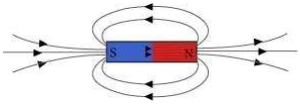
Draw the magnetic field lines around a bar magnet.
Solution
The magnetic field lines of a bar magnet represent the region of influence around the magnet.
$1$. Outside the magnet,the magnetic field lines emerge from the North pole $(N)$ and terminate at the South pole $(S)$.
$2$. Inside the magnet,the field lines move from the South pole $(S)$ to the North pole $(N)$,forming continuous closed loops.
$3$. The density of field lines is higher near the poles,indicating a stronger magnetic field in those regions.
$1$. Outside the magnet,the magnetic field lines emerge from the North pole $(N)$ and terminate at the South pole $(S)$.
$2$. Inside the magnet,the field lines move from the South pole $(S)$ to the North pole $(N)$,forming continuous closed loops.
$3$. The density of field lines is higher near the poles,indicating a stronger magnetic field in those regions.
0 likes
View Solution3
Medium
List the properties of magnetic field lines.
Solution
(N/A) The properties of magnetic field lines are as follows:
$(a)$ Magnetic field lines emerge from the north pole and merge at the south pole outside the magnet.
$(b)$ The direction of magnetic field lines inside the magnet is from the south pole to the north pole.
$(c)$ Magnetic field lines are closed continuous curves.
$(d)$ No two magnetic field lines can intersect each other because if they did,there would be two directions of the magnetic field at the point of intersection,which is impossible.
$(e)$ The relative strength of the magnetic field is shown by the degree of closeness of the field lines.
$(a)$ Magnetic field lines emerge from the north pole and merge at the south pole outside the magnet.
$(b)$ The direction of magnetic field lines inside the magnet is from the south pole to the north pole.
$(c)$ Magnetic field lines are closed continuous curves.
$(d)$ No two magnetic field lines can intersect each other because if they did,there would be two directions of the magnetic field at the point of intersection,which is impossible.
$(e)$ The relative strength of the magnetic field is shown by the degree of closeness of the field lines.
0 likes
View Solution4
Easy
Why do not two magnetic field lines intersect each other?
Solution
(N/A) If two magnetic field lines of a magnet were to intersect,it would imply that at the point of intersection,the magnetic field has two different directions simultaneously.
This would mean that a compass needle placed at that point would point in two different directions at the same time,which is physically impossible.
Therefore,magnetic field lines never intersect each other.
This would mean that a compass needle placed at that point would point in two different directions at the same time,which is physically impossible.
Therefore,magnetic field lines never intersect each other.
0 likes
View Solution5
Medium
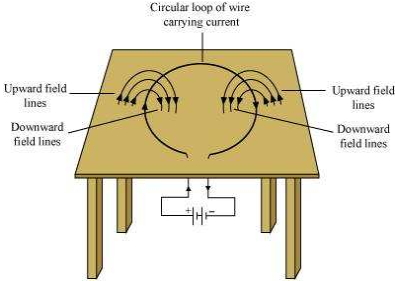
Consider a circular loop of wire lying in the plane of the table. Let the current pass through the loop clockwise. Apply the right-hand rule to find out the direction of the magnetic field inside and outside the loop.
Solution
(N/A) According to the right-hand thumb rule,if you curl the fingers of your right hand in the direction of the current (clockwise),your thumb points in the direction of the magnetic field inside the loop.
Inside the loop: The magnetic field lines point into the table (downward).
Outside the loop: The magnetic field lines emerge out of the table (upward).
This is consistent with the behavior of a magnetic dipole where field lines enter the loop from one side and emerge from the other.
Inside the loop: The magnetic field lines point into the table (downward).
Outside the loop: The magnetic field lines emerge out of the table (upward).
This is consistent with the behavior of a magnetic dipole where field lines enter the loop from one side and emerge from the other.
0 likes
View Solution6
Medium
The magnetic field in a given region is uniform. Draw a diagram to represent it.
Solution
(N/A) uniform magnetic field is represented by drawing a set of parallel,equidistant straight lines.
These lines indicate that the magnitude and direction of the magnetic field are the same at all points in the given region.
To represent this,draw a series of parallel lines pointing in the same direction (e.g.,from left to right).
These lines indicate that the magnitude and direction of the magnetic field are the same at all points in the given region.
To represent this,draw a series of parallel lines pointing in the same direction (e.g.,from left to right).
0 likes
View Solution7
MediumMCQ
Choose the correct option.
The magnetic field inside a long straight solenoid carrying current
The magnetic field inside a long straight solenoid carrying current
A
is zero
B
decreases as we move towards its end
C
is the same at all points
D
increases as we move towards its end
Solution
(C) The magnetic field inside a long,straight,current-carrying solenoid is uniform.
This means that the magnetic field strength and direction are constant at all points inside the solenoid.
Therefore,the magnetic field is the same at all points inside the solenoid.
This means that the magnetic field strength and direction are constant at all points inside the solenoid.
Therefore,the magnetic field is the same at all points inside the solenoid.
0 likes
View Solution8
MediumMCQ
Which of the following properties of a proton can change while it moves freely in a magnetic field?
A
mass
B
speed
C
velocity
D
velocity and momentum
Solution
(D) When a proton moves in a magnetic field,it experiences a magnetic force given by $F = q(v \times B)$.
This force acts perpendicular to the direction of motion,which causes the proton to follow a circular path.
Since the direction of motion changes continuously in a circular path,the velocity of the proton changes.
Because momentum is defined as $p = mv$ and velocity changes,the momentum also changes.
However,the speed (magnitude of velocity) and mass remain constant because the magnetic force does no work on the particle.
This force acts perpendicular to the direction of motion,which causes the proton to follow a circular path.
Since the direction of motion changes continuously in a circular path,the velocity of the proton changes.
Because momentum is defined as $p = mv$ and velocity changes,the momentum also changes.
However,the speed (magnitude of velocity) and mass remain constant because the magnetic force does no work on the particle.
0 likes
View Solution9
Medium
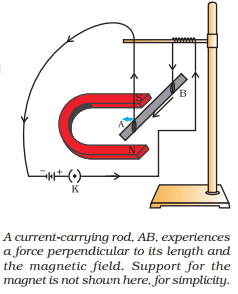
In the activity,how do we think the displacement of rod $AB$ will be affected if:
$(i)$ current in rod $AB$ is increased;
$(ii)$ a stronger horse-shoe magnet is used; and
$(iii)$ length of the rod $AB$ is increased?
$(i)$ current in rod $AB$ is increased;
$(ii)$ a stronger horse-shoe magnet is used; and
$(iii)$ length of the rod $AB$ is increased?
Solution
(N/A) current-carrying conductor placed in a magnetic field experiences a magnetic force. The magnitude of this force is given by $F = BIl \sin \theta$,where $B$ is the magnetic field strength,$I$ is the current,and $l$ is the length of the conductor.
$(i)$ If the current $(I)$ in rod $AB$ is increased,the magnetic force $F$ increases,leading to a greater displacement of the rod.
$(ii)$ If a stronger horse-shoe magnet is used,the magnetic field strength $(B)$ increases,which increases the magnetic force $F$,resulting in a greater displacement of the rod.
$(iii)$ If the length $(l)$ of the rod $AB$ is increased,the magnetic force $F$ increases,which also leads to a greater displacement of the rod.
$(i)$ If the current $(I)$ in rod $AB$ is increased,the magnetic force $F$ increases,leading to a greater displacement of the rod.
$(ii)$ If a stronger horse-shoe magnet is used,the magnetic field strength $(B)$ increases,which increases the magnetic force $F$,resulting in a greater displacement of the rod.
$(iii)$ If the length $(l)$ of the rod $AB$ is increased,the magnetic force $F$ increases,which also leads to a greater displacement of the rod.
0 likes
View Solution10
MediumMCQ
$A$ positively-charged particle (alpha-particle) projected towards west is deflected towards north by a magnetic field. The direction of magnetic field is
A
towards east
B
upward
C
downward
D
towards south
Solution
(B) The direction of the magnetic field can be determined by the $Fleming's$ left-hand rule.
According to this rule,if we arrange the thumb,the middle finger,and the forefinger of the left hand at right angles to each other,then the thumb points towards the direction of the magnetic force,the middle finger gives the direction of current,and the forefinger points in the direction of the magnetic field.
Since the direction of the positively charged alpha particle is towards the west,the direction of the current will be the same,i.e.,towards the west.
The direction of the magnetic force (deflection) is towards the north.
Applying $Fleming's$ left-hand rule: point the middle finger towards the west and the thumb towards the north; the forefinger will point in the upward direction.
Therefore,the direction of the magnetic field is upward.
According to this rule,if we arrange the thumb,the middle finger,and the forefinger of the left hand at right angles to each other,then the thumb points towards the direction of the magnetic force,the middle finger gives the direction of current,and the forefinger points in the direction of the magnetic field.
Since the direction of the positively charged alpha particle is towards the west,the direction of the current will be the same,i.e.,towards the west.
The direction of the magnetic force (deflection) is towards the north.
Applying $Fleming's$ left-hand rule: point the middle finger towards the west and the thumb towards the north; the forefinger will point in the upward direction.
Therefore,the direction of the magnetic field is upward.
0 likes
View Solution11
Medium
State Fleming's left-hand rule.
Solution
(N/A) Fleming's left-hand rule states that if we stretch the thumb,the forefinger,and the middle finger of the left hand such that they are mutually perpendicular to each other,then:
$1$. The forefinger points in the direction of the magnetic field.
$2$. The middle finger points in the direction of the current.
$3$. The thumb points in the direction of the force or motion experienced by the conductor.
$1$. The forefinger points in the direction of the magnetic field.
$2$. The middle finger points in the direction of the current.
$3$. The thumb points in the direction of the force or motion experienced by the conductor.
0 likes
View Solution12
MediumMCQ
What is the principle of an electric motor?
A
Magnetic effect of current
B
Electromagnetic induction
C
Heating effect of current
D
Chemical effect of current
Solution
(A) The working principle of an electric motor is based on the magnetic effect of current.
When a current-carrying coil is placed in a magnetic field,it experiences a mechanical force that causes it to rotate.
This phenomenon is described by the magnetic effect of electric current.
The direction of the force (and thus the rotation) is determined by Fleming's left-hand rule.
When a current-carrying coil is placed in a magnetic field,it experiences a mechanical force that causes it to rotate.
This phenomenon is described by the magnetic effect of electric current.
The direction of the force (and thus the rotation) is determined by Fleming's left-hand rule.
0 likes
View Solution13
MediumMCQ
What is the role of the split ring in an electric motor?
A
To increase the speed of the motor
B
To act as a commutator
C
To provide a magnetic field
D
To supply electricity to the coil
Solution
(B) The split ring in an electric motor acts as a commutator.
It reverses the direction of the current flowing through the coil after every half rotation.
Due to this reversal of the current,the force acting on the coil remains in the same direction,allowing the coil to continue rotating in the same direction.
It reverses the direction of the current flowing through the coil after every half rotation.
Due to this reversal of the current,the force acting on the coil remains in the same direction,allowing the coil to continue rotating in the same direction.
0 likes
View Solution14
Medium
Explain different ways to induce current in a coil.
Solution
(N/A) The different ways to induce an electric current in a coil are based on the principle of electromagnetic induction:
$(a)$ Moving a coil rapidly between the two poles of a horse-shoe magnet: When the magnetic flux linked with the coil changes due to its motion in a magnetic field,an induced current is generated in the coil.
$(b)$ Moving a magnet relative to a stationary coil: When a magnet is moved towards or away from a coil,the magnetic field lines passing through the coil change,which induces an electric current in the coil.
$(c)$ Changing the current in a nearby coil: If a second coil carrying a varying current is placed near the first coil,the changing magnetic field produced by the second coil induces a current in the first coil (mutual induction).
$(a)$ Moving a coil rapidly between the two poles of a horse-shoe magnet: When the magnetic flux linked with the coil changes due to its motion in a magnetic field,an induced current is generated in the coil.
$(b)$ Moving a magnet relative to a stationary coil: When a magnet is moved towards or away from a coil,the magnetic field lines passing through the coil change,which induces an electric current in the coil.
$(c)$ Changing the current in a nearby coil: If a second coil carrying a varying current is placed near the first coil,the changing magnetic field produced by the second coil induces a current in the first coil (mutual induction).
0 likes
View Solution15
Easy
State the principle of an electric generator.
Solution
(N/A) An electric generator works on the principle of electromagnetic induction.
It converts mechanical energy into electrical energy by rotating a coil within a magnetic field,which induces an electric current in the coil.
It converts mechanical energy into electrical energy by rotating a coil within a magnetic field,which induces an electric current in the coil.
0 likes
View Solution16
Easy
Name some sources of direct current.
Solution
(N/A) Some common sources of direct current $(DC)$ include:
$1$. Electric cells (or batteries).
$2$. $DC$ generators.
$3$. Photovoltaic cells (solar cells).
$1$. Electric cells (or batteries).
$2$. $DC$ generators.
$3$. Photovoltaic cells (solar cells).
0 likes
View Solution17
EasyMCQ
Which sources produce alternating current?
A
Dry cell
B
Car battery
C
$AC$ generator
D
Button cell
Solution
(C) An alternating current $(AC)$ is a type of electrical current that periodically reverses its direction and changes its magnitude continuously with time.
$AC$ generators (alternators) are the primary sources that produce alternating current by rotating a coil within a magnetic field.
Power plants,such as hydroelectric,thermal,and nuclear power stations,also generate $AC$ electricity for distribution to homes and industries.
$AC$ generators (alternators) are the primary sources that produce alternating current by rotating a coil within a magnetic field.
Power plants,such as hydroelectric,thermal,and nuclear power stations,also generate $AC$ electricity for distribution to homes and industries.
0 likes
View Solution18
EasyMCQ
Choose the correct option.
$A$ rectangular coil of copper wires is rotated in a magnetic field. The direction of the induced current changes once in each
$A$ rectangular coil of copper wires is rotated in a magnetic field. The direction of the induced current changes once in each
A
two revolutions
B
half revolution
C
one revolution
D
one-fourth revolution
Solution
(B) When a rectangular coil of copper is rotated in a magnetic field,the magnetic flux linked with the coil changes continuously.
According to Faraday's law of electromagnetic induction,this change in flux induces an electromotive force $(EMF)$ and consequently an induced current in the coil.
As the coil rotates,the side of the coil that was moving upwards starts moving downwards after completing a half revolution.
Due to this change in the direction of motion relative to the magnetic field lines,the direction of the induced current reverses after every half revolution.
Therefore,the direction of the induced current changes once in each half revolution.
According to Faraday's law of electromagnetic induction,this change in flux induces an electromotive force $(EMF)$ and consequently an induced current in the coil.
As the coil rotates,the side of the coil that was moving upwards starts moving downwards after completing a half revolution.
Due to this change in the direction of motion relative to the magnetic field lines,the direction of the induced current reverses after every half revolution.
Therefore,the direction of the induced current changes once in each half revolution.
0 likes
View Solution19
Medium
Name two safety measures commonly used in electric circuits and appliances.
Solution
(N/A) Two safety measures commonly used in electric circuits and appliances are as follows:
$(i)$ Electric Fuse: Each circuit must be connected with an electric fuse. This prevents the flow of excessive current through the circuit. When the current passing through the wire exceeds the maximum limit of the fuse element, the fuse melts to stop the flow of current, thereby protecting the appliances.
$(ii)$ Earthing: Earthing is essential to prevent electric shocks. Any leakage of current in an electric appliance is transferred to the ground, ensuring that people using the appliance do not receive a shock.
$(i)$ Electric Fuse: Each circuit must be connected with an electric fuse. This prevents the flow of excessive current through the circuit. When the current passing through the wire exceeds the maximum limit of the fuse element, the fuse melts to stop the flow of current, thereby protecting the appliances.
$(ii)$ Earthing: Earthing is essential to prevent electric shocks. Any leakage of current in an electric appliance is transferred to the ground, ensuring that people using the appliance do not receive a shock.
0 likes
View Solution20
Medium
An electric oven of $2\, kW$ power rating is operated in a domestic electric circuit $(220\, V)$ that has a current rating of $5\, A$. What result do you expect? Explain.
Solution
(D) The current drawn by the electric oven can be calculated using the formula:
$P = VI$
$I = \frac{P}{V}$
Where:
$P = 2\, kW = 2000\, W$
$V = 220\, V$
$I = \frac{2000}{220} = 9.09\, A$
Since the current drawn by the oven $(9.09\, A)$ is greater than the current rating of the circuit $(5\, A)$,the circuit will experience an overload.
As a result,the fuse wire will melt due to excessive heating,and the circuit will break,preventing any damage to the appliances.
$P = VI$
$I = \frac{P}{V}$
Where:
$P = 2\, kW = 2000\, W$
$V = 220\, V$
$I = \frac{2000}{220} = 9.09\, A$
Since the current drawn by the oven $(9.09\, A)$ is greater than the current rating of the circuit $(5\, A)$,the circuit will experience an overload.
As a result,the fuse wire will melt due to excessive heating,and the circuit will break,preventing any damage to the appliances.
0 likes
View Solution21
MediumMCQ
What precaution should be taken to avoid the overloading of domestic electric circuits?
A
Connect many appliances to a single socket.
B
Use all high-power appliances simultaneously.
C
Avoid connecting too many appliances to a single socket.
D
Use faulty appliances in the circuit.
Solution
(C) The precautions that should be taken to avoid the overloading of domestic circuits are as follows:
$(a)$ Too many appliances should not be connected to a single socket.
$(b)$ Too many high-power appliances should not be used at the same time.
$(c)$ Faulty appliances should not be connected in the circuit.
$(d)$ $A$ proper fuse should be connected in the circuit to prevent damage during overloading.
$(a)$ Too many appliances should not be connected to a single socket.
$(b)$ Too many high-power appliances should not be used at the same time.
$(c)$ Faulty appliances should not be connected in the circuit.
$(d)$ $A$ proper fuse should be connected in the circuit to prevent damage during overloading.
0 likes
View Solution22
MediumMCQ
Which of the following correctly describes the magnetic field near a long straight wire?
A
The field consists of straight lines perpendicular to the wire
B
The field consists of concentric circles centred on the wire
C
The field consists of radial lines originating from the wire
D
The field consists of straight lines parallel to the wire
Solution
(B) The magnetic field lines,produced around a straight current-carrying conductor,are concentric circles.
Their centres lie on the wire.
Their centres lie on the wire.
0 likes
View Solution23
MediumMCQ
The phenomenon of electromagnetic induction is
A
the process of charging a body
B
the process of generating magnetic field due to a current passing through a coil
C
producing induced current in a coil due to relative motion between a magnet and the coil
D
the process of rotating a coil of an electric motor
Solution
(C) Electromagnetic induction is the phenomenon where an electric current is produced in a conductor or coil due to a changing magnetic field.
When there is relative motion between a magnet and a coil,the magnetic flux linked with the coil changes.
This change in magnetic flux induces an electromotive force $(EMF)$ and consequently an induced current in the coil.
Therefore,producing induced current in a coil due to relative motion between a magnet and the coil is the correct definition.
When there is relative motion between a magnet and a coil,the magnetic flux linked with the coil changes.
This change in magnetic flux induces an electromotive force $(EMF)$ and consequently an induced current in the coil.
Therefore,producing induced current in a coil due to relative motion between a magnet and the coil is the correct definition.
0 likes
View Solution24
EasyMCQ
The device used for producing electric current is called a
A
motor
B
ammeter
C
galvanometer
D
generator
Solution
(D) An electric generator is a device that converts mechanical energy into electrical energy. It works on the principle of electromagnetic induction to produce an electric current.
0 likes
View Solution25
MediumMCQ
The essential difference between an $AC$ generator and a $DC$ generator is that
A
$AC$ generator has slip rings while the $DC$ generator has a commutator.
B
$AC$ generator has an electromagnet while a $DC$ generator has a permanent magnet.
C
$DC$ generator will generate a higher voltage.
D
$AC$ generator will generate a higher voltage.
Solution
(A) An $AC$ generator uses two slip rings to maintain continuous contact with the rotating coil,allowing the current to reverse direction periodically.
In contrast,a $DC$ generator uses a split-ring commutator,which reverses the connection of the coil to the external circuit every half rotation,ensuring that the current flows in only one direction in the external circuit.
Therefore,the fundamental difference lies in the type of ring assembly used.
In contrast,a $DC$ generator uses a split-ring commutator,which reverses the connection of the coil to the external circuit every half rotation,ensuring that the current flows in only one direction in the external circuit.
Therefore,the fundamental difference lies in the type of ring assembly used.
0 likes
View Solution26
MediumMCQ
At the time of a short circuit,the current in the circuit:
A
reduces substantially
B
increases heavily
C
does not change
D
varies continuously
Solution
(B) When two naked wires of an electric circuit touch each other,the resistance of the circuit becomes very low,causing the amount of current flowing in the circuit to increase abruptly. This phenomenon is known as a short circuit.
0 likes
View Solution27
MediumMCQ
State whether the following statements are true $(T)$ or false $(F)$.
$(a)$ An electric motor converts mechanical energy into electrical energy.
$(b)$ An electric generator works on the principle of electromagnetic induction.
$(a)$ An electric motor converts mechanical energy into electrical energy.
$(b)$ An electric generator works on the principle of electromagnetic induction.
A
$(a)-(T); (b)-(F)$
B
$(a)-(F); (b)-(F)$
C
$(a)-(F); (b)-(T)$
D
$(a)-(T); (b)-(T)$
Solution
(C) False.
An electric motor is a device that converts electrical energy into mechanical energy.
$(b)$ True.
An electric generator is a device that converts mechanical energy into electrical energy. It works on the principle of electromagnetic induction,where a changing magnetic flux through a coil induces an electromotive force $(EMF)$.
An electric motor is a device that converts electrical energy into mechanical energy.
$(b)$ True.
An electric generator is a device that converts mechanical energy into electrical energy. It works on the principle of electromagnetic induction,where a changing magnetic flux through a coil induces an electromotive force $(EMF)$.
0 likes
View Solution28
MediumMCQ
State whether the following statements are true or false.
$(a)$ The magnetic field at the centre of a long circular coil carrying current consists of parallel straight lines.
$(b)$ $A$ wire with green insulation is usually the live wire of an electric supply.
$(a)$ The magnetic field at the centre of a long circular coil carrying current consists of parallel straight lines.
$(b)$ $A$ wire with green insulation is usually the live wire of an electric supply.
A
$(a)-(T); (b)-(T)$
B
$(a)-(F); (b)-(T)$
C
$(a)-(F); (b)-(F)$
D
$(a)-(T); (b)-(F)$
Solution
(D) True.
$A$ long circular coil acts as a long solenoid. The magnetic field lines inside a long solenoid are parallel straight lines,indicating a uniform magnetic field.
$(b)$ False.
In domestic electric circuits,the live wire typically has red insulation,whereas the earth wire has green insulation.
$A$ long circular coil acts as a long solenoid. The magnetic field lines inside a long solenoid are parallel straight lines,indicating a uniform magnetic field.
$(b)$ False.
In domestic electric circuits,the live wire typically has red insulation,whereas the earth wire has green insulation.
0 likes
View Solution29
Easy
List two methods of producing magnetic fields.
Solution
(N/A) Two methods of producing magnetic fields are as follows:
$(a)$ Using a current-carrying conductor: When an electric current flows through a conductor,it produces a magnetic field around it.
$(b)$ Using permanent magnets: Permanent magnets,such as bar magnets,naturally produce a magnetic field in the space around them.
$(a)$ Using a current-carrying conductor: When an electric current flows through a conductor,it produces a magnetic field around it.
$(b)$ Using permanent magnets: Permanent magnets,such as bar magnets,naturally produce a magnetic field in the space around them.
0 likes
View Solution30
Medium
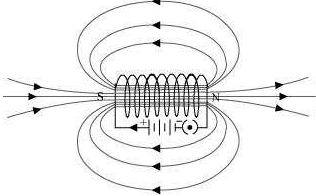
How does a solenoid behave like a magnet? Can you determine the north and south poles of a current-carrying solenoid with the help of a bar magnet? Explain.
Solution
(N/A) solenoid is a long coil of circular loops of insulated copper wire. When an electric current flows through it,it produces a magnetic field around it. The pattern of the magnetic field lines is similar to that of a bar magnet.
Yes,we can determine the north and south poles of a current-carrying solenoid using a bar magnet. If we bring the north pole of a bar magnet near one end of the solenoid,and the solenoid repels the magnet,then that end of the solenoid is acting as a north pole (since like poles repel). If the solenoid attracts the bar magnet,that end is acting as a south pole (since opposite poles attract). By observing the interaction (attraction or repulsion),we can identify the polarity of the solenoid's ends.
Yes,we can determine the north and south poles of a current-carrying solenoid using a bar magnet. If we bring the north pole of a bar magnet near one end of the solenoid,and the solenoid repels the magnet,then that end of the solenoid is acting as a north pole (since like poles repel). If the solenoid attracts the bar magnet,that end is acting as a south pole (since opposite poles attract). By observing the interaction (attraction or repulsion),we can identify the polarity of the solenoid's ends.
0 likes
View Solution31
EasyMCQ
When is the force experienced by a current-carrying conductor placed in a magnetic field largest?
A
When the current is parallel to the magnetic field.
B
When the current is perpendicular to the magnetic field.
C
When the current is at an angle of $45^{\circ}$ to the magnetic field.
D
When the current is at an angle of $60^{\circ}$ to the magnetic field.
Solution
(B) The force $F$ on a current-carrying conductor in a magnetic field is given by the formula $F = BIl \sin(\theta)$,where $B$ is the magnetic field strength,$I$ is the current,$l$ is the length of the conductor,and $\theta$ is the angle between the direction of the current and the magnetic field.
Since the maximum value of $\sin(\theta)$ is $1$ (which occurs when $\theta = 90^{\circ}$),the force is largest when the direction of the current is perpendicular to the direction of the magnetic field.
Since the maximum value of $\sin(\theta)$ is $1$ (which occurs when $\theta = 90^{\circ}$),the force is largest when the direction of the current is perpendicular to the direction of the magnetic field.
0 likes
View Solution32
Medium
Imagine that you are sitting in a chamber with your back to one wall. An electron beam,moving horizontally from the back wall towards the front wall,is deflected by a strong magnetic field to your right side. What is the direction of the magnetic field?
Solution
(DOWNWARD) The direction of the magnetic field is determined using Fleming's left-hand rule.
According to this rule,if the forefinger points in the direction of the magnetic field,the middle finger in the direction of the current,then the thumb points in the direction of the force (deflection).
$1$. The electron beam moves from the back wall to the front wall. Since electrons are negatively charged,the direction of the conventional current is from the front wall to the back wall.
$2$. The force (deflection) is directed towards your right side.
$3$. Applying Fleming's left-hand rule: Point your middle finger towards the back wall (direction of current) and your thumb towards your right (direction of force). Your forefinger will then point downwards.
Therefore,the direction of the magnetic field is downward.
According to this rule,if the forefinger points in the direction of the magnetic field,the middle finger in the direction of the current,then the thumb points in the direction of the force (deflection).
$1$. The electron beam moves from the back wall to the front wall. Since electrons are negatively charged,the direction of the conventional current is from the front wall to the back wall.
$2$. The force (deflection) is directed towards your right side.
$3$. Applying Fleming's left-hand rule: Point your middle finger towards the back wall (direction of current) and your thumb towards your right (direction of force). Your forefinger will then point downwards.
Therefore,the direction of the magnetic field is downward.
0 likes
View Solution33
Medium
Draw a labelled diagram of an electric motor. Explain its principle and working. What is the function of a split ring in an electric motor?
Solution
(N/A) An electric motor converts electrical energy into mechanical energy.
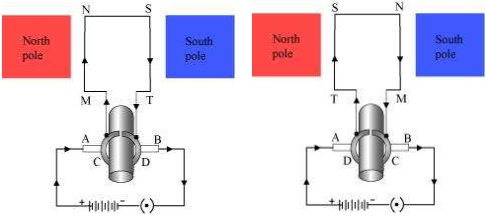
It works on the principle of the magnetic effect of current. $A$ current-carrying coil rotates in a magnetic field. The following figure shows a simple electric motor.
When a current is allowed to flow through the coil $MNST$ by closing the switch,the coil starts rotating anti-clockwise. This happens because a downward force acts on length $MN$ and at the same time,an upward force acts on length $ST$. As a result,the coil rotates anti-clockwise.
Current in the length $MN$ flows from $M$ to $N$ and the magnetic field acts from left to right,normal to length $MN$. Therefore,according to Fleming's left-hand rule,a downward force acts on the length $MN$. Similarly,current in the length $ST$ flows from $S$ to $T$ and the magnetic field acts from left to right,normal to the flow of current. Therefore,an upward force acts on the length $ST$. These two forces cause the coil to rotate anti-clockwise. After half a rotation,the position of $MN$ and $ST$ interchange. The half-ring $D$ comes in contact with brush $A$ and half-ring $C$ comes in contact with brush $B$. Hence,the direction of current in the coil $MNST$ gets reversed.
The current flows through the coil in the direction $TSNM$. The reversal of current through the coil $MNST$ repeats after each half rotation. As a result,the coil rotates unidirectionally. The split rings help to reverse the direction of current in the circuit. These are called the commutator.
It works on the principle of the magnetic effect of current. $A$ current-carrying coil rotates in a magnetic field. The following figure shows a simple electric motor.
When a current is allowed to flow through the coil $MNST$ by closing the switch,the coil starts rotating anti-clockwise. This happens because a downward force acts on length $MN$ and at the same time,an upward force acts on length $ST$. As a result,the coil rotates anti-clockwise.
Current in the length $MN$ flows from $M$ to $N$ and the magnetic field acts from left to right,normal to length $MN$. Therefore,according to Fleming's left-hand rule,a downward force acts on the length $MN$. Similarly,current in the length $ST$ flows from $S$ to $T$ and the magnetic field acts from left to right,normal to the flow of current. Therefore,an upward force acts on the length $ST$. These two forces cause the coil to rotate anti-clockwise. After half a rotation,the position of $MN$ and $ST$ interchange. The half-ring $D$ comes in contact with brush $A$ and half-ring $C$ comes in contact with brush $B$. Hence,the direction of current in the coil $MNST$ gets reversed.
The current flows through the coil in the direction $TSNM$. The reversal of current through the coil $MNST$ repeats after each half rotation. As a result,the coil rotates unidirectionally. The split rings help to reverse the direction of current in the circuit. These are called the commutator.
0 likes
View Solution34
Medium
Name some devices in which electric motors are used.
Solution
(N/A) Electric motors are devices that convert electrical energy into mechanical energy. Some common devices that use electric motors are as follows:
$(a)$ Water pumps
$(b)$ Electric fans
$(c)$ Electric mixers and grinders
$(d)$ Washing machines
$(e)$ Refrigerators
$(f)$ Electric drills
$(a)$ Water pumps
$(b)$ Electric fans
$(c)$ Electric mixers and grinders
$(d)$ Washing machines
$(e)$ Refrigerators
$(f)$ Electric drills
0 likes
View Solution35
MediumMCQ
$A$ coil of insulated copper wire is connected to a galvanometer. What will happen if a bar magnet is pushed into the coil?
A
The galvanometer needle will show a momentary deflection.
B
The galvanometer needle will show a constant deflection.
C
The galvanometer needle will not show any deflection.
D
The galvanometer will burn out.
Solution
(A) When a bar magnet is moved relative to a coil of insulated copper wire,the magnetic flux linked with the coil changes.
According to Faraday's law of electromagnetic induction,this change in magnetic flux induces an electromotive force $(EMF)$ and consequently an electric current in the coil.
When the bar magnet is pushed into the coil,the galvanometer needle deflects momentarily in a particular direction,indicating the presence of an induced current.
According to Faraday's law of electromagnetic induction,this change in magnetic flux induces an electromotive force $(EMF)$ and consequently an electric current in the coil.
When the bar magnet is pushed into the coil,the galvanometer needle deflects momentarily in a particular direction,indicating the presence of an induced current.
0 likes
View Solution36
MediumMCQ
$A$ coil of insulated copper wire is connected to a galvanometer. What will happen if a bar magnet is withdrawn from inside the coil?
A
The galvanometer needle will show a deflection in the same direction.
B
The galvanometer needle will show a deflection in the opposite direction.
C
The galvanometer needle will not show any deflection.
D
The galvanometer needle will show a continuous deflection.
Solution
(B) According to the principle of electromagnetic induction,a current is induced in a coil when there is a change in the magnetic flux linked with it.
When a bar magnet is moved relative to a coil,the magnetic field lines passing through the coil change,inducing an electric current.
When the bar magnet is withdrawn from inside the coil,the direction of the change in magnetic flux is reversed compared to when it was inserted.
Consequently,a current is induced in the opposite direction,causing the galvanometer needle to deflect momentarily in the opposite direction.
When a bar magnet is moved relative to a coil,the magnetic field lines passing through the coil change,inducing an electric current.
When the bar magnet is withdrawn from inside the coil,the direction of the change in magnetic flux is reversed compared to when it was inserted.
Consequently,a current is induced in the opposite direction,causing the galvanometer needle to deflect momentarily in the opposite direction.
0 likes
View Solution37
MediumMCQ
$A$ coil of insulated copper wire is connected to a galvanometer. What will happen if a bar magnet is held stationary inside the coil?
A
The galvanometer will show a constant deflection.
B
The galvanometer will show a momentary deflection.
C
The galvanometer will show no deflection.
D
The galvanometer will show a deflection that increases with time.
Solution
(C) According to the principle of electromagnetic induction,an electric current is induced in a coil only when there is a change in the magnetic flux linked with it.
When a bar magnet is moved relative to the coil,the magnetic flux changes,inducing a current.
However,when a bar magnet is held stationary inside the coil,the magnetic flux linked with the coil remains constant.
Since there is no change in magnetic flux,no current is induced in the coil.
Therefore,the galvanometer will show no deflection.
When a bar magnet is moved relative to the coil,the magnetic flux changes,inducing a current.
However,when a bar magnet is held stationary inside the coil,the magnetic flux linked with the coil remains constant.
Since there is no change in magnetic flux,no current is induced in the coil.
Therefore,the galvanometer will show no deflection.
0 likes
View Solution38
Medium
Two circular coils $A$ and $B$ are placed close to each other. If the current in the coil $A$ is changed,will some current be induced in the coil $B$? Give reason.
.jpg)
Solution
(N/A) Yes,a current will be induced in coil $B$.
Reason: When the current in coil $A$ is changed,the magnetic field associated with it also changes.
Since coil $B$ is placed close to coil $A$,the magnetic field lines passing through coil $B$ also change.
This change in magnetic flux linked with coil $B$ induces an electric current in it,according to the principle of electromagnetic induction.
Reason: When the current in coil $A$ is changed,the magnetic field associated with it also changes.
Since coil $B$ is placed close to coil $A$,the magnetic field lines passing through coil $B$ also change.
This change in magnetic flux linked with coil $B$ induces an electric current in it,according to the principle of electromagnetic induction.
0 likes
View Solution39
MediumMCQ
State the rule to determine the direction of: $(i)$ a magnetic field produced around a straight current-carrying conductor,$(ii)$ force experienced by a current-carrying straight conductor placed in a magnetic field perpendicular to it,and $(iii)$ current induced in a coil due to its rotation in a magnetic field.
A
Maxwell's right-hand thumb rule,Fleming's left-hand rule,Fleming's right-hand rule
B
Fleming's right-hand rule,Fleming's left-hand rule,Maxwell's right-hand thumb rule
C
Right-hand thumb rule,Right-hand rule,Left-hand rule
D
None of the above
Solution
(A) $(i)$ Maxwell's right-hand thumb rule: If you hold a current-carrying conductor in your right hand such that your thumb points in the direction of the current,then your fingers will wrap around the conductor in the direction of the magnetic field lines.
$(ii)$ Fleming's left-hand rule: Stretch the thumb,forefinger,and middle finger of your left hand such that they are mutually perpendicular. If the forefinger points in the direction of the magnetic field,the middle finger in the direction of the current,then the thumb will point in the direction of the force experienced by the conductor.
$(iii)$ Fleming's right-hand rule: Stretch the thumb,forefinger,and middle finger of your right hand such that they are mutually perpendicular. If the forefinger points in the direction of the magnetic field and the thumb in the direction of the motion of the conductor,then the middle finger will point in the direction of the induced current.
$(ii)$ Fleming's left-hand rule: Stretch the thumb,forefinger,and middle finger of your left hand such that they are mutually perpendicular. If the forefinger points in the direction of the magnetic field,the middle finger in the direction of the current,then the thumb will point in the direction of the force experienced by the conductor.
$(iii)$ Fleming's right-hand rule: Stretch the thumb,forefinger,and middle finger of your right hand such that they are mutually perpendicular. If the forefinger points in the direction of the magnetic field and the thumb in the direction of the motion of the conductor,then the middle finger will point in the direction of the induced current.
0 likes
View Solution40
Difficult
Explain the underlying principle and working of an electric generator by drawing a labelled diagram. What is the function of brushes?
Solution
(N/A) An electric generator converts mechanical energy into electrical energy.
The principle of working of an electric generator is based on electromagnetic induction. When a coil is rotated in a magnetic field,the magnetic flux linked with it changes,which induces an electric current in the coil.
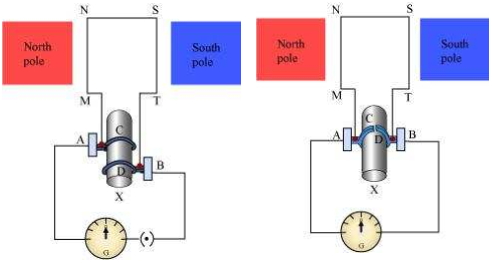
$MNST$ $\to$ Rectangular coil
$A$ and $B$ $\to$ Brushes
$C$ and $D$ $\to$ Two slip rings
$X$ $\to$ Axle,$G$ $\to$ Galvanometer
Working: When the axle $X$ is rotated,the coil $MNST$ rotates in the magnetic field. According to Fleming's right-hand rule,an induced current flows in the direction $MNST$ during the first half rotation. After half a rotation,the direction of the current reverses to $TSNM$. This periodic reversal results in an alternating current $(AC)$.
Function of brushes: Brushes ($A$ and $B$) are used to maintain contact with the rotating slip rings or split rings,allowing the induced current to flow from the rotating coil to the external circuit without tangling the wires.
The principle of working of an electric generator is based on electromagnetic induction. When a coil is rotated in a magnetic field,the magnetic flux linked with it changes,which induces an electric current in the coil.
$MNST$ $\to$ Rectangular coil
$A$ and $B$ $\to$ Brushes
$C$ and $D$ $\to$ Two slip rings
$X$ $\to$ Axle,$G$ $\to$ Galvanometer
Working: When the axle $X$ is rotated,the coil $MNST$ rotates in the magnetic field. According to Fleming's right-hand rule,an induced current flows in the direction $MNST$ during the first half rotation. After half a rotation,the direction of the current reverses to $TSNM$. This periodic reversal results in an alternating current $(AC)$.
Function of brushes: Brushes ($A$ and $B$) are used to maintain contact with the rotating slip rings or split rings,allowing the induced current to flow from the rotating coil to the external circuit without tangling the wires.
0 likes
View Solution41
MediumMCQ
When does an electric short circuit occur?
A
When the resistance of the circuit becomes very high.
B
When the live wire and the neutral wire come into direct contact.
C
When the current in the circuit is reduced.
D
When the voltage in the circuit is zero.
Solution
(B) An electric short circuit occurs when the resistance of an electric circuit becomes very low,leading to a sudden,extremely high flow of current.
This typically happens when the insulation of the $live$ wire and the $neutral$ wire is damaged due to wear and tear,causing them to come into direct contact with each other.
Additionally,connecting too many high-power appliances to a single socket can also lead to overloading,which may result in a short circuit.
This typically happens when the insulation of the $live$ wire and the $neutral$ wire is damaged due to wear and tear,causing them to come into direct contact with each other.
Additionally,connecting too many high-power appliances to a single socket can also lead to overloading,which may result in a short circuit.
0 likes
View Solution42
Medium
What is the function of an earth wire? Why is it necessary to earth metallic appliances?
Solution
(N/A) The function of an earth wire is to provide a low-resistance path for electric current to flow into the ground in case of any leakage or short circuit.
It is necessary to earth metallic appliances because if there is any leakage of current,the metallic body of the appliance becomes live.
If a person touches such an appliance,the current will pass through their body to the ground,causing a severe electric shock.
By connecting the metallic body to the earth wire,the leakage current is safely transferred to the ground,thereby protecting the user from electric shocks.
It is necessary to earth metallic appliances because if there is any leakage of current,the metallic body of the appliance becomes live.
If a person touches such an appliance,the current will pass through their body to the ground,causing a severe electric shock.
By connecting the metallic body to the earth wire,the leakage current is safely transferred to the ground,thereby protecting the user from electric shocks.
0 likes
View SolutionMagnetic Effects of Electric Current — Textbook - Magnetic Effects of Electric Current · Frequently Asked Questions
1Are these Magnetic Effects of Electric Current questions useful for JEE and NEET?
Yes. All questions in this section are mapped to JEE Main and NEET exam patterns. Previous year questions from JEE Main, NEET, GUJCET and state-level exams are included with full solutions.
2Can I switch to Hindi or Gujarati for these questions?
Yes. Use the language tabs in the hero section or the sidebar to view the same questions and solutions in English, Hindi or Gujarati.
3How do I generate a question paper from this subtopic?
Use the Vedclass Exam Paper Generator — select the chapter and subtopic, set difficulty, and generate Sets A, B, C, D automatically. First 3 chapters of every subject are free.
Vedclass Products
For Students
Vedclass Test Series
Mock tests in real JEE/NEET style with performance analysis. 5-day free trial.
Start Free TrialFor Teachers
Exam Paper Generator
Generate Set A/B/C/D papers from this chapter in 2 minutes. 3 chapters free.
Try FreeFor Institutes
Online Exam Module
Live online exams with unlimited students, 360° analytics & white-label branding.
See DemoFor Teachers & Institutes
Generate a Magnetic Effects of Electric Current Exam Paper in 2 Minutes
Select subtopic & difficulty — Sets A, B, C, D auto-generated with No Repeat logic.
First 3 chapters of every subject are free — no payment required.