
A English
Mix Examples - Magnetic Effects of Electric Current Questions in English
Class 10 Science · Magnetic Effects of Electric Current · Mix Examples - Magnetic Effects of Electric Current
332+
Questions
English
Language
100%
With Solutions
Showing 50 of 332 questions in English
51
EasyMCQ
What is meant by electromagnetic induction?
A
The process of generating a magnetic field using an electric current.
B
The phenomenon of producing an induced electric current in a conductor due to a changing magnetic field.
C
The conversion of electrical energy into mechanical energy in a motor.
D
The heating effect produced by an electric current flowing through a resistor.
Solution
(B) Electromagnetic induction is the phenomenon where an electromotive force $(EMF)$ or electric current is induced in a conductor when it is exposed to a changing magnetic field.
This principle was discovered by Michael Faraday.
It occurs when there is relative motion between a conductor and a magnetic field,or when the magnetic flux linked with a stationary conductor changes over time.
This principle was discovered by Michael Faraday.
It occurs when there is relative motion between a conductor and a magnetic field,or when the magnetic flux linked with a stationary conductor changes over time.
0 likes
View Solution52
Easy
State Faraday's first law of electromagnetic induction.
Solution
(N/A) Faraday's first law of electromagnetic induction states that whenever the magnetic flux linked with a closed circuit or coil changes,an induced electromotive force $(emf)$ is produced in the circuit.
This induced $emf$ persists only as long as the change in magnetic flux continues.
This induced $emf$ persists only as long as the change in magnetic flux continues.
0 likes
View Solution53
Easy
State Faraday's second law of electromagnetic induction.
Solution
(N/A) Faraday's second law of electromagnetic induction states that the magnitude of the induced electromotive force $(emf)$ in a circuit is directly proportional to the rate of change of magnetic flux linked with the circuit.
Mathematically,it is expressed as $\varepsilon = -\frac{d\Phi_B}{dt}$,where $\varepsilon$ is the induced $emf$ and $\frac{d\Phi_B}{dt}$ is the rate of change of magnetic flux.
Mathematically,it is expressed as $\varepsilon = -\frac{d\Phi_B}{dt}$,where $\varepsilon$ is the induced $emf$ and $\frac{d\Phi_B}{dt}$ is the rate of change of magnetic flux.
0 likes
View Solution54
EasyMCQ
State the rule which you use to find the direction of induced current or state Fleming's right-hand rule.
A
Fleming's Left-Hand Rule
B
Fleming's Right-Hand Rule
C
Right-Hand Thumb Rule
D
Maxwell's Corkscrew Rule
Solution
(B) Fleming's right-hand rule states that if you stretch the thumb,forefinger,and middle finger of your right hand such that they are mutually perpendicular to each other,then the thumb points in the direction of the motion of the conductor relative to the magnetic field,the forefinger points in the direction of the magnetic field,and the middle finger points in the direction of the induced current.
0 likes
View Solution55
Easy
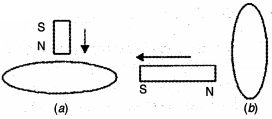
Give the direction of induced current in the following figure:
Solution
(N/A) According to Lenz's Law,the induced current will oppose the motion of the magnet. As the North pole $(N)$ of the magnet moves towards the coil,the coil will develop a North pole on its upper face to repel it. Therefore,the direction of the induced current,as seen from the top,will be anticlockwise.
$(b)$ As the North pole $(N)$ of the magnet moves towards the coil,the face of the coil facing the magnet will act as a North pole to oppose the motion. Looking from the right-hand side (where the magnet is approaching),the current will appear to flow in a clockwise direction.
$(b)$ As the North pole $(N)$ of the magnet moves towards the coil,the face of the coil facing the magnet will act as a North pole to oppose the motion. Looking from the right-hand side (where the magnet is approaching),the current will appear to flow in a clockwise direction.
0 likes
View Solution56
EasyMCQ
How is alternating current $(AC)$ different from direct current $(DC)$?
A
Alternating current flows in one direction,while direct current changes direction.
B
Alternating current changes its magnitude and direction periodically,while direct current maintains a constant magnitude and direction.
C
Direct current is used in household appliances,while alternating current is used in batteries.
D
There is no difference between alternating current and direct current.
Solution
(B) Alternating current $(AC)$ is defined as the current that changes its magnitude continuously and reverses its direction periodically over time.
In contrast,direct current $(DC)$ is the current that flows in a single constant direction and maintains a constant magnitude over time.
Therefore,the fundamental difference lies in the periodic reversal of direction and variation in magnitude characteristic of $AC$ compared to the steady nature of $DC$.
In contrast,direct current $(DC)$ is the current that flows in a single constant direction and maintains a constant magnitude over time.
Therefore,the fundamental difference lies in the periodic reversal of direction and variation in magnitude characteristic of $AC$ compared to the steady nature of $DC$.
0 likes
View Solution57
Easy
Name three colours used and names of the wires used in household wiring.
Solution
(N/A) In household electrical wiring,three types of wires are used based on their function:
$1$. Live wire: It is used to carry current from the source. According to the old convention,it is red in colour,and according to the new international convention,it is brown.
$2$. Neutral wire: It provides a return path for the current. According to the old convention,it is black in colour,and according to the new international convention,it is blue.
$3$. Earth wire: It is used for safety purposes to prevent electric shocks. It is green or yellow-green in colour.
$1$. Live wire: It is used to carry current from the source. According to the old convention,it is red in colour,and according to the new international convention,it is brown.
$2$. Neutral wire: It provides a return path for the current. According to the old convention,it is black in colour,and according to the new international convention,it is blue.
$3$. Earth wire: It is used for safety purposes to prevent electric shocks. It is green or yellow-green in colour.
0 likes
View Solution58
EasyMCQ
Name two types of wiring systems adopted for domestic wiring.
A
Tree system and Ring system
B
Series system and Parallel system
C
Single-phase system and Three-phase system
D
Direct system and Indirect system
Solution
(A) The two common types of wiring systems used for domestic purposes are the $Tree$ $system$ and the $Ring$ $system$.
In the $Tree$ $system$,the main supply is divided into several sub-circuits,which further branch out like a tree.
In the $Ring$ $system$,a ring circuit is formed where the supply cable starts from the distribution board,goes through all the points,and returns to the distribution board,allowing for multiple outlets to be connected to the same circuit.
In the $Tree$ $system$,the main supply is divided into several sub-circuits,which further branch out like a tree.
In the $Ring$ $system$,a ring circuit is formed where the supply cable starts from the distribution board,goes through all the points,and returns to the distribution board,allowing for multiple outlets to be connected to the same circuit.
0 likes
View Solution59
EasyMCQ
Why is earthing important for electrical appliances?
A
To increase the efficiency of the appliance.
B
To prevent electric shocks and protect the device from excessive current.
C
To reduce the electricity bill.
D
To improve the aesthetic appearance of the appliance.
Solution
(B) Earthing is a safety measure used to protect users from electric shocks.
If there is a fault in the appliance,such as a short circuit or insulation failure,the metal casing might become live.
Earthing provides a low-resistance path for the leakage current to flow directly into the ground,which triggers the circuit breaker or fuse to cut off the power supply.
This prevents the person operating the device from receiving a dangerous shock and protects the appliance from damage due to excessive current.
If there is a fault in the appliance,such as a short circuit or insulation failure,the metal casing might become live.
Earthing provides a low-resistance path for the leakage current to flow directly into the ground,which triggers the circuit breaker or fuse to cut off the power supply.
This prevents the person operating the device from receiving a dangerous shock and protects the appliance from damage due to excessive current.
0 likes
View Solution60
EasyMCQ
What colour wire is used for earthing or grounding?
A
Red
B
Black
C
Green or yellow
D
Blue
Solution
(C) In an electric circuit,the earthing or grounding wire is used to protect users from electric shocks.
According to the international colour code convention,the earthing wire is typically green or yellow in colour.
According to the international colour code convention,the earthing wire is typically green or yellow in colour.
0 likes
View Solution61
EasyMCQ
How can it be shown that a magnetic field exists around a wire through which a direct current is passing?
A
By using a voltmeter
B
By using a compass needle
C
By using an ammeter
D
By using a galvanometer
Solution
(B) To demonstrate the existence of a magnetic field around a current-carrying wire,we place a magnetic compass needle near the wire.
Since a magnetic compass needle is itself a small magnet,it experiences a force when placed in a magnetic field.
When the current flows through the wire,the needle shows a deflection,which confirms the presence of a magnetic field around the conductor.
Since a magnetic compass needle is itself a small magnet,it experiences a force when placed in a magnetic field.
When the current flows through the wire,the needle shows a deflection,which confirms the presence of a magnetic field around the conductor.
0 likes
View Solution62
EasyMCQ
How is the strength of the magnetic field at a point near a wire related to the strength of the electric current flowing in the wire?
A
It is inversely proportional to the current.
B
It is directly proportional to the current.
C
It is independent of the current.
D
It is proportional to the square of the current.
Solution
(B) The strength $(B)$ of the magnetic field at a point near a current-carrying wire is directly proportional to the strength $(I)$ of the electric current flowing through the wire.
Mathematically,this is expressed as $B \propto I$.
This means that as the magnitude of the electric current increases,the strength of the magnetic field produced around the wire also increases.
Mathematically,this is expressed as $B \propto I$.
This means that as the magnitude of the electric current increases,the strength of the magnetic field produced around the wire also increases.
0 likes
View Solution63
EasyMCQ
An alternating electric current has a frequency of $50 \ Hz$. How many times does it change its direction in one second (in $times$)?
A
$50$
B
$100$
C
$25$
D
$200$
Solution
(B) An alternating current $(AC)$ completes one full cycle by changing its direction twice.
Given that the frequency of the current is $50 \ Hz$, it means the current completes $50$ cycles in $1 \ second$.
Since the current changes its direction twice in every cycle, the total number of times it changes its direction in $1 \ second$ is $50 \times 2 = 100$ times.
Given that the frequency of the current is $50 \ Hz$, it means the current completes $50$ cycles in $1 \ second$.
Since the current changes its direction twice in every cycle, the total number of times it changes its direction in $1 \ second$ is $50 \times 2 = 100$ times.
0 likes
View Solution64
EasyMCQ
What will be the frequency of an alternating current if its direction changes after every $0.01\,s$ (in $,Hz$)?
A
$25$
B
$50$
C
$100$
D
$200$
Solution
(B) An alternating current $(AC)$ changes its direction twice in one complete cycle.
Given that the direction changes every $0.01\,s$,the time taken to complete one full cycle $(T)$ is $2 \times 0.01\,s = 0.02\,s$.
The frequency $(f)$ is the reciprocal of the time period $(T)$,given by $f = 1/T$.
Therefore,$f = 1 / 0.02 = 100 / 2 = 50\,Hz$.
Given that the direction changes every $0.01\,s$,the time taken to complete one full cycle $(T)$ is $2 \times 0.01\,s = 0.02\,s$.
The frequency $(f)$ is the reciprocal of the time period $(T)$,given by $f = 1/T$.
Therefore,$f = 1 / 0.02 = 100 / 2 = 50\,Hz$.
0 likes
View Solution65
EasyMCQ
What is short-circuiting in an electric supply?
A
$A$ condition where the current flows through the earth wire.
B
$A$ condition where the live wire comes in direct contact with the neutral wire.
C
$A$ condition where the voltage exceeds the limit.
D
$A$ condition where the appliance is switched off.
Solution
(B) Short-circuiting in an electric circuit is a condition that occurs when the live wire comes into direct contact with the neutral wire.
This results in a very low resistance path for the current,causing a massive surge of current to flow through the circuit.
This sudden increase in current can lead to overheating,sparking,and potentially a fire.
This results in a very low resistance path for the current,causing a massive surge of current to flow through the circuit.
This sudden increase in current can lead to overheating,sparking,and potentially a fire.
0 likes
View Solution66
EasyMCQ
What constitutes the field of a magnet?
A
The area where the magnet is kept.
B
The space around a magnet within which its magnetic effect can be experienced.
C
The total mass of the magnet.
D
The region inside the magnet where poles are located.
Solution
(B) The space or region surrounding a magnet within which the force of attraction or repulsion can be detected by other magnetic materials is known as the magnetic field of the magnet.
In this region,the magnetic influence of the magnet is exerted on other magnets or magnetic substances.
In this region,the magnetic influence of the magnet is exerted on other magnets or magnetic substances.
0 likes
View Solution67
EasyMCQ
What is the advantage of the third wire of earth connection in domestic appliances?
A
It prevents the appliance from overheating.
B
It provides a path for leakage current to flow to the ground,preventing electric shocks.
C
It increases the efficiency of the appliance.
D
It helps in reducing the electricity bill.
Solution
(B) In case of a defect in any domestic appliance,current may leak to its metallic body.
The third wire of the earth connection provides a low-resistance path that transfers this leakage current directly to the earth.
As a result of this,the user of the appliance is protected from a potentially fatal electric shock.
The third wire of the earth connection provides a low-resistance path that transfers this leakage current directly to the earth.
As a result of this,the user of the appliance is protected from a potentially fatal electric shock.
0 likes
View Solution68
EasyMCQ
How can you show that the magnetic field produced by a given electric current in a wire decreases as the distance from the wire increases?
A
By observing the deflection of a magnetic compass needle.
B
By measuring the temperature of the wire.
C
By checking the resistance of the wire.
D
By calculating the voltage across the wire.
Solution
(A) To demonstrate that the magnetic field decreases with distance,place a magnetic compass near a current-carrying wire.
Observe the deflection of the compass needle.
As you move the compass slowly away from the wire,the deflection of the needle decreases.
This reduction in deflection indicates that the strength of the magnetic field produced by the electric current decreases as the distance from the wire increases.
Observe the deflection of the compass needle.
As you move the compass slowly away from the wire,the deflection of the needle decreases.
This reduction in deflection indicates that the strength of the magnetic field produced by the electric current decreases as the distance from the wire increases.
0 likes
View Solution69
EasyMCQ
$A$ device used for producing current is:
A
$(i)$
B
(ii)
C
(iii)
D
(iv)
Solution
(A) $(i)$ Generator. An electric generator is a device that converts mechanical energy into electrical energy,thereby producing an electric current.
(ii) Voltmeter is used to measure the potential difference between two points in an electric circuit.
(iii) Ammeter is used to measure the magnitude of electric current in a circuit.
(iv) Galvanometer is used to detect the presence and direction of a small electric current in a circuit.
(ii) Voltmeter is used to measure the potential difference between two points in an electric circuit.
(iii) Ammeter is used to measure the magnitude of electric current in a circuit.
(iv) Galvanometer is used to detect the presence and direction of a small electric current in a circuit.
0 likes
View Solution70
EasyMCQ
What is the shape of the magnetic field lines inside a solenoid?
A
Circular
B
Parallel straight lines
C
Elliptical
D
Irregular
Solution
(B) Inside a solenoid,the magnetic field is uniform,which means the magnetic field lines are parallel to each other and run along the axis of the solenoid. Therefore,the shape of the magnetic field lines inside a solenoid is that of parallel straight lines.
0 likes
View Solution71
EasyMCQ
How can you magnetise a piece of magnetic material?
A
By heating it to a high temperature.
B
By placing it inside a current-carrying solenoid.
C
By rubbing it with a piece of wood.
D
By keeping it in a vacuum.
Solution
(B) piece of magnetic material can be magnetised by placing it inside a current-carrying solenoid. The magnetic field produced by the solenoid aligns the magnetic domains within the material,thereby converting it into an electromagnet.
0 likes
View Solution72
EasyMCQ
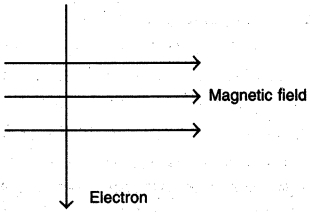
An electron enters a magnetic field at right angles to it as shown in the figure. The direction of force acting on the electron will be:
A
to the right
B
to the left
C
out of the page
D
into the page
Solution
(D) According to Fleming's left-hand rule,the direction of the force on a moving charge is determined by the orientation of the magnetic field and the direction of the conventional current.
Since the electron is a negatively charged particle moving downwards,the direction of the conventional current is upwards.
The magnetic field is directed towards the right.
Applying Fleming's left-hand rule: point the index finger in the direction of the magnetic field (right),and the middle finger in the direction of the current (upwards). The thumb will point into the page.
Therefore,the force acting on the electron is directed into the page.
Since the electron is a negatively charged particle moving downwards,the direction of the conventional current is upwards.
The magnetic field is directed towards the right.
Applying Fleming's left-hand rule: point the index finger in the direction of the magnetic field (right),and the middle finger in the direction of the current (upwards). The thumb will point into the page.
Therefore,the force acting on the electron is directed into the page.
0 likes
View Solution73
Easy
Why is the metallic body of electrical devices connected to the earth wire?
Solution
(N/A) The metallic body of electrical devices is connected to the earth wire to provide a low-resistance conducting path for any leakage current to flow directly to the earth. This process,known as earthing,ensures that the potential of the metallic body remains equal to that of the earth $(0 \ V)$. Consequently,if a fault occurs and the live wire touches the metallic casing,the current flows to the ground instead of through the user's body,thereby preventing severe electric shocks.
0 likes
View Solution74
Easy
How is a circuit overloaded?
Solution
(N/A) circuit becomes overloaded when too many electrical appliances are connected to a single socket or circuit simultaneously. This causes the total current flowing through the circuit to exceed its rated capacity,leading to excessive heating of the wires and potential fire hazards.
0 likes
View Solution75
EasyMCQ
What is short-circuiting?
A
$A$ sudden increase in voltage.
B
The direct contact between the live wire and the neutral wire.
C
The failure of an electrical appliance.
D
The overloading of an electrical circuit.
Solution
(B) Short-circuiting occurs when the live wire and the neutral wire come into direct contact with each other.
This results in a very low resistance path,causing a massive amount of current to flow through the circuit.
This sudden surge of current can lead to sparks,overheating,and potentially electrical fires.
This results in a very low resistance path,causing a massive amount of current to flow through the circuit.
This sudden surge of current can lead to sparks,overheating,and potentially electrical fires.
0 likes
View Solution76
EasyMCQ
What is the function of a field magnet in an $AC$ generator?
A
To convert $AC$ to $DC$
B
To produce a magnetic field
C
To rotate the armature coil
D
To increase the voltage
Solution
(B) In an $AC$ generator,the field magnet is used to produce a strong,uniform magnetic field. The armature coil of the generator rotates within this magnetic field,which induces an electromotive force $(EMF)$ or current in the coil according to Faraday's law of electromagnetic induction.
0 likes
View Solution77
EasyMCQ
What is the frequency of $DC$ (in $Hz$)?
A
$0$
B
$50$
C
$60$
D
$100$
Solution
(A) Direct Current $(DC)$ flows in a constant direction and maintains a constant magnitude over time.
Since the current does not oscillate or change its direction periodically,it does not complete any cycles per second.
Therefore,the frequency of $DC$ is $0 \ Hz$.
Since the current does not oscillate or change its direction periodically,it does not complete any cycles per second.
Therefore,the frequency of $DC$ is $0 \ Hz$.
0 likes
View Solution78
EasyMCQ
$A$ square coil moves in a plane with uniform velocity $v$ parallel to its sides. $A$ magnetic field $B$ points perpendicular and into the loop. What is the induced current in the coil?
A
Directly proportional to $v$
B
Directly proportional to $B$
C
Zero
D
Constant but non-zero
Solution
(C) According to Faraday's law of electromagnetic induction, an induced current is generated only when there is a change in the magnetic flux $(\Phi_B)$ linked with the coil.
Magnetic flux is given by $\Phi_B = B \cdot A \cdot \cos(\theta)$, where $A$ is the area of the coil and $\theta$ is the angle between the magnetic field and the area vector.
Since the coil is moving with a uniform velocity $v$ in a uniform magnetic field $B$ and the area $A$ remains constant, the magnetic flux $\Phi_B$ linked with the coil does not change over time.
Since $\frac{d\Phi_B}{dt} = 0$, the induced electromotive force $(e = -\frac{d\Phi_B}{dt})$ is zero.
Therefore, the induced current in the coil is zero.
Magnetic flux is given by $\Phi_B = B \cdot A \cdot \cos(\theta)$, where $A$ is the area of the coil and $\theta$ is the angle between the magnetic field and the area vector.
Since the coil is moving with a uniform velocity $v$ in a uniform magnetic field $B$ and the area $A$ remains constant, the magnetic flux $\Phi_B$ linked with the coil does not change over time.
Since $\frac{d\Phi_B}{dt} = 0$, the induced electromotive force $(e = -\frac{d\Phi_B}{dt})$ is zero.
Therefore, the induced current in the coil is zero.
0 likes
View Solution79
MediumMCQ
$A$ magnet is moved towards a coil,an $emf$ and charge are induced in it. If the magnet is moved slowly,how will the new $emf$ and charge be affected?
A
Both $emf$ and charge will decrease.
B
Both $emf$ and charge will increase.
C
$emf$ will decrease,but charge will remain unchanged.
D
$emf$ will increase,but charge will remain unchanged.
Solution
(C) According to Faraday's law of electromagnetic induction,the induced $emf$ is given by $\epsilon = -\frac{d\phi}{dt}$.
When the magnet is moved slowly,the rate of change of magnetic flux $\frac{d\phi}{dt}$ decreases,which causes the induced $emf$ to decrease.
The induced charge $q$ is given by $q = \int I dt = \int \frac{\epsilon}{R} dt = \int \frac{1}{R} \frac{d\phi}{dt} dt = \frac{\Delta\phi}{R}$.
Since the total change in magnetic flux $\Delta\phi$ and the resistance $R$ of the coil remain the same,the induced charge $q$ remains unchanged.
When the magnet is moved slowly,the rate of change of magnetic flux $\frac{d\phi}{dt}$ decreases,which causes the induced $emf$ to decrease.
The induced charge $q$ is given by $q = \int I dt = \int \frac{\epsilon}{R} dt = \int \frac{1}{R} \frac{d\phi}{dt} dt = \frac{\Delta\phi}{R}$.
Since the total change in magnetic flux $\Delta\phi$ and the resistance $R$ of the coil remain the same,the induced charge $q$ remains unchanged.
0 likes
View Solution80
EasyMCQ
$A$ beam of alpha particles enters a chamber moving along a magnetic field. What is the magnetic force experienced by the beam?
A
Maximum
B
Zero
C
Minimum but not zero
D
Depends on the velocity
Solution
(B) The magnetic force $F$ on a charged particle moving in a magnetic field is given by the formula $F = qvB \sin(\theta)$,where $q$ is the charge,$v$ is the velocity,$B$ is the magnetic field strength,and $\theta$ is the angle between the velocity vector and the magnetic field vector.
Since the alpha particles are moving along (parallel to) the magnetic field,the angle $\theta = 0^\circ$.
Therefore,$\sin(0^\circ) = 0$.
Consequently,the magnetic force $F = qvB(0) = 0$.
Thus,the beam experiences zero magnetic force.
Since the alpha particles are moving along (parallel to) the magnetic field,the angle $\theta = 0^\circ$.
Therefore,$\sin(0^\circ) = 0$.
Consequently,the magnetic force $F = qvB(0) = 0$.
Thus,the beam experiences zero magnetic force.
0 likes
View Solution81
EasyMCQ
How does a current-carrying solenoid behave?
A
Like a bar magnet
B
Like a copper wire
C
Like an insulator
D
Like a resistor
Solution
(A) current-carrying solenoid produces a magnetic field similar to that of a bar magnet.
One end of the solenoid acts as the North pole $(N)$,and the other end acts as the South pole $(S)$.
Therefore,it behaves exactly like a bar magnet.
One end of the solenoid acts as the North pole $(N)$,and the other end acts as the South pole $(S)$.
Therefore,it behaves exactly like a bar magnet.
0 likes
View Solution82
EasyMCQ
When is the force experienced by a current-carrying conductor placed in a magnetic field the largest?
A
When the current flows parallel to the magnetic field.
B
When the current flows at an angle of $45^{\circ}$ to the magnetic field.
C
When the current flows perpendicular to the magnetic field.
D
When the current flows at an angle of $30^{\circ}$ to the magnetic field.
Solution
(C) The force $F$ experienced by a current-carrying conductor of length $l$ carrying current $I$ in a magnetic field $B$ is given by the formula $F = BIl \sin(\theta)$,where $\theta$ is the angle between the direction of the current and the magnetic field.
Since the maximum value of $\sin(\theta)$ is $1$ (which occurs when $\theta = 90^{\circ}$),the force is largest when the current flows perpendicular to the applied magnetic field.
Since the maximum value of $\sin(\theta)$ is $1$ (which occurs when $\theta = 90^{\circ}$),the force is largest when the current flows perpendicular to the applied magnetic field.
0 likes
View Solution83
EasyMCQ
How is the induced current in a secondary coil related to the current in a primary coil?
A
It is always greater than the current in the primary coil.
B
It is always less than the current in the primary coil.
C
It is always equal to the current in the primary coil.
D
It may be greater than or less than the current in the primary coil.
Solution
(D) The induced current in a secondary coil depends on the number of turns in the primary and secondary coils ($N_p$ and $N_s$) and the rate of change of magnetic flux.
According to the transformer principle,the ratio of currents is inversely proportional to the ratio of the number of turns: $\frac{I_s}{I_p} = \frac{N_p}{N_s}$.
If $N_s > N_p$ (step-up transformer),the secondary current $I_s$ will be less than the primary current $I_p$.
If $N_s < N_p$ (step-down transformer),the secondary current $I_s$ will be greater than the primary current $I_p$.
Therefore,the induced current in the secondary coil may be greater than or less than the current in the primary coil depending on the transformer design.
According to the transformer principle,the ratio of currents is inversely proportional to the ratio of the number of turns: $\frac{I_s}{I_p} = \frac{N_p}{N_s}$.
If $N_s > N_p$ (step-up transformer),the secondary current $I_s$ will be less than the primary current $I_p$.
If $N_s < N_p$ (step-down transformer),the secondary current $I_s$ will be greater than the primary current $I_p$.
Therefore,the induced current in the secondary coil may be greater than or less than the current in the primary coil depending on the transformer design.
0 likes
View Solution84
Easy
What is the pattern of field lines inside a solenoid? What do they indicate?
Solution
(N/A) Inside a solenoid,the magnetic field lines are in the form of parallel straight lines.
This pattern indicates that the magnetic field is uniform at all points inside the solenoid.
This pattern indicates that the magnetic field is uniform at all points inside the solenoid.
0 likes
View Solution85
EasyMCQ
How is the magnetic field produced in a solenoid used?
A
To generate electricity
B
To magnetise a soft iron piece to form an electromagnet
C
To increase the resistance of the circuit
D
To measure the current in the circuit
Solution
(B) The magnetic field produced inside a solenoid is strong and uniform.
When a soft iron rod is placed inside the solenoid,the magnetic field of the solenoid magnetises the soft iron.
This combination of a soft iron core and a current-carrying solenoid is known as an electromagnet.
When a soft iron rod is placed inside the solenoid,the magnetic field of the solenoid magnetises the soft iron.
This combination of a soft iron core and a current-carrying solenoid is known as an electromagnet.
0 likes
View Solution86
EasyMCQ
What does the direction of the thumb indicate in the right-hand thumb rule?
A
Direction of magnetic field
B
Direction of current
C
Direction of force
D
Direction of motion
Solution
(B) The right-hand thumb rule states that if you hold a current-carrying straight conductor in your right hand such that your thumb points in the direction of the current,then your fingers wrapped around the conductor will show the direction of the magnetic field lines.
Therefore,the thumb indicates the direction of the current.
Therefore,the thumb indicates the direction of the current.
0 likes
View Solution87
EasyMCQ
Mention the angle between a current-carrying conductor and a magnetic field for which the force experienced by this conductor is maximum. (in $^{\circ}$)
A
$0$
B
$45$
C
$90$
D
$180$
Solution
(C) The force $F$ experienced by a current-carrying conductor of length $l$ carrying current $I$ placed in a magnetic field $B$ is given by the formula $F = BIl \sin(\theta)$,where $\theta$ is the angle between the direction of the current and the magnetic field.
Since the value of $\sin(\theta)$ is maximum $(1)$ when $\theta = 90^{\circ}$,the force experienced by the conductor is largest when the conductor is placed perpendicular to the magnetic field,i.e.,at an angle of $90^{\circ}$.
Since the value of $\sin(\theta)$ is maximum $(1)$ when $\theta = 90^{\circ}$,the force experienced by the conductor is largest when the conductor is placed perpendicular to the magnetic field,i.e.,at an angle of $90^{\circ}$.
0 likes
View Solution88
Easy
Suggest one way of discriminating a wire carrying current from a wire carrying no current.
Solution
(N/A) Bring a magnetic needle near the wire.
$A$ current-carrying wire produces a magnetic field around it,which exerts a force on the magnetic needle,causing it to deflect.
$A$ wire without current does not produce a magnetic field,so the magnetic needle will remain stationary.
$A$ current-carrying wire produces a magnetic field around it,which exerts a force on the magnetic needle,causing it to deflect.
$A$ wire without current does not produce a magnetic field,so the magnetic needle will remain stationary.
0 likes
View Solution89
EasyMCQ
What does the thumb indicate in Fleming's right-hand rule?
A
Direction of induced current
B
Direction of magnetic field
C
Direction of motion of the conductor
D
Direction of force
Solution
(C) Fleming's right-hand rule is used to determine the direction of the induced current in a conductor moving in a magnetic field.
According to this rule,if you stretch the thumb,forefinger,and middle finger of your right hand such that they are mutually perpendicular to each other,then:
$1$. The forefinger points in the direction of the magnetic field.
$2$. The thumb points in the direction of the motion of the conductor.
$3$. The middle finger points in the direction of the induced current.
Therefore,the thumb indicates the direction of motion of the conductor.
According to this rule,if you stretch the thumb,forefinger,and middle finger of your right hand such that they are mutually perpendicular to each other,then:
$1$. The forefinger points in the direction of the magnetic field.
$2$. The thumb points in the direction of the motion of the conductor.
$3$. The middle finger points in the direction of the induced current.
Therefore,the thumb indicates the direction of motion of the conductor.
0 likes
View Solution90
Easy
Why are magnetic field lines closed curves?
Solution
(N/A) By convention,magnetic field lines are considered to emerge from the $North$ $Pole$ and merge into the $South$ $Pole$ outside the magnet.
Inside the magnet,the direction of the field lines is from the $South$ $Pole$ to the $North$ $Pole$.
Since the field lines form a continuous path that starts and ends at the same point through the interior and exterior of the magnet,they are considered closed curves.
Inside the magnet,the direction of the field lines is from the $South$ $Pole$ to the $North$ $Pole$.
Since the field lines form a continuous path that starts and ends at the same point through the interior and exterior of the magnet,they are considered closed curves.
0 likes
View Solution91
Easy
Write any one method to induce current in a coil.
Solution
(N/A) An electric current can be induced in a coil by changing the magnetic field associated with it. One common method is to move a permanent magnet towards or away from the coil. As the magnet moves,the magnetic flux linked with the coil changes,which induces an electromotive force $(EMF)$ and consequently an electric current in the coil according to Faraday's Law of Electromagnetic Induction.
0 likes
View Solution92
Medium
State two ways by which the strength of an electromagnet can be increased.
Solution
(N/A) The strength of an electromagnet can be increased by:
$(i)$ Increasing the number of turns of the wire in the solenoid.
$(ii)$ Increasing the magnitude of the electric current flowing through the solenoid.
$(i)$ Increasing the number of turns of the wire in the solenoid.
$(ii)$ Increasing the magnitude of the electric current flowing through the solenoid.
0 likes
View Solution93
EasyMCQ
Define a solenoid. How is it different from a coil?
A
$A$ solenoid is a single loop of wire,while a coil has many loops.
B
$A$ solenoid is a long cylindrical coil of many turns of insulated copper wire,whereas a coil is a general term for any number of turns.
C
$A$ solenoid produces a non-uniform magnetic field,while a coil produces a uniform magnetic field.
D
There is no difference between a solenoid and a coil.
Solution
(B) solenoid is defined as a long coil consisting of many circular turns of insulated copper wire wrapped closely in the shape of a cylinder.
The primary difference lies in the magnetic field produced: inside a solenoid,the magnetic field is uniform and strong,resembling that of a bar magnet. In contrast,for a general coil,the magnetic field strength varies depending on the distance from the center and the geometry of the turns.
The primary difference lies in the magnetic field produced: inside a solenoid,the magnetic field is uniform and strong,resembling that of a bar magnet. In contrast,for a general coil,the magnetic field strength varies depending on the distance from the center and the geometry of the turns.
0 likes
View Solution94
Medium
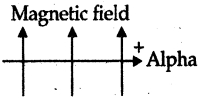
An alpha particle (positively charged particle) enters a magnetic field at a right angle to it,as shown in the figure. Explain the direction of the force acting on the alpha particle with the help of a relevant rule.
Solution
(N/A) According to Fleming's left-hand rule,if the forefinger points in the direction of the magnetic field and the central finger points in the direction of the current (the direction of motion of the positively charged alpha particle),then the thumb points in the direction of the force acting on the particle.
In this case,the magnetic field is directed upwards and the alpha particle is moving towards the right. Applying Fleming's left-hand rule,the force acting on the alpha particle will be directed out of the plane of the paper (perpendicular to the plane of the paper and towards the observer).
In this case,the magnetic field is directed upwards and the alpha particle is moving towards the right. Applying Fleming's left-hand rule,the force acting on the alpha particle will be directed out of the plane of the paper (perpendicular to the plane of the paper and towards the observer).
0 likes
View Solution95
Easy
An alternating electric current has a frequency of $50 \, Hz$. How many times does it change its direction in one second? Give reason for your answer.
Solution
(100) The current changes its direction $100$ times in one second.
Reason: $A$ frequency of $50 \, Hz$ means that the alternating current completes $50$ cycles in one second.
In each cycle,the current changes its direction twice (once in the positive half-cycle and once in the negative half-cycle).
Therefore,the total number of direction changes in one second is $50 \times 2 = 100$ times.
Reason: $A$ frequency of $50 \, Hz$ means that the alternating current completes $50$ cycles in one second.
In each cycle,the current changes its direction twice (once in the positive half-cycle and once in the negative half-cycle).
Therefore,the total number of direction changes in one second is $50 \times 2 = 100$ times.
0 likes
View Solution96
Medium
$(a)$ Name the type of electric current generated by most of the power stations in our country.
$(b)$ Why is it preferred over the other type?
$(c)$ State the frequency of the power supply generated in India.
$(b)$ Why is it preferred over the other type?
$(c)$ State the frequency of the power supply generated in India.
Solution
(N/A) The type of electric current generated by most power stations in India is Alternating Current $(AC)$.
$(b)$ Alternating Current $(AC)$ is preferred over Direct Current $(DC)$ because it can be transmitted over long distances with minimal loss of electrical energy using step-up transformers.
$(c)$ The frequency of the power supply generated in India is $50 \ Hz$.
$(b)$ Alternating Current $(AC)$ is preferred over Direct Current $(DC)$ because it can be transmitted over long distances with minimal loss of electrical energy using step-up transformers.
$(c)$ The frequency of the power supply generated in India is $50 \ Hz$.
0 likes
View Solution97
Medium
$(i)$ $A$ compass needle gets deflected when brought near a current-carrying conductor. Why?
$(ii)$ What happens to the deflection of the needle when the current in the conductor is increased?
$(ii)$ What happens to the deflection of the needle when the current in the conductor is increased?
Solution
(N/A) $(i)$ $A$ current-carrying conductor produces a magnetic field around it. When a compass needle is brought near this conductor,the magnetic field of the conductor exerts a force on the magnetic needle,causing it to deflect.
$(ii)$ The strength of the magnetic field produced by a current-carrying conductor is directly proportional to the magnitude of the current flowing through it. Therefore,when the current in the conductor is increased,the magnetic field strength increases,which leads to a greater deflection of the compass needle.
$(ii)$ The strength of the magnetic field produced by a current-carrying conductor is directly proportional to the magnitude of the current flowing through it. Therefore,when the current in the conductor is increased,the magnetic field strength increases,which leads to a greater deflection of the compass needle.
0 likes
View Solution98
Easy
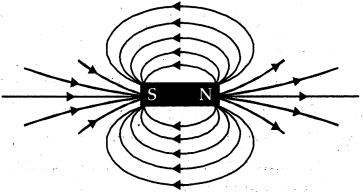
Draw the patterns of magnetic field lines due to a bar magnet. The magnetic field lines are closed curves. Why?
Solution
(N/A) Outside the magnet,the magnetic field lines emerge from the north pole and merge into the south pole.
Inside the magnet,the direction of the field lines is from the south pole to the north pole.
Because the field lines are continuous and form a complete path from the north pole to the south pole outside and from the south pole to the north pole inside,they form closed curves.
Inside the magnet,the direction of the field lines is from the south pole to the north pole.
Because the field lines are continuous and form a complete path from the north pole to the south pole outside and from the south pole to the north pole inside,they form closed curves.
0 likes
View Solution99
Easy
$(a)$ In a pattern of magnetic field lines due to a bar magnet,how can the regions of relative strength be identified?
$(b)$ Compare the strength of the magnetic field near the poles and the middle of a bar magnet.
$(b)$ Compare the strength of the magnetic field near the poles and the middle of a bar magnet.
Solution
(N/A) The relative strength of the magnetic field is indicated by the degree of closeness of the magnetic field lines. Where the field lines are crowded,the magnetic field is strong,and where they are far apart,the magnetic field is weak.
$(b)$ The strength of the magnetic field is highest near the poles of a bar magnet because the field lines are most concentrated there. Conversely,the strength of the magnetic field is lowest in the middle of the bar magnet,where the field lines are relatively far apart.
$(b)$ The strength of the magnetic field is highest near the poles of a bar magnet because the field lines are most concentrated there. Conversely,the strength of the magnetic field is lowest in the middle of the bar magnet,where the field lines are relatively far apart.
0 likes
View Solution100
Easy
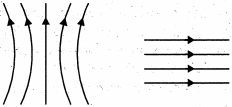
Identify the type of magnetic fields represented by the magnetic field lines given below and name the type of conductors which can produce them.
Solution
(N/A) The left figure represents the magnetic field lines produced by a current-carrying circular loop near its center,where the field lines appear as straight lines.
$(b)$ The right figure represents uniform magnetic field lines,which are produced by a long current-carrying solenoid.
$(b)$ The right figure represents uniform magnetic field lines,which are produced by a long current-carrying solenoid.
0 likes
View SolutionMagnetic Effects of Electric Current — Mix Examples - Magnetic Effects of Electric Current · Frequently Asked Questions
1Are these Magnetic Effects of Electric Current questions useful for JEE and NEET?
Yes. All questions in this section are mapped to JEE Main and NEET exam patterns. Previous year questions from JEE Main, NEET, GUJCET and state-level exams are included with full solutions.
2Can I switch to Hindi or Gujarati for these questions?
Yes. Use the language tabs in the hero section or the sidebar to view the same questions and solutions in English, Hindi or Gujarati.
3How do I generate a question paper from this subtopic?
Use the Vedclass Exam Paper Generator — select the chapter and subtopic, set difficulty, and generate Sets A, B, C, D automatically. First 3 chapters of every subject are free.
Vedclass Products
For Students
Vedclass Test Series
Mock tests in real JEE/NEET style with performance analysis. 5-day free trial.
Start Free TrialFor Teachers
Exam Paper Generator
Generate Set A/B/C/D papers from this chapter in 2 minutes. 3 chapters free.
Try FreeFor Institutes
Online Exam Module
Live online exams with unlimited students, 360° analytics & white-label branding.
See DemoFor Teachers & Institutes
Generate a Magnetic Effects of Electric Current Exam Paper in 2 Minutes
Select subtopic & difficulty — Sets A, B, C, D auto-generated with No Repeat logic.
First 3 chapters of every subject are free — no payment required.