
A English
Mix Examples - Magnetic Effects of Electric Current Questions in English
Class 10 Science · Magnetic Effects of Electric Current · Mix Examples - Magnetic Effects of Electric Current
332+
Questions
English
Language
100%
With Solutions
Showing 50 of 332 questions in English
1
MediumMCQ
Choose the incorrect statement from the following regarding magnetic field lines.
A
If magnetic field lines are parallel and equidistant,they represent zero field strength.
B
Magnetic field lines are closed curves.
C
The direction of magnetic field at a point is taken to be the direction in which the north pole of a magnetic compass needle points.
D
Relative strength of magnetic field is shown by the degree of closeness of the field lines.
Solution
(A) Magnetic field lines are imaginary lines that represent the magnetic field in a region.
$1$. Parallel and equidistant magnetic field lines represent a uniform magnetic field,not zero field strength. Therefore,option $A$ is incorrect.
$2$. Magnetic field lines always form continuous closed loops,starting from the north pole and ending at the south pole outside the magnet,and continuing from south to north inside the magnet.
$3$. The direction of the magnetic field at any point is defined by the direction in which the north pole of a magnetic compass needle points when placed at that point.
$4$. The degree of closeness of the field lines indicates the relative strength of the magnetic field; closer lines indicate a stronger field.
$1$. Parallel and equidistant magnetic field lines represent a uniform magnetic field,not zero field strength. Therefore,option $A$ is incorrect.
$2$. Magnetic field lines always form continuous closed loops,starting from the north pole and ending at the south pole outside the magnet,and continuing from south to north inside the magnet.
$3$. The direction of the magnetic field at any point is defined by the direction in which the north pole of a magnetic compass needle points when placed at that point.
$4$. The degree of closeness of the field lines indicates the relative strength of the magnetic field; closer lines indicate a stronger field.
0 likes
View Solution2
MediumMCQ
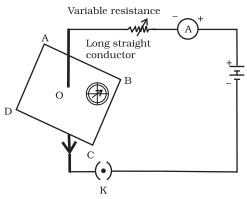
If the key in the arrangement (Figure) is taken out (the circuit is made open) and magnetic field lines are drawn over the horizontal plane $ABCD$,the lines are
A
concentric circles
B
straight lines parallel to each other
C
elliptical in shape
D
concentric circles near the point $O$ but of elliptical shapes as we go away from it
Solution
(B) When the key is taken out,the circuit becomes open,meaning no electric current flows through the conductor.
Since there is no electric current,there is no magnetic field produced by the conductor.
In this state,the only magnetic field present in the region is the Earth's magnetic field.
The Earth's magnetic field lines are approximately parallel to each other in a localized region.
Since there is no electric current,there is no magnetic field produced by the conductor.
In this state,the only magnetic field present in the region is the Earth's magnetic field.
The Earth's magnetic field lines are approximately parallel to each other in a localized region.
0 likes
View Solution3
MediumMCQ
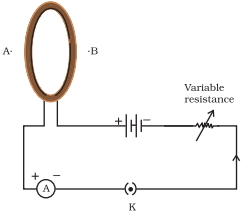
$A$ circular loop placed in a plane perpendicular to the plane of paper carries a current when the key is $ON$. The current as seen from points $A$ and $B$ (in the plane of paper and on the axis of the coil) is anti-clockwise and clockwise respectively. The magnetic field lines point from $B$ to $A$. The $N-$ pole of the resultant magnet is on the face close to
A
$A$ if the current is small, and $B$ if the current is large
B
$B$
C
$A$
D
$B$ if the current is small and $A$ if the current is large
Solution
(C) The direction of magnetic field lines inside a current-carrying loop is from the South pole to the North pole, and outside the loop, it is from the North pole to the South pole.
Given that the magnetic field lines point from $B$ to $A$, this indicates that the face at $A$ acts as the North pole and the face at $B$ acts as the South pole.
According to the right-hand rule for a circular loop, if the current appears anti-clockwise when viewed from a face, that face acts as the North pole ($N-$ pole).
Since the current is seen as anti-clockwise from point $A$, the face at $A$ behaves as the North pole.
Therefore, the $N-$ pole of the resultant magnet is on the face close to $A$.
Given that the magnetic field lines point from $B$ to $A$, this indicates that the face at $A$ acts as the North pole and the face at $B$ acts as the South pole.
According to the right-hand rule for a circular loop, if the current appears anti-clockwise when viewed from a face, that face acts as the North pole ($N-$ pole).
Since the current is seen as anti-clockwise from point $A$, the face at $A$ behaves as the North pole.
Therefore, the $N-$ pole of the resultant magnet is on the face close to $A$.
0 likes
View Solution4
MediumMCQ
For a current in a long straight solenoid,$N-$ and $S-$ poles are created at the two ends. Among the following statements,the incorrect statement is:
A
The field lines inside the solenoid are in the form of straight lines,which indicates that the magnetic field is the same at all points inside the solenoid.
B
The strong magnetic field produced inside the solenoid can be used to magnetise a piece of magnetic material like soft iron,when placed inside the coil.
C
The $N-$ and $S-$ poles exchange positions when the direction of current through the solenoid is reversed.
D
The pattern of the magnetic field associated with the solenoid is different from the pattern of the magnetic field around a bar magnet.
Solution
(D) current-carrying solenoid behaves exactly like a bar magnet.
$1$. The magnetic field lines inside a solenoid are parallel straight lines,indicating a uniform magnetic field.
$2$. The strong magnetic field inside can magnetize soft iron to create an electromagnet.
$3$. Reversing the current direction reverses the polarity of the poles.
$4$. Since a solenoid behaves like a bar magnet,its magnetic field pattern is identical to that of a bar magnet. Therefore,the statement that the patterns are different is incorrect.
$1$. The magnetic field lines inside a solenoid are parallel straight lines,indicating a uniform magnetic field.
$2$. The strong magnetic field inside can magnetize soft iron to create an electromagnet.
$3$. Reversing the current direction reverses the polarity of the poles.
$4$. Since a solenoid behaves like a bar magnet,its magnetic field pattern is identical to that of a bar magnet. Therefore,the statement that the patterns are different is incorrect.
0 likes
View Solution5
DifficultMCQ
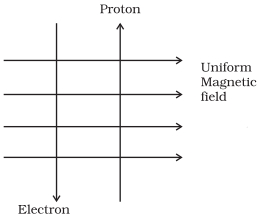
$A$ uniform magnetic field exists in the plane of paper pointing from left to right as shown in Figure. In the field,an electron and a proton move as shown. The electron and the proton experience:
A
forces both pointing into the plane of paper
B
forces both pointing out of the plane of paper
C
forces pointing into the plane of paper and out of the plane of paper,respectively
D
force pointing opposite and along the direction of the uniform magnetic field respectively
Solution
(C) According to Fleming's Left-Hand Rule,the direction of the force on a moving charge in a magnetic field is determined by the orientation of the magnetic field,the direction of the current (or motion of positive charge),and the force.
For the proton (positive charge moving upwards),the magnetic field is to the right. Using the left-hand rule,the force points into the plane of the paper.
For the electron (negative charge moving downwards),the direction of the conventional current is upwards. Since the magnetic field is to the right,the force on the electron points out of the plane of the paper.
Therefore,the proton experiences a force into the plane,and the electron experiences a force out of the plane.
For the proton (positive charge moving upwards),the magnetic field is to the right. Using the left-hand rule,the force points into the plane of the paper.
For the electron (negative charge moving downwards),the direction of the conventional current is upwards. Since the magnetic field is to the right,the force on the electron points out of the plane of the paper.
Therefore,the proton experiences a force into the plane,and the electron experiences a force out of the plane.
0 likes
View Solution6
EasyMCQ
Commercial electric motors do not use
A
an electromagnet to rotate the armature
B
a permanent magnet to rotate the armature
C
effectively large number of turns of conducting wire in the current carrying coil
D
a soft iron core on which the coil is wound
Solution
(B) Commercial electric motors are designed for high power and efficiency.
$1$. They use an electromagnet instead of a permanent magnet because electromagnets can generate much stronger magnetic fields,which are essential for high-torque applications.
$2$. They use a large number of turns of conducting wire to increase the magnetic effect of the coil.
$3$. They use a soft iron core on which the coil is wound to increase the magnetic flux through the coil.
Therefore,commercial electric motors do not use a permanent magnet to rotate the armature.
$1$. They use an electromagnet instead of a permanent magnet because electromagnets can generate much stronger magnetic fields,which are essential for high-torque applications.
$2$. They use a large number of turns of conducting wire to increase the magnetic effect of the coil.
$3$. They use a soft iron core on which the coil is wound to increase the magnetic flux through the coil.
Therefore,commercial electric motors do not use a permanent magnet to rotate the armature.
0 likes
View Solution7
MediumMCQ
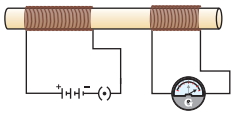
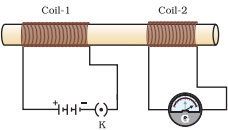
In the arrangement shown in the figure,there are two coils wound on a non-conducting cylindrical rod. Initially,the key is not inserted. Then the key is inserted and later removed. Then
A
the deflection in the galvanometer remains zero throughout
B
there is a momentary deflection in the galvanometer but it dies out shortly and there is no effect when the key is removed
C
there are momentary galvanometer deflections that die out shortly; the deflections are in opposite directions
D
there are momentary galvanometer deflections that die out shortly; the deflections are in the same direction
Solution
(C) According to Faraday's law of electromagnetic induction,an induced current is produced in a coil when the magnetic flux linked with it changes.
When the key is inserted,the current in the first coil increases from zero to a steady value,causing the magnetic field linked with the second coil to change,which induces a momentary current in the second coil,resulting in a deflection in the galvanometer.
Once the current becomes steady,the magnetic flux becomes constant,and the deflection drops to zero.
When the key is removed,the current in the first coil decreases from its steady value to zero,causing the magnetic flux linked with the second coil to change again,but in the opposite direction,which induces a momentary current in the opposite direction,resulting in a deflection in the opposite direction in the galvanometer.
When the key is inserted,the current in the first coil increases from zero to a steady value,causing the magnetic field linked with the second coil to change,which induces a momentary current in the second coil,resulting in a deflection in the galvanometer.
Once the current becomes steady,the magnetic flux becomes constant,and the deflection drops to zero.
When the key is removed,the current in the first coil decreases from its steady value to zero,causing the magnetic flux linked with the second coil to change again,but in the opposite direction,which induces a momentary current in the opposite direction,resulting in a deflection in the opposite direction in the galvanometer.
0 likes
View Solution8
MediumMCQ
Choose the incorrect statement.
A
Fleming's right-hand rule is a simple rule to know the direction of induced current.
B
The right-hand thumb rule is used to find the direction of magnetic fields due to current-carrying conductors.
C
The difference between the direct and alternating currents is that the direct current always flows in one direction,whereas the alternating current reverses its direction periodically.
D
In India,the $AC$ changes direction after every $\frac{1}{50}$ second.
Solution
(D) The frequency of $AC$ in India is $50 \, Hz$. This means the current completes $50$ cycles in one second. Since the current reverses its direction twice in each cycle,the total number of reversals per second is $100$. Therefore,the direction of the current changes after every $\frac{1}{100}$ second. Thus,the statement in option $D$ is incorrect.
0 likes
View Solution9
MediumMCQ
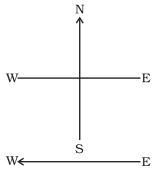
$A$ constant current flows in a horizontal wire in the plane of the paper from east to west as shown in the figure. The direction of the magnetic field at a point will be North to South:
A
directly below the wire
B
directly above the wire
C
at a point located in the plane of the paper,on the north side of the wire
D
at a point located in the plane of the paper,on the south side of the wire
Solution
(A) According to the Right-Hand Thumb Rule,if you hold the current-carrying wire in your right hand such that your thumb points in the direction of the current (West),then your curled fingers represent the direction of the magnetic field lines.
$1$. The current flows from East to West.
$2$. Above the wire,the magnetic field lines point towards the North.
$3$. Below the wire,the magnetic field lines point towards the South.
Therefore,the direction of the magnetic field is from North to South directly below the wire.
$1$. The current flows from East to West.
$2$. Above the wire,the magnetic field lines point towards the North.
$3$. Below the wire,the magnetic field lines point towards the South.
Therefore,the direction of the magnetic field is from North to South directly below the wire.
0 likes
View Solution10
EasyMCQ
The strength of the magnetic field inside a long current-carrying straight solenoid is
A
more at the ends than at the centre
B
same at all points
C
minimum in the middle
D
found to increase from one end to the other
Solution
(B) solenoid is a long coil containing a large number of close turns of insulated copper wire. When an electric current flows through the solenoid,it produces a magnetic field similar to that of a bar magnet. Inside a long,ideal solenoid,the magnetic field lines are parallel to the axis of the solenoid,indicating that the magnetic field is uniform. Therefore,the strength of the magnetic field is the same at all points inside the solenoid.
0 likes
View Solution11
EasyMCQ
To convert an $AC$ generator into a $DC$ generator,
A
a stronger magnetic field has to be used.
B
slip rings and brushes must be used.
C
a split-ring type commutator must be used.
D
a rectangular wire loop has to be used.
Solution
(C) An $AC$ generator uses slip rings to maintain a continuous connection with the rotating coil,which results in an alternating current output.
To convert this into a $DC$ generator,the slip rings must be replaced with a split-ring type commutator.
The split-ring commutator acts as a reversing switch that reverses the direction of the current in the external circuit every time the coil passes the vertical position,ensuring that the current flows in only one direction in the external circuit.
To convert this into a $DC$ generator,the slip rings must be replaced with a split-ring type commutator.
The split-ring commutator acts as a reversing switch that reverses the direction of the current in the external circuit every time the coil passes the vertical position,ensuring that the current flows in only one direction in the external circuit.
0 likes
View Solution12
EasyMCQ
The most important safety method used for protecting home appliances from short circuiting or overloading is
A
earthing
B
use of electric meter
C
use of stabilizers
D
use of fuse
Solution
(D) An electric fuse is a safety device used in electrical circuits to protect appliances from damage due to excessive current.
When a short circuit or overloading occurs,the current in the circuit increases significantly.
This high current causes the fuse wire to heat up and melt due to the Joule heating effect $(H = I^2Rt)$.
Once the fuse wire melts,the circuit breaks,preventing the flow of excessive current to the appliances and thereby protecting them from potential damage.
When a short circuit or overloading occurs,the current in the circuit increases significantly.
This high current causes the fuse wire to heat up and melt due to the Joule heating effect $(H = I^2Rt)$.
Once the fuse wire melts,the circuit breaks,preventing the flow of excessive current to the appliances and thereby protecting them from potential damage.
0 likes
View Solution13
Medium
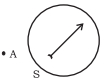
$A$ magnetic compass needle is placed in the plane of paper near point $A$ as shown in the figure. In which plane should a straight current-carrying conductor be placed so that it passes through $A$ and there is no change in the deflection of the compass? Under what condition is the deflection maximum and why?
Solution
(N/A) The conductor should be placed in the plane of the paper itself. Since the axis of the compass needle is vertical,the magnetic field produced by a current-carrying conductor lying in the same plane as the compass will also be vertical at the position of the needle. $A$ vertical magnetic field cannot exert a torque on a compass needle that is pivoted to rotate only in the horizontal plane,hence there is no change in deflection.
The deflection is maximum when the conductor passing through $A$ is placed perpendicular to the plane of the paper. In this orientation,the magnetic field lines produced by the current form concentric circles in the plane of the paper,exerting the maximum horizontal torque on the compass needle.
The deflection is maximum when the conductor passing through $A$ is placed perpendicular to the plane of the paper. In this orientation,the magnetic field lines produced by the current form concentric circles in the plane of the paper,exerting the maximum horizontal torque on the compass needle.
0 likes
View Solution14
Medium
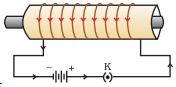
Under what conditions is a permanent magnet obtained if a current-carrying solenoid is used? Support your answer with the help of a labelled circuit diagram.
Solution
(N/A) To obtain a permanent magnet using a current-carrying solenoid,the following conditions must be met:
$(i)$ The core material placed inside the solenoid must be a magnetically hard material,such as steel,which retains its magnetism even after the current is switched off.
(ii) $A$ direct current $(DC)$ must be passed through the solenoid to magnetize the core material effectively.
(iii) Once the steel rod is placed inside the solenoid and the current is passed,it becomes a permanent magnet.
$(i)$ The core material placed inside the solenoid must be a magnetically hard material,such as steel,which retains its magnetism even after the current is switched off.
(ii) $A$ direct current $(DC)$ must be passed through the solenoid to magnetize the core material effectively.
(iii) Once the steel rod is placed inside the solenoid and the current is passed,it becomes a permanent magnet.
0 likes
View Solution15
Medium
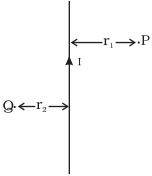
$AB$ is a current-carrying conductor in the plane of the paper as shown in the figure. What are the directions of the magnetic fields produced by it at points $P$ and $Q$? Given $r_1 > r_2$, where will the strength of the magnetic field be larger?
Solution
(N/A) According to the Right-Hand Thumb Rule, if you hold the current-carrying conductor in your right hand such that your thumb points in the direction of the current, your fingers will curl in the direction of the magnetic field lines.
For the given conductor with current flowing upwards, the magnetic field lines at point $P$ (to the right) go into the plane of the paper, and at point $Q$ (to the left), they come out of the plane of the paper.
The strength of the magnetic field produced by a straight current-carrying conductor is inversely proportional to the distance from the conductor $(B \propto 1/r)$.
Since $r_1 > r_2$, the point $Q$ is closer to the conductor than point $P$.
Therefore, the strength of the magnetic field will be larger at point $Q$.
For the given conductor with current flowing upwards, the magnetic field lines at point $P$ (to the right) go into the plane of the paper, and at point $Q$ (to the left), they come out of the plane of the paper.
The strength of the magnetic field produced by a straight current-carrying conductor is inversely proportional to the distance from the conductor $(B \propto 1/r)$.
Since $r_1 > r_2$, the point $Q$ is closer to the conductor than point $P$.
Therefore, the strength of the magnetic field will be larger at point $Q$.
0 likes
View Solution16
Medium
$A$ magnetic compass shows a deflection when placed near a current-carrying wire. How will the deflection of the compass be affected if the current in the wire is increased? Support your answer with a reason.
Solution
(N/A) The deflection of the magnetic compass increases.
Reason: The strength of the magnetic field produced by a current-carrying straight conductor is directly proportional to the magnitude of the current flowing through it $(B \propto I)$. Therefore,increasing the current increases the magnetic field strength,which exerts a greater force on the magnetic needle,resulting in a larger deflection.
Reason: The strength of the magnetic field produced by a current-carrying straight conductor is directly proportional to the magnitude of the current flowing through it $(B \propto I)$. Therefore,increasing the current increases the magnetic field strength,which exerts a greater force on the magnetic needle,resulting in a larger deflection.
0 likes
View Solution17
Medium
It is established that an electric current through a metallic conductor produces a magnetic field around it. Is there a similar magnetic field produced around a thin beam of moving $(i)$ alpha particles,$(ii)$ neutrons? Justify your answer.
Solution
(N/A) $(i)$ Yes. Alpha particles are positively charged particles. Their motion constitutes an electric current in the direction of their motion,which produces a magnetic field around the beam.
$(ii)$ No. Neutrons are electrically neutral particles. Since they carry no charge,their motion does not constitute an electric current,and therefore,no magnetic field is produced around the beam.
$(ii)$ No. Neutrons are electrically neutral particles. Since they carry no charge,their motion does not constitute an electric current,and therefore,no magnetic field is produced around the beam.
0 likes
View Solution18
MediumMCQ
What does the direction of the thumb indicate in the Right-Hand Thumb Rule? In what way is this rule different from Fleming's Left-Hand Rule?
A
Thumb indicates current direction; Fleming's rule indicates force direction.
B
Thumb indicates magnetic field; Fleming's rule indicates current direction.
C
Thumb indicates force direction; Fleming's rule indicates magnetic field.
D
Both rules indicate the same physical quantity.
Solution
(A) In the Right-Hand Thumb Rule,the thumb points in the direction of the conventional current flowing through a straight conductor,while the curled fingers represent the direction of the magnetic field lines around it.
In contrast,Fleming's Left-Hand Rule is used to determine the direction of the force (or motion) experienced by a current-carrying conductor when placed in an external magnetic field.
Therefore,the Right-Hand Thumb Rule relates current to magnetic field,whereas Fleming's Left-Hand Rule relates current,magnetic field,and force.
In contrast,Fleming's Left-Hand Rule is used to determine the direction of the force (or motion) experienced by a current-carrying conductor when placed in an external magnetic field.
Therefore,the Right-Hand Thumb Rule relates current to magnetic field,whereas Fleming's Left-Hand Rule relates current,magnetic field,and force.
0 likes
View Solution19
Medium
Meena draws magnetic field lines of a field close to the axis of a current-carrying circular loop. As she moves away from the centre of the circular loop,she observes that the lines keep on diverging. How will you explain her observation?
Solution
(N/A) The strength of the magnetic field decreases as the distance from the centre of the current-carrying loop increases.
This decrease in the strength of the magnetic field is represented by the increasing divergence (or decreasing degree of closeness) of the magnetic field lines as one moves away from the axis.
This decrease in the strength of the magnetic field is represented by the increasing divergence (or decreasing degree of closeness) of the magnetic field lines as one moves away from the axis.
0 likes
View Solution20
Easy
What does the divergence of magnetic field lines near the ends of a current-carrying straight solenoid indicate?
Solution
(N/A) The divergence,which refers to the decrease in the closeness of magnetic field lines,indicates a reduction in the strength of the magnetic field near and beyond the ends of the solenoid.
0 likes
View Solution21
MediumMCQ
Name four appliances wherein an electric motor,a rotating device that converts electrical energy to mechanical energy,is used as an important component. In what respect are motors different from generators?
A
Electric fans
B
Mixers
C
Washing machines
D
Computer drives
Solution
(A-D) Four appliances that use an electric motor as an important component are:
$1$. Electric fans
$2$. Mixers
$3$. Washing machines
$4$. Computer drives
Difference between motors and generators:
- An electric motor converts electrical energy into mechanical energy.
- $A$ generator converts mechanical energy into electrical energy.
$1$. Electric fans
$2$. Mixers
$3$. Washing machines
$4$. Computer drives
Difference between motors and generators:
- An electric motor converts electrical energy into mechanical energy.
- $A$ generator converts mechanical energy into electrical energy.
0 likes
View Solution22
EasyMCQ
What is the role of the two conducting stationary brushes in a simple electric motor?
A
To rotate the coil
B
To reverse the direction of current
C
To provide a sliding contact with the split rings to conduct current into the coil
D
To increase the magnetic field strength
Solution
(C) In a simple electric motor,the two conducting stationary brushes (usually made of carbon) are used to maintain a sliding contact with the split rings (commutator).
These brushes are connected to the external battery circuit.
As the split rings rotate with the coil,the brushes remain stationary and allow the electric current to flow continuously from the external source into the rotating coil without tangling the wires.
These brushes are connected to the external battery circuit.
As the split rings rotate with the coil,the brushes remain stationary and allow the electric current to flow continuously from the external source into the rotating coil without tangling the wires.
0 likes
View Solution23
Medium
What is the difference between a direct current and an alternating current? How many times does $AC$ used in India change direction in one second?
Solution
(N/A) Direct current $(DC)$ flows in only one direction throughout the circuit. In contrast,alternating current $(AC)$ reverses its direction periodically.
The frequency of $AC$ in India is $50 \, Hz$,which means it completes $50$ cycles per second.
Since the current changes its direction twice in each cycle,the total number of times it changes direction in one second is $2 \times 50 = 100$ times.
The frequency of $AC$ in India is $50 \, Hz$,which means it completes $50$ cycles per second.
Since the current changes its direction twice in each cycle,the total number of times it changes direction in one second is $2 \times 50 = 100$ times.
0 likes
View Solution24
Medium
What is the role of a fuse used in series with any electrical appliance? Why should a fuse with a defined rating not be replaced by one with a larger rating?
Solution
(N/A) fuse is a safety device used to protect electrical appliances from damage caused by short-circuiting or overloading.
It is designed to carry a specific maximum current. When the current flowing through the circuit exceeds this rated value,the fuse wire melts and breaks the circuit,thereby preventing damage to the appliance.
If a fuse with a larger rating is used,it will not melt even when the current exceeds the safe limit of the appliance.
Consequently,the appliance may get damaged or catch fire because the protective mechanism fails to operate. Therefore,one should always use a fuse of the correct rating.
It is designed to carry a specific maximum current. When the current flowing through the circuit exceeds this rated value,the fuse wire melts and breaks the circuit,thereby preventing damage to the appliance.
If a fuse with a larger rating is used,it will not melt even when the current exceeds the safe limit of the appliance.
Consequently,the appliance may get damaged or catch fire because the protective mechanism fails to operate. Therefore,one should always use a fuse of the correct rating.
0 likes
View Solution25
MediumMCQ
Why does a magnetic compass needle pointing North and South in the absence of a nearby magnet get deflected when a bar magnet or a current carrying loop is brought near it? Describe some salient features of magnetic lines of field concept.
A
$N$/$A$
B
$N$/$A$
C
$N$/$A$
D
$N$/$A$
Solution
(N/A) magnetic compass needle is a small magnet that aligns itself with the Earth's magnetic field. When a bar magnet or a current-carrying loop is brought near it,it produces its own magnetic field. The interaction between the external magnetic field and the compass needle's magnetic field exerts a torque,causing the needle to deflect.
Salient features of magnetic field lines:
$1$. Magnetic field lines emerge from the $N$-pole and enter the $S$-pole of a magnet.
$2$. The strength of the magnetic field is represented by the degree of closeness of the field lines; closer lines indicate a stronger field.
$3$. Magnetic field lines never intersect each other because if they did,there would be two directions of the magnetic field at the point of intersection,which is physically impossible.
$4$. If field lines are parallel and equidistant,they represent a uniform magnetic field.
Salient features of magnetic field lines:
$1$. Magnetic field lines emerge from the $N$-pole and enter the $S$-pole of a magnet.
$2$. The strength of the magnetic field is represented by the degree of closeness of the field lines; closer lines indicate a stronger field.
$3$. Magnetic field lines never intersect each other because if they did,there would be two directions of the magnetic field at the point of intersection,which is physically impossible.
$4$. If field lines are parallel and equidistant,they represent a uniform magnetic field.
0 likes
View Solution26
Medium
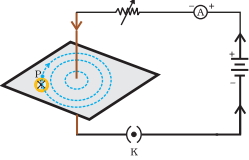
With the help of a labelled circuit diagram,illustrate the pattern of field lines of the magnetic field around a current-carrying straight long conducting wire. How is the Right-Hand Thumb Rule useful to find the direction of the magnetic field associated with a current-carrying conductor?
Solution
(N/A) The magnetic field lines around a straight current-carrying conductor are concentric circles with the wire as the center. The plane of these circles is perpendicular to the wire.
Right-Hand Thumb Rule: This rule states that if you imagine holding a current-carrying straight conductor in your right hand such that your thumb points in the direction of the current,then your fingers will wrap around the conductor in the direction of the magnetic field lines.
Right-Hand Thumb Rule: This rule states that if you imagine holding a current-carrying straight conductor in your right hand such that your thumb points in the direction of the current,then your fingers will wrap around the conductor in the direction of the magnetic field lines.
0 likes
View Solution27
Medium
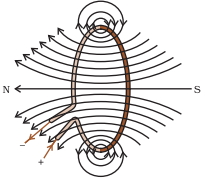
Explain with the help of a labelled diagram the distribution of magnetic field due to a current through a circular loop. Why is it that if a current-carrying coil has $n$ turns,the field produced at any point is $n$ times as large as that produced by a single turn?
Solution
(N/A) $1$. Magnetic field due to a circular loop: When a current flows through a circular loop,the magnetic field lines are circular near the wire. As we move towards the center of the loop,the arcs of these circles become larger and appear as straight lines at the center. The direction of the magnetic field can be determined using the Right-Hand Thumb Rule.
$2$. Effect of $n$ turns: The magnetic field produced by each turn of the coil adds up in the same direction. Since the current in each turn flows in the same direction,the magnetic effects of all the turns are additive. Therefore,if a coil has $n$ turns,the total magnetic field produced at any point is $n$ times the magnetic field produced by a single turn.
$2$. Effect of $n$ turns: The magnetic field produced by each turn of the coil adds up in the same direction. Since the current in each turn flows in the same direction,the magnetic effects of all the turns are additive. Therefore,if a coil has $n$ turns,the total magnetic field produced at any point is $n$ times the magnetic field produced by a single turn.
0 likes
View Solution28
Medium
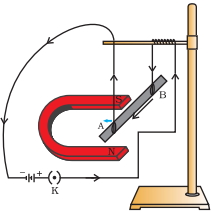
Describe the activity that shows that a current-carrying conductor experiences a force perpendicular to its length and the external magnetic field. How does Fleming's left-hand rule help us to find the direction of the force acting on the current-carrying conductor?
Solution
(N/A) Activity: Take a small aluminum rod $AB$ suspended horizontally from a stand using two connecting wires. Place a strong horseshoe magnet in such a way that the rod lies between the two poles with the magnetic field directed upwards. Connect the rod $AB$ in series with a battery,a key,and a rheostat. When current is passed through the rod from $B$ to $A$,the rod is observed to get displaced. This displacement shows that a force is acting on the current-carrying conductor when it is placed in a magnetic field. The direction of this force is perpendicular to both the length of the conductor and the magnetic field.
Fleming's Left-Hand Rule: According to this rule,stretch the thumb,forefinger,and middle finger of your left hand such that they are mutually perpendicular. If the forefinger points in the direction of the magnetic field and the middle finger points in the direction of the current,then the thumb will point in the direction of the motion or the force acting on the conductor.
Fleming's Left-Hand Rule: According to this rule,stretch the thumb,forefinger,and middle finger of your left hand such that they are mutually perpendicular. If the forefinger points in the direction of the magnetic field and the middle finger points in the direction of the current,then the thumb will point in the direction of the motion or the force acting on the conductor.
0 likes
View Solution29
Medium
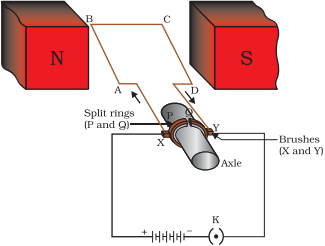
Draw a labelled circuit diagram of a simple electric motor and explain its working. In what way are these simple electric motors different from commercial motors?
Solution
(N/A) Working of an electric motor: An electric motor consists of a rectangular coil $ABCD$ of insulated copper wire placed between the two poles of a magnetic field. The ends of the coil are connected to the two halves $P$ and $Q$ of a split ring. The inner sides of these halves are insulated and attached to an axle. The external conducting edges of $P$ and $Q$ touch two conducting stationary brushes $X$ and $Y$. Current in the coil $ABCD$ enters from the source battery through conducting brush $X$ and flows back to the battery through brush $Y$. When current flows through the coil,a magnetic force acts on the arms $AB$ and $CD$. According to Fleming's Left-Hand Rule,the force on arm $AB$ pushes it downwards,while the force on arm $CD$ pushes it upwards. Thus,the coil and the axle rotate in an anti-clockwise direction. At half rotation,$Q$ makes contact with the brush $X$ and $P$ with brush $Y$. Therefore,the current in the coil gets reversed and flows along the path $DCBA$. This reversal of current reverses the direction of force acting on the two arms,and the coil continues to rotate in the same direction.
Differences from commercial motors:
$1$. Commercial motors use an electromagnet in place of a permanent magnet.
$2$. They use a large number of turns of conducting wire in the current-carrying coil.
$3$. They use a soft iron core on which the coil is wound to increase the magnetic field strength.
Differences from commercial motors:
$1$. Commercial motors use an electromagnet in place of a permanent magnet.
$2$. They use a large number of turns of conducting wire in the current-carrying coil.
$3$. They use a soft iron core on which the coil is wound to increase the magnetic field strength.
0 likes
View Solution30
Medium
Explain the phenomenon of electromagnetic induction. Describe an experiment to show that a current is set up in a closed loop when an external magnetic field passing through the loop increases or decreases.
Solution
(N/A) Electromagnetic induction is the phenomenon where a changing magnetic field in a conductor induces an electric current in another conductor or circuit.
Experiment:
$1$. Take two coils of copper wire having a large number of turns (say $50$ and $100$ turns respectively) and wind them over a non-conducting cylindrical roll.
$2$. Connect the terminals of the first coil (Coil-$1$) in series with a battery and a plug key $(K)$.
$3$. Connect the terminals of the second coil (Coil-$2$) to a galvanometer $(G)$.
$4$. When the key $K$ is closed,a current flows through Coil-$1$,creating a magnetic field. The galvanometer needle in Coil-$2$ shows a momentary deflection,indicating that a current is induced in Coil-$2$.
$5$. When the key $K$ is opened,the current in Coil-$1$ stops,causing the magnetic field to change. The galvanometer needle deflects in the opposite direction,indicating an induced current in the opposite direction.
$6$. This experiment demonstrates that a change in the magnetic field associated with a coil induces a current in it.
Experiment:
$1$. Take two coils of copper wire having a large number of turns (say $50$ and $100$ turns respectively) and wind them over a non-conducting cylindrical roll.
$2$. Connect the terminals of the first coil (Coil-$1$) in series with a battery and a plug key $(K)$.
$3$. Connect the terminals of the second coil (Coil-$2$) to a galvanometer $(G)$.
$4$. When the key $K$ is closed,a current flows through Coil-$1$,creating a magnetic field. The galvanometer needle in Coil-$2$ shows a momentary deflection,indicating that a current is induced in Coil-$2$.
$5$. When the key $K$ is opened,the current in Coil-$1$ stops,causing the magnetic field to change. The galvanometer needle deflects in the opposite direction,indicating an induced current in the opposite direction.
$6$. This experiment demonstrates that a change in the magnetic field associated with a coil induces a current in it.
0 likes
View Solution31
Medium
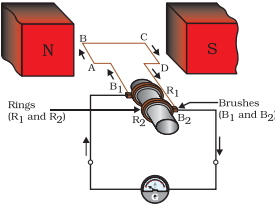
Describe the working of an $AC$ generator with the help of a labelled circuit diagram. What changes must be made in the arrangement to convert it to a $DC$ generator?
Solution
(N/A) Working of an $AC$ generator: An $AC$ generator consists of a rectangular coil placed between the poles of a strong permanent magnet. When the coil is rotated,the magnetic flux linked with it changes,inducing an alternating current $(AC)$ in the coil. The current flows through two slip rings ($R_1$ and $R_2$) and two stationary brushes ($B_1$ and $B_2$),which maintain contact with the rings.
Conversion to a $DC$ generator: To convert an $AC$ generator into a $DC$ generator,the slip rings must be replaced with a split-ring type commutator. This commutator reverses the direction of the current in the external circuit every half rotation,ensuring that the current flows in only one direction,thus producing direct current $(DC)$.
Conversion to a $DC$ generator: To convert an $AC$ generator into a $DC$ generator,the slip rings must be replaced with a split-ring type commutator. This commutator reverses the direction of the current in the external circuit every half rotation,ensuring that the current flows in only one direction,thus producing direct current $(DC)$.
0 likes
View Solution32
Difficult
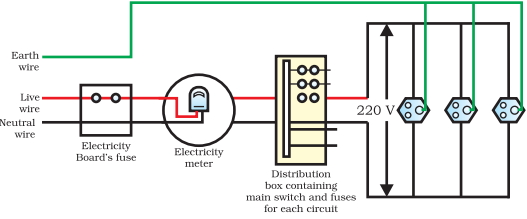
Draw an appropriate schematic diagram showing common domestic circuits and discuss the importance of a fuse. Why is it that a burnt-out fuse should be replaced by another fuse of identical rating?
Solution
(N/A) fuse is a safety device used in domestic circuits to protect electrical appliances and wiring from damage due to excessive current flow,which may occur during overloading or short-circuiting.
It works on the heating effect of electric current. When the current exceeds the rated limit,the fuse wire melts due to excessive heat,thereby breaking the circuit and preventing further damage.
$A$ burnt-out fuse must be replaced by another fuse of the same rating because the rating is specifically designed based on the maximum current capacity of the appliances and the wiring in that circuit.
If a fuse of a higher rating is used,it will not melt during an overload,potentially leading to fire or damage to the appliances. If a fuse of a lower rating is used,it will melt frequently even under normal operating conditions.
It works on the heating effect of electric current. When the current exceeds the rated limit,the fuse wire melts due to excessive heat,thereby breaking the circuit and preventing further damage.
$A$ burnt-out fuse must be replaced by another fuse of the same rating because the rating is specifically designed based on the maximum current capacity of the appliances and the wiring in that circuit.
If a fuse of a higher rating is used,it will not melt during an overload,potentially leading to fire or damage to the appliances. If a fuse of a lower rating is used,it will melt frequently even under normal operating conditions.
0 likes
View Solution33
Easy
Mention the shape of the magnetic field lines around a current-carrying straight conductor.
Solution
(N/A) The magnetic field lines around a current-carrying straight conductor are in the form of concentric circles. The center of these circles lies on the conductor itself. The direction of these field lines can be determined using the Right-Hand Thumb Rule.
0 likes
View Solution34
Easy
State the observation made by Oersted on the basis of his experiment with current carrying conductors.
Solution
(N/A) Hans Christian Oersted observed that a magnetic compass needle placed near a current-carrying wire gets deflected. This observation led to the conclusion that every current-carrying conductor produces a magnetic field around it.
0 likes
View Solution35
Easy
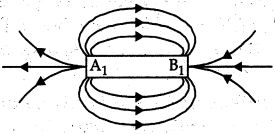
Identify the poles of the magnet in the given figure.
Solution
(N/A) Magnetic field lines always emerge from the North pole and enter the South pole of a magnet.
In the given figure,the field lines are shown entering the magnet at $A_{1}$ and emerging from the magnet at $B_{1}$.
Therefore,$A_{1}$ represents the South pole and $B_{1}$ represents the North pole.
In the given figure,the field lines are shown entering the magnet at $A_{1}$ and emerging from the magnet at $B_{1}$.
Therefore,$A_{1}$ represents the South pole and $B_{1}$ represents the North pole.
0 likes
View Solution36
Easy
State the direction of the magnetic field inside the bar magnet.
Solution
(N/A) Inside a bar magnet,the magnetic field lines travel from the south pole to the north pole. This forms a continuous closed loop with the external field lines,which travel from the north pole to the south pole.
0 likes
View Solution37
Easy
Mention the special feature regarding the shape of magnetic field lines.
Solution
(N/A) The special feature of magnetic field lines is that they are closed continuous curves. They emerge from the North pole and merge into the South pole outside the magnet,and continue from the South pole to the North pole inside the magnet.
0 likes
View Solution38
EasyMCQ
If field lines of a magnetic field are crossed at a point,what does it indicate?
A
The field is uniform.
B
The field is non-uniform.
C
The field has two directions at that point.
D
The field is zero at that point.
Solution
(C) If magnetic field lines cross each other at a point,it would imply that the magnetic field has two distinct directions at that single point. Since a magnetic compass needle can only point in one direction at any given location,this is physically impossible. Therefore,magnetic field lines never intersect.
0 likes
View Solution39
Easy
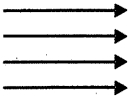
Draw a diagram to represent a uniform magnetic field in a given region.
Solution
(N/A) uniform magnetic field is represented by drawing a set of parallel,equidistant straight lines pointing in the same direction.
In such a field,the magnetic field strength and direction are the same at all points in the region.
The diagram shows these parallel lines,indicating that the magnetic field is uniform throughout the space.
In such a field,the magnetic field strength and direction are the same at all points in the region.
The diagram shows these parallel lines,indicating that the magnetic field is uniform throughout the space.
0 likes
View Solution40
EasyMCQ
What type of core is used to make an electromagnet?
A
Steel
B
Soft iron
C
Copper
D
Aluminum
Solution
(B) An electromagnet is typically made by winding a coil of insulated copper wire around a core of soft iron.
Soft iron is used because it has high magnetic permeability and low retentivity.
This means it can be easily magnetized when current flows through the coil and easily demagnetized when the current is switched off,making it ideal for temporary magnets.
Soft iron is used because it has high magnetic permeability and low retentivity.
This means it can be easily magnetized when current flows through the coil and easily demagnetized when the current is switched off,making it ideal for temporary magnets.
0 likes
View Solution41
Medium
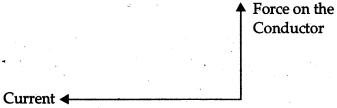
State the direction of the magnetic field in the following case:
Solution
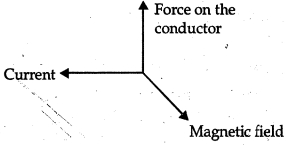
(N/A) To determine the direction of the magnetic field,we use Fleming's Left-Hand Rule.
According to Fleming's Left-Hand Rule,if we stretch the thumb,forefinger,and middle finger of our left hand such that they are mutually perpendicular to each other,then:
$1$. The forefinger points in the direction of the magnetic field.
$2$. The middle finger points in the direction of the current.
$3$. The thumb points in the direction of the force on the conductor.
In the given figure,the current is directed towards the left and the force on the conductor is directed upwards.
By applying Fleming's Left-Hand Rule,we find that the magnetic field is directed out of the page (towards the observer).
According to Fleming's Left-Hand Rule,if we stretch the thumb,forefinger,and middle finger of our left hand such that they are mutually perpendicular to each other,then:
$1$. The forefinger points in the direction of the magnetic field.
$2$. The middle finger points in the direction of the current.
$3$. The thumb points in the direction of the force on the conductor.
In the given figure,the current is directed towards the left and the force on the conductor is directed upwards.
By applying Fleming's Left-Hand Rule,we find that the magnetic field is directed out of the page (towards the observer).
0 likes
View Solution42
Easy
Mention the voltage and frequency of the electric current that we receive in our houses.
Solution
(N/A) In domestic electric circuits,the standard supply voltage is $220 \ V$ and the frequency of the alternating current is $50 \ Hz$.
0 likes
View Solution43
Easy
Name the type of current:
$(a)$ used in household supply,
$(b)$ given by a cell.
$(a)$ used in household supply,
$(b)$ given by a cell.
Solution
(N/A) Alternating current (ac): This is the type of current that periodically reverses its direction and changes its magnitude over time. It is the standard form of electricity supplied to homes.
$(b)$ Direct current (dc): This is the type of current that flows in a single,constant direction. $A$ cell or battery provides direct current.
$(b)$ Direct current (dc): This is the type of current that flows in a single,constant direction. $A$ cell or battery provides direct current.
0 likes
View Solution44
EasyMCQ
What is the shape of magnetic field lines around a straight current-carrying conductor?
A
Straight lines
B
Concentric circles
C
Elliptical
D
Radial
Solution
(B) When an electric current flows through a straight conductor,it produces a magnetic field around it.
According to the Right-Hand Thumb Rule,the magnetic field lines are in the form of concentric circles with the conductor at the center.
The plane of these circles is perpendicular to the straight conductor.
According to the Right-Hand Thumb Rule,the magnetic field lines are in the form of concentric circles with the conductor at the center.
The plane of these circles is perpendicular to the straight conductor.
0 likes
View Solution45
EasyMCQ
How can we find the direction of the magnetic field due to a straight current-carrying conductor?
A
Fleming's left-hand rule
B
Right-hand thumb rule
C
Fleming's right-hand rule
D
Lenz's law
Solution
(B) The direction of the magnetic field produced by a straight current-carrying conductor can be determined using the $Right-Hand$ $Thumb$ $Rule$.
According to this rule,if you hold the current-carrying conductor in your right hand such that your thumb points in the direction of the current,then your fingers wrapped around the conductor will point in the direction of the magnetic field lines.
According to this rule,if you hold the current-carrying conductor in your right hand such that your thumb points in the direction of the current,then your fingers wrapped around the conductor will point in the direction of the magnetic field lines.
0 likes
View Solution46
EasyMCQ
What is the shape of the magnetic field lines around a circular current-carrying conductor?
A
Circular
B
Elliptical
C
Straight lines at the center
D
Parabolic
Solution
(C) When current flows through a circular conductor,the magnetic field lines near the wire are circular. As we move towards the center of the circular loop,the circles become larger and larger. At the exact center of the circular loop,the magnetic field lines appear as straight lines.
0 likes
View Solution47
EasyMCQ
What is a solenoid?
A
$A$ straight wire carrying current
B
$A$ cylindrical coil of many tightly wound turns of insulated wire
C
$A$ circular loop of wire
D
$A$ permanent magnet
Solution
(B) solenoid is defined as a cylindrical coil of many tightly wound turns of insulated copper wire,where the length of the coil is significantly greater than its diameter. When an electric current flows through it,it produces a magnetic field similar to that of a bar magnet.
0 likes
View Solution48
EasyMCQ
Give the factors on which the magnetic field produced by a current-carrying solenoid depends.
A
Current flowing through the solenoid
B
Number of turns in the solenoid
C
Nature of the core material
D
All of the above
Solution
(D) The magnetic field produced by a current-carrying solenoid depends on the following factors:
$1$. The magnitude of the current flowing through the solenoid: The magnetic field strength is directly proportional to the current.
$2$. The number of turns in the solenoid: The magnetic field strength is directly proportional to the number of turns per unit length.
$3$. The nature of the core material: If a soft iron rod is placed inside the solenoid,it acts as an electromagnet,significantly increasing the magnetic field strength compared to an air core.
$1$. The magnitude of the current flowing through the solenoid: The magnetic field strength is directly proportional to the current.
$2$. The number of turns in the solenoid: The magnetic field strength is directly proportional to the number of turns per unit length.
$3$. The nature of the core material: If a soft iron rod is placed inside the solenoid,it acts as an electromagnet,significantly increasing the magnetic field strength compared to an air core.
0 likes
View Solution49
EasyMCQ
Name the rule used to find the direction of force on a current-carrying conductor placed in a magnetic field.
A
Fleming's left-hand rule
B
Fleming's right-hand rule
C
Right-hand thumb rule
D
Maxwell's corkscrew rule
Solution
(A) The rule used to determine the direction of the force acting on a current-carrying conductor placed in a magnetic field is $Fleming's \text{ left-hand rule}$. According to this rule, if we stretch the thumb, forefinger, and middle finger of our left hand such that they are mutually perpendicular to each other, then the forefinger points in the direction of the magnetic field, the middle finger points in the direction of the current, and the thumb gives the direction of the force or motion of the conductor.
0 likes
View Solution50
EasyMCQ
Name the factors on which the force acting on a current-carrying conductor placed in a magnetic field depends.
A
Current through the conductor
B
Strength of the magnetic field
C
Length of the conductor
D
All of the above
Solution
(D) The force $(F)$ acting on a current-carrying conductor placed in a magnetic field is given by the formula $F = BIl \sin \theta$.
Therefore,the factors are:
$(i)$ The current $(I)$ flowing through the conductor.
$(ii)$ The strength of the magnetic field $(B)$.
$(iii)$ The length of the conductor $(l)$.
$(iv)$ The angle $(\theta)$ between the direction of the current and the direction of the magnetic field.
Therefore,the factors are:
$(i)$ The current $(I)$ flowing through the conductor.
$(ii)$ The strength of the magnetic field $(B)$.
$(iii)$ The length of the conductor $(l)$.
$(iv)$ The angle $(\theta)$ between the direction of the current and the direction of the magnetic field.
0 likes
View SolutionMagnetic Effects of Electric Current — Mix Examples - Magnetic Effects of Electric Current · Frequently Asked Questions
1Are these Magnetic Effects of Electric Current questions useful for JEE and NEET?
Yes. All questions in this section are mapped to JEE Main and NEET exam patterns. Previous year questions from JEE Main, NEET, GUJCET and state-level exams are included with full solutions.
2Can I switch to Hindi or Gujarati for these questions?
Yes. Use the language tabs in the hero section or the sidebar to view the same questions and solutions in English, Hindi or Gujarati.
3How do I generate a question paper from this subtopic?
Use the Vedclass Exam Paper Generator — select the chapter and subtopic, set difficulty, and generate Sets A, B, C, D automatically. First 3 chapters of every subject are free.
Vedclass Products
For Students
Vedclass Test Series
Mock tests in real JEE/NEET style with performance analysis. 5-day free trial.
Start Free TrialFor Teachers
Exam Paper Generator
Generate Set A/B/C/D papers from this chapter in 2 minutes. 3 chapters free.
Try FreeFor Institutes
Online Exam Module
Live online exams with unlimited students, 360° analytics & white-label branding.
See DemoFor Teachers & Institutes
Generate a Magnetic Effects of Electric Current Exam Paper in 2 Minutes
Select subtopic & difficulty — Sets A, B, C, D auto-generated with No Repeat logic.
First 3 chapters of every subject are free — no payment required.