
A English
Mix Examples - Light – Reflection and Refraction Questions in English
Class 10 Science · Light – Reflection and Refraction · Mix Examples - Light – Reflection and Refraction
400+
Questions
English
Language
100%
With Solutions
Showing 50 of 400 questions in English
201
MediumMCQ
$A$ convex lens forms a real and inverted image of a needle at a distance of $50\, cm$ from the lens. Where should the needle be placed in front of the convex lens so that this image is of the same size as the object? Also, find the power of the lens.
A
At $25\, cm$, $P = 4\, D$
B
At $50\, cm$, $P = 4\, D$
C
At $50\, cm$, $P = 2\, D$
D
At $25\, cm$, $P = 2\, D$
Solution
(B) Given that the image is real, inverted, and of the same size as the object, the object must be placed at $2f$ from the convex lens.
Since the image is formed at a distance of $v = 50\, cm$, we have $2f = 50\, cm$.
Therefore, the focal length $f = 25\, cm = 0.25\, m$.
To obtain an image of the same size, the object must be placed at $2f$, which is $50\, cm$ in front of the lens.
The power of the lens $P$ is given by the formula $P = \frac{1}{f(\text{in meters})}$.
Substituting the value, $P = \frac{1}{0.25} = 4\, D$.
Since the image is formed at a distance of $v = 50\, cm$, we have $2f = 50\, cm$.
Therefore, the focal length $f = 25\, cm = 0.25\, m$.
To obtain an image of the same size, the object must be placed at $2f$, which is $50\, cm$ in front of the lens.
The power of the lens $P$ is given by the formula $P = \frac{1}{f(\text{in meters})}$.
Substituting the value, $P = \frac{1}{0.25} = 4\, D$.
0 likes
View Solution202
EasyMCQ
The refractive index of dense flint glass is $1.65$ and for alcohol it is $1.36,$ with respect to air. What is the refractive index of dense flint glass with respect to alcohol?
A
$1.21$
B
$0.82$
C
$2.24$
D
$1.01$
Solution
(A) Given:
Refractive index of dense flint glass with respect to air,$_{a}\mu_{g} = 1.65$
Refractive index of alcohol with respect to air,$_{a}\mu_{alc} = 1.36$
To find the refractive index of dense flint glass with respect to alcohol $(_{alc}\mu_{g})$,we use the formula:
$_{alc}\mu_{g} = \frac{_{a}\mu_{g}}{_{a}\mu_{alc}}$
Substituting the given values:
$_{alc}\mu_{g} = \frac{1.65}{1.36} \approx 1.21$
Therefore,the refractive index of dense flint glass with respect to alcohol is $1.21$.
Refractive index of dense flint glass with respect to air,$_{a}\mu_{g} = 1.65$
Refractive index of alcohol with respect to air,$_{a}\mu_{alc} = 1.36$
To find the refractive index of dense flint glass with respect to alcohol $(_{alc}\mu_{g})$,we use the formula:
$_{alc}\mu_{g} = \frac{_{a}\mu_{g}}{_{a}\mu_{alc}}$
Substituting the given values:
$_{alc}\mu_{g} = \frac{1.65}{1.36} \approx 1.21$
Therefore,the refractive index of dense flint glass with respect to alcohol is $1.21$.
0 likes
View Solution203
Medium
Two lenses of power $+3.5 D$ and $-2.5 D$ are placed in contact. Find the power and focal length of the lens combination.
Solution
(A) When lenses are placed in contact,the effective power $(P)$ of the combination is the algebraic sum of the individual powers of the lenses.
$P = P_1 + P_2$
Given $P_1 = +3.5 D$ and $P_2 = -2.5 D$.
Therefore,$P = +3.5 D + (-2.5 D) = +1.0 D$.
The focal length $(f)$ of the combination is given by the reciprocal of the total power $(f = 1/P)$.
$f = 1 / 1.0 D = 1.0 m$.
Since the power is positive,the combination behaves as a convex lens with a focal length of $1.0 m$.
$P = P_1 + P_2$
Given $P_1 = +3.5 D$ and $P_2 = -2.5 D$.
Therefore,$P = +3.5 D + (-2.5 D) = +1.0 D$.
The focal length $(f)$ of the combination is given by the reciprocal of the total power $(f = 1/P)$.
$f = 1 / 1.0 D = 1.0 m$.
Since the power is positive,the combination behaves as a convex lens with a focal length of $1.0 m$.
0 likes
View Solution204
Medium
$A$ convex lens has a focal length of $25\, cm$. Calculate the distance of the object from the lens if the image is to be formed on the opposite side of the lens at a distance of $75\, cm$ from the lens. What will be the nature of the image?
Solution
(D) Given: Focal length $f = +25\, cm$,Image distance $v = +75\, cm$ (since it is on the opposite side).
Using the lens formula: $\frac{1}{v} - \frac{1}{u} = \frac{1}{f}$.
Substituting the values: $\frac{1}{75} - \frac{1}{u} = \frac{1}{25}$.
Rearranging for $u$: $\frac{1}{u} = \frac{1}{75} - \frac{1}{25} = \frac{1 - 3}{75} = \frac{-2}{75}$.
Thus,$u = -37.5\, cm$.
The negative sign indicates the object is placed $37.5\, cm$ in front of the lens.
Since $v$ is positive and the image is formed on the opposite side,the image is real and inverted. Also,since $|v| > |u|$ $(75 > 37.5)$,the image is magnified.
Using the lens formula: $\frac{1}{v} - \frac{1}{u} = \frac{1}{f}$.
Substituting the values: $\frac{1}{75} - \frac{1}{u} = \frac{1}{25}$.
Rearranging for $u$: $\frac{1}{u} = \frac{1}{75} - \frac{1}{25} = \frac{1 - 3}{75} = \frac{-2}{75}$.
Thus,$u = -37.5\, cm$.
The negative sign indicates the object is placed $37.5\, cm$ in front of the lens.
Since $v$ is positive and the image is formed on the opposite side,the image is real and inverted. Also,since $|v| > |u|$ $(75 > 37.5)$,the image is magnified.
0 likes
View Solution205
MediumMCQ
$A$ $5 \, cm$ tall object is placed perpendicular to the principal axis of a convex lens of focal length $20 \, cm$. The distance of the object from the lens is $30 \, cm$. Find the $(i)$ position,$(ii)$ nature,and $(iii)$ size of the image formed.
A
$v = 60 \, cm$,Real and Inverted,$10 \, cm$
B
$v = -60 \, cm$,Virtual and Erect,$10 \, cm$
C
$v = 60 \, cm$,Real and Inverted,$-10 \, cm$
D
$v = -60 \, cm$,Real and Inverted,$10 \, cm$
Solution
(A) Given: Object height $O = 5 \, cm$,Object distance $u = -30 \, cm$,Focal length $f = +20 \, cm$.
Using the lens formula $\frac{1}{v} - \frac{1}{u} = \frac{1}{f}$:
$\frac{1}{v} = \frac{1}{f} + \frac{1}{u} = \frac{1}{20} + \frac{1}{-30} = \frac{3-2}{60} = \frac{1}{60}$.
Therefore,$v = 60 \, cm$. The positive sign indicates the image is formed on the other side of the lens.
Using magnification formula $m = \frac{I}{O} = \frac{v}{u}$:
$m = \frac{I}{5} = \frac{60}{-30} = -2$.
$I = 5 \times (-2) = -10 \, cm$.
$(i)$ Position: $60 \, cm$ from the lens on the opposite side.
(ii) Nature: Real and inverted (since $v$ is positive and $I$ is negative).
(iii) Size: $10 \, cm$ tall.
Using the lens formula $\frac{1}{v} - \frac{1}{u} = \frac{1}{f}$:
$\frac{1}{v} = \frac{1}{f} + \frac{1}{u} = \frac{1}{20} + \frac{1}{-30} = \frac{3-2}{60} = \frac{1}{60}$.
Therefore,$v = 60 \, cm$. The positive sign indicates the image is formed on the other side of the lens.
Using magnification formula $m = \frac{I}{O} = \frac{v}{u}$:
$m = \frac{I}{5} = \frac{60}{-30} = -2$.
$I = 5 \times (-2) = -10 \, cm$.
$(i)$ Position: $60 \, cm$ from the lens on the opposite side.
(ii) Nature: Real and inverted (since $v$ is positive and $I$ is negative).
(iii) Size: $10 \, cm$ tall.
0 likes
View Solution206
Medium
$A$ $10 \, cm$ tall object is placed perpendicular to the principal axis of a convex lens of focal length $30 \, cm$. The distance of the object from the lens is $20 \, cm$. Find the $(i)$ position,$(ii)$ nature,and $(iii)$ size of the image formed.
Solution
(D) Given: Object height $O = 10 \, cm$,object distance $u = -20 \, cm$,focal length $f = +30 \, cm$.
Using the lens formula $\frac{1}{v} - \frac{1}{u} = \frac{1}{f}$,we have:
$\frac{1}{v} = \frac{1}{f} + \frac{1}{u} = \frac{1}{30} + \frac{1}{-20} = \frac{2 - 3}{60} = -\frac{1}{60}$.
Therefore,the position of the image is $v = -60 \, cm$ (the image is formed on the same side as the object).
Using the magnification formula $m = \frac{I}{O} = \frac{v}{u}$,we have:
$\frac{I}{10} = \frac{-60}{-20} = 3$.
Therefore,the size of the image is $I = 30 \, cm$.
Since $v$ is negative,the image is virtual and erect. Since the height $I$ is positive and greater than $O$,the image is magnified.
Using the lens formula $\frac{1}{v} - \frac{1}{u} = \frac{1}{f}$,we have:
$\frac{1}{v} = \frac{1}{f} + \frac{1}{u} = \frac{1}{30} + \frac{1}{-20} = \frac{2 - 3}{60} = -\frac{1}{60}$.
Therefore,the position of the image is $v = -60 \, cm$ (the image is formed on the same side as the object).
Using the magnification formula $m = \frac{I}{O} = \frac{v}{u}$,we have:
$\frac{I}{10} = \frac{-60}{-20} = 3$.
Therefore,the size of the image is $I = 30 \, cm$.
Since $v$ is negative,the image is virtual and erect. Since the height $I$ is positive and greater than $O$,the image is magnified.
0 likes
View Solution207
MediumMCQ
An object $3 \, cm$ high is placed at a distance of $20 \, cm$ in front of a convex lens of focal length $12 \, cm$. Find the position,nature,and size of the image formed.
A
Position: $30 \, cm$ behind the lens,Nature: Real and Inverted,Size: $4.5 \, cm$
B
Position: $30 \, cm$ in front of the lens,Nature: Virtual and Erect,Size: $4.5 \, cm$
C
Position: $15 \, cm$ behind the lens,Nature: Real and Inverted,Size: $2.25 \, cm$
D
Position: $15 \, cm$ in front of the lens,Nature: Virtual and Erect,Size: $2.25 \, cm$
Solution
(A) Given: Height of object $O = 3 \, cm$,Object distance $u = -20 \, cm$,Focal length $f = +12 \, cm$.
Using the lens formula $\frac{1}{v} - \frac{1}{u} = \frac{1}{f}$,we have:
$\frac{1}{v} = \frac{1}{f} + \frac{1}{u} = \frac{1}{12} + \frac{1}{-20} = \frac{5 - 3}{60} = \frac{2}{60} = \frac{1}{30}$.
Therefore,$v = +30 \, cm$. The positive sign indicates the image is formed on the other side of the lens.
Using magnification $m = \frac{I}{O} = \frac{v}{u}$,we have:
$\frac{I}{3} = \frac{30}{-20} = -1.5$.
$I = 3 \times (-1.5) = -4.5 \, cm$.
The image is real,inverted,and $4.5 \, cm$ in size.
Using the lens formula $\frac{1}{v} - \frac{1}{u} = \frac{1}{f}$,we have:
$\frac{1}{v} = \frac{1}{f} + \frac{1}{u} = \frac{1}{12} + \frac{1}{-20} = \frac{5 - 3}{60} = \frac{2}{60} = \frac{1}{30}$.
Therefore,$v = +30 \, cm$. The positive sign indicates the image is formed on the other side of the lens.
Using magnification $m = \frac{I}{O} = \frac{v}{u}$,we have:
$\frac{I}{3} = \frac{30}{-20} = -1.5$.
$I = 3 \times (-1.5) = -4.5 \, cm$.
The image is real,inverted,and $4.5 \, cm$ in size.
0 likes
View Solution208
Medium
An object $4 \ cm$ high is placed at a distance of $27 \ cm$ in front of a convex lens of focal length $18 \ cm$. Find the position,nature,and size of the image formed.
Solution
(D) Given: Object height $O = 4 \ cm$,object distance $u = -27 \ cm$,focal length $f = +18 \ cm$.
Using the lens formula $\frac{1}{v} - \frac{1}{u} = \frac{1}{f}$,we have:
$\frac{1}{v} = \frac{1}{f} + \frac{1}{u} = \frac{1}{18} + \frac{1}{-27} = \frac{3-2}{54} = \frac{1}{54}$.
Therefore,the image position $v = +54 \ cm$.
Using magnification formula $m = \frac{I}{O} = \frac{v}{u}$,we have:
$\frac{I}{4} = \frac{54}{-27} = -2$.
Therefore,the image size $I = 4 \times (-2) = -8 \ cm$.
The positive value of $v$ indicates that the image is formed on the other side of the lens,and the negative value of $I$ indicates that the image is real and inverted.
Using the lens formula $\frac{1}{v} - \frac{1}{u} = \frac{1}{f}$,we have:
$\frac{1}{v} = \frac{1}{f} + \frac{1}{u} = \frac{1}{18} + \frac{1}{-27} = \frac{3-2}{54} = \frac{1}{54}$.
Therefore,the image position $v = +54 \ cm$.
Using magnification formula $m = \frac{I}{O} = \frac{v}{u}$,we have:
$\frac{I}{4} = \frac{54}{-27} = -2$.
Therefore,the image size $I = 4 \times (-2) = -8 \ cm$.
The positive value of $v$ indicates that the image is formed on the other side of the lens,and the negative value of $I$ indicates that the image is real and inverted.
0 likes
View Solution209
MediumMCQ
Find the position,nature,and size of the image of an object $3 \, cm$ high placed at a distance of $9 \, cm$ from a concave mirror of focal length $18 \, cm$.
A
Position: $18 \, cm$ behind the mirror,Nature: Virtual and erect,Size: $6 \, cm$
B
Position: $18 \, cm$ in front of the mirror,Nature: Real and inverted,Size: $6 \, cm$
C
Position: $9 \, cm$ behind the mirror,Nature: Virtual and erect,Size: $3 \, cm$
D
Position: $18 \, cm$ behind the mirror,Nature: Real and inverted,Size: $6 \, cm$
Solution
(A) Given: Object height $h = 3 \, cm$,Object distance $u = -9 \, cm$,Focal length $f = -18 \, cm$.
Using the mirror formula: $\frac{1}{f} = \frac{1}{v} + \frac{1}{u}$.
Substituting the values: $\frac{1}{-18} = \frac{1}{v} + \frac{1}{-9}$.
$\frac{1}{v} = \frac{1}{9} - \frac{1}{18} = \frac{2-1}{18} = \frac{1}{18}$.
Therefore,$v = +18 \, cm$. Since $v$ is positive,the image is formed $18 \, cm$ behind the mirror,which means it is virtual and erect.
Now,magnification $m = \frac{h'}{h} = -\frac{v}{u}$.
$h' = -\frac{v \times h}{u} = -\frac{18 \times 3}{-9} = 6 \, cm$.
Thus,the image is virtual,erect,$18 \, cm$ behind the mirror,and $6 \, cm$ in size.
Using the mirror formula: $\frac{1}{f} = \frac{1}{v} + \frac{1}{u}$.
Substituting the values: $\frac{1}{-18} = \frac{1}{v} + \frac{1}{-9}$.
$\frac{1}{v} = \frac{1}{9} - \frac{1}{18} = \frac{2-1}{18} = \frac{1}{18}$.
Therefore,$v = +18 \, cm$. Since $v$ is positive,the image is formed $18 \, cm$ behind the mirror,which means it is virtual and erect.
Now,magnification $m = \frac{h'}{h} = -\frac{v}{u}$.
$h' = -\frac{v \times h}{u} = -\frac{18 \times 3}{-9} = 6 \, cm$.
Thus,the image is virtual,erect,$18 \, cm$ behind the mirror,and $6 \, cm$ in size.
0 likes
View Solution210
Medium
With respect to air,the refractive indices of ice and rock salt are $1.31$ and $1.54$ respectively. Calculate the refractive index of rock salt with respect to ice.
Solution
(1.18) The refractive index of a medium $2$ with respect to medium $1$ is given by the formula: ${}_{1}n_{2} = \frac{{}_{a}n_{2}}{{}_{a}n_{1}}$.
Here,medium $1$ is ice $(i)$ and medium $2$ is rock salt $(r)$.
Given: Refractive index of ice with respect to air $({}_{a}n_{i})$ = $1.31$.
Refractive index of rock salt with respect to air $({}_{a}n_{r})$ = $1.54$.
Therefore,the refractive index of rock salt with respect to ice $({}_{i}n_{r})$ = $\frac{1.54}{1.31} \approx 1.18$.
Here,medium $1$ is ice $(i)$ and medium $2$ is rock salt $(r)$.
Given: Refractive index of ice with respect to air $({}_{a}n_{i})$ = $1.31$.
Refractive index of rock salt with respect to air $({}_{a}n_{r})$ = $1.54$.
Therefore,the refractive index of rock salt with respect to ice $({}_{i}n_{r})$ = $\frac{1.54}{1.31} \approx 1.18$.
0 likes
View Solution211
MediumMCQ
Light enters from air into diamond,which has a refractive index of $2.42$. Calculate the speed of light in diamond. The speed of light in air is $3.0 \times 10^{8} \text{ m s}^{-1}$.
A
$1.24 \times 10^{8} \text{ m s}^{-1}$
B
$1.50 \times 10^{8} \text{ m s}^{-1}$
C
$2.42 \times 10^{8} \text{ m s}^{-1}$
D
$7.26 \times 10^{8} \text{ m s}^{-1}$
Solution
(A) Given:
Speed of light in air $(c)$ = $3.0 \times 10^{8} \text{ m s}^{-1}$
Refractive index of diamond $(n)$ = $2.42$
Speed of light in diamond $(v)$ = ?
Formula:
The refractive index $(n)$ is defined as the ratio of the speed of light in air $(c)$ to the speed of light in the medium $(v)$:
$n = \frac{c}{v}$
Calculation:
Rearranging the formula to solve for $v$:
$v = \frac{c}{n}$
$v = \frac{3.0 \times 10^{8}}{2.42}$
$v \approx 1.24 \times 10^{8} \text{ m s}^{-1}$
Therefore,the speed of light in diamond is $1.24 \times 10^{8} \text{ m s}^{-1}$.
Speed of light in air $(c)$ = $3.0 \times 10^{8} \text{ m s}^{-1}$
Refractive index of diamond $(n)$ = $2.42$
Speed of light in diamond $(v)$ = ?
Formula:
The refractive index $(n)$ is defined as the ratio of the speed of light in air $(c)$ to the speed of light in the medium $(v)$:
$n = \frac{c}{v}$
Calculation:
Rearranging the formula to solve for $v$:
$v = \frac{c}{n}$
$v = \frac{3.0 \times 10^{8}}{2.42}$
$v \approx 1.24 \times 10^{8} \text{ m s}^{-1}$
Therefore,the speed of light in diamond is $1.24 \times 10^{8} \text{ m s}^{-1}$.
0 likes
View Solution212
Medium
An object $3.0 \text{ cm}$ high is placed perpendicular to the principal axis of a concave lens of focal length $7.5 \text{ cm}$. The image is formed at a distance of $5.0 \text{ cm}$ from the lens. Calculate $(i)$ distance at which object is placed,and $(ii)$ size and nature of image formed.
Solution
(A) Given: Object height $O = 3.0 \text{ cm}$,focal length $f = -7.5 \text{ cm}$,image distance $v = -5.0 \text{ cm}$.
$(i)$ Using the lens formula $\frac{1}{v} - \frac{1}{u} = \frac{1}{f}$:
$\frac{1}{u} = \frac{1}{v} - \frac{1}{f} = \frac{1}{-5.0} - \frac{1}{-7.5} = -0.2 + 0.1333 = -0.0667 \text{ cm}^{-1}$.
Thus,$u = -15 \text{ cm}$. The object is placed $15 \text{ cm}$ in front of the concave lens.
(ii) Magnification $m = \frac{I}{O} = \frac{v}{u}$.
$I = \frac{v}{u} \times O = \frac{-5.0}{-15.0} \times 3.0 = 1.0 \text{ cm}$.
Since the magnification is positive $(m = +0.33)$,the image is virtual,erect,and $1.0 \text{ cm}$ in size.
$(i)$ Using the lens formula $\frac{1}{v} - \frac{1}{u} = \frac{1}{f}$:
$\frac{1}{u} = \frac{1}{v} - \frac{1}{f} = \frac{1}{-5.0} - \frac{1}{-7.5} = -0.2 + 0.1333 = -0.0667 \text{ cm}^{-1}$.
Thus,$u = -15 \text{ cm}$. The object is placed $15 \text{ cm}$ in front of the concave lens.
(ii) Magnification $m = \frac{I}{O} = \frac{v}{u}$.
$I = \frac{v}{u} \times O = \frac{-5.0}{-15.0} \times 3.0 = 1.0 \text{ cm}$.
Since the magnification is positive $(m = +0.33)$,the image is virtual,erect,and $1.0 \text{ cm}$ in size.
0 likes
View Solution213
MediumMCQ
An object is placed at a distance of $12 \ cm$ in front of a concave mirror. It forms a real image four times larger than the object. Calculate the distance of the image from the mirror. (in $cm$)
A
$48$
B
$36$
C
$24$
D
$12$
Solution
(A) Given: Object distance $u = -12 \ cm$. Magnification $m = -4$ (since the image is real and inverted).
Using the magnification formula for a spherical mirror: $m = -\frac{v}{u}$.
Substituting the values: $-4 = -\frac{v}{-12}$.
Solving for $v$: $-4 = \frac{v}{12} \implies v = -48 \ cm$.
The negative sign indicates that the image is formed in front of the mirror,which is consistent with a real image. Thus,the distance of the image from the mirror is $48 \ cm$.
Using the magnification formula for a spherical mirror: $m = -\frac{v}{u}$.
Substituting the values: $-4 = -\frac{v}{-12}$.
Solving for $v$: $-4 = \frac{v}{12} \implies v = -48 \ cm$.
The negative sign indicates that the image is formed in front of the mirror,which is consistent with a real image. Thus,the distance of the image from the mirror is $48 \ cm$.
0 likes
View Solution214
MediumMCQ
$A$ point object is placed at a distance of $12 \, cm$ from a convex lens on its principal axis. Its image is formed on the other side of the lens at a distance of $18 \, cm$ from the lens. Find the focal length of the lens. Is the image magnified? Justify your answer.
A
Focal length = $7.2 \, cm$,Yes,magnified
B
Focal length = $6.0 \, cm$,No,diminished
C
Focal length = $7.2 \, cm$,No,diminished
D
Focal length = $12.0 \, cm$,Yes,magnified
Solution
(A) Given: Object distance $u = -12 \, cm$,Image distance $v = 18 \, cm$.
Using the lens formula: $\frac{1}{f} = \frac{1}{v} - \frac{1}{u}$.
Substituting the values: $\frac{1}{f} = \frac{1}{18} - \frac{1}{-12} = \frac{1}{18} + \frac{1}{12}$.
Taking the $LCM$ of $18$ and $12$ as $36$: $\frac{1}{f} = \frac{2+3}{36} = \frac{5}{36}$.
Therefore,$f = \frac{36}{5} = 7.2 \, cm$.
The magnification $m$ is given by $m = \frac{v}{u} = \frac{18}{-12} = -1.5$.
Since the magnitude of magnification $|m| = 1.5 > 1$,the image is magnified.
Using the lens formula: $\frac{1}{f} = \frac{1}{v} - \frac{1}{u}$.
Substituting the values: $\frac{1}{f} = \frac{1}{18} - \frac{1}{-12} = \frac{1}{18} + \frac{1}{12}$.
Taking the $LCM$ of $18$ and $12$ as $36$: $\frac{1}{f} = \frac{2+3}{36} = \frac{5}{36}$.
Therefore,$f = \frac{36}{5} = 7.2 \, cm$.
The magnification $m$ is given by $m = \frac{v}{u} = \frac{18}{-12} = -1.5$.
Since the magnitude of magnification $|m| = 1.5 > 1$,the image is magnified.
0 likes
View Solution215
Medium
$(a)$ Two lenses have powers of $(i) +2 \text{ D}$ and $(ii) -4 \text{ D}$. What is the nature and focal length of each lens?
$(b)$ An object is kept at a distance of $100 \text{ cm}$ from a lens of power $-4 \text{ D}$. Calculate the image distance.
$(b)$ An object is kept at a distance of $100 \text{ cm}$ from a lens of power $-4 \text{ D}$. Calculate the image distance.
Solution
(D) $(i)$ For power $P = +2 \text{ D}$,the lens is a convex lens. Focal length $f = \frac{1}{P} = \frac{1}{+2} = +0.5 \text{ m} = +50 \text{ cm}$.
$(ii)$ For power $P = -4 \text{ D}$,the lens is a concave lens. Focal length $f = \frac{1}{P} = \frac{1}{-4} = -0.25 \text{ m} = -25 \text{ cm}$.
$(b)$ Given: Power $P = -4 \text{ D}$,object distance $u = -100 \text{ cm}$.
Focal length $f = \frac{1}{P} = -25 \text{ cm}$.
Using the lens formula $\frac{1}{v} - \frac{1}{u} = \frac{1}{f}$:
$\frac{1}{v} = \frac{1}{f} + \frac{1}{u} = \frac{1}{-25} + \frac{1}{-100} = \frac{-4 - 1}{100} = \frac{-5}{100} = -\frac{1}{20}$.
Therefore,$v = -20 \text{ cm}$. The image is formed at a distance of $20 \text{ cm}$ on the same side as the object.
$(ii)$ For power $P = -4 \text{ D}$,the lens is a concave lens. Focal length $f = \frac{1}{P} = \frac{1}{-4} = -0.25 \text{ m} = -25 \text{ cm}$.
$(b)$ Given: Power $P = -4 \text{ D}$,object distance $u = -100 \text{ cm}$.
Focal length $f = \frac{1}{P} = -25 \text{ cm}$.
Using the lens formula $\frac{1}{v} - \frac{1}{u} = \frac{1}{f}$:
$\frac{1}{v} = \frac{1}{f} + \frac{1}{u} = \frac{1}{-25} + \frac{1}{-100} = \frac{-4 - 1}{100} = \frac{-5}{100} = -\frac{1}{20}$.
Therefore,$v = -20 \text{ cm}$. The image is formed at a distance of $20 \text{ cm}$ on the same side as the object.
0 likes
View Solution216
Medium
$(a)$ $A$ concave mirror produces a three times enlarged real image of an object placed at $10\, cm$ in front of it. Calculate the focal length of the mirror.
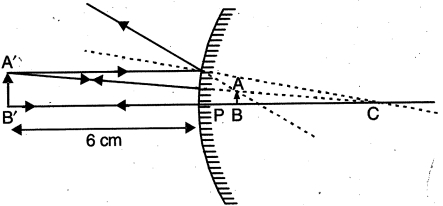
$(b)$ Show the formation of the image with the help of a ray diagram when an object is placed $6\, cm$ away from the pole of a convex mirror.
$(b)$ Show the formation of the image with the help of a ray diagram when an object is placed $6\, cm$ away from the pole of a convex mirror.
Solution
(N/A) Given: Magnification $m = -3$ (for a real image),Object distance $u = -10\, cm$. We need to find the focal length $f$.
Using the magnification formula: $m = -v/u$
$-3 = -v / (-10)$
$-3 = v / 10$
$v = -30\, cm$
Using the mirror formula: $1/f = 1/v + 1/u$
$1/f = 1/(-30) + 1/(-10)$
$1/f = (-1 - 3) / 30 = -4 / 30$
$f = -30 / 4 = -7.5\, cm$
Thus,the focal length of the concave mirror is $-7.5\, cm$.
$(b)$ The ray diagram for an object placed $6\, cm$ in front of a convex mirror is shown below.
Using the magnification formula: $m = -v/u$
$-3 = -v / (-10)$
$-3 = v / 10$
$v = -30\, cm$
Using the mirror formula: $1/f = 1/v + 1/u$
$1/f = 1/(-30) + 1/(-10)$
$1/f = (-1 - 3) / 30 = -4 / 30$
$f = -30 / 4 = -7.5\, cm$
Thus,the focal length of the concave mirror is $-7.5\, cm$.
$(b)$ The ray diagram for an object placed $6\, cm$ in front of a convex mirror is shown below.
0 likes
View Solution217
MediumMCQ
An object $1 \, cm$ tall is placed at a distance of $15 \, cm$ from a concave mirror of focal length $10 \, cm$. Find the position,size,and nature of the image formed.
A
$v = -30 \, cm$,$I = -2 \, cm$,Real and Inverted
B
$v = 30 \, cm$,$I = 2 \, cm$,Virtual and Erect
C
$v = -15 \, cm$,$I = -1 \, cm$,Real and Inverted
D
$v = -30 \, cm$,$I = 2 \, cm$,Real and Erect
Solution
(A) Given: Object height $O = 1 \, cm$,Object distance $u = -15 \, cm$,Focal length $f = -10 \, cm$.
Using the mirror formula $\frac{1}{f} = \frac{1}{v} + \frac{1}{u}$:
$\frac{1}{v} = \frac{1}{f} - \frac{1}{u} = \frac{1}{-10} - \frac{1}{-15} = \frac{-3 + 2}{30} = \frac{-1}{30}$.
Thus,$v = -30 \, cm$. The negative sign indicates the image is formed in front of the mirror.
Magnification $m = \frac{I}{O} = -\frac{v}{u}$.
$I = -\frac{v}{u} \times O = -\frac{-30}{-15} \times 1 = -2 \, cm$.
The image is $30 \, cm$ in front of the mirror,$2 \, cm$ tall,and is real and inverted.
Using the mirror formula $\frac{1}{f} = \frac{1}{v} + \frac{1}{u}$:
$\frac{1}{v} = \frac{1}{f} - \frac{1}{u} = \frac{1}{-10} - \frac{1}{-15} = \frac{-3 + 2}{30} = \frac{-1}{30}$.
Thus,$v = -30 \, cm$. The negative sign indicates the image is formed in front of the mirror.
Magnification $m = \frac{I}{O} = -\frac{v}{u}$.
$I = -\frac{v}{u} \times O = -\frac{-30}{-15} \times 1 = -2 \, cm$.
The image is $30 \, cm$ in front of the mirror,$2 \, cm$ tall,and is real and inverted.
0 likes
View Solution218
MediumMCQ
$A$ $2.0 \text{ cm}$ tall object is placed perpendicular to the principal axis of a convex lens of focal length $10 \text{ cm}$. The distance of the object from the lens is $15 \text{ cm}$. Find the position,nature,and size of the image formed.
A
v = $30$ cm,Real,Inverted,$4$ cm
B
v = -$30$ cm,Virtual,Erect,$4$ cm
C
v = $30$ cm,Real,Inverted,-$4$ cm
D
v = -$30$ cm,Real,Inverted,$4$ cm
Solution
(A) Given: Object height $O = 2.0 \text{ cm}$,Focal length $f = +10 \text{ cm}$,Object distance $u = -15 \text{ cm}$.
Using the lens formula $\frac{1}{v} - \frac{1}{u} = \frac{1}{f}$:
$\frac{1}{v} = \frac{1}{f} + \frac{1}{u} = \frac{1}{10} + \frac{1}{-15} = \frac{3 - 2}{30} = \frac{1}{30}$.
Therefore,$v = +30 \text{ cm}$. The positive sign indicates the image is formed on the other side of the lens.
Magnification $m = \frac{v}{u} = \frac{I}{O}$.
$I = \frac{v}{u} \times O = \frac{30}{-15} \times 2.0 = -4 \text{ cm}$.
The image is real,inverted,and $4 \text{ cm}$ tall,formed at a distance of $30 \text{ cm}$ from the lens.
Using the lens formula $\frac{1}{v} - \frac{1}{u} = \frac{1}{f}$:
$\frac{1}{v} = \frac{1}{f} + \frac{1}{u} = \frac{1}{10} + \frac{1}{-15} = \frac{3 - 2}{30} = \frac{1}{30}$.
Therefore,$v = +30 \text{ cm}$. The positive sign indicates the image is formed on the other side of the lens.
Magnification $m = \frac{v}{u} = \frac{I}{O}$.
$I = \frac{v}{u} \times O = \frac{30}{-15} \times 2.0 = -4 \text{ cm}$.
The image is real,inverted,and $4 \text{ cm}$ tall,formed at a distance of $30 \text{ cm}$ from the lens.
0 likes
View Solution219
Medium
$A$ girl was playing with a thin beam of light from her laser torch by directing it from different directions on a convex lens held vertically. She was surprised to see that in a particular direction the beam of light continues to move along the same direction after passing through the lens. State the reason for this observation.
Solution
(N/A) The beam of light must be passing through the optical centre of the lens.
When a light ray passes through the optical centre of a lens,it does not undergo any refraction or deviation.
This is because the central part of the lens acts like a very thin glass slab,allowing the light to pass straight through without changing its path.
When a light ray passes through the optical centre of a lens,it does not undergo any refraction or deviation.
This is because the central part of the lens acts like a very thin glass slab,allowing the light to pass straight through without changing its path.
0 likes
View Solution220
MediumMCQ
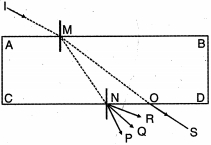
If a light ray $IM$ is incident on the surface $AB$ of a rectangular glass slab as shown,identify the correct emergent ray.
A
$P$
B
$Q$
C
$R$
D
$S$
Solution
(D) When a light ray passes through a rectangular glass slab,it undergoes refraction at two parallel surfaces ($AB$ and $CD$).
According to the laws of refraction,when a light ray travels from a rarer medium (air) to a denser medium (glass),it bends towards the normal.
When it emerges from the denser medium (glass) back into the rarer medium (air),it bends away from the normal.
Because the opposite surfaces of the rectangular glass slab are parallel to each other,the emergent ray is parallel to the incident ray.
In the given diagram,the ray $S$ is parallel to the incident ray $IM$,which is the characteristic property of refraction through a rectangular glass slab.
According to the laws of refraction,when a light ray travels from a rarer medium (air) to a denser medium (glass),it bends towards the normal.
When it emerges from the denser medium (glass) back into the rarer medium (air),it bends away from the normal.
Because the opposite surfaces of the rectangular glass slab are parallel to each other,the emergent ray is parallel to the incident ray.
In the given diagram,the ray $S$ is parallel to the incident ray $IM$,which is the characteristic property of refraction through a rectangular glass slab.
0 likes
View Solution221
Easy
Name the type of lens that can be used to obtain:
$(i)$ $A$ magnified and virtual image.
$(ii)$ $A$ diminished and virtual image of the object.
$(i)$ $A$ magnified and virtual image.
$(ii)$ $A$ diminished and virtual image of the object.
Solution
(N/A) $(i)$ $A$ convex lens can produce a magnified and virtual image when the object is placed between the optical center and the principal focus.
$(ii)$ $A$ concave lens always produces a diminished and virtual image for any position of the object.
$(ii)$ $A$ concave lens always produces a diminished and virtual image for any position of the object.
0 likes
View Solution222
Medium
An object is placed at a distance of $25 \, cm$ away from a converging mirror of focal length $20 \, cm$. Discuss the effect on the nature and position of the image if the position of the object changes from $25 \, cm$ to $15 \, cm$. Justify your answer without using the mirror formula.
Solution
(N/A) converging mirror is a concave mirror. The focal length $f$ is $20 \, cm$.
Initially,the object is at $25 \, cm$,which is between the center of curvature $(C = 40 \, cm)$ and the focus $(F = 20 \, cm)$. In this position,the image formed is real,inverted,and magnified,located beyond the center of curvature.
As the object is moved from $25 \, cm$ to $20 \, cm$ (the focus),the image shifts further away from the mirror and its size increases.
When the object is at the focus ($15 \, cm$ is between the focus and the pole),the image is formed at infinity.
When the object is moved from $20 \, cm$ to $15 \, cm$,it is now placed between the focus and the pole.
In this new position,the image becomes virtual,erect,and magnified,and it is formed behind the mirror.
Initially,the object is at $25 \, cm$,which is between the center of curvature $(C = 40 \, cm)$ and the focus $(F = 20 \, cm)$. In this position,the image formed is real,inverted,and magnified,located beyond the center of curvature.
As the object is moved from $25 \, cm$ to $20 \, cm$ (the focus),the image shifts further away from the mirror and its size increases.
When the object is at the focus ($15 \, cm$ is between the focus and the pole),the image is formed at infinity.
When the object is moved from $20 \, cm$ to $15 \, cm$,it is now placed between the focus and the pole.
In this new position,the image becomes virtual,erect,and magnified,and it is formed behind the mirror.
0 likes
View Solution223
Difficult
For driving a car,what type of mirror would you prefer to see the traffic at your back and why?
Solution
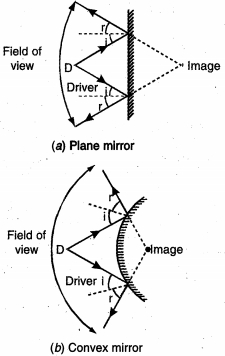
(N/A) We prefer a convex mirror for observing the traffic behind us because its field of view is much larger than that of a plane mirror.
Although it gives an erroneous idea about the speed of the vehicles behind us,we still prefer it due to its wider field of view.
The view shown by a plane mirror and a convex mirror is as shown in the figure. It is clear from the figure that the view produced by a convex mirror is wider than that produced by a plane mirror.
Although it gives an erroneous idea about the speed of the vehicles behind us,we still prefer it due to its wider field of view.
The view shown by a plane mirror and a convex mirror is as shown in the figure. It is clear from the figure that the view produced by a convex mirror is wider than that produced by a plane mirror.
0 likes
View Solution224
MediumMCQ
The mirror outside the driver's side of a vehicle is usually a convex mirror. Printed on such a mirror is usually the warning "Vehicles in this mirror are closer than they appear". What is the reason for this warning?
A
Convex mirrors produce real and inverted images.
B
Convex mirrors produce virtual, diminished, and erect images, making distant objects appear smaller and further away.
C
Convex mirrors produce magnified images, making objects appear closer.
D
Convex mirrors have a very small field of view.
Solution
(B) The reason for this warning is that a convex mirror forms a virtual, erect, and diminished image of the objects behind the vehicle.
Because the image is diminished in size, the driver may perceive the object as being further away than it actually is.
This optical illusion can lead a driver to believe that the vehicle behind is at a safe distance when it is actually closer, potentially causing an accident if the driver changes lanes without caution.
Because the image is diminished in size, the driver may perceive the object as being further away than it actually is.
This optical illusion can lead a driver to believe that the vehicle behind is at a safe distance when it is actually closer, potentially causing an accident if the driver changes lanes without caution.
0 likes
View Solution225
EasyMCQ
In the case of a convex mirror,if the object is moved away from the surface of the mirror,how do the position and size of the image change?
A
The image moves towards the pole and its size increases.
B
The image moves towards the focus and its size decreases.
C
The image moves towards the pole and its size decreases.
D
The image moves towards the focus and its size increases.
Solution
(B) As the object is moved away from a convex mirror,the distance of the virtual image,formed behind the mirror,increases (the image remains between the pole $P$ and the focus $F$).
Specifically,the image shifts from the pole $P$ towards the focus $F$ as the object distance increases.
Simultaneously,the size of the image gradually decreases.
When the object is at infinity,the image is formed at the focus $F$ and is highly diminished in size.
Specifically,the image shifts from the pole $P$ towards the focus $F$ as the object distance increases.
Simultaneously,the size of the image gradually decreases.
When the object is at infinity,the image is formed at the focus $F$ and is highly diminished in size.
0 likes
View Solution226
Easy
An object is brought towards a concave mirror. How does the position and size of the image change?
Solution
(N/A) $1$. When the object is at infinity,the image is formed at the focus $(F)$,and it is highly diminished and inverted.
$2$. As the object moves from infinity towards the centre of curvature $(C)$,the image moves from the focus $(F)$ towards the centre of curvature $(C)$,and its size increases.
$3$. When the object is at the centre of curvature $(C)$,the image is formed at the centre of curvature $(C)$,and its size is equal to the size of the object.
$4$. As the object moves from the centre of curvature $(C)$ towards the focus $(F)$,the image moves away from the centre of curvature $(C)$ towards infinity,and its size becomes magnified.
$5$. When the object is at the focus $(F)$,the image is formed at infinity.
$6$. When the object is placed between the focus $(F)$ and the pole $(P)$,the image is formed behind the mirror,and it becomes virtual,erect,and magnified.
$2$. As the object moves from infinity towards the centre of curvature $(C)$,the image moves from the focus $(F)$ towards the centre of curvature $(C)$,and its size increases.
$3$. When the object is at the centre of curvature $(C)$,the image is formed at the centre of curvature $(C)$,and its size is equal to the size of the object.
$4$. As the object moves from the centre of curvature $(C)$ towards the focus $(F)$,the image moves away from the centre of curvature $(C)$ towards infinity,and its size becomes magnified.
$5$. When the object is at the focus $(F)$,the image is formed at infinity.
$6$. When the object is placed between the focus $(F)$ and the pole $(P)$,the image is formed behind the mirror,and it becomes virtual,erect,and magnified.
0 likes
View Solution227
Medium
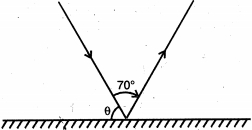
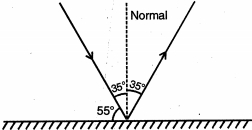
The angle between an incident ray and the reflected ray is $70^{\circ}$ as shown in the figure. What is the value of $\theta$?
Solution
$(55^{\circ})$ According to the law of reflection, the angle of incidence $(i)$ is equal to the angle of reflection $(r)$.
Given that the total angle between the incident ray and the reflected ray is $70^{\circ}$, we have $i + r = 70^{\circ}$.
Since $i = r$, we can write $2i = 70^{\circ}$, which gives $i = 35^{\circ}$.
The normal to the mirror surface makes an angle of $90^{\circ}$ with the mirror.
Therefore, the angle $\theta$ between the incident ray and the mirror surface is $\theta = 90^{\circ} - i$.
Substituting the value of $i$, we get $\theta = 90^{\circ} - 35^{\circ} = 55^{\circ}$.
Given that the total angle between the incident ray and the reflected ray is $70^{\circ}$, we have $i + r = 70^{\circ}$.
Since $i = r$, we can write $2i = 70^{\circ}$, which gives $i = 35^{\circ}$.
The normal to the mirror surface makes an angle of $90^{\circ}$ with the mirror.
Therefore, the angle $\theta$ between the incident ray and the mirror surface is $\theta = 90^{\circ} - i$.
Substituting the value of $i$, we get $\theta = 90^{\circ} - 35^{\circ} = 55^{\circ}$.
0 likes
View Solution228
EasyMCQ
$A$ concave mirror and a convex lens are held in water. What changes, if any, do you expect in their focal length?
A
Focal length of both will increase.
B
Focal length of both will decrease.
C
Focal length of the mirror remains unchanged, while the focal length of the lens increases.
D
Focal length of the mirror changes, while the focal length of the lens remains unchanged.
Solution
(C) The focal length of a mirror depends only on its radius of curvature $(f = R/2)$ and is independent of the refractive index of the surrounding medium. Therefore, the focal length of the concave mirror remains unchanged in water.
However, the focal length of a lens is determined by the Lens Maker's Formula: $1/f = (n_g/n_m - 1)(1/R_1 - 1/R_2)$, where $n_g$ is the refractive index of the lens material and $n_m$ is the refractive index of the medium. Since the refractive index of water $(n_m \approx 1.33)$ is greater than that of air $(n_m \approx 1.0)$, the relative refractive index $(n_g/n_m - 1)$ decreases, causing the focal length of the convex lens to increase.
However, the focal length of a lens is determined by the Lens Maker's Formula: $1/f = (n_g/n_m - 1)(1/R_1 - 1/R_2)$, where $n_g$ is the refractive index of the lens material and $n_m$ is the refractive index of the medium. Since the refractive index of water $(n_m \approx 1.33)$ is greater than that of air $(n_m \approx 1.0)$, the relative refractive index $(n_g/n_m - 1)$ decreases, causing the focal length of the convex lens to increase.
0 likes
View Solution229
EasyMCQ
Is it possible for a lens to act as a convergent lens in one medium and a divergent lens in another?
A
Yes
B
No
C
Only for concave lenses
D
Only for convex lenses
Solution
(A) Yes,it is possible. The focal length $f$ of a lens in a medium is given by the Lens Maker's Formula: $\frac{1}{f} = (\frac{n_l}{n_m} - 1)(\frac{1}{R_1} - \frac{1}{R_2})$.
If the refractive index of the surrounding medium $(n_m)$ is greater than the refractive index of the lens material $(n_l)$,the term $(\frac{n_l}{n_m} - 1)$ becomes negative.
This causes the lens to change its nature: a convex lens (convergent) will behave as a concave lens (divergent),and vice versa.
If the refractive index of the surrounding medium $(n_m)$ is greater than the refractive index of the lens material $(n_l)$,the term $(\frac{n_l}{n_m} - 1)$ becomes negative.
This causes the lens to change its nature: a convex lens (convergent) will behave as a concave lens (divergent),and vice versa.
0 likes
View Solution230
MediumMCQ
How will you decide whether a given piece of glass is a convex lens,concave lens or a plane glass plate?
A
By observing the thickness of the glass.
B
By holding it over printed matter and observing the size of the letters.
C
By checking the weight of the glass.
D
By measuring the refractive index.
Solution
(B) Hold the given piece of glass over some printed matter.
$(i)$ If the letters appear magnified,the given piece is a convex lens.
$(ii)$ If the letters appear diminished,the given piece is a concave lens.
$(iii)$ If the letters appear to be of the same size,then it is a plane glass plate.
$(i)$ If the letters appear magnified,the given piece is a convex lens.
$(ii)$ If the letters appear diminished,the given piece is a concave lens.
$(iii)$ If the letters appear to be of the same size,then it is a plane glass plate.
0 likes
View Solution231
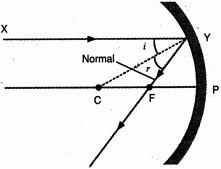
Medium
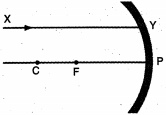
$A$ ray of light $XY$ is incident on a mirror as shown in the figure. The angle of incidence for this ray is the angle between it and the line joining two other points in the figure. Name these two points and show the course of rays after reflection.
Solution
(N/A) The angle of incidence is the angle between the incident ray and the normal at the point of incidence.
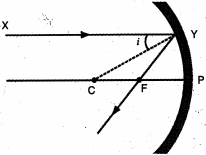
$A$ line joining the centre of curvature $(C)$ and the point of incidence $(Y)$ acts as a normal to the spherical mirror at that point.
Therefore,the two points are $C$ and $Y$.
After reflection,a ray of light incident parallel to the principal axis of a concave mirror passes through its principal focus $(F)$. The course of the reflected ray is shown in the figure.
$A$ line joining the centre of curvature $(C)$ and the point of incidence $(Y)$ acts as a normal to the spherical mirror at that point.
Therefore,the two points are $C$ and $Y$.
After reflection,a ray of light incident parallel to the principal axis of a concave mirror passes through its principal focus $(F)$. The course of the reflected ray is shown in the figure.
0 likes
View Solution232
Medium
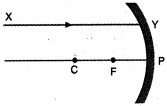
$A$ ray of light $XY$ is incident on a spherical mirror as shown in the diagram. Redraw the diagram and mark the normal,angle of incidence and angle of reflection.
Solution
(N/A) The incident ray $XY$,which is parallel to the principal axis,after reflection from the concave mirror will pass through the principal focus $F$.
To mark the normal,we draw a line from the center of curvature $C$ to the point of incidence $Y$.
The angle between the incident ray $XY$ and the normal $CY$ is the angle of incidence $(i)$.
The angle between the reflected ray and the normal $CY$ is the angle of reflection $(r)$.
According to the laws of reflection,the angle of incidence is equal to the angle of reflection $(i = r)$.
To mark the normal,we draw a line from the center of curvature $C$ to the point of incidence $Y$.
The angle between the incident ray $XY$ and the normal $CY$ is the angle of incidence $(i)$.
The angle between the reflected ray and the normal $CY$ is the angle of reflection $(r)$.
According to the laws of reflection,the angle of incidence is equal to the angle of reflection $(i = r)$.
0 likes
View Solution233
EasyMCQ
You have a spherical mirror. The image of an object placed in front of the mirror is virtual. If the position of the object is changed,the image remains virtual and erect. Is the spherical mirror concave or convex?
A
Concave
B
Convex
C
Plane
D
Cannot be determined
Solution
(B) convex mirror always produces a virtual and erect image,regardless of the position of the object in front of the mirror.
In contrast,a concave mirror produces a virtual and erect image only when the object is placed between the pole $(P)$ and the focus $(F)$.
Since the image remains virtual and erect for any position of the object,the spherical mirror must be convex.
In contrast,a concave mirror produces a virtual and erect image only when the object is placed between the pole $(P)$ and the focus $(F)$.
Since the image remains virtual and erect for any position of the object,the spherical mirror must be convex.
0 likes
View Solution234
Difficult
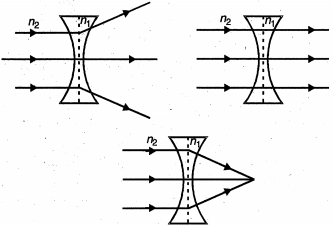
$A$ concave lens made of a material of refractive index $n_{1}$ is kept in a medium of refractive index $n_{2}$. $A$ parallel beam of light is incident on the lens. Complete the path of rays of light emerging from the concave lens if
$(i)$ $n_{1} > n_{2}$ $(ii)$ $n_{1}=n_{2}$ $(iii)$ $n_{1} < n_{2}$
$(i)$ $n_{1} > n_{2}$ $(ii)$ $n_{1}=n_{2}$ $(iii)$ $n_{1} < n_{2}$
Solution
(N/A) $(i)$ When $n_{1} > n_{2}$,the lens acts as a denser medium compared to the surroundings. Therefore,the concave lens behaves as a diverging lens,and the parallel rays diverge after passing through it.
$(ii)$ When $n_{1} = n_{2}$,the lens and the surrounding medium have the same refractive index. There is no change in the optical density,so the light rays pass through the lens without any deviation or refraction.
$(iii)$ When $n_{1} < n_{2}$,the lens acts as a rarer medium compared to the surroundings. In this case,the nature of the lens reverses,and the concave lens behaves as a converging lens,causing the parallel rays to converge after passing through it.
$(ii)$ When $n_{1} = n_{2}$,the lens and the surrounding medium have the same refractive index. There is no change in the optical density,so the light rays pass through the lens without any deviation or refraction.
$(iii)$ When $n_{1} < n_{2}$,the lens acts as a rarer medium compared to the surroundings. In this case,the nature of the lens reverses,and the concave lens behaves as a converging lens,causing the parallel rays to converge after passing through it.
0 likes
View Solution235
Medium
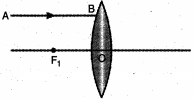
$A$ ray of light $AB$ parallel to the principal axis is incident on a convex lens as shown in the figure. Copy the figure.
$(i)$ Draw the refracted ray.
$(ii)$ Name the point through which the refracted ray passes on the principal axis.
$(i)$ Draw the refracted ray.
$(ii)$ Name the point through which the refracted ray passes on the principal axis.
Solution
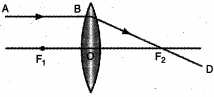
(N/A) $(i)$ The refracted ray $BD$ is shown in the figure.
$(ii)$ The point through which the refracted ray passes on the principal axis is known as the principal focus (denoted as $F_2$ in the figure) of the lens.
$(ii)$ The point through which the refracted ray passes on the principal axis is known as the principal focus (denoted as $F_2$ in the figure) of the lens.
0 likes
View Solution236
Medium
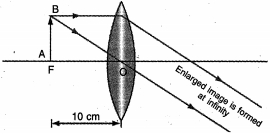
You are given a convex lens of focal length $10\, cm$. Where would you place an object to get a real,inverted and highly enlarged image of the object? Draw a ray diagram.
Solution
(N/A) When an object is placed at the principal focus $(F)$ of a convex lens,the refracted rays become parallel to each other and meet at infinity. This results in the formation of a real,inverted,and highly enlarged image at infinity.
Therefore,the object should be placed at a distance of $10\, cm$ from the optical centre of the lens.
The ray diagram is as shown below.
Therefore,the object should be placed at a distance of $10\, cm$ from the optical centre of the lens.
The ray diagram is as shown below.
0 likes
View Solution237
Medium
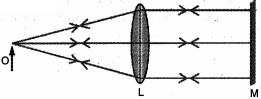
The ray diagram given below illustrates the experimental setup for the determination of the focal length of a converging lens using a plane mirror.
$(i)$ State the magnification of the image formed.
$(ii)$ Write two characteristics of the image formed.
$(iii)$ What is the name given to the distance between the object and the optical centre of the lens in the given diagram?
$(i)$ State the magnification of the image formed.
$(ii)$ Write two characteristics of the image formed.
$(iii)$ What is the name given to the distance between the object and the optical centre of the lens in the given diagram?
Solution
(N/A) $(i)$ The magnification of the image formed is unity (or $1$).
$(ii)$ The image formed is $(1)$ real and $(2)$ inverted,and it is formed at the same position as the object.
$(iii)$ The distance between the object and the optical centre of the lens is called the focal length of the lens.
$(ii)$ The image formed is $(1)$ real and $(2)$ inverted,and it is formed at the same position as the object.
$(iii)$ The distance between the object and the optical centre of the lens is called the focal length of the lens.
0 likes
View Solution238
Medium
The following table gives the values of refractive indices of a few media:
Use this table to give an example of $(i)$ a medium pair so that light speeds up when it goes from one of these media to another. $(ii)$ a medium pair so that light slows down when it goes from one of these media to another.
| $S.No.$ | $1$ | $2$ | $3$ | $4$ | $5$ |
| Medium | Water | Crown glass | Rock salt | Ruby | Diamond |
| Refractive index | $1.33$ | $1.52$ | $1.54$ | $1.71$ | $2.42$ |
Use this table to give an example of $(i)$ a medium pair so that light speeds up when it goes from one of these media to another. $(ii)$ a medium pair so that light slows down when it goes from one of these media to another.
Solution
(N/A) $(i)$ Light speeds up when it travels from an optically denser to an optically rarer medium. In other words, it travels from a medium of high refractive index to a medium of low refractive index. Therefore, one such pair is from crown glass $(1.52)$ into water $(1.33)$.
$(ii)$ Light slows down when it travels from an optically rarer to an optically denser medium. In other words, it travels from a medium of low refractive index to a medium of high refractive index. One such pair is from water $(1.33)$ into diamond $(2.42)$.
$(ii)$ Light slows down when it travels from an optically rarer to an optically denser medium. In other words, it travels from a medium of low refractive index to a medium of high refractive index. One such pair is from water $(1.33)$ into diamond $(2.42)$.
0 likes
View Solution239
Medium
Refractive indices of kerosene,turpentine,and water are $1.44$,$1.47$,and $1.33$ respectively. Through which of these media does light travel the fastest? Why?
Solution
(WATER) The refractive index $(n)$ of a medium is defined by the formula $n = \frac{c}{v}$,where $c$ is the speed of light in a vacuum and $v$ is the speed of light in the given medium.
Since $c$ is a constant,the relationship between speed and refractive index is $v = \frac{c}{n}$,which implies $v \propto \frac{1}{n}$.
This means that the speed of light is inversely proportional to the refractive index of the medium.
Comparing the given refractive indices: Water $(1.33)$ < Kerosene $(1.44)$ < Turpentine $(1.47)$.
Since water has the lowest refractive index among the three,light travels the fastest through water.
Since $c$ is a constant,the relationship between speed and refractive index is $v = \frac{c}{n}$,which implies $v \propto \frac{1}{n}$.
This means that the speed of light is inversely proportional to the refractive index of the medium.
Comparing the given refractive indices: Water $(1.33)$ < Kerosene $(1.44)$ < Turpentine $(1.47)$.
Since water has the lowest refractive index among the three,light travels the fastest through water.
0 likes
View Solution240
Medium
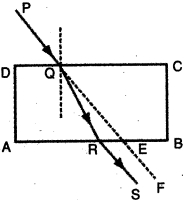
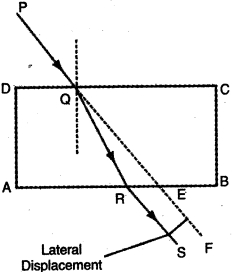
The figure below shows the refraction and emergence of a ray of light incident on a rectangular glass slab. Copy the diagram and mark the lateral displacement of the incident ray. Name the two factors on which the lateral displacement depends.
Solution
(N/A) The lateral displacement depends upon:
$(i)$ The angle of incidence of the incident ray $PQ$ on the face $DC$ of the given glass slab.
$(ii)$ The thickness of the glass slab.
The lateral displacement is defined as the perpendicular distance between the emergent ray and the original path of the incident ray $PQ$ when produced forward.
$(i)$ The angle of incidence of the incident ray $PQ$ on the face $DC$ of the given glass slab.
$(ii)$ The thickness of the glass slab.
The lateral displacement is defined as the perpendicular distance between the emergent ray and the original path of the incident ray $PQ$ when produced forward.
0 likes
View Solution241
Easy
Copy the figure and show the image formation with the help of rays.
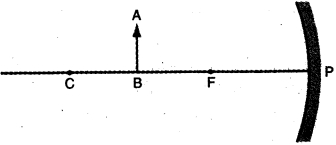
Solution
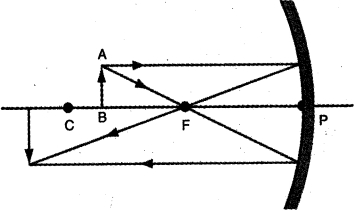
(N/A) The object is placed between the center of curvature $(C)$ and the principal focus $(F)$ of a concave mirror.
To find the image,we consider two rays:
$1$. $A$ ray parallel to the principal axis,after reflection,passes through the principal focus $(F)$.
$2$. $A$ ray passing through the principal focus $(F)$,after reflection,becomes parallel to the principal axis.
The intersection of these two reflected rays gives the position of the image.
The image formed is real,inverted,and magnified,and it is located beyond the center of curvature $(C)$.
To find the image,we consider two rays:
$1$. $A$ ray parallel to the principal axis,after reflection,passes through the principal focus $(F)$.
$2$. $A$ ray passing through the principal focus $(F)$,after reflection,becomes parallel to the principal axis.
The intersection of these two reflected rays gives the position of the image.
The image formed is real,inverted,and magnified,and it is located beyond the center of curvature $(C)$.
0 likes
View Solution242
Medium
Copy the given figure and complete it to show the formation of the image of the object $AB$. Name the lens used in the figure.
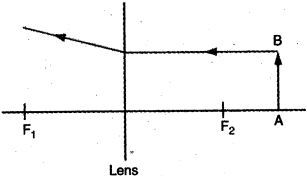
Solution
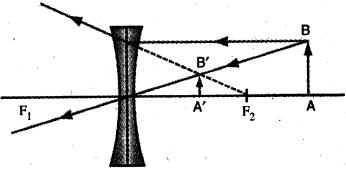
(CONCAVE LENS) Since the incident ray of light parallel to the principal axis is diverged by the lens,the lens used is a concave lens.
To complete the ray diagram:
$1$. Draw a concave lens at the position indicated.
$2$. Extend the diverged ray backwards until it appears to pass through the focus $F_2$.
$3$. Draw a second ray from the top of the object $B$ passing through the optical center of the lens. This ray will pass undeviated.
$4$. The point where these two rays appear to intersect gives the position of the image $A'B'$.
The completed figure is as shown below.
To complete the ray diagram:
$1$. Draw a concave lens at the position indicated.
$2$. Extend the diverged ray backwards until it appears to pass through the focus $F_2$.
$3$. Draw a second ray from the top of the object $B$ passing through the optical center of the lens. This ray will pass undeviated.
$4$. The point where these two rays appear to intersect gives the position of the image $A'B'$.
The completed figure is as shown below.
0 likes
View Solution243
Medium
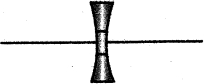
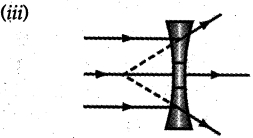
The figure below shows a lens treated as a combination of two prisms and a glass block. $(i)$ Name the lens formed by the combination. $(ii)$ Is the lens converging or diverging? $(iii)$ Draw the refraction of two incident rays to illustrate the property of the lens mentioned by you in part $(ii).$
Solution
(N/A) $(i)$ The lens formed by the combination is a concave lens.
$(ii)$ The lens is a diverging lens.
$(iii)$ $A$ concave lens causes parallel rays of light to diverge after refraction. The rays appear to originate from a single point on the principal axis,known as the principal focus. This is illustrated in the provided diagram.
$(ii)$ The lens is a diverging lens.
$(iii)$ $A$ concave lens causes parallel rays of light to diverge after refraction. The rays appear to originate from a single point on the principal axis,known as the principal focus. This is illustrated in the provided diagram.
0 likes
View Solution244
Medium
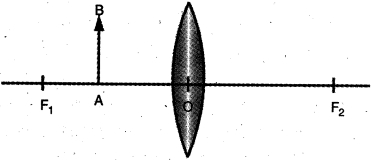
The figure below shows an object $AB$ placed on the principal axis of a convex lens placed in air. $F_{1}$ and $F_{2}$ are the two foci of the lens. Copy the diagram.
$(i)$ Draw a ray of light starting from $B$ and passing through $O$. Show the same ray after refraction by the lens.
$(ii)$ Draw another ray from $B$ which passes through $F_{2}$ after refraction by the lens.
$(iii)$ Locate the final image formed.
$(iv)$ Is the image real or virtual?
$(i)$ Draw a ray of light starting from $B$ and passing through $O$. Show the same ray after refraction by the lens.
$(ii)$ Draw another ray from $B$ which passes through $F_{2}$ after refraction by the lens.
$(iii)$ Locate the final image formed.
$(iv)$ Is the image real or virtual?
Solution
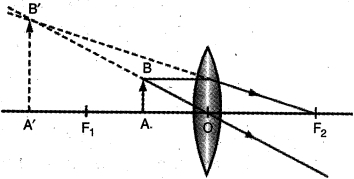
(N/A) The object $AB$ is placed between the optical center $O$ and the principal focus $F_{1}$ of the convex lens.
$(i)$ $A$ ray of light starting from $B$ and passing through the optical center $O$ goes straight without any deviation.
$(ii)$ $A$ ray of light starting from $B$ and moving parallel to the principal axis passes through the focus $F_{2}$ after refraction by the lens.
$(iii)$ The two refracted rays appear to diverge from a point $B'$. By dropping a perpendicular from $B'$ to the principal axis,we get the point $A'$. Thus,$A'B'$ is the virtual image of the object $AB$.
$(iv)$ The image formed is virtual and erect.
$(i)$ $A$ ray of light starting from $B$ and passing through the optical center $O$ goes straight without any deviation.
$(ii)$ $A$ ray of light starting from $B$ and moving parallel to the principal axis passes through the focus $F_{2}$ after refraction by the lens.
$(iii)$ The two refracted rays appear to diverge from a point $B'$. By dropping a perpendicular from $B'$ to the principal axis,we get the point $A'$. Thus,$A'B'$ is the virtual image of the object $AB$.
$(iv)$ The image formed is virtual and erect.
0 likes
View Solution245
Medium
The figure below shows a point source of light $S$,a convex lens $L$,and a plane mirror $M$. The three are placed such that rays of light from $S$ return to it after reflection from $M$. $(i)$ What is the distance $OS$ called? $(ii)$ To which point (left of $S$,on $S$,or right of $S$) will the rays return if $M$ is moved to the left and brought in contact with $L$?
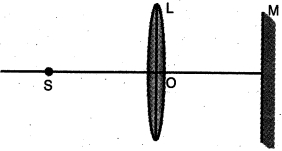
Solution
(N/A) $(i)$ The distance $OS$ is called the focal length of the lens.
$(ii)$ The rays will still return to the same point $S$. When the mirror $M$ is placed in contact with the convex lens $L$,the rays from the point source $S$ (placed at the focus) pass through the lens and become parallel to the principal axis. These parallel rays strike the plane mirror $M$ normally and reflect back along the same path. After passing through the lens again,they converge at the point source $S$ itself.
$(ii)$ The rays will still return to the same point $S$. When the mirror $M$ is placed in contact with the convex lens $L$,the rays from the point source $S$ (placed at the focus) pass through the lens and become parallel to the principal axis. These parallel rays strike the plane mirror $M$ normally and reflect back along the same path. After passing through the lens again,they converge at the point source $S$ itself.
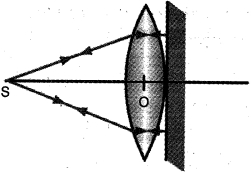
0 likes
View Solution246
Medium
The figure below shows an object $AB$ placed on the principal axis of a lens $L$. The two foci of the lens are $F_1$ and $F_2$. The image formed by the lens is erect,virtual and diminished. Copy the diagram and answer the following questions: $(i)$ Draw the outline of the lens $(L)$ used. $(ii)$ Draw a ray from $B$ passing through $O$. Show the ray after refraction by the lens. $(iii)$ Draw a ray of light starting from $B$,which after passing parallel to the principal axis,is incident on the lens and emerges after refraction from it. $(iv)$ Locate the final image formed.
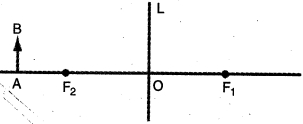
Solution
(N/A) The lens used is a concave lens because it forms an erect,virtual,and diminished image for an object placed anywhere in front of it.
$(i)$ The outline of the concave lens is drawn at the position $L$.
(ii) $A$ ray from $B$ passing through the optical center $O$ goes undeviated.
(iii) $A$ ray from $B$ parallel to the principal axis,after refraction,appears to diverge from the focus $F_2$.
(iv) The final image $A'B'$ is formed between the optical center $O$ and the focus $F_2$ on the same side as the object.
$(i)$ The outline of the concave lens is drawn at the position $L$.
(ii) $A$ ray from $B$ passing through the optical center $O$ goes undeviated.
(iii) $A$ ray from $B$ parallel to the principal axis,after refraction,appears to diverge from the focus $F_2$.
(iv) The final image $A'B'$ is formed between the optical center $O$ and the focus $F_2$ on the same side as the object.
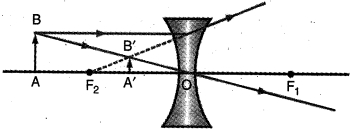
0 likes
View Solution247
Medium
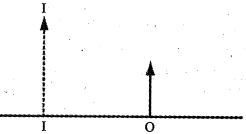
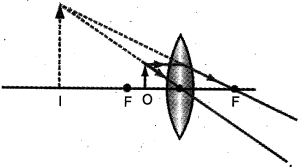
The diagram given below shows an object $O$ and its image $I.$ Copy the diagram and draw suitable rays to locate the lens and its focus. Name the type of lens in this case.
Solution
(N/A) The lens is a convex lens.
Since the image is virtual,erect,and magnified,the object must be placed between the optical center and the focus of the convex lens.
The lens is situated between the object $O$ and the image $I.$
To locate the lens,draw a line from the top of the object to the top of the image and extend it to intersect the principal axis; this point is the optical center of the lens.
Draw a vertical line through this point to represent the lens.
To locate the focus $F,$ draw a ray from the top of the object parallel to the principal axis,which will pass through the focus after refraction. Extend this refracted ray backward to meet the image point. The point where the parallel ray meets the principal axis after refraction is the focus $F.$
Since the image is virtual,erect,and magnified,the object must be placed between the optical center and the focus of the convex lens.
The lens is situated between the object $O$ and the image $I.$
To locate the lens,draw a line from the top of the object to the top of the image and extend it to intersect the principal axis; this point is the optical center of the lens.
Draw a vertical line through this point to represent the lens.
To locate the focus $F,$ draw a ray from the top of the object parallel to the principal axis,which will pass through the focus after refraction. Extend this refracted ray backward to meet the image point. The point where the parallel ray meets the principal axis after refraction is the focus $F.$
0 likes
View Solution248
Medium
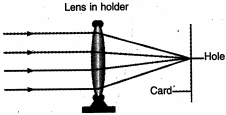
Zaheen uses a convex lens to make sunlight burn a hole in a piece of card. Zaheen changes the lens in the holder for another lens with twice the power. What will she have to do to focus the sunlight on the card?
Solution
(N/A) Power is related to the focal length as $P = \frac{1}{f}$.
An increase in power means a decrease in focal length.
Since the sunlight comes from infinity,the image is formed at the focal point of the lens.
If the power is doubled $(P' = 2P)$,the new focal length becomes half of the original focal length $(f' = \frac{f}{2})$.
Therefore,to focus the sunlight on the card,she will have to move the lens closer to the card,specifically at a distance equal to half of the previous focal length.
An increase in power means a decrease in focal length.
Since the sunlight comes from infinity,the image is formed at the focal point of the lens.
If the power is doubled $(P' = 2P)$,the new focal length becomes half of the original focal length $(f' = \frac{f}{2})$.
Therefore,to focus the sunlight on the card,she will have to move the lens closer to the card,specifically at a distance equal to half of the previous focal length.
0 likes
View Solution249
MediumMCQ
Multiple images are formed by a thick plane mirror. Which of the following is the brightest of all the images?
A
First
B
Third
C
Second
D
Fourth
Solution
(C) thick plane mirror consists of a silvered back surface and a front glass surface.
When light falls on the mirror,a small portion of it is reflected from the front surface (first reflection),while the majority of the light enters the glass,reflects from the silvered back surface,and exits through the front surface (second reflection).
Because the reflection from the silvered back surface involves a much larger amount of light compared to the partial reflection from the front glass surface,the second image is the brightest of all the images formed.
When light falls on the mirror,a small portion of it is reflected from the front surface (first reflection),while the majority of the light enters the glass,reflects from the silvered back surface,and exits through the front surface (second reflection).
Because the reflection from the silvered back surface involves a much larger amount of light compared to the partial reflection from the front glass surface,the second image is the brightest of all the images formed.
0 likes
View Solution250
MediumMCQ
$A$ plane mirror is placed vertically facing due north. An arrow pointing north-east is kept in front of the mirror. In which direction will the arrow point in this image?
A
north-east
B
south-west
C
north-west
D
south-east
Solution
(C) plane mirror produces a lateral inversion of the object.
When an object is placed in front of a mirror facing north,the mirror reflects the image such that the east-west component is reversed while the north-south component remains the same.
An arrow pointing north-east has a northward component and an eastward component.
In the mirror image,the northward component remains pointing north,but the eastward component is reversed to point west.
Therefore,the arrow in the image will point north-west.
When an object is placed in front of a mirror facing north,the mirror reflects the image such that the east-west component is reversed while the north-south component remains the same.
An arrow pointing north-east has a northward component and an eastward component.
In the mirror image,the northward component remains pointing north,but the eastward component is reversed to point west.
Therefore,the arrow in the image will point north-west.
0 likes
View SolutionLight – Reflection and Refraction — Mix Examples - Light – Reflection and Refraction · Frequently Asked Questions
1Are these Light – Reflection and Refraction questions useful for JEE and NEET?
Yes. All questions in this section are mapped to JEE Main and NEET exam patterns. Previous year questions from JEE Main, NEET, GUJCET and state-level exams are included with full solutions.
2Can I switch to Hindi or Gujarati for these questions?
Yes. Use the language tabs in the hero section or the sidebar to view the same questions and solutions in English, Hindi or Gujarati.
3How do I generate a question paper from this subtopic?
Use the Vedclass Exam Paper Generator — select the chapter and subtopic, set difficulty, and generate Sets A, B, C, D automatically. First 3 chapters of every subject are free.
Vedclass Products
For Students
Vedclass Test Series
Mock tests in real JEE/NEET style with performance analysis. 5-day free trial.
Start Free TrialFor Teachers
Exam Paper Generator
Generate Set A/B/C/D papers from this chapter in 2 minutes. 3 chapters free.
Try FreeFor Institutes
Online Exam Module
Live online exams with unlimited students, 360° analytics & white-label branding.
See DemoFor Teachers & Institutes
Generate a Light – Reflection and Refraction Exam Paper in 2 Minutes
Select subtopic & difficulty — Sets A, B, C, D auto-generated with No Repeat logic.
First 3 chapters of every subject are free — no payment required.