
A English
Mix Examples - Light – Reflection and Refraction Questions in English
Class 10 Science · Light – Reflection and Refraction · Mix Examples - Light – Reflection and Refraction
400+
Questions
English
Language
100%
With Solutions
Showing 50 of 400 questions in English
101
MediumMCQ
If the magnification of a body of size $1\, m$ is $2$,what is the size of the image (in $m$)?
A
$1$
B
$2$
C
$0.5$
D
$4$
Solution
(B) Given: Magnification $(m)$ = $2$,Size of the object $(O)$ = $1\, m$.
The formula for magnification is $m = \frac{I}{O}$,where $I$ is the size of the image.
Rearranging the formula to find the image size: $I = m \times O$.
Substituting the values: $I = 2 \times 1\, m = 2\, m$.
Therefore,the size of the image is $2\, m$.
The formula for magnification is $m = \frac{I}{O}$,where $I$ is the size of the image.
Rearranging the formula to find the image size: $I = m \times O$.
Substituting the values: $I = 2 \times 1\, m = 2\, m$.
Therefore,the size of the image is $2\, m$.
0 likes
View Solution102
EasyMCQ
What is the power of a concave lens of focal length $25\, cm$?
A
$+4\, D$
B
$-4\, D$
C
$+0.04\, D$
D
$-0.04\, D$
Solution
(B) The focal length of a concave lens is taken as negative by sign convention.
Given, focal length $f = -25\, cm = -0.25\, m$.
The formula for the power of a lens is $P = \frac{1}{f(\text{in meters})}$.
Substituting the value, $P = \frac{1}{-0.25} = -4\, D$.
Therefore, the power of the concave lens is $-4\, D$.
Given, focal length $f = -25\, cm = -0.25\, m$.
The formula for the power of a lens is $P = \frac{1}{f(\text{in meters})}$.
Substituting the value, $P = \frac{1}{-0.25} = -4\, D$.
Therefore, the power of the concave lens is $-4\, D$.
0 likes
View Solution103
EasyMCQ
What will be the focal length of a lens whose power is given as $+2.0 \ D$?
A
+$0.5$ m
B
-$0.5$ m
C
+$2.0$ m
D
-$2.0$ m
Solution
(A) Given: Power of the lens,$P = +2.0 \ D$.
The relationship between power $(P)$ and focal length $(f)$ in meters is given by the formula: $P = \frac{1}{f(m)}$.
Rearranging the formula to solve for focal length: $f = \frac{1}{P}$.
Substituting the given value: $f = \frac{1}{+2.0} = +0.5 \ m$.
Therefore,the focal length of the lens is $+0.5 \ m$.
The relationship between power $(P)$ and focal length $(f)$ in meters is given by the formula: $P = \frac{1}{f(m)}$.
Rearranging the formula to solve for focal length: $f = \frac{1}{P}$.
Substituting the given value: $f = \frac{1}{+2.0} = +0.5 \ m$.
Therefore,the focal length of the lens is $+0.5 \ m$.
0 likes
View Solution104
EasyMCQ
Where will the image be formed by a concave mirror when an object is placed between the pole and the focus point of the mirror?
A
At the focus
B
At the center of curvature
C
Behind the mirror
D
At infinity
Solution
(C) When an object is placed between the pole $(P)$ and the focus $(F)$ of a concave mirror,the light rays diverge after reflection.
These rays appear to meet behind the mirror when extended backwards.
Therefore,the image formed is virtual,erect,and magnified,and it is located behind the mirror.
These rays appear to meet behind the mirror when extended backwards.
Therefore,the image formed is virtual,erect,and magnified,and it is located behind the mirror.
0 likes
View Solution105
EasyMCQ
Where does an object and its image coincide in a concave mirror?
A
At the focus $(F)$
B
At the centre of curvature $(C)$
C
Between the pole $(P)$ and focus $(F)$
D
Beyond the centre of curvature $(C)$
Solution
(B) In a concave mirror,when an object is placed at the centre of curvature $(C)$,the light rays originating from the object strike the mirror and reflect back through the centre of curvature itself. As a result,the image is formed at the same position as the object. Therefore,the object and its image coincide at the centre of curvature $(C)$.
0 likes
View Solution106
EasyMCQ
What changes; frequency or wavelength, when light passes from a rarer to a denser medium?
A
Frequency
B
Wavelength
C
Both frequency and wavelength
D
Neither frequency nor wavelength
Solution
(B) When light travels from one medium to another, its frequency remains constant because it depends on the source of the light. However, the speed of light changes as it enters a different medium. Since the relationship between speed $(v)$, frequency $(f)$, and wavelength $(\lambda)$ is given by $v = f \times \lambda$, if the speed changes and the frequency remains constant, the wavelength must change. Therefore, when light passes from a rarer to a denser medium, its wavelength decreases.
0 likes
View Solution107
EasyMCQ
$A$ ray of light is incident normally on a reflecting surface. What are the $(i)$ angle of incidence and $(ii)$ angle of reflection?
A
$0^{\circ}, 0^{\circ}$
B
$90^{\circ}, 90^{\circ}$
C
$0^{\circ}, 90^{\circ}$
D
$90^{\circ}, 0^{\circ}$
Solution
(A) When a ray of light is incident normally (perpendicularly) on a reflecting surface,it travels along the normal.
Since the angle of incidence is the angle between the incident ray and the normal,and the ray itself lies on the normal,the angle of incidence is $0^{\circ}$.
According to the law of reflection,the angle of incidence is equal to the angle of reflection.
Therefore,the angle of reflection is also $0^{\circ}$.
Since the angle of incidence is the angle between the incident ray and the normal,and the ray itself lies on the normal,the angle of incidence is $0^{\circ}$.
According to the law of reflection,the angle of incidence is equal to the angle of reflection.
Therefore,the angle of reflection is also $0^{\circ}$.
0 likes
View Solution108
EasyMCQ
An incident ray falls normally on a glass slab. What is the angle of refraction (in $°$)?
A
$0$
B
$45$
C
$90$
D
$180$
Solution
(A) When a light ray falls normally (perpendicularly) on the surface of a glass slab,the angle of incidence $(i)$ is $0^{\circ}$.
According to Snell's Law,$n_1 \sin(i) = n_2 \sin(r)$.
Since $\sin(0^{\circ}) = 0$,it follows that $\sin(r) = 0$,which means the angle of refraction $(r)$ is $0^{\circ}$.
Therefore,the ray passes through the glass slab without any deviation.
According to Snell's Law,$n_1 \sin(i) = n_2 \sin(r)$.
Since $\sin(0^{\circ}) = 0$,it follows that $\sin(r) = 0$,which means the angle of refraction $(r)$ is $0^{\circ}$.
Therefore,the ray passes through the glass slab without any deviation.
0 likes
View Solution109
EasyMCQ
When is the magnitude of the power of a lens equal to its focal length?
A
When the focal length is $1 \, cm$
B
When the focal length is $1 \, m$
C
When the focal length is $0.5 \, m$
D
When the focal length is $2 \, m$
Solution
(B) The power $(P)$ of a lens is defined as the reciprocal of its focal length $(f)$ in metres, given by the formula $P = \frac{1}{f(in \, m)}$.
For the magnitude of the power to be equal to the magnitude of the focal length, we set $P = f$.
Substituting this into the formula, we get $f = \frac{1}{f}$.
This implies $f^2 = 1$, so $f = 1 \, m$ (since focal length is a physical distance).
Therefore, the magnitude of the power of a lens is equal to its focal length when the focal length is $1 \, m$.
For the magnitude of the power to be equal to the magnitude of the focal length, we set $P = f$.
Substituting this into the formula, we get $f = \frac{1}{f}$.
This implies $f^2 = 1$, so $f = 1 \, m$ (since focal length is a physical distance).
Therefore, the magnitude of the power of a lens is equal to its focal length when the focal length is $1 \, m$.
0 likes
View Solution110
EasyMCQ
$A$ ray of light is incident on a concave mirror after passing through the centre of curvature. What is the angle of incidence (in $°$)?
A
$0$
B
$45$
C
$90$
D
$180$
Solution
(A) When a ray of light passes through the centre of curvature $(C)$ of a concave mirror, it strikes the mirror surface normally (perpendicularly).
Since the ray travels along the normal to the surface at the point of incidence, the angle between the incident ray and the normal is $0^\circ$.
Therefore, the angle of incidence is $0^\circ$.
Since the ray travels along the normal to the surface at the point of incidence, the angle between the incident ray and the normal is $0^\circ$.
Therefore, the angle of incidence is $0^\circ$.
0 likes
View Solution111
EasyMCQ
What type of lens behaviour will an air bubble inside water show?
A
Convex lens
B
Concave lens
C
Plane mirror
D
Concave mirror
Solution
(B) An air bubble inside water acts as a concave lens.
This is because the refractive index of air $(n_a \approx 1.0)$ is less than the refractive index of water $(n_w \approx 1.33)$.
When light rays pass from the denser medium (water) into the rarer medium (air bubble),they diverge.
Since a concave lens is a diverging lens,the air bubble behaves like a concave lens.
This is because the refractive index of air $(n_a \approx 1.0)$ is less than the refractive index of water $(n_w \approx 1.33)$.
When light rays pass from the denser medium (water) into the rarer medium (air bubble),they diverge.
Since a concave lens is a diverging lens,the air bubble behaves like a concave lens.
0 likes
View Solution112
MediumMCQ
Two lenses have powers of $(a) +2 \text{ D}$ and $(b) -4 \text{ D}$. Find the nature and focal length of each lens.
A
Convex,$0.5 \text{ m}$ and Concave,$-0.25 \text{ m}$
B
Concave,$0.5 \text{ m}$ and Convex,$-0.25 \text{ m}$
C
Convex,$0.25 \text{ m}$ and Concave,$-0.5 \text{ m}$
D
Concave,$0.25 \text{ m}$ and Convex,$-0.5 \text{ m}$
Solution
(A) Since the power is positive $(+2 \text{ D})$,the lens is a convex lens.
The focal length is calculated as $f = \frac{1}{P} = \frac{1}{2} = 0.5 \text{ m} = 50 \text{ cm}$.
$(b)$ Since the power is negative $(-4 \text{ D})$,the lens is a concave lens.
The focal length is calculated as $f = \frac{1}{P} = \frac{1}{-4} = -0.25 \text{ m} = -25 \text{ cm}$.
The focal length is calculated as $f = \frac{1}{P} = \frac{1}{2} = 0.5 \text{ m} = 50 \text{ cm}$.
$(b)$ Since the power is negative $(-4 \text{ D})$,the lens is a concave lens.
The focal length is calculated as $f = \frac{1}{P} = \frac{1}{-4} = -0.25 \text{ m} = -25 \text{ cm}$.
0 likes
View Solution113
Medium
The absolute refractive indices of glass and water are $4/3$ and $3/2$ respectively. If the speed of light in glass is $2 \times 10^{8} \ m \ s^{-1}$,calculate the speed of light in $(i)$ vacuum,$(ii)$ water.
Solution
(N/A) Given: Refractive index of glass $(n_g)$ = $3/2$,Refractive index of water $(n_w)$ = $4/3$,Speed of light in glass $(v_g)$ = $2 \times 10^{8} \ m \ s^{-1}$.
$(i)$ Speed of light in vacuum $(c)$:
Using the formula $n_g = c / v_g$,we get $c = n_g \times v_g$.
$c = (3/2) \times (2 \times 10^{8} \ m \ s^{-1}) = 3 \times 10^{8} \ m \ s^{-1}$.
$(ii)$ Speed of light in water $(v_w)$:
Using the formula $n_w = c / v_w$,we get $v_w = c / n_w$.
$v_w = (3 \times 10^{8} \ m \ s^{-1}) / (4/3) = (3 \times 3 \times 10^{8}) / 4 = 2.25 \times 10^{8} \ m \ s^{-1}$.
$(i)$ Speed of light in vacuum $(c)$:
Using the formula $n_g = c / v_g$,we get $c = n_g \times v_g$.
$c = (3/2) \times (2 \times 10^{8} \ m \ s^{-1}) = 3 \times 10^{8} \ m \ s^{-1}$.
$(ii)$ Speed of light in water $(v_w)$:
Using the formula $n_w = c / v_w$,we get $v_w = c / n_w$.
$v_w = (3 \times 10^{8} \ m \ s^{-1}) / (4/3) = (3 \times 3 \times 10^{8}) / 4 = 2.25 \times 10^{8} \ m \ s^{-1}$.
0 likes
View Solution114
MediumMCQ
For driving a car,what type of mirror would you prefer to see the traffic at your back?
A
Plane mirror
B
Concave mirror
C
Convex mirror
D
Concave lens
Solution
(C) We prefer a convex mirror for observing the traffic behind us because its field of view is much larger than that of a plane mirror.
It forms a virtual,erect,and diminished image of the objects behind the vehicle.
Although it gives an erroneous idea about the distance and speed of the vehicles behind us,the advantage of a wider field of view makes it the preferred choice for rear-view mirrors.
It forms a virtual,erect,and diminished image of the objects behind the vehicle.
Although it gives an erroneous idea about the distance and speed of the vehicles behind us,the advantage of a wider field of view makes it the preferred choice for rear-view mirrors.
0 likes
View Solution115
Easy
$A$ plane mirror as well as a convex mirror can produce a real image if the object is virtual. How?
Solution
(N/A) real image is formed when reflected rays actually intersect at a point.
For a plane or convex mirror,this occurs when a converging beam of light is directed towards the mirror.
The point where these rays would have met behind the mirror acts as a virtual object.
Since the reflected rays converge in front of the mirror,they form a real image at that location.
For a plane or convex mirror,this occurs when a converging beam of light is directed towards the mirror.
The point where these rays would have met behind the mirror acts as a virtual object.
Since the reflected rays converge in front of the mirror,they form a real image at that location.
0 likes
View Solution116
Medium
Define linear magnification produced by a spherical mirror. Also,give its relation.
Solution
(N/A) Linear magnification $(m)$ produced by a spherical mirror is defined as the ratio of the height of the image $(h^{\prime})$ to the height of the object $(h)$.
Mathematically,it is expressed as:
$m = \frac{\text{height of the image}}{\text{height of the object}} = \frac{h^{\prime}}{h}$
Additionally,it is related to the object distance $(u)$ and image distance $(v)$ as:
$m = \frac{h^{\prime}}{h} = -\frac{v}{u}$
Here,$u$ is the distance of the object from the mirror,and $v$ is the distance of the image from the mirror.
Mathematically,it is expressed as:
$m = \frac{\text{height of the image}}{\text{height of the object}} = \frac{h^{\prime}}{h}$
Additionally,it is related to the object distance $(u)$ and image distance $(v)$ as:
$m = \frac{h^{\prime}}{h} = -\frac{v}{u}$
Here,$u$ is the distance of the object from the mirror,and $v$ is the distance of the image from the mirror.
0 likes
View Solution117
EasyMCQ
What happens to the image formed by a convex lens if its lower part is blackened?
A
The image will be inverted.
B
The image will be blurred.
C
The intensity of the image will decrease.
D
The lower half of the image will disappear.
Solution
(C) Every part of a convex lens contributes to the formation of a complete image.
When the lower part of the lens is blackened,light rays can still pass through the remaining upper part of the lens.
These rays will converge to form a complete image of the object at the same position.
However,since the total amount of light passing through the lens is reduced,the intensity (brightness) of the image will decrease.
When the lower part of the lens is blackened,light rays can still pass through the remaining upper part of the lens.
These rays will converge to form a complete image of the object at the same position.
However,since the total amount of light passing through the lens is reduced,the intensity (brightness) of the image will decrease.
0 likes
View Solution118
Medium
Show that the mirror formula for spherical mirrors also holds for a plane mirror.
Solution
(N/A) The mirror formula is given by $\frac{1}{v} + \frac{1}{u} = \frac{1}{f}$.
For a plane mirror,the focal length $f$ is considered to be infinity $(\infty)$.
Substituting $f = \infty$ into the mirror formula,we get:
$\frac{1}{v} + \frac{1}{u} = \frac{1}{\infty}$
Since $\frac{1}{\infty} = 0$,the equation becomes:
$\frac{1}{v} + \frac{1}{u} = 0$
$\frac{1}{v} = -\frac{1}{u}$
$v = -u$
This result shows that for a plane mirror,the image distance $v$ is equal in magnitude to the object distance $u$ but opposite in sign,which is consistent with the properties of plane mirrors (virtual image formed at the same distance behind the mirror).
For a plane mirror,the focal length $f$ is considered to be infinity $(\infty)$.
Substituting $f = \infty$ into the mirror formula,we get:
$\frac{1}{v} + \frac{1}{u} = \frac{1}{\infty}$
Since $\frac{1}{\infty} = 0$,the equation becomes:
$\frac{1}{v} + \frac{1}{u} = 0$
$\frac{1}{v} = -\frac{1}{u}$
$v = -u$
This result shows that for a plane mirror,the image distance $v$ is equal in magnitude to the object distance $u$ but opposite in sign,which is consistent with the properties of plane mirrors (virtual image formed at the same distance behind the mirror).
0 likes
View Solution119
Easy
$A$ virtual image cannot be focused on a screen. Yet when we see a virtual image,we obviously bring it to the screen that is the retina of our eyes. Is this a contradiction?
Solution
(N/A) No,this is not a contradiction. The lens of the eye converges the divergent beam of light (which appears to come from the virtual image) onto the retina. This process forms a real image of the virtual object on the retina,allowing us to perceive it.
0 likes
View Solution120
EasyMCQ
$A$ concave mirror and a convex lens are held in water. What changes, if any, do you expect in their focal length?
A
Focal length of both will increase.
B
Focal length of both will decrease.
C
Focal length of the mirror will remain the same, while the focal length of the lens will increase.
D
Focal length of the mirror will change, while the focal length of the lens will remain the same.
Solution
(C) The focal length of a mirror depends only on its radius of curvature $(f = R/2)$ and is independent of the surrounding medium.
Therefore, the focal length of the concave mirror remains unchanged when placed in water.
However, the focal length of a lens is determined by the Lens Maker's Formula: $1/f = (n_g/n_m - 1)(1/R_1 - 1/R_2)$, where $n_g$ is the refractive index of the lens material and $n_m$ is the refractive index of the medium.
Since the refractive index of water $(n_m \approx 1.33)$ is greater than that of air $(n_m \approx 1.0)$, the term $(n_g/n_m - 1)$ decreases, causing the focal length $(f)$ of the convex lens to increase.
Therefore, the focal length of the concave mirror remains unchanged when placed in water.
However, the focal length of a lens is determined by the Lens Maker's Formula: $1/f = (n_g/n_m - 1)(1/R_1 - 1/R_2)$, where $n_g$ is the refractive index of the lens material and $n_m$ is the refractive index of the medium.
Since the refractive index of water $(n_m \approx 1.33)$ is greater than that of air $(n_m \approx 1.0)$, the term $(n_g/n_m - 1)$ decreases, causing the focal length $(f)$ of the convex lens to increase.
0 likes
View Solution121
EasyMCQ
Is it possible for a lens to act as a convergent lens in one medium and a divergent lens in another?
A
Yes
B
No
C
Only for concave lenses
D
Only for convex lenses
Solution
(A) Yes,it is possible for a lens to change its nature depending on the refractive index of the surrounding medium.
According to the Lens Maker's Formula,the focal length $f$ is given by $\frac{1}{f} = (\frac{n_l}{n_m} - 1)(\frac{1}{R_1} - \frac{1}{R_2})$,where $n_l$ is the refractive index of the lens and $n_m$ is the refractive index of the medium.
If the lens is placed in a medium where $n_m > n_l$,the term $(\frac{n_l}{n_m} - 1)$ becomes negative.
Consequently,the sign of the focal length $f$ reverses,causing a convex lens (convergent) to behave as a divergent lens and a concave lens (divergent) to behave as a convergent lens.
According to the Lens Maker's Formula,the focal length $f$ is given by $\frac{1}{f} = (\frac{n_l}{n_m} - 1)(\frac{1}{R_1} - \frac{1}{R_2})$,where $n_l$ is the refractive index of the lens and $n_m$ is the refractive index of the medium.
If the lens is placed in a medium where $n_m > n_l$,the term $(\frac{n_l}{n_m} - 1)$ becomes negative.
Consequently,the sign of the focal length $f$ reverses,causing a convex lens (convergent) to behave as a divergent lens and a concave lens (divergent) to behave as a convergent lens.
0 likes
View Solution122
EasyMCQ
When does Snell's law fail?
A
When light is incident at an angle of $45$ degrees.
B
When light is incident normally on the surface of a refracting medium.
C
When the medium is opaque.
D
When the light is monochromatic.
Solution
(B) Snell's law is given by the formula $n_1 \sin(i) = n_2 \sin(r)$,where $i$ is the angle of incidence and $r$ is the angle of refraction.
When light is incident normally (perpendicularly) on the surface,the angle of incidence $i = 0^\circ$.
Since $\sin(0^\circ) = 0$,the equation becomes $n_1(0) = n_2 \sin(r)$,which implies $\sin(r) = 0$,so $r = 0^\circ$.
In this case,the law does not provide a unique relationship between the refractive indices and the angles because the ratio $\frac{\sin(i)}{\sin(r)}$ becomes $\frac{0}{0}$,which is undefined.
When light is incident normally (perpendicularly) on the surface,the angle of incidence $i = 0^\circ$.
Since $\sin(0^\circ) = 0$,the equation becomes $n_1(0) = n_2 \sin(r)$,which implies $\sin(r) = 0$,so $r = 0^\circ$.
In this case,the law does not provide a unique relationship between the refractive indices and the angles because the ratio $\frac{\sin(i)}{\sin(r)}$ becomes $\frac{0}{0}$,which is undefined.
0 likes
View Solution123
Easy
If the image formed by a convex lens is of the same size as that of the object,what is the position and nature of the image with respect to the lens?
Solution
(N/A) When an object is placed at $2F_1$ in front of a convex lens,the image is formed at $2F_2$ on the other side of the lens.
The image formed is of the same size as the object.
The nature of the image is real and inverted.
The image formed is of the same size as the object.
The nature of the image is real and inverted.
0 likes
View Solution124
MediumMCQ
The image formed by a concave mirror is observed to be virtual,erect and larger than the object. Then the position of the object should be
A
Between the focus and the centre of curvature.
B
At the centre of curvature.
C
Beyond the centre of curvature.
D
Between the pole of the mirror and the focus.
Solution
(D) For a concave mirror,when an object is placed between the pole $(P)$ and the focus $(F)$,the light rays diverge after reflection.
When these reflected rays are extended backwards,they appear to meet behind the mirror.
This results in the formation of a virtual,erect,and magnified (larger than the object) image.
Therefore,the correct position of the object is between the pole and the focus.
When these reflected rays are extended backwards,they appear to meet behind the mirror.
This results in the formation of a virtual,erect,and magnified (larger than the object) image.
Therefore,the correct position of the object is between the pole and the focus.
0 likes
View Solution125
EasyMCQ
Where should an object be placed so that a real and inverted image of the same size is obtained by a convex lens?
A
At the focus
B
At twice the focal length
C
At infinity
D
Between optical centre and focus
Solution
(B) When an object is placed at $2F_1$ (twice the focal length) in front of a convex lens,the light rays originating from the object pass through the lens and converge at $2F_2$ on the other side. The image formed is real,inverted,and of the same size as the object. Therefore,the correct option is $(b)$.
0 likes
View Solution126
Easy
How will you distinguish between a convex and a concave lens without touching them?
Solution
(N/A) To distinguish between a convex and a concave lens without touching them,hold the lens close to a page of a book and observe the printed letters through it.
$1$. If the letters appear enlarged (magnified),the lens is a convex lens.
$2$. If the letters appear diminished (smaller),the lens is a concave lens.
This happens because a convex lens acts as a magnifying glass when held close to an object,whereas a concave lens always forms a virtual,erect,and diminished image.
$1$. If the letters appear enlarged (magnified),the lens is a convex lens.
$2$. If the letters appear diminished (smaller),the lens is a concave lens.
This happens because a convex lens acts as a magnifying glass when held close to an object,whereas a concave lens always forms a virtual,erect,and diminished image.
0 likes
View Solution127
Medium
How can you identify the three types of mirrors without touching them?
Solution
(N/A) We can identify the three types of mirrors by observing the image formed when we look into them from a close distance:
$(i)$ If the image is of the same size and erect, it is a $Plane$ mirror.
$(ii)$ If the image is magnified (bigger size) and erect, it is a $Concave$ mirror.
$(iii)$ If the image is diminished (smaller size) and erect, it is a $Convex$ mirror.
$(i)$ If the image is of the same size and erect, it is a $Plane$ mirror.
$(ii)$ If the image is magnified (bigger size) and erect, it is a $Concave$ mirror.
$(iii)$ If the image is diminished (smaller size) and erect, it is a $Convex$ mirror.
0 likes
View Solution128
Medium
$(a)$ What happens to a ray of light when it travels from one medium to another having equal refractive indices?
$(b)$ State the cause of refraction of light.
$(b)$ State the cause of refraction of light.
Solution
(N/A) When a ray of light travels from one medium to another having equal refractive indices,no refraction or bending occurs. The light continues to travel in a straight line because there is no change in the optical density between the two media.
$(b)$ The cause of refraction of light is the change in the speed of light as it travels from one medium to another. When light enters a medium with a different optical density,its velocity changes,causing it to deviate from its original path.
$(b)$ The cause of refraction of light is the change in the speed of light as it travels from one medium to another. When light enters a medium with a different optical density,its velocity changes,causing it to deviate from its original path.
0 likes
View Solution129
Medium
$(a)$ What should be the position of the object,when a concave mirror is to be used $(i)$ as a shaving mirror,and $(ii)$ in torches producing a parallel beam of light? $(b)$ $A$ man standing in front of a mirror finds his image having a very small head and legs of normal size. What type of mirror is used in designing such a mirror?
Solution
(N/A) $(i)$ For a shaving mirror,the object (face) should be placed between the pole $(P)$ and the principal focus $(F)$ of the concave mirror to obtain an enlarged,erect,and virtual image.
$(ii)$ In torches,the source of light (bulb) should be placed at the principal focus $(F)$ of the concave mirror to produce a parallel beam of light.
$(b)$ The mirror is a combination of different types of mirrors. $A$ convex mirror is used for the upper part to produce a small head (diminished image),and a plane mirror is used for the lower part to produce an image of normal size.
$(ii)$ In torches,the source of light (bulb) should be placed at the principal focus $(F)$ of the concave mirror to produce a parallel beam of light.
$(b)$ The mirror is a combination of different types of mirrors. $A$ convex mirror is used for the upper part to produce a small head (diminished image),and a plane mirror is used for the lower part to produce an image of normal size.
0 likes
View Solution130
Medium
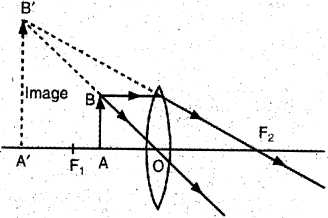
Name the type of lens that can be used as a magnifying glass. Give reason$(s)$ and draw a ray diagram to support your answer.
Solution
(N/A) convex lens is used as a magnifying glass.
Reason: When an object is placed between the optical center $(O)$ and the principal focus $(F_1)$ of a convex lens,it forms a virtual,erect,and magnified image on the same side of the lens as the object.
Ray Diagram: The diagram shows the object $AB$ placed between $O$ and $F_1$,resulting in a virtual,magnified image $A'B'$ formed behind the object.
Reason: When an object is placed between the optical center $(O)$ and the principal focus $(F_1)$ of a convex lens,it forms a virtual,erect,and magnified image on the same side of the lens as the object.
Ray Diagram: The diagram shows the object $AB$ placed between $O$ and $F_1$,resulting in a virtual,magnified image $A'B'$ formed behind the object.
0 likes
View Solution131
Medium
An object is placed at the following distances from a concave mirror of focal length $15 \, cm$.
$(a)$ $10 \, cm$ $(b)$ $20 \, cm$ $(c)$ $30 \, cm$ $(d)$ $40 \, cm$
Which position of the object will produce:
$(1)$ Virtual image
$(2)$ $A$ diminished real image
$(3)$ An enlarged real image
$(4)$ An image of same size
$(a)$ $10 \, cm$ $(b)$ $20 \, cm$ $(c)$ $30 \, cm$ $(d)$ $40 \, cm$
Which position of the object will produce:
$(1)$ Virtual image
$(2)$ $A$ diminished real image
$(3)$ An enlarged real image
$(4)$ An image of same size
Solution
(A-10, B-20, C-30, D-40) For a concave mirror with focal length $f = 15 \, cm$:
$(1)$ $A$ virtual image is formed when the object is placed between the pole and the focus $(u < 15 \, cm)$. Thus,the position is $10 \, cm$.
$(2)$ $A$ diminished real image is formed when the object is placed beyond the center of curvature $(u > 30 \, cm)$. Thus,the position is $40 \, cm$.
$(3)$ An enlarged real image is formed when the object is placed between the focus and the center of curvature $(15 \, cm < u < 30 \, cm)$. Thus,the position is $20 \, cm$.
$(4)$ An image of the same size is formed when the object is placed at the center of curvature $(u = 2R = 30 \, cm)$. Thus,the position is $30 \, cm$.
$(1)$ $A$ virtual image is formed when the object is placed between the pole and the focus $(u < 15 \, cm)$. Thus,the position is $10 \, cm$.
$(2)$ $A$ diminished real image is formed when the object is placed beyond the center of curvature $(u > 30 \, cm)$. Thus,the position is $40 \, cm$.
$(3)$ An enlarged real image is formed when the object is placed between the focus and the center of curvature $(15 \, cm < u < 30 \, cm)$. Thus,the position is $20 \, cm$.
$(4)$ An image of the same size is formed when the object is placed at the center of curvature $(u = 2R = 30 \, cm)$. Thus,the position is $30 \, cm$.
0 likes
View Solution132
Medium
$(a)$ What is meant by refraction of light?
$(b)$ If on applying Cartesian sign convention for spherical lenses the image distance obtained is negative,state the significance of the negative sign.
$(b)$ If on applying Cartesian sign convention for spherical lenses the image distance obtained is negative,state the significance of the negative sign.
Solution
(N/A) When light travels obliquely from one medium to another,the direction of propagation of light in the second medium changes. This phenomenon is known as refraction of light.
$(b)$ $A$ negative sign for the image distance $(v)$ in the case of spherical lenses indicates that the image is virtual and erect. It also signifies that the image is formed on the same side of the lens as the object.
$(b)$ $A$ negative sign for the image distance $(v)$ in the case of spherical lenses indicates that the image is virtual and erect. It also signifies that the image is formed on the same side of the lens as the object.
0 likes
View Solution133
Medium
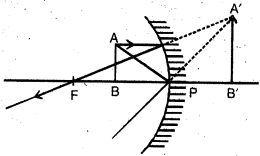
What is the minimum number of rays required for locating the image formed by a concave mirror for an object? Draw a ray diagram to show the formation of a virtual image by a concave mirror.
Solution
(N/A) To locate the image of an object formed by a concave mirror,a minimum of two rays are required.
Ray diagram: $A$ concave mirror forms a virtual,erect,and magnified image of an object when it is placed between the focus $(F)$ and the pole $(P)$ of the mirror. The rays appear to diverge from behind the mirror,forming a virtual image as shown in the diagram.
Ray diagram: $A$ concave mirror forms a virtual,erect,and magnified image of an object when it is placed between the focus $(F)$ and the pole $(P)$ of the mirror. The rays appear to diverge from behind the mirror,forming a virtual image as shown in the diagram.
0 likes
View Solution134
Medium
Name the spherical mirror used as:
$(a)$ $1.$ Shaving mirror,
$2.$ Rear-view mirror in vehicles,
$3.$ Reflector in searchlights.
$(b)$ Write any three differences between a real and virtual image.
$(a)$ $1.$ Shaving mirror,
$2.$ Rear-view mirror in vehicles,
$3.$ Reflector in searchlights.
$(b)$ Write any three differences between a real and virtual image.
Solution
(N/A) $1.$ Concave mirror
$2.$ Convex mirror
$3.$ Concave mirror
$(b)$ Differences between a real and virtual image:
$2.$ Convex mirror
$3.$ Concave mirror
$(b)$ Differences between a real and virtual image:
| Real image | Virtual image |
| $1.$ It is formed when light rays actually meet at a point after reflection or refraction. | $1.$ It is formed when light rays appear to meet at a point after reflection or refraction. |
| $2.$ It can be obtained on a screen. | $2.$ It cannot be obtained on a screen. |
| $3.$ It is always inverted. | $3.$ It is always erect. |
0 likes
View Solution135
Medium
What is meant by the power of a lens? Give its $SI$ unit. When two or more lenses are placed in contact,what will be their combined power?
Solution
(N/A) The power of a lens is defined as the measure of the degree of convergence or divergence of light rays falling on it. It is mathematically defined as the reciprocal of its focal length in meters.
i.e.,$P = 1 / f$ (where $f$ is in meters).
The $SI$ unit of power is the dioptre $(D)$.
When two or more thin lenses are placed in contact,the total power $(P)$ of the combination is the algebraic sum of the individual powers of the lenses:
$P = P_1 + P_2 + P_3 + ...$
i.e.,$P = 1 / f$ (where $f$ is in meters).
The $SI$ unit of power is the dioptre $(D)$.
When two or more thin lenses are placed in contact,the total power $(P)$ of the combination is the algebraic sum of the individual powers of the lenses:
$P = P_1 + P_2 + P_3 + ...$
0 likes
View Solution136
Medium
For the same angle of incidence in media $P, Q$ and $R$,the angles of refraction are $45^{\circ}, 35^{\circ}$ and $15^{\circ}$ respectively. In which medium will the velocity of light be minimum? Give reason.
Solution
(C) We know that the refractive index $n$ is given by $n = \frac{\sin i}{\sin r}$.
For a constant angle of incidence $i$,the refractive index $n$ is inversely proportional to $\sin r$.
Since the angle of refraction $r$ is minimum for medium $R$ $(15^{\circ})$,the refractive index $n$ is maximum for medium $R$.
We also know that the velocity of light $v$ in a medium is given by $v = \frac{c}{n}$,where $c$ is the speed of light in a vacuum.
Since $v$ is inversely proportional to $n$,the velocity of light will be minimum where the refractive index $n$ is maximum.
Therefore,the velocity of light is minimum in medium $R$.
For a constant angle of incidence $i$,the refractive index $n$ is inversely proportional to $\sin r$.
Since the angle of refraction $r$ is minimum for medium $R$ $(15^{\circ})$,the refractive index $n$ is maximum for medium $R$.
We also know that the velocity of light $v$ in a medium is given by $v = \frac{c}{n}$,where $c$ is the speed of light in a vacuum.
Since $v$ is inversely proportional to $n$,the velocity of light will be minimum where the refractive index $n$ is maximum.
Therefore,the velocity of light is minimum in medium $R$.
0 likes
View Solution137
Difficult
Define absolute refractive index. Absolute refractive indices of medium $A$ and medium $B$ are $n_{a}$ and $n_{b}$ respectively. What is the refractive index of medium $B$ with respect to medium $A$? How does the velocity of light vary with change in the optical density of the media?
Solution
(N/A) The absolute refractive index of a medium is defined as the ratio of the velocity of light in a vacuum to the velocity of light in that medium. If $c$ is the velocity of light in a vacuum and $v$ is the velocity in the medium,then $n = c / v$.
If $n_{a}$ and $n_{b}$ are the absolute refractive indices of media $A$ and $B$ respectively,then $n_{a} = c / v_{a}$ and $n_{b} = c / v_{b}$.
The refractive index of medium $B$ with respect to medium $A$ $(_{a}n_{b})$ is given by:
$_{a}n_{b} = \frac{\text{Velocity of light in } A}{\text{Velocity of light in } B} = \frac{v_{a}}{v_{b}} = \frac{c/n_{a}}{c/n_{b}} = \frac{n_{b}}{n_{a}}$.
Regarding the velocity of light: The velocity of light is inversely proportional to the optical density of the medium. As the optical density of a medium increases,the velocity of light in that medium decreases,and vice versa.
If $n_{a}$ and $n_{b}$ are the absolute refractive indices of media $A$ and $B$ respectively,then $n_{a} = c / v_{a}$ and $n_{b} = c / v_{b}$.
The refractive index of medium $B$ with respect to medium $A$ $(_{a}n_{b})$ is given by:
$_{a}n_{b} = \frac{\text{Velocity of light in } A}{\text{Velocity of light in } B} = \frac{v_{a}}{v_{b}} = \frac{c/n_{a}}{c/n_{b}} = \frac{n_{b}}{n_{a}}$.
Regarding the velocity of light: The velocity of light is inversely proportional to the optical density of the medium. As the optical density of a medium increases,the velocity of light in that medium decreases,and vice versa.
0 likes
View Solution138
MediumMCQ
As the velocity of light increases,the refractive index of the medium decreases. Light enters from air to water having a refractive index of $4/3$. Find the speed of light in water. The speed of light in vacuum is $3 \times 10^{8} \text{ m s}^{-1}$.
A
$2.25 \times 10^{8} \text{ m s}^{-1}$
B
$2.00 \times 10^{8} \text{ m s}^{-1}$
C
$1.50 \times 10^{8} \text{ m s}^{-1}$
D
$3.00 \times 10^{8} \text{ m s}^{-1}$
Solution
(A) Given: Refractive index of water $(n)$ = $4/3 = 1.33$.
Speed of light in vacuum $(c)$ = $3 \times 10^{8} \text{ m s}^{-1}$.
We know the formula for refractive index is $n = c / v$,where $v$ is the speed of light in the medium.
Rearranging the formula to find $v$: $v = c / n$.
Substituting the values: $v = (3 \times 10^{8}) / (4/3) = (3 \times 10^{8} \times 3) / 4 = 9 \times 10^{8} / 4 = 2.25 \times 10^{8} \text{ m s}^{-1}$.
Therefore,the speed of light in water is $2.25 \times 10^{8} \text{ m s}^{-1}$.
Speed of light in vacuum $(c)$ = $3 \times 10^{8} \text{ m s}^{-1}$.
We know the formula for refractive index is $n = c / v$,where $v$ is the speed of light in the medium.
Rearranging the formula to find $v$: $v = c / n$.
Substituting the values: $v = (3 \times 10^{8}) / (4/3) = (3 \times 10^{8} \times 3) / 4 = 9 \times 10^{8} / 4 = 2.25 \times 10^{8} \text{ m s}^{-1}$.
Therefore,the speed of light in water is $2.25 \times 10^{8} \text{ m s}^{-1}$.
0 likes
View Solution139
Easy
What is meant by the radius of curvature of a spherical mirror? How is it related to the focal length of the mirror?
Solution
(N/A) The radius of curvature of a spherical mirror is defined as the radius of the hollow sphere of glass of which the mirror is a part.
It is denoted by the symbol $R$.
The relationship between the radius of curvature $(R)$ and the focal length $(f)$ of a spherical mirror is given by the formula $R = 2f$,which means the radius of curvature is twice the focal length.
It is denoted by the symbol $R$.
The relationship between the radius of curvature $(R)$ and the focal length $(f)$ of a spherical mirror is given by the formula $R = 2f$,which means the radius of curvature is twice the focal length.
0 likes
View Solution140
Medium
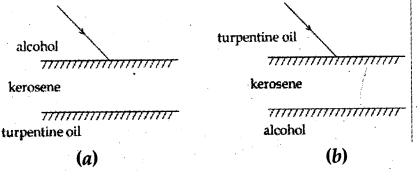
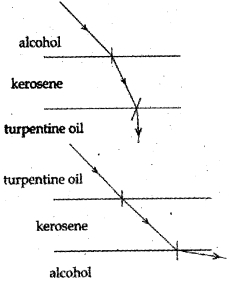
The refractive indices of turpentine oil,kerosene,and alcohol are $1.47, 1.44$,and $1.36$ respectively. Based on this information,complete the following ray diagrams to show the path of a ray of light through each medium. (Give a reason for your answer.)
Solution
(N/A) In this case,the light ray travels from alcohol $(n=1.36)$ to kerosene $(n=1.44)$ and then to turpentine oil $(n=1.47)$. Since the light is moving from a rarer to a denser medium at each interface,the ray of light bends towards the normal.
$(b)$ In this case,the light ray travels from turpentine oil $(n=1.47)$ to kerosene $(n=1.44)$ and then to alcohol $(n=1.36)$. Since the light is moving from a denser to a rarer medium at each interface,the ray of light bends away from the normal.
$(b)$ In this case,the light ray travels from turpentine oil $(n=1.47)$ to kerosene $(n=1.44)$ and then to alcohol $(n=1.36)$. Since the light is moving from a denser to a rarer medium at each interface,the ray of light bends away from the normal.
0 likes
View Solution141
Medium
With the help of a ray diagram,show that the angle of incidence is equal to the angle of reflection when a ray is incident on a concave mirror.
Solution
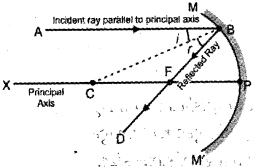
(N/A) In the provided ray diagram,$AB$ is the incident ray parallel to the principal axis.
$B$ is the point of incidence on the concave mirror.
$CB$ is the normal to the surface at point $B$,as the line joining the center of curvature $C$ to any point on the mirror is normal to the surface at that point.
According to the laws of reflection,the angle of incidence $(i)$ is equal to the angle of reflection $(r)$.
Thus,$\angle i = \angle r$,where $\angle i$ is the angle between the incident ray $AB$ and the normal $CB$,and $\angle r$ is the angle between the reflected ray $BD$ and the normal $CB$.
$B$ is the point of incidence on the concave mirror.
$CB$ is the normal to the surface at point $B$,as the line joining the center of curvature $C$ to any point on the mirror is normal to the surface at that point.
According to the laws of reflection,the angle of incidence $(i)$ is equal to the angle of reflection $(r)$.
Thus,$\angle i = \angle r$,where $\angle i$ is the angle between the incident ray $AB$ and the normal $CB$,and $\angle r$ is the angle between the reflected ray $BD$ and the normal $CB$.
0 likes
View Solution142
Medium
$(a)$ Calculate the distance at which an object should be placed in front of a convex lens of focal length $10\, cm$ to obtain a virtual image of double its size.
$(b)$ In the above given case,find the magnification,if the image formed is real. Express it in terms of the relation between $v$ and $u$.
$(b)$ In the above given case,find the magnification,if the image formed is real. Express it in terms of the relation between $v$ and $u$.
Solution
(A) Given: Focal length $f = +10\, cm$,Magnification $m = +2$ (for virtual image).
Using the magnification formula $m = \frac{v}{u}$,we get $v = mu = 2u$.
Using the lens formula $\frac{1}{f} = \frac{1}{v} - \frac{1}{u}$:
$\frac{1}{10} = \frac{1}{2u} - \frac{1}{u} = \frac{1-2}{2u} = -\frac{1}{2u}$.
Solving for $u$: $2u = -10$,so $u = -5\, cm$.
The object should be placed at a distance of $5\, cm$ in front of the lens.
$(b)$ If the image formed is real,then the magnification $m$ is negative. For a real image of double the size,$m = -2$. The relation between $v$ and $u$ is given by $m = \frac{v}{u}$,so $v = mu = -2u$.
Using the magnification formula $m = \frac{v}{u}$,we get $v = mu = 2u$.
Using the lens formula $\frac{1}{f} = \frac{1}{v} - \frac{1}{u}$:
$\frac{1}{10} = \frac{1}{2u} - \frac{1}{u} = \frac{1-2}{2u} = -\frac{1}{2u}$.
Solving for $u$: $2u = -10$,so $u = -5\, cm$.
The object should be placed at a distance of $5\, cm$ in front of the lens.
$(b)$ If the image formed is real,then the magnification $m$ is negative. For a real image of double the size,$m = -2$. The relation between $v$ and $u$ is given by $m = \frac{v}{u}$,so $v = mu = -2u$.
0 likes
View Solution143
Medium
One half of a convex lens is covered with a black paper.
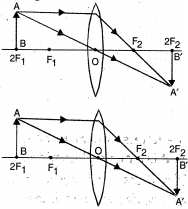
$(a)$ Show the formation of the image of an object placed at $2F_{1}$ of such a covered lens with the help of a ray diagram. Mention the position and nature of the image.
$(b)$ Draw the ray diagram for the same object at the same position in front of the same lens,but now uncovered. Will there be any difference in the image obtained in the two cases? Give a reason for your answer.
$(a)$ Show the formation of the image of an object placed at $2F_{1}$ of such a covered lens with the help of a ray diagram. Mention the position and nature of the image.
$(b)$ Draw the ray diagram for the same object at the same position in front of the same lens,but now uncovered. Will there be any difference in the image obtained in the two cases? Give a reason for your answer.
Solution
(N/A) The image formed is as shown in the ray diagram. Every part of a lens contributes to the formation of an image. Therefore,if the lower half of the lens is covered,it will still form a complete,real,and inverted image at $2F_{2}$ of the same size as the object on the other side of the lens. However,the intensity (brightness) of the image will be reduced because less light passes through the lens.
$(b)$ In the second case (uncovered lens),the image will be real,inverted,formed at $2F_{2}$,and will have the same size as the object. Its intensity will be greater than the image formed in the first case because more light rays are refracted through the entire aperture of the lens. The diagram is as shown.
$(b)$ In the second case (uncovered lens),the image will be real,inverted,formed at $2F_{2}$,and will have the same size as the object. Its intensity will be greater than the image formed in the first case because more light rays are refracted through the entire aperture of the lens. The diagram is as shown.
0 likes
View Solution144
Medium
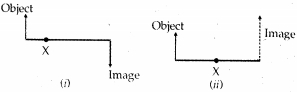
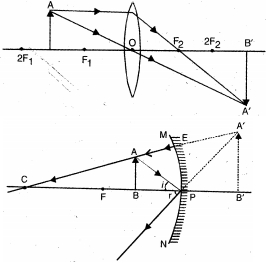
The nature,size,and position of the image of an object produced by a lens or mirror are as shown below. Identify the lens/mirror $(X)$ used in each case and draw the corresponding complete ray diagram.
Solution
(N/A) $(i)$ It is a convex lens. The image is real,inverted,and magnified,which occurs when the object is placed between $F_1$ and $2F_1$.
$(ii)$ It is a concave mirror. The image is virtual,erect,and magnified,which occurs when the object is placed between the focus $(F)$ and the pole $(P)$.
$(ii)$ It is a concave mirror. The image is virtual,erect,and magnified,which occurs when the object is placed between the focus $(F)$ and the pole $(P)$.
0 likes
View Solution145
Medium
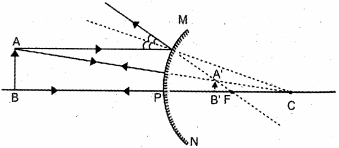
If the image formed by a mirror for all positions of the object placed in front of it is always erect and diminished,what type of mirror is it? Draw a ray diagram to justify your answer. Where and why do we generally use this type of mirror?
Solution
(N/A) The mirror is a convex mirror.
Ray Diagram: The provided image shows the ray diagram for a convex mirror where an object $AB$ is placed in front of it,and a virtual,erect,and diminished image $A'B'$ is formed between the pole $P$ and the principal focus $F$.
Usage: Convex mirrors are generally used as rear-view mirrors in vehicles.
Reason: They are used because they always form an erect image and provide a much wider field of view,allowing the driver to see a larger area of the traffic behind the vehicle.
Ray Diagram: The provided image shows the ray diagram for a convex mirror where an object $AB$ is placed in front of it,and a virtual,erect,and diminished image $A'B'$ is formed between the pole $P$ and the principal focus $F$.
Usage: Convex mirrors are generally used as rear-view mirrors in vehicles.
Reason: They are used because they always form an erect image and provide a much wider field of view,allowing the driver to see a larger area of the traffic behind the vehicle.
0 likes
View Solution146
MediumMCQ
An object of height $5 \, cm$ is placed perpendicular to the principal axis of a concave lens of focal length $10 \, cm$. If the distance of the object from the optical centre of the lens is $20 \, cm$,determine the position,nature,and size of the image formed using the lens formula.
A
Position: $6.67 \, cm$ from lens,Nature: Virtual and erect,Size: $1.67 \, cm$
B
Position: $10 \, cm$ from lens,Nature: Real and inverted,Size: $2.5 \, cm$
C
Position: $20 \, cm$ from lens,Nature: Virtual and erect,Size: $5 \, cm$
D
Position: $5 \, cm$ from lens,Nature: Real and inverted,Size: $1.25 \, cm$
Solution
(A) Given: Height of object $h = +5 \, cm$,Focal length of concave lens $f = -10 \, cm$,Object distance $u = -20 \, cm$.
Using the lens formula: $\frac{1}{f} = \frac{1}{v} - \frac{1}{u}$.
Substituting the values: $\frac{1}{v} = \frac{1}{f} + \frac{1}{u} = \frac{1}{-10} + \frac{1}{-20} = \frac{-2 - 1}{20} = \frac{-3}{20}$.
Therefore,$v = -\frac{20}{3} \, cm \approx -6.67 \, cm$. The negative sign indicates the image is formed on the same side as the object.
Nature: Since $v$ is negative,the image is virtual and erect.
Size of image $(h')$: Using magnification $m = \frac{h'}{h} = \frac{v}{u}$.
$h' = \frac{v}{u} \times h = \frac{-20/3}{-20} \times 5 = \frac{1}{3} \times 5 = +\frac{5}{3} \, cm \approx +1.67 \, cm$.
Using the lens formula: $\frac{1}{f} = \frac{1}{v} - \frac{1}{u}$.
Substituting the values: $\frac{1}{v} = \frac{1}{f} + \frac{1}{u} = \frac{1}{-10} + \frac{1}{-20} = \frac{-2 - 1}{20} = \frac{-3}{20}$.
Therefore,$v = -\frac{20}{3} \, cm \approx -6.67 \, cm$. The negative sign indicates the image is formed on the same side as the object.
Nature: Since $v$ is negative,the image is virtual and erect.
Size of image $(h')$: Using magnification $m = \frac{h'}{h} = \frac{v}{u}$.
$h' = \frac{v}{u} \times h = \frac{-20/3}{-20} \times 5 = \frac{1}{3} \times 5 = +\frac{5}{3} \, cm \approx +1.67 \, cm$.
0 likes
View Solution147
Medium
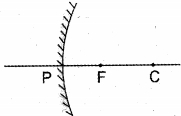
$(a)$ Define radius of curvature and focal length of a spherical mirror and show it on a figure.
$(b)$ Write the relation between the radius of curvature and the focal length of a spherical mirror.
$(b)$ Write the relation between the radius of curvature and the focal length of a spherical mirror.
Solution
(N/A) Radius of curvature: The radius of the hollow sphere of which the reflecting surface of the spherical mirror forms a part is called the radius of curvature. It is denoted by $R$.
Focal length: The distance between the pole $(P)$ and the principal focus $(F)$ of a spherical mirror is called its focal length. It is denoted by $f$.
In the figure,$P$ is the pole,$F$ is the principal focus,and $C$ is the center of curvature. The distance $PC$ represents the radius of curvature $(R)$,and the distance $PF$ represents the focal length $(f)$.
$(b)$ Relation: For a spherical mirror of small aperture,the radius of curvature is twice the focal length. The mathematical relation is given by:
$f = \frac{R}{2}$ or $R = 2f$
Focal length: The distance between the pole $(P)$ and the principal focus $(F)$ of a spherical mirror is called its focal length. It is denoted by $f$.
In the figure,$P$ is the pole,$F$ is the principal focus,and $C$ is the center of curvature. The distance $PC$ represents the radius of curvature $(R)$,and the distance $PF$ represents the focal length $(f)$.
$(b)$ Relation: For a spherical mirror of small aperture,the radius of curvature is twice the focal length. The mathematical relation is given by:
$f = \frac{R}{2}$ or $R = 2f$
0 likes
View Solution148
Medium
How can you distinguish between a plane mirror,a convex mirror,and a concave mirror by merely looking at the image formed in each case?
Solution
(N/A) To distinguish between a plane mirror,a convex mirror,and a concave mirror,the mirror is held near the face and the image is observed.
$1$. If the image is upright,of the same size as the object,and does not change in size when the mirror is moved,the mirror is a plane mirror.
$2$. If the image is upright and magnified,and it becomes inverted when the mirror is moved away from the face,the mirror is a concave mirror.
$3$. If the image is upright and diminished,and it remains upright even when the mirror is moved away from the face,the mirror is a convex mirror.
$1$. If the image is upright,of the same size as the object,and does not change in size when the mirror is moved,the mirror is a plane mirror.
$2$. If the image is upright and magnified,and it becomes inverted when the mirror is moved away from the face,the mirror is a concave mirror.
$3$. If the image is upright and diminished,and it remains upright even when the mirror is moved away from the face,the mirror is a convex mirror.
0 likes
View Solution149
Medium
Discuss the position and nature of the image formed by a concave mirror when the object is moved from infinity towards the pole of the mirror.
Solution
(N/A) When an object is moved from infinity towards the pole of a concave mirror,the image shifts from the focus to infinity and then behind the mirror.
$1$. At infinity: The image is formed at the principal focus $(F)$,real,inverted,and highly diminished.
$2$. Beyond the centre of curvature $(C)$: The image is formed between $F$ and $C$,real,inverted,and diminished.
$3$. At $C$: The image is formed at $C$,real,inverted,and of the same size as the object.
$4$. Between $C$ and $F$: The image is formed beyond $C$,real,inverted,and magnified.
$5$. At $F$: The image is formed at infinity,real,inverted,and highly magnified.
$6$. Between $F$ and the pole $(P)$: The image is formed behind the mirror,virtual,erect,and magnified.
$1$. At infinity: The image is formed at the principal focus $(F)$,real,inverted,and highly diminished.
$2$. Beyond the centre of curvature $(C)$: The image is formed between $F$ and $C$,real,inverted,and diminished.
$3$. At $C$: The image is formed at $C$,real,inverted,and of the same size as the object.
$4$. Between $C$ and $F$: The image is formed beyond $C$,real,inverted,and magnified.
$5$. At $F$: The image is formed at infinity,real,inverted,and highly magnified.
$6$. Between $F$ and the pole $(P)$: The image is formed behind the mirror,virtual,erect,and magnified.
0 likes
View Solution150
Medium
State the laws of refraction.
Solution
(N/A) $(i)$ The incident ray, the refracted ray, and the normal at the point of incidence all lie in the same plane.
$(ii)$ The ratio of the sine of the angle of incidence to the sine of the angle of refraction is a constant for a given pair of media. This law is also known as Snell's law. Mathematically, $\frac{\sin i}{\sin r} = \text{constant} = {_1n}_2$.
$(ii)$ The ratio of the sine of the angle of incidence to the sine of the angle of refraction is a constant for a given pair of media. This law is also known as Snell's law. Mathematically, $\frac{\sin i}{\sin r} = \text{constant} = {_1n}_2$.
0 likes
View SolutionLight – Reflection and Refraction — Mix Examples - Light – Reflection and Refraction · Frequently Asked Questions
1Are these Light – Reflection and Refraction questions useful for JEE and NEET?
Yes. All questions in this section are mapped to JEE Main and NEET exam patterns. Previous year questions from JEE Main, NEET, GUJCET and state-level exams are included with full solutions.
2Can I switch to Hindi or Gujarati for these questions?
Yes. Use the language tabs in the hero section or the sidebar to view the same questions and solutions in English, Hindi or Gujarati.
3How do I generate a question paper from this subtopic?
Use the Vedclass Exam Paper Generator — select the chapter and subtopic, set difficulty, and generate Sets A, B, C, D automatically. First 3 chapters of every subject are free.
Vedclass Products
For Students
Vedclass Test Series
Mock tests in real JEE/NEET style with performance analysis. 5-day free trial.
Start Free TrialFor Teachers
Exam Paper Generator
Generate Set A/B/C/D papers from this chapter in 2 minutes. 3 chapters free.
Try FreeFor Institutes
Online Exam Module
Live online exams with unlimited students, 360° analytics & white-label branding.
See DemoFor Teachers & Institutes
Generate a Light – Reflection and Refraction Exam Paper in 2 Minutes
Select subtopic & difficulty — Sets A, B, C, D auto-generated with No Repeat logic.
First 3 chapters of every subject are free — no payment required.