
A English
Textbook - Light – Reflection and Refraction Questions in English
Class 10 Science · Light – Reflection and Refraction · Textbook - Light – Reflection and Refraction
33+
Questions
English
Language
100%
With Solutions
Showing 33 of 33 questions in English
1
Easy
Define the principal focus of a concave mirror.
Solution
(N/A) Light rays that are parallel to the principal axis of a concave mirror converge at a specific point on its principal axis after reflecting from the mirror. This point is known as the principal focus of the concave mirror.
0 likes
View Solution2
EasyMCQ
The radius of curvature of a spherical mirror is $20\, cm$. What is its focal length (in $cm$)?
A
$5$
B
$10$
C
$20$
D
$40$
Solution
(B) Radius of curvature,$R = 20\, cm$.
The relationship between the radius of curvature $(R)$ and the focal length $(f)$ of a spherical mirror is given by the formula: $R = 2f$.
To find the focal length $(f)$,we rearrange the formula: $f = \frac{R}{2}$.
Substituting the given value: $f = \frac{20\, cm}{2} = 10\, cm$.
Therefore,the focal length of the given spherical mirror is $10\, cm$.
The relationship between the radius of curvature $(R)$ and the focal length $(f)$ of a spherical mirror is given by the formula: $R = 2f$.
To find the focal length $(f)$,we rearrange the formula: $f = \frac{R}{2}$.
Substituting the given value: $f = \frac{20\, cm}{2} = 10\, cm$.
Therefore,the focal length of the given spherical mirror is $10\, cm$.
0 likes
View Solution3
EasyMCQ
Name the mirror that can give an erect and enlarged image of an object.
A
Concave mirror
B
Convex mirror
C
Plane mirror
D
None of the above
Solution
(A) concave mirror produces an erect and enlarged image when the object is placed between the pole $(P)$ and the principal focus $(F)$ of the mirror.
In this position,the light rays appear to diverge from behind the mirror,forming a virtual image that is larger than the actual object.
In this position,the light rays appear to diverge from behind the mirror,forming a virtual image that is larger than the actual object.
0 likes
View Solution4
MediumMCQ
Why do we prefer a convex mirror as a rear-view mirror in vehicles?
A
It produces a real and inverted image.
B
It produces a virtual,erect,and diminished image with a wider field of view.
C
It produces a magnified image of the objects.
D
It is cheaper than other mirrors.
Solution
(B) Convex mirrors are preferred as rear-view mirrors in vehicles for the following reasons:
$1$. They always form a virtual,erect,and diminished image of the objects placed in front of them.
$2$. They have a wider field of view compared to plane mirrors,which allows the driver to see a larger area of the traffic behind the vehicle.
$3$. This helps the driver in safe driving by providing a better perspective of the vehicles approaching from the rear.
$1$. They always form a virtual,erect,and diminished image of the objects placed in front of them.
$2$. They have a wider field of view compared to plane mirrors,which allows the driver to see a larger area of the traffic behind the vehicle.
$3$. This helps the driver in safe driving by providing a better perspective of the vehicles approaching from the rear.
0 likes
View Solution5
EasyMCQ
Find the focal length (in $cm$) of a convex mirror whose radius of curvature is $32\, cm$.
A
$16$
B
$8$
C
$32$
D
$4$
Solution
(A) The radius of curvature $(R)$ of the convex mirror is given as $32\, cm$.
The relationship between the radius of curvature $(R)$ and the focal length $(f)$ of a spherical mirror is given by the formula: $R = 2f$.
To find the focal length $(f)$,we rearrange the formula: $f = \frac{R}{2}$.
Substituting the given value: $f = \frac{32\, cm}{2} = 16\, cm$.
Therefore,the focal length of the given convex mirror is $16\, cm$.
The relationship between the radius of curvature $(R)$ and the focal length $(f)$ of a spherical mirror is given by the formula: $R = 2f$.
To find the focal length $(f)$,we rearrange the formula: $f = \frac{R}{2}$.
Substituting the given value: $f = \frac{32\, cm}{2} = 16\, cm$.
Therefore,the focal length of the given convex mirror is $16\, cm$.
0 likes
View Solution6
MediumMCQ
$A$ concave mirror produces a three times magnified (enlarged) real image of an object placed at $10 \, cm$ in front of it. Where is the image located (in $cm$)?
A
$-30$
B
$-20$
C
$-10$
D
$-40$
Solution
(A) The magnification $(m)$ produced by a spherical mirror is given by the formula:
$m = -\frac{v}{u}$
Since the image is real and magnified three times,the magnification $m = -3$ (as real images are inverted).
Given,object distance $u = -10 \, cm$ (according to sign convention).
Substituting the values in the formula:
$-3 = -\frac{v}{-10}$
$-3 = \frac{v}{10}$
$v = -3 \times 10 = -30 \, cm$.
The negative sign indicates that the image is formed in front of the mirror at a distance of $30 \, cm$.
$m = -\frac{v}{u}$
Since the image is real and magnified three times,the magnification $m = -3$ (as real images are inverted).
Given,object distance $u = -10 \, cm$ (according to sign convention).
Substituting the values in the formula:
$-3 = -\frac{v}{-10}$
$-3 = \frac{v}{10}$
$v = -3 \times 10 = -30 \, cm$.
The negative sign indicates that the image is formed in front of the mirror at a distance of $30 \, cm$.
0 likes
View Solution7
Medium
$A$ ray of light travelling in air enters obliquely into water. Does the light ray bend towards the normal or away from the normal? Why?
Solution
(TOWARDS THE NORMAL) The light ray bends towards the normal.
When a ray of light travels from an optically rarer medium to an optically denser medium, it slows down and bends towards the normal. Since water $(n \approx 1.33)$ is optically denser than air $(n \approx 1.00)$, a ray of light travelling from air into water will bend towards the normal.
When a ray of light travels from an optically rarer medium to an optically denser medium, it slows down and bends towards the normal. Since water $(n \approx 1.33)$ is optically denser than air $(n \approx 1.00)$, a ray of light travelling from air into water will bend towards the normal.
0 likes
View Solution8
MediumMCQ
Light enters from air to glass having refractive index $1.50$. What is the speed of light in the glass? The speed of light in vacuum is $3 \times 10^8 \, m \, s^{-1}$.
A
$4.5 \times 10^8 \, m \, s^{-1}$
B
$1.5 \times 10^8 \, m \, s^{-1}$
C
$3 \times 10^8 \, m \, s^{-1}$
D
$2 \times 10^8 \, m \, s^{-1}$
Solution
(D) The refractive index $(n)$ of a medium is defined as the ratio of the speed of light in a vacuum $(c)$ to the speed of light in that medium $(v)$:
$n = \frac{c}{v}$
Given:
Speed of light in vacuum $(c)$ = $3 \times 10^8 \, m \, s^{-1}$
Refractive index of glass $(n)$ = $1.50$
Rearranging the formula to find the speed of light in glass $(v)$:
$v = \frac{c}{n}$
$v = \frac{3 \times 10^8 \, m \, s^{-1}}{1.50}$
$v = 2 \times 10^8 \, m \, s^{-1}$
Therefore,the speed of light in glass is $2 \times 10^8 \, m \, s^{-1}$.
$n = \frac{c}{v}$
Given:
Speed of light in vacuum $(c)$ = $3 \times 10^8 \, m \, s^{-1}$
Refractive index of glass $(n)$ = $1.50$
Rearranging the formula to find the speed of light in glass $(v)$:
$v = \frac{c}{n}$
$v = \frac{3 \times 10^8 \, m \, s^{-1}}{1.50}$
$v = 2 \times 10^8 \, m \, s^{-1}$
Therefore,the speed of light in glass is $2 \times 10^8 \, m \, s^{-1}$.
0 likes
View Solution9
Medium
Find out,from the table,the medium having the highest optical density. Also,find the medium with the lowest optical density.
| Material medium | Refractive index |
| Air | $1.0003$ |
| Ice | $1.31$ |
| Water | $1.33$ |
| Alcohol | $1.36$ |
| Kerosene | $1.44$ |
| Fused quartz | $1.46$ |
| Turpentine oil | $1.47$ |
| Benzene | $1.50$ |
| Crown glass | $1.52$ |
| Canada Balsam | $1.53$ |
| Rock salt | $1.54$ |
| Carbon disulphide | $1.63$ |
| Dense flint glass | $1.65$ |
| Ruby | $1.71$ |
| Sapphire | $1.77$ |
| Diamond | $2.42$ |
Solution
(N/A) The optical density of a medium is directly related to its refractive index. $A$ medium with a higher refractive index has a higher optical density,and a medium with a lower refractive index has a lower optical density.
$1$. Highest optical density: By comparing the refractive indices in the table,Diamond has the highest refractive index of $2.42$. Therefore,Diamond has the highest optical density.
$2$. Lowest optical density: By comparing the refractive indices in the table,Air has the lowest refractive index of $1.0003$. Therefore,Air has the lowest optical density.
$1$. Highest optical density: By comparing the refractive indices in the table,Diamond has the highest refractive index of $2.42$. Therefore,Diamond has the highest optical density.
$2$. Lowest optical density: By comparing the refractive indices in the table,Air has the lowest refractive index of $1.0003$. Therefore,Air has the lowest optical density.
0 likes
View Solution10
Medium
You are given kerosene,turpentine,and water. In which of these does the light travel fastest? Use the information given in the table below.
| Material medium | Refractive index |
| Water | $1.33$ |
| Kerosene | $1.44$ |
| Turpentine oil | $1.47$ |
Solution
(WATER) The speed of light in a medium is related to its refractive index $(n_m)$ by the formula:
$n_m = \frac{\text{Speed of light in vacuum (or air)}}{\text{Speed of light in the medium}} = \frac{c}{v}$
From this,the speed of light in the medium $(v)$ is given by:
$v = \frac{c}{n_m}$
This shows that the speed of light $(v)$ is inversely proportional to the refractive index $(n_m)$: $v \propto \frac{1}{n_m}$.
Therefore,light travels fastest in the medium with the lowest refractive index.
Comparing the given refractive indices:
- Water: $1.33$
- Kerosene: $1.44$
- Turpentine oil: $1.47$
Since water has the lowest refractive index $(1.33)$ among the three,light travels fastest in water.
$n_m = \frac{\text{Speed of light in vacuum (or air)}}{\text{Speed of light in the medium}} = \frac{c}{v}$
From this,the speed of light in the medium $(v)$ is given by:
$v = \frac{c}{n_m}$
This shows that the speed of light $(v)$ is inversely proportional to the refractive index $(n_m)$: $v \propto \frac{1}{n_m}$.
Therefore,light travels fastest in the medium with the lowest refractive index.
Comparing the given refractive indices:
- Water: $1.33$
- Kerosene: $1.44$
- Turpentine oil: $1.47$
Since water has the lowest refractive index $(1.33)$ among the three,light travels fastest in water.
0 likes
View Solution11
Easy
The refractive index of diamond is $2.42$. What is the meaning of this statement?
Solution
(N/A) The refractive index of a medium $n_m$ is related to the speed of light in that medium $v$ by the relation:
$n_m = \frac{\text{Speed of light in air}}{\text{Speed of light in the medium}} = \frac{c}{v}$
Where,$c$ is the speed of light in vacuum or air.
The refractive index of diamond is $2.42$. This suggests that the speed of light in diamond is reduced by a factor of $2.42$ compared to its speed in air.
$n_m = \frac{\text{Speed of light in air}}{\text{Speed of light in the medium}} = \frac{c}{v}$
Where,$c$ is the speed of light in vacuum or air.
The refractive index of diamond is $2.42$. This suggests that the speed of light in diamond is reduced by a factor of $2.42$ compared to its speed in air.
0 likes
View Solution12
Medium
Define $1$ dioptre of power of a lens.
Solution
(N/A) The power of a lens is defined as the reciprocal of its focal length in metres.
If $P$ is the power of a lens and $f$ is its focal length in metres,then the formula is:
$P = \frac{1}{f(\text{in metres})}$
The $S.I.$ unit of power of a lens is Dioptre,which is denoted by the symbol $D$.
$1$ dioptre is defined as the power of a lens whose focal length is $1$ metre.
Therefore,$1\, D = 1\, m^{-1}$.
If $P$ is the power of a lens and $f$ is its focal length in metres,then the formula is:
$P = \frac{1}{f(\text{in metres})}$
The $S.I.$ unit of power of a lens is Dioptre,which is denoted by the symbol $D$.
$1$ dioptre is defined as the power of a lens whose focal length is $1$ metre.
Therefore,$1\, D = 1\, m^{-1}$.
0 likes
View Solution13
Medium
$A$ convex lens forms a real and inverted image of a needle at a distance of $50\, cm$ from it. Where is the needle placed in front of the convex lens if the image is equal to the size of the object? Also,find the power of the lens.
Solution
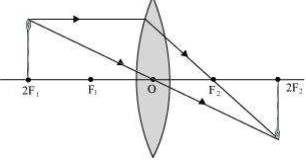
(N/A) When an object is placed at the centre of curvature,$2F_1$,of a convex lens,its image is formed at the centre of curvature,$2F_2$,on the other side of the lens. The image formed is inverted and of the same size as the object.
It is given that the image of the needle is formed at a distance of $50\, cm$ from the convex lens. Hence,the needle is placed in front of the lens at a distance of $50\, cm$.
Object distance,$u = -50\, cm$
Image distance,$v = 50\, cm$
Focal length $= f$
According to the lens formula,
$\frac{1}{v} - \frac{1}{u} = \frac{1}{f}$
$\frac{1}{f} = \frac{1}{50} - \frac{1}{-50} = \frac{1}{50} + \frac{1}{50} = \frac{2}{50} = \frac{1}{25}$
$f = 25\, cm = 0.25\, m$
Power of the lens,$P = \frac{1}{f(\text{in meters})} = \frac{1}{0.25} = +4\, D$
Hence,the power of the given lens is $+4\, D$.
It is given that the image of the needle is formed at a distance of $50\, cm$ from the convex lens. Hence,the needle is placed in front of the lens at a distance of $50\, cm$.
Object distance,$u = -50\, cm$
Image distance,$v = 50\, cm$
Focal length $= f$
According to the lens formula,
$\frac{1}{v} - \frac{1}{u} = \frac{1}{f}$
$\frac{1}{f} = \frac{1}{50} - \frac{1}{-50} = \frac{1}{50} + \frac{1}{50} = \frac{2}{50} = \frac{1}{25}$
$f = 25\, cm = 0.25\, m$
Power of the lens,$P = \frac{1}{f(\text{in meters})} = \frac{1}{0.25} = +4\, D$
Hence,the power of the given lens is $+4\, D$.
0 likes
View Solution14
MediumMCQ
Find the power of a concave lens of focal length $2 \,m$ in $Diopter$.
A
$-1$
B
$-0.5$
C
$-2$
D
$2$
Solution
(B) The focal length of a concave lens is taken as negative by sign convention.
Given,focal length $f = -2 \,m$.
The power of a lens is defined as the reciprocal of its focal length in meters,given by the formula $P = \frac{1}{f \text{ (in meters)}}$.
Substituting the value: $P = \frac{1}{-2} = -0.5 \,D$.
The negative sign indicates that the lens is concave (diverging).
Therefore,the power of the given concave lens is $-0.5 \,D$.
Given,focal length $f = -2 \,m$.
The power of a lens is defined as the reciprocal of its focal length in meters,given by the formula $P = \frac{1}{f \text{ (in meters)}}$.
Substituting the value: $P = \frac{1}{-2} = -0.5 \,D$.
The negative sign indicates that the lens is concave (diverging).
Therefore,the power of the given concave lens is $-0.5 \,D$.
0 likes
View Solution15
EasyMCQ
Which one of the following materials cannot be used to make a lens?
A
Water
B
Glass
C
Clay
D
Plastic
Solution
(C) lens is an optical device that refracts light and allows it to pass through it.
For a material to be used as a lens,it must be transparent so that light can travel through it.
Water,glass,and plastic are transparent materials and can be used to make lenses.
Clay is an opaque material,meaning light cannot pass through it.
Therefore,clay cannot be used to make a lens.
For a material to be used as a lens,it must be transparent so that light can travel through it.
Water,glass,and plastic are transparent materials and can be used to make lenses.
Clay is an opaque material,meaning light cannot pass through it.
Therefore,clay cannot be used to make a lens.
0 likes
View Solution16
MediumMCQ
The image formed by a concave mirror is observed to be virtual,erect and larger than the object. Where should be the position of the object?
A
Between the principal focus and the centre of curvature
B
At the centre of curvature
C
Beyond the centre of curvature
D
Between the pole of the mirror and its principal focus.
Solution
(D) concave mirror forms a virtual,erect,and magnified image only when the object is placed between the pole $(P)$ and the principal focus $(F)$ of the mirror.
In this position,the light rays appear to diverge from behind the mirror,creating a virtual image that is larger than the object.
In this position,the light rays appear to diverge from behind the mirror,creating a virtual image that is larger than the object.
0 likes
View Solution17
EasyMCQ
Where should an object be placed in front of a convex lens to get a real image of the size of the object?
A
At twice the focal length
B
At the principal focus of the lens
C
At infinity
D
Between the optical centre of the lens and its principal focus.
Solution
(A) When an object is placed at twice the focal length $(2F_1)$ in front of a convex lens,its image is formed at twice the focal length $(2F_2)$ on the other side of the lens.
This image is real,inverted,and of the same size as the object.
This image is real,inverted,and of the same size as the object.
0 likes
View Solution18
EasyMCQ
$A$ spherical mirror and a thin spherical lens have each a focal length of $-15\,cm$. The mirror and the lens are likely to be
A
both convex
B
both concave
C
the mirror is concave and the lens is convex
D
the mirror is convex,but the lens is concave
Solution
(B) According to the sign convention for spherical mirrors and lenses:
$1$. The focal length of a concave mirror is always negative.
$2$. The focal length of a concave lens is always negative.
Since both the spherical mirror and the thin spherical lens have a focal length of $-15\,cm$ (which is negative),both must be concave in nature.
$1$. The focal length of a concave mirror is always negative.
$2$. The focal length of a concave lens is always negative.
Since both the spherical mirror and the thin spherical lens have a focal length of $-15\,cm$ (which is negative),both must be concave in nature.
0 likes
View Solution19
MediumMCQ
No matter how far you stand from a mirror,your image appears erect. The mirror is likely to be
A
concave
B
convex
C
either plane or convex
D
plane
Solution
(C) convex mirror always forms a virtual and erect image of an object,regardless of its distance from the mirror.
Similarly,a plane mirror also always forms a virtual and erect image of an object,regardless of the distance.
Since both plane and convex mirrors produce erect images for all positions of the object,the mirror is likely to be either plane or convex.
Similarly,a plane mirror also always forms a virtual and erect image of an object,regardless of the distance.
Since both plane and convex mirrors produce erect images for all positions of the object,the mirror is likely to be either plane or convex.
0 likes
View Solution20
MediumMCQ
Which of the following lenses would you prefer to use while reading small letters found in a dictionary?
A
$A$ convex lens of focal length $50 \, cm$
B
$A$ concave lens of focal length $50 \, cm$
C
$A$ concave lens of focal length $5 \, cm$
D
$A$ convex lens of focal length $5 \, cm$
Solution
(D) convex lens produces a magnified,virtual,and erect image when an object is placed within its focal length.
Magnification $(m)$ for a lens is given by the formula $m = f / (f + u)$,where $f$ is the focal length and $u$ is the object distance.
For a given object distance,a lens with a shorter focal length provides higher magnification.
Therefore,to read small letters,a convex lens with a shorter focal length $(5 \, cm)$ is preferred over one with a longer focal length $(50 \, cm)$ to obtain a larger image.
Magnification $(m)$ for a lens is given by the formula $m = f / (f + u)$,where $f$ is the focal length and $u$ is the object distance.
For a given object distance,a lens with a shorter focal length provides higher magnification.
Therefore,to read small letters,a convex lens with a shorter focal length $(5 \, cm)$ is preferred over one with a longer focal length $(50 \, cm)$ to obtain a larger image.
0 likes
View Solution21
Medium
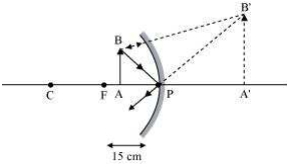
We wish to obtain an erect image of an object,using a concave mirror of focal length $15\, cm$. What should be the range of distance of the object from the mirror? What is the nature of the image? Is the image larger or smaller than the object? Draw a ray diagram to show the image formation in this case.
Solution
(N/A) The range of the object distance should be between $0\, cm$ and $15\, cm$ (i.e.,between the pole $P$ and the principal focus $F$).
$A$ concave mirror produces an erect image only when the object is placed between its pole $(P)$ and the principal focus $(F)$.
The nature of the image formed is virtual and erect.
The image is larger (magnified) than the object.
The ray diagram showing the image formation is provided in the image below.
$A$ concave mirror produces an erect image only when the object is placed between its pole $(P)$ and the principal focus $(F)$.
The nature of the image formed is virtual and erect.
The image is larger (magnified) than the object.
The ray diagram showing the image formation is provided in the image below.
1 likes
View Solution22
Easy
Name the type of mirror used in the following situation.
Support your answer with a reason.
$(a)$ Headlights of a car
Support your answer with a reason.
$(a)$ Headlights of a car
.jpg)
Solution
(N/A) Concave mirror.
$A$ concave mirror is used in the headlights of a car. This is because when a light source (bulb) is placed at the principal focus of a concave mirror,the light rays after reflection travel as a powerful parallel beam of light,which helps in illuminating the road at a long distance.
$A$ concave mirror is used in the headlights of a car. This is because when a light source (bulb) is placed at the principal focus of a concave mirror,the light rays after reflection travel as a powerful parallel beam of light,which helps in illuminating the road at a long distance.
0 likes
View Solution23
Easy
Name the type of mirror used as a side/rear-view mirror in a vehicle. Support your answer with a reason.
Solution
(CONVEX) The type of mirror used is a $Convex$ mirror.
Reason:
$1$. $Convex$ mirrors always form a virtual,erect,and diminished image of the objects placed in front of them.
$2$. They have a wider field of view compared to plane or concave mirrors,which allows the driver to see a larger area of the traffic behind the vehicle.
$3$. This helps the driver in safe driving by providing a better view of the road conditions behind.
Reason:
$1$. $Convex$ mirrors always form a virtual,erect,and diminished image of the objects placed in front of them.
$2$. They have a wider field of view compared to plane or concave mirrors,which allows the driver to see a larger area of the traffic behind the vehicle.
$3$. This helps the driver in safe driving by providing a better view of the road conditions behind.
0 likes
View Solution24
Medium
Name the type of mirror used in the following situation and support your answer with a reason:
$(a)$ Solar furnace
$(a)$ Solar furnace
Solution
(CONCAVE MIRROR) Concave mirror.
Concave mirrors are converging mirrors. They are used in solar furnaces because they converge the parallel rays of sunlight incident on them to a single point,known as the principal focus. This concentration of light energy produces a large amount of heat at that point,which is useful for heating purposes.
Concave mirrors are converging mirrors. They are used in solar furnaces because they converge the parallel rays of sunlight incident on them to a single point,known as the principal focus. This concentration of light energy produces a large amount of heat at that point,which is useful for heating purposes.
0 likes
View Solution25
Difficult
One-half of a convex lens is covered with a black paper. Will this lens produce a complete image of the object? Verify your answer experimentally. Explain your observations.
Solution
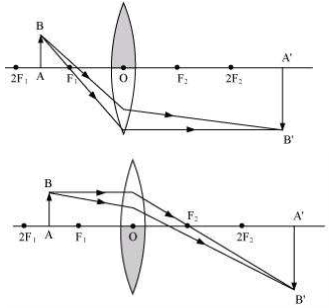
(N/A) Yes,the convex lens will form a complete image of an object,even if its one-half is covered with black paper. This can be understood by the following two cases:
Case $I$: When the upper half of the lens is covered.
In this case,rays of light coming from the object will be refracted by the lower half of the lens. These rays meet at the other side of the lens to form the image of the given object.
Case $II$: When the lower half of the lens is covered.
In this case,rays of light coming from the object are refracted by the upper half of the lens. These rays meet at the other side of the lens to form the image of the given object.
Note: Although the image is complete,its intensity (brightness) will be reduced because fewer light rays are passing through the lens to form the image.
Case $I$: When the upper half of the lens is covered.
In this case,rays of light coming from the object will be refracted by the lower half of the lens. These rays meet at the other side of the lens to form the image of the given object.
Case $II$: When the lower half of the lens is covered.
In this case,rays of light coming from the object are refracted by the upper half of the lens. These rays meet at the other side of the lens to form the image of the given object.
Note: Although the image is complete,its intensity (brightness) will be reduced because fewer light rays are passing through the lens to form the image.
0 likes
View Solution26
Medium
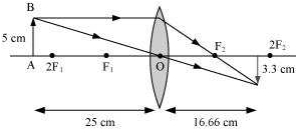
An object $5 \,cm$ in length is held $25 \,cm$ away from a converging lens of focal length $10 \,cm$. Find the position,size,and the nature of the image formed.
Solution
(N/A) Given:
Object height,$h_o = 5 \,cm$
Object distance,$u = -25 \,cm$
Focal length of converging lens,$f = +10 \,cm$
Using the lens formula:
$\frac{1}{v} - \frac{1}{u} = \frac{1}{f}$
$\frac{1}{v} = \frac{1}{f} + \frac{1}{u} = \frac{1}{10} - \frac{1}{25} = \frac{5 - 2}{50} = \frac{3}{50}$
$v = \frac{50}{3} \approx 16.67 \,cm$
The positive value of $v$ indicates that the image is real and formed on the other side of the lens at a distance of $16.67 \,cm$.
Magnification,$m = \frac{v}{u} = \frac{16.67}{-25} \approx -0.667$
Also,$m = \frac{h_i}{h_o}$
$h_i = m \times h_o = -0.667 \times 5 \approx -3.33 \,cm$
The negative sign of $h_i$ indicates that the image is inverted. Thus,the image is real,inverted,and diminished in size.
Object height,$h_o = 5 \,cm$
Object distance,$u = -25 \,cm$
Focal length of converging lens,$f = +10 \,cm$
Using the lens formula:
$\frac{1}{v} - \frac{1}{u} = \frac{1}{f}$
$\frac{1}{v} = \frac{1}{f} + \frac{1}{u} = \frac{1}{10} - \frac{1}{25} = \frac{5 - 2}{50} = \frac{3}{50}$
$v = \frac{50}{3} \approx 16.67 \,cm$
The positive value of $v$ indicates that the image is real and formed on the other side of the lens at a distance of $16.67 \,cm$.
Magnification,$m = \frac{v}{u} = \frac{16.67}{-25} \approx -0.667$
Also,$m = \frac{h_i}{h_o}$
$h_i = m \times h_o = -0.667 \times 5 \approx -3.33 \,cm$
The negative sign of $h_i$ indicates that the image is inverted. Thus,the image is real,inverted,and diminished in size.
0 likes
View Solution27
Difficult
$A$ concave lens of focal length $15 \,cm$ forms an image $10 \,cm$ from the lens. How far is the object placed from the lens? Draw the ray diagram.
Solution
(N/A) Focal length of concave lens,$f = -15 \,cm$ (by sign convention).
Image distance,$v = -10 \,cm$ (since the image formed by a concave lens is virtual and on the same side as the object).
According to the lens formula:
$\frac{1}{v} - \frac{1}{u} = \frac{1}{f}$
Substituting the values:
$\frac{1}{-10} - \frac{1}{u} = \frac{1}{-15}$
$-\frac{1}{u} = -\frac{1}{15} + \frac{1}{10}$
$-\frac{1}{u} = \frac{-2 + 3}{30} = \frac{1}{30}$
$u = -30 \,cm$
The negative sign indicates that the object is placed $30 \,cm$ in front of the lens.
Image distance,$v = -10 \,cm$ (since the image formed by a concave lens is virtual and on the same side as the object).
According to the lens formula:
$\frac{1}{v} - \frac{1}{u} = \frac{1}{f}$
Substituting the values:
$\frac{1}{-10} - \frac{1}{u} = \frac{1}{-15}$
$-\frac{1}{u} = -\frac{1}{15} + \frac{1}{10}$
$-\frac{1}{u} = \frac{-2 + 3}{30} = \frac{1}{30}$
$u = -30 \,cm$
The negative sign indicates that the object is placed $30 \,cm$ in front of the lens.
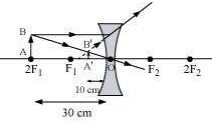
0 likes
View Solution28
DifficultMCQ
An object is placed at a distance of $10\, cm$ from a convex mirror of focal length $15\, cm$. Find the position and nature of the image.
A
$6\, cm$ behind the mirror,virtual and erect
B
$6\, cm$ in front of the mirror,real and inverted
C
$30\, cm$ behind the mirror,virtual and erect
D
$30\, cm$ in front of the mirror,real and inverted
Solution
(A) Focal length of convex mirror,$f = +15\, cm$.
Object distance,$u = -10\, cm$.
According to the mirror formula,$\frac{1}{v} + \frac{1}{u} = \frac{1}{f}$.
Substituting the values,$\frac{1}{v} = \frac{1}{f} - \frac{1}{u} = \frac{1}{15} - (\frac{1}{-10}) = \frac{1}{15} + \frac{1}{10}$.
$\frac{1}{v} = \frac{2 + 3}{30} = \frac{5}{30} = \frac{1}{6}$.
Therefore,$v = +6\, cm$.
The positive value of $v$ indicates that the image is formed $6\, cm$ behind the mirror.
Magnification,$m = -\frac{v}{u} = -(\frac{6}{-10}) = +0.6$.
The positive value of magnification indicates that the image formed is virtual and erect.
Object distance,$u = -10\, cm$.
According to the mirror formula,$\frac{1}{v} + \frac{1}{u} = \frac{1}{f}$.
Substituting the values,$\frac{1}{v} = \frac{1}{f} - \frac{1}{u} = \frac{1}{15} - (\frac{1}{-10}) = \frac{1}{15} + \frac{1}{10}$.
$\frac{1}{v} = \frac{2 + 3}{30} = \frac{5}{30} = \frac{1}{6}$.
Therefore,$v = +6\, cm$.
The positive value of $v$ indicates that the image is formed $6\, cm$ behind the mirror.
Magnification,$m = -\frac{v}{u} = -(\frac{6}{-10}) = +0.6$.
The positive value of magnification indicates that the image formed is virtual and erect.
0 likes
View Solution29
MediumMCQ
The magnification produced by a plane mirror is $+1$. What does this mean?
A
The image is real and inverted.
B
The image is virtual,erect,and of the same size as the object.
C
The image is magnified.
D
The image is diminished.
Solution
(B) The magnification $(m)$ produced by a mirror is defined as the ratio of the height of the image $(H_i)$ to the height of the object $(H_o)$:
$m = \frac{H_i}{H_o}$
Given that the magnification produced by a plane mirror is $+1$:
$1$. The magnitude $1$ indicates that the height of the image is equal to the height of the object $(H_i = H_o)$,meaning the image is of the same size as the object.
$2$. The positive sign $(+)$ indicates that the image formed is virtual and erect.
$m = \frac{H_i}{H_o}$
Given that the magnification produced by a plane mirror is $+1$:
$1$. The magnitude $1$ indicates that the height of the image is equal to the height of the object $(H_i = H_o)$,meaning the image is of the same size as the object.
$2$. The positive sign $(+)$ indicates that the image formed is virtual and erect.
0 likes
View Solution30
Difficult
An object $5.0\, cm$ in length is placed at a distance of $20\, cm$ in front of a convex mirror of radius of curvature $30\, cm$. Find the position of the image,its nature and size.
Solution
(N/A) Object distance,$u = -20\, cm$.
Object height,$h = 5\, cm$.
Radius of curvature,$R = 30\, cm$.
Focal length,$f = R/2 = 15\, cm$.
According to the mirror formula,$\frac{1}{v} + \frac{1}{u} = \frac{1}{f}$.
$\frac{1}{v} = \frac{1}{f} - \frac{1}{u} = \frac{1}{15} - (\frac{1}{-20}) = \frac{1}{15} + \frac{1}{20} = \frac{4+3}{60} = \frac{7}{60}$.
$v = \frac{60}{7} \approx 8.57\, cm$.
The positive value of $v$ indicates that the image is formed behind the mirror.
Magnification,$m = -\frac{v}{u} = -\frac{8.57}{-20} = 0.428$.
The positive value of magnification indicates that the image is virtual and erect.
Height of the image,$h' = m \times h = 0.428 \times 5 = 2.14\, cm$.
Thus,the image is virtual,erect,and $2.14\, cm$ in size,formed $8.57\, cm$ behind the mirror.
Object height,$h = 5\, cm$.
Radius of curvature,$R = 30\, cm$.
Focal length,$f = R/2 = 15\, cm$.
According to the mirror formula,$\frac{1}{v} + \frac{1}{u} = \frac{1}{f}$.
$\frac{1}{v} = \frac{1}{f} - \frac{1}{u} = \frac{1}{15} - (\frac{1}{-20}) = \frac{1}{15} + \frac{1}{20} = \frac{4+3}{60} = \frac{7}{60}$.
$v = \frac{60}{7} \approx 8.57\, cm$.
The positive value of $v$ indicates that the image is formed behind the mirror.
Magnification,$m = -\frac{v}{u} = -\frac{8.57}{-20} = 0.428$.
The positive value of magnification indicates that the image is virtual and erect.
Height of the image,$h' = m \times h = 0.428 \times 5 = 2.14\, cm$.
Thus,the image is virtual,erect,and $2.14\, cm$ in size,formed $8.57\, cm$ behind the mirror.
1 likes
View Solution31
DifficultMCQ
An object of size $7.0\, cm$ is placed at $27\, cm$ in front of a concave mirror of focal length $18\, cm$. At what distance from the mirror should a screen be placed,so that a sharp focussed image can be obtained? Find the size and the nature of the image.
A
Distance: $54\, cm$,Size: $14\, cm$,Nature: Real and Inverted
B
Distance: $27\, cm$,Size: $7\, cm$,Nature: Virtual and Erect
C
Distance: $54\, cm$,Size: $7\, cm$,Nature: Real and Inverted
D
Distance: $18\, cm$,Size: $14\, cm$,Nature: Virtual and Erect
Solution
(A) Object distance,$u = -27\, cm$.
Object height,$h = 7\, cm$.
Focal length,$f = -18\, cm$.
According to the mirror formula,$\frac{1}{v} + \frac{1}{u} = \frac{1}{f}$.
$\frac{1}{v} = \frac{1}{f} - \frac{1}{u} = \frac{1}{-18} - \frac{1}{-27} = \frac{-3 + 2}{54} = \frac{-1}{54}$.
Thus,$v = -54\, cm$.
The screen should be placed at a distance of $54\, cm$ in front of the mirror.
Magnification,$m = -\frac{v}{u} = -\frac{-54}{-27} = -2$.
The negative sign of magnification indicates that the image is real and inverted.
Magnification,$m = \frac{h'}{h} \implies h' = m \times h = -2 \times 7 = -14\, cm$.
The size of the image is $14\, cm$.
Object height,$h = 7\, cm$.
Focal length,$f = -18\, cm$.
According to the mirror formula,$\frac{1}{v} + \frac{1}{u} = \frac{1}{f}$.
$\frac{1}{v} = \frac{1}{f} - \frac{1}{u} = \frac{1}{-18} - \frac{1}{-27} = \frac{-3 + 2}{54} = \frac{-1}{54}$.
Thus,$v = -54\, cm$.
The screen should be placed at a distance of $54\, cm$ in front of the mirror.
Magnification,$m = -\frac{v}{u} = -\frac{-54}{-27} = -2$.
The negative sign of magnification indicates that the image is real and inverted.
Magnification,$m = \frac{h'}{h} \implies h' = m \times h = -2 \times 7 = -14\, cm$.
The size of the image is $14\, cm$.
0 likes
View Solution32
EasyMCQ
Find the focal length of a lens of power $-2.0 \, D$. What type of lens is this?
A
$-50 \, cm$; Concave lens.
B
$-0.50 \, cm$; Concave lens.
C
$-0.50 \, cm$; Convex lens.
D
$-50 \, cm$; Convex lens.
Solution
(A) The power of a lens is given by the formula $P = \frac{1}{f}$,where $f$ is the focal length in meters.
Given,$P = -2.0 \, D$.
Substituting the value in the formula: $-2.0 = \frac{1}{f}$.
Therefore,$f = \frac{1}{-2.0} = -0.5 \, m$.
Converting meters to centimeters: $f = -0.5 \times 100 \, cm = -50 \, cm$.
$A$ lens with a negative focal length is a concave lens.
Given,$P = -2.0 \, D$.
Substituting the value in the formula: $-2.0 = \frac{1}{f}$.
Therefore,$f = \frac{1}{-2.0} = -0.5 \, m$.
Converting meters to centimeters: $f = -0.5 \times 100 \, cm = -50 \, cm$.
$A$ lens with a negative focal length is a concave lens.
0 likes
View Solution33
MediumMCQ
$A$ doctor has prescribed a corrective lens of power $+1.5\, D.$ Find the focal length of the lens. Is the prescribed lens diverging or converging?
A
$67\, cm$; Diverging lens
B
$67\, cm$; Converging lens
C
$15\, cm$; Diverging lens
D
$15\, cm$; Converging lens
Solution
(B) The power of a lens is given by the formula $P = \frac{1}{f}$,where $f$ is the focal length in meters.
Given power $P = +1.5\, D$.
Substituting the value,$f = \frac{1}{1.5} = \frac{10}{15} = 0.666...\, m \approx 0.67\, m$.
Converting to centimeters,$f = 0.67 \times 100 = 67\, cm$.
$A$ lens with positive power and positive focal length is a convex lens.
$A$ convex lens is a converging lens.
Given power $P = +1.5\, D$.
Substituting the value,$f = \frac{1}{1.5} = \frac{10}{15} = 0.666...\, m \approx 0.67\, m$.
Converting to centimeters,$f = 0.67 \times 100 = 67\, cm$.
$A$ lens with positive power and positive focal length is a convex lens.
$A$ convex lens is a converging lens.
1 likes
View SolutionLight – Reflection and Refraction — Textbook - Light – Reflection and Refraction · Frequently Asked Questions
1Are these Light – Reflection and Refraction questions useful for JEE and NEET?
Yes. All questions in this section are mapped to JEE Main and NEET exam patterns. Previous year questions from JEE Main, NEET, GUJCET and state-level exams are included with full solutions.
2Can I switch to Hindi or Gujarati for these questions?
Yes. Use the language tabs in the hero section or the sidebar to view the same questions and solutions in English, Hindi or Gujarati.
3How do I generate a question paper from this subtopic?
Use the Vedclass Exam Paper Generator — select the chapter and subtopic, set difficulty, and generate Sets A, B, C, D automatically. First 3 chapters of every subject are free.
Vedclass Products
For Students
Vedclass Test Series
Mock tests in real JEE/NEET style with performance analysis. 5-day free trial.
Start Free TrialFor Teachers
Exam Paper Generator
Generate Set A/B/C/D papers from this chapter in 2 minutes. 3 chapters free.
Try FreeFor Institutes
Online Exam Module
Live online exams with unlimited students, 360° analytics & white-label branding.
See DemoFor Teachers & Institutes
Generate a Light – Reflection and Refraction Exam Paper in 2 Minutes
Select subtopic & difficulty — Sets A, B, C, D auto-generated with No Repeat logic.
First 3 chapters of every subject are free — no payment required.