
A English
Mix Examples - Light – Reflection and Refraction Questions in English
Class 10 Science · Light – Reflection and Refraction · Mix Examples - Light – Reflection and Refraction
400+
Questions
English
Language
100%
With Solutions
Showing 50 of 400 questions in English
151
Medium
With the help of a ray diagram,show the formation of an image by a convex lens when the object is placed between $F$ and $2F$. Write two characteristics of the image so formed.
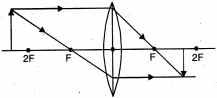
Solution
(N/A) When an object is placed between $F$ and $2F$ in front of a convex lens,the image is formed beyond $2F$ on the other side of the lens.
Two characteristics of the image formed are:
$1$. The image is real and inverted.
$2$. The image is magnified (larger than the object).
Two characteristics of the image formed are:
$1$. The image is real and inverted.
$2$. The image is magnified (larger than the object).
0 likes
View Solution152
MediumMCQ
How will you decide whether a given piece of glass is a convex lens,concave lens,or a plane glass plate?
A
By observing the image of printed matter through the glass.
B
By measuring the thickness of the glass.
C
By checking the weight of the glass.
D
By checking the color of the glass.
Solution
(A) To identify the type of glass,hold the given piece of glass over some printed matter and observe the letters:
$(i)$ If the letters appear magnified,the given piece is a convex lens.
$(ii)$ If the letters appear diminished,the given piece is a concave lens.
$(iii)$ If the letters appear to be of the same size as they are,then it is a plane glass plate.
$(i)$ If the letters appear magnified,the given piece is a convex lens.
$(ii)$ If the letters appear diminished,the given piece is a concave lens.
$(iii)$ If the letters appear to be of the same size as they are,then it is a plane glass plate.
0 likes
View Solution153
Medium
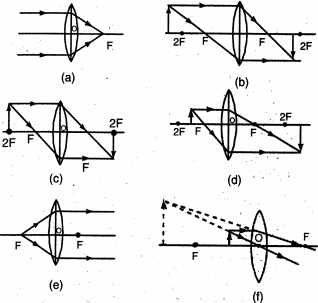
Describe the different cases of image formation by a convex lens. Provide the ray diagram for each case.
Solution
(N/A) convex lens forms images based on the position of the object as follows:
$(a)$ When the object is at infinity: The image is formed at the focus $F_2$,real,inverted,and highly diminished.
$(b)$ When the object is placed beyond $2F_1$: The image is formed between $F_2$ and $2F_2$,real,inverted,and diminished.
$(c)$ When the object is placed at $2F_1$: The image is formed at $2F_2$,real,inverted,and of the same size as the object.
$(d)$ When the object is placed between $F_1$ and $2F_1$: The image is formed beyond $2F_2$,real,inverted,and magnified.
$(e)$ When the object is placed at $F_1$: The image is formed at infinity,real,inverted,and highly magnified.
$(f)$ When the object is placed between the optical centre $O$ and focus $F_1$: The image is formed on the same side of the lens as the object,virtual,erect,and magnified.
$(a)$ When the object is at infinity: The image is formed at the focus $F_2$,real,inverted,and highly diminished.
$(b)$ When the object is placed beyond $2F_1$: The image is formed between $F_2$ and $2F_2$,real,inverted,and diminished.
$(c)$ When the object is placed at $2F_1$: The image is formed at $2F_2$,real,inverted,and of the same size as the object.
$(d)$ When the object is placed between $F_1$ and $2F_1$: The image is formed beyond $2F_2$,real,inverted,and magnified.
$(e)$ When the object is placed at $F_1$: The image is formed at infinity,real,inverted,and highly magnified.
$(f)$ When the object is placed between the optical centre $O$ and focus $F_1$: The image is formed on the same side of the lens as the object,virtual,erect,and magnified.
0 likes
View Solution154
Medium
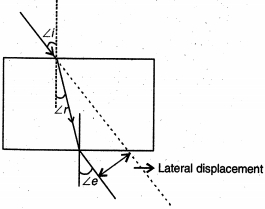
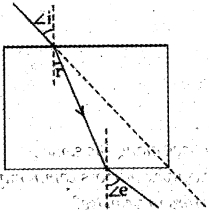
$A$ ray of light is incident obliquely on a glass slab. Draw a ray diagram showing the path of the light ray. Clearly,mark the angle of incidence,angle of refraction,angle of emergence,and lateral displacement of the ray. Give a formula to find the refractive index of the glass slab in terms of the angle of incidence and the angle of refraction.
Solution
(N/A) The ray diagram shows the path of a light ray passing through a rectangular glass slab. When a light ray enters the glass slab from air,it bends towards the normal because it travels from a rarer medium to a denser medium. Upon emerging from the glass slab into the air,it bends away from the normal.
$1$. Angle of incidence $(i)$: The angle between the incident ray and the normal at the point of incidence.
$2$. Angle of refraction $(r)$: The angle between the refracted ray and the normal inside the glass slab.
$3$. Angle of emergence $(e)$: The angle between the emergent ray and the normal at the second surface.
$4$. Lateral displacement: The perpendicular distance between the original path of the incident ray and the emergent ray.
The refractive index $(n)$ of the glass slab with respect to air is given by Snell's Law at the first interface:
$n = \frac{\sin i}{\sin r}$
$1$. Angle of incidence $(i)$: The angle between the incident ray and the normal at the point of incidence.
$2$. Angle of refraction $(r)$: The angle between the refracted ray and the normal inside the glass slab.
$3$. Angle of emergence $(e)$: The angle between the emergent ray and the normal at the second surface.
$4$. Lateral displacement: The perpendicular distance between the original path of the incident ray and the emergent ray.
The refractive index $(n)$ of the glass slab with respect to air is given by Snell's Law at the first interface:
$n = \frac{\sin i}{\sin r}$
0 likes
View Solution155
Medium
$(a)$ Why does a ray of light passing through the centre of curvature of a concave mirror after reflection get reflected back along the same path?
$(b)$ Why are convex mirrors commonly used as rear-view mirrors in vehicles?
$(c)$ $A$ pencil partly immersed in water in a glass tumbler appears to be displaced at the interface of air and water. Name the phenomenon of light responsible for it.
$(b)$ Why are convex mirrors commonly used as rear-view mirrors in vehicles?
$(c)$ $A$ pencil partly immersed in water in a glass tumbler appears to be displaced at the interface of air and water. Name the phenomenon of light responsible for it.
Solution
(N/A) ray of light passing through the centre of curvature of a concave mirror strikes the mirror surface at an angle of $90^{\circ}$ (normal incidence). According to the laws of reflection,when a ray falls normally on a surface,it reflects back along the same path.
$(b)$ Convex mirrors are used as rear-view mirrors because they always form an erect,virtual,and diminished image of objects. This provides a wider field of view,allowing the driver to see a much larger area behind the vehicle.
$(c)$ The phenomenon responsible for the apparent displacement of the pencil is the refraction of light.
$(b)$ Convex mirrors are used as rear-view mirrors because they always form an erect,virtual,and diminished image of objects. This provides a wider field of view,allowing the driver to see a much larger area behind the vehicle.
$(c)$ The phenomenon responsible for the apparent displacement of the pencil is the refraction of light.
0 likes
View Solution156
Medium
$(a)$ For the same angle of incidence $45^{\circ}$,the angle of refraction in two transparent media $I$ and $II$ is $20^{\circ}$ and $30^{\circ}$ respectively. Out of $I$ and $II$,which medium is optically denser and why?
$(b)$ Light enters from air to diamond,which has a refractive index of $2.42$. Calculate the speed of light in diamond,if the speed of light in air is $3.00 \times 10^{8} \text{ m s}^{-1}$.
$(b)$ Light enters from air to diamond,which has a refractive index of $2.42$. Calculate the speed of light in diamond,if the speed of light in air is $3.00 \times 10^{8} \text{ m s}^{-1}$.
Solution
(N/A) According to Snell's Law,$n_1 \sin(i) = n_2 \sin(r)$. For a constant angle of incidence $i$,the refractive index $n$ is inversely proportional to $\sin(r)$. Since the angle of refraction $r$ is smaller in medium $I$ $(20^{\circ})$ compared to medium $II$ $(30^{\circ})$,medium $I$ has a higher refractive index and is therefore optically denser.
$(b)$ The refractive index $n$ is given by the formula $n = \frac{c}{v}$,where $c$ is the speed of light in air (or vacuum) and $v$ is the speed of light in the medium.
Given $n = 2.42$ and $c = 3.00 \times 10^{8} \text{ m s}^{-1}$.
$v = \frac{c}{n} = \frac{3.00 \times 10^{8}}{2.42} \approx 1.24 \times 10^{8} \text{ m s}^{-1}$.
$(b)$ The refractive index $n$ is given by the formula $n = \frac{c}{v}$,where $c$ is the speed of light in air (or vacuum) and $v$ is the speed of light in the medium.
Given $n = 2.42$ and $c = 3.00 \times 10^{8} \text{ m s}^{-1}$.
$v = \frac{c}{n} = \frac{3.00 \times 10^{8}}{2.42} \approx 1.24 \times 10^{8} \text{ m s}^{-1}$.
0 likes
View Solution157
Medium
$A$ student focused the image of a candle flame on a white screen by placing the flame at various distances from a convex lens. He noted his observations:
$(a)$ From the above table, find the focal length of the lens without using the lens formula.
$(b)$ Which set of observations is incorrect and why?
$(c)$ In which case will the size of the object and the image be the same? Give a reason for your answer.
| Observation | Distance of flame from the lens $(cm)$ | Distance of screen from the lens $(cm)$ |
| $(i)$ | $60$ | $20$ |
| $(ii)$ | $40$ | $24$ |
| $(iii)$ | $30$ | $30$ |
| $(iv)$ | $24$ | $40$ |
| $(v)$ | $15$ | $70$ |
$(a)$ From the above table, find the focal length of the lens without using the lens formula.
$(b)$ Which set of observations is incorrect and why?
$(c)$ In which case will the size of the object and the image be the same? Give a reason for your answer.
Solution
(N/A) From the table of observations, it is clear that for observation $(iii)$, $u = 30 \, cm$ and $v = 30 \, cm$. This means that both $u$ and $v$ are equal to twice the focal length $(2f)$ of the convex lens.
Therefore, $2f = 30 \, cm$, which gives the focal length $f = 15 \, cm$.
$(b)$ The observation $(v)$ is incorrect. For this observation, $u = 15 \, cm$, which is equal to the focal length $(f = 15 \, cm)$. When an object is placed at the focus of a convex lens, the image is formed at infinity, not at $70 \, cm$.
$(c)$ The size of the image is equal to the size of the object when the magnification $m = 1$. Since $m = \frac{v}{u}$, the size of the image will be equal to the size of the object if $v = u$. This occurs in observation $(iii)$, where $u = 30 \, cm$ and $v = 30 \, cm$.
Therefore, $2f = 30 \, cm$, which gives the focal length $f = 15 \, cm$.
$(b)$ The observation $(v)$ is incorrect. For this observation, $u = 15 \, cm$, which is equal to the focal length $(f = 15 \, cm)$. When an object is placed at the focus of a convex lens, the image is formed at infinity, not at $70 \, cm$.
$(c)$ The size of the image is equal to the size of the object when the magnification $m = 1$. Since $m = \frac{v}{u}$, the size of the image will be equal to the size of the object if $v = u$. This occurs in observation $(iii)$, where $u = 30 \, cm$ and $v = 30 \, cm$.
0 likes
View Solution158
Medium
$(a)$ Define power of a lens and write its $SI$ unit.
$(b)$ $A$ convex lens forms a real and inverted image of a needle at a distance of $50\, cm$ from it. Where is the needle placed in front of the lens, if the image size is equal to the object size? Also, find the power of the lens.
$(b)$ $A$ convex lens forms a real and inverted image of a needle at a distance of $50\, cm$ from it. Where is the needle placed in front of the lens, if the image size is equal to the object size? Also, find the power of the lens.
Solution
$(D)$ The power of a lens is defined as the reciprocal of its focal length in meters. It represents the ability of a lens to converge or diverge rays of light. Its $SI$ unit is dioptre $(D)$.
$(b)$ Given that the image is real, inverted, and of the same size as the object, the object must be placed at $2f$ (twice the focal length) from the lens, and the image is also formed at $2f$ on the other side.
Given $v = 50\, cm$, therefore $2f = 50\, cm$, which implies $f = 25\, cm = 0.25\, m$.
The needle is placed at $50\, cm$ in front of the lens.
The power of the lens $P = \frac{1}{f(\text{in meters})} = \frac{1}{0.25} = +4\, D$.
$(b)$ Given that the image is real, inverted, and of the same size as the object, the object must be placed at $2f$ (twice the focal length) from the lens, and the image is also formed at $2f$ on the other side.
Given $v = 50\, cm$, therefore $2f = 50\, cm$, which implies $f = 25\, cm = 0.25\, m$.
The needle is placed at $50\, cm$ in front of the lens.
The power of the lens $P = \frac{1}{f(\text{in meters})} = \frac{1}{0.25} = +4\, D$.
0 likes
View Solution159
Medium
$(a)$ $A$ ray of light falls normally on a face of a glass slab. What are the values of angle of incidence and angle of refraction of this ray?
$(b)$ Light enters from air to a medium $X$. Its speed in medium $X$ becomes $1.5 \times 10^{8} \ m \ s^{-1}$. Speed of light in air is $3 \times 10^{8} \ m \ s^{-1}$. Find the refractive index of medium $X$.
$(b)$ Light enters from air to a medium $X$. Its speed in medium $X$ becomes $1.5 \times 10^{8} \ m \ s^{-1}$. Speed of light in air is $3 \times 10^{8} \ m \ s^{-1}$. Find the refractive index of medium $X$.
Solution
(N/A) When a ray of light falls normally (perpendicularly) on the surface of a glass slab,the angle between the incident ray and the normal is $0^{\circ}$. Therefore,the angle of incidence is $0^{\circ}$. Since the ray travels along the normal,it does not deviate,and the angle of refraction is also $0^{\circ}$.
$(b)$ Given:
Speed of light in air $(c)$ = $3 \times 10^{8} \ m \ s^{-1}$
Speed of light in medium $X$ $(v)$ = $1.5 \times 10^{8} \ m \ s^{-1}$
The refractive index $(n)$ of a medium is given by the ratio of the speed of light in air to the speed of light in that medium:
$n = \frac{c}{v}$
$n = \frac{3 \times 10^{8} \ m \ s^{-1}}{1.5 \times 10^{8} \ m \ s^{-1}}$
$n = 2$
Thus,the refractive index of medium $X$ is $2$.
$(b)$ Given:
Speed of light in air $(c)$ = $3 \times 10^{8} \ m \ s^{-1}$
Speed of light in medium $X$ $(v)$ = $1.5 \times 10^{8} \ m \ s^{-1}$
The refractive index $(n)$ of a medium is given by the ratio of the speed of light in air to the speed of light in that medium:
$n = \frac{c}{v}$
$n = \frac{3 \times 10^{8} \ m \ s^{-1}}{1.5 \times 10^{8} \ m \ s^{-1}}$
$n = 2$
Thus,the refractive index of medium $X$ is $2$.
0 likes
View Solution160
Medium
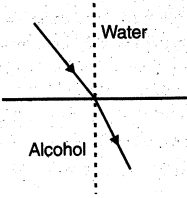
$(a)$ Water has a refractive index of $1.33$ and alcohol has a refractive index of $1.36$. Which of the two media is optically denser? Give a reason for your answer. Draw a ray diagram to show the path of a ray of light passing obliquely from water to alcohol.
$(b)$ The absolute refractive index of diamond is $2.42$ and the absolute refractive index of glass is $1.50$. Find the refractive index of diamond with respect to glass.
$(b)$ The absolute refractive index of diamond is $2.42$ and the absolute refractive index of glass is $1.50$. Find the refractive index of diamond with respect to glass.
Solution
(N/A) Alcohol is optically denser than water. This is because a higher refractive index indicates a higher optical density.
The ray diagram shows light bending towards the normal when passing from a rarer medium (water) to a denser medium (alcohol).
$(b)$ Given:
Absolute refractive index of diamond,$n_d = 2.42$
Absolute refractive index of glass,$n_g = 1.50$
Refractive index of diamond with respect to glass,$_g n_d = \frac{n_d}{n_g}$
$_g n_d = \frac{2.42}{1.50} = 1.6133$ (approximately $1.61$)
The ray diagram shows light bending towards the normal when passing from a rarer medium (water) to a denser medium (alcohol).
$(b)$ Given:
Absolute refractive index of diamond,$n_d = 2.42$
Absolute refractive index of glass,$n_g = 1.50$
Refractive index of diamond with respect to glass,$_g n_d = \frac{n_d}{n_g}$
$_g n_d = \frac{2.42}{1.50} = 1.6133$ (approximately $1.61$)
0 likes
View Solution161
Medium
$A$ $4.5 \, cm$ needle is placed $12 \, cm$ away from a convex mirror of focal length $15 \, cm$. Give the location of the image and the magnification. Describe what happens to the image as the needle is moved farther from the mirror.
Solution
(A) Given: Object height $h_{1} = 4.5 \, cm$,Object distance $u = -12 \, cm$,Focal length $f = +15 \, cm$ (for a convex mirror).
Using the mirror formula: $\frac{1}{f} = \frac{1}{v} + \frac{1}{u}$.
Substituting the values: $\frac{1}{15} = \frac{1}{v} + \frac{1}{-12}$.
Rearranging: $\frac{1}{v} = \frac{1}{15} + \frac{1}{12} = \frac{4 + 5}{60} = \frac{9}{60} = \frac{3}{20}$.
Thus,$v = \frac{20}{3} \approx +6.67 \, cm$.
The image is formed $6.67 \, cm$ behind the mirror.
Magnification $m = -\frac{v}{u} = -\frac{6.67}{-12} \approx +0.56$.
As the needle is moved farther from the mirror,the object distance $u$ increases. Consequently,the image moves closer to the focus $F$ and its size decreases.
Using the mirror formula: $\frac{1}{f} = \frac{1}{v} + \frac{1}{u}$.
Substituting the values: $\frac{1}{15} = \frac{1}{v} + \frac{1}{-12}$.
Rearranging: $\frac{1}{v} = \frac{1}{15} + \frac{1}{12} = \frac{4 + 5}{60} = \frac{9}{60} = \frac{3}{20}$.
Thus,$v = \frac{20}{3} \approx +6.67 \, cm$.
The image is formed $6.67 \, cm$ behind the mirror.
Magnification $m = -\frac{v}{u} = -\frac{6.67}{-12} \approx +0.56$.
As the needle is moved farther from the mirror,the object distance $u$ increases. Consequently,the image moves closer to the focus $F$ and its size decreases.
0 likes
View Solution162
Medium
$(a)$ State Snell's law of refraction.
$(b)$ When a ray of light travelling in air enters obliquely into a glass slab, it is observed that the light ray emerges parallel to the incident ray but it is shifted sideways slightly. Draw a ray diagram to illustrate it.
$(b)$ When a ray of light travelling in air enters obliquely into a glass slab, it is observed that the light ray emerges parallel to the incident ray but it is shifted sideways slightly. Draw a ray diagram to illustrate it.
Solution
(N/A) Snell's law states that the ratio of the sine of the angle of incidence to the sine of the angle of refraction is constant for a given pair of media and for light of a given wavelength. Mathematically, $\frac{\sin i}{\sin r} = \text{constant} = n_{21}$, where $n_{21}$ is the refractive index of the second medium with respect to the first.
$(b)$ When a light ray enters a glass slab obliquely, it bends towards the normal as it travels from a rarer medium (air) to a denser medium (glass). Upon exiting the glass slab, it bends away from the normal as it travels from a denser medium to a rarer medium. The emergent ray is parallel to the incident ray but undergoes a lateral displacement.
$(b)$ When a light ray enters a glass slab obliquely, it bends towards the normal as it travels from a rarer medium (air) to a denser medium (glass). Upon exiting the glass slab, it bends away from the normal as it travels from a denser medium to a rarer medium. The emergent ray is parallel to the incident ray but undergoes a lateral displacement.
0 likes
View Solution163
Medium
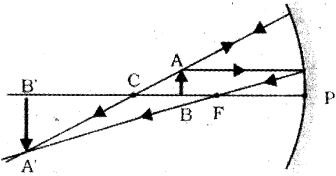
$A$ student wants to project the image of a candle flame on a screen $60\, cm$ in front of a mirror by keeping the flame at a distance of $15\, cm$ from its pole.
$(a)$ Write the type of mirror he should use.
$(b)$ Find the linear magnification of the image produced.
$(c)$ What is the distance between the object and its image?
$(d)$ Draw a ray diagram to show the image formation in this case.
$(a)$ Write the type of mirror he should use.
$(b)$ Find the linear magnification of the image produced.
$(c)$ What is the distance between the object and its image?
$(d)$ Draw a ray diagram to show the image formation in this case.
Solution
(A) Since the image is formed on a screen,it must be a real image. Only a concave mirror can form a real image.
$(b)$ Given: Object distance $u = -15\, cm$,Image distance $v = -60\, cm$ (as it is in front of the mirror).
Linear magnification $m = \frac{v}{u} = \frac{-60}{-15} = -4$.
$(c)$ The object is at $15\, cm$ from the pole and the image is at $60\, cm$ from the pole on the same side.
Distance between object and image $= |v - u| = |-60 - (-15)| = |-60 + 15| = |-45| = 45\, cm$.
$(d)$ The ray diagram shows the object placed between the focus $F$ and the pole $P$ is incorrect based on the values; however,for a real image,the object must be placed between $C$ and $F$. The provided diagram shows the object between $C$ and $F$ forming a real,inverted,and magnified image beyond $C$.
$(b)$ Given: Object distance $u = -15\, cm$,Image distance $v = -60\, cm$ (as it is in front of the mirror).
Linear magnification $m = \frac{v}{u} = \frac{-60}{-15} = -4$.
$(c)$ The object is at $15\, cm$ from the pole and the image is at $60\, cm$ from the pole on the same side.
Distance between object and image $= |v - u| = |-60 - (-15)| = |-60 + 15| = |-45| = 45\, cm$.
$(d)$ The ray diagram shows the object placed between the focus $F$ and the pole $P$ is incorrect based on the values; however,for a real image,the object must be placed between $C$ and $F$. The provided diagram shows the object between $C$ and $F$ forming a real,inverted,and magnified image beyond $C$.
0 likes
View Solution164
Medium
Name two spherical mirrors. Define them. Write any three points of difference between them.
Solution
(N/A) The two spherical mirrors are: $(i)$ Concave mirror and $(ii)$ Convex mirror.
$(i)$ Concave mirror: $A$ spherical mirror whose reflecting surface is curved inwards,i.e.,faces towards the center of the sphere,is called a concave mirror.
$(ii)$ Convex mirror: $A$ spherical mirror whose reflecting surface is curved outwards is called a convex mirror.
Points of difference:
$(1)$ The reflecting surface of a concave mirror is curved inwards,whereas the reflecting surface of a convex mirror is curved outwards.
$(2)$ $A$ concave mirror can produce both real and virtual images,whereas a convex mirror always produces virtual and erect images.
$(3)$ The image formed by a concave mirror can be enlarged,diminished,or of the same size as the object. The image formed by a convex mirror is always diminished.
$(i)$ Concave mirror: $A$ spherical mirror whose reflecting surface is curved inwards,i.e.,faces towards the center of the sphere,is called a concave mirror.
$(ii)$ Convex mirror: $A$ spherical mirror whose reflecting surface is curved outwards is called a convex mirror.
Points of difference:
$(1)$ The reflecting surface of a concave mirror is curved inwards,whereas the reflecting surface of a convex mirror is curved outwards.
$(2)$ $A$ concave mirror can produce both real and virtual images,whereas a convex mirror always produces virtual and erect images.
$(3)$ The image formed by a concave mirror can be enlarged,diminished,or of the same size as the object. The image formed by a convex mirror is always diminished.
0 likes
View Solution165
Difficult
$(a)$ Write the relation between $u, v, f$ for lenses and for mirrors,where $u, v, f$ are object distance,image distance,and focal length respectively.
$(b)$ The magnification produced by a concave mirror is $m = +4$. Write the information about the image given by this statement.
$(c)$ Draw a ray diagram for the following and show the formation of the images in the case of a concave mirror when the object is placed:
$(i)$ Between the pole and the focus point.
$(ii)$ At the centre of curvature.
$(b)$ The magnification produced by a concave mirror is $m = +4$. Write the information about the image given by this statement.
$(c)$ Draw a ray diagram for the following and show the formation of the images in the case of a concave mirror when the object is placed:
$(i)$ Between the pole and the focus point.
$(ii)$ At the centre of curvature.
Solution
(N/A) $(a) (i)$ For lenses,the lens formula is $\frac{1}{f} = \frac{1}{v} - \frac{1}{u}$.
$(ii)$ For mirrors,the mirror formula is $\frac{1}{f} = \frac{1}{v} + \frac{1}{u}$.
$(b)$ Since the magnification $m = +4$ is positive,the image is virtual and erect. Since the magnitude of $m$ is $4$ (which is greater than $1$),the image is magnified (enlarged).
$(c)$ $(i)$ When the object is placed between the pole $(P)$ and the focus $(F)$ of a concave mirror,a virtual,erect,and magnified image is formed behind the mirror.
$(ii)$ When the object is placed at the centre of curvature $(C)$ of a concave mirror,a real,inverted image of the same size as the object is formed at the centre of curvature $(C)$.
$(ii)$ For mirrors,the mirror formula is $\frac{1}{f} = \frac{1}{v} + \frac{1}{u}$.
$(b)$ Since the magnification $m = +4$ is positive,the image is virtual and erect. Since the magnitude of $m$ is $4$ (which is greater than $1$),the image is magnified (enlarged).
$(c)$ $(i)$ When the object is placed between the pole $(P)$ and the focus $(F)$ of a concave mirror,a virtual,erect,and magnified image is formed behind the mirror.
$(ii)$ When the object is placed at the centre of curvature $(C)$ of a concave mirror,a real,inverted image of the same size as the object is formed at the centre of curvature $(C)$.
0 likes
View Solution166
Medium
$(a)$ Write any three differences between concave and convex mirror.
$(b)$ Draw ray diagram to show what happens to a ray of light after reflection from a convex mirror,if it
$(i)$ is incident parallel to principal axis.
$(ii)$ incident at the pole.
$(b)$ Draw ray diagram to show what happens to a ray of light after reflection from a convex mirror,if it
$(i)$ is incident parallel to principal axis.
$(ii)$ incident at the pole.
Solution
(N/A) Differences between concave and convex mirror:
$1$. Concave mirror: The reflecting surface is curved inwards. Convex mirror: The reflecting surface is curved outwards.
$2$. Concave mirror: It can form both real and virtual images. Convex mirror: It always forms virtual,erect,and diminished images.
$3$. Concave mirror: It is a converging mirror. Convex mirror: It is a diverging mirror.
$(b)$ Ray diagrams for a convex mirror:
$(i)$ $A$ ray of light incident parallel to the principal axis appears to diverge from the principal focus $(F)$ after reflection.
$(ii)$ $A$ ray of light incident at the pole $(P)$ is reflected back such that the angle of incidence equals the angle of reflection $(i = r)$ with respect to the principal axis.
$1$. Concave mirror: The reflecting surface is curved inwards. Convex mirror: The reflecting surface is curved outwards.
$2$. Concave mirror: It can form both real and virtual images. Convex mirror: It always forms virtual,erect,and diminished images.
$3$. Concave mirror: It is a converging mirror. Convex mirror: It is a diverging mirror.
$(b)$ Ray diagrams for a convex mirror:
$(i)$ $A$ ray of light incident parallel to the principal axis appears to diverge from the principal focus $(F)$ after reflection.
$(ii)$ $A$ ray of light incident at the pole $(P)$ is reflected back such that the angle of incidence equals the angle of reflection $(i = r)$ with respect to the principal axis.
0 likes
View Solution167
Medium
State the relation between object distance,image distance,and focal length of a concave or convex mirror. $A$ concave mirror produces a two times magnified real image of an object placed at $10 \ cm$ from it. Find the position of the image.
Solution
(A) The mirror formula expressing the relationship between object distance $(u)$,image distance $(v)$,and focal length $(f)$ is given by: $\frac{1}{f} = \frac{1}{v} + \frac{1}{u}$.
Given that the image is real and magnified by $2$ times,the magnification $(m)$ is $-2$ (since real images are inverted).
The object distance $(u)$ is $-10 \ cm$ (using sign convention).
Using the magnification formula: $m = -\frac{v}{u}$.
Substituting the values: $-2 = -\frac{v}{-10}$.
Solving for $v$: $-2 = \frac{v}{10}$,which gives $v = -20 \ cm$.
Thus,the image is formed at a distance of $20 \ cm$ in front of the mirror.
Given that the image is real and magnified by $2$ times,the magnification $(m)$ is $-2$ (since real images are inverted).
The object distance $(u)$ is $-10 \ cm$ (using sign convention).
Using the magnification formula: $m = -\frac{v}{u}$.
Substituting the values: $-2 = -\frac{v}{-10}$.
Solving for $v$: $-2 = \frac{v}{10}$,which gives $v = -20 \ cm$.
Thus,the image is formed at a distance of $20 \ cm$ in front of the mirror.
0 likes
View Solution168
Medium
$(a)$ Define absolute refractive index.
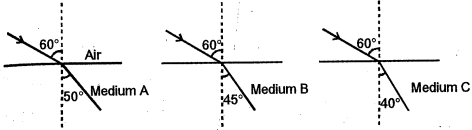
$(b)$ The path of a light ray from three different media $A, B$ and $C$ for a given angle of incidence is shown below. Study the diagrams and answer the following questions.
$(i)$ Which of the three media $A, B$ or $C$ has maximum optical density?
$(ii)$ Through which of the three media,will the speed of light be maximum?
$(iii)$ Will the light travelling from $A$ to $B$ bend towards or away from the normal?
$(iv)$ Will the refractive index of $B$ relative to $C$ be more than unity or less than unity?
$(b)$ The path of a light ray from three different media $A, B$ and $C$ for a given angle of incidence is shown below. Study the diagrams and answer the following questions.
$(i)$ Which of the three media $A, B$ or $C$ has maximum optical density?
$(ii)$ Through which of the three media,will the speed of light be maximum?
$(iii)$ Will the light travelling from $A$ to $B$ bend towards or away from the normal?
$(iv)$ Will the refractive index of $B$ relative to $C$ be more than unity or less than unity?
Solution
(D) The absolute refractive index of a medium is defined as the ratio of the speed of light in vacuum (or air) to the speed of light in that medium. Mathematically,$n = c/v$,where $c$ is the speed of light in vacuum and $v$ is the speed of light in the medium.
$(b)$ $(i)$ Optical density is directly related to the refractive index. $A$ higher refractive index means higher optical density. Since the angle of refraction is smallest in medium $C$ $(40^{\circ})$,it has the highest refractive index and thus the maximum optical density.
$(ii)$ The speed of light is inversely proportional to the refractive index. Since medium $A$ has the largest angle of refraction $(50^{\circ})$,it has the lowest refractive index,meaning the speed of light will be maximum in medium $A$.
$(iii)$ Light travelling from $A$ to $B$: Since the angle of refraction in $A$ $(50^{\circ})$ is greater than in $B$ $(45^{\circ})$,medium $B$ is optically denser than medium $A$. Therefore,light will bend towards the normal.
$(iv)$ Refractive index of $B$ relative to $C$ $(n_{BC})$ is given by $n_B / n_C$. Since the angle of refraction in $B$ $(45^{\circ})$ is greater than in $C$ $(40^{\circ})$,medium $C$ is optically denser than $B$ $(n_C > n_B)$. Thus,$n_{BC} = n_B / n_C < 1$,which is less than unity.
$(b)$ $(i)$ Optical density is directly related to the refractive index. $A$ higher refractive index means higher optical density. Since the angle of refraction is smallest in medium $C$ $(40^{\circ})$,it has the highest refractive index and thus the maximum optical density.
$(ii)$ The speed of light is inversely proportional to the refractive index. Since medium $A$ has the largest angle of refraction $(50^{\circ})$,it has the lowest refractive index,meaning the speed of light will be maximum in medium $A$.
$(iii)$ Light travelling from $A$ to $B$: Since the angle of refraction in $A$ $(50^{\circ})$ is greater than in $B$ $(45^{\circ})$,medium $B$ is optically denser than medium $A$. Therefore,light will bend towards the normal.
$(iv)$ Refractive index of $B$ relative to $C$ $(n_{BC})$ is given by $n_B / n_C$. Since the angle of refraction in $B$ $(45^{\circ})$ is greater than in $C$ $(40^{\circ})$,medium $C$ is optically denser than $B$ $(n_C > n_B)$. Thus,$n_{BC} = n_B / n_C < 1$,which is less than unity.
0 likes
View Solution169
Medium
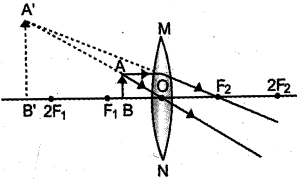
What is meant by power of a lens? Define its $SI$ unit. You have two lenses $A$ and $B$ of focal lengths $+10\, cm$ and $-10\, cm$ respectively. State the nature and power of each lens. Which of the two lenses will form a virtual and magnified image of an object placed $8\, cm$ from the lens? Draw a ray diagram to justify your answer.
Solution
(A) Power of a lens is defined as the reciprocal of its focal length in metres. It represents the ability of a lens to converge or diverge light rays.
$SI$ unit: The $SI$ unit of power is dioptre $(D)$. One dioptre is the power of a lens whose focal length is $1\, m$.
For lens $A$: Focal length $f_A = +10\, cm = +0.1\, m$. Since the focal length is positive,it is a convex (converging) lens. Power $P_A = 1 / f_A = 1 / (+0.1\, m) = +10\, D$.
For lens $B$: Focal length $f_B = -10\, cm = -0.1\, m$. Since the focal length is negative,it is a concave (diverging) lens. Power $P_B = 1 / f_B = 1 / (-0.1\, m) = -10\, D$.
$A$ convex lens forms a virtual and magnified image when the object is placed between the optical centre and the principal focus $(f = 10\, cm)$. Since the object is placed at $8\, cm$,which is less than the focal length,lens $A$ will form a virtual and magnified image.
$SI$ unit: The $SI$ unit of power is dioptre $(D)$. One dioptre is the power of a lens whose focal length is $1\, m$.
For lens $A$: Focal length $f_A = +10\, cm = +0.1\, m$. Since the focal length is positive,it is a convex (converging) lens. Power $P_A = 1 / f_A = 1 / (+0.1\, m) = +10\, D$.
For lens $B$: Focal length $f_B = -10\, cm = -0.1\, m$. Since the focal length is negative,it is a concave (diverging) lens. Power $P_B = 1 / f_B = 1 / (-0.1\, m) = -10\, D$.
$A$ convex lens forms a virtual and magnified image when the object is placed between the optical centre and the principal focus $(f = 10\, cm)$. Since the object is placed at $8\, cm$,which is less than the focal length,lens $A$ will form a virtual and magnified image.
0 likes
View Solution170
Difficult
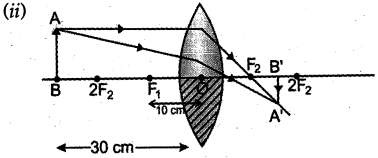
One half of a convex lens of focal length $10\, cm$ is covered with a black paper. Can such a lens produce an image of a complete object placed at a distance of $30\, cm$ from the lens? Draw a ray diagram to justify your answer.
$A$ $4\, cm$ tall object is placed perpendicular to the principal axis of a convex lens of focal length $20\, cm$. The distance of the object from the lens is $15\, cm$. Find the nature,position and size of the image.
$A$ $4\, cm$ tall object is placed perpendicular to the principal axis of a convex lens of focal length $20\, cm$. The distance of the object from the lens is $15\, cm$. Find the nature,position and size of the image.
Solution
(N/A) $(i)$ Yes,the lens can produce an image of the complete object. Although the intensity of the image will be reduced because less light passes through the lens,the image will still be formed at the same position.
$(ii)$ The ray diagram shows the object placed beyond $2F_1$. The image is formed between $F_2$ and $2F_2$ on the other side of the lens.
$(iii)$ Given: Height of object $h = 4\, cm$,focal length $f = +20\, cm$,object distance $u = -15\, cm$.
Using the lens formula: $\frac{1}{f} = \frac{1}{v} - \frac{1}{u}$
$\frac{1}{v} = \frac{1}{f} + \frac{1}{u} = \frac{1}{20} + \frac{1}{-15} = \frac{3 - 4}{60} = \frac{-1}{60}$
Therefore,$v = -60\, cm$.
The negative sign indicates that the image is formed on the same side as the object.
Nature: Virtual and erect.
Size of the image: $m = \frac{v}{u} = \frac{-60}{-15} = +4$.
$h' = m \times h = 4 \times 4\, cm = +16\, cm$. The image is magnified and erect.
$(ii)$ The ray diagram shows the object placed beyond $2F_1$. The image is formed between $F_2$ and $2F_2$ on the other side of the lens.
$(iii)$ Given: Height of object $h = 4\, cm$,focal length $f = +20\, cm$,object distance $u = -15\, cm$.
Using the lens formula: $\frac{1}{f} = \frac{1}{v} - \frac{1}{u}$
$\frac{1}{v} = \frac{1}{f} + \frac{1}{u} = \frac{1}{20} + \frac{1}{-15} = \frac{3 - 4}{60} = \frac{-1}{60}$
Therefore,$v = -60\, cm$.
The negative sign indicates that the image is formed on the same side as the object.
Nature: Virtual and erect.
Size of the image: $m = \frac{v}{u} = \frac{-60}{-15} = +4$.
$h' = m \times h = 4 \times 4\, cm = +16\, cm$. The image is magnified and erect.
0 likes
View Solution171
Medium
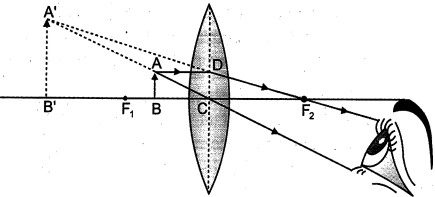
An object is situated at $8 \, cm$ from a convex lens of focal length $10 \, cm$. Find the position and nature of the image. Draw a ray diagram to illustrate the formation of the image (not to scale).
Solution
(N/A) Given: Focal length $f = +10 \, cm$ and object distance $u = -8 \, cm$.
According to the lens formula:
$\frac{1}{f} = \frac{1}{v} - \frac{1}{u}$
Rearranging for $v$:
$\frac{1}{v} = \frac{1}{f} + \frac{1}{u}$
Substituting the values:
$\frac{1}{v} = \frac{1}{10} + \frac{1}{-8} = \frac{1}{10} - \frac{1}{8} = \frac{4 - 5}{40} = -\frac{1}{40}$
Therefore,$v = -40 \, cm$.
Hence,we conclude that:
$(a)$ The image is formed at $40 \, cm$ from the lens on the same side as the object.
$(b)$ The image is virtual and erect.
$(c)$ The image is magnified,i.e.,larger in size than the object.
According to the lens formula:
$\frac{1}{f} = \frac{1}{v} - \frac{1}{u}$
Rearranging for $v$:
$\frac{1}{v} = \frac{1}{f} + \frac{1}{u}$
Substituting the values:
$\frac{1}{v} = \frac{1}{10} + \frac{1}{-8} = \frac{1}{10} - \frac{1}{8} = \frac{4 - 5}{40} = -\frac{1}{40}$
Therefore,$v = -40 \, cm$.
Hence,we conclude that:
$(a)$ The image is formed at $40 \, cm$ from the lens on the same side as the object.
$(b)$ The image is virtual and erect.
$(c)$ The image is magnified,i.e.,larger in size than the object.
0 likes
View Solution172
Medium
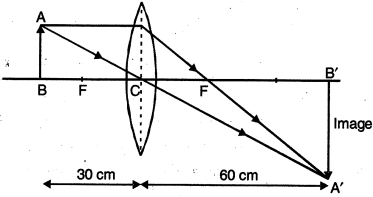
Draw a labelled ray diagram to locate the image of an object formed by a convex lens of focal length $20 \, cm$ when the object is placed $30 \, cm$ away from the lens.
Solution
(N/A) Given: Focal length $f = +20 \, cm$,Object distance $u = -30 \, cm$.
Using the lens formula $\frac{1}{v} - \frac{1}{u} = \frac{1}{f}$,we have:
$\frac{1}{v} = \frac{1}{f} + \frac{1}{u}$
$\frac{1}{v} = \frac{1}{20} + \frac{1}{-30} = \frac{3 - 2}{60} = \frac{1}{60}$
Therefore,$v = +60 \, cm$.
The image is formed at a distance of $60 \, cm$ on the other side of the lens. The ray diagram is as shown below.
Using the lens formula $\frac{1}{v} - \frac{1}{u} = \frac{1}{f}$,we have:
$\frac{1}{v} = \frac{1}{f} + \frac{1}{u}$
$\frac{1}{v} = \frac{1}{20} + \frac{1}{-30} = \frac{3 - 2}{60} = \frac{1}{60}$
Therefore,$v = +60 \, cm$.
The image is formed at a distance of $60 \, cm$ on the other side of the lens. The ray diagram is as shown below.
0 likes
View Solution173
Difficult
$(a)$ State the relation between object distance,image distance and the focal length of a spherical mirror.
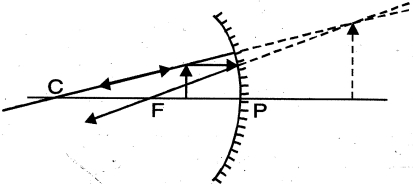
$(b)$ Draw a ray diagram to show the image formed by a concave mirror when an object is placed between the pole and focus of the mirror.
$(c)$ $A$ concave mirror of focal length $15\, cm$ forms an image of an object kept at a distance of $10\, cm$ from the mirror. Find the position,nature and size of the image formed by it.
$(b)$ Draw a ray diagram to show the image formed by a concave mirror when an object is placed between the pole and focus of the mirror.
$(c)$ $A$ concave mirror of focal length $15\, cm$ forms an image of an object kept at a distance of $10\, cm$ from the mirror. Find the position,nature and size of the image formed by it.
Solution
(N/A) The mirror formula is given by $\frac{1}{f} = \frac{1}{v} + \frac{1}{u}$,where $f$ is the focal length,$v$ is the image distance,and $u$ is the object distance.
$(b)$ The ray diagram shows the object placed between the pole $(P)$ and the focus $(F)$ of a concave mirror,resulting in a virtual,erect,and magnified image behind the mirror.
$(c)$ Given:
Focal length of concave mirror,$f = -15\, cm$
Object distance,$u = -10\, cm$
Using the mirror formula: $\frac{1}{f} = \frac{1}{v} + \frac{1}{u}$
$\frac{1}{v} = \frac{1}{f} - \frac{1}{u} = \frac{1}{-15} - \frac{1}{-10} = -\frac{1}{15} + \frac{1}{10} = \frac{-2 + 3}{30} = \frac{1}{30}$
Therefore,$v = +30\, cm$.
Since $v$ is positive,the image is formed $30\, cm$ behind the mirror.
The image is virtual,erect,and magnified (as magnification $m = -\frac{v}{u} = -\frac{30}{-10} = +3$).
$(b)$ The ray diagram shows the object placed between the pole $(P)$ and the focus $(F)$ of a concave mirror,resulting in a virtual,erect,and magnified image behind the mirror.
$(c)$ Given:
Focal length of concave mirror,$f = -15\, cm$
Object distance,$u = -10\, cm$
Using the mirror formula: $\frac{1}{f} = \frac{1}{v} + \frac{1}{u}$
$\frac{1}{v} = \frac{1}{f} - \frac{1}{u} = \frac{1}{-15} - \frac{1}{-10} = -\frac{1}{15} + \frac{1}{10} = \frac{-2 + 3}{30} = \frac{1}{30}$
Therefore,$v = +30\, cm$.
Since $v$ is positive,the image is formed $30\, cm$ behind the mirror.
The image is virtual,erect,and magnified (as magnification $m = -\frac{v}{u} = -\frac{30}{-10} = +3$).
0 likes
View Solution174
Medium
$(i)$ Define a real image of an object.
$(ii)$ Name the mirror that:
$(a)$ can give a real as well as a virtual image of an object.
$(b)$ will always give a virtual image of the same size as the object.
$(c)$ will always give a virtual and diminished image of an object.
$(d)$ is used by a doctor in examining teeth.
$(iii)$ With the help of a ray diagram,explain the use of a concave mirror as a solar concentrator.
$(ii)$ Name the mirror that:
$(a)$ can give a real as well as a virtual image of an object.
$(b)$ will always give a virtual image of the same size as the object.
$(c)$ will always give a virtual and diminished image of an object.
$(d)$ is used by a doctor in examining teeth.
$(iii)$ With the help of a ray diagram,explain the use of a concave mirror as a solar concentrator.
Solution
(N/A) $(i)$ $A$ real image is an image formed when the reflected light rays actually intersect at a point. It can be obtained on a screen.
$(ii)$ $(a)$ Concave mirror
$(b)$ Plane mirror
$(c)$ Convex mirror
$(d)$ Concave mirror
$(iii)$ $A$ concave mirror acts as a solar concentrator because it converges parallel rays of light coming from the sun at its principal focus. This concentration of light energy at the focus produces intense heat,which is used for solar heating applications. The ray diagram shows parallel rays from infinity incident on the concave mirror,which reflect and converge at the focus $F$.
$(ii)$ $(a)$ Concave mirror
$(b)$ Plane mirror
$(c)$ Convex mirror
$(d)$ Concave mirror
$(iii)$ $A$ concave mirror acts as a solar concentrator because it converges parallel rays of light coming from the sun at its principal focus. This concentration of light energy at the focus produces intense heat,which is used for solar heating applications. The ray diagram shows parallel rays from infinity incident on the concave mirror,which reflect and converge at the focus $F$.
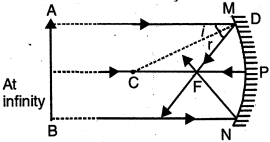
0 likes
View Solution175
Medium
Name the type of mirror used in the following:
$(a)$ Solar furnace.
$(b)$ Side/rear-view mirror of a vehicle.
Draw a labelled ray diagram to show the formation of image in each of the above two cases.
Which of these mirrors could also form a magnified and virtual image of an object? Illustrate with the help of a ray diagram.
$(a)$ Solar furnace.
$(b)$ Side/rear-view mirror of a vehicle.
Draw a labelled ray diagram to show the formation of image in each of the above two cases.
Which of these mirrors could also form a magnified and virtual image of an object? Illustrate with the help of a ray diagram.
Solution
(A-D) Concave mirror is used in a solar furnace because it converges parallel rays of sunlight to a single point (focus),producing high heat.
$(b)$ Convex mirror is used as a side/rear-view mirror in vehicles because it provides a wider field of view and always forms a virtual,erect,and diminished image.
Concave mirror can form a magnified and virtual image when the object is placed between the pole $(P)$ and the focus $(F)$ of the mirror.
The ray diagram for the magnified and virtual image is as follows: When an object is placed between $P$ and $F$,the reflected rays appear to diverge from a point behind the mirror,forming a virtual,erect,and magnified image.
$(b)$ Convex mirror is used as a side/rear-view mirror in vehicles because it provides a wider field of view and always forms a virtual,erect,and diminished image.
Concave mirror can form a magnified and virtual image when the object is placed between the pole $(P)$ and the focus $(F)$ of the mirror.
The ray diagram for the magnified and virtual image is as follows: When an object is placed between $P$ and $F$,the reflected rays appear to diverge from a point behind the mirror,forming a virtual,erect,and magnified image.
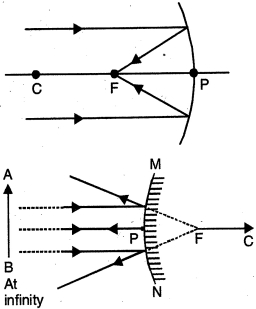
0 likes
View Solution176
Medium
$(a)$ Draw a ray diagram in each of the following cases to show the position and nature of the image formed when the object is placed:
$(i)$ between optical centre and principal focus $(F)$ of a convex lens.
$(ii)$ between $F$ and $2F$ of a convex lens.
$(iii)$ at $2F$ of a convex lens.
$(b)$ How will the nature and position of the image formed change in case $(i)$ and $(ii)$ in part $(a)$ of this question if the lens is replaced by a concave lens? Draw the corresponding ray diagram.
$(i)$ between optical centre and principal focus $(F)$ of a convex lens.
$(ii)$ between $F$ and $2F$ of a convex lens.
$(iii)$ at $2F$ of a convex lens.
$(b)$ How will the nature and position of the image formed change in case $(i)$ and $(ii)$ in part $(a)$ of this question if the lens is replaced by a concave lens? Draw the corresponding ray diagram.
Solution
(N/A) For the ray diagrams of a convex lens:
$(i)$ When the object is between the optical centre and the principal focus $(F)$,the image formed is virtual,erect,and magnified,and it is formed on the same side of the lens as the object.
$(ii)$ When the object is between $F$ and $2F$,the image formed is real,inverted,and magnified,and it is formed beyond $2F$ on the other side of the lens.
$(iii)$ When the object is at $2F$,the image formed is real,inverted,and of the same size as the object,and it is formed at $2F$ on the other side of the lens.
$(b)$ If the convex lens is replaced by a concave lens,the nature and position of the image will change as follows:
In both cases $(i)$ and $(ii)$,the concave lens will always form a virtual,erect,and diminished image. The image will always be formed between the optical centre and the principal focus $(F)$ on the same side as the object,regardless of the object's position.
$(i)$ When the object is between the optical centre and the principal focus $(F)$,the image formed is virtual,erect,and magnified,and it is formed on the same side of the lens as the object.
$(ii)$ When the object is between $F$ and $2F$,the image formed is real,inverted,and magnified,and it is formed beyond $2F$ on the other side of the lens.
$(iii)$ When the object is at $2F$,the image formed is real,inverted,and of the same size as the object,and it is formed at $2F$ on the other side of the lens.
$(b)$ If the convex lens is replaced by a concave lens,the nature and position of the image will change as follows:
In both cases $(i)$ and $(ii)$,the concave lens will always form a virtual,erect,and diminished image. The image will always be formed between the optical centre and the principal focus $(F)$ on the same side as the object,regardless of the object's position.
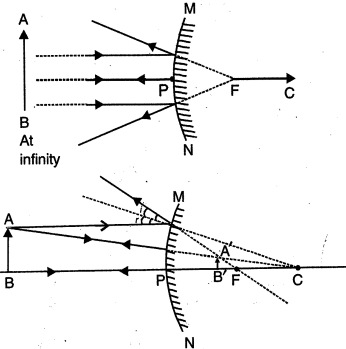
0 likes
View Solution177
Medium
$(a)$ $A$ thin converging lens forms a:
$(i)$ Real magnified image.
$(ii)$ Virtual magnified image of an object placed in front of it.
Write the positions of the objects in each case.
$(b)$ Draw labelled ray diagrams to show the image formation in each case.
$(c)$ How will the following be affected on cutting this lens into two halves along the principal axis?
$(i)$ Focal length,
$(ii)$ Intensity of the image formed by half lens.
$(i)$ Real magnified image.
$(ii)$ Virtual magnified image of an object placed in front of it.
Write the positions of the objects in each case.
$(b)$ Draw labelled ray diagrams to show the image formation in each case.
$(c)$ How will the following be affected on cutting this lens into two halves along the principal axis?
$(i)$ Focal length,
$(ii)$ Intensity of the image formed by half lens.
Solution
(N/A) $(i)$ The object is placed between $F_1$ and $2F_1$ of the lens.
$(ii)$ The object is placed between the optical center $O$ and the principal focus $F_1$.
$(b)$ Refer to the provided ray diagrams.
$(c)$ $(i)$ The focal length of the lens remains unchanged because the curvature and refractive index of the lens material remain the same.
$(ii)$ The intensity of the image decreases because the aperture of the lens is reduced,allowing less light to pass through the lens.
$(ii)$ The object is placed between the optical center $O$ and the principal focus $F_1$.
$(b)$ Refer to the provided ray diagrams.
$(c)$ $(i)$ The focal length of the lens remains unchanged because the curvature and refractive index of the lens material remain the same.
$(ii)$ The intensity of the image decreases because the aperture of the lens is reduced,allowing less light to pass through the lens.
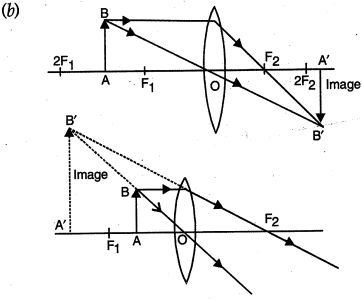
0 likes
View Solution178
Medium
$(a)$ Define principal focus of a spherical mirror.
$(b)$ For what position of the object does a concave mirror form a real,inverted and diminished image of the object? Draw the ray diagram.
$(c)$ An object $4 \,cm$ high is placed at a distance of $6 \,cm$ in front of a concave mirror of focal length $12 \,cm$. Find the position of the image formed.
$(b)$ For what position of the object does a concave mirror form a real,inverted and diminished image of the object? Draw the ray diagram.
$(c)$ An object $4 \,cm$ high is placed at a distance of $6 \,cm$ in front of a concave mirror of focal length $12 \,cm$. Find the position of the image formed.
Solution
(C) The principal focus is a point on the principal axis where rays parallel to the principal axis converge (in a concave mirror) or appear to diverge from (in a convex mirror) after reflection.
$(b)$ $A$ concave mirror forms a real,inverted,and diminished image when the object is placed beyond the center of curvature $(C)$.
$(c)$ Given: Object height $h = 4 \,cm$,object distance $u = -6 \,cm$,focal length $f = -12 \,cm$.
Using the mirror formula: $\frac{1}{f} = \frac{1}{v} + \frac{1}{u}$
$\frac{1}{-12} = \frac{1}{v} + \frac{1}{-6}$
$\frac{1}{v} = \frac{1}{6} - \frac{1}{12} = \frac{2-1}{12} = \frac{1}{12}$
$v = 12 \,cm$.
The image is formed at a distance of $12 \,cm$ behind the mirror (virtual image).
$(b)$ $A$ concave mirror forms a real,inverted,and diminished image when the object is placed beyond the center of curvature $(C)$.
$(c)$ Given: Object height $h = 4 \,cm$,object distance $u = -6 \,cm$,focal length $f = -12 \,cm$.
Using the mirror formula: $\frac{1}{f} = \frac{1}{v} + \frac{1}{u}$
$\frac{1}{-12} = \frac{1}{v} + \frac{1}{-6}$
$\frac{1}{v} = \frac{1}{6} - \frac{1}{12} = \frac{2-1}{12} = \frac{1}{12}$
$v = 12 \,cm$.
The image is formed at a distance of $12 \,cm$ behind the mirror (virtual image).
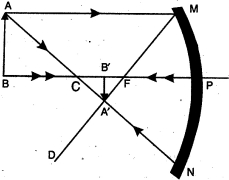
0 likes
View Solution179
Difficult
$(a)$ Define the optical centre of a spherical lens.
$(b)$ You are given a convex lens of focal length $30 \, cm$. Where would you place an object to get a real,inverted,and highly enlarged image of the object? Draw a ray diagram showing the image formation.
$(c)$ $A$ concave lens has a focal length of $20 \, cm$. At what distance from the lens should an object be placed so that it forms an image at $15 \, cm$ away from the lens?
$(b)$ You are given a convex lens of focal length $30 \, cm$. Where would you place an object to get a real,inverted,and highly enlarged image of the object? Draw a ray diagram showing the image formation.
$(c)$ $A$ concave lens has a focal length of $20 \, cm$. At what distance from the lens should an object be placed so that it forms an image at $15 \, cm$ away from the lens?
Solution
(N/A) The optical centre is the central point of a lens through which a ray of light passes without undergoing any deviation.
$(b)$ To obtain a real,inverted,and highly enlarged image with a convex lens,the object must be placed at the principal focus $(F_1)$. The image will be formed at infinity.
$(c)$ Given: Focal length of concave lens $f = -20 \, cm$,Image distance $v = -15 \, cm$.
Using the lens formula: $\frac{1}{f} = \frac{1}{v} - \frac{1}{u}$
$\frac{1}{-20} = \frac{1}{-15} - \frac{1}{u}$
$\frac{1}{u} = \frac{1}{-15} - \frac{1}{-20} = -\frac{1}{15} + \frac{1}{20}$
$\frac{1}{u} = \frac{-4 + 3}{60} = -\frac{1}{60}$
$u = -60 \, cm$.
Thus,the object should be placed at a distance of $60 \, cm$ in front of the lens.
$(b)$ To obtain a real,inverted,and highly enlarged image with a convex lens,the object must be placed at the principal focus $(F_1)$. The image will be formed at infinity.
$(c)$ Given: Focal length of concave lens $f = -20 \, cm$,Image distance $v = -15 \, cm$.
Using the lens formula: $\frac{1}{f} = \frac{1}{v} - \frac{1}{u}$
$\frac{1}{-20} = \frac{1}{-15} - \frac{1}{u}$
$\frac{1}{u} = \frac{1}{-15} - \frac{1}{-20} = -\frac{1}{15} + \frac{1}{20}$
$\frac{1}{u} = \frac{-4 + 3}{60} = -\frac{1}{60}$
$u = -60 \, cm$.
Thus,the object should be placed at a distance of $60 \, cm$ in front of the lens.
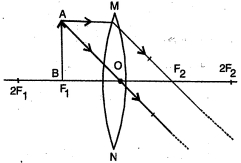
0 likes
View Solution180
Difficult
$(i)$ Under what condition does a concave mirror produce a virtual and magnified image? Draw a labelled ray diagram to show the formation of the image in the above case. Also,state the position of the object to produce a magnified and real image.
$(ii)$ $A$ ray of light moving along the principal axis is falling on a concave mirror. Draw the path of the reflected ray. Also,state the values of the angle of incidence and reflection in this case.
$(ii)$ $A$ ray of light moving along the principal axis is falling on a concave mirror. Draw the path of the reflected ray. Also,state the values of the angle of incidence and reflection in this case.
Solution
(N/A) $(i)$ $A$ concave mirror produces a virtual and magnified image when the object is placed between the pole $(P)$ and the focus $(F)$ of the mirror.
To produce a magnified and real image,the object must be placed between the center of curvature $(C)$ and the focus $(F)$.
$(ii)$ When a ray of light moves along the principal axis,it strikes the mirror at the pole $(P)$ normally. According to the laws of reflection,the reflected ray will retrace its path along the same principal axis.
In this case,the angle of incidence $(i)$ is $0^{\circ}$ and the angle of reflection $(r)$ is $0^{\circ}$ because the ray is incident normally to the surface.
To produce a magnified and real image,the object must be placed between the center of curvature $(C)$ and the focus $(F)$.
$(ii)$ When a ray of light moves along the principal axis,it strikes the mirror at the pole $(P)$ normally. According to the laws of reflection,the reflected ray will retrace its path along the same principal axis.
In this case,the angle of incidence $(i)$ is $0^{\circ}$ and the angle of reflection $(r)$ is $0^{\circ}$ because the ray is incident normally to the surface.
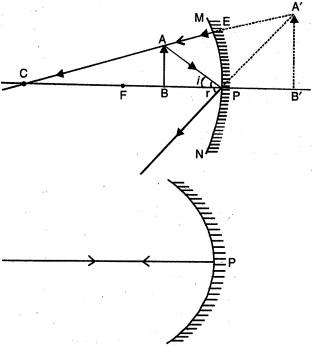
0 likes
View Solution181
Medium
Which lens can be used as a magnifying glass? For which position of the object does a convex lens form:
$(a)$ a virtual and erect image?
$(b)$ a real and inverted image of the same size as that of the object?
Draw labelled ray diagrams to show the formation of the required image in each of the above two cases.
$(a)$ a virtual and erect image?
$(b)$ a real and inverted image of the same size as that of the object?
Draw labelled ray diagrams to show the formation of the required image in each of the above two cases.
Solution
(N/A) convex lens can be used as a magnifying glass.
$(a)$ When the object is placed between the optical centre $O$ and the principal focus $F_{1}$,the convex lens forms a virtual,erect,and magnified image on the same side as the object.
$(b)$ When the object is placed at $2F_{1}$,the convex lens forms a real,inverted image of the same size as the object at $2F_{2}$ on the other side of the lens.
[Refer to the provided ray diagrams for the visual representation of these cases.]
$(a)$ When the object is placed between the optical centre $O$ and the principal focus $F_{1}$,the convex lens forms a virtual,erect,and magnified image on the same side as the object.
$(b)$ When the object is placed at $2F_{1}$,the convex lens forms a real,inverted image of the same size as the object at $2F_{2}$ on the other side of the lens.
[Refer to the provided ray diagrams for the visual representation of these cases.]
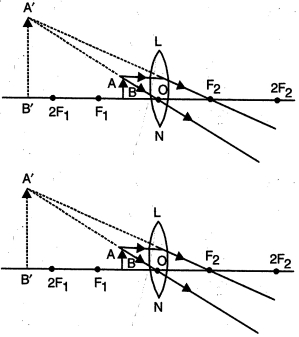
0 likes
View Solution182
Medium
$(i)$ Describe an activity to find the approximate value of the focal length of a concave mirror.
$(ii)$ What happens to the size of the image of an object when it is moved gradually away from a convex mirror?
$(iii)$ In an experiment to study refraction through a glass slab,it is observed that a ray of light undergoing refraction emerges parallel to the direction of the incident ray. Why does it happen so? Explain with the help of a diagram.
$(ii)$ What happens to the size of the image of an object when it is moved gradually away from a convex mirror?
$(iii)$ In an experiment to study refraction through a glass slab,it is observed that a ray of light undergoing refraction emerges parallel to the direction of the incident ray. Why does it happen so? Explain with the help of a diagram.
Solution
(N/A) $(i)$ Activity: Hold a concave mirror in your hand and direct it towards a distant object (like a window or a tree). Direct the light reflected by the mirror onto a sheet of paper held close to the mirror. Move the sheet back and forth slowly until a bright,sharp spot of light is seen on the paper. The distance of this image from the position of the mirror gives the approximate value of the focal length of the mirror.
$(ii)$ As an object is moved gradually away from a convex mirror,the size of the image becomes smaller and it shifts towards the focus.
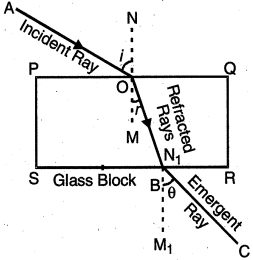
$(iii)$ When a light ray passes through a rectangular glass slab,it undergoes refraction at two parallel surfaces,$PQ$ (air-glass interface) and $SR$ (glass-air interface). The extent of bending of the ray of light at the first surface is equal and opposite to the bending at the second surface. Thus,the emergent ray is parallel to the incident ray,but it is laterally displaced. This is shown in the diagram below.
$(ii)$ As an object is moved gradually away from a convex mirror,the size of the image becomes smaller and it shifts towards the focus.
$(iii)$ When a light ray passes through a rectangular glass slab,it undergoes refraction at two parallel surfaces,$PQ$ (air-glass interface) and $SR$ (glass-air interface). The extent of bending of the ray of light at the first surface is equal and opposite to the bending at the second surface. Thus,the emergent ray is parallel to the incident ray,but it is laterally displaced. This is shown in the diagram below.
0 likes
View Solution183
Medium
$(i)$ Define the principal focus of a concave mirror.
$(ii)$ Why do we prefer a convex mirror as a rear-view mirror in vehicles?
$(iii)$ We wish to obtain an erect image of an object using a convex lens. Draw a ray diagram to show the image formation in this case.
$(ii)$ Why do we prefer a convex mirror as a rear-view mirror in vehicles?
$(iii)$ We wish to obtain an erect image of an object using a convex lens. Draw a ray diagram to show the image formation in this case.
Solution
(N/A) $(i)$ Principal focus: $A$ number of rays parallel to the principal axis,after reflection from a concave mirror,meet at a point on the principal axis which is called the principal focus.
$(ii)$ $A$ convex mirror always forms an erect and diminished image. It provides a wider field of view because it is curved outwards,allowing the driver to see a much larger area behind the vehicle.
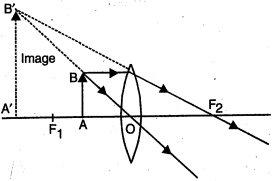
$(iii)$ To obtain an erect image with a convex lens,the object must be placed between the optical center $(O)$ and the principal focus $(F_1)$. The image formed is virtual,erect,and magnified,as shown in the diagram.
$(ii)$ $A$ convex mirror always forms an erect and diminished image. It provides a wider field of view because it is curved outwards,allowing the driver to see a much larger area behind the vehicle.
$(iii)$ To obtain an erect image with a convex lens,the object must be placed between the optical center $(O)$ and the principal focus $(F_1)$. The image formed is virtual,erect,and magnified,as shown in the diagram.
0 likes
View Solution184
Medium
$(a)$ The refractive index of diamond is $2.42$. What is the meaning of this statement?
$(b)$ Redraw the diagram given below in your answer book and complete the path of the ray.
$(c)$ What is the difference between virtual images produced by concave and convex mirrors?
$(d)$ What does the negative sign in the value of magnification produced by a mirror indicate about an image?
$(b)$ Redraw the diagram given below in your answer book and complete the path of the ray.
$(c)$ What is the difference between virtual images produced by concave and convex mirrors?
$(d)$ What does the negative sign in the value of magnification produced by a mirror indicate about an image?
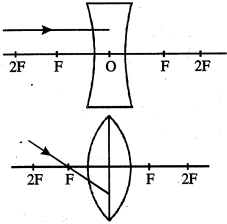
Solution
(N/A) This means that the ratio of the speed of light in air/vacuum to the speed of light in diamond is $2.42$.
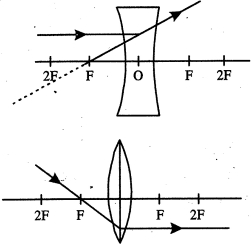
$(b)$ The two figures are shown below,completing the path of the light rays.
$(c)$ $A$ virtual image produced by a concave mirror is magnified,whereas a virtual image produced by a convex mirror is always diminished. $A$ virtual image produced by a plane mirror is of the same size as the object.
$(d)$ The negative sign in the magnification value indicates that the image formed is real and inverted.
$(b)$ The two figures are shown below,completing the path of the light rays.
$(c)$ $A$ virtual image produced by a concave mirror is magnified,whereas a virtual image produced by a convex mirror is always diminished. $A$ virtual image produced by a plane mirror is of the same size as the object.
$(d)$ The negative sign in the magnification value indicates that the image formed is real and inverted.
0 likes
View Solution185
Medium
$(a)$ Write one use of a concave mirror as well as a convex mirror.
$(b)$ Draw ray diagrams for the following cases when a ray of light:
$(i)$ passing through the centre of curvature of a concave mirror is incident on it.
$(ii)$ parallel to the principal axis is incident on a convex mirror.
$(iii)$ is incident at the pole of a convex mirror.
$(iv)$ passing through the focus of a concave mirror is incident on it.
$(b)$ Draw ray diagrams for the following cases when a ray of light:
$(i)$ passing through the centre of curvature of a concave mirror is incident on it.
$(ii)$ parallel to the principal axis is incident on a convex mirror.
$(iii)$ is incident at the pole of a convex mirror.
$(iv)$ passing through the focus of a concave mirror is incident on it.
Solution
(N/A) Concave mirrors are commonly used in torches,searchlights,and vehicle headlights to obtain a powerful parallel beam of light. Convex mirrors are commonly used as rear-view mirrors in vehicles.
$(b)$ The ray diagrams are shown in the image provided.
$(b)$ The ray diagrams are shown in the image provided.
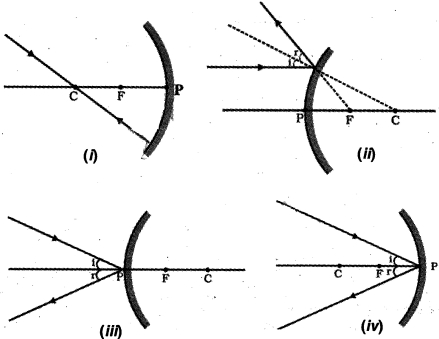
0 likes
View Solution186
Medium
$(a)$ Draw a ray diagram in each of the following cases to show the position and nature of the image formed when an object is placed:
$(i)$ Between the focus and the centre of curvature of a concave mirror.
$(ii)$ Between the focus and the pole of a concave mirror.
$(iii)$ Between the centre of curvature and infinity for a concave mirror.
$(b)$ Give mathematical formulae for determining the magnification produced by a spherical mirror. What does $m = -1$ signify? Identify the mirror that can produce it.
$(i)$ Between the focus and the centre of curvature of a concave mirror.
$(ii)$ Between the focus and the pole of a concave mirror.
$(iii)$ Between the centre of curvature and infinity for a concave mirror.
$(b)$ Give mathematical formulae for determining the magnification produced by a spherical mirror. What does $m = -1$ signify? Identify the mirror that can produce it.
Solution
(N/A) The ray diagrams are as shown in the provided image.
$(b)$ Magnification $(m)$ is defined as the ratio of the height of the image $(h')$ to the height of the object $(h)$,which is also equal to $-\frac{v}{u}$,where $v$ is the image distance and $u$ is the object distance.
$m = \frac{h'}{h} = -\frac{v}{u}$
$m = -1$ signifies:
$(i)$ The size of the image is equal to the size of the object.
$(ii)$ The negative sign indicates that the image is real and inverted.
This magnification is produced by a concave mirror when the object is placed at the centre of curvature $(C)$.
$(b)$ Magnification $(m)$ is defined as the ratio of the height of the image $(h')$ to the height of the object $(h)$,which is also equal to $-\frac{v}{u}$,where $v$ is the image distance and $u$ is the object distance.
$m = \frac{h'}{h} = -\frac{v}{u}$
$m = -1$ signifies:
$(i)$ The size of the image is equal to the size of the object.
$(ii)$ The negative sign indicates that the image is real and inverted.
This magnification is produced by a concave mirror when the object is placed at the centre of curvature $(C)$.
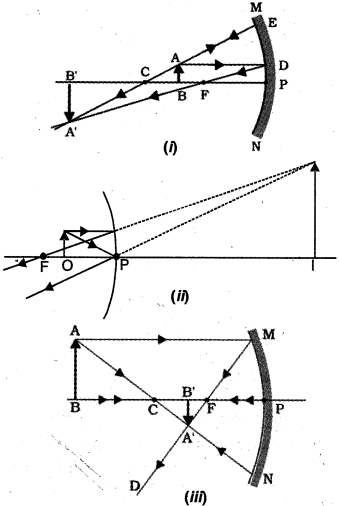
0 likes
View Solution187
Medium
$(a)$ State the laws of refraction.
$(b)$ $A$ ray of light enters from a medium $A$ into a slab made up of a transparent substance $B$ (as shown in the figure). The refractive indices of medium $A$ and $B$ are $2.42$ and $1.65$ respectively. Complete the path of the ray of light until it emerges out of the slab.
$(b)$ $A$ ray of light enters from a medium $A$ into a slab made up of a transparent substance $B$ (as shown in the figure). The refractive indices of medium $A$ and $B$ are $2.42$ and $1.65$ respectively. Complete the path of the ray of light until it emerges out of the slab.
Solution
(N/A) The two laws of refraction are:
$(i)$ The incident ray,the refracted ray,and the normal to the interface of two transparent media at the point of incidence,all lie in the same plane.
$(ii)$ The ratio of the sine of the angle of incidence to the sine of the angle of refraction is a constant,for the light of a given colour and for the given pair of media. This law is also known as Snell's law of refraction.
$(b)$ Since the refractive index of medium $A$ $(n_A = 2.42)$ is greater than the refractive index of medium $B$ $(n_B = 1.65)$,the light travels from a denser medium to a rarer medium. Therefore,the refracted ray will bend away from the normal when entering medium $B$. When the ray emerges from the slab back into medium $A$,it will bend towards the normal. The path of the ray is as shown in the figure.
$(i)$ The incident ray,the refracted ray,and the normal to the interface of two transparent media at the point of incidence,all lie in the same plane.
$(ii)$ The ratio of the sine of the angle of incidence to the sine of the angle of refraction is a constant,for the light of a given colour and for the given pair of media. This law is also known as Snell's law of refraction.
$(b)$ Since the refractive index of medium $A$ $(n_A = 2.42)$ is greater than the refractive index of medium $B$ $(n_B = 1.65)$,the light travels from a denser medium to a rarer medium. Therefore,the refracted ray will bend away from the normal when entering medium $B$. When the ray emerges from the slab back into medium $A$,it will bend towards the normal. The path of the ray is as shown in the figure.
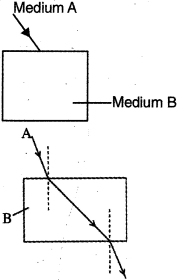
0 likes
View Solution188
Medium
Draw the ray diagram in each case to show the position,nature,and size of the image formed when the object is placed:
$(i)$ At the centre of curvature of a concave mirror.
$(ii)$ Within the focal length of a convex lens.
$(iii)$ Between the pole and focus of a concave mirror.
$(iv)$ In front of a convex mirror.
$(v)$ In front of a concave lens.
$(i)$ At the centre of curvature of a concave mirror.
$(ii)$ Within the focal length of a convex lens.
$(iii)$ Between the pole and focus of a concave mirror.
$(iv)$ In front of a convex mirror.
$(v)$ In front of a concave lens.
Solution
(N/A) $(i)$ At the centre of curvature $(C)$ of a concave mirror: The image is formed at $C$,is real,inverted,and of the same size as the object.
$(ii)$ Within the focal length $(f)$ of a convex lens: The image is formed on the same side as the object,is virtual,erect,and magnified.
$(iii)$ Between the pole $(P)$ and focus $(F)$ of a concave mirror: The image is formed behind the mirror,is virtual,erect,and magnified.
$(iv)$ In front of a convex mirror: The image is formed behind the mirror between the pole and focus,is virtual,erect,and diminished.
$(v)$ In front of a concave lens: The image is formed between the optical centre and focus on the same side as the object,is virtual,erect,and diminished.
$(ii)$ Within the focal length $(f)$ of a convex lens: The image is formed on the same side as the object,is virtual,erect,and magnified.
$(iii)$ Between the pole $(P)$ and focus $(F)$ of a concave mirror: The image is formed behind the mirror,is virtual,erect,and magnified.
$(iv)$ In front of a convex mirror: The image is formed behind the mirror between the pole and focus,is virtual,erect,and diminished.
$(v)$ In front of a concave lens: The image is formed between the optical centre and focus on the same side as the object,is virtual,erect,and diminished.
0 likes
View Solution189
Medium
$(a)$ $A$ converging lens forms a real and inverted image of an object at a distance of $100 \, cm$ from it. Where should an object be placed in front of the lens so that the size of the image is twice the size of the object? Also, calculate the power of the lens.
$(b)$ State the laws of refraction.
$(b)$ State the laws of refraction.
Solution
(N/A) Given: Image distance $v = 100 \, cm$. Since the image is real and inverted, magnification $m = -2$.
Using the magnification formula $m = \frac{v}{u}$, we have $-2 = \frac{100}{u}$, which gives $u = -50 \, cm$.
Thus, the object should be placed at a distance of $50 \, cm$ in front of the lens.
Using the lens formula $\frac{1}{f} = \frac{1}{v} - \frac{1}{u}$, we get $\frac{1}{f} = \frac{1}{100} - \frac{1}{-50} = \frac{1+2}{100} = \frac{3}{100}$.
So, $f = \frac{100}{3} \, cm = \frac{1}{3} \, m$.
The power of the lens $P = \frac{1}{f(\text{in } meters)} = \frac{1}{1/3} = 3 \, D$.
$(b)$ The laws of refraction are:
$1$. The incident ray, the refracted ray, and the normal to the interface of two transparent media at the point of incidence all lie in the same plane.
$2$. Snell's Law: The ratio of the sine of the angle of incidence to the sine of the angle of refraction is a constant for the light of a given color and for the given pair of media, i.e., $\frac{\sin i}{\sin r} = \text{constant}$.
Using the magnification formula $m = \frac{v}{u}$, we have $-2 = \frac{100}{u}$, which gives $u = -50 \, cm$.
Thus, the object should be placed at a distance of $50 \, cm$ in front of the lens.
Using the lens formula $\frac{1}{f} = \frac{1}{v} - \frac{1}{u}$, we get $\frac{1}{f} = \frac{1}{100} - \frac{1}{-50} = \frac{1+2}{100} = \frac{3}{100}$.
So, $f = \frac{100}{3} \, cm = \frac{1}{3} \, m$.
The power of the lens $P = \frac{1}{f(\text{in } meters)} = \frac{1}{1/3} = 3 \, D$.
$(b)$ The laws of refraction are:
$1$. The incident ray, the refracted ray, and the normal to the interface of two transparent media at the point of incidence all lie in the same plane.
$2$. Snell's Law: The ratio of the sine of the angle of incidence to the sine of the angle of refraction is a constant for the light of a given color and for the given pair of media, i.e., $\frac{\sin i}{\sin r} = \text{constant}$.
0 likes
View Solution190
Medium
$(a)$ Explain the following terms related to spherical lenses:
$(i)$ Optical centre
$(ii)$ Centres of curvature
$(iii)$ Principal axis
$(iv)$ Aperture
$(v)$ Principal focus
$(vi)$ Focal length
$(b)$ $A$ converging lens has a focal length of $12 \, cm$. Calculate at what distance should the object be placed from the lens so that it forms an image at $48 \, cm$ on the other side of the lens.
$(i)$ Optical centre
$(ii)$ Centres of curvature
$(iii)$ Principal axis
$(iv)$ Aperture
$(v)$ Principal focus
$(vi)$ Focal length
$(b)$ $A$ converging lens has a focal length of $12 \, cm$. Calculate at what distance should the object be placed from the lens so that it forms an image at $48 \, cm$ on the other side of the lens.
Solution
(N/A) Definitions:
$(i)$ Optical centre: The central point of a lens through which a ray of light passes without any deviation.
$(ii)$ Centres of curvature: The centres of the two imaginary spheres of which the lens surfaces are parts.
$(iii)$ Principal axis: An imaginary line passing through the optical centre and the centres of curvature of the lens.
$(iv)$ Aperture: The effective diameter of the circular outline of a spherical lens.
$(v)$ Principal focus: $A$ point on the principal axis where light rays parallel to the principal axis converge (in convex lens) or appear to diverge (in concave lens) after refraction.
$(vi)$ Focal length: The distance between the optical centre and the principal focus of the lens.
$(b)$ Given: Focal length $f = +12 \, cm$ (for a converging lens),Image distance $v = +48 \, cm$ (real image on the other side).
Using the lens formula: $\frac{1}{f} = \frac{1}{v} - \frac{1}{u}$
$\frac{1}{12} = \frac{1}{48} - \frac{1}{u}$
$\frac{1}{u} = \frac{1}{48} - \frac{1}{12}$
$\frac{1}{u} = \frac{1 - 4}{48} = \frac{-3}{48} = -\frac{1}{16}$
Therefore,$u = -16 \, cm$. The object should be placed at a distance of $16 \, cm$ in front of the lens.
$(i)$ Optical centre: The central point of a lens through which a ray of light passes without any deviation.
$(ii)$ Centres of curvature: The centres of the two imaginary spheres of which the lens surfaces are parts.
$(iii)$ Principal axis: An imaginary line passing through the optical centre and the centres of curvature of the lens.
$(iv)$ Aperture: The effective diameter of the circular outline of a spherical lens.
$(v)$ Principal focus: $A$ point on the principal axis where light rays parallel to the principal axis converge (in convex lens) or appear to diverge (in concave lens) after refraction.
$(vi)$ Focal length: The distance between the optical centre and the principal focus of the lens.
$(b)$ Given: Focal length $f = +12 \, cm$ (for a converging lens),Image distance $v = +48 \, cm$ (real image on the other side).
Using the lens formula: $\frac{1}{f} = \frac{1}{v} - \frac{1}{u}$
$\frac{1}{12} = \frac{1}{48} - \frac{1}{u}$
$\frac{1}{u} = \frac{1}{48} - \frac{1}{12}$
$\frac{1}{u} = \frac{1 - 4}{48} = \frac{-3}{48} = -\frac{1}{16}$
Therefore,$u = -16 \, cm$. The object should be placed at a distance of $16 \, cm$ in front of the lens.
0 likes
View Solution191
DifficultMCQ
The focal length of a concave mirror is $30 \, cm$. Find the position of the object in front of the mirror so that the image is three times the size of the object.
A
$40 \, cm$ and $20 \, cm$
B
$30 \, cm$ and $10 \, cm$
C
$60 \, cm$ and $30 \, cm$
D
$20 \, cm$ and $10 \, cm$
Solution
(A) $(i)$ If the image is real and inverted:
$m = -v/u = -3$,which implies $v = 3u$. Given $f = -30 \, cm$.
Using the mirror formula $\frac{1}{v} + \frac{1}{u} = \frac{1}{f}$:
$\frac{1}{3u} + \frac{1}{u} = \frac{1}{-30} \Rightarrow \frac{1+3}{3u} = \frac{1}{-30} \Rightarrow \frac{4}{3u} = \frac{1}{-30} \Rightarrow u = -40 \, cm$.
Thus,the object is placed at $40 \, cm$ in front of the mirror.
$(ii)$ If the image is virtual and erect:
$m = -v/u = +3$,which implies $v = -3u$. Given $f = -30 \, cm$.
Using the mirror formula $\frac{1}{v} + \frac{1}{u} = \frac{1}{f}$:
$\frac{1}{-3u} + \frac{1}{u} = \frac{1}{-30} \Rightarrow \frac{-1+3}{3u} = \frac{1}{-30} \Rightarrow \frac{2}{3u} = \frac{1}{-30} \Rightarrow u = -20 \, cm$.
Thus,the object is placed at $20 \, cm$ in front of the mirror.
$m = -v/u = -3$,which implies $v = 3u$. Given $f = -30 \, cm$.
Using the mirror formula $\frac{1}{v} + \frac{1}{u} = \frac{1}{f}$:
$\frac{1}{3u} + \frac{1}{u} = \frac{1}{-30} \Rightarrow \frac{1+3}{3u} = \frac{1}{-30} \Rightarrow \frac{4}{3u} = \frac{1}{-30} \Rightarrow u = -40 \, cm$.
Thus,the object is placed at $40 \, cm$ in front of the mirror.
$(ii)$ If the image is virtual and erect:
$m = -v/u = +3$,which implies $v = -3u$. Given $f = -30 \, cm$.
Using the mirror formula $\frac{1}{v} + \frac{1}{u} = \frac{1}{f}$:
$\frac{1}{-3u} + \frac{1}{u} = \frac{1}{-30} \Rightarrow \frac{-1+3}{3u} = \frac{1}{-30} \Rightarrow \frac{2}{3u} = \frac{1}{-30} \Rightarrow u = -20 \, cm$.
Thus,the object is placed at $20 \, cm$ in front of the mirror.
0 likes
View Solution192
MediumMCQ
An object is placed $15\, cm$ from a convex mirror of radius of curvature $60\, cm$. Find the position of the image and its magnification.
A
$v = 7.5\, cm, m = 0.5$
B
$v = -7.5\, cm, m = 0.5$
C
$v = 7.5\, cm, m = -0.5$
D
$v = -7.5\, cm, m = -0.5$
Solution
(A) Given: Object distance $u = -15\, cm$,Radius of curvature $R = +60\, cm$.
Focal length $f = R / 2 = +60 / 2 = +30\, cm$.
Using the mirror formula: $\frac{1}{v} + \frac{1}{u} = \frac{1}{f}$.
Substituting the values: $\frac{1}{v} + \frac{1}{-15} = \frac{1}{30}$.
$\frac{1}{v} = \frac{1}{30} + \frac{1}{15} = \frac{1 + 2}{30} = \frac{3}{30} = \frac{1}{10}$.
Therefore,$v = +10\, cm$.
The image is formed $10\, cm$ behind the mirror.
Magnification $m = -\frac{v}{u} = -\frac{10}{-15} = \frac{2}{3} \approx 0.67$.
The image is virtual,erect,and diminished.
Focal length $f = R / 2 = +60 / 2 = +30\, cm$.
Using the mirror formula: $\frac{1}{v} + \frac{1}{u} = \frac{1}{f}$.
Substituting the values: $\frac{1}{v} + \frac{1}{-15} = \frac{1}{30}$.
$\frac{1}{v} = \frac{1}{30} + \frac{1}{15} = \frac{1 + 2}{30} = \frac{3}{30} = \frac{1}{10}$.
Therefore,$v = +10\, cm$.
The image is formed $10\, cm$ behind the mirror.
Magnification $m = -\frac{v}{u} = -\frac{10}{-15} = \frac{2}{3} \approx 0.67$.
The image is virtual,erect,and diminished.
0 likes
View Solution193
MediumMCQ
$A$ $4.5\, cm$ needle is placed $12\, cm$ away from a convex mirror of focal length $15\, cm$. Give the location of the image and its magnification.
A
Location: $6.7\, cm$ behind the mirror,Magnification: $0.56$
B
Location: $6.7\, cm$ in front of the mirror,Magnification: $0.56$
C
Location: $12\, cm$ behind the mirror,Magnification: $1.0$
D
Location: $15\, cm$ behind the mirror,Magnification: $0.4$
Solution
(A) Given: Object height $O = 4.5\, cm$,Object distance $u = -12\, cm$,Focal length $f = +15\, cm$.
Using the mirror formula: $\frac{1}{v} + \frac{1}{u} = \frac{1}{f}$.
Substituting the values: $\frac{1}{v} + \frac{1}{-12} = \frac{1}{15}$.
$\frac{1}{v} = \frac{1}{15} + \frac{1}{12} = \frac{4 + 5}{60} = \frac{9}{60}$.
$v = \frac{60}{9} \approx 6.67\, cm \approx 6.7\, cm$.
The positive sign indicates that the image is formed $6.7\, cm$ behind the mirror.
Magnification $m = -\frac{v}{u} = -\frac{6.67}{-12} \approx 0.56$.
Since $m$ is positive and less than $1$,the image is virtual,erect,and diminished.
Using the mirror formula: $\frac{1}{v} + \frac{1}{u} = \frac{1}{f}$.
Substituting the values: $\frac{1}{v} + \frac{1}{-12} = \frac{1}{15}$.
$\frac{1}{v} = \frac{1}{15} + \frac{1}{12} = \frac{4 + 5}{60} = \frac{9}{60}$.
$v = \frac{60}{9} \approx 6.67\, cm \approx 6.7\, cm$.
The positive sign indicates that the image is formed $6.7\, cm$ behind the mirror.
Magnification $m = -\frac{v}{u} = -\frac{6.67}{-12} \approx 0.56$.
Since $m$ is positive and less than $1$,the image is virtual,erect,and diminished.
0 likes
View Solution194
Difficult
$A$ convex mirror used on an automobile has $3\, m$ radius of curvature. If a bus is located at $5\, m$ from this mirror,find the position,nature,and size of the image.
Solution
(N/A) Given: Radius of curvature $R = +3\, m$,Focal length $f = R/2 = +1.5\, m$.
Object distance $u = -5\, m$.
Using the mirror formula: $\frac{1}{f} = \frac{1}{v} + \frac{1}{u}$.
Substituting the values: $\frac{1}{1.5} = \frac{1}{v} + \frac{1}{-5}$.
$\frac{1}{v} = \frac{1}{1.5} + \frac{1}{5} = \frac{5 + 1.5}{7.5} = \frac{6.5}{7.5}$.
$v = \frac{7.5}{6.5} \approx +1.15\, m$.
The image is formed at $1.15\, m$ behind the mirror.
Magnification $m = -\frac{v}{u} = -\frac{1.15}{-5} = +0.23$.
Since $v$ is positive,the image is virtual and erect. Since $m < 1$,the image is diminished (smaller in size) by a factor of $0.23$.
Object distance $u = -5\, m$.
Using the mirror formula: $\frac{1}{f} = \frac{1}{v} + \frac{1}{u}$.
Substituting the values: $\frac{1}{1.5} = \frac{1}{v} + \frac{1}{-5}$.
$\frac{1}{v} = \frac{1}{1.5} + \frac{1}{5} = \frac{5 + 1.5}{7.5} = \frac{6.5}{7.5}$.
$v = \frac{7.5}{6.5} \approx +1.15\, m$.
The image is formed at $1.15\, m$ behind the mirror.
Magnification $m = -\frac{v}{u} = -\frac{1.15}{-5} = +0.23$.
Since $v$ is positive,the image is virtual and erect. Since $m < 1$,the image is diminished (smaller in size) by a factor of $0.23$.
0 likes
View Solution195
MediumMCQ
An object,$4.0 \, cm$ in size,is placed $25.0 \, cm$ in front of a concave mirror of focal length $15.0 \, cm$. At what distance from the mirror should a screen be placed in order to obtain a sharp image? Find the nature and the size of the image.
A
$-37.5 \, cm$,Real,Inverted,$6.0 \, cm$
B
$37.5 \, cm$,Virtual,Erect,$6.0 \, cm$
C
$-37.5 \, cm$,Virtual,Inverted,$4.0 \, cm$
D
$37.5 \, cm$,Real,Erect,$4.0 \, cm$
Solution
(A) Given:
Object size,$h = +4.0 \, cm$
Object distance,$u = -25.0 \, cm$
Focal length,$f = -15.0 \, cm$
Using the mirror formula:
$\frac{1}{f} = \frac{1}{v} + \frac{1}{u}$
$\frac{1}{v} = \frac{1}{f} - \frac{1}{u} = \frac{1}{-15} - \frac{1}{-25} = \frac{-5 + 3}{75} = \frac{-2}{75}$
$v = -37.5 \, cm$
The negative sign indicates that the image is formed in front of the mirror,so a screen must be placed at $37.5 \, cm$ from the mirror on the same side as the object. The image is real.
Magnification,$m = \frac{h'}{h} = -\frac{v}{u}$
$h' = -\frac{v \cdot h}{u} = -\frac{(-37.5) \cdot (4.0)}{-25.0} = -6.0 \, cm$
The image size is $6.0 \, cm$. The negative sign indicates that the image is inverted.
Object size,$h = +4.0 \, cm$
Object distance,$u = -25.0 \, cm$
Focal length,$f = -15.0 \, cm$
Using the mirror formula:
$\frac{1}{f} = \frac{1}{v} + \frac{1}{u}$
$\frac{1}{v} = \frac{1}{f} - \frac{1}{u} = \frac{1}{-15} - \frac{1}{-25} = \frac{-5 + 3}{75} = \frac{-2}{75}$
$v = -37.5 \, cm$
The negative sign indicates that the image is formed in front of the mirror,so a screen must be placed at $37.5 \, cm$ from the mirror on the same side as the object. The image is real.
Magnification,$m = \frac{h'}{h} = -\frac{v}{u}$
$h' = -\frac{v \cdot h}{u} = -\frac{(-37.5) \cdot (4.0)}{-25.0} = -6.0 \, cm$
The image size is $6.0 \, cm$. The negative sign indicates that the image is inverted.
0 likes
View Solution196
Medium
An object $5\, cm$ high is kept $25\, cm$ away from a converging lens (convex lens) of focal length $10\, cm$. What is the nature,position,and size of the image?
Solution
(D) Given: Object height $h = 5\, cm$,object distance $u = -25\, cm$,focal length $f = 10\, cm$.
Using the lens formula $\frac{1}{v} - \frac{1}{u} = \frac{1}{f}$,we have $\frac{1}{v} = \frac{1}{u} + \frac{1}{f} = \frac{1}{-25} + \frac{1}{10} = \frac{-2 + 5}{50} = \frac{3}{50}$.
Thus,$v = \frac{50}{3}\, cm \approx 16.67\, cm$.
The positive sign indicates that the image is formed on the other side of the lens (real image).
Magnification $m = \frac{v}{u} = \frac{h'}{h}$.
$h' = h \times \frac{v}{u} = 5 \times \frac{16.67}{-25} = -3.33\, cm$.
The negative sign of $h'$ indicates that the image is inverted.
Therefore,the image is real,inverted,diminished,and formed at a distance of $16.67\, cm$ from the lens.
Using the lens formula $\frac{1}{v} - \frac{1}{u} = \frac{1}{f}$,we have $\frac{1}{v} = \frac{1}{u} + \frac{1}{f} = \frac{1}{-25} + \frac{1}{10} = \frac{-2 + 5}{50} = \frac{3}{50}$.
Thus,$v = \frac{50}{3}\, cm \approx 16.67\, cm$.
The positive sign indicates that the image is formed on the other side of the lens (real image).
Magnification $m = \frac{v}{u} = \frac{h'}{h}$.
$h' = h \times \frac{v}{u} = 5 \times \frac{16.67}{-25} = -3.33\, cm$.
The negative sign of $h'$ indicates that the image is inverted.
Therefore,the image is real,inverted,diminished,and formed at a distance of $16.67\, cm$ from the lens.
0 likes
View Solution197
MediumMCQ
An object is placed $50\, cm$ from a lens that produces a virtual image at a distance of $10\, cm$ in front of the lens. Calculate the focal length of the lens. (in $, cm$)
A
$12.5$
B
$-12.5$
C
$8.33$
D
$-8.33$
Solution
(B) Given: Object distance $u = -50\, cm$,Image distance $v = -10\, cm$ (since the virtual image is formed in front of the lens).
Using the lens formula: $\frac{1}{f} = \frac{1}{v} - \frac{1}{u}$.
Substituting the values: $\frac{1}{f} = \frac{1}{-10} - \frac{1}{-50}$.
$\frac{1}{f} = -\frac{1}{10} + \frac{1}{50} = \frac{-5 + 1}{50} = \frac{-4}{50}$.
Therefore,$f = -\frac{50}{4} = -12.5\, cm$.
The negative sign indicates that the lens is a concave lens.
Using the lens formula: $\frac{1}{f} = \frac{1}{v} - \frac{1}{u}$.
Substituting the values: $\frac{1}{f} = \frac{1}{-10} - \frac{1}{-50}$.
$\frac{1}{f} = -\frac{1}{10} + \frac{1}{50} = \frac{-5 + 1}{50} = \frac{-4}{50}$.
Therefore,$f = -\frac{50}{4} = -12.5\, cm$.
The negative sign indicates that the lens is a concave lens.
0 likes
View Solution198
MediumMCQ
The power of a lens is $2.5$ dioptre. What is the focal length and the type of lens?
A
$40 \text{ cm}$,convex lens
B
$40 \text{ cm}$,concave lens
C
$0.4 \text{ cm}$,convex lens
D
$0.25 \text{ cm}$,concave lens
Solution
(A) The power of a lens is given by the formula $P = \frac{1}{f}$,where $f$ is the focal length in meters.
Given,power $P = 2.5 \text{ D}$.
Substituting the value in the formula: $2.5 = \frac{1}{f}$.
Therefore,$f = \frac{1}{2.5} \text{ m} = 0.4 \text{ m}$.
Converting meters to centimeters: $0.4 \text{ m} = 0.4 \times 100 \text{ cm} = 40 \text{ cm}$.
Since the power is positive $(+2.5 \text{ D})$,the focal length is also positive,which indicates that the lens is a convex lens.
Given,power $P = 2.5 \text{ D}$.
Substituting the value in the formula: $2.5 = \frac{1}{f}$.
Therefore,$f = \frac{1}{2.5} \text{ m} = 0.4 \text{ m}$.
Converting meters to centimeters: $0.4 \text{ m} = 0.4 \times 100 \text{ cm} = 40 \text{ cm}$.
Since the power is positive $(+2.5 \text{ D})$,the focal length is also positive,which indicates that the lens is a convex lens.
0 likes
View Solution199
MediumMCQ
$A$ convex lens of focal length $10 \ cm$ is placed at a distance of $12 \ cm$ from a wall. How far from the lens should an object be placed so as to form its real image on the wall (in $cm$)?
A
$60$
B
$12$
C
$10$
D
$5$
Solution
(A) Given: Focal length $f = +10 \ cm$,Image distance $v = +12 \ cm$ (since the image is real and formed on the wall on the other side of the lens).
Using the lens formula: $\frac{1}{v} - \frac{1}{u} = \frac{1}{f}$.
Substituting the values: $\frac{1}{12} - \frac{1}{u} = \frac{1}{10}$.
Rearranging for $u$: $\frac{1}{u} = \frac{1}{12} - \frac{1}{10}$.
Calculating the common denominator: $\frac{1}{u} = \frac{5 - 6}{60} = \frac{-1}{60}$.
Thus,$u = -60 \ cm$.
The negative sign indicates that the object should be placed at a distance of $60 \ cm$ in front of the lens.
Using the lens formula: $\frac{1}{v} - \frac{1}{u} = \frac{1}{f}$.
Substituting the values: $\frac{1}{12} - \frac{1}{u} = \frac{1}{10}$.
Rearranging for $u$: $\frac{1}{u} = \frac{1}{12} - \frac{1}{10}$.
Calculating the common denominator: $\frac{1}{u} = \frac{5 - 6}{60} = \frac{-1}{60}$.
Thus,$u = -60 \ cm$.
The negative sign indicates that the object should be placed at a distance of $60 \ cm$ in front of the lens.
0 likes
View Solution200
MediumMCQ
The refractive index of water with respect to air is $\frac{4}{3}$ and the refractive index of glass with respect to air is $\frac{3}{2}$. What is the refractive index of glass with respect to water?
A
$\frac{9}{8}$
B
$\frac{8}{9}$
C
$\frac{1}{2}$
D
$\frac{2}{1}$
Solution
(A) Given: Refractive index of water with respect to air,$_{a}\mu_{w} = \frac{4}{3}$.
Refractive index of glass with respect to air,$_{a}\mu_{g} = \frac{3}{2}$.
We need to find the refractive index of glass with respect to water,$_{w}\mu_{g}$.
The formula is $_{w}\mu_{g} = \frac{_{a}\mu_{g}}{_{a}\mu_{w}}$.
Substituting the values: $_{w}\mu_{g} = \frac{3/2}{4/3} = \frac{3}{2} \times \frac{3}{4} = \frac{9}{8}$.
Refractive index of glass with respect to air,$_{a}\mu_{g} = \frac{3}{2}$.
We need to find the refractive index of glass with respect to water,$_{w}\mu_{g}$.
The formula is $_{w}\mu_{g} = \frac{_{a}\mu_{g}}{_{a}\mu_{w}}$.
Substituting the values: $_{w}\mu_{g} = \frac{3/2}{4/3} = \frac{3}{2} \times \frac{3}{4} = \frac{9}{8}$.
0 likes
View SolutionLight – Reflection and Refraction — Mix Examples - Light – Reflection and Refraction · Frequently Asked Questions
1Are these Light – Reflection and Refraction questions useful for JEE and NEET?
Yes. All questions in this section are mapped to JEE Main and NEET exam patterns. Previous year questions from JEE Main, NEET, GUJCET and state-level exams are included with full solutions.
2Can I switch to Hindi or Gujarati for these questions?
Yes. Use the language tabs in the hero section or the sidebar to view the same questions and solutions in English, Hindi or Gujarati.
3How do I generate a question paper from this subtopic?
Use the Vedclass Exam Paper Generator — select the chapter and subtopic, set difficulty, and generate Sets A, B, C, D automatically. First 3 chapters of every subject are free.
Vedclass Products
For Students
Vedclass Test Series
Mock tests in real JEE/NEET style with performance analysis. 5-day free trial.
Start Free TrialFor Teachers
Exam Paper Generator
Generate Set A/B/C/D papers from this chapter in 2 minutes. 3 chapters free.
Try FreeFor Institutes
Online Exam Module
Live online exams with unlimited students, 360° analytics & white-label branding.
See DemoFor Teachers & Institutes
Generate a Light – Reflection and Refraction Exam Paper in 2 Minutes
Select subtopic & difficulty — Sets A, B, C, D auto-generated with No Repeat logic.
First 3 chapters of every subject are free — no payment required.