
A English
Mix Examples - Light – Reflection and Refraction Questions in English
Class 10 Science · Light – Reflection and Refraction · Mix Examples - Light – Reflection and Refraction
400+
Questions
English
Language
100%
With Solutions
Showing 50 of 400 questions in English
301
EasyMCQ
The compound microscope consists of two convex lenses of $5 \, cm$ and $20 \, cm$ focal length. Which of them will be the objective and the eyepiece?
A
Objective with $20 \, cm$ focal length and eyepiece with $5 \, cm$ focal length.
B
Objective with $5 \, cm$ focal length and eyepiece with $20 \, cm$ focal length.
C
Both should have $20 \, cm$ focal length.
D
Both should have $5 \, cm$ focal length.
Solution
(B) In a compound microscope,the objective lens is placed near the object and must have a short focal length to produce a magnified real image.
The eyepiece acts as a simple magnifier and typically has a longer focal length compared to the objective lens.
Therefore,the lens with a focal length of $5 \, cm$ serves as the objective,and the lens with a focal length of $20 \, cm$ serves as the eyepiece.
Thus,the correct option is $B$.
The eyepiece acts as a simple magnifier and typically has a longer focal length compared to the objective lens.
Therefore,the lens with a focal length of $5 \, cm$ serves as the objective,and the lens with a focal length of $20 \, cm$ serves as the eyepiece.
Thus,the correct option is $B$.
0 likes
View Solution302
EasyMCQ
The velocity of light in a vacuum is $....$
A
$3 \times 10^{5} \text{ m s}^{-1}$
B
$3 \times 10^{6} \text{ m s}^{-1}$
C
$3 \times 10^{8} \text{ m s}^{-1}$
D
$3 \times 10^{7} \text{ km s}^{-1}$
Solution
(C) The speed of light in a vacuum is a fundamental physical constant.
It is denoted by the symbol $c$.
The value of the speed of light in a vacuum is approximately $3 \times 10^{8} \text{ m s}^{-1}$ (or $300,000 \text{ km s}^{-1}$).
Therefore,the correct option is $C$.
It is denoted by the symbol $c$.
The value of the speed of light in a vacuum is approximately $3 \times 10^{8} \text{ m s}^{-1}$ (or $300,000 \text{ km s}^{-1}$).
Therefore,the correct option is $C$.
0 likes
View Solution303
EasyMCQ
What is the speed of light waves in a vacuum in units of $km/s$?
A
$4 \times 10^{7}$
B
$4000$
C
$3 \times 10^{5}$
D
$3000$
Solution
(C) The speed of light in a vacuum is approximately $3 \times 10^{8} \ m/s$.
To convert this into $km/s$,we divide the value by $1000$ (since $1 \ km = 1000 \ m$).
Speed in $km/s = (3 \times 10^{8} \ m/s) / 1000 = 3 \times 10^{5} \ km/s$.
Therefore,the correct option is $C$.
To convert this into $km/s$,we divide the value by $1000$ (since $1 \ km = 1000 \ m$).
Speed in $km/s = (3 \times 10^{8} \ m/s) / 1000 = 3 \times 10^{5} \ km/s$.
Therefore,the correct option is $C$.
0 likes
View Solution304
EasyMCQ
What is the wavelength range of visible light in $cm$?
A
$4 \times 10^{-7}\; cm$ to $8 \times 10^{-7}\; cm$
B
$4 \times 10^{-5}\; cm$ to $8 \times 10^{-5}\; cm$
C
$4 \times 10^{-9}\; cm$ to $8 \times 10^{-9}\; cm$
D
$400\; cm$ to $800\; cm$
Solution
(B) The wavelength range of visible light is approximately $400 \; nm$ to $750 \; nm$ (often rounded to $400 \; nm$ to $800 \; nm$).
To convert nanometers $(nm)$ to centimeters $(cm)$:
$1 \; nm = 10^{-9} \; m = 10^{-7} \; cm$.
Therefore,$400 \; nm = 400 \times 10^{-7} \; cm = 4 \times 10^{-5} \; cm$.
Similarly,$800 \; nm = 800 \times 10^{-7} \; cm = 8 \times 10^{-5} \; cm$.
Thus,the range is $4 \times 10^{-5} \; cm$ to $8 \times 10^{-5} \; cm$.
To convert nanometers $(nm)$ to centimeters $(cm)$:
$1 \; nm = 10^{-9} \; m = 10^{-7} \; cm$.
Therefore,$400 \; nm = 400 \times 10^{-7} \; cm = 4 \times 10^{-5} \; cm$.
Similarly,$800 \; nm = 800 \times 10^{-7} \; cm = 8 \times 10^{-5} \; cm$.
Thus,the range is $4 \times 10^{-5} \; cm$ to $8 \times 10^{-5} \; cm$.
0 likes
View Solution305
EasyMCQ
Which of the following statements is true for light waves?
A
They are mechanical waves.
B
They are of very long wavelength.
C
They require a medium for their propagation.
D
They are electromagnetic waves.
Solution
(D) Light waves are electromagnetic waves because they consist of oscillating electric and magnetic fields.
Unlike mechanical waves (such as sound waves),light waves do not require a material medium for their propagation and can travel through a vacuum.
Therefore,the statement that light waves are electromagnetic waves is correct.
Unlike mechanical waves (such as sound waves),light waves do not require a material medium for their propagation and can travel through a vacuum.
Therefore,the statement that light waves are electromagnetic waves is correct.
0 likes
View Solution306
EasyMCQ
Which of the following statements about light waves is $NOT$ correct?
A
They are electromagnetic waves.
B
They are non-mechanical waves.
C
They can propagate through a vacuum.
D
They require a medium for their propagation.
Solution
(D) Light waves are electromagnetic waves that do not require a material medium for their propagation.
They are non-mechanical waves,meaning they can travel through a vacuum as well as through various media.
Therefore,the statement that light waves require a medium for their propagation is incorrect.
They are non-mechanical waves,meaning they can travel through a vacuum as well as through various media.
Therefore,the statement that light waves require a medium for their propagation is incorrect.
0 likes
View Solution307
EasyMCQ
Light waves are said to travel in a straight line because ...
A
Their wavelength is very small.
B
Their wavelength is very large.
C
They are non-mechanical waves.
D
They are electromagnetic waves.
Solution
(A) Light travels in a straight line,a phenomenon known as rectilinear propagation of light. This occurs because the wavelength of visible light is extremely small compared to the size of the objects it interacts with. Due to this very small wavelength,the diffraction effects are negligible in everyday life,causing light to appear to travel in a straight path.
0 likes
View Solution308
EasyMCQ
The image of an object formed by a plane mirror is due to which optical phenomenon?
A
Refraction
B
Dispersion
C
Reflection
D
Absorption
Solution
(C) When light rays from an object strike the surface of a plane mirror,they bounce back into the same medium. This phenomenon of light bouncing back from a surface is known as reflection. $A$ plane mirror forms a virtual and erect image of an object due to the regular reflection of light.
0 likes
View Solution309
EasyMCQ
The image formed by a lens is due to which optical phenomenon?
A
Reflection
B
Refraction
C
Dispersion
D
Total internal reflection
Solution
(B) lens is a transparent medium bounded by two surfaces,at least one of which is spherical. When light rays pass through a lens,they undergo bending due to the change in the medium (from air to glass/plastic and back to air). This phenomenon of bending of light when it travels from one transparent medium to another is known as refraction. Therefore,the image formation by a lens is based on the principle of refraction.
0 likes
View Solution310
EasyMCQ
Which of the following statements is true regarding a real image of an object?
A
It can be obtained on a screen.
B
It is always erect.
C
It cannot be obtained on a screen.
D
It is always magnified.
Solution
(A) real image is formed when light rays actually intersect after reflection or refraction.
Because the light rays physically meet at the point of image formation,a real image can be captured or projected onto a screen.
Real images are always inverted relative to the object.
Therefore,the statement 'It can be obtained on a screen' is correct.
Because the light rays physically meet at the point of image formation,a real image can be captured or projected onto a screen.
Real images are always inverted relative to the object.
Therefore,the statement 'It can be obtained on a screen' is correct.
0 likes
View Solution311
EasyMCQ
$A$ candle is placed at a distance of $10 \ cm$ from a plane mirror. At what distance from the mirror will the image of this candle be formed (in $cm$)?
A
$10$
B
$20$
C
$5$
D
$0$
Solution
(A) For a plane mirror,the distance of the object from the mirror is equal to the distance of the image from the mirror.
Given that the object distance $(u)$ is $10 \ cm$.
According to the properties of a plane mirror,the image distance $(v)$ is equal to the object distance in magnitude.
Therefore,the image will be formed at a distance of $10 \ cm$ behind the mirror.
Given that the object distance $(u)$ is $10 \ cm$.
According to the properties of a plane mirror,the image distance $(v)$ is equal to the object distance in magnitude.
Therefore,the image will be formed at a distance of $10 \ cm$ behind the mirror.
0 likes
View Solution312
EasyMCQ
Which of the following statements is true about the image formed by a plane mirror?
A
It is larger than the object.
B
It is real.
C
It is smaller than the object.
D
It is virtual.
Solution
(D) plane mirror always forms an image that is virtual,erect,and of the same size as the object.
Since the light rays do not actually meet at the image point,the image is virtual.
Therefore,the correct statement is that the image formed is virtual.
Since the light rays do not actually meet at the image point,the image is virtual.
Therefore,the correct statement is that the image formed is virtual.
0 likes
View Solution313
EasyMCQ
If the angle of incidence on a plane mirror is $30^{\circ}$,what is the angle of reflection (in $^{\circ}$)?
A
$60$
B
$15$
C
$30$
D
$90$
Solution
(C) According to the laws of reflection,the angle of incidence $(i)$ is always equal to the angle of reflection $(r)$.
Given that the angle of incidence $(i)$ = $30^{\circ}$.
Therefore,the angle of reflection $(r)$ = $30^{\circ}$.
Given that the angle of incidence $(i)$ = $30^{\circ}$.
Therefore,the angle of reflection $(r)$ = $30^{\circ}$.
0 likes
View Solution314
EasyMCQ
For which type of mirror will the image always be erect,regardless of the distance at which the object is placed?
A
Plane mirror only
B
Concave mirror only
C
Convex mirror only
D
Plane or convex mirror
Solution
(D) plane mirror always forms a virtual and erect image of an object,regardless of its distance from the mirror.
$A$ convex mirror also always forms a virtual and erect image of an object,regardless of its distance from the mirror.
$A$ concave mirror can form both real and virtual images depending on the object's position.
Therefore,both plane and convex mirrors always produce an erect image for any object distance.
$A$ convex mirror also always forms a virtual and erect image of an object,regardless of its distance from the mirror.
$A$ concave mirror can form both real and virtual images depending on the object's position.
Therefore,both plane and convex mirrors always produce an erect image for any object distance.
0 likes
View Solution315
EasyMCQ
Which type of mirror can produce a virtual image?
A
Plane, concave, and convex mirrors
B
Only plane mirrors
C
Only convex mirrors
D
Only concave mirrors
Solution
A virtual image is an image that cannot be projected onto a screen and is formed when light rays appear to diverge from a point.
$1$. A Plane mirror always forms a virtual, erect, and same-sized image.
$2$. A Convex mirror always forms a virtual, erect, and diminished image.
$3$. A Concave mirror forms a virtual, erect, and magnified image when the object is placed between the pole $(P)$ and the focus $(F)$.
Therefore, all three types of mirrors can produce a virtual image under specific conditions.
$1$. A Plane mirror always forms a virtual, erect, and same-sized image.
$2$. A Convex mirror always forms a virtual, erect, and diminished image.
$3$. A Concave mirror forms a virtual, erect, and magnified image when the object is placed between the pole $(P)$ and the focus $(F)$.
Therefore, all three types of mirrors can produce a virtual image under specific conditions.
0 likes
View Solution316
EasyMCQ
What is the centre of a curved mirror called?
A
Principal focus
B
Centre of curvature
C
Pole
D
Principal axis
Solution
(C) The centre of the reflecting surface of a spherical mirror is a point called the pole. It lies on the surface of the mirror. It is usually represented by the letter $P$.
0 likes
View Solution317
EasyMCQ
What is the point,where the rays parallel to the principal axis meet after reflection,called?
A
Pole
B
Optical centre
C
Centre of curvature
D
Principal focus
Solution
(D) When light rays parallel to the principal axis strike a spherical mirror,they reflect and converge at (or appear to diverge from) a specific point on the principal axis.
This point is known as the principal focus,denoted by the letter $F$.
For a concave mirror,the rays actually meet at this point,while for a convex mirror,they appear to diverge from this point.
This point is known as the principal focus,denoted by the letter $F$.
For a concave mirror,the rays actually meet at this point,while for a convex mirror,they appear to diverge from this point.
0 likes
View Solution318
EasyMCQ
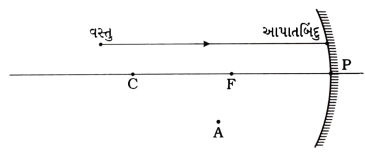
$A$ point object emits rays in all directions. Consider a ray emitted from the object that is parallel to the principal axis of the mirror. One of the points required to trace the reflected ray is the point of incidence itself,as shown in the figure. Select a point from the given figure through which the reflected ray passes.
A
$C$
B
$F$
C
$A$
D
$P$
Solution
(B) According to the rules of reflection for a concave mirror,any light ray that is parallel to the principal axis will pass through the principal focus $(F)$ after reflection from the mirror.
In the given figure,the incident ray is parallel to the principal axis.
Therefore,after reflection,this ray must pass through the principal focus,which is marked as point $F$.
In the given figure,the incident ray is parallel to the principal axis.
Therefore,after reflection,this ray must pass through the principal focus,which is marked as point $F$.
0 likes
View Solution319
EasyMCQ
What is the distance between the pole and the principal focus of a spherical mirror called?
A
Radius of curvature
B
Focal length
C
Aperture
D
Principal axis
Solution
(B) The distance between the pole $(P)$ and the principal focus $(F)$ of a spherical mirror is defined as the focal length $(f)$.
It is half of the radius of curvature $(R)$,represented by the relation $f = R/2$.
It is half of the radius of curvature $(R)$,represented by the relation $f = R/2$.
0 likes
View Solution320
EasyMCQ
Which of the following is a part of a spherical mirror?
A
Pole
B
Principal focus
C
Centre of curvature
D
Principal axis
Solution
(C) spherical mirror is a part of a sphere. The center of the sphere of which the mirror is a part is called the $Centre of curvature$ $(C)$. The pole $(P)$ is the center of the reflecting surface of the mirror. The principal focus $(F)$ is a point on the principal axis where light rays parallel to the axis converge or appear to diverge. The principal axis is the line passing through the pole and the center of curvature. However,in the context of defining the geometric origin of the mirror,the $Centre of curvature$ is the fundamental point that defines the sphere from which the mirror is cut.
0 likes
View Solution321
EasyMCQ
What is the point,where the rays parallel to the principal axis meet after reflection,called?
A
Optical centre
B
Centre of curvature
C
Principal focus
D
Pole
Solution
(C) When light rays parallel to the principal axis fall on a spherical mirror,they reflect and converge at (or appear to diverge from) a specific point on the principal axis.
This specific point is known as the Principal focus,denoted by the letter $F$.
For a concave mirror,the rays actually meet at this point,while for a convex mirror,they appear to diverge from this point.
This specific point is known as the Principal focus,denoted by the letter $F$.
For a concave mirror,the rays actually meet at this point,while for a convex mirror,they appear to diverge from this point.
0 likes
View Solution322
EasyMCQ
$A$ ray of light passing through the principal focus of a concave mirror,after reflection,travels in which direction?
A
Parallel to the principal axis.
B
Retraces its path through the principal focus.
C
Passes through the center of curvature.
D
Perpendicular to the principal axis.
Solution
(A) According to the rules of image formation by spherical mirrors,a ray of light passing through the principal focus $(F)$ of a concave mirror becomes parallel to the principal axis after reflection.
This is the converse of the rule where a ray parallel to the principal axis passes through the focus after reflection.
This is the converse of the rule where a ray parallel to the principal axis passes through the focus after reflection.
0 likes
View Solution323
EasyMCQ
Where should the object be placed to obtain a real and diminished image using a concave mirror?
A
Beyond the centre of curvature
B
At the centre of curvature
C
Between the focus and the pole
D
At the principal focus
Solution
(A) For a concave mirror,when an object is placed beyond the centre of curvature $(C)$,the light rays from the object form a real,inverted,and diminished image between the focus $(F)$ and the centre of curvature $(C)$.
Therefore,the correct position for the object is beyond the centre of curvature.
Therefore,the correct position for the object is beyond the centre of curvature.
0 likes
View Solution324
EasyMCQ
When an object is placed beyond the center of curvature $(C)$ in front of a concave mirror,where is the image formed and what is its nature?
A
Real and magnified
B
Real and diminished
C
Virtual and magnified
D
Virtual and diminished
Solution
(B) When an object is placed beyond the center of curvature $(C)$ of a concave mirror,the light rays from the object reflect off the mirror and converge between the center of curvature $(C)$ and the principal focus $(F)$.
Since the reflected rays actually meet at a point,the image formed is real.
Because the image is formed between $C$ and $F$,it is smaller in size than the object,i.e.,diminished.
Therefore,the image is real and diminished.
Since the reflected rays actually meet at a point,the image formed is real.
Because the image is formed between $C$ and $F$,it is smaller in size than the object,i.e.,diminished.
Therefore,the image is real and diminished.
0 likes
View Solution325
EasyMCQ
Where should an object be placed in front of a concave mirror to obtain a real and diminished image?
A
Beyond the center of curvature $(C)$
B
At the center of curvature $(C)$
C
At the principal focus $(F)$
D
Between the principal focus $(F)$ and the center of curvature $(C)$
Solution
(A) For a concave mirror,when an object is placed beyond the center of curvature $(C)$,the image formed is real,inverted,and diminished.
$1$. The rays of light coming from the object pass through the mirror and converge between the principal focus $(F)$ and the center of curvature $(C)$.
$2$. Since the rays actually intersect,the image is real.
$3$. The size of the image is smaller than the object,hence it is diminished.
$1$. The rays of light coming from the object pass through the mirror and converge between the principal focus $(F)$ and the center of curvature $(C)$.
$2$. Since the rays actually intersect,the image is real.
$3$. The size of the image is smaller than the object,hence it is diminished.
0 likes
View Solution326
EasyMCQ
When an object is placed at the center of curvature $(C)$ in front of a concave mirror,what kind of image is formed?
A
Virtual and magnified
B
Real and magnified
C
Real and diminished
D
Real and of the same size as the object
Solution
(D) When an object is placed at the center of curvature $(C)$ of a concave mirror,the light rays originating from the object follow the laws of reflection.
One ray passes parallel to the principal axis and reflects through the focus $(F)$.
Another ray passes through the focus $(F)$ and reflects parallel to the principal axis.
These reflected rays intersect exactly at the center of curvature $(C)$.
Therefore,the image formed is real,inverted,and of the same size as the object.
One ray passes parallel to the principal axis and reflects through the focus $(F)$.
Another ray passes through the focus $(F)$ and reflects parallel to the principal axis.
These reflected rays intersect exactly at the center of curvature $(C)$.
Therefore,the image formed is real,inverted,and of the same size as the object.
0 likes
View Solution327
EasyMCQ
Where should an object be placed in front of a concave mirror to obtain its image at the same position?
A
At the center of curvature $(C)$
B
Beyond the center of curvature
C
At the principal focus $(F)$
D
Between the principal focus $(F)$ and the pole $(P)$
Solution
(A) For a concave mirror,when an object is placed at the center of curvature $(C)$,the light rays originating from the object strike the mirror and reflect back through the same path.
As a result,the image is formed at the center of curvature $(C)$ itself.
The image formed is real,inverted,and of the same size as the object.
As a result,the image is formed at the center of curvature $(C)$ itself.
The image formed is real,inverted,and of the same size as the object.
0 likes
View Solution328
EasyMCQ
Where is the image formed when an object is placed between the principal focus $(F)$ and the center of curvature $(C)$ of a concave mirror?
A
At the center of curvature $(C)$
B
Beyond the center of curvature $(C)$
C
At infinity
D
Between the principal focus $(F)$ and the pole $(P)$
Solution
(B) When an object is placed between the principal focus $(F)$ and the center of curvature $(C)$ of a concave mirror,the light rays from the object follow the rules of reflection:
$1$. $A$ ray parallel to the principal axis passes through the principal focus $(F)$ after reflection.
$2$. $A$ ray passing through the principal focus $(F)$ becomes parallel to the principal axis after reflection.
These reflected rays meet at a point beyond the center of curvature $(C)$.
Therefore,the image formed is real,inverted,and magnified,and it is located beyond the center of curvature $(C)$.
$1$. $A$ ray parallel to the principal axis passes through the principal focus $(F)$ after reflection.
$2$. $A$ ray passing through the principal focus $(F)$ becomes parallel to the principal axis after reflection.
These reflected rays meet at a point beyond the center of curvature $(C)$.
Therefore,the image formed is real,inverted,and magnified,and it is located beyond the center of curvature $(C)$.
0 likes
View Solution329
EasyMCQ
When an object is placed between the principal focus $(F)$ and the center of curvature $(C)$ of a concave mirror,what kind of image is formed?
A
Virtual and diminished
B
Virtual and magnified
C
Real and diminished
D
Real and magnified
Solution
(D) For a concave mirror,when an object is placed between the principal focus $(F)$ and the center of curvature $(C)$:
$1$. The light rays from the object diverge and meet at a point beyond the center of curvature $(C)$.
$2$. The image formed is real because the light rays actually intersect.
$3$. The image is inverted.
$4$. The size of the image is larger than the object (magnified).
Therefore,the image formed is real and magnified.
$1$. The light rays from the object diverge and meet at a point beyond the center of curvature $(C)$.
$2$. The image formed is real because the light rays actually intersect.
$3$. The image is inverted.
$4$. The size of the image is larger than the object (magnified).
Therefore,the image formed is real and magnified.
0 likes
View Solution330
EasyMCQ
Where should an object be placed in front of a concave mirror to obtain an inverted and magnified image?
A
Beyond the center of curvature
B
Between the principal focus and the center of curvature
C
At the center of curvature
D
Between the principal focus and the pole
Solution
(B) For a concave mirror,when an object is placed between the principal focus $(F)$ and the center of curvature $(C)$,the image formed is real,inverted,and magnified.
$1$. When the object is beyond $C$,the image is diminished,real,and inverted.
$2$. When the object is at $C$,the image is of the same size,real,and inverted.
$3$. When the object is between $F$ and $C$,the image is formed beyond $C$ and is magnified,real,and inverted.
$4$. When the object is between $F$ and the pole $(P)$,the image is virtual,erect,and magnified.
$1$. When the object is beyond $C$,the image is diminished,real,and inverted.
$2$. When the object is at $C$,the image is of the same size,real,and inverted.
$3$. When the object is between $F$ and $C$,the image is formed beyond $C$ and is magnified,real,and inverted.
$4$. When the object is between $F$ and the pole $(P)$,the image is virtual,erect,and magnified.
0 likes
View Solution331
EasyMCQ
When an object is placed between the principal focus $(F)$ and the pole $(P)$ of a concave mirror,what kind of image is formed?
A
Real and magnified
B
Virtual and magnified
C
Real and diminished
D
Virtual and diminished
Solution
(B) When an object is placed between the principal focus $(F)$ and the pole $(P)$ of a concave mirror,the light rays diverge after reflection.
By extending these rays backward,they appear to meet behind the mirror.
Therefore,the image formed is virtual,erect,and magnified (larger than the object).
This is the only case where a concave mirror produces a virtual image.
By extending these rays backward,they appear to meet behind the mirror.
Therefore,the image formed is virtual,erect,and magnified (larger than the object).
This is the only case where a concave mirror produces a virtual image.
0 likes
View Solution332
EasyMCQ
Where will the image of an object placed at the centre of curvature of a concave mirror form?
A
At the principal focus
B
At the centre of curvature
C
At an infinite distance
D
At a distance less than $2f$
Solution
(B) When an object is placed at the centre of curvature $(C)$ of a concave mirror,the light rays originating from the object follow the laws of reflection.
$1$. $A$ ray parallel to the principal axis passes through the principal focus $(F)$ after reflection.
$2$. $A$ ray passing through the principal focus $(F)$ emerges parallel to the principal axis after reflection.
These two reflected rays intersect exactly at the centre of curvature $(C)$.
Therefore,the image formed is real,inverted,and of the same size as the object,located at the centre of curvature $(C)$.
$1$. $A$ ray parallel to the principal axis passes through the principal focus $(F)$ after reflection.
$2$. $A$ ray passing through the principal focus $(F)$ emerges parallel to the principal axis after reflection.
These two reflected rays intersect exactly at the centre of curvature $(C)$.
Therefore,the image formed is real,inverted,and of the same size as the object,located at the centre of curvature $(C)$.
0 likes
View Solution333
EasyMCQ
Where is the image formed when an object is placed at a distance of $2f$ in front of a convex mirror?
A
Between the principal focus and the pole behind the mirror
B
At a distance of $2f$ in front of the mirror
C
At a distance greater than $2f$ in front of the mirror
D
At a distance greater than $f$ behind the mirror
Solution
(A) convex mirror always forms a virtual,erect,and diminished image for any position of the object in front of it.
When an object is placed at any finite distance (including $2f$) in front of a convex mirror,the light rays diverge after reflection.
These rays appear to originate from a point behind the mirror.
The image is always formed between the pole $(P)$ and the principal focus $(F)$ behind the mirror.
Therefore,the correct option is $A$.
When an object is placed at any finite distance (including $2f$) in front of a convex mirror,the light rays diverge after reflection.
These rays appear to originate from a point behind the mirror.
The image is always formed between the pole $(P)$ and the principal focus $(F)$ behind the mirror.
Therefore,the correct option is $A$.
0 likes
View Solution334
EasyMCQ
At what position should an object be placed in front of a concave mirror to obtain a magnification of $(- 2)$?
A
At the center of curvature
B
Between the principal focus and the center of curvature
C
Beyond the center of curvature
D
Between the principal focus and the pole
Solution
(B) For a concave mirror,magnification $m = -v/u$. Given $m = -2$.
Substituting this,$-2 = -v/u$,which implies $v = 2u$.
According to the mirror formula,$1/f = 1/v + 1/u$.
Substituting $v = 2u$,we get $1/f = 1/(2u) + 1/u = 3/(2u)$.
This gives $u = 1.5f$.
Since the focal length $f$ is between the pole and the center of curvature $(2f)$,an object placed at $1.5f$ lies between the principal focus $(F)$ and the center of curvature $(C)$.
Thus,the correct position is between the principal focus and the center of curvature.
Substituting this,$-2 = -v/u$,which implies $v = 2u$.
According to the mirror formula,$1/f = 1/v + 1/u$.
Substituting $v = 2u$,we get $1/f = 1/(2u) + 1/u = 3/(2u)$.
This gives $u = 1.5f$.
Since the focal length $f$ is between the pole and the center of curvature $(2f)$,an object placed at $1.5f$ lies between the principal focus $(F)$ and the center of curvature $(C)$.
Thus,the correct position is between the principal focus and the center of curvature.
0 likes
View Solution335
EasyMCQ
In Section $I$, the magnification of the image obtained by placing an object at various distances in front of a concave mirror is mentioned, and in Section $II$, the type and size of the image are mentioned. Which of the following is the correct pair connecting Section $I$ and Section $II$?
| Section $I$ | Section $II$ |
| $1.$ Magnification $(-1)$ | $a.$ Real and enlarged |
| $2.$ Magnification $(+5)$ | $b.$ Real and same size as object |
| $3.$ Magnification $(-5)$ | $c.$ Real and diminished |
| $4.$ Magnification $(-0.5)$ | $d.$ Virtual and enlarged |
A
$(1-b), (2-d), (3-a), (4-c)$
B
$(1-c), (2-b), (3-a), (4-d)$
C
$(1-d), (2-c), (3-b), (4-a)$
D
$(1-c), (2-a), (3-d), (4-b)$
Solution
(A) The magnification $m$ of a spherical mirror is given by $m = -v/u = h'/h$.
$1.$ Magnification $m = -1$: The negative sign indicates a real and inverted image. The magnitude $1$ indicates the image size is equal to the object size. Thus, $(1-b)$.
$2.$ Magnification $m = +5$: The positive sign indicates a virtual and erect image. The magnitude $5$ $( > 1)$ indicates an enlarged image. Thus, $(2-d)$.
$3.$ Magnification $m = -5$: The negative sign indicates a real and inverted image. The magnitude $5$ $( > 1)$ indicates an enlarged image. Thus, $(3-a)$.
$4.$ Magnification $m = -0.5$: The negative sign indicates a real and inverted image. The magnitude $0.5$ $( < 1)$ indicates a diminished image. Thus, $(4-c)$.
Therefore, the correct matching is $(1-b), (2-d), (3-a), (4-c)$.
$1.$ Magnification $m = -1$: The negative sign indicates a real and inverted image. The magnitude $1$ indicates the image size is equal to the object size. Thus, $(1-b)$.
$2.$ Magnification $m = +5$: The positive sign indicates a virtual and erect image. The magnitude $5$ $( > 1)$ indicates an enlarged image. Thus, $(2-d)$.
$3.$ Magnification $m = -5$: The negative sign indicates a real and inverted image. The magnitude $5$ $( > 1)$ indicates an enlarged image. Thus, $(3-a)$.
$4.$ Magnification $m = -0.5$: The negative sign indicates a real and inverted image. The magnitude $0.5$ $( < 1)$ indicates a diminished image. Thus, $(4-c)$.
Therefore, the correct matching is $(1-b), (2-d), (3-a), (4-c)$.
0 likes
View Solution336
EasyMCQ
The magnification of a real image formed by a concave mirror is always ...
A
positive.
B
negative.
C
> $1$.
D
≤ $1$.
Solution
(B) For a concave mirror,a real image is always inverted.
According to the sign convention,the height of an inverted image is taken as negative $(h_i < 0)$ and the height of the object is taken as positive $(h_o > 0)$.
Magnification $(m)$ is defined as the ratio of the height of the image to the height of the object: $m = h_i / h_o$.
Since $h_i$ is negative and $h_o$ is positive,the magnification $m$ must be negative $(m < 0)$.
According to the sign convention,the height of an inverted image is taken as negative $(h_i < 0)$ and the height of the object is taken as positive $(h_o > 0)$.
Magnification $(m)$ is defined as the ratio of the height of the image to the height of the object: $m = h_i / h_o$.
Since $h_i$ is negative and $h_o$ is positive,the magnification $m$ must be negative $(m < 0)$.
0 likes
View Solution337
EasyMCQ
For a concave mirror,if the object distance $u = \infty$,then the image distance $v = ..........$.
A
Zero
B
$f$
C
$R$
D
$f/2$
Solution
(B) According to the mirror formula,$\frac{1}{v} + \frac{1}{u} = \frac{1}{f}$.
Given that the object is at infinity,$u = \infty$.
Substituting this into the formula: $\frac{1}{v} + \frac{1}{\infty} = \frac{1}{f}$.
Since $\frac{1}{\infty} = 0$,we get $\frac{1}{v} + 0 = \frac{1}{f}$.
Therefore,$v = f$.
When an object is placed at infinity in front of a concave mirror,the rays of light are parallel to the principal axis,and the image is formed at the principal focus $(F)$.
Given that the object is at infinity,$u = \infty$.
Substituting this into the formula: $\frac{1}{v} + \frac{1}{\infty} = \frac{1}{f}$.
Since $\frac{1}{\infty} = 0$,we get $\frac{1}{v} + 0 = \frac{1}{f}$.
Therefore,$v = f$.
When an object is placed at infinity in front of a concave mirror,the rays of light are parallel to the principal axis,and the image is formed at the principal focus $(F)$.
0 likes
View Solution338
EasyMCQ
If the magnification of an image formed by a mirror is $(-\frac{1}{3})$,what type of mirror is it?
A
Plane
B
Concave
C
Convex
D
Plane and Concave
Solution
(B) The magnification $(m)$ of a mirror is given by the ratio of the height of the image $(h')$ to the height of the object $(h)$,which is also equal to $(-\frac{v}{u})$.
Given $m = -\frac{1}{3}$.
$1$. The negative sign $(-)$ indicates that the image is real and inverted.
$2$. The magnitude of magnification is $\frac{1}{3}$,which is less than $1$,indicating that the image is diminished.
$3$. $A$ plane mirror always produces a virtual,erect image with a magnification of $+1$.
$4$. $A$ convex mirror always produces a virtual,erect,and diminished image with a magnification between $0$ and $+1$.
$5$. $A$ concave mirror can produce real,inverted,and diminished images when the object is placed beyond the center of curvature $(C)$.
Therefore,the mirror must be a concave mirror.
Given $m = -\frac{1}{3}$.
$1$. The negative sign $(-)$ indicates that the image is real and inverted.
$2$. The magnitude of magnification is $\frac{1}{3}$,which is less than $1$,indicating that the image is diminished.
$3$. $A$ plane mirror always produces a virtual,erect image with a magnification of $+1$.
$4$. $A$ convex mirror always produces a virtual,erect,and diminished image with a magnification between $0$ and $+1$.
$5$. $A$ concave mirror can produce real,inverted,and diminished images when the object is placed beyond the center of curvature $(C)$.
Therefore,the mirror must be a concave mirror.
0 likes
View Solution339
EasyMCQ
If the magnification $m$ of an image formed by a spherical mirror is negative,what is the nature of the image?
A
Smaller than the object
B
Larger than the object
C
Erect
D
Inverted
Solution
(D) In the context of spherical mirrors,the magnification $m$ is defined as the ratio of the height of the image $(h')$ to the height of the object $(h)$,i.e.,$m = h'/h$.
For real images,the image is formed below the principal axis,making the height of the image $(h')$ negative,while the object height $(h)$ is taken as positive.
Therefore,a negative magnification $(m < 0)$ indicates that the image is real and inverted.
Since all real images formed by spherical mirrors are inverted,the correct nature of the image is inverted.
For real images,the image is formed below the principal axis,making the height of the image $(h')$ negative,while the object height $(h)$ is taken as positive.
Therefore,a negative magnification $(m < 0)$ indicates that the image is real and inverted.
Since all real images formed by spherical mirrors are inverted,the correct nature of the image is inverted.
0 likes
View Solution340
EasyMCQ
Which type of image cannot be obtained by a concave mirror?
A
Real and enlarged
B
Real and diminished
C
Virtual and enlarged
D
Virtual and diminished
Solution
(D) concave mirror can form various types of images depending on the position of the object:
$1$. When the object is placed between the pole $(P)$ and the focus $(F)$,the image formed is virtual,erect,and enlarged.
$2$. When the object is placed at the focus $(F)$,the image is real,inverted,and highly enlarged.
$3$. When the object is placed between $F$ and $C$,the image is real,inverted,and enlarged.
$4$. When the object is placed at $C$,the image is real,inverted,and of the same size.
$5$. When the object is placed beyond $C$,the image is real,inverted,and diminished.
$6$. $A$ concave mirror can never form a virtual and diminished image. $A$ virtual and diminished image is only formed by a convex mirror.
$1$. When the object is placed between the pole $(P)$ and the focus $(F)$,the image formed is virtual,erect,and enlarged.
$2$. When the object is placed at the focus $(F)$,the image is real,inverted,and highly enlarged.
$3$. When the object is placed between $F$ and $C$,the image is real,inverted,and enlarged.
$4$. When the object is placed at $C$,the image is real,inverted,and of the same size.
$5$. When the object is placed beyond $C$,the image is real,inverted,and diminished.
$6$. $A$ concave mirror can never form a virtual and diminished image. $A$ virtual and diminished image is only formed by a convex mirror.
0 likes
View Solution341
EasyMCQ
Which type of image cannot be obtained by a concave mirror?
A
Real and enlarged
B
Real and diminished
C
Virtual and enlarged
D
Virtual and diminished
Solution
(D) concave mirror can form both real and virtual images.
$1$. Real images: These can be enlarged (when the object is between $F$ and $C$),diminished (when the object is beyond $C$),or of the same size (when the object is at $C$).
$2$. Virtual images: $A$ concave mirror forms a virtual image only when the object is placed between the pole $(P)$ and the focus $(F)$. In this case,the image formed is always virtual,erect,and enlarged.
$3$. Therefore,a concave mirror can never form a virtual and diminished image. $A$ virtual and diminished image is only formed by a convex mirror.
$1$. Real images: These can be enlarged (when the object is between $F$ and $C$),diminished (when the object is beyond $C$),or of the same size (when the object is at $C$).
$2$. Virtual images: $A$ concave mirror forms a virtual image only when the object is placed between the pole $(P)$ and the focus $(F)$. In this case,the image formed is always virtual,erect,and enlarged.
$3$. Therefore,a concave mirror can never form a virtual and diminished image. $A$ virtual and diminished image is only formed by a convex mirror.
0 likes
View Solution342
EasyMCQ
What can be said about the magnification of an image formed by a convex mirror?
A
It is positive.
B
It is negative.
C
It is both positive and negative.
D
It is greater than $1$.
Solution
(A) convex mirror always forms a virtual,erect,and diminished image for all positions of the object placed in front of it.
For an erect image,the height of the image $(h')$ and the height of the object $(h)$ are both taken as positive.
Magnification $(m)$ is defined as the ratio of the height of the image to the height of the object: $m = h'/h$.
Since both $h'$ and $h$ are positive for an erect image,the magnification $(m)$ is always positive.
Additionally,for a convex mirror,the image is always diminished,meaning the size of the image is smaller than the size of the object $(h' < h)$,so the magnification is always less than $1$ $(m < 1)$.
For an erect image,the height of the image $(h')$ and the height of the object $(h)$ are both taken as positive.
Magnification $(m)$ is defined as the ratio of the height of the image to the height of the object: $m = h'/h$.
Since both $h'$ and $h$ are positive for an erect image,the magnification $(m)$ is always positive.
Additionally,for a convex mirror,the image is always diminished,meaning the size of the image is smaller than the size of the object $(h' < h)$,so the magnification is always less than $1$ $(m < 1)$.
0 likes
View Solution343
EasyMCQ
What is the mirror formula for a spherical mirror?
A
$\frac{1}{v} + \frac{1}{u} = \frac{1}{f}$
B
$\frac{1}{v} - \frac{1}{u} = \frac{1}{f}$
C
$\frac{1}{u} - \frac{1}{v} = \frac{1}{f}$
D
$\frac{1}{u} + \frac{1}{v} = f$
Solution
(A) The mirror formula expresses the relationship between the object distance $(u)$,image distance $(v)$,and the focal length $(f)$ of a spherical mirror.
It is given by the equation: $\frac{1}{v} + \frac{1}{u} = \frac{1}{f}$.
Here,$u$ is the distance of the object from the pole,$v$ is the distance of the image from the pole,and $f$ is the focal length of the mirror.
It is given by the equation: $\frac{1}{v} + \frac{1}{u} = \frac{1}{f}$.
Here,$u$ is the distance of the object from the pole,$v$ is the distance of the image from the pole,and $f$ is the focal length of the mirror.
0 likes
View Solution344
EasyMCQ
If the focal length of a spherical mirror is $20 \ cm$,what is its radius of curvature (in $cm$)?
A
$20$
B
$40$
C
$10$
D
$60$
Solution
(B) For a spherical mirror,the relationship between the focal length $(f)$ and the radius of curvature $(R)$ is given by the formula: $R = 2f$.
Given that the focal length $f = 20 \ cm$.
Substituting the value into the formula: $R = 2 \times 20 \ cm = 40 \ cm$.
Therefore,the radius of curvature is $40 \ cm$.
Given that the focal length $f = 20 \ cm$.
Substituting the value into the formula: $R = 2 \times 20 \ cm = 40 \ cm$.
Therefore,the radius of curvature is $40 \ cm$.
0 likes
View Solution345
EasyMCQ
If the radius of curvature of a spherical mirror is $30 \ cm$,what is its focal length (in $cm$)?
A
$15$
B
$30$
C
$60$
D
$10$
Solution
(A) The relationship between the focal length $(f)$ and the radius of curvature $(R)$ of a spherical mirror is given by the formula: $f = \frac{R}{2}$.
Given that the radius of curvature $R = 30 \ cm$.
Substituting the value of $R$ into the formula: $f = \frac{30 \ cm}{2} = 15 \ cm$.
Therefore,the focal length of the spherical mirror is $15 \ cm$.
Given that the radius of curvature $R = 30 \ cm$.
Substituting the value of $R$ into the formula: $f = \frac{30 \ cm}{2} = 15 \ cm$.
Therefore,the focal length of the spherical mirror is $15 \ cm$.
0 likes
View Solution346
EasyMCQ
Magnification is the ratio of which of the following?
A
Height of the image and height of the object
B
Height of the object and height of the image
C
Height of the image and object distance
D
Object distance and height of the image
Solution
(A) Magnification $(m)$ produced by a spherical mirror or lens is defined as the ratio of the height of the image $(h')$ to the height of the object $(h)$.
Mathematically,it is expressed as: $m = \frac{h'}{h}$.
Therefore,magnification is the ratio of the height of the image to the height of the object.
Mathematically,it is expressed as: $m = \frac{h'}{h}$.
Therefore,magnification is the ratio of the height of the image to the height of the object.
0 likes
View Solution347
EasyMCQ
If an object of $4 \, cm$ height is placed at a distance of $12 \, cm$ from a concave mirror,then its image is formed at a distance of $24 \, cm$ from the mirror and behind it. What will be the height of the image (in $, cm$)?
A
$2$
B
$4$
C
$6$
D
$8$
Solution
(D) Given: Object height $(h_o)$ = $4 \, cm$,Object distance $(u)$ = $-12 \, cm$ (by sign convention).
Since the image is formed behind the mirror,it is a virtual image. Thus,Image distance $(v)$ = $+24 \, cm$.
The magnification $(m)$ of a mirror is given by the formula: $m = \frac{h_i}{h_o} = -\frac{v}{u}$.
Substituting the values: $\frac{h_i}{4} = -\frac{24}{-12}$.
$\frac{h_i}{4} = 2$.
$h_i = 2 \times 4 = 8 \, cm$.
Therefore,the height of the image is $8 \, cm$.
Since the image is formed behind the mirror,it is a virtual image. Thus,Image distance $(v)$ = $+24 \, cm$.
The magnification $(m)$ of a mirror is given by the formula: $m = \frac{h_i}{h_o} = -\frac{v}{u}$.
Substituting the values: $\frac{h_i}{4} = -\frac{24}{-12}$.
$\frac{h_i}{4} = 2$.
$h_i = 2 \times 4 = 8 \, cm$.
Therefore,the height of the image is $8 \, cm$.
0 likes
View Solution348
EasyMCQ
An object is placed at a distance of $18 \ cm$ in front of a concave mirror of focal length $12 \ cm$. Where will the image be formed?
A
At the center of curvature
B
Beyond the center of curvature
C
At the principal focus
D
Between the principal focus and the center of curvature
Solution
(B) Given: Focal length $(f)$ = $-12 \ cm$ (for a concave mirror),Object distance $(u)$ = $-18 \ cm$.
Using the mirror formula: $\frac{1}{f} = \frac{1}{v} + \frac{1}{u}$.
Substituting the values: $\frac{1}{-12} = \frac{1}{v} + \frac{1}{-18}$.
Rearranging: $\frac{1}{v} = \frac{1}{18} - \frac{1}{12}$.
Calculating the common denominator $(36)$: $\frac{1}{v} = \frac{2 - 3}{36} = -\frac{1}{36}$.
Therefore,$v = -36 \ cm$.
The center of curvature $(C)$ is at $2f = 2 \times 12 = 24 \ cm$.
Since the image distance $(36 \ cm)$ is greater than the center of curvature $(24 \ cm)$,the image is formed beyond the center of curvature.
Using the mirror formula: $\frac{1}{f} = \frac{1}{v} + \frac{1}{u}$.
Substituting the values: $\frac{1}{-12} = \frac{1}{v} + \frac{1}{-18}$.
Rearranging: $\frac{1}{v} = \frac{1}{18} - \frac{1}{12}$.
Calculating the common denominator $(36)$: $\frac{1}{v} = \frac{2 - 3}{36} = -\frac{1}{36}$.
Therefore,$v = -36 \ cm$.
The center of curvature $(C)$ is at $2f = 2 \times 12 = 24 \ cm$.
Since the image distance $(36 \ cm)$ is greater than the center of curvature $(24 \ cm)$,the image is formed beyond the center of curvature.
0 likes
View Solution349
EasyMCQ
An object is placed at a distance of $20 \text{ cm}$ in front of a concave mirror of focal length $10 \text{ cm}$. Where will the image be formed?
A
Between the principal focus and the center of curvature
B
At the principal focus
C
Beyond the center of curvature
D
At the center of curvature
Solution
(D) Given: Focal length $f = -10 \text{ cm}$ (for a concave mirror),Object distance $u = -20 \text{ cm}$.
Using the mirror formula: $\frac{1}{f} = \frac{1}{v} + \frac{1}{u}$.
Substituting the values: $\frac{1}{-10} = \frac{1}{v} + \frac{1}{-20}$.
Rearranging: $\frac{1}{v} = \frac{1}{20} - \frac{1}{10} = \frac{1 - 2}{20} = -\frac{1}{20}$.
Therefore,$v = -20 \text{ cm}$.
Since the object is placed at $2f$ $(2 \times 10 \text{ cm} = 20 \text{ cm})$,the image is also formed at $2f$,which is the center of curvature.
Using the mirror formula: $\frac{1}{f} = \frac{1}{v} + \frac{1}{u}$.
Substituting the values: $\frac{1}{-10} = \frac{1}{v} + \frac{1}{-20}$.
Rearranging: $\frac{1}{v} = \frac{1}{20} - \frac{1}{10} = \frac{1 - 2}{20} = -\frac{1}{20}$.
Therefore,$v = -20 \text{ cm}$.
Since the object is placed at $2f$ $(2 \times 10 \text{ cm} = 20 \text{ cm})$,the image is also formed at $2f$,which is the center of curvature.
0 likes
View Solution350
EasyMCQ
What is the nature of the image formed by an object placed at a distance of $10 \text{ cm}$ in front of a concave mirror with a focal length of $20 \text{ cm}$?
A
Real and magnified
B
Real and diminished
C
Virtual and magnified
D
Virtual and diminished
Solution
(C) Given: Focal length $(f)$ = $-20 \text{ cm}$ (for a concave mirror),Object distance $(u)$ = $-10 \text{ cm}$.
Using the mirror formula: $\frac{1}{f} = \frac{1}{v} + \frac{1}{u}$.
Substituting the values: $\frac{1}{-20} = \frac{1}{v} + \frac{1}{-10}$.
Rearranging: $\frac{1}{v} = \frac{1}{10} - \frac{1}{20} = \frac{2-1}{20} = \frac{1}{20}$.
So,$v = +20 \text{ cm}$.
Since the image distance $(v)$ is positive,the image is formed behind the mirror,which means it is virtual.
Magnification $(m)$ = $-\frac{v}{u} = -(\frac{20}{-10}) = +2$.
Since $m$ is positive and greater than $1$,the image is virtual and magnified.
Using the mirror formula: $\frac{1}{f} = \frac{1}{v} + \frac{1}{u}$.
Substituting the values: $\frac{1}{-20} = \frac{1}{v} + \frac{1}{-10}$.
Rearranging: $\frac{1}{v} = \frac{1}{10} - \frac{1}{20} = \frac{2-1}{20} = \frac{1}{20}$.
So,$v = +20 \text{ cm}$.
Since the image distance $(v)$ is positive,the image is formed behind the mirror,which means it is virtual.
Magnification $(m)$ = $-\frac{v}{u} = -(\frac{20}{-10}) = +2$.
Since $m$ is positive and greater than $1$,the image is virtual and magnified.
0 likes
View SolutionLight – Reflection and Refraction — Mix Examples - Light – Reflection and Refraction · Frequently Asked Questions
1Are these Light – Reflection and Refraction questions useful for JEE and NEET?
Yes. All questions in this section are mapped to JEE Main and NEET exam patterns. Previous year questions from JEE Main, NEET, GUJCET and state-level exams are included with full solutions.
2Can I switch to Hindi or Gujarati for these questions?
Yes. Use the language tabs in the hero section or the sidebar to view the same questions and solutions in English, Hindi or Gujarati.
3How do I generate a question paper from this subtopic?
Use the Vedclass Exam Paper Generator — select the chapter and subtopic, set difficulty, and generate Sets A, B, C, D automatically. First 3 chapters of every subject are free.
Vedclass Products
For Students
Vedclass Test Series
Mock tests in real JEE/NEET style with performance analysis. 5-day free trial.
Start Free TrialFor Teachers
Exam Paper Generator
Generate Set A/B/C/D papers from this chapter in 2 minutes. 3 chapters free.
Try FreeFor Institutes
Online Exam Module
Live online exams with unlimited students, 360° analytics & white-label branding.
See DemoFor Teachers & Institutes
Generate a Light – Reflection and Refraction Exam Paper in 2 Minutes
Select subtopic & difficulty — Sets A, B, C, D auto-generated with No Repeat logic.
First 3 chapters of every subject are free — no payment required.