
A English
Mix Examples - Light – Reflection and Refraction Questions in English
Class 10 Science · Light – Reflection and Refraction · Mix Examples - Light – Reflection and Refraction
400+
Questions
English
Language
100%
With Solutions
Showing 50 of 400 questions in English
51
Easy
Describe a spherical mirror.
Solution
(N/A) spherical mirror is a mirror whose reflecting surface is a part of a hollow sphere of glass.
There are two main types of spherical mirrors:
$1$. Concave mirror: $A$ spherical mirror whose reflecting surface is curved inwards,i.e.,faces towards the center of the sphere.
$2$. Convex mirror: $A$ spherical mirror whose reflecting surface is curved outwards,i.e.,faces away from the center of the sphere.
There are two main types of spherical mirrors:
$1$. Concave mirror: $A$ spherical mirror whose reflecting surface is curved inwards,i.e.,faces towards the center of the sphere.
$2$. Convex mirror: $A$ spherical mirror whose reflecting surface is curved outwards,i.e.,faces away from the center of the sphere.
0 likes
View Solution52
Medium
Define the following terms in relation to a concave spherical mirror (any five):
$(i)$ Pole
$(ii)$ Centre of curvature
$(iii)$ Radius of curvature
$(iv)$ Principal axis
$(v)$ Principal focus
$(vi)$ Aperture
$(vii)$ Focal length
$(i)$ Pole
$(ii)$ Centre of curvature
$(iii)$ Radius of curvature
$(iv)$ Principal axis
$(v)$ Principal focus
$(vi)$ Aperture
$(vii)$ Focal length
Solution
(N/A) $(i)$ Pole (Vertex): The central point of the reflecting surface of a spherical mirror is called its pole.
$(ii)$ Centre of curvature: The centre of the sphere of which the mirror is a part is called the centre of curvature.
$(iii)$ Radius of curvature: The radius of the sphere of which the mirror is a part is called the radius of curvature.
$(iv)$ Principal axis: The straight line passing through the pole and the centre of curvature of the mirror is called the principal axis.
$(v)$ Principal focus: It is a point on the principal axis where light rays parallel to the principal axis converge or appear to diverge after reflection.
$(vi)$ Aperture: The effective diameter of the light-reflecting area of the spherical mirror is called its aperture.
$(vii)$ Focal length: The distance between the pole and the principal focus of a spherical mirror is called the focal length,represented by $f$.
$(ii)$ Centre of curvature: The centre of the sphere of which the mirror is a part is called the centre of curvature.
$(iii)$ Radius of curvature: The radius of the sphere of which the mirror is a part is called the radius of curvature.
$(iv)$ Principal axis: The straight line passing through the pole and the centre of curvature of the mirror is called the principal axis.
$(v)$ Principal focus: It is a point on the principal axis where light rays parallel to the principal axis converge or appear to diverge after reflection.
$(vi)$ Aperture: The effective diameter of the light-reflecting area of the spherical mirror is called its aperture.
$(vii)$ Focal length: The distance between the pole and the principal focus of a spherical mirror is called the focal length,represented by $f$.
0 likes
View Solution53
Easy
Define the term principal focus for a convex mirror.
Solution
(N/A) The principal focus of a convex mirror is a point on its principal axis. When rays of light parallel to the principal axis strike the convex mirror,they diverge after reflection. If these reflected rays are extended backwards,they appear to meet at this specific point on the principal axis. This point is known as the principal focus of the convex mirror.
0 likes
View Solution54
EasyMCQ
What is the focal length of a plane mirror?
A
Zero
B
Infinity
C
Equal to the radius of curvature
D
Half of the radius of curvature
Solution
(B) The focal length $(f)$ of a spherical mirror is related to its radius of curvature $(R)$ by the formula $f = R/2$.
For a plane mirror, the surface is flat, which means it can be considered as a part of a sphere with an infinite radius of curvature $(R = \infty)$.
Substituting this into the formula, we get $f = \infty / 2 = \infty$.
Therefore, the focal length of a plane mirror is infinity.
For a plane mirror, the surface is flat, which means it can be considered as a part of a sphere with an infinite radius of curvature $(R = \infty)$.
Substituting this into the formula, we get $f = \infty / 2 = \infty$.
Therefore, the focal length of a plane mirror is infinity.
0 likes
View Solution55
Medium
What do you understand by the terms
$(i)$ Real image?
$(ii)$ Virtual image?
$(i)$ Real image?
$(ii)$ Virtual image?
Solution
(N/A) $(i)$ Real image: When the rays of light,after reflection from a mirror,actually meet at a point,the image formed by these rays is called a real image. Real images can be obtained on a screen.
$(ii)$ Virtual image: When the rays of light,after reflection from a mirror,appear to meet at a point,the image formed by these rays is called a virtual image. Virtual images cannot be obtained on a screen.
$(ii)$ Virtual image: When the rays of light,after reflection from a mirror,appear to meet at a point,the image formed by these rays is called a virtual image. Virtual images cannot be obtained on a screen.
0 likes
View Solution56
EasyMCQ
If the radius of curvature of a concave mirror is $36\, cm$,what is its focal length (in $, cm$)?
A
$18$
B
$36$
C
$72$
D
$9$
Solution
(A) The relationship between the focal length $(f)$ and the radius of curvature $(R)$ of a spherical mirror is given by the formula $f = R / 2$.
Given that the radius of curvature $R = 36\, cm$.
Substituting the value into the formula: $f = 36\, cm / 2 = 18\, cm$.
Therefore,the focal length of the concave mirror is $18\, cm$.
Given that the radius of curvature $R = 36\, cm$.
Substituting the value into the formula: $f = 36\, cm / 2 = 18\, cm$.
Therefore,the focal length of the concave mirror is $18\, cm$.
0 likes
View Solution57
EasyMCQ
What type of mirror is used to obtain a real image?
A
Concave mirror
B
Convex mirror
C
Plane mirror
D
None of the above
Solution
(A) concave mirror is capable of forming a real image when the object is placed at a distance greater than the focal length $(f)$ of the mirror.
In contrast,a convex mirror and a plane mirror always form virtual and erect images for real objects.
In contrast,a convex mirror and a plane mirror always form virtual and erect images for real objects.
0 likes
View Solution58
EasyMCQ
The image formed by a concave mirror is real and of the same size. Where is the object placed?
A
At the focus $(F)$
B
Between the pole $(P)$ and the focus $(F)$
C
At the centre of curvature $(C)$
D
Beyond the centre of curvature $(C)$
Solution
(C) For a concave mirror,when an object is placed at the centre of curvature $(C)$,the light rays originating from the object reflect off the mirror and converge at the same point $(C)$.
This results in the formation of a real,inverted image that is exactly the same size as the object.
Therefore,the object is placed at the centre of curvature $(C)$.
This results in the formation of a real,inverted image that is exactly the same size as the object.
Therefore,the object is placed at the centre of curvature $(C)$.
0 likes
View Solution59
EasyMCQ
$A$ ray is incident along $ACB$ on a spherical mirror,where $C$ is the centre of curvature. In which direction will the ray be reflected?
A
Along the same path $BCA$
B
Parallel to the principal axis
C
Through the focus
D
Perpendicular to the principal axis
Solution
(A) ray of light passing through the centre of curvature $(C)$ of a spherical mirror strikes the mirror surface normally (at an angle of $90^{\circ}$ to the tangent at the point of incidence).
According to the laws of reflection,when a ray strikes a surface normally,the angle of incidence $(i)$ is $0^{\circ}$.
Therefore,the angle of reflection $(r)$ is also $0^{\circ}$.
As a result,the ray reflects back along the same path,i.e.,$BCA$.
According to the laws of reflection,when a ray strikes a surface normally,the angle of incidence $(i)$ is $0^{\circ}$.
Therefore,the angle of reflection $(r)$ is also $0^{\circ}$.
As a result,the ray reflects back along the same path,i.e.,$BCA$.
0 likes
View Solution60
Easy
If you want to see an enlarged image of your face, which type of mirror will you use? Where will you place your face?
Solution
(N/A) To see an enlarged image of your face, you should use a $Concave$ mirror.
The face must be placed between the pole $(P)$ and the principal focus $(F)$ of the mirror.
When an object is placed between the pole and the focus of a $Concave$ mirror, the image formed is virtual, erect, and magnified (enlarged).
The face must be placed between the pole $(P)$ and the principal focus $(F)$ of the mirror.
When an object is placed between the pole and the focus of a $Concave$ mirror, the image formed is virtual, erect, and magnified (enlarged).
0 likes
View Solution61
EasyMCQ
For what position of the object does a concave mirror form a real and diminished image?
A
Between the pole and the focus
B
At the centre of curvature
C
Beyond the centre of curvature
D
At the focus
Solution
(C) concave mirror forms a real and diminished image when the object is placed beyond the centre of curvature $(C)$.
When the object is placed beyond $C$,the image is formed between the focus $(F)$ and the centre of curvature $(C)$.
The image formed is real,inverted,and diminished in size.
When the object is placed beyond $C$,the image is formed between the focus $(F)$ and the centre of curvature $(C)$.
The image formed is real,inverted,and diminished in size.
0 likes
View Solution62
EasyMCQ
Which mirror has a large field of view?
A
Concave mirror
B
Convex mirror
C
Plane mirror
D
None of these
Solution
(B) convex mirror is a spherical mirror whose reflecting surface is curved outwards.
Due to its shape,it always forms a virtual,diminished,and erect image of objects placed in front of it.
Because the image formed is smaller than the object,a convex mirror can cover a much wider area than a plane or concave mirror.
Therefore,it provides a large field of view,which is why it is commonly used as a rear-view mirror in vehicles.
Due to its shape,it always forms a virtual,diminished,and erect image of objects placed in front of it.
Because the image formed is smaller than the object,a convex mirror can cover a much wider area than a plane or concave mirror.
Therefore,it provides a large field of view,which is why it is commonly used as a rear-view mirror in vehicles.
0 likes
View Solution63
EasyMCQ
Which mirror is used by dentists?
A
Concave mirror
B
Convex mirror
C
Plane mirror
D
Cylindrical mirror
Solution
(A) Dentists use a concave mirror to examine teeth because it can produce an enlarged and virtual image of the object when the object is placed between the pole and the focus of the mirror. This helps in getting a clearer view of the tooth cavity or decay.
0 likes
View Solution64
MediumMCQ
Write two important applications of $(i)$ concave mirror and $(ii)$ convex mirror.
A
Concave: Shaving mirror,Dentist mirror; Convex: Rear view mirror,Streetlight reflector.
B
Concave: Solar furnace,Headlights; Convex: Magnifying glass,Security mirror.
C
Concave: Rear view mirror,Streetlight; Convex: Shaving mirror,Dentist mirror.
D
Concave: Security mirror,Magnifying glass; Convex: Solar furnace,Headlights.
Solution
(A) $(i)$ Applications of concave mirror:
$1$. They are used as shaving mirrors to see a larger image of the face.
$2$. They are used by dentists to see enlarged images of teeth.
$3$. They are used as reflectors in torches,searchlights,and vehicle headlights to get powerful parallel beams of light.
$(ii)$ Applications of convex mirror:
$1$. They are used as rear-view mirrors in vehicles because they always give an erect,diminished image and have a wider field of view.
$2$. They are used as reflectors in streetlights to diverge light over a larger area.
$1$. They are used as shaving mirrors to see a larger image of the face.
$2$. They are used by dentists to see enlarged images of teeth.
$3$. They are used as reflectors in torches,searchlights,and vehicle headlights to get powerful parallel beams of light.
$(ii)$ Applications of convex mirror:
$1$. They are used as rear-view mirrors in vehicles because they always give an erect,diminished image and have a wider field of view.
$2$. They are used as reflectors in streetlights to diverge light over a larger area.
0 likes
View Solution65
EasyMCQ
Explain why drivers prefer to use a convex mirror as a rearview mirror in automobiles.
A
It produces a real and inverted image.
B
It produces an erect and diminished image,providing a wider field of view.
C
It produces a virtual and magnified image.
D
It produces an image that is always at the same distance as the object.
Solution
(B) Drivers prefer convex mirrors as rearview mirrors because they always form a virtual,erect,and diminished image of the objects placed in front of them.
Due to the diminished size of the image,a convex mirror covers a much wider field of view compared to a plane mirror of the same size.
This allows the driver to see a larger area of the traffic behind the vehicle,which significantly enhances safety while driving.
Due to the diminished size of the image,a convex mirror covers a much wider field of view compared to a plane mirror of the same size.
This allows the driver to see a larger area of the traffic behind the vehicle,which significantly enhances safety while driving.
0 likes
View Solution66
Medium
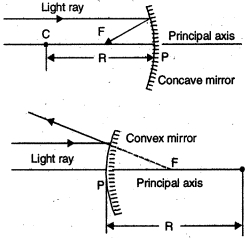
In a diagram,show the following for both a convex mirror and a concave mirror:
$(i)$ Principal axis
$(ii)$ Pole
$(iii)$ Focus
$(iv)$ Centre of curvature
$(v)$ Radius of curvature
$(i)$ Principal axis
$(ii)$ Pole
$(iii)$ Focus
$(iv)$ Centre of curvature
$(v)$ Radius of curvature
Solution
(N/A) The diagram illustrates the key components of spherical mirrors:
$1$. Principal axis: The straight line passing through the pole and the centre of curvature of a spherical mirror.
$2$. Pole $(P)$: The centre of the reflecting surface of a spherical mirror.
$3$. Focus $(F)$: The point on the principal axis where light rays parallel to the principal axis converge (in a concave mirror) or appear to diverge (in a convex mirror) after reflection.
$4$. Centre of curvature $(C)$: The centre of the sphere of which the reflecting surface of the spherical mirror forms a part.
$5$. Radius of curvature $(R)$: The radius of the sphere of which the reflecting surface of the spherical mirror forms a part. It is the distance between the pole $(P)$ and the centre of curvature $(C)$.
$1$. Principal axis: The straight line passing through the pole and the centre of curvature of a spherical mirror.
$2$. Pole $(P)$: The centre of the reflecting surface of a spherical mirror.
$3$. Focus $(F)$: The point on the principal axis where light rays parallel to the principal axis converge (in a concave mirror) or appear to diverge (in a convex mirror) after reflection.
$4$. Centre of curvature $(C)$: The centre of the sphere of which the reflecting surface of the spherical mirror forms a part.
$5$. Radius of curvature $(R)$: The radius of the sphere of which the reflecting surface of the spherical mirror forms a part. It is the distance between the pole $(P)$ and the centre of curvature $(C)$.
0 likes
View Solution67
Easy
What are the advantages and disadvantages of using a convex mirror for seeing traffic at the rear?
Solution
(N/A) Advantage: $A$ convex mirror provides a wider field of view compared to a plane mirror,allowing the driver to see a larger area of the traffic behind.
Disadvantage: It does not show the correct distance of the vehicle at the rear; objects appear smaller and farther away than they actually are.
Disadvantage: It does not show the correct distance of the vehicle at the rear; objects appear smaller and farther away than they actually are.
0 likes
View Solution68
Easy
State the sign convention used to measure distances from a mirror.
Solution
(N/A) According to the New Cartesian Sign Convention for spherical mirrors:
$1$. The object is always placed to the left of the mirror,so light travels from left to right.
$2$. All distances parallel to the principal axis are measured from the pole $(P)$ of the mirror.
$3$. Distances measured in the direction of incident light are taken as positive $(+)$.
$4$. Distances measured opposite to the direction of incident light are taken as negative $(-)$.
$5$. Distances measured perpendicular to and above the principal axis are taken as positive $(+)$.
$6$. Distances measured perpendicular to and below the principal axis are taken as negative $(-)$.
$1$. The object is always placed to the left of the mirror,so light travels from left to right.
$2$. All distances parallel to the principal axis are measured from the pole $(P)$ of the mirror.
$3$. Distances measured in the direction of incident light are taken as positive $(+)$.
$4$. Distances measured opposite to the direction of incident light are taken as negative $(-)$.
$5$. Distances measured perpendicular to and above the principal axis are taken as positive $(+)$.
$6$. Distances measured perpendicular to and below the principal axis are taken as negative $(-)$.
0 likes
View Solution69
Easy
State the sign convention used to measure the length of the image and the object.
Solution
(N/A) According to the Cartesian sign convention for spherical mirrors and lenses:
$1$. All distances measured perpendicular to the principal axis and in the upward direction (above the principal axis) are taken as positive (+).
$2$. All distances measured perpendicular to the principal axis and in the downward direction (below the principal axis) are taken as negative (-).
$1$. All distances measured perpendicular to the principal axis and in the upward direction (above the principal axis) are taken as positive (+).
$2$. All distances measured perpendicular to the principal axis and in the downward direction (below the principal axis) are taken as negative (-).
0 likes
View Solution70
EasyMCQ
What does positive magnification mean?
A
The image is real and inverted.
B
The image is virtual and erect.
C
The image is smaller than the object.
D
The image is larger than the object.
Solution
(B) Magnification $(m)$ is defined as the ratio of the height of the image $(h')$ to the height of the object $(h)$.
$m = h'/h$.
If the magnification is positive $(m > 0)$,it indicates that the image is formed above the principal axis.
This implies that the image is virtual and erect.
Therefore,the correct option is $B$.
$m = h'/h$.
If the magnification is positive $(m > 0)$,it indicates that the image is formed above the principal axis.
This implies that the image is virtual and erect.
Therefore,the correct option is $B$.
0 likes
View Solution71
EasyMCQ
What does negative magnification mean in the context of spherical mirrors?
A
The image is virtual and erect.
B
The image is real and inverted.
C
The image is magnified.
D
The image is diminished.
Solution
(B) In the context of spherical mirrors, magnification $(m)$ is defined as the ratio of the height of the image $(h')$ to the height of the object $(h)$.
If the magnification is negative $(m < 0)$, it indicates that the height of the image is negative relative to the height of the object.
Since the object is typically placed upright above the principal axis (positive height), a negative image height implies that the image is formed below the principal axis.
Therefore, a negative magnification signifies that the image is $real$ and $inverted$.
If the magnification is negative $(m < 0)$, it indicates that the height of the image is negative relative to the height of the object.
Since the object is typically placed upright above the principal axis (positive height), a negative image height implies that the image is formed below the principal axis.
Therefore, a negative magnification signifies that the image is $real$ and $inverted$.
0 likes
View Solution72
Easy
Give the relationship of magnification with focal length of a spherical mirror.
Solution
(N/A) The magnification $m$ of a spherical mirror is defined as the ratio of the height of the image to the height of the object,which is also given by $m = -v/u$.
Using the mirror formula $\frac{1}{f} = \frac{1}{v} + \frac{1}{u}$,we can derive the relationship between magnification,focal length $(f)$,and object distance $(u)$ or image distance $(v)$.
By substituting $v = \frac{fu}{u-f}$ into $m = -v/u$,we get $m = \frac{f}{f-u}$.
Similarly,by substituting $u = \frac{fv}{v-f}$ into $m = -v/u$,we get $m = \frac{f-v}{f}$.
Thus,the relationship is $m = \frac{f-v}{f} = \frac{f}{f-u}$.
Using the mirror formula $\frac{1}{f} = \frac{1}{v} + \frac{1}{u}$,we can derive the relationship between magnification,focal length $(f)$,and object distance $(u)$ or image distance $(v)$.
By substituting $v = \frac{fu}{u-f}$ into $m = -v/u$,we get $m = \frac{f}{f-u}$.
Similarly,by substituting $u = \frac{fv}{v-f}$ into $m = -v/u$,we get $m = \frac{f-v}{f}$.
Thus,the relationship is $m = \frac{f-v}{f} = \frac{f}{f-u}$.
0 likes
View Solution73
EasyMCQ
The magnification of a mirror is $+1$. What does it mean?
A
The image is real and inverted.
B
The image is virtual and erect,and of the same size as the object.
C
The image is magnified.
D
The image is diminished.
Solution
(B) The magnification $m$ is defined as the ratio of the height of the image $(h')$ to the height of the object $(h)$,i.e.,$m = h'/h$.
Given $m = +1$,this implies $h'/h = +1$,which means $h' = h$.
Since the magnification is positive $(+)$,the image is virtual and erect.
Since the magnitude of magnification is $1$,the size of the image is exactly equal to the size of the object.
Therefore,the image is virtual,erect,and of the same size as the object.
Given $m = +1$,this implies $h'/h = +1$,which means $h' = h$.
Since the magnification is positive $(+)$,the image is virtual and erect.
Since the magnitude of magnification is $1$,the size of the image is exactly equal to the size of the object.
Therefore,the image is virtual,erect,and of the same size as the object.
0 likes
View Solution74
Easy
Define lateral magnification.
Solution
(N/A) Lateral magnification is defined as the ratio of the height of the image $(h')$ to the height of the object $(h)$.
Mathematically,it is expressed as $m = \frac{h'}{h}$.
It indicates how much larger or smaller the image is compared to the object.
Mathematically,it is expressed as $m = \frac{h'}{h}$.
It indicates how much larger or smaller the image is compared to the object.
0 likes
View Solution75
EasyMCQ
Write the relationship between object distance $(u)$,image distance $(v)$,and focal length $(f)$ for a spherical mirror.
A
$\frac{1}{v} - \frac{1}{u} = \frac{1}{f}$
B
$\frac{1}{v} + \frac{1}{u} = \frac{1}{f}$
C
$\frac{1}{u} + \frac{1}{v} = \frac{1}{f}$
D
$\frac{1}{f} + \frac{1}{v} = \frac{1}{u}$
Solution
(B) The relationship between object distance $(u)$,image distance $(v)$,and focal length $(f)$ for a spherical mirror is known as the mirror formula.
This formula is given by: $\frac{1}{v} + \frac{1}{u} = \frac{1}{f}$.
Here,$(u)$ is the distance of the object from the pole,$(v)$ is the distance of the image from the pole,and $(f)$ is the focal length of the mirror.
This formula is given by: $\frac{1}{v} + \frac{1}{u} = \frac{1}{f}$.
Here,$(u)$ is the distance of the object from the pole,$(v)$ is the distance of the image from the pole,and $(f)$ is the focal length of the mirror.
0 likes
View Solution76
EasyMCQ
What are the units of refractive index?
A
Meter
B
Diopter
C
No units
D
Meter per second
Solution
(C) The refractive index $(n)$ is defined as the ratio of the speed of light in a vacuum $(c)$ to the speed of light in a given medium $(v)$,expressed as $n = c/v$.
Since it is a ratio of two similar physical quantities (both having units of speed,$m/s$),the units cancel out.
Therefore,the refractive index is a dimensionless quantity and has no units.
Since it is a ratio of two similar physical quantities (both having units of speed,$m/s$),the units cancel out.
Therefore,the refractive index is a dimensionless quantity and has no units.
0 likes
View Solution77
EasyMCQ
What is the effect on the wavelength of light when it travels from a rarer to a denser medium?
A
It increases.
B
It decreases.
C
It remains the same.
D
It becomes zero.
Solution
(B) When light travels from a rarer medium to a denser medium, its speed decreases.
Since the frequency $(f)$ of light remains constant during refraction, the relationship between speed $(v)$, frequency $(f)$, and wavelength $(\lambda)$ is given by $v = f \lambda$.
Because $v$ decreases and $f$ is constant, the wavelength $(\lambda)$ must also decrease.
Since the frequency $(f)$ of light remains constant during refraction, the relationship between speed $(v)$, frequency $(f)$, and wavelength $(\lambda)$ is given by $v = f \lambda$.
Because $v$ decreases and $f$ is constant, the wavelength $(\lambda)$ must also decrease.
0 likes
View Solution78
Easy
State Snell's law of refraction.
Solution
(N/A) Snell's law states that for a given pair of media,the ratio of the sine of the angle of incidence $(i)$ to the sine of the angle of refraction $(r)$ is constant.
Mathematically,it is expressed as: $\frac{\sin i}{\sin r} = n_{21}$,where $n_{21}$ is the refractive index of the second medium with respect to the first medium.
This constant value is known as the refractive index of the second medium with respect to the first.
Mathematically,it is expressed as: $\frac{\sin i}{\sin r} = n_{21}$,where $n_{21}$ is the refractive index of the second medium with respect to the first medium.
This constant value is known as the refractive index of the second medium with respect to the first.
0 likes
View Solution79
Easy
What is meant by a lateral shift?
Solution
(N/A) When a ray of light passes through a rectangular glass slab,it undergoes refraction at two parallel surfaces. The emergent ray is parallel to the incident ray but is displaced sideways from the original path of the incident ray. This perpendicular distance between the original path of the incident ray and the emergent ray is known as the lateral shift.
0 likes
View Solution80
EasyMCQ
What is the velocity of light in a glass slab of refractive index $1.5$?
A
$2 \times 10^{8} \ m \ s^{-1}$
B
$3 \times 10^{8} \ m \ s^{-1}$
C
$1.5 \times 10^{8} \ m \ s^{-1}$
D
$4.5 \times 10^{8} \ m \ s^{-1}$
Solution
(A) The velocity of light in a medium is calculated using the formula $v = \frac{c}{\mu}$,where $c$ is the speed of light in a vacuum $(3 \times 10^{8} \ m \ s^{-1})$ and $\mu$ is the refractive index of the medium.
Given,$\mu = 1.5$.
Substituting the values: $v = \frac{3 \times 10^{8}}{1.5} = 2 \times 10^{8} \ m \ s^{-1}$.
Therefore,the velocity of light in the glass slab is $2 \times 10^{8} \ m \ s^{-1}$.
Given,$\mu = 1.5$.
Substituting the values: $v = \frac{3 \times 10^{8}}{1.5} = 2 \times 10^{8} \ m \ s^{-1}$.
Therefore,the velocity of light in the glass slab is $2 \times 10^{8} \ m \ s^{-1}$.
0 likes
View Solution81
EasyMCQ
What is a lens?
A
$A$ piece of glass
B
An optical system with two refracting surfaces
C
$A$ mirror with a curved surface
D
$A$ device to reflect light
Solution
(B) lens is a transparent optical medium bounded by at least two surfaces,of which one or both surfaces are spherical. It is an optical system designed to refract light and form images.
0 likes
View Solution82
EasyMCQ
The image formed by a lens is always erect and diminished. What is the nature of the lens?
A
Concave lens
B
Convex lens
C
Plane mirror
D
Concave mirror
Solution
(A) concave lens always forms a virtual,erect,and diminished image for all positions of the object placed in front of it.
Therefore,the nature of the lens is concave.
Therefore,the nature of the lens is concave.
0 likes
View Solution83
EasyMCQ
For what position of the object does a convex lens form an erect and virtual image?
A
At the focus $(F_1)$
B
Between the optical centre $(O)$ and the focus $(F_1)$
C
At $2F_1$
D
Beyond $2F_1$
Solution
(B) convex lens forms an erect and virtual image only when the object is placed between the optical centre $(O)$ and the principal focus $(F_1)$ of the lens. In this position,the light rays diverge after refraction,and when traced backwards,they appear to meet behind the object,forming a magnified,virtual,and erect image.
0 likes
View Solution84
EasyMCQ
Where should an object be placed in front of a convex lens to form a real,inverted,and same size image?
A
At the focus $(F_1)$
B
Between $F_1$ and $2F_1$
C
At twice the focal length $(2F_1)$
D
Beyond $2F_1$
Solution
(C) When an object is placed at $2F_1$ (twice the focal length) in front of a convex lens,the light rays pass through the lens and converge at $2F_2$ on the other side.
The image formed is real,inverted,and of the same size as the object.
Therefore,the correct position is at twice the focal length $(2F_1)$.
The image formed is real,inverted,and of the same size as the object.
Therefore,the correct position is at twice the focal length $(2F_1)$.
0 likes
View Solution85
EasyMCQ
How will you identify a convex lens by touching it?
A
It is thicker at the centre and thinner at the edges.
B
It is thinner at the centre and thicker at the edges.
C
It is of uniform thickness throughout.
D
It is rough on both sides.
Solution
(A) convex lens is characterized by its physical shape. When you touch it,you will notice that it is thicker at the centre and thinner at the edges. This curvature causes light rays to converge,which is why it is also known as a converging lens.
0 likes
View Solution86
EasyMCQ
How will you identify a concave lens by touching it?
A
It is thicker at the centre and thinner at the edges.
B
It is thinner at the centre and thicker at the edges.
C
It is equally thick throughout.
D
It is rough at the centre and smooth at the edges.
Solution
(B) concave lens is defined by its physical structure where the central portion is thinner than the edges.
When you touch a concave lens,you will feel that the middle part is depressed or thinner,while the peripheral edges are thicker.
When you touch a concave lens,you will feel that the middle part is depressed or thinner,while the peripheral edges are thicker.
0 likes
View Solution87
EasyMCQ
What is the $SI$ unit of the power of a lens?
A
Watt
B
Dioptre
C
Metre
D
Joule
Solution
(B) The $SI$ unit of the power of a lens is the Dioptre,denoted by the symbol $D$.
One Dioptre is defined as the power of a lens whose focal length is $1 \ m$.
One Dioptre is defined as the power of a lens whose focal length is $1 \ m$.
0 likes
View Solution88
Easy
Give two uses of a convex lens.
Solution
(N/A) The two uses of a convex lens are as follows:
$(i)$ It is used in projectors to project images onto a screen.
$(ii)$ It is used in cameras to focus light onto the image sensor or film.
$(i)$ It is used in projectors to project images onto a screen.
$(ii)$ It is used in cameras to focus light onto the image sensor or film.
0 likes
View Solution89
Easy
Give one use of a concave lens.
Solution
(N/A) concave lens is used in spectacles to correct myopia (nearsightedness),a condition where distant objects appear blurry.
0 likes
View Solution90
Easy
State the sign convention for lenses regarding object and image distances.
Solution
(N/A) According to the Cartesian sign convention for spherical lenses:
$1$. The optical center $(O)$ of the lens is considered as the origin $(0, 0)$.
$2$. The principal axis of the lens is taken as the $x$-axis $(X'X)$ of the coordinate system.
$3$. All distances measured in the direction of the incident light are taken as positive $(+)$.
$4$. All distances measured against the direction of the incident light are taken as negative $(-)$.
$5$. Distances measured perpendicular to and above the principal axis are taken as positive $(+)$.
$6$. Distances measured perpendicular to and below the principal axis are taken as negative $(-)$.
Therefore,the object distance $(u)$ is always negative,while the image distance $(v)$ depends on the nature of the image formed.
$1$. The optical center $(O)$ of the lens is considered as the origin $(0, 0)$.
$2$. The principal axis of the lens is taken as the $x$-axis $(X'X)$ of the coordinate system.
$3$. All distances measured in the direction of the incident light are taken as positive $(+)$.
$4$. All distances measured against the direction of the incident light are taken as negative $(-)$.
$5$. Distances measured perpendicular to and above the principal axis are taken as positive $(+)$.
$6$. Distances measured perpendicular to and below the principal axis are taken as negative $(-)$.
Therefore,the object distance $(u)$ is always negative,while the image distance $(v)$ depends on the nature of the image formed.
0 likes
View Solution91
EasyMCQ
From which point of a lens are all the distances measured?
A
Focus
B
Optical centre
C
Centre of curvature
D
Aperture
Solution
(B) According to the sign convention for spherical lenses,all distances are measured from the optical centre of the lens.
The optical centre is the central point of the lens through which a ray of light passes without any deviation.
The optical centre is the central point of the lens through which a ray of light passes without any deviation.
0 likes
View Solution92
EasyMCQ
The power of a lens is $5$ dioptre. What is the focal length of the lens (in $m$)?
A
$0.20$
B
$0.50$
C
$0.10$
D
$0.25$
Solution
(A) The power of a lens $(P)$ is defined as the reciprocal of its focal length $(f)$ in meters.
The formula is given by $P = 1 / f$.
Given,$P = 5 \ D$.
Therefore,$f = 1 / P = 1 / 5 = 0.20 \ m$.
Converting meters to centimeters,$0.20 \ m = 20 \ cm$.
The formula is given by $P = 1 / f$.
Given,$P = 5 \ D$.
Therefore,$f = 1 / P = 1 / 5 = 0.20 \ m$.
Converting meters to centimeters,$0.20 \ m = 20 \ cm$.
0 likes
View Solution93
EasyMCQ
What is the power of a plane glass sheet?
A
Zero
B
Infinity
C
One
D
Undefined
Solution
(A) The power $(P)$ of a lens is defined as the reciprocal of its focal length $(f)$ in meters, given by the formula $P = 1/f$. A plane glass sheet can be considered as a lens with an infinite focal length $(f = \infty)$. Therefore, the power is $P = 1/\infty = 0$ diopters. Thus, the power of a plane glass sheet is zero.
0 likes
View Solution94
EasyMCQ
$A$ thin lens has a focal length of $-12\, cm$. Is it a convex lens or a concave lens?
A
Convex lens
B
Concave lens
C
Planoconvex lens
D
None of the above
Solution
(B) According to the sign convention for spherical lenses,the focal length of a concave lens is always taken as negative because the focus lies in front of the lens.
Conversely,the focal length of a convex lens is taken as positive.
Since the given focal length is $-12\, cm$,the lens must be a concave lens.
Conversely,the focal length of a convex lens is taken as positive.
Since the given focal length is $-12\, cm$,the lens must be a concave lens.
0 likes
View Solution95
Easy
Write down the equation connecting the object distance,image distance,and focal length of lenses and mirrors.
Solution
(N/A) For lenses,the lens formula is given by $\frac{1}{f} = \frac{1}{v} - \frac{1}{u}$,where $f$ is the focal length,$v$ is the image distance,and $u$ is the object distance.
For mirrors,the mirror formula is given by $\frac{1}{f} = \frac{1}{v} + \frac{1}{u}$,where $f$ is the focal length,$v$ is the image distance,and $u$ is the object distance.
For mirrors,the mirror formula is given by $\frac{1}{f} = \frac{1}{v} + \frac{1}{u}$,where $f$ is the focal length,$v$ is the image distance,and $u$ is the object distance.
0 likes
View Solution96
EasyMCQ
What is the expression for magnification of a lens?
A
m = v/u
B
m = -v/u
C
m = u/v
D
m = -u/v
Solution
(A) The magnification $(m)$ produced by a lens is defined as the ratio of the height of the image $(h')$ to the height of the object $(h)$.
It is also related to the object distance $(u)$ and image distance $(v)$ by the formula:
$m = \frac{h'}{h} = \frac{v}{u}$.
Note: For a lens,the magnification is positive for virtual images and negative for real images.
It is also related to the object distance $(u)$ and image distance $(v)$ by the formula:
$m = \frac{h'}{h} = \frac{v}{u}$.
Note: For a lens,the magnification is positive for virtual images and negative for real images.
0 likes
View Solution97
EasyMCQ
Does the magnification equation change depending on whether the lens is a concave lens or a convex lens?
A
Yes,it changes for both.
B
No,it remains the same.
C
It changes only for concave lenses.
D
It changes only for convex lenses.
Solution
(B) The magnification $(m)$ for any spherical lens is defined as the ratio of the height of the image $(h')$ to the height of the object $(h)$.
Mathematically,this is expressed as $m = h'/h = v/u$,where $v$ is the image distance and $u$ is the object distance.
This formula is universal and applies to both convex and concave lenses.
While the sign conventions for $v$ and $u$ differ depending on the type of lens and the position of the object,the fundamental equation for magnification remains the same.
Mathematically,this is expressed as $m = h'/h = v/u$,where $v$ is the image distance and $u$ is the object distance.
This formula is universal and applies to both convex and concave lenses.
While the sign conventions for $v$ and $u$ differ depending on the type of lens and the position of the object,the fundamental equation for magnification remains the same.
0 likes
View Solution98
Easy
Define the term power of a lens.
Solution
(N/A) The power of a lens is defined as the ability of a lens to converge or diverge a beam of light falling on it. It is mathematically expressed as the reciprocal of its focal length in meters,given by the formula $P = 1/f$ (where $f$ is in meters). The $SI$ unit of power of a lens is Dioptre $(D)$.
0 likes
View Solution99
EasyMCQ
Give the mathematical expression for the power of a lens.
A
$P = f$
B
$P = \frac{1}{f}$ (in meters)
C
$P = \frac{f}{100}$
D
$P = \frac{1}{f^{2}}$
Solution
(B) The power of a lens is defined as the reciprocal of its focal length in meters.
Mathematically, it is expressed as $P = \frac{1}{f}$, where $f$ is the focal length measured in meters $(m)$ and $P$ is the power measured in diopters $(D)$.
Mathematically, it is expressed as $P = \frac{1}{f}$, where $f$ is the focal length measured in meters $(m)$ and $P$ is the power measured in diopters $(D)$.
0 likes
View Solution100
MediumMCQ
When light of two colours $A$ and $B$ is passed through a plane boundary; $A$ is bent more than $B$. Which colour travels more slowly in the second medium?
A
Colour $A$
B
Colour $B$
C
Both travel at the same speed
D
Cannot be determined
Solution
(A) According to Snell's Law,the degree of bending (refraction) of light depends on the refractive index of the medium for that specific wavelength.
Light that bends more has a higher refractive index for that medium,which implies a lower velocity of light in that medium.
Since colour $A$ is bent more than colour $B$,the refractive index for colour $A$ is higher than that for colour $B$ in the second medium.
Because the speed of light $v$ is inversely proportional to the refractive index $n$ $(v = c/n)$,a higher refractive index results in a lower speed.
Therefore,colour $A$ travels more slowly in the second medium.
Light that bends more has a higher refractive index for that medium,which implies a lower velocity of light in that medium.
Since colour $A$ is bent more than colour $B$,the refractive index for colour $A$ is higher than that for colour $B$ in the second medium.
Because the speed of light $v$ is inversely proportional to the refractive index $n$ $(v = c/n)$,a higher refractive index results in a lower speed.
Therefore,colour $A$ travels more slowly in the second medium.
0 likes
View SolutionLight – Reflection and Refraction — Mix Examples - Light – Reflection and Refraction · Frequently Asked Questions
1Are these Light – Reflection and Refraction questions useful for JEE and NEET?
Yes. All questions in this section are mapped to JEE Main and NEET exam patterns. Previous year questions from JEE Main, NEET, GUJCET and state-level exams are included with full solutions.
2Can I switch to Hindi or Gujarati for these questions?
Yes. Use the language tabs in the hero section or the sidebar to view the same questions and solutions in English, Hindi or Gujarati.
3How do I generate a question paper from this subtopic?
Use the Vedclass Exam Paper Generator — select the chapter and subtopic, set difficulty, and generate Sets A, B, C, D automatically. First 3 chapters of every subject are free.
Vedclass Products
For Students
Vedclass Test Series
Mock tests in real JEE/NEET style with performance analysis. 5-day free trial.
Start Free TrialFor Teachers
Exam Paper Generator
Generate Set A/B/C/D papers from this chapter in 2 minutes. 3 chapters free.
Try FreeFor Institutes
Online Exam Module
Live online exams with unlimited students, 360° analytics & white-label branding.
See DemoFor Teachers & Institutes
Generate a Light – Reflection and Refraction Exam Paper in 2 Minutes
Select subtopic & difficulty — Sets A, B, C, D auto-generated with No Repeat logic.
First 3 chapters of every subject are free — no payment required.