
A English
Mix Examples - Light – Reflection and Refraction Questions in English
Class 10 Science · Light – Reflection and Refraction · Mix Examples - Light – Reflection and Refraction
400+
Questions
English
Language
100%
With Solutions
Showing 50 of 400 questions in English
1
MediumMCQ
Which of the following can make a parallel beam of light when light from a point source is incident on it?
A
Concave mirror as well as convex lens
B
Convex mirror as well as concave lens
C
Two plane mirrors placed at $90^o$ to each other
D
Concave mirror as well as concave lens
Solution
(A) point source of light placed at the focus of a concave mirror produces a parallel beam of light after reflection.
Similarly,a point source of light placed at the focus of a convex lens produces a parallel beam of light after refraction.
Therefore,both a concave mirror and a convex lens can produce a parallel beam of light from a point source.
Similarly,a point source of light placed at the focus of a convex lens produces a parallel beam of light after refraction.
Therefore,both a concave mirror and a convex lens can produce a parallel beam of light from a point source.
0 likes
View Solution2
MediumMCQ
$A$ $10\, mm$ long awl pin is placed vertically in front of a concave mirror. $A$ $5\, mm$ long image of the awl pin is formed at $30\, cm$ in front of the mirror. The focal length of this mirror is ......... $cm$.
A
$-30$
B
$-20$
C
$-40$
D
$-60$
Solution
(B) Given: Height of object $(h_o)$ = $10\, mm = 1\, cm$. Height of image $(h_i)$ = $-5\, mm = -0.5\, cm$ (since the image is real and inverted,it is formed in front of the mirror). Image distance $(v)$ = $-30\, cm$.
Magnification $(m)$ = $h_i / h_o = -v / u$.
Substituting the values: $-0.5 / 1 = -(-30) / u$.
$-0.5 = 30 / u$.
$u = 30 / -0.5 = -60\, cm$.
Using the mirror formula: $1/f = 1/v + 1/u$.
$1/f = 1/(-30) + 1/(-60)$.
$1/f = (-2 - 1) / 60 = -3 / 60$.
$1/f = -1 / 20$.
Therefore,$f = -20\, cm$.
Magnification $(m)$ = $h_i / h_o = -v / u$.
Substituting the values: $-0.5 / 1 = -(-30) / u$.
$-0.5 = 30 / u$.
$u = 30 / -0.5 = -60\, cm$.
Using the mirror formula: $1/f = 1/v + 1/u$.
$1/f = 1/(-30) + 1/(-60)$.
$1/f = (-2 - 1) / 60 = -3 / 60$.
$1/f = -1 / 20$.
Therefore,$f = -20\, cm$.
1 likes
View Solution3
MediumMCQ
Under which of the following conditions can a concave mirror form an image larger than the actual object?
A
When the object is kept at a distance equal to its radius of curvature
B
When the object is kept at a distance less than its focal length
C
When the object is placed between the focus and the centre of curvature
D
When the object is kept at a distance greater than its radius of curvature
Solution
(B, C) concave mirror can form a magnified (larger) image in two specific cases:
$1$. When the object is placed between the focus $(F)$ and the pole $(P)$ of the mirror (i.e.,at a distance less than its focal length $f$). In this case,the image formed is virtual,erect,and magnified.
$2$. When the object is placed between the focus $(F)$ and the centre of curvature $(C)$. In this case,the image formed is real,inverted,and magnified.
Since both options $B$ and $C$ describe conditions where a magnified image is formed,and typically in multiple-choice questions of this nature,both are valid. However,if only one must be chosen,both represent valid physical scenarios. Given the standard options provided,both $B$ and $C$ result in a magnified image.
$1$. When the object is placed between the focus $(F)$ and the pole $(P)$ of the mirror (i.e.,at a distance less than its focal length $f$). In this case,the image formed is virtual,erect,and magnified.
$2$. When the object is placed between the focus $(F)$ and the centre of curvature $(C)$. In this case,the image formed is real,inverted,and magnified.
Since both options $B$ and $C$ describe conditions where a magnified image is formed,and typically in multiple-choice questions of this nature,both are valid. However,if only one must be chosen,both represent valid physical scenarios. Given the standard options provided,both $B$ and $C$ result in a magnified image.
0 likes
View Solution4
MediumMCQ
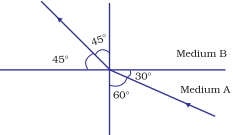
The figure shows a ray of light as it travels from medium $A$ to medium $B$. The refractive index of medium $B$ relative to medium $A$ is:
A
$\sqrt{2}$
B
$\sqrt{2} / \sqrt{3}$
C
$1 / \sqrt{2}$
D
$\sqrt{3} / \sqrt{2}$
Solution
(D) According to Snell's law,the refractive index of medium $B$ relative to medium $A$ $(n_{BA})$ is given by the ratio of the sine of the angle of incidence $(i)$ to the sine of the angle of refraction $(r)$:
$n_{BA} = \frac{\sin i}{\sin r}$
From the figure,the light ray travels from medium $A$ to medium $B$. The angle of incidence $i$ is the angle between the incident ray and the normal in medium $A$. Given the angle with the normal is $60^\circ$,so $i = 60^\circ$.
The angle of refraction $r$ is the angle between the refracted ray and the normal in medium $B$. Given the angle with the normal is $45^\circ$,so $r = 45^\circ$.
Substituting these values into Snell's law:
$n_{BA} = \frac{\sin 60^\circ}{\sin 45^\circ} = \frac{\sqrt{3}/2}{1/\sqrt{2}} = \frac{\sqrt{3}}{2} \times \sqrt{2} = \frac{\sqrt{3}}{\sqrt{2}}$
Therefore,the refractive index of medium $B$ relative to medium $A$ is $\sqrt{3} / \sqrt{2}$.
$n_{BA} = \frac{\sin i}{\sin r}$
From the figure,the light ray travels from medium $A$ to medium $B$. The angle of incidence $i$ is the angle between the incident ray and the normal in medium $A$. Given the angle with the normal is $60^\circ$,so $i = 60^\circ$.
The angle of refraction $r$ is the angle between the refracted ray and the normal in medium $B$. Given the angle with the normal is $45^\circ$,so $r = 45^\circ$.
Substituting these values into Snell's law:
$n_{BA} = \frac{\sin 60^\circ}{\sin 45^\circ} = \frac{\sqrt{3}/2}{1/\sqrt{2}} = \frac{\sqrt{3}}{2} \times \sqrt{2} = \frac{\sqrt{3}}{\sqrt{2}}$
Therefore,the refractive index of medium $B$ relative to medium $A$ is $\sqrt{3} / \sqrt{2}$.
0 likes
View Solution5
EasyMCQ
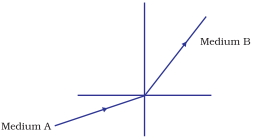
$A$ light ray enters from medium $A$ to medium $B$ as shown in the figure. The refractive index of medium $B$ relative to $A$ will be
A
greater than unity
B
less than unity
C
equal to unity
D
zero
Solution
(A) From the figure,we can observe the angles of incidence $(i)$ and refraction $(r)$.
By comparing the angles with the normal,we see that the angle of refraction $(r)$ is smaller than the angle of incidence $(i)$,i.e.,$r < i$.
According to Snell's Law,the refractive index of medium $B$ with respect to medium $A$ is given by $n_{BA} = \frac{\sin i}{\sin r}$.
Since $i > r$,it follows that $\sin i > \sin r$,which implies that $\frac{\sin i}{\sin r} > 1$.
Therefore,the refractive index of medium $B$ relative to $A$ is greater than unity.
By comparing the angles with the normal,we see that the angle of refraction $(r)$ is smaller than the angle of incidence $(i)$,i.e.,$r < i$.
According to Snell's Law,the refractive index of medium $B$ with respect to medium $A$ is given by $n_{BA} = \frac{\sin i}{\sin r}$.
Since $i > r$,it follows that $\sin i > \sin r$,which implies that $\frac{\sin i}{\sin r} > 1$.
Therefore,the refractive index of medium $B$ relative to $A$ is greater than unity.
0 likes
View Solution6
MediumMCQ
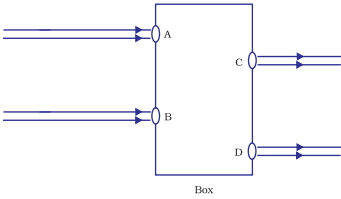
Beams of light are incident through the holes $A$ and $B$ and emerge out of the box through the holes $C$ and $D$ respectively,as shown in the figure. Which of the following could be inside the box?
A
$A$ convex lens
B
$A$ rectangular glass slab
C
$A$ concave lens
D
$A$ prism
Solution
(B) By observing the figure,we can see that the incident light beams entering through holes $A$ and $B$ emerge through holes $C$ and $D$ respectively,without any change in their direction or convergence/divergence.
This indicates that the light rays have undergone lateral displacement,which is a characteristic property of a rectangular glass slab.
$A$ convex lens would converge the rays,a concave lens would diverge them,and a prism would deviate the rays at an angle.
Therefore,a rectangular glass slab is the correct component inside the box.
This indicates that the light rays have undergone lateral displacement,which is a characteristic property of a rectangular glass slab.
$A$ convex lens would converge the rays,a concave lens would diverge them,and a prism would deviate the rays at an angle.
Therefore,a rectangular glass slab is the correct component inside the box.
0 likes
View Solution7
MediumMCQ
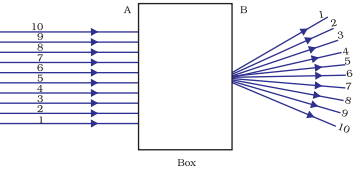
$A$ beam of light is incident through the holes on side $A$ and emerges out of the holes on the other face of the box as shown in the Figure. Which of the following could be inside the box?
A
Concave lens
B
Rectangular glass slab
C
Convex lens
D
Prism
Solution
(A) In the given figure,a parallel beam of light enters the box from side $A$ and emerges from side $B$ as a diverging beam.
$A$ convex lens is a converging lens,which would cause the parallel rays to converge at a point.
$A$ rectangular glass slab would cause a lateral shift but the rays would remain parallel to each other.
$A$ prism would deviate the rays but would not cause them to diverge in this specific pattern.
$A$ concave lens is a diverging lens,which causes parallel rays of light to spread out (diverge) after passing through it. Therefore,a concave lens is placed inside the box.
$A$ convex lens is a converging lens,which would cause the parallel rays to converge at a point.
$A$ rectangular glass slab would cause a lateral shift but the rays would remain parallel to each other.
$A$ prism would deviate the rays but would not cause them to diverge in this specific pattern.
$A$ concave lens is a diverging lens,which causes parallel rays of light to spread out (diverge) after passing through it. Therefore,a concave lens is placed inside the box.
0 likes
View Solution8
MediumMCQ
Which of the following statements is true?
A
$A$ concave lens has $-4$ dioptre power having a focal length $0.25 \, m$.
B
$A$ convex lens has $-4$ dioptre power having a focal length $0.25 \, m$.
C
$A$ concave lens has $4$ dioptre power having a focal length $0.25 \, m$.
D
$A$ convex lens has $4$ dioptre power having a focal length $0.25 \, m$.
Solution
(A) The power $P$ of a lens is given by the formula $P = 1/f$,where $f$ is the focal length in meters.
For a concave lens,the focal length is negative,and for a convex lens,it is positive.
Given $f = -0.25 \, m$ (for a concave lens),the power $P = 1/(-0.25) = -4 \, D$.
Therefore,a concave lens with a focal length of $-0.25 \, m$ has a power of $-4 \, D$.
For a concave lens,the focal length is negative,and for a convex lens,it is positive.
Given $f = -0.25 \, m$ (for a concave lens),the power $P = 1/(-0.25) = -4 \, D$.
Therefore,a concave lens with a focal length of $-0.25 \, m$ has a power of $-4 \, D$.
0 likes
View Solution9
MediumMCQ
Magnification produced by a rear-view mirror fitted in vehicles $....$
A
is less than one
B
is more than one
C
is equal to one
D
can be more than or less than one depending upon the position of the object in front of it
Solution
(A) rear-view mirror in vehicles is a convex mirror.
Convex mirrors always form virtual,erect,and diminished images of objects placed in front of them.
Since the image is always diminished (smaller than the object),the height of the image $(h')$ is always less than the height of the object $(h)$.
Magnification $(m)$ is defined as the ratio of the height of the image to the height of the object,i.e.,$m = h'/h$.
Because $h' < h$,the magnification $m$ is always less than $1$.
Convex mirrors always form virtual,erect,and diminished images of objects placed in front of them.
Since the image is always diminished (smaller than the object),the height of the image $(h')$ is always less than the height of the object $(h)$.
Magnification $(m)$ is defined as the ratio of the height of the image to the height of the object,i.e.,$m = h'/h$.
Because $h' < h$,the magnification $m$ is always less than $1$.
0 likes
View Solution10
MediumMCQ
Rays from the Sun converge at a point $15 \, cm$ in front of a concave mirror. Where should an object be placed so that the size of its image is equal to the size of the object?
A
$15 \, cm$ in front of the mirror
B
$30 \, cm$ in front of the mirror
C
Between $15 \, cm$ and $30 \, cm$ in front of the mirror
D
More than $30 \, cm$ in front of the mirror
Solution
(B) The rays from the Sun are parallel to the principal axis and converge at the focus $(F)$ of the concave mirror. Therefore,the focal length $(f)$ of the mirror is $15 \, cm$.
For a concave mirror,the image size is equal to the object size when the object is placed at the center of curvature $(C)$.
The center of curvature is at a distance equal to twice the focal length $(R = 2f)$.
Thus,$R = 2 \times 15 \, cm = 30 \, cm$.
Therefore,the object should be placed at $30 \, cm$ in front of the mirror.
For a concave mirror,the image size is equal to the object size when the object is placed at the center of curvature $(C)$.
The center of curvature is at a distance equal to twice the focal length $(R = 2f)$.
Thus,$R = 2 \times 15 \, cm = 30 \, cm$.
Therefore,the object should be placed at $30 \, cm$ in front of the mirror.
0 likes
View Solution11
EasyMCQ
$A$ full-length image of a distant tall building can definitely be seen by using:
A
a concave mirror
B
a plane mirror
C
a convex mirror
D
both concave as well as plane mirror
Solution
(C) convex mirror is used to see a full-length image of a distant tall building because it always forms a virtual,erect,and diminished image of objects placed in front of it. Due to its outward-curved surface,it has a wider field of view,allowing it to capture the entire image of a large object within a small mirror area. Plane mirrors would require a mirror of at least half the height of the building to see the full image,which is impractical for a distant tall building.
0 likes
View Solution12
MediumMCQ
In torches,searchlights,and headlights of vehicles,the bulb is placed:
A
between the pole and the focus of the reflector
B
at the centre of curvature of the reflector
C
between the focus and centre of curvature of the reflector
D
very near to the focus of the reflector
Solution
(D) In torches,searchlights,and vehicle headlights,a concave mirror is used as a reflector.
According to the properties of a concave mirror,when a light source (bulb) is placed at the focus $(F)$,the light rays emanating from it strike the mirror and are reflected as a parallel beam of light.
This parallel beam of light travels over a long distance,which is essential for these devices to illuminate distant objects.
Therefore,the bulb is placed very near to the focus of the reflector.
According to the properties of a concave mirror,when a light source (bulb) is placed at the focus $(F)$,the light rays emanating from it strike the mirror and are reflected as a parallel beam of light.
This parallel beam of light travels over a long distance,which is essential for these devices to illuminate distant objects.
Therefore,the bulb is placed very near to the focus of the reflector.
0 likes
View Solution13
EasyMCQ
The laws of reflection hold good for
A
all mirrors irrespective of their shape
B
concave mirrors only
C
convex mirrors only
D
plane mirrors only
Solution
(A) The laws of reflection state that:
$1$. The angle of incidence is equal to the angle of reflection $(i = r)$.
$2$. The incident ray,the reflected ray,and the normal to the mirror surface at the point of incidence all lie in the same plane.
These laws are universal and apply to all types of reflecting surfaces,including plane mirrors,concave mirrors,and convex mirrors,regardless of their shape or curvature.
$1$. The angle of incidence is equal to the angle of reflection $(i = r)$.
$2$. The incident ray,the reflected ray,and the normal to the mirror surface at the point of incidence all lie in the same plane.
These laws are universal and apply to all types of reflecting surfaces,including plane mirrors,concave mirrors,and convex mirrors,regardless of their shape or curvature.
0 likes
View Solution14
MediumMCQ
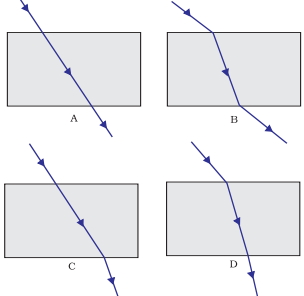
The path of a ray of light coming from air passing through a rectangular glass slab traced by four students are shown as $A, B, C$ and $D$ in the figure. Which one of them is correct?
A
$A$
B
$B$
C
$C$
D
$D$
Solution
(B) When a light ray travels from a rarer medium (air) to a denser medium (glass),it bends towards the normal at the point of incidence.
When the light ray emerges from the denser medium (glass) back into the rarer medium (air),it bends away from the normal.
In figure $B$,the ray bends towards the normal upon entering the glass slab and bends away from the normal upon exiting it,which correctly follows the laws of refraction.
Therefore,the path shown in $B$ is correct.
When the light ray emerges from the denser medium (glass) back into the rarer medium (air),it bends away from the normal.
In figure $B$,the ray bends towards the normal upon entering the glass slab and bends away from the normal upon exiting it,which correctly follows the laws of refraction.
Therefore,the path shown in $B$ is correct.
0 likes
View Solution15
EasyMCQ
You are given water,mustard oil,glycerine,and kerosene. In which of these media would a ray of light incident obliquely at the same angle bend the most?
A
Kerosene
B
Water
C
Glycerine
D
Mustard oil
Solution
(C) The bending of light (refraction) depends on the refractive index of the medium. $A$ higher refractive index means the medium is optically denser,causing light to bend more towards the normal when entering from air.
The refractive indices of the given media are approximately:
$1$. Water: $1.33$
$2$. Kerosene: $1.44$
$3$. Mustard oil: $1.46$
$4$. Glycerine: $1.47$
Since glycerine has the highest refractive index among the given options,a ray of light incident obliquely at the same angle will bend the most in glycerine.
The refractive indices of the given media are approximately:
$1$. Water: $1.33$
$2$. Kerosene: $1.44$
$3$. Mustard oil: $1.46$
$4$. Glycerine: $1.47$
Since glycerine has the highest refractive index among the given options,a ray of light incident obliquely at the same angle will bend the most in glycerine.
0 likes
View Solution16
EasyMCQ
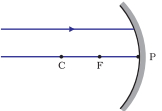
Which of the following ray diagrams is correct for the ray of light incident on a concave mirror as shown in Figure?
A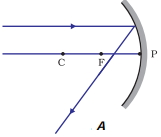
B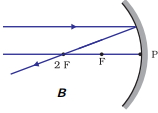
C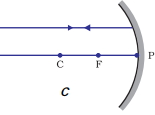
D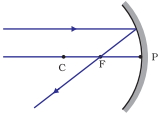
Solution
(D) According to the rules of reflection for a concave mirror,a ray of light parallel to the principal axis,after reflection,passes through the principal focus $(F)$ of the mirror.
In the given figure,the incident ray is parallel to the principal axis.
Therefore,after reflection,it must pass through the principal focus $(F)$.
Looking at the options,option $D$ correctly shows the reflected ray passing through the principal focus $(F)$.
Thus,the correct ray diagram is $D$.
In the given figure,the incident ray is parallel to the principal axis.
Therefore,after reflection,it must pass through the principal focus $(F)$.
Looking at the options,option $D$ correctly shows the reflected ray passing through the principal focus $(F)$.
Thus,the correct ray diagram is $D$.
0 likes
View Solution17
EasyMCQ
Which of the following ray diagrams is correct for the ray of light incident on a lens shown in the figure?
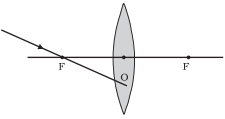
A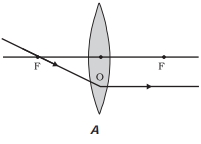
B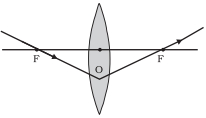
C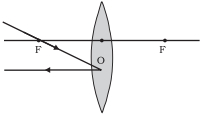
D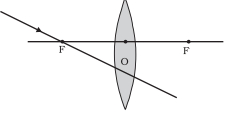
Solution
(A) According to the rules of refraction for a convex lens,a ray of light passing through the principal focus $(F)$ of a convex lens becomes parallel to the principal axis after refraction.
In the given figure,the incident ray is passing through the principal focus $(F)$ before hitting the lens.
Therefore,after refraction through the convex lens,this ray must emerge parallel to the principal axis.
Comparing this with the given options,diagram $A$ correctly depicts this behavior where the ray becomes parallel to the principal axis after passing through the lens.
In the given figure,the incident ray is passing through the principal focus $(F)$ before hitting the lens.
Therefore,after refraction through the convex lens,this ray must emerge parallel to the principal axis.
Comparing this with the given options,diagram $A$ correctly depicts this behavior where the ray becomes parallel to the principal axis after passing through the lens.
0 likes
View Solution18
MediumMCQ
$A$ child is standing in front of a magic mirror. She finds the image of her head bigger, the middle portion of her body of the same size, and that of the legs smaller. What is the order of combinations for the magic mirror from the top?
A
Plane, convex and concave
B
Concave, plane and convex
C
Convex, concave and plane
D
Convex, plane and concave
Solution
(B) $1$. $A$ concave mirror produces a magnified image when the object is placed close to it. Since the head appears bigger, the top part of the mirror is concave.
$2$. $A$ plane mirror produces an image of the same size as the object. Since the middle portion appears of the same size, the middle part of the mirror is plane.
$3$. $A$ convex mirror always produces a diminished (smaller) image. Since the legs appear smaller, the bottom part of the mirror is convex.
$4$. Therefore, the order of the mirrors from top to bottom is concave, plane, and convex.
$2$. $A$ plane mirror produces an image of the same size as the object. Since the middle portion appears of the same size, the middle part of the mirror is plane.
$3$. $A$ convex mirror always produces a diminished (smaller) image. Since the legs appear smaller, the bottom part of the mirror is convex.
$4$. Therefore, the order of the mirrors from top to bottom is concave, plane, and convex.
0 likes
View Solution19
MediumMCQ
In which of the following,the image of an object placed at infinity will be highly diminished and point-sized?
A
Concave mirror only
B
Convex mirror only
C
Concave mirror,convex mirror,concave lens and convex lens
D
Convex lens only
Solution
(C) When an object is placed at infinity,the rays of light coming from it are parallel to the principal axis.
In a concave mirror,these rays converge at the focus $(F)$,forming a highly diminished,point-sized,real,and inverted image.
In a convex mirror,these rays appear to diverge from the focus $(F)$ behind the mirror,forming a highly diminished,point-sized,virtual,and erect image.
In a concave lens,these rays appear to diverge from the focus $(F)$ on the same side,forming a highly diminished,point-sized,virtual,and erect image.
In a convex lens,these rays converge at the focus $(F)$ on the other side,forming a highly diminished,point-sized,real,and inverted image.
Therefore,all four optical elements produce a highly diminished and point-sized image for an object at infinity.
In a concave mirror,these rays converge at the focus $(F)$,forming a highly diminished,point-sized,real,and inverted image.
In a convex mirror,these rays appear to diverge from the focus $(F)$ behind the mirror,forming a highly diminished,point-sized,virtual,and erect image.
In a concave lens,these rays appear to diverge from the focus $(F)$ on the same side,forming a highly diminished,point-sized,virtual,and erect image.
In a convex lens,these rays converge at the focus $(F)$ on the other side,forming a highly diminished,point-sized,real,and inverted image.
Therefore,all four optical elements produce a highly diminished and point-sized image for an object at infinity.
0 likes
View Solution20
Medium
Identify the device used as a spherical mirror or lens in the following cases,where the image formed is virtual and erect in each case.
$(a)$ Object is placed between the device and its focus,image formed is enlarged and behind it.
$(b)$ Object is placed between the focus and the device,image formed is enlarged and on the same side as that of the object.
$(c)$ Object is placed between infinity and the device,image formed is diminished and between the focus and optical centre on the same side as that of the object.
$(d)$ Object is placed between infinity and the device,image formed is diminished and between the pole and focus,behind it.
$(a)$ Object is placed between the device and its focus,image formed is enlarged and behind it.
$(b)$ Object is placed between the focus and the device,image formed is enlarged and on the same side as that of the object.
$(c)$ Object is placed between infinity and the device,image formed is diminished and between the focus and optical centre on the same side as that of the object.
$(d)$ Object is placed between infinity and the device,image formed is diminished and between the pole and focus,behind it.
Solution
(A-D) Concave mirror: When an object is placed between the pole and the focus of a concave mirror,a virtual,erect,and enlarged image is formed behind the mirror.
$(b)$ Convex lens: When an object is placed between the optical centre and the focus of a convex lens,a virtual,erect,and enlarged image is formed on the same side as the object.
$(c)$ Concave lens: $A$ concave lens always forms a virtual,erect,and diminished image between the optical centre and the focus,regardless of the object's position (between infinity and the lens).
$(d)$ Convex mirror: $A$ convex mirror always forms a virtual,erect,and diminished image between the pole and the focus,behind the mirror,for any object position between infinity and the pole.
$(b)$ Convex lens: When an object is placed between the optical centre and the focus of a convex lens,a virtual,erect,and enlarged image is formed on the same side as the object.
$(c)$ Concave lens: $A$ concave lens always forms a virtual,erect,and diminished image between the optical centre and the focus,regardless of the object's position (between infinity and the lens).
$(d)$ Convex mirror: $A$ convex mirror always forms a virtual,erect,and diminished image between the pole and the focus,behind the mirror,for any object position between infinity and the pole.
0 likes
View Solution21
Difficult
Why does a light ray incident on a rectangular glass slab immersed in any medium emerge parallel to itself? Explain.
Solution
(N/A) When a light ray enters a rectangular glass slab,it undergoes refraction at two parallel interfaces.
$1$. At the first interface (air-glass),the light ray bends towards the normal because it travels from a rarer to a denser medium.
$2$. At the second interface (glass-air),the light ray bends away from the normal as it travels from a denser to a rarer medium.
$3$. According to Snell's Law,the angle of incidence at the first surface is equal to the angle of emergence at the second surface because the opposite sides of the rectangular slab are parallel.
$4$. Consequently,the emergent ray is parallel to the incident ray,but it undergoes a lateral displacement.
$1$. At the first interface (air-glass),the light ray bends towards the normal because it travels from a rarer to a denser medium.
$2$. At the second interface (glass-air),the light ray bends away from the normal as it travels from a denser to a rarer medium.
$3$. According to Snell's Law,the angle of incidence at the first surface is equal to the angle of emergence at the second surface because the opposite sides of the rectangular slab are parallel.
$4$. Consequently,the emergent ray is parallel to the incident ray,but it undergoes a lateral displacement.
0 likes
View Solution22
Medium
$A$ pencil when dipped in water in a glass tumbler appears to be bent at the interface of air and water. Will the pencil appear to be bent to the same extent,if instead of water we use liquids like kerosene or turpentine? Support your answer with reason.
Solution
(B) No,the pencil will not appear to be bent to the same extent. The extent of bending of the pencil depends on the refractive index of the liquid used. Since different liquids like kerosene and turpentine have different refractive indices compared to water,the angle of refraction will vary. The bending of light at the interface of two media is determined by the relative refractive index,which dictates the change in the velocity of light as it passes from one medium to another.
1 likes
View Solution23
Easy
How is the refractive index of a medium related to the speed of light? Obtain an expression for the refractive index of a medium with respect to another in terms of the speed of light in these two media.
Solution
(N/A) The refractive index $(n)$ of a medium is defined as the ratio of the speed of light in a vacuum $(c)$ to the speed of light in that medium $(v)$. Mathematically,it is expressed as: $n = \frac{c}{v}$.
To find the refractive index of medium $2$ with respect to medium $1$ $(n_{21})$,we take the ratio of the speed of light in medium $1$ $(v_1)$ to the speed of light in medium $2$ $(v_2)$. The expression is: $n_{21} = \frac{v_1}{v_2}$.
To find the refractive index of medium $2$ with respect to medium $1$ $(n_{21})$,we take the ratio of the speed of light in medium $1$ $(v_1)$ to the speed of light in medium $2$ $(v_2)$. The expression is: $n_{21} = \frac{v_1}{v_2}$.
0 likes
View Solution24
MediumMCQ
Refractive index of diamond with respect to glass is $1.6$ and absolute refractive index of glass is $1.5$. Find out the absolute refractive index of diamond.
A
$4.2$
B
$3.1$
C
$1.067$
D
$2.4$
Solution
(D) The refractive index of diamond with respect to glass is given by $n_{dg} = \frac{n_d}{n_g} = 1.6$.
Here,$n_d$ is the absolute refractive index of diamond and $n_g$ is the absolute refractive index of glass.
Given that $n_g = 1.5$.
Substituting the values,we get $\frac{n_d}{1.5} = 1.6$.
Therefore,$n_d = 1.6 \times 1.5 = 2.4$.
Here,$n_d$ is the absolute refractive index of diamond and $n_g$ is the absolute refractive index of glass.
Given that $n_g = 1.5$.
Substituting the values,we get $\frac{n_d}{1.5} = 1.6$.
Therefore,$n_d = 1.6 \times 1.5 = 2.4$.
0 likes
View Solution25
Medium
$A$ convex lens of focal length $20 \, cm$ can produce a magnified virtual as well as real image. Is this a correct statement? If yes,where shall the object be placed in each case for obtaining these images?
Solution
(N/A) Yes,the statement is correct.
$1$. To obtain a magnified virtual image,the object must be placed between the optical center $(O)$ and the principal focus $(F_1)$,i.e.,at a distance less than $20 \, cm$ from the lens.
$2$. To obtain a magnified real image,the object must be placed between the principal focus $(F_1)$ and the center of curvature $(2F_1)$,i.e.,at a distance greater than $20 \, cm$ but less than $40 \, cm$ from the lens.
$1$. To obtain a magnified virtual image,the object must be placed between the optical center $(O)$ and the principal focus $(F_1)$,i.e.,at a distance less than $20 \, cm$ from the lens.
$2$. To obtain a magnified real image,the object must be placed between the principal focus $(F_1)$ and the center of curvature $(2F_1)$,i.e.,at a distance greater than $20 \, cm$ but less than $40 \, cm$ from the lens.
0 likes
View Solution26
MediumMCQ
Sudha finds out that the sharp image of the window pane of her science laboratory is formed at a distance of $15\, cm$ from the lens. She now tries to focus the building visible to her outside the window instead of the window pane without disturbing the lens. In which direction will she move the screen to obtain a sharp image of the building? What is the approximate focal length of this lens?
A
Towards the lens; $15\, cm$
B
Away from the lens; $15\, cm$
C
Towards the lens; $30\, cm$
D
Away from the lens; $30\, cm$
Solution
(A) When the object is at a large distance (like a building outside),the rays of light coming from it are considered parallel to the principal axis.
According to the lens formula,for an object at infinity,the image is formed at the principal focus $(F)$.
Since the image of the nearby window pane was formed at $15\, cm$,the building (which is much further away) will form an image closer to the focal point of the lens.
Therefore,Sudha should move the screen towards the lens to obtain a sharp image of the building.
The approximate focal length of the lens is equal to the image distance of the distant object,which is $15\, cm$.
According to the lens formula,for an object at infinity,the image is formed at the principal focus $(F)$.
Since the image of the nearby window pane was formed at $15\, cm$,the building (which is much further away) will form an image closer to the focal point of the lens.
Therefore,Sudha should move the screen towards the lens to obtain a sharp image of the building.
The approximate focal length of the lens is equal to the image distance of the distant object,which is $15\, cm$.
0 likes
View Solution27
Medium
How are power and focal length of a lens related? You are provided with two lenses of focal length $20\, cm$ and $40\, cm$ respectively. Which lens will you use to obtain more convergent light?
Solution
(A) The power $(P)$ of a lens is defined as the reciprocal of its focal length $(f)$ in meters,expressed as $P = \frac{1}{f(m)}$.
This indicates that power is inversely proportional to the focal length $(P \propto \frac{1}{f})$.
$A$ lens with a shorter focal length has a higher power and thus a greater ability to converge light rays.
Comparing the two lenses,the lens with a focal length of $20\, cm$ has a higher power than the lens with a focal length of $40\, cm$.
Therefore,the lens with a focal length of $20\, cm$ will provide more convergent light.
This indicates that power is inversely proportional to the focal length $(P \propto \frac{1}{f})$.
$A$ lens with a shorter focal length has a higher power and thus a greater ability to converge light rays.
Comparing the two lenses,the lens with a focal length of $20\, cm$ has a higher power than the lens with a focal length of $40\, cm$.
Therefore,the lens with a focal length of $20\, cm$ will provide more convergent light.
1 likes
View Solution28
Difficult
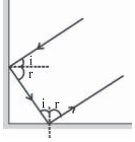
Under what condition in an arrangement of two plane mirrors,will the incident ray and the final reflected ray always be parallel to each other,regardless of the angle of incidence? Show the same with the help of a diagram.
Solution
(N/A) When two plane mirrors are placed at an angle of $90^{\circ}$ to each other,the incident ray and the final reflected ray will always be parallel to each other,regardless of the angle of incidence.
Explanation:
$1$. Let the two mirrors be $M_1$ and $M_2$ placed at $90^{\circ}$.
$2$. The incident ray strikes $M_1$ at an angle of incidence $i$. According to the law of reflection,the angle of reflection $r = i$.
$3$. The reflected ray from $M_1$ acts as the incident ray for $M_2$. By geometry,the angle of incidence at $M_2$ will be $(90^{\circ} - i)$.
$4$. The final angle of reflection at $M_2$ will also be $(90^{\circ} - i)$.
$5$. By calculating the total deviation or the angles with the normal,it can be shown that the final reflected ray is parallel to the initial incident ray.
Explanation:
$1$. Let the two mirrors be $M_1$ and $M_2$ placed at $90^{\circ}$.
$2$. The incident ray strikes $M_1$ at an angle of incidence $i$. According to the law of reflection,the angle of reflection $r = i$.
$3$. The reflected ray from $M_1$ acts as the incident ray for $M_2$. By geometry,the angle of incidence at $M_2$ will be $(90^{\circ} - i)$.
$4$. The final angle of reflection at $M_2$ will also be $(90^{\circ} - i)$.
$5$. By calculating the total deviation or the angles with the normal,it can be shown that the final reflected ray is parallel to the initial incident ray.
0 likes
View Solution29
Medium
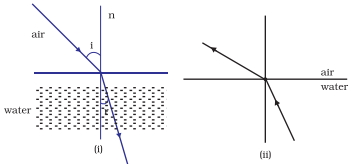
Draw a ray diagram showing the path of rays of light when it enters with oblique incidence: $(i)$ from air into water; $(ii)$ from water into air.
Solution
(N/A) When light travels from a rarer medium (air) to a denser medium (water),it bends towards the normal. In this case,the angle of refraction $(r)$ is less than the angle of incidence $(i)$.
When light travels from a denser medium (water) to a rarer medium (air),it bends away from the normal. In this case,the angle of refraction $(r)$ is greater than the angle of incidence $(i)$.
The ray diagrams are provided in the image.
When light travels from a denser medium (water) to a rarer medium (air),it bends away from the normal. In this case,the angle of refraction $(r)$ is greater than the angle of incidence $(i)$.
The ray diagrams are provided in the image.
0 likes
View Solution30
Medium
Draw ray diagrams showing the image formation by a concave mirror when an object is placed:
$(a)$ Between pole $(P)$ and focus $(F)$ of the mirror.
$(b)$ Between focus $(F)$ and centre of curvature $(C)$ of the mirror.
$(c)$ At centre of curvature $(C)$ of the mirror.
$(d)$ $A$ little beyond centre of curvature $(C)$ of the mirror.
$(e)$ At infinity.
$(a)$ Between pole $(P)$ and focus $(F)$ of the mirror.
$(b)$ Between focus $(F)$ and centre of curvature $(C)$ of the mirror.
$(c)$ At centre of curvature $(C)$ of the mirror.
$(d)$ $A$ little beyond centre of curvature $(C)$ of the mirror.
$(e)$ At infinity.
Solution
(N/A) To draw the ray diagrams for a concave mirror,follow these steps for each case:
$(a)$ Between $P$ and $F$: The image is virtual,erect,and magnified,formed behind the mirror.
$(b)$ Between $F$ and $C$: The image is real,inverted,and magnified,formed beyond $C$.
$(c)$ At $C$: The image is real,inverted,and of the same size as the object,formed at $C$.
$(d)$ Beyond $C$: The image is real,inverted,and diminished,formed between $F$ and $C$.
$(e)$ At infinity: The image is real,inverted,and highly diminished (point-sized),formed at the focus $F$.
$(a)$ Between $P$ and $F$: The image is virtual,erect,and magnified,formed behind the mirror.
$(b)$ Between $F$ and $C$: The image is real,inverted,and magnified,formed beyond $C$.
$(c)$ At $C$: The image is real,inverted,and of the same size as the object,formed at $C$.
$(d)$ Beyond $C$: The image is real,inverted,and diminished,formed between $F$ and $C$.
$(e)$ At infinity: The image is real,inverted,and highly diminished (point-sized),formed at the focus $F$.
0 likes
View Solution31
Medium
Draw ray diagrams showing the image formation by a convex lens when an object is placed:
$(a)$ Between optical centre and focus of the lens.
$(b)$ Between focus and twice the focal length of the lens.
$(c)$ At twice the focal length of the lens.
$(d)$ At infinity.
$(e)$ At the focus of the lens.
$(a)$ Between optical centre and focus of the lens.
$(b)$ Between focus and twice the focal length of the lens.
$(c)$ At twice the focal length of the lens.
$(d)$ At infinity.
$(e)$ At the focus of the lens.
Solution
(N/A) To draw the ray diagrams for a convex lens,follow these steps for each case:
$(a)$ When the object is between the optical centre $(O)$ and focus $(F_1)$: The image is virtual,erect,and magnified,formed on the same side as the object.
$(b)$ When the object is between $F_1$ and $2F_1$: The image is real,inverted,and magnified,formed beyond $2F_2$ on the other side.
$(c)$ When the object is at $2F_1$: The image is real,inverted,and of the same size as the object,formed at $2F_2$.
$(d)$ When the object is at infinity: The image is real,inverted,and highly diminished (point-sized),formed at the focus $F_2$.
$(e)$ When the object is at the focus $F_1$: The image is real,inverted,and highly magnified,formed at infinity.
$(a)$ When the object is between the optical centre $(O)$ and focus $(F_1)$: The image is virtual,erect,and magnified,formed on the same side as the object.
$(b)$ When the object is between $F_1$ and $2F_1$: The image is real,inverted,and magnified,formed beyond $2F_2$ on the other side.
$(c)$ When the object is at $2F_1$: The image is real,inverted,and of the same size as the object,formed at $2F_2$.
$(d)$ When the object is at infinity: The image is real,inverted,and highly diminished (point-sized),formed at the focus $F_2$.
$(e)$ When the object is at the focus $F_1$: The image is real,inverted,and highly magnified,formed at infinity.
0 likes
View Solution32
Difficult
State the laws of refraction. Explain the phenomenon of refraction when a ray of light passes through a rectangular glass slab with the help of a ray diagram.
Solution
(N/A) The laws of refraction are as follows:
$1$. The incident ray, the refracted ray, and the normal to the interface of two transparent media at the point of incidence all lie in the same plane.
$2$. Snell's Law: The ratio of the sine of the angle of incidence to the sine of the angle of refraction is a constant for the light of a given color and for a given pair of media, expressed as $\frac{\sin i}{\sin r} = \text{constant} = n_{21}$.
When a light ray passes through a rectangular glass slab:
- The ray enters from air to glass (denser medium) and bends towards the normal.
- It travels through the glass and exits from glass to air (rarer medium), bending away from the normal.
- The emergent ray is parallel to the incident ray but laterally displaced. This perpendicular distance between the original path of the incident ray and the emergent ray is called lateral displacement.
$1$. The incident ray, the refracted ray, and the normal to the interface of two transparent media at the point of incidence all lie in the same plane.
$2$. Snell's Law: The ratio of the sine of the angle of incidence to the sine of the angle of refraction is a constant for the light of a given color and for a given pair of media, expressed as $\frac{\sin i}{\sin r} = \text{constant} = n_{21}$.
When a light ray passes through a rectangular glass slab:
- The ray enters from air to glass (denser medium) and bends towards the normal.
- It travels through the glass and exits from glass to air (rarer medium), bending away from the normal.
- The emergent ray is parallel to the incident ray but laterally displaced. This perpendicular distance between the original path of the incident ray and the emergent ray is called lateral displacement.
0 likes
View Solution33
Medium
Draw ray diagrams showing the image formation by a concave lens when an object is placed:
$(a)$ at the focus of the lens
$(b)$ between focus and twice the focal length of the lens
$(c)$ beyond twice the focal length of the lens
$(a)$ at the focus of the lens
$(b)$ between focus and twice the focal length of the lens
$(c)$ beyond twice the focal length of the lens
Solution
(N/A) For a concave lens,the image formed is always virtual,erect,and diminished,regardless of the object's position.
$(a)$ When the object is at the focus $(F_1)$,the rays appear to diverge from a point between the optical center $(O)$ and the focus $(F_1)$. The image is virtual,erect,and highly diminished.
$(b)$ When the object is between the focus $(F_1)$ and twice the focal length $(2F_1)$,the image is formed between the optical center $(O)$ and the focus $(F_1)$. The image is virtual,erect,and diminished.
$(c)$ When the object is beyond twice the focal length $(2F_1)$,the image is formed between the optical center $(O)$ and the focus $(F_1)$. The image is virtual,erect,and diminished.
$(a)$ When the object is at the focus $(F_1)$,the rays appear to diverge from a point between the optical center $(O)$ and the focus $(F_1)$. The image is virtual,erect,and highly diminished.
$(b)$ When the object is between the focus $(F_1)$ and twice the focal length $(2F_1)$,the image is formed between the optical center $(O)$ and the focus $(F_1)$. The image is virtual,erect,and diminished.
$(c)$ When the object is beyond twice the focal length $(2F_1)$,the image is formed between the optical center $(O)$ and the focus $(F_1)$. The image is virtual,erect,and diminished.
0 likes
View Solution34
Medium
Draw ray diagrams showing the image formation by a convex mirror when an object is placed:
$(a)$ at infinity
$(b)$ at a finite distance from the mirror
$(a)$ at infinity
$(b)$ at a finite distance from the mirror
Solution
(N/A) For a convex mirror:
$(a)$ When the object is at infinity,the incident rays are parallel to the principal axis. After reflection,they appear to diverge from the principal focus $(F)$ behind the mirror. The image formed is virtual,erect,highly diminished,and located at the principal focus $(F)$ behind the mirror.
$(b)$ When the object is at a finite distance from the mirror,the image formed is always virtual,erect,and diminished. It is located between the pole $(P)$ and the principal focus $(F)$ behind the mirror,regardless of the object's distance.
$(a)$ When the object is at infinity,the incident rays are parallel to the principal axis. After reflection,they appear to diverge from the principal focus $(F)$ behind the mirror. The image formed is virtual,erect,highly diminished,and located at the principal focus $(F)$ behind the mirror.
$(b)$ When the object is at a finite distance from the mirror,the image formed is always virtual,erect,and diminished. It is located between the pole $(P)$ and the principal focus $(F)$ behind the mirror,regardless of the object's distance.
0 likes
View Solution35
DifficultMCQ
The image of a candle flame formed by a lens is obtained on a screen placed on the other side of the lens. If the image is three times the size of the flame and the distance between the lens and the image is $80 \, cm$,at what distance should the candle be placed from the lens? What is the nature of the image at a distance of $80 \, cm$ from the lens (in $, cm$)?
A
$26.67$
B
$30$
C
$20$
D
$40$
Solution
(A) Given that the image is formed on a screen,it must be a real image.
For a real image,the magnification $m$ is negative. Given $m = -3$.
We know that $m = \frac{v}{u}$,where $v$ is the image distance and $u$ is the object distance.
Since the image is on the other side of the lens,$v = +80 \, cm$.
Using the magnification formula: $-3 = \frac{80}{u}$.
Therefore,$u = -\frac{80}{3} \, cm \approx -26.67 \, cm$.
The negative sign indicates that the object is placed in front of the lens at a distance of $26.67 \, cm$.
The nature of the image is real and inverted,and the lens used is a convex lens.
For a real image,the magnification $m$ is negative. Given $m = -3$.
We know that $m = \frac{v}{u}$,where $v$ is the image distance and $u$ is the object distance.
Since the image is on the other side of the lens,$v = +80 \, cm$.
Using the magnification formula: $-3 = \frac{80}{u}$.
Therefore,$u = -\frac{80}{3} \, cm \approx -26.67 \, cm$.
The negative sign indicates that the object is placed in front of the lens at a distance of $26.67 \, cm$.
The nature of the image is real and inverted,and the lens used is a convex lens.
0 likes
View Solution36
Difficult
The size of an image of an object formed by a mirror with a focal length of $20\, cm$ is observed to be reduced to $1/3^{rd}$ of its size. At what distance is the object placed from the mirror? What is the nature of the image and the mirror?
Solution
(D) Given: Focal length $f = -20\, cm$ (for a concave mirror),Magnification $m = -1/3$ (for a real and inverted image).
Using the magnification formula $m = -v/u$,we get $-1/3 = -v/u$,which implies $v = u/3$.
Using the mirror formula $\frac{1}{v} + \frac{1}{u} = \frac{1}{f}$,substitute $v = u/3$:
$\frac{1}{u/3} + \frac{1}{u} = \frac{1}{-20}$
$\frac{3}{u} + \frac{1}{u} = -\frac{1}{20}$
$\frac{4}{u} = -\frac{1}{20}$
$u = -80\, cm$.
The object is placed at a distance of $80\, cm$ from the mirror.
The image is real and inverted,and the mirror is concave.
Using the magnification formula $m = -v/u$,we get $-1/3 = -v/u$,which implies $v = u/3$.
Using the mirror formula $\frac{1}{v} + \frac{1}{u} = \frac{1}{f}$,substitute $v = u/3$:
$\frac{1}{u/3} + \frac{1}{u} = \frac{1}{-20}$
$\frac{3}{u} + \frac{1}{u} = -\frac{1}{20}$
$\frac{4}{u} = -\frac{1}{20}$
$u = -80\, cm$.
The object is placed at a distance of $80\, cm$ from the mirror.
The image is real and inverted,and the mirror is concave.
0 likes
View Solution37
Medium
Define power of a lens. What is its unit? One student uses a lens of focal length $50\, cm$ and another of $-50\, cm$. What is the nature of the lens and its power used by each of them?
Solution
(A) The power of a lens is defined as the reciprocal of its focal length in meters,given by the formula $P = \frac{1}{f(m)}$.
The $SI$ unit of power of a lens is Dioptre $(D)$.
For the first student,the focal length $f = 50\, cm = 0.5\, m$. Since the focal length is positive,the lens is a convex lens. Its power $P = \frac{1}{0.5} = +2\, D$.
For the second student,the focal length $f = -50\, cm = -0.5\, m$. Since the focal length is negative,the lens is a concave lens. Its power $P = \frac{1}{-0.5} = -2\, D$.
The $SI$ unit of power of a lens is Dioptre $(D)$.
For the first student,the focal length $f = 50\, cm = 0.5\, m$. Since the focal length is positive,the lens is a convex lens. Its power $P = \frac{1}{0.5} = +2\, D$.
For the second student,the focal length $f = -50\, cm = -0.5\, m$. Since the focal length is negative,the lens is a concave lens. Its power $P = \frac{1}{-0.5} = -2\, D$.
0 likes
View Solution38
Difficult
$A$ student focused the image of a candle flame on a white screen using a convex lens. He noted down the positions of the candle,screen,and lens as follows:
Position of candle $= 12.0 \, cm$
Position of convex lens $= 50.0 \, cm$
Position of the screen $= 88.0 \, cm$
$(i)$ What is the focal length of the convex lens?
$(ii)$ Where will the image be formed if he shifts the candle towards the lens to a position of $31.0 \, cm$?
Position of candle $= 12.0 \, cm$
Position of convex lens $= 50.0 \, cm$
Position of the screen $= 88.0 \, cm$
$(i)$ What is the focal length of the convex lens?
$(ii)$ Where will the image be formed if he shifts the candle towards the lens to a position of $31.0 \, cm$?
Solution
(A) $(i)$ The object distance $u = 50.0 - 12.0 = 38.0 \, cm$. The image distance $v = 88.0 - 50.0 = 38.0 \, cm$. Since $u = v$,the object is placed at $2f$. Thus,$2f = 38.0 \, cm$,which gives the focal length $f = 19.0 \, cm$.
$(ii)$ If the candle is shifted to $31.0 \, cm$,the new object distance $u' = 50.0 - 31.0 = 19.0 \, cm$. Since the object is now placed at the focus $(u' = f = 19.0 \, cm)$,the image will be formed at infinity.
$(ii)$ If the candle is shifted to $31.0 \, cm$,the new object distance $u' = 50.0 - 31.0 = 19.0 \, cm$. Since the object is now placed at the focus $(u' = f = 19.0 \, cm)$,the image will be formed at infinity.
0 likes
View Solution39
Medium
$A$ student focussed the image of a candle flame on a white screen using a convex lens. He noted down the position of the candle,screen,and the lens as under:
Position of candle $= 12.0\, cm$
Position of convex lens $= 50.0\, cm$
Position of the screen $= 88.0\, cm$
$(i)$ Where will the image be formed if he shifts the candle towards the lens at a position of $31.0\, cm$?
$(ii)$ What will be the nature of the image formed if he further shifts the candle towards the lens?
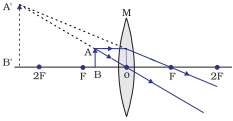
$(iii)$ Draw a ray diagram to show the formation of the image in case $(ii)$ as said above.
Position of candle $= 12.0\, cm$
Position of convex lens $= 50.0\, cm$
Position of the screen $= 88.0\, cm$
$(i)$ Where will the image be formed if he shifts the candle towards the lens at a position of $31.0\, cm$?
$(ii)$ What will be the nature of the image formed if he further shifts the candle towards the lens?
$(iii)$ Draw a ray diagram to show the formation of the image in case $(ii)$ as said above.
Solution
(N/A) First,calculate the focal length $(f)$ of the lens:
Object distance $u = 12.0 - 50.0 = -38.0\, cm$
Image distance $v = 88.0 - 50.0 = +38.0\, cm$
Using the lens formula: $\frac{1}{v} - \frac{1}{u} = \frac{1}{f}$
$\frac{1}{38} - \frac{1}{-38} = \frac{1}{f} \implies \frac{2}{38} = \frac{1}{f} \implies f = 19.0\, cm$
$(i)$ New object position $= 31.0\, cm$. New $u = 31.0 - 50.0 = -19.0\, cm$. Since the object is at the focus $(u = -f)$,the image will be formed at infinity.
$(ii)$ If the candle is shifted further towards the lens (i.e.,$u < f$),the object lies between the optical center and the focus. The image formed will be virtual,erect,and magnified.
$(iii)$ The ray diagram shows the object placed between $F$ and $O$,resulting in a virtual image formed on the same side as the object.
Object distance $u = 12.0 - 50.0 = -38.0\, cm$
Image distance $v = 88.0 - 50.0 = +38.0\, cm$
Using the lens formula: $\frac{1}{v} - \frac{1}{u} = \frac{1}{f}$
$\frac{1}{38} - \frac{1}{-38} = \frac{1}{f} \implies \frac{2}{38} = \frac{1}{f} \implies f = 19.0\, cm$
$(i)$ New object position $= 31.0\, cm$. New $u = 31.0 - 50.0 = -19.0\, cm$. Since the object is at the focus $(u = -f)$,the image will be formed at infinity.
$(ii)$ If the candle is shifted further towards the lens (i.e.,$u < f$),the object lies between the optical center and the focus. The image formed will be virtual,erect,and magnified.
$(iii)$ The ray diagram shows the object placed between $F$ and $O$,resulting in a virtual image formed on the same side as the object.
0 likes
View Solution40
EasyMCQ
What is a prism?
A
$A$ transparent optical element with flat,polished surfaces that refract light.
B
$A$ spherical glass object used to focus light.
C
$A$ flat mirror used for reflection.
D
$A$ concave lens used for magnification.
Solution
(A) prism is a transparent optical element with flat,polished surfaces that refract light.
It is typically a glass object with two triangular bases and three rectangular lateral surfaces inclined at an angle to each other.
It is typically a glass object with two triangular bases and three rectangular lateral surfaces inclined at an angle to each other.
0 likes
View Solution41
Easy
Define the term reflection.
Solution
(N/A) The phenomenon of bouncing back of light rays when they strike a smooth or polished surface is known as reflection of light. When light hits a surface,it changes its direction and returns to the same medium.
0 likes
View Solution42
Easy
Define the following terms:
$(i)$ Angle of incidence
$(ii)$ Angle of reflection
$(iii)$ Plane of incidence
$(i)$ Angle of incidence
$(ii)$ Angle of reflection
$(iii)$ Plane of incidence
Solution
(N/A) $(i)$ Angle of incidence: It is the angle between the incident ray and the normal at the point of incidence.
$(ii)$ Angle of reflection: It is the angle between the reflected ray and the normal at the point of incidence.
$(iii)$ Plane of incidence: It is the plane that contains the incident ray,the reflected ray,and the normal at the point of incidence.
$(ii)$ Angle of reflection: It is the angle between the reflected ray and the normal at the point of incidence.
$(iii)$ Plane of incidence: It is the plane that contains the incident ray,the reflected ray,and the normal at the point of incidence.
0 likes
View Solution43
Easy
State the laws of reflection.
Solution
(N/A) $(i)$ The angle of incidence $(i)$ is equal to the angle of reflection $(r)$,i.e.,$i = r$.
$(ii)$ The incident ray,the normal to the mirror at the point of incidence,and the reflected ray all lie in the same plane.
$(ii)$ The incident ray,the normal to the mirror at the point of incidence,and the reflected ray all lie in the same plane.
0 likes
View Solution44
MediumMCQ
Explain why the word $AMBULANCE$ is written in reverse on the front of some vehicles.
A
To make it look attractive.
B
Due to lateral inversion in the rear-view mirror of the vehicle ahead.
C
To warn the driver ahead to move aside.
D
It is a standard practice for all emergency vehicles.
Solution
(B) The image formed by a plane mirror undergoes lateral inversion,which means the left side of the object appears as the right side in the image.
When a driver looks into their rear-view mirror,they see the word $AMBULANCE$ written in reverse on the vehicle behind them.
Due to the lateral inversion caused by the rear-view mirror,the word appears correctly oriented to the driver.
This allows the driver to quickly identify the vehicle as an $AMBULANCE$ and give way.
When a driver looks into their rear-view mirror,they see the word $AMBULANCE$ written in reverse on the vehicle behind them.
Due to the lateral inversion caused by the rear-view mirror,the word appears correctly oriented to the driver.
This allows the driver to quickly identify the vehicle as an $AMBULANCE$ and give way.
0 likes
View Solution45
EasyMCQ
What type of image is formed by a plane mirror?
A
Real,inverted and magnified
B
Virtual,erect and same size
C
Real,erect and diminished
D
Virtual,inverted and same size
Solution
(B) plane mirror always forms a virtual and erect image.
The size of the image is equal to the size of the object (unmagnified).
The image formed is laterally inverted,meaning it exhibits right-left reversal.
Therefore,the image is virtual,erect,and of the same size as the object.
The size of the image is equal to the size of the object (unmagnified).
The image formed is laterally inverted,meaning it exhibits right-left reversal.
Therefore,the image is virtual,erect,and of the same size as the object.
0 likes
View Solution46
EasyMCQ
Can a plane mirror be called a spherical mirror?
A
Yes
B
No
C
Sometimes
D
Cannot be determined
Solution
(A) Yes,a plane mirror can be considered a spherical mirror with an infinite radius of curvature $(R = \infty)$.
Since the focal length $(f)$ is half of the radius of curvature $(f = R/2)$,the focal length of a plane mirror is also infinite $(f = \infty)$.
Since the focal length $(f)$ is half of the radius of curvature $(f = R/2)$,the focal length of a plane mirror is also infinite $(f = \infty)$.
0 likes
View Solution47
EasyMCQ
What is the radius of curvature of a plane mirror?
A
Zero
B
Infinity
C
One meter
D
Equal to the focal length
Solution
(B) plane mirror can be considered as a part of a spherical mirror with an infinitely large radius of curvature. Since the surface of a plane mirror is perfectly flat,it does not curve at any point. Mathematically,the radius of curvature $(R)$ is related to the focal length $(f)$ by the formula $R = 2f$. For a plane mirror,the focal length is considered to be infinity,therefore the radius of curvature is also infinity.
0 likes
View Solution48
EasyMCQ
How many images are formed by two parallel mirrors?
A
One
B
Two
C
Infinite
D
Zero
Solution
(C) When two plane mirrors are placed parallel to each other,the light rays reflect back and forth between the two mirrors repeatedly. Each reflection creates a new image of the previous image. Since the mirrors are parallel,the angle between them is $0^{\circ}$. The formula for the number of images formed is $n = (360^{\circ} / \theta) - 1$. Substituting $\theta = 0^{\circ}$,we get $n = (360^{\circ} / 0^{\circ}) - 1$,which approaches infinity. Therefore,an infinite number of images are formed.
0 likes
View Solution49
EasyMCQ
$A$ ray of light is incident on a plane mirror normally. What are the angle of incidence and the angle of reflection?
A
Angle of incidence = $0^{\circ}$,Angle of reflection = $0^{\circ}$
B
Angle of incidence = $90^{\circ}$,Angle of reflection = $90^{\circ}$
C
Angle of incidence = $0^{\circ}$,Angle of reflection = $90^{\circ}$
D
Angle of incidence = $90^{\circ}$,Angle of reflection = $0^{\circ}$
Solution
(A) When a ray of light is incident normally (perpendicularly) on a plane mirror,it strikes the surface along the normal.
By definition,the angle of incidence $(i)$ is the angle between the incident ray and the normal at the point of incidence.
Since the ray is incident along the normal,the angle between them is $0^{\circ}$,so $i = 0^{\circ}$.
According to the laws of reflection,the angle of incidence is equal to the angle of reflection $(i = r)$.
Therefore,the angle of reflection $(r)$ is also $0^{\circ}$.
By definition,the angle of incidence $(i)$ is the angle between the incident ray and the normal at the point of incidence.
Since the ray is incident along the normal,the angle between them is $0^{\circ}$,so $i = 0^{\circ}$.
According to the laws of reflection,the angle of incidence is equal to the angle of reflection $(i = r)$.
Therefore,the angle of reflection $(r)$ is also $0^{\circ}$.
0 likes
View Solution50
Easy
Write down four important characteristics of the image formed by a plane mirror.
Solution
(N/A) $(i)$ The image is of the same size as the object (unmagnified).
(ii) The image is virtual,meaning it cannot be caught on a screen.
(iii) The image is erect (upright).
(iv) The image exhibits lateral inversion (right-left reversal).
(ii) The image is virtual,meaning it cannot be caught on a screen.
(iii) The image is erect (upright).
(iv) The image exhibits lateral inversion (right-left reversal).
0 likes
View SolutionLight – Reflection and Refraction — Mix Examples - Light – Reflection and Refraction · Frequently Asked Questions
1Are these Light – Reflection and Refraction questions useful for JEE and NEET?
Yes. All questions in this section are mapped to JEE Main and NEET exam patterns. Previous year questions from JEE Main, NEET, GUJCET and state-level exams are included with full solutions.
2Can I switch to Hindi or Gujarati for these questions?
Yes. Use the language tabs in the hero section or the sidebar to view the same questions and solutions in English, Hindi or Gujarati.
3How do I generate a question paper from this subtopic?
Use the Vedclass Exam Paper Generator — select the chapter and subtopic, set difficulty, and generate Sets A, B, C, D automatically. First 3 chapters of every subject are free.
Vedclass Products
For Students
Vedclass Test Series
Mock tests in real JEE/NEET style with performance analysis. 5-day free trial.
Start Free TrialFor Teachers
Exam Paper Generator
Generate Set A/B/C/D papers from this chapter in 2 minutes. 3 chapters free.
Try FreeFor Institutes
Online Exam Module
Live online exams with unlimited students, 360° analytics & white-label branding.
See DemoFor Teachers & Institutes
Generate a Light – Reflection and Refraction Exam Paper in 2 Minutes
Select subtopic & difficulty — Sets A, B, C, D auto-generated with No Repeat logic.
First 3 chapters of every subject are free — no payment required.