
A English
Mix Examples - Triangles Questions in English
Class 10 Mathematics · Triangles · Mix Examples - Triangles
549+
Questions
English
Language
100%
With Solutions
Showing 50 of 549 questions in English
351
MediumMCQ
In rhombus $PQRS$,$PR = 9$ and $QS = 12$. Find the perimeter of rhombus $PQRS$.
A
$25$
B
$21$
C
$30$
D
$35$
Solution
(C) In a rhombus,the diagonals bisect each other at right angles $(90^{\circ})$.
Let the diagonals $PR$ and $QS$ intersect at point $O$.
Since the diagonals bisect each other,$PO = OR = \frac{PR}{2} = \frac{9}{2} = 4.5$ and $QO = OS = \frac{QS}{2} = \frac{12}{2} = 6$.
In the right-angled triangle $\triangle POQ$,by the Pythagorean theorem:
$PQ^2 = PO^2 + QO^2$
$PQ^2 = (4.5)^2 + (6)^2$
$PQ^2 = 20.25 + 36 = 56.25$
$PQ = \sqrt{56.25} = 7.5$.
Since all sides of a rhombus are equal,the perimeter is $4 \times PQ$.
Perimeter $= 4 \times 7.5 = 30$.
Let the diagonals $PR$ and $QS$ intersect at point $O$.
Since the diagonals bisect each other,$PO = OR = \frac{PR}{2} = \frac{9}{2} = 4.5$ and $QO = OS = \frac{QS}{2} = \frac{12}{2} = 6$.
In the right-angled triangle $\triangle POQ$,by the Pythagorean theorem:
$PQ^2 = PO^2 + QO^2$
$PQ^2 = (4.5)^2 + (6)^2$
$PQ^2 = 20.25 + 36 = 56.25$
$PQ = \sqrt{56.25} = 7.5$.
Since all sides of a rhombus are equal,the perimeter is $4 \times PQ$.
Perimeter $= 4 \times 7.5 = 30$.
0 likes
View Solution352
MediumMCQ
In rhombus $ABCD$,$AC > BD$ and $\overline{AC} \cap \overline{BD} = \{M\}$. If $AM + DM = 17$ and $AB = 13$,find $BD$.
A
$50$
B
$40$
C
$20$
D
$10$
Solution
(D) In a rhombus,the diagonals bisect each other at right angles. Let $AM = x$ and $DM = y$.
Since the diagonals intersect at $M$ at a $90^{\circ}$ angle,$\triangle AMB$ is a right-angled triangle.
By the Pythagorean theorem,$AM^2 + BM^2 = AB^2$.
Given $AM + DM = 17$,we have $x + y = 17$,so $y = 17 - x$.
In $\triangle AMB$,$x^2 + BM^2 = 13^2 = 169$.
In $\triangle AMD$,$x^2 + y^2 = AD^2$. Since all sides of a rhombus are equal,$AD = AB = 13$.
Thus,$x^2 + y^2 = 169$.
Substituting $y = 17 - x$: $x^2 + (17 - x)^2 = 169$.
$x^2 + 289 - 34x + x^2 = 169$.
$2x^2 - 34x + 120 = 0$.
$x^2 - 17x + 60 = 0$.
$(x - 12)(x - 5) = 0$.
So,$x = 12$ or $x = 5$.
If $x = 12$,then $y = 17 - 12 = 5$.
If $x = 5$,then $y = 17 - 5 = 12$.
Since $AC > BD$,$AM > DM$,so $x > y$. Thus,$x = 12$ and $y = 5$.
$DM = y = 5$.
Since the diagonals bisect each other,$BD = 2 \times DM = 2 \times 5 = 10$.
Since the diagonals intersect at $M$ at a $90^{\circ}$ angle,$\triangle AMB$ is a right-angled triangle.
By the Pythagorean theorem,$AM^2 + BM^2 = AB^2$.
Given $AM + DM = 17$,we have $x + y = 17$,so $y = 17 - x$.
In $\triangle AMB$,$x^2 + BM^2 = 13^2 = 169$.
In $\triangle AMD$,$x^2 + y^2 = AD^2$. Since all sides of a rhombus are equal,$AD = AB = 13$.
Thus,$x^2 + y^2 = 169$.
Substituting $y = 17 - x$: $x^2 + (17 - x)^2 = 169$.
$x^2 + 289 - 34x + x^2 = 169$.
$2x^2 - 34x + 120 = 0$.
$x^2 - 17x + 60 = 0$.
$(x - 12)(x - 5) = 0$.
So,$x = 12$ or $x = 5$.
If $x = 12$,then $y = 17 - 12 = 5$.
If $x = 5$,then $y = 17 - 5 = 12$.
Since $AC > BD$,$AM > DM$,so $x > y$. Thus,$x = 12$ and $y = 5$.
$DM = y = 5$.
Since the diagonals bisect each other,$BD = 2 \times DM = 2 \times 5 = 10$.
0 likes
View Solution353
MediumMCQ
In rectangle $ABCD$,$AC = 29$ and $AB + BC = 41$. Find $AB$ (given $AB > BC$).
A
$21$
B
$25$
C
$30$
D
$35$
Solution
(A) Let $AB = x$ and $BC = y$.
In rectangle $ABCD$,$\triangle ABC$ is a right-angled triangle with $\angle B = 90^\circ$.
By the Pythagorean theorem,$AB^2 + BC^2 = AC^2$.
Given $x^2 + y^2 = 29^2 = 841$.
Also given $x + y = 41$.
We know that $(x + y)^2 = x^2 + y^2 + 2xy$.
Substituting the values: $41^2 = 841 + 2xy$.
$1681 = 841 + 2xy$.
$2xy = 1681 - 841 = 840$.
$xy = 420$.
Now,we have $x + y = 41$ and $xy = 420$.
These are the roots of the quadratic equation $t^2 - (x+y)t + xy = 0$.
$t^2 - 41t + 420 = 0$.
Factoring the equation: $(t - 21)(t - 20) = 0$.
So,$t = 21$ or $t = 20$.
Since $AB > BC$,we have $AB = 21$ and $BC = 20$.
Thus,$AB = 21$.
In rectangle $ABCD$,$\triangle ABC$ is a right-angled triangle with $\angle B = 90^\circ$.
By the Pythagorean theorem,$AB^2 + BC^2 = AC^2$.
Given $x^2 + y^2 = 29^2 = 841$.
Also given $x + y = 41$.
We know that $(x + y)^2 = x^2 + y^2 + 2xy$.
Substituting the values: $41^2 = 841 + 2xy$.
$1681 = 841 + 2xy$.
$2xy = 1681 - 841 = 840$.
$xy = 420$.
Now,we have $x + y = 41$ and $xy = 420$.
These are the roots of the quadratic equation $t^2 - (x+y)t + xy = 0$.
$t^2 - 41t + 420 = 0$.
Factoring the equation: $(t - 21)(t - 20) = 0$.
So,$t = 21$ or $t = 20$.
Since $AB > BC$,we have $AB = 21$ and $BC = 20$.
Thus,$AB = 21$.
0 likes
View Solution354
EasyMCQ
The perimeter of equilateral $\Delta ABC$ is $30$. Find its area. (in $\sqrt{3}$)
A
$30$
B
$25$
C
$35$
D
$40$
Solution
(B) The perimeter of an equilateral triangle is given by $P = 3a$, where $a$ is the side length.
Given $P = 30$, we have $3a = 30$, which implies $a = 10$.
The area of an equilateral triangle is given by the formula $Area = \frac{\sqrt{3}}{4} a^2$.
Substituting $a = 10$ into the formula:
$Area = \frac{\sqrt{3}}{4} (10)^2$
$Area = \frac{\sqrt{3}}{4} \times 100$
$Area = 25 \sqrt{3}$.
Given $P = 30$, we have $3a = 30$, which implies $a = 10$.
The area of an equilateral triangle is given by the formula $Area = \frac{\sqrt{3}}{4} a^2$.
Substituting $a = 10$ into the formula:
$Area = \frac{\sqrt{3}}{4} (10)^2$
$Area = \frac{\sqrt{3}}{4} \times 100$
$Area = 25 \sqrt{3}$.
0 likes
View Solution355
Difficult
In $\Delta ABC$,$m \angle B = 90^{\circ}$. If $AC - BC = 4$ and $BC - AB = 4$,find the lengths of all the sides of $\Delta ABC$.
Solution
(A) Let $AB = x$.
Given $BC - AB = 4$,so $BC = x + 4$.
Given $AC - BC = 4$,so $AC = BC + 4 = (x + 4) + 4 = x + 8$.
Since $\Delta ABC$ is a right-angled triangle with $\angle B = 90^{\circ}$,by the Pythagorean theorem: $AB^2 + BC^2 = AC^2$.
Substituting the values: $x^2 + (x + 4)^2 = (x + 8)^2$.
$x^2 + x^2 + 8x + 16 = x^2 + 16x + 64$.
$x^2 - 8x - 48 = 0$.
$(x - 12)(x + 4) = 0$.
Since $x$ must be positive,$x = 12$.
Thus,$AB = 12$,$BC = 12 + 4 = 16$,and $AC = 16 + 4 = 20$.
Given $BC - AB = 4$,so $BC = x + 4$.
Given $AC - BC = 4$,so $AC = BC + 4 = (x + 4) + 4 = x + 8$.
Since $\Delta ABC$ is a right-angled triangle with $\angle B = 90^{\circ}$,by the Pythagorean theorem: $AB^2 + BC^2 = AC^2$.
Substituting the values: $x^2 + (x + 4)^2 = (x + 8)^2$.
$x^2 + x^2 + 8x + 16 = x^2 + 16x + 64$.
$x^2 - 8x - 48 = 0$.
$(x - 12)(x + 4) = 0$.
Since $x$ must be positive,$x = 12$.
Thus,$AB = 12$,$BC = 12 + 4 = 16$,and $AC = 16 + 4 = 20$.
0 likes
View Solution356
MediumMCQ
In $\Delta ABC$,$m \angle B = 90^{\circ}$ and $\overline{BM}$ is an altitude to the hypotenuse $\overline{AC}$. If $BM = 10$ and $CM = 5$,find the perimeter of $\Delta ABC$.
A
$15 + 15\sqrt{5}$
B
$25 + 15\sqrt{5}$
C
$15 + 25\sqrt{5}$
D
$25 + 25\sqrt{5}$
Solution
(B) In $\Delta ABC$,$\angle B = 90^{\circ}$ and $BM \perp AC$.
By the geometric mean theorem in right triangles,$BM^2 = AM \cdot CM$.
Given $BM = 10$ and $CM = 5$,we have $10^2 = AM \cdot 5$,which gives $100 = 5 \cdot AM$,so $AM = 20$.
The hypotenuse $AC = AM + CM = 20 + 5 = 25$.
Using the Pythagorean theorem in $\Delta BMC$,$BC^2 = BM^2 + CM^2 = 10^2 + 5^2 = 100 + 25 = 125$,so $BC = \sqrt{125} = 5\sqrt{5}$.
Using the Pythagorean theorem in $\Delta AMB$,$AB^2 = BM^2 + AM^2 = 10^2 + 20^2 = 100 + 400 = 500$,so $AB = \sqrt{500} = 10\sqrt{5}$.
The perimeter of $\Delta ABC = AB + BC + AC = 10\sqrt{5} + 5\sqrt{5} + 25 = 25 + 15\sqrt{5}$.
By the geometric mean theorem in right triangles,$BM^2 = AM \cdot CM$.
Given $BM = 10$ and $CM = 5$,we have $10^2 = AM \cdot 5$,which gives $100 = 5 \cdot AM$,so $AM = 20$.
The hypotenuse $AC = AM + CM = 20 + 5 = 25$.
Using the Pythagorean theorem in $\Delta BMC$,$BC^2 = BM^2 + CM^2 = 10^2 + 5^2 = 100 + 25 = 125$,so $BC = \sqrt{125} = 5\sqrt{5}$.
Using the Pythagorean theorem in $\Delta AMB$,$AB^2 = BM^2 + AM^2 = 10^2 + 20^2 = 100 + 400 = 500$,so $AB = \sqrt{500} = 10\sqrt{5}$.
The perimeter of $\Delta ABC = AB + BC + AC = 10\sqrt{5} + 5\sqrt{5} + 25 = 25 + 15\sqrt{5}$.
0 likes
View Solution357
MediumMCQ
In $\Delta ABC$,$\overline{AB} \cong \overline{AC}$ and $\overline{AM}$ is an altitude. If $AM = 15$ and the perimeter of $\Delta ABC$ is $50$,find the area of $\Delta ABC$.
A
$120$
B
$360$
C
$250$
D
$741$
Solution
(A) Given that $\Delta ABC$ is an isosceles triangle with $AB = AC$. Let $AB = AC = x$ and $BC = y$.
The perimeter is $AB + AC + BC = 50$,so $2x + y = 50$,which implies $y = 50 - 2x$.
Since $\overline{AM}$ is an altitude to the base $\overline{BC}$ in an isosceles triangle,it bisects the base. Thus,$BM = MC = y/2 = (50 - 2x)/2 = 25 - x$.
In right-angled $\Delta ABM$,by the Pythagorean theorem: $AM^2 + BM^2 = AB^2$.
Substituting the values: $15^2 + (25 - x)^2 = x^2$.
$225 + 625 - 50x + x^2 = x^2$.
$850 - 50x = 0$,so $50x = 850$,which gives $x = 17$.
Now,find the base $y$: $y = 50 - 2(17) = 50 - 34 = 16$.
The area of $\Delta ABC = \frac{1}{2} \times \text{base} \times \text{height} = \frac{1}{2} \times BC \times AM$.
Area $= \frac{1}{2} \times 16 \times 15 = 8 \times 15 = 120$.
The perimeter is $AB + AC + BC = 50$,so $2x + y = 50$,which implies $y = 50 - 2x$.
Since $\overline{AM}$ is an altitude to the base $\overline{BC}$ in an isosceles triangle,it bisects the base. Thus,$BM = MC = y/2 = (50 - 2x)/2 = 25 - x$.
In right-angled $\Delta ABM$,by the Pythagorean theorem: $AM^2 + BM^2 = AB^2$.
Substituting the values: $15^2 + (25 - x)^2 = x^2$.
$225 + 625 - 50x + x^2 = x^2$.
$850 - 50x = 0$,so $50x = 850$,which gives $x = 17$.
Now,find the base $y$: $y = 50 - 2(17) = 50 - 34 = 16$.
The area of $\Delta ABC = \frac{1}{2} \times \text{base} \times \text{height} = \frac{1}{2} \times BC \times AM$.
Area $= \frac{1}{2} \times 16 \times 15 = 8 \times 15 = 120$.
0 likes
View Solution358
MediumMCQ
In $\Delta ABC$,$AB = AC = 37$,$BC = 70$ and $\overline{AM}$ is a median. Find $AM$.
A
$25$
B
$12$
C
$30$
D
$35$
Solution
(B) In $\Delta ABC$,$AB = AC = 37$,which means $\Delta ABC$ is an isosceles triangle.
Since $\overline{AM}$ is the median to the base $BC$,it is also the altitude to the base $BC$ in an isosceles triangle.
Therefore,$\overline{AM} \perp \overline{BC}$ and $M$ is the midpoint of $BC$.
Since $BC = 70$,$BM = MC = \frac{70}{2} = 35$.
In the right-angled triangle $\Delta ABM$,by the Pythagorean theorem:
$AB^2 = AM^2 + BM^2$
$37^2 = AM^2 + 35^2$
$1369 = AM^2 + 1225$
$AM^2 = 1369 - 1225 = 144$
$AM = \sqrt{144} = 12$.
Since $\overline{AM}$ is the median to the base $BC$,it is also the altitude to the base $BC$ in an isosceles triangle.
Therefore,$\overline{AM} \perp \overline{BC}$ and $M$ is the midpoint of $BC$.
Since $BC = 70$,$BM = MC = \frac{70}{2} = 35$.
In the right-angled triangle $\Delta ABM$,by the Pythagorean theorem:
$AB^2 = AM^2 + BM^2$
$37^2 = AM^2 + 35^2$
$1369 = AM^2 + 1225$
$AM^2 = 1369 - 1225 = 144$
$AM = \sqrt{144} = 12$.
0 likes
View Solution359
MediumMCQ
In $\Delta ABC$,$m \angle B = 90^{\circ}$,$AC - BC = 2$ and $BC - AB = 7$. Find the perimeter of $\Delta ABC$.
A
$60$
B
$50$
C
$40$
D
$30$
Solution
(C) Let $AB = x$.
Given $BC - AB = 7$,so $BC = x + 7$.
Given $AC - BC = 2$,so $AC = BC + 2 = (x + 7) + 2 = x + 9$.
Since $\Delta ABC$ is a right-angled triangle with $m \angle B = 90^{\circ}$,by the Pythagorean theorem:
$AB^2 + BC^2 = AC^2$
$x^2 + (x + 7)^2 = (x + 9)^2$
$x^2 + x^2 + 14x + 49 = x^2 + 18x + 81$
$2x^2 + 14x + 49 = x^2 + 18x + 81$
$x^2 - 4x - 32 = 0$
$(x - 8)(x + 4) = 0$
Since $x$ represents a length,$x = 8$.
Thus,$AB = 8$,$BC = 8 + 7 = 15$,and $AC = 8 + 9 = 17$.
The perimeter of $\Delta ABC = AB + BC + AC = 8 + 15 + 17 = 40$.
Given $BC - AB = 7$,so $BC = x + 7$.
Given $AC - BC = 2$,so $AC = BC + 2 = (x + 7) + 2 = x + 9$.
Since $\Delta ABC$ is a right-angled triangle with $m \angle B = 90^{\circ}$,by the Pythagorean theorem:
$AB^2 + BC^2 = AC^2$
$x^2 + (x + 7)^2 = (x + 9)^2$
$x^2 + x^2 + 14x + 49 = x^2 + 18x + 81$
$2x^2 + 14x + 49 = x^2 + 18x + 81$
$x^2 - 4x - 32 = 0$
$(x - 8)(x + 4) = 0$
Since $x$ represents a length,$x = 8$.
Thus,$AB = 8$,$BC = 8 + 7 = 15$,and $AC = 8 + 9 = 17$.
The perimeter of $\Delta ABC = AB + BC + AC = 8 + 15 + 17 = 40$.
0 likes
View Solution360
MediumMCQ
$\square ABCD$ is a rectangle. If $AB^{2} + BC^{2} + CD^{2} + DA^{2} = 128$,find the length of diagonal $\overline{AC}$.
A
$10$
B
$15$
C
$13$
D
$8$
Solution
(D) In a rectangle $\square ABCD$,opposite sides are equal,so $AB = CD$ and $BC = DA$.
Given the equation: $AB^{2} + BC^{2} + CD^{2} + DA^{2} = 128$.
Substituting the equal sides,we get: $AB^{2} + BC^{2} + AB^{2} + BC^{2} = 128$.
This simplifies to: $2(AB^{2} + BC^{2}) = 128$.
Dividing by $2$,we get: $AB^{2} + BC^{2} = 64$.
In the right-angled triangle $\triangle ABC$,by the Pythagorean theorem: $AC^{2} = AB^{2} + BC^{2}$.
Therefore,$AC^{2} = 64$.
Taking the square root of both sides,$AC = \sqrt{64} = 8$.
Given the equation: $AB^{2} + BC^{2} + CD^{2} + DA^{2} = 128$.
Substituting the equal sides,we get: $AB^{2} + BC^{2} + AB^{2} + BC^{2} = 128$.
This simplifies to: $2(AB^{2} + BC^{2}) = 128$.
Dividing by $2$,we get: $AB^{2} + BC^{2} = 64$.
In the right-angled triangle $\triangle ABC$,by the Pythagorean theorem: $AC^{2} = AB^{2} + BC^{2}$.
Therefore,$AC^{2} = 64$.
Taking the square root of both sides,$AC = \sqrt{64} = 8$.
0 likes
View Solution361
MediumMCQ
The perimeter of rectangle $ABCD$ is $28$. If $AC = 10$ and $AB < BC$,find the measures of its sides.
A
$6$ and $8$
B
$5$ and $9$
C
$4$ and $10$
D
$7$ and $7$
Solution
(A) Let the sides of the rectangle be $AB = x$ and $BC = y$.
The perimeter of a rectangle is given by $2(x + y) = 28$,which simplifies to $x + y = 14$.
In a rectangle,the diagonal $AC$ forms a right-angled triangle $ABC$ with sides $AB$ and $BC$.
By the Pythagorean theorem,$x^2 + y^2 = AC^2 = 10^2 = 100$.
We have the system of equations:
$1) x + y = 14$
$2) x^2 + y^2 = 100$
From $(1)$,$y = 14 - x$. Substituting this into $(2)$:
$x^2 + (14 - x)^2 = 100$
$x^2 + 196 - 28x + x^2 = 100$
$2x^2 - 28x + 96 = 0$
$x^2 - 14x + 48 = 0$
$(x - 6)(x - 8) = 0$
So,$x = 6$ or $x = 8$.
If $x = 6$,then $y = 14 - 6 = 8$. Since $AB < BC$ $(6 < 8)$,this is a valid solution.
If $x = 8$,then $y = 14 - 8 = 6$. This contradicts $AB < BC$.
Therefore,the sides are $AB = 6$ and $BC = 8$.
The perimeter of a rectangle is given by $2(x + y) = 28$,which simplifies to $x + y = 14$.
In a rectangle,the diagonal $AC$ forms a right-angled triangle $ABC$ with sides $AB$ and $BC$.
By the Pythagorean theorem,$x^2 + y^2 = AC^2 = 10^2 = 100$.
We have the system of equations:
$1) x + y = 14$
$2) x^2 + y^2 = 100$
From $(1)$,$y = 14 - x$. Substituting this into $(2)$:
$x^2 + (14 - x)^2 = 100$
$x^2 + 196 - 28x + x^2 = 100$
$2x^2 - 28x + 96 = 0$
$x^2 - 14x + 48 = 0$
$(x - 6)(x - 8) = 0$
So,$x = 6$ or $x = 8$.
If $x = 6$,then $y = 14 - 6 = 8$. Since $AB < BC$ $(6 < 8)$,this is a valid solution.
If $x = 8$,then $y = 14 - 8 = 6$. This contradicts $AB < BC$.
Therefore,the sides are $AB = 6$ and $BC = 8$.
0 likes
View Solution362
EasyMCQ
The area of an equilateral triangle is $36 \sqrt{3}$. Find the measure of its sides.
A
$25$
B
$12$
C
$74$
D
$59$
Solution
(B) The area of an equilateral triangle with side length $a$ is given by the formula: $\text{Area} = \frac{\sqrt{3}}{4} a^2$.
Given that the area is $36 \sqrt{3}$,we can set up the equation:
$\frac{\sqrt{3}}{4} a^2 = 36 \sqrt{3}$.
Divide both sides by $\sqrt{3}$:
$\frac{1}{4} a^2 = 36$.
Multiply both sides by $4$:
$a^2 = 36 \times 4 = 144$.
Taking the square root of both sides:
$a = \sqrt{144} = 12$.
Therefore,the measure of its side is $12$.
Given that the area is $36 \sqrt{3}$,we can set up the equation:
$\frac{\sqrt{3}}{4} a^2 = 36 \sqrt{3}$.
Divide both sides by $\sqrt{3}$:
$\frac{1}{4} a^2 = 36$.
Multiply both sides by $4$:
$a^2 = 36 \times 4 = 144$.
Taking the square root of both sides:
$a = \sqrt{144} = 12$.
Therefore,the measure of its side is $12$.
0 likes
View Solution363
MediumMCQ
The heights of two poles standing erect on a flat ground are $6 \, m$ and $11 \, m$. If the distance between their bases is $12 \, m$,find the distance between their tops.
A
$35$
B
$68$
C
$13$
D
$40$
Solution
(C) Let the two poles be $AB = 6 \, m$ and $CD = 11 \, m$ standing on a flat ground.
The distance between their bases is $BD = 12 \, m$.
Draw a line segment $AE$ parallel to $BD$ such that $E$ lies on $CD$.
Then $AE = BD = 12 \, m$ and $ED = AB = 6 \, m$.
Now,$CE = CD - ED = 11 \, m - 6 \, m = 5 \, m$.
In the right-angled triangle $\triangle AEC$,by the Pythagorean theorem:
$AC^2 = AE^2 + CE^2$
$AC^2 = (12)^2 + (5)^2$
$AC^2 = 144 + 25 = 169$
$AC = \sqrt{169} = 13 \, m$.
Thus,the distance between their tops is $13 \, m$.
The distance between their bases is $BD = 12 \, m$.
Draw a line segment $AE$ parallel to $BD$ such that $E$ lies on $CD$.
Then $AE = BD = 12 \, m$ and $ED = AB = 6 \, m$.
Now,$CE = CD - ED = 11 \, m - 6 \, m = 5 \, m$.
In the right-angled triangle $\triangle AEC$,by the Pythagorean theorem:
$AC^2 = AE^2 + CE^2$
$AC^2 = (12)^2 + (5)^2$
$AC^2 = 144 + 25 = 169$
$AC = \sqrt{169} = 13 \, m$.
Thus,the distance between their tops is $13 \, m$.
0 likes
View Solution364
MediumMCQ
In $\Delta ABC$,$\overline{AM}$ is an altitude. If $AB = AC = 25$ and $BC = 14$,find $AM$.
A
$40$
B
$34$
C
$20$
D
$24$
Solution
(D) Given that $\Delta ABC$ is an isosceles triangle with $AB = AC = 25$ and base $BC = 14$.
Since $\overline{AM}$ is an altitude to the base $BC$,in an isosceles triangle,the altitude from the vertex to the base also acts as the median.
Therefore,$M$ is the midpoint of $BC$.
Thus,$BM = MC = \frac{BC}{2} = \frac{14}{2} = 7$.
In the right-angled triangle $\Delta ABM$,by the Pythagorean theorem:
$AB^2 = AM^2 + BM^2$
$25^2 = AM^2 + 7^2$
$625 = AM^2 + 49$
$AM^2 = 625 - 49 = 576$
$AM = \sqrt{576} = 24$.
Hence,the length of the altitude $AM$ is $24$.
Since $\overline{AM}$ is an altitude to the base $BC$,in an isosceles triangle,the altitude from the vertex to the base also acts as the median.
Therefore,$M$ is the midpoint of $BC$.
Thus,$BM = MC = \frac{BC}{2} = \frac{14}{2} = 7$.
In the right-angled triangle $\Delta ABM$,by the Pythagorean theorem:
$AB^2 = AM^2 + BM^2$
$25^2 = AM^2 + 7^2$
$625 = AM^2 + 49$
$AM^2 = 625 - 49 = 576$
$AM = \sqrt{576} = 24$.
Hence,the length of the altitude $AM$ is $24$.
0 likes
View Solution365
DifficultMCQ
When a ladder leans on a wall to reach a height of $8 \, m$, its lower end rests $6 \, m$ away from the base of the wall. If the same ladder leans on the wall to reach a height of $6 \, m$, find the distance of its lower end from the base of the wall. (in $m$)
A
$8$
B
$10$
C
$15$
D
$20$
Solution
(A) Let the length of the ladder be $L$. The ladder, the wall, and the ground form a right-angled triangle.
According to the Pythagorean theorem, $L^2 = (\text{height})^2 + (\text{base})^2$.
In the first case, height $= 8 \, m$ and base $= 6 \, m$.
So, $L^2 = 8^2 + 6^2 = 64 + 36 = 100$.
Thus, $L = \sqrt{100} = 10 \, m$.
In the second case, the same ladder of length $L = 10 \, m$ is used, and the new height is $6 \, m$.
Let the new base be $x$.
Using the Pythagorean theorem again: $L^2 = (\text{new height})^2 + x^2$.
$10^2 = 6^2 + x^2$.
$100 = 36 + x^2$.
$x^2 = 100 - 36 = 64$.
$x = \sqrt{64} = 8 \, m$.
Therefore, the distance of the lower end from the base of the wall is $8 \, m$.
According to the Pythagorean theorem, $L^2 = (\text{height})^2 + (\text{base})^2$.
In the first case, height $= 8 \, m$ and base $= 6 \, m$.
So, $L^2 = 8^2 + 6^2 = 64 + 36 = 100$.
Thus, $L = \sqrt{100} = 10 \, m$.
In the second case, the same ladder of length $L = 10 \, m$ is used, and the new height is $6 \, m$.
Let the new base be $x$.
Using the Pythagorean theorem again: $L^2 = (\text{new height})^2 + x^2$.
$10^2 = 6^2 + x^2$.
$100 = 36 + x^2$.
$x^2 = 100 - 36 = 64$.
$x = \sqrt{64} = 8 \, m$.
Therefore, the distance of the lower end from the base of the wall is $8 \, m$.
0 likes
View Solution366
EasyMCQ
In rhombus $ABCD$,$AC = 24$ and $BD = 70$. Find the perimeter of rhombus $ABCD$.
A
$148$
B
$156$
C
$164$
D
$172$
Solution
(A) rhombus is a quadrilateral where all sides are equal and diagonals bisect each other at right angles $(90^{\circ})$.
Let the diagonals be $d_1 = AC = 24$ and $d_2 = BD = 70$.
The diagonals bisect each other at point $O$. Thus,the segments are $AO = OC = \frac{24}{2} = 12$ and $BO = OD = \frac{70}{2} = 35$.
In the right-angled triangle $\triangle AOB$,by the Pythagorean theorem:
$AB^2 = AO^2 + BO^2$
$AB^2 = 12^2 + 35^2$
$AB^2 = 144 + 1225 = 1369$
$AB = \sqrt{1369} = 37$.
The perimeter of the rhombus is $4 \times \text{side} = 4 \times 37 = 148$.
Let the diagonals be $d_1 = AC = 24$ and $d_2 = BD = 70$.
The diagonals bisect each other at point $O$. Thus,the segments are $AO = OC = \frac{24}{2} = 12$ and $BO = OD = \frac{70}{2} = 35$.
In the right-angled triangle $\triangle AOB$,by the Pythagorean theorem:
$AB^2 = AO^2 + BO^2$
$AB^2 = 12^2 + 35^2$
$AB^2 = 144 + 1225 = 1369$
$AB = \sqrt{1369} = 37$.
The perimeter of the rhombus is $4 \times \text{side} = 4 \times 37 = 148$.
0 likes
View Solution367
MediumMCQ
In $\Delta ABC$,$m \angle B = 90^{\circ}$ and $\overline{BM}$ is an altitude to the hypotenuse $\overline{AC}$. If $AM = 4$ and $CM = 5$,find $AB$,$BC$,and $BM$.
A
$AB = 6, BC = 3\sqrt{5}, BM = 2\sqrt{5}$
B
$AB = 3\sqrt{5}, BC = 6, BM = 2\sqrt{5}$
C
$AB = 6, BC = 2\sqrt{5}, BM = 3\sqrt{5}$
D
$AB = 2\sqrt{5}, BC = 6, BM = 3\sqrt{5}$
Solution
(A) In a right-angled triangle,the altitude to the hypotenuse creates two triangles similar to the original triangle and to each other.
By the geometric mean theorem for the altitude: $BM^2 = AM \cdot CM$.
Substituting the given values: $BM^2 = 4 \cdot 5 = 20$.
Therefore,$BM = \sqrt{20} = 2\sqrt{5}$.
Using the Pythagorean theorem in $\Delta ABM$: $AB^2 = AM^2 + BM^2 = 4^2 + (2\sqrt{5})^2 = 16 + 20 = 36$.
Therefore,$AB = \sqrt{36} = 6$.
Using the Pythagorean theorem in $\Delta CBM$: $BC^2 = CM^2 + BM^2 = 5^2 + (2\sqrt{5})^2 = 25 + 20 = 45$.
Therefore,$BC = \sqrt{45} = 3\sqrt{5}$.
By the geometric mean theorem for the altitude: $BM^2 = AM \cdot CM$.
Substituting the given values: $BM^2 = 4 \cdot 5 = 20$.
Therefore,$BM = \sqrt{20} = 2\sqrt{5}$.
Using the Pythagorean theorem in $\Delta ABM$: $AB^2 = AM^2 + BM^2 = 4^2 + (2\sqrt{5})^2 = 16 + 20 = 36$.
Therefore,$AB = \sqrt{36} = 6$.
Using the Pythagorean theorem in $\Delta CBM$: $BC^2 = CM^2 + BM^2 = 5^2 + (2\sqrt{5})^2 = 25 + 20 = 45$.
Therefore,$BC = \sqrt{45} = 3\sqrt{5}$.
0 likes
View Solution368
Medium
In $\Delta PQR$,$m \angle Q = 90^{\circ}$ and $\overline{QS}$ is an altitude to the hypotenuse $PR$. If $PQ = 6$ and $PS = 4$,find $QS$,$QR$,and $RS$.
Solution
(N/A) In $\Delta PQR$,$\angle Q = 90^{\circ}$ and $QS \perp PR$.
By the property of geometric mean in a right-angled triangle,$PQ^2 = PS \cdot PR$.
Given $PQ = 6$ and $PS = 4$,we have $6^2 = 4 \cdot PR$,which implies $36 = 4 \cdot PR$,so $PR = 9$.
Since $PR = PS + RS$,we have $9 = 4 + RS$,so $RS = 5$.
Using the altitude theorem,$QS^2 = PS \cdot RS = 4 \cdot 5 = 20$,so $QS = \sqrt{20} = 2\sqrt{5}$.
In $\Delta QSR$,by the Pythagorean theorem,$QR^2 = QS^2 + RS^2 = 20 + 5^2 = 20 + 25 = 45$.
Thus,$QR = \sqrt{45} = 3\sqrt{5}$.
By the property of geometric mean in a right-angled triangle,$PQ^2 = PS \cdot PR$.
Given $PQ = 6$ and $PS = 4$,we have $6^2 = 4 \cdot PR$,which implies $36 = 4 \cdot PR$,so $PR = 9$.
Since $PR = PS + RS$,we have $9 = 4 + RS$,so $RS = 5$.
Using the altitude theorem,$QS^2 = PS \cdot RS = 4 \cdot 5 = 20$,so $QS = \sqrt{20} = 2\sqrt{5}$.
In $\Delta QSR$,by the Pythagorean theorem,$QR^2 = QS^2 + RS^2 = 20 + 5^2 = 20 + 25 = 45$.
Thus,$QR = \sqrt{45} = 3\sqrt{5}$.
0 likes
View Solution369
MediumMCQ
In $\Delta ABC$,$m \angle B = 90^{\circ}$ and $\overline{BM}$ is an altitude to the hypotenuse $AC$. If $AB = 7$ and $BC = 24$,find the length of $BM$.
A
$6.72$
B
$15.0$
C
$5.4$
D
$98.3$
Solution
(A) In $\Delta ABC$,since $m \angle B = 90^{\circ}$,the triangle is a right-angled triangle.
Using the Pythagorean theorem,the hypotenuse $AC = \sqrt{AB^2 + BC^2} = \sqrt{7^2 + 24^2} = \sqrt{49 + 576} = \sqrt{625} = 25$.
The area of $\Delta ABC$ can be calculated in two ways:
Area $= \frac{1}{2} \times \text{base} \times \text{height} = \frac{1}{2} \times AB \times BC = \frac{1}{2} \times 7 \times 24 = 84$.
Also,using $AC$ as the base and $BM$ as the altitude,Area $= \frac{1}{2} \times AC \times BM = \frac{1}{2} \times 25 \times BM$.
Equating the two areas: $\frac{1}{2} \times 25 \times BM = 84$.
$25 \times BM = 168$.
$BM = \frac{168}{25} = 6.72$.
Using the Pythagorean theorem,the hypotenuse $AC = \sqrt{AB^2 + BC^2} = \sqrt{7^2 + 24^2} = \sqrt{49 + 576} = \sqrt{625} = 25$.
The area of $\Delta ABC$ can be calculated in two ways:
Area $= \frac{1}{2} \times \text{base} \times \text{height} = \frac{1}{2} \times AB \times BC = \frac{1}{2} \times 7 \times 24 = 84$.
Also,using $AC$ as the base and $BM$ as the altitude,Area $= \frac{1}{2} \times AC \times BM = \frac{1}{2} \times 25 \times BM$.
Equating the two areas: $\frac{1}{2} \times 25 \times BM = 84$.
$25 \times BM = 168$.
$BM = \frac{168}{25} = 6.72$.
0 likes
View Solution370
DifficultMCQ
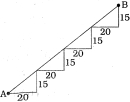
As shown in the adjoining diagram of a staircase,the width of each step is $20 \, cm$ and the height is $15 \, cm$. Find the distance between points $A$ and $B$ in meters.
A
$0.5$
B
$1$
C
$1.25$
D
$2$
Solution
(B) From the diagram,there are $4$ steps in total.
Total horizontal distance (base) $= 4 \times 20 \, cm = 80 \, cm = 0.8 \, m$.
Total vertical distance (height) $= 4 \times 15 \, cm = 60 \, cm = 0.6 \, m$.
The distance between points $A$ and $B$ forms the hypotenuse of a right-angled triangle with base $0.8 \, m$ and height $0.6 \, m$.
Using the Pythagorean theorem: $AB = \sqrt{(0.8)^2 + (0.6)^2} = \sqrt{0.64 + 0.36} = \sqrt{1.00} = 1 \, m$.
Total horizontal distance (base) $= 4 \times 20 \, cm = 80 \, cm = 0.8 \, m$.
Total vertical distance (height) $= 4 \times 15 \, cm = 60 \, cm = 0.6 \, m$.
The distance between points $A$ and $B$ forms the hypotenuse of a right-angled triangle with base $0.8 \, m$ and height $0.6 \, m$.
Using the Pythagorean theorem: $AB = \sqrt{(0.8)^2 + (0.6)^2} = \sqrt{0.64 + 0.36} = \sqrt{1.00} = 1 \, m$.
0 likes
View Solution371
Medium
In $\Delta ABC$,$m\angle B = 90^{\circ}$,$N \in \overline{AB}$ and $M \in \overline{BC}$. Prove that $AM^{2} + CN^{2} = AC^{2} + MN^{2}$.
Solution
(N/A) Given: In $\Delta ABC$,$\angle B = 90^{\circ}$. $N$ is a point on $AB$ and $M$ is a point on $BC$.
To prove: $AM^{2} + CN^{2} = AC^{2} + MN^{2}$.
Proof:
$1$. In right-angled $\Delta ABM$,by Pythagoras theorem: $AM^{2} = AB^{2} + BM^{2}$.
$2$. In right-angled $\Delta CBN$,by Pythagoras theorem: $CN^{2} = CB^{2} + BN^{2}$.
$3$. Adding these two equations: $AM^{2} + CN^{2} = AB^{2} + BM^{2} + CB^{2} + BN^{2}$.
$4$. Rearranging the terms: $AM^{2} + CN^{2} = (AB^{2} + BC^{2}) + (BM^{2} + BN^{2})$.
$5$. In $\Delta ABC$,by Pythagoras theorem: $AC^{2} = AB^{2} + BC^{2}$.
$6$. In right-angled $\Delta MBN$,by Pythagoras theorem: $MN^{2} = BM^{2} + BN^{2}$.
$7$. Substituting these into the equation from step $4$: $AM^{2} + CN^{2} = AC^{2} + MN^{2}$.
Hence,the statement is proved.
To prove: $AM^{2} + CN^{2} = AC^{2} + MN^{2}$.
Proof:
$1$. In right-angled $\Delta ABM$,by Pythagoras theorem: $AM^{2} = AB^{2} + BM^{2}$.
$2$. In right-angled $\Delta CBN$,by Pythagoras theorem: $CN^{2} = CB^{2} + BN^{2}$.
$3$. Adding these two equations: $AM^{2} + CN^{2} = AB^{2} + BM^{2} + CB^{2} + BN^{2}$.
$4$. Rearranging the terms: $AM^{2} + CN^{2} = (AB^{2} + BC^{2}) + (BM^{2} + BN^{2})$.
$5$. In $\Delta ABC$,by Pythagoras theorem: $AC^{2} = AB^{2} + BC^{2}$.
$6$. In right-angled $\Delta MBN$,by Pythagoras theorem: $MN^{2} = BM^{2} + BN^{2}$.
$7$. Substituting these into the equation from step $4$: $AM^{2} + CN^{2} = AC^{2} + MN^{2}$.
Hence,the statement is proved.
0 likes
View Solution372
Medium
In $\Delta ABC$,$m \angle B = 90^{\circ}$ and $\overline{BE}$ is an altitude to the hypotenuse $\overline{AC}$. Prove that $\frac{AB^2}{BC^2} = \frac{AE}{CE}$.
Solution
(A) In $\Delta ABC$,$\angle B = 90^{\circ}$ and $BE \perp AC$.
By the property of similarity in right-angled triangles,if an altitude is drawn to the hypotenuse,the triangles on both sides of the altitude are similar to the whole triangle and to each other.
$1$. $\Delta ABE \sim \Delta ABC$ (by $AA$ similarity).
Therefore,$\frac{AB}{AC} = \frac{AE}{AB}$,which implies $AB^2 = AE \cdot AC$ --- $(1)$.
$2$. $\Delta CBE \sim \Delta ABC$ (by $AA$ similarity).
Therefore,$\frac{BC}{AC} = \frac{CE}{BC}$,which implies $BC^2 = CE \cdot AC$ --- $(2)$.
Dividing equation $(1)$ by equation $(2)$:
$\frac{AB^2}{BC^2} = \frac{AE \cdot AC}{CE \cdot AC}$.
Canceling $AC$ from the numerator and denominator,we get:
$\frac{AB^2}{BC^2} = \frac{AE}{CE}$.
Hence proved.
By the property of similarity in right-angled triangles,if an altitude is drawn to the hypotenuse,the triangles on both sides of the altitude are similar to the whole triangle and to each other.
$1$. $\Delta ABE \sim \Delta ABC$ (by $AA$ similarity).
Therefore,$\frac{AB}{AC} = \frac{AE}{AB}$,which implies $AB^2 = AE \cdot AC$ --- $(1)$.
$2$. $\Delta CBE \sim \Delta ABC$ (by $AA$ similarity).
Therefore,$\frac{BC}{AC} = \frac{CE}{BC}$,which implies $BC^2 = CE \cdot AC$ --- $(2)$.
Dividing equation $(1)$ by equation $(2)$:
$\frac{AB^2}{BC^2} = \frac{AE \cdot AC}{CE \cdot AC}$.
Canceling $AC$ from the numerator and denominator,we get:
$\frac{AB^2}{BC^2} = \frac{AE}{CE}$.
Hence proved.
0 likes
View Solution373
Medium
In $\Delta PQR$,$m \angle Q = 90^{\circ}$ and $\overline{QD}$ is an altitude to the hypotenuse $PR$. If $PD = 25 DR$,prove that $PQ = 5 QR$.
Solution
(N/A) In $\Delta PQR$,$\angle Q = 90^{\circ}$ and $QD \perp PR$.
By the property of geometric mean in a right-angled triangle,we have $\Delta PDQ \sim \Delta QDR$.
From the similarity of triangles,the ratio of corresponding sides is equal: $\frac{PQ}{QR} = \frac{PD}{QD} = \frac{QD}{DR}$.
From $\frac{PQ}{QR} = \frac{QD}{DR}$,we get $PQ^2 = QR^2 \cdot \frac{PD}{DR}$.
Given $PD = 25 DR$,so $\frac{PD}{DR} = 25$.
Substituting this value,$PQ^2 = QR^2 \cdot 25$.
Taking the square root of both sides,we get $PQ = 5 QR$.
By the property of geometric mean in a right-angled triangle,we have $\Delta PDQ \sim \Delta QDR$.
From the similarity of triangles,the ratio of corresponding sides is equal: $\frac{PQ}{QR} = \frac{PD}{QD} = \frac{QD}{DR}$.
From $\frac{PQ}{QR} = \frac{QD}{DR}$,we get $PQ^2 = QR^2 \cdot \frac{PD}{DR}$.
Given $PD = 25 DR$,so $\frac{PD}{DR} = 25$.
Substituting this value,$PQ^2 = QR^2 \cdot 25$.
Taking the square root of both sides,we get $PQ = 5 QR$.
0 likes
View Solution374
Medium
In $\Delta PQR$,$m \angle Q = 90^{\circ}$ and $\overline{QD}$ is an altitude to the hypotenuse $\overline{PR}$. If $PQ = 4QR$,prove that $PD = 16RD$.
Solution
(N/A) $1$. In $\Delta PQR$,$\angle Q = 90^{\circ}$ and $\overline{QD} \perp \overline{PR}$.
$2$. By the property of similarity in right-angled triangles,$\Delta PDQ \sim \Delta QDR \sim \Delta PQR$.
$3$. From $\Delta PDQ \sim \Delta QDR$,we have the ratio of corresponding sides: $\frac{PD}{QD} = \frac{QD}{RD} = \frac{PQ}{QR}$.
$4$. From the ratio $\frac{PD}{QD} = \frac{PQ}{QR}$,we get $PD = QD \cdot \frac{PQ}{QR}$.
$5$. From the ratio $\frac{QD}{RD} = \frac{PQ}{QR}$,we get $QD = RD \cdot \frac{PQ}{QR}$.
$6$. Substituting $QD$ in the expression for $PD$: $PD = (RD \cdot \frac{PQ}{QR}) \cdot \frac{PQ}{QR} = RD \cdot (\frac{PQ}{QR})^2$.
$7$. Given $PQ = 4QR$,so $\frac{PQ}{QR} = 4$.
$8$. Therefore,$PD = RD \cdot (4)^2 = 16RD$.
$2$. By the property of similarity in right-angled triangles,$\Delta PDQ \sim \Delta QDR \sim \Delta PQR$.
$3$. From $\Delta PDQ \sim \Delta QDR$,we have the ratio of corresponding sides: $\frac{PD}{QD} = \frac{QD}{RD} = \frac{PQ}{QR}$.
$4$. From the ratio $\frac{PD}{QD} = \frac{PQ}{QR}$,we get $PD = QD \cdot \frac{PQ}{QR}$.
$5$. From the ratio $\frac{QD}{RD} = \frac{PQ}{QR}$,we get $QD = RD \cdot \frac{PQ}{QR}$.
$6$. Substituting $QD$ in the expression for $PD$: $PD = (RD \cdot \frac{PQ}{QR}) \cdot \frac{PQ}{QR} = RD \cdot (\frac{PQ}{QR})^2$.
$7$. Given $PQ = 4QR$,so $\frac{PQ}{QR} = 4$.
$8$. Therefore,$PD = RD \cdot (4)^2 = 16RD$.
0 likes
View Solution375
Medium
The diagonals of $\square XYZW$ intersect at right angles. Prove that $XY^{2} + ZW^{2} = YZ^{2} + XW^{2}$.
Solution
(N/A) Let the diagonals $XZ$ and $YW$ of the quadrilateral $\square XYZW$ intersect at point $O$ at right angles $(90^{\circ})$.
In $\triangle XOY$,$\triangle YOZ$,$\triangle ZOW$,and $\triangle WOX$,by the Pythagorean theorem:
$XY^{2} = XO^{2} + YO^{2}$ $(1)$
$YZ^{2} = YO^{2} + ZO^{2}$ $(2)$
$ZW^{2} = ZO^{2} + WO^{2}$ $(3)$
$XW^{2} = WO^{2} + XO^{2}$ $(4)$
Adding equations $(1)$ and $(3)$:
$XY^{2} + ZW^{2} = (XO^{2} + YO^{2}) + (ZO^{2} + WO^{2})$
Rearranging the terms:
$XY^{2} + ZW^{2} = (YO^{2} + ZO^{2}) + (WO^{2} + XO^{2})$
Substituting equations $(2)$ and $(4)$ into the expression:
$XY^{2} + ZW^{2} = YZ^{2} + XW^{2}$
Hence,it is proved.
In $\triangle XOY$,$\triangle YOZ$,$\triangle ZOW$,and $\triangle WOX$,by the Pythagorean theorem:
$XY^{2} = XO^{2} + YO^{2}$ $(1)$
$YZ^{2} = YO^{2} + ZO^{2}$ $(2)$
$ZW^{2} = ZO^{2} + WO^{2}$ $(3)$
$XW^{2} = WO^{2} + XO^{2}$ $(4)$
Adding equations $(1)$ and $(3)$:
$XY^{2} + ZW^{2} = (XO^{2} + YO^{2}) + (ZO^{2} + WO^{2})$
Rearranging the terms:
$XY^{2} + ZW^{2} = (YO^{2} + ZO^{2}) + (WO^{2} + XO^{2})$
Substituting equations $(2)$ and $(4)$ into the expression:
$XY^{2} + ZW^{2} = YZ^{2} + XW^{2}$
Hence,it is proved.
0 likes
View Solution376
Medium
Prove that the sum of squares of the sides of a rectangle is equal to the sum of squares of its diagonals.
Solution
(N/A) Let $ABCD$ be a rectangle with sides $AB = CD = l$ and $BC = DA = b$. Let the diagonals be $AC$ and $BD$.
In a rectangle,all interior angles are $90^{\circ}$.
Consider the right-angled triangle $\triangle ABC$. By the Pythagoras theorem:
$AC^2 = AB^2 + BC^2 = l^2 + b^2$
Similarly,in the right-angled triangle $\triangle BCD$:
$BD^2 = BC^2 + CD^2 = b^2 + l^2$
Sum of the squares of the diagonals:
$AC^2 + BD^2 = (l^2 + b^2) + (b^2 + l^2) = 2l^2 + 2b^2$
Sum of the squares of the sides:
$AB^2 + BC^2 + CD^2 + DA^2 = l^2 + b^2 + l^2 + b^2 = 2l^2 + 2b^2$
Thus,the sum of the squares of the sides is equal to the sum of the squares of the diagonals.
In a rectangle,all interior angles are $90^{\circ}$.
Consider the right-angled triangle $\triangle ABC$. By the Pythagoras theorem:
$AC^2 = AB^2 + BC^2 = l^2 + b^2$
Similarly,in the right-angled triangle $\triangle BCD$:
$BD^2 = BC^2 + CD^2 = b^2 + l^2$
Sum of the squares of the diagonals:
$AC^2 + BD^2 = (l^2 + b^2) + (b^2 + l^2) = 2l^2 + 2b^2$
Sum of the squares of the sides:
$AB^2 + BC^2 + CD^2 + DA^2 = l^2 + b^2 + l^2 + b^2 = 2l^2 + 2b^2$
Thus,the sum of the squares of the sides is equal to the sum of the squares of the diagonals.
1 likes
View Solution377
Medium
In $\Delta PQR$,$\overline{QM}$ is an altitude. If $PQ = 2PM$ and $RM = 3PM$,prove that $\Delta PQR$ is a right-angled triangle.
Solution
(N/A) Given: In $\Delta PQR$,$\overline{QM} \perp \overline{PR}$. Let $PM = x$. Then $PQ = 2x$ and $RM = 3x$.
In right-angled $\Delta QMP$,by Pythagoras theorem: $PQ^2 = PM^2 + QM^2 \implies (2x)^2 = x^2 + QM^2 \implies 4x^2 = x^2 + QM^2 \implies QM^2 = 3x^2$.
In right-angled $\Delta QMR$,by Pythagoras theorem: $QR^2 = QM^2 + RM^2 \implies QR^2 = 3x^2 + (3x)^2 \implies QR^2 = 3x^2 + 9x^2 = 12x^2$.
Now,consider the sides of $\Delta PQR$: $PR = PM + RM = x + 3x = 4x$. So,$PR^2 = (4x)^2 = 16x^2$.
Check if $PQ^2 + QR^2 = PR^2$: $PQ^2 + QR^2 = (2x)^2 + 12x^2 = 4x^2 + 12x^2 = 16x^2$.
Since $PQ^2 + QR^2 = PR^2$,by the converse of Pythagoras theorem,$\Delta PQR$ is a right-angled triangle with $\angle PQR = 90^\circ$.
In right-angled $\Delta QMP$,by Pythagoras theorem: $PQ^2 = PM^2 + QM^2 \implies (2x)^2 = x^2 + QM^2 \implies 4x^2 = x^2 + QM^2 \implies QM^2 = 3x^2$.
In right-angled $\Delta QMR$,by Pythagoras theorem: $QR^2 = QM^2 + RM^2 \implies QR^2 = 3x^2 + (3x)^2 \implies QR^2 = 3x^2 + 9x^2 = 12x^2$.
Now,consider the sides of $\Delta PQR$: $PR = PM + RM = x + 3x = 4x$. So,$PR^2 = (4x)^2 = 16x^2$.
Check if $PQ^2 + QR^2 = PR^2$: $PQ^2 + QR^2 = (2x)^2 + 12x^2 = 4x^2 + 12x^2 = 16x^2$.
Since $PQ^2 + QR^2 = PR^2$,by the converse of Pythagoras theorem,$\Delta PQR$ is a right-angled triangle with $\angle PQR = 90^\circ$.
0 likes
View Solution378
Medium
In $\Delta ABC$,$m \angle B = 90^{\circ}$ and $\overline{BM}$ is an altitude to the hypotenuse $\overline{AC}$. If $BM = 2 CM$,prove that $AC = 5 CM$.
Solution
(N/A) In $\Delta ABC$,$\angle B = 90^{\circ}$ and $\overline{BM} \perp \overline{AC}$.
By the property of geometric mean in a right-angled triangle,we have $BM^2 = AM \cdot CM$.
Given that $BM = 2 CM$,substitute this into the equation:
$(2 CM)^2 = AM \cdot CM$
$4 CM^2 = AM \cdot CM$
Since $CM \neq 0$,we can divide both sides by $CM$ to get $AM = 4 CM$.
Now,the hypotenuse $AC$ is the sum of segments $AM$ and $CM$:
$AC = AM + CM$
$AC = 4 CM + CM$
$AC = 5 CM$.
Hence,the result is proved.
By the property of geometric mean in a right-angled triangle,we have $BM^2 = AM \cdot CM$.
Given that $BM = 2 CM$,substitute this into the equation:
$(2 CM)^2 = AM \cdot CM$
$4 CM^2 = AM \cdot CM$
Since $CM \neq 0$,we can divide both sides by $CM$ to get $AM = 4 CM$.
Now,the hypotenuse $AC$ is the sum of segments $AM$ and $CM$:
$AC = AM + CM$
$AC = 4 CM + CM$
$AC = 5 CM$.
Hence,the result is proved.
0 likes
View Solution379
Medium
In $\Delta PQR$,$\overline{PM}$ is an altitude. If $PM^2 = QM \times RM$,prove that $\Delta PQR$ is a right-angled triangle.
Solution
(N/A) Given: In $\Delta PQR$,$\overline{PM} \perp \overline{QR}$ and $PM^2 = QM \times RM$.
Step $1$: From the given equation,we have $\frac{PM}{QM} = \frac{RM}{PM}$.
Step $2$: In $\Delta PMQ$ and $\Delta RMP$,$\angle PMQ = \angle RMP = 90^\circ$ (since $\overline{PM}$ is an altitude).
Step $3$: By the $SAS$ similarity criterion,$\Delta PMQ \sim \Delta RMP$.
Step $4$: Since the triangles are similar,their corresponding angles are equal: $\angle QPM = \angle PRM$ and $\angle PQM = \angle RPM$.
Step $5$: In $\Delta PQR$,the sum of angles is $180^\circ$. Thus,$\angle P + \angle Q + \angle R = 180^\circ$.
Step $6$: Substituting the angles,we get $\angle QPM + \angle RPM + \angle Q + \angle R = 180^\circ$.
Step $7$: Since $\angle QPM = \angle R$ and $\angle RPM = \angle Q$,we have $\angle R + \angle Q + \angle Q + \angle R = 180^\circ$,which simplifies to $2(\angle Q + \angle R) = 180^\circ$,so $\angle Q + \angle R = 90^\circ$.
Step $8$: Therefore,$\angle P = 180^\circ - 90^\circ = 90^\circ$. Hence,$\Delta PQR$ is a right-angled triangle.
Step $1$: From the given equation,we have $\frac{PM}{QM} = \frac{RM}{PM}$.
Step $2$: In $\Delta PMQ$ and $\Delta RMP$,$\angle PMQ = \angle RMP = 90^\circ$ (since $\overline{PM}$ is an altitude).
Step $3$: By the $SAS$ similarity criterion,$\Delta PMQ \sim \Delta RMP$.
Step $4$: Since the triangles are similar,their corresponding angles are equal: $\angle QPM = \angle PRM$ and $\angle PQM = \angle RPM$.
Step $5$: In $\Delta PQR$,the sum of angles is $180^\circ$. Thus,$\angle P + \angle Q + \angle R = 180^\circ$.
Step $6$: Substituting the angles,we get $\angle QPM + \angle RPM + \angle Q + \angle R = 180^\circ$.
Step $7$: Since $\angle QPM = \angle R$ and $\angle RPM = \angle Q$,we have $\angle R + \angle Q + \angle Q + \angle R = 180^\circ$,which simplifies to $2(\angle Q + \angle R) = 180^\circ$,so $\angle Q + \angle R = 90^\circ$.
Step $8$: Therefore,$\angle P = 180^\circ - 90^\circ = 90^\circ$. Hence,$\Delta PQR$ is a right-angled triangle.
0 likes
View Solution380
Medium
In $\Delta ABC$,$m\angle B = 90^{\circ}$. $D$ is the midpoint of $\overline{BC}$ and $F$ is the midpoint of $\overline{AB}$. Prove that $AD^{2} + CF^{2} = \frac{5}{4} AC^{2}$.
Solution
(N/A) $1$. In $\Delta ABC$,by the Pythagorean theorem,$AC^{2} = AB^{2} + BC^{2}$.
$2$. In right-angled $\Delta ABD$,$AD^{2} = AB^{2} + BD^{2}$. Since $D$ is the midpoint of $BC$,$BD = \frac{1}{2} BC$. Thus,$AD^{2} = AB^{2} + (\frac{1}{2} BC)^{2} = AB^{2} + \frac{1}{4} BC^{2}$.
$3$. In right-angled $\Delta CBF$,$CF^{2} = BC^{2} + BF^{2}$. Since $F$ is the midpoint of $AB$,$BF = \frac{1}{2} AB$. Thus,$CF^{2} = BC^{2} + (\frac{1}{2} AB)^{2} = BC^{2} + \frac{1}{4} AB^{2}$.
$4$. Adding the two equations: $AD^{2} + CF^{2} = (AB^{2} + \frac{1}{4} BC^{2}) + (BC^{2} + \frac{1}{4} AB^{2})$.
$5$. Simplifying: $AD^{2} + CF^{2} = (1 + \frac{1}{4}) AB^{2} + (1 + \frac{1}{4}) BC^{2} = \frac{5}{4} AB^{2} + \frac{5}{4} BC^{2}$.
$6$. Factoring out $\frac{5}{4}$: $AD^{2} + CF^{2} = \frac{5}{4} (AB^{2} + BC^{2})$.
$7$. Since $AB^{2} + BC^{2} = AC^{2}$,we get $AD^{2} + CF^{2} = \frac{5}{4} AC^{2}$.
$2$. In right-angled $\Delta ABD$,$AD^{2} = AB^{2} + BD^{2}$. Since $D$ is the midpoint of $BC$,$BD = \frac{1}{2} BC$. Thus,$AD^{2} = AB^{2} + (\frac{1}{2} BC)^{2} = AB^{2} + \frac{1}{4} BC^{2}$.
$3$. In right-angled $\Delta CBF$,$CF^{2} = BC^{2} + BF^{2}$. Since $F$ is the midpoint of $AB$,$BF = \frac{1}{2} AB$. Thus,$CF^{2} = BC^{2} + (\frac{1}{2} AB)^{2} = BC^{2} + \frac{1}{4} AB^{2}$.
$4$. Adding the two equations: $AD^{2} + CF^{2} = (AB^{2} + \frac{1}{4} BC^{2}) + (BC^{2} + \frac{1}{4} AB^{2})$.
$5$. Simplifying: $AD^{2} + CF^{2} = (1 + \frac{1}{4}) AB^{2} + (1 + \frac{1}{4}) BC^{2} = \frac{5}{4} AB^{2} + \frac{5}{4} BC^{2}$.
$6$. Factoring out $\frac{5}{4}$: $AD^{2} + CF^{2} = \frac{5}{4} (AB^{2} + BC^{2})$.
$7$. Since $AB^{2} + BC^{2} = AC^{2}$,we get $AD^{2} + CF^{2} = \frac{5}{4} AC^{2}$.
0 likes
View Solution381
Medium
In $\Delta PQR$,$m\angle Q = 90^{\circ}$ and $\overline{PM}$ is a median. Prove that $PR^{2} = PM^{2} + 3RM^{2}$.
Solution
(N/A) $1$. In $\Delta PQR$,$\angle Q = 90^{\circ}$. By Pythagoras theorem,$PR^{2} = PQ^{2} + QR^{2}$.
$2$. Since $\overline{PM}$ is a median to side $\overline{QR}$,$M$ is the midpoint of $\overline{QR}$. Therefore,$QM = RM = \frac{1}{2} QR$,which implies $QR = 2RM$.
$3$. In right-angled $\Delta PQM$,by Pythagoras theorem,$PM^{2} = PQ^{2} + QM^{2}$. Thus,$PQ^{2} = PM^{2} - QM^{2}$.
$4$. Substitute $PQ^{2} = PM^{2} - QM^{2}$ and $QR = 2RM$ into the first equation: $PR^{2} = (PM^{2} - QM^{2}) + (2RM)^{2}$.
$5$. Since $QM = RM$,substitute $QM$ with $RM$: $PR^{2} = PM^{2} - RM^{2} + 4RM^{2}$.
$6$. Simplifying the expression,we get $PR^{2} = PM^{2} + 3RM^{2}$. Hence proved.
$2$. Since $\overline{PM}$ is a median to side $\overline{QR}$,$M$ is the midpoint of $\overline{QR}$. Therefore,$QM = RM = \frac{1}{2} QR$,which implies $QR = 2RM$.
$3$. In right-angled $\Delta PQM$,by Pythagoras theorem,$PM^{2} = PQ^{2} + QM^{2}$. Thus,$PQ^{2} = PM^{2} - QM^{2}$.
$4$. Substitute $PQ^{2} = PM^{2} - QM^{2}$ and $QR = 2RM$ into the first equation: $PR^{2} = (PM^{2} - QM^{2}) + (2RM)^{2}$.
$5$. Since $QM = RM$,substitute $QM$ with $RM$: $PR^{2} = PM^{2} - RM^{2} + 4RM^{2}$.
$6$. Simplifying the expression,we get $PR^{2} = PM^{2} + 3RM^{2}$. Hence proved.
0 likes
View Solution382
Medium
In $\Delta ABC$,$m\angle B = 90^{\circ}$ and points $D$ and $E$ trisect $\overline{BC}$. Prove that $8AE^{2} - 3AC^{2} = 5AB^{2}$. (Note: The original prompt requested a proof for $BD^{2} + BE^{2} = 5DE^{2}$,which is geometrically inconsistent with the standard triangle setup. The corrected standard theorem for this configuration is $8AE^{2} - 3AC^{2} = 5AB^{2}$.)
Solution
(N/A) Let $BC$ be divided into three equal parts by points $D$ and $E$. Let $BD = DE = EC = x$. Then $BE = 2x$ and $BC = 3x$.
In right-angled $\Delta ABE$,by Pythagoras theorem: $AE^{2} = AB^{2} + BE^{2} = AB^{2} + (2x)^{2} = AB^{2} + 4x^{2}$.
Multiplying by $8$: $8AE^{2} = 8AB^{2} + 32x^{2}$.
In right-angled $\Delta ABC$,by Pythagoras theorem: $AC^{2} = AB^{2} + BC^{2} = AB^{2} + (3x)^{2} = AB^{2} + 9x^{2}$.
Multiplying by $3$: $3AC^{2} = 3AB^{2} + 27x^{2}$.
Subtracting the two equations: $8AE^{2} - 3AC^{2} = (8AB^{2} + 32x^{2}) - (3AB^{2} + 27x^{2}) = 5AB^{2} + 5x^{2}$.
Since $DE = x$,$DE^{2} = x^{2}$. Thus,$8AE^{2} - 3AC^{2} = 5AB^{2} + 5DE^{2}$.
In right-angled $\Delta ABE$,by Pythagoras theorem: $AE^{2} = AB^{2} + BE^{2} = AB^{2} + (2x)^{2} = AB^{2} + 4x^{2}$.
Multiplying by $8$: $8AE^{2} = 8AB^{2} + 32x^{2}$.
In right-angled $\Delta ABC$,by Pythagoras theorem: $AC^{2} = AB^{2} + BC^{2} = AB^{2} + (3x)^{2} = AB^{2} + 9x^{2}$.
Multiplying by $3$: $3AC^{2} = 3AB^{2} + 27x^{2}$.
Subtracting the two equations: $8AE^{2} - 3AC^{2} = (8AB^{2} + 32x^{2}) - (3AB^{2} + 27x^{2}) = 5AB^{2} + 5x^{2}$.
Since $DE = x$,$DE^{2} = x^{2}$. Thus,$8AE^{2} - 3AC^{2} = 5AB^{2} + 5DE^{2}$.
0 likes
View Solution383
Medium
In a rhombus $ABCD$,prove that $AC^{2} + BD^{2} = 4AB^{2}$.
Solution
(N/A) Let the diagonals $AC$ and $BD$ of the rhombus $ABCD$ intersect at point $O$.
Since the diagonals of a rhombus bisect each other at right angles $(90^{\circ})$,we have $AO = OC = \frac{AC}{2}$ and $BO = OD = \frac{BD}{2}$.
In the right-angled triangle $\triangle AOB$,by the Pythagoras theorem:
$AB^{2} = AO^{2} + BO^{2}$
Substitute the values of $AO$ and $BO$:
$AB^{2} = (\frac{AC}{2})^{2} + (\frac{BD}{2})^{2}$
$AB^{2} = \frac{AC^{2}}{4} + \frac{BD^{2}}{4}$
$AB^{2} = \frac{AC^{2} + BD^{2}}{4}$
Multiplying both sides by $4$,we get:
$4AB^{2} = AC^{2} + BD^{2}$
Hence,it is proved that $AC^{2} + BD^{2} = 4AB^{2}$.
Since the diagonals of a rhombus bisect each other at right angles $(90^{\circ})$,we have $AO = OC = \frac{AC}{2}$ and $BO = OD = \frac{BD}{2}$.
In the right-angled triangle $\triangle AOB$,by the Pythagoras theorem:
$AB^{2} = AO^{2} + BO^{2}$
Substitute the values of $AO$ and $BO$:
$AB^{2} = (\frac{AC}{2})^{2} + (\frac{BD}{2})^{2}$
$AB^{2} = \frac{AC^{2}}{4} + \frac{BD^{2}}{4}$
$AB^{2} = \frac{AC^{2} + BD^{2}}{4}$
Multiplying both sides by $4$,we get:
$4AB^{2} = AC^{2} + BD^{2}$
Hence,it is proved that $AC^{2} + BD^{2} = 4AB^{2}$.
0 likes
View Solution384
Medium
In $\Delta ABC$,$m \angle B = 90^{\circ}$ and $\overline{AD}$ is a median. Prove that $AC^{2} = 4AD^{2} - 3AB^{2}$.
Solution
(A) $1$. In $\Delta ABC$,since $\angle B = 90^{\circ}$,by Pythagoras theorem,$AC^{2} = AB^{2} + BC^{2}$ (Equation $1$).
$2$. Since $\overline{AD}$ is a median to side $\overline{BC}$,$D$ is the midpoint of $\overline{BC}$. Thus,$BD = DC = \frac{1}{2} BC$,which implies $BC = 2BD$.
$3$. In $\Delta ABD$,since $\angle B = 90^{\circ}$,by Pythagoras theorem,$AD^{2} = AB^{2} + BD^{2}$.
$4$. Rearranging for $BD^{2}$,we get $BD^{2} = AD^{2} - AB^{2}$.
$5$. Substitute $BC = 2BD$ into Equation $1$: $AC^{2} = AB^{2} + (2BD)^{2} = AB^{2} + 4BD^{2}$.
$6$. Substitute $BD^{2} = AD^{2} - AB^{2}$ into the expression: $AC^{2} = AB^{2} + 4(AD^{2} - AB^{2})$.
$7$. Simplify: $AC^{2} = AB^{2} + 4AD^{2} - 4AB^{2} = 4AD^{2} - 3AB^{2}$.
$8$. Hence,$AC^{2} = 4AD^{2} - 3AB^{2}$ is proved.
$2$. Since $\overline{AD}$ is a median to side $\overline{BC}$,$D$ is the midpoint of $\overline{BC}$. Thus,$BD = DC = \frac{1}{2} BC$,which implies $BC = 2BD$.
$3$. In $\Delta ABD$,since $\angle B = 90^{\circ}$,by Pythagoras theorem,$AD^{2} = AB^{2} + BD^{2}$.
$4$. Rearranging for $BD^{2}$,we get $BD^{2} = AD^{2} - AB^{2}$.
$5$. Substitute $BC = 2BD$ into Equation $1$: $AC^{2} = AB^{2} + (2BD)^{2} = AB^{2} + 4BD^{2}$.
$6$. Substitute $BD^{2} = AD^{2} - AB^{2}$ into the expression: $AC^{2} = AB^{2} + 4(AD^{2} - AB^{2})$.
$7$. Simplify: $AC^{2} = AB^{2} + 4AD^{2} - 4AB^{2} = 4AD^{2} - 3AB^{2}$.
$8$. Hence,$AC^{2} = 4AD^{2} - 3AB^{2}$ is proved.
0 likes
View Solution385
Medium
$\Delta ABC$ is an acute-angled triangle and $\overline{AM}$ is an altitude. Prove that $AC^{2} = AB^{2} + BC^{2} - 2 \cdot BC \cdot BM$.
Solution
(N/A) In $\Delta ABC$,$\overline{AM}$ is the altitude to side $\overline{BC}$,so $\angle AMB = 90^{\circ}$ and $\angle AMC = 90^{\circ}$.
In $\Delta AMC$,by Pythagoras theorem: $AC^{2} = AM^{2} + MC^{2}$.
Since $M$ lies on $BC$,we have $MC = BC - BM$.
Substituting this into the equation: $AC^{2} = AM^{2} + (BC - BM)^{2}$.
Expanding the square: $AC^{2} = AM^{2} + BC^{2} + BM^{2} - 2 \cdot BC \cdot BM$.
In $\Delta AMB$,by Pythagoras theorem: $AB^{2} = AM^{2} + BM^{2}$.
Substituting $AM^{2} + BM^{2} = AB^{2}$ into the equation: $AC^{2} = AB^{2} + BC^{2} - 2 \cdot BC \cdot BM$.
Hence,the result is proved.
In $\Delta AMC$,by Pythagoras theorem: $AC^{2} = AM^{2} + MC^{2}$.
Since $M$ lies on $BC$,we have $MC = BC - BM$.
Substituting this into the equation: $AC^{2} = AM^{2} + (BC - BM)^{2}$.
Expanding the square: $AC^{2} = AM^{2} + BC^{2} + BM^{2} - 2 \cdot BC \cdot BM$.
In $\Delta AMB$,by Pythagoras theorem: $AB^{2} = AM^{2} + BM^{2}$.
Substituting $AM^{2} + BM^{2} = AB^{2}$ into the equation: $AC^{2} = AB^{2} + BC^{2} - 2 \cdot BC \cdot BM$.
Hence,the result is proved.
0 likes
View Solution386
Medium
In quadrilateral $ABCD$,$m\angle B = 90^{\circ}$. If $AD^{2} = AB^{2} + BC^{2} + CD^{2}$,prove that $\angle ACD$ is a right angle.
Solution
(N/A) Given: In quadrilateral $ABCD$,$\angle B = 90^{\circ}$ and $AD^{2} = AB^{2} + BC^{2} + CD^{2}$.
To prove: $\angle ACD = 90^{\circ}$.
Proof: Join $AC$. In $\triangle ABC$,since $\angle B = 90^{\circ}$,by Pythagoras theorem,$AC^{2} = AB^{2} + BC^{2}$.
Substitute this into the given equation: $AD^{2} = (AB^{2} + BC^{2}) + CD^{2}$.
This becomes $AD^{2} = AC^{2} + CD^{2}$.
In $\triangle ACD$,we have $AD^{2} = AC^{2} + CD^{2}$.
By the converse of the Pythagoras theorem,if the square of one side is equal to the sum of the squares of the other two sides,then the angle opposite to the first side is a right angle.
Therefore,$\angle ACD = 90^{\circ}$.
To prove: $\angle ACD = 90^{\circ}$.
Proof: Join $AC$. In $\triangle ABC$,since $\angle B = 90^{\circ}$,by Pythagoras theorem,$AC^{2} = AB^{2} + BC^{2}$.
Substitute this into the given equation: $AD^{2} = (AB^{2} + BC^{2}) + CD^{2}$.
This becomes $AD^{2} = AC^{2} + CD^{2}$.
In $\triangle ACD$,we have $AD^{2} = AC^{2} + CD^{2}$.
By the converse of the Pythagoras theorem,if the square of one side is equal to the sum of the squares of the other two sides,then the angle opposite to the first side is a right angle.
Therefore,$\angle ACD = 90^{\circ}$.
0 likes
View Solution387
Medium
As shown in the adjoining diagram,$\angle B$ is an obtuse angle and $\overline{AM}$ is an altitude in $\Delta ABC$. Prove that $AC^{2} = AB^{2} + BC^{2} + 2 \cdot BC \cdot BM$.

Solution
(N/A) In $\Delta AMC$,$\angle AMC = 90^{\circ}$. By Pythagoras theorem,$AC^{2} = AM^{2} + MC^{2}$.
Since $MC = MB + BC$,we have $AC^{2} = AM^{2} + (MB + BC)^{2}$.
Expanding the square,$AC^{2} = AM^{2} + MB^{2} + BC^{2} + 2 \cdot MB \cdot BC$.
In $\Delta AMB$,$\angle AMB = 90^{\circ}$. By Pythagoras theorem,$AB^{2} = AM^{2} + MB^{2}$.
Substituting $AB^{2}$ for $AM^{2} + MB^{2}$ in the equation,we get $AC^{2} = AB^{2} + BC^{2} + 2 \cdot BC \cdot BM$.
Since $MC = MB + BC$,we have $AC^{2} = AM^{2} + (MB + BC)^{2}$.
Expanding the square,$AC^{2} = AM^{2} + MB^{2} + BC^{2} + 2 \cdot MB \cdot BC$.
In $\Delta AMB$,$\angle AMB = 90^{\circ}$. By Pythagoras theorem,$AB^{2} = AM^{2} + MB^{2}$.
Substituting $AB^{2}$ for $AM^{2} + MB^{2}$ in the equation,we get $AC^{2} = AB^{2} + BC^{2} + 2 \cdot BC \cdot BM$.
0 likes
View Solution388
DifficultMCQ
$A$ person begins his journey from point $A$. From $A$,he moves $800 \, m$ towards north to reach point $B$. From $B$,he moves $500 \, m$ towards east to reach point $C$. From $C$,he moves $400 \, m$ towards north to reach point $D$. Find the direct distance in $m$ from $A$ to $D$.
A
$1400$
B
$1500$
C
$1800$
D
$1300$
Solution
(D) Let the starting point $A$ be at the origin $(0, 0)$ in a Cartesian coordinate system.
Moving $800 \, m$ north takes the person to point $B(0, 800)$.
Moving $500 \, m$ east from $B$ takes the person to point $C(500, 800)$.
Moving $400 \, m$ north from $C$ takes the person to point $D(500, 800 + 400) = D(500, 1200)$.
The direct distance from $A(0, 0)$ to $D(500, 1200)$ is given by the distance formula: $d = \sqrt{(x_2 - x_1)^2 + (y_2 - y_1)^2}$.
$d = \sqrt{(500 - 0)^2 + (1200 - 0)^2} = \sqrt{500^2 + 1200^2}$.
$d = \sqrt{250000 + 1440000} = \sqrt{1690000}$.
$d = 1300 \, m$.
Moving $800 \, m$ north takes the person to point $B(0, 800)$.
Moving $500 \, m$ east from $B$ takes the person to point $C(500, 800)$.
Moving $400 \, m$ north from $C$ takes the person to point $D(500, 800 + 400) = D(500, 1200)$.
The direct distance from $A(0, 0)$ to $D(500, 1200)$ is given by the distance formula: $d = \sqrt{(x_2 - x_1)^2 + (y_2 - y_1)^2}$.
$d = \sqrt{(500 - 0)^2 + (1200 - 0)^2} = \sqrt{500^2 + 1200^2}$.
$d = \sqrt{250000 + 1440000} = \sqrt{1690000}$.
$d = 1300 \, m$.
0 likes
View Solution389
DifficultMCQ
From an airport,two planes begin their journey at the same instant to fly at the same height. One plane moves towards north at an average speed of $800 \, km/h$ and the other plane moves towards east at an average speed of $840 \, km/h$. Find the distance in $km$ between those planes after $1 \frac{1}{2}$ hours of journey.
A
$1740$
B
$1940$
C
$2340$
D
$2240$
Solution
(A) Let the airport be at the origin $(0, 0)$.
After $t = 1.5 \, \text{hours}$,the distance covered by the first plane moving North is $d_1 = 800 \times 1.5 = 1200 \, km$.
The distance covered by the second plane moving East is $d_2 = 840 \times 1.5 = 1260 \, km$.
Since North and East directions are perpendicular,the distance between the two planes forms the hypotenuse of a right-angled triangle.
Using the Pythagorean theorem,the distance $D = \sqrt{d_1^2 + d_2^2}$.
$D = \sqrt{1200^2 + 1260^2} = \sqrt{1440000 + 1587600} = \sqrt{3027600}$.
$D = 1740 \, km$.
After $t = 1.5 \, \text{hours}$,the distance covered by the first plane moving North is $d_1 = 800 \times 1.5 = 1200 \, km$.
The distance covered by the second plane moving East is $d_2 = 840 \times 1.5 = 1260 \, km$.
Since North and East directions are perpendicular,the distance between the two planes forms the hypotenuse of a right-angled triangle.
Using the Pythagorean theorem,the distance $D = \sqrt{d_1^2 + d_2^2}$.
$D = \sqrt{1200^2 + 1260^2} = \sqrt{1440000 + 1587600} = \sqrt{3027600}$.
$D = 1740 \, km$.
0 likes
View Solution390
Medium
Point $P$ lies in the interior of rectangle $ABCD$. Prove that $PA^2 + PC^2 = PB^2 + PD^2$.
Solution
(N/A) Let the rectangle be $ABCD$ in the Cartesian plane. Let $A = (0, b)$,$B = (a, b)$,$C = (a, 0)$,and $D = (0, 0)$.
Let the coordinates of point $P$ be $(x, y)$.
Using the distance formula,the squared distances are:
$PA^2 = (x - 0)^2 + (y - b)^2 = x^2 + y^2 - 2by + b^2$
$PC^2 = (x - a)^2 + (y - 0)^2 = x^2 - 2ax + a^2 + y^2$
$PB^2 = (x - a)^2 + (y - b)^2 = x^2 - 2ax + a^2 + y^2 - 2by + b^2$
$PD^2 = (x - 0)^2 + (y - 0)^2 = x^2 + y^2$
Now,calculate the sums:
$PA^2 + PC^2 = (x^2 + y^2 - 2by + b^2) + (x^2 - 2ax + a^2 + y^2) = 2x^2 + 2y^2 - 2ax - 2by + a^2 + b^2$
$PB^2 + PD^2 = (x^2 - 2ax + a^2 + y^2 - 2by + b^2) + (x^2 + y^2) = 2x^2 + 2y^2 - 2ax - 2by + a^2 + b^2$
Since both sums are equal,$PA^2 + PC^2 = PB^2 + PD^2$ is proved.
Let the coordinates of point $P$ be $(x, y)$.
Using the distance formula,the squared distances are:
$PA^2 = (x - 0)^2 + (y - b)^2 = x^2 + y^2 - 2by + b^2$
$PC^2 = (x - a)^2 + (y - 0)^2 = x^2 - 2ax + a^2 + y^2$
$PB^2 = (x - a)^2 + (y - b)^2 = x^2 - 2ax + a^2 + y^2 - 2by + b^2$
$PD^2 = (x - 0)^2 + (y - 0)^2 = x^2 + y^2$
Now,calculate the sums:
$PA^2 + PC^2 = (x^2 + y^2 - 2by + b^2) + (x^2 - 2ax + a^2 + y^2) = 2x^2 + 2y^2 - 2ax - 2by + a^2 + b^2$
$PB^2 + PD^2 = (x^2 - 2ax + a^2 + y^2 - 2by + b^2) + (x^2 + y^2) = 2x^2 + 2y^2 - 2ax - 2by + a^2 + b^2$
Since both sums are equal,$PA^2 + PC^2 = PB^2 + PD^2$ is proved.
0 likes
View Solution391
Medium
In $\Delta ABC$,$AB > AC$ and $D$ is the midpoint of $\overline{BC}$. $\overline{AM} \perp \overline{BC}$ and $M \in \overline{BC}$. Prove that $AB^{2} - AC^{2} = 2 \cdot BC \cdot DM$.
Solution
(N/A) In $\Delta ABM$,by Pythagoras theorem: $AB^{2} = AM^{2} + BM^{2}$ $(1)$.
In $\Delta ACM$,by Pythagoras theorem: $AC^{2} = AM^{2} + MC^{2}$ $(2)$.
Subtracting $(2)$ from $(1)$: $AB^{2} - AC^{2} = BM^{2} - MC^{2} = (BM - MC)(BM + MC)$.
Since $D$ is the midpoint of $BC$,$BD = DC = \frac{BC}{2}$.
We can express $BM$ as $BD + DM$ and $MC$ as $DC - DM = BD - DM$.
Substituting these: $BM - MC = (BD + DM) - (BD - DM) = 2DM$.
Also,$BM + MC = BC$.
Therefore,$AB^{2} - AC^{2} = (2DM)(BC) = 2 \cdot BC \cdot DM$.
In $\Delta ACM$,by Pythagoras theorem: $AC^{2} = AM^{2} + MC^{2}$ $(2)$.
Subtracting $(2)$ from $(1)$: $AB^{2} - AC^{2} = BM^{2} - MC^{2} = (BM - MC)(BM + MC)$.
Since $D$ is the midpoint of $BC$,$BD = DC = \frac{BC}{2}$.
We can express $BM$ as $BD + DM$ and $MC$ as $DC - DM = BD - DM$.
Substituting these: $BM - MC = (BD + DM) - (BD - DM) = 2DM$.
Also,$BM + MC = BC$.
Therefore,$AB^{2} - AC^{2} = (2DM)(BC) = 2 \cdot BC \cdot DM$.
0 likes
View Solution392
Medium
In $\Delta ABC$,$m\angle B = 90^{\circ}$ and $\overline{BD}$ is an altitude to the hypotenuse $\overline{AC}$. If $AC = 5 CD$,prove that $BD = 2 CD$.
Solution
(N/A) In $\Delta ABC$,$\angle B = 90^{\circ}$ and $\overline{BD} \perp \overline{AC}$.
By the property of geometric mean in a right-angled triangle,we have $BD^2 = AD \cdot CD$.
Given $AC = 5 CD$. Since $AC = AD + CD$,we have $AD + CD = 5 CD$,which implies $AD = 4 CD$.
Substituting $AD = 4 CD$ into the geometric mean equation:
$BD^2 = (4 CD) \cdot CD$
$BD^2 = 4 CD^2$
Taking the square root of both sides:
$BD = \sqrt{4 CD^2} = 2 CD$.
Thus,it is proved that $BD = 2 CD$.
By the property of geometric mean in a right-angled triangle,we have $BD^2 = AD \cdot CD$.
Given $AC = 5 CD$. Since $AC = AD + CD$,we have $AD + CD = 5 CD$,which implies $AD = 4 CD$.
Substituting $AD = 4 CD$ into the geometric mean equation:
$BD^2 = (4 CD) \cdot CD$
$BD^2 = 4 CD^2$
Taking the square root of both sides:
$BD = \sqrt{4 CD^2} = 2 CD$.
Thus,it is proved that $BD = 2 CD$.
0 likes
View Solution393
MediumMCQ
In $\Delta ABC$,$m\angle A + m\angle C = m\angle B$. If $AB = 7$ and $BC = 24$,then $AC = \ldots$
A
$25$
B
$31$
C
$17$
D
$23$
Solution
(A) Given that in $\Delta ABC$,$m\angle A + m\angle C = m\angle B$.
We know that the sum of all angles in a triangle is $180^{\circ}$,so $m\angle A + m\angle B + m\angle C = 180^{\circ}$.
Substituting $m\angle A + m\angle C = m\angle B$ into the equation,we get $m\angle B + m\angle B = 180^{\circ}$,which implies $2m\angle B = 180^{\circ}$,so $m\angle B = 90^{\circ}$.
Since $\angle B = 90^{\circ}$,$\Delta ABC$ is a right-angled triangle with $AC$ as the hypotenuse.
By the Pythagorean theorem,$AC^2 = AB^2 + BC^2$.
Substituting the given values,$AC^2 = 7^2 + 24^2 = 49 + 576 = 625$.
Therefore,$AC = \sqrt{625} = 25$.
We know that the sum of all angles in a triangle is $180^{\circ}$,so $m\angle A + m\angle B + m\angle C = 180^{\circ}$.
Substituting $m\angle A + m\angle C = m\angle B$ into the equation,we get $m\angle B + m\angle B = 180^{\circ}$,which implies $2m\angle B = 180^{\circ}$,so $m\angle B = 90^{\circ}$.
Since $\angle B = 90^{\circ}$,$\Delta ABC$ is a right-angled triangle with $AC$ as the hypotenuse.
By the Pythagorean theorem,$AC^2 = AB^2 + BC^2$.
Substituting the given values,$AC^2 = 7^2 + 24^2 = 49 + 576 = 625$.
Therefore,$AC = \sqrt{625} = 25$.
0 likes
View Solution394
EasyMCQ
The length of a diagonal of a square is $10$. Then,its area is......
A
$17$
B
$50$
C
$25$
D
$100$
Solution
(B) Let the side of the square be $a$ and the diagonal be $d$.
The formula for the diagonal of a square is $d = a\sqrt{2}$.
Given $d = 10$,we have $a\sqrt{2} = 10$.
Therefore,$a = \frac{10}{\sqrt{2}} = 5\sqrt{2}$.
The area of a square is given by $Area = a^2$.
$Area = (5\sqrt{2})^2 = 25 \times 2 = 50$.
Alternatively,the area of a square can be calculated using the diagonal as $Area = \frac{1}{2} \times d^2$.
$Area = \frac{1}{2} \times (10)^2 = \frac{1}{2} \times 100 = 50$.
The formula for the diagonal of a square is $d = a\sqrt{2}$.
Given $d = 10$,we have $a\sqrt{2} = 10$.
Therefore,$a = \frac{10}{\sqrt{2}} = 5\sqrt{2}$.
The area of a square is given by $Area = a^2$.
$Area = (5\sqrt{2})^2 = 25 \times 2 = 50$.
Alternatively,the area of a square can be calculated using the diagonal as $Area = \frac{1}{2} \times d^2$.
$Area = \frac{1}{2} \times (10)^2 = \frac{1}{2} \times 100 = 50$.
0 likes
View Solution395
EasyMCQ
In $\Delta ABC$,$m\angle B = 90^{\circ}$ and $\overline{BM}$ is an altitude to the hypotenuse $\overline{AC}$. If $AC = 25$ and $AM = 16$,then $BM = \dots$
A
$9$
B
$20$
C
$12$
D
$10$
Solution
(C) In a right-angled triangle,the altitude to the hypotenuse divides the triangle into two triangles that are similar to the original triangle and to each other.
Specifically,$\Delta AMB \sim \Delta BMC$.
From the similarity $\Delta AMB \sim \Delta ABC$,we have the property: $BM^2 = AM \cdot MC$.
Given $AC = 25$ and $AM = 16$,we find $MC = AC - AM = 25 - 16 = 9$.
Substituting these values into the formula: $BM^2 = 16 \cdot 9$.
$BM^2 = 144$.
Taking the square root,$BM = \sqrt{144} = 12$.
Specifically,$\Delta AMB \sim \Delta BMC$.
From the similarity $\Delta AMB \sim \Delta ABC$,we have the property: $BM^2 = AM \cdot MC$.
Given $AC = 25$ and $AM = 16$,we find $MC = AC - AM = 25 - 16 = 9$.
Substituting these values into the formula: $BM^2 = 16 \cdot 9$.
$BM^2 = 144$.
Taking the square root,$BM = \sqrt{144} = 12$.
0 likes
View Solution396
MediumMCQ
In $\Delta PQR$,$m\angle P = 90^{\circ}$ and $\overline{PM}$ is an altitude. If $PQ = \sqrt{20}$ and $QM = 4$,then $RM = \ldots \ldots .$
A
$5$
B
$9$
C
$10$
D
$1$
Solution
(D) In $\Delta PQR$,$\angle P = 90^{\circ}$ and $\overline{PM} \perp \overline{QR}$.
According to the geometric mean theorem (or property of altitude to the hypotenuse),$PQ^2 = QM \cdot QR$.
Given $PQ = \sqrt{20}$,so $PQ^2 = 20$.
Substituting the values: $20 = 4 \cdot QR$.
Therefore,$QR = \frac{20}{4} = 5$.
Since $QR = QM + RM$,we have $5 = 4 + RM$.
Thus,$RM = 5 - 4 = 1$.
According to the geometric mean theorem (or property of altitude to the hypotenuse),$PQ^2 = QM \cdot QR$.
Given $PQ = \sqrt{20}$,so $PQ^2 = 20$.
Substituting the values: $20 = 4 \cdot QR$.
Therefore,$QR = \frac{20}{4} = 5$.
Since $QR = QM + RM$,we have $5 = 4 + RM$.
Thus,$RM = 5 - 4 = 1$.
0 likes
View Solution397
MediumMCQ
In a rhombus,the diagonals measure $10$ and $24$. Then,the length of each side of the rhombus is...........
A
$13$
B
$7.5$
C
$9$
D
$10$
Solution
(A) Let the rhombus be $ABCD$ with diagonals $AC = 24$ and $BD = 10$.
In a rhombus,the diagonals bisect each other at right angles $(90^{\circ})$.
Let the intersection point be $O$.
Then,$AO = AC / 2 = 24 / 2 = 12$ and $BO = BD / 2 = 10 / 2 = 5$.
In the right-angled triangle $\triangle AOB$,by the Pythagorean theorem:
$AB^2 = AO^2 + BO^2$
$AB^2 = 12^2 + 5^2$
$AB^2 = 144 + 25 = 169$
$AB = \sqrt{169} = 13$.
Since all sides of a rhombus are equal,the length of each side is $13$.
In a rhombus,the diagonals bisect each other at right angles $(90^{\circ})$.
Let the intersection point be $O$.
Then,$AO = AC / 2 = 24 / 2 = 12$ and $BO = BD / 2 = 10 / 2 = 5$.
In the right-angled triangle $\triangle AOB$,by the Pythagorean theorem:
$AB^2 = AO^2 + BO^2$
$AB^2 = 12^2 + 5^2$
$AB^2 = 144 + 25 = 169$
$AB = \sqrt{169} = 13$.
Since all sides of a rhombus are equal,the length of each side is $13$.
0 likes
View Solution398
MediumMCQ
In $\Delta XYZ$,$m\angle Y = 90^{\circ}$ and $M$ is the midpoint of $\overline{XZ}$. If $XY = 3$ and $YZ = 4$,then $YM = \ldots$
A
$5$
B
$2.5$
C
$7.5$
D
$3.5$
Solution
(B) In $\Delta XYZ$,since $m\angle Y = 90^{\circ}$,the triangle is a right-angled triangle.
Using the Pythagorean theorem,$XZ^2 = XY^2 + YZ^2$.
Substituting the given values,$XZ^2 = 3^2 + 4^2 = 9 + 16 = 25$.
Therefore,$XZ = \sqrt{25} = 5$.
In a right-angled triangle,the length of the median to the hypotenuse is half the length of the hypotenuse.
Since $M$ is the midpoint of $\overline{XZ}$,$\overline{YM}$ is the median to the hypotenuse $\overline{XZ}$.
Thus,$YM = \frac{1}{2} \times XZ = \frac{1}{2} \times 5 = 2.5$.
Using the Pythagorean theorem,$XZ^2 = XY^2 + YZ^2$.
Substituting the given values,$XZ^2 = 3^2 + 4^2 = 9 + 16 = 25$.
Therefore,$XZ = \sqrt{25} = 5$.
In a right-angled triangle,the length of the median to the hypotenuse is half the length of the hypotenuse.
Since $M$ is the midpoint of $\overline{XZ}$,$\overline{YM}$ is the median to the hypotenuse $\overline{XZ}$.
Thus,$YM = \frac{1}{2} \times XZ = \frac{1}{2} \times 5 = 2.5$.
0 likes
View Solution399
MediumMCQ
$A$ $17 \, m$ long ladder leans on a wall such that its lower end rests $8 \, m$ away from the base of the wall. Then,its upper end reaches to the height of $\ldots \ldots \ldots \, m$ on the wall.
A
$12$
B
$18$
C
$15$
D
$20$
Solution
(C) Let the length of the ladder be $L = 17 \, m$.
Let the distance of the base of the ladder from the wall be $b = 8 \, m$.
Let the height reached by the ladder on the wall be $h$.
The wall,the ground,and the ladder form a right-angled triangle where the ladder is the hypotenuse.
According to the Pythagorean theorem: $h^2 + b^2 = L^2$.
Substituting the values: $h^2 + 8^2 = 17^2$.
$h^2 + 64 = 289$.
$h^2 = 289 - 64 = 225$.
$h = \sqrt{225} = 15 \, m$.
Thus,the upper end of the ladder reaches a height of $15 \, m$ on the wall.
Let the distance of the base of the ladder from the wall be $b = 8 \, m$.
Let the height reached by the ladder on the wall be $h$.
The wall,the ground,and the ladder form a right-angled triangle where the ladder is the hypotenuse.
According to the Pythagorean theorem: $h^2 + b^2 = L^2$.
Substituting the values: $h^2 + 8^2 = 17^2$.
$h^2 + 64 = 289$.
$h^2 = 289 - 64 = 225$.
$h = \sqrt{225} = 15 \, m$.
Thus,the upper end of the ladder reaches a height of $15 \, m$ on the wall.
1 likes
View Solution400
MediumMCQ
If the measures of the sides of a triangle are $\ldots \ldots \ldots,$ then it is not a right-angled triangle.
A
$3, 4, 5$
B
$5, 12, 13$
C
$7, 24, 25$
D
$8, 24, 26$
Solution
(D) triangle is a right-angled triangle if the square of the longest side is equal to the sum of the squares of the other two sides (Pythagoras theorem: $a^2 + b^2 = c^2$).
For option $A$: $3^2 + 4^2 = 9 + 16 = 25 = 5^2$. This is a right-angled triangle.
For option $B$: $5^2 + 12^2 = 25 + 144 = 169 = 13^2$. This is a right-angled triangle.
For option $C$: $7^2 + 24^2 = 49 + 576 = 625 = 25^2$. This is a right-angled triangle.
For option $D$: $8^2 + 24^2 = 64 + 576 = 640$,while $26^2 = 676$. Since $640 \neq 676$,this is not a right-angled triangle.
For option $A$: $3^2 + 4^2 = 9 + 16 = 25 = 5^2$. This is a right-angled triangle.
For option $B$: $5^2 + 12^2 = 25 + 144 = 169 = 13^2$. This is a right-angled triangle.
For option $C$: $7^2 + 24^2 = 49 + 576 = 625 = 25^2$. This is a right-angled triangle.
For option $D$: $8^2 + 24^2 = 64 + 576 = 640$,while $26^2 = 676$. Since $640 \neq 676$,this is not a right-angled triangle.
0 likes
View SolutionTriangles — Mix Examples - Triangles · Frequently Asked Questions
1Are these Triangles questions useful for JEE and NEET?
Yes. All questions in this section are mapped to JEE Main and NEET exam patterns. Previous year questions from JEE Main, NEET, GUJCET and state-level exams are included with full solutions.
2Can I switch to Hindi or Gujarati for these questions?
Yes. Use the language tabs in the hero section or the sidebar to view the same questions and solutions in English, Hindi or Gujarati.
3How do I generate a question paper from this subtopic?
Use the Vedclass Exam Paper Generator — select the chapter and subtopic, set difficulty, and generate Sets A, B, C, D automatically. First 3 chapters of every subject are free.
Vedclass Products
For Students
Vedclass Test Series
Mock tests in real JEE/NEET style with performance analysis. 5-day free trial.
Start Free TrialFor Teachers
Exam Paper Generator
Generate Set A/B/C/D papers from this chapter in 2 minutes. 3 chapters free.
Try FreeFor Institutes
Online Exam Module
Live online exams with unlimited students, 360° analytics & white-label branding.
See DemoFor Teachers & Institutes
Generate a Triangles Exam Paper in 2 Minutes
Select subtopic & difficulty — Sets A, B, C, D auto-generated with No Repeat logic.
First 3 chapters of every subject are free — no payment required.