
A English
Textbook - Triangles Questions in English
Class 10 Mathematics · Triangles · Textbook - Triangles
101+
Questions
English
Language
100%
With Solutions
Showing 50 of 101 questions in English
1
Medium
Fill in the blanks using the correct word given in brackets:
$(i)$ All circles are $........$ (congruent,similar)
$(ii)$ All squares are $.........$ (similar,congruent)
$(iii)$ All $.........$ triangles are similar. (isosceles,equilateral)
$(iv)$ Two polygons of the same number of sides are similar,if $(a)$ their corresponding angles are $......$ and $(b)$ their corresponding sides are $......$ (equal,proportional)
$(i)$ All circles are $........$ (congruent,similar)
$(ii)$ All squares are $.........$ (similar,congruent)
$(iii)$ All $.........$ triangles are similar. (isosceles,equilateral)
$(iv)$ Two polygons of the same number of sides are similar,if $(a)$ their corresponding angles are $......$ and $(b)$ their corresponding sides are $......$ (equal,proportional)
Solution
(A) $(i)$ All circles have the same shape but not necessarily the same size,therefore they are similar.
$(ii)$ All squares have the same shape (all angles are $90^{\circ}$ and sides are in the same ratio),therefore they are similar.
$(iii)$ All equilateral triangles have angles of $60^{\circ}$ and equal side ratios,therefore they are similar.
$(iv)$ Two polygons are similar if $(a)$ their corresponding angles are equal and $(b)$ their corresponding sides are proportional.
$(ii)$ All squares have the same shape (all angles are $90^{\circ}$ and sides are in the same ratio),therefore they are similar.
$(iii)$ All equilateral triangles have angles of $60^{\circ}$ and equal side ratios,therefore they are similar.
$(iv)$ Two polygons are similar if $(a)$ their corresponding angles are equal and $(b)$ their corresponding sides are proportional.
0 likes
View Solution2
Easy
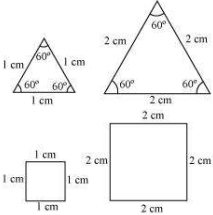
Give two different examples of pairs of similar figures.
Solution
(N/A) Two figures are said to be similar if they have the same shape but not necessarily the same size.
Example $1$: Two equilateral triangles with side lengths $1\, cm$ and $2\, cm$ respectively. Since all equilateral triangles have angles of $60^{\circ}$,they have the same shape.
Example $2$: Two squares with side lengths $1\, cm$ and $2\, cm$ respectively. Since all squares have interior angles of $90^{\circ}$ and proportional sides,they have the same shape.
Example $1$: Two equilateral triangles with side lengths $1\, cm$ and $2\, cm$ respectively. Since all equilateral triangles have angles of $60^{\circ}$,they have the same shape.
Example $2$: Two squares with side lengths $1\, cm$ and $2\, cm$ respectively. Since all squares have interior angles of $90^{\circ}$ and proportional sides,they have the same shape.
0 likes
View Solution3
Easy
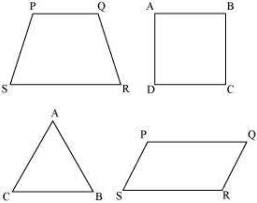
Give two different examples of pairs of non-similar figures.
Solution
(N/A) Two figures are said to be non-similar if they do not have the same shape,even if they have the same number of sides.
Example $1$: $A$ trapezium and a square are non-similar figures because their corresponding angles are not equal and their corresponding sides are not in the same ratio.
Example $2$: $A$ triangle and a parallelogram are non-similar figures because they have a different number of sides and different geometric properties.
Example $1$: $A$ trapezium and a square are non-similar figures because their corresponding angles are not equal and their corresponding sides are not in the same ratio.
Example $2$: $A$ triangle and a parallelogram are non-similar figures because they have a different number of sides and different geometric properties.
0 likes
View Solution4
Easy
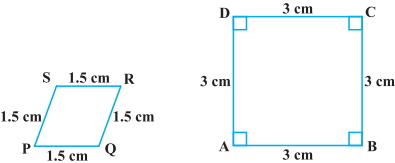
State whether the following quadrilaterals are similar or not.
Solution
(N/A) Two polygons are similar if:
$1$. Their corresponding angles are equal.
$2$. Their corresponding sides are in the same ratio (proportional).
In quadrilateral $PQRS$ and $ABCD$:
- The sides are in the ratio $PQ/AB = QR/BC = RS/CD = SP/DA = 1.5/3 = 1/2$. Thus,the sides are proportional.
- However,the angles of $PQRS$ are not $90^{\circ}$,while all angles of $ABCD$ are $90^{\circ}$.
Since the corresponding angles are not equal,the quadrilaterals $PQRS$ and $ABCD$ are not similar.
$1$. Their corresponding angles are equal.
$2$. Their corresponding sides are in the same ratio (proportional).
In quadrilateral $PQRS$ and $ABCD$:
- The sides are in the ratio $PQ/AB = QR/BC = RS/CD = SP/DA = 1.5/3 = 1/2$. Thus,the sides are proportional.
- However,the angles of $PQRS$ are not $90^{\circ}$,while all angles of $ABCD$ are $90^{\circ}$.
Since the corresponding angles are not equal,the quadrilaterals $PQRS$ and $ABCD$ are not similar.
0 likes
View Solution5
Easy
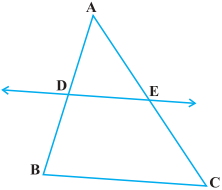
If a line intersects sides $AB$ and $AC$ of a $\Delta ABC$ at $D$ and $E$ respectively and is parallel to $BC$,prove that $\frac{AD}{AB} = \frac{AE}{AC}$ (see Figure).
Solution
(N/A) Given: In $\Delta ABC$,$DE || BC$,where $D$ and $E$ are points on $AB$ and $AC$ respectively.
According to the Basic Proportionality Theorem (Thales Theorem),if a line is drawn parallel to one side of a triangle to intersect the other two sides in distinct points,the other two sides are divided in the same ratio.
Therefore,$\frac{AD}{DB} = \frac{AE}{EC}$.
Taking the reciprocal of both sides:
$\frac{DB}{AD} = \frac{EC}{AE}$.
Adding $1$ to both sides:
$\frac{DB}{AD} + 1 = \frac{EC}{AE} + 1$.
Taking the common denominator:
$\frac{DB + AD}{AD} = \frac{EC + AE}{AE}$.
Since $DB + AD = AB$ and $EC + AE = AC$,we get:
$\frac{AB}{AD} = \frac{AC}{AE}$.
Taking the reciprocal again:
$\frac{AD}{AB} = \frac{AE}{AC}$.
Hence,it is proved.
According to the Basic Proportionality Theorem (Thales Theorem),if a line is drawn parallel to one side of a triangle to intersect the other two sides in distinct points,the other two sides are divided in the same ratio.
Therefore,$\frac{AD}{DB} = \frac{AE}{EC}$.
Taking the reciprocal of both sides:
$\frac{DB}{AD} = \frac{EC}{AE}$.
Adding $1$ to both sides:
$\frac{DB}{AD} + 1 = \frac{EC}{AE} + 1$.
Taking the common denominator:
$\frac{DB + AD}{AD} = \frac{EC + AE}{AE}$.
Since $DB + AD = AB$ and $EC + AE = AC$,we get:
$\frac{AB}{AD} = \frac{AC}{AE}$.
Taking the reciprocal again:
$\frac{AD}{AB} = \frac{AE}{AC}$.
Hence,it is proved.
0 likes
View Solution6
Medium
$ABCD$ is a trapezium with $AB \parallel DC.$ $E$ and $F$ are points on non-parallel sides $AD$ and $BC$ respectively such that $EF \parallel AB$ (see Figure). Show that $\frac{AE}{ED} = \frac{BF}{FC}$.
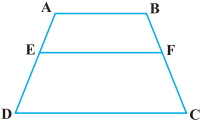
Solution
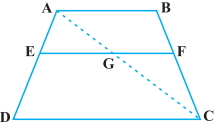
(N/A) Let us join $AC$ to intersect $EF$ at $G$ (see Figure).
Given: $AB \parallel DC$ and $EF \parallel AB$.
Since lines parallel to the same line are parallel to each other,we have $EF \parallel DC$.
Now,in $\Delta ADC$,since $EG \parallel DC$ (as $EF \parallel DC$),by Basic Proportionality Theorem,we have:
$\frac{AE}{ED} = \frac{AG}{GC} \quad ...(1)$
Similarly,in $\Delta CAB$,since $GF \parallel AB$ (as $EF \parallel AB$),by Basic Proportionality Theorem,we have:
$\frac{CG}{AG} = \frac{CF}{BF}$
Taking the reciprocal of both sides,we get:
$\frac{AG}{GC} = \frac{BF}{FC} \quad ...(2)$
From equations $(1)$ and $(2)$,we get:
$\frac{AE}{ED} = \frac{BF}{FC}$.
Given: $AB \parallel DC$ and $EF \parallel AB$.
Since lines parallel to the same line are parallel to each other,we have $EF \parallel DC$.
Now,in $\Delta ADC$,since $EG \parallel DC$ (as $EF \parallel DC$),by Basic Proportionality Theorem,we have:
$\frac{AE}{ED} = \frac{AG}{GC} \quad ...(1)$
Similarly,in $\Delta CAB$,since $GF \parallel AB$ (as $EF \parallel AB$),by Basic Proportionality Theorem,we have:
$\frac{CG}{AG} = \frac{CF}{BF}$
Taking the reciprocal of both sides,we get:
$\frac{AG}{GC} = \frac{BF}{FC} \quad ...(2)$
From equations $(1)$ and $(2)$,we get:
$\frac{AE}{ED} = \frac{BF}{FC}$.
0 likes
View Solution7
Medium
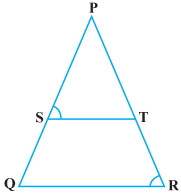
In the figure,$\frac{PS}{SQ} = \frac{PT}{TR}$ and $\angle PST = \angle PRQ$. Prove that $\triangle PQR$ is an isosceles triangle.
Solution
(N/A) It is given that $\frac{PS}{SQ} = \frac{PT}{TR}$.
By the Converse of Thales Theorem (Basic Proportionality Theorem),$ST \parallel QR$.
Therefore,$\angle PST = \angle PQR$ (Corresponding angles) $...(1)$
Also,it is given that $\angle PST = \angle PRQ$ $...(2)$
From equations $(1)$ and $(2)$,we get $\angle PQR = \angle PRQ$.
Since the angles opposite to the sides $PQ$ and $PR$ are equal,the sides themselves must be equal.
Therefore,$PQ = PR$.
Hence,$\triangle PQR$ is an isosceles triangle.
By the Converse of Thales Theorem (Basic Proportionality Theorem),$ST \parallel QR$.
Therefore,$\angle PST = \angle PQR$ (Corresponding angles) $...(1)$
Also,it is given that $\angle PST = \angle PRQ$ $...(2)$
From equations $(1)$ and $(2)$,we get $\angle PQR = \angle PRQ$.
Since the angles opposite to the sides $PQ$ and $PR$ are equal,the sides themselves must be equal.
Therefore,$PQ = PR$.
Hence,$\triangle PQR$ is an isosceles triangle.
0 likes
View Solution8
Medium
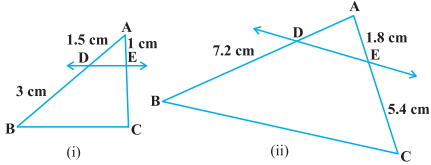
In Figure $(i)$ and $(ii),$ $DE || BC.$ Find $EC$ in $(i)$ and $AD$ in $(ii).$
Solution
(N/A) $(i)$ Let $EC = x \text{ cm}.$
It is given that $DE || BC.$
By using the Basic Proportionality Theorem,we obtain:
$\frac{AD}{DB} = \frac{AE}{EC}$
$\frac{1.5}{3} = \frac{1}{x}$
$x = \frac{3 \times 1}{1.5}$
$x = 2$
$\therefore EC = 2 \text{ cm}.$
$(ii)$ Let $AD = x \text{ cm}.$
It is given that $DE || BC.$
By using the Basic Proportionality Theorem,we obtain:
$\frac{AD}{DB} = \frac{AE}{EC}$
$\frac{x}{7.2} = \frac{1.8}{5.4}$
$x = \frac{1.8 \times 7.2}{5.4}$
$x = 2.4$
$\therefore AD = 2.4 \text{ cm}.$
It is given that $DE || BC.$
By using the Basic Proportionality Theorem,we obtain:
$\frac{AD}{DB} = \frac{AE}{EC}$
$\frac{1.5}{3} = \frac{1}{x}$
$x = \frac{3 \times 1}{1.5}$
$x = 2$
$\therefore EC = 2 \text{ cm}.$
$(ii)$ Let $AD = x \text{ cm}.$
It is given that $DE || BC.$
By using the Basic Proportionality Theorem,we obtain:
$\frac{AD}{DB} = \frac{AE}{EC}$
$\frac{x}{7.2} = \frac{1.8}{5.4}$
$x = \frac{1.8 \times 7.2}{5.4}$
$x = 2.4$
$\therefore AD = 2.4 \text{ cm}.$
0 likes
View Solution9
Medium
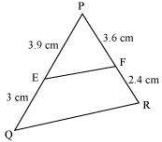
$E$ and $F$ are points on the sides $PQ$ and $PR$ respectively of a $\Delta PQR$. For the following case,state whether $EF || QR$: $PE = 3.9 \ cm, EQ = 3 \ cm, PF = 3.6 \ cm$ and $FR = 2.4 \ cm$.
Solution
(N/A) According to the Converse of Thales Theorem (Basic Proportionality Theorem),$EF || QR$ if and only if $\frac{PE}{EQ} = \frac{PF}{FR}$.
Given values are:
$PE = 3.9 \ cm$
$EQ = 3 \ cm$
$PF = 3.6 \ cm$
$FR = 2.4 \ cm$
Calculating the ratios:
$\frac{PE}{EQ} = \frac{3.9}{3} = 1.3$
$\frac{PF}{FR} = \frac{3.6}{2.4} = 1.5$
Since $\frac{PE}{EQ} \neq \frac{PF}{FR}$ $(1.3 \neq 1.5)$,the condition for $EF$ being parallel to $QR$ is not satisfied.
Therefore,$EF$ is not parallel to $QR$.
Given values are:
$PE = 3.9 \ cm$
$EQ = 3 \ cm$
$PF = 3.6 \ cm$
$FR = 2.4 \ cm$
Calculating the ratios:
$\frac{PE}{EQ} = \frac{3.9}{3} = 1.3$
$\frac{PF}{FR} = \frac{3.6}{2.4} = 1.5$
Since $\frac{PE}{EQ} \neq \frac{PF}{FR}$ $(1.3 \neq 1.5)$,the condition for $EF$ being parallel to $QR$ is not satisfied.
Therefore,$EF$ is not parallel to $QR$.
0 likes
View Solution10
Easy
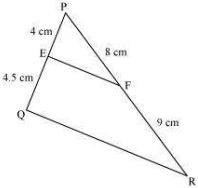
$E$ and $F$ are points on the sides $PQ$ and $PR$ respectively of a $\Delta PQR$. For the given case,state whether $EF || QR$:
$PE = 4 \, cm, QE = 4.5 \, cm, PF = 8 \, cm$ and $RF = 9 \, cm$.
$PE = 4 \, cm, QE = 4.5 \, cm, PF = 8 \, cm$ and $RF = 9 \, cm$.
Solution
(N/A) Given:
$PE = 4 \, cm, QE = 4.5 \, cm, PF = 8 \, cm, RF = 9 \, cm$.
According to the Converse of the Basic Proportionality Theorem (Thales Theorem),if a line divides any two sides of a triangle in the same ratio,then the line is parallel to the third side.
Calculate the ratios:
$\frac{PE}{EQ} = \frac{4}{4.5} = \frac{40}{45} = \frac{8}{9}$.
$\frac{PF}{FR} = \frac{8}{9}$.
Since $\frac{PE}{EQ} = \frac{PF}{FR}$,by the Converse of the Basic Proportionality Theorem,$EF$ is parallel to $QR$ $(EF || QR)$.
$PE = 4 \, cm, QE = 4.5 \, cm, PF = 8 \, cm, RF = 9 \, cm$.
According to the Converse of the Basic Proportionality Theorem (Thales Theorem),if a line divides any two sides of a triangle in the same ratio,then the line is parallel to the third side.
Calculate the ratios:
$\frac{PE}{EQ} = \frac{4}{4.5} = \frac{40}{45} = \frac{8}{9}$.
$\frac{PF}{FR} = \frac{8}{9}$.
Since $\frac{PE}{EQ} = \frac{PF}{FR}$,by the Converse of the Basic Proportionality Theorem,$EF$ is parallel to $QR$ $(EF || QR)$.
0 likes
View Solution11
Medium
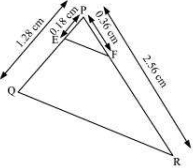
$E$ and $F$ are points on the sides $PQ$ and $PR$ respectively of a $\Delta PQR$. For each of the following cases,state whether $EF || QR$. $PQ = 1.28 \, cm, PR = 2.56 \, cm, PE = 0.18 \, cm$ and $PF = 0.36 \, cm$.
Solution
(A) Given: $PQ = 1.28 \, cm, PR = 2.56 \, cm, PE = 0.18 \, cm, PF = 0.36 \, cm$.
According to the converse of the Basic Proportionality Theorem (Thales Theorem),if a line divides two sides of a triangle in the same ratio,then the line is parallel to the third side.
Calculate the ratios:
$\frac{PE}{PQ} = \frac{0.18}{1.28} = \frac{18}{128} = \frac{9}{64}$
$\frac{PF}{PR} = \frac{0.36}{2.56} = \frac{36}{256} = \frac{9}{64}$
Since $\frac{PE}{PQ} = \frac{PF}{PR} = \frac{9}{64}$,the line $EF$ divides the sides $PQ$ and $PR$ in the same ratio.
Therefore,by the converse of the Basic Proportionality Theorem,$EF || QR$.
According to the converse of the Basic Proportionality Theorem (Thales Theorem),if a line divides two sides of a triangle in the same ratio,then the line is parallel to the third side.
Calculate the ratios:
$\frac{PE}{PQ} = \frac{0.18}{1.28} = \frac{18}{128} = \frac{9}{64}$
$\frac{PF}{PR} = \frac{0.36}{2.56} = \frac{36}{256} = \frac{9}{64}$
Since $\frac{PE}{PQ} = \frac{PF}{PR} = \frac{9}{64}$,the line $EF$ divides the sides $PQ$ and $PR$ in the same ratio.
Therefore,by the converse of the Basic Proportionality Theorem,$EF || QR$.
1 likes
View Solution12
Medium
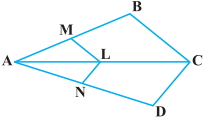
In the figure,if $LM \parallel CB$ and $LN \parallel CD$,prove that $\frac{AM}{AB} = \frac{AN}{AD}$.
Solution
(N/A) In the given figure,$LM \parallel CB$.
By using the Basic Proportionality Theorem (Thales Theorem) in $\triangle ABC$,we obtain:
$\frac{AM}{AB} = \frac{AL}{AC} \quad ...(i)$
Similarly,in $\triangle ADC$,since $LN \parallel CD$,by using the Basic Proportionality Theorem,we obtain:
$\frac{AN}{AD} = \frac{AL}{AC} \quad ...(ii)$
From equation $(i)$ and equation $(ii)$,we observe that the right-hand sides are equal.
Therefore,we obtain:
$\frac{AM}{AB} = \frac{AN}{AD}$
By using the Basic Proportionality Theorem (Thales Theorem) in $\triangle ABC$,we obtain:
$\frac{AM}{AB} = \frac{AL}{AC} \quad ...(i)$
Similarly,in $\triangle ADC$,since $LN \parallel CD$,by using the Basic Proportionality Theorem,we obtain:
$\frac{AN}{AD} = \frac{AL}{AC} \quad ...(ii)$
From equation $(i)$ and equation $(ii)$,we observe that the right-hand sides are equal.
Therefore,we obtain:
$\frac{AM}{AB} = \frac{AN}{AD}$
0 likes
View Solution13
Easy
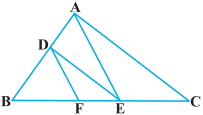
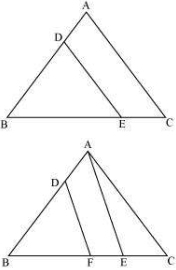
In the figure,$DE \parallel AC$ and $DF \parallel AE$. Prove that $\frac{BF}{FE} = \frac{BE}{EC}$.
Solution
(N/A) In $\Delta ABC$,$DE \parallel AC$.
By the Basic Proportionality Theorem $(BPT)$,we have:
$\frac{BD}{DA} = \frac{BE}{EC} \quad ...(i)$
In $\Delta BAE$,$DF \parallel AE$.
By the Basic Proportionality Theorem $(BPT)$,we have:
$\frac{BD}{DA} = \frac{BF}{FE} \quad ...(ii)$
From equations $(i)$ and $(ii)$,since the left-hand sides are equal,the right-hand sides must also be equal:
$\frac{BF}{FE} = \frac{BE}{EC}$
Hence,it is proved.
By the Basic Proportionality Theorem $(BPT)$,we have:
$\frac{BD}{DA} = \frac{BE}{EC} \quad ...(i)$
In $\Delta BAE$,$DF \parallel AE$.
By the Basic Proportionality Theorem $(BPT)$,we have:
$\frac{BD}{DA} = \frac{BF}{FE} \quad ...(ii)$
From equations $(i)$ and $(ii)$,since the left-hand sides are equal,the right-hand sides must also be equal:
$\frac{BF}{FE} = \frac{BE}{EC}$
Hence,it is proved.
0 likes
View Solution14
Medium
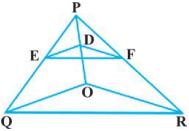
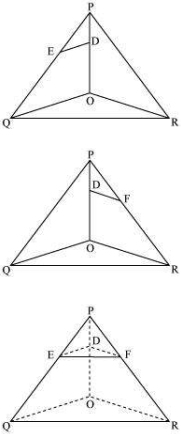
In the figure,$DE \parallel OQ$ and $DF \parallel OR$. Show that $EF \parallel QR$.
Solution
(N/A) In $\Delta POQ$,$DE \parallel OQ$.
Therefore,$\frac{PE}{EQ} = \frac{PD}{DO}$ (Basic Proportionality Theorem) $...(i)$
In $\Delta POR$,$DF \parallel OR$.
Therefore,$\frac{PF}{FR} = \frac{PD}{DO}$ (Basic Proportionality Theorem) $...(ii)$
From $(i)$ and $(ii)$,we obtain:
$\frac{PE}{EQ} = \frac{PF}{FR}$
Therefore,$EF \parallel QR$ (Converse of Basic Proportionality Theorem).
Therefore,$\frac{PE}{EQ} = \frac{PD}{DO}$ (Basic Proportionality Theorem) $...(i)$
In $\Delta POR$,$DF \parallel OR$.
Therefore,$\frac{PF}{FR} = \frac{PD}{DO}$ (Basic Proportionality Theorem) $...(ii)$
From $(i)$ and $(ii)$,we obtain:
$\frac{PE}{EQ} = \frac{PF}{FR}$
Therefore,$EF \parallel QR$ (Converse of Basic Proportionality Theorem).
0 likes
View Solution15
Difficult
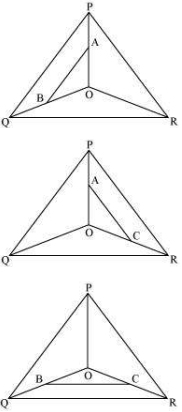
In the figure,$A, B$ and $C$ are points on $OP, OQ$ and $OR$ respectively such that $AB \parallel PQ$ and $AC \parallel PR$. Show that $BC \parallel QR$.
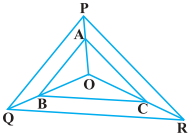
Solution
(N/A) In $\Delta POQ$,$AB \parallel PQ$.
Therefore,$\frac{OA}{AP} = \frac{OB}{BQ}$ (Basic Proportionality Theorem) $...(i)$
In $\Delta POR$,$AC \parallel PR$.
Therefore,$\frac{OA}{AP} = \frac{OC}{CR}$ (Basic Proportionality Theorem) $...(ii)$
From $(i)$ and $(ii)$,we obtain:
$\frac{OB}{BQ} = \frac{OC}{CR}$
Therefore,$BC \parallel QR$ (By the converse of the Basic Proportionality Theorem).
Therefore,$\frac{OA}{AP} = \frac{OB}{BQ}$ (Basic Proportionality Theorem) $...(i)$
In $\Delta POR$,$AC \parallel PR$.
Therefore,$\frac{OA}{AP} = \frac{OC}{CR}$ (Basic Proportionality Theorem) $...(ii)$
From $(i)$ and $(ii)$,we obtain:
$\frac{OB}{BQ} = \frac{OC}{CR}$
Therefore,$BC \parallel QR$ (By the converse of the Basic Proportionality Theorem).
0 likes
View Solution16
Medium
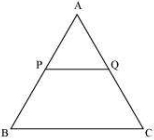
Using Theorem $6.1,$ prove that a line drawn through the mid-point of one side of a triangle parallel to another side bisects the third side.
Solution
(N/A) Consider a triangle $ABC$ in which $P$ is the mid-point of side $AB$ and a line $PQ$ is drawn parallel to $BC$ such that it intersects $AC$ at $Q$.
According to the Basic Proportionality Theorem (Theorem $6.1$),if a line is drawn parallel to one side of a triangle to intersect the other two sides in distinct points,the other two sides are divided in the same ratio.
Therefore,we have:
$\frac{AP}{PB} = \frac{AQ}{QC}$
Since $P$ is the mid-point of $AB$,we have $AP = PB$,which implies $\frac{AP}{PB} = 1$.
Substituting this into the equation,we get:
$1 = \frac{AQ}{QC}$
$\Rightarrow AQ = QC$
This proves that $Q$ is the mid-point of $AC$,meaning the line $PQ$ bisects the third side $AC$.
According to the Basic Proportionality Theorem (Theorem $6.1$),if a line is drawn parallel to one side of a triangle to intersect the other two sides in distinct points,the other two sides are divided in the same ratio.
Therefore,we have:
$\frac{AP}{PB} = \frac{AQ}{QC}$
Since $P$ is the mid-point of $AB$,we have $AP = PB$,which implies $\frac{AP}{PB} = 1$.
Substituting this into the equation,we get:
$1 = \frac{AQ}{QC}$
$\Rightarrow AQ = QC$
This proves that $Q$ is the mid-point of $AC$,meaning the line $PQ$ bisects the third side $AC$.
0 likes
View Solution17
Medium
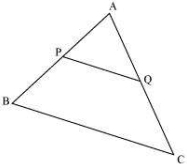
Using Theorem $6.2$,prove that the line joining the mid-points of any two sides of a triangle is parallel to the third side.
Solution
(N/A) Consider a triangle $ABC$ in which $P$ and $Q$ are the mid-points of sides $AB$ and $AC$ respectively.
Given: $AP = PB$ and $AQ = QC$.
To prove: $PQ \parallel BC$.
Proof:
Since $P$ is the mid-point of $AB$,we have $AP = PB$,which implies $\frac{AP}{PB} = 1$.
Since $Q$ is the mid-point of $AC$,we have $AQ = QC$,which implies $\frac{AQ}{QC} = 1$.
From the above two equations,we get $\frac{AP}{PB} = \frac{AQ}{QC}$.
According to the converse of the Basic Proportionality Theorem (Theorem $6.2$),if a line divides any two sides of a triangle in the same ratio,then the line is parallel to the third side.
Therefore,$PQ \parallel BC$.
Given: $AP = PB$ and $AQ = QC$.
To prove: $PQ \parallel BC$.
Proof:
Since $P$ is the mid-point of $AB$,we have $AP = PB$,which implies $\frac{AP}{PB} = 1$.
Since $Q$ is the mid-point of $AC$,we have $AQ = QC$,which implies $\frac{AQ}{QC} = 1$.
From the above two equations,we get $\frac{AP}{PB} = \frac{AQ}{QC}$.
According to the converse of the Basic Proportionality Theorem (Theorem $6.2$),if a line divides any two sides of a triangle in the same ratio,then the line is parallel to the third side.
Therefore,$PQ \parallel BC$.
0 likes
View Solution18
Medium
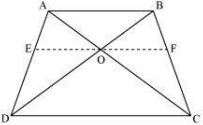
$ABCD$ is a trapezium in which $AB \parallel DC$ and its diagonals intersect each other at the point $O$. Show that $\frac{AO}{BO} = \frac{CO}{DO}$.
Solution
(N/A) Draw a line $EF$ through point $O$,such that $EF \parallel CD$.
In $\triangle ADC$,since $EO \parallel CD$,by using the Basic Proportionality Theorem $(BPT)$,we obtain:
$\frac{AE}{ED} = \frac{AO}{OC} \quad ...(1)$
Since $AB \parallel CD$ and $EF \parallel CD$,it follows that $EF \parallel AB$.
In $\triangle ABD$,since $EO \parallel AB$,by using the Basic Proportionality Theorem,we obtain:
$\frac{AE}{ED} = \frac{BO}{OD} \quad ...(2)$
From equations $(1)$ and $(2)$,we have:
$\frac{AO}{OC} = \frac{BO}{OD}$
Rearranging the terms,we get:
$\frac{AO}{BO} = \frac{OC}{OD}$
In $\triangle ADC$,since $EO \parallel CD$,by using the Basic Proportionality Theorem $(BPT)$,we obtain:
$\frac{AE}{ED} = \frac{AO}{OC} \quad ...(1)$
Since $AB \parallel CD$ and $EF \parallel CD$,it follows that $EF \parallel AB$.
In $\triangle ABD$,since $EO \parallel AB$,by using the Basic Proportionality Theorem,we obtain:
$\frac{AE}{ED} = \frac{BO}{OD} \quad ...(2)$
From equations $(1)$ and $(2)$,we have:
$\frac{AO}{OC} = \frac{BO}{OD}$
Rearranging the terms,we get:
$\frac{AO}{BO} = \frac{OC}{OD}$
0 likes
View Solution19
Difficult
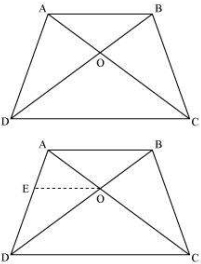
The diagonals of a quadrilateral $ABCD$ intersect each other at the point $O$ such that $\frac{AO}{BO} = \frac{CO}{DO}$. Show that $ABCD$ is a trapezium.
Solution
(N/A) Let us consider the following figure for the given question.
Draw a line $OE \parallel AB$ such that $E$ lies on $AD$.
In $\triangle ABD$,since $OE \parallel AB$,by using the Basic Proportionality Theorem $(BPT)$,we obtain:
$\frac{AE}{ED} = \frac{BO}{OD}$ $...(1)$
However,it is given that:
$\frac{AO}{BO} = \frac{CO}{DO}$
Rearranging the terms,we get:
$\frac{AO}{CO} = \frac{BO}{DO}$ $...(2)$
From equations $(1)$ and $(2)$,we obtain:
$\frac{AE}{ED} = \frac{AO}{CO}$
In $\triangle ADC$,since $\frac{AE}{ED} = \frac{AO}{OC}$,by the converse of the Basic Proportionality Theorem,we have:
$EO \parallel DC$
Since we constructed $OE \parallel AB$ and we proved $OE \parallel DC$,it follows that:
$AB \parallel DC$
Therefore,$ABCD$ is a trapezium because one pair of opposite sides is parallel.
Draw a line $OE \parallel AB$ such that $E$ lies on $AD$.
In $\triangle ABD$,since $OE \parallel AB$,by using the Basic Proportionality Theorem $(BPT)$,we obtain:
$\frac{AE}{ED} = \frac{BO}{OD}$ $...(1)$
However,it is given that:
$\frac{AO}{BO} = \frac{CO}{DO}$
Rearranging the terms,we get:
$\frac{AO}{CO} = \frac{BO}{DO}$ $...(2)$
From equations $(1)$ and $(2)$,we obtain:
$\frac{AE}{ED} = \frac{AO}{CO}$
In $\triangle ADC$,since $\frac{AE}{ED} = \frac{AO}{OC}$,by the converse of the Basic Proportionality Theorem,we have:
$EO \parallel DC$
Since we constructed $OE \parallel AB$ and we proved $OE \parallel DC$,it follows that:
$AB \parallel DC$
Therefore,$ABCD$ is a trapezium because one pair of opposite sides is parallel.
0 likes
View Solution20
Medium
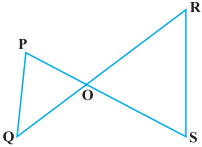
In the figure,if $PQ || RS,$ prove that $\Delta POQ \sim \Delta SOR$.
Solution
(N/A) Given: $PQ || RS$.
To prove: $\Delta POQ \sim \Delta SOR$.
Proof:
In $\Delta POQ$ and $\Delta SOR$:
$1$. $\angle P = \angle S$ (Alternate interior angles,as $PQ || RS$ and $PS$ is a transversal).
$2$. $\angle Q = \angle R$ (Alternate interior angles,as $PQ || RS$ and $QR$ is a transversal).
$3$. $\angle POQ = \angle SOR$ (Vertically opposite angles).
Therefore,by the $AAA$ (Angle-Angle-Angle) similarity criterion,$\Delta POQ \sim \Delta SOR$.
To prove: $\Delta POQ \sim \Delta SOR$.
Proof:
In $\Delta POQ$ and $\Delta SOR$:
$1$. $\angle P = \angle S$ (Alternate interior angles,as $PQ || RS$ and $PS$ is a transversal).
$2$. $\angle Q = \angle R$ (Alternate interior angles,as $PQ || RS$ and $QR$ is a transversal).
$3$. $\angle POQ = \angle SOR$ (Vertically opposite angles).
Therefore,by the $AAA$ (Angle-Angle-Angle) similarity criterion,$\Delta POQ \sim \Delta SOR$.
0 likes
View Solution21
Difficult
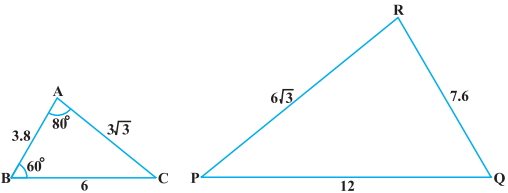
Observe the figure and find $\angle P$.
Solution
$(40^{\circ})$ In $\Delta ABC$ and $\Delta PQR$,
$\frac{AB}{RQ} = \frac{3.8}{7.6} = \frac{1}{2}$,$\frac{BC}{QP} = \frac{6}{12} = \frac{1}{2}$ and $\frac{CA}{PR} = \frac{3\sqrt{3}}{6\sqrt{3}} = \frac{1}{2}$
That is,$\frac{AB}{RQ} = \frac{BC}{QP} = \frac{CA}{PR}$
So,$\Delta ABC \sim \Delta RQP$ ($SSS$ similarity criterion).
Therefore,$\angle C = \angle P$ (Corresponding angles of similar triangles).
In $\Delta ABC$,by the angle sum property:
$\angle C = 180^{\circ} - \angle A - \angle B$
$\angle C = 180^{\circ} - 80^{\circ} - 60^{\circ} = 40^{\circ}$
Since $\angle C = \angle P$,we have $\angle P = 40^{\circ}$.
$\frac{AB}{RQ} = \frac{3.8}{7.6} = \frac{1}{2}$,$\frac{BC}{QP} = \frac{6}{12} = \frac{1}{2}$ and $\frac{CA}{PR} = \frac{3\sqrt{3}}{6\sqrt{3}} = \frac{1}{2}$
That is,$\frac{AB}{RQ} = \frac{BC}{QP} = \frac{CA}{PR}$
So,$\Delta ABC \sim \Delta RQP$ ($SSS$ similarity criterion).
Therefore,$\angle C = \angle P$ (Corresponding angles of similar triangles).
In $\Delta ABC$,by the angle sum property:
$\angle C = 180^{\circ} - \angle A - \angle B$
$\angle C = 180^{\circ} - 80^{\circ} - 60^{\circ} = 40^{\circ}$
Since $\angle C = \angle P$,we have $\angle P = 40^{\circ}$.
0 likes
View Solution22
Medium
In the figure,$OA \cdot OB = OC \cdot OD$. Show that $\angle A = \angle C$ and $\angle B = \angle D$.
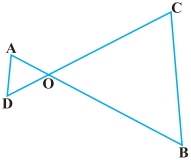
Solution
(N/A) Given: $OA \cdot OB = OC \cdot OD$
Rearranging the terms,we get:
$\frac{OA}{OC} = \frac{OD}{OB} \quad ...(1)$
Also,we have:
$\angle AOD = \angle COB \quad$ (Vertically opposite angles) $...(2)$
From $(1)$ and $(2)$,by the $SAS$ (Side-Angle-Side) similarity criterion,we have:
$\Delta AOD \sim \Delta COB$
Since the triangles are similar,their corresponding angles are equal:
Therefore,$\angle A = \angle C$ and $\angle D = \angle B$.
Rearranging the terms,we get:
$\frac{OA}{OC} = \frac{OD}{OB} \quad ...(1)$
Also,we have:
$\angle AOD = \angle COB \quad$ (Vertically opposite angles) $...(2)$
From $(1)$ and $(2)$,by the $SAS$ (Side-Angle-Side) similarity criterion,we have:
$\Delta AOD \sim \Delta COB$
Since the triangles are similar,their corresponding angles are equal:
Therefore,$\angle A = \angle C$ and $\angle D = \angle B$.
0 likes
View Solution23
Difficult
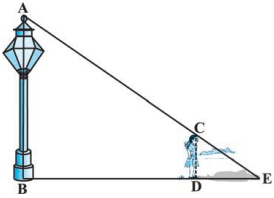
$A$ girl of height $90\, cm$ is walking away from the base of a lamp-post at a speed of $1.2\, m/s$. If the lamp is $3.6\, m$ above the ground,find the length of her shadow after $4\, seconds$.
Solution
(N/A) Let $AB$ denote the lamp-post and $CD$ the girl after walking for $4\, seconds$ away from the lamp-post.
From the figure,you can see that $DE$ is the shadow of the girl. Let $DE$ be $x$ meters.
Now,$BD = 1.2\, m/s \times 4\, s = 4.8\, m$.
Note that in $\Delta ABE$ and $\Delta CDE$:
$\angle B = \angle D = 90^{\circ}$ (Each is $90^{\circ}$ because the lamp-post and the girl are standing vertical to the ground).
$\angle E = \angle E$ (Common angle).
So,$\Delta ABE \sim \Delta CDE$ ($AA$ similarity criterion).
Therefore,$\frac{BE}{DE} = \frac{AB}{CD}$.
Given $AB = 3.6\, m$ and $CD = 90\, cm = 0.9\, m$.
$\frac{4.8 + x}{x} = \frac{3.6}{0.9}$.
$\frac{4.8 + x}{x} = 4$.
$4.8 + x = 4x$.
$3x = 4.8$.
$x = 1.6\, m$.
So,the length of the shadow of the girl after walking for $4\, seconds$ is $1.6\, m$.
From the figure,you can see that $DE$ is the shadow of the girl. Let $DE$ be $x$ meters.
Now,$BD = 1.2\, m/s \times 4\, s = 4.8\, m$.
Note that in $\Delta ABE$ and $\Delta CDE$:
$\angle B = \angle D = 90^{\circ}$ (Each is $90^{\circ}$ because the lamp-post and the girl are standing vertical to the ground).
$\angle E = \angle E$ (Common angle).
So,$\Delta ABE \sim \Delta CDE$ ($AA$ similarity criterion).
Therefore,$\frac{BE}{DE} = \frac{AB}{CD}$.
Given $AB = 3.6\, m$ and $CD = 90\, cm = 0.9\, m$.
$\frac{4.8 + x}{x} = \frac{3.6}{0.9}$.
$\frac{4.8 + x}{x} = 4$.
$4.8 + x = 4x$.
$3x = 4.8$.
$x = 1.6\, m$.
So,the length of the shadow of the girl after walking for $4\, seconds$ is $1.6\, m$.
0 likes
View Solution24
Difficult
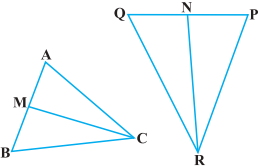
In Figure,$CM$ and $RN$ are respectively the medians of $\Delta ABC$ and $\Delta PQR$. If $\Delta ABC \sim \Delta PQR$,prove that:
$(i)$ $\Delta AMC \sim \Delta PNR$
$(ii)$ $\frac{CM}{RN} = \frac{AB}{PQ}$
$(iii)$ $\Delta CMB \sim \Delta RNQ$
$(i)$ $\Delta AMC \sim \Delta PNR$
$(ii)$ $\frac{CM}{RN} = \frac{AB}{PQ}$
$(iii)$ $\Delta CMB \sim \Delta RNQ$
Solution
(A) Given: $\Delta ABC \sim \Delta PQR$.
Since the triangles are similar,their corresponding sides are proportional and corresponding angles are equal:
$\frac{AB}{PQ} = \frac{BC}{QR} = \frac{CA}{RP} \quad ...(1)$
$\angle A = \angle P, \angle B = \angle Q, \angle C = \angle R \quad ...(2)$
Since $CM$ and $RN$ are medians,$M$ is the midpoint of $AB$ and $N$ is the midpoint of $PQ$. Therefore,$AB = 2AM$ and $PQ = 2PN$.
$(i)$ From $(1)$,$\frac{2AM}{2PN} = \frac{CA}{RP} \implies \frac{AM}{PN} = \frac{CA}{RP}$.
Also,$\angle MAC = \angle NPR$ (from $(2)$).
By $SAS$ similarity criterion,$\Delta AMC \sim \Delta PNR$.
$(ii)$ Since $\Delta AMC \sim \Delta PNR$,their corresponding sides are proportional:
$\frac{CM}{RN} = \frac{CA}{RP}$.
From $(1)$,$\frac{CA}{RP} = \frac{AB}{PQ}$.
Therefore,$\frac{CM}{RN} = \frac{AB}{PQ}$.
$(iii)$ In $\Delta CMB$ and $\Delta RNQ$:
$\frac{CM}{RN} = \frac{BC}{QR}$ (from $(ii)$ and $(1)$).
$\frac{BC}{QR} = \frac{BM}{QN}$ (since $BC = 2BM$ and $QR = 2QN$ from the median property).
Thus,$\frac{CM}{RN} = \frac{BC}{QR} = \frac{BM}{QN}$.
By $SSS$ similarity criterion,$\Delta CMB \sim \Delta RNQ$.
Since the triangles are similar,their corresponding sides are proportional and corresponding angles are equal:
$\frac{AB}{PQ} = \frac{BC}{QR} = \frac{CA}{RP} \quad ...(1)$
$\angle A = \angle P, \angle B = \angle Q, \angle C = \angle R \quad ...(2)$
Since $CM$ and $RN$ are medians,$M$ is the midpoint of $AB$ and $N$ is the midpoint of $PQ$. Therefore,$AB = 2AM$ and $PQ = 2PN$.
$(i)$ From $(1)$,$\frac{2AM}{2PN} = \frac{CA}{RP} \implies \frac{AM}{PN} = \frac{CA}{RP}$.
Also,$\angle MAC = \angle NPR$ (from $(2)$).
By $SAS$ similarity criterion,$\Delta AMC \sim \Delta PNR$.
$(ii)$ Since $\Delta AMC \sim \Delta PNR$,their corresponding sides are proportional:
$\frac{CM}{RN} = \frac{CA}{RP}$.
From $(1)$,$\frac{CA}{RP} = \frac{AB}{PQ}$.
Therefore,$\frac{CM}{RN} = \frac{AB}{PQ}$.
$(iii)$ In $\Delta CMB$ and $\Delta RNQ$:
$\frac{CM}{RN} = \frac{BC}{QR}$ (from $(ii)$ and $(1)$).
$\frac{BC}{QR} = \frac{BM}{QN}$ (since $BC = 2BM$ and $QR = 2QN$ from the median property).
Thus,$\frac{CM}{RN} = \frac{BC}{QR} = \frac{BM}{QN}$.
By $SSS$ similarity criterion,$\Delta CMB \sim \Delta RNQ$.
0 likes
View Solution25
Easy
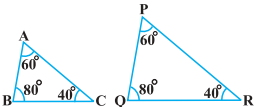
State which pairs of triangles in the figure are similar. Write the similarity criterion used by you for answering the question and also write the pairs of similar triangles in the symbolic form.
Solution
(A) In $\triangle ABC$ and $\triangle PQR$:
$\angle A = 60^{\circ}, \angle B = 80^{\circ}, \angle C = 40^{\circ}$
$\angle P = 60^{\circ}, \angle Q = 80^{\circ}, \angle R = 40^{\circ}$
Since $\angle A = \angle P = 60^{\circ}$,$\angle B = \angle Q = 80^{\circ}$,and $\angle C = \angle R = 40^{\circ}$,the corresponding angles are equal.
Therefore,by the $AAA$ (Angle-Angle-Angle) similarity criterion,$\triangle ABC \sim \triangle PQR$.
$\angle A = 60^{\circ}, \angle B = 80^{\circ}, \angle C = 40^{\circ}$
$\angle P = 60^{\circ}, \angle Q = 80^{\circ}, \angle R = 40^{\circ}$
Since $\angle A = \angle P = 60^{\circ}$,$\angle B = \angle Q = 80^{\circ}$,and $\angle C = \angle R = 40^{\circ}$,the corresponding angles are equal.
Therefore,by the $AAA$ (Angle-Angle-Angle) similarity criterion,$\triangle ABC \sim \triangle PQR$.
0 likes
View Solution26
Medium
State which pairs of triangles in the figure are similar. Write the similarity criterion used by you for answering the question and also write the pairs of similar triangles in the symbolic form.
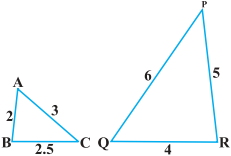
Solution
(N/A) In $\triangle ABC$ and $\triangle QRP$:
$\frac{AB}{QR} = \frac{2}{4} = \frac{1}{2}$
$\frac{BC}{RP} = \frac{2.5}{5} = \frac{1}{2}$
$\frac{AC}{QP} = \frac{3}{6} = \frac{1}{2}$
Since the ratios of the corresponding sides are equal,by the $SSS$ (Side-Side-Side) similarity criterion,the triangles are similar.
Therefore,$\triangle ABC \sim \triangle QRP$.
$\frac{AB}{QR} = \frac{2}{4} = \frac{1}{2}$
$\frac{BC}{RP} = \frac{2.5}{5} = \frac{1}{2}$
$\frac{AC}{QP} = \frac{3}{6} = \frac{1}{2}$
Since the ratios of the corresponding sides are equal,by the $SSS$ (Side-Side-Side) similarity criterion,the triangles are similar.
Therefore,$\triangle ABC \sim \triangle QRP$.
0 likes
View Solution27
Easy
State which pairs of triangles in the figure are similar. Write the similarity criterion used by you for answering the question and also write the pairs of similar triangles in the symbolic form.
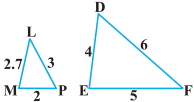
Solution
(NONE) In $\triangle LMP$ and $\triangle DEF$:
$\frac{LM}{DE} = \frac{2.7}{4} = 0.675$
$\frac{LP}{DF} = \frac{3}{6} = 0.5$
$\frac{MP}{EF} = \frac{2}{5} = 0.4$
Since the ratios of the corresponding sides are not equal (i.e.,$\frac{LM}{DE} \neq \frac{LP}{DF} \neq \frac{MP}{EF}$),the two triangles are not similar.
$\frac{LM}{DE} = \frac{2.7}{4} = 0.675$
$\frac{LP}{DF} = \frac{3}{6} = 0.5$
$\frac{MP}{EF} = \frac{2}{5} = 0.4$
Since the ratios of the corresponding sides are not equal (i.e.,$\frac{LM}{DE} \neq \frac{LP}{DF} \neq \frac{MP}{EF}$),the two triangles are not similar.
0 likes
View Solution28
Medium
State which pairs of triangles in the figure are similar. Write the similarity criterion used by you for answering the question and also write the pairs of similar triangles in the symbolic form.
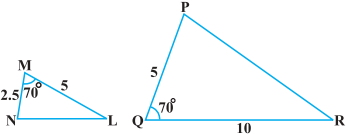
Solution
(N/A) In $\triangle MNL$ and $\triangle QPR$:
Given $\angle M = \angle Q = 70^{\circ}$.
Also,the ratios of the sides including these angles are:
$\frac{MN}{QP} = \frac{2.5}{5} = \frac{1}{2}$
$\frac{ML}{QR} = \frac{5}{10} = \frac{1}{2}$
Since $\frac{MN}{QP} = \frac{ML}{QR} = \frac{1}{2}$ and $\angle M = \angle Q$,by the $SAS$ (Side-Angle-Side) similarity criterion,the two triangles are similar.
Therefore,$\triangle MNL \sim \triangle QPR$.
Given $\angle M = \angle Q = 70^{\circ}$.
Also,the ratios of the sides including these angles are:
$\frac{MN}{QP} = \frac{2.5}{5} = \frac{1}{2}$
$\frac{ML}{QR} = \frac{5}{10} = \frac{1}{2}$
Since $\frac{MN}{QP} = \frac{ML}{QR} = \frac{1}{2}$ and $\angle M = \angle Q$,by the $SAS$ (Side-Angle-Side) similarity criterion,the two triangles are similar.
Therefore,$\triangle MNL \sim \triangle QPR$.
0 likes
View Solution29
Medium
State which pairs of triangles in the figure are similar. Write the similarity criterion used by you for answering the question and also write the pairs of similar triangles in the symbolic form.
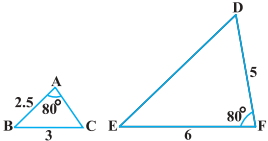
Solution
(NONE) In $\triangle ABC$ and $\triangle DEF$:
Given $\angle A = 80^{\circ}$ and $\angle F = 80^{\circ}$.
Also,the sides including these angles are:
$AB = 2.5$,$AC$ is not given.
$DF = 5$,$EF = 6$.
Checking the ratio of sides:
$\frac{AB}{DF} = \frac{2.5}{5} = \frac{1}{2} = 0.5$
$\frac{BC}{EF} = \frac{3}{6} = \frac{1}{2} = 0.5$
Since the ratio of two sides is equal and the included angle is not the same (the angle $80^{\circ}$ is at $A$ in $\triangle ABC$ and at $F$ in $\triangle DEF$),the triangles are not similar by the $SAS$ criterion.
Therefore,the given triangles are not similar.
Given $\angle A = 80^{\circ}$ and $\angle F = 80^{\circ}$.
Also,the sides including these angles are:
$AB = 2.5$,$AC$ is not given.
$DF = 5$,$EF = 6$.
Checking the ratio of sides:
$\frac{AB}{DF} = \frac{2.5}{5} = \frac{1}{2} = 0.5$
$\frac{BC}{EF} = \frac{3}{6} = \frac{1}{2} = 0.5$
Since the ratio of two sides is equal and the included angle is not the same (the angle $80^{\circ}$ is at $A$ in $\triangle ABC$ and at $F$ in $\triangle DEF$),the triangles are not similar by the $SAS$ criterion.
Therefore,the given triangles are not similar.
0 likes
View Solution30
Medium
State which pairs of triangles in the figure are similar. Write the similarity criterion used by you for answering the question and also write the pairs of similar triangles in the symbolic form.
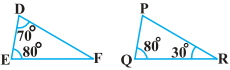
Solution
(N/A) In $\Delta DEF$,the sum of angles is $180^{\circ}$.
Given $\angle D = 70^{\circ}$ and $\angle E = 80^{\circ}$.
Therefore,$\angle F = 180^{\circ} - (70^{\circ} + 80^{\circ}) = 180^{\circ} - 150^{\circ} = 30^{\circ}$.
In $\Delta PQR$,the sum of angles is $180^{\circ}$.
Given $\angle Q = 80^{\circ}$ and $\angle R = 30^{\circ}$.
Therefore,$\angle P = 180^{\circ} - (80^{\circ} + 30^{\circ}) = 180^{\circ} - 110^{\circ} = 70^{\circ}$.
Comparing the two triangles:
$\angle D = \angle P = 70^{\circ}$
$\angle E = \angle Q = 80^{\circ}$
$\angle F = \angle R = 30^{\circ}$
Since all corresponding angles are equal,by the $AAA$ (Angle-Angle-Angle) similarity criterion,the triangles are similar.
Symbolic form: $\Delta DEF \sim \Delta PQR$.
Given $\angle D = 70^{\circ}$ and $\angle E = 80^{\circ}$.
Therefore,$\angle F = 180^{\circ} - (70^{\circ} + 80^{\circ}) = 180^{\circ} - 150^{\circ} = 30^{\circ}$.
In $\Delta PQR$,the sum of angles is $180^{\circ}$.
Given $\angle Q = 80^{\circ}$ and $\angle R = 30^{\circ}$.
Therefore,$\angle P = 180^{\circ} - (80^{\circ} + 30^{\circ}) = 180^{\circ} - 110^{\circ} = 70^{\circ}$.
Comparing the two triangles:
$\angle D = \angle P = 70^{\circ}$
$\angle E = \angle Q = 80^{\circ}$
$\angle F = \angle R = 30^{\circ}$
Since all corresponding angles are equal,by the $AAA$ (Angle-Angle-Angle) similarity criterion,the triangles are similar.
Symbolic form: $\Delta DEF \sim \Delta PQR$.
0 likes
View Solution31
Difficult
In the figure,$\Delta ODC \sim \Delta OBA$,$\angle BOC = 125^{\circ}$ and $\angle CDO = 70^{\circ}$. Find $\angle DOC$,$\angle DCO$,and $\angle OAB$.
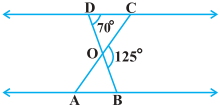
Solution
(N/A) Since $DB$ is a straight line,$\angle DOC$ and $\angle BOC$ form a linear pair.
$\angle DOC + \angle BOC = 180^{\circ}$
$\angle DOC + 125^{\circ} = 180^{\circ}$
$\angle DOC = 180^{\circ} - 125^{\circ} = 55^{\circ}$
In $\triangle ODC$,the sum of the angles is $180^{\circ}$:
$\angle DCO + \angle CDO + \angle DOC = 180^{\circ}$
$\angle DCO + 70^{\circ} + 55^{\circ} = 180^{\circ}$
$\angle DCO + 125^{\circ} = 180^{\circ}$
$\angle DCO = 180^{\circ} - 125^{\circ} = 55^{\circ}$
Given that $\Delta ODC \sim \Delta OBA$,the corresponding angles are equal:
$\angle OAB = \angle OCD = \angle DCO$
Therefore,$\angle OAB = 55^{\circ}$.
Thus,$\angle DOC = 55^{\circ}$,$\angle DCO = 55^{\circ}$,and $\angle OAB = 55^{\circ}$.
$\angle DOC + \angle BOC = 180^{\circ}$
$\angle DOC + 125^{\circ} = 180^{\circ}$
$\angle DOC = 180^{\circ} - 125^{\circ} = 55^{\circ}$
In $\triangle ODC$,the sum of the angles is $180^{\circ}$:
$\angle DCO + \angle CDO + \angle DOC = 180^{\circ}$
$\angle DCO + 70^{\circ} + 55^{\circ} = 180^{\circ}$
$\angle DCO + 125^{\circ} = 180^{\circ}$
$\angle DCO = 180^{\circ} - 125^{\circ} = 55^{\circ}$
Given that $\Delta ODC \sim \Delta OBA$,the corresponding angles are equal:
$\angle OAB = \angle OCD = \angle DCO$
Therefore,$\angle OAB = 55^{\circ}$.
Thus,$\angle DOC = 55^{\circ}$,$\angle DCO = 55^{\circ}$,and $\angle OAB = 55^{\circ}$.
0 likes
View Solution32
Medium
Diagonals $AC$ and $BD$ of a trapezium $ABCD$ with $AB \parallel DC$ intersect each other at the point $O$. Using a similarity criterion for two triangles,show that $\frac{OA}{OC} = \frac{OB}{OD}$.
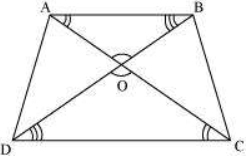
Solution
(N/A) Given: $ABCD$ is a trapezium with $AB \parallel CD$ and diagonals $AC$ and $BD$ intersecting at $O$.
To prove: $\frac{OA}{OC} = \frac{OB}{OD}$.
Proof:
Consider $\triangle OAB$ and $\triangle OCD$.
$1$. $\angle AOB = \angle COD$ (Vertically opposite angles).
$2$. $\angle OAB = \angle OCD$ (Alternate interior angles,since $AB \parallel CD$ and $AC$ is a transversal).
$3$. $\angle OBA = \angle ODC$ (Alternate interior angles,since $AB \parallel CD$ and $BD$ is a transversal).
Therefore,by $AAA$ similarity criterion,$\triangle OAB \sim \triangle OCD$.
Since the triangles are similar,their corresponding sides are proportional:
$\frac{OA}{OC} = \frac{OB}{OD}$.
Hence proved.
To prove: $\frac{OA}{OC} = \frac{OB}{OD}$.
Proof:
Consider $\triangle OAB$ and $\triangle OCD$.
$1$. $\angle AOB = \angle COD$ (Vertically opposite angles).
$2$. $\angle OAB = \angle OCD$ (Alternate interior angles,since $AB \parallel CD$ and $AC$ is a transversal).
$3$. $\angle OBA = \angle ODC$ (Alternate interior angles,since $AB \parallel CD$ and $BD$ is a transversal).
Therefore,by $AAA$ similarity criterion,$\triangle OAB \sim \triangle OCD$.
Since the triangles are similar,their corresponding sides are proportional:
$\frac{OA}{OC} = \frac{OB}{OD}$.
Hence proved.
0 likes
View Solution33
Medium
In the figure,$\frac{QR}{QS} = \frac{QT}{PR}$ and $\angle 1 = \angle 2$. Show that $\Delta PQS \sim \Delta TQR$.
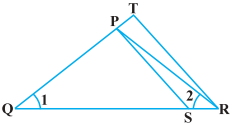
Solution
(N/A) In $\Delta PQR$,given $\angle PQR = \angle PRQ$.
Since the angles opposite to equal sides are equal,we have $PQ = PR$ $....(i)$
Given,
$\frac{QR}{QS} = \frac{QT}{PR}$
Using $(i)$,we substitute $PR$ with $PQ$ to obtain:
$\frac{QR}{QS} = \frac{QT}{PQ}$ $....(ii)$
Now,in $\Delta PQS$ and $\Delta TQR$:
$\frac{QR}{QS} = \frac{QT}{PQ}$ $[\text{From } (ii)]$
$\angle Q = \angle Q$ $[\text{Common angle}]$
Therefore,by the $SAS$ similarity criterion,$\Delta PQS \sim \Delta TQR$.
Since the angles opposite to equal sides are equal,we have $PQ = PR$ $....(i)$
Given,
$\frac{QR}{QS} = \frac{QT}{PR}$
Using $(i)$,we substitute $PR$ with $PQ$ to obtain:
$\frac{QR}{QS} = \frac{QT}{PQ}$ $....(ii)$
Now,in $\Delta PQS$ and $\Delta TQR$:
$\frac{QR}{QS} = \frac{QT}{PQ}$ $[\text{From } (ii)]$
$\angle Q = \angle Q$ $[\text{Common angle}]$
Therefore,by the $SAS$ similarity criterion,$\Delta PQS \sim \Delta TQR$.
0 likes
View Solution34
Difficult
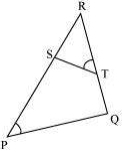
$S$ and $T$ are points on sides $PR$ and $QR$ of $\Delta PQR$ such that $\angle P = \angle RTS$. Show that $\Delta RPQ \sim \Delta RTS$.
Solution
(N/A) In $\Delta RPQ$ and $\Delta RST$:
$\angle RTS = \angle RPQ$ (Given)
$\angle R = \angle R$ (Common angle)
Therefore,$\Delta RPQ \sim \Delta RTS$ (By $AA$ similarity criterion).
$\angle RTS = \angle RPQ$ (Given)
$\angle R = \angle R$ (Common angle)
Therefore,$\Delta RPQ \sim \Delta RTS$ (By $AA$ similarity criterion).
0 likes
View Solution35
Medium
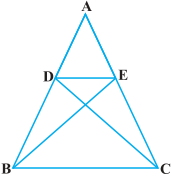
In the figure,if $\Delta ABE \cong \Delta ACD,$ show that $\Delta ADE \sim \Delta ABC.$
Solution
(N/A) Given: $\Delta ABE \cong \Delta ACD.$
Since the triangles are congruent,their corresponding parts are equal $(CPCT)$.
Therefore,$AB = AC$ $...(1)$
And,$AE = AD$ $...(2)$
Now,consider $\Delta ADE$ and $\Delta ABC$:
From equations $(1)$ and $(2)$,we have:
$\frac{AD}{AB} = \frac{AE}{AC}$
Also,$\angle DAE = \angle BAC$ (Common angle).
Therefore,by the $SAS$ (Side-Angle-Side) similarity criterion,$\Delta ADE \sim \Delta ABC.$
Since the triangles are congruent,their corresponding parts are equal $(CPCT)$.
Therefore,$AB = AC$ $...(1)$
And,$AE = AD$ $...(2)$
Now,consider $\Delta ADE$ and $\Delta ABC$:
From equations $(1)$ and $(2)$,we have:
$\frac{AD}{AB} = \frac{AE}{AC}$
Also,$\angle DAE = \angle BAC$ (Common angle).
Therefore,by the $SAS$ (Side-Angle-Side) similarity criterion,$\Delta ADE \sim \Delta ABC.$
0 likes
View Solution36
Easy
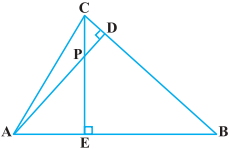
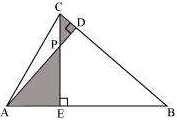
In the figure,altitudes $AD$ and $CE$ of $\Delta ABC$ intersect each other at the point $P$. Show that $\Delta AEP \sim \Delta CDP$.
Solution
(N/A) In $\Delta AEP$ and $\Delta CDP$:
$\angle AEP = \angle CDP = 90^{\circ}$ (Since $AD \perp BC$ and $CE \perp AB$)
$\angle APE = \angle CPD$ (Vertically opposite angles)
Therefore,by the $AA$ similarity criterion,
$\Delta AEP \sim \Delta CDP$.
$\angle AEP = \angle CDP = 90^{\circ}$ (Since $AD \perp BC$ and $CE \perp AB$)
$\angle APE = \angle CPD$ (Vertically opposite angles)
Therefore,by the $AA$ similarity criterion,
$\Delta AEP \sim \Delta CDP$.
0 likes
View Solution37
Easy
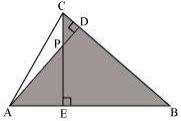
In the figure,altitudes $AD$ and $CE$ of $\Delta ABC$ intersect each other at the point $P$. Show that $\Delta ABD \sim \Delta CBE$.
Solution
(N/A) In $\Delta ABD$ and $\Delta CBE$:
$\angle ADB = \angle CEB = 90^{\circ}$ (Since $AD \perp BC$ and $CE \perp AB$)
$\angle ABD = \angle CBE$ (Common angle)
Therefore,by using the $AA$ similarity criterion,
$\Delta ABD \sim \Delta CBE$
$\angle ADB = \angle CEB = 90^{\circ}$ (Since $AD \perp BC$ and $CE \perp AB$)
$\angle ABD = \angle CBE$ (Common angle)
Therefore,by using the $AA$ similarity criterion,
$\Delta ABD \sim \Delta CBE$
0 likes
View Solution38
Easy
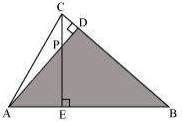
In the figure,altitudes $AD$ and $CE$ of $\Delta ABC$ intersect each other at the point $P$. Show that $\Delta AEP \sim \Delta ADB$.
Solution
(N/A) In $\triangle AEP$ and $\triangle ADB$:
$1. \angle AEP = \angle ADB = 90^{\circ}$ (Given that $AD$ and $CE$ are altitudes).
$2. \angle PAE = \angle DAB$ (Common angle).
Therefore,by the $AA$ (Angle-Angle) similarity criterion,we have:
$\triangle AEP \sim \triangle ADB$.
$1. \angle AEP = \angle ADB = 90^{\circ}$ (Given that $AD$ and $CE$ are altitudes).
$2. \angle PAE = \angle DAB$ (Common angle).
Therefore,by the $AA$ (Angle-Angle) similarity criterion,we have:
$\triangle AEP \sim \triangle ADB$.
0 likes
View Solution39
Easy
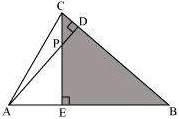
In the figure,altitudes $AD$ and $CE$ of $\Delta ABC$ intersect each other at the point $P$. Show that $\Delta PDC \sim \Delta BEC$.
Solution
(N/A) In $\Delta PDC$ and $\Delta BEC$:
$\angle PDC = \angle BEC = 90^{\circ}$ (Since $AD \perp BC$ and $CE \perp AB$)
$\angle PCD = \angle BCE$ (Common angle)
Therefore,by using the $AA$ similarity criterion,
$\Delta PDC \sim \Delta BEC$.
$\angle PDC = \angle BEC = 90^{\circ}$ (Since $AD \perp BC$ and $CE \perp AB$)
$\angle PCD = \angle BCE$ (Common angle)
Therefore,by using the $AA$ similarity criterion,
$\Delta PDC \sim \Delta BEC$.
0 likes
View Solution40
Easy
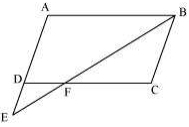
$E$ is a point on the side $AD$ produced of a parallelogram $ABCD$ and $BE$ intersects $CD$ at $F.$ Show that $\Delta ABE \sim \Delta CFB$.
Solution
(N/A) In $\triangle ABE$ and $\triangle CFB$:
$1$. $\angle A = \angle C$ (Opposite angles of a parallelogram are equal).
$2$. $\angle AEB = \angle CBF$ (Since $AE \parallel BC$ and $BE$ is a transversal,these are alternate interior angles).
Therefore,by the $AA$ (Angle-Angle) similarity criterion,$\triangle ABE \sim \triangle CFB$.
$1$. $\angle A = \angle C$ (Opposite angles of a parallelogram are equal).
$2$. $\angle AEB = \angle CBF$ (Since $AE \parallel BC$ and $BE$ is a transversal,these are alternate interior angles).
Therefore,by the $AA$ (Angle-Angle) similarity criterion,$\triangle ABE \sim \triangle CFB$.
0 likes
View Solution41
Medium
In the figure,$\Delta ABC$ and $\Delta AMP$ are two right-angled triangles,right-angled at $B$ and $M$ respectively. Prove that:
$(i)$ $\Delta ABC \sim \Delta AMP$
$(ii)$ $\frac{CA}{PA} = \frac{BC}{MP}$
$(i)$ $\Delta ABC \sim \Delta AMP$
$(ii)$ $\frac{CA}{PA} = \frac{BC}{MP}$
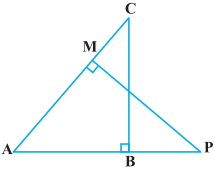
Solution
(N/A) In $\Delta ABC$ and $\Delta AMP$:
$\angle ABC = \angle AMP = 90^{\circ}$ (Given)
$\angle A = \angle A$ (Common angle)
Therefore,$\Delta ABC \sim \Delta AMP$ by $AA$ similarity criterion.
Since the triangles are similar,their corresponding sides are proportional.
Thus,$\frac{CA}{PA} = \frac{BC}{MP}$.
$\angle ABC = \angle AMP = 90^{\circ}$ (Given)
$\angle A = \angle A$ (Common angle)
Therefore,$\Delta ABC \sim \Delta AMP$ by $AA$ similarity criterion.
Since the triangles are similar,their corresponding sides are proportional.
Thus,$\frac{CA}{PA} = \frac{BC}{MP}$.
1 likes
View Solution42
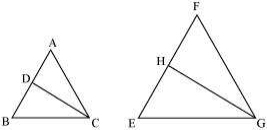
Difficult
$CD$ and $GH$ are respectively the bisectors of $\angle ACB$ and $\angle EGF$ such that $D$ and $H$ lie on sides $AB$ and $FE$ of $\Delta ABC$ and $\Delta EFG$ respectively. If $\Delta ABC \sim \Delta FEG,$ show that:
$(i) \frac{CD}{GH} = \frac{AC}{FG}$
$(ii) \Delta DCB \sim \Delta HGE$
$(iii) \Delta DCA \sim \Delta HGF$
$(i) \frac{CD}{GH} = \frac{AC}{FG}$
$(ii) \Delta DCB \sim \Delta HGE$
$(iii) \Delta DCA \sim \Delta HGF$
Solution
(N/A) It is given that $\Delta ABC \sim \Delta FEG$.
Therefore,$\angle A = \angle F, \angle B = \angle E,$ and $\angle ACB = \angle FGE$.
Since $\angle ACB = \angle FGE,$ their bisectors are also equal.
Therefore,$\angle ACD = \angle FGH$ (Angle bisector).
And,$\angle DCB = \angle HGE$ (Angle bisector).
$(i)$ In $\Delta DCA$ and $\Delta HGF$:
$\angle A = \angle F$ (Given)
$\angle ACD = \angle FGH$ (Proved above)
Therefore,$\Delta DCA \sim \Delta HGF$ (By $AA$ similarity criterion).
Since the triangles are similar,the ratio of their corresponding sides is equal:
$\frac{CD}{GH} = \frac{AC}{FG}$.
$(ii)$ In $\Delta DCB$ and $\Delta HGE$:
$\angle DCB = \angle HGE$ (Proved above)
$\angle B = \angle E$ (Given)
Therefore,$\Delta DCB \sim \Delta HGE$ (By $AA$ similarity criterion).
$(iii)$ In $\Delta DCA$ and $\Delta HGF$:
$\angle A = \angle F$ (Given)
$\angle ACD = \angle FGH$ (Proved above)
Therefore,$\Delta DCA \sim \Delta HGF$ (By $AA$ similarity criterion).
Therefore,$\angle A = \angle F, \angle B = \angle E,$ and $\angle ACB = \angle FGE$.
Since $\angle ACB = \angle FGE,$ their bisectors are also equal.
Therefore,$\angle ACD = \angle FGH$ (Angle bisector).
And,$\angle DCB = \angle HGE$ (Angle bisector).
$(i)$ In $\Delta DCA$ and $\Delta HGF$:
$\angle A = \angle F$ (Given)
$\angle ACD = \angle FGH$ (Proved above)
Therefore,$\Delta DCA \sim \Delta HGF$ (By $AA$ similarity criterion).
Since the triangles are similar,the ratio of their corresponding sides is equal:
$\frac{CD}{GH} = \frac{AC}{FG}$.
$(ii)$ In $\Delta DCB$ and $\Delta HGE$:
$\angle DCB = \angle HGE$ (Proved above)
$\angle B = \angle E$ (Given)
Therefore,$\Delta DCB \sim \Delta HGE$ (By $AA$ similarity criterion).
$(iii)$ In $\Delta DCA$ and $\Delta HGF$:
$\angle A = \angle F$ (Given)
$\angle ACD = \angle FGH$ (Proved above)
Therefore,$\Delta DCA \sim \Delta HGF$ (By $AA$ similarity criterion).
0 likes
View Solution43
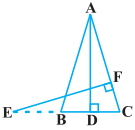
Medium
In the figure,$E$ is a point on the side $CB$ produced of an isosceles triangle $ABC$ with $AB = AC$. If $AD \perp BC$ and $EF \perp AC$,prove that $\Delta ABD \sim \Delta ECF$.
Solution
(N/A) Given: $ABC$ is an isosceles triangle with $AB = AC$.
Since $AB = AC$,the angles opposite to these sides are equal,so $\angle ABC = \angle ACB$.
Since $E$ is a point on $CB$ produced,$\angle ABC + \angle ABE = 180^{\circ}$ (linear pair).
Also,$\angle ACB + \angle ECF = 180^{\circ}$ is not directly applicable,but we know $\angle ABC = \angle ACB$.
In $\triangle ABD$ and $\triangle ECF$:
$1$. $\angle ADB = \angle EFC = 90^{\circ}$ (Given).
$2$. $\angle ABD = \angle ECF$ is incorrect; rather,$\angle ABC = \angle ACB$. Since $\angle ABC + \angle ABE = 180^{\circ}$ and $\angle ACB + \angle ECF$ is not the relation,we observe that $\angle ABC = \angle ACB$. Since $\angle ACB = \angle ECF$ (vertically opposite is not applicable here),we use $\angle ABC = \angle ACB$. In $\triangle ABC$,$\angle B = \angle C$. Thus,$\angle ABD = 180^{\circ} - \angle ABC$ and $\angle ECF = \angle ACB$. Actually,$\angle B = \angle C$,so $\angle ABD = 180^{\circ} - \angle B$ and $\angle ECF$ is just $\angle C$. Wait,$\angle ABC = \angle ACB$. Therefore,$\angle ABD = 180^{\circ} - \angle ABC = 180^{\circ} - \angle ACB$. This is not equal to $\angle ECF$. Let us re-evaluate: $\angle ABC = \angle ACB$. Since $E$ is on $CB$ produced,$\angle ECF$ is the same as $\angle ACB$. Thus $\angle B = \angle C$. In $\triangle ABD$ and $\triangle ECF$,$\angle ADB = \angle EFC = 90^{\circ}$ and $\angle B = \angle ECF$ is not correct. The correct relation is $\angle ABC = \angle ACB$. Since $\angle ABC = \angle ACB$,and $\angle ECF$ is the exterior angle,$\angle ECF = \angle ABC$. Thus $\angle B = \angle ECF$. By $AA$ similarity,$\Delta ABD \sim \Delta ECF$.
Since $AB = AC$,the angles opposite to these sides are equal,so $\angle ABC = \angle ACB$.
Since $E$ is a point on $CB$ produced,$\angle ABC + \angle ABE = 180^{\circ}$ (linear pair).
Also,$\angle ACB + \angle ECF = 180^{\circ}$ is not directly applicable,but we know $\angle ABC = \angle ACB$.
In $\triangle ABD$ and $\triangle ECF$:
$1$. $\angle ADB = \angle EFC = 90^{\circ}$ (Given).
$2$. $\angle ABD = \angle ECF$ is incorrect; rather,$\angle ABC = \angle ACB$. Since $\angle ABC + \angle ABE = 180^{\circ}$ and $\angle ACB + \angle ECF$ is not the relation,we observe that $\angle ABC = \angle ACB$. Since $\angle ACB = \angle ECF$ (vertically opposite is not applicable here),we use $\angle ABC = \angle ACB$. In $\triangle ABC$,$\angle B = \angle C$. Thus,$\angle ABD = 180^{\circ} - \angle ABC$ and $\angle ECF = \angle ACB$. Actually,$\angle B = \angle C$,so $\angle ABD = 180^{\circ} - \angle B$ and $\angle ECF$ is just $\angle C$. Wait,$\angle ABC = \angle ACB$. Therefore,$\angle ABD = 180^{\circ} - \angle ABC = 180^{\circ} - \angle ACB$. This is not equal to $\angle ECF$. Let us re-evaluate: $\angle ABC = \angle ACB$. Since $E$ is on $CB$ produced,$\angle ECF$ is the same as $\angle ACB$. Thus $\angle B = \angle C$. In $\triangle ABD$ and $\triangle ECF$,$\angle ADB = \angle EFC = 90^{\circ}$ and $\angle B = \angle ECF$ is not correct. The correct relation is $\angle ABC = \angle ACB$. Since $\angle ABC = \angle ACB$,and $\angle ECF$ is the exterior angle,$\angle ECF = \angle ABC$. Thus $\angle B = \angle ECF$. By $AA$ similarity,$\Delta ABD \sim \Delta ECF$.
0 likes
View Solution44
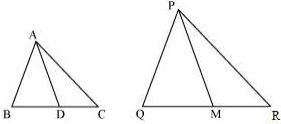
Difficult
Sides $AB$ and $BC$ and median $AD$ of a triangle $ABC$ are respectively proportional to sides $PQ$ and $QR$ and median $PM$ of $\Delta PQR$ (see Figure). Show that $\Delta ABC \sim \Delta PQR$.
Solution
(N/A) Given: In $\Delta ABC$ and $\Delta PQR$,$\frac{AB}{PQ} = \frac{BC}{QR} = \frac{AD}{PM}$.
Since $AD$ and $PM$ are medians,$D$ and $M$ are midpoints of $BC$ and $QR$ respectively.
Therefore,$BD = \frac{BC}{2}$ and $QM = \frac{QR}{2}$.
Substituting these in the given ratio:
$\frac{AB}{PQ} = \frac{2BD}{2QM} = \frac{AD}{PM} \Rightarrow \frac{AB}{PQ} = \frac{BD}{QM} = \frac{AD}{PM}$.
In $\Delta ABD$ and $\Delta PQM$:
$\frac{AB}{PQ} = \frac{BD}{QM} = \frac{AD}{PM}$ (Proved above).
Therefore,$\Delta ABD \sim \Delta PQM$ by $SSS$ similarity criterion.
This implies $\angle B = \angle Q$ (Corresponding angles of similar triangles).
Now,in $\Delta ABC$ and $\Delta PQR$:
$1$. $\frac{AB}{PQ} = \frac{BC}{QR}$ (Given)
$2$. $\angle B = \angle Q$ (Proved above)
Therefore,$\Delta ABC \sim \Delta PQR$ by $SAS$ similarity criterion.
Since $AD$ and $PM$ are medians,$D$ and $M$ are midpoints of $BC$ and $QR$ respectively.
Therefore,$BD = \frac{BC}{2}$ and $QM = \frac{QR}{2}$.
Substituting these in the given ratio:
$\frac{AB}{PQ} = \frac{2BD}{2QM} = \frac{AD}{PM} \Rightarrow \frac{AB}{PQ} = \frac{BD}{QM} = \frac{AD}{PM}$.
In $\Delta ABD$ and $\Delta PQM$:
$\frac{AB}{PQ} = \frac{BD}{QM} = \frac{AD}{PM}$ (Proved above).
Therefore,$\Delta ABD \sim \Delta PQM$ by $SSS$ similarity criterion.
This implies $\angle B = \angle Q$ (Corresponding angles of similar triangles).
Now,in $\Delta ABC$ and $\Delta PQR$:
$1$. $\frac{AB}{PQ} = \frac{BC}{QR}$ (Given)
$2$. $\angle B = \angle Q$ (Proved above)
Therefore,$\Delta ABC \sim \Delta PQR$ by $SAS$ similarity criterion.
0 likes
View Solution45
Easy
$D$ is a point on the side $BC$ of a triangle $ABC$ such that $\angle ADC = \angle BAC$. Show that $CA^2 = CB \cdot CD$.
Solution
(N/A) In $\triangle ADC$ and $\triangle BAC$:
$\angle ADC = \angle BAC$ (Given)
$\angle ACD = \angle BCA$ (Common angle)
Therefore,$\triangle ADC \sim \triangle BAC$ (By $AA$ similarity criterion).
We know that the corresponding sides of similar triangles are proportional.
Therefore,$\frac{CA}{CB} = \frac{CD}{CA}$.
Cross-multiplying gives $CA^2 = CB \cdot CD$.
$\angle ADC = \angle BAC$ (Given)
$\angle ACD = \angle BCA$ (Common angle)
Therefore,$\triangle ADC \sim \triangle BAC$ (By $AA$ similarity criterion).
We know that the corresponding sides of similar triangles are proportional.
Therefore,$\frac{CA}{CB} = \frac{CD}{CA}$.
Cross-multiplying gives $CA^2 = CB \cdot CD$.
0 likes
View Solution46
Difficult
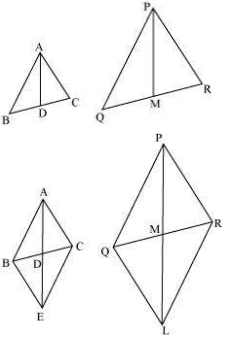
Sides $AB$ and $AC$ and median $AD$ of a triangle $ABC$ are respectively proportional to sides $PQ$ and $PR$ and median $PM$ of another triangle $PQR$. Show that $\Delta ABC \sim \Delta PQR$.
Solution
(A) Given that,
$\frac{AB}{PQ} = \frac{AC}{PR} = \frac{AD}{PM}$
Let us extend $AD$ and $PM$ up to points $E$ and $L$ respectively,such that $AD = DE$ and $PM = ML$. Then,join $B$ to $E$,$C$ to $E$,$Q$ to $L$,and $R$ to $L$.
We know that medians divide opposite sides. Therefore,$BD = DC$ and $QM = MR$.
Also,$AD = DE$ (by construction) and $PM = ML$ (by construction).
In quadrilateral $ABEC$,diagonals $AE$ and $BC$ bisect each other at point $D$. Therefore,quadrilateral $ABEC$ is a parallelogram.
$\therefore AC = BE$ and $AB = EC$ (opposite sides of a parallelogram are equal).
Similarly,we can prove that quadrilateral $PQLR$ is a parallelogram and $PR = QL$,$PQ = LR$.
It was given that $\frac{AB}{PQ} = \frac{AC}{PR} = \frac{AD}{PM}$.
$\Rightarrow \frac{AB}{PQ} = \frac{BE}{QL} = \frac{2AD}{2PM}$
$\Rightarrow \frac{AB}{PQ} = \frac{BE}{QL} = \frac{AE}{PL}$
$\therefore \Delta ABE \sim \Delta PQL$ (by $SSS$ similarity criterion).
We know that corresponding angles of similar triangles are equal.
$\therefore \angle BAE = \angle QPL \dots(1)$
Similarly,it can be proved that $\Delta AEC \sim \Delta PLR$ and $\angle CAE = \angle RPL \dots(2)$
Adding equation $(1)$ and $(2)$,we obtain:
$\angle BAE + \angle CAE = \angle QPL + \angle RPL$
$\Rightarrow \angle CAB = \angle RPQ \dots(3)$
In $\Delta ABC$ and $\Delta PQR$:
$\frac{AB}{PQ} = \frac{AC}{PR}$ (given)
$\angle CAB = \angle RPQ$ (using equation $(3)$)
$\therefore \Delta ABC \sim \Delta PQR$ (by $SAS$ similarity criterion).
$\frac{AB}{PQ} = \frac{AC}{PR} = \frac{AD}{PM}$
Let us extend $AD$ and $PM$ up to points $E$ and $L$ respectively,such that $AD = DE$ and $PM = ML$. Then,join $B$ to $E$,$C$ to $E$,$Q$ to $L$,and $R$ to $L$.
We know that medians divide opposite sides. Therefore,$BD = DC$ and $QM = MR$.
Also,$AD = DE$ (by construction) and $PM = ML$ (by construction).
In quadrilateral $ABEC$,diagonals $AE$ and $BC$ bisect each other at point $D$. Therefore,quadrilateral $ABEC$ is a parallelogram.
$\therefore AC = BE$ and $AB = EC$ (opposite sides of a parallelogram are equal).
Similarly,we can prove that quadrilateral $PQLR$ is a parallelogram and $PR = QL$,$PQ = LR$.
It was given that $\frac{AB}{PQ} = \frac{AC}{PR} = \frac{AD}{PM}$.
$\Rightarrow \frac{AB}{PQ} = \frac{BE}{QL} = \frac{2AD}{2PM}$
$\Rightarrow \frac{AB}{PQ} = \frac{BE}{QL} = \frac{AE}{PL}$
$\therefore \Delta ABE \sim \Delta PQL$ (by $SSS$ similarity criterion).
We know that corresponding angles of similar triangles are equal.
$\therefore \angle BAE = \angle QPL \dots(1)$
Similarly,it can be proved that $\Delta AEC \sim \Delta PLR$ and $\angle CAE = \angle RPL \dots(2)$
Adding equation $(1)$ and $(2)$,we obtain:
$\angle BAE + \angle CAE = \angle QPL + \angle RPL$
$\Rightarrow \angle CAB = \angle RPQ \dots(3)$
In $\Delta ABC$ and $\Delta PQR$:
$\frac{AB}{PQ} = \frac{AC}{PR}$ (given)
$\angle CAB = \angle RPQ$ (using equation $(3)$)
$\therefore \Delta ABC \sim \Delta PQR$ (by $SAS$ similarity criterion).
0 likes
View Solution47
MediumMCQ
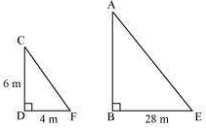
$A$ vertical pole of length $6\, m$ casts a shadow $4\, m$ long on the ground and at the same time a tower casts a shadow $28\, m$ long. Find the height of the tower. (in $m$)
A
$32$
B
$38$
C
$42$
D
$51$
Solution
(C) Let $AB$ be the height of the tower and $CD$ be the height of the pole.
Let $BE$ be the shadow of the tower and $DF$ be the shadow of the pole.
Since the sun's rays fall at the same angle at the same time,the triangles formed by the objects and their shadows are similar.
Therefore,$\triangle ABE \sim \triangle CDF$ by $AA$ similarity criterion.
This implies that the ratios of their corresponding sides are equal:
$\frac{AB}{CD} = \frac{BE}{DF}$
Given $CD = 6\, m$,$DF = 4\, m$,and $BE = 28\, m$.
Substituting the values:
$\frac{AB}{6} = \frac{28}{4}$
$\frac{AB}{6} = 7$
$AB = 7 \times 6 = 42\, m$.
Thus,the height of the tower is $42\, m$.
Let $BE$ be the shadow of the tower and $DF$ be the shadow of the pole.
Since the sun's rays fall at the same angle at the same time,the triangles formed by the objects and their shadows are similar.
Therefore,$\triangle ABE \sim \triangle CDF$ by $AA$ similarity criterion.
This implies that the ratios of their corresponding sides are equal:
$\frac{AB}{CD} = \frac{BE}{DF}$
Given $CD = 6\, m$,$DF = 4\, m$,and $BE = 28\, m$.
Substituting the values:
$\frac{AB}{6} = \frac{28}{4}$
$\frac{AB}{6} = 7$
$AB = 7 \times 6 = 42\, m$.
Thus,the height of the tower is $42\, m$.
0 likes
View Solution48
Medium
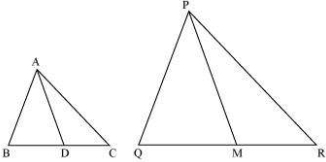
If $AD$ and $PM$ are medians of triangles $ABC$ and $PQR,$ respectively,where $\Delta ABC \sim \Delta PQR,$ prove that $\frac{AB}{PQ} = \frac{AD}{PM}.$
Solution
(N/A) It is given that $\Delta ABC \sim \Delta PQR.$
We know that the corresponding sides of similar triangles are in proportion.
$\frac{AB}{PQ} = \frac{AC}{PR} = \frac{BC}{QR} \dots(1)$
Also,$\angle A = \angle P, \angle B = \angle Q, \angle C = \angle R \dots(2)$
Since $AD$ and $PM$ are medians,they divide their opposite sides into two equal parts.
$BD = \frac{BC}{2}$ and $QM = \frac{QR}{2} \dots(3)$
From equations $(1)$ and $(3),$ we obtain
$\frac{AB}{PQ} = \frac{BC/2}{QR/2} = \frac{BD}{QM} \dots(4)$
In $\Delta ABD$ and $\Delta PQM,$
$\angle B = \angle Q$ [Using equation $(2)$]
$\frac{AB}{PQ} = \frac{BD}{QM}$ [Using equation $(4)$]
$\therefore \Delta ABD \sim \Delta PQM$ (By $SAS$ similarity criterion)
$\Rightarrow \frac{AB}{PQ} = \frac{BD}{QM} = \frac{AD}{PM}$
We know that the corresponding sides of similar triangles are in proportion.
$\frac{AB}{PQ} = \frac{AC}{PR} = \frac{BC}{QR} \dots(1)$
Also,$\angle A = \angle P, \angle B = \angle Q, \angle C = \angle R \dots(2)$
Since $AD$ and $PM$ are medians,they divide their opposite sides into two equal parts.
$BD = \frac{BC}{2}$ and $QM = \frac{QR}{2} \dots(3)$
From equations $(1)$ and $(3),$ we obtain
$\frac{AB}{PQ} = \frac{BC/2}{QR/2} = \frac{BD}{QM} \dots(4)$
In $\Delta ABD$ and $\Delta PQM,$
$\angle B = \angle Q$ [Using equation $(2)$]
$\frac{AB}{PQ} = \frac{BD}{QM}$ [Using equation $(4)$]
$\therefore \Delta ABD \sim \Delta PQM$ (By $SAS$ similarity criterion)
$\Rightarrow \frac{AB}{PQ} = \frac{BD}{QM} = \frac{AD}{PM}$
0 likes
View Solution49
Medium
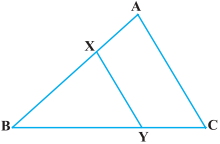
In the figure,the line segment $XY$ is parallel to side $AC$ of $\Delta ABC$ and it divides the triangle into two parts of equal areas. Find the ratio $\frac{AX}{AB}$.
Solution
(D) We have $XY \parallel AC$ (Given).
$\angle BXY = \angle A$ and $\angle BYX = \angle C$ (Corresponding angles).
Therefore,$\Delta ABC \sim \Delta XBY$ ($AA$ similarity criterion).
$\frac{\operatorname{ar}(ABC)}{\operatorname{ar}(XBY)} = \left(\frac{AB}{XB}\right)^2$ (Theorem regarding ratio of areas of similar triangles).
Since $XY$ divides the triangle into two parts of equal areas,$\operatorname{ar}(ABC) = 2 \operatorname{ar}(XBY)$.
$\frac{\operatorname{ar}(ABC)}{\operatorname{ar}(XBY)} = \frac{2}{1}$.
Therefore,$\left(\frac{AB}{XB}\right)^2 = \frac{2}{1}$,which implies $\frac{AB}{XB} = \frac{\sqrt{2}}{1}$.
Taking the reciprocal,$\frac{XB}{AB} = \frac{1}{\sqrt{2}}$.
Now,$\frac{AX}{AB} = \frac{AB - XB}{AB} = 1 - \frac{XB}{AB} = 1 - \frac{1}{\sqrt{2}} = \frac{\sqrt{2} - 1}{\sqrt{2}}$.
Rationalizing the denominator,$\frac{AX}{AB} = \frac{(\sqrt{2} - 1) \cdot \sqrt{2}}{\sqrt{2} \cdot \sqrt{2}} = \frac{2 - \sqrt{2}}{2}$.
$\angle BXY = \angle A$ and $\angle BYX = \angle C$ (Corresponding angles).
Therefore,$\Delta ABC \sim \Delta XBY$ ($AA$ similarity criterion).
$\frac{\operatorname{ar}(ABC)}{\operatorname{ar}(XBY)} = \left(\frac{AB}{XB}\right)^2$ (Theorem regarding ratio of areas of similar triangles).
Since $XY$ divides the triangle into two parts of equal areas,$\operatorname{ar}(ABC) = 2 \operatorname{ar}(XBY)$.
$\frac{\operatorname{ar}(ABC)}{\operatorname{ar}(XBY)} = \frac{2}{1}$.
Therefore,$\left(\frac{AB}{XB}\right)^2 = \frac{2}{1}$,which implies $\frac{AB}{XB} = \frac{\sqrt{2}}{1}$.
Taking the reciprocal,$\frac{XB}{AB} = \frac{1}{\sqrt{2}}$.
Now,$\frac{AX}{AB} = \frac{AB - XB}{AB} = 1 - \frac{XB}{AB} = 1 - \frac{1}{\sqrt{2}} = \frac{\sqrt{2} - 1}{\sqrt{2}}$.
Rationalizing the denominator,$\frac{AX}{AB} = \frac{(\sqrt{2} - 1) \cdot \sqrt{2}}{\sqrt{2} \cdot \sqrt{2}} = \frac{2 - \sqrt{2}}{2}$.
0 likes
View Solution50
MediumMCQ
Let $\Delta ABC \sim \Delta DEF$ and their areas be,respectively,$64 \text{ cm}^2$ and $121 \text{ cm}^2$. If $EF = 15.4 \text{ cm}$,find $BC$ (in $\text{cm}$).
A
$10.2$
B
$11.2$
C
$13.5$
D
$16.8$
Solution
(B) It is given that $\Delta ABC \sim \Delta DEF$.
According to the theorem of areas of similar triangles,the ratio of the areas of two similar triangles is equal to the square of the ratio of their corresponding sides.
$\therefore \frac{\text{ar}(\Delta ABC)}{\text{ar}(\Delta DEF)} = \left(\frac{BC}{EF}\right)^2$
Given that $\text{ar}(\Delta ABC) = 64 \text{ cm}^2$,$\text{ar}(\Delta DEF) = 121 \text{ cm}^2$,and $EF = 15.4 \text{ cm}$.
$\frac{64}{121} = \left(\frac{BC}{15.4}\right)^2$
Taking the square root on both sides:
$\sqrt{\frac{64}{121}} = \frac{BC}{15.4}$
$\frac{8}{11} = \frac{BC}{15.4}$
$BC = \frac{8 \times 15.4}{11}$
$BC = 8 \times 1.4 = 11.2 \text{ cm}$.
According to the theorem of areas of similar triangles,the ratio of the areas of two similar triangles is equal to the square of the ratio of their corresponding sides.
$\therefore \frac{\text{ar}(\Delta ABC)}{\text{ar}(\Delta DEF)} = \left(\frac{BC}{EF}\right)^2$
Given that $\text{ar}(\Delta ABC) = 64 \text{ cm}^2$,$\text{ar}(\Delta DEF) = 121 \text{ cm}^2$,and $EF = 15.4 \text{ cm}$.
$\frac{64}{121} = \left(\frac{BC}{15.4}\right)^2$
Taking the square root on both sides:
$\sqrt{\frac{64}{121}} = \frac{BC}{15.4}$
$\frac{8}{11} = \frac{BC}{15.4}$
$BC = \frac{8 \times 15.4}{11}$
$BC = 8 \times 1.4 = 11.2 \text{ cm}$.
0 likes
View SolutionTriangles — Textbook - Triangles · Frequently Asked Questions
1Are these Triangles questions useful for JEE and NEET?
Yes. All questions in this section are mapped to JEE Main and NEET exam patterns. Previous year questions from JEE Main, NEET, GUJCET and state-level exams are included with full solutions.
2Can I switch to Hindi or Gujarati for these questions?
Yes. Use the language tabs in the hero section or the sidebar to view the same questions and solutions in English, Hindi or Gujarati.
3How do I generate a question paper from this subtopic?
Use the Vedclass Exam Paper Generator — select the chapter and subtopic, set difficulty, and generate Sets A, B, C, D automatically. First 3 chapters of every subject are free.
Vedclass Products
For Students
Vedclass Test Series
Mock tests in real JEE/NEET style with performance analysis. 5-day free trial.
Start Free TrialFor Teachers
Exam Paper Generator
Generate Set A/B/C/D papers from this chapter in 2 minutes. 3 chapters free.
Try FreeFor Institutes
Online Exam Module
Live online exams with unlimited students, 360° analytics & white-label branding.
See DemoFor Teachers & Institutes
Generate a Triangles Exam Paper in 2 Minutes
Select subtopic & difficulty — Sets A, B, C, D auto-generated with No Repeat logic.
First 3 chapters of every subject are free — no payment required.