
A English
Mix Examples - Triangles Questions in English
Class 10 Mathematics · Triangles · Mix Examples - Triangles
549+
Questions
English
Language
100%
With Solutions
Showing 50 of 549 questions in English
1
MediumMCQ
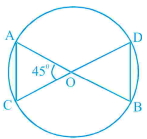
If in the figure, $O$ is the point of intersection of two chords $AB$ and $CD$ such that $OB = OD$, then triangles $OAC$ and $ODB$ are
A
isosceles and similar
B
equilateral and similar
C
isosceles but not similar
D
equilateral but not similar
Solution
(A) In $\triangle OAC$ and $\triangle ODB$:
$1$. $\angle AOC = \angle DOB$ (Vertically opposite angles).
$2$. $\angle OAC = \angle ODB$ (Angles subtended by the same arc $CB$ at the circumference are equal).
$3$. $\angle OCA = \angle OBD$ (Angles subtended by the same arc $AD$ at the circumference are equal).
Thus, $\triangle OAC \sim \triangle ODB$ by $AAA$ similarity criterion.
Given $OB = OD$, in $\triangle ODB$, the angles opposite to these sides must be equal, i.e., $\angle ODB = \angle OBD$. Since $\angle OAC = \angle ODB$ and $\angle OCA = \angle OBD$, it follows that $\angle OAC = \angle OCA$. Therefore, $\triangle OAC$ is an isosceles triangle with $OA = OC$.
Since $\triangle OAC \sim \triangle ODB$ and $\triangle OAC$ is isosceles, $\triangle ODB$ must also be isosceles.
Hence, the triangles are isosceles and similar.
$1$. $\angle AOC = \angle DOB$ (Vertically opposite angles).
$2$. $\angle OAC = \angle ODB$ (Angles subtended by the same arc $CB$ at the circumference are equal).
$3$. $\angle OCA = \angle OBD$ (Angles subtended by the same arc $AD$ at the circumference are equal).
Thus, $\triangle OAC \sim \triangle ODB$ by $AAA$ similarity criterion.
Given $OB = OD$, in $\triangle ODB$, the angles opposite to these sides must be equal, i.e., $\angle ODB = \angle OBD$. Since $\angle OAC = \angle ODB$ and $\angle OCA = \angle OBD$, it follows that $\angle OAC = \angle OCA$. Therefore, $\triangle OAC$ is an isosceles triangle with $OA = OC$.
Since $\triangle OAC \sim \triangle ODB$ and $\triangle OAC$ is isosceles, $\triangle ODB$ must also be isosceles.
Hence, the triangles are isosceles and similar.
0 likes
View Solution2
MediumMCQ
$D$ and $E$ are points on the sides $AB$ and $AC$ of a triangle $ABC$ respectively,such that $AD = 2 \, cm$,$BD = 3 \, cm$,$BC = 7.5 \, cm$,and $DE \parallel BC$. Find the length of $DE$ (in $cm$).
A
$2.5$
B
$3$
C
$5$
D
$6$
Solution
(B) Given that $DE \parallel BC$ in $\triangle ABC$,by the Basic Proportionality Theorem (Thales Theorem),$\triangle ADE \sim \triangle ABC$.
Therefore,the ratio of corresponding sides is equal: $\frac{AD}{AB} = \frac{DE}{BC}$.
Given $AD = 2 \, cm$ and $BD = 3 \, cm$,we have $AB = AD + BD = 2 + 3 = 5 \, cm$.
Substituting the values into the ratio: $\frac{2}{5} = \frac{DE}{7.5}$.
Solving for $DE$: $DE = \frac{2}{5} \times 7.5$.
$DE = 2 \times 1.5 = 3 \, cm$.
Therefore,the ratio of corresponding sides is equal: $\frac{AD}{AB} = \frac{DE}{BC}$.
Given $AD = 2 \, cm$ and $BD = 3 \, cm$,we have $AB = AD + BD = 2 + 3 = 5 \, cm$.
Substituting the values into the ratio: $\frac{2}{5} = \frac{DE}{7.5}$.
Solving for $DE$: $DE = \frac{2}{5} \times 7.5$.
$DE = 2 \times 1.5 = 3 \, cm$.
0 likes
View Solution3
MediumMCQ
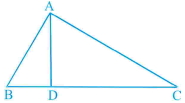
In the given figure,$\angle BAC = 90^{\circ}$ and $AD \perp BC$. Then,
A
$BD \cdot CD = BC^{2}$
B
$AB \cdot AC = BC^{2}$
C
$BD \cdot CD = AD^{2}$
D
$AB \cdot AC = AD^{2}$
Solution
(C) In $\triangle ADB$ and $\triangle ADC$:
$\angle ADB = \angle ADC = 90^{\circ}$ (since $AD \perp BC$)
$\angle BAD = \angle ACD$ (both are complementary to $\angle CAD$)
$\angle ABD = \angle CAD$ (both are complementary to $\angle BAD$)
Therefore,by $AA$ similarity criterion,$\triangle ADB \sim \triangle CDA$.
From the property of similar triangles,the ratio of corresponding sides is equal:
$\frac{AD}{CD} = \frac{BD}{AD}$
Cross-multiplying gives:
$AD^{2} = BD \cdot CD$
$\angle ADB = \angle ADC = 90^{\circ}$ (since $AD \perp BC$)
$\angle BAD = \angle ACD$ (both are complementary to $\angle CAD$)
$\angle ABD = \angle CAD$ (both are complementary to $\angle BAD$)
Therefore,by $AA$ similarity criterion,$\triangle ADB \sim \triangle CDA$.
From the property of similar triangles,the ratio of corresponding sides is equal:
$\frac{AD}{CD} = \frac{BD}{AD}$
Cross-multiplying gives:
$AD^{2} = BD \cdot CD$
0 likes
View Solution4
DifficultMCQ
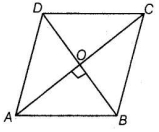
The lengths of the diagonals of a rhombus are $16 \, cm$ and $12 \, cm$. Then,the length of the side of the rhombus is (in $cm$)
A
$9$
B
$20$
C
$8$
D
$10$
Solution
(D) We know that the diagonals of a rhombus are perpendicular bisectors of each other.
Let the rhombus be $ABCD$ with diagonals $AC = 16 \, cm$ and $BD = 12 \, cm$ intersecting at $O$.
Since the diagonals bisect each other at right angles,we have:
$AO = \frac{AC}{2} = \frac{16}{2} = 8 \, cm$
$BO = \frac{BD}{2} = \frac{12}{2} = 6 \, cm$
In the right-angled triangle $\triangle AOB$,by Pythagoras theorem:
$AB^2 = AO^2 + BO^2$
$AB^2 = 8^2 + 6^2 = 64 + 36 = 100$
$AB = \sqrt{100} = 10 \, cm$
Thus,the length of the side of the rhombus is $10 \, cm$.
Let the rhombus be $ABCD$ with diagonals $AC = 16 \, cm$ and $BD = 12 \, cm$ intersecting at $O$.
Since the diagonals bisect each other at right angles,we have:
$AO = \frac{AC}{2} = \frac{16}{2} = 8 \, cm$
$BO = \frac{BD}{2} = \frac{12}{2} = 6 \, cm$
In the right-angled triangle $\triangle AOB$,by Pythagoras theorem:
$AB^2 = AO^2 + BO^2$
$AB^2 = 8^2 + 6^2 = 64 + 36 = 100$
$AB = \sqrt{100} = 10 \, cm$
Thus,the length of the side of the rhombus is $10 \, cm$.
0 likes
View Solution5
MediumMCQ
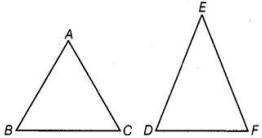
If $\triangle ABC \sim \triangle EDF$ and $\triangle ABC$ is not similar to $\triangle DEF$,then which of the following is not true?
A
$AB \cdot EF = AC \cdot DE$
B
$BC \cdot DE = AB \cdot EF$
C
$BC \cdot EF = AC \cdot FD$
D
$BC \cdot DE = AB \cdot FD$
Solution
(B) Given,$\triangle ABC \sim \triangle EDF$.
Therefore,the ratios of corresponding sides are equal:
$\frac{AB}{ED} = \frac{BC}{DF} = \frac{AC}{EF}$.
From $\frac{AB}{ED} = \frac{BC}{DF}$,we get $AB \cdot DF = ED \cdot BC$,which is $BC \cdot DE = AB \cdot DF$. Thus,option $(d)$ is true.
From $\frac{BC}{DF} = \frac{AC}{EF}$,we get $BC \cdot EF = AC \cdot DF$. This does not match any option directly,but let's check the others.
From $\frac{AB}{ED} = \frac{AC}{EF}$,we get $AB \cdot EF = AC \cdot ED$,which is $AB \cdot EF = AC \cdot DE$. Thus,option $(a)$ is true.
Comparing the given options with the derived ratios:
Option $(a)$: $AB \cdot EF = AC \cdot DE$ (True)
Option $(d)$: $BC \cdot DE = AB \cdot DF$ (True)
Option $(b)$: $BC \cdot DE = AB \cdot EF$ (This is not derived from the similarity $\triangle ABC \sim \triangle EDF$)
Option $(c)$: $BC \cdot EF = AC \cdot FD$ (This is not derived from the similarity $\triangle ABC \sim \triangle EDF$)
Re-evaluating the question: The question asks which is $NOT$ true. Based on the similarity $\triangle ABC \sim \triangle EDF$,the correct ratios are $\frac{AB}{ED} = \frac{BC}{DF} = \frac{AC}{EF}$.
From this,$BC \cdot EF = AC \cdot DF$ is true. Option $(c)$ says $BC \cdot EF = AC \cdot FD$. Since $DF = FD$,option $(c)$ is also true.
Therefore,option $(b)$ is the one that is not true.
Therefore,the ratios of corresponding sides are equal:
$\frac{AB}{ED} = \frac{BC}{DF} = \frac{AC}{EF}$.
From $\frac{AB}{ED} = \frac{BC}{DF}$,we get $AB \cdot DF = ED \cdot BC$,which is $BC \cdot DE = AB \cdot DF$. Thus,option $(d)$ is true.
From $\frac{BC}{DF} = \frac{AC}{EF}$,we get $BC \cdot EF = AC \cdot DF$. This does not match any option directly,but let's check the others.
From $\frac{AB}{ED} = \frac{AC}{EF}$,we get $AB \cdot EF = AC \cdot ED$,which is $AB \cdot EF = AC \cdot DE$. Thus,option $(a)$ is true.
Comparing the given options with the derived ratios:
Option $(a)$: $AB \cdot EF = AC \cdot DE$ (True)
Option $(d)$: $BC \cdot DE = AB \cdot DF$ (True)
Option $(b)$: $BC \cdot DE = AB \cdot EF$ (This is not derived from the similarity $\triangle ABC \sim \triangle EDF$)
Option $(c)$: $BC \cdot EF = AC \cdot FD$ (This is not derived from the similarity $\triangle ABC \sim \triangle EDF$)
Re-evaluating the question: The question asks which is $NOT$ true. Based on the similarity $\triangle ABC \sim \triangle EDF$,the correct ratios are $\frac{AB}{ED} = \frac{BC}{DF} = \frac{AC}{EF}$.
From this,$BC \cdot EF = AC \cdot DF$ is true. Option $(c)$ says $BC \cdot EF = AC \cdot FD$. Since $DF = FD$,option $(c)$ is also true.
Therefore,option $(b)$ is the one that is not true.
0 likes
View Solution6
MediumMCQ
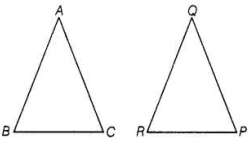
If in two triangles $ABC$ and $PQR$,$\frac{AB}{QR} = \frac{BC}{PR} = \frac{CA}{PQ}$,then
A
$\triangle PQR \sim \triangle ABC$
B
$\triangle PQR \sim \triangle CAB$
C
$\triangle CBA \sim \triangle PQR$
D
$\triangle BCA \sim \triangle PQR$
Solution
(B) Given,in two triangles $ABC$ and $PQR$,$\frac{AB}{QR} = \frac{BC}{PR} = \frac{CA}{PQ}$.
This ratio shows that the sides of $\triangle ABC$ are proportional to the corresponding sides of $\triangle PQR$.
Specifically,the side $AB$ corresponds to $QR$,$BC$ corresponds to $PR$,and $CA$ corresponds to $PQ$.
By the $SSS$ (Side-Side-Side) similarity criterion,if the sides of two triangles are in the same ratio,then the triangles are similar,and their corresponding angles are equal.
Matching the vertices based on the proportionality:
$A$ corresponds to $Q$,$B$ corresponds to $R$,and $C$ corresponds to $P$.
Therefore,$\triangle ABC \sim \triangle QRP$,or equivalently,$\triangle CAB \sim \triangle PQR$.
This ratio shows that the sides of $\triangle ABC$ are proportional to the corresponding sides of $\triangle PQR$.
Specifically,the side $AB$ corresponds to $QR$,$BC$ corresponds to $PR$,and $CA$ corresponds to $PQ$.
By the $SSS$ (Side-Side-Side) similarity criterion,if the sides of two triangles are in the same ratio,then the triangles are similar,and their corresponding angles are equal.
Matching the vertices based on the proportionality:
$A$ corresponds to $Q$,$B$ corresponds to $R$,and $C$ corresponds to $P$.
Therefore,$\triangle ABC \sim \triangle QRP$,or equivalently,$\triangle CAB \sim \triangle PQR$.
0 likes
View Solution7
DifficultMCQ
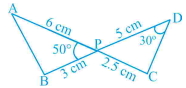
In the figure,two line segments $AC$ and $BD$ intersect each other at the point $P$ such that $PA = 6 \, cm$,$PB = 3 \, cm$,$PC = 2.5 \, cm$,$PD = 5 \, cm$,$\angle APB = 50^{\circ}$ and $\angle CDP = 30^{\circ}$. Then,$\angle PBA$ is equal to: (in $^{\circ}$)
A
$10$
B
$50$
C
$100$
D
$120$
Solution
(C) In $\triangle APB$ and $\triangle DPC$,we have:
$\angle APB = \angle DPC = 50^{\circ}$ [Vertically opposite angles]
Now,consider the ratios of the sides including the equal angles:
$\frac{PA}{PD} = \frac{6}{5} = 1.2$
$\frac{PB}{PC} = \frac{3}{2.5} = \frac{30}{25} = 1.2$
Since $\frac{PA}{PD} = \frac{PB}{PC}$ and the included angles are equal,by the $SAS$ similarity criterion:
$\triangle APB \sim \triangle DPC$
Since the triangles are similar,their corresponding angles are equal:
$\angle PAB = \angle PDC = 30^{\circ}$
In $\triangle APB$,the sum of angles is $180^{\circ}$:
$\angle PAB + \angle APB + \angle PBA = 180^{\circ}$
$30^{\circ} + 50^{\circ} + \angle PBA = 180^{\circ}$
$80^{\circ} + \angle PBA = 180^{\circ}$
$\angle PBA = 180^{\circ} - 80^{\circ} = 100^{\circ}$
$\angle APB = \angle DPC = 50^{\circ}$ [Vertically opposite angles]
Now,consider the ratios of the sides including the equal angles:
$\frac{PA}{PD} = \frac{6}{5} = 1.2$
$\frac{PB}{PC} = \frac{3}{2.5} = \frac{30}{25} = 1.2$
Since $\frac{PA}{PD} = \frac{PB}{PC}$ and the included angles are equal,by the $SAS$ similarity criterion:
$\triangle APB \sim \triangle DPC$
Since the triangles are similar,their corresponding angles are equal:
$\angle PAB = \angle PDC = 30^{\circ}$
In $\triangle APB$,the sum of angles is $180^{\circ}$:
$\angle PAB + \angle APB + \angle PBA = 180^{\circ}$
$30^{\circ} + 50^{\circ} + \angle PBA = 180^{\circ}$
$80^{\circ} + \angle PBA = 180^{\circ}$
$\angle PBA = 180^{\circ} - 80^{\circ} = 100^{\circ}$
0 likes
View Solution8
MediumMCQ
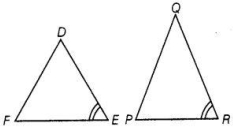
If in two triangles $DEF$ and $PQR$,$\angle D = \angle Q$ and $\angle R = \angle E$,then which of the following is not true?
A
$\frac{EF}{PR} = \frac{DF}{PQ}$
B
$\frac{EF}{RP} = \frac{DE}{QR}$
C
$\frac{DE}{QR} = \frac{DF}{PQ}$
D
$\frac{DE}{PQ} = \frac{EF}{RP}$
Solution
(D) Given,in $\triangle DEF$ and $\triangle PQR$,$\angle D = \angle Q$ and $\angle E = \angle R$.
By the $AA$ similarity criterion,$\triangle DEF \sim \triangle QRP$.
Since the triangles are similar,the ratios of their corresponding sides are equal:
$\frac{DE}{QR} = \frac{EF}{RP} = \frac{DF}{QP}$.
Now,let's check the given options:
Option $A$: $\frac{EF}{PR} = \frac{DF}{PQ}$ is equivalent to $\frac{EF}{RP} = \frac{DF}{QP}$,which is true.
Option $B$: $\frac{EF}{RP} = \frac{DE}{QR}$ is true.
Option $C$: $\frac{DE}{QR} = \frac{DF}{PQ}$ is equivalent to $\frac{DE}{QR} = \frac{DF}{QP}$,which is true.
Option $D$: $\frac{DE}{PQ} = \frac{EF}{RP}$. From the similarity ratio,$\frac{DE}{QR} = \frac{EF}{RP}$. Thus,$\frac{DE}{PQ} = \frac{EF}{RP}$ is not necessarily true because $PQ \neq QR$ in general.
Therefore,option $D$ is not true.
By the $AA$ similarity criterion,$\triangle DEF \sim \triangle QRP$.
Since the triangles are similar,the ratios of their corresponding sides are equal:
$\frac{DE}{QR} = \frac{EF}{RP} = \frac{DF}{QP}$.
Now,let's check the given options:
Option $A$: $\frac{EF}{PR} = \frac{DF}{PQ}$ is equivalent to $\frac{EF}{RP} = \frac{DF}{QP}$,which is true.
Option $B$: $\frac{EF}{RP} = \frac{DE}{QR}$ is true.
Option $C$: $\frac{DE}{QR} = \frac{DF}{PQ}$ is equivalent to $\frac{DE}{QR} = \frac{DF}{QP}$,which is true.
Option $D$: $\frac{DE}{PQ} = \frac{EF}{RP}$. From the similarity ratio,$\frac{DE}{QR} = \frac{EF}{RP}$. Thus,$\frac{DE}{PQ} = \frac{EF}{RP}$ is not necessarily true because $PQ \neq QR$ in general.
Therefore,option $D$ is not true.
0 likes
View Solution9
MediumMCQ
In triangles $ABC$ and $DEF$,$\angle B = \angle E$,$\angle F = \angle C$ and $AB = 3 DE$. Then,the two triangles are
A
similar but not congruent
B
congruent but not similar
C
neither congruent nor similar
D
congruent as well as similar
Solution
(A) In $\triangle ABC$ and $\triangle DEF$,we are given $\angle B = \angle E$ and $\angle F = \angle C$.
By the $AA$ (Angle-Angle) similarity criterion,since two angles of $\triangle ABC$ are equal to two corresponding angles of $\triangle DEF$,the triangles are similar,i.e.,$\triangle ABC \sim \triangle DEF$.
For two triangles to be congruent,their corresponding sides must be equal. Here,it is given that $AB = 3 DE$,which implies $AB \neq DE$.
Since the corresponding sides are not equal,the triangles are not congruent.
Therefore,the triangles are similar but not congruent.
By the $AA$ (Angle-Angle) similarity criterion,since two angles of $\triangle ABC$ are equal to two corresponding angles of $\triangle DEF$,the triangles are similar,i.e.,$\triangle ABC \sim \triangle DEF$.
For two triangles to be congruent,their corresponding sides must be equal. Here,it is given that $AB = 3 DE$,which implies $AB \neq DE$.
Since the corresponding sides are not equal,the triangles are not congruent.
Therefore,the triangles are similar but not congruent.
0 likes
View Solution10
MediumMCQ
It is given that $\triangle ABC \sim \triangle PQR,$ with $\frac{BC}{QR} = \frac{1}{3}.$ Then,$\frac{\operatorname{ar}(\triangle PRQ)}{\operatorname{ar}(\triangle BCA)}$ is equal to
A
$3$
B
$9$
C
$\frac{1}{3}$
D
$\frac{1}{9}$
Solution
(B) Given that $\triangle ABC \sim \triangle PQR$ and $\frac{BC}{QR} = \frac{1}{3}.$
We know that the ratio of the areas of two similar triangles is equal to the square of the ratio of their corresponding sides.
Therefore,$\frac{\operatorname{ar}(\triangle PRQ)}{\operatorname{ar}(\triangle BCA)} = \frac{(QR)^2}{(BC)^2} = \left(\frac{QR}{BC}\right)^2.$
Since $\frac{BC}{QR} = \frac{1}{3},$ it follows that $\frac{QR}{BC} = \frac{3}{1} = 3.$
Thus,$\frac{\operatorname{ar}(\triangle PRQ)}{\operatorname{ar}(\triangle BCA)} = (3)^2 = 9.$
We know that the ratio of the areas of two similar triangles is equal to the square of the ratio of their corresponding sides.
Therefore,$\frac{\operatorname{ar}(\triangle PRQ)}{\operatorname{ar}(\triangle BCA)} = \frac{(QR)^2}{(BC)^2} = \left(\frac{QR}{BC}\right)^2.$
Since $\frac{BC}{QR} = \frac{1}{3},$ it follows that $\frac{QR}{BC} = \frac{3}{1} = 3.$
Thus,$\frac{\operatorname{ar}(\triangle PRQ)}{\operatorname{ar}(\triangle BCA)} = (3)^2 = 9.$
0 likes
View Solution11
DifficultMCQ
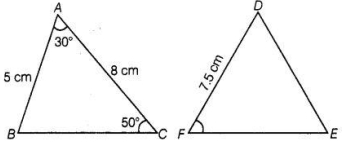
It is given that $\triangle ABC \sim \triangle DFE$,$\angle A = 30^{\circ}$,$\angle C = 50^{\circ}$,$AB = 5 \, cm$,$AC = 8 \, cm$ and $DF = 7.5 \, cm$. Then,the following is true:
A
$DE = 12 \, cm, \angle F = 50^{\circ}$
B
$EF = 12 \, cm, \angle D = 100^{\circ}$
C
$DE = 12 \, cm, \angle F = 100^{\circ}$
D
$EF = 12 \, cm, \angle D = 30^{\circ}$
Solution
(C) Given that $\triangle ABC \sim \triangle DFE$,the corresponding angles are equal and the corresponding sides are proportional.
Therefore,$\angle A = \angle D = 30^{\circ}$,$\angle B = \angle F$,and $\angle C = \angle E = 50^{\circ}$.
In $\triangle ABC$,the sum of angles is $180^{\circ}$,so $\angle B = 180^{\circ} - (30^{\circ} + 50^{\circ}) = 100^{\circ}$.
Thus,$\angle F = 100^{\circ}$.
From the similarity $\triangle ABC \sim \triangle DFE$,we have the ratio of corresponding sides: $\frac{AB}{DF} = \frac{AC}{DE} = \frac{BC}{FE}$.
Substituting the given values: $\frac{5}{7.5} = \frac{8}{DE}$.
Solving for $DE$: $DE = \frac{8 \times 7.5}{5} = \frac{60}{5} = 12 \, cm$.
Hence,$DE = 12 \, cm$ and $\angle F = 100^{\circ}$.
Therefore,$\angle A = \angle D = 30^{\circ}$,$\angle B = \angle F$,and $\angle C = \angle E = 50^{\circ}$.
In $\triangle ABC$,the sum of angles is $180^{\circ}$,so $\angle B = 180^{\circ} - (30^{\circ} + 50^{\circ}) = 100^{\circ}$.
Thus,$\angle F = 100^{\circ}$.
From the similarity $\triangle ABC \sim \triangle DFE$,we have the ratio of corresponding sides: $\frac{AB}{DF} = \frac{AC}{DE} = \frac{BC}{FE}$.
Substituting the given values: $\frac{5}{7.5} = \frac{8}{DE}$.
Solving for $DE$: $DE = \frac{8 \times 7.5}{5} = \frac{60}{5} = 12 \, cm$.
Hence,$DE = 12 \, cm$ and $\angle F = 100^{\circ}$.
0 likes
View Solution12
MediumMCQ
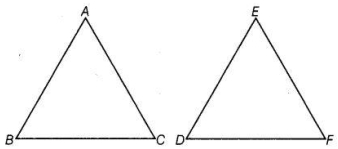
If in triangles $ABC$ and $DEF$,$\frac{AB}{DE} = \frac{BC}{FD}$,then they will be similar,when
A
$\angle B = \angle E$
B
$\angle A = \angle D$
C
$\angle A = \angle F$
D
$\angle B = \angle D$
Solution
(D) For two triangles to be similar by the $SAS$ (Side-Angle-Side) similarity criterion,the ratio of two corresponding sides must be equal,and the included angle between these sides must be equal.
Given the ratio $\frac{AB}{DE} = \frac{BC}{FD}$,the sides $AB$ and $BC$ form the angle $\angle B$ in $\triangle ABC$. Similarly,the sides $DE$ and $FD$ form the angle $\angle D$ in $\triangle DEF$.
Therefore,for $\triangle ABC \sim \triangle EDF$,the included angles must be equal,i.e.,$\angle B = \angle D$.
Given the ratio $\frac{AB}{DE} = \frac{BC}{FD}$,the sides $AB$ and $BC$ form the angle $\angle B$ in $\triangle ABC$. Similarly,the sides $DE$ and $FD$ form the angle $\angle D$ in $\triangle DEF$.
Therefore,for $\triangle ABC \sim \triangle EDF$,the included angles must be equal,i.e.,$\angle B = \angle D$.
0 likes
View Solution13
MediumMCQ
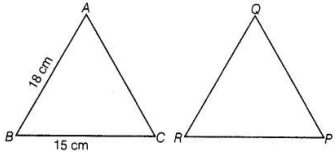
If $\triangle ABC \sim \triangle QRP$,$\frac{\operatorname{ar}(\triangle ABC)}{\operatorname{ar}(\triangle QRP)} = \frac{9}{4}$,$AB = 18 \, cm$ and $BC = 15 \, cm$,then $PR$ is equal to (in $cm$):
A
$10$
B
$12$
C
$\frac{20}{3}$
D
$8$
Solution
(A) Given,$\triangle ABC \sim \triangle QRP$.
We know that the ratio of the areas of two similar triangles is equal to the ratio of the squares of their corresponding sides.
Therefore,$\frac{\operatorname{ar}(\triangle ABC)}{\operatorname{ar}(\triangle QRP)} = \frac{BC^2}{RP^2}$.
Given that $\frac{\operatorname{ar}(\triangle ABC)}{\operatorname{ar}(\triangle QRP)} = \frac{9}{4}$ and $BC = 15 \, cm$.
Substituting the values,we get $\frac{9}{4} = \frac{(15)^2}{RP^2}$.
$\frac{9}{4} = \frac{225}{RP^2}$.
$RP^2 = \frac{225 \times 4}{9} = 25 \times 4 = 100$.
$RP = \sqrt{100} = 10 \, cm$.
Since $\triangle ABC \sim \triangle QRP$,the corresponding side to $PR$ is $AC$. However,the question asks for $PR$ based on the similarity ratio. From the similarity $\triangle ABC \sim \triangle QRP$,we have $\frac{BC}{RP} = \frac{AC}{QP} = \frac{AB}{QR}$.
Thus,$RP = 10 \, cm$.
We know that the ratio of the areas of two similar triangles is equal to the ratio of the squares of their corresponding sides.
Therefore,$\frac{\operatorname{ar}(\triangle ABC)}{\operatorname{ar}(\triangle QRP)} = \frac{BC^2}{RP^2}$.
Given that $\frac{\operatorname{ar}(\triangle ABC)}{\operatorname{ar}(\triangle QRP)} = \frac{9}{4}$ and $BC = 15 \, cm$.
Substituting the values,we get $\frac{9}{4} = \frac{(15)^2}{RP^2}$.
$\frac{9}{4} = \frac{225}{RP^2}$.
$RP^2 = \frac{225 \times 4}{9} = 25 \times 4 = 100$.
$RP = \sqrt{100} = 10 \, cm$.
Since $\triangle ABC \sim \triangle QRP$,the corresponding side to $PR$ is $AC$. However,the question asks for $PR$ based on the similarity ratio. From the similarity $\triangle ABC \sim \triangle QRP$,we have $\frac{BC}{RP} = \frac{AC}{QP} = \frac{AB}{QR}$.
Thus,$RP = 10 \, cm$.
0 likes
View Solution14
DifficultMCQ
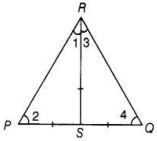
If $S$ is a point on side $PQ$ of a $\triangle PQR$ such that $PS = QS = RS$,then
A
$PR \cdot QR = RS^2$
B
$PR^2 + QR^2 = PQ^2$
C
$QS^2 + RS^2 = QR^2$
D
$PS^2 + RS^2 = PR^2$
Solution
(B) Given,in $\triangle PQR$,$PS = QS = RS$ ... $(1)$
In $\triangle PSR$,$PS = RS$ (from Eq. $1$),therefore $\angle 1 = \angle 2$ ... $(2)$ (angles opposite to equal sides are equal).
Similarly,in $\triangle RSQ$,$RS = QS$ (from Eq. $1$),therefore $\angle 3 = \angle 4$ ... $(3)$ (angles opposite to equal sides are equal).
In $\triangle PQR$,the sum of angles is $180^{\circ}$.
$\angle P + \angle Q + \angle R = 180^{\circ}$
$\angle 2 + \angle 4 + (\angle 1 + \angle 3) = 180^{\circ}$
Substituting $\angle 2 = \angle 1$ and $\angle 4 = \angle 3$ from $(2)$ and $(3)$:
$\angle 1 + \angle 3 + \angle 1 + \angle 3 = 180^{\circ}$
$2(\angle 1 + \angle 3) = 180^{\circ}$
$\angle 1 + \angle 3 = 90^{\circ}$
Thus,$\angle R = 90^{\circ}$.
In $\triangle PQR$,by Pythagoras theorem,$PR^2 + QR^2 = PQ^2$.
In $\triangle PSR$,$PS = RS$ (from Eq. $1$),therefore $\angle 1 = \angle 2$ ... $(2)$ (angles opposite to equal sides are equal).
Similarly,in $\triangle RSQ$,$RS = QS$ (from Eq. $1$),therefore $\angle 3 = \angle 4$ ... $(3)$ (angles opposite to equal sides are equal).
In $\triangle PQR$,the sum of angles is $180^{\circ}$.
$\angle P + \angle Q + \angle R = 180^{\circ}$
$\angle 2 + \angle 4 + (\angle 1 + \angle 3) = 180^{\circ}$
Substituting $\angle 2 = \angle 1$ and $\angle 4 = \angle 3$ from $(2)$ and $(3)$:
$\angle 1 + \angle 3 + \angle 1 + \angle 3 = 180^{\circ}$
$2(\angle 1 + \angle 3) = 180^{\circ}$
$\angle 1 + \angle 3 = 90^{\circ}$
Thus,$\angle R = 90^{\circ}$.
In $\triangle PQR$,by Pythagoras theorem,$PR^2 + QR^2 = PQ^2$.
0 likes
View Solution15
Medium
In $\triangle ABC$,$AB = 24 \, cm$,$BC = 10 \, cm$,and $AC = 26 \, cm$. Is this triangle a right triangle? Give reasons for your answer.
Solution
(A) To determine if $\triangle ABC$ is a right triangle,we check if it satisfies the converse of the Pythagoras theorem,which states that if the square of the length of the longest side is equal to the sum of the squares of the lengths of the other two sides,then the triangle is a right triangle.
Given sides are $AB = 24 \, cm$,$BC = 10 \, cm$,and $AC = 26 \, cm$.
Calculate the squares of the sides:
$AB^2 = 24^2 = 576 \, cm^2$
$BC^2 = 10^2 = 100 \, cm^2$
$AC^2 = 26^2 = 676 \, cm^2$
Now,check the sum of the squares of the two smaller sides:
$AB^2 + BC^2 = 576 + 100 = 676 \, cm^2$
Since $AB^2 + BC^2 = AC^2$ $(576 + 100 = 676)$,the triangle satisfies the Pythagoras theorem.
Therefore,$\triangle ABC$ is a right triangle with the right angle at vertex $B$.
Given sides are $AB = 24 \, cm$,$BC = 10 \, cm$,and $AC = 26 \, cm$.
Calculate the squares of the sides:
$AB^2 = 24^2 = 576 \, cm^2$
$BC^2 = 10^2 = 100 \, cm^2$
$AC^2 = 26^2 = 676 \, cm^2$
Now,check the sum of the squares of the two smaller sides:
$AB^2 + BC^2 = 576 + 100 = 676 \, cm^2$
Since $AB^2 + BC^2 = AC^2$ $(576 + 100 = 676)$,the triangle satisfies the Pythagoras theorem.
Therefore,$\triangle ABC$ is a right triangle with the right angle at vertex $B$.
0 likes
View Solution16
MediumMCQ
$P$ and $Q$ are the points on the sides $DE$ and $DF$ of a triangle $DEF$ such that $DP = 5 \, cm$,$DE = 15 \, cm$,$DQ = 6 \, cm$,and $QF = 18 \, cm$. Is $PQ \parallel EF$? Give reasons for your answer.
A
Yes,$PQ \parallel EF$ because the ratios are equal.
B
No,$PQ$ is not parallel to $EF$ because the ratios are not equal.
C
Yes,$PQ \parallel EF$ by the Converse of Thales Theorem.
D
Cannot be determined.
Solution
(B) According to the Converse of the Basic Proportionality Theorem (Thales Theorem),$PQ \parallel EF$ if and only if $\frac{DP}{PE} = \frac{DQ}{QF}$.
Given $DP = 5 \, cm$ and $DE = 15 \, cm$,we find $PE = DE - DP = 15 - 5 = 10 \, cm$.
Thus,the ratio $\frac{DP}{PE} = \frac{5}{10} = \frac{1}{2}$.
Given $DQ = 6 \, cm$ and $QF = 18 \, cm$,the ratio $\frac{DQ}{QF} = \frac{6}{18} = \frac{1}{3}$.
Since $\frac{DP}{PE} \neq \frac{DQ}{QF}$ (i.e.,$\frac{1}{2} \neq \frac{1}{3}$),the line $PQ$ is not parallel to $EF$.
Given $DP = 5 \, cm$ and $DE = 15 \, cm$,we find $PE = DE - DP = 15 - 5 = 10 \, cm$.
Thus,the ratio $\frac{DP}{PE} = \frac{5}{10} = \frac{1}{2}$.
Given $DQ = 6 \, cm$ and $QF = 18 \, cm$,the ratio $\frac{DQ}{QF} = \frac{6}{18} = \frac{1}{3}$.
Since $\frac{DP}{PE} \neq \frac{DQ}{QF}$ (i.e.,$\frac{1}{2} \neq \frac{1}{3}$),the line $PQ$ is not parallel to $EF$.
0 likes
View Solution17
Medium
It is given that $\triangle FED \sim \triangle STU$. Is it true to say that $\frac{DE}{ST} = \frac{EF}{TU}$? Why?
Solution
(B) No,it is not true.
Given that $\triangle FED \sim \triangle STU$,the corresponding vertices are $F \leftrightarrow S$,$E \leftrightarrow T$,and $D \leftrightarrow U$.
According to the property of similar triangles,the ratios of their corresponding sides must be equal.
Therefore,the correct ratios are $\frac{FE}{ST} = \frac{ED}{TU} = \frac{FD}{SU}$.
Comparing this with the given expression $\frac{DE}{ST} = \frac{EF}{TU}$,we can see that it does not match the required correspondence of sides.
Given that $\triangle FED \sim \triangle STU$,the corresponding vertices are $F \leftrightarrow S$,$E \leftrightarrow T$,and $D \leftrightarrow U$.
According to the property of similar triangles,the ratios of their corresponding sides must be equal.
Therefore,the correct ratios are $\frac{FE}{ST} = \frac{ED}{TU} = \frac{FD}{SU}$.
Comparing this with the given expression $\frac{DE}{ST} = \frac{EF}{TU}$,we can see that it does not match the required correspondence of sides.
0 likes
View Solution18
MediumMCQ
Is the triangle with sides $25 \, cm$,$5 \, cm$,and $24 \, cm$ a right triangle? Give reasons for your answer.
A
Yes
B
No
C
Cannot be determined
D
None of these
Solution
(B) To determine if the triangle is a right triangle,we check if it satisfies the Pythagorean theorem,which states that for a right triangle,the square of the longest side must be equal to the sum of the squares of the other two sides.
Let the sides be $a = 25 \, cm$,$b = 5 \, cm$,and $c = 24 \, cm$.
The longest side is $a = 25 \, cm$.
Calculate the square of the longest side: $a^2 = (25)^2 = 625 \, cm^2$.
Calculate the sum of the squares of the other two sides: $b^2 + c^2 = (5)^2 + (24)^2 = 25 + 576 = 601 \, cm^2$.
Since $a^2 \neq b^2 + c^2$ $(625 \neq 601)$,the triangle does not satisfy the Pythagorean theorem.
Therefore,the triangle with sides $25 \, cm$,$5 \, cm$,and $24 \, cm$ is not a right triangle.
Let the sides be $a = 25 \, cm$,$b = 5 \, cm$,and $c = 24 \, cm$.
The longest side is $a = 25 \, cm$.
Calculate the square of the longest side: $a^2 = (25)^2 = 625 \, cm^2$.
Calculate the sum of the squares of the other two sides: $b^2 + c^2 = (5)^2 + (24)^2 = 25 + 576 = 601 \, cm^2$.
Since $a^2 \neq b^2 + c^2$ $(625 \neq 601)$,the triangle does not satisfy the Pythagorean theorem.
Therefore,the triangle with sides $25 \, cm$,$5 \, cm$,and $24 \, cm$ is not a right triangle.
0 likes
View Solution19
Medium
It is given that $\triangle DEF \sim \triangle RPQ.$ Is it true to say that $\angle D = \angle R$ and $\angle F = \angle P?$ Why?
Solution
(B) The statement is false.
We know that if two triangles are similar,their corresponding angles are equal in the order of their vertices.
Given $\triangle DEF \sim \triangle RPQ$,the correspondence is:
$D \leftrightarrow R$
$E \leftrightarrow P$
$F \leftrightarrow Q$
Therefore,the correct equalities are $\angle D = \angle R$,$\angle E = \angle P$,and $\angle F = \angle Q$.
Since $\angle F = \angle Q$ and not $\angle P$,the statement $\angle F = \angle P$ is incorrect.
We know that if two triangles are similar,their corresponding angles are equal in the order of their vertices.
Given $\triangle DEF \sim \triangle RPQ$,the correspondence is:
$D \leftrightarrow R$
$E \leftrightarrow P$
$F \leftrightarrow Q$
Therefore,the correct equalities are $\angle D = \angle R$,$\angle E = \angle P$,and $\angle F = \angle Q$.
Since $\angle F = \angle Q$ and not $\angle P$,the statement $\angle F = \angle P$ is incorrect.
0 likes
View Solution20
Difficult
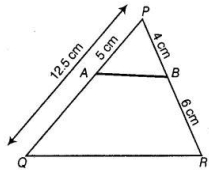
$A$ and $B$ are points on the sides $PQ$ and $PR$ of a triangle $PQR$ respectively,such that $PQ = 12.5 \, cm$,$PA = 5 \, cm$,$BR = 6 \, cm$,and $PB = 4 \, cm$. Is $AB \parallel QR$? Give reasons for your answer.
Solution
(A) Given: $PQ = 12.5 \, cm$,$PA = 5 \, cm$,$BR = 6 \, cm$,and $PB = 4 \, cm$.
First,calculate the length of $AQ$:
$AQ = PQ - PA = 12.5 - 5 = 7.5 \, cm$.
Now,calculate the ratios:
$\frac{PA}{AQ} = \frac{5}{7.5} = \frac{50}{75} = \frac{2}{3}$ ......$(i)$
$\frac{PB}{BR} = \frac{4}{6} = \frac{2}{3}$ ......$(ii)$
From equations $(i)$ and $(ii)$,we observe that:
$\frac{PA}{AQ} = \frac{PB}{BR}$
According to the converse of the Basic Proportionality Theorem (Thales Theorem),if a line divides any two sides of a triangle in the same ratio,then the line is parallel to the third side.
Therefore,$AB \parallel QR$.
First,calculate the length of $AQ$:
$AQ = PQ - PA = 12.5 - 5 = 7.5 \, cm$.
Now,calculate the ratios:
$\frac{PA}{AQ} = \frac{5}{7.5} = \frac{50}{75} = \frac{2}{3}$ ......$(i)$
$\frac{PB}{BR} = \frac{4}{6} = \frac{2}{3}$ ......$(ii)$
From equations $(i)$ and $(ii)$,we observe that:
$\frac{PA}{AQ} = \frac{PB}{BR}$
According to the converse of the Basic Proportionality Theorem (Thales Theorem),if a line divides any two sides of a triangle in the same ratio,then the line is parallel to the third side.
Therefore,$AB \parallel QR$.
0 likes
View Solution21
Medium
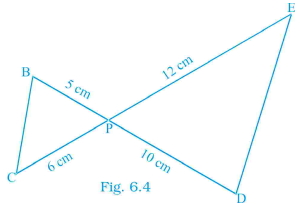
In the given figure,$BD$ and $CE$ intersect each other at the point $P$. Is $\triangle PBC \sim \triangle PDE$ ? Why?
Solution
(A) Yes,$\triangle PBC \sim \triangle PDE$.
In $\triangle PBC$ and $\triangle PDE$:
$\angle BPC = \angle EPD$ [Vertically opposite angles]
Now,calculating the ratios of the sides including the angles:
$\frac{PB}{PD} = \frac{5 \text{ cm}}{10 \text{ cm}} = \frac{1}{2}$ ......$(i)$
$\frac{PC}{PE} = \frac{6 \text{ cm}}{12 \text{ cm}} = \frac{1}{2}$ ......$(ii)$
From equations $(i)$ and $(ii)$:
$\frac{PB}{PD} = \frac{PC}{PE}$
Since one angle of $\triangle PBC$ is equal to one angle of $\triangle PDE$ and the sides including these angles are proportional,by the $SAS$ (Side-Angle-Side) similarity criterion,the triangles are similar.
Hence,$\triangle PBC \sim \triangle PDE$.
In $\triangle PBC$ and $\triangle PDE$:
$\angle BPC = \angle EPD$ [Vertically opposite angles]
Now,calculating the ratios of the sides including the angles:
$\frac{PB}{PD} = \frac{5 \text{ cm}}{10 \text{ cm}} = \frac{1}{2}$ ......$(i)$
$\frac{PC}{PE} = \frac{6 \text{ cm}}{12 \text{ cm}} = \frac{1}{2}$ ......$(ii)$
From equations $(i)$ and $(ii)$:
$\frac{PB}{PD} = \frac{PC}{PE}$
Since one angle of $\triangle PBC$ is equal to one angle of $\triangle PDE$ and the sides including these angles are proportional,by the $SAS$ (Side-Angle-Side) similarity criterion,the triangles are similar.
Hence,$\triangle PBC \sim \triangle PDE$.
0 likes
View Solution22
Difficult
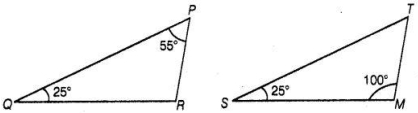
In triangles $PQR$ and $MST$,$\angle P = 55^{\circ}$,$\angle Q = 25^{\circ}$,$\angle M = 100^{\circ}$ and $\angle S = 25^{\circ}$. Is $\triangle QPR \sim \triangle TSM$? Why?
Solution
(N/A) No,$\triangle QPR$ is not similar to $\triangle TSM$.
We know that the sum of the three angles of a triangle is $180^{\circ}$.
In $\triangle PQR$,$\angle P + \angle Q + \angle R = 180^{\circ}$.
$55^{\circ} + 25^{\circ} + \angle R = 180^{\circ}$.
$\angle R = 180^{\circ} - 80^{\circ} = 100^{\circ}$.
In $\triangle TSM$,$\angle T + \angle S + \angle M = 180^{\circ}$.
$\angle T + 25^{\circ} + 100^{\circ} = 180^{\circ}$.
$\angle T = 180^{\circ} - 125^{\circ} = 55^{\circ}$.
Comparing the angles of $\triangle PQR$ and $\triangle TSM$:
$\angle P = 55^{\circ} = \angle T$
$\angle Q = 25^{\circ} = \angle S$
$\angle R = 100^{\circ} = \angle M$
Since all corresponding angles are equal,the triangles are similar,but the correct correspondence is $\triangle PQR \sim \triangle TSM$.
Therefore,$\triangle QPR$ is not similar to $\triangle TSM$ because the order of vertices does not match the correspondence of equal angles.
We know that the sum of the three angles of a triangle is $180^{\circ}$.
In $\triangle PQR$,$\angle P + \angle Q + \angle R = 180^{\circ}$.
$55^{\circ} + 25^{\circ} + \angle R = 180^{\circ}$.
$\angle R = 180^{\circ} - 80^{\circ} = 100^{\circ}$.
In $\triangle TSM$,$\angle T + \angle S + \angle M = 180^{\circ}$.
$\angle T + 25^{\circ} + 100^{\circ} = 180^{\circ}$.
$\angle T = 180^{\circ} - 125^{\circ} = 55^{\circ}$.
Comparing the angles of $\triangle PQR$ and $\triangle TSM$:
$\angle P = 55^{\circ} = \angle T$
$\angle Q = 25^{\circ} = \angle S$
$\angle R = 100^{\circ} = \angle M$
Since all corresponding angles are equal,the triangles are similar,but the correct correspondence is $\triangle PQR \sim \triangle TSM$.
Therefore,$\triangle QPR$ is not similar to $\triangle TSM$ because the order of vertices does not match the correspondence of equal angles.
0 likes
View Solution23
EasyMCQ
Is the following statement true? Why?
"Two quadrilaterals are similar,if their corresponding angles are equal".
"Two quadrilaterals are similar,if their corresponding angles are equal".
A
True
B
False
C
Cannot be determined
D
Depends on the type of quadrilateral
Solution
(B) The statement is $False$.
Two polygons (including quadrilaterals) are considered similar if and only if two conditions are met:
$1$. Their corresponding angles are equal.
$2$. Their corresponding sides are in the same ratio (proportional).
For example,a square and a rectangle have equal corresponding angles ($90^{\circ}$ each),but they are not similar because their sides are not proportional.
Two polygons (including quadrilaterals) are considered similar if and only if two conditions are met:
$1$. Their corresponding angles are equal.
$2$. Their corresponding sides are in the same ratio (proportional).
For example,a square and a rectangle have equal corresponding angles ($90^{\circ}$ each),but they are not similar because their sides are not proportional.
0 likes
View Solution24
Easy
Two sides and the perimeter of one triangle are respectively three times the corresponding sides and the perimeter of the other triangle. Are the two triangles similar? Why?
Solution
(A) Yes,the two triangles are similar.
Let the sides of the first triangle be $a_1, b_1, c_1$ and its perimeter be $P_1 = a_1 + b_1 + c_1$.
Let the sides of the second triangle be $a_2, b_2, c_2$ and its perimeter be $P_2 = a_2 + b_2 + c_2$.
Given that $a_1 = 3a_2$,$b_1 = 3b_2$,and $P_1 = 3P_2$.
Since $P_1 = a_1 + b_1 + c_1$ and $P_2 = a_2 + b_2 + c_2$,we have $3P_2 = 3a_2 + 3b_2 + c_1$.
Substituting $P_2 = a_2 + b_2 + c_2$,we get $3(a_2 + b_2 + c_2) = 3a_2 + 3b_2 + c_1$,which simplifies to $3c_2 = c_1$.
Since all three corresponding sides are proportional $(\frac{a_1}{a_2} = \frac{b_1}{b_2} = \frac{c_1}{c_2} = 3)$,by the $SSS$ similarity criterion,the two triangles are similar.
Let the sides of the first triangle be $a_1, b_1, c_1$ and its perimeter be $P_1 = a_1 + b_1 + c_1$.
Let the sides of the second triangle be $a_2, b_2, c_2$ and its perimeter be $P_2 = a_2 + b_2 + c_2$.
Given that $a_1 = 3a_2$,$b_1 = 3b_2$,and $P_1 = 3P_2$.
Since $P_1 = a_1 + b_1 + c_1$ and $P_2 = a_2 + b_2 + c_2$,we have $3P_2 = 3a_2 + 3b_2 + c_1$.
Substituting $P_2 = a_2 + b_2 + c_2$,we get $3(a_2 + b_2 + c_2) = 3a_2 + 3b_2 + c_1$,which simplifies to $3c_2 = c_1$.
Since all three corresponding sides are proportional $(\frac{a_1}{a_2} = \frac{b_1}{b_2} = \frac{c_1}{c_2} = 3)$,by the $SSS$ similarity criterion,the two triangles are similar.
0 likes
View Solution25
Easy
If in two right triangles,one of the acute angles of one triangle is equal to an acute angle of the other triangle,can you say that the two triangles will be similar? Why?
Solution
(A) Yes,the two triangles will be similar.
Let the two right-angled triangles be $\triangle ABC$ and $\triangle PQR$,where $\angle B = \angle Q = 90^{\circ}$.
Given that one acute angle of the first triangle is equal to an acute angle of the second triangle,let $\angle A = \angle P$.
In $\triangle ABC$ and $\triangle PQR$:
$1$. $\angle B = \angle Q = 90^{\circ}$ (Given)
$2$. $\angle A = \angle P$ (Given)
By the $AA$ (Angle-Angle) similarity criterion,since two angles of one triangle are equal to two angles of the other triangle,the triangles are similar $(\triangle ABC \sim \triangle PQR)$.
This is also a specific case of the $AAA$ similarity criterion,as the third angles must also be equal due to the angle sum property of a triangle.
Let the two right-angled triangles be $\triangle ABC$ and $\triangle PQR$,where $\angle B = \angle Q = 90^{\circ}$.
Given that one acute angle of the first triangle is equal to an acute angle of the second triangle,let $\angle A = \angle P$.
In $\triangle ABC$ and $\triangle PQR$:
$1$. $\angle B = \angle Q = 90^{\circ}$ (Given)
$2$. $\angle A = \angle P$ (Given)
By the $AA$ (Angle-Angle) similarity criterion,since two angles of one triangle are equal to two angles of the other triangle,the triangles are similar $(\triangle ABC \sim \triangle PQR)$.
This is also a specific case of the $AAA$ similarity criterion,as the third angles must also be equal due to the angle sum property of a triangle.
0 likes
View Solution26
Easy
The ratio of the corresponding altitudes of two similar triangles is $\frac{3}{5}$. Is it correct to say that the ratio of their areas is $\frac{6}{5}$? Why?
Solution
(B) The statement is False.
According to the theorem on the areas of similar triangles,the ratio of the areas of two similar triangles is equal to the square of the ratio of their corresponding altitudes.
$\frac{\text{Area}_1}{\text{Area}_2} = \left( \frac{\text{Altitude}_1}{\text{Altitude}_2} \right)^2$
Given that the ratio of the altitudes is $\frac{3}{5}$,we have:
$\frac{\text{Area}_1}{\text{Area}_2} = \left( \frac{3}{5} \right)^2 = \frac{9}{25}$
Since $\frac{9}{25} \neq \frac{6}{5}$,the given statement is incorrect.
According to the theorem on the areas of similar triangles,the ratio of the areas of two similar triangles is equal to the square of the ratio of their corresponding altitudes.
$\frac{\text{Area}_1}{\text{Area}_2} = \left( \frac{\text{Altitude}_1}{\text{Altitude}_2} \right)^2$
Given that the ratio of the altitudes is $\frac{3}{5}$,we have:
$\frac{\text{Area}_1}{\text{Area}_2} = \left( \frac{3}{5} \right)^2 = \frac{9}{25}$
Since $\frac{9}{25} \neq \frac{6}{5}$,the given statement is incorrect.
0 likes
View Solution27
Medium
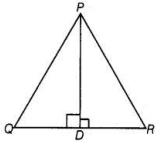
$D$ is a point on side $QR$ of $\triangle PQR$ such that $PD \perp QR$. Will it be correct to say that $\triangle PQD \sim \triangle RPD$? Why?
Solution
(N/A) No,it is not correct to say that $\triangle PQD \sim \triangle RPD$ in general.
In $\triangle PQD$ and $\triangle RPD$:
$1$. $\angle PDQ = \angle PDR = 90^{\circ}$ (Given that $PD \perp QR$)
$2$. $PD = PD$ (Common side)
For two triangles to be similar,we need either $AA$,$SAS$,or $SSS$ similarity criteria. Here,we only have one angle and one side equal. We do not have information about the equality of other angles or the proportionality of other sides.
Therefore,$\triangle PQD$ is not necessarily similar to $\triangle RPD$ unless $\triangle PQR$ is a specific type of triangle (e.g.,if $\angle P = 90^{\circ}$ and $PD$ is the altitude to the hypotenuse,then $\triangle PQD \sim \triangle RPD$ by $AA$ similarity).
In $\triangle PQD$ and $\triangle RPD$:
$1$. $\angle PDQ = \angle PDR = 90^{\circ}$ (Given that $PD \perp QR$)
$2$. $PD = PD$ (Common side)
For two triangles to be similar,we need either $AA$,$SAS$,or $SSS$ similarity criteria. Here,we only have one angle and one side equal. We do not have information about the equality of other angles or the proportionality of other sides.
Therefore,$\triangle PQD$ is not necessarily similar to $\triangle RPD$ unless $\triangle PQR$ is a specific type of triangle (e.g.,if $\angle P = 90^{\circ}$ and $PD$ is the altitude to the hypotenuse,then $\triangle PQD \sim \triangle RPD$ by $AA$ similarity).
0 likes
View Solution28
Easy
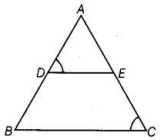
In the given figure,if $\angle D = \angle C$,then is it true that $\triangle ADE \sim \triangle ACB$? Why?
Solution
(N/A) Yes,it is true.
In $\triangle ADE$ and $\triangle ACB$:
$1$. $\angle A = \angle A$ (Common angle in both triangles).
$2$. $\angle D = \angle C$ (Given in the problem).
Therefore,by the $AA$ similarity criterion,$\triangle ADE \sim \triangle ACB$.
In $\triangle ADE$ and $\triangle ACB$:
$1$. $\angle A = \angle A$ (Common angle in both triangles).
$2$. $\angle D = \angle C$ (Given in the problem).
Therefore,by the $AA$ similarity criterion,$\triangle ADE \sim \triangle ACB$.
0 likes
View Solution29
EasyMCQ
Is it true to say that if in two triangles,an angle of one triangle is equal to an angle of another triangle and two sides of one triangle are proportional to the two sides of the other triangle,then the triangles are similar? Give reasons for your answer.
A
Yes
B
No
C
Cannot be determined
D
Depends on the triangle type
Solution
(B) The statement is $False$.
According to the $SAS$ (Side-Angle-Side) similarity criterion,two triangles are similar if one angle of one triangle is equal to one angle of the other triangle and the sides including these angles are proportional.
In the given statement,the two sides are proportional,but they are not necessarily the sides that include the equal angle. Therefore,the condition for $SAS$ similarity is not satisfied,and the triangles are not necessarily similar.
According to the $SAS$ (Side-Angle-Side) similarity criterion,two triangles are similar if one angle of one triangle is equal to one angle of the other triangle and the sides including these angles are proportional.
In the given statement,the two sides are proportional,but they are not necessarily the sides that include the equal angle. Therefore,the condition for $SAS$ similarity is not satisfied,and the triangles are not necessarily similar.
0 likes
View Solution30
DifficultMCQ
Legs (sides other than the hypotenuse) of a right triangle are of lengths $16 \,cm$ and $8 \,cm$. Find the length of the side of the largest square that can be inscribed in the triangle. (in $cm$)
A
$\frac{8}{3}$
B
$\frac{16}{3}$
C
$\frac{17}{3}$
D
$\frac{22}{3}$
Solution
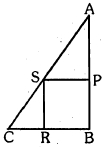
(B) Let $ABC$ be a right triangle right-angled at $B$ with $AB = 16 \,cm$ and $BC = 8 \,cm$. The largest square $BRSP$ that can be inscribed in this triangle is shown in the figure.
Let the side of the square be $x \,cm$. So,$PB = x \,cm$ and $BR = x \,cm$.
Then $AP = AB - PB = (16 - x) \,cm$.
In $\triangle APS$ and $\triangle ABC$,$\angle A = \angle A$ (common) and $\angle APS = \angle ABC = 90^{\circ}$.
Therefore,$\triangle APS \sim \triangle ABC$ by $AA$ similarity.
This implies $\frac{AP}{AB} = \frac{PS}{BC}$.
Substituting the values,$\frac{16 - x}{16} = \frac{x}{8}$.
Cross-multiplying,$8(16 - x) = 16x$.
$128 - 8x = 16x$.
$128 = 24x$.
$x = \frac{128}{24} = \frac{16}{3} \,cm$.
Let the side of the square be $x \,cm$. So,$PB = x \,cm$ and $BR = x \,cm$.
Then $AP = AB - PB = (16 - x) \,cm$.
In $\triangle APS$ and $\triangle ABC$,$\angle A = \angle A$ (common) and $\angle APS = \angle ABC = 90^{\circ}$.
Therefore,$\triangle APS \sim \triangle ABC$ by $AA$ similarity.
This implies $\frac{AP}{AB} = \frac{PS}{BC}$.
Substituting the values,$\frac{16 - x}{16} = \frac{x}{8}$.
Cross-multiplying,$8(16 - x) = 16x$.
$128 - 8x = 16x$.
$128 = 24x$.
$x = \frac{128}{24} = \frac{16}{3} \,cm$.
0 likes
View Solution31
DifficultMCQ
Hypotenuse of a right triangle is $25 \, cm$ and out of the remaining two sides,one is longer than the other by $5 \, cm$. Find the lengths of the other two sides.
A
$15 \, cm, 20 \, cm$
B
$10 \, cm, 15 \, cm$
C
$12 \, cm, 17 \, cm$
D
$20 \, cm, 25 \, cm$
Solution
(A) Let one side be $x \, cm$. Then the other side will be $(x+5) \, cm$.
According to the Pythagoras Theorem:
$x^{2} + (x+5)^{2} = (25)^{2}$
Expanding the equation:
$x^{2} + x^{2} + 10x + 25 = 625$
$2x^{2} + 10x - 600 = 0$
Dividing by $2$:
$x^{2} + 5x - 300 = 0$
Factoring the quadratic equation:
$x^{2} + 20x - 15x - 300 = 0$
$x(x+20) - 15(x+20) = 0$
$(x-15)(x+20) = 0$
Thus,$x = 15$ or $x = -20$.
Since the length cannot be negative,we reject $x = -20$.
Therefore,one side is $15 \, cm$ and the other side is $15 + 5 = 20 \, cm$.
According to the Pythagoras Theorem:
$x^{2} + (x+5)^{2} = (25)^{2}$
Expanding the equation:
$x^{2} + x^{2} + 10x + 25 = 625$
$2x^{2} + 10x - 600 = 0$
Dividing by $2$:
$x^{2} + 5x - 300 = 0$
Factoring the quadratic equation:
$x^{2} + 20x - 15x - 300 = 0$
$x(x+20) - 15(x+20) = 0$
$(x-15)(x+20) = 0$
Thus,$x = 15$ or $x = -20$.
Since the length cannot be negative,we reject $x = -20$.
Therefore,one side is $15 \, cm$ and the other side is $15 + 5 = 20 \, cm$.
0 likes
View Solution32
Medium
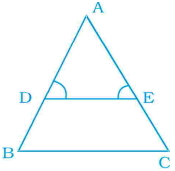
In the given figure,$\angle ADE = \angle AED$ and $\frac{AD}{DB} = \frac{AE}{EC}$. Prove that $\triangle ABC$ is an isosceles triangle.
Solution
(N/A) Given: $\frac{AD}{DB} = \frac{AE}{EC}$ and $\angle ADE = \angle AED$.
According to the converse of the Basic Proportionality Theorem (Thales Theorem),if a line divides any two sides of a triangle in the same ratio,then the line is parallel to the third side.
Therefore,$DE \parallel BC$.
Since $DE \parallel BC$ and $AB$ is a transversal,the corresponding angles are equal:
$\angle ADE = \angle ABC$ ....... $(1)$
Similarly,since $DE \parallel BC$ and $AC$ is a transversal:
$\angle AED = \angle ACB$ ....... $(2)$
We are given that $\angle ADE = \angle AED$.
Substituting the values from $(1)$ and $(2)$ into this equation,we get:
$\angle ABC = \angle ACB$.
In $\triangle ABC$,since the base angles are equal $(\angle B = \angle C)$,the sides opposite to these angles must also be equal.
Therefore,$AB = AC$.
Since two sides of $\triangle ABC$ are equal,$\triangle ABC$ is an isosceles triangle.
According to the converse of the Basic Proportionality Theorem (Thales Theorem),if a line divides any two sides of a triangle in the same ratio,then the line is parallel to the third side.
Therefore,$DE \parallel BC$.
Since $DE \parallel BC$ and $AB$ is a transversal,the corresponding angles are equal:
$\angle ADE = \angle ABC$ ....... $(1)$
Similarly,since $DE \parallel BC$ and $AC$ is a transversal:
$\angle AED = \angle ACB$ ....... $(2)$
We are given that $\angle ADE = \angle AED$.
Substituting the values from $(1)$ and $(2)$ into this equation,we get:
$\angle ABC = \angle ACB$.
In $\triangle ABC$,since the base angles are equal $(\angle B = \angle C)$,the sides opposite to these angles must also be equal.
Therefore,$AB = AC$.
Since two sides of $\triangle ABC$ are equal,$\triangle ABC$ is an isosceles triangle.
0 likes
View Solution33
Difficult
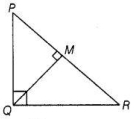
In a $\triangle PQR$,$PR^{2} - PQ^{2} = QR^{2}$ and $M$ is a point on side $PR$ such that $QM \perp PR$. Prove that $QM^{2} = PM \times MR$.
Solution
(N/A) Given: In $\triangle PQR$,$PR^{2} - PQ^{2} = QR^{2}$ and $QM \perp PR$.
To prove: $QM^{2} = PM \times MR$.
Proof: Since $PR^{2} - PQ^{2} = QR^{2}$,we have $PR^{2} = PQ^{2} + QR^{2}$.
By the converse of the Pythagoras theorem,$\triangle PQR$ is a right-angled triangle at $Q$.
In $\triangle QMR$ and $\triangle PMQ$:
$\angle M = \angle M = 90^{\circ}$ (given $QM \perp PR$ and $\angle PQR = 90^{\circ}$ implies $\angle MQR + \angle MQP = 90^{\circ}$).
Since $\angle P + \angle R = 90^{\circ}$ and $\angle MQR + \angle R = 90^{\circ}$,we have $\angle MQR = \angle P$.
Similarly,$\angle MQP = \angle R$.
Thus,$\triangle QMR \sim \triangle PMQ$ by $AA$ similarity criterion.
Since the triangles are similar,the ratios of their corresponding sides are equal:
$\frac{QM}{PM} = \frac{MR}{QM}$.
Therefore,$QM^{2} = PM \times MR$. Hence proved.
To prove: $QM^{2} = PM \times MR$.
Proof: Since $PR^{2} - PQ^{2} = QR^{2}$,we have $PR^{2} = PQ^{2} + QR^{2}$.
By the converse of the Pythagoras theorem,$\triangle PQR$ is a right-angled triangle at $Q$.
In $\triangle QMR$ and $\triangle PMQ$:
$\angle M = \angle M = 90^{\circ}$ (given $QM \perp PR$ and $\angle PQR = 90^{\circ}$ implies $\angle MQR + \angle MQP = 90^{\circ}$).
Since $\angle P + \angle R = 90^{\circ}$ and $\angle MQR + \angle R = 90^{\circ}$,we have $\angle MQR = \angle P$.
Similarly,$\angle MQP = \angle R$.
Thus,$\triangle QMR \sim \triangle PMQ$ by $AA$ similarity criterion.
Since the triangles are similar,the ratios of their corresponding sides are equal:
$\frac{QM}{PM} = \frac{MR}{QM}$.
Therefore,$QM^{2} = PM \times MR$. Hence proved.
0 likes
View Solution34
MediumMCQ
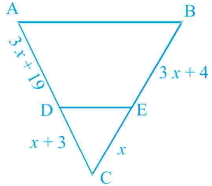
Find the value of $x$ for which $DE \parallel AB$ in the given figure.
A
$1$
B
$2$
C
$4$
D
$8$
Solution
(B) Given,$DE \parallel AB$.
By the Basic Proportionality Theorem (Thales Theorem),if a line is drawn parallel to one side of a triangle to intersect the other two sides in distinct points,the other two sides are divided in the same ratio.
Therefore,$\frac{CD}{AD} = \frac{CE}{BE}$.
Substituting the given values:
$\frac{x+3}{3x+19} = \frac{x}{3x+4}$
Cross-multiplying:
$(x+3)(3x+4) = x(3x+19)$
$3x^2 + 4x + 9x + 12 = 3x^2 + 19x$
$3x^2 + 13x + 12 = 3x^2 + 19x$
Subtracting $3x^2$ from both sides:
$13x + 12 = 19x$
$19x - 13x = 12$
$6x = 12$
$x = \frac{12}{6} = 2$.
Hence,the required value of $x$ is $2$.
By the Basic Proportionality Theorem (Thales Theorem),if a line is drawn parallel to one side of a triangle to intersect the other two sides in distinct points,the other two sides are divided in the same ratio.
Therefore,$\frac{CD}{AD} = \frac{CE}{BE}$.
Substituting the given values:
$\frac{x+3}{3x+19} = \frac{x}{3x+4}$
Cross-multiplying:
$(x+3)(3x+4) = x(3x+19)$
$3x^2 + 4x + 9x + 12 = 3x^2 + 19x$
$3x^2 + 13x + 12 = 3x^2 + 19x$
Subtracting $3x^2$ from both sides:
$13x + 12 = 19x$
$19x - 13x = 12$
$6x = 12$
$x = \frac{12}{6} = 2$.
Hence,the required value of $x$ is $2$.
0 likes
View Solution35
Difficult
In the given figure,if $\angle 1 = \angle 2$ and $\triangle NSQ \cong \triangle MTR,$ then prove that $\triangle PTS \sim \triangle PRQ.$
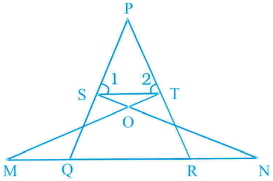
Solution
(N/A) Given: $\triangle NSQ \cong \triangle MTR$ and $\angle 1 = \angle 2.$
To prove: $\triangle PTS \sim \triangle PRQ.$
Proof: Since $\triangle NSQ \cong \triangle MTR,$ by $CPCT$,we have $SQ = TR$ and $NS = MT.$
Also,given $\angle 1 = \angle 2,$ in $\triangle PST,$ sides opposite to equal angles are equal,so $PT = PS.$
From the congruence $\triangle NSQ \cong \triangle MTR,$ we have $NQ = MR.$ Subtracting $SQ = TR$ from both sides,we get $NQ - SQ = MR - TR,$ which implies $NS = MT$ (already known) or more simply,from $\triangle NSQ \cong \triangle MTR,$ we have $SQ = TR.$
Since $PT = PS$ and $PQ = PT + TQ$ and $PR = PS + SR,$ and given the symmetry,we can show $\frac{PS}{PQ} = \frac{PT}{PR}.$
Since $\angle P = \angle P$ (common) and $\frac{PS}{PQ} = \frac{PT}{PR},$ by $SAS$ similarity criterion,$\triangle PTS \sim \triangle PRQ.$
To prove: $\triangle PTS \sim \triangle PRQ.$
Proof: Since $\triangle NSQ \cong \triangle MTR,$ by $CPCT$,we have $SQ = TR$ and $NS = MT.$
Also,given $\angle 1 = \angle 2,$ in $\triangle PST,$ sides opposite to equal angles are equal,so $PT = PS.$
From the congruence $\triangle NSQ \cong \triangle MTR,$ we have $NQ = MR.$ Subtracting $SQ = TR$ from both sides,we get $NQ - SQ = MR - TR,$ which implies $NS = MT$ (already known) or more simply,from $\triangle NSQ \cong \triangle MTR,$ we have $SQ = TR.$
Since $PT = PS$ and $PQ = PT + TQ$ and $PR = PS + SR,$ and given the symmetry,we can show $\frac{PS}{PQ} = \frac{PT}{PR}.$
Since $\angle P = \angle P$ (common) and $\frac{PS}{PQ} = \frac{PT}{PR},$ by $SAS$ similarity criterion,$\triangle PTS \sim \triangle PRQ.$
0 likes
View Solution36
MediumMCQ
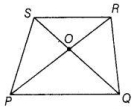
Diagonals of a trapezium $PQRS$ intersect each other at the point $O$. Given $PQ \parallel RS$ and $PQ = 3 RS$. Find the ratio of the areas of triangles $POQ$ and $ROS$.
A
$3: 1$
B
$9: 5$
C
$7: 1$
D
$9: 1$
Solution
(D) Given $PQRS$ is a trapezium in which $PQ \parallel RS$ and $PQ = 3 RS$.
$\frac{PQ}{RS} = \frac{3}{1}$ ......$(i)$
In $\triangle POQ$ and $\triangle ROS$:
$\angle SOR = \angle QOP$ [Vertically opposite angles]
$\angle OSR = \angle OPQ$ [Alternate interior angles,since $PQ \parallel RS$]
$\therefore \triangle POQ \sim \triangle ROS$ [By $AA$ similarity criterion]
By the property of the area of similar triangles,the ratio of their areas is equal to the square of the ratio of their corresponding sides:
$\frac{\text{ar}(\triangle POQ)}{\text{ar}(\triangle ROS)} = \left(\frac{PQ}{RS}\right)^2 = \left(\frac{3}{1}\right)^2 = \frac{9}{1}$
Hence,the required ratio is $9: 1$.
$\frac{PQ}{RS} = \frac{3}{1}$ ......$(i)$
In $\triangle POQ$ and $\triangle ROS$:
$\angle SOR = \angle QOP$ [Vertically opposite angles]
$\angle OSR = \angle OPQ$ [Alternate interior angles,since $PQ \parallel RS$]
$\therefore \triangle POQ \sim \triangle ROS$ [By $AA$ similarity criterion]
By the property of the area of similar triangles,the ratio of their areas is equal to the square of the ratio of their corresponding sides:
$\frac{\text{ar}(\triangle POQ)}{\text{ar}(\triangle ROS)} = \left(\frac{PQ}{RS}\right)^2 = \left(\frac{3}{1}\right)^2 = \frac{9}{1}$
Hence,the required ratio is $9: 1$.
0 likes
View Solution37
Medium
In the given figure,if $AB \parallel DC$ and $AC$ and $PQ$ intersect each other at the point $O$,prove that $OA \cdot CQ = OC \cdot AP$.
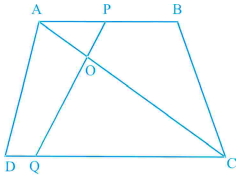
Solution
(N/A) Given: $AC$ and $PQ$ intersect each other at the point $O$ and $AB \parallel DC$.
To prove: $OA \cdot CQ = OC \cdot AP$.
Proof:
In $\triangle AOP$ and $\triangle COQ$:
$1$. $\angle AOP = \angle COQ$ (Vertically opposite angles).
$2$. $\angle OAP = \angle OCQ$ (Alternate interior angles,since $AB \parallel DC$ and $AC$ is a transversal).
$3$. $\angle OPA = \angle OQC$ (Alternate interior angles,since $AB \parallel DC$ and $PQ$ is a transversal).
Therefore,$\triangle AOP \sim \triangle COQ$ (by $AAA$ similarity criterion).
Since the triangles are similar,their corresponding sides are proportional:
$\frac{OA}{OC} = \frac{AP}{CQ}$
By cross-multiplying,we get:
$OA \cdot CQ = OC \cdot AP$.
Hence proved.
To prove: $OA \cdot CQ = OC \cdot AP$.
Proof:
In $\triangle AOP$ and $\triangle COQ$:
$1$. $\angle AOP = \angle COQ$ (Vertically opposite angles).
$2$. $\angle OAP = \angle OCQ$ (Alternate interior angles,since $AB \parallel DC$ and $AC$ is a transversal).
$3$. $\angle OPA = \angle OQC$ (Alternate interior angles,since $AB \parallel DC$ and $PQ$ is a transversal).
Therefore,$\triangle AOP \sim \triangle COQ$ (by $AAA$ similarity criterion).
Since the triangles are similar,their corresponding sides are proportional:
$\frac{OA}{OC} = \frac{AP}{CQ}$
By cross-multiplying,we get:
$OA \cdot CQ = OC \cdot AP$.
Hence proved.
0 likes
View Solution38
DifficultMCQ
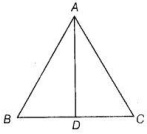
Find the altitude of an equilateral triangle of side $8 \, cm$. (in $cm$)
A
$3 \sqrt{3}$
B
$4 \sqrt{3}$
C
$5 \sqrt{3}$
D
$7 \sqrt{5}$
Solution
(B) Let $ABC$ be an equilateral triangle with side length $a = 8 \, cm$.
In an equilateral triangle,the altitude $AD$ drawn from vertex $A$ to the base $BC$ bisects the base.
Therefore,$BD = CD = \frac{BC}{2} = \frac{8}{2} = 4 \, cm$.
In the right-angled triangle $ABD$,by Pythagoras theorem:
$AB^2 = AD^2 + BD^2$
$8^2 = AD^2 + 4^2$
$64 = AD^2 + 16$
$AD^2 = 64 - 16 = 48$
$AD = \sqrt{48} = \sqrt{16 \times 3} = 4 \sqrt{3} \, cm$.
Alternatively,the altitude of an equilateral triangle is given by the formula $h = \frac{\sqrt{3}}{2} \times \text{side}$.
$h = \frac{\sqrt{3}}{2} \times 8 = 4 \sqrt{3} \, cm$.
In an equilateral triangle,the altitude $AD$ drawn from vertex $A$ to the base $BC$ bisects the base.
Therefore,$BD = CD = \frac{BC}{2} = \frac{8}{2} = 4 \, cm$.
In the right-angled triangle $ABD$,by Pythagoras theorem:
$AB^2 = AD^2 + BD^2$
$8^2 = AD^2 + 4^2$
$64 = AD^2 + 16$
$AD^2 = 64 - 16 = 48$
$AD = \sqrt{48} = \sqrt{16 \times 3} = 4 \sqrt{3} \, cm$.
Alternatively,the altitude of an equilateral triangle is given by the formula $h = \frac{\sqrt{3}}{2} \times \text{side}$.
$h = \frac{\sqrt{3}}{2} \times 8 = 4 \sqrt{3} \, cm$.
0 likes
View Solution39
DifficultMCQ
If $\triangle ABC \sim \triangle DEF$,$AB = 4 \, cm$,$DE = 6 \, cm$,$EF = 9 \, cm$,and $FD = 12 \, cm$,find the perimeter of $\triangle ABC$ (in $cm$).
A
$8$
B
$6$
C
$18$
D
$28$
Solution
(C) Given that $\triangle ABC \sim \triangle DEF$.
Since the triangles are similar,the ratio of their corresponding sides is equal:
$\frac{AB}{DE} = \frac{BC}{EF} = \frac{AC}{DF}$.
Substituting the given values:
$\frac{4}{6} = \frac{BC}{9} = \frac{AC}{12}$.
Now,solving for $BC$:
$\frac{4}{6} = \frac{BC}{9} \implies BC = \frac{4 \times 9}{6} = 6 \, cm$.
Solving for $AC$:
$\frac{4}{6} = \frac{AC}{12} \implies AC = \frac{4 \times 12}{6} = 8 \, cm$.
The perimeter of $\triangle ABC = AB + BC + AC$.
Perimeter $= 4 + 6 + 8 = 18 \, cm$.
Since the triangles are similar,the ratio of their corresponding sides is equal:
$\frac{AB}{DE} = \frac{BC}{EF} = \frac{AC}{DF}$.
Substituting the given values:
$\frac{4}{6} = \frac{BC}{9} = \frac{AC}{12}$.
Now,solving for $BC$:
$\frac{4}{6} = \frac{BC}{9} \implies BC = \frac{4 \times 9}{6} = 6 \, cm$.
Solving for $AC$:
$\frac{4}{6} = \frac{AC}{12} \implies AC = \frac{4 \times 12}{6} = 8 \, cm$.
The perimeter of $\triangle ABC = AB + BC + AC$.
Perimeter $= 4 + 6 + 8 = 18 \, cm$.
0 likes
View Solution40
DifficultMCQ
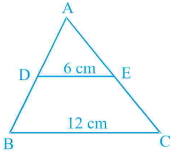
In the figure,if $DE \parallel BC,$ find the ratio of $\operatorname{ar}(ADE)$ and $\operatorname{ar}(DECB).$
A
$5: 3$
B
$1: 4$
C
$1: 2$
D
$1: 3$
Solution
(D) Given,$DE \parallel BC,$ $DE = 6 \, cm$ and $BC = 12 \, cm.$
In $\triangle ABC$ and $\triangle ADE,$
$\angle ABC = \angle ADE$ [Corresponding angles]
$\angle ACB = \angle AED$ [Corresponding angles]
$\angle A = \angle A$ [Common angle]
Therefore,$\triangle ADE \sim \triangle ABC$ [By $AAA$ similarity criterion].
We know that the ratio of the areas of two similar triangles is equal to the square of the ratio of their corresponding sides.
$\frac{\operatorname{ar}(ADE)}{\operatorname{ar}(ABC)} = \frac{(DE)^2}{(BC)^2}$
$= \frac{(6)^2}{(12)^2} = \left(\frac{6}{12}\right)^2 = \left(\frac{1}{2}\right)^2 = \frac{1}{4}.$
Let $\operatorname{ar}(ADE) = k,$ then $\operatorname{ar}(ABC) = 4k.$
Now,$\operatorname{ar}(DECB) = \operatorname{ar}(ABC) - \operatorname{ar}(ADE) = 4k - k = 3k.$
Therefore,the required ratio is $\operatorname{ar}(ADE) : \operatorname{ar}(DECB) = k : 3k = 1 : 3.$
In $\triangle ABC$ and $\triangle ADE,$
$\angle ABC = \angle ADE$ [Corresponding angles]
$\angle ACB = \angle AED$ [Corresponding angles]
$\angle A = \angle A$ [Common angle]
Therefore,$\triangle ADE \sim \triangle ABC$ [By $AAA$ similarity criterion].
We know that the ratio of the areas of two similar triangles is equal to the square of the ratio of their corresponding sides.
$\frac{\operatorname{ar}(ADE)}{\operatorname{ar}(ABC)} = \frac{(DE)^2}{(BC)^2}$
$= \frac{(6)^2}{(12)^2} = \left(\frac{6}{12}\right)^2 = \left(\frac{1}{2}\right)^2 = \frac{1}{4}.$
Let $\operatorname{ar}(ADE) = k,$ then $\operatorname{ar}(ABC) = 4k.$
Now,$\operatorname{ar}(DECB) = \operatorname{ar}(ABC) - \operatorname{ar}(ADE) = 4k - k = 3k.$
Therefore,the required ratio is $\operatorname{ar}(ADE) : \operatorname{ar}(DECB) = k : 3k = 1 : 3.$
0 likes
View Solution41
DifficultMCQ
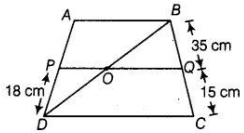
$ABCD$ is a trapezium in which $AB \parallel DC$ and $P$ and $Q$ are points on $AD$ and $BC$ respectively such that $PQ \parallel DC$. If $PD = 18 \, cm$,$BQ = 35 \, cm$ and $QC = 15 \, cm$,find $AD$ (in $cm$).
A
$60$
B
$24$
C
$50$
D
$70$
Solution
(A) Given,a trapezium $ABCD$ in which $AB \parallel DC$. $P$ and $Q$ are points on $AD$ and $BC$ respectively such that $PQ \parallel DC$. Thus,$AB \parallel PQ \parallel DC$.
Join $BD$. Let $BD$ intersect $PQ$ at point $O$.
In $\triangle ABD$,$PO \parallel AB$ (since $PQ \parallel AB$).
By the Basic Proportionality Theorem $(BPT)$,we have:
$\frac{AP}{PD} = \frac{BO}{OD}$ .......$(i)$
In $\triangle BDC$,$OQ \parallel DC$ (since $PQ \parallel DC$).
By the Basic Proportionality Theorem $(BPT)$,we have:
$\frac{BQ}{QC} = \frac{BO}{OD}$ .......$(ii)$
From equations $(i)$ and $(ii)$,we get:
$\frac{AP}{PD} = \frac{BQ}{QC}$
Substitute the given values $PD = 18 \, cm$,$BQ = 35 \, cm$,and $QC = 15 \, cm$:
$\frac{AP}{18} = \frac{35}{15}$
$AP = \frac{35 \times 18}{15}$
$AP = \frac{7 \times 18}{3} = 7 \times 6 = 42 \, cm$
Therefore,$AD = AP + PD = 42 \, cm + 18 \, cm = 60 \, cm$.
Join $BD$. Let $BD$ intersect $PQ$ at point $O$.
In $\triangle ABD$,$PO \parallel AB$ (since $PQ \parallel AB$).
By the Basic Proportionality Theorem $(BPT)$,we have:
$\frac{AP}{PD} = \frac{BO}{OD}$ .......$(i)$
In $\triangle BDC$,$OQ \parallel DC$ (since $PQ \parallel DC$).
By the Basic Proportionality Theorem $(BPT)$,we have:
$\frac{BQ}{QC} = \frac{BO}{OD}$ .......$(ii)$
From equations $(i)$ and $(ii)$,we get:
$\frac{AP}{PD} = \frac{BQ}{QC}$
Substitute the given values $PD = 18 \, cm$,$BQ = 35 \, cm$,and $QC = 15 \, cm$:
$\frac{AP}{18} = \frac{35}{15}$
$AP = \frac{35 \times 18}{15}$
$AP = \frac{7 \times 18}{3} = 7 \times 6 = 42 \, cm$
Therefore,$AD = AP + PD = 42 \, cm + 18 \, cm = 60 \, cm$.
0 likes
View Solution42
MediumMCQ
Corresponding sides of two similar triangles are in the ratio of $2:3$. If the area of the smaller triangle is $48 \, cm^2$,find the area of the larger triangle (in $cm^2$).
A
$109$
B
$108$
C
$110$
D
$108.5$
Solution
(B) Given,the ratio of corresponding sides of two similar triangles is $2:3$.
Let the area of the smaller triangle be $A_1 = 48 \, cm^2$ and the area of the larger triangle be $A_2$.
According to the theorem of the area of similar triangles,the ratio of the areas of two similar triangles is equal to the square of the ratio of their corresponding sides.
$\frac{A_1}{A_2} = \left(\frac{2}{3}\right)^2$
$\frac{48}{A_2} = \frac{4}{9}$
By cross-multiplying,we get:
$4 \times A_2 = 48 \times 9$
$A_2 = \frac{432}{4} = 108 \, cm^2$.
Therefore,the area of the larger triangle is $108 \, cm^2$.
Let the area of the smaller triangle be $A_1 = 48 \, cm^2$ and the area of the larger triangle be $A_2$.
According to the theorem of the area of similar triangles,the ratio of the areas of two similar triangles is equal to the square of the ratio of their corresponding sides.
$\frac{A_1}{A_2} = \left(\frac{2}{3}\right)^2$
$\frac{48}{A_2} = \frac{4}{9}$
By cross-multiplying,we get:
$4 \times A_2 = 48 \times 9$
$A_2 = \frac{432}{4} = 108 \, cm^2$.
Therefore,the area of the larger triangle is $108 \, cm^2$.
0 likes
View Solution43
Difficult
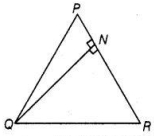
In a triangle $PQR$,$N$ is a point on $PR$ such that $QN \perp PR$. If $PN \cdot NR = QN^2$,prove that $\angle PQR = 90^{\circ}$.
Solution
(N/A) Given: In $\Delta PQR$,$N$ is a point on $PR$ such that $QN \perp PR$ and $PN \cdot NR = QN^2$.
To prove: $\angle PQR = 90^{\circ}$.
Proof: We have $PN \cdot NR = QN^2$.
This can be written as $\frac{PN}{QN} = \frac{QN}{NR}$.
In $\Delta QNP$ and $\Delta RNQ$:
$1$. $\frac{PN}{QN} = \frac{QN}{NR}$ (Given)
$2$. $\angle PNQ = \angle RNQ = 90^{\circ}$ (Given $QN \perp PR$)
By $SAS$ similarity criterion,$\Delta QNP \sim \Delta RNQ$.
Since the triangles are similar,their corresponding angles are equal:
$\angle PQN = \angle QRN$ (let this be $\alpha$)
$\angle RQN = \angle QPN$ (let this be $\beta$)
In $\Delta PQR$,the sum of angles is $180^{\circ}$:
$\angle P + \angle R + \angle PQR = 180^{\circ}$
$\angle QPN + \angle QRN + (\angle PQN + \angle RQN) = 180^{\circ}$
Substituting the equal angles:
$\beta + \alpha + (\alpha + \beta) = 180^{\circ}$
$2(\alpha + \beta) = 180^{\circ}$
$\alpha + \beta = 90^{\circ}$
Since $\angle PQR = \alpha + \beta$,we have $\angle PQR = 90^{\circ}$.
Hence proved.
To prove: $\angle PQR = 90^{\circ}$.
Proof: We have $PN \cdot NR = QN^2$.
This can be written as $\frac{PN}{QN} = \frac{QN}{NR}$.
In $\Delta QNP$ and $\Delta RNQ$:
$1$. $\frac{PN}{QN} = \frac{QN}{NR}$ (Given)
$2$. $\angle PNQ = \angle RNQ = 90^{\circ}$ (Given $QN \perp PR$)
By $SAS$ similarity criterion,$\Delta QNP \sim \Delta RNQ$.
Since the triangles are similar,their corresponding angles are equal:
$\angle PQN = \angle QRN$ (let this be $\alpha$)
$\angle RQN = \angle QPN$ (let this be $\beta$)
In $\Delta PQR$,the sum of angles is $180^{\circ}$:
$\angle P + \angle R + \angle PQR = 180^{\circ}$
$\angle QPN + \angle QRN + (\angle PQN + \angle RQN) = 180^{\circ}$
Substituting the equal angles:
$\beta + \alpha + (\alpha + \beta) = 180^{\circ}$
$2(\alpha + \beta) = 180^{\circ}$
$\alpha + \beta = 90^{\circ}$
Since $\angle PQR = \alpha + \beta$,we have $\angle PQR = 90^{\circ}$.
Hence proved.
0 likes
View Solution44
MediumMCQ
Areas of two similar triangles are $36\, cm^{2}$ and $100\, cm^{2}$. If the length of a side of the larger triangle is $20\, cm$,find the length of the corresponding side of the smaller triangle. (in $cm$)
A
$14$
B
$13$
C
$15$
D
$12$
Solution
(D) Given,area of smaller triangle $= 36\, cm^{2}$ and area of larger triangle $= 100\, cm^{2}$.
Also,length of a side of the larger triangle $= 20\, cm$.
Let the length of the corresponding side of the smaller triangle be $x\, cm$.
By the property of areas of similar triangles,the ratio of the areas of two similar triangles is equal to the square of the ratio of their corresponding sides.
$\frac{\text{Area of larger triangle}}{\text{Area of smaller triangle}} = \frac{(\text{Side of larger triangle})^{2}}{(\text{Side of smaller triangle})^{2}}$
$\Rightarrow \frac{100}{36} = \frac{(20)^{2}}{x^{2}}$
$\Rightarrow x^{2} = \frac{20^{2} \times 36}{100} = \frac{400 \times 36}{100} = 4 \times 36 = 144$
$x = \sqrt{144} = 12\, cm$.
Hence,the length of the corresponding side of the smaller triangle is $12\, cm$.
Also,length of a side of the larger triangle $= 20\, cm$.
Let the length of the corresponding side of the smaller triangle be $x\, cm$.
By the property of areas of similar triangles,the ratio of the areas of two similar triangles is equal to the square of the ratio of their corresponding sides.
$\frac{\text{Area of larger triangle}}{\text{Area of smaller triangle}} = \frac{(\text{Side of larger triangle})^{2}}{(\text{Side of smaller triangle})^{2}}$
$\Rightarrow \frac{100}{36} = \frac{(20)^{2}}{x^{2}}$
$\Rightarrow x^{2} = \frac{20^{2} \times 36}{100} = \frac{400 \times 36}{100} = 4 \times 36 = 144$
$x = \sqrt{144} = 12\, cm$.
Hence,the length of the corresponding side of the smaller triangle is $12\, cm$.
0 likes
View Solution45
DifficultMCQ
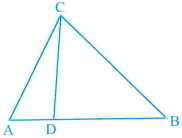
In the figure,if $\angle ACB = \angle CDA$,$AC = 8 \, cm$ and $AD = 3 \, cm$,find $BD$ (in $cm$).
A
$\frac{55}{3}$
B
$\frac{44}{3}$
C
$\frac{11}{3}$
D
$\frac{77}{3}$
Solution
(A) Given: $AC = 8 \, cm$,$AD = 3 \, cm$ and $\angle ACB = \angle CDA = 90^{\circ}$ (from the figure).
In right-angled $\triangle ADC$,by Pythagoras theorem:
$AC^2 = AD^2 + CD^2$
$8^2 = 3^2 + CD^2$
$64 = 9 + CD^2$
$CD^2 = 55$
$CD = \sqrt{55} \, cm$.
Now,consider $\triangle CDB$ and $\triangle ADC$:
$1$. $\angle BDC = \angle ADC = 90^{\circ}$ (given).
$2$. $\angle DBC = \angle DCA$ (since both are equal to $90^{\circ} - \angle A$).
By $AA$ similarity criterion,$\triangle CDB \sim \triangle ADC$.
Therefore,the ratio of corresponding sides is equal:
$\frac{CD}{BD} = \frac{AD}{CD}$
$CD^2 = AD \times BD$
$55 = 3 \times BD$
$BD = \frac{55}{3} \, cm$.
In right-angled $\triangle ADC$,by Pythagoras theorem:
$AC^2 = AD^2 + CD^2$
$8^2 = 3^2 + CD^2$
$64 = 9 + CD^2$
$CD^2 = 55$
$CD = \sqrt{55} \, cm$.
Now,consider $\triangle CDB$ and $\triangle ADC$:
$1$. $\angle BDC = \angle ADC = 90^{\circ}$ (given).
$2$. $\angle DBC = \angle DCA$ (since both are equal to $90^{\circ} - \angle A$).
By $AA$ similarity criterion,$\triangle CDB \sim \triangle ADC$.
Therefore,the ratio of corresponding sides is equal:
$\frac{CD}{BD} = \frac{AD}{CD}$
$CD^2 = AD \times BD$
$55 = 3 \times BD$
$BD = \frac{55}{3} \, cm$.
0 likes
View Solution46
DifficultMCQ
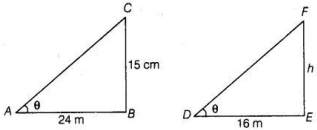
$A$ $15\, m$ high tower casts a shadow $24\, m$ long at a certain time. At the same time,a telephone pole casts a shadow $16\, m$ long. Find the height of the telephone pole (in $m$).
A
$20$
B
$10$
C
$15$
D
$25$
Solution
(B) Let $BC = 15\, m$ be the height of the tower and $AB = 24\, m$ be the length of its shadow. At that time,the angle of elevation of the sun is $\theta$,so $\angle CAB = \theta$.
Let $EF = h$ be the height of the telephone pole and $DE = 16\, m$ be the length of its shadow. At the same time,the angle of elevation of the sun is the same,so $\angle EDF = \theta$.
In $\triangle ABC$ and $\triangle DEF$:
$\angle CAB = \angle EDF = \theta$ (Angle of elevation of the sun)
$\angle ABC = \angle DEF = 90^{\circ}$ (Both are vertical objects on level ground)
Therefore,$\triangle ABC \sim \triangle DEF$ by $AA$ similarity criterion.
Since the triangles are similar,the ratios of their corresponding sides are equal:
$\frac{AB}{DE} = \frac{BC}{EF}$
Substituting the given values:
$\frac{24}{16} = \frac{15}{h}$
Solving for $h$:
$h = \frac{15 \times 16}{24}$
$h = \frac{15 \times 2}{3}$
$h = 5 \times 2 = 10\, m$.
Hence,the height of the telephone pole is $10\, m$.
Let $EF = h$ be the height of the telephone pole and $DE = 16\, m$ be the length of its shadow. At the same time,the angle of elevation of the sun is the same,so $\angle EDF = \theta$.
In $\triangle ABC$ and $\triangle DEF$:
$\angle CAB = \angle EDF = \theta$ (Angle of elevation of the sun)
$\angle ABC = \angle DEF = 90^{\circ}$ (Both are vertical objects on level ground)
Therefore,$\triangle ABC \sim \triangle DEF$ by $AA$ similarity criterion.
Since the triangles are similar,the ratios of their corresponding sides are equal:
$\frac{AB}{DE} = \frac{BC}{EF}$
Substituting the given values:
$\frac{24}{16} = \frac{15}{h}$
Solving for $h$:
$h = \frac{15 \times 16}{24}$
$h = \frac{15 \times 2}{3}$
$h = 5 \times 2 = 10\, m$.
Hence,the height of the telephone pole is $10\, m$.
0 likes
View Solution47
MediumMCQ
Foot of a $10\,m$ long ladder leaning against a vertical wall is $6\,m$ away from the base of the wall. Find the height of the point on the wall where the top of the ladder reaches. (in $m$)
A
$2$
B
$6$
C
$8$
D
$10$
Solution
(C) Let $AB$ be the vertical wall and $AC = 10\,m$ be the length of the ladder.
The distance of the foot of the ladder from the base of the wall is $BC = 6\,m$.
In the right-angled $\triangle ABC$,by the Pythagoras theorem:
$AC^2 = AB^2 + BC^2$
$(10)^2 = AB^2 + (6)^2$
$100 = AB^2 + 36$
$AB^2 = 100 - 36 = 64$
$AB = \sqrt{64} = 8\,m$.
Thus,the height of the point on the wall where the top of the ladder reaches is $8\,m$.
The distance of the foot of the ladder from the base of the wall is $BC = 6\,m$.
In the right-angled $\triangle ABC$,by the Pythagoras theorem:
$AC^2 = AB^2 + BC^2$
$(10)^2 = AB^2 + (6)^2$
$100 = AB^2 + 36$
$AB^2 = 100 - 36 = 64$
$AB = \sqrt{64} = 8\,m$.
Thus,the height of the point on the wall where the top of the ladder reaches is $8\,m$.
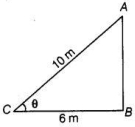
0 likes
View Solution48
Difficult
In the given figure,$OB$ is the perpendicular bisector of the line segment $DE$,$FA \perp OB$,and $FE$ intersects $OB$ at the point $C$. Prove that $\frac{1}{OA} + \frac{1}{OB} = \frac{2}{OC}$.
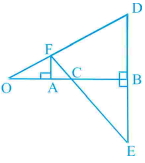
Solution
(N/A) In $\triangle AOF$ and $\triangle BOD$:
$\angle O = \angle O$ (Common angle) and $\angle A = \angle B = 90^{\circ}$.
Therefore,$\triangle AOF \sim \triangle BOD$ ($AA$ similarity).
So,$\frac{OA}{OB} = \frac{FA}{DB}$ .........$(1)$
Also,in $\triangle FAC$ and $\triangle EBC$:
$\angle A = \angle B = 90^{\circ}$ and $\angle FCA = \angle ECB$ (Vertically opposite angles).
Therefore,$\triangle FAC \sim \triangle EBC$ ($AA$ similarity).
So,$\frac{FA}{EB} = \frac{AC}{BC}$.
Since $OB$ is the perpendicular bisector of $DE$,$EB = DB$.
So,$\frac{FA}{DB} = \frac{AC}{BC}$ ......$(2)$
From $(1)$ and $(2)$,we have:
$\frac{AC}{BC} = \frac{OA}{OB}$.
Since $AC = OC - OA$ and $BC = OB - OC$,we get:
$\frac{OC - OA}{OB - OC} = \frac{OA}{OB}$.
$OB(OC - OA) = OA(OB - OC)$.
$OB \cdot OC - OA \cdot OB = OA \cdot OB - OA \cdot OC$.
$OB \cdot OC + OA \cdot OC = 2(OA \cdot OB)$.
Dividing both sides by $(OA \cdot OB \cdot OC)$:
$\frac{OB \cdot OC}{OA \cdot OB \cdot OC} + \frac{OA \cdot OC}{OA \cdot OB \cdot OC} = \frac{2(OA \cdot OB)}{OA \cdot OB \cdot OC}$.
$\frac{1}{OA} + \frac{1}{OB} = \frac{2}{OC}$.
$\angle O = \angle O$ (Common angle) and $\angle A = \angle B = 90^{\circ}$.
Therefore,$\triangle AOF \sim \triangle BOD$ ($AA$ similarity).
So,$\frac{OA}{OB} = \frac{FA}{DB}$ .........$(1)$
Also,in $\triangle FAC$ and $\triangle EBC$:
$\angle A = \angle B = 90^{\circ}$ and $\angle FCA = \angle ECB$ (Vertically opposite angles).
Therefore,$\triangle FAC \sim \triangle EBC$ ($AA$ similarity).
So,$\frac{FA}{EB} = \frac{AC}{BC}$.
Since $OB$ is the perpendicular bisector of $DE$,$EB = DB$.
So,$\frac{FA}{DB} = \frac{AC}{BC}$ ......$(2)$
From $(1)$ and $(2)$,we have:
$\frac{AC}{BC} = \frac{OA}{OB}$.
Since $AC = OC - OA$ and $BC = OB - OC$,we get:
$\frac{OC - OA}{OB - OC} = \frac{OA}{OB}$.
$OB(OC - OA) = OA(OB - OC)$.
$OB \cdot OC - OA \cdot OB = OA \cdot OB - OA \cdot OC$.
$OB \cdot OC + OA \cdot OC = 2(OA \cdot OB)$.
Dividing both sides by $(OA \cdot OB \cdot OC)$:
$\frac{OB \cdot OC}{OA \cdot OB \cdot OC} + \frac{OA \cdot OC}{OA \cdot OB \cdot OC} = \frac{2(OA \cdot OB)}{OA \cdot OB \cdot OC}$.
$\frac{1}{OA} + \frac{1}{OB} = \frac{2}{OC}$.
0 likes
View Solution49
Difficult
Prove that if in a triangle the square of one side is equal to the sum of the squares of the other two sides,then the angle opposite the first side is a right angle.
Solution
(N/A) Given: $A$ triangle $ABC$ such that $AC^2 = AB^2 + BC^2$.
To prove: $\angle B = 90^{\circ}$.
Construction: Construct a $\triangle PQR$ such that $\angle Q = 90^{\circ}$,$PQ = AB$,and $QR = BC$.
Proof:
In $\triangle PQR$,by Pythagoras theorem:
$PR^2 = PQ^2 + QR^2$
Since $PQ = AB$ and $QR = BC$,we have:
$PR^2 = AB^2 + BC^2$ ...... $(1)$
Given that $AC^2 = AB^2 + BC^2$ ...... $(2)$
From $(1)$ and $(2)$,$PR^2 = AC^2$,which implies $PR = AC$.
Now,in $\triangle ABC$ and $\triangle PQR$:
$AB = PQ$ (Construction)
$BC = QR$ (Construction)
$AC = PR$ (Proved above)
Therefore,$\triangle ABC \cong \triangle PQR$ by $SSS$ congruence criterion.
Thus,$\angle B = \angle Q$ by $CPCT$.
Since $\angle Q = 90^{\circ}$ by construction,it follows that $\angle B = 90^{\circ}$.
To prove: $\angle B = 90^{\circ}$.
Construction: Construct a $\triangle PQR$ such that $\angle Q = 90^{\circ}$,$PQ = AB$,and $QR = BC$.
Proof:
In $\triangle PQR$,by Pythagoras theorem:
$PR^2 = PQ^2 + QR^2$
Since $PQ = AB$ and $QR = BC$,we have:
$PR^2 = AB^2 + BC^2$ ...... $(1)$
Given that $AC^2 = AB^2 + BC^2$ ...... $(2)$
From $(1)$ and $(2)$,$PR^2 = AC^2$,which implies $PR = AC$.
Now,in $\triangle ABC$ and $\triangle PQR$:
$AB = PQ$ (Construction)
$BC = QR$ (Construction)
$AC = PR$ (Proved above)
Therefore,$\triangle ABC \cong \triangle PQR$ by $SSS$ congruence criterion.
Thus,$\angle B = \angle Q$ by $CPCT$.
Since $\angle Q = 90^{\circ}$ by construction,it follows that $\angle B = 90^{\circ}$.
0 likes
View Solution50
DifficultMCQ
An aeroplane leaves an airport and flies due North at $300 \, km/h$. At the same time,another aeroplane leaves the same airport and flies due West at $400 \, km/h$. How far apart will the two aeroplanes be after $1 \frac{1}{2}$ hours (in $, km$)?
A
$150$
B
$750$
C
$50$
D
$600$
Solution
(B) Distance travelled by the first aeroplane in $1 \frac{1}{2}$ hours (or $1.5$ hours) $= 300 \times 1.5 = 450 \, km$.
Distance travelled by the second aeroplane in $1.5$ hours $= 400 \times 1.5 = 600 \, km$.
Since one aeroplane flies North and the other flies West,the paths are perpendicular to each other,forming a right-angled triangle with the airport at the vertex of the right angle.
Let $O$ be the airport,$A$ be the position of the first aeroplane,and $B$ be the position of the second aeroplane.
Then $OA = 450 \, km$ and $OB = 600 \, km$.
Using the Pythagoras theorem in $\triangle AOB$:
$AB^2 = OA^2 + OB^2$
$AB^2 = (450)^2 + (600)^2$
$AB^2 = 202500 + 360000$
$AB^2 = 562500$
$AB = \sqrt{562500} = 750 \, km$.
Thus,the two aeroplanes will be $750 \, km$ apart.
Distance travelled by the second aeroplane in $1.5$ hours $= 400 \times 1.5 = 600 \, km$.
Since one aeroplane flies North and the other flies West,the paths are perpendicular to each other,forming a right-angled triangle with the airport at the vertex of the right angle.
Let $O$ be the airport,$A$ be the position of the first aeroplane,and $B$ be the position of the second aeroplane.
Then $OA = 450 \, km$ and $OB = 600 \, km$.
Using the Pythagoras theorem in $\triangle AOB$:
$AB^2 = OA^2 + OB^2$
$AB^2 = (450)^2 + (600)^2$
$AB^2 = 202500 + 360000$
$AB^2 = 562500$
$AB = \sqrt{562500} = 750 \, km$.
Thus,the two aeroplanes will be $750 \, km$ apart.
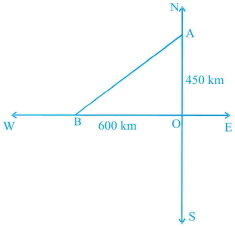
0 likes
View SolutionTriangles — Mix Examples - Triangles · Frequently Asked Questions
1Are these Triangles questions useful for JEE and NEET?
Yes. All questions in this section are mapped to JEE Main and NEET exam patterns. Previous year questions from JEE Main, NEET, GUJCET and state-level exams are included with full solutions.
2Can I switch to Hindi or Gujarati for these questions?
Yes. Use the language tabs in the hero section or the sidebar to view the same questions and solutions in English, Hindi or Gujarati.
3How do I generate a question paper from this subtopic?
Use the Vedclass Exam Paper Generator — select the chapter and subtopic, set difficulty, and generate Sets A, B, C, D automatically. First 3 chapters of every subject are free.
Vedclass Products
For Students
Vedclass Test Series
Mock tests in real JEE/NEET style with performance analysis. 5-day free trial.
Start Free TrialFor Teachers
Exam Paper Generator
Generate Set A/B/C/D papers from this chapter in 2 minutes. 3 chapters free.
Try FreeFor Institutes
Online Exam Module
Live online exams with unlimited students, 360° analytics & white-label branding.
See DemoFor Teachers & Institutes
Generate a Triangles Exam Paper in 2 Minutes
Select subtopic & difficulty — Sets A, B, C, D auto-generated with No Repeat logic.
First 3 chapters of every subject are free — no payment required.