
A English
Mix Examples - Triangles Questions in English
Class 10 Mathematics · Triangles · Mix Examples - Triangles
549+
Questions
English
Language
100%
With Solutions
Showing 50 of 549 questions in English
301
MediumMCQ
In $\Delta PQR$,$m \angle Q = 90^{\circ}$. If $PQ = 33$ and $PR = 65$,find $QR$.
A
$56$
B
$60$
C
$65$
D
$70$
Solution
(A) In a right-angled triangle $\Delta PQR$,where $\angle Q = 90^{\circ}$,the side $PR$ is the hypotenuse.
According to the Pythagorean theorem: $(PR)^2 = (PQ)^2 + (QR)^2$.
Given values are $PQ = 33$ and $PR = 65$.
Substituting the values: $(65)^2 = (33)^2 + (QR)^2$.
$4225 = 1089 + (QR)^2$.
$(QR)^2 = 4225 - 1089$.
$(QR)^2 = 3136$.
Taking the square root of both sides: $QR = \sqrt{3136} = 56$.
Therefore,the length of $QR$ is $56$.
According to the Pythagorean theorem: $(PR)^2 = (PQ)^2 + (QR)^2$.
Given values are $PQ = 33$ and $PR = 65$.
Substituting the values: $(65)^2 = (33)^2 + (QR)^2$.
$4225 = 1089 + (QR)^2$.
$(QR)^2 = 4225 - 1089$.
$(QR)^2 = 3136$.
Taking the square root of both sides: $QR = \sqrt{3136} = 56$.
Therefore,the length of $QR$ is $56$.
0 likes
View Solution302
Medium
The diagonals of convex quadrilateral $PQRS$ intersect at right angles. Prove that $PQ^{2} + RS^{2} = PS^{2} + QR^{2}$.
Solution
(A) Let the diagonals $PR$ and $QS$ of the quadrilateral $PQRS$ intersect at point $O$ at right angles.
Thus,$\angle POQ = \angle QOR = \angle ROS = \angle SOP = 90^{\circ}$.
In right-angled $\triangle POQ$,by Pythagoras theorem: $PQ^{2} = PO^{2} + OQ^{2}$.
In right-angled $\triangle ROS$,by Pythagoras theorem: $RS^{2} = RO^{2} + OS^{2}$.
Adding these two equations: $PQ^{2} + RS^{2} = PO^{2} + OQ^{2} + RO^{2} + OS^{2}$ --- (Equation $1$).
In right-angled $\triangle SOP$,by Pythagoras theorem: $PS^{2} = SO^{2} + OP^{2}$.
In right-angled $\triangle QOR$,by Pythagoras theorem: $QR^{2} = OQ^{2} + OR^{2}$.
Adding these two equations: $PS^{2} + QR^{2} = SO^{2} + OP^{2} + OQ^{2} + OR^{2}$ --- (Equation $2$).
Comparing Equation $1$ and Equation $2$,we see that the right-hand sides are identical.
Therefore,$PQ^{2} + RS^{2} = PS^{2} + QR^{2}$.
Thus,$\angle POQ = \angle QOR = \angle ROS = \angle SOP = 90^{\circ}$.
In right-angled $\triangle POQ$,by Pythagoras theorem: $PQ^{2} = PO^{2} + OQ^{2}$.
In right-angled $\triangle ROS$,by Pythagoras theorem: $RS^{2} = RO^{2} + OS^{2}$.
Adding these two equations: $PQ^{2} + RS^{2} = PO^{2} + OQ^{2} + RO^{2} + OS^{2}$ --- (Equation $1$).
In right-angled $\triangle SOP$,by Pythagoras theorem: $PS^{2} = SO^{2} + OP^{2}$.
In right-angled $\triangle QOR$,by Pythagoras theorem: $QR^{2} = OQ^{2} + OR^{2}$.
Adding these two equations: $PS^{2} + QR^{2} = SO^{2} + OP^{2} + OQ^{2} + OR^{2}$ --- (Equation $2$).
Comparing Equation $1$ and Equation $2$,we see that the right-hand sides are identical.
Therefore,$PQ^{2} + RS^{2} = PS^{2} + QR^{2}$.
0 likes
View Solution303
Medium
In $\Delta ABC$,$m\angle B = 90^{\circ}$,$N \in \overline{AB}$ and $M \in \overline{BC}$. Prove that $AM^{2} + CN^{2} = AC^{2} + MN^{2}$.
Solution
(N/A) Given: In $\Delta ABC$,$\angle B = 90^{\circ}$. $N$ is a point on $AB$ and $M$ is a point on $BC$.
Step $1$: Apply the Pythagorean theorem in $\Delta ABM$ and $\Delta CBN$.
In $\Delta ABM$,since $\angle B = 90^{\circ}$,we have $AM^{2} = AB^{2} + BM^{2}$.
In $\Delta CBN$,since $\angle B = 90^{\circ}$,we have $CN^{2} = CB^{2} + BN^{2}$.
Step $2$: Add the two equations.
$AM^{2} + CN^{2} = (AB^{2} + BM^{2}) + (CB^{2} + BN^{2})$.
Step $3$: Rearrange the terms.
$AM^{2} + CN^{2} = (AB^{2} + CB^{2}) + (BM^{2} + BN^{2})$.
Step $4$: Use the Pythagorean theorem for $\Delta ABC$ and $\Delta MBN$.
In $\Delta ABC$,$AC^{2} = AB^{2} + CB^{2}$.
In $\Delta MBN$,$MN^{2} = BM^{2} + BN^{2}$.
Step $5$: Substitute these into the equation from Step $3$.
$AM^{2} + CN^{2} = AC^{2} + MN^{2}$.
Hence,the result is proved.
Step $1$: Apply the Pythagorean theorem in $\Delta ABM$ and $\Delta CBN$.
In $\Delta ABM$,since $\angle B = 90^{\circ}$,we have $AM^{2} = AB^{2} + BM^{2}$.
In $\Delta CBN$,since $\angle B = 90^{\circ}$,we have $CN^{2} = CB^{2} + BN^{2}$.
Step $2$: Add the two equations.
$AM^{2} + CN^{2} = (AB^{2} + BM^{2}) + (CB^{2} + BN^{2})$.
Step $3$: Rearrange the terms.
$AM^{2} + CN^{2} = (AB^{2} + CB^{2}) + (BM^{2} + BN^{2})$.
Step $4$: Use the Pythagorean theorem for $\Delta ABC$ and $\Delta MBN$.
In $\Delta ABC$,$AC^{2} = AB^{2} + CB^{2}$.
In $\Delta MBN$,$MN^{2} = BM^{2} + BN^{2}$.
Step $5$: Substitute these into the equation from Step $3$.
$AM^{2} + CN^{2} = AC^{2} + MN^{2}$.
Hence,the result is proved.
0 likes
View Solution304
Medium
Prove that the sum of the squares of the sides of a rectangle is equal to the sum of the squares of its diagonals.
Solution
(N/A) Let $ABCD$ be a rectangle with sides $AB = CD = l$ and $BC = DA = b$.
Let the diagonals be $AC$ and $BD$.
In a rectangle,all interior angles are $90^{\circ}$.
Consider the right-angled triangle $\triangle ABC$. By the Pythagoras theorem:
$AC^2 = AB^2 + BC^2 = l^2 + b^2$.
Similarly,in the right-angled triangle $\triangle BCD$:
$BD^2 = BC^2 + CD^2 = b^2 + l^2$.
Sum of the squares of the diagonals = $AC^2 + BD^2 = (l^2 + b^2) + (b^2 + l^2) = 2l^2 + 2b^2$.
Sum of the squares of the sides = $AB^2 + BC^2 + CD^2 + DA^2 = l^2 + b^2 + l^2 + b^2 = 2l^2 + 2b^2$.
Thus,the sum of the squares of the sides is equal to the sum of the squares of the diagonals.
Let the diagonals be $AC$ and $BD$.
In a rectangle,all interior angles are $90^{\circ}$.
Consider the right-angled triangle $\triangle ABC$. By the Pythagoras theorem:
$AC^2 = AB^2 + BC^2 = l^2 + b^2$.
Similarly,in the right-angled triangle $\triangle BCD$:
$BD^2 = BC^2 + CD^2 = b^2 + l^2$.
Sum of the squares of the diagonals = $AC^2 + BD^2 = (l^2 + b^2) + (b^2 + l^2) = 2l^2 + 2b^2$.
Sum of the squares of the sides = $AB^2 + BC^2 + CD^2 + DA^2 = l^2 + b^2 + l^2 + b^2 = 2l^2 + 2b^2$.
Thus,the sum of the squares of the sides is equal to the sum of the squares of the diagonals.
0 likes
View Solution305
Medium
The lengths of the sides of a triangle are $m^{2}+n^{2}$,$2mn$,and $m^{2}-n^{2}$,where $m > n > 0$. Prove that the triangle is a right-angled triangle.
Solution
(N/A) Let the sides of the triangle be $a = m^{2}-n^{2}$,$b = 2mn$,and $c = m^{2}+n^{2}$.
To prove that the triangle is a right-angled triangle,we need to check if the square of the longest side is equal to the sum of the squares of the other two sides (Pythagoras Theorem).
Here,$c = m^{2}+n^{2}$ is the longest side since $m > n > 0$.
Calculate $a^{2} + b^{2}$:
$a^{2} + b^{2} = (m^{2}-n^{2})^{2} + (2mn)^{2}$
$= (m^{4} - 2m^{2}n^{2} + n^{4}) + 4m^{2}n^{2}$
$= m^{4} + 2m^{2}n^{2} + n^{4}$
$= (m^{2}+n^{2})^{2}$
$= c^{2}$
Since $a^{2} + b^{2} = c^{2}$,the triangle satisfies the Pythagoras Theorem.
Therefore,the triangle is a right-angled triangle.
To prove that the triangle is a right-angled triangle,we need to check if the square of the longest side is equal to the sum of the squares of the other two sides (Pythagoras Theorem).
Here,$c = m^{2}+n^{2}$ is the longest side since $m > n > 0$.
Calculate $a^{2} + b^{2}$:
$a^{2} + b^{2} = (m^{2}-n^{2})^{2} + (2mn)^{2}$
$= (m^{4} - 2m^{2}n^{2} + n^{4}) + 4m^{2}n^{2}$
$= m^{4} + 2m^{2}n^{2} + n^{4}$
$= (m^{2}+n^{2})^{2}$
$= c^{2}$
Since $a^{2} + b^{2} = c^{2}$,the triangle satisfies the Pythagoras Theorem.
Therefore,the triangle is a right-angled triangle.
0 likes
View Solution306
Medium
In $\Delta ABC$,$\overline{AC}$ is the hypotenuse and $\overline{BE}$ is a median. Prove that $AB^{2} + BC^{2} + AC^{2} = 8AE^{2}$.
Solution
(N/A) Given: In $\Delta ABC$,$\angle B = 90^{\circ}$ (since $\overline{AC}$ is the hypotenuse),and $\overline{BE}$ is a median to the hypotenuse $\overline{AC}$.
Since $\overline{BE}$ is a median,$E$ is the midpoint of $\overline{AC}$. Thus,$AE = EC = \frac{1}{2} AC$,which implies $AC = 2AE$.
In right-angled $\Delta ABC$,by Pythagoras theorem: $AB^{2} + BC^{2} = AC^{2}$.
We need to prove: $AB^{2} + BC^{2} + AC^{2} = 8AE^{2}$.
Substitute $AB^{2} + BC^{2} = AC^{2}$ into the expression:
$AC^{2} + AC^{2} = 2AC^{2}$.
Since $AC = 2AE$,substitute this into the expression:
$2(2AE)^{2} = 2(4AE^{2}) = 8AE^{2}$.
Thus,$AB^{2} + BC^{2} + AC^{2} = 8AE^{2}$ is proved.
Since $\overline{BE}$ is a median,$E$ is the midpoint of $\overline{AC}$. Thus,$AE = EC = \frac{1}{2} AC$,which implies $AC = 2AE$.
In right-angled $\Delta ABC$,by Pythagoras theorem: $AB^{2} + BC^{2} = AC^{2}$.
We need to prove: $AB^{2} + BC^{2} + AC^{2} = 8AE^{2}$.
Substitute $AB^{2} + BC^{2} = AC^{2}$ into the expression:
$AC^{2} + AC^{2} = 2AC^{2}$.
Since $AC = 2AE$,substitute this into the expression:
$2(2AE)^{2} = 2(4AE^{2}) = 8AE^{2}$.
Thus,$AB^{2} + BC^{2} + AC^{2} = 8AE^{2}$ is proved.
0 likes
View Solution307
Medium
In $\Delta GBS$,$m\angle B = 90^{\circ}$ and $\overline{BM}$ is an altitude to the hypotenuse $\overline{GS}$. Prove that $\frac{GB^{2}}{BS^{2}} = \frac{GM}{SM}$.
Solution
(A) In $\Delta GBS$,$\angle B = 90^{\circ}$ and $BM \perp GS$.
By the property of similar triangles in a right-angled triangle,when an altitude is drawn to the hypotenuse,the triangles formed on both sides of the altitude are similar to the original triangle and to each other.
Specifically,$\Delta GMB \sim \Delta GBS$ and $\Delta B M S \sim \Delta GBS$.
From $\Delta GMB \sim \Delta GBS$,we have $\frac{GB}{GS} = \frac{GM}{GB}$,which implies $GB^{2} = GM \cdot GS$ (Equation $1$).
From $\Delta BMS \sim \Delta GBS$,we have $\frac{BS}{GS} = \frac{SM}{BS}$,which implies $BS^{2} = SM \cdot GS$ (Equation $2$).
Dividing Equation $1$ by Equation $2$:
$\frac{GB^{2}}{BS^{2}} = \frac{GM \cdot GS}{SM \cdot GS} = \frac{GM}{SM}$.
Hence,the result is proved.
By the property of similar triangles in a right-angled triangle,when an altitude is drawn to the hypotenuse,the triangles formed on both sides of the altitude are similar to the original triangle and to each other.
Specifically,$\Delta GMB \sim \Delta GBS$ and $\Delta B M S \sim \Delta GBS$.
From $\Delta GMB \sim \Delta GBS$,we have $\frac{GB}{GS} = \frac{GM}{GB}$,which implies $GB^{2} = GM \cdot GS$ (Equation $1$).
From $\Delta BMS \sim \Delta GBS$,we have $\frac{BS}{GS} = \frac{SM}{BS}$,which implies $BS^{2} = SM \cdot GS$ (Equation $2$).
Dividing Equation $1$ by Equation $2$:
$\frac{GB^{2}}{BS^{2}} = \frac{GM \cdot GS}{SM \cdot GS} = \frac{GM}{SM}$.
Hence,the result is proved.
0 likes
View Solution308
Medium
In $\Delta PQR$,$m \angle Q = 90^{\circ}$ and $\overline{QD}$ is an altitude to the hypotenuse $\overline{PR}$. If $PQ = 3QR$,prove that $PD = 9RD$.
Solution
(N/A) $1$. In $\Delta PQR$,$\angle Q = 90^{\circ}$ and $\overline{QD} \perp \overline{PR}$.
$2$. By the property of similarity in right-angled triangles,$\Delta PDQ \sim \Delta PQR$ and $\Delta RDQ \sim \Delta RQP$.
$3$. Specifically,$\Delta PDQ \sim \Delta QDR$ is not directly applicable,but we use the property that in a right triangle,the altitude to the hypotenuse divides the triangle into two triangles similar to the original and to each other.
$4$. Thus,$\Delta PDQ \sim \Delta QDR$.
$5$. From the similarity $\Delta PDQ \sim \Delta QDR$,we have the ratio of corresponding sides: $\frac{PD}{QD} = \frac{QD}{RD} = \frac{PQ}{QR}$.
$6$. We are given $PQ = 3QR$,which implies $\frac{PQ}{QR} = 3$.
$7$. From $\frac{PD}{QD} = \frac{PQ}{QR}$,we get $PD = 3QD$.
$8$. From $\frac{QD}{RD} = \frac{PQ}{QR}$,we get $QD = 3RD$.
$9$. Substituting $QD = 3RD$ into $PD = 3QD$,we get $PD = 3(3RD) = 9RD$.
$10$. Hence,$PD = 9RD$ is proved.
$2$. By the property of similarity in right-angled triangles,$\Delta PDQ \sim \Delta PQR$ and $\Delta RDQ \sim \Delta RQP$.
$3$. Specifically,$\Delta PDQ \sim \Delta QDR$ is not directly applicable,but we use the property that in a right triangle,the altitude to the hypotenuse divides the triangle into two triangles similar to the original and to each other.
$4$. Thus,$\Delta PDQ \sim \Delta QDR$.
$5$. From the similarity $\Delta PDQ \sim \Delta QDR$,we have the ratio of corresponding sides: $\frac{PD}{QD} = \frac{QD}{RD} = \frac{PQ}{QR}$.
$6$. We are given $PQ = 3QR$,which implies $\frac{PQ}{QR} = 3$.
$7$. From $\frac{PD}{QD} = \frac{PQ}{QR}$,we get $PD = 3QD$.
$8$. From $\frac{QD}{RD} = \frac{PQ}{QR}$,we get $QD = 3RD$.
$9$. Substituting $QD = 3RD$ into $PD = 3QD$,we get $PD = 3(3RD) = 9RD$.
$10$. Hence,$PD = 9RD$ is proved.
0 likes
View Solution309
Medium
In $\Delta XYZ$,$m\angle Y = 90^{\circ}$ and $\overline{YM}$ is an altitude to the hypotenuse $\overline{XZ}$. If $XM = 16ZM$,prove that $XY = 4YZ$.
Solution
(N/A) In $\Delta XYZ$,$\angle Y = 90^{\circ}$ and $\overline{YM} \perp \overline{XZ}$.
According to the Geometric Mean Theorem (or properties of similar triangles),in a right-angled triangle,the altitude to the hypotenuse creates two triangles similar to the original triangle and to each other.
Specifically,$\Delta XMY \sim \Delta YMZ$.
From the similarity $\Delta XMY \sim \Delta YMZ$,we have the ratio of corresponding sides:
$\frac{XY}{YZ} = \frac{XM}{YM} = \frac{YM}{ZM}$.
From $\frac{XY}{YZ} = \frac{YM}{ZM}$,we get $YM^2 = XY \cdot ZM$ (not directly useful here).
Alternatively,using the property of the altitude in a right triangle:
$XY^2 = XM \cdot XZ$ and $YZ^2 = ZM \cdot XZ$.
Dividing these two equations:
$\frac{XY^2}{YZ^2} = \frac{XM \cdot XZ}{ZM \cdot XZ} = \frac{XM}{ZM}$.
Given $XM = 16ZM$,we substitute this into the ratio:
$\frac{XY^2}{YZ^2} = \frac{16ZM}{ZM} = 16$.
Taking the square root of both sides:
$\frac{XY}{YZ} = \sqrt{16} = 4$.
Therefore,$XY = 4YZ$.
According to the Geometric Mean Theorem (or properties of similar triangles),in a right-angled triangle,the altitude to the hypotenuse creates two triangles similar to the original triangle and to each other.
Specifically,$\Delta XMY \sim \Delta YMZ$.
From the similarity $\Delta XMY \sim \Delta YMZ$,we have the ratio of corresponding sides:
$\frac{XY}{YZ} = \frac{XM}{YM} = \frac{YM}{ZM}$.
From $\frac{XY}{YZ} = \frac{YM}{ZM}$,we get $YM^2 = XY \cdot ZM$ (not directly useful here).
Alternatively,using the property of the altitude in a right triangle:
$XY^2 = XM \cdot XZ$ and $YZ^2 = ZM \cdot XZ$.
Dividing these two equations:
$\frac{XY^2}{YZ^2} = \frac{XM \cdot XZ}{ZM \cdot XZ} = \frac{XM}{ZM}$.
Given $XM = 16ZM$,we substitute this into the ratio:
$\frac{XY^2}{YZ^2} = \frac{16ZM}{ZM} = 16$.
Taking the square root of both sides:
$\frac{XY}{YZ} = \sqrt{16} = 4$.
Therefore,$XY = 4YZ$.
0 likes
View Solution310
Medium
In $\Delta ABC$,$m\angle B = 90^{\circ}$ and $\overline{BM}$ is an altitude to the hypotenuse $\overline{AC}$. Prove that $\frac{1}{BM^2} = \frac{1}{AB^2} + \frac{1}{BC^2}$.
Solution
(N/A) In $\Delta ABC$,$m\angle B = 90^{\circ}$ and $\overline{BM} \perp \overline{AC}$.
By the area of a right-angled triangle,the area of $\Delta ABC$ can be expressed in two ways:
Area $= \frac{1}{2} \times AB \times BC$ (using legs as base and height)
Area $= \frac{1}{2} \times AC \times BM$ (using hypotenuse as base and altitude as height)
Equating the two expressions: $\frac{1}{2} \times AB \times BC = \frac{1}{2} \times AC \times BM \implies AB \times BC = AC \times BM$.
Squaring both sides: $AB^2 \times BC^2 = AC^2 \times BM^2$.
Since $\Delta ABC$ is a right-angled triangle,by the Pythagorean theorem: $AC^2 = AB^2 + BC^2$.
Substituting $AC^2$ into the equation: $AB^2 \times BC^2 = (AB^2 + BC^2) \times BM^2$.
Rearranging for $BM^2$: $BM^2 = \frac{AB^2 \times BC^2}{AB^2 + BC^2}$.
Taking the reciprocal of both sides: $\frac{1}{BM^2} = \frac{AB^2 + BC^2}{AB^2 \times BC^2}$.
Splitting the fraction: $\frac{1}{BM^2} = \frac{AB^2}{AB^2 \times BC^2} + \frac{BC^2}{AB^2 \times BC^2}$.
Simplifying: $\frac{1}{BM^2} = \frac{1}{BC^2} + \frac{1}{AB^2}$.
By the area of a right-angled triangle,the area of $\Delta ABC$ can be expressed in two ways:
Area $= \frac{1}{2} \times AB \times BC$ (using legs as base and height)
Area $= \frac{1}{2} \times AC \times BM$ (using hypotenuse as base and altitude as height)
Equating the two expressions: $\frac{1}{2} \times AB \times BC = \frac{1}{2} \times AC \times BM \implies AB \times BC = AC \times BM$.
Squaring both sides: $AB^2 \times BC^2 = AC^2 \times BM^2$.
Since $\Delta ABC$ is a right-angled triangle,by the Pythagorean theorem: $AC^2 = AB^2 + BC^2$.
Substituting $AC^2$ into the equation: $AB^2 \times BC^2 = (AB^2 + BC^2) \times BM^2$.
Rearranging for $BM^2$: $BM^2 = \frac{AB^2 \times BC^2}{AB^2 + BC^2}$.
Taking the reciprocal of both sides: $\frac{1}{BM^2} = \frac{AB^2 + BC^2}{AB^2 \times BC^2}$.
Splitting the fraction: $\frac{1}{BM^2} = \frac{AB^2}{AB^2 \times BC^2} + \frac{BC^2}{AB^2 \times BC^2}$.
Simplifying: $\frac{1}{BM^2} = \frac{1}{BC^2} + \frac{1}{AB^2}$.
0 likes
View Solution311
Difficult
In $\Delta ABC$,$m\angle B = 90^{\circ}$ and $\overline{BD}$ is an altitude to the hypotenuse $\overline{AC}$. If $BD = 2CD$,prove that $AC = 5CD$.
Solution
(N/A) $1$. In $\Delta ABC$,$\angle B = 90^{\circ}$ and $\overline{BD} \perp \overline{AC}$.
$2$. By the property of geometric mean in a right-angled triangle,we have $BD^2 = AD \cdot CD$.
$3$. Given $BD = 2CD$,substitute this into the equation: $(2CD)^2 = AD \cdot CD$.
$4$. This simplifies to $4CD^2 = AD \cdot CD$.
$5$. Dividing both sides by $CD$ (since $CD \neq 0$),we get $AD = 4CD$.
$6$. Since $AC = AD + CD$,substitute $AD = 4CD$ into the equation: $AC = 4CD + CD$.
$7$. Therefore,$AC = 5CD$.
$2$. By the property of geometric mean in a right-angled triangle,we have $BD^2 = AD \cdot CD$.
$3$. Given $BD = 2CD$,substitute this into the equation: $(2CD)^2 = AD \cdot CD$.
$4$. This simplifies to $4CD^2 = AD \cdot CD$.
$5$. Dividing both sides by $CD$ (since $CD \neq 0$),we get $AD = 4CD$.
$6$. Since $AC = AD + CD$,substitute $AD = 4CD$ into the equation: $AC = 4CD + CD$.
$7$. Therefore,$AC = 5CD$.
0 likes
View Solution312
Medium
In $\Delta ABC$,$m\angle B = 90^\circ$ and $\overline{BM}$ is an altitude to the hypotenuse $\overline{AC}$. If $AM = 4CM$,prove that $AB = 2BC$.
Solution
(N/A) In $\Delta ABC$,$\angle B = 90^\circ$ and $\overline{BM} \perp \overline{AC}$.
By the property of geometric mean in a right-angled triangle,we have $\Delta AMB \sim \Delta BMC$.
Therefore,the ratio of their corresponding sides is equal: $\frac{AB}{BC} = \frac{AM}{BM} = \frac{BM}{CM}$.
From $\frac{AB}{BC} = \frac{BM}{CM}$,we get $BM = \frac{AB \cdot CM}{BC}$.
Also,from $\Delta AMB \sim \Delta ABC$,we have $\frac{AB}{AC} = \frac{AM}{AB}$,which implies $AB^2 = AM \cdot AC$.
Similarly,from $\Delta BMC \sim \Delta ABC$,we have $\frac{BC}{AC} = \frac{CM}{BC}$,which implies $BC^2 = CM \cdot AC$.
Dividing the two equations: $\frac{AB^2}{BC^2} = \frac{AM \cdot AC}{CM \cdot AC} = \frac{AM}{CM}$.
Given $AM = 4CM$,we substitute this into the ratio: $\frac{AB^2}{BC^2} = \frac{4CM}{CM} = 4$.
Taking the square root of both sides: $\frac{AB}{BC} = \sqrt{4} = 2$.
Thus,$AB = 2BC$.
By the property of geometric mean in a right-angled triangle,we have $\Delta AMB \sim \Delta BMC$.
Therefore,the ratio of their corresponding sides is equal: $\frac{AB}{BC} = \frac{AM}{BM} = \frac{BM}{CM}$.
From $\frac{AB}{BC} = \frac{BM}{CM}$,we get $BM = \frac{AB \cdot CM}{BC}$.
Also,from $\Delta AMB \sim \Delta ABC$,we have $\frac{AB}{AC} = \frac{AM}{AB}$,which implies $AB^2 = AM \cdot AC$.
Similarly,from $\Delta BMC \sim \Delta ABC$,we have $\frac{BC}{AC} = \frac{CM}{BC}$,which implies $BC^2 = CM \cdot AC$.
Dividing the two equations: $\frac{AB^2}{BC^2} = \frac{AM \cdot AC}{CM \cdot AC} = \frac{AM}{CM}$.
Given $AM = 4CM$,we substitute this into the ratio: $\frac{AB^2}{BC^2} = \frac{4CM}{CM} = 4$.
Taking the square root of both sides: $\frac{AB}{BC} = \sqrt{4} = 2$.
Thus,$AB = 2BC$.
0 likes
View Solution313
Medium
In $\Delta ABC$,$m \angle B = 90^{\circ}$ and $D$ is a point on $\overline{BC}$. Prove that $AD^{2} + BC^{2} = AC^{2} + BD^{2}$.
Solution
(N/A) In $\Delta ABC$,since $m \angle B = 90^{\circ}$,by the Pythagorean theorem,we have $AC^{2} = AB^{2} + BC^{2}$. (Equation $1$)
In $\Delta ABD$,since $m \angle B = 90^{\circ}$,by the Pythagorean theorem,we have $AD^{2} = AB^{2} + BD^{2}$. (Equation $2$)
From Equation $2$,we can write $AB^{2} = AD^{2} - BD^{2}$.
Substitute this value of $AB^{2}$ into Equation $1$:
$AC^{2} = (AD^{2} - BD^{2}) + BC^{2}$.
Rearranging the terms,we get $AC^{2} + BD^{2} = AD^{2} + BC^{2}$.
Hence,the statement is proved.
In $\Delta ABD$,since $m \angle B = 90^{\circ}$,by the Pythagorean theorem,we have $AD^{2} = AB^{2} + BD^{2}$. (Equation $2$)
From Equation $2$,we can write $AB^{2} = AD^{2} - BD^{2}$.
Substitute this value of $AB^{2}$ into Equation $1$:
$AC^{2} = (AD^{2} - BD^{2}) + BC^{2}$.
Rearranging the terms,we get $AC^{2} + BD^{2} = AD^{2} + BC^{2}$.
Hence,the statement is proved.
0 likes
View Solution314
Medium
In $\Delta ABC$,$m \angle B = 90^{\circ}$ and $\overline{AD}$ is a median. Prove that $AC^{2} = AD^{2} + 3BD^{2}$.
Solution
(A) Given: In $\Delta ABC$,$\angle B = 90^{\circ}$ and $\overline{AD}$ is a median to side $\overline{BC}$.
Since $\overline{AD}$ is a median,$D$ is the midpoint of $\overline{BC}$. Therefore,$BD = DC = \frac{1}{2} BC$,which implies $BC = 2BD$.
In right-angled $\Delta ABC$,by Pythagoras theorem: $AC^{2} = AB^{2} + BC^{2}$.
Substituting $BC = 2BD$,we get $AC^{2} = AB^{2} + (2BD)^{2} = AB^{2} + 4BD^{2}$. (Equation $1$)
In right-angled $\Delta ABD$,by Pythagoras theorem: $AD^{2} = AB^{2} + BD^{2}$,which implies $AB^{2} = AD^{2} - BD^{2}$. (Equation $2$)
Substitute Equation $2$ into Equation $1$:
$AC^{2} = (AD^{2} - BD^{2}) + 4BD^{2}$
$AC^{2} = AD^{2} + 3BD^{2}$.
Hence,the result is proved.
Since $\overline{AD}$ is a median,$D$ is the midpoint of $\overline{BC}$. Therefore,$BD = DC = \frac{1}{2} BC$,which implies $BC = 2BD$.
In right-angled $\Delta ABC$,by Pythagoras theorem: $AC^{2} = AB^{2} + BC^{2}$.
Substituting $BC = 2BD$,we get $AC^{2} = AB^{2} + (2BD)^{2} = AB^{2} + 4BD^{2}$. (Equation $1$)
In right-angled $\Delta ABD$,by Pythagoras theorem: $AD^{2} = AB^{2} + BD^{2}$,which implies $AB^{2} = AD^{2} - BD^{2}$. (Equation $2$)
Substitute Equation $2$ into Equation $1$:
$AC^{2} = (AD^{2} - BD^{2}) + 4BD^{2}$
$AC^{2} = AD^{2} + 3BD^{2}$.
Hence,the result is proved.
0 likes
View Solution315
MediumMCQ
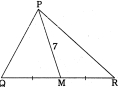
In $\Delta PQR$,$\overline{PM}$ is a median. If $PQ^{2} + PR^{2} = 148$ and $PM = 7$,find $QR$.
A
$70$
B
$40$
C
$10$
D
$30$
Solution
(C) In $\Delta PQR$,$\overline{PM}$ is a median.
By Apollonius' theorem:
$PQ^{2} + PR^{2} = 2(PM^{2} + QM^{2})$
Given $PQ^{2} + PR^{2} = 148$ and $PM = 7$:
$148 = 2(7^{2} + QM^{2})$
$74 = 49 + QM^{2}$
$QM^{2} = 74 - 49$
$QM^{2} = 25$
$QM = 5$
Since $\overline{PM}$ is a median,$M$ is the midpoint of $\overline{QR}$.
Therefore,$QR = 2 \times QM = 2 \times 5 = 10$.
By Apollonius' theorem:
$PQ^{2} + PR^{2} = 2(PM^{2} + QM^{2})$
Given $PQ^{2} + PR^{2} = 148$ and $PM = 7$:
$148 = 2(7^{2} + QM^{2})$
$74 = 49 + QM^{2}$
$QM^{2} = 74 - 49$
$QM^{2} = 25$
$QM = 5$
Since $\overline{PM}$ is a median,$M$ is the midpoint of $\overline{QR}$.
Therefore,$QR = 2 \times QM = 2 \times 5 = 10$.
0 likes
View Solution316
MediumMCQ
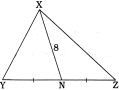
In $\Delta XYZ$,$\overline{XN}$ is a median. If $XY^2 + XZ^2 = 200$ and $XN = 8$,find $YZ$.
A
$15$
B
$25$
C
$20$
D
$12$
Solution
(D) In $\Delta XYZ$,$\overline{XN}$ is a median.
By Apollonius' theorem:
$XY^2 + XZ^2 = 2(XN^2 + YN^2)$
$200 = 2(8^2 + YN^2)$
$100 = 64 + YN^2$
$YN^2 = 36$
$YN = 6$
Since $\overline{XN}$ is a median,$N$ is the midpoint of $\overline{YZ}$.
Therefore,$YZ = 2 \times YN = 2 \times 6 = 12$.
By Apollonius' theorem:
$XY^2 + XZ^2 = 2(XN^2 + YN^2)$
$200 = 2(8^2 + YN^2)$
$100 = 64 + YN^2$
$YN^2 = 36$
$YN = 6$
Since $\overline{XN}$ is a median,$N$ is the midpoint of $\overline{YZ}$.
Therefore,$YZ = 2 \times YN = 2 \times 6 = 12$.
0 likes
View Solution317
MediumMCQ
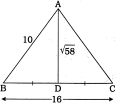
In $\Delta ABC$,$\overline{AD}$ is a median. If $AB = 10$,$BC = 16$ and $AD = \sqrt{58}$,find $AC$.
A
$12$
B
$15$
C
$19$
D
$20$
Solution
(A) In $\Delta ABC$,$\overline{AD}$ is a median to side $\overline{BC}$.
Therefore,$D$ is the midpoint of $\overline{BC}$.
$BD = \frac{1}{2} BC = \frac{1}{2}(16) = 8$.
By Apollonius' theorem for $\Delta ABC$ with median $\overline{AD}$:
$AB^2 + AC^2 = 2(AD^2 + BD^2)$
Substituting the given values:
$10^2 + AC^2 = 2((\sqrt{58})^2 + 8^2)$
$100 + AC^2 = 2(58 + 64)$
$100 + AC^2 = 2(122)$
$100 + AC^2 = 244$
$AC^2 = 244 - 100$
$AC^2 = 144$
$AC = \sqrt{144} = 12$.
Therefore,$D$ is the midpoint of $\overline{BC}$.
$BD = \frac{1}{2} BC = \frac{1}{2}(16) = 8$.
By Apollonius' theorem for $\Delta ABC$ with median $\overline{AD}$:
$AB^2 + AC^2 = 2(AD^2 + BD^2)$
Substituting the given values:
$10^2 + AC^2 = 2((\sqrt{58})^2 + 8^2)$
$100 + AC^2 = 2(58 + 64)$
$100 + AC^2 = 2(122)$
$100 + AC^2 = 244$
$AC^2 = 244 - 100$
$AC^2 = 144$
$AC = \sqrt{144} = 12$.
0 likes
View Solution318
DifficultMCQ
In $\Delta ABC,$ $\overline{AD}$ is a median. If $AD=7,$ $AC=7$ and $BD=4,$ find the perimeter of $\Delta ABC.$
A
$30$
B
$24$
C
$35$
D
$40$
Solution
(B) In $\Delta ABC,$ $\overline{AD}$ is a median.
Since $D$ is the midpoint of $\overline{BC},$ we have $BC = 2BD = 2(4) = 8.$
By Apollonius' theorem for $\Delta ABC$ with median $\overline{AD},$
$AB^2 + AC^2 = 2(AD^2 + BD^2)$
$AB^2 + 7^2 = 2(7^2 + 4^2)$
$AB^2 + 49 = 2(49 + 16)$
$AB^2 + 49 = 2(65)$
$AB^2 + 49 = 130$
$AB^2 = 130 - 49 = 81$
$AB = 9$
Perimeter of $\Delta ABC = AB + BC + AC = 9 + 8 + 7 = 24.$
Since $D$ is the midpoint of $\overline{BC},$ we have $BC = 2BD = 2(4) = 8.$
By Apollonius' theorem for $\Delta ABC$ with median $\overline{AD},$
$AB^2 + AC^2 = 2(AD^2 + BD^2)$
$AB^2 + 7^2 = 2(7^2 + 4^2)$
$AB^2 + 49 = 2(49 + 16)$
$AB^2 + 49 = 2(65)$
$AB^2 + 49 = 130$
$AB^2 = 130 - 49 = 81$
$AB = 9$
Perimeter of $\Delta ABC = AB + BC + AC = 9 + 8 + 7 = 24.$

0 likes
View Solution319
Difficult
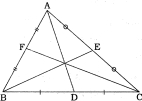
In $\Delta ABC$,$\overline{AD}$,$\overline{BE}$ and $\overline{CF}$ are medians. Prove that $3(AB^2 + BC^2 + AC^2) = 4(AD^2 + BE^2 + CF^2)$.
Solution
(N/A) In $\Delta ABC$,$\overline{AD}$,$\overline{BE}$ and $\overline{CF}$ are medians. Therefore,$D$,$E$,and $F$ are the midpoints of $\overline{BC}$,$\overline{AC}$,and $\overline{AB}$ respectively.
By Apollonius' theorem in $\Delta ABC$ with median $\overline{AD}$:
$AB^2 + AC^2 = 2(AD^2 + BD^2)$
Since $BD = \frac{1}{2}BC$,we have:
$AB^2 + AC^2 = 2AD^2 + 2(\frac{BC}{2})^2 = 2AD^2 + \frac{BC^2}{2}$
$2AD^2 = AB^2 + AC^2 - \frac{BC^2}{2} \quad \dots(1)$
Similarly,for medians $\overline{BE}$ and $\overline{CF}$:
$2BE^2 = AB^2 + BC^2 - \frac{AC^2}{2} \quad \dots(2)$
$2CF^2 = AC^2 + BC^2 - \frac{AB^2}{2} \quad \dots(3)$
Adding equations $(1)$,$(2)$,and $(3)$:
$2(AD^2 + BE^2 + CF^2) = (AB^2 + AB^2 - \frac{AB^2}{2}) + (BC^2 + BC^2 - \frac{BC^2}{2}) + (AC^2 + AC^2 - \frac{AC^2}{2})$
$2(AD^2 + BE^2 + CF^2) = \frac{3}{2}AB^2 + \frac{3}{2}BC^2 + \frac{3}{2}AC^2$
$2(AD^2 + BE^2 + CF^2) = \frac{3}{2}(AB^2 + BC^2 + AC^2)$
Multiplying both sides by $2$:
$4(AD^2 + BE^2 + CF^2) = 3(AB^2 + BC^2 + AC^2)$
By Apollonius' theorem in $\Delta ABC$ with median $\overline{AD}$:
$AB^2 + AC^2 = 2(AD^2 + BD^2)$
Since $BD = \frac{1}{2}BC$,we have:
$AB^2 + AC^2 = 2AD^2 + 2(\frac{BC}{2})^2 = 2AD^2 + \frac{BC^2}{2}$
$2AD^2 = AB^2 + AC^2 - \frac{BC^2}{2} \quad \dots(1)$
Similarly,for medians $\overline{BE}$ and $\overline{CF}$:
$2BE^2 = AB^2 + BC^2 - \frac{AC^2}{2} \quad \dots(2)$
$2CF^2 = AC^2 + BC^2 - \frac{AB^2}{2} \quad \dots(3)$
Adding equations $(1)$,$(2)$,and $(3)$:
$2(AD^2 + BE^2 + CF^2) = (AB^2 + AB^2 - \frac{AB^2}{2}) + (BC^2 + BC^2 - \frac{BC^2}{2}) + (AC^2 + AC^2 - \frac{AC^2}{2})$
$2(AD^2 + BE^2 + CF^2) = \frac{3}{2}AB^2 + \frac{3}{2}BC^2 + \frac{3}{2}AC^2$
$2(AD^2 + BE^2 + CF^2) = \frac{3}{2}(AB^2 + BC^2 + AC^2)$
Multiplying both sides by $2$:
$4(AD^2 + BE^2 + CF^2) = 3(AB^2 + BC^2 + AC^2)$
0 likes
View Solution320
MediumMCQ
In $\Delta ABC$,$\overline{AD}$ is a median. If $AB^2 + AC^2 = 122$ and $AD = 6$,find $BC$.
A
$50$
B
$40$
C
$30$
D
$10$
Solution
(D) According to Apollonius's Theorem,for any triangle $\Delta ABC$ with median $\overline{AD}$ to side $\overline{BC}$,the following relation holds:
$AB^2 + AC^2 = 2(AD^2 + BD^2)$
Given that $AB^2 + AC^2 = 122$ and $AD = 6$,we substitute these values into the formula:
$122 = 2(6^2 + BD^2)$
$122 = 2(36 + BD^2)$
Divide both sides by $2$:
$61 = 36 + BD^2$
$BD^2 = 61 - 36$
$BD^2 = 25$
$BD = \sqrt{25} = 5$
Since $\overline{AD}$ is a median,$D$ is the midpoint of $\overline{BC}$,so $BC = 2 \times BD$.
$BC = 2 \times 5 = 10$.
$AB^2 + AC^2 = 2(AD^2 + BD^2)$
Given that $AB^2 + AC^2 = 122$ and $AD = 6$,we substitute these values into the formula:
$122 = 2(6^2 + BD^2)$
$122 = 2(36 + BD^2)$
Divide both sides by $2$:
$61 = 36 + BD^2$
$BD^2 = 61 - 36$
$BD^2 = 25$
$BD = \sqrt{25} = 5$
Since $\overline{AD}$ is a median,$D$ is the midpoint of $\overline{BC}$,so $BC = 2 \times BD$.
$BC = 2 \times 5 = 10$.
0 likes
View Solution321
MediumMCQ
In $\Delta ABC$,$\overline{AD}$ is a median. If $AB = 18$,$AC = 14$,and $AD = 14$,find the perimeter of $\Delta ABC$.
A
$48$
B
$55$
C
$60$
D
$75$
Solution
(A) According to Apollonius' Theorem for $\Delta ABC$ with median $\overline{AD}$:
$AB^2 + AC^2 = 2(AD^2 + BD^2)$
Substitute the given values: $18^2 + 14^2 = 2(14^2 + BD^2)$
$324 + 196 = 2(196 + BD^2)$
$520 = 2(196 + BD^2)$
$260 = 196 + BD^2$
$BD^2 = 260 - 196 = 64$
$BD = 8$
Since $\overline{AD}$ is a median,$BD = DC = 8$.
Therefore,$BC = BD + DC = 8 + 8 = 16$.
The perimeter of $\Delta ABC = AB + AC + BC = 18 + 14 + 16 = 48$.
$AB^2 + AC^2 = 2(AD^2 + BD^2)$
Substitute the given values: $18^2 + 14^2 = 2(14^2 + BD^2)$
$324 + 196 = 2(196 + BD^2)$
$520 = 2(196 + BD^2)$
$260 = 196 + BD^2$
$BD^2 = 260 - 196 = 64$
$BD = 8$
Since $\overline{AD}$ is a median,$BD = DC = 8$.
Therefore,$BC = BD + DC = 8 + 8 = 16$.
The perimeter of $\Delta ABC = AB + AC + BC = 18 + 14 + 16 = 48$.
0 likes
View Solution322
MediumMCQ
In $\Delta ABC$,$\overline{AD}$ is a median. If $AD = 7$ and $AB^2 + AC^2 = 148$,find $BC$.
A
$70$
B
$10$
C
$60$
D
$80$
Solution
(B) According to Apollonius's Theorem,for any triangle $\Delta ABC$ with median $\overline{AD}$ to side $\overline{BC}$,the following relation holds:
$AB^2 + AC^2 = 2(AD^2 + BD^2)$
Given that $AD = 7$ and $AB^2 + AC^2 = 148$,we substitute these values into the formula:
$148 = 2(7^2 + BD^2)$
$148 = 2(49 + BD^2)$
Divide both sides by $2$:
$74 = 49 + BD^2$
$BD^2 = 74 - 49 = 25$
$BD = \sqrt{25} = 5$
Since $\overline{AD}$ is a median,$D$ is the midpoint of $\overline{BC}$,so $BC = 2 \times BD$.
$BC = 2 \times 5 = 10$.
$AB^2 + AC^2 = 2(AD^2 + BD^2)$
Given that $AD = 7$ and $AB^2 + AC^2 = 148$,we substitute these values into the formula:
$148 = 2(7^2 + BD^2)$
$148 = 2(49 + BD^2)$
Divide both sides by $2$:
$74 = 49 + BD^2$
$BD^2 = 74 - 49 = 25$
$BD = \sqrt{25} = 5$
Since $\overline{AD}$ is a median,$D$ is the midpoint of $\overline{BC}$,so $BC = 2 \times BD$.
$BC = 2 \times 5 = 10$.
0 likes
View Solution323
MediumMCQ
In $\Delta ABC$,$\overline{AD}$ is a median. If $AB = 8$,$AC = 15$ and $AD = 8.5$,find $BC$.
A
$20$
B
$15$
C
$17$
D
$30$
Solution
(C) According to Apollonius's Theorem,for any triangle $\Delta ABC$ with median $\overline{AD}$ to side $\overline{BC}$:
$AB^2 + AC^2 = 2(AD^2 + BD^2)$
Given $AB = 8$,$AC = 15$,and $AD = 8.5$.
Substituting the values:
$8^2 + 15^2 = 2(8.5^2 + BD^2)$
$64 + 225 = 2(72.25 + BD^2)$
$289 = 2(72.25 + BD^2)$
$144.5 = 72.25 + BD^2$
$BD^2 = 144.5 - 72.25 = 72.25$
$BD = \sqrt{72.25} = 8.5$
Since $\overline{AD}$ is a median,$D$ is the midpoint of $\overline{BC}$,so $BC = 2 \times BD$.
$BC = 2 \times 8.5 = 17$.
$AB^2 + AC^2 = 2(AD^2 + BD^2)$
Given $AB = 8$,$AC = 15$,and $AD = 8.5$.
Substituting the values:
$8^2 + 15^2 = 2(8.5^2 + BD^2)$
$64 + 225 = 2(72.25 + BD^2)$
$289 = 2(72.25 + BD^2)$
$144.5 = 72.25 + BD^2$
$BD^2 = 144.5 - 72.25 = 72.25$
$BD = \sqrt{72.25} = 8.5$
Since $\overline{AD}$ is a median,$D$ is the midpoint of $\overline{BC}$,so $BC = 2 \times BD$.
$BC = 2 \times 8.5 = 17$.
0 likes
View Solution324
MediumMCQ
In $\Delta XYZ$,$\overline{XM}$ is a median. If $XY = 20$,$XZ = 21$ and $XM = 14.5$,find $YZ$.
A
$30$
B
$35$
C
$40$
D
$29$
Solution
(D) According to Apollonius's Theorem for $\Delta XYZ$ with median $\overline{XM}$ to side $\overline{YZ}$:
$XY^2 + XZ^2 = 2(XM^2 + YM^2)$
Given $XY = 20$,$XZ = 21$,and $XM = 14.5$.
Substituting the values:
$20^2 + 21^2 = 2(14.5^2 + YM^2)$
$400 + 441 = 2(210.25 + YM^2)$
$841 = 2(210.25 + YM^2)$
$420.5 = 210.25 + YM^2$
$YM^2 = 420.5 - 210.25 = 210.25$
$YM = \sqrt{210.25} = 14.5$
Since $\overline{XM}$ is a median,$M$ is the midpoint of $\overline{YZ}$,so $YZ = 2 \times YM$.
$YZ = 2 \times 14.5 = 29$.
$XY^2 + XZ^2 = 2(XM^2 + YM^2)$
Given $XY = 20$,$XZ = 21$,and $XM = 14.5$.
Substituting the values:
$20^2 + 21^2 = 2(14.5^2 + YM^2)$
$400 + 441 = 2(210.25 + YM^2)$
$841 = 2(210.25 + YM^2)$
$420.5 = 210.25 + YM^2$
$YM^2 = 420.5 - 210.25 = 210.25$
$YM = \sqrt{210.25} = 14.5$
Since $\overline{XM}$ is a median,$M$ is the midpoint of $\overline{YZ}$,so $YZ = 2 \times YM$.
$YZ = 2 \times 14.5 = 29$.
0 likes
View Solution325
MediumMCQ
In $\Delta PQR$,$\overline{PS}$ is a median. If $PQ = 9$,$PR = 40$ and $PS = 20.5$,find $QR$.
A
$41$
B
$30$
C
$35$
D
$50$
Solution
(A) According to Apollonius's Theorem for $\Delta PQR$ with median $\overline{PS}$:
$PQ^2 + PR^2 = 2(PS^2 + QS^2)$
Given $PQ = 9$,$PR = 40$,and $PS = 20.5$:
$9^2 + 40^2 = 2(20.5^2 + QS^2)$
$81 + 1600 = 2(420.25 + QS^2)$
$1681 = 2(420.25 + QS^2)$
$840.5 = 420.25 + QS^2$
$QS^2 = 840.5 - 420.25 = 420.25$
$QS = \sqrt{420.25} = 20.5$
Since $\overline{PS}$ is a median,$S$ is the midpoint of $\overline{QR}$,so $QR = 2 \times QS = 2 \times 20.5 = 41$.
$PQ^2 + PR^2 = 2(PS^2 + QS^2)$
Given $PQ = 9$,$PR = 40$,and $PS = 20.5$:
$9^2 + 40^2 = 2(20.5^2 + QS^2)$
$81 + 1600 = 2(420.25 + QS^2)$
$1681 = 2(420.25 + QS^2)$
$840.5 = 420.25 + QS^2$
$QS^2 = 840.5 - 420.25 = 420.25$
$QS = \sqrt{420.25} = 20.5$
Since $\overline{PS}$ is a median,$S$ is the midpoint of $\overline{QR}$,so $QR = 2 \times QS = 2 \times 20.5 = 41$.
0 likes
View Solution326
MediumMCQ
In $\Delta ABC$,$\overline{AD}$ is a median. If $AB = 10$,$AC = 24$,and $AD = 13$,find $BC$.
A
$35$
B
$26$
C
$30$
D
$20$
Solution
(B) According to Apollonius's Theorem,for any triangle $ABC$ with median $AD$ to side $BC$:
$AB^2 + AC^2 = 2(AD^2 + BD^2)$
Given $AB = 10$,$AC = 24$,and $AD = 13$.
Substituting the values:
$10^2 + 24^2 = 2(13^2 + BD^2)$
$100 + 576 = 2(169 + BD^2)$
$676 = 2(169 + BD^2)$
$338 = 169 + BD^2$
$BD^2 = 338 - 169 = 169$
$BD = \sqrt{169} = 13$
Since $AD$ is a median,$D$ is the midpoint of $BC$,so $BC = 2 \times BD$.
$BC = 2 \times 13 = 26$.
$AB^2 + AC^2 = 2(AD^2 + BD^2)$
Given $AB = 10$,$AC = 24$,and $AD = 13$.
Substituting the values:
$10^2 + 24^2 = 2(13^2 + BD^2)$
$100 + 576 = 2(169 + BD^2)$
$676 = 2(169 + BD^2)$
$338 = 169 + BD^2$
$BD^2 = 338 - 169 = 169$
$BD = \sqrt{169} = 13$
Since $AD$ is a median,$D$ is the midpoint of $BC$,so $BC = 2 \times BD$.
$BC = 2 \times 13 = 26$.
0 likes
View Solution327
MediumMCQ
In $\Delta ABC$,$\overline{AD}$ is a median. If $AB = 8$ and $AD = BD = 8.5$,find $AC$.
A
$30$
B
$25$
C
$15$
D
$45$
Solution
(C) Given that $\overline{AD}$ is a median to side $\overline{BC}$,so $D$ is the midpoint of $\overline{BC}$.
Since $AD = BD = 8.5$,in $\Delta ABD$,we have $AD = BD = 8.5$. This implies $\angle DAB = \angle DBA$.
In $\Delta ABD$,by the Law of Cosines or using the property of isosceles triangles,we can find $\angle ADB$. Since $AD = BD = 8.5$,$D$ is the center of a circle passing through $A, B,$ and $C$ if $CD = 8.5$ as well.
Actually,since $AD$ is a median,$BD = DC = 8.5$. Thus,$AD = BD = DC = 8.5$.
This means $D$ is the circumcenter of $\Delta ABC$,and $BC$ is the diameter of the circumcircle.
Therefore,$\angle BAC = 90^\circ$ (angle in a semicircle).
In right-angled $\Delta ABC$,by Pythagoras theorem,$AC^2 + AB^2 = BC^2$.
We know $AB = 8$ and $BC = BD + DC = 8.5 + 8.5 = 17$.
$AC^2 + 8^2 = 17^2$
$AC^2 + 64 = 289$
$AC^2 = 225$
$AC = 15$.
Since $AD = BD = 8.5$,in $\Delta ABD$,we have $AD = BD = 8.5$. This implies $\angle DAB = \angle DBA$.
In $\Delta ABD$,by the Law of Cosines or using the property of isosceles triangles,we can find $\angle ADB$. Since $AD = BD = 8.5$,$D$ is the center of a circle passing through $A, B,$ and $C$ if $CD = 8.5$ as well.
Actually,since $AD$ is a median,$BD = DC = 8.5$. Thus,$AD = BD = DC = 8.5$.
This means $D$ is the circumcenter of $\Delta ABC$,and $BC$ is the diameter of the circumcircle.
Therefore,$\angle BAC = 90^\circ$ (angle in a semicircle).
In right-angled $\Delta ABC$,by Pythagoras theorem,$AC^2 + AB^2 = BC^2$.
We know $AB = 8$ and $BC = BD + DC = 8.5 + 8.5 = 17$.
$AC^2 + 8^2 = 17^2$
$AC^2 + 64 = 289$
$AC^2 = 225$
$AC = 15$.
0 likes
View Solution328
MediumMCQ
In $\Delta XYZ$,$\overline{XM}$ is a median. If $XY = 11$ and $XM = YM = 30.5$,find $XZ$.
A
$35$
B
$40$
C
$45$
D
$60$
Solution
(D) In $\Delta XYZ$,$\overline{XM}$ is a median to the side $\overline{YZ}$.
By definition of a median,$M$ is the midpoint of $\overline{YZ}$,so $YM = MZ = 30.5$.
Thus,the length of the side $YZ = YM + MZ = 30.5 + 30.5 = 61$.
We use Apollonius's Theorem for $\Delta XYZ$ with median $\overline{XM}$:
$XY^2 + XZ^2 = 2(XM^2 + YM^2)$.
Substitute the given values: $11^2 + XZ^2 = 2(30.5^2 + 30.5^2)$.
$121 + XZ^2 = 2(930.25 + 930.25)$.
$121 + XZ^2 = 2(1860.5)$.
$121 + XZ^2 = 3721$.
$XZ^2 = 3721 - 121$.
$XZ^2 = 3600$.
$XZ = \sqrt{3600} = 60$.
By definition of a median,$M$ is the midpoint of $\overline{YZ}$,so $YM = MZ = 30.5$.
Thus,the length of the side $YZ = YM + MZ = 30.5 + 30.5 = 61$.
We use Apollonius's Theorem for $\Delta XYZ$ with median $\overline{XM}$:
$XY^2 + XZ^2 = 2(XM^2 + YM^2)$.
Substitute the given values: $11^2 + XZ^2 = 2(30.5^2 + 30.5^2)$.
$121 + XZ^2 = 2(930.25 + 930.25)$.
$121 + XZ^2 = 2(1860.5)$.
$121 + XZ^2 = 3721$.
$XZ^2 = 3721 - 121$.
$XZ^2 = 3600$.
$XZ = \sqrt{3600} = 60$.
0 likes
View Solution329
MediumMCQ
In $\Delta PQR,$ $\overline{PS}$ is a median. If $PQ = 12$ and $PS = QS = 18.5,$ find $PR$.
A
$35$
B
$45$
C
$55$
D
$25$
Solution
(A) Given that $\overline{PS}$ is a median of $\Delta PQR,$ it divides the side $QR$ into two equal parts. Thus,$QS = SR = 18.5.$
Since $PS = QS = SR = 18.5,$ the point $S$ is the circumcenter of $\Delta PQR$ with respect to the side $QR,$ implying $\angle QPR = 90^\circ$ (by the property that if the median to a side is half the length of that side,the triangle is a right-angled triangle).
In the right-angled $\Delta PQR,$ by the Pythagorean theorem:
$PQ^2 + PR^2 = QR^2$
$QR = QS + SR = 18.5 + 18.5 = 37$
$12^2 + PR^2 = 37^2$
$144 + PR^2 = 1369$
$PR^2 = 1369 - 144 = 1225$
$PR = \sqrt{1225} = 35.$
Since $PS = QS = SR = 18.5,$ the point $S$ is the circumcenter of $\Delta PQR$ with respect to the side $QR,$ implying $\angle QPR = 90^\circ$ (by the property that if the median to a side is half the length of that side,the triangle is a right-angled triangle).
In the right-angled $\Delta PQR,$ by the Pythagorean theorem:
$PQ^2 + PR^2 = QR^2$
$QR = QS + SR = 18.5 + 18.5 = 37$
$12^2 + PR^2 = 37^2$
$144 + PR^2 = 1369$
$PR^2 = 1369 - 144 = 1225$
$PR = \sqrt{1225} = 35.$
0 likes
View Solution330
Medium
Prove that in a parallelogram,the sum of squares of all the sides is equal to the sum of squares of the diagonals.
Solution
(N/A) Let $ABCD$ be a parallelogram with diagonals $AC$ and $BD$ intersecting at $O$.
By the Parallelogram Law,we know that the sum of the squares of the four sides is equal to the sum of the squares of the two diagonals.
Let the sides be $AB$,$BC$,$CD$,and $DA$. Since $ABCD$ is a parallelogram,$AB = CD$ and $BC = DA$.
According to Apollonius Theorem in $\triangle ABC$ and $\triangle ADC$ with median $BO$ (where $O$ is the midpoint of $AC$):
$AB^2 + BC^2 = 2(BO^2 + AO^2)$
$AD^2 + CD^2 = 2(DO^2 + AO^2)$
Since $O$ is the midpoint of $BD$,$BO = DO$.
Adding the two equations:
$AB^2 + BC^2 + CD^2 + DA^2 = 2(BO^2 + AO^2 + DO^2 + AO^2) = 2(2BO^2 + 2AO^2) = 4BO^2 + 4AO^2$.
Since $BD = 2BO$ and $AC = 2AO$,then $BD^2 = 4BO^2$ and $AC^2 = 4AO^2$.
Therefore,$AB^2 + BC^2 + CD^2 + DA^2 = AC^2 + BD^2$.
By the Parallelogram Law,we know that the sum of the squares of the four sides is equal to the sum of the squares of the two diagonals.
Let the sides be $AB$,$BC$,$CD$,and $DA$. Since $ABCD$ is a parallelogram,$AB = CD$ and $BC = DA$.
According to Apollonius Theorem in $\triangle ABC$ and $\triangle ADC$ with median $BO$ (where $O$ is the midpoint of $AC$):
$AB^2 + BC^2 = 2(BO^2 + AO^2)$
$AD^2 + CD^2 = 2(DO^2 + AO^2)$
Since $O$ is the midpoint of $BD$,$BO = DO$.
Adding the two equations:
$AB^2 + BC^2 + CD^2 + DA^2 = 2(BO^2 + AO^2 + DO^2 + AO^2) = 2(2BO^2 + 2AO^2) = 4BO^2 + 4AO^2$.
Since $BD = 2BO$ and $AC = 2AO$,then $BD^2 = 4BO^2$ and $AC^2 = 4AO^2$.
Therefore,$AB^2 + BC^2 + CD^2 + DA^2 = AC^2 + BD^2$.
0 likes
View Solution331
MediumMCQ
In $\Delta PQR$,$m \angle Q = 90^\circ$. If $PQ = 5$ and $PR = 13$,find the area of $\Delta PQR$.
A
$40$
B
$35$
C
$30$
D
$45$
Solution
(C) Given that $\Delta PQR$ is a right-angled triangle with $m \angle Q = 90^\circ$.
$PQ$ and $QR$ are the legs,and $PR$ is the hypotenuse.
Using the Pythagorean theorem: $PQ^2 + QR^2 = PR^2$.
Substitute the given values: $5^2 + QR^2 = 13^2$.
$25 + QR^2 = 169$.
$QR^2 = 169 - 25 = 144$.
$QR = \sqrt{144} = 12$.
The area of a right-angled triangle is given by $\text{Area} = \frac{1}{2} \times \text{base} \times \text{height}$.
$\text{Area} = \frac{1}{2} \times PQ \times QR = \frac{1}{2} \times 5 \times 12$.
$\text{Area} = 5 \times 6 = 30$.
$PQ$ and $QR$ are the legs,and $PR$ is the hypotenuse.
Using the Pythagorean theorem: $PQ^2 + QR^2 = PR^2$.
Substitute the given values: $5^2 + QR^2 = 13^2$.
$25 + QR^2 = 169$.
$QR^2 = 169 - 25 = 144$.
$QR = \sqrt{144} = 12$.
The area of a right-angled triangle is given by $\text{Area} = \frac{1}{2} \times \text{base} \times \text{height}$.
$\text{Area} = \frac{1}{2} \times PQ \times QR = \frac{1}{2} \times 5 \times 12$.
$\text{Area} = 5 \times 6 = 30$.
0 likes
View Solution332
EasyMCQ
In $\Delta ABC$,$m \angle B = 90^{\circ}$. If $AB = 6$ and $AC = 10$,find the area of $\Delta ABC$.
A
$30$
B
$35$
C
$45$
D
$24$
Solution
(D) Given that $\Delta ABC$ is a right-angled triangle with $m \angle B = 90^{\circ}$.
Here,$AC$ is the hypotenuse and $AB$ is one of the legs.
Using the Pythagorean theorem: $AC^2 = AB^2 + BC^2$.
Substituting the given values: $10^2 = 6^2 + BC^2$.
$100 = 36 + BC^2$.
$BC^2 = 100 - 36 = 64$.
$BC = \sqrt{64} = 8$.
The area of a right-angled triangle is given by the formula: $\text{Area} = \frac{1}{2} \times \text{base} \times \text{height}$.
Here,base $BC = 8$ and height $AB = 6$.
$\text{Area} = \frac{1}{2} \times 8 \times 6 = 4 \times 6 = 24$.
Here,$AC$ is the hypotenuse and $AB$ is one of the legs.
Using the Pythagorean theorem: $AC^2 = AB^2 + BC^2$.
Substituting the given values: $10^2 = 6^2 + BC^2$.
$100 = 36 + BC^2$.
$BC^2 = 100 - 36 = 64$.
$BC = \sqrt{64} = 8$.
The area of a right-angled triangle is given by the formula: $\text{Area} = \frac{1}{2} \times \text{base} \times \text{height}$.
Here,base $BC = 8$ and height $AB = 6$.
$\text{Area} = \frac{1}{2} \times 8 \times 6 = 4 \times 6 = 24$.
0 likes
View Solution333
EasyMCQ
In $\Delta ABC$,$m\angle B = 90^{\circ}$ and $\overline{BM}$ is an altitude to the hypotenuse $\overline{AC}$. If $AB = 3$ and $AC = 5$,find the length of $BM$.
A
$2.4$
B
$3$
C
$5$
D
$7.1$
Solution
(A) $1$. In $\Delta ABC$,since $m\angle B = 90^{\circ}$,we can find the length of $BC$ using the Pythagorean theorem: $AB^2 + BC^2 = AC^2$.
$2$. Substituting the given values: $3^2 + BC^2 = 5^2$,which gives $9 + BC^2 = 25$.
$3$. Therefore,$BC^2 = 25 - 9 = 16$,so $BC = 4$.
$4$. The area of $\Delta ABC$ can be calculated in two ways: $\text{Area} = \frac{1}{2} \times AB \times BC$ or $\text{Area} = \frac{1}{2} \times AC \times BM$.
$5$. Equating the two expressions: $\frac{1}{2} \times 3 \times 4 = \frac{1}{2} \times 5 \times BM$.
$6$. Simplifying: $12 = 5 \times BM$,which leads to $BM = \frac{12}{5} = 2.4$.
$2$. Substituting the given values: $3^2 + BC^2 = 5^2$,which gives $9 + BC^2 = 25$.
$3$. Therefore,$BC^2 = 25 - 9 = 16$,so $BC = 4$.
$4$. The area of $\Delta ABC$ can be calculated in two ways: $\text{Area} = \frac{1}{2} \times AB \times BC$ or $\text{Area} = \frac{1}{2} \times AC \times BM$.
$5$. Equating the two expressions: $\frac{1}{2} \times 3 \times 4 = \frac{1}{2} \times 5 \times BM$.
$6$. Simplifying: $12 = 5 \times BM$,which leads to $BM = \frac{12}{5} = 2.4$.
0 likes
View Solution334
MediumMCQ
In $\Delta ABC$,$m \angle B = 90^{\circ}$ and $\overline{AB} \cong \overline{BC}$. Find the ratio $AB : AC$.
A
$2 : \sqrt{2}$
B
$1 : \sqrt{2}$
C
$3 : \sqrt{2}$
D
$4 : \sqrt{2}$
Solution
(B) Given that $\Delta ABC$ is a right-angled triangle where $m \angle B = 90^{\circ}$.
Since $\overline{AB} \cong \overline{BC}$,let $AB = BC = x$.
According to the Pythagorean theorem,$AC^2 = AB^2 + BC^2$.
Substituting the values,$AC^2 = x^2 + x^2 = 2x^2$.
Therefore,$AC = \sqrt{2x^2} = x\sqrt{2}$.
We need to find the ratio $AB : AC$.
$AB : AC = x : x\sqrt{2} = 1 : \sqrt{2}$.
Since $\overline{AB} \cong \overline{BC}$,let $AB = BC = x$.
According to the Pythagorean theorem,$AC^2 = AB^2 + BC^2$.
Substituting the values,$AC^2 = x^2 + x^2 = 2x^2$.
Therefore,$AC = \sqrt{2x^2} = x\sqrt{2}$.
We need to find the ratio $AB : AC$.
$AB : AC = x : x\sqrt{2} = 1 : \sqrt{2}$.
0 likes
View Solution335
MediumMCQ
In $\Delta ABC$,$m \angle B = 90^{\circ}$. If $AB = 20$ and $AC = 29$,find the perimeter of $\Delta ABC$.
A
$50$
B
$60$
C
$70$
D
$80$
Solution
(C) In $\Delta ABC$,since $m \angle B = 90^{\circ}$,the triangle is a right-angled triangle.
By the Pythagorean theorem,$AC^2 = AB^2 + BC^2$.
Given $AB = 20$ and $AC = 29$,we have $29^2 = 20^2 + BC^2$.
$841 = 400 + BC^2$.
$BC^2 = 841 - 400 = 441$.
$BC = \sqrt{441} = 21$.
The perimeter of $\Delta ABC = AB + BC + AC$.
Perimeter $= 20 + 21 + 29 = 70$.
By the Pythagorean theorem,$AC^2 = AB^2 + BC^2$.
Given $AB = 20$ and $AC = 29$,we have $29^2 = 20^2 + BC^2$.
$841 = 400 + BC^2$.
$BC^2 = 841 - 400 = 441$.
$BC = \sqrt{441} = 21$.
The perimeter of $\Delta ABC = AB + BC + AC$.
Perimeter $= 20 + 21 + 29 = 70$.
0 likes
View Solution336
MediumMCQ
$\square ABCD$ is a square. If its perimeter is $40$, find $AC + BD$. (in $\sqrt{2}$)
A
$10$
B
$20$
C
$30$
D
$40$
Solution
(B) Let the side length of the square be $s$.
The perimeter of a square is given by $4s$.
Given $4s = 40$, so $s = 10$.
The diagonals of a square are equal in length.
The length of the diagonal $d$ of a square with side $s$ is given by $d = s \sqrt{2}$.
Thus, $AC = BD = 10 \sqrt{2}$.
Therefore, $AC + BD = 10 \sqrt{2} + 10 \sqrt{2} = 20 \sqrt{2}$.
The perimeter of a square is given by $4s$.
Given $4s = 40$, so $s = 10$.
The diagonals of a square are equal in length.
The length of the diagonal $d$ of a square with side $s$ is given by $d = s \sqrt{2}$.
Thus, $AC = BD = 10 \sqrt{2}$.
Therefore, $AC + BD = 10 \sqrt{2} + 10 \sqrt{2} = 20 \sqrt{2}$.
0 likes
View Solution337
MediumMCQ
In $\Delta ABC$,$m \angle B = 90^{\circ}$ and $\overline{BE}$ is a median. If $AB = 3.6$ and $BC = 4.8$,find $BE$.
A
$3$
B
$5$
C
$9$
D
$12$
Solution
(A) In a right-angled triangle,the length of the median to the hypotenuse is half the length of the hypotenuse.
First,find the length of the hypotenuse $AC$ using the Pythagorean theorem: $AC^2 = AB^2 + BC^2$.
$AC^2 = (3.6)^2 + (4.8)^2 = 12.96 + 23.04 = 36$.
$AC = \sqrt{36} = 6$.
Since $\overline{BE}$ is the median to the hypotenuse $AC$,its length is $BE = \frac{1}{2} AC$.
$BE = \frac{1}{2} \times 6 = 3$.
First,find the length of the hypotenuse $AC$ using the Pythagorean theorem: $AC^2 = AB^2 + BC^2$.
$AC^2 = (3.6)^2 + (4.8)^2 = 12.96 + 23.04 = 36$.
$AC = \sqrt{36} = 6$.
Since $\overline{BE}$ is the median to the hypotenuse $AC$,its length is $BE = \frac{1}{2} AC$.
$BE = \frac{1}{2} \times 6 = 3$.
0 likes
View Solution338
MediumMCQ
In $\Delta ABC$,$m\angle B = 90^{\circ}$. If $AB : BC = 3 : 4$,find $AB : AC$.
A
$2:6$
B
$3:5$
C
$3:12$
D
$4:15$
Solution
(B) Given that in $\Delta ABC$,$m\angle B = 90^{\circ}$.
Let $AB = 3x$ and $BC = 4x$ for some constant $x > 0$.
By the Pythagorean theorem,$AC^2 = AB^2 + BC^2$.
$AC^2 = (3x)^2 + (4x)^2 = 9x^2 + 16x^2 = 25x^2$.
Taking the square root,$AC = \sqrt{25x^2} = 5x$.
We need to find the ratio $AB : AC$.
$AB : AC = 3x : 5x = 3 : 5$.
Therefore,the correct option is $B$.
Let $AB = 3x$ and $BC = 4x$ for some constant $x > 0$.
By the Pythagorean theorem,$AC^2 = AB^2 + BC^2$.
$AC^2 = (3x)^2 + (4x)^2 = 9x^2 + 16x^2 = 25x^2$.
Taking the square root,$AC = \sqrt{25x^2} = 5x$.
We need to find the ratio $AB : AC$.
$AB : AC = 3x : 5x = 3 : 5$.
Therefore,the correct option is $B$.
0 likes
View Solution339
MediumMCQ
In $\Delta ABC$,$m\angle B = 90^{\circ}$ and $\overline{BM}$ is a median. If $AB = 15$ and $BM = 12.5$,find $BC$.
A
$10$
B
$30$
C
$20$
D
$50$
Solution
(C) In a right-angled triangle,the length of the median to the hypotenuse is half the length of the hypotenuse.
Here,$\Delta ABC$ is a right-angled triangle with $m\angle B = 90^{\circ}$.
Since $\overline{BM}$ is the median to the hypotenuse $\overline{AC}$,we have $BM = \frac{1}{2} AC$.
Given $BM = 12.5$,so $12.5 = \frac{1}{2} AC$,which implies $AC = 25$.
Now,using the Pythagorean theorem in $\Delta ABC$:
$AB^2 + BC^2 = AC^2$
$15^2 + BC^2 = 25^2$
$225 + BC^2 = 625$
$BC^2 = 625 - 225 = 400$
$BC = \sqrt{400} = 20$.
Here,$\Delta ABC$ is a right-angled triangle with $m\angle B = 90^{\circ}$.
Since $\overline{BM}$ is the median to the hypotenuse $\overline{AC}$,we have $BM = \frac{1}{2} AC$.
Given $BM = 12.5$,so $12.5 = \frac{1}{2} AC$,which implies $AC = 25$.
Now,using the Pythagorean theorem in $\Delta ABC$:
$AB^2 + BC^2 = AC^2$
$15^2 + BC^2 = 25^2$
$225 + BC^2 = 625$
$BC^2 = 625 - 225 = 400$
$BC = \sqrt{400} = 20$.
0 likes
View Solution340
MediumMCQ
In $\Delta ABC$,$\overline{AD}$ is a median. If $AB^2 + AC^2 = 338$ and $AD = 5$,find $BC$.
A
$30$
B
$15$
C
$20$
D
$24$
Solution
(D) According to Apollonius's Theorem for $\Delta ABC$ with median $\overline{AD}$:
$AB^2 + AC^2 = 2(AD^2 + BD^2)$
Given $AB^2 + AC^2 = 338$ and $AD = 5$.
Substituting the values into the formula:
$338 = 2(5^2 + BD^2)$
$338 = 2(25 + BD^2)$
$169 = 25 + BD^2$
$BD^2 = 169 - 25 = 144$
$BD = \sqrt{144} = 12$
Since $\overline{AD}$ is a median,$D$ is the midpoint of $\overline{BC}$,so $BC = 2 \times BD$.
$BC = 2 \times 12 = 24$.
$AB^2 + AC^2 = 2(AD^2 + BD^2)$
Given $AB^2 + AC^2 = 338$ and $AD = 5$.
Substituting the values into the formula:
$338 = 2(5^2 + BD^2)$
$338 = 2(25 + BD^2)$
$169 = 25 + BD^2$
$BD^2 = 169 - 25 = 144$
$BD = \sqrt{144} = 12$
Since $\overline{AD}$ is a median,$D$ is the midpoint of $\overline{BC}$,so $BC = 2 \times BD$.
$BC = 2 \times 12 = 24$.
0 likes
View Solution341
MediumMCQ
The perimeter of equilateral $\Delta ABC$ is $24$. Find the length of its altitude. (in $\sqrt{3}$)
A
$4$
B
$5$
C
$6$
D
$8$
Solution
(A) The perimeter of an equilateral triangle is given by $P = 3a$, where $a$ is the side length.
Given $P = 24$, we have $3a = 24$, which implies $a = 8$.
The altitude $h$ of an equilateral triangle is given by the formula $h = \frac{\sqrt{3}}{2} a$.
Substituting $a = 8$ into the formula, we get $h = \frac{\sqrt{3}}{2} \times 8 = 4 \sqrt{3}$.
Therefore, the length of the altitude is $4 \sqrt{3}$.
Given $P = 24$, we have $3a = 24$, which implies $a = 8$.
The altitude $h$ of an equilateral triangle is given by the formula $h = \frac{\sqrt{3}}{2} a$.
Substituting $a = 8$ into the formula, we get $h = \frac{\sqrt{3}}{2} \times 8 = 4 \sqrt{3}$.
Therefore, the length of the altitude is $4 \sqrt{3}$.
0 likes
View Solution342
MediumMCQ
In $\Delta ABC$,$m \angle B = 90^{\circ}$ and $m \angle A : m \angle C = 1 : 2$. If $BC = 4$,find $AC$.
A
$10$
B
$8$
C
$5$
D
$25$
Solution
(B) In $\Delta ABC$,we are given $m \angle B = 90^{\circ}$.
Since the sum of angles in a triangle is $180^{\circ}$,we have $m \angle A + m \angle B + m \angle C = 180^{\circ}$.
Substituting $m \angle B = 90^{\circ}$,we get $m \angle A + m \angle C = 90^{\circ}$.
Given the ratio $m \angle A : m \angle C = 1 : 2$,let $m \angle A = x$ and $m \angle C = 2x$.
Thus,$x + 2x = 90^{\circ}$,which implies $3x = 90^{\circ}$,so $x = 30^{\circ}$.
Therefore,$m \angle A = 30^{\circ}$ and $m \angle C = 60^{\circ}$.
In a $30^{\circ}-60^{\circ}-90^{\circ}$ triangle,the side opposite to $30^{\circ}$ is half the hypotenuse.
Here,$BC$ is opposite to $\angle A = 30^{\circ}$,so $BC = \frac{1}{2} AC$.
Given $BC = 4$,we have $4 = \frac{1}{2} AC$,which implies $AC = 8$.
Since the sum of angles in a triangle is $180^{\circ}$,we have $m \angle A + m \angle B + m \angle C = 180^{\circ}$.
Substituting $m \angle B = 90^{\circ}$,we get $m \angle A + m \angle C = 90^{\circ}$.
Given the ratio $m \angle A : m \angle C = 1 : 2$,let $m \angle A = x$ and $m \angle C = 2x$.
Thus,$x + 2x = 90^{\circ}$,which implies $3x = 90^{\circ}$,so $x = 30^{\circ}$.
Therefore,$m \angle A = 30^{\circ}$ and $m \angle C = 60^{\circ}$.
In a $30^{\circ}-60^{\circ}-90^{\circ}$ triangle,the side opposite to $30^{\circ}$ is half the hypotenuse.
Here,$BC$ is opposite to $\angle A = 30^{\circ}$,so $BC = \frac{1}{2} AC$.
Given $BC = 4$,we have $4 = \frac{1}{2} AC$,which implies $AC = 8$.
0 likes
View Solution343
MediumMCQ
In $\Delta ABC$,$m \angle B = 90^{\circ}$ and $\overline{BD}$ is a median. If $m \angle C = 30^{\circ}$ and $AB = 5$,find $BD$.
A
$15$
B
$10$
C
$8$
D
$5$
Solution
(D) In $\Delta ABC$,we are given $m \angle B = 90^{\circ}$ and $m \angle C = 30^{\circ}$.
Since the sum of angles in a triangle is $180^{\circ}$,$m \angle A = 180^{\circ} - 90^{\circ} - 30^{\circ} = 60^{\circ}$.
In a $30^{\circ}-60^{\circ}-90^{\circ}$ triangle,the side opposite to $30^{\circ}$ is half the hypotenuse.
Here,$AB$ is opposite to $30^{\circ}$ (at $C$),so $AB = \frac{1}{2} AC$.
Given $AB = 5$,we have $5 = \frac{1}{2} AC$,which implies $AC = 10$.
In a right-angled triangle,the length of the median to the hypotenuse is half the length of the hypotenuse.
Therefore,$BD = \frac{1}{2} AC = \frac{1}{2} \times 10 = 5$.
Since the sum of angles in a triangle is $180^{\circ}$,$m \angle A = 180^{\circ} - 90^{\circ} - 30^{\circ} = 60^{\circ}$.
In a $30^{\circ}-60^{\circ}-90^{\circ}$ triangle,the side opposite to $30^{\circ}$ is half the hypotenuse.
Here,$AB$ is opposite to $30^{\circ}$ (at $C$),so $AB = \frac{1}{2} AC$.
Given $AB = 5$,we have $5 = \frac{1}{2} AC$,which implies $AC = 10$.
In a right-angled triangle,the length of the median to the hypotenuse is half the length of the hypotenuse.
Therefore,$BD = \frac{1}{2} AC = \frac{1}{2} \times 10 = 5$.
0 likes
View Solution344
MediumMCQ
In $\Delta XYZ$,$m \angle Y = 90^{\circ}$ and $XY : XZ = 15 : 17$. If $YZ = 4$,find the perimeter of $\Delta XYZ$.
A
$10$
B
$15$
C
$25$
D
$20$
Solution
(D) Given that $\Delta XYZ$ is a right-angled triangle with $m \angle Y = 90^{\circ}$.
According to the Pythagorean theorem,$XY^2 + YZ^2 = XZ^2$.
Let $XY = 15k$ and $XZ = 17k$ for some constant $k > 0$.
Substituting the values into the theorem: $(15k)^2 + 4^2 = (17k)^2$.
$225k^2 + 16 = 289k^2$.
$16 = 289k^2 - 225k^2$.
$16 = 64k^2$.
$k^2 = \frac{16}{64} = \frac{1}{4}$.
Therefore,$k = \frac{1}{2} = 0.5$.
Now,calculate the side lengths:
$XY = 15 \times 0.5 = 7.5$.
$XZ = 17 \times 0.5 = 8.5$.
$YZ = 4$.
The perimeter of $\Delta XYZ = XY + YZ + XZ = 7.5 + 4 + 8.5 = 20$.
According to the Pythagorean theorem,$XY^2 + YZ^2 = XZ^2$.
Let $XY = 15k$ and $XZ = 17k$ for some constant $k > 0$.
Substituting the values into the theorem: $(15k)^2 + 4^2 = (17k)^2$.
$225k^2 + 16 = 289k^2$.
$16 = 289k^2 - 225k^2$.
$16 = 64k^2$.
$k^2 = \frac{16}{64} = \frac{1}{4}$.
Therefore,$k = \frac{1}{2} = 0.5$.
Now,calculate the side lengths:
$XY = 15 \times 0.5 = 7.5$.
$XZ = 17 \times 0.5 = 8.5$.
$YZ = 4$.
The perimeter of $\Delta XYZ = XY + YZ + XZ = 7.5 + 4 + 8.5 = 20$.
0 likes
View Solution345
MediumMCQ
In $\Delta ABC$,$m \angle B = 90^{\circ}$ and $AC = 14\sqrt{2}$. If $AB = BC$,find the area of $\Delta ABC$.
A
$98$
B
$55$
C
$66$
D
$41$
Solution
(A) Given that $\Delta ABC$ is a right-angled triangle with $m \angle B = 90^{\circ}$ and $AB = BC$.
Let $AB = BC = x$.
According to the Pythagorean theorem,$AB^2 + BC^2 = AC^2$.
Substituting the values,we get $x^2 + x^2 = (14\sqrt{2})^2$.
$2x^2 = 196 \times 2$.
$2x^2 = 392$.
$x^2 = 196$.
$x = 14$.
Thus,the base $BC = 14$ and the height $AB = 14$.
The area of $\Delta ABC = \frac{1}{2} \times \text{base} \times \text{height} = \frac{1}{2} \times 14 \times 14 = 98$ square units.
Let $AB = BC = x$.
According to the Pythagorean theorem,$AB^2 + BC^2 = AC^2$.
Substituting the values,we get $x^2 + x^2 = (14\sqrt{2})^2$.
$2x^2 = 196 \times 2$.
$2x^2 = 392$.
$x^2 = 196$.
$x = 14$.
Thus,the base $BC = 14$ and the height $AB = 14$.
The area of $\Delta ABC = \frac{1}{2} \times \text{base} \times \text{height} = \frac{1}{2} \times 14 \times 14 = 98$ square units.
0 likes
View Solution346
MediumMCQ
In $\Delta ABC$,$m \angle B = 90^{\circ}$ and $\overline{BM}$ is an altitude to the hypotenuse $\overline{AC}$. If $AM = 2x$,$BM = 3x + 5$,and $CM = 8x$,find the value of $x$.
A
$10$
B
$5$
C
$15$
D
$20$
Solution
(B) In a right-angled triangle,if an altitude is drawn from the right-angle vertex to the hypotenuse,the altitude is the geometric mean of the segments of the hypotenuse.
According to the geometric mean theorem: $BM^2 = AM \cdot CM$.
Given $AM = 2x$,$BM = 3x + 5$,and $CM = 8x$.
Substituting these values into the equation: $(3x + 5)^2 = (2x)(8x)$.
Expanding the left side: $9x^2 + 30x + 25 = 16x^2$.
Rearranging the terms to form a quadratic equation: $7x^2 - 30x - 25 = 0$.
Factoring the quadratic equation: $7x^2 - 35x + 5x - 25 = 0$.
$7x(x - 5) + 5(x - 5) = 0$.
$(7x + 5)(x - 5) = 0$.
This gives $x = 5$ or $x = -5/7$.
Since $x$ represents a length,it must be positive,so $x = 5$.
According to the geometric mean theorem: $BM^2 = AM \cdot CM$.
Given $AM = 2x$,$BM = 3x + 5$,and $CM = 8x$.
Substituting these values into the equation: $(3x + 5)^2 = (2x)(8x)$.
Expanding the left side: $9x^2 + 30x + 25 = 16x^2$.
Rearranging the terms to form a quadratic equation: $7x^2 - 30x - 25 = 0$.
Factoring the quadratic equation: $7x^2 - 35x + 5x - 25 = 0$.
$7x(x - 5) + 5(x - 5) = 0$.
$(7x + 5)(x - 5) = 0$.
This gives $x = 5$ or $x = -5/7$.
Since $x$ represents a length,it must be positive,so $x = 5$.
0 likes
View Solution347
MediumMCQ
In $\Delta ABC$,$m \angle B = 90^{\circ}$ and $\overline{BM}$ is an altitude to the hypotenuse $\overline{AC}$. If $AB = x - 2$,$AM = x - 6$,and $AC = 2x - 4$,find the value of $x$.
A
$20$
B
$15$
C
$10$
D
$30$
Solution
(C) In a right-angled triangle $\Delta ABC$ where $\angle B = 90^{\circ}$,if $\overline{BM}$ is the altitude to the hypotenuse $\overline{AC}$,then by the geometric mean theorem (or property of similar triangles $\Delta AMB \sim \Delta ABC$),we have the relation: $AB^2 = AM \cdot AC$.
Given values are $AB = x - 2$,$AM = x - 6$,and $AC = 2x - 4$.
Substituting these into the equation: $(x - 2)^2 = (x - 6)(2x - 4)$.
Expanding both sides: $x^2 - 4x + 4 = 2x^2 - 4x - 12x + 24$.
Simplifying: $x^2 - 4x + 4 = 2x^2 - 16x + 24$.
Rearranging the terms to form a quadratic equation: $x^2 - 12x + 20 = 0$.
Factoring the quadratic equation: $(x - 10)(x - 2) = 0$.
This gives $x = 10$ or $x = 2$.
If $x = 2$,then $AB = 2 - 2 = 0$,which is impossible for a triangle side length. Thus,$x = 10$ is the only valid solution.
Given values are $AB = x - 2$,$AM = x - 6$,and $AC = 2x - 4$.
Substituting these into the equation: $(x - 2)^2 = (x - 6)(2x - 4)$.
Expanding both sides: $x^2 - 4x + 4 = 2x^2 - 4x - 12x + 24$.
Simplifying: $x^2 - 4x + 4 = 2x^2 - 16x + 24$.
Rearranging the terms to form a quadratic equation: $x^2 - 12x + 20 = 0$.
Factoring the quadratic equation: $(x - 10)(x - 2) = 0$.
This gives $x = 10$ or $x = 2$.
If $x = 2$,then $AB = 2 - 2 = 0$,which is impossible for a triangle side length. Thus,$x = 10$ is the only valid solution.
0 likes
View Solution348
MediumMCQ
In $\Delta ABC, m\angle B = 90^{\circ}$ and $\overline{BM}$ is an altitude to the hypotenuse $\overline{AC}$. If $AM = x - 1$,$BM = x + 1$,and $CM = x + 4$,find the value of $x$.
A
$15$
B
$20$
C
$25$
D
$5$
Solution
(D) In a right-angled triangle $\Delta ABC$ where $\angle B = 90^{\circ}$,if $\overline{BM}$ is the altitude to the hypotenuse $\overline{AC}$,then by the geometric mean theorem,$BM^2 = AM \cdot CM$.
Substituting the given values: $(x + 1)^2 = (x - 1)(x + 4)$.
Expanding both sides: $x^2 + 2x + 1 = x^2 + 4x - x - 4$.
Simplifying the equation: $x^2 + 2x + 1 = x^2 + 3x - 4$.
Subtracting $x^2$ from both sides: $2x + 1 = 3x - 4$.
Rearranging the terms: $3x - 2x = 1 + 4$.
Thus,$x = 5$.
Substituting the given values: $(x + 1)^2 = (x - 1)(x + 4)$.
Expanding both sides: $x^2 + 2x + 1 = x^2 + 4x - x - 4$.
Simplifying the equation: $x^2 + 2x + 1 = x^2 + 3x - 4$.
Subtracting $x^2$ from both sides: $2x + 1 = 3x - 4$.
Rearranging the terms: $3x - 2x = 1 + 4$.
Thus,$x = 5$.
0 likes
View Solution349
MediumMCQ
In $\Delta ABC$,$m \angle B = 90^\circ$ and $\overline{BM}$ is an altitude to the hypotenuse $AC$. If $BC = 2x + 2$,$CM = x + 1$,and $AC = 5x$,find the value of $x$.
A
$4$
B
$15$
C
$20$
D
$30$
Solution
(A) In a right-angled triangle $\Delta ABC$ with $\angle B = 90^\circ$,if $\overline{BM}$ is the altitude to the hypotenuse $AC$,then by the Geometric Mean Theorem (or properties of similar triangles $\Delta BMC \sim \Delta BCA$),we have the relation: $BC^2 = CM \cdot AC$.
Given $BC = 2x + 2$,$CM = x + 1$,and $AC = 5x$.
Substituting these values into the equation: $(2x + 2)^2 = (x + 1)(5x)$.
Expanding the left side: $(2(x + 1))^2 = 4(x + 1)^2 = 4(x^2 + 2x + 1)$.
So,$4(x^2 + 2x + 1) = 5x^2 + 5x$.
$4x^2 + 8x + 4 = 5x^2 + 5x$.
Rearranging the terms to form a quadratic equation: $x^2 - 3x - 4 = 0$.
Factoring the quadratic: $(x - 4)(x + 1) = 0$.
This gives $x = 4$ or $x = -1$.
Since $x$ represents a length component and $BC, CM, AC$ must be positive,we discard $x = -1$.
Therefore,$x = 4$.
Given $BC = 2x + 2$,$CM = x + 1$,and $AC = 5x$.
Substituting these values into the equation: $(2x + 2)^2 = (x + 1)(5x)$.
Expanding the left side: $(2(x + 1))^2 = 4(x + 1)^2 = 4(x^2 + 2x + 1)$.
So,$4(x^2 + 2x + 1) = 5x^2 + 5x$.
$4x^2 + 8x + 4 = 5x^2 + 5x$.
Rearranging the terms to form a quadratic equation: $x^2 - 3x - 4 = 0$.
Factoring the quadratic: $(x - 4)(x + 1) = 0$.
This gives $x = 4$ or $x = -1$.
Since $x$ represents a length component and $BC, CM, AC$ must be positive,we discard $x = -1$.
Therefore,$x = 4$.
0 likes
View Solution350
MediumMCQ
In rhombus $ABCD$,$AB = 13$ and $AC = 24$. Find $BD$.
A
$30$
B
$10$
C
$40$
D
$60$
Solution
(B) In a rhombus,the diagonals bisect each other at right angles $(90^{\circ})$.
Let the diagonals $AC$ and $BD$ intersect at point $O$.
Since $AC = 24$,the length of $AO = AC / 2 = 24 / 2 = 12$.
In the right-angled triangle $\triangle AOB$,by the Pythagorean theorem,$AB^2 = AO^2 + BO^2$.
Given $AB = 13$ and $AO = 12$,we have $13^2 = 12^2 + BO^2$.
$169 = 144 + BO^2$.
$BO^2 = 169 - 144 = 25$.
$BO = \sqrt{25} = 5$.
Since the diagonals bisect each other,$BD = 2 \times BO = 2 \times 5 = 10$.
Let the diagonals $AC$ and $BD$ intersect at point $O$.
Since $AC = 24$,the length of $AO = AC / 2 = 24 / 2 = 12$.
In the right-angled triangle $\triangle AOB$,by the Pythagorean theorem,$AB^2 = AO^2 + BO^2$.
Given $AB = 13$ and $AO = 12$,we have $13^2 = 12^2 + BO^2$.
$169 = 144 + BO^2$.
$BO^2 = 169 - 144 = 25$.
$BO = \sqrt{25} = 5$.
Since the diagonals bisect each other,$BD = 2 \times BO = 2 \times 5 = 10$.
0 likes
View SolutionTriangles — Mix Examples - Triangles · Frequently Asked Questions
1Are these Triangles questions useful for JEE and NEET?
Yes. All questions in this section are mapped to JEE Main and NEET exam patterns. Previous year questions from JEE Main, NEET, GUJCET and state-level exams are included with full solutions.
2Can I switch to Hindi or Gujarati for these questions?
Yes. Use the language tabs in the hero section or the sidebar to view the same questions and solutions in English, Hindi or Gujarati.
3How do I generate a question paper from this subtopic?
Use the Vedclass Exam Paper Generator — select the chapter and subtopic, set difficulty, and generate Sets A, B, C, D automatically. First 3 chapters of every subject are free.
Vedclass Products
For Students
Vedclass Test Series
Mock tests in real JEE/NEET style with performance analysis. 5-day free trial.
Start Free TrialFor Teachers
Exam Paper Generator
Generate Set A/B/C/D papers from this chapter in 2 minutes. 3 chapters free.
Try FreeFor Institutes
Online Exam Module
Live online exams with unlimited students, 360° analytics & white-label branding.
See DemoFor Teachers & Institutes
Generate a Triangles Exam Paper in 2 Minutes
Select subtopic & difficulty — Sets A, B, C, D auto-generated with No Repeat logic.
First 3 chapters of every subject are free — no payment required.