
A English
Mix Examples - Triangles Questions in English
Class 10 Mathematics · Triangles · Mix Examples - Triangles
549+
Questions
English
Language
100%
With Solutions
Showing 50 of 549 questions in English
201
MediumMCQ
In $\Delta ABC$,$A-M-B$,$A-N-C$ and $\overline{MN} \parallel \overline{BC}$. If $AM : MB = 4 : 13$ and $AC = 20.4$,find $AN$.
A
$4.8$
B
$10$
C
$2.4$
D
$13.5$
Solution
(A) According to the Basic Proportionality Theorem (Thales Theorem),if a line is drawn parallel to one side of a triangle to intersect the other two sides in distinct points,then the other two sides are divided in the same ratio.
Since $\overline{MN} \parallel \overline{BC}$,we have $\frac{AM}{MB} = \frac{AN}{NC}$.
Given $\frac{AM}{MB} = \frac{4}{13}$,therefore $\frac{AN}{NC} = \frac{4}{13}$.
Let $AN = 4x$ and $NC = 13x$.
We know that $AC = AN + NC$.
Substituting the values,$20.4 = 4x + 13x$.
$20.4 = 17x$.
$x = \frac{20.4}{17} = 1.2$.
Now,$AN = 4x = 4 \times 1.2 = 4.8$.
Since $\overline{MN} \parallel \overline{BC}$,we have $\frac{AM}{MB} = \frac{AN}{NC}$.
Given $\frac{AM}{MB} = \frac{4}{13}$,therefore $\frac{AN}{NC} = \frac{4}{13}$.
Let $AN = 4x$ and $NC = 13x$.
We know that $AC = AN + NC$.
Substituting the values,$20.4 = 4x + 13x$.
$20.4 = 17x$.
$x = \frac{20.4}{17} = 1.2$.
Now,$AN = 4x = 4 \times 1.2 = 4.8$.
0 likes
View Solution202
MediumMCQ
In $\Delta XYZ$,$X-P-Y$,$X-Q-Z$ and $\overline{PQ} \parallel \overline{YZ}$. If $XP:PY = 3:5$ and $XZ = 5.6$,find $QZ$.
A
$9$
B
$3.5$
C
$2$
D
$4$
Solution
(B) According to the Basic Proportionality Theorem (Thales Theorem),if a line is drawn parallel to one side of a triangle to intersect the other two sides in distinct points,then the other two sides are divided in the same ratio.
Given $\overline{PQ} \parallel \overline{YZ}$ in $\Delta XYZ$,we have:
$\frac{XP}{PY} = \frac{XQ}{QZ} = \frac{3}{5}$.
Let $XQ = 3k$ and $QZ = 5k$.
We know that $XZ = XQ + QZ = 5.6$.
Substituting the values,$3k + 5k = 5.6$.
$8k = 5.6$.
$k = \frac{5.6}{8} = 0.7$.
Now,$QZ = 5k = 5 \times 0.7 = 3.5$.
Given $\overline{PQ} \parallel \overline{YZ}$ in $\Delta XYZ$,we have:
$\frac{XP}{PY} = \frac{XQ}{QZ} = \frac{3}{5}$.
Let $XQ = 3k$ and $QZ = 5k$.
We know that $XZ = XQ + QZ = 5.6$.
Substituting the values,$3k + 5k = 5.6$.
$8k = 5.6$.
$k = \frac{5.6}{8} = 0.7$.
Now,$QZ = 5k = 5 \times 0.7 = 3.5$.
0 likes
View Solution203
MediumMCQ
In $\Delta ABC$,$A-M-B$,$A-N-C$ and $\overline{MN} \parallel \overline{BC}$. If $AM = x+3$,$AB = 2x$,$AN = x+5$ and $AC = 2x+3$,find the value of $x$.
A
$3$
B
$5$
C
$9$
D
$1$
Solution
(C) According to the Basic Proportionality Theorem (Thales Theorem),if a line is drawn parallel to one side of a triangle to intersect the other two sides in distinct points,then the other two sides are divided in the same ratio.
Since $\overline{MN} \parallel \overline{BC}$,we have $\frac{AM}{MB} = \frac{AN}{NC}$.
Given $AM = x+3$ and $AB = 2x$,then $MB = AB - AM = 2x - (x+3) = x-3$.
Given $AN = x+5$ and $AC = 2x+3$,then $NC = AC - AN = (2x+3) - (x+5) = x-2$.
Substituting these into the ratio: $\frac{x+3}{x-3} = \frac{x+5}{x-2}$.
Cross-multiplying gives: $(x+3)(x-2) = (x+5)(x-3)$.
Expanding both sides: $x^2 - 2x + 3x - 6 = x^2 - 3x + 5x - 15$.
Simplifying: $x^2 + x - 6 = x^2 + 2x - 15$.
Subtracting $x^2$ from both sides: $x - 6 = 2x - 15$.
Rearranging terms: $15 - 6 = 2x - x$.
Therefore,$x = 9$.
Since $\overline{MN} \parallel \overline{BC}$,we have $\frac{AM}{MB} = \frac{AN}{NC}$.
Given $AM = x+3$ and $AB = 2x$,then $MB = AB - AM = 2x - (x+3) = x-3$.
Given $AN = x+5$ and $AC = 2x+3$,then $NC = AC - AN = (2x+3) - (x+5) = x-2$.
Substituting these into the ratio: $\frac{x+3}{x-3} = \frac{x+5}{x-2}$.
Cross-multiplying gives: $(x+3)(x-2) = (x+5)(x-3)$.
Expanding both sides: $x^2 - 2x + 3x - 6 = x^2 - 3x + 5x - 15$.
Simplifying: $x^2 + x - 6 = x^2 + 2x - 15$.
Subtracting $x^2$ from both sides: $x - 6 = 2x - 15$.
Rearranging terms: $15 - 6 = 2x - x$.
Therefore,$x = 9$.
0 likes
View Solution204
Medium
In $\square ABCD$,$\overline{AB} \parallel \overline{CD}$,$M \in \overline{AD}$ and $N \in \overline{BC}$. If $\overline{MN} \parallel \overline{AB}$,prove that $\frac{DM}{MA} = \frac{CN}{NB}$.
Solution
(N/A) $1$. Given: In $\square ABCD$,$\overline{AB} \parallel \overline{CD}$. $M$ is a point on $\overline{AD}$ and $N$ is a point on $\overline{BC}$ such that $\overline{MN} \parallel \overline{AB}$.
$2$. Since $\overline{AB} \parallel \overline{CD}$ and $\overline{MN} \parallel \overline{AB}$,it follows that $\overline{MN} \parallel \overline{CD}$.
$3$. Draw diagonal $\overline{AC}$ intersecting $\overline{MN}$ at point $P$.
$4$. In $\triangle ADC$,since $\overline{MP} \parallel \overline{DC}$,by the Basic Proportionality Theorem (Thales Theorem),we have $\frac{DM}{MA} = \frac{CP}{PA}$.
$5$. In $\triangle ABC$,since $\overline{PN} \parallel \overline{AB}$,by the Basic Proportionality Theorem,we have $\frac{CP}{PA} = \frac{CN}{NB}$.
$6$. From the two equations,since both are equal to $\frac{CP}{PA}$,we conclude that $\frac{DM}{MA} = \frac{CN}{NB}$. Hence proved.
$2$. Since $\overline{AB} \parallel \overline{CD}$ and $\overline{MN} \parallel \overline{AB}$,it follows that $\overline{MN} \parallel \overline{CD}$.
$3$. Draw diagonal $\overline{AC}$ intersecting $\overline{MN}$ at point $P$.
$4$. In $\triangle ADC$,since $\overline{MP} \parallel \overline{DC}$,by the Basic Proportionality Theorem (Thales Theorem),we have $\frac{DM}{MA} = \frac{CP}{PA}$.
$5$. In $\triangle ABC$,since $\overline{PN} \parallel \overline{AB}$,by the Basic Proportionality Theorem,we have $\frac{CP}{PA} = \frac{CN}{NB}$.
$6$. From the two equations,since both are equal to $\frac{CP}{PA}$,we conclude that $\frac{DM}{MA} = \frac{CN}{NB}$. Hence proved.
0 likes
View Solution205
Medium
In quadrilateral $ABCD$,$P$ is the midpoint of $\overline{BC}$. If $\overline{DP}$ produced intersects $\overline{AB}$ produced at $Q$,prove that $AB = 2CD$ given that $ABCD$ is a parallelogram.
Solution
(A) Given: $ABCD$ is a parallelogram,$P$ is the midpoint of $\overline{BC}$,and $\overline{DP}$ produced meets $\overline{AB}$ produced at $Q$.
To prove: $AB = 2CD$.
Proof:
$1$. Consider $\triangle DCP$ and $\triangle QBP$.
$2$. $\angle DCP = \angle QBP$ (Alternate interior angles,as $AB \parallel CD$).
$3$. $CP = BP$ (Given,$P$ is the midpoint of $BC$).
$4$. $\angle DPC = \angle QPB$ (Vertically opposite angles).
$5$. Therefore,$\triangle DCP \cong \triangle QBP$ by the $ASA$ congruence criterion.
$6$. By $CPCT$,$CD = BQ$.
$7$. Since $ABCD$ is a parallelogram,$AB = CD$ and $AB \parallel CD$.
$8$. From the figure,$AQ = AB + BQ$.
$9$. Since $BQ = CD$ and $CD = AB$,we have $AQ = AB + AB = 2AB$ (This specific problem usually implies $ABCD$ is a parallelogram where $AB=CD$).
$10$. If the condition $AB=2CD$ is to be proven,it typically relates to specific geometric configurations where $Q$ is defined such that $AB=BQ$.
To prove: $AB = 2CD$.
Proof:
$1$. Consider $\triangle DCP$ and $\triangle QBP$.
$2$. $\angle DCP = \angle QBP$ (Alternate interior angles,as $AB \parallel CD$).
$3$. $CP = BP$ (Given,$P$ is the midpoint of $BC$).
$4$. $\angle DPC = \angle QPB$ (Vertically opposite angles).
$5$. Therefore,$\triangle DCP \cong \triangle QBP$ by the $ASA$ congruence criterion.
$6$. By $CPCT$,$CD = BQ$.
$7$. Since $ABCD$ is a parallelogram,$AB = CD$ and $AB \parallel CD$.
$8$. From the figure,$AQ = AB + BQ$.
$9$. Since $BQ = CD$ and $CD = AB$,we have $AQ = AB + AB = 2AB$ (This specific problem usually implies $ABCD$ is a parallelogram where $AB=CD$).
$10$. If the condition $AB=2CD$ is to be proven,it typically relates to specific geometric configurations where $Q$ is defined such that $AB=BQ$.
0 likes
View Solution206
Medium
In $\Delta ABC$,$D \in \overline{AB}$,$E \in \overline{AC}$ and $\overline{DE} \parallel \overline{BC}$. $F$ is a point on $\overline{AD}$ such that $\overline{EF} \parallel \overline{CD}$. Prove that $AD^2 = AB \times AF$.
Solution
(N/A) Given: In $\Delta ABC$,$\overline{DE} \parallel \overline{BC}$ and $\overline{EF} \parallel \overline{CD}$.
Step $1$: In $\Delta ABC$,since $\overline{DE} \parallel \overline{BC}$,by the Basic Proportionality Theorem $(BPT)$,we have $\frac{AD}{AB} = \frac{AE}{AC}$.
Step $2$: In $\Delta ADC$,since $\overline{EF} \parallel \overline{CD}$,by the Basic Proportionality Theorem $(BPT)$,we have $\frac{AF}{AD} = \frac{AE}{AC}$.
Step $3$: Comparing the two equations from Step $1$ and Step $2$,we get $\frac{AD}{AB} = \frac{AF}{AD}$.
Step $4$: By cross-multiplying,we obtain $AD^2 = AB \times AF$. Hence proved.
Step $1$: In $\Delta ABC$,since $\overline{DE} \parallel \overline{BC}$,by the Basic Proportionality Theorem $(BPT)$,we have $\frac{AD}{AB} = \frac{AE}{AC}$.
Step $2$: In $\Delta ADC$,since $\overline{EF} \parallel \overline{CD}$,by the Basic Proportionality Theorem $(BPT)$,we have $\frac{AF}{AD} = \frac{AE}{AC}$.
Step $3$: Comparing the two equations from Step $1$ and Step $2$,we get $\frac{AD}{AB} = \frac{AF}{AD}$.
Step $4$: By cross-multiplying,we obtain $AD^2 = AB \times AF$. Hence proved.
0 likes
View Solution207
Medium
In $\square ABCD$,$P \in \overline{AB}$,$Q \in \overline{BC}$,$R \in \overline{CD}$,and $S \in \overline{AD}$ such that $\frac{AP}{AB} = \frac{CQ}{BC} = \frac{CR}{CD} = \frac{AS}{AD} = \frac{1}{3}$. Prove that $\square PQRS$ is a parallelogram.
Solution
(A) Given: $\frac{AP}{AB} = \frac{AS}{AD} = \frac{1}{3}$.
In $\triangle ABD$,by the Converse of Basic Proportionality Theorem $(BPT)$,since $\frac{AP}{AB} = \frac{AS}{AD} = \frac{1}{3}$,it implies $\frac{AP}{PB} = \frac{AS}{SD} = \frac{1}{2}$. Thus,$PS \parallel BD$ and $PS = \frac{1}{3} BD$.
Similarly,in $\triangle BCD$,since $\frac{CQ}{BC} = \frac{CR}{CD} = \frac{1}{3}$,we have $\frac{CQ}{QB} = \frac{CR}{RD} = \frac{1}{2}$. Thus,$QR \parallel BD$ and $QR = \frac{1}{3} BD$.
From these two results,$PS \parallel QR$ and $PS = QR$.
Since one pair of opposite sides of quadrilateral $PQRS$ is equal and parallel,$\square PQRS$ is a parallelogram.
In $\triangle ABD$,by the Converse of Basic Proportionality Theorem $(BPT)$,since $\frac{AP}{AB} = \frac{AS}{AD} = \frac{1}{3}$,it implies $\frac{AP}{PB} = \frac{AS}{SD} = \frac{1}{2}$. Thus,$PS \parallel BD$ and $PS = \frac{1}{3} BD$.
Similarly,in $\triangle BCD$,since $\frac{CQ}{BC} = \frac{CR}{CD} = \frac{1}{3}$,we have $\frac{CQ}{QB} = \frac{CR}{RD} = \frac{1}{2}$. Thus,$QR \parallel BD$ and $QR = \frac{1}{3} BD$.
From these two results,$PS \parallel QR$ and $PS = QR$.
Since one pair of opposite sides of quadrilateral $PQRS$ is equal and parallel,$\square PQRS$ is a parallelogram.
0 likes
View Solution208
Medium
$\Delta ABC$ and $\Delta PQR$ are equilateral triangles. If $\frac{AB}{PQ} = \frac{3}{2}$,prove that $4 \times \text{Area of } \Delta ABC = 9 \times \text{Area of } \Delta PQR$.
Solution
(N/A) Given that $\Delta ABC$ and $\Delta PQR$ are equilateral triangles,they are similar by the $AAA$ similarity criterion $(\Delta ABC \sim \Delta PQR)$.
According to the theorem of the ratio of areas of two similar triangles,the ratio of their areas is equal to the square of the ratio of their corresponding sides.
Therefore,$\frac{\text{Area}(\Delta ABC)}{\text{Area}(\Delta PQR)} = \left( \frac{AB}{PQ} \right)^2$.
Given $\frac{AB}{PQ} = \frac{3}{2}$,we substitute this into the equation:
$\frac{\text{Area}(\Delta ABC)}{\text{Area}(\Delta PQR)} = \left( \frac{3}{2} \right)^2 = \frac{9}{4}$.
By cross-multiplying,we get $4 \times \text{Area}(\Delta ABC) = 9 \times \text{Area}(\Delta PQR)$.
Hence,the statement is proved.
According to the theorem of the ratio of areas of two similar triangles,the ratio of their areas is equal to the square of the ratio of their corresponding sides.
Therefore,$\frac{\text{Area}(\Delta ABC)}{\text{Area}(\Delta PQR)} = \left( \frac{AB}{PQ} \right)^2$.
Given $\frac{AB}{PQ} = \frac{3}{2}$,we substitute this into the equation:
$\frac{\text{Area}(\Delta ABC)}{\text{Area}(\Delta PQR)} = \left( \frac{3}{2} \right)^2 = \frac{9}{4}$.
By cross-multiplying,we get $4 \times \text{Area}(\Delta ABC) = 9 \times \text{Area}(\Delta PQR)$.
Hence,the statement is proved.
0 likes
View Solution209
Medium
$\Delta ABC \sim \Delta PQR$ for the correspondence $ABC \leftrightarrow PQR$. $\overline{AD}$ and $\overline{PM}$ are medians of these triangles. Prove that $AB \times PM = PQ \times AD$.
Solution
(A) Given: $\Delta ABC \sim \Delta PQR$.
Since the triangles are similar,their corresponding sides are proportional and their corresponding angles are equal.
Therefore,$\frac{AB}{PQ} = \frac{BC}{QR} = \frac{AC}{PR}$ and $\angle B = \angle Q$.
Since $\overline{AD}$ and $\overline{PM}$ are medians,$D$ is the midpoint of $BC$ and $M$ is the midpoint of $QR$.
Thus,$BC = 2BD$ and $QR = 2QM$.
Substituting these into the ratio: $\frac{AB}{PQ} = \frac{2BD}{2QM} = \frac{BD}{QM}$.
Now,in $\Delta ABD$ and $\Delta PQM$:
$1$. $\frac{AB}{PQ} = \frac{BD}{QM}$ (Proved above)
$2$. $\angle B = \angle Q$ (Corresponding angles of similar triangles)
By $SAS$ similarity criterion,$\Delta ABD \sim \Delta PQM$.
Since the triangles are similar,the ratio of their corresponding sides is equal: $\frac{AB}{PQ} = \frac{AD}{PM}$.
By cross-multiplication,we get $AB \times PM = PQ \times AD$.
Hence proved.
Since the triangles are similar,their corresponding sides are proportional and their corresponding angles are equal.
Therefore,$\frac{AB}{PQ} = \frac{BC}{QR} = \frac{AC}{PR}$ and $\angle B = \angle Q$.
Since $\overline{AD}$ and $\overline{PM}$ are medians,$D$ is the midpoint of $BC$ and $M$ is the midpoint of $QR$.
Thus,$BC = 2BD$ and $QR = 2QM$.
Substituting these into the ratio: $\frac{AB}{PQ} = \frac{2BD}{2QM} = \frac{BD}{QM}$.
Now,in $\Delta ABD$ and $\Delta PQM$:
$1$. $\frac{AB}{PQ} = \frac{BD}{QM}$ (Proved above)
$2$. $\angle B = \angle Q$ (Corresponding angles of similar triangles)
By $SAS$ similarity criterion,$\Delta ABD \sim \Delta PQM$.
Since the triangles are similar,the ratio of their corresponding sides is equal: $\frac{AB}{PQ} = \frac{AD}{PM}$.
By cross-multiplication,we get $AB \times PM = PQ \times AD$.
Hence proved.
0 likes
View Solution210
MediumMCQ
In $\Delta ABC$,$A-M-B$,$A-N-C$ and $\overline{MN} \parallel \overline{BC}$. If $AM = 2$,$MB = 5$ and $MN = 4$,find $BC$.
A
$25$
B
$14$
C
$30$
D
$29$
Solution
(B) Given that $\overline{MN} \parallel \overline{BC}$ in $\Delta ABC$.
By the Basic Proportionality Theorem or properties of similar triangles,$\Delta AMN \sim \Delta ABC$.
Therefore,the ratio of corresponding sides is equal:
$\frac{AM}{AB} = \frac{MN}{BC}$.
We are given $AM = 2$ and $MB = 5$.
Thus,$AB = AM + MB = 2 + 5 = 7$.
Substituting the values into the ratio:
$\frac{2}{7} = \frac{4}{BC}$.
Solving for $BC$:
$2 \times BC = 4 \times 7$
$2 \times BC = 28$
$BC = \frac{28}{2} = 14$.
Thus,the length of $BC$ is $14$.
By the Basic Proportionality Theorem or properties of similar triangles,$\Delta AMN \sim \Delta ABC$.
Therefore,the ratio of corresponding sides is equal:
$\frac{AM}{AB} = \frac{MN}{BC}$.
We are given $AM = 2$ and $MB = 5$.
Thus,$AB = AM + MB = 2 + 5 = 7$.
Substituting the values into the ratio:
$\frac{2}{7} = \frac{4}{BC}$.
Solving for $BC$:
$2 \times BC = 4 \times 7$
$2 \times BC = 28$
$BC = \frac{28}{2} = 14$.
Thus,the length of $BC$ is $14$.
0 likes
View Solution211
MediumMCQ
In $\Delta PQR$,$P-X-Q$,$P-Y-R$ and $\overline{XY} \parallel \overline{QR}$. If $PY = 4$,$YR = 7$ and $XY = 11$,find $QR$.
A
$25.25$
B
$31.41$
C
$30.25$
D
$26.5$
Solution
(C) Given that $\overline{XY} \parallel \overline{QR}$ in $\Delta PQR$.
By the Basic Proportionality Theorem (Thales Theorem) and the property of similar triangles,$\Delta PXY \sim \Delta PQR$.
Since the triangles are similar,the ratio of their corresponding sides is equal:
$\frac{XY}{QR} = \frac{PY}{PR}$.
We are given $PY = 4$ and $YR = 7$.
Therefore,$PR = PY + YR = 4 + 7 = 11$.
Substituting the values into the ratio:
$\frac{11}{QR} = \frac{4}{11}$.
Cross-multiplying to solve for $QR$:
$4 \times QR = 11 \times 11$.
$4 \times QR = 121$.
$QR = \frac{121}{4} = 30.25$.
By the Basic Proportionality Theorem (Thales Theorem) and the property of similar triangles,$\Delta PXY \sim \Delta PQR$.
Since the triangles are similar,the ratio of their corresponding sides is equal:
$\frac{XY}{QR} = \frac{PY}{PR}$.
We are given $PY = 4$ and $YR = 7$.
Therefore,$PR = PY + YR = 4 + 7 = 11$.
Substituting the values into the ratio:
$\frac{11}{QR} = \frac{4}{11}$.
Cross-multiplying to solve for $QR$:
$4 \times QR = 11 \times 11$.
$4 \times QR = 121$.
$QR = \frac{121}{4} = 30.25$.
0 likes
View Solution212
MediumMCQ
The ratio of the corresponding sides of two similar triangles is $4:9$. Then,the ratio of their areas is $\ldots \ldots$.
A
$2:3$
B
$4:9$
C
$81:16$
D
$16:81$
Solution
(D) According to the theorem of areas of similar triangles,the ratio of the areas of two similar triangles is equal to the square of the ratio of their corresponding sides.
Let the ratio of the corresponding sides be $a:b = 4:9$.
Then,the ratio of their areas is $a^2:b^2 = 4^2:9^2$.
Calculating the squares,we get $16:81$.
Therefore,the ratio of their areas is $16:81$.
Let the ratio of the corresponding sides be $a:b = 4:9$.
Then,the ratio of their areas is $a^2:b^2 = 4^2:9^2$.
Calculating the squares,we get $16:81$.
Therefore,the ratio of their areas is $16:81$.
0 likes
View Solution213
MediumMCQ
The areas of two similar triangles are $9$ and $16$. Then,the ratio of their corresponding sides is...............
A
$3:4$
B
$4:3$
C
$2:3$
D
$4:5$
Solution
(A) According to the theorem of areas of similar triangles,the ratio of the areas of two similar triangles is equal to the square of the ratio of their corresponding sides.
Let the areas of the two triangles be $A_1 = 9$ and $A_2 = 16$.
Let the corresponding sides be $s_1$ and $s_2$.
Therefore,$\frac{A_1}{A_2} = (\frac{s_1}{s_2})^2$.
Substituting the given values: $\frac{9}{16} = (\frac{s_1}{s_2})^2$.
Taking the square root on both sides: $\sqrt{\frac{9}{16}} = \frac{s_1}{s_2}$.
Thus,$\frac{s_1}{s_2} = \frac{3}{4}$.
The ratio of their corresponding sides is $3:4$.
Let the areas of the two triangles be $A_1 = 9$ and $A_2 = 16$.
Let the corresponding sides be $s_1$ and $s_2$.
Therefore,$\frac{A_1}{A_2} = (\frac{s_1}{s_2})^2$.
Substituting the given values: $\frac{9}{16} = (\frac{s_1}{s_2})^2$.
Taking the square root on both sides: $\sqrt{\frac{9}{16}} = \frac{s_1}{s_2}$.
Thus,$\frac{s_1}{s_2} = \frac{3}{4}$.
The ratio of their corresponding sides is $3:4$.
0 likes
View Solution214
MediumMCQ
The areas of two similar triangles are $144$ and $81$. If the length of the longest side of the first triangle is $36$,the length of the longest side of the second triangle is........
A
$20$
B
$27$
C
$26$
D
$30$
Solution
(B) According to the theorem of areas of similar triangles,the ratio of the areas of two similar triangles is equal to the square of the ratio of their corresponding sides.
Let the areas of the two triangles be $A_1 = 144$ and $A_2 = 81$.
Let the corresponding longest sides be $s_1 = 36$ and $s_2 = x$.
According to the theorem: $\frac{A_1}{A_2} = (\frac{s_1}{s_2})^2$.
Substituting the values: $\frac{144}{81} = (\frac{36}{x})^2$.
Taking the square root on both sides: $\sqrt{\frac{144}{81}} = \frac{36}{x}$.
This simplifies to: $\frac{12}{9} = \frac{36}{x}$.
Further simplifying the fraction: $\frac{4}{3} = \frac{36}{x}$.
Cross-multiplying gives: $4x = 36 \times 3$.
$4x = 108$.
$x = \frac{108}{4} = 27$.
Therefore,the length of the longest side of the second triangle is $27$.
Let the areas of the two triangles be $A_1 = 144$ and $A_2 = 81$.
Let the corresponding longest sides be $s_1 = 36$ and $s_2 = x$.
According to the theorem: $\frac{A_1}{A_2} = (\frac{s_1}{s_2})^2$.
Substituting the values: $\frac{144}{81} = (\frac{36}{x})^2$.
Taking the square root on both sides: $\sqrt{\frac{144}{81}} = \frac{36}{x}$.
This simplifies to: $\frac{12}{9} = \frac{36}{x}$.
Further simplifying the fraction: $\frac{4}{3} = \frac{36}{x}$.
Cross-multiplying gives: $4x = 36 \times 3$.
$4x = 108$.
$x = \frac{108}{4} = 27$.
Therefore,the length of the longest side of the second triangle is $27$.
0 likes
View Solution215
MediumMCQ
In $\Delta ABC$,$D$ is the midpoint of $\overline{BC}$. $\Delta ABC$ and $\Delta BDE$ are equilateral triangles. Then,the ratio of the areas of $\Delta ABC$ and $\Delta BDE$ is.......
A
$2:1$
B
$1:2$
C
$4:1$
D
$1:4$
Solution
(C) Let the side length of the equilateral triangle $\Delta ABC$ be $s_1 = BC = a$.
Since $D$ is the midpoint of $\overline{BC}$,the side length of the equilateral triangle $\Delta BDE$ is $s_2 = BD = \frac{a}{2}$.
The area of an equilateral triangle with side length $s$ is given by the formula $Area = \frac{\sqrt{3}}{4} s^2$.
Therefore,the area of $\Delta ABC$ is $Area(ABC) = \frac{\sqrt{3}}{4} a^2$.
The area of $\Delta BDE$ is $Area(BDE) = \frac{\sqrt{3}}{4} (\frac{a}{2})^2 = \frac{\sqrt{3}}{4} \cdot \frac{a^2}{4} = \frac{1}{4} \cdot Area(ABC)$.
The ratio of the areas of $\Delta ABC$ to $\Delta BDE$ is $\frac{Area(ABC)}{Area(BDE)} = \frac{Area(ABC)}{\frac{1}{4} Area(ABC)} = \frac{4}{1}$.
Thus,the ratio is $4:1$.
Since $D$ is the midpoint of $\overline{BC}$,the side length of the equilateral triangle $\Delta BDE$ is $s_2 = BD = \frac{a}{2}$.
The area of an equilateral triangle with side length $s$ is given by the formula $Area = \frac{\sqrt{3}}{4} s^2$.
Therefore,the area of $\Delta ABC$ is $Area(ABC) = \frac{\sqrt{3}}{4} a^2$.
The area of $\Delta BDE$ is $Area(BDE) = \frac{\sqrt{3}}{4} (\frac{a}{2})^2 = \frac{\sqrt{3}}{4} \cdot \frac{a^2}{4} = \frac{1}{4} \cdot Area(ABC)$.
The ratio of the areas of $\Delta ABC$ to $\Delta BDE$ is $\frac{Area(ABC)}{Area(BDE)} = \frac{Area(ABC)}{\frac{1}{4} Area(ABC)} = \frac{4}{1}$.
Thus,the ratio is $4:1$.
0 likes
View Solution216
MediumMCQ
The areas of two similar triangles are $200$ and $128$. Then,the ratio of their corresponding altitudes is.....
A
$25:16$
B
$16:25$
C
$4:5$
D
$5:4$
Solution
(D) For two similar triangles,the ratio of their areas is equal to the square of the ratio of their corresponding altitudes.
Let the areas be $A_1 = 200$ and $A_2 = 128$.
Let the corresponding altitudes be $h_1$ and $h_2$.
According to the theorem,$\frac{A_1}{A_2} = \left(\frac{h_1}{h_2}\right)^2$.
Substituting the values: $\frac{200}{128} = \left(\frac{h_1}{h_2}\right)^2$.
Simplifying the fraction: $\frac{200}{128} = \frac{100}{64} = \frac{25}{16}$.
Therefore,$\left(\frac{h_1}{h_2}\right)^2 = \frac{25}{16}$.
Taking the square root on both sides: $\frac{h_1}{h_2} = \sqrt{\frac{25}{16}} = \frac{5}{4}$.
Thus,the ratio of their corresponding altitudes is $5:4$.
Let the areas be $A_1 = 200$ and $A_2 = 128$.
Let the corresponding altitudes be $h_1$ and $h_2$.
According to the theorem,$\frac{A_1}{A_2} = \left(\frac{h_1}{h_2}\right)^2$.
Substituting the values: $\frac{200}{128} = \left(\frac{h_1}{h_2}\right)^2$.
Simplifying the fraction: $\frac{200}{128} = \frac{100}{64} = \frac{25}{16}$.
Therefore,$\left(\frac{h_1}{h_2}\right)^2 = \frac{25}{16}$.
Taking the square root on both sides: $\frac{h_1}{h_2} = \sqrt{\frac{25}{16}} = \frac{5}{4}$.
Thus,the ratio of their corresponding altitudes is $5:4$.
0 likes
View Solution217
MediumMCQ
If $\Delta ABC \sim \Delta PQR$ for the correspondence $ABC \leftrightarrow PQR$,$2 AB = PQ$,and $BC = 10$,then $QR = \dots$
A
$20$
B
$15$
C
$10$
D
$5$
Solution
(A) Given that $\Delta ABC \sim \Delta PQR$.
Since the triangles are similar,the ratio of their corresponding sides is equal.
Therefore,$\frac{AB}{PQ} = \frac{BC}{QR}$.
Given $2 AB = PQ$,we can write $\frac{AB}{PQ} = \frac{1}{2}$.
Substituting the values into the ratio: $\frac{1}{2} = \frac{10}{QR}$.
By cross-multiplying,$QR = 10 \times 2 = 20$.
Thus,$QR = 20$.
Since the triangles are similar,the ratio of their corresponding sides is equal.
Therefore,$\frac{AB}{PQ} = \frac{BC}{QR}$.
Given $2 AB = PQ$,we can write $\frac{AB}{PQ} = \frac{1}{2}$.
Substituting the values into the ratio: $\frac{1}{2} = \frac{10}{QR}$.
By cross-multiplying,$QR = 10 \times 2 = 20$.
Thus,$QR = 20$.
0 likes
View Solution218
MediumMCQ
In $\Delta PQR$ and $\Delta XYZ$,if $\frac{PQ}{XY} = \frac{QR}{YZ} = \frac{PR}{XZ} = \frac{2}{5}$,then the ratio of their areas $\text{Area}(\Delta PQR) : \text{Area}(\Delta XYZ) = \ldots$
A
$2:5$
B
$4:25$
C
$25:4$
D
$8:125$
Solution
(B) Given that $\frac{PQ}{XY} = \frac{QR}{YZ} = \frac{PR}{XZ} = \frac{2}{5}$.
By the $SSS$ (Side-Side-Side) similarity criterion,$\Delta PQR \sim \Delta XYZ$.
According to the theorem of the ratio of areas of two similar triangles,the ratio of their areas is equal to the square of the ratio of their corresponding sides.
Therefore,$\frac{\text{Area}(\Delta PQR)}{\text{Area}(\Delta XYZ)} = \left( \frac{PQ}{XY} \right)^2$.
Substituting the given value: $\left( \frac{2}{5} \right)^2 = \frac{4}{25}$.
Thus,the ratio is $4:25$.
By the $SSS$ (Side-Side-Side) similarity criterion,$\Delta PQR \sim \Delta XYZ$.
According to the theorem of the ratio of areas of two similar triangles,the ratio of their areas is equal to the square of the ratio of their corresponding sides.
Therefore,$\frac{\text{Area}(\Delta PQR)}{\text{Area}(\Delta XYZ)} = \left( \frac{PQ}{XY} \right)^2$.
Substituting the given value: $\left( \frac{2}{5} \right)^2 = \frac{4}{25}$.
Thus,the ratio is $4:25$.
0 likes
View Solution219
MediumMCQ
If $\Delta ABC \sim \Delta PQR$ for the correspondence $ABC \leftrightarrow PQR$. If $AB = 5, BC = 7, AC = 10$ and $PR = 15$,the perimeter of $\Delta PQR$ is........
A
$55$
B
$44$
C
$33$
D
$22$
Solution
(C) Given that $\Delta ABC \sim \Delta PQR$.
Since the triangles are similar,the ratio of their corresponding sides is equal.
$\frac{AB}{PQ} = \frac{BC}{QR} = \frac{AC}{PR} = k$.
Given $AB = 5, BC = 7, AC = 10$ and $PR = 15$.
Using the ratio $\frac{AC}{PR} = \frac{10}{15} = \frac{2}{3}$.
Therefore,the ratio of the sides is $k = \frac{2}{3}$.
Now,find the sides of $\Delta PQR$:
$PQ = AB \times \frac{3}{2} = 5 \times 1.5 = 7.5$.
$QR = BC \times \frac{3}{2} = 7 \times 1.5 = 10.5$.
$PR = 15$.
Perimeter of $\Delta PQR = PQ + QR + PR = 7.5 + 10.5 + 15 = 33$.
Since the triangles are similar,the ratio of their corresponding sides is equal.
$\frac{AB}{PQ} = \frac{BC}{QR} = \frac{AC}{PR} = k$.
Given $AB = 5, BC = 7, AC = 10$ and $PR = 15$.
Using the ratio $\frac{AC}{PR} = \frac{10}{15} = \frac{2}{3}$.
Therefore,the ratio of the sides is $k = \frac{2}{3}$.
Now,find the sides of $\Delta PQR$:
$PQ = AB \times \frac{3}{2} = 5 \times 1.5 = 7.5$.
$QR = BC \times \frac{3}{2} = 7 \times 1.5 = 10.5$.
$PR = 15$.
Perimeter of $\Delta PQR = PQ + QR + PR = 7.5 + 10.5 + 15 = 33$.
0 likes
View Solution220
MediumMCQ
If $\Delta ABC \sim \Delta XYZ$ under the correspondence $ABC \leftrightarrow XZY$,then $BC^2 : YZ^2 = \ldots \ldots \ldots$ (Wait,the question asks for $ABC : XYZ = BC^2 : \ldots$ which refers to the ratio of areas). Given $\Delta ABC \sim \Delta XZY$,the ratio of their areas is equal to the ratio of the squares of their corresponding sides. Thus,$\frac{\text{Area}(\Delta ABC)}{\text{Area}(\Delta XZY)} = \frac{BC^2}{ZY^2}$.
A
$CZ^2$
B
$BZ^2$
C
$AZ^2$
D
$YZ^2$
Solution
(D) According to the theorem of the ratio of areas of two similar triangles,if $\Delta ABC \sim \Delta XZY$,then the ratio of their areas is equal to the ratio of the squares of their corresponding sides.
Specifically,$\frac{\text{Area}(\Delta ABC)}{\text{Area}(\Delta XZY)} = \frac{AB^2}{XZ^2} = \frac{BC^2}{ZY^2} = \frac{AC^2}{XY^2}$.
Given the correspondence $ABC \leftrightarrow XZY$,the side $BC$ corresponds to the side $ZY$ (or $YZ$).
Therefore,the ratio of the areas is $BC^2 : YZ^2$.
Thus,the missing term is $YZ^2$.
Specifically,$\frac{\text{Area}(\Delta ABC)}{\text{Area}(\Delta XZY)} = \frac{AB^2}{XZ^2} = \frac{BC^2}{ZY^2} = \frac{AC^2}{XY^2}$.
Given the correspondence $ABC \leftrightarrow XZY$,the side $BC$ corresponds to the side $ZY$ (or $YZ$).
Therefore,the ratio of the areas is $BC^2 : YZ^2$.
Thus,the missing term is $YZ^2$.
0 likes
View Solution221
MediumMCQ
In $\Delta ABC$ and $\Delta PQR$,$\angle A \cong \angle P$ and $\angle B \cong \angle R$. Then,the correspondence $ABC \leftrightarrow \ldots$ is a similarity.
A
$PRQ$
B
$PQR$
C
$RPQ$
D
$RQP$
Solution
(A) Given that in $\Delta ABC$ and $\Delta PQR$,$\angle A = \angle P$ and $\angle B = \angle R$.
By the Angle-Angle $(AA)$ similarity criterion,if two angles of one triangle are respectively equal to two angles of another triangle,then the two triangles are similar.
Since $\angle A$ corresponds to $\angle P$ and $\angle B$ corresponds to $\angle R$,the third angle $\angle C$ must correspond to $\angle Q$ (as the sum of angles in a triangle is $180^{\circ}$).
Therefore,the correspondence $ABC \leftrightarrow PRQ$ represents the similarity $\Delta ABC \sim \Delta PRQ$.
By the Angle-Angle $(AA)$ similarity criterion,if two angles of one triangle are respectively equal to two angles of another triangle,then the two triangles are similar.
Since $\angle A$ corresponds to $\angle P$ and $\angle B$ corresponds to $\angle R$,the third angle $\angle C$ must correspond to $\angle Q$ (as the sum of angles in a triangle is $180^{\circ}$).
Therefore,the correspondence $ABC \leftrightarrow PRQ$ represents the similarity $\Delta ABC \sim \Delta PRQ$.
0 likes
View Solution222
MediumMCQ
In $\Delta ABC$,$A-P-B$,$A-Q-C$ and $\overline{PQ} \parallel \overline{BC}$. Then,$\ldots \ldots \ldots$ holds good.
A
$\frac{PQ}{BC} = \frac{AP}{PB}$
B
$\frac{PQ}{BC} = \frac{AQ}{AC}$
C
$\frac{PQ}{BC} = \frac{AQ}{QC}$
D
$\frac{PQ}{BC} = \frac{PB}{AB}$
Solution
(B) Given that in $\Delta ABC$,$\overline{PQ} \parallel \overline{BC}$.
By the Basic Proportionality Theorem (Thales Theorem),we have $\frac{AP}{PB} = \frac{AQ}{QC}$.
Also,since $\Delta APQ \sim \Delta ABC$ by $AA$ similarity criterion (as $\angle APQ = \angle ABC$ and $\angle AQP = \angle ACB$ due to parallel lines),
the ratios of their corresponding sides are equal:
$\frac{AP}{AB} = \frac{AQ}{AC} = \frac{PQ}{BC}$.
Comparing the options,$\frac{PQ}{BC} = \frac{AQ}{AC}$ is correct.
By the Basic Proportionality Theorem (Thales Theorem),we have $\frac{AP}{PB} = \frac{AQ}{QC}$.
Also,since $\Delta APQ \sim \Delta ABC$ by $AA$ similarity criterion (as $\angle APQ = \angle ABC$ and $\angle AQP = \angle ACB$ due to parallel lines),
the ratios of their corresponding sides are equal:
$\frac{AP}{AB} = \frac{AQ}{AC} = \frac{PQ}{BC}$.
Comparing the options,$\frac{PQ}{BC} = \frac{AQ}{AC}$ is correct.
0 likes
View Solution223
MediumMCQ
$\Delta ABC \sim \Delta PQR$ for the correspondence $ABC \leftrightarrow RPQ$. If $m \angle A + m \angle C = m \angle B$,then in $\Delta PQR$,$\ldots \ldots \ldots$ is a right angle.
A
$\angle R$
B
$\angle Q$
C
$\angle P$
D
$\angle PQR$
Solution
(C) Given that $\Delta ABC \sim \Delta PQR$ under the correspondence $ABC \leftrightarrow RPQ$. This implies that $\angle A = \angle R$,$\angle B = \angle P$,and $\angle C = \angle Q$.
In $\Delta ABC$,the sum of angles is $m \angle A + m \angle B + m \angle C = 180^{\circ}$.
Given $m \angle A + m \angle C = m \angle B$,we substitute this into the sum equation: $m \angle B + m \angle B = 180^{\circ}$,which gives $2(m \angle B) = 180^{\circ}$,so $m \angle B = 90^{\circ}$.
Since $\angle B = \angle P$ from the correspondence,it follows that $m \angle P = 90^{\circ}$.
Therefore,$\angle P$ is a right angle.
In $\Delta ABC$,the sum of angles is $m \angle A + m \angle B + m \angle C = 180^{\circ}$.
Given $m \angle A + m \angle C = m \angle B$,we substitute this into the sum equation: $m \angle B + m \angle B = 180^{\circ}$,which gives $2(m \angle B) = 180^{\circ}$,so $m \angle B = 90^{\circ}$.
Since $\angle B = \angle P$ from the correspondence,it follows that $m \angle P = 90^{\circ}$.
Therefore,$\angle P$ is a right angle.
0 likes
View Solution224
MediumMCQ
In $\Delta ABC$ and $\Delta PQR$,$\angle A \cong \angle R$ and $\angle B \cong \angle P$. If $AB = 6$,$BC = 8$ and $PR = 9$,then $PQ = \ldots$
A
$8$
B
$10$
C
$6$
D
$12$
Solution
(D) Given that in $\Delta ABC$ and $\Delta PQR$,$\angle A = \angle R$ and $\angle B = \angle P$.
By the $AA$ similarity criterion,$\Delta ABC \sim \Delta R P Q$.
Since the triangles are similar,the ratios of their corresponding sides are equal:
$\frac{AB}{RP} = \frac{BC}{PQ} = \frac{AC}{RQ}$.
We are given $AB = 6$,$BC = 8$,and $PR = 9$.
Substituting the values into the ratio $\frac{AB}{RP} = \frac{BC}{PQ}$:
$\frac{6}{9} = \frac{8}{PQ}$.
Simplifying the fraction $\frac{6}{9}$ gives $\frac{2}{3}$.
So,$\frac{2}{3} = \frac{8}{PQ}$.
$2 \times PQ = 8 \times 3$.
$2 \times PQ = 24$.
$PQ = \frac{24}{2} = 12$.
Therefore,$PQ = 12$.
By the $AA$ similarity criterion,$\Delta ABC \sim \Delta R P Q$.
Since the triangles are similar,the ratios of their corresponding sides are equal:
$\frac{AB}{RP} = \frac{BC}{PQ} = \frac{AC}{RQ}$.
We are given $AB = 6$,$BC = 8$,and $PR = 9$.
Substituting the values into the ratio $\frac{AB}{RP} = \frac{BC}{PQ}$:
$\frac{6}{9} = \frac{8}{PQ}$.
Simplifying the fraction $\frac{6}{9}$ gives $\frac{2}{3}$.
So,$\frac{2}{3} = \frac{8}{PQ}$.
$2 \times PQ = 8 \times 3$.
$2 \times PQ = 24$.
$PQ = \frac{24}{2} = 12$.
Therefore,$PQ = 12$.
0 likes
View Solution225
MediumMCQ
In $\Delta ABC$ and $\Delta DEF$,$\angle A \cong \angle E$ and $m \angle A + m \angle B = m \angle D + m \angle E$. Then the correspondence $ABC \leftrightarrow \ldots$ between them is a similarity.
A
$EDF$
B
$DFE$
C
$FED$
D
$DEF$
Solution
(A) Given that $\angle A \cong \angle E$,so $m \angle A = m \angle E$.
Given the equation $m \angle A + m \angle B = m \angle D + m \angle E$.
Substituting $m \angle A = m \angle E$ into the equation,we get $m \angle E + m \angle B = m \angle D + m \angle E$.
Subtracting $m \angle E$ from both sides,we get $m \angle B = m \angle D$.
Since two angles of $\Delta ABC$ are congruent to two angles of $\Delta DEF$ (specifically $\angle A \cong \angle E$ and $\angle B \cong \angle D$),by the $AA$ similarity criterion,the triangles are similar.
The correspondence must match the congruent angles: $A$ corresponds to $E$,$B$ corresponds to $D$,and therefore $C$ must correspond to $F$.
Thus,the correspondence is $ABC \leftrightarrow EDF$.
Given the equation $m \angle A + m \angle B = m \angle D + m \angle E$.
Substituting $m \angle A = m \angle E$ into the equation,we get $m \angle E + m \angle B = m \angle D + m \angle E$.
Subtracting $m \angle E$ from both sides,we get $m \angle B = m \angle D$.
Since two angles of $\Delta ABC$ are congruent to two angles of $\Delta DEF$ (specifically $\angle A \cong \angle E$ and $\angle B \cong \angle D$),by the $AA$ similarity criterion,the triangles are similar.
The correspondence must match the congruent angles: $A$ corresponds to $E$,$B$ corresponds to $D$,and therefore $C$ must correspond to $F$.
Thus,the correspondence is $ABC \leftrightarrow EDF$.
0 likes
View Solution226
MediumMCQ
For $\Delta ABC$ and $\Delta XYZ$,$\frac{AB}{XZ} = \frac{BC}{XY} = \frac{AC}{YZ}$. Then,the correspondence $ABC \leftrightarrow \ldots \ldots$ between them is a similarity.
A
$XYZ$
B
$ZXY$
C
$ZYX$
D
$XZY$
Solution
(D) Given the ratio of the sides of the two triangles: $\frac{AB}{XZ} = \frac{BC}{XY} = \frac{AC}{YZ}$.
According to the $SSS$ (Side-Side-Side) similarity criterion,two triangles are similar if their corresponding sides are in the same ratio.
By observing the ratios:
$AB$ corresponds to $XZ$
$BC$ corresponds to $XY$
$AC$ corresponds to $YZ$
Therefore,the vertices $A, B, C$ of $\Delta ABC$ correspond to the vertices $X, Z, Y$ of $\Delta XYZ$ respectively.
Thus,the correspondence is $\Delta ABC \sim \Delta XZY$.
According to the $SSS$ (Side-Side-Side) similarity criterion,two triangles are similar if their corresponding sides are in the same ratio.
By observing the ratios:
$AB$ corresponds to $XZ$
$BC$ corresponds to $XY$
$AC$ corresponds to $YZ$
Therefore,the vertices $A, B, C$ of $\Delta ABC$ correspond to the vertices $X, Z, Y$ of $\Delta XYZ$ respectively.
Thus,the correspondence is $\Delta ABC \sim \Delta XZY$.
0 likes
View Solution227
MediumMCQ
In $\Delta ABC$,$A-M-B$,$A-N-C$ and $\overline{MN} \parallel \overline{BC}$. If $AM = 5$,$MB = 8$ and $AN = 10$,then $NC = \dots$
A
$24$
B
$12$
C
$16$
D
$20$
Solution
(C) According to the Basic Proportionality Theorem (Thales Theorem),if a line is drawn parallel to one side of a triangle to intersect the other two sides in distinct points,then the other two sides are divided in the same ratio.
Given that $\overline{MN} \parallel \overline{BC}$,we have the ratio: $\frac{AM}{MB} = \frac{AN}{NC}$.
Substitute the given values: $\frac{5}{8} = \frac{10}{NC}$.
By cross-multiplying,we get: $5 \times NC = 8 \times 10$.
$5 \times NC = 80$.
$NC = \frac{80}{5} = 16$.
Therefore,the value of $NC$ is $16$.
Given that $\overline{MN} \parallel \overline{BC}$,we have the ratio: $\frac{AM}{MB} = \frac{AN}{NC}$.
Substitute the given values: $\frac{5}{8} = \frac{10}{NC}$.
By cross-multiplying,we get: $5 \times NC = 8 \times 10$.
$5 \times NC = 80$.
$NC = \frac{80}{5} = 16$.
Therefore,the value of $NC$ is $16$.
0 likes
View Solution228
MediumMCQ
In $\Delta ABC$,$A-M-B$,$A-N-C$ and $\overline{MN} \parallel \overline{BC}$. If $AM = x+1$,$MB = x$,$AN = 3x-3$ and $NC = 4x-10$,then $x = \dots$
A
$2$
B
$3$
C
$4$
D
$5$
Solution
(D) According to the Basic Proportionality Theorem (Thales Theorem),if a line is drawn parallel to one side of a triangle to intersect the other two sides in distinct points,then the other two sides are divided in the same ratio.
Since $\overline{MN} \parallel \overline{BC}$,we have:
$\frac{AM}{MB} = \frac{AN}{NC}$
Substitute the given values:
$\frac{x+1}{x} = \frac{3x-3}{4x-10}$
Cross-multiply to solve for $x$:
$(x+1)(4x-10) = x(3x-3)$
$4x^2 - 10x + 4x - 10 = 3x^2 - 3x$
$4x^2 - 6x - 10 = 3x^2 - 3x$
$x^2 - 3x - 10 = 0$
Factor the quadratic equation:
$(x-5)(x+2) = 0$
This gives $x = 5$ or $x = -2$.
Since length cannot be negative,$x$ must be $5$.
Since $\overline{MN} \parallel \overline{BC}$,we have:
$\frac{AM}{MB} = \frac{AN}{NC}$
Substitute the given values:
$\frac{x+1}{x} = \frac{3x-3}{4x-10}$
Cross-multiply to solve for $x$:
$(x+1)(4x-10) = x(3x-3)$
$4x^2 - 10x + 4x - 10 = 3x^2 - 3x$
$4x^2 - 6x - 10 = 3x^2 - 3x$
$x^2 - 3x - 10 = 0$
Factor the quadratic equation:
$(x-5)(x+2) = 0$
This gives $x = 5$ or $x = -2$.
Since length cannot be negative,$x$ must be $5$.
0 likes
View Solution229
MediumMCQ
In $\square ABCD$,$\overline{AB} \parallel \overline{CD}$ and $\overline{AC} \cap \overline{BD} = \{M\}$. If $MA = 6$,$MB = 9$ and $MC = 8$,then $MD = \dots$
A
$12$
B
$\frac{48}{9}$
C
$11$
D
$\frac{54}{9}$
Solution
(A) Given that $\square ABCD$ is a quadrilateral where $\overline{AB} \parallel \overline{CD}$.
Since $\overline{AB} \parallel \overline{CD}$,the alternate interior angles are equal,i.e.,$\angle MAB = \angle MCD$ and $\angle MBA = \angle MDC$.
By the $AA$ similarity criterion,$\triangle MAB \sim \triangle MCD$.
For similar triangles,the ratio of corresponding sides is equal: $\frac{MA}{MC} = \frac{MB}{MD}$.
Substituting the given values: $\frac{6}{8} = \frac{9}{MD}$.
Cross-multiplying gives: $6 \times MD = 8 \times 9$.
$6 \times MD = 72$.
$MD = \frac{72}{6} = 12$.
Since $\overline{AB} \parallel \overline{CD}$,the alternate interior angles are equal,i.e.,$\angle MAB = \angle MCD$ and $\angle MBA = \angle MDC$.
By the $AA$ similarity criterion,$\triangle MAB \sim \triangle MCD$.
For similar triangles,the ratio of corresponding sides is equal: $\frac{MA}{MC} = \frac{MB}{MD}$.
Substituting the given values: $\frac{6}{8} = \frac{9}{MD}$.
Cross-multiplying gives: $6 \times MD = 8 \times 9$.
$6 \times MD = 72$.
$MD = \frac{72}{6} = 12$.
0 likes
View Solution230
MediumMCQ
In $\Delta ABC$,the bisector of $\angle A$ intersects $\overline{BC}$ at $D$. If $AB = 8$,$AC = 10$ and $BD = 3.2$,then $DC = \ldots$
A
$7.2$
B
$4$
C
$5$
D
$6.4$
Solution
(B) According to the Angle Bisector Theorem,if a ray bisects an angle of a triangle,then it divides the opposite side into segments that are proportional to the other two sides of the triangle.
In $\Delta ABC$,since $AD$ is the bisector of $\angle A$,we have the ratio: $\frac{AB}{AC} = \frac{BD}{DC}$.
Substituting the given values: $\frac{8}{10} = \frac{3.2}{DC}$.
Cross-multiplying gives: $8 \times DC = 10 \times 3.2$.
$8 \times DC = 32$.
$DC = \frac{32}{8} = 4$.
Therefore,the length of $DC$ is $4$.
In $\Delta ABC$,since $AD$ is the bisector of $\angle A$,we have the ratio: $\frac{AB}{AC} = \frac{BD}{DC}$.
Substituting the given values: $\frac{8}{10} = \frac{3.2}{DC}$.
Cross-multiplying gives: $8 \times DC = 10 \times 3.2$.
$8 \times DC = 32$.
$DC = \frac{32}{8} = 4$.
Therefore,the length of $DC$ is $4$.
0 likes
View Solution231
MediumMCQ
In $\Delta PQR$,the bisector of $\angle P$ intersects $\overline{QR}$ at $S$. If $PQ = 15$,$QS = 10$,and $SR = 8$,then $PR = $.........
A
$5.33$
B
$18.57$
C
$12$
D
$9$
Solution
(C) According to the Angle Bisector Theorem,if a ray bisects an angle of a triangle,then it divides the opposite side into segments that are proportional to the other two sides of the triangle.
In $\Delta PQR$,since $PS$ is the bisector of $\angle P$,we have the ratio:
$\frac{PQ}{PR} = \frac{QS}{SR}$
Given values are $PQ = 15$,$QS = 10$,and $SR = 8$.
Substituting these values into the formula:
$\frac{15}{PR} = \frac{10}{8}$
$10 \times PR = 15 \times 8$
$10 \times PR = 120$
$PR = \frac{120}{10} = 12$
Therefore,$PR = 12$.
In $\Delta PQR$,since $PS$ is the bisector of $\angle P$,we have the ratio:
$\frac{PQ}{PR} = \frac{QS}{SR}$
Given values are $PQ = 15$,$QS = 10$,and $SR = 8$.
Substituting these values into the formula:
$\frac{15}{PR} = \frac{10}{8}$
$10 \times PR = 15 \times 8$
$10 \times PR = 120$
$PR = \frac{120}{10} = 12$
Therefore,$PR = 12$.
0 likes
View Solution232
Difficult
In $\Delta ABC$,$m\angle B = 90^\circ$ and $\overline{BM}$ is an altitude. If $AB = 8$ and $BC = 6$,find $AM$,$BM$,and $CM$.
Solution
(N/A) In $\Delta ABC$,$m\angle B = 90^\circ$.
By Pythagoras theorem,$AC^2 = AB^2 + BC^2$.
$AC^2 = 8^2 + 6^2 = 64 + 36 = 100$.
$AC = 10$.
The area of $\Delta ABC = \frac{1}{2} \times AB \times BC = \frac{1}{2} \times AC \times BM$.
$\frac{1}{2} \times 8 \times 6 = \frac{1}{2} \times 10 \times BM$.
$48 = 10 \times BM \implies BM = 4.8$.
In $\Delta AMB$,$m\angle M = 90^\circ$. By Pythagoras theorem,$AB^2 = AM^2 + BM^2$.
$8^2 = AM^2 + (4.8)^2$.
$64 = AM^2 + 23.04$.
$AM^2 = 64 - 23.04 = 40.96$.
$AM = \sqrt{40.96} = 6.4$.
Since $AC = AM + CM$,$10 = 6.4 + CM$.
$CM = 10 - 6.4 = 3.6$.
Thus,$AM = 6.4$,$BM = 4.8$,and $CM = 3.6$.
By Pythagoras theorem,$AC^2 = AB^2 + BC^2$.
$AC^2 = 8^2 + 6^2 = 64 + 36 = 100$.
$AC = 10$.
The area of $\Delta ABC = \frac{1}{2} \times AB \times BC = \frac{1}{2} \times AC \times BM$.
$\frac{1}{2} \times 8 \times 6 = \frac{1}{2} \times 10 \times BM$.
$48 = 10 \times BM \implies BM = 4.8$.
In $\Delta AMB$,$m\angle M = 90^\circ$. By Pythagoras theorem,$AB^2 = AM^2 + BM^2$.
$8^2 = AM^2 + (4.8)^2$.
$64 = AM^2 + 23.04$.
$AM^2 = 64 - 23.04 = 40.96$.
$AM = \sqrt{40.96} = 6.4$.
Since $AC = AM + CM$,$10 = 6.4 + CM$.
$CM = 10 - 6.4 = 3.6$.
Thus,$AM = 6.4$,$BM = 4.8$,and $CM = 3.6$.

0 likes
View Solution233
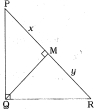
Difficult
In $\Delta PQR$,$m\angle Q = 90^{\circ}$ and $\overline{QM}$ is an altitude. If $PM = x$ and $RM = y$,find the lengths of $\overline{PQ}$,$\overline{QR}$,$\overline{PR}$,and $\overline{QM}$ in terms of $x$ and $y$.
Solution
(N/A) In $\Delta PQR$,$m\angle Q = 90^{\circ}$ and $\overline{QM}$ is an altitude to the hypotenuse $\overline{PR}$.
Since $M$ lies on $\overline{PR}$,we have $PR = PM + RM = x + y$.
Using the geometric mean theorem for the altitude to the hypotenuse:
$QM^2 = PM \cdot RM = x \cdot y$
$\therefore QM = \sqrt{xy}$.
Using the leg rule for $\Delta PQR$:
$PQ^2 = PM \cdot PR = x(x + y) = x^2 + xy$
$\therefore PQ = \sqrt{x^2 + xy}$.
Similarly,for the other leg:
$QR^2 = RM \cdot PR = y(x + y) = y^2 + xy$
$\therefore QR = \sqrt{y^2 + xy}$.
Thus,the lengths are $PQ = \sqrt{x^2 + xy}$,$QR = \sqrt{y^2 + xy}$,$PR = x + y$,and $QM = \sqrt{xy}$.
Since $M$ lies on $\overline{PR}$,we have $PR = PM + RM = x + y$.
Using the geometric mean theorem for the altitude to the hypotenuse:
$QM^2 = PM \cdot RM = x \cdot y$
$\therefore QM = \sqrt{xy}$.
Using the leg rule for $\Delta PQR$:
$PQ^2 = PM \cdot PR = x(x + y) = x^2 + xy$
$\therefore PQ = \sqrt{x^2 + xy}$.
Similarly,for the other leg:
$QR^2 = RM \cdot PR = y(x + y) = y^2 + xy$
$\therefore QR = \sqrt{y^2 + xy}$.
Thus,the lengths are $PQ = \sqrt{x^2 + xy}$,$QR = \sqrt{y^2 + xy}$,$PR = x + y$,and $QM = \sqrt{xy}$.
0 likes
View Solution234
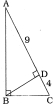
MediumMCQ
In $\Delta ABC$,$m \angle B = 90^{\circ}$ and $\overline{BD}$ is an altitude to the hypotenuse $AC$. If $AD = 9$ and $CD = 4$,find $BD$.
A
$10$
B
$6$
C
$15$
D
$12$
Solution
(B) In a right-angled triangle,the altitude drawn from the right-angle vertex to the hypotenuse divides the triangle into two triangles that are similar to the original triangle and to each other.
By the property of geometric mean in a right triangle,the altitude $BD$ to the hypotenuse $AC$ satisfies the relation:
$BD^2 = AD \times CD$
Given $AD = 9$ and $CD = 4$,we have:
$BD^2 = 9 \times 4$
$BD^2 = 36$
Taking the square root on both sides:
$BD = \sqrt{36} = 6$
Thus,the length of $BD$ is $6$.
By the property of geometric mean in a right triangle,the altitude $BD$ to the hypotenuse $AC$ satisfies the relation:
$BD^2 = AD \times CD$
Given $AD = 9$ and $CD = 4$,we have:
$BD^2 = 9 \times 4$
$BD^2 = 36$
Taking the square root on both sides:
$BD = \sqrt{36} = 6$
Thus,the length of $BD$ is $6$.
0 likes
View Solution235
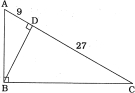
MediumMCQ
In $\Delta ABC$,$m \angle B = 90^{\circ}$ and $\overline{BD}$ is an altitude to the hypotenuse $AC$. If $AD = 9$ and $CD = 27$,find $AB$.
A
$20$
B
$15$
C
$18$
D
$12$
Solution
(C) In $\Delta ABC$,$m \angle B = 90^{\circ}$ and $\overline{BD}$ is an altitude to the hypotenuse $AC$.
Since $D$ lies on $AC$,we have $AC = AD + CD = 9 + 27 = 36$.
According to the geometric mean theorem (or property of altitude to the hypotenuse in a right triangle),$AB^2 = AD \times AC$.
Substituting the values,$AB^2 = 9 \times 36 = 324$.
Taking the square root of both sides,$AB = \sqrt{324} = 18$.
Thus,$AB = 18$.
Since $D$ lies on $AC$,we have $AC = AD + CD = 9 + 27 = 36$.
According to the geometric mean theorem (or property of altitude to the hypotenuse in a right triangle),$AB^2 = AD \times AC$.
Substituting the values,$AB^2 = 9 \times 36 = 324$.
Taking the square root of both sides,$AB = \sqrt{324} = 18$.
Thus,$AB = 18$.
0 likes
View Solution236
Difficult
In $\Delta ABC$,$m \angle A + m \angle C = m \angle B$ and $\overline{BM}$ is an altitude to $\overline{AC}$. If $AM = 16$ and $CM = 9$,find $BM$,$AB$,and $BC$.
Solution
(N/A) In $\Delta ABC$,the sum of angles is $180^{\circ}$.
$m \angle A + m \angle C + m \angle B = 180^{\circ}$
Since $m \angle A + m \angle C = m \angle B$,we substitute:
$m \angle B + m \angle B = 180^{\circ}$
$2 m \angle B = 180^{\circ}$
$m \angle B = 90^{\circ}$
In a right-angled triangle $\Delta ABC$ with altitude $\overline{BM}$ to the hypotenuse $\overline{AC}$,by the geometric mean theorem:
$BM^2 = AM \times CM$
$BM^2 = 16 \times 9 = 144$
$BM = 12$
Now,using the properties of right triangles:
$AC = AM + CM = 16 + 9 = 25$
$AB^2 = AM \times AC = 16 \times 25 = 400 \implies AB = 20$
$BC^2 = CM \times AC = 9 \times 25 = 225 \implies BC = 15$
Thus,$BM = 12$,$AB = 20$,and $BC = 15$.
$m \angle A + m \angle C + m \angle B = 180^{\circ}$
Since $m \angle A + m \angle C = m \angle B$,we substitute:
$m \angle B + m \angle B = 180^{\circ}$
$2 m \angle B = 180^{\circ}$
$m \angle B = 90^{\circ}$
In a right-angled triangle $\Delta ABC$ with altitude $\overline{BM}$ to the hypotenuse $\overline{AC}$,by the geometric mean theorem:
$BM^2 = AM \times CM$
$BM^2 = 16 \times 9 = 144$
$BM = 12$
Now,using the properties of right triangles:
$AC = AM + CM = 16 + 9 = 25$
$AB^2 = AM \times AC = 16 \times 25 = 400 \implies AB = 20$
$BC^2 = CM \times AC = 9 \times 25 = 225 \implies BC = 15$
Thus,$BM = 12$,$AB = 20$,and $BC = 15$.

0 likes
View Solution237
DifficultMCQ
In $\Delta ABC$,$\overline{AB} \cong \overline{AC}$ and $\overline{AD}$ is a median. If $AD = 12$ and the perimeter of $\Delta ABC$ is $36$,find the area of $\Delta ABC$.
A
$60$
B
$40$
C
$30$
D
$20$
Solution
(A) In $\Delta ABC$,$\overline{AD}$ is a median to the base $\overline{BC}$.
Since $\Delta ABC$ is an isosceles triangle with $\overline{AB} \cong \overline{AC}$,the median $\overline{AD}$ to the base is also the altitude to the base.
Therefore,$\overline{AD} \perp \overline{BC}$ and $\angle ADB = 90^{\circ}$.
Let $AB = AC = x$. The perimeter of $\Delta ABC$ is $AB + AC + BC = 36$.
$x + x + BC = 36 \implies BC = 36 - 2x$.
Since $D$ is the midpoint of $\overline{BC}$,$BD = \frac{BC}{2} = \frac{36 - 2x}{2} = 18 - x$.
In right-angled $\Delta ABD$,by the Pythagorean theorem:
$AB^2 = AD^2 + BD^2$
$x^2 = 12^2 + (18 - x)^2$
$x^2 = 144 + 324 - 36x + x^2$
$36x = 468$
$x = 13$.
Thus,$BD = 18 - 13 = 5$,so $BC = 2 \times 5 = 10$.
The area of $\Delta ABC = \frac{1}{2} \times \text{base} \times \text{height} = \frac{1}{2} \times BC \times AD$.
Area $= \frac{1}{2} \times 10 \times 12 = 60$.
Since $\Delta ABC$ is an isosceles triangle with $\overline{AB} \cong \overline{AC}$,the median $\overline{AD}$ to the base is also the altitude to the base.
Therefore,$\overline{AD} \perp \overline{BC}$ and $\angle ADB = 90^{\circ}$.
Let $AB = AC = x$. The perimeter of $\Delta ABC$ is $AB + AC + BC = 36$.
$x + x + BC = 36 \implies BC = 36 - 2x$.
Since $D$ is the midpoint of $\overline{BC}$,$BD = \frac{BC}{2} = \frac{36 - 2x}{2} = 18 - x$.
In right-angled $\Delta ABD$,by the Pythagorean theorem:
$AB^2 = AD^2 + BD^2$
$x^2 = 12^2 + (18 - x)^2$
$x^2 = 144 + 324 - 36x + x^2$
$36x = 468$
$x = 13$.
Thus,$BD = 18 - 13 = 5$,so $BC = 2 \times 5 = 10$.
The area of $\Delta ABC = \frac{1}{2} \times \text{base} \times \text{height} = \frac{1}{2} \times BC \times AD$.
Area $= \frac{1}{2} \times 10 \times 12 = 60$.

0 likes
View Solution238
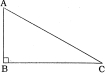
DifficultMCQ
In $\Delta ABC$,$m \angle B = 90^\circ$. If $AC - AB = 27$ and $AC - BC = 6$,find the perimeter of $\Delta ABC$.
A
$250$
B
$120$
C
$150$
D
$410$
Solution
(B) In $\Delta ABC$,we are given $AC - AB = 27$ and $AC - BC = 6$.
Therefore,$AB = AC - 27$ and $BC = AC - 6$.
Since $\Delta ABC$ is a right-angled triangle with $m \angle B = 90^\circ$,by the Pythagorean theorem:
$AC^2 = AB^2 + BC^2$
$AC^2 = (AC - 27)^2 + (AC - 6)^2$
$AC^2 = (AC^2 - 54AC + 729) + (AC^2 - 12AC + 36)$
$AC^2 = 2AC^2 - 66AC + 765$
$0 = AC^2 - 66AC + 765$
Factoring the quadratic equation:
$(AC - 51)(AC - 15) = 0$
So,$AC = 51$ or $AC = 15$.
If $AC = 15$,then $AB = 15 - 27 = -12$,which is impossible as the length of a side cannot be negative.
Thus,$AC = 51$.
Now,$AB = 51 - 27 = 24$ and $BC = 51 - 6 = 45$.
The perimeter of $\Delta ABC = AB + BC + AC = 24 + 45 + 51 = 120$.
Therefore,$AB = AC - 27$ and $BC = AC - 6$.
Since $\Delta ABC$ is a right-angled triangle with $m \angle B = 90^\circ$,by the Pythagorean theorem:
$AC^2 = AB^2 + BC^2$
$AC^2 = (AC - 27)^2 + (AC - 6)^2$
$AC^2 = (AC^2 - 54AC + 729) + (AC^2 - 12AC + 36)$
$AC^2 = 2AC^2 - 66AC + 765$
$0 = AC^2 - 66AC + 765$
Factoring the quadratic equation:
$(AC - 51)(AC - 15) = 0$
So,$AC = 51$ or $AC = 15$.
If $AC = 15$,then $AB = 15 - 27 = -12$,which is impossible as the length of a side cannot be negative.
Thus,$AC = 51$.
Now,$AB = 51 - 27 = 24$ and $BC = 51 - 6 = 45$.
The perimeter of $\Delta ABC = AB + BC + AC = 24 + 45 + 51 = 120$.
0 likes
View Solution239
Easy
Below are given the measures of sides $\overline{PQ}$,$\overline{QR}$ and $\overline{PR}$ of $\Delta PQR$. In each case,determine whether $\Delta PQR$ is a right-angled triangle or not. If it is a right-angled triangle,state which angle is a right angle: $PQ = 15, QR = 17, PR = 8$.
Solution
(D) In $\Delta PQR$,the side lengths are $PQ = 15$,$QR = 17$,and $PR = 8$.
To determine if it is a right-angled triangle,we check the converse of the Pythagoras theorem.
The longest side is $QR = 17$.
Calculate the square of the longest side: $QR^2 = 17^2 = 289$.
Calculate the sum of the squares of the other two sides: $PQ^2 + PR^2 = 15^2 + 8^2 = 225 + 64 = 289$.
Since $PQ^2 + PR^2 = QR^2$,the triangle satisfies the Pythagoras theorem.
Therefore,$\Delta PQR$ is a right-angled triangle,and the angle opposite to the hypotenuse $QR$ is $\angle P = 90^\circ$.
To determine if it is a right-angled triangle,we check the converse of the Pythagoras theorem.
The longest side is $QR = 17$.
Calculate the square of the longest side: $QR^2 = 17^2 = 289$.
Calculate the sum of the squares of the other two sides: $PQ^2 + PR^2 = 15^2 + 8^2 = 225 + 64 = 289$.
Since $PQ^2 + PR^2 = QR^2$,the triangle satisfies the Pythagoras theorem.
Therefore,$\Delta PQR$ is a right-angled triangle,and the angle opposite to the hypotenuse $QR$ is $\angle P = 90^\circ$.
0 likes
View Solution240
Easy
Below are given the measures of sides $\overline{PQ}$,$\overline{QR}$ and $\overline{PR}$ of $\Delta PQR$. In each case,determine whether $\Delta PQR$ is a right-angled triangle or not. If it is a right-angled triangle,state which angle is a right angle: $PQ = 8, QR = 6, PR = 12$.
Solution
(D) In $\Delta PQR$,the side lengths are $PQ = 8$,$QR = 6$,and $PR = 12$.
The longest side is $\overline{PR}$.
Calculate the square of the longest side: $PR^2 = 12^2 = 144$.
Calculate the sum of the squares of the other two sides: $PQ^2 + QR^2 = 8^2 + 6^2 = 64 + 36 = 100$.
According to the converse of the Pythagoras theorem,a triangle is right-angled if the square of the longest side is equal to the sum of the squares of the other two sides.
Here,$PQ^2 + QR^2 = 100$ and $PR^2 = 144$.
Since $PQ^2 + QR^2 \neq PR^2$,the triangle does not satisfy the condition for a right-angled triangle.
Therefore,$\Delta PQR$ is not a right-angled triangle.
The longest side is $\overline{PR}$.
Calculate the square of the longest side: $PR^2 = 12^2 = 144$.
Calculate the sum of the squares of the other two sides: $PQ^2 + QR^2 = 8^2 + 6^2 = 64 + 36 = 100$.
According to the converse of the Pythagoras theorem,a triangle is right-angled if the square of the longest side is equal to the sum of the squares of the other two sides.
Here,$PQ^2 + QR^2 = 100$ and $PR^2 = 144$.
Since $PQ^2 + QR^2 \neq PR^2$,the triangle does not satisfy the condition for a right-angled triangle.
Therefore,$\Delta PQR$ is not a right-angled triangle.
0 likes
View Solution241
Easy
Below are given the measures of sides $\overline{PQ}$,$\overline{QR}$ and $\overline{PR}$ of $\Delta PQR$. In each case,determine whether $\Delta PQR$ is a right-angled triangle or not. If it is a right-angled triangle,state which angle is a right angle: $PQ = 7, QR = 24, PR = 25$.
Solution
(D) In $\Delta PQR$,the side lengths are $PQ = 7$,$QR = 24$,and $PR = 25$.
The longest side is $PR = 25$.
Calculate the square of the longest side:
$PR^2 = 25^2 = 625$
Calculate the sum of the squares of the other two sides:
$PQ^2 + QR^2 = 7^2 + 24^2 = 49 + 576 = 625$
Since $PQ^2 + QR^2 = PR^2$,the triangle satisfies the converse of the Pythagoras theorem.
Therefore,$\Delta PQR$ is a right-angled triangle,and the angle opposite to the hypotenuse $PR$,which is $\angle Q$,is the right angle.
The longest side is $PR = 25$.
Calculate the square of the longest side:
$PR^2 = 25^2 = 625$
Calculate the sum of the squares of the other two sides:
$PQ^2 + QR^2 = 7^2 + 24^2 = 49 + 576 = 625$
Since $PQ^2 + QR^2 = PR^2$,the triangle satisfies the converse of the Pythagoras theorem.
Therefore,$\Delta PQR$ is a right-angled triangle,and the angle opposite to the hypotenuse $PR$,which is $\angle Q$,is the right angle.
0 likes
View Solution242
MediumMCQ
$A$ ladder is placed leaning on a wall. Its upper end reaches to the height of $12 \, m$ on the wall and its lower end rests $9 \, m$ away from the base of the wall. Find the length of the ladder in meters.
A
$25$
B
$15$
C
$35$
D
$40$
Solution
(B) Let $\overline{AB}$ represent the wall,$\overline{AC}$ represent the ladder,and $C$ be the lower end of the ladder on the ground.
Given: $AB = 12 \, m$,$BC = 9 \, m$,and $\angle B = 90^{\circ}$.
In right-angled $\Delta ABC$,by Pythagoras theorem:
$AC^2 = AB^2 + BC^2$
$AC^2 = 12^2 + 9^2$
$AC^2 = 144 + 81$
$AC^2 = 225$
$AC = \sqrt{225} = 15 \, m$.
Thus,the length of the ladder is $15 \, m$.
Given: $AB = 12 \, m$,$BC = 9 \, m$,and $\angle B = 90^{\circ}$.
In right-angled $\Delta ABC$,by Pythagoras theorem:
$AC^2 = AB^2 + BC^2$
$AC^2 = 12^2 + 9^2$
$AC^2 = 144 + 81$
$AC^2 = 225$
$AC = \sqrt{225} = 15 \, m$.
Thus,the length of the ladder is $15 \, m$.

0 likes
View Solution243
DifficultMCQ
In rhombus $ABCD$,$AC = 12$ and $BD = 16$. Find the perimeter of rhombus $ABCD$.
A
$50$
B
$60$
C
$40$
D
$10$
Solution
(C) The diagonals of a rhombus bisect each other at right angles.
Let the diagonals $\overline{AC}$ and $\overline{BD}$ intersect at point $M$.
Then,$m\angle AMB = 90^{\circ}$.
Since the diagonals bisect each other,$AM = \frac{1}{2} AC = \frac{1}{2}(12) = 6$ and $BM = \frac{1}{2} BD = \frac{1}{2}(16) = 8$.
In right-angled $\Delta AMB$,by the Pythagorean theorem:
$AB^2 = AM^2 + BM^2$
$AB^2 = 6^2 + 8^2$
$AB^2 = 36 + 64 = 100$
$AB = \sqrt{100} = 10$.
The perimeter of a rhombus is $4 \times \text{side length}$.
Perimeter $= 4 \times AB = 4 \times 10 = 40$.
Thus,the perimeter of rhombus $ABCD$ is $40$.
Let the diagonals $\overline{AC}$ and $\overline{BD}$ intersect at point $M$.
Then,$m\angle AMB = 90^{\circ}$.
Since the diagonals bisect each other,$AM = \frac{1}{2} AC = \frac{1}{2}(12) = 6$ and $BM = \frac{1}{2} BD = \frac{1}{2}(16) = 8$.
In right-angled $\Delta AMB$,by the Pythagorean theorem:
$AB^2 = AM^2 + BM^2$
$AB^2 = 6^2 + 8^2$
$AB^2 = 36 + 64 = 100$
$AB = \sqrt{100} = 10$.
The perimeter of a rhombus is $4 \times \text{side length}$.
Perimeter $= 4 \times AB = 4 \times 10 = 40$.
Thus,the perimeter of rhombus $ABCD$ is $40$.

0 likes
View Solution244
MediumMCQ
The perimeter of square $ABCD$ is $48$. Find the length of its diagonal $\overline{AC}$. (in $\sqrt{2}$)

A
$13$
B
$14$
C
$15$
D
$12$
Solution
(D) The perimeter of a square is given by $4 \times \text{side}$.
Let the side length of the square be $s$.
$4s = 48$
$s = 12$
In square $ABCD$, all sides are equal to $12$ and each angle is $90^{\circ}$.
In right-angled triangle $\Delta ABC$, by Pythagoras theorem:
$AC^2 = AB^2 + BC^2$
$AC^2 = 12^2 + 12^2$
$AC^2 = 144 + 144 = 288$
$AC = \sqrt{288} = \sqrt{144 \times 2} = 12 \sqrt{2}$.
Thus, the length of the diagonal $\overline{AC}$ is $12 \sqrt{2}$.
Let the side length of the square be $s$.
$4s = 48$
$s = 12$
In square $ABCD$, all sides are equal to $12$ and each angle is $90^{\circ}$.
In right-angled triangle $\Delta ABC$, by Pythagoras theorem:
$AC^2 = AB^2 + BC^2$
$AC^2 = 12^2 + 12^2$
$AC^2 = 144 + 144 = 288$
$AC = \sqrt{288} = \sqrt{144 \times 2} = 12 \sqrt{2}$.
Thus, the length of the diagonal $\overline{AC}$ is $12 \sqrt{2}$.
0 likes
View Solution245
MediumMCQ
In $\Delta ABC$,$m\angle B = 90^{\circ}$,$AB = 2x + 3$,$BC = x + 2$,and $AC = 3x - 1$. Find the value of $x$.
A
$6$
B
$5$
C
$4$
D
$2$
Solution
(A) In $\Delta ABC$,since $m\angle B = 90^{\circ}$,by the Pythagorean theorem:
$AC^2 = AB^2 + BC^2$
$(3x - 1)^2 = (2x + 3)^2 + (x + 2)^2$
$9x^2 - 6x + 1 = (4x^2 + 12x + 9) + (x^2 + 4x + 4)$
$9x^2 - 6x + 1 = 5x^2 + 16x + 13$
$4x^2 - 22x - 12 = 0$
Dividing by $2$:
$2x^2 - 11x - 6 = 0$
$2x^2 - 12x + x - 6 = 0$
$2x(x - 6) + 1(x - 6) = 0$
$(x - 6)(2x + 1) = 0$
Thus,$x = 6$ or $x = -\frac{1}{2}$.
Since side lengths must be positive,$x = -\frac{1}{2}$ is rejected because it results in negative side lengths.
Therefore,$x = 6$.
$AC^2 = AB^2 + BC^2$
$(3x - 1)^2 = (2x + 3)^2 + (x + 2)^2$
$9x^2 - 6x + 1 = (4x^2 + 12x + 9) + (x^2 + 4x + 4)$
$9x^2 - 6x + 1 = 5x^2 + 16x + 13$
$4x^2 - 22x - 12 = 0$
Dividing by $2$:
$2x^2 - 11x - 6 = 0$
$2x^2 - 12x + x - 6 = 0$
$2x(x - 6) + 1(x - 6) = 0$
$(x - 6)(2x + 1) = 0$
Thus,$x = 6$ or $x = -\frac{1}{2}$.
Since side lengths must be positive,$x = -\frac{1}{2}$ is rejected because it results in negative side lengths.
Therefore,$x = 6$.
0 likes
View Solution246
DifficultMCQ
In $\Delta ABC$,$m \angle B = 90^{\circ}$ and $AB : AC = 24 : 25$. If $BC = 14$,find the perimeter of $\Delta ABC$.
A
$120$
B
$112$
C
$130$
D
$150$
Solution
(B) Given $AB : AC = 24 : 25$.
Let $AB = 24k$ and $AC = 25k$,where $k > 0$.
In right-angled $\Delta ABC$,by the Pythagorean theorem:
$AC^2 = AB^2 + BC^2$
$(25k)^2 = (24k)^2 + (14)^2$
$625k^2 = 576k^2 + 196$
$625k^2 - 576k^2 = 196$
$49k^2 = 196$
$k^2 = 4$
Since $k > 0$,$k = 2$.
Now,$AB = 24 \times 2 = 48$ and $AC = 25 \times 2 = 50$.
The perimeter of $\Delta ABC = AB + BC + AC = 48 + 14 + 50 = 112$.
Thus,the perimeter of $\Delta ABC$ is $112$.
Let $AB = 24k$ and $AC = 25k$,where $k > 0$.
In right-angled $\Delta ABC$,by the Pythagorean theorem:
$AC^2 = AB^2 + BC^2$
$(25k)^2 = (24k)^2 + (14)^2$
$625k^2 = 576k^2 + 196$
$625k^2 - 576k^2 = 196$
$49k^2 = 196$
$k^2 = 4$
Since $k > 0$,$k = 2$.
Now,$AB = 24 \times 2 = 48$ and $AC = 25 \times 2 = 50$.
The perimeter of $\Delta ABC = AB + BC + AC = 48 + 14 + 50 = 112$.
Thus,the perimeter of $\Delta ABC$ is $112$.
0 likes
View Solution247
MediumMCQ
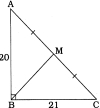
In $\Delta ABC$,$m \angle B = 90^{\circ}$ and $\overline{BM}$ is a median. If $AB = 20$ and $BC = 21$,find $BM$. (in $.5$)
A
$8$
B
$11$
C
$14$
D
$10$
Solution
(C) In $\Delta ABC$,$m \angle B = 90^{\circ}$.
By the Pythagorean theorem:
$AC^{2} = AB^{2} + BC^{2}$
$AC^{2} = 20^{2} + 21^{2}$
$AC^{2} = 400 + 441$
$AC^{2} = 841$
$AC = \sqrt{841} = 29$.
In a right-angled triangle,the length of the median to the hypotenuse is half the length of the hypotenuse.
Therefore,$BM = \frac{1}{2} AC = \frac{1}{2} \times 29 = 14.5$.
Thus,$BM = 14.5$.
By the Pythagorean theorem:
$AC^{2} = AB^{2} + BC^{2}$
$AC^{2} = 20^{2} + 21^{2}$
$AC^{2} = 400 + 441$
$AC^{2} = 841$
$AC = \sqrt{841} = 29$.
In a right-angled triangle,the length of the median to the hypotenuse is half the length of the hypotenuse.
Therefore,$BM = \frac{1}{2} AC = \frac{1}{2} \times 29 = 14.5$.
Thus,$BM = 14.5$.
0 likes
View Solution248
Medium
In $\Delta ABC$,$m \angle B = 90^{\circ}$ and $\overline{BM}$ is an altitude to the hypotenuse $AC$. Prove that $\frac{AB^2}{BC^2} = \frac{AM}{CM}$.
Solution
(N/A) Given: In $\Delta ABC$,$m \angle B = 90^{\circ}$ and $\overline{BM} \perp \overline{AC}$.
To prove: $\frac{AB^2}{BC^2} = \frac{AM}{CM}$.
Proof: In $\Delta ABC$,since $\overline{BM}$ is the altitude to the hypotenuse,we have two similar triangles:
$1$. $\Delta AMB \sim \Delta ABC$,which implies $\frac{AB}{AC} = \frac{AM}{AB}$,so $AB^2 = AM \times AC$.
$2$. $\Delta BMC \sim \Delta ABC$,which implies $\frac{BC}{AC} = \frac{CM}{BC}$,so $BC^2 = CM \times AC$.
Dividing the two equations:
$\frac{AB^2}{BC^2} = \frac{AM \times AC}{CM \times AC}$
Therefore,$\frac{AB^2}{BC^2} = \frac{AM}{CM}$.
To prove: $\frac{AB^2}{BC^2} = \frac{AM}{CM}$.
Proof: In $\Delta ABC$,since $\overline{BM}$ is the altitude to the hypotenuse,we have two similar triangles:
$1$. $\Delta AMB \sim \Delta ABC$,which implies $\frac{AB}{AC} = \frac{AM}{AB}$,so $AB^2 = AM \times AC$.
$2$. $\Delta BMC \sim \Delta ABC$,which implies $\frac{BC}{AC} = \frac{CM}{BC}$,so $BC^2 = CM \times AC$.
Dividing the two equations:
$\frac{AB^2}{BC^2} = \frac{AM \times AC}{CM \times AC}$
Therefore,$\frac{AB^2}{BC^2} = \frac{AM}{CM}$.

0 likes
View Solution249
Medium
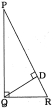
In $\Delta PQR$,$m \angle Q = 90^{\circ}$ and $\overline{QD}$ is an altitude. If $PD = 9RD$,prove that $PQ = 3QR$.
Solution
(N/A) Given: In $\Delta PQR$,$m \angle Q = 90^{\circ}$,$\overline{QD}$ is an altitude to the hypotenuse $PR$,and $PD = 9RD$.
To prove: $PQ = 3QR$.
Proof: In $\Delta PQR$,since $m \angle Q = 90^{\circ}$ and $\overline{QD} \perp \overline{PR}$,by the geometric mean theorem (or properties of similar triangles formed by an altitude to the hypotenuse):
$PQ^2 = PD \times PR$ and $QR^2 = RD \times PR$.
Dividing the two equations:
$\frac{PQ^2}{QR^2} = \frac{PD \times PR}{RD \times PR} = \frac{PD}{RD}$.
Substituting $PD = 9RD$ into the equation:
$\frac{PQ^2}{QR^2} = \frac{9RD}{RD} = 9$.
Taking the square root on both sides:
$\frac{PQ}{QR} = 3$.
Therefore,$PQ = 3QR$.
To prove: $PQ = 3QR$.
Proof: In $\Delta PQR$,since $m \angle Q = 90^{\circ}$ and $\overline{QD} \perp \overline{PR}$,by the geometric mean theorem (or properties of similar triangles formed by an altitude to the hypotenuse):
$PQ^2 = PD \times PR$ and $QR^2 = RD \times PR$.
Dividing the two equations:
$\frac{PQ^2}{QR^2} = \frac{PD \times PR}{RD \times PR} = \frac{PD}{RD}$.
Substituting $PD = 9RD$ into the equation:
$\frac{PQ^2}{QR^2} = \frac{9RD}{RD} = 9$.
Taking the square root on both sides:
$\frac{PQ}{QR} = 3$.
Therefore,$PQ = 3QR$.
0 likes
View Solution250
MediumMCQ
In $\Delta ABC$,$m \angle B = 90^{\circ}$ and $\overline{BM}$ is an altitude. If $AM - CM = 10$ and $AB^{2} - BC^{2} = 260$,find $AC$.
A
$30$
B
$26$
C
$40$
D
$60$
Solution
(B) In $\Delta ABC$,$m \angle B = 90^{\circ}$ and $\overline{BM}$ is an altitude to the hypotenuse $AC$.
According to the geometric mean theorem (or properties of right triangles with an altitude to the hypotenuse):
$AB^{2} = AM \times AC$
$BC^{2} = CM \times AC$
Subtracting the two equations:
$AB^{2} - BC^{2} = (AM \times AC) - (CM \times AC)$
$AB^{2} - BC^{2} = AC(AM - CM)$
Given $AB^{2} - BC^{2} = 260$ and $AM - CM = 10$:
$260 = AC(10)$
$AC = \frac{260}{10} = 26$
Thus,$AC = 26$.
According to the geometric mean theorem (or properties of right triangles with an altitude to the hypotenuse):
$AB^{2} = AM \times AC$
$BC^{2} = CM \times AC$
Subtracting the two equations:
$AB^{2} - BC^{2} = (AM \times AC) - (CM \times AC)$
$AB^{2} - BC^{2} = AC(AM - CM)$
Given $AB^{2} - BC^{2} = 260$ and $AM - CM = 10$:
$260 = AC(10)$
$AC = \frac{260}{10} = 26$
Thus,$AC = 26$.

0 likes
View SolutionTriangles — Mix Examples - Triangles · Frequently Asked Questions
1Are these Triangles questions useful for JEE and NEET?
Yes. All questions in this section are mapped to JEE Main and NEET exam patterns. Previous year questions from JEE Main, NEET, GUJCET and state-level exams are included with full solutions.
2Can I switch to Hindi or Gujarati for these questions?
Yes. Use the language tabs in the hero section or the sidebar to view the same questions and solutions in English, Hindi or Gujarati.
3How do I generate a question paper from this subtopic?
Use the Vedclass Exam Paper Generator — select the chapter and subtopic, set difficulty, and generate Sets A, B, C, D automatically. First 3 chapters of every subject are free.
Vedclass Products
For Students
Vedclass Test Series
Mock tests in real JEE/NEET style with performance analysis. 5-day free trial.
Start Free TrialFor Teachers
Exam Paper Generator
Generate Set A/B/C/D papers from this chapter in 2 minutes. 3 chapters free.
Try FreeFor Institutes
Online Exam Module
Live online exams with unlimited students, 360° analytics & white-label branding.
See DemoFor Teachers & Institutes
Generate a Triangles Exam Paper in 2 Minutes
Select subtopic & difficulty — Sets A, B, C, D auto-generated with No Repeat logic.
First 3 chapters of every subject are free — no payment required.