
A English
Textbook - Quadratic Equations Questions in English
Class 10 Mathematics · Quadratic Equations · Textbook - Quadratic Equations
73+
Questions
English
Language
100%
With Solutions
Showing 50 of 73 questions in English
1
Easy
Represent the following situation mathematically:
John and Jivanti together have $45$ marbles. Both of them lost $5$ marbles each,and the product of the number of marbles they now have is $124$. We would like to find out how many marbles they had to start with.
John and Jivanti together have $45$ marbles. Both of them lost $5$ marbles each,and the product of the number of marbles they now have is $124$. We would like to find out how many marbles they had to start with.
Solution
(A) Let the number of marbles John had be $x$.
Then the number of marbles Jivanti had $= 45 - x$.
The number of marbles left with John after losing $5$ marbles $= x - 5$.
The number of marbles left with Jivanti after losing $5$ marbles $= (45 - x) - 5 = 40 - x$.
According to the problem,the product of the remaining marbles is $124$:
$(x - 5)(40 - x) = 124$.
Expanding the product:
$40x - x^2 - 200 + 5x = 124$
$-x^2 + 45x - 200 = 124$
Rearranging the terms to form a standard quadratic equation:
$-x^2 + 45x - 200 - 124 = 0$
$-x^2 + 45x - 324 = 0$
Multiplying by $-1$:
$x^2 - 45x + 324 = 0$.
Thus,the number of marbles John had satisfies the quadratic equation $x^2 - 45x + 324 = 0$.
Then the number of marbles Jivanti had $= 45 - x$.
The number of marbles left with John after losing $5$ marbles $= x - 5$.
The number of marbles left with Jivanti after losing $5$ marbles $= (45 - x) - 5 = 40 - x$.
According to the problem,the product of the remaining marbles is $124$:
$(x - 5)(40 - x) = 124$.
Expanding the product:
$40x - x^2 - 200 + 5x = 124$
$-x^2 + 45x - 200 = 124$
Rearranging the terms to form a standard quadratic equation:
$-x^2 + 45x - 200 - 124 = 0$
$-x^2 + 45x - 324 = 0$
Multiplying by $-1$:
$x^2 - 45x + 324 = 0$.
Thus,the number of marbles John had satisfies the quadratic equation $x^2 - 45x + 324 = 0$.
0 likes
View Solution2
Easy
Represent the following situation mathematically:
$A$ cottage industry produces a certain number of toys in a day. The cost of production of each toy (in rupees) was found to be $55$ minus the number of toys produced in a day. On a particular day,the total cost of production was ₹ $750$. We would like to find out the number of toys produced on that day.
$A$ cottage industry produces a certain number of toys in a day. The cost of production of each toy (in rupees) was found to be $55$ minus the number of toys produced in a day. On a particular day,the total cost of production was ₹ $750$. We would like to find out the number of toys produced on that day.
Solution
(N/A) Let the number of toys produced on that day be $x$.
Therefore,the cost of production (in rupees) of each toy that day $= 55 - x$.
So,the total cost of production (in rupees) that day $= x(55 - x)$.
Given that the total cost of production is ₹ $750$,we have:
$x(55 - x) = 750$
Expanding the equation:
$55x - x^2 = 750$
Rearranging the terms to form a standard quadratic equation:
$-x^2 + 55x - 750 = 0$
Multiplying by $-1$ to simplify:
$x^2 - 55x + 750 = 0$
Thus,the number of toys produced that day satisfies the quadratic equation $x^2 - 55x + 750 = 0$.
Therefore,the cost of production (in rupees) of each toy that day $= 55 - x$.
So,the total cost of production (in rupees) that day $= x(55 - x)$.
Given that the total cost of production is ₹ $750$,we have:
$x(55 - x) = 750$
Expanding the equation:
$55x - x^2 = 750$
Rearranging the terms to form a standard quadratic equation:
$-x^2 + 55x - 750 = 0$
Multiplying by $-1$ to simplify:
$x^2 - 55x + 750 = 0$
Thus,the number of toys produced that day satisfies the quadratic equation $x^2 - 55x + 750 = 0$.
0 likes
View Solution3
EasyMCQ
Check whether the following is a quadratic equation:
$(x-2)^{2}+1=2x-3$
$(x-2)^{2}+1=2x-3$
A
Yes
B
No
C
Cannot be determined
D
None of these
Solution
(A) Given equation: $(x-2)^{2}+1=2x-3$
Expand the left-hand side $(LHS)$:
$(x-2)^{2}+1 = (x^{2}-4x+4)+1 = x^{2}-4x+5$
Now,equate it to the right-hand side $(RHS)$:
$x^{2}-4x+5 = 2x-3$
Rearrange the terms to bring them to one side:
$x^{2}-4x-2x+5+3 = 0$
$x^{2}-6x+8 = 0$
Since this equation is in the form $ax^{2}+bx+c=0$ where $a=1$,$b=-6$,and $c=8$ $(a \neq 0)$,it is a quadratic equation.
Expand the left-hand side $(LHS)$:
$(x-2)^{2}+1 = (x^{2}-4x+4)+1 = x^{2}-4x+5$
Now,equate it to the right-hand side $(RHS)$:
$x^{2}-4x+5 = 2x-3$
Rearrange the terms to bring them to one side:
$x^{2}-4x-2x+5+3 = 0$
$x^{2}-6x+8 = 0$
Since this equation is in the form $ax^{2}+bx+c=0$ where $a=1$,$b=-6$,and $c=8$ $(a \neq 0)$,it is a quadratic equation.
0 likes
View Solution4
EasyMCQ
Check whether the following is a quadratic equation:
$x(x+1)+8=(x+2)(x-2)$
$x(x+1)+8=(x+2)(x-2)$
A
Yes
B
No
C
Cannot be determined
D
None of these
Solution
(B) Given equation: $x(x+1)+8=(x+2)(x-2)$
Expanding the left side: $x^2+x+8$
Expanding the right side using the identity $(a+b)(a-b)=a^2-b^2$: $x^2-4$
Equating both sides: $x^2+x+8=x^2-4$
Subtracting $x^2$ from both sides: $x+8=-4$
Rearranging the terms: $x+12=0$
Since the highest power of the variable $x$ is $1$,it is a linear equation and not of the form $ax^2+bx+c=0$ (where $a \neq 0$).
Therefore,the given equation is not a quadratic equation.
Expanding the left side: $x^2+x+8$
Expanding the right side using the identity $(a+b)(a-b)=a^2-b^2$: $x^2-4$
Equating both sides: $x^2+x+8=x^2-4$
Subtracting $x^2$ from both sides: $x+8=-4$
Rearranging the terms: $x+12=0$
Since the highest power of the variable $x$ is $1$,it is a linear equation and not of the form $ax^2+bx+c=0$ (where $a \neq 0$).
Therefore,the given equation is not a quadratic equation.
0 likes
View Solution5
Easy
Check whether the following is a quadratic equation:
$x(2x + 3) = x^2 + 1$
$x(2x + 3) = x^2 + 1$
Solution
(YES) Given equation: $x(2x + 3) = x^2 + 1$
First,expand the left-hand side $(LHS)$:
$x(2x + 3) = 2x^2 + 3x$
Now,substitute this back into the equation:
$2x^2 + 3x = x^2 + 1$
Subtract $(x^2 + 1)$ from both sides to bring the equation to the standard form $ax^2 + bx + c = 0$:
$2x^2 - x^2 + 3x - 1 = 0$
$x^2 + 3x - 1 = 0$
Since this equation is in the form $ax^2 + bx + c = 0$ where $a = 1$,$b = 3$,and $c = -1$ (and $a \neq 0$),the given equation is a quadratic equation.
First,expand the left-hand side $(LHS)$:
$x(2x + 3) = 2x^2 + 3x$
Now,substitute this back into the equation:
$2x^2 + 3x = x^2 + 1$
Subtract $(x^2 + 1)$ from both sides to bring the equation to the standard form $ax^2 + bx + c = 0$:
$2x^2 - x^2 + 3x - 1 = 0$
$x^2 + 3x - 1 = 0$
Since this equation is in the form $ax^2 + bx + c = 0$ where $a = 1$,$b = 3$,and $c = -1$ (and $a \neq 0$),the given equation is a quadratic equation.
0 likes
View Solution6
EasyMCQ
Check whether the following is a quadratic equation:
$(x+2)^{3} = x^{3}-4$
$(x+2)^{3} = x^{3}-4$
A
Yes
B
No
Solution
(A) Given equation: $(x+2)^{3} = x^{3}-4$
Expanding the left-hand side using the identity $(a+b)^{3} = a^{3}+b^{3}+3ab(a+b)$:
$(x+2)^{3} = x^{3} + 2^{3} + 3(x)(2)(x+2) = x^{3} + 8 + 6x(x+2) = x^{3} + 8 + 6x^{2} + 12x$
Substituting this back into the equation:
$x^{3} + 6x^{2} + 12x + 8 = x^{3} - 4$
Subtracting $x^{3}$ from both sides:
$6x^{2} + 12x + 8 = -4$
Adding $4$ to both sides:
$6x^{2} + 12x + 12 = 0$
Dividing the entire equation by $6$:
$x^{2} + 2x + 2 = 0$
Since this equation is in the form $ax^{2} + bx + c = 0$ where $a \neq 0$,it is a quadratic equation.
Expanding the left-hand side using the identity $(a+b)^{3} = a^{3}+b^{3}+3ab(a+b)$:
$(x+2)^{3} = x^{3} + 2^{3} + 3(x)(2)(x+2) = x^{3} + 8 + 6x(x+2) = x^{3} + 8 + 6x^{2} + 12x$
Substituting this back into the equation:
$x^{3} + 6x^{2} + 12x + 8 = x^{3} - 4$
Subtracting $x^{3}$ from both sides:
$6x^{2} + 12x + 8 = -4$
Adding $4$ to both sides:
$6x^{2} + 12x + 12 = 0$
Dividing the entire equation by $6$:
$x^{2} + 2x + 2 = 0$
Since this equation is in the form $ax^{2} + bx + c = 0$ where $a \neq 0$,it is a quadratic equation.
0 likes
View Solution7
EasyMCQ
Check whether the following is a quadratic equation:
$(x+1)^{2}=2(x-3)$
$(x+1)^{2}=2(x-3)$
A
Yes
B
No
Solution
(A) Given equation: $(x+1)^{2}=2(x-3)$
Expanding the left side using the identity $(a+b)^{2} = a^{2} + 2ab + b^{2}$:
$x^{2} + 2x + 1 = 2(x-3)$
Distributing the $2$ on the right side:
$x^{2} + 2x + 1 = 2x - 6$
Subtracting $2x$ from both sides:
$x^{2} + 1 = -6$
Adding $6$ to both sides:
$x^{2} + 7 = 0$
Since this equation is of the form $ax^{2} + bx + c = 0$ (where $a=1, b=0, c=7$),it is a quadratic equation.
Expanding the left side using the identity $(a+b)^{2} = a^{2} + 2ab + b^{2}$:
$x^{2} + 2x + 1 = 2(x-3)$
Distributing the $2$ on the right side:
$x^{2} + 2x + 1 = 2x - 6$
Subtracting $2x$ from both sides:
$x^{2} + 1 = -6$
Adding $6$ to both sides:
$x^{2} + 7 = 0$
Since this equation is of the form $ax^{2} + bx + c = 0$ (where $a=1, b=0, c=7$),it is a quadratic equation.
0 likes
View Solution8
EasyMCQ
Check whether the following is a quadratic equation:
$x^{2}-2x=(-2)(3-x)$
$x^{2}-2x=(-2)(3-x)$
A
Yes
B
No
Solution
(A) Given equation: $x^{2}-2x=(-2)(3-x)$
Expand the right side: $x^{2}-2x = -6 + 2x$
Rearrange the terms to one side: $x^{2}-2x - 2x + 6 = 0$
Simplify: $x^{2}-4x + 6 = 0$
Since this equation is in the form $ax^{2}+bx+c=0$ where $a \neq 0$,it is a quadratic equation.
Expand the right side: $x^{2}-2x = -6 + 2x$
Rearrange the terms to one side: $x^{2}-2x - 2x + 6 = 0$
Simplify: $x^{2}-4x + 6 = 0$
Since this equation is in the form $ax^{2}+bx+c=0$ where $a \neq 0$,it is a quadratic equation.
0 likes
View Solution9
EasyMCQ
Check whether the following is a quadratic equation:
$(x-2)(x+1)=(x-1)(x+3)$
$(x-2)(x+1)=(x-1)(x+3)$
A
Yes,it is a quadratic equation.
B
No,it is not a quadratic equation.
C
It is a linear equation with two variables.
D
It is a cubic equation.
Solution
(B) Expand both sides of the equation:
$(x-2)(x+1) = x^2 + x - 2x - 2 = x^2 - x - 2$
$(x-1)(x+3) = x^2 + 3x - x - 3 = x^2 + 2x - 3$
Equating both sides:
$x^2 - x - 2 = x^2 + 2x - 3$
Subtract $x^2$ from both sides:
$-x - 2 = 2x - 3$
Rearranging the terms:
$3x - 1 = 0$
Since the highest power of the variable $x$ is $1$,it is not of the form $ax^2 + bx + c = 0$ (where $a \neq 0$).
Therefore,the given equation is not a quadratic equation.
$(x-2)(x+1) = x^2 + x - 2x - 2 = x^2 - x - 2$
$(x-1)(x+3) = x^2 + 3x - x - 3 = x^2 + 2x - 3$
Equating both sides:
$x^2 - x - 2 = x^2 + 2x - 3$
Subtract $x^2$ from both sides:
$-x - 2 = 2x - 3$
Rearranging the terms:
$3x - 1 = 0$
Since the highest power of the variable $x$ is $1$,it is not of the form $ax^2 + bx + c = 0$ (where $a \neq 0$).
Therefore,the given equation is not a quadratic equation.
0 likes
View Solution10
Easy
Check whether the following is a quadratic equation:
$(x-3)(2x+1) = x(x+5)$
$(x-3)(2x+1) = x(x+5)$
Solution
(A) Expand the left side: $(x-3)(2x+1) = 2x^2 + x - 6x - 3 = 2x^2 - 5x - 3$.
Expand the right side: $x(x+5) = x^2 + 5x$.
Equating both sides: $2x^2 - 5x - 3 = x^2 + 5x$.
Rearranging the terms to one side: $2x^2 - x^2 - 5x - 5x - 3 = 0$.
Simplifying the expression: $x^2 - 10x - 3 = 0$.
Since this equation is in the form $ax^2 + bx + c = 0$ where $a \neq 0$,it is a quadratic equation.
Expand the right side: $x(x+5) = x^2 + 5x$.
Equating both sides: $2x^2 - 5x - 3 = x^2 + 5x$.
Rearranging the terms to one side: $2x^2 - x^2 - 5x - 5x - 3 = 0$.
Simplifying the expression: $x^2 - 10x - 3 = 0$.
Since this equation is in the form $ax^2 + bx + c = 0$ where $a \neq 0$,it is a quadratic equation.
0 likes
View Solution11
EasyMCQ
Check whether the following is a quadratic equation:
$(2x - 1)(x - 3) = (x + 5)(x - 1)$
$(2x - 1)(x - 3) = (x + 5)(x - 1)$
A
Yes,it is a quadratic equation.
B
No,it is not a quadratic equation.
C
It is a linear equation.
D
It is a cubic equation.
Solution
(A) Expand both sides of the equation:
$(2x - 1)(x - 3) = 2x^2 - 6x - x + 3 = 2x^2 - 7x + 3$
$(x + 5)(x - 1) = x^2 - x + 5x - 5 = x^2 + 4x - 5$
Equating both sides:
$2x^2 - 7x + 3 = x^2 + 4x - 5$
Rearranging the terms to one side:
$2x^2 - x^2 - 7x - 4x + 3 + 5 = 0$
$x^2 - 11x + 8 = 0$
Since this equation is in the form $ax^2 + bx + c = 0$ where $a \neq 0$,it is a quadratic equation.
$(2x - 1)(x - 3) = 2x^2 - 6x - x + 3 = 2x^2 - 7x + 3$
$(x + 5)(x - 1) = x^2 - x + 5x - 5 = x^2 + 4x - 5$
Equating both sides:
$2x^2 - 7x + 3 = x^2 + 4x - 5$
Rearranging the terms to one side:
$2x^2 - x^2 - 7x - 4x + 3 + 5 = 0$
$x^2 - 11x + 8 = 0$
Since this equation is in the form $ax^2 + bx + c = 0$ where $a \neq 0$,it is a quadratic equation.
0 likes
View Solution12
EasyMCQ
Check whether the following is a quadratic equation:
$x^{2}+3x+1=(x-2)^{2}$
$x^{2}+3x+1=(x-2)^{2}$
A
Yes
B
No
C
Cannot be determined
D
None of these
Solution
(B) Given equation: $x^{2}+3x+1=(x-2)^{2}$
Expand the right side using the identity $(a-b)^{2} = a^{2}-2ab+b^{2}$:
$x^{2}+3x+1 = x^{2}-4x+4$
Subtract $x^{2}$ from both sides:
$3x+1 = -4x+4$
Rearrange the terms to one side:
$3x+4x+1-4 = 0$
$7x-3 = 0$
The resulting equation is of the form $ax+b=0$,which is a linear equation,not a quadratic equation of the form $ax^{2}+bx+c=0$ (where $a \neq 0$).
Therefore,the given equation is not a quadratic equation.
Expand the right side using the identity $(a-b)^{2} = a^{2}-2ab+b^{2}$:
$x^{2}+3x+1 = x^{2}-4x+4$
Subtract $x^{2}$ from both sides:
$3x+1 = -4x+4$
Rearrange the terms to one side:
$3x+4x+1-4 = 0$
$7x-3 = 0$
The resulting equation is of the form $ax+b=0$,which is a linear equation,not a quadratic equation of the form $ax^{2}+bx+c=0$ (where $a \neq 0$).
Therefore,the given equation is not a quadratic equation.
0 likes
View Solution13
MediumMCQ
Check whether the following is a quadratic equation:
$x^{3}-4x^{2}-x+1=(x-2)^{3}$
$x^{3}-4x^{2}-x+1=(x-2)^{3}$
A
Yes
B
No
Solution
(A) Given equation: $x^{3}-4x^{2}-x+1=(x-2)^{3}$
Expand the right side using the identity $(a-b)^{3} = a^{3}-b^{3}-3a^{2}b+3ab^{2}$:
$(x-2)^{3} = x^{3}-2^{3}-3(x^{2})(2)+3(x)(2^{2}) = x^{3}-8-6x^{2}+12x$
Substitute this back into the equation:
$x^{3}-4x^{2}-x+1 = x^{3}-6x^{2}+12x-8$
Subtract $x^{3}$ from both sides:
$-4x^{2}-x+1 = -6x^{2}+12x-8$
Rearrange the terms to one side:
$(-4x^{2}+6x^{2}) + (-x-12x) + (1+8) = 0$
$2x^{2}-13x+9 = 0$
Since the equation is in the form $ax^{2}+bx+c=0$ where $a \neq 0$,it is a quadratic equation.
Expand the right side using the identity $(a-b)^{3} = a^{3}-b^{3}-3a^{2}b+3ab^{2}$:
$(x-2)^{3} = x^{3}-2^{3}-3(x^{2})(2)+3(x)(2^{2}) = x^{3}-8-6x^{2}+12x$
Substitute this back into the equation:
$x^{3}-4x^{2}-x+1 = x^{3}-6x^{2}+12x-8$
Subtract $x^{3}$ from both sides:
$-4x^{2}-x+1 = -6x^{2}+12x-8$
Rearrange the terms to one side:
$(-4x^{2}+6x^{2}) + (-x-12x) + (1+8) = 0$
$2x^{2}-13x+9 = 0$
Since the equation is in the form $ax^{2}+bx+c=0$ where $a \neq 0$,it is a quadratic equation.
0 likes
View Solution14
Medium
Represent the following situation in the form of a quadratic equation:
The area of a rectangular plot is $528 \ m^{2}$. The length of the plot (in metres) is one more than twice its breadth. We need to find the length and breadth of the plot.
The area of a rectangular plot is $528 \ m^{2}$. The length of the plot (in metres) is one more than twice its breadth. We need to find the length and breadth of the plot.
Solution
(D) Let the breadth of the plot be $x \ m$.
According to the problem,the length of the plot is $(2x + 1) \ m$.
We know that the area of a rectangle is given by the formula: $\text{Area} = \text{Length} \times \text{Breadth}$.
Substituting the given values,we get: $528 = x(2x + 1)$.
Expanding the equation: $528 = 2x^{2} + x$.
Rearranging the terms to form a standard quadratic equation $ax^{2} + bx + c = 0$,we get: $2x^{2} + x - 528 = 0$.
According to the problem,the length of the plot is $(2x + 1) \ m$.
We know that the area of a rectangle is given by the formula: $\text{Area} = \text{Length} \times \text{Breadth}$.
Substituting the given values,we get: $528 = x(2x + 1)$.
Expanding the equation: $528 = 2x^{2} + x$.
Rearranging the terms to form a standard quadratic equation $ax^{2} + bx + c = 0$,we get: $2x^{2} + x - 528 = 0$.
0 likes
View Solution15
Medium
Represent the following situation in the form of a quadratic equation:
The product of two consecutive positive integers is $306$. We need to find the integers.
The product of two consecutive positive integers is $306$. We need to find the integers.
Solution
(N/A) Let the two consecutive positive integers be $x$ and $x+1$.
According to the problem,the product of these two integers is $306$.
Therefore,$x(x+1) = 306$.
Expanding the equation,we get $x^2 + x = 306$.
Subtracting $306$ from both sides,we obtain the quadratic equation: $x^2 + x - 306 = 0$.
According to the problem,the product of these two integers is $306$.
Therefore,$x(x+1) = 306$.
Expanding the equation,we get $x^2 + x = 306$.
Subtracting $306$ from both sides,we obtain the quadratic equation: $x^2 + x - 306 = 0$.
0 likes
View Solution16
Medium
Represent the following situation in the form of a quadratic equation:
Rohan's mother is $26$ years older than him. The product of their ages (in years) $3$ years from now will be $360$. We would like to find Rohan's present age.
Rohan's mother is $26$ years older than him. The product of their ages (in years) $3$ years from now will be $360$. We would like to find Rohan's present age.
Solution
(N/A) Let Rohan's present age be $x$ years.
Then,his mother's present age $= x + 26$ years.
After $3$ years:
Rohan's age $= x + 3$ years.
Mother's age $= (x + 26) + 3 = x + 29$ years.
According to the problem,the product of their ages after $3$ years is $360$.
Therefore,$(x + 3)(x + 29) = 360$.
Expanding the equation: $x^2 + 29x + 3x + 87 = 360$.
$x^2 + 32x + 87 - 360 = 0$.
$x^2 + 32x - 273 = 0$.
Then,his mother's present age $= x + 26$ years.
After $3$ years:
Rohan's age $= x + 3$ years.
Mother's age $= (x + 26) + 3 = x + 29$ years.
According to the problem,the product of their ages after $3$ years is $360$.
Therefore,$(x + 3)(x + 29) = 360$.
Expanding the equation: $x^2 + 29x + 3x + 87 = 360$.
$x^2 + 32x + 87 - 360 = 0$.
$x^2 + 32x - 273 = 0$.
0 likes
View Solution17
Medium
Represent the following situation in the form of a quadratic equation:
$A$ train travels a distance of $480 \, km$ at a uniform speed. If the speed had been $8 \, km/h$ less,then it would have taken $3 \, hours$ more to cover the same distance. We need to find the speed of the train.
$A$ train travels a distance of $480 \, km$ at a uniform speed. If the speed had been $8 \, km/h$ less,then it would have taken $3 \, hours$ more to cover the same distance. We need to find the speed of the train.
Solution
(N/A) Let the speed of the train be $x \, km/h$.
Time taken to travel $480 \, km = \frac{480}{x} \, hours$.
In the second condition,the speed of the train is $(x - 8) \, km/h$.
It is given that the train takes $3 \, hours$ more to cover the same distance.
Therefore,the time taken to travel $480 \, km = \left( \frac{480}{x} + 3 \right) \, hours$.
Using the relation: $\text{Speed} \times \text{Time} = \text{Distance}$.
$(x - 8) \left( \frac{480}{x} + 3 \right) = 480$
$480 + 3x - \frac{3840}{x} - 24 = 480$
$3x - \frac{3840}{x} - 24 = 0$
Multiplying the entire equation by $x$:
$3x^2 - 24x - 3840 = 0$
Dividing by $3$:
$x^2 - 8x - 1280 = 0$
Time taken to travel $480 \, km = \frac{480}{x} \, hours$.
In the second condition,the speed of the train is $(x - 8) \, km/h$.
It is given that the train takes $3 \, hours$ more to cover the same distance.
Therefore,the time taken to travel $480 \, km = \left( \frac{480}{x} + 3 \right) \, hours$.
Using the relation: $\text{Speed} \times \text{Time} = \text{Distance}$.
$(x - 8) \left( \frac{480}{x} + 3 \right) = 480$
$480 + 3x - \frac{3840}{x} - 24 = 480$
$3x - \frac{3840}{x} - 24 = 0$
Multiplying the entire equation by $x$:
$3x^2 - 24x - 3840 = 0$
Dividing by $3$:
$x^2 - 8x - 1280 = 0$
0 likes
View Solution18
DifficultMCQ
Find the roots of the equation $2x^{2}-5x+3=0$ by factorisation.
A
$1, \frac{3}{2}$
B
$1, \frac{2}{3}$
C
$-1, \frac{3}{2}$
D
$-1, -\frac{3}{2}$
Solution
(A) To find the roots of the quadratic equation $2x^{2}-5x+3=0$ by factorisation,we split the middle term $-5x$ into $-2x$ and $-3x$,because $(-2x) \times (-3x) = 6x^{2}$,which is the product of the coefficient of $x^{2}$ $(2)$ and the constant term $(3)$.
Now,rewrite the equation as:
$2x^{2}-2x-3x+3=0$
Factor by grouping:
$2x(x-1)-3(x-1)=0$
$(2x-3)(x-1)=0$
Setting each factor to zero:
$2x-3=0 \implies 2x=3 \implies x=\frac{3}{2}$
$x-1=0 \implies x=1$
Thus,the roots of the equation are $x=1$ and $x=\frac{3}{2}$.
Now,rewrite the equation as:
$2x^{2}-2x-3x+3=0$
Factor by grouping:
$2x(x-1)-3(x-1)=0$
$(2x-3)(x-1)=0$
Setting each factor to zero:
$2x-3=0 \implies 2x=3 \implies x=\frac{3}{2}$
$x-1=0 \implies x=1$
Thus,the roots of the equation are $x=1$ and $x=\frac{3}{2}$.
0 likes
View Solution19
Medium
Find the roots of the quadratic equation $6x^{2}-x-2=0$.
Solution
(A) We have the quadratic equation $6x^{2}-x-2=0$.
To find the roots,we factorize the quadratic expression by splitting the middle term:
$6x^{2}-x-2 = 6x^{2}+3x-4x-2$
Grouping the terms,we get:
$= 3x(2x+1)-2(2x+1)$
$= (3x-2)(2x+1)$
The roots of $6x^{2}-x-2=0$ are the values of $x$ for which $(3x-2)(2x+1)=0$.
Setting each factor to zero:
$3x-2=0$ or $2x+1=0$
Solving for $x$:
$3x=2 \implies x=\frac{2}{3}$
$2x=-1 \implies x=-\frac{1}{2}$
Therefore,the roots of the quadratic equation are $\frac{2}{3}$ and $-\frac{1}{2}$.
To find the roots,we factorize the quadratic expression by splitting the middle term:
$6x^{2}-x-2 = 6x^{2}+3x-4x-2$
Grouping the terms,we get:
$= 3x(2x+1)-2(2x+1)$
$= (3x-2)(2x+1)$
The roots of $6x^{2}-x-2=0$ are the values of $x$ for which $(3x-2)(2x+1)=0$.
Setting each factor to zero:
$3x-2=0$ or $2x+1=0$
Solving for $x$:
$3x=2 \implies x=\frac{2}{3}$
$2x=-1 \implies x=-\frac{1}{2}$
Therefore,the roots of the quadratic equation are $\frac{2}{3}$ and $-\frac{1}{2}$.
0 likes
View Solution20
Medium
Find the roots of the quadratic equation $3x^{2}-2\sqrt{6}x+2=0$.
Solution
(N/A) The given quadratic equation is $3x^{2}-2\sqrt{6}x+2=0$.
We can factorize the middle term $-2\sqrt{6}x$ as $-\sqrt{6}x - \sqrt{6}x$.
So,$3x^{2}-\sqrt{6}x-\sqrt{6}x+2=0$.
Taking common terms from the first two and last two terms:
$\sqrt{3}x(\sqrt{3}x-\sqrt{2})-\sqrt{2}(\sqrt{3}x-\sqrt{2})=0$.
This simplifies to $(\sqrt{3}x-\sqrt{2})(\sqrt{3}x-\sqrt{2})=0$.
Setting each factor to zero,we get $\sqrt{3}x-\sqrt{2}=0$,which implies $x = \frac{\sqrt{2}}{\sqrt{3}} = \sqrt{\frac{2}{3}}$.
Since both factors are identical,the roots are equal.
Therefore,the roots of the equation are $\sqrt{\frac{2}{3}}, \sqrt{\frac{2}{3}}$.
We can factorize the middle term $-2\sqrt{6}x$ as $-\sqrt{6}x - \sqrt{6}x$.
So,$3x^{2}-\sqrt{6}x-\sqrt{6}x+2=0$.
Taking common terms from the first two and last two terms:
$\sqrt{3}x(\sqrt{3}x-\sqrt{2})-\sqrt{2}(\sqrt{3}x-\sqrt{2})=0$.
This simplifies to $(\sqrt{3}x-\sqrt{2})(\sqrt{3}x-\sqrt{2})=0$.
Setting each factor to zero,we get $\sqrt{3}x-\sqrt{2}=0$,which implies $x = \frac{\sqrt{2}}{\sqrt{3}} = \sqrt{\frac{2}{3}}$.
Since both factors are identical,the roots are equal.
Therefore,the roots of the equation are $\sqrt{\frac{2}{3}}, \sqrt{\frac{2}{3}}$.
0 likes
View Solution21
Difficult
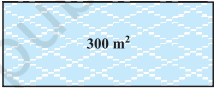
$A$ prayer hall has a carpet area of $300 \ m^2$ with its length one metre more than twice its breadth. Find the dimensions of the prayer hall.
Solution
(N/A) Suppose the breadth of the hall is $x \ m$. Then,its length should be $(2x + 1) \ m$.
Now,the area of the hall $= \text{length} \times \text{breadth} = (2x + 1) \times x = (2x^2 + x) \ m^2$.
Given that the area is $300 \ m^2$,we have:
$2x^2 + x = 300$
$2x^2 + x - 300 = 0$
Applying the factorization method,we split the middle term:
$2x^2 - 24x + 25x - 300 = 0$
$2x(x - 12) + 25(x - 12) = 0$
$(x - 12)(2x + 25) = 0$
So,the roots of the equation are $x = 12$ or $x = -12.5$.
Since $x$ represents the breadth,it cannot be negative. Therefore,$x = 12$.
The breadth of the hall is $12 \ m$ and its length is $2(12) + 1 = 25 \ m$.
Now,the area of the hall $= \text{length} \times \text{breadth} = (2x + 1) \times x = (2x^2 + x) \ m^2$.
Given that the area is $300 \ m^2$,we have:
$2x^2 + x = 300$
$2x^2 + x - 300 = 0$
Applying the factorization method,we split the middle term:
$2x^2 - 24x + 25x - 300 = 0$
$2x(x - 12) + 25(x - 12) = 0$
$(x - 12)(2x + 25) = 0$
So,the roots of the equation are $x = 12$ or $x = -12.5$.
Since $x$ represents the breadth,it cannot be negative. Therefore,$x = 12$.
The breadth of the hall is $12 \ m$ and its length is $2(12) + 1 = 25 \ m$.
0 likes
View Solution22
Easy
Find the roots of the following quadratic equation by factorisation:
$x^{2}-3x-10=0$
$x^{2}-3x-10=0$
Solution
(A) To find the roots of the quadratic equation $x^{2}-3x-10=0$ by factorisation,we split the middle term.
We need two numbers whose product is $-10$ and whose sum is $-3$. These numbers are $-5$ and $2$.
$x^{2}-5x+2x-10=0$
Factor by grouping:
$x(x-5)+2(x-5)=0$
$(x-5)(x+2)=0$
Setting each factor to zero:
$x-5=0$ or $x+2=0$
Therefore,the roots are $x=5$ or $x=-2$.
We need two numbers whose product is $-10$ and whose sum is $-3$. These numbers are $-5$ and $2$.
$x^{2}-5x+2x-10=0$
Factor by grouping:
$x(x-5)+2(x-5)=0$
$(x-5)(x+2)=0$
Setting each factor to zero:
$x-5=0$ or $x+2=0$
Therefore,the roots are $x=5$ or $x=-2$.
0 likes
View Solution23
Medium
Find the roots of the following quadratic equation by factorisation:
$2x^{2} + x - 6 = 0$
$2x^{2} + x - 6 = 0$
Solution
(A) To find the roots of the quadratic equation $2x^{2} + x - 6 = 0$ by factorisation,we split the middle term.
We need two numbers whose product is $2 \times (-6) = -12$ and whose sum is $1$.
These numbers are $4$ and $-3$.
So,$2x^{2} + 4x - 3x - 6 = 0$.
Grouping the terms,we get $2x(x + 2) - 3(x + 2) = 0$.
Factoring out $(x + 2)$,we have $(x + 2)(2x - 3) = 0$.
Setting each factor to zero:
$x + 2 = 0 \implies x = -2$
$2x - 3 = 0 \implies 2x = 3 \implies x = \frac{3}{2}$.
Thus,the roots are $x = -2$ and $x = \frac{3}{2}$.
We need two numbers whose product is $2 \times (-6) = -12$ and whose sum is $1$.
These numbers are $4$ and $-3$.
So,$2x^{2} + 4x - 3x - 6 = 0$.
Grouping the terms,we get $2x(x + 2) - 3(x + 2) = 0$.
Factoring out $(x + 2)$,we have $(x + 2)(2x - 3) = 0$.
Setting each factor to zero:
$x + 2 = 0 \implies x = -2$
$2x - 3 = 0 \implies 2x = 3 \implies x = \frac{3}{2}$.
Thus,the roots are $x = -2$ and $x = \frac{3}{2}$.
0 likes
View Solution24
MediumMCQ
Find the roots of the following quadratic equation by factorisation:
$\sqrt{2} x^{2}+7 x+5 \sqrt{2}=0$
$\sqrt{2} x^{2}+7 x+5 \sqrt{2}=0$
A
$x = -\frac{5}{\sqrt{2}}, x = -\sqrt{2}$
B
$x = \frac{5}{\sqrt{2}}, x = \sqrt{2}$
C
$x = -\frac{\sqrt{2}}{5}, x = -\sqrt{2}$
D
$x = \frac{\sqrt{2}}{5}, x = \sqrt{2}$
Solution
(A) To find the roots of the quadratic equation $\sqrt{2} x^{2}+7 x+5 \sqrt{2}=0$ by factorisation:
$1$. Split the middle term $7x$ into two parts such that their sum is $7x$ and their product is $(\sqrt{2} x^{2}) \times (5 \sqrt{2}) = 10x^{2}$.
$2$. The two parts are $5x$ and $2x$ because $5x + 2x = 7x$ and $5x \times 2x = 10x^{2}$.
$3$. Rewrite the equation: $\sqrt{2} x^{2} + 2x + 5x + 5 \sqrt{2} = 0$.
$4$. Factor by grouping: $\sqrt{2} x(x + \sqrt{2}) + 5(x + \sqrt{2}) = 0$.
$5$. Take out the common factor $(x + \sqrt{2})$: $(x + \sqrt{2})(\sqrt{2} x + 5) = 0$.
$6$. Set each factor to zero:
- $x + \sqrt{2} = 0 \implies x = -\sqrt{2}$
- $\sqrt{2} x + 5 = 0 \implies \sqrt{2} x = -5 \implies x = -\frac{5}{\sqrt{2}}$
Thus,the roots are $x = -\sqrt{2}$ and $x = -\frac{5}{\sqrt{2}}$.
$1$. Split the middle term $7x$ into two parts such that their sum is $7x$ and their product is $(\sqrt{2} x^{2}) \times (5 \sqrt{2}) = 10x^{2}$.
$2$. The two parts are $5x$ and $2x$ because $5x + 2x = 7x$ and $5x \times 2x = 10x^{2}$.
$3$. Rewrite the equation: $\sqrt{2} x^{2} + 2x + 5x + 5 \sqrt{2} = 0$.
$4$. Factor by grouping: $\sqrt{2} x(x + \sqrt{2}) + 5(x + \sqrt{2}) = 0$.
$5$. Take out the common factor $(x + \sqrt{2})$: $(x + \sqrt{2})(\sqrt{2} x + 5) = 0$.
$6$. Set each factor to zero:
- $x + \sqrt{2} = 0 \implies x = -\sqrt{2}$
- $\sqrt{2} x + 5 = 0 \implies \sqrt{2} x = -5 \implies x = -\frac{5}{\sqrt{2}}$
Thus,the roots are $x = -\sqrt{2}$ and $x = -\frac{5}{\sqrt{2}}$.
0 likes
View Solution25
EasyMCQ
Find the roots of the following quadratic equation by factorisation:
$2x^{2} - x + \frac{1}{8} = 0$
$2x^{2} - x + \frac{1}{8} = 0$
A
$x = \frac{1}{4}, \frac{1}{4}$
B
$x = \frac{1}{2}, \frac{1}{2}$
C
$x = \frac{1}{4}, -\frac{1}{4}$
D
$x = \frac{1}{8}, \frac{1}{8}$
Solution
(A) Given equation: $2x^{2} - x + \frac{1}{8} = 0$
Multiply the entire equation by $8$ to remove the fraction:
$16x^{2} - 8x + 1 = 0$
Now,factorise the quadratic expression by splitting the middle term:
$16x^{2} - 4x - 4x + 1 = 0$
Group the terms:
$4x(4x - 1) - 1(4x - 1) = 0$
$(4x - 1)(4x - 1) = 0$
$(4x - 1)^{2} = 0$
Setting the factor to zero:
$4x - 1 = 0$
$4x = 1$
$x = \frac{1}{4}$
Thus,the roots of the equation are $x = \frac{1}{4}, \frac{1}{4}$.
Multiply the entire equation by $8$ to remove the fraction:
$16x^{2} - 8x + 1 = 0$
Now,factorise the quadratic expression by splitting the middle term:
$16x^{2} - 4x - 4x + 1 = 0$
Group the terms:
$4x(4x - 1) - 1(4x - 1) = 0$
$(4x - 1)(4x - 1) = 0$
$(4x - 1)^{2} = 0$
Setting the factor to zero:
$4x - 1 = 0$
$4x = 1$
$x = \frac{1}{4}$
Thus,the roots of the equation are $x = \frac{1}{4}, \frac{1}{4}$.
0 likes
View Solution26
MediumMCQ
Find the roots of the following quadratic equation by factorisation:
$100 x^{2}-20 x+1=0$
$100 x^{2}-20 x+1=0$
A
$x = \frac{1}{10}, \frac{1}{10}$
B
$x = \frac{1}{20}, \frac{1}{20}$
C
$x = \frac{1}{5}, \frac{1}{5}$
D
$x = \frac{1}{10}, \frac{1}{20}$
Solution
(A) Given quadratic equation: $100 x^{2}-20 x+1=0$
To factorise,we split the middle term $-20x$ into $-10x - 10x$:
$100 x^{2}-10 x-10 x+1=0$
Group the terms:
$10 x(10 x-1)-1(10 x-1)=0$
Factor out the common term $(10 x-1)$:
$(10 x-1)(10 x-1)=0$
$(10 x-1)^{2}=0$
For the roots,set the factor to zero:
$10 x-1=0$
$10 x=1$
$x=\frac{1}{10}$
Since the factor is squared,the roots are equal: $x = \frac{1}{10}, \frac{1}{10}$.
To factorise,we split the middle term $-20x$ into $-10x - 10x$:
$100 x^{2}-10 x-10 x+1=0$
Group the terms:
$10 x(10 x-1)-1(10 x-1)=0$
Factor out the common term $(10 x-1)$:
$(10 x-1)(10 x-1)=0$
$(10 x-1)^{2}=0$
For the roots,set the factor to zero:
$10 x-1=0$
$10 x=1$
$x=\frac{1}{10}$
Since the factor is squared,the roots are equal: $x = \frac{1}{10}, \frac{1}{10}$.
0 likes
View Solution27
Difficult
John and Jivanti together have $45$ marbles. Both of them lost $5$ marbles each,and the product of the number of marbles they now have is $124$. Find out how many marbles they had to start with.
Solution
(A) Let the number of John's marbles be $x$.
Therefore,the number of Jivanti's marbles $= 45 - x$.
After losing $5$ marbles each:
Number of John's marbles $= x - 5$.
Number of Jivanti's marbles $= 45 - x - 5 = 40 - x$.
It is given that the product of their remaining marbles is $124$.
So,$(x - 5)(40 - x) = 124$.
Expanding the equation: $40x - x^2 - 200 + 5x = 124$.
Rearranging terms: $-x^2 + 45x - 200 = 124$.
$x^2 - 45x + 324 = 0$.
Factoring the quadratic equation: $x^2 - 36x - 9x + 324 = 0$.
$x(x - 36) - 9(x - 36) = 0$.
$(x - 36)(x - 9) = 0$.
Thus,$x = 36$ or $x = 9$.
If John had $36$ marbles,Jivanti had $45 - 36 = 9$ marbles.
If John had $9$ marbles,Jivanti had $45 - 9 = 36$ marbles.
Therefore,the number of Jivanti's marbles $= 45 - x$.
After losing $5$ marbles each:
Number of John's marbles $= x - 5$.
Number of Jivanti's marbles $= 45 - x - 5 = 40 - x$.
It is given that the product of their remaining marbles is $124$.
So,$(x - 5)(40 - x) = 124$.
Expanding the equation: $40x - x^2 - 200 + 5x = 124$.
Rearranging terms: $-x^2 + 45x - 200 = 124$.
$x^2 - 45x + 324 = 0$.
Factoring the quadratic equation: $x^2 - 36x - 9x + 324 = 0$.
$x(x - 36) - 9(x - 36) = 0$.
$(x - 36)(x - 9) = 0$.
Thus,$x = 36$ or $x = 9$.
If John had $36$ marbles,Jivanti had $45 - 36 = 9$ marbles.
If John had $9$ marbles,Jivanti had $45 - 9 = 36$ marbles.
1 likes
View Solution28
MediumMCQ
$A$ cottage industry produces a certain number of toys in a day. The cost of production of each toy (in rupees) was found to be $55$ minus the number of toys produced in a day. On a particular day,the total cost of production was $Rs$ $750$. Find out the number of toys produced on that day.
A
$25$ or $30$
B
$20$ or $35$
C
$15$ or $40$
D
$25$ or $35$
Solution
(A) Let the number of toys produced in a day be $x$.
The cost of production of each toy (in rupees) is $(55 - x)$.
The total cost of production is given by the product of the number of toys and the cost per toy:
$x(55 - x) = 750$
Expanding the equation:
$55x - x^2 = 750$
Rearranging into the standard quadratic form $ax^2 + bx + c = 0$:
$x^2 - 55x + 750 = 0$
To solve this,we factorize the quadratic equation by splitting the middle term:
$x^2 - 25x - 30x + 750 = 0$
Grouping the terms:
$x(x - 25) - 30(x - 25) = 0$
$(x - 25)(x - 30) = 0$
Setting each factor to zero:
$x - 25 = 0 \Rightarrow x = 25$
$x - 30 = 0 \Rightarrow x = 30$
Therefore,the number of toys produced on that day was either $25$ or $30$.
The cost of production of each toy (in rupees) is $(55 - x)$.
The total cost of production is given by the product of the number of toys and the cost per toy:
$x(55 - x) = 750$
Expanding the equation:
$55x - x^2 = 750$
Rearranging into the standard quadratic form $ax^2 + bx + c = 0$:
$x^2 - 55x + 750 = 0$
To solve this,we factorize the quadratic equation by splitting the middle term:
$x^2 - 25x - 30x + 750 = 0$
Grouping the terms:
$x(x - 25) - 30(x - 25) = 0$
$(x - 25)(x - 30) = 0$
Setting each factor to zero:
$x - 25 = 0 \Rightarrow x = 25$
$x - 30 = 0 \Rightarrow x = 30$
Therefore,the number of toys produced on that day was either $25$ or $30$.
0 likes
View Solution29
Medium
Find two numbers whose sum is $27$ and product is $182$.
Solution
(N/A) Let the first number be $x$. Then the second number is $27-x$.
Given that their product is $182$,we have:
$x(27-x) = 182$
Expanding the equation:
$27x - x^2 = 182$
Rearranging into the standard quadratic form $ax^2 + bx + c = 0$:
$x^2 - 27x + 182 = 0$
Factoring the quadratic equation:
$x^2 - 13x - 14x + 182 = 0$
$x(x - 13) - 14(x - 13) = 0$
$(x - 13)(x - 14) = 0$
Setting each factor to zero:
$x - 13 = 0 \Rightarrow x = 13$
$x - 14 = 0 \Rightarrow x = 14$
If the first number is $13$,the second number is $27 - 13 = 14$.
If the first number is $14$,the second number is $27 - 14 = 13$.
Therefore,the two numbers are $13$ and $14$.
Given that their product is $182$,we have:
$x(27-x) = 182$
Expanding the equation:
$27x - x^2 = 182$
Rearranging into the standard quadratic form $ax^2 + bx + c = 0$:
$x^2 - 27x + 182 = 0$
Factoring the quadratic equation:
$x^2 - 13x - 14x + 182 = 0$
$x(x - 13) - 14(x - 13) = 0$
$(x - 13)(x - 14) = 0$
Setting each factor to zero:
$x - 13 = 0 \Rightarrow x = 13$
$x - 14 = 0 \Rightarrow x = 14$
If the first number is $13$,the second number is $27 - 13 = 14$.
If the first number is $14$,the second number is $27 - 14 = 13$.
Therefore,the two numbers are $13$ and $14$.
0 likes
View Solution30
Medium
Find two consecutive positive integers,the sum of whose squares is $365$.
Solution
(A) Let the consecutive positive integers be $x$ and $x+1$.
Given that $x^{2} + (x+1)^{2} = 365$.
Expanding the equation: $x^{2} + x^{2} + 2x + 1 = 365$.
Simplifying: $2x^{2} + 2x + 1 = 365$.
$2x^{2} + 2x - 364 = 0$.
Dividing by $2$: $x^{2} + x - 182 = 0$.
Factoring the quadratic equation: $x^{2} + 14x - 13x - 182 = 0$.
$x(x + 14) - 13(x + 14) = 0$.
$(x + 14)(x - 13) = 0$.
This gives $x = -14$ or $x = 13$.
Since the integers must be positive,we take $x = 13$.
Therefore,the next integer is $x + 1 = 13 + 1 = 14$.
The two consecutive positive integers are $13$ and $14$.
Given that $x^{2} + (x+1)^{2} = 365$.
Expanding the equation: $x^{2} + x^{2} + 2x + 1 = 365$.
Simplifying: $2x^{2} + 2x + 1 = 365$.
$2x^{2} + 2x - 364 = 0$.
Dividing by $2$: $x^{2} + x - 182 = 0$.
Factoring the quadratic equation: $x^{2} + 14x - 13x - 182 = 0$.
$x(x + 14) - 13(x + 14) = 0$.
$(x + 14)(x - 13) = 0$.
This gives $x = -14$ or $x = 13$.
Since the integers must be positive,we take $x = 13$.
Therefore,the next integer is $x + 1 = 13 + 1 = 14$.
The two consecutive positive integers are $13$ and $14$.
0 likes
View Solution31
DifficultMCQ
The altitude of a right triangle is $7 \, cm$ less than its base. If the hypotenuse is $13 \, cm$,find the other two sides.
A
$5 \, cm$ and $12 \, cm$
B
$6 \, cm$ and $13 \, cm$
C
$7 \, cm$ and $14 \, cm$
D
$8 \, cm$ and $15 \, cm$
Solution
(A) Let the base of the right triangle be $x \, cm$.
Its altitude is $(x - 7) \, cm$.
According to the Pythagoras theorem:
$\text{Base}^2 + \text{Altitude}^2 = \text{Hypotenuse}^2$
$x^2 + (x - 7)^2 = 13^2$
$x^2 + x^2 - 14x + 49 = 169$
$2x^2 - 14x - 120 = 0$
Dividing by $2$:
$x^2 - 7x - 60 = 0$
Factoring the quadratic equation:
$x^2 - 12x + 5x - 60 = 0$
$x(x - 12) + 5(x - 12) = 0$
$(x - 12)(x + 5) = 0$
So,$x = 12$ or $x = -5$.
Since the length of a side cannot be negative,we take $x = 12$.
Therefore,the base is $12 \, cm$ and the altitude is $12 - 7 = 5 \, cm$.
Its altitude is $(x - 7) \, cm$.
According to the Pythagoras theorem:
$\text{Base}^2 + \text{Altitude}^2 = \text{Hypotenuse}^2$
$x^2 + (x - 7)^2 = 13^2$
$x^2 + x^2 - 14x + 49 = 169$
$2x^2 - 14x - 120 = 0$
Dividing by $2$:
$x^2 - 7x - 60 = 0$
Factoring the quadratic equation:
$x^2 - 12x + 5x - 60 = 0$
$x(x - 12) + 5(x - 12) = 0$
$(x - 12)(x + 5) = 0$
So,$x = 12$ or $x = -5$.
Since the length of a side cannot be negative,we take $x = 12$.
Therefore,the base is $12 \, cm$ and the altitude is $12 - 7 = 5 \, cm$.
0 likes
View Solution32
Medium
$A$ cottage industry produces a certain number of pottery articles in a day. It was observed on a particular day that the cost of production of each article (in rupees) was $3$ more than twice the number of articles produced on that day. If the total cost of production on that day was ₹ $90,$ find the number of articles produced and the cost of each article.
Solution
(N/A) Let the number of articles produced be $x$.
Therefore,the cost of production of each article $= (2x + 3)$ rupees.
It is given that the total cost of production is ₹ $90$.
Thus,$x(2x + 3) = 90$.
Expanding the equation: $2x^2 + 3x - 90 = 0$.
Factoring the quadratic equation: $2x^2 + 15x - 12x - 90 = 0$.
$x(2x + 15) - 6(2x + 15) = 0$.
$(2x + 15)(x - 6) = 0$.
This gives $x = -15/2$ or $x = 6$.
Since the number of articles produced must be a positive integer,we have $x = 6$.
Therefore,the number of articles produced is $6$,and the cost of each article is $2(6) + 3 = 15$ rupees.
Therefore,the cost of production of each article $= (2x + 3)$ rupees.
It is given that the total cost of production is ₹ $90$.
Thus,$x(2x + 3) = 90$.
Expanding the equation: $2x^2 + 3x - 90 = 0$.
Factoring the quadratic equation: $2x^2 + 15x - 12x - 90 = 0$.
$x(2x + 15) - 6(2x + 15) = 0$.
$(2x + 15)(x - 6) = 0$.
This gives $x = -15/2$ or $x = 6$.
Since the number of articles produced must be a positive integer,we have $x = 6$.
Therefore,the number of articles produced is $6$,and the cost of each article is $2(6) + 3 = 15$ rupees.
0 likes
View Solution33
Difficult
Solve the equation $2x^{2}-5x+3=0$ by the method of completing the square.
Solution
(N/A) The given equation is $2x^{2}-5x+3=0$.
Divide the entire equation by $2$ to make the coefficient of $x^{2}$ equal to $1$:
$x^{2}-\frac{5}{2}x+\frac{3}{2}=0$
Now,complete the square by adding and subtracting the square of half the coefficient of $x$,which is $(\frac{1}{2} \times \frac{5}{2})^{2} = (\frac{5}{4})^{2} = \frac{25}{16}$:
$x^{2}-\frac{5}{2}x + \frac{25}{16} - \frac{25}{16} + \frac{3}{2} = 0$
$(x-\frac{5}{4})^{2} - \frac{25}{16} + \frac{24}{16} = 0$
$(x-\frac{5}{4})^{2} - \frac{1}{16} = 0$
$(x-\frac{5}{4})^{2} = \frac{1}{16}$
Taking the square root on both sides:
$x-\frac{5}{4} = \pm \frac{1}{4}$
Case $1$: $x-\frac{5}{4} = \frac{1}{4} \implies x = \frac{5}{4} + \frac{1}{4} = \frac{6}{4} = \frac{3}{2}$
Case $2$: $x-\frac{5}{4} = -\frac{1}{4} \implies x = \frac{5}{4} - \frac{1}{4} = \frac{4}{4} = 1$
Thus,the solutions are $x = \frac{3}{2}$ and $x = 1$.
Divide the entire equation by $2$ to make the coefficient of $x^{2}$ equal to $1$:
$x^{2}-\frac{5}{2}x+\frac{3}{2}=0$
Now,complete the square by adding and subtracting the square of half the coefficient of $x$,which is $(\frac{1}{2} \times \frac{5}{2})^{2} = (\frac{5}{4})^{2} = \frac{25}{16}$:
$x^{2}-\frac{5}{2}x + \frac{25}{16} - \frac{25}{16} + \frac{3}{2} = 0$
$(x-\frac{5}{4})^{2} - \frac{25}{16} + \frac{24}{16} = 0$
$(x-\frac{5}{4})^{2} - \frac{1}{16} = 0$
$(x-\frac{5}{4})^{2} = \frac{1}{16}$
Taking the square root on both sides:
$x-\frac{5}{4} = \pm \frac{1}{4}$
Case $1$: $x-\frac{5}{4} = \frac{1}{4} \implies x = \frac{5}{4} + \frac{1}{4} = \frac{6}{4} = \frac{3}{2}$
Case $2$: $x-\frac{5}{4} = -\frac{1}{4} \implies x = \frac{5}{4} - \frac{1}{4} = \frac{4}{4} = 1$
Thus,the solutions are $x = \frac{3}{2}$ and $x = 1$.
0 likes
View Solution34
Difficult
Find the roots of the equation $5x^{2}-6x-2=0$ by the method of completing the square.
Solution
(N/A) Multiplying the equation throughout by $5$,we get:
$25x^{2}-30x-10=0$
This can be rewritten as:
$(5x)^{2}-2 \times (5x) \times 3 + 3^{2} - 3^{2} - 10 = 0$
$(5x-3)^{2} - 9 - 10 = 0$
$(5x-3)^{2} - 19 = 0$
$(5x-3)^{2} = 19$
Taking the square root on both sides:
$5x-3 = \pm \sqrt{19}$
$5x = 3 \pm \sqrt{19}$
$x = \frac{3 \pm \sqrt{19}}{5}$
Therefore,the roots are $\frac{3+\sqrt{19}}{5}$ and $\frac{3-\sqrt{19}}{5}$.
$25x^{2}-30x-10=0$
This can be rewritten as:
$(5x)^{2}-2 \times (5x) \times 3 + 3^{2} - 3^{2} - 10 = 0$
$(5x-3)^{2} - 9 - 10 = 0$
$(5x-3)^{2} - 19 = 0$
$(5x-3)^{2} = 19$
Taking the square root on both sides:
$5x-3 = \pm \sqrt{19}$
$5x = 3 \pm \sqrt{19}$
$x = \frac{3 \pm \sqrt{19}}{5}$
Therefore,the roots are $\frac{3+\sqrt{19}}{5}$ and $\frac{3-\sqrt{19}}{5}$.
0 likes
View Solution35
Medium
Find the roots of $4 x^{2}+3 x+5=0$ by the method of completing the square.
Solution
(NONE) Given the quadratic equation: $4 x^{2}+3 x+5=0$.
To solve by completing the square,we first divide the entire equation by $4$:
$x^{2} + \frac{3}{4}x + \frac{5}{4} = 0$.
Now,we rewrite the expression by completing the square:
$(x + \frac{3}{8})^{2} - (\frac{3}{8})^{2} + \frac{5}{4} = 0$.
$(x + \frac{3}{8})^{2} - \frac{9}{64} + \frac{80}{64} = 0$.
$(x + \frac{3}{8})^{2} + \frac{71}{64} = 0$.
$(x + \frac{3}{8})^{2} = -\frac{71}{64}$.
Since the square of any real number cannot be negative,there is no real value of $x$ that satisfies this equation.
Therefore,the equation $4 x^{2}+3 x+5=0$ has no real roots.
To solve by completing the square,we first divide the entire equation by $4$:
$x^{2} + \frac{3}{4}x + \frac{5}{4} = 0$.
Now,we rewrite the expression by completing the square:
$(x + \frac{3}{8})^{2} - (\frac{3}{8})^{2} + \frac{5}{4} = 0$.
$(x + \frac{3}{8})^{2} - \frac{9}{64} + \frac{80}{64} = 0$.
$(x + \frac{3}{8})^{2} + \frac{71}{64} = 0$.
$(x + \frac{3}{8})^{2} = -\frac{71}{64}$.
Since the square of any real number cannot be negative,there is no real value of $x$ that satisfies this equation.
Therefore,the equation $4 x^{2}+3 x+5=0$ has no real roots.
0 likes
View Solution36
Easy
Solve by using the quadratic formula. The area of a rectangular plot is $528 \ m^2$. The length of the plot (in metres) is one more than twice its breadth. We need to find the length and breadth of the plot.
Solution
(16 M, 33 M) Let the breadth of the plot be $x \ m$. Then the length is $(2x + 1) \ m$.
Given that the area is $528 \ m^2$,we have $x(2x + 1) = 528$,which simplifies to $2x^2 + x - 528 = 0$.
This is a quadratic equation of the form $ax^2 + bx + c = 0$,where $a = 2, b = 1, c = -528$.
Using the quadratic formula $x = \frac{-b \pm \sqrt{b^2 - 4ac}}{2a}$:
$x = \frac{-1 \pm \sqrt{1^2 - 4(2)(-528)}}{2(2)} = \frac{-1 \pm \sqrt{1 + 4224}}{4} = \frac{-1 \pm \sqrt{4225}}{4} = \frac{-1 \pm 65}{4}$.
This gives two possible values for $x$: $x = \frac{64}{4} = 16$ or $x = \frac{-66}{4} = -16.5$.
Since the breadth cannot be negative,we take $x = 16 \ m$.
Therefore,the breadth is $16 \ m$ and the length is $2(16) + 1 = 33 \ m$.
Given that the area is $528 \ m^2$,we have $x(2x + 1) = 528$,which simplifies to $2x^2 + x - 528 = 0$.
This is a quadratic equation of the form $ax^2 + bx + c = 0$,where $a = 2, b = 1, c = -528$.
Using the quadratic formula $x = \frac{-b \pm \sqrt{b^2 - 4ac}}{2a}$:
$x = \frac{-1 \pm \sqrt{1^2 - 4(2)(-528)}}{2(2)} = \frac{-1 \pm \sqrt{1 + 4224}}{4} = \frac{-1 \pm \sqrt{4225}}{4} = \frac{-1 \pm 65}{4}$.
This gives two possible values for $x$: $x = \frac{64}{4} = 16$ or $x = \frac{-66}{4} = -16.5$.
Since the breadth cannot be negative,we take $x = 16 \ m$.
Therefore,the breadth is $16 \ m$ and the length is $2(16) + 1 = 33 \ m$.
0 likes
View Solution37
MediumMCQ
Find two consecutive odd positive integers,the sum of whose squares is $290$.
A
$11, 13$
B
$13, 15$
C
$9, 11$
D
$7, 9$
Solution
(A) Let the smaller of the two consecutive odd positive integers be $x$. Then,the second integer will be $x+2$.
According to the question,
$x^{2} + (x+2)^{2} = 290$
$x^{2} + x^{2} + 4x + 4 = 290$
$2x^{2} + 4x - 286 = 0$
Dividing by $2$,we get:
$x^{2} + 2x - 143 = 0$
Using the quadratic formula $x = \frac{-b \pm \sqrt{b^{2} - 4ac}}{2a}$:
$x = \frac{-2 \pm \sqrt{2^{2} - 4(1)(-143)}}{2(1)}$
$x = \frac{-2 \pm \sqrt{4 + 572}}{2} = \frac{-2 \pm \sqrt{576}}{2} = \frac{-2 \pm 24}{2}$
$x = \frac{22}{2} = 11$ or $x = \frac{-26}{2} = -13$
Since $x$ must be a positive integer,we take $x = 11$.
The two consecutive odd integers are $11$ and $13$.
Verification: $11^{2} + 13^{2} = 121 + 169 = 290$.
According to the question,
$x^{2} + (x+2)^{2} = 290$
$x^{2} + x^{2} + 4x + 4 = 290$
$2x^{2} + 4x - 286 = 0$
Dividing by $2$,we get:
$x^{2} + 2x - 143 = 0$
Using the quadratic formula $x = \frac{-b \pm \sqrt{b^{2} - 4ac}}{2a}$:
$x = \frac{-2 \pm \sqrt{2^{2} - 4(1)(-143)}}{2(1)}$
$x = \frac{-2 \pm \sqrt{4 + 572}}{2} = \frac{-2 \pm \sqrt{576}}{2} = \frac{-2 \pm 24}{2}$
$x = \frac{22}{2} = 11$ or $x = \frac{-26}{2} = -13$
Since $x$ must be a positive integer,we take $x = 11$.
The two consecutive odd integers are $11$ and $13$.
Verification: $11^{2} + 13^{2} = 121 + 169 = 290$.
0 likes
View Solution38
Medium
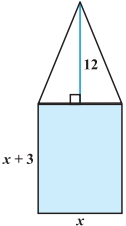
$A$ rectangular park is to be designed whose breadth is $3\, m$ less than its length. Its area is to be $4\, m^2$ more than the area of a park that has already been made in the shape of an isosceles triangle with its base as the breadth of the rectangular park and of altitude $12\, m$ (see Figure). Find its length and breadth.
Solution
(N/A) Let the breadth of the rectangular park be $x\, m$.
Then,its length is $(x+3)\, m$.
Therefore,the area of the rectangular park is $x(x+3) = (x^2 + 3x)\, m^2$.
The area of the isosceles triangle is $\frac{1}{2} \times \text{base} \times \text{altitude} = \frac{1}{2} \times x \times 12 = 6x\, m^2$.
According to the problem,the area of the rectangular park is $4\, m^2$ more than the area of the triangular park:
$x^2 + 3x = 6x + 4$
$x^2 - 3x - 4 = 0$
$(x - 4)(x + 1) = 0$
So,$x = 4$ or $x = -1$.
Since breadth cannot be negative,$x = 4$.
Thus,the breadth of the park is $4\, m$ and its length is $4 + 3 = 7\, m$.
Then,its length is $(x+3)\, m$.
Therefore,the area of the rectangular park is $x(x+3) = (x^2 + 3x)\, m^2$.
The area of the isosceles triangle is $\frac{1}{2} \times \text{base} \times \text{altitude} = \frac{1}{2} \times x \times 12 = 6x\, m^2$.
According to the problem,the area of the rectangular park is $4\, m^2$ more than the area of the triangular park:
$x^2 + 3x = 6x + 4$
$x^2 - 3x - 4 = 0$
$(x - 4)(x + 1) = 0$
So,$x = 4$ or $x = -1$.
Since breadth cannot be negative,$x = 4$.
Thus,the breadth of the park is $4\, m$ and its length is $4 + 3 = 7\, m$.
0 likes
View Solution39
EasyMCQ
Find the roots of the following quadratic equation,if they exist,using the quadratic formula: $3x^{2} - 5x + 2 = 0$.
A
$x = 1, x = 2/3$
B
$x = -1, x = -2/3$
C
$x = 1, x = -2/3$
D
$x = -1, x = 2/3$
Solution
(A) The given quadratic equation is $3x^{2} - 5x + 2 = 0$.
Comparing this with the standard form $ax^{2} + bx + c = 0$,we get $a = 3$,$b = -5$,and $c = 2$.
First,calculate the discriminant $D = b^{2} - 4ac$:
$D = (-5)^{2} - 4(3)(2) = 25 - 24 = 1$.
Since $D > 0$,real and distinct roots exist.
Using the quadratic formula $x = \frac{-b \pm \sqrt{D}}{2a}$:
$x = \frac{-(-5) \pm \sqrt{1}}{2(3)} = \frac{5 \pm 1}{6}$.
Case $1$: $x = \frac{5 + 1}{6} = \frac{6}{6} = 1$.
Case $2$: $x = \frac{5 - 1}{6} = \frac{4}{6} = \frac{2}{3}$.
Thus,the roots are $1$ and $\frac{2}{3}$.
Comparing this with the standard form $ax^{2} + bx + c = 0$,we get $a = 3$,$b = -5$,and $c = 2$.
First,calculate the discriminant $D = b^{2} - 4ac$:
$D = (-5)^{2} - 4(3)(2) = 25 - 24 = 1$.
Since $D > 0$,real and distinct roots exist.
Using the quadratic formula $x = \frac{-b \pm \sqrt{D}}{2a}$:
$x = \frac{-(-5) \pm \sqrt{1}}{2(3)} = \frac{5 \pm 1}{6}$.
Case $1$: $x = \frac{5 + 1}{6} = \frac{6}{6} = 1$.
Case $2$: $x = \frac{5 - 1}{6} = \frac{4}{6} = \frac{2}{3}$.
Thus,the roots are $1$ and $\frac{2}{3}$.
0 likes
View Solution40
Easy
Find the roots of the following quadratic equation,if they exist,using the quadratic formula: $x^{2}+4x+5=0$.
Solution
(NONE) The given quadratic equation is $x^{2}+4x+5=0$.
Comparing this with the standard form $ax^{2}+bx+c=0$,we get $a=1$,$b=4$,and $c=5$.
The discriminant $D$ is given by $D = b^{2}-4ac$.
Substituting the values,$D = (4)^{2} - 4(1)(5) = 16 - 20 = -4$.
Since the discriminant $D < 0$,the square root of the discriminant $\sqrt{D}$ does not yield a real number.
Therefore,the given quadratic equation has no real roots.
Comparing this with the standard form $ax^{2}+bx+c=0$,we get $a=1$,$b=4$,and $c=5$.
The discriminant $D$ is given by $D = b^{2}-4ac$.
Substituting the values,$D = (4)^{2} - 4(1)(5) = 16 - 20 = -4$.
Since the discriminant $D < 0$,the square root of the discriminant $\sqrt{D}$ does not yield a real number.
Therefore,the given quadratic equation has no real roots.
0 likes
View Solution41
EasyMCQ
Find the roots of the following quadratic equation,if they exist,using the quadratic formula: $2x^2 - 2\sqrt{2}x + 1 = 0$.
A
$x = \frac{1}{\sqrt{2}}, \frac{1}{\sqrt{2}}$
B
$x = \sqrt{2}, \sqrt{2}$
C
$x = \frac{1}{2}, \frac{1}{2}$
D
$x = 2, 2$
Solution
(A) Given quadratic equation is $2x^2 - 2\sqrt{2}x + 1 = 0$.
Comparing this with the standard form $ax^2 + bx + c = 0$,we get $a = 2, b = -2\sqrt{2}, c = 1$.
First,calculate the discriminant $D = b^2 - 4ac$.
$D = (-2\sqrt{2})^2 - 4(2)(1) = 8 - 8 = 0$.
Since $D = 0$,the equation has two equal real roots.
The quadratic formula is $x = \frac{-b \pm \sqrt{D}}{2a}$.
Substituting the values,$x = \frac{-(-2\sqrt{2}) \pm \sqrt{0}}{2(2)} = \frac{2\sqrt{2}}{4} = \frac{\sqrt{2}}{2} = \frac{1}{\sqrt{2}}$.
Thus,the roots are $\frac{1}{\sqrt{2}}, \frac{1}{\sqrt{2}}$.
Comparing this with the standard form $ax^2 + bx + c = 0$,we get $a = 2, b = -2\sqrt{2}, c = 1$.
First,calculate the discriminant $D = b^2 - 4ac$.
$D = (-2\sqrt{2})^2 - 4(2)(1) = 8 - 8 = 0$.
Since $D = 0$,the equation has two equal real roots.
The quadratic formula is $x = \frac{-b \pm \sqrt{D}}{2a}$.
Substituting the values,$x = \frac{-(-2\sqrt{2}) \pm \sqrt{0}}{2(2)} = \frac{2\sqrt{2}}{4} = \frac{\sqrt{2}}{2} = \frac{1}{\sqrt{2}}$.
Thus,the roots are $\frac{1}{\sqrt{2}}, \frac{1}{\sqrt{2}}$.
0 likes
View Solution42
Medium
Find the roots of the following equation:
$x + \frac{1}{x} = 3, x \neq 0$
$x + \frac{1}{x} = 3, x \neq 0$
Solution
(N/A) Given the equation $x + \frac{1}{x} = 3$.
Multiplying throughout by $x$,we get:
$x^2 + 1 = 3x$
Rearranging the terms,we get the quadratic equation:
$x^2 - 3x + 1 = 0$
Comparing this with the standard form $ax^2 + bx + c = 0$,we have $a = 1, b = -3, c = 1$.
The discriminant $D = b^2 - 4ac = (-3)^2 - 4(1)(1) = 9 - 4 = 5$.
Since $D > 0$,the roots are real and distinct.
Using the quadratic formula $x = \frac{-b \pm \sqrt{D}}{2a}$,we get:
$x = \frac{-(-3) \pm \sqrt{5}}{2(1)} = \frac{3 \pm \sqrt{5}}{2}$.
Thus,the roots are $\frac{3 + \sqrt{5}}{2}$ and $\frac{3 - \sqrt{5}}{2}$.
Multiplying throughout by $x$,we get:
$x^2 + 1 = 3x$
Rearranging the terms,we get the quadratic equation:
$x^2 - 3x + 1 = 0$
Comparing this with the standard form $ax^2 + bx + c = 0$,we have $a = 1, b = -3, c = 1$.
The discriminant $D = b^2 - 4ac = (-3)^2 - 4(1)(1) = 9 - 4 = 5$.
Since $D > 0$,the roots are real and distinct.
Using the quadratic formula $x = \frac{-b \pm \sqrt{D}}{2a}$,we get:
$x = \frac{-(-3) \pm \sqrt{5}}{2(1)} = \frac{3 \pm \sqrt{5}}{2}$.
Thus,the roots are $\frac{3 + \sqrt{5}}{2}$ and $\frac{3 - \sqrt{5}}{2}$.
0 likes
View Solution43
Difficult
Find the roots of the following equation:
$\frac{1}{x} - \frac{1}{x-2} = 3, x \neq 0, 2$
$\frac{1}{x} - \frac{1}{x-2} = 3, x \neq 0, 2$
Solution
(N/A) Given the equation: $\frac{1}{x} - \frac{1}{x-2} = 3$ for $x \neq 0, 2$.
Multiplying both sides by $x(x-2)$,we get:
$(x-2) - x = 3x(x-2)$
Simplifying the left side:
$-2 = 3x^2 - 6x$
Rearranging into the standard quadratic form $ax^2 + bx + c = 0$:
$3x^2 - 6x + 2 = 0$
Using the quadratic formula $x = \frac{-b \pm \sqrt{b^2 - 4ac}}{2a}$,where $a = 3, b = -6, c = 2$:
Discriminant $D = b^2 - 4ac = (-6)^2 - 4(3)(2) = 36 - 24 = 12$.
Thus,$x = \frac{6 \pm \sqrt{12}}{2(3)} = \frac{6 \pm 2\sqrt{3}}{6}$.
Dividing by $2$:
$x = \frac{3 \pm \sqrt{3}}{3}$.
Therefore,the roots are $\frac{3 + \sqrt{3}}{3}$ and $\frac{3 - \sqrt{3}}{3}$.
Multiplying both sides by $x(x-2)$,we get:
$(x-2) - x = 3x(x-2)$
Simplifying the left side:
$-2 = 3x^2 - 6x$
Rearranging into the standard quadratic form $ax^2 + bx + c = 0$:
$3x^2 - 6x + 2 = 0$
Using the quadratic formula $x = \frac{-b \pm \sqrt{b^2 - 4ac}}{2a}$,where $a = 3, b = -6, c = 2$:
Discriminant $D = b^2 - 4ac = (-6)^2 - 4(3)(2) = 36 - 24 = 12$.
Thus,$x = \frac{6 \pm \sqrt{12}}{2(3)} = \frac{6 \pm 2\sqrt{3}}{6}$.
Dividing by $2$:
$x = \frac{3 \pm \sqrt{3}}{3}$.
Therefore,the roots are $\frac{3 + \sqrt{3}}{3}$ and $\frac{3 - \sqrt{3}}{3}$.
0 likes
View Solution44
MediumMCQ
$A$ motor boat whose speed is $18\, km/h$ in still water takes $1\, hour$ more to go $24\, km$ upstream than to return downstream to the same spot. Find the speed of the stream. (in $ km/h$)
A
$2$
B
$4$
C
$6$
D
$8$
Solution
(C) Let the speed of the stream be $x\, km/h$.
Therefore,the speed of the boat upstream is $(18-x)\, km/h$ and the speed of the boat downstream is $(18+x)\, km/h$.
The time taken to go upstream is $\frac{\text{distance}}{\text{speed}} = \frac{24}{18-x}\, \text{hours}$.
Similarly,the time taken to go downstream is $\frac{24}{18+x}\, \text{hours}$.
According to the problem,the difference in time is $1\, \text{hour}$:
$\frac{24}{18-x} - \frac{24}{18+x} = 1$
Multiplying by $(18-x)(18+x)$,we get:
$24(18+x) - 24(18-x) = (18-x)(18+x)$
$432 + 24x - 432 + 24x = 324 - x^2$
$48x = 324 - x^2$
$x^2 + 48x - 324 = 0$
Using the quadratic formula $x = \frac{-b \pm \sqrt{b^2 - 4ac}}{2a}$:
$x = \frac{-48 \pm \sqrt{48^2 - 4(1)(-324)}}{2(1)}$
$x = \frac{-48 \pm \sqrt{2304 + 1296}}{2} = \frac{-48 \pm \sqrt{3600}}{2}$
$x = \frac{-48 \pm 60}{2}$
Since speed cannot be negative,we take $x = \frac{-48 + 60}{2} = \frac{12}{2} = 6\, km/h$.
Therefore,the speed of the boat upstream is $(18-x)\, km/h$ and the speed of the boat downstream is $(18+x)\, km/h$.
The time taken to go upstream is $\frac{\text{distance}}{\text{speed}} = \frac{24}{18-x}\, \text{hours}$.
Similarly,the time taken to go downstream is $\frac{24}{18+x}\, \text{hours}$.
According to the problem,the difference in time is $1\, \text{hour}$:
$\frac{24}{18-x} - \frac{24}{18+x} = 1$
Multiplying by $(18-x)(18+x)$,we get:
$24(18+x) - 24(18-x) = (18-x)(18+x)$
$432 + 24x - 432 + 24x = 324 - x^2$
$48x = 324 - x^2$
$x^2 + 48x - 324 = 0$
Using the quadratic formula $x = \frac{-b \pm \sqrt{b^2 - 4ac}}{2a}$:
$x = \frac{-48 \pm \sqrt{48^2 - 4(1)(-324)}}{2(1)}$
$x = \frac{-48 \pm \sqrt{2304 + 1296}}{2} = \frac{-48 \pm \sqrt{3600}}{2}$
$x = \frac{-48 \pm 60}{2}$
Since speed cannot be negative,we take $x = \frac{-48 + 60}{2} = \frac{12}{2} = 6\, km/h$.
1 likes
View Solution45
Easy
Find the roots of the following quadratic equation,if they exist,by the method of completing the square: $2x^2 - 7x + 3 = 0$.
Solution
(3, 1/2) Given equation: $2x^2 - 7x + 3 = 0$.
Step $1$: Move the constant term to the right side:
$2x^2 - 7x = -3$.
Step $2$: Divide the entire equation by the coefficient of $x^2$ (which is $2$):
$x^2 - \frac{7}{2}x = -\frac{3}{2}$.
Step $3$: Add the square of half the coefficient of $x$ to both sides. The coefficient of $x$ is $-\frac{7}{2}$,so half of it is $-\frac{7}{4}$. Adding $(-\frac{7}{4})^2 = \frac{49}{16}$ to both sides:
$x^2 - 2(x)(\frac{7}{4}) + (\frac{7}{4})^2 = -\frac{3}{2} + \frac{49}{16}$.
Step $4$: Write the left side as a perfect square:
$(x - \frac{7}{4})^2 = \frac{-24 + 49}{16} = \frac{25}{16}$.
Step $5$: Take the square root of both sides:
$x - \frac{7}{4} = \pm \frac{5}{4}$.
Step $6$: Solve for $x$:
Case $1$: $x = \frac{7}{4} + \frac{5}{4} = \frac{12}{4} = 3$.
Case $2$: $x = \frac{7}{4} - \frac{5}{4} = \frac{2}{4} = \frac{1}{2}$.
Thus,the roots are $3$ and $\frac{1}{2}$.
Step $1$: Move the constant term to the right side:
$2x^2 - 7x = -3$.
Step $2$: Divide the entire equation by the coefficient of $x^2$ (which is $2$):
$x^2 - \frac{7}{2}x = -\frac{3}{2}$.
Step $3$: Add the square of half the coefficient of $x$ to both sides. The coefficient of $x$ is $-\frac{7}{2}$,so half of it is $-\frac{7}{4}$. Adding $(-\frac{7}{4})^2 = \frac{49}{16}$ to both sides:
$x^2 - 2(x)(\frac{7}{4}) + (\frac{7}{4})^2 = -\frac{3}{2} + \frac{49}{16}$.
Step $4$: Write the left side as a perfect square:
$(x - \frac{7}{4})^2 = \frac{-24 + 49}{16} = \frac{25}{16}$.
Step $5$: Take the square root of both sides:
$x - \frac{7}{4} = \pm \frac{5}{4}$.
Step $6$: Solve for $x$:
Case $1$: $x = \frac{7}{4} + \frac{5}{4} = \frac{12}{4} = 3$.
Case $2$: $x = \frac{7}{4} - \frac{5}{4} = \frac{2}{4} = \frac{1}{2}$.
Thus,the roots are $3$ and $\frac{1}{2}$.
0 likes
View Solution46
Medium
Find the roots of the following quadratic equation,if they exist,by the method of completing the square: $2x^{2} + x - 4 = 0$.
Solution
(N/A) Given equation: $2x^{2} + x - 4 = 0$.
Step $1$: Divide the entire equation by $2$ to make the coefficient of $x^{2}$ equal to $1$:
$x^{2} + \frac{1}{2}x - 2 = 0 \Rightarrow x^{2} + \frac{1}{2}x = 2$.
Step $2$: Add the square of half the coefficient of $x$ to both sides. The coefficient of $x$ is $\frac{1}{2}$,so half of it is $\frac{1}{4}$. Adding $(\frac{1}{4})^{2}$ to both sides:
$x^{2} + 2(x)(\frac{1}{4}) + (\frac{1}{4})^{2} = 2 + (\frac{1}{4})^{2}$.
Step $3$: Write the left side as a perfect square:
$(x + \frac{1}{4})^{2} = 2 + \frac{1}{16} = \frac{32 + 1}{16} = \frac{33}{16}$.
Step $4$: Take the square root of both sides:
$x + \frac{1}{4} = \pm \sqrt{\frac{33}{16}} = \pm \frac{\sqrt{33}}{4}$.
Step $5$: Solve for $x$:
$x = -\frac{1}{4} \pm \frac{\sqrt{33}}{4} = \frac{-1 \pm \sqrt{33}}{4}$.
Thus,the roots are $x = \frac{-1 + \sqrt{33}}{4}$ and $x = \frac{-1 - \sqrt{33}}{4}$.
Step $1$: Divide the entire equation by $2$ to make the coefficient of $x^{2}$ equal to $1$:
$x^{2} + \frac{1}{2}x - 2 = 0 \Rightarrow x^{2} + \frac{1}{2}x = 2$.
Step $2$: Add the square of half the coefficient of $x$ to both sides. The coefficient of $x$ is $\frac{1}{2}$,so half of it is $\frac{1}{4}$. Adding $(\frac{1}{4})^{2}$ to both sides:
$x^{2} + 2(x)(\frac{1}{4}) + (\frac{1}{4})^{2} = 2 + (\frac{1}{4})^{2}$.
Step $3$: Write the left side as a perfect square:
$(x + \frac{1}{4})^{2} = 2 + \frac{1}{16} = \frac{32 + 1}{16} = \frac{33}{16}$.
Step $4$: Take the square root of both sides:
$x + \frac{1}{4} = \pm \sqrt{\frac{33}{16}} = \pm \frac{\sqrt{33}}{4}$.
Step $5$: Solve for $x$:
$x = -\frac{1}{4} \pm \frac{\sqrt{33}}{4} = \frac{-1 \pm \sqrt{33}}{4}$.
Thus,the roots are $x = \frac{-1 + \sqrt{33}}{4}$ and $x = \frac{-1 - \sqrt{33}}{4}$.
0 likes
View Solution47
Easy
Find the roots of the following quadratic equation,if they exist,by the method of completing the square: $4x^{2} + 4\sqrt{3}x + 3 = 0$.
Solution
(N/A) Given equation: $4x^{2} + 4\sqrt{3}x + 3 = 0$.
We can rewrite the equation as:
$(2x)^{2} + 2(2x)(\sqrt{3}) + (\sqrt{3})^{2} = 0$.
This is in the form of the algebraic identity $(a + b)^{2} = a^{2} + 2ab + b^{2}$,where $a = 2x$ and $b = \sqrt{3}$.
Therefore,$(2x + \sqrt{3})^{2} = 0$.
Taking the square root on both sides,we get:
$2x + \sqrt{3} = 0$.
Solving for $x$:
$2x = -\sqrt{3} \Rightarrow x = -\frac{\sqrt{3}}{2}$.
Since the quadratic equation has a repeated root,the roots are $x = -\frac{\sqrt{3}}{2}, -\frac{\sqrt{3}}{2}$.
We can rewrite the equation as:
$(2x)^{2} + 2(2x)(\sqrt{3}) + (\sqrt{3})^{2} = 0$.
This is in the form of the algebraic identity $(a + b)^{2} = a^{2} + 2ab + b^{2}$,where $a = 2x$ and $b = \sqrt{3}$.
Therefore,$(2x + \sqrt{3})^{2} = 0$.
Taking the square root on both sides,we get:
$2x + \sqrt{3} = 0$.
Solving for $x$:
$2x = -\sqrt{3} \Rightarrow x = -\frac{\sqrt{3}}{2}$.
Since the quadratic equation has a repeated root,the roots are $x = -\frac{\sqrt{3}}{2}, -\frac{\sqrt{3}}{2}$.
0 likes
View Solution48
Medium
Find the roots of the following quadratic equation,if they exist,by the method of completing the square: $2x^{2} + x + 4 = 0$.
Solution
(D) Given equation: $2x^{2} + x + 4 = 0$.
Step $1$: Divide the entire equation by $2$ to make the coefficient of $x^{2}$ equal to $1$:
$x^{2} + \frac{1}{2}x + 2 = 0$.
Step $2$: Move the constant term to the right side:
$x^{2} + \frac{1}{2}x = -2$.
Step $3$: Add the square of half the coefficient of $x$ to both sides. The coefficient of $x$ is $\frac{1}{2}$,so half of it is $\frac{1}{4}$. Adding $(\frac{1}{4})^{2}$ to both sides:
$x^{2} + 2(x)(\frac{1}{4}) + (\frac{1}{4})^{2} = -2 + \frac{1}{16}$.
Step $4$: Simplify the equation:
$(x + \frac{1}{4})^{2} = -\frac{32}{16} + \frac{1}{16}$.
$(x + \frac{1}{4})^{2} = -\frac{31}{16}$.
Since the square of any real number cannot be negative,$(x + \frac{1}{4})^{2}$ cannot be equal to $-\frac{31}{16}$.
Therefore,there are no real roots for the given quadratic equation.
Step $1$: Divide the entire equation by $2$ to make the coefficient of $x^{2}$ equal to $1$:
$x^{2} + \frac{1}{2}x + 2 = 0$.
Step $2$: Move the constant term to the right side:
$x^{2} + \frac{1}{2}x = -2$.
Step $3$: Add the square of half the coefficient of $x$ to both sides. The coefficient of $x$ is $\frac{1}{2}$,so half of it is $\frac{1}{4}$. Adding $(\frac{1}{4})^{2}$ to both sides:
$x^{2} + 2(x)(\frac{1}{4}) + (\frac{1}{4})^{2} = -2 + \frac{1}{16}$.
Step $4$: Simplify the equation:
$(x + \frac{1}{4})^{2} = -\frac{32}{16} + \frac{1}{16}$.
$(x + \frac{1}{4})^{2} = -\frac{31}{16}$.
Since the square of any real number cannot be negative,$(x + \frac{1}{4})^{2}$ cannot be equal to $-\frac{31}{16}$.
Therefore,there are no real roots for the given quadratic equation.
0 likes
View Solution49
Medium
Find the roots of the quadratic equation by applying the quadratic formula:
$2 x^{2}-7 x+3=0$
$2 x^{2}-7 x+3=0$
Solution
(N/A) Given equation: $2 x^{2}-7 x+3=0$
On comparing this equation with the standard form $a x^{2}+b x+c=0$,we get:
$a=2, b=-7, c=3$
The quadratic formula is given by:
$x=\frac{-b \pm \sqrt{b^{2}-4 a c}}{2 a}$
Substituting the values of $a, b,$ and $c$:
$x=\frac{-(-7) \pm \sqrt{(-7)^{2}-4(2)(3)}}{2(2)}$
$x=\frac{7 \pm \sqrt{49-24}}{4}$
$x=\frac{7 \pm \sqrt{25}}{4}$
$x=\frac{7 \pm 5}{4}$
Now,solving for both cases:
Case $1$: $x = \frac{7+5}{4} = \frac{12}{4} = 3$
Case $2$: $x = \frac{7-5}{4} = \frac{2}{4} = \frac{1}{2}$
Therefore,the roots of the equation are $3$ and $\frac{1}{2}$.
On comparing this equation with the standard form $a x^{2}+b x+c=0$,we get:
$a=2, b=-7, c=3$
The quadratic formula is given by:
$x=\frac{-b \pm \sqrt{b^{2}-4 a c}}{2 a}$
Substituting the values of $a, b,$ and $c$:
$x=\frac{-(-7) \pm \sqrt{(-7)^{2}-4(2)(3)}}{2(2)}$
$x=\frac{7 \pm \sqrt{49-24}}{4}$
$x=\frac{7 \pm \sqrt{25}}{4}$
$x=\frac{7 \pm 5}{4}$
Now,solving for both cases:
Case $1$: $x = \frac{7+5}{4} = \frac{12}{4} = 3$
Case $2$: $x = \frac{7-5}{4} = \frac{2}{4} = \frac{1}{2}$
Therefore,the roots of the equation are $3$ and $\frac{1}{2}$.
0 likes
View Solution50
Medium
Find the roots of the quadratic equation by applying the quadratic formula:
$2 x^{2} + x - 4 = 0$
$2 x^{2} + x - 4 = 0$
Solution
(N/A) Given equation: $2 x^{2} + x - 4 = 0$
On comparing this equation with the standard form $a x^{2} + b x + c = 0$,we obtain:
$a = 2, b = 1, c = -4$
By using the quadratic formula,$x = \frac{-b \pm \sqrt{b^{2} - 4 a c}}{2 a}$:
Substituting the values:
$x = \frac{-1 \pm \sqrt{(1)^{2} - 4(2)(-4)}}{2(2)}$
$x = \frac{-1 \pm \sqrt{1 + 32}}{4}$
$x = \frac{-1 \pm \sqrt{33}}{4}$
Thus,the roots are $x = \frac{-1 + \sqrt{33}}{4}$ and $x = \frac{-1 - \sqrt{33}}{4}$.
On comparing this equation with the standard form $a x^{2} + b x + c = 0$,we obtain:
$a = 2, b = 1, c = -4$
By using the quadratic formula,$x = \frac{-b \pm \sqrt{b^{2} - 4 a c}}{2 a}$:
Substituting the values:
$x = \frac{-1 \pm \sqrt{(1)^{2} - 4(2)(-4)}}{2(2)}$
$x = \frac{-1 \pm \sqrt{1 + 32}}{4}$
$x = \frac{-1 \pm \sqrt{33}}{4}$
Thus,the roots are $x = \frac{-1 + \sqrt{33}}{4}$ and $x = \frac{-1 - \sqrt{33}}{4}$.
0 likes
View SolutionQuadratic Equations — Textbook - Quadratic Equations · Frequently Asked Questions
1Are these Quadratic Equations questions useful for JEE and NEET?
Yes. All questions in this section are mapped to JEE Main and NEET exam patterns. Previous year questions from JEE Main, NEET, GUJCET and state-level exams are included with full solutions.
2Can I switch to Hindi or Gujarati for these questions?
Yes. Use the language tabs in the hero section or the sidebar to view the same questions and solutions in English, Hindi or Gujarati.
3How do I generate a question paper from this subtopic?
Use the Vedclass Exam Paper Generator — select the chapter and subtopic, set difficulty, and generate Sets A, B, C, D automatically. First 3 chapters of every subject are free.
Vedclass Products
For Students
Vedclass Test Series
Mock tests in real JEE/NEET style with performance analysis. 5-day free trial.
Start Free TrialFor Teachers
Exam Paper Generator
Generate Set A/B/C/D papers from this chapter in 2 minutes. 3 chapters free.
Try FreeFor Institutes
Online Exam Module
Live online exams with unlimited students, 360° analytics & white-label branding.
See DemoFor Teachers & Institutes
Generate a Quadratic Equations Exam Paper in 2 Minutes
Select subtopic & difficulty — Sets A, B, C, D auto-generated with No Repeat logic.
First 3 chapters of every subject are free — no payment required.