
A English
Textbook - Quadratic Equations Questions in English
Class 10 Mathematics · Quadratic Equations · Textbook - Quadratic Equations
73+
Questions
English
Language
100%
With Solutions
Showing 23 of 73 questions in English
51
Medium
Find the roots of the quadratic equation by applying the quadratic formula: $4 x^{2}+4 \sqrt{3} x+3=0$.
Solution
(D) Given quadratic equation: $4 x^{2}+4 \sqrt{3} x+3=0$.
Comparing this equation with the standard form $a x^{2}+b x+c=0$,we get $a=4, b=4 \sqrt{3}, c=3$.
The quadratic formula is given by $x=\frac{-b \pm \sqrt{b^{2}-4 a c}}{2 a}$.
First,calculate the discriminant $D = b^{2}-4 a c = (4 \sqrt{3})^{2} - 4(4)(3) = 48 - 48 = 0$.
Since $D=0$,the roots are real and equal.
Substituting the values into the formula:
$x = \frac{-4 \sqrt{3} \pm \sqrt{0}}{2(4)}$
$x = \frac{-4 \sqrt{3}}{8}$
$x = \frac{-\sqrt{3}}{2}$.
Thus,the roots are $x = \frac{-\sqrt{3}}{2}, \frac{-\sqrt{3}}{2}$.
Comparing this equation with the standard form $a x^{2}+b x+c=0$,we get $a=4, b=4 \sqrt{3}, c=3$.
The quadratic formula is given by $x=\frac{-b \pm \sqrt{b^{2}-4 a c}}{2 a}$.
First,calculate the discriminant $D = b^{2}-4 a c = (4 \sqrt{3})^{2} - 4(4)(3) = 48 - 48 = 0$.
Since $D=0$,the roots are real and equal.
Substituting the values into the formula:
$x = \frac{-4 \sqrt{3} \pm \sqrt{0}}{2(4)}$
$x = \frac{-4 \sqrt{3}}{8}$
$x = \frac{-\sqrt{3}}{2}$.
Thus,the roots are $x = \frac{-\sqrt{3}}{2}, \frac{-\sqrt{3}}{2}$.
0 likes
View Solution52
Medium
Find the roots of the quadratic equation by applying the quadratic formula:
$2x^{2} + x + 4 = 0$
$2x^{2} + x + 4 = 0$
Solution
(NONE) The given quadratic equation is $2x^{2} + x + 4 = 0$.
On comparing this equation with the standard form $ax^{2} + bx + c = 0$,we obtain:
$a = 2, b = 1, c = 4$.
By using the quadratic formula,$x = \frac{-b \pm \sqrt{b^{2} - 4ac}}{2a}$,we substitute the values:
$x = \frac{-1 \pm \sqrt{(1)^{2} - 4(2)(4)}}{2(2)}$
$x = \frac{-1 \pm \sqrt{1 - 32}}{4}$
$x = \frac{-1 \pm \sqrt{-31}}{4}$
Since the discriminant $D = b^{2} - 4ac = -31$,which is less than $0$,the square root of a negative number is not a real number.
Therefore,there are no real roots for the given quadratic equation.
On comparing this equation with the standard form $ax^{2} + bx + c = 0$,we obtain:
$a = 2, b = 1, c = 4$.
By using the quadratic formula,$x = \frac{-b \pm \sqrt{b^{2} - 4ac}}{2a}$,we substitute the values:
$x = \frac{-1 \pm \sqrt{(1)^{2} - 4(2)(4)}}{2(2)}$
$x = \frac{-1 \pm \sqrt{1 - 32}}{4}$
$x = \frac{-1 \pm \sqrt{-31}}{4}$
Since the discriminant $D = b^{2} - 4ac = -31$,which is less than $0$,the square root of a negative number is not a real number.
Therefore,there are no real roots for the given quadratic equation.
0 likes
View Solution53
Difficult
Find the roots of the following equation:
$x - \frac{1}{x} = 3, x \neq 0$
$x - \frac{1}{x} = 3, x \neq 0$
Solution
(N/A) Given equation: $x - \frac{1}{x} = 3$
Multiply throughout by $x$ to get: $x^{2} - 1 = 3x$
Rearrange into standard quadratic form: $x^{2} - 3x - 1 = 0$
Comparing this with $ax^{2} + bx + c = 0$,we get $a = 1, b = -3, c = -1$.
Using the quadratic formula $x = \frac{-b \pm \sqrt{b^{2} - 4ac}}{2a}$:
$x = \frac{-(-3) \pm \sqrt{(-3)^{2} - 4(1)(-1)}}{2(1)}$
$x = \frac{3 \pm \sqrt{9 + 4}}{2}$
$x = \frac{3 \pm \sqrt{13}}{2}$
Thus,the roots are $x = \frac{3 + \sqrt{13}}{2}$ and $x = \frac{3 - \sqrt{13}}{2}$.
Multiply throughout by $x$ to get: $x^{2} - 1 = 3x$
Rearrange into standard quadratic form: $x^{2} - 3x - 1 = 0$
Comparing this with $ax^{2} + bx + c = 0$,we get $a = 1, b = -3, c = -1$.
Using the quadratic formula $x = \frac{-b \pm \sqrt{b^{2} - 4ac}}{2a}$:
$x = \frac{-(-3) \pm \sqrt{(-3)^{2} - 4(1)(-1)}}{2(1)}$
$x = \frac{3 \pm \sqrt{9 + 4}}{2}$
$x = \frac{3 \pm \sqrt{13}}{2}$
Thus,the roots are $x = \frac{3 + \sqrt{13}}{2}$ and $x = \frac{3 - \sqrt{13}}{2}$.
0 likes
View Solution54
Difficult
Find the roots of the following equation:
$\frac{1}{x+4}-\frac{1}{x-7}=\frac{11}{30}, x \neq -4, 7$
$\frac{1}{x+4}-\frac{1}{x-7}=\frac{11}{30}, x \neq -4, 7$
Solution
(A) Given equation: $\frac{1}{x+4}-\frac{1}{x-7}=\frac{11}{30}$
Taking the common denominator on the left side:
$\frac{(x-7)-(x+4)}{(x+4)(x-7)}=\frac{11}{30}$
Simplifying the numerator:
$\frac{x-7-x-4}{x^2-7x+4x-28}=\frac{11}{30}$
$\frac{-11}{x^2-3x-28}=\frac{11}{30}$
Dividing both sides by $11$:
$\frac{-1}{x^2-3x-28}=\frac{1}{30}$
Cross-multiplying:
$x^2-3x-28 = -30$
$x^2-3x-28+30 = 0$
$x^2-3x+2 = 0$
Factoring the quadratic equation:
$x^2-2x-x+2 = 0$
$x(x-2)-1(x-2) = 0$
$(x-2)(x-1) = 0$
Therefore,the roots are $x = 1$ or $x = 2$.
Taking the common denominator on the left side:
$\frac{(x-7)-(x+4)}{(x+4)(x-7)}=\frac{11}{30}$
Simplifying the numerator:
$\frac{x-7-x-4}{x^2-7x+4x-28}=\frac{11}{30}$
$\frac{-11}{x^2-3x-28}=\frac{11}{30}$
Dividing both sides by $11$:
$\frac{-1}{x^2-3x-28}=\frac{1}{30}$
Cross-multiplying:
$x^2-3x-28 = -30$
$x^2-3x-28+30 = 0$
$x^2-3x+2 = 0$
Factoring the quadratic equation:
$x^2-2x-x+2 = 0$
$x(x-2)-1(x-2) = 0$
$(x-2)(x-1) = 0$
Therefore,the roots are $x = 1$ or $x = 2$.
0 likes
View Solution55
MediumMCQ
The sum of the reciprocals of Rehman's ages,(in $years$) $3$ years ago and $5$ years from now is $\frac{1}{3}$. Find his present age. (in $years$)
A
$5$
B
$6$
C
$7$
D
$8$
Solution
(C) Let the present age of Rehman be $x$ years.
Three years ago,his age was $(x-3)$ years.
Five years hence,his age will be $(x+5)$ years.
It is given that the sum of the reciprocals of Rehman's ages $3$ years ago and $5$ years from now is $\frac{1}{3}$.
$\therefore \frac{1}{x-3} + \frac{1}{x+5} = \frac{1}{3}$
$\frac{x+5+x-3}{(x-3)(x+5)} = \frac{1}{3}$
$\frac{2x+2}{x^2+2x-15} = \frac{1}{3}$
$3(2x+2) = x^2+2x-15$
$6x+6 = x^2+2x-15$
$x^2-4x-21 = 0$
$x^2-7x+3x-21 = 0$
$x(x-7)+3(x-7) = 0$
$(x-7)(x+3) = 0$
$x = 7$ or $x = -3$.
Since age cannot be negative,the present age of Rehman is $7$ years.
Three years ago,his age was $(x-3)$ years.
Five years hence,his age will be $(x+5)$ years.
It is given that the sum of the reciprocals of Rehman's ages $3$ years ago and $5$ years from now is $\frac{1}{3}$.
$\therefore \frac{1}{x-3} + \frac{1}{x+5} = \frac{1}{3}$
$\frac{x+5+x-3}{(x-3)(x+5)} = \frac{1}{3}$
$\frac{2x+2}{x^2+2x-15} = \frac{1}{3}$
$3(2x+2) = x^2+2x-15$
$6x+6 = x^2+2x-15$
$x^2-4x-21 = 0$
$x^2-7x+3x-21 = 0$
$x(x-7)+3(x-7) = 0$
$(x-7)(x+3) = 0$
$x = 7$ or $x = -3$.
Since age cannot be negative,the present age of Rehman is $7$ years.
0 likes
View Solution56
MediumMCQ
In a class test,the sum of Shefali's marks in Mathematics and English is $30$. Had she got $2$ marks more in Mathematics and $3$ marks less in English,the product of their marks would have been $210$. Find her marks in the two subjects.
A
Mathematics: $12$,English: $18$
B
Mathematics: $13$,English: $17$
C
Both $A$ and $B$ are possible
D
None of these
Solution
(C) Let the marks in Mathematics be $x$.
Then,the marks in English will be $30-x$.
According to the given condition:
$(x+2)(30-x-3) = 210$
$(x+2)(27-x) = 210$
$27x - x^2 + 54 - 2x = 210$
$-x^2 + 25x + 54 = 210$
$x^2 - 25x + 156 = 0$
Solving the quadratic equation by splitting the middle term:
$x^2 - 12x - 13x + 156 = 0$
$x(x-12) - 13(x-12) = 0$
$(x-12)(x-13) = 0$
So,$x = 12$ or $x = 13$.
Case $1$: If marks in Mathematics are $12$,then marks in English are $30-12 = 18$.
Case $2$: If marks in Mathematics are $13$,then marks in English are $30-13 = 17$.
Then,the marks in English will be $30-x$.
According to the given condition:
$(x+2)(30-x-3) = 210$
$(x+2)(27-x) = 210$
$27x - x^2 + 54 - 2x = 210$
$-x^2 + 25x + 54 = 210$
$x^2 - 25x + 156 = 0$
Solving the quadratic equation by splitting the middle term:
$x^2 - 12x - 13x + 156 = 0$
$x(x-12) - 13(x-12) = 0$
$(x-12)(x-13) = 0$
So,$x = 12$ or $x = 13$.
Case $1$: If marks in Mathematics are $12$,then marks in English are $30-12 = 18$.
Case $2$: If marks in Mathematics are $13$,then marks in English are $30-13 = 17$.
0 likes
View Solution57
MediumMCQ
The diagonal of a rectangular field is $60\, m$ more than the shorter side. If the longer side is $30\, m$ more than the shorter side,find the sides of the field. (in $m$)
A
$105$
B
$136$
C
$120$
D
$100$
Solution
(C) Let the shorter side of the rectangle be $x\, m$.
Then,the longer side of the rectangle is $(x+30)\, m$.
According to the Pythagorean theorem,the diagonal of the rectangle is $\sqrt{x^2 + (x+30)^2}$.
It is given that the diagonal is $60\, m$ more than the shorter side,so $\sqrt{x^2 + (x+30)^2} = x + 60$.
Squaring both sides,we get $x^2 + (x+30)^2 = (x+60)^2$.
Expanding the terms: $x^2 + x^2 + 60x + 900 = x^2 + 120x + 3600$.
Simplifying the equation: $x^2 - 60x - 2700 = 0$.
Factoring the quadratic equation: $x^2 - 90x + 30x - 2700 = 0$,which gives $x(x-90) + 30(x-90) = 0$.
So,$(x-90)(x+30) = 0$.
This gives $x = 90$ or $x = -30$.
Since the length cannot be negative,the shorter side is $90\, m$.
The longer side is $x + 30 = 90 + 30 = 120\, m$.
Then,the longer side of the rectangle is $(x+30)\, m$.
According to the Pythagorean theorem,the diagonal of the rectangle is $\sqrt{x^2 + (x+30)^2}$.
It is given that the diagonal is $60\, m$ more than the shorter side,so $\sqrt{x^2 + (x+30)^2} = x + 60$.
Squaring both sides,we get $x^2 + (x+30)^2 = (x+60)^2$.
Expanding the terms: $x^2 + x^2 + 60x + 900 = x^2 + 120x + 3600$.
Simplifying the equation: $x^2 - 60x - 2700 = 0$.
Factoring the quadratic equation: $x^2 - 90x + 30x - 2700 = 0$,which gives $x(x-90) + 30(x-90) = 0$.
So,$(x-90)(x+30) = 0$.
This gives $x = 90$ or $x = -30$.
Since the length cannot be negative,the shorter side is $90\, m$.
The longer side is $x + 30 = 90 + 30 = 120\, m$.
0 likes
View Solution58
Difficult
The difference of squares of two numbers is $180$. The square of the smaller number is $8$ times the larger number. Find the two numbers.
Solution
(A) Let the larger number be $x$ and the smaller number be $y$.
According to the given conditions:
$x^2 - y^2 = 180$ --- $(1)$
$y^2 = 8x$ --- $(2)$
Substituting equation $(2)$ into equation $(1)$:
$x^2 - 8x = 180$
$x^2 - 8x - 180 = 0$
Factoring the quadratic equation:
$x^2 - 18x + 10x - 180 = 0$
$x(x - 18) + 10(x - 18) = 0$
$(x - 18)(x + 10) = 0$
So,$x = 18$ or $x = -10$.
Since $y^2 = 8x$,if $x = -10$,then $y^2 = -80$,which is impossible for real numbers. Thus,$x = 18$.
Now,find $y$:
$y^2 = 8(18) = 144$
$y = \pm \sqrt{144} = \pm 12$.
Therefore,the two numbers are $(18, 12)$ or $(18, -12)$.
According to the given conditions:
$x^2 - y^2 = 180$ --- $(1)$
$y^2 = 8x$ --- $(2)$
Substituting equation $(2)$ into equation $(1)$:
$x^2 - 8x = 180$
$x^2 - 8x - 180 = 0$
Factoring the quadratic equation:
$x^2 - 18x + 10x - 180 = 0$
$x(x - 18) + 10(x - 18) = 0$
$(x - 18)(x + 10) = 0$
So,$x = 18$ or $x = -10$.
Since $y^2 = 8x$,if $x = -10$,then $y^2 = -80$,which is impossible for real numbers. Thus,$x = 18$.
Now,find $y$:
$y^2 = 8(18) = 144$
$y = \pm \sqrt{144} = \pm 12$.
Therefore,the two numbers are $(18, 12)$ or $(18, -12)$.
0 likes
View Solution59
EasyMCQ
$A$ train travels $360\, km$ at a uniform speed. If the speed had been $5\, km/h$ more,it would have taken $1\, hour$ less for the same journey. Find the speed of the train (in $km/h$).
A
$40$
B
$55$
C
$39$
D
$45$
Solution
(A) Let the uniform speed of the train be $x\, km/h$.
Time taken to cover $360\, km$ at speed $x$ is $t_1 = \frac{360}{x}\, h$.
If the speed is increased by $5\, km/h$,the new speed is $(x + 5)\, km/h$.
Time taken at the new speed is $t_2 = \frac{360}{x + 5}\, h$.
According to the problem,the difference in time is $1\, hour$:
$\frac{360}{x} - \frac{360}{x + 5} = 1$
$360 \left( \frac{1}{x} - \frac{1}{x + 5} \right) = 1$
$360 \left( \frac{x + 5 - x}{x(x + 5)} \right) = 1$
$360 \left( \frac{5}{x^2 + 5x} \right) = 1$
$1800 = x^2 + 5x$
$x^2 + 5x - 1800 = 0$
Factoring the quadratic equation:
$x^2 + 45x - 40x - 1800 = 0$
$x(x + 45) - 40(x + 45) = 0$
$(x + 45)(x - 40) = 0$
This gives $x = -45$ or $x = 40$.
Since speed cannot be negative,the speed of the train is $40\, km/h$.
Time taken to cover $360\, km$ at speed $x$ is $t_1 = \frac{360}{x}\, h$.
If the speed is increased by $5\, km/h$,the new speed is $(x + 5)\, km/h$.
Time taken at the new speed is $t_2 = \frac{360}{x + 5}\, h$.
According to the problem,the difference in time is $1\, hour$:
$\frac{360}{x} - \frac{360}{x + 5} = 1$
$360 \left( \frac{1}{x} - \frac{1}{x + 5} \right) = 1$
$360 \left( \frac{x + 5 - x}{x(x + 5)} \right) = 1$
$360 \left( \frac{5}{x^2 + 5x} \right) = 1$
$1800 = x^2 + 5x$
$x^2 + 5x - 1800 = 0$
Factoring the quadratic equation:
$x^2 + 45x - 40x - 1800 = 0$
$x(x + 45) - 40(x + 45) = 0$
$(x + 45)(x - 40) = 0$
This gives $x = -45$ or $x = 40$.
Since speed cannot be negative,the speed of the train is $40\, km/h$.
0 likes
View Solution60
Difficult
Two water taps together can fill a tank in $9 \frac{3}{8}$ hours. The tap of larger diameter takes $10 \text{ hours}$ less than the smaller one to fill the tank separately. Find the time in which each tap can separately fill the tank.
Solution
(A) Let the time taken by the smaller pipe to fill the tank be $x \text{ hours}$.
Time taken by the larger pipe $= (x - 10) \text{ hours}$.
Part of the tank filled by the smaller pipe in $1 \text{ hour} = \frac{1}{x}$.
Part of the tank filled by the larger pipe in $1 \text{ hour} = \frac{1}{x - 10}$.
It is given that the tank can be filled in $9 \frac{3}{8} = \frac{75}{8} \text{ hours}$ by both pipes together. Therefore,
$\frac{1}{x} + \frac{1}{x - 10} = \frac{8}{75}$.
$\frac{x - 10 + x}{x(x - 10)} = \frac{8}{75}$.
$\frac{2x - 10}{x^2 - 10x} = \frac{8}{75}$.
$75(2x - 10) = 8(x^2 - 10x)$.
$150x - 750 = 8x^2 - 80x$.
$8x^2 - 230x + 750 = 0$.
Dividing by $2$,we get $4x^2 - 115x + 375 = 0$.
$4x^2 - 100x - 15x + 375 = 0$.
$4x(x - 25) - 15(x - 25) = 0$.
$(x - 25)(4x - 15) = 0$.
Thus,$x = 25$ or $x = \frac{15}{4} = 3.75$.
If $x = 3.75$,the larger pipe takes $3.75 - 10 = -6.25 \text{ hours}$,which is impossible.
Therefore,the smaller pipe takes $25 \text{ hours}$ and the larger pipe takes $25 - 10 = 15 \text{ hours}$.
Time taken by the larger pipe $= (x - 10) \text{ hours}$.
Part of the tank filled by the smaller pipe in $1 \text{ hour} = \frac{1}{x}$.
Part of the tank filled by the larger pipe in $1 \text{ hour} = \frac{1}{x - 10}$.
It is given that the tank can be filled in $9 \frac{3}{8} = \frac{75}{8} \text{ hours}$ by both pipes together. Therefore,
$\frac{1}{x} + \frac{1}{x - 10} = \frac{8}{75}$.
$\frac{x - 10 + x}{x(x - 10)} = \frac{8}{75}$.
$\frac{2x - 10}{x^2 - 10x} = \frac{8}{75}$.
$75(2x - 10) = 8(x^2 - 10x)$.
$150x - 750 = 8x^2 - 80x$.
$8x^2 - 230x + 750 = 0$.
Dividing by $2$,we get $4x^2 - 115x + 375 = 0$.
$4x^2 - 100x - 15x + 375 = 0$.
$4x(x - 25) - 15(x - 25) = 0$.
$(x - 25)(4x - 15) = 0$.
Thus,$x = 25$ or $x = \frac{15}{4} = 3.75$.
If $x = 3.75$,the larger pipe takes $3.75 - 10 = -6.25 \text{ hours}$,which is impossible.
Therefore,the smaller pipe takes $25 \text{ hours}$ and the larger pipe takes $25 - 10 = 15 \text{ hours}$.
1 likes
View Solution61
DifficultMCQ
An express train takes $1\, hour$ less than a passenger train to travel $132\, km$ between Mysore and Bangalore (without taking into consideration the time they stop at intermediate stations). If the average speed of the express train is $11\, km/h$ more than that of the passenger train,find the average speed of the two trains. (in $km/h$)
A
$33, 44$
B
$44, 55$
C
$30, 41$
D
$35, 46$
Solution
(A) Let the average speed of the passenger train be $x\, km/h$.
Average speed of the express train $= (x + 11)\, km/h$.
Time taken by the passenger train to cover $132\, km = \frac{132}{x}\, hours$.
Time taken by the express train to cover $132\, km = \frac{132}{x + 11}\, hours$.
According to the problem,the express train takes $1\, hour$ less than the passenger train:
$\frac{132}{x} - \frac{132}{x + 11} = 1$
$132 \left[ \frac{x + 11 - x}{x(x + 11)} \right] = 1$
$\frac{132 \times 11}{x^2 + 11x} = 1$
$x^2 + 11x = 1452$
$x^2 + 11x - 1452 = 0$
Solving the quadratic equation by splitting the middle term:
$x^2 + 44x - 33x - 1452 = 0$
$x(x + 44) - 33(x + 44) = 0$
$(x + 44)(x - 33) = 0$
$x = -44$ or $x = 33$.
Since speed cannot be negative,$x = 33\, km/h$.
Therefore,the speed of the passenger train is $33\, km/h$ and the speed of the express train is $33 + 11 = 44\, km/h$.
Average speed of the express train $= (x + 11)\, km/h$.
Time taken by the passenger train to cover $132\, km = \frac{132}{x}\, hours$.
Time taken by the express train to cover $132\, km = \frac{132}{x + 11}\, hours$.
According to the problem,the express train takes $1\, hour$ less than the passenger train:
$\frac{132}{x} - \frac{132}{x + 11} = 1$
$132 \left[ \frac{x + 11 - x}{x(x + 11)} \right] = 1$
$\frac{132 \times 11}{x^2 + 11x} = 1$
$x^2 + 11x = 1452$
$x^2 + 11x - 1452 = 0$
Solving the quadratic equation by splitting the middle term:
$x^2 + 44x - 33x - 1452 = 0$
$x(x + 44) - 33(x + 44) = 0$
$(x + 44)(x - 33) = 0$
$x = -44$ or $x = 33$.
Since speed cannot be negative,$x = 33\, km/h$.
Therefore,the speed of the passenger train is $33\, km/h$ and the speed of the express train is $33 + 11 = 44\, km/h$.
0 likes
View Solution62
Medium
Sum of the areas of two squares is $468 \, m^2$. If the difference of their perimeters is $24 \, m$,find the sides of the two squares.
Solution
(A) Let the sides of the two squares be $x \, m$ and $y \, m$. Therefore,their perimeters are $4x$ and $4y$ respectively,and their areas are $x^2$ and $y^2$ respectively.
It is given that the difference of their perimeters is $24 \, m$:
$4x - 4y = 24$
$x - y = 6$
$x = y + 6$
It is also given that the sum of their areas is $468 \, m^2$:
$x^2 + y^2 = 468$
Substituting $x = y + 6$ into the area equation:
$(y + 6)^2 + y^2 = 468$
$y^2 + 12y + 36 + y^2 = 468$
$2y^2 + 12y - 432 = 0$
Dividing by $2$:
$y^2 + 6y - 216 = 0$
Factoring the quadratic equation:
$y^2 + 18y - 12y - 216 = 0$
$y(y + 18) - 12(y + 18) = 0$
$(y + 18)(y - 12) = 0$
This gives $y = -18$ or $y = 12$. Since the side of a square cannot be negative,we take $y = 12 \, m$.
Then,$x = 12 + 6 = 18 \, m$.
Thus,the sides of the two squares are $18 \, m$ and $12 \, m$.
It is given that the difference of their perimeters is $24 \, m$:
$4x - 4y = 24$
$x - y = 6$
$x = y + 6$
It is also given that the sum of their areas is $468 \, m^2$:
$x^2 + y^2 = 468$
Substituting $x = y + 6$ into the area equation:
$(y + 6)^2 + y^2 = 468$
$y^2 + 12y + 36 + y^2 = 468$
$2y^2 + 12y - 432 = 0$
Dividing by $2$:
$y^2 + 6y - 216 = 0$
Factoring the quadratic equation:
$y^2 + 18y - 12y - 216 = 0$
$y(y + 18) - 12(y + 18) = 0$
$(y + 18)(y - 12) = 0$
This gives $y = -18$ or $y = 12$. Since the side of a square cannot be negative,we take $y = 12 \, m$.
Then,$x = 12 + 6 = 18 \, m$.
Thus,the sides of the two squares are $18 \, m$ and $12 \, m$.
0 likes
View Solution63
Easy
Find the discriminant of the quadratic equation $2x^{2}-4x+3=0$,and hence find the nature of its roots.
Solution
(D) The given quadratic equation is in the form $ax^{2}+bx+c=0$,where $a=2$,$b=-4$,and $c=3$.
The discriminant $D$ is given by the formula $D = b^{2}-4ac$.
Substituting the values,we get:
$D = (-4)^{2} - (4 \times 2 \times 3)$
$D = 16 - 24$
$D = -8$
Since the discriminant $D < 0$,the quadratic equation has no real roots.
The discriminant $D$ is given by the formula $D = b^{2}-4ac$.
Substituting the values,we get:
$D = (-4)^{2} - (4 \times 2 \times 3)$
$D = 16 - 24$
$D = -8$
Since the discriminant $D < 0$,the quadratic equation has no real roots.
0 likes
View Solution64
Difficult
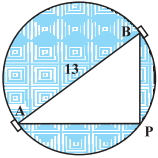
$A$ pole has to be erected at a point on the boundary of a circular park of diameter $13 \, m$ in such a way that the differences of its distances from two diametrically opposite fixed gates $A$ and $B$ on the boundary is $7 \, m$. Is it possible to do so? If yes,at what distances from the two gates should the pole be erected?
Solution
(A) Let $P$ be the required location of the pole on the boundary of the circular park.
Let the distance of the pole from gate $B$ be $x \, m$,i.e.,$BP = x \, m$.
The difference of the distances of the pole from the two gates is $AP - BP = 7 \, m$.
Therefore,$AP = (x + 7) \, m$.
Since $AB$ is the diameter of the circular park,$AB = 13 \, m$.
In a circle,the angle subtended by the diameter at any point on the boundary is $90^{\circ}$. Thus,$\angle APB = 90^{\circ}$.
By Pythagoras theorem in $\triangle APB$,we have $AP^2 + BP^2 = AB^2$.
Substituting the values,$(x + 7)^2 + x^2 = 13^2$.
Expanding the equation: $x^2 + 14x + 49 + x^2 = 169$.
$2x^2 + 14x - 120 = 0$.
Dividing by $2$,we get the quadratic equation: $x^2 + 7x - 60 = 0$.
To check if this is possible,we calculate the discriminant $D = b^2 - 4ac = 7^2 - 4(1)(-60) = 49 + 240 = 289$.
Since $D > 0$,the equation has two distinct real roots,so it is possible to erect the pole.
Using the quadratic formula $x = \frac{-b \pm \sqrt{D}}{2a}$,we get $x = \frac{-7 \pm \sqrt{289}}{2} = \frac{-7 \pm 17}{2}$.
This gives $x = \frac{10}{2} = 5$ or $x = \frac{-24}{2} = -12$.
Since distance cannot be negative,we take $x = 5$.
Thus,the pole should be erected at a distance of $5 \, m$ from gate $B$ and $12 \, m$ from gate $A$.
Let the distance of the pole from gate $B$ be $x \, m$,i.e.,$BP = x \, m$.
The difference of the distances of the pole from the two gates is $AP - BP = 7 \, m$.
Therefore,$AP = (x + 7) \, m$.
Since $AB$ is the diameter of the circular park,$AB = 13 \, m$.
In a circle,the angle subtended by the diameter at any point on the boundary is $90^{\circ}$. Thus,$\angle APB = 90^{\circ}$.
By Pythagoras theorem in $\triangle APB$,we have $AP^2 + BP^2 = AB^2$.
Substituting the values,$(x + 7)^2 + x^2 = 13^2$.
Expanding the equation: $x^2 + 14x + 49 + x^2 = 169$.
$2x^2 + 14x - 120 = 0$.
Dividing by $2$,we get the quadratic equation: $x^2 + 7x - 60 = 0$.
To check if this is possible,we calculate the discriminant $D = b^2 - 4ac = 7^2 - 4(1)(-60) = 49 + 240 = 289$.
Since $D > 0$,the equation has two distinct real roots,so it is possible to erect the pole.
Using the quadratic formula $x = \frac{-b \pm \sqrt{D}}{2a}$,we get $x = \frac{-7 \pm \sqrt{289}}{2} = \frac{-7 \pm 17}{2}$.
This gives $x = \frac{10}{2} = 5$ or $x = \frac{-24}{2} = -12$.
Since distance cannot be negative,we take $x = 5$.
Thus,the pole should be erected at a distance of $5 \, m$ from gate $B$ and $12 \, m$ from gate $A$.
0 likes
View Solution65
Medium
Find the discriminant of the equation $3x^{2}-2x+\frac{1}{3}=0$ and hence find the nature of its roots. Find them,if they are real.
Solution
(D) Given equation: $3x^{2}-2x+\frac{1}{3}=0$.
Comparing with $ax^{2}+bx+c=0$,we get $a=3, b=-2, c=\frac{1}{3}$.
Discriminant $D = b^{2}-4ac = (-2)^{2}-4(3)(\frac{1}{3}) = 4-4 = 0$.
Since $D=0$,the equation has two equal real roots.
The roots are given by $x = \frac{-b}{2a}$.
$x = \frac{-(-2)}{2(3)} = \frac{2}{6} = \frac{1}{3}$.
Thus,the roots are $\frac{1}{3}, \frac{1}{3}$.
Comparing with $ax^{2}+bx+c=0$,we get $a=3, b=-2, c=\frac{1}{3}$.
Discriminant $D = b^{2}-4ac = (-2)^{2}-4(3)(\frac{1}{3}) = 4-4 = 0$.
Since $D=0$,the equation has two equal real roots.
The roots are given by $x = \frac{-b}{2a}$.
$x = \frac{-(-2)}{2(3)} = \frac{2}{6} = \frac{1}{3}$.
Thus,the roots are $\frac{1}{3}, \frac{1}{3}$.
0 likes
View Solution66
Medium
Find the nature of the roots of the following quadratic equation. If real roots exist,find them:
$2x^2 - 3x + 5 = 0$
$2x^2 - 3x + 5 = 0$
Solution
(C) For a quadratic equation $ax^2 + bx + c = 0$,the discriminant $D$ is given by $D = b^2 - 4ac$.
$(A)$ If $D > 0$,there are two distinct real roots.
$(B)$ If $D = 0$,there are two equal real roots.
$(C)$ If $D < 0$,there are no real roots.
Given the equation $2x^2 - 3x + 5 = 0$,we compare it with $ax^2 + bx + c = 0$ to get:
$a = 2$,$b = -3$,$c = 5$.
Calculating the discriminant:
$D = b^2 - 4ac = (-3)^2 - 4(2)(5)$
$D = 9 - 40 = -31$.
Since $D < 0$,the given quadratic equation has no real roots.
$(A)$ If $D > 0$,there are two distinct real roots.
$(B)$ If $D = 0$,there are two equal real roots.
$(C)$ If $D < 0$,there are no real roots.
Given the equation $2x^2 - 3x + 5 = 0$,we compare it with $ax^2 + bx + c = 0$ to get:
$a = 2$,$b = -3$,$c = 5$.
Calculating the discriminant:
$D = b^2 - 4ac = (-3)^2 - 4(2)(5)$
$D = 9 - 40 = -31$.
Since $D < 0$,the given quadratic equation has no real roots.
0 likes
View Solution67
Difficult
Find the nature of the roots of the following quadratic equation. If real roots exist,find them:
$3x^2 - 4\sqrt{3}x + 4 = 0$
$3x^2 - 4\sqrt{3}x + 4 = 0$
Solution
(N/A) We know that for a quadratic equation $ax^2 + bx + c = 0$,the discriminant is $D = b^2 - 4ac$.
$(A)$ If $D > 0$,there are two distinct real roots.
$(B)$ If $D = 0$,there are two equal real roots.
$(C)$ If $D < 0$,there are no real roots.
Given equation: $3x^2 - 4\sqrt{3}x + 4 = 0$.
Comparing this with $ax^2 + bx + c = 0$,we get $a = 3$,$b = -4\sqrt{3}$,and $c = 4$.
Discriminant $D = b^2 - 4ac = (-4\sqrt{3})^2 - 4(3)(4)$.
$D = 48 - 48 = 0$.
Since $D = 0$,the equation has two equal real roots.
The roots are given by $x = \frac{-b}{2a}$.
$x = \frac{-(-4\sqrt{3})}{2(3)} = \frac{4\sqrt{3}}{6} = \frac{2\sqrt{3}}{3} = \frac{2}{\sqrt{3}}$.
Thus,the roots are $\frac{2}{\sqrt{3}}$ and $\frac{2}{\sqrt{3}}$.
$(A)$ If $D > 0$,there are two distinct real roots.
$(B)$ If $D = 0$,there are two equal real roots.
$(C)$ If $D < 0$,there are no real roots.
Given equation: $3x^2 - 4\sqrt{3}x + 4 = 0$.
Comparing this with $ax^2 + bx + c = 0$,we get $a = 3$,$b = -4\sqrt{3}$,and $c = 4$.
Discriminant $D = b^2 - 4ac = (-4\sqrt{3})^2 - 4(3)(4)$.
$D = 48 - 48 = 0$.
Since $D = 0$,the equation has two equal real roots.
The roots are given by $x = \frac{-b}{2a}$.
$x = \frac{-(-4\sqrt{3})}{2(3)} = \frac{4\sqrt{3}}{6} = \frac{2\sqrt{3}}{3} = \frac{2}{\sqrt{3}}$.
Thus,the roots are $\frac{2}{\sqrt{3}}$ and $\frac{2}{\sqrt{3}}$.
0 likes
View Solution68
Medium
Find the nature of the roots of the following quadratic equation. If the real roots exist,find them:
$2x^2 - 6x + 3 = 0$
$2x^2 - 6x + 3 = 0$
Solution
(A) For a quadratic equation $ax^2 + bx + c = 0$,the discriminant $D$ is given by $D = b^2 - 4ac$.
$(A)$ If $D > 0$,there are two distinct real roots.
$(B)$ If $D = 0$,there are two equal real roots.
$(C)$ If $D < 0$,there are no real roots.
Given the equation $2x^2 - 6x + 3 = 0$,comparing it with $ax^2 + bx + c = 0$,we get:
$a = 2, b = -6, c = 3$.
Discriminant $D = (-6)^2 - 4(2)(3) = 36 - 24 = 12$.
Since $D > 0$,the equation has two distinct real roots.
Using the quadratic formula $x = \frac{-b \pm \sqrt{D}}{2a}$:
$x = \frac{-(-6) \pm \sqrt{12}}{2(2)} = \frac{6 \pm 2\sqrt{3}}{4}$.
Dividing the numerator and denominator by $2$,we get:
$x = \frac{3 \pm \sqrt{3}}{2}$.
Thus,the roots are $\frac{3 + \sqrt{3}}{2}$ and $\frac{3 - \sqrt{3}}{2}$.
$(A)$ If $D > 0$,there are two distinct real roots.
$(B)$ If $D = 0$,there are two equal real roots.
$(C)$ If $D < 0$,there are no real roots.
Given the equation $2x^2 - 6x + 3 = 0$,comparing it with $ax^2 + bx + c = 0$,we get:
$a = 2, b = -6, c = 3$.
Discriminant $D = (-6)^2 - 4(2)(3) = 36 - 24 = 12$.
Since $D > 0$,the equation has two distinct real roots.
Using the quadratic formula $x = \frac{-b \pm \sqrt{D}}{2a}$:
$x = \frac{-(-6) \pm \sqrt{12}}{2(2)} = \frac{6 \pm 2\sqrt{3}}{4}$.
Dividing the numerator and denominator by $2$,we get:
$x = \frac{3 \pm \sqrt{3}}{2}$.
Thus,the roots are $\frac{3 + \sqrt{3}}{2}$ and $\frac{3 - \sqrt{3}}{2}$.
0 likes
View Solution69
Medium
Find the values of $k$ for the following quadratic equation,so that it has two equal roots:
$2 x^{2}+k x+3=0$
$2 x^{2}+k x+3=0$
Solution
(D) We know that if a quadratic equation $a x^{2}+b x+c=0$ has two equal roots,its discriminant $D = (b^{2}-4 a c)$ must be equal to $0$.
Given equation: $2 x^{2}+k x+3=0$
Comparing this with the standard form $a x^{2}+b x+c=0$,we get:
$a=2, b=k, c=3$
The discriminant is given by:
$D = b^{2}-4 a c$
$D = (k)^{2}-4(2)(3)$
$D = k^{2}-24$
For the equation to have two equal roots,we set the discriminant to $0$:
$k^{2}-24 = 0$
$k^{2} = 24$
$k = \pm \sqrt{24}$
$k = \pm 2 \sqrt{6}$
Given equation: $2 x^{2}+k x+3=0$
Comparing this with the standard form $a x^{2}+b x+c=0$,we get:
$a=2, b=k, c=3$
The discriminant is given by:
$D = b^{2}-4 a c$
$D = (k)^{2}-4(2)(3)$
$D = k^{2}-24$
For the equation to have two equal roots,we set the discriminant to $0$:
$k^{2}-24 = 0$
$k^{2} = 24$
$k = \pm \sqrt{24}$
$k = \pm 2 \sqrt{6}$
0 likes
View Solution70
Medium
Find the values of $k$ for the following quadratic equation,so that it has two equal roots:
$k x(x-2)+6=0$
$k x(x-2)+6=0$
Solution
(K=6) Given equation: $k x(x-2)+6=0$
Expanding the equation: $k x^{2}-2 k x+6=0$
Comparing this with the standard quadratic form $a x^{2}+b x+c=0$,we get:
$a=k, b=-2 k, c=6$
For a quadratic equation to have two equal roots,the discriminant $D$ must be equal to $0$:
$D = b^{2}-4 a c = 0$
Substituting the values:
$(-2 k)^{2}-4(k)(6) = 0$
$4 k^{2}-24 k = 0$
Factoring out $4k$:
$4 k(k-6) = 0$
This gives two possibilities: $4 k=0$ or $k-6=0$,which implies $k=0$ or $k=6$.
However,if $k=0$,the equation becomes $6=0$,which is not a quadratic equation. Thus,$k$ cannot be $0$.
Therefore,the only valid value is $k=6$.
Expanding the equation: $k x^{2}-2 k x+6=0$
Comparing this with the standard quadratic form $a x^{2}+b x+c=0$,we get:
$a=k, b=-2 k, c=6$
For a quadratic equation to have two equal roots,the discriminant $D$ must be equal to $0$:
$D = b^{2}-4 a c = 0$
Substituting the values:
$(-2 k)^{2}-4(k)(6) = 0$
$4 k^{2}-24 k = 0$
Factoring out $4k$:
$4 k(k-6) = 0$
This gives two possibilities: $4 k=0$ or $k-6=0$,which implies $k=0$ or $k=6$.
However,if $k=0$,the equation becomes $6=0$,which is not a quadratic equation. Thus,$k$ cannot be $0$.
Therefore,the only valid value is $k=6$.
0 likes
View Solution71
Medium
Is it possible to design a rectangular mango grove whose length is twice its breadth,and the area is $800 \, m^2$? If so,find its length and breadth.
Solution
(A) Let the breadth of the mango grove be $x \, m$.
Then,the length of the mango grove will be $2x \, m$.
Area of the rectangular mango grove $= \text{Length} \times \text{Breadth} = (2x)(x) = 2x^2 \, m^2$.
Given that the area is $800 \, m^2$,we have $2x^2 = 800$.
$x^2 = 400$.
$x^2 - 400 = 0$.
Comparing this with the standard quadratic equation $ax^2 + bx + c = 0$,we get $a = 1, b = 0, c = -400$.
The discriminant $D = b^2 - 4ac = (0)^2 - 4(1)(-400) = 1600$.
Since $D > 0$,the equation has two distinct real roots,meaning such a design is possible.
$x^2 = 400 \implies x = \pm 20$.
Since the breadth cannot be negative,we take $x = 20$.
Thus,the breadth is $20 \, m$ and the length is $2(20) = 40 \, m$.
Then,the length of the mango grove will be $2x \, m$.
Area of the rectangular mango grove $= \text{Length} \times \text{Breadth} = (2x)(x) = 2x^2 \, m^2$.
Given that the area is $800 \, m^2$,we have $2x^2 = 800$.
$x^2 = 400$.
$x^2 - 400 = 0$.
Comparing this with the standard quadratic equation $ax^2 + bx + c = 0$,we get $a = 1, b = 0, c = -400$.
The discriminant $D = b^2 - 4ac = (0)^2 - 4(1)(-400) = 1600$.
Since $D > 0$,the equation has two distinct real roots,meaning such a design is possible.
$x^2 = 400 \implies x = \pm 20$.
Since the breadth cannot be negative,we take $x = 20$.
Thus,the breadth is $20 \, m$ and the length is $2(20) = 40 \, m$.
0 likes
View Solution72
Medium
Is the following situation possible? If so,determine their present ages. The sum of the ages of two friends is $20$ years. Four years ago,the product of their ages in years was $48$.
Solution
(D) Let the age of one friend be $x$ years.
Age of the other friend will be $(20-x)$ years.
Four years ago,the age of the first friend was $(x-4)$ years.
The age of the second friend was $(20-x-4) = (16-x)$ years.
According to the given condition:
$(x-4)(16-x) = 48$
$16x - x^2 - 64 + 4x = 48$
$-x^2 + 20x - 64 = 48$
$-x^2 + 20x - 112 = 0$
$x^2 - 20x + 112 = 0$
Comparing this equation with the standard form $ax^2 + bx + c = 0$,we get $a=1, b=-20, c=112$.
The discriminant $D = b^2 - 4ac = (-20)^2 - 4(1)(112) = 400 - 448 = -48$.
Since the discriminant $D < 0$,there are no real roots for this quadratic equation.
Therefore,the given situation is not possible.
Age of the other friend will be $(20-x)$ years.
Four years ago,the age of the first friend was $(x-4)$ years.
The age of the second friend was $(20-x-4) = (16-x)$ years.
According to the given condition:
$(x-4)(16-x) = 48$
$16x - x^2 - 64 + 4x = 48$
$-x^2 + 20x - 64 = 48$
$-x^2 + 20x - 112 = 0$
$x^2 - 20x + 112 = 0$
Comparing this equation with the standard form $ax^2 + bx + c = 0$,we get $a=1, b=-20, c=112$.
The discriminant $D = b^2 - 4ac = (-20)^2 - 4(1)(112) = 400 - 448 = -48$.
Since the discriminant $D < 0$,there are no real roots for this quadratic equation.
Therefore,the given situation is not possible.
0 likes
View Solution73
Difficult
Is it possible to design a rectangular park of perimeter $80\, m$ and area $400\, m^2$? If so,find its length and breadth.
Solution
(A) Let the length and breadth of the park be $l$ and $b$ respectively.
The perimeter is given by $2(l + b) = 80\, m$,which simplifies to $l + b = 40$,or $b = 40 - l$.
The area is given by $l \times b = 400\, m^2$.
Substituting $b = 40 - l$ into the area equation: $l(40 - l) = 400$.
This gives $40l - l^2 = 400$,or $l^2 - 40l + 400 = 0$.
Comparing this with the standard quadratic equation $al^2 + bl + c = 0$,we have $a = 1, b = -40, c = 400$.
The discriminant $D = b^2 - 4ac = (-40)^2 - 4(1)(400) = 1600 - 1600 = 0$.
Since $D = 0$,the equation has real and equal roots,meaning the situation is possible.
The roots are given by $l = -b / (2a) = -(-40) / (2 \times 1) = 40 / 2 = 20$.
Thus,the length $l = 20\, m$ and the breadth $b = 40 - 20 = 20\, m$.
The perimeter is given by $2(l + b) = 80\, m$,which simplifies to $l + b = 40$,or $b = 40 - l$.
The area is given by $l \times b = 400\, m^2$.
Substituting $b = 40 - l$ into the area equation: $l(40 - l) = 400$.
This gives $40l - l^2 = 400$,or $l^2 - 40l + 400 = 0$.
Comparing this with the standard quadratic equation $al^2 + bl + c = 0$,we have $a = 1, b = -40, c = 400$.
The discriminant $D = b^2 - 4ac = (-40)^2 - 4(1)(400) = 1600 - 1600 = 0$.
Since $D = 0$,the equation has real and equal roots,meaning the situation is possible.
The roots are given by $l = -b / (2a) = -(-40) / (2 \times 1) = 40 / 2 = 20$.
Thus,the length $l = 20\, m$ and the breadth $b = 40 - 20 = 20\, m$.
0 likes
View SolutionQuadratic Equations — Textbook - Quadratic Equations · Frequently Asked Questions
1Are these Quadratic Equations questions useful for JEE and NEET?
Yes. All questions in this section are mapped to JEE Main and NEET exam patterns. Previous year questions from JEE Main, NEET, GUJCET and state-level exams are included with full solutions.
2Can I switch to Hindi or Gujarati for these questions?
Yes. Use the language tabs in the hero section or the sidebar to view the same questions and solutions in English, Hindi or Gujarati.
3How do I generate a question paper from this subtopic?
Use the Vedclass Exam Paper Generator — select the chapter and subtopic, set difficulty, and generate Sets A, B, C, D automatically. First 3 chapters of every subject are free.
Vedclass Products
For Students
Vedclass Test Series
Mock tests in real JEE/NEET style with performance analysis. 5-day free trial.
Start Free TrialFor Teachers
Exam Paper Generator
Generate Set A/B/C/D papers from this chapter in 2 minutes. 3 chapters free.
Try FreeFor Institutes
Online Exam Module
Live online exams with unlimited students, 360° analytics & white-label branding.
See DemoFor Teachers & Institutes
Generate a Quadratic Equations Exam Paper in 2 Minutes
Select subtopic & difficulty — Sets A, B, C, D auto-generated with No Repeat logic.
First 3 chapters of every subject are free — no payment required.