
A English
Textbook - Probability Questions in English
Class 10 Mathematics · Probability · Textbook - Probability
44+
Questions
English
Language
100%
With Solutions
Showing 44 of 44 questions in English
1
Easy
Find the probability of getting a head when a coin is tossed once. Also find the probability of getting a tail.
Solution
(N/A) In the experiment of tossing a coin once, the total number of possible outcomes is $2$ $-$ Head $(H)$ and Tail $(T).$
Let $E$ be the event of 'getting a head'. The number of outcomes favourable to $E$ is $1.$
Therefore, $P(E) = P(\text{head}) = \frac{\text{Number of outcomes favourable to } E}{\text{Total number of possible outcomes}} = \frac{1}{2}.$
Similarly, if $F$ is the event of 'getting a tail', the number of outcomes favourable to $F$ is $1.$
Therefore, $P(F) = P(\text{tail}) = \frac{1}{2}.$
Let $E$ be the event of 'getting a head'. The number of outcomes favourable to $E$ is $1.$
Therefore, $P(E) = P(\text{head}) = \frac{\text{Number of outcomes favourable to } E}{\text{Total number of possible outcomes}} = \frac{1}{2}.$
Similarly, if $F$ is the event of 'getting a tail', the number of outcomes favourable to $F$ is $1.$
Therefore, $P(F) = P(\text{tail}) = \frac{1}{2}.$
0 likes
View Solution2
Easy
$A$ bag contains a red ball,a blue ball and a yellow ball,all the balls being of the same size. Kritika takes out a ball from the bag without looking into it. What is the probability that she takes out the
$(i)$ yellow ball?
$(ii)$ red ball?
$(iii)$ blue ball?
$(i)$ yellow ball?
$(ii)$ red ball?
$(iii)$ blue ball?
Solution
(N/A) Kritika takes out a ball from the bag without looking into it. Since all balls are of the same size,it is equally likely that she takes out any one of them.
Let $Y$ be the event 'the ball taken out is yellow',$B$ be the event 'the ball taken out is blue',and $R$ be the event 'the ball taken out is red'.
The total number of possible outcomes $= 3$.
$(i)$ The number of outcomes favourable to the event $Y = 1$.
So,$P(Y) = \frac{\text{Number of favourable outcomes}}{\text{Total number of possible outcomes}} = \frac{1}{3}$.
$(ii)$ The number of outcomes favourable to the event $R = 1$.
So,$P(R) = \frac{1}{3}$.
$(iii)$ The number of outcomes favourable to the event $B = 1$.
So,$P(B) = \frac{1}{3}$.
Let $Y$ be the event 'the ball taken out is yellow',$B$ be the event 'the ball taken out is blue',and $R$ be the event 'the ball taken out is red'.
The total number of possible outcomes $= 3$.
$(i)$ The number of outcomes favourable to the event $Y = 1$.
So,$P(Y) = \frac{\text{Number of favourable outcomes}}{\text{Total number of possible outcomes}} = \frac{1}{3}$.
$(ii)$ The number of outcomes favourable to the event $R = 1$.
So,$P(R) = \frac{1}{3}$.
$(iii)$ The number of outcomes favourable to the event $B = 1$.
So,$P(B) = \frac{1}{3}$.
0 likes
View Solution3
Easy
Suppose we throw a die once. $(i)$ What is the probability of getting a number greater than $4$? $(ii)$ What is the probability of getting a number less than or equal to $4$?
Solution
(N/A) $(i)$ Here,let $E$ be the event 'getting a number greater than $4$'. The total number of possible outcomes is $6$ $(1, 2, 3, 4, 5, 6)$. The outcomes favourable to $E$ are $5$ and $6$. Therefore,the number of outcomes favourable to $E$ is $2$.
$P(E) = P(\text{number greater than } 4) = \frac{2}{6} = \frac{1}{3}$.
$(ii)$ Let $F$ be the event 'getting a number less than or equal to $4$'.
The total number of possible outcomes is $6$.
The outcomes favourable to the event $F$ are $1, 2, 3, 4$.
Therefore,the number of outcomes favourable to $F$ is $4$.
$P(F) = P(\text{number less than or equal to } 4) = \frac{4}{6} = \frac{2}{3}$.
$P(E) = P(\text{number greater than } 4) = \frac{2}{6} = \frac{1}{3}$.
$(ii)$ Let $F$ be the event 'getting a number less than or equal to $4$'.
The total number of possible outcomes is $6$.
The outcomes favourable to the event $F$ are $1, 2, 3, 4$.
Therefore,the number of outcomes favourable to $F$ is $4$.
$P(F) = P(\text{number less than or equal to } 4) = \frac{4}{6} = \frac{2}{3}$.
0 likes
View Solution4
MediumMCQ
One card is drawn from a well-shuffled deck of $52$ cards. Calculate the probability that the card will
$(i)$ be an ace,
$(ii)$ not be an ace.
$(i)$ be an ace,
$(ii)$ not be an ace.
A
$1/13, 12/13$
B
$1/52, 51/52$
C
$4/13, 9/13$
D
$1/4, 3/4$
Solution
(A) Well-shuffling ensures equally likely outcomes.
$(i)$ There are $4$ aces in a deck. Let $E$ be the event 'the card is an ace'.
The number of outcomes favourable to $E = 4$.
The number of possible outcomes $= 52$.
Therefore,$P(E) = \frac{4}{52} = \frac{1}{13}$.
$(ii)$ Let $F$ be the event 'card drawn is not an ace'.
The number of outcomes favourable to the event $F = 52 - 4 = 48$.
The number of possible outcomes $= 52$.
Therefore,$P(F) = \frac{48}{52} = \frac{12}{13}$.
$(i)$ There are $4$ aces in a deck. Let $E$ be the event 'the card is an ace'.
The number of outcomes favourable to $E = 4$.
The number of possible outcomes $= 52$.
Therefore,$P(E) = \frac{4}{52} = \frac{1}{13}$.
$(ii)$ Let $F$ be the event 'card drawn is not an ace'.
The number of outcomes favourable to the event $F = 52 - 4 = 48$.
The number of possible outcomes $= 52$.
Therefore,$P(F) = \frac{48}{52} = \frac{12}{13}$.
0 likes
View Solution5
MediumMCQ
Two players,Sangeeta and Reshma,play a tennis match. It is known that the probability of Sangeeta winning the match is $0.62$. What is the probability of Reshma winning the match?
A
$0.10$
B
$0.62$
C
$0.38$
D
$0.86$
Solution
(C) Let $S$ and $R$ denote the events that Sangeeta wins the match and Reshma wins the match,respectively.
The probability of Sangeeta winning is $P(S) = 0.62$ (given).
Since the events $S$ and $R$ are complementary (assuming one must win),the probability of Reshma winning is $P(R) = 1 - P(S)$.
Therefore,$P(R) = 1 - 0.62 = 0.38$.
The probability of Sangeeta winning is $P(S) = 0.62$ (given).
Since the events $S$ and $R$ are complementary (assuming one must win),the probability of Reshma winning is $P(R) = 1 - P(S)$.
Therefore,$P(R) = 1 - 0.62 = 0.38$.
0 likes
View Solution6
EasyMCQ
Savita and Hamida are friends. What is the probability that both will have $(i)$ different birthdays? $(ii)$ the same birthday? (ignoring a leap year).
A
$364/365, 1/365$
B
$1/365, 364/365$
C
$1/366, 365/366$
D
$365/366, 1/366$
Solution
(A) Out of the two friends,one girl,say,Savita's birthday can be any day of the year. Now,Hamida's birthday can also be any day of $365$ days in the year.
We assume that these $365$ outcomes are equally likely.
$(i)$ If Hamida's birthday is different from Savita's,the number of favourable outcomes for her birthday is $365 - 1 = 364$.
So,$P(\text{Hamida's birthday is different from Savita's birthday}) = \frac{364}{365}$.
$(ii)$ $P(\text{Savita and Hamida have the same birthday})$
$= 1 - P(\text{both have different birthdays})$
$= 1 - \frac{364}{365} \quad [\text{Using } P(\overline{E}) = 1 - P(E)]$
$= \frac{1}{365}$.
We assume that these $365$ outcomes are equally likely.
$(i)$ If Hamida's birthday is different from Savita's,the number of favourable outcomes for her birthday is $365 - 1 = 364$.
So,$P(\text{Hamida's birthday is different from Savita's birthday}) = \frac{364}{365}$.
$(ii)$ $P(\text{Savita and Hamida have the same birthday})$
$= 1 - P(\text{both have different birthdays})$
$= 1 - \frac{364}{365} \quad [\text{Using } P(\overline{E}) = 1 - P(E)]$
$= \frac{1}{365}$.
0 likes
View Solution7
MediumMCQ
There are $40$ students in Class $X$ of a school,of whom $25$ are girls and $15$ are boys. The class teacher has to select one student as a class representative. She writes the name of each student on a separate card,the cards being identical. Then she puts cards in a bag and stirs them thoroughly. She then draws one card from the bag. What is the probability that the name written on the card is the name of $(i)$ a girl? $(ii)$ a boy?
A
Probability of a girl: $5/8$,Probability of a boy: $3/8$
B
Probability of a girl: $3/8$,Probability of a boy: $5/8$
C
Probability of a girl: $1/2$,Probability of a boy: $1/2$
D
Probability of a girl: $2/5$,Probability of a boy: $3/5$
Solution
(A) Total number of students $= 40$.
$(i)$ Number of girls $= 25$.
Probability of selecting a girl $= \frac{\text{Number of girls}}{\text{Total number of students}} = \frac{25}{40} = \frac{5}{8}$.
$(ii)$ Number of boys $= 15$.
Probability of selecting a boy $= \frac{\text{Number of boys}}{\text{Total number of students}} = \frac{15}{40} = \frac{3}{8}$.
$(i)$ Number of girls $= 25$.
Probability of selecting a girl $= \frac{\text{Number of girls}}{\text{Total number of students}} = \frac{25}{40} = \frac{5}{8}$.
$(ii)$ Number of boys $= 15$.
Probability of selecting a boy $= \frac{\text{Number of boys}}{\text{Total number of students}} = \frac{15}{40} = \frac{3}{8}$.
0 likes
View Solution8
Difficult
$A$ box contains $3$ blue,$2$ white,and $4$ red marbles. If a marble is drawn at random from the box,what is the probability that it will be
$(i)$ white?
$(ii)$ blue?
$(iii)$ red?
$(i)$ white?
$(ii)$ blue?
$(iii)$ red?
Solution
(A) The statement that a marble is drawn at random implies that all marbles are equally likely to be drawn.
Total number of possible outcomes $= 3 + 2 + 4 = 9$.
Let $W$ denote the event 'the marble is white',$B$ denote the event 'the marble is blue',and $R$ denote the event 'the marble is red'.
$(i)$ The number of outcomes favourable to the event $W$ is $2$.
So,$P(W) = \frac{2}{9}$.
$(ii)$ The number of outcomes favourable to the event $B$ is $3$.
So,$P(B) = \frac{3}{9} = \frac{1}{3}$.
$(iii)$ The number of outcomes favourable to the event $R$ is $4$.
So,$P(R) = \frac{4}{9}$.
Note that $P(W) + P(B) + P(R) = \frac{2}{9} + \frac{3}{9} + \frac{4}{9} = \frac{9}{9} = 1$.
Total number of possible outcomes $= 3 + 2 + 4 = 9$.
Let $W$ denote the event 'the marble is white',$B$ denote the event 'the marble is blue',and $R$ denote the event 'the marble is red'.
$(i)$ The number of outcomes favourable to the event $W$ is $2$.
So,$P(W) = \frac{2}{9}$.
$(ii)$ The number of outcomes favourable to the event $B$ is $3$.
So,$P(B) = \frac{3}{9} = \frac{1}{3}$.
$(iii)$ The number of outcomes favourable to the event $R$ is $4$.
So,$P(R) = \frac{4}{9}$.
Note that $P(W) + P(B) + P(R) = \frac{2}{9} + \frac{3}{9} + \frac{4}{9} = \frac{9}{9} = 1$.
1 likes
View Solution9
MediumMCQ
Harpreet tosses two different coins simultaneously (say,one is of $Rs. 1$ and other of $Rs. 2$). What is the probability that she gets at least one head?
A
$1/4$
B
$1/2$
C
$3/4$
D
$1$
Solution
(C) We write $H$ for 'head' and $T$ for 'tail'. When two coins are tossed simultaneously,the possible outcomes are $(H, H), (H, T), (T, H), (T, T)$,which are all equally likely.
Here $(H, H)$ means head up on the first coin (say on $Rs. 1$) and head up on the second coin (say on $Rs. 2$). Similarly,$(H, T)$ means head up on the first coin and tail up on the second coin,and so on.
The outcomes favourable to the event $E$,'at least one head',are $(H, H), (H, T)$,and $(T, H)$.
So,the number of outcomes favourable to $E$ is $3$.
The total number of possible outcomes is $4$.
Therefore,$P(E) = \frac{\text{Number of favourable outcomes}}{\text{Total number of possible outcomes}} = \frac{3}{4}$.
i.e.,the probability that Harpreet gets at least one head is $3/4$.
Here $(H, H)$ means head up on the first coin (say on $Rs. 1$) and head up on the second coin (say on $Rs. 2$). Similarly,$(H, T)$ means head up on the first coin and tail up on the second coin,and so on.
The outcomes favourable to the event $E$,'at least one head',are $(H, H), (H, T)$,and $(T, H)$.
So,the number of outcomes favourable to $E$ is $3$.
The total number of possible outcomes is $4$.
Therefore,$P(E) = \frac{\text{Number of favourable outcomes}}{\text{Total number of possible outcomes}} = \frac{3}{4}$.
i.e.,the probability that Harpreet gets at least one head is $3/4$.
0 likes
View Solution10
Medium
In a musical chair game,the person playing the music has been advised to stop playing the music at any time within $2 \, \text{minutes}$ after she starts playing. What is the probability that the music will stop within the first half-minute after starting?
Solution
(1/4) Here,the possible outcomes are all the numbers between $0$ and $2$. This is the portion of the number line from $0$ to $2$.
Let $E$ be the event that 'the music is stopped within the first half-minute'.
The outcomes favourable to $E$ are points on the number line from $0$ to $\frac{1}{2}$.
The total distance from $0$ to $2$ is $2$,while the distance favourable to $E$ from $0$ to $\frac{1}{2}$ is $\frac{1}{2}$.
Since all the outcomes are equally likely,we can argue that,of the total distance of $2$,the distance favourable to the event $E$ is $\frac{1}{2}$.
So,$P(E) = \frac{\text{Distance favourable to the event } E}{\text{Total distance in which outcomes can lie}} = \frac{\frac{1}{2}}{2} = \frac{1}{4}$.
Let $E$ be the event that 'the music is stopped within the first half-minute'.
The outcomes favourable to $E$ are points on the number line from $0$ to $\frac{1}{2}$.
The total distance from $0$ to $2$ is $2$,while the distance favourable to $E$ from $0$ to $\frac{1}{2}$ is $\frac{1}{2}$.
Since all the outcomes are equally likely,we can argue that,of the total distance of $2$,the distance favourable to the event $E$ is $\frac{1}{2}$.
So,$P(E) = \frac{\text{Distance favourable to the event } E}{\text{Total distance in which outcomes can lie}} = \frac{\frac{1}{2}}{2} = \frac{1}{4}$.

0 likes
View Solution11
DifficultMCQ
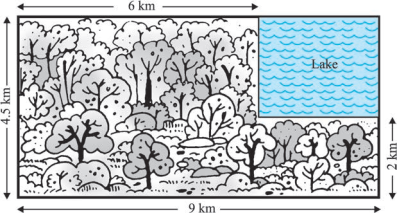
$A$ missing helicopter is reported to have crashed somewhere in the rectangular region shown in the figure. What is the probability that it crashed inside the lake shown in the figure?
A
$1$/$9$
B
$1$/$6$
C
$1$/$3$
D
$5$/$27$
Solution
(D) The helicopter is equally likely to crash anywhere in the region.
Total area of the rectangular region $= (9 \times 4.5) \, km^2 = 40.5 \, km^2$.
The lake is a rectangle with length $= (9 - 6) \, km = 3 \, km$ and width $= (4.5 - 2) \, km = 2.5 \, km$.
Area of the lake $= (3 \times 2.5) \, km^2 = 7.5 \, km^2$.
The probability that the helicopter crashed inside the lake is given by the ratio of the area of the lake to the total area.
$P(\text{helicopter crashed in the lake}) = \frac{\text{Area of the lake}}{\text{Total area}} = \frac{7.5}{40.5} = \frac{75}{405} = \frac{5}{27}$.
Total area of the rectangular region $= (9 \times 4.5) \, km^2 = 40.5 \, km^2$.
The lake is a rectangle with length $= (9 - 6) \, km = 3 \, km$ and width $= (4.5 - 2) \, km = 2.5 \, km$.
Area of the lake $= (3 \times 2.5) \, km^2 = 7.5 \, km^2$.
The probability that the helicopter crashed inside the lake is given by the ratio of the area of the lake to the total area.
$P(\text{helicopter crashed in the lake}) = \frac{\text{Area of the lake}}{\text{Total area}} = \frac{7.5}{40.5} = \frac{75}{405} = \frac{5}{27}$.
0 likes
View Solution12
Medium
$A$ carton consists of $100$ shirts of which $88$ are good,$8$ have minor defects and $4$ have major defects. Jimmy,a trader,will only accept the shirts which are good,but Sujatha,another trader,will only reject the shirts which have major defects. One shirt is drawn at random from the carton. What is the probability that
$(i)$ it is acceptable to Jimmy? $\quad (ii)$ it is acceptable to Sujatha?
$(i)$ it is acceptable to Jimmy? $\quad (ii)$ it is acceptable to Sujatha?
Solution
(A) Total number of shirts in the carton $= 100$.
$(i)$ Jimmy accepts only good shirts. The number of good shirts $= 88$.
Therefore,the probability that the shirt is acceptable to Jimmy $= \frac{88}{100} = 0.88$.
$(ii)$ Sujatha rejects only shirts with major defects. This means she accepts shirts that are good and shirts that have minor defects.
Number of shirts acceptable to Sujatha $= 88 + 8 = 96$.
Therefore,the probability that the shirt is acceptable to Sujatha $= \frac{96}{100} = 0.96$.
$(i)$ Jimmy accepts only good shirts. The number of good shirts $= 88$.
Therefore,the probability that the shirt is acceptable to Jimmy $= \frac{88}{100} = 0.88$.
$(ii)$ Sujatha rejects only shirts with major defects. This means she accepts shirts that are good and shirts that have minor defects.
Number of shirts acceptable to Sujatha $= 88 + 8 = 96$.
Therefore,the probability that the shirt is acceptable to Sujatha $= \frac{96}{100} = 0.96$.
0 likes
View Solution13
Medium
Two dice,one blue and one grey,are thrown at the same time. Write down all the possible outcomes. What is the probability that the sum of the two numbers appearing on the top of the dice is
$(i)$ $8 ?$
$(ii)$ $13 ?$
$(iii)$ less than or equal to $12 ?$
$(i)$ $8 ?$
$(ii)$ $13 ?$
$(iii)$ less than or equal to $12 ?$
Solution
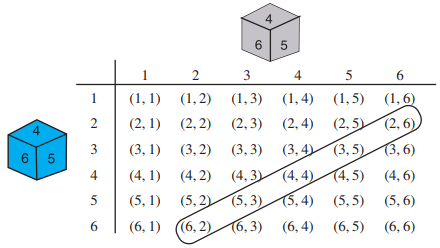
(N/A) When the blue die shows $1$,the grey die could show any one of the numbers $1, 2, 3, 4, 5, 6$. The same is true when the blue die shows $2, 3, 4, 5,$ or $6$. The possible outcomes of the experiment are listed in the table below; the first number in each ordered pair is the number appearing on the blue die and the second number is that on the grey die.
Note that the pair $(1, 4)$ is different from $(4, 1)$.
So,the total number of possible outcomes $= 6 \times 6 = 36$.
$(i)$ The outcomes favourable to the event "the sum of the two numbers is $8$" denoted by $E$,are: $(2, 6), (3, 5), (4, 4), (5, 3), (6, 2)$.
i.e.,the number of outcomes favourable to $E = 5$.
Hence,$P(E) = \frac{5}{36}$.
$(ii)$ As you can see,there is no outcome favourable to the event $F$,"the sum of two numbers is $13$".
So,$P(F) = \frac{0}{36} = 0$.
$(iii)$ As you can see,all the outcomes are favourable to the event $G$,"sum of two numbers $\leq 12$".
So,$P(G) = \frac{36}{36} = 1$.
Note that the pair $(1, 4)$ is different from $(4, 1)$.
So,the total number of possible outcomes $= 6 \times 6 = 36$.
$(i)$ The outcomes favourable to the event "the sum of the two numbers is $8$" denoted by $E$,are: $(2, 6), (3, 5), (4, 4), (5, 3), (6, 2)$.
i.e.,the number of outcomes favourable to $E = 5$.
Hence,$P(E) = \frac{5}{36}$.
$(ii)$ As you can see,there is no outcome favourable to the event $F$,"the sum of two numbers is $13$".
So,$P(F) = \frac{0}{36} = 0$.
$(iii)$ As you can see,all the outcomes are favourable to the event $G$,"sum of two numbers $\leq 12$".
So,$P(G) = \frac{36}{36} = 1$.
0 likes
View Solution14
Medium
Complete the following statements:
$(i)$ Probability of an event $E +$ Probability of the event 'not $E$' $= \dots \dots \dots \dots \dots$
$(ii)$ The probability of an event that cannot happen is $\dots \dots \dots$. Such an event is called $\dots \dots \dots \dots \dots$
$(iii)$ The probability of an event that is certain to happen is $\dots \dots \dots$. Such an event is called $\dots \dots \dots \dots \dots$
$(i)$ Probability of an event $E +$ Probability of the event 'not $E$' $= \dots \dots \dots \dots \dots$
$(ii)$ The probability of an event that cannot happen is $\dots \dots \dots$. Such an event is called $\dots \dots \dots \dots \dots$
$(iii)$ The probability of an event that is certain to happen is $\dots \dots \dots$. Such an event is called $\dots \dots \dots \dots \dots$
Solution
(A) $(i)$ The sum of the probabilities of an event $E$ and its complement 'not $E$' is always $1$. Thus,$P(E) + P(\text{not } E) = 1$.
$(ii)$ The probability of an event that cannot happen is $0$. Such an event is called an impossible event.
$(iii)$ The probability of an event that is certain to happen is $1$. Such an event is called a sure event or a certain event.
$(ii)$ The probability of an event that cannot happen is $0$. Such an event is called an impossible event.
$(iii)$ The probability of an event that is certain to happen is $1$. Such an event is called a sure event or a certain event.
0 likes
View Solution15
Easy
Complete the following statements:
$(i)$ The sum of the probabilities of all the elementary events of an experiment is .......
$(ii)$ The probability of an event is greater than or equal to ....... and less than or equal to .......
$(i)$ The sum of the probabilities of all the elementary events of an experiment is .......
$(ii)$ The probability of an event is greater than or equal to ....... and less than or equal to .......
Solution
(N/A) $(i)$ The sum of the probabilities of all elementary events of an experiment is $1$.
$(ii)$ The probability of an event $E$ is such that $0 \le P(E) \le 1$. Therefore,the probability of an event is greater than or equal to $0$ and less than or equal to $1$.
$(ii)$ The probability of an event $E$ is such that $0 \le P(E) \le 1$. Therefore,the probability of an event is greater than or equal to $0$ and less than or equal to $1$.
0 likes
View Solution16
Difficult
Which of the following experiments have equally likely outcomes? Explain.
$(i)$ $A$ driver attempts to start a car. The car starts or does not start.
$(ii)$ $A$ player attempts to shoot a basketball. She/he shoots or misses the shot.
$(iii)$ $A$ trial is made to answer a true-false question. The answer is right or wrong.
$(iv)$ $A$ baby is born. It is a boy or a girl.
$(i)$ $A$ driver attempts to start a car. The car starts or does not start.
$(ii)$ $A$ player attempts to shoot a basketball. She/he shoots or misses the shot.
$(iii)$ $A$ trial is made to answer a true-false question. The answer is right or wrong.
$(iv)$ $A$ baby is born. It is a boy or a girl.
Solution
(III, IV) $(i)$ This is not an equally likely event because the outcome depends on the mechanical condition of the car. The probability of the car starting is not necessarily equal to the probability of it not starting.
$(ii)$ This is not an equally likely event because the outcome depends on the player's skill and practice,which are not uniform for every attempt.
$(iii)$ This is an equally likely event because there are only two possible outcomes (right or wrong),and assuming no prior knowledge,each has an equal chance of occurring.
$(iv)$ This is an equally likely event because the biological probability of a baby being a boy or a girl is considered to be $50\%$ each,assuming no other external factors.
$(ii)$ This is not an equally likely event because the outcome depends on the player's skill and practice,which are not uniform for every attempt.
$(iii)$ This is an equally likely event because there are only two possible outcomes (right or wrong),and assuming no prior knowledge,each has an equal chance of occurring.
$(iv)$ This is an equally likely event because the biological probability of a baby being a boy or a girl is considered to be $50\%$ each,assuming no other external factors.
0 likes
View Solution17
EasyMCQ
Why is tossing a coin considered to be a fair way of deciding which team should get the ball at the beginning of a football game?
A
Because the coin is circular.
B
Because the outcomes are equally likely.
C
Because it is a tradition.
D
Because it is quick.
Solution
(B) When we toss a coin,the possible outcomes are only two,head or tail,which are equally likely outcomes.
Since the probability of getting a head is $1/2$ and the probability of getting a tail is $1/2$,the result of an individual toss is completely unpredictable and unbiased.
Therefore,tossing a coin is considered a fair way to decide which team gets the ball.
Since the probability of getting a head is $1/2$ and the probability of getting a tail is $1/2$,the result of an individual toss is completely unpredictable and unbiased.
Therefore,tossing a coin is considered a fair way to decide which team gets the ball.
0 likes
View Solution18
EasyMCQ
Which of the following cannot be the probability of an event?
A
$2/3$
B
$0.7$
C
$15 \%$
D
$-1.5$
Solution
(D) The probability of an event $E$,denoted by $P(E)$,always lies in the range $0 \le P(E) \le 1$.
This means that the probability of an event can never be negative and cannot exceed $1$.
Comparing the given options:
$(A)$ $2/3 \approx 0.66$,which is between $0$ and $1$.
$(B)$ $0.7$ is between $0$ and $1$.
$(C)$ $15 \% = 0.15$,which is between $0$ and $1$.
$(D)$ $-1.5$ is less than $0$.
Therefore,$-1.5$ cannot be the probability of an event.
This means that the probability of an event can never be negative and cannot exceed $1$.
Comparing the given options:
$(A)$ $2/3 \approx 0.66$,which is between $0$ and $1$.
$(B)$ $0.7$ is between $0$ and $1$.
$(C)$ $15 \% = 0.15$,which is between $0$ and $1$.
$(D)$ $-1.5$ is less than $0$.
Therefore,$-1.5$ cannot be the probability of an event.
0 likes
View Solution19
EasyMCQ
If $P(E) = 0.05$,what is the probability of 'not $E$'?
A
$0.95$
B
$1$
C
$0.90$
D
$0.50$
Solution
(A) We know that the sum of the probability of an event and the probability of its complement is $1$.
$P(E) + P(\text{not } E) = 1$
Given that $P(E) = 0.05$.
Therefore,$P(\text{not } E) = 1 - P(E)$
$P(\text{not } E) = 1 - 0.05$
$P(\text{not } E) = 0.95$
Thus,the probability of 'not $E$' is $0.95$.
$P(E) + P(\text{not } E) = 1$
Given that $P(E) = 0.05$.
Therefore,$P(\text{not } E) = 1 - P(E)$
$P(\text{not } E) = 1 - 0.05$
$P(\text{not } E) = 0.95$
Thus,the probability of 'not $E$' is $0.95$.
0 likes
View Solution20
MediumMCQ
$A$ bag contains lemon flavoured candies only. Malini takes out one candy without looking into the bag. What is the probability that she takes out
$(i)$ an orange flavoured candy?
$(ii)$ a lemon flavoured candy?
$(i)$ an orange flavoured candy?
$(ii)$ a lemon flavoured candy?
A
$0, 1$
B
$1, 0$
C
$0.5, 0.5$
D
$1, 1$
Solution
(A) $(i)$ The bag contains lemon flavoured candies only. It does not contain any orange flavoured candies. This implies that every time,she will take out only lemon flavoured candies. Therefore,the event that Malini will take out an orange flavoured candy is an impossible event.
Hence,$P(\text{an orange flavoured candy}) = 0$.
$(ii)$ As the bag has lemon flavoured candies,Malini will take out only lemon flavoured candies. Therefore,the event that Malini will take out a lemon flavoured candy is a sure event.
Hence,$P(\text{a lemon flavoured candy}) = 1$.
Hence,$P(\text{an orange flavoured candy}) = 0$.
$(ii)$ As the bag has lemon flavoured candies,Malini will take out only lemon flavoured candies. Therefore,the event that Malini will take out a lemon flavoured candy is a sure event.
Hence,$P(\text{a lemon flavoured candy}) = 1$.
0 likes
View Solution21
EasyMCQ
It is given that in a group of $3$ students,the probability of $2$ students not having the same birthday is $0.992$. What is the probability that the $2$ students have the same birthday?
A
$0.005$
B
$0.06$
C
$0.008$
D
$0.009$
Solution
(C) Let $E$ be the event that $2$ students have the same birthday.
Let $\bar{E}$ be the event that $2$ students do not have the same birthday.
It is given that $P(\bar{E}) = 0.992$.
We know that the sum of the probabilities of complementary events is $1$,so $P(E) + P(\bar{E}) = 1$.
Therefore,$P(E) = 1 - P(\bar{E})$.
$P(E) = 1 - 0.992 = 0.008$.
Let $\bar{E}$ be the event that $2$ students do not have the same birthday.
It is given that $P(\bar{E}) = 0.992$.
We know that the sum of the probabilities of complementary events is $1$,so $P(E) + P(\bar{E}) = 1$.
Therefore,$P(E) = 1 - P(\bar{E})$.
$P(E) = 1 - 0.992 = 0.008$.
0 likes
View Solution22
Medium
$A$ bag contains $3$ red balls and $5$ black balls. $A$ ball is drawn at random from the bag. What is the probability that the ball drawn is
$(i)$ red?
$(ii)$ not red?
$(i)$ red?
$(ii)$ not red?
Solution
(A) $(i)$ Total number of balls in the bag $= 3 + 5 = 8$.
The probability of drawing a red ball is given by the formula: $P(\text{red}) = \frac{\text{Number of favourable outcomes}}{\text{Total number of possible outcomes}}$.
$P(\text{red}) = \frac{3}{8}$.
$(ii)$ The probability of not drawing a red ball is the complement of drawing a red ball.
$P(\text{not red}) = 1 - P(\text{red})$.
$P(\text{not red}) = 1 - \frac{3}{8} = \frac{8 - 3}{8} = \frac{5}{8}$.
The probability of drawing a red ball is given by the formula: $P(\text{red}) = \frac{\text{Number of favourable outcomes}}{\text{Total number of possible outcomes}}$.
$P(\text{red}) = \frac{3}{8}$.
$(ii)$ The probability of not drawing a red ball is the complement of drawing a red ball.
$P(\text{not red}) = 1 - P(\text{red})$.
$P(\text{not red}) = 1 - \frac{3}{8} = \frac{8 - 3}{8} = \frac{5}{8}$.
0 likes
View Solution23
DifficultMCQ
$A$ box contains $5$ red marbles,$8$ white marbles and $4$ green marbles. One marble is taken out of the box at random. What is the probability that the marble taken out will be
$(i)$ red?
$(ii)$ white?
$(iii)$ not green?
$(i)$ red?
$(ii)$ white?
$(iii)$ not green?
A
$\frac{5}{17}, \frac{8}{17}, \frac{13}{17}$
B
$\frac{8}{17}, \frac{5}{17}, \frac{13}{17}$
C
$\frac{5}{17}, \frac{4}{17}, \frac{8}{17}$
D
$\frac{13}{17}, \frac{5}{17}, \frac{8}{17}$
Solution
(A) Total number of marbles $= 5 + 8 + 4 = 17$.
$(i)$ Number of red marbles $= 5$.
Probability of getting a red marble $= \frac{\text{Number of favourable outcomes}}{\text{Number of total possible outcomes}} = \frac{5}{17}$.
$(ii)$ Number of white marbles $= 8$.
Probability of getting a white marble $= \frac{\text{Number of favourable outcomes}}{\text{Number of total possible outcomes}} = \frac{8}{17}$.
$(iii)$ Number of green marbles $= 4$.
Probability of getting a green marble $= \frac{4}{17}$.
Probability of not getting a green marble $= 1 - P(\text{green}) = 1 - \frac{4}{17} = \frac{13}{17}$.
$(i)$ Number of red marbles $= 5$.
Probability of getting a red marble $= \frac{\text{Number of favourable outcomes}}{\text{Number of total possible outcomes}} = \frac{5}{17}$.
$(ii)$ Number of white marbles $= 8$.
Probability of getting a white marble $= \frac{\text{Number of favourable outcomes}}{\text{Number of total possible outcomes}} = \frac{8}{17}$.
$(iii)$ Number of green marbles $= 4$.
Probability of getting a green marble $= \frac{4}{17}$.
Probability of not getting a green marble $= 1 - P(\text{green}) = 1 - \frac{4}{17} = \frac{13}{17}$.
0 likes
View Solution24
EasyMCQ
$A$ piggy bank contains $100$ $50\, p$ coins,$50$ $Rs.\, 1$ coins,$20$ $Rs.\, 2$ coins,and $10$ $Rs.\, 5$ coins. If it is equally likely that one of the coins will fall out when the bank is turned upside down,what is the probability that the coin:
$(i)$ will be a $50\, p$ coin?
$(ii)$ will not be a $Rs.\, 5$ coin?
$(i)$ will be a $50\, p$ coin?
$(ii)$ will not be a $Rs.\, 5$ coin?
A
$\frac{5}{9}, \frac{17}{18}$
B
$\frac{17}{18}, \frac{5}{9}$
C
$\frac{9}{5}, \frac{17}{18}$
D
$\frac{9}{5}, \frac{18}{17}$
Solution
(A) Total number of coins in the piggy bank $= 100 + 50 + 20 + 10 = 180$.
$(i)$ Number of $50\, p$ coins $= 100$.
Probability of getting a $50\, p$ coin $= \frac{\text{Number of favourable outcomes}}{\text{Total number of outcomes}} = \frac{100}{180} = \frac{5}{9}$.
$(ii)$ Number of $Rs.\, 5$ coins $= 10$.
Probability of getting a $Rs.\, 5$ coin $= \frac{10}{180} = \frac{1}{18}$.
Probability of not getting a $Rs.\, 5$ coin $= 1 - P(\text{getting a } Rs.\, 5 \text{ coin}) = 1 - \frac{1}{18} = \frac{17}{18}$.
$(i)$ Number of $50\, p$ coins $= 100$.
Probability of getting a $50\, p$ coin $= \frac{\text{Number of favourable outcomes}}{\text{Total number of outcomes}} = \frac{100}{180} = \frac{5}{9}$.
$(ii)$ Number of $Rs.\, 5$ coins $= 10$.
Probability of getting a $Rs.\, 5$ coin $= \frac{10}{180} = \frac{1}{18}$.
Probability of not getting a $Rs.\, 5$ coin $= 1 - P(\text{getting a } Rs.\, 5 \text{ coin}) = 1 - \frac{1}{18} = \frac{17}{18}$.
0 likes
View Solution25
MediumMCQ
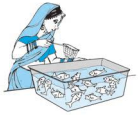
Gopi buys a fish from a shop for his aquarium. The shopkeeper takes out one fish at random from a tank containing $5$ male fish and $8$ female fish. What is the probability that the fish taken out is a male fish?
A
$\frac{5}{8}$
B
$\frac{8}{13}$
C
$\frac{5}{13}$
D
$\frac{13}{5}$
Solution
(C) Total number of fish in the tank $=$ Number of male fish $+$ Number of female fish
$= 5 + 8 = 13$
Probability of getting a male fish $= \frac{\text{Number of favourable outcomes}}{\text{Number of total possible outcomes}}$
$= \frac{5}{13}$
$= 5 + 8 = 13$
Probability of getting a male fish $= \frac{\text{Number of favourable outcomes}}{\text{Number of total possible outcomes}}$
$= \frac{5}{13}$
0 likes
View Solution26
Medium
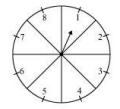
$A$ game of chance consists of spinning an arrow which comes to rest pointing at one of the numbers $1, 2, 3, 4, 5, 6, 7, 8$ (see figure),and these are equally likely outcomes. What is the probability that it will point at:
$(i)$ $8?$
$(ii)$ an odd number?
$(iii)$ a number greater than $2?$
$(iv)$ a number less than $9?$
$(i)$ $8?$
$(ii)$ an odd number?
$(iii)$ a number greater than $2?$
$(iv)$ a number less than $9?$
Solution
(N/A) The total number of possible outcomes is $8$ (i.e.,$1, 2, 3, 4, 5, 6, 7, 8$).
$(i)$ The number of favourable outcomes for getting $8$ is $1$.
Probability $= \frac{\text{Number of favourable outcomes}}{\text{Total number of possible outcomes}} = \frac{1}{8}$.
$(ii)$ The odd numbers are $1, 3, 5, 7$. The number of favourable outcomes is $4$.
Probability $= \frac{4}{8} = \frac{1}{2}$.
$(iii)$ The numbers greater than $2$ are $3, 4, 5, 6, 7, 8$. The number of favourable outcomes is $6$.
Probability $= \frac{6}{8} = \frac{3}{4}$.
$(iv)$ All numbers $1, 2, 3, 4, 5, 6, 7, 8$ are less than $9$. The number of favourable outcomes is $8$.
Probability $= \frac{8}{8} = 1$.
$(i)$ The number of favourable outcomes for getting $8$ is $1$.
Probability $= \frac{\text{Number of favourable outcomes}}{\text{Total number of possible outcomes}} = \frac{1}{8}$.
$(ii)$ The odd numbers are $1, 3, 5, 7$. The number of favourable outcomes is $4$.
Probability $= \frac{4}{8} = \frac{1}{2}$.
$(iii)$ The numbers greater than $2$ are $3, 4, 5, 6, 7, 8$. The number of favourable outcomes is $6$.
Probability $= \frac{6}{8} = \frac{3}{4}$.
$(iv)$ All numbers $1, 2, 3, 4, 5, 6, 7, 8$ are less than $9$. The number of favourable outcomes is $8$.
Probability $= \frac{8}{8} = 1$.
0 likes
View Solution27
Easy
$A$ die is thrown once. Find the probability of getting:
$(i)$ a prime number;
$(ii)$ a number lying between $2$ and $6$;
$(iii)$ an odd number.
$(i)$ a prime number;
$(ii)$ a number lying between $2$ and $6$;
$(iii)$ an odd number.
Solution
(N/A) The set of all possible outcomes when a fair die is thrown is $S = \{1, 2, 3, 4, 5, 6\}$.
The total number of possible outcomes is $n(S) = 6$.
$(i)$ The prime numbers on a die are $\{2, 3, 5\}$.
The number of favorable outcomes is $3$.
Probability $P(\text{prime}) = \frac{3}{6} = \frac{1}{2}$.
$(ii)$ The numbers lying between $2$ and $6$ are $\{3, 4, 5\}$.
The number of favorable outcomes is $3$.
Probability $P(\text{between } 2 \text{ and } 6) = \frac{3}{6} = \frac{1}{2}$.
$(iii)$ The odd numbers on a die are $\{1, 3, 5\}$.
The number of favorable outcomes is $3$.
Probability $P(\text{odd}) = \frac{3}{6} = \frac{1}{2}$.
The total number of possible outcomes is $n(S) = 6$.
$(i)$ The prime numbers on a die are $\{2, 3, 5\}$.
The number of favorable outcomes is $3$.
Probability $P(\text{prime}) = \frac{3}{6} = \frac{1}{2}$.
$(ii)$ The numbers lying between $2$ and $6$ are $\{3, 4, 5\}$.
The number of favorable outcomes is $3$.
Probability $P(\text{between } 2 \text{ and } 6) = \frac{3}{6} = \frac{1}{2}$.
$(iii)$ The odd numbers on a die are $\{1, 3, 5\}$.
The number of favorable outcomes is $3$.
Probability $P(\text{odd}) = \frac{3}{6} = \frac{1}{2}$.
0 likes
View Solution28
Medium
One card is drawn from a well-shuffled deck of $52$ cards. Find the probability of getting:
$(i)$ a king of red colour
$(ii)$ a face card
$(iii)$ a red face card
$(iv)$ the jack of hearts
$(v)$ a spade
$(vi)$ the queen of diamonds
$(i)$ a king of red colour
$(ii)$ a face card
$(iii)$ a red face card
$(iv)$ the jack of hearts
$(v)$ a spade
$(vi)$ the queen of diamonds
Solution
(A-D) Total number of cards in a well-shuffled deck $= 52$.
$(i)$ Total number of kings of red colour $= 2$ (King of Hearts and King of Diamonds).
$P(\text{king of red colour}) = \frac{2}{52} = \frac{1}{26}$.
$(ii)$ Total number of face cards (Kings,Queens,and Jacks) $= 3 \times 4 = 12$.
$P(\text{face card}) = \frac{12}{52} = \frac{3}{13}$.
$(iii)$ Total number of red face cards (Hearts and Diamonds) $= 3 + 3 = 6$.
$P(\text{red face card}) = \frac{6}{52} = \frac{3}{26}$.
$(iv)$ Total number of Jack of hearts $= 1$.
$P(\text{Jack of hearts}) = \frac{1}{52}$.
$(v)$ Total number of spade cards $= 13$.
$P(\text{spade}) = \frac{13}{52} = \frac{1}{4}$.
$(vi)$ Total number of queen of diamonds $= 1$.
$P(\text{queen of diamonds}) = \frac{1}{52}$.
$(i)$ Total number of kings of red colour $= 2$ (King of Hearts and King of Diamonds).
$P(\text{king of red colour}) = \frac{2}{52} = \frac{1}{26}$.
$(ii)$ Total number of face cards (Kings,Queens,and Jacks) $= 3 \times 4 = 12$.
$P(\text{face card}) = \frac{12}{52} = \frac{3}{13}$.
$(iii)$ Total number of red face cards (Hearts and Diamonds) $= 3 + 3 = 6$.
$P(\text{red face card}) = \frac{6}{52} = \frac{3}{26}$.
$(iv)$ Total number of Jack of hearts $= 1$.
$P(\text{Jack of hearts}) = \frac{1}{52}$.
$(v)$ Total number of spade cards $= 13$.
$P(\text{spade}) = \frac{13}{52} = \frac{1}{4}$.
$(vi)$ Total number of queen of diamonds $= 1$.
$P(\text{queen of diamonds}) = \frac{1}{52}$.
0 likes
View Solution29
Medium
Five cards - the ten,jack,queen,king and ace of diamonds,are well-shuffled with their face downwards. One card is then picked up at random.
$(i)$ What is the probability that the card is the queen?
$(ii)$ If the queen is drawn and put aside,what is the probability that the second card picked up is $(a)$ an $ace?$ $(b)$ a $queen?$
$(i)$ What is the probability that the card is the queen?
$(ii)$ If the queen is drawn and put aside,what is the probability that the second card picked up is $(a)$ an $ace?$ $(b)$ a $queen?$
Solution
(A) $(i)$ Total number of cards $= 5$.
Total number of queens $= 1$.
$P(\text{getting a queen}) = \frac{\text{Number of favourable outcomes}}{\text{Number of total possible outcomes}} = \frac{1}{5}$.
$(ii)$ When the queen is drawn and put aside,the total number of remaining cards will be $4$.
$(a)$ Total number of aces $= 1$.
$P(\text{getting an ace}) = \frac{1}{4}$.
$(b)$ As the queen is already drawn,the number of remaining queens is $0$.
$P(\text{getting a queen}) = \frac{0}{4} = 0$.
Total number of queens $= 1$.
$P(\text{getting a queen}) = \frac{\text{Number of favourable outcomes}}{\text{Number of total possible outcomes}} = \frac{1}{5}$.
$(ii)$ When the queen is drawn and put aside,the total number of remaining cards will be $4$.
$(a)$ Total number of aces $= 1$.
$P(\text{getting an ace}) = \frac{1}{4}$.
$(b)$ As the queen is already drawn,the number of remaining queens is $0$.
$P(\text{getting a queen}) = \frac{0}{4} = 0$.
0 likes
View Solution30
EasyMCQ
$12$ defective pens are accidentally mixed with $132$ good ones. It is not possible to just look at a pen and tell whether or not it is defective. One pen is taken out at random from this lot. Determine the probability that the pen taken out is a good one.
A
$11/12$
B
$1/12$
C
$12/132$
D
$132/144$
Solution
(A) Total number of pens $= 12 + 132 = 144$.
Total number of good pens $= 132$.
The probability $P$ of an event is given by the formula:
$P(\text{event}) = \frac{\text{Number of favourable outcomes}}{\text{Total number of possible outcomes}}$.
Therefore,the probability of getting a good pen is:
$P(\text{good pen}) = \frac{132}{144}$.
Dividing both the numerator and the denominator by $12$,we get:
$P(\text{good pen}) = \frac{11}{12}$.
Total number of good pens $= 132$.
The probability $P$ of an event is given by the formula:
$P(\text{event}) = \frac{\text{Number of favourable outcomes}}{\text{Total number of possible outcomes}}$.
Therefore,the probability of getting a good pen is:
$P(\text{good pen}) = \frac{132}{144}$.
Dividing both the numerator and the denominator by $12$,we get:
$P(\text{good pen}) = \frac{11}{12}$.
0 likes
View Solution31
Medium
$(i)$ $A$ lot of $20$ bulbs contains $4$ defective ones. One bulb is drawn at random from the lot. What is the probability that this bulb is defective?
$(ii)$ Suppose the bulb drawn in $(i)$ is not defective and is not replaced. Now one bulb is drawn at random from the rest. What is the probability that this bulb is not defective?
$(ii)$ Suppose the bulb drawn in $(i)$ is not defective and is not replaced. Now one bulb is drawn at random from the rest. What is the probability that this bulb is not defective?
Solution
(C) $(i)$ Total number of bulbs $= 20$.
Total number of defective bulbs $= 4$.
$P(\text{defective bulb}) = \frac{\text{Number of favourable outcomes}}{\text{Total number of outcomes}} = \frac{4}{20} = \frac{1}{5}$.
$(ii)$ After drawing one non-defective bulb,the remaining total number of bulbs $= 20 - 1 = 19$.
The number of non-defective bulbs remaining $= (20 - 4) - 1 = 15$.
$P(\text{non-defective bulb}) = \frac{\text{Number of non-defective bulbs}}{\text{Remaining total bulbs}} = \frac{15}{19}$.
Total number of defective bulbs $= 4$.
$P(\text{defective bulb}) = \frac{\text{Number of favourable outcomes}}{\text{Total number of outcomes}} = \frac{4}{20} = \frac{1}{5}$.
$(ii)$ After drawing one non-defective bulb,the remaining total number of bulbs $= 20 - 1 = 19$.
The number of non-defective bulbs remaining $= (20 - 4) - 1 = 15$.
$P(\text{non-defective bulb}) = \frac{\text{Number of non-defective bulbs}}{\text{Remaining total bulbs}} = \frac{15}{19}$.
0 likes
View Solution32
Difficult
$A$ box contains $90$ discs which are numbered from $1$ to $90$. If one disc is drawn at random from the box, find the probability that it bears:
$(i)$ a two-digit number
$(ii)$ a perfect square number
$(iii)$ a number divisible by $5$.
$(i)$ a two-digit number
$(ii)$ a perfect square number
$(iii)$ a number divisible by $5$.
Solution
(N/A) Total number of discs $= 90$.
$(i)$ The two-digit numbers from $1$ to $90$ are $10, 11, \dots, 90$. The total count is $90 - 9 = 81$.
$P(\text{two-digit number}) = \frac{81}{90} = \frac{9}{10}$.
$(ii)$ The perfect square numbers between $1$ and $90$ are $1^2=1, 2^2=4, 3^2=9, 4^2=16, 5^2=25, 6^2=36, 7^2=49, 8^2=64, 9^2=81$. Total count is $9$.
$P(\text{perfect square}) = \frac{9}{90} = \frac{1}{10}$.
$(iii)$ The numbers between $1$ and $90$ divisible by $5$ are $5, 10, 15, 20, 25, 30, 35, 40, 45, 50, 55, 60, 65, 70, 75, 80, 85, 90$. Total count is $18$.
$P(\text{divisible by } 5) = \frac{18}{90} = \frac{1}{5}$.
$(i)$ The two-digit numbers from $1$ to $90$ are $10, 11, \dots, 90$. The total count is $90 - 9 = 81$.
$P(\text{two-digit number}) = \frac{81}{90} = \frac{9}{10}$.
$(ii)$ The perfect square numbers between $1$ and $90$ are $1^2=1, 2^2=4, 3^2=9, 4^2=16, 5^2=25, 6^2=36, 7^2=49, 8^2=64, 9^2=81$. Total count is $9$.
$P(\text{perfect square}) = \frac{9}{90} = \frac{1}{10}$.
$(iii)$ The numbers between $1$ and $90$ divisible by $5$ are $5, 10, 15, 20, 25, 30, 35, 40, 45, 50, 55, 60, 65, 70, 75, 80, 85, 90$. Total count is $18$.
$P(\text{divisible by } 5) = \frac{18}{90} = \frac{1}{5}$.
0 likes
View Solution33
Medium
$A$ child has a die whose six faces show the letters as given below:
$A$,$B$,$C$,$D$,$E$,$A$
The die is thrown once. What is the probability of getting:
$(i)$ $A$?
(ii) $D$?
$A$,$B$,$C$,$D$,$E$,$A$
The die is thrown once. What is the probability of getting:
$(i)$ $A$?
(ii) $D$?

Solution
(N/A) The total number of possible outcomes on the die is $6$ (since there are $6$ faces).
$(i)$ The number of faces having the letter $A$ is $2$.
Therefore,the probability of getting $A$ is $P(A) = \frac{\text{Number of favorable outcomes}}{\text{Total number of possible outcomes}} = \frac{2}{6} = \frac{1}{3}$.
(ii) The number of faces having the letter $D$ is $1$.
Therefore,the probability of getting $D$ is $P(D) = \frac{\text{Number of favorable outcomes}}{\text{Total number of possible outcomes}} = \frac{1}{6}$.
$(i)$ The number of faces having the letter $A$ is $2$.
Therefore,the probability of getting $A$ is $P(A) = \frac{\text{Number of favorable outcomes}}{\text{Total number of possible outcomes}} = \frac{2}{6} = \frac{1}{3}$.
(ii) The number of faces having the letter $D$ is $1$.
Therefore,the probability of getting $D$ is $P(D) = \frac{\text{Number of favorable outcomes}}{\text{Total number of possible outcomes}} = \frac{1}{6}$.
0 likes
View Solution34
Easy
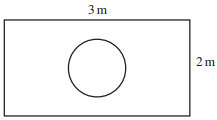
Suppose you drop a die at random on the rectangular region shown in the figure. What is the probability that it will land inside the circle with diameter $1 \, m$?
Solution
(N/A) The area of the rectangular region is given by $Area = \text{length} \times \text{breadth} = 3 \, m \times 2 \, m = 6 \, m^2$.
The diameter of the circle is $1 \, m$, so its radius $r = \frac{1}{2} \, m$.
The area of the circle is given by $Area = \pi r^2 = \pi \left(\frac{1}{2}\right)^2 = \frac{\pi}{4} \, m^2$.
The probability that the die will land inside the circle is the ratio of the area of the circle to the total area of the rectangle:
$P(\text{landing inside the circle}) = \frac{\text{Area of circle}}{\text{Area of rectangle}} = \frac{\frac{\pi}{4}}{6} = \frac{\pi}{24}$.
The diameter of the circle is $1 \, m$, so its radius $r = \frac{1}{2} \, m$.
The area of the circle is given by $Area = \pi r^2 = \pi \left(\frac{1}{2}\right)^2 = \frac{\pi}{4} \, m^2$.
The probability that the die will land inside the circle is the ratio of the area of the circle to the total area of the rectangle:
$P(\text{landing inside the circle}) = \frac{\text{Area of circle}}{\text{Area of rectangle}} = \frac{\frac{\pi}{4}}{6} = \frac{\pi}{24}$.
0 likes
View Solution35
Medium
$A$ lot consists of $144$ ball pens of which $20$ are defective and the others are good. Nuri will buy a pen if it is good,but will not buy if it is defective. The shopkeeper draws one pen at random and gives it to her. What is the probability that
$(i)$ She will buy it?
$(ii)$ She will not buy it?
$(i)$ She will buy it?
$(ii)$ She will not buy it?
Solution
(A) Total number of pens $= 144$
Total number of defective pens $= 20$
Total number of good pens $= 144 - 20 = 124$
$(i)$ Probability of getting a good pen (Nuri buys the pen) $= \frac{124}{144} = \frac{31}{36}$
$(ii)$ Probability of getting a defective pen (Nuri will not buy the pen) $= \frac{20}{144} = \frac{5}{36}$ or $1 - \frac{31}{36} = \frac{5}{36}$
Total number of defective pens $= 20$
Total number of good pens $= 144 - 20 = 124$
$(i)$ Probability of getting a good pen (Nuri buys the pen) $= \frac{124}{144} = \frac{31}{36}$
$(ii)$ Probability of getting a defective pen (Nuri will not buy the pen) $= \frac{20}{144} = \frac{5}{36}$ or $1 - \frac{31}{36} = \frac{5}{36}$
0 likes
View Solution36
Difficult
Two dice,one blue and one grey,are thrown at the same time.
$(i)$ Complete the following table:
$\begin{array}{|l|c|c|c|c|c|c|c|c|c|c|c|} \hline \text{Sum} & 2 & 3 & 4 & 5 & 6 & 7 & 8 & 9 & 10 & 11 & 12 \\ \hline \text{Prob.} & \frac{1}{36} & & & & & & \frac{5}{36} & & & & \frac{1}{36} \\ \hline \end{array}$
$(ii)$ $A$ student argues that 'there are $11$ possible outcomes $2, 3, 4, 5, 6, 7, 8, 9, 10, 11$ and $12$. Therefore,each of them has a probability $\frac{1}{11}$.' Do you agree with this argument? Justify your answer.
$(i)$ Complete the following table:
$\begin{array}{|l|c|c|c|c|c|c|c|c|c|c|c|} \hline \text{Sum} & 2 & 3 & 4 & 5 & 6 & 7 & 8 & 9 & 10 & 11 & 12 \\ \hline \text{Prob.} & \frac{1}{36} & & & & & & \frac{5}{36} & & & & \frac{1}{36} \\ \hline \end{array}$
$(ii)$ $A$ student argues that 'there are $11$ possible outcomes $2, 3, 4, 5, 6, 7, 8, 9, 10, 11$ and $12$. Therefore,each of them has a probability $\frac{1}{11}$.' Do you agree with this argument? Justify your answer.
Solution
(N/A) $(i)$ When two dice are thrown,the total number of possible outcomes is $6 \times 6 = 36$. The sums and their corresponding probabilities are calculated as follows:
- Sum $= 2$: $(1,1) \rightarrow \frac{1}{36}$
- Sum $= 3$: $(1,2), (2,1) \rightarrow \frac{2}{36}$
- Sum $= 4$: $(1,3), (3,1), (2,2) \rightarrow \frac{3}{36}$
- Sum $= 5$: $(1,4), (4,1), (2,3), (3,2) \rightarrow \frac{4}{36}$
- Sum $= 6$: $(1,5), (5,1), (2,4), (4,2), (3,3) \rightarrow \frac{5}{36}$
- Sum $= 7$: $(1,6), (6,1), (2,5), (5,2), (3,4), (4,3) \rightarrow \frac{6}{36}$
- Sum $= 8$: $(2,6), (6,2), (3,5), (5,3), (4,4) \rightarrow \frac{5}{36}$
- Sum $= 9$: $(3,6), (6,3), (4,5), (5,4) \rightarrow \frac{4}{36}$
- Sum $= 10$: $(4,6), (6,4), (5,5) \rightarrow \frac{3}{36}$
- Sum $= 11$: $(5,6), (6,5) \rightarrow \frac{2}{36}$
- Sum $= 12$: $(6,6) \rightarrow \frac{1}{36}$
$(ii)$ No,$I$ do not agree with the student. The outcomes $2, 3, \dots, 12$ are not equally likely because the number of ways to obtain each sum varies. For example,there is only $1$ way to get a sum of $2$,but $6$ ways to get a sum of $7$.
- Sum $= 2$: $(1,1) \rightarrow \frac{1}{36}$
- Sum $= 3$: $(1,2), (2,1) \rightarrow \frac{2}{36}$
- Sum $= 4$: $(1,3), (3,1), (2,2) \rightarrow \frac{3}{36}$
- Sum $= 5$: $(1,4), (4,1), (2,3), (3,2) \rightarrow \frac{4}{36}$
- Sum $= 6$: $(1,5), (5,1), (2,4), (4,2), (3,3) \rightarrow \frac{5}{36}$
- Sum $= 7$: $(1,6), (6,1), (2,5), (5,2), (3,4), (4,3) \rightarrow \frac{6}{36}$
- Sum $= 8$: $(2,6), (6,2), (3,5), (5,3), (4,4) \rightarrow \frac{5}{36}$
- Sum $= 9$: $(3,6), (6,3), (4,5), (5,4) \rightarrow \frac{4}{36}$
- Sum $= 10$: $(4,6), (6,4), (5,5) \rightarrow \frac{3}{36}$
- Sum $= 11$: $(5,6), (6,5) \rightarrow \frac{2}{36}$
- Sum $= 12$: $(6,6) \rightarrow \frac{1}{36}$
$(ii)$ No,$I$ do not agree with the student. The outcomes $2, 3, \dots, 12$ are not equally likely because the number of ways to obtain each sum varies. For example,there is only $1$ way to get a sum of $2$,but $6$ ways to get a sum of $7$.
0 likes
View Solution37
MediumMCQ
$A$ game consists of tossing a one rupee coin $3$ times and noting its outcome each time. Hanif wins if all the tosses give the same result,i.e.,three heads or three tails,and loses otherwise. Calculate the probability that Hanif will lose the game.
A
$1/4$
B
$1/2$
C
$3/4$
D
$1/8$
Solution
(C) The possible outcomes when tossing a coin $3$ times are:
$(HHH, HHT, HTH, HTT, THH, THT, TTH, TTT)$
Total number of possible outcomes $= 8$.
Hanif wins if all tosses give the same result,which are $(HHH)$ or $(TTT)$.
Number of favourable outcomes for winning $= 2$.
Probability of winning $P(\text{Win}) = \frac{2}{8} = \frac{1}{4}$.
Since the sum of the probability of an event and its complement is $1$,the probability of losing is:
$P(\text{Lose}) = 1 - P(\text{Win}) = 1 - \frac{1}{4} = \frac{3}{4}$.
$(HHH, HHT, HTH, HTT, THH, THT, TTH, TTT)$
Total number of possible outcomes $= 8$.
Hanif wins if all tosses give the same result,which are $(HHH)$ or $(TTT)$.
Number of favourable outcomes for winning $= 2$.
Probability of winning $P(\text{Win}) = \frac{2}{8} = \frac{1}{4}$.
Since the sum of the probability of an event and its complement is $1$,the probability of losing is:
$P(\text{Lose}) = 1 - P(\text{Win}) = 1 - \frac{1}{4} = \frac{3}{4}$.
0 likes
View Solution38
Easy
$A$ die is thrown twice. What is the probability that
$(i)$ $5$ will not come up either time?
$(ii)$ $5$ will come up at least once?
$(i)$ $5$ will not come up either time?
$(ii)$ $5$ will come up at least once?
Solution
(A) Total number of outcomes $= 6 \times 6 = 36$.
$(i)$ Let $E$ be the event that $5$ comes up at least once. The outcomes where $5$ appears are $(5,1), (5,2), (5,3), (5,4), (5,5), (5,6), (1,5), (2,5), (3,5), (4,5), (6,5)$.
Number of favourable outcomes for $E = 11$.
Probability of $5$ coming up at least once,$P(E) = \frac{11}{36}$.
The probability that $5$ will not come up either time is $P(\text{not } E) = 1 - P(E) = 1 - \frac{11}{36} = \frac{25}{36}$.
$(ii)$ The probability that $5$ will come up at least once is $P(E) = \frac{11}{36}$.
$(i)$ Let $E$ be the event that $5$ comes up at least once. The outcomes where $5$ appears are $(5,1), (5,2), (5,3), (5,4), (5,5), (5,6), (1,5), (2,5), (3,5), (4,5), (6,5)$.
Number of favourable outcomes for $E = 11$.
Probability of $5$ coming up at least once,$P(E) = \frac{11}{36}$.
The probability that $5$ will not come up either time is $P(\text{not } E) = 1 - P(E) = 1 - \frac{11}{36} = \frac{25}{36}$.
$(ii)$ The probability that $5$ will come up at least once is $P(E) = \frac{11}{36}$.
0 likes
View Solution39
Medium
Which of the following arguments are correct and which are not correct? Give reasons for your answer.
$(i)$ If two coins are tossed simultaneously,there are three possible outcomes - two heads,two tails,or one of each. Therefore,for each of these outcomes,the probability is $\frac{1}{3}$.
$(ii)$ If a die is thrown,there are two possible outcomes - an odd number or an even number. Therefore,the probability of getting an odd number is $\frac{1}{2}$.
$(i)$ If two coins are tossed simultaneously,there are three possible outcomes - two heads,two tails,or one of each. Therefore,for each of these outcomes,the probability is $\frac{1}{3}$.
$(ii)$ If a die is thrown,there are two possible outcomes - an odd number or an even number. Therefore,the probability of getting an odd number is $\frac{1}{2}$.
Solution
(A) $(i)$ $Incorrect$
When two coins are tossed,the possible outcomes are $(H, H), (H, T), (T, H),$ and $(T, T)$.
It can be observed that there can be one of each in two possible ways: $(H, T)$ and $(T, H)$.
Therefore,the probability of getting two heads is $\frac{1}{4}$,the probability of getting two tails is $\frac{1}{4},$ and the probability of getting one of each is $\frac{2}{4} = \frac{1}{2}$.
Thus,the probability for each of these outcomes is not $\frac{1}{3}$.
$(ii)$ $Correct$
When a die is thrown,the possible outcomes are $1, 2, 3, 4, 5,$ and $6$. Out of these,$1, 3, 5$ are $odd$ and $2, 4, 6$ are $even$ numbers.
Since there are $3$ odd numbers out of $6$ total outcomes,the probability of getting an odd number is $\frac{3}{6} = \frac{1}{2}$.
When two coins are tossed,the possible outcomes are $(H, H), (H, T), (T, H),$ and $(T, T)$.
It can be observed that there can be one of each in two possible ways: $(H, T)$ and $(T, H)$.
Therefore,the probability of getting two heads is $\frac{1}{4}$,the probability of getting two tails is $\frac{1}{4},$ and the probability of getting one of each is $\frac{2}{4} = \frac{1}{2}$.
Thus,the probability for each of these outcomes is not $\frac{1}{3}$.
$(ii)$ $Correct$
When a die is thrown,the possible outcomes are $1, 2, 3, 4, 5,$ and $6$. Out of these,$1, 3, 5$ are $odd$ and $2, 4, 6$ are $even$ numbers.
Since there are $3$ odd numbers out of $6$ total outcomes,the probability of getting an odd number is $\frac{3}{6} = \frac{1}{2}$.
0 likes
View Solution40
Difficult
Two customers,Shyam and Ekta,are visiting a particular shop in the same week (Tuesday to Saturday). Each is equally likely to visit the shop on any day as on another day. What is the probability that both will visit the shop on
$(i)$ the same day?
$(ii)$ consecutive days?
$(iii)$ different days?
$(i)$ the same day?
$(ii)$ consecutive days?
$(iii)$ different days?
Solution
(A) There are a total of $5$ days (Tuesday,Wednesday,Thursday,Friday,Saturday). Shyam can visit the shop in $5$ ways and Ekta can visit the shop in $5$ ways.
Therefore,total number of outcomes $= 5 \times 5 = 25$.
$(i)$ They can reach on the same day in $5$ ways: $(T, T), (W, W), (Th, Th), (F, F), (S, S)$.
$P(\text{same day}) = \frac{5}{25} = \frac{1}{5}$.
$(ii)$ They can reach on consecutive days in $8$ ways: $(T, W), (W, Th), (Th, F), (F, S), (W, T), (Th, W), (F, Th), (S, F)$.
$P(\text{consecutive days}) = \frac{8}{25}$.
$(iii)$ $P(\text{different days}) = 1 - P(\text{same day}) = 1 - \frac{1}{5} = \frac{4}{5}$.
Therefore,total number of outcomes $= 5 \times 5 = 25$.
$(i)$ They can reach on the same day in $5$ ways: $(T, T), (W, W), (Th, Th), (F, F), (S, S)$.
$P(\text{same day}) = \frac{5}{25} = \frac{1}{5}$.
$(ii)$ They can reach on consecutive days in $8$ ways: $(T, W), (W, Th), (Th, F), (F, S), (W, T), (Th, W), (F, Th), (S, F)$.
$P(\text{consecutive days}) = \frac{8}{25}$.
$(iii)$ $P(\text{different days}) = 1 - P(\text{same day}) = 1 - \frac{1}{5} = \frac{4}{5}$.
0 likes
View Solution41
Difficult
$A$ die is numbered in such a way that its faces show the numbers $1, 2, 2, 3, 3, 6$. It is thrown two times and the total score in two throws is noted. Complete the following table which gives a few values of the total score on the two throws:
What is the probability that the total score is
$(i)$ even?
$(ii)$ $6?$
$(iii)$ at least $6?$
| + | $1$ | $2$ | $2$ | $3$ | $3$ | $6$ |
|---|---|---|---|---|---|---|
| $1$ | $2$ | $3$ | $3$ | $4$ | $4$ | $7$ |
| $2$ | $3$ | $4$ | $4$ | $5$ | $5$ | $8$ |
| $2$ | $3$ | $4$ | $4$ | $5$ | $5$ | $8$ |
| $3$ | $4$ | $5$ | $5$ | $6$ | $6$ | $9$ |
| $3$ | $4$ | $5$ | $5$ | $6$ | $6$ | $9$ |
| $6$ | $7$ | $8$ | $8$ | $9$ | $9$ | $12$ |
What is the probability that the total score is
$(i)$ even?
$(ii)$ $6?$
$(iii)$ at least $6?$
Solution
(N/A) The total number of possible outcomes when two dice are thrown is $6 \times 6 = 36$.
$(i)$ The outcomes where the sum is even are:
$2, 2, 4, 4, 4, 4, 4, 4, 6, 6, 6, 6, 8, 8, 8, 8, 12$ (counting all occurrences).
Total number of outcomes with an even sum $= 18$.
$P(\text{even sum}) = \frac{18}{36} = \frac{1}{2}$.
$(ii)$ The outcomes where the sum is $6$ are:
$(3, 3), (3, 3), (3, 3), (3, 3)$ (from the table).
Total number of outcomes with sum $6 = 4$.
$P(\text{sum is } 6) = \frac{4}{36} = \frac{1}{9}$.
$(iii)$ The outcomes where the sum is at least $6$ (i.e., $\ge 6$) are:
$6, 6, 6, 6, 7, 7, 8, 8, 8, 8, 9, 9, 9, 9, 12$.
Total number of outcomes with sum at least $6 = 15$.
$P(\text{sum at least } 6) = \frac{15}{36} = \frac{5}{12}$.
$(i)$ The outcomes where the sum is even are:
$2, 2, 4, 4, 4, 4, 4, 4, 6, 6, 6, 6, 8, 8, 8, 8, 12$ (counting all occurrences).
Total number of outcomes with an even sum $= 18$.
$P(\text{even sum}) = \frac{18}{36} = \frac{1}{2}$.
$(ii)$ The outcomes where the sum is $6$ are:
$(3, 3), (3, 3), (3, 3), (3, 3)$ (from the table).
Total number of outcomes with sum $6 = 4$.
$P(\text{sum is } 6) = \frac{4}{36} = \frac{1}{9}$.
$(iii)$ The outcomes where the sum is at least $6$ (i.e., $\ge 6$) are:
$6, 6, 6, 6, 7, 7, 8, 8, 8, 8, 9, 9, 9, 9, 12$.
Total number of outcomes with sum at least $6 = 15$.
$P(\text{sum at least } 6) = \frac{15}{36} = \frac{5}{12}$.
0 likes
View Solution42
DifficultMCQ
$A$ bag contains $5$ red balls and some blue balls. If the probability of drawing a blue ball is double that of a red ball,determine the number of blue balls in the bag.
A
$5$
B
$15$
C
$10$
D
$50$
Solution
(C) Let the number of blue balls be $x$.
Number of red balls $= 5$.
Total number of balls $= x + 5$.
Probability of drawing a red ball,$P(\text{Red}) = \frac{5}{x + 5}$.
Probability of drawing a blue ball,$P(\text{Blue}) = \frac{x}{x + 5}$.
According to the problem,the probability of drawing a blue ball is double that of a red ball:
$P(\text{Blue}) = 2 \times P(\text{Red})$
$\frac{x}{x + 5} = 2 \times \left( \frac{5}{x + 5} \right)$
Since $x + 5 \neq 0$,we can multiply both sides by $(x + 5)$:
$x = 2 \times 5$
$x = 10$.
Therefore,the number of blue balls in the bag is $10$.
Number of red balls $= 5$.
Total number of balls $= x + 5$.
Probability of drawing a red ball,$P(\text{Red}) = \frac{5}{x + 5}$.
Probability of drawing a blue ball,$P(\text{Blue}) = \frac{x}{x + 5}$.
According to the problem,the probability of drawing a blue ball is double that of a red ball:
$P(\text{Blue}) = 2 \times P(\text{Red})$
$\frac{x}{x + 5} = 2 \times \left( \frac{5}{x + 5} \right)$
Since $x + 5 \neq 0$,we can multiply both sides by $(x + 5)$:
$x = 2 \times 5$
$x = 10$.
Therefore,the number of blue balls in the bag is $10$.
0 likes
View Solution43
Medium
$A$ box contains $12$ balls out of which $x$ are black. If one ball is drawn at random from the box,what is the probability that it will be a black ball?
If $6$ more black balls are put in the box,the probability of drawing a black ball is now double of what it was before. Find $x$.
If $6$ more black balls are put in the box,the probability of drawing a black ball is now double of what it was before. Find $x$.
Solution
(3) Total number of balls $= 12$.
Total number of black balls $= x$.
The probability of drawing a black ball is $P_1 = \frac{x}{12}$.
If $6$ more black balls are added,the new total number of balls $= 12 + 6 = 18$.
The new number of black balls $= x + 6$.
The new probability of drawing a black ball is $P_2 = \frac{x+6}{18}$.
According to the problem,$P_2 = 2 \times P_1$.
Therefore,$\frac{x+6}{18} = 2 \times \frac{x}{12}$.
$\frac{x+6}{18} = \frac{x}{6}$.
Multiplying both sides by $18$,we get $x + 6 = 3x$.
$2x = 6$,which gives $x = 3$.
Total number of black balls $= x$.
The probability of drawing a black ball is $P_1 = \frac{x}{12}$.
If $6$ more black balls are added,the new total number of balls $= 12 + 6 = 18$.
The new number of black balls $= x + 6$.
The new probability of drawing a black ball is $P_2 = \frac{x+6}{18}$.
According to the problem,$P_2 = 2 \times P_1$.
Therefore,$\frac{x+6}{18} = 2 \times \frac{x}{12}$.
$\frac{x+6}{18} = \frac{x}{6}$.
Multiplying both sides by $18$,we get $x + 6 = 3x$.
$2x = 6$,which gives $x = 3$.
0 likes
View Solution44
EasyMCQ
$A$ jar contains $24$ marbles,some are green and others are blue. If a marble is drawn at random from the jar,the probability that it is green is $\frac{2}{3}$. Find the number of blue balls in the jar.
A
$6$
B
$8$
C
$10$
D
$12$
Solution
(B) Total number of marbles $= 24$.
Let the number of green marbles be $x$.
Then,the number of blue marbles $= 24 - x$.
The probability of drawing a green marble is given by $P(\text{Green}) = \frac{\text{Number of green marbles}}{\text{Total number of marbles}} = \frac{x}{24}$.
According to the problem,$P(\text{Green}) = \frac{2}{3}$.
So,$\frac{x}{24} = \frac{2}{3}$.
Multiplying both sides by $24$,we get $x = \frac{2}{3} \times 24 = 16$.
Thus,the number of green marbles is $16$.
The number of blue marbles $= 24 - 16 = 8$.
Let the number of green marbles be $x$.
Then,the number of blue marbles $= 24 - x$.
The probability of drawing a green marble is given by $P(\text{Green}) = \frac{\text{Number of green marbles}}{\text{Total number of marbles}} = \frac{x}{24}$.
According to the problem,$P(\text{Green}) = \frac{2}{3}$.
So,$\frac{x}{24} = \frac{2}{3}$.
Multiplying both sides by $24$,we get $x = \frac{2}{3} \times 24 = 16$.
Thus,the number of green marbles is $16$.
The number of blue marbles $= 24 - 16 = 8$.
0 likes
View SolutionProbability — Textbook - Probability · Frequently Asked Questions
1Are these Probability questions useful for JEE and NEET?
Yes. All questions in this section are mapped to JEE Main and NEET exam patterns. Previous year questions from JEE Main, NEET, GUJCET and state-level exams are included with full solutions.
2Can I switch to Hindi or Gujarati for these questions?
Yes. Use the language tabs in the hero section or the sidebar to view the same questions and solutions in English, Hindi or Gujarati.
3How do I generate a question paper from this subtopic?
Use the Vedclass Exam Paper Generator — select the chapter and subtopic, set difficulty, and generate Sets A, B, C, D automatically. First 3 chapters of every subject are free.
Vedclass Products
For Students
Vedclass Test Series
Mock tests in real JEE/NEET style with performance analysis. 5-day free trial.
Start Free TrialFor Teachers
Exam Paper Generator
Generate Set A/B/C/D papers from this chapter in 2 minutes. 3 chapters free.
Try FreeFor Institutes
Online Exam Module
Live online exams with unlimited students, 360° analytics & white-label branding.
See DemoFor Teachers & Institutes
Generate a Probability Exam Paper in 2 Minutes
Select subtopic & difficulty — Sets A, B, C, D auto-generated with No Repeat logic.
First 3 chapters of every subject are free — no payment required.