
A English
Mix Examples - Pair of Linear Equations in Two Variables Questions in English
Class 10 Mathematics · Pair of Linear Equations in Two Variables · Mix Examples - Pair of Linear Equations in Two Variables
360+
Questions
English
Language
100%
With Solutions
Showing 50 of 360 questions in English
151
EasyMCQ
Solve the following pair of linear equations by the method of elimination:
$4x - 3y = 8$
$6x - y = \frac{29}{3}$
$4x - 3y = 8$
$6x - y = \frac{29}{3}$
A
$(-\frac{2}{5}, \frac{3}{5})$
B
$(\frac{1}{2}, \frac{1}{2})$
C
$(\frac{3}{2}, -\frac{2}{3})$
D
$(\frac{1}{3}, \frac{1}{2})$
Solution
(C) Given equations are:
$(1) \quad 4x - 3y = 8$
$(2) \quad 6x - y = \frac{29}{3}$
To eliminate $y$,multiply equation $(2)$ by $3$:
$18x - 3y = 29 \quad (3)$
Subtract equation $(1)$ from equation $(3)$:
$(18x - 3y) - (4x - 3y) = 29 - 8$
$14x = 21$
$x = \frac{21}{14} = \frac{3}{2}$
Substitute $x = \frac{3}{2}$ into equation $(2)$:
$6(\frac{3}{2}) - y = \frac{29}{3}$
$9 - y = \frac{29}{3}$
$y = 9 - \frac{29}{3} = \frac{27 - 29}{3} = -\frac{2}{3}$
Thus,the solution is $(x, y) = (\frac{3}{2}, -\frac{2}{3})$.
$(1) \quad 4x - 3y = 8$
$(2) \quad 6x - y = \frac{29}{3}$
To eliminate $y$,multiply equation $(2)$ by $3$:
$18x - 3y = 29 \quad (3)$
Subtract equation $(1)$ from equation $(3)$:
$(18x - 3y) - (4x - 3y) = 29 - 8$
$14x = 21$
$x = \frac{21}{14} = \frac{3}{2}$
Substitute $x = \frac{3}{2}$ into equation $(2)$:
$6(\frac{3}{2}) - y = \frac{29}{3}$
$9 - y = \frac{29}{3}$
$y = 9 - \frac{29}{3} = \frac{27 - 29}{3} = -\frac{2}{3}$
Thus,the solution is $(x, y) = (\frac{3}{2}, -\frac{2}{3})$.
0 likes
View Solution152
EasyMCQ
Solve the following pairs of equations by the method of elimination:
$5x - 3y = 1$
$2x + 5y = 19$
$5x - 3y = 1$
$2x + 5y = 19$
A
$(2, 3)$
B
$(-2, 1)$
C
$(1, 4)$
D
$(2, 3)$
Solution
(D) Given equations are:
$(1) \ 5x - 3y = 1$
$(2) \ 2x + 5y = 19$
To eliminate $y$,multiply equation $(1)$ by $5$ and equation $(2)$ by $3$:
$25x - 15y = 5 \quad (3)$
$6x + 15y = 57 \quad (4)$
Adding equations $(3)$ and $(4)$:
$(25x + 6x) + (-15y + 15y) = 5 + 57$
$31x = 62$
$x = 2$
Substitute $x = 2$ into equation $(1)$:
$5(2) - 3y = 1$
$10 - 3y = 1$
$-3y = -9$
$y = 3$
Thus,the solution is $(x, y) = (2, 3)$.
$(1) \ 5x - 3y = 1$
$(2) \ 2x + 5y = 19$
To eliminate $y$,multiply equation $(1)$ by $5$ and equation $(2)$ by $3$:
$25x - 15y = 5 \quad (3)$
$6x + 15y = 57 \quad (4)$
Adding equations $(3)$ and $(4)$:
$(25x + 6x) + (-15y + 15y) = 5 + 57$
$31x = 62$
$x = 2$
Substitute $x = 2$ into equation $(1)$:
$5(2) - 3y = 1$
$10 - 3y = 1$
$-3y = -9$
$y = 3$
Thus,the solution is $(x, y) = (2, 3)$.
0 likes
View Solution153
EasyMCQ
Solve the following pair of equations by the method of elimination:
$x + 2y = \frac{3}{2}$
$2x + y = \frac{3}{2}$
$x + 2y = \frac{3}{2}$
$2x + y = \frac{3}{2}$
A
$\left(\frac{1}{2}, \frac{1}{2}\right)$
B
$\left(2, \frac{1}{2}\right)$
C
$\left(\frac{1}{2}, -\frac{1}{2}\right)$
D
$\left(-\frac{2}{5}, \frac{3}{5}\right)$
Solution
(A) Given equations are:
$(1)$ $x + 2y = \frac{3}{2}$
$(2)$ $2x + y = \frac{3}{2}$
To eliminate $y$,multiply equation $(1)$ by $1$ and equation $(2)$ by $2$:
$x + 2y = \frac{3}{2}$
$4x + 2y = 3$
Subtracting the first equation from the second:
$(4x - x) + (2y - 2y) = 3 - \frac{3}{2}$
$3x = \frac{6 - 3}{2} = \frac{3}{2}$
$x = \frac{3}{2 \times 3} = \frac{1}{2}$
Substitute $x = \frac{1}{2}$ into equation $(1)$:
$\frac{1}{2} + 2y = \frac{3}{2}$
$2y = \frac{3}{2} - \frac{1}{2} = \frac{2}{2} = 1$
$y = \frac{1}{2}$
Thus,the solution is $\left(\frac{1}{2}, \frac{1}{2}\right)$.
$(1)$ $x + 2y = \frac{3}{2}$
$(2)$ $2x + y = \frac{3}{2}$
To eliminate $y$,multiply equation $(1)$ by $1$ and equation $(2)$ by $2$:
$x + 2y = \frac{3}{2}$
$4x + 2y = 3$
Subtracting the first equation from the second:
$(4x - x) + (2y - 2y) = 3 - \frac{3}{2}$
$3x = \frac{6 - 3}{2} = \frac{3}{2}$
$x = \frac{3}{2 \times 3} = \frac{1}{2}$
Substitute $x = \frac{1}{2}$ into equation $(1)$:
$\frac{1}{2} + 2y = \frac{3}{2}$
$2y = \frac{3}{2} - \frac{1}{2} = \frac{2}{2} = 1$
$y = \frac{1}{2}$
Thus,the solution is $\left(\frac{1}{2}, \frac{1}{2}\right)$.
0 likes
View Solution154
EasyMCQ
If $2x + y = 35$ and $3x + 4y = 65$,then find $\frac{x}{y}$.
A
$2$
B
$3$
C
$0$
D
$1$
Solution
(B) Given equations are:
$(1) \ 2x + y = 35$
$(2) \ 3x + 4y = 65$
From equation $(1)$,we can express $y$ in terms of $x$:
$y = 35 - 2x$
Substitute this value of $y$ into equation $(2)$:
$3x + 4(35 - 2x) = 65$
$3x + 140 - 8x = 65$
$-5x = 65 - 140$
$-5x = -75$
$x = 15$
Now,substitute $x = 15$ back into the expression for $y$:
$y = 35 - 2(15)$
$y = 35 - 30$
$y = 5$
Finally,calculate the ratio $\frac{x}{y}$:
$\frac{x}{y} = \frac{15}{5} = 3$
Therefore,the correct option is $B$.
$(1) \ 2x + y = 35$
$(2) \ 3x + 4y = 65$
From equation $(1)$,we can express $y$ in terms of $x$:
$y = 35 - 2x$
Substitute this value of $y$ into equation $(2)$:
$3x + 4(35 - 2x) = 65$
$3x + 140 - 8x = 65$
$-5x = 65 - 140$
$-5x = -75$
$x = 15$
Now,substitute $x = 15$ back into the expression for $y$:
$y = 35 - 2(15)$
$y = 35 - 30$
$y = 5$
Finally,calculate the ratio $\frac{x}{y}$:
$\frac{x}{y} = \frac{15}{5} = 3$
Therefore,the correct option is $B$.
0 likes
View Solution155
EasyMCQ
There are some $25$ paise coins and some $50$ paise coins in a bag. The total number of coins is $100$ and the total amount in the bag is Rs. $42.50$. Find the number of coins of each value in the bag.
A
$25$ paise: $30$,$50$ paise: $70$
B
$25$ paise: $70$,$50$ paise: $30$
C
$25$ paise: $50$,$50$ paise: $50$
D
$25$ paise: $40$,$50$ paise: $60$
Solution
(A) Let the number of $25$ paise coins be $x$ and the number of $50$ paise coins be $y$.
According to the problem,the total number of coins is $100$,so $x + y = 100$ (Equation $1$).
The value of $x$ coins of $25$ paise is $0.25x$ rupees,and the value of $y$ coins of $50$ paise is $0.50y$ rupees.
The total amount is Rs. $42.50$,so $0.25x + 0.50y = 42.50$ (Equation $2$).
Multiply Equation $1$ by $0.25$: $0.25x + 0.25y = 25$ (Equation $3$).
Subtract Equation $3$ from Equation $2$: $(0.25x + 0.50y) - (0.25x + 0.25y) = 42.50 - 25$.
This simplifies to $0.25y = 17.50$,so $y = 17.50 / 0.25 = 70$.
Substitute $y = 70$ into Equation $1$: $x + 70 = 100$,so $x = 30$.
Therefore,there are $30$ coins of $25$ paise and $70$ coins of $50$ paise.
According to the problem,the total number of coins is $100$,so $x + y = 100$ (Equation $1$).
The value of $x$ coins of $25$ paise is $0.25x$ rupees,and the value of $y$ coins of $50$ paise is $0.50y$ rupees.
The total amount is Rs. $42.50$,so $0.25x + 0.50y = 42.50$ (Equation $2$).
Multiply Equation $1$ by $0.25$: $0.25x + 0.25y = 25$ (Equation $3$).
Subtract Equation $3$ from Equation $2$: $(0.25x + 0.50y) - (0.25x + 0.25y) = 42.50 - 25$.
This simplifies to $0.25y = 17.50$,so $y = 17.50 / 0.25 = 70$.
Substitute $y = 70$ into Equation $1$: $x + 70 = 100$,so $x = 30$.
Therefore,there are $30$ coins of $25$ paise and $70$ coins of $50$ paise.
0 likes
View Solution156
MediumMCQ
In a two-digit number,the digit at the ten's place is double the digit at the unit's place. If the digits of the number are interchanged,the new number so formed is $27$ less than the original number. Find the original number.
A
$23$
B
$60$
C
$45$
D
$63$
Solution
(D) Let the digit at the unit's place be $x$ and the digit at the ten's place be $y$.
According to the problem,the digit at the ten's place is double the digit at the unit's place,so $y = 2x$.
The original number can be expressed as $10y + x$.
Substituting $y = 2x$,the original number is $10(2x) + x = 20x + x = 21x$.
When the digits are interchanged,the new number becomes $10x + y$.
Substituting $y = 2x$,the new number is $10x + 2x = 12x$.
According to the problem,the new number is $27$ less than the original number,so $21x - 12x = 27$.
$9x = 27$,which gives $x = 3$.
Since $y = 2x$,we have $y = 2(3) = 6$.
The original number is $10(6) + 3 = 63$.
According to the problem,the digit at the ten's place is double the digit at the unit's place,so $y = 2x$.
The original number can be expressed as $10y + x$.
Substituting $y = 2x$,the original number is $10(2x) + x = 20x + x = 21x$.
When the digits are interchanged,the new number becomes $10x + y$.
Substituting $y = 2x$,the new number is $10x + 2x = 12x$.
According to the problem,the new number is $27$ less than the original number,so $21x - 12x = 27$.
$9x = 27$,which gives $x = 3$.
Since $y = 2x$,we have $y = 2(3) = 6$.
The original number is $10(6) + 3 = 63$.
0 likes
View Solution157
MediumMCQ
The sum of two numbers is $9$. The difference of five times the first number and thrice the other number is $5$. Find the numbers.
A
$4, 5$
B
$-4, 2$
C
$0, -5$
D
$7, 5$
Solution
(A) Let the two numbers be $x$ and $y$.
According to the problem,the sum of the numbers is $9$,so $x + y = 9$ (Equation $1$).
The difference of five times the first number and thrice the other number is $5$,so $5x - 3y = 5$ (Equation $2$).
From Equation $1$,we get $y = 9 - x$.
Substitute this into Equation $2$: $5x - 3(9 - x) = 5$.
$5x - 27 + 3x = 5$.
$8x = 32$.
$x = 4$.
Now,substitute $x = 4$ into $y = 9 - x$: $y = 9 - 4 = 5$.
Thus,the numbers are $4$ and $5$.
According to the problem,the sum of the numbers is $9$,so $x + y = 9$ (Equation $1$).
The difference of five times the first number and thrice the other number is $5$,so $5x - 3y = 5$ (Equation $2$).
From Equation $1$,we get $y = 9 - x$.
Substitute this into Equation $2$: $5x - 3(9 - x) = 5$.
$5x - 27 + 3x = 5$.
$8x = 32$.
$x = 4$.
Now,substitute $x = 4$ into $y = 9 - x$: $y = 9 - 4 = 5$.
Thus,the numbers are $4$ and $5$.
0 likes
View Solution158
MediumMCQ
The sum of the digits of a two-digit number is $13$. The number obtained by interchanging the digits is $9$ more than the original number. Find the original number.
A
$11$
B
$67$
C
$53$
D
$89$
Solution
(B) Let the tens digit be $x$ and the units digit be $y$. The number is $10x + y$.
According to the problem,the sum of the digits is $x + y = 13$ (Equation $1$).
The number obtained by interchanging the digits is $10y + x$.
According to the problem,$(10y + x) = (10x + y) + 9$.
Simplifying this,$9y - 9x = 9$,which gives $y - x = 1$ (Equation $2$).
Adding Equation $1$ and Equation $2$: $(x + y) + (y - x) = 13 + 1$,so $2y = 14$,which means $y = 7$.
Substituting $y = 7$ into Equation $1$: $x + 7 = 13$,so $x = 6$.
The original number is $10x + y = 10(6) + 7 = 67$.
According to the problem,the sum of the digits is $x + y = 13$ (Equation $1$).
The number obtained by interchanging the digits is $10y + x$.
According to the problem,$(10y + x) = (10x + y) + 9$.
Simplifying this,$9y - 9x = 9$,which gives $y - x = 1$ (Equation $2$).
Adding Equation $1$ and Equation $2$: $(x + y) + (y - x) = 13 + 1$,so $2y = 14$,which means $y = 7$.
Substituting $y = 7$ into Equation $1$: $x + 7 = 13$,so $x = 6$.
The original number is $10x + y = 10(6) + 7 = 67$.
0 likes
View Solution159
MediumMCQ
The length of a rectangle is one and a half times its breadth. If the perimeter of the rectangle is $100 \,cm$, find the length and the breadth of the rectangle.
A
Length $= 30 \,cm$, Breadth $= 20 \,cm$
B
Length $= 40 \,cm$, Breadth $= 10 \,cm$
C
Length $= 25 \,cm$, Breadth $= 25 \,cm$
D
Length $= 35 \,cm$, Breadth $= 15 \,cm$
Solution
(A) Let the breadth of the rectangle be $x \,cm$.
According to the problem, the length is $1.5$ times the breadth, so length $= 1.5x \,cm$.
The perimeter of a rectangle is given by the formula $P = 2 \times (\text{length} + \text{breadth})$.
Given $P = 100 \,cm$, we have $100 = 2 \times (1.5x + x)$.
$100 = 2 \times (2.5x)$.
$100 = 5x$.
$x = 20 \,cm$.
Therefore, the breadth is $20 \,cm$ and the length is $1.5 \times 20 = 30 \,cm$.
According to the problem, the length is $1.5$ times the breadth, so length $= 1.5x \,cm$.
The perimeter of a rectangle is given by the formula $P = 2 \times (\text{length} + \text{breadth})$.
Given $P = 100 \,cm$, we have $100 = 2 \times (1.5x + x)$.
$100 = 2 \times (2.5x)$.
$100 = 5x$.
$x = 20 \,cm$.
Therefore, the breadth is $20 \,cm$ and the length is $1.5 \times 20 = 30 \,cm$.
0 likes
View Solution160
MediumMCQ
The ratio of the present ages of Rajan and Jay is $3:2$. After five years,the ratio of their ages will be $4:3$. Find the present ages of both.
A
Rajan: $15$ years,Jay: $10$ years
B
Rajan: $12$ years,Jay: $8$ years
C
Rajan: $18$ years,Jay: $12$ years
D
Rajan: $21$ years,Jay: $14$ years
Solution
(A) Let the present ages of Rajan and Jay be $3x$ and $2x$ respectively.
After five years,their ages will be $(3x + 5)$ and $(2x + 5)$.
According to the problem,the ratio of their ages after five years is $4:3$,so:
$\frac{3x + 5}{2x + 5} = \frac{4}{3}$
Cross-multiplying gives: $3(3x + 5) = 4(2x + 5)$
$9x + 15 = 8x + 20$
$9x - 8x = 20 - 15$
$x = 5$
Therefore,the present age of Rajan is $3 \times 5 = 15$ years and the present age of Jay is $2 \times 5 = 10$ years.
After five years,their ages will be $(3x + 5)$ and $(2x + 5)$.
According to the problem,the ratio of their ages after five years is $4:3$,so:
$\frac{3x + 5}{2x + 5} = \frac{4}{3}$
Cross-multiplying gives: $3(3x + 5) = 4(2x + 5)$
$9x + 15 = 8x + 20$
$9x - 8x = 20 - 15$
$x = 5$
Therefore,the present age of Rajan is $3 \times 5 = 15$ years and the present age of Jay is $2 \times 5 = 10$ years.
0 likes
View Solution161
MediumMCQ
The total cost of $3$ pens and $4$ pencils is Rs. $23$ and the total cost of $2$ pens and $3$ pencils is Rs. $16$. Find the cost of a pen and a pencil each.
A
Pen: Rs. $5$,Pencil: Rs. $2$
B
Pen: Rs. $4$,Pencil: Rs. $3$
C
Pen: Rs. $6$,Pencil: Rs. $1$
D
Pen: Rs. $3$,Pencil: Rs. $4$
Solution
(A) Let the cost of one pen be Rs. $x$ and the cost of one pencil be Rs. $y$.
According to the problem,we have the following system of linear equations:
$3x + 4y = 23$ --- $(1)$
$2x + 3y = 16$ --- $(2)$
To solve this,multiply equation $(1)$ by $2$ and equation $(2)$ by $3$:
$6x + 8y = 46$ --- $(3)$
$6x + 9y = 48$ --- $(4)$
Subtracting equation $(3)$ from equation $(4)$:
$(6x + 9y) - (6x + 8y) = 48 - 46$
$y = 2$
Substitute $y = 2$ into equation $(1)$:
$3x + 4(2) = 23$
$3x + 8 = 23$
$3x = 15$
$x = 5$
Therefore,the cost of a pen is Rs. $5$ and the cost of a pencil is Rs. $2$.
According to the problem,we have the following system of linear equations:
$3x + 4y = 23$ --- $(1)$
$2x + 3y = 16$ --- $(2)$
To solve this,multiply equation $(1)$ by $2$ and equation $(2)$ by $3$:
$6x + 8y = 46$ --- $(3)$
$6x + 9y = 48$ --- $(4)$
Subtracting equation $(3)$ from equation $(4)$:
$(6x + 9y) - (6x + 8y) = 48 - 46$
$y = 2$
Substitute $y = 2$ into equation $(1)$:
$3x + 4(2) = 23$
$3x + 8 = 23$
$3x = 15$
$x = 5$
Therefore,the cost of a pen is Rs. $5$ and the cost of a pencil is Rs. $2$.
0 likes
View Solution162
MediumMCQ
There are some coins of $25$ paise and some coins of $50$ paise in a box. There are in all $20$ coins and they amount to Rs. $7$. Find the number of coins of $25$ paise and $50$ paise each.
A
$12$ coins of $25$ paise and $8$ coins of $50$ paise
B
$8$ coins of $25$ paise and $12$ coins of $50$ paise
C
$10$ coins of $25$ paise and $10$ coins of $50$ paise
D
$15$ coins of $25$ paise and $5$ coins of $50$ paise
Solution
(A) Let the number of $25$ paise coins be $x$ and the number of $50$ paise coins be $y$.
According to the problem,the total number of coins is $20$,so $x + y = 20$ (Equation $1$).
The total value of the coins is Rs. $7$,which is $700$ paise. Thus,$25x + 50y = 700$ (Equation $2$).
Dividing Equation $2$ by $25$,we get $x + 2y = 28$ (Equation $3$).
Subtracting Equation $1$ from Equation $3$: $(x + 2y) - (x + y) = 28 - 20$,which gives $y = 8$.
Substituting $y = 8$ into Equation $1$: $x + 8 = 20$,which gives $x = 12$.
Therefore,there are $12$ coins of $25$ paise and $8$ coins of $50$ paise.
According to the problem,the total number of coins is $20$,so $x + y = 20$ (Equation $1$).
The total value of the coins is Rs. $7$,which is $700$ paise. Thus,$25x + 50y = 700$ (Equation $2$).
Dividing Equation $2$ by $25$,we get $x + 2y = 28$ (Equation $3$).
Subtracting Equation $1$ from Equation $3$: $(x + 2y) - (x + y) = 28 - 20$,which gives $y = 8$.
Substituting $y = 8$ into Equation $1$: $x + 8 = 20$,which gives $x = 12$.
Therefore,there are $12$ coins of $25$ paise and $8$ coins of $50$ paise.
0 likes
View Solution163
Medium
Solve the following pair of linear equations by the method of elimination: $0.3 x + 0.4 y = 1$ and $6 x + 8 y = 20$.
Solution
(N/A) Given equations are:
$1) 0.3 x + 0.4 y = 1$
$2) 6 x + 8 y = 20$
Multiply equation $(1)$ by $10$ to clear the decimals: $3 x + 4 y = 10$ (Equation $3$).
Now,multiply equation $(3)$ by $2$: $6 x + 8 y = 20$ (Equation $4$).
Comparing equation $(2)$ and equation $(4)$,we see they are identical: $6 x + 8 y = 20$.
Since both equations represent the same line,there are infinitely many solutions.
The solution set is $\{(x, y) \mid 3 x + 4 y = 10, x, y \in R \}$.
$1) 0.3 x + 0.4 y = 1$
$2) 6 x + 8 y = 20$
Multiply equation $(1)$ by $10$ to clear the decimals: $3 x + 4 y = 10$ (Equation $3$).
Now,multiply equation $(3)$ by $2$: $6 x + 8 y = 20$ (Equation $4$).
Comparing equation $(2)$ and equation $(4)$,we see they are identical: $6 x + 8 y = 20$.
Since both equations represent the same line,there are infinitely many solutions.
The solution set is $\{(x, y) \mid 3 x + 4 y = 10, x, y \in R \}$.
0 likes
View Solution164
EasyMCQ
Solve the following pair of linear equations by the method of elimination: $2x + 5y = 7$ and $4x + 10y = 12$.
A
$(1, 4)$
B
$(-2, 1)$
C
$(-1, -5)$
D
$\text{No solution}$
Solution
(D) Given equations are:
$2x + 5y = 7$ --- $(i)$
$4x + 10y = 12$ --- $(ii)$
To eliminate $x$,multiply equation $(i)$ by $2$:
$4x + 10y = 14$ --- $(iii)$
Now,subtract equation $(ii)$ from equation $(iii)$:
$(4x + 10y) - (4x + 10y) = 14 - 12$
$0 = 2$
Since $0 = 2$ is a false statement,the given pair of linear equations has no solution. Thus,the system is inconsistent.
$2x + 5y = 7$ --- $(i)$
$4x + 10y = 12$ --- $(ii)$
To eliminate $x$,multiply equation $(i)$ by $2$:
$4x + 10y = 14$ --- $(iii)$
Now,subtract equation $(ii)$ from equation $(iii)$:
$(4x + 10y) - (4x + 10y) = 14 - 12$
$0 = 2$
Since $0 = 2$ is a false statement,the given pair of linear equations has no solution. Thus,the system is inconsistent.
0 likes
View Solution165
MediumMCQ
Rajvansh invested some amount at the rate of $12 \%$ simple interest and some amount at the rate of $10 \%$ simple interest. He received a yearly interest of Rs. $130$. However,if he had interchanged the amounts invested,he would have received Rs. $4$ more as interest. How much amount did he invest at each rate?
A
Rs. $500$ at $12 \%$,Rs. $700$ at $10 \%$
B
Rs. $700$ at $12 \%$,Rs. $500$ at $10 \%$
C
Rs. $600$ at $12 \%$,Rs. $600$ at $10 \%$
D
Rs. $400$ at $12 \%$,Rs. $800$ at $10 \%$
Solution
(A) Let the amount invested at $12 \%$ be Rs. $x$ and the amount invested at $10 \%$ be Rs. $y$.
According to the problem,the total interest is Rs. $130$:
$0.12x + 0.10y = 130$ --- (Equation $1$)
If the amounts are interchanged,the interest increases by Rs. $4$,so the new interest is Rs. $134$:
$0.10x + 0.12y = 134$ --- (Equation $2$)
Adding Equation $1$ and Equation $2$:
$0.22x + 0.22y = 264 \implies x + y = 1200$ --- (Equation $3$)
Subtracting Equation $2$ from Equation $1$:
$0.02x - 0.02y = -4 \implies x - y = -200$ --- (Equation $4$)
Adding Equation $3$ and Equation $4$:
$2x = 1000 \implies x = 500$
Substituting $x = 500$ in Equation $3$:
$500 + y = 1200 \implies y = 700$
Therefore,Rajvansh invested Rs. $500$ at $12 \%$ and Rs. $700$ at $10 \%$.
According to the problem,the total interest is Rs. $130$:
$0.12x + 0.10y = 130$ --- (Equation $1$)
If the amounts are interchanged,the interest increases by Rs. $4$,so the new interest is Rs. $134$:
$0.10x + 0.12y = 134$ --- (Equation $2$)
Adding Equation $1$ and Equation $2$:
$0.22x + 0.22y = 264 \implies x + y = 1200$ --- (Equation $3$)
Subtracting Equation $2$ from Equation $1$:
$0.02x - 0.02y = -4 \implies x - y = -200$ --- (Equation $4$)
Adding Equation $3$ and Equation $4$:
$2x = 1000 \implies x = 500$
Substituting $x = 500$ in Equation $3$:
$500 + y = 1200 \implies y = 700$
Therefore,Rajvansh invested Rs. $500$ at $12 \%$ and Rs. $700$ at $10 \%$.
0 likes
View Solution166
MediumMCQ
Solve the following pair of equations by the method of cross-multiplication:
$x + 2y + 1 = 0$
$2x - 3y - 12 = 0$
$x + 2y + 1 = 0$
$2x - 3y - 12 = 0$
A
$-3, -2$
B
$3, -2$
C
$3, 2$
D
$-3, 2$
Solution
(B) Comparing the given equations with the standard form $a_1x + b_1y + c_1 = 0$ and $a_2x + b_2y + c_2 = 0$,we get:
$a_1 = 1, b_1 = 2, c_1 = 1$
$a_2 = 2, b_2 = -3, c_2 = -12$
Using the cross-multiplication formula:
$\frac{x}{b_1c_2 - b_2c_1} = \frac{y}{c_1a_2 - c_2a_1} = \frac{1}{a_1b_2 - a_2b_1}$
Substituting the values:
$\frac{x}{(2)(-12) - (-3)(1)} = \frac{y}{(1)(2) - (-12)(1)} = \frac{1}{(1)(-3) - (2)(2)}$
$\frac{x}{-24 + 3} = \frac{y}{2 + 12} = \frac{1}{-3 - 4}$
$\frac{x}{-21} = \frac{y}{14} = \frac{1}{-7}$
Now,solving for $x$:
$\frac{x}{-21} = \frac{1}{-7} \implies x = \frac{-21}{-7} = 3$
Solving for $y$:
$\frac{y}{14} = \frac{1}{-7} \implies y = \frac{14}{-7} = -2$
Thus,the solution is $x = 3, y = -2$.
$a_1 = 1, b_1 = 2, c_1 = 1$
$a_2 = 2, b_2 = -3, c_2 = -12$
Using the cross-multiplication formula:
$\frac{x}{b_1c_2 - b_2c_1} = \frac{y}{c_1a_2 - c_2a_1} = \frac{1}{a_1b_2 - a_2b_1}$
Substituting the values:
$\frac{x}{(2)(-12) - (-3)(1)} = \frac{y}{(1)(2) - (-12)(1)} = \frac{1}{(1)(-3) - (2)(2)}$
$\frac{x}{-24 + 3} = \frac{y}{2 + 12} = \frac{1}{-3 - 4}$
$\frac{x}{-21} = \frac{y}{14} = \frac{1}{-7}$
Now,solving for $x$:
$\frac{x}{-21} = \frac{1}{-7} \implies x = \frac{-21}{-7} = 3$
Solving for $y$:
$\frac{y}{14} = \frac{1}{-7} \implies y = \frac{14}{-7} = -2$
Thus,the solution is $x = 3, y = -2$.
0 likes
View Solution167
MediumMCQ
Solve the following pair of equations by the method of cross-multiplication:
$2x + y = 35$
$3x + 4y = 65$
$2x + y = 35$
$3x + 4y = 65$
A
$(3, 5)$
B
$(10, 3)$
C
$(15, 5)$
D
$(7, 3)$
Solution
(C) Converting into the standard form $a_1x + b_1y + c_1 = 0$ and $a_2x + b_2y + c_2 = 0$,we get:
$2x + y - 35 = 0$ ........ $(1)$
$3x + 4y - 65 = 0$ ........ $(2)$
Comparing with the standard form,we get:
$a_1 = 2, b_1 = 1, c_1 = -35$
$a_2 = 3, b_2 = 4, c_2 = -65$
Using the cross-multiplication formula:
$\frac{x}{b_1c_2 - b_2c_1} = \frac{y}{c_1a_2 - c_2a_1} = \frac{1}{a_1b_2 - a_2b_1}$
Substituting the values:
$\frac{x}{(1)(-65) - (4)(-35)} = \frac{y}{(-35)(3) - (-65)(2)} = \frac{1}{(2)(4) - (3)(1)}$
$\frac{x}{-65 + 140} = \frac{y}{-105 + 130} = \frac{1}{8 - 3}$
$\frac{x}{75} = \frac{y}{25} = \frac{1}{5}$
Now,solving for $x$:
$\frac{x}{75} = \frac{1}{5} \implies x = \frac{75}{5} = 15$
Solving for $y$:
$\frac{y}{25} = \frac{1}{5} \implies y = \frac{25}{5} = 5$
Thus,the solution is $(x, y) = (15, 5)$.
$2x + y - 35 = 0$ ........ $(1)$
$3x + 4y - 65 = 0$ ........ $(2)$
Comparing with the standard form,we get:
$a_1 = 2, b_1 = 1, c_1 = -35$
$a_2 = 3, b_2 = 4, c_2 = -65$
Using the cross-multiplication formula:
$\frac{x}{b_1c_2 - b_2c_1} = \frac{y}{c_1a_2 - c_2a_1} = \frac{1}{a_1b_2 - a_2b_1}$
Substituting the values:
$\frac{x}{(1)(-65) - (4)(-35)} = \frac{y}{(-35)(3) - (-65)(2)} = \frac{1}{(2)(4) - (3)(1)}$
$\frac{x}{-65 + 140} = \frac{y}{-105 + 130} = \frac{1}{8 - 3}$
$\frac{x}{75} = \frac{y}{25} = \frac{1}{5}$
Now,solving for $x$:
$\frac{x}{75} = \frac{1}{5} \implies x = \frac{75}{5} = 15$
Solving for $y$:
$\frac{y}{25} = \frac{1}{5} \implies y = \frac{25}{5} = 5$
Thus,the solution is $(x, y) = (15, 5)$.
0 likes
View Solution168
DifficultMCQ
Solve the following pair of equations by the method of cross multiplication:
$\frac{x}{a} + \frac{y}{b} = 2$
$ax - by = a^{2} - b^{2}$
$\frac{x}{a} + \frac{y}{b} = 2$
$ax - by = a^{2} - b^{2}$
A
$(a, -b)$
B
$(-a, -b)$
C
$(-a, b)$
D
$(a, b)$
Solution
(D) Converting the equations into the standard form $a_{1}x + b_{1}y + c_{1} = 0$ and $a_{2}x + b_{2}y + c_{2} = 0$:
From $\frac{x}{a} + \frac{y}{b} = 2$,we get $bx + ay = 2ab$,so $bx + ay - 2ab = 0$ ... $(1)$
From $ax - by = a^{2} - b^{2}$,we get $ax - by - (a^{2} - b^{2}) = 0$ ... $(2)$
Comparing with the standard form:
$a_{1} = b, b_{1} = a, c_{1} = -2ab$
$a_{2} = a, b_{2} = -b, c_{2} = -(a^{2} - b^{2}) = b^{2} - a^{2}$
Using the cross multiplication method:
$\frac{x}{b_{1}c_{2} - b_{2}c_{1}} = \frac{y}{c_{1}a_{2} - c_{2}a_{1}} = \frac{1}{a_{1}b_{2} - a_{2}b_{1}}$
$\frac{x}{a(b^{2} - a^{2}) - (-b)(-2ab)} = \frac{y}{(-2ab)(a) - (b^{2} - a^{2})(b)} = \frac{1}{b(-b) - a(a)}$
$\frac{x}{ab^{2} - a^{3} - 2ab^{2}} = \frac{y}{-2a^{2}b - b^{3} + a^{2}b} = \frac{1}{-b^{2} - a^{2}}$
$\frac{x}{-a^{3} - ab^{2}} = \frac{y}{-a^{2}b - b^{3}} = \frac{1}{-(a^{2} + b^{2})}$
$\frac{x}{-a(a^{2} + b^{2})} = \frac{y}{-b(a^{2} + b^{2})} = \frac{1}{-(a^{2} + b^{2})}$
Equating to the constant term:
$x = \frac{-a(a^{2} + b^{2})}{-(a^{2} + b^{2})} = a$
$y = \frac{-b(a^{2} + b^{2})}{-(a^{2} + b^{2})} = b$
Thus,the solution is $(x, y) = (a, b)$.
From $\frac{x}{a} + \frac{y}{b} = 2$,we get $bx + ay = 2ab$,so $bx + ay - 2ab = 0$ ... $(1)$
From $ax - by = a^{2} - b^{2}$,we get $ax - by - (a^{2} - b^{2}) = 0$ ... $(2)$
Comparing with the standard form:
$a_{1} = b, b_{1} = a, c_{1} = -2ab$
$a_{2} = a, b_{2} = -b, c_{2} = -(a^{2} - b^{2}) = b^{2} - a^{2}$
Using the cross multiplication method:
$\frac{x}{b_{1}c_{2} - b_{2}c_{1}} = \frac{y}{c_{1}a_{2} - c_{2}a_{1}} = \frac{1}{a_{1}b_{2} - a_{2}b_{1}}$
$\frac{x}{a(b^{2} - a^{2}) - (-b)(-2ab)} = \frac{y}{(-2ab)(a) - (b^{2} - a^{2})(b)} = \frac{1}{b(-b) - a(a)}$
$\frac{x}{ab^{2} - a^{3} - 2ab^{2}} = \frac{y}{-2a^{2}b - b^{3} + a^{2}b} = \frac{1}{-b^{2} - a^{2}}$
$\frac{x}{-a^{3} - ab^{2}} = \frac{y}{-a^{2}b - b^{3}} = \frac{1}{-(a^{2} + b^{2})}$
$\frac{x}{-a(a^{2} + b^{2})} = \frac{y}{-b(a^{2} + b^{2})} = \frac{1}{-(a^{2} + b^{2})}$
Equating to the constant term:
$x = \frac{-a(a^{2} + b^{2})}{-(a^{2} + b^{2})} = a$
$y = \frac{-b(a^{2} + b^{2})}{-(a^{2} + b^{2})} = b$
Thus,the solution is $(x, y) = (a, b)$.
0 likes
View Solution169
DifficultMCQ
Solve the following pair of equations by the method of cross multiplication:
$x + y - (a + b) = 0$
$ax - by - (a^2 - b^2) = 0$
$x + y - (a + b) = 0$
$ax - by - (a^2 - b^2) = 0$
A
$(a, b)$
B
$(-a, -b)$
C
$(a, -b)$
D
$(-a, b)$
Solution
(A) Comparing the given equations with the standard form $a_1x + b_1y + c_1 = 0$ and $a_2x + b_2y + c_2 = 0$,we get:
$a_1 = 1, b_1 = 1, c_1 = -(a + b) = -a - b$
$a_2 = a, b_2 = -b, c_2 = -(a^2 - b^2) = -a^2 + b^2$
Using the cross multiplication method:
$\frac{x}{b_1c_2 - b_2c_1} = \frac{y}{c_1a_2 - c_2a_1} = \frac{1}{a_1b_2 - a_2b_1}$
Substituting the values:
$\frac{x}{(1)(-a^2 + b^2) - (-b)(-a - b)} = \frac{y}{(-a - b)(a) - (-a^2 + b^2)(1)} = \frac{1}{(1)(-b) - (a)(1)}$
Simplifying the denominators:
$\frac{x}{-a^2 + b^2 - (ab + b^2)} = \frac{y}{-a^2 - ab + a^2 - b^2} = \frac{1}{-b - a}$
$\frac{x}{-a^2 - ab} = \frac{y}{-b^2 - ab} = \frac{1}{-(a + b)}$
Now,solving for $x$:
$x = \frac{-a^2 - ab}{-(a + b)} = \frac{-a(a + b)}{-(a + b)} = a$
Solving for $y$:
$y = \frac{-b^2 - ab}{-(a + b)} = \frac{-b(b + a)}{-(a + b)} = b$
Thus,the solution is $(x, y) = (a, b)$.
$a_1 = 1, b_1 = 1, c_1 = -(a + b) = -a - b$
$a_2 = a, b_2 = -b, c_2 = -(a^2 - b^2) = -a^2 + b^2$
Using the cross multiplication method:
$\frac{x}{b_1c_2 - b_2c_1} = \frac{y}{c_1a_2 - c_2a_1} = \frac{1}{a_1b_2 - a_2b_1}$
Substituting the values:
$\frac{x}{(1)(-a^2 + b^2) - (-b)(-a - b)} = \frac{y}{(-a - b)(a) - (-a^2 + b^2)(1)} = \frac{1}{(1)(-b) - (a)(1)}$
Simplifying the denominators:
$\frac{x}{-a^2 + b^2 - (ab + b^2)} = \frac{y}{-a^2 - ab + a^2 - b^2} = \frac{1}{-b - a}$
$\frac{x}{-a^2 - ab} = \frac{y}{-b^2 - ab} = \frac{1}{-(a + b)}$
Now,solving for $x$:
$x = \frac{-a^2 - ab}{-(a + b)} = \frac{-a(a + b)}{-(a + b)} = a$
Solving for $y$:
$y = \frac{-b^2 - ab}{-(a + b)} = \frac{-b(b + a)}{-(a + b)} = b$
Thus,the solution is $(x, y) = (a, b)$.
0 likes
View Solution170
DifficultMCQ
Solve the following pair of equations by the method of cross multiplication:
$ax + by - a + b = 0$
$bx - ay - a - b = 0$
$ax + by - a + b = 0$
$bx - ay - a - b = 0$
A
$(1, 1)$
B
$(1, -1)$
C
$(1, 0)$
D
$(0, -1)$
Solution
(B) The given equations are:
$ax + by + (-a + b) = 0$
$bx - ay + (-a - b) = 0$
Comparing with the standard form $a_1x + b_1y + c_1 = 0$ and $a_2x + b_2y + c_2 = 0$,we get:
$a_1 = a, b_1 = b, c_1 = -a + b$
$a_2 = b, b_2 = -a, c_2 = -a - b$
Using the cross-multiplication method:
$\frac{x}{b_1c_2 - b_2c_1} = \frac{y}{c_1a_2 - c_2a_1} = \frac{1}{a_1b_2 - a_2b_1}$
Substituting the values:
$\frac{x}{b(-a - b) - (-a)(-a + b)} = \frac{y}{(-a + b)(b) - (-a - b)(a)} = \frac{1}{a(-a) - b(b)}$
$\frac{x}{-ab - b^2 - (a^2 - ab)} = \frac{y}{-ab + b^2 - (-a^2 - ab)} = \frac{1}{-a^2 - b^2}$
$\frac{x}{-ab - b^2 - a^2 + ab} = \frac{y}{-ab + b^2 + a^2 + ab} = \frac{1}{-a^2 - b^2}$
$\frac{x}{-(a^2 + b^2)} = \frac{y}{a^2 + b^2} = \frac{1}{-(a^2 + b^2)}$
Now,solving for $x$ and $y$:
$x = \frac{-(a^2 + b^2)}{-(a^2 + b^2)} = 1$
$y = \frac{a^2 + b^2}{-(a^2 + b^2)} = -1$
Thus,the solution is $(x, y) = (1, -1)$.
$ax + by + (-a + b) = 0$
$bx - ay + (-a - b) = 0$
Comparing with the standard form $a_1x + b_1y + c_1 = 0$ and $a_2x + b_2y + c_2 = 0$,we get:
$a_1 = a, b_1 = b, c_1 = -a + b$
$a_2 = b, b_2 = -a, c_2 = -a - b$
Using the cross-multiplication method:
$\frac{x}{b_1c_2 - b_2c_1} = \frac{y}{c_1a_2 - c_2a_1} = \frac{1}{a_1b_2 - a_2b_1}$
Substituting the values:
$\frac{x}{b(-a - b) - (-a)(-a + b)} = \frac{y}{(-a + b)(b) - (-a - b)(a)} = \frac{1}{a(-a) - b(b)}$
$\frac{x}{-ab - b^2 - (a^2 - ab)} = \frac{y}{-ab + b^2 - (-a^2 - ab)} = \frac{1}{-a^2 - b^2}$
$\frac{x}{-ab - b^2 - a^2 + ab} = \frac{y}{-ab + b^2 + a^2 + ab} = \frac{1}{-a^2 - b^2}$
$\frac{x}{-(a^2 + b^2)} = \frac{y}{a^2 + b^2} = \frac{1}{-(a^2 + b^2)}$
Now,solving for $x$ and $y$:
$x = \frac{-(a^2 + b^2)}{-(a^2 + b^2)} = 1$
$y = \frac{a^2 + b^2}{-(a^2 + b^2)} = -1$
Thus,the solution is $(x, y) = (1, -1)$.
0 likes
View Solution171
DifficultMCQ
The sum of the digits of a two-digit number is $9$. The number obtained by interchanging the digits exceeds the original number by $45$. Find the original number.
A
$20$
B
$7$
C
$27$
D
$10$
Solution
(C) Let the digit at the ten's place be $x$ and the digit at the unit's place be $y$ in the original two-digit number.
Then,the original number $= 10x + y$.
The sum of the digits is $x + y = 9$ ......... $(1)$
The number obtained by interchanging the digits is $10y + x$.
According to the problem,the new number exceeds the original number by $45$:
$10y + x = (10x + y) + 45$
$10y + x - 10x - y = 45$
$-9x + 9y = 45$
Dividing by $9$,we get $-x + y = 5$ ......... $(2)$
Adding equations $(1)$ and $(2)$:
$(x + y) + (-x + y) = 9 + 5$
$2y = 14$
$y = 7$
Substituting $y = 7$ into equation $(1)$:
$x + 7 = 9$
$x = 2$
Therefore,the original number $= 10x + y = 10(2) + 7 = 27$.
Then,the original number $= 10x + y$.
The sum of the digits is $x + y = 9$ ......... $(1)$
The number obtained by interchanging the digits is $10y + x$.
According to the problem,the new number exceeds the original number by $45$:
$10y + x = (10x + y) + 45$
$10y + x - 10x - y = 45$
$-9x + 9y = 45$
Dividing by $9$,we get $-x + y = 5$ ......... $(2)$
Adding equations $(1)$ and $(2)$:
$(x + y) + (-x + y) = 9 + 5$
$2y = 14$
$y = 7$
Substituting $y = 7$ into equation $(1)$:
$x + 7 = 9$
$x = 2$
Therefore,the original number $= 10x + y = 10(2) + 7 = 27$.
0 likes
View Solution172
EasyMCQ
Solve the following pairs of equations by the cross-multiplication method:
$x - 3y = -5$
$3x = 7y - 13$
$x - 3y = -5$
$3x = 7y - 13$
A
$(-2, 0)$
B
$(-1, 1)$
C
$(2, 1)$
D
$(-2, 1)$
Solution
(D) First,rewrite the equations in the standard form $a_1x + b_1y + c_1 = 0$ and $a_2x + b_2y + c_2 = 0$:
$1$) $x - 3y + 5 = 0$
$2$) $3x - 7y + 13 = 0$
Here,$a_1 = 1, b_1 = -3, c_1 = 5$ and $a_2 = 3, b_2 = -7, c_2 = 13$.
Using the cross-multiplication formula:
$\frac{x}{b_1c_2 - b_2c_1} = \frac{y}{c_1a_2 - c_2a_1} = \frac{1}{a_1b_2 - a_2b_1}$
Substitute the values:
$\frac{x}{(-3)(13) - (-7)(5)} = \frac{y}{(5)(3) - (13)(1)} = \frac{1}{(1)(-7) - (3)(-3)}$
$\frac{x}{-39 + 35} = \frac{y}{15 - 13} = \frac{1}{-7 + 9}$
$\frac{x}{-4} = \frac{y}{2} = \frac{1}{2}$
Solving for $x$: $x = \frac{-4}{2} = -2$
Solving for $y$: $y = \frac{2}{2} = 1$
Thus,the solution is $(-2, 1)$.
$1$) $x - 3y + 5 = 0$
$2$) $3x - 7y + 13 = 0$
Here,$a_1 = 1, b_1 = -3, c_1 = 5$ and $a_2 = 3, b_2 = -7, c_2 = 13$.
Using the cross-multiplication formula:
$\frac{x}{b_1c_2 - b_2c_1} = \frac{y}{c_1a_2 - c_2a_1} = \frac{1}{a_1b_2 - a_2b_1}$
Substitute the values:
$\frac{x}{(-3)(13) - (-7)(5)} = \frac{y}{(5)(3) - (13)(1)} = \frac{1}{(1)(-7) - (3)(-3)}$
$\frac{x}{-39 + 35} = \frac{y}{15 - 13} = \frac{1}{-7 + 9}$
$\frac{x}{-4} = \frac{y}{2} = \frac{1}{2}$
Solving for $x$: $x = \frac{-4}{2} = -2$
Solving for $y$: $y = \frac{2}{2} = 1$
Thus,the solution is $(-2, 1)$.
0 likes
View Solution173
EasyMCQ
Solve the following pairs of equations by cross-multiplication method:
$3x - 4y = 17$
$4x - 5y = 21$
$3x - 4y = 17$
$4x - 5y = 21$
A
$(-1, -5)$
B
$(-2, 0)$
C
$(-1, 1)$
D
$(2, 1)$
Solution
(A) Given equations are:
$3x - 4y - 17 = 0$ --- $(1)$
$4x - 5y - 21 = 0$ --- $(2)$
Using the cross-multiplication method:
$\frac{x}{(-4)(-21) - (-5)(-17)} = \frac{y}{(-17)(4) - (-21)(3)} = \frac{1}{(3)(-5) - (4)(-4)}$
$\frac{x}{84 - 85} = \frac{y}{-68 + 63} = \frac{1}{-15 + 16}$
$\frac{x}{-1} = \frac{y}{-5} = \frac{1}{1}$
Therefore,$x = -1$ and $y = -5$.
The solution is $(-1, -5)$.
$3x - 4y - 17 = 0$ --- $(1)$
$4x - 5y - 21 = 0$ --- $(2)$
Using the cross-multiplication method:
$\frac{x}{(-4)(-21) - (-5)(-17)} = \frac{y}{(-17)(4) - (-21)(3)} = \frac{1}{(3)(-5) - (4)(-4)}$
$\frac{x}{84 - 85} = \frac{y}{-68 + 63} = \frac{1}{-15 + 16}$
$\frac{x}{-1} = \frac{y}{-5} = \frac{1}{1}$
Therefore,$x = -1$ and $y = -5$.
The solution is $(-1, -5)$.
0 likes
View Solution174
EasyMCQ
Solve the following pair of linear equations by the cross-multiplication method:
$3x + y = 7$
$2x + 3y = 14$
$3x + y = 7$
$2x + 3y = 14$
A
$(-1, -5)$
B
$(1, 4)$
C
$(2, -4)$
D
$(-4, 4)$
Solution
(B) The given equations are:
$3x + y - 7 = 0$ --- $(i)$
$2x + 3y - 14 = 0$ --- $(ii)$
Using the cross-multiplication method,the formula is:
$\frac{x}{b_1c_2 - b_2c_1} = \frac{y}{c_1a_2 - c_2a_1} = \frac{1}{a_1b_2 - a_2b_1}$
Here,$a_1 = 3, b_1 = 1, c_1 = -7$ and $a_2 = 2, b_2 = 3, c_2 = -14$.
Substituting the values:
$\frac{x}{(1)(-14) - (3)(-7)} = \frac{y}{(-7)(2) - (-14)(3)} = \frac{1}{(3)(3) - (2)(1)}$
$\frac{x}{-14 + 21} = \frac{y}{-14 + 42} = \frac{1}{9 - 2}$
$\frac{x}{7} = \frac{y}{28} = \frac{1}{7}$
For $x$: $\frac{x}{7} = \frac{1}{7} \implies x = 1$
For $y$: $\frac{y}{28} = \frac{1}{7} \implies y = 4$
Thus,the solution is $(1, 4)$.
$3x + y - 7 = 0$ --- $(i)$
$2x + 3y - 14 = 0$ --- $(ii)$
Using the cross-multiplication method,the formula is:
$\frac{x}{b_1c_2 - b_2c_1} = \frac{y}{c_1a_2 - c_2a_1} = \frac{1}{a_1b_2 - a_2b_1}$
Here,$a_1 = 3, b_1 = 1, c_1 = -7$ and $a_2 = 2, b_2 = 3, c_2 = -14$.
Substituting the values:
$\frac{x}{(1)(-14) - (3)(-7)} = \frac{y}{(-7)(2) - (-14)(3)} = \frac{1}{(3)(3) - (2)(1)}$
$\frac{x}{-14 + 21} = \frac{y}{-14 + 42} = \frac{1}{9 - 2}$
$\frac{x}{7} = \frac{y}{28} = \frac{1}{7}$
For $x$: $\frac{x}{7} = \frac{1}{7} \implies x = 1$
For $y$: $\frac{y}{28} = \frac{1}{7} \implies y = 4$
Thus,the solution is $(1, 4)$.
0 likes
View Solution175
EasyMCQ
Solve the following pairs of equations by cross-multiplication method:
$3x + y = 5$
$5x + 3y = 3$
$3x + y = 5$
$5x + 3y = 3$
A
$(-1, -5)$
B
$(7, -5)$
C
$(3, -4)$
D
$(1, -4)$
Solution
(C) Given equations are:
$3x + y - 5 = 0$ --- $(1)$
$5x + 3y - 3 = 0$ --- $(2)$
Comparing with $a_1x + b_1y + c_1 = 0$ and $a_2x + b_2y + c_2 = 0$,we get:
$a_1 = 3, b_1 = 1, c_1 = -5$
$a_2 = 5, b_2 = 3, c_2 = -3$
Using the cross-multiplication formula:
$\frac{x}{b_1c_2 - b_2c_1} = \frac{y}{c_1a_2 - c_2a_1} = \frac{1}{a_1b_2 - a_2b_1}$
Substituting the values:
$\frac{x}{(1)(-3) - (3)(-5)} = \frac{y}{(-5)(5) - (-3)(3)} = \frac{1}{(3)(3) - (5)(1)}$
$\frac{x}{-3 + 15} = \frac{y}{-25 + 9} = \frac{1}{9 - 5}$
$\frac{x}{12} = \frac{y}{-16} = \frac{1}{4}$
For $x$: $\frac{x}{12} = \frac{1}{4} \implies x = 3$
For $y$: $\frac{y}{-16} = \frac{1}{4} \implies y = -4$
Thus,the solution is $(3, -4)$.
$3x + y - 5 = 0$ --- $(1)$
$5x + 3y - 3 = 0$ --- $(2)$
Comparing with $a_1x + b_1y + c_1 = 0$ and $a_2x + b_2y + c_2 = 0$,we get:
$a_1 = 3, b_1 = 1, c_1 = -5$
$a_2 = 5, b_2 = 3, c_2 = -3$
Using the cross-multiplication formula:
$\frac{x}{b_1c_2 - b_2c_1} = \frac{y}{c_1a_2 - c_2a_1} = \frac{1}{a_1b_2 - a_2b_1}$
Substituting the values:
$\frac{x}{(1)(-3) - (3)(-5)} = \frac{y}{(-5)(5) - (-3)(3)} = \frac{1}{(3)(3) - (5)(1)}$
$\frac{x}{-3 + 15} = \frac{y}{-25 + 9} = \frac{1}{9 - 5}$
$\frac{x}{12} = \frac{y}{-16} = \frac{1}{4}$
For $x$: $\frac{x}{12} = \frac{1}{4} \implies x = 3$
For $y$: $\frac{y}{-16} = \frac{1}{4} \implies y = -4$
Thus,the solution is $(3, -4)$.
0 likes
View Solution176
MediumMCQ
Solve the following pairs of equations by the cross-multiplication method:
$4x + 6y = 11$
$5x - 8y = 6$
$4x + 6y = 11$
$5x - 8y = 6$
A
$\left(\frac{1}{2}, -\frac{1}{2}\right)$
B
$\left(-\frac{2}{5}, \frac{3}{5}\right)$
C
$\left(-\frac{3}{5}, \frac{7}{5}\right)$
D
$\left(2, \frac{1}{2}\right)$
Solution
(D) The given equations are:
$4x + 6y - 11 = 0$ ... $(i)$
$5x - 8y - 6 = 0$ ... $(ii)$
Using the cross-multiplication method for $a_1x + b_1y + c_1 = 0$ and $a_2x + b_2y + c_2 = 0$:
$\frac{x}{b_1c_2 - b_2c_1} = \frac{y}{c_1a_2 - c_2a_1} = \frac{1}{a_1b_2 - a_2b_1}$
Here,$a_1 = 4, b_1 = 6, c_1 = -11$ and $a_2 = 5, b_2 = -8, c_2 = -6$.
$\frac{x}{(6)(-6) - (-8)(-11)} = \frac{y}{(-11)(5) - (-6)(4)} = \frac{1}{(4)(-8) - (5)(6)}$
$\frac{x}{-36 - 88} = \frac{y}{-55 + 24} = \frac{1}{-32 - 30}$
$\frac{x}{-124} = \frac{y}{-31} = \frac{1}{-62}$
For $x$: $x = \frac{-124}{-62} = 2$
For $y$: $y = \frac{-31}{-62} = \frac{1}{2}$
Thus,the solution is $(x, y) = (2, \frac{1}{2})$.
$4x + 6y - 11 = 0$ ... $(i)$
$5x - 8y - 6 = 0$ ... $(ii)$
Using the cross-multiplication method for $a_1x + b_1y + c_1 = 0$ and $a_2x + b_2y + c_2 = 0$:
$\frac{x}{b_1c_2 - b_2c_1} = \frac{y}{c_1a_2 - c_2a_1} = \frac{1}{a_1b_2 - a_2b_1}$
Here,$a_1 = 4, b_1 = 6, c_1 = -11$ and $a_2 = 5, b_2 = -8, c_2 = -6$.
$\frac{x}{(6)(-6) - (-8)(-11)} = \frac{y}{(-11)(5) - (-6)(4)} = \frac{1}{(4)(-8) - (5)(6)}$
$\frac{x}{-36 - 88} = \frac{y}{-55 + 24} = \frac{1}{-32 - 30}$
$\frac{x}{-124} = \frac{y}{-31} = \frac{1}{-62}$
For $x$: $x = \frac{-124}{-62} = 2$
For $y$: $y = \frac{-31}{-62} = \frac{1}{2}$
Thus,the solution is $(x, y) = (2, \frac{1}{2})$.
0 likes
View Solution177
EasyMCQ
Solve the following pair of equations by the cross-multiplication method:
$\frac{x}{5} - \frac{y}{4} = \frac{9}{40}$
$\frac{x}{3} - \frac{y}{2} = \frac{5}{12}$
$\frac{x}{5} - \frac{y}{4} = \frac{9}{40}$
$\frac{x}{3} - \frac{y}{2} = \frac{5}{12}$
A
$(\frac{1}{2}, -\frac{1}{2})$
B
$(\frac{1}{2}, \frac{1}{2})$
C
$(\frac{2}{2}, \frac{7}{4})$
D
$(-\frac{2}{5}, \frac{3}{5})$
Solution
(A) First,simplify the equations:
$1$) Multiply the first equation by $20$: $4x - 5y = 4.5$ or $8x - 10y = 9$,so $8x - 10y - 9 = 0$.
$2$) Multiply the second equation by $12$: $4x - 6y = 5$,so $4x - 6y - 5 = 0$.
Using the cross-multiplication method for $a_1x + b_1y + c_1 = 0$ and $a_2x + b_2y + c_2 = 0$:
$\frac{x}{b_1c_2 - b_2c_1} = \frac{y}{c_1a_2 - c_2a_1} = \frac{1}{a_1b_2 - a_2b_1}$
Here,$a_1 = 8, b_1 = -10, c_1 = -9$ and $a_2 = 4, b_2 = -6, c_2 = -5$.
$\frac{x}{(-10)(-5) - (-6)(-9)} = \frac{y}{(-9)(4) - (-5)(8)} = \frac{1}{(8)(-6) - (4)(-10)}$
$\frac{x}{50 - 54} = \frac{y}{-36 + 40} = \frac{1}{-48 + 40}$
$\frac{x}{-4} = \frac{y}{4} = \frac{1}{-8}$
$x = \frac{-4}{-8} = \frac{1}{2}$ and $y = \frac{4}{-8} = -\frac{1}{2}$.
Thus,the solution is $(\frac{1}{2}, -\frac{1}{2})$.
$1$) Multiply the first equation by $20$: $4x - 5y = 4.5$ or $8x - 10y = 9$,so $8x - 10y - 9 = 0$.
$2$) Multiply the second equation by $12$: $4x - 6y = 5$,so $4x - 6y - 5 = 0$.
Using the cross-multiplication method for $a_1x + b_1y + c_1 = 0$ and $a_2x + b_2y + c_2 = 0$:
$\frac{x}{b_1c_2 - b_2c_1} = \frac{y}{c_1a_2 - c_2a_1} = \frac{1}{a_1b_2 - a_2b_1}$
Here,$a_1 = 8, b_1 = -10, c_1 = -9$ and $a_2 = 4, b_2 = -6, c_2 = -5$.
$\frac{x}{(-10)(-5) - (-6)(-9)} = \frac{y}{(-9)(4) - (-5)(8)} = \frac{1}{(8)(-6) - (4)(-10)}$
$\frac{x}{50 - 54} = \frac{y}{-36 + 40} = \frac{1}{-48 + 40}$
$\frac{x}{-4} = \frac{y}{4} = \frac{1}{-8}$
$x = \frac{-4}{-8} = \frac{1}{2}$ and $y = \frac{4}{-8} = -\frac{1}{2}$.
Thus,the solution is $(\frac{1}{2}, -\frac{1}{2})$.
0 likes
View Solution178
EasyMCQ
Solve the following pair of linear equations using the cross-multiplication method:
$5x + 2y = 10$
$4x + 3y - 1 = 0$
$5x + 2y = 10$
$4x + 3y - 1 = 0$
A
$(1, -3)$
B
$(4, -5)$
C
$(-4, 7)$
D
$(7, -9)$
Solution
(B) Given equations are:
$5x + 2y - 10 = 0$ ---$(1)$
$4x + 3y - 1 = 0$ ---$(2)$
Comparing with $a_1x + b_1y + c_1 = 0$ and $a_2x + b_2y + c_2 = 0$:
$a_1 = 5, b_1 = 2, c_1 = -10$
$a_2 = 4, b_2 = 3, c_2 = -1$
Using the cross-multiplication formula:
$\frac{x}{b_1c_2 - b_2c_1} = \frac{y}{c_1a_2 - c_2a_1} = \frac{1}{a_1b_2 - a_2b_1}$
$\frac{x}{(2)(-1) - (3)(-10)} = \frac{y}{(-10)(4) - (-1)(5)} = \frac{1}{(5)(3) - (4)(2)}$
$\frac{x}{-2 + 30} = \frac{y}{-40 + 5} = \frac{1}{15 - 8}$
$\frac{x}{28} = \frac{y}{-35} = \frac{1}{7}$
For $x$: $\frac{x}{28} = \frac{1}{7} \implies x = \frac{28}{7} = 4$
For $y$: $\frac{y}{-35} = \frac{1}{7} \implies y = \frac{-35}{7} = -5$
Thus,the solution is $(4, -5)$.
$5x + 2y - 10 = 0$ ---$(1)$
$4x + 3y - 1 = 0$ ---$(2)$
Comparing with $a_1x + b_1y + c_1 = 0$ and $a_2x + b_2y + c_2 = 0$:
$a_1 = 5, b_1 = 2, c_1 = -10$
$a_2 = 4, b_2 = 3, c_2 = -1$
Using the cross-multiplication formula:
$\frac{x}{b_1c_2 - b_2c_1} = \frac{y}{c_1a_2 - c_2a_1} = \frac{1}{a_1b_2 - a_2b_1}$
$\frac{x}{(2)(-1) - (3)(-10)} = \frac{y}{(-10)(4) - (-1)(5)} = \frac{1}{(5)(3) - (4)(2)}$
$\frac{x}{-2 + 30} = \frac{y}{-40 + 5} = \frac{1}{15 - 8}$
$\frac{x}{28} = \frac{y}{-35} = \frac{1}{7}$
For $x$: $\frac{x}{28} = \frac{1}{7} \implies x = \frac{28}{7} = 4$
For $y$: $\frac{y}{-35} = \frac{1}{7} \implies y = \frac{-35}{7} = -5$
Thus,the solution is $(4, -5)$.
0 likes
View Solution179
DifficultMCQ
Solve the following pairs of equations by the cross-multiplication method:
$4x - 19y + 13 = 0$
$13x - 23y + 19 = 0$
$4x - 19y + 13 = 0$
$13x - 23y + 19 = 0$
A
$(-2/5, -3/5)$
B
$(2/5, -3/5)$
C
$(-2/5, 3/5)$
D
$(-7/5, 1/5)$
Solution
(C) Given equations are:
$4x - 19y + 13 = 0$ ... $(i)$
$13x - 23y + 19 = 0$ ... $(ii)$
Using the cross-multiplication method for $a_1x + b_1y + c_1 = 0$ and $a_2x + b_2y + c_2 = 0$:
$\frac{x}{b_1c_2 - b_2c_1} = \frac{y}{c_1a_2 - c_2a_1} = \frac{1}{a_1b_2 - a_2b_1}$
Here,$a_1 = 4, b_1 = -19, c_1 = 13$ and $a_2 = 13, b_2 = -23, c_2 = 19$.
$\frac{x}{(-19)(19) - (-23)(13)} = \frac{y}{(13)(13) - (19)(4)} = \frac{1}{(4)(-23) - (13)(-19)}$
$\frac{x}{-361 + 299} = \frac{y}{169 - 76} = \frac{1}{-92 + 247}$
$\frac{x}{-62} = \frac{y}{93} = \frac{1}{155}$
$x = -62 / 155 = -2 / 5$
$y = 93 / 155 = 3 / 5$
Thus,the solution is $(-2/5, 3/5)$.
$4x - 19y + 13 = 0$ ... $(i)$
$13x - 23y + 19 = 0$ ... $(ii)$
Using the cross-multiplication method for $a_1x + b_1y + c_1 = 0$ and $a_2x + b_2y + c_2 = 0$:
$\frac{x}{b_1c_2 - b_2c_1} = \frac{y}{c_1a_2 - c_2a_1} = \frac{1}{a_1b_2 - a_2b_1}$
Here,$a_1 = 4, b_1 = -19, c_1 = 13$ and $a_2 = 13, b_2 = -23, c_2 = 19$.
$\frac{x}{(-19)(19) - (-23)(13)} = \frac{y}{(13)(13) - (19)(4)} = \frac{1}{(4)(-23) - (13)(-19)}$
$\frac{x}{-361 + 299} = \frac{y}{169 - 76} = \frac{1}{-92 + 247}$
$\frac{x}{-62} = \frac{y}{93} = \frac{1}{155}$
$x = -62 / 155 = -2 / 5$
$y = 93 / 155 = 3 / 5$
Thus,the solution is $(-2/5, 3/5)$.
0 likes
View Solution180
MediumMCQ
Solve the following pair of equations by the cross-multiplication method:
$\frac{x}{a} + \frac{y}{b} = a + b$
$\frac{x}{a^2} + \frac{y}{b^2} = 2$
$\frac{x}{a} + \frac{y}{b} = a + b$
$\frac{x}{a^2} + \frac{y}{b^2} = 2$
A
$(a, b)$
B
$(a^2, b)$
C
$(a, b^2)$
D
$(a^2, b^2)$
Solution
(D) The given equations are:
$1$) $\frac{x}{a} + \frac{y}{b} - (a + b) = 0$
$2$) $\frac{x}{a^2} + \frac{y}{b^2} - 2 = 0$
Using the cross-multiplication method for equations $A_1x + B_1y + C_1 = 0$ and $A_2x + B_2y + C_2 = 0$:
$\frac{x}{B_1C_2 - B_2C_1} = \frac{y}{C_1A_2 - C_2A_1} = \frac{1}{A_1B_2 - A_2B_1}$
Here,$A_1 = \frac{1}{a}, B_1 = \frac{1}{b}, C_1 = -(a + b)$
$A_2 = \frac{1}{a^2}, B_2 = \frac{1}{b^2}, C_2 = -2$
$\frac{x}{(\frac{1}{b})(-2) - (\frac{1}{b^2})(-(a + b))} = \frac{y}{(-(a + b))(\frac{1}{a^2}) - (-2)(\frac{1}{a})} = \frac{1}{(\frac{1}{a})(\frac{1}{b^2}) - (\frac{1}{a^2})(\frac{1}{b})}$
Simplifying the denominators:
$\frac{x}{-\frac{2}{b} + \frac{a+b}{b^2}} = \frac{y}{-\frac{a+b}{a^2} + \frac{2}{a}} = \frac{1}{\frac{1}{ab^2} - \frac{1}{a^2b}}$
$\frac{x}{\frac{-2b + a + b}{b^2}} = \frac{y}{\frac{-a - b + 2a}{a^2}} = \frac{1}{\frac{a - b}{a^2b^2}}$
$\frac{x}{\frac{a - b}{b^2}} = \frac{y}{\frac{a - b}{a^2}} = \frac{a^2b^2}{a - b}$
$x = \frac{a^2b^2}{a - b} \cdot \frac{a - b}{b^2} = a^2$
$y = \frac{a^2b^2}{a - b} \cdot \frac{a - b}{a^2} = b^2$
Thus,the solution is $(a^2, b^2)$.
$1$) $\frac{x}{a} + \frac{y}{b} - (a + b) = 0$
$2$) $\frac{x}{a^2} + \frac{y}{b^2} - 2 = 0$
Using the cross-multiplication method for equations $A_1x + B_1y + C_1 = 0$ and $A_2x + B_2y + C_2 = 0$:
$\frac{x}{B_1C_2 - B_2C_1} = \frac{y}{C_1A_2 - C_2A_1} = \frac{1}{A_1B_2 - A_2B_1}$
Here,$A_1 = \frac{1}{a}, B_1 = \frac{1}{b}, C_1 = -(a + b)$
$A_2 = \frac{1}{a^2}, B_2 = \frac{1}{b^2}, C_2 = -2$
$\frac{x}{(\frac{1}{b})(-2) - (\frac{1}{b^2})(-(a + b))} = \frac{y}{(-(a + b))(\frac{1}{a^2}) - (-2)(\frac{1}{a})} = \frac{1}{(\frac{1}{a})(\frac{1}{b^2}) - (\frac{1}{a^2})(\frac{1}{b})}$
Simplifying the denominators:
$\frac{x}{-\frac{2}{b} + \frac{a+b}{b^2}} = \frac{y}{-\frac{a+b}{a^2} + \frac{2}{a}} = \frac{1}{\frac{1}{ab^2} - \frac{1}{a^2b}}$
$\frac{x}{\frac{-2b + a + b}{b^2}} = \frac{y}{\frac{-a - b + 2a}{a^2}} = \frac{1}{\frac{a - b}{a^2b^2}}$
$\frac{x}{\frac{a - b}{b^2}} = \frac{y}{\frac{a - b}{a^2}} = \frac{a^2b^2}{a - b}$
$x = \frac{a^2b^2}{a - b} \cdot \frac{a - b}{b^2} = a^2$
$y = \frac{a^2b^2}{a - b} \cdot \frac{a - b}{a^2} = b^2$
Thus,the solution is $(a^2, b^2)$.
0 likes
View Solution181
MediumMCQ
Solve the following pair of equations by the cross-multiplication method:
$ax - by = \frac{a-b}{2}$
$x + 3y = 2$
$ax - by = \frac{a-b}{2}$
$x + 3y = 2$
A
$(\frac{1}{2}, \frac{1}{2})$
B
$(\frac{1}{2}, -\frac{1}{2})$
C
$(-\frac{1}{2}, \frac{1}{2})$
D
$(-\frac{1}{2}, -\frac{1}{2})$
Solution
(A) The given equations are:
$ax - by - \frac{a-b}{2} = 0$ --- $(1)$
$x + 3y - 2 = 0$ --- $(2)$
Using the cross-multiplication method for $a_1x + b_1y + c_1 = 0$ and $a_2x + b_2y + c_2 = 0$:
$\frac{x}{b_1c_2 - b_2c_1} = \frac{y}{c_1a_2 - c_2a_1} = \frac{1}{a_1b_2 - a_2b_1}$
Here,$a_1 = a, b_1 = -b, c_1 = -\frac{a-b}{2}$ and $a_2 = 1, b_2 = 3, c_2 = -2$.
$\frac{x}{(-b)(-2) - (3)(-\frac{a-b}{2})} = \frac{y}{(-\frac{a-b}{2})(1) - (-2)(a)} = \frac{1}{(a)(3) - (1)(-b)}$
$\frac{x}{2b + \frac{3a-3b}{2}} = \frac{y}{-\frac{a}{2} + \frac{b}{2} + 2a} = \frac{1}{3a + b}$
$\frac{x}{\frac{4b + 3a - 3b}{2}} = \frac{y}{\frac{-a + b + 4a}{2}} = \frac{1}{3a + b}$
$\frac{x}{\frac{3a + b}{2}} = \frac{y}{\frac{3a + b}{2}} = \frac{1}{3a + b}$
Equating with the constant term:
$x = \frac{3a+b}{2} \cdot \frac{1}{3a+b} = \frac{1}{2}$
$y = \frac{3a+b}{2} \cdot \frac{1}{3a+b} = \frac{1}{2}$
Thus,the solution is $(\frac{1}{2}, \frac{1}{2})$.
$ax - by - \frac{a-b}{2} = 0$ --- $(1)$
$x + 3y - 2 = 0$ --- $(2)$
Using the cross-multiplication method for $a_1x + b_1y + c_1 = 0$ and $a_2x + b_2y + c_2 = 0$:
$\frac{x}{b_1c_2 - b_2c_1} = \frac{y}{c_1a_2 - c_2a_1} = \frac{1}{a_1b_2 - a_2b_1}$
Here,$a_1 = a, b_1 = -b, c_1 = -\frac{a-b}{2}$ and $a_2 = 1, b_2 = 3, c_2 = -2$.
$\frac{x}{(-b)(-2) - (3)(-\frac{a-b}{2})} = \frac{y}{(-\frac{a-b}{2})(1) - (-2)(a)} = \frac{1}{(a)(3) - (1)(-b)}$
$\frac{x}{2b + \frac{3a-3b}{2}} = \frac{y}{-\frac{a}{2} + \frac{b}{2} + 2a} = \frac{1}{3a + b}$
$\frac{x}{\frac{4b + 3a - 3b}{2}} = \frac{y}{\frac{-a + b + 4a}{2}} = \frac{1}{3a + b}$
$\frac{x}{\frac{3a + b}{2}} = \frac{y}{\frac{3a + b}{2}} = \frac{1}{3a + b}$
Equating with the constant term:
$x = \frac{3a+b}{2} \cdot \frac{1}{3a+b} = \frac{1}{2}$
$y = \frac{3a+b}{2} \cdot \frac{1}{3a+b} = \frac{1}{2}$
Thus,the solution is $(\frac{1}{2}, \frac{1}{2})$.
0 likes
View Solution182
EasyMCQ
Solve the following pair of equations by the cross-multiplication method:
$\frac{x}{a} - \frac{y}{b} = 0$
$ax + by = a^2 + b^2$
$\frac{x}{a} - \frac{y}{b} = 0$
$ax + by = a^2 + b^2$
A
$(-a, -b)$
B
$(a, b)$
C
$(-a, b)$
D
$(a, -b)$
Solution
(B) Given equations are:
$1$) $\frac{x}{a} - \frac{y}{b} = 0 \implies bx - ay = 0$
$2$) $ax + by = a^2 + b^2 \implies ax + by - (a^2 + b^2) = 0$
Using the cross-multiplication method for $a_1x + b_1y + c_1 = 0$ and $a_2x + b_2y + c_2 = 0$:
$\frac{x}{b_1c_2 - b_2c_1} = \frac{y}{c_1a_2 - c_2a_1} = \frac{1}{a_1b_2 - a_2b_1}$
Here,$a_1 = b, b_1 = -a, c_1 = 0$ and $a_2 = a, b_2 = b, c_2 = -(a^2 + b^2)$.
$\frac{x}{(-a)(-(a^2 + b^2)) - (b)(0)} = \frac{y}{(0)(a) - (-(a^2 + b^2))(b)} = \frac{1}{(b)(b) - (a)(-a)}$
$\frac{x}{a(a^2 + b^2)} = \frac{y}{b(a^2 + b^2)} = \frac{1}{b^2 + a^2}$
$x = \frac{a(a^2 + b^2)}{a^2 + b^2} = a$
$y = \frac{b(a^2 + b^2)}{a^2 + b^2} = b$
Thus,the solution is $(a, b)$.
$1$) $\frac{x}{a} - \frac{y}{b} = 0 \implies bx - ay = 0$
$2$) $ax + by = a^2 + b^2 \implies ax + by - (a^2 + b^2) = 0$
Using the cross-multiplication method for $a_1x + b_1y + c_1 = 0$ and $a_2x + b_2y + c_2 = 0$:
$\frac{x}{b_1c_2 - b_2c_1} = \frac{y}{c_1a_2 - c_2a_1} = \frac{1}{a_1b_2 - a_2b_1}$
Here,$a_1 = b, b_1 = -a, c_1 = 0$ and $a_2 = a, b_2 = b, c_2 = -(a^2 + b^2)$.
$\frac{x}{(-a)(-(a^2 + b^2)) - (b)(0)} = \frac{y}{(0)(a) - (-(a^2 + b^2))(b)} = \frac{1}{(b)(b) - (a)(-a)}$
$\frac{x}{a(a^2 + b^2)} = \frac{y}{b(a^2 + b^2)} = \frac{1}{b^2 + a^2}$
$x = \frac{a(a^2 + b^2)}{a^2 + b^2} = a$
$y = \frac{b(a^2 + b^2)}{a^2 + b^2} = b$
Thus,the solution is $(a, b)$.
0 likes
View Solution183
MediumMCQ
Solve the following pair of linear equations by the cross-multiplication method:
$\frac{x}{a} + \frac{y}{b} = 0$
$(a+b)x + (a-b)y = a^2 + b^2$
$\frac{x}{a} + \frac{y}{b} = 0$
$(a+b)x + (a-b)y = a^2 + b^2$
A
$(-a, -b)$
B
$(a, b)$
C
$(a, -b)$
D
$(-a, b)$
Solution
(C) Given equations are:
$1$) $\frac{x}{a} + \frac{y}{b} = 0 \implies bx + ay = 0$
$2$) $(a+b)x + (a-b)y = a^2 + b^2$
Rewriting in standard form $a_1x + b_1y + c_1 = 0$:
$1$) $bx + ay + 0 = 0$
$2$) $(a+b)x + (a-b)y - (a^2 + b^2) = 0$
Using cross-multiplication method $\frac{x}{b_1c_2 - b_2c_1} = \frac{y}{c_1a_2 - c_2a_1} = \frac{1}{a_1b_2 - a_2b_1}$:
$\frac{x}{a(-(a^2+b^2)) - (a-b)(0)} = \frac{y}{0(a+b) - (- (a^2+b^2))b} = \frac{1}{b(a-b) - a(a+b)}$
$\frac{x}{-a(a^2+b^2)} = \frac{y}{b(a^2+b^2)} = \frac{1}{ab - b^2 - a^2 - ab}$
$\frac{x}{-a(a^2+b^2)} = \frac{y}{b(a^2+b^2)} = \frac{1}{-(a^2+b^2)}$
For $x$: $x = \frac{-a(a^2+b^2)}{-(a^2+b^2)} = a$
For $y$: $y = \frac{b(a^2+b^2)}{-(a^2+b^2)} = -b$
Thus,the solution is $(a, -b)$.
$1$) $\frac{x}{a} + \frac{y}{b} = 0 \implies bx + ay = 0$
$2$) $(a+b)x + (a-b)y = a^2 + b^2$
Rewriting in standard form $a_1x + b_1y + c_1 = 0$:
$1$) $bx + ay + 0 = 0$
$2$) $(a+b)x + (a-b)y - (a^2 + b^2) = 0$
Using cross-multiplication method $\frac{x}{b_1c_2 - b_2c_1} = \frac{y}{c_1a_2 - c_2a_1} = \frac{1}{a_1b_2 - a_2b_1}$:
$\frac{x}{a(-(a^2+b^2)) - (a-b)(0)} = \frac{y}{0(a+b) - (- (a^2+b^2))b} = \frac{1}{b(a-b) - a(a+b)}$
$\frac{x}{-a(a^2+b^2)} = \frac{y}{b(a^2+b^2)} = \frac{1}{ab - b^2 - a^2 - ab}$
$\frac{x}{-a(a^2+b^2)} = \frac{y}{b(a^2+b^2)} = \frac{1}{-(a^2+b^2)}$
For $x$: $x = \frac{-a(a^2+b^2)}{-(a^2+b^2)} = a$
For $y$: $y = \frac{b(a^2+b^2)}{-(a^2+b^2)} = -b$
Thus,the solution is $(a, -b)$.
0 likes
View Solution184
MediumMCQ
Solve the following pairs of equations by the cross-multiplication method:
$0.5x + 0.3y = 0.1$
$0.6x + 0.3y = 0.3$
$0.5x + 0.3y = 0.1$
$0.6x + 0.3y = 0.3$
A
$(2, 3)$
B
$(-2, 3)$
C
$(-2, -3)$
D
$(2, -3)$
Solution
(D) Given equations:
$0.5x + 0.3y - 0.1 = 0$ --- $(1)$
$0.6x + 0.3y - 0.3 = 0$ --- $(2)$
Multiply both equations by $10$ to simplify:
$5x + 3y - 1 = 0$
$6x + 3y - 3 = 0$
Using the cross-multiplication formula for $a_1x + b_1y + c_1 = 0$ and $a_2x + b_2y + c_2 = 0$:
$\frac{x}{b_1c_2 - b_2c_1} = \frac{y}{c_1a_2 - c_2a_1} = \frac{1}{a_1b_2 - a_2b_1}$
Here,$a_1 = 5, b_1 = 3, c_1 = -1$ and $a_2 = 6, b_2 = 3, c_2 = -3$.
$\frac{x}{(3)(-3) - (3)(-1)} = \frac{y}{(-1)(6) - (-3)(5)} = \frac{1}{(5)(3) - (6)(3)}$
$\frac{x}{-9 + 3} = \frac{y}{-6 + 15} = \frac{1}{15 - 18}$
$\frac{x}{-6} = \frac{y}{9} = \frac{1}{-3}$
$x = \frac{-6}{-3} = 2$
$y = \frac{9}{-3} = -3$
Thus,the solution is $(2, -3)$.
$0.5x + 0.3y - 0.1 = 0$ --- $(1)$
$0.6x + 0.3y - 0.3 = 0$ --- $(2)$
Multiply both equations by $10$ to simplify:
$5x + 3y - 1 = 0$
$6x + 3y - 3 = 0$
Using the cross-multiplication formula for $a_1x + b_1y + c_1 = 0$ and $a_2x + b_2y + c_2 = 0$:
$\frac{x}{b_1c_2 - b_2c_1} = \frac{y}{c_1a_2 - c_2a_1} = \frac{1}{a_1b_2 - a_2b_1}$
Here,$a_1 = 5, b_1 = 3, c_1 = -1$ and $a_2 = 6, b_2 = 3, c_2 = -3$.
$\frac{x}{(3)(-3) - (3)(-1)} = \frac{y}{(-1)(6) - (-3)(5)} = \frac{1}{(5)(3) - (6)(3)}$
$\frac{x}{-9 + 3} = \frac{y}{-6 + 15} = \frac{1}{15 - 18}$
$\frac{x}{-6} = \frac{y}{9} = \frac{1}{-3}$
$x = \frac{-6}{-3} = 2$
$y = \frac{9}{-3} = -3$
Thus,the solution is $(2, -3)$.
0 likes
View Solution185
MediumMCQ
$A$ number is $3$ less than another number. By adding $17$ to twice the larger number,it becomes thrice the smaller number. Find these numbers.
A
$26, 23$
B
$62, 20$
C
$20, 27$
D
$29, 21$
Solution
(A) Let the larger number be $x$ and the smaller number be $y$.
According to the first condition,$x = y + 3$ or $x - y = 3$ (Equation $1$).
According to the second condition,$2x + 17 = 3y$ or $2x - 3y = -17$ (Equation $2$).
Substitute $x = y + 3$ into Equation $2$:
$2(y + 3) - 3y = -17$
$2y + 6 - 3y = -17$
$-y + 6 = -17$
$-y = -23$
$y = 23$.
Now,find $x$ using $x = y + 3$:
$x = 23 + 3 = 26$.
Therefore,the numbers are $26$ and $23$.
According to the first condition,$x = y + 3$ or $x - y = 3$ (Equation $1$).
According to the second condition,$2x + 17 = 3y$ or $2x - 3y = -17$ (Equation $2$).
Substitute $x = y + 3$ into Equation $2$:
$2(y + 3) - 3y = -17$
$2y + 6 - 3y = -17$
$-y + 6 = -17$
$-y = -23$
$y = 23$.
Now,find $x$ using $x = y + 3$:
$x = 23 + 3 = 26$.
Therefore,the numbers are $26$ and $23$.
2 likes
View Solution186
MediumMCQ
While arranging the students of standard $X$ in rows,if two rows are reduced,then one more student has to be arranged in each of the remaining rows. If three more rows are formed,then one student has to be taken off from each of the previously arranged rows. Find the total number of students in the class.
A
$23$
B
$60$
C
$63$
D
$32$
Solution
(B) Let the number of rows be $x$ and the number of students in each row be $y$. The total number of students is $xy$.
According to the first condition: $(x - 2)(y + 1) = xy$
$xy + x - 2y - 2 = xy$
$x - 2y = 2$ --- $(1)$
According to the second condition: $(x + 3)(y - 1) = xy$
$xy - x + 3y - 3 = xy$
$-x + 3y = 3$ --- $(2)$
Adding equations $(1)$ and $(2)$:
$(x - 2y) + (-x + 3y) = 2 + 3$
$y = 5$
Substituting $y = 5$ in equation $(1)$:
$x - 2(5) = 2$
$x - 10 = 2$
$x = 12$
Total number of students $= xy = 12 \times 5 = 60$.
According to the first condition: $(x - 2)(y + 1) = xy$
$xy + x - 2y - 2 = xy$
$x - 2y = 2$ --- $(1)$
According to the second condition: $(x + 3)(y - 1) = xy$
$xy - x + 3y - 3 = xy$
$-x + 3y = 3$ --- $(2)$
Adding equations $(1)$ and $(2)$:
$(x - 2y) + (-x + 3y) = 2 + 3$
$y = 5$
Substituting $y = 5$ in equation $(1)$:
$x - 2(5) = 2$
$x - 10 = 2$
$x = 12$
Total number of students $= xy = 12 \times 5 = 60$.
0 likes
View Solution187
MediumMCQ
The sum of a two-digit number and the number obtained by interchanging its digits is $110$. If the number obtained by subtracting $10$ from the original number exceeds five times the sum of the digits of the original number by $4$,then find the original number.
A
$60$
B
$78$
C
$64$
D
$94$
Solution
(C) Let the tens digit be $x$ and the units digit be $y$. The original number is $10x + y$.
The number obtained by interchanging the digits is $10y + x$.
According to the first condition: $(10x + y) + (10y + x) = 110$.
$11x + 11y = 110 \implies x + y = 10$ (Equation $1$).
According to the second condition: $(10x + y - 10) = 5(x + y) + 4$.
Substitute $x + y = 10$ into the equation: $10x + y - 10 = 5(10) + 4$.
$10x + y - 10 = 54 \implies 10x + y = 64$ (Equation $2$).
From $x + y = 10$ and $10x + y = 64$,we subtract the equations: $(10x + y) - (x + y) = 64 - 10$.
$9x = 54 \implies x = 6$.
Substituting $x = 6$ into $x + y = 10$,we get $y = 4$.
Thus,the original number is $10(6) + 4 = 64$.
The number obtained by interchanging the digits is $10y + x$.
According to the first condition: $(10x + y) + (10y + x) = 110$.
$11x + 11y = 110 \implies x + y = 10$ (Equation $1$).
According to the second condition: $(10x + y - 10) = 5(x + y) + 4$.
Substitute $x + y = 10$ into the equation: $10x + y - 10 = 5(10) + 4$.
$10x + y - 10 = 54 \implies 10x + y = 64$ (Equation $2$).
From $x + y = 10$ and $10x + y = 64$,we subtract the equations: $(10x + y) - (x + y) = 64 - 10$.
$9x = 54 \implies x = 6$.
Substituting $x = 6$ into $x + y = 10$,we get $y = 4$.
Thus,the original number is $10(6) + 4 = 64$.
0 likes
View Solution188
Difficult
In cyclic quadrilateral $ABCD$,$m \angle A = 2x + 4$,$m \angle B = y + 3$,$m \angle C = 2y + 10$,and $m \angle D = 4x - 5$. Find the measures of all four angles.
Solution
(A) In a cyclic quadrilateral,the sum of opposite angles is $180^{\circ}$.
Therefore,$m \angle A + m \angle C = 180^{\circ}$ and $m \angle B + m \angle D = 180^{\circ}$.
For $A$ and $C$: $(2x + 4) + (2y + 10) = 180 \implies 2x + 2y + 14 = 180 \implies 2x + 2y = 166 \implies x + y = 83$ (Equation $1$).
For $B$ and $D$: $(y + 3) + (4x - 5) = 180 \implies 4x + y - 2 = 180 \implies 4x + y = 182$ (Equation $2$).
Subtracting Equation $1$ from Equation $2$: $(4x + y) - (x + y) = 182 - 83 \implies 3x = 99 \implies x = 33$.
Substituting $x = 33$ into Equation $1$: $33 + y = 83 \implies y = 50$.
Calculating the angles:
$m \angle A = 2(33) + 4 = 66 + 4 = 70^{\circ}$.
$m \angle B = 50 + 3 = 53^{\circ}$.
$m \angle C = 2(50) + 10 = 100 + 10 = 110^{\circ}$.
$m \angle D = 4(33) - 5 = 132 - 5 = 127^{\circ}$.
Therefore,$m \angle A + m \angle C = 180^{\circ}$ and $m \angle B + m \angle D = 180^{\circ}$.
For $A$ and $C$: $(2x + 4) + (2y + 10) = 180 \implies 2x + 2y + 14 = 180 \implies 2x + 2y = 166 \implies x + y = 83$ (Equation $1$).
For $B$ and $D$: $(y + 3) + (4x - 5) = 180 \implies 4x + y - 2 = 180 \implies 4x + y = 182$ (Equation $2$).
Subtracting Equation $1$ from Equation $2$: $(4x + y) - (x + y) = 182 - 83 \implies 3x = 99 \implies x = 33$.
Substituting $x = 33$ into Equation $1$: $33 + y = 83 \implies y = 50$.
Calculating the angles:
$m \angle A = 2(33) + 4 = 66 + 4 = 70^{\circ}$.
$m \angle B = 50 + 3 = 53^{\circ}$.
$m \angle C = 2(50) + 10 = 100 + 10 = 110^{\circ}$.
$m \angle D = 4(33) - 5 = 132 - 5 = 127^{\circ}$.
0 likes
View Solution189
MediumMCQ
The length of a rectangle is $5$ less than twice its breadth. If its perimeter is $110,$ find the area of the rectangle. Use the cross-multiplication method for the solution.
A
$700$
B
$730$
C
$690$
D
$790$
Solution
(A) Let the breadth of the rectangle be $x$ and the length be $y$.
According to the problem,the length is $5$ less than twice the breadth: $y = 2x - 5$,which can be written as $2x - y - 5 = 0$.
The perimeter of a rectangle is $2(l + b) = 110$,so $l + b = 55$,which means $x + y = 55$,or $x + y - 55 = 0$.
We have the system of equations:
$2x - y - 5 = 0$
$x + y - 55 = 0$
Using the cross-multiplication method:
$\frac{x}{(-1)(-55) - (1)(-5)} = \frac{-y}{(2)(-55) - (1)(-5)} = \frac{1}{(2)(1) - (1)(-1)}$
$\frac{x}{55 + 5} = \frac{-y}{-110 + 5} = \frac{1}{2 + 1}$
$\frac{x}{60} = \frac{-y}{-105} = \frac{1}{3}$
$x = \frac{60}{3} = 20$ and $y = \frac{105}{3} = 35$.
The area of the rectangle is $l \times b = 35 \times 20 = 700$ square units.
According to the problem,the length is $5$ less than twice the breadth: $y = 2x - 5$,which can be written as $2x - y - 5 = 0$.
The perimeter of a rectangle is $2(l + b) = 110$,so $l + b = 55$,which means $x + y = 55$,or $x + y - 55 = 0$.
We have the system of equations:
$2x - y - 5 = 0$
$x + y - 55 = 0$
Using the cross-multiplication method:
$\frac{x}{(-1)(-55) - (1)(-5)} = \frac{-y}{(2)(-55) - (1)(-5)} = \frac{1}{(2)(1) - (1)(-1)}$
$\frac{x}{55 + 5} = \frac{-y}{-110 + 5} = \frac{1}{2 + 1}$
$\frac{x}{60} = \frac{-y}{-105} = \frac{1}{3}$
$x = \frac{60}{3} = 20$ and $y = \frac{105}{3} = 35$.
The area of the rectangle is $l \times b = 35 \times 20 = 700$ square units.
0 likes
View Solution190
Difficult
Solve the following pair of equations: $2x + y = \frac{7xy}{3}, x + 3y = \frac{11xy}{3}$
Solution
(N/A) Given equations are $2x + y = \frac{7xy}{3}$ and $x + 3y = \frac{11xy}{3}$.
It is clear that $x = 0$ and $y = 0$ satisfy both equations. Thus,$(0, 0)$ is a solution.
Assuming $x \neq 0$ and $y \neq 0$,we divide both equations by $xy$:
For the first equation: $\frac{2x}{xy} + \frac{y}{xy} = \frac{7}{3} \implies \frac{2}{y} + \frac{1}{x} = \frac{7}{3} \implies \frac{6}{y} + \frac{3}{x} = 7$ ... $(1)$
For the second equation: $\frac{x}{xy} + \frac{3y}{xy} = \frac{11}{3} \implies \frac{1}{y} + \frac{3}{x} = \frac{11}{3} \implies \frac{3}{y} + \frac{9}{x} = 11$ ... $(2)$
Let $u = \frac{1}{x}$ and $v = \frac{1}{y}$. The equations become:
$3u + 6v = 7$ ... $(3)$
$9u + 3v = 11$ ... $(4)$
Multiply equation $(4)$ by $2$: $18u + 6v = 22$ ... $(5)$
Subtract equation $(3)$ from $(5)$: $(18u - 3u) + (6v - 6v) = 22 - 7 \implies 15u = 15 \implies u = 1$.
Substitute $u = 1$ into equation $(3)$: $3(1) + 6v = 7 \implies 6v = 4 \implies v = \frac{2}{3}$.
Since $u = \frac{1}{x} = 1 \implies x = 1$ and $v = \frac{1}{y} = \frac{2}{3} \implies y = \frac{3}{2}$.
The solutions are $(x, y) = (0, 0)$ and $(x, y) = (1, \frac{3}{2})$.
It is clear that $x = 0$ and $y = 0$ satisfy both equations. Thus,$(0, 0)$ is a solution.
Assuming $x \neq 0$ and $y \neq 0$,we divide both equations by $xy$:
For the first equation: $\frac{2x}{xy} + \frac{y}{xy} = \frac{7}{3} \implies \frac{2}{y} + \frac{1}{x} = \frac{7}{3} \implies \frac{6}{y} + \frac{3}{x} = 7$ ... $(1)$
For the second equation: $\frac{x}{xy} + \frac{3y}{xy} = \frac{11}{3} \implies \frac{1}{y} + \frac{3}{x} = \frac{11}{3} \implies \frac{3}{y} + \frac{9}{x} = 11$ ... $(2)$
Let $u = \frac{1}{x}$ and $v = \frac{1}{y}$. The equations become:
$3u + 6v = 7$ ... $(3)$
$9u + 3v = 11$ ... $(4)$
Multiply equation $(4)$ by $2$: $18u + 6v = 22$ ... $(5)$
Subtract equation $(3)$ from $(5)$: $(18u - 3u) + (6v - 6v) = 22 - 7 \implies 15u = 15 \implies u = 1$.
Substitute $u = 1$ into equation $(3)$: $3(1) + 6v = 7 \implies 6v = 4 \implies v = \frac{2}{3}$.
Since $u = \frac{1}{x} = 1 \implies x = 1$ and $v = \frac{1}{y} = \frac{2}{3} \implies y = \frac{3}{2}$.
The solutions are $(x, y) = (0, 0)$ and $(x, y) = (1, \frac{3}{2})$.
0 likes
View Solution191
DifficultMCQ
Solve the following pair of equations: $(a \neq 0, b \neq 0)$
$\frac{2}{a} + \frac{3}{b} = 1$
$\frac{1}{a} + \frac{1}{b} = 1$
$\frac{2}{a} + \frac{3}{b} = 1$
$\frac{1}{a} + \frac{1}{b} = 1$
A
$\left(2, \frac{1}{2}\right)$
B
$\left(\frac{1}{2}, -\frac{1}{2}\right)$
C
$\left(\frac{1}{2}, -1\right)$
D
$\left(-\frac{2}{5}, \frac{3}{5}\right)$
Solution
(C) Let $\frac{1}{a} = x$ and $\frac{1}{b} = y$. The equations become:
$2x + 3y = 1$ ....... $(1)$
$x + y = 1$ ........... $(2)$
Multiply equation $(2)$ by $2$ to get $2x + 2y = 2$ ....... $(3)$
Subtract equation $(3)$ from equation $(1)$:
$(2x + 3y) - (2x + 2y) = 1 - 2$
$y = -1$
Substitute $y = -1$ into equation $(2)$:
$x + (-1) = 1$
$x = 2$
Since $x = \frac{1}{a} = 2$,we get $a = \frac{1}{2}$.
Since $y = \frac{1}{b} = -1$,we get $b = -1$.
Thus,the solution is $(a, b) = \left(\frac{1}{2}, -1\right)$.
$2x + 3y = 1$ ....... $(1)$
$x + y = 1$ ........... $(2)$
Multiply equation $(2)$ by $2$ to get $2x + 2y = 2$ ....... $(3)$
Subtract equation $(3)$ from equation $(1)$:
$(2x + 3y) - (2x + 2y) = 1 - 2$
$y = -1$
Substitute $y = -1$ into equation $(2)$:
$x + (-1) = 1$
$x = 2$
Since $x = \frac{1}{a} = 2$,we get $a = \frac{1}{2}$.
Since $y = \frac{1}{b} = -1$,we get $b = -1$.
Thus,the solution is $(a, b) = \left(\frac{1}{2}, -1\right)$.
0 likes
View Solution192
DifficultMCQ
Solve the following pair of equations: $(a \neq 0, b \neq 0)$
$\frac{5}{a} + \frac{3}{2b} = 1$
$\frac{1}{2a} - \frac{3}{b} = 1$
$\frac{5}{a} + \frac{3}{2b} = 1$
$\frac{1}{2a} - \frac{3}{b} = 1$
A
$(\frac{1}{2}, \frac{1}{2})$
B
$(-\frac{2}{5}, \frac{3}{5})$
C
$(\frac{1}{2}, -\frac{1}{2})$
D
$(\frac{7}{2}, -\frac{7}{2})$
Solution
(D) Let $\frac{1}{a} = x$ and $\frac{1}{b} = y$. The equations become:
$5x + \frac{3}{2}y = 1$ and $\frac{1}{2}x - 3y = 1$
Multiplying the first equation by $2$,we get $10x + 3y = 2$ ... $(1)$
Multiplying the second equation by $2$,we get $x - 6y = 2$ ... $(2)$
To eliminate $y$,multiply equation $(1)$ by $2$ and add to equation $(2)$:
$20x + 6y = 4$
$x - 6y = 2$
Adding these gives $21x = 6$,so $x = \frac{6}{21} = \frac{2}{7}$.
Substitute $x = \frac{2}{7}$ into equation $(1)$:
$10(\frac{2}{7}) + 3y = 2$
$\frac{20}{7} + 3y = 2$
$3y = 2 - \frac{20}{7} = \frac{14 - 20}{7} = -\frac{6}{7}$
$y = -\frac{6}{7} \times \frac{1}{3} = -\frac{2}{7}$.
Since $x = \frac{1}{a} = \frac{2}{7}$,we have $a = \frac{7}{2}$.
Since $y = \frac{1}{b} = -\frac{2}{7}$,we have $b = -\frac{7}{2}$.
Thus,the solution is $(a, b) = (\frac{7}{2}, -\frac{7}{2})$.
$5x + \frac{3}{2}y = 1$ and $\frac{1}{2}x - 3y = 1$
Multiplying the first equation by $2$,we get $10x + 3y = 2$ ... $(1)$
Multiplying the second equation by $2$,we get $x - 6y = 2$ ... $(2)$
To eliminate $y$,multiply equation $(1)$ by $2$ and add to equation $(2)$:
$20x + 6y = 4$
$x - 6y = 2$
Adding these gives $21x = 6$,so $x = \frac{6}{21} = \frac{2}{7}$.
Substitute $x = \frac{2}{7}$ into equation $(1)$:
$10(\frac{2}{7}) + 3y = 2$
$\frac{20}{7} + 3y = 2$
$3y = 2 - \frac{20}{7} = \frac{14 - 20}{7} = -\frac{6}{7}$
$y = -\frac{6}{7} \times \frac{1}{3} = -\frac{2}{7}$.
Since $x = \frac{1}{a} = \frac{2}{7}$,we have $a = \frac{7}{2}$.
Since $y = \frac{1}{b} = -\frac{2}{7}$,we have $b = -\frac{7}{2}$.
Thus,the solution is $(a, b) = (\frac{7}{2}, -\frac{7}{2})$.
0 likes
View Solution193
MediumMCQ
Solve the following pair of equations: $(a \neq 0, b \neq 0)$
$\frac{2}{a} = -1 - \frac{3}{b}$
$\frac{9}{b} = \frac{4}{a} + 7$
$\frac{2}{a} = -1 - \frac{3}{b}$
$\frac{9}{b} = \frac{4}{a} + 7$
A
$(-1, 3)$
B
$(1, 3)$
C
$(-1, -3)$
D
$(1, -3)$
Solution
(A) Given equations are:
$\frac{2}{a} + \frac{3}{b} = -1$ --- $(1)$
$\frac{4}{a} - \frac{9}{b} = -7$ --- $(2)$
Let $\frac{1}{a} = x$ and $\frac{1}{b} = y$. Then the equations become:
$2x + 3y = -1$ --- $(3)$
$4x - 9y = -7$ --- $(4)$
Multiply equation $(3)$ by $3$ to eliminate $y$:
$6x + 9y = -3$ --- $(5)$
Adding equation $(4)$ and $(5)$:
$(4x - 9y) + (6x + 9y) = -7 + (-3)$
$10x = -10$
$x = -1$
Since $x = \frac{1}{a}$,we have $\frac{1}{a} = -1$,so $a = -1$.
Substitute $x = -1$ into equation $(3)$:
$2(-1) + 3y = -1$
$-2 + 3y = -1$
$3y = 1$
$y = \frac{1}{3}$
Since $y = \frac{1}{b}$,we have $\frac{1}{b} = \frac{1}{3}$,so $b = 3$.
Thus,the solution is $(a, b) = (-1, 3)$.
$\frac{2}{a} + \frac{3}{b} = -1$ --- $(1)$
$\frac{4}{a} - \frac{9}{b} = -7$ --- $(2)$
Let $\frac{1}{a} = x$ and $\frac{1}{b} = y$. Then the equations become:
$2x + 3y = -1$ --- $(3)$
$4x - 9y = -7$ --- $(4)$
Multiply equation $(3)$ by $3$ to eliminate $y$:
$6x + 9y = -3$ --- $(5)$
Adding equation $(4)$ and $(5)$:
$(4x - 9y) + (6x + 9y) = -7 + (-3)$
$10x = -10$
$x = -1$
Since $x = \frac{1}{a}$,we have $\frac{1}{a} = -1$,so $a = -1$.
Substitute $x = -1$ into equation $(3)$:
$2(-1) + 3y = -1$
$-2 + 3y = -1$
$3y = 1$
$y = \frac{1}{3}$
Since $y = \frac{1}{b}$,we have $\frac{1}{b} = \frac{1}{3}$,so $b = 3$.
Thus,the solution is $(a, b) = (-1, 3)$.
0 likes
View Solution194
DifficultMCQ
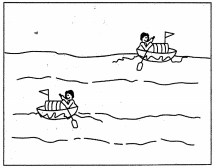
$A$ boat goes $32 \, km$ upstream and $36 \, km$ downstream in $7$ hours. In $9$ hours,it can go $40 \, km$ upstream and $48 \, km$ downstream. Determine the speed of the stream and that of the boat in still water. (Speed of boat in still water is more than the speed of the stream of river.)
A
$(10, 2)$
B
$(10, 1)$
C
$(9, 3)$
D
$(7, 3)$
Solution
(A) Let the speed of the boat in still water be $x \, km/hr$ and the speed of the stream be $y \, km/hr$. It is necessary that $x > y$.
The speed of the boat downstream is $(x+y) \, km/hr$ and the speed of the boat upstream is $(x-y) \, km/hr$.
Using the formula $\text{time} = \frac{\text{distance}}{\text{speed}}$,we have:
For the first case: $\frac{32}{x-y} + \frac{36}{x+y} = 7$ --- $(1)$
For the second case: $\frac{40}{x-y} + \frac{48}{x+y} = 9$ --- $(2)$
Let $\frac{1}{x-y} = a$ and $\frac{1}{x+y} = b$. The equations become:
$32a + 36b = 7$ --- $(3)$
$40a + 48b = 9$ --- $(4)$
Solving these linear equations by elimination or substitution:
Multiply $(3)$ by $4$ and $(4)$ by $3$:
$128a + 144b = 28$
$120a + 144b = 27$
Subtracting the two equations: $8a = 1 \implies a = \frac{1}{8}$.
Substituting $a = \frac{1}{8}$ in $(3)$:
$32(\frac{1}{8}) + 36b = 7 \implies 4 + 36b = 7 \implies 36b = 3 \implies b = \frac{1}{12}$.
Now,$x-y = 8$ and $x+y = 12$.
Adding these: $2x = 20 \implies x = 10$.
Subtracting these: $2y = 4 \implies y = 2$.
Thus,the speed of the boat in still water is $10 \, km/hr$ and the speed of the stream is $2 \, km/hr$.
The speed of the boat downstream is $(x+y) \, km/hr$ and the speed of the boat upstream is $(x-y) \, km/hr$.
Using the formula $\text{time} = \frac{\text{distance}}{\text{speed}}$,we have:
For the first case: $\frac{32}{x-y} + \frac{36}{x+y} = 7$ --- $(1)$
For the second case: $\frac{40}{x-y} + \frac{48}{x+y} = 9$ --- $(2)$
Let $\frac{1}{x-y} = a$ and $\frac{1}{x+y} = b$. The equations become:
$32a + 36b = 7$ --- $(3)$
$40a + 48b = 9$ --- $(4)$
Solving these linear equations by elimination or substitution:
Multiply $(3)$ by $4$ and $(4)$ by $3$:
$128a + 144b = 28$
$120a + 144b = 27$
Subtracting the two equations: $8a = 1 \implies a = \frac{1}{8}$.
Substituting $a = \frac{1}{8}$ in $(3)$:
$32(\frac{1}{8}) + 36b = 7 \implies 4 + 36b = 7 \implies 36b = 3 \implies b = \frac{1}{12}$.
Now,$x-y = 8$ and $x+y = 12$.
Adding these: $2x = 20 \implies x = 10$.
Subtracting these: $2y = 4 \implies y = 2$.
Thus,the speed of the boat in still water is $10 \, km/hr$ and the speed of the stream is $2 \, km/hr$.
0 likes
View Solution195
DifficultMCQ
Solve the following pair of linear equations: $x+y=5xy$ and $3x+2y=13xy$.
A
$(1/2, 1), (3, 2)$
B
$(-2, 1), (-2/5, 3/5)$
C
$(0, 0), (1/2, 1/3)$
D
$(3, -4), (1/2, -1/2)$
Solution
(C) Given equations are:
$(1)$ $x + y = 5xy$
$(2)$ $3x + 2y = 13xy$
Dividing both equations by $xy$ (assuming $x \neq 0, y \neq 0$):
From $(1)$: $1/y + 1/x = 5$ => $1/x + 1/y = 5$ --- $(3)$
From $(2)$: $3/y + 2/x = 13$ => $2/x + 3/y = 13$ --- $(4)$
Let $u = 1/x$ and $v = 1/y$. The equations become:
$(3)$ $u + v = 5$
$(4)$ $2u + 3v = 13$
Multiply $(3)$ by $2$: $2u + 2v = 10$ --- $(5)$
Subtract $(5)$ from $(4)$: $(2u + 3v) - (2u + 2v) = 13 - 10$ => $v = 3$
Substitute $v = 3$ in $(3)$: $u + 3 = 5$ => $u = 2$
Since $u = 1/x = 2$,$x = 1/2$.
Since $v = 1/y = 3$,$y = 1/3$.
Also,if $x=0$ and $y=0$,both equations are satisfied $(0=0)$.
Thus,the solutions are $(0, 0)$ and $(1/2, 1/3)$.
$(1)$ $x + y = 5xy$
$(2)$ $3x + 2y = 13xy$
Dividing both equations by $xy$ (assuming $x \neq 0, y \neq 0$):
From $(1)$: $1/y + 1/x = 5$ => $1/x + 1/y = 5$ --- $(3)$
From $(2)$: $3/y + 2/x = 13$ => $2/x + 3/y = 13$ --- $(4)$
Let $u = 1/x$ and $v = 1/y$. The equations become:
$(3)$ $u + v = 5$
$(4)$ $2u + 3v = 13$
Multiply $(3)$ by $2$: $2u + 2v = 10$ --- $(5)$
Subtract $(5)$ from $(4)$: $(2u + 3v) - (2u + 2v) = 13 - 10$ => $v = 3$
Substitute $v = 3$ in $(3)$: $u + 3 = 5$ => $u = 2$
Since $u = 1/x = 2$,$x = 1/2$.
Since $v = 1/y = 3$,$y = 1/3$.
Also,if $x=0$ and $y=0$,both equations are satisfied $(0=0)$.
Thus,the solutions are $(0, 0)$ and $(1/2, 1/3)$.
0 likes
View Solution196
DifficultMCQ
Solve the following pair of linear equations: $\frac{5}{x-1} + \frac{1}{y-2} = 2$ and $\frac{6}{x-1} - \frac{3}{y-2} = 1$.
A
$x = 4, y = 5$
B
$x = 6, y = 3$
C
$x = 7, y = 0$
D
$x = 2, y = 1$
Solution
(A) Let $u = \frac{1}{x-1}$ and $v = \frac{1}{y-2}$.
Substituting these into the given equations,we get:
$5u + v = 2$ --- $(1)$
$6u - 3v = 1$ --- $(2)$
Multiply equation $(1)$ by $3$ to eliminate $v$:
$15u + 3v = 6$ --- $(3)$
Adding equation $(2)$ and $(3)$:
$(6u - 3v) + (15u + 3v) = 1 + 6$
$21u = 7$
$u = \frac{7}{21} = \frac{1}{3}$
Substitute $u = \frac{1}{3}$ into equation $(1)$:
$5(\frac{1}{3}) + v = 2$
$v = 2 - \frac{5}{3} = \frac{6-5}{3} = \frac{1}{3}$
Now,solve for $x$ and $y$:
$\frac{1}{x-1} = \frac{1}{3} \implies x-1 = 3 \implies x = 4$
$\frac{1}{y-2} = \frac{1}{3} \implies y-2 = 3 \implies y = 5$
Thus,the solution is $(x, y) = (4, 5)$.
Substituting these into the given equations,we get:
$5u + v = 2$ --- $(1)$
$6u - 3v = 1$ --- $(2)$
Multiply equation $(1)$ by $3$ to eliminate $v$:
$15u + 3v = 6$ --- $(3)$
Adding equation $(2)$ and $(3)$:
$(6u - 3v) + (15u + 3v) = 1 + 6$
$21u = 7$
$u = \frac{7}{21} = \frac{1}{3}$
Substitute $u = \frac{1}{3}$ into equation $(1)$:
$5(\frac{1}{3}) + v = 2$
$v = 2 - \frac{5}{3} = \frac{6-5}{3} = \frac{1}{3}$
Now,solve for $x$ and $y$:
$\frac{1}{x-1} = \frac{1}{3} \implies x-1 = 3 \implies x = 4$
$\frac{1}{y-2} = \frac{1}{3} \implies y-2 = 3 \implies y = 5$
Thus,the solution is $(x, y) = (4, 5)$.
0 likes
View Solution197
Medium
Solve the following pair of linear equations: $2(3u - v) = 5uv$ and $2(u + 3v) = 5uv$.
Solution
(A) Given equations are:
$1) 2(3u - v) = 5uv \implies 6u - 2v = 5uv$
$2) 2(u + 3v) = 5uv \implies 2u + 6v = 5uv$
Divide both equations by $uv$ (assuming $u, v \neq 0$):
$1) \frac{6}{v} - \frac{2}{u} = 5$
$2) \frac{2}{v} + \frac{6}{u} = 5$
Let $x = \frac{1}{u}$ and $y = \frac{1}{v}$. The equations become:
$1) -2x + 6y = 5$
$2) 6x + 2y = 5$
Multiply equation $(2)$ by $3$: $18x + 6y = 15$. Subtract equation $(1)$ from this:
$(18x + 6y) - (-2x + 6y) = 15 - 5 \implies 20x = 10 \implies x = \frac{1}{2}$.
Substitute $x = \frac{1}{2}$ into $6x + 2y = 5$:
$6(\frac{1}{2}) + 2y = 5 \implies 3 + 2y = 5 \implies 2y = 2 \implies y = 1$.
Since $x = \frac{1}{u} = \frac{1}{2} \implies u = 2$ and $y = \frac{1}{v} = 1 \implies v = 1$.
Thus,$(u, v) = (2, 1)$.
$1) 2(3u - v) = 5uv \implies 6u - 2v = 5uv$
$2) 2(u + 3v) = 5uv \implies 2u + 6v = 5uv$
Divide both equations by $uv$ (assuming $u, v \neq 0$):
$1) \frac{6}{v} - \frac{2}{u} = 5$
$2) \frac{2}{v} + \frac{6}{u} = 5$
Let $x = \frac{1}{u}$ and $y = \frac{1}{v}$. The equations become:
$1) -2x + 6y = 5$
$2) 6x + 2y = 5$
Multiply equation $(2)$ by $3$: $18x + 6y = 15$. Subtract equation $(1)$ from this:
$(18x + 6y) - (-2x + 6y) = 15 - 5 \implies 20x = 10 \implies x = \frac{1}{2}$.
Substitute $x = \frac{1}{2}$ into $6x + 2y = 5$:
$6(\frac{1}{2}) + 2y = 5 \implies 3 + 2y = 5 \implies 2y = 2 \implies y = 1$.
Since $x = \frac{1}{u} = \frac{1}{2} \implies u = 2$ and $y = \frac{1}{v} = 1 \implies v = 1$.
Thus,$(u, v) = (2, 1)$.
0 likes
View Solution198
DifficultMCQ
Solve the following pairs of linear equations: $\frac{2}{x} + \frac{3}{y} = \frac{9}{xy}, \quad \frac{4}{x} + \frac{9}{y} = \frac{21}{xy} \quad (x \neq 0, y \neq 0)$
A
$(4, 5)$
B
$(1, 3)$
C
$(3, 2)$
D
$(7, 0)$
Solution
(B) Given equations are:
$(1)$ $\frac{2}{x} + \frac{3}{y} = \frac{9}{xy}$
$(2)$ $\frac{4}{x} + \frac{9}{y} = \frac{21}{xy}$
Multiply both equations by $xy$ (since $x \neq 0, y \neq 0$):
$(1)$ $2y + 3x = 9 \implies 3x + 2y = 9$
$(2)$ $4y + 9x = 21 \implies 9x + 4y = 21$
Multiply the first equation by $2$ to eliminate $y$:
$2(3x + 2y) = 2(9) \implies 6x + 4y = 18$
Subtract this from the second equation:
$(9x + 4y) - (6x + 4y) = 21 - 18$
$3x = 3 \implies x = 1$
Substitute $x = 1$ into $3x + 2y = 9$:
$3(1) + 2y = 9$
$3 + 2y = 9 \implies 2y = 6 \implies y = 3$
Thus,the solution is $(x, y) = (1, 3)$.
$(1)$ $\frac{2}{x} + \frac{3}{y} = \frac{9}{xy}$
$(2)$ $\frac{4}{x} + \frac{9}{y} = \frac{21}{xy}$
Multiply both equations by $xy$ (since $x \neq 0, y \neq 0$):
$(1)$ $2y + 3x = 9 \implies 3x + 2y = 9$
$(2)$ $4y + 9x = 21 \implies 9x + 4y = 21$
Multiply the first equation by $2$ to eliminate $y$:
$2(3x + 2y) = 2(9) \implies 6x + 4y = 18$
Subtract this from the second equation:
$(9x + 4y) - (6x + 4y) = 21 - 18$
$3x = 3 \implies x = 1$
Substitute $x = 1$ into $3x + 2y = 9$:
$3(1) + 2y = 9$
$3 + 2y = 9 \implies 2y = 6 \implies y = 3$
Thus,the solution is $(x, y) = (1, 3)$.
0 likes
View Solution199
MediumMCQ
Solve the following pairs of linear equations: $\frac{5}{a} - \frac{6}{b} = 3$ and $\frac{1}{a} + \frac{4}{b} = 11$.
A
$\left(-\frac{2}{5}, \frac{3}{5}\right)$
B
$\left(\frac{7}{3}, \frac{1}{5}\right)$
C
$\left(\frac{1}{3}, \frac{1}{2}\right)$
D
$\left(\frac{2}{5}, \frac{3}{1}\right)$
Solution
(C) Let $x = \frac{1}{a}$ and $y = \frac{1}{b}$.
The equations become:
$5x - 6y = 3$ --- $(1)$
$x + 4y = 11$ --- $(2)$
From equation $(2)$,$x = 11 - 4y$.
Substitute $x$ in equation $(1)$:
$5(11 - 4y) - 6y = 3$
$55 - 20y - 6y = 3$
$55 - 26y = 3$
$26y = 52$
$y = 2$.
Since $y = \frac{1}{b} = 2$,then $b = \frac{1}{2}$.
Substitute $y = 2$ in $x = 11 - 4y$:
$x = 11 - 4(2) = 11 - 8 = 3$.
Since $x = \frac{1}{a} = 3$,then $a = \frac{1}{3}$.
Thus,$(a, b) = \left(\frac{1}{3}, \frac{1}{2}\right)$.
The equations become:
$5x - 6y = 3$ --- $(1)$
$x + 4y = 11$ --- $(2)$
From equation $(2)$,$x = 11 - 4y$.
Substitute $x$ in equation $(1)$:
$5(11 - 4y) - 6y = 3$
$55 - 20y - 6y = 3$
$55 - 26y = 3$
$26y = 52$
$y = 2$.
Since $y = \frac{1}{b} = 2$,then $b = \frac{1}{2}$.
Substitute $y = 2$ in $x = 11 - 4y$:
$x = 11 - 4(2) = 11 - 8 = 3$.
Since $x = \frac{1}{a} = 3$,then $a = \frac{1}{3}$.
Thus,$(a, b) = \left(\frac{1}{3}, \frac{1}{2}\right)$.
0 likes
View Solution200
MediumMCQ
Solve the following pair of linear equations: $\frac{9}{a} + \frac{8}{b} = 7$ and $\frac{2}{a} - \frac{3}{b} = -8$.
A
$\left(2, \frac{1}{2}\right)$
B
$\left(-\frac{2}{5}, \frac{3}{5}\right)$
C
$\left(\frac{1}{2}, -\frac{1}{2}\right)$
D
$\left(-1, \frac{1}{2}\right)$
Solution
(D) Let $x = \frac{1}{a}$ and $y = \frac{1}{b}$.
The equations become:
$9x + 8y = 7$ --- $(1)$
$2x - 3y = -8$ --- $(2)$
Multiply $(1)$ by $3$ and $(2)$ by $8$ to eliminate $y$:
$27x + 24y = 21$ --- $(3)$
$16x - 24y = -64$ --- $(4)$
Adding $(3)$ and $(4)$:
$43x = -43 \implies x = -1$.
Since $x = \frac{1}{a} = -1$,we get $a = -1$.
Substitute $x = -1$ into $(2)$:
$2(-1) - 3y = -8$
$-2 - 3y = -8$
$-3y = -6 \implies y = 2$.
Since $y = \frac{1}{b} = 2$,we get $b = \frac{1}{2}$.
Thus,$(a, b) = \left(-1, \frac{1}{2}\right)$.
The equations become:
$9x + 8y = 7$ --- $(1)$
$2x - 3y = -8$ --- $(2)$
Multiply $(1)$ by $3$ and $(2)$ by $8$ to eliminate $y$:
$27x + 24y = 21$ --- $(3)$
$16x - 24y = -64$ --- $(4)$
Adding $(3)$ and $(4)$:
$43x = -43 \implies x = -1$.
Since $x = \frac{1}{a} = -1$,we get $a = -1$.
Substitute $x = -1$ into $(2)$:
$2(-1) - 3y = -8$
$-2 - 3y = -8$
$-3y = -6 \implies y = 2$.
Since $y = \frac{1}{b} = 2$,we get $b = \frac{1}{2}$.
Thus,$(a, b) = \left(-1, \frac{1}{2}\right)$.
0 likes
View SolutionPair of Linear Equations in Two Variables — Mix Examples - Pair of Linear Equations in Two Variables · Frequently Asked Questions
1Are these Pair of Linear Equations in Two Variables questions useful for JEE and NEET?
Yes. All questions in this section are mapped to JEE Main and NEET exam patterns. Previous year questions from JEE Main, NEET, GUJCET and state-level exams are included with full solutions.
2Can I switch to Hindi or Gujarati for these questions?
Yes. Use the language tabs in the hero section or the sidebar to view the same questions and solutions in English, Hindi or Gujarati.
3How do I generate a question paper from this subtopic?
Use the Vedclass Exam Paper Generator — select the chapter and subtopic, set difficulty, and generate Sets A, B, C, D automatically. First 3 chapters of every subject are free.
Vedclass Products
For Students
Vedclass Test Series
Mock tests in real JEE/NEET style with performance analysis. 5-day free trial.
Start Free TrialFor Teachers
Exam Paper Generator
Generate Set A/B/C/D papers from this chapter in 2 minutes. 3 chapters free.
Try FreeFor Institutes
Online Exam Module
Live online exams with unlimited students, 360° analytics & white-label branding.
See DemoFor Teachers & Institutes
Generate a Pair of Linear Equations in Two Variables Exam Paper in 2 Minutes
Select subtopic & difficulty — Sets A, B, C, D auto-generated with No Repeat logic.
First 3 chapters of every subject are free — no payment required.