
MathematicsQ201–216 of 406 questions
Page 5 of 5 · English
201
MathematicsEasyMCQTS EAMCET · 2018
If the period of the function $f(x) = \sin 5x \cos 3x$ is $\alpha$,then $\cos \alpha =$
A
$1$
B
$\frac{1}{\sqrt{2}}$
C
$-\frac{1}{2}$
D
$-1$
Solution
(D) Given the function $f(x) = \sin 5x \cos 3x$.
Using the trigonometric identity $2 \sin A \cos B = \sin(A+B) + \sin(A-B)$,we can rewrite the function as:
$f(x) = \frac{1}{2} [\sin(5x+3x) + \sin(5x-3x)] = \frac{1}{2} (\sin 8x + \sin 2x)$.
The period of $\sin 8x$ is $T_1 = \frac{2\pi}{8} = \frac{\pi}{4}$.
The period of $\sin 2x$ is $T_2 = \frac{2\pi}{2} = \pi$.
The period of the sum of two periodic functions is the Least Common Multiple ($L$.$C$.$M$.) of their individual periods.
$\alpha = \text{L.C.M.}\left(\frac{\pi}{4}, \pi\right) = \frac{\text{L.C.M.}(\pi, \pi)}{\text{H.C.F.}(4, 1)} = \frac{\pi}{1} = \pi$.
Thus,$\alpha = \pi$.
Finally,$\cos \alpha = \cos \pi = -1$.
Using the trigonometric identity $2 \sin A \cos B = \sin(A+B) + \sin(A-B)$,we can rewrite the function as:
$f(x) = \frac{1}{2} [\sin(5x+3x) + \sin(5x-3x)] = \frac{1}{2} (\sin 8x + \sin 2x)$.
The period of $\sin 8x$ is $T_1 = \frac{2\pi}{8} = \frac{\pi}{4}$.
The period of $\sin 2x$ is $T_2 = \frac{2\pi}{2} = \pi$.
The period of the sum of two periodic functions is the Least Common Multiple ($L$.$C$.$M$.) of their individual periods.
$\alpha = \text{L.C.M.}\left(\frac{\pi}{4}, \pi\right) = \frac{\text{L.C.M.}(\pi, \pi)}{\text{H.C.F.}(4, 1)} = \frac{\pi}{1} = \pi$.
Thus,$\alpha = \pi$.
Finally,$\cos \alpha = \cos \pi = -1$.
0 likesView Solution
202
MathematicsEasyMCQTS EAMCET · 2018
The set of real values of $x$ for which the inequality $|x-1|+|x+1| < 4$ holds true is
A
$(-2, 2)$
B
$(-\infty, -2) \cup (2, \infty)$
C
$(-\infty, -1] \cup [1, \infty)$
D
$(-2, -1) \cup (1, 2)$
Solution
(A) The given inequality is $|x-1|+|x+1| < 4$.
We define the function $f(x) = |x-1|+|x+1|$.
Case $1$: $x < -1$. Then $f(x) = -(x-1) - (x+1) = -2x$.
$-2x < 4 \Rightarrow x > -2$. So,$x \in (-2, -1)$.
Case $2$: $-1 \leq x \leq 1$. Then $f(x) = -(x-1) + (x+1) = 2$.
$2 < 4$ is always true for $x \in [-1, 1]$.
Case $3$: $x > 1$. Then $f(x) = (x-1) + (x+1) = 2x$.
$2x < 4 \Rightarrow x < 2$. So,$x \in (1, 2)$.
Combining all cases,the solution set is $(-2, -1) \cup [-1, 1] \cup (1, 2) = (-2, 2)$.
We define the function $f(x) = |x-1|+|x+1|$.
Case $1$: $x < -1$. Then $f(x) = -(x-1) - (x+1) = -2x$.
$-2x < 4 \Rightarrow x > -2$. So,$x \in (-2, -1)$.
Case $2$: $-1 \leq x \leq 1$. Then $f(x) = -(x-1) + (x+1) = 2$.
$2 < 4$ is always true for $x \in [-1, 1]$.
Case $3$: $x > 1$. Then $f(x) = (x-1) + (x+1) = 2x$.
$2x < 4 \Rightarrow x < 2$. So,$x \in (1, 2)$.
Combining all cases,the solution set is $(-2, -1) \cup [-1, 1] \cup (1, 2) = (-2, 2)$.
0 likesView Solution
203
MathematicsEasyMCQTS EAMCET · 2018
The angle between the curves $x^2-y^2=4$ and $x^2+y^2=4\sqrt{2}$ is
A
$\frac{\pi}{6}$
B
$\frac{\pi}{4}$
C
$\frac{\pi}{3}$
D
$\frac{\pi}{2}$
Solution
(B) Given curves are $x^2-y^2=4$ ...$(i)$ and $x^2+y^2=4\sqrt{2}$ ...(ii).
Adding $(i)$ and (ii),we get $2x^2 = 4(1+\sqrt{2})$,so $x^2 = 2(1+\sqrt{2})$.
Subtracting $(i)$ from (ii),we get $2y^2 = 4(\sqrt{2}-1)$,so $y^2 = 2(\sqrt{2}-1)$.
Differentiating $(i)$ with respect to $x$: $2x - 2y\frac{dy}{dx} = 0 \Rightarrow \frac{dy}{dx} = \frac{x}{y} = m_1$.
Differentiating (ii) with respect to $x$: $2x + 2y\frac{dy}{dx} = 0 \Rightarrow \frac{dy}{dx} = -\frac{x}{y} = m_2$.
The angle $\theta$ between the curves is given by $\tan \theta = \left|\frac{m_1-m_2}{1+m_1m_2}\right|$.
Substituting the values: $\tan \theta = \left|\frac{\frac{x}{y} - (-\frac{x}{y})}{1 + (\frac{x}{y})(-\frac{x}{y})}\right| = \left|\frac{2x/y}{1 - x^2/y^2}\right| = \left|\frac{2xy}{y^2-x^2}\right|$.
From $(i)$ and (ii),$x^2-y^2=4$ and $x^2+y^2=4\sqrt{2}$. Thus $y^2-x^2 = -4$.
Also,$x^2y^2 = 4(\sqrt{2}+1) \times 2(\sqrt{2}-1) = 8(2-1) = 8$,so $xy = \sqrt{8} = 2\sqrt{2}$.
Therefore,$\tan \theta = \left|\frac{2(2\sqrt{2})}{-4}\right| = \left|-\sqrt{2}\right|$ is incorrect in the original prompt logic; let's re-evaluate: $\tan \theta = \left|\frac{2xy}{y^2-x^2}\right| = \left|\frac{2(2\sqrt{2})}{-4}\right| = \sqrt{2}$. Wait,checking the intersection: $x^2 = 2+2\sqrt{2}$,$y^2 = 2\sqrt{2}-2$. $y^2-x^2 = -4$. $x^2y^2 = 4(2-1) = 4$,so $xy=2$. $\tan \theta = |4/-4| = 1$.
Thus,$\theta = \frac{\pi}{4}$.
Adding $(i)$ and (ii),we get $2x^2 = 4(1+\sqrt{2})$,so $x^2 = 2(1+\sqrt{2})$.
Subtracting $(i)$ from (ii),we get $2y^2 = 4(\sqrt{2}-1)$,so $y^2 = 2(\sqrt{2}-1)$.
Differentiating $(i)$ with respect to $x$: $2x - 2y\frac{dy}{dx} = 0 \Rightarrow \frac{dy}{dx} = \frac{x}{y} = m_1$.
Differentiating (ii) with respect to $x$: $2x + 2y\frac{dy}{dx} = 0 \Rightarrow \frac{dy}{dx} = -\frac{x}{y} = m_2$.
The angle $\theta$ between the curves is given by $\tan \theta = \left|\frac{m_1-m_2}{1+m_1m_2}\right|$.
Substituting the values: $\tan \theta = \left|\frac{\frac{x}{y} - (-\frac{x}{y})}{1 + (\frac{x}{y})(-\frac{x}{y})}\right| = \left|\frac{2x/y}{1 - x^2/y^2}\right| = \left|\frac{2xy}{y^2-x^2}\right|$.
From $(i)$ and (ii),$x^2-y^2=4$ and $x^2+y^2=4\sqrt{2}$. Thus $y^2-x^2 = -4$.
Also,$x^2y^2 = 4(\sqrt{2}+1) \times 2(\sqrt{2}-1) = 8(2-1) = 8$,so $xy = \sqrt{8} = 2\sqrt{2}$.
Therefore,$\tan \theta = \left|\frac{2(2\sqrt{2})}{-4}\right| = \left|-\sqrt{2}\right|$ is incorrect in the original prompt logic; let's re-evaluate: $\tan \theta = \left|\frac{2xy}{y^2-x^2}\right| = \left|\frac{2(2\sqrt{2})}{-4}\right| = \sqrt{2}$. Wait,checking the intersection: $x^2 = 2+2\sqrt{2}$,$y^2 = 2\sqrt{2}-2$. $y^2-x^2 = -4$. $x^2y^2 = 4(2-1) = 4$,so $xy=2$. $\tan \theta = |4/-4| = 1$.
Thus,$\theta = \frac{\pi}{4}$.
0 likesView Solution
204
MathematicsMediumMCQTS EAMCET · 2018
The normal at a point $\theta$ to the curve $x=a(1+\cos \theta), y=a \sin \theta$ always passes through the fixed point
A
$(0, a)$
B
$(2 a, 0)$
C
$(a, 0)$
D
$(a, a)$
Solution
(C) Given the parametric equations of the curve are $x = a(1 + \cos \theta)$ and $y = a \sin \theta$.
First,we find the derivative $\frac{dy}{dx}$:
$\frac{dy}{d\theta} = a \cos \theta$ and $\frac{dx}{d\theta} = -a \sin \theta$.
Thus,$\frac{dy}{dx} = \frac{a \cos \theta}{-a \sin \theta} = -\cot \theta$.
The slope of the normal at point $\theta$ is $m_n = -\frac{1}{dy/dx} = \frac{1}{\cot \theta} = \tan \theta$.
The equation of the normal at point $(x_1, y_1) = (a(1 + \cos \theta), a \sin \theta)$ is given by:
$y - a \sin \theta = \tan \theta (x - a(1 + \cos \theta))$.
$y - a \sin \theta = \frac{\sin \theta}{\cos \theta} (x - a - a \cos \theta)$.
$y \cos \theta - a \sin \theta \cos \theta = x \sin \theta - a \sin \theta - a \sin \theta \cos \theta$.
$y \cos \theta = x \sin \theta - a \sin \theta$.
$y \cos \theta = (x - a) \sin \theta$.
If we check the point $(a, 0)$,we substitute $x = a$ and $y = 0$ into the equation:
$0 \cdot \cos \theta = (a - a) \sin \theta \Rightarrow 0 = 0$.
Since this holds true for all $\theta$,the normal always passes through the fixed point $(a, 0)$.
First,we find the derivative $\frac{dy}{dx}$:
$\frac{dy}{d\theta} = a \cos \theta$ and $\frac{dx}{d\theta} = -a \sin \theta$.
Thus,$\frac{dy}{dx} = \frac{a \cos \theta}{-a \sin \theta} = -\cot \theta$.
The slope of the normal at point $\theta$ is $m_n = -\frac{1}{dy/dx} = \frac{1}{\cot \theta} = \tan \theta$.
The equation of the normal at point $(x_1, y_1) = (a(1 + \cos \theta), a \sin \theta)$ is given by:
$y - a \sin \theta = \tan \theta (x - a(1 + \cos \theta))$.
$y - a \sin \theta = \frac{\sin \theta}{\cos \theta} (x - a - a \cos \theta)$.
$y \cos \theta - a \sin \theta \cos \theta = x \sin \theta - a \sin \theta - a \sin \theta \cos \theta$.
$y \cos \theta = x \sin \theta - a \sin \theta$.
$y \cos \theta = (x - a) \sin \theta$.
If we check the point $(a, 0)$,we substitute $x = a$ and $y = 0$ into the equation:
$0 \cdot \cos \theta = (a - a) \sin \theta \Rightarrow 0 = 0$.
Since this holds true for all $\theta$,the normal always passes through the fixed point $(a, 0)$.
0 likesView Solution
205
MathematicsEasyMCQTS EAMCET · 2018
If the curves $\frac{x^2}{4}+\frac{y^2}{9}=1$ and $\frac{x^2}{16}-\frac{y^2}{k}=1$ cut each other orthogonally,then $k=$
A
$144$
B
$-9$
C
$25$
D
$-21$
Solution
(D) Given curves are $\frac{x^2}{4}+\frac{y^2}{9}=1$ $(i)$ and $\frac{x^2}{16}-\frac{y^2}{k}=1$ (ii).
For curve $(i)$,differentiating with respect to $x$: $\frac{2x}{4} + \frac{2yy'}{9} = 0 \Rightarrow y'_1 = -\frac{9x}{4y}$.
For curve (ii),differentiating with respect to $x$: $\frac{2x}{16} - \frac{2yy'}{k} = 0 \Rightarrow y'_2 = \frac{kx}{16y}$.
Since the curves are orthogonal,$y'_1 \times y'_2 = -1$.
Substituting the derivatives: $(-\frac{9x}{4y}) \times (\frac{kx}{16y}) = -1 \Rightarrow \frac{9kx^2}{64y^2} = 1 \Rightarrow 9kx^2 = 64y^2$.
From $(i)$,$y^2 = 9(1 - \frac{x^2}{4}) = \frac{9(4-x^2)}{4}$.
Substitute $y^2$ into the orthogonality condition: $9kx^2 = 64 \times \frac{9(4-x^2)}{4} = 16 \times 9(4-x^2) = 144(4-x^2)$.
$kx^2 = 16(4-x^2) = 64 - 16x^2 \Rightarrow x^2(k+16) = 64 \Rightarrow x^2 = \frac{64}{k+16}$.
Substitute $x^2$ into $(i)$: $\frac{64}{4(k+16)} + \frac{y^2}{9} = 1 \Rightarrow \frac{16}{k+16} + \frac{y^2}{9} = 1 \Rightarrow \frac{y^2}{9} = 1 - \frac{16}{k+16} = \frac{k}{k+16} \Rightarrow y^2 = \frac{9k}{k+16}$.
Substitute $x^2$ and $y^2$ into $9kx^2 = 64y^2$: $9k(\frac{64}{k+16}) = 64(\frac{9k}{k+16})$.
This is an identity for any $k$ where the intersection exists.
Subtracting the two original equations: $(\frac{1}{4} - \frac{1}{16})x^2 + (\frac{1}{9} + \frac{1}{k})y^2 = 0 \Rightarrow \frac{3}{16}x^2 + \frac{k+9}{9k}y^2 = 0$.
Using $9kx^2 = 64y^2 \Rightarrow x^2 = \frac{64y^2}{9k}$,substitute into the subtraction: $\frac{3}{16}(\frac{64y^2}{9k}) + \frac{k+9}{9k}y^2 = 0 \Rightarrow \frac{4y^2}{3k} + \frac{(k+9)y^2}{9k} = 0$.
Dividing by $y^2/9k$: $12 + k + 9 = 0 \Rightarrow k = -21$.
For curve $(i)$,differentiating with respect to $x$: $\frac{2x}{4} + \frac{2yy'}{9} = 0 \Rightarrow y'_1 = -\frac{9x}{4y}$.
For curve (ii),differentiating with respect to $x$: $\frac{2x}{16} - \frac{2yy'}{k} = 0 \Rightarrow y'_2 = \frac{kx}{16y}$.
Since the curves are orthogonal,$y'_1 \times y'_2 = -1$.
Substituting the derivatives: $(-\frac{9x}{4y}) \times (\frac{kx}{16y}) = -1 \Rightarrow \frac{9kx^2}{64y^2} = 1 \Rightarrow 9kx^2 = 64y^2$.
From $(i)$,$y^2 = 9(1 - \frac{x^2}{4}) = \frac{9(4-x^2)}{4}$.
Substitute $y^2$ into the orthogonality condition: $9kx^2 = 64 \times \frac{9(4-x^2)}{4} = 16 \times 9(4-x^2) = 144(4-x^2)$.
$kx^2 = 16(4-x^2) = 64 - 16x^2 \Rightarrow x^2(k+16) = 64 \Rightarrow x^2 = \frac{64}{k+16}$.
Substitute $x^2$ into $(i)$: $\frac{64}{4(k+16)} + \frac{y^2}{9} = 1 \Rightarrow \frac{16}{k+16} + \frac{y^2}{9} = 1 \Rightarrow \frac{y^2}{9} = 1 - \frac{16}{k+16} = \frac{k}{k+16} \Rightarrow y^2 = \frac{9k}{k+16}$.
Substitute $x^2$ and $y^2$ into $9kx^2 = 64y^2$: $9k(\frac{64}{k+16}) = 64(\frac{9k}{k+16})$.
This is an identity for any $k$ where the intersection exists.
Subtracting the two original equations: $(\frac{1}{4} - \frac{1}{16})x^2 + (\frac{1}{9} + \frac{1}{k})y^2 = 0 \Rightarrow \frac{3}{16}x^2 + \frac{k+9}{9k}y^2 = 0$.
Using $9kx^2 = 64y^2 \Rightarrow x^2 = \frac{64y^2}{9k}$,substitute into the subtraction: $\frac{3}{16}(\frac{64y^2}{9k}) + \frac{k+9}{9k}y^2 = 0 \Rightarrow \frac{4y^2}{3k} + \frac{(k+9)y^2}{9k} = 0$.
Dividing by $y^2/9k$: $12 + k + 9 = 0 \Rightarrow k = -21$.
0 likesView Solution
206
MathematicsEasyMCQTS EAMCET · 2018
If $Q$ is the point on the parabola $y^2=4x$ that is nearest to the point $P(2,0)$,then $PQ=$
A
$1$
B
$2$
C
$3$
D
$4$
Solution
(B) Let the coordinates of point $Q$ be $(x, y)$ on the parabola $y^2=4x$.
The distance $PQ$ is given by $PQ = \sqrt{(x-2)^2 + (y-0)^2}$.
Substituting $y^2 = 4x$,we get $PQ = \sqrt{(x-2)^2 + 4x} = \sqrt{x^2 - 4x + 4 + 4x} = \sqrt{x^2 + 4}$.
To find the minimum distance,let $f(x) = x^2 + 4$.
Differentiating with respect to $x$,$f'(x) = 2x$.
Setting $f'(x) = 0$,we get $x = 0$.
Since $f''(x) = 2 > 0$,the function has a minimum at $x = 0$.
The minimum distance is $PQ = \sqrt{0^2 + 4} = \sqrt{4} = 2$.
The distance $PQ$ is given by $PQ = \sqrt{(x-2)^2 + (y-0)^2}$.
Substituting $y^2 = 4x$,we get $PQ = \sqrt{(x-2)^2 + 4x} = \sqrt{x^2 - 4x + 4 + 4x} = \sqrt{x^2 + 4}$.
To find the minimum distance,let $f(x) = x^2 + 4$.
Differentiating with respect to $x$,$f'(x) = 2x$.
Setting $f'(x) = 0$,we get $x = 0$.
Since $f''(x) = 2 > 0$,the function has a minimum at $x = 0$.
The minimum distance is $PQ = \sqrt{0^2 + 4} = \sqrt{4} = 2$.
0 likesView Solution
207
MathematicsMediumMCQTS EAMCET · 2018
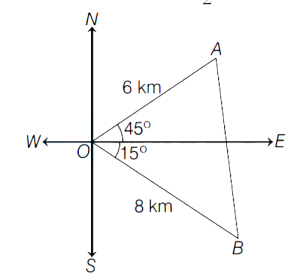
Two ships leave a port from a point at the same time. One goes with a velocity of $3 \text{ km/h}$ along North-East making an angle of $45^{\circ}$ with the East direction and the other travels with a velocity of $4 \text{ km/h}$ along South-East making an angle of $15^{\circ}$ with the East direction. Then,the distance between the ships at the end of two hours is
A
$2 \sqrt{13}$
B
$\sqrt{13}$
C
$5$
D
$10$
Solution
(A) Let the starting point be $O$. After $2 \text{ hours}$,the distance travelled by the first ship is $OA = 3 \text{ km/h} \times 2 \text{ h} = 6 \text{ km}$.
The distance travelled by the second ship is $OB = 4 \text{ km/h} \times 2 \text{ h} = 8 \text{ km}$.
The angle between the two paths is $\angle AOB = 45^{\circ} + 15^{\circ} = 60^{\circ}$.
Using the Law of Cosines in $\triangle AOB$:
$AB^2 = OA^2 + OB^2 - 2(OA)(OB) \cos(60^{\circ})$
$AB^2 = 6^2 + 8^2 - 2(6)(8) \times \frac{1}{2}$
$AB^2 = 36 + 64 - 48$
$AB^2 = 100 - 48 = 52$
$AB = \sqrt{52} = \sqrt{4 \times 13} = 2 \sqrt{13} \text{ km}$.
The distance travelled by the second ship is $OB = 4 \text{ km/h} \times 2 \text{ h} = 8 \text{ km}$.
The angle between the two paths is $\angle AOB = 45^{\circ} + 15^{\circ} = 60^{\circ}$.
Using the Law of Cosines in $\triangle AOB$:
$AB^2 = OA^2 + OB^2 - 2(OA)(OB) \cos(60^{\circ})$
$AB^2 = 6^2 + 8^2 - 2(6)(8) \times \frac{1}{2}$
$AB^2 = 36 + 64 - 48$
$AB^2 = 100 - 48 = 52$
$AB = \sqrt{52} = \sqrt{4 \times 13} = 2 \sqrt{13} \text{ km}$.
0 likesView Solution
208
MathematicsMediumMCQTS EAMCET · 2018
If $\alpha$ and $\beta$ are the greatest common divisors of $n(n^2-1)$ and $2n(n^2+2)$ respectively for all $n \in N$,then $\alpha \beta=$
A
$18$
B
$36$
C
$27$
D
$9$
Solution
(B) Let $f(n) = n(n^2-1) = (n-1)n(n+1)$. This is the product of three consecutive integers,so it is always divisible by $3! = 6$. Thus,$\alpha = 6$.
Let $g(n) = 2n(n^2+2) = 2n^3 + 4n$.
For $n=1$,$g(1) = 2(1)(1+2) = 6$.
For $n=2$,$g(2) = 2(2)(4+2) = 24$.
For $n=3$,$g(3) = 2(3)(9+2) = 66$.
The greatest common divisor of these values is $\beta = 6$.
Therefore,$\alpha \beta = 6 \times 6 = 36$.
Let $g(n) = 2n(n^2+2) = 2n^3 + 4n$.
For $n=1$,$g(1) = 2(1)(1+2) = 6$.
For $n=2$,$g(2) = 2(2)(4+2) = 24$.
For $n=3$,$g(3) = 2(3)(9+2) = 66$.
The greatest common divisor of these values is $\beta = 6$.
Therefore,$\alpha \beta = 6 \times 6 = 36$.
0 likesView Solution
209
MathematicsEasyMCQTS EAMCET · 2018
$x^n + y^n$ is divisible by
A
$x - y$ for all $n \in N$
B
$x + y$ for all $n \in N$
C
$x + y$ for all $n = 2m - 1, m \in N$
D
$x + y$ for all $n = 2m, m \in N$
Solution
(C) The expression $x^n + y^n$ is divisible by $(x + y)$ if and only if $n$ is an odd positive integer.
For $n = 1$,$x^1 + y^1 = x + y$,which is divisible by $(x + y)$.
For $n = 2$,$x^2 + y^2$ is not divisible by $(x + y)$.
For $n = 3$,$x^3 + y^3 = (x + y)(x^2 - xy + y^2)$,which is divisible by $(x + y)$.
In general,for any odd integer $n = 2m - 1$ where $m \in N$,$x^n + y^n$ is divisible by $(x + y)$.
For $n = 1$,$x^1 + y^1 = x + y$,which is divisible by $(x + y)$.
For $n = 2$,$x^2 + y^2$ is not divisible by $(x + y)$.
For $n = 3$,$x^3 + y^3 = (x + y)(x^2 - xy + y^2)$,which is divisible by $(x + y)$.
In general,for any odd integer $n = 2m - 1$ where $m \in N$,$x^n + y^n$ is divisible by $(x + y)$.
0 likesView Solution
210
MathematicsEasyMCQTS EAMCET · 2018
For all positive integers $k$,if the greatest divisor of $25^k+12k-1$ is $d$,then $4\sqrt{d}=$
A
$36$
B
$8$
C
$20$
D
$24$
Solution
(D) Let $f(k) = 25^k + 12k - 1$.
For $k=1$,$f(1) = 25^1 + 12(1) - 1 = 36$.
For $k=2$,$f(2) = 25^2 + 12(2) - 1 = 625 + 24 - 1 = 648$.
The greatest common divisor $d$ of $f(1)$ and $f(2)$ is $\text{gcd}(36, 648) = 36$.
Thus,$d = 36$.
Then,$4\sqrt{d} = 4\sqrt{36} = 4 \times 6 = 24$.
For $k=1$,$f(1) = 25^1 + 12(1) - 1 = 36$.
For $k=2$,$f(2) = 25^2 + 12(2) - 1 = 625 + 24 - 1 = 648$.
The greatest common divisor $d$ of $f(1)$ and $f(2)$ is $\text{gcd}(36, 648) = 36$.
Thus,$d = 36$.
Then,$4\sqrt{d} = 4\sqrt{36} = 4 \times 6 = 24$.
0 likesView Solution
211
MathematicsEasyMCQTS EAMCET · 2018
Let $n \in \mathbb{N}$. Which one of the following is true?
A
$47^n+16n-1$ is divisible by $4$
B
$2(4^{2n+1})-3^{3n+1}$ is divisible by $9$
C
$4^n-3n-1$ is divisible by $11$
D
$3(5^{2n+1})+2^{3n+1}$ is divisible by $17$
Solution
(D) We test each option for $n \in \mathbb{N}$.
$(a)$ For $n=1$,$47^1+16(1)-1 = 47+16-1 = 62$,which is not divisible by $4$.
$(b)$ For $n=1$,$2(4^3)-3^4 = 2(64)-81 = 128-81 = 47$,which is not divisible by $9$.
$(c)$ For $n=1$,$4^1-3(1)-1 = 4-3-1 = 0$. For $n=2$,$4^2-3(2)-1 = 16-6-1 = 9$,which is not divisible by $11$.
$(d)$ Consider $f(n) = 3 \cdot 5^{2n+1} + 2^{3n+1} = 15 \cdot 25^n + 2 \cdot 8^n$.
Using the property $x^n - y^n = (x-y)(x^{n-1} + \dots + y^{n-1})$,we can write $25^n = (17+8)^n = 17k + 8^n$.
So,$f(n) = 15(17k + 8^n) + 2 \cdot 8^n = 15 \cdot 17k + 15 \cdot 8^n + 2 \cdot 8^n = 15 \cdot 17k + 17 \cdot 8^n = 17(15k + 8^n)$.
Thus,$3(5^{2n+1}) + 2^{3n+1}$ is always divisible by $17$ for all $n \in \mathbb{N}$.
$(a)$ For $n=1$,$47^1+16(1)-1 = 47+16-1 = 62$,which is not divisible by $4$.
$(b)$ For $n=1$,$2(4^3)-3^4 = 2(64)-81 = 128-81 = 47$,which is not divisible by $9$.
$(c)$ For $n=1$,$4^1-3(1)-1 = 4-3-1 = 0$. For $n=2$,$4^2-3(2)-1 = 16-6-1 = 9$,which is not divisible by $11$.
$(d)$ Consider $f(n) = 3 \cdot 5^{2n+1} + 2^{3n+1} = 15 \cdot 25^n + 2 \cdot 8^n$.
Using the property $x^n - y^n = (x-y)(x^{n-1} + \dots + y^{n-1})$,we can write $25^n = (17+8)^n = 17k + 8^n$.
So,$f(n) = 15(17k + 8^n) + 2 \cdot 8^n = 15 \cdot 17k + 15 \cdot 8^n + 2 \cdot 8^n = 15 \cdot 17k + 17 \cdot 8^n = 17(15k + 8^n)$.
Thus,$3(5^{2n+1}) + 2^{3n+1}$ is always divisible by $17$ for all $n \in \mathbb{N}$.
0 likesView Solution
212
MathematicsEasyMCQTS EAMCET · 2018
Let $A(3, 2, -4)$ and $B(9, 8, -10)$ be two points. Let $P_1$ divide $AB$ in the ratio $1:2$ and $P_2$ divide $AB$ in the ratio $2:1$. If the point $P(\alpha, \beta, \gamma)$ divides $P_1 P_2$ in the ratio $1:1$,then $\alpha + 2\beta + 2\gamma =$
A
$1$
B
$2$
C
$3$
D
$4$
Solution
(B) The coordinates of $P_1$ dividing $AB$ in the ratio $1:2$ are given by the section formula:
$P_1 = \left( \frac{1(9) + 2(3)}{1+2}, \frac{1(8) + 2(2)}{1+2}, \frac{1(-10) + 2(-4)}{1+2} \right) = \left( \frac{15}{3}, \frac{12}{3}, \frac{-18}{3} \right) = (5, 4, -6)$.
The coordinates of $P_2$ dividing $AB$ in the ratio $2:1$ are:
$P_2 = \left( \frac{2(9) + 1(3)}{2+1}, \frac{2(8) + 1(2)}{2+1}, \frac{2(-10) + 1(-4)}{2+1} \right) = \left( \frac{21}{3}, \frac{18}{3}, \frac{-24}{3} \right) = (7, 6, -8)$.
Since $P(\alpha, \beta, \gamma)$ is the midpoint of $P_1 P_2$ (ratio $1:1$):
$P = \left( \frac{5+7}{2}, \frac{4+6}{2}, \frac{-6-8}{2} \right) = (6, 5, -7)$.
Thus,$\alpha = 6$,$\beta = 5$,and $\gamma = -7$.
Calculating the expression:
$\alpha + 2\beta + 2\gamma = 6 + 2(5) + 2(-7) = 6 + 10 - 14 = 2$.
$P_1 = \left( \frac{1(9) + 2(3)}{1+2}, \frac{1(8) + 2(2)}{1+2}, \frac{1(-10) + 2(-4)}{1+2} \right) = \left( \frac{15}{3}, \frac{12}{3}, \frac{-18}{3} \right) = (5, 4, -6)$.
The coordinates of $P_2$ dividing $AB$ in the ratio $2:1$ are:
$P_2 = \left( \frac{2(9) + 1(3)}{2+1}, \frac{2(8) + 1(2)}{2+1}, \frac{2(-10) + 1(-4)}{2+1} \right) = \left( \frac{21}{3}, \frac{18}{3}, \frac{-24}{3} \right) = (7, 6, -8)$.
Since $P(\alpha, \beta, \gamma)$ is the midpoint of $P_1 P_2$ (ratio $1:1$):
$P = \left( \frac{5+7}{2}, \frac{4+6}{2}, \frac{-6-8}{2} \right) = (6, 5, -7)$.
Thus,$\alpha = 6$,$\beta = 5$,and $\gamma = -7$.
Calculating the expression:
$\alpha + 2\beta + 2\gamma = 6 + 2(5) + 2(-7) = 6 + 10 - 14 = 2$.
0 likesView Solution
213
MathematicsMediumMCQTS EAMCET · 2018
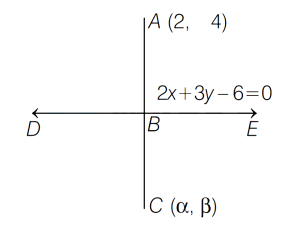
The image of the point $(2, 4)$ with respect to the straight line $2x + 3y - 6 = 0$ is
A
$\left(-\frac{14}{13}, -\frac{8}{13}\right)$
B
$\left(\frac{14}{13}, \frac{8}{13}\right)$
C
$\left(-\frac{2}{13}, -\frac{4}{13}\right)$
D
$\left(-\frac{2}{7}, -\frac{8}{7}\right)$
Solution
(A) Let the image of the point $A(2, 4)$ in the line mirror $DE$ be $C(\alpha, \beta)$. Then,$AC$ is perpendicular to $DE$.
The midpoint $B$ of $AC$ is $\left(\frac{\alpha + 2}{2}, \frac{\beta + 4}{2}\right)$.
Since point $B$ lies on the line $2x + 3y - 6 = 0$,we have:
$2\left(\frac{\alpha + 2}{2}\right) + 3\left(\frac{\beta + 4}{2}\right) - 6 = 0$
$\Rightarrow 2\alpha + 4 + 3\beta + 12 - 12 = 0$
$\Rightarrow 2\alpha + 3\beta + 4 = 0$ --- $(i)$
Since $AC \perp DE$,the product of their slopes is $-1$. The slope of $DE$ is $-\frac{2}{3}$,so the slope of $AC$ must be $\frac{3}{2}$.
$\frac{\beta - 4}{\alpha - 2} = \frac{3}{2}$
$\Rightarrow 2\beta - 8 = 3\alpha - 6$
$\Rightarrow 3\alpha - 2\beta + 2 = 0$ --- $(ii)$
Solving equations $(i)$ and $(ii)$:
Multiply $(i)$ by $2$ and $(ii)$ by $3$:
$4\alpha + 6\beta + 8 = 0$
$9\alpha - 6\beta + 6 = 0$
Adding these,$13\alpha + 14 = 0 \Rightarrow \alpha = -\frac{14}{13}$.
Substituting $\alpha$ in $(i)$:
$2(-\frac{14}{13}) + 3\beta + 4 = 0$
$-\frac{28}{13} + 3\beta + \frac{52}{13} = 0$
$3\beta = -\frac{24}{13} \Rightarrow \beta = -\frac{8}{13}$.
Thus,the image of the point $(2, 4)$ is $\left(-\frac{14}{13}, -\frac{8}{13}\right)$.
The midpoint $B$ of $AC$ is $\left(\frac{\alpha + 2}{2}, \frac{\beta + 4}{2}\right)$.
Since point $B$ lies on the line $2x + 3y - 6 = 0$,we have:
$2\left(\frac{\alpha + 2}{2}\right) + 3\left(\frac{\beta + 4}{2}\right) - 6 = 0$
$\Rightarrow 2\alpha + 4 + 3\beta + 12 - 12 = 0$
$\Rightarrow 2\alpha + 3\beta + 4 = 0$ --- $(i)$
Since $AC \perp DE$,the product of their slopes is $-1$. The slope of $DE$ is $-\frac{2}{3}$,so the slope of $AC$ must be $\frac{3}{2}$.
$\frac{\beta - 4}{\alpha - 2} = \frac{3}{2}$
$\Rightarrow 2\beta - 8 = 3\alpha - 6$
$\Rightarrow 3\alpha - 2\beta + 2 = 0$ --- $(ii)$
Solving equations $(i)$ and $(ii)$:
Multiply $(i)$ by $2$ and $(ii)$ by $3$:
$4\alpha + 6\beta + 8 = 0$
$9\alpha - 6\beta + 6 = 0$
Adding these,$13\alpha + 14 = 0 \Rightarrow \alpha = -\frac{14}{13}$.
Substituting $\alpha$ in $(i)$:
$2(-\frac{14}{13}) + 3\beta + 4 = 0$
$-\frac{28}{13} + 3\beta + \frac{52}{13} = 0$
$3\beta = -\frac{24}{13} \Rightarrow \beta = -\frac{8}{13}$.
Thus,the image of the point $(2, 4)$ is $\left(-\frac{14}{13}, -\frac{8}{13}\right)$.
0 likesView Solution
214
MathematicsEasyMCQTS EAMCET · 2018
$A$ number $n$ is chosen at random from the natural numbers $2$ to $1001$. The probability that $n$ is a number that leaves remainder $1$ when divided by $7$ is:
A
$\frac{73}{500}$
B
$\frac{71}{1000}$
C
$\frac{143}{1000}$
D
$\frac{71}{500}$
Solution
(D) The total number of natural numbers from $2$ to $1001$ is $1001 - 2 + 1 = 1000$.
We are looking for numbers $n$ such that $n \equiv 1 \pmod{7}$.
The sequence of such numbers starting from $2$ is $8, 15, 22, \dots, 995$.
This is an arithmetic progression where the first term $a = 8$,the common difference $d = 7$,and the last term $l = 995$.
Using the formula $l = a + (m - 1)d$,we have:
$995 = 8 + (m - 1)7$
$987 = (m - 1)7$
$m - 1 = 141$
$m = 142$.
The required probability is $\frac{m}{\text{Total numbers}} = \frac{142}{1000} = \frac{71}{500}$.
We are looking for numbers $n$ such that $n \equiv 1 \pmod{7}$.
The sequence of such numbers starting from $2$ is $8, 15, 22, \dots, 995$.
This is an arithmetic progression where the first term $a = 8$,the common difference $d = 7$,and the last term $l = 995$.
Using the formula $l = a + (m - 1)d$,we have:
$995 = 8 + (m - 1)7$
$987 = (m - 1)7$
$m - 1 = 141$
$m = 142$.
The required probability is $\frac{m}{\text{Total numbers}} = \frac{142}{1000} = \frac{71}{500}$.
0 likesView Solution
215
MathematicsMediumTS EAMCET · 2018
$A$ bag contains $4$ red,$3$ white,and $5$ blue balls. Three balls are drawn at a time randomly from the bag. Match the items from List-$I$ with those of List-$II$.
| List-$I$ | List-$II$ |
| $A$. Probability of getting $1$ red,$1$ white and $1$ blue ball | $(i)$ $\frac{3}{44}$ |
| $B$. Probability of getting $2$ white and $1$ blue ball | $(ii)$ $\frac{21}{55}$ |
| $C$. Probability of getting $2$ red and $1$ white ball | $(iii)$ $\frac{38}{55}$ |
| $D$. Probability that none of the balls is white | $(iv)$ $\frac{3}{11}$ |
| $(v)$ $\frac{9}{110}$ |
Solution
(A) Total number of balls = $4 + 3 + 5 = 12$.
Total ways to draw $3$ balls = $^{12}C_3 = \frac{12 \times 11 \times 10}{3 \times 2 \times 1} = 220$.
$(A)$ Probability of getting $1$ red,$1$ white and $1$ blue ball:
Ways = $^4C_1 \times ^3C_1 \times ^5C_1 = 4 \times 3 \times 5 = 60$.
Probability = $\frac{60}{220} = \frac{3}{11}$ (Matches $(iv)$).
$(B)$ Probability of getting $2$ white and $1$ blue ball:
Ways = $^3C_2 \times ^5C_1 = 3 \times 5 = 15$.
Probability = $\frac{15}{220} = \frac{3}{44}$ (Matches $(i)$).
$(C)$ Probability of getting $2$ red and $1$ white ball:
Ways = $^4C_2 \times ^3C_1 = 6 \times 3 = 18$.
Probability = $\frac{18}{220} = \frac{9}{110}$ (Matches $(v)$).
$(D)$ Probability that none of the balls is white (i.e.,all $3$ are from red and blue balls,total $4+5=9$):
Ways = $^9C_3 = \frac{9 \times 8 \times 7}{3 \times 2 \times 1} = 84$.
Probability = $\frac{84}{220} = \frac{21}{55}$ (Matches $(ii)$).
Therefore,the correct matching is: $A \rightarrow (iv), B \rightarrow (i), C \rightarrow (v), D \rightarrow (ii)$.
Total ways to draw $3$ balls = $^{12}C_3 = \frac{12 \times 11 \times 10}{3 \times 2 \times 1} = 220$.
$(A)$ Probability of getting $1$ red,$1$ white and $1$ blue ball:
Ways = $^4C_1 \times ^3C_1 \times ^5C_1 = 4 \times 3 \times 5 = 60$.
Probability = $\frac{60}{220} = \frac{3}{11}$ (Matches $(iv)$).
$(B)$ Probability of getting $2$ white and $1$ blue ball:
Ways = $^3C_2 \times ^5C_1 = 3 \times 5 = 15$.
Probability = $\frac{15}{220} = \frac{3}{44}$ (Matches $(i)$).
$(C)$ Probability of getting $2$ red and $1$ white ball:
Ways = $^4C_2 \times ^3C_1 = 6 \times 3 = 18$.
Probability = $\frac{18}{220} = \frac{9}{110}$ (Matches $(v)$).
$(D)$ Probability that none of the balls is white (i.e.,all $3$ are from red and blue balls,total $4+5=9$):
Ways = $^9C_3 = \frac{9 \times 8 \times 7}{3 \times 2 \times 1} = 84$.
Probability = $\frac{84}{220} = \frac{21}{55}$ (Matches $(ii)$).
Therefore,the correct matching is: $A \rightarrow (iv), B \rightarrow (i), C \rightarrow (v), D \rightarrow (ii)$.
0 likesView Solution
216
MathematicsEasyMCQTS EAMCET · 2018
Ten persons with badges numbered $1$ to $10$ are in a room. If three of them are asked to leave the room,then the probability that the person with the smallest badge number among the three who left is $5$,is:
A
$\frac{3}{10}$
B
$\frac{1}{6}$
C
$\frac{1}{12}$
D
$\frac{2}{5}$
Solution
(C) Total number of ways to select $3$ persons out of $10$ is given by $n(S) = {}^{10}C_3 = \frac{10 \times 9 \times 8}{3 \times 2 \times 1} = 120$.
If the smallest badge number among the three selected is $5$,then $5$ must be one of the selected persons.
The other two persons must be selected from the set of numbers greater than $5$,which is $\{6, 7, 8, 9, 10\}$.
There are $5$ such numbers.
Therefore,the number of ways to select the other two persons is $n(A) = {}^{5}C_2 = \frac{5 \times 4}{2 \times 1} = 10$.
The required probability is $P(A) = \frac{n(A)}{n(S)} = \frac{10}{120} = \frac{1}{12}$.
If the smallest badge number among the three selected is $5$,then $5$ must be one of the selected persons.
The other two persons must be selected from the set of numbers greater than $5$,which is $\{6, 7, 8, 9, 10\}$.
There are $5$ such numbers.
Therefore,the number of ways to select the other two persons is $n(A) = {}^{5}C_2 = \frac{5 \times 4}{2 \times 1} = 10$.
The required probability is $P(A) = \frac{n(A)}{n(S)} = \frac{10}{120} = \frac{1}{12}$.
0 likesView Solution
Vedclass Products
For Students
Vedclass Test Series
Mock tests in real TS EAMCET style covering Mathematics with performance analysis. 5-day free trial.
Start Free TrialFor Teachers
Exam Paper Generator
Generate Set A/B/C/D Mathematics papers from 7.5L+ questions in 2 minutes. 3 chapters free.
Try FreeFor Institutes
Online Exam Module
Run live TS EAMCET mock exams with unlimited students, 360° analytics & white-label branding.
See DemoFrequently Asked Questions
How many Mathematics questions are in TS EAMCET 2018?
There are 406 Mathematics questions from the TS EAMCET 2018 paper on Vedclass, each with a detailed step-by-step solution in English.
Are TS EAMCET 2018 Mathematics solutions available in English?
Yes. All solutions on this page are in English. You can also switch to English or Hindi using the language buttons above the questions.
Can I practice TS EAMCET 2018 Mathematics as a timed test?
Yes. Use the Vedclass Test Series to attempt a full TS EAMCET mock test covering Mathematics with time limits and instant score analysis.
Can teachers create Mathematics papers from TS EAMCET previous year questions?
Yes. The Vedclass Exam Paper Generator lets teachers mix TS EAMCET Mathematics questions and generate Set A/B/C/D papers in minutes.
For Teachers & Institutes
Build a Custom Mathematics Paper
Pick TS EAMCET 2018 Mathematics questions, set difficulty, and generate Set A/B/C/D in 2 minutes.