
ChemistryQ51–100 of 185 questions
Page 2 of 4 · English
51
ChemistryMCQTS EAMCET · 2005
If $|a| < 1$ and $b = \sum_{k=1}^{\infty} \frac{a^k}{k}$,then $a$ is equal to
A
$\sum_{k=1}^{\infty} \frac{(-1)^k b^k}{k}$
B
$\sum_{k=1}^{\infty} \frac{(-1)^{k-1} b^k}{k!}$
C
$\sum_{k=1}^{\infty} \frac{(-1)^k b^k}{(k-1)!}$
D
$\sum_{k=1}^{\infty} \frac{(-1)^{k-1} b^k}{(k+1)!}$
Solution
(B) Given that $b = \sum_{k=1}^{\infty} \frac{a^k}{k}$.
We know the logarithmic series expansion: $-\ln(1-a) = \sum_{k=1}^{\infty} \frac{a^k}{k}$ for $|a| < 1$.
Therefore,$b = -\ln(1-a)$.
This implies $e^{-b} = 1-a$,so $a = 1 - e^{-b}$.
Using the Taylor series expansion for $e^{-b} = \sum_{k=0}^{\infty} \frac{(-b)^k}{k!} = 1 - b + \frac{b^2}{2!} - \frac{b^3}{3!} + \dots$.
Substituting this into the expression for $a$:
$a = 1 - (1 - b + \frac{b^2}{2!} - \frac{b^3}{3!} + \dots) = b - \frac{b^2}{2!} + \frac{b^3}{3!} - \dots$.
This can be written as $a = \sum_{k=1}^{\infty} \frac{(-1)^{k-1} b^k}{k!}$.
We know the logarithmic series expansion: $-\ln(1-a) = \sum_{k=1}^{\infty} \frac{a^k}{k}$ for $|a| < 1$.
Therefore,$b = -\ln(1-a)$.
This implies $e^{-b} = 1-a$,so $a = 1 - e^{-b}$.
Using the Taylor series expansion for $e^{-b} = \sum_{k=0}^{\infty} \frac{(-b)^k}{k!} = 1 - b + \frac{b^2}{2!} - \frac{b^3}{3!} + \dots$.
Substituting this into the expression for $a$:
$a = 1 - (1 - b + \frac{b^2}{2!} - \frac{b^3}{3!} + \dots) = b - \frac{b^2}{2!} + \frac{b^3}{3!} - \dots$.
This can be written as $a = \sum_{k=1}^{\infty} \frac{(-1)^{k-1} b^k}{k!}$.
0 likesView Solution
52
ChemistryMCQTS EAMCET · 2005
The equation of the straight line perpendicular to $5x - 2y = 7$ and passing through the point of intersection of the lines $2x + 3y = 1$ and $3x + 4y = 6$ is
A
$2x + 5y + 17 = 0$
B
$2x + 5y - 17 = 0$
C
$2x - 5y + 17 = 0$
D
$2x - 5y = 17$
Solution
(A) The given line is $5x - 2y = 7$. The slope of this line is $m_1 = \frac{5}{2}$.
Any line perpendicular to this line will have a slope $m_2 = -\frac{1}{m_1} = -\frac{2}{5}$.
Thus,the equation of the required line is of the form $2x + 5y = \lambda$ $(i)$.
Now,we find the point of intersection of the lines $2x + 3y = 1$ (ii) and $3x + 4y = 6$ (iii).
Multiplying (ii) by $3$ and (iii) by $2$,we get:
$6x + 9y = 3$
$6x + 8y = 12$
Subtracting the two equations,we get $y = -9$.
Substituting $y = -9$ into (ii): $2x + 3(-9) = 1$ $\Rightarrow 2x - 27 = 1$ $\Rightarrow 2x = 28$ $\Rightarrow x = 14$.
The point of intersection is $(14, -9)$.
Since the line $(i)$ passes through $(14, -9)$,we have:
$2(14) + 5(-9) = \lambda$
$28 - 45 = \lambda$
$\lambda = -17$.
Substituting $\lambda = -17$ into $(i)$,we get $2x + 5y = -17$,which is $2x + 5y + 17 = 0$.
Any line perpendicular to this line will have a slope $m_2 = -\frac{1}{m_1} = -\frac{2}{5}$.
Thus,the equation of the required line is of the form $2x + 5y = \lambda$ $(i)$.
Now,we find the point of intersection of the lines $2x + 3y = 1$ (ii) and $3x + 4y = 6$ (iii).
Multiplying (ii) by $3$ and (iii) by $2$,we get:
$6x + 9y = 3$
$6x + 8y = 12$
Subtracting the two equations,we get $y = -9$.
Substituting $y = -9$ into (ii): $2x + 3(-9) = 1$ $\Rightarrow 2x - 27 = 1$ $\Rightarrow 2x = 28$ $\Rightarrow x = 14$.
The point of intersection is $(14, -9)$.
Since the line $(i)$ passes through $(14, -9)$,we have:
$2(14) + 5(-9) = \lambda$
$28 - 45 = \lambda$
$\lambda = -17$.
Substituting $\lambda = -17$ into $(i)$,we get $2x + 5y = -17$,which is $2x + 5y + 17 = 0$.
0 likesView Solution
53
ChemistryMCQTS EAMCET · 2005
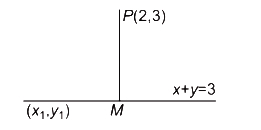
If $PM$ is the perpendicular from $P(2, 3)$ onto the line $x+y=3$,then the coordinates of $M$ are
A
$(2, 1)$
B
$(-1, 4)$
C
$(1, 2)$
D
$(4, -1)$
Solution
(C) Let the coordinates of $M$ be $(x_1, y_1)$.
Since $PM$ is perpendicular to the line $x+y=3$,the slope of $PM$ is the negative reciprocal of the slope of the given line.
The slope of $x+y=3$ is $-1$,so the slope of $PM$ is $1$.
Thus,$\frac{y_1-3}{x_1-2} = 1$ $\Rightarrow y_1-3 = x_1-2$ $\Rightarrow x_1-y_1 = -1$ (Eq. $i$).
Since $M(x_1, y_1)$ lies on the line $x+y=3$,we have $x_1+y_1=3$ (Eq. $ii$).
Adding Eq. $i$ and Eq. $ii$: $(x_1-y_1) + (x_1+y_1) = -1+3$ $\Rightarrow 2x_1 = 2$ $\Rightarrow x_1 = 1$.
Substituting $x_1=1$ into Eq. $ii$: $1+y_1=3 \Rightarrow y_1=2$.
Therefore,the coordinates of $M$ are $(1, 2)$.
Since $PM$ is perpendicular to the line $x+y=3$,the slope of $PM$ is the negative reciprocal of the slope of the given line.
The slope of $x+y=3$ is $-1$,so the slope of $PM$ is $1$.
Thus,$\frac{y_1-3}{x_1-2} = 1$ $\Rightarrow y_1-3 = x_1-2$ $\Rightarrow x_1-y_1 = -1$ (Eq. $i$).
Since $M(x_1, y_1)$ lies on the line $x+y=3$,we have $x_1+y_1=3$ (Eq. $ii$).
Adding Eq. $i$ and Eq. $ii$: $(x_1-y_1) + (x_1+y_1) = -1+3$ $\Rightarrow 2x_1 = 2$ $\Rightarrow x_1 = 1$.
Substituting $x_1=1$ into Eq. $ii$: $1+y_1=3 \Rightarrow y_1=2$.
Therefore,the coordinates of $M$ are $(1, 2)$.
0 likesView Solution
54
ChemistryMCQTS EAMCET · 2005
If a point $P$ moves such that its distances from the point $A(1,1)$ and the line $x+y+2=0$ are equal,then the locus of $P$ is
A
a straight line
B
a pair of straight lines
C
a parabola
D
an ellipse
Solution
(C) Let the coordinates of $P$ be $(x, y)$. According to the given condition,the distance from $P(x, y)$ to $A(1, 1)$ equals the distance from $P(x, y)$ to the line $x+y+2=0$.
$\sqrt{(x-1)^2+(y-1)^2} = \frac{|x+y+2|}{\sqrt{1^2+1^2}}$
Squaring both sides,we get:
$(x-1)^2+(y-1)^2 = \frac{(x+y+2)^2}{2}$
$2(x^2-2x+1+y^2-2y+1) = x^2+y^2+4+2xy+4x+4y$
$2x^2+2y^2-4x-4y+4 = x^2+y^2+2xy+4x+4y+4$
$x^2+y^2-2xy-8x-8y = 0$
This equation is of the form $ax^2+2hxy+by^2+2gx+2fy+c=0$ where $h^2-ab = (-1)^2 - (1)(1) = 0$. Since $h^2=ab$ and the point $A$ does not lie on the line $x+y+2=0$,the locus represents a parabola.
$\sqrt{(x-1)^2+(y-1)^2} = \frac{|x+y+2|}{\sqrt{1^2+1^2}}$
Squaring both sides,we get:
$(x-1)^2+(y-1)^2 = \frac{(x+y+2)^2}{2}$
$2(x^2-2x+1+y^2-2y+1) = x^2+y^2+4+2xy+4x+4y$
$2x^2+2y^2-4x-4y+4 = x^2+y^2+2xy+4x+4y+4$
$x^2+y^2-2xy-8x-8y = 0$
This equation is of the form $ax^2+2hxy+by^2+2gx+2fy+c=0$ where $h^2-ab = (-1)^2 - (1)(1) = 0$. Since $h^2=ab$ and the point $A$ does not lie on the line $x+y+2=0$,the locus represents a parabola.
0 likesView Solution
55
ChemistryMCQTS EAMCET · 2005
The Cartesian form of the polar equation $\theta = \tan^{-1} 2$ is
A
$x = 2y$
B
$y = 2x$
C
$x = 4y$
D
$y = 4x$
Solution
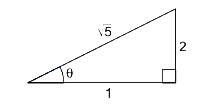
(B) Given the polar equation $\theta = \tan^{-1} 2$.
Taking tangent on both sides,we get $\tan \theta = 2$.
We know that in Cartesian coordinates,$\tan \theta = \frac{y}{x}$.
Substituting this into the equation,we have $\frac{y}{x} = 2$.
Therefore,$y = 2x$.
Taking tangent on both sides,we get $\tan \theta = 2$.
We know that in Cartesian coordinates,$\tan \theta = \frac{y}{x}$.
Substituting this into the equation,we have $\frac{y}{x} = 2$.
Therefore,$y = 2x$.
0 likesView Solution
56
ChemistryMCQTS EAMCET · 2005
The product of the perpendicular distances from the origin to the pair of straight lines $12x^2+25xy+12y^2+10x+11y+2=0$ is
A
$\frac{1}{25}$
B
$\frac{2}{25}$
C
$\frac{3}{25}$
D
$\frac{4}{25}$
Solution
(B) Given the equation of the pair of straight lines: $12x^2+25xy+12y^2+10x+11y+2=0$ ... $(i)$
First,we consider the homogeneous part of Eq. $(i)$:
$12x^2+25xy+12y^2 = 0$
$\Rightarrow (3x+4y)(4x+3y) = 0$
Let the lines be represented by $(3x+4y+c_1)(4x+3y+c_2) = 0$.
Expanding this,we get:
$12x^2+25xy+12y^2+(4c_1+3c_2)x+(3c_1+4c_2)y+c_1c_2 = 0$
Comparing this with Eq. $(i)$:
$4c_1+3c_2 = 10$ ... (ii)
$3c_1+4c_2 = 11$ ... (iii)
$c_1c_2 = 2$ ... (iv)
Solving (ii) and (iii):
Adding (ii) and (iii): $7(c_1+c_2) = 21 \Rightarrow c_1+c_2 = 3$
Subtracting (iii) from (ii): $c_1-c_2 = -1$
Adding these: $2c_1 = 2 \Rightarrow c_1 = 1$. Then $c_2 = 2$.
Check: $c_1c_2 = 1 \times 2 = 2$,which satisfies (iv).
The lines are $3x+4y+1=0$ and $4x+3y+2=0$.
The perpendicular distances from the origin $(0,0)$ to these lines are:
$p_1 = \frac{|0+0+1|}{\sqrt{3^2+4^2}} = \frac{1}{5}$
$p_2 = \frac{|0+0+2|}{\sqrt{4^2+3^2}} = \frac{2}{5}$
The product of the distances is $p_1 \cdot p_2 = \frac{1}{5} \cdot \frac{2}{5} = \frac{2}{25}$.
First,we consider the homogeneous part of Eq. $(i)$:
$12x^2+25xy+12y^2 = 0$
$\Rightarrow (3x+4y)(4x+3y) = 0$
Let the lines be represented by $(3x+4y+c_1)(4x+3y+c_2) = 0$.
Expanding this,we get:
$12x^2+25xy+12y^2+(4c_1+3c_2)x+(3c_1+4c_2)y+c_1c_2 = 0$
Comparing this with Eq. $(i)$:
$4c_1+3c_2 = 10$ ... (ii)
$3c_1+4c_2 = 11$ ... (iii)
$c_1c_2 = 2$ ... (iv)
Solving (ii) and (iii):
Adding (ii) and (iii): $7(c_1+c_2) = 21 \Rightarrow c_1+c_2 = 3$
Subtracting (iii) from (ii): $c_1-c_2 = -1$
Adding these: $2c_1 = 2 \Rightarrow c_1 = 1$. Then $c_2 = 2$.
Check: $c_1c_2 = 1 \times 2 = 2$,which satisfies (iv).
The lines are $3x+4y+1=0$ and $4x+3y+2=0$.
The perpendicular distances from the origin $(0,0)$ to these lines are:
$p_1 = \frac{|0+0+1|}{\sqrt{3^2+4^2}} = \frac{1}{5}$
$p_2 = \frac{|0+0+2|}{\sqrt{4^2+3^2}} = \frac{2}{5}$
The product of the distances is $p_1 \cdot p_2 = \frac{1}{5} \cdot \frac{2}{5} = \frac{2}{25}$.
0 likesView Solution
57
ChemistryMCQTS EAMCET · 2005
The equation of the circle whose diameter is the common chord of the circles $x^2+y^2+2x+3y+2=0$ and $x^2+y^2+2x-3y-4=0$ is
A
$x^2+y^2+2x+2y+2=0$
B
$x^2+y^2+2x+2y-1=0$
C
$x^2+y^2+2x+2y+1=0$
D
$x^2+y^2+2x+2y+3=0$
Solution
(C) Let the given circles be $S_1 \equiv x^2+y^2+2x+3y+2=0$ and $S_2 \equiv x^2+y^2+2x-3y-4=0$.
The equation of the common chord is given by $S_1 - S_2 = 0$.
$(x^2+y^2+2x+3y+2) - (x^2+y^2+2x-3y-4) = 0$
$6y + 6 = 0 \Rightarrow y = -1$.
Substituting $y = -1$ into the equation of $S_1$:
$x^2 + (-1)^2 + 2x + 3(-1) + 2 = 0$
$x^2 + 1 + 2x - 3 + 2 = 0$
$x^2 + 2x = 0$ $\Rightarrow x(x+2) = 0$ $\Rightarrow x = 0, -2$.
The endpoints of the diameter are $(0, -1)$ and $(-2, -1)$.
The equation of the circle with diameter endpoints $(x_1, y_1)$ and $(x_2, y_2)$ is $(x-x_1)(x-x_2) + (y-y_1)(y-y_2) = 0$.
$(x-0)(x-(-2)) + (y-(-1))(y-(-1)) = 0$
$x(x+2) + (y+1)^2 = 0$
$x^2 + 2x + y^2 + 2y + 1 = 0$
$x^2 + y^2 + 2x + 2y + 1 = 0$.
The equation of the common chord is given by $S_1 - S_2 = 0$.
$(x^2+y^2+2x+3y+2) - (x^2+y^2+2x-3y-4) = 0$
$6y + 6 = 0 \Rightarrow y = -1$.
Substituting $y = -1$ into the equation of $S_1$:
$x^2 + (-1)^2 + 2x + 3(-1) + 2 = 0$
$x^2 + 1 + 2x - 3 + 2 = 0$
$x^2 + 2x = 0$ $\Rightarrow x(x+2) = 0$ $\Rightarrow x = 0, -2$.
The endpoints of the diameter are $(0, -1)$ and $(-2, -1)$.
The equation of the circle with diameter endpoints $(x_1, y_1)$ and $(x_2, y_2)$ is $(x-x_1)(x-x_2) + (y-y_1)(y-y_2) = 0$.
$(x-0)(x-(-2)) + (y-(-1))(y-(-1)) = 0$
$x(x+2) + (y+1)^2 = 0$
$x^2 + 2x + y^2 + 2y + 1 = 0$
$x^2 + y^2 + 2x + 2y + 1 = 0$.
0 likesView Solution
58
ChemistryMCQTS EAMCET · 2005
If $x-y+1=0$ meets the circle $x^2+y^2+y-1=0$ at $A$ and $B$,then the equation of the circle with $AB$ as diameter is
A
$2(x^2+y^2)+3x-y+1=0$
B
$2(x^2+y^2)+3x-y+2=0$
C
$2(x^2+y^2)+3x-y+3=0$
D
$x^2+y^2+3x-y+1=0$
Solution
(A) Given the equations:
$x-y+1=0 \implies y=x+1$ $(i)$
$x^2+y^2+y-1=0$ (ii)
Substituting $(i)$ into (ii):
$x^2+(x+1)^2+(x+1)-1=0$
$x^2+x^2+2x+1+x=0$
$2x^2+3x+1=0$
$(2x+1)(x+1)=0$
So,$x=-\frac{1}{2}$ or $x=-1$.
For $x=-\frac{1}{2}$,$y=-\frac{1}{2}+1=\frac{1}{2}$. Point $A$ is $(-\frac{1}{2}, \frac{1}{2})$.
For $x=-1$,$y=-1+1=0$. Point $B$ is $(-1, 0)$.
The equation of a circle with diameter endpoints $(x_1, y_1)$ and $(x_2, y_2)$ is $(x-x_1)(x-x_2)+(y-y_1)(y-y_2)=0$.
$(x+\frac{1}{2})(x+1)+(y-\frac{1}{2})(y-0)=0$
$(x+\frac{1}{2})(x+1)+y(y-\frac{1}{2})=0$
Multiply by $2$:
$(2x+1)(x+1)+2y(y-\frac{1}{2})=0$
$2x^2+2x+x+1+2y^2-y=0$
$2(x^2+y^2)+3x-y+1=0$.
$x-y+1=0 \implies y=x+1$ $(i)$
$x^2+y^2+y-1=0$ (ii)
Substituting $(i)$ into (ii):
$x^2+(x+1)^2+(x+1)-1=0$
$x^2+x^2+2x+1+x=0$
$2x^2+3x+1=0$
$(2x+1)(x+1)=0$
So,$x=-\frac{1}{2}$ or $x=-1$.
For $x=-\frac{1}{2}$,$y=-\frac{1}{2}+1=\frac{1}{2}$. Point $A$ is $(-\frac{1}{2}, \frac{1}{2})$.
For $x=-1$,$y=-1+1=0$. Point $B$ is $(-1, 0)$.
The equation of a circle with diameter endpoints $(x_1, y_1)$ and $(x_2, y_2)$ is $(x-x_1)(x-x_2)+(y-y_1)(y-y_2)=0$.
$(x+\frac{1}{2})(x+1)+(y-\frac{1}{2})(y-0)=0$
$(x+\frac{1}{2})(x+1)+y(y-\frac{1}{2})=0$
Multiply by $2$:
$(2x+1)(x+1)+2y(y-\frac{1}{2})=0$
$2x^2+2x+x+1+2y^2-y=0$
$2(x^2+y^2)+3x-y+1=0$.
0 likesView Solution
59
ChemistryMCQTS EAMCET · 2005
If $y=3x$ is a tangent to a circle with centre $(1,1)$,then the other tangent drawn through $(0,0)$ to the circle is
A
$3y=x$
B
$y=-3x$
C
$y=2x$
D
$y=-2x$
Solution
(A) The line $y-3x=0$ is a tangent to the circle. The radius $r$ is the perpendicular distance from the centre $(1,1)$ to the line $3x-y=0$.
$r = \frac{|3(1) - 1(1)|}{\sqrt{3^2 + (-1)^2}} = \frac{|3-1|}{\sqrt{9+1}} = \frac{2}{\sqrt{10}}$.
Let the other tangent passing through the origin $(0,0)$ be $y=mx$,or $mx-y=0$.
The perpendicular distance from the centre $(1,1)$ to this line must also be equal to the radius $r$.
$\frac{|m(1) - 1(1)|}{\sqrt{m^2 + (-1)^2}} = \frac{2}{\sqrt{10}}$
$\frac{|m-1|}{\sqrt{m^2+1}} = \frac{2}{\sqrt{10}}$
Squaring both sides:
$\frac{(m-1)^2}{m^2+1} = \frac{4}{10} = \frac{2}{5}$
$5(m^2 - 2m + 1) = 2(m^2 + 1)$
$5m^2 - 10m + 5 = 2m^2 + 2$
$3m^2 - 10m + 3 = 0$
$3m^2 - 9m - m + 3 = 0$
$3m(m-3) - 1(m-3) = 0$
$(3m-1)(m-3) = 0$
Thus,$m=3$ or $m=\frac{1}{3}$.
The case $m=3$ corresponds to the given tangent $y=3x$. The other tangent is $y=\frac{1}{3}x$,which is $3y=x$.
$r = \frac{|3(1) - 1(1)|}{\sqrt{3^2 + (-1)^2}} = \frac{|3-1|}{\sqrt{9+1}} = \frac{2}{\sqrt{10}}$.
Let the other tangent passing through the origin $(0,0)$ be $y=mx$,or $mx-y=0$.
The perpendicular distance from the centre $(1,1)$ to this line must also be equal to the radius $r$.
$\frac{|m(1) - 1(1)|}{\sqrt{m^2 + (-1)^2}} = \frac{2}{\sqrt{10}}$
$\frac{|m-1|}{\sqrt{m^2+1}} = \frac{2}{\sqrt{10}}$
Squaring both sides:
$\frac{(m-1)^2}{m^2+1} = \frac{4}{10} = \frac{2}{5}$
$5(m^2 - 2m + 1) = 2(m^2 + 1)$
$5m^2 - 10m + 5 = 2m^2 + 2$
$3m^2 - 10m + 3 = 0$
$3m^2 - 9m - m + 3 = 0$
$3m(m-3) - 1(m-3) = 0$
$(3m-1)(m-3) = 0$
Thus,$m=3$ or $m=\frac{1}{3}$.
The case $m=3$ corresponds to the given tangent $y=3x$. The other tangent is $y=\frac{1}{3}x$,which is $3y=x$.
0 likesView Solution
60
ChemistryMCQTS EAMCET · 2005
Which of the following equations represents a circle?
A
$r = 2 \sin \theta$
B
$r^2 \cos 2 \theta = 1$
C
$r(4 \cos \theta + 5 \sin \theta) = 3$
D
$5 = r(1 + \sqrt{2} \cos \theta)$
Solution
(A) To determine which equation represents a circle,we convert the polar equations to Cartesian coordinates using $x = r \cos \theta$ and $y = r \sin \theta$,where $r^2 = x^2 + y^2$.
For option $A$: $r = 2 \sin \theta$
Multiply both sides by $r$: $r^2 = 2r \sin \theta$
Substituting $r^2 = x^2 + y^2$ and $y = r \sin \theta$:
$x^2 + y^2 = 2y$
$x^2 + y^2 - 2y = 0$
This is the equation of a circle with center $(0, 1)$ and radius $1$.
For option $B$: $r^2 \cos 2 \theta = 1$
Using $\cos 2 \theta = \cos^2 \theta - \sin^2 \theta$:
$r^2(\cos^2 \theta - \sin^2 \theta) = 1$
$(r \cos \theta)^2 - (r \sin \theta)^2 = 1$
$x^2 - y^2 = 1$,which is a rectangular hyperbola.
For option $C$: $r(4 \cos \theta + 5 \sin \theta) = 3$
$4r \cos \theta + 5r \sin \theta = 3$
$4x + 5y = 3$,which is a straight line.
For option $D$: $5 = r(1 + \sqrt{2} \cos \theta)$
This is the polar form of a conic section $r = \frac{ed}{1 + e \cos \theta}$,which represents a parabola,ellipse,or hyperbola depending on eccentricity $e$.
For option $A$: $r = 2 \sin \theta$
Multiply both sides by $r$: $r^2 = 2r \sin \theta$
Substituting $r^2 = x^2 + y^2$ and $y = r \sin \theta$:
$x^2 + y^2 = 2y$
$x^2 + y^2 - 2y = 0$
This is the equation of a circle with center $(0, 1)$ and radius $1$.
For option $B$: $r^2 \cos 2 \theta = 1$
Using $\cos 2 \theta = \cos^2 \theta - \sin^2 \theta$:
$r^2(\cos^2 \theta - \sin^2 \theta) = 1$
$(r \cos \theta)^2 - (r \sin \theta)^2 = 1$
$x^2 - y^2 = 1$,which is a rectangular hyperbola.
For option $C$: $r(4 \cos \theta + 5 \sin \theta) = 3$
$4r \cos \theta + 5r \sin \theta = 3$
$4x + 5y = 3$,which is a straight line.
For option $D$: $5 = r(1 + \sqrt{2} \cos \theta)$
This is the polar form of a conic section $r = \frac{ed}{1 + e \cos \theta}$,which represents a parabola,ellipse,or hyperbola depending on eccentricity $e$.
0 likesView Solution
61
ChemistryMCQTS EAMCET · 2005
The line among the following which touches the parabola $y^2=4ax$ is
A
$x+my+am^3=0$
B
$x-my+am^2=0$
C
$x+my-am^2=0$
D
$y+mx+am^2=0$
Solution
(B) The given equation of the parabola is $y^2=4ax$.
Let the equation of the line be $y=mx+c$.
If this line touches the parabola,the condition for tangency is $c = \frac{a}{m}$.
Substituting this into the line equation,we get $y = mx + \frac{a}{m}$.
Multiplying by $m$,we get $my = m^2x + a$.
Rearranging the terms,we get $m^2x - my + a = 0$.
Replacing $m$ with $\frac{1}{m}$ in the standard form $y = mx + \frac{a}{m}$,we get $y = \frac{1}{m}x + am$.
Multiplying by $m$,we get $my = x + am^2$,which simplifies to $x - my + am^2 = 0$.
Let the equation of the line be $y=mx+c$.
If this line touches the parabola,the condition for tangency is $c = \frac{a}{m}$.
Substituting this into the line equation,we get $y = mx + \frac{a}{m}$.
Multiplying by $m$,we get $my = m^2x + a$.
Rearranging the terms,we get $m^2x - my + a = 0$.
Replacing $m$ with $\frac{1}{m}$ in the standard form $y = mx + \frac{a}{m}$,we get $y = \frac{1}{m}x + am$.
Multiplying by $m$,we get $my = x + am^2$,which simplifies to $x - my + am^2 = 0$.
0 likesView Solution
62
ChemistryMCQTS EAMCET · 2005
The parabola with directrix $x+2y-1=0$ and focus $(1,0)$ is
A
$4x^2-4xy+y^2-8x+4y+4=0$
B
$4x^2+4xy+y^2-8x+4y+4=0$
C
$4x^2+5xy+y^2+8x-4y+4=0$
D
$4x^2-4xy+y^2-8x-4y+4=0$
Solution
(A) Let $P(x, y)$ be any point on the parabola.
By the definition of a parabola,the distance from $P$ to the focus $S(1, 0)$ is equal to the perpendicular distance from $P$ to the directrix $x+2y-1=0$.
$PS = PM$
$\sqrt{(x-1)^2 + (y-0)^2} = \frac{|x+2y-1|}{\sqrt{1^2+2^2}}$
Squaring both sides,we get:
$(x-1)^2 + y^2 = \frac{(x+2y-1)^2}{5}$
$5(x^2 - 2x + 1 + y^2) = x^2 + 4y^2 + 1 + 4xy - 2x - 4y$
$5x^2 - 10x + 5 + 5y^2 = x^2 + 4y^2 + 4xy - 2x - 4y + 1$
$4x^2 - 4xy + y^2 - 8x + 4y + 4 = 0$
By the definition of a parabola,the distance from $P$ to the focus $S(1, 0)$ is equal to the perpendicular distance from $P$ to the directrix $x+2y-1=0$.
$PS = PM$
$\sqrt{(x-1)^2 + (y-0)^2} = \frac{|x+2y-1|}{\sqrt{1^2+2^2}}$
Squaring both sides,we get:
$(x-1)^2 + y^2 = \frac{(x+2y-1)^2}{5}$
$5(x^2 - 2x + 1 + y^2) = x^2 + 4y^2 + 1 + 4xy - 2x - 4y$
$5x^2 - 10x + 5 + 5y^2 = x^2 + 4y^2 + 4xy - 2x - 4y + 1$
$4x^2 - 4xy + y^2 - 8x + 4y + 4 = 0$
0 likesView Solution
63
ChemistryMCQTS EAMCET · 2005
The coefficient of $x^3 y^4 z^5$ in the expansion of $(x y+y z+x z)^6$ is
A
$70$
B
$60$
C
$50$
D
\text{None of these}
Solution
(B) We have the multinomial expansion formula:
$(xy+yz+zx)^6 = \sum_{r+s+t=6} \frac{6!}{r!s!t!} (xy)^r (yz)^s (zx)^t$
$= \sum_{r+s+t=6} \frac{6!}{r!s!t!} x^{r+t} y^{r+s} z^{s+t}$
For the term $x^3 y^4 z^5$,we equate the exponents:
$r+t = 3$
$r+s = 4$
$s+t = 5$
Adding these equations: $2(r+s+t) = 3+4+5 = 12$,so $r+s+t = 6$.
Subtracting each equation from the sum:
$s = (r+s+t) - (r+t) = 6 - 3 = 3$
$t = (r+s+t) - (r+s) = 6 - 4 = 2$
$r = (r+s+t) - (s+t) = 6 - 5 = 1$
The coefficient is $\frac{6!}{1!3!2!} = \frac{720}{1 \times 6 \times 2} = \frac{720}{12} = 60$.
$(xy+yz+zx)^6 = \sum_{r+s+t=6} \frac{6!}{r!s!t!} (xy)^r (yz)^s (zx)^t$
$= \sum_{r+s+t=6} \frac{6!}{r!s!t!} x^{r+t} y^{r+s} z^{s+t}$
For the term $x^3 y^4 z^5$,we equate the exponents:
$r+t = 3$
$r+s = 4$
$s+t = 5$
Adding these equations: $2(r+s+t) = 3+4+5 = 12$,so $r+s+t = 6$.
Subtracting each equation from the sum:
$s = (r+s+t) - (r+t) = 6 - 3 = 3$
$t = (r+s+t) - (r+s) = 6 - 4 = 2$
$r = (r+s+t) - (s+t) = 6 - 5 = 1$
The coefficient is $\frac{6!}{1!3!2!} = \frac{720}{1 \times 6 \times 2} = \frac{720}{12} = 60$.
0 likesView Solution
64
ChemistryMCQTS EAMCET · 2005
If $|x| < \frac{1}{2}$,then the coefficient of $x^r$ in the expansion of $\frac{1+2x}{(1-2x)^2}$ is
A
$r 2^r$
B
$(2r-1) 2^r$
C
$r 2^{2r+1}$
D
$(2r+1) 2^r$
Solution
(D) We have the expression $\frac{1+2x}{(1-2x)^2} = (1+2x)(1-2x)^{-2}$.
Using the binomial expansion for negative indices,$(1-y)^{-n} = \sum_{k=0}^{\infty} \binom{n+k-1}{k} y^k$.
For $(1-2x)^{-2}$,we have $n=2$ and $y=2x$,so $(1-2x)^{-2} = \sum_{k=0}^{\infty} \binom{k+1}{1} (2x)^k = \sum_{k=0}^{\infty} (k+1) 2^k x^k$.
Now,multiply by $(1+2x)$:
$(1+2x) \sum_{k=0}^{\infty} (k+1) 2^k x^k = \sum_{k=0}^{\infty} (k+1) 2^k x^k + \sum_{k=0}^{\infty} 2(k+1) 2^k x^{k+1}$.
To find the coefficient of $x^r$,we take the term where $k=r$ from the first sum and the term where $k+1=r$ (i.e.,$k=r-1$) from the second sum:
Coefficient of $x^r = (r+1) 2^r + 2((r-1)+1) 2^{r-1}$.
$= (r+1) 2^r + 2(r) 2^{r-1} = (r+1) 2^r + r 2^r$.
$= (r+1+r) 2^r = (2r+1) 2^r$.
Using the binomial expansion for negative indices,$(1-y)^{-n} = \sum_{k=0}^{\infty} \binom{n+k-1}{k} y^k$.
For $(1-2x)^{-2}$,we have $n=2$ and $y=2x$,so $(1-2x)^{-2} = \sum_{k=0}^{\infty} \binom{k+1}{1} (2x)^k = \sum_{k=0}^{\infty} (k+1) 2^k x^k$.
Now,multiply by $(1+2x)$:
$(1+2x) \sum_{k=0}^{\infty} (k+1) 2^k x^k = \sum_{k=0}^{\infty} (k+1) 2^k x^k + \sum_{k=0}^{\infty} 2(k+1) 2^k x^{k+1}$.
To find the coefficient of $x^r$,we take the term where $k=r$ from the first sum and the term where $k+1=r$ (i.e.,$k=r-1$) from the second sum:
Coefficient of $x^r = (r+1) 2^r + 2((r-1)+1) 2^{r-1}$.
$= (r+1) 2^r + 2(r) 2^{r-1} = (r+1) 2^r + r 2^r$.
$= (r+1+r) 2^r = (2r+1) 2^r$.
0 likesView Solution
65
ChemistryMCQTS EAMCET · 2005
If $(1+x)^{15}=a_0+a_1 x+\ldots+a_{15} x^{15}$,then $\sum_{r=1}^{15} r \frac{a_r}{a_{r-1}}$ is equal to
A
$110$
B
$115$
C
$120$
D
$135$
Solution
(C) Given that $(1+x)^{15} = \sum_{r=0}^{15} {}^{15}C_r x^r = a_0 + a_1 x + \ldots + a_{15} x^{15}$.
Comparing coefficients,we have $a_r = {}^{15}C_r$.
We need to evaluate $\sum_{r=1}^{15} r \frac{a_r}{a_{r-1}}$.
Using the property $\frac{{}^{n}C_r}{{}^{n}C_{r-1}} = \frac{n-r+1}{r}$,we get $\frac{a_r}{a_{r-1}} = \frac{15-r+1}{r} = \frac{16-r}{r}$.
Thus,$r \frac{a_r}{a_{r-1}} = r \cdot \frac{16-r}{r} = 16-r$.
Therefore,$\sum_{r=1}^{15} (16-r) = (16-1) + (16-2) + \ldots + (16-15) = 15 + 14 + \ldots + 1$.
This is the sum of the first $15$ natural numbers: $\frac{15(15+1)}{2} = \frac{15 \times 16}{2} = 15 \times 8 = 120$.
Comparing coefficients,we have $a_r = {}^{15}C_r$.
We need to evaluate $\sum_{r=1}^{15} r \frac{a_r}{a_{r-1}}$.
Using the property $\frac{{}^{n}C_r}{{}^{n}C_{r-1}} = \frac{n-r+1}{r}$,we get $\frac{a_r}{a_{r-1}} = \frac{15-r+1}{r} = \frac{16-r}{r}$.
Thus,$r \frac{a_r}{a_{r-1}} = r \cdot \frac{16-r}{r} = 16-r$.
Therefore,$\sum_{r=1}^{15} (16-r) = (16-1) + (16-2) + \ldots + (16-15) = 15 + 14 + \ldots + 1$.
This is the sum of the first $15$ natural numbers: $\frac{15(15+1)}{2} = \frac{15 \times 16}{2} = 15 \times 8 = 120$.
0 likesView Solution
66
ChemistryMCQTS EAMCET · 2005
$\lim _{x \rightarrow 0} x^2 \sin \left(\frac{\pi}{x}\right)$ is equal to
A
$1$
B
$0$
C
does not exist
D
$\infty$
Solution
(B) We use the Squeeze Theorem to evaluate the limit.
We know that for all $x \neq 0$,$-1 \leq \sin \left(\frac{\pi}{x}\right) \leq 1$.
Multiplying the inequality by $x^2$ (since $x^2 > 0$ for $x \neq 0$),we get:
$-x^2 \leq x^2 \sin \left(\frac{\pi}{x}\right) \leq x^2$.
Now,taking the limit as $x \rightarrow 0$ on all sides:
$\lim _{x \rightarrow 0} (-x^2) \leq \lim _{x \rightarrow 0} x^2 \sin \left(\frac{\pi}{x}\right) \leq \lim _{x \rightarrow 0} x^2$.
Since $\lim _{x \rightarrow 0} (-x^2) = 0$ and $\lim _{x \rightarrow 0} x^2 = 0$,by the Squeeze Theorem:
$\lim _{x \rightarrow 0} x^2 \sin \left(\frac{\pi}{x}\right) = 0$.
We know that for all $x \neq 0$,$-1 \leq \sin \left(\frac{\pi}{x}\right) \leq 1$.
Multiplying the inequality by $x^2$ (since $x^2 > 0$ for $x \neq 0$),we get:
$-x^2 \leq x^2 \sin \left(\frac{\pi}{x}\right) \leq x^2$.
Now,taking the limit as $x \rightarrow 0$ on all sides:
$\lim _{x \rightarrow 0} (-x^2) \leq \lim _{x \rightarrow 0} x^2 \sin \left(\frac{\pi}{x}\right) \leq \lim _{x \rightarrow 0} x^2$.
Since $\lim _{x \rightarrow 0} (-x^2) = 0$ and $\lim _{x \rightarrow 0} x^2 = 0$,by the Squeeze Theorem:
$\lim _{x \rightarrow 0} x^2 \sin \left(\frac{\pi}{x}\right) = 0$.
0 likesView Solution
67
ChemistryMCQTS EAMCET · 2005
If $\frac{\tan 3A}{\tan A} = a$,then $\frac{\sin 3A}{\sin A}$ is equal to
A
$\frac{2a}{a+1}$
B
$\frac{2a}{a-1}$
C
$\frac{a}{a+1}$
D
$\frac{a}{a-1}$
Solution
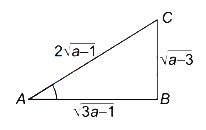
(B) Given that $\frac{\tan 3A}{\tan A} = a$.
Using the formula $\tan 3A = \frac{3\tan A - \tan^3 A}{1 - 3\tan^2 A}$,we have:
$\frac{3\tan A - \tan^3 A}{\tan A(1 - 3\tan^2 A)} = a$
$\Rightarrow \frac{3 - \tan^2 A}{1 - 3\tan^2 A} = a$
$\Rightarrow 3 - \tan^2 A = a - 3a\tan^2 A$
$\Rightarrow \tan^2 A(3a - 1) = a - 3$
$\Rightarrow \tan^2 A = \frac{a - 3}{3a - 1}$
Now,consider $\frac{\sin 3A}{\sin A} = \frac{3\sin A - 4\sin^3 A}{\sin A} = 3 - 4\sin^2 A$.
Using $\sin^2 A = \frac{\tan^2 A}{1 + \tan^2 A}$,we get:
$\sin^2 A = \frac{\frac{a-3}{3a-1}}{1 + \frac{a-3}{3a-1}} = \frac{a-3}{3a-1+a-3} = \frac{a-3}{4a-4} = \frac{a-3}{4(a-1)}$.
Substituting this into the expression:
$\frac{\sin 3A}{\sin A} = 3 - 4\left(\frac{a-3}{4(a-1)}\right) = 3 - \frac{a-3}{a-1}$
$= \frac{3(a-1) - (a-3)}{a-1} = \frac{3a - 3 - a + 3}{a-1} = \frac{2a}{a-1}$.
Using the formula $\tan 3A = \frac{3\tan A - \tan^3 A}{1 - 3\tan^2 A}$,we have:
$\frac{3\tan A - \tan^3 A}{\tan A(1 - 3\tan^2 A)} = a$
$\Rightarrow \frac{3 - \tan^2 A}{1 - 3\tan^2 A} = a$
$\Rightarrow 3 - \tan^2 A = a - 3a\tan^2 A$
$\Rightarrow \tan^2 A(3a - 1) = a - 3$
$\Rightarrow \tan^2 A = \frac{a - 3}{3a - 1}$
Now,consider $\frac{\sin 3A}{\sin A} = \frac{3\sin A - 4\sin^3 A}{\sin A} = 3 - 4\sin^2 A$.
Using $\sin^2 A = \frac{\tan^2 A}{1 + \tan^2 A}$,we get:
$\sin^2 A = \frac{\frac{a-3}{3a-1}}{1 + \frac{a-3}{3a-1}} = \frac{a-3}{3a-1+a-3} = \frac{a-3}{4a-4} = \frac{a-3}{4(a-1)}$.
Substituting this into the expression:
$\frac{\sin 3A}{\sin A} = 3 - 4\left(\frac{a-3}{4(a-1)}\right) = 3 - \frac{a-3}{a-1}$
$= \frac{3(a-1) - (a-3)}{a-1} = \frac{3a - 3 - a + 3}{a-1} = \frac{2a}{a-1}$.
0 likesView Solution
68
ChemistryMCQTS EAMCET · 2005
If $A+C=2B$,then $\frac{\cos C-\cos A}{\sin A-\sin C}$ is equal to
A
$\cot B$
B
$\cot 2B$
C
$\tan 2B$
D
$\tan B$
Solution
(D) Given that $A+C=2B$ ... $(i)$
We need to evaluate the expression:
$\frac{\cos C-\cos A}{\sin A-\sin C}$
Using the trigonometric identities:
$\cos C - \cos A = 2 \sin \left(\frac{A+C}{2}\right) \sin \left(\frac{A-C}{2}\right)$
$\sin A - \sin C = 2 \cos \left(\frac{A+C}{2}\right) \sin \left(\frac{A-C}{2}\right)$
Substituting these into the expression:
$\frac{2 \sin \left(\frac{A+C}{2}\right) \sin \left(\frac{A-C}{2}\right)}{2 \cos \left(\frac{A+C}{2}\right) \sin \left(\frac{A-C}{2}\right)}$
Canceling the common terms $2$ and $\sin \left(\frac{A-C}{2}\right)$:
$= \frac{\sin \left(\frac{A+C}{2}\right)}{\cos \left(\frac{A+C}{2}\right)}$
Since $A+C=2B$,we have $\frac{A+C}{2} = B$:
$= \frac{\sin B}{\cos B} = \tan B$
We need to evaluate the expression:
$\frac{\cos C-\cos A}{\sin A-\sin C}$
Using the trigonometric identities:
$\cos C - \cos A = 2 \sin \left(\frac{A+C}{2}\right) \sin \left(\frac{A-C}{2}\right)$
$\sin A - \sin C = 2 \cos \left(\frac{A+C}{2}\right) \sin \left(\frac{A-C}{2}\right)$
Substituting these into the expression:
$\frac{2 \sin \left(\frac{A+C}{2}\right) \sin \left(\frac{A-C}{2}\right)}{2 \cos \left(\frac{A+C}{2}\right) \sin \left(\frac{A-C}{2}\right)}$
Canceling the common terms $2$ and $\sin \left(\frac{A-C}{2}\right)$:
$= \frac{\sin \left(\frac{A+C}{2}\right)}{\cos \left(\frac{A+C}{2}\right)}$
Since $A+C=2B$,we have $\frac{A+C}{2} = B$:
$= \frac{\sin B}{\cos B} = \tan B$
0 likesView Solution
69
ChemistryMCQTS EAMCET · 2005
If $A+B=C$,then the value of $\cos^2 A + \cos^2 B + \cos^2 C - 2 \cos A \cos B \cos C$ is equal to
A
$1$
B
$2$
C
$0$
D
$3$
Solution
(A) Given that $A+B=C$.
We need to evaluate the expression $E = \cos^2 A + \cos^2 B + \cos^2 C - 2 \cos A \cos B \cos C$.
Using the identity $\cos^2 \theta = \frac{1+\cos 2\theta}{2}$,we have:
$E = \frac{1+\cos 2A}{2} + \frac{1+\cos 2B}{2} + \cos^2 C - 2 \cos A \cos B \cos C$
$E = 1 + \frac{1}{2}(\cos 2A + \cos 2B) + \cos^2 C - 2 \cos A \cos B \cos C$
Using $\cos 2A + \cos 2B = 2 \cos(A+B) \cos(A-B)$:
$E = 1 + \cos(A+B) \cos(A-B) + \cos^2 C - 2 \cos A \cos B \cos C$
Since $A+B=C$,$\cos(A+B) = \cos C$:
$E = 1 + \cos C \cos(A-B) + \cos^2 C - 2 \cos A \cos B \cos C$
$E = 1 + \cos C [\cos(A-B) + \cos C] - 2 \cos A \cos B \cos C$
Since $C = A+B$,$\cos C = \cos(A+B) = \cos A \cos B - \sin A \sin B$:
$E = 1 + \cos C [\cos(A-B) + \cos(A+B)] - 2 \cos A \cos B \cos C$
Using $\cos(A-B) + \cos(A+B) = 2 \cos A \cos B$:
$E = 1 + \cos C [2 \cos A \cos B] - 2 \cos A \cos B \cos C$
$E = 1 + 2 \cos A \cos B \cos C - 2 \cos A \cos B \cos C = 1$.
We need to evaluate the expression $E = \cos^2 A + \cos^2 B + \cos^2 C - 2 \cos A \cos B \cos C$.
Using the identity $\cos^2 \theta = \frac{1+\cos 2\theta}{2}$,we have:
$E = \frac{1+\cos 2A}{2} + \frac{1+\cos 2B}{2} + \cos^2 C - 2 \cos A \cos B \cos C$
$E = 1 + \frac{1}{2}(\cos 2A + \cos 2B) + \cos^2 C - 2 \cos A \cos B \cos C$
Using $\cos 2A + \cos 2B = 2 \cos(A+B) \cos(A-B)$:
$E = 1 + \cos(A+B) \cos(A-B) + \cos^2 C - 2 \cos A \cos B \cos C$
Since $A+B=C$,$\cos(A+B) = \cos C$:
$E = 1 + \cos C \cos(A-B) + \cos^2 C - 2 \cos A \cos B \cos C$
$E = 1 + \cos C [\cos(A-B) + \cos C] - 2 \cos A \cos B \cos C$
Since $C = A+B$,$\cos C = \cos(A+B) = \cos A \cos B - \sin A \sin B$:
$E = 1 + \cos C [\cos(A-B) + \cos(A+B)] - 2 \cos A \cos B \cos C$
Using $\cos(A-B) + \cos(A+B) = 2 \cos A \cos B$:
$E = 1 + \cos C [2 \cos A \cos B] - 2 \cos A \cos B \cos C$
$E = 1 + 2 \cos A \cos B \cos C - 2 \cos A \cos B \cos C = 1$.
0 likesView Solution
70
ChemistryMCQTS EAMCET · 2005
In $\Delta ABC$,the expression $a(\cos^2 B + \cos^2 C) + \cos A(c \cos C + b \cos B)$ is equal to:
A
$a$
B
$b$
C
$c$
D
$a+b+c$
Solution
(A) We use the projection formula: $c \cos C + b \cos B = a$.
Substituting this into the expression,we get:
$a(\cos^2 B + \cos^2 C) + a \cos A$
$= a(\cos^2 B + \cos^2 C + \cos A)$
Since $A + B + C = \pi$,we have $A = \pi - (B + C)$,so $\cos A = -\cos(B + C)$.
The expression becomes $a(\cos^2 B + \cos^2 C - \cos(B + C))$
$= a(\cos^2 B + \cos^2 C - (\cos B \cos C - \sin B \sin C))$
Using the identity $\cos^2 B + \cos^2 C = 1 - \sin^2 B + \cos^2 C = 1 - (\sin^2 B - \cos^2 C) = 1 + \cos(B+C)\cos(B-C)$ is complex,let's simplify directly:
Using $\cos^2 B = \frac{1+\cos 2B}{2}$ and $\cos^2 C = \frac{1+\cos 2C}{2}$:
$a(\frac{1+\cos 2B + 1 + \cos 2C}{2}) + a \cos A$
$= a(1 + \frac{\cos 2B + \cos 2C}{2}) + a \cos A$
$= a(1 + \cos(B+C)\cos(B-C)) + a \cos A$
Since $\cos(B+C) = -\cos A$,we have:
$= a(1 - \cos A \cos(B-C) + \cos A)$
$= a(1 + \cos A(1 - \cos(B-C)))$
Actually,a simpler approach: $a(\cos^2 B + \cos^2 C) + a \cos A = a(\cos^2 B + \cos^2 C + \cos A)$
Using $\cos A = -\cos(B+C)$,$\cos^2 B + \cos^2 C - \cos(B+C) = \cos^2 B + \cos^2 C - (\cos B \cos C - \sin B \sin C) = \cos^2 B + \cos^2 C - \cos B \cos C + \sin B \sin C$.
This simplifies to $a$.
Substituting this into the expression,we get:
$a(\cos^2 B + \cos^2 C) + a \cos A$
$= a(\cos^2 B + \cos^2 C + \cos A)$
Since $A + B + C = \pi$,we have $A = \pi - (B + C)$,so $\cos A = -\cos(B + C)$.
The expression becomes $a(\cos^2 B + \cos^2 C - \cos(B + C))$
$= a(\cos^2 B + \cos^2 C - (\cos B \cos C - \sin B \sin C))$
Using the identity $\cos^2 B + \cos^2 C = 1 - \sin^2 B + \cos^2 C = 1 - (\sin^2 B - \cos^2 C) = 1 + \cos(B+C)\cos(B-C)$ is complex,let's simplify directly:
Using $\cos^2 B = \frac{1+\cos 2B}{2}$ and $\cos^2 C = \frac{1+\cos 2C}{2}$:
$a(\frac{1+\cos 2B + 1 + \cos 2C}{2}) + a \cos A$
$= a(1 + \frac{\cos 2B + \cos 2C}{2}) + a \cos A$
$= a(1 + \cos(B+C)\cos(B-C)) + a \cos A$
Since $\cos(B+C) = -\cos A$,we have:
$= a(1 - \cos A \cos(B-C) + \cos A)$
$= a(1 + \cos A(1 - \cos(B-C)))$
Actually,a simpler approach: $a(\cos^2 B + \cos^2 C) + a \cos A = a(\cos^2 B + \cos^2 C + \cos A)$
Using $\cos A = -\cos(B+C)$,$\cos^2 B + \cos^2 C - \cos(B+C) = \cos^2 B + \cos^2 C - (\cos B \cos C - \sin B \sin C) = \cos^2 B + \cos^2 C - \cos B \cos C + \sin B \sin C$.
This simplifies to $a$.
0 likesView Solution
71
ChemistryMCQTS EAMCET · 2005
In a $\triangle ABC$,the value of $\Sigma(b+c) \tan \frac{A}{2} \tan \left(\frac{B-C}{2}\right)$ is equal to
A
$a$
B
$b$
C
$c$
D
$0$
Solution
(D) We use the Napier's analogy: $\tan \left(\frac{B-C}{2}\right) = \frac{b-c}{b+c} \cot \frac{A}{2}$.
Substituting this into the expression:
$(b+c) \tan \frac{A}{2} \tan \left(\frac{B-C}{2}\right) = (b+c) \tan \frac{A}{2} \left[ \frac{b-c}{b+c} \cot \frac{A}{2} \right]$.
Since $\tan \frac{A}{2} \cot \frac{A}{2} = 1$,the expression simplifies to $(b-c)$.
Now,summing over the cyclic permutations:
$\Sigma(b-c) = (b-c) + (c-a) + (a-b) = 0$.
Substituting this into the expression:
$(b+c) \tan \frac{A}{2} \tan \left(\frac{B-C}{2}\right) = (b+c) \tan \frac{A}{2} \left[ \frac{b-c}{b+c} \cot \frac{A}{2} \right]$.
Since $\tan \frac{A}{2} \cot \frac{A}{2} = 1$,the expression simplifies to $(b-c)$.
Now,summing over the cyclic permutations:
$\Sigma(b-c) = (b-c) + (c-a) + (a-b) = 0$.
0 likesView Solution
72
ChemistryMCQTS EAMCET · 2005
Two sides of a triangle are given by the roots of the equation $x^2-5x+6=0$ and the angle between the sides is $\frac{\pi}{3}$. Then,the perimeter of the triangle is
A
$5+\sqrt{2}$
B
$5+\sqrt{3}$
C
$5+\sqrt{5}$
D
$5+\sqrt{7}$
Solution
(D) The given equation is $x^2-5x+6=0$. \\ Solving for $x$: $(x-3)(x-2)=0$,which gives $x=3$ and $x=2$. \\ Let the two sides be $a=3$ and $b=2$,and the included angle be $C=\frac{\pi}{3}$. \\ Using the Law of Cosines: $\cos C = \frac{a^2+b^2-c^2}{2ab}$. \\ Substituting the values: $\cos(\frac{\pi}{3}) = \frac{3^2+2^2-c^2}{2 \times 3 \times 2}$. \\ $\frac{1}{2} = \frac{9+4-c^2}{12} \Rightarrow \frac{1}{2} = \frac{13-c^2}{12}$. \\ $6 = 13-c^2$ $\Rightarrow c^2 = 7$ $\Rightarrow c = \sqrt{7}$. \\ The perimeter of the triangle is $a+b+c = 3+2+\sqrt{7} = 5+\sqrt{7}$.
0 likesView Solution
73
ChemistryMCQTS EAMCET · 2005
If $m \begin{bmatrix} -3 & 4 \end{bmatrix} + n \begin{bmatrix} 4 & -3 \end{bmatrix} = \begin{bmatrix} 10 & -11 \end{bmatrix}$,then $3m + 7n$ is equal to
A
$3$
B
$5$
C
$10$
D
$1$
Solution
(D) Given that,$m \begin{bmatrix} -3 & 4 \end{bmatrix} + n \begin{bmatrix} 4 & -3 \end{bmatrix} = \begin{bmatrix} 10 & -11 \end{bmatrix}$
Multiplying the scalars $m$ and $n$ into the matrices,we get:
$\begin{bmatrix} -3m & 4m \end{bmatrix} + \begin{bmatrix} 4n & -3n \end{bmatrix} = \begin{bmatrix} 10 & -11 \end{bmatrix}$
Adding the matrices:
$\begin{bmatrix} -3m + 4n & 4m - 3n \end{bmatrix} = \begin{bmatrix} 10 & -11 \end{bmatrix}$
By equating the corresponding elements,we get the following system of linear equations:
$-3m + 4n = 10 \quad \dots (i)$
$4m - 3n = -11 \quad \dots (ii)$
To solve this system,multiply equation $(i)$ by $3$ and equation $(ii)$ by $4$:
$-9m + 12n = 30 \quad \dots (iii)$
$16m - 12n = -44 \quad \dots (iv)$
Adding equations $(iii)$ and $(iv)$:
$7m = -14 \Rightarrow m = -2$
Substituting $m = -2$ into equation $(i)$:
$-3(-2) + 4n = 10 \Rightarrow 6 + 4n = 10 \Rightarrow 4n = 4 \Rightarrow n = 1$
Now,calculate $3m + 7n$:
$3m + 7n = 3(-2) + 7(1) = -6 + 7 = 1$
Multiplying the scalars $m$ and $n$ into the matrices,we get:
$\begin{bmatrix} -3m & 4m \end{bmatrix} + \begin{bmatrix} 4n & -3n \end{bmatrix} = \begin{bmatrix} 10 & -11 \end{bmatrix}$
Adding the matrices:
$\begin{bmatrix} -3m + 4n & 4m - 3n \end{bmatrix} = \begin{bmatrix} 10 & -11 \end{bmatrix}$
By equating the corresponding elements,we get the following system of linear equations:
$-3m + 4n = 10 \quad \dots (i)$
$4m - 3n = -11 \quad \dots (ii)$
To solve this system,multiply equation $(i)$ by $3$ and equation $(ii)$ by $4$:
$-9m + 12n = 30 \quad \dots (iii)$
$16m - 12n = -44 \quad \dots (iv)$
Adding equations $(iii)$ and $(iv)$:
$7m = -14 \Rightarrow m = -2$
Substituting $m = -2$ into equation $(i)$:
$-3(-2) + 4n = 10 \Rightarrow 6 + 4n = 10 \Rightarrow 4n = 4 \Rightarrow n = 1$
Now,calculate $3m + 7n$:
$3m + 7n = 3(-2) + 7(1) = -6 + 7 = 1$
0 likesView Solution
74
ChemistryMCQTS EAMCET · 2005
If $A = \begin{bmatrix} -1 & 0 \\ 0 & 2 \end{bmatrix}$,then $A^3 - A^2$ is equal to
A
$2A$
B
$2I$
C
$A$
D
$I$
Solution
(A) Given that,$A = \begin{bmatrix} -1 & 0 \\ 0 & 2 \end{bmatrix}$.
First,we calculate $A^2$:
$A^2 = A \cdot A = \begin{bmatrix} -1 & 0 \\ 0 & 2 \end{bmatrix} \begin{bmatrix} -1 & 0 \\ 0 & 2 \end{bmatrix} = \begin{bmatrix} (-1)(-1) + (0)(0) & (-1)(0) + (0)(2) \\ (0)(-1) + (2)(0) & (0)(0) + (2)(2) \end{bmatrix} = \begin{bmatrix} 1 & 0 \\ 0 & 4 \end{bmatrix}$.
Next,we calculate $A^3$:
$A^3 = A^2 \cdot A = \begin{bmatrix} 1 & 0 \\ 0 & 4 \end{bmatrix} \begin{bmatrix} -1 & 0 \\ 0 & 2 \end{bmatrix} = \begin{bmatrix} (1)(-1) + (0)(0) & (1)(0) + (0)(2) \\ (0)(-1) + (4)(0) & (0)(0) + (4)(2) \end{bmatrix} = \begin{bmatrix} -1 & 0 \\ 0 & 8 \end{bmatrix}$.
Now,calculate $A^3 - A^2$:
$A^3 - A^2 = \begin{bmatrix} -1 & 0 \\ 0 & 8 \end{bmatrix} - \begin{bmatrix} 1 & 0 \\ 0 & 4 \end{bmatrix} = \begin{bmatrix} -1 - 1 & 0 - 0 \\ 0 - 0 & 8 - 4 \end{bmatrix} = \begin{bmatrix} -2 & 0 \\ 0 & 4 \end{bmatrix}$.
We observe that $2A = 2 \begin{bmatrix} -1 & 0 \\ 0 & 2 \end{bmatrix} = \begin{bmatrix} -2 & 0 \\ 0 & 4 \end{bmatrix}$.
Therefore,$A^3 - A^2 = 2A$.
First,we calculate $A^2$:
$A^2 = A \cdot A = \begin{bmatrix} -1 & 0 \\ 0 & 2 \end{bmatrix} \begin{bmatrix} -1 & 0 \\ 0 & 2 \end{bmatrix} = \begin{bmatrix} (-1)(-1) + (0)(0) & (-1)(0) + (0)(2) \\ (0)(-1) + (2)(0) & (0)(0) + (2)(2) \end{bmatrix} = \begin{bmatrix} 1 & 0 \\ 0 & 4 \end{bmatrix}$.
Next,we calculate $A^3$:
$A^3 = A^2 \cdot A = \begin{bmatrix} 1 & 0 \\ 0 & 4 \end{bmatrix} \begin{bmatrix} -1 & 0 \\ 0 & 2 \end{bmatrix} = \begin{bmatrix} (1)(-1) + (0)(0) & (1)(0) + (0)(2) \\ (0)(-1) + (4)(0) & (0)(0) + (4)(2) \end{bmatrix} = \begin{bmatrix} -1 & 0 \\ 0 & 8 \end{bmatrix}$.
Now,calculate $A^3 - A^2$:
$A^3 - A^2 = \begin{bmatrix} -1 & 0 \\ 0 & 8 \end{bmatrix} - \begin{bmatrix} 1 & 0 \\ 0 & 4 \end{bmatrix} = \begin{bmatrix} -1 - 1 & 0 - 0 \\ 0 - 0 & 8 - 4 \end{bmatrix} = \begin{bmatrix} -2 & 0 \\ 0 & 4 \end{bmatrix}$.
We observe that $2A = 2 \begin{bmatrix} -1 & 0 \\ 0 & 2 \end{bmatrix} = \begin{bmatrix} -2 & 0 \\ 0 & 4 \end{bmatrix}$.
Therefore,$A^3 - A^2 = 2A$.
0 likesView Solution
75
ChemistryMCQTS EAMCET · 2005
If $\operatorname{adj}\begin{bmatrix} 1 & 0 & 2 \\ -1 & 1 & -2 \\ 0 & 2 & 1 \end{bmatrix} = \begin{bmatrix} 5 & a & -2 \\ 1 & 1 & 0 \\ -2 & -2 & b \end{bmatrix}$,then $\begin{bmatrix} a & b \end{bmatrix}$ is equal to
A
$[-4, 1]$
B
$[-4, -1]$
C
$[4, 1]$
D
$[4, -1]$
Solution
(C) Let $A = \begin{bmatrix} 1 & 0 & 2 \\ -1 & 1 & -2 \\ 0 & 2 & 1 \end{bmatrix}$. The adjoint of a matrix is the transpose of the cofactor matrix,i.e.,$\operatorname{adj}(A) = [C_{ij}]^T$.
The cofactors $C_{ij}$ are calculated as follows:
$C_{11} = + \begin{vmatrix} 1 & -2 \\ 2 & 1 \end{vmatrix} = 1 - (-4) = 5$
$C_{12} = - \begin{vmatrix} -1 & -2 \\ 0 & 1 \end{vmatrix} = -(-1 - 0) = 1$
$C_{13} = + \begin{vmatrix} -1 & 1 \\ 0 & 2 \end{vmatrix} = -2 - 0 = -2$
$C_{21} = - \begin{vmatrix} 0 & 2 \\ 2 & 1 \end{vmatrix} = -(0 - 4) = 4$
$C_{22} = + \begin{vmatrix} 1 & 2 \\ 0 & 1 \end{vmatrix} = 1 - 0 = 1$
$C_{23} = - \begin{vmatrix} 1 & 0 \\ 0 & 2 \end{vmatrix} = -(2 - 0) = -2$
$C_{31} = + \begin{vmatrix} 0 & 2 \\ 1 & -2 \end{vmatrix} = 0 - 2 = -2$
$C_{32} = - \begin{vmatrix} 1 & 2 \\ -1 & -2 \end{vmatrix} = -(-2 - (-2)) = 0$
$C_{33} = + \begin{vmatrix} 1 & 0 \\ -1 & 1 \end{vmatrix} = 1 - 0 = 1$
The cofactor matrix is $\begin{bmatrix} 5 & 1 & -2 \\ 4 & 1 & -2 \\ -2 & 0 & 1 \end{bmatrix}$.
Taking the transpose,we get $\operatorname{adj}(A) = \begin{bmatrix} 5 & 4 & -2 \\ 1 & 1 & 0 \\ -2 & -2 & 1 \end{bmatrix}$.
Comparing this with the given matrix $\begin{bmatrix} 5 & a & -2 \\ 1 & 1 & 0 \\ -2 & -2 & b \end{bmatrix}$,we find $a = 4$ and $b = 1$.
Therefore,$\begin{bmatrix} a & b \end{bmatrix} = \begin{bmatrix} 4 & 1 \end{bmatrix}$.
The cofactors $C_{ij}$ are calculated as follows:
$C_{11} = + \begin{vmatrix} 1 & -2 \\ 2 & 1 \end{vmatrix} = 1 - (-4) = 5$
$C_{12} = - \begin{vmatrix} -1 & -2 \\ 0 & 1 \end{vmatrix} = -(-1 - 0) = 1$
$C_{13} = + \begin{vmatrix} -1 & 1 \\ 0 & 2 \end{vmatrix} = -2 - 0 = -2$
$C_{21} = - \begin{vmatrix} 0 & 2 \\ 2 & 1 \end{vmatrix} = -(0 - 4) = 4$
$C_{22} = + \begin{vmatrix} 1 & 2 \\ 0 & 1 \end{vmatrix} = 1 - 0 = 1$
$C_{23} = - \begin{vmatrix} 1 & 0 \\ 0 & 2 \end{vmatrix} = -(2 - 0) = -2$
$C_{31} = + \begin{vmatrix} 0 & 2 \\ 1 & -2 \end{vmatrix} = 0 - 2 = -2$
$C_{32} = - \begin{vmatrix} 1 & 2 \\ -1 & -2 \end{vmatrix} = -(-2 - (-2)) = 0$
$C_{33} = + \begin{vmatrix} 1 & 0 \\ -1 & 1 \end{vmatrix} = 1 - 0 = 1$
The cofactor matrix is $\begin{bmatrix} 5 & 1 & -2 \\ 4 & 1 & -2 \\ -2 & 0 & 1 \end{bmatrix}$.
Taking the transpose,we get $\operatorname{adj}(A) = \begin{bmatrix} 5 & 4 & -2 \\ 1 & 1 & 0 \\ -2 & -2 & 1 \end{bmatrix}$.
Comparing this with the given matrix $\begin{bmatrix} 5 & a & -2 \\ 1 & 1 & 0 \\ -2 & -2 & b \end{bmatrix}$,we find $a = 4$ and $b = 1$.
Therefore,$\begin{bmatrix} a & b \end{bmatrix} = \begin{bmatrix} 4 & 1 \end{bmatrix}$.
0 likesView Solution
76
ChemistryMCQTS EAMCET · 2005
$2 \tanh^{-1} \frac{1}{2}$ is equal to
A
$0$
B
$\log 2$
C
$\log 3$
D
$\log 4$
Solution
(C) We use the identity $2 \tanh^{-1} x = \tanh^{-1} \left( \frac{2x}{1+x^2} \right)$.
Substituting $x = \frac{1}{2}$,we get:
$2 \tanh^{-1} \left( \frac{1}{2} \right) = \tanh^{-1} \left( \frac{2 \cdot \frac{1}{2}}{1 + (\frac{1}{2})^2} \right) = \tanh^{-1} \left( \frac{1}{1 + \frac{1}{4}} \right) = \tanh^{-1} \left( \frac{1}{\frac{5}{4}} \right) = \tanh^{-1} \left( \frac{4}{5} \right)$.
Now,we use the logarithmic form $\tanh^{-1} x = \frac{1}{2} \log \left( \frac{1+x}{1-x} \right)$ for $|x| < 1$.
Substituting $x = \frac{4}{5}$:
$\tanh^{-1} \left( \frac{4}{5} \right) = \frac{1}{2} \log \left( \frac{1 + \frac{4}{5}}{1 - \frac{4}{5}} \right) = \frac{1}{2} \log \left( \frac{\frac{9}{5}}{\frac{1}{5}} \right) = \frac{1}{2} \log 9 = \frac{1}{2} \log 3^2 = \log 3$.
Substituting $x = \frac{1}{2}$,we get:
$2 \tanh^{-1} \left( \frac{1}{2} \right) = \tanh^{-1} \left( \frac{2 \cdot \frac{1}{2}}{1 + (\frac{1}{2})^2} \right) = \tanh^{-1} \left( \frac{1}{1 + \frac{1}{4}} \right) = \tanh^{-1} \left( \frac{1}{\frac{5}{4}} \right) = \tanh^{-1} \left( \frac{4}{5} \right)$.
Now,we use the logarithmic form $\tanh^{-1} x = \frac{1}{2} \log \left( \frac{1+x}{1-x} \right)$ for $|x| < 1$.
Substituting $x = \frac{4}{5}$:
$\tanh^{-1} \left( \frac{4}{5} \right) = \frac{1}{2} \log \left( \frac{1 + \frac{4}{5}}{1 - \frac{4}{5}} \right) = \frac{1}{2} \log \left( \frac{\frac{9}{5}}{\frac{1}{5}} \right) = \frac{1}{2} \log 9 = \frac{1}{2} \log 3^2 = \log 3$.
0 likesView Solution
77
ChemistryMCQTS EAMCET · 2005
$\sin ^{-1} \frac{4}{5} + 2 \tan ^{-1} \frac{1}{3}$ is equal to
A
$\frac{\pi}{3}$
B
$\frac{\pi}{4}$
C
$\frac{\pi}{2}$
D
$0$
Solution
(C) We are given the expression: $\sin ^{-1} \frac{4}{5} + 2 \tan ^{-1} \frac{1}{3}$.
First,use the formula $2 \tan ^{-1} x = \tan ^{-1} \frac{2x}{1-x^2}$:
$2 \tan ^{-1} \frac{1}{3} = \tan ^{-1} \frac{2(1/3)}{1-(1/3)^2} = \tan ^{-1} \frac{2/3}{1-1/9} = \tan ^{-1} \frac{2/3}{8/9} = \tan ^{-1} \left( \frac{2}{3} \times \frac{9}{8} \right) = \tan ^{-1} \frac{3}{4}$.
Now,the expression becomes $\sin ^{-1} \frac{4}{5} + \tan ^{-1} \frac{3}{4}$.
Since $\tan ^{-1} \frac{3}{4} = \theta$,then $\tan \theta = \frac{3}{4}$,which implies $\sin \theta = \frac{3}{5}$ and $\cos \theta = \frac{4}{5}$.
Thus,$\tan ^{-1} \frac{3}{4} = \cos ^{-1} \frac{4}{5}$.
Substituting this back,we get $\sin ^{-1} \frac{4}{5} + \cos ^{-1} \frac{4}{5}$.
Using the identity $\sin ^{-1} x + \cos ^{-1} x = \frac{\pi}{2}$,we get $\frac{\pi}{2}$.
First,use the formula $2 \tan ^{-1} x = \tan ^{-1} \frac{2x}{1-x^2}$:
$2 \tan ^{-1} \frac{1}{3} = \tan ^{-1} \frac{2(1/3)}{1-(1/3)^2} = \tan ^{-1} \frac{2/3}{1-1/9} = \tan ^{-1} \frac{2/3}{8/9} = \tan ^{-1} \left( \frac{2}{3} \times \frac{9}{8} \right) = \tan ^{-1} \frac{3}{4}$.
Now,the expression becomes $\sin ^{-1} \frac{4}{5} + \tan ^{-1} \frac{3}{4}$.
Since $\tan ^{-1} \frac{3}{4} = \theta$,then $\tan \theta = \frac{3}{4}$,which implies $\sin \theta = \frac{3}{5}$ and $\cos \theta = \frac{4}{5}$.
Thus,$\tan ^{-1} \frac{3}{4} = \cos ^{-1} \frac{4}{5}$.
Substituting this back,we get $\sin ^{-1} \frac{4}{5} + \cos ^{-1} \frac{4}{5}$.
Using the identity $\sin ^{-1} x + \cos ^{-1} x = \frac{\pi}{2}$,we get $\frac{\pi}{2}$.
0 likesView Solution
78
ChemistryMCQTS EAMCET · 2005
The set $\{x \in R : [x - |x|] = 5\}$ is equal to
A
$R$,the set of all real numbers
B
$\phi$,the empty set
C
$\{x \in R : x < 0\}$
D
$\{x \in R : x \geq 0\}$
Solution
(B) Consider the expression $f(x) = x - |x|$.
Case $1$: If $x \geq 0$,then $|x| = x$. Thus,$f(x) = x - x = 0$.
Case $2$: If $x < 0$,then $|x| = -x$. Thus,$f(x) = x - (-x) = 2x$.
Since $x < 0$,$2x < 0$.
Therefore,the value of $x - |x|$ is either $0$ (for $x \geq 0$) or a negative number (for $x < 0$).
It can never be equal to $5$.
Hence,the set $\{x \in R : [x - |x|] = 5\}$ is the empty set,denoted by $\phi$.
Case $1$: If $x \geq 0$,then $|x| = x$. Thus,$f(x) = x - x = 0$.
Case $2$: If $x < 0$,then $|x| = -x$. Thus,$f(x) = x - (-x) = 2x$.
Since $x < 0$,$2x < 0$.
Therefore,the value of $x - |x|$ is either $0$ (for $x \geq 0$) or a negative number (for $x < 0$).
It can never be equal to $5$.
Hence,the set $\{x \in R : [x - |x|] = 5\}$ is the empty set,denoted by $\phi$.
0 likesView Solution
79
ChemistryMCQTS EAMCET · 2005
If $x = \frac{1}{2} \left( \sqrt{3} + \frac{1}{\sqrt{3}} \right)$,then the value of $\frac{\sqrt{x^2 - 1}}{x - \sqrt{x^2 - 1}}$ is equal to
A
$1$
B
$2$
C
$3$
D
$\frac{1}{2}$
Solution
(A) Given $x = \frac{1}{2} \left( \sqrt{3} + \frac{1}{\sqrt{3}} \right) = \frac{1}{2} \left( \frac{3+1}{\sqrt{3}} \right) = \frac{4}{2\sqrt{3}} = \frac{2}{\sqrt{3}}$.
Then $x^2 = \left( \frac{2}{\sqrt{3}} \right)^2 = \frac{4}{3}$.
Now,$x^2 - 1 = \frac{4}{3} - 1 = \frac{1}{3}$.
So,$\sqrt{x^2 - 1} = \sqrt{\frac{1}{3}} = \frac{1}{\sqrt{3}}$.
Substituting these values into the expression $\frac{\sqrt{x^2 - 1}}{x - \sqrt{x^2 - 1}}$:
$= \frac{\frac{1}{\sqrt{3}}}{\frac{2}{\sqrt{3}} - \frac{1}{\sqrt{3}}} = \frac{\frac{1}{\sqrt{3}}}{\frac{1}{\sqrt{3}}} = 1$.
Then $x^2 = \left( \frac{2}{\sqrt{3}} \right)^2 = \frac{4}{3}$.
Now,$x^2 - 1 = \frac{4}{3} - 1 = \frac{1}{3}$.
So,$\sqrt{x^2 - 1} = \sqrt{\frac{1}{3}} = \frac{1}{\sqrt{3}}$.
Substituting these values into the expression $\frac{\sqrt{x^2 - 1}}{x - \sqrt{x^2 - 1}}$:
$= \frac{\frac{1}{\sqrt{3}}}{\frac{2}{\sqrt{3}} - \frac{1}{\sqrt{3}}} = \frac{\frac{1}{\sqrt{3}}}{\frac{1}{\sqrt{3}}} = 1$.
0 likesView Solution
80
ChemistryMCQTS EAMCET · 2005
If $\frac{x^3}{(2 x-1)(x+2)(x-3)} = A+\frac{B}{2 x-1}+\frac{C}{x+2}+\frac{D}{x-3}$,then $A$ is equal to
A
$\frac{1}{2}$
B
$-\frac{1}{50}$
C
$-\frac{8}{25}$
D
$\frac{27}{25}$
Solution
(A) Given the expression: $\frac{x^3}{(2 x-1)(x+2)(x-3)} = A+\frac{B}{2 x-1}+\frac{C}{x+2}+\frac{D}{x-3}$.
First,expand the denominator: $(2x-1)(x+2)(x-3) = (2x-1)(x^2-x-6) = 2x^3 - 2x^2 - 12x - x^2 + x + 6 = 2x^3 - 3x^2 - 11x + 6$.
Since the degree of the numerator $(3)$ is equal to the degree of the denominator $(3)$,we perform long division to find the constant $A$.
Dividing $x^3$ by $2x^3 - 3x^2 - 11x + 6$:
$\frac{x^3}{2x^3 - 3x^2 - 11x + 6} = \frac{1}{2} \left( \frac{2x^3}{2x^3 - 3x^2 - 11x + 6} \right) = \frac{1}{2} \left( \frac{2x^3 - 3x^2 - 11x + 6 + 3x^2 + 11x - 6}{2x^3 - 3x^2 - 11x + 6} \right) = \frac{1}{2} + \frac{\frac{3}{2}x^2 + \frac{11}{2}x - 3}{(2x-1)(x+2)(x-3)}$.
Comparing this with the given form $A+\frac{B}{2 x-1}+\frac{C}{x+2}+\frac{D}{x-3}$,we get $A = \frac{1}{2}$.
First,expand the denominator: $(2x-1)(x+2)(x-3) = (2x-1)(x^2-x-6) = 2x^3 - 2x^2 - 12x - x^2 + x + 6 = 2x^3 - 3x^2 - 11x + 6$.
Since the degree of the numerator $(3)$ is equal to the degree of the denominator $(3)$,we perform long division to find the constant $A$.
Dividing $x^3$ by $2x^3 - 3x^2 - 11x + 6$:
$\frac{x^3}{2x^3 - 3x^2 - 11x + 6} = \frac{1}{2} \left( \frac{2x^3}{2x^3 - 3x^2 - 11x + 6} \right) = \frac{1}{2} \left( \frac{2x^3 - 3x^2 - 11x + 6 + 3x^2 + 11x - 6}{2x^3 - 3x^2 - 11x + 6} \right) = \frac{1}{2} + \frac{\frac{3}{2}x^2 + \frac{11}{2}x - 3}{(2x-1)(x+2)(x-3)}$.
Comparing this with the given form $A+\frac{B}{2 x-1}+\frac{C}{x+2}+\frac{D}{x-3}$,we get $A = \frac{1}{2}$.
0 likesView Solution
81
ChemistryMCQTS EAMCET · 2005
If $f: R \rightarrow R$ is an even function which is twice differentiable on $R$ and $f^{\prime \prime}(\pi)=1$,then $f^{\prime \prime}(-\pi)$ is equal to
A
-$1$
B
$0$
C
$1$
D
$2$
Solution
(C) Given that $f(x)$ is an even function,by definition,$f(x) = f(-x)$ for all $x \in R$.
Differentiating both sides with respect to $x$,we get $f^{\prime}(x) = -f^{\prime}(-x)$.
Differentiating again with respect to $x$,we get $f^{\prime \prime}(x) = f^{\prime \prime}(-x)$.
This shows that the second derivative of an even function is also an even function.
Since $f^{\prime \prime}(x)$ is an even function,$f^{\prime \prime}(-\pi) = f^{\prime \prime}(\pi)$.
Given $f^{\prime \prime}(\pi) = 1$,it follows that $f^{\prime \prime}(-\pi) = 1$.
Differentiating both sides with respect to $x$,we get $f^{\prime}(x) = -f^{\prime}(-x)$.
Differentiating again with respect to $x$,we get $f^{\prime \prime}(x) = f^{\prime \prime}(-x)$.
This shows that the second derivative of an even function is also an even function.
Since $f^{\prime \prime}(x)$ is an even function,$f^{\prime \prime}(-\pi) = f^{\prime \prime}(\pi)$.
Given $f^{\prime \prime}(\pi) = 1$,it follows that $f^{\prime \prime}(-\pi) = 1$.
0 likesView Solution
82
ChemistryMCQTS EAMCET · 2005
If $u=\sin ^{-1}\left(\frac{x}{y}\right)+\tan ^{-1}\left(\frac{y}{x}\right)$,then the value of $x \frac{\partial u}{\partial x}+y \frac{\partial u}{\partial y}$ is
A
$0$
B
$1$
C
$2$
D
None of these
Solution
(A) Given $u = \sin^{-1}\left(\frac{x}{y}\right) + \tan^{-1}\left(\frac{y}{x}\right)$.
First,we find the partial derivative with respect to $x$:
$\frac{\partial u}{\partial x} = \frac{1}{\sqrt{1 - (x/y)^2}} \cdot \frac{1}{y} + \frac{1}{1 + (y/x)^2} \cdot \left(-\frac{y}{x^2}\right)$
$= \frac{1}{\sqrt{(y^2 - x^2)/y^2}} \cdot \frac{1}{y} - \frac{x^2}{x^2 + y^2} \cdot \frac{y}{x^2}$
$= \frac{y}{\sqrt{y^2 - x^2}} \cdot \frac{1}{y} - \frac{y}{x^2 + y^2} = \frac{1}{\sqrt{y^2 - x^2}} - \frac{y}{x^2 + y^2}$
Multiplying by $x$,we get:
$x \frac{\partial u}{\partial x} = \frac{x}{\sqrt{y^2 - x^2}} - \frac{xy}{x^2 + y^2} \quad \dots(i)$
Next,we find the partial derivative with respect to $y$:
$\frac{\partial u}{\partial y} = \frac{1}{\sqrt{1 - (x/y)^2}} \cdot \left(-\frac{x}{y^2}\right) + \frac{1}{1 + (y/x)^2} \cdot \left(\frac{1}{x}\right)$
$= \frac{y}{\sqrt{y^2 - x^2}} \cdot \left(-\frac{x}{y^2}\right) + \frac{x^2}{x^2 + y^2} \cdot \frac{1}{x}$
$= -\frac{x}{y \sqrt{y^2 - x^2}} + \frac{x}{x^2 + y^2}$
Multiplying by $y$,we get:
$y \frac{\partial u}{\partial y} = -\frac{x}{\sqrt{y^2 - x^2}} + \frac{xy}{x^2 + y^2} \quad \dots(ii)$
Adding equations $(i)$ and $(ii)$:
$x \frac{\partial u}{\partial x} + y \frac{\partial u}{\partial y} = \left(\frac{x}{\sqrt{y^2 - x^2}} - \frac{xy}{x^2 + y^2}\right) + \left(-\frac{x}{\sqrt{y^2 - x^2}} + \frac{xy}{x^2 + y^2}\right) = 0$.
First,we find the partial derivative with respect to $x$:
$\frac{\partial u}{\partial x} = \frac{1}{\sqrt{1 - (x/y)^2}} \cdot \frac{1}{y} + \frac{1}{1 + (y/x)^2} \cdot \left(-\frac{y}{x^2}\right)$
$= \frac{1}{\sqrt{(y^2 - x^2)/y^2}} \cdot \frac{1}{y} - \frac{x^2}{x^2 + y^2} \cdot \frac{y}{x^2}$
$= \frac{y}{\sqrt{y^2 - x^2}} \cdot \frac{1}{y} - \frac{y}{x^2 + y^2} = \frac{1}{\sqrt{y^2 - x^2}} - \frac{y}{x^2 + y^2}$
Multiplying by $x$,we get:
$x \frac{\partial u}{\partial x} = \frac{x}{\sqrt{y^2 - x^2}} - \frac{xy}{x^2 + y^2} \quad \dots(i)$
Next,we find the partial derivative with respect to $y$:
$\frac{\partial u}{\partial y} = \frac{1}{\sqrt{1 - (x/y)^2}} \cdot \left(-\frac{x}{y^2}\right) + \frac{1}{1 + (y/x)^2} \cdot \left(\frac{1}{x}\right)$
$= \frac{y}{\sqrt{y^2 - x^2}} \cdot \left(-\frac{x}{y^2}\right) + \frac{x^2}{x^2 + y^2} \cdot \frac{1}{x}$
$= -\frac{x}{y \sqrt{y^2 - x^2}} + \frac{x}{x^2 + y^2}$
Multiplying by $y$,we get:
$y \frac{\partial u}{\partial y} = -\frac{x}{\sqrt{y^2 - x^2}} + \frac{xy}{x^2 + y^2} \quad \dots(ii)$
Adding equations $(i)$ and $(ii)$:
$x \frac{\partial u}{\partial x} + y \frac{\partial u}{\partial y} = \left(\frac{x}{\sqrt{y^2 - x^2}} - \frac{xy}{x^2 + y^2}\right) + \left(-\frac{x}{\sqrt{y^2 - x^2}} + \frac{xy}{x^2 + y^2}\right) = 0$.
0 likesView Solution
83
ChemistryMCQTS EAMCET · 2005
Observe the following statements:
$I. f(x) = a x^{41} + b x^{-40} \Rightarrow \frac{f^{\prime \prime}(x)}{f(x)} = 1640 x^{-2}$
$II. \frac{d}{d x} \tan ^{-1}\left(\frac{2 x}{1-x^2}\right) = \frac{1}{1+x^2}$
Which of the following is correct?
$I. f(x) = a x^{41} + b x^{-40} \Rightarrow \frac{f^{\prime \prime}(x)}{f(x)} = 1640 x^{-2}$
$II. \frac{d}{d x} \tan ^{-1}\left(\frac{2 x}{1-x^2}\right) = \frac{1}{1+x^2}$
Which of the following is correct?
A
$I$ is true,but $II$ is false
B
Both $I$ and $II$ are true
C
Neither $I$ nor $II$ is true
D
$I$ is false,but $II$ is true
Solution
(A) For statement $I$:
$f(x) = a x^{41} + b x^{-40}$
$f^{\prime}(x) = 41 a x^{40} - 40 b x^{-41}$
$f^{\prime \prime}(x) = 41 \times 40 a x^{39} + 40 \times 41 b x^{-42} = 1640 a x^{39} + 1640 b x^{-42}$
$\frac{f^{\prime \prime}(x)}{f(x)} = \frac{1640(a x^{39} + b x^{-42})}{a x^{41} + b x^{-40}} = \frac{1640 x^{-2}(a x^{41} + b x^{-40})}{a x^{41} + b x^{-40}} = 1640 x^{-2}$
Thus,statement $I$ is true.
For statement $II$:
Let $y = \tan ^{-1}\left(\frac{2 x}{1-x^2}\right)$. For $|x| < 1$,we substitute $x = \tan \theta$,so $y = \tan ^{-1}(\tan 2 \theta) = 2 \theta = 2 \tan ^{-1} x$.
Then $\frac{d y}{d x} = \frac{2}{1+x^2}$.
Since the given expression is $\frac{1}{1+x^2}$,statement $II$ is false.
$f(x) = a x^{41} + b x^{-40}$
$f^{\prime}(x) = 41 a x^{40} - 40 b x^{-41}$
$f^{\prime \prime}(x) = 41 \times 40 a x^{39} + 40 \times 41 b x^{-42} = 1640 a x^{39} + 1640 b x^{-42}$
$\frac{f^{\prime \prime}(x)}{f(x)} = \frac{1640(a x^{39} + b x^{-42})}{a x^{41} + b x^{-40}} = \frac{1640 x^{-2}(a x^{41} + b x^{-40})}{a x^{41} + b x^{-40}} = 1640 x^{-2}$
Thus,statement $I$ is true.
For statement $II$:
Let $y = \tan ^{-1}\left(\frac{2 x}{1-x^2}\right)$. For $|x| < 1$,we substitute $x = \tan \theta$,so $y = \tan ^{-1}(\tan 2 \theta) = 2 \theta = 2 \tan ^{-1} x$.
Then $\frac{d y}{d x} = \frac{2}{1+x^2}$.
Since the given expression is $\frac{1}{1+x^2}$,statement $II$ is false.
0 likesView Solution
84
ChemistryMCQTS EAMCET · 2005
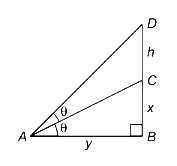
$A$ tower,of $x$ metres high,has a flagstaff at its top. The tower and the flagstaff subtend equal angles at a point distant $y$ metres from the foot of the tower. Then,the length of the flagstaff (in metres) is:
A
$\frac{y(x^2-y^2)}{(x^2+y^2)}$
B
$\frac{x(y^2+x^2)}{(y^2-x^2)}$
C
$\frac{x(x^2+y^2)}{(x^2-y^2)}$
D
$\frac{x(x^2-y^2)}{(x^2+y^2)}$
Solution
(B) Let $BC = x$ be the height of the tower and $CD = h$ be the height of the flagstaff. Let the point be $A$ at a distance $y$ from the foot $B$.
In $\triangle ABC$,$\tan \theta = \frac{BC}{AB} = \frac{x}{y}$.
In $\triangle ABD$,the total angle is $2\theta$,so $\tan 2\theta = \frac{BD}{AB} = \frac{x+h}{y}$.
Using the formula $\tan 2\theta = \frac{2\tan \theta}{1-\tan^2 \theta}$,we have:
$\frac{2(x/y)}{1-(x/y)^2} = \frac{x+h}{y}$
$\frac{2x/y}{(y^2-x^2)/y^2} = \frac{x+h}{y}$
$\frac{2xy}{y^2-x^2} = \frac{x+h}{y}$
$2xy^2 = (y^2-x^2)(x+h)$
$h = \frac{2xy^2}{y^2-x^2} - x = \frac{2xy^2 - x(y^2-x^2)}{y^2-x^2} = \frac{2xy^2 - xy^2 + x^3}{y^2-x^2} = \frac{xy^2 + x^3}{y^2-x^2} = \frac{x(x^2+y^2)}{y^2-x^2}$.
Note: The option $C$ is $\frac{x(x^2+y^2)}{x^2-y^2}$,which is the negative of our result. Given the standard form of such problems,the correct length is $\frac{x(x^2+y^2)}{y^2-x^2}$.
In $\triangle ABC$,$\tan \theta = \frac{BC}{AB} = \frac{x}{y}$.
In $\triangle ABD$,the total angle is $2\theta$,so $\tan 2\theta = \frac{BD}{AB} = \frac{x+h}{y}$.
Using the formula $\tan 2\theta = \frac{2\tan \theta}{1-\tan^2 \theta}$,we have:
$\frac{2(x/y)}{1-(x/y)^2} = \frac{x+h}{y}$
$\frac{2x/y}{(y^2-x^2)/y^2} = \frac{x+h}{y}$
$\frac{2xy}{y^2-x^2} = \frac{x+h}{y}$
$2xy^2 = (y^2-x^2)(x+h)$
$h = \frac{2xy^2}{y^2-x^2} - x = \frac{2xy^2 - x(y^2-x^2)}{y^2-x^2} = \frac{2xy^2 - xy^2 + x^3}{y^2-x^2} = \frac{xy^2 + x^3}{y^2-x^2} = \frac{x(x^2+y^2)}{y^2-x^2}$.
Note: The option $C$ is $\frac{x(x^2+y^2)}{x^2-y^2}$,which is the negative of our result. Given the standard form of such problems,the correct length is $\frac{x(x^2+y^2)}{y^2-x^2}$.
0 likesView Solution
85
ChemistryMCQTS EAMCET · 2005
If $\int \sin ^{-1}\left(\frac{2 x}{1+x^2}\right) d x=f(x)-\log \left(1+x^2\right)$ then $f(x)$ is equal to
A
$2 x \tan ^{-1} x$
B
$-2 x \tan ^{-1} x$
C
$x \tan ^{-1} x$
D
$-x \tan ^{-1} x$
Solution
(A) Let $I = \int \sin ^{-1}\left(\frac{2 x}{1+x^2}\right) d x$.
Substitute $x = \tan \theta$,then $d x = \sec ^2 \theta d \theta$.
The integral becomes $I = \int \sin ^{-1}(\sin 2 \theta) \cdot \sec ^2 \theta d \theta$.
Assuming $|x| \le 1$,we have $I = 2 \int \theta \sec ^2 \theta d \theta$.
Using integration by parts: $I = 2 \left[ \theta \tan \theta - \int \tan \theta d \theta \right]$.
$I = 2 [\theta \tan \theta + \log |\cos \theta|] + C$.
Since $\tan \theta = x$,we have $\cos \theta = \frac{1}{\sqrt{1+x^2}}$,so $\log |\cos \theta| = \log (1+x^2)^{-1/2} = -\frac{1}{2} \log (1+x^2)$.
Substituting back: $I = 2 [x \tan ^{-1} x - \frac{1}{2} \log (1+x^2)] + C$.
$I = 2 x \tan ^{-1} x - \log (1+x^2) + C$.
Comparing this with $f(x) - \log (1+x^2)$,we get $f(x) = 2 x \tan ^{-1} x$.
Substitute $x = \tan \theta$,then $d x = \sec ^2 \theta d \theta$.
The integral becomes $I = \int \sin ^{-1}(\sin 2 \theta) \cdot \sec ^2 \theta d \theta$.
Assuming $|x| \le 1$,we have $I = 2 \int \theta \sec ^2 \theta d \theta$.
Using integration by parts: $I = 2 \left[ \theta \tan \theta - \int \tan \theta d \theta \right]$.
$I = 2 [\theta \tan \theta + \log |\cos \theta|] + C$.
Since $\tan \theta = x$,we have $\cos \theta = \frac{1}{\sqrt{1+x^2}}$,so $\log |\cos \theta| = \log (1+x^2)^{-1/2} = -\frac{1}{2} \log (1+x^2)$.
Substituting back: $I = 2 [x \tan ^{-1} x - \frac{1}{2} \log (1+x^2)] + C$.
$I = 2 x \tan ^{-1} x - \log (1+x^2) + C$.
Comparing this with $f(x) - \log (1+x^2)$,we get $f(x) = 2 x \tan ^{-1} x$.
0 likesView Solution
86
ChemistryMCQTS EAMCET · 2005
If $\int \frac{\sin x}{\cos x(1+\cos x)} d x=f(x)+c$,then $f(x)$ is equal to
A
$\log \left|\frac{1+\cos x}{\cos x}\right|$
B
$\log \left|\frac{\cos x}{1+\cos x}\right|$
C
$\log \left|\frac{\sin x}{1+\sin x}\right|$
D
$\log \left|\frac{1+\sin x}{\sin x}\right|$
Solution
(A) Let $I = \int \frac{\sin x}{\cos x(1+\cos x)} dx$.
Substitute $\cos x = t$,then $-\sin x dx = dt$,which implies $\sin x dx = -dt$.
Substituting these into the integral,we get:
$I = \int \frac{-dt}{t(1+t)}$.
Using partial fractions,$\frac{1}{t(1+t)} = \frac{1}{t} - \frac{1}{1+t}$.
Therefore,$I = -\int \left( \frac{1}{t} - \frac{1}{1+t} \right) dt$.
$I = -(\log |t| - \log |1+t|) + c$.
$I = \log |1+t| - \log |t| + c = \log \left| \frac{1+t}{t} \right| + c$.
Substituting $t = \cos x$ back,we get $I = \log \left| \frac{1+\cos x}{\cos x} \right| + c$.
Since $I = f(x) + c$,we have $f(x) = \log \left| \frac{1+\cos x}{\cos x} \right|$.
Substitute $\cos x = t$,then $-\sin x dx = dt$,which implies $\sin x dx = -dt$.
Substituting these into the integral,we get:
$I = \int \frac{-dt}{t(1+t)}$.
Using partial fractions,$\frac{1}{t(1+t)} = \frac{1}{t} - \frac{1}{1+t}$.
Therefore,$I = -\int \left( \frac{1}{t} - \frac{1}{1+t} \right) dt$.
$I = -(\log |t| - \log |1+t|) + c$.
$I = \log |1+t| - \log |t| + c = \log \left| \frac{1+t}{t} \right| + c$.
Substituting $t = \cos x$ back,we get $I = \log \left| \frac{1+\cos x}{\cos x} \right| + c$.
Since $I = f(x) + c$,we have $f(x) = \log \left| \frac{1+\cos x}{\cos x} \right|$.
0 likesView Solution
87
ChemistryMCQTS EAMCET · 2005
$\int \frac{x^{49} \tan ^{-1}\left(x^{50}\right)}{1+x^{100}} d x = k\left(\tan ^{-1}\left(x^{50}\right)\right)^2 + c$,then $k$ is equal to
A
$\frac{1}{50}$
B
$-\frac{1}{50}$
C
$\frac{1}{100}$
D
$-\frac{1}{100}$
Solution
(C) Let $I = \int \frac{x^{49} \tan ^{-1}\left(x^{50}\right)}{1+x^{100}} d x$.
Substitute $t = x^{50}$,then $dt = 50x^{49} dx$,which implies $x^{49} dx = \frac{1}{50} dt$.
The integral becomes $I = \frac{1}{50} \int \frac{\tan ^{-1} t}{1+t^2} dt$.
Now,substitute $u = \tan ^{-1} t$,then $du = \frac{1}{1+t^2} dt$.
Substituting this into the integral,we get $I = \frac{1}{50} \int u du = \frac{1}{50} \cdot \frac{u^2}{2} + c = \frac{u^2}{100} + c$.
Replacing $u$ back,we get $I = \frac{(\tan ^{-1} x^{50})^2}{100} + c$.
Comparing this with the given expression $k(\tan ^{-1} x^{50})^2 + c$,we find $k = \frac{1}{100}$.
Substitute $t = x^{50}$,then $dt = 50x^{49} dx$,which implies $x^{49} dx = \frac{1}{50} dt$.
The integral becomes $I = \frac{1}{50} \int \frac{\tan ^{-1} t}{1+t^2} dt$.
Now,substitute $u = \tan ^{-1} t$,then $du = \frac{1}{1+t^2} dt$.
Substituting this into the integral,we get $I = \frac{1}{50} \int u du = \frac{1}{50} \cdot \frac{u^2}{2} + c = \frac{u^2}{100} + c$.
Replacing $u$ back,we get $I = \frac{(\tan ^{-1} x^{50})^2}{100} + c$.
Comparing this with the given expression $k(\tan ^{-1} x^{50})^2 + c$,we find $k = \frac{1}{100}$.
0 likesView Solution
88
ChemistryMCQTS EAMCET · 2005
$\int_0^\pi \frac{\theta \sin \theta}{1+\cos ^2 \theta} d \theta$ is equal to
A
$\frac{\pi^2}{2}$
B
$\frac{\pi^2}{3}$
C
$\pi^2$
D
$\frac{\pi^2}{4}$
Solution
(D) Let $I = \int_0^\pi \frac{\theta \sin \theta}{1+\cos ^2 \theta} d \theta$ ... $(i)$
Using the property $\int_0^a f(x) dx = \int_0^a f(a-x) dx$,we have:
$I = \int_0^\pi \frac{(\pi-\theta) \sin (\pi-\theta)}{1+\cos ^2(\pi-\theta)} d \theta$
Since $\sin(\pi-\theta) = \sin\theta$ and $\cos(\pi-\theta) = -\cos\theta$,we get:
$I = \int_0^\pi \frac{(\pi-\theta) \sin \theta}{1+\cos ^2 \theta} d \theta$ ... (ii)
Adding $(i)$ and (ii):
$2I = \int_0^\pi \frac{\theta \sin \theta + (\pi-\theta) \sin \theta}{1+\cos ^2 \theta} d \theta = \int_0^\pi \frac{\pi \sin \theta}{1+\cos ^2 \theta} d \theta$
$2I = \pi \int_0^\pi \frac{\sin \theta}{1+\cos ^2 \theta} d \theta$
Let $\cos \theta = t$,then $-\sin \theta d \theta = dt$. When $\theta = 0, t = 1$ and when $\theta = \pi, t = -1$.
$2I = \pi \int_1^{-1} \frac{-dt}{1+t^2} = \pi \int_{-1}^1 \frac{dt}{1+t^2}$
$2I = \pi [\tan^{-1} t]_{-1}^1 = \pi (\tan^{-1}(1) - \tan^{-1}(-1)) = \pi (\frac{\pi}{4} - (-\frac{\pi}{4})) = \pi (\frac{\pi}{2}) = \frac{\pi^2}{2}$
$2I = \frac{\pi^2}{2} \Rightarrow I = \frac{\pi^2}{4}$
Using the property $\int_0^a f(x) dx = \int_0^a f(a-x) dx$,we have:
$I = \int_0^\pi \frac{(\pi-\theta) \sin (\pi-\theta)}{1+\cos ^2(\pi-\theta)} d \theta$
Since $\sin(\pi-\theta) = \sin\theta$ and $\cos(\pi-\theta) = -\cos\theta$,we get:
$I = \int_0^\pi \frac{(\pi-\theta) \sin \theta}{1+\cos ^2 \theta} d \theta$ ... (ii)
Adding $(i)$ and (ii):
$2I = \int_0^\pi \frac{\theta \sin \theta + (\pi-\theta) \sin \theta}{1+\cos ^2 \theta} d \theta = \int_0^\pi \frac{\pi \sin \theta}{1+\cos ^2 \theta} d \theta$
$2I = \pi \int_0^\pi \frac{\sin \theta}{1+\cos ^2 \theta} d \theta$
Let $\cos \theta = t$,then $-\sin \theta d \theta = dt$. When $\theta = 0, t = 1$ and when $\theta = \pi, t = -1$.
$2I = \pi \int_1^{-1} \frac{-dt}{1+t^2} = \pi \int_{-1}^1 \frac{dt}{1+t^2}$
$2I = \pi [\tan^{-1} t]_{-1}^1 = \pi (\tan^{-1}(1) - \tan^{-1}(-1)) = \pi (\frac{\pi}{4} - (-\frac{\pi}{4})) = \pi (\frac{\pi}{2}) = \frac{\pi^2}{2}$
$2I = \frac{\pi^2}{2} \Rightarrow I = \frac{\pi^2}{4}$
0 likesView Solution
89
ChemistryMCQTS EAMCET · 2005
$\int_0^{\pi / 2} \frac{200 \sin x+100 \cos x}{\sin x+\cos x} d x$ is equal to (in $pi$)
A
$50$
B
$25$
C
$75$
D
$150$
Solution
(C) Let $I = \int_0^{\pi / 2} \frac{200 \sin x+100 \cos x}{\sin x+\cos x} d x$.
We can rewrite the numerator as $100(\sin x + \cos x) + 100 \sin x$.
So,$I = \int_0^{\pi / 2} \frac{100(\sin x + \cos x) + 100 \sin x}{\sin x + \cos x} d x = 100 \int_0^{\pi / 2} 1 d x + 100 \int_0^{\pi / 2} \frac{\sin x}{\sin x + \cos x} d x$.
Let $I_1 = \int_0^{\pi / 2} \frac{\sin x}{\sin x + \cos x} d x$.
Using the property $\int_0^a f(x) d x = \int_0^a f(a-x) d x$,we have $I_1 = \int_0^{\pi / 2} \frac{\sin(\pi/2 - x)}{\sin(\pi/2 - x) + \cos(\pi/2 - x)} d x = \int_0^{\pi / 2} \frac{\cos x}{\cos x + \sin x} d x$.
Adding the two expressions for $I_1$: $2I_1 = \int_0^{\pi / 2} \frac{\sin x + \cos x}{\sin x + \cos x} d x = \int_0^{\pi / 2} 1 d x = \frac{\pi}{2}$.
Thus,$I_1 = \frac{\pi}{4}$.
Substituting back into the expression for $I$: $I = 100[x]_0^{\pi/2} + 100(I_1) = 100(\frac{\pi}{2}) + 100(\frac{\pi}{4}) = 50\pi + 25\pi = 75\pi$.
We can rewrite the numerator as $100(\sin x + \cos x) + 100 \sin x$.
So,$I = \int_0^{\pi / 2} \frac{100(\sin x + \cos x) + 100 \sin x}{\sin x + \cos x} d x = 100 \int_0^{\pi / 2} 1 d x + 100 \int_0^{\pi / 2} \frac{\sin x}{\sin x + \cos x} d x$.
Let $I_1 = \int_0^{\pi / 2} \frac{\sin x}{\sin x + \cos x} d x$.
Using the property $\int_0^a f(x) d x = \int_0^a f(a-x) d x$,we have $I_1 = \int_0^{\pi / 2} \frac{\sin(\pi/2 - x)}{\sin(\pi/2 - x) + \cos(\pi/2 - x)} d x = \int_0^{\pi / 2} \frac{\cos x}{\cos x + \sin x} d x$.
Adding the two expressions for $I_1$: $2I_1 = \int_0^{\pi / 2} \frac{\sin x + \cos x}{\sin x + \cos x} d x = \int_0^{\pi / 2} 1 d x = \frac{\pi}{2}$.
Thus,$I_1 = \frac{\pi}{4}$.
Substituting back into the expression for $I$: $I = 100[x]_0^{\pi/2} + 100(I_1) = 100(\frac{\pi}{2}) + 100(\frac{\pi}{4}) = 50\pi + 25\pi = 75\pi$.
0 likesView Solution
90
ChemistryMCQTS EAMCET · 2005
The area (in square units) bounded by the curves $y^2=4x$ and $x^2=4y$ in the plane is
A
$\frac{8}{3}$
B
$\frac{16}{3}$
C
$\frac{32}{3}$
D
$\frac{64}{3}$
Solution
(B) The given curves are:
$y^2 = 4x$ ...$(i)$
$x^2 = 4y$ ...$(ii)$
From $(ii)$,we have $y = \frac{x^2}{4}$. Substituting this into $(i)$:
$(\frac{x^2}{4})^2 = 4x \implies \frac{x^4}{16} = 4x \implies x^4 = 64x \implies x(x^3 - 64) = 0$.
So,$x = 0$ or $x = 4$. The intersection points are $(0,0)$ and $(4,4)$.
The required area is given by the integral of the upper curve minus the lower curve from $x=0$ to $x=4$:
$Area = \int_0^4 (\sqrt{4x} - \frac{x^2}{4}) dx$
$= \int_0^4 (2\sqrt{x} - \frac{x^2}{4}) dx$
$= [2 \cdot \frac{x^{3/2}}{3/2} - \frac{x^3}{12}]_0^4$
$= [\frac{4}{3} x^{3/2} - \frac{x^3}{12}]_0^4$
$= [\frac{4}{3} (4)^{3/2} - \frac{4^3}{12}] - [0]$
$= [\frac{4}{3} \cdot 8 - \frac{64}{12}]$
$= \frac{32}{3} - \frac{16}{3} = \frac{16}{3}$ sq. units.
$y^2 = 4x$ ...$(i)$
$x^2 = 4y$ ...$(ii)$
From $(ii)$,we have $y = \frac{x^2}{4}$. Substituting this into $(i)$:
$(\frac{x^2}{4})^2 = 4x \implies \frac{x^4}{16} = 4x \implies x^4 = 64x \implies x(x^3 - 64) = 0$.
So,$x = 0$ or $x = 4$. The intersection points are $(0,0)$ and $(4,4)$.
The required area is given by the integral of the upper curve minus the lower curve from $x=0$ to $x=4$:
$Area = \int_0^4 (\sqrt{4x} - \frac{x^2}{4}) dx$
$= \int_0^4 (2\sqrt{x} - \frac{x^2}{4}) dx$
$= [2 \cdot \frac{x^{3/2}}{3/2} - \frac{x^3}{12}]_0^4$
$= [\frac{4}{3} x^{3/2} - \frac{x^3}{12}]_0^4$
$= [\frac{4}{3} (4)^{3/2} - \frac{4^3}{12}] - [0]$
$= [\frac{4}{3} \cdot 8 - \frac{64}{12}]$
$= \frac{32}{3} - \frac{16}{3} = \frac{16}{3}$ sq. units.
0 likesView Solution
91
ChemistryMCQTS EAMCET · 2005
Assertion $(A)$: Propagation of light through an optical fibre is due to total internal reflection taking place at the core-clad interface.
Reason $(R)$: Refractive index of the material of the core of the optical fibre is greater than that of air.
Reason $(R)$: Refractive index of the material of the core of the optical fibre is greater than that of air.
A
both $(A)$ and $(R)$ are true and $(R)$ is the correct explanation of $(A)$
B
both $(A)$ and $(R)$ are true but $(R)$ is not the correct explanation of $(A)$
C
$(A)$ is true but $(R)$ is false
D
$(A)$ is false but $(R)$ is true
Solution
(B) The propagation of light through an optical fibre is indeed based on the principle of total internal reflection $(TIR)$.
For $TIR$ to occur,light must travel from a medium of higher refractive index to a medium of lower refractive index,and the angle of incidence must be greater than the critical angle.
In an optical fibre,the core has a higher refractive index $(n_1)$ than the cladding $(n_2)$. The interface between the core and the cladding is where $TIR$ occurs.
The reason statement mentions that the refractive index of the core is greater than that of air. While this is true,it is not the reason why $TIR$ occurs at the core-clad interface. $TIR$ occurs because the core's refractive index is greater than the cladding's refractive index.
Therefore,both $(A)$ and $(R)$ are true,but $(R)$ is not the correct explanation of $(A)$.
For $TIR$ to occur,light must travel from a medium of higher refractive index to a medium of lower refractive index,and the angle of incidence must be greater than the critical angle.
In an optical fibre,the core has a higher refractive index $(n_1)$ than the cladding $(n_2)$. The interface between the core and the cladding is where $TIR$ occurs.
The reason statement mentions that the refractive index of the core is greater than that of air. While this is true,it is not the reason why $TIR$ occurs at the core-clad interface. $TIR$ occurs because the core's refractive index is greater than the cladding's refractive index.
Therefore,both $(A)$ and $(R)$ are true,but $(R)$ is not the correct explanation of $(A)$.
0 likesView Solution
92
ChemistryMCQTS EAMCET · 2005
The focal length of an equi-convex lens is greater than the radius of curvature of any of the surfaces. Then the refractive index of the material of the lens is
A
greater than zero but less than $1.5$
B
greater than $1.5$ but less than $2.0$
C
greater than $2.0$ but less than $2.5$
D
greater than $2.5$ but less than $2.0$
Solution
(A) The lens maker's formula is given by $\frac{1}{f} = (\mu - 1) \left( \frac{1}{R_1} - \frac{1}{R_2} \right)$.
For an equi-convex lens,$R_1 = R$ and $R_2 = -R$.
Substituting these values,we get $\frac{1}{f} = (\mu - 1) \left( \frac{1}{R} - \frac{1}{-R} \right) = (\mu - 1) \left( \frac{2}{R} \right)$.
Thus,$f = \frac{R}{2(\mu - 1)}$.
According to the problem,the focal length $f$ is greater than the radius of curvature $R$,so $f > R$.
Substituting the expression for $f$,we get $\frac{R}{2(\mu - 1)} > R$.
This simplifies to $\frac{1}{2(\mu - 1)} > 1$,which implies $2(\mu - 1) < 1$.
Therefore,$\mu - 1 < 0.5$,which means $\mu < 1.5$.
Since the refractive index $\mu$ must be greater than $1$ for a converging lens in air,the range is $1 < \mu < 1.5$. However,based on the provided options,the correct range is greater than zero but less than $1.5$.
For an equi-convex lens,$R_1 = R$ and $R_2 = -R$.
Substituting these values,we get $\frac{1}{f} = (\mu - 1) \left( \frac{1}{R} - \frac{1}{-R} \right) = (\mu - 1) \left( \frac{2}{R} \right)$.
Thus,$f = \frac{R}{2(\mu - 1)}$.
According to the problem,the focal length $f$ is greater than the radius of curvature $R$,so $f > R$.
Substituting the expression for $f$,we get $\frac{R}{2(\mu - 1)} > R$.
This simplifies to $\frac{1}{2(\mu - 1)} > 1$,which implies $2(\mu - 1) < 1$.
Therefore,$\mu - 1 < 0.5$,which means $\mu < 1.5$.
Since the refractive index $\mu$ must be greater than $1$ for a converging lens in air,the range is $1 < \mu < 1.5$. However,based on the provided options,the correct range is greater than zero but less than $1.5$.
0 likesView Solution
93
ChemistryMCQTS EAMCET · 2005
Sodium is heated in air at $300^{\circ} C$ to form $X$. $X$ absorbs $CO_2$ and forms $Na_2CO_3$ and $Y$. Which of the following is $Y$?
A
$H_2$
B
$O_2$
C
$H_2O_2$
D
$O_3$
Solution
(B) The reaction of sodium with oxygen at $300^{\circ} C$ forms sodium peroxide $(X)$: $2Na + O_2 \xrightarrow{300^{\circ} C} Na_2O_2$ $(X)$.
Sodium peroxide $(X)$ reacts with carbon dioxide to form sodium carbonate and oxygen $(Y)$: $2Na_2O_2 + 2CO_2 \longrightarrow 2Na_2CO_3 + O_2$ $(Y)$.
Thus,$Y$ is $O_2$.
Sodium peroxide $(X)$ reacts with carbon dioxide to form sodium carbonate and oxygen $(Y)$: $2Na_2O_2 + 2CO_2 \longrightarrow 2Na_2CO_3 + O_2$ $(Y)$.
Thus,$Y$ is $O_2$.
0 likesView Solution
94
ChemistryMCQTS EAMCET · 2005
In which of the following reactions,$MgO$ is not formed?
A
$Mg + CO_2 \longrightarrow$
B
$Mg + \text{dil. } HNO_3 \longrightarrow$
C
$Mg + NO \xrightarrow{\Delta}$
D
$Mg + B_2O_3 \longrightarrow$
Solution
(B) In the reaction of $Mg$ with dilute $HNO_3$,magnesium nitrate and hydrogen gas are produced: $Mg + 2HNO_3 \longrightarrow Mg(NO_3)_2 + H_2 \uparrow$.
In the other reactions:
$2Mg + CO_2 \longrightarrow 2MgO + C$
$2Mg + 2NO \longrightarrow 2MgO + N_2$
$3Mg + B_2O_3 \longrightarrow 3MgO + 2B$
Therefore,$MgO$ is not formed in the reaction with dilute $HNO_3$.
In the other reactions:
$2Mg + CO_2 \longrightarrow 2MgO + C$
$2Mg + 2NO \longrightarrow 2MgO + N_2$
$3Mg + B_2O_3 \longrightarrow 3MgO + 2B$
Therefore,$MgO$ is not formed in the reaction with dilute $HNO_3$.
0 likesView Solution
95
ChemistryMCQTS EAMCET · 2005
An $n-p-n$ transistor power amplifier in $C-E$ configuration gives
A
voltage amplification only
B
current amplification only
C
both current and voltage amplifications
D
only power gain of unity
Solution
(C) In a Common-Emitter $(C-E)$ configuration, the transistor acts as an amplifier.
$1$. Current gain $(\beta)$ is defined as the ratio of collector current $(I_C)$ to base current $(I_B)$, which is typically much greater than $1$.
$2$. Voltage gain $(A_V)$ is defined as the product of current gain $(\beta)$ and the ratio of output resistance to input resistance $(R_{out}/R_{in})$.
$3$. Since both current gain and voltage gain are greater than $1$ in a $C-E$ amplifier, the device provides both current and voltage amplification.
$4$. Consequently, it also provides significant power amplification.
$1$. Current gain $(\beta)$ is defined as the ratio of collector current $(I_C)$ to base current $(I_B)$, which is typically much greater than $1$.
$2$. Voltage gain $(A_V)$ is defined as the product of current gain $(\beta)$ and the ratio of output resistance to input resistance $(R_{out}/R_{in})$.
$3$. Since both current gain and voltage gain are greater than $1$ in a $C-E$ amplifier, the device provides both current and voltage amplification.
$4$. Consequently, it also provides significant power amplification.
0 likesView Solution
96
ChemistryMCQTS EAMCET · 2005
If $dx + dy = (x + y)(dx - dy)$,then $\log(x + y)$ is equal to
A
$x + y + c$
B
$x + 2y + c$
C
$x - y + c$
D
$2x + y + c$
Solution
(C) Given that $dx + dy = (x + y)(dx - dy)$.
Dividing by $dx$,we get:
$1 + \frac{dy}{dx} = (x + y)(1 - \frac{dy}{dx})$
$1 + \frac{dy}{dx} = x + y - (x + y)\frac{dy}{dx}$
$\frac{dy}{dx}(1 + x + y) = x + y - 1$
$\frac{dy}{dx} = \frac{x + y - 1}{x + y + 1} \quad \dots(i)$
Let $x + y = t$. Then $1 + \frac{dy}{dx} = \frac{dt}{dx}$,so $\frac{dy}{dx} = \frac{dt}{dx} - 1$.
Substituting into $(i)$:
$\frac{dt}{dx} - 1 = \frac{t - 1}{t + 1}$
$\frac{dt}{dx} = \frac{t - 1}{t + 1} + 1 = \frac{t - 1 + t + 1}{t + 1} = \frac{2t}{t + 1}$
Separating variables:
$\frac{t + 1}{2t} dt = dx$
$\frac{1}{2}(1 + \frac{1}{t}) dt = dx$
Integrating both sides:
$\frac{1}{2}(t + \log|t|) = x + C_1$
$t + \log|t| = 2x + 2C_1$
Substitute $t = x + y$:
$x + y + \log(x + y) = 2x + C$
$\log(x + y) = x - y + C$
Dividing by $dx$,we get:
$1 + \frac{dy}{dx} = (x + y)(1 - \frac{dy}{dx})$
$1 + \frac{dy}{dx} = x + y - (x + y)\frac{dy}{dx}$
$\frac{dy}{dx}(1 + x + y) = x + y - 1$
$\frac{dy}{dx} = \frac{x + y - 1}{x + y + 1} \quad \dots(i)$
Let $x + y = t$. Then $1 + \frac{dy}{dx} = \frac{dt}{dx}$,so $\frac{dy}{dx} = \frac{dt}{dx} - 1$.
Substituting into $(i)$:
$\frac{dt}{dx} - 1 = \frac{t - 1}{t + 1}$
$\frac{dt}{dx} = \frac{t - 1}{t + 1} + 1 = \frac{t - 1 + t + 1}{t + 1} = \frac{2t}{t + 1}$
Separating variables:
$\frac{t + 1}{2t} dt = dx$
$\frac{1}{2}(1 + \frac{1}{t}) dt = dx$
Integrating both sides:
$\frac{1}{2}(t + \log|t|) = x + C_1$
$t + \log|t| = 2x + 2C_1$
Substitute $t = x + y$:
$x + y + \log(x + y) = 2x + C$
$\log(x + y) = x - y + C$
0 likesView Solution
97
ChemistryMCQTS EAMCET · 2005
If $\frac{dy}{dx} = \frac{y + x \tan(\frac{y}{x})}{x}$,then $\sin(\frac{y}{x})$ is equal to
A
$cx^2$
B
$cx$
C
$cx^3$
D
$cx^4$
Solution
(B) Given the differential equation: $\frac{dy}{dx} = \frac{y + x \tan(\frac{y}{x})}{x} \quad (i)$
This is a homogeneous differential equation.
Let $y = vx$,then differentiating with respect to $x$,we get $\frac{dy}{dx} = v + x \frac{dv}{dx}$.
Substituting these into Eq. $(i)$:
$v + x \frac{dv}{dx} = \frac{vx + x \tan(v)}{x}$
$v + x \frac{dv}{dx} = v + \tan(v)$
$x \frac{dv}{dx} = \tan(v)$
Separating the variables,we get:
$\cot(v) dv = \frac{1}{x} dx$
Integrating both sides:
$\int \cot(v) dv = \int \frac{1}{x} dx$
$\log|\sin(v)| = \log|x| + \log|c|$
$\log|\sin(v)| = \log|cx|$
Taking the exponential of both sides:
$\sin(v) = cx$
Substituting $v = \frac{y}{x}$ back:
$\sin(\frac{y}{x}) = cx$
This is a homogeneous differential equation.
Let $y = vx$,then differentiating with respect to $x$,we get $\frac{dy}{dx} = v + x \frac{dv}{dx}$.
Substituting these into Eq. $(i)$:
$v + x \frac{dv}{dx} = \frac{vx + x \tan(v)}{x}$
$v + x \frac{dv}{dx} = v + \tan(v)$
$x \frac{dv}{dx} = \tan(v)$
Separating the variables,we get:
$\cot(v) dv = \frac{1}{x} dx$
Integrating both sides:
$\int \cot(v) dv = \int \frac{1}{x} dx$
$\log|\sin(v)| = \log|x| + \log|c|$
$\log|\sin(v)| = \log|cx|$
Taking the exponential of both sides:
$\sin(v) = cx$
Substituting $v = \frac{y}{x}$ back:
$\sin(\frac{y}{x}) = cx$
0 likesView Solution
98
ChemistryMCQTS EAMCET · 2005
If the vector $a = 2\hat{i} + 3\hat{j} + 6\hat{k}$ and $b$ are collinear and $|b| = 21$,then $b$ is equal to:
A
$\pm(2\hat{i} + 3\hat{j} + 6\hat{k})$
B
$\pm 3(2\hat{i} + 3\hat{j} + 6\hat{k})$
C
$(\hat{i} + \hat{j} + \hat{k})$
D
$\pm 21(2\hat{i} + 3\hat{j} + 6\hat{k})$
Solution
(B) Given that $a = 2\hat{i} + 3\hat{j} + 6\hat{k}$.
First,calculate the magnitude of vector $a$:
$|a| = \sqrt{2^2 + 3^2 + 6^2} = \sqrt{4 + 9 + 36} = \sqrt{49} = 7$.
Since $a$ and $b$ are collinear,$b$ can be written as $b = k a$ for some scalar $k$.
Given $|b| = 21$,we have $|k a| = 21$,which implies $|k| |a| = 21$.
Substituting $|a| = 7$,we get $|k| \times 7 = 21$,so $|k| = 3$,which means $k = \pm 3$.
Therefore,$b = \pm 3(2\hat{i} + 3\hat{j} + 6\hat{k})$.
First,calculate the magnitude of vector $a$:
$|a| = \sqrt{2^2 + 3^2 + 6^2} = \sqrt{4 + 9 + 36} = \sqrt{49} = 7$.
Since $a$ and $b$ are collinear,$b$ can be written as $b = k a$ for some scalar $k$.
Given $|b| = 21$,we have $|k a| = 21$,which implies $|k| |a| = 21$.
Substituting $|a| = 7$,we get $|k| \times 7 = 21$,so $|k| = 3$,which means $k = \pm 3$.
Therefore,$b = \pm 3(2\hat{i} + 3\hat{j} + 6\hat{k})$.
0 likesView Solution
99
ChemistryMCQTS EAMCET · 2005
$I$. Two non-zero,non-collinear vectors are linearly independent.
$II$. Any three coplanar vectors are linearly dependent.
Which of the above statements is/are true?
$II$. Any three coplanar vectors are linearly dependent.
Which of the above statements is/are true?
A
Only $I$
B
Only $II$
C
Both $I$ and $II$
D
Neither $I$ nor $II$
Solution
(C) $I$: Two vectors $\vec{a}$ and $\vec{b}$ are linearly independent if and only if they are non-zero and non-collinear. Thus,statement $I$ is true.
$II$: Any three coplanar vectors $\vec{a}, \vec{b}, \vec{c}$ are linearly dependent because there exist scalars $x, y, z$ (not all zero) such that $x\vec{a} + y\vec{b} + z\vec{c} = \vec{0}$. Thus,statement $II$ is true.
$\therefore$ Both $I$ and $II$ are true.
$II$: Any three coplanar vectors $\vec{a}, \vec{b}, \vec{c}$ are linearly dependent because there exist scalars $x, y, z$ (not all zero) such that $x\vec{a} + y\vec{b} + z\vec{c} = \vec{0}$. Thus,statement $II$ is true.
$\therefore$ Both $I$ and $II$ are true.
0 likesView Solution
100
ChemistryMCQTS EAMCET · 2005
Observe the following statements:
$A$. Three vectors are coplanar if one of them is expressible as a linear combination of the other two.
$R$. Any three coplanar vectors are linearly dependent.
Then,which of the following is true?
$A$. Three vectors are coplanar if one of them is expressible as a linear combination of the other two.
$R$. Any three coplanar vectors are linearly dependent.
Then,which of the following is true?
A
Both $A$ and $R$ are true and $R$ is the correct explanation of $A$
B
Both $A$ and $R$ are true but $R$ is not the correct explanation of $A$
C
$A$ is true,but $R$ is false
D
$A$ is false,but $R$ is true
Solution
(B) Statement $A$ is true because if three vectors $\vec{a}, \vec{b}, \vec{c}$ are coplanar,then one can be written as $\vec{c} = x\vec{a} + y\vec{b}$ for some scalars $x$ and $y$.
Statement $R$ is also true because any set of three coplanar vectors in $3D$ space is linearly dependent,as their scalar triple product is zero.
However,$R$ is a general property of coplanar vectors,while $A$ is a specific condition for coplanarity. Thus,$R$ is not the correct explanation of $A$.
Statement $R$ is also true because any set of three coplanar vectors in $3D$ space is linearly dependent,as their scalar triple product is zero.
However,$R$ is a general property of coplanar vectors,while $A$ is a specific condition for coplanarity. Thus,$R$ is not the correct explanation of $A$.
0 likesView Solution
Vedclass Products
For Students
Vedclass Test Series
Mock tests in real TS EAMCET style covering Chemistry with performance analysis. 5-day free trial.
Start Free TrialFor Teachers
Exam Paper Generator
Generate Set A/B/C/D Chemistry papers from 7.5L+ questions in 2 minutes. 3 chapters free.
Try FreeFor Institutes
Online Exam Module
Run live TS EAMCET mock exams with unlimited students, 360° analytics & white-label branding.
See DemoFrequently Asked Questions
How many Chemistry questions are in TS EAMCET 2005?
There are 185 Chemistry questions from the TS EAMCET 2005 paper on Vedclass, each with a detailed step-by-step solution in English.
Are TS EAMCET 2005 Chemistry solutions available in English?
Yes. All solutions on this page are in English. You can also switch to English or Hindi using the language buttons above the questions.
Can I practice TS EAMCET 2005 Chemistry as a timed test?
Yes. Use the Vedclass Test Series to attempt a full TS EAMCET mock test covering Chemistry with time limits and instant score analysis.
Can teachers create Chemistry papers from TS EAMCET previous year questions?
Yes. The Vedclass Exam Paper Generator lets teachers mix TS EAMCET Chemistry questions and generate Set A/B/C/D papers in minutes.
For Teachers & Institutes
Build a Custom Chemistry Paper
Pick TS EAMCET 2005 Chemistry questions, set difficulty, and generate Set A/B/C/D in 2 minutes.