
MathematicsQ1–15 of 15 questions
Page 1 of 1 · English
1
MathematicsMediumMCQIIT JEE · 1975
If ${a_1}, {a_2}, {a_3}, \dots, {a_n}$ are in $H.P.$,then ${a_1}{a_2} + {a_2}{a_3} + \dots + {a_{n - 1}}{a_n}$ is equal to
A
${a_1}{a_n}$
B
$n{a_1}{a_n}$
C
$(n - 1){a_1}{a_n}$
D
None of these
Solution
(C) Since ${a_1}, {a_2}, {a_3}, \dots, {a_n}$ are in $H.P.$,their reciprocals $\frac{1}{a_1}, \frac{1}{a_2}, \dots, \frac{1}{a_n}$ are in $A.P.$
Let the common difference of this $A.P.$ be $d$.
Then,$\frac{1}{a_{k+1}} - \frac{1}{a_k} = d$ for $k = 1, 2, \dots, n-1$.
This implies $\frac{a_k - a_{k+1}}{a_k a_{k+1}} = d$,or $a_k a_{k+1} = \frac{1}{d}(a_k - a_{k+1})$.
Summing this from $k=1$ to $n-1$:
$\sum_{k=1}^{n-1} a_k a_{k+1} = \frac{1}{d} \sum_{k=1}^{n-1} (a_k - a_{k+1}) = \frac{1}{d} (a_1 - a_n)$.
For the $A.P.$,the $n^{th}$ term is $\frac{1}{a_n} = \frac{1}{a_1} + (n-1)d$,so $d = \frac{a_1 - a_n}{(n-1)a_1 a_n}$.
Substituting $d$ into the sum:
$\sum_{k=1}^{n-1} a_k a_{k+1} = \frac{1}{\frac{a_1 - a_n}{(n-1)a_1 a_n}} (a_1 - a_n) = (n-1)a_1 a_n$.
Let the common difference of this $A.P.$ be $d$.
Then,$\frac{1}{a_{k+1}} - \frac{1}{a_k} = d$ for $k = 1, 2, \dots, n-1$.
This implies $\frac{a_k - a_{k+1}}{a_k a_{k+1}} = d$,or $a_k a_{k+1} = \frac{1}{d}(a_k - a_{k+1})$.
Summing this from $k=1$ to $n-1$:
$\sum_{k=1}^{n-1} a_k a_{k+1} = \frac{1}{d} \sum_{k=1}^{n-1} (a_k - a_{k+1}) = \frac{1}{d} (a_1 - a_n)$.
For the $A.P.$,the $n^{th}$ term is $\frac{1}{a_n} = \frac{1}{a_1} + (n-1)d$,so $d = \frac{a_1 - a_n}{(n-1)a_1 a_n}$.
Substituting $d$ into the sum:
$\sum_{k=1}^{n-1} a_k a_{k+1} = \frac{1}{\frac{a_1 - a_n}{(n-1)a_1 a_n}} (a_1 - a_n) = (n-1)a_1 a_n$.
0 likesView Solution
2
MathematicsEasyMCQIIT JEE · 1975
If $(x + 1)$ is a factor of ${x^4} - (p - 3){x^3} - (3p - 5){x^2} + (2p - 7)x + 6$,then $p = $
A
$4$
B
$2$
C
$1$
D
None of these
Solution
(A) Let $f(x) = {x^4} - (p - 3){x^3} - (3p - 5){x^2} + (2p - 7)x + 6$.
Since $(x + 1)$ is a factor of $f(x)$,by the Factor Theorem,$f(-1) = 0$.
Substituting $x = -1$ into the expression:
$(-1)^4 - (p - 3)(-1)^3 - (3p - 5)(-1)^2 + (2p - 7)(-1) + 6 = 0$
$1 - (p - 3)(-1) - (3p - 5)(1) - (2p - 7) + 6 = 0$
$1 + (p - 3) - (3p - 5) - (2p - 7) + 6 = 0$
$1 + p - 3 - 3p + 5 - 2p + 7 + 6 = 0$
Combining like terms:
$(p - 3p - 2p) + (1 - 3 + 5 + 7 + 6) = 0$
$-4p + 16 = 0$
$-4p = -16$
$p = 4$.
Since $(x + 1)$ is a factor of $f(x)$,by the Factor Theorem,$f(-1) = 0$.
Substituting $x = -1$ into the expression:
$(-1)^4 - (p - 3)(-1)^3 - (3p - 5)(-1)^2 + (2p - 7)(-1) + 6 = 0$
$1 - (p - 3)(-1) - (3p - 5)(1) - (2p - 7) + 6 = 0$
$1 + (p - 3) - (3p - 5) - (2p - 7) + 6 = 0$
$1 + p - 3 - 3p + 5 - 2p + 7 + 6 = 0$
Combining like terms:
$(p - 3p - 2p) + (1 - 3 + 5 + 7 + 6) = 0$
$-4p + 16 = 0$
$-4p = -16$
$p = 4$.
0 likesView Solution
3
MathematicsEasyMCQIIT JEE · 1975
In how many ways can $5$ boys and $5$ girls sit in a circle so that no two boys sit together?
A
$5! \times 5!$
B
$4! \times 5!$
C
$\frac{5! \times 5!}{2}$
D
None of these
Solution
(B) To arrange $5$ boys and $5$ girls in a circle such that no two boys sit together,we first arrange the $5$ girls in a circle.
The number of ways to arrange $5$ girls in a circle is $(5 - 1)! = 4!$.
This creates $5$ gaps between the girls where the $5$ boys can be seated.
The number of ways to arrange $5$ boys in these $5$ gaps is $5!$.
Therefore,the total number of ways is $4! \times 5!$.
The number of ways to arrange $5$ girls in a circle is $(5 - 1)! = 4!$.
This creates $5$ gaps between the girls where the $5$ boys can be seated.
The number of ways to arrange $5$ boys in these $5$ gaps is $5!$.
Therefore,the total number of ways is $4! \times 5!$.
0 likesView Solution
4
MathematicsDifficultMCQIIT JEE · 1975
If ${a_1}, {a_2}, {a_3}, {a_4}$ are the coefficients of any four consecutive terms in the expansion of ${(1 + x)^n}$,then $\frac{{{a_1}}}{{{a_1} + {a_2}}} + \frac{{{a_3}}}{{{a_3} + {a_4}}}$ =
A
$\frac{{{a_2}}}{{{a_2} + {a_3}}}$
B
$\frac{1}{2} \frac{{{a_2}}}{{{a_2} + {a_3}}}$
C
$\frac{{2{a_2}}}{{{a_2} + {a_3}}}$
D
$\frac{{2{a_3}}}{{{a_2} + {a_3}}}$
Solution
(C) Let ${a_1}, {a_2}, {a_3}, {a_4}$ be the coefficients of the $(r+1)^{th}, (r+2)^{th}, (r+3)^{th}$ and $(r+4)^{th}$ terms in the expansion of ${(1 + x)^n}$ respectively.
Then ${a_1} = {^nC_r}, {a_2} = {^nC_{r+1}}, {a_3} = {^nC_{r+2}}, {a_4} = {^nC_{r+3}}$.
Using the identity ${^nC_r} + {^nC_{r+1}} = {^{n+1}C_{r+1}}$,we have:
$\frac{{{a_1}}}{{{a_1} + {a_2}}} + \frac{{{a_3}}}{{{a_3} + {a_4}}} = \frac{{{^nC_r}}}{{{^{n+1}C_{r+1}}}} + \frac{{{^nC_{r+2}}}}{{{^{n+1}C_{r+3}}}}$
Using the property ${^{n+1}C_{k+1}} = \frac{n+1}{k+1} {^nC_k}$,we get:
$= \frac{{{^nC_r}}}{{\frac{n+1}{r+1} {^nC_r}}} + \frac{{{^nC_{r+2}}}}{{\frac{n+1}{r+3} {^nC_{r+2}}}} = \frac{r+1}{n+1} + \frac{r+3}{n+1} = \frac{2r+4}{n+1} = \frac{2(r+2)}{n+1}$.
Now,consider $\frac{2{a_2}}{{a_2} + {a_3}} = \frac{2{^nC_{r+1}}}{{^nC_{r+1}} + {^nC_{r+2}}} = \frac{2{^nC_{r+1}}}{{^{n+1}C_{r+2}}} = 2 \cdot \frac{{^nC_{r+1}}}{{\frac{n+1}{r+2} {^nC_{r+1}}}} = \frac{2(r+2)}{n+1}$.
Thus,$\frac{{{a_1}}}{{{a_1} + {a_2}}} + \frac{{{a_3}}}{{{a_3} + {a_4}}} = \frac{{2{a_2}}}{{{a_2} + {a_3}}}$.
Then ${a_1} = {^nC_r}, {a_2} = {^nC_{r+1}}, {a_3} = {^nC_{r+2}}, {a_4} = {^nC_{r+3}}$.
Using the identity ${^nC_r} + {^nC_{r+1}} = {^{n+1}C_{r+1}}$,we have:
$\frac{{{a_1}}}{{{a_1} + {a_2}}} + \frac{{{a_3}}}{{{a_3} + {a_4}}} = \frac{{{^nC_r}}}{{{^{n+1}C_{r+1}}}} + \frac{{{^nC_{r+2}}}}{{{^{n+1}C_{r+3}}}}$
Using the property ${^{n+1}C_{k+1}} = \frac{n+1}{k+1} {^nC_k}$,we get:
$= \frac{{{^nC_r}}}{{\frac{n+1}{r+1} {^nC_r}}} + \frac{{{^nC_{r+2}}}}{{\frac{n+1}{r+3} {^nC_{r+2}}}} = \frac{r+1}{n+1} + \frac{r+3}{n+1} = \frac{2r+4}{n+1} = \frac{2(r+2)}{n+1}$.
Now,consider $\frac{2{a_2}}{{a_2} + {a_3}} = \frac{2{^nC_{r+1}}}{{^nC_{r+1}} + {^nC_{r+2}}} = \frac{2{^nC_{r+1}}}{{^{n+1}C_{r+2}}} = 2 \cdot \frac{{^nC_{r+1}}}{{\frac{n+1}{r+2} {^nC_{r+1}}}} = \frac{2(r+2)}{n+1}$.
Thus,$\frac{{{a_1}}}{{{a_1} + {a_2}}} + \frac{{{a_3}}}{{{a_3} + {a_4}}} = \frac{{2{a_2}}}{{{a_2} + {a_3}}}$.
0 likesView Solution
5
MathematicsDifficultMCQIIT JEE · 1975
$\sqrt{2} + \sqrt{3} + \sqrt{4} + \sqrt{6}$ is equal to
A
$\cot(7\frac{1}{2}^{\circ})$
B
$\sin(7\frac{1}{2}^{\circ})$
C
$\sin(15^{\circ})$
D
$\cos(15^{\circ})$
Solution
(A) We know that $\cot(A) = \frac{1 + \cos(2A)}{\sin(2A)}$.
Let $A = 7\frac{1}{2}^{\circ}$. Then $2A = 15^{\circ}$.
$\cot(7\frac{1}{2}^{\circ}) = \frac{1 + \cos(15^{\circ})}{\sin(15^{\circ})}$.
We know $\cos(15^{\circ}) = \cos(45^{\circ} - 30^{\circ}) = \cos(45^{\circ})\cos(30^{\circ}) + \sin(45^{\circ})\sin(30^{\circ}) = \frac{1}{\sqrt{2}} \cdot \frac{\sqrt{3}}{2} + \frac{1}{\sqrt{2}} \cdot \frac{1}{2} = \frac{\sqrt{3} + 1}{2\sqrt{2}}$.
And $\sin(15^{\circ}) = \sin(45^{\circ} - 30^{\circ}) = \sin(45^{\circ})\cos(30^{\circ}) - \cos(45^{\circ})\sin(30^{\circ}) = \frac{1}{\sqrt{2}} \cdot \frac{\sqrt{3}}{2} - \frac{1}{\sqrt{2}} \cdot \frac{1}{2} = \frac{\sqrt{3} - 1}{2\sqrt{2}}$.
Substituting these values:
$\cot(7\frac{1}{2}^{\circ}) = \frac{1 + \frac{\sqrt{3} + 1}{2\sqrt{2}}}{\frac{\sqrt{3} - 1}{2\sqrt{2}}} = \frac{2\sqrt{2} + \sqrt{3} + 1}{\sqrt{3} - 1}$.
Rationalizing the denominator:
$= \frac{(2\sqrt{2} + \sqrt{3} + 1)(\sqrt{3} + 1)}{(\sqrt{3} - 1)(\sqrt{3} + 1)} = \frac{2\sqrt{6} + 2\sqrt{2} + 3 + \sqrt{3} + \sqrt{3} + 1}{3 - 1} = \frac{2\sqrt{6} + 2\sqrt{2} + 2\sqrt{3} + 4}{2} = \sqrt{6} + \sqrt{2} + \sqrt{3} + 2$.
Since $\sqrt{4} = 2$,the expression is $\sqrt{6} + \sqrt{2} + \sqrt{3} + \sqrt{4}$.
Let $A = 7\frac{1}{2}^{\circ}$. Then $2A = 15^{\circ}$.
$\cot(7\frac{1}{2}^{\circ}) = \frac{1 + \cos(15^{\circ})}{\sin(15^{\circ})}$.
We know $\cos(15^{\circ}) = \cos(45^{\circ} - 30^{\circ}) = \cos(45^{\circ})\cos(30^{\circ}) + \sin(45^{\circ})\sin(30^{\circ}) = \frac{1}{\sqrt{2}} \cdot \frac{\sqrt{3}}{2} + \frac{1}{\sqrt{2}} \cdot \frac{1}{2} = \frac{\sqrt{3} + 1}{2\sqrt{2}}$.
And $\sin(15^{\circ}) = \sin(45^{\circ} - 30^{\circ}) = \sin(45^{\circ})\cos(30^{\circ}) - \cos(45^{\circ})\sin(30^{\circ}) = \frac{1}{\sqrt{2}} \cdot \frac{\sqrt{3}}{2} - \frac{1}{\sqrt{2}} \cdot \frac{1}{2} = \frac{\sqrt{3} - 1}{2\sqrt{2}}$.
Substituting these values:
$\cot(7\frac{1}{2}^{\circ}) = \frac{1 + \frac{\sqrt{3} + 1}{2\sqrt{2}}}{\frac{\sqrt{3} - 1}{2\sqrt{2}}} = \frac{2\sqrt{2} + \sqrt{3} + 1}{\sqrt{3} - 1}$.
Rationalizing the denominator:
$= \frac{(2\sqrt{2} + \sqrt{3} + 1)(\sqrt{3} + 1)}{(\sqrt{3} - 1)(\sqrt{3} + 1)} = \frac{2\sqrt{6} + 2\sqrt{2} + 3 + \sqrt{3} + \sqrt{3} + 1}{3 - 1} = \frac{2\sqrt{6} + 2\sqrt{2} + 2\sqrt{3} + 4}{2} = \sqrt{6} + \sqrt{2} + \sqrt{3} + 2$.
Since $\sqrt{4} = 2$,the expression is $\sqrt{6} + \sqrt{2} + \sqrt{3} + \sqrt{4}$.
0 likesView Solution
6
MathematicsDifficultMCQIIT JEE · 1975
If in a triangle $ABC$,$\angle C = 60^{\circ}$,then $\frac{1}{a + c} + \frac{1}{b + c} = $
A
$\frac{1}{a + b + c}$
B
$\frac{2}{a + b + c}$
C
$\frac{3}{a + b + c}$
D
None of these
Solution
(C) Given $\angle C = 60^{\circ}$,by the Law of Cosines,$\cos 60^{\circ} = \frac{a^2 + b^2 - c^2}{2ab}$.
Since $\cos 60^{\circ} = \frac{1}{2}$,we have $\frac{1}{2} = \frac{a^2 + b^2 - c^2}{2ab}$,which implies $ab = a^2 + b^2 - c^2$,or $c^2 = a^2 + b^2 - ab$.
We want to evaluate $S = \frac{1}{a + c} + \frac{1}{b + c} = \frac{b + c + a + c}{(a + c)(b + c)} = \frac{a + b + 2c}{ab + ac + bc + c^2}$.
Substituting $c^2 = a^2 + b^2 - ab$ into the denominator:
Denominator $= ab + ac + bc + a^2 + b^2 - ab = a^2 + b^2 + ac + bc = a(a + c) + b(b + c)$.
This does not simplify directly to the target form easily,so let's use the identity $a^2 + b^2 - c^2 = ab$.
Adding $ac + bc$ to both sides: $a^2 + b^2 - c^2 + ac + bc = ab + ac + bc$.
$(a + c)(a - c) + b(b + c) = ab + ac + bc$.
Actually,the standard identity is $\frac{3}{a+b+c} = \frac{3(a+b+c)}{(a+b+c)^2}$.
Given $c^2 = a^2 + b^2 - ab$,we have $(a+b+c)(a+b-c) = a^2 + b^2 + 2ab - c^2 = ab + 2ab = 3ab$.
Thus,$\frac{3}{a+b+c} = \frac{a+b-c}{ab}$.
Using the expression $\frac{1}{a+c} + \frac{1}{b+c} = \frac{a+b+2c}{(a+c)(b+c)} = \frac{a+b+2c}{ab + c(a+b+c)}$.
Since $c^2 = a^2 + b^2 - ab$,it can be shown that $\frac{1}{a+c} + \frac{1}{b+c} = \frac{3}{a+b+c}$ holds true.
Since $\cos 60^{\circ} = \frac{1}{2}$,we have $\frac{1}{2} = \frac{a^2 + b^2 - c^2}{2ab}$,which implies $ab = a^2 + b^2 - c^2$,or $c^2 = a^2 + b^2 - ab$.
We want to evaluate $S = \frac{1}{a + c} + \frac{1}{b + c} = \frac{b + c + a + c}{(a + c)(b + c)} = \frac{a + b + 2c}{ab + ac + bc + c^2}$.
Substituting $c^2 = a^2 + b^2 - ab$ into the denominator:
Denominator $= ab + ac + bc + a^2 + b^2 - ab = a^2 + b^2 + ac + bc = a(a + c) + b(b + c)$.
This does not simplify directly to the target form easily,so let's use the identity $a^2 + b^2 - c^2 = ab$.
Adding $ac + bc$ to both sides: $a^2 + b^2 - c^2 + ac + bc = ab + ac + bc$.
$(a + c)(a - c) + b(b + c) = ab + ac + bc$.
Actually,the standard identity is $\frac{3}{a+b+c} = \frac{3(a+b+c)}{(a+b+c)^2}$.
Given $c^2 = a^2 + b^2 - ab$,we have $(a+b+c)(a+b-c) = a^2 + b^2 + 2ab - c^2 = ab + 2ab = 3ab$.
Thus,$\frac{3}{a+b+c} = \frac{a+b-c}{ab}$.
Using the expression $\frac{1}{a+c} + \frac{1}{b+c} = \frac{a+b+2c}{(a+c)(b+c)} = \frac{a+b+2c}{ab + c(a+b+c)}$.
Since $c^2 = a^2 + b^2 - ab$,it can be shown that $\frac{1}{a+c} + \frac{1}{b+c} = \frac{3}{a+b+c}$ holds true.
0 likesView Solution
7
MathematicsMediumMCQIIT JEE · 1975
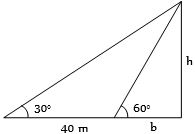
$A$ person standing on the bank of a river observes that the angle subtended by a tree on the opposite bank is $60^\circ$. When he moves $40 \ m$ away from the bank,he finds the angle to be $30^\circ$. The breadth of the river is.....$m$
A
$20$
B
$40$
C
$30$
D
$60$
Solution
(A) Let the height of the tree be $h$ and the breadth of the river be $b$.
From the given information:
In the first triangle,$\tan 60^\circ = \frac{h}{b} \Rightarrow h = b \tan 60^\circ = b\sqrt{3}$.
In the second triangle,$\tan 30^\circ = \frac{h}{b + 40} \Rightarrow h = (b + 40) \tan 30^\circ = \frac{b + 40}{\sqrt{3}}$.
Equating the two expressions for $h$:
$b\sqrt{3} = \frac{b + 40}{\sqrt{3}}$
$3b = b + 40$
$2b = 40$
$b = 20 \ m$.
From the given information:
In the first triangle,$\tan 60^\circ = \frac{h}{b} \Rightarrow h = b \tan 60^\circ = b\sqrt{3}$.
In the second triangle,$\tan 30^\circ = \frac{h}{b + 40} \Rightarrow h = (b + 40) \tan 30^\circ = \frac{b + 40}{\sqrt{3}}$.
Equating the two expressions for $h$:
$b\sqrt{3} = \frac{b + 40}{\sqrt{3}}$
$3b = b + 40$
$2b = 40$
$b = 20 \ m$.
0 likesView Solution
8
MathematicsMediumMCQIIT JEE · 1975
$A$ vertex of an equilateral triangle is $(2, 3)$ and the equation of the opposite side is $x + y = 2$. Then,the equation of one of the other two sides is:
A
$y - 3 = 2(x - 2)$
B
$y - 3 = (2 - \sqrt{3})(x - 2)$
C
$y - 3 = (\sqrt{3} - 1)(x - 2)$
D
None of these
Solution
(B) The slope of the given side $x + y = 2$ is $m_1 = -1$,which corresponds to an angle of inclination $\theta = 135^\circ$.
Since the triangle is equilateral,the other two sides make an angle of $60^\circ$ with the base.
The slopes of the other two sides are given by $m = \tan(135^\circ \pm 60^\circ)$.
For the first case,$m = \tan(135^\circ - 60^\circ) = \tan(75^\circ) = 2 + \sqrt{3}$.
For the second case,$m = \tan(135^\circ + 60^\circ) = \tan(195^\circ) = \tan(15^\circ) = 2 - \sqrt{3}$.
Using the point-slope form $y - y_1 = m(x - x_1)$ with the vertex $(2, 3)$,the equations are $y - 3 = (2 \pm \sqrt{3})(x - 2)$.
Thus,one of the equations is $y - 3 = (2 - \sqrt{3})(x - 2)$.
Since the triangle is equilateral,the other two sides make an angle of $60^\circ$ with the base.
The slopes of the other two sides are given by $m = \tan(135^\circ \pm 60^\circ)$.
For the first case,$m = \tan(135^\circ - 60^\circ) = \tan(75^\circ) = 2 + \sqrt{3}$.
For the second case,$m = \tan(135^\circ + 60^\circ) = \tan(195^\circ) = \tan(15^\circ) = 2 - \sqrt{3}$.
Using the point-slope form $y - y_1 = m(x - x_1)$ with the vertex $(2, 3)$,the equations are $y - 3 = (2 \pm \sqrt{3})(x - 2)$.
Thus,one of the equations is $y - 3 = (2 - \sqrt{3})(x - 2)$.
0 likesView Solution
9
MathematicsDifficultMCQIIT JEE · 1975
The equation of the bisector of the acute angle between the lines $3x - 4y + 7 = 0$ and $12x + 5y - 2 = 0$ is
A
$21x + 77y - 101 = 0$
B
$11x - 3y + 9 = 0$
C
$31x + 77y + 101 = 0$
D
$11x - 3y - 9 = 0$
Solution
(B) The equations of the angle bisectors are given by $\frac{3x - 4y + 7}{\sqrt{3^2 + (-4)^2}} = \pm \frac{12x + 5y - 2}{\sqrt{12^2 + 5^2}}$
$\frac{3x - 4y + 7}{5} = \pm \frac{12x + 5y - 2}{13}$
Case $1$: $13(3x - 4y + 7) = 5(12x + 5y - 2)$ $\Rightarrow 39x - 52y + 91 = 60x + 25y - 10
$ $\Rightarrow 21x + 77y - 101 = 0$
Case $2$: $13(3x - 4y + 7) = -5(12x + 5y - 2)$ $\Rightarrow 39x - 52y + 91 = -60x - 25y + 10
$ $\Rightarrow 99x - 27y + 81 = 0$ $\Rightarrow 11x - 3y + 9 = 0$
To identify the acute angle bisector,check the sign of $a_1a_2 + b_1b_2$. Here $a_1=3, b_1=-4, a_2=12, b_2=5$.
$a_1a_2 + b_1b_2 = (3)(12) + (-4)(5) = 36 - 20 = 16 > 0$.
Since the expression is positive,the equation $\frac{a_1x + b_1y + c_1}{\sqrt{a_1^2 + b_1^2}} = -\frac{a_2x + b_2y + c_2}{\sqrt{a_2^2 + b_2^2}}$ gives the acute angle bisector.
This corresponds to $13(3x - 4y + 7) = -5(12x + 5y - 2)$,which simplifies to $11x - 3y + 9 = 0$.
$\frac{3x - 4y + 7}{5} = \pm \frac{12x + 5y - 2}{13}$
Case $1$: $13(3x - 4y + 7) = 5(12x + 5y - 2)$ $\Rightarrow 39x - 52y + 91 = 60x + 25y - 10
$ $\Rightarrow 21x + 77y - 101 = 0$
Case $2$: $13(3x - 4y + 7) = -5(12x + 5y - 2)$ $\Rightarrow 39x - 52y + 91 = -60x - 25y + 10
$ $\Rightarrow 99x - 27y + 81 = 0$ $\Rightarrow 11x - 3y + 9 = 0$
To identify the acute angle bisector,check the sign of $a_1a_2 + b_1b_2$. Here $a_1=3, b_1=-4, a_2=12, b_2=5$.
$a_1a_2 + b_1b_2 = (3)(12) + (-4)(5) = 36 - 20 = 16 > 0$.
Since the expression is positive,the equation $\frac{a_1x + b_1y + c_1}{\sqrt{a_1^2 + b_1^2}} = -\frac{a_2x + b_2y + c_2}{\sqrt{a_2^2 + b_2^2}}$ gives the acute angle bisector.
This corresponds to $13(3x - 4y + 7) = -5(12x + 5y - 2)$,which simplifies to $11x - 3y + 9 = 0$.
0 likesView Solution
10
MathematicsMediumMCQIIT JEE · 1975
The tangent to the circle $x^2 + y^2 = 5$ at the point $(1, -2)$ intersects the circle $x^2 + y^2 - 8x + 6y + 20 = 0$ at which of the following?
A
Touches
B
Cuts at real points
C
Cuts at imaginary points
D
None of these
Solution
(A) The equation of the tangent to the circle $x^2 + y^2 = 5$ at $(1, -2)$ is given by $x(1) + y(-2) = 5$,which simplifies to $x - 2y = 5$,or $x = 2y + 5$.
Substitute $x = 2y + 5$ into the equation of the second circle $x^2 + y^2 - 8x + 6y + 20 = 0$:
$(2y + 5)^2 + y^2 - 8(2y + 5) + 6y + 20 = 0$
Expanding the terms:
$(4y^2 + 20y + 25) + y^2 - 16y - 40 + 6y + 20 = 0$
Combining like terms:
$5y^2 + 10y + 5 = 0$
Dividing by $5$:
$y^2 + 2y + 1 = 0$
$(y + 1)^2 = 0$
This gives $y = -1$. Substituting $y = -1$ into $x = 2y + 5$ gives $x = 2(-1) + 5 = 3$.
Since there is only one point of intersection $(3, -1)$,the line touches the circle.
Substitute $x = 2y + 5$ into the equation of the second circle $x^2 + y^2 - 8x + 6y + 20 = 0$:
$(2y + 5)^2 + y^2 - 8(2y + 5) + 6y + 20 = 0$
Expanding the terms:
$(4y^2 + 20y + 25) + y^2 - 16y - 40 + 6y + 20 = 0$
Combining like terms:
$5y^2 + 10y + 5 = 0$
Dividing by $5$:
$y^2 + 2y + 1 = 0$
$(y + 1)^2 = 0$
This gives $y = -1$. Substituting $y = -1$ into $x = 2y + 5$ gives $x = 2(-1) + 5 = 3$.
Since there is only one point of intersection $(3, -1)$,the line touches the circle.
0 likesView Solution
11
MathematicsEasyMCQIIT JEE · 1975
$\mathop {\lim }\limits_{x \to \infty } \frac{{\sin x}}{x} = $
A
$1$
B
$0$
C
Does not exist
D
None of these
Solution
(B) We need to evaluate $\mathop {\lim }\limits_{x \to \infty } \frac{{\sin x}}{x}$.
We know that for all $x \in \mathbb{R}$,the value of $\sin x$ is bounded such that $-1 \le \sin x \le 1$.
For $x > 0$,we can divide the inequality by $x$:
$-\frac{1}{x} \le \frac{\sin x}{x} \le \frac{1}{x}$.
Applying the Squeeze Theorem as $x \to \infty$:
$\mathop {\lim }\limits_{x \to \infty } \left( -\frac{1}{x} \right) = 0$ and $\mathop {\lim }\limits_{x \to \infty } \left( \frac{1}{x} \right) = 0$.
Therefore,by the Squeeze Theorem,$\mathop {\lim }\limits_{x \to \infty } \frac{{\sin x}}{x} = 0$.
We know that for all $x \in \mathbb{R}$,the value of $\sin x$ is bounded such that $-1 \le \sin x \le 1$.
For $x > 0$,we can divide the inequality by $x$:
$-\frac{1}{x} \le \frac{\sin x}{x} \le \frac{1}{x}$.
Applying the Squeeze Theorem as $x \to \infty$:
$\mathop {\lim }\limits_{x \to \infty } \left( -\frac{1}{x} \right) = 0$ and $\mathop {\lim }\limits_{x \to \infty } \left( \frac{1}{x} \right) = 0$.
Therefore,by the Squeeze Theorem,$\mathop {\lim }\limits_{x \to \infty } \frac{{\sin x}}{x} = 0$.
0 likesView Solution
12
MathematicsMediumMCQIIT JEE · 1975
The probability that $A$ speaks the truth is $\frac{4}{5}$,while the probability that $B$ speaks the truth is $\frac{3}{4}$. What is the probability that they contradict each other when asked to speak on a fact?
A
$\frac{4}{5}$
B
$\frac{1}{5}$
C
$\frac{7}{20}$
D
$\frac{3}{20}$
Solution
(C) Let $P(A)$ be the probability that $A$ speaks the truth and $P(B)$ be the probability that $B$ speaks the truth.
Given: $P(A) = \frac{4}{5}$ and $P(B) = \frac{3}{4}$.
Then,the probability that $A$ lies is $P(\bar{A}) = 1 - \frac{4}{5} = \frac{1}{5}$.
The probability that $B$ lies is $P(\bar{B}) = 1 - \frac{3}{4} = \frac{1}{4}$.
They contradict each other if ($A$ speaks the truth and $B$ lies) $OR$ ($A$ lies and $B$ speaks the truth).
Required probability $= P(A) \times P(\bar{B}) + P(\bar{A}) \times P(B)$.
$= (\frac{4}{5} \times \frac{1}{4}) + (\frac{1}{5} \times \frac{3}{4})$.
$= \frac{4}{20} + \frac{3}{20} = \frac{7}{20}$.
Given: $P(A) = \frac{4}{5}$ and $P(B) = \frac{3}{4}$.
Then,the probability that $A$ lies is $P(\bar{A}) = 1 - \frac{4}{5} = \frac{1}{5}$.
The probability that $B$ lies is $P(\bar{B}) = 1 - \frac{3}{4} = \frac{1}{4}$.
They contradict each other if ($A$ speaks the truth and $B$ lies) $OR$ ($A$ lies and $B$ speaks the truth).
Required probability $= P(A) \times P(\bar{B}) + P(\bar{A}) \times P(B)$.
$= (\frac{4}{5} \times \frac{1}{4}) + (\frac{1}{5} \times \frac{3}{4})$.
$= \frac{4}{20} + \frac{3}{20} = \frac{7}{20}$.
0 likesView Solution
13
MathematicsDifficultMCQIIT JEE · 1975
If ${a_1}, {a_2}, {a_3}, \dots, {a_n}$ are in $H.P.$,then the expression ${a_1}{a_2} + {a_2}{a_3} + \dots + {a_{n - 1}}{a_n}$ is equal to:
A
${a_1}{a_n}$
B
$n{a_1}{a_n}$
C
$(n - 1){a_1}{a_n}$
D
None of these
0 likesView Solution
14
MathematicsEasyMCQIIT JEE · 1975
If the vertices of a triangle have integral coordinates,then the triangle is
A
Equilateral
B
Never equilateral
C
Isosceles
D
None of these
Solution
(B) Let the vertices of the triangle be $(x_1, y_1)$,$(x_2, y_2)$,and $(x_3, y_3)$,where all coordinates are integers.
The area of the triangle is given by the formula: $\text{Area} = \frac{1}{2} |x_1(y_2 - y_3) + x_2(y_3 - y_1) + x_3(y_1 - y_2)|$.
Since all coordinates are integers,the area must be a rational number (specifically,a multiple of $0.5$).
If the triangle were equilateral with side length $a$,then $a^2 = (x_1 - x_2)^2 + (y_1 - y_2)^2$. Since the coordinates are integers,$a^2$ must be a positive integer.
The area of an equilateral triangle is given by $\frac{\sqrt{3}}{4} a^2$.
Since $a^2$ is an integer,$\frac{\sqrt{3}}{4} a^2$ is an irrational number.
This creates a contradiction because the area cannot be both rational and irrational. Therefore,a triangle with integral coordinates can never be equilateral.
The area of the triangle is given by the formula: $\text{Area} = \frac{1}{2} |x_1(y_2 - y_3) + x_2(y_3 - y_1) + x_3(y_1 - y_2)|$.
Since all coordinates are integers,the area must be a rational number (specifically,a multiple of $0.5$).
If the triangle were equilateral with side length $a$,then $a^2 = (x_1 - x_2)^2 + (y_1 - y_2)^2$. Since the coordinates are integers,$a^2$ must be a positive integer.
The area of an equilateral triangle is given by $\frac{\sqrt{3}}{4} a^2$.
Since $a^2$ is an integer,$\frac{\sqrt{3}}{4} a^2$ is an irrational number.
This creates a contradiction because the area cannot be both rational and irrational. Therefore,a triangle with integral coordinates can never be equilateral.
0 likesView Solution
15
MathematicsMediumMCQIIT JEE · 1975
$\int {\frac{{{x^5}dx}}{{\sqrt {1 + {x^3}} }}} = $
A
$\frac{2}{3}\sqrt {1 + {x^3}} ({x^3} + 2) + C$
B
$\frac{2}{9}\sqrt {1 + {x^3}} ({x^3} - 4) + C$
C
$\frac{2}{9}\sqrt {1 + {x^3}} ({x^3} + 4) + C$
D
$\frac{2}{9}\sqrt {1 + {x^3}} ({x^3} - 2) + C$
Solution
(D) Let $I = \int {\frac{{{x^5}dx}}{{\sqrt {1 + {x^3}} }}} $.
We can write $x^5 dx$ as $x^3 \cdot x^2 dx$.
Let $1 + x^3 = t^2$. Then $3x^2 dx = 2t dt$,which implies $x^2 dx = \frac{2}{3}t dt$.
Also,$x^3 = t^2 - 1$.
Substituting these into the integral:
$I = \int {\frac{{(t^2 - 1)}}{t} \cdot \frac{2}{3}t dt} = \frac{2}{3} \int {(t^2 - 1) dt} $.
Integrating with respect to $t$:
$I = \frac{2}{3} \left( \frac{t^3}{3} - t \right) + C = \frac{2}{9} t(t^2 - 3) + C$.
Since $t = \sqrt{1 + x^3}$ and $t^2 = 1 + x^3$,we have:
$I = \frac{2}{9} \sqrt{1 + x^3} (1 + x^3 - 3) + C = \frac{2}{9} \sqrt{1 + x^3} (x^3 - 2) + C$.
We can write $x^5 dx$ as $x^3 \cdot x^2 dx$.
Let $1 + x^3 = t^2$. Then $3x^2 dx = 2t dt$,which implies $x^2 dx = \frac{2}{3}t dt$.
Also,$x^3 = t^2 - 1$.
Substituting these into the integral:
$I = \int {\frac{{(t^2 - 1)}}{t} \cdot \frac{2}{3}t dt} = \frac{2}{3} \int {(t^2 - 1) dt} $.
Integrating with respect to $t$:
$I = \frac{2}{3} \left( \frac{t^3}{3} - t \right) + C = \frac{2}{9} t(t^2 - 3) + C$.
Since $t = \sqrt{1 + x^3}$ and $t^2 = 1 + x^3$,we have:
$I = \frac{2}{9} \sqrt{1 + x^3} (1 + x^3 - 3) + C = \frac{2}{9} \sqrt{1 + x^3} (x^3 - 2) + C$.
0 likesView Solution
Vedclass Products
For Students
Vedclass Test Series
Mock tests in real IIT JEE style covering Mathematics with performance analysis. 5-day free trial.
Start Free TrialFor Teachers
Exam Paper Generator
Generate Set A/B/C/D Mathematics papers from 7.5L+ questions in 2 minutes. 3 chapters free.
Try FreeFor Institutes
Online Exam Module
Run live IIT JEE mock exams with unlimited students, 360° analytics & white-label branding.
See DemoFrequently Asked Questions
How many Mathematics questions are in IIT JEE 1975?
There are 15 Mathematics questions from the IIT JEE 1975 paper on Vedclass, each with a detailed step-by-step solution in English.
Are IIT JEE 1975 Mathematics solutions available in English?
Yes. All solutions on this page are in English. You can also switch to English or Hindi using the language buttons above the questions.
Can I practice IIT JEE 1975 Mathematics as a timed test?
Yes. Use the Vedclass Test Series to attempt a full IIT JEE mock test covering Mathematics with time limits and instant score analysis.
Can teachers create Mathematics papers from IIT JEE previous year questions?
Yes. The Vedclass Exam Paper Generator lets teachers mix IIT JEE Mathematics questions and generate Set A/B/C/D papers in minutes.
For Teachers & Institutes
Build a Custom Mathematics Paper
Pick IIT JEE 1975 Mathematics questions, set difficulty, and generate Set A/B/C/D in 2 minutes.