
MathematicsQ1–8 of 8 questions
Page 1 of 1 · English
1
MathematicsEasyMCQIIT JEE · 1965
If $\omega$ is a cube root of unity,then the value of $(1 - \omega + \omega^2)^5 + (1 + \omega - \omega^2)^5$ is:
A
$16$
B
$32$
C
$48$
D
$-32$
Solution
(B) Given that $\omega$ is a cube root of unity,we know that $1 + \omega + \omega^2 = 0$ and $\omega^3 = 1$.
Using $1 + \omega^2 = -\omega$,the first term becomes $(1 - \omega + \omega^2)^5 = (-\omega - \omega)^5 = (-2\omega)^5 = -32\omega^5$.
Since $\omega^5 = \omega^3 \cdot \omega^2 = \omega^2$,this simplifies to $-32\omega^2$.
Using $1 + \omega = -\omega^2$,the second term becomes $(1 + \omega - \omega^2)^5 = (-\omega^2 - \omega^2)^5 = (-2\omega^2)^5 = -32\omega^{10}$.
Since $\omega^{10} = (\omega^3)^3 \cdot \omega = \omega$,this simplifies to $-32\omega$.
Adding the two terms: $-32\omega^2 - 32\omega = -32(\omega^2 + \omega)$.
Since $1 + \omega + \omega^2 = 0$,we have $\omega^2 + \omega = -1$.
Therefore,$-32(-1) = 32$.
Using $1 + \omega^2 = -\omega$,the first term becomes $(1 - \omega + \omega^2)^5 = (-\omega - \omega)^5 = (-2\omega)^5 = -32\omega^5$.
Since $\omega^5 = \omega^3 \cdot \omega^2 = \omega^2$,this simplifies to $-32\omega^2$.
Using $1 + \omega = -\omega^2$,the second term becomes $(1 + \omega - \omega^2)^5 = (-\omega^2 - \omega^2)^5 = (-2\omega^2)^5 = -32\omega^{10}$.
Since $\omega^{10} = (\omega^3)^3 \cdot \omega = \omega$,this simplifies to $-32\omega$.
Adding the two terms: $-32\omega^2 - 32\omega = -32(\omega^2 + \omega)$.
Since $1 + \omega + \omega^2 = 0$,we have $\omega^2 + \omega = -1$.
Therefore,$-32(-1) = 32$.
0 likesView Solution
2
MathematicsMediumMCQIIT JEE · 1965
If $x, 1, z$ are in $A.P.$ and $x, 2, z$ are in $G.P.$,then $x, 4, z$ will be in
A
$A.P.$
B
$G.P.$
C
$H.P.$
D
None of these
Solution
(C) Given that $x, 1, z$ are in $A.P.$,the middle term is the arithmetic mean: $1 = \frac{x + z}{2}$,which implies $x + z = 2$......$(i)$
Given that $x, 2, z$ are in $G.P.$,the middle term is the geometric mean: $2^2 = xz$,which implies $xz = 4$......$(ii)$
For $x, 4, z$ to be in $H.P.$,the middle term must be the harmonic mean of $x$ and $z$,which is $\frac{2xz}{x + z}$.
Substituting the values from $(i)$ and $(ii)$ into the expression for the harmonic mean:
$\text{Harmonic Mean} = \frac{2(4)}{2} = \frac{8}{2} = 4$.
Since the middle term is $4$,$x, 4, z$ are in $H.P.$
Given that $x, 2, z$ are in $G.P.$,the middle term is the geometric mean: $2^2 = xz$,which implies $xz = 4$......$(ii)$
For $x, 4, z$ to be in $H.P.$,the middle term must be the harmonic mean of $x$ and $z$,which is $\frac{2xz}{x + z}$.
Substituting the values from $(i)$ and $(ii)$ into the expression for the harmonic mean:
$\text{Harmonic Mean} = \frac{2(4)}{2} = \frac{8}{2} = 4$.
Since the middle term is $4$,$x, 4, z$ are in $H.P.$
0 likesView Solution
3
MathematicsEasyMCQIIT JEE · 1965
The term independent of $x$ in the expansion of ${\left( {\sqrt {\frac{x}{3}} + \frac{3}{{2{x^2}}}} \right)^{10}}$ is:
A
$3/2$
B
$5/4$
C
$5/2$
D
None of these
Solution
(B) The general term $T_{r+1}$ in the expansion of $(a+b)^n$ is given by $^{n}C_{r} a^{n-r} b^{r}$.
Here,$a = (x/3)^{1/2}$,$b = 3/(2x^2)$,and $n = 10$.
$T_{r+1} = ^{10}C_{r} (x/3)^{(10-r)/2} (3/(2x^2))^r$
$T_{r+1} = ^{10}C_{r} (1/3)^{(10-r)/2} (3/2)^r x^{(10-r)/2 - 2r}$
For the term to be independent of $x$,the exponent of $x$ must be $0$:
$(10-r)/2 - 2r = 0$
$5 - r/2 - 2r = 0$
$5 = 5r/2 \Rightarrow r = 2$
Substituting $r = 2$ into the expression:
$T_{3} = ^{10}C_{2} (1/3)^{(10-2)/2} (3/2)^2$
$T_{3} = 45 \times (1/3)^4 \times (9/4)$
$T_{3} = 45 \times (1/81) \times (9/4) = 45/36 = 5/4$.
Here,$a = (x/3)^{1/2}$,$b = 3/(2x^2)$,and $n = 10$.
$T_{r+1} = ^{10}C_{r} (x/3)^{(10-r)/2} (3/(2x^2))^r$
$T_{r+1} = ^{10}C_{r} (1/3)^{(10-r)/2} (3/2)^r x^{(10-r)/2 - 2r}$
For the term to be independent of $x$,the exponent of $x$ must be $0$:
$(10-r)/2 - 2r = 0$
$5 - r/2 - 2r = 0$
$5 = 5r/2 \Rightarrow r = 2$
Substituting $r = 2$ into the expression:
$T_{3} = ^{10}C_{2} (1/3)^{(10-2)/2} (3/2)^2$
$T_{3} = 45 \times (1/3)^4 \times (9/4)$
$T_{3} = 45 \times (1/81) \times (9/4) = 45/36 = 5/4$.
0 likesView Solution
4
MathematicsMediumMCQIIT JEE · 1965
$\sin 36^\circ \sin 72^\circ \sin 108^\circ \sin 144^\circ = $
A
$1/4$
B
$1/16$
C
$3/4$
D
$5/16$
Solution
(D) We know that $\sin 108^\circ = \sin(180^\circ - 72^\circ) = \sin 72^\circ$ and $\sin 144^\circ = \sin(180^\circ - 36^\circ) = \sin 36^\circ$.
So,the expression becomes $\sin^2 36^\circ \sin^2 72^\circ$.
Using the identity $\sin^2 \theta = \frac{1 - \cos 2\theta}{2}$,we have:
$\sin^2 36^\circ \sin^2 72^\circ = \left(\frac{1 - \cos 72^\circ}{2}\right) \left(\frac{1 - \cos 144^\circ}{2}\right)$
$= \frac{1}{4} (1 - \cos 72^\circ)(1 - \cos 144^\circ)$
$= \frac{1}{4} (1 - \sin 18^\circ)(1 + \cos 36^\circ)$
Substituting the values $\sin 18^\circ = \frac{\sqrt{5}-1}{4}$ and $\cos 36^\circ = \frac{\sqrt{5}+1}{4}$:
$= \frac{1}{4} \left(1 - \frac{\sqrt{5}-1}{4}\right) \left(1 + \frac{\sqrt{5}+1}{4}\right)$
$= \frac{1}{4} \left(\frac{5-\sqrt{5}}{4}\right) \left(\frac{5+\sqrt{5}}{4}\right)$
$= \frac{1}{4} \left(\frac{25-5}{16}\right) = \frac{1}{4} \times \frac{20}{16} = \frac{5}{16}$.
So,the expression becomes $\sin^2 36^\circ \sin^2 72^\circ$.
Using the identity $\sin^2 \theta = \frac{1 - \cos 2\theta}{2}$,we have:
$\sin^2 36^\circ \sin^2 72^\circ = \left(\frac{1 - \cos 72^\circ}{2}\right) \left(\frac{1 - \cos 144^\circ}{2}\right)$
$= \frac{1}{4} (1 - \cos 72^\circ)(1 - \cos 144^\circ)$
$= \frac{1}{4} (1 - \sin 18^\circ)(1 + \cos 36^\circ)$
Substituting the values $\sin 18^\circ = \frac{\sqrt{5}-1}{4}$ and $\cos 36^\circ = \frac{\sqrt{5}+1}{4}$:
$= \frac{1}{4} \left(1 - \frac{\sqrt{5}-1}{4}\right) \left(1 + \frac{\sqrt{5}+1}{4}\right)$
$= \frac{1}{4} \left(\frac{5-\sqrt{5}}{4}\right) \left(\frac{5+\sqrt{5}}{4}\right)$
$= \frac{1}{4} \left(\frac{25-5}{16}\right) = \frac{1}{4} \times \frac{20}{16} = \frac{5}{16}$.
0 likesView Solution
5
MathematicsMediumMCQIIT JEE · 1965
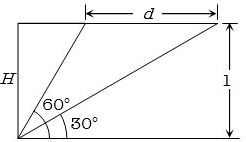
An aeroplane flying horizontally $1 \ km$ above the ground is observed at an elevation of $60^\circ$ and after $10$ seconds the elevation is observed to be $30^\circ$. The uniform speed of the aeroplane in $km/h$ is
A
$240$
B
$240\sqrt{3}$
C
$60\sqrt{3}$
D
None of these
Solution
$(B)$ Let the height of the aeroplane be $H = 1 \ km$. Let the distance covered by the aeroplane in $10$ seconds be $d$.
From the geometry of the problem,we have:
$d = H \cot(30^\circ) - H \cot(60^\circ)$
$d = 1 \times \sqrt{3} - 1 \times \frac{1}{\sqrt{3}} = \sqrt{3} - \frac{1}{\sqrt{3}} = \frac{3-1}{\sqrt{3}} = \frac{2}{\sqrt{3}} \ km$.
Time taken $t = 10 \ seconds = \frac{10}{3600} \ hours = \frac{1}{360} \ hours$.
Speed $= \frac{\text{Distance}}{\text{Time}} = \frac{2/\sqrt{3}}{1/360} = \frac{2}{\sqrt{3}} \times 360 = \frac{720}{\sqrt{3}} = 240\sqrt{3} \ km/h$.
From the geometry of the problem,we have:
$d = H \cot(30^\circ) - H \cot(60^\circ)$
$d = 1 \times \sqrt{3} - 1 \times \frac{1}{\sqrt{3}} = \sqrt{3} - \frac{1}{\sqrt{3}} = \frac{3-1}{\sqrt{3}} = \frac{2}{\sqrt{3}} \ km$.
Time taken $t = 10 \ seconds = \frac{10}{3600} \ hours = \frac{1}{360} \ hours$.
Speed $= \frac{\text{Distance}}{\text{Time}} = \frac{2/\sqrt{3}}{1/360} = \frac{2}{\sqrt{3}} \times 360 = \frac{720}{\sqrt{3}} = 240\sqrt{3} \ km/h$.
0 likesView Solution
6
MathematicsMediumMCQIIT JEE · 1965
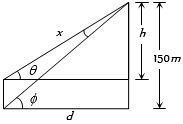
The angles of depression of the top and the foot of a chimney as seen from the top of a second chimney,which is $150 \, m$ high and standing on the same level as the first,are $\theta$ and $\phi$ respectively. If $\tan \theta = \frac{4}{3}$ and $\tan \phi = \frac{5}{2}$,then the distance between their tops is.......$m$.
A
$\frac{150}{\sqrt{3}}$
B
$100\sqrt{3}$
C
$150$
D
$100$
Solution
(D) Let $H = 150 \, m$ be the height of the second chimney.
Let $d$ be the distance between the two chimneys.
From the geometry of the problem,the angle of depression to the foot of the first chimney is $\phi$,so $\tan \phi = \frac{H}{d}$.
Given $\tan \phi = \frac{5}{2}$,we have $\frac{150}{d} = \frac{5}{2}$,which gives $d = \frac{150 \times 2}{5} = 60 \, m$.
Let $h$ be the height of the first chimney. The angle of depression to the top of the first chimney is $\theta$,so $\tan \theta = \frac{H - h}{d}$.
Given $\tan \theta = \frac{4}{3}$,we have $\frac{150 - h}{60} = \frac{4}{3}$.
$150 - h = 60 \times \frac{4}{3} = 80$.
$h = 150 - 80 = 70 \, m$.
The vertical distance between the tops is $H - h = 150 - 70 = 80 \, m$.
The horizontal distance between the tops is $d = 60 \, m$.
The distance between the tops is $\sqrt{(H - h)^2 + d^2} = \sqrt{80^2 + 60^2} = \sqrt{6400 + 3600} = \sqrt{10000} = 100 \, m$.
Let $d$ be the distance between the two chimneys.
From the geometry of the problem,the angle of depression to the foot of the first chimney is $\phi$,so $\tan \phi = \frac{H}{d}$.
Given $\tan \phi = \frac{5}{2}$,we have $\frac{150}{d} = \frac{5}{2}$,which gives $d = \frac{150 \times 2}{5} = 60 \, m$.
Let $h$ be the height of the first chimney. The angle of depression to the top of the first chimney is $\theta$,so $\tan \theta = \frac{H - h}{d}$.
Given $\tan \theta = \frac{4}{3}$,we have $\frac{150 - h}{60} = \frac{4}{3}$.
$150 - h = 60 \times \frac{4}{3} = 80$.
$h = 150 - 80 = 70 \, m$.
The vertical distance between the tops is $H - h = 150 - 70 = 80 \, m$.
The horizontal distance between the tops is $d = 60 \, m$.
The distance between the tops is $\sqrt{(H - h)^2 + d^2} = \sqrt{80^2 + 60^2} = \sqrt{6400 + 3600} = \sqrt{10000} = 100 \, m$.
0 likesView Solution
7
MathematicsEasyMCQIIT JEE · 1965
The line $x + y = 4$ divides the line segment joining the points $(-1, 1)$ and $(5, 7)$ in the ratio:
A
$2 : 1$
B
$1 : 2$
C
$1 : 2$ externally
D
None of these
Solution
(B) Let the line $x + y - 4 = 0$ divide the line segment joining $A(-1, 1)$ and $B(5, 7)$ in the ratio $k : 1$.
Using the section formula,the coordinates of the point of division are $\left( \frac{5k - 1}{k + 1}, \frac{7k + 1}{k + 1} \right)$.
Since this point lies on the line $x + y = 4$,we have:
$\frac{5k - 1}{k + 1} + \frac{7k + 1}{k + 1} = 4$
$5k - 1 + 7k + 1 = 4(k + 1)$
$12k = 4k + 4$
$8k = 4$
$k = \frac{4}{8} = \frac{1}{2}$.
Thus,the ratio is $1 : 2$.
Using the section formula,the coordinates of the point of division are $\left( \frac{5k - 1}{k + 1}, \frac{7k + 1}{k + 1} \right)$.
Since this point lies on the line $x + y = 4$,we have:
$\frac{5k - 1}{k + 1} + \frac{7k + 1}{k + 1} = 4$
$5k - 1 + 7k + 1 = 4(k + 1)$
$12k = 4k + 4$
$8k = 4$
$k = \frac{4}{8} = \frac{1}{2}$.
Thus,the ratio is $1 : 2$.
0 likesView Solution
8
MathematicsDifficultMCQIIT JEE · 1965
If the slope of a line passing through the point $A(3, 2)$ is $3/4$,then the points on the line which are $5$ units away from $A$ are:
A
$(5, 5), (-1, -1)$
B
$(7, 5), (-1, -1)$
C
$(5, 7), (-1, -1)$
D
$(7, 5), (1, 1)$
Solution
(B) The slope of the line is $m = \frac{3}{4} = \tan \theta$. Thus,$\cos \theta = \frac{4}{5}$ and $\sin \theta = \frac{3}{5}$.
The coordinates of points at a distance $r = 5$ from $A(x_1, y_1) = (3, 2)$ are given by $(x_1 \pm r \cos \theta, y_1 \pm r \sin \theta)$.
For the positive direction: $(3 + 5 \times \frac{4}{5}, 2 + 5 \times \frac{3}{5}) = (3 + 4, 2 + 3) = (7, 5)$.
For the negative direction: $(3 - 5 \times \frac{4}{5}, 2 - 5 \times \frac{3}{5}) = (3 - 4, 2 - 3) = (-1, -1)$.
Thus,the required points are $(7, 5)$ and $(-1, -1)$.
The coordinates of points at a distance $r = 5$ from $A(x_1, y_1) = (3, 2)$ are given by $(x_1 \pm r \cos \theta, y_1 \pm r \sin \theta)$.
For the positive direction: $(3 + 5 \times \frac{4}{5}, 2 + 5 \times \frac{3}{5}) = (3 + 4, 2 + 3) = (7, 5)$.
For the negative direction: $(3 - 5 \times \frac{4}{5}, 2 - 5 \times \frac{3}{5}) = (3 - 4, 2 - 3) = (-1, -1)$.
Thus,the required points are $(7, 5)$ and $(-1, -1)$.
0 likesView Solution
Vedclass Products
For Students
Vedclass Test Series
Mock tests in real IIT JEE style covering Mathematics with performance analysis. 5-day free trial.
Start Free TrialFor Teachers
Exam Paper Generator
Generate Set A/B/C/D Mathematics papers from 7.5L+ questions in 2 minutes. 3 chapters free.
Try FreeFor Institutes
Online Exam Module
Run live IIT JEE mock exams with unlimited students, 360° analytics & white-label branding.
See DemoFrequently Asked Questions
How many Mathematics questions are in IIT JEE 1965?
There are 8 Mathematics questions from the IIT JEE 1965 paper on Vedclass, each with a detailed step-by-step solution in English.
Are IIT JEE 1965 Mathematics solutions available in English?
Yes. All solutions on this page are in English. You can also switch to English or Hindi using the language buttons above the questions.
Can I practice IIT JEE 1965 Mathematics as a timed test?
Yes. Use the Vedclass Test Series to attempt a full IIT JEE mock test covering Mathematics with time limits and instant score analysis.
Can teachers create Mathematics papers from IIT JEE previous year questions?
Yes. The Vedclass Exam Paper Generator lets teachers mix IIT JEE Mathematics questions and generate Set A/B/C/D papers in minutes.
For Teachers & Institutes
Build a Custom Mathematics Paper
Pick IIT JEE 1965 Mathematics questions, set difficulty, and generate Set A/B/C/D in 2 minutes.