
MathematicsQ1–5 of 5 questions
Page 1 of 1 · English
1
MathematicsDifficultMCQIIT JEE · 1964
$1 + \cos 56^\circ + \cos 58^\circ - \cos 66^\circ = $
A
$2 \cos 28^\circ \cos 29^\circ \cos 33^\circ $
B
$4 \cos 28^\circ \cos 29^\circ \cos 33^\circ $
C
$4 \cos 28^\circ \cos 29^\circ \sin 33^\circ $
D
$2 \cos 28^\circ \cos 29^\circ \sin 33^\circ $
Solution
(C) Given expression: $1 + \cos 56^\circ + \cos 58^\circ - \cos 66^\circ $
Using the identity $1 + \cos 2\theta = 2 \cos^2 \theta$,we have $1 + \cos 56^\circ = 2 \cos^2 28^\circ$.
Now,the expression becomes $2 \cos^2 28^\circ + (\cos 58^\circ - \cos 66^\circ)$.
Using the identity $\cos C - \cos D = 2 \sin \frac{C+D}{2} \sin \frac{D-C}{2}$,we get $\cos 58^\circ - \cos 66^\circ = 2 \sin \frac{58^\circ + 66^\circ}{2} \sin \frac{66^\circ - 58^\circ}{2} = 2 \sin 62^\circ \sin 4^\circ$.
Since $\sin 62^\circ = \cos 28^\circ$,the expression is $2 \cos^2 28^\circ + 2 \cos 28^\circ \sin 4^\circ = 2 \cos 28^\circ (\cos 28^\circ + \sin 4^\circ)$.
Since $\sin 4^\circ = \cos 86^\circ$,we have $2 \cos 28^\circ (\cos 28^\circ + \cos 86^\circ)$.
Using $\cos C + \cos D = 2 \cos \frac{C+D}{2} \cos \frac{C-D}{2}$,we get $2 \cos 28^\circ [2 \cos \frac{28^\circ + 86^\circ}{2} \cos \frac{86^\circ - 28^\circ}{2}] = 2 \cos 28^\circ [2 \cos 57^\circ \cos 29^\circ]$.
Since $\cos 57^\circ = \sin 33^\circ$,the final result is $4 \cos 28^\circ \cos 29^\circ \sin 33^\circ$.
Using the identity $1 + \cos 2\theta = 2 \cos^2 \theta$,we have $1 + \cos 56^\circ = 2 \cos^2 28^\circ$.
Now,the expression becomes $2 \cos^2 28^\circ + (\cos 58^\circ - \cos 66^\circ)$.
Using the identity $\cos C - \cos D = 2 \sin \frac{C+D}{2} \sin \frac{D-C}{2}$,we get $\cos 58^\circ - \cos 66^\circ = 2 \sin \frac{58^\circ + 66^\circ}{2} \sin \frac{66^\circ - 58^\circ}{2} = 2 \sin 62^\circ \sin 4^\circ$.
Since $\sin 62^\circ = \cos 28^\circ$,the expression is $2 \cos^2 28^\circ + 2 \cos 28^\circ \sin 4^\circ = 2 \cos 28^\circ (\cos 28^\circ + \sin 4^\circ)$.
Since $\sin 4^\circ = \cos 86^\circ$,we have $2 \cos 28^\circ (\cos 28^\circ + \cos 86^\circ)$.
Using $\cos C + \cos D = 2 \cos \frac{C+D}{2} \cos \frac{C-D}{2}$,we get $2 \cos 28^\circ [2 \cos \frac{28^\circ + 86^\circ}{2} \cos \frac{86^\circ - 28^\circ}{2}] = 2 \cos 28^\circ [2 \cos 57^\circ \cos 29^\circ]$.
Since $\cos 57^\circ = \sin 33^\circ$,the final result is $4 \cos 28^\circ \cos 29^\circ \sin 33^\circ$.
0 likesView Solution
2
MathematicsMediumMCQIIT JEE · 1964
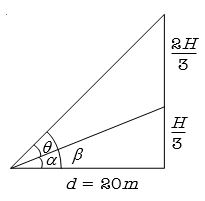
$A$ vertical pole consists of two parts,the lower part being one third of the whole. At a point in the horizontal plane through the base of the pole and at a distance of $20 \, m$ from it,the upper part of the pole subtends an angle whose tangent is $\frac{1}{2}$. The possible heights of the pole are
A
$20 \, m$ and $20\sqrt{3} \, m$
B
$20 \, m$ and $60 \, m$
C
$16 \, m$ and $48 \, m$
D
None of these
Solution
(B) Let the total height of the pole be $H$. The lower part is $\frac{H}{3}$ and the upper part is $\frac{2H}{3}$. Let the point be at a distance $d = 20 \, m$ from the base. Let $\alpha$ be the angle subtended by the lower part and $\beta$ be the angle subtended by the whole pole at the point. The angle subtended by the upper part is $\theta = \beta - \alpha$,where $\tan \theta = \frac{1}{2}$.
We have $\tan \alpha = \frac{H/3}{d} = \frac{H}{3d}$ and $\tan \beta = \frac{H}{d}$.
Using the formula $\tan(\beta - \alpha) = \frac{\tan \beta - \tan \alpha}{1 + \tan \beta \tan \alpha}$,we get:
$\frac{1}{2} = \frac{\frac{H}{d} - \frac{H}{3d}}{1 + (\frac{H}{d})(\frac{H}{3d})} = \frac{\frac{2H}{3d}}{1 + \frac{H^2}{3d^2}} = \frac{2Hd}{3d^2 + H^2}$.
Thus,$3d^2 + H^2 = 4Hd$,which simplifies to $H^2 - 4dH + 3d^2 = 0$.
Substituting $d = 20$,we get $H^2 - 4(20)H + 3(20^2) = 0$,so $H^2 - 80H + 1200 = 0$.
Factoring the quadratic equation: $(H - 20)(H - 60) = 0$.
Therefore,the possible heights of the pole are $H = 20 \, m$ and $H = 60 \, m$.
We have $\tan \alpha = \frac{H/3}{d} = \frac{H}{3d}$ and $\tan \beta = \frac{H}{d}$.
Using the formula $\tan(\beta - \alpha) = \frac{\tan \beta - \tan \alpha}{1 + \tan \beta \tan \alpha}$,we get:
$\frac{1}{2} = \frac{\frac{H}{d} - \frac{H}{3d}}{1 + (\frac{H}{d})(\frac{H}{3d})} = \frac{\frac{2H}{3d}}{1 + \frac{H^2}{3d^2}} = \frac{2Hd}{3d^2 + H^2}$.
Thus,$3d^2 + H^2 = 4Hd$,which simplifies to $H^2 - 4dH + 3d^2 = 0$.
Substituting $d = 20$,we get $H^2 - 4(20)H + 3(20^2) = 0$,so $H^2 - 80H + 1200 = 0$.
Factoring the quadratic equation: $(H - 20)(H - 60) = 0$.
Therefore,the possible heights of the pole are $H = 20 \, m$ and $H = 60 \, m$.
0 likesView Solution
3
MathematicsEasyMCQIIT JEE · 1964
The centroid of a triangle,whose vertices are $(2, 1)$,$(5, 2)$,and $(3, 4)$,is
A
$\left( \frac{8}{3}, \frac{7}{3} \right)$
B
$\left( \frac{10}{3}, \frac{7}{3} \right)$
C
$\left( -\frac{10}{3}, \frac{7}{3} \right)$
D
$\left( \frac{10}{3}, -\frac{7}{3} \right)$
Solution
(B) The formula for the centroid $(G)$ of a triangle with vertices $(x_1, y_1)$,$(x_2, y_2)$,and $(x_3, y_3)$ is given by $G = \left( \frac{x_1 + x_2 + x_3}{3}, \frac{y_1 + y_2 + y_3}{3} \right)$.
Given vertices are $(2, 1)$,$(5, 2)$,and $(3, 4)$.
Calculating the $x$-coordinate: $x = \frac{2 + 5 + 3}{3} = \frac{10}{3}$.
Calculating the $y$-coordinate: $y = \frac{1 + 2 + 4}{3} = \frac{7}{3}$.
Thus,the centroid is $\left( \frac{10}{3}, \frac{7}{3} \right)$.
Given vertices are $(2, 1)$,$(5, 2)$,and $(3, 4)$.
Calculating the $x$-coordinate: $x = \frac{2 + 5 + 3}{3} = \frac{10}{3}$.
Calculating the $y$-coordinate: $y = \frac{1 + 2 + 4}{3} = \frac{7}{3}$.
Thus,the centroid is $\left( \frac{10}{3}, \frac{7}{3} \right)$.
0 likesView Solution
4
MathematicsMediumMCQIIT JEE · 1964
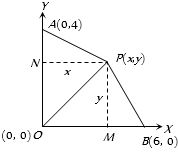
The coordinates of the points $O$,$A$,and $B$ are $(0,0)$,$(0,4)$,and $(6,0)$ respectively. If a point $P$ moves such that the area of $\Delta POA$ is always twice the area of $\Delta POB$,then the equation to both parts of the locus of $P$ is
A
$(x - 3y)(x + 3y) = 0$
B
$(x - 3y)(x + y) = 0$
C
$(3x - y)(3x + y) = 0$
D
None of these
Solution
(A) Let the coordinates of the moving point $P$ be $(x, y)$.
The coordinates of the given points are $O(0, 0)$,$A(0, 4)$,and $B(6, 0)$.
The area of a triangle with vertices $(x_1, y_1)$,$(x_2, y_2)$,and $(x_3, y_3)$ is given by $\frac{1}{2} |x_1(y_2 - y_3) + x_2(y_3 - y_1) + x_3(y_1 - y_2)|$.
Area of $\Delta POA = \frac{1}{2} |0(4 - y) + 0(y - 0) + x(0 - 4)| = \frac{1}{2} |-4x| = 2|x|$.
Area of $\Delta POB = \frac{1}{2} |0(0 - y) + 6(y - 0) + x(0 - 0)| = \frac{1}{2} |6y| = 3|y|$.
According to the problem,Area of $\Delta POA = 2 \times$ Area of $\Delta POB$.
Therefore,$2|x| = 2 \times 3|y|$.
$|x| = 3|y|$.
Squaring both sides,we get $x^2 = 9y^2$,which implies $x^2 - 9y^2 = 0$.
This can be factored as $(x - 3y)(x + 3y) = 0$.
The coordinates of the given points are $O(0, 0)$,$A(0, 4)$,and $B(6, 0)$.
The area of a triangle with vertices $(x_1, y_1)$,$(x_2, y_2)$,and $(x_3, y_3)$ is given by $\frac{1}{2} |x_1(y_2 - y_3) + x_2(y_3 - y_1) + x_3(y_1 - y_2)|$.
Area of $\Delta POA = \frac{1}{2} |0(4 - y) + 0(y - 0) + x(0 - 4)| = \frac{1}{2} |-4x| = 2|x|$.
Area of $\Delta POB = \frac{1}{2} |0(0 - y) + 6(y - 0) + x(0 - 0)| = \frac{1}{2} |6y| = 3|y|$.
According to the problem,Area of $\Delta POA = 2 \times$ Area of $\Delta POB$.
Therefore,$2|x| = 2 \times 3|y|$.
$|x| = 3|y|$.
Squaring both sides,we get $x^2 = 9y^2$,which implies $x^2 - 9y^2 = 0$.
This can be factored as $(x - 3y)(x + 3y) = 0$.
0 likesView Solution
5
MathematicsMediumMCQIIT JEE · 1964
If the vertices of a triangle are $(2, 1), (5, 2)$ and $(3, 4)$,then its circumcentre is
A
$\left( \frac{13}{2}, \frac{9}{2} \right)$
B
$\left( \frac{13}{4}, \frac{9}{4} \right)$
C
$\left( \frac{9}{4}, \frac{13}{4} \right)$
D
None of these
Solution
(B) Let the circumcentre be $O(x, y)$ and the given vertices be $A(2, 1), B(5, 2),$ and $C(3, 4).$
Since the circumcentre is equidistant from all vertices,$OA^2 = OB^2 = OC^2.$
From $OA^2 = OB^2: (x - 2)^2 + (y - 1)^2 = (x - 5)^2 + (y - 2)^2.$
Expanding this: $x^2 - 4x + 4 + y^2 - 2y + 1 = x^2 - 10x + 25 + y^2 - 4y + 4.$
Simplifying: $6x + 2y = 24 \implies 3x + y = 12$......$(i)$
From $OA^2 = OC^2: (x - 2)^2 + (y - 1)^2 = (x - 3)^2 + (y - 4)^2.$
Expanding this: $x^2 - 4x + 4 + y^2 - 2y + 1 = x^2 - 6x + 9 + y^2 - 8y + 16.$
Simplifying: $2x + 6y = 20 \implies x + 3y = 10$......(ii)
Solving equations $(i)$ and (ii): Multiply $(i)$ by $3$: $9x + 3y = 36.$
Subtracting (ii) from this: $(9x - x) + (3y - 3y) = 36 - 10 \implies 8x = 26 \implies x = \frac{13}{4}.$
Substituting $x = \frac{13}{4}$ into $(i)$: $3(\frac{13}{4}) + y = 12 \implies y = 12 - \frac{39}{4} = \frac{48 - 39}{4} = \frac{9}{4}.$
Thus,the circumcentre is $\left( \frac{13}{4}, \frac{9}{4} \right).$
Since the circumcentre is equidistant from all vertices,$OA^2 = OB^2 = OC^2.$
From $OA^2 = OB^2: (x - 2)^2 + (y - 1)^2 = (x - 5)^2 + (y - 2)^2.$
Expanding this: $x^2 - 4x + 4 + y^2 - 2y + 1 = x^2 - 10x + 25 + y^2 - 4y + 4.$
Simplifying: $6x + 2y = 24 \implies 3x + y = 12$......$(i)$
From $OA^2 = OC^2: (x - 2)^2 + (y - 1)^2 = (x - 3)^2 + (y - 4)^2.$
Expanding this: $x^2 - 4x + 4 + y^2 - 2y + 1 = x^2 - 6x + 9 + y^2 - 8y + 16.$
Simplifying: $2x + 6y = 20 \implies x + 3y = 10$......(ii)
Solving equations $(i)$ and (ii): Multiply $(i)$ by $3$: $9x + 3y = 36.$
Subtracting (ii) from this: $(9x - x) + (3y - 3y) = 36 - 10 \implies 8x = 26 \implies x = \frac{13}{4}.$
Substituting $x = \frac{13}{4}$ into $(i)$: $3(\frac{13}{4}) + y = 12 \implies y = 12 - \frac{39}{4} = \frac{48 - 39}{4} = \frac{9}{4}.$
Thus,the circumcentre is $\left( \frac{13}{4}, \frac{9}{4} \right).$
0 likesView Solution
Vedclass Products
For Students
Vedclass Test Series
Mock tests in real IIT JEE style covering Mathematics with performance analysis. 5-day free trial.
Start Free TrialFor Teachers
Exam Paper Generator
Generate Set A/B/C/D Mathematics papers from 7.5L+ questions in 2 minutes. 3 chapters free.
Try FreeFor Institutes
Online Exam Module
Run live IIT JEE mock exams with unlimited students, 360° analytics & white-label branding.
See DemoFrequently Asked Questions
How many Mathematics questions are in IIT JEE 1964?
There are 5 Mathematics questions from the IIT JEE 1964 paper on Vedclass, each with a detailed step-by-step solution in English.
Are IIT JEE 1964 Mathematics solutions available in English?
Yes. All solutions on this page are in English. You can also switch to English or Hindi using the language buttons above the questions.
Can I practice IIT JEE 1964 Mathematics as a timed test?
Yes. Use the Vedclass Test Series to attempt a full IIT JEE mock test covering Mathematics with time limits and instant score analysis.
Can teachers create Mathematics papers from IIT JEE previous year questions?
Yes. The Vedclass Exam Paper Generator lets teachers mix IIT JEE Mathematics questions and generate Set A/B/C/D papers in minutes.
For Teachers & Institutes
Build a Custom Mathematics Paper
Pick IIT JEE 1964 Mathematics questions, set difficulty, and generate Set A/B/C/D in 2 minutes.