
MathematicsQ401–435 of 794 questions
Page 9 of 9 · English
401
MathematicsMediumMCQAP EAMCET · 2025
If the curves $y^2=16x$ and $9x^2+\alpha y^2=25$ intersect at right angles,then $\alpha=$
A
$6$
B
$9$
C
$\frac{9}{2}$
D
$3$
Solution
(C) Let the curves be $C_1: y^2 = 16x$ and $C_2: 9x^2 + \alpha y^2 = 25$.
First,find the point of intersection $(x_1, y_1)$.
From $C_1$,$y^2 = 16x$. Substituting this into $C_2$: $9x^2 + \alpha(16x) = 25 \implies 9x^2 + 16\alpha x - 25 = 0$.
For the curves to intersect at right angles,the product of their slopes at the point of intersection must be $-1$.
Differentiating $C_1$: $2y \frac{dy}{dx} = 16 \implies \frac{dy}{dx} = \frac{8}{y}$.
Differentiating $C_2$: $18x + 2\alpha y \frac{dy}{dx} = 0 \implies \frac{dy}{dx} = -\frac{9x}{\alpha y}$.
At the point of intersection,the product of slopes is $(\frac{8}{y})(-\frac{9x}{\alpha y}) = -1 \implies \frac{72x}{\alpha y^2} = 1$.
Since $y^2 = 16x$,we have $\frac{72x}{\alpha(16x)} = 1 \implies \frac{72}{16\alpha} = 1 \implies 16\alpha = 72 \implies \alpha = \frac{72}{16} = \frac{9}{2}$.
First,find the point of intersection $(x_1, y_1)$.
From $C_1$,$y^2 = 16x$. Substituting this into $C_2$: $9x^2 + \alpha(16x) = 25 \implies 9x^2 + 16\alpha x - 25 = 0$.
For the curves to intersect at right angles,the product of their slopes at the point of intersection must be $-1$.
Differentiating $C_1$: $2y \frac{dy}{dx} = 16 \implies \frac{dy}{dx} = \frac{8}{y}$.
Differentiating $C_2$: $18x + 2\alpha y \frac{dy}{dx} = 0 \implies \frac{dy}{dx} = -\frac{9x}{\alpha y}$.
At the point of intersection,the product of slopes is $(\frac{8}{y})(-\frac{9x}{\alpha y}) = -1 \implies \frac{72x}{\alpha y^2} = 1$.
Since $y^2 = 16x$,we have $\frac{72x}{\alpha(16x)} = 1 \implies \frac{72}{16\alpha} = 1 \implies 16\alpha = 72 \implies \alpha = \frac{72}{16} = \frac{9}{2}$.
0 likesView Solution
402
MathematicsMediumMCQAP EAMCET · 2025
The horizontal distance between a tower and a building is $10 \sqrt{3}$ units. If the angle of depression of the foot of the building from the top of the tower is $60^{\circ}$ and the angle of elevation of the top of the building from the foot of the tower is $30^{\circ}$,then the sum of the heights of the tower and the building is
A
$60$
B
$50$
C
$40$
D
$30$
Solution
(C) Let the height of the tower be $H$ and the height of the building be $h$. The horizontal distance $d = 10 \sqrt{3}$.
From the top of the tower,the angle of depression to the foot of the building is $60^{\circ}$. Thus,$\tan(60^{\circ}) = \frac{H}{d}$.
$H = d \times \tan(60^{\circ}) = 10 \sqrt{3} \times \sqrt{3} = 10 \times 3 = 30$ units.
From the foot of the tower,the angle of elevation to the top of the building is $30^{\circ}$. Thus,$\tan(30^{\circ}) = \frac{h}{d}$.
$h = d \times \tan(30^{\circ}) = 10 \sqrt{3} \times \frac{1}{\sqrt{3}} = 10$ units.
The sum of the heights is $H + h = 30 + 10 = 40$ units.
From the top of the tower,the angle of depression to the foot of the building is $60^{\circ}$. Thus,$\tan(60^{\circ}) = \frac{H}{d}$.
$H = d \times \tan(60^{\circ}) = 10 \sqrt{3} \times \sqrt{3} = 10 \times 3 = 30$ units.
From the foot of the tower,the angle of elevation to the top of the building is $30^{\circ}$. Thus,$\tan(30^{\circ}) = \frac{h}{d}$.
$h = d \times \tan(30^{\circ}) = 10 \sqrt{3} \times \frac{1}{\sqrt{3}} = 10$ units.
The sum of the heights is $H + h = 30 + 10 = 40$ units.
0 likesView Solution
403
MathematicsMediumMCQAP EAMCET · 2025
An aeroplane is flying at a constant speed,parallel to the horizontal ground at a height of $5 \text{ km}$. $A$ person on the ground observed that the angle of elevation of the plane is changed from $15^{\circ}$ to $30^{\circ}$ in the duration of $50 \text{ seconds}$. The speed of the plane (in $\text{kmph}$) is:
A
$100$
B
$720$
C
$360$
D
$540$
Solution
(B) Let the height of the plane be $h = 5 \text{ km}$.
Let the positions of the plane be $A$ and $B$ at angles $15^{\circ}$ and $30^{\circ}$ respectively.
Let $O$ be the observer on the ground.
In $\triangle ODA$ (where $D$ is the point directly below $A$),$\tan(15^{\circ}) = \frac{h}{OD} \implies OD = \frac{5}{\tan(15^{\circ})} = 5 \cot(15^{\circ})$.
Using $\cot(15^{\circ}) = 2 + \sqrt{3}$,$OD = 5(2 + \sqrt{3}) = 10 + 5\sqrt{3} \text{ km}$.
In $\triangle OEB$ (where $E$ is the point directly below $B$),$\tan(30^{\circ}) = \frac{h}{OE} \implies OE = \frac{5}{\tan(30^{\circ})} = 5\sqrt{3} \text{ km}$.
The distance traveled by the plane is $d = OD - OE = 10 + 5\sqrt{3} - 5\sqrt{3} = 10 \text{ km}$.
The time taken is $t = 50 \text{ seconds} = \frac{50}{3600} \text{ hours} = \frac{1}{72} \text{ hours}$.
Speed $v = \frac{d}{t} = \frac{10}{1/72} = 720 \text{ kmph}$.
Let the positions of the plane be $A$ and $B$ at angles $15^{\circ}$ and $30^{\circ}$ respectively.
Let $O$ be the observer on the ground.
In $\triangle ODA$ (where $D$ is the point directly below $A$),$\tan(15^{\circ}) = \frac{h}{OD} \implies OD = \frac{5}{\tan(15^{\circ})} = 5 \cot(15^{\circ})$.
Using $\cot(15^{\circ}) = 2 + \sqrt{3}$,$OD = 5(2 + \sqrt{3}) = 10 + 5\sqrt{3} \text{ km}$.
In $\triangle OEB$ (where $E$ is the point directly below $B$),$\tan(30^{\circ}) = \frac{h}{OE} \implies OE = \frac{5}{\tan(30^{\circ})} = 5\sqrt{3} \text{ km}$.
The distance traveled by the plane is $d = OD - OE = 10 + 5\sqrt{3} - 5\sqrt{3} = 10 \text{ km}$.
The time taken is $t = 50 \text{ seconds} = \frac{50}{3600} \text{ hours} = \frac{1}{72} \text{ hours}$.
Speed $v = \frac{d}{t} = \frac{10}{1/72} = 720 \text{ kmph}$.
0 likesView Solution
404
MathematicsMediumMCQAP EAMCET · 2025
$G(1,0,1)$ is the centroid of the triangle $ABC$. If $A=(1,-4,2)$ and $B=(3,1,0)$,then $AG^2+CG^2=$
A
$BG^2$
B
$2 BG^2$
C
$6 BG^2$
D
$5 BG^2$
Solution
(D) Let the coordinates of $C$ be $(x, y, z)$.
Since $G(1,0,1)$ is the centroid of $\triangle ABC$,we have:
$\frac{1+3+x}{3} = 1 \implies 4+x = 3 \implies x = -1$
$\frac{-4+1+y}{3} = 0 \implies -3+y = 0 \implies y = 3$
$\frac{2+0+z}{3} = 1 \implies 2+z = 3 \implies z = 1$
So,$C = (-1, 3, 1)$.
Now,calculate $AG^2$:
$AG^2 = (1-1)^2 + (0-(-4))^2 + (1-2)^2 = 0^2 + 4^2 + (-1)^2 = 16 + 1 = 17$.
Calculate $CG^2$:
$CG^2 = (-1-1)^2 + (3-0)^2 + (1-1)^2 = (-2)^2 + 3^2 + 0^2 = 4 + 9 = 13$.
Thus,$AG^2 + CG^2 = 17 + 13 = 30$.
Calculate $BG^2$:
$BG^2 = (3-1)^2 + (1-0)^2 + (0-1)^2 = 2^2 + 1^2 + (-1)^2 = 4 + 1 + 1 = 6$.
Comparing the values,$AG^2 + CG^2 = 30 = 5 \times 6 = 5 BG^2$.
Since $G(1,0,1)$ is the centroid of $\triangle ABC$,we have:
$\frac{1+3+x}{3} = 1 \implies 4+x = 3 \implies x = -1$
$\frac{-4+1+y}{3} = 0 \implies -3+y = 0 \implies y = 3$
$\frac{2+0+z}{3} = 1 \implies 2+z = 3 \implies z = 1$
So,$C = (-1, 3, 1)$.
Now,calculate $AG^2$:
$AG^2 = (1-1)^2 + (0-(-4))^2 + (1-2)^2 = 0^2 + 4^2 + (-1)^2 = 16 + 1 = 17$.
Calculate $CG^2$:
$CG^2 = (-1-1)^2 + (3-0)^2 + (1-1)^2 = (-2)^2 + 3^2 + 0^2 = 4 + 9 = 13$.
Thus,$AG^2 + CG^2 = 17 + 13 = 30$.
Calculate $BG^2$:
$BG^2 = (3-1)^2 + (1-0)^2 + (0-1)^2 = 2^2 + 1^2 + (-1)^2 = 4 + 1 + 1 = 6$.
Comparing the values,$AG^2 + CG^2 = 30 = 5 \times 6 = 5 BG^2$.
0 likesView Solution
405
MathematicsMediumMCQAP EAMCET · 2025
If $Q(\alpha, \beta, \gamma)$ is the harmonic conjugate of the point $P(0, -7, 1)$ with respect to the line segment joining the points $A(2, -5, 3)$ and $B(-1, -8, 0)$,then $\alpha - \beta + \gamma =$
A
$4$
B
$3$
C
$2$
D
$1$
Solution
(A) Let the points be $A(2, -5, 3)$ and $B(-1, -8, 0)$. The point $P(0, -7, 1)$ divides the line segment $AB$ in the ratio $k:1$.
Using the section formula:
$0 = \frac{k(-1) + 1(2)}{k+1} \implies -k + 2 = 0 \implies k = 2$.
So,$P$ divides $AB$ internally in the ratio $2:1$.
Since $Q$ is the harmonic conjugate of $P$ with respect to $AB$,$Q$ divides $AB$ externally in the ratio $2:1$.
Using the external section formula for $Q(\alpha, \beta, \gamma)$:
$\alpha = \frac{2(-1) - 1(2)}{2-1} = -2 - 2 = -4$.
$\beta = \frac{2(-8) - 1(-5)}{2-1} = -16 + 5 = -11$.
$\gamma = \frac{2(0) - 1(3)}{2-1} = 0 - 3 = -3$.
Thus,$Q = (-4, -11, -3)$.
We need to find $\alpha - \beta + \gamma = -4 - (-11) + (-3) = -4 + 11 - 3 = 4$.
Using the section formula:
$0 = \frac{k(-1) + 1(2)}{k+1} \implies -k + 2 = 0 \implies k = 2$.
So,$P$ divides $AB$ internally in the ratio $2:1$.
Since $Q$ is the harmonic conjugate of $P$ with respect to $AB$,$Q$ divides $AB$ externally in the ratio $2:1$.
Using the external section formula for $Q(\alpha, \beta, \gamma)$:
$\alpha = \frac{2(-1) - 1(2)}{2-1} = -2 - 2 = -4$.
$\beta = \frac{2(-8) - 1(-5)}{2-1} = -16 + 5 = -11$.
$\gamma = \frac{2(0) - 1(3)}{2-1} = 0 - 3 = -3$.
Thus,$Q = (-4, -11, -3)$.
We need to find $\alpha - \beta + \gamma = -4 - (-11) + (-3) = -4 + 11 - 3 = 4$.
0 likesView Solution
406
MathematicsMediumMCQAP EAMCET · 2025
The points $A(-1, 2, 3)$,$B(2, -3, 1)$,and $C(3, 1, -2)$:
A
are collinear
B
form an isosceles triangle
C
form a right angled triangle
D
form a scalene triangle
Solution
(D) To determine the nature of the triangle formed by points $A(-1, 2, 3)$,$B(2, -3, 1)$,and $C(3, 1, -2)$,we calculate the lengths of the sides using the distance formula $d = \sqrt{(x_2-x_1)^2 + (y_2-y_1)^2 + (z_2-z_1)^2}$.
$1$. Length of $AB$:
$AB = \sqrt{(2 - (-1))^2 + (-3 - 2)^2 + (1 - 3)^2} = \sqrt{3^2 + (-5)^2 + (-2)^2} = \sqrt{9 + 25 + 4} = \sqrt{38}$.
$2$. Length of $BC$:
$BC = \sqrt{(3 - 2)^2 + (1 - (-3))^2 + (-2 - 1)^2} = \sqrt{1^2 + 4^2 + (-3)^2} = \sqrt{1 + 16 + 9} = \sqrt{26}$.
$3$. Length of $AC$:
$AC = \sqrt{(3 - (-1))^2 + (1 - 2)^2 + (-2 - 3)^2} = \sqrt{4^2 + (-1)^2 + (-5)^2} = \sqrt{16 + 1 + 25} = \sqrt{42}$.
Since all sides $AB = \sqrt{38}$,$BC = \sqrt{26}$,and $AC = \sqrt{42}$ are unequal,the triangle is a scalene triangle.
$1$. Length of $AB$:
$AB = \sqrt{(2 - (-1))^2 + (-3 - 2)^2 + (1 - 3)^2} = \sqrt{3^2 + (-5)^2 + (-2)^2} = \sqrt{9 + 25 + 4} = \sqrt{38}$.
$2$. Length of $BC$:
$BC = \sqrt{(3 - 2)^2 + (1 - (-3))^2 + (-2 - 1)^2} = \sqrt{1^2 + 4^2 + (-3)^2} = \sqrt{1 + 16 + 9} = \sqrt{26}$.
$3$. Length of $AC$:
$AC = \sqrt{(3 - (-1))^2 + (1 - 2)^2 + (-2 - 3)^2} = \sqrt{4^2 + (-1)^2 + (-5)^2} = \sqrt{16 + 1 + 25} = \sqrt{42}$.
Since all sides $AB = \sqrt{38}$,$BC = \sqrt{26}$,and $AC = \sqrt{42}$ are unequal,the triangle is a scalene triangle.
0 likesView Solution
407
MathematicsMediumMCQAP EAMCET · 2025
The circumradius of the triangle formed by the points $A(2, -1, 1)$,$B(1, -3, -5)$,and $C(3, -4, -4)$ is:
A
$\frac{\sqrt{35}}{2}$
B
$\frac{\sqrt{25}}{3}$
C
$\sqrt{41}$
D
$\frac{\sqrt{41}}{2}$
Solution
(D) Let the vertices be $A(2, -1, 1)$,$B(1, -3, -5)$,and $C(3, -4, -4)$.
First,calculate the side lengths:
$AB = \sqrt{(1-2)^2 + (-3-(-1))^2 + (-5-1)^2} = \sqrt{(-1)^2 + (-2)^2 + (-6)^2} = \sqrt{1 + 4 + 36} = \sqrt{41}$.
$BC = \sqrt{(3-1)^2 + (-4-(-3))^2 + (-4-(-5))^2} = \sqrt{2^2 + (-1)^2 + 1^2} = \sqrt{4 + 1 + 1} = \sqrt{6}$.
$AC = \sqrt{(3-2)^2 + (-4-(-1))^2 + (-4-1)^2} = \sqrt{1^2 + (-3)^2 + (-5)^2} = \sqrt{1 + 9 + 25} = \sqrt{35}$.
Observe that $AB^2 = 41$ and $BC^2 + AC^2 = 6 + 35 = 41$.
Since $AB^2 = BC^2 + AC^2$,the triangle is a right-angled triangle with the right angle at $C$.
For a right-angled triangle,the circumradius $R$ is half of the hypotenuse.
Here,the hypotenuse is $AB = \sqrt{41}$.
Therefore,$R = \frac{AB}{2} = \frac{\sqrt{41}}{2}$.
First,calculate the side lengths:
$AB = \sqrt{(1-2)^2 + (-3-(-1))^2 + (-5-1)^2} = \sqrt{(-1)^2 + (-2)^2 + (-6)^2} = \sqrt{1 + 4 + 36} = \sqrt{41}$.
$BC = \sqrt{(3-1)^2 + (-4-(-3))^2 + (-4-(-5))^2} = \sqrt{2^2 + (-1)^2 + 1^2} = \sqrt{4 + 1 + 1} = \sqrt{6}$.
$AC = \sqrt{(3-2)^2 + (-4-(-1))^2 + (-4-1)^2} = \sqrt{1^2 + (-3)^2 + (-5)^2} = \sqrt{1 + 9 + 25} = \sqrt{35}$.
Observe that $AB^2 = 41$ and $BC^2 + AC^2 = 6 + 35 = 41$.
Since $AB^2 = BC^2 + AC^2$,the triangle is a right-angled triangle with the right angle at $C$.
For a right-angled triangle,the circumradius $R$ is half of the hypotenuse.
Here,the hypotenuse is $AB = \sqrt{41}$.
Therefore,$R = \frac{AB}{2} = \frac{\sqrt{41}}{2}$.
0 likesView Solution
408
MathematicsMediumMCQAP EAMCET · 2025
If $A(2,-1,1)$,$B(2,5,1)$,and $C(0,-2,3)$ are the vertices of a triangle,and $D$ is the point of intersection of the side $BC$ and the internal angular bisector of angle $A$,then $AD=$
A
$\frac{5}{\sqrt{7}}$
B
$\frac{3}{\sqrt{2}}$
C
$\frac{\sqrt{3}}{2}$
D
$\frac{4}{\sqrt{3}}$
Solution
(D) The length of the sides of $\triangle ABC$ are calculated using the distance formula $d = \sqrt{(x_2-x_1)^2 + (y_2-y_1)^2 + (z_2-z_1)^2}$.
$c = AB = \sqrt{(2-2)^2 + (5-(-1))^2 + (1-1)^2} = \sqrt{0^2 + 6^2 + 0^2} = 6$.
$b = AC = \sqrt{(0-2)^2 + (-2-(-1))^2 + (3-1)^2} = \sqrt{(-2)^2 + (-1)^2 + 2^2} = \sqrt{4+1+4} = 3$.
$a = BC = \sqrt{(0-2)^2 + (-2-5)^2 + (3-1)^2} = \sqrt{(-2)^2 + (-7)^2 + 2^2} = \sqrt{4+49+4} = \sqrt{57}$.
By the Angle Bisector Theorem,point $D$ divides $BC$ in the ratio $c:b$,which is $6:3 = 2:1$.
Using the section formula,the coordinates of $D$ are $\left(\frac{2(0)+1(2)}{2+1}, \frac{2(-2)+1(5)}{2+1}, \frac{2(3)+1(1)}{2+1}\right) = \left(\frac{2}{3}, \frac{1}{3}, \frac{7}{3}\right)$.
Now,$AD = \sqrt{(\frac{2}{3}-2)^2 + (\frac{1}{3}-(-1))^2 + (\frac{7}{3}-1)^2} = \sqrt{(-\frac{4}{3})^2 + (\frac{4}{3})^2 + (\frac{4}{3})^2} = \sqrt{\frac{16}{9} + \frac{16}{9} + \frac{16}{9}} = \sqrt{\frac{48}{9}} = \frac{4\sqrt{3}}{3} = \frac{4}{\sqrt{3}}$.
$c = AB = \sqrt{(2-2)^2 + (5-(-1))^2 + (1-1)^2} = \sqrt{0^2 + 6^2 + 0^2} = 6$.
$b = AC = \sqrt{(0-2)^2 + (-2-(-1))^2 + (3-1)^2} = \sqrt{(-2)^2 + (-1)^2 + 2^2} = \sqrt{4+1+4} = 3$.
$a = BC = \sqrt{(0-2)^2 + (-2-5)^2 + (3-1)^2} = \sqrt{(-2)^2 + (-7)^2 + 2^2} = \sqrt{4+49+4} = \sqrt{57}$.
By the Angle Bisector Theorem,point $D$ divides $BC$ in the ratio $c:b$,which is $6:3 = 2:1$.
Using the section formula,the coordinates of $D$ are $\left(\frac{2(0)+1(2)}{2+1}, \frac{2(-2)+1(5)}{2+1}, \frac{2(3)+1(1)}{2+1}\right) = \left(\frac{2}{3}, \frac{1}{3}, \frac{7}{3}\right)$.
Now,$AD = \sqrt{(\frac{2}{3}-2)^2 + (\frac{1}{3}-(-1))^2 + (\frac{7}{3}-1)^2} = \sqrt{(-\frac{4}{3})^2 + (\frac{4}{3})^2 + (\frac{4}{3})^2} = \sqrt{\frac{16}{9} + \frac{16}{9} + \frac{16}{9}} = \sqrt{\frac{48}{9}} = \frac{4\sqrt{3}}{3} = \frac{4}{\sqrt{3}}$.
0 likesView Solution
409
MathematicsMediumMCQAP EAMCET · 2025
$A$ box contains $12$ balls,of which $4$ are red,$5$ are green,and $3$ are white. If $3$ balls are drawn at random simultaneously from the box,then the probability that exactly $2$ balls have the same colour is
A
$\frac{27}{44}$
B
$\frac{29}{44}$
C
$\frac{17}{22}$
D
$\frac{31}{44}$
Solution
(B) The total number of ways to draw $3$ balls from $12$ is given by $C(12, 3) = \frac{12 \times 11 \times 10}{3 \times 2 \times 1} = 220$.
We want the probability that exactly $2$ balls have the same colour. This means $2$ balls are of one colour and $1$ ball is of a different colour.
Case $1$: $2$ red and $1$ non-red (green or white). Number of ways = $C(4, 2) \times C(8, 1) = 6 \times 8 = 48$.
Case $2$: $2$ green and $1$ non-green (red or white). Number of ways = $C(5, 2) \times C(7, 1) = 10 \times 7 = 70$.
Case $3$: $2$ white and $1$ non-white (red or green). Number of ways = $C(3, 2) \times C(9, 1) = 3 \times 9 = 27$.
Total favorable outcomes = $48 + 70 + 27 = 145$.
The probability is $\frac{145}{220} = \frac{29}{44}$.
We want the probability that exactly $2$ balls have the same colour. This means $2$ balls are of one colour and $1$ ball is of a different colour.
Case $1$: $2$ red and $1$ non-red (green or white). Number of ways = $C(4, 2) \times C(8, 1) = 6 \times 8 = 48$.
Case $2$: $2$ green and $1$ non-green (red or white). Number of ways = $C(5, 2) \times C(7, 1) = 10 \times 7 = 70$.
Case $3$: $2$ white and $1$ non-white (red or green). Number of ways = $C(3, 2) \times C(9, 1) = 3 \times 9 = 27$.
Total favorable outcomes = $48 + 70 + 27 = 145$.
The probability is $\frac{145}{220} = \frac{29}{44}$.
0 likesView Solution
410
MathematicsMediumMCQAP EAMCET · 2025
If $3$ squares are chosen at random from the $64$ squares of a chess board,then the probability that all of them lie along the same diagonal line is
A
$\frac{21}{764}$
B
$\frac{14}{745}$
C
$\frac{7}{744}$
D
$\frac{7}{736}$
Solution
(C) The total number of ways to choose $3$ squares from $64$ is $\binom{64}{3} = \frac{64 \times 63 \times 62}{3 \times 2 \times 1} = 41664$.
On a chess board,the diagonals have lengths $1, 2, 3, 4, 5, 6, 7, 8, 7, 6, 5, 4, 3, 2, 1$ in both directions.
For a diagonal of length $k$,the number of ways to choose $3$ squares is $\binom{k}{3}$.
We only consider diagonals with length $k \ge 3$.
The lengths are $3, 4, 5, 6, 7, 8, 7, 6, 5, 4, 3$.
There are two sets of these diagonals (one for each direction).
Sum of $\binom{k}{3}$ for one direction: $\binom{3}{3} + \binom{4}{3} + \binom{5}{3} + \binom{6}{3} + \binom{7}{3} + \binom{8}{3} + \binom{7}{3} + \binom{6}{3} + \binom{5}{3} + \binom{4}{3} + \binom{3}{3} = 1 + 4 + 10 + 20 + 35 + 56 + 35 + 20 + 10 + 4 + 1 = 196$.
Since there are two directions,the total number of favorable outcomes is $196 \times 2 = 392$.
The probability is $\frac{392}{41664} = \frac{7}{744}$.
On a chess board,the diagonals have lengths $1, 2, 3, 4, 5, 6, 7, 8, 7, 6, 5, 4, 3, 2, 1$ in both directions.
For a diagonal of length $k$,the number of ways to choose $3$ squares is $\binom{k}{3}$.
We only consider diagonals with length $k \ge 3$.
The lengths are $3, 4, 5, 6, 7, 8, 7, 6, 5, 4, 3$.
There are two sets of these diagonals (one for each direction).
Sum of $\binom{k}{3}$ for one direction: $\binom{3}{3} + \binom{4}{3} + \binom{5}{3} + \binom{6}{3} + \binom{7}{3} + \binom{8}{3} + \binom{7}{3} + \binom{6}{3} + \binom{5}{3} + \binom{4}{3} + \binom{3}{3} = 1 + 4 + 10 + 20 + 35 + 56 + 35 + 20 + 10 + 4 + 1 = 196$.
Since there are two directions,the total number of favorable outcomes is $196 \times 2 = 392$.
The probability is $\frac{392}{41664} = \frac{7}{744}$.
0 likesView Solution
411
MathematicsDifficultMCQAP EAMCET · 2025
Three letters are chosen at random from the letters of the word $VARIABLE$ and all possible three-letter words (with or without meaning) are formed with them. Then the probability of getting a three-letter word having a consonant as its middle letter is
A
$\frac{1}{2}$
B
$\frac{21}{28}$
C
$\frac{43}{57}$
D
$\frac{31}{57}$
Solution
(A) The word $VARIABLE$ consists of $8$ letters: $V, A, R, I, A, B, L, E$. There are $4$ consonants $(V, R, B, L)$ and $4$ vowels $(A, A, I, E)$.
Total number of ways to form a $3$-letter word from $8$ letters is $P(8, 3) = 8 \times 7 \times 6 = 336$.
To find the number of words with a consonant in the middle,we fix the middle position with one of the $4$ consonants. This can be done in $4$ ways.
The remaining $2$ positions can be filled by the remaining $7$ letters in $P(7, 2) = 7 \times 6 = 42$ ways.
Total favorable words = $4 \times 42 = 168$.
Probability = $\frac{168}{336} = \frac{1}{2}$.
Note: The calculated probability is $\frac{1}{2}$. Given the options provided,there is a discrepancy in the question's options as $\frac{1}{2}$ is not listed.
Total number of ways to form a $3$-letter word from $8$ letters is $P(8, 3) = 8 \times 7 \times 6 = 336$.
To find the number of words with a consonant in the middle,we fix the middle position with one of the $4$ consonants. This can be done in $4$ ways.
The remaining $2$ positions can be filled by the remaining $7$ letters in $P(7, 2) = 7 \times 6 = 42$ ways.
Total favorable words = $4 \times 42 = 168$.
Probability = $\frac{168}{336} = \frac{1}{2}$.
Note: The calculated probability is $\frac{1}{2}$. Given the options provided,there is a discrepancy in the question's options as $\frac{1}{2}$ is not listed.
0 likesView Solution
412
MathematicsMediumMCQAP EAMCET · 2025
$A$ rational number is selected at random from the distinct rational numbers of the form $p/q$ formed with $p$ and $q$ belonging to the set $\{1, 2, 3, 4, 5, 6\}$. The probability that the rational number selected is a proper fraction is:
A
$1/2$
B
$5/6$
C
$11/23$
D
$13/35$
Solution
(C) The set of possible values for $p$ and $q$ is $S = \{1, 2, 3, 4, 5, 6\}$.
The total number of pairs $(p, q)$ is $6 \times 6 = 36$.
We need to find the number of distinct rational numbers $p/q$.
The distinct values are:
$1/1=1, 1/2, 1/3, 1/4, 1/5, 1/6$
$2/1=2, 2/2=1, 2/3, 2/4=1/2, 2/5, 2/6=1/3$
$3/1=3, 3/2, 3/3=1, 3/4, 3/5, 3/6=1/2$
$4/1=4, 4/2=2, 4/3, 4/4=1, 4/5, 4/6=2/3$
$5/1=5, 5/2, 5/3, 5/4, 5/5=1, 5/6$
$6/1=6, 6/2=3, 6/3=2, 6/4=3/2, 6/5, 6/6=1$
Listing the distinct values: $\{1, 2, 3, 4, 5, 6, 1/2, 1/3, 1/4, 1/5, 1/6, 2/3, 2/5, 3/2, 3/4, 3/5, 4/3, 4/5, 5/2, 5/3, 5/4, 5/6, 6/5\}$.
Counting these,we find there are $23$ distinct rational numbers.
$A$ proper fraction is a fraction where $p < q$.
The proper fractions are: $\{1/2, 1/3, 1/4, 1/5, 1/6, 2/3, 2/5, 3/4, 3/5, 4/5, 5/6\}$.
There are $11$ such distinct proper fractions.
Thus,the probability is $11/23$.
The total number of pairs $(p, q)$ is $6 \times 6 = 36$.
We need to find the number of distinct rational numbers $p/q$.
The distinct values are:
$1/1=1, 1/2, 1/3, 1/4, 1/5, 1/6$
$2/1=2, 2/2=1, 2/3, 2/4=1/2, 2/5, 2/6=1/3$
$3/1=3, 3/2, 3/3=1, 3/4, 3/5, 3/6=1/2$
$4/1=4, 4/2=2, 4/3, 4/4=1, 4/5, 4/6=2/3$
$5/1=5, 5/2, 5/3, 5/4, 5/5=1, 5/6$
$6/1=6, 6/2=3, 6/3=2, 6/4=3/2, 6/5, 6/6=1$
Listing the distinct values: $\{1, 2, 3, 4, 5, 6, 1/2, 1/3, 1/4, 1/5, 1/6, 2/3, 2/5, 3/2, 3/4, 3/5, 4/3, 4/5, 5/2, 5/3, 5/4, 5/6, 6/5\}$.
Counting these,we find there are $23$ distinct rational numbers.
$A$ proper fraction is a fraction where $p < q$.
The proper fractions are: $\{1/2, 1/3, 1/4, 1/5, 1/6, 2/3, 2/5, 3/4, 3/5, 4/5, 5/6\}$.
There are $11$ such distinct proper fractions.
Thus,the probability is $11/23$.
0 likesView Solution
413
MathematicsMediumMCQAP EAMCET · 2025
There are $8$ boys and $7$ girls in a classroom. If the names of all those children are written on paper slips and $3$ slips are drawn at random from them,then the probability of getting the names of one boy and two girls or one girl and two boys is
A
$\frac{1}{5}$
B
$\frac{3}{4}$
C
$\frac{4}{5}$
D
$\frac{1}{4}$
Solution
(C) Total number of children = $8 + 7 = 15$.
Total ways to choose $3$ slips from $15$ is $^{15}C_3 = \frac{15 \times 14 \times 13}{3 \times 2 \times 1} = 455$.
Case $1$: One boy and two girls.
Ways = $^8C_1 \times ^7C_2 = 8 \times \frac{7 \times 6}{2} = 8 \times 21 = 168$.
Case $2$: One girl and two boys.
Ways = $^7C_1 \times ^8C_2 = 7 \times \frac{8 \times 7}{2} = 7 \times 28 = 196$.
Total favorable ways = $168 + 196 = 364$.
Probability = $\frac{364}{455}$.
Dividing both by $91$,we get $\frac{364 \div 91}{455 \div 91} = \frac{4}{5}$.
Total ways to choose $3$ slips from $15$ is $^{15}C_3 = \frac{15 \times 14 \times 13}{3 \times 2 \times 1} = 455$.
Case $1$: One boy and two girls.
Ways = $^8C_1 \times ^7C_2 = 8 \times \frac{7 \times 6}{2} = 8 \times 21 = 168$.
Case $2$: One girl and two boys.
Ways = $^7C_1 \times ^8C_2 = 7 \times \frac{8 \times 7}{2} = 7 \times 28 = 196$.
Total favorable ways = $168 + 196 = 364$.
Probability = $\frac{364}{455}$.
Dividing both by $91$,we get $\frac{364 \div 91}{455 \div 91} = \frac{4}{5}$.
0 likesView Solution
414
MathematicsMediumMCQAP EAMCET · 2025
Three numbers are chosen from $1$ to $30$. The probability that they are not three consecutive numbers is
A
$\frac{1}{145}$
B
$\frac{142}{145}$
C
$\frac{143}{145}$
D
$\frac{144}{145}$
Solution
(D) The total number of ways to choose $3$ numbers from $30$ is given by $C(30, 3) = \frac{30 \times 29 \times 28}{3 \times 2 \times 1} = 4060$.
Next,we find the number of ways to choose $3$ consecutive numbers. These are $(1, 2, 3), (2, 3, 4), \dots, (28, 29, 30)$.
There are $28$ such sets of consecutive numbers.
The probability of choosing $3$ consecutive numbers is $P(E) = \frac{28}{4060} = \frac{1}{145}$.
The probability that they are not three consecutive numbers is $1 - P(E) = 1 - \frac{1}{145} = \frac{144}{145}$.
Next,we find the number of ways to choose $3$ consecutive numbers. These are $(1, 2, 3), (2, 3, 4), \dots, (28, 29, 30)$.
There are $28$ such sets of consecutive numbers.
The probability of choosing $3$ consecutive numbers is $P(E) = \frac{28}{4060} = \frac{1}{145}$.
The probability that they are not three consecutive numbers is $1 - P(E) = 1 - \frac{1}{145} = \frac{144}{145}$.
0 likesView Solution
415
MathematicsMediumMCQAP EAMCET · 2025
Two dice are thrown and the sum of the numbers appeared on the dice is noted. If $A$ is the event of getting a prime number as their sum and $B$ is the event of getting a number greater than $8$ as their sum,then $P(A \cap \overline{B})=$
A
$\frac{1}{4}$
B
$\frac{13}{36}$
C
$\frac{2}{9}$
D
$\frac{5}{18}$
Solution
(B) When two dice are thrown,the total number of outcomes is $6 \times 6 = 36$.
Let $S$ be the sum of the numbers on the two dice. The possible values for $S$ are $\{2, 3, 4, 5, 6, 7, 8, 9, 10, 11, 12\}$.
Event $A$ is the event that the sum is a prime number: $A = \{2, 3, 5, 7, 11\}$.
Event $B$ is the event that the sum is greater than $8$: $B = \{9, 10, 11, 12\}$.
We need to find $P(A \cap \overline{B})$,which is the probability of the event $A$ occurring and $B$ not occurring.
This is equivalent to the event that the sum is a prime number $AND$ the sum is less than or equal to $8$.
$A \cap \overline{B} = \{2, 3, 5, 7\}$.
Now,we count the number of outcomes for each sum:
Sum $= 2: (1,1) \rightarrow 1$ outcome
Sum $= 3: (1,2), (2,1) \rightarrow 2$ outcomes
Sum $= 5: (1,4), (2,3), (3,2), (4,1) \rightarrow 4$ outcomes
Sum $= 7: (1,6), (2,5), (3,4), (4,3), (5,2), (6,1) \rightarrow 6$ outcomes
Total outcomes for $A \cap \overline{B} = 1 + 2 + 4 + 6 = 13$.
Therefore,$P(A \cap \overline{B}) = \frac{13}{36}$.
Let $S$ be the sum of the numbers on the two dice. The possible values for $S$ are $\{2, 3, 4, 5, 6, 7, 8, 9, 10, 11, 12\}$.
Event $A$ is the event that the sum is a prime number: $A = \{2, 3, 5, 7, 11\}$.
Event $B$ is the event that the sum is greater than $8$: $B = \{9, 10, 11, 12\}$.
We need to find $P(A \cap \overline{B})$,which is the probability of the event $A$ occurring and $B$ not occurring.
This is equivalent to the event that the sum is a prime number $AND$ the sum is less than or equal to $8$.
$A \cap \overline{B} = \{2, 3, 5, 7\}$.
Now,we count the number of outcomes for each sum:
Sum $= 2: (1,1) \rightarrow 1$ outcome
Sum $= 3: (1,2), (2,1) \rightarrow 2$ outcomes
Sum $= 5: (1,4), (2,3), (3,2), (4,1) \rightarrow 4$ outcomes
Sum $= 7: (1,6), (2,5), (3,4), (4,3), (5,2), (6,1) \rightarrow 6$ outcomes
Total outcomes for $A \cap \overline{B} = 1 + 2 + 4 + 6 = 13$.
Therefore,$P(A \cap \overline{B}) = \frac{13}{36}$.
0 likesView Solution
416
MathematicsMediumMCQAP EAMCET · 2025
If $A$ and $B$ are events of a random experiment such that $P(A \cup B) = \frac{3}{4}$,$P(A \cap B) = \frac{1}{4}$,and $P(\bar{A}) = \frac{2}{3}$,then find $P(\bar{A} \cap B)$.
A
$\frac{5}{8}$
B
$\frac{5}{12}$
C
$\frac{3}{8}$
D
$\frac{2}{5}$
Solution
(B) Given that $P(\bar{A}) = \frac{2}{3}$,we can find $P(A)$ using the complement rule: $P(A) = 1 - P(\bar{A}) = 1 - \frac{2}{3} = \frac{1}{3}$.
We know the formula for the union of two events: $P(A \cup B) = P(A) + P(B) - P(A \cap B)$.
Substituting the given values: $\frac{3}{4} = \frac{1}{3} + P(B) - \frac{1}{4}$.
Rearranging to solve for $P(B)$: $P(B) = \frac{3}{4} + \frac{1}{4} - \frac{1}{3} = 1 - \frac{1}{3} = \frac{2}{3}$.
We need to find $P(\bar{A} \cap B)$. Using the set theory property,$P(\bar{A} \cap B) = P(B) - P(A \cap B)$.
Substituting the values: $P(\bar{A} \cap B) = \frac{2}{3} - \frac{1}{4} = \frac{8 - 3}{12} = \frac{5}{12}$.
Thus,the correct option is $B$.
We know the formula for the union of two events: $P(A \cup B) = P(A) + P(B) - P(A \cap B)$.
Substituting the given values: $\frac{3}{4} = \frac{1}{3} + P(B) - \frac{1}{4}$.
Rearranging to solve for $P(B)$: $P(B) = \frac{3}{4} + \frac{1}{4} - \frac{1}{3} = 1 - \frac{1}{3} = \frac{2}{3}$.
We need to find $P(\bar{A} \cap B)$. Using the set theory property,$P(\bar{A} \cap B) = P(B) - P(A \cap B)$.
Substituting the values: $P(\bar{A} \cap B) = \frac{2}{3} - \frac{1}{4} = \frac{8 - 3}{12} = \frac{5}{12}$.
Thus,the correct option is $B$.
0 likesView Solution
417
MathematicsMediumMCQAP EAMCET · 2025
In a shoe rack,there are $4$ pairs of shoes. If $4$ shoes are drawn one after the other at random without replacement,what is the probability of getting at least one correct pair of shoes among the four shoes drawn?
A
$\frac{8}{35}$
B
$\frac{27}{35}$
C
$\frac{1679}{1680}$
D
$\frac{1}{1680}$
Solution
(B) Total number of ways to choose $4$ shoes out of $8$ is $\binom{8}{4} = \frac{8 \times 7 \times 6 \times 5}{4 \times 3 \times 2 \times 1} = 70$.
Let $E$ be the event of getting at least one correct pair.
It is easier to calculate the probability of the complement event $E^c$,which is the event of getting no correct pairs.
To have no correct pairs,we must choose $4$ shoes such that no two shoes form a pair.
There are $4$ pairs. We must select $4$ pairs out of $4$ and then select $1$ shoe from each of these $4$ pairs.
Number of ways to select $4$ pairs out of $4$ is $\binom{4}{4} = 1$.
Number of ways to select $1$ shoe from each of the $4$ pairs is $2^4 = 16$.
So,the number of ways to choose $4$ shoes with no correct pair is $1 \times 16 = 16$.
Probability of no correct pair $P(E^c) = \frac{16}{70} = \frac{8}{35}$.
Probability of at least one correct pair $P(E) = 1 - P(E^c) = 1 - \frac{8}{35} = \frac{27}{35}$.
Let $E$ be the event of getting at least one correct pair.
It is easier to calculate the probability of the complement event $E^c$,which is the event of getting no correct pairs.
To have no correct pairs,we must choose $4$ shoes such that no two shoes form a pair.
There are $4$ pairs. We must select $4$ pairs out of $4$ and then select $1$ shoe from each of these $4$ pairs.
Number of ways to select $4$ pairs out of $4$ is $\binom{4}{4} = 1$.
Number of ways to select $1$ shoe from each of the $4$ pairs is $2^4 = 16$.
So,the number of ways to choose $4$ shoes with no correct pair is $1 \times 16 = 16$.
Probability of no correct pair $P(E^c) = \frac{16}{70} = \frac{8}{35}$.
Probability of at least one correct pair $P(E) = 1 - P(E^c) = 1 - \frac{8}{35} = \frac{27}{35}$.
0 likesView Solution
418
MathematicsMediumMCQAP EAMCET · 2025
Two candidates $A$ and $B$ have attended an interview conducted by a recruitment board for two jobs. If the probability that candidate $A$ will get the job is $0.8$ and the probability that candidate $B$ will get the job is $0.7$,then the probability that at least one of them will get the job is
A
$0.96$
B
$0.94$
C
$0.92$
D
$0.9$
Solution
(B) Let $P(A)$ be the probability that candidate $A$ gets the job and $P(B)$ be the probability that candidate $B$ gets the job.
Given: $P(A) = 0.8$ and $P(B) = 0.7$.
Since the events are independent,the probability that both get the job is $P(A \cap B) = P(A) \times P(B) = 0.8 \times 0.7 = 0.56$.
The probability that at least one of them gets the job is given by $P(A \cup B) = P(A) + P(B) - P(A \cap B)$.
$P(A \cup B) = 0.8 + 0.7 - 0.56 = 1.5 - 0.56 = 0.94$.
Given: $P(A) = 0.8$ and $P(B) = 0.7$.
Since the events are independent,the probability that both get the job is $P(A \cap B) = P(A) \times P(B) = 0.8 \times 0.7 = 0.56$.
The probability that at least one of them gets the job is given by $P(A \cup B) = P(A) + P(B) - P(A \cap B)$.
$P(A \cup B) = 0.8 + 0.7 - 0.56 = 1.5 - 0.56 = 0.94$.
0 likesView Solution
419
MathematicsMediumMCQAP EAMCET · 2025
Two students appeared simultaneously for an entrance exam. If the probability that the first student gets qualified in the exam is $\frac{1}{4}$ and the probability that the second student gets qualified in the same exam is $\frac{2}{5}$,then the probability that at least one of them gets qualified in that exam is
A
$\frac{1}{10}$
B
$\frac{7}{20}$
C
$\frac{6}{10}$
D
$\frac{11}{20}$
Solution
(D) Let $A$ be the event that the first student qualifies and $B$ be the event that the second student qualifies.
Given $P(A) = \frac{1}{4}$ and $P(B) = \frac{2}{5}$.
Since the events are independent,the probability that neither qualifies is $P(A^c \cap B^c) = P(A^c) \times P(B^c)$.
$P(A^c) = 1 - P(A) = 1 - \frac{1}{4} = \frac{3}{4}$.
$P(B^c) = 1 - P(B) = 1 - \frac{2}{5} = \frac{3}{5}$.
Probability that neither qualifies = $\frac{3}{4} \times \frac{3}{5} = \frac{9}{20}$.
Probability that at least one qualifies = $1 - P(\text{neither qualifies}) = 1 - \frac{9}{20} = \frac{11}{20}$.
Given $P(A) = \frac{1}{4}$ and $P(B) = \frac{2}{5}$.
Since the events are independent,the probability that neither qualifies is $P(A^c \cap B^c) = P(A^c) \times P(B^c)$.
$P(A^c) = 1 - P(A) = 1 - \frac{1}{4} = \frac{3}{4}$.
$P(B^c) = 1 - P(B) = 1 - \frac{2}{5} = \frac{3}{5}$.
Probability that neither qualifies = $\frac{3}{4} \times \frac{3}{5} = \frac{9}{20}$.
Probability that at least one qualifies = $1 - P(\text{neither qualifies}) = 1 - \frac{9}{20} = \frac{11}{20}$.
0 likesView Solution
420
MathematicsMediumMCQAP EAMCET · 2025
$A$ problem in Algebra is given to two students $A$ and $B$ whose chances of solving it are $\frac{2}{5}$ and $\frac{3}{4}$ respectively. The probability that the problem is solved if both of them try independently is
A
$\frac{17}{20}$
B
$\frac{3}{20}$
C
$\frac{1}{2}$
D
$\frac{13}{20}$
Solution
(A) Let $P(A)$ be the probability that student $A$ solves the problem,so $P(A) = \frac{2}{5}$.
Let $P(B)$ be the probability that student $B$ solves the problem,so $P(B) = \frac{3}{4}$.
The probability that student $A$ does not solve the problem is $P(A') = 1 - P(A) = 1 - \frac{2}{5} = \frac{3}{5}$.
The probability that student $B$ does not solve the problem is $P(B') = 1 - P(B) = 1 - \frac{3}{4} = \frac{1}{4}$.
The problem is solved if at least one of them solves it. This is the complement of the event that neither of them solves the problem.
Probability that neither solves the problem = $P(A') \times P(B') = \frac{3}{5} \times \frac{1}{4} = \frac{3}{20}$.
Probability that the problem is solved = $1 - P(\text{neither solves}) = 1 - \frac{3}{20} = \frac{17}{20}$.
Let $P(B)$ be the probability that student $B$ solves the problem,so $P(B) = \frac{3}{4}$.
The probability that student $A$ does not solve the problem is $P(A') = 1 - P(A) = 1 - \frac{2}{5} = \frac{3}{5}$.
The probability that student $B$ does not solve the problem is $P(B') = 1 - P(B) = 1 - \frac{3}{4} = \frac{1}{4}$.
The problem is solved if at least one of them solves it. This is the complement of the event that neither of them solves the problem.
Probability that neither solves the problem = $P(A') \times P(B') = \frac{3}{5} \times \frac{1}{4} = \frac{3}{20}$.
Probability that the problem is solved = $1 - P(\text{neither solves}) = 1 - \frac{3}{20} = \frac{17}{20}$.
0 likesView Solution
421
MathematicsMediumMCQAP EAMCET · 2025
The probability that a person $A$ completes a work in a given time is $\frac{2}{3}$ and the probability that another person $B$ completes the same work in the same time is $\frac{3}{4}$. If both $A$ and $B$ start doing this work at the same time,then the probability that the work is completed in the given time is
A
$\frac{11}{12}$
B
$\frac{1}{2}$
C
$\frac{5}{12}$
D
$\frac{8}{9}$
Solution
(A) Let $P(A)$ be the probability that person $A$ completes the work,$P(A) = \frac{2}{3}$.
Let $P(B)$ be the probability that person $B$ completes the work,$P(B) = \frac{3}{4}$.
The work is completed if at least one of them completes the work.
This is given by $P(A \cup B) = P(A) + P(B) - P(A \cap B)$.
Since the events are independent,$P(A \cap B) = P(A) \times P(B) = \frac{2}{3} \times \frac{3}{4} = \frac{6}{12} = \frac{1}{2}$.
Therefore,$P(A \cup B) = \frac{2}{3} + \frac{3}{4} - \frac{1}{2}$.
Finding a common denominator of $12$:
$P(A \cup B) = \frac{8}{12} + \frac{9}{12} - \frac{6}{12} = \frac{11}{12}$.
Thus,the probability that the work is completed is $\frac{11}{12}$.
Let $P(B)$ be the probability that person $B$ completes the work,$P(B) = \frac{3}{4}$.
The work is completed if at least one of them completes the work.
This is given by $P(A \cup B) = P(A) + P(B) - P(A \cap B)$.
Since the events are independent,$P(A \cap B) = P(A) \times P(B) = \frac{2}{3} \times \frac{3}{4} = \frac{6}{12} = \frac{1}{2}$.
Therefore,$P(A \cup B) = \frac{2}{3} + \frac{3}{4} - \frac{1}{2}$.
Finding a common denominator of $12$:
$P(A \cup B) = \frac{8}{12} + \frac{9}{12} - \frac{6}{12} = \frac{11}{12}$.
Thus,the probability that the work is completed is $\frac{11}{12}$.
0 likesView Solution
422
MathematicsMediumMCQAP EAMCET · 2025
$A$ four-member committee is to be formed from a group containing $9$ men and $5$ women. If a committee is formed randomly,then the probability that it contains at least one woman is
A
$\frac{125}{143}$
B
$\frac{18}{143}$
C
$\frac{60}{143}$
D
$\frac{65}{143}$
Solution
(A) The total number of people is $9 + 5 = 14$.
We need to form a committee of $4$ members.
The total number of ways to select $4$ members from $14$ is given by $^{14}C_4 = \frac{14 \times 13 \times 12 \times 11}{4 \times 3 \times 2 \times 1} = 1001$.
We want the probability that the committee contains at least one woman.
It is easier to calculate the complement: the probability that the committee contains no women (i.e.,all $4$ members are men).
The number of ways to select $4$ men from $9$ men is $^{9}C_4 = \frac{9 \times 8 \times 7 \times 6}{4 \times 3 \times 2 \times 1} = 126$.
The probability of selecting no women is $P(\text{No women}) = \frac{126}{1001} = \frac{18}{143}$.
The probability of selecting at least one woman is $1 - P(\text{No women}) = 1 - \frac{18}{143} = \frac{125}{143}$.
We need to form a committee of $4$ members.
The total number of ways to select $4$ members from $14$ is given by $^{14}C_4 = \frac{14 \times 13 \times 12 \times 11}{4 \times 3 \times 2 \times 1} = 1001$.
We want the probability that the committee contains at least one woman.
It is easier to calculate the complement: the probability that the committee contains no women (i.e.,all $4$ members are men).
The number of ways to select $4$ men from $9$ men is $^{9}C_4 = \frac{9 \times 8 \times 7 \times 6}{4 \times 3 \times 2 \times 1} = 126$.
The probability of selecting no women is $P(\text{No women}) = \frac{126}{1001} = \frac{18}{143}$.
The probability of selecting at least one woman is $1 - P(\text{No women}) = 1 - \frac{18}{143} = \frac{125}{143}$.
0 likesView Solution
423
MathematicsEasyMCQAP EAMCET · 2025
If $3$ sisters and $8$ other girls are together playing a game,then the number of ways in which all the girls are seated around a circle such that the three sisters are not seated together,is
A
$11 ! \times 8$
B
$8 ! \times 504$
C
$7 ! \times 210$
D
$8 ! \times 84$
Solution
(D) Total number of girls $= 3 + 8 = 11$.
Number of ways to arrange $11$ girls around a circle is $(11 - 1)! = 10!$.
To find the number of ways where the $3$ sisters are $NOT$ seated together,we use the complement method: Total arrangements $-$ Arrangements where $3$ sisters are together.
Treating the $3$ sisters as a single unit,we have $8 + 1 = 9$ units to arrange in a circle,which can be done in $(9 - 1)! = 8!$ ways.
The $3$ sisters can be arranged among themselves in $3!$ ways.
So,arrangements where $3$ sisters are together $= 8! \times 3!$.
Required number of ways $= 10! - (8! \times 3!) = 10! - (8! \times 6)$.
$= 8! \times (10 \times 9 - 6) = 8! \times (90 - 6) = 8! \times 84$.
Number of ways to arrange $11$ girls around a circle is $(11 - 1)! = 10!$.
To find the number of ways where the $3$ sisters are $NOT$ seated together,we use the complement method: Total arrangements $-$ Arrangements where $3$ sisters are together.
Treating the $3$ sisters as a single unit,we have $8 + 1 = 9$ units to arrange in a circle,which can be done in $(9 - 1)! = 8!$ ways.
The $3$ sisters can be arranged among themselves in $3!$ ways.
So,arrangements where $3$ sisters are together $= 8! \times 3!$.
Required number of ways $= 10! - (8! \times 3!) = 10! - (8! \times 6)$.
$= 8! \times (10 \times 9 - 6) = 8! \times (90 - 6) = 8! \times 84$.
0 likesView Solution
424
MathematicsMediumMCQAP EAMCET · 2025
If the number of diagonals of a regular polygon is $35$,then the number of sides of the polygon is
A
$12$
B
$9$
C
$10$
D
$11$
Solution
(C) The number of diagonals of a regular polygon having $n$ sides is given by $\frac{n(n-3)}{2}$.
$\therefore \frac{n(n-3)}{2} = 35$
$\Rightarrow n(n-3) = 70$
$\Rightarrow n^2 - 3n - 70 = 0$
$\Rightarrow n^2 - 10n + 7n - 70 = 0$
$\Rightarrow n(n - 10) + 7(n - 10) = 0$
$\Rightarrow (n - 10)(n + 7) = 0$
Since the number of sides $n$ must be positive,we have $n = 10$.
$\therefore \frac{n(n-3)}{2} = 35$
$\Rightarrow n(n-3) = 70$
$\Rightarrow n^2 - 3n - 70 = 0$
$\Rightarrow n^2 - 10n + 7n - 70 = 0$
$\Rightarrow n(n - 10) + 7(n - 10) = 0$
$\Rightarrow (n - 10)(n + 7) = 0$
Since the number of sides $n$ must be positive,we have $n = 10$.
0 likesView Solution
425
MathematicsEasyMCQAP EAMCET · 2025
If $S_n = 1^3 + 2^3 + \ldots + n^3$ and $T_n = 1 + 2 + \ldots + n$,then
A
$S_n = T_{n^3}$
B
$S_n = T_{n^2}$
C
$S_n = T_n^2$
D
$S_n = T_n^3$
Solution
(C) Given,$S_n = \sum_{k=1}^{n} k^3$ and $T_n = \sum_{k=1}^{n} k$.
We know that the sum of the first $n$ natural numbers is $T_n = \frac{n(n+1)}{2}$.
The sum of the cubes of the first $n$ natural numbers is $S_n = \left[\frac{n(n+1)}{2}\right]^2$.
Substituting $T_n$ into the expression for $S_n$,we get $S_n = (T_n)^2$.
Therefore,the correct relation is $S_n = T_n^2$.
We know that the sum of the first $n$ natural numbers is $T_n = \frac{n(n+1)}{2}$.
The sum of the cubes of the first $n$ natural numbers is $S_n = \left[\frac{n(n+1)}{2}\right]^2$.
Substituting $T_n$ into the expression for $S_n$,we get $S_n = (T_n)^2$.
Therefore,the correct relation is $S_n = T_n^2$.
0 likesView Solution
426
MathematicsMediumMCQAP EAMCET · 2025
If $y = \frac{3}{4} + \frac{3 \times 5}{4 \times 8} + \frac{3 \times 5 \times 7}{4 \times 8 \times 12} + \ldots$ to $\infty$,then
A
$y^2 - 2y + 5 = 0$
B
$y^2 + 2y - 7 = 0$
C
$y^2 - 3y + 4 = 0$
D
$y^2 + 4y - 6 = 0$
Solution
(B) Given the series $y = \frac{3}{4} + \frac{3 \times 5}{4 \times 8} + \frac{3 \times 5 \times 7}{4 \times 8 \times 12} + \ldots \infty$.
Adding $1$ to both sides,we get $y + 1 = 1 + \frac{3}{4} + \frac{3 \times 5}{4 \times 8} + \frac{3 \times 5 \times 7}{4 \times 8 \times 12} + \ldots \infty$.
This is of the form $(1 - x)^{-n} = 1 + nx + \frac{n(n+1)}{2!}x^2 + \ldots$.
Here,$nx = \frac{3}{4}$ and $\frac{n(n+1)}{2!}x^2 = \frac{15}{32}$.
Solving for $n$ and $x$,we find $n = \frac{3}{2}$ and $x = \frac{1}{2}$.
Thus,$y + 1 = (1 - \frac{1}{2})^{-\frac{3}{2}} = (\frac{1}{2})^{-\frac{3}{2}} = 2^{\frac{3}{2}}$.
Squaring both sides,$(y + 1)^2 = 2^3 = 8$.
$y^2 + 2y + 1 = 8 \Rightarrow y^2 + 2y - 7 = 0$.
Adding $1$ to both sides,we get $y + 1 = 1 + \frac{3}{4} + \frac{3 \times 5}{4 \times 8} + \frac{3 \times 5 \times 7}{4 \times 8 \times 12} + \ldots \infty$.
This is of the form $(1 - x)^{-n} = 1 + nx + \frac{n(n+1)}{2!}x^2 + \ldots$.
Here,$nx = \frac{3}{4}$ and $\frac{n(n+1)}{2!}x^2 = \frac{15}{32}$.
Solving for $n$ and $x$,we find $n = \frac{3}{2}$ and $x = \frac{1}{2}$.
Thus,$y + 1 = (1 - \frac{1}{2})^{-\frac{3}{2}} = (\frac{1}{2})^{-\frac{3}{2}} = 2^{\frac{3}{2}}$.
Squaring both sides,$(y + 1)^2 = 2^3 = 8$.
$y^2 + 2y + 1 = 8 \Rightarrow y^2 + 2y - 7 = 0$.
0 likesView Solution
427
MathematicsEasyMCQAP EAMCET · 2025
If $A$ and $B$ are acute angles satisfying $3 \cos ^2 A + 2 \cos ^2 B = 4$ and $\frac{3 \sin A}{\sin B} = \frac{2 \cos B}{\cos A}$,then $A + 2B =$ (in $^{\circ}$)
A
$30$
B
$45$
C
$60$
D
$90$
Solution
(D) Given equations are:
$1) \ 3 \cos^2 A + 2 \cos^2 B = 4$
$2) \ \frac{3 \sin A}{\sin B} = \frac{2 \cos B}{\cos A}$ $\Rightarrow 3 \sin A \cos A = 2 \sin B \cos B$ $\Rightarrow \frac{3}{2} \sin 2A = \sin 2B$
From $(1)$:
$3(1 - \sin^2 A) + 2(1 - \sin^2 B) = 4$
$5 - 3 \sin^2 A - 2 \sin^2 B = 4$
$3 \sin^2 A + 2 \sin^2 B = 1$
$3 \sin^2 A = 1 - 2 \sin^2 B = \cos 2B$
Consider $\cos(A + 2B) = \cos A \cos 2B - \sin A \sin 2B$
Substitute $\cos 2B = 3 \sin^2 A$ and $\sin 2B = \frac{3}{2} \sin 2A = 3 \sin A \cos A$:
$\cos(A + 2B) = \cos A (3 \sin^2 A) - \sin A (3 \sin A \cos A)$
$\cos(A + 2B) = 3 \sin^2 A \cos A - 3 \sin^2 A \cos A = 0$
Since $A, B$ are acute,$A + 2B$ must be $90^{\circ}$.
$1) \ 3 \cos^2 A + 2 \cos^2 B = 4$
$2) \ \frac{3 \sin A}{\sin B} = \frac{2 \cos B}{\cos A}$ $\Rightarrow 3 \sin A \cos A = 2 \sin B \cos B$ $\Rightarrow \frac{3}{2} \sin 2A = \sin 2B$
From $(1)$:
$3(1 - \sin^2 A) + 2(1 - \sin^2 B) = 4$
$5 - 3 \sin^2 A - 2 \sin^2 B = 4$
$3 \sin^2 A + 2 \sin^2 B = 1$
$3 \sin^2 A = 1 - 2 \sin^2 B = \cos 2B$
Consider $\cos(A + 2B) = \cos A \cos 2B - \sin A \sin 2B$
Substitute $\cos 2B = 3 \sin^2 A$ and $\sin 2B = \frac{3}{2} \sin 2A = 3 \sin A \cos A$:
$\cos(A + 2B) = \cos A (3 \sin^2 A) - \sin A (3 \sin A \cos A)$
$\cos(A + 2B) = 3 \sin^2 A \cos A - 3 \sin^2 A \cos A = 0$
Since $A, B$ are acute,$A + 2B$ must be $90^{\circ}$.
0 likesView Solution
428
MathematicsMediumMCQAP EAMCET · 2025
If $\cosh 2x = 199$,then $\coth x$ equals
A
$\frac{5}{3 \sqrt{11}}$
B
$\frac{5}{6 \sqrt{11}}$
C
$\frac{7}{3 \sqrt{11}}$
D
$\frac{10}{3 \sqrt{11}}$
Solution
(D) We know that $\cosh 2x = \frac{1 + \tanh^2 x}{1 - \tanh^2 x}$.
Given $\cosh 2x = 199$,we have:
$\frac{1 + \tanh^2 x}{1 - \tanh^2 x} = 199$
$1 + \tanh^2 x = 199 - 199 \tanh^2 x$
$200 \tanh^2 x = 198$
$\tanh^2 x = \frac{198}{200} = \frac{99}{100}$
$\tanh x = \sqrt{\frac{99}{100}} = \frac{3 \sqrt{11}}{10}$
Since $\coth x = \frac{1}{\tanh x}$,we get:
$\coth x = \frac{10}{3 \sqrt{11}}$
Given $\cosh 2x = 199$,we have:
$\frac{1 + \tanh^2 x}{1 - \tanh^2 x} = 199$
$1 + \tanh^2 x = 199 - 199 \tanh^2 x$
$200 \tanh^2 x = 198$
$\tanh^2 x = \frac{198}{200} = \frac{99}{100}$
$\tanh x = \sqrt{\frac{99}{100}} = \frac{3 \sqrt{11}}{10}$
Since $\coth x = \frac{1}{\tanh x}$,we get:
$\coth x = \frac{10}{3 \sqrt{11}}$
0 likesView Solution
429
MathematicsEasyMCQAP EAMCET · 2025
In a triangle $ABC$,if $\cos A \cos B + \sin A \sin B \sin C = 1$,then $\sin A + \sin B + \sin C = $
A
$\frac{2+\sqrt{3}}{2}$
B
$1+\sqrt{2}$
C
$\frac{2\sqrt{3}-1}{2}$
D
$\frac{3+\sqrt{3}}{2}$
Solution
(B) Given the equation $\cos A \cos B + \sin A \sin B \sin C = 1$ in $\triangle ABC$.
Since $\sin C \le 1$,we have $\cos A \cos B + \sin A \sin B \sin C \le \cos A \cos B + \sin A \sin B = \cos(A - B)$.
Since $\cos(A - B) \le 1$,the equality holds only if $\cos(A - B) = 1$ and $\sin C = 1$.
This implies $A = B$ and $C = 90^{\circ}$.
Since $A + B + C = 180^{\circ}$,we have $2A + 90^{\circ} = 180^{\circ}$,so $A = 45^{\circ}$ and $B = 45^{\circ}$.
Thus,$\sin A + \sin B + \sin C = \sin 45^{\circ} + \sin 45^{\circ} + \sin 90^{\circ} = \frac{1}{\sqrt{2}} + \frac{1}{\sqrt{2}} + 1 = \sqrt{2} + 1$.
Since $\sin C \le 1$,we have $\cos A \cos B + \sin A \sin B \sin C \le \cos A \cos B + \sin A \sin B = \cos(A - B)$.
Since $\cos(A - B) \le 1$,the equality holds only if $\cos(A - B) = 1$ and $\sin C = 1$.
This implies $A = B$ and $C = 90^{\circ}$.
Since $A + B + C = 180^{\circ}$,we have $2A + 90^{\circ} = 180^{\circ}$,so $A = 45^{\circ}$ and $B = 45^{\circ}$.
Thus,$\sin A + \sin B + \sin C = \sin 45^{\circ} + \sin 45^{\circ} + \sin 90^{\circ} = \frac{1}{\sqrt{2}} + \frac{1}{\sqrt{2}} + 1 = \sqrt{2} + 1$.
0 likesView Solution
430
MathematicsEasyMCQAP EAMCET · 2025
If $PQ$ is a focal chord of the parabola $y^2=4x$ with focus $S$ and $P=(4,4)$,then $SQ=$
A
$2$
B
$\frac{5}{4}$
C
$5$
D
$\frac{3}{2}$
Solution
(B) The parabola is given by $y^2=4x$,which is of the form $y^2=4ax$ with $a=1$. The focus is $S(a,0) = (1,0)$.
Since $PQ$ is a focal chord,the segments $PS$ and $SQ$ are related to the semi-latus rectum $l=2a=2$ by the harmonic mean property: $\frac{1}{PS} + \frac{1}{SQ} = \frac{1}{a} = \frac{1}{1} = 1$.
Given $P=(4,4)$ and $S=(1,0)$,the distance $PS = \sqrt{(4-1)^2 + (4-0)^2} = \sqrt{3^2 + 4^2} = \sqrt{9+16} = \sqrt{25} = 5$.
Substituting $PS=5$ into the relation: $\frac{1}{5} + \frac{1}{SQ} = 1$.
$\frac{1}{SQ} = 1 - \frac{1}{5} = \frac{4}{5}$.
Therefore,$SQ = \frac{5}{4}$.
Since $PQ$ is a focal chord,the segments $PS$ and $SQ$ are related to the semi-latus rectum $l=2a=2$ by the harmonic mean property: $\frac{1}{PS} + \frac{1}{SQ} = \frac{1}{a} = \frac{1}{1} = 1$.
Given $P=(4,4)$ and $S=(1,0)$,the distance $PS = \sqrt{(4-1)^2 + (4-0)^2} = \sqrt{3^2 + 4^2} = \sqrt{9+16} = \sqrt{25} = 5$.
Substituting $PS=5$ into the relation: $\frac{1}{5} + \frac{1}{SQ} = 1$.
$\frac{1}{SQ} = 1 - \frac{1}{5} = \frac{4}{5}$.
Therefore,$SQ = \frac{5}{4}$.
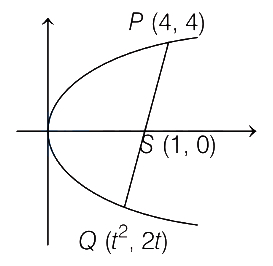
0 likesView Solution
431
MathematicsDifficultMCQAP EAMCET · 2025
The locus of the midpoints of the intercepted portion of the tangents by the coordinate axes,which are drawn to the ellipse $x^2+2y^2=2$,is
A
$\frac{1}{2x^2}+\frac{1}{4y^2}=1$
B
$\frac{1}{4x^2}+\frac{1}{2y^2}=1$
C
$\frac{x^2}{2}+\frac{y^2}{4}=1$
D
$\frac{x^2}{4}+\frac{y^2}{2}=1$
Solution
(A) The given equation of the ellipse is $x^2+2y^2=2$,which can be written as $\frac{x^2}{2}+\frac{y^2}{1}=1$. Here $a^2=2$ and $b^2=1$,so $a=\sqrt{2}$ and $b=1$.
The equation of the tangent to the ellipse at point $P(a \cos \theta, b \sin \theta)$ is $\frac{x \cos \theta}{a} + \frac{y \sin \theta}{b} = 1$.
Substituting the values,we get $\frac{x \cos \theta}{\sqrt{2}} + y \sin \theta = 1$.
For the $x$-intercept $(A)$,set $y=0$: $\frac{x \cos \theta}{\sqrt{2}} = 1 \Rightarrow x = \sqrt{2} \sec \theta$. So,$A = (\sqrt{2} \sec \theta, 0)$.
For the $y$-intercept $(B)$,set $x=0$: $y \sin \theta = 1 \Rightarrow y = \operatorname{cosec} \theta$. So,$B = (0, \operatorname{cosec} \theta)$.
Let $M(h, k)$ be the midpoint of $AB$. Then:
$h = \frac{\sqrt{2} \sec \theta + 0}{2} = \frac{\sec \theta}{\sqrt{2}} \Rightarrow \sec \theta = \sqrt{2}h$
$k = \frac{0 + \operatorname{cosec} \theta}{2} = \frac{\operatorname{cosec} \theta}{2} \Rightarrow \operatorname{cosec} \theta = 2k$
We know that $\cos^2 \theta + \sin^2 \theta = 1$,which implies $\frac{1}{\sec^2 \theta} + \frac{1}{\operatorname{cosec}^2 \theta} = 1$.
Substituting the values of $\sec \theta$ and $\operatorname{cosec} \theta$:
$\frac{1}{(\sqrt{2}h)^2} + \frac{1}{(2k)^2} = 1$
$\frac{1}{2h^2} + \frac{1}{4k^2} = 1$
Replacing $(h, k)$ with $(x, y)$,the locus is $\frac{1}{2x^2} + \frac{1}{4y^2} = 1$.
The equation of the tangent to the ellipse at point $P(a \cos \theta, b \sin \theta)$ is $\frac{x \cos \theta}{a} + \frac{y \sin \theta}{b} = 1$.
Substituting the values,we get $\frac{x \cos \theta}{\sqrt{2}} + y \sin \theta = 1$.
For the $x$-intercept $(A)$,set $y=0$: $\frac{x \cos \theta}{\sqrt{2}} = 1 \Rightarrow x = \sqrt{2} \sec \theta$. So,$A = (\sqrt{2} \sec \theta, 0)$.
For the $y$-intercept $(B)$,set $x=0$: $y \sin \theta = 1 \Rightarrow y = \operatorname{cosec} \theta$. So,$B = (0, \operatorname{cosec} \theta)$.
Let $M(h, k)$ be the midpoint of $AB$. Then:
$h = \frac{\sqrt{2} \sec \theta + 0}{2} = \frac{\sec \theta}{\sqrt{2}} \Rightarrow \sec \theta = \sqrt{2}h$
$k = \frac{0 + \operatorname{cosec} \theta}{2} = \frac{\operatorname{cosec} \theta}{2} \Rightarrow \operatorname{cosec} \theta = 2k$
We know that $\cos^2 \theta + \sin^2 \theta = 1$,which implies $\frac{1}{\sec^2 \theta} + \frac{1}{\operatorname{cosec}^2 \theta} = 1$.
Substituting the values of $\sec \theta$ and $\operatorname{cosec} \theta$:
$\frac{1}{(\sqrt{2}h)^2} + \frac{1}{(2k)^2} = 1$
$\frac{1}{2h^2} + \frac{1}{4k^2} = 1$
Replacing $(h, k)$ with $(x, y)$,the locus is $\frac{1}{2x^2} + \frac{1}{4y^2} = 1$.
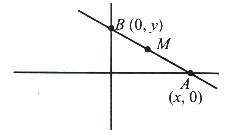
0 likesView Solution
432
MathematicsDifficultMCQAP EAMCET · 2025
If tangents are drawn to the ellipse $x^2+2y^2=2$,then the locus of the mid-points of the intercepts made by those tangents between the coordinate axes is
A
$\frac{x^2}{2}+\frac{y^2}{4}=1$
B
$\frac{x^2}{4}+\frac{y^2}{2}=1$
C
$\frac{1}{2x^2}+\frac{1}{4y^2}=1$
D
$\frac{1}{4x^2}+\frac{1}{2y^2}=1$
Solution
(C) The equation of the ellipse is $x^2+2y^2=2$,which can be written as $\frac{x^2}{2}+\frac{y^2}{1}=1$.
Any point $P$ on the ellipse is $(\sqrt{2}\cos\theta, \sin\theta)$.
The equation of the tangent at $P$ is $\frac{x(\sqrt{2}\cos\theta)}{2} + \frac{y(\sin\theta)}{1} = 1$,which simplifies to $\frac{x\cos\theta}{\sqrt{2}} + y\sin\theta = 1$.
The intercepts made by the tangent on the coordinate axes are $A\left(\frac{\sqrt{2}}{\cos\theta}, 0\right)$ and $B\left(0, \frac{1}{\sin\theta}\right)$.
Let $(h, k)$ be the mid-point of $AB$. Then $h = \frac{\sqrt{2}}{2\cos\theta}$ and $k = \frac{1}{2\sin\theta}$.
This implies $\cos\theta = \frac{1}{\sqrt{2}h}$ and $\sin\theta = \frac{1}{2k}$.
Using the identity $\cos^2\theta + \sin^2\theta = 1$,we get $\left(\frac{1}{\sqrt{2}h}\right)^2 + \left(\frac{1}{2k}\right)^2 = 1$.
Thus,the locus is $\frac{1}{2x^2} + \frac{1}{4y^2} = 1$.
Any point $P$ on the ellipse is $(\sqrt{2}\cos\theta, \sin\theta)$.
The equation of the tangent at $P$ is $\frac{x(\sqrt{2}\cos\theta)}{2} + \frac{y(\sin\theta)}{1} = 1$,which simplifies to $\frac{x\cos\theta}{\sqrt{2}} + y\sin\theta = 1$.
The intercepts made by the tangent on the coordinate axes are $A\left(\frac{\sqrt{2}}{\cos\theta}, 0\right)$ and $B\left(0, \frac{1}{\sin\theta}\right)$.
Let $(h, k)$ be the mid-point of $AB$. Then $h = \frac{\sqrt{2}}{2\cos\theta}$ and $k = \frac{1}{2\sin\theta}$.
This implies $\cos\theta = \frac{1}{\sqrt{2}h}$ and $\sin\theta = \frac{1}{2k}$.
Using the identity $\cos^2\theta + \sin^2\theta = 1$,we get $\left(\frac{1}{\sqrt{2}h}\right)^2 + \left(\frac{1}{2k}\right)^2 = 1$.
Thus,the locus is $\frac{1}{2x^2} + \frac{1}{4y^2} = 1$.
0 likesView Solution
433
MathematicsDifficultMCQAP EAMCET · 2025
Let $P(a \sec \theta, b \tan \theta)$ and $Q(a \sec \phi, b \tan \phi)$ be two points such that $\theta+\phi=\frac{\pi}{2}$ on the hyperbola $\frac{x^2}{a^2}-\frac{y^2}{b^2}=1$. If $(h, k)$ is the point of intersection of the normals at $P$ and $Q$,then $k=$
A
$\frac{a^2+b^2}{a}$
B
$-\left(\frac{a^2+b^2}{a}\right)$
C
$\frac{a^2+b^2}{b}$
D
$-\left(\frac{a^2+b^2}{b}\right)$
Solution
(D) The equation of the hyperbola is $\frac{x^2}{a^2}-\frac{y^2}{b^2}=1$.
The equation of the normal at a point $P(a \sec \theta, b \tan \theta)$ is $\frac{ax}{\sec \theta} + \frac{by}{\tan \theta} = a^2+b^2$,which simplifies to $ax \cos \theta + by \cot \theta = a^2+b^2$.
Similarly,the equation of the normal at $Q(a \sec \phi, b \tan \phi)$ is $ax \cos \phi + by \cot \phi = a^2+b^2$.
Given $\theta + \phi = \frac{\pi}{2}$,we have $\phi = \frac{\pi}{2} - \theta$. Thus,$\cos \phi = \sin \theta$ and $\cot \phi = \tan \theta$.
The two equations are:
$(1) \quad ax \cos \theta + by \cot \theta = a^2+b^2$
$(2) \quad ax \sin \theta + by \tan \theta = a^2+b^2$
To find $k$ (the $y$-coordinate),we eliminate $x$ by multiplying $(1)$ by $\sin \theta$ and $(2)$ by $\cos \theta$:
$ax \cos \theta \sin \theta + by \cot \theta \sin \theta = (a^2+b^2) \sin \theta$
$ax \sin \theta \cos \theta + by \tan \theta \cos \theta = (a^2+b^2) \cos \theta$
Subtracting the two equations:
$by(\cot \theta \sin \theta - \tan \theta \cos \theta) = (a^2+b^2)(\sin \theta - \cos \theta)$
$by(\cos \theta - \sin \theta) = (a^2+b^2)(\sin \theta - \cos \theta)$
$by = -(a^2+b^2)$
$y = -\frac{a^2+b^2}{b}$
Therefore,$k = -\frac{a^2+b^2}{b}$.
The equation of the normal at a point $P(a \sec \theta, b \tan \theta)$ is $\frac{ax}{\sec \theta} + \frac{by}{\tan \theta} = a^2+b^2$,which simplifies to $ax \cos \theta + by \cot \theta = a^2+b^2$.
Similarly,the equation of the normal at $Q(a \sec \phi, b \tan \phi)$ is $ax \cos \phi + by \cot \phi = a^2+b^2$.
Given $\theta + \phi = \frac{\pi}{2}$,we have $\phi = \frac{\pi}{2} - \theta$. Thus,$\cos \phi = \sin \theta$ and $\cot \phi = \tan \theta$.
The two equations are:
$(1) \quad ax \cos \theta + by \cot \theta = a^2+b^2$
$(2) \quad ax \sin \theta + by \tan \theta = a^2+b^2$
To find $k$ (the $y$-coordinate),we eliminate $x$ by multiplying $(1)$ by $\sin \theta$ and $(2)$ by $\cos \theta$:
$ax \cos \theta \sin \theta + by \cot \theta \sin \theta = (a^2+b^2) \sin \theta$
$ax \sin \theta \cos \theta + by \tan \theta \cos \theta = (a^2+b^2) \cos \theta$
Subtracting the two equations:
$by(\cot \theta \sin \theta - \tan \theta \cos \theta) = (a^2+b^2)(\sin \theta - \cos \theta)$
$by(\cos \theta - \sin \theta) = (a^2+b^2)(\sin \theta - \cos \theta)$
$by = -(a^2+b^2)$
$y = -\frac{a^2+b^2}{b}$
Therefore,$k = -\frac{a^2+b^2}{b}$.
0 likesView Solution
434
MathematicsMediumMCQAP EAMCET · 2025
In a $\triangle ABC$,if $a+c=5b$,then $\cot \frac{A}{2} \cot \frac{C}{2}$ is equal to
A
$2$
B
$\frac{1}{2}$
C
$\frac{3}{2}$
D
$\frac{2}{3}$
Solution
(C) We know that $\cot \frac{A}{2} = \sqrt{\frac{s(s-a)}{(s-b)(s-c)}}$ and $\cot \frac{C}{2} = \sqrt{\frac{s(s-c)}{(s-a)(s-b)}}$.
Multiplying these,we get $\cot \frac{A}{2} \cot \frac{C}{2} = \sqrt{\frac{s(s-a) \cdot s(s-c)}{(s-b)(s-c) \cdot (s-a)(s-b)}} = \sqrt{\frac{s^2}{(s-b)^2}} = \frac{s}{s-b}$.
Since $s = \frac{a+b+c}{2}$,we have $2s = a+b+c$.
Thus,$\frac{s}{s-b} = \frac{2s}{2s-2b} = \frac{a+b+c}{a+b+c-2b} = \frac{(a+c)+b}{(a+c)-b}$.
Given $a+c=5b$,substituting this into the expression gives $\frac{5b+b}{5b-b} = \frac{6b}{4b} = \frac{3}{2}$.
Multiplying these,we get $\cot \frac{A}{2} \cot \frac{C}{2} = \sqrt{\frac{s(s-a) \cdot s(s-c)}{(s-b)(s-c) \cdot (s-a)(s-b)}} = \sqrt{\frac{s^2}{(s-b)^2}} = \frac{s}{s-b}$.
Since $s = \frac{a+b+c}{2}$,we have $2s = a+b+c$.
Thus,$\frac{s}{s-b} = \frac{2s}{2s-2b} = \frac{a+b+c}{a+b+c-2b} = \frac{(a+c)+b}{(a+c)-b}$.
Given $a+c=5b$,substituting this into the expression gives $\frac{5b+b}{5b-b} = \frac{6b}{4b} = \frac{3}{2}$.
0 likesView Solution
435
MathematicsEasyMCQAP EAMCET · 2025
In a $\triangle ABC$,if $r_1 = 2r_2 = 3r_3$,then $a : b =$
A
$3 : 5$
B
$5 : 3$
C
$4 : 5$
D
$5 : 4$
Solution
(D) Given,$r_1 = 2r_2 = 3r_3$.
Using the formula $r_1 = \frac{\Delta}{s-a}$,$r_2 = \frac{\Delta}{s-b}$,and $r_3 = \frac{\Delta}{s-c}$,we have:
$\frac{\Delta}{s-a} = \frac{2\Delta}{s-b} = \frac{3\Delta}{s-c}$.
Dividing by $\Delta$,we get $\frac{1}{s-a} = \frac{2}{s-b} = \frac{3}{s-c} = k$ (let).
Then $s-a = \frac{1}{k}$,$s-b = \frac{2}{k}$,and $s-c = \frac{3}{k}$.
Adding these,$(s-a) + (s-b) + (s-c) = 3s - (a+b+c) = 3s - 2s = s$.
So,$s = \frac{1+2+3}{k} = \frac{6}{k}$,which implies $k = \frac{6}{s}$.
Now,$s-a = \frac{1}{6/s} = \frac{s}{6}$ $\Rightarrow 6s - 6a = s$ $\Rightarrow 5s = 6a$ $\Rightarrow a = \frac{5s}{6}$.
And $s-b = \frac{2}{6/s} = \frac{2s}{6} = \frac{s}{3}$ $\Rightarrow 3s - 3b = s$ $\Rightarrow 2s = 3b$ $\Rightarrow b = \frac{2s}{3} = \frac{4s}{6}$.
Therefore,$a : b = \frac{5s}{6} : \frac{4s}{6} = 5 : 4$.
Using the formula $r_1 = \frac{\Delta}{s-a}$,$r_2 = \frac{\Delta}{s-b}$,and $r_3 = \frac{\Delta}{s-c}$,we have:
$\frac{\Delta}{s-a} = \frac{2\Delta}{s-b} = \frac{3\Delta}{s-c}$.
Dividing by $\Delta$,we get $\frac{1}{s-a} = \frac{2}{s-b} = \frac{3}{s-c} = k$ (let).
Then $s-a = \frac{1}{k}$,$s-b = \frac{2}{k}$,and $s-c = \frac{3}{k}$.
Adding these,$(s-a) + (s-b) + (s-c) = 3s - (a+b+c) = 3s - 2s = s$.
So,$s = \frac{1+2+3}{k} = \frac{6}{k}$,which implies $k = \frac{6}{s}$.
Now,$s-a = \frac{1}{6/s} = \frac{s}{6}$ $\Rightarrow 6s - 6a = s$ $\Rightarrow 5s = 6a$ $\Rightarrow a = \frac{5s}{6}$.
And $s-b = \frac{2}{6/s} = \frac{2s}{6} = \frac{s}{3}$ $\Rightarrow 3s - 3b = s$ $\Rightarrow 2s = 3b$ $\Rightarrow b = \frac{2s}{3} = \frac{4s}{6}$.
Therefore,$a : b = \frac{5s}{6} : \frac{4s}{6} = 5 : 4$.
0 likesView Solution
Vedclass Products
For Students
Vedclass Test Series
Mock tests in real AP EAMCET style covering Mathematics with performance analysis. 5-day free trial.
Start Free TrialFor Teachers
Exam Paper Generator
Generate Set A/B/C/D Mathematics papers from 7.5L+ questions in 2 minutes. 3 chapters free.
Try FreeFor Institutes
Online Exam Module
Run live AP EAMCET mock exams with unlimited students, 360° analytics & white-label branding.
See DemoFrequently Asked Questions
How many Mathematics questions are in AP EAMCET 2025?
There are 794 Mathematics questions from the AP EAMCET 2025 paper on Vedclass, each with a detailed step-by-step solution in English.
Are AP EAMCET 2025 Mathematics solutions available in English?
Yes. All solutions on this page are in English. You can also switch to English or Hindi using the language buttons above the questions.
Can I practice AP EAMCET 2025 Mathematics as a timed test?
Yes. Use the Vedclass Test Series to attempt a full AP EAMCET mock test covering Mathematics with time limits and instant score analysis.
Can teachers create Mathematics papers from AP EAMCET previous year questions?
Yes. The Vedclass Exam Paper Generator lets teachers mix AP EAMCET Mathematics questions and generate Set A/B/C/D papers in minutes.
For Teachers & Institutes
Build a Custom Mathematics Paper
Pick AP EAMCET 2025 Mathematics questions, set difficulty, and generate Set A/B/C/D in 2 minutes.