
MathematicsQ351–386 of 720 questions
Page 8 of 8 · English
351
MathematicsMediumMCQAP EAMCET · 2023
In $\triangle ABC$,what is the value of $r_1+r_2+r_3-r$?
A
$4 R$
B
$2 R$
C
$4 R \sin A$
D
$4 R \cos A$
Solution
(A) We know that $r_1 = 4R \sin \frac{A}{2} \cos \frac{B}{2} \cos \frac{C}{2}$,$r_2 = 4R \cos \frac{A}{2} \sin \frac{B}{2} \cos \frac{C}{2}$,$r_3 = 4R \cos \frac{A}{2} \cos \frac{B}{2} \sin \frac{C}{2}$,and $r = 4R \sin \frac{A}{2} \sin \frac{B}{2} \sin \frac{C}{2}$.
Substituting these into the expression $r_1+r_2+r_3-r$:
$= 4R [\sin \frac{A}{2} \cos \frac{B}{2} \cos \frac{C}{2} + \cos \frac{A}{2} \sin \frac{B}{2} \cos \frac{C}{2} + \cos \frac{A}{2} \cos \frac{B}{2} \sin \frac{C}{2} - \sin \frac{A}{2} \sin \frac{B}{2} \sin \frac{C}{2}]$
$= 4R [\cos \frac{C}{2} (\sin \frac{A}{2} \cos \frac{B}{2} + \cos \frac{A}{2} \sin \frac{B}{2}) + \sin \frac{C}{2} (\cos \frac{A}{2} \cos \frac{B}{2} - \sin \frac{A}{2} \sin \frac{B}{2})]$
$= 4R [\cos \frac{C}{2} \sin (\frac{A+B}{2}) + \sin \frac{C}{2} \cos (\frac{A+B}{2})]$
Since $A+B+C = \pi$,we have $\frac{A+B}{2} = \frac{\pi}{2} - \frac{C}{2}$.
$= 4R [\cos \frac{C}{2} \sin (\frac{\pi}{2} - \frac{C}{2}) + \sin \frac{C}{2} \cos (\frac{\pi}{2} - \frac{C}{2})]$
$= 4R [\cos \frac{C}{2} \cos \frac{C}{2} + \sin \frac{C}{2} \sin \frac{C}{2}]$
$= 4R [\cos^2 \frac{C}{2} + \sin^2 \frac{C}{2}] = 4R(1) = 4R$.
Substituting these into the expression $r_1+r_2+r_3-r$:
$= 4R [\sin \frac{A}{2} \cos \frac{B}{2} \cos \frac{C}{2} + \cos \frac{A}{2} \sin \frac{B}{2} \cos \frac{C}{2} + \cos \frac{A}{2} \cos \frac{B}{2} \sin \frac{C}{2} - \sin \frac{A}{2} \sin \frac{B}{2} \sin \frac{C}{2}]$
$= 4R [\cos \frac{C}{2} (\sin \frac{A}{2} \cos \frac{B}{2} + \cos \frac{A}{2} \sin \frac{B}{2}) + \sin \frac{C}{2} (\cos \frac{A}{2} \cos \frac{B}{2} - \sin \frac{A}{2} \sin \frac{B}{2})]$
$= 4R [\cos \frac{C}{2} \sin (\frac{A+B}{2}) + \sin \frac{C}{2} \cos (\frac{A+B}{2})]$
Since $A+B+C = \pi$,we have $\frac{A+B}{2} = \frac{\pi}{2} - \frac{C}{2}$.
$= 4R [\cos \frac{C}{2} \sin (\frac{\pi}{2} - \frac{C}{2}) + \sin \frac{C}{2} \cos (\frac{\pi}{2} - \frac{C}{2})]$
$= 4R [\cos \frac{C}{2} \cos \frac{C}{2} + \sin \frac{C}{2} \sin \frac{C}{2}]$
$= 4R [\cos^2 \frac{C}{2} + \sin^2 \frac{C}{2}] = 4R(1) = 4R$.
0 likesView Solution
352
MathematicsEasyMCQAP EAMCET · 2023
In a committee of $25$ members,each member is proficient either in Mathematics or in Statistics or in both. If $19$ of them are proficient in Mathematics and $16$ of them are proficient in Statistics,then the probability that a person selected at random from the committee is proficient in both is
A
$\frac{1}{5}$
B
$\frac{3}{5}$
C
$\frac{2}{5}$
D
$\frac{1}{2}$
Solution
(C) Let $n(M)$ be the number of members proficient in Mathematics and $n(S)$ be the number of members proficient in Statistics.
Given $n(M \cup S) = 25$,$n(M) = 19$,and $n(S) = 16$.
Using the formula $n(M \cup S) = n(M) + n(S) - n(M \cap S)$:
$25 = 19 + 16 - n(M \cap S)$
$25 = 35 - n(M \cap S)$
$n(M \cap S) = 35 - 25 = 10$.
The probability that a person selected at random is proficient in both is $P(M \cap S) = \frac{n(M \cap S)}{n(M \cup S)} = \frac{10}{25} = \frac{2}{5}$.
Given $n(M \cup S) = 25$,$n(M) = 19$,and $n(S) = 16$.
Using the formula $n(M \cup S) = n(M) + n(S) - n(M \cap S)$:
$25 = 19 + 16 - n(M \cap S)$
$25 = 35 - n(M \cap S)$
$n(M \cap S) = 35 - 25 = 10$.
The probability that a person selected at random is proficient in both is $P(M \cap S) = \frac{n(M \cap S)}{n(M \cup S)} = \frac{10}{25} = \frac{2}{5}$.
0 likesView Solution
353
MathematicsMediumMCQAP EAMCET · 2023
If $A$ and $B$ are any two events of a sample space,then the set-theoretic description for the event: "Exactly one of the events $A, B$ occurs" is
(Here $E^c$ denotes the complement of the event $E$)
(Here $E^c$ denotes the complement of the event $E$)
A
$A \cap B^c$
B
$(A-B) \cup (A \cup B)$
C
$(A \cap B^c) \cup (A^c \cap B)$
D
$(A \cap B)^c \cup (A^c \cap B^c)$
Solution
(C) When only event $A$ occurs,it is represented as $(A \cap B^c)$.
When only event $B$ occurs,it is represented as $(A^c \cap B)$.
Therefore,the event 'exactly one of the events $A$ or $B$ occurs' is the union of these two disjoint sets: $(A \cap B^c) \cup (A^c \cap B)$.
When only event $B$ occurs,it is represented as $(A^c \cap B)$.
Therefore,the event 'exactly one of the events $A$ or $B$ occurs' is the union of these two disjoint sets: $(A \cap B^c) \cup (A^c \cap B)$.
0 likesView Solution
354
MathematicsEasyMCQAP EAMCET · 2023
If $A = \{(a, b) : 4a = 5b; a, b \in \{1, 2, 3, \dots, 30\}\}$,then the number of such ordered pairs $(a, b)$ is
A
$4$
B
$6$
C
$8$
D
$10$
Solution
(B) Given the equation $4a = 5b$,we can write $a = \frac{5}{4}b$.
Since $a$ must be an integer,$b$ must be a multiple of $4$.
Given $b \in \{1, 2, 3, \dots, 30\}$,the possible values for $b$ are $4, 8, 12, 16, 20, 24, 28$.
For each $b$,we calculate $a = \frac{5}{4}b$:
If $b = 4, a = 5$.
If $b = 8, a = 10$.
If $b = 12, a = 15$.
If $b = 16, a = 20$.
If $b = 20, a = 25$.
If $b = 24, a = 30$.
If $b = 28, a = 35$ (which is not in the set $\{1, 2, \dots, 30\}$).
Thus,the valid ordered pairs $(a, b)$ are $(5, 4), (10, 8), (15, 12), (20, 16), (25, 20), (30, 24)$.
The total number of such pairs is $6$.
Since $a$ must be an integer,$b$ must be a multiple of $4$.
Given $b \in \{1, 2, 3, \dots, 30\}$,the possible values for $b$ are $4, 8, 12, 16, 20, 24, 28$.
For each $b$,we calculate $a = \frac{5}{4}b$:
If $b = 4, a = 5$.
If $b = 8, a = 10$.
If $b = 12, a = 15$.
If $b = 16, a = 20$.
If $b = 20, a = 25$.
If $b = 24, a = 30$.
If $b = 28, a = 35$ (which is not in the set $\{1, 2, \dots, 30\}$).
Thus,the valid ordered pairs $(a, b)$ are $(5, 4), (10, 8), (15, 12), (20, 16), (25, 20), (30, 24)$.
The total number of such pairs is $6$.
0 likesView Solution
355
MathematicsMediumMCQAP EAMCET · 2023
The number of elements in the set $S = \{x \in \mathbb{Z} : x^2 - 7x + 6 \leq 0 \text{ and } x^2 - 3x > 0\}$ is
A
$\infty$
B
$2$
C
$3$
D
$4$
Solution
(C) Given $S = \{x \in \mathbb{Z} : x^2 - 7x + 6 \leq 0 \text{ and } x^2 - 3x > 0\}$ ...$(i)$
First,solve the inequality $x^2 - 7x + 6 \leq 0$:
$(x - 6)(x - 1) \leq 0$
This implies $x \in [1, 6]$.
Next,solve the inequality $x^2 - 3x > 0$:
$x(x - 3) > 0$
This implies $x \in (-\infty, 0) \cup (3, \infty)$.
Now,find the intersection of these two intervals:
$S = \{x \in \mathbb{Z} : x \in [1, 6] \cap ((-\infty, 0) \cup (3, \infty))\}$
$S = \{x \in \mathbb{Z} : x \in (3, 6] \cap \mathbb{Z}\}$
$S = \{4, 5, 6\}$.
The number of elements in set $S$ is $3$.
First,solve the inequality $x^2 - 7x + 6 \leq 0$:
$(x - 6)(x - 1) \leq 0$
This implies $x \in [1, 6]$.
Next,solve the inequality $x^2 - 3x > 0$:
$x(x - 3) > 0$
This implies $x \in (-\infty, 0) \cup (3, \infty)$.
Now,find the intersection of these two intervals:
$S = \{x \in \mathbb{Z} : x \in [1, 6] \cap ((-\infty, 0) \cup (3, \infty))\}$
$S = \{x \in \mathbb{Z} : x \in (3, 6] \cap \mathbb{Z}\}$
$S = \{4, 5, 6\}$.
The number of elements in set $S$ is $3$.
0 likesView Solution
356
MathematicsMediumMCQAP EAMCET · 2023
$A$ team of $5$ students is to be selected from $12$ students. If two particular students are to be included in that team,then the number of ways that such team can be selected is
A
$792$
B
$180$
C
$120$
D
$90$
Solution
(C) Since $2$ particular students are always to be included in the team,we have already selected $2$ members.
Remaining members to be selected $= 5 - 2 = 3$.
Remaining students available to choose from $= 12 - 2 = 10$.
Therefore,the number of ways to select the remaining $3$ students from $10$ available students is given by the combination formula ${}^{n}C_{r} = \frac{n!}{r!(n-r)!}$.
Number of ways $= {}^{10}C_{3} = \frac{10 \times 9 \times 8}{3 \times 2 \times 1} = 10 \times 3 \times 4 = 120$.
Remaining members to be selected $= 5 - 2 = 3$.
Remaining students available to choose from $= 12 - 2 = 10$.
Therefore,the number of ways to select the remaining $3$ students from $10$ available students is given by the combination formula ${}^{n}C_{r} = \frac{n!}{r!(n-r)!}$.
Number of ways $= {}^{10}C_{3} = \frac{10 \times 9 \times 8}{3 \times 2 \times 1} = 10 \times 3 \times 4 = 120$.
0 likesView Solution
357
MathematicsEasyMCQAP EAMCET · 2023
If $f(0)=0, f(1)=1, f(2)=2$ and $f(x)=f(x-2)+f(x-3)$ for $x=3, 4, 5, \ldots$,then $f(10)=$
A
$13$
B
$9$
C
$11$
D
$10$
Solution
(A) Given the recurrence relation $f(x)=f(x-2)+f(x-3)$ with initial values $f(0)=0, f(1)=1, f(2)=2$.
We calculate the subsequent values step by step:
$f(3)=f(1)+f(0)=1+0=1$
$f(4)=f(2)+f(1)=2+1=3$
$f(5)=f(3)+f(2)=1+2=3$
$f(6)=f(4)+f(3)=3+1=4$
$f(7)=f(5)+f(4)=3+3=6$
$f(8)=f(6)+f(5)=4+3=7$
$f(9)=f(7)+f(6)=6+4=10$
$f(10)=f(8)+f(7)=7+6=13$
We calculate the subsequent values step by step:
$f(3)=f(1)+f(0)=1+0=1$
$f(4)=f(2)+f(1)=2+1=3$
$f(5)=f(3)+f(2)=1+2=3$
$f(6)=f(4)+f(3)=3+1=4$
$f(7)=f(5)+f(4)=3+3=6$
$f(8)=f(6)+f(5)=4+3=7$
$f(9)=f(7)+f(6)=6+4=10$
$f(10)=f(8)+f(7)=7+6=13$
0 likesView Solution
358
MathematicsEasyMCQAP EAMCET · 2023
If $f(x) = \frac{\cos^2 x + \sin^4 x}{\sin^2 x + \cos^4 x}$ for all $x \in R$,then $f(2023) = $
A
$1$
B
$0$
C
$2$
D
$\pi$
Solution
(A) Given $f(x) = \frac{\cos^2 x + \sin^4 x}{\sin^2 x + \cos^4 x}$.
We know that $\sin^2 x + \cos^2 x = 1$,so $\cos^2 x = 1 - \sin^2 x$ and $\sin^2 x = 1 - \cos^2 x$.
Substituting these into the numerator and denominator:
Numerator: $\cos^2 x + \sin^4 x = \cos^2 x + \sin^2 x \cdot \sin^2 x = \cos^2 x + \sin^2 x(1 - \cos^2 x) = \cos^2 x + \sin^2 x - \sin^2 x \cos^2 x = 1 - \sin^2 x \cos^2 x$.
Denominator: $\sin^2 x + \cos^4 x = \sin^2 x + \cos^2 x \cdot \cos^2 x = \sin^2 x + \cos^2 x(1 - \sin^2 x) = \sin^2 x + \cos^2 x - \cos^2 x \sin^2 x = 1 - \cos^2 x \sin^2 x$.
Thus,$f(x) = \frac{1 - \sin^2 x \cos^2 x}{1 - \cos^2 x \sin^2 x} = 1$.
Since $f(x) = 1$ for all $x \in R$,it follows that $f(2023) = 1$.
We know that $\sin^2 x + \cos^2 x = 1$,so $\cos^2 x = 1 - \sin^2 x$ and $\sin^2 x = 1 - \cos^2 x$.
Substituting these into the numerator and denominator:
Numerator: $\cos^2 x + \sin^4 x = \cos^2 x + \sin^2 x \cdot \sin^2 x = \cos^2 x + \sin^2 x(1 - \cos^2 x) = \cos^2 x + \sin^2 x - \sin^2 x \cos^2 x = 1 - \sin^2 x \cos^2 x$.
Denominator: $\sin^2 x + \cos^4 x = \sin^2 x + \cos^2 x \cdot \cos^2 x = \sin^2 x + \cos^2 x(1 - \sin^2 x) = \sin^2 x + \cos^2 x - \cos^2 x \sin^2 x = 1 - \cos^2 x \sin^2 x$.
Thus,$f(x) = \frac{1 - \sin^2 x \cos^2 x}{1 - \cos^2 x \sin^2 x} = 1$.
Since $f(x) = 1$ for all $x \in R$,it follows that $f(2023) = 1$.
0 likesView Solution
359
MathematicsMediumMCQAP EAMCET · 2023
If $\frac{x^2-7 x+2}{x^4+3 x^2+4}=\frac{A x+B}{x^2+a x+2}+\frac{C x+D}{x^2+b x+2}$ and $a>b$ then $B+D=$
A
$a+b$
B
$2 a+b$
C
$a+2 b$
D
$a-b$
Solution
(B) Given $\frac{x^2-7 x+2}{x^4+3 x^2+4}=\frac{A x+B}{x^2+a x+2}+\frac{C x+D}{x^2+b x+2}$ ...$(i)$
Factorize the denominator: $x^4+3 x^2+4 = (x^2+2)^2 - x^2 = (x^2+x+2)(x^2-x+2)$.
Thus,$\frac{x^2-7 x+2}{(x^2+x+2)(x^2-x+2)} = \frac{Px+Q}{x^2+x+2} + \frac{Rx+S}{x^2-x+2}$.
Equating numerators: $x^2-7x+2 = (Px+Q)(x^2-x+2) + (Rx+S)(x^2+x+2)$.
Expanding the right side: $x^2-7x+2 = x^3(P+R) + x^2(-P+Q+R+S) + x(2P-Q+2R+S) + (2Q+2S)$.
Comparing coefficients:
$P+R=0$
$-P+Q+R+S=1$
$2P-Q+2R+S=-7$
$2Q+2S=2 \Rightarrow Q+S=1$
Solving these,we get $P=0, Q=4, R=0, S=-3$.
So,$\frac{x^2-7x+2}{x^4+3x^2+4} = \frac{4}{x^2+x+2} + \frac{-3}{x^2-x+2}$.
Comparing with $(i)$,we have $a=1, b=-1$ (since $a>b$),$A=0, B=4, C=0, D=-3$.
Then $B+D = 4-3 = 1$.
Checking options: $2a+b = 2(1) + (-1) = 1$.
Therefore,$B+D = 2a+b$.
Factorize the denominator: $x^4+3 x^2+4 = (x^2+2)^2 - x^2 = (x^2+x+2)(x^2-x+2)$.
Thus,$\frac{x^2-7 x+2}{(x^2+x+2)(x^2-x+2)} = \frac{Px+Q}{x^2+x+2} + \frac{Rx+S}{x^2-x+2}$.
Equating numerators: $x^2-7x+2 = (Px+Q)(x^2-x+2) + (Rx+S)(x^2+x+2)$.
Expanding the right side: $x^2-7x+2 = x^3(P+R) + x^2(-P+Q+R+S) + x(2P-Q+2R+S) + (2Q+2S)$.
Comparing coefficients:
$P+R=0$
$-P+Q+R+S=1$
$2P-Q+2R+S=-7$
$2Q+2S=2 \Rightarrow Q+S=1$
Solving these,we get $P=0, Q=4, R=0, S=-3$.
So,$\frac{x^2-7x+2}{x^4+3x^2+4} = \frac{4}{x^2+x+2} + \frac{-3}{x^2-x+2}$.
Comparing with $(i)$,we have $a=1, b=-1$ (since $a>b$),$A=0, B=4, C=0, D=-3$.
Then $B+D = 4-3 = 1$.
Checking options: $2a+b = 2(1) + (-1) = 1$.
Therefore,$B+D = 2a+b$.
0 likesView Solution
360
MathematicsEasyMCQAP EAMCET · 2023
If $\frac{2 x^2+5 x+6}{(x+2)^3}=\frac{a}{x+2}+\frac{b}{(x+2)^2}+\frac{c}{(x+2)^3}$ then $a \cdot b+b \cdot c+c \cdot a=$
A
$28$
B
$14$
C
-$10$
D
-$8$
Solution
(C) Given the partial fraction decomposition: $\frac{2 x^2+5 x+6}{(x+2)^3}=\frac{a}{x+2}+\frac{b}{(x+2)^2}+\frac{c}{(x+2)^3}$
Multiply both sides by $(x+2)^3$:
$2 x^2+5 x+6 = a(x+2)^2 + b(x+2) + c$
Let $x+2 = t$,then $x = t-2$. Substituting this:
$2(t-2)^2 + 5(t-2) + 6 = a t^2 + b t + c$
$2(t^2 - 4t + 4) + 5t - 10 + 6 = a t^2 + b t + c$
$2t^2 - 8t + 8 + 5t - 4 = a t^2 + b t + c$
$2t^2 - 3t + 4 = a t^2 + b t + c$
Comparing coefficients:
$a = 2, b = -3, c = 4$
Now,calculate $a \cdot b + b \cdot c + c \cdot a$:
$a \cdot b = 2 \cdot (-3) = -6$
$b \cdot c = (-3) \cdot 4 = -12$
$c \cdot a = 4 \cdot 2 = 8$
Sum $= -6 - 12 + 8 = -10$
Multiply both sides by $(x+2)^3$:
$2 x^2+5 x+6 = a(x+2)^2 + b(x+2) + c$
Let $x+2 = t$,then $x = t-2$. Substituting this:
$2(t-2)^2 + 5(t-2) + 6 = a t^2 + b t + c$
$2(t^2 - 4t + 4) + 5t - 10 + 6 = a t^2 + b t + c$
$2t^2 - 8t + 8 + 5t - 4 = a t^2 + b t + c$
$2t^2 - 3t + 4 = a t^2 + b t + c$
Comparing coefficients:
$a = 2, b = -3, c = 4$
Now,calculate $a \cdot b + b \cdot c + c \cdot a$:
$a \cdot b = 2 \cdot (-3) = -6$
$b \cdot c = (-3) \cdot 4 = -12$
$c \cdot a = 4 \cdot 2 = 8$
Sum $= -6 - 12 + 8 = -10$
0 likesView Solution
361
MathematicsMediumMCQAP EAMCET · 2023
If $\frac{-x^2+6x+1}{(x-1)^2(x^2+2)} = \frac{A}{x-1} + \frac{B}{(x-1)^2} + \frac{Cx-3}{x^2+2}$,then $A+B+C=$
A
$7$
B
$5$
C
$3$
D
$2$
Solution
(D) Given the partial fraction decomposition: $\frac{-x^2+6x+1}{(x-1)^2(x^2+2)} = \frac{A}{x-1} + \frac{B}{(x-1)^2} + \frac{Cx-3}{x^2+2}$.
Multiplying both sides by $(x-1)^2(x^2+2)$,we get:
$-x^2+6x+1 = A(x-1)(x^2+2) + B(x^2+2) + (Cx-3)(x-1)^2$.
Setting $x=1$: $-1+6+1 = B(1+2) \Rightarrow 6 = 3B \Rightarrow B=2$.
Expanding the right side: $-x^2+6x+1 = A(x^3-x^2+2x-2) + B(x^2+2) + (Cx-3)(x^2-2x+1)$.
Comparing the coefficients of $x^3$: $0 = A + C \Rightarrow C = -A$.
Comparing the coefficients of $x^2$: $-1 = -A + B + (-2C - 3) = -A + 2 - 2C - 3 = -A - 2C - 1$.
Thus,$A + 2C = 0$. Since $C = -A$,we have $A - 2A = 0 \Rightarrow -A = 0 \Rightarrow A = 0$.
Therefore,$C = -A = 0$.
Finally,$A+B+C = 0 + 2 + 0 = 2$.
Multiplying both sides by $(x-1)^2(x^2+2)$,we get:
$-x^2+6x+1 = A(x-1)(x^2+2) + B(x^2+2) + (Cx-3)(x-1)^2$.
Setting $x=1$: $-1+6+1 = B(1+2) \Rightarrow 6 = 3B \Rightarrow B=2$.
Expanding the right side: $-x^2+6x+1 = A(x^3-x^2+2x-2) + B(x^2+2) + (Cx-3)(x^2-2x+1)$.
Comparing the coefficients of $x^3$: $0 = A + C \Rightarrow C = -A$.
Comparing the coefficients of $x^2$: $-1 = -A + B + (-2C - 3) = -A + 2 - 2C - 3 = -A - 2C - 1$.
Thus,$A + 2C = 0$. Since $C = -A$,we have $A - 2A = 0 \Rightarrow -A = 0 \Rightarrow A = 0$.
Therefore,$C = -A = 0$.
Finally,$A+B+C = 0 + 2 + 0 = 2$.
0 likesView Solution
362
MathematicsEasyMCQAP EAMCET · 2023
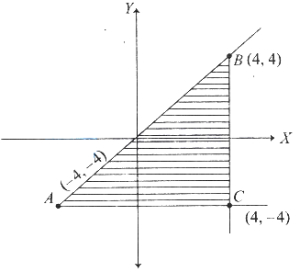
The area (in sq. units) bounded by $x=4$,$y=-4$ and $y=x$ is
A
$48$
B
$32$
C
$24$
D
$16$
Solution
(B) The region is bounded by the lines $x=4$,$y=-4$,and $y=x$.
To find the vertices of the triangle,we find the intersection points of these lines:
$1$. Intersection of $x=4$ and $y=x$ is $B(4, 4)$.
$2$. Intersection of $y=-4$ and $y=x$ is $A(-4, -4)$.
$3$. Intersection of $x=4$ and $y=-4$ is $C(4, -4)$.
The region is a right-angled triangle $ABC$ with vertices $A(-4, -4)$,$B(4, 4)$,and $C(4, -4)$.
The length of the base $AC$ is the distance between $(-4, -4)$ and $(4, -4)$,which is $|4 - (-4)| = 8$ units.
The length of the height $BC$ is the distance between $(4, -4)$ and $(4, 4)$,which is $|4 - (-4)| = 8$ units.
The area of the triangle is given by $\frac{1}{2} \times \text{base} \times \text{height}$.
Area $= \frac{1}{2} \times 8 \times 8 = 32$ sq. units.
To find the vertices of the triangle,we find the intersection points of these lines:
$1$. Intersection of $x=4$ and $y=x$ is $B(4, 4)$.
$2$. Intersection of $y=-4$ and $y=x$ is $A(-4, -4)$.
$3$. Intersection of $x=4$ and $y=-4$ is $C(4, -4)$.
The region is a right-angled triangle $ABC$ with vertices $A(-4, -4)$,$B(4, 4)$,and $C(4, -4)$.
The length of the base $AC$ is the distance between $(-4, -4)$ and $(4, -4)$,which is $|4 - (-4)| = 8$ units.
The length of the height $BC$ is the distance between $(4, -4)$ and $(4, 4)$,which is $|4 - (-4)| = 8$ units.
The area of the triangle is given by $\frac{1}{2} \times \text{base} \times \text{height}$.
Area $= \frac{1}{2} \times 8 \times 8 = 32$ sq. units.
0 likesView Solution
363
MathematicsEasyMCQAP EAMCET · 2023
The coordinates of the point $(3,-7,5)$ in the new system,when the origin is shifted to the point $(-1,-1,-1)$ by the translation of axes,are
A
$(4,-6,6)$
B
$(4,6,6)$
C
$(6,6,6)$
D
$(4,4,4)$
Solution
(A) Let the original coordinates be $(x, y, z) = (3, -7, 5)$.
Let the origin be shifted to $(h, k, l) = (-1, -1, -1)$.
The new coordinates $(x', y', z')$ are given by the transformation:
$x' = x - h$
$y' = y - k$
$z' = z - l$
Substituting the values:
$x' = 3 - (-1) = 3 + 1 = 4$
$y' = -7 - (-1) = -7 + 1 = -6$
$z' = 5 - (-1) = 5 + 1 = 6$
Therefore,the new coordinates are $(4, -6, 6)$.
Let the origin be shifted to $(h, k, l) = (-1, -1, -1)$.
The new coordinates $(x', y', z')$ are given by the transformation:
$x' = x - h$
$y' = y - k$
$z' = z - l$
Substituting the values:
$x' = 3 - (-1) = 3 + 1 = 4$
$y' = -7 - (-1) = -7 + 1 = -6$
$z' = 5 - (-1) = 5 + 1 = 6$
Therefore,the new coordinates are $(4, -6, 6)$.
0 likesView Solution
364
MathematicsMediumMCQAP EAMCET · 2023
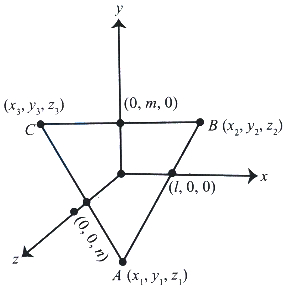
In $\triangle ABC$,if the midpoints of the sides $AB, BC$ and $CA$ are respectively $(l, 0, 0), (0, m, 0)$ and $(0, 0, n)$,then $\frac{AB^2+BC^2+CA^2}{l^2+m^2+n^2}=$
A
$2$
B
$4$
C
$8$
D
$16$
Solution
(C) Let the vertices of $\triangle ABC$ be $A(x_1, y_1, z_1)$,$B(x_2, y_2, z_2)$,and $C(x_3, y_3, z_3)$.
Given that the midpoints of $AB, BC, CA$ are $(l, 0, 0), (0, m, 0), (0, 0, n)$ respectively.
For midpoint of $AB$: $\frac{x_1+x_2}{2}=l, \frac{y_1+y_2}{2}=0, \frac{z_1+z_2}{2}=0 \Rightarrow x_1+x_2=2l, y_1+y_2=0, z_1+z_2=0$ ... $(i)$
For midpoint of $BC$: $\frac{x_2+x_3}{2}=0, \frac{y_2+y_3}{2}=m, \frac{z_2+z_3}{2}=0 \Rightarrow x_2+x_3=0, y_2+y_3=2m, z_2+z_3=0$ ... (ii)
For midpoint of $CA$: $\frac{x_3+x_1}{2}=0, \frac{y_3+y_1}{2}=0, \frac{z_3+z_1}{2}=n \Rightarrow x_3+x_1=0, y_3+y_1=0, z_3+z_1=2n$ ... (iii)
Solving these equations:
Adding $(i)$,(ii),and (iii): $2(x_1+x_2+x_3)=2l \Rightarrow x_1+x_2+x_3=l$. Similarly,$y_1+y_2+y_3=m$ and $z_1+z_2+z_3=n$.
Subtracting (ii) from the sum: $x_1=l, y_1=-m, z_1=n$ (Wait,let's re-evaluate).
From $(i)$,$x_2=2l-x_1$. Substituting into (ii): $2l-x_1+x_3=0 \Rightarrow x_1-x_3=2l$. From (iii),$x_1+x_3=0$. Adding gives $2x_1=2l \Rightarrow x_1=l, x_3=-l, x_2=l$.
Similarly,$y_1=m, y_2=-m, y_3=m$ and $z_1=-n, z_2=n, z_3=n$.
Thus,$A(l, m, -n), B(l, -m, n), C(-l, m, n)$.
$AB^2 = (l-l)^2 + (m-(-m))^2 + (-n-n)^2 = 0 + 4m^2 + 4n^2 = 4(m^2+n^2)$.
$BC^2 = (l-(-l))^2 + (-m-m)^2 + (n-n)^2 = 4l^2 + 4m^2 + 0 = 4(l^2+m^2)$.
$CA^2 = (-l-l)^2 + (m-m)^2 + (n-(-n))^2 = 4l^2 + 0 + 4n^2 = 4(l^2+n^2)$.
$AB^2+BC^2+CA^2 = 4(m^2+n^2+l^2+m^2+l^2+n^2) = 8(l^2+m^2+n^2)$.
Therefore,$\frac{AB^2+BC^2+CA^2}{l^2+m^2+n^2} = \frac{8(l^2+m^2+n^2)}{l^2+m^2+n^2} = 8$.
Given that the midpoints of $AB, BC, CA$ are $(l, 0, 0), (0, m, 0), (0, 0, n)$ respectively.
For midpoint of $AB$: $\frac{x_1+x_2}{2}=l, \frac{y_1+y_2}{2}=0, \frac{z_1+z_2}{2}=0 \Rightarrow x_1+x_2=2l, y_1+y_2=0, z_1+z_2=0$ ... $(i)$
For midpoint of $BC$: $\frac{x_2+x_3}{2}=0, \frac{y_2+y_3}{2}=m, \frac{z_2+z_3}{2}=0 \Rightarrow x_2+x_3=0, y_2+y_3=2m, z_2+z_3=0$ ... (ii)
For midpoint of $CA$: $\frac{x_3+x_1}{2}=0, \frac{y_3+y_1}{2}=0, \frac{z_3+z_1}{2}=n \Rightarrow x_3+x_1=0, y_3+y_1=0, z_3+z_1=2n$ ... (iii)
Solving these equations:
Adding $(i)$,(ii),and (iii): $2(x_1+x_2+x_3)=2l \Rightarrow x_1+x_2+x_3=l$. Similarly,$y_1+y_2+y_3=m$ and $z_1+z_2+z_3=n$.
Subtracting (ii) from the sum: $x_1=l, y_1=-m, z_1=n$ (Wait,let's re-evaluate).
From $(i)$,$x_2=2l-x_1$. Substituting into (ii): $2l-x_1+x_3=0 \Rightarrow x_1-x_3=2l$. From (iii),$x_1+x_3=0$. Adding gives $2x_1=2l \Rightarrow x_1=l, x_3=-l, x_2=l$.
Similarly,$y_1=m, y_2=-m, y_3=m$ and $z_1=-n, z_2=n, z_3=n$.
Thus,$A(l, m, -n), B(l, -m, n), C(-l, m, n)$.
$AB^2 = (l-l)^2 + (m-(-m))^2 + (-n-n)^2 = 0 + 4m^2 + 4n^2 = 4(m^2+n^2)$.
$BC^2 = (l-(-l))^2 + (-m-m)^2 + (n-n)^2 = 4l^2 + 4m^2 + 0 = 4(l^2+m^2)$.
$CA^2 = (-l-l)^2 + (m-m)^2 + (n-(-n))^2 = 4l^2 + 0 + 4n^2 = 4(l^2+n^2)$.
$AB^2+BC^2+CA^2 = 4(m^2+n^2+l^2+m^2+l^2+n^2) = 8(l^2+m^2+n^2)$.
Therefore,$\frac{AB^2+BC^2+CA^2}{l^2+m^2+n^2} = \frac{8(l^2+m^2+n^2)}{l^2+m^2+n^2} = 8$.
0 likesView Solution
365
MathematicsEasyMCQAP EAMCET · 2023
The coordinates of the point which divides the line joining the points $(2, 3, 4)$ and $(3, -4, 7)$ in the ratio $2:4$ externally are:
A
$(10, 1, 1)$
B
$(1, 10, 1)$
C
$(10, -10, 10)$
D
$(1, 1, 10)$
Solution
(B) The formula for the coordinates of a point dividing the line segment joining $(x_1, y_1, z_1)$ and $(x_2, y_2, z_2)$ in the ratio $m:n$ externally is given by:
$\left(\frac{mx_2 - nx_1}{m - n}, \frac{my_2 - ny_1}{m - n}, \frac{mz_2 - nz_1}{m - n}\right)$
Given points are $(2, 3, 4)$ and $(3, -4, 7)$ with ratio $m:n = 2:4$.
Substituting the values:
$x = \frac{2(3) - 4(2)}{2 - 4} = \frac{6 - 8}{-2} = \frac{-2}{-2} = 1$
$y = \frac{2(-4) - 4(3)}{2 - 4} = \frac{-8 - 12}{-2} = \frac{-20}{-2} = 10$
$z = \frac{2(7) - 4(4)}{2 - 4} = \frac{14 - 16}{-2} = \frac{-2}{-2} = 1$
Thus,the coordinates are $(1, 10, 1)$.
$\left(\frac{mx_2 - nx_1}{m - n}, \frac{my_2 - ny_1}{m - n}, \frac{mz_2 - nz_1}{m - n}\right)$
Given points are $(2, 3, 4)$ and $(3, -4, 7)$ with ratio $m:n = 2:4$.
Substituting the values:
$x = \frac{2(3) - 4(2)}{2 - 4} = \frac{6 - 8}{-2} = \frac{-2}{-2} = 1$
$y = \frac{2(-4) - 4(3)}{2 - 4} = \frac{-8 - 12}{-2} = \frac{-20}{-2} = 10$
$z = \frac{2(7) - 4(4)}{2 - 4} = \frac{14 - 16}{-2} = \frac{-2}{-2} = 1$
Thus,the coordinates are $(1, 10, 1)$.
0 likesView Solution
366
MathematicsDifficultMCQAP EAMCET · 2023
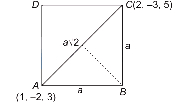
If the extremities of a diagonal of a square are $(1, -2, 3)$ and $(2, -3, 5)$,then the length of its side is
A
$\sqrt{6}$
B
$\sqrt{3}$
C
$\sqrt{5}$
D
$\sqrt{7}$
Solution
(B) Let the side of the square be $a$.
The length of the diagonal $d$ of a square with side $a$ is given by $d = a\sqrt{2}$.
The distance between the two given points $(1, -2, 3)$ and $(2, -3, 5)$ is the length of the diagonal $d$.
$d = \sqrt{(2-1)^2 + (-3 - (-2))^2 + (5-3)^2}$
$d = \sqrt{(1)^2 + (-1)^2 + (2)^2}$
$d = \sqrt{1 + 1 + 4} = \sqrt{6}$
Since $d = a\sqrt{2}$,we have $a\sqrt{2} = \sqrt{6}$.
Dividing both sides by $\sqrt{2}$,we get $a = \frac{\sqrt{6}}{\sqrt{2}} = \sqrt{3}$.
The length of the diagonal $d$ of a square with side $a$ is given by $d = a\sqrt{2}$.
The distance between the two given points $(1, -2, 3)$ and $(2, -3, 5)$ is the length of the diagonal $d$.
$d = \sqrt{(2-1)^2 + (-3 - (-2))^2 + (5-3)^2}$
$d = \sqrt{(1)^2 + (-1)^2 + (2)^2}$
$d = \sqrt{1 + 1 + 4} = \sqrt{6}$
Since $d = a\sqrt{2}$,we have $a\sqrt{2} = \sqrt{6}$.
Dividing both sides by $\sqrt{2}$,we get $a = \frac{\sqrt{6}}{\sqrt{2}} = \sqrt{3}$.
0 likesView Solution
367
MathematicsEasyMCQAP EAMCET · 2023
$A(2,3,5), B(\alpha, 3,3)$ and $C(7,5, \beta)$ are the vertices of a triangle. If the median through $A$ is equally inclined with the coordinate axes,then $\frac{\beta}{\alpha}=$
A
-$9$
B
$\frac{-1}{9}$
C
$\frac{-2}{9}$
D
$\frac{9}{2}$
Solution
(A) Let $D$ be the midpoint of $BC$. The coordinates of $D$ are $\left(\frac{\alpha+7}{2}, \frac{3+5}{2}, \frac{3+\beta}{2}\right) = \left(\frac{\alpha+7}{2}, 4, \frac{3+\beta}{2}\right)$.
The direction ratios of the median $AD$ are given by the difference of coordinates of $D$ and $A$:
$\left(\frac{\alpha+7}{2} - 2, 4 - 3, \frac{3+\beta}{2} - 5\right) = \left(\frac{\alpha+3}{2}, 1, \frac{\beta-7}{2}\right)$.
Since the median $AD$ is equally inclined to the coordinate axes,its direction cosines are equal,which implies that its direction ratios must be proportional to $(1, 1, 1)$.
Thus,$\frac{\alpha+3}{2} = 1$ and $\frac{\beta-7}{2} = 1$.
Solving for $\alpha$: $\alpha+3 = 2 \Rightarrow \alpha = -1$.
Solving for $\beta$: $\beta-7 = 2 \Rightarrow \beta = 9$.
Therefore,$\frac{\beta}{\alpha} = \frac{9}{-1} = -9$.
The direction ratios of the median $AD$ are given by the difference of coordinates of $D$ and $A$:
$\left(\frac{\alpha+7}{2} - 2, 4 - 3, \frac{3+\beta}{2} - 5\right) = \left(\frac{\alpha+3}{2}, 1, \frac{\beta-7}{2}\right)$.
Since the median $AD$ is equally inclined to the coordinate axes,its direction cosines are equal,which implies that its direction ratios must be proportional to $(1, 1, 1)$.
Thus,$\frac{\alpha+3}{2} = 1$ and $\frac{\beta-7}{2} = 1$.
Solving for $\alpha$: $\alpha+3 = 2 \Rightarrow \alpha = -1$.
Solving for $\beta$: $\beta-7 = 2 \Rightarrow \beta = 9$.
Therefore,$\frac{\beta}{\alpha} = \frac{9}{-1} = -9$.
0 likesView Solution
368
MathematicsMediumMCQAP EAMCET · 2023
If two subsets $A$ and $B$ are selected at random from a set $S$ containing $n$ elements,then the probability that $A \cap B = \phi$ and $A \cup B = S$ is
A
$\frac{1}{2^n}$
B
$2^n$
C
$\frac{1}{2^{n+1}}$
D
$\frac{1}{4^n}$
Solution
(A) Let $S$ be a set with $n$ elements. Each element $x \in S$ can belong to one of the following four disjoint sets:
$1$. $x \in A$ and $x \in B$
$2$. $x \in A$ and $x \notin B$
$3$. $x \notin A$ and $x \in B$
$4$. $x \notin A$ and $x \notin B$
Since there are $n$ elements,there are $4^n$ total ways to choose subsets $A$ and $B$.
We are given the conditions $A \cap B = \phi$ and $A \cup B = S$.
For each element $x \in S$,it must belong to either $A$ or $B$ (since $A \cup B = S$) but not both (since $A \cap B = \phi$).
Thus,for each element,there are only $2$ choices: either $x \in A$ (which implies $x \notin B$) or $x \in B$ (which implies $x \notin A$).
Therefore,the number of favorable outcomes is $2^n$.
The probability is $\frac{2^n}{4^n} = \frac{2^n}{(2^2)^n} = \frac{2^n}{2^{2n}} = \frac{1}{2^n}$.
$1$. $x \in A$ and $x \in B$
$2$. $x \in A$ and $x \notin B$
$3$. $x \notin A$ and $x \in B$
$4$. $x \notin A$ and $x \notin B$
Since there are $n$ elements,there are $4^n$ total ways to choose subsets $A$ and $B$.
We are given the conditions $A \cap B = \phi$ and $A \cup B = S$.
For each element $x \in S$,it must belong to either $A$ or $B$ (since $A \cup B = S$) but not both (since $A \cap B = \phi$).
Thus,for each element,there are only $2$ choices: either $x \in A$ (which implies $x \notin B$) or $x \in B$ (which implies $x \notin A$).
Therefore,the number of favorable outcomes is $2^n$.
The probability is $\frac{2^n}{4^n} = \frac{2^n}{(2^2)^n} = \frac{2^n}{2^{2n}} = \frac{1}{2^n}$.
0 likesView Solution
369
MathematicsMediumMCQAP EAMCET · 2023
$A$ coin is tossed three times. Let $A$ be the event of "getting three heads" and $B$ be the event of "getting a head on the first toss". Then $A$ and $B$ are
A
Dependent events
B
Independent events
C
Impossible events
D
Certain events
Solution
(A) The sample space $S$ for tossing a coin three times contains $2^3 = 8$ outcomes: $S = \{HHH, HHT, HTH, HTT, THH, THT, TTH, TTT\}$.
Event $A$ (getting three heads) is $\{HHH\}$,so $P(A) = \frac{1}{8}$.
Event $B$ (getting a head on the first toss) is $\{HHH, HHT, HTH, HTT\}$,so $P(B) = \frac{4}{8} = \frac{1}{2}$.
The intersection $A \cap B$ is $\{HHH\}$,so $P(A \cap B) = \frac{1}{8}$.
For events to be independent,we must have $P(A \cap B) = P(A) \times P(B)$.
Calculating $P(A) \times P(B) = \frac{1}{8} \times \frac{1}{2} = \frac{1}{16}$.
Since $P(A \cap B) = \frac{1}{8} \neq \frac{1}{16}$,the events are dependent.
Event $A$ (getting three heads) is $\{HHH\}$,so $P(A) = \frac{1}{8}$.
Event $B$ (getting a head on the first toss) is $\{HHH, HHT, HTH, HTT\}$,so $P(B) = \frac{4}{8} = \frac{1}{2}$.
The intersection $A \cap B$ is $\{HHH\}$,so $P(A \cap B) = \frac{1}{8}$.
For events to be independent,we must have $P(A \cap B) = P(A) \times P(B)$.
Calculating $P(A) \times P(B) = \frac{1}{8} \times \frac{1}{2} = \frac{1}{16}$.
Since $P(A \cap B) = \frac{1}{8} \neq \frac{1}{16}$,the events are dependent.
0 likesView Solution
370
MathematicsEasyMCQAP EAMCET · 2023
From a collection of eight cards numbered $1$ to $8$,if two cards are drawn at random,one after the other with replacement,then the probability that the product of the numbers that appear on the cards is a perfect square is
A
$\frac{3}{14}$
B
$\frac{6}{13}$
C
$\frac{3}{16}$
D
$\frac{1}{16}$
Solution
(C) The total number of outcomes when drawing two cards with replacement from $8$ cards is $8 \times 8 = 64$.
Let the two numbers drawn be $(x, y)$ where $x, y \in \{1, 2, 3, 4, 5, 6, 7, 8\}$.
We need the product $xy$ to be a perfect square.
The pairs $(x, y)$ whose product is a perfect square are:
$(1, 1), (1, 4), (2, 2), (2, 8), (3, 3), (4, 1), (4, 4), (5, 5), (6, 6), (7, 7), (8, 2), (8, 8)$.
There are $12$ such favorable outcomes.
Therefore,the probability $P = \frac{12}{64} = \frac{3}{16}$.
Let the two numbers drawn be $(x, y)$ where $x, y \in \{1, 2, 3, 4, 5, 6, 7, 8\}$.
We need the product $xy$ to be a perfect square.
The pairs $(x, y)$ whose product is a perfect square are:
$(1, 1), (1, 4), (2, 2), (2, 8), (3, 3), (4, 1), (4, 4), (5, 5), (6, 6), (7, 7), (8, 2), (8, 8)$.
There are $12$ such favorable outcomes.
Therefore,the probability $P = \frac{12}{64} = \frac{3}{16}$.
0 likesView Solution
371
MathematicsEasyMCQAP EAMCET · 2023
If one ticket is selected at random from $30$ tickets,each with a distinct number from $1$ to $30$,then the probability that the number on the selected ticket is a multiple of $3$ or $5$ is
A
$\frac{14}{31}$
B
$\frac{7}{30}$
C
$\frac{14}{15}$
D
$\frac{7}{15}$
Solution
(D) Total number of outcomes $= 30$.
Multiples of $3$ in the range $1$ to $30$ are: $3, 6, 9, 12, 15, 18, 21, 24, 27, 30$ (Total $10$).
Multiples of $5$ in the range $1$ to $30$ are: $5, 10, 15, 20, 25, 30$ (Total $6$).
Multiples of both $3$ and $5$ (i.e.,multiples of $15$) are: $15, 30$ (Total $2$).
Using the inclusion-exclusion principle,the number of favorable outcomes (multiples of $3$ or $5$) is: $10 + 6 - 2 = 14$.
Therefore,the required probability $= \frac{\text{Number of favorable outcomes}}{\text{Total number of outcomes}} = \frac{14}{30} = \frac{7}{15}$.
Multiples of $3$ in the range $1$ to $30$ are: $3, 6, 9, 12, 15, 18, 21, 24, 27, 30$ (Total $10$).
Multiples of $5$ in the range $1$ to $30$ are: $5, 10, 15, 20, 25, 30$ (Total $6$).
Multiples of both $3$ and $5$ (i.e.,multiples of $15$) are: $15, 30$ (Total $2$).
Using the inclusion-exclusion principle,the number of favorable outcomes (multiples of $3$ or $5$) is: $10 + 6 - 2 = 14$.
Therefore,the required probability $= \frac{\text{Number of favorable outcomes}}{\text{Total number of outcomes}} = \frac{14}{30} = \frac{7}{15}$.
0 likesView Solution
372
MathematicsEasyMCQAP EAMCET · 2023
$A$ game consists of tossing a coin $3$ times and noting its outcome. $A$ boy wins the game if all tosses give the same outcome (i.e.,three heads or three tails) and loses the game otherwise. The probability that the boy loses the game is
A
$\frac{3}{4}$
B
$\frac{1}{4}$
C
$\frac{2}{3}$
D
$\frac{1}{3}$
Solution
(A) The total number of outcomes when tossing a coin $3$ times is $2^3 = 8$. The sample space is $S = \{HHH, HHT, HTH, HTT, THH, THT, TTH, TTT\}$.
The boy wins if all tosses give the same outcome,which are the events $\{HHH, TTT\}$.
The number of winning outcomes is $2$.
The number of losing outcomes is $8 - 2 = 6$. These outcomes are $\{HHT, HTH, HTT, THH, THT, TTH\}$.
The probability that the boy loses the game is $P(\text{Lose}) = \frac{\text{Number of losing outcomes}}{\text{Total number of outcomes}} = \frac{6}{8} = \frac{3}{4}$.
The boy wins if all tosses give the same outcome,which are the events $\{HHH, TTT\}$.
The number of winning outcomes is $2$.
The number of losing outcomes is $8 - 2 = 6$. These outcomes are $\{HHT, HTH, HTT, THH, THT, TTH\}$.
The probability that the boy loses the game is $P(\text{Lose}) = \frac{\text{Number of losing outcomes}}{\text{Total number of outcomes}} = \frac{6}{8} = \frac{3}{4}$.
0 likesView Solution
373
MathematicsEasyMCQAP EAMCET · 2023
$A$ bag contains $12$ two-rupee coins,$7$ one-rupee coins,and $4$ fifty-paise coins. If three coins are selected at random,the probability that the sum of the values of the three coins is not an integral multiple of a rupee is:
A
$\frac{4({ }^{12} C_2 \cdot{ }^7 C_2+{ }^{12} C_1 \cdot{ }^7 C_1+{ }^7 C_2)+3({ }^{12} C_1+{ }^7 C_1)}{{ }^{23} C_3}$
B
$\frac{4({ }^{12} C_1 \cdot{ }^7 C_1+{ }^{12} C_2+{ }^7 C_2)+{ }^4 C_3}{{ }^{23} C_3}$
C
$\frac{4({ }^{12} C_2 \cdot{ }^7 C_1+{ }^{12} C_1 \cdot{ }^7 C_2)+3({ }^{12} C_1 \cdot{ }^7 C_2)}{{ }^{23} C_3}$
D
$\frac{4({ }^{12} C_3+{ }^7 C_3)+3({ }^{12} C_1+{ }^7 C_1)}{{ }^{23} C_3}$
Solution
(B) Total coins = $12 + 7 + 4 = 23$. Total ways to select $3$ coins = ${}^{23}C_3$. \\ The sum of values is $NOT$ an integral multiple of a rupee if the number of $50$-paise coins selected is odd. \\ Possible cases for selecting $3$ coins such that the number of $50$-paise coins is odd: \\ $(i)$ $1$ fifty-paise coin and $2$ other coins (from $12$ two-rupee and $7$ one-rupee coins): ${}^{4}C_1 \times {}^{19}C_2$. \\ $(ii)$ $3$ fifty-paise coins: ${}^{4}C_3$. \\ Total favorable ways = ${}^{4}C_1 \times {}^{19}C_2 + {}^{4}C_3$. \\ Expanding ${}^{19}C_2 = {}^{12}C_2 + {}^{7}C_2 + {}^{12}C_1 \times {}^{7}C_1$. \\ Thus,the probability is $\frac{4({}^{12}C_1 \times {}^{7}C_1 + {}^{12}C_2 + {}^{7}C_2) + {}^{4}C_3}{{}^{23}C_3}$.
0 likesView Solution
374
MathematicsMediumMCQAP EAMCET · 2023
If $A$ and $B$ are among $20$ persons who sit at random along a round table,then the probability that there are exactly six persons between $A$ and $B$ is
A
$\frac{1}{2}$
B
$\frac{5}{16}$
C
$\frac{2}{19}$
D
$\frac{2}{81}$
Solution
(C) Total number of ways to arrange $20$ persons around a round table is $(20-1)! = 19!$.
Fix person $A$ at one position.
There are $19$ remaining seats for person $B$.
For there to be exactly $6$ persons between $A$ and $B$,$B$ must sit in a specific position relative to $A$.
Counting $6$ seats clockwise from $A$,the $7$th seat is occupied by $B$.
Counting $6$ seats counter-clockwise from $A$,the $7$th seat is also occupied by $B$.
Thus,there are $2$ favorable positions for $B$ out of $19$ possible seats.
Therefore,the probability is $\frac{2}{19}$.
Fix person $A$ at one position.
There are $19$ remaining seats for person $B$.
For there to be exactly $6$ persons between $A$ and $B$,$B$ must sit in a specific position relative to $A$.
Counting $6$ seats clockwise from $A$,the $7$th seat is occupied by $B$.
Counting $6$ seats counter-clockwise from $A$,the $7$th seat is also occupied by $B$.
Thus,there are $2$ favorable positions for $B$ out of $19$ possible seats.
Therefore,the probability is $\frac{2}{19}$.
0 likesView Solution
375
MathematicsEasyMCQAP EAMCET · 2023
The probability that a non-leap year contains $53$ Sundays is
A
$\frac{1}{7}$
B
$\frac{1}{9}$
C
$\frac{2}{7}$
D
$\frac{1}{5}$
Solution
(A) non-leap year contains $365$ days,which is equal to $52$ weeks and $1$ extra day.
Since there are $52$ weeks,there are definitely $52$ Sundays.
For the year to have $53$ Sundays,the extra day must be a Sunday.
The set of possible outcomes for the extra day is $\{ \text{Monday, Tuesday, Wednesday, Thursday, Friday, Saturday, Sunday} \}$.
Total number of possible outcomes $= 7$.
Number of favorable outcomes (the day being a Sunday) $= 1$.
Therefore,the probability $= \frac{\text{Number of favorable outcomes}}{\text{Total number of outcomes}} = \frac{1}{7}$.
Since there are $52$ weeks,there are definitely $52$ Sundays.
For the year to have $53$ Sundays,the extra day must be a Sunday.
The set of possible outcomes for the extra day is $\{ \text{Monday, Tuesday, Wednesday, Thursday, Friday, Saturday, Sunday} \}$.
Total number of possible outcomes $= 7$.
Number of favorable outcomes (the day being a Sunday) $= 1$.
Therefore,the probability $= \frac{\text{Number of favorable outcomes}}{\text{Total number of outcomes}} = \frac{1}{7}$.
0 likesView Solution
376
MathematicsEasyMCQAP EAMCET · 2023
If $A$ and $B$ are two events of a random experiment such that $P(A \cup B) = 0.65$ and $P(A \cap B) = 0.15$,then $P(\overline{A}) + P(\overline{B}) = $
A
$0.5$
B
$1.0$
C
$1.2$
D
$0.8$
Solution
(C) We know that for any two events $A$ and $B$,the addition theorem of probability states:
$P(A \cup B) = P(A) + P(B) - P(A \cap B)$
Substituting the given values:
$0.65 = P(A) + P(B) - 0.15$
$P(A) + P(B) = 0.65 + 0.15 = 0.8$
We are asked to find $P(\overline{A}) + P(\overline{B})$.
Using the complement rule $P(\overline{E}) = 1 - P(E)$:
$P(\overline{A}) + P(\overline{B}) = (1 - P(A)) + (1 - P(B))$
$= 2 - (P(A) + P(B))$
$= 2 - 0.8 = 1.2$
$P(A \cup B) = P(A) + P(B) - P(A \cap B)$
Substituting the given values:
$0.65 = P(A) + P(B) - 0.15$
$P(A) + P(B) = 0.65 + 0.15 = 0.8$
We are asked to find $P(\overline{A}) + P(\overline{B})$.
Using the complement rule $P(\overline{E}) = 1 - P(E)$:
$P(\overline{A}) + P(\overline{B}) = (1 - P(A)) + (1 - P(B))$
$= 2 - (P(A) + P(B))$
$= 2 - 0.8 = 1.2$
0 likesView Solution
377
MathematicsEasyMCQAP EAMCET · 2023
If a card is drawn at random from a well-shuffled pack of $52$ playing cards,then the probability that it is either an ace or a spade card is
A
$\frac{4}{13}$
B
$\frac{1}{13}$
C
$\frac{1}{52}$
D
$\frac{17}{52}$
Solution
(A) Total number of cards in a pack $= 52$.
Number of sample space $n(S) = 52$.
Let $A$ be the event of drawing an ace and $B$ be the event of drawing a spade.
Number of aces $n(A) = 4$.
Number of spades $n(B) = 13$.
The number of cards that are both an ace and a spade is $n(A \cap B) = 1$.
Using the addition rule of probability: $P(A \cup B) = P(A) + P(B) - P(A \cap B)$.
$P(A \cup B) = \frac{4}{52} + \frac{13}{52} - \frac{1}{52} = \frac{16}{52}$.
Simplifying the fraction,we get $\frac{16}{52} = \frac{4}{13}$.
Number of sample space $n(S) = 52$.
Let $A$ be the event of drawing an ace and $B$ be the event of drawing a spade.
Number of aces $n(A) = 4$.
Number of spades $n(B) = 13$.
The number of cards that are both an ace and a spade is $n(A \cap B) = 1$.
Using the addition rule of probability: $P(A \cup B) = P(A) + P(B) - P(A \cap B)$.
$P(A \cup B) = \frac{4}{52} + \frac{13}{52} - \frac{1}{52} = \frac{16}{52}$.
Simplifying the fraction,we get $\frac{16}{52} = \frac{4}{13}$.
0 likesView Solution
378
MathematicsEasyMCQAP EAMCET · 2023
If $A$ and $B$ are events of a random experiment with $P(A) = 0.5$,$P(B) = 0.4$ and $P(A \cap B) = 0.3$,then the probability that neither $A$ nor $B$ occurs is
A
$0.04$
B
$0.4$
C
$0.8$
D
$0.2$
Solution
(B) We know that the probability of the union of two events is given by $P(A \cup B) = P(A) + P(B) - P(A \cap B)$.
Substituting the given values: $P(A \cup B) = 0.5 + 0.4 - 0.3 = 0.6$.
The probability that neither $A$ nor $B$ occurs is given by $P(A^c \cap B^c) = 1 - P(A \cup B)$.
Therefore,$P(A^c \cap B^c) = 1 - 0.6 = 0.4$.
Substituting the given values: $P(A \cup B) = 0.5 + 0.4 - 0.3 = 0.6$.
The probability that neither $A$ nor $B$ occurs is given by $P(A^c \cap B^c) = 1 - P(A \cup B)$.
Therefore,$P(A^c \cap B^c) = 1 - 0.6 = 0.4$.
0 likesView Solution
379
MathematicsEasyMCQAP EAMCET · 2023
If $A, B$ and $C$ are three events of a random experiment with $P(A)=0.4, P(B)=0.3$ and $P(A \cap B)=0.2$,then the probability that neither $A$ nor $B$ occurs is
A
$0.5$
B
$0.15$
C
$0.13$
D
$0.12$
Solution
(A) Given,$P(A)=0.4, P(B)=0.3$ and $P(A \cap B)=0.2$.
We need to find the probability that neither $A$ nor $B$ occurs,which is $P(\overline{A} \cap \overline{B})$.
By De Morgan's Law,$P(\overline{A} \cap \overline{B}) = P(\overline{A \cup B}) = 1 - P(A \cup B)$.
First,calculate $P(A \cup B)$ using the formula:
$P(A \cup B) = P(A) + P(B) - P(A \cap B) = 0.4 + 0.3 - 0.2 = 0.5$.
Therefore,$P(\overline{A} \cap \overline{B}) = 1 - 0.5 = 0.5$.
We need to find the probability that neither $A$ nor $B$ occurs,which is $P(\overline{A} \cap \overline{B})$.
By De Morgan's Law,$P(\overline{A} \cap \overline{B}) = P(\overline{A \cup B}) = 1 - P(A \cup B)$.
First,calculate $P(A \cup B)$ using the formula:
$P(A \cup B) = P(A) + P(B) - P(A \cap B) = 0.4 + 0.3 - 0.2 = 0.5$.
Therefore,$P(\overline{A} \cap \overline{B}) = 1 - 0.5 = 0.5$.
0 likesView Solution
380
MathematicsEasyMCQAP EAMCET · 2023
The probability that $A$ speaks truth is $4/5$,while the probability that $B$ speaks truth is $3/4$. The probability that $A$ and $B$ contradict each other when asked to reveal the fact is
A
$3/20$
B
$1/5$
C
$7/20$
D
$4/5$
Solution
(C) $A =$ Event that $A$ speaks the truth.
$B =$ Event that $B$ speaks the truth.
$P(A) = 4/5 \implies P(A^c) = 1/5$.
$P(B) = 3/4 \implies P(B^c) = 1/4$.
$A$ and $B$ contradict each other if one speaks the truth and the other lies.
Required probability $= P(A) \cdot P(B^c) + P(A^c) \cdot P(B)$.
$= (4/5 \times 1/4) + (1/5 \times 3/4)$.
$= 4/20 + 3/20 = 7/20$.
$B =$ Event that $B$ speaks the truth.
$P(A) = 4/5 \implies P(A^c) = 1/5$.
$P(B) = 3/4 \implies P(B^c) = 1/4$.
$A$ and $B$ contradict each other if one speaks the truth and the other lies.
Required probability $= P(A) \cdot P(B^c) + P(A^c) \cdot P(B)$.
$= (4/5 \times 1/4) + (1/5 \times 3/4)$.
$= 4/20 + 3/20 = 7/20$.
0 likesView Solution
381
MathematicsDifficultMCQAP EAMCET · 2023
Let $A$ and $B$ be two independent events of a random experiment. If the probability that both $A$ and $B$ occur is $\frac{1}{6}$ and the probability that neither of them occur is $\frac{1}{3}$,then the probability of occurrence of $A$ is
A
$0$ or $1$
B
$\frac{1}{2}$ or $\frac{1}{4}$
C
$\frac{1}{2}$ or $\frac{1}{3}$
D
$\frac{1}{2}$ or $\frac{1}{7}$
Solution
(C) Since $A$ and $B$ are independent events,we have $P(A \cap B) = P(A) \cdot P(B)$.
Given $P(A \cap B) = \frac{1}{6}$,let $P(A) = x$ and $P(B) = y$. Thus,$xy = \frac{1}{6}$.
The probability that neither occurs is $P(A' \cap B') = P((A \cup B)') = 1 - P(A \cup B) = \frac{1}{3}$.
Therefore,$P(A \cup B) = 1 - \frac{1}{3} = \frac{2}{3}$.
Using the formula $P(A \cup B) = P(A) + P(B) - P(A \cap B)$,we get $x + y - \frac{1}{6} = \frac{2}{3}$,which implies $x + y = \frac{5}{6}$.
Substituting $y = \frac{5}{6} - x$ into $xy = \frac{1}{6}$,we get $x(\frac{5}{6} - x) = \frac{1}{6}$.
This simplifies to $6x^2 - 5x + 1 = 0$.
Factoring the quadratic equation,we get $(2x - 1)(3x - 1) = 0$.
Thus,$x = \frac{1}{2}$ or $x = \frac{1}{3}$.
Hence,the probability of occurrence of $A$ is $\frac{1}{2}$ or $\frac{1}{3}$.
Given $P(A \cap B) = \frac{1}{6}$,let $P(A) = x$ and $P(B) = y$. Thus,$xy = \frac{1}{6}$.
The probability that neither occurs is $P(A' \cap B') = P((A \cup B)') = 1 - P(A \cup B) = \frac{1}{3}$.
Therefore,$P(A \cup B) = 1 - \frac{1}{3} = \frac{2}{3}$.
Using the formula $P(A \cup B) = P(A) + P(B) - P(A \cap B)$,we get $x + y - \frac{1}{6} = \frac{2}{3}$,which implies $x + y = \frac{5}{6}$.
Substituting $y = \frac{5}{6} - x$ into $xy = \frac{1}{6}$,we get $x(\frac{5}{6} - x) = \frac{1}{6}$.
This simplifies to $6x^2 - 5x + 1 = 0$.
Factoring the quadratic equation,we get $(2x - 1)(3x - 1) = 0$.
Thus,$x = \frac{1}{2}$ or $x = \frac{1}{3}$.
Hence,the probability of occurrence of $A$ is $\frac{1}{2}$ or $\frac{1}{3}$.
0 likesView Solution
382
MathematicsEasyMCQAP EAMCET · 2023
If $X_1, X_2, \ldots, X_n$ are $n$ independent events such that $P(X_r) = \frac{1}{r+1}$ for $r = 1, 2, \ldots, n$,then the probability that none of the $n$ events occur is
A
$\frac{1}{n}$
B
$\frac{1}{n+1}$
C
$\frac{n}{n+1}$
D
$\frac{n+1}{n+2}$
Solution
(B) The probability that none of the $n$ independent events $X_1, X_2, \ldots, X_n$ occur is given by $P(X_1' \cap X_2' \cap \ldots \cap X_n')$.
Since the events are independent,this is equal to $P(X_1') P(X_2') \ldots P(X_n')$.
Given $P(X_r) = \frac{1}{r+1}$,the probability of the complement event is $P(X_r') = 1 - P(X_r) = 1 - \frac{1}{r+1} = \frac{r}{r+1}$.
Thus,the required probability is:
$P(X_1') P(X_2') \ldots P(X_n') = \left(1 - \frac{1}{2}\right) \left(1 - \frac{1}{3}\right) \ldots \left(1 - \frac{1}{n+1}\right)$
$= \frac{1}{2} \times \frac{2}{3} \times \frac{3}{4} \times \ldots \times \frac{n}{n+1}$
$= \frac{1}{n+1}$.
Since the events are independent,this is equal to $P(X_1') P(X_2') \ldots P(X_n')$.
Given $P(X_r) = \frac{1}{r+1}$,the probability of the complement event is $P(X_r') = 1 - P(X_r) = 1 - \frac{1}{r+1} = \frac{r}{r+1}$.
Thus,the required probability is:
$P(X_1') P(X_2') \ldots P(X_n') = \left(1 - \frac{1}{2}\right) \left(1 - \frac{1}{3}\right) \ldots \left(1 - \frac{1}{n+1}\right)$
$= \frac{1}{2} \times \frac{2}{3} \times \frac{3}{4} \times \ldots \times \frac{n}{n+1}$
$= \frac{1}{n+1}$.
0 likesView Solution
383
MathematicsMediumMCQAP EAMCET · 2023
$A$,$B$,$C$ are three horses participating in a race. The probability of horse $A$ to win the race is twice that of horse $B$ and the probability of horse $B$ to win is twice that of horse $C$. Then the probabilities of horses $A$,$B$,and $C$ to win the race are respectively:
A
$\frac{4}{7}, \frac{2}{7}, \frac{1}{7}$
B
$\frac{1}{6}, \frac{2}{6}, \frac{3}{6}$
C
$\frac{1}{4}, \frac{1}{2}, \frac{1}{4}$
D
$\frac{4}{7}, \frac{3}{7}, \frac{1}{7}$
Solution
(A) Let the probabilities of horses $A$,$B$,and $C$ winning be $a$,$b$,and $c$ respectively.
Since one of them must win,the sum of their probabilities is $a + b + c = 1$ ... $(i)$
Given that $a = 2b$ and $b = 2c$.
Substituting $b = 2c$ into the expression for $a$,we get $a = 2(2c) = 4c$.
Now,substitute $a = 4c$ and $b = 2c$ into equation $(i)$:
$4c + 2c + c = 1$
$7c = 1$
$c = \frac{1}{7}$
Now,find $b$ and $a$:
$b = 2c = 2 \times \frac{1}{7} = \frac{2}{7}$
$a = 2b = 2 \times \frac{2}{7} = \frac{4}{7}$
Therefore,the probabilities of horses $A$,$B$,and $C$ winning are $\frac{4}{7}, \frac{2}{7}, \frac{1}{7}$ respectively.
Since one of them must win,the sum of their probabilities is $a + b + c = 1$ ... $(i)$
Given that $a = 2b$ and $b = 2c$.
Substituting $b = 2c$ into the expression for $a$,we get $a = 2(2c) = 4c$.
Now,substitute $a = 4c$ and $b = 2c$ into equation $(i)$:
$4c + 2c + c = 1$
$7c = 1$
$c = \frac{1}{7}$
Now,find $b$ and $a$:
$b = 2c = 2 \times \frac{1}{7} = \frac{2}{7}$
$a = 2b = 2 \times \frac{2}{7} = \frac{4}{7}$
Therefore,the probabilities of horses $A$,$B$,and $C$ winning are $\frac{4}{7}, \frac{2}{7}, \frac{1}{7}$ respectively.
0 likesView Solution
384
MathematicsMediumMCQAP EAMCET · 2023
From out of $100$ enrolled students,two sections of strength $40$ and $60$ are formed. If you and your friend are among those $100$ students,then the probability that both of you are placed in the same section is
A
$\frac{{ }^{98} C_{40}+{ }^{98} C_{58}}{{ }^{100} C_{40}}$
B
$\frac{{ }^{40} C_2+{ }^{60} C_2}{{ }^{100} C_2}$
C
$\frac{{ }^{98} C_{60}+{ }^{98} C_{38}}{{ }^{100} C_{60}}$
D
$\frac{{ }^{98} C_{58}+{ }^{98} C_0}{{ }^{100} C_2}$
Solution
(B) Total number of ways to select $2$ students out of $100$ is ${ }^{100} C_2$.
Number of ways in which both you and your friend are placed in the first section (strength $40$) is ${ }^{40} C_2$.
Number of ways in which both you and your friend are placed in the second section (strength $60$) is ${ }^{60} C_2$.
Since these are mutually exclusive events,the total number of favorable ways is ${ }^{40} C_2 + { }^{60} C_2$.
Therefore,the required probability is $\frac{{ }^{40} C_2 + { }^{60} C_2}{{ }^{100} C_2}$.
Number of ways in which both you and your friend are placed in the first section (strength $40$) is ${ }^{40} C_2$.
Number of ways in which both you and your friend are placed in the second section (strength $60$) is ${ }^{60} C_2$.
Since these are mutually exclusive events,the total number of favorable ways is ${ }^{40} C_2 + { }^{60} C_2$.
Therefore,the required probability is $\frac{{ }^{40} C_2 + { }^{60} C_2}{{ }^{100} C_2}$.
0 likesView Solution
385
MathematicsMediumMCQAP EAMCET · 2023
If the angle between the pair of lines $x^2+2 \sqrt{2} x y+k y^2=0, k>0$ is $45^{\circ}$,then the area (in square units) of the triangle formed by the pair of bisectors of angles between the given lines and the line $x+2 y+1=0$ is
A
$\frac{1}{3}$
B
$1$
C
$\frac{2}{3}$
D
$2$
Solution
(A) The given equation of the pair of lines is $x^2+2 \sqrt{2} x y+k y^2=0$.
Comparing with $ax^2+2hxy+by^2=0$,we have $a=1, h=\sqrt{2}, b=k$.
The angle $\theta$ between the lines is given by $\tan \theta = \frac{2\sqrt{h^2-ab}}{a+b}$.
Given $\theta = 45^{\circ}$,so $\tan 45^{\circ} = 1 = \frac{2\sqrt{2-k}}{1+k}$.
Squaring both sides,$(1+k)^2 = 4(2-k)$ $\Rightarrow k^2+2k+1 = 8-4k$ $\Rightarrow k^2+6k-7=0$.
Factoring gives $(k+7)(k-1)=0$. Since $k>0$,we have $k=1$.
The equation of the pair of lines becomes $x^2+2\sqrt{2}xy+y^2=0$.
The equation of the angle bisectors is $\frac{x^2-y^2}{a-b} = \frac{xy}{h}$ $\Rightarrow \frac{x^2-y^2}{1-1} = \frac{xy}{\sqrt{2}}$ $\Rightarrow x^2-y^2=0$.
This represents two lines: $x-y=0$ and $x+y=0$.
The third line is $x+2y+1=0$.
The vertices of the triangle are the intersection points of these three lines:
$1$) $x-y=0$ and $x+y=0 \Rightarrow (0,0)$.
$2$) $x-y=0$ and $x+2y+1=0$ $\Rightarrow -3y=1$ $\Rightarrow y=-1/3, x=-1/3$.
$3$) $x+y=0$ and $x+2y+1=0 \Rightarrow y=-1, x=1$.
The area of the triangle with vertices $(x_1, y_1), (x_2, y_2), (x_3, y_3)$ is $\frac{1}{2} |x_1(y_2-y_3) + x_2(y_3-y_1) + x_3(y_1-y_2)|$.
Area $= \frac{1}{2} |0(-1/3 - (-1)) + (-1/3)(-1 - 0) + 1(0 - (-1/3))| = \frac{1}{2} |0 + 1/3 + 1/3| = \frac{1}{2} \times \frac{2}{3} = \frac{1}{3}$.
Comparing with $ax^2+2hxy+by^2=0$,we have $a=1, h=\sqrt{2}, b=k$.
The angle $\theta$ between the lines is given by $\tan \theta = \frac{2\sqrt{h^2-ab}}{a+b}$.
Given $\theta = 45^{\circ}$,so $\tan 45^{\circ} = 1 = \frac{2\sqrt{2-k}}{1+k}$.
Squaring both sides,$(1+k)^2 = 4(2-k)$ $\Rightarrow k^2+2k+1 = 8-4k$ $\Rightarrow k^2+6k-7=0$.
Factoring gives $(k+7)(k-1)=0$. Since $k>0$,we have $k=1$.
The equation of the pair of lines becomes $x^2+2\sqrt{2}xy+y^2=0$.
The equation of the angle bisectors is $\frac{x^2-y^2}{a-b} = \frac{xy}{h}$ $\Rightarrow \frac{x^2-y^2}{1-1} = \frac{xy}{\sqrt{2}}$ $\Rightarrow x^2-y^2=0$.
This represents two lines: $x-y=0$ and $x+y=0$.
The third line is $x+2y+1=0$.
The vertices of the triangle are the intersection points of these three lines:
$1$) $x-y=0$ and $x+y=0 \Rightarrow (0,0)$.
$2$) $x-y=0$ and $x+2y+1=0$ $\Rightarrow -3y=1$ $\Rightarrow y=-1/3, x=-1/3$.
$3$) $x+y=0$ and $x+2y+1=0 \Rightarrow y=-1, x=1$.
The area of the triangle with vertices $(x_1, y_1), (x_2, y_2), (x_3, y_3)$ is $\frac{1}{2} |x_1(y_2-y_3) + x_2(y_3-y_1) + x_3(y_1-y_2)|$.
Area $= \frac{1}{2} |0(-1/3 - (-1)) + (-1/3)(-1 - 0) + 1(0 - (-1/3))| = \frac{1}{2} |0 + 1/3 + 1/3| = \frac{1}{2} \times \frac{2}{3} = \frac{1}{3}$.
0 likesView Solution
386
MathematicsDifficultMCQAP EAMCET · 2023
The line $x+y=k$ meets the pair of straight lines $x^2+y^2-2x-4y+2=0$ at two points $A$ and $B$. If $O$ is the origin and $\angle AOB=90^{\circ}$,then the value of $k (>1)$ is
A
$5$
B
$4$
C
$3$
D
$2$
Solution
(D) Homogenize the equation of the pair of lines $x^2+y^2-2x-4y+2=0$ using the line $x+y=k$,which can be written as $\frac{x+y}{k}=1$.
Substituting this into the equation,we get:
$x^2+y^2-2x(\frac{x+y}{k})-4y(\frac{x+y}{k})+2(\frac{x+y}{k})^2=0$.
Since the lines $OA$ and $OB$ are perpendicular,the sum of the coefficients of $x^2$ and $y^2$ must be zero.
Expanding the equation:
$x^2+y^2-\frac{2}{k}(x^2+xy)-\frac{4}{k}(xy+y^2)+\frac{2}{k^2}(x^2+2xy+y^2)=0$.
Grouping the terms:
$(1-\frac{2}{k}+\frac{2}{k^2})x^2 + (1-\frac{4}{k}+\frac{2}{k^2})y^2 + (\dots)xy = 0$.
Setting the sum of coefficients of $x^2$ and $y^2$ to zero:
$(1-\frac{2}{k}+\frac{2}{k^2}) + (1-\frac{4}{k}+\frac{2}{k^2}) = 0$.
$2 - \frac{6}{k} + \frac{4}{k^2} = 0$.
Multiplying by $k^2$:
$2k^2 - 6k + 4 = 0 \Rightarrow k^2 - 3k + 2 = 0$.
$(k-1)(k-2) = 0$.
Thus,$k=1$ or $k=2$.
Given $k>1$,the value is $k=2$.
Substituting this into the equation,we get:
$x^2+y^2-2x(\frac{x+y}{k})-4y(\frac{x+y}{k})+2(\frac{x+y}{k})^2=0$.
Since the lines $OA$ and $OB$ are perpendicular,the sum of the coefficients of $x^2$ and $y^2$ must be zero.
Expanding the equation:
$x^2+y^2-\frac{2}{k}(x^2+xy)-\frac{4}{k}(xy+y^2)+\frac{2}{k^2}(x^2+2xy+y^2)=0$.
Grouping the terms:
$(1-\frac{2}{k}+\frac{2}{k^2})x^2 + (1-\frac{4}{k}+\frac{2}{k^2})y^2 + (\dots)xy = 0$.
Setting the sum of coefficients of $x^2$ and $y^2$ to zero:
$(1-\frac{2}{k}+\frac{2}{k^2}) + (1-\frac{4}{k}+\frac{2}{k^2}) = 0$.
$2 - \frac{6}{k} + \frac{4}{k^2} = 0$.
Multiplying by $k^2$:
$2k^2 - 6k + 4 = 0 \Rightarrow k^2 - 3k + 2 = 0$.
$(k-1)(k-2) = 0$.
Thus,$k=1$ or $k=2$.
Given $k>1$,the value is $k=2$.
0 likesView Solution
Vedclass Products
For Students
Vedclass Test Series
Mock tests in real AP EAMCET style covering Mathematics with performance analysis. 5-day free trial.
Start Free TrialFor Teachers
Exam Paper Generator
Generate Set A/B/C/D Mathematics papers from 7.5L+ questions in 2 minutes. 3 chapters free.
Try FreeFor Institutes
Online Exam Module
Run live AP EAMCET mock exams with unlimited students, 360° analytics & white-label branding.
See DemoFrequently Asked Questions
How many Mathematics questions are in AP EAMCET 2023?
There are 720 Mathematics questions from the AP EAMCET 2023 paper on Vedclass, each with a detailed step-by-step solution in English.
Are AP EAMCET 2023 Mathematics solutions available in English?
Yes. All solutions on this page are in English. You can also switch to English or Hindi using the language buttons above the questions.
Can I practice AP EAMCET 2023 Mathematics as a timed test?
Yes. Use the Vedclass Test Series to attempt a full AP EAMCET mock test covering Mathematics with time limits and instant score analysis.
Can teachers create Mathematics papers from AP EAMCET previous year questions?
Yes. The Vedclass Exam Paper Generator lets teachers mix AP EAMCET Mathematics questions and generate Set A/B/C/D papers in minutes.
For Teachers & Institutes
Build a Custom Mathematics Paper
Pick AP EAMCET 2023 Mathematics questions, set difficulty, and generate Set A/B/C/D in 2 minutes.