
MathematicsQ401–422 of 797 questions
Page 9 of 9 · English
401
MathematicsEasyMCQAP EAMCET · 2021
Which of the following is an improper rational fraction?
A
$\frac{x^2+1}{(x^2+2)(x^2+x+1)}$
B
$\frac{x^2+1}{(x+3)(x^2-x+1)}$
C
$\frac{x}{x^2+3x+1}$
D
$\frac{x^2+1}{x^2-1}$
Solution
(D) rational fraction $\frac{p(x)}{q(x)}$ is called an improper rational fraction if the degree of the numerator $p(x)$ is greater than or equal to the degree of the denominator $q(x)$.
$(a)$ For $\frac{x^2+1}{(x^2+2)(x^2+x+1)}$,degree of $p(x) = 2$ and degree of $q(x) = 4$. Since $2 < 4$,it is a proper fraction.
$(b)$ For $\frac{x^2+1}{(x+3)(x^2-x+1)}$,degree of $p(x) = 2$ and degree of $q(x) = 3$. Since $2 < 3$,it is a proper fraction.
$(c)$ For $\frac{x}{x^2+3x+1}$,degree of $p(x) = 1$ and degree of $q(x) = 2$. Since $1 < 2$,it is a proper fraction.
$(d)$ For $\frac{x^2+1}{x^2-1}$,degree of $p(x) = 2$ and degree of $q(x) = 2$. Since the degree of the numerator is equal to the degree of the denominator,it is an improper rational fraction.
$(a)$ For $\frac{x^2+1}{(x^2+2)(x^2+x+1)}$,degree of $p(x) = 2$ and degree of $q(x) = 4$. Since $2 < 4$,it is a proper fraction.
$(b)$ For $\frac{x^2+1}{(x+3)(x^2-x+1)}$,degree of $p(x) = 2$ and degree of $q(x) = 3$. Since $2 < 3$,it is a proper fraction.
$(c)$ For $\frac{x}{x^2+3x+1}$,degree of $p(x) = 1$ and degree of $q(x) = 2$. Since $1 < 2$,it is a proper fraction.
$(d)$ For $\frac{x^2+1}{x^2-1}$,degree of $p(x) = 2$ and degree of $q(x) = 2$. Since the degree of the numerator is equal to the degree of the denominator,it is an improper rational fraction.
0 likesView Solution
402
MathematicsMediumMCQAP EAMCET · 2021
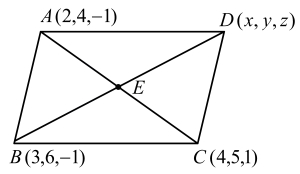
If the points $(2,4,-1), (3,6,-1)$ and $(4,5,1)$ are three consecutive vertices of a parallelogram,then its fourth vertex is
A
$(3,3,1)$
B
$(3,1,3)$
C
$(1,3,3)$
D
$(0,0,0)$
Solution
(A) Let the vertices of the parallelogram be $A(2,4,-1)$,$B(3,6,-1)$,and $C(4,5,1)$.
Let the fourth vertex be $D(x, y, z)$.
In a parallelogram,the diagonals bisect each other,which means the midpoint of diagonal $AC$ is the same as the midpoint of diagonal $BD$.
Midpoint of $AC = \left( \frac{2+4}{2}, \frac{4+5}{2}, \frac{-1+1}{2} \right) = \left( 3, \frac{9}{2}, 0 \right)$.
Midpoint of $BD = \left( \frac{3+x}{2}, \frac{6+y}{2}, \frac{-1+z}{2} \right)$.
Equating the midpoints:
$\frac{3+x}{2} = 3 \Rightarrow 3+x = 6 \Rightarrow x = 3$.
$\frac{6+y}{2} = \frac{9}{2} \Rightarrow 6+y = 9 \Rightarrow y = 3$.
$\frac{-1+z}{2} = 0 \Rightarrow -1+z = 0 \Rightarrow z = 1$.
Thus,the fourth vertex $D$ is $(3,3,1)$.
Let the fourth vertex be $D(x, y, z)$.
In a parallelogram,the diagonals bisect each other,which means the midpoint of diagonal $AC$ is the same as the midpoint of diagonal $BD$.
Midpoint of $AC = \left( \frac{2+4}{2}, \frac{4+5}{2}, \frac{-1+1}{2} \right) = \left( 3, \frac{9}{2}, 0 \right)$.
Midpoint of $BD = \left( \frac{3+x}{2}, \frac{6+y}{2}, \frac{-1+z}{2} \right)$.
Equating the midpoints:
$\frac{3+x}{2} = 3 \Rightarrow 3+x = 6 \Rightarrow x = 3$.
$\frac{6+y}{2} = \frac{9}{2} \Rightarrow 6+y = 9 \Rightarrow y = 3$.
$\frac{-1+z}{2} = 0 \Rightarrow -1+z = 0 \Rightarrow z = 1$.
Thus,the fourth vertex $D$ is $(3,3,1)$.
0 likesView Solution
403
MathematicsMediumMCQAP EAMCET · 2021
The point of intersection of the lines joining points $\hat{i}+2 \hat{j}, 2 \hat{i}-\hat{j}$ and $-\hat{i}, 2 \hat{i}$ is
A
$\frac{5}{3} \hat{i}$
B
$\frac{3 \hat{i}+\hat{j}}{5}$
C
$\frac{-3}{5} \hat{i}$
D
$\frac{2}{5} \hat{j}$
Solution
(A) Let the points be $A(1, 2)$,$B(2, -1)$,$C(-1, 0)$,and $D(2, 0)$.
The equation of the line passing through two points $(x_1, y_1)$ and $(x_2, y_2)$ is given by $(y - y_1) = \frac{y_2 - y_1}{x_2 - x_1}(x - x_1)$.
For line $AB$ passing through $(1, 2)$ and $(2, -1)$:
$(y - 2) = \frac{-1 - 2}{2 - 1}(x - 1) \Rightarrow (y - 2) = -3(x - 1) \Rightarrow y - 2 = -3x + 3 \Rightarrow 3x + y = 5$.
For line $CD$ passing through $(-1, 0)$ and $(2, 0)$:
Since the $y$-coordinates are both $0$,the line is the $x$-axis,which is $y = 0$.
To find the intersection,substitute $y = 0$ into the equation $3x + y = 5$:
$3x + 0 = 5 \Rightarrow x = \frac{5}{3}$.
Thus,the point of intersection is $(\frac{5}{3}, 0)$,which in vector form is $\frac{5}{3} \hat{i}$.
The equation of the line passing through two points $(x_1, y_1)$ and $(x_2, y_2)$ is given by $(y - y_1) = \frac{y_2 - y_1}{x_2 - x_1}(x - x_1)$.
For line $AB$ passing through $(1, 2)$ and $(2, -1)$:
$(y - 2) = \frac{-1 - 2}{2 - 1}(x - 1) \Rightarrow (y - 2) = -3(x - 1) \Rightarrow y - 2 = -3x + 3 \Rightarrow 3x + y = 5$.
For line $CD$ passing through $(-1, 0)$ and $(2, 0)$:
Since the $y$-coordinates are both $0$,the line is the $x$-axis,which is $y = 0$.
To find the intersection,substitute $y = 0$ into the equation $3x + y = 5$:
$3x + 0 = 5 \Rightarrow x = \frac{5}{3}$.
Thus,the point of intersection is $(\frac{5}{3}, 0)$,which in vector form is $\frac{5}{3} \hat{i}$.
0 likesView Solution
404
MathematicsEasyMCQAP EAMCET · 2021
If the origin is the centroid of the triangle for which $(-2, 3, 4)$ and $(3, -1, 5)$ are two vertices,then the third vertex is
A
$(-1, -2, -9)$
B
$(-1, -2, 9)$
C
$(1, -2, -9)$
D
$(1, 2, 9)$
Solution
(A) Let the vertices of the triangle be $A(x, y, z)$,$B(-2, 3, 4)$,and $C(3, -1, 5)$.
The centroid $G$ of a triangle with vertices $(x_1, y_1, z_1)$,$(x_2, y_2, z_2)$,and $(x_3, y_3, z_3)$ is given by $\left(\frac{x_1+x_2+x_3}{3}, \frac{y_1+y_2+y_3}{3}, \frac{z_1+z_2+z_3}{3}\right)$.
Given that the centroid is the origin $(0, 0, 0)$,we have:
$\frac{x-2+3}{3} = 0 \Rightarrow x+1 = 0 \Rightarrow x = -1$
$\frac{y+3-1}{3} = 0 \Rightarrow y+2 = 0 \Rightarrow y = -2$
$\frac{z+4+5}{3} = 0 \Rightarrow z+9 = 0 \Rightarrow z = -9$
Therefore,the third vertex is $(-1, -2, -9)$.
The centroid $G$ of a triangle with vertices $(x_1, y_1, z_1)$,$(x_2, y_2, z_2)$,and $(x_3, y_3, z_3)$ is given by $\left(\frac{x_1+x_2+x_3}{3}, \frac{y_1+y_2+y_3}{3}, \frac{z_1+z_2+z_3}{3}\right)$.
Given that the centroid is the origin $(0, 0, 0)$,we have:
$\frac{x-2+3}{3} = 0 \Rightarrow x+1 = 0 \Rightarrow x = -1$
$\frac{y+3-1}{3} = 0 \Rightarrow y+2 = 0 \Rightarrow y = -2$
$\frac{z+4+5}{3} = 0 \Rightarrow z+9 = 0 \Rightarrow z = -9$
Therefore,the third vertex is $(-1, -2, -9)$.
0 likesView Solution
405
MathematicsEasyMCQAP EAMCET · 2021
Nine balls are drawn simultaneously from a bag containing $5$ white and $7$ black balls. The probability of drawing $3$ white and $6$ black balls is:
A
$\frac{{ }^7 C_3}{{ }^{12} C_9}$
B
$\frac{7}{22}$
C
$\frac{3}{22}$
D
$\frac{7}{11}$
Solution
(B) Total number of balls = $5 + 7 = 12$.
We need to draw $9$ balls from $12$ balls.
The total number of ways to select $9$ balls is $n(S) = {}^{12}C_9 = {}^{12}C_3 = \frac{12 \times 11 \times 10}{3 \times 2 \times 1} = 220$.
We need to select $3$ white balls from $5$ white balls and $6$ black balls from $7$ black balls.
The number of ways to select $3$ white balls is ${}^5C_3 = {}^5C_2 = \frac{5 \times 4}{2 \times 1} = 10$.
The number of ways to select $6$ black balls is ${}^7C_6 = {}^7C_1 = 7$.
The number of favorable outcomes is $n(P) = 10 \times 7 = 70$.
The probability is $P = \frac{n(P)}{n(S)} = \frac{70}{220} = \frac{7}{22}$.
We need to draw $9$ balls from $12$ balls.
The total number of ways to select $9$ balls is $n(S) = {}^{12}C_9 = {}^{12}C_3 = \frac{12 \times 11 \times 10}{3 \times 2 \times 1} = 220$.
We need to select $3$ white balls from $5$ white balls and $6$ black balls from $7$ black balls.
The number of ways to select $3$ white balls is ${}^5C_3 = {}^5C_2 = \frac{5 \times 4}{2 \times 1} = 10$.
The number of ways to select $6$ black balls is ${}^7C_6 = {}^7C_1 = 7$.
The number of favorable outcomes is $n(P) = 10 \times 7 = 70$.
The probability is $P = \frac{n(P)}{n(S)} = \frac{70}{220} = \frac{7}{22}$.
0 likesView Solution
406
MathematicsEasyMCQAP EAMCET · 2021
The probability for a contractor to get a road contract is $\frac{2}{9}$ and to get a building contract is $\frac{5}{9}$. If the probability to get both the contracts is $\frac{1}{6}$,then what is the probability to get neither of these two contracts?
A
$\frac{7}{9}$
B
$\frac{4}{9}$
C
$\frac{7}{18}$
D
$\frac{4}{18}$
Solution
(C) Let $A$ be the event of getting a road contract and $B$ be the event of getting a building contract.
Given: $P(A) = \frac{2}{9}$,$P(B) = \frac{5}{9}$,and $P(A \cap B) = \frac{1}{6}$.
We need to find the probability of getting neither contract,which is $P(A' \cap B') = P((A \cup B)')$.
First,calculate the probability of getting at least one contract:
$P(A \cup B) = P(A) + P(B) - P(A \cap B)$
$P(A \cup B) = \frac{2}{9} + \frac{5}{9} - \frac{1}{6} = \frac{7}{9} - \frac{1}{6}$
Finding a common denominator $(18)$:
$P(A \cup B) = \frac{14}{18} - \frac{3}{18} = \frac{11}{18}$.
Now,the probability of getting neither contract is:
$P((A \cup B)') = 1 - P(A \cup B) = 1 - \frac{11}{18} = \frac{7}{18}$.
Thus,the probability is $\frac{7}{18}$.
Given: $P(A) = \frac{2}{9}$,$P(B) = \frac{5}{9}$,and $P(A \cap B) = \frac{1}{6}$.
We need to find the probability of getting neither contract,which is $P(A' \cap B') = P((A \cup B)')$.
First,calculate the probability of getting at least one contract:
$P(A \cup B) = P(A) + P(B) - P(A \cap B)$
$P(A \cup B) = \frac{2}{9} + \frac{5}{9} - \frac{1}{6} = \frac{7}{9} - \frac{1}{6}$
Finding a common denominator $(18)$:
$P(A \cup B) = \frac{14}{18} - \frac{3}{18} = \frac{11}{18}$.
Now,the probability of getting neither contract is:
$P((A \cup B)') = 1 - P(A \cup B) = 1 - \frac{11}{18} = \frac{7}{18}$.
Thus,the probability is $\frac{7}{18}$.
0 likesView Solution
407
MathematicsEasyMCQAP EAMCET · 2021
Let $A$ and $B$ be events with $P(A)=\frac{1}{3}, P(B)=\frac{1}{4}$ and $P(A \cup B)=\frac{1}{2}$. Then which of the following statements is incorrect?
A
$A$ and $B$ are independent
B
$P(A|B)=\frac{1}{3}$
C
$P(A^C \cap B)=\frac{1}{3}$
D
$P(A \cap B^C)=\frac{1}{4}$
Solution
(C) Given,$P(A)=\frac{1}{3}, P(B)=\frac{1}{4}, P(A \cup B)=\frac{1}{2}$.
First,we find $P(A \cap B)$ using the formula $P(A \cup B) = P(A) + P(B) - P(A \cap B)$:
$P(A \cap B) = P(A) + P(B) - P(A \cup B) = \frac{1}{3} + \frac{1}{4} - \frac{1}{2} = \frac{4+3-6}{12} = \frac{1}{12}$.
Check for independence: $P(A) \cdot P(B) = \frac{1}{3} \cdot \frac{1}{4} = \frac{1}{12}$. Since $P(A \cap B) = P(A) \cdot P(B)$,$A$ and $B$ are independent. (Option $A$ is correct).
Calculate $P(A|B) = \frac{P(A \cap B)}{P(B)} = \frac{1/12}{1/4} = \frac{1}{3}$. (Option $B$ is correct).
Calculate $P(A^C \cap B) = P(B) - P(A \cap B) = \frac{1}{4} - \frac{1}{12} = \frac{3-1}{12} = \frac{2}{12} = \frac{1}{6}$. (Option $C$ is incorrect,as it states $1/3$).
Calculate $P(A \cap B^C) = P(A) - P(A \cap B) = \frac{1}{3} - \frac{1}{12} = \frac{4-1}{12} = \frac{3}{12} = \frac{1}{4}$. (Option $D$ is correct).
Thus,the incorrect statement is $P(A^C \cap B) = \frac{1}{3}$.
First,we find $P(A \cap B)$ using the formula $P(A \cup B) = P(A) + P(B) - P(A \cap B)$:
$P(A \cap B) = P(A) + P(B) - P(A \cup B) = \frac{1}{3} + \frac{1}{4} - \frac{1}{2} = \frac{4+3-6}{12} = \frac{1}{12}$.
Check for independence: $P(A) \cdot P(B) = \frac{1}{3} \cdot \frac{1}{4} = \frac{1}{12}$. Since $P(A \cap B) = P(A) \cdot P(B)$,$A$ and $B$ are independent. (Option $A$ is correct).
Calculate $P(A|B) = \frac{P(A \cap B)}{P(B)} = \frac{1/12}{1/4} = \frac{1}{3}$. (Option $B$ is correct).
Calculate $P(A^C \cap B) = P(B) - P(A \cap B) = \frac{1}{4} - \frac{1}{12} = \frac{3-1}{12} = \frac{2}{12} = \frac{1}{6}$. (Option $C$ is incorrect,as it states $1/3$).
Calculate $P(A \cap B^C) = P(A) - P(A \cap B) = \frac{1}{3} - \frac{1}{12} = \frac{4-1}{12} = \frac{3}{12} = \frac{1}{4}$. (Option $D$ is correct).
Thus,the incorrect statement is $P(A^C \cap B) = \frac{1}{3}$.
0 likesView Solution
408
MathematicsMediumMCQAP EAMCET · 2021
Three numbers are chosen at random without replacement from the set $A = \{x \in \mathbb{Z} \mid 2 \leq x \leq 11\}$. The probability that the minimum of the chosen numbers is $3$ and the maximum is $7$ is
A
$\frac{1}{30}$
B
$\frac{1}{40}$
C
$\frac{1}{50}$
D
$\frac{1}{60}$
Solution
(B) The set $A$ is given by $A = \{2, 3, 4, 5, 6, 7, 8, 9, 10, 11\}$. The total number of elements in $A$ is $n(A) = 10$.
The total number of ways to choose $3$ numbers from $10$ is $n(E) = {}^{10}C_3 = \frac{10 \times 9 \times 8}{3 \times 2 \times 1} = 120$.
For the minimum to be $3$ and the maximum to be $7$,the chosen set must contain $3$ and $7$. The third number must be chosen from the set $\{4, 5, 6\}$.
Thus,the favorable outcomes are $\{3, 4, 7\}, \{3, 5, 7\}, \{3, 6, 7\}$.
The number of favorable outcomes is $n(F) = 3$.
The required probability is $P = \frac{n(F)}{n(E)} = \frac{3}{120} = \frac{1}{40}$.
The total number of ways to choose $3$ numbers from $10$ is $n(E) = {}^{10}C_3 = \frac{10 \times 9 \times 8}{3 \times 2 \times 1} = 120$.
For the minimum to be $3$ and the maximum to be $7$,the chosen set must contain $3$ and $7$. The third number must be chosen from the set $\{4, 5, 6\}$.
Thus,the favorable outcomes are $\{3, 4, 7\}, \{3, 5, 7\}, \{3, 6, 7\}$.
The number of favorable outcomes is $n(F) = 3$.
The required probability is $P = \frac{n(F)}{n(E)} = \frac{3}{120} = \frac{1}{40}$.
0 likesView Solution
409
MathematicsEasyMCQAP EAMCET · 2021
If $A$ and $B$ are two events with $P(A \cup B) = 0.65$ and $P(A \cap B) = 0.15$,then find the value of $P(A^C) + P(B^C)$.
A
$0.8$
B
$1$
C
$1.2$
D
$1.4$
Solution
(C) We know that $P(A \cup B) = P(A) + P(B) - P(A \cap B)$.
Rearranging the terms,we get $P(A) + P(B) = P(A \cup B) + P(A \cap B)$.
Substituting the given values,$P(A) + P(B) = 0.65 + 0.15 = 0.8$.
We need to find $P(A^C) + P(B^C)$.
Using the complement rule,$P(A^C) = 1 - P(A)$ and $P(B^C) = 1 - P(B)$.
Therefore,$P(A^C) + P(B^C) = (1 - P(A)) + (1 - P(B)) = 2 - (P(A) + P(B))$.
Substituting the sum $P(A) + P(B) = 0.8$,we get $2 - 0.8 = 1.2$.
Rearranging the terms,we get $P(A) + P(B) = P(A \cup B) + P(A \cap B)$.
Substituting the given values,$P(A) + P(B) = 0.65 + 0.15 = 0.8$.
We need to find $P(A^C) + P(B^C)$.
Using the complement rule,$P(A^C) = 1 - P(A)$ and $P(B^C) = 1 - P(B)$.
Therefore,$P(A^C) + P(B^C) = (1 - P(A)) + (1 - P(B)) = 2 - (P(A) + P(B))$.
Substituting the sum $P(A) + P(B) = 0.8$,we get $2 - 0.8 = 1.2$.
0 likesView Solution
410
MathematicsMediumMCQAP EAMCET · 2021
Let $S$ be the set of all quadratic equations of the form $x^2+bx+c=0$,where $b, c \in \{1, 2, 3, 4, 5, 6\}$. If an equation is selected at random from $S$,then the probability that the equation has real roots is
A
$\frac{9}{12}$
B
$\frac{9}{36}$
C
$\frac{19}{36}$
D
$\frac{7}{36}$
Solution
(C) The set $S$ consists of equations $x^2+bx+c=0$ where $b, c \in \{1, 2, 3, 4, 5, 6\}$.
The total number of such equations is $n(S) = 6 \times 6 = 36$.
$A$ quadratic equation $x^2+bx+c=0$ has real roots if the discriminant $D = b^2-4ac \geq 0$.
Since $a=1$,the condition becomes $b^2 \geq 4c$.
We test values of $b$ from $1$ to $6$:
If $b=1$,$1 \geq 4c$ (No values for $c$)
If $b=2$,$4 \geq 4c \implies c \leq 1$ ($c=1$,$1$ case)
If $b=3$,$9 \geq 4c \implies c \leq 2.25$ ($c=1, 2$,$2$ cases)
If $b=4$,$16 \geq 4c \implies c \leq 4$ ($c=1, 2, 3, 4$,$4$ cases)
If $b=5$,$25 \geq 4c \implies c \leq 6.25$ ($c=1, 2, 3, 4, 5, 6$,$6$ cases)
If $b=6$,$36 \geq 4c \implies c \leq 9$ ($c=1, 2, 3, 4, 5, 6$,$6$ cases)
Total favorable outcomes $n(E) = 0 + 1 + 2 + 4 + 6 + 6 = 19$.
The probability $P(E) = \frac{n(E)}{n(S)} = \frac{19}{36}$.
The total number of such equations is $n(S) = 6 \times 6 = 36$.
$A$ quadratic equation $x^2+bx+c=0$ has real roots if the discriminant $D = b^2-4ac \geq 0$.
Since $a=1$,the condition becomes $b^2 \geq 4c$.
We test values of $b$ from $1$ to $6$:
If $b=1$,$1 \geq 4c$ (No values for $c$)
If $b=2$,$4 \geq 4c \implies c \leq 1$ ($c=1$,$1$ case)
If $b=3$,$9 \geq 4c \implies c \leq 2.25$ ($c=1, 2$,$2$ cases)
If $b=4$,$16 \geq 4c \implies c \leq 4$ ($c=1, 2, 3, 4$,$4$ cases)
If $b=5$,$25 \geq 4c \implies c \leq 6.25$ ($c=1, 2, 3, 4, 5, 6$,$6$ cases)
If $b=6$,$36 \geq 4c \implies c \leq 9$ ($c=1, 2, 3, 4, 5, 6$,$6$ cases)
Total favorable outcomes $n(E) = 0 + 1 + 2 + 4 + 6 + 6 = 19$.
The probability $P(E) = \frac{n(E)}{n(S)} = \frac{19}{36}$.
0 likesView Solution
411
MathematicsEasyMCQAP EAMCET · 2021
Two bolts,two nuts,and three needles are in a box. Two parts are chosen at random from the box. What is the probability that one is a bolt and one is a needle?
A
$\frac{2}{21}$
B
$\frac{4}{21}$
C
$\frac{6}{21}$
D
$\frac{12}{21}$
Solution
(C) Total number of items = $2 \text{ (bolts)} + 2 \text{ (nuts)} + 3 \text{ (needles)} = 7 \text{ items}$.
Total number of ways to choose $2$ parts from $7$ is given by $n(S) = {}^{7}C_{2} = \frac{7 \times 6}{2 \times 1} = 21$.
Let $E$ be the event that one part is a bolt and one part is a needle.
The number of ways to choose $1$ bolt from $2$ and $1$ needle from $3$ is $n(E) = {}^{2}C_{1} \times {}^{3}C_{1} = 2 \times 3 = 6$.
Therefore,the probability $P(E) = \frac{n(E)}{n(S)} = \frac{6}{21}$.
Total number of ways to choose $2$ parts from $7$ is given by $n(S) = {}^{7}C_{2} = \frac{7 \times 6}{2 \times 1} = 21$.
Let $E$ be the event that one part is a bolt and one part is a needle.
The number of ways to choose $1$ bolt from $2$ and $1$ needle from $3$ is $n(E) = {}^{2}C_{1} \times {}^{3}C_{1} = 2 \times 3 = 6$.
Therefore,the probability $P(E) = \frac{n(E)}{n(S)} = \frac{6}{21}$.
0 likesView Solution
412
MathematicsEasyMCQAP EAMCET · 2021
If $A$ and $B$ are two events with $P(A \cap B) = \frac{1}{3}$,$P(A \cup B) = \frac{5}{6}$,and $P(A^C) = \frac{1}{2}$,then the value of $P(B^C)$ is
A
$\frac{1}{2}$
B
$\frac{1}{3}$
C
$\frac{2}{3}$
D
$\frac{5}{6}$
Solution
(B) We know that $P(A \cup B) = P(A) + P(B) - P(A \cap B)$.
Since $P(A) = 1 - P(A^C) = 1 - \frac{1}{2} = \frac{1}{2}$.
Substituting the values into the addition theorem of probability:
$\frac{5}{6} = \frac{1}{2} + P(B) - \frac{1}{3}$.
$\frac{5}{6} = \frac{3-2}{6} + P(B) = \frac{1}{6} + P(B)$.
$P(B) = \frac{5}{6} - \frac{1}{6} = \frac{4}{6} = \frac{2}{3}$.
Therefore,$P(B^C) = 1 - P(B) = 1 - \frac{2}{3} = \frac{1}{3}$.
Since $P(A) = 1 - P(A^C) = 1 - \frac{1}{2} = \frac{1}{2}$.
Substituting the values into the addition theorem of probability:
$\frac{5}{6} = \frac{1}{2} + P(B) - \frac{1}{3}$.
$\frac{5}{6} = \frac{3-2}{6} + P(B) = \frac{1}{6} + P(B)$.
$P(B) = \frac{5}{6} - \frac{1}{6} = \frac{4}{6} = \frac{2}{3}$.
Therefore,$P(B^C) = 1 - P(B) = 1 - \frac{2}{3} = \frac{1}{3}$.
0 likesView Solution
413
MathematicsEasyMCQAP EAMCET · 2021
If $A$ and $B$ are mutually exclusive events with $P(A)=\frac{1}{4}$ and $P(B)=\frac{3}{7}$,then what is the value of $P(A / A \cup B)$?
A
$\frac{7}{19}$
B
$\frac{12}{19}$
C
$\frac{6}{19}$
D
$\frac{13}{19}$
Solution
(A) Since $A$ and $B$ are mutually exclusive events,$A \cap B = \phi$,which implies $P(A \cap B) = 0$.
Given $P(A) = \frac{1}{4}$ and $P(B) = \frac{3}{7}$.
We need to find $P(A / A \cup B) = \frac{P(A \cap (A \cup B))}{P(A \cup B)}$.
Since $A \subset (A \cup B)$,we have $A \cap (A \cup B) = A$,so $P(A \cap (A \cup B)) = P(A) = \frac{1}{4}$.
Also,$P(A \cup B) = P(A) + P(B) - P(A \cap B) = \frac{1}{4} + \frac{3}{7} - 0 = \frac{7 + 12}{28} = \frac{19}{28}$.
Therefore,$P(A / A \cup B) = \frac{1/4}{19/28} = \frac{1}{4} \times \frac{28}{19} = \frac{7}{19}$.
Given $P(A) = \frac{1}{4}$ and $P(B) = \frac{3}{7}$.
We need to find $P(A / A \cup B) = \frac{P(A \cap (A \cup B))}{P(A \cup B)}$.
Since $A \subset (A \cup B)$,we have $A \cap (A \cup B) = A$,so $P(A \cap (A \cup B)) = P(A) = \frac{1}{4}$.
Also,$P(A \cup B) = P(A) + P(B) - P(A \cap B) = \frac{1}{4} + \frac{3}{7} - 0 = \frac{7 + 12}{28} = \frac{19}{28}$.
Therefore,$P(A / A \cup B) = \frac{1/4}{19/28} = \frac{1}{4} \times \frac{28}{19} = \frac{7}{19}$.
0 likesView Solution
414
MathematicsDifficultMCQAP EAMCET · 2021
Events $A, B$ and $C$ are mutually exclusive events such that $P(A)=\frac{3x+1}{3}$,$P(B)=\frac{1-x}{4}$ and $P(C)=\frac{1-2x}{2}$. The set of possible values of $x$ is in the interval
A
$[\frac{1}{3}, \frac{1}{2}]$
B
$[\frac{1}{3}, \frac{2}{3}]$
C
$[\frac{1}{3}, \frac{13}{3}]$
D
$[0, 1]$
Solution
(A) Since $A, B, C$ are mutually exclusive,we have $P(A \cap B) = P(B \cap C) = P(C \cap A) = P(A \cap B \cap C) = 0$.
For any event $E$,$0 \leq P(E) \leq 1$.
$1$. For $P(A) = \frac{3x+1}{3}$: $0 \leq \frac{3x+1}{3} \leq 1 \implies 0 \leq 3x+1 \leq 3 \implies -1 \leq 3x \leq 2 \implies -\frac{1}{3} \leq x \leq \frac{2}{3}$.
$2$. For $P(B) = \frac{1-x}{4}$: $0 \leq \frac{1-x}{4} \leq 1 \implies 0 \leq 1-x \leq 4 \implies -1 \leq -x \leq 3 \implies -3 \leq x \leq 1$.
$3$. For $P(C) = \frac{1-2x}{2}$: $0 \leq \frac{1-2x}{2} \leq 1 \implies 0 \leq 1-2x \leq 2 \implies -1 \leq -2x \leq 1 \implies -\frac{1}{2} \leq x \leq \frac{1}{2}$.
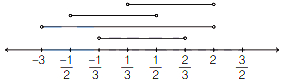
Intersection of these intervals: $[-\frac{1}{3}, \frac{2}{3}] \cap [-3, 1] \cap [-\frac{1}{2}, \frac{1}{2}] = [-\frac{1}{3}, \frac{1}{2}]$.
Also,for mutually exclusive events,$P(A \cup B \cup C) = P(A) + P(B) + P(C) \leq 1$.
$\frac{3x+1}{3} + \frac{1-x}{4} + \frac{1-2x}{2} \leq 1$
$\frac{4(3x+1) + 3(1-x) + 6(1-2x)}{12} \leq 1$
$\frac{12x+4+3-3x+6-12x}{12} \leq 1 \implies \frac{13-3x}{12} \leq 1 \implies 13-3x \leq 12 \implies -3x \leq -1 \implies x \geq \frac{1}{3}$.
Combining $x \geq \frac{1}{3}$ with the intersection $[-\frac{1}{3}, \frac{1}{2}]$,we get $x \in [\frac{1}{3}, \frac{1}{2}]$.
For any event $E$,$0 \leq P(E) \leq 1$.
$1$. For $P(A) = \frac{3x+1}{3}$: $0 \leq \frac{3x+1}{3} \leq 1 \implies 0 \leq 3x+1 \leq 3 \implies -1 \leq 3x \leq 2 \implies -\frac{1}{3} \leq x \leq \frac{2}{3}$.
$2$. For $P(B) = \frac{1-x}{4}$: $0 \leq \frac{1-x}{4} \leq 1 \implies 0 \leq 1-x \leq 4 \implies -1 \leq -x \leq 3 \implies -3 \leq x \leq 1$.
$3$. For $P(C) = \frac{1-2x}{2}$: $0 \leq \frac{1-2x}{2} \leq 1 \implies 0 \leq 1-2x \leq 2 \implies -1 \leq -2x \leq 1 \implies -\frac{1}{2} \leq x \leq \frac{1}{2}$.
Intersection of these intervals: $[-\frac{1}{3}, \frac{2}{3}] \cap [-3, 1] \cap [-\frac{1}{2}, \frac{1}{2}] = [-\frac{1}{3}, \frac{1}{2}]$.
Also,for mutually exclusive events,$P(A \cup B \cup C) = P(A) + P(B) + P(C) \leq 1$.
$\frac{3x+1}{3} + \frac{1-x}{4} + \frac{1-2x}{2} \leq 1$
$\frac{4(3x+1) + 3(1-x) + 6(1-2x)}{12} \leq 1$
$\frac{12x+4+3-3x+6-12x}{12} \leq 1 \implies \frac{13-3x}{12} \leq 1 \implies 13-3x \leq 12 \implies -3x \leq -1 \implies x \geq \frac{1}{3}$.
Combining $x \geq \frac{1}{3}$ with the intersection $[-\frac{1}{3}, \frac{1}{2}]$,we get $x \in [\frac{1}{3}, \frac{1}{2}]$.
0 likesView Solution
415
MathematicsMediumMCQAP EAMCET · 2021
Three students $A$,$B$ and $C$ are running a race. $A$ and $B$ have the same probability of winning and each is twice as likely to win as $C$. Then,the probability that $B$ or $C$ wins is equal to (assuming there are no ties)
A
$\frac{2}{5}$
B
$\frac{3}{5}$
C
$\frac{3}{7}$
D
$\frac{2}{7}$
Solution
(B) Let the winning probability of $C$ be $P(C) = p$.
Since $A$ and $B$ are twice as likely to win as $C$,we have $P(A) = 2p$ and $P(B) = 2p$.
Since the sum of probabilities of all possible outcomes is $1$,we have $P(A) + P(B) + P(C) = 1$.
Substituting the values,we get $2p + 2p + p = 1$,which implies $5p = 1$,so $p = \frac{1}{5}$.
The probability that $B$ or $C$ wins is $P(B \cup C) = P(B) + P(C)$ (since the events are mutually exclusive).
$P(B \cup C) = 2p + p = 3p = 3 \times \frac{1}{5} = \frac{3}{5}$.
Since $A$ and $B$ are twice as likely to win as $C$,we have $P(A) = 2p$ and $P(B) = 2p$.
Since the sum of probabilities of all possible outcomes is $1$,we have $P(A) + P(B) + P(C) = 1$.
Substituting the values,we get $2p + 2p + p = 1$,which implies $5p = 1$,so $p = \frac{1}{5}$.
The probability that $B$ or $C$ wins is $P(B \cup C) = P(B) + P(C)$ (since the events are mutually exclusive).
$P(B \cup C) = 2p + p = 3p = 3 \times \frac{1}{5} = \frac{3}{5}$.
0 likesView Solution
416
MathematicsEasyMCQAP EAMCET · 2021
One card is selected at random from $27$ cards numbered from $1$ to $27$. What is the probability that the number on the card is even or divisible by $5$?
A
$\frac{15}{27}$
B
$\frac{16}{27}$
C
$\frac{17}{27}$
D
$\frac{18}{27}$
Solution
(B) Total number of cards $n(S) = 27$.
Let $E$ be the event that the number is even. The even numbers between $1$ and $27$ are $\{2, 4, 6, 8, 10, 12, 14, 16, 18, 20, 22, 24, 26\}$.
Thus,$n(E) = 13$.
Let $F$ be the event that the number is divisible by $5$. The numbers divisible by $5$ are $\{5, 10, 15, 20, 25\}$.
Thus,$n(F) = 5$.
The intersection $E \cap F$ contains numbers that are both even and divisible by $5$,which are multiples of $10$. These are $\{10, 20\}$.
Thus,$n(E \cap F) = 2$.
Using the addition rule for probability,$n(E \cup F) = n(E) + n(F) - n(E \cap F) = 13 + 5 - 2 = 16$.
The probability is $P(E \cup F) = \frac{n(E \cup F)}{n(S)} = \frac{16}{27}$.
Let $E$ be the event that the number is even. The even numbers between $1$ and $27$ are $\{2, 4, 6, 8, 10, 12, 14, 16, 18, 20, 22, 24, 26\}$.
Thus,$n(E) = 13$.
Let $F$ be the event that the number is divisible by $5$. The numbers divisible by $5$ are $\{5, 10, 15, 20, 25\}$.
Thus,$n(F) = 5$.
The intersection $E \cap F$ contains numbers that are both even and divisible by $5$,which are multiples of $10$. These are $\{10, 20\}$.
Thus,$n(E \cap F) = 2$.
Using the addition rule for probability,$n(E \cup F) = n(E) + n(F) - n(E \cap F) = 13 + 5 - 2 = 16$.
The probability is $P(E \cup F) = \frac{n(E \cup F)}{n(S)} = \frac{16}{27}$.
0 likesView Solution
417
MathematicsEasyMCQAP EAMCET · 2021
The probabilities that $A$ and $B$ speak the truth are $\frac{4}{5}$ and $\frac{3}{4}$ respectively. The probability that they contradict each other when asked to speak on a fact is
A
$\frac{1}{5}$
B
$\frac{3}{20}$
C
$\frac{4}{20}$
D
$\frac{7}{20}$
Solution
(D) Let $P(A)$ be the probability that $A$ speaks the truth and $P(B)$ be the probability that $B$ speaks the truth.
Given,$P(A) = \frac{4}{5}$ and $P(B) = \frac{3}{4}$.
The probability that $A$ does not speak the truth is $P(\overline{A}) = 1 - P(A) = 1 - \frac{4}{5} = \frac{1}{5}$.
The probability that $B$ does not speak the truth is $P(\overline{B}) = 1 - P(B) = 1 - \frac{3}{4} = \frac{1}{4}$.
They contradict each other if one speaks the truth and the other lies.
Thus,the probability of contradiction is $P(A \cap \overline{B}) + P(\overline{A} \cap B) = P(A) \cdot P(\overline{B}) + P(\overline{A}) \cdot P(B)$.
Substituting the values: $(\frac{4}{5} \times \frac{1}{4}) + (\frac{1}{5} \times \frac{3}{4}) = \frac{4}{20} + \frac{3}{20} = \frac{7}{20}$.
Given,$P(A) = \frac{4}{5}$ and $P(B) = \frac{3}{4}$.
The probability that $A$ does not speak the truth is $P(\overline{A}) = 1 - P(A) = 1 - \frac{4}{5} = \frac{1}{5}$.
The probability that $B$ does not speak the truth is $P(\overline{B}) = 1 - P(B) = 1 - \frac{3}{4} = \frac{1}{4}$.
They contradict each other if one speaks the truth and the other lies.
Thus,the probability of contradiction is $P(A \cap \overline{B}) + P(\overline{A} \cap B) = P(A) \cdot P(\overline{B}) + P(\overline{A}) \cdot P(B)$.
Substituting the values: $(\frac{4}{5} \times \frac{1}{4}) + (\frac{1}{5} \times \frac{3}{4}) = \frac{4}{20} + \frac{3}{20} = \frac{7}{20}$.
0 likesView Solution
418
MathematicsMediumMCQAP EAMCET · 2021
Two integers are drawn at random from the set $\{5, 6, \ldots, 35\}$. What is the probability that their difference is odd?
A
$\frac{15}{62}$
B
$\frac{8}{31}$
C
$\frac{15}{31}$
D
$\frac{16}{31}$
Solution
(D) The set is $S = \{5, 6, \ldots, 35\}$. The number of elements is $35 - 5 + 1 = 31$.
The total number of ways to choose $2$ integers from $31$ is $^{31}C_2 = \frac{31 \times 30}{2} = 465$.
The difference between two integers is odd if and only if one integer is even and the other is odd.
In the set $\{5, 6, \ldots, 35\}$,the number of odd integers is $16$ (i.e.,$5, 7, \ldots, 35$) and the number of even integers is $15$ (i.e.,$6, 8, \ldots, 34$).
The number of ways to choose one odd and one even integer is $^{16}C_1 \times ^{15}C_1 = 16 \times 15 = 240$.
The probability that the difference is odd is $P = \frac{240}{465}$.
Dividing both numerator and denominator by $15$,we get $P = \frac{16}{31}$.
The total number of ways to choose $2$ integers from $31$ is $^{31}C_2 = \frac{31 \times 30}{2} = 465$.
The difference between two integers is odd if and only if one integer is even and the other is odd.
In the set $\{5, 6, \ldots, 35\}$,the number of odd integers is $16$ (i.e.,$5, 7, \ldots, 35$) and the number of even integers is $15$ (i.e.,$6, 8, \ldots, 34$).
The number of ways to choose one odd and one even integer is $^{16}C_1 \times ^{15}C_1 = 16 \times 15 = 240$.
The probability that the difference is odd is $P = \frac{240}{465}$.
Dividing both numerator and denominator by $15$,we get $P = \frac{16}{31}$.
0 likesView Solution
419
MathematicsMediumMCQAP EAMCET · 2021
Let $A, B$ and $C$ be three events associated with sample space $S$. $A, B$ and $C$ are pairwise independent and $P(A)=P(B)=P(C)=P$. If all of them cannot occur simultaneously,then $P(A \cup B \cup C)$ is equal to
A
$1-(1-P)^3$
B
$3P(1-P)$
C
$P^3$
D
$3P$
Solution
(B) $A, B, C$ are pairwise independent events.
$\Rightarrow P(A \cap B) = P(A) \cdot P(B) = P^2$
$P(B \cap C) = P(B) \cdot P(C) = P^2$
$P(C \cap A) = P(C) \cdot P(A) = P^2$
Given that all of them cannot occur simultaneously,$P(A \cap B \cap C) = 0$.
Using the inclusion-exclusion principle:
$P(A \cup B \cup C) = P(A) + P(B) + P(C) - [P(A \cap B) + P(B \cap C) + P(C \cap A)] + P(A \cap B \cap C)$
$P(A \cup B \cup C) = P + P + P - [P^2 + P^2 + P^2] + 0$
$P(A \cup B \cup C) = 3P - 3P^2 = 3P(1-P)$.
$\Rightarrow P(A \cap B) = P(A) \cdot P(B) = P^2$
$P(B \cap C) = P(B) \cdot P(C) = P^2$
$P(C \cap A) = P(C) \cdot P(A) = P^2$
Given that all of them cannot occur simultaneously,$P(A \cap B \cap C) = 0$.
Using the inclusion-exclusion principle:
$P(A \cup B \cup C) = P(A) + P(B) + P(C) - [P(A \cap B) + P(B \cap C) + P(C \cap A)] + P(A \cap B \cap C)$
$P(A \cup B \cup C) = P + P + P - [P^2 + P^2 + P^2] + 0$
$P(A \cup B \cup C) = 3P - 3P^2 = 3P(1-P)$.
0 likesView Solution
420
MathematicsMediumMCQAP EAMCET · 2021
$A$ random variable $X$ has the probability distribution:
For the events $E = \{X \text{ is a prime number}\}$ and $F = \{X < 4\}$,then $P(E \cup F)$ is
| $X$ | $1$ | $2$ | $3$ | $4$ | $5$ | $6$ | $7$ | $8$ |
| $P(X)$ | $0.15$ | $0.23$ | $0.12$ | $0.10$ | $0.20$ | $0.08$ | $0.07$ | $0.05$ |
For the events $E = \{X \text{ is a prime number}\}$ and $F = \{X < 4\}$,then $P(E \cup F)$ is
A
$0.50$
B
$0.77$
C
$0.35$
D
$0.87$
Solution
(B) The prime numbers in the set $\{1, 2, 3, 4, 5, 6, 7, 8\}$ are $2, 3, 5, 7$.
$P(E) = P(X=2) + P(X=3) + P(X=5) + P(X=7) = 0.23 + 0.12 + 0.20 + 0.07 = 0.62$.
The event $F = \{X < 4\}$ corresponds to $X \in \{1, 2, 3\}$.
$P(F) = P(X=1) + P(X=2) + P(X=3) = 0.15 + 0.23 + 0.12 = 0.50$.
The intersection $E \cap F$ consists of values that are both prime and less than $4$,which are $\{2, 3\}$.
$P(E \cap F) = P(X=2) + P(X=3) = 0.23 + 0.12 = 0.35$.
Using the addition theorem of probability,$P(E \cup F) = P(E) + P(F) - P(E \cap F)$.
$P(E \cup F) = 0.62 + 0.50 - 0.35 = 0.77$.
$P(E) = P(X=2) + P(X=3) + P(X=5) + P(X=7) = 0.23 + 0.12 + 0.20 + 0.07 = 0.62$.
The event $F = \{X < 4\}$ corresponds to $X \in \{1, 2, 3\}$.
$P(F) = P(X=1) + P(X=2) + P(X=3) = 0.15 + 0.23 + 0.12 = 0.50$.
The intersection $E \cap F$ consists of values that are both prime and less than $4$,which are $\{2, 3\}$.
$P(E \cap F) = P(X=2) + P(X=3) = 0.23 + 0.12 = 0.35$.
Using the addition theorem of probability,$P(E \cup F) = P(E) + P(F) - P(E \cap F)$.
$P(E \cup F) = 0.62 + 0.50 - 0.35 = 0.77$.
0 likesView Solution
421
MathematicsDifficultMCQAP EAMCET · 2021
The transformed equation of $3x^2 + 3y^2 + 2xy = 2$,when the coordinate axes are rotated through an angle of $45^{\circ}$,is
A
$x^2 + 2y^2 = 1$
B
$2x^2 + y^2 = 1$
C
$x^2 + y^2 = 1$
D
$x^2 + 3y^2 = 1$
Solution
(B) Since the axes are rotated through an angle $\theta = 45^{\circ}$,we replace $(x, y)$ with $(x \cos 45^{\circ} - y \sin 45^{\circ}, x \sin 45^{\circ} + y \cos 45^{\circ})$,which is $\left(\frac{x-y}{\sqrt{2}}, \frac{x+y}{\sqrt{2}}\right)$.
Substituting these into the equation $3x^2 + 3y^2 + 2xy = 2$:
$3\left(\frac{x-y}{\sqrt{2}}\right)^2 + 3\left(\frac{x+y}{\sqrt{2}}\right)^2 + 2\left(\frac{x-y}{\sqrt{2}}\right)\left(\frac{x+y}{\sqrt{2}}\right) = 2$
$\frac{3}{2}(x^2 + y^2 - 2xy) + \frac{3}{2}(x^2 + y^2 + 2xy) + \frac{2}{2}(x^2 - y^2) = 2$
$\frac{3}{2}(2x^2 + 2y^2) + (x^2 - y^2) = 2$
$3x^2 + 3y^2 + x^2 - y^2 = 2$
$4x^2 + 2y^2 = 2$
Dividing by $2$,we get $2x^2 + y^2 = 1$.
Substituting these into the equation $3x^2 + 3y^2 + 2xy = 2$:
$3\left(\frac{x-y}{\sqrt{2}}\right)^2 + 3\left(\frac{x+y}{\sqrt{2}}\right)^2 + 2\left(\frac{x-y}{\sqrt{2}}\right)\left(\frac{x+y}{\sqrt{2}}\right) = 2$
$\frac{3}{2}(x^2 + y^2 - 2xy) + \frac{3}{2}(x^2 + y^2 + 2xy) + \frac{2}{2}(x^2 - y^2) = 2$
$\frac{3}{2}(2x^2 + 2y^2) + (x^2 - y^2) = 2$
$3x^2 + 3y^2 + x^2 - y^2 = 2$
$4x^2 + 2y^2 = 2$
Dividing by $2$,we get $2x^2 + y^2 = 1$.
0 likesView Solution
422
MathematicsDifficultMCQAP EAMCET · 2021
$\lim _{x \rightarrow \infty}\left(\frac{x+6}{x+1}\right)^{x+4}$ is equal to
A
$e^4$
B
$e^6$
C
$e^5$
D
$e$
Solution
(C) We use the standard limit formula: $\lim _{x \rightarrow \infty} (1 + \frac{a}{x+b})^{x+c} = e^a$.
Given the expression: $\lim _{x \rightarrow \infty} (\frac{x+6}{x+1})^{x+4}$.
Rewrite the base: $\frac{x+6}{x+1} = \frac{x+1+5}{x+1} = 1 + \frac{5}{x+1}$.
So,the limit becomes $\lim _{x \rightarrow \infty} (1 + \frac{5}{x+1})^{x+4}$.
Using the property $\lim _{x \rightarrow \infty} (1 + \frac{k}{f(x)})^{g(x)} = e^{\lim _{x \rightarrow \infty} k \cdot \frac{g(x)}{f(x)}}$:
$= e^{\lim _{x \rightarrow \infty} 5 \cdot \frac{x+4}{x+1}}$.
$= e^{5 \cdot \lim _{x \rightarrow \infty} \frac{1 + 4/x}{1 + 1/x}} = e^{5 \cdot 1} = e^5$.
Given the expression: $\lim _{x \rightarrow \infty} (\frac{x+6}{x+1})^{x+4}$.
Rewrite the base: $\frac{x+6}{x+1} = \frac{x+1+5}{x+1} = 1 + \frac{5}{x+1}$.
So,the limit becomes $\lim _{x \rightarrow \infty} (1 + \frac{5}{x+1})^{x+4}$.
Using the property $\lim _{x \rightarrow \infty} (1 + \frac{k}{f(x)})^{g(x)} = e^{\lim _{x \rightarrow \infty} k \cdot \frac{g(x)}{f(x)}}$:
$= e^{\lim _{x \rightarrow \infty} 5 \cdot \frac{x+4}{x+1}}$.
$= e^{5 \cdot \lim _{x \rightarrow \infty} \frac{1 + 4/x}{1 + 1/x}} = e^{5 \cdot 1} = e^5$.
0 likesView Solution
Vedclass Products
For Students
Vedclass Test Series
Mock tests in real AP EAMCET style covering Mathematics with performance analysis. 5-day free trial.
Start Free TrialFor Teachers
Exam Paper Generator
Generate Set A/B/C/D Mathematics papers from 7.5L+ questions in 2 minutes. 3 chapters free.
Try FreeFor Institutes
Online Exam Module
Run live AP EAMCET mock exams with unlimited students, 360° analytics & white-label branding.
See DemoFrequently Asked Questions
How many Mathematics questions are in AP EAMCET 2021?
There are 797 Mathematics questions from the AP EAMCET 2021 paper on Vedclass, each with a detailed step-by-step solution in English.
Are AP EAMCET 2021 Mathematics solutions available in English?
Yes. All solutions on this page are in English. You can also switch to English or Hindi using the language buttons above the questions.
Can I practice AP EAMCET 2021 Mathematics as a timed test?
Yes. Use the Vedclass Test Series to attempt a full AP EAMCET mock test covering Mathematics with time limits and instant score analysis.
Can teachers create Mathematics papers from AP EAMCET previous year questions?
Yes. The Vedclass Exam Paper Generator lets teachers mix AP EAMCET Mathematics questions and generate Set A/B/C/D papers in minutes.
For Teachers & Institutes
Build a Custom Mathematics Paper
Pick AP EAMCET 2021 Mathematics questions, set difficulty, and generate Set A/B/C/D in 2 minutes.