
MathematicsQ151–250 of 797 questions
Page 4 of 9 · English
151
MathematicsEasyMCQAP EAMCET · 2021
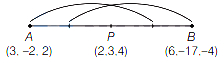
The harmonic conjugate of the point $P(2,3,4)$ with respect to the points $A(3,-2,2)$ and $B(6,-17,-4)$ is
A
$\left(\frac{18}{5},-5, \frac{4}{5}\right)$
B
$(11,-16,2)$
C
$\left(\frac{1}{2}, \frac{1}{3}, \frac{1}{4}\right)$
D
$(0,0,0)$
Solution
(A) Let the points be $A(3,-2,2)$ and $B(6,-17,-4)$. Let $P(2,3,4)$ divide the line segment $AB$ in the ratio $\lambda : 1$.
Using the section formula for the $x$-coordinate:
$2 = \frac{6\lambda + 3}{\lambda + 1}$
$2\lambda + 2 = 6\lambda + 3$
$-4\lambda = 1 \implies \lambda = -\frac{1}{4}$.
The harmonic conjugate $Q$ of $P$ with respect to $A$ and $B$ divides $AB$ externally in the same ratio $\lambda : 1$,which is equivalent to dividing $AB$ internally in the ratio $-\lambda : 1$.
Thus,$Q$ divides $AB$ in the ratio $\frac{1}{4} : 1$,or $1 : 4$.
Using the section formula for $Q$ with ratio $m:n = 1:4$:
$Q = \left( \frac{1(6) + 4(3)}{1+4}, \frac{1(-17) + 4(-2)}{1+4}, \frac{1(-4) + 4(2)}{1+4} \right)$
$Q = \left( \frac{6+12}{5}, \frac{-17-8}{5}, \frac{-4+8}{5} \right)$
$Q = \left( \frac{18}{5}, -\frac{25}{5}, \frac{4}{5} \right) = \left( \frac{18}{5}, -5, \frac{4}{5} \right)$.
Using the section formula for the $x$-coordinate:
$2 = \frac{6\lambda + 3}{\lambda + 1}$
$2\lambda + 2 = 6\lambda + 3$
$-4\lambda = 1 \implies \lambda = -\frac{1}{4}$.
The harmonic conjugate $Q$ of $P$ with respect to $A$ and $B$ divides $AB$ externally in the same ratio $\lambda : 1$,which is equivalent to dividing $AB$ internally in the ratio $-\lambda : 1$.
Thus,$Q$ divides $AB$ in the ratio $\frac{1}{4} : 1$,or $1 : 4$.
Using the section formula for $Q$ with ratio $m:n = 1:4$:
$Q = \left( \frac{1(6) + 4(3)}{1+4}, \frac{1(-17) + 4(-2)}{1+4}, \frac{1(-4) + 4(2)}{1+4} \right)$
$Q = \left( \frac{6+12}{5}, \frac{-17-8}{5}, \frac{-4+8}{5} \right)$
$Q = \left( \frac{18}{5}, -\frac{25}{5}, \frac{4}{5} \right) = \left( \frac{18}{5}, -5, \frac{4}{5} \right)$.
0 likesView Solution
152
MathematicsMediumMCQAP EAMCET · 2021
$A$ straight rod of length $4$ units slides such that its ends $A$ and $B$ always lie on the $X$ and $Y$-axes respectively. Then,the locus of the centroid of $\triangle OAB$ is
A
$x^2+y^2=4$
B
$x^2+y^2=3$
C
$x^2+y^2=\frac{9}{16}$
D
$x^2+y^2=\frac{16}{9}$
Solution
(D) Let the coordinates of the vertices of $\triangle OAB$ be $O(0,0)$,$A(a, 0)$,and $B(0, b)$.
Since the length of the rod $AB$ is $4$,we have $a^2 + b^2 = 4^2 = 16$.
Let $(x, y)$ be the centroid of $\triangle OAB$.
Then,$x = \frac{0+a+0}{3} = \frac{a}{3} \implies a = 3x$.
And $y = \frac{0+0+b}{3} = \frac{b}{3} \implies b = 3y$.
Substituting these into the equation $a^2 + b^2 = 16$,we get $(3x)^2 + (3y)^2 = 16$.
$9x^2 + 9y^2 = 16$.
$x^2 + y^2 = \frac{16}{9}$.
Thus,the locus of the centroid is $x^2 + y^2 = \frac{16}{9}$.
Since the length of the rod $AB$ is $4$,we have $a^2 + b^2 = 4^2 = 16$.
Let $(x, y)$ be the centroid of $\triangle OAB$.
Then,$x = \frac{0+a+0}{3} = \frac{a}{3} \implies a = 3x$.
And $y = \frac{0+0+b}{3} = \frac{b}{3} \implies b = 3y$.
Substituting these into the equation $a^2 + b^2 = 16$,we get $(3x)^2 + (3y)^2 = 16$.
$9x^2 + 9y^2 = 16$.
$x^2 + y^2 = \frac{16}{9}$.
Thus,the locus of the centroid is $x^2 + y^2 = \frac{16}{9}$.
0 likesView Solution
153
MathematicsDifficultMCQAP EAMCET · 2021
Find the transformed equation of the curve $x^2+2 \sqrt{3} xy - y^2 = 8$,when the axes are rotated through an angle $\frac{\pi}{3}$.
A
$x^2+y^2+2 \sqrt{3} xy = 8$
B
$x^2+y^2-2 \sqrt{3} xy = 8$
C
$x^2-y^2+2 \sqrt{3} xy = 8$
D
$x^2-y^2-2 \sqrt{3} xy = 8$
Solution
(D) The given equation is $x^2+2 \sqrt{3} xy - y^2 = 8$.
When the axes are rotated through an angle $\theta = \frac{\pi}{3}$,the coordinates $(x, y)$ are replaced by $(X, Y)$ where:
$x = X \cos \frac{\pi}{3} - Y \sin \frac{\pi}{3} = \frac{X - \sqrt{3}Y}{2}$
$y = X \sin \frac{\pi}{3} + Y \cos \frac{\pi}{3} = \frac{\sqrt{3}X + Y}{2}$
Substituting these into the equation:
$\left(\frac{X - \sqrt{3}Y}{2}\right)^2 + 2 \sqrt{3} \left(\frac{X - \sqrt{3}Y}{2}\right) \left(\frac{\sqrt{3}X + Y}{2}\right) - \left(\frac{\sqrt{3}X + Y}{2}\right)^2 = 8$
$\frac{1}{4} [ (X^2 - 2\sqrt{3}XY + 3Y^2) + 2\sqrt{3}(\sqrt{3}X^2 + XY - 3XY - \sqrt{3}Y^2) - (3X^2 + 2\sqrt{3}XY + Y^2) ] = 8$
$\frac{1}{4} [ X^2 - 2\sqrt{3}XY + 3Y^2 + 6X^2 - 4\sqrt{3}XY - 6Y^2 - 3X^2 - 2\sqrt{3}XY - Y^2 ] = 8$
$\frac{1}{4} [ 4X^2 - 8\sqrt{3}XY - 4Y^2 ] = 8$
$X^2 - 2\sqrt{3}XY - Y^2 = 8$
Thus,the transformed equation is $x^2 - 2\sqrt{3}xy - y^2 = 8$.
When the axes are rotated through an angle $\theta = \frac{\pi}{3}$,the coordinates $(x, y)$ are replaced by $(X, Y)$ where:
$x = X \cos \frac{\pi}{3} - Y \sin \frac{\pi}{3} = \frac{X - \sqrt{3}Y}{2}$
$y = X \sin \frac{\pi}{3} + Y \cos \frac{\pi}{3} = \frac{\sqrt{3}X + Y}{2}$
Substituting these into the equation:
$\left(\frac{X - \sqrt{3}Y}{2}\right)^2 + 2 \sqrt{3} \left(\frac{X - \sqrt{3}Y}{2}\right) \left(\frac{\sqrt{3}X + Y}{2}\right) - \left(\frac{\sqrt{3}X + Y}{2}\right)^2 = 8$
$\frac{1}{4} [ (X^2 - 2\sqrt{3}XY + 3Y^2) + 2\sqrt{3}(\sqrt{3}X^2 + XY - 3XY - \sqrt{3}Y^2) - (3X^2 + 2\sqrt{3}XY + Y^2) ] = 8$
$\frac{1}{4} [ X^2 - 2\sqrt{3}XY + 3Y^2 + 6X^2 - 4\sqrt{3}XY - 6Y^2 - 3X^2 - 2\sqrt{3}XY - Y^2 ] = 8$
$\frac{1}{4} [ 4X^2 - 8\sqrt{3}XY - 4Y^2 ] = 8$
$X^2 - 2\sqrt{3}XY - Y^2 = 8$
Thus,the transformed equation is $x^2 - 2\sqrt{3}xy - y^2 = 8$.
0 likesView Solution
154
MathematicsEasyMCQAP EAMCET · 2021
The number of lines that can be drawn through the point $(4, -5)$ at a distance of $10$ units from the point $(1, 3)$ is
A
$1$
B
$0$
C
$2$
D
$\infty$
Solution
(B) Let the given point be $P(4, -5)$ and the fixed point be $Q(1, 3)$.
The distance $d$ between $P$ and $Q$ is given by the distance formula:
$d = \sqrt{(4 - 1)^2 + (-5 - 3)^2} = \sqrt{3^2 + (-8)^2} = \sqrt{9 + 64} = \sqrt{73}$.
Since $\sqrt{73} \approx 8.54$,the distance between the point $P$ and the point $Q$ is less than $10$ units.
For a line to be at a distance of $10$ units from point $Q$,the point $P$ must be at a distance of at least $10$ units from $Q$ (if $P$ lies on the line) or the line must be tangent to a circle of radius $10$ centered at $Q$.
Since the distance $PQ < 10$,the point $P$ lies inside the circle of radius $10$ centered at $Q$.
Any line passing through a point inside a circle must intersect the circle at two points,meaning the distance from the center $Q$ to any line passing through $P$ will always be less than the radius $10$.
Therefore,it is impossible to draw a line through $P$ such that its distance from $Q$ is $10$ units.
The number of such lines is $0$.
The distance $d$ between $P$ and $Q$ is given by the distance formula:
$d = \sqrt{(4 - 1)^2 + (-5 - 3)^2} = \sqrt{3^2 + (-8)^2} = \sqrt{9 + 64} = \sqrt{73}$.
Since $\sqrt{73} \approx 8.54$,the distance between the point $P$ and the point $Q$ is less than $10$ units.
For a line to be at a distance of $10$ units from point $Q$,the point $P$ must be at a distance of at least $10$ units from $Q$ (if $P$ lies on the line) or the line must be tangent to a circle of radius $10$ centered at $Q$.
Since the distance $PQ < 10$,the point $P$ lies inside the circle of radius $10$ centered at $Q$.
Any line passing through a point inside a circle must intersect the circle at two points,meaning the distance from the center $Q$ to any line passing through $P$ will always be less than the radius $10$.
Therefore,it is impossible to draw a line through $P$ such that its distance from $Q$ is $10$ units.
The number of such lines is $0$.
0 likesView Solution
155
MathematicsEasyMCQAP EAMCET · 2021
The circumcentre of the triangle formed by the points $A(1, \sqrt{3})$,$B(-1, -\sqrt{3})$,and $C(3, -\sqrt{3})$ is
A
$(1, -\sqrt{3})$
B
$\left(-1, \frac{1}{\sqrt{3}}\right)$
C
$(0, 0)$
D
$\left(1, -\frac{1}{\sqrt{3}}\right)$
Solution
(D) Let the vertices be $A(1, \sqrt{3})$,$B(-1, -\sqrt{3})$,and $C(3, -\sqrt{3})$.
Calculate the side lengths:
$AB = \sqrt{(-1-1)^2 + (-\sqrt{3}-\sqrt{3})^2} = \sqrt{(-2)^2 + (-2\sqrt{3})^2} = \sqrt{4 + 12} = 4$.
$BC = \sqrt{(3 - (-1))^2 + (-\sqrt{3} - (-\sqrt{3}))^2} = \sqrt{4^2 + 0^2} = 4$.
$AC = \sqrt{(3-1)^2 + (-\sqrt{3}-\sqrt{3})^2} = \sqrt{2^2 + (-2\sqrt{3})^2} = \sqrt{4 + 12} = 4$.
Since $AB = BC = AC = 4$,the triangle is an equilateral triangle.
In an equilateral triangle,the circumcentre coincides with the centroid.
The centroid $(G)$ is given by $\left(\frac{x_1+x_2+x_3}{3}, \frac{y_1+y_2+y_3}{3}\right)$.
$G = \left(\frac{1-1+3}{3}, \frac{\sqrt{3}-\sqrt{3}-\sqrt{3}}{3}\right) = \left(\frac{3}{3}, \frac{-\sqrt{3}}{3}\right) = \left(1, -\frac{1}{\sqrt{3}}\right)$.
Calculate the side lengths:
$AB = \sqrt{(-1-1)^2 + (-\sqrt{3}-\sqrt{3})^2} = \sqrt{(-2)^2 + (-2\sqrt{3})^2} = \sqrt{4 + 12} = 4$.
$BC = \sqrt{(3 - (-1))^2 + (-\sqrt{3} - (-\sqrt{3}))^2} = \sqrt{4^2 + 0^2} = 4$.
$AC = \sqrt{(3-1)^2 + (-\sqrt{3}-\sqrt{3})^2} = \sqrt{2^2 + (-2\sqrt{3})^2} = \sqrt{4 + 12} = 4$.
Since $AB = BC = AC = 4$,the triangle is an equilateral triangle.
In an equilateral triangle,the circumcentre coincides with the centroid.
The centroid $(G)$ is given by $\left(\frac{x_1+x_2+x_3}{3}, \frac{y_1+y_2+y_3}{3}\right)$.
$G = \left(\frac{1-1+3}{3}, \frac{\sqrt{3}-\sqrt{3}-\sqrt{3}}{3}\right) = \left(\frac{3}{3}, \frac{-\sqrt{3}}{3}\right) = \left(1, -\frac{1}{\sqrt{3}}\right)$.
0 likesView Solution
156
MathematicsMediumMCQAP EAMCET · 2021
If the orthocenter and circumcenter of a triangle are $(3, -4, 2)$ and $(2, 1, 3)$ respectively,then its centroid is
A
$\left(\frac{-7}{3}, \frac{6}{3}, \frac{-4}{3}\right)$
B
$\left(\frac{7}{3}, \frac{-6}{3}, \frac{4}{3}\right)$
C
$\left(\frac{7}{3}, \frac{-6}{3}, \frac{-4}{3}\right)$
D
$\left(\frac{7}{3}, \frac{-2}{3}, \frac{8}{3}\right)$
Solution
(D) Let $O$ be the orthocenter $(3, -4, 2)$ and $C$ be the circumcenter $(2, 1, 3)$.
We know that the centroid $G$ divides the line segment joining the orthocenter and the circumcenter in the ratio $2:1$.
Using the section formula,the coordinates of the centroid $G$ are given by:
$G = \left(\frac{1(3) + 2(2)}{1+2}, \frac{1(-4) + 2(1)}{1+2}, \frac{1(2) + 2(3)}{1+2}\right)$
$G = \left(\frac{3+4}{3}, \frac{-4+2}{3}, \frac{2+6}{3}\right)$
$G = \left(\frac{7}{3}, \frac{-2}{3}, \frac{8}{3}\right)$
We know that the centroid $G$ divides the line segment joining the orthocenter and the circumcenter in the ratio $2:1$.
Using the section formula,the coordinates of the centroid $G$ are given by:
$G = \left(\frac{1(3) + 2(2)}{1+2}, \frac{1(-4) + 2(1)}{1+2}, \frac{1(2) + 2(3)}{1+2}\right)$
$G = \left(\frac{3+4}{3}, \frac{-4+2}{3}, \frac{2+6}{3}\right)$
$G = \left(\frac{7}{3}, \frac{-2}{3}, \frac{8}{3}\right)$
0 likesView Solution
157
MathematicsEasyMCQAP EAMCET · 2021
The number of triangles in which $\tan A + \tan B + \tan C = \cot A + \cot B + \cot C$ is:
A
$1$
B
$\infty$
C
$0$
D
$2$
Solution
(C) Given the equation: $\tan A + \tan B + \tan C = \cot A + \cot B + \cot C$.
We know that for any triangle,$A + B + C = 180^{\circ}$.
If we assume the triangle is equilateral,$A = B = C = 60^{\circ}$,then $\tan 60^{\circ} = \sqrt{3}$ and $\cot 60^{\circ} = \frac{1}{\sqrt{3}}$.
$3\sqrt{3} \neq \frac{3}{\sqrt{3}} = \sqrt{3}$.
For a general triangle,the condition $\tan A + \tan B + \tan C = \cot A + \cot B + \cot C$ implies $\tan A + \tan B + \tan C = \frac{1}{\tan A} + \frac{1}{\tan B} + \frac{1}{\tan C}$.
This equation is satisfied if $A=B=C=60^{\circ}$ is not true,but rather if the angles satisfy specific constraints.
However,in a triangle,$\tan A + \tan B + \tan C = \tan A \tan B \tan C$.
Also,$\cot A \cot B + \cot B \cot C + \cot C \cot A = 1$.
It can be shown that for any triangle,the given condition leads to a contradiction or is impossible for real angles $A, B, C$ summing to $180^{\circ}$ except in degenerate cases.
Thus,the number of such triangles is $0$.
We know that for any triangle,$A + B + C = 180^{\circ}$.
If we assume the triangle is equilateral,$A = B = C = 60^{\circ}$,then $\tan 60^{\circ} = \sqrt{3}$ and $\cot 60^{\circ} = \frac{1}{\sqrt{3}}$.
$3\sqrt{3} \neq \frac{3}{\sqrt{3}} = \sqrt{3}$.
For a general triangle,the condition $\tan A + \tan B + \tan C = \cot A + \cot B + \cot C$ implies $\tan A + \tan B + \tan C = \frac{1}{\tan A} + \frac{1}{\tan B} + \frac{1}{\tan C}$.
This equation is satisfied if $A=B=C=60^{\circ}$ is not true,but rather if the angles satisfy specific constraints.
However,in a triangle,$\tan A + \tan B + \tan C = \tan A \tan B \tan C$.
Also,$\cot A \cot B + \cot B \cot C + \cot C \cot A = 1$.
It can be shown that for any triangle,the given condition leads to a contradiction or is impossible for real angles $A, B, C$ summing to $180^{\circ}$ except in degenerate cases.
Thus,the number of such triangles is $0$.
0 likesView Solution
158
MathematicsEasyMCQAP EAMCET · 2021
The equation of the locus of a point which is equidistant from the points $(2, 3)$ and $(4, 5)$ is
A
$x+y=0$
B
$x+y=4$
C
$x+y=7$
D
$4x+4y=38$
Solution
(C) Let the point be $P(x, y)$ which is equidistant from the points $A(2, 3)$ and $B(4, 5)$.
By the distance formula,$PA = PB$,so $PA^2 = PB^2$.
$(x-2)^2 + (y-3)^2 = (x-4)^2 + (y-5)^2$
Expanding both sides:
$x^2 - 4x + 4 + y^2 - 6y + 9 = x^2 - 8x + 16 + y^2 - 10y + 25$
Canceling $x^2$ and $y^2$ from both sides:
$-4x - 6y + 13 = -8x - 10y + 41$
Rearranging the terms:
$8x - 4x + 10y - 6y = 41 - 13$
$4x + 4y = 28$
Dividing by $4$:
$x + y = 7$
By the distance formula,$PA = PB$,so $PA^2 = PB^2$.
$(x-2)^2 + (y-3)^2 = (x-4)^2 + (y-5)^2$
Expanding both sides:
$x^2 - 4x + 4 + y^2 - 6y + 9 = x^2 - 8x + 16 + y^2 - 10y + 25$
Canceling $x^2$ and $y^2$ from both sides:
$-4x - 6y + 13 = -8x - 10y + 41$
Rearranging the terms:
$8x - 4x + 10y - 6y = 41 - 13$
$4x + 4y = 28$
Dividing by $4$:
$x + y = 7$
0 likesView Solution
159
MathematicsEasyMCQAP EAMCET · 2021
The equation obtained by transforming $x^2+y^2-6x+10y-2=0$ to the parallel axes through $(3,-5)$ is
A
$x^2+y^2=16$
B
$x^2+y^2=9$
C
$x^2+y^2=25$
D
$x^2+y^2=36$
Solution
(D) Given equation is $x^2+y^2-6x+10y-2=0$.
Completing the square for $x$ and $y$ terms:
$(x^2-6x+9) + (y^2+10y+25) - 9 - 25 - 2 = 0$.
$(x-3)^2 + (y+5)^2 = 36$.
To transform the origin to $(3, -5)$,we substitute $x = X+3$ and $y = Y-5$,which implies $X = x-3$ and $Y = y+5$.
Substituting these into the equation,we get $X^2 + Y^2 = 36$.
Thus,the new equation is $x^2+y^2=36$.
Completing the square for $x$ and $y$ terms:
$(x^2-6x+9) + (y^2+10y+25) - 9 - 25 - 2 = 0$.
$(x-3)^2 + (y+5)^2 = 36$.
To transform the origin to $(3, -5)$,we substitute $x = X+3$ and $y = Y-5$,which implies $X = x-3$ and $Y = y+5$.
Substituting these into the equation,we get $X^2 + Y^2 = 36$.
Thus,the new equation is $x^2+y^2=36$.
0 likesView Solution
160
MathematicsMediumMCQAP EAMCET · 2021
If the axes are transformed to the point $(-1, 1)$,then the equation $3x^2 + y^2 + 2x + 4y + 15 = 0$ would transform to:
A
$3x^2 + 2y^2 - 4x + 6y + 23 = 0$
B
$3x^2 + y^2 - 4x + 6y + 21 = 0$
C
$3x^2 + y^2 + 4x - 6y - 21 = 0$
D
$3x^2 + y^2 + 4x + 6y + 21 = 0$
Solution
(B) When the origin is shifted to the point $(h, k) = (-1, 1)$,the new coordinates $(X, Y)$ are related to the old coordinates $(x, y)$ by the equations:
$x = X + h = X - 1$
$y = Y + k = Y + 1$
Substituting these into the given equation $3x^2 + y^2 + 2x + 4y + 15 = 0$:
$3(X - 1)^2 + (Y + 1)^2 + 2(X - 1) + 4(Y + 1) + 15 = 0$
$3(X^2 - 2X + 1) + (Y^2 + 2Y + 1) + 2X - 2 + 4Y + 4 + 15 = 0$
$3X^2 - 6X + 3 + Y^2 + 2Y + 1 + 2X - 2 + 4Y + 4 + 15 = 0$
$3X^2 + Y^2 - 4X + 6Y + 21 = 0$
Thus,the transformed equation is $3x^2 + y^2 - 4x + 6y + 21 = 0$.
$x = X + h = X - 1$
$y = Y + k = Y + 1$
Substituting these into the given equation $3x^2 + y^2 + 2x + 4y + 15 = 0$:
$3(X - 1)^2 + (Y + 1)^2 + 2(X - 1) + 4(Y + 1) + 15 = 0$
$3(X^2 - 2X + 1) + (Y^2 + 2Y + 1) + 2X - 2 + 4Y + 4 + 15 = 0$
$3X^2 - 6X + 3 + Y^2 + 2Y + 1 + 2X - 2 + 4Y + 4 + 15 = 0$
$3X^2 + Y^2 - 4X + 6Y + 21 = 0$
Thus,the transformed equation is $3x^2 + y^2 - 4x + 6y + 21 = 0$.
0 likesView Solution
161
MathematicsEasyMCQAP EAMCET · 2021
The sum of the squares of the intercepts made by the line $5x - 2y = 10$ on the coordinate axes equals:
A
$29$
B
$25$
C
$4$
D
$100$
Solution
(A) The given line is $5x - 2y = 10$.
Dividing both sides by $10$,we get $\frac{5x}{10} - \frac{2y}{10} = 1$,which simplifies to $\frac{x}{2} + \frac{y}{-5} = 1$.
Comparing this with the intercept form $\frac{x}{a} + \frac{y}{b} = 1$,the intercepts are $a = 2$ and $b = -5$.
The sum of the squares of the intercepts is $a^2 + b^2 = 2^2 + (-5)^2$.
$= 4 + 25 = 29$.
Dividing both sides by $10$,we get $\frac{5x}{10} - \frac{2y}{10} = 1$,which simplifies to $\frac{x}{2} + \frac{y}{-5} = 1$.
Comparing this with the intercept form $\frac{x}{a} + \frac{y}{b} = 1$,the intercepts are $a = 2$ and $b = -5$.
The sum of the squares of the intercepts is $a^2 + b^2 = 2^2 + (-5)^2$.
$= 4 + 25 = 29$.
0 likesView Solution
162
MathematicsEasyMCQAP EAMCET · 2021
Find the equation of a straight line passing through $(-5, 6)$ and cutting off equal intercepts on the coordinate axes.
A
$6x - 5y = 30$
B
$x - y = -11$
C
$x + y = 11$
D
$x + y = 1$
Solution
(D) The equation of a line cutting off equal intercepts on the coordinate axes is given by $\frac{x}{a} + \frac{y}{a} = 1$,which simplifies to $x + y = a$.
Since the line passes through $(-5, 6)$,we substitute these coordinates into the equation:
$-5 + 6 = a$
$a = 1$
Substituting the value of $a$ back into the equation,we get $x + y = 1$.
Since the line passes through $(-5, 6)$,we substitute these coordinates into the equation:
$-5 + 6 = a$
$a = 1$
Substituting the value of $a$ back into the equation,we get $x + y = 1$.
0 likesView Solution
163
MathematicsEasyMCQAP EAMCET · 2021
$A$ line has slope $m$ and $y$-intercept $4$. The distance between the origin and the line is equal to
A
$\frac{4}{\sqrt{1 - m^2}}$
B
$\frac{4}{\sqrt{m^2 - 1}}$
C
$\frac{4}{\sqrt{m^2 + 1}}$
D
$\frac{4m}{\sqrt{1 + m^2}}$
Solution
(C) The equation of a line with slope $m$ and $y$-intercept $c$ is given by $y = mx + c$.
Given $c = 4$,the equation of the line is $y = mx + 4$,which can be rewritten as $mx - y + 4 = 0$.
The distance $d$ from a point $(x_1, y_1)$ to a line $Ax + By + C = 0$ is given by $d = \frac{|Ax_1 + By_1 + C|}{\sqrt{A^2 + B^2}}$.
Here,the point is the origin $(0, 0)$,so $x_1 = 0$ and $y_1 = 0$.
Substituting these values into the distance formula:
$d = \frac{|m(0) - (0) + 4|}{\sqrt{m^2 + (-1)^2}}$
$d = \frac{|4|}{\sqrt{m^2 + 1}}$
$d = \frac{4}{\sqrt{m^2 + 1}}$.
Given $c = 4$,the equation of the line is $y = mx + 4$,which can be rewritten as $mx - y + 4 = 0$.
The distance $d$ from a point $(x_1, y_1)$ to a line $Ax + By + C = 0$ is given by $d = \frac{|Ax_1 + By_1 + C|}{\sqrt{A^2 + B^2}}$.
Here,the point is the origin $(0, 0)$,so $x_1 = 0$ and $y_1 = 0$.
Substituting these values into the distance formula:
$d = \frac{|m(0) - (0) + 4|}{\sqrt{m^2 + (-1)^2}}$
$d = \frac{|4|}{\sqrt{m^2 + 1}}$
$d = \frac{4}{\sqrt{m^2 + 1}}$.
0 likesView Solution
164
MathematicsEasyMCQAP EAMCET · 2021
The equation of a straight line which passes through the point $(a \cos^3 \theta, a \sin^3 \theta)$ and is perpendicular to $x \sec \theta + y \operatorname{cosec} \theta = a$ is
A
$\frac{x}{a} + \frac{y}{a} = a \cos \theta$
B
$x \cos \theta - y \sin \theta = a \cos 2 \theta$
C
$x \cos \theta + y \sin \theta = a \cos 2 \theta$
D
$x \cos \theta + y \sin \theta - a \cos 2 \theta = 1$
Solution
(B) The given line is $x \sec \theta + y \operatorname{cosec} \theta = a$,which can be written as $\frac{x}{\cos \theta} + \frac{y}{\sin \theta} = a$.
Any line perpendicular to $Ax + By + C = 0$ is of the form $Bx - Ay + k = 0$.
Thus,the line perpendicular to the given line is $x \operatorname{cosec} \theta - y \sec \theta + k = 0$,or $\frac{x}{\sin \theta} - \frac{y}{\cos \theta} = -k$.
Since this line passes through $(a \cos^3 \theta, a \sin^3 \theta)$,we substitute these coordinates:
$\frac{a \cos^3 \theta}{\sin \theta} - \frac{a \sin^3 \theta}{\cos \theta} = -k$
$\frac{a(\cos^4 \theta - \sin^4 \theta)}{\sin \theta \cos \theta} = -k$
Using $\cos^4 \theta - \sin^4 \theta = (\cos^2 \theta - \sin^2 \theta)(\cos^2 \theta + \sin^2 \theta) = \cos 2 \theta$,we get:
$\frac{a \cos 2 \theta}{\sin \theta \cos \theta} = -k$
Substituting $-k$ back into the equation $\frac{x}{\sin \theta} - \frac{y}{\cos \theta} = -k$:
$\frac{x}{\sin \theta} - \frac{y}{\cos \theta} = \frac{a \cos 2 \theta}{\sin \theta \cos \theta}$
Multiplying by $\sin \theta \cos \theta$ gives:
$x \cos \theta - y \sin \theta = a \cos 2 \theta$.
Any line perpendicular to $Ax + By + C = 0$ is of the form $Bx - Ay + k = 0$.
Thus,the line perpendicular to the given line is $x \operatorname{cosec} \theta - y \sec \theta + k = 0$,or $\frac{x}{\sin \theta} - \frac{y}{\cos \theta} = -k$.
Since this line passes through $(a \cos^3 \theta, a \sin^3 \theta)$,we substitute these coordinates:
$\frac{a \cos^3 \theta}{\sin \theta} - \frac{a \sin^3 \theta}{\cos \theta} = -k$
$\frac{a(\cos^4 \theta - \sin^4 \theta)}{\sin \theta \cos \theta} = -k$
Using $\cos^4 \theta - \sin^4 \theta = (\cos^2 \theta - \sin^2 \theta)(\cos^2 \theta + \sin^2 \theta) = \cos 2 \theta$,we get:
$\frac{a \cos 2 \theta}{\sin \theta \cos \theta} = -k$
Substituting $-k$ back into the equation $\frac{x}{\sin \theta} - \frac{y}{\cos \theta} = -k$:
$\frac{x}{\sin \theta} - \frac{y}{\cos \theta} = \frac{a \cos 2 \theta}{\sin \theta \cos \theta}$
Multiplying by $\sin \theta \cos \theta$ gives:
$x \cos \theta - y \sin \theta = a \cos 2 \theta$.
0 likesView Solution
165
MathematicsEasyMCQAP EAMCET · 2021
Find the equation of a line which passes through $(2 \cos^3 \theta, 2 \sin^3 \theta)$ and is perpendicular to the line $x \cos \theta - y \sin \theta = 2 \cos 2 \theta$.
A
$x \sec \theta + y \operatorname{cosec} \theta = 2$
B
$x \operatorname{cosec} \theta + y \sec \theta = 2$
C
$x \sin \theta + y \cos \theta = 2$
D
$x \cos \theta + y \sin \theta = 2$
Solution
(A) The given line is $x \cos \theta - y \sin \theta = 2 \cos 2 \theta$.
Comparing this with $y = mx + c$,the slope $m_1 = \frac{\cos \theta}{\sin \theta}$.
The slope of the line perpendicular to this line is $m_2 = -\frac{1}{m_1} = -\frac{\sin \theta}{\cos \theta}$.
The equation of the line passing through $(2 \cos^3 \theta, 2 \sin^3 \theta)$ with slope $m_2$ is:
$y - 2 \sin^3 \theta = -\frac{\sin \theta}{\cos \theta} (x - 2 \cos^3 \theta)$
$y \cos \theta - 2 \sin^3 \theta \cos \theta = -x \sin \theta + 2 \cos^3 \theta \sin \theta$
$x \sin \theta + y \cos \theta = 2 \sin \theta \cos \theta (\cos^2 \theta + \sin^2 \theta)$
Since $\cos^2 \theta + \sin^2 \theta = 1$,we have:
$x \sin \theta + y \cos \theta = 2 \sin \theta \cos \theta$
Dividing both sides by $\sin \theta \cos \theta$:
$\frac{x \sin \theta}{\sin \theta \cos \theta} + \frac{y \cos \theta}{\sin \theta \cos \theta} = \frac{2 \sin \theta \cos \theta}{\sin \theta \cos \theta}$
$x \sec \theta + y \operatorname{cosec} \theta = 2$.
Comparing this with $y = mx + c$,the slope $m_1 = \frac{\cos \theta}{\sin \theta}$.
The slope of the line perpendicular to this line is $m_2 = -\frac{1}{m_1} = -\frac{\sin \theta}{\cos \theta}$.
The equation of the line passing through $(2 \cos^3 \theta, 2 \sin^3 \theta)$ with slope $m_2$ is:
$y - 2 \sin^3 \theta = -\frac{\sin \theta}{\cos \theta} (x - 2 \cos^3 \theta)$
$y \cos \theta - 2 \sin^3 \theta \cos \theta = -x \sin \theta + 2 \cos^3 \theta \sin \theta$
$x \sin \theta + y \cos \theta = 2 \sin \theta \cos \theta (\cos^2 \theta + \sin^2 \theta)$
Since $\cos^2 \theta + \sin^2 \theta = 1$,we have:
$x \sin \theta + y \cos \theta = 2 \sin \theta \cos \theta$
Dividing both sides by $\sin \theta \cos \theta$:
$\frac{x \sin \theta}{\sin \theta \cos \theta} + \frac{y \cos \theta}{\sin \theta \cos \theta} = \frac{2 \sin \theta \cos \theta}{\sin \theta \cos \theta}$
$x \sec \theta + y \operatorname{cosec} \theta = 2$.
0 likesView Solution
166
MathematicsEasyMCQAP EAMCET · 2021
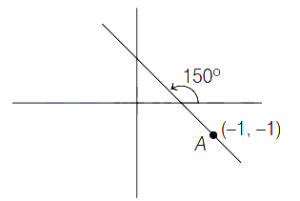
Find the equation of a straight line which passes through the point $(-1, -1)$ and makes an angle $150^{\circ}$ with the positive direction of the $X$-axis.
A
$\sqrt{3} x + y = 1$
B
$\sqrt{3} y + x + (1 + \sqrt{3}) = 0$
C
$x + \sqrt{3} y + (\sqrt{3} - 1) = 0$
D
$x + y = 0$
Solution
(B) The slope $m$ of the line is given by $m = \tan \theta$,where $\theta = 150^{\circ}$.
$m = \tan 150^{\circ} = \tan(180^{\circ} - 30^{\circ}) = -\tan 30^{\circ} = -\frac{1}{\sqrt{3}}$.
The equation of a line passing through $(x_1, y_1)$ with slope $m$ is $y - y_1 = m(x - x_1)$.
Substituting the point $(-1, -1)$ and $m = -\frac{1}{\sqrt{3}}$:
$y - (-1) = -\frac{1}{\sqrt{3}}(x - (-1))$
$y + 1 = -\frac{1}{\sqrt{3}}(x + 1)$
$\sqrt{3}(y + 1) = -(x + 1)$
$\sqrt{3}y + \sqrt{3} = -x - 1$
$x + \sqrt{3}y + \sqrt{3} + 1 = 0$
Thus,the equation is $x + \sqrt{3}y + (\sqrt{3} + 1) = 0$.
$m = \tan 150^{\circ} = \tan(180^{\circ} - 30^{\circ}) = -\tan 30^{\circ} = -\frac{1}{\sqrt{3}}$.
The equation of a line passing through $(x_1, y_1)$ with slope $m$ is $y - y_1 = m(x - x_1)$.
Substituting the point $(-1, -1)$ and $m = -\frac{1}{\sqrt{3}}$:
$y - (-1) = -\frac{1}{\sqrt{3}}(x - (-1))$
$y + 1 = -\frac{1}{\sqrt{3}}(x + 1)$
$\sqrt{3}(y + 1) = -(x + 1)$
$\sqrt{3}y + \sqrt{3} = -x - 1$
$x + \sqrt{3}y + \sqrt{3} + 1 = 0$
Thus,the equation is $x + \sqrt{3}y + (\sqrt{3} + 1) = 0$.
0 likesView Solution
167
MathematicsEasyMCQAP EAMCET · 2021
The lines $(a+2b)x + (a-3b)y = a-b$ for different values of $a$ and $b$ pass through a fixed point whose coordinates are:
A
$\left(\frac{2}{5}, \frac{2}{5}\right)$
B
$\left(\frac{3}{5}, \frac{3}{5}\right)$
C
$\left(\frac{2}{5}, \frac{3}{5}\right)$
D
$\left(\frac{3}{5}, \frac{2}{5}\right)$
Solution
(C) The given equation of the line is $(a+2b)x + (a-3b)y = a-b$.
Rearranging the terms to group coefficients of $a$ and $b$:
$ax + 2bx + ay - 3by = a - b$
$a(x + y - 1) + b(2x - 3y + 1) = 0$
For this equation to hold for all values of $a$ and $b$,the coefficients must be zero:
$x + y - 1 = 0$ $(i)$
$2x - 3y + 1 = 0$ (ii)
From $(i)$,$y = 1 - x$. Substituting into (ii):
$2x - 3(1 - x) + 1 = 0$
$2x - 3 + 3x + 1 = 0$
$5x - 2 = 0 \Rightarrow x = \frac{2}{5}$
Substituting $x = \frac{2}{5}$ into $(i)$:
$\frac{2}{5} + y - 1 = 0 \Rightarrow y = 1 - \frac{2}{5} = \frac{3}{5}$
Thus,the fixed point is $\left(\frac{2}{5}, \frac{3}{5}\right)$.
Rearranging the terms to group coefficients of $a$ and $b$:
$ax + 2bx + ay - 3by = a - b$
$a(x + y - 1) + b(2x - 3y + 1) = 0$
For this equation to hold for all values of $a$ and $b$,the coefficients must be zero:
$x + y - 1 = 0$ $(i)$
$2x - 3y + 1 = 0$ (ii)
From $(i)$,$y = 1 - x$. Substituting into (ii):
$2x - 3(1 - x) + 1 = 0$
$2x - 3 + 3x + 1 = 0$
$5x - 2 = 0 \Rightarrow x = \frac{2}{5}$
Substituting $x = \frac{2}{5}$ into $(i)$:
$\frac{2}{5} + y - 1 = 0 \Rightarrow y = 1 - \frac{2}{5} = \frac{3}{5}$
Thus,the fixed point is $\left(\frac{2}{5}, \frac{3}{5}\right)$.
0 likesView Solution
168
MathematicsDifficultMCQAP EAMCET · 2021
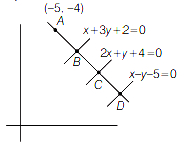
$A$ line $L$ through $A(-5,-4)$ meets the lines $x+3y+2=0$,$2x+y+4=0$,and $x-y-5=0$ at points $B$,$C$,and $D$ respectively. If $\left(\frac{15}{AB}\right)^2+\left(\frac{10}{AC}\right)^2=\left(\frac{6}{AD}\right)^2$,then find the equation of $L$.
A
$2x+3y+22=0$
B
$5x-4y+7=0$
C
$3x-2y+3=0$
D
$3x-2y+7=0$
Solution
(A) Let the equation of the line passing through $A(-5,-4)$ be $\frac{x+5}{\cos \theta} = \frac{y+4}{\sin \theta} = r$.
Any point on this line is $(-5+r\cos \theta, -4+r\sin \theta)$.
For point $B$ on $x+3y+2=0$:
$(-5+r_1\cos \theta) + 3(-4+r_1\sin \theta) + 2 = 0$ $\Rightarrow r_1(\cos \theta + 3\sin \theta) = 15$ $\Rightarrow \frac{15}{r_1} = \cos \theta + 3\sin \theta \dots (i)$.
For point $C$ on $2x+y+4=0$:
$2(-5+r_2\cos \theta) + (-4+r_2\sin \theta) + 4 = 0$ $\Rightarrow r_2(2\cos \theta + \sin \theta) = 10$ $\Rightarrow \frac{10}{r_2} = 2\cos \theta + \sin \theta \dots (ii)$.
For point $D$ on $x-y-5=0$:
$(-5+r_3\cos \theta) - (-4+r_3\sin \theta) - 5 = 0$ $\Rightarrow r_3(\cos \theta - \sin \theta) = 6$ $\Rightarrow \frac{6}{r_3} = \cos \theta - \sin \theta \dots (iii)$.
Given $\left(\frac{15}{AB}\right)^2 + \left(\frac{10}{AC}\right)^2 = \left(\frac{6}{AD}\right)^2$,we have:
$(\cos \theta + 3\sin \theta)^2 + (2\cos \theta + \sin \theta)^2 = (\cos \theta - \sin \theta)^2$.
$(\cos^2 \theta + 9\sin^2 \theta + 6\sin \theta \cos \theta) + (4\cos^2 \theta + \sin^2 \theta + 4\cos \theta \sin \theta) = \cos^2 \theta + \sin^2 \theta - 2\sin \theta \cos \theta$.
$5\cos^2 \theta + 10\sin^2 \theta + 10\sin \theta \cos \theta = \cos^2 \theta + \sin^2 \theta - 2\sin \theta \cos \theta$.
$4\cos^2 \theta + 9\sin^2 \theta + 12\sin \theta \cos \theta = 0$.
$(2\cos \theta + 3\sin \theta)^2 = 0 \Rightarrow 2\cos \theta + 3\sin \theta = 0$.
$\tan \theta = -\frac{2}{3}$.
The equation of line $L$ is $y - (-4) = -\frac{2}{3}(x - (-5))$ $\Rightarrow 3y + 12 = -2x - 10$ $\Rightarrow 2x + 3y + 22 = 0$.
Any point on this line is $(-5+r\cos \theta, -4+r\sin \theta)$.
For point $B$ on $x+3y+2=0$:
$(-5+r_1\cos \theta) + 3(-4+r_1\sin \theta) + 2 = 0$ $\Rightarrow r_1(\cos \theta + 3\sin \theta) = 15$ $\Rightarrow \frac{15}{r_1} = \cos \theta + 3\sin \theta \dots (i)$.
For point $C$ on $2x+y+4=0$:
$2(-5+r_2\cos \theta) + (-4+r_2\sin \theta) + 4 = 0$ $\Rightarrow r_2(2\cos \theta + \sin \theta) = 10$ $\Rightarrow \frac{10}{r_2} = 2\cos \theta + \sin \theta \dots (ii)$.
For point $D$ on $x-y-5=0$:
$(-5+r_3\cos \theta) - (-4+r_3\sin \theta) - 5 = 0$ $\Rightarrow r_3(\cos \theta - \sin \theta) = 6$ $\Rightarrow \frac{6}{r_3} = \cos \theta - \sin \theta \dots (iii)$.
Given $\left(\frac{15}{AB}\right)^2 + \left(\frac{10}{AC}\right)^2 = \left(\frac{6}{AD}\right)^2$,we have:
$(\cos \theta + 3\sin \theta)^2 + (2\cos \theta + \sin \theta)^2 = (\cos \theta - \sin \theta)^2$.
$(\cos^2 \theta + 9\sin^2 \theta + 6\sin \theta \cos \theta) + (4\cos^2 \theta + \sin^2 \theta + 4\cos \theta \sin \theta) = \cos^2 \theta + \sin^2 \theta - 2\sin \theta \cos \theta$.
$5\cos^2 \theta + 10\sin^2 \theta + 10\sin \theta \cos \theta = \cos^2 \theta + \sin^2 \theta - 2\sin \theta \cos \theta$.
$4\cos^2 \theta + 9\sin^2 \theta + 12\sin \theta \cos \theta = 0$.
$(2\cos \theta + 3\sin \theta)^2 = 0 \Rightarrow 2\cos \theta + 3\sin \theta = 0$.
$\tan \theta = -\frac{2}{3}$.
The equation of line $L$ is $y - (-4) = -\frac{2}{3}(x - (-5))$ $\Rightarrow 3y + 12 = -2x - 10$ $\Rightarrow 2x + 3y + 22 = 0$.
0 likesView Solution
169
MathematicsMediumMCQAP EAMCET · 2021
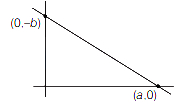
$A$ straight line $x/a - y/b = 1$ passes through the point $(8, 6)$ and cuts a triangle of area $12 \text{ sq units}$ from the axes of coordinates. The equations of the straight lines are
A
$3 x + 12 y = 12$ and $3 x + 8 y = 24$
B
$3 x - 2 y - 12 = 0$ and $3 x - 8 y + 24 = 0$
C
$2 x + 3 y = 12$ and $8 x + 3 y = 24$
D
$2 x - 3 y + 12 = 0$ and $8 x + 3 y + 24 = 0$
Solution
(B) The line $x/a - y/b = 1$ passes through $(8, 6)$,so $8/a - 6/b = 1$ . . . $(i)$.
The intercepts are $(a, 0)$ and $(0, -b)$. The area of the triangle formed with the axes is $1/2 \times |a| \times |-b| = 12$,so $|ab| = 24$,which means $ab = 24$ or $ab = -24$.
Case $1$: $b = 24/a$. Substituting into $(i)$: $8/a - 6/(24/a) = 1 \implies 8/a - a/4 = 1 \implies 32 - a^2 = 4a \implies a^2 + 4a - 32 = 0 \implies (a+8)(a-4) = 0$.
If $a = 4$,$b = 6$. The line is $x/4 - y/6 = 1 \implies 3x - 2y = 12 \implies 3x - 2y - 12 = 0$.
If $a = -8$,$b = -3$. The line is $x/(-8) - y/(-3) = 1 \implies -x/8 + y/3 = 1 \implies -3x + 8y = 24 \implies 3x - 8y + 24 = 0$.
Thus,the equations are $3x - 2y - 12 = 0$ and $3x - 8y + 24 = 0$.
The intercepts are $(a, 0)$ and $(0, -b)$. The area of the triangle formed with the axes is $1/2 \times |a| \times |-b| = 12$,so $|ab| = 24$,which means $ab = 24$ or $ab = -24$.
Case $1$: $b = 24/a$. Substituting into $(i)$: $8/a - 6/(24/a) = 1 \implies 8/a - a/4 = 1 \implies 32 - a^2 = 4a \implies a^2 + 4a - 32 = 0 \implies (a+8)(a-4) = 0$.
If $a = 4$,$b = 6$. The line is $x/4 - y/6 = 1 \implies 3x - 2y = 12 \implies 3x - 2y - 12 = 0$.
If $a = -8$,$b = -3$. The line is $x/(-8) - y/(-3) = 1 \implies -x/8 + y/3 = 1 \implies -3x + 8y = 24 \implies 3x - 8y + 24 = 0$.
Thus,the equations are $3x - 2y - 12 = 0$ and $3x - 8y + 24 = 0$.
0 likesView Solution
170
MathematicsEasyMCQAP EAMCET · 2021
If a straight line through the point $P(1, 2)$,which makes an angle $45^{\circ}$ with the $X$-axis,meets the line $3x + 4y + 5 = 0$ at $Q$,then the length of $PQ$ equals ......... units.
A
$\frac{16\sqrt{2}}{7}$
B
$\frac{\sqrt{7}}{2}$
C
$\frac{7\sqrt{2}}{16}$
D
$\frac{16}{7}$
Solution
(A) The equation of the line passing through $P(1, 2)$ with slope $m = \tan(45^{\circ}) = 1$ is given by $(y - 2) = 1(x - 1)$,which simplifies to $x - y + 1 = 0$.
To find the point $Q$,we solve the system of equations:
$x - y + 1 = 0 \Rightarrow y = x + 1$
$3x + 4y + 5 = 0$
Substituting $y = x + 1$ into the second equation:
$3x + 4(x + 1) + 5 = 0$
$3x + 4x + 4 + 5 = 0$
$7x + 9 = 0 \Rightarrow x = -\frac{9}{7}$
Then $y = -\frac{9}{7} + 1 = -\frac{2}{7}$.
So,$Q = \left(-\frac{9}{7}, -\frac{2}{7}\right)$.
The distance $PQ$ is calculated using the distance formula:
$PQ = \sqrt{\left(1 - (-\frac{9}{7})\right)^2 + \left(2 - (-\frac{2}{7})\right)^2}$
$PQ = \sqrt{\left(\frac{16}{7}\right)^2 + \left(\frac{16}{7}\right)^2}$
$PQ = \sqrt{2 \times \left(\frac{16}{7}\right)^2} = \frac{16\sqrt{2}}{7}$ units.
To find the point $Q$,we solve the system of equations:
$x - y + 1 = 0 \Rightarrow y = x + 1$
$3x + 4y + 5 = 0$
Substituting $y = x + 1$ into the second equation:
$3x + 4(x + 1) + 5 = 0$
$3x + 4x + 4 + 5 = 0$
$7x + 9 = 0 \Rightarrow x = -\frac{9}{7}$
Then $y = -\frac{9}{7} + 1 = -\frac{2}{7}$.
So,$Q = \left(-\frac{9}{7}, -\frac{2}{7}\right)$.
The distance $PQ$ is calculated using the distance formula:
$PQ = \sqrt{\left(1 - (-\frac{9}{7})\right)^2 + \left(2 - (-\frac{2}{7})\right)^2}$
$PQ = \sqrt{\left(\frac{16}{7}\right)^2 + \left(\frac{16}{7}\right)^2}$
$PQ = \sqrt{2 \times \left(\frac{16}{7}\right)^2} = \frac{16\sqrt{2}}{7}$ units.
0 likesView Solution
171
MathematicsEasyMCQAP EAMCET · 2021
If the line $px - qy = r$ intersects the coordinate axes at $(a, 0)$ and $(0, b)$,then the value of $(a + b)$ is equal to
A
$\frac{r(q+p)}{pq}$
B
$\frac{r(q-p)}{pq}$
C
$\frac{r(p-q)}{pq}$
D
$\frac{r(p-q)}{p+q}$
Solution
(B) The given equation of the line is $px - qy = r$.
Since the line intersects the $x$-axis at $(a, 0)$,we substitute $x = a$ and $y = 0$ into the equation:
$p(a) - q(0) = r$ $\Rightarrow pa = r$ $\Rightarrow a = \frac{r}{p}$.
Since the line intersects the $y$-axis at $(0, b)$,we substitute $x = 0$ and $y = b$ into the equation:
$p(0) - q(b) = r$ $\Rightarrow -qb = r$ $\Rightarrow b = -\frac{r}{q}$.
Therefore,the value of $(a + b)$ is:
$a + b = \frac{r}{p} - \frac{r}{q} = \frac{rq - rp}{pq} = \frac{r(q - p)}{pq}$.
Since the line intersects the $x$-axis at $(a, 0)$,we substitute $x = a$ and $y = 0$ into the equation:
$p(a) - q(0) = r$ $\Rightarrow pa = r$ $\Rightarrow a = \frac{r}{p}$.
Since the line intersects the $y$-axis at $(0, b)$,we substitute $x = 0$ and $y = b$ into the equation:
$p(0) - q(b) = r$ $\Rightarrow -qb = r$ $\Rightarrow b = -\frac{r}{q}$.
Therefore,the value of $(a + b)$ is:
$a + b = \frac{r}{p} - \frac{r}{q} = \frac{rq - rp}{pq} = \frac{r(q - p)}{pq}$.
0 likesView Solution
172
MathematicsEasyMCQAP EAMCET · 2021
If a point $P$ on the line $3x + 5y = 15$ is equidistant from the coordinate axes,then $P$ lies
A
only in the first quadrant
B
either in first or in second quadrant
C
either in first or in third quadrant
D
only in the third quadrant
Solution
(B) Let the point $P(h, k)$ lie on the line $3x + 5y = 15$.
Since $P$ is equidistant from the coordinate axes,we have $|h| = |k|$,which implies $h = k$ or $h = -k$.
Case $1$: If $h = k$,then $3h + 5h = 15$ $\Rightarrow 8h = 15$ $\Rightarrow h = \frac{15}{8}$. Thus,$P = (\frac{15}{8}, \frac{15}{8})$,which lies in the first quadrant.
Case $2$: If $h = -k$,then $3h + 5(-h) = 15$ $\Rightarrow -2h = 15$ $\Rightarrow h = -\frac{15}{2}$. Thus,$k = \frac{15}{2}$,and $P = (-\frac{15}{2}, \frac{15}{2})$,which lies in the second quadrant.
Therefore,$P$ lies either in the first or in the second quadrant.
Since $P$ is equidistant from the coordinate axes,we have $|h| = |k|$,which implies $h = k$ or $h = -k$.
Case $1$: If $h = k$,then $3h + 5h = 15$ $\Rightarrow 8h = 15$ $\Rightarrow h = \frac{15}{8}$. Thus,$P = (\frac{15}{8}, \frac{15}{8})$,which lies in the first quadrant.
Case $2$: If $h = -k$,then $3h + 5(-h) = 15$ $\Rightarrow -2h = 15$ $\Rightarrow h = -\frac{15}{2}$. Thus,$k = \frac{15}{2}$,and $P = (-\frac{15}{2}, \frac{15}{2})$,which lies in the second quadrant.
Therefore,$P$ lies either in the first or in the second quadrant.
0 likesView Solution
173
MathematicsEasyMCQAP EAMCET · 2021
$A$ person standing at the junction (crossing) of $2$ straight paths represented by the equations $2x - 3y + 4 = 0$ and $3x + 4y - 5 = 0$,wants to reach the path whose equation is $6x - 7y + 8 = 0$ in the least time. The equation of the path he should follow is:
A
$119x - 102y - 125 = 0$
B
$119x + 102y - 125 = 0$
C
$102x + 119y - 125 = 0$
D
$102x - 119y + 125 = 0$
Solution
(B) The person is standing at the intersection of the lines $2x - 3y + 4 = 0$ and $3x + 4y - 5 = 0$.
Solving these equations,we multiply the first by $4$ and the second by $3$:
$8x - 12y + 16 = 0$
$9x + 12y - 15 = 0$
Adding these gives $17x + 1 = 0$,so $x = -\frac{1}{17}$.
Substituting $x$ into the first equation: $2(-\frac{1}{17}) - 3y + 4 = 0$ $\Rightarrow -\frac{2}{17} + 4 = 3y$ $\Rightarrow 3y = \frac{66}{17}$ $\Rightarrow y = \frac{22}{17}$.
The junction point is $A = (-\frac{1}{17}, \frac{22}{17})$.
To reach the path $6x - 7y + 8 = 0$ in the least time,the person must walk along the perpendicular line.
The slope of the given path is $m_1 = \frac{6}{7}$.
The slope of the perpendicular line is $m_2 = -\frac{1}{m_1} = -\frac{7}{6}$.
The equation of the line passing through $(-\frac{1}{17}, \frac{22}{17})$ with slope $-\frac{7}{6}$ is:
$y - \frac{22}{17} = -\frac{7}{6}(x + \frac{1}{17})$
$6(17y - 22) = -7(17x + 1)$
$102y - 132 = -119x - 7$
$119x + 102y - 125 = 0$.
Solving these equations,we multiply the first by $4$ and the second by $3$:
$8x - 12y + 16 = 0$
$9x + 12y - 15 = 0$
Adding these gives $17x + 1 = 0$,so $x = -\frac{1}{17}$.
Substituting $x$ into the first equation: $2(-\frac{1}{17}) - 3y + 4 = 0$ $\Rightarrow -\frac{2}{17} + 4 = 3y$ $\Rightarrow 3y = \frac{66}{17}$ $\Rightarrow y = \frac{22}{17}$.
The junction point is $A = (-\frac{1}{17}, \frac{22}{17})$.
To reach the path $6x - 7y + 8 = 0$ in the least time,the person must walk along the perpendicular line.
The slope of the given path is $m_1 = \frac{6}{7}$.
The slope of the perpendicular line is $m_2 = -\frac{1}{m_1} = -\frac{7}{6}$.
The equation of the line passing through $(-\frac{1}{17}, \frac{22}{17})$ with slope $-\frac{7}{6}$ is:
$y - \frac{22}{17} = -\frac{7}{6}(x + \frac{1}{17})$
$6(17y - 22) = -7(17x + 1)$
$102y - 132 = -119x - 7$
$119x + 102y - 125 = 0$.
0 likesView Solution
174
MathematicsEasyMCQAP EAMCET · 2021
The angle between the straight lines $3x + 4y + 9 = 0$ and $x - 7y - 22 = 0$ is
A
$\frac{\pi}{4}$
B
$\frac{\pi}{6}$
C
$\frac{\pi}{3}$
D
$\frac{\pi}{8}$
Solution
(A) Given,the equations of the straight lines are:
$l_1: 3x + 4y + 9 = 0$ ...$(i)$
$l_2: x - 7y - 22 = 0$ ...(ii)
The slope of line $l_1$ is $m_1 = -\frac{3}{4}$.
The slope of line $l_2$ is $m_2 = -\frac{1}{-7} = \frac{1}{7}$.
Let $\theta$ be the angle between the lines $l_1$ and $l_2$. The formula for the angle between two lines is:
$\tan \theta = \left| \frac{m_1 - m_2}{1 + m_1 m_2} \right|$
Substituting the values of $m_1$ and $m_2$:
$\tan \theta = \left| \frac{-\frac{3}{4} - \frac{1}{7}}{1 + (-\frac{3}{4})(\frac{1}{7})} \right|$
$\tan \theta = \left| \frac{-\frac{21+4}{28}}{1 - \frac{3}{28}} \right| = \left| \frac{-\frac{25}{28}}{\frac{25}{28}} \right|$
$\tan \theta = |-1| = 1$
Since $\tan \theta = 1$,we have $\theta = \frac{\pi}{4}$.
$l_1: 3x + 4y + 9 = 0$ ...$(i)$
$l_2: x - 7y - 22 = 0$ ...(ii)
The slope of line $l_1$ is $m_1 = -\frac{3}{4}$.
The slope of line $l_2$ is $m_2 = -\frac{1}{-7} = \frac{1}{7}$.
Let $\theta$ be the angle between the lines $l_1$ and $l_2$. The formula for the angle between two lines is:
$\tan \theta = \left| \frac{m_1 - m_2}{1 + m_1 m_2} \right|$
Substituting the values of $m_1$ and $m_2$:
$\tan \theta = \left| \frac{-\frac{3}{4} - \frac{1}{7}}{1 + (-\frac{3}{4})(\frac{1}{7})} \right|$
$\tan \theta = \left| \frac{-\frac{21+4}{28}}{1 - \frac{3}{28}} \right| = \left| \frac{-\frac{25}{28}}{\frac{25}{28}} \right|$
$\tan \theta = |-1| = 1$
Since $\tan \theta = 1$,we have $\theta = \frac{\pi}{4}$.
0 likesView Solution
175
MathematicsMediumMCQAP EAMCET · 2021
If a pair of lines drawn through the origin forms an isosceles right-angled triangle with the line $2x + 3y = 6$,then those lines are
A
$x - 5y = 0, 5x + y = 0$
B
$3x - y = 0, x + 3y = 0$
C
$5x - y = 0, x + 5y = 0$
D
$x - 3y = 0, 3x + y = 0$
Solution
(A) The given line is $2x + 3y = 6$,which has a slope $m_1 = -2/3$.
Since the pair of lines passing through the origin forms an isosceles right-angled triangle with this line,the lines must make an angle of $45^{\circ}$ with the given line.
Let the slope of the required lines be $m$. The angle between the lines is given by $\tan \theta = |(m - m_1) / (1 + m \cdot m_1)|$.
Setting $\theta = 45^{\circ}$ and $m_1 = -2/3$:
$1 = |(m - (-2/3)) / (1 + m(-2/3))| = |(3m + 2) / (3 - 2m)|$.
This gives two cases:
Case $1$: $(3m + 2) / (3 - 2m) = 1$ $\Rightarrow 3m + 2 = 3 - 2m$ $\Rightarrow 5m = 1$ $\Rightarrow m = 1/5$.
The equation of the line is $y = (1/5)x \Rightarrow x - 5y = 0$.
Case $2$: $(3m + 2) / (3 - 2m) = -1$ $\Rightarrow 3m + 2 = -3 + 2m$ $\Rightarrow m = -5$.
The equation of the line is $y = -5x \Rightarrow 5x + y = 0$.
Thus,the lines are $x - 5y = 0$ and $5x + y = 0$.
Since the pair of lines passing through the origin forms an isosceles right-angled triangle with this line,the lines must make an angle of $45^{\circ}$ with the given line.
Let the slope of the required lines be $m$. The angle between the lines is given by $\tan \theta = |(m - m_1) / (1 + m \cdot m_1)|$.
Setting $\theta = 45^{\circ}$ and $m_1 = -2/3$:
$1 = |(m - (-2/3)) / (1 + m(-2/3))| = |(3m + 2) / (3 - 2m)|$.
This gives two cases:
Case $1$: $(3m + 2) / (3 - 2m) = 1$ $\Rightarrow 3m + 2 = 3 - 2m$ $\Rightarrow 5m = 1$ $\Rightarrow m = 1/5$.
The equation of the line is $y = (1/5)x \Rightarrow x - 5y = 0$.
Case $2$: $(3m + 2) / (3 - 2m) = -1$ $\Rightarrow 3m + 2 = -3 + 2m$ $\Rightarrow m = -5$.
The equation of the line is $y = -5x \Rightarrow 5x + y = 0$.
Thus,the lines are $x - 5y = 0$ and $5x + y = 0$.
0 likesView Solution
176
MathematicsEasyMCQAP EAMCET · 2021
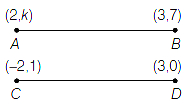
Find the value of $k$,if the line joining the points $(2, k)$ and $(3, 7)$ is parallel to the line joining points $(-2, 1)$ and $(3, 0)$.
A
$\frac{37}{5}$
B
$\frac{34}{5}$
C
$\frac{36}{5}$
D
$\frac{35}{5}$
Solution
(C) Let the points be $A(2, k)$,$B(3, 7)$,$C(-2, 1)$,and $D(3, 0)$.
Since the line $AB$ is parallel to the line $CD$,their slopes must be equal,i.e.,$m_{AB} = m_{CD}$.
The slope of a line passing through $(x_1, y_1)$ and $(x_2, y_2)$ is given by $m = \frac{y_2 - y_1}{x_2 - x_1}$.
$m_{AB} = \frac{7 - k}{3 - 2} = \frac{7 - k}{1} = 7 - k$.
$m_{CD} = \frac{0 - 1}{3 - (-2)} = \frac{-1}{3 + 2} = \frac{-1}{5}$.
Equating the slopes: $7 - k = \frac{-1}{5}$.
$35 - 5k = -1$.
$5k = 36$.
$k = \frac{36}{5}$.
Since the line $AB$ is parallel to the line $CD$,their slopes must be equal,i.e.,$m_{AB} = m_{CD}$.
The slope of a line passing through $(x_1, y_1)$ and $(x_2, y_2)$ is given by $m = \frac{y_2 - y_1}{x_2 - x_1}$.
$m_{AB} = \frac{7 - k}{3 - 2} = \frac{7 - k}{1} = 7 - k$.
$m_{CD} = \frac{0 - 1}{3 - (-2)} = \frac{-1}{3 + 2} = \frac{-1}{5}$.
Equating the slopes: $7 - k = \frac{-1}{5}$.
$35 - 5k = -1$.
$5k = 36$.
$k = \frac{36}{5}$.
0 likesView Solution
177
MathematicsDifficultMCQAP EAMCET · 2021
If $A(1,3)$ and $C(7,5)$ are two opposite vertices of a square,then find the equation of a side passing through $A$.
A
$x-2y+5=0$
B
$x-2y+1=0$
C
$x-3y+8=0$
D
$2x-y+1=0$
Solution
(D) Let $ABCD$ be a square where $A \equiv (1,3)$ and $C \equiv (7,5)$.
Diagonal $AC$ has slope $m_{AC} = \frac{5-3}{7-1} = \frac{2}{6} = \frac{1}{3}$.
Let the slope of the side $AB$ be $m$.
Since the diagonal of a square makes an angle of $45^{\circ}$ with the sides,we have $\left| \frac{m - 1/3}{1 + m(1/3)} \right| = \tan 45^{\circ} = 1$.
$\left| \frac{3m-1}{3+m} \right| = 1$.
Case $1$: $\frac{3m-1}{3+m} = 1$ $\Rightarrow 3m-1 = 3+m$ $\Rightarrow 2m = 4$ $\Rightarrow m = 2$.
The equation of the side passing through $A(1,3)$ with slope $m=2$ is $y-3 = 2(x-1)$ $\Rightarrow y-3 = 2x-2$ $\Rightarrow 2x-y+1 = 0$.
Case $2$: $\frac{3m-1}{3+m} = -1$ $\Rightarrow 3m-1 = -3-m$ $\Rightarrow 4m = -2$ $\Rightarrow m = -1/2$.
The equation of the side passing through $A(1,3)$ with slope $m=-1/2$ is $y-3 = -1/2(x-1)$ $\Rightarrow 2y-6 = -x+1$ $\Rightarrow x+2y-7 = 0$.
Comparing with the options,$2x-y+1=0$ is present.
Diagonal $AC$ has slope $m_{AC} = \frac{5-3}{7-1} = \frac{2}{6} = \frac{1}{3}$.
Let the slope of the side $AB$ be $m$.
Since the diagonal of a square makes an angle of $45^{\circ}$ with the sides,we have $\left| \frac{m - 1/3}{1 + m(1/3)} \right| = \tan 45^{\circ} = 1$.
$\left| \frac{3m-1}{3+m} \right| = 1$.
Case $1$: $\frac{3m-1}{3+m} = 1$ $\Rightarrow 3m-1 = 3+m$ $\Rightarrow 2m = 4$ $\Rightarrow m = 2$.
The equation of the side passing through $A(1,3)$ with slope $m=2$ is $y-3 = 2(x-1)$ $\Rightarrow y-3 = 2x-2$ $\Rightarrow 2x-y+1 = 0$.
Case $2$: $\frac{3m-1}{3+m} = -1$ $\Rightarrow 3m-1 = -3-m$ $\Rightarrow 4m = -2$ $\Rightarrow m = -1/2$.
The equation of the side passing through $A(1,3)$ with slope $m=-1/2$ is $y-3 = -1/2(x-1)$ $\Rightarrow 2y-6 = -x+1$ $\Rightarrow x+2y-7 = 0$.
Comparing with the options,$2x-y+1=0$ is present.
0 likesView Solution
178
MathematicsMediumMCQAP EAMCET · 2021
The equations of the lines passing through the point $(3,2)$ which make an angle of $45^{\circ}$ with the line $x-2y=3$ are
A
$3x-y=7$ and $x+3y=9$
B
$x-3y=7$ and $3x+y=9$
C
$x-y=3$ and $x+y=2$
D
$2x+y=7$ and $x-2y=9$
Solution
(A) Let $m_1$ be the slope of the line passing through $(3,2)$ and $m_2$ be the slope of $x-2y=3$.
$m_2 = \frac{-1}{-2} = \frac{1}{2}$.
The angle between the lines is $45^{\circ}$,so $\tan 45^{\circ} = \left| \frac{m_1 - m_2}{1 + m_1 m_2} \right|$.
$1 = \left| \frac{m_1 - 1/2}{1 + m_1/2} \right| = \left| \frac{2m_1 - 1}{2 + m_1} \right|$.
Case $1$: $\frac{2m_1 - 1}{2 + m_1} = 1$ $\Rightarrow 2m_1 - 1 = 2 + m_1$ $\Rightarrow m_1 = 3$.
The equation is $y - 2 = 3(x - 3)$ $\Rightarrow y - 2 = 3x - 9$ $\Rightarrow 3x - y = 7$.
Case $2$: $\frac{2m_1 - 1}{2 + m_1} = -1$ $\Rightarrow 2m_1 - 1 = -2 - m_1$ $\Rightarrow 3m_1 = -1$ $\Rightarrow m_1 = -1/3$.
The equation is $y - 2 = -\frac{1}{3}(x - 3)$ $\Rightarrow 3y - 6 = -x + 3$ $\Rightarrow x + 3y = 9$.
Thus,the equations are $3x - y = 7$ and $x + 3y = 9$.
$m_2 = \frac{-1}{-2} = \frac{1}{2}$.
The angle between the lines is $45^{\circ}$,so $\tan 45^{\circ} = \left| \frac{m_1 - m_2}{1 + m_1 m_2} \right|$.
$1 = \left| \frac{m_1 - 1/2}{1 + m_1/2} \right| = \left| \frac{2m_1 - 1}{2 + m_1} \right|$.
Case $1$: $\frac{2m_1 - 1}{2 + m_1} = 1$ $\Rightarrow 2m_1 - 1 = 2 + m_1$ $\Rightarrow m_1 = 3$.
The equation is $y - 2 = 3(x - 3)$ $\Rightarrow y - 2 = 3x - 9$ $\Rightarrow 3x - y = 7$.
Case $2$: $\frac{2m_1 - 1}{2 + m_1} = -1$ $\Rightarrow 2m_1 - 1 = -2 - m_1$ $\Rightarrow 3m_1 = -1$ $\Rightarrow m_1 = -1/3$.
The equation is $y - 2 = -\frac{1}{3}(x - 3)$ $\Rightarrow 3y - 6 = -x + 3$ $\Rightarrow x + 3y = 9$.
Thus,the equations are $3x - y = 7$ and $x + 3y = 9$.
0 likesView Solution
179
MathematicsMediumMCQAP EAMCET · 2021
If the products of the perpendiculars from the origin to the pairs of lines $xy+x+y+1=0$,$x^2-y^2+2x+1=0$,and $2x^2+3xy-2y^2+2x+1=0$ are $p_1, p_2$,and $p_3$ respectively,then:
A
$p_1 < p_2 < p_3$
B
$p_1 < p_3 < p_2$
C
$p_3 < p_2 < p_1$
D
$p_2 < p_1 < p_3$
Solution
(C) The product of the perpendiculars from the origin $(0,0)$ to the pair of lines represented by $ax^2 + 2hxy + by^2 + 2gx + 2fy + c = 0$ is given by $p = \left| \frac{c}{\sqrt{(a-b)^2 + 4h^2}} \right|$.
For $xy+x+y+1=0$:
$a=0, b=0, h=1/2, c=1$.
$p_1 = \left| \frac{1}{\sqrt{(0-0)^2 + 4(1/2)^2}} \right| = \left| \frac{1}{\sqrt{1}} \right| = 1$.
For $x^2-y^2+2x+1=0$:
$a=1, b=-1, h=0, c=1$.
$p_2 = \left| \frac{1}{\sqrt{(1-(-1))^2 + 4(0)^2}} \right| = \left| \frac{1}{\sqrt{4}} \right| = 1/2$.
For $2x^2+3xy-2y^2+2x+1=0$:
$a=2, b=-2, h=3/2, c=1$.
$p_3 = \left| \frac{1}{\sqrt{(2-(-2))^2 + 4(3/2)^2}} \right| = \left| \frac{1}{\sqrt{16 + 9}} \right| = \frac{1}{\sqrt{25}} = 1/5$.
Comparing the values: $1/5 < 1/2 < 1$,which means $p_3 < p_2 < p_1$.
For $xy+x+y+1=0$:
$a=0, b=0, h=1/2, c=1$.
$p_1 = \left| \frac{1}{\sqrt{(0-0)^2 + 4(1/2)^2}} \right| = \left| \frac{1}{\sqrt{1}} \right| = 1$.
For $x^2-y^2+2x+1=0$:
$a=1, b=-1, h=0, c=1$.
$p_2 = \left| \frac{1}{\sqrt{(1-(-1))^2 + 4(0)^2}} \right| = \left| \frac{1}{\sqrt{4}} \right| = 1/2$.
For $2x^2+3xy-2y^2+2x+1=0$:
$a=2, b=-2, h=3/2, c=1$.
$p_3 = \left| \frac{1}{\sqrt{(2-(-2))^2 + 4(3/2)^2}} \right| = \left| \frac{1}{\sqrt{16 + 9}} \right| = \frac{1}{\sqrt{25}} = 1/5$.
Comparing the values: $1/5 < 1/2 < 1$,which means $p_3 < p_2 < p_1$.
0 likesView Solution
180
MathematicsMediumMCQAP EAMCET · 2021
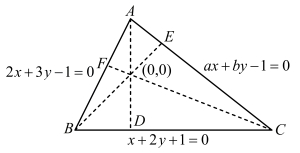
If the orthocenter of the triangle formed by the lines $2x + 3y - 1 = 0$,$x + 2y + 1 = 0$,and $ax + by - 1 = 0$ lies at the origin,then $\frac{1}{a} + \frac{1}{b} =$
A
$0$
B
$\frac{1}{60}$
C
$\frac{1}{8}$
D
$4$
Solution
(B) Let the lines be $L_1: 2x + 3y - 1 = 0$,$L_2: x + 2y + 1 = 0$,and $L_3: ax + by - 1 = 0$. The orthocenter is at $(0, 0)$.
Since the orthocenter is the intersection of altitudes,the altitude from vertex $B$ (intersection of $L_1$ and $L_2$) passes through $(0, 0)$ and is perpendicular to $L_3$. The family of lines through $B$ is $(2x + 3y - 1) + \lambda(x + 2y + 1) = 0$. Since it passes through $(0, 0)$,we have $-1 + \lambda = 0 \Rightarrow \lambda = 1$. The altitude is $3x + 5y = 0$,with slope $m = -\frac{3}{5}$. Since this is perpendicular to $L_3$ (slope $-\frac{a}{b}$),we have $(-\frac{a}{b}) \times (-\frac{3}{5}) = -1 \Rightarrow 3a = -5b$.
Similarly,the altitude from vertex $A$ (intersection of $L_1$ and $L_3$) passes through $(0, 0)$ and is perpendicular to $L_2$ (slope $-\frac{1}{2}$). The family of lines through $A$ is $(2x + 3y - 1) + \mu(ax + by - 1) = 0$. Since it passes through $(0, 0)$,we have $-1 - \mu = 0 \Rightarrow \mu = -1$. The altitude is $(2-a)x + (3-b)y = 0$,with slope $-\frac{2-a}{3-b}$. Since this is perpendicular to $L_2$,we have $(-\frac{2-a}{3-b}) \times (-\frac{1}{2}) = -1$ $\Rightarrow 2-a = -2(3-b)$ $\Rightarrow a + 2b = 8$.
Solving $3a = -5b$ and $a + 2b = 8$,we get $a = -40$ and $b = 24$. Wait,checking the calculation: $a = -40, b = 24 \Rightarrow 3(-40) = -120, -5(24) = -120$ (Correct). $a + 2b = -40 + 48 = 8$ (Correct). Thus,$\frac{1}{a} + \frac{1}{b} = -\frac{1}{40} + \frac{1}{24} = \frac{-3 + 5}{120} = \frac{2}{120} = \frac{1}{60}$.
Since the orthocenter is the intersection of altitudes,the altitude from vertex $B$ (intersection of $L_1$ and $L_2$) passes through $(0, 0)$ and is perpendicular to $L_3$. The family of lines through $B$ is $(2x + 3y - 1) + \lambda(x + 2y + 1) = 0$. Since it passes through $(0, 0)$,we have $-1 + \lambda = 0 \Rightarrow \lambda = 1$. The altitude is $3x + 5y = 0$,with slope $m = -\frac{3}{5}$. Since this is perpendicular to $L_3$ (slope $-\frac{a}{b}$),we have $(-\frac{a}{b}) \times (-\frac{3}{5}) = -1 \Rightarrow 3a = -5b$.
Similarly,the altitude from vertex $A$ (intersection of $L_1$ and $L_3$) passes through $(0, 0)$ and is perpendicular to $L_2$ (slope $-\frac{1}{2}$). The family of lines through $A$ is $(2x + 3y - 1) + \mu(ax + by - 1) = 0$. Since it passes through $(0, 0)$,we have $-1 - \mu = 0 \Rightarrow \mu = -1$. The altitude is $(2-a)x + (3-b)y = 0$,with slope $-\frac{2-a}{3-b}$. Since this is perpendicular to $L_2$,we have $(-\frac{2-a}{3-b}) \times (-\frac{1}{2}) = -1$ $\Rightarrow 2-a = -2(3-b)$ $\Rightarrow a + 2b = 8$.
Solving $3a = -5b$ and $a + 2b = 8$,we get $a = -40$ and $b = 24$. Wait,checking the calculation: $a = -40, b = 24 \Rightarrow 3(-40) = -120, -5(24) = -120$ (Correct). $a + 2b = -40 + 48 = 8$ (Correct). Thus,$\frac{1}{a} + \frac{1}{b} = -\frac{1}{40} + \frac{1}{24} = \frac{-3 + 5}{120} = \frac{2}{120} = \frac{1}{60}$.
0 likesView Solution
181
MathematicsMediumMCQAP EAMCET · 2021
The points $(2, 3, 4)$,$(-1, -2, 1)$,and $(5, 8, 7)$ are
A
collinear
B
vertices of a right-angled triangle
C
vertices of an equilateral triangle
D
vertices of an isosceles triangle
Solution
(A) Let the points be $A(2, 3, 4)$,$B(-1, -2, 1)$,and $C(5, 8, 7)$.
We check if the points are collinear by calculating the distance between them.
$AB = \sqrt{(-1-2)^2 + (-2-3)^2 + (1-4)^2} = \sqrt{(-3)^2 + (-5)^2 + (-3)^2} = \sqrt{9 + 25 + 9} = \sqrt{43}$.
$BC = \sqrt{(5-(-1))^2 + (8-(-2))^2 + (7-1)^2} = \sqrt{6^2 + 10^2 + 6^2} = \sqrt{36 + 100 + 36} = \sqrt{172} = 2\sqrt{43}$.
$AC = \sqrt{(5-2)^2 + (8-3)^2 + (7-4)^2} = \sqrt{3^2 + 5^2 + 3^2} = \sqrt{9 + 25 + 9} = \sqrt{43}$.
Since $AB + AC = \sqrt{43} + \sqrt{43} = 2\sqrt{43} = BC$,the points $A, B, C$ are collinear.
We check if the points are collinear by calculating the distance between them.
$AB = \sqrt{(-1-2)^2 + (-2-3)^2 + (1-4)^2} = \sqrt{(-3)^2 + (-5)^2 + (-3)^2} = \sqrt{9 + 25 + 9} = \sqrt{43}$.
$BC = \sqrt{(5-(-1))^2 + (8-(-2))^2 + (7-1)^2} = \sqrt{6^2 + 10^2 + 6^2} = \sqrt{36 + 100 + 36} = \sqrt{172} = 2\sqrt{43}$.
$AC = \sqrt{(5-2)^2 + (8-3)^2 + (7-4)^2} = \sqrt{3^2 + 5^2 + 3^2} = \sqrt{9 + 25 + 9} = \sqrt{43}$.
Since $AB + AC = \sqrt{43} + \sqrt{43} = 2\sqrt{43} = BC$,the points $A, B, C$ are collinear.
0 likesView Solution
182
MathematicsEasyMCQAP EAMCET · 2021
If a point $(a, a)$ lies between the lines $|x+y|=4$,then
A
$|a|=2$
B
$|a|=3$
C
$|a| < 2$
D
$|a| < 3$
Solution
(C) The equation $|x+y|=4$ represents two parallel lines: $x+y=4$ and $x+y=-4$.
For a point $(a, a)$ to lie between these two lines,the expression $(x+y)$ evaluated at $(a, a)$ must lie between the values $-4$ and $4$.
Substituting $(a, a)$ into the expression $x+y$,we get $a+a = 2a$.
Thus,the condition is $-4 < 2a < 4$.
Dividing the inequality by $2$,we get $-2 < a < 2$.
This is equivalent to $|a| < 2$.
For a point $(a, a)$ to lie between these two lines,the expression $(x+y)$ evaluated at $(a, a)$ must lie between the values $-4$ and $4$.
Substituting $(a, a)$ into the expression $x+y$,we get $a+a = 2a$.
Thus,the condition is $-4 < 2a < 4$.
Dividing the inequality by $2$,we get $-2 < a < 2$.
This is equivalent to $|a| < 2$.
0 likesView Solution
183
MathematicsMediumMCQAP EAMCET · 2021
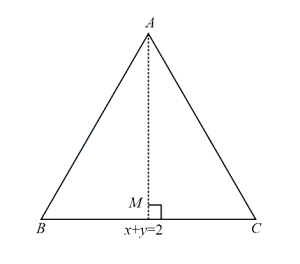
The equation of the base of an equilateral triangle is $x+y=2$ and one vertex is $(2,-1)$. The length of the side of the triangle is:
A
$\sqrt{3/2}$
B
$\sqrt{2}$
C
$\sqrt{2/3}$
D
$\sqrt{3}$
Solution
(C) Let $\triangle ABC$ be the equilateral triangle with base $BC$ given by $x+y-2=0$ and vertex $A$ as $(2,-1)$.
The length of the altitude $h$ from vertex $A$ to the base $BC$ is the perpendicular distance from $(2,-1)$ to $x+y-2=0$.
$h = \frac{|(1)(2) + (1)(-1) - 2|}{\sqrt{1^2 + 1^2}} = \frac{|2 - 1 - 2|}{\sqrt{2}} = \frac{|-1|}{\sqrt{2}} = \frac{1}{\sqrt{2}}$.
In an equilateral triangle with side length $s$,the altitude $h$ is given by $h = \frac{\sqrt{3}}{2}s$.
Therefore,$\frac{1}{\sqrt{2}} = \frac{\sqrt{3}}{2}s$.
$s = \frac{2}{\sqrt{2} \times \sqrt{3}} = \frac{\sqrt{2}}{\sqrt{3}} = \sqrt{\frac{2}{3}}$.
The length of the altitude $h$ from vertex $A$ to the base $BC$ is the perpendicular distance from $(2,-1)$ to $x+y-2=0$.
$h = \frac{|(1)(2) + (1)(-1) - 2|}{\sqrt{1^2 + 1^2}} = \frac{|2 - 1 - 2|}{\sqrt{2}} = \frac{|-1|}{\sqrt{2}} = \frac{1}{\sqrt{2}}$.
In an equilateral triangle with side length $s$,the altitude $h$ is given by $h = \frac{\sqrt{3}}{2}s$.
Therefore,$\frac{1}{\sqrt{2}} = \frac{\sqrt{3}}{2}s$.
$s = \frac{2}{\sqrt{2} \times \sqrt{3}} = \frac{\sqrt{2}}{\sqrt{3}} = \sqrt{\frac{2}{3}}$.
0 likesView Solution
184
MathematicsMediumMCQAP EAMCET · 2021
The distance of the point $(1, 2)$ from the line $x + y + 5 = 0$ measured along the line parallel to $3x - y = 7$ is equal to
A
$4 \sqrt{10}$
B
$40$
C
$\sqrt{40}$
D
$2 \sqrt{20}$
Solution
(C) Let the equation of the line parallel to $3x - y = 7$ be $3x - y = \lambda$.
Since it passes through $(1, 2)$,this point must satisfy the equation $3x - y = \lambda$.
$\therefore 3(1) - 2 = \lambda \Rightarrow \lambda = 1$.
So,the line is $3x - y = 1$.
Now,we find the intersection of $x + y + 5 = 0$ and $3x - y = 1$.
Adding the two equations: $(x + y + 5) + (3x - y) = 0 + 1$ $\Rightarrow 4x + 5 = 1$ $\Rightarrow 4x = -4$ $\Rightarrow x = -1$.
Substituting $x = -1$ into $x + y + 5 = 0$: $-1 + y + 5 = 0 \Rightarrow y = -4$.
So,the point of intersection is $(-1, -4)$.
The required distance is the distance between $(1, 2)$ and $(-1, -4)$.
Using the distance formula: $d = \sqrt{(1 - (-1))^2 + (2 - (-4))^2} = \sqrt{2^2 + 6^2} = \sqrt{4 + 36} = \sqrt{40}$.
Since it passes through $(1, 2)$,this point must satisfy the equation $3x - y = \lambda$.
$\therefore 3(1) - 2 = \lambda \Rightarrow \lambda = 1$.
So,the line is $3x - y = 1$.
Now,we find the intersection of $x + y + 5 = 0$ and $3x - y = 1$.
Adding the two equations: $(x + y + 5) + (3x - y) = 0 + 1$ $\Rightarrow 4x + 5 = 1$ $\Rightarrow 4x = -4$ $\Rightarrow x = -1$.
Substituting $x = -1$ into $x + y + 5 = 0$: $-1 + y + 5 = 0 \Rightarrow y = -4$.
So,the point of intersection is $(-1, -4)$.
The required distance is the distance between $(1, 2)$ and $(-1, -4)$.
Using the distance formula: $d = \sqrt{(1 - (-1))^2 + (2 - (-4))^2} = \sqrt{2^2 + 6^2} = \sqrt{4 + 36} = \sqrt{40}$.
0 likesView Solution
185
MathematicsMediumMCQAP EAMCET · 2021
If $(\alpha, \beta)$ is the image of the point $(3, -4)$ with respect to the line $4x - y - 1 = 0$,then the value of $\beta - \alpha$ is equal to
A
$\frac{-31}{17}$
B
$\frac{-107}{17}$
C
$\frac{31}{17}$
D
$\frac{13}{71}$
Solution
(C) Let the image of the point $(3, -4)$ with respect to the line $4x - y - 1 = 0$ be $P(\alpha, \beta)$.
Using the formula for the image of a point $(x_1, y_1)$ with respect to the line $ax + by + c = 0$ is $\frac{\alpha - x_1}{a} = \frac{\beta - y_1}{b} = \frac{-2(ax_1 + by_1 + c)}{a^2 + b^2}$.
Substituting the values,we get:
$\frac{\alpha - 3}{4} = \frac{\beta + 4}{-1} = \frac{-2(4(3) - (-4) - 1)}{4^2 + (-1)^2}$.
$\frac{\alpha - 3}{4} = \frac{\beta + 4}{-1} = \frac{-2(12 + 4 - 1)}{16 + 1} = \frac{-2(15)}{17} = \frac{-30}{17}$.
Now,solving for $\alpha$:
$\frac{\alpha - 3}{4} = \frac{-30}{17}$ $\Rightarrow \alpha - 3 = \frac{-120}{17}$ $\Rightarrow \alpha = 3 - \frac{120}{17} = \frac{51 - 120}{17} = \frac{-69}{17}$.
Solving for $\beta$:
$\frac{\beta + 4}{-1} = \frac{-30}{17}$ $\Rightarrow \beta + 4 = \frac{30}{17}$ $\Rightarrow \beta = \frac{30}{17} - 4 = \frac{30 - 68}{17} = \frac{-38}{17}$.
Finally,calculating $\beta - \alpha$:
$\beta - \alpha = \frac{-38}{17} - (\frac{-69}{17}) = \frac{-38 + 69}{17} = \frac{31}{17}$.
Using the formula for the image of a point $(x_1, y_1)$ with respect to the line $ax + by + c = 0$ is $\frac{\alpha - x_1}{a} = \frac{\beta - y_1}{b} = \frac{-2(ax_1 + by_1 + c)}{a^2 + b^2}$.
Substituting the values,we get:
$\frac{\alpha - 3}{4} = \frac{\beta + 4}{-1} = \frac{-2(4(3) - (-4) - 1)}{4^2 + (-1)^2}$.
$\frac{\alpha - 3}{4} = \frac{\beta + 4}{-1} = \frac{-2(12 + 4 - 1)}{16 + 1} = \frac{-2(15)}{17} = \frac{-30}{17}$.
Now,solving for $\alpha$:
$\frac{\alpha - 3}{4} = \frac{-30}{17}$ $\Rightarrow \alpha - 3 = \frac{-120}{17}$ $\Rightarrow \alpha = 3 - \frac{120}{17} = \frac{51 - 120}{17} = \frac{-69}{17}$.
Solving for $\beta$:
$\frac{\beta + 4}{-1} = \frac{-30}{17}$ $\Rightarrow \beta + 4 = \frac{30}{17}$ $\Rightarrow \beta = \frac{30}{17} - 4 = \frac{30 - 68}{17} = \frac{-38}{17}$.
Finally,calculating $\beta - \alpha$:
$\beta - \alpha = \frac{-38}{17} - (\frac{-69}{17}) = \frac{-38 + 69}{17} = \frac{31}{17}$.
0 likesView Solution
186
MathematicsMediumMCQAP EAMCET · 2021
If $p_1$ and $p_2$ denote the lengths of perpendiculars from $(2,3)$ onto the lines given by $15 x^2+31 x y+14 y^2=0$,and if $p_1 > p_2$,then $p_1^2 + \frac{1}{74} - p_2^2 + \frac{1}{13}$ is equal to
A
-$2$
B
$0$
C
$2$
D
$1$
Solution
(C) The given equation of the pair of lines is $15 x^2 + 31 x y + 14 y^2 = 0$.
Factoring the quadratic expression: $15 x^2 + 10 x y + 21 x y + 14 y^2 = 0$ $\Rightarrow 5 x(3 x + 2 y) + 7 y(3 x + 2 y) = 0$ $\Rightarrow (3 x + 2 y)(5 x + 7 y) = 0$.
Thus,the two lines are $L_1: 3 x + 2 y = 0$ and $L_2: 5 x + 7 y = 0$.
The perpendicular distance from $(2,3)$ to $3 x + 2 y = 0$ is $d_1 = \frac{|3(2) + 2(3)|}{\sqrt{3^2 + 2^2}} = \frac{12}{\sqrt{13}}$.
The perpendicular distance from $(2,3)$ to $5 x + 7 y = 0$ is $d_2 = \frac{|5(2) + 7(3)|}{\sqrt{5^2 + 7^2}} = \frac{31}{\sqrt{74}}$.
Since $p_1 > p_2$,we have $p_1 = \frac{31}{\sqrt{74}}$ and $p_2 = \frac{12}{\sqrt{13}}$.
Now,calculating $p_1^2 + \frac{1}{74} - p_2^2 + \frac{1}{13} = \frac{31^2}{74} + \frac{1}{74} - \frac{12^2}{13} + \frac{1}{13} = \frac{961+1}{74} - \frac{144-1}{13} = \frac{962}{74} - \frac{143}{13} = 13 - 11 = 2$.
Factoring the quadratic expression: $15 x^2 + 10 x y + 21 x y + 14 y^2 = 0$ $\Rightarrow 5 x(3 x + 2 y) + 7 y(3 x + 2 y) = 0$ $\Rightarrow (3 x + 2 y)(5 x + 7 y) = 0$.
Thus,the two lines are $L_1: 3 x + 2 y = 0$ and $L_2: 5 x + 7 y = 0$.
The perpendicular distance from $(2,3)$ to $3 x + 2 y = 0$ is $d_1 = \frac{|3(2) + 2(3)|}{\sqrt{3^2 + 2^2}} = \frac{12}{\sqrt{13}}$.
The perpendicular distance from $(2,3)$ to $5 x + 7 y = 0$ is $d_2 = \frac{|5(2) + 7(3)|}{\sqrt{5^2 + 7^2}} = \frac{31}{\sqrt{74}}$.
Since $p_1 > p_2$,we have $p_1 = \frac{31}{\sqrt{74}}$ and $p_2 = \frac{12}{\sqrt{13}}$.
Now,calculating $p_1^2 + \frac{1}{74} - p_2^2 + \frac{1}{13} = \frac{31^2}{74} + \frac{1}{74} - \frac{12^2}{13} + \frac{1}{13} = \frac{961+1}{74} - \frac{144-1}{13} = \frac{962}{74} - \frac{143}{13} = 13 - 11 = 2$.
0 likesView Solution
187
MathematicsMediumMCQAP EAMCET · 2021
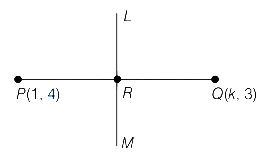
The perpendicular bisector of the line segment joining the points $P(1, 4)$ and $Q(k, 3)$ has a $y$-intercept of $-4$. Then a possible value of $k$ among the following is:
A
$2$
B
$-2$
C
$-4$
D
$-1$
Solution
(C) Let $LM$ be the perpendicular bisector of $PQ$ at $R$.
The midpoint $R$ of $PQ$ is given by:
$R = \left(\frac{1+k}{2}, \frac{4+3}{2}\right) = \left(\frac{k+1}{2}, \frac{7}{2}\right)$
The slope of $PQ$ is:
$m_{PQ} = \frac{3-4}{k-1} = \frac{-1}{k-1}$
Since $LM$ is perpendicular to $PQ$,the slope of $LM$ $(m_{LM})$ is:
$m_{LM} = -\frac{1}{m_{PQ}} = -\frac{1}{-1/(k-1)} = k-1$
The equation of the line $LM$ with slope $(k-1)$ and $y$-intercept $-4$ is:
$y = (k-1)x - 4$
Since the perpendicular bisector passes through the midpoint $R\left(\frac{k+1}{2}, \frac{7}{2}\right)$,it must satisfy the equation:
$\frac{7}{2} = (k-1)\left(\frac{k+1}{2}\right) - 4$
Multiply by $2$ on both sides:
$7 = (k-1)(k+1) - 8$
$7 = k^2 - 1 - 8$
$7 = k^2 - 9$
$k^2 = 16$
$k = \pm 4$
Thus,a possible value of $k$ is $-4$.
The midpoint $R$ of $PQ$ is given by:
$R = \left(\frac{1+k}{2}, \frac{4+3}{2}\right) = \left(\frac{k+1}{2}, \frac{7}{2}\right)$
The slope of $PQ$ is:
$m_{PQ} = \frac{3-4}{k-1} = \frac{-1}{k-1}$
Since $LM$ is perpendicular to $PQ$,the slope of $LM$ $(m_{LM})$ is:
$m_{LM} = -\frac{1}{m_{PQ}} = -\frac{1}{-1/(k-1)} = k-1$
The equation of the line $LM$ with slope $(k-1)$ and $y$-intercept $-4$ is:
$y = (k-1)x - 4$
Since the perpendicular bisector passes through the midpoint $R\left(\frac{k+1}{2}, \frac{7}{2}\right)$,it must satisfy the equation:
$\frac{7}{2} = (k-1)\left(\frac{k+1}{2}\right) - 4$
Multiply by $2$ on both sides:
$7 = (k-1)(k+1) - 8$
$7 = k^2 - 1 - 8$
$7 = k^2 - 9$
$k^2 = 16$
$k = \pm 4$
Thus,a possible value of $k$ is $-4$.
0 likesView Solution
188
MathematicsEasyMCQAP EAMCET · 2021
The distance between the lines $3x + 4y = 9$ and $6x + 8y = 15$ is
A
$\frac{3}{2}$
B
$\frac{3}{10}$
C
$6$
D
$\frac{3}{5}$
Solution
(B) To find the distance between the lines $3x + 4y = 9$ and $6x + 8y = 15$,we first rewrite them in the form $ax + by + c = 0$.
Dividing the second equation by $2$,we get $3x + 4y = 7.5$ or $3x + 4y - 7.5 = 0$.
The first equation is $3x + 4y - 9 = 0$.
The distance $d$ between two parallel lines $ax + by + c_1 = 0$ and $ax + by + c_2 = 0$ is given by $d = \left| \frac{c_1 - c_2}{\sqrt{a^2 + b^2}} \right|$.
Here,$a = 3$,$b = 4$,$c_1 = -9$,and $c_2 = -7.5$.
$d = \left| \frac{-9 - (-7.5)}{\sqrt{3^2 + 4^2}} \right| = \left| \frac{-1.5}{\sqrt{9 + 16}} \right| = \left| \frac{-1.5}{5} \right| = \frac{1.5}{5} = \frac{3}{10} \text{ units}$.
Dividing the second equation by $2$,we get $3x + 4y = 7.5$ or $3x + 4y - 7.5 = 0$.
The first equation is $3x + 4y - 9 = 0$.
The distance $d$ between two parallel lines $ax + by + c_1 = 0$ and $ax + by + c_2 = 0$ is given by $d = \left| \frac{c_1 - c_2}{\sqrt{a^2 + b^2}} \right|$.
Here,$a = 3$,$b = 4$,$c_1 = -9$,and $c_2 = -7.5$.
$d = \left| \frac{-9 - (-7.5)}{\sqrt{3^2 + 4^2}} \right| = \left| \frac{-1.5}{\sqrt{9 + 16}} \right| = \left| \frac{-1.5}{5} \right| = \frac{1.5}{5} = \frac{3}{10} \text{ units}$.
0 likesView Solution
189
MathematicsEasyMCQAP EAMCET · 2021
If the equation $8x^2+8xy+2y^2+26x+13y+15=0$ represents a pair of parallel straight lines,then the distance between them is.........
A
$\frac{7}{\sqrt{5}}$
B
$\frac{7}{2\sqrt{5}}$
C
$\frac{2}{\sqrt{5}}$
D
$\frac{7}{\sqrt{3}}$
Solution
(B) The given equation is $8x^2+8xy+2y^2+26x+13y+15=0$ ...$(i)$
We can rewrite the equation as $2(4x^2+4xy+y^2)+13(2x+y)+15=0$.
Let $2x+y=t$. Then the equation becomes $2t^2+13t+15=0$.
Factoring the quadratic: $2t^2+10t+3t+15=0 \Rightarrow 2t(t+5)+3(t+5)=0$.
So,$(2t+3)(t+5)=0$.
Substituting $t=2x+y$ back,we get $(2(2x+y)+3)(2x+y+5)=0$.
This simplifies to $(4x+2y+3)(2x+y+5)=0$.
Thus,the two lines are $4x+2y+3=0$ and $2x+y+5=0$.
Dividing the first line by $2$,we get $2x+y+1.5=0$.
The distance $d$ between parallel lines $Ax+By+C_1=0$ and $Ax+By+C_2=0$ is given by $d = \frac{|C_1-C_2|}{\sqrt{A^2+B^2}}$.
Here,$A=2, B=1, C_1=5, C_2=1.5$.
$d = \frac{|5-1.5|}{\sqrt{2^2+1^2}} = \frac{3.5}{\sqrt{5}} = \frac{7}{2\sqrt{5}}$.
We can rewrite the equation as $2(4x^2+4xy+y^2)+13(2x+y)+15=0$.
Let $2x+y=t$. Then the equation becomes $2t^2+13t+15=0$.
Factoring the quadratic: $2t^2+10t+3t+15=0 \Rightarrow 2t(t+5)+3(t+5)=0$.
So,$(2t+3)(t+5)=0$.
Substituting $t=2x+y$ back,we get $(2(2x+y)+3)(2x+y+5)=0$.
This simplifies to $(4x+2y+3)(2x+y+5)=0$.
Thus,the two lines are $4x+2y+3=0$ and $2x+y+5=0$.
Dividing the first line by $2$,we get $2x+y+1.5=0$.
The distance $d$ between parallel lines $Ax+By+C_1=0$ and $Ax+By+C_2=0$ is given by $d = \frac{|C_1-C_2|}{\sqrt{A^2+B^2}}$.
Here,$A=2, B=1, C_1=5, C_2=1.5$.
$d = \frac{|5-1.5|}{\sqrt{2^2+1^2}} = \frac{3.5}{\sqrt{5}} = \frac{7}{2\sqrt{5}}$.
0 likesView Solution
190
MathematicsEasyMCQAP EAMCET · 2021
The distance between the pair of parallel lines represented by $x^2+2xy+y^2-8ax-8ay-9a^2=0$ is $...$ units.
A
$5 \sqrt{2}$
B
$5 \sqrt{2} a$
C
$2 \sqrt{5} a$
D
$a$
Solution
(B) The given equation is $x^2+2xy+y^2-8ax-8ay-9a^2=0$.
Comparing this with the general second-degree equation $Ax^2+2Hxy+By^2+2Gx+2Fy+C=0$,we get $A=1, B=1, H=1, G=-4a, F=-4a, C=-9a^2$.
The distance $d$ between two parallel lines represented by $Ax^2+2Hxy+By^2+2Gx+2Fy+C=0$ is given by the formula $d = 2 \sqrt{\frac{G^2-AC}{A(A+B)}}$.
Substituting the values:
$d = 2 \sqrt{\frac{(-4a)^2 - (1)(-9a^2)}{1(1+1)}}$
$d = 2 \sqrt{\frac{16a^2 + 9a^2}{2}}$
$d = 2 \sqrt{\frac{25a^2}{2}} = 2 \times \frac{5a}{\sqrt{2}} = 5\sqrt{2}a$.
Thus,the distance is $5\sqrt{2}a$ units.
Comparing this with the general second-degree equation $Ax^2+2Hxy+By^2+2Gx+2Fy+C=0$,we get $A=1, B=1, H=1, G=-4a, F=-4a, C=-9a^2$.
The distance $d$ between two parallel lines represented by $Ax^2+2Hxy+By^2+2Gx+2Fy+C=0$ is given by the formula $d = 2 \sqrt{\frac{G^2-AC}{A(A+B)}}$.
Substituting the values:
$d = 2 \sqrt{\frac{(-4a)^2 - (1)(-9a^2)}{1(1+1)}}$
$d = 2 \sqrt{\frac{16a^2 + 9a^2}{2}}$
$d = 2 \sqrt{\frac{25a^2}{2}} = 2 \times \frac{5a}{\sqrt{2}} = 5\sqrt{2}a$.
Thus,the distance is $5\sqrt{2}a$ units.
0 likesView Solution
191
MathematicsMediumMCQAP EAMCET · 2021
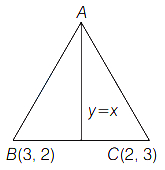
In an isosceles $\triangle ABC$,the coordinates of vertices $B$ and $C$ of the base $BC$ are $(3, 2)$ and $(2, 3)$ respectively. If the equation of the line $AB$ is $3y = 2x$,then the equation of the line $AC$ is
A
$2y = 3x$
B
$2y = x$
C
$x + y = 0$
D
$2x - y = 0$
Solution
(A) Given that $\triangle ABC$ is an isosceles triangle with base $BC$ where $B \equiv (3, 2)$ and $C \equiv (2, 3)$.
Note that the points $B(3, 2)$ and $C(2, 3)$ are symmetric with respect to the line $y = x$.
Since the triangle is isosceles with base $BC$,the vertex $A$ must lie on the perpendicular bisector of $BC$. The perpendicular bisector of the segment joining $(3, 2)$ and $(2, 3)$ is the line $y = x$.
Because the entire configuration is symmetric about the line $y = x$,the line $AC$ is the reflection of the line $AB$ about the line $y = x$.
To find the reflection of the line $3y = 2x$ about $y = x$,we swap $x$ and $y$ in the equation.
Replacing $x$ with $y$ and $y$ with $x$,we get $3x = 2y$,which is $2y = 3x$.
Thus,the equation of the line $AC$ is $2y = 3x$.
Note that the points $B(3, 2)$ and $C(2, 3)$ are symmetric with respect to the line $y = x$.
Since the triangle is isosceles with base $BC$,the vertex $A$ must lie on the perpendicular bisector of $BC$. The perpendicular bisector of the segment joining $(3, 2)$ and $(2, 3)$ is the line $y = x$.
Because the entire configuration is symmetric about the line $y = x$,the line $AC$ is the reflection of the line $AB$ about the line $y = x$.
To find the reflection of the line $3y = 2x$ about $y = x$,we swap $x$ and $y$ in the equation.
Replacing $x$ with $y$ and $y$ with $x$,we get $3x = 2y$,which is $2y = 3x$.
Thus,the equation of the line $AC$ is $2y = 3x$.
0 likesView Solution
192
MathematicsMediumMCQAP EAMCET · 2021
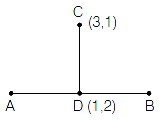
The equation of a line passing through the point $(1, 2)$ whose distance from the point $(3, 1)$ is the greatest is
A
$y = 2x$
B
$y = x + 1$
C
$x + 2y = 5$
D
$y = 3x - 1$
Solution
(A) Let the given point be $P(1, 2)$ and the external point be $Q(3, 1)$.
We want to find the equation of a line passing through $P$ such that its perpendicular distance from $Q$ is maximized.
The perpendicular distance from a point $Q$ to a line passing through $P$ is always less than or equal to the distance $PQ$ itself.
The maximum distance is achieved when the line is perpendicular to the segment $PQ$ at point $P$.
Let the line be $L$. Since $L \perp PQ$,the slope of $L$ is the negative reciprocal of the slope of $PQ$.
Slope of $PQ = \frac{1 - 2}{3 - 1} = \frac{-1}{2}$.
Therefore,the slope of line $L$ is $m = -(\frac{1}{-1/2}) = 2$.
The equation of line $L$ passing through $(1, 2)$ with slope $2$ is:
$y - 2 = 2(x - 1)$
$y - 2 = 2x - 2$
$y = 2x$.
We want to find the equation of a line passing through $P$ such that its perpendicular distance from $Q$ is maximized.
The perpendicular distance from a point $Q$ to a line passing through $P$ is always less than or equal to the distance $PQ$ itself.
The maximum distance is achieved when the line is perpendicular to the segment $PQ$ at point $P$.
Let the line be $L$. Since $L \perp PQ$,the slope of $L$ is the negative reciprocal of the slope of $PQ$.
Slope of $PQ = \frac{1 - 2}{3 - 1} = \frac{-1}{2}$.
Therefore,the slope of line $L$ is $m = -(\frac{1}{-1/2}) = 2$.
The equation of line $L$ passing through $(1, 2)$ with slope $2$ is:
$y - 2 = 2(x - 1)$
$y - 2 = 2x - 2$
$y = 2x$.
0 likesView Solution
193
MathematicsMediumMCQAP EAMCET · 2021
Identify the point on the line $2x + 3y + 7 = 0$,which is at a distance of $3$ units from $(1, -3)$.
A
$\left(\frac{\sqrt{13}+9}{\sqrt{13}}, \frac{-3 \sqrt{13}+6}{\sqrt{13}}\right)$
B
$\left(\frac{\sqrt{13}-9}{\sqrt{13}}, \frac{-3 \sqrt{13}-6}{\sqrt{13}}\right)$
C
$\left(\frac{\sqrt{13}-9}{\sqrt{13}}, \frac{-3 \sqrt{13}+6}{\sqrt{13}}\right)$
D
$\left(\frac{\sqrt{13}+9}{\sqrt{13}}, \frac{3 \sqrt{13}-6}{\sqrt{13}}\right)$
Solution
(C) Let $P(\alpha, \beta)$ be the point on the line $2x + 3y + 7 = 0$.
Then $2\alpha + 3\beta + 7 = 0$,so $\beta = \frac{-7-2\alpha}{3}$.
The point $P$ is $\left(\alpha, \frac{-7-2\alpha}{3}\right)$.
The distance between $P(\alpha, \beta)$ and $A(1, -3)$ is $3$.
Using the distance formula: $(\alpha - 1)^2 + \left(\frac{-7-2\alpha}{3} + 3\right)^2 = 3^2$.
$(\alpha - 1)^2 + \left(\frac{-7-2\alpha+9}{3}\right)^2 = 9$.
$(\alpha - 1)^2 + \left(\frac{2-2\alpha}{3}\right)^2 = 9$.
$(\alpha - 1)^2 + \frac{4(1-\alpha)^2}{9} = 9$.
$(\alpha - 1)^2 \left(1 + \frac{4}{9}\right) = 9$.
$(\alpha - 1)^2 \left(\frac{13}{9}\right) = 9$.
$(\alpha - 1)^2 = \frac{81}{13}$.
$\alpha - 1 = \pm \frac{9}{\sqrt{13}}$.
$\alpha = 1 \pm \frac{9}{\sqrt{13}} = \frac{\sqrt{13} \pm 9}{\sqrt{13}}$.
For $\alpha = \frac{\sqrt{13}-9}{\sqrt{13}}$,$\beta = \frac{-7 - 2(\frac{\sqrt{13}-9}{\sqrt{13}})}{3} = \frac{-7\sqrt{13} - 2\sqrt{13} + 18}{3\sqrt{13}} = \frac{-9\sqrt{13} + 18}{3\sqrt{13}} = \frac{-3\sqrt{13} + 6}{\sqrt{13}}$.
Thus,the point is $\left(\frac{\sqrt{13}-9}{\sqrt{13}}, \frac{-3\sqrt{13}+6}{\sqrt{13}}\right)$.
Then $2\alpha + 3\beta + 7 = 0$,so $\beta = \frac{-7-2\alpha}{3}$.
The point $P$ is $\left(\alpha, \frac{-7-2\alpha}{3}\right)$.
The distance between $P(\alpha, \beta)$ and $A(1, -3)$ is $3$.
Using the distance formula: $(\alpha - 1)^2 + \left(\frac{-7-2\alpha}{3} + 3\right)^2 = 3^2$.
$(\alpha - 1)^2 + \left(\frac{-7-2\alpha+9}{3}\right)^2 = 9$.
$(\alpha - 1)^2 + \left(\frac{2-2\alpha}{3}\right)^2 = 9$.
$(\alpha - 1)^2 + \frac{4(1-\alpha)^2}{9} = 9$.
$(\alpha - 1)^2 \left(1 + \frac{4}{9}\right) = 9$.
$(\alpha - 1)^2 \left(\frac{13}{9}\right) = 9$.
$(\alpha - 1)^2 = \frac{81}{13}$.
$\alpha - 1 = \pm \frac{9}{\sqrt{13}}$.
$\alpha = 1 \pm \frac{9}{\sqrt{13}} = \frac{\sqrt{13} \pm 9}{\sqrt{13}}$.
For $\alpha = \frac{\sqrt{13}-9}{\sqrt{13}}$,$\beta = \frac{-7 - 2(\frac{\sqrt{13}-9}{\sqrt{13}})}{3} = \frac{-7\sqrt{13} - 2\sqrt{13} + 18}{3\sqrt{13}} = \frac{-9\sqrt{13} + 18}{3\sqrt{13}} = \frac{-3\sqrt{13} + 6}{\sqrt{13}}$.
Thus,the point is $\left(\frac{\sqrt{13}-9}{\sqrt{13}}, \frac{-3\sqrt{13}+6}{\sqrt{13}}\right)$.
0 likesView Solution
194
MathematicsMediumMCQAP EAMCET · 2021
The point to which the origin should be shifted in order to eliminate the $x$ and $y$ terms from the equation $9x^2+4y^2+10x+12y+1=0$ is
A
$\left(\frac{5}{9}, \frac{3}{2}\right)$
B
$\left(-\frac{5}{2}, -\frac{3}{9}\right)$
C
$\left(-\frac{5}{9}, -\frac{3}{2}\right)$
D
$\left(-\frac{3}{2}, -\frac{5}{9}\right)$
Solution
(C) Let the origin be shifted to $(h, k)$.
Let $(x', y')$ be the new coordinates.
Then $x = x' + h$ and $y = y' + k$.
Substituting these into the given equation $9x^2 + 4y^2 + 10x + 12y + 1 = 0$:
$9(x' + h)^2 + 4(y' + k)^2 + 10(x' + h) + 12(y' + k) + 1 = 0$
Expanding the terms:
$9(x'^2 + 2x'h + h^2) + 4(y'^2 + 2y'k + k^2) + 10x' + 10h + 12y' + 12k + 1 = 0$
Grouping the $x'$ and $y'$ terms:
$9x'^2 + 4y'^2 + x'(18h + 10) + y'(8k + 12) + (9h^2 + 4k^2 + 10h + 12k + 1) = 0$
To eliminate the $x'$ and $y'$ terms,we set their coefficients to zero:
$18h + 10 = 0 \implies h = -\frac{10}{18} = -\frac{5}{9}$
$8k + 12 = 0 \implies k = -\frac{12}{8} = -\frac{3}{2}$
Thus,the origin should be shifted to $\left(-\frac{5}{9}, -\frac{3}{2}\right)$.
Let $(x', y')$ be the new coordinates.
Then $x = x' + h$ and $y = y' + k$.
Substituting these into the given equation $9x^2 + 4y^2 + 10x + 12y + 1 = 0$:
$9(x' + h)^2 + 4(y' + k)^2 + 10(x' + h) + 12(y' + k) + 1 = 0$
Expanding the terms:
$9(x'^2 + 2x'h + h^2) + 4(y'^2 + 2y'k + k^2) + 10x' + 10h + 12y' + 12k + 1 = 0$
Grouping the $x'$ and $y'$ terms:
$9x'^2 + 4y'^2 + x'(18h + 10) + y'(8k + 12) + (9h^2 + 4k^2 + 10h + 12k + 1) = 0$
To eliminate the $x'$ and $y'$ terms,we set their coefficients to zero:
$18h + 10 = 0 \implies h = -\frac{10}{18} = -\frac{5}{9}$
$8k + 12 = 0 \implies k = -\frac{12}{8} = -\frac{3}{2}$
Thus,the origin should be shifted to $\left(-\frac{5}{9}, -\frac{3}{2}\right)$.
0 likesView Solution
195
MathematicsDifficultMCQAP EAMCET · 2021
If one of the lines given by the equation $2x^2 + axy + 3y^2 = 0$ coincides with one of those given by the equation $2x^2 + bxy - 3y^2 = 0$,while the other two lines are perpendicular to each other,then the values of $a$ and $b$ are
A
$a = -5$ and $b = 1$
B
$a = -4$ and $b = -1$
C
$a = 4$ and $b = 1$
D
$a = -5$ and $b = -1$
Solution
(D) Let the slopes of the lines represented by $2x^2 + axy + 3y^2 = 0$ be $m$ and $m_1$. Then $m + m_1 = -a/3$ and $mm_1 = 2/3$.
Let the slopes of the lines represented by $2x^2 + bxy - 3y^2 = 0$ be $m$ and $m_2$. Then $m + m_2 = -b/(-3) = b/3$ and $mm_2 = 2/(-3) = -2/3$.
Since the other two lines are perpendicular,$m_1m_2 = -1$.
Dividing the product of slopes: $(mm_1) / (mm_2) = (2/3) / (-2/3) = -1$.
Thus,$m_1 / m_2 = -1$,which implies $m_1 = -m_2$ or $m_1 + m_2 = 0$.
From $mm_1 = 2/3$ and $mm_2 = -2/3$,we have $m_1 = 2/(3m)$ and $m_2 = -2/(3m)$.
Substituting into $m_1m_2 = -1$: $(2/(3m)) \times (-2/(3m)) = -1$ $\Rightarrow -4/(9m^2) = -1$ $\Rightarrow m^2 = 4/9$ $\Rightarrow m = 2/3$ (taking $m = 2/3$).
Then $m_1 = (2/3) / (2/3) = 1$ and $m_2 = (-2/3) / (2/3) = -1$.
Using $m + m_1 = -a/3$: $2/3 + 1 = -a/3$ $\Rightarrow 5/3 = -a/3$ $\Rightarrow a = -5$.
Using $m + m_2 = b/3$: $2/3 - 1 = b/3$ $\Rightarrow -1/3 = b/3$ $\Rightarrow b = -1$.
Let the slopes of the lines represented by $2x^2 + bxy - 3y^2 = 0$ be $m$ and $m_2$. Then $m + m_2 = -b/(-3) = b/3$ and $mm_2 = 2/(-3) = -2/3$.
Since the other two lines are perpendicular,$m_1m_2 = -1$.
Dividing the product of slopes: $(mm_1) / (mm_2) = (2/3) / (-2/3) = -1$.
Thus,$m_1 / m_2 = -1$,which implies $m_1 = -m_2$ or $m_1 + m_2 = 0$.
From $mm_1 = 2/3$ and $mm_2 = -2/3$,we have $m_1 = 2/(3m)$ and $m_2 = -2/(3m)$.
Substituting into $m_1m_2 = -1$: $(2/(3m)) \times (-2/(3m)) = -1$ $\Rightarrow -4/(9m^2) = -1$ $\Rightarrow m^2 = 4/9$ $\Rightarrow m = 2/3$ (taking $m = 2/3$).
Then $m_1 = (2/3) / (2/3) = 1$ and $m_2 = (-2/3) / (2/3) = -1$.
Using $m + m_1 = -a/3$: $2/3 + 1 = -a/3$ $\Rightarrow 5/3 = -a/3$ $\Rightarrow a = -5$.
Using $m + m_2 = b/3$: $2/3 - 1 = b/3$ $\Rightarrow -1/3 = b/3$ $\Rightarrow b = -1$.
0 likesView Solution
196
MathematicsEasyMCQAP EAMCET · 2021
If the straight lines $2x - y + 1 = 0$,$4x + y + 2 = 0$,and $x + y - k = 0$ are concurrent,then $k$ equals
A
$\frac{1}{2}$
B
$2$
C
$-2$
D
$\frac{-1}{2}$
Solution
(D) For the lines to be concurrent,the determinant of their coefficients must be zero:
$\left| \begin{array}{ccc} 2 & -1 & 1 \\ 4 & 1 & 2 \\ 1 & 1 & -k \end{array} \right| = 0$
Expanding along the first row:
$2(-k - 2) - (-1)(-4k - 2) + 1(4 - 1) = 0$
$-2k - 4 - 4k - 2 + 3 = 0$
$-6k - 3 = 0$
$-6k = 3$
$k = -\frac{1}{2}$
$\left| \begin{array}{ccc} 2 & -1 & 1 \\ 4 & 1 & 2 \\ 1 & 1 & -k \end{array} \right| = 0$
Expanding along the first row:
$2(-k - 2) - (-1)(-4k - 2) + 1(4 - 1) = 0$
$-2k - 4 - 4k - 2 + 3 = 0$
$-6k - 3 = 0$
$-6k = 3$
$k = -\frac{1}{2}$
0 likesView Solution
197
MathematicsMediumMCQAP EAMCET · 2021
If $2x + 3y + 4 = 0$ is the perpendicular bisector of the line segment joining the points $A(1, 2)$ and $B(\alpha, \beta)$,then the value of $13\alpha + 13\beta$ equals $......$
A
$-81$
B
$-99$
C
$99$
D
$81$
Solution
(A) The line $2x + 3y + 4 = 0$ is the perpendicular bisector of $AB$.
First,the midpoint $M$ of $AB$ lies on the line:
$M = (\frac{1+\alpha}{2}, \frac{2+\beta}{2})$
$2(\frac{1+\alpha}{2}) + 3(\frac{2+\beta}{2}) + 4 = 0$
$1 + \alpha + 3 + \frac{3\beta}{2} + 4 = 0$
$2\alpha + 3\beta + 16 = 0$ ... $(i)$
Second,the slope of $AB$ is perpendicular to the slope of the given line $(-2/3)$:
$\frac{\beta - 2}{\alpha - 1} \times (-\frac{2}{3}) = -1$
$2(\beta - 2) = 3(\alpha - 1)$
$2\beta - 4 = 3\alpha - 3$
$3\alpha - 2\beta + 1 = 0$ ... $(ii)$
Solving $(i)$ and $(ii)$:
Multiply $(i)$ by $2$ and $(ii)$ by $3$:
$4\alpha + 6\beta = -32$
$9\alpha - 6\beta = -3$
Adding them: $13\alpha = -35 \Rightarrow \alpha = -\frac{35}{13}$
Substituting $\alpha$ in $(ii)$: $3(-\frac{35}{13}) - 2\beta + 1 = 0
-\frac{105}{13} + 1 = 2\beta
-\frac{92}{13} = 2\beta$ $\Rightarrow \beta = -\frac{46}{13}$
Finally,$13\alpha + 13\beta = 13(-\frac{35}{13}) + 13(-\frac{46}{13}) = -35 - 46 = -81$.
First,the midpoint $M$ of $AB$ lies on the line:
$M = (\frac{1+\alpha}{2}, \frac{2+\beta}{2})$
$2(\frac{1+\alpha}{2}) + 3(\frac{2+\beta}{2}) + 4 = 0$
$1 + \alpha + 3 + \frac{3\beta}{2} + 4 = 0$
$2\alpha + 3\beta + 16 = 0$ ... $(i)$
Second,the slope of $AB$ is perpendicular to the slope of the given line $(-2/3)$:
$\frac{\beta - 2}{\alpha - 1} \times (-\frac{2}{3}) = -1$
$2(\beta - 2) = 3(\alpha - 1)$
$2\beta - 4 = 3\alpha - 3$
$3\alpha - 2\beta + 1 = 0$ ... $(ii)$
Solving $(i)$ and $(ii)$:
Multiply $(i)$ by $2$ and $(ii)$ by $3$:
$4\alpha + 6\beta = -32$
$9\alpha - 6\beta = -3$
Adding them: $13\alpha = -35 \Rightarrow \alpha = -\frac{35}{13}$
Substituting $\alpha$ in $(ii)$: $3(-\frac{35}{13}) - 2\beta + 1 = 0
-\frac{105}{13} + 1 = 2\beta
-\frac{92}{13} = 2\beta$ $\Rightarrow \beta = -\frac{46}{13}$
Finally,$13\alpha + 13\beta = 13(-\frac{35}{13}) + 13(-\frac{46}{13}) = -35 - 46 = -81$.
0 likesView Solution
198
MathematicsMediumMCQAP EAMCET · 2021
For three consecutive odd integers $a, b$ and $c$,if the variable line $a x+b y+c=0$ always passes through the point $(\alpha, \beta)$,the value of $\alpha^2+\beta^2$ equals
A
$9$
B
$4$
C
$5$
D
$3$
Solution
(C) The given line is $ax + by + c = 0$.
Since $a, b,$ and $c$ are three consecutive odd integers,they are in arithmetic progression.
Thus,$b - a = c - b$,which implies $c = 2b - a$.
Substituting $c$ into the line equation: $ax + by + (2b - a) = 0$.
Rearranging the terms: $a(x - 1) + b(y + 2) = 0$.
For this line to pass through the fixed point $(\alpha, \beta)$ for all such $a$ and $b$,the coefficients must satisfy:
$\alpha - 1 = 0 \Rightarrow \alpha = 1$ and $\beta + 2 = 0 \Rightarrow \beta = -2$.
Therefore,the value of $\alpha^2 + \beta^2 = 1^2 + (-2)^2 = 1 + 4 = 5$.
Since $a, b,$ and $c$ are three consecutive odd integers,they are in arithmetic progression.
Thus,$b - a = c - b$,which implies $c = 2b - a$.
Substituting $c$ into the line equation: $ax + by + (2b - a) = 0$.
Rearranging the terms: $a(x - 1) + b(y + 2) = 0$.
For this line to pass through the fixed point $(\alpha, \beta)$ for all such $a$ and $b$,the coefficients must satisfy:
$\alpha - 1 = 0 \Rightarrow \alpha = 1$ and $\beta + 2 = 0 \Rightarrow \beta = -2$.
Therefore,the value of $\alpha^2 + \beta^2 = 1^2 + (-2)^2 = 1 + 4 = 5$.
0 likesView Solution
199
MathematicsMediumMCQAP EAMCET · 2021
If $A(4,7)$,$B(-7,8)$,and $C(1,2)$ are the vertices of $\triangle ABC$,then the equation of the perpendicular bisector of the side $AB$ is
A
$x-11y-24=0$
B
$11x+y+24=0$
C
$11x-y+24=0$
D
$11x+y-24=0$
Solution
(C) The slope of the side $AB$ is $m_{AB} = \frac{8-7}{-7-4} = \frac{1}{-11} = -\frac{1}{11}$.
Since the perpendicular bisector is perpendicular to $AB$,its slope $m$ is given by $m \times m_{AB} = -1$,so $m = 11$.
The midpoint $D$ of side $AB$ is $\left(\frac{4+(-7)}{2}, \frac{7+8}{2}\right) = \left(-\frac{3}{2}, \frac{15}{2}\right)$.
The equation of the line passing through $D\left(-\frac{3}{2}, \frac{15}{2}\right)$ with slope $m=11$ is:
$y - \frac{15}{2} = 11\left(x - (-\frac{3}{2}\right))$
$y - \frac{15}{2} = 11\left(x + \frac{3}{2}\right)$
$y - \frac{15}{2} = 11x + \frac{33}{2}$
$11x - y + \frac{33}{2} + \frac{15}{2} = 0$
$11x - y + \frac{48}{2} = 0$
$11x - y + 24 = 0$.
Since the perpendicular bisector is perpendicular to $AB$,its slope $m$ is given by $m \times m_{AB} = -1$,so $m = 11$.
The midpoint $D$ of side $AB$ is $\left(\frac{4+(-7)}{2}, \frac{7+8}{2}\right) = \left(-\frac{3}{2}, \frac{15}{2}\right)$.
The equation of the line passing through $D\left(-\frac{3}{2}, \frac{15}{2}\right)$ with slope $m=11$ is:
$y - \frac{15}{2} = 11\left(x - (-\frac{3}{2}\right))$
$y - \frac{15}{2} = 11\left(x + \frac{3}{2}\right)$
$y - \frac{15}{2} = 11x + \frac{33}{2}$
$11x - y + \frac{33}{2} + \frac{15}{2} = 0$
$11x - y + \frac{48}{2} = 0$
$11x - y + 24 = 0$.
0 likesView Solution
200
MathematicsMediumMCQAP EAMCET · 2021
The locus of a point which is at a distance of $4$ units from $(3, -2)$ in the $xy$-plane is
A
$x^2+y^2+6x-4y+16=0$
B
$x^2+y^2-6x-4y+3=0$
C
$x^2+y^2-6x+4y-16=0$
D
$x^2+y^2-6x+4y-3=0$
Solution
(D) Let the point be $(x, y)$.
The distance between $(x, y)$ and $(3, -2)$ is given as $4$ units.
Using the distance formula,$\sqrt{(x-3)^2 + (y-(-2))^2} = 4$.
Squaring both sides,we get $(x-3)^2 + (y+2)^2 = 16$.
Expanding the terms,$x^2 - 6x + 9 + y^2 + 4y + 4 = 16$.
Simplifying the equation,$x^2 + y^2 - 6x + 4y + 13 = 16$.
Thus,the locus is $x^2 + y^2 - 6x + 4y - 3 = 0$.
The distance between $(x, y)$ and $(3, -2)$ is given as $4$ units.
Using the distance formula,$\sqrt{(x-3)^2 + (y-(-2))^2} = 4$.
Squaring both sides,we get $(x-3)^2 + (y+2)^2 = 16$.
Expanding the terms,$x^2 - 6x + 9 + y^2 + 4y + 4 = 16$.
Simplifying the equation,$x^2 + y^2 - 6x + 4y + 13 = 16$.
Thus,the locus is $x^2 + y^2 - 6x + 4y - 3 = 0$.
0 likesView Solution
201
MathematicsEasyMCQAP EAMCET · 2021
If the radius of a sphere is measured as $9 \ cm$ with an error of $0.03 \ cm$, then find the approximate error in calculating its surface area. (in $\pi \ cm^2$)
A
$2.16$
B
$21.6$
C
$216$
D
$0.216$
Solution
(A) Let $r$ be the radius of the sphere and $\Delta r$ be the error in measuring the radius.
Given, $r = 9 \ cm$ and $\Delta r = 0.03 \ cm$.
The surface area $S$ of a sphere is given by $S = 4 \pi r^2$.
To find the approximate error in the surface area, we differentiate $S$ with respect to $r$:
$\frac{dS}{dr} = 8 \pi r$.
Using the differential approximation, $\Delta S \approx \frac{dS}{dr} \times \Delta r$.
Substituting the values:
$\Delta S = 8 \pi \times 9 \times 0.03$.
$\Delta S = 72 \pi \times 0.03 = 2.16 \pi \ cm^2$.
Thus, the approximate error in calculating the surface area is $2.16 \pi \ cm^2$.
Given, $r = 9 \ cm$ and $\Delta r = 0.03 \ cm$.
The surface area $S$ of a sphere is given by $S = 4 \pi r^2$.
To find the approximate error in the surface area, we differentiate $S$ with respect to $r$:
$\frac{dS}{dr} = 8 \pi r$.
Using the differential approximation, $\Delta S \approx \frac{dS}{dr} \times \Delta r$.
Substituting the values:
$\Delta S = 8 \pi \times 9 \times 0.03$.
$\Delta S = 72 \pi \times 0.03 = 2.16 \pi \ cm^2$.
Thus, the approximate error in calculating the surface area is $2.16 \pi \ cm^2$.
0 likesView Solution
202
MathematicsEasyMCQAP EAMCET · 2021
The diameter and altitude of a right circular cone,at a certain instant,were found to be $10 \ cm$ and $20 \ cm$ respectively. If its diameter is increasing at a rate of $2 \ cm/s$,then at what rate must its altitude change,in order to keep its volume constant (in $cm/s$)?
A
$4$
B
$6$
C
$-4$
D
$-8$
Solution
(D) Let $D$ be the diameter,$r$ be the radius,and $h$ be the altitude of the right circular cone.
Given $D = 10 \ cm$,so $r = 5 \ cm$.
Given $h = 20 \ cm$.
The rate of change of diameter is $\frac{dD}{dt} = 2 \ cm/s$.
Since $D = 2r$,we have $\frac{dr}{dt} = \frac{1}{2} \frac{dD}{dt} = \frac{1}{2} \times 2 = 1 \ cm/s$.
The volume of the cone is $V = \frac{1}{3} \pi r^2 h$.
To keep the volume constant,$\frac{dV}{dt} = 0$.
Using the product rule,$\frac{dV}{dt} = \frac{1}{3} \pi (2rh \frac{dr}{dt} + r^2 \frac{dh}{dt}) = 0$.
Substituting the values: $2(5)(20)(1) + (5)^2 \frac{dh}{dt} = 0$.
$200 + 25 \frac{dh}{dt} = 0$.
$25 \frac{dh}{dt} = -200$.
$\frac{dh}{dt} = -8 \ cm/s$.
Thus,the altitude must change at a rate of $-8 \ cm/s$.
Given $D = 10 \ cm$,so $r = 5 \ cm$.
Given $h = 20 \ cm$.
The rate of change of diameter is $\frac{dD}{dt} = 2 \ cm/s$.
Since $D = 2r$,we have $\frac{dr}{dt} = \frac{1}{2} \frac{dD}{dt} = \frac{1}{2} \times 2 = 1 \ cm/s$.
The volume of the cone is $V = \frac{1}{3} \pi r^2 h$.
To keep the volume constant,$\frac{dV}{dt} = 0$.
Using the product rule,$\frac{dV}{dt} = \frac{1}{3} \pi (2rh \frac{dr}{dt} + r^2 \frac{dh}{dt}) = 0$.
Substituting the values: $2(5)(20)(1) + (5)^2 \frac{dh}{dt} = 0$.
$200 + 25 \frac{dh}{dt} = 0$.
$25 \frac{dh}{dt} = -200$.
$\frac{dh}{dt} = -8 \ cm/s$.
Thus,the altitude must change at a rate of $-8 \ cm/s$.
0 likesView Solution
203
MathematicsMediumMCQAP EAMCET · 2021
$A$ spherical iron ball of $10 \ cm$ radius is coated with a layer of ice of uniform thickness that melts at a rate of $50 \ cm^3/min$. When the thickness of ice is $5 \ cm$,then the rate (in $cm/min$) at which the thickness of ice decreases is:
A
$\frac{5}{6\pi}$
B
$\frac{1}{54\pi}$
C
$\frac{1}{36\pi}$
D
$\frac{1}{18\pi}$
Solution
(D) Let the radius of the iron ball be $r_0 = 10 \ cm$ and the thickness of the ice layer be $x \ cm$. The total radius of the sphere (iron ball + ice) is $R = 10 + x \ cm$.
The volume of the ice layer is $V = \frac{4}{3}\pi (10+x)^3 - \frac{4}{3}\pi (10)^3$.
Since the iron ball is constant,the rate of change of the total volume is equal to the rate of change of the ice volume.
$V = \frac{4}{3}\pi (10+x)^3$.
Differentiating with respect to time $t$:
$\frac{dV}{dt} = 4\pi (10+x)^2 \frac{dx}{dt}$.
Given $\frac{dV}{dt} = -50 \ cm^3/min$ (since it melts) and $x = 5 \ cm$:
$-50 = 4\pi (10+5)^2 \frac{dx}{dt}$.
$-50 = 4\pi (15)^2 \frac{dx}{dt}$.
$-50 = 4\pi (225) \frac{dx}{dt}$.
$-50 = 900\pi \frac{dx}{dt}$.
$\frac{dx}{dt} = -\frac{50}{900\pi} = -\frac{1}{18\pi} \ cm/min$.
The negative sign indicates a decrease in thickness.
Therefore,the rate at which the thickness decreases is $\frac{1}{18\pi} \ cm/min$.
Thus,option $(D)$ is correct.
The volume of the ice layer is $V = \frac{4}{3}\pi (10+x)^3 - \frac{4}{3}\pi (10)^3$.
Since the iron ball is constant,the rate of change of the total volume is equal to the rate of change of the ice volume.
$V = \frac{4}{3}\pi (10+x)^3$.
Differentiating with respect to time $t$:
$\frac{dV}{dt} = 4\pi (10+x)^2 \frac{dx}{dt}$.
Given $\frac{dV}{dt} = -50 \ cm^3/min$ (since it melts) and $x = 5 \ cm$:
$-50 = 4\pi (10+5)^2 \frac{dx}{dt}$.
$-50 = 4\pi (15)^2 \frac{dx}{dt}$.
$-50 = 4\pi (225) \frac{dx}{dt}$.
$-50 = 900\pi \frac{dx}{dt}$.
$\frac{dx}{dt} = -\frac{50}{900\pi} = -\frac{1}{18\pi} \ cm/min$.
The negative sign indicates a decrease in thickness.
Therefore,the rate at which the thickness decreases is $\frac{1}{18\pi} \ cm/min$.
Thus,option $(D)$ is correct.
0 likesView Solution
204
MathematicsEasyMCQAP EAMCET · 2021
The volume of a spherical balloon is increasing at the rate of $30 \ cm^3/min$. Find the rate of change of the surface area of the balloon when its radius is $6 \ cm$.
A
$5 \ cm^2/min$
B
$30 \ cm^2/min$
C
$10 \ cm^2/min$
D
$20 \ cm^2/min$
Solution
(C) Let $v$ be the volume and $s$ be the surface area of the spherical balloon with radius $r$.
Given: $\frac{dv}{dt} = 30 \ cm^3/min$.
The volume of a sphere is $v = \frac{4}{3} \pi r^3$.
Differentiating with respect to $t$: $\frac{dv}{dt} = 4 \pi r^2 \frac{dr}{dt}$.
Substituting the given values: $30 = 4 \pi r^2 \frac{dr}{dt} \implies \frac{dr}{dt} = \frac{30}{4 \pi r^2} = \frac{15}{2 \pi r^2}$.
The surface area of a sphere is $s = 4 \pi r^2$.
Differentiating with respect to $t$: $\frac{ds}{dt} = 8 \pi r \frac{dr}{dt}$.
Substituting $\frac{dr}{dt}$: $\frac{ds}{dt} = 8 \pi r \left( \frac{15}{2 \pi r^2} \right) = \frac{60}{r}$.
For $r = 6 \ cm$: $\frac{ds}{dt} = \frac{60}{6} = 10 \ cm^2/min$.
Given: $\frac{dv}{dt} = 30 \ cm^3/min$.
The volume of a sphere is $v = \frac{4}{3} \pi r^3$.
Differentiating with respect to $t$: $\frac{dv}{dt} = 4 \pi r^2 \frac{dr}{dt}$.
Substituting the given values: $30 = 4 \pi r^2 \frac{dr}{dt} \implies \frac{dr}{dt} = \frac{30}{4 \pi r^2} = \frac{15}{2 \pi r^2}$.
The surface area of a sphere is $s = 4 \pi r^2$.
Differentiating with respect to $t$: $\frac{ds}{dt} = 8 \pi r \frac{dr}{dt}$.
Substituting $\frac{dr}{dt}$: $\frac{ds}{dt} = 8 \pi r \left( \frac{15}{2 \pi r^2} \right) = \frac{60}{r}$.
For $r = 6 \ cm$: $\frac{ds}{dt} = \frac{60}{6} = 10 \ cm^2/min$.
0 likesView Solution
205
MathematicsEasyMCQAP EAMCET · 2021
The time period $T$ of a simple pendulum of length $l$ is given by $T=2 \pi \sqrt{\frac{l}{g}}$,where $g$ denotes the acceleration due to gravity. If the length of the pendulum is increased by $1 \%$,then the approximate change in its time period is (in $\%$)
A
$0.5$
B
$2$
C
$1$
D
$4$
Solution
(A) Given,$T=2 \pi \sqrt{\frac{l}{g}}$.
Taking the natural logarithm on both sides,we get $\ln T = \ln(2 \pi) + \frac{1}{2} \ln l - \frac{1}{2} \ln g$.
Differentiating both sides with respect to $l$,we get $\frac{1}{T} \frac{dT}{dl} = \frac{1}{2l}$.
Thus,the relative change is $\frac{dT}{T} = \frac{1}{2} \frac{dl}{l}$.
Given that the length is increased by $1 \%$,we have $\frac{dl}{l} \times 100 = 1 \%$.
Therefore,the percentage change in the time period is $\frac{dT}{T} \times 100 = \frac{1}{2} \times \left( \frac{dl}{l} \times 100 \right) = \frac{1}{2} \times 1 \% = 0.5 \%$.
Hence,the approximate change in the time period is $0.5 \%$.
Taking the natural logarithm on both sides,we get $\ln T = \ln(2 \pi) + \frac{1}{2} \ln l - \frac{1}{2} \ln g$.
Differentiating both sides with respect to $l$,we get $\frac{1}{T} \frac{dT}{dl} = \frac{1}{2l}$.
Thus,the relative change is $\frac{dT}{T} = \frac{1}{2} \frac{dl}{l}$.
Given that the length is increased by $1 \%$,we have $\frac{dl}{l} \times 100 = 1 \%$.
Therefore,the percentage change in the time period is $\frac{dT}{T} \times 100 = \frac{1}{2} \times \left( \frac{dl}{l} \times 100 \right) = \frac{1}{2} \times 1 \% = 0.5 \%$.
Hence,the approximate change in the time period is $0.5 \%$.
0 likesView Solution
206
MathematicsEasyMCQAP EAMCET · 2021
The volume of a spherical ball is increasing at a rate of $4 \pi \text{ cm}^3 \text{ s}^{-1}$. The rate at which its radius increases,when its volume is $288 \pi \text{ cm}^3$,is ....... $\text{cm s}^{-1}$.
A
$\frac{1}{6}$
B
$\frac{1}{36}$
C
$\frac{1}{9}$
D
$\frac{1}{24}$
Solution
(B) Given,$\frac{dV}{dt} = 4 \pi \text{ cm}^3/\text{s}$ ...$(i)$
We need to find $\frac{dr}{dt}$ when $V = 288 \pi \text{ cm}^3$.
Let $r$ be the radius of the spherical ball.
The volume of a sphere is given by $V = \frac{4}{3} \pi r^3$.
Differentiating both sides with respect to $t$,we get:
$\frac{dV}{dt} = \frac{4}{3} \pi (3r^2) \frac{dr}{dt} = 4 \pi r^2 \frac{dr}{dt}$.
Substituting the given rate $\frac{dV}{dt} = 4 \pi$:
$4 \pi = 4 \pi r^2 \frac{dr}{dt} \Rightarrow \frac{dr}{dt} = \frac{1}{r^2}$ ...(ii)
When $V = 288 \pi$,we have:
$288 \pi = \frac{4}{3} \pi r^3 \Rightarrow r^3 = 288 \times \frac{3}{4} = 216$.
Thus,$r = \sqrt[3]{216} = 6 \text{ cm}$.
Substituting $r = 6$ into equation (ii):
$\frac{dr}{dt} = \frac{1}{6^2} = \frac{1}{36} \text{ cm/s}$.
We need to find $\frac{dr}{dt}$ when $V = 288 \pi \text{ cm}^3$.
Let $r$ be the radius of the spherical ball.
The volume of a sphere is given by $V = \frac{4}{3} \pi r^3$.
Differentiating both sides with respect to $t$,we get:
$\frac{dV}{dt} = \frac{4}{3} \pi (3r^2) \frac{dr}{dt} = 4 \pi r^2 \frac{dr}{dt}$.
Substituting the given rate $\frac{dV}{dt} = 4 \pi$:
$4 \pi = 4 \pi r^2 \frac{dr}{dt} \Rightarrow \frac{dr}{dt} = \frac{1}{r^2}$ ...(ii)
When $V = 288 \pi$,we have:
$288 \pi = \frac{4}{3} \pi r^3 \Rightarrow r^3 = 288 \times \frac{3}{4} = 216$.
Thus,$r = \sqrt[3]{216} = 6 \text{ cm}$.
Substituting $r = 6$ into equation (ii):
$\frac{dr}{dt} = \frac{1}{6^2} = \frac{1}{36} \text{ cm/s}$.
0 likesView Solution
207
MathematicsEasyMCQAP EAMCET · 2021
For the curve $y=5x-2x^3$,if $x$ increases at the rate of $2 \text{ units/sec}$,the rate of change in the slope of the curve at $x=3$ is ......../sec
A
$72$
B
$27$
C
$-72$
D
$-27$
Solution
(C) Given the curve $y = 5x - 2x^3$.
The slope of the curve is given by $m = \frac{dy}{dx} = 5 - 6x^2$.
We need to find the rate of change of the slope with respect to time $t$,which is $\frac{dm}{dt}$.
Differentiating $m$ with respect to $t$ using the chain rule:
$\frac{dm}{dt} = \frac{d}{dt}(5 - 6x^2) = -12x \cdot \frac{dx}{dt}$.
Given that $\frac{dx}{dt} = 2 \text{ units/sec}$ and we need to evaluate this at $x = 3$:
$\left(\frac{dm}{dt}\right)_{x=3} = -12(3) \times 2 = -72$.
Thus,the rate of change of the slope at $x = 3$ is $-72 \text{ units/sec}^2$.
The slope of the curve is given by $m = \frac{dy}{dx} = 5 - 6x^2$.
We need to find the rate of change of the slope with respect to time $t$,which is $\frac{dm}{dt}$.
Differentiating $m$ with respect to $t$ using the chain rule:
$\frac{dm}{dt} = \frac{d}{dt}(5 - 6x^2) = -12x \cdot \frac{dx}{dt}$.
Given that $\frac{dx}{dt} = 2 \text{ units/sec}$ and we need to evaluate this at $x = 3$:
$\left(\frac{dm}{dt}\right)_{x=3} = -12(3) \times 2 = -72$.
Thus,the rate of change of the slope at $x = 3$ is $-72 \text{ units/sec}^2$.
0 likesView Solution
208
MathematicsEasyMCQAP EAMCET · 2021
If $s=60 t-5 t^2$ denotes the distance covered by a particle in time $t$,then the distance it covers before coming to rest is.... units.
A
$120$
B
$720$
C
$240$
D
$180$
Solution
(D) Given the distance function $s = 60t - 5t^2$.
The velocity $v$ is the rate of change of distance with respect to time $t$,given by $v = \frac{ds}{dt}$.
$\frac{ds}{dt} = \frac{d}{dt}(60t - 5t^2) = 60 - 10t$.
The particle comes to rest when its velocity $v = 0$.
Setting $60 - 10t = 0$,we get $10t = 60$,which implies $t = 6 \text{ s}$.
Now,we calculate the distance covered at $t = 6 \text{ s}$:
$s(6) = 60(6) - 5(6)^2$
$s(6) = 360 - 5(36)$
$s(6) = 360 - 180 = 180 \text{ units}$.
Thus,the distance covered before coming to rest is $180 \text{ units}$.
The velocity $v$ is the rate of change of distance with respect to time $t$,given by $v = \frac{ds}{dt}$.
$\frac{ds}{dt} = \frac{d}{dt}(60t - 5t^2) = 60 - 10t$.
The particle comes to rest when its velocity $v = 0$.
Setting $60 - 10t = 0$,we get $10t = 60$,which implies $t = 6 \text{ s}$.
Now,we calculate the distance covered at $t = 6 \text{ s}$:
$s(6) = 60(6) - 5(6)^2$
$s(6) = 360 - 5(36)$
$s(6) = 360 - 180 = 180 \text{ units}$.
Thus,the distance covered before coming to rest is $180 \text{ units}$.
0 likesView Solution
209
MathematicsMediumMCQAP EAMCET · 2021
If $y=5x^2+6x+6$,$x=2$,and $\Delta x=0.001$,then the values of $\Delta y$ and $dy$ respectively are:
A
$0.026$ and $0.026005$
B
$0.026005$ and $0.026$
C
$0.026005$ and $0.26$
D
$0.0026$ and $0.026$
Solution
(B) Given $y = f(x) = 5x^2 + 6x + 6$,$x = 2$,and $\Delta x = 0.001$.
First,calculate the differential $dy$:
$\frac{dy}{dx} = 10x + 6$
$dy = \left(\frac{dy}{dx}\right) \Delta x = (10x + 6) \Delta x$
Substituting $x = 2$ and $\Delta x = 0.001$:
$dy = (10(2) + 6)(0.001) = (26)(0.001) = 0.026$.
Next,calculate the increment $\Delta y$:
$\Delta y = f(x + \Delta x) - f(x)$
$\Delta y = [5(x + \Delta x)^2 + 6(x + \Delta x) + 6] - [5x^2 + 6x + 6]$
$\Delta y = 5(x^2 + 2x\Delta x + (\Delta x)^2) + 6x + 6\Delta x + 6 - 5x^2 - 6x - 6$
$\Delta y = 10x\Delta x + 5(\Delta x)^2 + 6\Delta x$
Substituting $x = 2$ and $\Delta x = 0.001$:
$\Delta y = 10(2)(0.001) + 5(0.001)^2 + 6(0.001)$
$\Delta y = 0.020 + 0.000005 + 0.006 = 0.026005$.
Thus,$\Delta y = 0.026005$ and $dy = 0.026$.
First,calculate the differential $dy$:
$\frac{dy}{dx} = 10x + 6$
$dy = \left(\frac{dy}{dx}\right) \Delta x = (10x + 6) \Delta x$
Substituting $x = 2$ and $\Delta x = 0.001$:
$dy = (10(2) + 6)(0.001) = (26)(0.001) = 0.026$.
Next,calculate the increment $\Delta y$:
$\Delta y = f(x + \Delta x) - f(x)$
$\Delta y = [5(x + \Delta x)^2 + 6(x + \Delta x) + 6] - [5x^2 + 6x + 6]$
$\Delta y = 5(x^2 + 2x\Delta x + (\Delta x)^2) + 6x + 6\Delta x + 6 - 5x^2 - 6x - 6$
$\Delta y = 10x\Delta x + 5(\Delta x)^2 + 6\Delta x$
Substituting $x = 2$ and $\Delta x = 0.001$:
$\Delta y = 10(2)(0.001) + 5(0.001)^2 + 6(0.001)$
$\Delta y = 0.020 + 0.000005 + 0.006 = 0.026005$.
Thus,$\Delta y = 0.026005$ and $dy = 0.026$.
0 likesView Solution
210
MathematicsEasyMCQAP EAMCET · 2021
The stationary points of the curve $y = 8x^2 - x^4 - 4$ are . . . . . .
A
$(0, -4), (2, 12), (-2, 12)$
B
$(0, 4), (-2, 12), (1, 2)$
C
$(0, -4), (-1, 2), (2, 12)$
D
$(0, 4), (-1, 2), (1, 2)$
Solution
(A) Given curve is $y = 8x^2 - x^4 - 4$.
To find the stationary points,we differentiate the function with respect to $x$:
$\frac{dy}{dx} = 16x - 4x^3$.
Stationary points occur where $\frac{dy}{dx} = 0$:
$16x - 4x^3 = 0$
$4x(4 - x^2) = 0$
This gives $x = 0$ or $x^2 = 4$,which implies $x = 0, 2, -2$.
Now,we find the corresponding $y$-values:
For $x = 0$: $y = 8(0)^2 - (0)^4 - 4 = -4$.
For $x = 2$: $y = 8(2)^2 - (2)^4 - 4 = 8(4) - 16 - 4 = 32 - 20 = 12$.
For $x = -2$: $y = 8(-2)^2 - (-2)^4 - 4 = 8(4) - 16 - 4 = 32 - 20 = 12$.
Thus,the stationary points are $(0, -4), (2, 12), (-2, 12)$.
To find the stationary points,we differentiate the function with respect to $x$:
$\frac{dy}{dx} = 16x - 4x^3$.
Stationary points occur where $\frac{dy}{dx} = 0$:
$16x - 4x^3 = 0$
$4x(4 - x^2) = 0$
This gives $x = 0$ or $x^2 = 4$,which implies $x = 0, 2, -2$.
Now,we find the corresponding $y$-values:
For $x = 0$: $y = 8(0)^2 - (0)^4 - 4 = -4$.
For $x = 2$: $y = 8(2)^2 - (2)^4 - 4 = 8(4) - 16 - 4 = 32 - 20 = 12$.
For $x = -2$: $y = 8(-2)^2 - (-2)^4 - 4 = 8(4) - 16 - 4 = 32 - 20 = 12$.
Thus,the stationary points are $(0, -4), (2, 12), (-2, 12)$.
0 likesView Solution
211
MathematicsMediumMCQAP EAMCET · 2021
Which statement among the following is true?
$(i)$ The function $f(x) = x|x|$ is strictly increasing on $R - \{0\}$.
$(ii)$ The function $f(x) = \log_{(1/4)} x$ is strictly increasing on $(0, \infty)$.
$(iii)$ $A$ one-one function is always an increasing function.
$(iv)$ $f(x) = x^{1/3}$ is strictly decreasing on $R$.
$(i)$ The function $f(x) = x|x|$ is strictly increasing on $R - \{0\}$.
$(ii)$ The function $f(x) = \log_{(1/4)} x$ is strictly increasing on $(0, \infty)$.
$(iii)$ $A$ one-one function is always an increasing function.
$(iv)$ $f(x) = x^{1/3}$ is strictly decreasing on $R$.
A
$(i)$
B
$(ii)$
C
$(iii)$
D
$(iv)$
Solution
(A) $(i)$ Given $f(x) = x|x|$. For $x > 0$,$f(x) = x^2$,so $f'(x) = 2x > 0$. For $x < 0$,$f(x) = -x^2$,so $f'(x) = -2x > 0$. Thus,$f'(x) > 0$ for all $x \in R - \{0\}$,meaning $f(x)$ is strictly increasing. This statement is true.
$(ii)$ Given $f(x) = \log_{1/4} (x)$. Since the base $1/4 < 1$,the logarithmic function is strictly decreasing on $(0, \infty)$. This statement is false.
$(iii)$ $A$ one-one function can be strictly increasing,strictly decreasing,or neither (e.g.,$f(x) = 1/x$ is one-one but not monotonic). This statement is false.
$(iv)$ Given $f(x) = x^{1/3}$. $f'(x) = \frac{1}{3}x^{-2/3} = \frac{1}{3x^{2/3}} > 0$ for all $x \neq 0$. Thus,it is strictly increasing on $R$. This statement is false.
$(ii)$ Given $f(x) = \log_{1/4} (x)$. Since the base $1/4 < 1$,the logarithmic function is strictly decreasing on $(0, \infty)$. This statement is false.
$(iii)$ $A$ one-one function can be strictly increasing,strictly decreasing,or neither (e.g.,$f(x) = 1/x$ is one-one but not monotonic). This statement is false.
$(iv)$ Given $f(x) = x^{1/3}$. $f'(x) = \frac{1}{3}x^{-2/3} = \frac{1}{3x^{2/3}} > 0$ for all $x \neq 0$. Thus,it is strictly increasing on $R$. This statement is false.
0 likesView Solution
212
MathematicsEasyMCQAP EAMCET · 2021
For which value$(s)$ of $a$,$f(x) = -x^3 + 4ax^2 + 2x - 5$ is decreasing for every $x$?
A
$(1, 2)$
B
$(3, 4)$
C
$R$
D
No value of $a$
Solution
(D) Given the function $f(x) = -x^3 + 4ax^2 + 2x - 5$.
To find where the function is decreasing,we calculate the derivative $f'(x) = -3x^2 + 8ax + 2$.
For the function to be decreasing for every $x$,we must have $f'(x) < 0$ for all $x \in R$.
This implies $-3x^2 + 8ax + 2 < 0$ for all $x$.
For a quadratic expression $Ax^2 + Bx + C$ to be negative for all $x$,the conditions are $A < 0$ and the discriminant $\Delta = B^2 - 4AC < 0$.
Here,$A = -3$,which is less than $0$.
The discriminant is $\Delta = (8a)^2 - 4(-3)(2) = 64a^2 + 24$.
Since $64a^2 + 24$ is always positive for any real value of $a$,the condition $\Delta < 0$ can never be satisfied.
Therefore,there is no value of $a$ for which the function is decreasing for every $x$.
To find where the function is decreasing,we calculate the derivative $f'(x) = -3x^2 + 8ax + 2$.
For the function to be decreasing for every $x$,we must have $f'(x) < 0$ for all $x \in R$.
This implies $-3x^2 + 8ax + 2 < 0$ for all $x$.
For a quadratic expression $Ax^2 + Bx + C$ to be negative for all $x$,the conditions are $A < 0$ and the discriminant $\Delta = B^2 - 4AC < 0$.
Here,$A = -3$,which is less than $0$.
The discriminant is $\Delta = (8a)^2 - 4(-3)(2) = 64a^2 + 24$.
Since $64a^2 + 24$ is always positive for any real value of $a$,the condition $\Delta < 0$ can never be satisfied.
Therefore,there is no value of $a$ for which the function is decreasing for every $x$.
0 likesView Solution
213
MathematicsMediumMCQAP EAMCET · 2021
If $f''(x)$ is a positive function for all $x \in R$,$f'(3) = 0$ and $g(x) = f(\tan^2 x - 2 \tan x + 4)$ for $0 < x < \frac{\pi}{2}$,then the interval in which $g(x)$ is increasing is
A
$(\frac{\pi}{6}, \frac{\pi}{3})$
B
$(0, \frac{\pi}{4})$
C
$(0, \frac{\pi}{3})$
D
$(\frac{\pi}{4}, \frac{\pi}{2})$
Solution
(D) Given that $f''(x) > 0$ for all $x \in R$,it implies that $f'(x)$ is a strictly increasing function for all $x \in R$.
Since $f'(3) = 0$,we have $f'(x) < 0$ for $x < 3$ and $f'(x) > 0$ for $x > 3$.
Now,consider $g(x) = f(\tan^2 x - 2 \tan x + 4)$.
Differentiating with respect to $x$,we get $g'(x) = f'(\tan^2 x - 2 \tan x + 4) \cdot \frac{d}{dx}(\tan^2 x - 2 \tan x + 4)$.
$g'(x) = f'(\tan^2 x - 2 \tan x + 4) \cdot (2 \tan x \sec^2 x - 2 \sec^2 x) = f'(\tan^2 x - 2 \tan x + 4) \cdot 2 \sec^2 x (\tan x - 1)$.
Let $u = \tan^2 x - 2 \tan x + 4 = (\tan x - 1)^2 + 3$. Since $(\tan x - 1)^2 \ge 0$,we have $u \ge 3$.
For $u > 3$,we know $f'(u) > 0$ because $f'(x)$ is increasing and $f'(3) = 0$.
For $g(x)$ to be increasing,we require $g'(x) > 0$.
Since $f'(u) > 0$ and $2 \sec^2 x > 0$ for $x \in (0, \frac{\pi}{2})$,the sign of $g'(x)$ depends on $(\tan x - 1)$.
Thus,$g'(x) > 0$ when $\tan x - 1 > 0$,which means $\tan x > 1$.
For $x \in (0, \frac{\pi}{2})$,$\tan x > 1$ implies $x \in (\frac{\pi}{4}, \frac{\pi}{2})$.
Since $f'(3) = 0$,we have $f'(x) < 0$ for $x < 3$ and $f'(x) > 0$ for $x > 3$.
Now,consider $g(x) = f(\tan^2 x - 2 \tan x + 4)$.
Differentiating with respect to $x$,we get $g'(x) = f'(\tan^2 x - 2 \tan x + 4) \cdot \frac{d}{dx}(\tan^2 x - 2 \tan x + 4)$.
$g'(x) = f'(\tan^2 x - 2 \tan x + 4) \cdot (2 \tan x \sec^2 x - 2 \sec^2 x) = f'(\tan^2 x - 2 \tan x + 4) \cdot 2 \sec^2 x (\tan x - 1)$.
Let $u = \tan^2 x - 2 \tan x + 4 = (\tan x - 1)^2 + 3$. Since $(\tan x - 1)^2 \ge 0$,we have $u \ge 3$.
For $u > 3$,we know $f'(u) > 0$ because $f'(x)$ is increasing and $f'(3) = 0$.
For $g(x)$ to be increasing,we require $g'(x) > 0$.
Since $f'(u) > 0$ and $2 \sec^2 x > 0$ for $x \in (0, \frac{\pi}{2})$,the sign of $g'(x)$ depends on $(\tan x - 1)$.
Thus,$g'(x) > 0$ when $\tan x - 1 > 0$,which means $\tan x > 1$.
For $x \in (0, \frac{\pi}{2})$,$\tan x > 1$ implies $x \in (\frac{\pi}{4}, \frac{\pi}{2})$.
0 likesView Solution
214
MathematicsDifficultMCQAP EAMCET · 2021
If $g(x) = \frac{1}{6} f(3 x^2 - 1) + \frac{1}{2} f(1 - x^2), \forall x \in R$,where $f''(x) > 0, \forall x \in R$. Then $g(x)$ is increasing in the interval
A
$\left( \frac{-1}{\sqrt{2}}, 0 \right) \cup \left( \frac{1}{\sqrt{2}}, \infty \right)$
B
$\left( \frac{-1}{\sqrt{2}}, \frac{1}{\sqrt{2}} \right)$
C
$(-1, 0) \cup (1, 2)$
D
$\left( -\infty, \frac{-1}{\sqrt{2}} \right) \cup \left( \frac{1}{\sqrt{2}}, \infty \right)$
Solution
(A) Given $g(x) = \frac{1}{6} f(3 x^2 - 1) + \frac{1}{2} f(1 - x^2)$.
Taking the derivative with respect to $x$:
$g'(x) = \frac{1}{6} f'(3 x^2 - 1) \cdot (6x) + \frac{1}{2} f'(1 - x^2) \cdot (-2x)$
$g'(x) = x [f'(3 x^2 - 1) - f'(1 - x^2)]$.
Since $f''(x) > 0$,$f'(x)$ is an increasing function.
For $g(x)$ to be increasing,$g'(x) > 0$.
Case $1$: If $x > 0$,then we need $f'(3 x^2 - 1) - f'(1 - x^2) > 0$,which implies $f'(3 x^2 - 1) > f'(1 - x^2)$.
Since $f'$ is increasing,this means $3 x^2 - 1 > 1 - x^2$,so $4 x^2 > 2$,or $x^2 > \frac{1}{2}$.
Given $x > 0$,this gives $x \in \left( \frac{1}{\sqrt{2}}, \infty \right)$.
Case $2$: If $x < 0$,then we need $f'(3 x^2 - 1) - f'(1 - x^2) < 0$,which implies $f'(3 x^2 - 1) < f'(1 - x^2)$.
Since $f'$ is increasing,this means $3 x^2 - 1 < 1 - x^2$,so $4 x^2 < 2$,or $x^2 < \frac{1}{2}$.
Given $x < 0$,this gives $x \in \left( -\frac{1}{\sqrt{2}}, 0 \right)$.
Thus,$g(x)$ is increasing in $\left( -\frac{1}{\sqrt{2}}, 0 \right) \cup \left( \frac{1}{\sqrt{2}}, \infty \right)$.
Taking the derivative with respect to $x$:
$g'(x) = \frac{1}{6} f'(3 x^2 - 1) \cdot (6x) + \frac{1}{2} f'(1 - x^2) \cdot (-2x)$
$g'(x) = x [f'(3 x^2 - 1) - f'(1 - x^2)]$.
Since $f''(x) > 0$,$f'(x)$ is an increasing function.
For $g(x)$ to be increasing,$g'(x) > 0$.
Case $1$: If $x > 0$,then we need $f'(3 x^2 - 1) - f'(1 - x^2) > 0$,which implies $f'(3 x^2 - 1) > f'(1 - x^2)$.
Since $f'$ is increasing,this means $3 x^2 - 1 > 1 - x^2$,so $4 x^2 > 2$,or $x^2 > \frac{1}{2}$.
Given $x > 0$,this gives $x \in \left( \frac{1}{\sqrt{2}}, \infty \right)$.
Case $2$: If $x < 0$,then we need $f'(3 x^2 - 1) - f'(1 - x^2) < 0$,which implies $f'(3 x^2 - 1) < f'(1 - x^2)$.
Since $f'$ is increasing,this means $3 x^2 - 1 < 1 - x^2$,so $4 x^2 < 2$,or $x^2 < \frac{1}{2}$.
Given $x < 0$,this gives $x \in \left( -\frac{1}{\sqrt{2}}, 0 \right)$.
Thus,$g(x)$ is increasing in $\left( -\frac{1}{\sqrt{2}}, 0 \right) \cup \left( \frac{1}{\sqrt{2}}, \infty \right)$.
0 likesView Solution
215
MathematicsEasyMCQAP EAMCET · 2021
If $f(x)=k x^3-9 x^2+9 x+3$ $(k>0)$ is increasing for all $x$,then
A
$k \leq 3$
B
$k \geq 3$
C
$0 < k < 1$
D
$1 < k < 3$
Solution
(B) Given $f(x)=k x^3-9 x^2+9 x+3$ $(k>0)$ is increasing for all $x$.
Since $f(x)$ is increasing,its derivative $f^{\prime}(x) \geq 0$ for all $x$.
$f^{\prime}(x) = 3 k x^2-18 x+9$.
Setting $f^{\prime}(x) \geq 0$,we get $3 k x^2-18 x+9 \geq 0$,which simplifies to $k x^2-6 x+3 \geq 0$.
For a quadratic expression $a x^2+b x+c$ to be non-negative for all $x$ where $a>0$,the discriminant $D$ must be less than or equal to $0$.
Here $a=k$,$b=-6$,and $c=3$.
$D = b^2-4 a c = (-6)^2-4(k)(3) = 36-12 k$.
Setting $D \leq 0$,we have $36-12 k \leq 0$,which implies $12 k \geq 36$,so $k \geq 3$.
Thus,the correct condition is $k \geq 3$.
Since $f(x)$ is increasing,its derivative $f^{\prime}(x) \geq 0$ for all $x$.
$f^{\prime}(x) = 3 k x^2-18 x+9$.
Setting $f^{\prime}(x) \geq 0$,we get $3 k x^2-18 x+9 \geq 0$,which simplifies to $k x^2-6 x+3 \geq 0$.
For a quadratic expression $a x^2+b x+c$ to be non-negative for all $x$ where $a>0$,the discriminant $D$ must be less than or equal to $0$.
Here $a=k$,$b=-6$,and $c=3$.
$D = b^2-4 a c = (-6)^2-4(k)(3) = 36-12 k$.
Setting $D \leq 0$,we have $36-12 k \leq 0$,which implies $12 k \geq 36$,so $k \geq 3$.
Thus,the correct condition is $k \geq 3$.
0 likesView Solution
216
MathematicsMediumMCQAP EAMCET · 2021
$A$ particle moves along a straight line according to the law $s = \frac{1}{3} t^3 - 3 t^2 + 9 t + 17$,where $s$ is in metre and $t$ is in second. Its velocity decreases in
A
$0 < t < 5$
B
$0 < t < 3$
C
$t > 5$
D
$t > 3$
Solution
(B) Given the displacement function: $s = \frac{1}{3} t^3 - 3 t^2 + 9 t + 17$.
The velocity $v$ is the derivative of displacement with respect to time: $v = \frac{ds}{dt} = t^2 - 6 t + 9$.
To find when the velocity decreases,we calculate the acceleration $a = \frac{dv}{dt}$.
$a = \frac{dv}{dt} = 2 t - 6$.
Velocity decreases when the acceleration is negative,i.e.,$\frac{dv}{dt} < 0$.
$2 t - 6 < 0 \implies 2 t < 6 \implies t < 3$.
Since time $t$ must be greater than $0$,the velocity decreases in the interval $0 < t < 3$.
The velocity $v$ is the derivative of displacement with respect to time: $v = \frac{ds}{dt} = t^2 - 6 t + 9$.
To find when the velocity decreases,we calculate the acceleration $a = \frac{dv}{dt}$.
$a = \frac{dv}{dt} = 2 t - 6$.
Velocity decreases when the acceleration is negative,i.e.,$\frac{dv}{dt} < 0$.
$2 t - 6 < 0 \implies 2 t < 6 \implies t < 3$.
Since time $t$ must be greater than $0$,the velocity decreases in the interval $0 < t < 3$.
0 likesView Solution
217
MathematicsDifficultMCQAP EAMCET · 2021
Find the positive value of $a$ for which the equality $2 \alpha + \beta = 8$ holds,where $\alpha$ and $\beta$ are the points of maximum and minimum,respectively,of the function $f(x) = 2 x^3 - 9 a x^2 + 12 a^2 x + 1$.
A
$0$
B
$2$
C
$1$
D
$\frac{1}{4}$
Solution
(B) Given,$a > 0$.
$f(x) = 2 x^3 - 9 a x^2 + 12 a^2 x + 1$.
Find the derivative: $f'(x) = 6 x^2 - 18 a x + 12 a^2$.
Factor the derivative: $f'(x) = 6 (x^2 - 3 a x + 2 a^2) = 6 (x - 2 a) (x - a)$.
Setting $f'(x) = 0$ gives critical points $x = a$ and $x = 2 a$.
Find the second derivative: $f''(x) = 6 (2 x - 3 a) = 12 x - 18 a$.
Check for local maxima and minima:
At $x = a$,$f''(a) = 6 (2 a - 3 a) = -6 a < 0$ (since $a > 0$),so $\alpha = a$ is the point of local maximum.
At $x = 2 a$,$f''(2 a) = 6 (4 a - 3 a) = 6 a > 0$ (since $a > 0$),so $\beta = 2 a$ is the point of local minimum.
Given the condition $2 \alpha + \beta = 8$,substitute $\alpha = a$ and $\beta = 2 a$:
$2(a) + 2 a = 8$.
$4 a = 8$.
$a = 2$.
$f(x) = 2 x^3 - 9 a x^2 + 12 a^2 x + 1$.
Find the derivative: $f'(x) = 6 x^2 - 18 a x + 12 a^2$.
Factor the derivative: $f'(x) = 6 (x^2 - 3 a x + 2 a^2) = 6 (x - 2 a) (x - a)$.
Setting $f'(x) = 0$ gives critical points $x = a$ and $x = 2 a$.
Find the second derivative: $f''(x) = 6 (2 x - 3 a) = 12 x - 18 a$.
Check for local maxima and minima:
At $x = a$,$f''(a) = 6 (2 a - 3 a) = -6 a < 0$ (since $a > 0$),so $\alpha = a$ is the point of local maximum.
At $x = 2 a$,$f''(2 a) = 6 (4 a - 3 a) = 6 a > 0$ (since $a > 0$),so $\beta = 2 a$ is the point of local minimum.
Given the condition $2 \alpha + \beta = 8$,substitute $\alpha = a$ and $\beta = 2 a$:
$2(a) + 2 a = 8$.
$4 a = 8$.
$a = 2$.
0 likesView Solution
218
MathematicsMediumMCQAP EAMCET · 2021
Find the minimum value of $2x + 3y$ when $xy = 6$.
A
$9$
B
$12$
C
$8$
D
$6$
Solution
(B) Given: $xy = 6$
$\implies y = \frac{6}{x}$
Let $f(x) = 2x + 3y = 2x + 3 \left( \frac{6}{x} \right) = 2x + \frac{18}{x}$
To find the minimum value,differentiate $f(x)$ with respect to $x$:
$f'(x) = 2 - \frac{18}{x^2}$
Set $f'(x) = 0$ for critical points:
$2 - \frac{18}{x^2} = 0 \implies x^2 = 9 \implies x = 3$ (assuming $x > 0$ for positive values)
Now,find the second derivative:
$f''(x) = \frac{36}{x^3}$
At $x = 3$,$f''(3) = \frac{36}{27} > 0$,which confirms a local minimum.
The minimum value is $f(3) = 2(3) + \frac{18}{3} = 6 + 6 = 12$.
$\implies y = \frac{6}{x}$
Let $f(x) = 2x + 3y = 2x + 3 \left( \frac{6}{x} \right) = 2x + \frac{18}{x}$
To find the minimum value,differentiate $f(x)$ with respect to $x$:
$f'(x) = 2 - \frac{18}{x^2}$
Set $f'(x) = 0$ for critical points:
$2 - \frac{18}{x^2} = 0 \implies x^2 = 9 \implies x = 3$ (assuming $x > 0$ for positive values)
Now,find the second derivative:
$f''(x) = \frac{36}{x^3}$
At $x = 3$,$f''(3) = \frac{36}{27} > 0$,which confirms a local minimum.
The minimum value is $f(3) = 2(3) + \frac{18}{3} = 6 + 6 = 12$.
0 likesView Solution
219
MathematicsDifficultMCQAP EAMCET · 2021
If the function $f(x) = 2x^3 - 9ax^2 + 12a^2x + 1$,where $a > 0$,attains its maximum and minimum at $p$ and $q$ respectively such that $p^2 = q$,then $a$ equals
A
$0$
B
$1$
C
$2$
D
$-1$
Solution
(C) Given $f(x) = 2x^3 - 9ax^2 + 12a^2x + 1$.
Differentiating $f(x)$ with respect to $x$,we get $f'(x) = 6x^2 - 18ax + 12a^2$.
For maximum or minimum,we set $f'(x) = 0$:
$6(x^2 - 3ax + 2a^2) = 0$
$6(x - a)(x - 2a) = 0$
Thus,the critical points are $x = a$ and $x = 2a$.
Now,we find the second derivative $f''(x) = 12x - 18a$.
At $x = a$,$f''(a) = 12a - 18a = -6a$. Since $a > 0$,$f''(a) < 0$,so $f(x)$ has a maximum at $p = a$.
At $x = 2a$,$f''(2a) = 12(2a) - 18a = 6a$. Since $a > 0$,$f''(2a) > 0$,so $f(x)$ has a minimum at $q = 2a$.
Given the condition $p^2 = q$,we substitute the values:
$a^2 = 2a$
$a^2 - 2a = 0$
$a(a - 2) = 0$
Since $a > 0$,we must have $a = 2$.
Differentiating $f(x)$ with respect to $x$,we get $f'(x) = 6x^2 - 18ax + 12a^2$.
For maximum or minimum,we set $f'(x) = 0$:
$6(x^2 - 3ax + 2a^2) = 0$
$6(x - a)(x - 2a) = 0$
Thus,the critical points are $x = a$ and $x = 2a$.
Now,we find the second derivative $f''(x) = 12x - 18a$.
At $x = a$,$f''(a) = 12a - 18a = -6a$. Since $a > 0$,$f''(a) < 0$,so $f(x)$ has a maximum at $p = a$.
At $x = 2a$,$f''(2a) = 12(2a) - 18a = 6a$. Since $a > 0$,$f''(2a) > 0$,so $f(x)$ has a minimum at $q = 2a$.
Given the condition $p^2 = q$,we substitute the values:
$a^2 = 2a$
$a^2 - 2a = 0$
$a(a - 2) = 0$
Since $a > 0$,we must have $a = 2$.
0 likesView Solution
220
MathematicsEasyMCQAP EAMCET · 2021
The absolute minimum value of $x^4-x^2-2x+5$ is
A
equal to $5$
B
equal to $3$
C
equal to $7$
D
Does not exist
Solution
(B) Let $f(x) = x^4-x^2-2x+5$.
Find the derivative: $f'(x) = 4x^3-2x-2$.
Set $f'(x) = 0$ to find critical points: $4x^3-2x-2 = 0 \Rightarrow 2x^3-x-1 = 0$.
Factoring the cubic equation: $2x^3-2x^2+2x^2-2x+x-1 = 0 \Rightarrow 2x^2(x-1) + 2x(x-1) + 1(x-1) = 0 \Rightarrow (x-1)(2x^2+2x+1) = 0$.
The real root is $x = 1$. The quadratic factor $2x^2+2x+1$ has a negative discriminant $(D = 4-8 = -4)$,so it yields no real roots.
Check the second derivative: $f''(x) = 12x^2-2$.
At $x = 1$,$f''(1) = 12(1)^2-2 = 10 > 0$.
Since $f''(1) > 0$,the function has a local minimum at $x = 1$.
As $x \to \pm \infty$,$f(x) \to \infty$,so the local minimum is the absolute minimum.
Calculating the value: $f(1) = (1)^4-(1)^2-2(1)+5 = 1-1-2+5 = 3$.
Thus,the absolute minimum value is $3$.
Find the derivative: $f'(x) = 4x^3-2x-2$.
Set $f'(x) = 0$ to find critical points: $4x^3-2x-2 = 0 \Rightarrow 2x^3-x-1 = 0$.
Factoring the cubic equation: $2x^3-2x^2+2x^2-2x+x-1 = 0 \Rightarrow 2x^2(x-1) + 2x(x-1) + 1(x-1) = 0 \Rightarrow (x-1)(2x^2+2x+1) = 0$.
The real root is $x = 1$. The quadratic factor $2x^2+2x+1$ has a negative discriminant $(D = 4-8 = -4)$,so it yields no real roots.
Check the second derivative: $f''(x) = 12x^2-2$.
At $x = 1$,$f''(1) = 12(1)^2-2 = 10 > 0$.
Since $f''(1) > 0$,the function has a local minimum at $x = 1$.
As $x \to \pm \infty$,$f(x) \to \infty$,so the local minimum is the absolute minimum.
Calculating the value: $f(1) = (1)^4-(1)^2-2(1)+5 = 1-1-2+5 = 3$.
Thus,the absolute minimum value is $3$.
0 likesView Solution
221
MathematicsEasyMCQAP EAMCET · 2021
If the area of a circular sector of perimeter $60 \ m$ is to be maximized,then its radius must be......... $m$.
A
$20$
B
$15$
C
$10$
D
$5$
Solution
(B) Given,the perimeter of the circular sector is $P = 60 \ m$.
Let the radius be $r \ m$ and the arc length be $l \ m$.
The perimeter of a circular sector is given by $P = l + 2r$.
Substituting the given perimeter,we have $60 = l + 2r$,which implies $l = 60 - 2r$.
The area $A$ of a circular sector is given by $A = \frac{1}{2}lr$.
Substituting $l = 60 - 2r$ into the area formula,we get:
$A = \frac{1}{2}(60 - 2r)r = 30r - r^2$.
To maximize the area,we find the derivative of $A$ with respect to $r$ and set it to zero:
$\frac{dA}{dr} = \frac{d}{dr}(30r - r^2) = 30 - 2r$.
Setting $\frac{dA}{dr} = 0$ gives $30 - 2r = 0$,so $2r = 30$,which means $r = 15 \ m$.
To confirm this is a maximum,we check the second derivative: $\frac{d^2A}{dr^2} = -2$,which is less than $0$,confirming that $r = 15 \ m$ provides the maximum area.
Let the radius be $r \ m$ and the arc length be $l \ m$.
The perimeter of a circular sector is given by $P = l + 2r$.
Substituting the given perimeter,we have $60 = l + 2r$,which implies $l = 60 - 2r$.
The area $A$ of a circular sector is given by $A = \frac{1}{2}lr$.
Substituting $l = 60 - 2r$ into the area formula,we get:
$A = \frac{1}{2}(60 - 2r)r = 30r - r^2$.
To maximize the area,we find the derivative of $A$ with respect to $r$ and set it to zero:
$\frac{dA}{dr} = \frac{d}{dr}(30r - r^2) = 30 - 2r$.
Setting $\frac{dA}{dr} = 0$ gives $30 - 2r = 0$,so $2r = 30$,which means $r = 15 \ m$.
To confirm this is a maximum,we check the second derivative: $\frac{d^2A}{dr^2} = -2$,which is less than $0$,confirming that $r = 15 \ m$ provides the maximum area.
0 likesView Solution
222
MathematicsMediumMCQAP EAMCET · 2021
The maximum value of $y=x(\log x)^2$ is
A
$e^{-2}$
B
$2 e^{-2}$
C
$3 e^{-2}$
D
$4 e^{-2}$
Solution
(D) Given $y = x(\log x)^2$.
To find the critical points,we differentiate $y$ with respect to $x$:
$\frac{dy}{dx} = x \cdot (2 \log x \cdot \frac{1}{x}) + (\log x)^2 \cdot 1 = 2 \log x + (\log x)^2$.
Setting $\frac{dy}{dx} = 0$:
$\log x (2 + \log x) = 0$.
This gives $\log x = 0$ or $\log x = -2$.
Thus,$x = e^0 = 1$ or $x = e^{-2}$.
Now,we use the second derivative test:
$\frac{d^2y}{dx^2} = \frac{2}{x} + 2 \log x \cdot \frac{1}{x} = \frac{2 + 2 \log x}{x}$.
At $x = 1$,$\frac{d^2y}{dx^2} = \frac{2 + 0}{1} = 2 > 0$,so $x = 1$ is a point of local minima.
At $x = e^{-2}$,$\frac{d^2y}{dx^2} = \frac{2 + 2(-2)}{e^{-2}} = \frac{-2}{e^{-2}} < 0$,so $x = e^{-2}$ is a point of local maxima.
The maximum value is $y(e^{-2}) = e^{-2}(\log e^{-2})^2 = e^{-2}(-2)^2 = 4e^{-2}$.
To find the critical points,we differentiate $y$ with respect to $x$:
$\frac{dy}{dx} = x \cdot (2 \log x \cdot \frac{1}{x}) + (\log x)^2 \cdot 1 = 2 \log x + (\log x)^2$.
Setting $\frac{dy}{dx} = 0$:
$\log x (2 + \log x) = 0$.
This gives $\log x = 0$ or $\log x = -2$.
Thus,$x = e^0 = 1$ or $x = e^{-2}$.
Now,we use the second derivative test:
$\frac{d^2y}{dx^2} = \frac{2}{x} + 2 \log x \cdot \frac{1}{x} = \frac{2 + 2 \log x}{x}$.
At $x = 1$,$\frac{d^2y}{dx^2} = \frac{2 + 0}{1} = 2 > 0$,so $x = 1$ is a point of local minima.
At $x = e^{-2}$,$\frac{d^2y}{dx^2} = \frac{2 + 2(-2)}{e^{-2}} = \frac{-2}{e^{-2}} < 0$,so $x = e^{-2}$ is a point of local maxima.
The maximum value is $y(e^{-2}) = e^{-2}(\log e^{-2})^2 = e^{-2}(-2)^2 = 4e^{-2}$.
0 likesView Solution
223
MathematicsEasyMCQAP EAMCET · 2021
For the function $f(x)=x^3-6x^2-12x-3$,$x=2$ is a
A
point of maxima
B
point of minima
C
point of inflection
D
not a critical point
Solution
(C) Given the function $f(x) = x^3 - 6x^2 - 12x - 3$.
First,find the first derivative: $f'(x) = 3x^2 - 12x - 12$.
Next,find the second derivative: $f''(x) = 6x - 12$.
Evaluate the second derivative at $x = 2$: $f''(2) = 6(2) - 12 = 12 - 12 = 0$.
Since $f'(2) = 3(2)^2 - 12(2) - 12 = 12 - 24 - 12 = -24 \neq 0$,$x=2$ is not a critical point.
However,checking the options provided,the question implies evaluating the nature of the point where $f''(x)=0$.
Since $f''(x)$ changes sign at $x=2$ (for $x < 2$,$f''(x) < 0$ and for $x > 2$,$f''(x) > 0$),$x=2$ is a point of inflection.
First,find the first derivative: $f'(x) = 3x^2 - 12x - 12$.
Next,find the second derivative: $f''(x) = 6x - 12$.
Evaluate the second derivative at $x = 2$: $f''(2) = 6(2) - 12 = 12 - 12 = 0$.
Since $f'(2) = 3(2)^2 - 12(2) - 12 = 12 - 24 - 12 = -24 \neq 0$,$x=2$ is not a critical point.
However,checking the options provided,the question implies evaluating the nature of the point where $f''(x)=0$.
Since $f''(x)$ changes sign at $x=2$ (for $x < 2$,$f''(x) < 0$ and for $x > 2$,$f''(x) > 0$),$x=2$ is a point of inflection.
0 likesView Solution
224
MathematicsDifficultMCQAP EAMCET · 2021
Find the absolute maximum of $x^{40}-x^{20}$ on the interval $[0,1]$.
A
$\frac{-1}{4}$
B
$0$
C
$\frac{1}{4}$
D
$\frac{1}{2}$
Solution
(B) Let $f(x) = x^{40} - x^{20}$ on the interval $[0, 1]$.
To find the absolute maximum,we first find the critical points by setting the derivative $f'(x) = 0$.
$f'(x) = 40x^{39} - 20x^{19} = 20x^{19}(2x^{20} - 1)$.
Setting $f'(x) = 0$,we get $x = 0$ or $2x^{20} = 1$,which implies $x^{20} = \frac{1}{2}$,so $x = (\frac{1}{2})^{1/20}$.
Now,evaluate $f(x)$ at the critical point and the endpoints $x=0$ and $x=1$:
$f(0) = 0^{40} - 0^{20} = 0$.
$f(1) = 1^{40} - 1^{20} = 1 - 1 = 0$.
$f((\frac{1}{2})^{1/20}) = ((\frac{1}{2})^{1/20})^{40} - ((\frac{1}{2})^{1/20})^{20} = (\frac{1}{2})^2 - (\frac{1}{2})^1 = \frac{1}{4} - \frac{1}{2} = -\frac{1}{4}$.
Comparing the values $f(0)=0$,$f(1)=0$,and $f((\frac{1}{2})^{1/20}) = -\frac{1}{4}$,the absolute maximum value is $0$.
To find the absolute maximum,we first find the critical points by setting the derivative $f'(x) = 0$.
$f'(x) = 40x^{39} - 20x^{19} = 20x^{19}(2x^{20} - 1)$.
Setting $f'(x) = 0$,we get $x = 0$ or $2x^{20} = 1$,which implies $x^{20} = \frac{1}{2}$,so $x = (\frac{1}{2})^{1/20}$.
Now,evaluate $f(x)$ at the critical point and the endpoints $x=0$ and $x=1$:
$f(0) = 0^{40} - 0^{20} = 0$.
$f(1) = 1^{40} - 1^{20} = 1 - 1 = 0$.
$f((\frac{1}{2})^{1/20}) = ((\frac{1}{2})^{1/20})^{40} - ((\frac{1}{2})^{1/20})^{20} = (\frac{1}{2})^2 - (\frac{1}{2})^1 = \frac{1}{4} - \frac{1}{2} = -\frac{1}{4}$.
Comparing the values $f(0)=0$,$f(1)=0$,and $f((\frac{1}{2})^{1/20}) = -\frac{1}{4}$,the absolute maximum value is $0$.
0 likesView Solution
225
MathematicsMediumMCQAP EAMCET · 2021
The maximum area of a rectangle that can be formed with a fixed perimeter of $20$ units is $ . . . . . . $ sq units.
A
$30$
B
$25$
C
$20$
D
$15$
Solution
(B) Let the sides of the rectangle be $x$ and $y$.
Given,the perimeter is $20$ units.
$2(x + y) = 20 \Rightarrow x + y = 10 \Rightarrow y = 10 - x$.
The area $A$ of the rectangle is given by $A = xy$.
Substituting $y$,we get $A = x(10 - x) = 10x - x^2$.
To find the maximum area,we differentiate $A$ with respect to $x$:
$\frac{dA}{dx} = 10 - 2x$.
Setting $\frac{dA}{dx} = 0$,we get $10 - 2x = 0$,which implies $x = 5$.
Now,we check the second derivative: $\frac{d^2A}{dx^2} = -2$.
Since $\frac{d^2A}{dx^2} < 0$,the area is maximum at $x = 5$.
When $x = 5$,$y = 10 - 5 = 5$.
Thus,the maximum area is $A = 5 \times 5 = 25$ sq units.
Given,the perimeter is $20$ units.
$2(x + y) = 20 \Rightarrow x + y = 10 \Rightarrow y = 10 - x$.
The area $A$ of the rectangle is given by $A = xy$.
Substituting $y$,we get $A = x(10 - x) = 10x - x^2$.
To find the maximum area,we differentiate $A$ with respect to $x$:
$\frac{dA}{dx} = 10 - 2x$.
Setting $\frac{dA}{dx} = 0$,we get $10 - 2x = 0$,which implies $x = 5$.
Now,we check the second derivative: $\frac{d^2A}{dx^2} = -2$.
Since $\frac{d^2A}{dx^2} < 0$,the area is maximum at $x = 5$.
When $x = 5$,$y = 10 - 5 = 5$.
Thus,the maximum area is $A = 5 \times 5 = 25$ sq units.
0 likesView Solution
226
MathematicsMediumMCQAP EAMCET · 2021
If $f(x)=x^5-5 x^4+5 x^3-10$ has its local maxima and minima at $x=a$ and $x=b$ respectively,then $2 a+b$ is equal to
A
$5$
B
$4$
C
$7$
D
$3$
Solution
(A) Given $f(x) = x^5 - 5x^4 + 5x^3 - 10$.
First,find the derivative $f'(x)$:
$f'(x) = 5x^4 - 20x^3 + 15x^2$.
For local maxima and minima,set $f'(x) = 0$:
$5x^2(x^2 - 4x + 3) = 0
\Rightarrow 5x^2(x - 1)(x - 3) = 0$.
The critical points are $x = 0, 1, 3$.
Now,find the second derivative $f''(x)$:
$f''(x) = 20x^3 - 60x^2 + 30x$.
Check the nature of the critical points:
For $x = 1$: $f''(1) = 20(1)^3 - 60(1)^2 + 30(1) = 20 - 60 + 30 = -10 < 0$. Thus,$x = 1$ is a point of local maxima. So,$a = 1$.
For $x = 3$: $f''(3) = 20(27) - 60(9) + 30(3) = 540 - 540 + 90 = 90 > 0$. Thus,$x = 3$ is a point of local minima. So,$b = 3$.
For $x = 0$: $f''(0) = 0$,which is a point of inflection.
Finally,calculate $2a + b$:
$2a + b = 2(1) + 3 = 5$.
First,find the derivative $f'(x)$:
$f'(x) = 5x^4 - 20x^3 + 15x^2$.
For local maxima and minima,set $f'(x) = 0$:
$5x^2(x^2 - 4x + 3) = 0
\Rightarrow 5x^2(x - 1)(x - 3) = 0$.
The critical points are $x = 0, 1, 3$.
Now,find the second derivative $f''(x)$:
$f''(x) = 20x^3 - 60x^2 + 30x$.
Check the nature of the critical points:
For $x = 1$: $f''(1) = 20(1)^3 - 60(1)^2 + 30(1) = 20 - 60 + 30 = -10 < 0$. Thus,$x = 1$ is a point of local maxima. So,$a = 1$.
For $x = 3$: $f''(3) = 20(27) - 60(9) + 30(3) = 540 - 540 + 90 = 90 > 0$. Thus,$x = 3$ is a point of local minima. So,$b = 3$.
For $x = 0$: $f''(0) = 0$,which is a point of inflection.
Finally,calculate $2a + b$:
$2a + b = 2(1) + 3 = 5$.
0 likesView Solution
227
MathematicsEasyMCQAP EAMCET · 2021
If the function $f(x) = a \sin(x) + \frac{1}{3} \sin(3x)$ attains its maximum value at $x = \frac{\pi}{3}$,then $a$ equals:
A
$3$
B
$\frac{1}{3}$
C
$2$
D
$\frac{1}{2}$
Solution
(C) Given function: $f(x) = a \sin(x) + \frac{1}{3} \sin(3x)$.
First,find the derivative $f'(x)$:
$f'(x) = a \cos(x) + \frac{1}{3} \cos(3x) \cdot 3 = a \cos(x) + \cos(3x)$.
Since the function attains its maximum at $x = \frac{\pi}{3}$,the first derivative must be zero at this point:
$f'\left(\frac{\pi}{3}\right) = 0$.
Substituting $x = \frac{\pi}{3}$ into the derivative:
$a \cos\left(\frac{\pi}{3}\right) + \cos\left(3 \cdot \frac{\pi}{3}\right) = 0$.
$a \cdot \frac{1}{2} + \cos(\pi) = 0$.
Since $\cos(\pi) = -1$,we have:
$\frac{a}{2} - 1 = 0$.
$\frac{a}{2} = 1$.
$a = 2$.
First,find the derivative $f'(x)$:
$f'(x) = a \cos(x) + \frac{1}{3} \cos(3x) \cdot 3 = a \cos(x) + \cos(3x)$.
Since the function attains its maximum at $x = \frac{\pi}{3}$,the first derivative must be zero at this point:
$f'\left(\frac{\pi}{3}\right) = 0$.
Substituting $x = \frac{\pi}{3}$ into the derivative:
$a \cos\left(\frac{\pi}{3}\right) + \cos\left(3 \cdot \frac{\pi}{3}\right) = 0$.
$a \cdot \frac{1}{2} + \cos(\pi) = 0$.
Since $\cos(\pi) = -1$,we have:
$\frac{a}{2} - 1 = 0$.
$\frac{a}{2} = 1$.
$a = 2$.
0 likesView Solution
228
MathematicsDifficultMCQAP EAMCET · 2021
If the function $f(x) = ax^3 + bx^2 + 26x - 24$ satisfies the conditions of Rolle's theorem in $[2, 4]$ and $f^{\prime}\left(3 + \frac{1}{\sqrt{3}}\right) = 0$,then the value of $ab$ is equal to
A
$-9$
B
$9$
C
$-3$
D
$3$
Solution
(A) $f(x) = ax^3 + bx^2 + 26x - 24$ ...$(i)$ on $[2, 4]$.
Since $f(x)$ satisfies Rolle's theorem,$f(2) = f(4)$.
$f(2) = a(8) + b(4) + 26(2) - 24 = 8a + 4b + 28$.
$f(4) = a(64) + b(16) + 26(4) - 24 = 64a + 16b + 80$.
Equating $f(2) = f(4)$: $8a + 4b + 28 = 64a + 16b + 80 \Rightarrow 56a + 12b + 52 = 0 \Rightarrow 14a + 3b + 13 = 0$ ...(ii).
Differentiating $f(x)$ w.r.t. $x$: $f^{\prime}(x) = 3ax^2 + 2bx + 26$.
Given $f^{\prime}\left(3 + \frac{1}{\sqrt{3}}\right) = 0$:
$3a\left(3 + \frac{1}{\sqrt{3}}\right)^2 + 2b\left(3 + \frac{1}{\sqrt{3}}\right) + 26 = 0$.
$3a\left(9 + \frac{1}{3} + 2\sqrt{3}\right) + 6b + \frac{2b}{\sqrt{3}} + 26 = 0$.
$3a\left(\frac{28}{3} + 2\sqrt{3}\right) + 6b + \frac{2b}{\sqrt{3}} + 26 = 0$.
$28a + 6\sqrt{3}a + 6b + \frac{2b}{\sqrt{3}} + 26 = 0$.
$(28a + 6b + 26) + \frac{1}{\sqrt{3}}(18a + 2b) = 0$.
Comparing rational and irrational parts: $28a + 6b + 26 = 0$ and $18a + 2b = 0$.
From $18a + 2b = 0$,$b = -9a$.
Substitute into $28a + 6(-9a) + 26 = 0 \Rightarrow 28a - 54a + 26 = 0 \Rightarrow -26a = -26 \Rightarrow a = 1$.
Then $b = -9(1) = -9$.
Therefore,$ab = 1 \times (-9) = -9$.
Since $f(x)$ satisfies Rolle's theorem,$f(2) = f(4)$.
$f(2) = a(8) + b(4) + 26(2) - 24 = 8a + 4b + 28$.
$f(4) = a(64) + b(16) + 26(4) - 24 = 64a + 16b + 80$.
Equating $f(2) = f(4)$: $8a + 4b + 28 = 64a + 16b + 80 \Rightarrow 56a + 12b + 52 = 0 \Rightarrow 14a + 3b + 13 = 0$ ...(ii).
Differentiating $f(x)$ w.r.t. $x$: $f^{\prime}(x) = 3ax^2 + 2bx + 26$.
Given $f^{\prime}\left(3 + \frac{1}{\sqrt{3}}\right) = 0$:
$3a\left(3 + \frac{1}{\sqrt{3}}\right)^2 + 2b\left(3 + \frac{1}{\sqrt{3}}\right) + 26 = 0$.
$3a\left(9 + \frac{1}{3} + 2\sqrt{3}\right) + 6b + \frac{2b}{\sqrt{3}} + 26 = 0$.
$3a\left(\frac{28}{3} + 2\sqrt{3}\right) + 6b + \frac{2b}{\sqrt{3}} + 26 = 0$.
$28a + 6\sqrt{3}a + 6b + \frac{2b}{\sqrt{3}} + 26 = 0$.
$(28a + 6b + 26) + \frac{1}{\sqrt{3}}(18a + 2b) = 0$.
Comparing rational and irrational parts: $28a + 6b + 26 = 0$ and $18a + 2b = 0$.
From $18a + 2b = 0$,$b = -9a$.
Substitute into $28a + 6(-9a) + 26 = 0 \Rightarrow 28a - 54a + 26 = 0 \Rightarrow -26a = -26 \Rightarrow a = 1$.
Then $b = -9(1) = -9$.
Therefore,$ab = 1 \times (-9) = -9$.
0 likesView Solution
229
MathematicsEasyMCQAP EAMCET · 2021
If $f(x) = x^\alpha \log x$ and $f(0) = 0$,then the value of $\alpha$ for which Rolle's theorem can be applied in $[0, 1]$ is
A
$-2$
B
$-1$
C
$0$
D
$1/2$
Solution
(D) For Rolle's theorem to be applicable on $[0, 1]$,the function $f(x)$ must satisfy three conditions:
$1$. $f(x)$ is continuous on $[0, 1]$.
$2$. $f(x)$ is differentiable on $(0, 1)$.
$3$. $f(0) = f(1)$.
Given $f(x) = x^\alpha \log x$ and $f(0) = 0$.
First,check the condition $f(0) = f(1)$:
$f(1) = 1^\alpha \log(1) = 1 \times 0 = 0$.
Since $f(0) = 0$,the condition $f(0) = f(1)$ is satisfied for any $\alpha$.
Next,check continuity at $x = 0$:
$\lim_{x \to 0^+} f(x) = \lim_{x \to 0^+} x^\alpha \log x = 0$.
This limit exists and equals $0$ if $\alpha > 0$.
Using $L$'$H$ôpital's rule:
$\lim_{x \to 0^+} \frac{\log x}{x^{-\alpha}} = \lim_{x \to 0^+} \frac{1/x}{-\alpha x^{-\alpha-1}} = \lim_{x \to 0^+} \frac{x^\alpha}{-\alpha} = 0$ (for $\alpha > 0$).
Checking the options,$\alpha = 1/2$ is the only value greater than $0$.
$1$. $f(x)$ is continuous on $[0, 1]$.
$2$. $f(x)$ is differentiable on $(0, 1)$.
$3$. $f(0) = f(1)$.
Given $f(x) = x^\alpha \log x$ and $f(0) = 0$.
First,check the condition $f(0) = f(1)$:
$f(1) = 1^\alpha \log(1) = 1 \times 0 = 0$.
Since $f(0) = 0$,the condition $f(0) = f(1)$ is satisfied for any $\alpha$.
Next,check continuity at $x = 0$:
$\lim_{x \to 0^+} f(x) = \lim_{x \to 0^+} x^\alpha \log x = 0$.
This limit exists and equals $0$ if $\alpha > 0$.
Using $L$'$H$ôpital's rule:
$\lim_{x \to 0^+} \frac{\log x}{x^{-\alpha}} = \lim_{x \to 0^+} \frac{1/x}{-\alpha x^{-\alpha-1}} = \lim_{x \to 0^+} \frac{x^\alpha}{-\alpha} = 0$ (for $\alpha > 0$).
Checking the options,$\alpha = 1/2$ is the only value greater than $0$.
0 likesView Solution
230
MathematicsDifficultMCQAP EAMCET · 2021
The value of $c$ for the Lagrange's mean value theorem for $f(x)=\sqrt{x^2-x}, x \in[1,4]$ is
A
$\frac{4}{3}$
B
$\frac{3}{2}$
C
$\frac{5}{4}$
D
$3$
Solution
(B) Given $f(x)=\sqrt{x^2-x}$ on the interval $[1,4]$.
First,calculate the values at the endpoints:
$f(1)=\sqrt{1^2-1}=0$
$f(4)=\sqrt{4^2-4}=\sqrt{12}=2\sqrt{3}$
Next,find the derivative $f^{\prime}(x)$:
$f^{\prime}(x)=\frac{1}{2\sqrt{x^2-x}} \cdot (2x-1) = \frac{2x-1}{2\sqrt{x^2-x}}$
According to Lagrange's mean value theorem,there exists $c \in (1,4)$ such that $f^{\prime}(c) = \frac{f(4)-f(1)}{4-1}$.
Substituting the values:
$\frac{2c-1}{2\sqrt{c^2-c}} = \frac{2\sqrt{3}-0}{3} = \frac{2}{\sqrt{3}}$
$\sqrt{3}(2c-1) = 4\sqrt{c^2-c}$
Squaring both sides:
$3(4c^2-4c+1) = 16(c^2-c)$
$12c^2-12c+3 = 16c^2-16c$
$4c^2-4c-3 = 0$
Solving the quadratic equation using the quadratic formula or factoring:
$(2c-3)(2c+1) = 0$
This gives $c = \frac{3}{2}$ or $c = -\frac{1}{2}$.
Since $c \in (1,4)$,we discard $c = -\frac{1}{2}$.
Thus,$c = \frac{3}{2}$.
First,calculate the values at the endpoints:
$f(1)=\sqrt{1^2-1}=0$
$f(4)=\sqrt{4^2-4}=\sqrt{12}=2\sqrt{3}$
Next,find the derivative $f^{\prime}(x)$:
$f^{\prime}(x)=\frac{1}{2\sqrt{x^2-x}} \cdot (2x-1) = \frac{2x-1}{2\sqrt{x^2-x}}$
According to Lagrange's mean value theorem,there exists $c \in (1,4)$ such that $f^{\prime}(c) = \frac{f(4)-f(1)}{4-1}$.
Substituting the values:
$\frac{2c-1}{2\sqrt{c^2-c}} = \frac{2\sqrt{3}-0}{3} = \frac{2}{\sqrt{3}}$
$\sqrt{3}(2c-1) = 4\sqrt{c^2-c}$
Squaring both sides:
$3(4c^2-4c+1) = 16(c^2-c)$
$12c^2-12c+3 = 16c^2-16c$
$4c^2-4c-3 = 0$
Solving the quadratic equation using the quadratic formula or factoring:
$(2c-3)(2c+1) = 0$
This gives $c = \frac{3}{2}$ or $c = -\frac{1}{2}$.
Since $c \in (1,4)$,we discard $c = -\frac{1}{2}$.
Thus,$c = \frac{3}{2}$.
0 likesView Solution
231
MathematicsMediumMCQAP EAMCET · 2021
$\int \frac{\sin \alpha}{\sqrt{1 + \cos \alpha}} d \alpha =$
A
$-2 \sqrt{2} \cos (\frac{\alpha}{2}) + c$
B
$2 \sqrt{2} \cos (\frac{\alpha}{2}) + c$
C
$\sqrt{2} \cos (\frac{\alpha}{2}) + c$
D
$-\sqrt{2} \cos (\frac{\alpha}{2}) + c$
Solution
(A) We are given the integral $I = \int \frac{\sin \alpha}{\sqrt{1 + \cos \alpha}} d \alpha$.
Using the trigonometric identity $1 + \cos \alpha = 2 \cos^2 (\frac{\alpha}{2})$,we substitute this into the integral:
$I = \int \frac{2 \sin (\frac{\alpha}{2}) \cos (\frac{\alpha}{2})}{\sqrt{2 \cos^2 (\frac{\alpha}{2})}} d \alpha$
Assuming $\cos (\frac{\alpha}{2}) > 0$,the denominator becomes $\sqrt{2} \cos (\frac{\alpha}{2})$:
$I = \int \frac{2 \sin (\frac{\alpha}{2}) \cos (\frac{\alpha}{2})}{\sqrt{2} \cos (\frac{\alpha}{2})} d \alpha$
$I = \sqrt{2} \int \sin (\frac{\alpha}{2}) d \alpha$
Integrating $\sin (\frac{\alpha}{2})$ with respect to $\alpha$:
$I = \sqrt{2} \times (-2 \cos (\frac{\alpha}{2})) + c$
$I = -2 \sqrt{2} \cos (\frac{\alpha}{2}) + c$.
Using the trigonometric identity $1 + \cos \alpha = 2 \cos^2 (\frac{\alpha}{2})$,we substitute this into the integral:
$I = \int \frac{2 \sin (\frac{\alpha}{2}) \cos (\frac{\alpha}{2})}{\sqrt{2 \cos^2 (\frac{\alpha}{2})}} d \alpha$
Assuming $\cos (\frac{\alpha}{2}) > 0$,the denominator becomes $\sqrt{2} \cos (\frac{\alpha}{2})$:
$I = \int \frac{2 \sin (\frac{\alpha}{2}) \cos (\frac{\alpha}{2})}{\sqrt{2} \cos (\frac{\alpha}{2})} d \alpha$
$I = \sqrt{2} \int \sin (\frac{\alpha}{2}) d \alpha$
Integrating $\sin (\frac{\alpha}{2})$ with respect to $\alpha$:
$I = \sqrt{2} \times (-2 \cos (\frac{\alpha}{2})) + c$
$I = -2 \sqrt{2} \cos (\frac{\alpha}{2}) + c$.
0 likesView Solution
232
MathematicsEasyMCQAP EAMCET · 2021
$\int_{1}^{2} \frac{x^{3} - 1}{x^{2}} dx =$
A
$\frac{5}{3}$
B
$\frac{3}{5}$
C
$1$
D
$-1$
Solution
(C) We are given the integral $I = \int_{1}^{2} \frac{x^{3} - 1}{x^{2}} dx$.
First,simplify the integrand:
$\frac{x^{3} - 1}{x^{2}} = \frac{x^{3}}{x^{2}} - \frac{1}{x^{2}} = x - x^{-2}$.
Now,integrate term by term:
$I = \int_{1}^{2} (x - x^{-2}) dx = \left[ \frac{x^{2}}{2} - \frac{x^{-1}}{-1} \right]_{1}^{2} = \left[ \frac{x^{2}}{2} + \frac{1}{x} \right]_{1}^{2}$.
Substitute the limits:
$I = \left( \frac{2^{2}}{2} + \frac{1}{2} \right) - \left( \frac{1^{2}}{2} + \frac{1}{1} \right) = \left( 2 + \frac{1}{2} \right) - \left( \frac{1}{2} + 1 \right) = 2 + \frac{1}{2} - \frac{1}{2} - 1 = 1$.
First,simplify the integrand:
$\frac{x^{3} - 1}{x^{2}} = \frac{x^{3}}{x^{2}} - \frac{1}{x^{2}} = x - x^{-2}$.
Now,integrate term by term:
$I = \int_{1}^{2} (x - x^{-2}) dx = \left[ \frac{x^{2}}{2} - \frac{x^{-1}}{-1} \right]_{1}^{2} = \left[ \frac{x^{2}}{2} + \frac{1}{x} \right]_{1}^{2}$.
Substitute the limits:
$I = \left( \frac{2^{2}}{2} + \frac{1}{2} \right) - \left( \frac{1^{2}}{2} + \frac{1}{1} \right) = \left( 2 + \frac{1}{2} \right) - \left( \frac{1}{2} + 1 \right) = 2 + \frac{1}{2} - \frac{1}{2} - 1 = 1$.
0 likesView Solution
233
MathematicsMediumMCQAP EAMCET · 2021
$\int \left\{ \frac{x}{a} + \frac{b}{x} + x^a + b^x + ab \right\} dx$ is equal to
A
$\frac{x^2}{2a} + \frac{b}{x^2} + \frac{x^{a+1}}{a+1} + \frac{b^x}{\log b} + C$
B
$\frac{x^2}{2a} + b \log |x| + \frac{x^{a+1}}{a+1} + \frac{b^x}{\log b} + abx + C$
C
$\frac{1}{a} + b \log |x| + ax^{a-1} + b^x \log b + ab + C$
D
$\frac{x^2}{2a} + b \log |x| + \frac{x^{a+1}}{a+1} + \frac{b^x}{\log a} + abx + C$
Solution
(B) We need to evaluate the integral: $\int \left( \frac{x}{a} + \frac{b}{x} + x^a + b^x + ab \right) dx$
Applying the linearity property of integration:
$= \int \frac{x}{a} dx + \int \frac{b}{x} dx + \int x^a dx + \int b^x dx + \int ab dx$
$= \frac{1}{a} \int x dx + b \int \frac{1}{x} dx + \int x^a dx + \int b^x dx + ab \int 1 dx$
Using standard integration formulas:
$= \frac{1}{a} \cdot \frac{x^2}{2} + b \log |x| + \frac{x^{a+1}}{a+1} + \frac{b^x}{\log b} + abx + C$
$= \frac{x^2}{2a} + b \log |x| + \frac{x^{a+1}}{a+1} + \frac{b^x}{\log b} + abx + C$
Applying the linearity property of integration:
$= \int \frac{x}{a} dx + \int \frac{b}{x} dx + \int x^a dx + \int b^x dx + \int ab dx$
$= \frac{1}{a} \int x dx + b \int \frac{1}{x} dx + \int x^a dx + \int b^x dx + ab \int 1 dx$
Using standard integration formulas:
$= \frac{1}{a} \cdot \frac{x^2}{2} + b \log |x| + \frac{x^{a+1}}{a+1} + \frac{b^x}{\log b} + abx + C$
$= \frac{x^2}{2a} + b \log |x| + \frac{x^{a+1}}{a+1} + \frac{b^x}{\log b} + abx + C$
0 likesView Solution
234
MathematicsEasyMCQAP EAMCET · 2021
If $f^{\prime}(x)=\tan ^2(x)+\cot ^2(x)$ and $f\left(\frac{\pi}{4}\right)=0$,then $f(x)$ is equal to:
A
$\tan (x)-\cot (x)-x+\frac{\pi}{2}$
B
$\tan (x)-\cot (x)-2 x+\frac{\pi}{2}$
C
$\tan (x)+\cot (x)-2 x+\frac{\pi}{2}$
D
$\sec (x)-\operatorname{cosec}(x)-2 x+\frac{\pi}{2}$
Solution
(B) Given $f^{\prime}(x)=\tan ^2 x+\cot ^2 x$.
Integrating both sides with respect to $x$:
$f(x)=\int(\tan ^2 x+\cot ^2 x) dx$.
Using the identity $\tan^2 x = \sec^2 x - 1$ and $\cot^2 x = \operatorname{cosec}^2 x - 1$:
$f(x)=\int(\sec^2 x - 1 + \operatorname{cosec}^2 x - 1) dx$.
$f(x)=\int(\sec^2 x + \operatorname{cosec}^2 x - 2) dx$.
$f(x)=\tan x - \cot x - 2x + C$.
Given $f\left(\frac{\pi}{4}\right)=0$:
$f\left(\frac{\pi}{4}\right)=\tan\left(\frac{\pi}{4}\right) - \cot\left(\frac{\pi}{4}\right) - 2\left(\frac{\pi}{4}\right) + C = 0$.
$1 - 1 - \frac{\pi}{2} + C = 0$.
$C = \frac{\pi}{2}$.
Therefore,$f(x)=\tan x - \cot x - 2x + \frac{\pi}{2}$.
Integrating both sides with respect to $x$:
$f(x)=\int(\tan ^2 x+\cot ^2 x) dx$.
Using the identity $\tan^2 x = \sec^2 x - 1$ and $\cot^2 x = \operatorname{cosec}^2 x - 1$:
$f(x)=\int(\sec^2 x - 1 + \operatorname{cosec}^2 x - 1) dx$.
$f(x)=\int(\sec^2 x + \operatorname{cosec}^2 x - 2) dx$.
$f(x)=\tan x - \cot x - 2x + C$.
Given $f\left(\frac{\pi}{4}\right)=0$:
$f\left(\frac{\pi}{4}\right)=\tan\left(\frac{\pi}{4}\right) - \cot\left(\frac{\pi}{4}\right) - 2\left(\frac{\pi}{4}\right) + C = 0$.
$1 - 1 - \frac{\pi}{2} + C = 0$.
$C = \frac{\pi}{2}$.
Therefore,$f(x)=\tan x - \cot x - 2x + \frac{\pi}{2}$.
0 likesView Solution
235
MathematicsEasyMCQAP EAMCET · 2021
$\int \frac{x^3-x^2+x-1}{x-1} dx$ is equal to
A
$\frac{x^3}{3}-x+c$
B
$\frac{x^2}{3}+x+c$
C
$\frac{x^3}{3}+x+c$
D
$2x+c$
Solution
(C) Given integral is $I = \int \frac{x^3-x^2+x-1}{x-1} dx$.
Factorize the numerator: $x^3-x^2+x-1 = x^2(x-1) + 1(x-1) = (x^2+1)(x-1)$.
Substitute this into the integral: $I = \int \frac{(x^2+1)(x-1)}{x-1} dx$.
Cancel the common term $(x-1)$: $I = \int (x^2+1) dx$.
Integrate term by term: $I = \frac{x^3}{3} + x + C$.
Factorize the numerator: $x^3-x^2+x-1 = x^2(x-1) + 1(x-1) = (x^2+1)(x-1)$.
Substitute this into the integral: $I = \int \frac{(x^2+1)(x-1)}{x-1} dx$.
Cancel the common term $(x-1)$: $I = \int (x^2+1) dx$.
Integrate term by term: $I = \frac{x^3}{3} + x + C$.
0 likesView Solution
236
MathematicsMediumMCQAP EAMCET · 2021
If $\int \frac{dx}{x (\sqrt{x^4 - 1})} = \frac{1}{k} \sec^{-1} (x^k)$,then the value of $k = $
A
$1$
B
$2$
C
$3$
D
$4$
Solution
(B) Let $I = \int \frac{dx}{x \sqrt{x^4 - 1}}$.
Multiply the numerator and denominator by $x$:
$I = \int \frac{x \ dx}{x^2 \sqrt{(x^2)^2 - 1}}$.
Let $x^2 = t$,then $2x \ dx = dt$,or $x \ dx = \frac{dt}{2}$.
Substituting these into the integral:
$I = \int \frac{dt/2}{t \sqrt{t^2 - 1}} = \frac{1}{2} \int \frac{dt}{t \sqrt{t^2 - 1}}$.
We know that $\int \frac{dt}{t \sqrt{t^2 - 1}} = \sec^{-1}(t) + C$.
Therefore,$I = \frac{1}{2} \sec^{-1}(t) + C = \frac{1}{2} \sec^{-1}(x^2) + C$.
Comparing this with the given expression $\frac{1}{k} \sec^{-1}(x^k)$,we get $k = 2$.
Multiply the numerator and denominator by $x$:
$I = \int \frac{x \ dx}{x^2 \sqrt{(x^2)^2 - 1}}$.
Let $x^2 = t$,then $2x \ dx = dt$,or $x \ dx = \frac{dt}{2}$.
Substituting these into the integral:
$I = \int \frac{dt/2}{t \sqrt{t^2 - 1}} = \frac{1}{2} \int \frac{dt}{t \sqrt{t^2 - 1}}$.
We know that $\int \frac{dt}{t \sqrt{t^2 - 1}} = \sec^{-1}(t) + C$.
Therefore,$I = \frac{1}{2} \sec^{-1}(t) + C = \frac{1}{2} \sec^{-1}(x^2) + C$.
Comparing this with the given expression $\frac{1}{k} \sec^{-1}(x^k)$,we get $k = 2$.
0 likesView Solution
237
MathematicsMediumMCQAP EAMCET · 2021
If $\int \frac{(x - 1)^2}{(x^2 + 1)^2} dx = \tan^{-1} (x) + g(x) + k$,then $g(x)$ is equal to
A
$\tan^{-1} \left( \frac{x}{2} \right)$
B
$\frac{1}{x^2 + 1}$
C
$\frac{1}{2(x^2 + 1)}$
D
$\frac{2}{x^2 + 1}$
Solution
(B) Given the integral $I = \int \frac{(x - 1)^2}{(x^2 + 1)^2} dx$.
Expanding the numerator,we get $(x - 1)^2 = x^2 - 2x + 1$.
So,$I = \int \frac{x^2 + 1 - 2x}{(x^2 + 1)^2} dx$.
Splitting the integral,we have $I = \int \frac{x^2 + 1}{(x^2 + 1)^2} dx - \int \frac{2x}{(x^2 + 1)^2} dx$.
This simplifies to $I = \int \frac{1}{x^2 + 1} dx - \int 2x(x^2 + 1)^{-2} dx$.
We know that $\int \frac{1}{x^2 + 1} dx = \tan^{-1}(x)$.
For the second part,let $u = x^2 + 1$,then $du = 2x dx$.
Thus,$\int 2x(x^2 + 1)^{-2} dx = \int u^{-2} du = \frac{u^{-1}}{-1} = -\frac{1}{u} = -\frac{1}{x^2 + 1}$.
Substituting these back,$I = \tan^{-1}(x) - (-\frac{1}{x^2 + 1}) + k = \tan^{-1}(x) + \frac{1}{x^2 + 1} + k$.
Comparing this with the given form $\tan^{-1}(x) + g(x) + k$,we find $g(x) = \frac{1}{x^2 + 1}$.
Expanding the numerator,we get $(x - 1)^2 = x^2 - 2x + 1$.
So,$I = \int \frac{x^2 + 1 - 2x}{(x^2 + 1)^2} dx$.
Splitting the integral,we have $I = \int \frac{x^2 + 1}{(x^2 + 1)^2} dx - \int \frac{2x}{(x^2 + 1)^2} dx$.
This simplifies to $I = \int \frac{1}{x^2 + 1} dx - \int 2x(x^2 + 1)^{-2} dx$.
We know that $\int \frac{1}{x^2 + 1} dx = \tan^{-1}(x)$.
For the second part,let $u = x^2 + 1$,then $du = 2x dx$.
Thus,$\int 2x(x^2 + 1)^{-2} dx = \int u^{-2} du = \frac{u^{-1}}{-1} = -\frac{1}{u} = -\frac{1}{x^2 + 1}$.
Substituting these back,$I = \tan^{-1}(x) - (-\frac{1}{x^2 + 1}) + k = \tan^{-1}(x) + \frac{1}{x^2 + 1} + k$.
Comparing this with the given form $\tan^{-1}(x) + g(x) + k$,we find $g(x) = \frac{1}{x^2 + 1}$.
0 likesView Solution
238
MathematicsMediumMCQAP EAMCET · 2021
$\int \frac{1 + x + \sqrt{x + x^2}}{\sqrt{x} + \sqrt{1 + x}} dx =$
A
$\frac{1}{2} \sqrt{1 + x} + c$
B
$\frac{2}{3} (1 + x)^{3/2} + c$
C
$\sqrt{1 + x} + c$
D
$2 (1 + x)^{3/2} + c$
Solution
(B) Given integral is $I = \int \frac{1 + x + \sqrt{x(1 + x)}}{\sqrt{x} + \sqrt{1 + x}} dx$.
We can rewrite the numerator as:
$1 + x + \sqrt{x} \cdot \sqrt{1 + x} = \sqrt{1 + x} \cdot \sqrt{1 + x} + \sqrt{x} \cdot \sqrt{1 + x}$.
Factoring out $\sqrt{1 + x}$,we get:
$\sqrt{1 + x} (\sqrt{1 + x} + \sqrt{x})$.
Substituting this back into the integral:
$I = \int \frac{\sqrt{1 + x} (\sqrt{1 + x} + \sqrt{x})}{\sqrt{x} + \sqrt{1 + x}} dx$.
Canceling the common term $(\sqrt{x} + \sqrt{1 + x})$:
$I = \int \sqrt{1 + x} dx = \int (1 + x)^{1/2} dx$.
Using the power rule $\int u^n du = \frac{u^{n+1}}{n+1} + c$:
$I = \frac{(1 + x)^{3/2}}{3/2} + c = \frac{2}{3} (1 + x)^{3/2} + c$.
We can rewrite the numerator as:
$1 + x + \sqrt{x} \cdot \sqrt{1 + x} = \sqrt{1 + x} \cdot \sqrt{1 + x} + \sqrt{x} \cdot \sqrt{1 + x}$.
Factoring out $\sqrt{1 + x}$,we get:
$\sqrt{1 + x} (\sqrt{1 + x} + \sqrt{x})$.
Substituting this back into the integral:
$I = \int \frac{\sqrt{1 + x} (\sqrt{1 + x} + \sqrt{x})}{\sqrt{x} + \sqrt{1 + x}} dx$.
Canceling the common term $(\sqrt{x} + \sqrt{1 + x})$:
$I = \int \sqrt{1 + x} dx = \int (1 + x)^{1/2} dx$.
Using the power rule $\int u^n du = \frac{u^{n+1}}{n+1} + c$:
$I = \frac{(1 + x)^{3/2}}{3/2} + c = \frac{2}{3} (1 + x)^{3/2} + c$.
0 likesView Solution
239
MathematicsEasyMCQAP EAMCET · 2021
$\int (\cos x) \log \cot (\frac{x}{2}) dx =$
A
$(\sin x) \log \cot (\frac{x}{2}) + c$
B
$(\cos x) \log \cot (\frac{x}{2}) + c$
C
$(\sin x) \log \cot (\frac{x}{2}) + x + c$
D
$(\sin x) \log \cot (\frac{x}{2}) - x + c$
Solution
(C) Using integration by parts,let $u = \log \cot (\frac{x}{2})$ and $dv = \cos x dx$.
Then $du = \frac{1}{\cot (\frac{x}{2})} \cdot (-\csc^2 (\frac{x}{2})) \cdot \frac{1}{2} dx = -\frac{1}{2 \sin (\frac{x}{2}) \cos (\frac{x}{2})} dx = -\frac{1}{\sin x} dx$.
And $v = \int \cos x dx = \sin x$.
Using the formula $\int u dv = uv - \int v du$:
$\int \cos x \log \cot (\frac{x}{2}) dx = \sin x \log \cot (\frac{x}{2}) - \int \sin x \cdot (-\frac{1}{\sin x}) dx$
$= \sin x \log \cot (\frac{x}{2}) + \int 1 dx$
$= \sin x \log \cot (\frac{x}{2}) + x + c$.
Then $du = \frac{1}{\cot (\frac{x}{2})} \cdot (-\csc^2 (\frac{x}{2})) \cdot \frac{1}{2} dx = -\frac{1}{2 \sin (\frac{x}{2}) \cos (\frac{x}{2})} dx = -\frac{1}{\sin x} dx$.
And $v = \int \cos x dx = \sin x$.
Using the formula $\int u dv = uv - \int v du$:
$\int \cos x \log \cot (\frac{x}{2}) dx = \sin x \log \cot (\frac{x}{2}) - \int \sin x \cdot (-\frac{1}{\sin x}) dx$
$= \sin x \log \cot (\frac{x}{2}) + \int 1 dx$
$= \sin x \log \cot (\frac{x}{2}) + x + c$.
0 likesView Solution
240
MathematicsDifficultMCQAP EAMCET · 2021
If $\int \frac{\cos 4x + 1}{\cot x - \tan x} dx = k \cos 4x + c$,then $k$ is equal to
A
$\frac{-1}{2}$
B
$\frac{-1}{8}$
C
$\frac{-1}{3}$
D
$\frac{-1}{5}$
Solution
(B) Given integral: $I = \int \frac{\cos 4x + 1}{\cot x - \tan x} dx$
Using the identity $\cos 4x + 1 = 2 \cos^2 2x$ and $\cot x - \tan x = \frac{\cos x}{\sin x} - \frac{\sin x}{\cos x} = \frac{\cos^2 x - \sin^2 x}{\sin x \cos x} = \frac{\cos 2x}{\frac{1}{2} \sin 2x} = \frac{2 \cos 2x}{\sin 2x}$.
Substituting these into the integral:
$I = \int \frac{2 \cos^2 2x}{\frac{2 \cos 2x}{\sin 2x}} dx$
$I = \int \cos 2x \sin 2x dx$
$I = \frac{1}{2} \int \sin 4x dx$
$I = \frac{1}{2} \left( \frac{-\cos 4x}{4} \right) + c$
$I = \frac{-1}{8} \cos 4x + c$
Comparing with $k \cos 4x + c$,we get $k = \frac{-1}{8}$.
Using the identity $\cos 4x + 1 = 2 \cos^2 2x$ and $\cot x - \tan x = \frac{\cos x}{\sin x} - \frac{\sin x}{\cos x} = \frac{\cos^2 x - \sin^2 x}{\sin x \cos x} = \frac{\cos 2x}{\frac{1}{2} \sin 2x} = \frac{2 \cos 2x}{\sin 2x}$.
Substituting these into the integral:
$I = \int \frac{2 \cos^2 2x}{\frac{2 \cos 2x}{\sin 2x}} dx$
$I = \int \cos 2x \sin 2x dx$
$I = \frac{1}{2} \int \sin 4x dx$
$I = \frac{1}{2} \left( \frac{-\cos 4x}{4} \right) + c$
$I = \frac{-1}{8} \cos 4x + c$
Comparing with $k \cos 4x + c$,we get $k = \frac{-1}{8}$.
0 likesView Solution
241
MathematicsMediumMCQAP EAMCET · 2021
If $\int_{0}^{a} \frac{dx}{4 + x^2} = \frac{\pi}{8}$,then the value of $a =$
A
$1$
B
$2$
C
$3$
D
$4$
Solution
(B) Given the integral: $\int_{0}^{a} \frac{dx}{4 + x^2} = \frac{\pi}{8}$
We know that $\int \frac{dx}{k^2 + x^2} = \frac{1}{k} \tan^{-1} \left( \frac{x}{k} \right) + C$.
Here,$k^2 = 4$,so $k = 2$.
Applying the limits from $0$ to $a$:
$\left[ \frac{1}{2} \tan^{-1} \left( \frac{x}{2} \right) \right]_{0}^{a} = \frac{\pi}{8}$
$\frac{1}{2} \tan^{-1} \left( \frac{a}{2} \right) - \frac{1}{2} \tan^{-1} (0) = \frac{\pi}{8}$
Since $\tan^{-1}(0) = 0$,we have:
$\frac{1}{2} \tan^{-1} \left( \frac{a}{2} \right) = \frac{\pi}{8}$
$\tan^{-1} \left( \frac{a}{2} \right) = \frac{\pi}{4}$
Taking the tangent of both sides:
$\frac{a}{2} = \tan \left( \frac{\pi}{4} \right)$
$\frac{a}{2} = 1$
$a = 2$
We know that $\int \frac{dx}{k^2 + x^2} = \frac{1}{k} \tan^{-1} \left( \frac{x}{k} \right) + C$.
Here,$k^2 = 4$,so $k = 2$.
Applying the limits from $0$ to $a$:
$\left[ \frac{1}{2} \tan^{-1} \left( \frac{x}{2} \right) \right]_{0}^{a} = \frac{\pi}{8}$
$\frac{1}{2} \tan^{-1} \left( \frac{a}{2} \right) - \frac{1}{2} \tan^{-1} (0) = \frac{\pi}{8}$
Since $\tan^{-1}(0) = 0$,we have:
$\frac{1}{2} \tan^{-1} \left( \frac{a}{2} \right) = \frac{\pi}{8}$
$\tan^{-1} \left( \frac{a}{2} \right) = \frac{\pi}{4}$
Taking the tangent of both sides:
$\frac{a}{2} = \tan \left( \frac{\pi}{4} \right)$
$\frac{a}{2} = 1$
$a = 2$
0 likesView Solution
242
MathematicsEasyMCQAP EAMCET · 2021
If $f(x) = \frac{1}{(\cos^2 x) \sqrt{1 + \tan x}}$,then its anti-derivative $F(x) = . . . . . . .$,given $F(0) = 4$.
A
$\sqrt{1 + \tan x} + 4$
B
$\frac{2}{3} (1 + \tan x)^{3/2}$
C
$2 (\sqrt{1 + \tan x} + 1)$
D
$\sqrt{1 + \tan x} + 2$
Solution
(C) We are given $f(x) = \frac{1}{\cos^2 x \sqrt{1 + \tan x}} = \sec^2 x (1 + \tan x)^{-1/2}$.
Let $t = 1 + \tan x$. Then $dt = \sec^2 x \ dx$.
Substituting these into the integral:
$F(x) = \int f(x) \ dx = \int (1 + \tan x)^{-1/2} \sec^2 x \ dx = \int t^{-1/2} \ dt$.
Integrating with respect to $t$:
$F(x) = \frac{t^{1/2}}{1/2} + C = 2 \sqrt{t} + C = 2 \sqrt{1 + \tan x} + C$.
Given $F(0) = 4$,we substitute $x = 0$:
$F(0) = 2 \sqrt{1 + \tan 0} + C = 2 \sqrt{1 + 0} + C = 2 + C$.
Since $F(0) = 4$,we have $2 + C = 4$,which implies $C = 2$.
Thus,$F(x) = 2 \sqrt{1 + \tan x} + 2 = 2 (\sqrt{1 + \tan x} + 1)$.
Let $t = 1 + \tan x$. Then $dt = \sec^2 x \ dx$.
Substituting these into the integral:
$F(x) = \int f(x) \ dx = \int (1 + \tan x)^{-1/2} \sec^2 x \ dx = \int t^{-1/2} \ dt$.
Integrating with respect to $t$:
$F(x) = \frac{t^{1/2}}{1/2} + C = 2 \sqrt{t} + C = 2 \sqrt{1 + \tan x} + C$.
Given $F(0) = 4$,we substitute $x = 0$:
$F(0) = 2 \sqrt{1 + \tan 0} + C = 2 \sqrt{1 + 0} + C = 2 + C$.
Since $F(0) = 4$,we have $2 + C = 4$,which implies $C = 2$.
Thus,$F(x) = 2 \sqrt{1 + \tan x} + 2 = 2 (\sqrt{1 + \tan x} + 1)$.
0 likesView Solution
243
MathematicsDifficultMCQAP EAMCET · 2021
$\int \frac{\sec x}{\sqrt{\sin (2 x + \theta) + \sin \theta}} d x =$
A
$\sqrt{(\tan x + \tan \theta) \sec \theta} + c$
B
$\sqrt{2 (\tan x + \tan \theta) \sec \theta} + c$
C
$\sqrt{2 (\sin x + \tan \theta) \sec \theta} + c$
D
$\sqrt{2 (\cos x + \tan \theta) \sec \theta} + c$
Solution
(B) Given $I = \int \frac{\sec x}{\sqrt{\sin (2 x + \theta) + \sin \theta}} d x$
Using the formula $\sin C + \sin D = 2 \sin (\frac{C + D}{2}) \cos (\frac{C - D}{2})$:
$\Rightarrow I = \int \frac{\sec x}{\sqrt{2 \sin (\frac{2 x + 2 \theta}{2}) \cos (\frac{2 x + \theta - \theta}{2})}} d x$
$\Rightarrow I = \int \frac{\sec x}{\sqrt{2 \sin (x + \theta) \cos x}} d x$
$\Rightarrow I = \int \frac{\sec x}{\sqrt{2 (\sin x \cos \theta + \cos x \sin \theta) \cos x}} d x$
Divide numerator and denominator by $\cos x$ inside the square root:
$\Rightarrow I = \int \frac{\sec x}{\sqrt{2 \cos^2 x (\tan x \cos \theta + \sin \theta)}} d x$
$\Rightarrow I = \int \frac{\sec x}{\sqrt{2} \cos x \sqrt{\tan x \cos \theta + \sin \theta}} d x$
$\Rightarrow I = \frac{1}{\sqrt{2}} \int \frac{\sec^2 x}{\sqrt{\tan x \cos \theta + \sin \theta}} d x$
Let $t = \tan x \cos \theta + \sin \theta$,then $dt = \sec^2 x \cos \theta d x$,so $\sec^2 x d x = \frac{dt}{\cos \theta}$.
$\Rightarrow I = \frac{1}{\sqrt{2} \cos \theta} \int t^{-1/2} dt$
$\Rightarrow I = \frac{1}{\sqrt{2} \cos \theta} \cdot 2 t^{1/2} + C$
$\Rightarrow I = \sqrt{\frac{2}{\cos^2 \theta}} \sqrt{\tan x \cos \theta + \sin \theta} + C$
$\Rightarrow I = \sqrt{2 \sec^2 \theta (\tan x \cos \theta + \sin \theta)} + C$
$\Rightarrow I = \sqrt{2 \sec \theta (\tan x + \tan \theta)} + C$
Using the formula $\sin C + \sin D = 2 \sin (\frac{C + D}{2}) \cos (\frac{C - D}{2})$:
$\Rightarrow I = \int \frac{\sec x}{\sqrt{2 \sin (\frac{2 x + 2 \theta}{2}) \cos (\frac{2 x + \theta - \theta}{2})}} d x$
$\Rightarrow I = \int \frac{\sec x}{\sqrt{2 \sin (x + \theta) \cos x}} d x$
$\Rightarrow I = \int \frac{\sec x}{\sqrt{2 (\sin x \cos \theta + \cos x \sin \theta) \cos x}} d x$
Divide numerator and denominator by $\cos x$ inside the square root:
$\Rightarrow I = \int \frac{\sec x}{\sqrt{2 \cos^2 x (\tan x \cos \theta + \sin \theta)}} d x$
$\Rightarrow I = \int \frac{\sec x}{\sqrt{2} \cos x \sqrt{\tan x \cos \theta + \sin \theta}} d x$
$\Rightarrow I = \frac{1}{\sqrt{2}} \int \frac{\sec^2 x}{\sqrt{\tan x \cos \theta + \sin \theta}} d x$
Let $t = \tan x \cos \theta + \sin \theta$,then $dt = \sec^2 x \cos \theta d x$,so $\sec^2 x d x = \frac{dt}{\cos \theta}$.
$\Rightarrow I = \frac{1}{\sqrt{2} \cos \theta} \int t^{-1/2} dt$
$\Rightarrow I = \frac{1}{\sqrt{2} \cos \theta} \cdot 2 t^{1/2} + C$
$\Rightarrow I = \sqrt{\frac{2}{\cos^2 \theta}} \sqrt{\tan x \cos \theta + \sin \theta} + C$
$\Rightarrow I = \sqrt{2 \sec^2 \theta (\tan x \cos \theta + \sin \theta)} + C$
$\Rightarrow I = \sqrt{2 \sec \theta (\tan x + \tan \theta)} + C$
0 likesView Solution
244
MathematicsMediumMCQAP EAMCET · 2021
If $\int \frac{d x}{\cos ^4 x+\sin ^4 x}=\frac{1}{\sqrt{2}} \tan ^{-1}[g(x)]+C$,then $g(x)$ equals
A
$\frac{\tan x-\cot x}{\sqrt{2}}$
B
$\frac{\tan x+\cot x}{\sqrt{2}}$
C
$\frac{\sin x-\cos x}{\sqrt{2}}$
D
$\frac{\sin x+\cos x}{\sqrt{2}}$
Solution
(A) Given $I = \int \frac{d x}{\cos ^4 x+\sin ^4 x}$.
Dividing numerator and denominator by $\cos^4 x$,we get $I = \int \frac{\sec^4 x}{1+\tan^4 x} d x = \int \frac{\sec^2 x(1+\tan^2 x)}{1+\tan^4 x} d x$.
Let $\tan x = t$,then $\sec^2 x d x = d t$.
$I = \int \frac{1+t^2}{1+t^4} d t = \int \frac{1+\frac{1}{t^2}}{t^2+\frac{1}{t^2}} d t$.
$I = \int \frac{1+\frac{1}{t^2}}{(t-\frac{1}{t})^2+2} d t$.
Let $u = t-\frac{1}{t}$,then $d u = (1+\frac{1}{t^2}) d t$.
$I = \int \frac{d u}{u^2+(\sqrt{2})^2} = \frac{1}{\sqrt{2}} \tan^{-1}(\frac{u}{\sqrt{2}}) + C$.
Substituting $u = t-\frac{1}{t} = \tan x - \cot x$,we get $I = \frac{1}{\sqrt{2}} \tan^{-1}(\frac{\tan x - \cot x}{\sqrt{2}}) + C$.
Comparing this with the given form,$g(x) = \frac{\tan x - \cot x}{\sqrt{2}}$.
Dividing numerator and denominator by $\cos^4 x$,we get $I = \int \frac{\sec^4 x}{1+\tan^4 x} d x = \int \frac{\sec^2 x(1+\tan^2 x)}{1+\tan^4 x} d x$.
Let $\tan x = t$,then $\sec^2 x d x = d t$.
$I = \int \frac{1+t^2}{1+t^4} d t = \int \frac{1+\frac{1}{t^2}}{t^2+\frac{1}{t^2}} d t$.
$I = \int \frac{1+\frac{1}{t^2}}{(t-\frac{1}{t})^2+2} d t$.
Let $u = t-\frac{1}{t}$,then $d u = (1+\frac{1}{t^2}) d t$.
$I = \int \frac{d u}{u^2+(\sqrt{2})^2} = \frac{1}{\sqrt{2}} \tan^{-1}(\frac{u}{\sqrt{2}}) + C$.
Substituting $u = t-\frac{1}{t} = \tan x - \cot x$,we get $I = \frac{1}{\sqrt{2}} \tan^{-1}(\frac{\tan x - \cot x}{\sqrt{2}}) + C$.
Comparing this with the given form,$g(x) = \frac{\tan x - \cot x}{\sqrt{2}}$.
0 likesView Solution
245
MathematicsMediumMCQAP EAMCET · 2021
$\int(1-\cos x) \operatorname{cosec}^2 x \, dx$ is equal to
A
$\tan \left(\frac{x}{2}\right)+C$
B
$-\tan \left(\frac{x}{2}\right)+C$
C
$2 \tan \left(\frac{x}{2}\right)+C$
D
$-2 \tan \left(\frac{x}{2}\right)+C$
Solution
(A) Let $I = \int (1 - \cos x) \operatorname{cosec}^2 x \, dx$.
Using the identity $1 - \cos x = 2 \sin^2 \left(\frac{x}{2}\right)$ and $\operatorname{cosec}^2 x = \frac{1}{\sin^2 x}$,we have:
$I = \int 2 \sin^2 \left(\frac{x}{2}\right) \cdot \frac{1}{\sin^2 x} \, dx$.
Since $\sin x = 2 \sin \left(\frac{x}{2}\right) \cos \left(\frac{x}{2}\right)$,then $\sin^2 x = 4 \sin^2 \left(\frac{x}{2}\right) \cos^2 \left(\frac{x}{2}\right)$.
Substituting this into the integral:
$I = \int \frac{2 \sin^2 \left(\frac{x}{2}\right)}{4 \sin^2 \left(\frac{x}{2}\right) \cos^2 \left(\frac{x}{2}\right)} \, dx$.
$I = \int \frac{1}{2 \cos^2 \left(\frac{x}{2}\right)} \, dx = \frac{1}{2} \int \sec^2 \left(\frac{x}{2}\right) \, dx$.
Integrating $\sec^2 \left(\frac{x}{2}\right)$,we get $2 \tan \left(\frac{x}{2}\right)$.
$I = \frac{1}{2} \cdot 2 \tan \left(\frac{x}{2}\right) + C = \tan \left(\frac{x}{2}\right) + C$.
Using the identity $1 - \cos x = 2 \sin^2 \left(\frac{x}{2}\right)$ and $\operatorname{cosec}^2 x = \frac{1}{\sin^2 x}$,we have:
$I = \int 2 \sin^2 \left(\frac{x}{2}\right) \cdot \frac{1}{\sin^2 x} \, dx$.
Since $\sin x = 2 \sin \left(\frac{x}{2}\right) \cos \left(\frac{x}{2}\right)$,then $\sin^2 x = 4 \sin^2 \left(\frac{x}{2}\right) \cos^2 \left(\frac{x}{2}\right)$.
Substituting this into the integral:
$I = \int \frac{2 \sin^2 \left(\frac{x}{2}\right)}{4 \sin^2 \left(\frac{x}{2}\right) \cos^2 \left(\frac{x}{2}\right)} \, dx$.
$I = \int \frac{1}{2 \cos^2 \left(\frac{x}{2}\right)} \, dx = \frac{1}{2} \int \sec^2 \left(\frac{x}{2}\right) \, dx$.
Integrating $\sec^2 \left(\frac{x}{2}\right)$,we get $2 \tan \left(\frac{x}{2}\right)$.
$I = \frac{1}{2} \cdot 2 \tan \left(\frac{x}{2}\right) + C = \tan \left(\frac{x}{2}\right) + C$.
0 likesView Solution
246
MathematicsMediumMCQAP EAMCET · 2021
Find the value of $k$ if $\int \cos ^k(x) \sin (x) d x = \frac{-1}{4} \cos ^4(x) + C$.
A
$4$
B
$3$
C
$2$
D
$1$
Solution
(B) Given the integral: $\int \cos ^k(x) \sin (x) d x = \frac{-1}{4} \cos ^4(x) + C$.
Let $I = \int \cos ^k(x) \sin (x) d x$.
Substitute $t = \cos x$,then $dt = -\sin x d x$,which implies $\sin x d x = -dt$.
Substituting these into the integral,we get:
$I = \int t^k (-dt) = -\int t^k dt$.
Integrating $t^k$ with respect to $t$ gives:
$I = -\frac{t^{k+1}}{k+1} + C$.
Substituting back $t = \cos x$:
$I = -\frac{\cos^{k+1} x}{k+1} + C$.
Comparing this with the given expression $\frac{-1}{4} \cos^4(x) + C$,we have:
$\frac{1}{k+1} = \frac{1}{4}$ and $k+1 = 4$.
Therefore,$k = 3$.
Let $I = \int \cos ^k(x) \sin (x) d x$.
Substitute $t = \cos x$,then $dt = -\sin x d x$,which implies $\sin x d x = -dt$.
Substituting these into the integral,we get:
$I = \int t^k (-dt) = -\int t^k dt$.
Integrating $t^k$ with respect to $t$ gives:
$I = -\frac{t^{k+1}}{k+1} + C$.
Substituting back $t = \cos x$:
$I = -\frac{\cos^{k+1} x}{k+1} + C$.
Comparing this with the given expression $\frac{-1}{4} \cos^4(x) + C$,we have:
$\frac{1}{k+1} = \frac{1}{4}$ and $k+1 = 4$.
Therefore,$k = 3$.
0 likesView Solution
247
MathematicsMediumMCQAP EAMCET · 2021
$\int \frac{\sin x-\cos x}{\sqrt{\sin 2 x}} \, dx$ is equal to
A
$-\log |\sin x-\cos x+\sqrt{\sin 2 x}|+C$
B
$-\log |\sin x+\cos x-\sqrt{\sin 2 x}|+C$
C
$-\log |\sin x+\cos x+\sqrt{\sin 2 x}|+C$
D
$-\log |\sin x-\cos x-\sqrt{\sin 2 x}|+C$
Solution
(C) Let $I = \int \frac{\sin x - \cos x}{\sqrt{\sin 2x}} \, dx$.
We know that $\sin 2x = 1 - (1 - \sin 2x) = 1 - (\sin^2 x + \cos^2 x - 2 \sin x \cos x) = 1 - (\sin x - \cos x)^2$.
Alternatively,we can write $\sin 2x = (\sin x + \cos x)^2 - 1$.
So,$I = \int \frac{\sin x - \cos x}{\sqrt{(\sin x + \cos x)^2 - 1}} \, dx$.
Let $t = \sin x + \cos x$.
Then $dt = (\cos x - \sin x) \, dx$,which implies $(\sin x - \cos x) \, dx = -dt$.
Substituting these into the integral:
$I = \int \frac{-dt}{\sqrt{t^2 - 1}} = -\int \frac{dt}{\sqrt{t^2 - 1}}$.
Using the standard integral formula $\int \frac{dx}{\sqrt{x^2 - a^2}} = \log |x + \sqrt{x^2 - a^2}| + C$,we get:
$I = -\log |t + \sqrt{t^2 - 1}| + C$.
Substituting $t = \sin x + \cos x$ back:
$I = -\log |\sin x + \cos x + \sqrt{(\sin x + \cos x)^2 - 1}| + C$.
Since $(\sin x + \cos x)^2 - 1 = 1 + \sin 2x - 1 = \sin 2x$,we have:
$I = -\log |\sin x + \cos x + \sqrt{\sin 2x}| + C$.
We know that $\sin 2x = 1 - (1 - \sin 2x) = 1 - (\sin^2 x + \cos^2 x - 2 \sin x \cos x) = 1 - (\sin x - \cos x)^2$.
Alternatively,we can write $\sin 2x = (\sin x + \cos x)^2 - 1$.
So,$I = \int \frac{\sin x - \cos x}{\sqrt{(\sin x + \cos x)^2 - 1}} \, dx$.
Let $t = \sin x + \cos x$.
Then $dt = (\cos x - \sin x) \, dx$,which implies $(\sin x - \cos x) \, dx = -dt$.
Substituting these into the integral:
$I = \int \frac{-dt}{\sqrt{t^2 - 1}} = -\int \frac{dt}{\sqrt{t^2 - 1}}$.
Using the standard integral formula $\int \frac{dx}{\sqrt{x^2 - a^2}} = \log |x + \sqrt{x^2 - a^2}| + C$,we get:
$I = -\log |t + \sqrt{t^2 - 1}| + C$.
Substituting $t = \sin x + \cos x$ back:
$I = -\log |\sin x + \cos x + \sqrt{(\sin x + \cos x)^2 - 1}| + C$.
Since $(\sin x + \cos x)^2 - 1 = 1 + \sin 2x - 1 = \sin 2x$,we have:
$I = -\log |\sin x + \cos x + \sqrt{\sin 2x}| + C$.
0 likesView Solution
248
MathematicsMediumMCQAP EAMCET · 2021
If $\int \sqrt[3]{x}\left\{1+\sqrt[3]{x^4}\right\}^{1 / 7} d x=A\left(1+\sqrt[3]{x^4}\right)^B+c$,then the value of $A B$ is equal to
A
$3 / 2$
B
$3 / 4$
C
$3 / 32$
D
$4 / 3$
Solution
(B) Let $I = \int \sqrt[3]{x}\left(1+\sqrt[3]{x^4}\right)^{\frac{1}{7}} d x = \int x^{\frac{1}{3}}\left(1+x^{\frac{4}{3}}\right)^{\frac{1}{7}} d x$.
Let $1+x^{\frac{4}{3}} = t$.
Then,$\frac{4}{3} x^{\frac{1}{3}} d x = d t$,which implies $x^{\frac{1}{3}} d x = \frac{3}{4} d t$.
Substituting these into the integral,we get:
$I = \int t^{\frac{1}{7}} \cdot \frac{3}{4} d t = \frac{3}{4} \int t^{\frac{1}{7}} d t$.
Integrating,we have:
$I = \frac{3}{4} \cdot \frac{t^{\frac{1}{7}+1}}{\frac{1}{7}+1} + c = \frac{3}{4} \cdot \frac{t^{\frac{8}{7}}}{\frac{8}{7}} + c = \frac{3}{4} \cdot \frac{7}{8} t^{\frac{8}{7}} + c = \frac{21}{32} \left(1+x^{\frac{4}{3}}\right)^{\frac{8}{7}} + c$.
Comparing this with $A\left(1+\sqrt[3]{x^4}\right)^B+c$,we get $A = \frac{21}{32}$ and $B = \frac{8}{7}$.
Therefore,$A B = \frac{21}{32} \times \frac{8}{7} = \frac{3}{4}$.
Let $1+x^{\frac{4}{3}} = t$.
Then,$\frac{4}{3} x^{\frac{1}{3}} d x = d t$,which implies $x^{\frac{1}{3}} d x = \frac{3}{4} d t$.
Substituting these into the integral,we get:
$I = \int t^{\frac{1}{7}} \cdot \frac{3}{4} d t = \frac{3}{4} \int t^{\frac{1}{7}} d t$.
Integrating,we have:
$I = \frac{3}{4} \cdot \frac{t^{\frac{1}{7}+1}}{\frac{1}{7}+1} + c = \frac{3}{4} \cdot \frac{t^{\frac{8}{7}}}{\frac{8}{7}} + c = \frac{3}{4} \cdot \frac{7}{8} t^{\frac{8}{7}} + c = \frac{21}{32} \left(1+x^{\frac{4}{3}}\right)^{\frac{8}{7}} + c$.
Comparing this with $A\left(1+\sqrt[3]{x^4}\right)^B+c$,we get $A = \frac{21}{32}$ and $B = \frac{8}{7}$.
Therefore,$A B = \frac{21}{32} \times \frac{8}{7} = \frac{3}{4}$.
0 likesView Solution
249
MathematicsMediumMCQAP EAMCET · 2021
$\int \frac{\sqrt{2} \sin x}{\sin \left(x+\frac{\pi}{4}\right)} d x$ is equal to
A
$x+\log \left|\sin \left(x-\frac{\pi}{4}\right)\right|+c$
B
$x-\log \left|\sin \left(x-\frac{\pi}{4}\right)\right|+c$
C
$x+\log \left|\sin \left(x+\frac{\pi}{4}\right)\right|+c$
D
$x-\log \left|\sin \left(x+\frac{\pi}{4}\right)\right|+c$
Solution
(D) Let $I = \int \frac{\sqrt{2} \sin x}{\sin \left(x+\frac{\pi}{4}\right)} d x$.
Using the substitution $t = x+\frac{\pi}{4}$,we have $x = t-\frac{\pi}{4}$ and $dx = dt$.
Substituting these into the integral:
$I = \int \frac{\sqrt{2} \sin \left(t-\frac{\pi}{4}\right)}{\sin t} dt$.
Using the identity $\sin(A-B) = \sin A \cos B - \cos A \sin B$:
$I = \int \sqrt{2} \frac{\sin t \cos \frac{\pi}{4} - \cos t \sin \frac{\pi}{4}}{\sin t} dt$.
Since $\cos \frac{\pi}{4} = \frac{1}{\sqrt{2}}$ and $\sin \frac{\pi}{4} = \frac{1}{\sqrt{2}}$:
$I = \int \sqrt{2} \frac{\left(\frac{1}{\sqrt{2}} \sin t - \frac{1}{\sqrt{2}} \cos t\right)}{\sin t} dt = \int \frac{\sin t - \cos t}{\sin t} dt$.
$I = \int (1 - \cot t) dt = t - \ln |\sin t| + c$.
Substituting back $t = x+\frac{\pi}{4}$:
$I = x + \frac{\pi}{4} - \ln |\sin (x+\frac{\pi}{4})| + c$.
Since $\frac{\pi}{4}$ is a constant,it can be absorbed into the constant $c$:
$I = x - \log |\sin (x+\frac{\pi}{4})| + c$.
Using the substitution $t = x+\frac{\pi}{4}$,we have $x = t-\frac{\pi}{4}$ and $dx = dt$.
Substituting these into the integral:
$I = \int \frac{\sqrt{2} \sin \left(t-\frac{\pi}{4}\right)}{\sin t} dt$.
Using the identity $\sin(A-B) = \sin A \cos B - \cos A \sin B$:
$I = \int \sqrt{2} \frac{\sin t \cos \frac{\pi}{4} - \cos t \sin \frac{\pi}{4}}{\sin t} dt$.
Since $\cos \frac{\pi}{4} = \frac{1}{\sqrt{2}}$ and $\sin \frac{\pi}{4} = \frac{1}{\sqrt{2}}$:
$I = \int \sqrt{2} \frac{\left(\frac{1}{\sqrt{2}} \sin t - \frac{1}{\sqrt{2}} \cos t\right)}{\sin t} dt = \int \frac{\sin t - \cos t}{\sin t} dt$.
$I = \int (1 - \cot t) dt = t - \ln |\sin t| + c$.
Substituting back $t = x+\frac{\pi}{4}$:
$I = x + \frac{\pi}{4} - \ln |\sin (x+\frac{\pi}{4})| + c$.
Since $\frac{\pi}{4}$ is a constant,it can be absorbed into the constant $c$:
$I = x - \log |\sin (x+\frac{\pi}{4})| + c$.
0 likesView Solution
250
MathematicsEasyMCQAP EAMCET · 2021
$\int \frac{dx}{(\sin x)(\cos x)}$ is equal to
A
$\log |\sin x| + c$
B
$\log |\cos x| + c$
C
$\log |\tan x| + c$
D
$\log |\operatorname{cosec} x| + c$
Solution
(C) Let $I = \int \frac{dx}{\sin x \cos x}$.
Multiply the numerator and denominator by $\sec^2 x$:
$I = \int \frac{\sec^2 x dx}{\tan x}$.
Substitute $\tan x = t$,then $\sec^2 x dx = dt$.
Therefore,$I = \int \frac{dt}{t} = \log |t| + c$.
Substituting back $t = \tan x$,we get $I = \log |\tan x| + c$.
Multiply the numerator and denominator by $\sec^2 x$:
$I = \int \frac{\sec^2 x dx}{\tan x}$.
Substitute $\tan x = t$,then $\sec^2 x dx = dt$.
Therefore,$I = \int \frac{dt}{t} = \log |t| + c$.
Substituting back $t = \tan x$,we get $I = \log |\tan x| + c$.
0 likesView Solution
Vedclass Products
For Students
Vedclass Test Series
Mock tests in real AP EAMCET style covering Mathematics with performance analysis. 5-day free trial.
Start Free TrialFor Teachers
Exam Paper Generator
Generate Set A/B/C/D Mathematics papers from 7.5L+ questions in 2 minutes. 3 chapters free.
Try FreeFor Institutes
Online Exam Module
Run live AP EAMCET mock exams with unlimited students, 360° analytics & white-label branding.
See DemoFrequently Asked Questions
How many Mathematics questions are in AP EAMCET 2021?
There are 797 Mathematics questions from the AP EAMCET 2021 paper on Vedclass, each with a detailed step-by-step solution in English.
Are AP EAMCET 2021 Mathematics solutions available in English?
Yes. All solutions on this page are in English. You can also switch to English or Hindi using the language buttons above the questions.
Can I practice AP EAMCET 2021 Mathematics as a timed test?
Yes. Use the Vedclass Test Series to attempt a full AP EAMCET mock test covering Mathematics with time limits and instant score analysis.
Can teachers create Mathematics papers from AP EAMCET previous year questions?
Yes. The Vedclass Exam Paper Generator lets teachers mix AP EAMCET Mathematics questions and generate Set A/B/C/D papers in minutes.
For Teachers & Institutes
Build a Custom Mathematics Paper
Pick AP EAMCET 2021 Mathematics questions, set difficulty, and generate Set A/B/C/D in 2 minutes.