
MathematicsQ201–253 of 471 questions
Page 5 of 6 · English
201
MathematicsMediumMCQAP EAMCET · 2019
The locus of the mid-points of the chords of the circle $x^2+y^2=16$ which are the tangents to the hyperbola $9x^2-16y^2=144$ is
A
$3x^2-4y^2=16(x^2+y^2)$
B
$4x^2-3y^2=9(x^2+y^2)$
C
$16x^2-9y^2=(x^2+y^2)^2$
D
$16x^2-9y^2=4(x^2+y^2)$
Solution
(C) Let the mid-point of the chord be $(h, k)$. The equation of the chord of the circle $x^2+y^2=16$ with mid-point $(h, k)$ is given by $T=S_1$,which is $hx+ky=h^2+k^2$.
Rearranging this,we get $y = -\frac{h}{k}x + \frac{h^2+k^2}{k}$.
For the hyperbola $9x^2-16y^2=144$,we can write it as $\frac{x^2}{16} - \frac{y^2}{9} = 1$.
Here $a^2=16$ and $b^2=9$.
The condition for the line $y=mx+c$ to be a tangent to the hyperbola $\frac{x^2}{a^2} - \frac{y^2}{b^2} = 1$ is $c^2 = a^2m^2 - b^2$.
Substituting $m = -\frac{h}{k}$ and $c = \frac{h^2+k^2}{k}$,we get:
$(\frac{h^2+k^2}{k})^2 = 16(-\frac{h}{k})^2 - 9$.
Multiplying by $k^2$,we get $(h^2+k^2)^2 = 16h^2 - 9k^2$.
Replacing $(h, k)$ with $(x, y)$,the locus is $16x^2-9y^2=(x^2+y^2)^2$.
Rearranging this,we get $y = -\frac{h}{k}x + \frac{h^2+k^2}{k}$.
For the hyperbola $9x^2-16y^2=144$,we can write it as $\frac{x^2}{16} - \frac{y^2}{9} = 1$.
Here $a^2=16$ and $b^2=9$.
The condition for the line $y=mx+c$ to be a tangent to the hyperbola $\frac{x^2}{a^2} - \frac{y^2}{b^2} = 1$ is $c^2 = a^2m^2 - b^2$.
Substituting $m = -\frac{h}{k}$ and $c = \frac{h^2+k^2}{k}$,we get:
$(\frac{h^2+k^2}{k})^2 = 16(-\frac{h}{k})^2 - 9$.
Multiplying by $k^2$,we get $(h^2+k^2)^2 = 16h^2 - 9k^2$.
Replacing $(h, k)$ with $(x, y)$,the locus is $16x^2-9y^2=(x^2+y^2)^2$.
0 likesView Solution
202
MathematicsMediumMCQAP EAMCET · 2019
If $\lim _{x \rightarrow \infty}\left\{\frac{x^3+1}{x^2+1}-(\alpha x+\beta)\right\}$ exists and is equal to $2$,then the ordered pair $(\alpha, \beta)$ of real numbers is
A
$(1, -1)$
B
$(-2, 1)$
C
$(-1, 1)$
D
$(1, -2)$
Solution
(D) Given that $\lim _{x \rightarrow \infty}\left\{\frac{x^3+1}{x^2+1}-(\alpha x+\beta)\right\}=2$.
Simplifying the expression:
$\lim _{x \rightarrow \infty} \frac{x^3+1-(\alpha x+\beta)(x^2+1)}{x^2+1} = 2$
$\lim _{x \rightarrow \infty} \frac{x^3+1-(\alpha x^3+\alpha x+\beta x^2+\beta)}{x^2+1} = 2$
$\lim _{x \rightarrow \infty} \frac{(1-\alpha)x^3-\beta x^2-\alpha x+(1-\beta)}{x^2+1} = 2$.
For the limit to exist and be finite,the coefficient of $x^3$ must be $0$:
$1-\alpha = 0 \Rightarrow \alpha = 1$.
Now the limit becomes:
$\lim _{x \rightarrow \infty} \frac{-\beta x^2-x+(1-\beta)}{x^2+1} = 2$.
Dividing numerator and denominator by $x^2$:
$\lim _{x \rightarrow \infty} \frac{-\beta - \frac{1}{x} + \frac{1-\beta}{x^2}}{1 + \frac{1}{x^2}} = 2$.
As $x \rightarrow \infty$,the terms with $x$ in the denominator approach $0$:
$-\beta = 2 \Rightarrow \beta = -2$.
Thus,the ordered pair is $(\alpha, \beta) = (1, -2)$.
Simplifying the expression:
$\lim _{x \rightarrow \infty} \frac{x^3+1-(\alpha x+\beta)(x^2+1)}{x^2+1} = 2$
$\lim _{x \rightarrow \infty} \frac{x^3+1-(\alpha x^3+\alpha x+\beta x^2+\beta)}{x^2+1} = 2$
$\lim _{x \rightarrow \infty} \frac{(1-\alpha)x^3-\beta x^2-\alpha x+(1-\beta)}{x^2+1} = 2$.
For the limit to exist and be finite,the coefficient of $x^3$ must be $0$:
$1-\alpha = 0 \Rightarrow \alpha = 1$.
Now the limit becomes:
$\lim _{x \rightarrow \infty} \frac{-\beta x^2-x+(1-\beta)}{x^2+1} = 2$.
Dividing numerator and denominator by $x^2$:
$\lim _{x \rightarrow \infty} \frac{-\beta - \frac{1}{x} + \frac{1-\beta}{x^2}}{1 + \frac{1}{x^2}} = 2$.
As $x \rightarrow \infty$,the terms with $x$ in the denominator approach $0$:
$-\beta = 2 \Rightarrow \beta = -2$.
Thus,the ordered pair is $(\alpha, \beta) = (1, -2)$.
0 likesView Solution
203
MathematicsEasyMCQAP EAMCET · 2019
Let $[x]$ denote the greatest integer not exceeding $x$. If $l_1 = \lim_{x \rightarrow 2^{+}} (x^2 + [x])$,$l_2 = \lim_{x \rightarrow 3^{-}} (2x - [x])$ and $l_3 = \lim_{x \rightarrow \frac{\pi}{2}} \left( \frac{\cos x}{x - \frac{\pi}{2}} \right)$,then:
A
$l_2 < l_3 < l_1$
B
$l_1 < l_3 < l_2$
C
$l_1 < l_2 < l_3$
D
$l_3 < l_2 < l_1$
Solution
(D) For $l_1 = \lim_{x \rightarrow 2^{+}} (x^2 + [x])$: As $x \rightarrow 2^{+}$,$[x] = 2$. Therefore,$l_1 = 2^2 + 2 = 4 + 2 = 6$.
For $l_2 = \lim_{x \rightarrow 3^{-}} (2x - [x])$: As $x \rightarrow 3^{-}$,$[x] = 2$. Therefore,$l_2 = 2(3) - 2 = 6 - 2 = 4$.
For $l_3 = \lim_{x \rightarrow \frac{\pi}{2}} \left( \frac{\cos x}{x - \frac{\pi}{2}} \right)$: Let $y = x - \frac{\pi}{2}$. As $x \rightarrow \frac{\pi}{2}$,$y \rightarrow 0$. Then $x = y + \frac{\pi}{2}$.
$l_3 = \lim_{y \rightarrow 0} \frac{\cos(y + \frac{\pi}{2})}{y} = \lim_{y \rightarrow 0} \frac{-\sin y}{y} = -1$.
Comparing the values,we have $l_3 = -1$,$l_2 = 4$,and $l_1 = 6$.
Thus,$l_3 < l_2 < l_1$.
For $l_2 = \lim_{x \rightarrow 3^{-}} (2x - [x])$: As $x \rightarrow 3^{-}$,$[x] = 2$. Therefore,$l_2 = 2(3) - 2 = 6 - 2 = 4$.
For $l_3 = \lim_{x \rightarrow \frac{\pi}{2}} \left( \frac{\cos x}{x - \frac{\pi}{2}} \right)$: Let $y = x - \frac{\pi}{2}$. As $x \rightarrow \frac{\pi}{2}$,$y \rightarrow 0$. Then $x = y + \frac{\pi}{2}$.
$l_3 = \lim_{y \rightarrow 0} \frac{\cos(y + \frac{\pi}{2})}{y} = \lim_{y \rightarrow 0} \frac{-\sin y}{y} = -1$.
Comparing the values,we have $l_3 = -1$,$l_2 = 4$,and $l_1 = 6$.
Thus,$l_3 < l_2 < l_1$.
0 likesView Solution
204
MathematicsMediumMCQAP EAMCET · 2019
If $\alpha=\lim _{x \rightarrow 0} \frac{x \cdot 2^x-x}{1-\cos x}$ and $\beta=\lim _{x \rightarrow 0} \frac{x \cdot 2^x-x}{\sqrt{1+x^2}-\sqrt{1-x^2}}$,then
A
$\alpha=\beta$
B
$2\alpha=\beta$
C
$\alpha=2 \beta$
D
$\alpha=3\beta$
Solution
(C) To find $\alpha$:
$\alpha = \lim _{x \rightarrow 0} \frac{x(2^x-1)}{1-\cos x} = \lim _{x \rightarrow 0} \frac{x(2^x-1)}{2 \sin^2(x/2)}$
$= \lim _{x \rightarrow 0} \frac{1}{2} \cdot \frac{2^x-1}{x} \cdot \frac{x^2}{\sin^2(x/2)} \cdot \frac{1}{x} = \lim _{x \rightarrow 0} \frac{1}{2} \cdot \frac{2^x-1}{x} \cdot \frac{1}{(\frac{\sin(x/2)}{x/2})^2 \cdot \frac{1}{4}} = \frac{1}{2} \cdot \ln 2 \cdot 4 = 2 \ln 2$
So,$\alpha = 2 \ln 2$ ... $(i)$
To find $\beta$:
$\beta = \lim _{x \rightarrow 0} \frac{x(2^x-1)}{\sqrt{1+x^2}-\sqrt{1-x^2}}$
Rationalizing the denominator:
$\beta = \lim _{x \rightarrow 0} \frac{x(2^x-1)(\sqrt{1+x^2}+\sqrt{1-x^2})}{(1+x^2)-(1-x^2)} = \lim _{x \rightarrow 0} \frac{x(2^x-1)(\sqrt{1+x^2}+\sqrt{1-x^2})}{2x^2}$
$= \lim _{x \rightarrow 0} \frac{1}{2} \cdot \frac{2^x-1}{x} \cdot (\sqrt{1+x^2}+\sqrt{1-x^2}) = \frac{1}{2} \cdot \ln 2 \cdot (1+1) = \ln 2$
So,$\beta = \ln 2$ ... $(ii)$
From $(i)$ and $(ii)$,we get $\alpha = 2\beta$.
$\alpha = \lim _{x \rightarrow 0} \frac{x(2^x-1)}{1-\cos x} = \lim _{x \rightarrow 0} \frac{x(2^x-1)}{2 \sin^2(x/2)}$
$= \lim _{x \rightarrow 0} \frac{1}{2} \cdot \frac{2^x-1}{x} \cdot \frac{x^2}{\sin^2(x/2)} \cdot \frac{1}{x} = \lim _{x \rightarrow 0} \frac{1}{2} \cdot \frac{2^x-1}{x} \cdot \frac{1}{(\frac{\sin(x/2)}{x/2})^2 \cdot \frac{1}{4}} = \frac{1}{2} \cdot \ln 2 \cdot 4 = 2 \ln 2$
So,$\alpha = 2 \ln 2$ ... $(i)$
To find $\beta$:
$\beta = \lim _{x \rightarrow 0} \frac{x(2^x-1)}{\sqrt{1+x^2}-\sqrt{1-x^2}}$
Rationalizing the denominator:
$\beta = \lim _{x \rightarrow 0} \frac{x(2^x-1)(\sqrt{1+x^2}+\sqrt{1-x^2})}{(1+x^2)-(1-x^2)} = \lim _{x \rightarrow 0} \frac{x(2^x-1)(\sqrt{1+x^2}+\sqrt{1-x^2})}{2x^2}$
$= \lim _{x \rightarrow 0} \frac{1}{2} \cdot \frac{2^x-1}{x} \cdot (\sqrt{1+x^2}+\sqrt{1-x^2}) = \frac{1}{2} \cdot \ln 2 \cdot (1+1) = \ln 2$
So,$\beta = \ln 2$ ... $(ii)$
From $(i)$ and $(ii)$,we get $\alpha = 2\beta$.
0 likesView Solution
205
MathematicsMediumMCQAP EAMCET · 2019
$\lim _{x \rightarrow 0} \frac{x^2(\tan 2 x-2 \tan x)^2}{(1-\cos 2 x)^4}=$
A
$4$
B
$2$
C
$\frac{1}{2}$
D
$\frac{1}{4}$
Solution
(D) We use the Taylor series expansion for $\tan x$ and $\cos 2x$ near $x=0$:
$\tan x = x + \frac{x^3}{3} + \frac{2x^5}{15} + \dots$
$\tan 2x = 2x + \frac{(2x)^3}{3} + \frac{2(2x)^5}{15} + \dots = 2x + \frac{8x^3}{3} + \frac{64x^5}{15} + \dots$
$1 - \cos 2x = 1 - (1 - \frac{(2x)^2}{2!} + \frac{(2x)^4}{4!} - \dots) = 2x^2 - \frac{2x^4}{3} + \dots$
Now,consider the numerator term $(\tan 2x - 2 \tan x)$:
$\tan 2x - 2 \tan x = (2x + \frac{8x^3}{3} + \frac{64x^5}{15} + \dots) - 2(x + \frac{x^3}{3} + \frac{2x^5}{15} + \dots)$
$= (2x - 2x) + (\frac{8}{3} - \frac{2}{3})x^3 + (\frac{64}{15} - \frac{4}{15})x^5 + \dots = 2x^3 + 4x^5 + \dots$
So,$(\tan 2x - 2 \tan x)^2 = (2x^3 + 4x^5 + \dots)^2 = 4x^6 + \dots$
The numerator is $x^2(\tan 2x - 2 \tan x)^2 = x^2(4x^6 + \dots) = 4x^8 + \dots$
The denominator is $(1 - \cos 2x)^4 = (2x^2 - \frac{2x^4}{3} + \dots)^4 = (2x^2)^4 + \dots = 16x^8 + \dots$
Taking the limit:
$\lim _{x \rightarrow 0} \frac{4x^8}{16x^8} = \frac{4}{16} = \frac{1}{4}$
$\tan x = x + \frac{x^3}{3} + \frac{2x^5}{15} + \dots$
$\tan 2x = 2x + \frac{(2x)^3}{3} + \frac{2(2x)^5}{15} + \dots = 2x + \frac{8x^3}{3} + \frac{64x^5}{15} + \dots$
$1 - \cos 2x = 1 - (1 - \frac{(2x)^2}{2!} + \frac{(2x)^4}{4!} - \dots) = 2x^2 - \frac{2x^4}{3} + \dots$
Now,consider the numerator term $(\tan 2x - 2 \tan x)$:
$\tan 2x - 2 \tan x = (2x + \frac{8x^3}{3} + \frac{64x^5}{15} + \dots) - 2(x + \frac{x^3}{3} + \frac{2x^5}{15} + \dots)$
$= (2x - 2x) + (\frac{8}{3} - \frac{2}{3})x^3 + (\frac{64}{15} - \frac{4}{15})x^5 + \dots = 2x^3 + 4x^5 + \dots$
So,$(\tan 2x - 2 \tan x)^2 = (2x^3 + 4x^5 + \dots)^2 = 4x^6 + \dots$
The numerator is $x^2(\tan 2x - 2 \tan x)^2 = x^2(4x^6 + \dots) = 4x^8 + \dots$
The denominator is $(1 - \cos 2x)^4 = (2x^2 - \frac{2x^4}{3} + \dots)^4 = (2x^2)^4 + \dots = 16x^8 + \dots$
Taking the limit:
$\lim _{x \rightarrow 0} \frac{4x^8}{16x^8} = \frac{4}{16} = \frac{1}{4}$
0 likesView Solution
206
MathematicsDifficultMCQAP EAMCET · 2019
$\lim _{x \rightarrow \infty}\left(\frac{6 x^2-\cos 3 x}{x^2+5}-\frac{5 x^3+3}{\sqrt{x^6+2}}\right) = $
A
$11$
B
$0$
C
$-1$
D
$1$
Solution
(D) We evaluate the limit as $x \rightarrow \infty$:
$\lim _{x \rightarrow \infty}\left(\frac{6 x^2-\cos 3 x}{x^2+5}-\frac{5 x^3+3}{\sqrt{x^6+2}}\right)$
Divide the numerator and denominator of the first term by $x^2$:
$\lim _{x \rightarrow \infty} \frac{6 - \frac{\cos 3x}{x^2}}{1 + \frac{5}{x^2}} = \frac{6 - 0}{1 + 0} = 6$
For the second term,since $x \rightarrow \infty$,$x > 0$,so $\sqrt{x^6} = x^3$:
$\lim _{x \rightarrow \infty} \frac{5x^3 + 3}{\sqrt{x^6+2}} = \lim _{x \rightarrow \infty} \frac{5 + \frac{3}{x^3}}{\sqrt{1 + \frac{2}{x^6}}} = \frac{5 + 0}{\sqrt{1 + 0}} = 5$
Thus,the limit is $6 - 5 = 1$.
$\lim _{x \rightarrow \infty}\left(\frac{6 x^2-\cos 3 x}{x^2+5}-\frac{5 x^3+3}{\sqrt{x^6+2}}\right)$
Divide the numerator and denominator of the first term by $x^2$:
$\lim _{x \rightarrow \infty} \frac{6 - \frac{\cos 3x}{x^2}}{1 + \frac{5}{x^2}} = \frac{6 - 0}{1 + 0} = 6$
For the second term,since $x \rightarrow \infty$,$x > 0$,so $\sqrt{x^6} = x^3$:
$\lim _{x \rightarrow \infty} \frac{5x^3 + 3}{\sqrt{x^6+2}} = \lim _{x \rightarrow \infty} \frac{5 + \frac{3}{x^3}}{\sqrt{1 + \frac{2}{x^6}}} = \frac{5 + 0}{\sqrt{1 + 0}} = 5$
Thus,the limit is $6 - 5 = 1$.
0 likesView Solution
207
MathematicsMediumMCQAP EAMCET · 2019
If $\alpha = \lim_{x \rightarrow 0} \frac{x \cdot 2^x - x}{1 - \cos x}$ and $\beta = \lim_{x \rightarrow 0} \frac{x \cdot 2^x - x}{\sqrt{1 + x^2} - \sqrt{1 - x^2}}$,then
A
$\alpha = 5 \beta$
B
$\alpha = 2 \beta$
C
$\beta = 2 \alpha^2$
D
$\beta = \frac{1}{6}$
Solution
(B) Given $\alpha = \lim_{x \rightarrow 0} \frac{x(2^x - 1)}{1 - \cos x}$.
Applying $L'H\hat{o}pital's$ rule:
$\alpha = \lim_{x \rightarrow 0} \frac{2^x - 1 + x \cdot 2^x \ln 2}{\sin x}$.
Applying $L'H\hat{o}pital's$ rule again:
$\alpha = \lim_{x \rightarrow 0} \frac{2^x \ln 2 + 2^x \ln 2 + x \cdot 2^x (\ln 2)^2}{\cos x} = \frac{\ln 2 + \ln 2 + 0}{1} = 2 \ln 2$.
Now,$\beta = \lim_{x \rightarrow 0} \frac{x(2^x - 1)}{\sqrt{1 + x^2} - \sqrt{1 - x^2}}$.
Rationalizing the denominator:
$\beta = \lim_{x \rightarrow 0} \frac{x(2^x - 1)(\sqrt{1 + x^2} + \sqrt{1 - x^2})}{(1 + x^2) - (1 - x^2)} = \lim_{x \rightarrow 0} \frac{x(2^x - 1)(\sqrt{1 + x^2} + \sqrt{1 - x^2})}{2x^2}$.
$\beta = \frac{1}{2} \lim_{x \rightarrow 0} \frac{2^x - 1}{x} \cdot (\sqrt{1 + x^2} + \sqrt{1 - x^2}) = \frac{1}{2} \cdot \ln 2 \cdot (1 + 1) = \ln 2$.
Thus,$\alpha = 2 \beta$.
Applying $L'H\hat{o}pital's$ rule:
$\alpha = \lim_{x \rightarrow 0} \frac{2^x - 1 + x \cdot 2^x \ln 2}{\sin x}$.
Applying $L'H\hat{o}pital's$ rule again:
$\alpha = \lim_{x \rightarrow 0} \frac{2^x \ln 2 + 2^x \ln 2 + x \cdot 2^x (\ln 2)^2}{\cos x} = \frac{\ln 2 + \ln 2 + 0}{1} = 2 \ln 2$.
Now,$\beta = \lim_{x \rightarrow 0} \frac{x(2^x - 1)}{\sqrt{1 + x^2} - \sqrt{1 - x^2}}$.
Rationalizing the denominator:
$\beta = \lim_{x \rightarrow 0} \frac{x(2^x - 1)(\sqrt{1 + x^2} + \sqrt{1 - x^2})}{(1 + x^2) - (1 - x^2)} = \lim_{x \rightarrow 0} \frac{x(2^x - 1)(\sqrt{1 + x^2} + \sqrt{1 - x^2})}{2x^2}$.
$\beta = \frac{1}{2} \lim_{x \rightarrow 0} \frac{2^x - 1}{x} \cdot (\sqrt{1 + x^2} + \sqrt{1 - x^2}) = \frac{1}{2} \cdot \ln 2 \cdot (1 + 1) = \ln 2$.
Thus,$\alpha = 2 \beta$.
0 likesView Solution
208
MathematicsEasyMCQAP EAMCET · 2019
$\lim _{x \rightarrow \infty}\left[\sqrt{x^2+a x+b}-x\right]$ where $a < 0 < b$.
A
depends on both $a$ and $b$
B
depends only on $b$
C
depends only on $a$
D
does not depend on $a$ and $b$
Solution
(C) To evaluate the limit $\lim _{x \rightarrow \infty}\left(\sqrt{x^2+a x+b}-x\right)$,we rationalize the expression:
$= \lim _{x}$ ${\rightarrow \infty}\left(\left(\sqrt{x^2+a x+b}-x\right) \times \frac{\sqrt{x^2+a x+b}+x}{\sqrt{x^2+a x+b}+x}\right)$
$= \lim _{x \rightarrow \infty}\left(\frac{x^2+a x+b-x^2}{\sqrt{x^2+a x+b}+x}\right)$
$= \lim _{x \rightarrow \infty}\left(\frac{a x+b}{\sqrt{x^2+a x+b}+x}\right)$
Divide the numerator and denominator by $x$:
$= \lim _{x \rightarrow \infty} \frac{a+\frac{b}{x}}{\sqrt{1+\frac{a}{x}+\frac{b}{x^2}}+1}$
As $x \rightarrow \infty$,$\frac{1}{x} \rightarrow 0$ and $\frac{1}{x^2} \rightarrow 0$,so the limit becomes:
$= \frac{a+0}{\sqrt{1+0+0}+1} = \frac{a}{2}$
Since the result is $\frac{a}{2}$,the limit depends only on $a$.
$= \lim _{x}$ ${\rightarrow \infty}\left(\left(\sqrt{x^2+a x+b}-x\right) \times \frac{\sqrt{x^2+a x+b}+x}{\sqrt{x^2+a x+b}+x}\right)$
$= \lim _{x \rightarrow \infty}\left(\frac{x^2+a x+b-x^2}{\sqrt{x^2+a x+b}+x}\right)$
$= \lim _{x \rightarrow \infty}\left(\frac{a x+b}{\sqrt{x^2+a x+b}+x}\right)$
Divide the numerator and denominator by $x$:
$= \lim _{x \rightarrow \infty} \frac{a+\frac{b}{x}}{\sqrt{1+\frac{a}{x}+\frac{b}{x^2}}+1}$
As $x \rightarrow \infty$,$\frac{1}{x} \rightarrow 0$ and $\frac{1}{x^2} \rightarrow 0$,so the limit becomes:
$= \frac{a+0}{\sqrt{1+0+0}+1} = \frac{a}{2}$
Since the result is $\frac{a}{2}$,the limit depends only on $a$.
0 likesView Solution
209
MathematicsEasyMCQAP EAMCET · 2019
Define $f(x) = \begin{cases} \frac{\sqrt{1+px} - \sqrt{1-px}}{x}, & \text{if } -1 \leq x < 0 \\ \frac{2x+1}{x-2}, & \text{if } 0 \leq x \leq 1 \end{cases}$. If $\lim_{x \rightarrow 0} f(x)$ exists,then $p =$
A
$-1$
B
$-\frac{1}{2}$
C
$\frac{1}{2}$
D
$1$
Solution
(B) For the limit to exist at $x=0$,the Left Hand Limit $(LHL)$ must equal the Right Hand Limit $(RHL)$.
$RHL = \lim_{x \rightarrow 0^+} \frac{2x+1}{x-2} = \frac{2(0)+1}{0-2} = -\frac{1}{2}$.
$LHL = \lim_{x \rightarrow 0^-} \frac{\sqrt{1+px} - \sqrt{1-px}}{x}$.
Using rationalization:
$LHL = \lim_{x \rightarrow 0^-} \frac{(\sqrt{1+px} - \sqrt{1-px})(\sqrt{1+px} + \sqrt{1-px})}{x(\sqrt{1+px} + \sqrt{1-px})} = \lim_{x \rightarrow 0^-} \frac{(1+px) - (1-px)}{x(\sqrt{1+px} + \sqrt{1-px})} = \lim_{x \rightarrow 0^-} \frac{2px}{x(\sqrt{1+px} + \sqrt{1-px})} = \frac{2p}{1+1} = p$.
Equating $LHL = RHL$,we get $p = -\frac{1}{2}$.
$RHL = \lim_{x \rightarrow 0^+} \frac{2x+1}{x-2} = \frac{2(0)+1}{0-2} = -\frac{1}{2}$.
$LHL = \lim_{x \rightarrow 0^-} \frac{\sqrt{1+px} - \sqrt{1-px}}{x}$.
Using rationalization:
$LHL = \lim_{x \rightarrow 0^-} \frac{(\sqrt{1+px} - \sqrt{1-px})(\sqrt{1+px} + \sqrt{1-px})}{x(\sqrt{1+px} + \sqrt{1-px})} = \lim_{x \rightarrow 0^-} \frac{(1+px) - (1-px)}{x(\sqrt{1+px} + \sqrt{1-px})} = \lim_{x \rightarrow 0^-} \frac{2px}{x(\sqrt{1+px} + \sqrt{1-px})} = \frac{2p}{1+1} = p$.
Equating $LHL = RHL$,we get $p = -\frac{1}{2}$.
0 likesView Solution
210
MathematicsMediumMCQAP EAMCET · 2019
If $\lim _{x \rightarrow 0} \frac{[(a-n) n x-\tan x] \sin n x}{x^2}=0, (n \neq 0)$,then the minimum possible positive value of $a$ is
A
$0$
B
$-2$
C
$2$
D
$1$
Solution
(C) Given $\lim _{x \rightarrow 0} \frac{((a-n) n x-\tan x) \sin n x}{x^2}=0, n \neq 0$.
Dividing the numerator and denominator by $x^2$,we get:
$\lim _{x \rightarrow 0} \left( \frac{(a-n) n x - \tan x}{x} \right) \left( \frac{\sin n x}{x} \right) = 0$.
$\lim _{x \rightarrow 0} \left( (a-n)n - \frac{\tan x}{x} \right) \left( n \cdot \frac{\sin n x}{n x} \right) = 0$.
Since $\lim _{x \rightarrow 0} \frac{\tan x}{x} = 1$ and $\lim _{x \rightarrow 0} \frac{\sin n x}{n x} = 1$,we have:
$((a-n)n - 1) \cdot n = 0$.
Since $n \neq 0$,we have $(a-n)n - 1 = 0$,which implies $an - n^2 = 1$,or $a = n + \frac{1}{n}$.
By the Arithmetic Mean-Geometric Mean inequality $(AM \geq GM)$,for $n > 0$:
$\frac{n + \frac{1}{n}}{2} \geq \sqrt{n \cdot \frac{1}{n}} = 1$.
Therefore,$a \geq 2$.
The minimum possible positive value of $a$ is $2$.
Dividing the numerator and denominator by $x^2$,we get:
$\lim _{x \rightarrow 0} \left( \frac{(a-n) n x - \tan x}{x} \right) \left( \frac{\sin n x}{x} \right) = 0$.
$\lim _{x \rightarrow 0} \left( (a-n)n - \frac{\tan x}{x} \right) \left( n \cdot \frac{\sin n x}{n x} \right) = 0$.
Since $\lim _{x \rightarrow 0} \frac{\tan x}{x} = 1$ and $\lim _{x \rightarrow 0} \frac{\sin n x}{n x} = 1$,we have:
$((a-n)n - 1) \cdot n = 0$.
Since $n \neq 0$,we have $(a-n)n - 1 = 0$,which implies $an - n^2 = 1$,or $a = n + \frac{1}{n}$.
By the Arithmetic Mean-Geometric Mean inequality $(AM \geq GM)$,for $n > 0$:
$\frac{n + \frac{1}{n}}{2} \geq \sqrt{n \cdot \frac{1}{n}} = 1$.
Therefore,$a \geq 2$.
The minimum possible positive value of $a$ is $2$.
0 likesView Solution
211
MathematicsMediumMCQAP EAMCET · 2019
For $A \neq 0$ and $x < 0$,evaluate $\lim _{n \rightarrow \infty} \frac{\sin x - e^{n x}}{1 + A e^{n x}}$.
A
$\frac{1}{A}$
B
$\sin x$
C
$-\frac{1}{A}$
D
$-\sin x$
Solution
(B) Given the limit: $\lim _{n \rightarrow \infty} \frac{\sin x - e^{n x}}{1 + A e^{n x}}$.
Since $x < 0$,as $n \rightarrow \infty$,$e^{n x} \rightarrow 0$.
Dividing the numerator and denominator by $e^{n x}$ (or simply evaluating the limit as $e^{n x} \rightarrow 0$):
$\lim _{n}$ ${\rightarrow \infty} \frac{\sin x - e^{n x}}{1 + A e^{n x}} = \frac{\sin x - 0}{1 + A(0)} = \frac{\sin x}{1} = \sin x$.
Wait,let us re-evaluate the limit expression: $\lim _{n \rightarrow \infty} \frac{\sin x - e^{n x}}{1 + A e^{n x}}$.
If $x < 0$,then $e^{n x} \rightarrow 0$ as $n \rightarrow \infty$.
Thus,$\frac{\sin x - 0}{1 + A(0)} = \sin x$.
Since $x < 0$,as $n \rightarrow \infty$,$e^{n x} \rightarrow 0$.
Dividing the numerator and denominator by $e^{n x}$ (or simply evaluating the limit as $e^{n x} \rightarrow 0$):
$\lim _{n}$ ${\rightarrow \infty} \frac{\sin x - e^{n x}}{1 + A e^{n x}} = \frac{\sin x - 0}{1 + A(0)} = \frac{\sin x}{1} = \sin x$.
Wait,let us re-evaluate the limit expression: $\lim _{n \rightarrow \infty} \frac{\sin x - e^{n x}}{1 + A e^{n x}}$.
If $x < 0$,then $e^{n x} \rightarrow 0$ as $n \rightarrow \infty$.
Thus,$\frac{\sin x - 0}{1 + A(0)} = \sin x$.
0 likesView Solution
212
MathematicsMediumMCQAP EAMCET · 2019
$\lim _{n \rightarrow \infty} \left( \frac{1}{3 \cdot 7} + \frac{1}{7 \cdot 11} + \frac{1}{11 \cdot 15} + \ldots + n \text{ terms} \right) =$
A
$\frac{1}{12}$
B
$\frac{1}{4}$
C
$\frac{1}{3}$
D
$0$
Solution
(A) The general term of the series is $T_k = \frac{1}{(4k-1)(4k+3)}$.
We can write $T_k = \frac{1}{4} \left( \frac{1}{4k-1} - \frac{1}{4k+3} \right)$.
The sum of $n$ terms is $S_n = \sum_{k=1}^{n} \frac{1}{4} \left( \frac{1}{4k-1} - \frac{1}{4k+3} \right)$.
This is a telescoping series:
$S_n = \frac{1}{4} \left[ \left( \frac{1}{3} - \frac{1}{7} \right) + \left( \frac{1}{7} - \frac{1}{11} \right) + \ldots + \left( \frac{1}{4n-1} - \frac{1}{4n+3} \right) \right]$.
$S_n = \frac{1}{4} \left( \frac{1}{3} - \frac{1}{4n+3} \right)$.
Taking the limit as $n \rightarrow \infty$:
$\lim _{n \rightarrow \infty} S_n = \lim _{n \rightarrow \infty} \frac{1}{4} \left( \frac{1}{3} - \frac{1}{4n+3} \right) = \frac{1}{4} \left( \frac{1}{3} - 0 \right) = \frac{1}{12}$.
We can write $T_k = \frac{1}{4} \left( \frac{1}{4k-1} - \frac{1}{4k+3} \right)$.
The sum of $n$ terms is $S_n = \sum_{k=1}^{n} \frac{1}{4} \left( \frac{1}{4k-1} - \frac{1}{4k+3} \right)$.
This is a telescoping series:
$S_n = \frac{1}{4} \left[ \left( \frac{1}{3} - \frac{1}{7} \right) + \left( \frac{1}{7} - \frac{1}{11} \right) + \ldots + \left( \frac{1}{4n-1} - \frac{1}{4n+3} \right) \right]$.
$S_n = \frac{1}{4} \left( \frac{1}{3} - \frac{1}{4n+3} \right)$.
Taking the limit as $n \rightarrow \infty$:
$\lim _{n \rightarrow \infty} S_n = \lim _{n \rightarrow \infty} \frac{1}{4} \left( \frac{1}{3} - \frac{1}{4n+3} \right) = \frac{1}{4} \left( \frac{1}{3} - 0 \right) = \frac{1}{12}$.
0 likesView Solution
213
MathematicsEasyMCQAP EAMCET · 2019
For a data consisting of $15$ observations $x_i$,$i=1, 2, 3, \ldots, 15$,the following results are obtained: $\sum_{i=1}^{15} x_i = 170$ and $\sum_{i=1}^{15} x_i^2 = 2830$. If one of the observations,namely $20$,was found to be wrong and was replaced by its correct value $30$,then the corrected variance is:
A
$80$
B
$78$
C
$76$
D
$75$
Solution
(B) Given,$\sum x = 170$ and $\sum x^2 = 2830$ for $n = 15$.
Replacing the wrong observation $20$ with the correct observation $30$:
Corrected $\sum x = 170 - 20 + 30 = 180$.
Corrected $\sum x^2 = 2830 - (20)^2 + (30)^2 = 2830 - 400 + 900 = 3330$.
We know that,$\text{Variance} = \frac{\sum x^2}{n} - \left(\frac{\sum x}{n}\right)^2$.
Substituting the values:
$\text{Variance} = \frac{3330}{15} - \left(\frac{180}{15}\right)^2$.
$\text{Variance} = 222 - (12)^2$.
$\text{Variance} = 222 - 144 = 78$.
Replacing the wrong observation $20$ with the correct observation $30$:
Corrected $\sum x = 170 - 20 + 30 = 180$.
Corrected $\sum x^2 = 2830 - (20)^2 + (30)^2 = 2830 - 400 + 900 = 3330$.
We know that,$\text{Variance} = \frac{\sum x^2}{n} - \left(\frac{\sum x}{n}\right)^2$.
Substituting the values:
$\text{Variance} = \frac{3330}{15} - \left(\frac{180}{15}\right)^2$.
$\text{Variance} = 222 - (12)^2$.
$\text{Variance} = 222 - 144 = 78$.
0 likesView Solution
214
MathematicsEasyMCQAP EAMCET · 2019
If $a_0, a_1, \ldots, a_{11}$ are in an arithmetic progression with common difference $d$,then their mean deviation from their arithmetic mean is
A
$\frac{30}{11}|d|$
B
$2|d|$
C
$3|d|$
D
$12|d|$
Solution
(C) The mean of the given $12$ terms in arithmetic progression is $\bar{x} = \frac{a_0 + a_{11}}{2}$.
Since $a_n = a_0 + nd$,we have $a_{11} = a_0 + 11d$,so $\bar{x} = a_0 + \frac{11}{2}d$.
The terms are $a_0, a_0+d, \ldots, a_0+11d$.
The deviations from the mean are $|a_k - \bar{x}| = |a_0 + kd - (a_0 + 5.5d)| = |k - 5.5||d|$.
For $k = 0, 1, \ldots, 11$,the values of $|k - 5.5|$ are $5.5, 4.5, 3.5, 2.5, 1.5, 0.5, 0.5, 1.5, 2.5, 3.5, 4.5, 5.5$.
The sum of these deviations is $2 \times (5.5 + 4.5 + 3.5 + 2.5 + 1.5 + 0.5)|d| = 2 \times 18|d| = 36|d|$.
The mean deviation is $\frac{36|d|}{12} = 3|d|$.
Since $a_n = a_0 + nd$,we have $a_{11} = a_0 + 11d$,so $\bar{x} = a_0 + \frac{11}{2}d$.
The terms are $a_0, a_0+d, \ldots, a_0+11d$.
The deviations from the mean are $|a_k - \bar{x}| = |a_0 + kd - (a_0 + 5.5d)| = |k - 5.5||d|$.
For $k = 0, 1, \ldots, 11$,the values of $|k - 5.5|$ are $5.5, 4.5, 3.5, 2.5, 1.5, 0.5, 0.5, 1.5, 2.5, 3.5, 4.5, 5.5$.
The sum of these deviations is $2 \times (5.5 + 4.5 + 3.5 + 2.5 + 1.5 + 0.5)|d| = 2 \times 18|d| = 36|d|$.
The mean deviation is $\frac{36|d|}{12} = 3|d|$.
0 likesView Solution
215
MathematicsEasyMCQAP EAMCET · 2019
The variance of the following continuous frequency distribution is
| Class Interval | $0-10$ | $10-20$ | $20-30$ | $30-40$ |
| Frequency | $2$ | $3$ | $4$ | $1$ |
A
$201$
B
$62$
C
$19$
D
$84$
Solution
(D) First,calculate the mean $\bar{x}$:
$\bar{x} = \frac{\sum f_i x_i}{\sum f_i} = \frac{(5 \times 2) + (15 \times 3) + (25 \times 4) + (35 \times 1)}{2 + 3 + 4 + 1} = \frac{10 + 45 + 100 + 35}{10} = \frac{190}{10} = 19$.
Next,calculate the variance $\sigma^2 = \frac{\sum f_i (x_i - \bar{x})^2}{N}$:
$\sigma^2 = \frac{2(5-19)^2 + 3(15-19)^2 + 4(25-19)^2 + 1(35-19)^2}{10}$
$\sigma^2 = \frac{2(-14)^2 + 3(-4)^2 + 4(6)^2 + 1(16)^2}{10}$
$\sigma^2 = \frac{2(196) + 3(16) + 4(36) + 1(256)}{10}$
$\sigma^2 = \frac{392 + 48 + 144 + 256}{10} = \frac{840}{10} = 84$.
Thus,the variance is $84$.
$\bar{x} = \frac{\sum f_i x_i}{\sum f_i} = \frac{(5 \times 2) + (15 \times 3) + (25 \times 4) + (35 \times 1)}{2 + 3 + 4 + 1} = \frac{10 + 45 + 100 + 35}{10} = \frac{190}{10} = 19$.
Next,calculate the variance $\sigma^2 = \frac{\sum f_i (x_i - \bar{x})^2}{N}$:
$\sigma^2 = \frac{2(5-19)^2 + 3(15-19)^2 + 4(25-19)^2 + 1(35-19)^2}{10}$
$\sigma^2 = \frac{2(-14)^2 + 3(-4)^2 + 4(6)^2 + 1(16)^2}{10}$
$\sigma^2 = \frac{2(196) + 3(16) + 4(36) + 1(256)}{10}$
$\sigma^2 = \frac{392 + 48 + 144 + 256}{10} = \frac{840}{10} = 84$.
Thus,the variance is $84$.
0 likesView Solution
216
MathematicsMediumMCQAP EAMCET · 2019
The coefficient of variation and standard deviation of an ungrouped data are $60$ and $21$ respectively. If $15$ is added to every observation of the data,then the coefficient of variation of the new data is
A
$30$
B
$42$
C
$40$
D
$20$
Solution
(B) Given,Coefficient of Variation $(CV) = 60$ and Standard Deviation $(\sigma) = 21$.
We know that $CV = \frac{\sigma}{\mu} \times 100$,where $\mu$ is the mean.
Substituting the values: $60 = \frac{21}{\mu} \times 100 \Rightarrow \mu = \frac{2100}{60} = 35$.
When a constant $k = 15$ is added to every observation,the standard deviation remains unchanged,so $\sigma' = \sigma = 21$.
The new mean becomes $\mu' = \mu + 15 = 35 + 15 = 50$.
The new coefficient of variation is $CV' = \frac{\sigma'}{\mu'} \times 100$.
$CV' = \frac{21}{50} \times 100 = 21 \times 2 = 42$.
Thus,the correct option is $B$.
We know that $CV = \frac{\sigma}{\mu} \times 100$,where $\mu$ is the mean.
Substituting the values: $60 = \frac{21}{\mu} \times 100 \Rightarrow \mu = \frac{2100}{60} = 35$.
When a constant $k = 15$ is added to every observation,the standard deviation remains unchanged,so $\sigma' = \sigma = 21$.
The new mean becomes $\mu' = \mu + 15 = 35 + 15 = 50$.
The new coefficient of variation is $CV' = \frac{\sigma'}{\mu'} \times 100$.
$CV' = \frac{21}{50} \times 100 = 21 \times 2 = 42$.
Thus,the correct option is $B$.
0 likesView Solution
217
MathematicsMediumMCQAP EAMCET · 2019
The standard deviations of $x_i (i=1, 2, \ldots, 10)$ and $y_i (i=1, 2, \ldots, 10)$ are $a$ and $b$ respectively. $\bar{x}$ and $\bar{y}$ are the means of these two sets of observations. If $z_i = (x_i - \bar{x})(y_i - \bar{y})$ and $\sum_{i=1}^{10} z_i = c$,then the standard deviation of the observations $(x_i - y_i)$ for $i=1, 2, \ldots, 10$ is:
A
$\sqrt{a^2 + b^2 + \frac{c}{5}}$
B
$\sqrt{a^2 + b^2 - \frac{c}{5}}$
C
$\sqrt{a^2 + b^2 - \frac{c^2}{5}}$
D
$\sqrt{a^2 + b^2 + \frac{c^2}{5}}$
Solution
(B) Given that the standard deviations of $x_i$ and $y_i$ are $a$ and $b$ respectively,we have $a^2 = \frac{1}{10} \sum x_i^2 - \bar{x}^2$ and $b^2 = \frac{1}{10} \sum y_i^2 - \bar{y}^2$.
We are given $\sum_{i=1}^{10} (x_i - \bar{x})(y_i - \bar{y}) = c$.
Let $d_i = x_i - y_i$. The mean of $d_i$ is $\bar{d} = \bar{x} - \bar{y}$.
The variance of $d_i$ is $\sigma_d^2 = \frac{1}{10} \sum (d_i - \bar{d})^2 = \frac{1}{10} \sum ((x_i - y_i) - (\bar{x} - \bar{y}))^2$.
$\sigma_d^2 = \frac{1}{10} \sum ((x_i - \bar{x}) - (y_i - \bar{y}))^2 = \frac{1}{10} \sum (x_i - \bar{x})^2 + \frac{1}{10} \sum (y_i - \bar{y})^2 - \frac{2}{10} \sum (x_i - \bar{x})(y_i - \bar{y})$.
Since $\frac{1}{10} \sum (x_i - \bar{x})^2 = a^2$ and $\frac{1}{10} \sum (y_i - \bar{y})^2 = b^2$,and $\sum (x_i - \bar{x})(y_i - \bar{y}) = c$,we get:
$\sigma_d^2 = a^2 + b^2 - \frac{2c}{10} = a^2 + b^2 - \frac{c}{5}$.
Therefore,the standard deviation is $\sqrt{a^2 + b^2 - \frac{c}{5}}$.
We are given $\sum_{i=1}^{10} (x_i - \bar{x})(y_i - \bar{y}) = c$.
Let $d_i = x_i - y_i$. The mean of $d_i$ is $\bar{d} = \bar{x} - \bar{y}$.
The variance of $d_i$ is $\sigma_d^2 = \frac{1}{10} \sum (d_i - \bar{d})^2 = \frac{1}{10} \sum ((x_i - y_i) - (\bar{x} - \bar{y}))^2$.
$\sigma_d^2 = \frac{1}{10} \sum ((x_i - \bar{x}) - (y_i - \bar{y}))^2 = \frac{1}{10} \sum (x_i - \bar{x})^2 + \frac{1}{10} \sum (y_i - \bar{y})^2 - \frac{2}{10} \sum (x_i - \bar{x})(y_i - \bar{y})$.
Since $\frac{1}{10} \sum (x_i - \bar{x})^2 = a^2$ and $\frac{1}{10} \sum (y_i - \bar{y})^2 = b^2$,and $\sum (x_i - \bar{x})(y_i - \bar{y}) = c$,we get:
$\sigma_d^2 = a^2 + b^2 - \frac{2c}{10} = a^2 + b^2 - \frac{c}{5}$.
Therefore,the standard deviation is $\sqrt{a^2 + b^2 - \frac{c}{5}}$.
0 likesView Solution
218
MathematicsEasyMCQAP EAMCET · 2019
For a group of $100$ students,the mean $\bar{x}_1$ and the standard deviation $\sigma_1$ of their marks were found to be $40$ and $15$ respectively. Later,it was observed that the scores $40$ and $50$ were misread as $30$ and $60$ respectively. If the mean and the standard deviation with the corrected observations of the scores are $\bar{x}_2$ and $\sigma_2$ respectively,then:
A
$\bar{x}_1=\bar{x}_2 ; \sigma_1=\sigma_2$
B
$\bar{x}_1=\bar{x}_2 ; \sigma_1 < \sigma_2$
C
$\bar{x}_1=\bar{x}_2 ; \sigma_1 > \sigma_2$
D
$\bar{x}_1 > \bar{x}_2 ; \sigma_1=\sigma_2$
Solution
(C) Given $n=100$,$\bar{x}_1=40$,and $\sigma_1=15$.
The sum of observations is $\sum x_i = n \times \bar{x}_1 = 100 \times 40 = 4000$.
The corrected sum is $\sum x_i^{\prime} = 4000 - 30 - 60 + 40 + 50 = 4000$.
Thus,the corrected mean $\bar{x}_2 = \frac{4000}{100} = 40$.
So,$\bar{x}_1 = \bar{x}_2$.
Now,$\sigma_1^2 = \frac{\sum x_i^2}{n} - (\bar{x}_1)^2$ $\Rightarrow 225 = \frac{\sum x_i^2}{100} - 1600$ $\Rightarrow \sum x_i^2 = 182500$.
The corrected sum of squares is $\sum x_i^{\prime 2} = 182500 - 30^2 - 60^2 + 40^2 + 50^2 = 182500 - 900 - 3600 + 1600 + 2500 = 182100$.
The corrected variance is $\sigma_2^2 = \frac{182100}{100} - (40)^2 = 1821 - 1600 = 221$.
Since $\sigma_1^2 = 225$ and $\sigma_2^2 = 221$,we have $\sigma_1^2 > \sigma_2^2$,which implies $\sigma_1 > \sigma_2$.
Therefore,$\bar{x}_1 = \bar{x}_2$ and $\sigma_1 > \sigma_2$.
The sum of observations is $\sum x_i = n \times \bar{x}_1 = 100 \times 40 = 4000$.
The corrected sum is $\sum x_i^{\prime} = 4000 - 30 - 60 + 40 + 50 = 4000$.
Thus,the corrected mean $\bar{x}_2 = \frac{4000}{100} = 40$.
So,$\bar{x}_1 = \bar{x}_2$.
Now,$\sigma_1^2 = \frac{\sum x_i^2}{n} - (\bar{x}_1)^2$ $\Rightarrow 225 = \frac{\sum x_i^2}{100} - 1600$ $\Rightarrow \sum x_i^2 = 182500$.
The corrected sum of squares is $\sum x_i^{\prime 2} = 182500 - 30^2 - 60^2 + 40^2 + 50^2 = 182500 - 900 - 3600 + 1600 + 2500 = 182100$.
The corrected variance is $\sigma_2^2 = \frac{182100}{100} - (40)^2 = 1821 - 1600 = 221$.
Since $\sigma_1^2 = 225$ and $\sigma_2^2 = 221$,we have $\sigma_1^2 > \sigma_2^2$,which implies $\sigma_1 > \sigma_2$.
Therefore,$\bar{x}_1 = \bar{x}_2$ and $\sigma_1 > \sigma_2$.
0 likesView Solution
219
MathematicsEasyMCQAP EAMCET · 2019
The coefficient of variation of $9, 3, 11, 5, 7$ is
A
$\frac{100 \sqrt{2}}{7}$
B
$\frac{200 \sqrt{2}}{3}$
C
$\frac{200 \sqrt{2}}{7}$
D
$\frac{100 \sqrt{2}}{3}$
Solution
(C) The given data set is $9, 3, 11, 5, 7$.
First,calculate the mean $(\bar{x})$:
$\bar{x} = \frac{9+3+11+5+7}{5} = \frac{35}{5} = 7$.
Next,calculate the variance $(\sigma^2)$:
$\sigma^2 = \frac{1}{n} \sum (x_i - \bar{x})^2 = \frac{(9-7)^2 + (3-7)^2 + (11-7)^2 + (5-7)^2 + (7-7)^2}{5}$
$= \frac{2^2 + (-4)^2 + 4^2 + (-2)^2 + 0^2}{5} = \frac{4 + 16 + 16 + 4 + 0}{5} = \frac{40}{5} = 8$.
The standard deviation $(\sigma)$ is $\sqrt{8} = 2\sqrt{2}$.
The coefficient of variation $(CV)$ is given by:
$CV = \frac{\sigma}{\bar{x}} \times 100 = \frac{2\sqrt{2}}{7} \times 100 = \frac{200\sqrt{2}}{7}$.
First,calculate the mean $(\bar{x})$:
$\bar{x} = \frac{9+3+11+5+7}{5} = \frac{35}{5} = 7$.
Next,calculate the variance $(\sigma^2)$:
$\sigma^2 = \frac{1}{n} \sum (x_i - \bar{x})^2 = \frac{(9-7)^2 + (3-7)^2 + (11-7)^2 + (5-7)^2 + (7-7)^2}{5}$
$= \frac{2^2 + (-4)^2 + 4^2 + (-2)^2 + 0^2}{5} = \frac{4 + 16 + 16 + 4 + 0}{5} = \frac{40}{5} = 8$.
The standard deviation $(\sigma)$ is $\sqrt{8} = 2\sqrt{2}$.
The coefficient of variation $(CV)$ is given by:
$CV = \frac{\sigma}{\bar{x}} \times 100 = \frac{2\sqrt{2}}{7} \times 100 = \frac{200\sqrt{2}}{7}$.
0 likesView Solution
220
MathematicsEasyMCQAP EAMCET · 2019
The mean deviation about the mean for the following data is:
| $\text{Marks obtained}$ | $0-10$ | $10-20$ | $20-30$ | $30-40$ | $40-50$ |
| $\text{Number of Boys}$ | $6$ | $8$ | $10$ | $4$ | $2$ |
A
$9.33$
B
$5.6$
C
$8.33$
D
$9.6$
Solution
(D) First,we calculate the mean $(\bar{x})$ of the given data.
The midpoints $(x_i)$ of the intervals are $5, 15, 25, 35, 45$.
The frequencies $(f_i)$ are $6, 8, 10, 4, 2$.
Total frequency $N = \sum f_i = 6 + 8 + 10 + 4 + 2 = 30$.
Sum of products $\sum f_i x_i = (5 \times 6) + (15 \times 8) + (25 \times 10) + (35 \times 4) + (45 \times 2) = 30 + 120 + 250 + 140 + 90 = 630$.
Mean $\bar{x} = \frac{\sum f_i x_i}{N} = \frac{630}{30} = 21$.
Now,calculate the mean deviation about the mean using the formula $\text{M.D.}(\bar{x}) = \frac{1}{N} \sum f_i |x_i - \bar{x}|$.
$\sum f_i |x_i - 21| = 6|5-21| + 8|15-21| + 10|25-21| + 4|35-21| + 2|45-21|$
$= 6(16) + 8(6) + 10(4) + 4(14) + 2(24) = 96 + 48 + 40 + 56 + 48 = 288$.
$\text{Mean deviation} = \frac{288}{30} = 9.6$.
The midpoints $(x_i)$ of the intervals are $5, 15, 25, 35, 45$.
The frequencies $(f_i)$ are $6, 8, 10, 4, 2$.
Total frequency $N = \sum f_i = 6 + 8 + 10 + 4 + 2 = 30$.
Sum of products $\sum f_i x_i = (5 \times 6) + (15 \times 8) + (25 \times 10) + (35 \times 4) + (45 \times 2) = 30 + 120 + 250 + 140 + 90 = 630$.
Mean $\bar{x} = \frac{\sum f_i x_i}{N} = \frac{630}{30} = 21$.
Now,calculate the mean deviation about the mean using the formula $\text{M.D.}(\bar{x}) = \frac{1}{N} \sum f_i |x_i - \bar{x}|$.
$\sum f_i |x_i - 21| = 6|5-21| + 8|15-21| + 10|25-21| + 4|35-21| + 2|45-21|$
$= 6(16) + 8(6) + 10(4) + 4(14) + 2(24) = 96 + 48 + 40 + 56 + 48 = 288$.
$\text{Mean deviation} = \frac{288}{30} = 9.6$.
0 likesView Solution
221
MathematicsEasyMCQAP EAMCET · 2019
The variance of the following data is
| $x_{i}$ | $1$ | $2$ | $3$ | $4$ | $5$ | $6$ | $7$ | $8$ | $9$ | $10$ |
| $f_{i}$ | $1$ | $2$ | $3$ | $4$ | $5$ | $6$ | $7$ | $8$ | $9$ | $10$ |
A
$10$
B
$9$
C
$8$
D
$6$
Solution
(D) First,calculate the mean $\bar{x} = \frac{\sum f_i x_i}{\sum f_i}$.
$\sum f_i = 1+2+3+4+5+6+7+8+9+10 = 55$.
$\sum f_i x_i = 1(1) + 2(2) + 3(3) + 4(4) + 5(5) + 6(6) + 7(7) + 8(8) + 9(9) + 10(10) = 1+4+9+16+25+36+49+64+81+100 = 385$.
$\bar{x} = \frac{385}{55} = 7$.
The variance $\sigma^2$ is given by $\frac{\sum f_i (x_i - \bar{x})^2}{\sum f_i}$.
$\sum f_i (x_i - 7)^2 = 1(1-7)^2 + 2(2-7)^2 + 3(3-7)^2 + 4(4-7)^2 + 5(5-7)^2 + 6(6-7)^2 + 7(7-7)^2 + 8(8-7)^2 + 9(9-7)^2 + 10(10-7)^2$.
$= 1(36) + 2(25) + 3(16) + 4(9) + 5(4) + 6(1) + 7(0) + 8(1) + 9(4) + 10(9)$.
$= 36 + 50 + 48 + 36 + 20 + 6 + 0 + 8 + 36 + 90 = 330$.
$\sigma^2 = \frac{330}{55} = 6$.
Thus,the correct option is $D$.
$\sum f_i = 1+2+3+4+5+6+7+8+9+10 = 55$.
$\sum f_i x_i = 1(1) + 2(2) + 3(3) + 4(4) + 5(5) + 6(6) + 7(7) + 8(8) + 9(9) + 10(10) = 1+4+9+16+25+36+49+64+81+100 = 385$.
$\bar{x} = \frac{385}{55} = 7$.
The variance $\sigma^2$ is given by $\frac{\sum f_i (x_i - \bar{x})^2}{\sum f_i}$.
$\sum f_i (x_i - 7)^2 = 1(1-7)^2 + 2(2-7)^2 + 3(3-7)^2 + 4(4-7)^2 + 5(5-7)^2 + 6(6-7)^2 + 7(7-7)^2 + 8(8-7)^2 + 9(9-7)^2 + 10(10-7)^2$.
$= 1(36) + 2(25) + 3(16) + 4(9) + 5(4) + 6(1) + 7(0) + 8(1) + 9(4) + 10(9)$.
$= 36 + 50 + 48 + 36 + 20 + 6 + 0 + 8 + 36 + 90 = 330$.
$\sigma^2 = \frac{330}{55} = 6$.
Thus,the correct option is $D$.
0 likesView Solution
222
MathematicsEasyMCQAP EAMCET · 2019
The coefficient of variation of the following distribution is
| Class interval | $0-5$ | $5-10$ | $10-15$ | $15-20$ | $20-25$ |
| Frequency | $4$ | $1$ | $10$ | $3$ | $2$ |
A
$\frac{25 \sqrt{139}}{12}$
B
$\frac{25 \sqrt{139}}{6}$
C
$\frac{139}{6}$
D
$\frac{25 \times 139}{12}$
Solution
(B) First,we calculate the mean $\bar{x}$ of the distribution:
The midpoints $x_i$ are $2.5, 7.5, 12.5, 17.5, 22.5$.
The sum of frequencies $N = \sum f_i = 4 + 1 + 10 + 3 + 2 = 20$.
The sum $\sum f_i x_i = (4 \times 2.5) + (1 \times 7.5) + (10 \times 12.5) + (3 \times 17.5) + (2 \times 22.5) = 10 + 7.5 + 125 + 52.5 + 45 = 240$.
Mean $\bar{x} = \frac{240}{20} = 12$.
Next,we calculate the variance $\sigma^2 = \frac{\sum f_i (x_i - \bar{x})^2}{N}$:
$\sigma^2 = \frac{4(2.5-12)^2 + 1(7.5-12)^2 + 10(12.5-12)^2 + 3(17.5-12)^2 + 2(22.5-12)^2}{20}$
$\sigma^2 = \frac{4(-9.5)^2 + 1(-4.5)^2 + 10(0.5)^2 + 3(5.5)^2 + 2(10.5)^2}{20}$
$\sigma^2 = \frac{4(90.25) + 20.25 + 10(0.25) + 3(30.25) + 2(110.25)}{20}$
$\sigma^2 = \frac{361 + 20.25 + 2.5 + 90.75 + 220.5}{20} = \frac{695}{20} = 34.75 = \frac{139}{4}$.
Standard deviation $\sigma = \sqrt{\frac{139}{4}} = \frac{\sqrt{139}}{2}$.
Coefficient of variation $CV = \frac{\sigma}{\bar{x}} \times 100 = \frac{\sqrt{139}/2}{12} \times 100 = \frac{\sqrt{139}}{24} \times 100 = \frac{25 \sqrt{139}}{6}$.
Thus,option $B$ is correct.
The midpoints $x_i$ are $2.5, 7.5, 12.5, 17.5, 22.5$.
The sum of frequencies $N = \sum f_i = 4 + 1 + 10 + 3 + 2 = 20$.
The sum $\sum f_i x_i = (4 \times 2.5) + (1 \times 7.5) + (10 \times 12.5) + (3 \times 17.5) + (2 \times 22.5) = 10 + 7.5 + 125 + 52.5 + 45 = 240$.
Mean $\bar{x} = \frac{240}{20} = 12$.
Next,we calculate the variance $\sigma^2 = \frac{\sum f_i (x_i - \bar{x})^2}{N}$:
$\sigma^2 = \frac{4(2.5-12)^2 + 1(7.5-12)^2 + 10(12.5-12)^2 + 3(17.5-12)^2 + 2(22.5-12)^2}{20}$
$\sigma^2 = \frac{4(-9.5)^2 + 1(-4.5)^2 + 10(0.5)^2 + 3(5.5)^2 + 2(10.5)^2}{20}$
$\sigma^2 = \frac{4(90.25) + 20.25 + 10(0.25) + 3(30.25) + 2(110.25)}{20}$
$\sigma^2 = \frac{361 + 20.25 + 2.5 + 90.75 + 220.5}{20} = \frac{695}{20} = 34.75 = \frac{139}{4}$.
Standard deviation $\sigma = \sqrt{\frac{139}{4}} = \frac{\sqrt{139}}{2}$.
Coefficient of variation $CV = \frac{\sigma}{\bar{x}} \times 100 = \frac{\sqrt{139}/2}{12} \times 100 = \frac{\sqrt{139}}{24} \times 100 = \frac{25 \sqrt{139}}{6}$.
Thus,option $B$ is correct.
0 likesView Solution
223
MathematicsEasyMCQAP EAMCET · 2019
Find the mean deviation about the mean for the following data:
| Class interval | $0$-$10$ | $10$-$20$ | $20$-$30$ | $30$-$40$ | $40$-$50$ | $50$-$60$ | $60$-$70$ |
|---|---|---|---|---|---|---|---|
| Frequency | $4$ | $6$ | $16$ | $28$ | $16$ | $6$ | $4$ |
A
$35$
B
$10$
C
$15$
D
$12$
Solution
(B) To find the mean deviation about the mean,we first calculate the mean $\bar{X}$.
The midpoints $(x_i)$ of the classes are $5, 15, 25, 35, 45, 55, 65$.
The sum of frequencies $N = \Sigma f_i = 4+6+16+28+16+6+4 = 80$.
The sum $\Sigma f_i x_i = (4 \times 5) + (6 \times 15) + (16 \times 25) + (28 \times 35) + (16 \times 45) + (6 \times 55) + (4 \times 65) = 20 + 90 + 400 + 980 + 720 + 330 + 260 = 2800$.
Mean $\bar{X} = \frac{\Sigma f_i x_i}{N} = \frac{2800}{80} = 35$.
Now,calculate $\Sigma f_i |x_i - \bar{X}| = \Sigma f_i |x_i - 35|$:
$4|5-35| + 6|15-35| + 16|25-35| + 28|35-35| + 16|45-35| + 6|55-35| + 4|65-35|$
$= 4(30) + 6(20) + 16(10) + 28(0) + 16(10) + 6(20) + 4(30)$
$= 120 + 120 + 160 + 0 + 160 + 120 + 120 = 800$.
Mean Deviation about the mean = $\frac{1}{N} \Sigma f_i |x_i - \bar{X}| = \frac{800}{80} = 10$.
The midpoints $(x_i)$ of the classes are $5, 15, 25, 35, 45, 55, 65$.
The sum of frequencies $N = \Sigma f_i = 4+6+16+28+16+6+4 = 80$.
The sum $\Sigma f_i x_i = (4 \times 5) + (6 \times 15) + (16 \times 25) + (28 \times 35) + (16 \times 45) + (6 \times 55) + (4 \times 65) = 20 + 90 + 400 + 980 + 720 + 330 + 260 = 2800$.
Mean $\bar{X} = \frac{\Sigma f_i x_i}{N} = \frac{2800}{80} = 35$.
Now,calculate $\Sigma f_i |x_i - \bar{X}| = \Sigma f_i |x_i - 35|$:
$4|5-35| + 6|15-35| + 16|25-35| + 28|35-35| + 16|45-35| + 6|55-35| + 4|65-35|$
$= 4(30) + 6(20) + 16(10) + 28(0) + 16(10) + 6(20) + 4(30)$
$= 120 + 120 + 160 + 0 + 160 + 120 + 120 = 800$.
Mean Deviation about the mean = $\frac{1}{N} \Sigma f_i |x_i - \bar{X}| = \frac{800}{80} = 10$.
0 likesView Solution
224
MathematicsEasyMCQAP EAMCET · 2019
The variance of the observations $2, 3, 5, 7, 11, 13, 17, 22$ is
A
$43.75$
B
$48.25$
C
$80$
D
$350$
Solution
(A) The given observations are $x_i = \{2, 3, 5, 7, 11, 13, 17, 22\}$.
First,calculate the mean $(\bar{x})$:
$\bar{x} = \frac{\sum x_i}{n} = \frac{2+3+5+7+11+13+17+22}{8} = \frac{80}{8} = 10$.
Next,calculate the sum of squared deviations $\sum (x_i - \bar{x})^2$:
$(2-10)^2 + (3-10)^2 + (5-10)^2 + (7-10)^2 + (11-10)^2 + (13-10)^2 + (17-10)^2 + (22-10)^2$
$= (-8)^2 + (-7)^2 + (-5)^2 + (-3)^2 + (1)^2 + (3)^2 + (7)^2 + (12)^2$
$= 64 + 49 + 25 + 9 + 1 + 9 + 49 + 144 = 350$.
The variance is given by $\sigma^2 = \frac{\sum (x_i - \bar{x})^2}{n} = \frac{350}{8} = 43.75$.
Thus,the correct option is $A$.
First,calculate the mean $(\bar{x})$:
$\bar{x} = \frac{\sum x_i}{n} = \frac{2+3+5+7+11+13+17+22}{8} = \frac{80}{8} = 10$.
Next,calculate the sum of squared deviations $\sum (x_i - \bar{x})^2$:
$(2-10)^2 + (3-10)^2 + (5-10)^2 + (7-10)^2 + (11-10)^2 + (13-10)^2 + (17-10)^2 + (22-10)^2$
$= (-8)^2 + (-7)^2 + (-5)^2 + (-3)^2 + (1)^2 + (3)^2 + (7)^2 + (12)^2$
$= 64 + 49 + 25 + 9 + 1 + 9 + 49 + 144 = 350$.
The variance is given by $\sigma^2 = \frac{\sum (x_i - \bar{x})^2}{n} = \frac{350}{8} = 43.75$.
Thus,the correct option is $A$.
0 likesView Solution
225
MathematicsEasyMCQAP EAMCET · 2019
If $\cos A = -\frac{60}{61}$ and $\tan B = -\frac{7}{24}$ and neither $A$ nor $B$ is in the second quadrant,then the angle $A + \frac{B}{2}$ lies in the quadrant:
A
$1$
B
$2$
C
$3$
D
$4$
Solution
(D) Given $\cos A = -\frac{60}{61}$ and $\tan B = -\frac{7}{24}$. Since $A$ and $B$ are not in the second quadrant,$A$ must be in the third quadrant (as $\cos A < 0$) and $B$ must be in the fourth quadrant (as $\tan B < 0$).
For $A \in (\pi, \frac{3\pi}{2})$,$\tan A = \frac{11}{60}$.
For $B \in (\frac{3\pi}{2}, 2\pi)$,$\frac{B}{2} \in (\frac{3\pi}{4}, \pi)$,which is in the second quadrant.
Using $\tan B = \frac{2 \tan(B/2)}{1 - \tan^2(B/2)} = -\frac{7}{24}$,we get $7 \tan^2(B/2) - 48 \tan(B/2) - 7 = 0$,which gives $\tan(B/2) = 7$ or $\tan(B/2) = -1/7$. Since $\frac{B}{2}$ is in the second quadrant,$\tan(B/2) = -7$.
Now,$\tan(A + \frac{B}{2}) = \frac{\tan A + \tan(B/2)}{1 - \tan A \tan(B/2)} = \frac{11/60 - 7}{1 + (11/60)(7)} = \frac{11 - 420}{60 + 77} = \frac{-409}{137} < 0$.
Since $A \in (\pi, \frac{3\pi}{2})$ and $\frac{B}{2} \in (\frac{3\pi}{4}, \pi)$,$A + \frac{B}{2} \in (\frac{7\pi}{4}, \frac{5\pi}{2})$,which corresponds to the fourth quadrant.
For $A \in (\pi, \frac{3\pi}{2})$,$\tan A = \frac{11}{60}$.
For $B \in (\frac{3\pi}{2}, 2\pi)$,$\frac{B}{2} \in (\frac{3\pi}{4}, \pi)$,which is in the second quadrant.
Using $\tan B = \frac{2 \tan(B/2)}{1 - \tan^2(B/2)} = -\frac{7}{24}$,we get $7 \tan^2(B/2) - 48 \tan(B/2) - 7 = 0$,which gives $\tan(B/2) = 7$ or $\tan(B/2) = -1/7$. Since $\frac{B}{2}$ is in the second quadrant,$\tan(B/2) = -7$.
Now,$\tan(A + \frac{B}{2}) = \frac{\tan A + \tan(B/2)}{1 - \tan A \tan(B/2)} = \frac{11/60 - 7}{1 + (11/60)(7)} = \frac{11 - 420}{60 + 77} = \frac{-409}{137} < 0$.
Since $A \in (\pi, \frac{3\pi}{2})$ and $\frac{B}{2} \in (\frac{3\pi}{4}, \pi)$,$A + \frac{B}{2} \in (\frac{7\pi}{4}, \frac{5\pi}{2})$,which corresponds to the fourth quadrant.
0 likesView Solution
226
MathematicsDifficultMCQAP EAMCET · 2019
In a $\triangle ABC$,with usual notation,match the items in List-$I$ with the items in List-$II$ and choose the correct option.
| List-$I$ | List-$II$ |
| $(A) \ r_1 r_2 \sqrt{\frac{4R-r_1-r_2}{r_1+r_2}}$ | $1. \ b$ |
| $(B) \ \frac{r_2(r_3+r_1)}{\sqrt{r_1r_2+r_2r_3+r_3r_1}}$ | $2. \ a^2, b^2, c^2 \text{ are in } AP$ |
| $(C) \ \frac{a}{c} = \frac{\sin(A-B)}{\sin(B-C)}$ | $3. \ \Delta$ |
| $(D) \ bc \cos^2 \frac{A}{2}$ | $4. \ R r_1 r_2 r_3$ |
| $5. \ s(s-a)$ |
A
$A-4, B-3, C-1, D-5$
B
$A-5, B-4, C-3, D-2$
C
$A-3, B-1, C-2, D-5$
D
$A-4, B-5, C-2, D-1$
Solution
(C) For $(A)$,$r_1 r_2 \sqrt{\frac{4R-r_1-r_2}{r_1+r_2}} = \Delta$.
For $(B)$,$\frac{r_2(r_3+r_1)}{\sqrt{r_1r_2+r_2r_3+r_3r_1}} = b$.
For $(C)$,$\frac{a}{c} = \frac{\sin(A-B)}{\sin(B-C)} \implies a^2, b^2, c^2$ are in $AP$.
For $(D)$,$bc \cos^2 \frac{A}{2} = s(s-a)$.
Thus,the correct matching is $A-3, B-1, C-2, D-5$,which corresponds to option $(C)$.
For $(B)$,$\frac{r_2(r_3+r_1)}{\sqrt{r_1r_2+r_2r_3+r_3r_1}} = b$.
For $(C)$,$\frac{a}{c} = \frac{\sin(A-B)}{\sin(B-C)} \implies a^2, b^2, c^2$ are in $AP$.
For $(D)$,$bc \cos^2 \frac{A}{2} = s(s-a)$.
Thus,the correct matching is $A-3, B-1, C-2, D-5$,which corresponds to option $(C)$.
0 likesView Solution
227
MathematicsEasyMCQAP EAMCET · 2019
If $ABCD$ is a cyclic quadrilateral with $AB=6, BC=4, CD=5, DA=3$ and $\angle ABC=\theta$,then $\cos \theta=$
A
$\frac{3}{13}$
B
$\frac{18}{76}$
C
$\frac{16}{78}$
D
$\frac{78}{86}$
Solution
(A) In $\triangle ABC$,by the law of cosines:
$AC^2 = AB^2 + BC^2 - 2(AB)(BC) \cos \theta$
$AC^2 = 6^2 + 4^2 - 2(6)(4) \cos \theta = 36 + 16 - 48 \cos \theta = 52 - 48 \cos \theta \quad (i)$
In a cyclic quadrilateral,opposite angles are supplementary. Thus,$\angle ADC = 180^{\circ} - \theta$.
In $\triangle ADC$,by the law of cosines:
$AC^2 = AD^2 + CD^2 - 2(AD)(CD) \cos(180^{\circ} - \theta)$
Since $\cos(180^{\circ} - \theta) = -\cos \theta$,we have:
$AC^2 = 3^2 + 5^2 - 2(3)(5)(-\cos \theta) = 9 + 25 + 30 \cos \theta = 34 + 30 \cos \theta \quad (ii)$
Equating $(i)$ and $(ii)$:
$52 - 48 \cos \theta = 34 + 30 \cos \theta$
$52 - 34 = 30 \cos \theta + 48 \cos \theta$
$18 = 78 \cos \theta$
$\cos \theta = \frac{18}{78} = \frac{3}{13}$
$AC^2 = AB^2 + BC^2 - 2(AB)(BC) \cos \theta$
$AC^2 = 6^2 + 4^2 - 2(6)(4) \cos \theta = 36 + 16 - 48 \cos \theta = 52 - 48 \cos \theta \quad (i)$
In a cyclic quadrilateral,opposite angles are supplementary. Thus,$\angle ADC = 180^{\circ} - \theta$.
In $\triangle ADC$,by the law of cosines:
$AC^2 = AD^2 + CD^2 - 2(AD)(CD) \cos(180^{\circ} - \theta)$
Since $\cos(180^{\circ} - \theta) = -\cos \theta$,we have:
$AC^2 = 3^2 + 5^2 - 2(3)(5)(-\cos \theta) = 9 + 25 + 30 \cos \theta = 34 + 30 \cos \theta \quad (ii)$
Equating $(i)$ and $(ii)$:
$52 - 48 \cos \theta = 34 + 30 \cos \theta$
$52 - 34 = 30 \cos \theta + 48 \cos \theta$
$18 = 78 \cos \theta$
$\cos \theta = \frac{18}{78} = \frac{3}{13}$
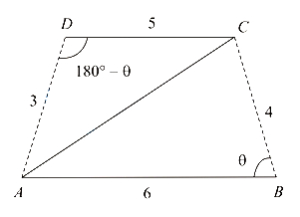
0 likesView Solution
228
MathematicsEasyMCQAP EAMCET · 2019
If $ABC$ is a right-angled triangle with $90^{\circ}$ at $C$ and $a > b$,then $\frac{a^2+b^2}{a^2-b^2} \sin (A-B) = $
A
$\frac{3}{2}$
B
$1$
C
$\frac{1}{2}$
D
$0$
Solution
(B) Using the sine rule,we have $a = 2R \sin A$ and $b = 2R \sin B$. Substituting these into the expression:
$\frac{a^2+b^2}{a^2-b^2} \sin (A-B) = \frac{(2R \sin A)^2 + (2R \sin B)^2}{(2R \sin A)^2 - (2R \sin B)^2} \sin (A-B)$
$= \frac{\sin^2 A + \sin^2 B}{\sin^2 A - \sin^2 B} \sin (A-B)$
Using the identity $\sin^2 A - \sin^2 B = \sin(A+B) \sin(A-B)$:
$= \frac{\sin^2 A + \sin^2 B}{\sin(A+B) \sin(A-B)} \sin(A-B)$
$= \frac{\sin^2 A + \sin^2 B}{\sin(A+B)}$
Since $A+B+C = 180^{\circ}$ and $C = 90^{\circ}$,we have $A+B = 90^{\circ}$,so $\sin(A+B) = \sin 90^{\circ} = 1$ and $B = 90^{\circ} - A$,which implies $\sin B = \cos A$.
$= \frac{\sin^2 A + \cos^2 A}{1} = 1$
Thus,the correct option is $B$.
$\frac{a^2+b^2}{a^2-b^2} \sin (A-B) = \frac{(2R \sin A)^2 + (2R \sin B)^2}{(2R \sin A)^2 - (2R \sin B)^2} \sin (A-B)$
$= \frac{\sin^2 A + \sin^2 B}{\sin^2 A - \sin^2 B} \sin (A-B)$
Using the identity $\sin^2 A - \sin^2 B = \sin(A+B) \sin(A-B)$:
$= \frac{\sin^2 A + \sin^2 B}{\sin(A+B) \sin(A-B)} \sin(A-B)$
$= \frac{\sin^2 A + \sin^2 B}{\sin(A+B)}$
Since $A+B+C = 180^{\circ}$ and $C = 90^{\circ}$,we have $A+B = 90^{\circ}$,so $\sin(A+B) = \sin 90^{\circ} = 1$ and $B = 90^{\circ} - A$,which implies $\sin B = \cos A$.
$= \frac{\sin^2 A + \cos^2 A}{1} = 1$
Thus,the correct option is $B$.
0 likesView Solution
229
MathematicsEasyMCQAP EAMCET · 2019
In triangle $ABC$,if $\frac{b+c}{9}=\frac{c+a}{10}=\frac{a+b}{11}$,then $\frac{\cos A+\cos B}{\cos C}=$
A
$\frac{9}{10}$
B
$\frac{10}{11}$
C
$\frac{11}{12}$
D
$\frac{12}{13}$
Solution
(C) Let $\frac{b+c}{9}=\frac{c+a}{10}=\frac{a+b}{11}=k$.
Then $b+c=9k$,$c+a=10k$,and $a+b=11k$.
Adding these gives $2(a+b+c)=30k$,so $a+b+c=15k$.
Thus,$a=(a+b+c)-(b+c)=15k-9k=6k$,$b=(a+b+c)-(c+a)=15k-10k=5k$,and $c=(a+b+c)-(a+b)=15k-11k=4k$.
Using the cosine rule,$\cos A = \frac{b^2+c^2-a^2}{2bc} = \frac{25k^2+16k^2-36k^2}{2(5k)(4k)} = \frac{5k^2}{40k^2} = \frac{1}{8}$.
$\cos B = \frac{a^2+c^2-b^2}{2ac} = \frac{36k^2+16k^2-25k^2}{2(6k)(4k)} = \frac{27k^2}{48k^2} = \frac{9}{16}$.
$\cos C = \frac{a^2+b^2-c^2}{2ab} = \frac{36k^2+25k^2-16k^2}{2(6k)(5k)} = \frac{45k^2}{60k^2} = \frac{3}{4}$.
Therefore,$\frac{\cos A+\cos B}{\cos C} = \frac{\frac{1}{8}+\frac{9}{16}}{\frac{3}{4}} = \frac{\frac{2+9}{16}}{\frac{3}{4}} = \frac{11}{16} \times \frac{4}{3} = \frac{11}{12}$.
Hence,option $C$ is correct.
Then $b+c=9k$,$c+a=10k$,and $a+b=11k$.
Adding these gives $2(a+b+c)=30k$,so $a+b+c=15k$.
Thus,$a=(a+b+c)-(b+c)=15k-9k=6k$,$b=(a+b+c)-(c+a)=15k-10k=5k$,and $c=(a+b+c)-(a+b)=15k-11k=4k$.
Using the cosine rule,$\cos A = \frac{b^2+c^2-a^2}{2bc} = \frac{25k^2+16k^2-36k^2}{2(5k)(4k)} = \frac{5k^2}{40k^2} = \frac{1}{8}$.
$\cos B = \frac{a^2+c^2-b^2}{2ac} = \frac{36k^2+16k^2-25k^2}{2(6k)(4k)} = \frac{27k^2}{48k^2} = \frac{9}{16}$.
$\cos C = \frac{a^2+b^2-c^2}{2ab} = \frac{36k^2+25k^2-16k^2}{2(6k)(5k)} = \frac{45k^2}{60k^2} = \frac{3}{4}$.
Therefore,$\frac{\cos A+\cos B}{\cos C} = \frac{\frac{1}{8}+\frac{9}{16}}{\frac{3}{4}} = \frac{\frac{2+9}{16}}{\frac{3}{4}} = \frac{11}{16} \times \frac{4}{3} = \frac{11}{12}$.
Hence,option $C$ is correct.
0 likesView Solution
230
MathematicsMediumMCQAP EAMCET · 2019
If $a, b$ and $c$ are the sides of $\triangle ABC$ for which $r_1=8, r_2=12$ and $r_3=24$,then the ordered triad $(a, b, c)=$
A
$(12, 20, 16)$
B
$(12, 16, 20)$
C
$(16, 12, 20)$
D
$(20, 16, 12)$
Solution
(B) Given that the exradii are $r_1 = 8, r_2 = 12, r_3 = 24$.
We know that $\frac{1}{r_1} + \frac{1}{r_2} + \frac{1}{r_3} = \frac{1}{r}$,where $r$ is the inradius.
$\frac{1}{8} + \frac{1}{12} + \frac{1}{24} = \frac{3+2+1}{24} = \frac{6}{24} = \frac{1}{4}$,so $r = 4$.
Also,$\Delta = \sqrt{r r_1 r_2 r_3} = \sqrt{4 \times 8 \times 12 \times 24} = \sqrt{9216} = 96$.
Using $r_1 = \frac{\Delta}{s-a}$,we have $8 = \frac{96}{s-a} \Rightarrow s-a = 12$.
Using $r_2 = \frac{\Delta}{s-b}$,we have $12 = \frac{96}{s-b} \Rightarrow s-b = 8$.
Using $r_3 = \frac{\Delta}{s-c}$,we have $24 = \frac{96}{s-c} \Rightarrow s-c = 4$.
Adding these: $3s - (a+b+c) = 24$ $\Rightarrow 3s - 2s = 24$ $\Rightarrow s = 24$.
Then $a = s-12 = 12$,$b = s-8 = 16$,and $c = s-4 = 20$.
Thus,the ordered triad $(a, b, c) = (12, 16, 20)$.
We know that $\frac{1}{r_1} + \frac{1}{r_2} + \frac{1}{r_3} = \frac{1}{r}$,where $r$ is the inradius.
$\frac{1}{8} + \frac{1}{12} + \frac{1}{24} = \frac{3+2+1}{24} = \frac{6}{24} = \frac{1}{4}$,so $r = 4$.
Also,$\Delta = \sqrt{r r_1 r_2 r_3} = \sqrt{4 \times 8 \times 12 \times 24} = \sqrt{9216} = 96$.
Using $r_1 = \frac{\Delta}{s-a}$,we have $8 = \frac{96}{s-a} \Rightarrow s-a = 12$.
Using $r_2 = \frac{\Delta}{s-b}$,we have $12 = \frac{96}{s-b} \Rightarrow s-b = 8$.
Using $r_3 = \frac{\Delta}{s-c}$,we have $24 = \frac{96}{s-c} \Rightarrow s-c = 4$.
Adding these: $3s - (a+b+c) = 24$ $\Rightarrow 3s - 2s = 24$ $\Rightarrow s = 24$.
Then $a = s-12 = 12$,$b = s-8 = 16$,and $c = s-4 = 20$.
Thus,the ordered triad $(a, b, c) = (12, 16, 20)$.
0 likesView Solution
231
MathematicsMediumMCQAP EAMCET · 2019
In $\triangle ABC$,if the median $AD$ drawn through $A$ is perpendicular to the side $AC$,then $3ca \cos A \cos C + 2a^2 =$
A
$c^2$
B
$2c^2$
C
$3c^2$
D
$4c^2$
Solution
(B) In $\triangle ABC$,$AD$ is the median to $BC$,so $BD = DC = a/2$. Given $AD \perp AC$,in right-angled $\triangle ADC$,by Pythagoras theorem,$AD^2 + b^2 = (a/2)^2$,so $AD^2 = a^2/4 - b^2$.
By Apollonius theorem on $\triangle ABC$,$c^2 + b^2 = 2(AD^2 + (a/2)^2)$.
Substituting $AD^2$,we get $c^2 + b^2 = 2(a^2/4 - b^2 + a^2/4) = a^2 - 2b^2$,which implies $a^2 = 3b^2 + c^2$ (Eq. $iii$).
Now,consider the expression $3ca \cos A \cos C + 2a^2$.
Using cosine rule,$\cos A = (b^2 + c^2 - a^2)/(2bc)$ and $\cos C = (a^2 + b^2 - c^2)/(2ab)$.
Substituting these,the expression becomes $3ca \cdot [(b^2 + c^2 - a^2)/(2bc)] \cdot [(a^2 + b^2 - c^2)/(2ab)] + 2a^2$.
$= (3/4b^2) \cdot (b^2 + c^2 - a^2)(a^2 + b^2 - c^2) + 2a^2$.
Since $a^2 - c^2 = 3b^2$,we have $b^2 + c^2 - a^2 = -2b^2$ and $a^2 + b^2 - c^2 = 4b^2$.
$= (3/4b^2) \cdot (-2b^2)(4b^2) + 2a^2 = -6b^2 + 2a^2 = 2(a^2 - 3b^2)$.
From Eq. $iii$,$a^2 - 3b^2 = c^2$.
Thus,the expression equals $2c^2$.
By Apollonius theorem on $\triangle ABC$,$c^2 + b^2 = 2(AD^2 + (a/2)^2)$.
Substituting $AD^2$,we get $c^2 + b^2 = 2(a^2/4 - b^2 + a^2/4) = a^2 - 2b^2$,which implies $a^2 = 3b^2 + c^2$ (Eq. $iii$).
Now,consider the expression $3ca \cos A \cos C + 2a^2$.
Using cosine rule,$\cos A = (b^2 + c^2 - a^2)/(2bc)$ and $\cos C = (a^2 + b^2 - c^2)/(2ab)$.
Substituting these,the expression becomes $3ca \cdot [(b^2 + c^2 - a^2)/(2bc)] \cdot [(a^2 + b^2 - c^2)/(2ab)] + 2a^2$.
$= (3/4b^2) \cdot (b^2 + c^2 - a^2)(a^2 + b^2 - c^2) + 2a^2$.
Since $a^2 - c^2 = 3b^2$,we have $b^2 + c^2 - a^2 = -2b^2$ and $a^2 + b^2 - c^2 = 4b^2$.
$= (3/4b^2) \cdot (-2b^2)(4b^2) + 2a^2 = -6b^2 + 2a^2 = 2(a^2 - 3b^2)$.
From Eq. $iii$,$a^2 - 3b^2 = c^2$.
Thus,the expression equals $2c^2$.
0 likesView Solution
232
MathematicsEasyMCQAP EAMCET · 2019
In $\triangle ABC$,if $a: b: c = 3: 5: 7$,then $\cos A + \cos B =$
A
$\frac{13}{7}$
B
$\frac{11}{7}$
C
$\frac{12}{7}$
D
$\frac{10}{7}$
Solution
(C) Given the ratio of sides as $a: b: c = 3: 5: 7$,let $a = 3x, b = 5x, c = 7x$.
Using the cosine rule,$\cos A = \frac{b^2 + c^2 - a^2}{2bc}$ and $\cos B = \frac{a^2 + c^2 - b^2}{2ac}$.
Substituting the values:
$\cos A = \frac{(5x)^2 + (7x)^2 - (3x)^2}{2(5x)(7x)} = \frac{25x^2 + 49x^2 - 9x^2}{70x^2} = \frac{65x^2}{70x^2} = \frac{13}{14}$.
$\cos B = \frac{(3x)^2 + (7x)^2 - (5x)^2}{2(3x)(7x)} = \frac{9x^2 + 49x^2 - 25x^2}{42x^2} = \frac{33x^2}{42x^2} = \frac{11}{14}$.
Therefore,$\cos A + \cos B = \frac{13}{14} + \frac{11}{14} = \frac{24}{14} = \frac{12}{7}$.
Using the cosine rule,$\cos A = \frac{b^2 + c^2 - a^2}{2bc}$ and $\cos B = \frac{a^2 + c^2 - b^2}{2ac}$.
Substituting the values:
$\cos A = \frac{(5x)^2 + (7x)^2 - (3x)^2}{2(5x)(7x)} = \frac{25x^2 + 49x^2 - 9x^2}{70x^2} = \frac{65x^2}{70x^2} = \frac{13}{14}$.
$\cos B = \frac{(3x)^2 + (7x)^2 - (5x)^2}{2(3x)(7x)} = \frac{9x^2 + 49x^2 - 25x^2}{42x^2} = \frac{33x^2}{42x^2} = \frac{11}{14}$.
Therefore,$\cos A + \cos B = \frac{13}{14} + \frac{11}{14} = \frac{24}{14} = \frac{12}{7}$.
0 likesView Solution
233
MathematicsEasyMCQAP EAMCET · 2019
In $\triangle ABC$,if $a, b$ and $c$ are in arithmetic progression,then $\cos A + 2 \cos B + \cos C =$
A
$1$
B
$2$
C
$\frac{3}{2}$
D
$\sqrt{3}+1$
Solution
(B) Given that $a, b, c$ are in arithmetic progression,we have $2b = a + c$.
Using the cosine rule,$\cos A = \frac{b^2+c^2-a^2}{2bc}$,$\cos B = \frac{a^2+c^2-b^2}{2ac}$,and $\cos C = \frac{a^2+b^2-c^2}{2ab}$.
We need to evaluate $\cos A + 2 \cos B + \cos C$.
Substituting the expressions:
$\cos A + \cos C + 2 \cos B = \frac{b^2+c^2-a^2}{2bc} + \frac{a^2+b^2-c^2}{2ab} + 2 \left( \frac{a^2+c^2-b^2}{2ac} \right)$
$= \frac{ab(b^2+c^2-a^2) + bc(a^2+b^2-c^2) + 2b^2(a^2+c^2-b^2)}{2abc}$
$= \frac{ab^3 + abc^2 - a^3b + a^2bc + b^3c - bc^3 + 2a^2b^2 + 2b^2c^2 - 2b^4}{2abc}$
Since $a+c = 2b$,we can simplify the numerator.
Using $a^2+c^2 = (a+c)^2 - 2ac = 4b^2 - 2ac$,the expression simplifies to:
$= \frac{4b^2(ac) + 2ac(2b^2) - 2b^2(2b^2)}{2abc} = \frac{4b^2ac + 4b^2ac - 4b^4}{2abc} = \frac{8b^2ac - 4b^4}{2abc} = \frac{4b^2(2ac - b^2)}{2abc}$.
Given $2b = a+c$,$b = \frac{a+c}{2}$. Substituting this,the expression evaluates to $2$.
Using the cosine rule,$\cos A = \frac{b^2+c^2-a^2}{2bc}$,$\cos B = \frac{a^2+c^2-b^2}{2ac}$,and $\cos C = \frac{a^2+b^2-c^2}{2ab}$.
We need to evaluate $\cos A + 2 \cos B + \cos C$.
Substituting the expressions:
$\cos A + \cos C + 2 \cos B = \frac{b^2+c^2-a^2}{2bc} + \frac{a^2+b^2-c^2}{2ab} + 2 \left( \frac{a^2+c^2-b^2}{2ac} \right)$
$= \frac{ab(b^2+c^2-a^2) + bc(a^2+b^2-c^2) + 2b^2(a^2+c^2-b^2)}{2abc}$
$= \frac{ab^3 + abc^2 - a^3b + a^2bc + b^3c - bc^3 + 2a^2b^2 + 2b^2c^2 - 2b^4}{2abc}$
Since $a+c = 2b$,we can simplify the numerator.
Using $a^2+c^2 = (a+c)^2 - 2ac = 4b^2 - 2ac$,the expression simplifies to:
$= \frac{4b^2(ac) + 2ac(2b^2) - 2b^2(2b^2)}{2abc} = \frac{4b^2ac + 4b^2ac - 4b^4}{2abc} = \frac{8b^2ac - 4b^4}{2abc} = \frac{4b^2(2ac - b^2)}{2abc}$.
Given $2b = a+c$,$b = \frac{a+c}{2}$. Substituting this,the expression evaluates to $2$.
0 likesView Solution
234
MathematicsDifficultMCQAP EAMCET · 2019
Let $\Delta$ denote the area of a $\triangle ABC$. If $\alpha, \beta, \gamma$ are the lengths of the altitudes of the $\triangle ABC$,then $\alpha^{-2}+\beta^{-2}+\gamma^{-2}=$
A
$\frac{4}{\Delta}(\tan A+\tan B+\tan C)$
B
$\frac{1}{\Delta}(\cot A+\cot B+\cot C)$
C
$\frac{\Delta^2}{2}(\tan A+\tan B+\tan C)$
D
$\frac{\Delta^2}{4}(\cot A+\cot B+\cot C)$
Solution
(B) The area of $\triangle ABC$ is given by $\Delta = \frac{1}{2} a \alpha = \frac{1}{2} b \beta = \frac{1}{2} c \gamma$.
Thus,$\alpha = \frac{2\Delta}{a}$,$\beta = \frac{2\Delta}{b}$,and $\gamma = \frac{2\Delta}{c}$.
Substituting these into the expression:
$\alpha^{-2} + \beta^{-2} + \gamma^{-2} = \frac{a^2}{4\Delta^2} + \frac{b^2}{4\Delta^2} + \frac{c^2}{4\Delta^2} = \frac{a^2+b^2+c^2}{4\Delta^2}$.
Using the identity $\cot A = \frac{b^2+c^2-a^2}{4\Delta}$,we have $b^2+c^2-a^2 = 4\Delta \cot A$.
Summing these for $A, B, C$:
$(b^2+c^2-a^2) + (c^2+a^2-b^2) + (a^2+b^2-c^2) = a^2+b^2+c^2 = 4\Delta(\cot A + \cot B + \cot C)$.
Therefore,$\frac{a^2+b^2+c^2}{4\Delta^2} = \frac{4\Delta(\cot A + \cot B + \cot C)}{4\Delta^2} = \frac{1}{\Delta}(\cot A + \cot B + \cot C)$.
Thus,$\alpha = \frac{2\Delta}{a}$,$\beta = \frac{2\Delta}{b}$,and $\gamma = \frac{2\Delta}{c}$.
Substituting these into the expression:
$\alpha^{-2} + \beta^{-2} + \gamma^{-2} = \frac{a^2}{4\Delta^2} + \frac{b^2}{4\Delta^2} + \frac{c^2}{4\Delta^2} = \frac{a^2+b^2+c^2}{4\Delta^2}$.
Using the identity $\cot A = \frac{b^2+c^2-a^2}{4\Delta}$,we have $b^2+c^2-a^2 = 4\Delta \cot A$.
Summing these for $A, B, C$:
$(b^2+c^2-a^2) + (c^2+a^2-b^2) + (a^2+b^2-c^2) = a^2+b^2+c^2 = 4\Delta(\cot A + \cot B + \cot C)$.
Therefore,$\frac{a^2+b^2+c^2}{4\Delta^2} = \frac{4\Delta(\cot A + \cot B + \cot C)}{4\Delta^2} = \frac{1}{\Delta}(\cot A + \cot B + \cot C)$.
0 likesView Solution
235
MathematicsMediumMCQAP EAMCET · 2019
In $\triangle ABC, (r_2 + r_3) \cot \left(\frac{B+C}{2}\right) = $
A
$a+b+c$
B
$a$
C
$b$
D
$c$
Solution
(B) We know that $r_2 = \frac{\Delta}{s-b}$ and $r_3 = \frac{\Delta}{s-c}$.
Also,$\cot \left(\frac{B+C}{2}\right) = \tan \left(\frac{A}{2}\right) = \sqrt{\frac{(s-b)(s-c)}{s(s-a)}}$.
Substituting these values:
$(r_2 + r_3) \cot \left(\frac{B+C}{2}\right) = \left( \frac{\Delta}{s-b} + \frac{\Delta}{s-c} \right) \tan \left(\frac{A}{2}\right)$
$= \Delta \left( \frac{s-c+s-b}{(s-b)(s-c)} \right) \sqrt{\frac{(s-b)(s-c)}{s(s-a)}}$
$= \Delta \left( \frac{a}{(s-b)(s-c)} \right) \frac{\sqrt{(s-b)(s-c)}}{\sqrt{s(s-a)}}$
$= \frac{\Delta \cdot a}{\sqrt{s(s-a)(s-b)(s-c)}}$
Since $\Delta = \sqrt{s(s-a)(s-b)(s-c)}$,the expression simplifies to:
$= \frac{\Delta \cdot a}{\Delta} = a$.
Thus,option $B$ is correct.
Also,$\cot \left(\frac{B+C}{2}\right) = \tan \left(\frac{A}{2}\right) = \sqrt{\frac{(s-b)(s-c)}{s(s-a)}}$.
Substituting these values:
$(r_2 + r_3) \cot \left(\frac{B+C}{2}\right) = \left( \frac{\Delta}{s-b} + \frac{\Delta}{s-c} \right) \tan \left(\frac{A}{2}\right)$
$= \Delta \left( \frac{s-c+s-b}{(s-b)(s-c)} \right) \sqrt{\frac{(s-b)(s-c)}{s(s-a)}}$
$= \Delta \left( \frac{a}{(s-b)(s-c)} \right) \frac{\sqrt{(s-b)(s-c)}}{\sqrt{s(s-a)}}$
$= \frac{\Delta \cdot a}{\sqrt{s(s-a)(s-b)(s-c)}}$
Since $\Delta = \sqrt{s(s-a)(s-b)(s-c)}$,the expression simplifies to:
$= \frac{\Delta \cdot a}{\Delta} = a$.
Thus,option $B$ is correct.
0 likesView Solution
236
MathematicsEasyMCQAP EAMCET · 2019
The area (in square units) of $\triangle ABC$ if $\angle A=75^{\circ}, \angle B=45^{\circ}$ and $a=2(\sqrt{3}+1)$ is
A
$6$
B
$2\sqrt{3}$
C
$6-2\sqrt{3}$
D
$6+2\sqrt{3}$
Solution
(D) Given,$\angle A=75^{\circ}, \angle B=45^{\circ}$ and $a=2(\sqrt{3}+1)$.
In $\triangle AOC$,$\tan 60^{\circ} = \frac{x}{y}$ $\Rightarrow \sqrt{3} = \frac{x}{y}$ $\Rightarrow x = \sqrt{3}y$.
Now,$x+y = 2(\sqrt{3}+1)$.
Substituting $x = \sqrt{3}y$,we get $\sqrt{3}y + y = 2(\sqrt{3}+1)$ $\Rightarrow y(\sqrt{3}+1) = 2(\sqrt{3}+1)$ $\Rightarrow y = 2$.
Then,$x = 2\sqrt{3}$.
Now,the area of $\triangle ABC = \text{Area of } \triangle AOB + \text{Area of } \triangle AOC$.
Area $= \frac{1}{2} \times x \times x + \frac{1}{2} \times x \times y = \frac{1}{2}x(x+y)$.
Area $= \frac{1}{2} \times (2\sqrt{3}) \times (2\sqrt{3} + 2) = \sqrt{3} \times 2(\sqrt{3}+1) = 2(3 + \sqrt{3}) = 6 + 2\sqrt{3} \text{ sq units}$.
In $\triangle AOC$,$\tan 60^{\circ} = \frac{x}{y}$ $\Rightarrow \sqrt{3} = \frac{x}{y}$ $\Rightarrow x = \sqrt{3}y$.
Now,$x+y = 2(\sqrt{3}+1)$.
Substituting $x = \sqrt{3}y$,we get $\sqrt{3}y + y = 2(\sqrt{3}+1)$ $\Rightarrow y(\sqrt{3}+1) = 2(\sqrt{3}+1)$ $\Rightarrow y = 2$.
Then,$x = 2\sqrt{3}$.
Now,the area of $\triangle ABC = \text{Area of } \triangle AOB + \text{Area of } \triangle AOC$.
Area $= \frac{1}{2} \times x \times x + \frac{1}{2} \times x \times y = \frac{1}{2}x(x+y)$.
Area $= \frac{1}{2} \times (2\sqrt{3}) \times (2\sqrt{3} + 2) = \sqrt{3} \times 2(\sqrt{3}+1) = 2(3 + \sqrt{3}) = 6 + 2\sqrt{3} \text{ sq units}$.
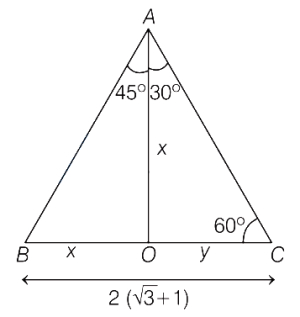
0 likesView Solution
237
MathematicsMediumMCQAP EAMCET · 2019
In a $\triangle ABC$,if $3a = b + c$,then $\cot \frac{B}{2} \cot \frac{C}{2} =$
A
$1$
B
$2$
C
$\frac{1}{3}$
D
$\frac{1}{2}$
Solution
(B) Given,$3a = b + c$ ... $(i)$
Let $s$ be the semi-perimeter of $\triangle ABC$,so $s = \frac{a + b + c}{2}$.
Substituting the value from $(i)$,we get $s = \frac{a + 3a}{2} = \frac{4a}{2} = 2a$.
We know that $\cot \frac{B}{2} = \sqrt{\frac{s(s-b)}{(s-a)(s-c)}}$ and $\cot \frac{C}{2} = \sqrt{\frac{s(s-c)}{(s-a)(s-b)}}$.
Therefore,$\cot \frac{B}{2} \cot \frac{C}{2} = \sqrt{\frac{s(s-b)}{(s-a)(s-c)} \cdot \frac{s(s-c)}{(s-a)(s-b)}} = \sqrt{\frac{s^2}{(s-a)^2}} = \frac{s}{s-a}$.
Substituting $s = 2a$,we get $\frac{2a}{2a - a} = \frac{2a}{a} = 2$.
Let $s$ be the semi-perimeter of $\triangle ABC$,so $s = \frac{a + b + c}{2}$.
Substituting the value from $(i)$,we get $s = \frac{a + 3a}{2} = \frac{4a}{2} = 2a$.
We know that $\cot \frac{B}{2} = \sqrt{\frac{s(s-b)}{(s-a)(s-c)}}$ and $\cot \frac{C}{2} = \sqrt{\frac{s(s-c)}{(s-a)(s-b)}}$.
Therefore,$\cot \frac{B}{2} \cot \frac{C}{2} = \sqrt{\frac{s(s-b)}{(s-a)(s-c)} \cdot \frac{s(s-c)}{(s-a)(s-b)}} = \sqrt{\frac{s^2}{(s-a)^2}} = \frac{s}{s-a}$.
Substituting $s = 2a$,we get $\frac{2a}{2a - a} = \frac{2a}{a} = 2$.
0 likesView Solution
238
MathematicsEasyMCQAP EAMCET · 2019
In a $\triangle ABC$,if $\frac{2 r_2 r_3}{r_2-r_1}=r_3-r_1$,then $\frac{r_1(r_2+r_3)}{\sqrt{r_1 r_2+r_2 r_3+r_3 r_1}} = $
A
$\frac{a^2+b^2+c^2}{\Delta^2}$
B
$b-c$
C
$\frac{1}{2R}$
D
$2R$
Solution
(D) Given,$\frac{2 r_2 r_3}{r_2-r_1} = r_3-r_1$.
Using $r_1 = \frac{\Delta}{s-a}, r_2 = \frac{\Delta}{s-b}, r_3 = \frac{\Delta}{s-c}$,we get:
$2 \cdot \frac{\Delta}{s-b} \cdot \frac{\Delta}{s-c} = \left(\frac{\Delta}{s-b} - \frac{\Delta}{s-a}\right) \left(\frac{\Delta}{s-c} - \frac{\Delta}{s-a}\right)$
$\frac{2}{(s-b)(s-c)} = \frac{(s-a)-(s-b)}{(s-b)(s-a)} \cdot \frac{(s-a)-(s-c)}{(s-c)(s-a)}$
$2(s-a)^2 = (b-a)(c-a)$
$2(\frac{b+c-a}{2})^2 = (b-a)(c-a)$
$\frac{(b+c-a)^2}{2} = (b-a)(c-a)$
$b^2+c^2+a^2+2bc-2ab-2ac = 2(bc-ab-ac+a^2)$
$b^2+c^2+a^2+2bc-2ab-2ac = 2bc-2ab-2ac+2a^2$
$b^2+c^2 = a^2$.
Now,$\sqrt{r_1 r_2+r_2 r_3+r_3 r_1} = \sqrt{\frac{\Delta^2}{(s-a)(s-b)} + \frac{\Delta^2}{(s-b)(s-c)} + \frac{\Delta^2}{(s-c)(s-a)}} = \sqrt{\frac{\Delta^2(s-c+s-a+s-b)}{(s-a)(s-b)(s-c)}} = \sqrt{\frac{\Delta^2(3s-2s)}{\frac{\Delta^2}{s}}} = s$.
Thus,$\frac{r_1(r_2+r_3)}{s} = \frac{\frac{\Delta}{s-a}(\frac{\Delta}{s-b} + \frac{\Delta}{s-c})}{s} = \frac{\Delta^2(2s-b-c)}{s(s-a)(s-b)(s-c)} = \frac{\Delta^2(a)}{\Delta^2} = a = 2R$.
Using $r_1 = \frac{\Delta}{s-a}, r_2 = \frac{\Delta}{s-b}, r_3 = \frac{\Delta}{s-c}$,we get:
$2 \cdot \frac{\Delta}{s-b} \cdot \frac{\Delta}{s-c} = \left(\frac{\Delta}{s-b} - \frac{\Delta}{s-a}\right) \left(\frac{\Delta}{s-c} - \frac{\Delta}{s-a}\right)$
$\frac{2}{(s-b)(s-c)} = \frac{(s-a)-(s-b)}{(s-b)(s-a)} \cdot \frac{(s-a)-(s-c)}{(s-c)(s-a)}$
$2(s-a)^2 = (b-a)(c-a)$
$2(\frac{b+c-a}{2})^2 = (b-a)(c-a)$
$\frac{(b+c-a)^2}{2} = (b-a)(c-a)$
$b^2+c^2+a^2+2bc-2ab-2ac = 2(bc-ab-ac+a^2)$
$b^2+c^2+a^2+2bc-2ab-2ac = 2bc-2ab-2ac+2a^2$
$b^2+c^2 = a^2$.
Now,$\sqrt{r_1 r_2+r_2 r_3+r_3 r_1} = \sqrt{\frac{\Delta^2}{(s-a)(s-b)} + \frac{\Delta^2}{(s-b)(s-c)} + \frac{\Delta^2}{(s-c)(s-a)}} = \sqrt{\frac{\Delta^2(s-c+s-a+s-b)}{(s-a)(s-b)(s-c)}} = \sqrt{\frac{\Delta^2(3s-2s)}{\frac{\Delta^2}{s}}} = s$.
Thus,$\frac{r_1(r_2+r_3)}{s} = \frac{\frac{\Delta}{s-a}(\frac{\Delta}{s-b} + \frac{\Delta}{s-c})}{s} = \frac{\Delta^2(2s-b-c)}{s(s-a)(s-b)(s-c)} = \frac{\Delta^2(a)}{\Delta^2} = a = 2R$.
0 likesView Solution
239
MathematicsEasyMCQAP EAMCET · 2019
If the area of triangle $ABC$ is $b^2-(c-a)^2$,then $\tan B=$
A
$1$
B
$\frac{13}{15}$
C
$\frac{1}{4}$
D
$\frac{8}{15}$
Solution
(D) Given,the area of triangle $\Delta = b^2-(c-a)^2$.
Using the identity $x^2-y^2 = (x-y)(x+y)$,we have $\Delta = (b-c+a)(b+c-a)$.
Since $2s = a+b+c$,we have $b-c+a = 2s-2c$ and $b+c-a = 2s-2a$.
Thus,$\Delta = (2s-2c)(2s-2a) = 4(s-a)(s-c)$.
By Heron's formula,$\Delta = \sqrt{s(s-a)(s-b)(s-c)}$.
Equating the two expressions: $\sqrt{s(s-a)(s-b)(s-c)} = 4(s-a)(s-c)$.
Dividing both sides by $\sqrt{(s-a)(s-c)}$,we get $\sqrt{s(s-b)} = 4\sqrt{(s-a)(s-c)}$.
Therefore,$\tan(\frac{B}{2}) = \sqrt{\frac{(s-a)(s-c)}{s(s-b)}} = \frac{1}{4}$.
Using the double angle formula $\tan B = \frac{2\tan(B/2)}{1-\tan^2(B/2)}$,we get $\tan B = \frac{2(1/4)}{1-(1/4)^2} = \frac{1/2}{1-1/16} = \frac{1/2}{15/16} = \frac{8}{15}$.
Using the identity $x^2-y^2 = (x-y)(x+y)$,we have $\Delta = (b-c+a)(b+c-a)$.
Since $2s = a+b+c$,we have $b-c+a = 2s-2c$ and $b+c-a = 2s-2a$.
Thus,$\Delta = (2s-2c)(2s-2a) = 4(s-a)(s-c)$.
By Heron's formula,$\Delta = \sqrt{s(s-a)(s-b)(s-c)}$.
Equating the two expressions: $\sqrt{s(s-a)(s-b)(s-c)} = 4(s-a)(s-c)$.
Dividing both sides by $\sqrt{(s-a)(s-c)}$,we get $\sqrt{s(s-b)} = 4\sqrt{(s-a)(s-c)}$.
Therefore,$\tan(\frac{B}{2}) = \sqrt{\frac{(s-a)(s-c)}{s(s-b)}} = \frac{1}{4}$.
Using the double angle formula $\tan B = \frac{2\tan(B/2)}{1-\tan^2(B/2)}$,we get $\tan B = \frac{2(1/4)}{1-(1/4)^2} = \frac{1/2}{1-1/16} = \frac{1/2}{15/16} = \frac{8}{15}$.
0 likesView Solution
240
MathematicsEasyMCQAP EAMCET · 2019
In $\triangle ABC$,$\frac{1}{r_1^2}+\frac{1}{r_2^2}+\frac{1}{r_3^2}+\frac{1}{r^2} =$
A
$\frac{a^2+b^2+c^2}{\Delta^2}$
B
$\frac{a+b+c}{\Delta^2}$
C
$\frac{s^2}{\Delta^2}$
D
$\frac{4s^2}{\Delta^2}$
Solution
(A) We know that $r_1 = \frac{\Delta}{s-a}$,$r_2 = \frac{\Delta}{s-b}$,$r_3 = \frac{\Delta}{s-c}$,and $r = \frac{\Delta}{s}$.
Therefore,$\frac{1}{r_1} = \frac{s-a}{\Delta}$,$\frac{1}{r_2} = \frac{s-b}{\Delta}$,$\frac{1}{r_3} = \frac{s-c}{\Delta}$,and $\frac{1}{r} = \frac{s}{\Delta}$.
Now,$\frac{1}{r_1^2}+\frac{1}{r_2^2}+\frac{1}{r_3^2}+\frac{1}{r^2} = \frac{(s-a)^2}{\Delta^2} + \frac{(s-b)^2}{\Delta^2} + \frac{(s-c)^2}{\Delta^2} + \frac{s^2}{\Delta^2}$.
$= \frac{(s^2+a^2-2as) + (s^2+b^2-2sb) + (s^2+c^2-2sc) + s^2}{\Delta^2}$.
$= \frac{4s^2 + a^2+b^2+c^2 - 2s(a+b+c)}{\Delta^2}$.
Since $a+b+c = 2s$,we have $2s(a+b+c) = 2s(2s) = 4s^2$.
$= \frac{4s^2 + a^2+b^2+c^2 - 4s^2}{\Delta^2} = \frac{a^2+b^2+c^2}{\Delta^2}$.
Therefore,$\frac{1}{r_1} = \frac{s-a}{\Delta}$,$\frac{1}{r_2} = \frac{s-b}{\Delta}$,$\frac{1}{r_3} = \frac{s-c}{\Delta}$,and $\frac{1}{r} = \frac{s}{\Delta}$.
Now,$\frac{1}{r_1^2}+\frac{1}{r_2^2}+\frac{1}{r_3^2}+\frac{1}{r^2} = \frac{(s-a)^2}{\Delta^2} + \frac{(s-b)^2}{\Delta^2} + \frac{(s-c)^2}{\Delta^2} + \frac{s^2}{\Delta^2}$.
$= \frac{(s^2+a^2-2as) + (s^2+b^2-2sb) + (s^2+c^2-2sc) + s^2}{\Delta^2}$.
$= \frac{4s^2 + a^2+b^2+c^2 - 2s(a+b+c)}{\Delta^2}$.
Since $a+b+c = 2s$,we have $2s(a+b+c) = 2s(2s) = 4s^2$.
$= \frac{4s^2 + a^2+b^2+c^2 - 4s^2}{\Delta^2} = \frac{a^2+b^2+c^2}{\Delta^2}$.
0 likesView Solution
241
MathematicsMediumMCQAP EAMCET · 2019
In triangle $ABC$,if $r_1=36, r_2=18$ and $r_3=12$,then $a+b=$
A
$36$
B
$24$
C
$30$
D
$54$
Solution
(D) Given in a $\triangle ABC$:
$r_1 = \frac{\Delta}{s-a} = 36, r_2 = \frac{\Delta}{s-b} = 18, r_3 = \frac{\Delta}{s-c} = 12$
$\frac{1}{r_1} + \frac{1}{r_2} + \frac{1}{r_3} = \frac{1}{36} + \frac{1}{18} + \frac{1}{12} = \frac{1+2+3}{36} = \frac{6}{36} = \frac{1}{6}$
Since $\frac{1}{r_1} + \frac{1}{r_2} + \frac{1}{r_3} = \frac{s}{\Delta}$,we have $\frac{s}{\Delta} = \frac{1}{6} \Rightarrow \Delta = 6s$
$r_1 = \frac{6s}{s-a} = 36$ $\Rightarrow 6s = 36s - 36a$ $\Rightarrow 36a = 30s$ $\Rightarrow a = \frac{5s}{6}$
$r_2 = \frac{6s}{s-b} = 18$ $\Rightarrow 6s = 18s - 18b$ $\Rightarrow 18b = 12s$ $\Rightarrow b = \frac{2s}{3}$
$r_3 = \frac{6s}{s-c} = 12$ $\Rightarrow 6s = 12s - 12c$ $\Rightarrow 12c = 6s$ $\Rightarrow c = \frac{s}{2}$
Using Heron's formula $\Delta^2 = s(s-a)(s-b)(s-c) = (6s)^2 = 36s^2$
$s(s - \frac{5s}{6})(s - \frac{2s}{3})(s - \frac{s}{2}) = 36s^2$
$s(\frac{s}{6})(\frac{s}{3})(\frac{s}{2}) = 36s^2$
$\frac{s^4}{36} = 36s^2$ $\Rightarrow s^2 = 36^2$ $\Rightarrow s = 36$
$a = \frac{5 \times 36}{6} = 30$
$b = \frac{2 \times 36}{3} = 24$
$a+b = 30+24 = 54$
$r_1 = \frac{\Delta}{s-a} = 36, r_2 = \frac{\Delta}{s-b} = 18, r_3 = \frac{\Delta}{s-c} = 12$
$\frac{1}{r_1} + \frac{1}{r_2} + \frac{1}{r_3} = \frac{1}{36} + \frac{1}{18} + \frac{1}{12} = \frac{1+2+3}{36} = \frac{6}{36} = \frac{1}{6}$
Since $\frac{1}{r_1} + \frac{1}{r_2} + \frac{1}{r_3} = \frac{s}{\Delta}$,we have $\frac{s}{\Delta} = \frac{1}{6} \Rightarrow \Delta = 6s$
$r_1 = \frac{6s}{s-a} = 36$ $\Rightarrow 6s = 36s - 36a$ $\Rightarrow 36a = 30s$ $\Rightarrow a = \frac{5s}{6}$
$r_2 = \frac{6s}{s-b} = 18$ $\Rightarrow 6s = 18s - 18b$ $\Rightarrow 18b = 12s$ $\Rightarrow b = \frac{2s}{3}$
$r_3 = \frac{6s}{s-c} = 12$ $\Rightarrow 6s = 12s - 12c$ $\Rightarrow 12c = 6s$ $\Rightarrow c = \frac{s}{2}$
Using Heron's formula $\Delta^2 = s(s-a)(s-b)(s-c) = (6s)^2 = 36s^2$
$s(s - \frac{5s}{6})(s - \frac{2s}{3})(s - \frac{s}{2}) = 36s^2$
$s(\frac{s}{6})(\frac{s}{3})(\frac{s}{2}) = 36s^2$
$\frac{s^4}{36} = 36s^2$ $\Rightarrow s^2 = 36^2$ $\Rightarrow s = 36$
$a = \frac{5 \times 36}{6} = 30$
$b = \frac{2 \times 36}{3} = 24$
$a+b = 30+24 = 54$
0 likesView Solution
242
MathematicsMediumMCQAP EAMCET · 2019
Let a triangle $ABC$ be inscribed in a circle of radius $2$ units. If the $3$ bisectors of the angles $A, B$ and $C$ are extended to cut the circle at $A_1, B_1$ and $C_1$ respectively,then the value of $\left[\frac{AA_1 \cos \frac{A}{2} + BB_1 \cos \frac{B}{2} + CC_1 \cos \frac{C}{2}}{\sin A + \sin B + \sin C}\right]^2$ is:
A
$4$
B
$16$
C
$25$
D
$1$
Solution
(B) Let the triangle $ABC$ be an equilateral triangle inscribed in a circle of radius $R = 2$.
For an equilateral triangle,$A = B = C = 60^{\circ}$.
The length of the angle bisector $AA_1$ from vertex $A$ to the circle is given by $AA_1 = 2R \cos \frac{A}{2} \cos \frac{B-C}{2}$.
Since $A=B=C=60^{\circ}$,we have $AA_1 = BB_1 = CC_1 = 2(2) \cos 30^{\circ} \cos 0^{\circ} = 4 \times \frac{\sqrt{3}}{2} = 2\sqrt{3}$.
Substituting these values into the expression:
$\left[\frac{2\sqrt{3} \cos 30^{\circ} + 2\sqrt{3} \cos 30^{\circ} + 2\sqrt{3} \cos 30^{\circ}}{\sin 60^{\circ} + \sin 60^{\circ} + \sin 60^{\circ}}\right]^2$
$= \left[\frac{3 \times 2\sqrt{3} \times \frac{\sqrt{3}}{2}}{3 \times \frac{\sqrt{3}}{2}}\right]^2$
$= \left[\frac{9}{3 \frac{\sqrt{3}}{2}}\right]^2 = \left[\frac{6}{\sqrt{3}}\right]^2 = (2\sqrt{3})^2 = 12$.
Wait,re-evaluating the general case: $AA_1 = 2R \cos \frac{A}{2} \cos \frac{B-C}{2}$.
The expression is $\frac{\sum 2R \cos^2 \frac{A}{2} \cos \frac{B-C}{2}}{\sum \sin A} = \frac{2R \sum \cos \frac{A}{2} \cos \frac{B-C}{2} \cos \frac{A}{2}}{\sum 2 \sin \frac{A}{2} \cos \frac{A}{2} \cos \frac{B-C}{2} \dots} = 2R = 4$.
Thus,the square is $4^2 = 16$.
For an equilateral triangle,$A = B = C = 60^{\circ}$.
The length of the angle bisector $AA_1$ from vertex $A$ to the circle is given by $AA_1 = 2R \cos \frac{A}{2} \cos \frac{B-C}{2}$.
Since $A=B=C=60^{\circ}$,we have $AA_1 = BB_1 = CC_1 = 2(2) \cos 30^{\circ} \cos 0^{\circ} = 4 \times \frac{\sqrt{3}}{2} = 2\sqrt{3}$.
Substituting these values into the expression:
$\left[\frac{2\sqrt{3} \cos 30^{\circ} + 2\sqrt{3} \cos 30^{\circ} + 2\sqrt{3} \cos 30^{\circ}}{\sin 60^{\circ} + \sin 60^{\circ} + \sin 60^{\circ}}\right]^2$
$= \left[\frac{3 \times 2\sqrt{3} \times \frac{\sqrt{3}}{2}}{3 \times \frac{\sqrt{3}}{2}}\right]^2$
$= \left[\frac{9}{3 \frac{\sqrt{3}}{2}}\right]^2 = \left[\frac{6}{\sqrt{3}}\right]^2 = (2\sqrt{3})^2 = 12$.
Wait,re-evaluating the general case: $AA_1 = 2R \cos \frac{A}{2} \cos \frac{B-C}{2}$.
The expression is $\frac{\sum 2R \cos^2 \frac{A}{2} \cos \frac{B-C}{2}}{\sum \sin A} = \frac{2R \sum \cos \frac{A}{2} \cos \frac{B-C}{2} \cos \frac{A}{2}}{\sum 2 \sin \frac{A}{2} \cos \frac{A}{2} \cos \frac{B-C}{2} \dots} = 2R = 4$.
Thus,the square is $4^2 = 16$.
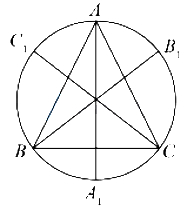
0 likesView Solution
243
MathematicsMediumMCQAP EAMCET · 2019
If $x \in \left(-\frac{\pi}{2}, \frac{\pi}{2}\right)$,then $\log \sec x = $
A
$2 \operatorname{cosech}^{-1}\left(\cot ^2 \frac{x}{2}-1\right)$
B
$2 \operatorname{cosech}^{-1}\left(\cot ^2 \frac{x}{2}+1\right)$
C
$2 \operatorname{coth}^{-1}\left(\operatorname{cosec}^2 \frac{x}{2}-1\right)$
D
$2 \operatorname{coth}^{-1}\left(\operatorname{cosec}^2 \frac{x}{2}+1\right)$
Solution
(C) Let $y = \log \sec x$. Then $\sec x = e^y$,which implies $\cos x = e^{-y}$.
We know that $\cos x = \frac{1 - \tan^2(x/2)}{1 + \tan^2(x/2)}$.
Also,$\cos x = \frac{e^y + e^{-y} - (e^y - e^{-y})}{e^y + e^{-y} + (e^y - e^{-y})} = \frac{2e^{-y}}{2e^y} = e^{-2y}$.
Alternatively,using hyperbolic functions,$\cos x = \frac{1 - \tan^2(x/2)}{1 + \tan^2(x/2)}$.
We have $\cos x = \frac{1 - \tan^2(x/2)}{1 + \tan^2(x/2)} = \frac{\cot^2(x/2) - 1}{\cot^2(x/2) + 1}$.
Using the identity $\coth(y/2) = \frac{e^{y/2} + e^{-y/2}}{e^{y/2} - e^{-y/2}}$,we relate this to the expression.
Specifically,$\coth(y/2) = \frac{1 + e^{-y}}{1 - e^{-y}} = \frac{1 + \cos x}{1 - \cos x} = \frac{1 + \frac{1-\tan^2(x/2)}{1+\tan^2(x/2)}}{1 - \frac{1-\tan^2(x/2)}{1+\tan^2(x/2)}} = \frac{2}{2\tan^2(x/2)} = \cot^2(x/2)$.
Since $\cot^2(x/2) = \operatorname{cosec}^2(x/2) - 1$,we have $\coth(y/2) = \operatorname{cosec}^2(x/2) - 1$.
Therefore,$\frac{y}{2} = \operatorname{coth}^{-1}(\operatorname{cosec}^2(x/2) - 1)$,which gives $y = 2 \operatorname{coth}^{-1}(\operatorname{cosec}^2(x/2) - 1)$.
We know that $\cos x = \frac{1 - \tan^2(x/2)}{1 + \tan^2(x/2)}$.
Also,$\cos x = \frac{e^y + e^{-y} - (e^y - e^{-y})}{e^y + e^{-y} + (e^y - e^{-y})} = \frac{2e^{-y}}{2e^y} = e^{-2y}$.
Alternatively,using hyperbolic functions,$\cos x = \frac{1 - \tan^2(x/2)}{1 + \tan^2(x/2)}$.
We have $\cos x = \frac{1 - \tan^2(x/2)}{1 + \tan^2(x/2)} = \frac{\cot^2(x/2) - 1}{\cot^2(x/2) + 1}$.
Using the identity $\coth(y/2) = \frac{e^{y/2} + e^{-y/2}}{e^{y/2} - e^{-y/2}}$,we relate this to the expression.
Specifically,$\coth(y/2) = \frac{1 + e^{-y}}{1 - e^{-y}} = \frac{1 + \cos x}{1 - \cos x} = \frac{1 + \frac{1-\tan^2(x/2)}{1+\tan^2(x/2)}}{1 - \frac{1-\tan^2(x/2)}{1+\tan^2(x/2)}} = \frac{2}{2\tan^2(x/2)} = \cot^2(x/2)$.
Since $\cot^2(x/2) = \operatorname{cosec}^2(x/2) - 1$,we have $\coth(y/2) = \operatorname{cosec}^2(x/2) - 1$.
Therefore,$\frac{y}{2} = \operatorname{coth}^{-1}(\operatorname{cosec}^2(x/2) - 1)$,which gives $y = 2 \operatorname{coth}^{-1}(\operatorname{cosec}^2(x/2) - 1)$.
0 likesView Solution
244
MathematicsMediumMCQAP EAMCET · 2019
If $\sin x \cosh y = \cos \theta$,$\cos x \sinh y = \sin \theta$ and $4 \tan x = 3$,then $\sinh^2 y =$
A
$\frac{4}{5}$
B
$\frac{9}{16}$
C
$\frac{9}{25}$
D
$\frac{16}{25}$
Solution
(D) Given $\tan x = \frac{3}{4}$.
Since $\tan^2 x = \frac{\sin^2 x}{\cos^2 x} = \frac{9}{16}$,we have $\sin^2 x = \frac{9}{25}$ and $\cos^2 x = \frac{16}{25}$.
We are given $\sin x \cosh y = \cos \theta$ and $\cos x \sinh y = \sin \theta$.
Using the identity $\cos^2 \theta + \sin^2 \theta = 1$,we substitute the given expressions:
$(\sin x \cosh y)^2 + (\cos x \sinh y)^2 = 1$
$\sin^2 x \cosh^2 y + \cos^2 x \sinh^2 y = 1$
Using $\cosh^2 y = 1 + \sinh^2 y$,we get:
$\sin^2 x (1 + \sinh^2 y) + \cos^2 x \sinh^2 y = 1$
$\frac{9}{25}(1 + \sinh^2 y) + \frac{16}{25} \sinh^2 y = 1$
Multiply by $25$:
$9 + 9 \sinh^2 y + 16 \sinh^2 y = 25$
$25 \sinh^2 y = 25 - 9$
$25 \sinh^2 y = 16$
$\sinh^2 y = \frac{16}{25}$.
Since $\tan^2 x = \frac{\sin^2 x}{\cos^2 x} = \frac{9}{16}$,we have $\sin^2 x = \frac{9}{25}$ and $\cos^2 x = \frac{16}{25}$.
We are given $\sin x \cosh y = \cos \theta$ and $\cos x \sinh y = \sin \theta$.
Using the identity $\cos^2 \theta + \sin^2 \theta = 1$,we substitute the given expressions:
$(\sin x \cosh y)^2 + (\cos x \sinh y)^2 = 1$
$\sin^2 x \cosh^2 y + \cos^2 x \sinh^2 y = 1$
Using $\cosh^2 y = 1 + \sinh^2 y$,we get:
$\sin^2 x (1 + \sinh^2 y) + \cos^2 x \sinh^2 y = 1$
$\frac{9}{25}(1 + \sinh^2 y) + \frac{16}{25} \sinh^2 y = 1$
Multiply by $25$:
$9 + 9 \sinh^2 y + 16 \sinh^2 y = 25$
$25 \sinh^2 y = 25 - 9$
$25 \sinh^2 y = 16$
$\sinh^2 y = \frac{16}{25}$.
0 likesView Solution
245
MathematicsMediumMCQAP EAMCET · 2019
The set of all real numbers satisfying the inequation $x^2-|x+2|+x>0$ is
A
$[-2, -\sqrt{2}) \cup (\sqrt{2}, \infty)$
B
$(-\infty, -2) \cup (2, \infty)$
C
$(-\infty, -\sqrt{2}) \cup (\sqrt{2}, \infty)$
D
$(-\infty, -2) \cup (\sqrt{2}, \infty)$
Solution
(C) Given inequation: $x^2 - |x+2| + x > 0$
Case $I$: If $x+2 \geq 0$ (i.e., $x \geq -2$), then $|x+2| = x+2$.
The inequation becomes:
$x^2 - (x+2) + x > 0$
$\Rightarrow x^2 - 2 > 0$
$\Rightarrow (x-\sqrt{2})(x+\sqrt{2}) > 0$
The solution for this is $x \in (-\infty, -\sqrt{2}) \cup (\sqrt{2}, \infty)$.
Considering the condition $x \geq -2$, the intersection is $x \in [-2, -\sqrt{2}) \cup (\sqrt{2}, \infty)$.
Case $II$: If $x+2 < 0$ (i.e., $x < -2$), then $|x+2| = -(x+2)$.
The inequation becomes:
$x^2 - (-(x+2)) + x > 0$
$\Rightarrow x^2 + x + 2 + x > 0$
$\Rightarrow x^2 + 2x + 2 > 0$
$\Rightarrow (x+1)^2 + 1 > 0$
Since $(x+1)^2 + 1$ is always positive for all real $x$, the condition $x < -2$ is satisfied.
Combining Case $I$ and Case $II$:
$(-\infty, -2) \cup [-2, -\sqrt{2}) \cup (\sqrt{2}, \infty) = (-\infty, -\sqrt{2}) \cup (\sqrt{2}, \infty)$
Case $I$: If $x+2 \geq 0$ (i.e., $x \geq -2$), then $|x+2| = x+2$.
The inequation becomes:
$x^2 - (x+2) + x > 0$
$\Rightarrow x^2 - 2 > 0$
$\Rightarrow (x-\sqrt{2})(x+\sqrt{2}) > 0$
The solution for this is $x \in (-\infty, -\sqrt{2}) \cup (\sqrt{2}, \infty)$.
Considering the condition $x \geq -2$, the intersection is $x \in [-2, -\sqrt{2}) \cup (\sqrt{2}, \infty)$.
Case $II$: If $x+2 < 0$ (i.e., $x < -2$), then $|x+2| = -(x+2)$.
The inequation becomes:
$x^2 - (-(x+2)) + x > 0$
$\Rightarrow x^2 + x + 2 + x > 0$
$\Rightarrow x^2 + 2x + 2 > 0$
$\Rightarrow (x+1)^2 + 1 > 0$
Since $(x+1)^2 + 1$ is always positive for all real $x$, the condition $x < -2$ is satisfied.
Combining Case $I$ and Case $II$:
$(-\infty, -2) \cup [-2, -\sqrt{2}) \cup (\sqrt{2}, \infty) = (-\infty, -\sqrt{2}) \cup (\sqrt{2}, \infty)$
0 likesView Solution
246
MathematicsEasyMCQAP EAMCET · 2019
If $\frac{x-P}{x^2-3x+2}$ takes all real values for $x \in \mathbb{R} \setminus \{1, 2\}$,then the range of $P$ is
A
$1 \leq P \leq 2$
B
$1 < P < 2$
C
$P < 1 \text{ or } P > 2$
D
$P \geq 2 \text{ or } P \leq 1$
Solution
(B) Let $y = \frac{x-P}{x^2-3x+2}$.
For $y$ to take all real values,the equation $yx^2 - (3y+1)x + (2y+P) = 0$ must have real roots for $x$ for all $y \in \mathbb{R}$.
This implies the discriminant $D \geq 0$ for all $y$.
$D = (3y+1)^2 - 4y(2y+P) \geq 0$
$9y^2 + 6y + 1 - 8y^2 - 4Py \geq 0$
$y^2 + (6-4P)y + 1 \geq 0$.
For this quadratic in $y$ to be non-negative for all $y \in \mathbb{R}$,the discriminant of this quadratic must be $\leq 0$.
$(6-4P)^2 - 4(1)(1) \leq 0$
$(6-4P)^2 \leq 4$
$|6-4P| \leq 2$
$-2 \leq 6-4P \leq 2$
$-8 \leq -4P \leq -4$
$1 \leq P \leq 2$.
However,if $P=1$,$y = \frac{x-1}{(x-1)(x-2)} = \frac{1}{x-2}$,which cannot take the value $0$. If $P=2$,$y = \frac{x-2}{(x-1)(x-2)} = \frac{1}{x-1}$,which cannot take the value $0$. Thus,$P \neq 1$ and $P \neq 2$.
Therefore,$1 < P < 2$.
For $y$ to take all real values,the equation $yx^2 - (3y+1)x + (2y+P) = 0$ must have real roots for $x$ for all $y \in \mathbb{R}$.
This implies the discriminant $D \geq 0$ for all $y$.
$D = (3y+1)^2 - 4y(2y+P) \geq 0$
$9y^2 + 6y + 1 - 8y^2 - 4Py \geq 0$
$y^2 + (6-4P)y + 1 \geq 0$.
For this quadratic in $y$ to be non-negative for all $y \in \mathbb{R}$,the discriminant of this quadratic must be $\leq 0$.
$(6-4P)^2 - 4(1)(1) \leq 0$
$(6-4P)^2 \leq 4$
$|6-4P| \leq 2$
$-2 \leq 6-4P \leq 2$
$-8 \leq -4P \leq -4$
$1 \leq P \leq 2$.
However,if $P=1$,$y = \frac{x-1}{(x-1)(x-2)} = \frac{1}{x-2}$,which cannot take the value $0$. If $P=2$,$y = \frac{x-2}{(x-1)(x-2)} = \frac{1}{x-1}$,which cannot take the value $0$. Thus,$P \neq 1$ and $P \neq 2$.
Therefore,$1 < P < 2$.
0 likesView Solution
247
MathematicsEasyMCQAP EAMCET · 2019
If $\left|\frac{x^2+k x+1}{x^2+x+1}\right| < 3$ for all real numbers $x$,then the range of the parameter $k$ is
A
$(0,4)$
B
$(-1,5)$
C
$(-4,0)$
D
$(-5,1)$
Solution
(B) Given that for all $x \in \mathbb{R}$,$\left|\frac{x^2+k x+1}{x^2+x+1}\right| < 3$.
This implies $-3 < \frac{x^2+k x+1}{x^2+x+1} < 3$.
Since $x^2+x+1 > 0$ for all $x \in \mathbb{R}$,we can multiply by the denominator:
$-3(x^2+x+1) < x^2+k x+1 < 3(x^2+x+1)$.
Case $1$: $x^2+k x+1 < 3x^2+3x+3 \Rightarrow 2x^2+(3-k)x+2 > 0$.
For this to hold for all $x$,the discriminant $D_1 < 0$:
$(3-k)^2 - 4(2)(2) < 0$ $\Rightarrow (3-k)^2 - 16 < 0$ $\Rightarrow (k-3)^2 < 16$.
$-4 < k-3 < 4 \Rightarrow -1 < k < 7$.
Case $2$: $x^2+k x+1 > -3x^2-3x-3 \Rightarrow 4x^2+(k+3)x+4 > 0$.
For this to hold for all $x$,the discriminant $D_2 < 0$:
$(k+3)^2 - 4(4)(4) < 0$ $\Rightarrow (k+3)^2 - 64 < 0$ $\Rightarrow (k+3)^2 < 64$.
$-8 < k+3 < 8 \Rightarrow -11 < k < 5$.
Taking the intersection of both intervals $(-1, 7)$ and $(-11, 5)$,we get $k \in (-1, 5)$.
Thus,the correct option is $B$.
This implies $-3 < \frac{x^2+k x+1}{x^2+x+1} < 3$.
Since $x^2+x+1 > 0$ for all $x \in \mathbb{R}$,we can multiply by the denominator:
$-3(x^2+x+1) < x^2+k x+1 < 3(x^2+x+1)$.
Case $1$: $x^2+k x+1 < 3x^2+3x+3 \Rightarrow 2x^2+(3-k)x+2 > 0$.
For this to hold for all $x$,the discriminant $D_1 < 0$:
$(3-k)^2 - 4(2)(2) < 0$ $\Rightarrow (3-k)^2 - 16 < 0$ $\Rightarrow (k-3)^2 < 16$.
$-4 < k-3 < 4 \Rightarrow -1 < k < 7$.
Case $2$: $x^2+k x+1 > -3x^2-3x-3 \Rightarrow 4x^2+(k+3)x+4 > 0$.
For this to hold for all $x$,the discriminant $D_2 < 0$:
$(k+3)^2 - 4(4)(4) < 0$ $\Rightarrow (k+3)^2 - 64 < 0$ $\Rightarrow (k+3)^2 < 64$.
$-8 < k+3 < 8 \Rightarrow -11 < k < 5$.
Taking the intersection of both intervals $(-1, 7)$ and $(-11, 5)$,we get $k \in (-1, 5)$.
Thus,the correct option is $B$.
0 likesView Solution
248
MathematicsEasyMCQAP EAMCET · 2019
Let $A$ and $B$ be finite sets and $P_A$ and $P_B$ respectively denote their power sets. If $P_B$ has $112$ elements more than those in $P_A$,then the number of injective functions from $A$ to $B$ is
A
$224$
B
$56$
C
$120$
D
$840$
Solution
(D) Let $n(A) = m$ and $n(B) = n$.
Given that $P_B$ has $112$ elements more than $P_A$,we have $n(P_B) - n(P_A) = 112$.
Since $n(P_A) = 2^m$ and $n(P_B) = 2^n$,we get $2^n - 2^m = 112$.
Factoring out $2^m$,we have $2^m(2^{n-m} - 1) = 112$.
We can write $112$ as $16 \times 7 = 2^4 \times (8 - 1) = 2^4(2^3 - 1)$.
Comparing both sides,we get $m = 4$ and $n - m = 3$,which implies $n = 7$.
The number of injective functions from $A$ to $B$ is given by the formula $^n P_m$.
Substituting the values,we get $^7 P_4 = \frac{7!}{(7-4)!} = \frac{7 \times 6 \times 5 \times 4 \times 3!}{3!} = 7 \times 6 \times 5 \times 4 = 840$.
Given that $P_B$ has $112$ elements more than $P_A$,we have $n(P_B) - n(P_A) = 112$.
Since $n(P_A) = 2^m$ and $n(P_B) = 2^n$,we get $2^n - 2^m = 112$.
Factoring out $2^m$,we have $2^m(2^{n-m} - 1) = 112$.
We can write $112$ as $16 \times 7 = 2^4 \times (8 - 1) = 2^4(2^3 - 1)$.
Comparing both sides,we get $m = 4$ and $n - m = 3$,which implies $n = 7$.
The number of injective functions from $A$ to $B$ is given by the formula $^n P_m$.
Substituting the values,we get $^7 P_4 = \frac{7!}{(7-4)!} = \frac{7 \times 6 \times 5 \times 4 \times 3!}{3!} = 7 \times 6 \times 5 \times 4 = 840$.
0 likesView Solution
249
MathematicsDifficultMCQAP EAMCET · 2019
If $\frac{3}{(x-1)(x^2+x+1)} = \frac{1}{x-1} - \frac{x+2}{x^2+x+1} = f_1(x) - f_2(x)$ and $\frac{x+1}{(x-1)^2(x^2+x+1)} = A f_1(x) + (B + \frac{D}{x-1}) f_2(x) + \frac{C}{(x-1)^2}$,then find $A+B+C+D$.
A
$1$
B
$\frac{-1}{3}$
C
$0$
D
$\frac{1}{3}$
Solution
(C) Given that $\frac{3}{(x-1)(x^2+x+1)} = \frac{1}{x-1} - \frac{x+2}{x^2+x+1} = f_1(x) - f_2(x)$.
From this,we identify $f_1(x) = \frac{1}{x-1}$ and $f_2(x) = \frac{x+2}{x^2+x+1}$.
Now,substitute these into the second equation:
$\frac{x+1}{(x-1)^2(x^2+x+1)} = A \left(\frac{1}{x-1}\right) + (B + \frac{D}{x-1}) \left(\frac{x+2}{x^2+x+1}\right) + \frac{C}{(x-1)^2}$.
Multiply both sides by $(x-1)^2(x^2+x+1)$:
$x+1 = A(x-1)(x^2+x+1) + (B(x-1) + D)(x+2) + C(x^2+x+1)$.
$x+1 = A(x^3-1) + (Bx-B+D)(x+2) + C(x^2+x+1)$.
$x+1 = A(x^3-1) + (Bx^2 + 2Bx - Bx - 2B + Dx + 2D) + C(x^2+x+1)$.
$x+1 = Ax^3 - A + Bx^2 + Bx - 2B + Dx + 2D + Cx^2 + Cx + C$.
Comparing coefficients:
Coefficient of $x^3$: $A + B = 0$.
Coefficient of $x^2$: $B + C = 0$.
Coefficient of $x$: $B + D + C = 1$.
Constant term: $-A - 2B + 2D + C = 1$.
From $A+B=0$,$B=-A$. From $B+C=0$,$C=-B=A$. Then $D+C=0$ is not directly implied,but solving the system yields $A+B+C+D = 0$.
From this,we identify $f_1(x) = \frac{1}{x-1}$ and $f_2(x) = \frac{x+2}{x^2+x+1}$.
Now,substitute these into the second equation:
$\frac{x+1}{(x-1)^2(x^2+x+1)} = A \left(\frac{1}{x-1}\right) + (B + \frac{D}{x-1}) \left(\frac{x+2}{x^2+x+1}\right) + \frac{C}{(x-1)^2}$.
Multiply both sides by $(x-1)^2(x^2+x+1)$:
$x+1 = A(x-1)(x^2+x+1) + (B(x-1) + D)(x+2) + C(x^2+x+1)$.
$x+1 = A(x^3-1) + (Bx-B+D)(x+2) + C(x^2+x+1)$.
$x+1 = A(x^3-1) + (Bx^2 + 2Bx - Bx - 2B + Dx + 2D) + C(x^2+x+1)$.
$x+1 = Ax^3 - A + Bx^2 + Bx - 2B + Dx + 2D + Cx^2 + Cx + C$.
Comparing coefficients:
Coefficient of $x^3$: $A + B = 0$.
Coefficient of $x^2$: $B + C = 0$.
Coefficient of $x$: $B + D + C = 1$.
Constant term: $-A - 2B + 2D + C = 1$.
From $A+B=0$,$B=-A$. From $B+C=0$,$C=-B=A$. Then $D+C=0$ is not directly implied,but solving the system yields $A+B+C+D = 0$.
0 likesView Solution
250
MathematicsEasyMCQAP EAMCET · 2019
If $\frac{x^4}{(x-1)(x-2)(x-3)} = x+k+\frac{A}{x-1}+\frac{B}{x-2}+\frac{C}{x-3}$,then $k+A-B+C=$
A
$104$
B
$52$
C
$63$
D
$\frac{127}{2}$
Solution
(C) Given,$\frac{x^4}{(x-1)(x-2)(x-3)} = x+k+\frac{A}{x-1}+\frac{B}{x-2}+\frac{C}{x-3}$.
First,perform polynomial division: $\frac{x^4}{x^3-6x^2+11x-6} = x+6 + \frac{31x^2-72x+36}{(x-1)(x-2)(x-3)}$.
Comparing,we get $k=6$.
Now,decompose the remainder: $\frac{31x^2-72x+36}{(x-1)(x-2)(x-3)} = \frac{A}{x-1}+\frac{B}{x-2}+\frac{C}{x-3}$.
Using partial fractions:
For $A$: $A = \frac{31(1)^2-72(1)+36}{(1-2)(1-3)} = \frac{31-72+36}{2} = \frac{-5}{2}$.
For $B$: $B = \frac{31(2)^2-72(2)+36}{(2-1)(2-3)} = \frac{124-144+36}{-1} = \frac{16}{-1} = -16$.
For $C$: $C = \frac{31(3)^2-72(3)+36}{(3-1)(3-2)} = \frac{279-216+36}{2} = \frac{99}{2}$.
Thus,$k+A-B+C = 6 + (-\frac{5}{2}) - (-16) + \frac{99}{2} = 6 - 2.5 + 16 + 49.5 = 69$.
First,perform polynomial division: $\frac{x^4}{x^3-6x^2+11x-6} = x+6 + \frac{31x^2-72x+36}{(x-1)(x-2)(x-3)}$.
Comparing,we get $k=6$.
Now,decompose the remainder: $\frac{31x^2-72x+36}{(x-1)(x-2)(x-3)} = \frac{A}{x-1}+\frac{B}{x-2}+\frac{C}{x-3}$.
Using partial fractions:
For $A$: $A = \frac{31(1)^2-72(1)+36}{(1-2)(1-3)} = \frac{31-72+36}{2} = \frac{-5}{2}$.
For $B$: $B = \frac{31(2)^2-72(2)+36}{(2-1)(2-3)} = \frac{124-144+36}{-1} = \frac{16}{-1} = -16$.
For $C$: $C = \frac{31(3)^2-72(3)+36}{(3-1)(3-2)} = \frac{279-216+36}{2} = \frac{99}{2}$.
Thus,$k+A-B+C = 6 + (-\frac{5}{2}) - (-16) + \frac{99}{2} = 6 - 2.5 + 16 + 49.5 = 69$.
0 likesView Solution
251
MathematicsMediumMCQAP EAMCET · 2019
$A$ random variable $X$ has its range $\{-1, 0, 1\}$. If its mean is $0.2$ and $P(X=0)=0.2$,then $P(X=1)=$
A
$0.1$
B
$0.7$
C
$0.4$
D
$0.5$
Solution
(D) Let $P(X=-1) = a$,$P(X=0) = b$,and $P(X=1) = c$.
Since the sum of probabilities is $1$,we have $a + b + c = 1$.
Given $P(X=0) = b = 0.2$.
Substituting $b$ into the sum: $a + 0.2 + c = 1 \Rightarrow a + c = 0.8 \Rightarrow a = 0.8 - c$.
The mean of the random variable $X$ is given by $E(X) = \sum x_i P(X=x_i) = 0.2$.
So,$(-1)(a) + (0)(b) + (1)(c) = 0.2$.
$-a + c = 0.2$.
Substitute $a = 0.8 - c$ into the equation: $-(0.8 - c) + c = 0.2$.
$-0.8 + c + c = 0.2$.
$2c = 1.0$.
$c = 0.5$.
Thus,$P(X=1) = 0.5$.
Since the sum of probabilities is $1$,we have $a + b + c = 1$.
Given $P(X=0) = b = 0.2$.
Substituting $b$ into the sum: $a + 0.2 + c = 1 \Rightarrow a + c = 0.8 \Rightarrow a = 0.8 - c$.
The mean of the random variable $X$ is given by $E(X) = \sum x_i P(X=x_i) = 0.2$.
So,$(-1)(a) + (0)(b) + (1)(c) = 0.2$.
$-a + c = 0.2$.
Substitute $a = 0.8 - c$ into the equation: $-(0.8 - c) + c = 0.2$.
$-0.8 + c + c = 0.2$.
$2c = 1.0$.
$c = 0.5$.
Thus,$P(X=1) = 0.5$.
0 likesView Solution
252
MathematicsMediumMCQAP EAMCET · 2019
There are $800$ families with four children in each family. Assuming an equal chance for every child to be a boy or a girl,the number of families expected to have children of both sexes is:
A
$700$
B
$100$
C
$500$
D
$300$
Solution
(A) Let $n = 4$ be the number of children in each family. The probability of a child being a boy $(B)$ or a girl $(G)$ is $P(B) = P(G) = \frac{1}{2}$.
For a family with $4$ children,the total number of possible outcomes is $2^4 = 16$.
The event of having children of both sexes is the complement of the event where all children are of the same sex (all boys or all girls).
$P(\text{all boys}) = (\frac{1}{2})^4 = \frac{1}{16}$.
$P(\text{all girls}) = (\frac{1}{2})^4 = \frac{1}{16}$.
$P(\text{both sexes}) = 1 - [P(\text{all boys}) + P(\text{all girls})] = 1 - [\frac{1}{16} + \frac{1}{16}] = 1 - \frac{2}{16} = 1 - \frac{1}{8} = \frac{7}{8}$.
For $800$ families,the expected number of families with children of both sexes is $800 \times \frac{7}{8} = 700$.
For a family with $4$ children,the total number of possible outcomes is $2^4 = 16$.
The event of having children of both sexes is the complement of the event where all children are of the same sex (all boys or all girls).
$P(\text{all boys}) = (\frac{1}{2})^4 = \frac{1}{16}$.
$P(\text{all girls}) = (\frac{1}{2})^4 = \frac{1}{16}$.
$P(\text{both sexes}) = 1 - [P(\text{all boys}) + P(\text{all girls})] = 1 - [\frac{1}{16} + \frac{1}{16}] = 1 - \frac{2}{16} = 1 - \frac{1}{8} = \frac{7}{8}$.
For $800$ families,the expected number of families with children of both sexes is $800 \times \frac{7}{8} = 700$.
0 likesView Solution
253
MathematicsEasyMCQAP EAMCET · 2019
From a bag containing $4$ white and $5$ red balls,if $3$ balls are drawn at random,then the mean of the number of red balls among the balls drawn is:
A
$\frac{5}{3}$
B
$\frac{20}{7}$
C
$\frac{22}{7}$
D
$\frac{25}{9}$
Solution
(A) Let $X$ be the random variable representing the number of red balls drawn. The total number of balls is $4 + 5 = 9$. The number of ways to draw $3$ balls from $9$ is ${}^9C_3 = \frac{9 \times 8 \times 7}{3 \times 2 \times 1} = 84$.
The probability distribution of $X$ is:
$P(X=0) = \frac{{}^4C_3}{{}^9C_3} = \frac{4}{84}$
$P(X=1) = \frac{{}^4C_2 \times {}^5C_1}{{}^9C_3} = \frac{6 \times 5}{84} = \frac{30}{84}$
$P(X=2) = \frac{{}^4C_1 \times {}^5C_2}{{}^9C_3} = \frac{4 \times 10}{84} = \frac{40}{84}$
$P(X=3) = \frac{{}^4C_0 \times {}^5C_3}{{}^9C_3} = \frac{1 \times 10}{84} = \frac{10}{84}$
The mean $E(X) = \sum x_i P(x_i) = 0 \times \frac{4}{84} + 1 \times \frac{30}{84} + 2 \times \frac{40}{84} + 3 \times \frac{10}{84}$
$E(X) = \frac{0 + 30 + 80 + 30}{84} = \frac{140}{84} = \frac{5}{3}$.
Thus,the mean is $\frac{5}{3}$. Hence,option $(A)$ is correct.
The probability distribution of $X$ is:
$P(X=0) = \frac{{}^4C_3}{{}^9C_3} = \frac{4}{84}$
$P(X=1) = \frac{{}^4C_2 \times {}^5C_1}{{}^9C_3} = \frac{6 \times 5}{84} = \frac{30}{84}$
$P(X=2) = \frac{{}^4C_1 \times {}^5C_2}{{}^9C_3} = \frac{4 \times 10}{84} = \frac{40}{84}$
$P(X=3) = \frac{{}^4C_0 \times {}^5C_3}{{}^9C_3} = \frac{1 \times 10}{84} = \frac{10}{84}$
The mean $E(X) = \sum x_i P(x_i) = 0 \times \frac{4}{84} + 1 \times \frac{30}{84} + 2 \times \frac{40}{84} + 3 \times \frac{10}{84}$
$E(X) = \frac{0 + 30 + 80 + 30}{84} = \frac{140}{84} = \frac{5}{3}$.
Thus,the mean is $\frac{5}{3}$. Hence,option $(A)$ is correct.
0 likesView Solution
Vedclass Products
For Students
Vedclass Test Series
Mock tests in real AP EAMCET style covering Mathematics with performance analysis. 5-day free trial.
Start Free TrialFor Teachers
Exam Paper Generator
Generate Set A/B/C/D Mathematics papers from 7.5L+ questions in 2 minutes. 3 chapters free.
Try FreeFor Institutes
Online Exam Module
Run live AP EAMCET mock exams with unlimited students, 360° analytics & white-label branding.
See DemoFrequently Asked Questions
How many Mathematics questions are in AP EAMCET 2019?
There are 471 Mathematics questions from the AP EAMCET 2019 paper on Vedclass, each with a detailed step-by-step solution in English.
Are AP EAMCET 2019 Mathematics solutions available in English?
Yes. All solutions on this page are in English. You can also switch to English or Hindi using the language buttons above the questions.
Can I practice AP EAMCET 2019 Mathematics as a timed test?
Yes. Use the Vedclass Test Series to attempt a full AP EAMCET mock test covering Mathematics with time limits and instant score analysis.
Can teachers create Mathematics papers from AP EAMCET previous year questions?
Yes. The Vedclass Exam Paper Generator lets teachers mix AP EAMCET Mathematics questions and generate Set A/B/C/D papers in minutes.
For Teachers & Institutes
Build a Custom Mathematics Paper
Pick AP EAMCET 2019 Mathematics questions, set difficulty, and generate Set A/B/C/D in 2 minutes.