
MathematicsQ251–268 of 471 questions
Page 6 of 6 · English
251
MathematicsEasyMCQAP EAMCET · 2019
For $x > 2$,the equation $\sqrt{x+2} - \sqrt{x-2} = \sqrt{4x-2}$ has
A
one solution
B
two solutions
C
more than two solutions
D
No solution
Solution
(D) Given the equation for $x > 2$:
$\sqrt{x+2} - \sqrt{x-2} = \sqrt{4x-2}$
Squaring both sides,we get:
$(x+2) + (x-2) - 2\sqrt{(x+2)(x-2)} = 4x - 2$
$2x - 2\sqrt{x^2-4} = 4x - 2$
$-2\sqrt{x^2-4} = 2x - 2$
$-\sqrt{x^2-4} = x - 1$
Squaring again:
$x^2 - 4 = (x-1)^2$
$x^2 - 4 = x^2 - 2x + 1$
$-4 = -2x + 1$
$2x = 5$
$x = 2.5$
Now,check the value $x = 2.5$ in the original equation:
$LHS$: $\sqrt{2.5+2} - \sqrt{2.5-2} = \sqrt{4.5} - \sqrt{0.5} = \sqrt{9 \times 0.5} - \sqrt{0.5} = 3\sqrt{0.5} - \sqrt{0.5} = 2\sqrt{0.5} = \sqrt{4 \times 0.5} = \sqrt{2}$
$RHS$: $\sqrt{4(2.5) - 2} = \sqrt{10 - 2} = \sqrt{8} = 2\sqrt{2}$
Since $LHS$ $\neq$ $RHS$,there is no solution. Thus,option $D$ is correct.
$\sqrt{x+2} - \sqrt{x-2} = \sqrt{4x-2}$
Squaring both sides,we get:
$(x+2) + (x-2) - 2\sqrt{(x+2)(x-2)} = 4x - 2$
$2x - 2\sqrt{x^2-4} = 4x - 2$
$-2\sqrt{x^2-4} = 2x - 2$
$-\sqrt{x^2-4} = x - 1$
Squaring again:
$x^2 - 4 = (x-1)^2$
$x^2 - 4 = x^2 - 2x + 1$
$-4 = -2x + 1$
$2x = 5$
$x = 2.5$
Now,check the value $x = 2.5$ in the original equation:
$LHS$: $\sqrt{2.5+2} - \sqrt{2.5-2} = \sqrt{4.5} - \sqrt{0.5} = \sqrt{9 \times 0.5} - \sqrt{0.5} = 3\sqrt{0.5} - \sqrt{0.5} = 2\sqrt{0.5} = \sqrt{4 \times 0.5} = \sqrt{2}$
$RHS$: $\sqrt{4(2.5) - 2} = \sqrt{10 - 2} = \sqrt{8} = 2\sqrt{2}$
Since $LHS$ $\neq$ $RHS$,there is no solution. Thus,option $D$ is correct.
0 likesView Solution
252
MathematicsMediumMCQAP EAMCET · 2019
Let $[x]$ denote the largest integer $\leq x$. If the number of solutions of $\sin x \sqrt{4 \cos ^2 x} = \frac{2+x-[x]}{1-x+[x]}$ is $k$,then for $x \in \left[\frac{\pi}{4}, \frac{\pi}{3}\right]$,the value of $k^{\tan^2 x}$
A
is equal to $1$
B
lies in between $2^1$ and $2^3$
C
is equal to zero
D
lies in between $\frac{1}{2^3}$ and $\frac{1}{2}$
Solution
(C) Given equation: $\sin x \sqrt{4 \cos^2 x} = \frac{2+x-[x]}{1-x+[x]}$.
Since $x-[x] = \{x\}$,the equation becomes $\sin x \cdot 2|\cos x| = \frac{2+\{x\}}{1-\{x\}}$.
For $x \in \left[\frac{\pi}{4}, \frac{\pi}{3}\right]$,$\cos x > 0$,so $|\cos x| = \cos x$.
The equation simplifies to $\sin 2x = \frac{2+\{x\}}{1-\{x\}}$.
In the interval $x \in \left[\frac{\pi}{4}, \frac{\pi}{3}\right]$,the maximum value of $\sin 2x$ is $\sin\left(\frac{2\pi}{3}\right) = \frac{\sqrt{3}}{2} \approx 0.866$.
The expression $f(\{x\}) = \frac{2+\{x\}}{1-\{x\}}$ for $\{x\} \in [0, 1)$ has a minimum value at $\{x\} = 0$,which is $f(0) = \frac{2+0}{1-0} = 2$.
Since the maximum value of the $LHS$ $(0.866)$ is less than the minimum value of the $RHS$ $(2)$,there are no solutions for $x$ in the given interval.
Thus,$k = 0$.
Therefore,$k^{\tan^2 x} = 0^{\tan^2 x} = 0$ for all $x \in \left[\frac{\pi}{4}, \frac{\pi}{3}\right]$.
Since $x-[x] = \{x\}$,the equation becomes $\sin x \cdot 2|\cos x| = \frac{2+\{x\}}{1-\{x\}}$.
For $x \in \left[\frac{\pi}{4}, \frac{\pi}{3}\right]$,$\cos x > 0$,so $|\cos x| = \cos x$.
The equation simplifies to $\sin 2x = \frac{2+\{x\}}{1-\{x\}}$.
In the interval $x \in \left[\frac{\pi}{4}, \frac{\pi}{3}\right]$,the maximum value of $\sin 2x$ is $\sin\left(\frac{2\pi}{3}\right) = \frac{\sqrt{3}}{2} \approx 0.866$.
The expression $f(\{x\}) = \frac{2+\{x\}}{1-\{x\}}$ for $\{x\} \in [0, 1)$ has a minimum value at $\{x\} = 0$,which is $f(0) = \frac{2+0}{1-0} = 2$.
Since the maximum value of the $LHS$ $(0.866)$ is less than the minimum value of the $RHS$ $(2)$,there are no solutions for $x$ in the given interval.
Thus,$k = 0$.
Therefore,$k^{\tan^2 x} = 0^{\tan^2 x} = 0$ for all $x \in \left[\frac{\pi}{4}, \frac{\pi}{3}\right]$.
0 likesView Solution
253
MathematicsMediumMCQAP EAMCET · 2019
Let $M$ and $m$ respectively denote the maximum and the minimum values of $[f(\theta)]^2$,where $f(\theta)=\sqrt{a^2 \cos^2 \theta+b^2 \sin^2 \theta} + \sqrt{a^2 \sin^2 \theta+b^2 \cos^2 \theta}$. Then $M-m=$
A
$a^2+b^2$
B
$(a-b)^2$
C
$a^2 b^2$
D
$(a+b)^2$
Solution
(B) Given $f(\theta) = \sqrt{a^2 \cos^2 \theta + b^2 \sin^2 \theta} + \sqrt{a^2 \sin^2 \theta + b^2 \cos^2 \theta}$.
Squaring both sides,we get $[f(\theta)]^2 = (a^2 \cos^2 \theta + b^2 \sin^2 \theta) + (a^2 \sin^2 \theta + b^2 \cos^2 \theta) + 2 \sqrt{(a^2 \cos^2 \theta + b^2 \sin^2 \theta)(a^2 \sin^2 \theta + b^2 \cos^2 \theta)}$.
Simplifying the terms,$[f(\theta)]^2 = a^2 + b^2 + 2 \sqrt{a^4 \sin^2 \theta \cos^2 \theta + a^2 b^2 \cos^4 \theta + a^2 b^2 \sin^4 \theta + b^4 \sin^2 \theta \cos^2 \theta}$.
$[f(\theta)]^2 = a^2 + b^2 + 2 \sqrt{a^2 b^2 (\sin^4 \theta + \cos^4 \theta) + (a^4 + b^4) \sin^2 \theta \cos^2 \theta}$.
Using $\sin^4 \theta + \cos^4 \theta = 1 - 2 \sin^2 \theta \cos^2 \theta$,we get $[f(\theta)]^2 = a^2 + b^2 + 2 \sqrt{a^2 b^2 (1 - 2 \sin^2 \theta \cos^2 \theta) + (a^4 + b^4) \sin^2 \theta \cos^2 \theta}$.
$[f(\theta)]^2 = a^2 + b^2 + 2 \sqrt{a^2 b^2 + (a^4 + b^4 - 2 a^2 b^2) \sin^2 \theta \cos^2 \theta} = a^2 + b^2 + 2 \sqrt{a^2 b^2 + (a^2 - b^2)^2 \sin^2 \theta \cos^2 \theta}$.
Let $X = \sin^2 \theta \cos^2 \theta = \frac{\sin^2(2\theta)}{4}$. The range of $X$ is $[0, 1/4]$.
For maximum value $M$,$X = 1/4$: $M = a^2 + b^2 + 2 \sqrt{a^2 b^2 + \frac{(a^2 - b^2)^2}{4}} = a^2 + b^2 + 2 \sqrt{\frac{4a^2 b^2 + a^4 + b^4 - 2a^2 b^2}{4}} = a^2 + b^2 + 2 \sqrt{\frac{(a^2 + b^2)^2}{4}} = a^2 + b^2 + (a^2 + b^2) = 2(a^2 + b^2)$.
For minimum value $m$,$X = 0$: $m = a^2 + b^2 + 2 \sqrt{a^2 b^2} = a^2 + b^2 + 2ab = (a+b)^2$.
Thus,$M - m = 2a^2 + 2b^2 - (a^2 + b^2 + 2ab) = a^2 + b^2 - 2ab = (a-b)^2$.
Squaring both sides,we get $[f(\theta)]^2 = (a^2 \cos^2 \theta + b^2 \sin^2 \theta) + (a^2 \sin^2 \theta + b^2 \cos^2 \theta) + 2 \sqrt{(a^2 \cos^2 \theta + b^2 \sin^2 \theta)(a^2 \sin^2 \theta + b^2 \cos^2 \theta)}$.
Simplifying the terms,$[f(\theta)]^2 = a^2 + b^2 + 2 \sqrt{a^4 \sin^2 \theta \cos^2 \theta + a^2 b^2 \cos^4 \theta + a^2 b^2 \sin^4 \theta + b^4 \sin^2 \theta \cos^2 \theta}$.
$[f(\theta)]^2 = a^2 + b^2 + 2 \sqrt{a^2 b^2 (\sin^4 \theta + \cos^4 \theta) + (a^4 + b^4) \sin^2 \theta \cos^2 \theta}$.
Using $\sin^4 \theta + \cos^4 \theta = 1 - 2 \sin^2 \theta \cos^2 \theta$,we get $[f(\theta)]^2 = a^2 + b^2 + 2 \sqrt{a^2 b^2 (1 - 2 \sin^2 \theta \cos^2 \theta) + (a^4 + b^4) \sin^2 \theta \cos^2 \theta}$.
$[f(\theta)]^2 = a^2 + b^2 + 2 \sqrt{a^2 b^2 + (a^4 + b^4 - 2 a^2 b^2) \sin^2 \theta \cos^2 \theta} = a^2 + b^2 + 2 \sqrt{a^2 b^2 + (a^2 - b^2)^2 \sin^2 \theta \cos^2 \theta}$.
Let $X = \sin^2 \theta \cos^2 \theta = \frac{\sin^2(2\theta)}{4}$. The range of $X$ is $[0, 1/4]$.
For maximum value $M$,$X = 1/4$: $M = a^2 + b^2 + 2 \sqrt{a^2 b^2 + \frac{(a^2 - b^2)^2}{4}} = a^2 + b^2 + 2 \sqrt{\frac{4a^2 b^2 + a^4 + b^4 - 2a^2 b^2}{4}} = a^2 + b^2 + 2 \sqrt{\frac{(a^2 + b^2)^2}{4}} = a^2 + b^2 + (a^2 + b^2) = 2(a^2 + b^2)$.
For minimum value $m$,$X = 0$: $m = a^2 + b^2 + 2 \sqrt{a^2 b^2} = a^2 + b^2 + 2ab = (a+b)^2$.
Thus,$M - m = 2a^2 + 2b^2 - (a^2 + b^2 + 2ab) = a^2 + b^2 - 2ab = (a-b)^2$.
0 likesView Solution
254
MathematicsMediumMCQAP EAMCET · 2019
The maximum value of the function $f(x) = \tan \left(x + \frac{2 \pi}{3} \right) - \tan \left(x + \frac{\pi}{6} \right) + \cos \left(x + \frac{\pi}{6} \right)$ in the interval $\left[ -\frac{5 \pi}{12}, -\frac{\pi}{3} \right]$ is
A
$\frac{11 \sqrt{2}}{6}$
B
$\frac{11 \sqrt{3}}{6}$
C
$3$
D
$1$
Solution
(B) Given,$f(x) = \tan \left(x + \frac{2 \pi}{3} \right) - \tan \left(x + \frac{\pi}{6} \right) + \cos \left(x + \frac{\pi}{6} \right)$.
Using the identity $\tan A - \tan B = \frac{\sin(A-B)}{\cos A \cos B}$,we have:
$\tan \left(x + \frac{2 \pi}{3} \right) - \tan \left(x + \frac{\pi}{6} \right) = \frac{\sin \left( \frac{2 \pi}{3} - \frac{\pi}{6} \right)}{\cos \left(x + \frac{2 \pi}{3} \right) \cos \left(x + \frac{\pi}{6} \right)} = \frac{\sin \frac{\pi}{2}}{\cos \left(x + \frac{2 \pi}{3} \right) \cos \left(x + \frac{\pi}{6} \right)} = \frac{1}{\cos \left(x + \frac{2 \pi}{3} \right) \cos \left(x + \frac{\pi}{6} \right)}$.
Using $2 \cos A \cos B = \cos(A+B) + \cos(A-B)$,the expression becomes:
$f(x) = \frac{2}{\cos \left( 2x + \frac{5 \pi}{6} \right) + \cos \frac{\pi}{2}} + \cos \left(x + \frac{\pi}{6} \right) = \frac{2}{\cos \left( 2x + \frac{5 \pi}{6} \right)} + \cos \left(x + \frac{\pi}{6} \right)$.
In the interval $\left[ -\frac{5 \pi}{12}, -\frac{\pi}{3} \right]$,the function is monotonically increasing.
Thus,the maximum value occurs at the right endpoint $x = -\frac{\pi}{3} = -60^{\circ}$.
$f(-60^{\circ}) = \tan \left( -60^{\circ} + 120^{\circ} \right) - \tan \left( -60^{\circ} + 30^{\circ} \right) + \cos \left( -60^{\circ} + 30^{\circ} \right) = \tan 60^{\circ} - \tan(-30^{\circ}) + \cos(-30^{\circ}) = \sqrt{3} + \frac{1}{\sqrt{3}} + \frac{\sqrt{3}}{2} = \sqrt{3} + \frac{\sqrt{3}}{3} + \frac{\sqrt{3}}{2} = \frac{6 \sqrt{3} + 2 \sqrt{3} + 3 \sqrt{3}}{6} = \frac{11 \sqrt{3}}{6}$.
Using the identity $\tan A - \tan B = \frac{\sin(A-B)}{\cos A \cos B}$,we have:
$\tan \left(x + \frac{2 \pi}{3} \right) - \tan \left(x + \frac{\pi}{6} \right) = \frac{\sin \left( \frac{2 \pi}{3} - \frac{\pi}{6} \right)}{\cos \left(x + \frac{2 \pi}{3} \right) \cos \left(x + \frac{\pi}{6} \right)} = \frac{\sin \frac{\pi}{2}}{\cos \left(x + \frac{2 \pi}{3} \right) \cos \left(x + \frac{\pi}{6} \right)} = \frac{1}{\cos \left(x + \frac{2 \pi}{3} \right) \cos \left(x + \frac{\pi}{6} \right)}$.
Using $2 \cos A \cos B = \cos(A+B) + \cos(A-B)$,the expression becomes:
$f(x) = \frac{2}{\cos \left( 2x + \frac{5 \pi}{6} \right) + \cos \frac{\pi}{2}} + \cos \left(x + \frac{\pi}{6} \right) = \frac{2}{\cos \left( 2x + \frac{5 \pi}{6} \right)} + \cos \left(x + \frac{\pi}{6} \right)$.
In the interval $\left[ -\frac{5 \pi}{12}, -\frac{\pi}{3} \right]$,the function is monotonically increasing.
Thus,the maximum value occurs at the right endpoint $x = -\frac{\pi}{3} = -60^{\circ}$.
$f(-60^{\circ}) = \tan \left( -60^{\circ} + 120^{\circ} \right) - \tan \left( -60^{\circ} + 30^{\circ} \right) + \cos \left( -60^{\circ} + 30^{\circ} \right) = \tan 60^{\circ} - \tan(-30^{\circ}) + \cos(-30^{\circ}) = \sqrt{3} + \frac{1}{\sqrt{3}} + \frac{\sqrt{3}}{2} = \sqrt{3} + \frac{\sqrt{3}}{3} + \frac{\sqrt{3}}{2} = \frac{6 \sqrt{3} + 2 \sqrt{3} + 3 \sqrt{3}}{6} = \frac{11 \sqrt{3}}{6}$.
0 likesView Solution
255
MathematicsEasyMCQAP EAMCET · 2019
If $a$ and $b$ are the maximum and minimum values of the quadratic expressions $1-2x-5x^2$ and $x^2-2x+5$ respectively,then the set of all values of $x$ for which the expression $5ax^2+bx+7$ is positive,is
A
$(a, b)$
B
$(-\infty, 7)$
C
$(5, \infty)$
D
$(-\infty, \infty)$
Solution
(D) The maximum value of the quadratic expression $1-2x-5x^2$ is found at $x = -\frac{b}{2a} = -\frac{-2}{2(-5)} = -\frac{1}{5}$.
Substituting $x = -\frac{1}{5}$,we get $a = 1 - 2(-\frac{1}{5}) - 5(-\frac{1}{5})^2 = 1 + \frac{2}{5} - \frac{1}{5} = \frac{6}{5}$.
The minimum value of the quadratic expression $x^2-2x+5$ is found at $x = -\frac{b}{2a} = -\frac{-2}{2(1)} = 1$.
Substituting $x = 1$,we get $b = (1)^2 - 2(1) + 5 = 4$.
Now,substitute $a = \frac{6}{5}$ and $b = 4$ into the expression $5ax^2+bx+7$:
$5(\frac{6}{5})x^2 + 4x + 7 = 6x^2 + 4x + 7$.
For the quadratic $6x^2 + 4x + 7 > 0$,we check the discriminant $D = b^2 - 4ac = (4)^2 - 4(6)(7) = 16 - 168 = -152$.
Since $D < 0$ and the leading coefficient $6 > 0$,the expression $6x^2 + 4x + 7$ is always positive for all real values of $x$.
Thus,the set of all values of $x$ is $(-\infty, \infty)$.
Substituting $x = -\frac{1}{5}$,we get $a = 1 - 2(-\frac{1}{5}) - 5(-\frac{1}{5})^2 = 1 + \frac{2}{5} - \frac{1}{5} = \frac{6}{5}$.
The minimum value of the quadratic expression $x^2-2x+5$ is found at $x = -\frac{b}{2a} = -\frac{-2}{2(1)} = 1$.
Substituting $x = 1$,we get $b = (1)^2 - 2(1) + 5 = 4$.
Now,substitute $a = \frac{6}{5}$ and $b = 4$ into the expression $5ax^2+bx+7$:
$5(\frac{6}{5})x^2 + 4x + 7 = 6x^2 + 4x + 7$.
For the quadratic $6x^2 + 4x + 7 > 0$,we check the discriminant $D = b^2 - 4ac = (4)^2 - 4(6)(7) = 16 - 168 = -152$.
Since $D < 0$ and the leading coefficient $6 > 0$,the expression $6x^2 + 4x + 7$ is always positive for all real values of $x$.
Thus,the set of all values of $x$ is $(-\infty, \infty)$.
0 likesView Solution
256
MathematicsEasyMCQAP EAMCET · 2019
$\begin{aligned} & \text{If } \frac{x^4}{(x-a)(x-b)(x-c)}=P(x)+\frac{A}{x-a}+\frac{B}{x-b} \\ & +\frac{C}{x-c} \text{, then } P(0)+A(a-b)(a-c)= \end{aligned}$
A
$a^4+b^4+c^4+a$
B
$a+b+c$
C
$a^4-a-b-c$
D
$a+b+c+a^4$
Solution
(D) Given the expression:
$\frac{x^4}{(x-a)(x-b)(x-c)}=P(x)+\frac{A}{x-a}+\frac{B}{x-b}+\frac{C}{x-c}$
Since the degree of the numerator is $4$ and the degree of the denominator is $3$,$P(x)$ must be a linear polynomial of the form $P(x) = x+k$.
Comparing the coefficients of $x^4$ on both sides,we see that $P(x) = x+k$.
Multiplying by $(x-a)(x-b)(x-c)$,we get:
$x^4 = (x-a)(x-b)(x-c)P(x) + A(x-b)(x-c) + B(x-a)(x-c) + C(x-a)(x-b)$
Setting $x=a$,we get $A = \frac{a^4}{(a-b)(a-c)}$.
Thus,$A(a-b)(a-c) = a^4$.
To find $P(0)$,we substitute $x=0$ in the original equation:
$\frac{0}{(-a)(-b)(-c)} = P(0) + \frac{A}{-a} + \frac{B}{-b} + \frac{C}{-c}$
$0 = P(0) - (\frac{A}{a} + \frac{B}{b} + \frac{C}{c})$
$P(0) = \frac{A}{a} + \frac{B}{b} + \frac{C}{c}$.
Using the values $A = \frac{a^4}{(a-b)(a-c)}$,$B = \frac{b^4}{(b-a)(b-c)}$,and $C = \frac{c^4}{(c-a)(c-b)}$,we find $P(0) = a+b+c$.
Therefore,$P(0) + A(a-b)(a-c) = (a+b+c) + a^4$.
Hence,the correct option is $D$.
$\frac{x^4}{(x-a)(x-b)(x-c)}=P(x)+\frac{A}{x-a}+\frac{B}{x-b}+\frac{C}{x-c}$
Since the degree of the numerator is $4$ and the degree of the denominator is $3$,$P(x)$ must be a linear polynomial of the form $P(x) = x+k$.
Comparing the coefficients of $x^4$ on both sides,we see that $P(x) = x+k$.
Multiplying by $(x-a)(x-b)(x-c)$,we get:
$x^4 = (x-a)(x-b)(x-c)P(x) + A(x-b)(x-c) + B(x-a)(x-c) + C(x-a)(x-b)$
Setting $x=a$,we get $A = \frac{a^4}{(a-b)(a-c)}$.
Thus,$A(a-b)(a-c) = a^4$.
To find $P(0)$,we substitute $x=0$ in the original equation:
$\frac{0}{(-a)(-b)(-c)} = P(0) + \frac{A}{-a} + \frac{B}{-b} + \frac{C}{-c}$
$0 = P(0) - (\frac{A}{a} + \frac{B}{b} + \frac{C}{c})$
$P(0) = \frac{A}{a} + \frac{B}{b} + \frac{C}{c}$.
Using the values $A = \frac{a^4}{(a-b)(a-c)}$,$B = \frac{b^4}{(b-a)(b-c)}$,and $C = \frac{c^4}{(c-a)(c-b)}$,we find $P(0) = a+b+c$.
Therefore,$P(0) + A(a-b)(a-c) = (a+b+c) + a^4$.
Hence,the correct option is $D$.
0 likesView Solution
257
MathematicsEasyMCQAP EAMCET · 2019
If $\frac{8}{(x+3)^2(x-2)}=\frac{Ax+B}{(x+3)^2}+\frac{C}{x-2}$,then $25(B+8C-A)=$
A
$25$
B
$1$
C
$8$
D
-$8$
Solution
(C) Given,$\frac{8}{(x+3)^2(x-2)}=\frac{Ax+B}{(x+3)^2}+\frac{C}{x-2}$
Multiplying both sides by $(x+3)^2(x-2)$,we get:
$8 = (Ax+B)(x-2) + C(x+3)^2$
Setting $x=2$:
$8 = 0 + C(2+3)^2 \Rightarrow 8 = 25C \Rightarrow C = \frac{8}{25}$
Setting $x=-3$:
$8 = (A(-3)+B)(-3-2) + 0 \Rightarrow 8 = (-3A+B)(-5) \Rightarrow 8 = 15A - 5B$
Comparing coefficients of $x^2$:
$0 = A + C \Rightarrow A = -C = -\frac{8}{25}$
Substituting $A$ into $8 = 15A - 5B$:
$8 = 15(-\frac{8}{25}) - 5B \Rightarrow 8 = -\frac{24}{5} - 5B \Rightarrow 5B = -\frac{24}{5} - 8 = -\frac{64}{5} \Rightarrow B = -\frac{64}{25}$
Now,calculate $25(B+8C-A)$:
$25(-\frac{64}{25} + 8(\frac{8}{25}) - (-\frac{8}{25})) = 25(-\frac{64}{25} + \frac{64}{25} + \frac{8}{25}) = 25(\frac{8}{25}) = 8$
Multiplying both sides by $(x+3)^2(x-2)$,we get:
$8 = (Ax+B)(x-2) + C(x+3)^2$
Setting $x=2$:
$8 = 0 + C(2+3)^2 \Rightarrow 8 = 25C \Rightarrow C = \frac{8}{25}$
Setting $x=-3$:
$8 = (A(-3)+B)(-3-2) + 0 \Rightarrow 8 = (-3A+B)(-5) \Rightarrow 8 = 15A - 5B$
Comparing coefficients of $x^2$:
$0 = A + C \Rightarrow A = -C = -\frac{8}{25}$
Substituting $A$ into $8 = 15A - 5B$:
$8 = 15(-\frac{8}{25}) - 5B \Rightarrow 8 = -\frac{24}{5} - 5B \Rightarrow 5B = -\frac{24}{5} - 8 = -\frac{64}{5} \Rightarrow B = -\frac{64}{25}$
Now,calculate $25(B+8C-A)$:
$25(-\frac{64}{25} + 8(\frac{8}{25}) - (-\frac{8}{25})) = 25(-\frac{64}{25} + \frac{64}{25} + \frac{8}{25}) = 25(\frac{8}{25}) = 8$
0 likesView Solution
258
MathematicsEasyMCQAP EAMCET · 2019
If the area of the region bounded by the curves $y=x^2$ and $x=y^2$ is $k$,then the area of the region bounded by the curves $\frac{x+\sqrt{3} y}{2}=\left(\frac{\sqrt{3} x-y}{2}\right)^2$ and $\frac{\sqrt{3} x-y}{2}=\left(\frac{x+\sqrt{3} y}{2}\right)^2$ is:
A
$\frac{\sqrt{3}}{2} k$
B
$\frac{1}{2} k$
C
$k$
D
$\left(\frac{\sqrt{3}+1}{2}\right) k$
Solution
(C) Let $X = \frac{\sqrt{3}x - y}{2}$ and $Y = \frac{x + \sqrt{3}y}{2}$.
This transformation represents a rotation of the coordinate axes by an angle $\theta = 30^\circ$ (or $\pi/6$ radians).
Since rotation is an isometry (it preserves distances and areas),the area of the region bounded by the curves in the new coordinate system $(X, Y)$ is identical to the area of the region bounded by the curves $Y = X^2$ and $X = Y^2$ in the original coordinate system $(x, y)$.
The given equations $\frac{x+\sqrt{3} y}{2}=\left(\frac{\sqrt{3} x-y}{2}\right)^2$ and $\frac{\sqrt{3} x-y}{2}=\left(\frac{x+\sqrt{3} y}{2}\right)^2$ transform into $Y = X^2$ and $X = Y^2$ respectively.
Therefore,the area of the region bounded by these curves is equal to the area of the region bounded by $y=x^2$ and $x=y^2$,which is given as $k$.
This transformation represents a rotation of the coordinate axes by an angle $\theta = 30^\circ$ (or $\pi/6$ radians).
Since rotation is an isometry (it preserves distances and areas),the area of the region bounded by the curves in the new coordinate system $(X, Y)$ is identical to the area of the region bounded by the curves $Y = X^2$ and $X = Y^2$ in the original coordinate system $(x, y)$.
The given equations $\frac{x+\sqrt{3} y}{2}=\left(\frac{\sqrt{3} x-y}{2}\right)^2$ and $\frac{\sqrt{3} x-y}{2}=\left(\frac{x+\sqrt{3} y}{2}\right)^2$ transform into $Y = X^2$ and $X = Y^2$ respectively.
Therefore,the area of the region bounded by these curves is equal to the area of the region bounded by $y=x^2$ and $x=y^2$,which is given as $k$.
0 likesView Solution
259
MathematicsEasyMCQAP EAMCET · 2019
If $A(2, 4, -1)$,$B(3, 6, -1)$,and $C(4, 5, 1)$ are three consecutive vertices of a parallelogram,then its fourth vertex is
A
$(1, 3, 3)$
B
$(1, 3, -3)$
C
$(3, 3, -1)$
D
$(3, 3, 1)$
Solution
(D) Let the vertices of the parallelogram be $A(2, 4, -1)$,$B(3, 6, -1)$,$C(4, 5, 1)$,and $D(x, y, z)$.
Since the diagonals of a parallelogram bisect each other,the midpoint of diagonal $AC$ is the same as the midpoint of diagonal $BD$.
Midpoint of $AC = \left( \frac{2+4}{2}, \frac{4+5}{2}, \frac{-1+1}{2} \right) = \left( 3, \frac{9}{2}, 0 \right)$.
Midpoint of $BD = \left( \frac{3+x}{2}, \frac{6+y}{2}, \frac{-1+z}{2} \right)$.
Equating the midpoints:
$\frac{3+x}{2} = 3 \implies 3+x = 6 \implies x = 3$.
$\frac{6+y}{2} = \frac{9}{2} \implies 6+y = 9 \implies y = 3$.
$\frac{-1+z}{2} = 0 \implies -1+z = 0 \implies z = 1$.
Thus,the fourth vertex $D$ is $(3, 3, 1)$.
Therefore,option $(D)$ is correct.
Since the diagonals of a parallelogram bisect each other,the midpoint of diagonal $AC$ is the same as the midpoint of diagonal $BD$.
Midpoint of $AC = \left( \frac{2+4}{2}, \frac{4+5}{2}, \frac{-1+1}{2} \right) = \left( 3, \frac{9}{2}, 0 \right)$.
Midpoint of $BD = \left( \frac{3+x}{2}, \frac{6+y}{2}, \frac{-1+z}{2} \right)$.
Equating the midpoints:
$\frac{3+x}{2} = 3 \implies 3+x = 6 \implies x = 3$.
$\frac{6+y}{2} = \frac{9}{2} \implies 6+y = 9 \implies y = 3$.
$\frac{-1+z}{2} = 0 \implies -1+z = 0 \implies z = 1$.
Thus,the fourth vertex $D$ is $(3, 3, 1)$.
Therefore,option $(D)$ is correct.
0 likesView Solution
260
MathematicsEasyMCQAP EAMCET · 2019
The points $A(2, -1, 4)$,$B(1, 0, -1)$,$C(1, 2, 3)$,and $D(2, 1, 8)$ form a
A
rectangle
B
square
C
rhombus
D
parallelogram
Solution
(D) Given points are $A(2, -1, 4)$,$B(1, 0, -1)$,$C(1, 2, 3)$,and $D(2, 1, 8)$.
First,we calculate the lengths of the sides using the distance formula $d = \sqrt{(x_2-x_1)^2 + (y_2-y_1)^2 + (z_2-z_1)^2}$.
$AB = \sqrt{(1-2)^2 + (0-(-1))^2 + (-1-4)^2} = \sqrt{(-1)^2 + 1^2 + (-5)^2} = \sqrt{1+1+25} = \sqrt{27}$.
$BC = \sqrt{(1-1)^2 + (2-0)^2 + (3-(-1))^2} = \sqrt{0^2 + 2^2 + 4^2} = \sqrt{0+4+16} = \sqrt{20}$.
$CD = \sqrt{(2-1)^2 + (1-2)^2 + (8-3)^2} = \sqrt{1^2 + (-1)^2 + 5^2} = \sqrt{1+1+25} = \sqrt{27}$.
$DA = \sqrt{(2-2)^2 + (-1-1)^2 + (4-8)^2} = \sqrt{0^2 + (-2)^2 + (-4)^2} = \sqrt{0+4+16} = \sqrt{20}$.
Since $AB = CD = \sqrt{27}$ and $BC = DA = \sqrt{20}$,the opposite sides are equal.
Now,we check the diagonals $AC$ and $BD$.
$AC = \sqrt{(1-2)^2 + (2-(-1))^2 + (3-4)^2} = \sqrt{(-1)^2 + 3^2 + (-1)^2} = \sqrt{1+9+1} = \sqrt{11}$.
$BD = \sqrt{(2-1)^2 + (1-0)^2 + (8-(-1))^2} = \sqrt{1^2 + 1^2 + 9^2} = \sqrt{1+1+81} = \sqrt{83}$.
Since $AC \neq BD$,the diagonals are not equal.
Therefore,the points $A, B, C$,and $D$ form a parallelogram.
First,we calculate the lengths of the sides using the distance formula $d = \sqrt{(x_2-x_1)^2 + (y_2-y_1)^2 + (z_2-z_1)^2}$.
$AB = \sqrt{(1-2)^2 + (0-(-1))^2 + (-1-4)^2} = \sqrt{(-1)^2 + 1^2 + (-5)^2} = \sqrt{1+1+25} = \sqrt{27}$.
$BC = \sqrt{(1-1)^2 + (2-0)^2 + (3-(-1))^2} = \sqrt{0^2 + 2^2 + 4^2} = \sqrt{0+4+16} = \sqrt{20}$.
$CD = \sqrt{(2-1)^2 + (1-2)^2 + (8-3)^2} = \sqrt{1^2 + (-1)^2 + 5^2} = \sqrt{1+1+25} = \sqrt{27}$.
$DA = \sqrt{(2-2)^2 + (-1-1)^2 + (4-8)^2} = \sqrt{0^2 + (-2)^2 + (-4)^2} = \sqrt{0+4+16} = \sqrt{20}$.
Since $AB = CD = \sqrt{27}$ and $BC = DA = \sqrt{20}$,the opposite sides are equal.
Now,we check the diagonals $AC$ and $BD$.
$AC = \sqrt{(1-2)^2 + (2-(-1))^2 + (3-4)^2} = \sqrt{(-1)^2 + 3^2 + (-1)^2} = \sqrt{1+9+1} = \sqrt{11}$.
$BD = \sqrt{(2-1)^2 + (1-0)^2 + (8-(-1))^2} = \sqrt{1^2 + 1^2 + 9^2} = \sqrt{1+1+81} = \sqrt{83}$.
Since $AC \neq BD$,the diagonals are not equal.
Therefore,the points $A, B, C$,and $D$ form a parallelogram.
0 likesView Solution
261
MathematicsEasyMCQAP EAMCET · 2019
The distance between the orthocentre and circumcentre of the triangle formed by the points $(1,2,3), (3,-1,5)$ and $(4,0,-3)$ is
A
$\sqrt{\frac{33}{2}}$
B
$\sqrt{\frac{31}{2}}$
C
$\sqrt{\frac{27}{2}}$
D
$\sqrt{\frac{23}{2}}$
Solution
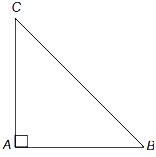
(A) Let $A = (1,2,3)$,$B = (3,-1,5)$,and $C = (4,0,-3)$.
First,we find the direction ratios of the sides:
Direction ratios of $\overline{AB} = (3-1, -1-2, 5-3) = (2, -3, 2)$.
Direction ratios of $\overline{AC} = (4-1, 0-2, -3-3) = (3, -2, -6)$.
Check for orthogonality: $\vec{AB} \cdot \vec{AC} = (2)(3) + (-3)(-2) + (2)(-6) = 6 + 6 - 12 = 0$.
Since the dot product is $0$,$\overline{AB} \perp \overline{AC}$,which means $\angle A = 90^{\circ}$.
In a right-angled triangle,the orthocentre $H$ is the vertex where the right angle is located. Thus,$H = A = (1, 2, 3)$.
The circumcentre $S$ of a right-angled triangle is the midpoint of the hypotenuse $\overline{BC}$.
$S = \left( \frac{3+4}{2}, \frac{-1+0}{2}, \frac{5-3}{2} \right) = \left( \frac{7}{2}, -\frac{1}{2}, 1 \right)$.
The distance $HS$ is given by the distance formula:
$HS = \sqrt{\left( \frac{7}{2} - 1 \right)^2 + \left( -\frac{1}{2} - 2 \right)^2 + (1 - 3)^2}$
$HS = \sqrt{\left( \frac{5}{2} \right)^2 + \left( -\frac{5}{2} \right)^2 + (-2)^2}$
$HS = \sqrt{\frac{25}{4} + \frac{25}{4} + 4} = \sqrt{\frac{50}{4} + \frac{16}{4}} = \sqrt{\frac{66}{4}} = \sqrt{\frac{33}{2}}$.
Thus,the correct option is $(A)$.
First,we find the direction ratios of the sides:
Direction ratios of $\overline{AB} = (3-1, -1-2, 5-3) = (2, -3, 2)$.
Direction ratios of $\overline{AC} = (4-1, 0-2, -3-3) = (3, -2, -6)$.
Check for orthogonality: $\vec{AB} \cdot \vec{AC} = (2)(3) + (-3)(-2) + (2)(-6) = 6 + 6 - 12 = 0$.
Since the dot product is $0$,$\overline{AB} \perp \overline{AC}$,which means $\angle A = 90^{\circ}$.
In a right-angled triangle,the orthocentre $H$ is the vertex where the right angle is located. Thus,$H = A = (1, 2, 3)$.
The circumcentre $S$ of a right-angled triangle is the midpoint of the hypotenuse $\overline{BC}$.
$S = \left( \frac{3+4}{2}, \frac{-1+0}{2}, \frac{5-3}{2} \right) = \left( \frac{7}{2}, -\frac{1}{2}, 1 \right)$.
The distance $HS$ is given by the distance formula:
$HS = \sqrt{\left( \frac{7}{2} - 1 \right)^2 + \left( -\frac{1}{2} - 2 \right)^2 + (1 - 3)^2}$
$HS = \sqrt{\left( \frac{5}{2} \right)^2 + \left( -\frac{5}{2} \right)^2 + (-2)^2}$
$HS = \sqrt{\frac{25}{4} + \frac{25}{4} + 4} = \sqrt{\frac{50}{4} + \frac{16}{4}} = \sqrt{\frac{66}{4}} = \sqrt{\frac{33}{2}}$.
Thus,the correct option is $(A)$.
0 likesView Solution
262
MathematicsMediumMCQAP EAMCET · 2019
If two sections of strengths $30$ and $45$ are formed from $75$ students who are admitted in a school,then the probability that two particular students are always together in the same section is
A
$\frac{66}{185}$
B
$\frac{19}{37}$
C
$\frac{29}{185}$
D
$\frac{18}{37}$
Solution
(B) Total ways to divide $75$ students into two sections of $30$ and $45$ is $^{75}C_{30}$.
Let the two particular students be $S_1$ and $S_2$.
Case $I$: Both $S_1$ and $S_2$ are in the section of $30$ students. The number of ways is $^{73}C_{28}$.
Case $II$: Both $S_1$ and $S_2$ are in the section of $45$ students. The number of ways is $^{73}C_{43}$.
The required probability is $\frac{^{73}C_{28} + ^{73}C_{43}}{^{75}C_{30}}$.
Using the formula $^{n}C_{r} = \frac{n!}{r!(n-r)!}$,we get:
$\frac{\frac{73!}{28!45!} + \frac{73!}{43!30!}}{\frac{75!}{30!45!}} = \frac{73!}{75!} \times \left( \frac{30!45!}{28!45!} + \frac{30!45!}{43!30!} \right)$
$= \frac{1}{75 \times 74} \times (30 \times 29 + 45 \times 44)$
$= \frac{870 + 1980}{5550} = \frac{2850}{5550} = \frac{285}{555} = \frac{19}{37}$.
Let the two particular students be $S_1$ and $S_2$.
Case $I$: Both $S_1$ and $S_2$ are in the section of $30$ students. The number of ways is $^{73}C_{28}$.
Case $II$: Both $S_1$ and $S_2$ are in the section of $45$ students. The number of ways is $^{73}C_{43}$.
The required probability is $\frac{^{73}C_{28} + ^{73}C_{43}}{^{75}C_{30}}$.
Using the formula $^{n}C_{r} = \frac{n!}{r!(n-r)!}$,we get:
$\frac{\frac{73!}{28!45!} + \frac{73!}{43!30!}}{\frac{75!}{30!45!}} = \frac{73!}{75!} \times \left( \frac{30!45!}{28!45!} + \frac{30!45!}{43!30!} \right)$
$= \frac{1}{75 \times 74} \times (30 \times 29 + 45 \times 44)$
$= \frac{870 + 1980}{5550} = \frac{2850}{5550} = \frac{285}{555} = \frac{19}{37}$.
0 likesView Solution
263
MathematicsMediumMCQAP EAMCET · 2019
From a group of $50$ students,two sections comprising of $20$ and $30$ students are formed. If $Ram$ and $Rahim$ are two particular students among the $50$ students,then the probability that they both belong to the same section is
A
$\frac{25}{49}$
B
$\frac{12}{23}$
C
$\frac{13}{23}$
D
$\frac{24}{49}$
Solution
(A) Total number of students $= 50$. The total number of ways to divide $50$ students into two groups of $20$ and $30$ is given by ${}^{50}C_{20} \times {}^{30}C_{30} = {}^{50}C_{20}$.
If both $Ram$ and $Rahim$ are in the first group (size $20$),we need to choose $18$ more students from the remaining $48$ students. The number of ways is ${}^{48}C_{18}$.
If both $Ram$ and $Rahim$ are in the second group (size $30$),we need to choose $28$ more students from the remaining $48$ students. The number of ways is ${}^{48}C_{28}$.
The required probability is $P = \frac{{}^{48}C_{18} + {}^{48}C_{28}}{{}^{50}C_{20}}$.
Using the formula ${}^{n}C_{r} = \frac{n!}{r!(n-r)!}$,we have:
$P = \frac{\frac{48!}{18!30!} + \frac{48!}{28!20!}}{\frac{50!}{20!30!}} = \frac{48!}{18!30!} \cdot \frac{20!30!}{50!} + \frac{48!}{28!20!} \cdot \frac{20!30!}{50!}$
$P = \frac{20 \times 19}{50 \times 49} + \frac{30 \times 29}{50 \times 49} = \frac{380 + 870}{2450} = \frac{1250}{2450} = \frac{25}{49}$.
Thus,the correct option is $A$.
If both $Ram$ and $Rahim$ are in the first group (size $20$),we need to choose $18$ more students from the remaining $48$ students. The number of ways is ${}^{48}C_{18}$.
If both $Ram$ and $Rahim$ are in the second group (size $30$),we need to choose $28$ more students from the remaining $48$ students. The number of ways is ${}^{48}C_{28}$.
The required probability is $P = \frac{{}^{48}C_{18} + {}^{48}C_{28}}{{}^{50}C_{20}}$.
Using the formula ${}^{n}C_{r} = \frac{n!}{r!(n-r)!}$,we have:
$P = \frac{\frac{48!}{18!30!} + \frac{48!}{28!20!}}{\frac{50!}{20!30!}} = \frac{48!}{18!30!} \cdot \frac{20!30!}{50!} + \frac{48!}{28!20!} \cdot \frac{20!30!}{50!}$
$P = \frac{20 \times 19}{50 \times 49} + \frac{30 \times 29}{50 \times 49} = \frac{380 + 870}{2450} = \frac{1250}{2450} = \frac{25}{49}$.
Thus,the correct option is $A$.
0 likesView Solution
264
MathematicsEasyMCQAP EAMCET · 2019
Each of the two boxes $A$ and $B$ contain $10$ chits numbered $1$ to $10$. If one chit is drawn at random from each of $A$ and $B$,then the probability that the number on the chit drawn from $A$ is smaller than the number on the chit drawn from $B$,is
A
$\frac{9}{10}$
B
$\frac{9}{20}$
C
$\frac{19}{20}$
D
$\frac{17}{20}$
Solution
(B) Let $X$ be the number drawn from box $A$ and $Y$ be the number drawn from box $B$. The total number of possible outcomes is $10 \times 10 = 100$.
We want to find the probability $P(X < Y)$.
The total outcomes can be divided into three cases: $X < Y$,$X > Y$,and $X = Y$.
The number of cases where $X = Y$ is $10$ (i.e.,$(1,1), (2,2), \ldots, (10,10)$).
Since the situation is symmetric,the number of cases where $X < Y$ is equal to the number of cases where $X > Y$.
Let $N$ be the number of cases where $X < Y$. Then $N + N + 10 = 100$.
$2N = 90 \implies N = 45$.
The required probability is $\frac{N}{100} = \frac{45}{100} = \frac{9}{20}$.
Hence,option $B$ is correct.
We want to find the probability $P(X < Y)$.
The total outcomes can be divided into three cases: $X < Y$,$X > Y$,and $X = Y$.
The number of cases where $X = Y$ is $10$ (i.e.,$(1,1), (2,2), \ldots, (10,10)$).
Since the situation is symmetric,the number of cases where $X < Y$ is equal to the number of cases where $X > Y$.
Let $N$ be the number of cases where $X < Y$. Then $N + N + 10 = 100$.
$2N = 90 \implies N = 45$.
The required probability is $\frac{N}{100} = \frac{45}{100} = \frac{9}{20}$.
Hence,option $B$ is correct.
0 likesView Solution
265
MathematicsMediumMCQAP EAMCET · 2019
If $y = \log_e \tan \left(\frac{\pi}{4} + \frac{x}{2}\right)$,then $\tanh \left(\frac{y}{2}\right) = $
A
$\cot \frac{x}{2}$
B
$\tan x$
C
$\coth x$
D
$\tan \frac{x}{2}$
Solution
(D) Given $y = \log_e \tan \left(\frac{\pi}{4} + \frac{x}{2}\right)$.
$e^y = \tan \left(\frac{\pi}{4} + \frac{x}{2}\right) = \frac{1 + \tan \frac{x}{2}}{1 - \tan \frac{x}{2}}$.
We know that $\tanh \left(\frac{y}{2}\right) = \frac{e^y - 1}{e^y + 1}$.
Substituting the value of $e^y$:
$\tanh \left(\frac{y}{2}\right) = \frac{\frac{1 + \tan \frac{x}{2}}{1 - \tan \frac{x}{2}} - 1}{\frac{1 + \tan \frac{x}{2}}{1 - \tan \frac{x}{2}} + 1} = \frac{(1 + \tan \frac{x}{2}) - (1 - \tan \frac{x}{2})}{(1 + \tan \frac{x}{2}) + (1 - \tan \frac{x}{2})} = \frac{2 \tan \frac{x}{2}}{2} = \tan \frac{x}{2}$.
Thus,option $D$ is correct.
$e^y = \tan \left(\frac{\pi}{4} + \frac{x}{2}\right) = \frac{1 + \tan \frac{x}{2}}{1 - \tan \frac{x}{2}}$.
We know that $\tanh \left(\frac{y}{2}\right) = \frac{e^y - 1}{e^y + 1}$.
Substituting the value of $e^y$:
$\tanh \left(\frac{y}{2}\right) = \frac{\frac{1 + \tan \frac{x}{2}}{1 - \tan \frac{x}{2}} - 1}{\frac{1 + \tan \frac{x}{2}}{1 - \tan \frac{x}{2}} + 1} = \frac{(1 + \tan \frac{x}{2}) - (1 - \tan \frac{x}{2})}{(1 + \tan \frac{x}{2}) + (1 - \tan \frac{x}{2})} = \frac{2 \tan \frac{x}{2}}{2} = \tan \frac{x}{2}$.
Thus,option $D$ is correct.
0 likesView Solution
266
MathematicsDifficultMCQAP EAMCET · 2019
If the circle $x^2+y^2+6x-2y+k=0$ bisects the circumference of the circle $x^2+y^2+2x-6y-15=0$,then $k$ is equal to :
A
$21$
B
-$21$
C
$23$
D
-$23$
Solution
(D) Given that,the circle $S_1 \equiv x^2+y^2+6x-2y+k=0$ and $S_2 \equiv x^2+y^2+2x-6y-15=0$.
Since $S_1$ bisects the circumference of $S_2$,the common chord of $S_1$ and $S_2$ must be the diameter of $S_2$.
The equation of the common chord is given by $S_1 - S_2 = 0$.
$(x^2+y^2+6x-2y+k) - (x^2+y^2+2x-6y-15) = 0$.
$4x + 4y + k + 15 = 0$.
Since this chord is the diameter of $S_2$,it must pass through the center of $S_2$.
The center of $S_2$ is $(-g, -f) = (-1, 3)$.
Substituting $(-1, 3)$ into the chord equation:
$4(-1) + 4(3) + k + 15 = 0$.
$-4 + 12 + k + 15 = 0$.
$8 + k + 15 = 0$.
$k + 23 = 0$.
$k = -23$.
Since $S_1$ bisects the circumference of $S_2$,the common chord of $S_1$ and $S_2$ must be the diameter of $S_2$.
The equation of the common chord is given by $S_1 - S_2 = 0$.
$(x^2+y^2+6x-2y+k) - (x^2+y^2+2x-6y-15) = 0$.
$4x + 4y + k + 15 = 0$.
Since this chord is the diameter of $S_2$,it must pass through the center of $S_2$.
The center of $S_2$ is $(-g, -f) = (-1, 3)$.
Substituting $(-1, 3)$ into the chord equation:
$4(-1) + 4(3) + k + 15 = 0$.
$-4 + 12 + k + 15 = 0$.
$8 + k + 15 = 0$.
$k + 23 = 0$.
$k = -23$.
0 likesView Solution
267
MathematicsMediumMCQAP EAMCET · 2019
The normal at a point on the parabola $y^2=4x$ passes through $(5,0)$. If there are two more normals to this parabola which pass through $(5,0)$,the centroid of the triangle formed by the feet of these three normals is
A
$\left(\frac{1}{2}, \frac{1}{2}\right)$
B
$(4,0)$
C
$(0,2)$
D
$(2,0)$
Solution
(D) The equation of the parabola is $y^2=4ax$,where $a=1$.
The normals to the parabola $y^2=4ax$ passing through a point $(h,k)$ are given by the cubic equation $my^3 + (2a-h)m^2 + k^2m - k = 0$.
For the point $(5,0)$,we have $h=5$ and $k=0$.
The equation becomes $m(y^2 + (2-5)) = 0$,which simplifies to $m(y^2-3)=0$.
The feet of the normals $(x_i, y_i)$ for $i=1, 2, 3$ are the points on the parabola.
The centroid $(G_x, G_y)$ of the triangle formed by the feet of the normals $(x_1, y_1), (x_2, y_2), (x_3, y_3)$ is given by $G_x = \frac{x_1+x_2+x_3}{3}$ and $G_y = \frac{y_1+y_2+y_3}{3}$.
For a parabola $y^2=4ax$,the centroid of the triangle formed by the feet of the three normals passing through $(h,k)$ is $\left(\frac{2}{3}(h-2a), 0\right)$.
Substituting $h=5$ and $a=1$,we get the centroid as $\left(\frac{2}{3}(5-2(1)), 0\right) = \left(\frac{2}{3}(3), 0\right) = (2,0)$.
The normals to the parabola $y^2=4ax$ passing through a point $(h,k)$ are given by the cubic equation $my^3 + (2a-h)m^2 + k^2m - k = 0$.
For the point $(5,0)$,we have $h=5$ and $k=0$.
The equation becomes $m(y^2 + (2-5)) = 0$,which simplifies to $m(y^2-3)=0$.
The feet of the normals $(x_i, y_i)$ for $i=1, 2, 3$ are the points on the parabola.
The centroid $(G_x, G_y)$ of the triangle formed by the feet of the normals $(x_1, y_1), (x_2, y_2), (x_3, y_3)$ is given by $G_x = \frac{x_1+x_2+x_3}{3}$ and $G_y = \frac{y_1+y_2+y_3}{3}$.
For a parabola $y^2=4ax$,the centroid of the triangle formed by the feet of the three normals passing through $(h,k)$ is $\left(\frac{2}{3}(h-2a), 0\right)$.
Substituting $h=5$ and $a=1$,we get the centroid as $\left(\frac{2}{3}(5-2(1)), 0\right) = \left(\frac{2}{3}(3), 0\right) = (2,0)$.
0 likesView Solution
268
MathematicsEasyMCQAP EAMCET · 2019
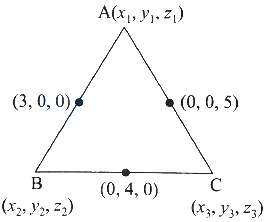
In a triangle $ABC$,if the midpoints of sides $AB, BC, CA$ are $(3,0,0), (0,4,0), (0,0,5)$ respectively,then $AB^2+BC^2+CA^2=$
A
$50$
B
$200$
C
$300$
D
$400$
Solution
(D) Let the vertices of the triangle be $A(x_1, y_1, z_1)$,$B(x_2, y_2, z_2)$,and $C(x_3, y_3, z_3)$.
Given the midpoints of $AB, BC, CA$ are $M_1(3,0,0)$,$M_2(0,4,0)$,and $M_3(0,0,5)$ respectively.
Using the midpoint formula:
$x_1+x_2=6, x_2+x_3=0, x_3+x_1=0$
Solving these,we get $x_1=3, x_2=3, x_3=-3$.
Similarly for $y$ coordinates:
$y_1+y_2=0, y_2+y_3=8, y_3+y_1=0$
Solving these,we get $y_1=-4, y_2=4, y_3=4$.
Similarly for $z$ coordinates:
$z_1+z_2=0, z_2+z_3=0, z_3+z_1=10$
Solving these,we get $z_1=5, z_2=-5, z_3=5$.
Thus,the vertices are $A(3, -4, 5)$,$B(3, 4, -5)$,and $C(-3, 4, 5)$.
Now,calculate the squares of the side lengths:
$AB^2 = (3-3)^2 + (4-(-4))^2 + (-5-5)^2 = 0^2 + 8^2 + (-10)^2 = 64 + 100 = 164$.
$BC^2 = (-3-3)^2 + (4-4)^2 + (5-(-5))^2 = (-6)^2 + 0^2 + 10^2 = 36 + 100 = 136$.
$CA^2 = (3-(-3))^2 + (-4-4)^2 + (5-5)^2 = 6^2 + (-8)^2 + 0^2 = 36 + 64 = 100$.
Finally,$AB^2+BC^2+CA^2 = 164 + 136 + 100 = 400$.
Given the midpoints of $AB, BC, CA$ are $M_1(3,0,0)$,$M_2(0,4,0)$,and $M_3(0,0,5)$ respectively.
Using the midpoint formula:
$x_1+x_2=6, x_2+x_3=0, x_3+x_1=0$
Solving these,we get $x_1=3, x_2=3, x_3=-3$.
Similarly for $y$ coordinates:
$y_1+y_2=0, y_2+y_3=8, y_3+y_1=0$
Solving these,we get $y_1=-4, y_2=4, y_3=4$.
Similarly for $z$ coordinates:
$z_1+z_2=0, z_2+z_3=0, z_3+z_1=10$
Solving these,we get $z_1=5, z_2=-5, z_3=5$.
Thus,the vertices are $A(3, -4, 5)$,$B(3, 4, -5)$,and $C(-3, 4, 5)$.
Now,calculate the squares of the side lengths:
$AB^2 = (3-3)^2 + (4-(-4))^2 + (-5-5)^2 = 0^2 + 8^2 + (-10)^2 = 64 + 100 = 164$.
$BC^2 = (-3-3)^2 + (4-4)^2 + (5-(-5))^2 = (-6)^2 + 0^2 + 10^2 = 36 + 100 = 136$.
$CA^2 = (3-(-3))^2 + (-4-4)^2 + (5-5)^2 = 6^2 + (-8)^2 + 0^2 = 36 + 64 = 100$.
Finally,$AB^2+BC^2+CA^2 = 164 + 136 + 100 = 400$.
0 likesView Solution
Vedclass Products
For Students
Vedclass Test Series
Mock tests in real AP EAMCET style covering Mathematics with performance analysis. 5-day free trial.
Start Free TrialFor Teachers
Exam Paper Generator
Generate Set A/B/C/D Mathematics papers from 7.5L+ questions in 2 minutes. 3 chapters free.
Try FreeFor Institutes
Online Exam Module
Run live AP EAMCET mock exams with unlimited students, 360° analytics & white-label branding.
See DemoFrequently Asked Questions
How many Mathematics questions are in AP EAMCET 2019?
There are 471 Mathematics questions from the AP EAMCET 2019 paper on Vedclass, each with a detailed step-by-step solution in English.
Are AP EAMCET 2019 Mathematics solutions available in English?
Yes. All solutions on this page are in English. You can also switch to English or Hindi using the language buttons above the questions.
Can I practice AP EAMCET 2019 Mathematics as a timed test?
Yes. Use the Vedclass Test Series to attempt a full AP EAMCET mock test covering Mathematics with time limits and instant score analysis.
Can teachers create Mathematics papers from AP EAMCET previous year questions?
Yes. The Vedclass Exam Paper Generator lets teachers mix AP EAMCET Mathematics questions and generate Set A/B/C/D papers in minutes.
For Teachers & Institutes
Build a Custom Mathematics Paper
Pick AP EAMCET 2019 Mathematics questions, set difficulty, and generate Set A/B/C/D in 2 minutes.