
A English
Probability Questions in English
Competitive Exam Quantitative Aptitude · Probability · Probability
494+
Questions
English
Language
100%
With Solutions
Showing 50 of 494 questions in English
151
EasyMCQ
Five horses are in a race. $Mr. A$ selects two of the horses at random and bets on them. The probability that $Mr. A$ selected the winning horse is (in $/5$)
A
$4$
B
$3$
C
$1$
D
$2$
Solution
(D) Total number of horses = $5$.
Number of horses selected by $Mr. A$ = $2$.
Total ways to select $2$ horses out of $5$ is given by $^5C_2 = \frac{5 \times 4}{2 \times 1} = 10$.
There is only $1$ winning horse.
The number of ways to select $2$ horses such that the winning horse is $NOT$ included is the number of ways to select $2$ horses from the $4$ losing horses,which is $^4C_2 = \frac{4 \times 3}{2 \times 1} = 6$.
The probability that the winning horse is $NOT$ selected = $\frac{6}{10} = \frac{3}{5}$.
The probability that the winning horse $IS$ selected = $1 - \frac{3}{5} = \frac{2}{5}$.
Number of horses selected by $Mr. A$ = $2$.
Total ways to select $2$ horses out of $5$ is given by $^5C_2 = \frac{5 \times 4}{2 \times 1} = 10$.
There is only $1$ winning horse.
The number of ways to select $2$ horses such that the winning horse is $NOT$ included is the number of ways to select $2$ horses from the $4$ losing horses,which is $^4C_2 = \frac{4 \times 3}{2 \times 1} = 6$.
The probability that the winning horse is $NOT$ selected = $\frac{6}{10} = \frac{3}{5}$.
The probability that the winning horse $IS$ selected = $1 - \frac{3}{5} = \frac{2}{5}$.
0 likes
View Solution152
MediumMCQ
$X$ speaks the truth in $60\%$ of cases and $Y$ in $50\%$ of cases. The probability that they contradict each other while narrating the same incident is
A
$\frac{1}{4}$
B
$\frac{1}{3}$
C
$\frac{1}{2}$
D
$\frac{2}{3}$
Solution
(C) Let $P(X)$ be the probability that $X$ speaks the truth and $P(Y)$ be the probability that $Y$ speaks the truth.
Given: $P(X) = 60\% = \frac{60}{100} = \frac{3}{5}$ and $P(Y) = 50\% = \frac{50}{100} = \frac{1}{2}$.
$X$ and $Y$ contradict each other if one speaks the truth and the other lies.
This can happen in two ways: ($X$ speaks the truth $AND$ $Y$ lies) $OR$ ($X$ lies $AND$ $Y$ speaks the truth).
Required probability $= P(X) \cdot P(\bar{Y}) + P(\bar{X}) \cdot P(Y)$.
Here,$P(\bar{X}) = 1 - P(X) = 1 - \frac{3}{5} = \frac{2}{5}$ and $P(\bar{Y}) = 1 - P(Y) = 1 - \frac{1}{2} = \frac{1}{2}$.
Required probability $= (\frac{3}{5} \cdot \frac{1}{2}) + (\frac{2}{5} \cdot \frac{1}{2}) = \frac{3}{10} + \frac{2}{10} = \frac{5}{10} = \frac{1}{2}$.
Given: $P(X) = 60\% = \frac{60}{100} = \frac{3}{5}$ and $P(Y) = 50\% = \frac{50}{100} = \frac{1}{2}$.
$X$ and $Y$ contradict each other if one speaks the truth and the other lies.
This can happen in two ways: ($X$ speaks the truth $AND$ $Y$ lies) $OR$ ($X$ lies $AND$ $Y$ speaks the truth).
Required probability $= P(X) \cdot P(\bar{Y}) + P(\bar{X}) \cdot P(Y)$.
Here,$P(\bar{X}) = 1 - P(X) = 1 - \frac{3}{5} = \frac{2}{5}$ and $P(\bar{Y}) = 1 - P(Y) = 1 - \frac{1}{2} = \frac{1}{2}$.
Required probability $= (\frac{3}{5} \cdot \frac{1}{2}) + (\frac{2}{5} \cdot \frac{1}{2}) = \frac{3}{10} + \frac{2}{10} = \frac{5}{10} = \frac{1}{2}$.
0 likes
View Solution153
MediumMCQ
The probability that $A$ speaks the truth is $\frac{4}{5}$,while this probability for $B$ is $\frac{3}{4}$. Find the probability that they contradict each other when asked to speak on a fact.
A
$\frac{4}{5}$
B
$\frac{1}{5}$
C
$\frac{7}{20}$
D
$\frac{3}{20}$
Solution
(C) Let $P(A)$ be the probability that $A$ speaks the truth and $P(B)$ be the probability that $B$ speaks the truth.
Given: $P(A) = \frac{4}{5}$ and $P(B) = \frac{3}{4}$.
The probability that $A$ lies is $P(\bar{A}) = 1 - P(A) = 1 - \frac{4}{5} = \frac{1}{5}$.
The probability that $B$ lies is $P(\bar{B}) = 1 - P(B) = 1 - \frac{3}{4} = \frac{1}{4}$.
They contradict each other if $A$ speaks the truth and $B$ lies,$OR$ $A$ lies and $B$ speaks the truth.
Required Probability $= P(A) \cdot P(\bar{B}) + P(\bar{A}) \cdot P(B)$
$= (\frac{4}{5} \cdot \frac{1}{4}) + (\frac{1}{5} \cdot \frac{3}{4})$
$= \frac{4}{20} + \frac{3}{20} = \frac{7}{20}$.
Given: $P(A) = \frac{4}{5}$ and $P(B) = \frac{3}{4}$.
The probability that $A$ lies is $P(\bar{A}) = 1 - P(A) = 1 - \frac{4}{5} = \frac{1}{5}$.
The probability that $B$ lies is $P(\bar{B}) = 1 - P(B) = 1 - \frac{3}{4} = \frac{1}{4}$.
They contradict each other if $A$ speaks the truth and $B$ lies,$OR$ $A$ lies and $B$ speaks the truth.
Required Probability $= P(A) \cdot P(\bar{B}) + P(\bar{A}) \cdot P(B)$
$= (\frac{4}{5} \cdot \frac{1}{4}) + (\frac{1}{5} \cdot \frac{3}{4})$
$= \frac{4}{20} + \frac{3}{20} = \frac{7}{20}$.
0 likes
View Solution154
EasyMCQ
The probability of getting a sum of $16$ in one throw with three dice is:
A
$\frac{1}{36}$
B
$\frac{1}{18}$
C
$\frac{1}{72}$
D
$\frac{1}{9}$
Solution
(A) The total number of outcomes when throwing three dice is $n(S) = 6 \times 6 \times 6 = 216$.
To get a sum of $16$,the possible combinations $(x, y, z)$ are:
$(6, 6, 4), (6, 4, 6), (4, 6, 6), (6, 5, 5), (5, 6, 5), (5, 5, 6)$.
The number of favorable outcomes is $n(E) = 6$.
The required probability is $P(E) = \frac{n(E)}{n(S)} = \frac{6}{216} = \frac{1}{36}$.
To get a sum of $16$,the possible combinations $(x, y, z)$ are:
$(6, 6, 4), (6, 4, 6), (4, 6, 6), (6, 5, 5), (5, 6, 5), (5, 5, 6)$.
The number of favorable outcomes is $n(E) = 6$.
The required probability is $P(E) = \frac{n(E)}{n(S)} = \frac{6}{216} = \frac{1}{36}$.
0 likes
View Solution155
EasyMCQ
The probability of choosing at random a number that is divisible by $6$ or $8$ from among $1$ to $90$ is equal to
A
$\frac{1}{6}$
B
$\frac{1}{30}$
C
$\frac{11}{80}$
D
$\frac{23}{90}$
Solution
(D) Let $A$ be the set of numbers divisible by $6$ and $B$ be the set of numbers divisible by $8$ in the range $1$ to $90$.
Total numbers $n(S) = 90$.
Number of elements divisible by $6$ is $n(A) = \lfloor \frac{90}{6} \rfloor = 15$.
Number of elements divisible by $8$ is $n(B) = \lfloor \frac{90}{8} \rfloor = 11$.
Numbers divisible by both $6$ and $8$ are divisible by $\text{lcm}(6, 8) = 24$.
Number of elements divisible by $24$ is $n(A \cap B) = \lfloor \frac{90}{24} \rfloor = 3$.
Using the inclusion-exclusion principle,the number of elements divisible by $6$ or $8$ is $n(A \cup B) = n(A) + n(B) - n(A \cap B) = 15 + 11 - 3 = 23$.
The probability is $P(A \cup B) = \frac{n(A \cup B)}{n(S)} = \frac{23}{90}$.
Total numbers $n(S) = 90$.
Number of elements divisible by $6$ is $n(A) = \lfloor \frac{90}{6} \rfloor = 15$.
Number of elements divisible by $8$ is $n(B) = \lfloor \frac{90}{8} \rfloor = 11$.
Numbers divisible by both $6$ and $8$ are divisible by $\text{lcm}(6, 8) = 24$.
Number of elements divisible by $24$ is $n(A \cap B) = \lfloor \frac{90}{24} \rfloor = 3$.
Using the inclusion-exclusion principle,the number of elements divisible by $6$ or $8$ is $n(A \cup B) = n(A) + n(B) - n(A \cap B) = 15 + 11 - 3 = 23$.
The probability is $P(A \cup B) = \frac{n(A \cup B)}{n(S)} = \frac{23}{90}$.
0 likes
View Solution156
MediumMCQ
The probabilities of a problem being solved by two students are $\frac{1}{2}$ and $\frac{1}{3}$ respectively. What is the probability that the problem is solved?
A
$\frac{2}{3}$
B
$\frac{4}{3}$
C
$\frac{1}{3}$
D
$1$
Solution
(A) Let $A$ be the event that the first student solves the problem,so $P(A) = \frac{1}{2}$.
Let $B$ be the event that the second student solves the problem,so $P(B) = \frac{1}{3}$.
The problem is solved if at least one of the students solves it.
The probability that the problem is not solved by either student is $P(A^c) \times P(B^c) = (1 - \frac{1}{2}) \times (1 - \frac{1}{3}) = \frac{1}{2} \times \frac{2}{3} = \frac{1}{3}$.
The probability that the problem is solved is $1 - P(\text{not solved}) = 1 - \frac{1}{3} = \frac{2}{3}$.
Let $B$ be the event that the second student solves the problem,so $P(B) = \frac{1}{3}$.
The problem is solved if at least one of the students solves it.
The probability that the problem is not solved by either student is $P(A^c) \times P(B^c) = (1 - \frac{1}{2}) \times (1 - \frac{1}{3}) = \frac{1}{2} \times \frac{2}{3} = \frac{1}{3}$.
The probability that the problem is solved is $1 - P(\text{not solved}) = 1 - \frac{1}{3} = \frac{2}{3}$.
0 likes
View Solution157
DifficultMCQ
Three houses are available in a locality. Three persons apply for the houses. Each applies for one house without consulting others. The probability that all the three apply for the same house is
A
$\frac{8}{9}$
B
$\frac{7}{9}$
C
$\frac{2}{9}$
D
$\frac{1}{9}$
Solution
(D) There are $3$ houses available and $3$ persons applying for them.
Each person has $3$ choices for selecting a house.
Since each person applies independently,the total number of ways the $3$ persons can apply for the $3$ houses is $3 \times 3 \times 3 = 27$.
For all $3$ persons to apply for the same house,they can either all choose the first house,all choose the second house,or all choose the third house.
There are $3$ such favorable outcomes.
Therefore,the probability that all $3$ persons apply for the same house is $\frac{3}{27} = \frac{1}{9}$.
Each person has $3$ choices for selecting a house.
Since each person applies independently,the total number of ways the $3$ persons can apply for the $3$ houses is $3 \times 3 \times 3 = 27$.
For all $3$ persons to apply for the same house,they can either all choose the first house,all choose the second house,or all choose the third house.
There are $3$ such favorable outcomes.
Therefore,the probability that all $3$ persons apply for the same house is $\frac{3}{27} = \frac{1}{9}$.
0 likes
View Solution158
DifficultMCQ
In a throw of a dice,the probability of getting a $1$ in an even number of throws is:
A
$\frac{5}{36}$
B
$\frac{5}{11}$
C
$\frac{6}{11}$
D
$\frac{1}{6}$
Solution
(B) Let $p$ be the probability of getting a $1$ in a single throw,so $p = \frac{1}{6}$.
Let $q$ be the probability of not getting a $1$,so $q = 1 - \frac{1}{6} = \frac{5}{6}$.
The event of getting a $1$ in an even number of throws means getting it on the $2^{nd}, 4^{th}, 6^{th}, \dots$ throw.
This is represented by the sum of the probabilities: $q \cdot p + q^3 \cdot p + q^5 \cdot p + \dots$
This is an infinite geometric series with the first term $a = qp = \frac{5}{6} \cdot \frac{1}{6} = \frac{5}{36}$ and common ratio $r = q^2 = (\frac{5}{6})^2 = \frac{25}{36}$.
The sum $S$ of an infinite geometric series is given by $S = \frac{a}{1 - r}$.
$S = \frac{5/36}{1 - 25/36} = \frac{5/36}{11/36} = \frac{5}{11}$.
Let $q$ be the probability of not getting a $1$,so $q = 1 - \frac{1}{6} = \frac{5}{6}$.
The event of getting a $1$ in an even number of throws means getting it on the $2^{nd}, 4^{th}, 6^{th}, \dots$ throw.
This is represented by the sum of the probabilities: $q \cdot p + q^3 \cdot p + q^5 \cdot p + \dots$
This is an infinite geometric series with the first term $a = qp = \frac{5}{6} \cdot \frac{1}{6} = \frac{5}{36}$ and common ratio $r = q^2 = (\frac{5}{6})^2 = \frac{25}{36}$.
The sum $S$ of an infinite geometric series is given by $S = \frac{a}{1 - r}$.
$S = \frac{5/36}{1 - 25/36} = \frac{5/36}{11/36} = \frac{5}{11}$.
0 likes
View Solution159
MediumMCQ
$A$ and $B$ are two independent events such that $P(A) = 1/2$ and $P(B) = 1/3$. Then $P$ (neither $A$ nor $B$) is equal to
A
$2/3$
B
$1/6$
C
$5/6$
D
$1/3$
Solution
(D) Given that $A$ and $B$ are independent events,the probability of neither $A$ nor $B$ occurring is given by $P(\bar{A} \cap \bar{B})$.
Since $A$ and $B$ are independent,their complements $\bar{A}$ and $\bar{B}$ are also independent.
Therefore,$P(\bar{A} \cap \bar{B}) = P(\bar{A}) \times P(\bar{B})$.
We know that $P(\bar{A}) = 1 - P(A) = 1 - 1/2 = 1/2$.
Similarly,$P(\bar{B}) = 1 - P(B) = 1 - 1/3 = 2/3$.
Thus,$P(\bar{A} \cap \bar{B}) = (1/2) \times (2/3) = 1/3$.
Since $A$ and $B$ are independent,their complements $\bar{A}$ and $\bar{B}$ are also independent.
Therefore,$P(\bar{A} \cap \bar{B}) = P(\bar{A}) \times P(\bar{B})$.
We know that $P(\bar{A}) = 1 - P(A) = 1 - 1/2 = 1/2$.
Similarly,$P(\bar{B}) = 1 - P(B) = 1 - 1/3 = 2/3$.
Thus,$P(\bar{A} \cap \bar{B}) = (1/2) \times (2/3) = 1/3$.
0 likes
View Solution160
MediumMCQ
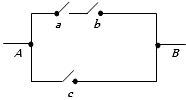
Consider the circuit shown in the image. If the probability that each switch is closed is $p$,then find the probability of current flowing through $AB$.
A
$p^2 + p$
B
$p^3 + p - 1$
C
$p^3 + p$
D
$p^2 + p + 1$
Solution
(NONE) The circuit consists of two parallel branches connected between points $A$ and $B$.
$1$. The upper branch contains two switches $a$ and $b$ in series. Current flows through this branch only if both switches $a$ and $b$ are closed.
Since the probability of each switch being closed is $p$,the probability that the upper branch is closed is $P(\text{upper}) = p \cdot p = p^2$.
$2$. The lower branch contains a single switch $c$. Current flows through this branch if switch $c$ is closed.
The probability that the lower branch is closed is $P(\text{lower}) = p$.
$3$. Current flows from $A$ to $B$ if either the upper branch is closed $OR$ the lower branch is closed.
Using the inclusion-exclusion principle for probability: $P(A \cup B) = P(A) + P(B) - P(A \cap B)$.
Here,$P(\text{upper} \cup \text{lower}) = P(\text{upper}) + P(\text{lower}) - P(\text{upper} \cap \text{lower})$.
$P(\text{upper} \cap \text{lower}) = p^2 \cdot p = p^3$.
Therefore,the required probability is $p^2 + p - p^3$.
$1$. The upper branch contains two switches $a$ and $b$ in series. Current flows through this branch only if both switches $a$ and $b$ are closed.
Since the probability of each switch being closed is $p$,the probability that the upper branch is closed is $P(\text{upper}) = p \cdot p = p^2$.
$2$. The lower branch contains a single switch $c$. Current flows through this branch if switch $c$ is closed.
The probability that the lower branch is closed is $P(\text{lower}) = p$.
$3$. Current flows from $A$ to $B$ if either the upper branch is closed $OR$ the lower branch is closed.
Using the inclusion-exclusion principle for probability: $P(A \cup B) = P(A) + P(B) - P(A \cap B)$.
Here,$P(\text{upper} \cup \text{lower}) = P(\text{upper}) + P(\text{lower}) - P(\text{upper} \cap \text{lower})$.
$P(\text{upper} \cap \text{lower}) = p^2 \cdot p = p^3$.
Therefore,the required probability is $p^2 + p - p^3$.
0 likes
View Solution161
EasyMCQ
Two cards are drawn at random from a pack of $52$ cards. The probability that both are the cards of spade is
A
$\frac{1}{26}$
B
$\frac{1}{4}$
C
$\frac{1}{17}$
D
None of these
Solution
(C) Total number of ways to draw $2$ cards from $52$ cards is given by $^{52}C_2$.
Number of ways to draw $2$ spade cards from $13$ spade cards is given by $^{13}C_2$.
The required probability is $P = \frac{^{13}C_2}{^{52}C_2}$.
Calculating the combinations: $^{13}C_2 = \frac{13 \times 12}{2 \times 1} = 78$ and $^{52}C_2 = \frac{52 \times 51}{2 \times 1} = 1326$.
Thus,$P = \frac{78}{1326} = \frac{1}{17}$.
Number of ways to draw $2$ spade cards from $13$ spade cards is given by $^{13}C_2$.
The required probability is $P = \frac{^{13}C_2}{^{52}C_2}$.
Calculating the combinations: $^{13}C_2 = \frac{13 \times 12}{2 \times 1} = 78$ and $^{52}C_2 = \frac{52 \times 51}{2 \times 1} = 1326$.
Thus,$P = \frac{78}{1326} = \frac{1}{17}$.
0 likes
View Solution162
EasyMCQ
Six cards are drawn simultaneously from a pack of playing cards. What is the probability that $3$ will be red and $3$ will be black?
A
$^{26}C_6$
B
$\frac{^{26}C_3}{^{52}C_6}$
C
$\frac{^{26}C_3 \times ^{26}C_3}{^{52}C_6}$
D
$\frac{1}{2}$
Solution
(C) Total number of cards in a pack is $52$.
There are $26$ red cards and $26$ black cards in a pack.
We need to draw $6$ cards simultaneously,which can be done in $^{52}C_6$ ways.
The number of ways to select $3$ red cards from $26$ red cards is $^{26}C_3$.
The number of ways to select $3$ black cards from $26$ black cards is $^{26}C_3$.
Therefore,the number of favorable outcomes is $^{26}C_3 \times ^{26}C_3$.
The probability is given by the ratio of favorable outcomes to total outcomes: $P = \frac{^{26}C_3 \times ^{26}C_3}{^{52}C_6}$.
There are $26$ red cards and $26$ black cards in a pack.
We need to draw $6$ cards simultaneously,which can be done in $^{52}C_6$ ways.
The number of ways to select $3$ red cards from $26$ red cards is $^{26}C_3$.
The number of ways to select $3$ black cards from $26$ black cards is $^{26}C_3$.
Therefore,the number of favorable outcomes is $^{26}C_3 \times ^{26}C_3$.
The probability is given by the ratio of favorable outcomes to total outcomes: $P = \frac{^{26}C_3 \times ^{26}C_3}{^{52}C_6}$.
0 likes
View Solution163
MediumMCQ
$A$ man draws a card from a pack of $52$ playing cards,replaces it,and shuffles the pack. He continues this process until he gets a card of spade. The probability that he will fail the first two times is
A
$\frac{9}{16}$
B
$\frac{1}{16}$
C
$\frac{9}{64}$
D
None of these
Solution
(C) The total number of cards in a pack is $52$.
The number of spade cards is $13$.
The probability of drawing a spade card in a single trial is $P(S) = \frac{13}{52} = \frac{1}{4}$.
The probability of not drawing a spade card (failure) in a single trial is $P(F) = 1 - P(S) = 1 - \frac{1}{4} = \frac{3}{4}$.
Since the card is replaced and the pack is shuffled,each trial is independent.
The probability that he fails the first two times is the probability of getting a non-spade card in the first trial $AND$ a non-spade card in the second trial.
Required probability $= P(F) \times P(F) = \frac{3}{4} \times \frac{3}{4} = \frac{9}{64}$.
The number of spade cards is $13$.
The probability of drawing a spade card in a single trial is $P(S) = \frac{13}{52} = \frac{1}{4}$.
The probability of not drawing a spade card (failure) in a single trial is $P(F) = 1 - P(S) = 1 - \frac{1}{4} = \frac{3}{4}$.
Since the card is replaced and the pack is shuffled,each trial is independent.
The probability that he fails the first two times is the probability of getting a non-spade card in the first trial $AND$ a non-spade card in the second trial.
Required probability $= P(F) \times P(F) = \frac{3}{4} \times \frac{3}{4} = \frac{9}{64}$.
0 likes
View Solution164
MediumMCQ
If out of $20$ consecutive whole numbers two are chosen at random,then the probability that their sum is odd,is
A
$\frac{5}{19}$
B
$\frac{10}{19}$
C
$\frac{9}{19}$
D
None of these
Solution
(B) The total number of ways to choose $2$ integers from $20$ consecutive integers is given by ${}^{20}C_2 = \frac{20 \times 19}{2} = 190$.
In any set of $20$ consecutive integers,there are exactly $10$ even numbers and $10$ odd numbers.
The sum of two numbers is odd if and only if one number is even and the other is odd.
The number of ways to choose one even number from $10$ and one odd number from $10$ is ${}^{10}C_1 \times {}^{10}C_1 = 10 \times 10 = 100$.
Therefore,the required probability is $\frac{100}{190} = \frac{10}{19}$.
In any set of $20$ consecutive integers,there are exactly $10$ even numbers and $10$ odd numbers.
The sum of two numbers is odd if and only if one number is even and the other is odd.
The number of ways to choose one even number from $10$ and one odd number from $10$ is ${}^{10}C_1 \times {}^{10}C_1 = 10 \times 10 = 100$.
Therefore,the required probability is $\frac{100}{190} = \frac{10}{19}$.
0 likes
View Solution165
MediumMCQ
$A$ bag contains $3$ red,$7$ white,and $4$ black balls. If three balls are drawn from the bag,the probability that all of them are of the same color is:
A
$\frac{6}{71}$
B
$\frac{7}{81}$
C
$\frac{10}{91}$
D
None of these
Solution
(C) Total number of balls $= 3 + 7 + 4 = 14$.
Number of ways to draw $3$ balls out of $14$ is given by $^{14}C_3 = \frac{14 \times 13 \times 12}{3 \times 2 \times 1} = 14 \times 13 \times 2 = 364$.
For all three balls to be of the same color,they must be either all red,all white,or all black.
Number of ways to choose $3$ red balls $= ^3C_3 = 1$.
Number of ways to choose $3$ white balls $= ^7C_3 = \frac{7 \times 6 \times 5}{3 \times 2 \times 1} = 35$.
Number of ways to choose $3$ black balls $= ^4C_3 = 4$.
Total favorable outcomes $= 1 + 35 + 4 = 40$.
Required probability $= \frac{40}{364} = \frac{10}{91}$.
Number of ways to draw $3$ balls out of $14$ is given by $^{14}C_3 = \frac{14 \times 13 \times 12}{3 \times 2 \times 1} = 14 \times 13 \times 2 = 364$.
For all three balls to be of the same color,they must be either all red,all white,or all black.
Number of ways to choose $3$ red balls $= ^3C_3 = 1$.
Number of ways to choose $3$ white balls $= ^7C_3 = \frac{7 \times 6 \times 5}{3 \times 2 \times 1} = 35$.
Number of ways to choose $3$ black balls $= ^4C_3 = 4$.
Total favorable outcomes $= 1 + 35 + 4 = 40$.
Required probability $= \frac{40}{364} = \frac{10}{91}$.
0 likes
View Solution166
MediumMCQ
If four persons are chosen at random from a group of $3$ men,$2$ women,and $4$ children,then the probability that exactly two of them are children is:
A
$\frac{10}{21}$
B
$\frac{8}{63}$
C
$\frac{5}{21}$
D
$\frac{9}{21}$
Solution
(A) Total number of persons $= 3 + 2 + 4 = 9$.
We need to choose $4$ persons out of $9$,which can be done in ${}^9C_4$ ways.
${}^9C_4 = \frac{9 \times 8 \times 7 \times 6}{4 \times 3 \times 2 \times 1} = 126$.
We want exactly $2$ children out of $4$ children,which can be chosen in ${}^4C_2$ ways.
${}^4C_2 = \frac{4 \times 3}{2 \times 1} = 6$.
The remaining $2$ persons must be chosen from the $5$ adults ($3$ men $+ 2$ women),which can be done in ${}^5C_2$ ways.
${}^5C_2 = \frac{5 \times 4}{2 \times 1} = 10$.
The number of favorable outcomes $= {}^4C_2 \times {}^5C_2 = 6 \times 10 = 60$.
The required probability $= \frac{60}{126} = \frac{10}{21}$.
We need to choose $4$ persons out of $9$,which can be done in ${}^9C_4$ ways.
${}^9C_4 = \frac{9 \times 8 \times 7 \times 6}{4 \times 3 \times 2 \times 1} = 126$.
We want exactly $2$ children out of $4$ children,which can be chosen in ${}^4C_2$ ways.
${}^4C_2 = \frac{4 \times 3}{2 \times 1} = 6$.
The remaining $2$ persons must be chosen from the $5$ adults ($3$ men $+ 2$ women),which can be done in ${}^5C_2$ ways.
${}^5C_2 = \frac{5 \times 4}{2 \times 1} = 10$.
The number of favorable outcomes $= {}^4C_2 \times {}^5C_2 = 6 \times 10 = 60$.
The required probability $= \frac{60}{126} = \frac{10}{21}$.
0 likes
View Solution167
MediumMCQ
$A$ box contains $25$ tickets numbered $1, 2, \dots, 25$. If two tickets are drawn at random,then the probability that the product of their numbers is even is:
A
$\frac{11}{50}$
B
$\frac{13}{50}$
C
$\frac{37}{50}$
D
None of these
Solution
(C) The total number of ways to draw $2$ tickets from $25$ is given by $^{25}C_2 = \frac{25 \times 24}{2} = 300$.
The product of two numbers is even if at least one of the numbers is even.
It is easier to calculate the probability of the complement event: the product is odd.
The product is odd only if both selected numbers are odd.
In the set ${1, 2, \dots, 25}$,there are $13$ odd numbers $(1, 3, 5, \dots, 25)$ and $12$ even numbers.
The number of ways to choose $2$ odd tickets is $^{13}C_2 = \frac{13 \times 12}{2} = 78$.
The probability that the product is odd is $P(\text{odd}) = \frac{78}{300} = \frac{13}{50}$.
Therefore,the probability that the product is even is $1 - P(\text{odd}) = 1 - \frac{13}{50} = \frac{37}{50}$.
The product of two numbers is even if at least one of the numbers is even.
It is easier to calculate the probability of the complement event: the product is odd.
The product is odd only if both selected numbers are odd.
In the set ${1, 2, \dots, 25}$,there are $13$ odd numbers $(1, 3, 5, \dots, 25)$ and $12$ even numbers.
The number of ways to choose $2$ odd tickets is $^{13}C_2 = \frac{13 \times 12}{2} = 78$.
The probability that the product is odd is $P(\text{odd}) = \frac{78}{300} = \frac{13}{50}$.
Therefore,the probability that the product is even is $1 - P(\text{odd}) = 1 - \frac{13}{50} = \frac{37}{50}$.
0 likes
View Solution168
EasyMCQ
From a class of $12$ girls and $18$ boys,two students are chosen randomly. What is the probability that both of them are girls?
A
$\frac{22}{145}$
B
$\frac{13}{15}$
C
$\frac{1}{18}$
D
None of these
Solution
(A) Total number of students = $12 + 18 = 30$.
Number of ways to choose $2$ students from $30$ is given by $^{30}C_2 = \frac{30 \times 29}{2 \times 1} = 435$.
Number of ways to choose $2$ girls from $12$ is given by $^{12}C_2 = \frac{12 \times 11}{2 \times 1} = 66$.
The probability that both chosen students are girls is $P = \frac{^{12}C_2}{^{30}C_2} = \frac{66}{435}$.
Dividing both numerator and denominator by $3$,we get $P = \frac{22}{145}$.
Number of ways to choose $2$ students from $30$ is given by $^{30}C_2 = \frac{30 \times 29}{2 \times 1} = 435$.
Number of ways to choose $2$ girls from $12$ is given by $^{12}C_2 = \frac{12 \times 11}{2 \times 1} = 66$.
The probability that both chosen students are girls is $P = \frac{^{12}C_2}{^{30}C_2} = \frac{66}{435}$.
Dividing both numerator and denominator by $3$,we get $P = \frac{22}{145}$.
0 likes
View Solution169
EasyMCQ
$A$ word consists of $11$ letters in which there are $7$ consonants and $4$ vowels. If $2$ letters are chosen at random,then the probability that both of them are consonants is:
A
$\frac{5}{11}$
B
$\frac{21}{55}$
C
$\frac{4}{11}$
D
None of these
Solution
(B) Total number of letters = $11$.
Number of consonants = $7$.
Number of vowels = $4$.
We need to choose $2$ letters out of $11$. The total number of ways to choose $2$ letters is given by $^{11}C_2 = \frac{11 \times 10}{2 \times 1} = 55$.
The number of ways to choose $2$ consonants out of $7$ is given by $^7C_2 = \frac{7 \times 6}{2 \times 1} = 21$.
The probability that both chosen letters are consonants is the ratio of the number of favorable outcomes to the total number of outcomes.
Required probability = $\frac{^7C_2}{^{11}C_2} = \frac{21}{55}$.
Number of consonants = $7$.
Number of vowels = $4$.
We need to choose $2$ letters out of $11$. The total number of ways to choose $2$ letters is given by $^{11}C_2 = \frac{11 \times 10}{2 \times 1} = 55$.
The number of ways to choose $2$ consonants out of $7$ is given by $^7C_2 = \frac{7 \times 6}{2 \times 1} = 21$.
The probability that both chosen letters are consonants is the ratio of the number of favorable outcomes to the total number of outcomes.
Required probability = $\frac{^7C_2}{^{11}C_2} = \frac{21}{55}$.
0 likes
View Solution170
EasyMCQ
Twenty tickets are marked with the numbers $1, 2, \dots, 20$. If three tickets are drawn at random,what is the probability that those marked $7$ and $11$ are among them?
A
$\frac{3}{190}$
B
$\frac{1}{19}$
C
$\frac{1}{190}$
D
None of these
Solution
(A) Total number of ways to draw $3$ tickets out of $20$ is given by $^{20}C_3 = \frac{20 \times 19 \times 18}{3 \times 2 \times 1} = 1140$.
We want to find the probability that the tickets marked $7$ and $11$ are included in the selection.
Since $2$ tickets ($7$ and $11$) are already fixed,we only need to choose $1$ more ticket from the remaining $18$ tickets $(20 - 2 = 18)$.
The number of ways to choose the $3^{rd}$ ticket is $^{18}C_1 = 18$.
Therefore,the required probability is $\frac{18}{1140} = \frac{18}{1140} = \frac{3}{190}$.
We want to find the probability that the tickets marked $7$ and $11$ are included in the selection.
Since $2$ tickets ($7$ and $11$) are already fixed,we only need to choose $1$ more ticket from the remaining $18$ tickets $(20 - 2 = 18)$.
The number of ways to choose the $3^{rd}$ ticket is $^{18}C_1 = 18$.
Therefore,the required probability is $\frac{18}{1140} = \frac{18}{1140} = \frac{3}{190}$.
0 likes
View Solution171
MediumMCQ
If Mohan has $3$ tickets of a lottery containing $3$ prizes and $9$ blanks,then his chance of winning at least one prize is
A
$\frac{34}{55}$
B
$\frac{21}{55}$
C
$\frac{17}{55}$
D
None of these
Solution
(A) Total number of tickets $= 3 + 9 = 12$.
Mohan selects $3$ tickets out of $12$. The total number of ways to select $3$ tickets is ${}^{12}C_3 = \frac{12 \times 11 \times 10}{3 \times 2 \times 1} = 220$.
The probability of winning at least one prize is $1 - P(\text{winning no prize})$.
Winning no prize means all $3$ tickets are selected from the $9$ blanks.
The number of ways to select $3$ blanks out of $9$ is ${}^9C_3 = \frac{9 \times 8 \times 7}{3 \times 2 \times 1} = 84$.
The probability of winning no prize is $\frac{84}{220} = \frac{21}{55}$.
Therefore,the probability of winning at least one prize is $1 - \frac{21}{55} = \frac{34}{55}$.
Mohan selects $3$ tickets out of $12$. The total number of ways to select $3$ tickets is ${}^{12}C_3 = \frac{12 \times 11 \times 10}{3 \times 2 \times 1} = 220$.
The probability of winning at least one prize is $1 - P(\text{winning no prize})$.
Winning no prize means all $3$ tickets are selected from the $9$ blanks.
The number of ways to select $3$ blanks out of $9$ is ${}^9C_3 = \frac{9 \times 8 \times 7}{3 \times 2 \times 1} = 84$.
The probability of winning no prize is $\frac{84}{220} = \frac{21}{55}$.
Therefore,the probability of winning at least one prize is $1 - \frac{21}{55} = \frac{34}{55}$.
0 likes
View Solution172
EasyMCQ
$A$ bag contains $3$ white and $7$ red balls. If a ball is drawn at random,what is the probability that the drawn ball is either white or red?
A
$0$
B
$\frac{3}{10}$
C
$\frac{7}{10}$
D
$\frac{10}{10}$
Solution
(D) Total number of balls in the bag = $3$ (white) + $7$ (red) = $10$ balls.
Let $E$ be the event of drawing a ball that is either white or red.
Since all balls in the bag are either white or red,this is a certain event.
The number of favorable outcomes = $3 + 7 = 10$.
The total number of possible outcomes = $10$.
Probability $P(E) = \frac{\text{Number of favorable outcomes}}{\text{Total number of possible outcomes}} = \frac{10}{10} = 1$.
Let $E$ be the event of drawing a ball that is either white or red.
Since all balls in the bag are either white or red,this is a certain event.
The number of favorable outcomes = $3 + 7 = 10$.
The total number of possible outcomes = $10$.
Probability $P(E) = \frac{\text{Number of favorable outcomes}}{\text{Total number of possible outcomes}} = \frac{10}{10} = 1$.
0 likes
View Solution173
EasyMCQ
$A$ bag contains $4$ white,$5$ red,and $6$ black balls. If two balls are drawn at random,then the probability that one of them is white is
A
$\frac{44}{105}$
B
$\frac{11}{105}$
C
$\frac{11}{21}$
D
None of these
Solution
(A) Total number of balls $= 4 + 5 + 6 = 15$.
Number of ways to draw $2$ balls from $15$ is $^{15}C_2 = \frac{15 \times 14}{2 \times 1} = 105$.
We want the probability that one ball is white and the other is non-white (red or black).
Number of white balls $= 4$.
Number of non-white balls $= 5 + 6 = 11$.
Number of ways to choose $1$ white ball and $1$ non-white ball $= ^4C_1 \times ^{11}C_1 = 4 \times 11 = 44$.
Required probability $= \frac{44}{105}$.
Number of ways to draw $2$ balls from $15$ is $^{15}C_2 = \frac{15 \times 14}{2 \times 1} = 105$.
We want the probability that one ball is white and the other is non-white (red or black).
Number of white balls $= 4$.
Number of non-white balls $= 5 + 6 = 11$.
Number of ways to choose $1$ white ball and $1$ non-white ball $= ^4C_1 \times ^{11}C_1 = 4 \times 11 = 44$.
Required probability $= \frac{44}{105}$.
0 likes
View Solution174
EasyMCQ
$A$ bag contains $6$ red,$4$ white and $8$ blue balls. If three balls are drawn at random,then the probability that $2$ are white and $1$ is red,is
A
$\frac{5}{204}$
B
$\frac{7}{102}$
C
$\frac{3}{68}$
D
$\frac{1}{13}$
Solution
(C) Total number of balls = $6 + 4 + 8 = 18$.
Number of ways to draw $3$ balls from $18$ is given by ${}^{18}C_3 = \frac{18 \times 17 \times 16}{3 \times 2 \times 1} = 3 \times 17 \times 16 = 816$.
We need to draw $2$ white balls from $4$ and $1$ red ball from $6$.
Number of ways to choose $2$ white balls = ${}^4C_2 = \frac{4 \times 3}{2 \times 1} = 6$.
Number of ways to choose $1$ red ball = ${}^6C_1 = 6$.
Total favorable outcomes = ${}^4C_2 \times {}^6C_1 = 6 \times 6 = 36$.
Required probability = $\frac{36}{816} = \frac{3}{68}$.
Number of ways to draw $3$ balls from $18$ is given by ${}^{18}C_3 = \frac{18 \times 17 \times 16}{3 \times 2 \times 1} = 3 \times 17 \times 16 = 816$.
We need to draw $2$ white balls from $4$ and $1$ red ball from $6$.
Number of ways to choose $2$ white balls = ${}^4C_2 = \frac{4 \times 3}{2 \times 1} = 6$.
Number of ways to choose $1$ red ball = ${}^6C_1 = 6$.
Total favorable outcomes = ${}^4C_2 \times {}^6C_1 = 6 \times 6 = 36$.
Required probability = $\frac{36}{816} = \frac{3}{68}$.
0 likes
View Solution175
EasyMCQ
$A$ committee of $5$ is to be chosen from a group of $9$ people. The probability that a certain married couple will either serve together or not at all,is
A
$\frac{1}{2}$
B
$\frac{5}{9}$
C
$\frac{4}{9}$
D
$\frac{2}{9}$
Solution
(C) Total ways to choose a committee of $5$ from $9$ people is ${}^9C_5 = \frac{9 \times 8 \times 7 \times 6}{4 \times 3 \times 2 \times 1} = 126$.
Case $1$: The couple serves together.
If the couple is included,we need to choose $3$ more people from the remaining $7$ people. This can be done in ${}^7C_3 = \frac{7 \times 6 \times 5}{3 \times 2 \times 1} = 35$ ways.
Case $2$: The couple does not serve at all.
If the couple is excluded,we need to choose $5$ people from the remaining $7$ people. This can be done in ${}^7C_5 = {}^7C_2 = \frac{7 \times 6}{2 \times 1} = 21$ ways.
Total favorable ways $= 35 + 21 = 56$.
Required probability $= \frac{56}{126} = \frac{4}{9}$.
Case $1$: The couple serves together.
If the couple is included,we need to choose $3$ more people from the remaining $7$ people. This can be done in ${}^7C_3 = \frac{7 \times 6 \times 5}{3 \times 2 \times 1} = 35$ ways.
Case $2$: The couple does not serve at all.
If the couple is excluded,we need to choose $5$ people from the remaining $7$ people. This can be done in ${}^7C_5 = {}^7C_2 = \frac{7 \times 6}{2 \times 1} = 21$ ways.
Total favorable ways $= 35 + 21 = 56$.
Required probability $= \frac{56}{126} = \frac{4}{9}$.
0 likes
View Solution176
DifficultMCQ
The letters of the word $ASSASSIN$ are written down at random in a row. The probability that no two $S$ occur together is
A
$\frac{1}{35}$
B
$\frac{1}{14}$
C
$\frac{1}{15}$
D
None of these
Solution
(B) The word $ASSASSIN$ contains $8$ letters: $A(2), S(4), I(1), N(1)$.
Total number of arrangements $ = \frac{8!}{4! \times 2!} = \frac{8 \times 7 \times 6 \times 5 \times 4!}{4! \times 2} = 840$.
To ensure no two $S$ occur together,we use the gap method. First,arrange the remaining $4$ letters $(A, A, I, N)$.
The number of ways to arrange these $4$ letters is $\frac{4!}{2!} = 12$.
These $4$ letters create $5$ gaps (including ends): $\_ L_1 \_ L_2 \_ L_3 \_ L_4 \_$.
We need to place $4$ $S$'s in these $5$ gaps. The number of ways to choose $4$ gaps out of $5$ is $\binom{5}{4} = 5$.
Total favorable arrangements $ = 12 \times 5 = 60$.
Probability $ = \frac{\text{Favorable arrangements}}{\text{Total arrangements}} = \frac{60}{840} = \frac{1}{14}$.
Total number of arrangements $ = \frac{8!}{4! \times 2!} = \frac{8 \times 7 \times 6 \times 5 \times 4!}{4! \times 2} = 840$.
To ensure no two $S$ occur together,we use the gap method. First,arrange the remaining $4$ letters $(A, A, I, N)$.
The number of ways to arrange these $4$ letters is $\frac{4!}{2!} = 12$.
These $4$ letters create $5$ gaps (including ends): $\_ L_1 \_ L_2 \_ L_3 \_ L_4 \_$.
We need to place $4$ $S$'s in these $5$ gaps. The number of ways to choose $4$ gaps out of $5$ is $\binom{5}{4} = 5$.
Total favorable arrangements $ = 12 \times 5 = 60$.
Probability $ = \frac{\text{Favorable arrangements}}{\text{Total arrangements}} = \frac{60}{840} = \frac{1}{14}$.
0 likes
View Solution177
EasyMCQ
The probability of getting $4$ heads in $8$ throws of a coin is:
A
$\frac{1}{2}$
B
$\frac{1}{64}$
C
$\frac{^8C_4}{8}$
D
$\frac{^8C_4}{2^8}$
Solution
(D) The probability of getting $k$ successes in $n$ independent Bernoulli trials is given by the binomial distribution formula: $P(X = k) = {}^nC_k \cdot p^k \cdot q^{n-k}$.
Here,$n = 8$ (total number of throws),$k = 4$ (number of heads required),$p = \frac{1}{2}$ (probability of getting a head),and $q = 1 - p = \frac{1}{2}$ (probability of getting a tail).
Substituting these values into the formula:
$P(X = 4) = {}^8C_4 \cdot (\frac{1}{2})^4 \cdot (\frac{1}{2})^{8-4}$
$P(X = 4) = {}^8C_4 \cdot (\frac{1}{2})^4 \cdot (\frac{1}{2})^4$
$P(X = 4) = {}^8C_4 \cdot (\frac{1}{2})^8$
$P(X = 4) = \frac{{}^8C_4}{2^8}$.
Thus,the correct option is $(d)$.
Here,$n = 8$ (total number of throws),$k = 4$ (number of heads required),$p = \frac{1}{2}$ (probability of getting a head),and $q = 1 - p = \frac{1}{2}$ (probability of getting a tail).
Substituting these values into the formula:
$P(X = 4) = {}^8C_4 \cdot (\frac{1}{2})^4 \cdot (\frac{1}{2})^{8-4}$
$P(X = 4) = {}^8C_4 \cdot (\frac{1}{2})^4 \cdot (\frac{1}{2})^4$
$P(X = 4) = {}^8C_4 \cdot (\frac{1}{2})^8$
$P(X = 4) = \frac{{}^8C_4}{2^8}$.
Thus,the correct option is $(d)$.
0 likes
View Solution178
EasyMCQ
In a lottery $50$ tickets are sold in which $14$ are prize-winning tickets. $A$ man bought $2$ tickets,then the probability that the man wins at least one prize is:
A
$\frac{17}{35}$
B
$\frac{18}{35}$
C
$\frac{72}{175}$
D
$\frac{13}{175}$
Solution
(A) Total number of tickets = $50$.
Number of prize-winning tickets = $14$.
Number of non-prize-winning (blank) tickets = $50 - 14 = 36$.
The man buys $2$ tickets.
The total number of ways to choose $2$ tickets from $50$ is ${}^{50}C_2 = \frac{50 \times 49}{2 \times 1} = 1225$.
The number of ways to choose $2$ tickets such that none of them are prize-winning is ${}^{36}C_2 = \frac{36 \times 35}{2 \times 1} = 630$.
The probability of not winning any prize is $P(\text{No prize}) = \frac{630}{1225} = \frac{18}{35}$.
The probability of winning at least one prize is $P(\text{At least one prize}) = 1 - P(\text{No prize}) = 1 - \frac{18}{35} = \frac{17}{35}$.
Number of prize-winning tickets = $14$.
Number of non-prize-winning (blank) tickets = $50 - 14 = 36$.
The man buys $2$ tickets.
The total number of ways to choose $2$ tickets from $50$ is ${}^{50}C_2 = \frac{50 \times 49}{2 \times 1} = 1225$.
The number of ways to choose $2$ tickets such that none of them are prize-winning is ${}^{36}C_2 = \frac{36 \times 35}{2 \times 1} = 630$.
The probability of not winning any prize is $P(\text{No prize}) = \frac{630}{1225} = \frac{18}{35}$.
The probability of winning at least one prize is $P(\text{At least one prize}) = 1 - P(\text{No prize}) = 1 - \frac{18}{35} = \frac{17}{35}$.
0 likes
View Solution179
MediumMCQ
$A$ bag contains $8$ black and $7$ white balls. Two balls are drawn at random. For which of the following is the probability the highest?
A
Both balls are white
B
One ball is white and one is black
C
Both balls are black
D
All of the above are equal
Solution
(B) Total number of balls $= 8 + 7 = 15$.
Total ways to draw $2$ balls $= {}^{15}C_2 = \frac{15 \times 14}{2} = 105$.
$1$. Probability that both balls are white: $P(WW) = \frac{{}^7C_2}{{}^{15}C_2} = \frac{21}{105} = \frac{1}{5} = 0.2$.
$2$. Probability that both balls are black: $P(BB) = \frac{{}^8C_2}{{}^{15}C_2} = \frac{28}{105} = \frac{4}{15} \approx 0.266$.
$3$. Probability that one ball is white and one is black: $P(WB) = \frac{{}^7C_1 \times {}^8C_1}{{}^{15}C_2} = \frac{7 \times 8}{105} = \frac{56}{105} = \frac{8}{15} \approx 0.533$.
Comparing the probabilities: $\frac{8}{15} > \frac{4}{15} > \frac{3}{15}$.
Thus,the probability of drawing one white and one black ball is the highest.
Total ways to draw $2$ balls $= {}^{15}C_2 = \frac{15 \times 14}{2} = 105$.
$1$. Probability that both balls are white: $P(WW) = \frac{{}^7C_2}{{}^{15}C_2} = \frac{21}{105} = \frac{1}{5} = 0.2$.
$2$. Probability that both balls are black: $P(BB) = \frac{{}^8C_2}{{}^{15}C_2} = \frac{28}{105} = \frac{4}{15} \approx 0.266$.
$3$. Probability that one ball is white and one is black: $P(WB) = \frac{{}^7C_1 \times {}^8C_1}{{}^{15}C_2} = \frac{7 \times 8}{105} = \frac{56}{105} = \frac{8}{15} \approx 0.533$.
Comparing the probabilities: $\frac{8}{15} > \frac{4}{15} > \frac{3}{15}$.
Thus,the probability of drawing one white and one black ball is the highest.
0 likes
View Solution180
MediumMCQ
$A$ committee of $5$ members is to be formed from $6$ men and $4$ women. The probability that at least one woman is present in the committee is
A
$\frac{1}{42}$
B
$\frac{41}{42}$
C
$\frac{2}{63}$
D
$\frac{1}{7}$
Solution
(B) Total number of ways to select $5$ members from $10$ people ($6$ men + $4$ women) is given by ${}^{10}C_5 = \frac{10 \times 9 \times 8 \times 7 \times 6}{5 \times 4 \times 3 \times 2 \times 1} = 252$.
The number of ways to select a committee with no women (i.e.,all $5$ members are men) is given by ${}^{6}C_5 = 6$.
The number of ways to select at least one woman is (Total ways) - (Ways with no women) = $252 - 6 = 246$.
Therefore,the required probability is $P = \frac{246}{252} = \frac{41}{42}$.
The number of ways to select a committee with no women (i.e.,all $5$ members are men) is given by ${}^{6}C_5 = 6$.
The number of ways to select at least one woman is (Total ways) - (Ways with no women) = $252 - 6 = 246$.
Therefore,the required probability is $P = \frac{246}{252} = \frac{41}{42}$.
0 likes
View Solution181
MediumMCQ
$A$ three-digit number is formed by using the digits $1, 2, 3,$ and $4$. The probability that the number is divisible by $3$ is:
A
$\frac{2}{3}$
B
$\frac{2}{7}$
C
$\frac{1}{2}$
D
$\frac{3}{4}$
Solution
(C) The total number of ways to form a three-digit number using the digits $1, 2, 3,$ and $4$ (without repetition) is $P(4, 3) = 4 \times 3 \times 2 = 24$.
$A$ number is divisible by $3$ if the sum of its digits is divisible by $3$.
Possible sets of $3$ digits from ${1, 2, 3, 4}$ whose sum is divisible by $3$ are:
$1) \{1, 2, 3\}$ (Sum $= 6$,which is divisible by $3$)
$2) \{2, 3, 4\}$ (Sum $= 9$,which is divisible by $3$)
For each set,the number of ways to arrange the $3$ digits is $3! = 6$.
Total favorable outcomes $= 6 + 6 = 12$.
Required probability $= \frac{\text{Favorable outcomes}}{\text{Total outcomes}} = \frac{12}{24} = \frac{1}{2}$.
$A$ number is divisible by $3$ if the sum of its digits is divisible by $3$.
Possible sets of $3$ digits from ${1, 2, 3, 4}$ whose sum is divisible by $3$ are:
$1) \{1, 2, 3\}$ (Sum $= 6$,which is divisible by $3$)
$2) \{2, 3, 4\}$ (Sum $= 9$,which is divisible by $3$)
For each set,the number of ways to arrange the $3$ digits is $3! = 6$.
Total favorable outcomes $= 6 + 6 = 12$.
Required probability $= \frac{\text{Favorable outcomes}}{\text{Total outcomes}} = \frac{12}{24} = \frac{1}{2}$.
0 likes
View Solution182
EasyMCQ
From a pack of playing cards,three cards are drawn simultaneously. The probability that these are one king,one queen,and one jack is:
A
$\frac{64}{5525}$
B
$\frac{16}{5525}$
C
$\frac{128}{5525}$
D
$\frac{64}{625}$
Solution
(B) Total number of ways to draw $3$ cards from $52$ cards is given by ${}^{52}C_3 = \frac{52 \times 51 \times 50}{3 \times 2 \times 1} = 22100$.
The number of ways to select $1$ king from $4$,$1$ queen from $4$,and $1$ jack from $4$ is ${}^4C_1 \times {}^4C_1 \times {}^4C_1 = 4 \times 4 \times 4 = 64$.
The required probability is $P = \frac{64}{22100}$.
Simplifying the fraction by dividing both numerator and denominator by $4$,we get $P = \frac{16}{5525}$.
The number of ways to select $1$ king from $4$,$1$ queen from $4$,and $1$ jack from $4$ is ${}^4C_1 \times {}^4C_1 \times {}^4C_1 = 4 \times 4 \times 4 = 64$.
The required probability is $P = \frac{64}{22100}$.
Simplifying the fraction by dividing both numerator and denominator by $4$,we get $P = \frac{16}{5525}$.
0 likes
View Solution183
MediumMCQ
The word '$UNIVERSITY$' is arranged randomly. Then the probability that both '$I$'s do not come together is:
A
$\frac{3}{5}$
B
$\frac{2}{5}$
C
$\frac{4}{5}$
D
$\frac{1}{5}$
Solution
(C) The word '$UNIVERSITY$' contains $10$ letters,where '$I$' appears $2$ times and all other letters are distinct.
Total number of arrangements $ = \frac{10!}{2!}$.
To find the probability that both '$I$'s come together,we treat the two '$I$'s as a single unit $(II)$. Now we have $9$ units to arrange: $(U, N, V, E, R, S, T, Y, (II))$.
The number of ways to arrange these $9$ units is $9!$.
Probability that both '$I$'s come together $ = \frac{9!}{\frac{10!}{2!}} = \frac{9! \times 2!}{10!} = \frac{2}{10} = \frac{1}{5}$.
Therefore,the probability that both '$I$'s do not come together $ = 1 - \frac{1}{5} = \frac{4}{5}$.
Total number of arrangements $ = \frac{10!}{2!}$.
To find the probability that both '$I$'s come together,we treat the two '$I$'s as a single unit $(II)$. Now we have $9$ units to arrange: $(U, N, V, E, R, S, T, Y, (II))$.
The number of ways to arrange these $9$ units is $9!$.
Probability that both '$I$'s come together $ = \frac{9!}{\frac{10!}{2!}} = \frac{9! \times 2!}{10!} = \frac{2}{10} = \frac{1}{5}$.
Therefore,the probability that both '$I$'s do not come together $ = 1 - \frac{1}{5} = \frac{4}{5}$.
0 likes
View Solution184
DifficultMCQ
There are $n$ different objects $1, 2, 3, \dots, n$ distributed at random in $n$ places marked $1, 2, 3, \dots, n$. The probability that at least three of the objects occupy places corresponding to their number is
A
$\frac{1}{6}$
B
$\frac{5}{6}$
C
$\frac{1}{3}$
D
None of these
Solution
(A) Let $E_i$ be the event that the $i^{th}$ object occupies the $i^{th}$ place.
The total number of ways to arrange $n$ objects in $n$ places is $n!$.
The number of ways to choose $3$ objects out of $n$ that occupy their corresponding places is given by $\binom{n}{3}$.
The remaining $(n-3)$ objects can be arranged in $(n-3)!$ ways.
Thus,the number of ways where at least $3$ objects are in their correct places is $\binom{n}{3} \times (n-3)!$.
The probability is $\frac{\binom{n}{3} \times (n-3)!}{n!} = \frac{n!}{3!(n-3)!} \times \frac{(n-3)!}{n!} = \frac{1}{3!} = \frac{1}{6}$.
The total number of ways to arrange $n$ objects in $n$ places is $n!$.
The number of ways to choose $3$ objects out of $n$ that occupy their corresponding places is given by $\binom{n}{3}$.
The remaining $(n-3)$ objects can be arranged in $(n-3)!$ ways.
Thus,the number of ways where at least $3$ objects are in their correct places is $\binom{n}{3} \times (n-3)!$.
The probability is $\frac{\binom{n}{3} \times (n-3)!}{n!} = \frac{n!}{3!(n-3)!} \times \frac{(n-3)!}{n!} = \frac{1}{3!} = \frac{1}{6}$.
0 likes
View Solution185
DifficultMCQ
An ordinary cube has four blank faces,one face marked $2$,and another marked $3$. The probability of obtaining a total of exactly $12$ in $5$ throws is:
A
$\frac{5}{1296}$
B
$\frac{5}{1944}$
C
$\frac{5}{2592}$
D
None of these
Solution
(C) The total number of outcomes in $5$ throws of a $6$-faced die is $6^5 = 7776$.
Let $X$ be the outcome of a single throw. The possible values are $0$ (blank),$2$,and $3$.
We want the sum of $5$ throws to be $12$.
Let $n_0, n_2, n_3$ be the number of times $0, 2, 3$ appear respectively,where $n_0 + n_2 + n_3 = 5$.
The sum is $0(n_0) + 2(n_2) + 3(n_3) = 12$.
Case $1$: If $n_0 = 1$,then $2n_2 + 3n_3 = 12$. If $n_3 = 4$,then $2n_2 = 0 \implies n_2 = 0$. This gives $(n_0, n_2, n_3) = (1, 0, 4)$.
The number of ways is $\frac{5!}{1!0!4!} = 5$.
Case $2$: If $n_0 = 0$,then $2n_2 + 3n_3 = 12$. If $n_3 = 2$,then $2n_2 = 6 \implies n_2 = 3$. This gives $(n_0, n_2, n_3) = (0, 3, 2)$.
The number of ways is $\frac{5!}{0!3!2!} = 10$.
Total favorable outcomes = $5 + 10 = 15$.
Probability = $\frac{15}{6^5} = \frac{15}{7776} = \frac{5}{2592}$.
Let $X$ be the outcome of a single throw. The possible values are $0$ (blank),$2$,and $3$.
We want the sum of $5$ throws to be $12$.
Let $n_0, n_2, n_3$ be the number of times $0, 2, 3$ appear respectively,where $n_0 + n_2 + n_3 = 5$.
The sum is $0(n_0) + 2(n_2) + 3(n_3) = 12$.
Case $1$: If $n_0 = 1$,then $2n_2 + 3n_3 = 12$. If $n_3 = 4$,then $2n_2 = 0 \implies n_2 = 0$. This gives $(n_0, n_2, n_3) = (1, 0, 4)$.
The number of ways is $\frac{5!}{1!0!4!} = 5$.
Case $2$: If $n_0 = 0$,then $2n_2 + 3n_3 = 12$. If $n_3 = 2$,then $2n_2 = 6 \implies n_2 = 3$. This gives $(n_0, n_2, n_3) = (0, 3, 2)$.
The number of ways is $\frac{5!}{0!3!2!} = 10$.
Total favorable outcomes = $5 + 10 = 15$.
Probability = $\frac{15}{6^5} = \frac{15}{7776} = \frac{5}{2592}$.
0 likes
View Solution186
DifficultMCQ
Two persons each make a single throw with a die. The probability they get equal value is ${p_1}$. Four persons each make a single throw and the probability of three being equal is ${p_2}$,then:
A
${p_1} = {p_2}$
B
${p_1} < {p_2}$
C
${p_1} > {p_2}$
D
None of these
Solution
(C) For ${p_1}$: Two persons throw a die. Total outcomes $= 6 \times 6 = 36$. Favourable outcomes (equal values) are $(1,1), (2,2), (3,3), (4,4), (5,5), (6,6)$,which are $6$ outcomes. So,${p_1} = \frac{6}{36} = \frac{1}{6}$.
For ${p_2}$: Four persons throw a die. Total outcomes $= 6^4 = 1296$. We need the probability that exactly three persons get the same value.
Step $1$: Choose the value that appears three times: ${}^6C_1 = 6$ ways.
Step $2$: Choose the three persons out of four who get this value: ${}^4C_3 = 4$ ways.
Step $3$: Choose the value for the fourth person (must be different from the first value): ${}^5C_1 = 5$ ways.
Favourable outcomes $= 6 \times 4 \times 5 = 120$.
So,${p_2} = \frac{120}{1296} = \frac{5}{54}$.
Comparing ${p_1} = \frac{1}{6} = \frac{9}{54}$ and ${p_2} = \frac{5}{54}$,we get ${p_1} > {p_2}$.
For ${p_2}$: Four persons throw a die. Total outcomes $= 6^4 = 1296$. We need the probability that exactly three persons get the same value.
Step $1$: Choose the value that appears three times: ${}^6C_1 = 6$ ways.
Step $2$: Choose the three persons out of four who get this value: ${}^4C_3 = 4$ ways.
Step $3$: Choose the value for the fourth person (must be different from the first value): ${}^5C_1 = 5$ ways.
Favourable outcomes $= 6 \times 4 \times 5 = 120$.
So,${p_2} = \frac{120}{1296} = \frac{5}{54}$.
Comparing ${p_1} = \frac{1}{6} = \frac{9}{54}$ and ${p_2} = \frac{5}{54}$,we get ${p_1} > {p_2}$.
0 likes
View Solution187
MediumMCQ
$n$ cadets have to stand in a row. If all possible permutations are equally likely,then the probability that two particular cadets stand side by side,is
A
$\frac{2}{n}$
B
$\frac{1}{n}$
C
$\frac{2}{(n - 1)!}$
D
None of these
Solution
(A) The total number of ways to arrange $n$ cadets in a row is $n!$.
To find the number of favorable cases where two particular cadets stand side by side,we treat these two cadets as a single unit.
Now,we have $(n - 1)$ units to arrange,which can be done in $(n - 1)!$ ways.
Within the single unit,the two particular cadets can be arranged in $2! = 2$ ways.
Thus,the total number of favorable arrangements is $2 \times (n - 1)!$.
The required probability is the ratio of favorable cases to the total number of cases:
$P = \frac{2 \times (n - 1)!}{n!} = \frac{2 \times (n - 1)!}{n \times (n - 1)!} = \frac{2}{n}$.
To find the number of favorable cases where two particular cadets stand side by side,we treat these two cadets as a single unit.
Now,we have $(n - 1)$ units to arrange,which can be done in $(n - 1)!$ ways.
Within the single unit,the two particular cadets can be arranged in $2! = 2$ ways.
Thus,the total number of favorable arrangements is $2 \times (n - 1)!$.
The required probability is the ratio of favorable cases to the total number of cases:
$P = \frac{2 \times (n - 1)!}{n!} = \frac{2 \times (n - 1)!}{n \times (n - 1)!} = \frac{2}{n}$.
0 likes
View Solution188
EasyMCQ
$A$ bag contains tickets numbered from $1$ to $20$. Two tickets are drawn. The probability that both the numbers are prime,is
A
$\frac{14}{95}$
B
$\frac{7}{95}$
C
$\frac{1}{95}$
D
None of these
Solution
(A) The total number of tickets is $20$. The number of ways to draw $2$ tickets from $20$ is given by $^{20}C_2 = \frac{20 \times 19}{2 \times 1} = 190$.
The prime numbers between $1$ and $20$ are $2, 3, 5, 7, 11, 13, 17, 19$. There are $8$ such prime numbers.
The number of ways to choose $2$ prime numbers from these $8$ prime numbers is given by $^8C_2 = \frac{8 \times 7}{2 \times 1} = 28$.
The probability that both numbers are prime is $P = \frac{\text{Number of favorable outcomes}}{\text{Total number of outcomes}} = \frac{28}{190}$.
Simplifying the fraction,we get $P = \frac{14}{95}$.
The prime numbers between $1$ and $20$ are $2, 3, 5, 7, 11, 13, 17, 19$. There are $8$ such prime numbers.
The number of ways to choose $2$ prime numbers from these $8$ prime numbers is given by $^8C_2 = \frac{8 \times 7}{2 \times 1} = 28$.
The probability that both numbers are prime is $P = \frac{\text{Number of favorable outcomes}}{\text{Total number of outcomes}} = \frac{28}{190}$.
Simplifying the fraction,we get $P = \frac{14}{95}$.
0 likes
View Solution189
EasyMCQ
$A$ bag contains $6$ red,$5$ white and $4$ black balls. Two balls are drawn. The probability that none of them is red,is
A
$\frac{12}{35}$
B
$\frac{6}{35}$
C
$\frac{4}{35}$
D
None of these
Solution
(A) Total number of balls $= 6 + 5 + 4 = 15$.
Number of non-red balls $= 5 + 4 = 9$.
We need to draw $2$ balls from the $9$ non-red balls.
The number of ways to choose $2$ balls out of $15$ is ${}^{15}C_2 = \frac{15 \times 14}{2 \times 1} = 105$.
The number of ways to choose $2$ non-red balls out of $9$ is ${}^{9}C_2 = \frac{9 \times 8}{2 \times 1} = 36$.
The probability that none of the balls is red is $P = \frac{{}^{9}C_2}{{}^{15}C_2} = \frac{36}{105}$.
Simplifying the fraction by dividing by $3$,we get $P = \frac{12}{35}$.
Number of non-red balls $= 5 + 4 = 9$.
We need to draw $2$ balls from the $9$ non-red balls.
The number of ways to choose $2$ balls out of $15$ is ${}^{15}C_2 = \frac{15 \times 14}{2 \times 1} = 105$.
The number of ways to choose $2$ non-red balls out of $9$ is ${}^{9}C_2 = \frac{9 \times 8}{2 \times 1} = 36$.
The probability that none of the balls is red is $P = \frac{{}^{9}C_2}{{}^{15}C_2} = \frac{36}{105}$.
Simplifying the fraction by dividing by $3$,we get $P = \frac{12}{35}$.
0 likes
View Solution190
EasyMCQ
$A$ bag contains $3$ white and $5$ black balls. If one ball is drawn, then the probability that it is black, is
A
$\frac{3}{8}$
B
$\frac{5}{8}$
C
$\frac{6}{8}$
D
$\frac{10}{20}$
Solution
(B) Total number of white balls = $3$.
Total number of black balls = $5$.
Total number of balls in the bag = $3 + 5 = 8$.
The probability of drawing a black ball is given by the ratio of the number of black balls to the total number of balls.
Probability $P(\text{black}) = \frac{\text{Number of black balls}}{\text{Total number of balls}} = \frac{5}{8}$.
Total number of black balls = $5$.
Total number of balls in the bag = $3 + 5 = 8$.
The probability of drawing a black ball is given by the ratio of the number of black balls to the total number of balls.
Probability $P(\text{black}) = \frac{\text{Number of black balls}}{\text{Total number of balls}} = \frac{5}{8}$.
0 likes
View Solution191
DifficultMCQ
Three of the six vertices of a regular hexagon are chosen at random. The probability that the triangle formed by these three vertices is equilateral is:
A
$\frac{1}{2}$
B
$\frac{1}{5}$
C
$\frac{1}{10}$
D
$\frac{1}{20}$
Solution
(C) regular hexagon has $6$ vertices. The total number of ways to choose $3$ vertices out of $6$ is given by the combination formula ${}^nC_r = \frac{n!}{r!(n-r)!}$.
Total triangles $= {}^6C_3 = \frac{6 \times 5 \times 4}{3 \times 2 \times 1} = 20$.
In a regular hexagon,an equilateral triangle is formed by connecting every second vertex. There are only $2$ such triangles possible (by taking vertices ${1, 3, 5}$ and ${2, 4, 6}$).
Therefore,the required probability $= \frac{\text{Number of equilateral triangles}}{\text{Total number of triangles}} = \frac{2}{20} = \frac{1}{10}$.
Total triangles $= {}^6C_3 = \frac{6 \times 5 \times 4}{3 \times 2 \times 1} = 20$.
In a regular hexagon,an equilateral triangle is formed by connecting every second vertex. There are only $2$ such triangles possible (by taking vertices ${1, 3, 5}$ and ${2, 4, 6}$).
Therefore,the required probability $= \frac{\text{Number of equilateral triangles}}{\text{Total number of triangles}} = \frac{2}{20} = \frac{1}{10}$.
0 likes
View Solution192
EasyMCQ
Three mangoes and three apples are in a box. If two fruits are chosen at random,the probability that one is a mango and the other is an apple is
A
$\frac{2}{3}$
B
$\frac{3}{5}$
C
$\frac{1}{3}$
D
None of these
Solution
(B) Total number of fruits in the box $= 3 \text{ (mangoes)} + 3 \text{ (apples)} = 6 \text{ fruits}.$
We need to choose $2$ fruits out of $6$. The total number of ways to choose $2$ fruits is given by ${}^6C_2 = \frac{6 \times 5}{2 \times 1} = 15$.
The number of ways to choose $1$ mango out of $3$ is ${}^3C_1 = 3$.
The number of ways to choose $1$ apple out of $3$ is ${}^3C_1 = 3$.
The number of favorable outcomes (choosing $1$ mango and $1$ apple) is ${}^3C_1 \times {}^3C_1 = 3 \times 3 = 9$.
Therefore,the required probability $P = \frac{\text{Favorable outcomes}}{\text{Total outcomes}} = \frac{9}{15} = \frac{3}{5}.$
We need to choose $2$ fruits out of $6$. The total number of ways to choose $2$ fruits is given by ${}^6C_2 = \frac{6 \times 5}{2 \times 1} = 15$.
The number of ways to choose $1$ mango out of $3$ is ${}^3C_1 = 3$.
The number of ways to choose $1$ apple out of $3$ is ${}^3C_1 = 3$.
The number of favorable outcomes (choosing $1$ mango and $1$ apple) is ${}^3C_1 \times {}^3C_1 = 3 \times 3 = 9$.
Therefore,the required probability $P = \frac{\text{Favorable outcomes}}{\text{Total outcomes}} = \frac{9}{15} = \frac{3}{5}.$
0 likes
View Solution193
DifficultMCQ
There are $5$ volumes of Mathematics among $25$ books. They are arranged on a shelf in random order. The probability that the volumes of Mathematics stand in increasing order from left to right (the volumes are not necessarily kept side by side) is
A
$\frac{1}{5!}$
B
$\frac{50!}{55!}$
C
$\frac{1}{50^5}$
D
None of these
Solution
(A) Total number of ways to arrange $25$ books is $25!$.
Consider the $5$ volumes of Mathematics as distinct items. In any random arrangement of $25$ books,there are $5!$ possible relative orderings of these $5$ volumes.
Out of these $5!$ possible relative orderings,only $1$ ordering corresponds to the volumes being in increasing order (from left to right).
Since all $5!$ relative orderings are equally likely,the probability that the volumes appear in the specific increasing order is $\frac{1}{5!}$.
Consider the $5$ volumes of Mathematics as distinct items. In any random arrangement of $25$ books,there are $5!$ possible relative orderings of these $5$ volumes.
Out of these $5!$ possible relative orderings,only $1$ ordering corresponds to the volumes being in increasing order (from left to right).
Since all $5!$ relative orderings are equally likely,the probability that the volumes appear in the specific increasing order is $\frac{1}{5!}$.
0 likes
View Solution194
MediumMCQ
$A$ cricket team has $15$ members,of whom only $5$ can bowl. If the names of the $15$ members are put into a hat and $11$ are drawn at random,then the probability of obtaining a team of $11$ containing at least $3$ bowlers is
A
$\frac{7}{13}$
B
$\frac{11}{15}$
C
$\frac{12}{13}$
D
None of these
Solution
(C) Total members = $15$,Bowlers = $5$,Non-bowlers = $10$. We need to select $11$ members such that at least $3$ are bowlers.
The total number of ways to select $11$ members from $15$ is ${}^{15}C_{11} = {}^{15}C_4 = \frac{15 \times 14 \times 13 \times 12}{4 \times 3 \times 2 \times 1} = 1365$.
The number of ways to select at least $3$ bowlers is:
Case $1$: $3$ bowlers and $8$ non-bowlers: ${}^5C_3 \times {}^{10}C_8 = 10 \times 45 = 450$.
Case $2$: $4$ bowlers and $7$ non-bowlers: ${}^5C_4 \times {}^{10}C_7 = 5 \times 120 = 600$.
Case $3$: $5$ bowlers and $6$ non-bowlers: ${}^5C_5 \times {}^{10}C_6 = 1 \times 210 = 210$.
Total favorable ways = $450 + 600 + 210 = 1260$.
Probability = $\frac{1260}{1365} = \frac{12}{13}$.
The total number of ways to select $11$ members from $15$ is ${}^{15}C_{11} = {}^{15}C_4 = \frac{15 \times 14 \times 13 \times 12}{4 \times 3 \times 2 \times 1} = 1365$.
The number of ways to select at least $3$ bowlers is:
Case $1$: $3$ bowlers and $8$ non-bowlers: ${}^5C_3 \times {}^{10}C_8 = 10 \times 45 = 450$.
Case $2$: $4$ bowlers and $7$ non-bowlers: ${}^5C_4 \times {}^{10}C_7 = 5 \times 120 = 600$.
Case $3$: $5$ bowlers and $6$ non-bowlers: ${}^5C_5 \times {}^{10}C_6 = 1 \times 210 = 210$.
Total favorable ways = $450 + 600 + 210 = 1260$.
Probability = $\frac{1260}{1365} = \frac{12}{13}$.
0 likes
View Solution195
DifficultMCQ
$A$ bag contains $13$ red,$14$ green,and $15$ black balls. The probability of getting exactly $2$ black balls when pulling out $4$ balls is ${P_1}$. Now,the number of balls of each color is doubled,and $8$ balls are pulled out. The probability of getting exactly $4$ black balls is ${P_2}$. Then:
A
${P_1} = {P_2}$
B
${P_1} > {P_2}$
C
${P_1} < {P_2}$
D
None of these
Solution
(B) For ${P_1}$: Total balls = $13 + 14 + 15 = 42$. We select $4$ balls. The probability of getting exactly $2$ black balls is given by the hypergeometric distribution:
${P_1} = \frac{{{}^{15}{C_2} \times {}^{27}{C_2}}}{{{}^{42}{C_4}}} = \frac{105 \times 351}{111930} = \frac{36855}{111930} \approx 0.3292$.
For ${P_2}$: The number of balls is doubled. Total balls = $26 + 28 + 30 = 84$. We select $8$ balls. The probability of getting exactly $4$ black balls is:
${P_2} = \frac{{{}^{30}{C_4} \times {}^{54}{C_4}}}{{{}^{84}{C_8}}}$.
Using the property of the hypergeometric distribution,as the population size $N$ and sample size $n$ are scaled by a factor $k=2$,the probability of getting a proportional number of successes $(k \times r)$ generally decreases as the sample size increases relative to the population. Calculating the values,we find ${P_1} \approx 0.329$ and ${P_2} \approx 0.273$.
Therefore,${P_1} > {P_2}$.
${P_1} = \frac{{{}^{15}{C_2} \times {}^{27}{C_2}}}{{{}^{42}{C_4}}} = \frac{105 \times 351}{111930} = \frac{36855}{111930} \approx 0.3292$.
For ${P_2}$: The number of balls is doubled. Total balls = $26 + 28 + 30 = 84$. We select $8$ balls. The probability of getting exactly $4$ black balls is:
${P_2} = \frac{{{}^{30}{C_4} \times {}^{54}{C_4}}}{{{}^{84}{C_8}}}$.
Using the property of the hypergeometric distribution,as the population size $N$ and sample size $n$ are scaled by a factor $k=2$,the probability of getting a proportional number of successes $(k \times r)$ generally decreases as the sample size increases relative to the population. Calculating the values,we find ${P_1} \approx 0.329$ and ${P_2} \approx 0.273$.
Therefore,${P_1} > {P_2}$.
0 likes
View Solution196
DifficultMCQ
If $m$ rupee coins and $n$ ten paise coins are placed in a line,then the probability that the extreme coins are ten paise coins is
A
$^{m+n}C_m / n^m$
B
$\frac{n(n-1)}{(m+n)(m+n-1)}$
C
$^{m+n}P_m / m^n$
D
$^{m+n}P_n / n^m$
Solution
(B) Total number of ways to arrange $m$ rupee coins and $n$ ten paise coins in a line is given by the permutation of multiset formula: $\frac{(m+n)!}{m!n!}$.
If the extreme coins are both ten paise coins,we fix two ten paise coins at the two ends. The remaining $(m+n-2)$ coins consist of $m$ rupee coins and $(n-2)$ ten paise coins.
The number of ways to arrange these remaining coins is $\frac{(m+n-2)!}{m!(n-2)!}$.
The required probability is the ratio of favorable arrangements to total arrangements:
$P = \frac{\frac{(m+n-2)!}{m!(n-2)!}}{\frac{(m+n)!}{m!n!}}$
$P = \frac{(m+n-2)!}{m!(n-2)!} \times \frac{m!n!}{(m+n)!}$
$P = \frac{n(n-1)}{(m+n)(m+n-1)}$.
If the extreme coins are both ten paise coins,we fix two ten paise coins at the two ends. The remaining $(m+n-2)$ coins consist of $m$ rupee coins and $(n-2)$ ten paise coins.
The number of ways to arrange these remaining coins is $\frac{(m+n-2)!}{m!(n-2)!}$.
The required probability is the ratio of favorable arrangements to total arrangements:
$P = \frac{\frac{(m+n-2)!}{m!(n-2)!}}{\frac{(m+n)!}{m!n!}}$
$P = \frac{(m+n-2)!}{m!(n-2)!} \times \frac{m!n!}{(m+n)!}$
$P = \frac{n(n-1)}{(m+n)(m+n-1)}$.
0 likes
View Solution197
MediumMCQ
$A$ mapping is selected at random from the set of all the mappings of the set $A = \{1, 2, ..., n\}$ into itself. The probability that the mapping selected is an injection is
A
$\frac{1}{n^n}$
B
$\frac{1}{n!}$
C
$\frac{(n-1)!}{n^{n-1}}$
D
$\frac{n!}{n^{n-1}}$
Solution
(C) The total number of functions from a set $A$ with $n$ elements to itself is given by $n^n$.
An injection (one-to-one function) from a finite set $A$ to itself is necessarily a bijection (one-to-one and onto function).
The total number of bijections (permutations) of a set with $n$ elements is $n!$.
Therefore,the probability that a randomly selected mapping is an injection is the ratio of the number of bijections to the total number of functions:
$P = \frac{n!}{n^n} = \frac{n \times (n-1)!}{n \times n^{n-1}} = \frac{(n-1)!}{n^{n-1}}$.
An injection (one-to-one function) from a finite set $A$ to itself is necessarily a bijection (one-to-one and onto function).
The total number of bijections (permutations) of a set with $n$ elements is $n!$.
Therefore,the probability that a randomly selected mapping is an injection is the ratio of the number of bijections to the total number of functions:
$P = \frac{n!}{n^n} = \frac{n \times (n-1)!}{n \times n^{n-1}} = \frac{(n-1)!}{n^{n-1}}$.
0 likes
View Solution198
EasyMCQ
$A$ lot consists of $12$ good pencils,$6$ with minor defects,and $2$ with major defects. $A$ pencil is chosen at random. The probability that this pencil is not defective is
A
$\frac{3}{5}$
B
$\frac{3}{10}$
C
$\frac{4}{5}$
D
$\frac{1}{2}$
Solution
(A) Total number of pencils = $12 + 6 + 2 = 20$.
Number of good (non-defective) pencils = $12$.
Probability of choosing a non-defective pencil = $\frac{\text{Number of good pencils}}{\text{Total number of pencils}}$.
Probability = $\frac{12}{20} = \frac{3}{5}$.
Number of good (non-defective) pencils = $12$.
Probability of choosing a non-defective pencil = $\frac{\text{Number of good pencils}}{\text{Total number of pencils}}$.
Probability = $\frac{12}{20} = \frac{3}{5}$.
0 likes
View Solution199
DifficultMCQ
$A$ box contains $10$ mangoes,out of which $4$ are rotten. $2$ mangoes are taken out together. If one of them is found to be good,the probability that the other is also good is
A
$\frac{1}{3}$
B
$\frac{8}{15}$
C
$\frac{5}{18}$
D
$\frac{2}{3}$
Solution
(C) Total mangoes $= 10$. Good mangoes $= 6$. Rotten mangoes $= 4$.
Let $G_1$ be the event that the first mango is good and $G_2$ be the event that the second mango is good.
We are given that at least one mango is good. Let $A$ be the event that at least one mango is good.
Total ways to select $2$ mangoes from $10$ is $^{10}C_2 = \frac{10 \times 9}{2} = 45$.
Ways to select $2$ rotten mangoes $= ^4C_2 = 6$.
Ways to select at least one good mango $= 45 - 6 = 39$.
Ways to select $2$ good mangoes $= ^6C_2 = 15$.
The probability that both are good given that at least one is good is $\frac{15}{39} = \frac{5}{13}$.
Wait,re-evaluating: If one is found to be good,the sample space is restricted to cases where at least one is good. The number of ways to pick at least one good mango is $39$. The number of ways to pick two good mangoes is $15$. Thus,the probability is $\frac{15}{39} = \frac{5}{13}$.
Let $G_1$ be the event that the first mango is good and $G_2$ be the event that the second mango is good.
We are given that at least one mango is good. Let $A$ be the event that at least one mango is good.
Total ways to select $2$ mangoes from $10$ is $^{10}C_2 = \frac{10 \times 9}{2} = 45$.
Ways to select $2$ rotten mangoes $= ^4C_2 = 6$.
Ways to select at least one good mango $= 45 - 6 = 39$.
Ways to select $2$ good mangoes $= ^6C_2 = 15$.
The probability that both are good given that at least one is good is $\frac{15}{39} = \frac{5}{13}$.
Wait,re-evaluating: If one is found to be good,the sample space is restricted to cases where at least one is good. The number of ways to pick at least one good mango is $39$. The number of ways to pick two good mangoes is $15$. Thus,the probability is $\frac{15}{39} = \frac{5}{13}$.
0 likes
View Solution200
EasyMCQ
Out of $13$ applicants for a job,there are $5$ women and $8$ men. It is desired to select $2$ persons for the job. The probability that at least one of the selected persons will be a woman is
A
$\frac{25}{39}$
B
$\frac{14}{39}$
C
$\frac{5}{13}$
D
$\frac{10}{13}$
Solution
(A) Total number of ways to select $2$ persons out of $13$ is ${}^{13}C_2 = \frac{13 \times 12}{2 \times 1} = 78$.
We want the probability that at least one woman is selected.
This can happen in two ways: selecting $1$ woman and $1$ man,or selecting $2$ women.
Number of ways to select $1$ woman and $1$ man = ${}^5C_1 \times {}^8C_1 = 5 \times 8 = 40$.
Number of ways to select $2$ women = ${}^5C_2 = \frac{5 \times 4}{2 \times 1} = 10$.
Total favorable outcomes = $40 + 10 = 50$.
Probability = $\frac{50}{78} = \frac{25}{39}$.
We want the probability that at least one woman is selected.
This can happen in two ways: selecting $1$ woman and $1$ man,or selecting $2$ women.
Number of ways to select $1$ woman and $1$ man = ${}^5C_1 \times {}^8C_1 = 5 \times 8 = 40$.
Number of ways to select $2$ women = ${}^5C_2 = \frac{5 \times 4}{2 \times 1} = 10$.
Total favorable outcomes = $40 + 10 = 50$.
Probability = $\frac{50}{78} = \frac{25}{39}$.
0 likes
View SolutionProbability — Probability · Frequently Asked Questions
1Are these Probability questions useful for JEE and NEET?
Yes. All questions in this section are mapped to JEE Main and NEET exam patterns. Previous year questions from JEE Main, NEET, GUJCET and state-level exams are included with full solutions.
2Can I switch to Hindi or Gujarati for these questions?
Yes. Use the language tabs in the hero section or the sidebar to view the same questions and solutions in English, Hindi or Gujarati.
3How do I generate a question paper from this subtopic?
Use the Vedclass Exam Paper Generator — select the chapter and subtopic, set difficulty, and generate Sets A, B, C, D automatically. First 3 chapters of every subject are free.
Vedclass Products
For Students
Vedclass Test Series
Mock tests in real JEE/NEET style with performance analysis. 5-day free trial.
Start Free TrialFor Teachers
Exam Paper Generator
Generate Set A/B/C/D papers from this chapter in 2 minutes. 3 chapters free.
Try FreeFor Institutes
Online Exam Module
Live online exams with unlimited students, 360° analytics & white-label branding.
See DemoFor Teachers & Institutes
Generate a Probability Exam Paper in 2 Minutes
Select subtopic & difficulty — Sets A, B, C, D auto-generated with No Repeat logic.
First 3 chapters of every subject are free — no payment required.