
A English
Probability Questions in English
Competitive Exam Quantitative Aptitude · Probability · Probability
494+
Questions
English
Language
100%
With Solutions
Showing 50 of 494 questions in English
201
DifficultMCQ
Two numbers $a$ and $b$ are chosen at random from the set of first $30$ natural numbers. The probability that $a^2 - b^2$ is divisible by $3$ is
A
$\frac{9}{87}$
B
$\frac{12}{87}$
C
$\frac{15}{87}$
D
$\frac{47}{87}$
Solution
(D) The total number of ways to choose two distinct numbers $a$ and $b$ from the set ${1, 2, 3, \dots, 30}$ is given by ${}^{30}C_2 = \frac{30 \times 29}{2} = 435$.
We know that $a^2 - b^2$ is divisible by $3$ if $a^2 \equiv b^2 \pmod{3}$.
For any integer $n$, $n^2 \pmod{3}$ can be $0$ (if $n$ is a multiple of $3$) or $1$ (if $n$ is not a multiple of $3$).
Let $S_0$ be the set of numbers divisible by $3$ $(|S_0| = 10)$ and $S_1$ be the set of numbers not divisible by $3$ $(|S_1| = 20)$.
$a^2 - b^2$ is divisible by $3$ in two cases:
Case $1$: Both $a$ and $b$ are in $S_0$. The number of ways is ${}^{10}C_2 = \frac{10 \times 9}{2} = 45$.
Case $2$: Both $a$ and $b$ are in $S_1$. The number of ways is ${}^{20}C_2 = \frac{20 \times 19}{2} = 190$.
Total favorable cases $= 45 + 190 = 235$.
Therefore, the required probability $= \frac{235}{435} = \frac{47}{87}$.
We know that $a^2 - b^2$ is divisible by $3$ if $a^2 \equiv b^2 \pmod{3}$.
For any integer $n$, $n^2 \pmod{3}$ can be $0$ (if $n$ is a multiple of $3$) or $1$ (if $n$ is not a multiple of $3$).
Let $S_0$ be the set of numbers divisible by $3$ $(|S_0| = 10)$ and $S_1$ be the set of numbers not divisible by $3$ $(|S_1| = 20)$.
$a^2 - b^2$ is divisible by $3$ in two cases:
Case $1$: Both $a$ and $b$ are in $S_0$. The number of ways is ${}^{10}C_2 = \frac{10 \times 9}{2} = 45$.
Case $2$: Both $a$ and $b$ are in $S_1$. The number of ways is ${}^{20}C_2 = \frac{20 \times 19}{2} = 190$.
Total favorable cases $= 45 + 190 = 235$.
Therefore, the required probability $= \frac{235}{435} = \frac{47}{87}$.
0 likes
View Solution202
DifficultMCQ
Two friends $A$ and $B$ have an equal number of daughters. There are three cinema tickets which are to be distributed among the daughters of $A$ and $B$. The probability that all the tickets go to the daughters of $A$ is $1/20$. The number of daughters each of them has is:
A
$4$
B
$5$
C
$6$
D
$3$
Solution
(D) Let the number of daughters each friend has be $x$.
Total number of daughters = $x + x = 2x$.
We need to select $3$ tickets out of $2x$ daughters. The total number of ways to distribute $3$ tickets is ${}^{2x}C_3$.
The number of ways to select $3$ tickets such that all go to the daughters of $A$ is ${}^xC_3$.
The probability is given by $\frac{{}^xC_3}{{}^{2x}C_3} = \frac{1}{20}$.
Expanding the combinations: $\frac{x(x-1)(x-2)}{3!} / \frac{2x(2x-1)(2x-2)}{3!} = \frac{1}{20}$.
$\frac{x(x-1)(x-2)}{2x(2x-1)2(x-1)} = \frac{1}{20}$.
$\frac{x-2}{4(2x-1)} = \frac{1}{20}$.
$20(x-2) = 4(2x-1)$.
$5(x-2) = 2x-1$.
$5x - 10 = 2x - 1$.
$3x = 9$.
$x = 3$.
Total number of daughters = $x + x = 2x$.
We need to select $3$ tickets out of $2x$ daughters. The total number of ways to distribute $3$ tickets is ${}^{2x}C_3$.
The number of ways to select $3$ tickets such that all go to the daughters of $A$ is ${}^xC_3$.
The probability is given by $\frac{{}^xC_3}{{}^{2x}C_3} = \frac{1}{20}$.
Expanding the combinations: $\frac{x(x-1)(x-2)}{3!} / \frac{2x(2x-1)(2x-2)}{3!} = \frac{1}{20}$.
$\frac{x(x-1)(x-2)}{2x(2x-1)2(x-1)} = \frac{1}{20}$.
$\frac{x-2}{4(2x-1)} = \frac{1}{20}$.
$20(x-2) = 4(2x-1)$.
$5(x-2) = 2x-1$.
$5x - 10 = 2x - 1$.
$3x = 9$.
$x = 3$.
0 likes
View Solution203
EasyMCQ
While dialing a telephone number,an old man forgets the last two digits,remembering only that they are different. If he dials the last two digits at random,what is the probability that the number is dialed correctly?
A
$\frac{1}{45}$
B
$\frac{1}{90}$
C
$\frac{1}{100}$
D
None of these
Solution
(B) There are $10$ possible digits: $0, 1, 2, 3, 4, 5, 6, 7, 8, 9$.
Since the last two digits are different,the total number of ways to choose and arrange these two digits is given by the permutation formula ${}^{10}P_2$.
${}^{10}P_2 = 10 \times 9 = 90$.
Out of these $90$ possible outcomes,only $1$ outcome is the correct sequence of the last two digits.
Therefore,the required probability is $\frac{1}{90}$.
Since the last two digits are different,the total number of ways to choose and arrange these two digits is given by the permutation formula ${}^{10}P_2$.
${}^{10}P_2 = 10 \times 9 = 90$.
Out of these $90$ possible outcomes,only $1$ outcome is the correct sequence of the last two digits.
Therefore,the required probability is $\frac{1}{90}$.
0 likes
View Solution204
MediumMCQ
In a box,there are $2$ red,$3$ black,and $4$ white balls. If $3$ balls are drawn together,what is the probability that they are of the same color?
A
$\frac{1}{84}$
B
$\frac{1}{21}$
C
$\frac{5}{84}$
D
None of these
Solution
(C) The total number of balls in the box is $2 + 3 + 4 = 9$.
The total number of ways to draw $3$ balls out of $9$ is given by ${}^9C_3 = \frac{9 \times 8 \times 7}{3 \times 2 \times 1} = 84$.
For the balls to be of the same color,they must be either all black or all white (since there are only $2$ red balls,it is impossible to draw $3$ red balls).
The number of ways to draw $3$ black balls from $3$ is ${}^3C_3 = 1$.
The number of ways to draw $3$ white balls from $4$ is ${}^4C_3 = 4$.
Therefore,the total number of favorable ways is $1 + 4 = 5$.
The required probability is $\frac{\text{Favorable outcomes}}{\text{Total outcomes}} = \frac{5}{84}$.
The total number of ways to draw $3$ balls out of $9$ is given by ${}^9C_3 = \frac{9 \times 8 \times 7}{3 \times 2 \times 1} = 84$.
For the balls to be of the same color,they must be either all black or all white (since there are only $2$ red balls,it is impossible to draw $3$ red balls).
The number of ways to draw $3$ black balls from $3$ is ${}^3C_3 = 1$.
The number of ways to draw $3$ white balls from $4$ is ${}^4C_3 = 4$.
Therefore,the total number of favorable ways is $1 + 4 = 5$.
The required probability is $\frac{\text{Favorable outcomes}}{\text{Total outcomes}} = \frac{5}{84}$.
0 likes
View Solution205
MediumMCQ
Six boys and six girls sit in a row randomly. What is the probability that the six girls sit together?
A
$\frac{1}{77}$
B
$\frac{1}{132}$
C
$\frac{1}{231}$
D
None of these
Solution
(B) Total number of ways to arrange $6$ boys and $6$ girls in a row is $12!$.
To find the number of ways where all $6$ girls sit together,we treat the $6$ girls as a single unit. Now,we have $6$ boys and $1$ unit of girls,totaling $7$ entities,which can be arranged in $7!$ ways.
Within the unit,the $6$ girls can be arranged among themselves in $6!$ ways.
Thus,the number of favorable arrangements is $7! \times 6!$.
The required probability is $\frac{7! \times 6!}{12!} = \frac{7! \times 6 \times 5 \times 4 \times 3 \times 2 \times 1}{12 \times 11 \times 10 \times 9 \times 8 \times 7!} = \frac{720}{95040} = \frac{1}{132}$.
To find the number of ways where all $6$ girls sit together,we treat the $6$ girls as a single unit. Now,we have $6$ boys and $1$ unit of girls,totaling $7$ entities,which can be arranged in $7!$ ways.
Within the unit,the $6$ girls can be arranged among themselves in $6!$ ways.
Thus,the number of favorable arrangements is $7! \times 6!$.
The required probability is $\frac{7! \times 6!}{12!} = \frac{7! \times 6 \times 5 \times 4 \times 3 \times 2 \times 1}{12 \times 11 \times 10 \times 9 \times 8 \times 7!} = \frac{720}{95040} = \frac{1}{132}$.
0 likes
View Solution206
EasyMCQ
From a group of $7$ men and $4$ ladies,a committee of $6$ persons is formed. What is the probability that the committee contains exactly $2$ ladies?
A
$\frac{5}{13}$
B
$\frac{5}{11}$
C
$\frac{4}{11}$
D
$\frac{3}{11}$
Solution
(B) Total number of ways to select $6$ persons out of $11$ is given by ${}^{11}C_6 = \frac{11 \times 10 \times 9 \times 8 \times 7 \times 6}{6 \times 5 \times 4 \times 3 \times 2 \times 1} = 462$.
To have exactly $2$ ladies in a committee of $6$,we must select $2$ ladies from $4$ and $4$ men from $7$.
Number of ways to select $2$ ladies from $4$ is ${}^4C_2 = \frac{4 \times 3}{2 \times 1} = 6$.
Number of ways to select $4$ men from $7$ is ${}^7C_4 = {}^7C_3 = \frac{7 \times 6 \times 5}{3 \times 2 \times 1} = 35$.
Total favorable ways = ${}^4C_2 \times {}^7C_4 = 6 \times 35 = 210$.
Probability = $\frac{\text{Favorable ways}}{\text{Total ways}} = \frac{210}{462} = \frac{5}{11}$.
To have exactly $2$ ladies in a committee of $6$,we must select $2$ ladies from $4$ and $4$ men from $7$.
Number of ways to select $2$ ladies from $4$ is ${}^4C_2 = \frac{4 \times 3}{2 \times 1} = 6$.
Number of ways to select $4$ men from $7$ is ${}^7C_4 = {}^7C_3 = \frac{7 \times 6 \times 5}{3 \times 2 \times 1} = 35$.
Total favorable ways = ${}^4C_2 \times {}^7C_4 = 6 \times 35 = 210$.
Probability = $\frac{\text{Favorable ways}}{\text{Total ways}} = \frac{210}{462} = \frac{5}{11}$.
0 likes
View Solution207
EasyMCQ
$A$ bag contains $4$ white and $3$ red balls. Two draws of one ball each are made without replacement. Then the probability that both the balls are red is (in $/7$)
A
$1$
B
$2$
C
$3$
D
$4$
Solution
(A) Total number of balls = $4$ (white) + $3$ (red) = $7$ balls.
Probability of drawing the first red ball = $\frac{3}{7}$.
Since the ball is not replaced,the remaining number of balls is $6$,and the remaining number of red balls is $2$.
Probability of drawing the second red ball = $\frac{2}{6} = \frac{1}{3}$.
Therefore,the probability that both balls are red = $\frac{3}{7} \times \frac{1}{3} = \frac{1}{7}$.
Probability of drawing the first red ball = $\frac{3}{7}$.
Since the ball is not replaced,the remaining number of balls is $6$,and the remaining number of red balls is $2$.
Probability of drawing the second red ball = $\frac{2}{6} = \frac{1}{3}$.
Therefore,the probability that both balls are red = $\frac{3}{7} \times \frac{1}{3} = \frac{1}{7}$.
0 likes
View Solution208
EasyMCQ
$A$ bag contains $5$ white,$7$ black,and $4$ red balls. Three balls are drawn from the bag at random. The probability that all the three balls are white is:
A
$\frac{3}{16}$
B
$\frac{3}{5}$
C
$\frac{1}{60}$
D
$\frac{1}{56}$
Solution
(D) Total number of balls in the bag $= 5 + 7 + 4 = 16$.
We need to draw $3$ balls out of $16$. The total number of ways to select $3$ balls is given by $^{16}C_3 = \frac{16 \times 15 \times 14}{3 \times 2 \times 1} = 16 \times 5 \times 7 = 560$.
The number of ways to select $3$ white balls out of $5$ white balls is given by $^{5}C_3 = \frac{5 \times 4 \times 3}{3 \times 2 \times 1} = 10$.
The probability of drawing $3$ white balls is $P = \frac{\text{Number of favorable outcomes}}{\text{Total number of outcomes}} = \frac{10}{560} = \frac{1}{56}$.
We need to draw $3$ balls out of $16$. The total number of ways to select $3$ balls is given by $^{16}C_3 = \frac{16 \times 15 \times 14}{3 \times 2 \times 1} = 16 \times 5 \times 7 = 560$.
The number of ways to select $3$ white balls out of $5$ white balls is given by $^{5}C_3 = \frac{5 \times 4 \times 3}{3 \times 2 \times 1} = 10$.
The probability of drawing $3$ white balls is $P = \frac{\text{Number of favorable outcomes}}{\text{Total number of outcomes}} = \frac{10}{560} = \frac{1}{56}$.
0 likes
View Solution209
EasyMCQ
Out of $40$ consecutive natural numbers,two are chosen at random. The probability that the sum of the numbers is odd is:
A
$\frac{14}{29}$
B
$\frac{20}{39}$
C
$\frac{1}{2}$
D
None of these
Solution
(B) In a set of $40$ consecutive natural numbers,there are exactly $20$ odd numbers and $20$ even numbers.
For the sum of two chosen numbers to be odd,one number must be odd and the other must be even.
The total number of ways to choose $2$ numbers out of $40$ is given by ${}^{40}C_2 = \frac{40 \times 39}{2} = 780$.
The number of ways to choose one odd number and one even number is ${}^{20}C_1 \times {}^{20}C_1 = 20 \times 20 = 400$.
Therefore,the required probability is $P = \frac{400}{780} = \frac{40}{78} = \frac{20}{39}$.
For the sum of two chosen numbers to be odd,one number must be odd and the other must be even.
The total number of ways to choose $2$ numbers out of $40$ is given by ${}^{40}C_2 = \frac{40 \times 39}{2} = 780$.
The number of ways to choose one odd number and one even number is ${}^{20}C_1 \times {}^{20}C_1 = 20 \times 20 = 400$.
Therefore,the required probability is $P = \frac{400}{780} = \frac{40}{78} = \frac{20}{39}$.
0 likes
View Solution210
EasyMCQ
The probability that the three cards drawn from a pack of $52$ cards are all red is
A
$\frac{1}{17}$
B
$\frac{3}{19}$
C
$\frac{2}{19}$
D
$\frac{2}{17}$
Solution
(D) Total number of cards in a pack = $52$.
Number of red cards in a pack = $26$.
We need to draw $3$ cards from the $26$ red cards.
The number of ways to choose $3$ red cards out of $26$ is given by ${}^{26}C_3$.
The total number of ways to choose $3$ cards out of $52$ is given by ${}^{52}C_3$.
The probability $P$ is given by:
$P = \frac{{}^{26}C_3}{{}^{52}C_3} = \frac{\frac{26 \times 25 \times 24}{3 \times 2 \times 1}}{\frac{52 \times 51 \times 50}{3 \times 2 \times 1}} = \frac{26 \times 25 \times 24}{52 \times 51 \times 50}$
Simplifying the expression:
$P = \frac{26}{52} \times \frac{25}{50} \times \frac{24}{51} = \frac{1}{2} \times \frac{1}{2} \times \frac{8}{17} = \frac{8}{68} = \frac{2}{17}$.
Thus,the correct option is $D$.
Number of red cards in a pack = $26$.
We need to draw $3$ cards from the $26$ red cards.
The number of ways to choose $3$ red cards out of $26$ is given by ${}^{26}C_3$.
The total number of ways to choose $3$ cards out of $52$ is given by ${}^{52}C_3$.
The probability $P$ is given by:
$P = \frac{{}^{26}C_3}{{}^{52}C_3} = \frac{\frac{26 \times 25 \times 24}{3 \times 2 \times 1}}{\frac{52 \times 51 \times 50}{3 \times 2 \times 1}} = \frac{26 \times 25 \times 24}{52 \times 51 \times 50}$
Simplifying the expression:
$P = \frac{26}{52} \times \frac{25}{50} \times \frac{24}{51} = \frac{1}{2} \times \frac{1}{2} \times \frac{8}{17} = \frac{8}{68} = \frac{2}{17}$.
Thus,the correct option is $D$.
0 likes
View Solution211
MediumMCQ
$A$ committee consists of $9$ experts taken from three institutions $A, B$ and $C$,of which $2$ are from $A, 3$ from $B$ and $4$ from $C$. If three experts resign,then the probability that they belong to different institutions is
A
$\frac{1}{729}$
B
$\frac{1}{24}$
C
$\frac{1}{21}$
D
$\frac{2}{7}$
Solution
(D) Total number of experts $= 2 + 3 + 4 = 9$.
We need to select $3$ experts out of $9$ to resign. The total number of ways to choose $3$ experts is given by ${}^9C_3 = \frac{9 \times 8 \times 7}{3 \times 2 \times 1} = 84$.
We want the probability that the $3$ experts belong to different institutions. This means we must select $1$ expert from institution $A$,$1$ from $B$,and $1$ from $C$.
The number of ways to select $1$ expert from each is ${}^2C_1 \times {}^3C_1 \times {}^4C_1 = 2 \times 3 \times 4 = 24$.
The required probability is $\frac{\text{Number of favorable outcomes}}{\text{Total number of outcomes}} = \frac{24}{84}$.
Simplifying the fraction,$\frac{24}{84} = \frac{2}{7}$.
We need to select $3$ experts out of $9$ to resign. The total number of ways to choose $3$ experts is given by ${}^9C_3 = \frac{9 \times 8 \times 7}{3 \times 2 \times 1} = 84$.
We want the probability that the $3$ experts belong to different institutions. This means we must select $1$ expert from institution $A$,$1$ from $B$,and $1$ from $C$.
The number of ways to select $1$ expert from each is ${}^2C_1 \times {}^3C_1 \times {}^4C_1 = 2 \times 3 \times 4 = 24$.
The required probability is $\frac{\text{Number of favorable outcomes}}{\text{Total number of outcomes}} = \frac{24}{84}$.
Simplifying the fraction,$\frac{24}{84} = \frac{2}{7}$.
0 likes
View Solution212
DifficultMCQ
Two numbers are selected at random from $1, 2, 3, \dots, 100$ and are multiplied. The probability, correct to two decimal places, that the product thus obtained is divisible by $3$ is:
A
$0.55$
B
$0.44$
C
$0.22$
D
$0.33$
Solution
(A) Total number of ways to select two numbers from $100$ is ${}^{100}C_2 = \frac{100 \times 99}{2} = 4950$.
Let $S$ be the set $\{1, 2, 3, \dots, 100\}$. The numbers in $S$ divisible by $3$ are $\{3, 6, 9, \dots, 99\}$, which are $33$ in total. The numbers not divisible by $3$ are $100 - 33 = 67$.
A product of two numbers is divisible by $3$ if at least one of the selected numbers is divisible by $3$.
It is easier to calculate the complement: the product is $NOT$ divisible by $3$ if both selected numbers are $NOT$ divisible by $3$.
The number of ways to select two numbers such that neither is divisible by $3$ is ${}^{67}C_2 = \frac{67 \times 66}{2} = 2211$.
The number of ways the product is divisible by $3$ is $4950 - 2211 = 2739$.
The required probability is $\frac{2739}{4950} = 0.5533\dots$, which is $0.55$ correct to two decimal places.
Let $S$ be the set $\{1, 2, 3, \dots, 100\}$. The numbers in $S$ divisible by $3$ are $\{3, 6, 9, \dots, 99\}$, which are $33$ in total. The numbers not divisible by $3$ are $100 - 33 = 67$.
A product of two numbers is divisible by $3$ if at least one of the selected numbers is divisible by $3$.
It is easier to calculate the complement: the product is $NOT$ divisible by $3$ if both selected numbers are $NOT$ divisible by $3$.
The number of ways to select two numbers such that neither is divisible by $3$ is ${}^{67}C_2 = \frac{67 \times 66}{2} = 2211$.
The number of ways the product is divisible by $3$ is $4950 - 2211 = 2739$.
The required probability is $\frac{2739}{4950} = 0.5533\dots$, which is $0.55$ correct to two decimal places.
0 likes
View Solution213
MediumMCQ
Five-digit numbers are formed using the digits $1, 2, 3, 4, 5, 6$,and $8$. What is the probability that they have even digits at both the ends?
A
$\frac{2}{7}$
B
$\frac{3}{7}$
C
$\frac{4}{7}$
D
None of these
Solution
(A) The set of available digits is ${1, 2, 3, 4, 5, 6, 8}$. There are $7$ digits in total.
Total number of $5$-digit numbers that can be formed using these $7$ digits (assuming repetition is not allowed) is $^7P_5 = 7 \times 6 \times 5 \times 4 \times 3 = 2520$.
Even digits available in the set are ${2, 4, 6, 8}$,which are $4$ in total.
For a $5$-digit number to have even digits at both ends,we must choose $2$ even digits for the two ends from the $4$ available even digits. The number of ways to arrange these is $^4P_2 = 4 \times 3 = 12$.
After placing $2$ even digits at the ends,we are left with $5$ digits (from the original $7$ digits minus the $2$ used). We need to fill the remaining $3$ positions using these $5$ digits. The number of ways to do this is $^5P_3 = 5 \times 4 \times 3 = 60$.
Total favorable outcomes = $12 \times 60 = 720$.
Probability = $\frac{\text{Favorable outcomes}}{\text{Total outcomes}} = \frac{720}{2520} = \frac{72}{252} = \frac{2}{7}$.
Total number of $5$-digit numbers that can be formed using these $7$ digits (assuming repetition is not allowed) is $^7P_5 = 7 \times 6 \times 5 \times 4 \times 3 = 2520$.
Even digits available in the set are ${2, 4, 6, 8}$,which are $4$ in total.
For a $5$-digit number to have even digits at both ends,we must choose $2$ even digits for the two ends from the $4$ available even digits. The number of ways to arrange these is $^4P_2 = 4 \times 3 = 12$.
After placing $2$ even digits at the ends,we are left with $5$ digits (from the original $7$ digits minus the $2$ used). We need to fill the remaining $3$ positions using these $5$ digits. The number of ways to do this is $^5P_3 = 5 \times 4 \times 3 = 60$.
Total favorable outcomes = $12 \times 60 = 720$.
Probability = $\frac{\text{Favorable outcomes}}{\text{Total outcomes}} = \frac{720}{2520} = \frac{72}{252} = \frac{2}{7}$.
0 likes
View Solution214
EasyMCQ
$A$ bag contains $3$ red,$4$ white and $5$ black balls. Three balls are drawn at random. The probability of the balls being of different colours is
A
$\frac{3}{11}$
B
$\frac{2}{11}$
C
$\frac{8}{11}$
D
None of these
Solution
(A) Total number of balls $= 3 + 4 + 5 = 12$.
Number of ways to draw $3$ balls out of $12$ is given by $^{12}C_3 = \frac{12 \times 11 \times 10}{3 \times 2 \times 1} = 220$.
For the balls to be of different colours,we must draw $1$ red,$1$ white,and $1$ black ball.
Number of favorable outcomes $= ^3C_1 \times ^4C_1 \times ^5C_1 = 3 \times 4 \times 5 = 60$.
Probability $= \frac{\text{Favorable outcomes}}{\text{Total outcomes}} = \frac{60}{220} = \frac{6}{22} = \frac{3}{11}$.
Number of ways to draw $3$ balls out of $12$ is given by $^{12}C_3 = \frac{12 \times 11 \times 10}{3 \times 2 \times 1} = 220$.
For the balls to be of different colours,we must draw $1$ red,$1$ white,and $1$ black ball.
Number of favorable outcomes $= ^3C_1 \times ^4C_1 \times ^5C_1 = 3 \times 4 \times 5 = 60$.
Probability $= \frac{\text{Favorable outcomes}}{\text{Total outcomes}} = \frac{60}{220} = \frac{6}{22} = \frac{3}{11}$.
0 likes
View Solution215
DifficultMCQ
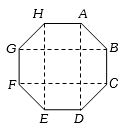
If four vertices of a regular octagon are chosen at random,then the probability that the quadrilateral formed by them is a rectangle is
A
$\frac{1}{8}$
B
$\frac{2}{21}$
C
$\frac{1}{32}$
D
$\frac{1}{35}$
Solution
(D) regular octagon has $8$ vertices. The total number of ways to choose $4$ vertices out of $8$ is given by the combination formula $^nC_r = \frac{n!}{r!(n-r)!}$.
Total number of cases $= ^8C_4 = \frac{8 \times 7 \times 6 \times 5}{4 \times 3 \times 2 \times 1} = 70$.
In a regular octagon,a rectangle is formed by choosing $4$ vertices such that the diagonals of the rectangle are diameters of the circumscribed circle. There are only $2$ such rectangles possible in a regular octagon (as shown in the figure: $ADEH$ and $GFCB$).
Number of favourable cases $= 2$.
Therefore,the required probability $= \frac{\text{Number of favourable cases}}{\text{Total number of cases}} = \frac{2}{70} = \frac{1}{35}$.
Total number of cases $= ^8C_4 = \frac{8 \times 7 \times 6 \times 5}{4 \times 3 \times 2 \times 1} = 70$.
In a regular octagon,a rectangle is formed by choosing $4$ vertices such that the diagonals of the rectangle are diameters of the circumscribed circle. There are only $2$ such rectangles possible in a regular octagon (as shown in the figure: $ADEH$ and $GFCB$).
Number of favourable cases $= 2$.
Therefore,the required probability $= \frac{\text{Number of favourable cases}}{\text{Total number of cases}} = \frac{2}{70} = \frac{1}{35}$.
0 likes
View Solution216
MediumMCQ
$A$ bag contains $5$ brown and $4$ white socks. $A$ man pulls out two socks. The probability that these are of the same colour is
A
$\frac{5}{108}$
B
$\frac{18}{108}$
C
$\frac{30}{108}$
D
$\frac{48}{108}$
Solution
(D) Total number of socks $= 5 + 4 = 9$.
The total number of ways to select $2$ socks out of $9$ is given by $^9C_2 = \frac{9 \times 8}{2 \times 1} = 36$.
The number of ways to select $2$ brown socks from $5$ is $^5C_2 = \frac{5 \times 4}{2 \times 1} = 10$.
The number of ways to select $2$ white socks from $4$ is $^4C_2 = \frac{4 \times 3}{2 \times 1} = 6$.
The number of ways to select $2$ socks of the same colour is $10 + 6 = 16$.
Therefore,the probability $P$ that both socks are of the same colour is $P = \frac{16}{36}$.
To match the options,we multiply the numerator and denominator by $3$: $P = \frac{16 \times 3}{36 \times 3} = \frac{48}{108}$.
The total number of ways to select $2$ socks out of $9$ is given by $^9C_2 = \frac{9 \times 8}{2 \times 1} = 36$.
The number of ways to select $2$ brown socks from $5$ is $^5C_2 = \frac{5 \times 4}{2 \times 1} = 10$.
The number of ways to select $2$ white socks from $4$ is $^4C_2 = \frac{4 \times 3}{2 \times 1} = 6$.
The number of ways to select $2$ socks of the same colour is $10 + 6 = 16$.
Therefore,the probability $P$ that both socks are of the same colour is $P = \frac{16}{36}$.
To match the options,we multiply the numerator and denominator by $3$: $P = \frac{16 \times 3}{36 \times 3} = \frac{48}{108}$.
0 likes
View Solution217
EasyMCQ
If a committee of $3$ is to be chosen from a group of $38$ people of which you are a member,what is the probability that you will be on the committee?
A
$\binom{38}{3}$
B
$\binom{37}{2}$
C
$\frac{\binom{37}{2}}{\binom{38}{3}}$
D
$\frac{666}{8436}$
Solution
(C) Total number of ways to choose a committee of $3$ people from $38$ is $\binom{38}{3}$.
If you are on the committee,then you have already been selected,and we need to choose the remaining $2$ members from the remaining $37$ people.
The number of ways to choose the remaining $2$ members is $\binom{37}{2}$.
Therefore,the probability that you will be on the committee is the ratio of the number of favorable outcomes to the total number of outcomes:
$P = \frac{\binom{37}{2}}{\binom{38}{3}}$.
If you are on the committee,then you have already been selected,and we need to choose the remaining $2$ members from the remaining $37$ people.
The number of ways to choose the remaining $2$ members is $\binom{37}{2}$.
Therefore,the probability that you will be on the committee is the ratio of the number of favorable outcomes to the total number of outcomes:
$P = \frac{\binom{37}{2}}{\binom{38}{3}}$.
0 likes
View Solution218
MediumMCQ
Four boys and three girls stand in a queue for an interview. What is the probability that they will stand in alternate positions?
A
$\frac{1}{34}$
B
$\frac{1}{35}$
C
$\frac{1}{17}$
D
$\frac{1}{68}$
Solution
(B) Total number of people $= 4 \text{ boys} + 3 \text{ girls} = 7 \text{ people}$.
Total ways to arrange $7$ people in a queue $= 7!$.
For the boys and girls to stand in alternate positions,the arrangement must be $B, G, B, G, B, G, B$.
Number of ways to arrange $4$ boys in the $4$ designated positions $= 4!$.
Number of ways to arrange $3$ girls in the $3$ designated positions $= 3!$.
Total favourable arrangements $= 4! \times 3!$.
Probability $= \frac{4! \times 3!}{7!} = \frac{24 \times 6}{5040} = \frac{144}{5040} = \frac{1}{35}$.
Total ways to arrange $7$ people in a queue $= 7!$.
For the boys and girls to stand in alternate positions,the arrangement must be $B, G, B, G, B, G, B$.
Number of ways to arrange $4$ boys in the $4$ designated positions $= 4!$.
Number of ways to arrange $3$ girls in the $3$ designated positions $= 3!$.
Total favourable arrangements $= 4! \times 3!$.
Probability $= \frac{4! \times 3!}{7!} = \frac{24 \times 6}{5040} = \frac{144}{5040} = \frac{1}{35}$.
0 likes
View Solution219
EasyMCQ
In a lottery,there were $90$ tickets numbered $1$ to $90$. Five tickets were drawn at random. What is the probability that two of the tickets drawn are numbered $15$ and $89$?
A
$\frac{2}{801}$
B
$\frac{2}{623}$
C
$\frac{1}{267}$
D
$\frac{1}{623}$
Solution
(A) Total number of ways to draw $5$ tickets from $90$ is $^{90}C_5$.
We need to draw $2$ specific tickets ($15$ and $89$) and $3$ other tickets from the remaining $88$ tickets.
The number of favorable outcomes is $^{2}C_2 \times ^{88}C_3 = 1 \times ^{88}C_3$.
The probability $P = \frac{^{88}C_3}{^{90}C_5}$.
$P = \frac{88 \times 87 \times 86}{3 \times 2 \times 1} \div \frac{90 \times 89 \times 88 \times 87 \times 86}{5 \times 4 \times 3 \times 2 \times 1}$.
$P = \frac{88 \times 87 \times 86}{6} \times \frac{120}{90 \times 89 \times 88 \times 87 \times 86}$.
$P = \frac{120}{90 \times 89 \times 6} = \frac{20}{89 \times 6} = \frac{10}{89 \times 3} = \frac{10}{267}$.
Wait,re-calculating: $P = \frac{88! / (3! 85!)}{90! / (5! 85!)} = \frac{88!}{3! 85!} \times \frac{5! 85!}{90!} = \frac{5 \times 4}{90 \times 89} = \frac{20}{8010} = \frac{2}{801}$.
We need to draw $2$ specific tickets ($15$ and $89$) and $3$ other tickets from the remaining $88$ tickets.
The number of favorable outcomes is $^{2}C_2 \times ^{88}C_3 = 1 \times ^{88}C_3$.
The probability $P = \frac{^{88}C_3}{^{90}C_5}$.
$P = \frac{88 \times 87 \times 86}{3 \times 2 \times 1} \div \frac{90 \times 89 \times 88 \times 87 \times 86}{5 \times 4 \times 3 \times 2 \times 1}$.
$P = \frac{88 \times 87 \times 86}{6} \times \frac{120}{90 \times 89 \times 88 \times 87 \times 86}$.
$P = \frac{120}{90 \times 89 \times 6} = \frac{20}{89 \times 6} = \frac{10}{89 \times 3} = \frac{10}{267}$.
Wait,re-calculating: $P = \frac{88! / (3! 85!)}{90! / (5! 85!)} = \frac{88!}{3! 85!} \times \frac{5! 85!}{90!} = \frac{5 \times 4}{90 \times 89} = \frac{20}{8010} = \frac{2}{801}$.
0 likes
View Solution220
EasyMCQ
Among $15$ players,$8$ are batsmen and $7$ are bowlers. Find the probability that a team is chosen of $6$ batsmen and $5$ bowlers.
A
$\frac{{^8C_6} \times {^7C_5}}{{^{15}C_{11}}}$
B
$\frac{{^8C_6} + {^7C_5}}{{^{15}C_{11}}}$
C
$\frac{15}{28}$
D
None of these
Solution
(A) Total number of ways to select $11$ players from $15$ players is given by ${^{15}C_{11}}$.
Number of ways to select $6$ batsmen from $8$ batsmen is ${^8C_6}$.
Number of ways to select $5$ bowlers from $7$ bowlers is ${^7C_5}$.
Therefore,the number of favourable outcomes is ${^8C_6} \times {^7C_5}$.
The required probability is the ratio of favourable outcomes to total outcomes:
$P = \frac{{^8C_6} \times {^7C_5}}{{^{15}C_{11}}}$.
Number of ways to select $6$ batsmen from $8$ batsmen is ${^8C_6}$.
Number of ways to select $5$ bowlers from $7$ bowlers is ${^7C_5}$.
Therefore,the number of favourable outcomes is ${^8C_6} \times {^7C_5}$.
The required probability is the ratio of favourable outcomes to total outcomes:
$P = \frac{{^8C_6} \times {^7C_5}}{{^{15}C_{11}}}$.
0 likes
View Solution221
EasyMCQ
$A$ bag contains $5$ black balls, $4$ white balls, and $3$ red balls. If a ball is selected at random, the probability that it is a black or red ball is
A
$\frac{1}{3}$
B
$\frac{1}{4}$
C
$\frac{5}{12}$
D
$\frac{2}{3}$
Solution
(D) Total number of balls in the bag = $5$ (black) + $4$ (white) + $3$ (red) = $12$ balls.
We need to find the probability of selecting a black or red ball.
Number of favorable outcomes (black or red) = $5 + 3 = 8$.
Total number of possible outcomes = $12$.
Probability $P(\text{Black or Red}) = \frac{\text{Number of favorable outcomes}}{\text{Total number of outcomes}} = \frac{8}{12} = \frac{2}{3}$.
We need to find the probability of selecting a black or red ball.
Number of favorable outcomes (black or red) = $5 + 3 = 8$.
Total number of possible outcomes = $12$.
Probability $P(\text{Black or Red}) = \frac{\text{Number of favorable outcomes}}{\text{Total number of outcomes}} = \frac{8}{12} = \frac{2}{3}$.
0 likes
View Solution222
EasyMCQ
Out of $30$ consecutive numbers,$2$ are chosen at random. The probability that their sum is odd,is
A
$\frac{14}{29}$
B
$\frac{16}{29}$
C
$\frac{15}{29}$
D
$\frac{10}{29}$
Solution
(C) The total number of ways to choose $2$ integers from $30$ consecutive integers is given by $^{30}C_2 = \frac{30 \times 29}{2} = 435$.
For the sum of two numbers to be odd,one number must be even and the other must be odd.
In $30$ consecutive integers,there are $15$ even numbers and $15$ odd numbers.
The number of ways to choose one even number and one odd number is $^{15}C_1 \times ^{15}C_1 = 15 \times 15 = 225$.
The required probability is $\frac{\text{Favourable outcomes}}{\text{Total outcomes}} = \frac{225}{435}$.
Dividing both numerator and denominator by $15$,we get $\frac{225 \div 15}{435 \div 15} = \frac{15}{29}$.
For the sum of two numbers to be odd,one number must be even and the other must be odd.
In $30$ consecutive integers,there are $15$ even numbers and $15$ odd numbers.
The number of ways to choose one even number and one odd number is $^{15}C_1 \times ^{15}C_1 = 15 \times 15 = 225$.
The required probability is $\frac{\text{Favourable outcomes}}{\text{Total outcomes}} = \frac{225}{435}$.
Dividing both numerator and denominator by $15$,we get $\frac{225 \div 15}{435 \div 15} = \frac{15}{29}$.
0 likes
View Solution223
EasyMCQ
Three integers are chosen at random from the first $20$ integers. The probability that their product is even is:
A
$\frac{2}{19}$
B
$\frac{3}{29}$
C
$\frac{17}{19}$
D
$\frac{4}{19}$
Solution
(C) The total number of ways to choose $3$ integers from the first $20$ integers is $^{20}C_3 = \frac{20 \times 19 \times 18}{3 \times 2 \times 1} = 1140$.
The product of three integers is even if at least one of the chosen integers is even.
It is easier to calculate the probability of the complement event,which is that the product is odd. The product is odd if and only if all three chosen integers are odd.
There are $10$ odd integers and $10$ even integers in the first $20$ integers.
The number of ways to choose $3$ odd integers is $^{10}C_3 = \frac{10 \times 9 \times 8}{3 \times 2 \times 1} = 120$.
The probability that the product is odd is $P(\text{odd}) = \frac{^{10}C_3}{^{20}C_3} = \frac{120}{1140} = \frac{12}{114} = \frac{2}{19}$.
Therefore,the probability that the product is even is $P(\text{even}) = 1 - P(\text{odd}) = 1 - \frac{2}{19} = \frac{17}{19}$.
The product of three integers is even if at least one of the chosen integers is even.
It is easier to calculate the probability of the complement event,which is that the product is odd. The product is odd if and only if all three chosen integers are odd.
There are $10$ odd integers and $10$ even integers in the first $20$ integers.
The number of ways to choose $3$ odd integers is $^{10}C_3 = \frac{10 \times 9 \times 8}{3 \times 2 \times 1} = 120$.
The probability that the product is odd is $P(\text{odd}) = \frac{^{10}C_3}{^{20}C_3} = \frac{120}{1140} = \frac{12}{114} = \frac{2}{19}$.
Therefore,the probability that the product is even is $P(\text{even}) = 1 - P(\text{odd}) = 1 - \frac{2}{19} = \frac{17}{19}$.
0 likes
View Solution224
EasyMCQ
Two numbers are selected randomly from the set $S = \{ 1, 2, 3, 4, 5, 6 \}$ without replacement one by one. The probability that the minimum of the two numbers is less than $4$ is
A
$\frac{1}{15}$
B
$\frac{14}{15}$
C
$\frac{1}{5}$
D
$\frac{4}{5}$
Solution
(D) The total number of ways to select $2$ numbers from $6$ numbers without replacement where order matters is $P(6, 2) = 6 \times 5 = 30$.
Let $X$ and $Y$ be the two selected numbers. We want to find the probability that $\min(X, Y) < 4$.
It is easier to calculate the complement: the probability that $\min(X, Y) \ge 4$.
If $\min(X, Y) \ge 4$,then both numbers must be chosen from the set $\{4, 5, 6\}$.
The number of ways to choose $2$ numbers from $\{4, 5, 6\}$ without replacement is $P(3, 2) = 3 \times 2 = 6$.
The probability that $\min(X, Y) \ge 4$ is $\frac{6}{30} = \frac{1}{5}$.
Therefore,the probability that $\min(X, Y) < 4$ is $1 - \frac{1}{5} = \frac{4}{5}$.
Let $X$ and $Y$ be the two selected numbers. We want to find the probability that $\min(X, Y) < 4$.
It is easier to calculate the complement: the probability that $\min(X, Y) \ge 4$.
If $\min(X, Y) \ge 4$,then both numbers must be chosen from the set $\{4, 5, 6\}$.
The number of ways to choose $2$ numbers from $\{4, 5, 6\}$ without replacement is $P(3, 2) = 3 \times 2 = 6$.
The probability that $\min(X, Y) \ge 4$ is $\frac{6}{30} = \frac{1}{5}$.
Therefore,the probability that $\min(X, Y) < 4$ is $1 - \frac{1}{5} = \frac{4}{5}$.
0 likes
View Solution225
EasyMCQ
$A$ bag contains $6$ white,$7$ red,and $5$ black balls. If $3$ balls are drawn from the bag at random,then the probability that all of them are white is
A
$\frac{20}{204}$
B
$\frac{5}{204}$
C
$\frac{1}{3}$
D
None of these
Solution
(B) Total number of balls in the bag $= 6 + 7 + 5 = 18$.
The number of ways to draw $3$ balls from $18$ balls is given by ${}^{18}C_3 = \frac{18 \times 17 \times 16}{3 \times 2 \times 1} = 3 \times 17 \times 16 = 816$.
The number of ways to draw $3$ white balls from $6$ white balls is given by ${}^{6}C_3 = \frac{6 \times 5 \times 4}{3 \times 2 \times 1} = 20$.
The required probability is the ratio of favourable outcomes to total outcomes:
$P = \frac{{}^{6}C_3}{{}^{18}C_3} = \frac{20}{816}$.
Simplifying the fraction by dividing both numerator and denominator by $4$:
$P = \frac{5}{204}$.
The number of ways to draw $3$ balls from $18$ balls is given by ${}^{18}C_3 = \frac{18 \times 17 \times 16}{3 \times 2 \times 1} = 3 \times 17 \times 16 = 816$.
The number of ways to draw $3$ white balls from $6$ white balls is given by ${}^{6}C_3 = \frac{6 \times 5 \times 4}{3 \times 2 \times 1} = 20$.
The required probability is the ratio of favourable outcomes to total outcomes:
$P = \frac{{}^{6}C_3}{{}^{18}C_3} = \frac{20}{816}$.
Simplifying the fraction by dividing both numerator and denominator by $4$:
$P = \frac{5}{204}$.
0 likes
View Solution226
EasyMCQ
$A$ bag contains $4$ white,$5$ red,and $6$ green balls. Three balls are picked up randomly. The probability that a white,a red,and a green ball is drawn is
A
$\frac{15}{91}$
B
$\frac{30}{91}$
C
$\frac{20}{91}$
D
$\frac{24}{91}$
Solution
(D) Total number of balls = $4 + 5 + 6 = 15$.
We need to select $3$ balls out of $15$. The total number of ways to select $3$ balls is given by ${}^{15}C_3 = \frac{15 \times 14 \times 13}{3 \times 2 \times 1} = 5 \times 7 \times 13 = 455$.
The number of ways to select $1$ white,$1$ red,and $1$ green ball is ${}^4C_1 \times {}^5C_1 \times {}^6C_1 = 4 \times 5 \times 6 = 120$.
The required probability is $\frac{\text{Favorable outcomes}}{\text{Total outcomes}} = \frac{120}{455}$.
Dividing both numerator and denominator by $5$,we get $\frac{24}{91}$.
We need to select $3$ balls out of $15$. The total number of ways to select $3$ balls is given by ${}^{15}C_3 = \frac{15 \times 14 \times 13}{3 \times 2 \times 1} = 5 \times 7 \times 13 = 455$.
The number of ways to select $1$ white,$1$ red,and $1$ green ball is ${}^4C_1 \times {}^5C_1 \times {}^6C_1 = 4 \times 5 \times 6 = 120$.
The required probability is $\frac{\text{Favorable outcomes}}{\text{Total outcomes}} = \frac{120}{455}$.
Dividing both numerator and denominator by $5$,we get $\frac{24}{91}$.
0 likes
View Solution227
EasyMCQ
$A$ box contains $10$ red balls and $15$ green balls. If two balls are drawn in succession,then the probability that one is red and the other is green is:
A
$\frac{1}{3}$
B
$\frac{1}{2}$
C
$\frac{1}{4}$
D
None of these
Solution
(B) Total number of balls $= 10 + 15 = 25$.
We need to draw one red ball and one green ball in two draws.
The number of ways to choose $1$ red ball from $10$ and $1$ green ball from $15$ is given by $10 \times 15 = 150$.
The total number of ways to choose $2$ balls from $25$ is given by $^{25}C_2 = \frac{25 \times 24}{2} = 300$.
The probability is $\frac{150}{300} = \frac{1}{2}$.
Alternatively,considering the order: (Red then Green) or (Green then Red).
$P(RG) + P(GR) = (\frac{10}{25} \times \frac{15}{24}) + (\frac{15}{25} \times \frac{10}{24}) = \frac{150}{600} + \frac{150}{600} = \frac{300}{600} = \frac{1}{2}$.
We need to draw one red ball and one green ball in two draws.
The number of ways to choose $1$ red ball from $10$ and $1$ green ball from $15$ is given by $10 \times 15 = 150$.
The total number of ways to choose $2$ balls from $25$ is given by $^{25}C_2 = \frac{25 \times 24}{2} = 300$.
The probability is $\frac{150}{300} = \frac{1}{2}$.
Alternatively,considering the order: (Red then Green) or (Green then Red).
$P(RG) + P(GR) = (\frac{10}{25} \times \frac{15}{24}) + (\frac{15}{25} \times \frac{10}{24}) = \frac{150}{600} + \frac{150}{600} = \frac{300}{600} = \frac{1}{2}$.
0 likes
View Solution228
EasyMCQ
Three cards are drawn at random from a pack of $52$ cards. What is the chance of drawing three aces?
A
$\frac{3}{5525}$
B
$\frac{2}{5525}$
C
$\frac{1}{5525}$
D
None of these
Solution
(C) The total number of ways to draw $3$ cards from a pack of $52$ cards is given by ${}^{52}C_3$.
${}^{52}C_3 = \frac{52 \times 51 \times 50}{3 \times 2 \times 1} = 52 \times 17 \times 25 = 22100$.
There are $4$ aces in a pack of $52$ cards. The number of ways to draw $3$ aces from $4$ is given by ${}^{4}C_3$.
${}^{4}C_3 = \frac{4 \times 3 \times 2}{3 \times 2 \times 1} = 4$.
The probability of drawing $3$ aces is $\frac{\text{Number of favorable outcomes}}{\text{Total number of outcomes}} = \frac{{}^{4}C_3}{{}^{52}C_3} = \frac{4}{22100} = \frac{1}{5525}$.
${}^{52}C_3 = \frac{52 \times 51 \times 50}{3 \times 2 \times 1} = 52 \times 17 \times 25 = 22100$.
There are $4$ aces in a pack of $52$ cards. The number of ways to draw $3$ aces from $4$ is given by ${}^{4}C_3$.
${}^{4}C_3 = \frac{4 \times 3 \times 2}{3 \times 2 \times 1} = 4$.
The probability of drawing $3$ aces is $\frac{\text{Number of favorable outcomes}}{\text{Total number of outcomes}} = \frac{{}^{4}C_3}{{}^{52}C_3} = \frac{4}{22100} = \frac{1}{5525}$.
0 likes
View Solution229
EasyMCQ
$A$ pack of cards contains $4$ aces,$4$ kings,$4$ queens,and $4$ jacks. Two cards are drawn at random. The probability that at least one of these is an ace is:
A
$\frac{9}{20}$
B
$\frac{3}{16}$
C
$\frac{1}{6}$
D
$\frac{1}{9}$
Solution
(A) Total number of cards = $4 + 4 + 4 + 4 = 16$.
Number of cards drawn = $2$.
Total ways to draw $2$ cards from $16$ is ${}^{16}C_2 = \frac{16 \times 15}{2 \times 1} = 120$.
Number of non-ace cards = $16 - 4 = 12$.
Ways to draw $2$ cards such that none of them is an ace = ${}^{12}C_2 = \frac{12 \times 11}{2 \times 1} = 66$.
Probability of drawing no ace = $\frac{66}{120} = \frac{11}{20}$.
Probability of drawing at least one ace = $1 - P(\text{No Ace}) = 1 - \frac{11}{20} = \frac{9}{20}$.
Number of cards drawn = $2$.
Total ways to draw $2$ cards from $16$ is ${}^{16}C_2 = \frac{16 \times 15}{2 \times 1} = 120$.
Number of non-ace cards = $16 - 4 = 12$.
Ways to draw $2$ cards such that none of them is an ace = ${}^{12}C_2 = \frac{12 \times 11}{2 \times 1} = 66$.
Probability of drawing no ace = $\frac{66}{120} = \frac{11}{20}$.
Probability of drawing at least one ace = $1 - P(\text{No Ace}) = 1 - \frac{11}{20} = \frac{9}{20}$.
0 likes
View Solution230
MediumMCQ
$A$ fair coin is tossed $100$ times. The probability of getting tails an odd number of times is
A
$\frac{1}{2}$
B
$\frac{1}{8}$
C
$\frac{3}{8}$
D
None of these
Solution
(A) The total number of possible outcomes when a coin is tossed $100$ times is $2^{100}$.
The number of ways to get tails an odd number of times is given by the sum of combinations: ${}^{100}C_1 + {}^{100}C_3 + {}^{100}C_5 + \dots + {}^{100}C_{99}$.
Using the binomial identity,the sum of odd-indexed binomial coefficients is ${}^{n}C_1 + {}^{n}C_3 + \dots = 2^{n-1}$.
For $n = 100$,the number of favourable outcomes is $2^{100-1} = 2^{99}$.
Therefore,the required probability is $\frac{2^{99}}{2^{100}} = \frac{1}{2}$.
The number of ways to get tails an odd number of times is given by the sum of combinations: ${}^{100}C_1 + {}^{100}C_3 + {}^{100}C_5 + \dots + {}^{100}C_{99}$.
Using the binomial identity,the sum of odd-indexed binomial coefficients is ${}^{n}C_1 + {}^{n}C_3 + \dots = 2^{n-1}$.
For $n = 100$,the number of favourable outcomes is $2^{100-1} = 2^{99}$.
Therefore,the required probability is $\frac{2^{99}}{2^{100}} = \frac{1}{2}$.
0 likes
View Solution231
EasyMCQ
$A$ bag contains $3$ red,$4$ white and $5$ blue balls. All balls are different. Two balls are drawn at random. The probability that they are of different colour is
A
$\frac{47}{66}$
B
$\frac{10}{33}$
C
$\frac{5}{22}$
D
None of these
Solution
(A) Total number of balls $= 3 + 4 + 5 = 12$.
Number of ways to draw $2$ balls from $12$ is ${}^{12}C_2 = \frac{12 \times 11}{2} = 66$.
To find the probability that the balls are of different colours,it is easier to calculate the probability that they are of the same colour and subtract it from $1$.
Number of ways to draw $2$ balls of the same colour:
- Both red: ${}^{3}C_2 = 3$
- Both white: ${}^{4}C_2 = 6$
- Both blue: ${}^{5}C_2 = 10$
Total ways for same colour $= 3 + 6 + 10 = 19$.
Probability of same colour $= \frac{19}{66}$.
Probability of different colours $= 1 - \frac{19}{66} = \frac{66 - 19}{66} = \frac{47}{66}$.
Number of ways to draw $2$ balls from $12$ is ${}^{12}C_2 = \frac{12 \times 11}{2} = 66$.
To find the probability that the balls are of different colours,it is easier to calculate the probability that they are of the same colour and subtract it from $1$.
Number of ways to draw $2$ balls of the same colour:
- Both red: ${}^{3}C_2 = 3$
- Both white: ${}^{4}C_2 = 6$
- Both blue: ${}^{5}C_2 = 10$
Total ways for same colour $= 3 + 6 + 10 = 19$.
Probability of same colour $= \frac{19}{66}$.
Probability of different colours $= 1 - \frac{19}{66} = \frac{66 - 19}{66} = \frac{47}{66}$.
0 likes
View Solution232
EasyMCQ
Ten students are seated at random in a row. The probability that two particular students are not seated side by side is
A
$\frac{4}{5}$
B
$\frac{3}{5}$
C
$\frac{2}{5}$
D
$\frac{1}{5}$
Solution
(A) Total number of ways to arrange $10$ students in a row is $10!$.
To find the probability that two particular students sit together,we treat them as a single unit. Now,we have $9$ units (the pair + $8$ other students),which can be arranged in $9!$ ways. Within the pair,the two students can be arranged in $2! = 2$ ways.
Therefore,the number of ways they sit together is $2 \times 9!$.
The probability that they sit together is $P(\text{together}) = \frac{2 \times 9!}{10!} = \frac{2 \times 9!}{10 \times 9!} = \frac{2}{10} = \frac{1}{5}$.
The probability that they are not seated side by side is $P(\text{not together}) = 1 - P(\text{together}) = 1 - \frac{1}{5} = \frac{4}{5}$.
To find the probability that two particular students sit together,we treat them as a single unit. Now,we have $9$ units (the pair + $8$ other students),which can be arranged in $9!$ ways. Within the pair,the two students can be arranged in $2! = 2$ ways.
Therefore,the number of ways they sit together is $2 \times 9!$.
The probability that they sit together is $P(\text{together}) = \frac{2 \times 9!}{10!} = \frac{2 \times 9!}{10 \times 9!} = \frac{2}{10} = \frac{1}{5}$.
The probability that they are not seated side by side is $P(\text{not together}) = 1 - P(\text{together}) = 1 - \frac{1}{5} = \frac{4}{5}$.
0 likes
View Solution233
MediumMCQ
$A$ drawer contains $5$ brown socks and $4$ blue socks well mixed. $A$ man reaches the drawer and pulls out $2$ socks at random. What is the probability that they match?
A
$\frac{4}{9}$
B
$\frac{5}{8}$
C
$\frac{5}{9}$
D
$\frac{7}{12}$
Solution
(A) Total number of socks = $5 + 4 = 9$.
The total number of ways to choose $2$ socks out of $9$ is given by ${}^9C_2 = \frac{9 \times 8}{2 \times 1} = 36$.
The socks will match if either both are brown or both are blue.
Number of ways to choose $2$ brown socks from $5$ is ${}^5C_2 = \frac{5 \times 4}{2 \times 1} = 10$.
Number of ways to choose $2$ blue socks from $4$ is ${}^4C_2 = \frac{4 \times 3}{2 \times 1} = 6$.
Total favorable outcomes = $10 + 6 = 16$.
Therefore,the required probability = $\frac{\text{Favorable outcomes}}{\text{Total outcomes}} = \frac{16}{36} = \frac{4}{9}$.
The total number of ways to choose $2$ socks out of $9$ is given by ${}^9C_2 = \frac{9 \times 8}{2 \times 1} = 36$.
The socks will match if either both are brown or both are blue.
Number of ways to choose $2$ brown socks from $5$ is ${}^5C_2 = \frac{5 \times 4}{2 \times 1} = 10$.
Number of ways to choose $2$ blue socks from $4$ is ${}^4C_2 = \frac{4 \times 3}{2 \times 1} = 6$.
Total favorable outcomes = $10 + 6 = 16$.
Therefore,the required probability = $\frac{\text{Favorable outcomes}}{\text{Total outcomes}} = \frac{16}{36} = \frac{4}{9}$.
0 likes
View Solution234
MediumMCQ
$5$ persons $A, B, C, D$ and $E$ are in a queue at a shop. The probability that $A$ and $E$ are always together is:
A
$\frac{1}{4}$
B
$\frac{2}{3}$
C
$\frac{2}{5}$
D
$\frac{3}{5}$
Solution
(C) Total number of ways to arrange $5$ persons in a queue is $5! = 120$.
To find the number of favourable ways where $A$ and $E$ are always together,we treat $(AE)$ as a single unit.
Now,we have $4$ units to arrange: $(AE), B, C, D$. These can be arranged in $4!$ ways.
Within the unit $(AE)$,$A$ and $E$ can be arranged in $2! = 2$ ways.
So,the total number of favourable ways is $2 \times 4! = 2 \times 24 = 48$.
The required probability is $\frac{\text{Favourable outcomes}}{\text{Total outcomes}} = \frac{2 \times 4!}{5!} = \frac{2 \times 24}{120} = \frac{48}{120} = \frac{2}{5}$.
To find the number of favourable ways where $A$ and $E$ are always together,we treat $(AE)$ as a single unit.
Now,we have $4$ units to arrange: $(AE), B, C, D$. These can be arranged in $4!$ ways.
Within the unit $(AE)$,$A$ and $E$ can be arranged in $2! = 2$ ways.
So,the total number of favourable ways is $2 \times 4! = 2 \times 24 = 48$.
The required probability is $\frac{\text{Favourable outcomes}}{\text{Total outcomes}} = \frac{2 \times 4!}{5!} = \frac{2 \times 24}{120} = \frac{48}{120} = \frac{2}{5}$.
0 likes
View Solution235
EasyMCQ
$A$ bag contains $8$ red and $7$ black balls. Two balls are drawn at random. The probability that both the balls are of the same colour is
A
$\frac{14}{15}$
B
$\frac{11}{15}$
C
$\frac{7}{15}$
D
$\frac{4}{15}$
Solution
(C) Total number of balls = $8 + 7 = 15$.
Number of ways to draw $2$ balls from $15$ is $^{15}C_2 = \frac{15 \times 14}{2 \times 1} = 105$.
For both balls to be of the same colour,they must either both be red or both be black.
Number of ways to draw $2$ red balls from $8$ is $^8C_2 = \frac{8 \times 7}{2 \times 1} = 28$.
Number of ways to draw $2$ black balls from $7$ is $^7C_2 = \frac{7 \times 6}{2 \times 1} = 21$.
Total favorable outcomes = $28 + 21 = 49$.
Required probability = $\frac{49}{105} = \frac{7}{15}$.
Number of ways to draw $2$ balls from $15$ is $^{15}C_2 = \frac{15 \times 14}{2 \times 1} = 105$.
For both balls to be of the same colour,they must either both be red or both be black.
Number of ways to draw $2$ red balls from $8$ is $^8C_2 = \frac{8 \times 7}{2 \times 1} = 28$.
Number of ways to draw $2$ black balls from $7$ is $^7C_2 = \frac{7 \times 6}{2 \times 1} = 21$.
Total favorable outcomes = $28 + 21 = 49$.
Required probability = $\frac{49}{105} = \frac{7}{15}$.
0 likes
View Solution236
EasyMCQ
From $80$ cards numbered $1$ to $80$, two cards are selected randomly. The probability that both the cards have numbers divisible by $4$ is given by
A
$\frac{21}{316}$
B
$\frac{19}{316}$
C
$\frac{1}{4}$
D
None of these
Solution
(B) Total number of cards = $80$.
Numbers divisible by $4$ between $1$ and $80$ are $4, 8, 12, \dots, 80$. This is an arithmetic progression where $a = 4$, $d = 4$, and $l = 80$.
Using $l = a + (n - 1)d$, we get $80 = 4 + (n - 1)4$, which implies $n = 20$.
Total ways to select $2$ cards from $80$ is $^{80}C_2 = \frac{80 \times 79}{2} = 3160$.
Favorable ways to select $2$ cards from the $20$ cards divisible by $4$ is $^{20}C_2 = \frac{20 \times 19}{2} = 190$.
Required probability $P = \frac{190}{3160} = \frac{19}{316}$.
Numbers divisible by $4$ between $1$ and $80$ are $4, 8, 12, \dots, 80$. This is an arithmetic progression where $a = 4$, $d = 4$, and $l = 80$.
Using $l = a + (n - 1)d$, we get $80 = 4 + (n - 1)4$, which implies $n = 20$.
Total ways to select $2$ cards from $80$ is $^{80}C_2 = \frac{80 \times 79}{2} = 3160$.
Favorable ways to select $2$ cards from the $20$ cards divisible by $4$ is $^{20}C_2 = \frac{20 \times 19}{2} = 190$.
Required probability $P = \frac{190}{3160} = \frac{19}{316}$.
0 likes
View Solution237
EasyMCQ
$A$ basket contains $5$ apples and $7$ oranges,and another basket contains $4$ apples and $8$ oranges. One fruit is picked out from each basket. Find the probability that the fruits are both apples or both oranges.
A
$\frac{24}{144}$
B
$\frac{56}{144}$
C
$\frac{68}{144}$
D
$\frac{76}{144}$
Solution
(D) Let $B_1$ be the first basket and $B_2$ be the second basket.
Total fruits in $B_1 = 5 + 7 = 12$.
Total fruits in $B_2 = 4 + 8 = 12$.
Probability of picking an apple from $B_1 = \frac{5}{12}$.
Probability of picking an apple from $B_2 = \frac{4}{12}$.
Probability of picking an orange from $B_1 = \frac{7}{12}$.
Probability of picking an orange from $B_2 = \frac{8}{12}$.
Since the events are independent,the probability that both are apples is $\frac{5}{12} \times \frac{4}{12} = \frac{20}{144}$.
The probability that both are oranges is $\frac{7}{12} \times \frac{8}{12} = \frac{56}{144}$.
Since these events are mutually exclusive,the total probability is $\frac{20}{144} + \frac{56}{144} = \frac{76}{144}$.
Total fruits in $B_1 = 5 + 7 = 12$.
Total fruits in $B_2 = 4 + 8 = 12$.
Probability of picking an apple from $B_1 = \frac{5}{12}$.
Probability of picking an apple from $B_2 = \frac{4}{12}$.
Probability of picking an orange from $B_1 = \frac{7}{12}$.
Probability of picking an orange from $B_2 = \frac{8}{12}$.
Since the events are independent,the probability that both are apples is $\frac{5}{12} \times \frac{4}{12} = \frac{20}{144}$.
The probability that both are oranges is $\frac{7}{12} \times \frac{8}{12} = \frac{56}{144}$.
Since these events are mutually exclusive,the total probability is $\frac{20}{144} + \frac{56}{144} = \frac{76}{144}$.
0 likes
View Solution238
MediumMCQ
Let $A$ and $B$ be two finite sets having $m$ and $n$ elements respectively such that $m \le n.$ $A$ mapping is selected at random from the set of all mappings from $A$ to $B$. The probability that the mapping selected is an injection is
A
$\frac{n!}{(n - m)! m^n}$
B
$\frac{n!}{(n - m)! n^m}$
C
$\frac{m!}{(n - m)! n^m}$
D
$\frac{m!}{(n - m)! m^n}$
Solution
(B) The total number of functions (mappings) from a set $A$ with $m$ elements to a set $B$ with $n$ elements is given by $n^m$.
An injection (one-to-one function) exists only if $m \le n$. The number of ways to choose $m$ distinct elements from $B$ and arrange them is given by the permutation formula $P(n, m) = \frac{n!}{(n - m)!}$.
Therefore,the number of injective mappings is $\frac{n!}{(n - m)!}$.
The probability $P$ of selecting an injection is the ratio of the number of injective mappings to the total number of mappings:
$P = \frac{\text{Number of injective mappings}}{\text{Total number of mappings}} = \frac{\frac{n!}{(n - m)!}}{n^m} = \frac{n!}{(n - m)! n^m}$.
An injection (one-to-one function) exists only if $m \le n$. The number of ways to choose $m$ distinct elements from $B$ and arrange them is given by the permutation formula $P(n, m) = \frac{n!}{(n - m)!}$.
Therefore,the number of injective mappings is $\frac{n!}{(n - m)!}$.
The probability $P$ of selecting an injection is the ratio of the number of injective mappings to the total number of mappings:
$P = \frac{\text{Number of injective mappings}}{\text{Total number of mappings}} = \frac{\frac{n!}{(n - m)!}}{n^m} = \frac{n!}{(n - m)! n^m}$.
0 likes
View Solution239
MediumMCQ
Suppose $n \ge 3$ persons are sitting in a row. Two of them are selected at random. The probability that they are not together is
A
$1 - \frac{2}{n}$
B
$\frac{2}{n - 1}$
C
$1 - \frac{1}{n}$
D
None of these
Solution
(A) Total number of ways to select $2$ persons out of $n$ is given by $^nC_2 = \frac{n(n-1)}{2}$.
To find the number of ways they are together,we treat the $2$ adjacent persons as a single unit. There are $(n-1)$ such pairs in a row of $n$ persons.
So,the number of ways they are together is $(n-1)$.
The probability that they are together is $P(\text{together}) = \frac{n-1}{^nC_2} = \frac{n-1}{\frac{n(n-1)}{2}} = \frac{2}{n}$.
The probability that they are not together is $P(\text{not together}) = 1 - P(\text{together}) = 1 - \frac{2}{n}$.
To find the number of ways they are together,we treat the $2$ adjacent persons as a single unit. There are $(n-1)$ such pairs in a row of $n$ persons.
So,the number of ways they are together is $(n-1)$.
The probability that they are together is $P(\text{together}) = \frac{n-1}{^nC_2} = \frac{n-1}{\frac{n(n-1)}{2}} = \frac{2}{n}$.
The probability that they are not together is $P(\text{not together}) = 1 - P(\text{together}) = 1 - \frac{2}{n}$.
0 likes
View Solution240
DifficultMCQ
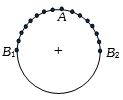
Fifteen persons,including $A$ and $B$,sit down at random at a round table. The probability that there are $4$ persons between $A$ and $B$ is
A
$\frac{1}{3}$
B
$\frac{2}{3}$
C
$\frac{2}{7}$
D
$\frac{1}{7}$
Solution
(D) Let $A$ occupy any seat at the round table. There are $14$ remaining seats available for $B$.
For there to be $4$ persons between $A$ and $B$,$B$ must occupy one of the two specific seats (one on the left side of $A$ and one on the right side of $A$) such that there are exactly $4$ people in the gap between them.
Since there are $14$ total possible positions for $B$ and $2$ favorable positions,the required probability is $P = \frac{2}{14} = \frac{1}{7}$.
For there to be $4$ persons between $A$ and $B$,$B$ must occupy one of the two specific seats (one on the left side of $A$ and one on the right side of $A$) such that there are exactly $4$ people in the gap between them.
Since there are $14$ total possible positions for $B$ and $2$ favorable positions,the required probability is $P = \frac{2}{14} = \frac{1}{7}$.
0 likes
View Solution241
MediumMCQ
$5$ boys and $5$ girls are sitting in a row randomly. The probability that boys and girls sit alternatively is
A
$5/126$
B
$1/126$
C
$4/126$
D
$6/125$
Solution
(B) The total number of ways to arrange $10$ people ( $5$ boys and $5$ girls) in a row is $10!$.
For the boys and girls to sit alternatively,there are two possible patterns:
$1$. Boy,Girl,Boy,Girl,Boy,Girl,Boy,Girl,Boy,Girl
$2$. Girl,Boy,Girl,Boy,Girl,Boy,Girl,Boy,Girl,Boy
In each pattern,the $5$ boys can be arranged in $5!$ ways and the $5$ girls can be arranged in $5!$ ways.
Therefore,the number of favorable ways is $2 \times (5! \times 5!)$.
The probability is given by the ratio of favorable outcomes to total outcomes:
$P = \frac{2 \times 5! \times 5!}{10!}$
$P = \frac{2 \times 120 \times 120}{3628800} = \frac{2 \times 120}{10 \times 9 \times 8 \times 7 \times 6} = \frac{2}{30240} \times 120 = \frac{2}{252} = \frac{1}{126}$.
For the boys and girls to sit alternatively,there are two possible patterns:
$1$. Boy,Girl,Boy,Girl,Boy,Girl,Boy,Girl,Boy,Girl
$2$. Girl,Boy,Girl,Boy,Girl,Boy,Girl,Boy,Girl,Boy
In each pattern,the $5$ boys can be arranged in $5!$ ways and the $5$ girls can be arranged in $5!$ ways.
Therefore,the number of favorable ways is $2 \times (5! \times 5!)$.
The probability is given by the ratio of favorable outcomes to total outcomes:
$P = \frac{2 \times 5! \times 5!}{10!}$
$P = \frac{2 \times 120 \times 120}{3628800} = \frac{2 \times 120}{10 \times 9 \times 8 \times 7 \times 6} = \frac{2}{30240} \times 120 = \frac{2}{252} = \frac{1}{126}$.
0 likes
View Solution242
EasyMCQ
Two dice are thrown. What is the probability that the sum of the numbers appearing on the two dice is $11$,given that $5$ appears on the first die?
A
$\frac{1}{36}$
B
$\frac{1}{6}$
C
$\frac{5}{6}$
D
None of these
Solution
(B) Let $A$ be the event that the sum of the numbers is $11$. The possible outcomes for a sum of $11$ are $(5, 6)$ and $(6, 5)$.
Let $B$ be the event that $5$ appears on the first die. The possible outcomes for $B$ are $(5, 1), (5, 2), (5, 3), (5, 4), (5, 5), (5, 6)$.
We need to find the conditional probability $P(A|B) = \frac{P(A \cap B)}{P(B)}$.
The intersection $A \cap B$ is the event where the sum is $11$ $AND$ $5$ is on the first die,which is only the outcome $(5, 6)$.
Thus,$n(A \cap B) = 1$ and $n(B) = 6$.
The required probability is $\frac{n(A \cap B)}{n(B)} = \frac{1}{6}$.
Let $B$ be the event that $5$ appears on the first die. The possible outcomes for $B$ are $(5, 1), (5, 2), (5, 3), (5, 4), (5, 5), (5, 6)$.
We need to find the conditional probability $P(A|B) = \frac{P(A \cap B)}{P(B)}$.
The intersection $A \cap B$ is the event where the sum is $11$ $AND$ $5$ is on the first die,which is only the outcome $(5, 6)$.
Thus,$n(A \cap B) = 1$ and $n(B) = 6$.
The required probability is $\frac{n(A \cap B)}{n(B)} = \frac{1}{6}$.
0 likes
View Solution243
EasyMCQ
If $P(A) = \frac{1}{2}$,$P(B) = \frac{1}{3}$ and $P(A \cap B) = \frac{1}{4}$,then $P(B/A) = $
A
$1$
B
$0$
C
$\frac{1}{2}$
D
$\frac{1}{3}$
Solution
(C) The formula for conditional probability is given by $P(B/A) = \frac{P(A \cap B)}{P(A)}$.
Given values are $P(A) = \frac{1}{2}$ and $P(A \cap B) = \frac{1}{4}$.
Substituting these values into the formula:
$P(B/A) = \frac{1/4}{1/2} = \frac{1}{4} \times \frac{2}{1} = \frac{2}{4} = \frac{1}{2}$.
Therefore,the correct option is $C$.
Given values are $P(A) = \frac{1}{2}$ and $P(A \cap B) = \frac{1}{4}$.
Substituting these values into the formula:
$P(B/A) = \frac{1/4}{1/2} = \frac{1}{4} \times \frac{2}{1} = \frac{2}{4} = \frac{1}{2}$.
Therefore,the correct option is $C$.
0 likes
View Solution244
EasyMCQ
If $A$ and $B$ are two events such that $P(A) \neq 0$ and $P(B) \neq 1$,then $P\left( \frac{\overline{A}}{\overline{B}} \right) = $
A
$1 - P\left( \frac{A}{B} \right)$
B
$1 - P\left( \frac{\overline{A}}{B} \right)$
C
$\frac{1 - P(A \cup B)}{P(\overline{B})}$
D
$\frac{P(\overline{A})}{P(\overline{B})}$
Solution
(C) By the definition of conditional probability,$P\left( \frac{\overline{A}}{\overline{B}} \right) = \frac{P(\overline{A} \cap \overline{B})}{P(\overline{B})}$.
Using De Morgan's Law,we know that $\overline{A} \cap \overline{B} = \overline{A \cup B}$.
Therefore,$P(\overline{A} \cap \overline{B}) = P(\overline{A \cup B}) = 1 - P(A \cup B)$.
Substituting this into the expression,we get $P\left( \frac{\overline{A}}{\overline{B}} \right) = \frac{1 - P(A \cup B)}{P(\overline{B})}$.
Using De Morgan's Law,we know that $\overline{A} \cap \overline{B} = \overline{A \cup B}$.
Therefore,$P(\overline{A} \cap \overline{B}) = P(\overline{A \cup B}) = 1 - P(A \cup B)$.
Substituting this into the expression,we get $P\left( \frac{\overline{A}}{\overline{B}} \right) = \frac{1 - P(A \cup B)}{P(\overline{B})}$.
0 likes
View Solution245
EasyMCQ
In a single throw of two dice,what is the probability of obtaining a sum of numbers greater than $7$,given that $4$ appears on the first die?
A
$\frac{1}{3}$
B
$\frac{1}{2}$
C
$\frac{1}{12}$
D
None of these
Solution
(B) Let $A$ be the event that $4$ appears on the first die.
The sample space for the first die showing $4$ is: $(4, 1), (4, 2), (4, 3), (4, 4), (4, 5), (4, 6)$.
There are $6$ possible outcomes in this reduced sample space.
Let $B$ be the event that the sum of the numbers is greater than $7$.
We look for outcomes $(4, x)$ such that $4 + x > 7$,which implies $x > 3$.
The favorable outcomes are $(4, 4), (4, 5), (4, 6)$.
There are $3$ favorable outcomes.
The required probability is $\frac{\text{Number of favorable outcomes}}{\text{Total outcomes in reduced sample space}} = \frac{3}{6} = \frac{1}{2}$.
The sample space for the first die showing $4$ is: $(4, 1), (4, 2), (4, 3), (4, 4), (4, 5), (4, 6)$.
There are $6$ possible outcomes in this reduced sample space.
Let $B$ be the event that the sum of the numbers is greater than $7$.
We look for outcomes $(4, x)$ such that $4 + x > 7$,which implies $x > 3$.
The favorable outcomes are $(4, 4), (4, 5), (4, 6)$.
There are $3$ favorable outcomes.
The required probability is $\frac{\text{Number of favorable outcomes}}{\text{Total outcomes in reduced sample space}} = \frac{3}{6} = \frac{1}{2}$.
0 likes
View Solution246
EasyMCQ
If $A$ and $B$ are two events such that $P(A) = \frac{1}{3}$,$P(B) = \frac{1}{4}$ and $P(A \cap B) = \frac{1}{5}$,then $P\left( \frac{\overline{B}}{\overline{A}} \right) = $
A
$\frac{37}{40}$
B
$\frac{37}{45}$
C
$\frac{23}{40}$
D
None of these
Solution
(A) We are given $P(A) = \frac{1}{3}$,$P(B) = \frac{1}{4}$,and $P(A \cap B) = \frac{1}{5}$.
First,calculate $P(A \cup B) = P(A) + P(B) - P(A \cap B) = \frac{1}{3} + \frac{1}{4} - \frac{1}{5} = \frac{20 + 15 - 12}{60} = \frac{23}{60}$.
We need to find $P\left( \frac{\overline{B}}{\overline{A}} \right)$. By the definition of conditional probability,$P\left( \frac{\overline{B}}{\overline{A}} \right) = \frac{P(\overline{B} \cap \overline{A})}{P(\overline{A})}$.
Using De Morgan's Law,$\overline{B} \cap \overline{A} = \overline{A \cup B}$,so $P(\overline{B} \cap \overline{A}) = 1 - P(A \cup B) = 1 - \frac{23}{60} = \frac{37}{60}$.
Also,$P(\overline{A}) = 1 - P(A) = 1 - \frac{1}{3} = \frac{2}{3}$.
Therefore,$P\left( \frac{\overline{B}}{\overline{A}} \right) = \frac{37/60}{2/3} = \frac{37}{60} \times \frac{3}{2} = \frac{37}{40}$.
First,calculate $P(A \cup B) = P(A) + P(B) - P(A \cap B) = \frac{1}{3} + \frac{1}{4} - \frac{1}{5} = \frac{20 + 15 - 12}{60} = \frac{23}{60}$.
We need to find $P\left( \frac{\overline{B}}{\overline{A}} \right)$. By the definition of conditional probability,$P\left( \frac{\overline{B}}{\overline{A}} \right) = \frac{P(\overline{B} \cap \overline{A})}{P(\overline{A})}$.
Using De Morgan's Law,$\overline{B} \cap \overline{A} = \overline{A \cup B}$,so $P(\overline{B} \cap \overline{A}) = 1 - P(A \cup B) = 1 - \frac{23}{60} = \frac{37}{60}$.
Also,$P(\overline{A}) = 1 - P(A) = 1 - \frac{1}{3} = \frac{2}{3}$.
Therefore,$P\left( \frac{\overline{B}}{\overline{A}} \right) = \frac{37/60}{2/3} = \frac{37}{60} \times \frac{3}{2} = \frac{37}{40}$.
0 likes
View Solution247
EasyMCQ
If $A$ and $B$ are two events such that $P(A) = \frac{3}{8}$,$P(B) = \frac{5}{8}$ and $P(A \cup B) = \frac{3}{4}$,then $P(A|B) = $
A
$\frac{2}{5}$
B
$\frac{2}{3}$
C
$\frac{3}{5}$
D
None of these
Solution
(A) We are given the probabilities $P(A) = \frac{3}{8}$,$P(B) = \frac{5}{8}$,and $P(A \cup B) = \frac{3}{4}$.
Using the addition rule of probability: $P(A \cup B) = P(A) + P(B) - P(A \cap B)$.
Substituting the values: $\frac{3}{4} = \frac{3}{8} + \frac{5}{8} - P(A \cap B)$.
$\frac{3}{4} = \frac{8}{8} - P(A \cap B) = 1 - P(A \cap B)$.
Therefore,$P(A \cap B) = 1 - \frac{3}{4} = \frac{1}{4}$.
Now,the conditional probability $P(A|B)$ is given by the formula: $P(A|B) = \frac{P(A \cap B)}{P(B)}$.
Substituting the values: $P(A|B) = \frac{1/4}{5/8} = \frac{1}{4} \times \frac{8}{5} = \frac{2}{5}$.
Using the addition rule of probability: $P(A \cup B) = P(A) + P(B) - P(A \cap B)$.
Substituting the values: $\frac{3}{4} = \frac{3}{8} + \frac{5}{8} - P(A \cap B)$.
$\frac{3}{4} = \frac{8}{8} - P(A \cap B) = 1 - P(A \cap B)$.
Therefore,$P(A \cap B) = 1 - \frac{3}{4} = \frac{1}{4}$.
Now,the conditional probability $P(A|B)$ is given by the formula: $P(A|B) = \frac{P(A \cap B)}{P(B)}$.
Substituting the values: $P(A|B) = \frac{1/4}{5/8} = \frac{1}{4} \times \frac{8}{5} = \frac{2}{5}$.
0 likes
View Solution248
EasyMCQ
If the events $A$ and $B$ are mutually exclusive,then $P\left( \frac{A}{B} \right) = $
A
$0$
B
$1$
C
$\frac{P(A \cap B)}{P(A)}$
D
$\frac{P(A \cap B)}{P(B)}$
Solution
(A) The conditional probability is defined as $P\left( \frac{A}{B} \right) = \frac{P(A \cap B)}{P(B)}$.
Since the events $A$ and $B$ are mutually exclusive,they cannot occur simultaneously.
Therefore,the probability of their intersection is $P(A \cap B) = 0$.
Substituting this value into the formula,we get $P\left( \frac{A}{B} \right) = \frac{0}{P(B)} = 0$ (provided $P(B) \neq 0$).
Since the events $A$ and $B$ are mutually exclusive,they cannot occur simultaneously.
Therefore,the probability of their intersection is $P(A \cap B) = 0$.
Substituting this value into the formula,we get $P\left( \frac{A}{B} \right) = \frac{0}{P(B)} = 0$ (provided $P(B) \neq 0$).
0 likes
View Solution249
EasyMCQ
If $A$ and $B$ are two events such that $A \subseteq B,$ then $P\left( \frac{B}{A} \right) = $
A
$0$
B
$1$
C
$1/2$
D
$1/3$
Solution
(B) Given that $A \subseteq B$.
This implies that whenever event $A$ occurs,event $B$ must also occur.
Therefore,the intersection of $A$ and $B$ is $A \cap B = A$.
By the definition of conditional probability,$P\left( \frac{B}{A} \right) = \frac{P(A \cap B)}{P(A)}$.
Substituting $A \cap B = A$ into the formula,we get $P\left( \frac{B}{A} \right) = \frac{P(A)}{P(A)} = 1$ (provided $P(A) > 0$).
This implies that whenever event $A$ occurs,event $B$ must also occur.
Therefore,the intersection of $A$ and $B$ is $A \cap B = A$.
By the definition of conditional probability,$P\left( \frac{B}{A} \right) = \frac{P(A \cap B)}{P(A)}$.
Substituting $A \cap B = A$ into the formula,we get $P\left( \frac{B}{A} \right) = \frac{P(A)}{P(A)} = 1$ (provided $P(A) > 0$).
0 likes
View Solution250
MediumMCQ
If $A$ and $B$ are two independent events,then $P(A/B) = $
A
$0$
B
$1$
C
$P(A)$
D
$P(B)$
Solution
(C) By the definition of conditional probability,$P(A/B) = \frac{P(A \cap B)}{P(B)}$.
Since $A$ and $B$ are independent events,the probability of their intersection is $P(A \cap B) = P(A) \cdot P(B)$.
Substituting this into the formula,we get $P(A/B) = \frac{P(A) \cdot P(B)}{P(B)}$.
Canceling $P(B)$ from the numerator and denominator,we obtain $P(A/B) = P(A)$.
Since $A$ and $B$ are independent events,the probability of their intersection is $P(A \cap B) = P(A) \cdot P(B)$.
Substituting this into the formula,we get $P(A/B) = \frac{P(A) \cdot P(B)}{P(B)}$.
Canceling $P(B)$ from the numerator and denominator,we obtain $P(A/B) = P(A)$.
0 likes
View SolutionProbability — Probability · Frequently Asked Questions
1Are these Probability questions useful for JEE and NEET?
Yes. All questions in this section are mapped to JEE Main and NEET exam patterns. Previous year questions from JEE Main, NEET, GUJCET and state-level exams are included with full solutions.
2Can I switch to Hindi or Gujarati for these questions?
Yes. Use the language tabs in the hero section or the sidebar to view the same questions and solutions in English, Hindi or Gujarati.
3How do I generate a question paper from this subtopic?
Use the Vedclass Exam Paper Generator — select the chapter and subtopic, set difficulty, and generate Sets A, B, C, D automatically. First 3 chapters of every subject are free.
Vedclass Products
For Students
Vedclass Test Series
Mock tests in real JEE/NEET style with performance analysis. 5-day free trial.
Start Free TrialFor Teachers
Exam Paper Generator
Generate Set A/B/C/D papers from this chapter in 2 minutes. 3 chapters free.
Try FreeFor Institutes
Online Exam Module
Live online exams with unlimited students, 360° analytics & white-label branding.
See DemoFor Teachers & Institutes
Generate a Probability Exam Paper in 2 Minutes
Select subtopic & difficulty — Sets A, B, C, D auto-generated with No Repeat logic.
First 3 chapters of every subject are free — no payment required.