
A English
Mix Example - SOUND Questions in English
Class 9 Science · SOUND · Mix Example - SOUND
169+
Questions
English
Language
100%
With Solutions
Showing 50 of 169 questions in English
1
EasyMCQ
$A$ note is a sound:
A
consisting of a mixture of several frequencies
B
consisting of a mixture of two frequencies only
C
consisting of a single frequency
D
that is always unpleasant to listen to
Solution
(A) note is defined as a sound produced by a mixture of several frequencies. It is characterized by being pleasant to hear,unlike noise,which is typically unpleasant.
0 likes
View Solution2
MediumMCQ
$A$ key of a mechanical piano is struck gently and then struck again but much harder this time. In the second case,
A
sound will be louder and pitch will also be higher
B
sound will be louder but pitch will not be different
C
sound will be louder but pitch will be lower
D
both loudness and pitch will remain unaffected
Solution
(B) The pitch of a sound depends on the frequency of the vibration. Since the same key is struck,the frequency remains constant,and therefore the pitch does not change.
Loudness depends on the amplitude of the vibration. When the key is struck harder,the amplitude of the vibration increases,which results in a louder sound.
Loudness depends on the amplitude of the vibration. When the key is struck harder,the amplitude of the vibration increases,which results in a louder sound.
0 likes
View Solution3
EasyMCQ
In $SONAR$, we use
A
radio waves
B
infrasonic waves
C
ultrasonic waves
D
audible sound waves
Solution
(C) $SONAR$ stands for $\text{Sound Navigation and Ranging}$.
It is a technique used to determine the direction, distance, and speed of underwater objects.
$SONAR$ works on the principle of reflection of sound waves.
It specifically uses ultrasonic waves (sound waves with frequencies higher than $20,000 \text{ Hz}$) because these waves can travel through water for long distances without being scattered significantly.
It is a technique used to determine the direction, distance, and speed of underwater objects.
$SONAR$ works on the principle of reflection of sound waves.
It specifically uses ultrasonic waves (sound waves with frequencies higher than $20,000 \text{ Hz}$) because these waves can travel through water for long distances without being scattered significantly.
0 likes
View Solution4
MediumMCQ
Sound travels in air if
A
particles of medium travel from one place to another
B
there is no moisture in the atmosphere
C
both particles as well as disturbance travel from one place to another
D
disturbance moves
Solution
(D) Sound is a mechanical wave that propagates through a medium by the transfer of energy.
During the propagation of sound,the particles of the medium do not travel from one place to another; they only oscillate about their mean positions.
It is the disturbance (energy) that travels from one particle to the next through the medium.
During the propagation of sound,the particles of the medium do not travel from one place to another; they only oscillate about their mean positions.
It is the disturbance (energy) that travels from one particle to the next through the medium.
1 likes
View Solution5
EasyMCQ
When we change a feeble sound to a loud sound,we increase its:
A
amplitude
B
frequency
C
velocity
D
wavelength
Solution
(A) The loudness of a sound is directly proportional to the square of the amplitude of the vibration producing the sound. Therefore,when we change a feeble sound to a loud sound,we increase its amplitude.
0 likes
View Solution6
MediumMCQ
In the given curve, half the wavelength is:
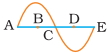
A
$AB$
B
$BD$
C
$DE$
D
$AE$
Solution
(A) The wavelength $(\lambda)$ is defined as the distance between two consecutive crests (peaks) or two consecutive troughs.
In the given wave diagram, the distance $AE$ represents one complete wavelength, as it covers one full crest and one full trough.
A half wavelength $(\lambda/2)$ corresponds to the distance of either one crest or one trough.
Looking at the diagram, the distance $AB$ represents one crest, and the distance $DE$ represents one trough.
However, the question asks for half the wavelength. Since $AB$ is the length of one crest, it represents $\lambda/2$. Similarly, $DE$ also represents $\lambda/2$.
Given the options, $AB$ is a correct representation of half the wavelength.
In the given wave diagram, the distance $AE$ represents one complete wavelength, as it covers one full crest and one full trough.
A half wavelength $(\lambda/2)$ corresponds to the distance of either one crest or one trough.
Looking at the diagram, the distance $AB$ represents one crest, and the distance $DE$ represents one trough.
However, the question asks for half the wavelength. Since $AB$ is the length of one crest, it represents $\lambda/2$. Similarly, $DE$ also represents $\lambda/2$.
Given the options, $AB$ is a correct representation of half the wavelength.
0 likes
View Solution7
MediumMCQ
Earthquakes produce which kind of sound before the main shock wave begins?
A
ultrasound
B
audible sound
C
infrasound
D
none of the above
Solution
(C) Earthquakes produce low-frequency vibrations known as infrasound before the main shock wave begins.
These infrasonic waves are below the human audible range (less than $20 \ Hz$).
Some animals are sensitive to these low-frequency vibrations and show strange changes in their behavior,which serves as an advanced warning of the earthquake.
These infrasonic waves are below the human audible range (less than $20 \ Hz$).
Some animals are sensitive to these low-frequency vibrations and show strange changes in their behavior,which serves as an advanced warning of the earthquake.
0 likes
View Solution8
EasyMCQ
Infrasound can be heard by
A
dog
B
bat
C
human beings
D
rhinoceros
Solution
(D) Infrasound refers to sound waves with frequencies below the audible range of humans,which is typically below $20\, Hz$. Rhinoceros communicate using infrasound at frequencies as low as $5\, Hz$.
0 likes
View Solution9
MediumMCQ
Before playing the orchestra in a musical concert,a sitarist tries to adjust the tension and pluck the string suitably. By doing so,he is adjusting
A
frequency of the sitar string with the frequency of other musical instruments
B
amplitude of sound only
C
intensity of sound only
D
loudness of sound
Solution
(A) The frequency of a particular musical instrument should be in tune with that of other musical instruments to ensure harmony.
By adjusting the tension of the strings,the sitarist changes the frequency of vibration of the strings.
This process,known as tuning,ensures that the sitar produces notes that are in harmony with the other instruments in the orchestra,resulting in pleasant music.
By adjusting the tension of the strings,the sitarist changes the frequency of vibration of the strings.
This process,known as tuning,ensures that the sitar produces notes that are in harmony with the other instruments in the orchestra,resulting in pleasant music.
0 likes
View Solution10
MediumMCQ
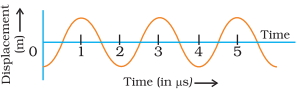
The given graph shows the displacement versus time relation for a disturbance travelling with a velocity of $1500\, m \,s^{-1}$. Calculate the wavelength of the disturbance.
A
$3 \times 10^{-3} \, m$
B
$5 \times 10^{-3} \, m$
C
$4 \times 10^{-3} \, m$
D
$6 \times 10^{-3} \, m$
Solution
(A) From the graph,the time period $T$ is the time taken for one complete oscillation.
Looking at the graph,one complete wave cycle spans from $t = 0.5 \, \mu s$ to $t = 2.5 \, \mu s$ (or similar interval),which gives $T = 2 \, \mu s = 2 \times 10^{-6} \, s$.
Frequency $f = 1/T = 1 / (2 \times 10^{-6} \, s) = 0.5 \times 10^6 \, Hz = 5 \times 10^5 \, Hz$.
Given velocity $v = 1500 \, m \, s^{-1}$.
Wavelength $\lambda = v / f = 1500 / (5 \times 10^5) = 300 \times 10^{-5} \, m = 3 \times 10^{-3} \, m$.
Looking at the graph,one complete wave cycle spans from $t = 0.5 \, \mu s$ to $t = 2.5 \, \mu s$ (or similar interval),which gives $T = 2 \, \mu s = 2 \times 10^{-6} \, s$.
Frequency $f = 1/T = 1 / (2 \times 10^{-6} \, s) = 0.5 \times 10^6 \, Hz = 5 \times 10^5 \, Hz$.
Given velocity $v = 1500 \, m \, s^{-1}$.
Wavelength $\lambda = v / f = 1500 / (5 \times 10^5) = 300 \times 10^{-5} \, m = 3 \times 10^{-3} \, m$.
0 likes
View Solution11
Medium
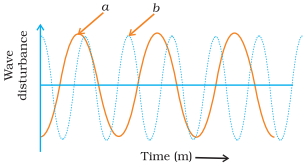
Which of the above two graphs $(a)$ and $(b)$ representing the human voice is likely to be the male voice? Give reason for your answer.
Solution
(A) Graph $(a)$ is likely to be the male voice.
Reason: The pitch of a sound is determined by its frequency. $A$ lower frequency corresponds to a lower pitch. In the given graph,wave $(a)$ has a lower frequency (fewer oscillations per unit time) compared to wave $(b)$. Since the male voice typically has a lower pitch than the female voice,graph $(a)$ represents the male voice.
Reason: The pitch of a sound is determined by its frequency. $A$ lower frequency corresponds to a lower pitch. In the given graph,wave $(a)$ has a lower frequency (fewer oscillations per unit time) compared to wave $(b)$. Since the male voice typically has a lower pitch than the female voice,graph $(a)$ represents the male voice.
0 likes
View Solution12
Medium
$A$ girl is sitting in the middle of a park of dimension $12 \,m \times 12 \,m$. On the left side of it there is a building adjoining the park and on the right side of the park,there is a road adjoining the park. $A$ sound is produced on the road by a cracker. Is it possible for the girl to hear the echo of this sound? Explain your answer.
Solution
(D) To hear an echo,the time interval between the original sound and the reflected sound must be at least $0.1 \,s$.
The minimum distance required for the reflected sound wave to be heard as an echo is calculated as:
Distance = Velocity of sound $\times$ Time interval
Distance = $344 \,m/s \times 0.1 \,s = 34.4 \,m$.
In this scenario,the girl is in the middle of a $12 \,m$ wide park. The sound travels from the road to the building $(6 \,m)$ and reflects back to the girl $(6 \,m)$.
Total distance travelled by the reflected sound = $6 \,m + 6 \,m = 12 \,m$.
Since $12 \,m < 34.4 \,m$,the reflected sound reaches the girl in less than $0.1 \,s$. Therefore,the girl cannot hear a distinct echo.
The minimum distance required for the reflected sound wave to be heard as an echo is calculated as:
Distance = Velocity of sound $\times$ Time interval
Distance = $344 \,m/s \times 0.1 \,s = 34.4 \,m$.
In this scenario,the girl is in the middle of a $12 \,m$ wide park. The sound travels from the road to the building $(6 \,m)$ and reflects back to the girl $(6 \,m)$.
Total distance travelled by the reflected sound = $6 \,m + 6 \,m = 12 \,m$.
Since $12 \,m < 34.4 \,m$,the reflected sound reaches the girl in less than $0.1 \,s$. Therefore,the girl cannot hear a distinct echo.
0 likes
View Solution13
EasyMCQ
Why do we hear the sound produced by the humming bees while the sound of vibrations of a pendulum is not heard?
A
The frequency of bee sound is within the audible range,while the pendulum frequency is infrasonic.
B
The frequency of bee sound is ultrasonic,while the pendulum frequency is audible.
C
The amplitude of bee sound is higher than that of the pendulum.
D
The pendulum does not produce any vibrations.
Solution
(A) The sound produced by humming bees is caused by the rapid vibration of their wings,which creates a frequency within the human audible range ($20 \,Hz$ to $20,000 \,Hz$).
In contrast,the vibrations of a typical pendulum are very slow,resulting in a frequency below $20 \,Hz$,which is classified as infrasonic sound.
Since the human ear cannot detect frequencies below $20 \,Hz$,we cannot hear the sound of the pendulum's vibrations.
In contrast,the vibrations of a typical pendulum are very slow,resulting in a frequency below $20 \,Hz$,which is classified as infrasonic sound.
Since the human ear cannot detect frequencies below $20 \,Hz$,we cannot hear the sound of the pendulum's vibrations.
0 likes
View Solution14
EasyMCQ
If an explosion takes place at the bottom of a lake,what type of shock waves will be produced in the water?
A
Transverse waves
B
Longitudinal waves
C
Stationary waves
D
Electromagnetic waves
Solution
(B) When an explosion occurs underwater,it creates a sudden pressure disturbance that travels through the medium.
Since water is a fluid,it can only support the propagation of pressure variations in the form of longitudinal waves.
Sound waves are mechanical waves that require a medium to travel,and in fluids like water,they propagate as longitudinal waves where the particles of the medium oscillate parallel to the direction of wave propagation.
Since water is a fluid,it can only support the propagation of pressure variations in the form of longitudinal waves.
Sound waves are mechanical waves that require a medium to travel,and in fluids like water,they propagate as longitudinal waves where the particles of the medium oscillate parallel to the direction of wave propagation.
0 likes
View Solution15
EasyMCQ
Sound produced by a thunderstorm is heard $10 \, s$ after the lightning is seen. Calculate the approximate distance of the thunder cloud. (Given speed of sound $= 340 \, m \, s^{-1}$.) (in $, m$)
A
$5800$
B
$2900$
C
$3400$
D
$4400$
Solution
(C) The speed of sound is given as $v = 340 \, m \, s^{-1}$.
The time interval between seeing the lightning and hearing the thunder is $t = 10 \, s$.
Since the speed of light is extremely high,the time taken for light to reach the observer is negligible.
Therefore,the distance $d$ of the thunder cloud can be calculated using the formula: $d = v \times t$.
Substituting the values: $d = 340 \, m \, s^{-1} \times 10 \, s = 3400 \, m$.
Thus,the approximate distance of the thunder cloud is $3400 \, m$.
The time interval between seeing the lightning and hearing the thunder is $t = 10 \, s$.
Since the speed of light is extremely high,the time taken for light to reach the observer is negligible.
Therefore,the distance $d$ of the thunder cloud can be calculated using the formula: $d = v \times t$.
Substituting the values: $d = 340 \, m \, s^{-1} \times 10 \, s = 3400 \, m$.
Thus,the approximate distance of the thunder cloud is $3400 \, m$.
0 likes
View Solution16
MediumMCQ
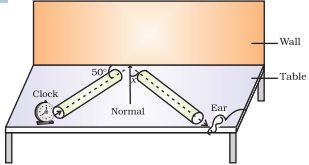
For hearing the loudest ticking sound of the clock,find the angle $x$ in the figure. (in $^o$)
A
$60$
B
$80$
C
$50$
D
$40$
Solution
(D) According to the laws of reflection,the angle of incidence is equal to the angle of reflection.
The incident sound wave makes an angle of $50^o$ with the reflecting surface (the wall).
The normal is perpendicular to the reflecting surface,so the angle between the normal and the surface is $90^o$.
Therefore,the angle of incidence $i = 90^o - 50^o = 40^o$.
Since the angle of incidence equals the angle of reflection $(i = r)$,the angle of reflection $r$ is also $40^o$.
In the figure,$x$ represents the angle of reflection with respect to the normal.
Thus,$x = 40^o$.
The incident sound wave makes an angle of $50^o$ with the reflecting surface (the wall).
The normal is perpendicular to the reflecting surface,so the angle between the normal and the surface is $90^o$.
Therefore,the angle of incidence $i = 90^o - 50^o = 40^o$.
Since the angle of incidence equals the angle of reflection $(i = r)$,the angle of reflection $r$ is also $40^o$.
In the figure,$x$ represents the angle of reflection with respect to the normal.
Thus,$x = 40^o$.
0 likes
View Solution17
EasyMCQ
Why are the ceiling and the wall behind the stage of good conference halls or concert halls made curved?
A
To absorb sound waves and prevent echoes.
B
To reflect sound waves towards the audience uniformly.
C
To increase the aesthetic appeal of the hall.
D
To reduce the cost of construction.
Solution
(B) The ceiling and the wall behind the stage in good conference halls or concert halls are made curved so that sound,after reflection from these surfaces,spreads evenly across the entire hall. This ensures that the sound reaches all members of the audience clearly and effectively without significant loss of intensity.
0 likes
View Solution18
Medium
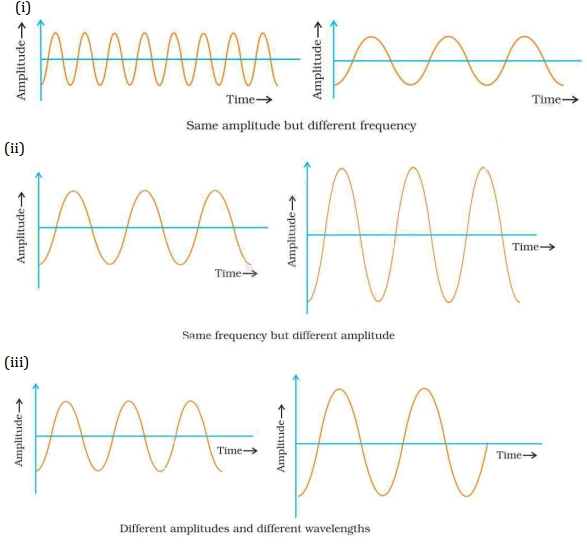
Represent graphically by two separate diagrams in each case:
$(i)$ Two sound waves having the same amplitude but different frequencies.
$(ii)$ Two sound waves having the same frequency but different amplitudes.
$(iii)$ Two sound waves having different amplitudes and also different wavelengths.
$(i)$ Two sound waves having the same amplitude but different frequencies.
$(ii)$ Two sound waves having the same frequency but different amplitudes.
$(iii)$ Two sound waves having different amplitudes and also different wavelengths.
Solution
(N/A) The graphical representation of sound waves involves plotting amplitude on the $y$-axis against time on the $x$-axis.
$(i)$ For two sound waves with the same amplitude but different frequencies,the height of the peaks (amplitude) remains constant for both waves,but the number of oscillations per unit time (frequency) differs.
$(ii)$ For two sound waves with the same frequency but different amplitudes,the number of oscillations per unit time is identical,but the maximum displacement from the mean position (amplitude) varies.
$(iii)$ For two sound waves with different amplitudes and different wavelengths,both the height of the peaks and the distance between consecutive crests (wavelength) differ between the two waves.
$(i)$ For two sound waves with the same amplitude but different frequencies,the height of the peaks (amplitude) remains constant for both waves,but the number of oscillations per unit time (frequency) differs.
$(ii)$ For two sound waves with the same frequency but different amplitudes,the number of oscillations per unit time is identical,but the maximum displacement from the mean position (amplitude) varies.
$(iii)$ For two sound waves with different amplitudes and different wavelengths,both the height of the peaks and the distance between consecutive crests (wavelength) differ between the two waves.
0 likes
View Solution19
MediumMCQ
Establish the relationship between the speed of sound, its wavelength, and frequency. If the velocity of sound in air is $340 \, m \, s^{-1}$, calculate:
$(i)$ The wavelength when the frequency is $256 \, Hz$.
$(ii)$ The frequency when the wavelength is $0.85 \, m$.
$(i)$ The wavelength when the frequency is $256 \, Hz$.
$(ii)$ The frequency when the wavelength is $0.85 \, m$.
A
$\lambda = 5.33 \, m, \nu = 200 \, Hz$
B
$\lambda = 1.63 \, m, \nu = 300 \, Hz$
C
$\lambda = 1.33 \, m, \nu = 400 \, Hz$
D
$\lambda = 1.50 \, m, \nu = 500 \, Hz$
Solution
(C) The relationship between the speed of sound $(v)$, frequency $(\nu)$, and wavelength $(\lambda)$ is given by the formula: $v = \nu \lambda$.
$(i)$ Given: $v = 340 \, m \, s^{-1}$, $\nu = 256 \, Hz$.
Using $v = \nu \lambda$, we get $340 = 256 \times \lambda$.
$\lambda = \frac{340}{256} = 1.328 \, m \approx 1.33 \, m$.
$(ii)$ Given: $v = 340 \, m \, s^{-1}$, $\lambda = 0.85 \, m$.
Using $v = \nu \lambda$, we get $340 = \nu \times 0.85$.
$\nu = \frac{340}{0.85} = 400 \, Hz$.
$(i)$ Given: $v = 340 \, m \, s^{-1}$, $\nu = 256 \, Hz$.
Using $v = \nu \lambda$, we get $340 = 256 \times \lambda$.
$\lambda = \frac{340}{256} = 1.328 \, m \approx 1.33 \, m$.
$(ii)$ Given: $v = 340 \, m \, s^{-1}$, $\lambda = 0.85 \, m$.
Using $v = \nu \lambda$, we get $340 = \nu \times 0.85$.
$\nu = \frac{340}{0.85} = 400 \, Hz$.
0 likes
View Solution20
Medium
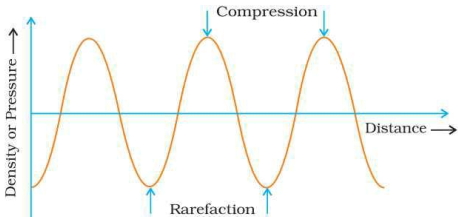
Draw a curve showing density or pressure variations with respect to distance for a disturbance produced by sound. Mark the position of compression and rarefaction on this curve. Also,define wavelengths and time-period using this curve.
Solution
(N/A) The curve representing density or pressure variations with respect to distance for a sound wave is shown in the provided image.
$1$. Compression: These are the regions of high pressure and high density,represented by the crests of the wave.
$2$. Rarefaction: These are the regions of low pressure and low density,represented by the troughs of the wave.
$3$. Wavelength: It is defined as the distance between two consecutive compressions or two consecutive rarefactions.
$4$. Time-period: It is defined as the time taken by the wave to travel the distance between any two consecutive compressions or rarefactions from a fixed point.
$1$. Compression: These are the regions of high pressure and high density,represented by the crests of the wave.
$2$. Rarefaction: These are the regions of low pressure and low density,represented by the troughs of the wave.
$3$. Wavelength: It is defined as the distance between two consecutive compressions or two consecutive rarefactions.
$4$. Time-period: It is defined as the time taken by the wave to travel the distance between any two consecutive compressions or rarefactions from a fixed point.
0 likes
View Solution21
EasyMCQ
What is a wave?
A
$A$ physical movement of matter from one place to another.
B
$A$ disturbance in a medium due to repeated periodic motion of particles about their mean position,transferring energy without the actual net transport of the medium.
C
The random motion of particles in a vacuum.
D
$A$ stationary state of matter where particles do not move.
Solution
(B) wave is a disturbance in a medium caused by the repeated periodic motion of particles about their mean position.
In this process,energy is transferred from one point to another through the medium.
Crucially,the particles of the medium only oscillate about their equilibrium positions and do not undergo actual net displacement from one location to another.
In this process,energy is transferred from one point to another through the medium.
Crucially,the particles of the medium only oscillate about their equilibrium positions and do not undergo actual net displacement from one location to another.
0 likes
View Solution22
Easy
Name the two types of mechanical waves.
Solution
(N/A) The two types of mechanical waves are:
$(i)$ Transverse waves: In these waves,the particles of the medium vibrate in a direction perpendicular to the direction of wave propagation.
$(ii)$ Longitudinal waves: In these waves,the particles of the medium vibrate in a direction parallel to the direction of wave propagation.
$(i)$ Transverse waves: In these waves,the particles of the medium vibrate in a direction perpendicular to the direction of wave propagation.
$(ii)$ Longitudinal waves: In these waves,the particles of the medium vibrate in a direction parallel to the direction of wave propagation.
0 likes
View Solution23
EasyMCQ
What is a transverse wave?
A
$A$ wave where particles vibrate parallel to the direction of propagation.
B
$A$ wave where particles vibrate perpendicular to the direction of propagation.
C
$A$ wave that requires no medium to travel.
D
$A$ wave that only travels in solids.
Solution
(B) transverse wave is a type of wave in which the particles of the medium oscillate or vibrate in a direction perpendicular to the direction of the wave's propagation.
For example,waves produced on a stretched string or ripples on the surface of water are transverse waves.
For example,waves produced on a stretched string or ripples on the surface of water are transverse waves.
0 likes
View Solution24
EasyMCQ
What is a longitudinal wave?
A
$A$ wave where particles vibrate perpendicular to the direction of propagation.
B
$A$ wave where particles vibrate parallel to the direction of propagation.
C
$A$ wave that requires no medium to travel.
D
$A$ wave that only travels in a vacuum.
Solution
(B) longitudinal wave is a type of mechanical wave in which the particles of the medium oscillate or vibrate back and forth in the same direction as the wave propagation.
This results in the formation of regions of high pressure called compressions and regions of low pressure called rarefactions.
Sound waves in air are the most common example of longitudinal waves.
This results in the formation of regions of high pressure called compressions and regions of low pressure called rarefactions.
Sound waves in air are the most common example of longitudinal waves.
0 likes
View Solution25
EasyMCQ
What is a longitudinal wave?
A
$A$ wave where particles vibrate perpendicular to the direction of wave propagation.
B
$A$ wave where particles vibrate parallel to the direction of wave propagation.
C
$A$ wave that does not require a medium to travel.
D
$A$ wave that travels only in a vacuum.
Solution
(B) longitudinal wave is a type of wave in which the particles of the medium oscillate or vibrate back and forth in the same direction as the wave propagates.
This means the displacement of the medium is parallel to the direction of the wave's travel,resulting in regions of compressions and rarefactions.
This means the displacement of the medium is parallel to the direction of the wave's travel,resulting in regions of compressions and rarefactions.
0 likes
View Solution26
EasyMCQ
What is a crest?
A
The point of minimum displacement in a wave.
B
The point of maximum displacement in the positive direction of a wave.
C
The distance between two consecutive compressions.
D
The time taken for one complete oscillation.
Solution
(B) crest is defined as the point of maximum positive displacement in a transverse wave.
It represents the highest point or the peak of the wave above the mean equilibrium position.
In contrast,the point of maximum negative displacement is known as a trough.
It represents the highest point or the peak of the wave above the mean equilibrium position.
In contrast,the point of maximum negative displacement is known as a trough.
0 likes
View Solution27
EasyMCQ
What is a trough?
A
The highest point of a wave
B
The lowest point of a wave
C
The distance between two crests
D
The time taken for one oscillation
Solution
(B) trough is the point of maximum negative displacement in a wave.
It represents the lowest point of a wave below the mean or equilibrium position.
In a transverse wave,the crests are the high points and the troughs are the low points.
It represents the lowest point of a wave below the mean or equilibrium position.
In a transverse wave,the crests are the high points and the troughs are the low points.
0 likes
View Solution28
EasyMCQ
What do you understand by the term sound energy?
A
Energy produced by light
B
Mechanical energy that produces a sensation of hearing
C
Energy stored in chemical bonds
D
Energy related to thermal motion
Solution
(B) Sound is a form of mechanical energy that travels through a medium as a wave.
It is produced by the vibration of objects.
When these vibrations reach our ears,they produce a sensation of hearing,allowing us to perceive sound.
It is produced by the vibration of objects.
When these vibrations reach our ears,they produce a sensation of hearing,allowing us to perceive sound.
0 likes
View Solution29
Easy
What do you understand by the term infrasonic vibrations?
Solution
(N/A) Infrasonic vibrations,also known as infrasound,refer to sound waves that have a frequency below the lower limit of human audibility,which is $20 \,Hz$. These vibrations are typically produced by sources such as earthquakes,volcanic eruptions,and the movement of large animals like whales and elephants.
0 likes
View Solution30
EasyMCQ
What is the audible range for human beings?
A
$10$ Hz to $10$,$000$ Hz
B
$20$ Hz to $20$,$000$ Hz
C
$50$ Hz to $50$,$000$ Hz
D
$100$ Hz to $100$,$000$ Hz
Solution
(B) The audible range for human beings is the range of frequencies that the human ear can detect. This range is typically from $20 \,Hz$ to $20,000 \,Hz$. Frequencies below $20 \,Hz$ are called infrasonic,and frequencies above $20,000 \,Hz$ are called ultrasonic.
0 likes
View Solution31
Medium
Define the terms:
$(i)$ vibration
$(ii)$ time period
$(iii)$ frequency and
$(iv)$ amplitude. [one mark each]
$(i)$ vibration
$(ii)$ time period
$(iii)$ frequency and
$(iv)$ amplitude. [one mark each]
Solution
(N/A) $(i)$ One complete to and fro motion of a body is called one vibration.
$(ii)$ The time taken by a vibrating body to complete one vibration is called its time period.
$(iii)$ The number of complete vibrations that the vibrating body makes in one second is called its frequency.
$(iv)$ The maximum displacement of a vibrating body from its mean position is called its amplitude.
$(ii)$ The time taken by a vibrating body to complete one vibration is called its time period.
$(iii)$ The number of complete vibrations that the vibrating body makes in one second is called its frequency.
$(iv)$ The maximum displacement of a vibrating body from its mean position is called its amplitude.
0 likes
View Solution32
EasyMCQ
Which of the following sound waves can we hear? $10 \, Hz, 500 \, Hz, 1500 \, Hz, 12000 \, Hz, 25000 \, Hz$
A
$10 \, Hz, 500 \, Hz, 1500 \, Hz$
B
$500 \, Hz, 1500 \, Hz, 12000 \, Hz$
C
$12000 \, Hz, 25000 \, Hz$
D
$10 \, Hz, 25000 \, Hz$
Solution
(B) The human ear can hear sound waves in the audible frequency range,which is between $20 \, Hz$ and $20,000 \, Hz$ $(20 \, kHz)$.
$1$. $10 \, Hz$ is infrasonic (below $20 \, Hz$),so it cannot be heard.
$2$. $500 \, Hz$,$1500 \, Hz$,and $12000 \, Hz$ fall within the audible range $(20 \, Hz - 20,000 \, Hz)$.
$3$. $25000 \, Hz$ is ultrasonic (above $20,000 \, Hz$),so it cannot be heard.
Therefore,we can hear $500 \, Hz, 1500 \, Hz,$ and $12000 \, Hz$.
$1$. $10 \, Hz$ is infrasonic (below $20 \, Hz$),so it cannot be heard.
$2$. $500 \, Hz$,$1500 \, Hz$,and $12000 \, Hz$ fall within the audible range $(20 \, Hz - 20,000 \, Hz)$.
$3$. $25000 \, Hz$ is ultrasonic (above $20,000 \, Hz$),so it cannot be heard.
Therefore,we can hear $500 \, Hz, 1500 \, Hz,$ and $12000 \, Hz$.
0 likes
View Solution33
EasyMCQ
What do you understand by the term ultrasonic vibrations?
A
Sounds with frequency less than $20 \,Hz$
B
Sounds with frequency between $20 \,Hz$ and $20,000 \,Hz$
C
Sounds with frequency higher than $20,000 \,Hz$
D
Sounds with frequency exactly $20,000 \,Hz$
Solution
(C) Ultrasonic vibrations,or ultrasonics,refer to sound waves that have a frequency higher than the upper limit of human hearing,which is $20,000 \,Hz$ (or $20 \,kHz$).
These vibrations are beyond the audible range for humans.
These vibrations are beyond the audible range for humans.
0 likes
View Solution34
Easy
Name three animals which can hear ultrasonic vibrations.
Solution
(N/A) Animals that can hear ultrasonic vibrations (frequencies greater than $20,000 \ Hz$) include dogs,bats,and dolphins. These animals possess specialized auditory systems that allow them to perceive high-frequency sounds beyond the range of human hearing.
0 likes
View Solution35
Easy
What are elastic waves? Name two kinds of elastic waves.
Solution
(N/A) Elastic waves are mechanical waves that propagate through a material medium due to the elasticity and inertia of the medium's particles.
These waves require a medium to travel and cannot propagate through a vacuum.
The two primary types of elastic waves are:
$1$. Longitudinal waves: Waves in which the particles of the medium oscillate parallel to the direction of wave propagation.
$2$. Transverse waves: Waves in which the particles of the medium oscillate perpendicular to the direction of wave propagation.
These waves require a medium to travel and cannot propagate through a vacuum.
The two primary types of elastic waves are:
$1$. Longitudinal waves: Waves in which the particles of the medium oscillate parallel to the direction of wave propagation.
$2$. Transverse waves: Waves in which the particles of the medium oscillate perpendicular to the direction of wave propagation.
0 likes
View Solution36
Easy
What do you understand by the term echo?
Solution
(N/A) An echo is a repetition of sound caused by the reflection of sound waves from a distant,rigid obstacle,such as a wall,cliff,or mountain. For an echo to be heard distinctly by the human ear,the reflected sound must reach the listener at least $0.1 \ s$ after the original sound.
0 likes
View Solution37
Medium
State two practical uses or applications of echoes.
Solution
(N/A) Echoes are used in the following ways:
$1$. $SONAR$ ($Sound$ $Navigation$ $And$ $Ranging$) systems use echoes to determine the depth of the sea and to locate underwater objects like submarines,shipwrecks,or icebergs.
$2$. Medical ultrasound imaging uses echoes of high-frequency sound waves to create images of internal organs,such as monitoring the development of a fetus during pregnancy.
$1$. $SONAR$ ($Sound$ $Navigation$ $And$ $Ranging$) systems use echoes to determine the depth of the sea and to locate underwater objects like submarines,shipwrecks,or icebergs.
$2$. Medical ultrasound imaging uses echoes of high-frequency sound waves to create images of internal organs,such as monitoring the development of a fetus during pregnancy.
0 likes
View Solution38
EasyMCQ
Flash of lightning reaches earlier than the sound of thunder. Why?
A
Light travels faster than sound.
B
Sound travels faster than light.
C
Both travel at the same speed.
D
Thunder is produced before lightning.
Solution
(A) The speed of light in air is approximately $3 \times 10^{8} \text{ m s}^{-1}$,whereas the speed of sound in air is approximately $340 \text{ m s}^{-1}$ at room temperature. Since the speed of light is significantly higher than the speed of sound,the flash of lightning is observed by our eyes much earlier than the sound of thunder reaches our ears.
0 likes
View Solution39
EasyMCQ
What is reverberation?
A
The reflection of sound from a distant object.
B
The repeated reflection of sound waves that results in the persistence of sound.
C
The bending of sound waves around an obstacle.
D
The change in frequency of sound due to motion.
Solution
(B) Reverberation is defined as the repeated reflection of sound waves from the walls,ceiling,and floor of an enclosed space.
This phenomenon causes the sound to persist for a certain duration even after the source of the sound has stopped emitting it.
It is commonly observed in large halls or auditoriums with hard,reflective surfaces.
This phenomenon causes the sound to persist for a certain duration even after the source of the sound has stopped emitting it.
It is commonly observed in large halls or auditoriums with hard,reflective surfaces.
0 likes
View Solution40
EasyMCQ
If $20$ waves are produced per second,what is the frequency in hertz (in $, Hz$)?
A
$10$
B
$20$
C
$40$
D
$5$
Solution
(B) Frequency is defined as the number of oscillations or waves produced per unit of time.
Given that $20$ waves are produced in $1$ second.
Therefore,the frequency $f = \frac{\text{Number of waves}}{\text{Time}} = \frac{20}{1} = 20\, Hz$.
Given that $20$ waves are produced in $1$ second.
Therefore,the frequency $f = \frac{\text{Number of waves}}{\text{Time}} = \frac{20}{1} = 20\, Hz$.
0 likes
View Solution41
MediumMCQ
What is $SONAR$?
A
$A$ device to measure light intensity.
B
$A$ technique for sound navigation and ranging.
C
$A$ method to measure atmospheric pressure.
D
$A$ tool to detect radioactive waves.
Solution
(B) $SONAR$ stands for $\text{Sound Navigation And Ranging}$.
It is a technique that uses ultrasonic sound waves to determine the depth of the sea and to locate underwater objects such as reefs,submarines,and schools of fish.
The system works by emitting sound pulses and measuring the time taken for the echo to return after reflecting off an object.
It is a technique that uses ultrasonic sound waves to determine the depth of the sea and to locate underwater objects such as reefs,submarines,and schools of fish.
The system works by emitting sound pulses and measuring the time taken for the echo to return after reflecting off an object.
0 likes
View Solution42
Easy
Name the waves of frequency greater than $20,000 \,Hz$. Give one use of these waves.
Solution
(N/A) Sound waves with a frequency greater than $20,000 \,Hz$ are known as ultrasonic waves or ultrasound.
These waves are widely used in medical diagnostics,such as in ultrasonography (ultrasound scans) to visualize internal organs of the human body.
These waves are widely used in medical diagnostics,such as in ultrasonography (ultrasound scans) to visualize internal organs of the human body.
0 likes
View Solution43
Easy
Explain why echoes cannot be heard in a small room.
Solution
(N/A) To hear an echo,the minimum distance between the source of sound and the reflecting surface (obstacle) must be approximately $17 \,m$. This is because the human brain retains sound for $0.1 \,s$ (persistence of hearing). Since the speed of sound in air is about $344 \,m/s$,the total distance traveled by sound in $0.1 \,s$ is $34.4 \,m$. Therefore,the distance to the obstacle must be at least $34.4 / 2 = 17.2 \,m$. In small rooms,this distance is not maintained,so the reflected sound reaches the ear before the $0.1 \,s$ interval,causing the original sound and the echo to overlap,making the echo inaudible.
0 likes
View Solution44
EasyMCQ
Why can we hear echoes in long galleries and big halls?
A
Due to the reflection of sound from walls.
B
Due to the absorption of sound by walls.
C
Due to the refraction of sound.
D
Due to the diffraction of sound.
Solution
(A) An echo is the repetition of sound caused by the reflection of sound waves from a hard surface.
For an echo to be heard distinctly,the time interval between the original sound and the reflected sound must be at least $0.1 \, s$.
Since the speed of sound in air is approximately $344 \, m/s$,the total distance traveled by the sound in $0.1 \, s$ is $34.4 \, m$.
Therefore,the minimum distance between the source of sound and the reflecting surface must be half of this,which is $17.2 \, m$.
In long galleries and big halls,the dimensions are large enough to provide this minimum distance,allowing the reflected sound to reach the listener after the required time interval,thus creating an echo.
For an echo to be heard distinctly,the time interval between the original sound and the reflected sound must be at least $0.1 \, s$.
Since the speed of sound in air is approximately $344 \, m/s$,the total distance traveled by the sound in $0.1 \, s$ is $34.4 \, m$.
Therefore,the minimum distance between the source of sound and the reflecting surface must be half of this,which is $17.2 \, m$.
In long galleries and big halls,the dimensions are large enough to provide this minimum distance,allowing the reflected sound to reach the listener after the required time interval,thus creating an echo.
0 likes
View Solution45
Medium
Two astronauts cannot hear each other on the moon. Why?
Solution
(N/A) Sound requires a material medium for its propagation. The moon has no atmosphere,meaning it is a vacuum. Since sound waves cannot travel through a vacuum,astronauts cannot hear each other on the moon.
0 likes
View Solution46
Easy
Explain why there is usually a time delay between observing a flash and hearing a thunder?
Solution
(N/A) The speed of light in air is approximately $3 \times 10^8 \text{ m/s}$, whereas the speed of sound in air is approximately $343 \text{ m/s}$ at room temperature.
Because the velocity of light is significantly greater than the velocity of sound, the light from the lightning flash reaches the observer almost instantaneously.
In contrast, the sound waves produced by the thunder travel much slower, resulting in a noticeable time delay between seeing the flash and hearing the thunder.
Because the velocity of light is significantly greater than the velocity of sound, the light from the lightning flash reaches the observer almost instantaneously.
In contrast, the sound waves produced by the thunder travel much slower, resulting in a noticeable time delay between seeing the flash and hearing the thunder.
0 likes
View Solution47
MediumMCQ
Bats have no eyes,yet they can ascertain the distance,direction,nature,and size of objects. Explain why.
A
They use infrared vision.
B
They use echolocation by producing ultrasonic waves.
C
They have highly developed olfactory senses.
D
They use electromagnetic fields to navigate.
Solution
(B) Bats possess the ability to navigate and hunt in the dark using a biological sonar system known as echolocation.
When bats fly,they emit high-frequency sound waves called ultrasonic waves.
These waves travel through the air and strike nearby objects,reflecting back to the bat's ears.
By analyzing the time delay,intensity,and frequency shift of the returning echoes,the bat can accurately determine the distance,direction,size,and texture of the objects in its path.
This highly sensitive auditory system allows them to maneuver and hunt effectively without the need for vision.
When bats fly,they emit high-frequency sound waves called ultrasonic waves.
These waves travel through the air and strike nearby objects,reflecting back to the bat's ears.
By analyzing the time delay,intensity,and frequency shift of the returning echoes,the bat can accurately determine the distance,direction,size,and texture of the objects in its path.
This highly sensitive auditory system allows them to maneuver and hunt effectively without the need for vision.
0 likes
View Solution48
EasyMCQ
State whether the following waves are transverse or longitudinal waves :
$(i)$ light waves
$(ii)$ waves in water and
$(iii)$ sound waves.
$(i)$ light waves
$(ii)$ waves in water and
$(iii)$ sound waves.
A
Light waves: Transverse,Water waves: Transverse,Sound waves: Longitudinal
B
Light waves: Longitudinal,Water waves: Transverse,Sound waves: Transverse
C
Light waves: Transverse,Water waves: Longitudinal,Sound waves: Longitudinal
D
Light waves: Longitudinal,Water waves: Longitudinal,Sound waves: Transverse
Solution
(A) $(i)$ Light waves are electromagnetic waves,which are transverse in nature because their oscillations occur perpendicular to the direction of wave propagation.
$(ii)$ Waves in water (surface waves) are transverse waves because the water particles move up and down perpendicular to the direction of the wave travel.
$(iii)$ Sound waves are longitudinal waves because the particles of the medium vibrate back and forth parallel to the direction of wave propagation.
$(ii)$ Waves in water (surface waves) are transverse waves because the water particles move up and down perpendicular to the direction of the wave travel.
$(iii)$ Sound waves are longitudinal waves because the particles of the medium vibrate back and forth parallel to the direction of wave propagation.
0 likes
View Solution49
Medium
State three factors on which the speed of sound in a medium depends.
Solution
(N/A) The speed of sound in a medium depends on the following three factors:
$(i)$ Density of the medium: The speed of sound is inversely proportional to the square root of the density of the medium.
$(ii)$ Elasticity of the medium: The speed of sound is directly proportional to the square root of the elasticity of the medium. Sound travels faster in more elastic media.
$(iii)$ Temperature of the medium: The speed of sound in a gas is directly proportional to the square root of its absolute temperature (measured in Kelvin).
$(i)$ Density of the medium: The speed of sound is inversely proportional to the square root of the density of the medium.
$(ii)$ Elasticity of the medium: The speed of sound is directly proportional to the square root of the elasticity of the medium. Sound travels faster in more elastic media.
$(iii)$ Temperature of the medium: The speed of sound in a gas is directly proportional to the square root of its absolute temperature (measured in Kelvin).
0 likes
View Solution50
Medium
$(i)$ Define the time period of a wave.
$(ii)$ Give the relation among speed of sound $V$,wavelength $\lambda$ and its frequency $\nu$.
$(ii)$ Give the relation among speed of sound $V$,wavelength $\lambda$ and its frequency $\nu$.
Solution
(N/A) $(i)$ The time taken by two consecutive compressions or rarefactions to cross a fixed point is called the time period of a wave.
$(ii)$ The relationship between speed of sound $(V)$,wavelength $(\lambda)$,and frequency $(\nu)$ is given by the formula: $V = \lambda \times \nu$.
$(ii)$ The relationship between speed of sound $(V)$,wavelength $(\lambda)$,and frequency $(\nu)$ is given by the formula: $V = \lambda \times \nu$.
0 likes
View SolutionSOUND — Mix Example - SOUND · Frequently Asked Questions
1Are these SOUND questions useful for JEE and NEET?
Yes. All questions in this section are mapped to JEE Main and NEET exam patterns. Previous year questions from JEE Main, NEET, GUJCET and state-level exams are included with full solutions.
2Can I switch to Hindi or Gujarati for these questions?
Yes. Use the language tabs in the hero section or the sidebar to view the same questions and solutions in English, Hindi or Gujarati.
3How do I generate a question paper from this subtopic?
Use the Vedclass Exam Paper Generator — select the chapter and subtopic, set difficulty, and generate Sets A, B, C, D automatically. First 3 chapters of every subject are free.
Vedclass Products
For Students
Vedclass Test Series
Mock tests in real JEE/NEET style with performance analysis. 5-day free trial.
Start Free TrialFor Teachers
Exam Paper Generator
Generate Set A/B/C/D papers from this chapter in 2 minutes. 3 chapters free.
Try FreeFor Institutes
Online Exam Module
Live online exams with unlimited students, 360° analytics & white-label branding.
See DemoFor Teachers & Institutes
Generate a SOUND Exam Paper in 2 Minutes
Select subtopic & difficulty — Sets A, B, C, D auto-generated with No Repeat logic.
First 3 chapters of every subject are free — no payment required.