
A English
Mix Example - SOUND Questions in English
Class 9 Science · SOUND · Mix Example - SOUND
169+
Questions
English
Language
100%
With Solutions
Showing 50 of 169 questions in English
51
EasyMCQ
How do our ears permit us to receive sound?
A
By converting sound waves into mechanical vibrations.
B
By converting pressure variations in the air into electrical signals.
C
By directly transmitting sound waves to the brain.
D
By amplifying sound waves through the ear canal.
Solution
(B) The ear functions by capturing sound waves,which are pressure variations in the air.
These waves cause the eardrum to vibrate.
These vibrations are amplified by the middle ear bones and transmitted to the inner ear (cochlea).
The cochlea converts these mechanical vibrations into electrical signals.
Finally,these electrical signals are sent to the brain via the auditory nerve,where they are interpreted as sound.
These waves cause the eardrum to vibrate.
These vibrations are amplified by the middle ear bones and transmitted to the inner ear (cochlea).
The cochlea converts these mechanical vibrations into electrical signals.
Finally,these electrical signals are sent to the brain via the auditory nerve,where they are interpreted as sound.
0 likes
View Solution52
Easy
Give two applications of ultrasound.
Solution
(N/A) The two applications of ultrasound are as follows:
$(i)$ Ultrasound scanning: It is used for medical diagnostics,such as examining internal organs (e.g.,liver,gallbladder,uterus) and monitoring the development of a fetus during pregnancy.
$(ii)$ Detection of defects in metals: Ultrasound waves are used to detect cracks or flaws in metal blocks used in construction or manufacturing without damaging the structure.
$(i)$ Ultrasound scanning: It is used for medical diagnostics,such as examining internal organs (e.g.,liver,gallbladder,uterus) and monitoring the development of a fetus during pregnancy.
$(ii)$ Detection of defects in metals: Ultrasound waves are used to detect cracks or flaws in metal blocks used in construction or manufacturing without damaging the structure.
0 likes
View Solution53
Medium
$(a)$ Illustrate the use of a stethoscope.
$(b)$ What are infrasonic and ultrasonic sound waves?
$(b)$ What are infrasonic and ultrasonic sound waves?
Solution
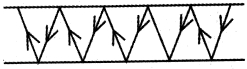
(N/A) stethoscope is a medical instrument used for listening to sounds produced within the body,primarily in the heart or lungs. It works on the principle of multiple reflection of sound. The sound of a patient's heartbeat enters the chest piece and travels through the rubber tube via multiple reflections until it reaches the doctor's ears.
$(b)$ Infrasonic sound waves are sound waves with frequencies below $20 \ Hz$. Humans cannot hear these sounds.
Ultrasonic sound waves are sound waves with frequencies above $20,000 \ Hz$ (or $20 \ kHz$). Humans cannot hear these sounds either.
$(b)$ Infrasonic sound waves are sound waves with frequencies below $20 \ Hz$. Humans cannot hear these sounds.
Ultrasonic sound waves are sound waves with frequencies above $20,000 \ Hz$ (or $20 \ kHz$). Humans cannot hear these sounds either.
0 likes
View Solution54
Medium
What is echo ranging? State any one application of this technique.
Solution
(N/A) Echo ranging is a technique used to determine the distance,direction,and speed of an object by measuring the time interval between the emission of a sound pulse (usually ultrasound) and the reception of its echo.
One application of this technique is in $SONAR$ ($Sound$ $Navigation$ $And$ $Ranging$),which is used to measure the depth of the sea or to locate underwater objects like hills,valleys,submarines,icebergs,and sunken ships.
One application of this technique is in $SONAR$ ($Sound$ $Navigation$ $And$ $Ranging$),which is used to measure the depth of the sea or to locate underwater objects like hills,valleys,submarines,icebergs,and sunken ships.
0 likes
View Solution55
Easy
$(a)$ What type of wave is represented by a density-distance graph?
$(b)$ What is meant by a transverse wave? Give an example.
$(b)$ What is meant by a transverse wave? Give an example.
Solution
(N/A) density-distance graph represents a longitudinal wave,as longitudinal waves involve variations in density and pressure of the medium.
$(b)$ $A$ transverse wave is a wave in which the particles of the medium vibrate in a direction perpendicular to the direction of wave propagation. An example of a transverse wave is the wave produced in a vibrating string or light waves.
$(b)$ $A$ transverse wave is a wave in which the particles of the medium vibrate in a direction perpendicular to the direction of wave propagation. An example of a transverse wave is the wave produced in a vibrating string or light waves.
0 likes
View Solution56
MediumMCQ
Sound of explosions taking place on other planets is not heard by a person on the Earth. Give the reason.
A
Sound travels faster in vacuum.
B
Sound requires a material medium for propagation.
C
The distance is too large for sound to travel.
D
Explosions on other planets are silent.
Solution
(B) Sound is a mechanical wave,which means it requires a material medium (such as air,water,or solids) to travel from one point to another.
Space between the Earth and other planets is a vacuum,meaning it lacks any material medium.
Since there is no medium for the sound waves to propagate through the vacuum of space,the sound of explosions occurring on other planets cannot be heard by a person on the Earth.
Space between the Earth and other planets is a vacuum,meaning it lacks any material medium.
Since there is no medium for the sound waves to propagate through the vacuum of space,the sound of explosions occurring on other planets cannot be heard by a person on the Earth.
0 likes
View Solution57
Medium
$(a)$ What are the basic factors on which the speed of sound in a medium depends?
$(b)$ Why are sound waves called mechanical waves?
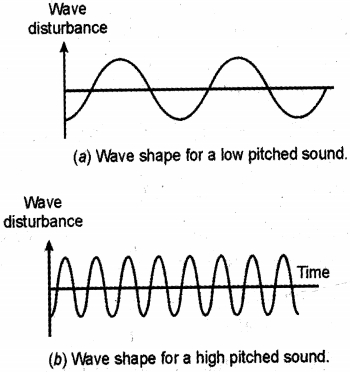
$(c)$ How will you differentiate a high-pitch sound from a low-pitch sound with the help of a graph?
$(b)$ Why are sound waves called mechanical waves?
$(c)$ How will you differentiate a high-pitch sound from a low-pitch sound with the help of a graph?
Solution
(N/A) The speed of sound in a medium depends upon:
$(i)$ Elasticity of the medium
$(ii)$ Density of the medium
$(b)$ Sound waves are called mechanical waves because they require a material medium for their propagation and are produced by the vibration of particles of the medium about their mean position.
$(c)$ The pitch of a sound depends upon its frequency. $A$ high-pitch sound has a higher frequency (more oscillations per unit time),while a low-pitch sound has a lower frequency (fewer oscillations per unit time). In the graph,the wave with more cycles per unit time represents a high-pitch sound,and the wave with fewer cycles per unit time represents a low-pitch sound.
$(i)$ Elasticity of the medium
$(ii)$ Density of the medium
$(b)$ Sound waves are called mechanical waves because they require a material medium for their propagation and are produced by the vibration of particles of the medium about their mean position.
$(c)$ The pitch of a sound depends upon its frequency. $A$ high-pitch sound has a higher frequency (more oscillations per unit time),while a low-pitch sound has a lower frequency (fewer oscillations per unit time). In the graph,the wave with more cycles per unit time represents a high-pitch sound,and the wave with fewer cycles per unit time represents a low-pitch sound.
0 likes
View Solution58
Medium
Give reasons for the following:
$(a)$ The reverberation time of a hall used for speeches should be very short.
$(b)$ $A$ vibrating body produces sound. However,no sound is heard when a simple pendulum oscillates in air.
$(c)$ Sounds of same loudness and pitch but produced by different musical instruments like a violin and flute are distinguishable.
$(a)$ The reverberation time of a hall used for speeches should be very short.
$(b)$ $A$ vibrating body produces sound. However,no sound is heard when a simple pendulum oscillates in air.
$(c)$ Sounds of same loudness and pitch but produced by different musical instruments like a violin and flute are distinguishable.
Solution
(N/A) The reverberation time of a hall used for speeches should be very short so that the speech remains clear and intelligible. If the reverberation time is long,the reflected sound waves overlap with the original sound,causing confusion and making it difficult to understand the words.
$(b)$ For a sound to be audible to the human ear,it must have a frequency between $20 \, Hz$ and $20,000 \, Hz$. $A$ simple pendulum oscillates at a very low frequency (much less than $20 \, Hz$),which is in the infrasonic range and therefore cannot be heard by humans.
$(c)$ Sounds of the same loudness and pitch can be distinguished due to the 'quality' or 'timbre' of the sound. This is determined by the waveform or the presence of overtones produced by the specific instrument,which makes each instrument's sound unique.
$(b)$ For a sound to be audible to the human ear,it must have a frequency between $20 \, Hz$ and $20,000 \, Hz$. $A$ simple pendulum oscillates at a very low frequency (much less than $20 \, Hz$),which is in the infrasonic range and therefore cannot be heard by humans.
$(c)$ Sounds of the same loudness and pitch can be distinguished due to the 'quality' or 'timbre' of the sound. This is determined by the waveform or the presence of overtones produced by the specific instrument,which makes each instrument's sound unique.
0 likes
View Solution59
MediumMCQ
$A$ person fires a gun standing at a distance of $55 \, m$ from a wall. If the speed of sound is $330 \, m s^{-1}$,find the time taken for an echo to be heard. (in $s$)
A
$0.1$
B
$0.2$
C
$0.3$
D
$0.4$
Solution
(C) Given: Distance of the wall $(D)$ = $55 \, m$. Speed of sound $(V)$ = $330 \, m s^{-1}$.
For an echo to be heard,the sound must travel to the wall and back to the person,covering a total distance of $2D$.
Using the formula: $2D = V \times t$.
Substituting the values: $2 \times 55 = 330 \times t$.
$110 = 330 \times t$.
$t = 110 / 330 = 1 / 3 \, s \approx 0.33 \, s$.
Rounding to the nearest provided option,the time taken is $0.3 \, s$.
For an echo to be heard,the sound must travel to the wall and back to the person,covering a total distance of $2D$.
Using the formula: $2D = V \times t$.
Substituting the values: $2 \times 55 = 330 \times t$.
$110 = 330 \times t$.
$t = 110 / 330 = 1 / 3 \, s \approx 0.33 \, s$.
Rounding to the nearest provided option,the time taken is $0.3 \, s$.
0 likes
View Solution60
EasyMCQ
The pulse rate of a man is $80$ beats in one minute. Calculate its frequency. (in $ Hz$)
A
$1.33$
B
$1.50$
C
$0.75$
D
$2.00$
Solution
(A) The pulse rate is given as $80$ beats per minute.
Frequency is defined as the number of oscillations or events per second.
To find the frequency in Hertz $(Hz)$, we divide the number of beats by the total time in seconds.
Time $= 1 \, \text{minute} = 60 \, \text{seconds}$.
Frequency $= \frac{\text{Number of beats}}{\text{Time in seconds}} = \frac{80}{60} \, Hz$.
Frequency $= 1.33 \, Hz$ (approximately).
Frequency is defined as the number of oscillations or events per second.
To find the frequency in Hertz $(Hz)$, we divide the number of beats by the total time in seconds.
Time $= 1 \, \text{minute} = 60 \, \text{seconds}$.
Frequency $= \frac{\text{Number of beats}}{\text{Time in seconds}} = \frac{80}{60} \, Hz$.
Frequency $= 1.33 \, Hz$ (approximately).
0 likes
View Solution61
Medium
What is Galton's whistle? To what use can it be put?
Solution
(N/A) Galton's whistle is a specialized device designed to produce ultrasonic sound waves,typically in the frequency range of $20,000 \,Hz$ to $40,000 \,Hz$.
These high-frequency vibrations are beyond the audible range of human beings,who can generally hear sounds only up to $20,000 \,Hz$.
However,dogs possess a much wider range of hearing and can easily perceive these ultrasonic frequencies.
Because of this,Galton's whistle is used for training dogs to respond to silent commands that humans cannot hear.
It is particularly useful for security purposes; if an intruder enters a property,the whistle can be blown to alert a guard dog without alerting the intruder,allowing the dog to react immediately.
These high-frequency vibrations are beyond the audible range of human beings,who can generally hear sounds only up to $20,000 \,Hz$.
However,dogs possess a much wider range of hearing and can easily perceive these ultrasonic frequencies.
Because of this,Galton's whistle is used for training dogs to respond to silent commands that humans cannot hear.
It is particularly useful for security purposes; if an intruder enters a property,the whistle can be blown to alert a guard dog without alerting the intruder,allowing the dog to react immediately.
0 likes
View Solution62
Easy
$A$ continuous disturbance is created on the surface of water in a ripple tank with a small piece of cork floating on it. Describe the motion of the cork. What does this tell us about the disturbance?
Solution
(N/A) The cork will move up and down at the same position while the waves travel outwards from the point of disturbance.
Thus,the cork is not carried away by the waves.
The motion of the cork indicates that the particles of the medium are vibrating at right angles to the direction of wave propagation.
This demonstrates that a wave involves the propagation of energy and not the physical transport of matter.
Thus,the cork is not carried away by the waves.
The motion of the cork indicates that the particles of the medium are vibrating at right angles to the direction of wave propagation.
This demonstrates that a wave involves the propagation of energy and not the physical transport of matter.
0 likes
View Solution63
Medium
State three conditions necessary for sound to be heard.
Solution
(N/A) $(i)$ There must be a vibrating body capable of transferring its energy to its surroundings.
$(ii)$ There must be a material medium to pick up the energy and propagate it in the forward direction.
$(iii)$ There must be a receiver,such as the human ear,to receive the sound vibrations and transmit them to the brain for final interpretation.
$(ii)$ There must be a material medium to pick up the energy and propagate it in the forward direction.
$(iii)$ There must be a receiver,such as the human ear,to receive the sound vibrations and transmit them to the brain for final interpretation.
0 likes
View Solution64
Medium
Give four practical uses of ultrasonic vibrations.
Solution
(N/A) $(i)$ They are used for dissipating fog on runways at airports.
$(ii)$ They are used in dishwashing machines to clean delicate objects.
$(iii)$ They are used for homogenizing milk.
$(iv)$ They are used for welding metals like tungsten.
$(ii)$ They are used in dishwashing machines to clean delicate objects.
$(iii)$ They are used for homogenizing milk.
$(iv)$ They are used for welding metals like tungsten.
0 likes
View Solution65
MediumMCQ
Why do astronauts talk to each other through radio telephones?
A
Sound waves travel faster in space.
B
Radio waves can travel through a vacuum.
C
Radio waves are a type of sound wave.
D
The vacuum of space amplifies sound.
Solution
(B) Space is a vacuum,meaning it contains no air or other material medium.
Sound waves are mechanical waves that require a material medium (like air,water,or solids) to propagate.
Since there is no medium in space,sound cannot travel between astronauts.
Radio waves are electromagnetic waves,which do not require a material medium for propagation.
Therefore,astronauts use radio communication to transmit and receive signals through the vacuum of space.
Sound waves are mechanical waves that require a material medium (like air,water,or solids) to propagate.
Since there is no medium in space,sound cannot travel between astronauts.
Radio waves are electromagnetic waves,which do not require a material medium for propagation.
Therefore,astronauts use radio communication to transmit and receive signals through the vacuum of space.
0 likes
View Solution66
Medium
$(a)$ Why does the stage of an auditorium have a curved background,curtains,carpets,and a false ceiling?
$(b)$ The sound of a ringing bell inside a vacuum chamber cannot be heard. Why?
$(b)$ The sound of a ringing bell inside a vacuum chamber cannot be heard. Why?
Solution
(N/A) The curved background is designed to act as a reflector,ensuring that sound waves are directed and distributed uniformly throughout the auditorium. Curtains,carpets,and false ceilings are sound-absorbing materials used to minimize reverberation and prevent the formation of echoes,thereby improving the clarity of sound.
$(b)$ Sound is a mechanical wave that requires a material medium (such as air,water,or solids) to travel. Since a vacuum chamber contains no particles to transmit the vibrations of the bell,the sound cannot propagate,and therefore,it cannot be heard.
$(b)$ Sound is a mechanical wave that requires a material medium (such as air,water,or solids) to travel. Since a vacuum chamber contains no particles to transmit the vibrations of the bell,the sound cannot propagate,and therefore,it cannot be heard.
0 likes
View Solution67
Medium
$(i)$ Even if a loud explosion were to take place at any place on the moon,it would not be heard at a nearby point. Give reason.
$(ii)$ Explain in brief the dependence of speed of sound on the nature of the material medium and temperature.
$(iii)$ Identify the two factors on which the loudness of sound depends.
$(ii)$ Explain in brief the dependence of speed of sound on the nature of the material medium and temperature.
$(iii)$ Identify the two factors on which the loudness of sound depends.
Solution
(N/A) $(i)$ Sound requires a material medium for propagation and cannot travel through a vacuum. Since the moon has no atmosphere (vacuum),sound waves from an explosion cannot travel to a nearby point.
$(ii)$ The speed of sound depends on the medium's elasticity and density; it is generally highest in solids,followed by liquids,and lowest in gases. Additionally,the speed of sound increases with an increase in temperature because the kinetic energy of the particles increases,facilitating faster transmission of vibrations.
$(iii)$ The loudness of sound depends on two main factors: $(1)$ Amplitude of the sound wave and $(2)$ Sensitivity of the listener's ear.
$(ii)$ The speed of sound depends on the medium's elasticity and density; it is generally highest in solids,followed by liquids,and lowest in gases. Additionally,the speed of sound increases with an increase in temperature because the kinetic energy of the particles increases,facilitating faster transmission of vibrations.
$(iii)$ The loudness of sound depends on two main factors: $(1)$ Amplitude of the sound wave and $(2)$ Sensitivity of the listener's ear.
0 likes
View Solution68
Medium
$(i)$ How do bats make use of ultrasonic waves to catch their prey? Explain.
$(ii)$ $A$ radar signal is reflected by an aeroplane and is received $2 \times 10^{-5} \text{ s}$ after it was sent. If the speed of these waves is $3 \times 10^{8} \text{ m s}^{-1}$,how far is the aeroplane?
$(ii)$ $A$ radar signal is reflected by an aeroplane and is received $2 \times 10^{-5} \text{ s}$ after it was sent. If the speed of these waves is $3 \times 10^{8} \text{ m s}^{-1}$,how far is the aeroplane?
Solution
(N/A) $(i)$ Bats emit high-frequency ultrasonic waves. These waves strike the prey and reflect back to the bat. By analyzing the time delay and the nature of the reflected echoes,the bat can accurately determine the location,distance,and movement of its prey.
$(ii)$ Given:
Speed of radio waves $(v)$ $= 3 \times 10^{8} \text{ m s}^{-1}$
Total time taken $(t_{total})$ $= 2 \times 10^{-5} \text{ s}$
Since the signal travels to the aeroplane and back,the time taken to reach the aeroplane $(t)$ is half of the total time:
$t = t_{total} / 2 = (2 \times 10^{-5} \text{ s}) / 2 = 1 \times 10^{-5} \text{ s}$
Distance $(d)$ $=$ Speed $\times$ Time
$d = (3 \times 10^{8} \text{ m s}^{-1}) \times (1 \times 10^{-5} \text{ s})$
$d = 3 \times 10^{3} \text{ m} = 3000 \text{ m} = 3 \text{ km}$
Thus,the aeroplane is $3 \text{ km}$ away.
$(ii)$ Given:
Speed of radio waves $(v)$ $= 3 \times 10^{8} \text{ m s}^{-1}$
Total time taken $(t_{total})$ $= 2 \times 10^{-5} \text{ s}$
Since the signal travels to the aeroplane and back,the time taken to reach the aeroplane $(t)$ is half of the total time:
$t = t_{total} / 2 = (2 \times 10^{-5} \text{ s}) / 2 = 1 \times 10^{-5} \text{ s}$
Distance $(d)$ $=$ Speed $\times$ Time
$d = (3 \times 10^{8} \text{ m s}^{-1}) \times (1 \times 10^{-5} \text{ s})$
$d = 3 \times 10^{3} \text{ m} = 3000 \text{ m} = 3 \text{ km}$
Thus,the aeroplane is $3 \text{ km}$ away.
0 likes
View Solution69
Medium
$(i)$ What does the acronym $SONAR$ stand for?
$(ii)$ What is the audible range of sound for human beings?
$(iii)$ How do the bats search and catch their prey in dark night?
$(ii)$ What is the audible range of sound for human beings?
$(iii)$ How do the bats search and catch their prey in dark night?
Solution
(N/A) $(i)$ $SONAR$ stands for Sound Navigation And Ranging.
$(ii)$ The audible range of sound for human beings is $20 \,Hz$ to $20,000 \,Hz$.
$(iii)$ Bats produce high-pitched ultrasonic squeaks. These sound waves are reflected back to the bat's ears after hitting obstacles or prey. By analyzing these reflections,the bat can locate its prey and navigate in the dark.
$(ii)$ The audible range of sound for human beings is $20 \,Hz$ to $20,000 \,Hz$.
$(iii)$ Bats produce high-pitched ultrasonic squeaks. These sound waves are reflected back to the bat's ears after hitting obstacles or prey. By analyzing these reflections,the bat can locate its prey and navigate in the dark.
0 likes
View Solution70
Medium
$(i)$ What causes the reverberation of thunder sound?
$(ii)$ $A$ $SONAR$ device on a submarine sends a signal and receives an echo $5 \, s$ later. Calculate the speed of sound in water if the distance of the object from the submarine is $3625 \, m$.
$(ii)$ $A$ $SONAR$ device on a submarine sends a signal and receives an echo $5 \, s$ later. Calculate the speed of sound in water if the distance of the object from the submarine is $3625 \, m$.
Solution
(N/A) $(i)$ Reverberation of thunder is caused by the successive and multiple reflections of sound waves from various reflecting surfaces,such as clouds and the Earth's surface.
$(ii)$ Given:
Distance of the object from the submarine $(d)$ $= 3625 \, m$
Total distance travelled by the signal $(2d)$ $= 2 \times 3625 \, m = 7250 \, m$
Time taken $(t)$ $= 5 \, s$
Speed of sound $(v)$ $= \text{Total Distance} / \text{Time}$
$v = 7250 / 5$
$v = 1450 \, m \, s^{-1}$
Therefore,the speed of sound in water is $1450 \, m \, s^{-1}$.
$(ii)$ Given:
Distance of the object from the submarine $(d)$ $= 3625 \, m$
Total distance travelled by the signal $(2d)$ $= 2 \times 3625 \, m = 7250 \, m$
Time taken $(t)$ $= 5 \, s$
Speed of sound $(v)$ $= \text{Total Distance} / \text{Time}$
$v = 7250 / 5$
$v = 1450 \, m \, s^{-1}$
Therefore,the speed of sound in water is $1450 \, m \, s^{-1}$.
0 likes
View Solution71
Medium
What is 'Ultrasound'? Explain how defects in a metal block can be detected using ultrasound.
Solution
(N/A) Ultrasound refers to sound waves having a frequency greater than $20 \ kHz$.
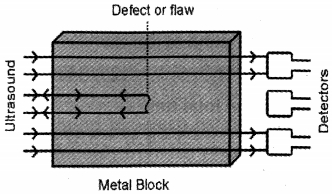
Defects like internal cracks or holes in metal blocks are detected using ultrasound. This method is based on the principle that an internal crack or hole in the block does not allow ultrasonic waves to pass through it.
To detect a flaw in metallic blocks,a source of ultrasonic sound is placed in front of one face of the block,and a detector is placed on the opposite face.
The ultrasonic waves are produced and made to pass through one face of the block and are then detected on the opposite face.
$(a)$ If the ultrasonic waves pass uninterrupted through all parts of the block,then there is no defect in the block.
$(b)$ If the ultrasonic waves do not reach the opposite face or are reflected back by the flaw,it indicates that the block has a defect (like a crack or a hole).
Defects like internal cracks or holes in metal blocks are detected using ultrasound. This method is based on the principle that an internal crack or hole in the block does not allow ultrasonic waves to pass through it.
To detect a flaw in metallic blocks,a source of ultrasonic sound is placed in front of one face of the block,and a detector is placed on the opposite face.
The ultrasonic waves are produced and made to pass through one face of the block and are then detected on the opposite face.
$(a)$ If the ultrasonic waves pass uninterrupted through all parts of the block,then there is no defect in the block.
$(b)$ If the ultrasonic waves do not reach the opposite face or are reflected back by the flaw,it indicates that the block has a defect (like a crack or a hole).
0 likes
View Solution72
Medium
Explain how the human ear works in the transmission of sound waves to the brain.
Solution
(N/A) $1$. The outer ear $(PINNA)$ collects sound waves from the surroundings.
$2$. These sound waves travel through the auditory canal to the eardrum $(TYMPANIC \text{ } MEMBRANE)$.
$3$. When a compression reaches the eardrum, the pressure increases, pushing it inward. When a rarefaction reaches it, the pressure decreases, pulling it outward. This causes the eardrum to vibrate.
$4$. These vibrations are amplified several times by the three small bones $(MALLEUS, \text{ } INCUS, \text{ } STAPES)$ in the middle ear.
$5$. The middle ear transmits these amplified pressure variations to the inner ear.
$6$. In the inner ear, the $COCHLEA$ converts these pressure variations into electrical signals.
$7$. These electrical signals are sent to the brain via the auditory nerve, where the brain interprets them as sound.
$2$. These sound waves travel through the auditory canal to the eardrum $(TYMPANIC \text{ } MEMBRANE)$.
$3$. When a compression reaches the eardrum, the pressure increases, pushing it inward. When a rarefaction reaches it, the pressure decreases, pulling it outward. This causes the eardrum to vibrate.
$4$. These vibrations are amplified several times by the three small bones $(MALLEUS, \text{ } INCUS, \text{ } STAPES)$ in the middle ear.
$5$. The middle ear transmits these amplified pressure variations to the inner ear.
$6$. In the inner ear, the $COCHLEA$ converts these pressure variations into electrical signals.
$7$. These electrical signals are sent to the brain via the auditory nerve, where the brain interprets them as sound.
0 likes
View Solution73
Medium
Define frequency,amplitude,and speed of a sound wave.
Solution
(N/A) Frequency: It is defined as the number of oscillations or cycles completed by a wave per unit time. Its $SI$ unit is Hertz $(Hz)$.
Amplitude: It is the magnitude of the maximum displacement or disturbance of the particles of the medium from their mean position. It is denoted by $A$.
Speed: It is defined as the distance traveled by a point on a wave (such as a compression or a rarefaction) per unit time. It is calculated as $v = f \times \lambda$,where $f$ is frequency and $\lambda$ is wavelength.
Amplitude: It is the magnitude of the maximum displacement or disturbance of the particles of the medium from their mean position. It is denoted by $A$.
Speed: It is defined as the distance traveled by a point on a wave (such as a compression or a rarefaction) per unit time. It is calculated as $v = f \times \lambda$,where $f$ is frequency and $\lambda$ is wavelength.
0 likes
View Solution74
Easy
State the relationship between frequency and time period of a wave. The wavelength of vibrations produced on the surface of water is $2 \, cm$. If the wave velocity is $16 \, m s^{-1}$, find its frequency and time period.
Solution
(N/A) The relationship between frequency $(v)$ and time period $(T)$ is given by $v = 1 / T$.
Given:
Wavelength $(\lambda)$ = $2 \, cm = 2 \times 10^{-2} \, m$
Wave velocity $(V)$ = $16 \, m s^{-1}$
To find frequency $(v)$:
Using the formula $V = v \lambda$, we get $v = V / \lambda$.
$v = 16 / (2 \times 10^{-2}) = 8 \times 10^2 = 800 \, Hz$.
To find time period $(T)$:
Using the formula $T = 1 / v$.
$T = 1 / 800 = 0.00125 \, s$ or $1.25 \times 10^{-3} \, s$.
Given:
Wavelength $(\lambda)$ = $2 \, cm = 2 \times 10^{-2} \, m$
Wave velocity $(V)$ = $16 \, m s^{-1}$
To find frequency $(v)$:
Using the formula $V = v \lambda$, we get $v = V / \lambda$.
$v = 16 / (2 \times 10^{-2}) = 8 \times 10^2 = 800 \, Hz$.
To find time period $(T)$:
Using the formula $T = 1 / v$.
$T = 1 / 800 = 0.00125 \, s$ or $1.25 \times 10^{-3} \, s$.
0 likes
View Solution75
Medium
Define echo. Establish a mathematical relation between speed of sound, distance of reflecting body from source of sound, and time for echo.
Solution
(N/A) An echo is the phenomenon where the repetition of sound is heard due to reflection from a distant object after the original sound from the source has died out.
Let $t$ be the time taken to hear the echo. Let $d$ be the distance between the source of sound and the reflecting body, and $V$ be the speed of sound.
Since the sound travels from the source to the reflecting body and back to the observer, the total distance covered by the sound is $2d$.
Using the formula: $\text{Speed} = \frac{\text{Total Distance}}{\text{Total Time}}$
We have: $V = \frac{2d}{t}$
Rearranging the formula to find the distance $d$, we get: $d = \frac{V \times t}{2}$
Let $t$ be the time taken to hear the echo. Let $d$ be the distance between the source of sound and the reflecting body, and $V$ be the speed of sound.
Since the sound travels from the source to the reflecting body and back to the observer, the total distance covered by the sound is $2d$.
Using the formula: $\text{Speed} = \frac{\text{Total Distance}}{\text{Total Time}}$
We have: $V = \frac{2d}{t}$
Rearranging the formula to find the distance $d$, we get: $d = \frac{V \times t}{2}$
0 likes
View Solution76
Medium
$(a)$ $A$ boy strikes one end of a long pipe with a stone. Another boy who keeps his ear close to the other end of the pipe hears two sounds in a short interval of time. Explain why.
$(b)$ List two uses of ultrasonics.
$(b)$ List two uses of ultrasonics.
Solution
(N/A) When a boy strikes an iron pipe,sound is produced. The sound waves travel through both the air and the material of the pipe. Since the speed of sound in iron is significantly greater than the speed of sound in air,the sound travels faster through the iron pipe than through the air. Therefore,the boy at the other end hears two distinct sounds: one that traveled through the iron pipe and arrived first,and another that traveled through the air and arrived later.
$(b)$ Two uses of ultrasonic waves are:
$(i)$ They are used to determine the depth of the sea using $SONAR$ (Sound Navigation and Ranging).
$(ii)$ They are used in medical diagnostics,such as ultrasonography,to detect diseases or abnormalities in the human body.
$(b)$ Two uses of ultrasonic waves are:
$(i)$ They are used to determine the depth of the sea using $SONAR$ (Sound Navigation and Ranging).
$(ii)$ They are used in medical diagnostics,such as ultrasonography,to detect diseases or abnormalities in the human body.
0 likes
View Solution77
Medium
$(a)$ What is the audible range of the average human ear?
$(b)$ Explain how ultrasound is used to clean spiral tubes and electronic components?
$(b)$ Explain how ultrasound is used to clean spiral tubes and electronic components?
Solution
(N/A) The audible range of the average human ear is $20 \, Hz$ to $20,000 \, Hz$.
$(b)$ Ultrasound is used for cleaning by placing the objects (such as spiral tubes or electronic components) in a cleaning solution. When ultrasound waves are passed through the solution,the high-frequency vibrations cause the dust,grease,and dirt particles to detach from the surfaces. These particles then drop out,resulting in the thorough cleaning of the components.
$(b)$ Ultrasound is used for cleaning by placing the objects (such as spiral tubes or electronic components) in a cleaning solution. When ultrasound waves are passed through the solution,the high-frequency vibrations cause the dust,grease,and dirt particles to detach from the surfaces. These particles then drop out,resulting in the thorough cleaning of the components.
0 likes
View Solution78
Medium
$(a)$ $A$ mobile ringing inside a vacuum chamber cannot be heard outside. Why?
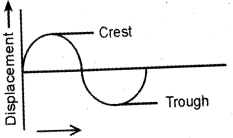
$(b)$ Represent a transverse wave graphically.
$(c)$ What is meant by loudness of sound? On what factor does it depend?
$(b)$ Represent a transverse wave graphically.
$(c)$ What is meant by loudness of sound? On what factor does it depend?
Solution
(N/A) Sound is a mechanical wave and requires a material medium (like air,water,or steel) to propagate. Since a vacuum chamber contains no particles to transmit the vibrations of the sound wave,the sound cannot travel from the mobile to the outside.
$(b)$ $A$ transverse wave is represented by a sinusoidal graph showing crests (points of maximum positive displacement) and troughs (points of maximum negative displacement) along the direction of propagation.
$(c)$ Loudness is a physiological measure of the response of the ear to the intensity of sound. It depends primarily on the amplitude of the vibrating particles of the medium. The greater the amplitude,the louder the sound.
$(b)$ $A$ transverse wave is represented by a sinusoidal graph showing crests (points of maximum positive displacement) and troughs (points of maximum negative displacement) along the direction of propagation.
$(c)$ Loudness is a physiological measure of the response of the ear to the intensity of sound. It depends primarily on the amplitude of the vibrating particles of the medium. The greater the amplitude,the louder the sound.
0 likes
View Solution79
MediumMCQ
$(a)$ Why are sound waves called mechanical waves? List two practical applications of reflection of these waves.
$(b)$ $A$ stone is dropped from the top of a tower $125 \ m$ high into a pond of water at the base of the tower. When is the splash heard at the top? $(g = 10 \ m s^{-2}$ and speed of sound $= 340 \ m s^{-1})$
$(b)$ $A$ stone is dropped from the top of a tower $125 \ m$ high into a pond of water at the base of the tower. When is the splash heard at the top? $(g = 10 \ m s^{-2}$ and speed of sound $= 340 \ m s^{-1})$
A
$(a)$ Why are sound waves called mechanical waves? List two practical applications of reflection of these waves.
B
$(b)$ $A$ stone is dropped from the top of a tower $125 \ m$ high into a pond of water at the base of the tower. When is the splash heard at the top? $(g = 10 \ m s^{-2}$ and speed of sound $= 340 \ m s^{-1})$
Solution
(D) Sound waves are called mechanical waves because they require a material medium for their propagation and are produced by the vibration of particles of the medium about their mean position.
Two practical applications of the reflection of sound are:
$(i)$ Megaphones: Used to direct sound waves in a specific direction by multiple reflections.
$(ii)$ Stethoscope: Used by doctors to listen to heartbeats by multiple reflections of sound through a tube.
$(b)$ Let $t_1$ be the time taken by the stone to reach the water surface and $t_2$ be the time taken by the sound to travel back to the top.
For the stone falling: $S = ut + \frac{1}{2}gt^2$
$125 = 0 + \frac{1}{2} \times 10 \times t_1^2$
$125 = 5t_1^2 \implies t_1^2 = 25 \implies t_1 = 5 \ s$
For the sound traveling back: $t_2 = \frac{\text{Distance}}{\text{Speed}} = \frac{125}{340} \approx 0.37 \ s$
Total time taken to hear the splash $= t_1 + t_2 = 5 + 0.37 = 5.37 \ s$.
Two practical applications of the reflection of sound are:
$(i)$ Megaphones: Used to direct sound waves in a specific direction by multiple reflections.
$(ii)$ Stethoscope: Used by doctors to listen to heartbeats by multiple reflections of sound through a tube.
$(b)$ Let $t_1$ be the time taken by the stone to reach the water surface and $t_2$ be the time taken by the sound to travel back to the top.
For the stone falling: $S = ut + \frac{1}{2}gt^2$
$125 = 0 + \frac{1}{2} \times 10 \times t_1^2$
$125 = 5t_1^2 \implies t_1^2 = 25 \implies t_1 = 5 \ s$
For the sound traveling back: $t_2 = \frac{\text{Distance}}{\text{Speed}} = \frac{125}{340} \approx 0.37 \ s$
Total time taken to hear the splash $= t_1 + t_2 = 5 + 0.37 = 5.37 \ s$.
0 likes
View Solution80
Difficult
What is $SONAR$? For what is it used? Explain its working in brief.
Solution
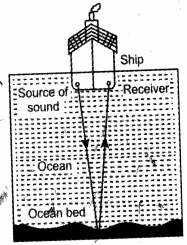
(N/A) $SONAR$ stands for Sound Navigation and Ranging. It is a technique used to determine the depth of the ocean and to locate underwater objects such as reefs,submarines,shipwrecks,etc.
Working:
In this method,a strong ultrasonic wave is sent from a transmitter installed on a ship towards the bottom of the ocean. This ultrasonic wave is reflected back after hitting the ocean bed and is received by a detector (receiver) on the ship.
The time interval $t$ between the transmission and reception of the ultrasonic wave is recorded.
If $V$ is the speed of sound in seawater,then the total distance $2d$ covered by the sound wave (going to the bottom and coming back) is given by $2d = V \times t$.
Therefore,the depth $d$ of the ocean is given by $d = (V \times t) / 2$.
Working:
In this method,a strong ultrasonic wave is sent from a transmitter installed on a ship towards the bottom of the ocean. This ultrasonic wave is reflected back after hitting the ocean bed and is received by a detector (receiver) on the ship.
The time interval $t$ between the transmission and reception of the ultrasonic wave is recorded.
If $V$ is the speed of sound in seawater,then the total distance $2d$ covered by the sound wave (going to the bottom and coming back) is given by $2d = V \times t$.
Therefore,the depth $d$ of the ocean is given by $d = (V \times t) / 2$.
0 likes
View Solution81
MediumMCQ
$A$ ship sends out ultrasound waves that are detected after $4 \, s$ upon reflection from the seabed. If the speed of ultrasound through seawater is $1550 \, m \, s^{-1}$,find the distance of the seabed from the ship. (in $, m$)
A
$3100$
B
$1550$
C
$6200$
D
$775$
Solution
(A) Given:
Time taken for the echo to return,$t = 4 \, s$.
Speed of ultrasound in seawater,$v = 1550 \, m \, s^{-1}$.
The ultrasound travels from the ship to the seabed and back to the ship. Therefore,the total distance covered is $2d$,where $d$ is the distance of the seabed from the ship.
Using the formula: $\text{Distance} = \text{Speed} \times \text{Time}$.
$2d = v \times t$
$2d = 1550 \, m \, s^{-1} \times 4 \, s$
$2d = 6200 \, m$
$d = 6200 / 2 = 3100 \, m$.
Thus,the distance of the seabed from the ship is $3100 \, m$ or $3.1 \, km$.
Time taken for the echo to return,$t = 4 \, s$.
Speed of ultrasound in seawater,$v = 1550 \, m \, s^{-1}$.
The ultrasound travels from the ship to the seabed and back to the ship. Therefore,the total distance covered is $2d$,where $d$ is the distance of the seabed from the ship.
Using the formula: $\text{Distance} = \text{Speed} \times \text{Time}$.
$2d = v \times t$
$2d = 1550 \, m \, s^{-1} \times 4 \, s$
$2d = 6200 \, m$
$d = 6200 / 2 = 3100 \, m$.
Thus,the distance of the seabed from the ship is $3100 \, m$ or $3.1 \, km$.
0 likes
View Solution82
Medium
Define the following characteristics of sound:
$(a)$
$(i)$ Pitch
$(ii)$ Loudness
$(iii)$ Quality or Timbre
$(b)$ $A$ boy receives his echo $3 \, s$ later. Find the distance of the reflecting surface from the boy. Speed of sound in air is $342 \, m s^{-1}$.
$(a)$
$(i)$ Pitch
$(ii)$ Loudness
$(iii)$ Quality or Timbre
$(b)$ $A$ boy receives his echo $3 \, s$ later. Find the distance of the reflecting surface from the boy. Speed of sound in air is $342 \, m s^{-1}$.
Solution
(N/A)
$(i)$ Pitch: It is the characteristic of sound that helps to distinguish between a shrill sound and a hoarse sound. Pitch depends upon the frequency of the sound wave.
$(ii)$ Loudness: It is the characteristic of sound that helps to distinguish between a loud sound and a faint sound. It is determined by the amplitude of the sound wave.
$(iii)$ Quality or Timbre: It is the characteristic of sound that allows us to distinguish between sounds produced by different sources,even if they have the same pitch and loudness. It helps us identify the source,such as a $Tabla$ or a $Guitar$.
$(b)$ Given:
Speed of sound $(v)$ = $342 \, m s^{-1}$
Time taken $(t)$ = $3 \, s$
Let the distance of the reflecting surface be $d$.
The total distance traveled by sound to reach the reflecting surface and return is $2d$.
Using the formula: $2d = v \times t$
$2d = 342 \times 3$
$2d = 1026$
$d = 1026 / 2 = 513 \, m$
Therefore,the distance of the reflecting surface is $513 \, m$.
$(i)$ Pitch: It is the characteristic of sound that helps to distinguish between a shrill sound and a hoarse sound. Pitch depends upon the frequency of the sound wave.
$(ii)$ Loudness: It is the characteristic of sound that helps to distinguish between a loud sound and a faint sound. It is determined by the amplitude of the sound wave.
$(iii)$ Quality or Timbre: It is the characteristic of sound that allows us to distinguish between sounds produced by different sources,even if they have the same pitch and loudness. It helps us identify the source,such as a $Tabla$ or a $Guitar$.
$(b)$ Given:
Speed of sound $(v)$ = $342 \, m s^{-1}$
Time taken $(t)$ = $3 \, s$
Let the distance of the reflecting surface be $d$.
The total distance traveled by sound to reach the reflecting surface and return is $2d$.
Using the formula: $2d = v \times t$
$2d = 342 \times 3$
$2d = 1026$
$d = 1026 / 2 = 513 \, m$
Therefore,the distance of the reflecting surface is $513 \, m$.
0 likes
View Solution83
Medium
What is an echo? When can we distinctly hear the echo of a sharp sound? Why cannot we hear an echo in small halls?
Solution
(N/A) An echo is the phenomenon of the repetition of sound caused by the reflection of sound waves from an obstacle.
For hearing a distinct echo,the obstacle must be situated at a sufficient distance from the source.
Due to the persistence of hearing,the original sound and the reflected sound must reach the listener with a time interval of at least $0.1 \, s$ $(1/10 \, s)$.
If $d$ is the minimum distance of the reflecting surface from the source,the total distance covered by the sound is $2d$. Given the speed of sound $V \approx 340 \, m/s$,the time taken $t = 2d / V$.
Setting $t = 0.1 \, s$,we get $d = (V \times t) / 2 = (340 \times 0.1) / 2 = 17 \, m$.
Therefore,the minimum distance required to hear a distinct echo is $17 \, m$.
In small halls,the distance between the source and the reflecting walls is less than $17 \, m$,so the reflected sound reaches the listener before the persistence of hearing ends,causing the sound to overlap with the original sound rather than being heard as a distinct echo.
For hearing a distinct echo,the obstacle must be situated at a sufficient distance from the source.
Due to the persistence of hearing,the original sound and the reflected sound must reach the listener with a time interval of at least $0.1 \, s$ $(1/10 \, s)$.
If $d$ is the minimum distance of the reflecting surface from the source,the total distance covered by the sound is $2d$. Given the speed of sound $V \approx 340 \, m/s$,the time taken $t = 2d / V$.
Setting $t = 0.1 \, s$,we get $d = (V \times t) / 2 = (340 \times 0.1) / 2 = 17 \, m$.
Therefore,the minimum distance required to hear a distinct echo is $17 \, m$.
In small halls,the distance between the source and the reflecting walls is less than $17 \, m$,so the reflected sound reaches the listener before the persistence of hearing ends,causing the sound to overlap with the original sound rather than being heard as a distinct echo.
0 likes
View Solution84
Medium
$(a)$ What is the cause of the sensation of sound due to the rolling of thunder?
$(b)$ Give the audible range of the human ear.
$(c)$ What are infrasonic and ultrasonic waves?
$(b)$ Give the audible range of the human ear.
$(c)$ What are infrasonic and ultrasonic waves?
Solution
(N/A) The rolling of thunder is caused by the multiple reflections of sound waves from various reflecting surfaces,such as clouds and the Earth's surface.
$(b)$ The audible range for the human ear is $20 \, Hz$ to $20,000 \, Hz$ $(20 \, kHz)$.
$(c)$ Sound waves with frequencies lower than $20 \, Hz$ are known as infrasonic waves,while sound waves with frequencies higher than $20,000 \, Hz$ $(20 \, kHz)$ are known as ultrasonic waves.
$(b)$ The audible range for the human ear is $20 \, Hz$ to $20,000 \, Hz$ $(20 \, kHz)$.
$(c)$ Sound waves with frequencies lower than $20 \, Hz$ are known as infrasonic waves,while sound waves with frequencies higher than $20,000 \, Hz$ $(20 \, kHz)$ are known as ultrasonic waves.
0 likes
View Solution85
Medium
$A$ sound wave with frequency higher than $20 \,kHz$ is not audible for human ear. Answer the following in respect of this statement:
$(i)$ What is the term used for such a sound?
$(ii)$ Name two organisms producing sound in this range.
$(iii)$ Write an application of such a wave.
$(i)$ What is the term used for such a sound?
$(ii)$ Name two organisms producing sound in this range.
$(iii)$ Write an application of such a wave.
Solution
(N/A) $(i)$ The term used for sound waves with frequencies higher than $20 \,kHz$ is ultrasound.
$(ii)$ Two organisms that produce and use ultrasound are dolphins and bats.
$(iii)$ An important application of ultrasound is medical ultrasound scanning (ultrasonography) used to visualize internal body structures.
$(ii)$ Two organisms that produce and use ultrasound are dolphins and bats.
$(iii)$ An important application of ultrasound is medical ultrasound scanning (ultrasonography) used to visualize internal body structures.
0 likes
View Solution86
Medium
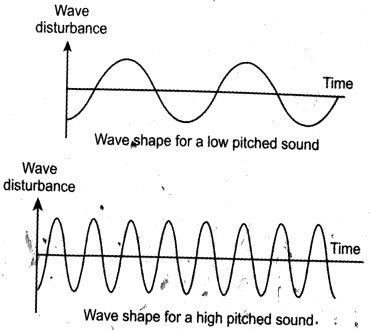
Draw the sound waves for a low-pitched and a high-pitched sound. Write one use of ultrasonography. Which wave property determines pitch?
Solution
(N/A) The diagram shows the wave shapes for low-pitched and high-pitched sounds. $A$ low-pitched sound has a lower frequency (fewer waves per unit time),while a high-pitched sound has a higher frequency (more waves per unit time).
$(b)$ Ultrasonography is used for the medical examination of the foetus during pregnancy to detect congenital defects and growth abnormalities.
$(c)$ Frequency is the wave property that determines the pitch of a sound.
$(b)$ Ultrasonography is used for the medical examination of the foetus during pregnancy to detect congenital defects and growth abnormalities.
$(c)$ Frequency is the wave property that determines the pitch of a sound.
0 likes
View Solution87
Easy
$(a)$ Which of the following frequencies are audible to human ears: $2 \, Hz$,$5 \, Hz$,$20 \, Hz$,$200 \, Hz$,$2000 \, Hz$?
$(b)$ How are moths of certain families able to escape capture?
$(b)$ How are moths of certain families able to escape capture?
Solution
(A) The audible range for human ears is $20 \, Hz$ to $20,000 \, Hz$. Therefore,the frequencies $20 \, Hz$,$200 \, Hz$,and $2000 \, Hz$ are audible to human ears.
$(b)$ Moths of certain families have the ability to hear the high-frequency ultrasonic waves emitted by bats. When they detect these sounds,they perform evasive maneuvers or drop to the ground to avoid being captured by the bats. Additionally,some moths have evolved structures that do not reflect the ultrasounds sent towards them by bats,effectively making them 'invisible' to the bat's echolocation.
$(b)$ Moths of certain families have the ability to hear the high-frequency ultrasonic waves emitted by bats. When they detect these sounds,they perform evasive maneuvers or drop to the ground to avoid being captured by the bats. Additionally,some moths have evolved structures that do not reflect the ultrasounds sent towards them by bats,effectively making them 'invisible' to the bat's echolocation.
0 likes
View Solution88
Medium
How does the sound produced by a musical instrument reach your ears? Astronauts need radio transmitters to talk to each other on the moon. Why?
Solution
(N/A) The sound produced by a musical instrument causes the air molecules to vibrate. These vibrations are transmitted through the air from molecule to molecule until they reach our ears. Upon reaching the ear,these vibrations cause the eardrum to vibrate,which is perceived as sound. Since sound is a mechanical wave that requires a material medium (like air,water,or solids) to propagate,it cannot travel through the vacuum of space. Because the moon has no atmosphere (a vacuum),sound cannot travel between astronauts,necessitating the use of radio transmitters,which use electromagnetic waves that do not require a medium.
0 likes
View Solution89
Medium
Explain with the help of a diagram,how defects in a metal block can be detected using ultrasound.
Solution
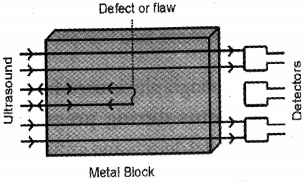
(N/A) Ultrasound can be used to detect cracks and flaws in metal blocks. Metallic components are generally used in the construction of large structures like buildings,bridges,machines,and scientific equipment.
Cracks or holes inside metal blocks,which are invisible from the outside,reduce the structural strength of the component.
To detect these,ultrasonic waves are passed through the metal block,and detectors are placed on the opposite side to receive the transmitted waves.
If there is even a small defect or flaw,the ultrasound waves encounter the boundary of the defect and get reflected back,indicating the presence of the flaw,as shown in the diagram.
Cracks or holes inside metal blocks,which are invisible from the outside,reduce the structural strength of the component.
To detect these,ultrasonic waves are passed through the metal block,and detectors are placed on the opposite side to receive the transmitted waves.
If there is even a small defect or flaw,the ultrasound waves encounter the boundary of the defect and get reflected back,indicating the presence of the flaw,as shown in the diagram.
0 likes
View Solution90
Medium
$(a)$ Briefly mention three uses of ultrasound in the field of medicine.
$(b)$ $A$ ship which is stationary is at a distance of $2800 \ m$ from the sea-bed. The ship sends an ultrasound signal to the sea-bed and its echo is heard after $4 \ s$. Find the speed of sound in water.
$(b)$ $A$ ship which is stationary is at a distance of $2800 \ m$ from the sea-bed. The ship sends an ultrasound signal to the sea-bed and its echo is heard after $4 \ s$. Find the speed of sound in water.
Solution
(N/A) Three uses of ultrasound in medicine are:
$(i)$ Echocardiography: Ultrasonic waves are reflected from various parts of the heart to form an image of the heart.
$(ii)$ Ultrasound scanning: It is used to obtain images of internal organs like the liver,gall bladder,uterus,and kidneys to detect abnormalities like stones or tumours.
$(iii)$ Prenatal examination: Ultrasonography is used during pregnancy to monitor the growth of the foetus and detect congenital defects.
$(b)$ Given: Distance $(S) = 2800 \ m$,Time $(t) = 4 \ s$.
The sound travels to the sea-bed and back,so the total distance covered is $2S$.
Speed $(V) = \frac{\text{Total Distance}}{\text{Total Time}} = \frac{2S}{t} = \frac{2 \times 2800 \ m}{4 \ s} = 1400 \ m/s$.
Thus,the speed of sound in water is $1400 \ m/s$.
$(i)$ Echocardiography: Ultrasonic waves are reflected from various parts of the heart to form an image of the heart.
$(ii)$ Ultrasound scanning: It is used to obtain images of internal organs like the liver,gall bladder,uterus,and kidneys to detect abnormalities like stones or tumours.
$(iii)$ Prenatal examination: Ultrasonography is used during pregnancy to monitor the growth of the foetus and detect congenital defects.
$(b)$ Given: Distance $(S) = 2800 \ m$,Time $(t) = 4 \ s$.
The sound travels to the sea-bed and back,so the total distance covered is $2S$.
Speed $(V) = \frac{\text{Total Distance}}{\text{Total Time}} = \frac{2S}{t} = \frac{2 \times 2800 \ m}{4 \ s} = 1400 \ m/s$.
Thus,the speed of sound in water is $1400 \ m/s$.
0 likes
View Solution91
Medium
Answer the following:
$(i)$ Can transverse waves travel in gases?
$(ii)$ Can longitudinal waves travel in solid,liquid as well as gas?
$(iii)$ At any instant,a compression is formed at a point. After how much time $(a)$ a rarefaction $(b)$ a compression will be formed at the same point?
$(i)$ Can transverse waves travel in gases?
$(ii)$ Can longitudinal waves travel in solid,liquid as well as gas?
$(iii)$ At any instant,a compression is formed at a point. After how much time $(a)$ a rarefaction $(b)$ a compression will be formed at the same point?
Solution
(N/A) $(i)$ No,transverse waves cannot travel in gases because gases do not have the property of rigidity (shear modulus is zero).
$(ii)$ Yes,longitudinal waves can travel through solids,liquids,and gases because they rely on pressure variations and density changes.
$(iii)$ Let $T$ be the time period of the wave:
$(a)$ $A$ rarefaction will be formed at the same point after a time interval of $T / 2$.
$(b)$ $A$ compression will be formed at the same point after a time interval of $T$.
$(ii)$ Yes,longitudinal waves can travel through solids,liquids,and gases because they rely on pressure variations and density changes.
$(iii)$ Let $T$ be the time period of the wave:
$(a)$ $A$ rarefaction will be formed at the same point after a time interval of $T / 2$.
$(b)$ $A$ compression will be formed at the same point after a time interval of $T$.
0 likes
View Solution92
Medium
State four differences between longitudinal and transverse waves. Give an example of each.
Solution
(N/A)
| Longitudinal Waves | Transverse Waves |
|---|---|
| $1$. The particles of the medium vibrate parallel to the direction of wave propagation. | $1$. The particles of the medium vibrate at right angles to the direction of wave propagation. |
| $2$. They can travel through solids,liquids,and gases. | $2$. They can travel only through solids and on the surfaces of liquids. |
| $3$. They consist of regions of compressions and rarefactions. | $3$. They consist of crests and troughs. |
| $4$. They cannot be polarized. | $4$. They can be polarized. |
| Example: Sound waves in air. | Example: Vibrations in a stretched string. |
0 likes
View Solution93
Medium
$(a)$ Mention two practical applications of reflection of sound waves.
$(b)$ How is the pressure variation in a sound wave amplified in the human ear?
$(c)$ In a ripple tank,$10$ ripples are produced per second. If the distance between a trough and a neighbouring crest is $12 \, cm$,calculate the frequency,wavelength,and velocity of the wave.
$(b)$ How is the pressure variation in a sound wave amplified in the human ear?
$(c)$ In a ripple tank,$10$ ripples are produced per second. If the distance between a trough and a neighbouring crest is $12 \, cm$,calculate the frequency,wavelength,and velocity of the wave.
Solution
(N/A) Two practical applications of the reflection of sound waves are the megaphone and the stethoscope.
$(b)$ In the human ear,the pressure variations in a sound wave are amplified by the three small bones in the middle ear: the hammer (malleus),anvil (incus),and stirrup (stapes).
$(c)$ Given:
Frequency $(f) = 10 \, Hz$ (since $10$ ripples are produced per second).
Distance between a trough and a neighbouring crest $= 12 \, cm$.
Since the distance between a crest and the adjacent trough is half the wavelength $(\lambda/2)$,we have $\lambda/2 = 12 \, cm$,which means $\lambda = 24 \, cm$.
Velocity $(v) = \text{Wavelength} \times \text{Frequency} = 24 \, cm \times 10 \, Hz = 240 \, cm/s$.
$(b)$ In the human ear,the pressure variations in a sound wave are amplified by the three small bones in the middle ear: the hammer (malleus),anvil (incus),and stirrup (stapes).
$(c)$ Given:
Frequency $(f) = 10 \, Hz$ (since $10$ ripples are produced per second).
Distance between a trough and a neighbouring crest $= 12 \, cm$.
Since the distance between a crest and the adjacent trough is half the wavelength $(\lambda/2)$,we have $\lambda/2 = 12 \, cm$,which means $\lambda = 24 \, cm$.
Velocity $(v) = \text{Wavelength} \times \text{Frequency} = 24 \, cm \times 10 \, Hz = 240 \, cm/s$.
0 likes
View Solution94
Difficult
$(a)$ What is meant by intensity of sound?
$(b)$ Mention the conditions for an echo to be heard clearly.
$(c)$ $A$ ball is dropped into a pond from a height of $44.1 \, m$. The splash of sound is heard $3.13 \, s$ after the ball is dropped. Determine the velocity of sound in air.
$(b)$ Mention the conditions for an echo to be heard clearly.
$(c)$ $A$ ball is dropped into a pond from a height of $44.1 \, m$. The splash of sound is heard $3.13 \, s$ after the ball is dropped. Determine the velocity of sound in air.
Solution
(C) Intensity of sound is defined as the amount of sound energy passing per unit time through a unit area held perpendicular to the direction of propagation of sound.
$(b)$ The conditions for an echo to be heard clearly are:
$(i)$ The time interval between the original sound and the reflected sound must be at least $0.1 \, s$.
$(ii)$ The minimum distance between the source of sound and the obstacle must be approximately $17 \, m$.
$(c)$ Given: Height $h = 44.1 \, m$,initial velocity $u = 0$,acceleration due to gravity $g = 9.8 \, m \, s^{-2}$.
Step $1$: Calculate the time taken by the ball to reach the water surface using $S = ut + \frac{1}{2}gt^2$.
$44.1 = 0 \times t + \frac{1}{2} \times 9.8 \times t^2$
$44.1 = 4.9 \times t^2$
$t^2 = \frac{44.1}{4.9} = 9$
$t = 3 \, s$.
Step $2$: Calculate the time taken by the sound to travel back to the observer.
Total time = $3.13 \, s$.
Time for sound = $3.13 - 3 = 0.13 \, s$.
Step $3$: Calculate the velocity of sound.
$V = \frac{\text{Distance}}{\text{Time}} = \frac{44.1 \, m}{0.13 \, s} \approx 339.23 \, m \, s^{-1}$.
$(b)$ The conditions for an echo to be heard clearly are:
$(i)$ The time interval between the original sound and the reflected sound must be at least $0.1 \, s$.
$(ii)$ The minimum distance between the source of sound and the obstacle must be approximately $17 \, m$.
$(c)$ Given: Height $h = 44.1 \, m$,initial velocity $u = 0$,acceleration due to gravity $g = 9.8 \, m \, s^{-2}$.
Step $1$: Calculate the time taken by the ball to reach the water surface using $S = ut + \frac{1}{2}gt^2$.
$44.1 = 0 \times t + \frac{1}{2} \times 9.8 \times t^2$
$44.1 = 4.9 \times t^2$
$t^2 = \frac{44.1}{4.9} = 9$
$t = 3 \, s$.
Step $2$: Calculate the time taken by the sound to travel back to the observer.
Total time = $3.13 \, s$.
Time for sound = $3.13 - 3 = 0.13 \, s$.
Step $3$: Calculate the velocity of sound.
$V = \frac{\text{Distance}}{\text{Time}} = \frac{44.1 \, m}{0.13 \, s} \approx 339.23 \, m \, s^{-1}$.
0 likes
View Solution95
Difficult
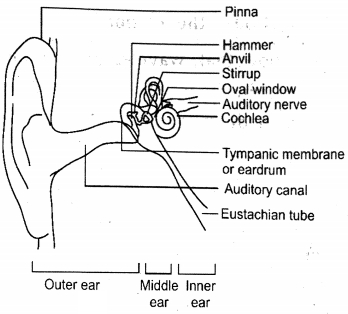
Draw a labelled diagram of the auditory parts of the human ear and explain how the human ear works.
Solution
(N/A) The human ear consists of three main parts: $(i)$ outer ear,$(ii)$ middle ear,and $(iii)$ inner ear.
$1$. Outer Ear: The outer ear,called the pinna,collects sound waves from the surroundings. These sound waves pass through the auditory canal to the eardrum (tympanic membrane).
$2$. Middle Ear: The eardrum vibrates when sound waves strike it. These vibrations are amplified by three small bones (hammer,anvil,and stirrup) in the middle ear.
$3$. Inner Ear: The amplified pressure waves are transmitted to the inner ear. In the cochlea,these pressure variations are converted into electrical signals by hair cells. These signals are sent to the brain via the auditory nerve,where they are interpreted as sound.
$1$. Outer Ear: The outer ear,called the pinna,collects sound waves from the surroundings. These sound waves pass through the auditory canal to the eardrum (tympanic membrane).
$2$. Middle Ear: The eardrum vibrates when sound waves strike it. These vibrations are amplified by three small bones (hammer,anvil,and stirrup) in the middle ear.
$3$. Inner Ear: The amplified pressure waves are transmitted to the inner ear. In the cochlea,these pressure variations are converted into electrical signals by hair cells. These signals are sent to the brain via the auditory nerve,where they are interpreted as sound.
0 likes
View Solution96
Medium
Define the following terms and state their $SI$ units:
$(a)$ Wavelength $(b)$ Time period $(c)$ Amplitude.
Establish the relation $V = v \lambda$,where the symbols have their usual meanings.
$(a)$ Wavelength $(b)$ Time period $(c)$ Amplitude.
Establish the relation $V = v \lambda$,where the symbols have their usual meanings.
Solution
(N/A) Wavelength: It is defined as the distance travelled by a wave during the time a particle of the medium completes one vibration. It is denoted by $\lambda$. Its $SI$ unit is metre $(m)$.
$(b)$ Time period: It is defined as the time taken by a vibrating particle to complete one vibration. It is denoted by $T$. Its $SI$ unit is second $(s)$.
$(c)$ Amplitude: It is defined as the maximum displacement produced in the vibrating particle on either side of the mean position. It is denoted by $A$. Its $SI$ unit is metre $(m)$.
Derivation of the relation $V = v \lambda$:
We know that,wavelength $\lambda$ is the distance covered by the wave during the time a particle of the medium completes one vibration,i.e.,$T$.
Velocity of the wave $(V)$ is defined as:
$V = \frac{\text{Distance travelled by the wave}}{\text{Time taken}} = \frac{\lambda}{T}$
Since frequency $v = \frac{1}{T}$,substituting this into the equation:
$V = v \lambda$
$(b)$ Time period: It is defined as the time taken by a vibrating particle to complete one vibration. It is denoted by $T$. Its $SI$ unit is second $(s)$.
$(c)$ Amplitude: It is defined as the maximum displacement produced in the vibrating particle on either side of the mean position. It is denoted by $A$. Its $SI$ unit is metre $(m)$.
Derivation of the relation $V = v \lambda$:
We know that,wavelength $\lambda$ is the distance covered by the wave during the time a particle of the medium completes one vibration,i.e.,$T$.
Velocity of the wave $(V)$ is defined as:
$V = \frac{\text{Distance travelled by the wave}}{\text{Time taken}} = \frac{\lambda}{T}$
Since frequency $v = \frac{1}{T}$,substituting this into the equation:
$V = v \lambda$
0 likes
View Solution97
Medium
$(a)$ How does sound propagate through a medium?
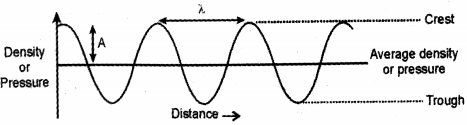
$(b)$ Show a sound wave in graphic form and mention the crest,trough,wavelength,and amplitude of the wave in it.
$(c)$ Why are sound waves called longitudinal waves?
$(b)$ Show a sound wave in graphic form and mention the crest,trough,wavelength,and amplitude of the wave in it.
$(c)$ Why are sound waves called longitudinal waves?
Solution
(N/A) When a sound wave is produced in a medium,it causes the particles of the medium to vibrate. Consider,for example,the vibration of the diaphragm of a speaker. As the diaphragm vibrates outwards,it creates a region of high pressure called a compression,which travels through the medium. When the diaphragm moves inwards,it creates a region of low pressure called a rarefaction. Thus,sound travels through the medium in the form of a series of compressions and rarefactions.
$(b)$ The graphical representation of a sound wave is shown below:
(See the provided image for the graph showing density/pressure vs distance,with crest,trough,wavelength $\lambda$,and amplitude $A$ marked.)
$(c)$ Sound waves are called longitudinal waves because the particles of the medium vibrate parallel to the direction of the propagation of the wave.
$(b)$ The graphical representation of a sound wave is shown below:
(See the provided image for the graph showing density/pressure vs distance,with crest,trough,wavelength $\lambda$,and amplitude $A$ marked.)
$(c)$ Sound waves are called longitudinal waves because the particles of the medium vibrate parallel to the direction of the propagation of the wave.
0 likes
View Solution98
Medium
$(i)$ Which property of sound wave determines:
$(a)$ loudness
$(b)$ pitch?
$(ii)$ $A$ $SONAR$ station picks up a return signal after $3 \ s$. How far away is the object? (Speed of sound in water is $1440 \ m \ s^{-1}$)
$(iii)$ How can reverberations in a big hall or auditorium be reduced?
$(a)$ loudness
$(b)$ pitch?
$(ii)$ $A$ $SONAR$ station picks up a return signal after $3 \ s$. How far away is the object? (Speed of sound in water is $1440 \ m \ s^{-1}$)
$(iii)$ How can reverberations in a big hall or auditorium be reduced?
Solution
(N/A) $(i)$
$(a)$ Loudness is determined by the amplitude of the sound wave.
$(b)$ Pitch is determined by the frequency of the sound wave.
$(ii)$ Given: Time taken $(t)$ = $3 \ s$,Speed of sound in water $(V)$ = $1440 \ m \ s^{-1}$.
The distance $(S)$ is calculated as: $S = (V \times t) / 2 = (1440 \times 3) / 2 = 2160 \ m$.
$(iii)$ Reverberations in a big hall or auditorium can be reduced by covering the walls and ceiling with sound-absorbent materials such as compressed fibreboard,rough plaster,or draperies. Additionally,seats can be covered with sound-absorbing materials.
$(a)$ Loudness is determined by the amplitude of the sound wave.
$(b)$ Pitch is determined by the frequency of the sound wave.
$(ii)$ Given: Time taken $(t)$ = $3 \ s$,Speed of sound in water $(V)$ = $1440 \ m \ s^{-1}$.
The distance $(S)$ is calculated as: $S = (V \times t) / 2 = (1440 \times 3) / 2 = 2160 \ m$.
$(iii)$ Reverberations in a big hall or auditorium can be reduced by covering the walls and ceiling with sound-absorbent materials such as compressed fibreboard,rough plaster,or draperies. Additionally,seats can be covered with sound-absorbing materials.
0 likes
View Solution99
Medium
$(a)$ List in tabular form the distinguishing features between longitudinal waves and transverse waves. Give an example of each.
$(b)$ State and define the characteristics associated with sound waves.
$(b)$ State and define the characteristics associated with sound waves.
Solution
(N/A)
$(b)$ The characteristics of sound waves are:
$1.$ Frequency: The number of oscillations per unit time.
$2.$ Amplitude: The maximum displacement of the particles from their mean position.
$3.$ Time Period: The time taken to complete one full oscillation.
$4.$ Wavelength: The distance between two consecutive compressions or rarefactions.
$5.$ Pitch: The characteristic of sound that depends on frequency; higher frequency results in higher pitch.
$6.$ Timbre (Quality): The characteristic that allows us to distinguish between sounds of the same pitch and loudness produced by different sources.
| $LONGITUDINAL$ $WAVES$ | $TRANSVERSE$ $WAVES$ |
| $1.$ Particles of the medium vibrate parallel to the direction of wave propagation. | $1.$ Particles of the medium vibrate perpendicular to the direction of wave propagation. |
| $2.$ They can travel through solids,liquids,and gases. | $2.$ They can travel primarily through solids and on the surfaces of liquids. |
| $3.$ They consist of regions of compression and rarefaction. | $3.$ They consist of crests and troughs. |
| $4.$ Example: Sound waves in air. | $4.$ Example: Waves on a stretched string. |
$(b)$ The characteristics of sound waves are:
$1.$ Frequency: The number of oscillations per unit time.
$2.$ Amplitude: The maximum displacement of the particles from their mean position.
$3.$ Time Period: The time taken to complete one full oscillation.
$4.$ Wavelength: The distance between two consecutive compressions or rarefactions.
$5.$ Pitch: The characteristic of sound that depends on frequency; higher frequency results in higher pitch.
$6.$ Timbre (Quality): The characteristic that allows us to distinguish between sounds of the same pitch and loudness produced by different sources.
0 likes
View Solution100
Medium
$(a)$ Write two points of difference between sound wave and light wave.
$(b)$ Write an expression relating wave velocity, wavelength and frequency if speed of sound in air is $340 \, m s^{-1}$.
Calculate:
$(i)$ Wavelength when frequency $= 256 \, Hz$.
$(ii)$ Frequency when wavelength $= 0.85 \, m$.
$(b)$ Write an expression relating wave velocity, wavelength and frequency if speed of sound in air is $340 \, m s^{-1}$.
Calculate:
$(i)$ Wavelength when frequency $= 256 \, Hz$.
$(ii)$ Frequency when wavelength $= 0.85 \, m$.
Solution
(A) Two differences are as follows:
$(b)$ The expression relating wave velocity $(v)$, frequency $(f)$, and wavelength $(\lambda)$ is: $v = f \times \lambda$.
Given: Speed of sound $(v)$ $= 340 \, m s^{-1}$.
$(i)$ Given frequency $(f)$ $= 256 \, Hz$. Using the formula $\lambda = v / f$:
$\lambda = 340 / 256 = 1.328 \, m \approx 1.33 \, m$.
$(ii)$ Given wavelength $(\lambda)$ $= 0.85 \, m$. Using the formula $f = v / \lambda$:
$f = 340 / 0.85 = 400 \, Hz$.
| Sound Waves | Light Waves |
| $1.$ Longitudinal waves. | $1.$ Transverse waves. |
| $2.$ Require a material medium to propagate. | $2.$ Do not require a material medium to propagate. |
$(b)$ The expression relating wave velocity $(v)$, frequency $(f)$, and wavelength $(\lambda)$ is: $v = f \times \lambda$.
Given: Speed of sound $(v)$ $= 340 \, m s^{-1}$.
$(i)$ Given frequency $(f)$ $= 256 \, Hz$. Using the formula $\lambda = v / f$:
$\lambda = 340 / 256 = 1.328 \, m \approx 1.33 \, m$.
$(ii)$ Given wavelength $(\lambda)$ $= 0.85 \, m$. Using the formula $f = v / \lambda$:
$f = 340 / 0.85 = 400 \, Hz$.
0 likes
View SolutionSOUND — Mix Example - SOUND · Frequently Asked Questions
1Are these SOUND questions useful for JEE and NEET?
Yes. All questions in this section are mapped to JEE Main and NEET exam patterns. Previous year questions from JEE Main, NEET, GUJCET and state-level exams are included with full solutions.
2Can I switch to Hindi or Gujarati for these questions?
Yes. Use the language tabs in the hero section or the sidebar to view the same questions and solutions in English, Hindi or Gujarati.
3How do I generate a question paper from this subtopic?
Use the Vedclass Exam Paper Generator — select the chapter and subtopic, set difficulty, and generate Sets A, B, C, D automatically. First 3 chapters of every subject are free.
Vedclass Products
For Students
Vedclass Test Series
Mock tests in real JEE/NEET style with performance analysis. 5-day free trial.
Start Free TrialFor Teachers
Exam Paper Generator
Generate Set A/B/C/D papers from this chapter in 2 minutes. 3 chapters free.
Try FreeFor Institutes
Online Exam Module
Live online exams with unlimited students, 360° analytics & white-label branding.
See DemoFor Teachers & Institutes
Generate a SOUND Exam Paper in 2 Minutes
Select subtopic & difficulty — Sets A, B, C, D auto-generated with No Repeat logic.
First 3 chapters of every subject are free — no payment required.