
A English
Textbook - SOUND Questions in English
Class 9 Science · SOUND · Textbook - SOUND
39+
Questions
English
Language
100%
With Solutions
Showing 39 of 39 questions in English
1
Easy
How does the sound produced by a vibrating object in a medium reach your ear?
Solution
(N/A) When an object vibrates,it causes the neighbouring particles of the medium to vibrate.
These vibrating particles then transfer the energy to the adjacent particles.
Vibrations in an object create a disturbance in the medium,resulting in a series of compressions and rarefactions.
$A$ region of high pressure and high density is called a compression,while a region of low pressure and low density is called a rarefaction.
As the object continues to vibrate,it produces a series of successive compressions and rarefactions in the medium,which propagate the sound wave until it reaches our ear.
These vibrating particles then transfer the energy to the adjacent particles.
Vibrations in an object create a disturbance in the medium,resulting in a series of compressions and rarefactions.
$A$ region of high pressure and high density is called a compression,while a region of low pressure and low density is called a rarefaction.
As the object continues to vibrate,it produces a series of successive compressions and rarefactions in the medium,which propagate the sound wave until it reaches our ear.
0 likes
View Solution2
Easy
Explain how sound is produced by your school bell.
Solution
(N/A) Sound is produced by the vibration of the school bell. When the bell is struck,it begins to vibrate rapidly. These vibrations cause the surrounding air particles to move back and forth,creating regions of high pressure called compressions and regions of low pressure called rarefactions. This series of compressions and rarefactions travels through the air as a sound wave,which eventually reaches our ears.
0 likes
View Solution3
EasyMCQ
Why are sound waves called mechanical waves?
A
Because they require a material medium for propagation.
B
Because they travel at the speed of light.
C
Because they are electromagnetic in nature.
D
Because they do not require any medium.
Solution
(A) Sound waves are called mechanical waves because they require a material medium (solid,liquid,or gas) for their propagation.
These waves travel by creating disturbances in the particles of the medium,which involves the transfer of energy through mechanical interactions between particles.
Since they cannot travel through a vacuum,they are classified as mechanical waves.
These waves travel by creating disturbances in the particles of the medium,which involves the transfer of energy through mechanical interactions between particles.
Since they cannot travel through a vacuum,they are classified as mechanical waves.
0 likes
View Solution4
EasyMCQ
Suppose you and your friend are on the moon. Will you be able to hear any sound produced by your friend?
A
Yes,sound travels through vacuum.
B
No,sound requires a material medium to propagate.
C
Yes,sound travels faster on the moon.
D
No,because the moon is too cold.
Solution
(B) Sound is a mechanical wave that requires a material medium (like air,water,or solids) to propagate.
Since the moon has no atmosphere and is essentially a vacuum,there is no medium for the sound waves to travel through.
Therefore,you will not be able to hear any sound produced by your friend on the moon.
Since the moon has no atmosphere and is essentially a vacuum,there is no medium for the sound waves to travel through.
Therefore,you will not be able to hear any sound produced by your friend on the moon.
0 likes
View Solution5
Medium
Which wave property determines $(a)$ loudness,$(b)$ pitch?
Solution
(N/A) The amplitude of sound waves determines loudness. $A$ louder sound has a greater amplitude,while a quieter sound has a smaller amplitude.
$(b)$ The frequency of sound waves determines the pitch of the sound. $A$ higher frequency results in a higher pitch,while a lower frequency results in a lower pitch.
$(b)$ The frequency of sound waves determines the pitch of the sound. $A$ higher frequency results in a higher pitch,while a lower frequency results in a lower pitch.
0 likes
View Solution6
EasyMCQ
Guess which sound has a higher pitch: guitar or car horn?
A
Guitar
B
Car horn
C
Both have the same pitch
D
None of the above
Solution
(B) Pitch is determined by the frequency of vibration. $A$ guitar string produces a sound with a specific frequency depending on its tension and length,but a car horn typically produces a sound with a much higher frequency and intensity,resulting in a higher pitch compared to the standard notes of a guitar.
0 likes
View Solution7
Easy
What are wavelength,frequency,time period and amplitude of a sound wave?
Solution
(N/A) Wavelength: The wavelength is the distance between two consecutive compressions or two consecutive rarefactions of a sound wave. It is denoted by $\lambda$ and measured in meters $(m)$.
Frequency: The frequency is the number of sound wave oscillations produced in one second. It is measured in Hertz $(Hz)$.
Time period: The time period is the time taken to complete one full oscillation or to produce one complete wave of sound. It is denoted by $T$ and measured in seconds $(s)$.
Amplitude: The amplitude is the maximum displacement of the particles of the medium from their mean position as the wave passes through. It is denoted by $A$.
Frequency: The frequency is the number of sound wave oscillations produced in one second. It is measured in Hertz $(Hz)$.
Time period: The time period is the time taken to complete one full oscillation or to produce one complete wave of sound. It is denoted by $T$ and measured in seconds $(s)$.
Amplitude: The amplitude is the maximum displacement of the particles of the medium from their mean position as the wave passes through. It is denoted by $A$.
0 likes
View Solution8
Medium
How are the wavelength and frequency of a sound wave related to its speed?
Solution
(N/A) The relationship between the speed,frequency,and wavelength of a sound wave is defined by the wave equation:
$v = \lambda \times f$
Where:
$v$ represents the speed of the sound wave (measured in $m/s$),
$\lambda$ (lambda) represents the wavelength (measured in $m$),
$f$ represents the frequency (measured in $Hz$ or $s^{-1}$).
This equation indicates that the speed of a sound wave is equal to the product of its wavelength and its frequency. This fundamental relationship applies to all types of waves.
$v = \lambda \times f$
Where:
$v$ represents the speed of the sound wave (measured in $m/s$),
$\lambda$ (lambda) represents the wavelength (measured in $m$),
$f$ represents the frequency (measured in $Hz$ or $s^{-1}$).
This equation indicates that the speed of a sound wave is equal to the product of its wavelength and its frequency. This fundamental relationship applies to all types of waves.
0 likes
View Solution9
EasyMCQ
Calculate the wavelength of a sound wave whose frequency is $220 \,Hz$ and speed is $440 \,m/s$ in a given medium. (in $,m$)
A
$2$
B
$3$
C
$4$
D
$5$
Solution
(A) Given:
Frequency $(\nu) = 220 \,Hz$
Velocity $(v) = 440 \,m/s$
Wavelength $(\lambda) = ?$
We know the relationship between velocity,frequency,and wavelength is:
$v = \nu \times \lambda$
Substituting the given values:
$440 \,m/s = 220 \,Hz \times \lambda$
Solving for $\lambda$:
$\lambda = \frac{440 \,m/s}{220 \,Hz} = 2 \,m$
Therefore,the wavelength of the sound wave is $2 \,m$.
Frequency $(\nu) = 220 \,Hz$
Velocity $(v) = 440 \,m/s$
Wavelength $(\lambda) = ?$
We know the relationship between velocity,frequency,and wavelength is:
$v = \nu \times \lambda$
Substituting the given values:
$440 \,m/s = 220 \,Hz \times \lambda$
Solving for $\lambda$:
$\lambda = \frac{440 \,m/s}{220 \,Hz} = 2 \,m$
Therefore,the wavelength of the sound wave is $2 \,m$.
0 likes
View Solution10
EasyMCQ
$A$ person is listening to a tone of $500$ $Hz$ sitting at a distance of $450$ $m$ from the source of the sound. What is the time interval between successive compressions from the source (in $s$)?
A
$0.04$
B
$0.002$
C
$0.06$
D
$0.08$
Solution
(B) The time interval between two successive compressions or rarefactions is defined as the time period $(T)$ of the sound wave.
This time period is the reciprocal of the frequency $(f)$ of the sound wave.
The relationship is given by the formula: $T = 1/f$.
Given the frequency $f = 500$ $Hz$.
Substituting the value into the formula: $T = 1 / 500 = 0.002$ $s$.
Therefore,the time interval between successive compressions is $0.002$ $s$.
This time period is the reciprocal of the frequency $(f)$ of the sound wave.
The relationship is given by the formula: $T = 1/f$.
Given the frequency $f = 500$ $Hz$.
Substituting the value into the formula: $T = 1 / 500 = 0.002$ $s$.
Therefore,the time interval between successive compressions is $0.002$ $s$.
0 likes
View Solution11
Easy
Distinguish between loudness and intensity of sound.
Solution
(N/A) Loudness is a measure of the response of the ear to the sound. It depends on the amplitude of the sound wave; higher amplitude results in greater loudness.
Intensity of sound is defined as the amount of sound energy passing per unit time through a unit area. It is a physical quantity that does not depend on the ear's response and is proportional to the square of the amplitude of the sound wave.
Intensity of sound is defined as the amount of sound energy passing per unit time through a unit area. It is a physical quantity that does not depend on the ear's response and is proportional to the square of the amplitude of the sound wave.
0 likes
View Solution12
EasyMCQ
In which of the three media,air,water,or iron,does sound travel the fastest at a particular temperature?
A
Air
B
Water
C
Iron
D
All travel at the same speed
Solution
(C) The speed of sound depends on the density and elasticity of the medium.
Sound travels fastest in solids,followed by liquids,and slowest in gases.
Among the given options,iron is a solid,water is a liquid,and air is a gas.
Therefore,at a particular temperature,sound travels fastest in iron.
Sound travels fastest in solids,followed by liquids,and slowest in gases.
Among the given options,iron is a solid,water is a liquid,and air is a gas.
Therefore,at a particular temperature,sound travels fastest in iron.
0 likes
View Solution13
MediumMCQ
An echo is heard in $3 \,s$. What is the distance of the reflecting surface from the source,given that the speed of sound is $342 \,m \,s^{-1}$ (in $,m$)?
A
$513$
B
$253$
C
$625$
D
$754$
Solution
(A) To hear an echo,the sound must travel to the reflecting surface and back to the source,covering the distance twice.
Given:
Speed of sound $(v)$ = $342 \,m \,s^{-1}$
Time taken $(t)$ = $3 \,s$
Total distance traveled by sound $(2d)$ = $\text{speed} \times \text{time}$
$2d = 342 \,m \,s^{-1} \times 3 \,s = 1026 \,m$
Therefore,the distance of the reflecting surface from the source $(d)$ is:
$d = 1026 \,m / 2 = 513 \,m$.
Given:
Speed of sound $(v)$ = $342 \,m \,s^{-1}$
Time taken $(t)$ = $3 \,s$
Total distance traveled by sound $(2d)$ = $\text{speed} \times \text{time}$
$2d = 342 \,m \,s^{-1} \times 3 \,s = 1026 \,m$
Therefore,the distance of the reflecting surface from the source $(d)$ is:
$d = 1026 \,m / 2 = 513 \,m$.
0 likes
View Solution14
MediumMCQ
Why are the ceilings of concert halls curved?
A
To absorb sound waves
B
To reflect sound waves towards the audience
C
To prevent echo
D
To make the hall look attractive
Solution
(B) Concert halls are large,and sound intensity decreases with distance,making it difficult for the audience in the back rows to hear clearly.
To overcome this,the ceilings of concert halls are designed to be concave.
Concave surfaces act as reflectors that collect and focus sound waves towards the audience.
This reflection ensures that the sound reaches even the farthest rows of the hall,providing clear audibility to everyone.
To overcome this,the ceilings of concert halls are designed to be concave.
Concave surfaces act as reflectors that collect and focus sound waves towards the audience.
This reflection ensures that the sound reaches even the farthest rows of the hall,providing clear audibility to everyone.
0 likes
View Solution15
MediumMCQ
What is the audible range of the average human ear?
A
$50 \,Hz$ to $50000 \,Hz$
B
$40 \,Hz$ to $40000 \,Hz$
C
$20 \,Hz$ to $20000 \,Hz$
D
$200 \,Hz$ to $2000 \,Hz$
Solution
(C) The audible range of sound for the average human ear is between $20 \,Hz$ and $20000 \,Hz$ $(20 \,kHz)$.
Sounds with frequencies below $20 \,Hz$ are known as infrasonic sounds.
Sounds with frequencies above $20000 \,Hz$ are known as ultrasonic sounds.
Sounds with frequencies below $20 \,Hz$ are known as infrasonic sounds.
Sounds with frequencies above $20000 \,Hz$ are known as ultrasonic sounds.
0 likes
View Solution16
Easy
What is the range of frequencies associated with:
$(a)$ Infrasound?
$(b)$ Ultrasound?
$(a)$ Infrasound?
$(b)$ Ultrasound?
Solution
(N/A) Infrasound: Frequencies less than $20\, Hz$.
$(b)$ Ultrasound: Frequencies more than $20000\, Hz$ (or $20\, kHz$).
$(b)$ Ultrasound: Frequencies more than $20000\, Hz$ (or $20\, kHz$).
0 likes
View Solution17
MediumMCQ
$A$ submarine emits a sonar pulse,which returns from an underwater cliff in $1.02\, s$. If the speed of sound in salt water is $1531\, m/s$,how far away is the cliff (in $, m$)?
A
$780.81$
B
$775.81$
C
$753.42$
D
$740.35$
Solution
(A) To return the $SONAR$ pulse back,the sound wave has to travel the distance twice (to the cliff and back to the submarine).
Given:
Velocity $(v)$ of sound wave $= 1531\, m/s$
Total time $(t) = 1.02\, s$
Total distance traveled by the sound wave $= v \times t$
Total distance $= 1531\, m/s \times 1.02\, s = 1561.62\, m$
Since the sound travels to the cliff and back,the distance to the cliff is half of the total distance traveled.
Distance to the cliff $= 1561.62\, m / 2 = 780.81\, m$.
Given:
Velocity $(v)$ of sound wave $= 1531\, m/s$
Total time $(t) = 1.02\, s$
Total distance traveled by the sound wave $= v \times t$
Total distance $= 1531\, m/s \times 1.02\, s = 1561.62\, m$
Since the sound travels to the cliff and back,the distance to the cliff is half of the total distance traveled.
Distance to the cliff $= 1561.62\, m / 2 = 780.81\, m$.
0 likes
View Solution18
EasyMCQ
What is sound and how is it produced?
A
Sound is a type of energy that travels in a straight line.
B
Sound is a mechanical wave produced by the vibration of objects.
C
Sound is an electromagnetic wave that can travel through a vacuum.
D
Sound is a form of light energy produced by heat.
Solution
(B) Sound is defined as a mechanical wave that propagates through a medium (such as air,water,or solids) due to the vibration of particles.
It is produced by a vibrating body.
When an object vibrates,it causes the particles of the surrounding medium to vibrate,creating a series of compressions and rarefactions that travel outward as a sound wave.
It is produced by a vibrating body.
When an object vibrates,it causes the particles of the surrounding medium to vibrate,creating a series of compressions and rarefactions that travel outward as a sound wave.
0 likes
View Solution19
Difficult
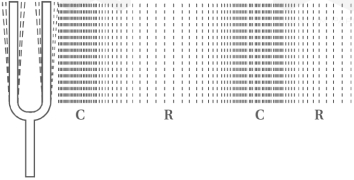
Describe with the help of a diagram,how compressions and rarefactions are produced in air near a source of sound.
Solution
(N/A) Compression is a region of high pressure and high density in a longitudinal wave where particles of the medium are closer together.
Rarefaction is a region of low pressure and low density in a longitudinal wave where particles of the medium are farther apart.
When an object vibrates,it moves back and forth rapidly. When it moves forward,it pushes the air particles in front of it,creating a region of high pressure and density called a compression. When it moves backward,it creates a region of low pressure and density behind it,called a rarefaction. As the object continues to vibrate,these alternating regions of compressions and rarefactions propagate through the medium as a sound wave.
Rarefaction is a region of low pressure and low density in a longitudinal wave where particles of the medium are farther apart.
When an object vibrates,it moves back and forth rapidly. When it moves forward,it pushes the air particles in front of it,creating a region of high pressure and density called a compression. When it moves backward,it creates a region of low pressure and density behind it,called a rarefaction. As the object continues to vibrate,these alternating regions of compressions and rarefactions propagate through the medium as a sound wave.
0 likes
View Solution20
Difficult
Cite an experiment to show that sound needs a material medium for its propagation.
Solution
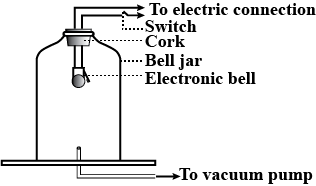
(N/A) Apparatus required: $A$ bell jar,an electronic bell,a cork,and a vacuum pump.
Procedure:
$1$. Take an electronic bell and suspend it inside an airtight glass bell jar.
$2$. Connect the bell to a power supply through the cork at the top of the jar.
$3$. Switch on the bell; you will hear the sound of the ringing bell.
$4$. Now,connect the bottom of the jar to a vacuum pump and start the pump to remove the air from the jar.
$5$. As the air is gradually removed,the loudness of the sound decreases.
$6$. When the air is completely removed (creating a vacuum),you will observe that no sound is heard,even though the hammer of the bell is still seen striking the gong.
Conclusion: Since the bell was working but its sound could not be heard in the absence of air,it is concluded that sound requires a material medium for its propagation.
Procedure:
$1$. Take an electronic bell and suspend it inside an airtight glass bell jar.
$2$. Connect the bell to a power supply through the cork at the top of the jar.
$3$. Switch on the bell; you will hear the sound of the ringing bell.
$4$. Now,connect the bottom of the jar to a vacuum pump and start the pump to remove the air from the jar.
$5$. As the air is gradually removed,the loudness of the sound decreases.
$6$. When the air is completely removed (creating a vacuum),you will observe that no sound is heard,even though the hammer of the bell is still seen striking the gong.
Conclusion: Since the bell was working but its sound could not be heard in the absence of air,it is concluded that sound requires a material medium for its propagation.
0 likes
View Solution21
MediumMCQ
Why is a sound wave called a longitudinal wave?
A
Because particles vibrate perpendicular to the direction of propagation.
B
Because particles vibrate parallel to the direction of propagation.
C
Because it requires a medium to travel.
D
Because it travels at a constant speed.
Solution
(B) wave in which the particles of the medium vibrate along or parallel to the direction of wave propagation is called a longitudinal wave.
In a sound wave,the particles of the medium oscillate back and forth in the same direction as the wave travels.
Since the displacement of the medium particles is parallel to the direction of energy transfer,a sound wave is classified as a longitudinal wave.
In a sound wave,the particles of the medium oscillate back and forth in the same direction as the wave travels.
Since the displacement of the medium particles is parallel to the direction of energy transfer,a sound wave is classified as a longitudinal wave.
0 likes
View Solution22
MediumMCQ
Which characteristic of the sound helps you to identify your friend by his voice while sitting with others in a dark room?
A
Pitch
B
Loudness
C
Quality (Timbre)
D
Amplitude
Solution
(C) The quality (or timbre) of sound is the characteristic that enables us to distinguish between sounds produced by different sources,even when they have the same pitch and loudness.
Each person's voice has a unique quality due to the specific waveform produced by their vocal cords and vocal tract.
Therefore,this characteristic allows us to identify a specific person by their voice,even in the absence of visual cues.
Each person's voice has a unique quality due to the specific waveform produced by their vocal cords and vocal tract.
Therefore,this characteristic allows us to identify a specific person by their voice,even in the absence of visual cues.
0 likes
View Solution23
Medium
Flash and thunder are produced simultaneously. But thunder is heard a few seconds after the flash is seen,why?
Solution
(N/A) This happens because of the difference in the velocities of light and sound waves.
The speed of sound in air $(330 \; m/s)$ is significantly lower than the speed of light in air $(3 \times 10^8 \; m/s)$.
Hence,although the flash and thunder are produced simultaneously,light (flash) reaches the Earth's surface much earlier than sound (thunder).
Therefore,thunder is heard a few seconds after the flash is seen.
The speed of sound in air $(330 \; m/s)$ is significantly lower than the speed of light in air $(3 \times 10^8 \; m/s)$.
Hence,although the flash and thunder are produced simultaneously,light (flash) reaches the Earth's surface much earlier than sound (thunder).
Therefore,thunder is heard a few seconds after the flash is seen.
0 likes
View Solution24
MediumMCQ
$A$ person has a hearing range from $20\, Hz$ to $20\, kHz$. What are the typical wavelengths of sound waves in air corresponding to these two frequencies? Take the speed of sound in air as $344\, m \,s^{-1}$.
A
$17.2\, m$ and $1.72\, cm$
B
$17.2\, cm$ and $1.72\, m$
C
$1.72\, m$ and $17.2\, cm$
D
$1.72\, cm$ and $17.2\, m$
Solution
(A) The relationship between speed of sound $(v)$, frequency $(f)$, and wavelength $(\lambda)$ is given by the formula: $v = f \times \lambda$, which implies $\lambda = v / f$.
Given speed of sound $v = 344\, m \,s^{-1}$.
For the lower frequency $f_1 = 20\, Hz$:
$\lambda_1 = 344 / 20 = 17.2\, m$.
For the higher frequency $f_2 = 20\, kHz = 20,000\, Hz$:
$\lambda_2 = 344 / 20,000 = 0.0172\, m = 1.72\, cm$.
Therefore, the wavelengths are $17.2\, m$ and $1.72\, cm$.
Given speed of sound $v = 344\, m \,s^{-1}$.
For the lower frequency $f_1 = 20\, Hz$:
$\lambda_1 = 344 / 20 = 17.2\, m$.
For the higher frequency $f_2 = 20\, kHz = 20,000\, Hz$:
$\lambda_2 = 344 / 20,000 = 0.0172\, m = 1.72\, cm$.
Therefore, the wavelengths are $17.2\, m$ and $1.72\, cm$.
0 likes
View Solution25
DifficultMCQ
Two children are at opposite ends of an aluminium rod. One strikes the end of the rod with a stone. Find the ratio of times taken by the sound wave in air and in aluminium to reach the second child.
A
$t_1:t_2 = 18.55:1$
B
$t_1:t_2 = 28.55:1$
C
$t_1:t_2 = 9.6:1$
D
$t_1:t_2 = 17.5:3$
Solution
(A) Let the length of the aluminium rod be $x$.
Let $v_1$ be the speed of sound in air $(346 \ m/s)$ and $v_2$ be the speed of sound in aluminium $(6420 \ m/s)$.
The time taken by sound to travel through air is $t_1 = x / v_1$.
The time taken by sound to travel through the aluminium rod is $t_2 = x / v_2$.
The ratio of the times is $t_1 / t_2 = (x / v_1) / (x / v_2) = v_2 / v_1$.
Substituting the values: $t_1 / t_2 = 6420 / 346 \approx 18.55$.
Therefore,the ratio $t_1:t_2$ is $18.55:1$.
Let $v_1$ be the speed of sound in air $(346 \ m/s)$ and $v_2$ be the speed of sound in aluminium $(6420 \ m/s)$.
The time taken by sound to travel through air is $t_1 = x / v_1$.
The time taken by sound to travel through the aluminium rod is $t_2 = x / v_2$.
The ratio of the times is $t_1 / t_2 = (x / v_1) / (x / v_2) = v_2 / v_1$.
Substituting the values: $t_1 / t_2 = 6420 / 346 \approx 18.55$.
Therefore,the ratio $t_1:t_2$ is $18.55:1$.
0 likes
View Solution26
MediumMCQ
The frequency of a source of sound is $100 \, Hz$. How many times does it vibrate in a minute?
A
$5000$
B
$6000$
C
$4000$
D
$1000$
Solution
(B) The frequency $(v)$ of the sound source is $100 \, Hz$, which means it completes $100$ vibrations in $1 \, second$.
The time duration given is $1 \, minute$, which is equal to $60 \, seconds$.
The total number of vibrations is calculated by multiplying the frequency by the total time:
$\text{Number of vibrations} = v \times t$
$= 100 \, Hz \times 60 \, s$
$= 6000$
Therefore, the source vibrates $6000$ times in a minute.
The time duration given is $1 \, minute$, which is equal to $60 \, seconds$.
The total number of vibrations is calculated by multiplying the frequency by the total time:
$\text{Number of vibrations} = v \times t$
$= 100 \, Hz \times 60 \, s$
$= 6000$
Therefore, the source vibrates $6000$ times in a minute.
0 likes
View Solution27
Medium
Does sound follow the same laws of reflection as light does? Explain.
Solution
(A) Yes,sound follows the same laws of reflection as light. The laws of reflection for sound are as follows:
$1$. The angle of incidence is equal to the angle of reflection $(i = r)$.
$2$. The incident sound wave,the reflected sound wave,and the normal at the point of incidence all lie in the same plane.
These laws are applicable to all surfaces,whether they are polished or rough. Reflection of sound is utilized in various technologies,such as $SONAR$ (Sound Navigation and Ranging) to measure the distance and speed of underwater objects,and in the design of musical concert halls to ensure clear sound distribution.
$1$. The angle of incidence is equal to the angle of reflection $(i = r)$.
$2$. The incident sound wave,the reflected sound wave,and the normal at the point of incidence all lie in the same plane.
These laws are applicable to all surfaces,whether they are polished or rough. Reflection of sound is utilized in various technologies,such as $SONAR$ (Sound Navigation and Ranging) to measure the distance and speed of underwater objects,and in the design of musical concert halls to ensure clear sound distribution.
0 likes
View Solution28
MediumMCQ
When a sound is reflected from a distant object,an echo is produced. Let the distance between the reflecting surface and the source of sound production remains the same. Do you hear an echo on a hotter day?
A
Yes,the echo is heard more clearly.
B
No,the echo is not heard.
C
Yes,the echo is heard at the same time.
D
The echo is heard only at night.
Solution
(B) The velocity of sound increases with an increase in temperature. Thus,the velocity of sound in air is higher on a hotter day.
Since the distance between the source and the reflecting surface remains constant,the time taken for the sound to travel to the surface and return $(t = \frac{2d}{v})$ decreases as the velocity $(v)$ increases.
$A$ human ear requires a minimum time interval of $\frac{1}{10} \text{ s}$ (or $0.1 \text{ s}$) to distinguish an echo from the original sound.
On a hotter day,because the velocity of sound is higher,the time interval between the original sound and the reflected sound becomes less than $0.1 \text{ s}$. Therefore,it becomes difficult or impossible to hear a distinct echo.
Since the distance between the source and the reflecting surface remains constant,the time taken for the sound to travel to the surface and return $(t = \frac{2d}{v})$ decreases as the velocity $(v)$ increases.
$A$ human ear requires a minimum time interval of $\frac{1}{10} \text{ s}$ (or $0.1 \text{ s}$) to distinguish an echo from the original sound.
On a hotter day,because the velocity of sound is higher,the time interval between the original sound and the reflected sound becomes less than $0.1 \text{ s}$. Therefore,it becomes difficult or impossible to hear a distinct echo.
0 likes
View Solution29
Easy
Give two practical applications of reflection of sound waves.
Solution
(N/A) $1$. $SONAR$ ($Sound$ $Navigation$ $And$ $Ranging$): This technique uses the reflection of ultrasonic sound waves to measure the speed,distance,and direction of underwater objects like submarines or icebergs.
$2$. Stethoscope: This medical instrument works on the principle of multiple reflections of sound. The sound of a patient's heartbeat or lungs is channeled through a tube to the doctor's ears via repeated reflections within the tube walls.
$2$. Stethoscope: This medical instrument works on the principle of multiple reflections of sound. The sound of a patient's heartbeat or lungs is channeled through a tube to the doctor's ears via repeated reflections within the tube walls.
0 likes
View Solution30
DifficultMCQ
$A$ stone is dropped from the top of a tower $500\, m$ high into a pond of water at the base of the tower. When is the splash heard (in $sec$) at the top?
Given,$g = 10\, m\, s^{-2}$ and speed of sound $= 340\, m\, s^{-1}$.
Given,$g = 10\, m\, s^{-2}$ and speed of sound $= 340\, m\, s^{-1}$.
A
$9.64$
B
$11.47$
C
$14.34$
D
$8.24$
Solution
(B) The total time $t$ to hear the splash is the sum of the time taken by the stone to fall $(t_1)$ and the time taken by the sound to travel back to the top $(t_2)$.
$1$. Time taken for the stone to fall $(t_1)$:
Using the equation of motion $s = ut + \frac{1}{2}at^2$,where $u = 0$,$a = g = 10\, m\, s^{-2}$,and $s = 500\, m$:
$500 = 0 + \frac{1}{2} \times 10 \times t_1^2$
$500 = 5 \times t_1^2$
$t_1^2 = 100$
$t_1 = 10\, s$.
$2$. Time taken for the sound to travel back $(t_2)$:
Using the formula $t_2 = \frac{\text{distance}}{\text{speed}}$:
$t_2 = \frac{500}{340} \approx 1.47\, s$.
$3$. Total time $(t)$:
$t = t_1 + t_2 = 10 + 1.47 = 11.47\, s$.
$1$. Time taken for the stone to fall $(t_1)$:
Using the equation of motion $s = ut + \frac{1}{2}at^2$,where $u = 0$,$a = g = 10\, m\, s^{-2}$,and $s = 500\, m$:
$500 = 0 + \frac{1}{2} \times 10 \times t_1^2$
$500 = 5 \times t_1^2$
$t_1^2 = 100$
$t_1 = 10\, s$.
$2$. Time taken for the sound to travel back $(t_2)$:
Using the formula $t_2 = \frac{\text{distance}}{\text{speed}}$:
$t_2 = \frac{500}{340} \approx 1.47\, s$.
$3$. Total time $(t)$:
$t = t_1 + t_2 = 10 + 1.47 = 11.47\, s$.
0 likes
View Solution31
MediumMCQ
$A$ sound wave travels at a speed of $339\, m\,s^{-1}$. If its wavelength is $1.5\, cm$, what is the frequency of the wave? Will it be audible?
A
Frequency = $22600\, Hz$; Yes, it is audible.
B
Frequency = $22600\, Hz$; No, it is not audible.
C
Frequency = $2260\, Hz$; Yes, it is audible.
D
Frequency = $2260\, Hz$; No, it is not audible.
Solution
(B) Given:
Speed of sound $(v)$ = $339\, m\,s^{-1}$
Wavelength $(\lambda)$ = $1.5\, cm = 0.015\, m$
Formula: $v = \nu \times \lambda$, where $\nu$ is the frequency.
$\nu = v / \lambda = 339 / 0.015 = 22600\, Hz$.
The audible range for human beings is $20\, Hz$ to $20000\, Hz$.
Since $22600\, Hz > 20000\, Hz$, this sound is ultrasonic and will not be audible to human beings.
Speed of sound $(v)$ = $339\, m\,s^{-1}$
Wavelength $(\lambda)$ = $1.5\, cm = 0.015\, m$
Formula: $v = \nu \times \lambda$, where $\nu$ is the frequency.
$\nu = v / \lambda = 339 / 0.015 = 22600\, Hz$.
The audible range for human beings is $20\, Hz$ to $20000\, Hz$.
Since $22600\, Hz > 20000\, Hz$, this sound is ultrasonic and will not be audible to human beings.
0 likes
View Solution32
Medium
What is reverberation? How can it be reduced?
Solution
(N/A) Reverberation is the persistence of sound in an enclosed space due to repeated reflections from the walls,ceiling,and floor after the original source of sound has stopped.
Reverberation can be reduced by using sound-absorbing materials on the walls and ceilings of the room to minimize reflections.
Common materials used to reduce reverberation include fibreboard,heavy curtains,carpets,and acoustic foam.
Reverberation can be reduced by using sound-absorbing materials on the walls and ceilings of the room to minimize reflections.
Common materials used to reduce reverberation include fibreboard,heavy curtains,carpets,and acoustic foam.
0 likes
View Solution33
Medium
What is loudness of sound? What factors does it depend on?
Solution
(N/A) Loudness is the measure of the degree of sensation of sound produced in the ear. It is a physiological response of the ear to the intensity of sound.
Loudness depends primarily on the $amplitude$ of the vibration producing the sound. The greater the $amplitude$ of vibration,the louder the sound produced.
Additionally,loudness depends on the force with which an object is made to vibrate and the surface area of the vibrating object.
Loudness depends primarily on the $amplitude$ of the vibration producing the sound. The greater the $amplitude$ of vibration,the louder the sound produced.
Additionally,loudness depends on the force with which an object is made to vibrate and the surface area of the vibrating object.
0 likes
View Solution34
Medium
Explain how bats use ultrasound to catch a prey.
Solution
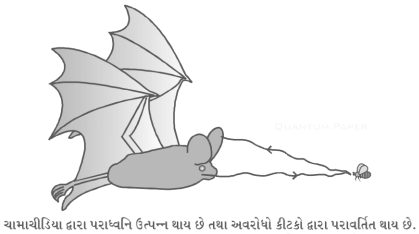
(N/A) Bats use a process called echolocation to navigate and hunt in the dark.
$1$. Bats emit high-frequency ultrasonic waves (sounds with frequencies higher than $20,000 \ Hz$) from their mouths.
$2$. These ultrasonic waves travel through the air and strike the prey (such as an insect).
$3$. The waves are reflected back by the prey as an echo.
$4$. The bat detects these reflected waves (echoes) with its sensitive ears.
$5$. By analyzing the time taken for the echo to return and the nature of the reflected sound,the bat can determine the distance,size,shape,and direction of the prey,allowing it to catch the insect accurately.
$1$. Bats emit high-frequency ultrasonic waves (sounds with frequencies higher than $20,000 \ Hz$) from their mouths.
$2$. These ultrasonic waves travel through the air and strike the prey (such as an insect).
$3$. The waves are reflected back by the prey as an echo.
$4$. The bat detects these reflected waves (echoes) with its sensitive ears.
$5$. By analyzing the time taken for the echo to return and the nature of the reflected sound,the bat can determine the distance,size,shape,and direction of the prey,allowing it to catch the insect accurately.
0 likes
View Solution35
MediumMCQ
How is ultrasound used for cleaning?
A
Ultrasound waves create high-pressure bubbles that scrub surfaces.
B
Ultrasound waves vibrate the cleaning solution to remove dirt from hard-to-reach parts.
C
Ultrasound waves heat the cleaning liquid to dissolve grease.
D
Ultrasound waves use magnetic force to attract dust particles.
Solution
(B) Ultrasound is used for cleaning parts located in hard-to-reach places,such as spiral tubes,odd-shaped parts,and electronic components.
$1$. The objects to be cleaned are placed in a cleaning solution.
$2$. Ultrasonic waves are passed into the solution.
$3$. Due to the high frequency of these waves,the particles of dust,grease,and dirt get detached and drop out.
$4$. The objects thus get thoroughly cleaned.
$1$. The objects to be cleaned are placed in a cleaning solution.
$2$. Ultrasonic waves are passed into the solution.
$3$. Due to the high frequency of these waves,the particles of dust,grease,and dirt get detached and drop out.
$4$. The objects thus get thoroughly cleaned.
0 likes
View Solution36
Medium
Explain the working and application of a sonar.
Solution
(N/A) $SONAR$ stands for $Sound$ $Navigation$ $And$ $Ranging$.
It is a device that uses ultrasonic waves to measure the distance,direction,and speed of underwater objects.
Working: $A$ sonar device consists of a transmitter and a detector installed in a ship or boat. The transmitter produces and transmits ultrasonic waves. These waves travel through water and strike the object on the seabed. After striking,the waves are reflected back and are sensed by the detector. The detector converts the ultrasonic waves into electrical signals which are appropriately interpreted.
Calculation: If the time interval between transmission and reception of the ultrasound signal is $t$ and the speed of sound through seawater is $v$,then the total distance $2d$ traveled by the wave is given by $2d = v \times t$,where $d$ is the depth of the object.
Applications: $1$. Used to determine the depth of the sea. $2$. Used to locate underwater hills,valleys,submarines,icebergs,and sunken ships.
It is a device that uses ultrasonic waves to measure the distance,direction,and speed of underwater objects.
Working: $A$ sonar device consists of a transmitter and a detector installed in a ship or boat. The transmitter produces and transmits ultrasonic waves. These waves travel through water and strike the object on the seabed. After striking,the waves are reflected back and are sensed by the detector. The detector converts the ultrasonic waves into electrical signals which are appropriately interpreted.
Calculation: If the time interval between transmission and reception of the ultrasound signal is $t$ and the speed of sound through seawater is $v$,then the total distance $2d$ traveled by the wave is given by $2d = v \times t$,where $d$ is the depth of the object.
Applications: $1$. Used to determine the depth of the sea. $2$. Used to locate underwater hills,valleys,submarines,icebergs,and sunken ships.
0 likes
View Solution37
MediumMCQ
$A$ sonar device on a submarine sends out a signal and receives an echo $5\, s$ later. Calculate the speed of sound in water if the distance of the object from the submarine is $3625\, m$. (in $, m/s$)
A
$1450$
B
$1500$
C
$1400$
D
$1550$
Solution
(A) The total distance traveled by the sound signal is twice the distance between the submarine and the object,because the sound travels to the object and reflects back to the submarine.
Total distance $(d)$ = $2 \times 3625\, m = 7250\, m$.
The time taken $(t)$ for the echo to return is $5\, s$.
The speed of sound $(v)$ is calculated using the formula: $v = \frac{d}{t}$.
Substituting the values: $v = \frac{7250\, m}{5\, s} = 1450\, m/s$.
Therefore,the speed of sound in water is $1450\, m/s$.
Total distance $(d)$ = $2 \times 3625\, m = 7250\, m$.
The time taken $(t)$ for the echo to return is $5\, s$.
The speed of sound $(v)$ is calculated using the formula: $v = \frac{d}{t}$.
Substituting the values: $v = \frac{7250\, m}{5\, s} = 1450\, m/s$.
Therefore,the speed of sound in water is $1450\, m/s$.
0 likes
View Solution38
Medium
Explain how defects in a metal block can be detected using ultrasound.
Solution
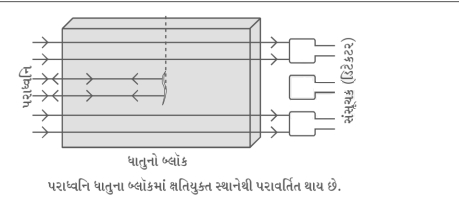
(N/A) Ultrasound can be used to detect cracks and flaws in metal blocks.
$1$. Ultrasound waves are allowed to pass through the metal block,and detectors are used to detect the transmitted waves.
$2$. If there is even a small defect,such as a crack or a hole inside the metal block,the ultrasound waves get reflected back from the defect site.
$3$. This reflection indicates the presence of a flaw or defect in the metal block.
$4$. Since ultrasound has a high frequency,it can travel through the material and detect internal defects that are not visible from the outside.
$1$. Ultrasound waves are allowed to pass through the metal block,and detectors are used to detect the transmitted waves.
$2$. If there is even a small defect,such as a crack or a hole inside the metal block,the ultrasound waves get reflected back from the defect site.
$3$. This reflection indicates the presence of a flaw or defect in the metal block.
$4$. Since ultrasound has a high frequency,it can travel through the material and detect internal defects that are not visible from the outside.
0 likes
View Solution39
Medium
Explain how the human ear works.
Solution
(N/A) The outer ear $(pinna)$ collects sound waves from the surroundings.
These sound waves pass through the auditory canal to the eardrum,a thin membrane.
When a compression of the medium reaches the eardrum,the pressure increases,forcing it inward.
Conversely,when a rarefaction reaches the eardrum,it moves outward,causing the eardrum to vibrate.
These vibrations are amplified several times by the three bones in the middle ear ($malleus$,$incus$,and $stapes$).
The middle ear transmits these amplified pressure variations to the inner ear.
In the inner ear,the $cochlea$ converts these pressure variations into electrical signals.
These electrical signals are sent to the brain via the auditory nerve,where the brain interprets them as sound.
These sound waves pass through the auditory canal to the eardrum,a thin membrane.
When a compression of the medium reaches the eardrum,the pressure increases,forcing it inward.
Conversely,when a rarefaction reaches the eardrum,it moves outward,causing the eardrum to vibrate.
These vibrations are amplified several times by the three bones in the middle ear ($malleus$,$incus$,and $stapes$).
The middle ear transmits these amplified pressure variations to the inner ear.
In the inner ear,the $cochlea$ converts these pressure variations into electrical signals.
These electrical signals are sent to the brain via the auditory nerve,where the brain interprets them as sound.
0 likes
View SolutionSOUND — Textbook - SOUND · Frequently Asked Questions
1Are these SOUND questions useful for JEE and NEET?
Yes. All questions in this section are mapped to JEE Main and NEET exam patterns. Previous year questions from JEE Main, NEET, GUJCET and state-level exams are included with full solutions.
2Can I switch to Hindi or Gujarati for these questions?
Yes. Use the language tabs in the hero section or the sidebar to view the same questions and solutions in English, Hindi or Gujarati.
3How do I generate a question paper from this subtopic?
Use the Vedclass Exam Paper Generator — select the chapter and subtopic, set difficulty, and generate Sets A, B, C, D automatically. First 3 chapters of every subject are free.
Vedclass Products
For Students
Vedclass Test Series
Mock tests in real JEE/NEET style with performance analysis. 5-day free trial.
Start Free TrialFor Teachers
Exam Paper Generator
Generate Set A/B/C/D papers from this chapter in 2 minutes. 3 chapters free.
Try FreeFor Institutes
Online Exam Module
Live online exams with unlimited students, 360° analytics & white-label branding.
See DemoFor Teachers & Institutes
Generate a SOUND Exam Paper in 2 Minutes
Select subtopic & difficulty — Sets A, B, C, D auto-generated with No Repeat logic.
First 3 chapters of every subject are free — no payment required.