
A English
Mix Example - SOUND Questions in English
Class 9 Science · SOUND · Mix Example - SOUND
169+
Questions
English
Language
100%
With Solutions
Showing 50 of 169 questions in English
101
Difficult
$(a)$ What is reverberation? Write two ways of reducing reverberation.
$(b)$ Distinguish between tone and note.
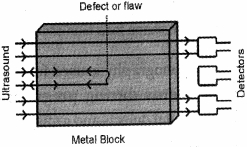
$(c)$ With the help of a simple diagram,explain how defects in a metal block can be detected using ultrasound.
$(b)$ Distinguish between tone and note.
$(c)$ With the help of a simple diagram,explain how defects in a metal block can be detected using ultrasound.
Solution
(N/A) The persistence of sound in an auditorium as a result of repeated reflections of sound is called reverberation. Two ways to reduce reverberation are: $(i)$ Covering the walls and ceiling of the auditorium with sound-absorbing materials like compressed fibreboard,rough plaster,or draperies. $(ii)$ Using sound-absorbing materials for seats and carpets.
$(b)$ $A$ sound of a single frequency is called a tone. $A$ sound which is produced due to a mixture of several frequencies is called a note.
$(c)$ Ultrasound can be used to detect cracks and flaws in metal blocks. Metallic components are generally used in the construction of big structures like buildings,bridges,machines,and scientific equipment. The cracks or holes inside the metal blocks,which are invisible from the outside,reduce the strength of the structure. Ultrasonic waves are allowed to pass through the metal block,and detectors are used to detect the transmitted waves. If there is even a small defect,the ultrasound gets reflected back,indicating the presence of the flaw or defect,as shown in the figure.
$(b)$ $A$ sound of a single frequency is called a tone. $A$ sound which is produced due to a mixture of several frequencies is called a note.
$(c)$ Ultrasound can be used to detect cracks and flaws in metal blocks. Metallic components are generally used in the construction of big structures like buildings,bridges,machines,and scientific equipment. The cracks or holes inside the metal blocks,which are invisible from the outside,reduce the strength of the structure. Ultrasonic waves are allowed to pass through the metal block,and detectors are used to detect the transmitted waves. If there is even a small defect,the ultrasound gets reflected back,indicating the presence of the flaw or defect,as shown in the figure.
0 likes
View Solution102
Medium
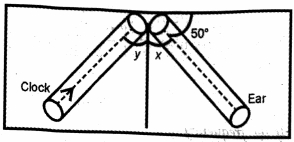
For hearing the loudest ticking sound by the ear:
$(a)$ Find the angles $x$ and $y$ in the figure below.
$(b)$ Name the phenomenon observed here.
$(c)$ State the laws of the phenomenon.
$(a)$ Find the angles $x$ and $y$ in the figure below.
$(b)$ Name the phenomenon observed here.
$(c)$ State the laws of the phenomenon.
Solution
(N/A) The angle between the tube and the reflecting surface is $50^{\circ}$. The normal is perpendicular to the surface,so the angle of reflection $r$ is $90^{\circ} - 50^{\circ} = 40^{\circ}$. According to the laws of reflection,the angle of incidence $i$ is equal to the angle of reflection $r$. Therefore,$\angle x = \angle r = 40^{\circ}$ and $\angle y = \angle i = 40^{\circ}$.
$(b)$ The phenomenon observed is the reflection of sound.
$(c)$ The laws of reflection of sound are:
$(i)$ The incident sound wave,the reflected sound wave,and the normal at the point of incidence all lie in the same plane.
$(ii)$ The angle of incidence is always equal to the angle of reflection $(\angle i = \angle r)$.
$(b)$ The phenomenon observed is the reflection of sound.
$(c)$ The laws of reflection of sound are:
$(i)$ The incident sound wave,the reflected sound wave,and the normal at the point of incidence all lie in the same plane.
$(ii)$ The angle of incidence is always equal to the angle of reflection $(\angle i = \angle r)$.
0 likes
View Solution103
Medium
$(a)$ $A$ particular transmitter of Aakashvani broadcasts at $420.5\, m$ wavelength. Given the speed of radio waves $3 \times 10^{8}\, m s^{-1}$. Calculate the frequency at which the radio station broadcasts its programme.
$(b)$ What is the direction of oscillations of the medium particles through which a
$(i)$ transverse wave is propagating?
$(ii)$ longitudinal wave is propagating?
$(b)$ What is the direction of oscillations of the medium particles through which a
$(i)$ transverse wave is propagating?
$(ii)$ longitudinal wave is propagating?
Solution
(A-D) Given: $\lambda = 420.5\, m$,$V = 3 \times 10^{8}\, m s^{-1}$.
Using the wave equation $V = \nu \lambda$,the frequency $\nu$ is given by $\nu = V / \lambda$.
Substituting the values: $\nu = (3 \times 10^{8}) / 420.5 \approx 7.13 \times 10^{5}\, Hz$.
$(b)$ $(i)$ In a transverse wave,the particles of the medium oscillate perpendicular to the direction of wave propagation.
$(ii)$ In a longitudinal wave,the particles of the medium oscillate parallel to the direction of wave propagation.
Using the wave equation $V = \nu \lambda$,the frequency $\nu$ is given by $\nu = V / \lambda$.
Substituting the values: $\nu = (3 \times 10^{8}) / 420.5 \approx 7.13 \times 10^{5}\, Hz$.
$(b)$ $(i)$ In a transverse wave,the particles of the medium oscillate perpendicular to the direction of wave propagation.
$(ii)$ In a longitudinal wave,the particles of the medium oscillate parallel to the direction of wave propagation.
0 likes
View Solution104
Medium
Given that sound travels in air at $340 \, m s^{-1}$,find the wavelength of the waves in air produced by a $20 \, Hz$ sound source. If the same source is put in a water tank,what would be the wavelength of the sound waves in water? (Given,speed of the sound in water $= 1480 \, m s^{-1}$)
Solution
(N/A) Given: Speed of sound in air $V_{a} = 340 \, m s^{-1}$,frequency $v = 20 \, Hz$.
Using the formula $V = v \lambda$,the wavelength in air is $\lambda_{a} = \frac{V_{a}}{v} = \frac{340}{20} = 17 \, m$.
Given: Speed of sound in water $V_{w} = 1480 \, m s^{-1}$.
The frequency $v$ remains constant when the source is moved to a different medium.
Therefore,the wavelength in water is $\lambda_{w} = \frac{V_{w}}{v} = \frac{1480}{20} = 74 \, m$.
Using the formula $V = v \lambda$,the wavelength in air is $\lambda_{a} = \frac{V_{a}}{v} = \frac{340}{20} = 17 \, m$.
Given: Speed of sound in water $V_{w} = 1480 \, m s^{-1}$.
The frequency $v$ remains constant when the source is moved to a different medium.
Therefore,the wavelength in water is $\lambda_{w} = \frac{V_{w}}{v} = \frac{1480}{20} = 74 \, m$.
0 likes
View Solution105
Easy
$A$ body vibrating with a time period of $5 \times 10^{-3} \text{ s}$ produces a wave travelling in a medium with a velocity of $1450 \text{ m s}^{-1}$. Calculate its wavelength and the frequency of vibration of the body.
Solution
(N/A) Given: Time period $T = 5 \times 10^{-3} \text{ s}$,Velocity $V = 1450 \text{ m s}^{-1}$.
$1$. Frequency $(v)$: The frequency is the reciprocal of the time period.
$v = \frac{1}{T} = \frac{1}{5 \times 10^{-3}} = \frac{1000}{5} = 200 \text{ Hz}$.
$2$. Wavelength $(\lambda)$: The wavelength is calculated using the relation $V = v \times \lambda$.
$\lambda = \frac{V}{v} = \frac{1450}{200} = 7.25 \text{ m}$.
Thus,the frequency is $200 \text{ Hz}$ and the wavelength is $7.25 \text{ m}$.
$1$. Frequency $(v)$: The frequency is the reciprocal of the time period.
$v = \frac{1}{T} = \frac{1}{5 \times 10^{-3}} = \frac{1000}{5} = 200 \text{ Hz}$.
$2$. Wavelength $(\lambda)$: The wavelength is calculated using the relation $V = v \times \lambda$.
$\lambda = \frac{V}{v} = \frac{1450}{200} = 7.25 \text{ m}$.
Thus,the frequency is $200 \text{ Hz}$ and the wavelength is $7.25 \text{ m}$.
0 likes
View Solution106
EasyMCQ
If the frequency of a tuning fork is $400 \, Hz$ and the speed of sound in air is $340 \, m/s$. Find how far sound travels when the tuning fork makes $16$ vibrations. (in $m$)
A
$13.6$
B
$12.8$
C
$14.4$
D
$15.2$
Solution
(A) Given: Frequency $(v) = 400 \, Hz$, Speed of sound $(V) = 340 \, m/s$, Number of vibrations $(n) = 16$.
First, calculate the wavelength $(\lambda)$ of the sound wave using the formula: $\lambda = V / v$.
$\lambda = 340 / 400 = 0.85 \, m$.
The distance traveled by sound in one vibration is equal to its wavelength $(\lambda)$.
Therefore, the total distance traveled in $16$ vibrations is $d = n \times \lambda$.
$d = 16 \times 0.85 = 13.6 \, m$.
Thus, the sound travels $13.6 \, m$ when the tuning fork makes $16$ vibrations.
First, calculate the wavelength $(\lambda)$ of the sound wave using the formula: $\lambda = V / v$.
$\lambda = 340 / 400 = 0.85 \, m$.
The distance traveled by sound in one vibration is equal to its wavelength $(\lambda)$.
Therefore, the total distance traveled in $16$ vibrations is $d = n \times \lambda$.
$d = 16 \times 0.85 = 13.6 \, m$.
Thus, the sound travels $13.6 \, m$ when the tuning fork makes $16$ vibrations.
0 likes
View Solution107
EasyMCQ
$A$ man stands $33\, m$ from a high wall and claps his hands. Will he hear an echo? (Given,velocity of sound is $330\, m s^{-1}$)
A
Yes
B
No
C
Cannot be determined
D
Depends on the frequency of the clap
Solution
(A) The distance of the wall is $d = 33\, m$.
The velocity of sound is $v = 330\, m s^{-1}$.
The time taken for the sound to travel to the wall and back is given by the formula $t = \frac{2d}{v}$.
Substituting the values,$t = \frac{2 \times 33}{330} = \frac{66}{330} = 0.2\, s$.
For an echo to be heard by the human ear,the time interval between the original sound and the reflected sound must be at least $0.1\, s$.
Since the calculated time $0.2\, s$ is greater than $0.1\, s$,the echo will be heard.
The velocity of sound is $v = 330\, m s^{-1}$.
The time taken for the sound to travel to the wall and back is given by the formula $t = \frac{2d}{v}$.
Substituting the values,$t = \frac{2 \times 33}{330} = \frac{66}{330} = 0.2\, s$.
For an echo to be heard by the human ear,the time interval between the original sound and the reflected sound must be at least $0.1\, s$.
Since the calculated time $0.2\, s$ is greater than $0.1\, s$,the echo will be heard.
0 likes
View Solution108
Easy
The distance between the crest and trough of a transverse wave is $15 \, cm$. What is the velocity of the wave if its frequency is $1000 \, Hz$?
Solution
$300 \, m \, s^{-1}$ In a transverse wave, the distance between a crest and the consecutive trough is equal to half of the wavelength $(\lambda/2)$.
Given, $\lambda/2 = 15 \, cm$.
Therefore, the wavelength $\lambda = 2 \times 15 = 30 \, cm = 0.3 \, m$.
The frequency $f = 1000 \, Hz$.
The velocity of the wave $V$ is given by the formula $V = f \times \lambda$.
Substituting the values, $V = 1000 \times 0.3 = 300 \, m \, s^{-1}$.
Given, $\lambda/2 = 15 \, cm$.
Therefore, the wavelength $\lambda = 2 \times 15 = 30 \, cm = 0.3 \, m$.
The frequency $f = 1000 \, Hz$.
The velocity of the wave $V$ is given by the formula $V = f \times \lambda$.
Substituting the values, $V = 1000 \times 0.3 = 300 \, m \, s^{-1}$.
0 likes
View Solution109
Easy
$A$ sound wave of length $70 \ cm$ travels $840 \ m$ in $2.5 \ s$. What is the velocity and frequency of the sound?
Solution
(N/A) The velocity $(v)$ of the sound wave is calculated by dividing the total distance traveled by the time taken:
$v = \frac{\text{Distance}}{\text{Time}} = \frac{840 \ m}{2.5 \ s} = 336 \ m/s$.
The frequency $(f)$ of the sound wave is calculated using the formula $v = f \times \lambda$,where $\lambda$ is the wavelength.
Given $\lambda = 70 \ cm = 0.7 \ m$ and $v = 336 \ m/s$:
$f = \frac{v}{\lambda} = \frac{336 \ m/s}{0.7 \ m} = 480 \ Hz$.
$v = \frac{\text{Distance}}{\text{Time}} = \frac{840 \ m}{2.5 \ s} = 336 \ m/s$.
The frequency $(f)$ of the sound wave is calculated using the formula $v = f \times \lambda$,where $\lambda$ is the wavelength.
Given $\lambda = 70 \ cm = 0.7 \ m$ and $v = 336 \ m/s$:
$f = \frac{v}{\lambda} = \frac{336 \ m/s}{0.7 \ m} = 480 \ Hz$.
0 likes
View Solution110
EasyMCQ
$A$ person fires a gun in front of a building $167 \ m$ away. If the speed of sound is $334 \ m \ s^{-1}$,calculate the time in which he hears an echo. (in $s$)
A
$0.5$
B
$1.0$
C
$2.0$
D
$1.5$
Solution
(B) The distance between the person and the building is $d = 167 \ m$.
The sound travels to the building and reflects back to the person,covering a total distance of $2d = 2 \times 167 \ m = 334 \ m$.
The speed of sound is given as $V = 334 \ m \ s^{-1}$.
The time taken to hear the echo is calculated using the formula $t = \frac{\text{Total Distance}}{\text{Speed}} = \frac{2d}{V}$.
Substituting the values: $t = \frac{334 \ m}{334 \ m \ s^{-1}} = 1.0 \ s$.
Therefore,the person hears the echo after $1.0 \ s$.
The sound travels to the building and reflects back to the person,covering a total distance of $2d = 2 \times 167 \ m = 334 \ m$.
The speed of sound is given as $V = 334 \ m \ s^{-1}$.
The time taken to hear the echo is calculated using the formula $t = \frac{\text{Total Distance}}{\text{Speed}} = \frac{2d}{V}$.
Substituting the values: $t = \frac{334 \ m}{334 \ m \ s^{-1}} = 1.0 \ s$.
Therefore,the person hears the echo after $1.0 \ s$.
0 likes
View Solution111
EasyMCQ
An echo is heard after $0.8 \, s$,when a person fires a cracker $132.8 \, m$ from a high building. Calculate the speed of sound.
A
$332 \, m \, s^{-1}$
B
$340 \, m \, s^{-1}$
C
$320 \, m \, s^{-1}$
D
$350 \, m \, s^{-1}$
Solution
(A) The distance of the person from the building is $d = 132.8 \, m$.
The total distance traveled by the sound to the building and back to the person is $2d = 2 \times 132.8 = 265.6 \, m$.
The time taken to hear the echo is $t = 0.8 \, s$.
The speed of sound $V$ is given by the formula $V = \frac{\text{Total distance}}{\text{Time}} = \frac{2d}{t}$.
Substituting the values: $V = \frac{265.6}{0.8} = 332 \, m \, s^{-1}$.
The total distance traveled by the sound to the building and back to the person is $2d = 2 \times 132.8 = 265.6 \, m$.
The time taken to hear the echo is $t = 0.8 \, s$.
The speed of sound $V$ is given by the formula $V = \frac{\text{Total distance}}{\text{Time}} = \frac{2d}{t}$.
Substituting the values: $V = \frac{265.6}{0.8} = 332 \, m \, s^{-1}$.
0 likes
View Solution112
EasyMCQ
The speed of sound is $310 \, m s^{-1}$. $A$ person fires a gun and the echo is heard after $1.5 \, s$. Calculate the distance of the person from the cliff from which the echo takes place. (in $, m$)
A
$232.5$
B
$465$
C
$155$
D
$310$
Solution
(A) The speed of sound $V = 310 \, m s^{-1}$.
The time taken for the echo to be heard is $t = 1.5 \, s$.
Since the sound travels to the cliff and back to the person,the total distance covered is $2d$,where $d$ is the distance of the person from the cliff.
The formula for speed is $V = \frac{2d}{t}$.
Rearranging for distance: $2d = V \times t$.
Substituting the values: $2d = 310 \times 1.5 = 465 \, m$.
Therefore,the distance $d = \frac{465}{2} = 232.5 \, m$.
The time taken for the echo to be heard is $t = 1.5 \, s$.
Since the sound travels to the cliff and back to the person,the total distance covered is $2d$,where $d$ is the distance of the person from the cliff.
The formula for speed is $V = \frac{2d}{t}$.
Rearranging for distance: $2d = V \times t$.
Substituting the values: $2d = 310 \times 1.5 = 465 \, m$.
Therefore,the distance $d = \frac{465}{2} = 232.5 \, m$.
0 likes
View Solution113
Difficult
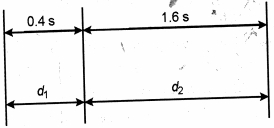
$A$ man stands between two high-rise buildings and blows a whistle. He hears two successive echoes after $0.4 \, s$ and $2.0 \, s$. Calculate the distance between the buildings. (Assume the speed of sound $v = 332 \, m/s$)
Solution
(N/A) Let the speed of sound be $v = 332 \, m/s$.
The time taken for the first echo is $t_1 = 0.4 \, s$. The distance of the person from the nearer building $(d_1)$ is given by:
$d_1 = \frac{v \times t_1}{2} = \frac{332 \times 0.4}{2} = 66.4 \, m$.
The time taken for the second echo is $t_2 = 2.0 \, s$. The distance of the person from the farther building $(d_2)$ is given by:
$d_2 = \frac{v \times t_2}{2} = \frac{332 \times 2.0}{2} = 332 \, m$.
The total distance between the two buildings is the sum of the distances from the person to each building:
$D = d_1 + d_2 = 66.4 + 332 = 398.4 \, m$.
The time taken for the first echo is $t_1 = 0.4 \, s$. The distance of the person from the nearer building $(d_1)$ is given by:
$d_1 = \frac{v \times t_1}{2} = \frac{332 \times 0.4}{2} = 66.4 \, m$.
The time taken for the second echo is $t_2 = 2.0 \, s$. The distance of the person from the farther building $(d_2)$ is given by:
$d_2 = \frac{v \times t_2}{2} = \frac{332 \times 2.0}{2} = 332 \, m$.
The total distance between the two buildings is the sum of the distances from the person to each building:
$D = d_1 + d_2 = 66.4 + 332 = 398.4 \, m$.
0 likes
View Solution114
Medium
Ocean waves of time period $0.01 \, s$ have a speed of $15 \, m s^{-1}$. Calculate the wavelength of these waves. Find the distance between the adjacent crest and the trough.
Solution
(N/A) Given: Time period $T = 0.01 \, s$,Speed $V = 15 \, m s^{-1}$.
Using the relation $V = \nu \lambda$ and $\nu = 1/T$,we have $V = \lambda / T$.
Therefore,the wavelength $\lambda = V \times T = 15 \times 0.01 = 0.15 \, m$.
The distance between an adjacent crest and a trough is equal to half of the wavelength $(\lambda / 2)$.
Distance $= 0.15 / 2 = 0.075 \, m$.
Using the relation $V = \nu \lambda$ and $\nu = 1/T$,we have $V = \lambda / T$.
Therefore,the wavelength $\lambda = V \times T = 15 \times 0.01 = 0.15 \, m$.
The distance between an adjacent crest and a trough is equal to half of the wavelength $(\lambda / 2)$.
Distance $= 0.15 / 2 = 0.075 \, m$.
0 likes
View Solution115
MediumMCQ
$A$ hospital uses an ultrasonic scanner to locate tumours in a tissue. What is the wavelength of sound in a tissue in which the speed of sound is $1.7 \, km \, s^{-1}$? The operating frequency of the scanner is $4.2 \, MHz$ $(1 \, MHz = 10^{6} \, Hz)$.
A
$4 \times 10^{-4} \, m$
B
$4.2 \times 10^{-4} \, m$
C
$1.7 \times 10^{-4} \, m$
D
$2.5 \times 10^{-4} \, m$
Solution
(A) Given: Speed of sound $V = 1.7 \, km \, s^{-1} = 1700 \, m \, s^{-1}$.
Frequency $\nu = 4.2 \, MHz = 4.2 \times 10^{6} \, Hz$.
Wavelength $\lambda = ?$.
Using the wave equation $V = \nu \lambda$,we can calculate the wavelength as $\lambda = V / \nu$.
Substituting the values: $\lambda = 1700 / (4.2 \times 10^{6}) \, m$.
$\lambda \approx 4.047 \times 10^{-4} \, m$,which is approximately $4 \times 10^{-4} \, m$.
Frequency $\nu = 4.2 \, MHz = 4.2 \times 10^{6} \, Hz$.
Wavelength $\lambda = ?$.
Using the wave equation $V = \nu \lambda$,we can calculate the wavelength as $\lambda = V / \nu$.
Substituting the values: $\lambda = 1700 / (4.2 \times 10^{6}) \, m$.
$\lambda \approx 4.047 \times 10^{-4} \, m$,which is approximately $4 \times 10^{-4} \, m$.
0 likes
View Solution116
EasyMCQ
An echo is returned in $6$ seconds. What is the distance of the reflecting surface from the source (in $, m$)? [Given that the speed of sound is $342 \, m s^{-1}$]
A
$1026$
B
$2052$
C
$513$
D
$171$
Solution
(A) Given: Time taken for the echo to return,$t = 6 \, s$. Speed of sound,$V = 342 \, m s^{-1}$.
An echo is the sound heard after reflection from a distant surface. The sound travels to the reflecting surface and back to the source,covering a total distance of $2d$ in time $t$.
The formula for distance is: $d = \frac{V \times t}{2}$.
Substituting the values: $d = \frac{342 \times 6}{2} = 342 \times 3 = 1026 \, m$.
Therefore,the distance of the reflecting surface from the source is $1026 \, m$.
An echo is the sound heard after reflection from a distant surface. The sound travels to the reflecting surface and back to the source,covering a total distance of $2d$ in time $t$.
The formula for distance is: $d = \frac{V \times t}{2}$.
Substituting the values: $d = \frac{342 \times 6}{2} = 342 \times 3 = 1026 \, m$.
Therefore,the distance of the reflecting surface from the source is $1026 \, m$.
0 likes
View Solution117
Medium
$20$ waves pass through a point in $2$ seconds. If the distance between one crest and adjacent trough is $1.5 \, m$,calculate: $(a)$ the frequency,$(b)$ the wavelength.
Solution
(N/A) The frequency $(v)$ is defined as the number of waves passing through a point per unit time.
Given that $20$ waves pass in $2$ seconds,the frequency is calculated as:
$v = \frac{20 \text{ waves}}{2 \text{ seconds}} = 10 \text{ Hz}$.
$(b)$ The distance between a crest and the adjacent trough is equal to half of the wavelength $(\frac{\lambda}{2})$.
Given that the distance is $1.5 \, m$,we have:
$\frac{\lambda}{2} = 1.5 \, m$.
Therefore,the wavelength $\lambda = 1.5 \times 2 = 3 \, m$.
Given that $20$ waves pass in $2$ seconds,the frequency is calculated as:
$v = \frac{20 \text{ waves}}{2 \text{ seconds}} = 10 \text{ Hz}$.
$(b)$ The distance between a crest and the adjacent trough is equal to half of the wavelength $(\frac{\lambda}{2})$.
Given that the distance is $1.5 \, m$,we have:
$\frac{\lambda}{2} = 1.5 \, m$.
Therefore,the wavelength $\lambda = 1.5 \times 2 = 3 \, m$.
0 likes
View Solution118
Medium
$(a)$ The sound of an explosion on the surface of a lake is heard by a boatman $100 \ m$ away and a diver $100 \ m$ below the point of explosion. Of the two persons mentioned (boatman or diver),who would hear the sound first and why?
$(b)$ Calculate the wavelength of a sound wave whose frequency is $220 \ Hz$ and speed is $440 \ m \ s^{-1}$ in a given medium.
$(b)$ Calculate the wavelength of a sound wave whose frequency is $220 \ Hz$ and speed is $440 \ m \ s^{-1}$ in a given medium.
Solution
(B) The diver will hear the sound first. This is because the speed of sound in water (a liquid medium) is significantly higher than the speed of sound in air (a gaseous medium). Since the distance is the same for both,the sound travels faster through the water to reach the diver.
$(b)$ Given:
Frequency $(v) = 220 \ Hz$
Speed $(V) = 440 \ m \ s^{-1}$
Formula: $V = v \times \lambda$
Therefore,wavelength $(\lambda) = V / v$
$\lambda = 440 / 220 = 2 \ m$
The wavelength of the sound wave is $2 \ m$.
$(b)$ Given:
Frequency $(v) = 220 \ Hz$
Speed $(V) = 440 \ m \ s^{-1}$
Formula: $V = v \times \lambda$
Therefore,wavelength $(\lambda) = V / v$
$\lambda = 440 / 220 = 2 \ m$
The wavelength of the sound wave is $2 \ m$.
0 likes
View Solution119
Medium
$A$ source is producing $1500$ sound waves in $3$ seconds. If the distance covered by a compression and an adjacent rarefaction is $68 \, cm$,find $(a)$ frequency,$(b)$ wavelength,and $(c)$ velocity of the sound wave.
Solution
(N/A) Number of waves produced in $3 \, s = 1500$.
Number of waves produced in $1 \, s = 1500 / 3 = 500$.
Therefore,frequency,$\nu = 500 \, Hz$.
$(b)$ Wavelength is defined as the distance between two consecutive compressions or two consecutive rarefactions. The distance between a compression and an adjacent rarefaction is half the wavelength $(\lambda / 2)$.
Given,$\lambda / 2 = 68 \, cm$.
Therefore,wavelength,$\lambda = 68 \times 2 = 136 \, cm = 1.36 \, m$.
$(c)$ Velocity,$V = \nu \times \lambda$.
$V = 500 \, Hz \times 1.36 \, m = 680 \, m/s$.
Number of waves produced in $1 \, s = 1500 / 3 = 500$.
Therefore,frequency,$\nu = 500 \, Hz$.
$(b)$ Wavelength is defined as the distance between two consecutive compressions or two consecutive rarefactions. The distance between a compression and an adjacent rarefaction is half the wavelength $(\lambda / 2)$.
Given,$\lambda / 2 = 68 \, cm$.
Therefore,wavelength,$\lambda = 68 \times 2 = 136 \, cm = 1.36 \, m$.
$(c)$ Velocity,$V = \nu \times \lambda$.
$V = 500 \, Hz \times 1.36 \, m = 680 \, m/s$.
0 likes
View Solution120
MediumMCQ
$A$ sound wave travels at a speed of $399\, m s^{-1}$. If its wavelength is $1.5\, cm$,what is the frequency of the wave? Will it be audible?
A
Frequency is $26600\, Hz$; it is audible.
B
Frequency is $26600\, Hz$; it is not audible.
C
Frequency is $2660\, Hz$; it is audible.
D
Frequency is $2660\, Hz$; it is not audible.
Solution
(B) Given: Speed of sound $(V) = 399\, m s^{-1}$,Wavelength $(\lambda) = 1.5\, cm = 0.015\, m$.
We know the relationship between speed,frequency $(v)$,and wavelength $(\lambda)$ is given by the formula: $V = v \times \lambda$.
Rearranging for frequency: $v = V / \lambda$.
Substituting the values: $v = 399 / 0.015 = 26600\, Hz$.
The human audible range is between $20\, Hz$ and $20,000\, Hz$.
Since the calculated frequency of $26600\, Hz$ is greater than $20,000\, Hz$,it is ultrasonic and therefore not audible to the human ear.
We know the relationship between speed,frequency $(v)$,and wavelength $(\lambda)$ is given by the formula: $V = v \times \lambda$.
Rearranging for frequency: $v = V / \lambda$.
Substituting the values: $v = 399 / 0.015 = 26600\, Hz$.
The human audible range is between $20\, Hz$ and $20,000\, Hz$.
Since the calculated frequency of $26600\, Hz$ is greater than $20,000\, Hz$,it is ultrasonic and therefore not audible to the human ear.
0 likes
View Solution121
MediumMCQ
In a submarine equipped with sonar,the time between the transmission of ultrasonic signals and the reception of the echo after reflection is found to be $80 \, s$. Find the distance of the obstacle from the submarine,given that the speed of sound in water is $1530 \, m s^{-1}$. (in $, m$)
A
$61200$
B
$30600$
C
$122400$
D
$15300$
Solution
(A) Given: Speed of sound in water $(V)$ = $1530 \, m s^{-1}$.
Total time taken for the echo to return $(t)$ = $80 \, s$.
Let the distance of the obstacle from the submarine be $d$.
The sound travels to the obstacle and back to the submarine,covering a total distance of $2d$.
Using the formula: $2d = V \times t$.
Substituting the values: $2d = 1530 \times 80$.
$2d = 122400 \, m$.
Therefore,$d = 122400 / 2 = 61200 \, m$.
Total time taken for the echo to return $(t)$ = $80 \, s$.
Let the distance of the obstacle from the submarine be $d$.
The sound travels to the obstacle and back to the submarine,covering a total distance of $2d$.
Using the formula: $2d = V \times t$.
Substituting the values: $2d = 1530 \times 80$.
$2d = 122400 \, m$.
Therefore,$d = 122400 / 2 = 61200 \, m$.
0 likes
View Solution122
MediumMCQ
If the frequency of a tuning fork is $400 \, Hz$ and the speed of sound in air is $340 \, m s^{-1}$,find how far sound travels when the tuning fork makes $16$ vibrations. (in $, m$)
A
$13.6$
B
$14.2$
C
$12.8$
D
$15.0$
Solution
(A) Given:
Frequency $(f)$ = $400 \, Hz$
Speed of sound $(V)$ = $340 \, m s^{-1}$
Number of vibrations $(n)$ = $16$
The time period $(T)$ for one vibration is $T = 1/f = 1/400 \, s$.
Total time $(t)$ taken for $16$ vibrations is $t = n \times T = 16 \times (1/400) = 16/400 \, s$.
Distance $(d)$ traveled by sound is calculated using the formula $d = V \times t$.
Substituting the values: $d = 340 \times (16/400) = 340 \times 0.04 = 13.6 \, m$.
Therefore,the sound travels $13.6 \, m$.
Frequency $(f)$ = $400 \, Hz$
Speed of sound $(V)$ = $340 \, m s^{-1}$
Number of vibrations $(n)$ = $16$
The time period $(T)$ for one vibration is $T = 1/f = 1/400 \, s$.
Total time $(t)$ taken for $16$ vibrations is $t = n \times T = 16 \times (1/400) = 16/400 \, s$.
Distance $(d)$ traveled by sound is calculated using the formula $d = V \times t$.
Substituting the values: $d = 340 \times (16/400) = 340 \times 0.04 = 13.6 \, m$.
Therefore,the sound travels $13.6 \, m$.
0 likes
View Solution123
MediumMCQ
$A$ laboratory uses an ultrasonic scanner to trace a tumour in tissue. The operating frequency of the scanner is $4.2 \times 10^{6} \text{ Hz}$. Calculate the wavelength of sound in the tissue if the speed of the sound is $1700 \text{ m s}^{-1}$.
A
$4.04 \times 10^{-4} \text{ m}$
B
$3.04 \times 10^{-4} \text{ m}$
C
$5.04 \times 10^{-4} \text{ m}$
D
$2.04 \times 10^{-4} \text{ m}$
Solution
(A) Given: Frequency $(v)$ = $4.2 \times 10^{6} \text{ Hz}$,Speed of sound $(V)$ = $1700 \text{ m s}^{-1}$.
We know the relationship between speed,frequency,and wavelength is given by the formula: $V = v \lambda$.
To find the wavelength $(\lambda)$,we rearrange the formula: $\lambda = V / v$.
Substituting the given values: $\lambda = 1700 / (4.2 \times 10^{6})$.
$\lambda = 404.76 \times 10^{-6} \text{ m} \approx 4.04 \times 10^{-4} \text{ m}$.
We know the relationship between speed,frequency,and wavelength is given by the formula: $V = v \lambda$.
To find the wavelength $(\lambda)$,we rearrange the formula: $\lambda = V / v$.
Substituting the given values: $\lambda = 1700 / (4.2 \times 10^{6})$.
$\lambda = 404.76 \times 10^{-6} \text{ m} \approx 4.04 \times 10^{-4} \text{ m}$.
0 likes
View Solution124
Medium
The rear view mirror of a motorbike starts vibrating violently at a particular speed of the motorbike.
$(a)$ Why does this happen?
$(b)$ What is the name of the phenomenon taking place?
$(c)$ What could be done to stop the violent vibration?
$(a)$ Why does this happen?
$(b)$ What is the name of the phenomenon taking place?
$(c)$ What could be done to stop the violent vibration?
Solution
(N/A) This happens when the frequency of vibration produced by the engine of the motorbike becomes equal to the natural frequency of the rear view mirror.
$(b)$ The name of this phenomenon is resonance.
$(c)$ The speed of the motorbike should be changed,which will alter the frequency of vibration of the engine,thereby stopping the resonance condition.
$(b)$ The name of this phenomenon is resonance.
$(c)$ The speed of the motorbike should be changed,which will alter the frequency of vibration of the engine,thereby stopping the resonance condition.
0 likes
View Solution125
Medium
$A$ vibrating tuning fork is placed over the mouth of a burette filled with water. The tap is opened and the water level gradually falls. It is observed that the sound becomes the loudest for a particular length of air column.
$(i)$ What is the name of the phenomenon taking place when this happens?
$(ii)$ Why does the sound become the loudest?
$(iii)$ How does the frequency of the loud sound compare with that of the tuning fork?
$(iv)$ State the unit for measuring loudness.
$(i)$ What is the name of the phenomenon taking place when this happens?
$(ii)$ Why does the sound become the loudest?
$(iii)$ How does the frequency of the loud sound compare with that of the tuning fork?
$(iv)$ State the unit for measuring loudness.
Solution
(N/A) $(i)$ The phenomenon is called resonance.
$(ii)$ The sound becomes loudest because the natural frequency of the air column becomes equal to the frequency of the vibrating tuning fork.
$(iii)$ The frequency of the loud sound is equal to the frequency of the tuning fork.
$(iv)$ The unit for measuring loudness is the decibel $(dB)$.
$(ii)$ The sound becomes loudest because the natural frequency of the air column becomes equal to the frequency of the vibrating tuning fork.
$(iii)$ The frequency of the loud sound is equal to the frequency of the tuning fork.
$(iv)$ The unit for measuring loudness is the decibel $(dB)$.
0 likes
View Solution126
Medium
Two friends were playing on identical guitars whose strings were adjusted to give notes of the same pitch. Will the quality of the two notes be the same? Give a reason for your answer.
Solution
(NO) The quality of the two notes need not be the same.
The pitch of a note is determined by its frequency.
The quality (or timbre) of a sound depends upon the number,distribution,and relative intensity of the different harmonics and overtones produced by the instrument.
Even if two guitars are identical,the way they are played,the material of the strings,and the resonance of the wooden body can vary,leading to differences in the overtones produced,thus resulting in different sound qualities.
The pitch of a note is determined by its frequency.
The quality (or timbre) of a sound depends upon the number,distribution,and relative intensity of the different harmonics and overtones produced by the instrument.
Even if two guitars are identical,the way they are played,the material of the strings,and the resonance of the wooden body can vary,leading to differences in the overtones produced,thus resulting in different sound qualities.
0 likes
View Solution127
Medium
The stem of a tuning fork is pressed against a table top. Answer the following questions:
$(i)$ Would the above action produce any audible sound?
$(ii)$ Does the above action cause the table to set into vibrations?
$(iii)$ If the answer above is yes,what type of vibrations are they?
$(iv)$ Under what conditions does the above action lead to resonance?
$(i)$ Would the above action produce any audible sound?
$(ii)$ Does the above action cause the table to set into vibrations?
$(iii)$ If the answer above is yes,what type of vibrations are they?
$(iv)$ Under what conditions does the above action lead to resonance?
Solution
(N/A) $(i)$ Yes,the above action produces an audible sound because the surface area of the table is much larger than the tuning fork,which helps in vibrating a larger volume of air.
$(ii)$ Yes,the above action causes the table top to set into vibrations.
$(iii)$ These vibrations are known as forced vibrations.
$(iv)$ Resonance occurs when the frequency of the tuning fork is equal to the natural frequency of oscillation of the table top.
$(ii)$ Yes,the above action causes the table top to set into vibrations.
$(iii)$ These vibrations are known as forced vibrations.
$(iv)$ Resonance occurs when the frequency of the tuning fork is equal to the natural frequency of oscillation of the table top.
0 likes
View Solution128
Medium
How do you account for the fact that two strings can be used to give notes of the same pitch and loudness but of different quality?
Solution
(N/A) The 'quality' or 'timbre' of a sound is determined by the presence and relative intensity of overtones or harmonics.
Even if two strings produce notes of the same fundamental frequency (pitch) and amplitude (loudness),they may vibrate in different modes or have different harmonic structures depending on the material,tension,and point of plucking.
These additional harmonics superimpose on the fundamental frequency,creating a unique waveform for each string.
Therefore,the overall effect of these harmonics results in a different 'quality' of sound for each string.
Even if two strings produce notes of the same fundamental frequency (pitch) and amplitude (loudness),they may vibrate in different modes or have different harmonic structures depending on the material,tension,and point of plucking.
These additional harmonics superimpose on the fundamental frequency,creating a unique waveform for each string.
Therefore,the overall effect of these harmonics results in a different 'quality' of sound for each string.
0 likes
View Solution129
Medium
The stem of a tuning fork is pressed against a table top. Answer the following questions: $(i)$ Would the above action produce any audible sound? $(ii)$ Does the above action cause the table to set into vibrations? $(iii)$ If the answer above is yes,what type of vibrations are they? $(iv)$ Under what conditions does the above action lead to resonance?
Solution
(N/A) $(i)$ Yes,an audible sound is produced because the large surface area of the table forces more air molecules to vibrate,increasing the intensity of the sound.
$(ii)$ Yes,the table top is set into vibrations by the stem of the tuning fork.
$(iii)$ These vibrations are known as 'forced vibrations' because the table is forced to vibrate at the frequency of the tuning fork.
$(iv)$ Resonance occurs when the frequency of the vibrating tuning fork exactly matches the natural frequency of the table top,resulting in a significantly louder sound.
$(ii)$ Yes,the table top is set into vibrations by the stem of the tuning fork.
$(iii)$ These vibrations are known as 'forced vibrations' because the table is forced to vibrate at the frequency of the tuning fork.
$(iv)$ Resonance occurs when the frequency of the vibrating tuning fork exactly matches the natural frequency of the table top,resulting in a significantly louder sound.
0 likes
View Solution130
Difficult
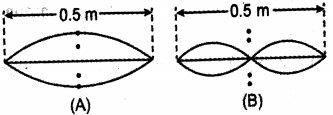
$A$ stretched wire $0.5\, m$ long is made to vibrate in two different modes as shown in diagrams $(A)$ and $(B)$ given below:
$(i)$ If the wavelength of the wave produced in mode $(A)$ is $1\, m$,what is the wavelength of the wave produced in mode $(B)$ of the following diagram?
$(ii)$ In which case is the note produced louder? Give a reason for your answer.
$(iii)$ In which case is the pitch of the note produced higher? Give a reason for your answer.
$(i)$ If the wavelength of the wave produced in mode $(A)$ is $1\, m$,what is the wavelength of the wave produced in mode $(B)$ of the following diagram?
$(ii)$ In which case is the note produced louder? Give a reason for your answer.
$(iii)$ In which case is the pitch of the note produced higher? Give a reason for your answer.
Solution
(N/A) $(i)$ In mode $(A)$,the wire vibrates in one loop,so the length $L = \lambda/2$,which means $\lambda = 2L = 2 \times 0.5\, m = 1\, m$. In mode $(B)$,the wire vibrates in two loops,so the length $L = \lambda'$. Thus,$\lambda' = L = 0.5\, m$. Therefore,the wavelength in mode $(B)$ is $0.5\, m$.
$(ii)$ The note produced in mode $(A)$ is louder. This is because the amplitude (maximum displacement from the mean position) of the wave in mode $(A)$ is greater than that in mode $(B)$. Since loudness is directly proportional to the square of the amplitude,the sound in mode $(A)$ is louder.
$(iii)$ The pitch of the note produced in mode $(B)$ is higher. This is because pitch is directly related to the frequency of the sound wave. As seen from the diagram,mode $(B)$ has two loops,meaning it vibrates at a higher frequency compared to mode $(A)$,which has only one loop. Higher frequency results in a higher pitch.
$(ii)$ The note produced in mode $(A)$ is louder. This is because the amplitude (maximum displacement from the mean position) of the wave in mode $(A)$ is greater than that in mode $(B)$. Since loudness is directly proportional to the square of the amplitude,the sound in mode $(A)$ is louder.
$(iii)$ The pitch of the note produced in mode $(B)$ is higher. This is because pitch is directly related to the frequency of the sound wave. As seen from the diagram,mode $(B)$ has two loops,meaning it vibrates at a higher frequency compared to mode $(A)$,which has only one loop. Higher frequency results in a higher pitch.
0 likes
View Solution131
Easy
State any two characteristics of a wave motion.
Solution
(N/A) The characteristics of a wave motion are:
$(i)$ It is a periodic disturbance that travels through a medium.
$(ii)$ Energy and momentum are transferred from one point to another without the actual transfer of matter.
$(i)$ It is a periodic disturbance that travels through a medium.
$(ii)$ Energy and momentum are transferred from one point to another without the actual transfer of matter.
0 likes
View Solution132
EasyMCQ
If the amplitude of a wave is doubled, what will be the effect on its loudness?
A
It becomes double.
B
It becomes four times.
C
It remains the same.
D
It becomes half.
Solution
(B) Loudness is directly proportional to the square of the amplitude of the wave $(L \propto A^2)$.
When the amplitude $(A)$ is doubled $(2A)$, the new loudness becomes proportional to $(2A)^2 = 4A^2$.
Therefore, the loudness becomes four times the original value.
When the amplitude $(A)$ is doubled $(2A)$, the new loudness becomes proportional to $(2A)^2 = 4A^2$.
Therefore, the loudness becomes four times the original value.
0 likes
View Solution133
Medium
How do the frequency and amplitudes affect a musical sound?
Solution
(N/A) The $frequency$ of a musical sound determines its $pitch$. $A$ higher frequency results in a $sharper$ and $shriller$ sound.
The $amplitude$ of a musical sound determines its $loudness$ or $intensity$. $A$ larger amplitude results in a $louder$ or $more$ $intense$ sound.
The $amplitude$ of a musical sound determines its $loudness$ or $intensity$. $A$ larger amplitude results in a $louder$ or $more$ $intense$ sound.
0 likes
View Solution134
Difficult
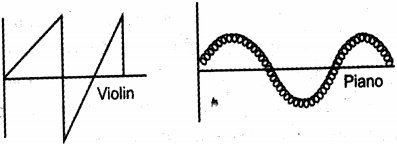
Two musical notes of the same pitch and loudness are played on a violin and a piano. The waveforms are as shown in the figures below. Explain why the wave patterns are different.
Solution
(N/A) Even though the two musical notes have the same pitch (frequency) and loudness (amplitude),they sound different because of their different 'quality' or 'timbre'.
This difference in quality arises because the number and nature of the harmonics and overtones produced by the violin and the piano are different.
Each musical instrument produces a unique combination of harmonics and overtones along with the fundamental frequency,which results in the distinct wave patterns observed for each instrument.
This difference in quality arises because the number and nature of the harmonics and overtones produced by the violin and the piano are different.
Each musical instrument produces a unique combination of harmonics and overtones along with the fundamental frequency,which results in the distinct wave patterns observed for each instrument.
0 likes
View Solution135
Easy
Name the subjective property of sound related to its frequency and of light related to its wavelength.
Solution
(N/A) The subjective property of sound waves,which is related to its frequency,is known as its $pitch$.
As the frequency of sound increases,the $pitch$ also increases.
The subjective property of light,which is related to its wavelength,is known as the $colour$ of light.
Different wavelengths of light correspond to different perceived $colours$ in the visible spectrum.
As the frequency of sound increases,the $pitch$ also increases.
The subjective property of light,which is related to its wavelength,is known as the $colour$ of light.
Different wavelengths of light correspond to different perceived $colours$ in the visible spectrum.
0 likes
View Solution136
Medium
Two friends were playing on identical guitars whose strings were adjusted to give notes of the same pitch. Will the quality of the two notes be the same? Give a reason for your answer.
Solution
(NO) The quality of the two notes need not be the same.
This is because while the pitch of a note is determined solely by its frequency,the quality (or timbre) is determined by its harmonic or overtone content.
It is the number,distribution,and relative intensity of the different harmonics and overtones that determine the quality of a sound.
Even if two guitars are identical,the way they are played or slight variations in the construction and material of the strings can lead to differences in the harmonic content,meaning the quality of the notes produced may differ.
This is because while the pitch of a note is determined solely by its frequency,the quality (or timbre) is determined by its harmonic or overtone content.
It is the number,distribution,and relative intensity of the different harmonics and overtones that determine the quality of a sound.
Even if two guitars are identical,the way they are played or slight variations in the construction and material of the strings can lead to differences in the harmonic content,meaning the quality of the notes produced may differ.
0 likes
View Solution137
Medium
Give one example each of natural vibration,forced vibration,and resonance.
Solution
(N/A) $(i)$ Natural vibration: The oscillations of a simple pendulum about its mean position in the absence of any external force.
$(ii)$ Forced vibration: $A$ sonometer wire,kept under tension,vibrating under the influence of an external vibrating tuning fork.
$(iii)$ Resonance: When the frequency of an external periodic force matches the natural frequency of a system,such as a sonometer wire vibrating with maximum amplitude when the tuning fork frequency matches its own natural frequency.
$(ii)$ Forced vibration: $A$ sonometer wire,kept under tension,vibrating under the influence of an external vibrating tuning fork.
$(iii)$ Resonance: When the frequency of an external periodic force matches the natural frequency of a system,such as a sonometer wire vibrating with maximum amplitude when the tuning fork frequency matches its own natural frequency.
0 likes
View Solution138
Easy
Mention one practical use of echoes.
Solution
(N/A) Echoes are used in $SONAR$ (Sound Navigation and Ranging) and $RADAR$ systems to detect the presence and estimate the distance of underwater objects or flying objects,respectively.
0 likes
View Solution139
Easy
How does a stretched string,on being set into vibration,produce an audible sound?
Solution
(N/A) When a stretched string is set into vibration,it pushes and pulls the surrounding air molecules,creating a series of compressions and rarefactions. These vibrations travel through the air as sound waves. When these waves reach our ears,they cause the eardrum to vibrate,which the brain interprets as an audible sound.
0 likes
View Solution140
Easy
Will the sound be audible if a string is set into vibration on the surface of the moon? Give a reason for your answer.
Solution
(NO) No,the sound will not be audible on the surface of the moon.
Sound is a mechanical wave that requires a material medium (like air,water,or solids) to propagate.
The moon has no atmosphere,meaning it is a vacuum.
Since there is no medium for the sound waves to travel through,the vibrations cannot reach our ears,and therefore,no sound will be heard.
Sound is a mechanical wave that requires a material medium (like air,water,or solids) to propagate.
The moon has no atmosphere,meaning it is a vacuum.
Since there is no medium for the sound waves to travel through,the vibrations cannot reach our ears,and therefore,no sound will be heard.
0 likes
View Solution141
EasyMCQ
What change,if any,would you expect in the characteristics of musical sound when we increase $(i)$ its frequency and (ii) its amplitude?
A
Pitch increases,Loudness increases
B
Pitch decreases,Loudness increases
C
Pitch increases,Loudness decreases
D
Pitch decreases,Loudness decreases
Solution
(A) $(i)$ When the frequency of a sound wave is increased,the pitch of the sound increases. Pitch is the characteristic of sound that determines the shrillness or gravity of a note.
(ii) When the amplitude of a sound wave is increased,the loudness of the sound increases. Loudness is a measure of the sound energy reaching the ear per unit time.
(ii) When the amplitude of a sound wave is increased,the loudness of the sound increases. Loudness is a measure of the sound energy reaching the ear per unit time.
0 likes
View Solution142
Medium
Sound made in front of a tall building $18 \, m$ away is repeated. Name the phenomenon and briefly explain it.
Solution
(N/A) The phenomenon is known as Echo.
An echo is the repetition of sound caused by the reflection of sound waves from a distant surface.
For an echo to be heard,the reflected sound must reach the observer at least $0.1 \, s$ after the original sound,as the human ear has a persistence of hearing of $0.1 \, s$.
The total distance traveled by the sound is $2d$,where $d$ is the distance to the reflecting surface.
Given the speed of sound in air is approximately $340 \, m/s$,the minimum distance required is calculated as $d = (v \times t) / 2 = (340 \times 0.1) / 2 = 17 \, m$.
Since the building is at a distance of $18 \, m$,which is greater than $17 \, m$,the reflected sound reaches the observer after $0.1 \, s$,allowing the echo to be heard clearly.
An echo is the repetition of sound caused by the reflection of sound waves from a distant surface.
For an echo to be heard,the reflected sound must reach the observer at least $0.1 \, s$ after the original sound,as the human ear has a persistence of hearing of $0.1 \, s$.
The total distance traveled by the sound is $2d$,where $d$ is the distance to the reflecting surface.
Given the speed of sound in air is approximately $340 \, m/s$,the minimum distance required is calculated as $d = (v \times t) / 2 = (340 \times 0.1) / 2 = 17 \, m$.
Since the building is at a distance of $18 \, m$,which is greater than $17 \, m$,the reflected sound reaches the observer after $0.1 \, s$,allowing the echo to be heard clearly.
0 likes
View Solution143
EasyMCQ
Which of the following are transferred from one place to another place by the waves?
A
mass
B
wavelength
C
energy
D
velocity
Solution
(C) wave is a disturbance that travels through a medium or vacuum,transferring energy from one point to another without the net transport of matter (mass).
While the particles of the medium oscillate about their mean positions,they do not travel along with the wave.
Therefore,energy is the physical quantity that is transferred by waves from one place to another.
While the particles of the medium oscillate about their mean positions,they do not travel along with the wave.
Therefore,energy is the physical quantity that is transferred by waves from one place to another.
0 likes
View Solution144
EasyMCQ
Sound waves are
A
transverse
B
partly transverse and partly longitudinal
C
none of these
D
longitudinal
Solution
(D) Sound waves are mechanical waves that require a medium for propagation.
In a longitudinal wave,the particles of the medium oscillate back and forth in the same direction as the wave propagation.
Since sound waves travel by creating compressions and rarefactions in the medium,they are classified as longitudinal waves.
In a longitudinal wave,the particles of the medium oscillate back and forth in the same direction as the wave propagation.
Since sound waves travel by creating compressions and rarefactions in the medium,they are classified as longitudinal waves.
0 likes
View Solution145
EasyMCQ
On a slinky,we can produce:
A
both transverse and longitudinal waves
B
transverse waves only
C
longitudinal waves only
D
neither transverse nor longitudinal waves
Solution
(A) slinky is a long,flexible spring.
When we push and pull the slinky along its length,we produce longitudinal waves (compressions and rarefactions).
When we move the slinky up and down or side to side perpendicular to its length,we produce transverse waves (crests and troughs).
Therefore,both types of waves can be produced on a slinky.
When we push and pull the slinky along its length,we produce longitudinal waves (compressions and rarefactions).
When we move the slinky up and down or side to side perpendicular to its length,we produce transverse waves (crests and troughs).
Therefore,both types of waves can be produced on a slinky.
0 likes
View Solution146
EasyMCQ
The distance between two consecutive crests in a wave is known as:
A
half a wavelength
B
one wavelength
C
one-fourth wavelength
D
twice wavelength
Solution
(B) In a transverse wave,a crest represents the point of maximum positive displacement from the equilibrium position.
Consecutive crests are the two nearest points of maximum displacement in the same direction.
The distance between two consecutive crests or two consecutive troughs is defined as one wavelength (denoted by the Greek letter $\lambda$).
Consecutive crests are the two nearest points of maximum displacement in the same direction.
The distance between two consecutive crests or two consecutive troughs is defined as one wavelength (denoted by the Greek letter $\lambda$).
0 likes
View Solution147
EasyMCQ
Hertz is a unit of
A
time period
B
wavelength
C
frequency
D
wave speed
Solution
(C) The $SI$ unit of frequency is $Hertz$ $(Hz)$.
One $Hertz$ is defined as one cycle per second.
Frequency is defined as the number of oscillations or cycles completed by a wave in one second.
Therefore,$Hertz$ is the unit of frequency.
One $Hertz$ is defined as one cycle per second.
Frequency is defined as the number of oscillations or cycles completed by a wave in one second.
Therefore,$Hertz$ is the unit of frequency.
0 likes
View Solution148
EasyMCQ
If the density of a medium through which sound is propagating is minimum,then this point is called:
A
crest
B
compression
C
trough
D
rarefaction
Solution
(D) Sound travels through a medium as a series of compressions and rarefactions.
Compressions are regions of high pressure and high density.
Rarefactions are regions of low pressure and low density.
Since the question specifies that the density of the medium is at its minimum,this point corresponds to a rarefaction.
Compressions are regions of high pressure and high density.
Rarefactions are regions of low pressure and low density.
Since the question specifies that the density of the medium is at its minimum,this point corresponds to a rarefaction.
0 likes
View Solution149
EasyMCQ
The audible range for a normal human being is
A
$20 \, Hz$ to $20 \, kHz$
B
$10 \, Hz$ to $20,000 \, Hz$
C
$10 \, Hz$ to $50 \, kHz$
D
$2 \, Hz$ to $1000 \, Hz$
Solution
(A) The audible range of sound for a healthy human ear is typically between $20 \, Hz$ and $20,000 \, Hz$ (or $20 \, kHz$).
Frequencies below $20 \, Hz$ are called infrasonic,and frequencies above $20,000 \, Hz$ are called ultrasonic.
Therefore,the correct range is $20 \, Hz$ to $20 \, kHz$.
Frequencies below $20 \, Hz$ are called infrasonic,and frequencies above $20,000 \, Hz$ are called ultrasonic.
Therefore,the correct range is $20 \, Hz$ to $20 \, kHz$.
0 likes
View Solution150
MediumMCQ
Ultrasonic waves are not used in which of the following?
A
$SONAR$
B
Radio waves
C
Sonography
D
$CUSA$
Solution
(B) Ultrasonic waves are high-frequency sound waves $(> 20,000 \ Hz)$.
$SONAR$ (Sound Navigation and Ranging) uses ultrasonic waves to detect objects underwater.
Sonography (or ultrasound scanning) uses ultrasonic waves to create images of internal body structures.
$CUSA$ (Cavitron Ultrasonic Surgical Aspirator) uses ultrasonic energy to fragment and remove tissues during surgery.
Radio waves are a type of electromagnetic radiation,not sound waves,and do not involve ultrasonic technology. Therefore,ultrasonic waves are not used in radio waves.
$SONAR$ (Sound Navigation and Ranging) uses ultrasonic waves to detect objects underwater.
Sonography (or ultrasound scanning) uses ultrasonic waves to create images of internal body structures.
$CUSA$ (Cavitron Ultrasonic Surgical Aspirator) uses ultrasonic energy to fragment and remove tissues during surgery.
Radio waves are a type of electromagnetic radiation,not sound waves,and do not involve ultrasonic technology. Therefore,ultrasonic waves are not used in radio waves.
0 likes
View SolutionSOUND — Mix Example - SOUND · Frequently Asked Questions
1Are these SOUND questions useful for JEE and NEET?
Yes. All questions in this section are mapped to JEE Main and NEET exam patterns. Previous year questions from JEE Main, NEET, GUJCET and state-level exams are included with full solutions.
2Can I switch to Hindi or Gujarati for these questions?
Yes. Use the language tabs in the hero section or the sidebar to view the same questions and solutions in English, Hindi or Gujarati.
3How do I generate a question paper from this subtopic?
Use the Vedclass Exam Paper Generator — select the chapter and subtopic, set difficulty, and generate Sets A, B, C, D automatically. First 3 chapters of every subject are free.
Vedclass Products
For Students
Vedclass Test Series
Mock tests in real JEE/NEET style with performance analysis. 5-day free trial.
Start Free TrialFor Teachers
Exam Paper Generator
Generate Set A/B/C/D papers from this chapter in 2 minutes. 3 chapters free.
Try FreeFor Institutes
Online Exam Module
Live online exams with unlimited students, 360° analytics & white-label branding.
See DemoFor Teachers & Institutes
Generate a SOUND Exam Paper in 2 Minutes
Select subtopic & difficulty — Sets A, B, C, D auto-generated with No Repeat logic.
First 3 chapters of every subject are free — no payment required.