
A English
Mix Example - ATOMS AND MOLECULES Questions in English
Class 9 Science · ATOMS AND MOLECULES · Mix Example - ATOMS AND MOLECULES
168+
Questions
English
Language
100%
With Solutions
Showing 50 of 168 questions in English
51
Easy
Helium atom has $2$ electrons in its valence shell,but its valency is not $2$. Explain.
Solution
(N/A) The Helium atom has only one shell ($K$-shell),which has a maximum capacity of accommodating $2$ electrons. Since this shell is completely filled,the atom is stable and does not have a tendency to gain,lose,or share electrons with other atoms. Therefore,the valency of Helium is $0$.
0 likes
View Solution52
MediumMCQ
The atomic numbers of three elements $A, B$ and $C$ are $9, 10$ and $13$ respectively. Which of them will form a cation?
A
$A$
B
$B$
C
$C$
D
None of these
Solution
(C) The electronic configuration of the elements is as follows:
Element $A$ (atomic number $9$): $2, 7$. It needs $1$ electron to complete its octet,so it forms an anion.
Element $B$ (atomic number $10$): $2, 8$. It has a complete octet and is a noble gas,so it is inert.
Element $C$ (atomic number $13$): $2, 8, 3$. It has $3$ valence electrons. Metals tend to lose their valence electrons to achieve a stable octet configuration,thereby forming a cation ($+$ve ion).
Therefore,element $C$ will form a cation by losing $3$ electrons: $C (2, 8, 3) \rightarrow C^{3+} (2, 8) + 3e^-$.
Element $A$ (atomic number $9$): $2, 7$. It needs $1$ electron to complete its octet,so it forms an anion.
Element $B$ (atomic number $10$): $2, 8$. It has a complete octet and is a noble gas,so it is inert.
Element $C$ (atomic number $13$): $2, 8, 3$. It has $3$ valence electrons. Metals tend to lose their valence electrons to achieve a stable octet configuration,thereby forming a cation ($+$ve ion).
Therefore,element $C$ will form a cation by losing $3$ electrons: $C (2, 8, 3) \rightarrow C^{3+} (2, 8) + 3e^-$.
0 likes
View Solution53
Easy
What is meant by the following?
$(i)$ Molar mass
$(ii)$ Valency
$(i)$ Molar mass
$(ii)$ Valency
Solution
(N/A) $(i)$ Molar mass: The mass of one mole of a substance in grams is called its molar mass.
$(ii)$ Valency: The combining capacity of an atom of an element is known as its valency. It represents the number of electrons an atom needs to lose,gain,or share to achieve a stable electronic configuration.
$(ii)$ Valency: The combining capacity of an atom of an element is known as its valency. It represents the number of electrons an atom needs to lose,gain,or share to achieve a stable electronic configuration.
0 likes
View Solution54
Medium
State the law of constant proportions.
Solution
(N/A) The law of constant proportions states that in a chemical substance,the elements are always present in definite proportions by mass. This means that a pure chemical compound is always made up of the same elements combined together in the same fixed ratio of mass,regardless of the source from which it is obtained or the method of its preparation.
0 likes
View Solution55
Easy
Define the term mole.
Solution
(N/A) mole is a fundamental unit in chemistry used to quantify the amount of a substance.
One mole of any substance contains exactly $6.022 \times 10^{23}$ elementary entities,such as atoms,molecules,ions,or electrons.
This constant value is known as Avogadro's number $(N_A)$.
One mole of any substance contains exactly $6.022 \times 10^{23}$ elementary entities,such as atoms,molecules,ions,or electrons.
This constant value is known as Avogadro's number $(N_A)$.
0 likes
View Solution56
MediumMCQ
The chemical formula of the oxide of an element $X$ is $X_2O_5$. Write the chemical formula of its chloride.
A
$XCl_3$
B
$XCl_5$
C
$X_2Cl_5$
D
$XCl_2$
Solution
(B) $1$. In the oxide $X_2O_5$,the valency of oxygen is $2$.
$2$. Let the valency of element $X$ be $v$.
$3$. According to the criss-cross method for $X_2O_5$,the valency of $X$ is $5$ (since $2 \times v = 5 \times 2$,so $v = 5$).
$4$. Chlorine $(Cl)$ has a valency of $1$.
$5$. To write the formula of the chloride of $X$,we place the valency of $X$ $(5)$ under $Cl$ and the valency of $Cl$ $(1)$ under $X$.
$6$. Thus,the chemical formula is $X_1Cl_5$,which is written as $XCl_5$.
$2$. Let the valency of element $X$ be $v$.
$3$. According to the criss-cross method for $X_2O_5$,the valency of $X$ is $5$ (since $2 \times v = 5 \times 2$,so $v = 5$).
$4$. Chlorine $(Cl)$ has a valency of $1$.
$5$. To write the formula of the chloride of $X$,we place the valency of $X$ $(5)$ under $Cl$ and the valency of $Cl$ $(1)$ under $X$.
$6$. Thus,the chemical formula is $X_1Cl_5$,which is written as $XCl_5$.
0 likes
View Solution57
Easy
Determine the atomicity of the following molecules:
$(i)$ $H_{2}SO_{4}$
$(ii)$ $CCl_{4}$
$(i)$ $H_{2}SO_{4}$
$(ii)$ $CCl_{4}$
Solution
(N/A) Atomicity is defined as the total number of atoms present in one molecule of a substance.
$(i)$ In $H_{2}SO_{4}$ (Sulfuric acid):
Number of Hydrogen atoms = $2$
Number of Sulfur atoms = $1$
Number of Oxygen atoms = $4$
Total atoms = $2 + 1 + 4 = 7$
Therefore,the atomicity is $7$.
$(ii)$ In $CCl_{4}$ (Carbon tetrachloride):
Number of Carbon atoms = $1$
Number of Chlorine atoms = $4$
Total atoms = $1 + 4 = 5$
Therefore,the atomicity is $5$.
$(i)$ In $H_{2}SO_{4}$ (Sulfuric acid):
Number of Hydrogen atoms = $2$
Number of Sulfur atoms = $1$
Number of Oxygen atoms = $4$
Total atoms = $2 + 1 + 4 = 7$
Therefore,the atomicity is $7$.
$(ii)$ In $CCl_{4}$ (Carbon tetrachloride):
Number of Carbon atoms = $1$
Number of Chlorine atoms = $4$
Total atoms = $1 + 4 = 5$
Therefore,the atomicity is $5$.
0 likes
View Solution58
Easy
What is the difference between $2H$ and $H_2$?
Solution
(N/A) $2H$ represents $2$ individual atoms of hydrogen,which exist independently. In contrast,$H_2$ represents a single molecule of hydrogen,which consists of $2$ hydrogen atoms chemically bonded together.
0 likes
View Solution59
EasyMCQ
Which of the following compounds contain polyatomic ions?
$NaOH, NaCl, Na_{2}O, NaNO_{3}$
$NaOH, NaCl, Na_{2}O, NaNO_{3}$
A
$NaOH, NaCl$
B
$NaCl, Na_{2}O$
C
$NaOH, NaNO_{3}$
D
$Na_{2}O, NaNO_{3}$
Solution
(C) polyatomic ion is an ion composed of two or more atoms covalently bonded or of a metal complex that can be considered to be acting as a single unit.
$1$. In $NaOH$,the hydroxide ion $(OH^-)$ is a polyatomic ion.
$2$. In $NaCl$,both $Na^+$ and $Cl^-$ are monatomic ions.
$3$. In $Na_{2}O$,both $Na^+$ and $O^{2-}$ are monatomic ions.
$4$. In $NaNO_{3}$,the nitrate ion $(NO_{3}^-)$ is a polyatomic ion.
Therefore,$NaOH$ and $NaNO_{3}$ contain polyatomic ions.
$1$. In $NaOH$,the hydroxide ion $(OH^-)$ is a polyatomic ion.
$2$. In $NaCl$,both $Na^+$ and $Cl^-$ are monatomic ions.
$3$. In $Na_{2}O$,both $Na^+$ and $O^{2-}$ are monatomic ions.
$4$. In $NaNO_{3}$,the nitrate ion $(NO_{3}^-)$ is a polyatomic ion.
Therefore,$NaOH$ and $NaNO_{3}$ contain polyatomic ions.
0 likes
View Solution60
EasyMCQ
Who proposed the laws of chemical combination?
A
John Dalton
B
Antoine $L$. Lavoisier and Joseph $L$. Proust
C
Dmitri Mendeleev
D
Robert Boyle
Solution
(B) The laws of chemical combination were established by Antoine $L.$ Lavoisier and Joseph $L.$ Proust.
Antoine $L.$ Lavoisier is known as the 'Father of Modern Chemistry' and proposed the Law of Conservation of Mass.
Joseph $L.$ Proust proposed the Law of Definite Proportions.
Antoine $L.$ Lavoisier is known as the 'Father of Modern Chemistry' and proposed the Law of Conservation of Mass.
Joseph $L.$ Proust proposed the Law of Definite Proportions.
0 likes
View Solution61
Difficult
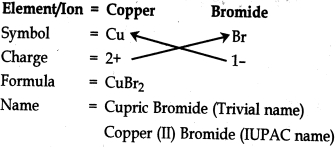
Derive the molecular formula for Copper $(II)$ Bromide.
Solution
(N/A) To derive the molecular formula for Copper $(II)$ Bromide,follow these steps:
$1$. Identify the symbols of the elements involved: Copper is represented by $Cu$ and Bromide is represented by $Br$.
$2$. Determine the valency or charge of each ion: Copper $(II)$ indicates a charge of $+2$ $(Cu^{2+})$,and Bromide has a charge of $-1$ $(Br^-)$.
$3$. Use the criss-cross method to balance the charges: The charge of Copper $(2)$ becomes the subscript for Bromide,and the charge of Bromide $(1)$ becomes the subscript for Copper.
$4$. Write the formula: By crossing the charges,we get $Cu_1Br_2$,which is written as $CuBr_2$.
$1$. Identify the symbols of the elements involved: Copper is represented by $Cu$ and Bromide is represented by $Br$.
$2$. Determine the valency or charge of each ion: Copper $(II)$ indicates a charge of $+2$ $(Cu^{2+})$,and Bromide has a charge of $-1$ $(Br^-)$.
$3$. Use the criss-cross method to balance the charges: The charge of Copper $(2)$ becomes the subscript for Bromide,and the charge of Bromide $(1)$ becomes the subscript for Copper.
$4$. Write the formula: By crossing the charges,we get $Cu_1Br_2$,which is written as $CuBr_2$.
0 likes
View Solution62
Medium
Give one example each of:
$(a)$ Triatomic element
$(b)$ Monoatomic molecule
$(c)$ Polyatomic element
$(d)$ Polyatomic ion
$(a)$ Triatomic element
$(b)$ Monoatomic molecule
$(c)$ Polyatomic element
$(d)$ Polyatomic ion
Solution
(N/A) $O_3$ (Ozone) is a triatomic element because it consists of three oxygen atoms.
$(b)$ $Ar$ (Argon) is a monoatomic molecule as it is a noble gas and exists as a single atom.
$(c)$ $S_8$ (Sulphur) is a polyatomic element because its molecule consists of eight sulphur atoms.
$(d)$ $SO_4^{2-}$ (Sulphate) or $NH_4^+$ (Ammonium) are examples of polyatomic ions,which are ions consisting of more than one atom.
$(b)$ $Ar$ (Argon) is a monoatomic molecule as it is a noble gas and exists as a single atom.
$(c)$ $S_8$ (Sulphur) is a polyatomic element because its molecule consists of eight sulphur atoms.
$(d)$ $SO_4^{2-}$ (Sulphate) or $NH_4^+$ (Ammonium) are examples of polyatomic ions,which are ions consisting of more than one atom.
0 likes
View Solution63
Medium
Differentiate between:
$(i)$ Molar mass and Avogadro's constant.
$(ii)$ Molecular mass and formula unit mass.
$(i)$ Molar mass and Avogadro's constant.
$(ii)$ Molecular mass and formula unit mass.
Solution
(N/A)
| $(i)$ Molar mass | Avogadro's constant |
|---|---|
| It is the mass of one mole of a substance expressed in grams $(g/mol)$. | It is the number of particles (atoms,molecules,or ions) present in one mole of a substance,equal to $6.022 \times 10^{23} \text{ mol}^{-1}$. |
| $(ii)$ Molecular mass | Formula unit mass |
| It is the sum of the atomic masses of all atoms present in a molecule of a covalent compound. | It is the sum of the atomic masses of all atoms in a formula unit of an ionic compound. |
0 likes
View Solution64
Medium
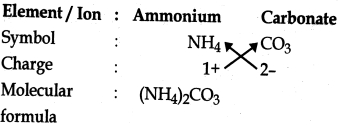
Derive the molecular formula for Ammonium carbonate.
Solution
(N/A) To derive the molecular formula for Ammonium carbonate,we follow these steps:
$1$. Identify the ions and their respective charges:
- Ammonium ion: $NH_4^+$ (charge = $+1$)
- Carbonate ion: $CO_3^{2-}$ (charge = $-2$)
$2$. Write the symbols and their charges side-by-side:
- Symbol: $NH_4$ and $CO_3$
- Charge: $+1$ and $-2$
$3$. Use the criss-cross method to balance the charges:
- The charge of the Ammonium ion $(+1)$ becomes the subscript for the Carbonate ion.
- The charge of the Carbonate ion $(-2)$ becomes the subscript for the Ammonium ion.
$4$. Combine them to form the neutral compound:
- Since we need two Ammonium ions to balance one Carbonate ion,the formula is $(NH_4)_2CO_3$.
$1$. Identify the ions and their respective charges:
- Ammonium ion: $NH_4^+$ (charge = $+1$)
- Carbonate ion: $CO_3^{2-}$ (charge = $-2$)
$2$. Write the symbols and their charges side-by-side:
- Symbol: $NH_4$ and $CO_3$
- Charge: $+1$ and $-2$
$3$. Use the criss-cross method to balance the charges:
- The charge of the Ammonium ion $(+1)$ becomes the subscript for the Carbonate ion.
- The charge of the Carbonate ion $(-2)$ becomes the subscript for the Ammonium ion.
$4$. Combine them to form the neutral compound:
- Since we need two Ammonium ions to balance one Carbonate ion,the formula is $(NH_4)_2CO_3$.
0 likes
View Solution65
Medium
What is a molecular formula? State with an example what information can be derived from a molecular formula.
Solution
(N/A) molecular formula represents the actual number of atoms of each element present in one molecule of a compound.
For example,the molecular formula of aluminium sulphate is $Al_{2}(SO_{4})_{3}$. It provides the following information:
$(i)$ The compound is composed of three different types of atoms: aluminium $(Al)$,sulphur $(S)$,and oxygen $(O)$.
$(ii)$ There are a total of $17$ atoms in one molecule ($2$ atoms of $Al$,$3$ atoms of $S$,and $12$ atoms of $O$).
$(iii)$ The valency of aluminium $(Al^{3+})$ is $3$,while the valency of the sulphate ion $(SO_{4}^{2-})$ is $2$.
For example,the molecular formula of aluminium sulphate is $Al_{2}(SO_{4})_{3}$. It provides the following information:
$(i)$ The compound is composed of three different types of atoms: aluminium $(Al)$,sulphur $(S)$,and oxygen $(O)$.
$(ii)$ There are a total of $17$ atoms in one molecule ($2$ atoms of $Al$,$3$ atoms of $S$,and $12$ atoms of $O$).
$(iii)$ The valency of aluminium $(Al^{3+})$ is $3$,while the valency of the sulphate ion $(SO_{4}^{2-})$ is $2$.
0 likes
View Solution66
Easy
Define Avogadro's constant. How is it related to a mole?
Solution
(N/A) Avogadro's constant $(N_A)$ is defined as the number of constituent particles (atoms,molecules,or ions) present in one mole of any substance. Its value is approximately $6.022 \times 10^{23} \text{ particles/mol}$.
Relationship to a mole: $A$ mole is a unit that represents a specific quantity of substance. By definition,one mole of any substance contains exactly $6.022 \times 10^{23}$ elementary entities. Therefore,the number of particles in one mole is equal to Avogadro's constant.
Relationship to a mole: $A$ mole is a unit that represents a specific quantity of substance. By definition,one mole of any substance contains exactly $6.022 \times 10^{23}$ elementary entities. Therefore,the number of particles in one mole is equal to Avogadro's constant.
0 likes
View Solution67
Medium
What is the difference between a cation and an anion?
Solution
(N/A)
| Cation | Anion |
| $1.$ It is positively charged,e.g.,$Na^+$ | $1.$ It is negatively charged,e.g.,$Cl^-$ |
| $2.$ It is formed from metal atoms. | $2.$ It is formed from non-metal atoms. |
| $3.$ On passing electric current,it moves towards the cathode. | $3.$ On passing electric current,it moves towards the anode. |
| $4.$ It is smaller in size than its parent atom. | $4.$ It is larger in size than its parent atom. |
0 likes
View Solution68
Medium
Write the chemical formulae and names of the compounds formed by the combination of:
$(i)$ $Fe^{3+}$ and $SO_{4}^{2-}$
$(ii)$ $NH_{4}^{+}$ and $CO_{3}^{2-}$
$(i)$ $Fe^{3+}$ and $SO_{4}^{2-}$
$(ii)$ $NH_{4}^{+}$ and $CO_{3}^{2-}$
Solution
(N/A) To write the chemical formula,we use the criss-cross method where the valency of one ion becomes the subscript of the other.
$(i)$ For $Fe^{3+}$ and $SO_{4}^{2-}$:
- The valency of $Fe$ is $3$ and $SO_{4}$ is $2$.
- By crossing the valencies,we get $Fe_{2}(SO_{4})_{3}$.
- The name of the compound is Iron$(III)$ sulphate.
$(ii)$ For $NH_{4}^{+}$ and $CO_{3}^{2-}$:
- The valency of $NH_{4}$ is $1$ and $CO_{3}$ is $2$.
- By crossing the valencies,we get $(NH_{4})_{2}CO_{3}$.
- The name of the compound is Ammonium carbonate.
$(i)$ For $Fe^{3+}$ and $SO_{4}^{2-}$:
- The valency of $Fe$ is $3$ and $SO_{4}$ is $2$.
- By crossing the valencies,we get $Fe_{2}(SO_{4})_{3}$.
- The name of the compound is Iron$(III)$ sulphate.
$(ii)$ For $NH_{4}^{+}$ and $CO_{3}^{2-}$:
- The valency of $NH_{4}$ is $1$ and $CO_{3}$ is $2$.
- By crossing the valencies,we get $(NH_{4})_{2}CO_{3}$.
- The name of the compound is Ammonium carbonate.
0 likes
View Solution69
Medium
$(i)$ Name the body which approves the nomenclature of elements and compounds.
$(ii)$ The symbol of sodium is written as $Na$ and not as $S$. Give reason.
$(iii)$ Name one element which forms diatomic and one which forms tetraatomic molecules.
$(ii)$ The symbol of sodium is written as $Na$ and not as $S$. Give reason.
$(iii)$ Name one element which forms diatomic and one which forms tetraatomic molecules.
Solution
(N/A) $(i)$ The body that approves the nomenclature of elements and compounds is the International Union of Pure and Applied Chemistry $(IUPAC)$.
$(ii)$ The symbol of sodium is $Na$ because it is derived from its Latin name,$Natrium$. The symbol $S$ is reserved for sulfur.
$(iii)$ $(a)$ An element that forms a diatomic molecule is Hydrogen $(H_2)$.
$(b)$ An element that forms a tetraatomic molecule is Phosphorus $(P_4)$.
$(ii)$ The symbol of sodium is $Na$ because it is derived from its Latin name,$Natrium$. The symbol $S$ is reserved for sulfur.
$(iii)$ $(a)$ An element that forms a diatomic molecule is Hydrogen $(H_2)$.
$(b)$ An element that forms a tetraatomic molecule is Phosphorus $(P_4)$.
0 likes
View Solution70
Medium
$(a)$ Define atomicity.
$(b)$ Give an example for an element which is monoatomic and a polyatomic molecule.
$(b)$ Give an example for an element which is monoatomic and a polyatomic molecule.
Solution
(N/A) Atomicity is defined as the total number of atoms present in one molecule of an element or a compound.
$(b)$ Monoatomic molecule: $He$ (Helium) or $Ne$ (Neon) are examples of monoatomic molecules because they consist of a single atom.
Polyatomic molecule: $S_8$ (Sulphur) is an example of a polyatomic molecule because it consists of eight atoms.
$(b)$ Monoatomic molecule: $He$ (Helium) or $Ne$ (Neon) are examples of monoatomic molecules because they consist of a single atom.
Polyatomic molecule: $S_8$ (Sulphur) is an example of a polyatomic molecule because it consists of eight atoms.
0 likes
View Solution71
Medium
$(a)$ What is the law of constant proportions? Explain with the help of an example.
$(b)$ Which postulate of Dalton's atomic theory is in agreement with this law?
$(b)$ Which postulate of Dalton's atomic theory is in agreement with this law?
Solution
(N/A) The law of constant proportions states that in a chemical substance, the elements are always present in definite proportions by mass.
Example: In water $(H_2O)$, the ratio of the mass of hydrogen to the mass of oxygen is always $1:8$, regardless of the source of water.
$(b)$ The postulate of Dalton's atomic theory that is in agreement with this law is: "The relative number and kinds of atoms are constant in a given compound."
Example: In water $(H_2O)$, the ratio of the mass of hydrogen to the mass of oxygen is always $1:8$, regardless of the source of water.
$(b)$ The postulate of Dalton's atomic theory that is in agreement with this law is: "The relative number and kinds of atoms are constant in a given compound."
0 likes
View Solution72
EasyMCQ
Calculate the number of moles in $5.75 \, g$ of sodium (atomic mass of sodium $= 23$).
A
$0.15 \, \text{moles}$
B
$0.25 \, \text{moles}$
C
$0.35 \, \text{moles}$
D
$0.45 \, \text{moles}$
Solution
(B) Given mass $(m) = 5.75 \, g$.
Atomic mass of sodium $= 23 \, u$.
Molar mass $(M) = 23 \, g/mol$.
The formula for the number of moles $(n)$ is given by: $n = \frac{m}{M}$.
Substituting the values: $n = \frac{5.75}{23} = 0.25 \, \text{moles}$.
Therefore, the number of moles in $5.75 \, g$ of sodium is $0.25 \, \text{moles}$.
Atomic mass of sodium $= 23 \, u$.
Molar mass $(M) = 23 \, g/mol$.
The formula for the number of moles $(n)$ is given by: $n = \frac{m}{M}$.
Substituting the values: $n = \frac{5.75}{23} = 0.25 \, \text{moles}$.
Therefore, the number of moles in $5.75 \, g$ of sodium is $0.25 \, \text{moles}$.
0 likes
View Solution73
Difficult
Which amongst the following has a greater number of atoms,$11.5 \, g$ of sodium $(Na)$ or $15 \, g$ of calcium $(Ca)$? How? (Given: atomic mass of $Na = 23 \, u$,$Ca = 40 \, u$)
Solution
(A) $1$. Calculate the number of atoms in $11.5 \, g$ of $Na$:
- Molar mass of $Na = 23 \, g/mol$.
- Number of moles of $Na = \frac{11.5 \, g}{23 \, g/mol} = 0.5 \, mol$.
- Number of atoms in $Na = 0.5 \times 6.022 \times 10^{23} = 3.011 \times 10^{23}$ atoms.
$2$. Calculate the number of atoms in $15 \, g$ of $Ca$:
- Molar mass of $Ca = 40 \, g/mol$.
- Number of moles of $Ca = \frac{15 \, g}{40 \, g/mol} = 0.375 \, mol$.
- Number of atoms in $Ca = 0.375 \times 6.022 \times 10^{23} = 2.258 \times 10^{23}$ atoms.
$3$. Conclusion:
- Since $3.011 \times 10^{23} > 2.258 \times 10^{23}$,$11.5 \, g$ of sodium contains a greater number of atoms.
- Molar mass of $Na = 23 \, g/mol$.
- Number of moles of $Na = \frac{11.5 \, g}{23 \, g/mol} = 0.5 \, mol$.
- Number of atoms in $Na = 0.5 \times 6.022 \times 10^{23} = 3.011 \times 10^{23}$ atoms.
$2$. Calculate the number of atoms in $15 \, g$ of $Ca$:
- Molar mass of $Ca = 40 \, g/mol$.
- Number of moles of $Ca = \frac{15 \, g}{40 \, g/mol} = 0.375 \, mol$.
- Number of atoms in $Ca = 0.375 \times 6.022 \times 10^{23} = 2.258 \times 10^{23}$ atoms.
$3$. Conclusion:
- Since $3.011 \times 10^{23} > 2.258 \times 10^{23}$,$11.5 \, g$ of sodium contains a greater number of atoms.
0 likes
View Solution74
EasyMCQ
What is the mass of one mole of oxygen atoms (in $g$)?
A
$8$
B
$16$
C
$32$
D
$64$
Solution
(B) The molar mass of an oxygen atom $(O)$ is $16 \text{ g/mol}$.
The formula to calculate mass is: $\text{Mass} = \text{number of moles} \times \text{molar mass}$.
Given that the number of moles is $1 \text{ mol}$,the calculation is:
$\text{Mass} = 1 \text{ mol} \times 16 \text{ g/mol} = 16 \text{ g}$.
Therefore,the mass of one mole of oxygen atoms is $16 \text{ g}$.
The formula to calculate mass is: $\text{Mass} = \text{number of moles} \times \text{molar mass}$.
Given that the number of moles is $1 \text{ mol}$,the calculation is:
$\text{Mass} = 1 \text{ mol} \times 16 \text{ g/mol} = 16 \text{ g}$.
Therefore,the mass of one mole of oxygen atoms is $16 \text{ g}$.
0 likes
View Solution75
Easy
$(a)$ Write the chemical formula of sodium sulphate.
$(b)$ Name one element each that forms a diatomic and a tetraatomic molecule.
$(b)$ Name one element each that forms a diatomic and a tetraatomic molecule.
Solution
(N/A) The chemical formula of sodium sulphate is $Na_{2}SO_{4}$.
$(b)$ $A$ diatomic molecule consists of two atoms of the same element. Examples include Oxygen $(O_{2})$,Hydrogen $(H_{2})$,or Nitrogen $(N_{2})$. Any one of these can be cited.
$A$ tetraatomic molecule consists of four atoms of the same element. Phosphorus $(P_{4})$ is a common example of a tetraatomic molecule.
$(b)$ $A$ diatomic molecule consists of two atoms of the same element. Examples include Oxygen $(O_{2})$,Hydrogen $(H_{2})$,or Nitrogen $(N_{2})$. Any one of these can be cited.
$A$ tetraatomic molecule consists of four atoms of the same element. Phosphorus $(P_{4})$ is a common example of a tetraatomic molecule.
0 likes
View Solution76
EasyMCQ
State the postulate of Dalton's atomic theory which led to the law of conservation of mass. Calculate the molecular mass of water.
A
Atoms are indivisible particles.
B
Atoms can neither be created nor destroyed in a chemical reaction.
C
Atoms of a given element have identical properties.
D
Atoms combine in the ratio of small whole numbers.
Solution
(B) The postulate of Dalton's atomic theory that led to the law of conservation of mass is: $Atoms$ can neither be created nor destroyed in a chemical reaction.
To calculate the molecular mass of water $(H_2O)$:
Atomic mass of $H = 1 \text{ u}$
Atomic mass of $O = 16 \text{ u}$
Molecular mass of $H_2O = (2 \times \text{atomic mass of } H) + (1 \times \text{atomic mass of } O)$
$= (2 \times 1) + (1 \times 16) = 2 + 16 = 18 \text{ u}$.
To calculate the molecular mass of water $(H_2O)$:
Atomic mass of $H = 1 \text{ u}$
Atomic mass of $O = 16 \text{ u}$
Molecular mass of $H_2O = (2 \times \text{atomic mass of } H) + (1 \times \text{atomic mass of } O)$
$= (2 \times 1) + (1 \times 16) = 2 + 16 = 18 \text{ u}$.
0 likes
View Solution77
Difficult
Define formula unit mass of a compound. Calculate the formula unit mass of:
$(a)$ $Na_{2}CO_{3} \cdot 10H_{2}O$
$(b)$ $CuSO_{4}$
(Given atomic mass of $Na = 23 \text{ u}, C = 12 \text{ u}, O = 16 \text{ u}, Cu = 63.5 \text{ u}, S = 32 \text{ u}, H = 1 \text{ u}$)
$(a)$ $Na_{2}CO_{3} \cdot 10H_{2}O$
$(b)$ $CuSO_{4}$
(Given atomic mass of $Na = 23 \text{ u}, C = 12 \text{ u}, O = 16 \text{ u}, Cu = 63.5 \text{ u}, S = 32 \text{ u}, H = 1 \text{ u}$)
Solution
(N/A) The formula unit mass of a substance is the sum of the atomic masses of all atoms in a formula unit of a compound. It is calculated in the same manner as molecular mass,with the distinction that the term 'formula unit mass' is used for substances whose constituent particles are ions,such as $NaCl$.
$(a)$ $Na_{2}CO_{3} \cdot 10H_{2}O = (2 \times \text{Mass of } Na) + (1 \times \text{Mass of } C) + (3 \times \text{Mass of } O) + 10 \times (2 \times \text{Mass of } H + 1 \times \text{Mass of } O)$
$= (2 \times 23) + (1 \times 12) + (3 \times 16) + 10 \times (2 \times 1 + 16)$
$= 46 + 12 + 48 + 10 \times (18)$
$= 106 + 180 = 286 \text{ u}$
$(b)$ $CuSO_{4} = (1 \times \text{Mass of } Cu) + (1 \times \text{Mass of } S) + (4 \times \text{Mass of } O)$
$= 63.5 + 32 + (4 \times 16)$
$= 63.5 + 32 + 64 = 159.5 \text{ u}$
$(a)$ $Na_{2}CO_{3} \cdot 10H_{2}O = (2 \times \text{Mass of } Na) + (1 \times \text{Mass of } C) + (3 \times \text{Mass of } O) + 10 \times (2 \times \text{Mass of } H + 1 \times \text{Mass of } O)$
$= (2 \times 23) + (1 \times 12) + (3 \times 16) + 10 \times (2 \times 1 + 16)$
$= 46 + 12 + 48 + 10 \times (18)$
$= 106 + 180 = 286 \text{ u}$
$(b)$ $CuSO_{4} = (1 \times \text{Mass of } Cu) + (1 \times \text{Mass of } S) + (4 \times \text{Mass of } O)$
$= 63.5 + 32 + (4 \times 16)$
$= 63.5 + 32 + 64 = 159.5 \text{ u}$
0 likes
View Solution78
Difficult
Write the chemical formulae for the following compounds and find the ratio by mass of the combining elements in each one of them.
$(N=14 \ u, H=1 \ u, C=12 \ u, O=16 \ u, S=32 \ u)$
$(a)$ Methane
$(b)$ Carbon dioxide
$(c)$ Hydrogen sulphide
$(N=14 \ u, H=1 \ u, C=12 \ u, O=16 \ u, S=32 \ u)$
$(a)$ Methane
$(b)$ Carbon dioxide
$(c)$ Hydrogen sulphide
Solution
(A) Methane: Formula is $CH_{4}$. The ratio by mass of $C:H$ is $12:(4 \times 1) = 12:4 = 3:1$.
$(b)$ Carbon dioxide: Formula is $CO_{2}$. The ratio by mass of $C:O$ is $12:(2 \times 16) = 12:32 = 3:8$.
$(c)$ Hydrogen sulphide: Formula is $H_{2}S$. The ratio by mass of $H:S$ is $(2 \times 1):32 = 2:32 = 1:16$.
$(b)$ Carbon dioxide: Formula is $CO_{2}$. The ratio by mass of $C:O$ is $12:(2 \times 16) = 12:32 = 3:8$.
$(c)$ Hydrogen sulphide: Formula is $H_{2}S$. The ratio by mass of $H:S$ is $(2 \times 1):32 = 2:32 = 1:16$.
0 likes
View Solution79
Medium
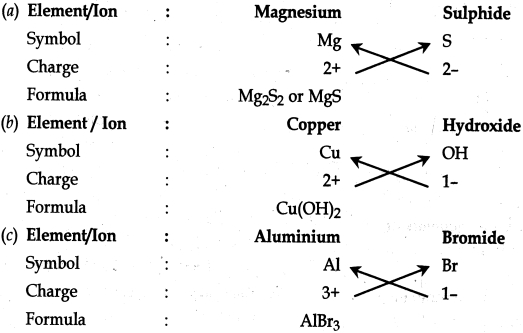
Write the chemical formulae of the compounds formed by the following ions:
$(a)$ $Mg^{2+}$ and $S^{2-}$
$(b)$ $Cu^{2+}$ and $OH^-$
$(c)$ $Al^{3+}$ and $Br^-$
Name the compounds formed in each case.
$(a)$ $Mg^{2+}$ and $S^{2-}$
$(b)$ $Cu^{2+}$ and $OH^-$
$(c)$ $Al^{3+}$ and $Br^-$
Name the compounds formed in each case.
Solution
(N/A) To write the chemical formula,we use the criss-cross method where the valency of one ion becomes the subscript of the other.
$(a)$ For $Mg^{2+}$ and $S^{2-}$:
- The charges are $+2$ and $-2$. Since the magnitudes are equal,they cancel out to form a $1:1$ ratio.
- Chemical Formula: $MgS$
- Name: Magnesium sulphide
$(b)$ For $Cu^{2+}$ and $OH^-$:
- The valency of $Cu$ is $2$ and $OH$ is $1$. By criss-crossing,we get $Cu(OH)_2$.
- Chemical Formula: $Cu(OH)_2$
- Name: Copper$(II)$ hydroxide
$(c)$ For $Al^{3+}$ and $Br^-$:
- The valency of $Al$ is $3$ and $Br$ is $1$. By criss-crossing,we get $AlBr_3$.
- Chemical Formula: $AlBr_3$
- Name: Aluminium bromide
$(a)$ For $Mg^{2+}$ and $S^{2-}$:
- The charges are $+2$ and $-2$. Since the magnitudes are equal,they cancel out to form a $1:1$ ratio.
- Chemical Formula: $MgS$
- Name: Magnesium sulphide
$(b)$ For $Cu^{2+}$ and $OH^-$:
- The valency of $Cu$ is $2$ and $OH$ is $1$. By criss-crossing,we get $Cu(OH)_2$.
- Chemical Formula: $Cu(OH)_2$
- Name: Copper$(II)$ hydroxide
$(c)$ For $Al^{3+}$ and $Br^-$:
- The valency of $Al$ is $3$ and $Br$ is $1$. By criss-crossing,we get $AlBr_3$.
- Chemical Formula: $AlBr_3$
- Name: Aluminium bromide
0 likes
View Solution80
DifficultMCQ
Nitrogen and hydrogen combine in the ratio $14:3$ by mass to form an ammonia molecule. Find the formula of the ammonia molecule by calculating the molar ratio. (Given atomic mass of $N = 14 \ u, H = 1 \ u$)
A
$NH_2$
B
$NH_3$
C
$N_2H_3$
D
$NH_4$
Solution
(B) To find the formula of ammonia,we calculate the molar ratio of the constituent elements:
The ratio of the number of atoms of $N$ to $H$ is $1:3$.
Therefore,the formula of ammonia is $NH_3$.
| Element | Mass Ratio / Atomic Mass = Molar Ratio |
|---|---|
| $N$ | $14 / 14 = 1$ |
| $H$ | $3 / 1 = 3$ |
The ratio of the number of atoms of $N$ to $H$ is $1:3$.
Therefore,the formula of ammonia is $NH_3$.
0 likes
View Solution81
Medium
$(a)$ An atom is considered electrically neutral. Explain.
$(b)$ State the valency of Helium.
$(c)$ If an atom has an atomic mass of $4$ and $2$ protons in its nucleus,how many neutrons does it have?
$(b)$ State the valency of Helium.
$(c)$ If an atom has an atomic mass of $4$ and $2$ protons in its nucleus,how many neutrons does it have?
Solution
(N/A) An atom is considered electrically neutral because it contains an equal number of positively charged protons and negatively charged electrons,which cancel out each other's charge.
$(b)$ The valency of Helium is $0$ because its outermost shell is completely filled (it has a stable duplet configuration).
$(c)$ The formula for atomic mass is: $\text{Atomic mass} = \text{Number of protons} + \text{Number of neutrons}$.
Given: $\text{Atomic mass} = 4$,$\text{Number of protons} = 2$.
Substituting the values: $4 = 2 + \text{Number of neutrons}$.
Therefore,$\text{Number of neutrons} = 4 - 2 = 2$.
$(b)$ The valency of Helium is $0$ because its outermost shell is completely filled (it has a stable duplet configuration).
$(c)$ The formula for atomic mass is: $\text{Atomic mass} = \text{Number of protons} + \text{Number of neutrons}$.
Given: $\text{Atomic mass} = 4$,$\text{Number of protons} = 2$.
Substituting the values: $4 = 2 + \text{Number of neutrons}$.
Therefore,$\text{Number of neutrons} = 4 - 2 = 2$.
0 likes
View Solution82
Medium
Calculate the number of particles in each of the following:
$(a)$ $48 \,g$ of $Mg$
$(b)$ $8 \,g$ of $O_2$
$(c)$ $0.1$ mole of carbon (Atomic mass $Mg = 24 \,u, O = 16 \,u, C = 12 \,u$,Avogadro constant $= 6.022 \times 10^{23}$)
$(a)$ $48 \,g$ of $Mg$
$(b)$ $8 \,g$ of $O_2$
$(c)$ $0.1$ mole of carbon (Atomic mass $Mg = 24 \,u, O = 16 \,u, C = 12 \,u$,Avogadro constant $= 6.022 \times 10^{23}$)
Solution
(N/A) The number of atoms $= \frac{\text{Given mass}}{\text{Molar mass}} \times \text{Avogadro constant}$
$\Rightarrow N = \frac{m}{M} \times N_A = \frac{48}{24} \times 6.022 \times 10^{23} = 2 \times 6.022 \times 10^{23} = 12.044 \times 10^{23} \text{ atoms}$.
$(b)$ The number of molecules $= \frac{\text{Given mass}}{\text{Molar mass}} \times \text{Avogadro constant}$
$\Rightarrow N = \frac{8}{32} \times 6.022 \times 10^{23} = 0.25 \times 6.022 \times 10^{23} = 1.5055 \times 10^{23} \text{ molecules}$.
$(c)$ The number of particles (atoms) $= \text{Number of moles} \times \text{Avogadro constant}$
$\Rightarrow N = 0.1 \times 6.022 \times 10^{23} = 6.022 \times 10^{22} \text{ atoms}$.
$\Rightarrow N = \frac{m}{M} \times N_A = \frac{48}{24} \times 6.022 \times 10^{23} = 2 \times 6.022 \times 10^{23} = 12.044 \times 10^{23} \text{ atoms}$.
$(b)$ The number of molecules $= \frac{\text{Given mass}}{\text{Molar mass}} \times \text{Avogadro constant}$
$\Rightarrow N = \frac{8}{32} \times 6.022 \times 10^{23} = 0.25 \times 6.022 \times 10^{23} = 1.5055 \times 10^{23} \text{ molecules}$.
$(c)$ The number of particles (atoms) $= \text{Number of moles} \times \text{Avogadro constant}$
$\Rightarrow N = 0.1 \times 6.022 \times 10^{23} = 6.022 \times 10^{22} \text{ atoms}$.
0 likes
View Solution83
Medium
Verify by calculating that:
$(a)$ $5$ moles of $CO_2$ has a higher mass than $5$ moles of $H_2O$.
$(b)$ $120 \, g$ of calcium and $120 \, g$ of magnesium elements have a mole ratio of $3:5$.
$(a)$ $5$ moles of $CO_2$ has a higher mass than $5$ moles of $H_2O$.
$(b)$ $120 \, g$ of calcium and $120 \, g$ of magnesium elements have a mole ratio of $3:5$.
Solution
(N/A) The molar mass of $CO_2$ is $44 \, g/mol$ and the molar mass of $H_2O$ is $18 \, g/mol$.
Mass of $5$ moles of $CO_2 = 5 \times 44 = 220 \, g$.
Mass of $5$ moles of $H_2O = 5 \times 18 = 90 \, g$.
Since $220 \, g > 90 \, g$, it is verified that $5$ moles of $CO_2$ has a higher mass.
$(b)$ Molar mass of $Ca = 40 \, g/mol$ and $Mg = 24 \, g/mol$.
Moles of $120 \, g$ of $Ca = 120 / 40 = 3 \, moles$.
Moles of $120 \, g$ of $Mg = 120 / 24 = 5 \, moles$.
Therefore, the mole ratio of $Ca$ to $Mg = 3:5$.
Mass of $5$ moles of $CO_2 = 5 \times 44 = 220 \, g$.
Mass of $5$ moles of $H_2O = 5 \times 18 = 90 \, g$.
Since $220 \, g > 90 \, g$, it is verified that $5$ moles of $CO_2$ has a higher mass.
$(b)$ Molar mass of $Ca = 40 \, g/mol$ and $Mg = 24 \, g/mol$.
Moles of $120 \, g$ of $Ca = 120 / 40 = 3 \, moles$.
Moles of $120 \, g$ of $Mg = 120 / 24 = 5 \, moles$.
Therefore, the mole ratio of $Ca$ to $Mg = 3:5$.
0 likes
View Solution84
Medium
State three rules for writing the chemical formulae.
Solution
(N/A) $(1)$ The valencies or charges on the ions must be balanced.
$(2)$ When a compound consists of a metal and a non-metal,the name or symbol of the metal is written first.
$(3)$ In compounds formed with polyatomic ions,the ion is enclosed in a bracket before writing the number to indicate the ratio. In case the number of the polyatomic ion is one,the bracket is not required.
$(2)$ When a compound consists of a metal and a non-metal,the name or symbol of the metal is written first.
$(3)$ In compounds formed with polyatomic ions,the ion is enclosed in a bracket before writing the number to indicate the ratio. In case the number of the polyatomic ion is one,the bracket is not required.
0 likes
View Solution85
Medium
$A$ gas jar contains $1.7 \, g$ of ammonia gas. Calculate the following:
$(i)$ Molar mass of ammonia.
$(ii)$ How many moles of ammonia are present in the gas jar?
$(iii)$ How many molecules of ammonia are present in the sample?
$(i)$ Molar mass of ammonia.
$(ii)$ How many moles of ammonia are present in the gas jar?
$(iii)$ How many molecules of ammonia are present in the sample?
Solution
$(i)$ Molar mass of $NH_3 = 14 + (3 \times 1) = 17 \, g/mol$.
$(ii)$ Number of moles $= \frac{\text{Given mass}}{\text{Molar mass}} = \frac{1.7 \, g}{17 \, g/mol} = 0.1 \, mol$.
$(iii)$ Number of molecules $= \text{Number of moles} \times \text{Avogadro's number} = 0.1 \times 6.022 \times 10^{23} = 6.022 \times 10^{22}$ molecules.
$(ii)$ Number of moles $= \frac{\text{Given mass}}{\text{Molar mass}} = \frac{1.7 \, g}{17 \, g/mol} = 0.1 \, mol$.
$(iii)$ Number of molecules $= \text{Number of moles} \times \text{Avogadro's number} = 0.1 \times 6.022 \times 10^{23} = 6.022 \times 10^{22}$ molecules.
0 likes
View Solution86
DifficultMCQ
Calculate the number of atoms in $120 \, g$ of calcium and $120 \, g$ of iron. Which one has more number of atoms and what is the difference? (Given: atomic mass of calcium $= 40 \, u$ and iron $= 56 \, u$)
A
$18.066 \times 10^{23}$ atoms of $Ca$,$12.887 \times 10^{23}$ atoms of $Fe$; $Ca$ has more; difference $= 5.179 \times 10^{23}$
B
$12.044 \times 10^{23}$ atoms of $Ca$,$18.066 \times 10^{23}$ atoms of $Fe$; $Fe$ has more; difference $= 6.022 \times 10^{23}$
C
$18.066 \times 10^{23}$ atoms of $Ca$,$12.887 \times 10^{23}$ atoms of $Fe$; $Fe$ has more; difference $= 5.179 \times 10^{23}$
D
$12.044 \times 10^{23}$ atoms of $Ca$,$12.887 \times 10^{23}$ atoms of $Fe$; $Ca$ has more; difference $= 0.843 \times 10^{23}$
Solution
(A) $1$. For Calcium $(Ca)$: Atomic mass $= 40 \, g/mol$. Moles $= \frac{120 \, g}{40 \, g/mol} = 3 \, mol$. Number of atoms $= 3 \times 6.022 \times 10^{23} = 18.066 \times 10^{23}$ atoms.
$2$. For Iron $(Fe)$: Atomic mass $= 56 \, g/mol$. Moles $= \frac{120 \, g}{56 \, g/mol} \approx 2.143 \, mol$. Number of atoms $= 2.143 \times 6.022 \times 10^{23} \approx 12.905 \times 10^{23}$ atoms (using precise division $120/56 \approx 2.1428$).
$3$. Comparing the two,Calcium has more atoms.
$4$. Difference $= (18.066 - 12.905) \times 10^{23} = 5.161 \times 10^{23}$ atoms.
$2$. For Iron $(Fe)$: Atomic mass $= 56 \, g/mol$. Moles $= \frac{120 \, g}{56 \, g/mol} \approx 2.143 \, mol$. Number of atoms $= 2.143 \times 6.022 \times 10^{23} \approx 12.905 \times 10^{23}$ atoms (using precise division $120/56 \approx 2.1428$).
$3$. Comparing the two,Calcium has more atoms.
$4$. Difference $= (18.066 - 12.905) \times 10^{23} = 5.161 \times 10^{23}$ atoms.
0 likes
View Solution87
Medium
$(a)$ Calculate the mass of $0.5$ mole of oxygen atoms.
$(b)$ Calculate the number of molecules of glucose present in its $90 \ g$ (molecular mass of glucose is $180 \ u$). (Avogadro constant $= 6.022 \times 10^{23} \ mol^{-1}$)
$(c)$ Calculate the number of moles of water in $2 \ g$ of water.
(Atomic mass of $H = 1 \ u, O = 16 \ u$)
$(b)$ Calculate the number of molecules of glucose present in its $90 \ g$ (molecular mass of glucose is $180 \ u$). (Avogadro constant $= 6.022 \times 10^{23} \ mol^{-1}$)
$(c)$ Calculate the number of moles of water in $2 \ g$ of water.
(Atomic mass of $H = 1 \ u, O = 16 \ u$)
Solution
(N/A) Mass $=$ Molar mass $\times$ Number of moles
$m = M \times n$
$m = 16 \ g/mol \times 0.5 \ mol = 8 \ g$
$(b)$ Number of moles $(n) = \frac{\text{Given mass } (m)}{\text{Molar mass } (M)}$
$n = \frac{90 \ g}{180 \ g/mol} = 0.5 \ mol$
Since $1 \ mol$ contains $6.022 \times 10^{23}$ molecules,
Therefore,$0.5 \ mol$ will contain $0.5 \times 6.022 \times 10^{23} = 3.011 \times 10^{23}$ molecules.
$(c)$ Number of moles $(n) = \frac{\text{Given mass } (m)}{\text{Molar mass } (M)}$
Given mass of water $= 2 \ g$,Molar mass of water $(H_2O) = (2 \times 1) + 16 = 18 \ g/mol$
$n = \frac{2}{18} = \frac{1}{9} \approx 0.11 \ mol$
$m = M \times n$
$m = 16 \ g/mol \times 0.5 \ mol = 8 \ g$
$(b)$ Number of moles $(n) = \frac{\text{Given mass } (m)}{\text{Molar mass } (M)}$
$n = \frac{90 \ g}{180 \ g/mol} = 0.5 \ mol$
Since $1 \ mol$ contains $6.022 \times 10^{23}$ molecules,
Therefore,$0.5 \ mol$ will contain $0.5 \times 6.022 \times 10^{23} = 3.011 \times 10^{23}$ molecules.
$(c)$ Number of moles $(n) = \frac{\text{Given mass } (m)}{\text{Molar mass } (M)}$
Given mass of water $= 2 \ g$,Molar mass of water $(H_2O) = (2 \times 1) + 16 = 18 \ g/mol$
$n = \frac{2}{18} = \frac{1}{9} \approx 0.11 \ mol$
0 likes
View Solution88
Medium
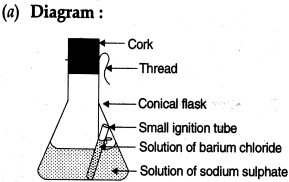
With a labelled diagram,describe an activity to demonstrate the law of conservation of mass.
Solution
(N/A) The law of conservation of mass states that mass can neither be created nor destroyed in a chemical reaction.
Activity:
$1$. Prepare separate solutions of $X$ and $Y$ in water. Take a little amount of $X$ solution in a conical flask and some $Y$ solution in a small ignition tube.
$2$. Hang the ignition tube in the flask carefully by a thread. Put a cork on the flask.
$3$. Weigh the flask with its contents on a balance.
$4$. Now,tilt and swirl the flask so that the solutions $X$ and $Y$ get mixed.
$5$. Weigh the flask again.
Observation:
It is observed that the mass of the flask and its contents remains the same before and after the reaction,demonstrating that mass is conserved.
Example:
Reaction between Barium Chloride $(BaCl_2)$ and Sodium Sulphate $(Na_2SO_4)$:
$BaCl_2(aq) + Na_2SO_4(aq) \rightarrow BaSO_4(s) + 2NaCl(aq)$
Activity:
$1$. Prepare separate solutions of $X$ and $Y$ in water. Take a little amount of $X$ solution in a conical flask and some $Y$ solution in a small ignition tube.
$2$. Hang the ignition tube in the flask carefully by a thread. Put a cork on the flask.
$3$. Weigh the flask with its contents on a balance.
$4$. Now,tilt and swirl the flask so that the solutions $X$ and $Y$ get mixed.
$5$. Weigh the flask again.
Observation:
It is observed that the mass of the flask and its contents remains the same before and after the reaction,demonstrating that mass is conserved.
Example:
Reaction between Barium Chloride $(BaCl_2)$ and Sodium Sulphate $(Na_2SO_4)$:
$BaCl_2(aq) + Na_2SO_4(aq) \rightarrow BaSO_4(s) + 2NaCl(aq)$
0 likes
View Solution89
Medium
$(a)$ The ratio of hydrogen and oxygen in water is $1:8$ by mass. Find out their ratio by number of atoms in one molecule of water.
(Atomic mass: $H=1 \ u, O=16 \ u)$
$(b)$ Write the formulae of the following compounds:
$(i)$ Ammonium sulphate
$(ii)$ Magnesium chloride
(Given: Ammonium $= NH_{4}^{+}$,Sulphate $= SO_{4}^{2-}$,Magnesium $= Mg^{2+}$,Chloride $= Cl^{-}$)
(Atomic mass: $H=1 \ u, O=16 \ u)$
$(b)$ Write the formulae of the following compounds:
$(i)$ Ammonium sulphate
$(ii)$ Magnesium chloride
(Given: Ammonium $= NH_{4}^{+}$,Sulphate $= SO_{4}^{2-}$,Magnesium $= Mg^{2+}$,Chloride $= Cl^{-}$)
Solution
(D) To find the ratio by number of atoms,we divide the mass ratio by the atomic mass of each element:
Dividing by the smallest value $(0.5)$:
$H = 1 / 0.5 = 2$
$O = 0.5 / 0.5 = 1$
Thus,the ratio of the number of atoms of $H$ to $O$ is $2:1$.
$(b)$ $(i)$ Ammonium sulphate: The valency of $NH_{4}^{+}$ is $+1$ and $SO_{4}^{2-}$ is $-2$. By criss-cross method,the formula is $(NH_{4})_{2}SO_{4}$.
$(ii)$ Magnesium chloride: The valency of $Mg^{2+}$ is $+2$ and $Cl^{-}$ is $-1$. By criss-cross method,the formula is $MgCl_{2}$.
| Element | Ratio by mass / Atomic mass |
|---|---|
| $H$ | $1 / 1 = 1$ |
| $O$ | $8 / 16 = 0.5$ |
Dividing by the smallest value $(0.5)$:
$H = 1 / 0.5 = 2$
$O = 0.5 / 0.5 = 1$
Thus,the ratio of the number of atoms of $H$ to $O$ is $2:1$.
$(b)$ $(i)$ Ammonium sulphate: The valency of $NH_{4}^{+}$ is $+1$ and $SO_{4}^{2-}$ is $-2$. By criss-cross method,the formula is $(NH_{4})_{2}SO_{4}$.
$(ii)$ Magnesium chloride: The valency of $Mg^{2+}$ is $+2$ and $Cl^{-}$ is $-1$. By criss-cross method,the formula is $MgCl_{2}$.
0 likes
View Solution90
MediumMCQ
The chemical formula of the chloride of a metal $M$ is $MCl$. Write the chemical formula of its oxide,bicarbonate,and sulphide.
A
Oxide: $M_2O$,Bicarbonate: $MHCO_3$,Sulphide: $M_2S$
B
Oxide: $MO$,Bicarbonate: $M(HCO_3)_2$,Sulphide: $MS$
C
Oxide: $M_2O_3$,Bicarbonate: $MHCO_3$,Sulphide: $M_2S_3$
D
Oxide: $MO_2$,Bicarbonate: $M(HCO_3)_4$,Sulphide: $MS_2$
Solution
(A) Given that the formula of the metal chloride is $MCl$,the valency of metal $M$ is $+1$ because the valency of chlorine $(Cl)$ is $-1$.
$1$. Oxide: The valency of oxygen $(O)$ is $-2$. By criss-cross method,the formula is $M_2O$.
$2$. Bicarbonate: The valency of the bicarbonate ion $(HCO_3)$ is $-1$. Combining $M^{+1}$ and $HCO_3^{-1}$,the formula is $MHCO_3$.
$3$. Sulphide: The valency of sulphur $(S)$ is $-2$. By criss-cross method,the formula is $M_2S$.
$1$. Oxide: The valency of oxygen $(O)$ is $-2$. By criss-cross method,the formula is $M_2O$.
$2$. Bicarbonate: The valency of the bicarbonate ion $(HCO_3)$ is $-1$. Combining $M^{+1}$ and $HCO_3^{-1}$,the formula is $MHCO_3$.
$3$. Sulphide: The valency of sulphur $(S)$ is $-2$. By criss-cross method,the formula is $M_2S$.
0 likes
View Solution91
Medium
$(a)$ Define the following:
$(i)$ Mole
$(ii)$ Gram atomic mass
$(iii)$ Gram molecular mass
$(b)$ Calculate the mass of the following:
$(i)$ $2$ moles of carbon dioxide
$(ii)$ $6.022 \times 10^{23}$ molecules of carbon dioxide.
$(i)$ Mole
$(ii)$ Gram atomic mass
$(iii)$ Gram molecular mass
$(b)$ Calculate the mass of the following:
$(i)$ $2$ moles of carbon dioxide
$(ii)$ $6.022 \times 10^{23}$ molecules of carbon dioxide.
Solution
(N/A) $(i)$ Mole: One mole of any species (atoms,molecules,ions,or particles) is the quantity in number equal to Avogadro's constant $(6.022 \times 10^{23})$ having a mass equal to its atomic or molecular mass in grams.
$(ii)$ Gram atomic mass: The mass of one mole of atoms of an element expressed in grams.
$(iii)$ Gram molecular mass: The mass of one mole of molecules of a substance expressed in grams,which is the sum of the atomic masses of all atoms in the molecule.
$(b)$ $(i)$ The molar mass of $CO_2$ is $(12 + 2 \times 16) = 44 \text{ g/mol}$. Therefore,the mass of $2$ moles of $CO_2$ is $2 \times 44 = 88 \text{ g}$.
$(ii)$ Since $6.022 \times 10^{23}$ molecules represent $1$ mole of $CO_2$,the mass is equal to its molar mass,which is $44 \text{ g}$.
$(ii)$ Gram atomic mass: The mass of one mole of atoms of an element expressed in grams.
$(iii)$ Gram molecular mass: The mass of one mole of molecules of a substance expressed in grams,which is the sum of the atomic masses of all atoms in the molecule.
$(b)$ $(i)$ The molar mass of $CO_2$ is $(12 + 2 \times 16) = 44 \text{ g/mol}$. Therefore,the mass of $2$ moles of $CO_2$ is $2 \times 44 = 88 \text{ g}$.
$(ii)$ Since $6.022 \times 10^{23}$ molecules represent $1$ mole of $CO_2$,the mass is equal to its molar mass,which is $44 \text{ g}$.
0 likes
View Solution92
Medium
$(a)$ Calculate the percentage of oxygen in $H_{2}O_{2}$.
$(b)$ Calculate the number of moles in $56 \, g$ of nitrogen gas $(N_{2})$.
$(c)$ Calculate the mass of $0.50$ moles of $Ca$ atoms.
$(d)$ Find out the number of particles in:
$(i)$ $5$ moles of methane gas $(CH_{4})$
$(ii)$ $92 \, g$ of sodium $(Na)$
(Atomic masses: $H=1, O=16, N=14, Ca=40, Na=23$)
$(b)$ Calculate the number of moles in $56 \, g$ of nitrogen gas $(N_{2})$.
$(c)$ Calculate the mass of $0.50$ moles of $Ca$ atoms.
$(d)$ Find out the number of particles in:
$(i)$ $5$ moles of methane gas $(CH_{4})$
$(ii)$ $92 \, g$ of sodium $(Na)$
(Atomic masses: $H=1, O=16, N=14, Ca=40, Na=23$)
Solution
(N/A) Molar mass of $H_{2}O_{2} = (2 \times 1) + (2 \times 16) = 34 \, g/mol$. Percentage of oxygen $= (32 / 34) \times 100 = 94.12 \%$.
$(b)$ Molar mass of $N_{2} = 2 \times 14 = 28 \, g/mol$. Number of moles $= 56 \, g / 28 \, g/mol = 2 \, moles$.
$(c)$ Mass of $Ca = \text{moles} \times \text{atomic mass} = 0.50 \times 40 = 20 \, g$.
$(d)(i)$ Number of molecules $= \text{moles} \times N_{A} = 5 \times 6.022 \times 10^{23} = 30.110 \times 10^{23}$ particles.
$(d)(ii)$ Number of atoms $= (\text{given mass} / \text{atomic mass}) \times N_{A} = (92 / 23) \times 6.022 \times 10^{23} = 4 \times 6.022 \times 10^{23} = 24.088 \times 10^{23}$ particles.
$(b)$ Molar mass of $N_{2} = 2 \times 14 = 28 \, g/mol$. Number of moles $= 56 \, g / 28 \, g/mol = 2 \, moles$.
$(c)$ Mass of $Ca = \text{moles} \times \text{atomic mass} = 0.50 \times 40 = 20 \, g$.
$(d)(i)$ Number of molecules $= \text{moles} \times N_{A} = 5 \times 6.022 \times 10^{23} = 30.110 \times 10^{23}$ particles.
$(d)(ii)$ Number of atoms $= (\text{given mass} / \text{atomic mass}) \times N_{A} = (92 / 23) \times 6.022 \times 10^{23} = 4 \times 6.022 \times 10^{23} = 24.088 \times 10^{23}$ particles.
0 likes
View Solution93
Medium
Write the names of the compounds represented by the following chemical formulae:
$(i)$ $NaBr$
$(ii)$ $Al_{2}O_{3}$
$(iii)$ $Zn(NO_{3})_{2}$
$(iv)$ $HCl$
$(v)$ $NaCl$
$(vi)$ $CaCO_{3}$
$(i)$ $NaBr$
$(ii)$ $Al_{2}O_{3}$
$(iii)$ $Zn(NO_{3})_{2}$
$(iv)$ $HCl$
$(v)$ $NaCl$
$(vi)$ $CaCO_{3}$
Solution
(N/A) $(i)$ $NaBr$: Sodium bromide
$(ii)$ $Al_{2}O_{3}$: Aluminium oxide
$(iii)$ $Zn(NO_{3})_{2}$: Zinc nitrate
$(iv)$ $HCl$: Hydrogen chloride
$(v)$ $NaCl$: Sodium chloride
$(vi)$ $CaCO_{3}$: Calcium carbonate
$(ii)$ $Al_{2}O_{3}$: Aluminium oxide
$(iii)$ $Zn(NO_{3})_{2}$: Zinc nitrate
$(iv)$ $HCl$: Hydrogen chloride
$(v)$ $NaCl$: Sodium chloride
$(vi)$ $CaCO_{3}$: Calcium carbonate
0 likes
View Solution94
Medium
$(a)$ What do the following formulae stand for:
$(i)$ $2O$
$(ii)$ $O_{2}$
$(iii)$ $O_{3}$
$(iv)$ $H_{2}O$
$(b)$ Give the chemical formulae of the following compounds:
$(i)$ Potassium carbonate
$(ii)$ Calcium chloride
$(c)$ Calculate the formula unit mass of $Al_{2}(SO_{4})_{3}$.
(Given atomic mass of $Al = 27 \, u, S = 32 \, u, O = 16 \, u$)
$(i)$ $2O$
$(ii)$ $O_{2}$
$(iii)$ $O_{3}$
$(iv)$ $H_{2}O$
$(b)$ Give the chemical formulae of the following compounds:
$(i)$ Potassium carbonate
$(ii)$ Calcium chloride
$(c)$ Calculate the formula unit mass of $Al_{2}(SO_{4})_{3}$.
(Given atomic mass of $Al = 27 \, u, S = 32 \, u, O = 16 \, u$)
Solution
(N/A) $(i)$ $2O$ represents two separate atoms of oxygen.
$(ii)$ $O_{2}$ represents one molecule of diatomic oxygen.
$(iii)$ $O_{3}$ represents one molecule of triatomic oxygen (ozone).
$(iv)$ $H_{2}O$ represents one molecule of water, consisting of two atoms of hydrogen and one atom of oxygen.
$(b)$ $(i)$ Potassium carbonate: $K_{2}CO_{3}$
$(ii)$ Calcium chloride: $CaCl_{2}$
$(c)$ Formula unit mass of $Al_{2}(SO_{4})_{3}$:
$= (2 \times \text{atomic mass of } Al) + (3 \times \text{atomic mass of } S) + (12 \times \text{atomic mass of } O)$
$= (2 \times 27) + (3 \times 32) + (12 \times 16)$
$= 54 + 96 + 192 = 342 \, u$.
$(ii)$ $O_{2}$ represents one molecule of diatomic oxygen.
$(iii)$ $O_{3}$ represents one molecule of triatomic oxygen (ozone).
$(iv)$ $H_{2}O$ represents one molecule of water, consisting of two atoms of hydrogen and one atom of oxygen.
$(b)$ $(i)$ Potassium carbonate: $K_{2}CO_{3}$
$(ii)$ Calcium chloride: $CaCl_{2}$
$(c)$ Formula unit mass of $Al_{2}(SO_{4})_{3}$:
$= (2 \times \text{atomic mass of } Al) + (3 \times \text{atomic mass of } S) + (12 \times \text{atomic mass of } O)$
$= (2 \times 27) + (3 \times 32) + (12 \times 16)$
$= 54 + 96 + 192 = 342 \, u$.
0 likes
View Solution95
Medium
$(a)$ Write the chemical symbols of two elements:
$(i)$ which are formed from the first letter of the element's name.
$(ii)$ whose name has been taken from the names of the elements in Latin.
$(b)$ Define Avogadro's constant and molar mass. How are they related to one mole of an atom,molecule,or ion?
$(i)$ which are formed from the first letter of the element's name.
$(ii)$ whose name has been taken from the names of the elements in Latin.
$(b)$ Define Avogadro's constant and molar mass. How are they related to one mole of an atom,molecule,or ion?
Solution
(N/A) $(a) (i)$ Examples include Carbon $(C)$ and Nitrogen $(N)$.
$(ii)$ Examples include Sodium ($Na$,from Natrium) and Iron ($Fe$,from Ferrum).
$(b)$ Avogadro's constant: The value $6.022 \times 10^{23}$ is defined as Avogadro's constant $(N_A)$. It represents the number of particles (atoms,molecules,or ions) present in one mole of any substance.
Molar mass: The mass of $1$ mole of a substance in grams is called its molar mass.
Relationship: One mole of any species (atoms,molecules,or ions) contains $6.022 \times 10^{23}$ number of particles,and its mass is equal to its relative atomic or molecular mass expressed in grams.
$(ii)$ Examples include Sodium ($Na$,from Natrium) and Iron ($Fe$,from Ferrum).
$(b)$ Avogadro's constant: The value $6.022 \times 10^{23}$ is defined as Avogadro's constant $(N_A)$. It represents the number of particles (atoms,molecules,or ions) present in one mole of any substance.
Molar mass: The mass of $1$ mole of a substance in grams is called its molar mass.
Relationship: One mole of any species (atoms,molecules,or ions) contains $6.022 \times 10^{23}$ number of particles,and its mass is equal to its relative atomic or molecular mass expressed in grams.
| $1$ mole of particles | Number of particles = $6.022 \times 10^{23}$ | Mass = Molar mass in grams |
0 likes
View Solution96
Medium
$(a)$ Define polyatomic ions. Write an example.
$(b)$ Calculate the formula unit mass of $CaCO_{3}$. (Atomic mass of $C = 12 \ u, Ca = 40 \ u, O = 16 \ u$)
$(c)$ Calculate the molecular mass of the following:
$(i)$ $HNO_{3}$
$(ii)$ $CH_{3}COOH$
(Atomic mass of $H = 1 \ u, N = 14 \ u, O = 16 \ u, C = 12 \ u$)
$(b)$ Calculate the formula unit mass of $CaCO_{3}$. (Atomic mass of $C = 12 \ u, Ca = 40 \ u, O = 16 \ u$)
$(c)$ Calculate the molecular mass of the following:
$(i)$ $HNO_{3}$
$(ii)$ $CH_{3}COOH$
(Atomic mass of $H = 1 \ u, N = 14 \ u, O = 16 \ u, C = 12 \ u$)
Solution
(N/A) group of atoms carrying a charge is known as a polyatomic ion.
Example: $NH_{4}^{+}, PO_{4}^{3-}, SO_{4}^{2-}$.
$(b)$ Formula unit mass of $CaCO_{3} = (1 \times \text{Atomic mass of } Ca) + (1 \times \text{Atomic mass of } C) + (3 \times \text{Atomic mass of } O)$
$= 40 \ u + 12 \ u + (3 \times 16 \ u) = 40 + 12 + 48 = 100 \ u$.
$(c)$ $(i)$ Molecular mass of $HNO_{3} = (1 \times \text{Atomic mass of } H) + (1 \times \text{Atomic mass of } N) + (3 \times \text{Atomic mass of } O)$
$= 1 \ u + 14 \ u + (3 \times 16 \ u) = 1 + 14 + 48 = 63 \ u$.
$(ii)$ Molecular mass of $CH_{3}COOH = (2 \times \text{Atomic mass of } C) + (4 \times \text{Atomic mass of } H) + (2 \times \text{Atomic mass of } O)$
$= (2 \times 12 \ u) + (4 \times 1 \ u) + (2 \times 16 \ u) = 24 + 4 + 32 = 60 \ u$.
Example: $NH_{4}^{+}, PO_{4}^{3-}, SO_{4}^{2-}$.
$(b)$ Formula unit mass of $CaCO_{3} = (1 \times \text{Atomic mass of } Ca) + (1 \times \text{Atomic mass of } C) + (3 \times \text{Atomic mass of } O)$
$= 40 \ u + 12 \ u + (3 \times 16 \ u) = 40 + 12 + 48 = 100 \ u$.
$(c)$ $(i)$ Molecular mass of $HNO_{3} = (1 \times \text{Atomic mass of } H) + (1 \times \text{Atomic mass of } N) + (3 \times \text{Atomic mass of } O)$
$= 1 \ u + 14 \ u + (3 \times 16 \ u) = 1 + 14 + 48 = 63 \ u$.
$(ii)$ Molecular mass of $CH_{3}COOH = (2 \times \text{Atomic mass of } C) + (4 \times \text{Atomic mass of } H) + (2 \times \text{Atomic mass of } O)$
$= (2 \times 12 \ u) + (4 \times 1 \ u) + (2 \times 16 \ u) = 24 + 4 + 32 = 60 \ u$.
0 likes
View Solution97
EasyMCQ
Mention the name given to the number of $6.022 \times 10^{23}$ particles.
A
Avogadro's number
B
Atomic mass unit
C
Molar mass
D
Relative atomic mass
Solution
(A) The number $6.022 \times 10^{23}$ is known as Avogadro's number or Avogadro's constant.
It represents the number of particles (atoms,molecules,or ions) present in one mole of a substance.
It represents the number of particles (atoms,molecules,or ions) present in one mole of a substance.
0 likes
View Solution98
Easy
How did Berzelius assign symbols to the elements?
Solution
(N/A) $J$öns Jacob Berzelius proposed a system for representing elements using symbols. He suggested that the symbols of elements should be derived from one or two letters of their names,typically taken from their English or Latin names. For example,$H$ for Hydrogen and $Ca$ for Calcium.
0 likes
View Solution99
Easy
Name the international organisation which approves the names given to the elements. Write the symbol of tungsten.
Solution
(N/A) $(i)$ The international organisation that approves the names of elements is the International Union of Pure and Applied Chemistry $(IUPAC)$.
$(ii)$ The symbol of tungsten is $W$ (derived from its German name,Wolfram).
$(ii)$ The symbol of tungsten is $W$ (derived from its German name,Wolfram).
0 likes
View Solution100
EasyMCQ
Find the total number of atoms present in one $SO_{4}^{2-}$ ion.
A
$4$
B
$5$
C
$6$
D
$7$
Solution
(B) The chemical formula of the sulfate ion is $SO_{4}^{2-}$.
This ion consists of one sulfur $(S)$ atom and four oxygen $(O)$ atoms.
Total number of atoms = $1$ (sulfur) + $4$ (oxygen) = $5$ atoms.
Therefore,the total number of atoms present in one $SO_{4}^{2-}$ ion is $5$.
This ion consists of one sulfur $(S)$ atom and four oxygen $(O)$ atoms.
Total number of atoms = $1$ (sulfur) + $4$ (oxygen) = $5$ atoms.
Therefore,the total number of atoms present in one $SO_{4}^{2-}$ ion is $5$.
0 likes
View SolutionATOMS AND MOLECULES — Mix Example - ATOMS AND MOLECULES · Frequently Asked Questions
1Are these ATOMS AND MOLECULES questions useful for JEE and NEET?
Yes. All questions in this section are mapped to JEE Main and NEET exam patterns. Previous year questions from JEE Main, NEET, GUJCET and state-level exams are included with full solutions.
2Can I switch to Hindi or Gujarati for these questions?
Yes. Use the language tabs in the hero section or the sidebar to view the same questions and solutions in English, Hindi or Gujarati.
3How do I generate a question paper from this subtopic?
Use the Vedclass Exam Paper Generator — select the chapter and subtopic, set difficulty, and generate Sets A, B, C, D automatically. First 3 chapters of every subject are free.
Vedclass Products
For Students
Vedclass Test Series
Mock tests in real JEE/NEET style with performance analysis. 5-day free trial.
Start Free TrialFor Teachers
Exam Paper Generator
Generate Set A/B/C/D papers from this chapter in 2 minutes. 3 chapters free.
Try FreeFor Institutes
Online Exam Module
Live online exams with unlimited students, 360° analytics & white-label branding.
See DemoFor Teachers & Institutes
Generate a ATOMS AND MOLECULES Exam Paper in 2 Minutes
Select subtopic & difficulty — Sets A, B, C, D auto-generated with No Repeat logic.
First 3 chapters of every subject are free — no payment required.