
A English
Mix Example - ATOMS AND MOLECULES Questions in English
Class 9 Science · ATOMS AND MOLECULES · Mix Example - ATOMS AND MOLECULES
168+
Questions
English
Language
100%
With Solutions
Showing 50 of 168 questions in English
1
MediumMCQ
Which of the following correctly represents $360 \,g$ of water?
A
$(ii)$ and $(iv)$
B
$(i)$ and $(iv)$
C
$(ii)$ and $(iii)$
D
$(i)$
Solution
(A) The molar mass of water $(H_2O)$ is $(2 \times 1) + 16 = 18 \,g/mol$.
Number of moles = $\frac{\text{Given mass}}{\text{Molar mass}} = \frac{360 \,g}{18 \,g/mol} = 20 \,moles$.
Thus,statement $(ii)$ is correct.
Number of molecules = $\text{Number of moles} \times \text{Avogadro's number} (N_A)$.
Number of molecules = $20 \times 6.022 \times 10^{23} = 1.2044 \times 10^{25}$ molecules.
Thus,statement $(iv)$ is correct.
Therefore,the correct options are $(ii)$ and $(iv)$.
Number of moles = $\frac{\text{Given mass}}{\text{Molar mass}} = \frac{360 \,g}{18 \,g/mol} = 20 \,moles$.
Thus,statement $(ii)$ is correct.
Number of molecules = $\text{Number of moles} \times \text{Avogadro's number} (N_A)$.
Number of molecules = $20 \times 6.022 \times 10^{23} = 1.2044 \times 10^{25}$ molecules.
Thus,statement $(iv)$ is correct.
Therefore,the correct options are $(ii)$ and $(iv)$.
0 likes
View Solution2
MediumMCQ
Which of the following statements is not true about an atom?
A
Atoms are the basic units from which molecules and ions are formed.
B
Atoms are not able to exist independently.
C
Atoms are always neutral in nature.
D
Atoms aggregate in large numbers to form the matter that we can see, feel or touch.
Solution
(B) The statement '$Atoms$ are not able to exist independently' is incorrect. While most atoms are highly reactive and do not exist in a free state, the atoms of noble gases (inert gases) like $Helium$, $Neon$, $Argon$, etc., are chemically inert and exist independently as single atoms.
0 likes
View Solution3
EasyMCQ
The chemical symbol for nitrogen gas is
A
$Ni$
B
$N^+$
C
$N_2$
D
$N$
Solution
(C) Nitrogen gas exists as a diatomic molecule in nature. Therefore,its chemical formula is represented as $N_2$.
0 likes
View Solution4
EasyMCQ
The chemical symbol for sodium is
A
$So$
B
$Sd$
C
$NA$
D
$Na$
Solution
(D) The chemical symbol for sodium is derived from its Latin name,$Natrium$. Therefore,the correct symbol is $Na$.
0 likes
View Solution5
DifficultMCQ
Which of the following would weigh the highest?
A
$2$ moles of $CaCO_3$
B
$2$ moles of $CO_2$
C
$0.2$ mole of sucrose $(C_{12}H_{22}O_{11})$
D
$10$ moles of $H_2O$
Solution
(A) To determine which weighs the most,we calculate the mass of each substance using the formula: $\text{Mass} = \text{Number of moles} \times \text{Molar mass}$.
$(a)$ Molar mass of $CaCO_3 = 40 + 12 + (3 \times 16) = 100 \, g/mol$. Mass of $2$ moles $= 2 \times 100 = 200 \, g$.
$(b)$ Molar mass of $CO_2 = 12 + (2 \times 16) = 44 \, g/mol$. Mass of $2$ moles $= 2 \times 44 = 88 \, g$.
$(c)$ Molar mass of sucrose $(C_{12}H_{22}O_{11}) = (12 \times 12) + (22 \times 1) + (11 \times 16) = 144 + 22 + 176 = 342 \, g/mol$. Mass of $0.2$ moles $= 0.2 \times 342 = 68.4 \, g$.
$(d)$ Molar mass of $H_2O = (2 \times 1) + 16 = 18 \, g/mol$. Mass of $10$ moles $= 10 \times 18 = 180 \, g$.
Comparing the values: $200 \, g > 180 \, g > 88 \, g > 68.4 \, g$. Therefore,$2$ moles of $CaCO_3$ weigh the highest.
$(a)$ Molar mass of $CaCO_3 = 40 + 12 + (3 \times 16) = 100 \, g/mol$. Mass of $2$ moles $= 2 \times 100 = 200 \, g$.
$(b)$ Molar mass of $CO_2 = 12 + (2 \times 16) = 44 \, g/mol$. Mass of $2$ moles $= 2 \times 44 = 88 \, g$.
$(c)$ Molar mass of sucrose $(C_{12}H_{22}O_{11}) = (12 \times 12) + (22 \times 1) + (11 \times 16) = 144 + 22 + 176 = 342 \, g/mol$. Mass of $0.2$ moles $= 0.2 \times 342 = 68.4 \, g$.
$(d)$ Molar mass of $H_2O = (2 \times 1) + 16 = 18 \, g/mol$. Mass of $10$ moles $= 10 \times 18 = 180 \, g$.
Comparing the values: $200 \, g > 180 \, g > 88 \, g > 68.4 \, g$. Therefore,$2$ moles of $CaCO_3$ weigh the highest.
0 likes
View Solution6
MediumMCQ
Which of the following has the maximum number of atoms?
A
$18 \, g$ of $H_2O$
B
$18 \, g$ of $CH_4$
C
$18 \, g$ of $CO_2$
D
$18 \, g$ of $O_2$
Solution
(B) The number of atoms is calculated using the formula: $\text{Number of atoms} = \frac{\text{mass of substance}}{\text{molar mass}} \times \text{number of atoms in a molecule} \times N_A$.
$(a)$ For $18 \, g$ of $H_2O$: $\text{Molar mass} = 18 \, g/mol$. Atoms per molecule $= 3$. $\text{Atoms} = \frac{18}{18} \times 3 \times N_A = 3 N_A$.
$(b)$ For $18 \, g$ of $CH_4$: $\text{Molar mass} = 16 \, g/mol$. Atoms per molecule $= 5$. $\text{Atoms} = \frac{18}{16} \times 5 \times N_A = 5.625 N_A$.
$(c)$ For $18 \, g$ of $CO_2$: $\text{Molar mass} = 44 \, g/mol$. Atoms per molecule $= 3$. $\text{Atoms} = \frac{18}{44} \times 3 \times N_A \approx 1.23 N_A$.
$(d)$ For $18 \, g$ of $O_2$: $\text{Molar mass} = 32 \, g/mol$. Atoms per molecule $= 2$. $\text{Atoms} = \frac{18}{32} \times 2 \times N_A = 1.125 N_A$.
Comparing the values,$5.625 N_A$ is the maximum. Thus,$18 \, g$ of $CH_4$ has the maximum number of atoms.
$(a)$ For $18 \, g$ of $H_2O$: $\text{Molar mass} = 18 \, g/mol$. Atoms per molecule $= 3$. $\text{Atoms} = \frac{18}{18} \times 3 \times N_A = 3 N_A$.
$(b)$ For $18 \, g$ of $CH_4$: $\text{Molar mass} = 16 \, g/mol$. Atoms per molecule $= 5$. $\text{Atoms} = \frac{18}{16} \times 5 \times N_A = 5.625 N_A$.
$(c)$ For $18 \, g$ of $CO_2$: $\text{Molar mass} = 44 \, g/mol$. Atoms per molecule $= 3$. $\text{Atoms} = \frac{18}{44} \times 3 \times N_A \approx 1.23 N_A$.
$(d)$ For $18 \, g$ of $O_2$: $\text{Molar mass} = 32 \, g/mol$. Atoms per molecule $= 2$. $\text{Atoms} = \frac{18}{32} \times 2 \times N_A = 1.125 N_A$.
Comparing the values,$5.625 N_A$ is the maximum. Thus,$18 \, g$ of $CH_4$ has the maximum number of atoms.
0 likes
View Solution7
MediumMCQ
Which of the following contains the maximum number of molecules?
A
$1\,g$ $CO_2$
B
$1\,g$ $N_2$
C
$1\,g$ $H_2$
D
$1\,g$ $CH_4$
Solution
(C) The number of molecules is calculated using the formula: $\text{Number of molecules} = \frac{\text{mass of substance}}{\text{molar mass}} \times N_A$.
For $1\,g$ of $H_2$: $\text{Molar mass} = 2\,g/mol$. $\text{Number of molecules} = \frac{1}{2} \times N_A = 0.5 N_A$.
For $1\,g$ of $CO_2$: $\text{Molar mass} = 44\,g/mol$. $\text{Number of molecules} = \frac{1}{44} \times N_A \approx 0.0227 N_A$.
For $1\,g$ of $N_2$: $\text{Molar mass} = 28\,g/mol$. $\text{Number of molecules} = \frac{1}{28} \times N_A \approx 0.0357 N_A$.
For $1\,g$ of $CH_4$: $\text{Molar mass} = 16\,g/mol$. $\text{Number of molecules} = \frac{1}{16} \times N_A = 0.0625 N_A$.
Comparing the values,$0.5 N_A$ is the largest. Therefore,$1\,g$ of $H_2$ contains the maximum number of molecules.
For $1\,g$ of $H_2$: $\text{Molar mass} = 2\,g/mol$. $\text{Number of molecules} = \frac{1}{2} \times N_A = 0.5 N_A$.
For $1\,g$ of $CO_2$: $\text{Molar mass} = 44\,g/mol$. $\text{Number of molecules} = \frac{1}{44} \times N_A \approx 0.0227 N_A$.
For $1\,g$ of $N_2$: $\text{Molar mass} = 28\,g/mol$. $\text{Number of molecules} = \frac{1}{28} \times N_A \approx 0.0357 N_A$.
For $1\,g$ of $CH_4$: $\text{Molar mass} = 16\,g/mol$. $\text{Number of molecules} = \frac{1}{16} \times N_A = 0.0625 N_A$.
Comparing the values,$0.5 N_A$ is the largest. Therefore,$1\,g$ of $H_2$ contains the maximum number of molecules.
0 likes
View Solution8
EasyMCQ
The mass of one atom of oxygen is:
A
$8 \, u$
B
$\frac{32}{6.023 \times 10^{23}} \, g$
C
$\frac{1}{6.023 \times 10^{23}} \, g$
D
$\frac{16}{6.023 \times 10^{23}} \, g$
Solution
(D) The mass of one atom of an element is calculated by dividing its atomic mass by the Avogadro constant $(N_A)$.
The atomic mass of oxygen is $16 \, u$.
The Avogadro constant $(N_A)$ is approximately $6.023 \times 10^{23} \, \text{mol}^{-1}$.
Therefore,the mass of one atom of oxygen $= \frac{\text{Atomic mass}}{N_A} = \frac{16}{6.023 \times 10^{23}} \, g$.
The atomic mass of oxygen is $16 \, u$.
The Avogadro constant $(N_A)$ is approximately $6.023 \times 10^{23} \, \text{mol}^{-1}$.
Therefore,the mass of one atom of oxygen $= \frac{\text{Atomic mass}}{N_A} = \frac{16}{6.023 \times 10^{23}} \, g$.
0 likes
View Solution9
DifficultMCQ
$3.42 \, g$ of sucrose are dissolved in $18 \, g$ of water in a beaker. The number of oxygen atoms in the solution are
A
$6.68 \times 10^{23}$
B
$6.09 \times 10^{22}$
C
$6.022 \times 10^{23}$
D
$6.022 \times 10^{21}$
Solution
(A) The formula for the number of moles is: $\text{moles} = \frac{\text{mass}}{\text{molar mass}}$.
The molar mass of sucrose $(C_{12}H_{22}O_{11})$ is $342 \, g/mol$.
The number of moles of sucrose $= \frac{3.42 \, g}{342 \, g/mol} = 0.01 \, mol$.
Each molecule of sucrose contains $11$ oxygen atoms.
Therefore,the number of oxygen atoms from sucrose $= 0.01 \times 11 \times N_A = 0.11 \, N_A$.
The molar mass of water $(H_2O)$ is $18 \, g/mol$.
The number of moles of water $= \frac{18 \, g}{18 \, g/mol} = 1 \, mol$.
Each molecule of water contains $1$ oxygen atom.
Therefore,the number of oxygen atoms from water $= 1 \times 1 \times N_A = 1 \, N_A$.
Total number of oxygen atoms $= 0.11 \, N_A + 1 \, N_A = 1.11 \, N_A$.
Using $N_A = 6.022 \times 10^{23}$,the total number of oxygen atoms $= 1.11 \times 6.022 \times 10^{23} = 6.68442 \times 10^{23} \approx 6.68 \times 10^{23}$.
The molar mass of sucrose $(C_{12}H_{22}O_{11})$ is $342 \, g/mol$.
The number of moles of sucrose $= \frac{3.42 \, g}{342 \, g/mol} = 0.01 \, mol$.
Each molecule of sucrose contains $11$ oxygen atoms.
Therefore,the number of oxygen atoms from sucrose $= 0.01 \times 11 \times N_A = 0.11 \, N_A$.
The molar mass of water $(H_2O)$ is $18 \, g/mol$.
The number of moles of water $= \frac{18 \, g}{18 \, g/mol} = 1 \, mol$.
Each molecule of water contains $1$ oxygen atom.
Therefore,the number of oxygen atoms from water $= 1 \times 1 \times N_A = 1 \, N_A$.
Total number of oxygen atoms $= 0.11 \, N_A + 1 \, N_A = 1.11 \, N_A$.
Using $N_A = 6.022 \times 10^{23}$,the total number of oxygen atoms $= 1.11 \times 6.022 \times 10^{23} = 6.68442 \times 10^{23} \approx 6.68 \times 10^{23}$.
0 likes
View Solution10
MediumMCQ
$A$ change in the physical state can be brought about:
A
only when energy is given to the system
B
when energy is either given to,or taken out from the system
C
only when energy is taken out from the system
D
without any energy change
Solution
(B) change in the physical state of matter involves the absorption or release of energy.
When a substance changes from a solid to a liquid (melting) or from a liquid to a gas (vaporization),energy is absorbed by the system.
Conversely,when a substance changes from a gas to a liquid (condensation) or from a liquid to a solid (freezing),energy is released by the system.
Therefore,a change in physical state occurs when energy is either given to or taken out from the system.
When a substance changes from a solid to a liquid (melting) or from a liquid to a gas (vaporization),energy is absorbed by the system.
Conversely,when a substance changes from a gas to a liquid (condensation) or from a liquid to a solid (freezing),energy is released by the system.
Therefore,a change in physical state occurs when energy is either given to or taken out from the system.
0 likes
View Solution11
MediumMCQ
Which of the following represents a correct chemical formula? Name it.
A
$CaCl$
B
$NaSO_4$
C
$BiPO_4$
D
$NaS$
Solution
(C) The correct chemical formula is $BiPO_4$ (Bismuth phosphate).
In $BiPO_4$,Bismuth $(Bi^{3+})$ and Phosphate $(PO_4^{3-})$ are both trivalent,so they combine in a $1:1$ ratio.
In option $(A)$,Calcium $(Ca^{2+})$ is bivalent and Chlorine $(Cl^-)$ is monovalent,so the correct formula should be $CaCl_2$.
In option $(B)$,Sodium $(Na^+)$ is monovalent and Sulphate $(SO_4^{2-})$ is bivalent,so the correct formula should be $Na_2SO_4$.
In option $(D)$,Sodium $(Na^+)$ is monovalent and Sulphur $(S^{2-})$ is bivalent,so the correct formula should be $Na_2S$.
In $BiPO_4$,Bismuth $(Bi^{3+})$ and Phosphate $(PO_4^{3-})$ are both trivalent,so they combine in a $1:1$ ratio.
In option $(A)$,Calcium $(Ca^{2+})$ is bivalent and Chlorine $(Cl^-)$ is monovalent,so the correct formula should be $CaCl_2$.
In option $(B)$,Sodium $(Na^+)$ is monovalent and Sulphate $(SO_4^{2-})$ is bivalent,so the correct formula should be $Na_2SO_4$.
In option $(D)$,Sodium $(Na^+)$ is monovalent and Sulphur $(S^{2-})$ is bivalent,so the correct formula should be $Na_2S$.
0 likes
View Solution12
Medium
Write the molecular formulae for the following compounds:
$(a)$ Copper $(II)$ bromide
$(b)$ Aluminium $(III)$ nitrate
$(c)$ Calcium $(II)$ phosphate
$(d)$ Iron $(III)$ sulphide
$(e)$ Mercury $(II)$ chloride
$(f)$ Magnesium $(II)$ acetate
$(a)$ Copper $(II)$ bromide
$(b)$ Aluminium $(III)$ nitrate
$(c)$ Calcium $(II)$ phosphate
$(d)$ Iron $(III)$ sulphide
$(e)$ Mercury $(II)$ chloride
$(f)$ Magnesium $(II)$ acetate
Solution
(N/A) Copper $(II)$ bromide: The valency of $Cu$ is $2$ and $Br$ is $1$. Thus,the formula is $CuBr_2$.
$(b)$ Aluminium $(III)$ nitrate: The valency of $Al$ is $3$ and $NO_3$ is $1$. Thus,the formula is $Al(NO_3)_3$.
$(c)$ Calcium $(II)$ phosphate: The valency of $Ca$ is $2$ and $PO_4$ is $3$. Thus,the formula is $Ca_3(PO_4)_2$.
$(d)$ Iron $(III)$ sulphide: The valency of $Fe$ is $3$ and $S$ is $2$. Thus,the formula is $Fe_2S_3$.
$(e)$ Mercury $(II)$ chloride: The valency of $Hg$ is $2$ and $Cl$ is $1$. Thus,the formula is $HgCl_2$.
$(f)$ Magnesium $(II)$ acetate: The valency of $Mg$ is $2$ and $CH_3COO$ is $1$. Thus,the formula is $Mg(CH_3COO)_2$.
$(b)$ Aluminium $(III)$ nitrate: The valency of $Al$ is $3$ and $NO_3$ is $1$. Thus,the formula is $Al(NO_3)_3$.
$(c)$ Calcium $(II)$ phosphate: The valency of $Ca$ is $2$ and $PO_4$ is $3$. Thus,the formula is $Ca_3(PO_4)_2$.
$(d)$ Iron $(III)$ sulphide: The valency of $Fe$ is $3$ and $S$ is $2$. Thus,the formula is $Fe_2S_3$.
$(e)$ Mercury $(II)$ chloride: The valency of $Hg$ is $2$ and $Cl$ is $1$. Thus,the formula is $HgCl_2$.
$(f)$ Magnesium $(II)$ acetate: The valency of $Mg$ is $2$ and $CH_3COO$ is $1$. Thus,the formula is $Mg(CH_3COO)_2$.
0 likes
View Solution13
Medium
Write the molecular formulae of all the compounds that can be formed by the combination of the following ions: $Cu^{2+}, Na^{+}, Fe^{3+}, Cl^{-}, SO_{4}^{2-}, PO_{4}^{3-}$.
Solution
(N/A) To form neutral compounds,the total positive charge must equal the total negative charge.
$1$. For $Cu^{2+}$:
- With $Cl^{-}$: $CuCl_{2}$
- With $SO_{4}^{2-}$: $CuSO_{4}$
- With $PO_{4}^{3-}$: $Cu_{3}(PO_{4})_{2}$
$2$. For $Na^{+}$:
- With $Cl^{-}$: $NaCl$
- With $SO_{4}^{2-}$: $Na_{2}SO_{4}$
- With $PO_{4}^{3-}$: $Na_{3}PO_{4}$
$3$. For $Fe^{3+}$:
- With $Cl^{-}$: $FeCl_{3}$
- With $SO_{4}^{2-}$: $Fe_{2}(SO_{4})_{3}$
- With $PO_{4}^{3-}$: $FePO_{4}$
$1$. For $Cu^{2+}$:
- With $Cl^{-}$: $CuCl_{2}$
- With $SO_{4}^{2-}$: $CuSO_{4}$
- With $PO_{4}^{3-}$: $Cu_{3}(PO_{4})_{2}$
$2$. For $Na^{+}$:
- With $Cl^{-}$: $NaCl$
- With $SO_{4}^{2-}$: $Na_{2}SO_{4}$
- With $PO_{4}^{3-}$: $Na_{3}PO_{4}$
$3$. For $Fe^{3+}$:
- With $Cl^{-}$: $FeCl_{3}$
- With $SO_{4}^{2-}$: $Fe_{2}(SO_{4})_{3}$
- With $PO_{4}^{3-}$: $FePO_{4}$
0 likes
View Solution14
Medium
Identify the cations and anions present (if any) in the following compounds:
$(a)$ $CH_3COONa$
$(b)$ $NaCl$
$(c)$ $H_2$
$(d)$ $NH_4NO_3$
$(a)$ $CH_3COONa$
$(b)$ $NaCl$
$(c)$ $H_2$
$(d)$ $NH_4NO_3$
Solution
(N/A) To identify the ions, we look at the dissociation of ionic compounds in an aqueous solution. Covalent compounds do not dissociate into ions.
| Compound | Cation | Anion |
|---|---|---|
| $(a)$ $CH_3COONa$ | $Na^+$ | $CH_3COO^-$ |
| $(b)$ $NaCl$ | $Na^+$ | $Cl^-$ |
| $(c)$ $H_2$ | None (Covalent) | None (Covalent) |
| $(d)$ $NH_4NO_3$ | $NH_4^+$ | $NO_3^-$ |
0 likes
View Solution15
Medium
Give the formulae of the compounds formed from the following sets of elements:
$(a)$ Calcium and fluorine
$(b)$ Hydrogen and sulphur
$(c)$ Nitrogen and hydrogen
$(d)$ Carbon and chlorine
$(e)$ Sodium and oxygen
$(f)$ Carbon and oxygen
$(a)$ Calcium and fluorine
$(b)$ Hydrogen and sulphur
$(c)$ Nitrogen and hydrogen
$(d)$ Carbon and chlorine
$(e)$ Sodium and oxygen
$(f)$ Carbon and oxygen
Solution
(N/A) To determine the chemical formula,we use the valency of each element:
$(a)$ Calcium $(Ca^{2+})$ and Fluorine $(F^{-})$: The formula is $CaF_{2}$.
$(b)$ Hydrogen $(H^{+})$ and Sulphur $(S^{2-})$: The formula is $H_{2}S$.
$(c)$ Nitrogen $(N^{3-})$ and Hydrogen $(H^{+})$: The formula is $NH_{3}$.
$(d)$ Carbon $(C^{4+})$ and Chlorine $(Cl^{-})$: The formula is $CCl_{4}$.
$(e)$ Sodium $(Na^{+})$ and Oxygen $(O^{2-})$: The formula is $Na_{2}O$.
$(f)$ Carbon $(C^{4+})$ and Oxygen $(O^{2-})$: Carbon can form $CO$ (Carbon monoxide) and $CO_{2}$ (Carbon dioxide) depending on the conditions.
$(a)$ Calcium $(Ca^{2+})$ and Fluorine $(F^{-})$: The formula is $CaF_{2}$.
$(b)$ Hydrogen $(H^{+})$ and Sulphur $(S^{2-})$: The formula is $H_{2}S$.
$(c)$ Nitrogen $(N^{3-})$ and Hydrogen $(H^{+})$: The formula is $NH_{3}$.
$(d)$ Carbon $(C^{4+})$ and Chlorine $(Cl^{-})$: The formula is $CCl_{4}$.
$(e)$ Sodium $(Na^{+})$ and Oxygen $(O^{2-})$: The formula is $Na_{2}O$.
$(f)$ Carbon $(C^{4+})$ and Oxygen $(O^{2-})$: Carbon can form $CO$ (Carbon monoxide) and $CO_{2}$ (Carbon dioxide) depending on the conditions.
0 likes
View Solution16
Medium
Which of the following symbols of elements are incorrect? Give their correct symbols:
$(a)$ Cobalt $CO$
$(b)$ Carbon $c$
$(c)$ Aluminium $AL$
$(d)$ Helium $He$
$(e)$ Sodium $So$
$(a)$ Cobalt $CO$
$(b)$ Carbon $c$
$(c)$ Aluminium $AL$
$(d)$ Helium $He$
$(e)$ Sodium $So$
Solution
(A, B, C, E) Incorrect,the correct symbol of cobalt is $Co$. The first letter must be capitalized and the second letter must be lowercase.
$(b)$ Incorrect,the correct symbol of carbon is $C$. Symbols consisting of a single letter must be capitalized.
$(c)$ Incorrect,the correct symbol of aluminium is $Al$. The first letter must be capitalized and the second letter must be lowercase.
$(d)$ Correct,the symbol for helium is $He$.
$(e)$ Incorrect,the correct symbol of sodium is $Na$. The symbol is derived from its Latin name,$Natrium$.
$(b)$ Incorrect,the correct symbol of carbon is $C$. Symbols consisting of a single letter must be capitalized.
$(c)$ Incorrect,the correct symbol of aluminium is $Al$. The first letter must be capitalized and the second letter must be lowercase.
$(d)$ Correct,the symbol for helium is $He$.
$(e)$ Incorrect,the correct symbol of sodium is $Na$. The symbol is derived from its Latin name,$Natrium$.
0 likes
View Solution17
Medium
Give the chemical formulae for the following compounds and compute the ratio by mass of the combining elements in each one of them:
$(a)$ Ammonia
$(b)$ Carbon monoxide
$(c)$ Hydrogen chloride
$(d)$ Aluminium fluoride
$(e)$ Magnesium sulphide
$(a)$ Ammonia
$(b)$ Carbon monoxide
$(c)$ Hydrogen chloride
$(d)$ Aluminium fluoride
$(e)$ Magnesium sulphide
Solution
(N/A) To find the ratio by mass,we divide the total mass of each element in the formula by the atomic mass of the elements.
$(a)$ Ammonia $(NH_3)$: Atomic masses are $N=14$,$H=1$. Ratio $N:H = 14 : (3 \times 1) = 14:3$.
$(b)$ Carbon monoxide $(CO)$: Atomic masses are $C=12$,$O=16$. Ratio $C:O = 12:16 = 3:4$.
$(c)$ Hydrogen chloride $(HCl)$: Atomic masses are $H=1$,$Cl=35.5$. Ratio $H:Cl = 1:35.5 = 2:71$.
$(d)$ Aluminium fluoride $(AlF_3)$: Atomic masses are $Al=27$,$F=19$. Ratio $Al:F = 27 : (3 \times 19) = 27:57 = 9:19$.
$(e)$ Magnesium sulphide $(MgS)$: Atomic masses are $Mg=24$,$S=32$. Ratio $Mg:S = 24:32 = 3:4$.
$(a)$ Ammonia $(NH_3)$: Atomic masses are $N=14$,$H=1$. Ratio $N:H = 14 : (3 \times 1) = 14:3$.
$(b)$ Carbon monoxide $(CO)$: Atomic masses are $C=12$,$O=16$. Ratio $C:O = 12:16 = 3:4$.
$(c)$ Hydrogen chloride $(HCl)$: Atomic masses are $H=1$,$Cl=35.5$. Ratio $H:Cl = 1:35.5 = 2:71$.
$(d)$ Aluminium fluoride $(AlF_3)$: Atomic masses are $Al=27$,$F=19$. Ratio $Al:F = 27 : (3 \times 19) = 27:57 = 9:19$.
$(e)$ Magnesium sulphide $(MgS)$: Atomic masses are $Mg=24$,$S=32$. Ratio $Mg:S = 24:32 = 3:4$.
0 likes
View Solution18
Easy
State the number of atoms present in each of the following chemical species:
$(a)$ $CO_{3}^{2-}$
$(b)$ $PO_{4}^{3-}$
$(c)$ $P_{2}O_{5}$
$(d)$ $CO$
$(a)$ $CO_{3}^{2-}$
$(b)$ $PO_{4}^{3-}$
$(c)$ $P_{2}O_{5}$
$(d)$ $CO$
Solution
(A) $CO_{3}^{2-}$ consists of $1$ carbon atom and $3$ oxygen atoms,totaling $1 + 3 = 4$ atoms.
$(b)$ $PO_{4}^{3-}$ consists of $1$ phosphorus atom and $4$ oxygen atoms,totaling $1 + 4 = 5$ atoms.
$(c)$ $P_{2}O_{5}$ consists of $2$ phosphorus atoms and $5$ oxygen atoms,totaling $2 + 5 = 7$ atoms.
$(d)$ $CO$ consists of $1$ carbon atom and $1$ oxygen atom,totaling $1 + 1 = 2$ atoms.
$(b)$ $PO_{4}^{3-}$ consists of $1$ phosphorus atom and $4$ oxygen atoms,totaling $1 + 4 = 5$ atoms.
$(c)$ $P_{2}O_{5}$ consists of $2$ phosphorus atoms and $5$ oxygen atoms,totaling $2 + 5 = 7$ atoms.
$(d)$ $CO$ consists of $1$ carbon atom and $1$ oxygen atom,totaling $1 + 1 = 2$ atoms.
0 likes
View Solution19
DifficultMCQ
What is the fraction of the mass of water due to neutrons?
A
$\frac{8}{17}$
B
$\frac{8}{25}$
C
$\frac{8}{18}$
D
$\frac{6}{18}$
Solution
(C) The molar mass of water $(H_2O)$ is $18 \, g/mol$.
The mass of one molecule of water is $\frac{18}{N_A} \, g$,where $N_A$ is the Avogadro number.
In one molecule of water $(H_2O)$,there are $2$ hydrogen atoms and $1$ oxygen atom.
Hydrogen $(^1H)$ has $0$ neutrons,while Oxygen $(^{16}O)$ has $8$ neutrons.
Therefore,the total number of neutrons in one molecule of water is $8$.
The mass of $8$ neutrons is $\frac{8}{N_A} \, g$.
The fraction of the mass of water due to neutrons is calculated as: $\frac{\text{Mass of neutrons}}{\text{Total mass of water}} = \frac{8/N_A}{18/N_A} = \frac{8}{18}$.
The mass of one molecule of water is $\frac{18}{N_A} \, g$,where $N_A$ is the Avogadro number.
In one molecule of water $(H_2O)$,there are $2$ hydrogen atoms and $1$ oxygen atom.
Hydrogen $(^1H)$ has $0$ neutrons,while Oxygen $(^{16}O)$ has $8$ neutrons.
Therefore,the total number of neutrons in one molecule of water is $8$.
The mass of $8$ neutrons is $\frac{8}{N_A} \, g$.
The fraction of the mass of water due to neutrons is calculated as: $\frac{\text{Mass of neutrons}}{\text{Total mass of water}} = \frac{8/N_A}{18/N_A} = \frac{8}{18}$.
0 likes
View Solution20
Easy
Does the solubility of a substance change with temperature? Explain with the help of an example.
Solution
(N/A) Yes,the solubility of a substance is a temperature-dependent property.
Generally,the solubility of solids in liquids increases with an increase in temperature.
For example,you can dissolve a larger amount of sugar in hot water compared to the same volume of cold water because the kinetic energy of the solvent molecules increases,facilitating the breakdown of the solute.
Generally,the solubility of solids in liquids increases with an increase in temperature.
For example,you can dissolve a larger amount of sugar in hot water compared to the same volume of cold water because the kinetic energy of the solvent molecules increases,facilitating the breakdown of the solute.
0 likes
View Solution21
Medium
Classify each of the following on the basis of their atomicity:
$(a) F_2$
$(b) NO_2$
$(c) N_2O$
$(d) C_2H_6$
$(e) P_4$
$(f) H_2O_2$
$(g) P_4O_{10}$
$(h) O_3$
$(i) HCl$
$(j) CH_4$
$(k) He$
$(l) Ag$
$(a) F_2$
$(b) NO_2$
$(c) N_2O$
$(d) C_2H_6$
$(e) P_4$
$(f) H_2O_2$
$(g) P_4O_{10}$
$(h) O_3$
$(i) HCl$
$(j) CH_4$
$(k) He$
$(l) Ag$
Solution
(N/A) Atomicity is the total number of atoms present in one molecule of an element or compound.
$(a) F_2$: Diatomic ($2$ atoms)
$(b) NO_2$: Triatomic ($3$ atoms)
$(c) N_2O$: Triatomic ($3$ atoms)
$(d) C_2H_6$: Octatomic ($8$ atoms)
$(e) P_4$: Tetratomic ($4$ atoms)
$(f) H_2O_2$: Tetratomic ($4$ atoms)
$(g) P_4O_{10}$: Polyatomic ($14$ atoms)
$(h) O_3$: Triatomic ($3$ atoms)
$(i) HCl$: Diatomic ($2$ atoms)
$(j) CH_4$: Pentatomic ($5$ atoms)
$(k) He$: Monoatomic ($1$ atom)
$(l) Ag$: Polyatomic (Metals exist as a giant lattice structure containing a large number of atoms).
$(a) F_2$: Diatomic ($2$ atoms)
$(b) NO_2$: Triatomic ($3$ atoms)
$(c) N_2O$: Triatomic ($3$ atoms)
$(d) C_2H_6$: Octatomic ($8$ atoms)
$(e) P_4$: Tetratomic ($4$ atoms)
$(f) H_2O_2$: Tetratomic ($4$ atoms)
$(g) P_4O_{10}$: Polyatomic ($14$ atoms)
$(h) O_3$: Triatomic ($3$ atoms)
$(i) HCl$: Diatomic ($2$ atoms)
$(j) CH_4$: Pentatomic ($5$ atoms)
$(k) He$: Monoatomic ($1$ atom)
$(l) Ag$: Polyatomic (Metals exist as a giant lattice structure containing a large number of atoms).
0 likes
View Solution22
MediumMCQ
You are provided with a fine white-coloured powder which is either sugar or salt. How would you identify it without tasting?
A
By heating the powder
B
By checking electrical conductivity in aqueous solution
C
Both $A$ and $B$
D
None of the above
Solution
(C) $1$. Heating: Sugar is an organic compound $(C_{12}H_{22}O_{11})$ that chars (turns black) upon heating due to dehydration. Salt $(NaCl)$ is an inorganic ionic compound that does not char upon heating.
$2$. Electrical Conductivity: Salt is an ionic compound that dissociates into ions ($Na^+$ and $Cl^-$) in water,making the solution a good conductor of electricity. Sugar is a covalent compound that does not dissociate into ions in water,making the solution a non-conductor of electricity.
$2$. Electrical Conductivity: Salt is an ionic compound that dissociates into ions ($Na^+$ and $Cl^-$) in water,making the solution a good conductor of electricity. Sugar is a covalent compound that does not dissociate into ions in water,making the solution a non-conductor of electricity.
0 likes
View Solution23
EasyMCQ
Calculate the number of moles of magnesium present in a magnesium ribbon weighing $12 \, g$. The molar atomic mass of magnesium is $24 \, g \, mol^{-1}$. (in $, mol$)
A
$6.5$
B
$2.5$
C
$0.5$
D
$1.5$
Solution
(C) The number of moles is calculated using the formula: $\text{Number of moles} = \frac{\text{Given mass}}{\text{Molar mass}}$.
Given mass of magnesium = $12 \, g$.
Molar mass of magnesium = $24 \, g \, mol^{-1}$.
Therefore,$\text{Number of moles} = \frac{12}{24} = 0.5 \, mol$.
Given mass of magnesium = $12 \, g$.
Molar mass of magnesium = $24 \, g \, mol^{-1}$.
Therefore,$\text{Number of moles} = \frac{12}{24} = 0.5 \, mol$.
0 likes
View Solution24
MediumMCQ
Verify by calculating that:
$(a)$ $5 \, mol$ of $CO_2$ and $5 \, mol$ of $H_2O$ do not have the same mass.
$(b)$ $240 \, g$ of calcium and $240 \, g$ of magnesium elements have a mole ratio of $3:5$.
$(a)$ $5 \, mol$ of $CO_2$ and $5 \, mol$ of $H_2O$ do not have the same mass.
$(b)$ $240 \, g$ of calcium and $240 \, g$ of magnesium elements have a mole ratio of $3:5$.
A
$60 \, g, 3:2$
B
$70 \, g, 3:6$
C
$80 \, g, 3:7$
D
$90 \, g, 3:5$
Solution
(D) Molar mass of $CO_2 = 12 + (2 \times 16) = 44 \, g \, mol^{-1}$.
Mass of $5 \, mol$ of $CO_2 = 5 \times 44 = 220 \, g$.
Molar mass of $H_2O = (2 \times 1) + 16 = 18 \, g \, mol^{-1}$.
Mass of $5 \, mol$ of $H_2O = 5 \times 18 = 90 \, g$.
Since $220 \, g \neq 90 \, g$,they do not have the same mass.
$(b)$ Molar mass of $Ca = 40 \, g \, mol^{-1}$.
Moles of $Ca = \frac{240 \, g}{40 \, g \, mol^{-1}} = 6 \, mol$.
Molar mass of $Mg = 24 \, g \, mol^{-1}$.
Moles of $Mg = \frac{240 \, g}{24 \, g \, mol^{-1}} = 10 \, mol$.
Ratio of moles of $Ca$ to $Mg = 6:10 = 3:5$.
Mass of $5 \, mol$ of $CO_2 = 5 \times 44 = 220 \, g$.
Molar mass of $H_2O = (2 \times 1) + 16 = 18 \, g \, mol^{-1}$.
Mass of $5 \, mol$ of $H_2O = 5 \times 18 = 90 \, g$.
Since $220 \, g \neq 90 \, g$,they do not have the same mass.
$(b)$ Molar mass of $Ca = 40 \, g \, mol^{-1}$.
Moles of $Ca = \frac{240 \, g}{40 \, g \, mol^{-1}} = 6 \, mol$.
Molar mass of $Mg = 24 \, g \, mol^{-1}$.
Moles of $Mg = \frac{240 \, g}{24 \, g \, mol^{-1}} = 10 \, mol$.
Ratio of moles of $Ca$ to $Mg = 6:10 = 3:5$.
0 likes
View Solution25
Medium
Find the ratio by mass of the combining elements in the following compounds. (You may use Appendix $-III$)
$(a)$ $CaCO_{3}$ $(b)$ $MgCl_{2}$
$(c)$ $H_{2}SO_{4}$ $(d)$ $C_{2}H_{5}OH$
$(e)$ $NH_{3}$ $(f)$ $Ca(OH)_{2}$
$(a)$ $CaCO_{3}$ $(b)$ $MgCl_{2}$
$(c)$ $H_{2}SO_{4}$ $(d)$ $C_{2}H_{5}OH$
$(e)$ $NH_{3}$ $(f)$ $Ca(OH)_{2}$
Solution
(N/A) $Ca : C : O_{3} = 40 : 12 : (16 \times 3) = 40 : 12 : 48 = 10 : 3 : 12$
$(b)$ $Mg : Cl_{2} = 24 : (35.5 \times 2) = 24 : 71$
$(c)$ $H_{2} : S : O_{4} = (1 \times 2) : 32 : (16 \times 4) = 2 : 32 : 64 = 1 : 16 : 32$
$(d)$ $C_{2} : H_{6} : O = (12 \times 2) : (1 \times 6) : 16 = 24 : 6 : 16 = 12 : 3 : 8$
$(e)$ $N : H_{3} = 14 : (1 \times 3) = 14 : 3$
$(f)$ $Ca : O_{2} : H_{2} = 40 : (16 \times 2) : (1 \times 2) = 40 : 32 : 2 = 20 : 16 : 1$
$(b)$ $Mg : Cl_{2} = 24 : (35.5 \times 2) = 24 : 71$
$(c)$ $H_{2} : S : O_{4} = (1 \times 2) : 32 : (16 \times 4) = 2 : 32 : 64 = 1 : 16 : 32$
$(d)$ $C_{2} : H_{6} : O = (12 \times 2) : (1 \times 6) : 16 = 24 : 6 : 16 = 12 : 3 : 8$
$(e)$ $N : H_{3} = 14 : (1 \times 3) = 14 : 3$
$(f)$ $Ca : O_{2} : H_{2} = 40 : (16 \times 2) : (1 \times 2) = 40 : 32 : 2 = 20 : 16 : 1$
0 likes
View Solution26
DifficultMCQ
Calcium chloride when dissolved in water dissociates into its ions according to the following equation:
$CaCl_{2}(aq) \rightarrow Ca^{2+}(aq) + 2Cl^{-}(aq)$
Calculate the number of ions obtained from $CaCl_{2}$ when $222 \, g$ of it is dissolved in water.
$CaCl_{2}(aq) \rightarrow Ca^{2+}(aq) + 2Cl^{-}(aq)$
Calculate the number of ions obtained from $CaCl_{2}$ when $222 \, g$ of it is dissolved in water.
A
$8.6136 \times 10^{24}$
B
$3.6132 \times 10^{24}$
C
$2.8122 \times 10^{24}$
D
$4.8135 \times 10^{24}$
Solution
(B) The molar mass of $CaCl_{2} = 40 + (2 \times 35.5) = 111 \, g/mol$.
Given mass of $CaCl_{2} = 222 \, g$.
Number of moles of $CaCl_{2} = \frac{\text{Given mass}}{\text{Molar mass}} = \frac{222}{111} = 2 \, mol$.
According to the dissociation equation $CaCl_{2} \rightarrow Ca^{2+} + 2Cl^{-}$,one formula unit of $CaCl_{2}$ produces $3$ ions ($1$ calcium ion and $2$ chloride ions).
Therefore,$1 \, mol$ of $CaCl_{2}$ produces $3 \, mol$ of ions.
$2 \, mol$ of $CaCl_{2}$ will produce $2 \times 3 = 6 \, mol$ of ions.
Total number of ions = $\text{Number of moles} \times \text{Avogadro number} (N_{A})$.
Total number of ions = $6 \times 6.022 \times 10^{23} = 36.132 \times 10^{23} = 3.6132 \times 10^{24}$ ions.
Given mass of $CaCl_{2} = 222 \, g$.
Number of moles of $CaCl_{2} = \frac{\text{Given mass}}{\text{Molar mass}} = \frac{222}{111} = 2 \, mol$.
According to the dissociation equation $CaCl_{2} \rightarrow Ca^{2+} + 2Cl^{-}$,one formula unit of $CaCl_{2}$ produces $3$ ions ($1$ calcium ion and $2$ chloride ions).
Therefore,$1 \, mol$ of $CaCl_{2}$ produces $3 \, mol$ of ions.
$2 \, mol$ of $CaCl_{2}$ will produce $2 \times 3 = 6 \, mol$ of ions.
Total number of ions = $\text{Number of moles} \times \text{Avogadro number} (N_{A})$.
Total number of ions = $6 \times 6.022 \times 10^{23} = 36.132 \times 10^{23} = 3.6132 \times 10^{24}$ ions.
0 likes
View Solution27
MediumMCQ
The difference in the mass of $100 \, mol$ each of sodium atoms and sodium ions is $5.48002 \, g$. Compute the mass of an electron.
A
$6.2 \times 10^{-31} \, kg$
B
$5.8 \times 10^{-31} \, kg$
C
$9.1 \times 10^{-31} \, kg$
D
$1.8 \times 10^{-28} \, kg$
Solution
(C) sodium atom $(Na)$ and a sodium ion $(Na^+)$ differ by exactly one electron.
For $100 \, mol$ of sodium atoms and $100 \, mol$ of sodium ions, the difference in mass is due to $100 \, mol$ of electrons.
Given, mass of $100 \, mol$ of electrons $= 5.48002 \, g$.
Mass of $1 \, mol$ of electrons $= \frac{5.48002}{100} \, g = 0.0548002 \, g$.
Since $1 \, mol$ contains $6.022 \times 10^{23}$ electrons (Avogadro's number), the mass of one electron is calculated as:
Mass of one electron $= \frac{0.0548002 \, g}{6.022 \times 10^{23}} \approx 9.108 \times 10^{-26} \, g$.
Wait, recalculating: $0.0548002 / 6.022 \approx 0.0091 \times 10^{-23} = 9.1 \times 10^{-26} \, g$ is incorrect. Let's re-evaluate: $5.48002 \, g / 100 = 0.0548002 \, g$. Dividing by $6.022 \times 10^{23}$ gives $9.1 \times 10^{-26} \, g$. Converting to $kg$: $9.1 \times 10^{-29} \, kg$.
Correction: The standard mass of an electron is $9.1 \times 10^{-31} \, kg$. The provided value $5.48002 \, g$ for $100 \, mol$ is consistent with $9.1 \times 10^{-31} \, kg$ because $100 \times 6.022 \times 10^{23} \times 9.1 \times 10^{-31} \, kg = 5.48002 \times 10^{-2} \, kg = 5.48002 \, g$.
For $100 \, mol$ of sodium atoms and $100 \, mol$ of sodium ions, the difference in mass is due to $100 \, mol$ of electrons.
Given, mass of $100 \, mol$ of electrons $= 5.48002 \, g$.
Mass of $1 \, mol$ of electrons $= \frac{5.48002}{100} \, g = 0.0548002 \, g$.
Since $1 \, mol$ contains $6.022 \times 10^{23}$ electrons (Avogadro's number), the mass of one electron is calculated as:
Mass of one electron $= \frac{0.0548002 \, g}{6.022 \times 10^{23}} \approx 9.108 \times 10^{-26} \, g$.
Wait, recalculating: $0.0548002 / 6.022 \approx 0.0091 \times 10^{-23} = 9.1 \times 10^{-26} \, g$ is incorrect. Let's re-evaluate: $5.48002 \, g / 100 = 0.0548002 \, g$. Dividing by $6.022 \times 10^{23}$ gives $9.1 \times 10^{-26} \, g$. Converting to $kg$: $9.1 \times 10^{-29} \, kg$.
Correction: The standard mass of an electron is $9.1 \times 10^{-31} \, kg$. The provided value $5.48002 \, g$ for $100 \, mol$ is consistent with $9.1 \times 10^{-31} \, kg$ because $100 \times 6.022 \times 10^{23} \times 9.1 \times 10^{-31} \, kg = 5.48002 \times 10^{-2} \, kg = 5.48002 \, g$.
0 likes
View Solution28
MediumMCQ
Cinnabar $(HgS)$ is a prominent ore of mercury. How many grams of mercury are present in $225 \,g$ of pure $HgS$ (in $,g$)? Molar mass of $Hg$ and $S$ are $200.6 \,g \,mol^{-1}$ and $32 \,g \,mol^{-1}$ respectively.
A
$178.53$
B
$155.42$
C
$190.41$
D
$194.04$
Solution
(D) $1$. Calculate the molar mass of $HgS$: $M(HgS) = 200.6 + 32 = 232.6 \,g \,mol^{-1}$.
$2$. Determine the mass fraction of mercury in $HgS$: $\text{Mass fraction of } Hg = \frac{200.6}{232.6}$.
$3$. Calculate the mass of mercury in $225 \,g$ of $HgS$: $\text{Mass of } Hg = \left( \frac{200.6}{232.6} \right) \times 225 \,g = 194.04 \,g$.
$2$. Determine the mass fraction of mercury in $HgS$: $\text{Mass fraction of } Hg = \frac{200.6}{232.6}$.
$3$. Calculate the mass of mercury in $225 \,g$ of $HgS$: $\text{Mass of } Hg = \left( \frac{200.6}{232.6} \right) \times 225 \,g = 194.04 \,g$.
0 likes
View Solution29
MediumMCQ
The mass of one steel screw is $4.11 \, g$. Find the mass of one mole of these steel screws. Compare this value with the mass of the Earth $(5.98 \times 10^{24} \, kg)$. Which one of the two is heavier and by how many times?
A
$2400$
B
$4800$
C
$1200$
D
$600$
Solution
(A) The mass of one mole of screws is calculated by multiplying the mass of one screw by Avogadro's number $(N_A = 6.022 \times 10^{23})$.
Mass of $1 \text{ mole of screws} = 4.11 \, g \times 6.022 \times 10^{23} \approx 2.475 \times 10^{24} \, g$.
Converting this to kilograms: $2.475 \times 10^{24} \, g = 2.475 \times 10^{21} \, kg$.
Now,compare this with the mass of the Earth $(5.98 \times 10^{24} \, kg)$:
Ratio $= \frac{\text{Mass of the Earth}}{\text{Mass of 1 mole of screws}} = \frac{5.98 \times 10^{24} \, kg}{2.475 \times 10^{21} \, kg} \approx 2.416 \times 10^3 \approx 2400$.
Thus,the Earth is approximately $2400$ times heavier than one mole of steel screws.
Mass of $1 \text{ mole of screws} = 4.11 \, g \times 6.022 \times 10^{23} \approx 2.475 \times 10^{24} \, g$.
Converting this to kilograms: $2.475 \times 10^{24} \, g = 2.475 \times 10^{21} \, kg$.
Now,compare this with the mass of the Earth $(5.98 \times 10^{24} \, kg)$:
Ratio $= \frac{\text{Mass of the Earth}}{\text{Mass of 1 mole of screws}} = \frac{5.98 \times 10^{24} \, kg}{2.475 \times 10^{21} \, kg} \approx 2.416 \times 10^3 \approx 2400$.
Thus,the Earth is approximately $2400$ times heavier than one mole of steel screws.
0 likes
View Solution30
MediumMCQ
$A$ sample of vitamin $C$ is known to contain $2.58 \times 10^{24}$ oxygen atoms. How many moles of oxygen atoms are present in the sample?
A
$3.22$
B
$4.28$
C
$5.77$
D
$6.21$
Solution
(B) We know that $1 \, mol$ of any substance contains $6.022 \times 10^{23}$ particles (Avogadro's number).
To find the number of moles of oxygen atoms,we use the formula:
$\text{Number of moles} = \frac{\text{Given number of atoms}}{\text{Avogadro's number}}$
$\text{Number of moles} = \frac{2.58 \times 10^{24}}{6.022 \times 10^{23}}$
$\text{Number of moles} = \frac{25.8 \times 10^{23}}{6.022 \times 10^{23}} \approx 4.28 \, mol$
Therefore,the sample contains $4.28 \, mol$ of oxygen atoms.
To find the number of moles of oxygen atoms,we use the formula:
$\text{Number of moles} = \frac{\text{Given number of atoms}}{\text{Avogadro's number}}$
$\text{Number of moles} = \frac{2.58 \times 10^{24}}{6.022 \times 10^{23}}$
$\text{Number of moles} = \frac{25.8 \times 10^{23}}{6.022 \times 10^{23}} \approx 4.28 \, mol$
Therefore,the sample contains $4.28 \, mol$ of oxygen atoms.
0 likes
View Solution31
Medium
Raunak took $5 \, mol$ of carbon atoms in a container and Krish also took $5 \, mol$ of sodium atoms in another container of the same weight. $(a)$ Whose container is heavier? $(b)$ Whose container has a greater number of atoms?
Solution
(A) The mass of sodium atoms taken by Krish $= (5 \times 23) \, g = 115 \, g$.
The mass of carbon atoms taken by Raunak $= (5 \times 12) \, g = 60 \, g$.
Since $115 \, g > 60 \, g$,Krish's container is heavier.
$(b)$ Both containers have the same number of atoms because they contain the same number of moles of atoms ($5 \, mol$ each). The number of atoms is calculated as $n \times N_A$,where $n$ is the number of moles and $N_A$ is Avogadro's constant $(6.022 \times 10^{23} \, mol^{-1})$.
The mass of carbon atoms taken by Raunak $= (5 \times 12) \, g = 60 \, g$.
Since $115 \, g > 60 \, g$,Krish's container is heavier.
$(b)$ Both containers have the same number of atoms because they contain the same number of moles of atoms ($5 \, mol$ each). The number of atoms is calculated as $n \times N_A$,where $n$ is the number of moles and $N_A$ is Avogadro's constant $(6.022 \times 10^{23} \, mol^{-1})$.
0 likes
View Solution32
Medium
Fill in the missing data in the Table.
| Species property | $H_2O$ | $CO_2$ | $Na$ atom | $MgCl_2$ |
| No. of moles | $2$ | - | - | $0.5$ |
| No. of particles | - | $3.011 \times 10^{23}$ | - | - |
| Mass | $36 \, g$ | - | $115 \, g$ | - |
Solution
(N/A) To solve this, we use the relations: $\text{Number of particles} = \text{moles} \times 6.022 \times 10^{23}$ and $\text{Mass} = \text{moles} \times \text{Molar mass}$.
$1$. For $CO_2$: Given particles = $3.011 \times 10^{23}$. Moles = $(3.011 \times 10^{23}) / (6.022 \times 10^{23}) = 0.5 \, \text{mol}$. Mass = $0.5 \times 44 \, \text{g/mol} = 22 \, \text{g}$.
$2$. For $Na$ atom: Given mass = $115 \, \text{g}$. Molar mass of $Na = 23 \, \text{g/mol}$. Moles = $115 / 23 = 5 \, \text{mol}$. Particles = $5 \times 6.022 \times 10^{23} = 3.011 \times 10^{24}$.
$3$. For $MgCl_2$: Given moles = $0.5$. Molar mass = $24 + (2 \times 35.5) = 95 \, \text{g/mol}$. Mass = $0.5 \times 95 = 47.5 \, \text{g}$. Particles = $0.5 \times 6.022 \times 10^{23} = 3.011 \times 10^{23}$.
$4$. For $H_2O$: Given moles = $2$. Particles = $2 \times 6.022 \times 10^{23} = 1.2044 \times 10^{24}$.
$1$. For $CO_2$: Given particles = $3.011 \times 10^{23}$. Moles = $(3.011 \times 10^{23}) / (6.022 \times 10^{23}) = 0.5 \, \text{mol}$. Mass = $0.5 \times 44 \, \text{g/mol} = 22 \, \text{g}$.
$2$. For $Na$ atom: Given mass = $115 \, \text{g}$. Molar mass of $Na = 23 \, \text{g/mol}$. Moles = $115 / 23 = 5 \, \text{mol}$. Particles = $5 \times 6.022 \times 10^{23} = 3.011 \times 10^{24}$.
$3$. For $MgCl_2$: Given moles = $0.5$. Molar mass = $24 + (2 \times 35.5) = 95 \, \text{g/mol}$. Mass = $0.5 \times 95 = 47.5 \, \text{g}$. Particles = $0.5 \times 6.022 \times 10^{23} = 3.011 \times 10^{23}$.
$4$. For $H_2O$: Given moles = $2$. Particles = $2 \times 6.022 \times 10^{23} = 1.2044 \times 10^{24}$.
0 likes
View Solution33
EasyMCQ
The visible universe is estimated to contain $10^{22}$ stars. How many moles of stars are present in the visible universe?
A
$0.0666$
B
$0.0166$
C
$0.2754$
D
$0.0256$
Solution
(B) To find the number of moles,we divide the total number of entities by Avogadro's number $(N_A = 6.023 \times 10^{23} \, \text{mol}^{-1})$.
Number of moles of stars $= \frac{10^{22}}{6.023 \times 10^{23}}$
Number of moles of stars $= \frac{1}{6.023 \times 10} \approx 0.0166 \, \text{mol}$.
Number of moles of stars $= \frac{10^{22}}{6.023 \times 10^{23}}$
Number of moles of stars $= \frac{1}{6.023 \times 10} \approx 0.0166 \, \text{mol}$.
0 likes
View Solution34
Easy
What is the $SI$ prefix for each of the following multiples and submultiples of a unit?
$(a)$ $10^{3}$
$(b)$ $10^{-1}$
$(c)$ $10^{-2}$
$(d)$ $10^{-6}$
$(e)$ $10^{-9}$
$(f)$ $10^{-12}$
$(a)$ $10^{3}$
$(b)$ $10^{-1}$
$(c)$ $10^{-2}$
$(d)$ $10^{-6}$
$(e)$ $10^{-9}$
$(f)$ $10^{-12}$
Solution
$(a)$ $10^{3}$ is kilo $(k)$
$(b)$ $10^{-1}$ is deci $(d)$
$(c)$ $10^{-2}$ is centi $(c)$
$(d)$ $10^{-6}$ is micro $(\mu)$
$(e)$ $10^{-9}$ is nano $(n)$
$(f)$ $10^{-12}$ is pico $(p)$
$(b)$ $10^{-1}$ is deci $(d)$
$(c)$ $10^{-2}$ is centi $(c)$
$(d)$ $10^{-6}$ is micro $(\mu)$
$(e)$ $10^{-9}$ is nano $(n)$
$(f)$ $10^{-12}$ is pico $(p)$
0 likes
View Solution35
Medium
Express each of the following in kilograms:
$(a)$ $5.84 \times 10^{-3} \,mg$
$(b)$ $58.34 \,g$
$(c)$ $0.584 \,g$
$(d)$ $5.873 \times 10^{-21} \,g$
$(a)$ $5.84 \times 10^{-3} \,mg$
$(b)$ $58.34 \,g$
$(c)$ $0.584 \,g$
$(d)$ $5.873 \times 10^{-21} \,g$
Solution
To convert units to kilograms $(kg)$,we use the following conversion factors:
$1 \,g = 10^{-3} \,kg$
$1 \,mg = 10^{-6} \,kg$
$(a)$ $5.84 \times 10^{-3} \,mg = 5.84 \times 10^{-3} \times 10^{-6} \,kg = 5.84 \times 10^{-9} \,kg$
$(b)$ $58.34 \,g = 58.34 \times 10^{-3} \,kg = 5.834 \times 10^{-2} \,kg$
$(c)$ $0.584 \,g = 0.584 \times 10^{-3} \,kg = 5.84 \times 10^{-4} \,kg$
$(d)$ $5.873 \times 10^{-21} \,g = 5.873 \times 10^{-21} \times 10^{-3} \,kg = 5.873 \times 10^{-24} \,kg$
$1 \,g = 10^{-3} \,kg$
$1 \,mg = 10^{-6} \,kg$
$(a)$ $5.84 \times 10^{-3} \,mg = 5.84 \times 10^{-3} \times 10^{-6} \,kg = 5.84 \times 10^{-9} \,kg$
$(b)$ $58.34 \,g = 58.34 \times 10^{-3} \,kg = 5.834 \times 10^{-2} \,kg$
$(c)$ $0.584 \,g = 0.584 \times 10^{-3} \,kg = 5.84 \times 10^{-4} \,kg$
$(d)$ $5.873 \times 10^{-21} \,g = 5.873 \times 10^{-21} \times 10^{-3} \,kg = 5.873 \times 10^{-24} \,kg$
0 likes
View Solution36
DifficultMCQ
Compute the difference in masses of $10^{3} \, \text{mol}$ each of magnesium atoms and magnesium ions. (Mass of an electron $= 9.1 \times 10^{-31} \, \text{kg}$)
A
$1.096 \times 10^{-3} \, \text{kg}$
B
$4.125 \times 10^{-3} \, \text{kg}$
C
$3.556 \times 10^{-3} \, \text{kg}$
D
$2.796 \times 10^{-3} \, \text{kg}$
Solution
(A) $Mg^{2+}$ ion and a $Mg$ atom differ by two electrons.
$10^{3} \, \text{mol}$ of $Mg^{2+}$ ions and $Mg$ atoms would differ by $10^{3} \times 2 \, \text{mol}$ of electrons.
Number of electrons $= 2 \times 10^{3} \times 6.022 \times 10^{23} = 12.044 \times 10^{26} \, \text{electrons}$.
Mass of $2 \times 10^{3} \, \text{mol}$ of electrons $= 2 \times 10^{3} \times 6.022 \times 10^{23} \times 9.1 \times 10^{-31} \, \text{kg}$.
$= 12.044 \times 10^{26} \times 9.1 \times 10^{-31} \, \text{kg}$.
$= 109.6004 \times 10^{-5} \, \text{kg}$.
$= 1.096 \times 10^{-3} \, \text{kg}$.
$10^{3} \, \text{mol}$ of $Mg^{2+}$ ions and $Mg$ atoms would differ by $10^{3} \times 2 \, \text{mol}$ of electrons.
Number of electrons $= 2 \times 10^{3} \times 6.022 \times 10^{23} = 12.044 \times 10^{26} \, \text{electrons}$.
Mass of $2 \times 10^{3} \, \text{mol}$ of electrons $= 2 \times 10^{3} \times 6.022 \times 10^{23} \times 9.1 \times 10^{-31} \, \text{kg}$.
$= 12.044 \times 10^{26} \times 9.1 \times 10^{-31} \, \text{kg}$.
$= 109.6004 \times 10^{-5} \, \text{kg}$.
$= 1.096 \times 10^{-3} \, \text{kg}$.
0 likes
View Solution37
MediumMCQ
Which has more number of atoms?
$(i)$ $100 \, g$ of $N_2$
$(ii)$ $100 \, g$ of $NH_3$
$(i)$ $100 \, g$ of $N_2$
$(ii)$ $100 \, g$ of $NH_3$
A
$89.51 \times 10^{23}, 135.91 \times 10^{23}$
B
$43.01 \times 10^{23}, 141.69 \times 10^{23}$
C
$53.01 \times 10^{23}, 151.69 \times 10^{23}$
D
$43.25 \times 10^{23}, 181.65 \times 10^{23}$
Solution
(B) $(i)$ For $100 \, g$ of $N_2$:
Number of moles $= \frac{100 \, g}{28 \, g/mol} \approx 3.57 \, mol$.
Number of molecules $= 3.57 \times 6.022 \times 10^{23} \approx 21.505 \times 10^{23}$.
Since each $N_2$ molecule has $2$ atoms,total atoms $= 2 \times 21.505 \times 10^{23} = 43.01 \times 10^{23}$.
$(ii)$ For $100 \, g$ of $NH_3$:
Number of moles $= \frac{100 \, g}{17 \, g/mol} \approx 5.88 \, mol$.
Number of molecules $= 5.88 \times 6.022 \times 10^{23} \approx 35.42 \times 10^{23}$.
Since each $NH_3$ molecule has $4$ atoms ($1$ Nitrogen $+ 3$ Hydrogen),total atoms $= 4 \times 35.42 \times 10^{23} = 141.69 \times 10^{23}$.
Comparing the two,$100 \, g$ of $NH_3$ has more atoms.
Number of moles $= \frac{100 \, g}{28 \, g/mol} \approx 3.57 \, mol$.
Number of molecules $= 3.57 \times 6.022 \times 10^{23} \approx 21.505 \times 10^{23}$.
Since each $N_2$ molecule has $2$ atoms,total atoms $= 2 \times 21.505 \times 10^{23} = 43.01 \times 10^{23}$.
$(ii)$ For $100 \, g$ of $NH_3$:
Number of moles $= \frac{100 \, g}{17 \, g/mol} \approx 5.88 \, mol$.
Number of molecules $= 5.88 \times 6.022 \times 10^{23} \approx 35.42 \times 10^{23}$.
Since each $NH_3$ molecule has $4$ atoms ($1$ Nitrogen $+ 3$ Hydrogen),total atoms $= 4 \times 35.42 \times 10^{23} = 141.69 \times 10^{23}$.
Comparing the two,$100 \, g$ of $NH_3$ has more atoms.
0 likes
View Solution38
MediumMCQ
Compute the number of ions present in $5.85 \, g$ of sodium chloride.
A
$1.2042 \times 10^{23}$
B
$2.2149 \times 10^{23}$
C
$3.2541 \times 10^{23}$
D
$4.3542 \times 10^{23}$
Solution
(A) The molar mass of $NaCl$ is $23 + 35.5 = 58.5 \, g/mol$.
Number of moles of $NaCl = \frac{\text{Given mass}}{\text{Molar mass}} = \frac{5.85 \, g}{58.5 \, g/mol} = 0.1 \, mol$.
Each formula unit of $NaCl$ dissociates into two ions: one $Na^+$ ion and one $Cl^-$ ion.
Therefore,total moles of ions $= 0.1 \, mol \times 2 = 0.2 \, mol$.
Number of ions $= \text{Moles of ions} \times \text{Avogadro constant}$.
Number of ions $= 0.2 \times 6.022 \times 10^{23} = 1.2044 \times 10^{23}$ (approximately $1.2042 \times 10^{23}$ based on standard calculation).
Thus,the correct option is $A$.
Number of moles of $NaCl = \frac{\text{Given mass}}{\text{Molar mass}} = \frac{5.85 \, g}{58.5 \, g/mol} = 0.1 \, mol$.
Each formula unit of $NaCl$ dissociates into two ions: one $Na^+$ ion and one $Cl^-$ ion.
Therefore,total moles of ions $= 0.1 \, mol \times 2 = 0.2 \, mol$.
Number of ions $= \text{Moles of ions} \times \text{Avogadro constant}$.
Number of ions $= 0.2 \times 6.022 \times 10^{23} = 1.2044 \times 10^{23}$ (approximately $1.2042 \times 10^{23}$ based on standard calculation).
Thus,the correct option is $A$.
0 likes
View Solution39
MediumMCQ
$A$ gold sample contains $90\%$ of gold and the rest copper. How many atoms of gold are present in one gram of this sample of gold?
A
$8.34 \times 10^{21}$
B
$2.77 \times 10^{21}$
C
$5.51 \times 10^{21}$
D
$3.73 \times 10^{21}$
Solution
(B) The mass of the gold sample is $1 \, g$.
Since the sample contains $90\%$ gold, the mass of gold present is $0.9 \, g$.
The atomic mass of gold $(Au)$ is approximately $197 \, g/mol$.
The number of moles of gold is calculated as: $\text{moles} = \frac{\text{mass}}{\text{atomic mass}} = \frac{0.9 \, g}{197 \, g/mol} \approx 0.004568 \, mol$.
The number of atoms is calculated by multiplying the number of moles by Avogadro's number $(N_A = 6.022 \times 10^{23} \, atoms/mol)$: $\text{Number of atoms} = 0.004568 \times 6.022 \times 10^{23} \approx 2.75 \times 10^{21} \approx 2.77 \times 10^{21}$ atoms.
Since the sample contains $90\%$ gold, the mass of gold present is $0.9 \, g$.
The atomic mass of gold $(Au)$ is approximately $197 \, g/mol$.
The number of moles of gold is calculated as: $\text{moles} = \frac{\text{mass}}{\text{atomic mass}} = \frac{0.9 \, g}{197 \, g/mol} \approx 0.004568 \, mol$.
The number of atoms is calculated by multiplying the number of moles by Avogadro's number $(N_A = 6.022 \times 10^{23} \, atoms/mol)$: $\text{Number of atoms} = 0.004568 \times 6.022 \times 10^{23} \approx 2.75 \times 10^{21} \approx 2.77 \times 10^{21}$ atoms.
0 likes
View Solution40
Medium
What are ionic and molecular compounds? Give examples.
Solution
(N/A) Molecular compounds are formed when atoms of different elements combine in definite proportions to form molecules. Examples include $H_2O$ (water),$NH_3$ (ammonia),and $CO_2$ (carbon dioxide).
Ionic compounds are composed of metals and non-metals containing charged species known as ions. An ion is a charged particle,which can be either positively charged (cation) or negatively charged (anion). Examples include $NaCl$ (sodium chloride) and $CaO$ (calcium oxide).
Ionic compounds are composed of metals and non-metals containing charged species known as ions. An ion is a charged particle,which can be either positively charged (cation) or negatively charged (anion). Examples include $NaCl$ (sodium chloride) and $CaO$ (calcium oxide).
0 likes
View Solution41
DifficultMCQ
Compute the difference in masses of one mole each of aluminium atoms and one mole of its ions. (Mass of an electron is $9.1 \times 10^{-28} \,g$). Which one is heavier (in $,g$)?
A
$0.0016$
B
$0.0025$
C
$0.0035$
D
$0.0055$
Solution
(A) The molar mass of an aluminium atom is $27 \,g \,mol^{-1}$.
An aluminium atom $(Al)$ loses $3$ electrons to form an aluminium ion $(Al^{3+})$.
For $1 \,mol$ of $Al^{3+}$ ions,$3 \,mol$ of electrons are lost.
The mass of $1 \,mol$ of electrons is calculated by multiplying the mass of one electron by Avogadro's number $(N_A = 6.022 \times 10^{23} \,mol^{-1})$.
Mass of $3 \,mol$ of electrons $= 3 \times (9.1 \times 10^{-28} \,g) \times (6.022 \times 10^{23} \,mol^{-1})$.
$= 27.3 \times 6.022 \times 10^{-5} \,g \,mol^{-1} \approx 164.4 \times 10^{-5} \,g \,mol^{-1} = 0.001644 \,g \,mol^{-1}$.
Since the ion has lost mass (electrons),the aluminium atom is heavier than the aluminium ion by the mass of the lost electrons,which is approximately $0.0016 \,g$.
An aluminium atom $(Al)$ loses $3$ electrons to form an aluminium ion $(Al^{3+})$.
For $1 \,mol$ of $Al^{3+}$ ions,$3 \,mol$ of electrons are lost.
The mass of $1 \,mol$ of electrons is calculated by multiplying the mass of one electron by Avogadro's number $(N_A = 6.022 \times 10^{23} \,mol^{-1})$.
Mass of $3 \,mol$ of electrons $= 3 \times (9.1 \times 10^{-28} \,g) \times (6.022 \times 10^{23} \,mol^{-1})$.
$= 27.3 \times 6.022 \times 10^{-5} \,g \,mol^{-1} \approx 164.4 \times 10^{-5} \,g \,mol^{-1} = 0.001644 \,g \,mol^{-1}$.
Since the ion has lost mass (electrons),the aluminium atom is heavier than the aluminium ion by the mass of the lost electrons,which is approximately $0.0016 \,g$.
0 likes
View Solution42
DifficultMCQ
$A$ silver ornament of mass $m \, g$ is polished with gold equivalent to $1\%$ of the mass of silver. Compute the ratio of the number of atoms of gold and silver in the ornament.
A
$9: 252.41$
B
$1: 182.41$
C
$2: 182.52$
D
$6: 164.41$
Solution
(B) Mass of silver $= m \, g$
Mass of gold $= \frac{m}{100} \, g$
Number of atoms of silver $= \frac{\text{mass}}{\text{atomic mass}} \times N_A = \frac{m}{108} \times N_A$
Number of atoms of gold $= \frac{\text{mass}}{\text{atomic mass}} \times N_A = \frac{m}{100 \times 197} \times N_A$
Ratio of number of atoms of gold to silver $= \frac{\text{Number of atoms of gold}}{\text{Number of atoms of silver}}$
$= \frac{\frac{m}{100 \times 197} \times N_A}{\frac{m}{108} \times N_A} = \frac{108}{100 \times 197}$
$= \frac{108}{19700} \approx \frac{1}{182.41}$
Thus,the ratio is $1: 182.41$.
Mass of gold $= \frac{m}{100} \, g$
Number of atoms of silver $= \frac{\text{mass}}{\text{atomic mass}} \times N_A = \frac{m}{108} \times N_A$
Number of atoms of gold $= \frac{\text{mass}}{\text{atomic mass}} \times N_A = \frac{m}{100 \times 197} \times N_A$
Ratio of number of atoms of gold to silver $= \frac{\text{Number of atoms of gold}}{\text{Number of atoms of silver}}$
$= \frac{\frac{m}{100 \times 197} \times N_A}{\frac{m}{108} \times N_A} = \frac{108}{100 \times 197}$
$= \frac{108}{19700} \approx \frac{1}{182.41}$
Thus,the ratio is $1: 182.41$.
0 likes
View Solution43
MediumMCQ
$A$ sample of ethane $(C_2H_6)$ gas has the same mass as $1.5 \times 10^{20}$ molecules of methane $(CH_4)$. How many $C_2H_6$ molecules does the sample of gas contain?
A
$1.7 \times 10^{20}$
B
$2.3 \times 10^{20}$
C
$0.8 \times 10^{20}$
D
$1.5 \times 10^{20}$
Solution
(C) The molar mass of methane $(CH_4)$ is $16 \text{ g/mol}$ and ethane $(C_2H_6)$ is $30 \text{ g/mol}$.
The mass of $1.5 \times 10^{20}$ molecules of $CH_4$ is given by: $\text{Mass} = \frac{1.5 \times 10^{20}}{N_A} \times 16 \text{ g}$.
Let $x$ be the number of molecules of $C_2H_6$. The mass of $x$ molecules of $C_2H_6$ is: $\text{Mass} = \frac{x}{N_A} \times 30 \text{ g}$.
Since the masses are equal:
$\frac{1.5 \times 10^{20} \times 16}{N_A} = \frac{x \times 30}{N_A}$.
Solving for $x$:
$x = \frac{1.5 \times 10^{20} \times 16}{30} = \frac{24 \times 10^{20}}{30} = 0.8 \times 10^{20}$ molecules.
The mass of $1.5 \times 10^{20}$ molecules of $CH_4$ is given by: $\text{Mass} = \frac{1.5 \times 10^{20}}{N_A} \times 16 \text{ g}$.
Let $x$ be the number of molecules of $C_2H_6$. The mass of $x$ molecules of $C_2H_6$ is: $\text{Mass} = \frac{x}{N_A} \times 30 \text{ g}$.
Since the masses are equal:
$\frac{1.5 \times 10^{20} \times 16}{N_A} = \frac{x \times 30}{N_A}$.
Solving for $x$:
$x = \frac{1.5 \times 10^{20} \times 16}{30} = \frac{24 \times 10^{20}}{30} = 0.8 \times 10^{20}$ molecules.
0 likes
View Solution44
Medium
Fill in the blanks:
$(a)$ In a chemical reaction,the sum of the masses of the reactants and products remains unchanged. This is called ...............
$(b)$ $A$ group of atoms carrying a fixed charge on them is called ...............
$(c)$ The formula unit mass of $Ca_3(PO_4)_2$ is ...............
$(d)$ The formula of sodium carbonate is ............... and that of ammonium sulphate is ...............
$(a)$ In a chemical reaction,the sum of the masses of the reactants and products remains unchanged. This is called ...............
$(b)$ $A$ group of atoms carrying a fixed charge on them is called ...............
$(c)$ The formula unit mass of $Ca_3(PO_4)_2$ is ...............
$(d)$ The formula of sodium carbonate is ............... and that of ammonium sulphate is ...............
Solution
(N/A) Law of conservation of mass.
$(b)$ Polyatomic ion.
$(c)$ The formula unit mass of $Ca_3(PO_4)_2$ is calculated as: $(3 \times 40) + 2 \times (31 + 4 \times 16) = 120 + 2 \times (31 + 64) = 120 + 2 \times 95 = 120 + 190 = 310 \text{ u}$.
$(d)$ The formula of sodium carbonate is $Na_2CO_3$ and the formula of ammonium sulphate is $(NH_4)_2SO_4$.
$(b)$ Polyatomic ion.
$(c)$ The formula unit mass of $Ca_3(PO_4)_2$ is calculated as: $(3 \times 40) + 2 \times (31 + 4 \times 16) = 120 + 2 \times (31 + 64) = 120 + 2 \times 95 = 120 + 190 = 310 \text{ u}$.
$(d)$ The formula of sodium carbonate is $Na_2CO_3$ and the formula of ammonium sulphate is $(NH_4)_2SO_4$.
0 likes
View Solution45
Difficult
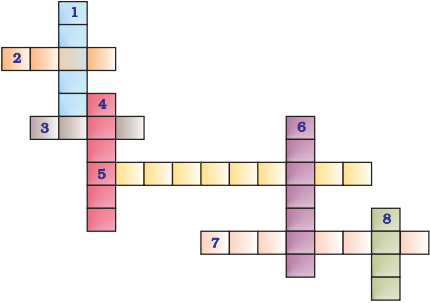
Complete the following crossword puzzle by using the names of the chemical elements based on the data provided in the table.
| Across | Down |
|---|---|
| $2$. The element used by Rutherford during his $\alpha$-scattering experiment. | $1$. $A$ white lustrous metal used for making ornaments and which tends to get tarnished black in the presence of moist air. |
| $3$. An element which forms rust on exposure to moist air. | $4$. Both brass and bronze are alloys of this element. |
| $5$. $A$ very reactive non-metal stored under water. | $6$. The metal which exists in the liquid state at room temperature. |
| $7$. Zinc metal when treated with dilute hydrochloric acid produces a gas of this element which when tested with a burning splinter produces a pop sound. | $8$. An element with the symbol $Pb$. |
Solution
(N/A) The completed crossword puzzle corresponds to the following elements:
$(1)$ Silver
$(2)$ Gold
$(3)$ Iron
$(4)$ Copper
$(5)$ Phosphorus
$(6)$ Mercury
$(7)$ Hydrogen
$(8)$ Lead
$(1)$ Silver
$(2)$ Gold
$(3)$ Iron
$(4)$ Copper
$(5)$ Phosphorus
$(6)$ Mercury
$(7)$ Hydrogen
$(8)$ Lead
.jpg)
1 likes
View Solution46
Medium
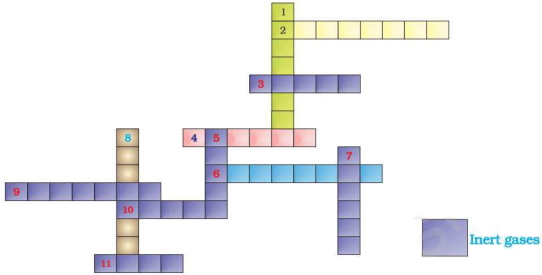
$(a)$ In this crossword puzzle (Fig),names of $11$ elements are hidden. Symbols of these are given below. Complete the puzzle.
$1. Cl$
$2. H$
$3. Ar$
$4. O$
$5. Xe$
$6. N$
$7. He$
$8. F$
$9. Kr$
$10. Rn$
$11. Ne$
$(b)$ Identify the total number of inert gases,their names,and symbols from this crossword puzzle.
$1. Cl$
$2. H$
$3. Ar$
$4. O$
$5. Xe$
$6. N$
$7. He$
$8. F$
$9. Kr$
$10. Rn$
$11. Ne$
$(b)$ Identify the total number of inert gases,their names,and symbols from this crossword puzzle.
Solution
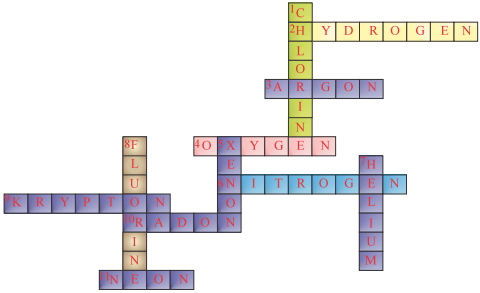
(A) The completed crossword puzzle reveals the names of the $11$ elements: Chlorine $(Cl)$,Hydrogen $(H)$,Argon $(Ar)$,Oxygen $(O)$,Xenon $(Xe)$,Nitrogen $(N)$,Helium $(He)$,Fluorine $(F)$,Krypton $(Kr)$,Radon $(Rn)$,and Neon $(Ne)$.
$(b)$ Inert gases (Noble gases) are elements that have a stable electron configuration. From the given crossword,there are $6$ inert gases present: Helium $(He)$,Neon $(Ne)$,Argon $(Ar)$,Krypton $(Kr)$,Xenon $(Xe)$,and Radon $(Rn)$.
$(b)$ Inert gases (Noble gases) are elements that have a stable electron configuration. From the given crossword,there are $6$ inert gases present: Helium $(He)$,Neon $(Ne)$,Argon $(Ar)$,Krypton $(Kr)$,Xenon $(Xe)$,and Radon $(Rn)$.
0 likes
View Solution47
Medium
Write the chemical formulae for the following substances and calculate the molecular mass for each one of them:
$(a)$ Caustic potash
$(b)$ Baking soda
$(c)$ Limestone
$(d)$ Caustic soda
$(e)$ Ethanol
$(f)$ Common salt
$(a)$ Caustic potash
$(b)$ Baking soda
$(c)$ Limestone
$(d)$ Caustic soda
$(e)$ Ethanol
$(f)$ Common salt
Solution
(N/A) Caustic potash: $KOH$
Molecular mass: $39 + 16 + 1 = 56 \, g \, mol^{-1}$
$(b)$ Baking soda: $NaHCO_3$
Molecular mass: $23 + 1 + 12 + (3 \times 16) = 84 \, g \, mol^{-1}$
$(c)$ Limestone: $CaCO_3$
Molecular mass: $40 + 12 + (3 \times 16) = 100 \, g \, mol^{-1}$
$(d)$ Caustic soda: $NaOH$
Molecular mass: $23 + 16 + 1 = 40 \, g \, mol^{-1}$
$(e)$ Ethanol: $C_2H_5OH$
Molecular mass: $(2 \times 12) + (6 \times 1) + 16 = 46 \, g \, mol^{-1}$
$(f)$ Common salt: $NaCl$
Molecular mass: $23 + 35.5 = 58.5 \, g \, mol^{-1}$
Molecular mass: $39 + 16 + 1 = 56 \, g \, mol^{-1}$
$(b)$ Baking soda: $NaHCO_3$
Molecular mass: $23 + 1 + 12 + (3 \times 16) = 84 \, g \, mol^{-1}$
$(c)$ Limestone: $CaCO_3$
Molecular mass: $40 + 12 + (3 \times 16) = 100 \, g \, mol^{-1}$
$(d)$ Caustic soda: $NaOH$
Molecular mass: $23 + 16 + 1 = 40 \, g \, mol^{-1}$
$(e)$ Ethanol: $C_2H_5OH$
Molecular mass: $(2 \times 12) + (6 \times 1) + 16 = 46 \, g \, mol^{-1}$
$(f)$ Common salt: $NaCl$
Molecular mass: $23 + 35.5 = 58.5 \, g \, mol^{-1}$
0 likes
View Solution48
MediumMCQ
In photosynthesis,$6$ molecules of carbon dioxide combine with an equal number of water molecules through a complex series of reactions to give a molecule of glucose having a molecular formula $C_6H_{12}O_6$. How many grams of water would be required to produce $18\, g$ of glucose? Compute the volume of water (in $cm^3$) so consumed assuming the density of water to be $1\, g\, cm^{-3}$.
A
$16.8$
B
$13.5$
C
$11.3$
D
$10.8$
Solution
(D) The balanced chemical equation for photosynthesis is: $6CO_2 + 6H_2O \xrightarrow{\text{Chlorophyll, Sunlight}} C_6H_{12}O_6 + 6O_2$.
From the equation,$1$ mole of glucose $(C_6H_{12}O_6)$ is produced from $6$ moles of water $(H_2O)$.
The molar mass of glucose is $(6 \times 12) + (12 \times 1) + (6 \times 16) = 72 + 12 + 96 = 180\, g/mol$.
The molar mass of water is $(2 \times 1) + 16 = 18\, g/mol$.
Thus,$180\, g$ of glucose requires $6 \times 18 = 108\, g$ of water.
Therefore,$18\, g$ of glucose requires: $\frac{108}{180} \times 18 = 10.8\, g$ of water.
Given the density of water is $1\, g\, cm^{-3}$,the volume of water consumed is: $\text{Volume} = \frac{\text{Mass}}{\text{Density}} = \frac{10.8\, g}{1\, g\, cm^{-3}} = 10.8\, cm^3$.
From the equation,$1$ mole of glucose $(C_6H_{12}O_6)$ is produced from $6$ moles of water $(H_2O)$.
The molar mass of glucose is $(6 \times 12) + (12 \times 1) + (6 \times 16) = 72 + 12 + 96 = 180\, g/mol$.
The molar mass of water is $(2 \times 1) + 16 = 18\, g/mol$.
Thus,$180\, g$ of glucose requires $6 \times 18 = 108\, g$ of water.
Therefore,$18\, g$ of glucose requires: $\frac{108}{180} \times 18 = 10.8\, g$ of water.
Given the density of water is $1\, g\, cm^{-3}$,the volume of water consumed is: $\text{Volume} = \frac{\text{Mass}}{\text{Density}} = \frac{10.8\, g}{1\, g\, cm^{-3}} = 10.8\, cm^3$.
0 likes
View Solution49
Medium
Name the anion and cation which constitute the molecule of aluminium oxide.
Solution
(N/A) $(i)$ Cation: $Al^{3+}$ (Aluminium ion)
$(ii)$ Anion: $O^{2-}$ (Oxide ion)
$(ii)$ Anion: $O^{2-}$ (Oxide ion)
0 likes
View Solution50
Easy
Write the atomicity of the following:
$(i)$ Sulphur molecule
$(ii)$ Phosphorus molecule
$(i)$ Sulphur molecule
$(ii)$ Phosphorus molecule
Solution
(N/A) Atomicity is defined as the total number of atoms present in one molecule of an element.
$(i)$ The chemical formula of a sulphur molecule is $S_{8}$. Since it contains $8$ atoms of sulphur,its atomicity is $8$ (Polyatomic).
$(ii)$ The chemical formula of a phosphorus molecule is $P_{4}$. Since it contains $4$ atoms of phosphorus,its atomicity is $4$ (Tetraatomic).
$(i)$ The chemical formula of a sulphur molecule is $S_{8}$. Since it contains $8$ atoms of sulphur,its atomicity is $8$ (Polyatomic).
$(ii)$ The chemical formula of a phosphorus molecule is $P_{4}$. Since it contains $4$ atoms of phosphorus,its atomicity is $4$ (Tetraatomic).
0 likes
View SolutionATOMS AND MOLECULES — Mix Example - ATOMS AND MOLECULES · Frequently Asked Questions
1Are these ATOMS AND MOLECULES questions useful for JEE and NEET?
Yes. All questions in this section are mapped to JEE Main and NEET exam patterns. Previous year questions from JEE Main, NEET, GUJCET and state-level exams are included with full solutions.
2Can I switch to Hindi or Gujarati for these questions?
Yes. Use the language tabs in the hero section or the sidebar to view the same questions and solutions in English, Hindi or Gujarati.
3How do I generate a question paper from this subtopic?
Use the Vedclass Exam Paper Generator — select the chapter and subtopic, set difficulty, and generate Sets A, B, C, D automatically. First 3 chapters of every subject are free.
Vedclass Products
For Students
Vedclass Test Series
Mock tests in real JEE/NEET style with performance analysis. 5-day free trial.
Start Free TrialFor Teachers
Exam Paper Generator
Generate Set A/B/C/D papers from this chapter in 2 minutes. 3 chapters free.
Try FreeFor Institutes
Online Exam Module
Live online exams with unlimited students, 360° analytics & white-label branding.
See DemoFor Teachers & Institutes
Generate a ATOMS AND MOLECULES Exam Paper in 2 Minutes
Select subtopic & difficulty — Sets A, B, C, D auto-generated with No Repeat logic.
First 3 chapters of every subject are free — no payment required.