
A English
Textbook - Surface Areas and Volumes Questions in English
Class 9 Mathematics · Surface Areas and Volumes · Textbook - Surface Areas and Volumes
116+
Questions
English
Language
100%
With Solutions
Showing 50 of 116 questions in English
51
MediumMCQ
Find the total surface area of a hemisphere of radius $10 \, cm.$ (Use $\pi = 3.14$) (in $cm^2$)
A
$600$
B
$502$
C
$942$
D
$900$
Solution
(C) Radius $(r)$ of the hemisphere $= 10 \, cm$.
The total surface area of a hemisphere is given by the sum of its curved surface area and the area of its circular base.
Total Surface Area $= CSA + \text{Area of circular base}$
$= 2 \pi r^2 + \pi r^2 = 3 \pi r^2$
Substituting the values:
$= 3 \times 3.14 \times (10)^2 \, cm^2$
$= 3 \times 3.14 \times 100 \, cm^2$
$= 3 \times 314 \, cm^2$
$= 942 \, cm^2$
Thus,the total surface area of the hemisphere is $942 \, cm^2$.
The total surface area of a hemisphere is given by the sum of its curved surface area and the area of its circular base.
Total Surface Area $= CSA + \text{Area of circular base}$
$= 2 \pi r^2 + \pi r^2 = 3 \pi r^2$
Substituting the values:
$= 3 \times 3.14 \times (10)^2 \, cm^2$
$= 3 \times 3.14 \times 100 \, cm^2$
$= 3 \times 314 \, cm^2$
$= 942 \, cm^2$
Thus,the total surface area of the hemisphere is $942 \, cm^2$.

0 likes
View Solution52
MediumMCQ
The radius of a spherical balloon increases from $7 \, cm$ to $14 \, cm$ as air is being pumped into it. Find the ratio of surface areas of the balloon in the two cases.
A
$1:7$
B
$1:5$
C
$1:6$
D
$1:4$
Solution
(D) The initial radius $(r_1)$ of the spherical balloon is $7 \, cm$.
The final radius $(r_2)$ of the spherical balloon after pumping air is $14 \, cm$.
The surface area of a sphere is given by the formula $A = 4 \pi r^2$.
The ratio of the surface areas is given by $\frac{A_1}{A_2} = \frac{4 \pi r_1^2}{4 \pi r_2^2} = \left( \frac{r_1}{r_2} \right)^2$.
Substituting the values,we get $\left( \frac{7}{14} \right)^2 = \left( \frac{1}{2} \right)^2 = \frac{1}{4}$.
Therefore,the ratio of the surface areas is $1:4$.
The final radius $(r_2)$ of the spherical balloon after pumping air is $14 \, cm$.
The surface area of a sphere is given by the formula $A = 4 \pi r^2$.
The ratio of the surface areas is given by $\frac{A_1}{A_2} = \frac{4 \pi r_1^2}{4 \pi r_2^2} = \left( \frac{r_1}{r_2} \right)^2$.
Substituting the values,we get $\left( \frac{7}{14} \right)^2 = \left( \frac{1}{2} \right)^2 = \frac{1}{4}$.
Therefore,the ratio of the surface areas is $1:4$.
1 likes
View Solution53
MediumMCQ
$A$ hemispherical bowl made of brass has an inner diameter of $10.5 \, cm$. Find the cost of tin-plating it on the inside at the rate of $Rs. 16$ per $100 \, cm^2$.
A
$Rs. 27.72$
B
$Rs. 30.72$
C
$Rs. 27.00$
D
$Rs. 42.32$
Solution
(A) Inner diameter of the hemisphere $(d) = 10.5 \, cm$.
Radius $(r) = \frac{d}{2} = \frac{10.5}{2} \, cm = 5.25 \, cm = \frac{21}{4} \, cm$.
Inner curved surface area of the hemispherical bowl $= 2 \pi r^2$.
Area $= 2 \times \frac{22}{7} \times \left(\frac{21}{4}\right)^2 \, cm^2 = 2 \times \frac{22}{7} \times \frac{21}{4} \times \frac{21}{4} \, cm^2$.
Area $= 11 \times 3 \times \frac{21}{4} \, cm^2 = \frac{693}{4} \, cm^2 = 173.25 \, cm^2$.
Rate of tin-plating $= Rs. 16$ per $100 \, cm^2$.
Total cost $= \left(\frac{173.25}{100}\right) \times 16 = 1.7325 \times 16 = Rs. 27.72$.
Radius $(r) = \frac{d}{2} = \frac{10.5}{2} \, cm = 5.25 \, cm = \frac{21}{4} \, cm$.
Inner curved surface area of the hemispherical bowl $= 2 \pi r^2$.
Area $= 2 \times \frac{22}{7} \times \left(\frac{21}{4}\right)^2 \, cm^2 = 2 \times \frac{22}{7} \times \frac{21}{4} \times \frac{21}{4} \, cm^2$.
Area $= 11 \times 3 \times \frac{21}{4} \, cm^2 = \frac{693}{4} \, cm^2 = 173.25 \, cm^2$.
Rate of tin-plating $= Rs. 16$ per $100 \, cm^2$.
Total cost $= \left(\frac{173.25}{100}\right) \times 16 = 1.7325 \times 16 = Rs. 27.72$.
0 likes
View Solution54
MediumMCQ
Find the radius of a sphere whose surface area is $154 \, cm^2$. (in $, cm$)
A
$5.6$
B
$3.5$
C
$3.0$
D
$6.5$
Solution
(B) Let the radius of the sphere be $r \, cm$.
The surface area of a sphere is given by the formula $4 \pi r^2$.
Given that the surface area is $154 \, cm^2$,we have:
$4 \pi r^2 = 154$
Substituting $\pi = \frac{22}{7}$:
$4 \times \frac{22}{7} \times r^2 = 154$
Solving for $r^2$:
$r^2 = \frac{154 \times 7}{4 \times 22}$
$r^2 = \frac{7 \times 7}{4} = \left(\frac{7}{2}\right)^2$
Taking the square root of both sides:
$r = \frac{7}{2} = 3.5 \, cm$
Thus,the radius of the sphere is $3.5 \, cm$.
The surface area of a sphere is given by the formula $4 \pi r^2$.
Given that the surface area is $154 \, cm^2$,we have:
$4 \pi r^2 = 154$
Substituting $\pi = \frac{22}{7}$:
$4 \times \frac{22}{7} \times r^2 = 154$
Solving for $r^2$:
$r^2 = \frac{154 \times 7}{4 \times 22}$
$r^2 = \frac{7 \times 7}{4} = \left(\frac{7}{2}\right)^2$
Taking the square root of both sides:
$r = \frac{7}{2} = 3.5 \, cm$
Thus,the radius of the sphere is $3.5 \, cm$.
0 likes
View Solution55
MediumMCQ
The diameter of the moon is approximately one-fourth of the diameter of the earth. Find the ratio of their surface areas.
A
$1:19$
B
$1:18$
C
$1:16$
D
$1:17$
Solution
(C) Let the radius of the earth be $R$.
Since the diameter of the moon is one-fourth of the diameter of the earth,the radius of the moon will also be one-fourth of the radius of the earth.
Therefore,the radius of the moon $= \frac{R}{4}$.
The surface area of a sphere is given by the formula $A = 4 \pi r^2$.
Surface area of the earth $= 4 \pi R^2$.
Surface area of the moon $= 4 \pi \left( \frac{R}{4} \right)^2 = 4 \pi \left( \frac{R^2}{16} \right) = \frac{\pi R^2}{4}$.
The ratio of the surface area of the moon to the surface area of the earth is:
$\frac{\text{Surface area of the moon}}{\text{Surface area of the earth}} = \frac{\frac{\pi R^2}{4}}{4 \pi R^2} = \frac{1}{4 \times 4} = \frac{1}{16}$.
Thus,the ratio of their surface areas is $1:16$.
Since the diameter of the moon is one-fourth of the diameter of the earth,the radius of the moon will also be one-fourth of the radius of the earth.
Therefore,the radius of the moon $= \frac{R}{4}$.
The surface area of a sphere is given by the formula $A = 4 \pi r^2$.
Surface area of the earth $= 4 \pi R^2$.
Surface area of the moon $= 4 \pi \left( \frac{R}{4} \right)^2 = 4 \pi \left( \frac{R^2}{16} \right) = \frac{\pi R^2}{4}$.
The ratio of the surface area of the moon to the surface area of the earth is:
$\frac{\text{Surface area of the moon}}{\text{Surface area of the earth}} = \frac{\frac{\pi R^2}{4}}{4 \pi R^2} = \frac{1}{4 \times 4} = \frac{1}{16}$.
Thus,the ratio of their surface areas is $1:16$.
0 likes
View Solution56
MediumMCQ
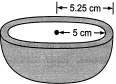
$A$ hemispherical bowl is made of steel,$0.25 \, cm$ thick. The inner radius of the bowl is $5 \, cm$. Find the outer curved surface area of the bowl. (in $, cm^2$)
A
$170.96$
B
$153.29$
C
$160.25$
D
$173.25$
Solution
(D) Inner radius $(r) = 5 \, cm$
Thickness $= 0.25 \, cm$
Outer radius $(R) = r + \text{thickness} = 5 + 0.25 = 5.25 \, cm$
The outer curved surface area of a hemispherical bowl is given by the formula $2 \pi R^2$.
Outer curved surface area $= 2 \times \frac{22}{7} \times (5.25)^2 \, cm^2$
$= 2 \times \frac{22}{7} \times 5.25 \times 5.25 \, cm^2$
$= 2 \times \frac{22}{7} \times \frac{525}{100} \times \frac{525}{100} \, cm^2$
$= 2 \times 22 \times \frac{75}{100} \times 5.25 \, cm^2$
$= 44 \times 0.75 \times 5.25 \, cm^2$
$= 173.25 \, cm^2$
Thickness $= 0.25 \, cm$
Outer radius $(R) = r + \text{thickness} = 5 + 0.25 = 5.25 \, cm$
The outer curved surface area of a hemispherical bowl is given by the formula $2 \pi R^2$.
Outer curved surface area $= 2 \times \frac{22}{7} \times (5.25)^2 \, cm^2$
$= 2 \times \frac{22}{7} \times 5.25 \times 5.25 \, cm^2$
$= 2 \times \frac{22}{7} \times \frac{525}{100} \times \frac{525}{100} \, cm^2$
$= 2 \times 22 \times \frac{75}{100} \times 5.25 \, cm^2$
$= 44 \times 0.75 \times 5.25 \, cm^2$
$= 173.25 \, cm^2$
0 likes
View Solution57
Medium
$A$ right circular cylinder just encloses a sphere of radius $r$ (see figure). Find:
$(i)$ Surface area of the sphere,
$(ii)$ Curved surface area of the cylinder,
$(iii)$ Ratio of the areas obtained in $(i)$ and $(ii)$.
$(i)$ Surface area of the sphere,
$(ii)$ Curved surface area of the cylinder,
$(iii)$ Ratio of the areas obtained in $(i)$ and $(ii)$.

Solution
(N/A) $(i)$ For the sphere:
Radius $= r$
$\therefore$ Surface area of the sphere $= 4 \pi r^{2}$
$(ii)$ For the right circular cylinder:
Since the cylinder just encloses the sphere,the radius of the cylinder is equal to the radius of the sphere.
$\therefore$ Radius of the cylinder $= r$
Height of the cylinder is equal to the diameter of the sphere.
$\Rightarrow$ Height of the cylinder $(h) = 2r$
Curved surface area of a cylinder $= 2 \pi rh = 2 \pi r(2r) = 4 \pi r^{2}$
$(iii)$ Ratio of the areas obtained in $(i)$ and $(ii)$:
$\frac{\text{Surface area of the sphere}}{\text{Curved surface area of the cylinder}} = \frac{4 \pi r^{2}}{4 \pi r^{2}} = \frac{1}{1}$
Thus,the required ratio is $1:1$.
Radius $= r$
$\therefore$ Surface area of the sphere $= 4 \pi r^{2}$
$(ii)$ For the right circular cylinder:
Since the cylinder just encloses the sphere,the radius of the cylinder is equal to the radius of the sphere.
$\therefore$ Radius of the cylinder $= r$
Height of the cylinder is equal to the diameter of the sphere.
$\Rightarrow$ Height of the cylinder $(h) = 2r$
Curved surface area of a cylinder $= 2 \pi rh = 2 \pi r(2r) = 4 \pi r^{2}$
$(iii)$ Ratio of the areas obtained in $(i)$ and $(ii)$:
$\frac{\text{Surface area of the sphere}}{\text{Curved surface area of the cylinder}} = \frac{4 \pi r^{2}}{4 \pi r^{2}} = \frac{1}{1}$
Thus,the required ratio is $1:1$.
0 likes
View Solution58
MediumMCQ
$A$ wall of length $10\, m$ was to be built across an open ground. The height of the wall is $4\, m$ and thickness of the wall is $24\, cm$. If this wall is to be built up with bricks whose dimensions are $24\, cm \times 12\, cm \times 8\, cm$,how many bricks would be required?
A
$9625$
B
$4167$
C
$4100$
D
$7160$
Solution
(B) The wall is a cuboid. First,convert all dimensions to centimeters:
Length of the wall $= 10\, m = 1000\, cm$.
Thickness of the wall $= 24\, cm$.
Height of the wall $= 4\, m = 400\, cm$.
Volume of the wall $= 1000\, cm \times 24\, cm \times 400\, cm = 9,600,000\, cm^3$.
Volume of one brick $= 24\, cm \times 12\, cm \times 8\, cm = 2304\, cm^3$.
Number of bricks required $= \frac{\text{Volume of the wall}}{\text{Volume of one brick}} = \frac{9,600,000}{2304} \approx 4166.67$.
Since we cannot have a fraction of a brick,we round up to the nearest whole number,which is $4167$ bricks.
Length of the wall $= 10\, m = 1000\, cm$.
Thickness of the wall $= 24\, cm$.
Height of the wall $= 4\, m = 400\, cm$.
Volume of the wall $= 1000\, cm \times 24\, cm \times 400\, cm = 9,600,000\, cm^3$.
Volume of one brick $= 24\, cm \times 12\, cm \times 8\, cm = 2304\, cm^3$.
Number of bricks required $= \frac{\text{Volume of the wall}}{\text{Volume of one brick}} = \frac{9,600,000}{2304} \approx 4166.67$.
Since we cannot have a fraction of a brick,we round up to the nearest whole number,which is $4167$ bricks.
0 likes
View Solution59
EasyMCQ
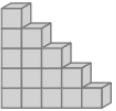
$A$ child is playing with building blocks, which are in the shape of cubes, and has built a structure as shown in the figure. If the edge of each cube is $3 \, cm$, find the volume of the structure built by the child. (in $cm^3$)
A
$420$
B
$415$
C
$405$
D
$410$
Solution
(C) The volume of a single cube is given by the formula: $V = \text{edge} \times \text{edge} \times \text{edge}$.
Given the edge length is $3 \, cm$, the volume of one cube is $3 \, cm \times 3 \, cm \times 3 \, cm = 27 \, cm^3$.
By observing the structure in the figure, we can count the total number of cubes:
- Column $1$ (leftmost): $5$ cubes
- Column $2$: $4$ cubes
- Column $3$: $3$ cubes
- Column $4$: $2$ cubes
- Column $5$ (rightmost): $1$ cube
Total number of cubes $= 5 + 4 + 3 + 2 + 1 = 15$ cubes.
The total volume of the structure is the number of cubes multiplied by the volume of one cube:
Total Volume $= 15 \times 27 \, cm^3 = 405 \, cm^3$.
Given the edge length is $3 \, cm$, the volume of one cube is $3 \, cm \times 3 \, cm \times 3 \, cm = 27 \, cm^3$.
By observing the structure in the figure, we can count the total number of cubes:
- Column $1$ (leftmost): $5$ cubes
- Column $2$: $4$ cubes
- Column $3$: $3$ cubes
- Column $4$: $2$ cubes
- Column $5$ (rightmost): $1$ cube
Total number of cubes $= 5 + 4 + 3 + 2 + 1 = 15$ cubes.
The total volume of the structure is the number of cubes multiplied by the volume of one cube:
Total Volume $= 15 \times 27 \, cm^3 = 405 \, cm^3$.
0 likes
View Solution60
EasyMCQ
$A$ matchbox measures $4 \,cm \times 2.5 \,cm \times 1.5 \,cm.$ What will be the volume of a packet containing $12$ such boxes (in $,cm^3$)?
A
$210$
B
$200$
C
$190$
D
$180$
Solution
(D) The dimensions of the matchbox (cuboid) are $l = 4 \,cm$,$b = 2.5 \,cm$,and $h = 1.5 \,cm$.
The volume of one matchbox is given by the formula $V = l \times b \times h$.
$V = 4 \,cm \times 2.5 \,cm \times 1.5 \,cm = 15 \,cm^3$.
The volume of a packet containing $12$ such boxes is $12 \times V$.
Volume $= 12 \times 15 \,cm^3 = 180 \,cm^3$.
The volume of one matchbox is given by the formula $V = l \times b \times h$.
$V = 4 \,cm \times 2.5 \,cm \times 1.5 \,cm = 15 \,cm^3$.
The volume of a packet containing $12$ such boxes is $12 \times V$.
Volume $= 12 \times 15 \,cm^3 = 180 \,cm^3$.
0 likes
View Solution61
MediumMCQ
$A$ cuboidal water tank is $6 \,m$ long,$5 \,m$ wide and $4.5 \,m$ deep. How many litres of water can it hold (in $,l$)? $(1 \,m^3 = 1000 \,l)$
A
$135000$
B
$535000$
C
$600000$
D
$885000$
Solution
(A) Given: Length $(l) = 6 \,m$,Breadth $(b) = 5 \,m$,Depth $(h) = 4.5 \,m$.
The capacity of the cuboidal tank is given by the formula: $\text{Volume} = l \times b \times h$.
$\text{Volume} = 6 \,m \times 5 \,m \times 4.5 \,m = 135 \,m^3$.
We know that $1 \,m^3 = 1000 \,l$.
Therefore,the capacity in litres is $135 \times 1000 \,l = 135000 \,l$.
Thus,the tank can hold $135000 \,l$ of water.
The capacity of the cuboidal tank is given by the formula: $\text{Volume} = l \times b \times h$.
$\text{Volume} = 6 \,m \times 5 \,m \times 4.5 \,m = 135 \,m^3$.
We know that $1 \,m^3 = 1000 \,l$.
Therefore,the capacity in litres is $135 \times 1000 \,l = 135000 \,l$.
Thus,the tank can hold $135000 \,l$ of water.
0 likes
View Solution62
MediumMCQ
$A$ cuboidal vessel is $10 \, m$ long and $8 \, m$ wide. How high must it be made to hold $380$ cubic metres of a liquid (in $, m$)?
A
$4.70$
B
$4.75$
C
$3.70$
D
$5.76$
Solution
(B) Given: Length $(l) = 10 \, m$,Breadth $(b) = 8 \, m$,Volume $(V) = 380 \, m^3$.
Let the height of the cuboidal vessel be $h$.
We know that the volume of a cuboid is given by the formula: $V = l \times b \times h$.
Substituting the given values: $380 = 10 \times 8 \times h$.
$380 = 80 \times h$.
$h = \frac{380}{80} = \frac{38}{8} = 4.75 \, m$.
Therefore,the vessel must be $4.75 \, m$ high to hold $380 \, m^3$ of liquid.
Let the height of the cuboidal vessel be $h$.
We know that the volume of a cuboid is given by the formula: $V = l \times b \times h$.
Substituting the given values: $380 = 10 \times 8 \times h$.
$380 = 80 \times h$.
$h = \frac{380}{80} = \frac{38}{8} = 4.75 \, m$.
Therefore,the vessel must be $4.75 \, m$ high to hold $380 \, m^3$ of liquid.
0 likes
View Solution63
MediumMCQ
Find the cost of digging a cuboidal pit $8 \, m$ long,$6 \, m$ broad,and $3 \, m$ deep at the rate of $Rs. 30$ per $m^3$.
A
$Rs. 4300$
B
$Rs. 4000$
C
$Rs. 4320$
D
$Rs. 4120$
Solution
(C) Length $(l) = 8 \, m$; Breadth $(b) = 6 \, m$; Depth $(h) = 3 \, m$.
$\therefore$ Volume of the cuboidal pit $= l \times b \times h = 8 \times 6 \times 3 \, m^3 = 144 \, m^3$.
Since the rate of digging the pit is $Rs. 30$ per $m^3$,
$\therefore$ Cost of digging $= 30 \times 144 = Rs. 4320$.
$\therefore$ Volume of the cuboidal pit $= l \times b \times h = 8 \times 6 \times 3 \, m^3 = 144 \, m^3$.
Since the rate of digging the pit is $Rs. 30$ per $m^3$,
$\therefore$ Cost of digging $= 30 \times 144 = Rs. 4320$.
0 likes
View Solution64
MediumMCQ
The capacity of a cuboidal tank is $50000$ litres of water. Find the breadth of the tank,if its length and depth are respectively $2.5\, m$ and $10\, m$. (in $, m$)
A
$6$
B
$4$
C
$3$
D
$2$
Solution
(D) Given: Length of the tank $(l) = 2.5\, m$,Depth of the tank $(h) = 10\, m$.
Capacity of the tank $= 50000\, l$.
Since $1000\, l = 1\, m^3$,the capacity in cubic metres is $50000 / 1000 = 50\, m^3$.
Let the breadth of the tank be $b\, m$.
The volume of a cuboidal tank is given by the formula $V = l \times b \times h$.
Substituting the values: $50 = 2.5 \times b \times 10$.
$50 = 25 \times b$.
$b = 50 / 25 = 2\, m$.
Therefore,the breadth of the tank is $2\, m$.
Capacity of the tank $= 50000\, l$.
Since $1000\, l = 1\, m^3$,the capacity in cubic metres is $50000 / 1000 = 50\, m^3$.
Let the breadth of the tank be $b\, m$.
The volume of a cuboidal tank is given by the formula $V = l \times b \times h$.
Substituting the values: $50 = 2.5 \times b \times 10$.
$50 = 25 \times b$.
$b = 50 / 25 = 2\, m$.
Therefore,the breadth of the tank is $2\, m$.
0 likes
View Solution65
MediumMCQ
$A$ village,having a population of $4000$,requires $150$ litres of water per head per day. It has a tank measuring $20 \,m \times 15 \,m \times 6 \,m$. For how many days will the water of this tank last?
A
$3$
B
$4$
C
$5$
D
$6$
Solution
(A) Length of the tank $(l) = 20 \,m$.
Breadth of the tank $(b) = 15 \,m$.
Height of the tank $(h) = 6 \,m$.
Volume of the tank $= l \times b \times h = 20 \times 15 \times 6 \,m^3 = 1800 \,m^3$.
Since $1 \,m^3 = 1000 \,l$,the capacity of the tank $= 1800 \times 1000 \,l = 1,800,000 \,l$.
Village population $= 4000$.
Water required per head per day $= 150 \,l$.
Total water required per day $= 4000 \times 150 \,l = 600,000 \,l$.
Let the number of days the water will last be $x$.
Total water required for $x$ days $= 600,000 \times x$.
Equating the total capacity to the total requirement: $600,000 \times x = 1,800,000$.
$x = \frac{1,800,000}{600,000} = 3$.
Thus,the water in the tank will last for $3$ days.
Breadth of the tank $(b) = 15 \,m$.
Height of the tank $(h) = 6 \,m$.
Volume of the tank $= l \times b \times h = 20 \times 15 \times 6 \,m^3 = 1800 \,m^3$.
Since $1 \,m^3 = 1000 \,l$,the capacity of the tank $= 1800 \times 1000 \,l = 1,800,000 \,l$.
Village population $= 4000$.
Water required per head per day $= 150 \,l$.
Total water required per day $= 4000 \times 150 \,l = 600,000 \,l$.
Let the number of days the water will last be $x$.
Total water required for $x$ days $= 600,000 \times x$.
Equating the total capacity to the total requirement: $600,000 \times x = 1,800,000$.
$x = \frac{1,800,000}{600,000} = 3$.
Thus,the water in the tank will last for $3$ days.
0 likes
View Solution66
MediumMCQ
$A$ godown measures $60 \,m \times 25 \,m \times 15 \,m$. Find the maximum number of wooden crates each measuring $1.5 \,m \times 1.25 \,m \times 0.5 \,m$ that can be stored in the godown.
A
$18000$
B
$16000$
C
$17000$
D
$19000$
Solution
(B) Volume of the godown $= 60 \,m \times 25 \,m \times 15 \,m = 22500 \,m^3$.
Volume of one wooden crate $= 1.5 \,m \times 1.25 \,m \times 0.5 \,m = 0.9375 \,m^3$.
Let the maximum number of crates that can be stored be $n$.
Then,$n = \frac{\text{Volume of the godown}}{\text{Volume of one crate}}$.
$n = \frac{60 \times 25 \times 15}{1.5 \times 1.25 \times 0.5}$.
$n = \frac{22500}{0.9375} = 24000$.
Wait,re-calculating: $n = \frac{60 \times 25 \times 15}{1.5 \times 1.25 \times 0.5} = \frac{22500}{0.9375} = 24000$.
Correction: The provided options do not match the calculation. Re-checking the question dimensions: $60 \times 25 \times 15$. If the volume is $22500$ and crate is $0.9375$,$n = 24000$. If the godown height was $10 \,m$ instead of $15 \,m$,then $n = \frac{60 \times 25 \times 10}{0.9375} = 16000$. Given the options,the intended height was $10 \,m$.
Volume of one wooden crate $= 1.5 \,m \times 1.25 \,m \times 0.5 \,m = 0.9375 \,m^3$.
Let the maximum number of crates that can be stored be $n$.
Then,$n = \frac{\text{Volume of the godown}}{\text{Volume of one crate}}$.
$n = \frac{60 \times 25 \times 15}{1.5 \times 1.25 \times 0.5}$.
$n = \frac{22500}{0.9375} = 24000$.
Wait,re-calculating: $n = \frac{60 \times 25 \times 15}{1.5 \times 1.25 \times 0.5} = \frac{22500}{0.9375} = 24000$.
Correction: The provided options do not match the calculation. Re-checking the question dimensions: $60 \times 25 \times 15$. If the volume is $22500$ and crate is $0.9375$,$n = 24000$. If the godown height was $10 \,m$ instead of $15 \,m$,then $n = \frac{60 \times 25 \times 10}{0.9375} = 16000$. Given the options,the intended height was $10 \,m$.
0 likes
View Solution67
DifficultMCQ
$A$ solid cube of side $12 \, cm$ is cut into eight cubes of equal volume. What will be the side of the new cube? Also,find the ratio between their surface areas.
A
$1:2$
B
$1:3$
C
$1:4$
D
$1:5$
Solution
(A) Side of the given cube $= 12 \, cm$.
Volume of the given cube $= (12)^3 = 1728 \, cm^3$.
Let the side of each new smaller cube be $n \, cm$.
Volume of $8$ smaller cubes $= 8 \times n^3$.
Since the volume remains constant,$8n^3 = 1728$.
$n^3 = \frac{1728}{8} = 216$.
$n = \sqrt[3]{216} = 6 \, cm$.
The side of the new cube is $6 \, cm$.
Surface area of the given cube $= 6 \times (12)^2 = 6 \times 144 = 864 \, cm^2$.
Surface area of $8$ smaller cubes $= 8 \times (6 \times 6^2) = 8 \times 216 = 1728 \, cm^2$.
Ratio of surface areas $= \frac{864}{1728} = \frac{1}{2} = 1:2$.
Volume of the given cube $= (12)^3 = 1728 \, cm^3$.
Let the side of each new smaller cube be $n \, cm$.
Volume of $8$ smaller cubes $= 8 \times n^3$.
Since the volume remains constant,$8n^3 = 1728$.
$n^3 = \frac{1728}{8} = 216$.
$n = \sqrt[3]{216} = 6 \, cm$.
The side of the new cube is $6 \, cm$.
Surface area of the given cube $= 6 \times (12)^2 = 6 \times 144 = 864 \, cm^2$.
Surface area of $8$ smaller cubes $= 8 \times (6 \times 6^2) = 8 \times 216 = 1728 \, cm^2$.
Ratio of surface areas $= \frac{864}{1728} = \frac{1}{2} = 1:2$.
0 likes
View Solution68
MediumMCQ
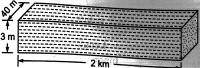
$A$ river $3 \,m$ deep and $40 \,m$ wide is flowing at the rate of $2 \,km$ per hour. How much water will fall into the sea in a minute (in $,m^3$)?
A
$4600$
B
$4800$
C
$4200$
D
$4000$
Solution
(D) The water flowing in a river can be considered in the form of a cuboid.
Given:
Depth $(h) = 3 \,m$
Width $(b) = 40 \,m$
Rate of flow (length in $1$ hour) $(l) = 2 \,km = 2000 \,m$
Volume of water flowing in $1$ hour ($60$ minutes) = $l \times b \times h$
$= 2000 \,m \times 40 \,m \times 3 \,m = 240000 \,m^3$
Volume of water that will fall into the sea in $1$ minute = $\frac{\text{Volume in } 60 \text{ minutes}}{60}$
$= \frac{240000 \,m^3}{60} = 4000 \,m^3$
Given:
Depth $(h) = 3 \,m$
Width $(b) = 40 \,m$
Rate of flow (length in $1$ hour) $(l) = 2 \,km = 2000 \,m$
Volume of water flowing in $1$ hour ($60$ minutes) = $l \times b \times h$
$= 2000 \,m \times 40 \,m \times 3 \,m = 240000 \,m^3$
Volume of water that will fall into the sea in $1$ minute = $\frac{\text{Volume in } 60 \text{ minutes}}{60}$
$= \frac{240000 \,m^3}{60} = 4000 \,m^3$
0 likes
View Solution69
MediumMCQ
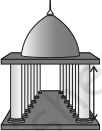
The pillars of a temple are cylindrically shaped (see Fig.). If each pillar has a circular base of radius $20\, cm$ and height $10\, m$,how much concrete mixture would be required to build $14$ such pillars (in $, m^3$)?
A
$17.6$
B
$15.6$
C
$13.6$
D
$12.6$
Solution
(A) Since the concrete mixture used to build the pillars occupies the entire space of the pillar,we need to calculate the volume of the cylinders.
Radius of the base of a cylinder $(r)$ $= 20\, cm = 0.2\, m$.
Height of the cylindrical pillar $(h)$ $= 10\, m$.
Volume of one cylindrical pillar $= \pi r^2 h$
$= \frac{22}{7} \times (0.2)^2 \times 10\, m^3$
$= \frac{22}{7} \times 0.04 \times 10\, m^3$
$= \frac{8.8}{7}\, m^3$.
Volume of $14$ such pillars $= 14 \times \text{Volume of one pillar}$
$= 14 \times \frac{8.8}{7}\, m^3$
$= 2 \times 8.8\, m^3$
$= 17.6\, m^3$.
Thus,$17.6\, m^3$ of concrete mixture is required to build $14$ such pillars.
Radius of the base of a cylinder $(r)$ $= 20\, cm = 0.2\, m$.
Height of the cylindrical pillar $(h)$ $= 10\, m$.
Volume of one cylindrical pillar $= \pi r^2 h$
$= \frac{22}{7} \times (0.2)^2 \times 10\, m^3$
$= \frac{22}{7} \times 0.04 \times 10\, m^3$
$= \frac{8.8}{7}\, m^3$.
Volume of $14$ such pillars $= 14 \times \text{Volume of one pillar}$
$= 14 \times \frac{8.8}{7}\, m^3$
$= 2 \times 8.8\, m^3$
$= 17.6\, m^3$.
Thus,$17.6\, m^3$ of concrete mixture is required to build $14$ such pillars.
0 likes
View Solution70
MediumMCQ
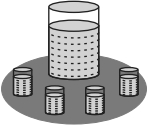
At a Ramzan Mela,a stall keeper in one of the food stalls has a large cylindrical vessel of base radius $15 \, cm$ filled up to a height of $32 \, cm$ with orange juice. The juice is filled in small cylindrical glasses (see figure) of radius $3 \, cm$ up to a height of $8 \, cm$,and sold for $Rs. 15$ each. How much money does the stall keeper receive by selling the juice completely?
A
$Rs. 1400$
B
$Rs. 1500$
C
$Rs. 1900$
D
$Rs. 2000$
Solution
(B) The volume of juice in the large vessel is given by the formula for the volume of a cylinder,$V = \pi R^2 H$.
Here,the radius $R = 15 \, cm$ and the height $H = 32 \, cm$.
So,the volume of juice $= \pi \times 15 \times 15 \times 32 \, cm^3$.
The volume of juice in each small glass is given by $v = \pi r^2 h$.
Here,the radius $r = 3 \, cm$ and the height $h = 8 \, cm$.
So,the volume of each glass $= \pi \times 3 \times 3 \times 8 \, cm^3$.
The number of glasses that can be filled is the ratio of the total volume of juice to the volume of one glass:
Number of glasses $= \frac{\pi \times 15 \times 15 \times 32}{\pi \times 3 \times 3 \times 8} = \frac{225 \times 32}{9 \times 8} = \frac{7200}{72} = 100$.
Since each glass is sold for $Rs. 15$,the total money received by the stall keeper is:
Total amount $= 100 \times 15 = Rs. 1500$.
Here,the radius $R = 15 \, cm$ and the height $H = 32 \, cm$.
So,the volume of juice $= \pi \times 15 \times 15 \times 32 \, cm^3$.
The volume of juice in each small glass is given by $v = \pi r^2 h$.
Here,the radius $r = 3 \, cm$ and the height $h = 8 \, cm$.
So,the volume of each glass $= \pi \times 3 \times 3 \times 8 \, cm^3$.
The number of glasses that can be filled is the ratio of the total volume of juice to the volume of one glass:
Number of glasses $= \frac{\pi \times 15 \times 15 \times 32}{\pi \times 3 \times 3 \times 8} = \frac{225 \times 32}{9 \times 8} = \frac{7200}{72} = 100$.
Since each glass is sold for $Rs. 15$,the total money received by the stall keeper is:
Total amount $= 100 \times 15 = Rs. 1500$.
0 likes
View Solution71
MediumMCQ
The circumference of the base of a cylindrical vessel is $132 \,cm$ and its height is $25 \,cm$. How many litres of water can it hold (in $,l$)? $(1000 \,cm^3 = 1 \,l)$ Assume $\pi = \frac{22}{7}$.
A
$55.65$
B
$34.00$
C
$34.65$
D
$77.65$
Solution
(C) Let the base radius of the cylindrical vessel be $r \,cm$.
The circumference of the base is given by $2 \pi r$.
$2 \pi r = 132$
$2 \times \frac{22}{7} \times r = 132$
$r = \frac{132 \times 7}{2 \times 22} = 21 \,cm$.
The height of the vessel is $h = 25 \,cm$.
The volume of a cylinder is given by $V = \pi r^2 h$.
$V = \frac{22}{7} \times (21)^2 \times 25$
$V = \frac{22}{7} \times 21 \times 21 \times 25 = 22 \times 3 \times 21 \times 25 = 34650 \,cm^3$.
Since $1000 \,cm^3 = 1 \,l$,the capacity in litres is $\frac{34650}{1000} = 34.65 \,l$.
Thus,the vessel can hold $34.65 \,l$ of water.
The circumference of the base is given by $2 \pi r$.
$2 \pi r = 132$
$2 \times \frac{22}{7} \times r = 132$
$r = \frac{132 \times 7}{2 \times 22} = 21 \,cm$.
The height of the vessel is $h = 25 \,cm$.
The volume of a cylinder is given by $V = \pi r^2 h$.
$V = \frac{22}{7} \times (21)^2 \times 25$
$V = \frac{22}{7} \times 21 \times 21 \times 25 = 22 \times 3 \times 21 \times 25 = 34650 \,cm^3$.
Since $1000 \,cm^3 = 1 \,l$,the capacity in litres is $\frac{34650}{1000} = 34.65 \,l$.
Thus,the vessel can hold $34.65 \,l$ of water.
0 likes
View Solution72
DifficultMCQ
The inner diameter of a cylindrical wooden pipe is $24 \, cm$ and its outer diameter is $28 \, cm$. The length of the pipe is $35 \, cm$. Find the mass of the pipe,if $1 \, cm^3$ of wood has a mass of $0.6 \, g$. (in $, kg$)
A
$8.432$
B
$5.432$
C
$3.400$
D
$3.432$
Solution
(D) Given:
Inner diameter $= 24 \, cm$,so inner radius $(r) = 12 \, cm$.
Outer diameter $= 28 \, cm$,so outer radius $(R) = 14 \, cm$.
Length of the pipe $(h) = 35 \, cm$.
The volume of wood in the pipe is the difference between the outer volume and the inner volume:
$V = \pi R^2 h - \pi r^2 h = \pi h (R^2 - r^2) = \pi h (R + r)(R - r)$.
Substituting the values:
$V = \frac{22}{7} \times 35 \times (14 + 12) \times (14 - 12) \, cm^3$.
$V = 22 \times 5 \times 26 \times 2 = 5720 \, cm^3$.
Mass of the wood $= \text{Volume} \times \text{Density} = 5720 \, cm^3 \times 0.6 \, g/cm^3$.
Mass $= 3432 \, g$.
Converting to kilograms: $3432 \, g = 3.432 \, kg$.
Inner diameter $= 24 \, cm$,so inner radius $(r) = 12 \, cm$.
Outer diameter $= 28 \, cm$,so outer radius $(R) = 14 \, cm$.
Length of the pipe $(h) = 35 \, cm$.
The volume of wood in the pipe is the difference between the outer volume and the inner volume:
$V = \pi R^2 h - \pi r^2 h = \pi h (R^2 - r^2) = \pi h (R + r)(R - r)$.
Substituting the values:
$V = \frac{22}{7} \times 35 \times (14 + 12) \times (14 - 12) \, cm^3$.
$V = 22 \times 5 \times 26 \times 2 = 5720 \, cm^3$.
Mass of the wood $= \text{Volume} \times \text{Density} = 5720 \, cm^3 \times 0.6 \, g/cm^3$.
Mass $= 3432 \, g$.
Converting to kilograms: $3432 \, g = 3.432 \, kg$.
0 likes
View Solution73
DifficultMCQ
$A$ soft drink is available in two packs: $(i)$ a tin can with a rectangular base of length $5 \, cm$ and width $4 \, cm$ having a height of $15 \, cm$,and $(ii)$ a plastic cylinder with a circular base of diameter $7 \, cm$ and height $10 \, cm$. Which container has greater capacity and by how much (in $, cm^3$)?
A
$85$
B
$80$
C
$75$
D
$95$
Solution
(A) For the rectangular pack:
Length $(l) = 5 \, cm$,Breadth $(b) = 4 \, cm$,Height $(h) = 15 \, cm$.
Volume $= l \times b \times h = 5 \times 4 \times 15 = 300 \, cm^3$.
Capacity of the rectangular pack $= 300 \, cm^3$.
For the cylindrical pack:
Base diameter $= 7 \, cm$,so Radius $(r) = \frac{7}{2} = 3.5 \, cm$.
Height $(h) = 10 \, cm$.
Volume $= \pi r^2 h = \frac{22}{7} \times (3.5)^2 \times 10 = \frac{22}{7} \times 12.25 \times 10 = 385 \, cm^3$.
Capacity of the cylindrical pack $= 385 \, cm^3$.
Comparing the two:
$385 \, cm^3 - 300 \, cm^3 = 85 \, cm^3$.
Thus,the cylindrical pack has a greater capacity by $85 \, cm^3$.
Length $(l) = 5 \, cm$,Breadth $(b) = 4 \, cm$,Height $(h) = 15 \, cm$.
Volume $= l \times b \times h = 5 \times 4 \times 15 = 300 \, cm^3$.
Capacity of the rectangular pack $= 300 \, cm^3$.
For the cylindrical pack:
Base diameter $= 7 \, cm$,so Radius $(r) = \frac{7}{2} = 3.5 \, cm$.
Height $(h) = 10 \, cm$.
Volume $= \pi r^2 h = \frac{22}{7} \times (3.5)^2 \times 10 = \frac{22}{7} \times 12.25 \times 10 = 385 \, cm^3$.
Capacity of the cylindrical pack $= 385 \, cm^3$.
Comparing the two:
$385 \, cm^3 - 300 \, cm^3 = 85 \, cm^3$.
Thus,the cylindrical pack has a greater capacity by $85 \, cm^3$.
0 likes
View Solution74
MediumMCQ
If the lateral surface area of a cylinder is $94.2 \, cm^2$ and its height is $5 \, cm$,then find the radius of its base. (in $, cm$)
A
$5$
B
$3$
C
$4$
D
$9$
Solution
(B) Given: Height of the cylinder $(h) = 5 \, cm$.
Lateral surface area of the cylinder $= 94.2 \, cm^2$.
Let the radius of the base be $r$.
The formula for the lateral surface area of a cylinder is $2 \pi rh$.
Substituting the given values (taking $\pi = 3.14$):
$2 \times 3.14 \times r \times 5 = 94.2$
$31.4 \times r = 94.2$
$r = \frac{94.2}{31.4}$
$r = 3 \, cm$.
Thus,the radius of the base is $3 \, cm$.
Lateral surface area of the cylinder $= 94.2 \, cm^2$.
Let the radius of the base be $r$.
The formula for the lateral surface area of a cylinder is $2 \pi rh$.
Substituting the given values (taking $\pi = 3.14$):
$2 \times 3.14 \times r \times 5 = 94.2$
$31.4 \times r = 94.2$
$r = \frac{94.2}{31.4}$
$r = 3 \, cm$.
Thus,the radius of the base is $3 \, cm$.
0 likes
View Solution75
MediumMCQ
If the lateral surface area of a cylinder is $94.2 \, cm^2$ and its height is $5 \, cm$,then find its volume. (Use $\pi = 3.14$) (in $, cm^3$)
A
$150.3$
B
$145.3$
C
$141.3$
D
$1441.3$
Solution
(C) The lateral surface area of a cylinder is given by the formula $A = 2 \pi r h$.
Given $A = 94.2 \, cm^2$,$h = 5 \, cm$,and $\pi = 3.14$.
$94.2 = 2 \times 3.14 \times r \times 5$
$94.2 = 31.4 \times r$
$r = \frac{94.2}{31.4} = 3 \, cm$.
Now,the volume of the cylinder is given by $V = \pi r^2 h$.
$V = 3.14 \times (3)^2 \times 5$
$V = 3.14 \times 9 \times 5$
$V = 3.14 \times 45 = 141.3 \, cm^3$.
Thus,the required volume is $141.3 \, cm^3$.
Given $A = 94.2 \, cm^2$,$h = 5 \, cm$,and $\pi = 3.14$.
$94.2 = 2 \times 3.14 \times r \times 5$
$94.2 = 31.4 \times r$
$r = \frac{94.2}{31.4} = 3 \, cm$.
Now,the volume of the cylinder is given by $V = \pi r^2 h$.
$V = 3.14 \times (3)^2 \times 5$
$V = 3.14 \times 9 \times 5$
$V = 3.14 \times 45 = 141.3 \, cm^3$.
Thus,the required volume is $141.3 \, cm^3$.
0 likes
View Solution76
EasyMCQ
It costs $Rs. 2200$ to paint the inner curved surface of a cylindrical vessel $10 \, m$ deep. If the cost of painting is at the rate of $Rs. 20$ per $m^2$,find the inner curved surface area of the vessel. (in $, m^2$)
A
$550$
B
$220$
C
$330$
D
$110$
Solution
(D) To find the inner curved surface area,we use the relationship between total cost,rate,and area.
Total cost of painting $= Rs. 2200$.
Rate of painting $= Rs. 20$ per $m^2$.
Since,$\text{Total Cost} = \text{Area} \times \text{Rate}$,we have:
$\text{Area} = \frac{\text{Total Cost}}{\text{Rate}} = \frac{2200}{20} = 110 \, m^2$.
Therefore,the inner curved surface area of the vessel is $110 \, m^2$.
Total cost of painting $= Rs. 2200$.
Rate of painting $= Rs. 20$ per $m^2$.
Since,$\text{Total Cost} = \text{Area} \times \text{Rate}$,we have:
$\text{Area} = \frac{\text{Total Cost}}{\text{Rate}} = \frac{2200}{20} = 110 \, m^2$.
Therefore,the inner curved surface area of the vessel is $110 \, m^2$.
0 likes
View Solution77
EasyMCQ
It costs $Rs. 2200$ to paint the inner curved surface of a cylindrical vessel $10 \, m$ deep. If the cost of painting is at the rate of $Rs. 20$ per $m^2$, find the radius of the base. (in $m$)
A
$1.75$
B
$1.55$
C
$1.05$
D
$1.60$
Solution
(A) Given:
Total cost of painting $= Rs. 2200$
Rate of painting $= Rs. 20 \, \text{per} \, m^2$
Depth (height) of the vessel $(h)$ $= 10 \, m$
First, calculate the inner curved surface area $(CSA)$ of the cylindrical vessel:
$CSA = \frac{\text{Total cost}}{\text{Rate}} = \frac{2200}{20} = 110 \, m^2$
The formula for the curved surface area of a cylinder is $CSA = 2 \pi rh$.
Substituting the known values:
$110 = 2 \times \frac{22}{7} \times r \times 10$
Solving for $r$:
$110 = \frac{440}{7} \times r$
$r = \frac{110 \times 7}{440}$
$r = \frac{7}{4} = 1.75 \, m$
Thus, the radius of the base is $1.75 \, m$.
Total cost of painting $= Rs. 2200$
Rate of painting $= Rs. 20 \, \text{per} \, m^2$
Depth (height) of the vessel $(h)$ $= 10 \, m$
First, calculate the inner curved surface area $(CSA)$ of the cylindrical vessel:
$CSA = \frac{\text{Total cost}}{\text{Rate}} = \frac{2200}{20} = 110 \, m^2$
The formula for the curved surface area of a cylinder is $CSA = 2 \pi rh$.
Substituting the known values:
$110 = 2 \times \frac{22}{7} \times r \times 10$
Solving for $r$:
$110 = \frac{440}{7} \times r$
$r = \frac{110 \times 7}{440}$
$r = \frac{7}{4} = 1.75 \, m$
Thus, the radius of the base is $1.75 \, m$.
0 likes
View Solution78
MediumMCQ
It costs $Rs. 2200$ to paint the inner curved surface of a cylindrical vessel $10\, m$ deep. If the cost of painting is at the rate of $Rs. 20$ per $m^2$,find the capacity of the vessel. (in $, kl$)
A
$96.30$
B
$96.25$
C
$85.25$
D
$75.25$
Solution
(B) Given: Depth of the cylindrical vessel $(h) = 10\, m$. Total cost of painting = $Rs. 2200$. Rate of painting = $Rs. 20/m^2$.
First,find the inner curved surface area $(CSA)$ of the vessel:
$CSA = \frac{\text{Total cost}}{\text{Rate}} = \frac{2200}{20} = 110\, m^2$.
Formula for $CSA$ of a cylinder is $2\pi rh = 110$.
$2 \times \frac{22}{7} \times r \times 10 = 110$.
$r = \frac{110 \times 7}{2 \times 22 \times 10} = \frac{770}{440} = 1.75\, m$ or $\frac{7}{4}\, m$.
Now,find the capacity (volume) of the vessel:
$V = \pi r^2 h = \frac{22}{7} \times (\frac{7}{4})^2 \times 10$.
$V = \frac{22}{7} \times \frac{49}{16} \times 10 = \frac{22 \times 7 \times 10}{16} = \frac{1540}{16} = 96.25\, m^3$.
Since $1\, m^3 = 1\, kl$,the capacity is $96.25\, kl$.
First,find the inner curved surface area $(CSA)$ of the vessel:
$CSA = \frac{\text{Total cost}}{\text{Rate}} = \frac{2200}{20} = 110\, m^2$.
Formula for $CSA$ of a cylinder is $2\pi rh = 110$.
$2 \times \frac{22}{7} \times r \times 10 = 110$.
$r = \frac{110 \times 7}{2 \times 22 \times 10} = \frac{770}{440} = 1.75\, m$ or $\frac{7}{4}\, m$.
Now,find the capacity (volume) of the vessel:
$V = \pi r^2 h = \frac{22}{7} \times (\frac{7}{4})^2 \times 10$.
$V = \frac{22}{7} \times \frac{49}{16} \times 10 = \frac{22 \times 7 \times 10}{16} = \frac{1540}{16} = 96.25\, m^3$.
Since $1\, m^3 = 1\, kl$,the capacity is $96.25\, kl$.
0 likes
View Solution79
DifficultMCQ
The capacity of a closed cylindrical vessel of height $1 \, m$ is $15.4$ litres. How many square metres of metal sheet would be needed to make it (in $, m^{2}$)?
A
$0.57008$
B
$0.89008$
C
$0.4708$
D
$0.4308$
Solution
(C) Capacity of the cylindrical vessel $= 15.4 \, l$.
Since $1 \, l = 1000 \, cm^{3}$,the capacity $= 15.4 \times 1000 \, cm^{3} = 15400 \, cm^{3}$.
Converting to cubic metres: $15400 \, cm^{3} = \frac{15400}{1000000} \, m^{3} = 0.0154 \, m^{3}$.
Volume of a cylinder $= \pi r^{2} h$,where $h = 1 \, m$.
$0.0154 = \frac{22}{7} \times r^{2} \times 1$.
$r^{2} = \frac{0.0154 \times 7}{22} = 0.0007 \times 7 = 0.0049$.
$r = \sqrt{0.0049} = 0.07 \, m$.
Total surface area of a closed cylinder $= 2 \pi r (h + r)$.
$= 2 \times \frac{22}{7} \times 0.07 \times (1 + 0.07) \, m^{2}$.
$= 2 \times 22 \times 0.01 \times 1.07 \, m^{2}$.
$= 0.44 \times 1.07 \, m^{2} = 0.4708 \, m^{2}$.
Since $1 \, l = 1000 \, cm^{3}$,the capacity $= 15.4 \times 1000 \, cm^{3} = 15400 \, cm^{3}$.
Converting to cubic metres: $15400 \, cm^{3} = \frac{15400}{1000000} \, m^{3} = 0.0154 \, m^{3}$.
Volume of a cylinder $= \pi r^{2} h$,where $h = 1 \, m$.
$0.0154 = \frac{22}{7} \times r^{2} \times 1$.
$r^{2} = \frac{0.0154 \times 7}{22} = 0.0007 \times 7 = 0.0049$.
$r = \sqrt{0.0049} = 0.07 \, m$.
Total surface area of a closed cylinder $= 2 \pi r (h + r)$.
$= 2 \times \frac{22}{7} \times 0.07 \times (1 + 0.07) \, m^{2}$.
$= 2 \times 22 \times 0.01 \times 1.07 \, m^{2}$.
$= 0.44 \times 1.07 \, m^{2} = 0.4708 \, m^{2}$.
0 likes
View Solution80
DifficultMCQ
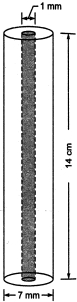
$A$ lead pencil consists of a cylinder of wood with a solid cylinder of graphite filled in the interior. The diameter of the pencil is $7 \,mm$ and the diameter of the graphite is $1 \,mm$. If the length of the pencil is $14 \,cm$,find the volume of the wood and that of the graphite. (in $,cm^3$)
A
$9.28$
B
$7.38$
C
$6.85$
D
$5.28$
Solution
(D) Given that,$10 \,mm = 1 \,cm$,so $1 \,mm = 0.1 \,cm$.
For the graphite cylinder:
Diameter $= 1 \,mm = 0.1 \,cm$.
Radius $(r) = \frac{0.1}{2} \,cm = 0.05 \,cm$.
Length $(h) = 14 \,cm$.
Volume of graphite $= \pi r^2 h = \frac{22}{7} \times (0.05)^2 \times 14 \,cm^3 = 22 \times 0.0025 \times 2 \,cm^3 = 0.11 \,cm^3$.
For the pencil:
Diameter $= 7 \,mm = 0.7 \,cm$.
Radius $(R) = \frac{0.7}{2} \,cm = 0.35 \,cm$.
Length $(h) = 14 \,cm$.
Volume of pencil $= \pi R^2 h = \frac{22}{7} \times (0.35)^2 \times 14 \,cm^3 = 22 \times 0.1225 \times 2 \,cm^3 = 5.39 \,cm^3$.
Volume of wood = Volume of pencil - Volume of graphite
$= 5.39 \,cm^3 - 0.11 \,cm^3 = 5.28 \,cm^3$.
Thus,the volume of the graphite is $0.11 \,cm^3$ and the volume of the wood is $5.28 \,cm^3$.
For the graphite cylinder:
Diameter $= 1 \,mm = 0.1 \,cm$.
Radius $(r) = \frac{0.1}{2} \,cm = 0.05 \,cm$.
Length $(h) = 14 \,cm$.
Volume of graphite $= \pi r^2 h = \frac{22}{7} \times (0.05)^2 \times 14 \,cm^3 = 22 \times 0.0025 \times 2 \,cm^3 = 0.11 \,cm^3$.
For the pencil:
Diameter $= 7 \,mm = 0.7 \,cm$.
Radius $(R) = \frac{0.7}{2} \,cm = 0.35 \,cm$.
Length $(h) = 14 \,cm$.
Volume of pencil $= \pi R^2 h = \frac{22}{7} \times (0.35)^2 \times 14 \,cm^3 = 22 \times 0.1225 \times 2 \,cm^3 = 5.39 \,cm^3$.
Volume of wood = Volume of pencil - Volume of graphite
$= 5.39 \,cm^3 - 0.11 \,cm^3 = 5.28 \,cm^3$.
Thus,the volume of the graphite is $0.11 \,cm^3$ and the volume of the wood is $5.28 \,cm^3$.
0 likes
View Solution81
MediumMCQ
$A$ patient in a hospital is given soup daily in a cylindrical bowl of diameter $7 \, cm$. If the bowl is filled with soup to a height of $4 \, cm$, how much soup does the hospital have to prepare daily to serve $250$ patients?
A
$38.5 \, \text{litres}$
B
$40.5 \, \text{litres}$
C
$48.5 \, \text{litres}$
D
$50.5 \, \text{litres}$
Solution
$(A)$ The bowl is cylindrical.
Diameter of the base $= 7 \, cm$.
Radius of the base $(r) = \frac{7}{2} \, cm = 3.5 \, cm$.
Height $(h) = 4 \, cm$.
Volume of soup in one bowl $= \pi r^2 h = \frac{22}{7} \times (3.5)^2 \times 4 \, cm^3$.
Volume $= \frac{22}{7} \times \frac{7}{2} \times \frac{7}{2} \times 4 \, cm^3 = 11 \times 7 \times 2 \, cm^3 = 154 \, cm^3$.
Volume of soup for $250$ patients $= 250 \times 154 \, cm^3 = 38500 \, cm^3$.
Since $1000 \, cm^3 = 1 \, \text{litre}$, the total volume in litres $= \frac{38500}{1000} \, \text{litres} = 38.5 \, \text{litres}$.
Thus, the hospital needs to prepare $38.5 \, \text{litres}$ of soup daily.
Diameter of the base $= 7 \, cm$.
Radius of the base $(r) = \frac{7}{2} \, cm = 3.5 \, cm$.
Height $(h) = 4 \, cm$.
Volume of soup in one bowl $= \pi r^2 h = \frac{22}{7} \times (3.5)^2 \times 4 \, cm^3$.
Volume $= \frac{22}{7} \times \frac{7}{2} \times \frac{7}{2} \times 4 \, cm^3 = 11 \times 7 \times 2 \, cm^3 = 154 \, cm^3$.
Volume of soup for $250$ patients $= 250 \times 154 \, cm^3 = 38500 \, cm^3$.
Since $1000 \, cm^3 = 1 \, \text{litre}$, the total volume in litres $= \frac{38500}{1000} \, \text{litres} = 38.5 \, \text{litres}$.
Thus, the hospital needs to prepare $38.5 \, \text{litres}$ of soup daily.
0 likes
View Solution82
EasyMCQ
The height and the slant height of a cone are $21 \, cm$ and $28 \, cm$ respectively. Find the volume of the cone. (in $, cm^3$)
A
$7500$
B
$7546$
C
$7900$
D
$7006$
Solution
(B) Given: Height $(h) = 21 \, cm$,Slant height $(l) = 28 \, cm$.
Using the relation $l^2 = r^2 + h^2$,we find the radius $(r)$:
$r = \sqrt{l^2 - h^2} = \sqrt{28^2 - 21^2} = \sqrt{784 - 441} = \sqrt{343} = 7\sqrt{7} \, cm$.
Now,the volume of the cone is given by $V = \frac{1}{3} \pi r^2 h$.
$V = \frac{1}{3} \times \frac{22}{7} \times (7\sqrt{7})^2 \times 21$.
$V = \frac{1}{3} \times \frac{22}{7} \times 49 \times 7 \times 21$.
$V = 22 \times 49 \times 7 = 7546 \, cm^3$.
Using the relation $l^2 = r^2 + h^2$,we find the radius $(r)$:
$r = \sqrt{l^2 - h^2} = \sqrt{28^2 - 21^2} = \sqrt{784 - 441} = \sqrt{343} = 7\sqrt{7} \, cm$.
Now,the volume of the cone is given by $V = \frac{1}{3} \pi r^2 h$.
$V = \frac{1}{3} \times \frac{22}{7} \times (7\sqrt{7})^2 \times 21$.
$V = \frac{1}{3} \times \frac{22}{7} \times 49 \times 7 \times 21$.
$V = 22 \times 49 \times 7 = 7546 \, cm^3$.
0 likes
View Solution83
DifficultMCQ
Monica has a piece of canvas whose area is $551 \, m^2$. She uses it to have a conical tent made,with a base radius of $7 \, m$. Assuming that all the stitching margins and the wastage incurred while cutting amounts to approximately $1 \, m^2$,find the volume of the tent that can be made with it. (in $, m^3$)
A
$1450$
B
$1338$
C
$1232$
D
$11348$
Solution
(C) The total area of the canvas is $551 \, m^2$. Since $1 \, m^2$ is lost in wastage,the area available for the tent is $551 \, m^2 - 1 \, m^2 = 550 \, m^2$.
The curved surface area of a conical tent is given by $\pi rl$. Since the floor is not covered,we have $\pi rl = 550 \, m^2$.
Given the radius $r = 7 \, m$,we substitute the values: $\frac{22}{7} \times 7 \times l = 550$.
Solving for $l$,we get $22l = 550$,so $l = \frac{550}{22} = 25 \, m$.
Using the relation $l^2 = r^2 + h^2$,we find the height $h$: $h = \sqrt{l^2 - r^2} = \sqrt{25^2 - 7^2} = \sqrt{625 - 49} = \sqrt{576} = 24 \, m$.
The volume of the conical tent is $V = \frac{1}{3} \pi r^2 h$.
Substituting the values: $V = \frac{1}{3} \times \frac{22}{7} \times 7^2 \times 24 = \frac{1}{3} \times 22 \times 7 \times 24 = 22 \times 7 \times 8 = 1232 \, m^3$.
The curved surface area of a conical tent is given by $\pi rl$. Since the floor is not covered,we have $\pi rl = 550 \, m^2$.
Given the radius $r = 7 \, m$,we substitute the values: $\frac{22}{7} \times 7 \times l = 550$.
Solving for $l$,we get $22l = 550$,so $l = \frac{550}{22} = 25 \, m$.
Using the relation $l^2 = r^2 + h^2$,we find the height $h$: $h = \sqrt{l^2 - r^2} = \sqrt{25^2 - 7^2} = \sqrt{625 - 49} = \sqrt{576} = 24 \, m$.
The volume of the conical tent is $V = \frac{1}{3} \pi r^2 h$.
Substituting the values: $V = \frac{1}{3} \times \frac{22}{7} \times 7^2 \times 24 = \frac{1}{3} \times 22 \times 7 \times 24 = 22 \times 7 \times 8 = 1232 \, m^3$.
0 likes
View Solution84
EasyMCQ
Find the volume of the right circular cone with radius $6 \, cm$ and height $7 \, cm$. Assume $\pi = \frac{22}{7}$. (in $, cm^3$)
A
$278$
B
$255$
C
$250$
D
$264$
Solution
(D) The formula for the volume of a right circular cone is $V = \frac{1}{3} \pi r^2 h$.
Given:
Radius $(r) = 6 \, cm$
Height $(h) = 7 \, cm$
$\pi = \frac{22}{7}$
Substituting the values into the formula:
$V = \frac{1}{3} \times \frac{22}{7} \times (6)^2 \times 7$
$V = \frac{1}{3} \times \frac{22}{7} \times 36 \times 7$
$V = \frac{1}{3} \times 22 \times 36$
$V = 22 \times 12$
$V = 264 \, cm^3$
Thus,the volume of the cone is $264 \, cm^3$.
Given:
Radius $(r) = 6 \, cm$
Height $(h) = 7 \, cm$
$\pi = \frac{22}{7}$
Substituting the values into the formula:
$V = \frac{1}{3} \times \frac{22}{7} \times (6)^2 \times 7$
$V = \frac{1}{3} \times \frac{22}{7} \times 36 \times 7$
$V = \frac{1}{3} \times 22 \times 36$
$V = 22 \times 12$
$V = 264 \, cm^3$
Thus,the volume of the cone is $264 \, cm^3$.
0 likes
View Solution85
EasyMCQ
Find the volume of the right circular cone with radius $3.5 \, cm$,height $12 \, cm$. Assume $\pi = \frac{22}{7}$. (in $, cm^3$)
A
$154$
B
$148$
C
$160$
D
$190$
Solution
(A) Given:
Radius of the cone $(r) = 3.5 \, cm = \frac{35}{10} \, cm = \frac{7}{2} \, cm$.
Height of the cone $(h) = 12 \, cm$.
The formula for the volume of a right circular cone is $V = \frac{1}{3} \pi r^2 h$.
Substituting the values:
$V = \frac{1}{3} \times \frac{22}{7} \times (3.5)^2 \times 12$
$V = \frac{1}{3} \times \frac{22}{7} \times \frac{7}{2} \times \frac{7}{2} \times 12$
$V = \frac{1}{3} \times 22 \times \frac{1}{2} \times 7 \times 6$
$V = 11 \times 14 = 154 \, cm^3$.
Thus,the volume of the cone is $154 \, cm^3$.
Radius of the cone $(r) = 3.5 \, cm = \frac{35}{10} \, cm = \frac{7}{2} \, cm$.
Height of the cone $(h) = 12 \, cm$.
The formula for the volume of a right circular cone is $V = \frac{1}{3} \pi r^2 h$.
Substituting the values:
$V = \frac{1}{3} \times \frac{22}{7} \times (3.5)^2 \times 12$
$V = \frac{1}{3} \times \frac{22}{7} \times \frac{7}{2} \times \frac{7}{2} \times 12$
$V = \frac{1}{3} \times 22 \times \frac{1}{2} \times 7 \times 6$
$V = 11 \times 14 = 154 \, cm^3$.
Thus,the volume of the cone is $154 \, cm^3$.
0 likes
View Solution86
MediumMCQ
Find the capacity in litres of a conical vessel with radius $7 \, cm$ and slant height $25 \, cm$. (in $, l$)
A
$1.002$
B
$1.232$
C
$1.300$
D
$2.202$
Solution
(B) Given: radius $r = 7 \, cm$ and slant height $l = 25 \, cm$.
First,we find the vertical height $h$ using the relation $l^2 = r^2 + h^2$:
$h = \sqrt{l^2 - r^2} = \sqrt{25^2 - 7^2} = \sqrt{625 - 49} = \sqrt{576} = 24 \, cm$.
The volume $V$ of a conical vessel is given by the formula $V = \frac{1}{3} \pi r^2 h$.
Substituting the values:
$V = \frac{1}{3} \times \frac{22}{7} \times (7)^2 \times 24 \, cm^3$
$V = \frac{1}{3} \times \frac{22}{7} \times 49 \times 24 \, cm^3$
$V = 22 \times 7 \times 8 \, cm^3 = 1232 \, cm^3$.
Since $1000 \, cm^3 = 1 \, l$,the capacity in litres is:
$V = \frac{1232}{1000} \, l = 1.232 \, l$.
Thus,the required capacity of the conical vessel is $1.232 \, l$.
First,we find the vertical height $h$ using the relation $l^2 = r^2 + h^2$:
$h = \sqrt{l^2 - r^2} = \sqrt{25^2 - 7^2} = \sqrt{625 - 49} = \sqrt{576} = 24 \, cm$.
The volume $V$ of a conical vessel is given by the formula $V = \frac{1}{3} \pi r^2 h$.
Substituting the values:
$V = \frac{1}{3} \times \frac{22}{7} \times (7)^2 \times 24 \, cm^3$
$V = \frac{1}{3} \times \frac{22}{7} \times 49 \times 24 \, cm^3$
$V = 22 \times 7 \times 8 \, cm^3 = 1232 \, cm^3$.
Since $1000 \, cm^3 = 1 \, l$,the capacity in litres is:
$V = \frac{1232}{1000} \, l = 1.232 \, l$.
Thus,the required capacity of the conical vessel is $1.232 \, l$.
0 likes
View Solution87
MediumMCQ
Find the capacity in litres of a conical vessel with height $12 \,cm$ and slant height $13 \,cm$.
A
$\frac{11}{50} \,l$
B
$\frac{11}{40} \,l$
C
$\frac{11}{35} \,l$
D
$\frac{12}{45} \,l$
Solution
(C) Given: Height $(h) = 12 \,cm$ and slant height $(l) = 13 \,cm$.
First,we find the radius $(r)$ using the relation $l^2 = r^2 + h^2$.
$r = \sqrt{l^2 - h^2} = \sqrt{13^2 - 12^2} = \sqrt{169 - 144} = \sqrt{25} = 5 \,cm$.
Now,the volume $(V)$ of the conical vessel is given by the formula $V = \frac{1}{3} \pi r^2 h$.
$V = \frac{1}{3} \times \frac{22}{7} \times (5)^2 \times 12 \,cm^3$.
$V = \frac{1}{3} \times \frac{22}{7} \times 25 \times 12 = 22 \times 25 \times \frac{4}{7} = \frac{2200}{7} \,cm^3$.
Since $1000 \,cm^3 = 1 \,l$,the capacity in litres is $\frac{2200}{7 \times 1000} \,l = \frac{22}{70} \,l = \frac{11}{35} \,l$.
Thus,the capacity of the conical vessel is $\frac{11}{35} \,l$.
First,we find the radius $(r)$ using the relation $l^2 = r^2 + h^2$.
$r = \sqrt{l^2 - h^2} = \sqrt{13^2 - 12^2} = \sqrt{169 - 144} = \sqrt{25} = 5 \,cm$.
Now,the volume $(V)$ of the conical vessel is given by the formula $V = \frac{1}{3} \pi r^2 h$.
$V = \frac{1}{3} \times \frac{22}{7} \times (5)^2 \times 12 \,cm^3$.
$V = \frac{1}{3} \times \frac{22}{7} \times 25 \times 12 = 22 \times 25 \times \frac{4}{7} = \frac{2200}{7} \,cm^3$.
Since $1000 \,cm^3 = 1 \,l$,the capacity in litres is $\frac{2200}{7 \times 1000} \,l = \frac{22}{70} \,l = \frac{11}{35} \,l$.
Thus,the capacity of the conical vessel is $\frac{11}{35} \,l$.
0 likes
View Solution88
MediumMCQ
The height of a cone is $15 \, cm$. If its volume is $1570 \, cm^3$,find the radius of the base. (Use $\pi = 3.14$) (in $, cm$)
A
$20$
B
$30$
C
$40$
D
$10$
Solution
(D) Given,height of the cone $(h) = 15 \, cm$.
Volume of the cone $(V) = 1570 \, cm^3$.
Let the radius of the base be $r \, cm$.
The formula for the volume of a cone is $V = \frac{1}{3} \pi r^2 h$.
Substituting the given values: $1570 = \frac{1}{3} \times 3.14 \times r^2 \times 15$.
Simplifying the equation: $1570 = 3.14 \times r^2 \times 5$.
$1570 = 15.7 \times r^2$.
$r^2 = \frac{1570}{15.7} = 100$.
$r = \sqrt{100} = 10 \, cm$.
Therefore,the radius of the base is $10 \, cm$.
Volume of the cone $(V) = 1570 \, cm^3$.
Let the radius of the base be $r \, cm$.
The formula for the volume of a cone is $V = \frac{1}{3} \pi r^2 h$.
Substituting the given values: $1570 = \frac{1}{3} \times 3.14 \times r^2 \times 15$.
Simplifying the equation: $1570 = 3.14 \times r^2 \times 5$.
$1570 = 15.7 \times r^2$.
$r^2 = \frac{1570}{15.7} = 100$.
$r = \sqrt{100} = 10 \, cm$.
Therefore,the radius of the base is $10 \, cm$.
0 likes
View Solution89
MediumMCQ
If the volume of a right circular cone of height $9 \, cm$ is $48 \pi \, cm^3$,find the diameter of its base. (in $, cm$)
A
$8$
B
$6$
C
$5$
D
$4$
Solution
(A) Volume of the cone $= 48 \pi \, cm^3$.
Height of the cone $(h) = 9 \, cm$.
Let $r$ be the radius of the base.
The formula for the volume of a cone is $V = \frac{1}{3} \pi r^2 h$.
Substituting the given values: $\frac{1}{3} \pi r^2 (9) = 48 \pi$.
$3 \pi r^2 = 48 \pi$.
$r^2 = \frac{48 \pi}{3 \pi} = 16$.
$r = \sqrt{16} = 4 \, cm$.
The diameter of the base is $d = 2r = 2 \times 4 = 8 \, cm$.
Height of the cone $(h) = 9 \, cm$.
Let $r$ be the radius of the base.
The formula for the volume of a cone is $V = \frac{1}{3} \pi r^2 h$.
Substituting the given values: $\frac{1}{3} \pi r^2 (9) = 48 \pi$.
$3 \pi r^2 = 48 \pi$.
$r^2 = \frac{48 \pi}{3 \pi} = 16$.
$r = \sqrt{16} = 4 \, cm$.
The diameter of the base is $d = 2r = 2 \times 4 = 8 \, cm$.
0 likes
View Solution90
MediumMCQ
$A$ conical pit of top diameter $3.5 \, m$ is $12 \, m$ deep. What is its capacity in kilolitres (in $kl$)?
A
$70.5$
B
$38.5$
C
$40.5$
D
$85.5$
Solution
(B) Given, diameter of the conical pit $= 3.5 \, m$.
Radius $(r) = \frac{3.5}{2} \, m = 1.75 \, m$.
Depth $(h) = 12 \, m$.
The volume (capacity) of a cone is given by the formula $V = \frac{1}{3} \pi r^2 h$.
Substituting the values: $V = \frac{1}{3} \times \frac{22}{7} \times (1.75)^2 \times 12 \, m^3$.
$V = \frac{1}{3} \times \frac{22}{7} \times \frac{35}{20} \times \frac{35}{20} \times 12 \, m^3$.
$V = \frac{22}{7} \times \frac{7}{4} \times \frac{7}{4} \times 4 \, m^3 = 38.5 \, m^3$.
We know that $1 \, m^3 = 1000 \, litres = 1 \, kilolitre (kl)$.
Therefore, the capacity of the pit is $38.5 \, kl$.
Radius $(r) = \frac{3.5}{2} \, m = 1.75 \, m$.
Depth $(h) = 12 \, m$.
The volume (capacity) of a cone is given by the formula $V = \frac{1}{3} \pi r^2 h$.
Substituting the values: $V = \frac{1}{3} \times \frac{22}{7} \times (1.75)^2 \times 12 \, m^3$.
$V = \frac{1}{3} \times \frac{22}{7} \times \frac{35}{20} \times \frac{35}{20} \times 12 \, m^3$.
$V = \frac{22}{7} \times \frac{7}{4} \times \frac{7}{4} \times 4 \, m^3 = 38.5 \, m^3$.
We know that $1 \, m^3 = 1000 \, litres = 1 \, kilolitre (kl)$.
Therefore, the capacity of the pit is $38.5 \, kl$.
0 likes
View Solution91
MediumMCQ
The volume of a right circular cone is $9856 \, cm^3$. If the diameter of the base is $28 \, cm$,find the height of the cone. (in $, cm$)
A
$52$
B
$50$
C
$48$
D
$46$
Solution
(C) Given,volume of the cone $(V) = 9856 \, cm^3$.
Diameter of the base $= 28 \, cm$.
Radius of the base $(r) = \frac{28}{2} \, cm = 14 \, cm$.
Let the height of the cone be $h \, cm$.
The formula for the volume of a cone is $V = \frac{1}{3} \pi r^2 h$.
Substituting the values: $9856 = \frac{1}{3} \times \frac{22}{7} \times (14)^2 \times h$.
$9856 = \frac{1}{3} \times \frac{22}{7} \times 14 \times 14 \times h$.
$9856 = \frac{1}{3} \times 22 \times 2 \times 14 \times h$.
$9856 = \frac{616}{3} \times h$.
$h = \frac{9856 \times 3}{616}$.
$h = 16 \times 3 = 48 \, cm$.
Thus,the height of the cone is $48 \, cm$.
Diameter of the base $= 28 \, cm$.
Radius of the base $(r) = \frac{28}{2} \, cm = 14 \, cm$.
Let the height of the cone be $h \, cm$.
The formula for the volume of a cone is $V = \frac{1}{3} \pi r^2 h$.
Substituting the values: $9856 = \frac{1}{3} \times \frac{22}{7} \times (14)^2 \times h$.
$9856 = \frac{1}{3} \times \frac{22}{7} \times 14 \times 14 \times h$.
$9856 = \frac{1}{3} \times 22 \times 2 \times 14 \times h$.
$9856 = \frac{616}{3} \times h$.
$h = \frac{9856 \times 3}{616}$.
$h = 16 \times 3 = 48 \, cm$.
Thus,the height of the cone is $48 \, cm$.
0 likes
View Solution92
MediumMCQ
The volume of a right circular cone is $9856 \, cm^3$. If the diameter of the base is $28 \, cm$,find the slant height of the cone. (in $, cm$)
A
$90$
B
$30$
C
$40$
D
$50$
Solution
(D) Volume of the cone $(V) = 9856 \, cm^3$.
Diameter of the base $= 28 \, cm$.
Radius of the base $(r) = \frac{28}{2} = 14 \, cm$.
Formula for the volume of a cone is $V = \frac{1}{3} \pi r^2 h$.
$9856 = \frac{1}{3} \times \frac{22}{7} \times 14 \times 14 \times h$.
$9856 = \frac{1}{3} \times 22 \times 2 \times 14 \times h$.
$9856 = \frac{616}{3} \times h$.
$h = \frac{9856 \times 3}{616} = 16 \times 3 = 48 \, cm$.
Slant height $(\ell) = \sqrt{r^2 + h^2} = \sqrt{14^2 + 48^2} = \sqrt{196 + 2304} = \sqrt{2500} = 50 \, cm$.
Diameter of the base $= 28 \, cm$.
Radius of the base $(r) = \frac{28}{2} = 14 \, cm$.
Formula for the volume of a cone is $V = \frac{1}{3} \pi r^2 h$.
$9856 = \frac{1}{3} \times \frac{22}{7} \times 14 \times 14 \times h$.
$9856 = \frac{1}{3} \times 22 \times 2 \times 14 \times h$.
$9856 = \frac{616}{3} \times h$.
$h = \frac{9856 \times 3}{616} = 16 \times 3 = 48 \, cm$.
Slant height $(\ell) = \sqrt{r^2 + h^2} = \sqrt{14^2 + 48^2} = \sqrt{196 + 2304} = \sqrt{2500} = 50 \, cm$.
0 likes
View Solution93
MediumMCQ
The volume of a right circular cone is $9856 \, cm^3$. If the diameter of the base is $28 \, cm$,find the curved surface area of the cone. (in $, cm^2$)
A
$2200$
B
$4400$
C
$5500$
D
$4600$
Solution
(A) Given: Volume of the cone $(V) = 9856 \, cm^3$ and diameter of the base $= 28 \, cm$.
Radius of the base $(r) = \frac{28}{2} = 14 \, cm$.
The formula for the volume of a cone is $V = \frac{1}{3} \pi r^2 h$.
Substituting the values: $9856 = \frac{1}{3} \times \frac{22}{7} \times (14)^2 \times h$.
$9856 = \frac{1}{3} \times \frac{22}{7} \times 196 \times h$.
$9856 = \frac{1}{3} \times 22 \times 28 \times h$.
$h = \frac{9856 \times 3}{22 \times 28} = \frac{29568}{616} = 48 \, cm$.
Now,find the slant height $(l) = \sqrt{r^2 + h^2} = \sqrt{14^2 + 48^2} = \sqrt{196 + 2304} = \sqrt{2500} = 50 \, cm$.
The curved surface area of a cone is given by $\pi r l$.
Curved surface area $= \frac{22}{7} \times 14 \times 50 = 22 \times 2 \times 50 = 2200 \, cm^2$.
Radius of the base $(r) = \frac{28}{2} = 14 \, cm$.
The formula for the volume of a cone is $V = \frac{1}{3} \pi r^2 h$.
Substituting the values: $9856 = \frac{1}{3} \times \frac{22}{7} \times (14)^2 \times h$.
$9856 = \frac{1}{3} \times \frac{22}{7} \times 196 \times h$.
$9856 = \frac{1}{3} \times 22 \times 28 \times h$.
$h = \frac{9856 \times 3}{22 \times 28} = \frac{29568}{616} = 48 \, cm$.
Now,find the slant height $(l) = \sqrt{r^2 + h^2} = \sqrt{14^2 + 48^2} = \sqrt{196 + 2304} = \sqrt{2500} = 50 \, cm$.
The curved surface area of a cone is given by $\pi r l$.
Curved surface area $= \frac{22}{7} \times 14 \times 50 = 22 \times 2 \times 50 = 2200 \, cm^2$.
0 likes
View Solution94
MediumMCQ
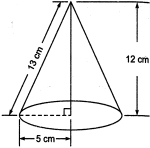
$A$ right triangle $ABC$ with sides $5 \, cm, 12 \, cm$ and $13 \, cm$ is revolved about the side $12 \, cm$. Find the volume of the solid so obtained.
A
$200 \pi \, cm^3$
B
$100 \pi \, cm^3$
C
$300 \pi \, cm^3$
D
$600 \pi \, cm^3$
Solution
(B) The sides of the right triangle are $5 \, cm, 12 \, cm$,and $13 \, cm$.
Since the right-angled triangle is revolved about the $12 \, cm$ side,the height of the resulting cone is $h = 12 \, cm$ and the radius of the base is $r = 5 \, cm$.
The volume of a cone is given by the formula $V = \frac{1}{3} \pi r^2 h$.
Substituting the values,we get:
$V = \frac{1}{3} \times \pi \times (5)^2 \times 12 \, cm^3$
$V = \frac{1}{3} \times \pi \times 25 \times 12 \, cm^3$
$V = \pi \times 25 \times 4 \, cm^3$
$V = 100 \pi \, cm^3$.
Thus,the volume of the solid obtained is $100 \pi \, cm^3$.
Since the right-angled triangle is revolved about the $12 \, cm$ side,the height of the resulting cone is $h = 12 \, cm$ and the radius of the base is $r = 5 \, cm$.
The volume of a cone is given by the formula $V = \frac{1}{3} \pi r^2 h$.
Substituting the values,we get:
$V = \frac{1}{3} \times \pi \times (5)^2 \times 12 \, cm^3$
$V = \frac{1}{3} \times \pi \times 25 \times 12 \, cm^3$
$V = \pi \times 25 \times 4 \, cm^3$
$V = 100 \pi \, cm^3$.
Thus,the volume of the solid obtained is $100 \pi \, cm^3$.
0 likes
View Solution95
MediumMCQ
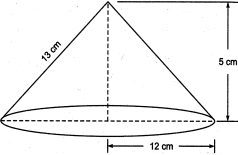
$A$ right triangle $ABC$ with sides $5 \, cm, 12 \, cm$ and $13 \, cm$ is revolved about the side $12 \, cm$. Find the volume of the solid so obtained. Also,find the volume of the solid obtained when the same triangle is revolved about the side $5 \, cm$. Finally,find the ratio of the volumes of the two solids.
A
$8:12$
B
$5:19$
C
$5:12$
D
$5:16$
Solution
(C) $1$. When the triangle is revolved about the side $12 \, cm$:
Height $(h) = 12 \, cm$,Radius $(r) = 5 \, cm$.
Volume $V_1 = \frac{1}{3} \pi r^2 h = \frac{1}{3} \times \pi \times (5)^2 \times 12 = 100 \pi \, cm^3$.
$2$. When the triangle is revolved about the side $5 \, cm$:
Height $(h) = 5 \, cm$,Radius $(r) = 12 \, cm$.
Volume $V_2 = \frac{1}{3} \pi r^2 h = \frac{1}{3} \times \pi \times (12)^2 \times 5 = 240 \pi \, cm^3$.
$3$. Ratio of the volumes:
Ratio $= \frac{V_1}{V_2} = \frac{100 \pi}{240 \pi} = \frac{100}{240} = \frac{5}{12} = 5:12$.
Height $(h) = 12 \, cm$,Radius $(r) = 5 \, cm$.
Volume $V_1 = \frac{1}{3} \pi r^2 h = \frac{1}{3} \times \pi \times (5)^2 \times 12 = 100 \pi \, cm^3$.
$2$. When the triangle is revolved about the side $5 \, cm$:
Height $(h) = 5 \, cm$,Radius $(r) = 12 \, cm$.
Volume $V_2 = \frac{1}{3} \pi r^2 h = \frac{1}{3} \times \pi \times (12)^2 \times 5 = 240 \pi \, cm^3$.
$3$. Ratio of the volumes:
Ratio $= \frac{V_1}{V_2} = \frac{100 \pi}{240 \pi} = \frac{100}{240} = \frac{5}{12} = 5:12$.
0 likes
View Solution96
DifficultMCQ
$A$ heap of wheat is in the form of a cone whose diameter is $10.5\, m$ and height is $3\, m$. Find its volume. The heap is to be covered by canvas to protect it from rain. Find the area of the canvas required. (in $, m^{2}$)
A
$50.8365$
B
$90.860$
C
$99.800$
D
$99.825$
Solution
(D) Given: Diameter of the conical heap $= 10.5\, m$,so radius $(r) = \frac{10.5}{2} = 5.25\, m$. Height $(h) = 3\, m$.
$1$. Volume of the heap:
Volume $= \frac{1}{3} \pi r^2 h = \frac{1}{3} \times \frac{22}{7} \times (5.25)^2 \times 3 = \frac{22}{7} \times 27.5625 = 86.625\, m^3$.
$2$. Area of the canvas:
The canvas required is equal to the curved surface area of the cone,which is $\pi rl$.
First,find the slant height $(l) = \sqrt{r^2 + h^2} = \sqrt{(5.25)^2 + 3^2} = \sqrt{27.5625 + 9} = \sqrt{36.5625} = 6.0467\, m$ (approx $6.05\, m$).
Curved Surface Area $= \pi rl = \frac{22}{7} \times 5.25 \times 6.0467 = 99.825\, m^2$.
Thus,the required area of the canvas is $99.825\, m^2$.
$1$. Volume of the heap:
Volume $= \frac{1}{3} \pi r^2 h = \frac{1}{3} \times \frac{22}{7} \times (5.25)^2 \times 3 = \frac{22}{7} \times 27.5625 = 86.625\, m^3$.
$2$. Area of the canvas:
The canvas required is equal to the curved surface area of the cone,which is $\pi rl$.
First,find the slant height $(l) = \sqrt{r^2 + h^2} = \sqrt{(5.25)^2 + 3^2} = \sqrt{27.5625 + 9} = \sqrt{36.5625} = 6.0467\, m$ (approx $6.05\, m$).
Curved Surface Area $= \pi rl = \frac{22}{7} \times 5.25 \times 6.0467 = 99.825\, m^2$.
Thus,the required area of the canvas is $99.825\, m^2$.
0 likes
View Solution97
EasyMCQ
Find the volume of a sphere of radius $11.2 \, cm$. (in $, cm^3$)
A
$5887.32$
B
$5000.32$
C
$5857.30$
D
$457.32$
Solution
(A) The formula for the volume of a sphere is $V = \frac{4}{3} \pi r^3$.
Given the radius $r = 11.2 \, cm$.
Substituting the values,we get:
$V = \frac{4}{3} \times \frac{22}{7} \times (11.2)^3 \, cm^3$
$V = \frac{4}{3} \times \frac{22}{7} \times 1404.928 \, cm^3$
$V = \frac{123633.664}{21} \, cm^3$
$V \approx 5887.32 \, cm^3$.
Given the radius $r = 11.2 \, cm$.
Substituting the values,we get:
$V = \frac{4}{3} \times \frac{22}{7} \times (11.2)^3 \, cm^3$
$V = \frac{4}{3} \times \frac{22}{7} \times 1404.928 \, cm^3$
$V = \frac{123633.664}{21} \, cm^3$
$V \approx 5887.32 \, cm^3$.
0 likes
View Solution98
MediumMCQ
$A$ shot-put is a metallic sphere of radius $4.9 \, cm$. If the density of the metal is $7.8 \, g/cm^3$,find the mass of the shot-put. (in $, kg$)
A
$9.85$
B
$3.85$
C
$5.85$
D
$7.85$
Solution
(B) The shot-put is a solid sphere. The mass of the sphere is calculated by multiplying its volume by its density.
Step $1$: Calculate the volume of the sphere.
The formula for the volume of a sphere is $V = \frac{4}{3} \pi r^3$.
Given $r = 4.9 \, cm$,we have:
$V = \frac{4}{3} \times \frac{22}{7} \times (4.9)^3$
$V = \frac{4}{3} \times \frac{22}{7} \times 4.9 \times 4.9 \times 4.9$
$V = \frac{4}{3} \times 22 \times 0.7 \times 4.9 \times 4.9$
$V \approx 493.0 \, cm^3$.
Step $2$: Calculate the mass of the shot-put.
Mass = Volume $\times$ Density
Mass = $493.0 \, cm^3 \times 7.8 \, g/cm^3$
Mass = $3845.4 \, g$.
Step $3$: Convert the mass into kilograms.
Since $1 \, kg = 1000 \, g$,
Mass = $\frac{3845.4}{1000} \, kg \approx 3.85 \, kg$.
Step $1$: Calculate the volume of the sphere.
The formula for the volume of a sphere is $V = \frac{4}{3} \pi r^3$.
Given $r = 4.9 \, cm$,we have:
$V = \frac{4}{3} \times \frac{22}{7} \times (4.9)^3$
$V = \frac{4}{3} \times \frac{22}{7} \times 4.9 \times 4.9 \times 4.9$
$V = \frac{4}{3} \times 22 \times 0.7 \times 4.9 \times 4.9$
$V \approx 493.0 \, cm^3$.
Step $2$: Calculate the mass of the shot-put.
Mass = Volume $\times$ Density
Mass = $493.0 \, cm^3 \times 7.8 \, g/cm^3$
Mass = $3845.4 \, g$.
Step $3$: Convert the mass into kilograms.
Since $1 \, kg = 1000 \, g$,
Mass = $\frac{3845.4}{1000} \, kg \approx 3.85 \, kg$.
1 likes
View Solution99
EasyMCQ
$A$ hemispherical bowl has a radius of $3.5\, cm$. What would be the volume of water it would contain (in $, cm^{3}$)?
A
$89.83$
B
$94.8$
C
$96.8$
D
$92.8$
Solution
(A) The volume of a hemispherical bowl is given by the formula $V = \frac{2}{3} \pi r^{3}$.
Given the radius $r = 3.5\, cm = \frac{7}{2}\, cm$.
Substituting the values:
$V = \frac{2}{3} \times \frac{22}{7} \times (\frac{7}{2})^{3}$
$V = \frac{2}{3} \times \frac{22}{7} \times \frac{7}{2} \times \frac{7}{2} \times \frac{7}{2}$
$V = \frac{1}{3} \times 11 \times \frac{49}{2} = \frac{539}{6} \approx 89.83\, cm^{3}$.
Given the radius $r = 3.5\, cm = \frac{7}{2}\, cm$.
Substituting the values:
$V = \frac{2}{3} \times \frac{22}{7} \times (\frac{7}{2})^{3}$
$V = \frac{2}{3} \times \frac{22}{7} \times \frac{7}{2} \times \frac{7}{2} \times \frac{7}{2}$
$V = \frac{1}{3} \times 11 \times \frac{49}{2} = \frac{539}{6} \approx 89.83\, cm^{3}$.
0 likes
View Solution100
EasyMCQ
Find the volume of a sphere whose radius is $7 \, cm$. Assume $\pi = \frac{22}{7}$.
A
$1337 \frac{1}{3} \, cm^3$
B
$1737 \frac{1}{3} \, cm^3$
C
$1207 \frac{1}{3} \, cm^3$
D
$1437 \frac{1}{3} \, cm^3$
Solution
(D) Given,radius $(r) = 7 \, cm$.
The formula for the volume of a sphere is $V = \frac{4}{3} \pi r^3$.
Substituting the given values:
$V = \frac{4}{3} \times \frac{22}{7} \times (7)^3 \, cm^3$
$V = \frac{4}{3} \times \frac{22}{7} \times 7 \times 7 \times 7 \, cm^3$
$V = \frac{4 \times 22 \times 7 \times 7}{3} \, cm^3$
$V = \frac{4312}{3} \, cm^3$
Converting the improper fraction to a mixed fraction:
$V = 1437 \frac{1}{3} \, cm^3$.
Thus,the required volume is $1437 \frac{1}{3} \, cm^3$.
The formula for the volume of a sphere is $V = \frac{4}{3} \pi r^3$.
Substituting the given values:
$V = \frac{4}{3} \times \frac{22}{7} \times (7)^3 \, cm^3$
$V = \frac{4}{3} \times \frac{22}{7} \times 7 \times 7 \times 7 \, cm^3$
$V = \frac{4 \times 22 \times 7 \times 7}{3} \, cm^3$
$V = \frac{4312}{3} \, cm^3$
Converting the improper fraction to a mixed fraction:
$V = 1437 \frac{1}{3} \, cm^3$.
Thus,the required volume is $1437 \frac{1}{3} \, cm^3$.
0 likes
View SolutionSurface Areas and Volumes — Textbook - Surface Areas and Volumes · Frequently Asked Questions
1Are these Surface Areas and Volumes questions useful for JEE and NEET?
Yes. All questions in this section are mapped to JEE Main and NEET exam patterns. Previous year questions from JEE Main, NEET, GUJCET and state-level exams are included with full solutions.
2Can I switch to Hindi or Gujarati for these questions?
Yes. Use the language tabs in the hero section or the sidebar to view the same questions and solutions in English, Hindi or Gujarati.
3How do I generate a question paper from this subtopic?
Use the Vedclass Exam Paper Generator — select the chapter and subtopic, set difficulty, and generate Sets A, B, C, D automatically. First 3 chapters of every subject are free.
Vedclass Products
For Students
Vedclass Test Series
Mock tests in real JEE/NEET style with performance analysis. 5-day free trial.
Start Free TrialFor Teachers
Exam Paper Generator
Generate Set A/B/C/D papers from this chapter in 2 minutes. 3 chapters free.
Try FreeFor Institutes
Online Exam Module
Live online exams with unlimited students, 360° analytics & white-label branding.
See DemoFor Teachers & Institutes
Generate a Surface Areas and Volumes Exam Paper in 2 Minutes
Select subtopic & difficulty — Sets A, B, C, D auto-generated with No Repeat logic.
First 3 chapters of every subject are free — no payment required.