
A English
Mix Examples - Linear Equations in Two Variables Questions in English
Class 9 Mathematics · Linear Equations in Two Variables · Mix Examples - Linear Equations in Two Variables
156+
Questions
English
Language
100%
With Solutions
Showing 50 of 156 questions in English
51
Medium
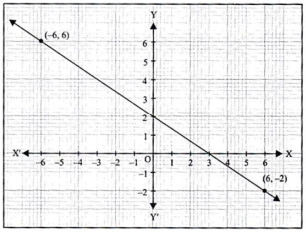
The following observed values of $x$ and $y$ are thought to satisfy a linear equation. Write the linear equation:
Draw the graph using the values of $x$ and $y$ as given in the above table.
At what points does the graph of the linear equation:
$(i)$ cut the $x$-axis and
$(ii)$ cut the $y$-axis?
| $x$ | $6$ | $-6$ |
| $y$ | $-2$ | $6$ |
Draw the graph using the values of $x$ and $y$ as given in the above table.
At what points does the graph of the linear equation:
$(i)$ cut the $x$-axis and
$(ii)$ cut the $y$-axis?
Solution
(N/A) To find the linear equation $ax + by = c$,we use the two given points $(6, -2)$ and $(-6, 6)$.
For $(6, -2)$: $6a - 2b = c$
For $(-6, 6)$: $-6a + 6b = c$
Adding the two equations: $4b = 2c \implies c = 2b$.
Substituting $c = 2b$ into the first equation: $6a - 2b = 2b \implies 6a = 4b \implies a = \frac{2}{3}b$.
Let $b = 3$,then $a = 2$ and $c = 6$. The equation is $2x + 3y = 6$.
Plot the points $(6, -2)$ and $(-6, 6)$ on a Cartesian plane and join them with a straight line.
$(i)$ To find the $x$-intercept,set $y = 0$: $2x + 3(0) = 6 \implies 2x = 6 \implies x = 3$. The graph cuts the $x$-axis at $(3, 0)$.
$(ii)$ To find the $y$-intercept,set $x = 0$: $2(0) + 3y = 6 \implies 3y = 6 \implies y = 2$. The graph cuts the $y$-axis at $(0, 2)$.
For $(6, -2)$: $6a - 2b = c$
For $(-6, 6)$: $-6a + 6b = c$
Adding the two equations: $4b = 2c \implies c = 2b$.
Substituting $c = 2b$ into the first equation: $6a - 2b = 2b \implies 6a = 4b \implies a = \frac{2}{3}b$.
Let $b = 3$,then $a = 2$ and $c = 6$. The equation is $2x + 3y = 6$.
Plot the points $(6, -2)$ and $(-6, 6)$ on a Cartesian plane and join them with a straight line.
$(i)$ To find the $x$-intercept,set $y = 0$: $2x + 3(0) = 6 \implies 2x = 6 \implies x = 3$. The graph cuts the $x$-axis at $(3, 0)$.
$(ii)$ To find the $y$-intercept,set $x = 0$: $2(0) + 3y = 6 \implies 3y = 6 \implies y = 2$. The graph cuts the $y$-axis at $(0, 2)$.
0 likes
View Solution52
Medium
Draw the graph of the linear equation $3x + 4y = 6$. At what points does the graph cut the $x$-axis and the $y$-axis?
Solution
(N/A) To draw the graph of the linear equation $3x + 4y = 6$,we first find some coordinate points that satisfy the equation.
$1$. To find the $x$-intercept,set $y = 0$:
$3x + 4(0) = 6 \implies 3x = 6 \implies x = 2$. So,the point is $(2, 0)$.
$2$. To find the $y$-intercept,set $x = 0$:
$3(0) + 4y = 6 \implies 4y = 6 \implies y = 1.5$. So,the point is $(0, 1.5)$.
$3$. To find another point,set $x = -2$:
$3(-2) + 4y = 6 \implies -6 + 4y = 6 \implies 4y = 12 \implies y = 3$. So,the point is $(-2, 3)$.
Summary table:
Plot these points $(2, 0)$,$(0, 1.5)$,and $(-2, 3)$ on a Cartesian plane and join them to obtain a straight line.
The graph cuts the $x$-axis at $(2, 0)$ and the $y$-axis at $(0, 1.5)$.
$1$. To find the $x$-intercept,set $y = 0$:
$3x + 4(0) = 6 \implies 3x = 6 \implies x = 2$. So,the point is $(2, 0)$.
$2$. To find the $y$-intercept,set $x = 0$:
$3(0) + 4y = 6 \implies 4y = 6 \implies y = 1.5$. So,the point is $(0, 1.5)$.
$3$. To find another point,set $x = -2$:
$3(-2) + 4y = 6 \implies -6 + 4y = 6 \implies 4y = 12 \implies y = 3$. So,the point is $(-2, 3)$.
Summary table:
| $x$ | $2$ | $0$ | $-2$ |
| $y$ | $0$ | $1.5$ | $3$ |
Plot these points $(2, 0)$,$(0, 1.5)$,and $(-2, 3)$ on a Cartesian plane and join them to obtain a straight line.
The graph cuts the $x$-axis at $(2, 0)$ and the $y$-axis at $(0, 1.5)$.
0 likes
View Solution53
Difficult
The linear equation that converts Fahrenheit $(F)$ to Celsius $(C)$ is given by the relation:
$C = \frac{5F - 160}{9}$
$(i)$ If the temperature is $86^{\circ} F$,what is the temperature in Celsius?
$(ii)$ If the temperature is $35^{\circ} C$,what is the temperature in Fahrenheit?
$(iii)$ If the temperature is $0^{\circ} C$,what is the temperature in Fahrenheit? And if the temperature is $0^{\circ} F$,what is the temperature in Celsius?
$(iv)$ What is the numerical value of the temperature which is the same in both the scales?
$C = \frac{5F - 160}{9}$
$(i)$ If the temperature is $86^{\circ} F$,what is the temperature in Celsius?
$(ii)$ If the temperature is $35^{\circ} C$,what is the temperature in Fahrenheit?
$(iii)$ If the temperature is $0^{\circ} C$,what is the temperature in Fahrenheit? And if the temperature is $0^{\circ} F$,what is the temperature in Celsius?
$(iv)$ What is the numerical value of the temperature which is the same in both the scales?
Solution
(N/A) $C = \frac{5F - 160}{9}$
$(i)$ Putting $F = 86^{\circ}$,we get $C = \frac{5(86) - 160}{9} = \frac{430 - 160}{9} = \frac{270}{9} = 30^{\circ}$.
Hence,the temperature in Celsius is $30^{\circ} C$.
$(ii)$ Putting $C = 35^{\circ}$,we get $35 = \frac{5F - 160}{9} \Rightarrow 315 = 5F - 160$.
$\Rightarrow 5F = 315 + 160 = 475$.
$\therefore F = \frac{475}{5} = 95^{\circ}$.
Hence,the temperature in Fahrenheit is $95^{\circ} F$.
$(iii)$ Putting $C = 0^{\circ}$,we get $0 = \frac{5F - 160}{9} \Rightarrow 0 = 5F - 160$.
$\Rightarrow 5F = 160 \Rightarrow F = \frac{160}{5} = 32^{\circ}$.
Now,putting $F = 0^{\circ}$,we get $C = \frac{5(0) - 160}{9} = -\frac{160}{9} \approx -17.78^{\circ} C$.
If the temperature is $0^{\circ} C$,the temperature in Fahrenheit is $32^{\circ} F$,and if the temperature is $0^{\circ} F$,the temperature in Celsius is $-\frac{160}{9}^{\circ} C$.
$(iv)$ Putting $C = F$ in the given relation,we get $F = \frac{5F - 160}{9} \Rightarrow 9F = 5F - 160$.
$\Rightarrow 4F = -160 \Rightarrow F = -40^{\circ}$.
Hence,the numerical value of the temperature which is the same in both scales is $-40$.
$(i)$ Putting $F = 86^{\circ}$,we get $C = \frac{5(86) - 160}{9} = \frac{430 - 160}{9} = \frac{270}{9} = 30^{\circ}$.
Hence,the temperature in Celsius is $30^{\circ} C$.
$(ii)$ Putting $C = 35^{\circ}$,we get $35 = \frac{5F - 160}{9} \Rightarrow 315 = 5F - 160$.
$\Rightarrow 5F = 315 + 160 = 475$.
$\therefore F = \frac{475}{5} = 95^{\circ}$.
Hence,the temperature in Fahrenheit is $95^{\circ} F$.
$(iii)$ Putting $C = 0^{\circ}$,we get $0 = \frac{5F - 160}{9} \Rightarrow 0 = 5F - 160$.
$\Rightarrow 5F = 160 \Rightarrow F = \frac{160}{5} = 32^{\circ}$.
Now,putting $F = 0^{\circ}$,we get $C = \frac{5(0) - 160}{9} = -\frac{160}{9} \approx -17.78^{\circ} C$.
If the temperature is $0^{\circ} C$,the temperature in Fahrenheit is $32^{\circ} F$,and if the temperature is $0^{\circ} F$,the temperature in Celsius is $-\frac{160}{9}^{\circ} C$.
$(iv)$ Putting $C = F$ in the given relation,we get $F = \frac{5F - 160}{9} \Rightarrow 9F = 5F - 160$.
$\Rightarrow 4F = -160 \Rightarrow F = -40^{\circ}$.
Hence,the numerical value of the temperature which is the same in both scales is $-40$.
0 likes
View Solution54
Medium
If the temperature of a liquid can be measured in Kelvin units as $x^{\circ} K$ or in Fahrenheit units as $y^{\circ} F$,the relation between the two systems of measurement of temperature is given by the linear equation
$y = \frac{9}{5}(x - 273) + 32$
$(i)$ Find the temperature of the liquid in Fahrenheit if the temperature of the liquid is $313^{\circ} K$.
$(ii)$ If the temperature is $158^{\circ} F$,then find the temperature in Kelvin.
$y = \frac{9}{5}(x - 273) + 32$
$(i)$ Find the temperature of the liquid in Fahrenheit if the temperature of the liquid is $313^{\circ} K$.
$(ii)$ If the temperature is $158^{\circ} F$,then find the temperature in Kelvin.
Solution
(N/A) The given linear equation is $y = \frac{9}{5}(x - 273) + 32$.
$(i)$ Given $x = 313^{\circ} K$:
$y = \frac{9}{5}(313 - 273) + 32$
$y = \frac{9}{5}(40) + 32$
$y = 9 \times 8 + 32 = 72 + 32 = 104^{\circ} F$.
$(ii)$ Given $y = 158^{\circ} F$:
$158 = \frac{9}{5}(x - 273) + 32$
$158 - 32 = \frac{9}{5}(x - 273)$
$126 = \frac{9}{5}(x - 273)$
$x - 273 = 126 \times \frac{5}{9}$
$x - 273 = 14 \times 5 = 70$
$x = 273 + 70 = 343^{\circ} K$.
$(i)$ Given $x = 313^{\circ} K$:
$y = \frac{9}{5}(313 - 273) + 32$
$y = \frac{9}{5}(40) + 32$
$y = 9 \times 8 + 32 = 72 + 32 = 104^{\circ} F$.
$(ii)$ Given $y = 158^{\circ} F$:
$158 = \frac{9}{5}(x - 273) + 32$
$158 - 32 = \frac{9}{5}(x - 273)$
$126 = \frac{9}{5}(x - 273)$
$x - 273 = 126 \times \frac{5}{9}$
$x - 273 = 14 \times 5 = 70$
$x = 273 + 70 = 343^{\circ} K$.
0 likes
View Solution55
Difficult
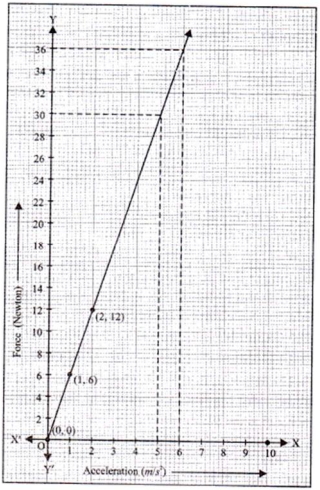
The force exerted to pull a cart is directly proportional to the acceleration produced in the body. Express the statement as a linear equation of two variables and draw the graph of the same by taking the constant mass equal to $6 \,kg$. Read from the graph,the force required when the acceleration produced is $(i)$ $5 \,m/s^2$,$(ii)$ $6 \,m/s^2$.
Solution
(N/A) Let $y$ be the force and $x$ be the acceleration. Since force is directly proportional to acceleration,we have $y \propto x$,which implies $y = mx$,where $m$ is the constant mass.
Given $m = 6 \,kg$,the linear equation is $y = 6x$.
To draw the graph,we find some points satisfying the equation:
Plotting the points $(0,0)$,$(1,6)$,and $(2,12)$ on a graph and joining them gives a straight line.
From the graph:
$(i)$ When acceleration $x = 5 \,m/s^2$,the corresponding force $y = 30 \,N$.
$(ii)$ When acceleration $x = 6 \,m/s^2$,the corresponding force $y = 36 \,N$.
Given $m = 6 \,kg$,the linear equation is $y = 6x$.
To draw the graph,we find some points satisfying the equation:
| $x$ (Acceleration) | $0$ | $1$ | $2$ |
| $y$ (Force) | $0$ | $6$ | $12$ |
Plotting the points $(0,0)$,$(1,6)$,and $(2,12)$ on a graph and joining them gives a straight line.
From the graph:
$(i)$ When acceleration $x = 5 \,m/s^2$,the corresponding force $y = 30 \,N$.
$(ii)$ When acceleration $x = 6 \,m/s^2$,the corresponding force $y = 36 \,N$.
0 likes
View Solution56
EasyMCQ
If a linear equation has solutions $(-2, 2), (0, 0)$ and $(2, -2)$,then it is of the form
A
$y - x = 0$
B
$x - 2y = 0$
C
$-2x + y = 0$
D
$x + y = 0$
Solution
(D) To find the linear equation,we check which equation is satisfied by all the given points: $(-2, 2), (0, 0),$ and $(2, -2)$.
For option $D$,$x + y = 0$:
$1$. For $(-2, 2): -2 + 2 = 0$. (Satisfied)
$2$. For $(0, 0): 0 + 0 = 0$. (Satisfied)
$3$. For $(2, -2): 2 + (-2) = 0$. (Satisfied)
Since all points satisfy the equation $x + y = 0$,this is the correct linear equation.
For option $D$,$x + y = 0$:
$1$. For $(-2, 2): -2 + 2 = 0$. (Satisfied)
$2$. For $(0, 0): 0 + 0 = 0$. (Satisfied)
$3$. For $(2, -2): 2 + (-2) = 0$. (Satisfied)
Since all points satisfy the equation $x + y = 0$,this is the correct linear equation.
0 likes
View Solution57
EasyMCQ
The positive solutions of the equation $ax + by + c = 0$ always lie in the
A
$1^{st}$ quadrant
B
$2^{nd}$ quadrant
C
$3^{rd}$ quadrant
D
$4^{th}$ quadrant
Solution
(A) The Cartesian plane is divided into four quadrants based on the signs of the coordinates $(x, y)$.
Quadrant $I$ consists of all points $(x, y)$ where both $x > 0$ and $y > 0$.
Since a positive solution implies that both $x$ and $y$ are positive,such points must satisfy the condition for the $1^{st}$ quadrant.
Therefore,the positive solutions of the equation $ax + by + c = 0$ always lie in the $1^{st}$ quadrant.
Quadrant $I$ consists of all points $(x, y)$ where both $x > 0$ and $y > 0$.
Since a positive solution implies that both $x$ and $y$ are positive,such points must satisfy the condition for the $1^{st}$ quadrant.
Therefore,the positive solutions of the equation $ax + by + c = 0$ always lie in the $1^{st}$ quadrant.
0 likes
View Solution58
Easy
Write four solutions for the following equation: $2x + 5y = 20$.
Solution
Given equation: $2x + 5y = 20$.
Rearranging for $y$: $5y = 20 - 2x$,which gives $y = \frac{20 - 2x}{5}$.
$1$. If $x = 0$,then $y = \frac{20 - 2(0)}{5} = \frac{20}{5} = 4$. So,$(0, 4)$ is a solution.
$2$. If $x = 5$,then $y = \frac{20 - 2(5)}{5} = \frac{10}{5} = 2$. So,$(5, 2)$ is a solution.
$3$. If $x = -5$,then $y = \frac{20 - 2(-5)}{5} = \frac{30}{5} = 6$. So,$(-5, 6)$ is a solution.
$4$. If $x = 10$,then $y = \frac{20 - 2(10)}{5} = \frac{0}{5} = 0$. So,$(10, 0)$ is a solution.
Thus,four solutions of the given equation are $(0, 4), (5, 2), (-5, 6),$ and $(10, 0)$.
Rearranging for $y$: $5y = 20 - 2x$,which gives $y = \frac{20 - 2x}{5}$.
$1$. If $x = 0$,then $y = \frac{20 - 2(0)}{5} = \frac{20}{5} = 4$. So,$(0, 4)$ is a solution.
$2$. If $x = 5$,then $y = \frac{20 - 2(5)}{5} = \frac{10}{5} = 2$. So,$(5, 2)$ is a solution.
$3$. If $x = -5$,then $y = \frac{20 - 2(-5)}{5} = \frac{30}{5} = 6$. So,$(-5, 6)$ is a solution.
$4$. If $x = 10$,then $y = \frac{20 - 2(10)}{5} = \frac{0}{5} = 0$. So,$(10, 0)$ is a solution.
Thus,four solutions of the given equation are $(0, 4), (5, 2), (-5, 6),$ and $(10, 0)$.
2 likes
View Solution59
Medium
Write four solutions for the following equation: $4x - 3y = 24$.
Solution
(N/A) Given equation: $4x - 3y = 24$.
Rearranging for $y$:
$3y = 4x - 24$
$y = \frac{4x - 24}{3}$
To find four solutions,we substitute different values for $x$:
$1$. If $x = 0$,then $y = \frac{4(0) - 24}{3} = \frac{-24}{3} = -8$. So,$(0, -8)$ is a solution.
$2$. If $x = 3$,then $y = \frac{4(3) - 24}{3} = \frac{12 - 24}{3} = \frac{-12}{3} = -4$. So,$(3, -4)$ is a solution.
$3$. If $x = 6$,then $y = \frac{4(6) - 24}{3} = \frac{24 - 24}{3} = \frac{0}{3} = 0$. So,$(6, 0)$ is a solution.
$4$. If $x = 9$,then $y = \frac{4(9) - 24}{3} = \frac{36 - 24}{3} = \frac{12}{3} = 4$. So,$(9, 4)$ is a solution.
Thus,four solutions of the given equation are $(0, -8), (3, -4), (6, 0),$ and $(9, 4)$.
Rearranging for $y$:
$3y = 4x - 24$
$y = \frac{4x - 24}{3}$
To find four solutions,we substitute different values for $x$:
$1$. If $x = 0$,then $y = \frac{4(0) - 24}{3} = \frac{-24}{3} = -8$. So,$(0, -8)$ is a solution.
$2$. If $x = 3$,then $y = \frac{4(3) - 24}{3} = \frac{12 - 24}{3} = \frac{-12}{3} = -4$. So,$(3, -4)$ is a solution.
$3$. If $x = 6$,then $y = \frac{4(6) - 24}{3} = \frac{24 - 24}{3} = \frac{0}{3} = 0$. So,$(6, 0)$ is a solution.
$4$. If $x = 9$,then $y = \frac{4(9) - 24}{3} = \frac{36 - 24}{3} = \frac{12}{3} = 4$. So,$(9, 4)$ is a solution.
Thus,four solutions of the given equation are $(0, -8), (3, -4), (6, 0),$ and $(9, 4)$.
0 likes
View Solution60
Medium
Write four solutions for the following equation: $3x + 5y = 0$.
Solution
(N/A) Given equation: $3x + 5y = 0$.
Rearranging for $y$:
$5y = -3x$
$y = \frac{-3x}{5}$
To find solutions,we substitute different values for $x$:
$1$. If $x = 0$,then $y = \frac{-3(0)}{5} = 0$. So,$(0, 0)$ is a solution.
$2$. If $x = 5$,then $y = \frac{-3(5)}{5} = -3$. So,$(5, -3)$ is a solution.
$3$. If $x = -5$,then $y = \frac{-3(-5)}{5} = 3$. So,$(-5, 3)$ is a solution.
$4$. If $x = 10$,then $y = \frac{-3(10)}{5} = -6$. So,$(10, -6)$ is a solution.
Thus,four solutions of the given equation are $(0, 0), (5, -3), (-5, 3),$ and $(10, -6)$.
Rearranging for $y$:
$5y = -3x$
$y = \frac{-3x}{5}$
To find solutions,we substitute different values for $x$:
$1$. If $x = 0$,then $y = \frac{-3(0)}{5} = 0$. So,$(0, 0)$ is a solution.
$2$. If $x = 5$,then $y = \frac{-3(5)}{5} = -3$. So,$(5, -3)$ is a solution.
$3$. If $x = -5$,then $y = \frac{-3(-5)}{5} = 3$. So,$(-5, 3)$ is a solution.
$4$. If $x = 10$,then $y = \frac{-3(10)}{5} = -6$. So,$(10, -6)$ is a solution.
Thus,four solutions of the given equation are $(0, 0), (5, -3), (-5, 3),$ and $(10, -6)$.
0 likes
View Solution61
Easy
Write four solutions for the following equation:
$2x - 12 = 0$
$2x - 12 = 0$
Solution
(N/A) Given equation: $2x - 12 = 0$
Step $1$: Simplify the equation to solve for $x$.
$2x = 12$
$x = 6$
Step $2$: Express the equation in the form $ax + by + c = 0$.
$1x + 0y - 6 = 0$
Step $3$: Since the coefficient of $y$ is $0$,the value of $x$ will always be $6$ regardless of the value of $y$. We can choose any four arbitrary values for $y$ to find the corresponding solutions $(x, y)$.
Let $y = 0$,then $x = 6$. Solution: $(6, 0)$
Let $y = 1$,then $x = 6$. Solution: $(6, 1)$
Let $y = 2$,then $x = 6$. Solution: $(6, 2)$
Let $y = 3$,then $x = 6$. Solution: $(6, 3)$
Thus,four solutions are $(6, 0), (6, 1), (6, 2),$ and $(6, 3)$.
Step $1$: Simplify the equation to solve for $x$.
$2x = 12$
$x = 6$
Step $2$: Express the equation in the form $ax + by + c = 0$.
$1x + 0y - 6 = 0$
Step $3$: Since the coefficient of $y$ is $0$,the value of $x$ will always be $6$ regardless of the value of $y$. We can choose any four arbitrary values for $y$ to find the corresponding solutions $(x, y)$.
Let $y = 0$,then $x = 6$. Solution: $(6, 0)$
Let $y = 1$,then $x = 6$. Solution: $(6, 1)$
Let $y = 2$,then $x = 6$. Solution: $(6, 2)$
Let $y = 3$,then $x = 6$. Solution: $(6, 3)$
Thus,four solutions are $(6, 0), (6, 1), (6, 2),$ and $(6, 3)$.
0 likes
View Solution62
Easy
Write four solutions for the following equation: $2x - 5y = 10$.
Solution
(N/A) To find the solutions for the equation $2x - 5y = 10$,we can substitute different values for $x$ and solve for $y$,or vice versa.
$1$. If $x = 0$,then $2(0) - 5y = 10 \implies -5y = 10 \implies y = -2$. So,$(0, -2)$ is a solution.
$2$. If $y = 0$,then $2x - 5(0) = 10 \implies 2x = 10 \implies x = 5$. So,$(5, 0)$ is a solution.
$3$. If $x = -5$,then $2(-5) - 5y = 10 \implies -10 - 5y = 10 \implies -5y = 20 \implies y = -4$. So,$(-5, -4)$ is a solution.
$4$. If $y = 2$,then $2x - 5(2) = 10 \implies 2x - 10 = 10 \implies 2x = 20 \implies x = 10$. So,$(10, 2)$ is a solution.
Thus,four solutions are $(0, -2), (5, 0), (-5, -4), (10, 2)$.
$1$. If $x = 0$,then $2(0) - 5y = 10 \implies -5y = 10 \implies y = -2$. So,$(0, -2)$ is a solution.
$2$. If $y = 0$,then $2x - 5(0) = 10 \implies 2x = 10 \implies x = 5$. So,$(5, 0)$ is a solution.
$3$. If $x = -5$,then $2(-5) - 5y = 10 \implies -10 - 5y = 10 \implies -5y = 20 \implies y = -4$. So,$(-5, -4)$ is a solution.
$4$. If $y = 2$,then $2x - 5(2) = 10 \implies 2x - 10 = 10 \implies 2x = 20 \implies x = 10$. So,$(10, 2)$ is a solution.
Thus,four solutions are $(0, -2), (5, 0), (-5, -4), (10, 2)$.
1 likes
View Solution63
Easy
Write four solutions for the following equation: $2x + 3y = 7$.
Solution
(N/A) To find the solutions for the linear equation $2x + 3y = 7$,we can express $y$ in terms of $x$:
$3y = 7 - 2x$
$y = \frac{7 - 2x}{3}$
Now,we substitute different values of $x$ to find corresponding values of $y$:
$1$. If $x = -1$,then $y = \frac{7 - 2(-1)}{3} = \frac{7 + 2}{3} = \frac{9}{3} = 3$. Solution: $(-1, 3)$.
$2$. If $x = 2$,then $y = \frac{7 - 2(2)}{3} = \frac{7 - 4}{3} = \frac{3}{3} = 1$. Solution: $(2, 1)$.
$3$. If $x = 5$,then $y = \frac{7 - 2(5)}{3} = \frac{7 - 10}{3} = \frac{-3}{3} = -1$. Solution: $(5, -1)$.
$4$. If $x = 8$,then $y = \frac{7 - 2(8)}{3} = \frac{7 - 16}{3} = \frac{-9}{3} = -3$. Solution: $(8, -3)$.
Thus,four solutions are $(-1, 3), (2, 1), (5, -1), (8, -3)$.
$3y = 7 - 2x$
$y = \frac{7 - 2x}{3}$
Now,we substitute different values of $x$ to find corresponding values of $y$:
$1$. If $x = -1$,then $y = \frac{7 - 2(-1)}{3} = \frac{7 + 2}{3} = \frac{9}{3} = 3$. Solution: $(-1, 3)$.
$2$. If $x = 2$,then $y = \frac{7 - 2(2)}{3} = \frac{7 - 4}{3} = \frac{3}{3} = 1$. Solution: $(2, 1)$.
$3$. If $x = 5$,then $y = \frac{7 - 2(5)}{3} = \frac{7 - 10}{3} = \frac{-3}{3} = -1$. Solution: $(5, -1)$.
$4$. If $x = 8$,then $y = \frac{7 - 2(8)}{3} = \frac{7 - 16}{3} = \frac{-9}{3} = -3$. Solution: $(8, -3)$.
Thus,four solutions are $(-1, 3), (2, 1), (5, -1), (8, -3)$.
0 likes
View Solution64
Easy
Write four solutions for the following equation: $5x + 3y = 16$.
Solution
(N/A) To find the solutions for the linear equation $5x + 3y = 16$,we can assign arbitrary values to $x$ and solve for $y$ using the formula $y = \frac{16 - 5x}{3}$.
$1$. If $x = 2$,then $y = \frac{16 - 5(2)}{3} = \frac{16 - 10}{3} = \frac{6}{3} = 2$. Solution: $(2, 2)$.
$2$. If $x = 5$,then $y = \frac{16 - 5(5)}{3} = \frac{16 - 25}{3} = \frac{-9}{3} = -3$. Solution: $(5, -3)$.
$3$. If $x = -1$,then $y = \frac{16 - 5(-1)}{3} = \frac{16 + 5}{3} = \frac{21}{3} = 7$. Solution: $(-1, 7)$.
$4$. If $x = -4$,then $y = \frac{16 - 5(-4)}{3} = \frac{16 + 20}{3} = \frac{36}{3} = 12$. Solution: $(-4, 12)$.
$1$. If $x = 2$,then $y = \frac{16 - 5(2)}{3} = \frac{16 - 10}{3} = \frac{6}{3} = 2$. Solution: $(2, 2)$.
$2$. If $x = 5$,then $y = \frac{16 - 5(5)}{3} = \frac{16 - 25}{3} = \frac{-9}{3} = -3$. Solution: $(5, -3)$.
$3$. If $x = -1$,then $y = \frac{16 - 5(-1)}{3} = \frac{16 + 5}{3} = \frac{21}{3} = 7$. Solution: $(-1, 7)$.
$4$. If $x = -4$,then $y = \frac{16 - 5(-4)}{3} = \frac{16 + 20}{3} = \frac{36}{3} = 12$. Solution: $(-4, 12)$.
0 likes
View Solution65
Easy
Write four solutions for the following equation: $3x + y = 11$.
Solution
To find the solutions for the equation $3x + y = 11$,we can express $y$ in terms of $x$:
$y = 11 - 3x$
Now,we substitute different values of $x$ to find the corresponding values of $y$:
$1$. If $x = 0$,then $y = 11 - 3(0) = 11$. So,the solution is $(0, 11)$.
$2$. If $x = 1$,then $y = 11 - 3(1) = 8$. So,the solution is $(1, 8)$.
$3$. If $x = 2$,then $y = 11 - 3(2) = 5$. So,the solution is $(2, 5)$.
$4$. If $x = -1$,then $y = 11 - 3(-1) = 11 + 3 = 14$. So,the solution is $(-1, 14)$.
Thus,four solutions are $(0, 11), (1, 8), (2, 5), (-1, 14)$.
$y = 11 - 3x$
Now,we substitute different values of $x$ to find the corresponding values of $y$:
$1$. If $x = 0$,then $y = 11 - 3(0) = 11$. So,the solution is $(0, 11)$.
$2$. If $x = 1$,then $y = 11 - 3(1) = 8$. So,the solution is $(1, 8)$.
$3$. If $x = 2$,then $y = 11 - 3(2) = 5$. So,the solution is $(2, 5)$.
$4$. If $x = -1$,then $y = 11 - 3(-1) = 11 + 3 = 14$. So,the solution is $(-1, 14)$.
Thus,four solutions are $(0, 11), (1, 8), (2, 5), (-1, 14)$.
0 likes
View Solution66
Easy
Write four solutions for the following equation: $4y - 11 = 0$.
Solution
(N/A) The given equation is $4y - 11 = 0$,which can be written as $0x + 4y = 11$.
This is a linear equation in two variables $x$ and $y$.
Since the coefficient of $x$ is $0$,the value of $y$ will always be $\frac{11}{4}$ regardless of the value of $x$.
We can choose any four arbitrary values for $x$ to find the corresponding solutions.
Let $x = 0$,then $y = \frac{11}{4}$. Solution: $(0, 2.75)$.
Let $x = 1$,then $y = \frac{11}{4}$. Solution: $(1, 2.75)$.
Let $x = 2$,then $y = \frac{11}{4}$. Solution: $(2, 2.75)$.
Let $x = 3$,then $y = \frac{11}{4}$. Solution: $(3, 2.75)$.
Thus,four solutions are $(0, 2.75), (1, 2.75), (2, 2.75), (3, 2.75)$.
This is a linear equation in two variables $x$ and $y$.
Since the coefficient of $x$ is $0$,the value of $y$ will always be $\frac{11}{4}$ regardless of the value of $x$.
We can choose any four arbitrary values for $x$ to find the corresponding solutions.
Let $x = 0$,then $y = \frac{11}{4}$. Solution: $(0, 2.75)$.
Let $x = 1$,then $y = \frac{11}{4}$. Solution: $(1, 2.75)$.
Let $x = 2$,then $y = \frac{11}{4}$. Solution: $(2, 2.75)$.
Let $x = 3$,then $y = \frac{11}{4}$. Solution: $(3, 2.75)$.
Thus,four solutions are $(0, 2.75), (1, 2.75), (2, 2.75), (3, 2.75)$.
2 likes
View Solution67
Easy
Write four solutions for the equation $3x - 24 = 0$.
Solution
(N/A) The given equation is $3x - 24 = 0$.
This can be simplified as $3x = 24$, which gives $x = 8$.
Since the equation is in the form $x = 8$, it can be written as a linear equation in two variables as $1x + 0y = 8$.
For any value of $y$, the value of $x$ will always be $8$.
Therefore, four possible solutions are $(8, 0), (8, 1), (8, 2), \text{ and } (8, 3)$.
This can be simplified as $3x = 24$, which gives $x = 8$.
Since the equation is in the form $x = 8$, it can be written as a linear equation in two variables as $1x + 0y = 8$.
For any value of $y$, the value of $x$ will always be $8$.
Therefore, four possible solutions are $(8, 0), (8, 1), (8, 2), \text{ and } (8, 3)$.
0 likes
View Solution68
Easy
Examine which of the following points are solutions of the equation $3x - 2y = 12$,and which are not:
$(1) (0, -6)$
$(2) (2, 3)$
$(3) (2, -3)$
$(4) (-4, 0)$
$(5) (-2, -9)$
$(6) (6, 4)$
$(1) (0, -6)$
$(2) (2, 3)$
$(3) (2, -3)$
$(4) (-4, 0)$
$(5) (-2, -9)$
$(6) (6, 4)$
Solution
(N/A) To check if a point $(x, y)$ is a solution to the equation $3x - 2y = 12$,we substitute the values of $x$ and $y$ into the equation and check if the left-hand side $(LHS)$ equals the right-hand side ($RHS$ = $12$).
$(1) (0, -6): 3(0) - 2(-6) = 0 + 12 = 12$. Since $LHS$ = $RHS$,$(0, -6)$ is a solution.
$(2) (2, 3): 3(2) - 2(3) = 6 - 6 = 0 \neq 12$. Not a solution.
$(3) (2, -3): 3(2) - 2(-3) = 6 + 6 = 12$. Since $LHS$ = $RHS$,$(2, -3)$ is a solution.
$(4) (-4, 0): 3(-4) - 2(0) = -12 - 0 = -12 \neq 12$. Not a solution.
$(5) (-2, -9): 3(-2) - 2(-9) = -6 + 18 = 12$. Since $LHS$ = $RHS$,$(-2, -9)$ is a solution.
$(6) (6, 4): 3(6) - 2(4) = 18 - 8 = 10 \neq 12$. Not a solution.
Therefore,$(1), (3),$ and $(5)$ are solutions,while $(2), (4),$ and $(6)$ are not.
$(1) (0, -6): 3(0) - 2(-6) = 0 + 12 = 12$. Since $LHS$ = $RHS$,$(0, -6)$ is a solution.
$(2) (2, 3): 3(2) - 2(3) = 6 - 6 = 0 \neq 12$. Not a solution.
$(3) (2, -3): 3(2) - 2(-3) = 6 + 6 = 12$. Since $LHS$ = $RHS$,$(2, -3)$ is a solution.
$(4) (-4, 0): 3(-4) - 2(0) = -12 - 0 = -12 \neq 12$. Not a solution.
$(5) (-2, -9): 3(-2) - 2(-9) = -6 + 18 = 12$. Since $LHS$ = $RHS$,$(-2, -9)$ is a solution.
$(6) (6, 4): 3(6) - 2(4) = 18 - 8 = 10 \neq 12$. Not a solution.
Therefore,$(1), (3),$ and $(5)$ are solutions,while $(2), (4),$ and $(6)$ are not.
0 likes
View Solution69
EasyMCQ
If $(3,5)$ is a solution of the equation $2x + 5y = k$,find the value of $k$.
A
$31$
B
$25$
C
$35$
D
$21$
Solution
(A) Given the equation is $2x + 5y = k$.
Since $(3,5)$ is a solution of the equation,we substitute $x = 3$ and $y = 5$ into the equation.
$2(3) + 5(5) = k$
$6 + 25 = k$
$k = 31$
Therefore,the value of $k$ is $31$.
Since $(3,5)$ is a solution of the equation,we substitute $x = 3$ and $y = 5$ into the equation.
$2(3) + 5(5) = k$
$6 + 25 = k$
$k = 31$
Therefore,the value of $k$ is $31$.
0 likes
View Solution70
EasyMCQ
If $(2, -3)$ is a solution of the equation $3x + ky = 18$,find the value of $k$.
A
$k = -4$
B
$k = 4$
C
$k = -8$
D
$k = 8$
Solution
(A) Given that $(2, -3)$ is a solution of the equation $3x + ky = 18$.
This means that when we substitute $x = 2$ and $y = -3$ into the equation,it must satisfy the equality.
Substituting the values: $3(2) + k(-3) = 18$.
$6 - 3k = 18$.
Subtract $6$ from both sides: $-3k = 18 - 6$.
$-3k = 12$.
Divide by $-3$: $k = 12 / -3$.
Therefore,$k = -4$.
This means that when we substitute $x = 2$ and $y = -3$ into the equation,it must satisfy the equality.
Substituting the values: $3(2) + k(-3) = 18$.
$6 - 3k = 18$.
Subtract $6$ from both sides: $-3k = 18 - 6$.
$-3k = 12$.
Divide by $-3$: $k = 12 / -3$.
Therefore,$k = -4$.
1 likes
View Solution71
EasyMCQ
If $(5, 2)$ is a solution of the equation $kx + 4y = 33$,find the value of $k$.
A
$k = 4$
B
$k = 5$
C
$k = 6$
D
$k = 3$
Solution
(B) Given the equation is $kx + 4y = 33$.
Since $(5, 2)$ is a solution,we substitute $x = 5$ and $y = 2$ into the equation.
$k(5) + 4(2) = 33$
$5k + 8 = 33$
$5k = 33 - 8$
$5k = 25$
$k = \frac{25}{5}$
$k = 5$.
Since $(5, 2)$ is a solution,we substitute $x = 5$ and $y = 2$ into the equation.
$k(5) + 4(2) = 33$
$5k + 8 = 33$
$5k = 33 - 8$
$5k = 25$
$k = \frac{25}{5}$
$k = 5$.
0 likes
View Solution72
EasyMCQ
If $(k, 3)$ is a solution of the equation $2x + 5y = 17$,find the value of $k$.
A
$1$
B
$2$
C
$3$
D
$4$
Solution
(A) Given the equation is $2x + 5y = 17$.
Since $(k, 3)$ is a solution,we substitute $x = k$ and $y = 3$ into the equation.
$2(k) + 5(3) = 17$
$2k + 15 = 17$
$2k = 17 - 15$
$2k = 2$
$k = 1$.
Since $(k, 3)$ is a solution,we substitute $x = k$ and $y = 3$ into the equation.
$2(k) + 5(3) = 17$
$2k + 15 = 17$
$2k = 17 - 15$
$2k = 2$
$k = 1$.
0 likes
View Solution73
Medium
If $(2,3)$ is a solution of the equation $7x - 3y = a$ and $(a, a+1)$ is a solution of the equation $2x + y = b$,find the values of $a$ and $b$.
Solution
(A) Step $1$: Substitute $(x, y) = (2, 3)$ into the equation $7x - 3y = a$.
$7(2) - 3(3) = a$
$14 - 9 = a$
$a = 5$.
Step $2$: Substitute $a = 5$ into the point $(a, a+1)$ to get $(5, 6)$.
Step $3$: Substitute $(x, y) = (5, 6)$ into the equation $2x + y = b$.
$2(5) + 6 = b$
$10 + 6 = b$
$b = 16$.
Thus,the values are $a = 5$ and $b = 16$.
$7(2) - 3(3) = a$
$14 - 9 = a$
$a = 5$.
Step $2$: Substitute $a = 5$ into the point $(a, a+1)$ to get $(5, 6)$.
Step $3$: Substitute $(x, y) = (5, 6)$ into the equation $2x + y = b$.
$2(5) + 6 = b$
$10 + 6 = b$
$b = 16$.
Thus,the values are $a = 5$ and $b = 16$.
3 likes
View Solution74
Medium
Give the equations of four lines passing through $(2,3)$.
Solution
The equation of a line passing through a point $(x_1, y_1)$ can be represented in the form $a(x - x_1) + b(y - y_1) = 0$. Since there are infinitely many lines passing through a single point $(2, 3)$,we can choose different values for the coefficients $a$ and $b$ to generate them.
$1$. For $a=1, b=1$: $(x - 2) + (y - 3) = 0 \implies x + y = 5$.
$2$. For $a=3, b=-2$: $3(x - 2) - 2(y - 3) = 0 \implies 3x - 6 - 2y + 6 = 0 \implies 3x - 2y = 0$.
$3$. For $a=5, b=-3$: $5(x - 2) - 3(y - 3) = 0 \implies 5x - 10 - 3y + 9 = 0 \implies 5x - 3y = 1$.
$4$. For $a=2, b=3$: $2(x - 2) + 3(y - 3) = 0 \implies 2x - 4 + 3y - 9 = 0 \implies 2x + 3y = 13$.
$1$. For $a=1, b=1$: $(x - 2) + (y - 3) = 0 \implies x + y = 5$.
$2$. For $a=3, b=-2$: $3(x - 2) - 2(y - 3) = 0 \implies 3x - 6 - 2y + 6 = 0 \implies 3x - 2y = 0$.
$3$. For $a=5, b=-3$: $5(x - 2) - 3(y - 3) = 0 \implies 5x - 10 - 3y + 9 = 0 \implies 5x - 3y = 1$.
$4$. For $a=2, b=3$: $2(x - 2) + 3(y - 3) = 0 \implies 2x - 4 + 3y - 9 = 0 \implies 2x + 3y = 13$.
0 likes
View Solution75
EasyMCQ
If the point $(3, 5)$ lies on the graph of the equation $ax + y = 20$,find the value of $a$.
A
$3$
B
$7$
C
$5$
D
$9$
Solution
(C) Since every point on the graph of a linear equation is a solution of the equation,the coordinates $(x, y) = (3, 5)$ must satisfy the equation $ax + y = 20$.
Substituting $x = 3$ and $y = 5$ into the equation:
$a(3) + 5 = 20$
$3a + 5 = 20$
Subtracting $5$ from both sides:
$3a = 20 - 5$
$3a = 15$
Dividing by $3$:
$a = \frac{15}{3}$
$a = 5$
Thus,the value of $a$ is $5$.
Substituting $x = 3$ and $y = 5$ into the equation:
$a(3) + 5 = 20$
$3a + 5 = 20$
Subtracting $5$ from both sides:
$3a = 20 - 5$
$3a = 15$
Dividing by $3$:
$a = \frac{15}{3}$
$a = 5$
Thus,the value of $a$ is $5$.
0 likes
View Solution76
EasyMCQ
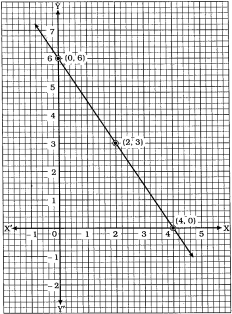
From the choices given below,choose the correct equation whose graph is shown in the following figure.
A
$x+y=4$
B
$x+y=5$
C
$x+y=6$
D
$3x+2y=12$
Solution
(D) To find the correct equation,we check which equation is satisfied by the points $(0,6)$,$(2,3)$,and $(4,0)$ shown on the graph.
$1$. For $x+y=4$: Substituting $(4,0)$ gives $4+0=4$ (True),but $(0,6)$ gives $0+6=6 \neq 4$ (False).
$2$. For $x+y=5$: Substituting $(2,3)$ gives $2+3=5$ (True),but $(4,0)$ gives $4+0=4 \neq 5$ (False).
$3$. For $x+y=6$: Substituting $(0,6)$ gives $0+6=6$ (True),but $(4,0)$ gives $4+0=4 \neq 6$ (False).
$4$. For $3x+2y=12$:
- For $(4,0)$: $3(4)+2(0) = 12+0 = 12$ (True).
- For $(2,3)$: $3(2)+2(3) = 6+6 = 12$ (True).
- For $(0,6)$: $3(0)+2(6) = 0+12 = 12$ (True).
Since all three points satisfy the equation $3x+2y=12$,this is the correct equation.
$1$. For $x+y=4$: Substituting $(4,0)$ gives $4+0=4$ (True),but $(0,6)$ gives $0+6=6 \neq 4$ (False).
$2$. For $x+y=5$: Substituting $(2,3)$ gives $2+3=5$ (True),but $(4,0)$ gives $4+0=4 \neq 5$ (False).
$3$. For $x+y=6$: Substituting $(0,6)$ gives $0+6=6$ (True),but $(4,0)$ gives $4+0=4 \neq 6$ (False).
$4$. For $3x+2y=12$:
- For $(4,0)$: $3(4)+2(0) = 12+0 = 12$ (True).
- For $(2,3)$: $3(2)+2(3) = 6+6 = 12$ (True).
- For $(0,6)$: $3(0)+2(6) = 0+12 = 12$ (True).
Since all three points satisfy the equation $3x+2y=12$,this is the correct equation.
0 likes
View Solution77
Medium
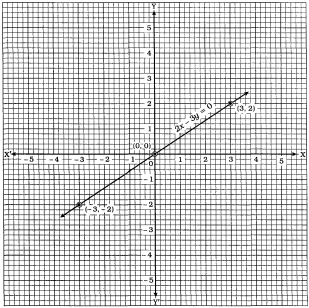
Draw the graph of the following linear equation in two variables:
$2x - 3y = 0$
$2x - 3y = 0$
Solution
(N/A) Given equation: $2x - 3y = 0$
$\therefore 3y = 2x$
$\therefore y = \frac{2}{3}x$
To draw the graph,we find at least two solutions for the equation:
$1$. For $x = 0$,we get $y = \frac{2}{3}(0) = 0$. So,the point is $(0, 0)$.
$2$. For $x = 3$,we get $y = \frac{2}{3}(3) = 2$. So,the point is $(3, 2)$.
$3$. For $x = -3$,we get $y = \frac{2}{3}(-3) = -2$. So,the point is $(-3, -2)$.
We can represent these solutions in the tabular form as below:
Plot these points on a Cartesian plane and join them to obtain the straight line representing the equation $2x - 3y = 0$.
$\therefore 3y = 2x$
$\therefore y = \frac{2}{3}x$
To draw the graph,we find at least two solutions for the equation:
$1$. For $x = 0$,we get $y = \frac{2}{3}(0) = 0$. So,the point is $(0, 0)$.
$2$. For $x = 3$,we get $y = \frac{2}{3}(3) = 2$. So,the point is $(3, 2)$.
$3$. For $x = -3$,we get $y = \frac{2}{3}(-3) = -2$. So,the point is $(-3, -2)$.
We can represent these solutions in the tabular form as below:
| $x$ | $0$ | $3$ | $-3$ |
| $y$ | $0$ | $2$ | $-2$ |
Plot these points on a Cartesian plane and join them to obtain the straight line representing the equation $2x - 3y = 0$.
0 likes
View Solution78
Medium
Draw the graph of the following linear equation in two variables:
$4x - 3y = 12$
$4x - 3y = 12$
Solution
(N/A) $4x - 3y = 12$
$\therefore 4x - 12 = 3y$
$\therefore y = \frac{4x - 12}{3}$
For $x = 0$,we get:
$y = \frac{4(0) - 12}{3} = \frac{-12}{3} = -4$; i.e.,$y = -4$
For $x = 3$,we get:
$y = \frac{4(3) - 12}{3} = \frac{0}{3} = 0$; i.e.,$y = 0$
For $x = 6$,we get:
$y = \frac{4(6) - 12}{3} = \frac{12}{3} = 4$; i.e.,$y = 4$
We can represent these solutions in the tabular form as below:
Plot the points $(0, -4)$,$(3, 0)$,and $(6, 4)$ on a Cartesian plane and join them to obtain the graph of the line $4x - 3y = 12$.
$\therefore 4x - 12 = 3y$
$\therefore y = \frac{4x - 12}{3}$
For $x = 0$,we get:
$y = \frac{4(0) - 12}{3} = \frac{-12}{3} = -4$; i.e.,$y = -4$
For $x = 3$,we get:
$y = \frac{4(3) - 12}{3} = \frac{0}{3} = 0$; i.e.,$y = 0$
For $x = 6$,we get:
$y = \frac{4(6) - 12}{3} = \frac{12}{3} = 4$; i.e.,$y = 4$
We can represent these solutions in the tabular form as below:
| $x$ | $0$ | $3$ | $6$ |
| $y$ | $-4$ | $0$ | $4$ |
Plot the points $(0, -4)$,$(3, 0)$,and $(6, 4)$ on a Cartesian plane and join them to obtain the graph of the line $4x - 3y = 12$.
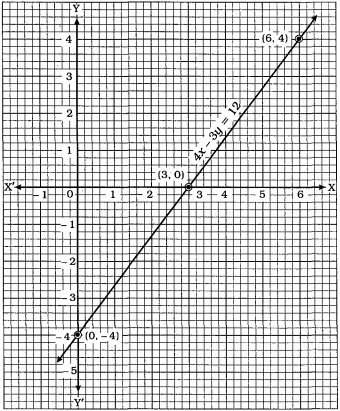
0 likes
View Solution79
Easy
Solve the equation $2y + 1 = y + 4$ and represent the solution$(s)$ on $(1)$ the number line $(2)$ the Cartesian plane.
Solution
(A) We solve the equation $2y + 1 = y + 4$:
$\therefore 2y - y = 4 - 1$
$\therefore y = 3$
$(1)$ Representation on the number line:
Since $y = 3$ is an equation in one variable,it represents a unique point on the number line at the position $3$.
$(2)$ Representation on the Cartesian plane:
We know that $y = 3$ can be written as a linear equation in two variables: $0x + 1y = 3$.
For any value of $x$,the value of $y$ remains $3$. Thus,we can choose points like $(0, 3)$,$(1, 3)$,and $(3, 3)$. Plotting these points on the Cartesian plane and joining them results in a line parallel to the $x$-axis passing through $y = 3$.
$\therefore 2y - y = 4 - 1$
$\therefore y = 3$
$(1)$ Representation on the number line:
Since $y = 3$ is an equation in one variable,it represents a unique point on the number line at the position $3$.
$(2)$ Representation on the Cartesian plane:
We know that $y = 3$ can be written as a linear equation in two variables: $0x + 1y = 3$.
For any value of $x$,the value of $y$ remains $3$. Thus,we can choose points like $(0, 3)$,$(1, 3)$,and $(3, 3)$. Plotting these points on the Cartesian plane and joining them results in a line parallel to the $x$-axis passing through $y = 3$.
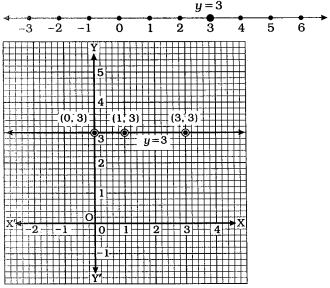
0 likes
View Solution80
Medium
Give equations of four lines passing through the point $(3, 5)$.
Solution
$A$ linear equation in two variables passing through a point $(x_0, y_0)$ can be represented in the form $a(x - x_0) + b(y - y_0) = 0$.
Given the point $(3, 5)$,we can choose different values for $a$ and $b$ to find various lines:
$1$. For $a=1, b=1$: $(x - 3) + (y - 5) = 0 \implies x + y = 8$.
$2$. For $a=-1, b=1$: $-(x - 3) + (y - 5) = 0 \implies -x + 3 + y - 5 = 0 \implies y - x = 2$.
$3$. For $a=1, b=2$: $(x - 3) + 2(y - 5) = 0 \implies x - 3 + 2y - 10 = 0 \implies x + 2y = 13$.
$4$. For $a=2, b=1$: $2(x - 3) + (y - 5) = 0 \implies 2x - 6 + y - 5 = 0 \implies 2x + y = 11$.
Given the point $(3, 5)$,we can choose different values for $a$ and $b$ to find various lines:
$1$. For $a=1, b=1$: $(x - 3) + (y - 5) = 0 \implies x + y = 8$.
$2$. For $a=-1, b=1$: $-(x - 3) + (y - 5) = 0 \implies -x + 3 + y - 5 = 0 \implies y - x = 2$.
$3$. For $a=1, b=2$: $(x - 3) + 2(y - 5) = 0 \implies x - 3 + 2y - 10 = 0 \implies x + 2y = 13$.
$4$. For $a=2, b=1$: $2(x - 3) + (y - 5) = 0 \implies 2x - 6 + y - 5 = 0 \implies 2x + y = 11$.
0 likes
View Solution81
Easy
Give equations of four lines passing through the point $(-2, 4)$.
Solution
The general equation of a line passing through a point $(x_1, y_1)$ is given by $(y - y_1) = m(x - x_1)$,where $m$ is the slope.
For the point $(-2, 4)$,the equation is $(y - 4) = m(x + 2)$.
By choosing different values for the slope $m$,we can find infinitely many lines:
$1$. If $m = -1$,then $(y - 4) = -1(x + 2) \implies y - 4 = -x - 2 \implies x + y = 2$.
$2$. If $m = 1$,then $(y - 4) = 1(x + 2) \implies y - 4 = x + 2 \implies x - y = -6$.
$3$. If $m = -2$,then $(y - 4) = -2(x + 2) \implies y - 4 = -2x - 4 \implies 2x + y = 0$.
$4$. If $m = -0.5$,then $(y - 4) = -0.5(x + 2) \implies y - 4 = -0.5x - 1 \implies 0.5x + y = 3 \implies x + 2y = 6$.
For the point $(-2, 4)$,the equation is $(y - 4) = m(x + 2)$.
By choosing different values for the slope $m$,we can find infinitely many lines:
$1$. If $m = -1$,then $(y - 4) = -1(x + 2) \implies y - 4 = -x - 2 \implies x + y = 2$.
$2$. If $m = 1$,then $(y - 4) = 1(x + 2) \implies y - 4 = x + 2 \implies x - y = -6$.
$3$. If $m = -2$,then $(y - 4) = -2(x + 2) \implies y - 4 = -2x - 4 \implies 2x + y = 0$.
$4$. If $m = -0.5$,then $(y - 4) = -0.5(x + 2) \implies y - 4 = -0.5x - 1 \implies 0.5x + y = 3 \implies x + 2y = 6$.
0 likes
View Solution82
EasyMCQ
Which of the following is an equation of a line that passes through points $(3,0)$ and $(0,4)$?
A
$x+y=7$
B
$4x+3y=12$
C
$2x+y=10$
D
$4x-3y=0$
Solution
(B) The equation of a line passing through two points $(x_1, y_1)$ and $(x_2, y_2)$ is given by the intercept form: $\frac{x}{a} + \frac{y}{b} = 1$,where $a$ and $b$ are the $x$-intercept and $y$-intercept respectively.
Given points are $(3,0)$ and $(0,4)$.
Here,the $x$-intercept $a = 3$ and the $y$-intercept $b = 4$.
Substituting these values into the intercept form equation:
$\frac{x}{3} + \frac{y}{4} = 1$
To simplify,multiply the entire equation by the least common multiple of $3$ and $4$,which is $12$:
$12 \times (\frac{x}{3}) + 12 \times (\frac{y}{4}) = 12 \times 1$
$4x + 3y = 12$
Thus,the correct equation is $4x + 3y = 12$.
Given points are $(3,0)$ and $(0,4)$.
Here,the $x$-intercept $a = 3$ and the $y$-intercept $b = 4$.
Substituting these values into the intercept form equation:
$\frac{x}{3} + \frac{y}{4} = 1$
To simplify,multiply the entire equation by the least common multiple of $3$ and $4$,which is $12$:
$12 \times (\frac{x}{3}) + 12 \times (\frac{y}{4}) = 12 \times 1$
$4x + 3y = 12$
Thus,the correct equation is $4x + 3y = 12$.
0 likes
View Solution83
EasyMCQ
Which of the following is an equation of a line that passes through points $(-2, 0)$ and $(0, 3)$?
A
$x + y = 1$
B
$x - y = -5$
C
$3x - 2y = -6$
D
$3x + 2y = 0$
Solution
(C) The slope $m$ of a line passing through points $(x_1, y_1)$ and $(x_2, y_2)$ is given by $m = \frac{y_2 - y_1}{x_2 - x_1}$.
Substituting the given points $(-2, 0)$ and $(0, 3)$:
$m = \frac{3 - 0}{0 - (-2)} = \frac{3}{2}$.
The equation of a line in slope-intercept form is $y = mx + c$,where $c$ is the $y$-intercept.
Since the line passes through $(0, 3)$,the $y$-intercept $c = 3$.
Thus,the equation is $y = \frac{3}{2}x + 3$.
Multiplying by $2$,we get $2y = 3x + 6$,which rearranges to $3x - 2y = -6$.
Substituting the given points $(-2, 0)$ and $(0, 3)$:
$m = \frac{3 - 0}{0 - (-2)} = \frac{3}{2}$.
The equation of a line in slope-intercept form is $y = mx + c$,where $c$ is the $y$-intercept.
Since the line passes through $(0, 3)$,the $y$-intercept $c = 3$.
Thus,the equation is $y = \frac{3}{2}x + 3$.
Multiplying by $2$,we get $2y = 3x + 6$,which rearranges to $3x - 2y = -6$.
0 likes
View Solution84
EasyMCQ
If the point $(2, 3)$ lies on the graph of the equation $3x + ay = 18$,find the value of $a$.
A
$a = 2$
B
$a = 3$
C
$a = 4$
D
$a = 5$
Solution
(C) Given that the point $(2, 3)$ lies on the graph of the equation $3x + ay = 18$.
This means that the coordinates $x = 2$ and $y = 3$ must satisfy the given equation.
Substituting $x = 2$ and $y = 3$ into the equation:
$3(2) + a(3) = 18$
$6 + 3a = 18$
Subtracting $6$ from both sides:
$3a = 18 - 6$
$3a = 12$
Dividing by $3$:
$a = 4$.
This means that the coordinates $x = 2$ and $y = 3$ must satisfy the given equation.
Substituting $x = 2$ and $y = 3$ into the equation:
$3(2) + a(3) = 18$
$6 + 3a = 18$
Subtracting $6$ from both sides:
$3a = 18 - 6$
$3a = 12$
Dividing by $3$:
$a = 4$.
0 likes
View Solution85
EasyMCQ
If the point $(-2, 5)$ lies on the graph of the equation $ax + 3y = 7$,find the value of $a$.
A
$a = 4$
B
$a = 2$
C
$a = -4$
D
$a = -2$
Solution
(A) Given the equation is $ax + 3y = 7$.
Since the point $(-2, 5)$ lies on the graph,it must satisfy the equation.
Substitute $x = -2$ and $y = 5$ into the equation:
$a(-2) + 3(5) = 7$
$-2a + 15 = 7$
$-2a = 7 - 15$
$-2a = -8$
$a = \frac{-8}{-2}$
$a = 4$
Since the point $(-2, 5)$ lies on the graph,it must satisfy the equation.
Substitute $x = -2$ and $y = 5$ into the equation:
$a(-2) + 3(5) = 7$
$-2a + 15 = 7$
$-2a = 7 - 15$
$-2a = -8$
$a = \frac{-8}{-2}$
$a = 4$
0 likes
View Solution86
EasyMCQ
If the point $(a, a-2)$ lies on the graph of the equation $3x + 5y = 30$,find the value of $a$.
A
$5$
B
$6$
C
$4$
D
$7$
Solution
(A) Given that the point $(a, a-2)$ lies on the graph of the equation $3x + 5y = 30$.
This means that the coordinates of the point must satisfy the equation.
Substitute $x = a$ and $y = a - 2$ into the equation:
$3(a) + 5(a - 2) = 30$
$3a + 5a - 10 = 30$
$8a - 10 = 30$
$8a = 30 + 10$
$8a = 40$
$a = 40 / 8$
$a = 5$
This means that the coordinates of the point must satisfy the equation.
Substitute $x = a$ and $y = a - 2$ into the equation:
$3(a) + 5(a - 2) = 30$
$3a + 5a - 10 = 30$
$8a - 10 = 30$
$8a = 30 + 10$
$8a = 40$
$a = 40 / 8$
$a = 5$
0 likes
View Solution87
MediumMCQ
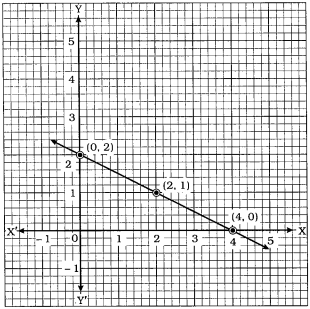
Determine which of the given equations is represented by the graph shown in the figure below.
A
$3x - y = 12$
B
$4x + y = 9$
C
$x + 2y = 4$
D
$2x + 3y = 6$
Solution
(C) To determine the correct equation,we check which equation is satisfied by the points shown on the graph. The points on the line are $(0, 2)$,$(2, 1)$,and $(4, 0)$.
Testing the points in option $(C)$,$x + 2y = 4$:
For $(0, 2)$: $0 + 2(2) = 4$,which is $4 = 4$ (True).
For $(2, 1)$: $2 + 2(1) = 4$,which is $4 = 4$ (True).
For $(4, 0)$: $4 + 2(0) = 4$,which is $4 = 4$ (True).
Since all points satisfy the equation $x + 2y = 4$,this is the correct equation.
Testing the points in option $(C)$,$x + 2y = 4$:
For $(0, 2)$: $0 + 2(2) = 4$,which is $4 = 4$ (True).
For $(2, 1)$: $2 + 2(1) = 4$,which is $4 = 4$ (True).
For $(4, 0)$: $4 + 2(0) = 4$,which is $4 = 4$ (True).
Since all points satisfy the equation $x + 2y = 4$,this is the correct equation.
0 likes
View Solution88
MediumMCQ
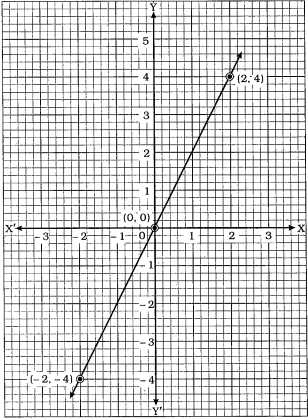
Determine which of the given equations is represented by the graph shown in the figure below.
A
$x+y=-6$
B
$x=2y$
C
$x+y=6$
D
$y=2x$
Solution
(D) To determine the correct equation,we check the points lying on the line shown in the graph.
The points marked on the line are $(0, 0)$,$(2, 4)$,and $(-2, -4)$.
Now,we test these points in the given equations:
For option $D$,$y = 2x$:
$1$. For $(0, 0)$: $0 = 2(0) \implies 0 = 0$ (True)
$2$. For $(2, 4)$: $4 = 2(2) \implies 4 = 4$ (True)
$3$. For $(-2, -4)$: $-4 = 2(-2) \implies -4 = -4$ (True)
Since all points satisfy the equation $y = 2x$,this is the correct equation.
The points marked on the line are $(0, 0)$,$(2, 4)$,and $(-2, -4)$.
Now,we test these points in the given equations:
For option $D$,$y = 2x$:
$1$. For $(0, 0)$: $0 = 2(0) \implies 0 = 0$ (True)
$2$. For $(2, 4)$: $4 = 2(2) \implies 4 = 4$ (True)
$3$. For $(-2, -4)$: $-4 = 2(-2) \implies -4 = -4$ (True)
Since all points satisfy the equation $y = 2x$,this is the correct equation.
0 likes
View Solution89
Easy
Draw the graph of each of the equations given below. Also,find the coordinates of the points where the graph intersects the coordinate axes:
$1. 3x + 5y = 15$
$2. 5x - 2y = 10$
$3. 4x + 3y = -12$
$4. 3x - 7y = 21$
$5. x - y = 0$
$6. 2x - 3y = 0$
$7. x - y = -5$
$8. 5x - 3y = 15$
$1. 3x + 5y = 15$
$2. 5x - 2y = 10$
$3. 4x + 3y = -12$
$4. 3x - 7y = 21$
$5. x - y = 0$
$6. 2x - 3y = 0$
$7. x - y = -5$
$8. 5x - 3y = 15$
Solution
(A) To find the intersection points with the coordinate axes:
- For the $x$-axis,set $y = 0$ and solve for $x$.
- For the $y$-axis,set $x = 0$ and solve for $y$.
- For the $x$-axis,set $y = 0$ and solve for $x$.
- For the $y$-axis,set $x = 0$ and solve for $y$.
| Equation | Intersection at $x$-axis $(y=0)$ | Intersection at $y$-axis $(x=0)$ |
|---|---|---|
| $1. 3x + 5y = 15$ | $(5, 0)$ | $(0, 3)$ |
| $2. 5x - 2y = 10$ | $(2, 0)$ | $(0, -5)$ |
| $3. 4x + 3y = -12$ | $(-3, 0)$ | $(0, -4)$ |
| $4. 3x - 7y = 21$ | $(7, 0)$ | $(0, -3)$ |
| $5. x - y = 0$ | $(0, 0)$ | $(0, 0)$ |
| $6. 2x - 3y = 0$ | $(0, 0)$ | $(0, 0)$ |
| $7. x - y = -5$ | $(-5, 0)$ | $(0, 5)$ |
| $8. 5x - 3y = 15$ | $(3, 0)$ | $(0, -5)$ |
0 likes
View Solution90
Easy
Solve the equation $3x - 1 = x + 7$ and represent the solution$(s)$ on $(1)$ the number line $(2)$ the Cartesian plane.
Solution
(N/A) Step $1$: Solve the equation for $x$.
$3x - 1 = x + 7$
$3x - x = 7 + 1$
$2x = 8$
$x = 4$
Step $2$: Representation on the number line.
On the number line,mark the point $4$ as a solid dot.
Step $3$: Representation on the Cartesian plane.
In the Cartesian plane,the equation $x = 4$ represents a vertical line passing through $x = 4$ on the $x$-axis,parallel to the $y$-axis.
$3x - 1 = x + 7$
$3x - x = 7 + 1$
$2x = 8$
$x = 4$
Step $2$: Representation on the number line.
On the number line,mark the point $4$ as a solid dot.
Step $3$: Representation on the Cartesian plane.
In the Cartesian plane,the equation $x = 4$ represents a vertical line passing through $x = 4$ on the $x$-axis,parallel to the $y$-axis.
0 likes
View Solution91
Medium
Solve the equation $5y + 10 = 3y + 4$ and represent the solution on $(1)$ the number line and $(2)$ the Cartesian plane.
Solution
(Y = -3) Step $1$: Solve the equation for $y$.
$5y + 10 = 3y + 4$
$5y - 3y = 4 - 10$
$2y = -6$
$y = -3$
Step $2$: Representation on the number line.
On a horizontal number line,mark the point at $-3$.
Step $3$: Representation on the Cartesian plane.
The equation $y = -3$ represents a horizontal line parallel to the $x$-axis,passing through the point $(0, -3)$.
$5y + 10 = 3y + 4$
$5y - 3y = 4 - 10$
$2y = -6$
$y = -3$
Step $2$: Representation on the number line.
On a horizontal number line,mark the point at $-3$.
Step $3$: Representation on the Cartesian plane.
The equation $y = -3$ represents a horizontal line parallel to the $x$-axis,passing through the point $(0, -3)$.
0 likes
View Solution92
Difficult
The autorickshaw fare in a city is as follows: For the first kilometre,the fare is ₹ $10$,and for the subsequent distance,it is ₹ $3$ per $km$. Taking the distance covered as $x$ $km$ and the total fare as ₹ $y$,write a linear equation for this information and draw its graph. Find the total fare for a journey of $4$ kilometres from the graph.
Solution
(D) Let the total distance covered be $x$ $km$ and the total fare be ₹ $y$.
For the first $1$ $km$,the fare is ₹ $10$.
For the remaining distance $(x - 1)$ $km$,the fare is $3(x - 1)$.
Therefore,the total fare $y = 10 + 3(x - 1)$.
Simplifying the equation: $y = 10 + 3x - 3$,which gives $y = 3x + 7$.
To draw the graph,we find points:
If $x = 1, y = 10$.
If $x = 2, y = 13$.
If $x = 3, y = 16$.
Plotting these points on a graph and joining them gives a straight line.
For a journey of $4$ $km$,substitute $x = 4$ in the equation: $y = 3(4) + 7 = 12 + 7 = 19$.
Thus,the total fare for $4$ $km$ is ₹ $19$.
For the first $1$ $km$,the fare is ₹ $10$.
For the remaining distance $(x - 1)$ $km$,the fare is $3(x - 1)$.
Therefore,the total fare $y = 10 + 3(x - 1)$.
Simplifying the equation: $y = 10 + 3x - 3$,which gives $y = 3x + 7$.
To draw the graph,we find points:
If $x = 1, y = 10$.
If $x = 2, y = 13$.
If $x = 3, y = 16$.
Plotting these points on a graph and joining them gives a straight line.
For a journey of $4$ $km$,substitute $x = 4$ in the equation: $y = 3(4) + 7 = 12 + 7 = 19$.
Thus,the total fare for $4$ $km$ is ₹ $19$.
0 likes
View Solution93
Difficult
The total cost of a school picnic consists of two parts: a fixed bus fare of ₹ $200$ and the cost of snacks at the rate of ₹ $30$ per student. Representing the total number of students by $x$ and the total cost by $y$,form a linear equation in two variables. If the number of students going on the picnic is $40$,find the total cost.
Solution
(N/A) Let the number of students be $x$ and the total cost be $y$.
The fixed cost for the bus is ₹ $200$.
The cost of snacks per student is ₹ $30$.
Therefore,the total cost $y$ is given by the linear equation: $y = 30x + 200$.
To find the total cost for $40$ students,substitute $x = 40$ into the equation:
$y = 30(40) + 200$
$y = 1200 + 200$
$y = 1400$.
Thus,the total cost for $40$ students is ₹ $1400$.
The fixed cost for the bus is ₹ $200$.
The cost of snacks per student is ₹ $30$.
Therefore,the total cost $y$ is given by the linear equation: $y = 30x + 200$.
To find the total cost for $40$ students,substitute $x = 40$ into the equation:
$y = 30(40) + 200$
$y = 1200 + 200$
$y = 1400$.
Thus,the total cost for $40$ students is ₹ $1400$.
0 likes
View Solution94
Easy
Draw the graph of the equation represented by a straight line which is parallel to the $x$-axis and at a distance of $3$ units below it.
Solution
(N/A) line parallel to the $x$-axis is given by the equation $y = k$,where $k$ is the distance from the $x$-axis.
Since the line is $3$ units below the $x$-axis,the value of $y$ is negative.
Therefore,the equation of the line is $y = -3$.
The graph is a horizontal straight line passing through the point $(0, -3)$ on the $y$-axis.
Since the line is $3$ units below the $x$-axis,the value of $y$ is negative.
Therefore,the equation of the line is $y = -3$.
The graph is a horizontal straight line passing through the point $(0, -3)$ on the $y$-axis.
0 likes
View Solution95
Easy
Draw the graph of the linear equation whose solutions are represented by the points having the sum of the coordinates as $10$ units.
Solution
Let the coordinates of the point be $(x, y)$.
According to the problem,the sum of the coordinates is $10$,so the linear equation is $x + y = 10$.
To draw the graph,we find at least two solutions for the equation:
If $x = 0$,then $0 + y = 10 \implies y = 10$. So,the point is $(0, 10)$.
If $x = 10$,then $10 + y = 10 \implies y = 0$. So,the point is $(10, 0)$.
If $x = 5$,then $5 + y = 10 \implies y = 5$. So,the point is $(5, 5)$.
Plot these points $(0, 10)$,$(10, 0)$,and $(5, 5)$ on a Cartesian plane and join them with a straight line to obtain the graph of the equation $x + y = 10$.
According to the problem,the sum of the coordinates is $10$,so the linear equation is $x + y = 10$.
To draw the graph,we find at least two solutions for the equation:
If $x = 0$,then $0 + y = 10 \implies y = 10$. So,the point is $(0, 10)$.
If $x = 10$,then $10 + y = 10 \implies y = 0$. So,the point is $(10, 0)$.
If $x = 5$,then $5 + y = 10 \implies y = 5$. So,the point is $(5, 5)$.
Plot these points $(0, 10)$,$(10, 0)$,and $(5, 5)$ on a Cartesian plane and join them with a straight line to obtain the graph of the equation $x + y = 10$.
0 likes
View Solution96
Easy
State whether the following statement is true or false:
An equation in two variables has a unique solution.
An equation in two variables has a unique solution.
Solution
(B) The statement is False.
$A$ linear equation in two variables,typically represented as $ax + by + c = 0$,where $a, b,$ and $c$ are real numbers and $a, b \neq 0$,has infinitely many solutions.
For any value assigned to one variable,there exists a corresponding value for the other variable that satisfies the equation. Therefore,it does not have a unique solution.
$A$ linear equation in two variables,typically represented as $ax + by + c = 0$,where $a, b,$ and $c$ are real numbers and $a, b \neq 0$,has infinitely many solutions.
For any value assigned to one variable,there exists a corresponding value for the other variable that satisfies the equation. Therefore,it does not have a unique solution.
0 likes
View Solution97
Easy
State whether the following statement is true or false:
The graph of the equation $3x = 4y$ is a line passing through the origin.
The graph of the equation $3x = 4y$ is a line passing through the origin.
Solution
(A) The given equation is $3x = 4y$,which can be rewritten as $y = \frac{3}{4}x$.
This is a linear equation of the form $y = mx$,where $m = \frac{3}{4}$.
Any linear equation of the form $y = mx$ (where $c = 0$) represents a straight line that passes through the origin $(0, 0)$.
Substituting $x = 0$ in the equation $3x = 4y$,we get $3(0) = 4y$,which implies $4y = 0$,so $y = 0$.
Since the point $(0, 0)$ satisfies the equation,the graph passes through the origin.
Therefore,the statement is True.
This is a linear equation of the form $y = mx$,where $m = \frac{3}{4}$.
Any linear equation of the form $y = mx$ (where $c = 0$) represents a straight line that passes through the origin $(0, 0)$.
Substituting $x = 0$ in the equation $3x = 4y$,we get $3(0) = 4y$,which implies $4y = 0$,so $y = 0$.
Since the point $(0, 0)$ satisfies the equation,the graph passes through the origin.
Therefore,the statement is True.
0 likes
View Solution98
Easy
State whether the following statement is true or false:
If $(5, -2)$ is a solution of $5x + 2y = k$,then $k = 0$.
If $(5, -2)$ is a solution of $5x + 2y = k$,then $k = 0$.
Solution
(B) To determine if the statement is true or false,we substitute the coordinates $(x, y) = (5, -2)$ into the given equation $5x + 2y = k$.
Substituting $x = 5$ and $y = -2$:
$5(5) + 2(-2) = k$
$25 - 4 = k$
$21 = k$
Since the calculated value of $k$ is $21$ and not $0$,the statement is False.
Substituting $x = 5$ and $y = -2$:
$5(5) + 2(-2) = k$
$25 - 4 = k$
$21 = k$
Since the calculated value of $k$ is $21$ and not $0$,the statement is False.
0 likes
View Solution99
EasyMCQ
State whether the following statement is true or false:
In a Cartesian plane,the graph of $3x = 15$ is a line parallel to the $x$-axis.
In a Cartesian plane,the graph of $3x = 15$ is a line parallel to the $x$-axis.
A
True
B
False
Solution
(B) The given equation is $3x = 15$.
Dividing both sides by $3$,we get $x = 5$.
In a Cartesian plane,the equation $x = a$ represents a vertical line parallel to the $y$-axis,passing through the point $(a, 0)$.
Therefore,the graph of $x = 5$ is a vertical line parallel to the $y$-axis,not the $x$-axis.
Thus,the statement is False.
Dividing both sides by $3$,we get $x = 5$.
In a Cartesian plane,the equation $x = a$ represents a vertical line parallel to the $y$-axis,passing through the point $(a, 0)$.
Therefore,the graph of $x = 5$ is a vertical line parallel to the $y$-axis,not the $x$-axis.
Thus,the statement is False.
0 likes
View Solution100
Easy
State whether the following statement is true or false:
The graph of the linear equation $5x - 3y = 30$ intersects the $y$-axis at the point $(6, 0)$.
The graph of the linear equation $5x - 3y = 30$ intersects the $y$-axis at the point $(6, 0)$.
Solution
(B) The statement is False.
To find the intersection point with the $y$-axis,we set $x = 0$ in the equation $5x - 3y = 30$.
Substituting $x = 0$: $5(0) - 3y = 30 \implies -3y = 30 \implies y = -10$.
Thus,the graph intersects the $y$-axis at the point $(0, -10)$.
Conversely,if we check the point $(6, 0)$ by substituting $x = 6$ and $y = 0$ into the equation: $5(6) - 3(0) = 30 - 0 = 30$. This point lies on the $x$-axis,not the $y$-axis.
To find the intersection point with the $y$-axis,we set $x = 0$ in the equation $5x - 3y = 30$.
Substituting $x = 0$: $5(0) - 3y = 30 \implies -3y = 30 \implies y = -10$.
Thus,the graph intersects the $y$-axis at the point $(0, -10)$.
Conversely,if we check the point $(6, 0)$ by substituting $x = 6$ and $y = 0$ into the equation: $5(6) - 3(0) = 30 - 0 = 30$. This point lies on the $x$-axis,not the $y$-axis.
0 likes
View SolutionLinear Equations in Two Variables — Mix Examples - Linear Equations in Two Variables · Frequently Asked Questions
1Are these Linear Equations in Two Variables questions useful for JEE and NEET?
Yes. All questions in this section are mapped to JEE Main and NEET exam patterns. Previous year questions from JEE Main, NEET, GUJCET and state-level exams are included with full solutions.
2Can I switch to Hindi or Gujarati for these questions?
Yes. Use the language tabs in the hero section or the sidebar to view the same questions and solutions in English, Hindi or Gujarati.
3How do I generate a question paper from this subtopic?
Use the Vedclass Exam Paper Generator — select the chapter and subtopic, set difficulty, and generate Sets A, B, C, D automatically. First 3 chapters of every subject are free.
Vedclass Products
For Students
Vedclass Test Series
Mock tests in real JEE/NEET style with performance analysis. 5-day free trial.
Start Free TrialFor Teachers
Exam Paper Generator
Generate Set A/B/C/D papers from this chapter in 2 minutes. 3 chapters free.
Try FreeFor Institutes
Online Exam Module
Live online exams with unlimited students, 360° analytics & white-label branding.
See DemoFor Teachers & Institutes
Generate a Linear Equations in Two Variables Exam Paper in 2 Minutes
Select subtopic & difficulty — Sets A, B, C, D auto-generated with No Repeat logic.
First 3 chapters of every subject are free — no payment required.