
A English
Mix Examples - Circles Questions in English
Class 9 Mathematics · Circles · Mix Examples - Circles
152+
Questions
English
Language
100%
With Solutions
Showing 50 of 152 questions in English
51
Difficult
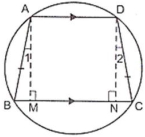
If non-parallel sides of a trapezium are equal,prove that it is cyclic.
Solution
(N/A) Given: $ABCD$ is a trapezium in which $AD \parallel BC$ and its non-parallel sides $AB$ and $DC$ are equal,i.e.,$AB = DC$.
To prove: Trapezium $ABCD$ is cyclic.
Construction: Draw $AM \perp BC$ and $DN \perp BC$.
Proof: In right-angled triangles $\Delta AMB$ and $\Delta DNC$:
$\angle AMB = \angle DNC = 90^{\circ}$ (By construction)
$AB = DC$ (Given)
$AM = DN$ (Distance between two parallel lines is constant)
Therefore,$\Delta AMB \cong \Delta DNC$ (By $RHS$ congruence rule).
Thus,$\angle B = \angle C$ $(CPCT)$.
Also,$\angle BAM = \angle CDN$ $(CPCT)$.
Since $\angle AMB = 90^{\circ}$ and $\angle DNC = 90^{\circ}$,we have $\angle MAB = 90^{\circ} - \angle B$ and $\angle NDC = 90^{\circ} - \angle C$. Since $\angle B = \angle C$,then $\angle MAB = \angle NDC$.
Now,$\angle BAD = \angle BAM + \angle MAD = \angle BAM + 90^{\circ}$ and $\angle CDA = \angle CDN + \angle NDA = \angle CDN + 90^{\circ}$.
Since $\angle BAM = \angle CDN$,it follows that $\angle BAD = \angle CDA$.
In quadrilateral $ABCD$,$\angle B + \angle C + \angle CDA + \angle BAD = 360^{\circ}$.
Substituting $\angle C = \angle B$ and $\angle CDA = \angle BAD$,we get $2\angle B + 2\angle BAD = 360^{\circ}$,which implies $\angle B + \angle BAD = 180^{\circ}$.
Since the sum of a pair of opposite angles is $180^{\circ}$,the trapezium $ABCD$ is cyclic.
To prove: Trapezium $ABCD$ is cyclic.
Construction: Draw $AM \perp BC$ and $DN \perp BC$.
Proof: In right-angled triangles $\Delta AMB$ and $\Delta DNC$:
$\angle AMB = \angle DNC = 90^{\circ}$ (By construction)
$AB = DC$ (Given)
$AM = DN$ (Distance between two parallel lines is constant)
Therefore,$\Delta AMB \cong \Delta DNC$ (By $RHS$ congruence rule).
Thus,$\angle B = \angle C$ $(CPCT)$.
Also,$\angle BAM = \angle CDN$ $(CPCT)$.
Since $\angle AMB = 90^{\circ}$ and $\angle DNC = 90^{\circ}$,we have $\angle MAB = 90^{\circ} - \angle B$ and $\angle NDC = 90^{\circ} - \angle C$. Since $\angle B = \angle C$,then $\angle MAB = \angle NDC$.
Now,$\angle BAD = \angle BAM + \angle MAD = \angle BAM + 90^{\circ}$ and $\angle CDA = \angle CDN + \angle NDA = \angle CDN + 90^{\circ}$.
Since $\angle BAM = \angle CDN$,it follows that $\angle BAD = \angle CDA$.
In quadrilateral $ABCD$,$\angle B + \angle C + \angle CDA + \angle BAD = 360^{\circ}$.
Substituting $\angle C = \angle B$ and $\angle CDA = \angle BAD$,we get $2\angle B + 2\angle BAD = 360^{\circ}$,which implies $\angle B + \angle BAD = 180^{\circ}$.
Since the sum of a pair of opposite angles is $180^{\circ}$,the trapezium $ABCD$ is cyclic.
0 likes
View Solution52
Difficult
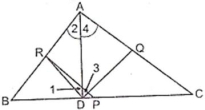
If $P, Q$ and $R$ are the mid-points of the sides $BC, CA$ and $AB$ of a triangle $ABC$ and $AD$ is the perpendicular from $A$ on $BC$,prove that $P, Q, R$ and $D$ are concyclic.
Solution
(N/A) We have to prove that $R, D, P$ and $Q$ are concyclic.
Join $RD, QD, PR$ and $PQ$.
Since $RP$ joins $R$ and $P$,the mid-points of $AB$ and $BC$,by the Mid-point theorem,$RP \parallel AC$.
Similarly,$PQ \parallel AB$.
Therefore,$ARPQ$ is a parallelogram. So,$\angle RAQ = \angle RPQ$ (Opposite angles of a parallelogram) ... $(1)$
In right-angled triangle $ABD$,$DR$ is the median to the hypotenuse $AB$. Therefore,$RA = RD$,which implies $\angle 1 = \angle B$.
Similarly,in right-angled triangle $ACD$,$DQ$ is the median to the hypotenuse $AC$. Therefore,$QA = QD$,which implies $\angle 3 = \angle C$.
In $\triangle ABC$,$\angle A + \angle B + \angle C = 180^{\circ}$.
Also,in $\triangle RDQ$,$\angle RDQ = 180^{\circ} - (\angle DRQ + \angle DQR) = 180^{\circ} - (2\angle B + 2\angle C) = 180^{\circ} - 2(\angle B + \angle C) = 180^{\circ} - 2(180^{\circ} - \angle A) = 2\angle A - 180^{\circ}$.
Alternatively,using the property of cyclic quadrilaterals,since $\angle RPQ = \angle A$ and $\angle RDQ = 180^{\circ} - \angle A$ is not directly applicable,we observe that $\angle RDQ = \angle RDA + \angle ADQ = \angle RAD + \angle QAD = \angle A$. Since $\angle RPQ = \angle A$ and $\angle RDQ = \angle A$,the points $R, D, P, Q$ are concyclic as they subtend equal angles on the same side of the segment $RQ$.
Join $RD, QD, PR$ and $PQ$.
Since $RP$ joins $R$ and $P$,the mid-points of $AB$ and $BC$,by the Mid-point theorem,$RP \parallel AC$.
Similarly,$PQ \parallel AB$.
Therefore,$ARPQ$ is a parallelogram. So,$\angle RAQ = \angle RPQ$ (Opposite angles of a parallelogram) ... $(1)$
In right-angled triangle $ABD$,$DR$ is the median to the hypotenuse $AB$. Therefore,$RA = RD$,which implies $\angle 1 = \angle B$.
Similarly,in right-angled triangle $ACD$,$DQ$ is the median to the hypotenuse $AC$. Therefore,$QA = QD$,which implies $\angle 3 = \angle C$.
In $\triangle ABC$,$\angle A + \angle B + \angle C = 180^{\circ}$.
Also,in $\triangle RDQ$,$\angle RDQ = 180^{\circ} - (\angle DRQ + \angle DQR) = 180^{\circ} - (2\angle B + 2\angle C) = 180^{\circ} - 2(\angle B + \angle C) = 180^{\circ} - 2(180^{\circ} - \angle A) = 2\angle A - 180^{\circ}$.
Alternatively,using the property of cyclic quadrilaterals,since $\angle RPQ = \angle A$ and $\angle RDQ = 180^{\circ} - \angle A$ is not directly applicable,we observe that $\angle RDQ = \angle RDA + \angle ADQ = \angle RAD + \angle QAD = \angle A$. Since $\angle RPQ = \angle A$ and $\angle RDQ = \angle A$,the points $R, D, P, Q$ are concyclic as they subtend equal angles on the same side of the segment $RQ$.
0 likes
View Solution53
Medium
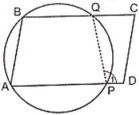
$ABCD$ is a parallelogram. $A$ circle through $A$ and $B$ is drawn such that it intersects $AD$ at $P$ and $BC$ at $Q$. Prove that $P, Q, C,$ and $D$ are concyclic.
Solution
(N/A) $ABCD$ is a parallelogram. $A$ circle passes through $A$ and $B$,intersecting $AD$ at $P$ and $BC$ at $Q$. We need to prove that $P, Q, C,$ and $D$ are concyclic.
$1$. Since $ABQP$ is a cyclic quadrilateral,the exterior angle formed by extending side $AP$ to $D$ is equal to the interior opposite angle.
Let $\angle QPD$ be the exterior angle at $P$. Then,$\angle QPD = \angle ABQ$.
$2$. In parallelogram $ABCD$,$AD \parallel BC$. Since $AB$ is a transversal,$\angle A + \angle B = 180^{\circ}$. However,considering the parallel lines $AB$ and $DC$ with transversal $BC$,we have $\angle B + \angle C = 180^{\circ}$ (consecutive interior angles).
$3$. Since $\angle QPD = \angle ABQ$ (exterior angle property of cyclic quadrilateral $ABQP$),and we know $\angle ABQ + \angle C = 180^{\circ}$,we can substitute $\angle QPD$ for $\angle ABQ$.
$4$. Therefore,$\angle QPD + \angle C = 180^{\circ}$.
$5$. Since the sum of the opposite angles of quadrilateral $PDCQ$ is $180^{\circ}$,$PDCQ$ is a cyclic quadrilateral.
Hence,the points $P, Q, C,$ and $D$ are concyclic.
$1$. Since $ABQP$ is a cyclic quadrilateral,the exterior angle formed by extending side $AP$ to $D$ is equal to the interior opposite angle.
Let $\angle QPD$ be the exterior angle at $P$. Then,$\angle QPD = \angle ABQ$.
$2$. In parallelogram $ABCD$,$AD \parallel BC$. Since $AB$ is a transversal,$\angle A + \angle B = 180^{\circ}$. However,considering the parallel lines $AB$ and $DC$ with transversal $BC$,we have $\angle B + \angle C = 180^{\circ}$ (consecutive interior angles).
$3$. Since $\angle QPD = \angle ABQ$ (exterior angle property of cyclic quadrilateral $ABQP$),and we know $\angle ABQ + \angle C = 180^{\circ}$,we can substitute $\angle QPD$ for $\angle ABQ$.
$4$. Therefore,$\angle QPD + \angle C = 180^{\circ}$.
$5$. Since the sum of the opposite angles of quadrilateral $PDCQ$ is $180^{\circ}$,$PDCQ$ is a cyclic quadrilateral.
Hence,the points $P, Q, C,$ and $D$ are concyclic.
0 likes
View Solution54
Difficult
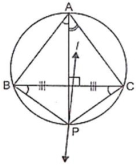
Prove that the angle bisector of any angle of a triangle and the perpendicular bisector of the opposite side,if they intersect,will intersect on the circumcircle of the triangle.
Solution
(N/A) Given: $A$ $\Delta ABC$ and a line $l$ which is the perpendicular bisector of $BC$.
To prove: The angle bisector of $\angle A$ and the perpendicular bisector of $BC$ intersect on the circumcircle of $\Delta ABC$.
Proof: Let the angle bisector of $\angle A$ intersect the circumcircle of $\Delta ABC$ at point $P$. Join $BP$ and $CP$.
Since angles in the same segment are equal,we have:
$\angle BAP = \angle BCP$
Since $AP$ is the bisector of $\angle A$,we have:
$\angle BAP = \angle PAC = \frac{1}{2} \angle A$
Therefore,$\angle BCP = \frac{1}{2} \angle A$ $...(1)$
Similarly,in the same segment,$\angle PAC = \angle PBC$.
Since $\angle PAC = \frac{1}{2} \angle A$,we have:
$\angle PBC = \frac{1}{2} \angle A$ $...(2)$
From equations $(1)$ and $(2)$,we get:
$\angle BCP = \angle PBC$
In $\Delta PBC$,since the base angles are equal,the sides opposite to them are equal:
$BP = CP$
Since $P$ is equidistant from $B$ and $C$,$P$ must lie on the perpendicular bisector of $BC$.
Hence,the angle bisector of $\angle A$ and the perpendicular bisector of $BC$ intersect on the circumcircle of $\Delta ABC$.
To prove: The angle bisector of $\angle A$ and the perpendicular bisector of $BC$ intersect on the circumcircle of $\Delta ABC$.
Proof: Let the angle bisector of $\angle A$ intersect the circumcircle of $\Delta ABC$ at point $P$. Join $BP$ and $CP$.
Since angles in the same segment are equal,we have:
$\angle BAP = \angle BCP$
Since $AP$ is the bisector of $\angle A$,we have:
$\angle BAP = \angle PAC = \frac{1}{2} \angle A$
Therefore,$\angle BCP = \frac{1}{2} \angle A$ $...(1)$
Similarly,in the same segment,$\angle PAC = \angle PBC$.
Since $\angle PAC = \frac{1}{2} \angle A$,we have:
$\angle PBC = \frac{1}{2} \angle A$ $...(2)$
From equations $(1)$ and $(2)$,we get:
$\angle BCP = \angle PBC$
In $\Delta PBC$,since the base angles are equal,the sides opposite to them are equal:
$BP = CP$
Since $P$ is equidistant from $B$ and $C$,$P$ must lie on the perpendicular bisector of $BC$.
Hence,the angle bisector of $\angle A$ and the perpendicular bisector of $BC$ intersect on the circumcircle of $\Delta ABC$.
0 likes
View Solution55
Difficult
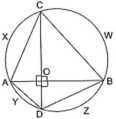
If two chords $AB$ and $CD$ of a circle intersect at right angles (see Fig.),prove that $\text{arc } CXA + \text{arc } DZB = \text{arc } AYD + \text{arc } BWC = \text{semicircle}$.
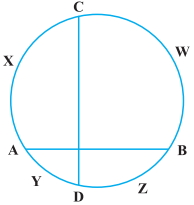
Solution
(A) To prove: $\text{arc } CXA + \text{arc } DZB = \text{arc } AYD + \text{arc } BWC = \text{semicircle}$.
Construction: Join $AC, AD, BD$ and $BC$.
Proof: Let the chords $AB$ and $CD$ intersect at point $O$ at right angles. Thus,$\angle AOC = \angle COB = \angle BOD = \angle DOA = 90^{\circ}$.
The angle subtended by an arc at the center is double the angle subtended by it at any point on the remaining part of the circle. Let the measure of the arcs be denoted by their corresponding central angles.
In $\triangle AOC$,$\angle OAC + \angle OCA = 180^{\circ} - 90^{\circ} = 90^{\circ}$.
Since the angle subtended by an arc at the circumference is half the angle at the center,we have:
$\text{arc } CXA = 2 \angle CBA$ and $\text{arc } DZB = 2 \angle BCD$.
In $\triangle OBC$,$\angle OBC + \angle OCB = 90^{\circ}$.
Thus,$\frac{1}{2} (\text{arc } CXA) + \frac{1}{2} (\text{arc } DZB) = \angle CBA + \angle BCD = 90^{\circ}$.
Therefore,$\text{arc } CXA + \text{arc } DZB = 180^{\circ}$,which is a semicircle.
Similarly,for the other pair,$\text{arc } AYD + \text{arc } BWC = 180^{\circ}$,which is also a semicircle.
Hence,$\text{arc } CXA + \text{arc } DZB = \text{arc } AYD + \text{arc } BWC = \text{semicircle}$.
Construction: Join $AC, AD, BD$ and $BC$.
Proof: Let the chords $AB$ and $CD$ intersect at point $O$ at right angles. Thus,$\angle AOC = \angle COB = \angle BOD = \angle DOA = 90^{\circ}$.
The angle subtended by an arc at the center is double the angle subtended by it at any point on the remaining part of the circle. Let the measure of the arcs be denoted by their corresponding central angles.
In $\triangle AOC$,$\angle OAC + \angle OCA = 180^{\circ} - 90^{\circ} = 90^{\circ}$.
Since the angle subtended by an arc at the circumference is half the angle at the center,we have:
$\text{arc } CXA = 2 \angle CBA$ and $\text{arc } DZB = 2 \angle BCD$.
In $\triangle OBC$,$\angle OBC + \angle OCB = 90^{\circ}$.
Thus,$\frac{1}{2} (\text{arc } CXA) + \frac{1}{2} (\text{arc } DZB) = \angle CBA + \angle BCD = 90^{\circ}$.
Therefore,$\text{arc } CXA + \text{arc } DZB = 180^{\circ}$,which is a semicircle.
Similarly,for the other pair,$\text{arc } AYD + \text{arc } BWC = 180^{\circ}$,which is also a semicircle.
Hence,$\text{arc } CXA + \text{arc } DZB = \text{arc } AYD + \text{arc } BWC = \text{semicircle}$.
0 likes
View Solution56
Medium
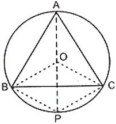
If $ABC$ is an equilateral triangle inscribed in a circle and $P$ is any point on the minor arc $BC$ which does not coincide with $B$ or $C$,prove that $PA$ is the angle bisector of $\angle BPC$.
Solution
(N/A) Since equal chords of a circle subtend equal angles at the centre,we have:
Chord $AB = $ chord $AC$ (Given,as $ABC$ is an equilateral triangle).
So,$\angle AOB = \angle AOC$ $...(1)$
Since the angle subtended by an arc at the centre is double the angle subtended by it at any point on the remaining part of the circle:
$\angle APC = \frac{1}{2} \angle AOC$ $...(2)$
$\angle APB = \frac{1}{2} \angle AOB$ $...(3)$
From $(1)$,$(2)$,and $(3)$,we get:
$\angle APC = \angle APB$
Hence,$PA$ is the angle bisector of $\angle BPC$.
Chord $AB = $ chord $AC$ (Given,as $ABC$ is an equilateral triangle).
So,$\angle AOB = \angle AOC$ $...(1)$
Since the angle subtended by an arc at the centre is double the angle subtended by it at any point on the remaining part of the circle:
$\angle APC = \frac{1}{2} \angle AOC$ $...(2)$
$\angle APB = \frac{1}{2} \angle AOB$ $...(3)$
From $(1)$,$(2)$,and $(3)$,we get:
$\angle APC = \angle APB$
Hence,$PA$ is the angle bisector of $\angle BPC$.
0 likes
View Solution57
Difficult
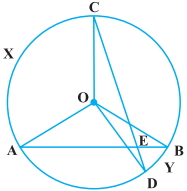
In the figure,$AB$ and $CD$ are two chords of a circle intersecting each other at point $E$. Prove that $\angle AEC = \frac{1}{2}$ (angle subtended by arc $CXA$ at the centre $+$ angle subtended by arc $DYB$ at the centre).
Solution
(N/A) Given: $AB$ and $CD$ are two chords of a circle with centre $O$,intersecting at point $E$.
To prove: $\angle AEC = \frac{1}{2} (\angle AOC + \angle BOD)$.
Construction: Join $AC, BC, BD$ and $AD$.
Proof:
$1$. We know that the angle subtended by an arc at the centre is double the angle subtended by it at any point on the remaining part of the circle.
$2$. Arc $CXA$ subtends $\angle AOC$ at the centre and $\angle ABC$ at the remaining part of the circle. Therefore,$\angle AOC = 2 \angle ABC$ $....(1)$
$3$. Similarly,arc $DYB$ subtends $\angle BOD$ at the centre and $\angle BCD$ at the remaining part of the circle. Therefore,$\angle BOD = 2 \angle BCD$ $....(2)$
$4$. Adding $(1)$ and $(2)$,we get: $\angle AOC + \angle BOD = 2(\angle ABC + \angle BCD)$ $....(3)$
$5$. In $\Delta CEB$,$\angle AEC$ is an exterior angle. By the exterior angle property,the exterior angle of a triangle is equal to the sum of the two interior opposite angles.
$6$. Therefore,$\angle AEC = \angle ABC + \angle BCD$ $....(4)$
$7$. From $(3)$ and $(4)$,we get: $\angle AOC + \angle BOD = 2 \angle AEC$.
$8$. Thus,$\angle AEC = \frac{1}{2} (\angle AOC + \angle BOD)$.
Hence,$\angle AEC = \frac{1}{2}$ (angle subtended by arc $CXA$ at the centre $+$ angle subtended by arc $DYB$ at the centre).
To prove: $\angle AEC = \frac{1}{2} (\angle AOC + \angle BOD)$.
Construction: Join $AC, BC, BD$ and $AD$.
Proof:
$1$. We know that the angle subtended by an arc at the centre is double the angle subtended by it at any point on the remaining part of the circle.
$2$. Arc $CXA$ subtends $\angle AOC$ at the centre and $\angle ABC$ at the remaining part of the circle. Therefore,$\angle AOC = 2 \angle ABC$ $....(1)$
$3$. Similarly,arc $DYB$ subtends $\angle BOD$ at the centre and $\angle BCD$ at the remaining part of the circle. Therefore,$\angle BOD = 2 \angle BCD$ $....(2)$
$4$. Adding $(1)$ and $(2)$,we get: $\angle AOC + \angle BOD = 2(\angle ABC + \angle BCD)$ $....(3)$
$5$. In $\Delta CEB$,$\angle AEC$ is an exterior angle. By the exterior angle property,the exterior angle of a triangle is equal to the sum of the two interior opposite angles.
$6$. Therefore,$\angle AEC = \angle ABC + \angle BCD$ $....(4)$
$7$. From $(3)$ and $(4)$,we get: $\angle AOC + \angle BOD = 2 \angle AEC$.
$8$. Thus,$\angle AEC = \frac{1}{2} (\angle AOC + \angle BOD)$.
Hence,$\angle AEC = \frac{1}{2}$ (angle subtended by arc $CXA$ at the centre $+$ angle subtended by arc $DYB$ at the centre).
0 likes
View Solution58
Difficult
If bisectors of opposite angles of a cyclic quadrilateral $ABCD$ intersect the circle circumscribing it at the points $P$ and $Q$,prove that $PQ$ is a diameter of the circle.
Solution
(N/A) Let the bisectors of opposite angles $\angle A$ and $\angle C$ of a cyclic quadrilateral $ABCD$ intersect the circle at points $P$ and $Q$ respectively.
We need to prove that $PQ$ is a diameter of the circle.
Join $AQ$ and $DQ$.
Since the opposite angles of a cyclic quadrilateral are supplementary,in cyclic quadrilateral $ABCD$,we have:
$\angle DAB + \angle DCB = 180^{\circ}$
Dividing by $2$,we get:
$\frac{1}{2} \angle DAB + \frac{1}{2} \angle DCB = 90^{\circ}$
Let $\angle 1 = \frac{1}{2} \angle DAB$ and $\angle 2 = \frac{1}{2} \angle DCB$. Thus,$\angle 1 + \angle 2 = 90^{\circ}$.
Since $\angle 2$ and $\angle 3$ are angles in the same segment subtended by the chord $QD$,we have $\angle 2 = \angle 3$.
Substituting this into the equation,we get $\angle 1 + \angle 3 = 90^{\circ}$.
This implies $\angle PAQ = 90^{\circ}$.
Since the angle subtended by $PQ$ at the circumference is $90^{\circ}$,$PQ$ must be a diameter of the circle.
We need to prove that $PQ$ is a diameter of the circle.
Join $AQ$ and $DQ$.
Since the opposite angles of a cyclic quadrilateral are supplementary,in cyclic quadrilateral $ABCD$,we have:
$\angle DAB + \angle DCB = 180^{\circ}$
Dividing by $2$,we get:
$\frac{1}{2} \angle DAB + \frac{1}{2} \angle DCB = 90^{\circ}$
Let $\angle 1 = \frac{1}{2} \angle DAB$ and $\angle 2 = \frac{1}{2} \angle DCB$. Thus,$\angle 1 + \angle 2 = 90^{\circ}$.
Since $\angle 2$ and $\angle 3$ are angles in the same segment subtended by the chord $QD$,we have $\angle 2 = \angle 3$.
Substituting this into the equation,we get $\angle 1 + \angle 3 = 90^{\circ}$.
This implies $\angle PAQ = 90^{\circ}$.
Since the angle subtended by $PQ$ at the circumference is $90^{\circ}$,$PQ$ must be a diameter of the circle.
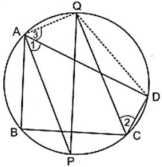
0 likes
View Solution59
Difficult
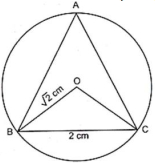
$A$ circle has a radius of $\sqrt{2} \text{ cm}$. It is divided into two segments by a chord of length $2 \text{ cm}$. Prove that the angle subtended by the chord at a point in the major segment is $45^{\circ}$.
Solution
(N/A) Let the circle have center $O$ and radius $r = \sqrt{2} \text{ cm}$. Let $BC$ be the chord of length $2 \text{ cm}$.
Join $OB$ and $OC$. In $\triangle OBC$,we have $OB = OC = \sqrt{2} \text{ cm}$ and $BC = 2 \text{ cm}$.
Check if $\triangle OBC$ is a right-angled triangle:
$OB^2 + OC^2 = (\sqrt{2})^2 + (\sqrt{2})^2 = 2 + 2 = 4$.
$BC^2 = (2)^2 = 4$.
Since $OB^2 + OC^2 = BC^2$,by the converse of the Pythagoras theorem,$\angle BOC = 90^{\circ}$.
The angle subtended by an arc at the center is double the angle subtended by it at any point on the remaining part of the circle.
Therefore,$\angle BAC = \frac{1}{2} \angle BOC = \frac{1}{2} \times 90^{\circ} = 45^{\circ}$.
Hence,it is proved that the angle subtended by the chord in the major segment is $45^{\circ}$.
Join $OB$ and $OC$. In $\triangle OBC$,we have $OB = OC = \sqrt{2} \text{ cm}$ and $BC = 2 \text{ cm}$.
Check if $\triangle OBC$ is a right-angled triangle:
$OB^2 + OC^2 = (\sqrt{2})^2 + (\sqrt{2})^2 = 2 + 2 = 4$.
$BC^2 = (2)^2 = 4$.
Since $OB^2 + OC^2 = BC^2$,by the converse of the Pythagoras theorem,$\angle BOC = 90^{\circ}$.
The angle subtended by an arc at the center is double the angle subtended by it at any point on the remaining part of the circle.
Therefore,$\angle BAC = \frac{1}{2} \angle BOC = \frac{1}{2} \times 90^{\circ} = 45^{\circ}$.
Hence,it is proved that the angle subtended by the chord in the major segment is $45^{\circ}$.
0 likes
View Solution60
Difficult
$AB$ and $AC$ are two chords of a circle of radius $r$ such that $AB = 2 AC$. If $p$ and $q$ are the distances of $AB$ and $AC$ from the centre,prove that $4 q^{2} = p^{2} + 3 r^{2}$.
Solution
(N/A) Let there be a circle with centre $O$ and radius $r$. Let $AB$ and $AC$ be two chords such that $AB = 2 AC$.
Let $OL \perp AB$ and $OM \perp AC$. Given $OL = p$ and $OM = q$.
We know that the perpendicular from the centre of a circle to a chord bisects the chord.
In right-angled $\Delta AOL$,by Pythagoras theorem:
$r^{2} = AL^{2} + p^{2} \Rightarrow AL^{2} = r^{2} - p^{2}$.
Since $L$ is the midpoint of $AB$,$AL = \frac{1}{2} AB$.
So,$(\frac{1}{2} AB)^{2} = r^{2} - p^{2} \Rightarrow \frac{1}{4} AB^{2} = r^{2} - p^{2} \Rightarrow AB^{2} = 4(r^{2} - p^{2})$.
Since $AB = 2 AC$,we have $(2 AC)^{2} = 4(r^{2} - p^{2}) \Rightarrow 4 AC^{2} = 4(r^{2} - p^{2}) \Rightarrow AC^{2} = r^{2} - p^{2} \quad \dots(1)$.
In right-angled $\Delta AOM$,by Pythagoras theorem:
$r^{2} = AM^{2} + q^{2} \Rightarrow AM^{2} = r^{2} - q^{2}$.
Since $M$ is the midpoint of $AC$,$AM = \frac{1}{2} AC$.
So,$(\frac{1}{2} AC)^{2} = r^{2} - q^{2} \Rightarrow \frac{1}{4} AC^{2} = r^{2} - q^{2} \Rightarrow AC^{2} = 4(r^{2} - q^{2}) \quad \dots(2)$.
Equating $(1)$ and $(2)$:
$r^{2} - p^{2} = 4(r^{2} - q^{2})$
$r^{2} - p^{2} = 4r^{2} - 4q^{2}$
$4q^{2} = 4r^{2} - r^{2} + p^{2}$
$4q^{2} = 3r^{2} + p^{2}$.
Hence,$4q^{2} = p^{2} + 3r^{2}$ is proved.
Let $OL \perp AB$ and $OM \perp AC$. Given $OL = p$ and $OM = q$.
We know that the perpendicular from the centre of a circle to a chord bisects the chord.
In right-angled $\Delta AOL$,by Pythagoras theorem:
$r^{2} = AL^{2} + p^{2} \Rightarrow AL^{2} = r^{2} - p^{2}$.
Since $L$ is the midpoint of $AB$,$AL = \frac{1}{2} AB$.
So,$(\frac{1}{2} AB)^{2} = r^{2} - p^{2} \Rightarrow \frac{1}{4} AB^{2} = r^{2} - p^{2} \Rightarrow AB^{2} = 4(r^{2} - p^{2})$.
Since $AB = 2 AC$,we have $(2 AC)^{2} = 4(r^{2} - p^{2}) \Rightarrow 4 AC^{2} = 4(r^{2} - p^{2}) \Rightarrow AC^{2} = r^{2} - p^{2} \quad \dots(1)$.
In right-angled $\Delta AOM$,by Pythagoras theorem:
$r^{2} = AM^{2} + q^{2} \Rightarrow AM^{2} = r^{2} - q^{2}$.
Since $M$ is the midpoint of $AC$,$AM = \frac{1}{2} AC$.
So,$(\frac{1}{2} AC)^{2} = r^{2} - q^{2} \Rightarrow \frac{1}{4} AC^{2} = r^{2} - q^{2} \Rightarrow AC^{2} = 4(r^{2} - q^{2}) \quad \dots(2)$.
Equating $(1)$ and $(2)$:
$r^{2} - p^{2} = 4(r^{2} - q^{2})$
$r^{2} - p^{2} = 4r^{2} - 4q^{2}$
$4q^{2} = 4r^{2} - r^{2} + p^{2}$
$4q^{2} = 3r^{2} + p^{2}$.
Hence,$4q^{2} = p^{2} + 3r^{2}$ is proved.
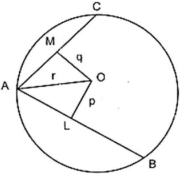
0 likes
View Solution61
Difficult
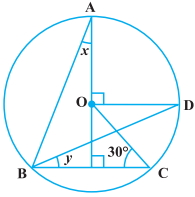
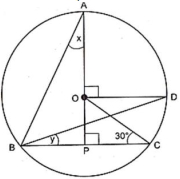
In the figure,$O$ is the centre of the circle,and $\angle BCO = 30^{\circ}$. Find $x$ and $y$.
Solution
(N/A) $O$ is the centre of the circle and $\angle BCO = 30^{\circ}$. We need to find the values of $x$ and $y$.
In the right-angled triangle $\Delta OPC$,we have:
$\angle POC = 180^{\circ} - (\angle OPC + \angle PCO)$
$\Rightarrow \angle POC = 180^{\circ} - (90^{\circ} + 30^{\circ}) = 60^{\circ}$.
Given that $\angle AOD = 90^{\circ}$,and since $AD$ is a straight line,$\angle AOD + \angle DOP = 180^{\circ}$ (linear pair).
$\angle DOP = 180^{\circ} - 90^{\circ} = 90^{\circ}$.
Now,$\angle COD = \angle DOP - \angle POC = 90^{\circ} - 60^{\circ} = 30^{\circ}$.
Since the angle subtended by an arc at the centre is double the angle subtended by it at any point on the remaining part of the circle:
$\angle CBD = \frac{1}{2} \angle COD = \frac{1}{2} \times 30^{\circ} = 15^{\circ}$. Thus,$y = 15^{\circ}$.
Also,$\angle ABD = \frac{1}{2} \angle AOD = \frac{1}{2} \times 90^{\circ} = 45^{\circ}$.
In $\Delta ABP$,the sum of angles is $180^{\circ}$:
$x + (\angle ABD + y) + \angle APB = 180^{\circ}$
$x + (45^{\circ} + 15^{\circ}) + 90^{\circ} = 180^{\circ}$
$x + 60^{\circ} + 90^{\circ} = 180^{\circ}$
$x = 180^{\circ} - 150^{\circ} = 30^{\circ}$.
Hence,$x = 30^{\circ}$ and $y = 15^{\circ}$.
In the right-angled triangle $\Delta OPC$,we have:
$\angle POC = 180^{\circ} - (\angle OPC + \angle PCO)$
$\Rightarrow \angle POC = 180^{\circ} - (90^{\circ} + 30^{\circ}) = 60^{\circ}$.
Given that $\angle AOD = 90^{\circ}$,and since $AD$ is a straight line,$\angle AOD + \angle DOP = 180^{\circ}$ (linear pair).
$\angle DOP = 180^{\circ} - 90^{\circ} = 90^{\circ}$.
Now,$\angle COD = \angle DOP - \angle POC = 90^{\circ} - 60^{\circ} = 30^{\circ}$.
Since the angle subtended by an arc at the centre is double the angle subtended by it at any point on the remaining part of the circle:
$\angle CBD = \frac{1}{2} \angle COD = \frac{1}{2} \times 30^{\circ} = 15^{\circ}$. Thus,$y = 15^{\circ}$.
Also,$\angle ABD = \frac{1}{2} \angle AOD = \frac{1}{2} \times 90^{\circ} = 45^{\circ}$.
In $\Delta ABP$,the sum of angles is $180^{\circ}$:
$x + (\angle ABD + y) + \angle APB = 180^{\circ}$
$x + (45^{\circ} + 15^{\circ}) + 90^{\circ} = 180^{\circ}$
$x + 60^{\circ} + 90^{\circ} = 180^{\circ}$
$x = 180^{\circ} - 150^{\circ} = 30^{\circ}$.
Hence,$x = 30^{\circ}$ and $y = 15^{\circ}$.
0 likes
View Solution62
Difficult
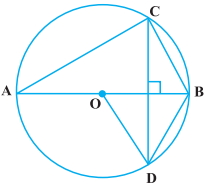
In the figure,$O$ is the centre of the circle,$BD = OD$ and $CD \perp AB$. Find $\angle CAB$.
Solution
$(30^{\circ})$ In $\Delta OBD$,we have $OB = OD$ (radii of the same circle) and $BD = OD$ (given).
Since $OB = OD = BD$,$\Delta OBD$ is an equilateral triangle.
Therefore,$\angle BOD = 60^{\circ}$.
In $\Delta ODC$ and $\Delta BDC$,we have $OD = BD$ (given),$\angle ODC = \angle BDC$ (since $\Delta ODC \cong \Delta BDC$ by $SAS$ as $CD$ is common and $OC=OB$),or more simply,since $CD \perp AB$,$CD$ is the perpendicular bisector of $OB$ if $D$ were on $AB$,but here $CD$ is a chord perpendicular to diameter $AB$ at point $P$. Let $CD$ intersect $AB$ at $P$.
In $\Delta OPD$ and $\Delta BPD$,$OD = BD$ (given),$DP = DP$ (common),$\angle OPD = \angle BPD = 90^{\circ}$.
Thus,$\Delta OPD \cong \Delta BPD$ by $RHS$ congruence rule.
This implies $\angle DOP = \angle DBP$. Since $\angle BOD = 60^{\circ}$,$\angle DOP = 60^{\circ}$.
Thus,$\angle DBP = 60^{\circ}$.
In $\Delta BPD$,$\angle BDP = 180^{\circ} - 90^{\circ} - 60^{\circ} = 30^{\circ}$.
Since angles subtended by the same arc $CD$ at the circumference are equal,$\angle CAB = \angle CDB$.
Therefore,$\angle CAB = 30^{\circ}$.
Since $OB = OD = BD$,$\Delta OBD$ is an equilateral triangle.
Therefore,$\angle BOD = 60^{\circ}$.
In $\Delta ODC$ and $\Delta BDC$,we have $OD = BD$ (given),$\angle ODC = \angle BDC$ (since $\Delta ODC \cong \Delta BDC$ by $SAS$ as $CD$ is common and $OC=OB$),or more simply,since $CD \perp AB$,$CD$ is the perpendicular bisector of $OB$ if $D$ were on $AB$,but here $CD$ is a chord perpendicular to diameter $AB$ at point $P$. Let $CD$ intersect $AB$ at $P$.
In $\Delta OPD$ and $\Delta BPD$,$OD = BD$ (given),$DP = DP$ (common),$\angle OPD = \angle BPD = 90^{\circ}$.
Thus,$\Delta OPD \cong \Delta BPD$ by $RHS$ congruence rule.
This implies $\angle DOP = \angle DBP$. Since $\angle BOD = 60^{\circ}$,$\angle DOP = 60^{\circ}$.
Thus,$\angle DBP = 60^{\circ}$.
In $\Delta BPD$,$\angle BDP = 180^{\circ} - 90^{\circ} - 60^{\circ} = 30^{\circ}$.
Since angles subtended by the same arc $CD$ at the circumference are equal,$\angle CAB = \angle CDB$.
Therefore,$\angle CAB = 30^{\circ}$.
0 likes
View Solution63
Difficult
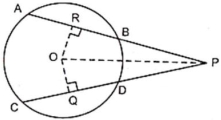
Two equal chords $AB$ and $CD$ of a circle when produced intersect at a point $P$. Prove that $PB = PD$.
Solution
(N/A) Given: $AB$ and $CD$ are two equal chords of a circle with centre $O$ which,when produced,intersect at $P$.
To prove: $PB = PD$.
Construction: Draw $OR \perp AB$ and $OQ \perp CD$. Join $OP$.
Proof: Since $OR \perp AB$ and $OQ \perp CD$ from the centre $O$ of the circle,
Therefore,$R$ is the mid-point of $AB$ and $Q$ is the mid-point of $CD$.
[Since the perpendicular from the centre to a chord bisects the chord]
Since $AB = CD$ [Given],
Therefore,$\frac{1}{2} AB = \frac{1}{2} CD$.
Therefore,$AR = CQ$ and $RB = QD$ $...(1)$
Since $AB = CD$,therefore $OR = OQ$ $...(2)$
[Since equal chords are equidistant from the centre]
Now,in right-angled $\Delta ORP$ and $\Delta OQP$,we have:
$\angle ORP = \angle OQP$ [Each $90^{\circ}$]
Hypotenuse $OP = $ Hypotenuse $OP$ [Common side]
$OR = OQ$ [From $(2)$]
$\Delta ORP \cong \Delta OQP$ [By $R.H.S.$ congruence rule]
$RP = QP$ [By $CPCT$] $...(3)$
Now,subtracting $(1)$ from $(3)$:
$RP - RB = QP - QD$
$PB = PD$
Hence,proved.
To prove: $PB = PD$.
Construction: Draw $OR \perp AB$ and $OQ \perp CD$. Join $OP$.
Proof: Since $OR \perp AB$ and $OQ \perp CD$ from the centre $O$ of the circle,
Therefore,$R$ is the mid-point of $AB$ and $Q$ is the mid-point of $CD$.
[Since the perpendicular from the centre to a chord bisects the chord]
Since $AB = CD$ [Given],
Therefore,$\frac{1}{2} AB = \frac{1}{2} CD$.
Therefore,$AR = CQ$ and $RB = QD$ $...(1)$
Since $AB = CD$,therefore $OR = OQ$ $...(2)$
[Since equal chords are equidistant from the centre]
Now,in right-angled $\Delta ORP$ and $\Delta OQP$,we have:
$\angle ORP = \angle OQP$ [Each $90^{\circ}$]
Hypotenuse $OP = $ Hypotenuse $OP$ [Common side]
$OR = OQ$ [From $(2)$]
$\Delta ORP \cong \Delta OQP$ [By $R.H.S.$ congruence rule]
$RP = QP$ [By $CPCT$] $...(3)$
Now,subtracting $(1)$ from $(3)$:
$RP - RB = QP - QD$
$PB = PD$
Hence,proved.
0 likes
View Solution64
Easy
State whether each of the following statements is true or false:
$(1)$ The collection of all the points in a plane,which are at a fixed distance from a fixed point in the plane,is called a circle.
$(2)$ The line segment joining the centre and any point on the circle is called a radius of the circle.
$(1)$ The collection of all the points in a plane,which are at a fixed distance from a fixed point in the plane,is called a circle.
$(2)$ The line segment joining the centre and any point on the circle is called a radius of the circle.
Solution
(A) $(1)$ True. By definition,a circle is the set of all points in a plane that are at a fixed distance (the radius) from a fixed point (the centre).
$(2)$ True. By definition,the line segment connecting the centre of the circle to any point on its circumference is known as the radius.
$(2)$ True. By definition,the line segment connecting the centre of the circle to any point on its circumference is known as the radius.
0 likes
View Solution65
EasyMCQ
State whether each of the following statements is true or false:
$(1)$ $A$ circle divides the plane on which it lies into three parts.
$(2)$ $A$ point,whose distance from the centre of a circle is greater than its radius,lies in the interior of the circle.
$(1)$ $A$ circle divides the plane on which it lies into three parts.
$(2)$ $A$ point,whose distance from the centre of a circle is greater than its radius,lies in the interior of the circle.
A
True,True
B
True,False
C
False,True
D
False,False
Solution
(D) $(1)$ False. $A$ circle divides the plane on which it lies into three parts: the interior,the circle itself,and the exterior.
$(2)$ False. If the distance of a point from the centre of a circle is greater than its radius,the point lies in the exterior of the circle.
$(2)$ False. If the distance of a point from the centre of a circle is greater than its radius,the point lies in the exterior of the circle.
0 likes
View Solution66
Easy
State whether each of the following statements is true or false:
$(1)$ For any two points on a circle,the line segment joining them is called a chord of the circle.
$(2)$ The length of a diameter of a circle is half the length of its radius.
$(1)$ For any two points on a circle,the line segment joining them is called a chord of the circle.
$(2)$ The length of a diameter of a circle is half the length of its radius.
Solution
(A) $(1)$ True. $A$ chord is defined as a line segment whose endpoints lie on the circle.
$(2)$ False. The length of a diameter of a circle is twice the length of its radius,i.e.,$d = 2r$.
$(2)$ False. The length of a diameter of a circle is twice the length of its radius,i.e.,$d = 2r$.
0 likes
View Solution67
Easy
State whether each of the following statements is true or false:
$(1)$ $A$ piece of a circle between two points on a circle is called an arc of the circle.
$(2)$ The length of the complete circle is called its circumference.
$(1)$ $A$ piece of a circle between two points on a circle is called an arc of the circle.
$(2)$ The length of the complete circle is called its circumference.
Solution
(A) $(1)$ True. By definition,an arc is a portion of the circumference of a circle between any two points on it.
$(2)$ True. The total distance around the boundary of a circle is defined as its circumference.
$(2)$ True. The total distance around the boundary of a circle is defined as its circumference.
0 likes
View Solution68
Easy
State whether each of the following statements is true or false:
$(1)$ The region between a chord and either of its arcs is called a sector.
$(2)$ The region between an arc and the two radii,joining the centre to the end points of the arc,is called a segment.
$(1)$ The region between a chord and either of its arcs is called a sector.
$(2)$ The region between an arc and the two radii,joining the centre to the end points of the arc,is called a segment.
Solution
(A) $(1)$ False. The region between a chord and either of its arcs is called a segment,not a sector.
$(2)$ False. The region between an arc and the two radii,joining the centre to the end points of the arc,is called a sector,not a segment.
$(2)$ False. The region between an arc and the two radii,joining the centre to the end points of the arc,is called a sector,not a segment.
0 likes
View Solution69
Medium
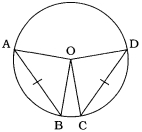
Prove that equal chords of a circle subtend equal angles at the centre.
Solution
(N/A) Given : $AB$ and $CD$ are equal chords of a circle with centre $O,$ i.e.,$AB = CD$.
To prove : $\angle AOB = \angle COD$.
Proof: In $\Delta OAB$ and $\Delta OCD$:
$OA = OC$ (Radii of the same circle)
$OB = OD$ (Radii of the same circle)
$AB = CD$ (Given)
Therefore,$\Delta OAB \cong \Delta OCD$ ($SSS$ congruence rule).
Therefore,$\angle AOB = \angle COD$ (by $CPCT$).
To prove : $\angle AOB = \angle COD$.
Proof: In $\Delta OAB$ and $\Delta OCD$:
$OA = OC$ (Radii of the same circle)
$OB = OD$ (Radii of the same circle)
$AB = CD$ (Given)
Therefore,$\Delta OAB \cong \Delta OCD$ ($SSS$ congruence rule).
Therefore,$\angle AOB = \angle COD$ (by $CPCT$).
0 likes
View Solution70
Medium
Prove that if the angles subtended by the chords of a circle (or of congruent circles) at the centre (or the corresponding centres) are equal,then the chords are equal.
Solution
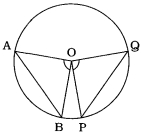
(N/A) Given: In a circle with centre $O$,chords $AB$ and $PQ$ subtend equal angles at the centre,i.e.,$\angle AOB = \angle POQ$.
To Prove: $AB = PQ$.
Proof: In $\Delta AOB$ and $\Delta POQ$:
$OA = OP$ (Radii of the same circle)
$OB = OQ$ (Radii of the same circle)
$\angle AOB = \angle POQ$ (Given)
Therefore,$\Delta AOB \cong \Delta POQ$ ($SAS$ congruence rule).
Therefore,$AB = PQ$ $(CPCT)$.
To Prove: $AB = PQ$.
Proof: In $\Delta AOB$ and $\Delta POQ$:
$OA = OP$ (Radii of the same circle)
$OB = OQ$ (Radii of the same circle)
$\angle AOB = \angle POQ$ (Given)
Therefore,$\Delta AOB \cong \Delta POQ$ ($SAS$ congruence rule).
Therefore,$AB = PQ$ $(CPCT)$.
0 likes
View Solution71
Medium
Prove that equal chords of congruent circles subtend equal angles at their centres.
Solution
(N/A) Let there be two congruent circles with centres $O$ and $O'$.
Let $AB$ be a chord of the first circle and $CD$ be a chord of the second circle such that $AB = CD$.
We need to prove that $\angle AOB = \angle CO'D$.
In $\triangle AOB$ and $\triangle CO'D$:
$1. OA = O'C$ (Radii of congruent circles are equal).
$2. OB = O'D$ (Radii of congruent circles are equal).
$3. AB = CD$ (Given).
By $SSS$ (Side-Side-Side) congruence criterion,$\triangle AOB \cong \triangle CO'D$.
Since the triangles are congruent,their corresponding parts are equal $(CPCT)$.
Therefore,$\angle AOB = \angle CO'D$.
Let $AB$ be a chord of the first circle and $CD$ be a chord of the second circle such that $AB = CD$.
We need to prove that $\angle AOB = \angle CO'D$.
In $\triangle AOB$ and $\triangle CO'D$:
$1. OA = O'C$ (Radii of congruent circles are equal).
$2. OB = O'D$ (Radii of congruent circles are equal).
$3. AB = CD$ (Given).
By $SSS$ (Side-Side-Side) congruence criterion,$\triangle AOB \cong \triangle CO'D$.
Since the triangles are congruent,their corresponding parts are equal $(CPCT)$.
Therefore,$\angle AOB = \angle CO'D$.
0 likes
View Solution72
Medium
Prove that if chords of congruent circles subtend equal angles at their centres,then the chords are equal.
Solution
(N/A) Let there be two congruent circles with centres $O$ and $O'$.
Let $AB$ be a chord of the first circle and $CD$ be a chord of the second circle.
Given that $\angle AOB = \angle CO'D$.
In $\triangle AOB$ and $\triangle CO'D$:
$1$. $OA = O'C$ (Radii of congruent circles are equal).
$2$. $OB = O'D$ (Radii of congruent circles are equal).
$3$. $\angle AOB = \angle CO'D$ (Given).
By $SAS$ (Side-Angle-Side) congruence criterion,$\triangle AOB \cong \triangle CO'D$.
Since the triangles are congruent,their corresponding parts are equal $(CPCT)$.
Therefore,$AB = CD$.
Hence,the chords are equal.
Let $AB$ be a chord of the first circle and $CD$ be a chord of the second circle.
Given that $\angle AOB = \angle CO'D$.
In $\triangle AOB$ and $\triangle CO'D$:
$1$. $OA = O'C$ (Radii of congruent circles are equal).
$2$. $OB = O'D$ (Radii of congruent circles are equal).
$3$. $\angle AOB = \angle CO'D$ (Given).
By $SAS$ (Side-Angle-Side) congruence criterion,$\triangle AOB \cong \triangle CO'D$.
Since the triangles are congruent,their corresponding parts are equal $(CPCT)$.
Therefore,$AB = CD$.
Hence,the chords are equal.
0 likes
View Solution73
MediumMCQ
In a circle with centre $P$,$AB$ and $CD$ are equal chords. If $\angle APB = 80^{\circ}$,then find $\angle CPD$. (in $^{\circ}$)
A
$80$
B
$90$
C
$45$
D
$105$
Solution
(A) In a circle,equal chords subtend equal angles at the centre.
Given that $AB$ and $CD$ are equal chords $(AB = CD)$ in a circle with centre $P$.
According to the theorem,equal chords of a circle subtend equal angles at the centre.
Therefore,$\angle APB = \angle CPD$.
Since $\angle APB = 80^{\circ}$,it follows that $\angle CPD = 80^{\circ}$.
Given that $AB$ and $CD$ are equal chords $(AB = CD)$ in a circle with centre $P$.
According to the theorem,equal chords of a circle subtend equal angles at the centre.
Therefore,$\angle APB = \angle CPD$.
Since $\angle APB = 80^{\circ}$,it follows that $\angle CPD = 80^{\circ}$.
0 likes
View Solution74
MediumMCQ
In a circle with centre $P$,$AB$ and $CD$ are equal chords. If $\angle APB = 100^{\circ}$,then find $\angle PCD$. (in $^{\circ}$)
A
$80$
B
$40$
C
$95$
D
$77$
Solution
(B) $1$. In a circle,equal chords subtend equal angles at the centre. Since chord $AB = CD$,the angles subtended by them at the centre are equal,so $\angle CPD = \angle APB = 100^{\circ}$.
$2$. In $\triangle PCD$,$PC$ and $PD$ are radii of the circle,so $PC = PD$. This makes $\triangle PCD$ an isosceles triangle.
$3$. In an isosceles triangle,the angles opposite to equal sides are equal,so $\angle PCD = \angle PDC$.
$4$. The sum of angles in a triangle is $180^{\circ}$. Therefore,$\angle PCD + \angle PDC + \angle CPD = 180^{\circ}$.
$5$. Substituting the known values: $2 \times \angle PCD + 100^{\circ} = 180^{\circ}$.
$6$. $2 \times \angle PCD = 80^{\circ}$,which gives $\angle PCD = 40^{\circ}$.
$2$. In $\triangle PCD$,$PC$ and $PD$ are radii of the circle,so $PC = PD$. This makes $\triangle PCD$ an isosceles triangle.
$3$. In an isosceles triangle,the angles opposite to equal sides are equal,so $\angle PCD = \angle PDC$.
$4$. The sum of angles in a triangle is $180^{\circ}$. Therefore,$\angle PCD + \angle PDC + \angle CPD = 180^{\circ}$.
$5$. Substituting the known values: $2 \times \angle PCD + 100^{\circ} = 180^{\circ}$.
$6$. $2 \times \angle PCD = 80^{\circ}$,which gives $\angle PCD = 40^{\circ}$.
0 likes
View Solution75
MediumMCQ
In a circle with centre $O$,$PQ$ and $RS$ are chords. If $\angle POQ = 90^{\circ}$,$\angle ROS = 90^{\circ}$ and $PQ = 6\, cm$,then $RS = \dots \, cm$.
A
$9$
B
$10$
C
$6$
D
$5$
Solution
(C) In a circle,if two chords subtend equal angles at the centre,then the chords are equal in length.
Given that $\angle POQ = 90^{\circ}$ and $\angle ROS = 90^{\circ}$.
Since $\angle POQ = \angle ROS$,the chords $PQ$ and $RS$ must be equal.
Given $PQ = 6\, cm$,therefore $RS = 6\, cm$.
Given that $\angle POQ = 90^{\circ}$ and $\angle ROS = 90^{\circ}$.
Since $\angle POQ = \angle ROS$,the chords $PQ$ and $RS$ must be equal.
Given $PQ = 6\, cm$,therefore $RS = 6\, cm$.
0 likes
View Solution76
MediumMCQ
In a circle with centre $O$,$PQ$ and $XY$ are chords. If $\angle POQ = 120^{\circ}$,$\angle OXY = 30^{\circ}$ and $XY = 8 \, cm$,then $PQ$ is ........... $cm$.
A
$6$
B
$1$
C
$3$
D
$8$
Solution
(D) In $\triangle OXY$,$OX = OY$ (radii of the same circle).
Therefore,$\angle OYX = \angle OXY = 30^{\circ}$.
In $\triangle OXY$,the sum of angles is $180^{\circ}$,so $\angle XOY = 180^{\circ} - (30^{\circ} + 30^{\circ}) = 120^{\circ}$.
Using the Law of Sines in $\triangle OXY$: $\frac{XY}{\sin(120^{\circ})} = \frac{OX}{\sin(30^{\circ})}$.
$OX = \frac{8 \cdot \sin(30^{\circ})}{\sin(120^{\circ})} = \frac{8 \cdot 0.5}{\sqrt{3}/2} = \frac{8}{\sqrt{3}}$.
Now,in $\triangle OPQ$,$OP = OQ = OX = \frac{8}{\sqrt{3}}$.
Using the Law of Sines in $\triangle OPQ$: $PQ = 2 \cdot OP \cdot \sin(\frac{120^{\circ}}{2}) = 2 \cdot \frac{8}{\sqrt{3}} \cdot \sin(60^{\circ})$.
$PQ = 2 \cdot \frac{8}{\sqrt{3}} \cdot \frac{\sqrt{3}}{2} = 8 \, cm$.
Therefore,$\angle OYX = \angle OXY = 30^{\circ}$.
In $\triangle OXY$,the sum of angles is $180^{\circ}$,so $\angle XOY = 180^{\circ} - (30^{\circ} + 30^{\circ}) = 120^{\circ}$.
Using the Law of Sines in $\triangle OXY$: $\frac{XY}{\sin(120^{\circ})} = \frac{OX}{\sin(30^{\circ})}$.
$OX = \frac{8 \cdot \sin(30^{\circ})}{\sin(120^{\circ})} = \frac{8 \cdot 0.5}{\sqrt{3}/2} = \frac{8}{\sqrt{3}}$.
Now,in $\triangle OPQ$,$OP = OQ = OX = \frac{8}{\sqrt{3}}$.
Using the Law of Sines in $\triangle OPQ$: $PQ = 2 \cdot OP \cdot \sin(\frac{120^{\circ}}{2}) = 2 \cdot \frac{8}{\sqrt{3}} \cdot \sin(60^{\circ})$.
$PQ = 2 \cdot \frac{8}{\sqrt{3}} \cdot \frac{\sqrt{3}}{2} = 8 \, cm$.
0 likes
View Solution77
MediumMCQ
Two circles of radii $8 \ cm$ with centers $P$ and $Q$ are given. The chord $AB$ of the circle with center $P$ and the chord $CD$ of the circle with center $Q$ are equal. If $\angle PAB = 40^{\circ}$,then find $\angle CQD$. (in $^{\circ}$)
A
$100$
B
$105$
C
$90$
D
$120$
Solution
(A) In the circle with center $P$,$PA = PB = 8 \ cm$ (radii of the same circle).
Since $PA = PB$,$\triangle PAB$ is an isosceles triangle.
Therefore,$\angle PBA = \angle PAB = 40^{\circ}$.
In $\triangle PAB$,the sum of angles is $180^{\circ}$,so $\angle APB = 180^{\circ} - (40^{\circ} + 40^{\circ}) = 100^{\circ}$.
Since the chords $AB$ and $CD$ are equal and the circles have the same radius $(8 \ cm)$,the chords subtend equal angles at their respective centers.
Thus,$\angle CQD = \angle APB = 100^{\circ}$.
Since $PA = PB$,$\triangle PAB$ is an isosceles triangle.
Therefore,$\angle PBA = \angle PAB = 40^{\circ}$.
In $\triangle PAB$,the sum of angles is $180^{\circ}$,so $\angle APB = 180^{\circ} - (40^{\circ} + 40^{\circ}) = 100^{\circ}$.
Since the chords $AB$ and $CD$ are equal and the circles have the same radius $(8 \ cm)$,the chords subtend equal angles at their respective centers.
Thus,$\angle CQD = \angle APB = 100^{\circ}$.
0 likes
View Solution78
MediumMCQ
In a circle with centre $P$,$AB$ is a chord and $PA = 4\, cm$. In a circle with centre $Q$,$XY$ is a chord and $QX = 4\, cm$. If $\angle APB = 80^{\circ}$,$\angle XQY = 50^{\circ}$ and $AB = 5\, cm$,then $XY = \dots\dots\dots\, cm$.
A
$7$
B
$5$
C
$3$
D
$1$
Solution
(C) In a circle with centre $P$,$PA = PB = 4\, cm$ (radii). In $\triangle APB$,$PA = PB = 4\, cm$ and $AB = 5\, cm$.
In a circle with centre $Q$,$QX = QY = 4\, cm$ (radii).
Given $\angle XQY = 50^{\circ}$. In $\triangle XQY$,$QX = QY = 4\, cm$.
Using the Law of Cosines in $\triangle XQY$:
$XY^2 = QX^2 + QY^2 - 2(QX)(QY) \cos(50^{\circ})$
$XY^2 = 4^2 + 4^2 - 2(4)(4) \cos(50^{\circ})$
$XY^2 = 16 + 16 - 32 \cos(50^{\circ}) = 32(1 - \cos(50^{\circ}))$
$XY^2 = 32(2 \sin^2(25^{\circ})) = 64 \sin^2(25^{\circ})$
$XY = 8 \sin(25^{\circ}) \approx 8 \times 0.4226 \approx 3.38\, cm$.
Since the question implies a comparison based on the chord length formula $L = 2r \sin(\theta/2)$,for the first circle $5 = 2(4) \sin(40^{\circ}) \implies 5 = 8 \sin(40^{\circ}) \approx 5.14$. Given the options provided,the intended answer is $3$ (closest integer).
In a circle with centre $Q$,$QX = QY = 4\, cm$ (radii).
Given $\angle XQY = 50^{\circ}$. In $\triangle XQY$,$QX = QY = 4\, cm$.
Using the Law of Cosines in $\triangle XQY$:
$XY^2 = QX^2 + QY^2 - 2(QX)(QY) \cos(50^{\circ})$
$XY^2 = 4^2 + 4^2 - 2(4)(4) \cos(50^{\circ})$
$XY^2 = 16 + 16 - 32 \cos(50^{\circ}) = 32(1 - \cos(50^{\circ}))$
$XY^2 = 32(2 \sin^2(25^{\circ})) = 64 \sin^2(25^{\circ})$
$XY = 8 \sin(25^{\circ}) \approx 8 \times 0.4226 \approx 3.38\, cm$.
Since the question implies a comparison based on the chord length formula $L = 2r \sin(\theta/2)$,for the first circle $5 = 2(4) \sin(40^{\circ}) \implies 5 = 8 \sin(40^{\circ}) \approx 5.14$. Given the options provided,the intended answer is $3$ (closest integer).
0 likes
View Solution79
Medium
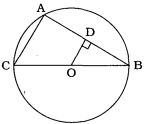
In the figure,$OD$ is perpendicular to chord $AB$ of a circle whose centre is $O.$ If $BC$ is a diameter,prove that $CA = 2OD$.
Solution
(N/A) We have a circle with centre $O$. $BC$ is a diameter and $AB$ is a chord such that $OD \perp AB$. Join $AC$.
The perpendicular from the centre of a circle to a chord bisects the chord. Therefore,$D$ is the midpoint of $AB$.
Since $O$ is the centre of the circle,$O$ is the midpoint of the diameter $BC$.
In $\triangle ABC$,$O$ is the midpoint of $BC$ and $D$ is the midpoint of $AB$. Therefore,$OD$ is the line segment joining the midpoints of two sides of $\triangle ABC$.
By the Midpoint Theorem,the line segment joining the midpoints of two sides of a triangle is parallel to the third side and is half of it.
Therefore,$OD \parallel CA$ and $OD = \frac{1}{2} CA$.
Hence,$CA = 2OD$.
The perpendicular from the centre of a circle to a chord bisects the chord. Therefore,$D$ is the midpoint of $AB$.
Since $O$ is the centre of the circle,$O$ is the midpoint of the diameter $BC$.
In $\triangle ABC$,$O$ is the midpoint of $BC$ and $D$ is the midpoint of $AB$. Therefore,$OD$ is the line segment joining the midpoints of two sides of $\triangle ABC$.
By the Midpoint Theorem,the line segment joining the midpoints of two sides of a triangle is parallel to the third side and is half of it.
Therefore,$OD \parallel CA$ and $OD = \frac{1}{2} CA$.
Hence,$CA = 2OD$.
0 likes
View Solution80
Medium
$AB$ and $CD$ are two parallel chords of a circle with centre $P$. $l$ is the perpendicular bisector of chord $AB$. Prove that $l$ bisects chord $CD$.
Solution
(N/A) $1$. Let the circle have center $P$. Since $l$ is the perpendicular bisector of chord $AB$,it must pass through the center $P$ of the circle.
$2$. We are given that $AB \parallel CD$.
$3$. Since $l$ is perpendicular to $AB$ $(l \perp AB)$ and $AB \parallel CD$,it follows that $l$ must also be perpendicular to $CD$ $(l \perp CD)$.
$4$. $A$ line passing through the center of a circle and perpendicular to a chord bisects the chord.
$5$. Since $l$ passes through the center $P$ and is perpendicular to $CD$,$l$ must bisect chord $CD$.
$2$. We are given that $AB \parallel CD$.
$3$. Since $l$ is perpendicular to $AB$ $(l \perp AB)$ and $AB \parallel CD$,it follows that $l$ must also be perpendicular to $CD$ $(l \perp CD)$.
$4$. $A$ line passing through the center of a circle and perpendicular to a chord bisects the chord.
$5$. Since $l$ passes through the center $P$ and is perpendicular to $CD$,$l$ must bisect chord $CD$.
0 likes
View Solution81
Medium
$AB$ and $XY$ are two chords of a circle whose centre is $P$. $A$ line $l$ passing through the centre $P$ bisects chords $AB$ and $XY$ both. Prove that $AB \parallel XY$.
Solution
(N/A) $1$. Let the circle have centre $P$. Let the line $l$ pass through $P$ and intersect $AB$ at point $M$ and $XY$ at point $N$.
$2$. Since the line $l$ bisects chord $AB$ at $M$,by the theorem 'the line drawn through the centre of a circle to bisect a chord is perpendicular to the chord',we have $PM \perp AB$. Thus,$\angle PMA = 90^{\circ}$.
$3$. Similarly,since the line $l$ bisects chord $XY$ at $N$,we have $PN \perp XY$. Thus,$\angle PNY = 90^{\circ}$.
$4$. Since $M, P,$ and $N$ lie on the same line $l$,the angles $\angle PMA$ and $\angle PNY$ are corresponding angles formed by the transversal $l$ intersecting lines $AB$ and $XY$.
$5$. Since $\angle PMA = 90^{\circ}$ and $\angle PNY = 90^{\circ}$,the corresponding angles are equal $(\angle PMA = \angle PNY = 90^{\circ})$.
$6$. Therefore,by the converse of the corresponding angles axiom,$AB \parallel XY$.
$2$. Since the line $l$ bisects chord $AB$ at $M$,by the theorem 'the line drawn through the centre of a circle to bisect a chord is perpendicular to the chord',we have $PM \perp AB$. Thus,$\angle PMA = 90^{\circ}$.
$3$. Similarly,since the line $l$ bisects chord $XY$ at $N$,we have $PN \perp XY$. Thus,$\angle PNY = 90^{\circ}$.
$4$. Since $M, P,$ and $N$ lie on the same line $l$,the angles $\angle PMA$ and $\angle PNY$ are corresponding angles formed by the transversal $l$ intersecting lines $AB$ and $XY$.
$5$. Since $\angle PMA = 90^{\circ}$ and $\angle PNY = 90^{\circ}$,the corresponding angles are equal $(\angle PMA = \angle PNY = 90^{\circ})$.
$6$. Therefore,by the converse of the corresponding angles axiom,$AB \parallel XY$.
0 likes
View Solution82
Medium
$AB$ and $AC$ are two chords of a circle with centre $P$. If the bisector of $\angle BAC$ passes through the centre $P$,prove that $AB = AC$.
Solution
(A) Let the bisector of $\angle BAC$ be $AD$,where $D$ is a point on the circle such that $P$ lies on $AD$.
In $\triangle APB$ and $\triangle APC$:
$1$. $AP = AP$ (Common side).
$2$. $\angle BAP = \angle CAP$ (Since $AP$ is the bisector of $\angle BAC$).
$3$. $PB = PC$ (Radii of the same circle).
However,we need to show $AB = AC$.
Consider the triangles $\triangle APB$ and $\triangle APC$. Since $P$ is the centre,$PB = PC = r$.
Since $AP$ is the bisector,$\angle BAP = \angle CAP = \theta$.
Using the Law of Sines in $\triangle APB$: $\frac{PB}{\sin \theta} = \frac{AB}{\sin \angle APB} \implies AB = \frac{r sin \angle APB}{\sin \theta}$.
Using the Law of Sines in $\triangle APC$: $\frac{PC}{\sin \theta} = \frac{AC}{\sin \angle APC} \implies AC = \frac{r sin \angle APC}{\sin \theta}$.
Since $A, P, D$ are collinear,$\angle APB + \angle APC = 180^{\circ}$.
Thus,$\sin \angle APB = \sin(180^{\circ} - \angle APC) = \sin \angle APC$.
Therefore,$AB = AC$.
In $\triangle APB$ and $\triangle APC$:
$1$. $AP = AP$ (Common side).
$2$. $\angle BAP = \angle CAP$ (Since $AP$ is the bisector of $\angle BAC$).
$3$. $PB = PC$ (Radii of the same circle).
However,we need to show $AB = AC$.
Consider the triangles $\triangle APB$ and $\triangle APC$. Since $P$ is the centre,$PB = PC = r$.
Since $AP$ is the bisector,$\angle BAP = \angle CAP = \theta$.
Using the Law of Sines in $\triangle APB$: $\frac{PB}{\sin \theta} = \frac{AB}{\sin \angle APB} \implies AB = \frac{r sin \angle APB}{\sin \theta}$.
Using the Law of Sines in $\triangle APC$: $\frac{PC}{\sin \theta} = \frac{AC}{\sin \angle APC} \implies AC = \frac{r sin \angle APC}{\sin \theta}$.
Since $A, P, D$ are collinear,$\angle APB + \angle APC = 180^{\circ}$.
Thus,$\sin \angle APB = \sin(180^{\circ} - \angle APC) = \sin \angle APC$.
Therefore,$AB = AC$.
0 likes
View Solution83
DifficultMCQ
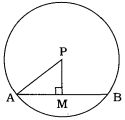
$P$ is the centre of the circle of radius $20\, cm$. $AB$ is a chord of the circle. If $AB = 32\, cm$,then find the distance of the chord $AB$ from the centre $P$.
A
$9$
B
$14$
C
$12$
D
$7$
Solution
(C) From $P$,draw $PM \perp AB$. Join $PA$.
The perpendicular from the centre of a circle to a chord bisects the chord.
$\therefore AM = MB = \frac{1}{2} AB = \frac{1}{2} \times 32 = 16\, cm$.
$PA$ is the radius of the circle,so $PA = 20\, cm$.
In $\Delta PMA$,$\angle M = 90^{\circ}$.
By Pythagoras theorem,$PA^2 = PM^2 + AM^2$.
$\therefore PM^2 = PA^2 - AM^2 = (20)^2 - (16)^2 = 400 - 256 = 144$.
$\therefore PM = \sqrt{144} = 12\, cm$.
Thus,the distance of the chord $AB$ from the centre $P$ is $12\, cm$.
The perpendicular from the centre of a circle to a chord bisects the chord.
$\therefore AM = MB = \frac{1}{2} AB = \frac{1}{2} \times 32 = 16\, cm$.
$PA$ is the radius of the circle,so $PA = 20\, cm$.
In $\Delta PMA$,$\angle M = 90^{\circ}$.
By Pythagoras theorem,$PA^2 = PM^2 + AM^2$.
$\therefore PM^2 = PA^2 - AM^2 = (20)^2 - (16)^2 = 400 - 256 = 144$.
$\therefore PM = \sqrt{144} = 12\, cm$.
Thus,the distance of the chord $AB$ from the centre $P$ is $12\, cm$.
0 likes
View Solution84
DifficultMCQ
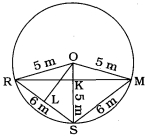
Three girls Reshma,Salma and Mandip are playing a game by standing on a circle of radius $5 \, m$ drawn in a park. Reshma throws a ball to Salma,Salma to Mandip,Mandip to Reshma. If the distance between Reshma and Salma and between Salma and Mandip is $6 \, m$ each,what is the distance between Reshma and Mandip?
A
$4.8$
B
$24$
C
$5$
D
$9.6$
Solution
(D) Let $O$ be the centre of the circle. Given $OR = OM = OS = 5 \, m$ (radii of the circle) and $RS = SM = 6 \, m$.
In quadrilateral $ORSM$,$OR = OM = 5 \, m$ and $RS = SM = 6 \, m$.
Therefore,quadrilateral $ORSM$ is a kite.
Thus,its diagonal $OS$ bisects the diagonal $RM$ at right angles at point $K$.
Therefore,$\angle RKO = 90^{\circ}$ and $K$ is the midpoint of $RM$,so $RM = 2 RK$.
Draw $OL \perp RS$. Since $OL$ is perpendicular from the centre to the chord $RS$,$L$ is the midpoint of $RS$.
Therefore,$RL = \frac{1}{2} RS = \frac{1}{2} \times 6 = 3 \, m$.
In right-angled $\Delta RLO$,by Pythagoras theorem:
$RO^2 = OL^2 + RL^2$
$5^2 = OL^2 + 3^2$
$25 = OL^2 + 9$
$OL^2 = 16 \implies OL = 4 \, m$.
Now,the area of $\Delta ROS$ can be calculated in two ways:
Area $= \frac{1}{2} \times RS \times OL = \frac{1}{2} \times 6 \times 4 = 12 \, m^2$.
Also,Area $= \frac{1}{2} \times OS \times RK = \frac{1}{2} \times 5 \times RK$.
Equating the two areas: $\frac{1}{2} \times 5 \times RK = 12$
$5 \times RK = 24 \implies RK = 4.8 \, m$.
Since $RM = 2 RK$,$RM = 2 \times 4.8 = 9.6 \, m$.
Thus,the distance between Reshma and Mandip is $9.6 \, m$.
In quadrilateral $ORSM$,$OR = OM = 5 \, m$ and $RS = SM = 6 \, m$.
Therefore,quadrilateral $ORSM$ is a kite.
Thus,its diagonal $OS$ bisects the diagonal $RM$ at right angles at point $K$.
Therefore,$\angle RKO = 90^{\circ}$ and $K$ is the midpoint of $RM$,so $RM = 2 RK$.
Draw $OL \perp RS$. Since $OL$ is perpendicular from the centre to the chord $RS$,$L$ is the midpoint of $RS$.
Therefore,$RL = \frac{1}{2} RS = \frac{1}{2} \times 6 = 3 \, m$.
In right-angled $\Delta RLO$,by Pythagoras theorem:
$RO^2 = OL^2 + RL^2$
$5^2 = OL^2 + 3^2$
$25 = OL^2 + 9$
$OL^2 = 16 \implies OL = 4 \, m$.
Now,the area of $\Delta ROS$ can be calculated in two ways:
Area $= \frac{1}{2} \times RS \times OL = \frac{1}{2} \times 6 \times 4 = 12 \, m^2$.
Also,Area $= \frac{1}{2} \times OS \times RK = \frac{1}{2} \times 5 \times RK$.
Equating the two areas: $\frac{1}{2} \times 5 \times RK = 12$
$5 \times RK = 24 \implies RK = 4.8 \, m$.
Since $RM = 2 RK$,$RM = 2 \times 4.8 = 9.6 \, m$.
Thus,the distance between Reshma and Mandip is $9.6 \, m$.
0 likes
View Solution85
DifficultMCQ
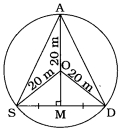
$A$ circular park of radius $20\,m$ is situated in a colony. Three boys Ankur,Syed and David are sitting at equal distance on its boundary,each having a toy telephone in his hands to talk with each other. Find the length of the string of each phone.
A
$20 \sqrt{3} \, m$
B
$23 \sqrt{3} \, m$
C
$17 \sqrt{3} \, m$
D
$18 \sqrt{3} \, m$
Solution
(A) Let the circle with centre $O$ represent the park and the points $A, S,$ and $D$ represent the positions of Ankur,Syed,and David respectively. Since Ankur,Syed,and David are sitting at equal distances from each other,$\Delta ASD$ is an equilateral triangle.
Draw the perpendicular bisector of $SD$ from its midpoint $M$. It will pass through the centre $O$ and vertex $A$.
Let $SM = x \, m$. Then $SD = 2SM = 2x \, m$.
In $\Delta OMS$,$\angle M = 90^{\circ}$. Using the Pythagorean theorem:
$OM^2 = OS^2 - SM^2 = (20)^2 - x^2 = 400 - x^2$
$OM = \sqrt{400 - x^2}$
Since $O$ is the centroid of the equilateral triangle $ASD$,the distance from the vertex to the centroid is twice the distance from the centroid to the midpoint of the opposite side.
$AM = AO + OM = 20 + \sqrt{400 - x^2}$
In $\Delta ASD$,the height $AM = \frac{\sqrt{3}}{2} \times \text{side} = \frac{\sqrt{3}}{2} \times (2x) = x\sqrt{3}$.
Equating the two expressions for $AM$:
$x\sqrt{3} = 20 + \sqrt{400 - x^2}$
$x\sqrt{3} - 20 = \sqrt{400 - x^2}$
Squaring both sides:
$(x\sqrt{3} - 20)^2 = 400 - x^2$
$3x^2 - 40\sqrt{3}x + 400 = 400 - x^2$
$4x^2 - 40\sqrt{3}x = 0$
$4x(x - 10\sqrt{3}) = 0$
Since $x \neq 0$,$x = 10\sqrt{3}$.
The length of the string is the side of the triangle $SD = 2x = 2(10\sqrt{3}) = 20\sqrt{3} \, m$.
Draw the perpendicular bisector of $SD$ from its midpoint $M$. It will pass through the centre $O$ and vertex $A$.
Let $SM = x \, m$. Then $SD = 2SM = 2x \, m$.
In $\Delta OMS$,$\angle M = 90^{\circ}$. Using the Pythagorean theorem:
$OM^2 = OS^2 - SM^2 = (20)^2 - x^2 = 400 - x^2$
$OM = \sqrt{400 - x^2}$
Since $O$ is the centroid of the equilateral triangle $ASD$,the distance from the vertex to the centroid is twice the distance from the centroid to the midpoint of the opposite side.
$AM = AO + OM = 20 + \sqrt{400 - x^2}$
In $\Delta ASD$,the height $AM = \frac{\sqrt{3}}{2} \times \text{side} = \frac{\sqrt{3}}{2} \times (2x) = x\sqrt{3}$.
Equating the two expressions for $AM$:
$x\sqrt{3} = 20 + \sqrt{400 - x^2}$
$x\sqrt{3} - 20 = \sqrt{400 - x^2}$
Squaring both sides:
$(x\sqrt{3} - 20)^2 = 400 - x^2$
$3x^2 - 40\sqrt{3}x + 400 = 400 - x^2$
$4x^2 - 40\sqrt{3}x = 0$
$4x(x - 10\sqrt{3}) = 0$
Since $x \neq 0$,$x = 10\sqrt{3}$.
The length of the string is the side of the triangle $SD = 2x = 2(10\sqrt{3}) = 20\sqrt{3} \, m$.
0 likes
View Solution86
MediumMCQ
In a circle with centre $P$,$AB$ is a chord. If the length of a radius is $17\,cm$ and $AB = 30\,cm$,then find the distance of $AB$ from the centre $P$. (in $,cm$)
A
$7$
B
$8$
C
$6$
D
$4$
Solution
(B) Let $P$ be the centre of the circle and $AB$ be the chord of length $30\,cm$.
Draw a perpendicular $PM$ from the centre $P$ to the chord $AB$.
$A$ perpendicular from the centre of a circle to a chord bisects the chord.
Therefore,$AM = MB = \frac{AB}{2} = \frac{30}{2} = 15\,cm$.
In the right-angled triangle $\triangle PMA$,by Pythagoras theorem:
$PA^2 = PM^2 + AM^2$.
Given radius $PA = 17\,cm$ and $AM = 15\,cm$.
$17^2 = PM^2 + 15^2$.
$289 = PM^2 + 225$.
$PM^2 = 289 - 225 = 64$.
$PM = \sqrt{64} = 8\,cm$.
Thus,the distance of the chord $AB$ from the centre $P$ is $8\,cm$.
Draw a perpendicular $PM$ from the centre $P$ to the chord $AB$.
$A$ perpendicular from the centre of a circle to a chord bisects the chord.
Therefore,$AM = MB = \frac{AB}{2} = \frac{30}{2} = 15\,cm$.
In the right-angled triangle $\triangle PMA$,by Pythagoras theorem:
$PA^2 = PM^2 + AM^2$.
Given radius $PA = 17\,cm$ and $AM = 15\,cm$.
$17^2 = PM^2 + 15^2$.
$289 = PM^2 + 225$.
$PM^2 = 289 - 225 = 64$.
$PM = \sqrt{64} = 8\,cm$.
Thus,the distance of the chord $AB$ from the centre $P$ is $8\,cm$.
0 likes
View Solution87
MediumMCQ
In a circle with centre $P$,the length of chord $AB$ is $40 \, cm$. $AB$ lies at a distance of $21 \, cm$ from the centre $P$. Find the diameter of the circle. (in $, cm$)
A
$58$
B
$60$
C
$82$
D
$49$
Solution
(A) Let $P$ be the centre of the circle and $AB$ be the chord of length $40 \, cm$.
Let $M$ be the midpoint of $AB$. The perpendicular from the centre to a chord bisects the chord.
Therefore,$AM = MB = \frac{40}{2} = 20 \, cm$.
Given the distance from the centre to the chord is $PM = 21 \, cm$.
In the right-angled triangle $\triangle PMA$,by the Pythagorean theorem:
$PA^2 = PM^2 + AM^2$
$PA^2 = 21^2 + 20^2$
$PA^2 = 441 + 400 = 841$
$PA = \sqrt{841} = 29 \, cm$.
Here,$PA$ is the radius $(r)$ of the circle.
Diameter $(d)$ = $2 \times r = 2 \times 29 = 58 \, cm$.
Let $M$ be the midpoint of $AB$. The perpendicular from the centre to a chord bisects the chord.
Therefore,$AM = MB = \frac{40}{2} = 20 \, cm$.
Given the distance from the centre to the chord is $PM = 21 \, cm$.
In the right-angled triangle $\triangle PMA$,by the Pythagorean theorem:
$PA^2 = PM^2 + AM^2$
$PA^2 = 21^2 + 20^2$
$PA^2 = 441 + 400 = 841$
$PA = \sqrt{841} = 29 \, cm$.
Here,$PA$ is the radius $(r)$ of the circle.
Diameter $(d)$ = $2 \times r = 2 \times 29 = 58 \, cm$.
0 likes
View Solution88
MediumMCQ
In a circle with centre $O$,the lengths of two chords $AB$ and $CD$ are $12 \, cm$ and $16 \, cm$ respectively. If the chord $AB$ is at a distance $8 \, cm$ from the centre,what is the distance of the chord $CD$ from the centre (in $, cm$)?
A
$5$
B
$9$
C
$7$
D
$6$
Solution
(D) Let $r$ be the radius of the circle.
For chord $AB$ of length $12 \, cm$,the distance from the centre $O$ is $d_1 = 8 \, cm$.
$A$ perpendicular from the centre to a chord bisects the chord. Thus,the distance from the centre,the radius,and half the chord length form a right-angled triangle.
$r^2 = (12/2)^2 + 8^2 = 6^2 + 8^2 = 36 + 64 = 100$.
So,$r = 10 \, cm$.
For chord $CD$ of length $16 \, cm$,let the distance from the centre be $d_2$.
$r^2 = (16/2)^2 + d_2^2$.
$10^2 = 8^2 + d_2^2$.
$100 = 64 + d_2^2$.
$d_2^2 = 36$.
$d_2 = 6 \, cm$.
For chord $AB$ of length $12 \, cm$,the distance from the centre $O$ is $d_1 = 8 \, cm$.
$A$ perpendicular from the centre to a chord bisects the chord. Thus,the distance from the centre,the radius,and half the chord length form a right-angled triangle.
$r^2 = (12/2)^2 + 8^2 = 6^2 + 8^2 = 36 + 64 = 100$.
So,$r = 10 \, cm$.
For chord $CD$ of length $16 \, cm$,let the distance from the centre be $d_2$.
$r^2 = (16/2)^2 + d_2^2$.
$10^2 = 8^2 + d_2^2$.
$100 = 64 + d_2^2$.
$d_2^2 = 36$.
$d_2 = 6 \, cm$.
0 likes
View Solution89
MediumMCQ
$AB$ and $CD$ are two chords of a circle with centre $P$. The distance of chord $AB$ from the centre $P$ is $15 \, cm$ and the distance of chord $CD$ from the centre $P$ is $8 \, cm$. If $AB = 16 \, cm$,then find the length of chord $CD$. (in $, cm$)
A
$30$
B
$15$
C
$23$
D
$33$
Solution
(A) Let $r$ be the radius of the circle.
Draw a perpendicular from $P$ to chord $AB$ at point $M$ and to chord $CD$ at point $N$.
$PM = 15 \, cm$ and $PN = 8 \, cm$.
Since the perpendicular from the centre bisects the chord,$AM = MB = AB / 2 = 16 / 2 = 8 \, cm$.
In right-angled triangle $\triangle PAM$,by Pythagoras theorem: $r^2 = PM^2 + AM^2 = 15^2 + 8^2 = 225 + 64 = 289$.
So,$r = \sqrt{289} = 17 \, cm$.
Now,in right-angled triangle $\triangle PNC$,by Pythagoras theorem: $r^2 = PN^2 + CN^2$.
$17^2 = 8^2 + CN^2 \implies 289 = 64 + CN^2$.
$CN^2 = 289 - 64 = 225$.
$CN = \sqrt{225} = 15 \, cm$.
Since $N$ is the midpoint of $CD$,$CD = 2 \times CN = 2 \times 15 = 30 \, cm$.
Draw a perpendicular from $P$ to chord $AB$ at point $M$ and to chord $CD$ at point $N$.
$PM = 15 \, cm$ and $PN = 8 \, cm$.
Since the perpendicular from the centre bisects the chord,$AM = MB = AB / 2 = 16 / 2 = 8 \, cm$.
In right-angled triangle $\triangle PAM$,by Pythagoras theorem: $r^2 = PM^2 + AM^2 = 15^2 + 8^2 = 225 + 64 = 289$.
So,$r = \sqrt{289} = 17 \, cm$.
Now,in right-angled triangle $\triangle PNC$,by Pythagoras theorem: $r^2 = PN^2 + CN^2$.
$17^2 = 8^2 + CN^2 \implies 289 = 64 + CN^2$.
$CN^2 = 289 - 64 = 225$.
$CN = \sqrt{225} = 15 \, cm$.
Since $N$ is the midpoint of $CD$,$CD = 2 \times CN = 2 \times 15 = 30 \, cm$.
0 likes
View Solution90
MediumMCQ
$AB$ and $CD$ are two parallel chords of a circle with centre $P$. Centre $P$ is not between the two chords $AB$ and $CD$. If $AB = 40\,cm$,$CD = 30\,cm$ and the radius of the circle is $25\,cm$,find the distance between $AB$ and $CD$. (in $,cm$)
A
$5$
B
$6$
C
$4$
D
$3$
Solution
(A) Let $P$ be the centre of the circle with radius $r = 25\,cm$.
Let $M$ and $N$ be the midpoints of chords $AB$ and $CD$ respectively.
Since the perpendicular from the centre to a chord bisects the chord,$AM = MB = AB/2 = 40/2 = 20\,cm$ and $CN = ND = CD/2 = 30/2 = 15\,cm$.
In right-angled $\triangle PMA$,by Pythagoras theorem: $PM^2 + AM^2 = PA^2 \implies PM^2 + 20^2 = 25^2 \implies PM^2 = 625 - 400 = 225 \implies PM = 15\,cm$.
In right-angled $\triangle PNC$,by Pythagoras theorem: $PN^2 + CN^2 = PC^2 \implies PN^2 + 15^2 = 25^2 \implies PN^2 = 625 - 225 = 400 \implies PN = 20\,cm$.
Since the centre $P$ is not between the chords,the distance between the chords is $|PN - PM| = |20 - 15| = 5\,cm$.
Let $M$ and $N$ be the midpoints of chords $AB$ and $CD$ respectively.
Since the perpendicular from the centre to a chord bisects the chord,$AM = MB = AB/2 = 40/2 = 20\,cm$ and $CN = ND = CD/2 = 30/2 = 15\,cm$.
In right-angled $\triangle PMA$,by Pythagoras theorem: $PM^2 + AM^2 = PA^2 \implies PM^2 + 20^2 = 25^2 \implies PM^2 = 625 - 400 = 225 \implies PM = 15\,cm$.
In right-angled $\triangle PNC$,by Pythagoras theorem: $PN^2 + CN^2 = PC^2 \implies PN^2 + 15^2 = 25^2 \implies PN^2 = 625 - 225 = 400 \implies PN = 20\,cm$.
Since the centre $P$ is not between the chords,the distance between the chords is $|PN - PM| = |20 - 15| = 5\,cm$.
0 likes
View Solution91
MediumMCQ
$AB$ and $CD$ are two parallel chords of a circle with centre $P$. Also,the centre $P$ lies between the chords $AB$ and $CD$. If $AB = 20\,cm$,$CD = 48\,cm$,and the radius of the circle is $26\,cm$,find the distance between $AB$ and $CD$.
A
$23$
B
$30$
C
$34$
D
$36$
Solution
(C) Let $P$ be the centre of the circle and $r = 26\,cm$ be the radius.
Draw perpendiculars $PM$ and $PN$ from $P$ to chords $AB$ and $CD$ respectively.
Since the perpendicular from the centre to a chord bisects the chord,we have:
$AM = MB = \frac{AB}{2} = \frac{20}{2} = 10\,cm$
$CN = ND = \frac{CD}{2} = \frac{48}{2} = 24\,cm$
In right-angled $\triangle PMA$,by Pythagoras theorem:
$PM^2 + AM^2 = PA^2$
$PM^2 + 10^2 = 26^2$
$PM^2 = 676 - 100 = 576$
$PM = \sqrt{576} = 24\,cm$
In right-angled $\triangle PNC$,by Pythagoras theorem:
$PN^2 + CN^2 = PC^2$
$PN^2 + 24^2 = 26^2$
$PN^2 = 676 - 576 = 100$
$PN = \sqrt{100} = 10\,cm$
Since the centre $P$ lies between the chords,the distance between $AB$ and $CD$ is $PM + PN = 24 + 10 = 34\,cm$.
Draw perpendiculars $PM$ and $PN$ from $P$ to chords $AB$ and $CD$ respectively.
Since the perpendicular from the centre to a chord bisects the chord,we have:
$AM = MB = \frac{AB}{2} = \frac{20}{2} = 10\,cm$
$CN = ND = \frac{CD}{2} = \frac{48}{2} = 24\,cm$
In right-angled $\triangle PMA$,by Pythagoras theorem:
$PM^2 + AM^2 = PA^2$
$PM^2 + 10^2 = 26^2$
$PM^2 = 676 - 100 = 576$
$PM = \sqrt{576} = 24\,cm$
In right-angled $\triangle PNC$,by Pythagoras theorem:
$PN^2 + CN^2 = PC^2$
$PN^2 + 24^2 = 26^2$
$PN^2 = 676 - 576 = 100$
$PN = \sqrt{100} = 10\,cm$
Since the centre $P$ lies between the chords,the distance between $AB$ and $CD$ is $PM + PN = 24 + 10 = 34\,cm$.
0 likes
View Solution92
MediumMCQ
$AB$ and $CD$ are two parallel chords of a circle with centre $P$. Also,the centre $P$ lies between $AB$ and $CD$. If $AB = 48 \, cm$,$CD = 40 \, cm$,and the radius of the circle is $25 \, cm$,find the distance between $AB$ and $CD$. (in $, cm$)
A
$17$
B
$19$
C
$20$
D
$22$
Solution
(D) Let the centre of the circle be $P$ and the radius $r = 25 \, cm$.
Draw perpendiculars from $P$ to the chords $AB$ and $CD$,meeting them at points $M$ and $N$ respectively.
Since the perpendicular from the centre to a chord bisects the chord,we have:
$AM = MB = \frac{AB}{2} = \frac{48}{2} = 24 \, cm$
$CN = ND = \frac{CD}{2} = \frac{40}{2} = 20 \, cm$
In right-angled triangle $\triangle PMA$:
$PM^2 + AM^2 = PA^2$
$PM^2 + 24^2 = 25^2$
$PM^2 + 576 = 625$
$PM^2 = 49 \implies PM = 7 \, cm$
In right-angled triangle $\triangle PNC$:
$PN^2 + CN^2 = PC^2$
$PN^2 + 20^2 = 25^2$
$PN^2 + 400 = 625$
$PN^2 = 225 \implies PN = 15 \, cm$
Since the centre $P$ lies between the chords,the distance between $AB$ and $CD$ is $PM + PN = 7 \, cm + 15 \, cm = 22 \, cm$.
Draw perpendiculars from $P$ to the chords $AB$ and $CD$,meeting them at points $M$ and $N$ respectively.
Since the perpendicular from the centre to a chord bisects the chord,we have:
$AM = MB = \frac{AB}{2} = \frac{48}{2} = 24 \, cm$
$CN = ND = \frac{CD}{2} = \frac{40}{2} = 20 \, cm$
In right-angled triangle $\triangle PMA$:
$PM^2 + AM^2 = PA^2$
$PM^2 + 24^2 = 25^2$
$PM^2 + 576 = 625$
$PM^2 = 49 \implies PM = 7 \, cm$
In right-angled triangle $\triangle PNC$:
$PN^2 + CN^2 = PC^2$
$PN^2 + 20^2 = 25^2$
$PN^2 + 400 = 625$
$PN^2 = 225 \implies PN = 15 \, cm$
Since the centre $P$ lies between the chords,the distance between $AB$ and $CD$ is $PM + PN = 7 \, cm + 15 \, cm = 22 \, cm$.
0 likes
View Solution93
MediumMCQ
In a circle with centre $P$,the radius is $13 \, cm$. The distance between two parallel chords $AB$ and $CD$ is $17 \, cm$. If $AB = 24 \, cm$,find the length of $CD$. (in $, cm$)
A
$10$
B
$19$
C
$17$
D
$13$
Solution
(A) Let $P$ be the center of the circle with radius $r = 13 \, cm$. Let $M$ and $N$ be the midpoints of chords $AB$ and $CD$ respectively. Since the perpendicular from the center to a chord bisects the chord,$AM = MB = 12 \, cm$ and $CN = ND$. In $\triangle PMA$,by the Pythagorean theorem,$PM^2 + AM^2 = PA^2$,so $PM^2 + 12^2 = 13^2$,which gives $PM^2 = 169 - 144 = 25$,so $PM = 5 \, cm$. There are two cases: chords are on the same side or opposite sides of the center. Case $1$: Chords are on opposite sides. The distance $MN = PM + PN = 17 \, cm$. Since $PM = 5 \, cm$,$PN = 17 - 5 = 12 \, cm$. In $\triangle PNC$,$PN^2 + CN^2 = PC^2$,so $12^2 + CN^2 = 13^2$,which gives $CN^2 = 169 - 144 = 25$,so $CN = 5 \, cm$. Thus,$CD = 2 \times CN = 10 \, cm$. Case $2$: Chords are on the same side. The distance $MN = |PM - PN| = 17 \, cm$. Since $PM = 5 \, cm$,$PN$ would be $22 \, cm$ or $-12 \, cm$,which is impossible as the radius is $13 \, cm$. Thus,$CD = 10 \, cm$.
0 likes
View Solution94
MediumMCQ
The radius of a circle with centre $P$ is $50 \, cm$. Centre $P$ is not lying between two parallel chords $AB$ and $CD$. If $AB = 80 \, cm$ and the distance between $AB$ and $CD$ is $10 \, cm$,then find the length of $CD$. (Given $AB > CD$) (in $, cm$)
A
$55$
B
$60$
C
$59$
D
$67$
Solution
(B) Let the radius $r = 50 \, cm$. Let $M$ and $N$ be the midpoints of chords $AB$ and $CD$ respectively.
Since $AB = 80 \, cm$,$AM = MB = 40 \, cm$.
In $\triangle PMA$,by Pythagoras theorem,$PM^2 + AM^2 = PA^2$.
$PM^2 + 40^2 = 50^2 \implies PM^2 = 2500 - 1600 = 900 \implies PM = 30 \, cm$.
Since $P$ does not lie between the chords,the distance between the chords is $PN - PM = 10 \, cm$.
$PN = 10 + PM = 10 + 30 = 40 \, cm$.
In $\triangle PNC$,$PN^2 + NC^2 = PC^2$.
$40^2 + NC^2 = 50^2 \implies 1600 + NC^2 = 2500 \implies NC^2 = 900 \implies NC = 30 \, cm$.
Since $N$ is the midpoint of $CD$,$CD = 2 \times NC = 2 \times 30 = 60 \, cm$.
Since $AB = 80 \, cm$,$AM = MB = 40 \, cm$.
In $\triangle PMA$,by Pythagoras theorem,$PM^2 + AM^2 = PA^2$.
$PM^2 + 40^2 = 50^2 \implies PM^2 = 2500 - 1600 = 900 \implies PM = 30 \, cm$.
Since $P$ does not lie between the chords,the distance between the chords is $PN - PM = 10 \, cm$.
$PN = 10 + PM = 10 + 30 = 40 \, cm$.
In $\triangle PNC$,$PN^2 + NC^2 = PC^2$.
$40^2 + NC^2 = 50^2 \implies 1600 + NC^2 = 2500 \implies NC^2 = 900 \implies NC = 30 \, cm$.
Since $N$ is the midpoint of $CD$,$CD = 2 \times NC = 2 \times 30 = 60 \, cm$.
0 likes
View Solution95
MediumMCQ
$AB$ is a chord of a circle with centre $P$. Point $C$ is a point other than $A$ and $B$ on the major arc $AB$. If $\angle ACB = 50^{\circ}$,then find $\angle APB$. (in $^{\circ}$)
A
$105$
B
$95$
C
$100$
D
$90$
Solution
(C) According to the circle theorem,the angle subtended by an arc at the centre is double the angle subtended by it at any point on the remaining part of the circle.
Here,the arc $AB$ subtends $\angle APB$ at the centre $P$ and $\angle ACB$ at the remaining part of the circle.
Therefore,$\angle APB = 2 \angle ACB$.
Given that $\angle ACB = 50^{\circ}$.
Substituting the value,we get $\angle APB = 2 \times 50^{\circ} = 100^{\circ}$.
Thus,the value of $\angle APB$ is $100^{\circ}$.
Here,the arc $AB$ subtends $\angle APB$ at the centre $P$ and $\angle ACB$ at the remaining part of the circle.
Therefore,$\angle APB = 2 \angle ACB$.
Given that $\angle ACB = 50^{\circ}$.
Substituting the value,we get $\angle APB = 2 \times 50^{\circ} = 100^{\circ}$.
Thus,the value of $\angle APB$ is $100^{\circ}$.
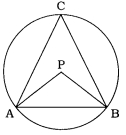
0 likes
View Solution96
MediumMCQ
$AB$ is a chord of a circle with centre $P$. Point $C$ is a point other than $A$ and $B$ on the major arc $AB$. If $\angle APB = 130^{\circ}$,then find $\angle ACB$. (in $^{\circ}$)
A
$100$
B
$45$
C
$90$
D
$65$
Solution
(D) Given that $AB$ is a chord of a circle with centre $P$. Point $C$ is a point on the major arc $AB$.
We are given that $\angle APB = 130^{\circ}$.
According to the circle theorem,the angle subtended by an arc at the centre is double the angle subtended by it at any point on the remaining part of the circle.
Therefore,$\angle APB = 2 \angle ACB$.
Substituting the given value:
$130^{\circ} = 2 \angle ACB$
$\angle ACB = \frac{130^{\circ}}{2} = 65^{\circ}$.
Thus,$\angle ACB = 65^{\circ}$.
We are given that $\angle APB = 130^{\circ}$.
According to the circle theorem,the angle subtended by an arc at the centre is double the angle subtended by it at any point on the remaining part of the circle.
Therefore,$\angle APB = 2 \angle ACB$.
Substituting the given value:
$130^{\circ} = 2 \angle ACB$
$\angle ACB = \frac{130^{\circ}}{2} = 65^{\circ}$.
Thus,$\angle ACB = 65^{\circ}$.
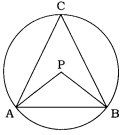
0 likes
View Solution97
DifficultMCQ
$AB$ is a chord of a circle with centre $P$. Point $C$ is a point other than $A$ and $B$ on the major arc $AB$. If $\angle ACB + \angle APB = 135^{\circ}$,then find $\angle ACB$ and $\angle APB$.
A
$45^{\circ}$ and $90^{\circ}$
B
$105^{\circ}$ and $90^{\circ}$
C
$120^{\circ}$ and $105^{\circ}$
D
$80^{\circ}$ and $90^{\circ}$
Solution
(A) Given that $AB$ is a chord of a circle with centre $P$. Point $C$ is a point on the major arc $AB$.
According to the circle theorem,the angle subtended by an arc at the centre is double the angle subtended by it at any point on the remaining part of the circle.
Therefore,$\angle APB = 2 \angle ACB$.
Given that $\angle ACB + \angle APB = 135^{\circ}$.
Substituting $\angle APB = 2 \angle ACB$ in the given equation:
$\angle ACB + 2 \angle ACB = 135^{\circ}$
$3 \angle ACB = 135^{\circ}$
$\angle ACB = \frac{135^{\circ}}{3} = 45^{\circ}$.
Now,calculating $\angle APB$:
$\angle APB = 2 \times 45^{\circ} = 90^{\circ}$.
Thus,$\angle ACB = 45^{\circ}$ and $\angle APB = 90^{\circ}$.
According to the circle theorem,the angle subtended by an arc at the centre is double the angle subtended by it at any point on the remaining part of the circle.
Therefore,$\angle APB = 2 \angle ACB$.
Given that $\angle ACB + \angle APB = 135^{\circ}$.
Substituting $\angle APB = 2 \angle ACB$ in the given equation:
$\angle ACB + 2 \angle ACB = 135^{\circ}$
$3 \angle ACB = 135^{\circ}$
$\angle ACB = \frac{135^{\circ}}{3} = 45^{\circ}$.
Now,calculating $\angle APB$:
$\angle APB = 2 \times 45^{\circ} = 90^{\circ}$.
Thus,$\angle ACB = 45^{\circ}$ and $\angle APB = 90^{\circ}$.
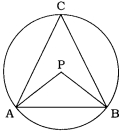
0 likes
View Solution98
MediumMCQ
In the given figure,$ABCD$ is a cyclic quadrilateral in which diagonals $AC$ and $BD$ intersect at $M.$ If $\angle BAC = 50^{\circ}$ and $\angle ADB = 45^{\circ}$,then find $\angle ABC$. (in $^{\circ}$)
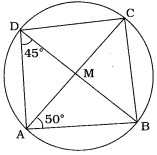
A
$90$
B
$85$
C
$102$
D
$110$
Solution
(B) We know that angles in the same segment of a circle are equal.
Therefore,$\angle BDC = \angle BAC$.
Given $\angle BAC = 50^{\circ}$,so $\angle BDC = 50^{\circ}$.
Now,$\angle ADC = \angle ADB + \angle BDC$.
Substituting the values,$\angle ADC = 45^{\circ} + 50^{\circ} = 95^{\circ}$.
Since $ABCD$ is a cyclic quadrilateral,the sum of opposite angles is $180^{\circ}$.
Therefore,$\angle ABC + \angle ADC = 180^{\circ}$.
$\angle ABC + 95^{\circ} = 180^{\circ}$.
$\angle ABC = 180^{\circ} - 95^{\circ} = 85^{\circ}$.
Therefore,$\angle BDC = \angle BAC$.
Given $\angle BAC = 50^{\circ}$,so $\angle BDC = 50^{\circ}$.
Now,$\angle ADC = \angle ADB + \angle BDC$.
Substituting the values,$\angle ADC = 45^{\circ} + 50^{\circ} = 95^{\circ}$.
Since $ABCD$ is a cyclic quadrilateral,the sum of opposite angles is $180^{\circ}$.
Therefore,$\angle ABC + \angle ADC = 180^{\circ}$.
$\angle ABC + 95^{\circ} = 180^{\circ}$.
$\angle ABC = 180^{\circ} - 95^{\circ} = 85^{\circ}$.
0 likes
View Solution99
Medium
If circles are drawn taking two sides of a triangle as diameters,prove that the point of intersection of these circles lies on the third side.
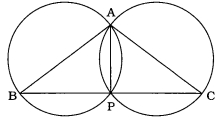
Solution
(N/A) Let the sides $AB$ and $AC$ of $\Delta ABC$ be the diameters of two circles. These circles intersect each other at points $A$ and $P$.
Draw the common chord $AP$.
Since $AB$ is a diameter,$\angle APB$ is an angle in a semicircle.
$\therefore \angle APB = 90^{\circ}$.
Since $AC$ is a diameter,$\angle APC$ is an angle in a semicircle.
$\therefore \angle APC = 90^{\circ}$.
Adding these two equations,we get:
$\angle APB + \angle APC = 90^{\circ} + 90^{\circ} = 180^{\circ}$.
Since $\angle APB$ and $\angle APC$ are adjacent angles with a common arm $AP$ and their sum is $180^{\circ}$,they form a linear pair.
Therefore,the points $B, P,$ and $C$ must lie on a straight line.
Hence,the point of intersection $P$ of the circles lies on the third side $BC$ of the triangle.
Draw the common chord $AP$.
Since $AB$ is a diameter,$\angle APB$ is an angle in a semicircle.
$\therefore \angle APB = 90^{\circ}$.
Since $AC$ is a diameter,$\angle APC$ is an angle in a semicircle.
$\therefore \angle APC = 90^{\circ}$.
Adding these two equations,we get:
$\angle APB + \angle APC = 90^{\circ} + 90^{\circ} = 180^{\circ}$.
Since $\angle APB$ and $\angle APC$ are adjacent angles with a common arm $AP$ and their sum is $180^{\circ}$,they form a linear pair.
Therefore,the points $B, P,$ and $C$ must lie on a straight line.
Hence,the point of intersection $P$ of the circles lies on the third side $BC$ of the triangle.
0 likes
View Solution100
Medium
Bisectors of angles $A, B$ and $C$ of a triangle $ABC$ intersect its circumcircle at $D, E$ and $F$ respectively. Prove that the angles of the triangle $DEF$ are $90^{\circ}-\frac{1}{2} A, 90^{\circ}-\frac{1}{2} B$ and $90^{\circ}-\frac{1}{2} C$.
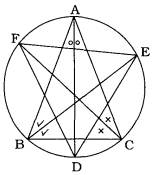
Solution
(N/A) The bisectors of $\angle A, \angle B$ and $\angle C$ of $\Delta ABC$ intersect the circumcircle of $\Delta ABC$ at $D, E$ and $F$ respectively.
$\angle FDE = \angle FDA + \angle EDA$ (Adjacent angles)
$= \angle FCA + \angle EBA$ (Angles in the same segment of the circle are equal)
$= \frac{1}{2} \angle C + \frac{1}{2} \angle B$ (Since $AD, BE, CF$ are angle bisectors)
$= \frac{1}{2}(\angle B + \angle C)$
$= \frac{1}{2}(180^{\circ} - \angle A)$ (Since $\angle A + \angle B + \angle C = 180^{\circ}$)
$= 90^{\circ} - \frac{1}{2} \angle A$
Thus,$\angle FDE = 90^{\circ} - \frac{1}{2} \angle A$.
Similarly,$\angle DEF = 90^{\circ} - \frac{1}{2} \angle B$ and $\angle EFD = 90^{\circ} - \frac{1}{2} \angle C$.
$\angle FDE = \angle FDA + \angle EDA$ (Adjacent angles)
$= \angle FCA + \angle EBA$ (Angles in the same segment of the circle are equal)
$= \frac{1}{2} \angle C + \frac{1}{2} \angle B$ (Since $AD, BE, CF$ are angle bisectors)
$= \frac{1}{2}(\angle B + \angle C)$
$= \frac{1}{2}(180^{\circ} - \angle A)$ (Since $\angle A + \angle B + \angle C = 180^{\circ}$)
$= 90^{\circ} - \frac{1}{2} \angle A$
Thus,$\angle FDE = 90^{\circ} - \frac{1}{2} \angle A$.
Similarly,$\angle DEF = 90^{\circ} - \frac{1}{2} \angle B$ and $\angle EFD = 90^{\circ} - \frac{1}{2} \angle C$.
0 likes
View SolutionCircles — Mix Examples - Circles · Frequently Asked Questions
1Are these Circles questions useful for JEE and NEET?
Yes. All questions in this section are mapped to JEE Main and NEET exam patterns. Previous year questions from JEE Main, NEET, GUJCET and state-level exams are included with full solutions.
2Can I switch to Hindi or Gujarati for these questions?
Yes. Use the language tabs in the hero section or the sidebar to view the same questions and solutions in English, Hindi or Gujarati.
3How do I generate a question paper from this subtopic?
Use the Vedclass Exam Paper Generator — select the chapter and subtopic, set difficulty, and generate Sets A, B, C, D automatically. First 3 chapters of every subject are free.
Vedclass Products
For Students
Vedclass Test Series
Mock tests in real JEE/NEET style with performance analysis. 5-day free trial.
Start Free TrialFor Teachers
Exam Paper Generator
Generate Set A/B/C/D papers from this chapter in 2 minutes. 3 chapters free.
Try FreeFor Institutes
Online Exam Module
Live online exams with unlimited students, 360° analytics & white-label branding.
See DemoFor Teachers & Institutes
Generate a Circles Exam Paper in 2 Minutes
Select subtopic & difficulty — Sets A, B, C, D auto-generated with No Repeat logic.
First 3 chapters of every subject are free — no payment required.