
A English
Textbook - Circles Questions in English
Class 9 Mathematics · Circles · Textbook - Circles
42+
Questions
English
Language
100%
With Solutions
Showing 42 of 42 questions in English
1
Easy
Fill in the blanks:
$(i)$ The centre of a circle lies in . . . . . . of the circle. (exterior/ interior)
$(ii)$ $A$ point,whose distance from the centre of a circle is greater than its radius,lies in . . . . . . of the circle. (exterior/ interior)
$(iii)$ The longest chord of a circle is a . . . . . . of the circle.
$(iv)$ An arc is a . . . . . . when its ends are the ends of a diameter.
$(v)$ Segment of a circle is the region between an arc and . . . . . . of the circle.
$(vi)$ $A$ circle divides the plane,on which it lies,in . . . . . . parts.
$(i)$ The centre of a circle lies in . . . . . . of the circle. (exterior/ interior)
$(ii)$ $A$ point,whose distance from the centre of a circle is greater than its radius,lies in . . . . . . of the circle. (exterior/ interior)
$(iii)$ The longest chord of a circle is a . . . . . . of the circle.
$(iv)$ An arc is a . . . . . . when its ends are the ends of a diameter.
$(v)$ Segment of a circle is the region between an arc and . . . . . . of the circle.
$(vi)$ $A$ circle divides the plane,on which it lies,in . . . . . . parts.
Solution
(N/A) $(i)$ The centre of a circle always lies in the interior of the circle.
$(ii)$ If the distance of a point from the centre is greater than the radius,the point lies in the exterior of the circle.
$(iii)$ The longest chord of a circle is its diameter.
$(iv)$ An arc is a semicircle when its ends are the ends of a diameter.
$(v)$ $A$ segment of a circle is the region between an arc and the chord of the circle.
$(vi)$ $A$ circle divides the plane on which it lies into three parts: the interior,the circle itself,and the exterior.
$(ii)$ If the distance of a point from the centre is greater than the radius,the point lies in the exterior of the circle.
$(iii)$ The longest chord of a circle is its diameter.
$(iv)$ An arc is a semicircle when its ends are the ends of a diameter.
$(v)$ $A$ segment of a circle is the region between an arc and the chord of the circle.
$(vi)$ $A$ circle divides the plane on which it lies into three parts: the interior,the circle itself,and the exterior.
0 likes
View Solution2
Easy
State whether the following statements are True or False. Give reasons for your answers.
$(i)$ The line segment joining the centre to any point on the circle is a radius of the circle.
$(ii)$ $A$ circle has only a finite number of equal chords.
$(iii)$ If a circle is divided into three equal arcs,each is a major arc.
$(iv)$ $A$ chord of a circle,which is twice as long as its radius,is a diameter of the circle.
$(v)$ $A$ sector is the region between the chord and its corresponding arc.
$(vi)$ $A$ circle is a plane figure.
$(i)$ The line segment joining the centre to any point on the circle is a radius of the circle.
$(ii)$ $A$ circle has only a finite number of equal chords.
$(iii)$ If a circle is divided into three equal arcs,each is a major arc.
$(iv)$ $A$ chord of a circle,which is twice as long as its radius,is a diameter of the circle.
$(v)$ $A$ sector is the region between the chord and its corresponding arc.
$(vi)$ $A$ circle is a plane figure.
Solution
(A-D) $(i)$ True. The definition of a radius is the line segment joining the centre to any point on the circle.
$(ii)$ False. $A$ circle can have an infinite number of equal chords of any given length.
$(iii)$ False. If a circle is divided into three equal arcs,each arc measures $120^{\circ}$,which is less than a semicircle $(180^{\circ})$,so each is a minor arc.
$(iv)$ True. By definition,the diameter is the longest chord of a circle and its length is equal to $2 \times \text{radius}$.
$(v)$ False. The region between a chord and its corresponding arc is called a segment,whereas a sector is the region between an arc and the two radii joining the centre to the endpoints of the arc.
$(vi)$ True. $A$ circle is a collection of all points in a plane that are at a fixed distance from a fixed point (the centre).
$(ii)$ False. $A$ circle can have an infinite number of equal chords of any given length.
$(iii)$ False. If a circle is divided into three equal arcs,each arc measures $120^{\circ}$,which is less than a semicircle $(180^{\circ})$,so each is a minor arc.
$(iv)$ True. By definition,the diameter is the longest chord of a circle and its length is equal to $2 \times \text{radius}$.
$(v)$ False. The region between a chord and its corresponding arc is called a segment,whereas a sector is the region between an arc and the two radii joining the centre to the endpoints of the arc.
$(vi)$ True. $A$ circle is a collection of all points in a plane that are at a fixed distance from a fixed point (the centre).
0 likes
View Solution3
Medium
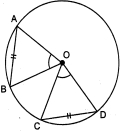
Recall that two circles are congruent if they have the same radii. Prove that equal chords of congruent circles subtend equal angles at their centres.
Solution
(N/A) Consider two congruent circles with centres $O$ and $O'$. Let $AB$ and $CD$ be equal chords of these circles respectively,such that $AB = CD$.
We need to prove that $\angle AOB = \angle CO'D$.
In $\Delta AOB$ and $\Delta CO'D$:
$AO = CO'$ (Radii of congruent circles are equal)
$BO = DO'$ (Radii of congruent circles are equal)
$AB = CD$ (Given)
By the $SSS$ (Side-Side-Side) congruence criterion,$\Delta AOB \cong \Delta CO'D$.
Since congruent triangles have equal corresponding parts,we have:
$\angle AOB = \angle CO'D$.
Hence,equal chords of congruent circles subtend equal angles at their centres.
We need to prove that $\angle AOB = \angle CO'D$.
In $\Delta AOB$ and $\Delta CO'D$:
$AO = CO'$ (Radii of congruent circles are equal)
$BO = DO'$ (Radii of congruent circles are equal)
$AB = CD$ (Given)
By the $SSS$ (Side-Side-Side) congruence criterion,$\Delta AOB \cong \Delta CO'D$.
Since congruent triangles have equal corresponding parts,we have:
$\angle AOB = \angle CO'D$.
Hence,equal chords of congruent circles subtend equal angles at their centres.
0 likes
View Solution4
Medium
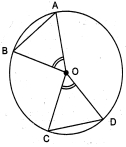
Prove that if chords of congruent circles subtend equal angles at their centres,then the chords are equal.
Solution
(N/A) Given: Two congruent circles with centres $O$ and $O'$. Let $AB$ be a chord of the first circle and $CD$ be a chord of the second circle such that $\angle AOB = \angle CO'D$.
To prove: $AB = CD$.
Proof:
In $\Delta AOB$ and $\Delta CO'D$:
$AO = CO'$ (Radii of congruent circles)
$BO = DO'$ (Radii of congruent circles)
$\angle AOB = \angle CO'D$ (Given)
Therefore,by the $SAS$ (Side-Angle-Side) congruence criterion:
$\Delta AOB \cong \Delta CO'D$
Since the triangles are congruent,their corresponding parts are equal $(CPCT)$.
Thus,$AB = CD$.
To prove: $AB = CD$.
Proof:
In $\Delta AOB$ and $\Delta CO'D$:
$AO = CO'$ (Radii of congruent circles)
$BO = DO'$ (Radii of congruent circles)
$\angle AOB = \angle CO'D$ (Given)
Therefore,by the $SAS$ (Side-Angle-Side) congruence criterion:
$\Delta AOB \cong \Delta CO'D$
Since the triangles are congruent,their corresponding parts are equal $(CPCT)$.
Thus,$AB = CD$.
0 likes
View Solution5
Medium
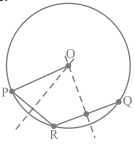
Given an arc of a circle,complete the circle.
Solution
(N/A) Let arc $PQ$ of a circle be given. We have to complete the circle,which means that we have to find its centre and radius.
$1$. Take a point $R$ on the arc $PQ$.
$2$. Join $PR$ and $RQ$ to form two chords $PR$ and $RQ$.
$3$. Draw the perpendicular bisectors of chords $PR$ and $RQ$.
$4$. The point where these two perpendicular bisectors intersect is the centre $O$ of the circle.
$5$. With $O$ as the centre and $OP$ (or $OQ$ or $OR$) as the radius,draw the circle to complete it.
$1$. Take a point $R$ on the arc $PQ$.
$2$. Join $PR$ and $RQ$ to form two chords $PR$ and $RQ$.
$3$. Draw the perpendicular bisectors of chords $PR$ and $RQ$.
$4$. The point where these two perpendicular bisectors intersect is the centre $O$ of the circle.
$5$. With $O$ as the centre and $OP$ (or $OQ$ or $OR$) as the radius,draw the circle to complete it.
0 likes
View Solution6
Medium
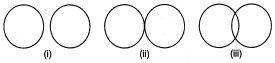
Draw different pairs of circles. How many points does each pair have in common? What is the maximum number of common points?
Solution
(N/A) Let us draw different pairs of circles as shown below:
Thus,two circles can have at the most $2$ points in common.
| In figure | Maximum number of common points |
| $(i)$ | $0$ |
| $(ii)$ | $1$ |
| $(iii)$ | $2$ |
Thus,two circles can have at the most $2$ points in common.
0 likes
View Solution7
Medium
Suppose you are given a circle. Give a construction to find its centre.
Solution
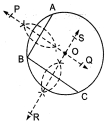
(N/A) Steps of construction:
$I.$ Take any three points on the given circle. Let these be $A, B$ and $C$.
$II.$ Join $AB$ and $BC$.
$III.$ Draw the perpendicular bisector $PQ$ of $AB$.
$IV.$ Draw the perpendicular bisector $RS$ of $BC$ such that it intersects $PQ$ at $O$.
Thus,$O$ is the required centre of the given circle.
$I.$ Take any three points on the given circle. Let these be $A, B$ and $C$.
$II.$ Join $AB$ and $BC$.
$III.$ Draw the perpendicular bisector $PQ$ of $AB$.
$IV.$ Draw the perpendicular bisector $RS$ of $BC$ such that it intersects $PQ$ at $O$.
Thus,$O$ is the required centre of the given circle.
0 likes
View Solution8
Difficult
If two circles intersect at two points,prove that their centres lie on the perpendicular bisector of the common chord.
Solution
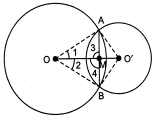
(N/A) Let there be two circles with centres $O$ and $O^{\prime}$ that intersect at points $A$ and $B$.
$AB$ is the common chord of the two circles,and $OO^{\prime}$ is the line segment joining the centres. Let $OO^{\prime}$ and $AB$ intersect at point $M$.
To prove that $OO^{\prime}$ is the perpendicular bisector of $AB$,we join $OA, OB, O^{\prime}A$,and $O^{\prime}B$.
In $\Delta OAO^{\prime}$ and $\Delta OBO^{\prime}$:
$OA = OB$ (radii of the same circle)
$O^{\prime}A = O^{\prime}B$ (radii of the same circle)
$OO^{\prime} = OO^{\prime}$ (common side)
By $SSS$ congruence criterion,$\Delta OAO^{\prime} \cong \Delta OBO^{\prime}$.
Therefore,$\angle 1 = \angle 2$ (by $CPCT$).
Now,in $\Delta AOM$ and $\Delta BOM$:
$OA = OB$ (radii of the same circle)
$OM = OM$ (common side)
$\angle 1 = \angle 2$ (proved above)
By $SAS$ congruence criterion,$\Delta AOM \cong \Delta BOM$.
Therefore,$AM = BM$ (by $CPCT$) and $\angle 3 = \angle 4$ (by $CPCT$).
Since $AB$ is a line segment,$\angle 3 + \angle 4 = 180^{\circ}$ (linear pair).
Thus,$2 \angle 3 = 180^{\circ} \Rightarrow \angle 3 = 90^{\circ}$.
Since $\angle 3 = \angle 4 = 90^{\circ}$ and $AM = BM$,$OO^{\prime}$ is the perpendicular bisector of $AB$.
$AB$ is the common chord of the two circles,and $OO^{\prime}$ is the line segment joining the centres. Let $OO^{\prime}$ and $AB$ intersect at point $M$.
To prove that $OO^{\prime}$ is the perpendicular bisector of $AB$,we join $OA, OB, O^{\prime}A$,and $O^{\prime}B$.
In $\Delta OAO^{\prime}$ and $\Delta OBO^{\prime}$:
$OA = OB$ (radii of the same circle)
$O^{\prime}A = O^{\prime}B$ (radii of the same circle)
$OO^{\prime} = OO^{\prime}$ (common side)
By $SSS$ congruence criterion,$\Delta OAO^{\prime} \cong \Delta OBO^{\prime}$.
Therefore,$\angle 1 = \angle 2$ (by $CPCT$).
Now,in $\Delta AOM$ and $\Delta BOM$:
$OA = OB$ (radii of the same circle)
$OM = OM$ (common side)
$\angle 1 = \angle 2$ (proved above)
By $SAS$ congruence criterion,$\Delta AOM \cong \Delta BOM$.
Therefore,$AM = BM$ (by $CPCT$) and $\angle 3 = \angle 4$ (by $CPCT$).
Since $AB$ is a line segment,$\angle 3 + \angle 4 = 180^{\circ}$ (linear pair).
Thus,$2 \angle 3 = 180^{\circ} \Rightarrow \angle 3 = 90^{\circ}$.
Since $\angle 3 = \angle 4 = 90^{\circ}$ and $AM = BM$,$OO^{\prime}$ is the perpendicular bisector of $AB$.
0 likes
View Solution9
Medium
If two intersecting chords of a circle make equal angles with the diameter passing through their point of intersection,prove that the chords are equal.
Solution
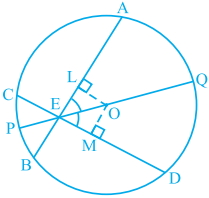
(N/A) Given that $AB$ and $CD$ are two chords of a circle with centre $O$,intersecting at a point $E$. $PQ$ is a diameter passing through $E$,such that $\angle AEQ = \angle DEQ$. We need to prove that $AB = CD$.
Draw perpendiculars $OL$ and $OM$ on chords $AB$ and $CD$,respectively.
In $\Delta OLE$,$\angle OLE = 90^{\circ}$. Therefore,$\angle LOE = 180^{\circ} - 90^{\circ} - \angle LEO = 90^{\circ} - \angle LEO$.
Since $\angle LEO = \angle AEQ$ (vertically opposite angles),we have $\angle LOE = 90^{\circ} - \angle AEQ$.
Similarly,in $\Delta OME$,$\angle OME = 90^{\circ}$. Therefore,$\angle MOE = 90^{\circ} - \angle MEO = 90^{\circ} - \angle DEQ$.
Since it is given that $\angle AEQ = \angle DEQ$,it follows that $\angle LOE = \angle MOE$.
Now,in triangles $OLE$ and $OME$:
$1$. $\angle LEO = \angle MEO$ (Given $\angle AEQ = \angle DEQ$ and vertically opposite angles)
$2$. $\angle LOE = \angle MOE$ (Proved above)
$3$. $EO = EO$ (Common side)
By $ASA$ congruence criterion,$\Delta OLE \cong \Delta OME$.
By $CPCT$,$OL = OM$.
Since chords equidistant from the centre of a circle are equal in length,it follows that $AB = CD$.
Draw perpendiculars $OL$ and $OM$ on chords $AB$ and $CD$,respectively.
In $\Delta OLE$,$\angle OLE = 90^{\circ}$. Therefore,$\angle LOE = 180^{\circ} - 90^{\circ} - \angle LEO = 90^{\circ} - \angle LEO$.
Since $\angle LEO = \angle AEQ$ (vertically opposite angles),we have $\angle LOE = 90^{\circ} - \angle AEQ$.
Similarly,in $\Delta OME$,$\angle OME = 90^{\circ}$. Therefore,$\angle MOE = 90^{\circ} - \angle MEO = 90^{\circ} - \angle DEQ$.
Since it is given that $\angle AEQ = \angle DEQ$,it follows that $\angle LOE = \angle MOE$.
Now,in triangles $OLE$ and $OME$:
$1$. $\angle LEO = \angle MEO$ (Given $\angle AEQ = \angle DEQ$ and vertically opposite angles)
$2$. $\angle LOE = \angle MOE$ (Proved above)
$3$. $EO = EO$ (Common side)
By $ASA$ congruence criterion,$\Delta OLE \cong \Delta OME$.
By $CPCT$,$OL = OM$.
Since chords equidistant from the centre of a circle are equal in length,it follows that $AB = CD$.
0 likes
View Solution10
DifficultMCQ
Two circles of radii $5\, cm$ and $3\, cm$ intersect at two points and the distance between their centres is $4\, cm.$ Find the length of the common chord. (in $, cm$)
A
$8$
B
$6$
C
$10$
D
$12$
Solution
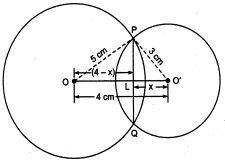
(B) Let the two circles have centres $O$ and $O'$ with radii $r_1 = 5\, cm$ and $r_2 = 3\, cm$ respectively. The distance between the centres $OO' = 4\, cm$.
Let $PQ$ be the common chord intersecting $OO'$ at $L$.
Since the line joining the centres is the perpendicular bisector of the common chord,$\angle OLP = 90^{\circ}$ and $PL = LQ$.
Let $O'L = x$,then $OL = 4 - x$.
In right-angled $\Delta OLP$,by Pythagoras theorem:
$PL^2 + OL^2 = OP^2$
$PL^2 + (4 - x)^2 = 5^2$
$PL^2 = 25 - (16 - 8x + x^2) = 9 + 8x - x^2 \quad \dots(1)$
In right-angled $\Delta O'LP$,by Pythagoras theorem:
$PL^2 + O'L^2 = O'P^2$
$PL^2 + x^2 = 3^2$
$PL^2 = 9 - x^2 \quad \dots(2)$
Equating $(1)$ and $(2)$:
$9 + 8x - x^2 = 9 - x^2$
$8x = 0 \Rightarrow x = 0$.
This means $L$ coincides with $O'$. Thus,$PQ$ is the diameter of the smaller circle.
$PL^2 = 9 - 0^2 = 9 \Rightarrow PL = 3\, cm$.
Since $PQ = 2 \times PL = 2 \times 3 = 6\, cm$.
The length of the common chord is $6\, cm$.
Let $PQ$ be the common chord intersecting $OO'$ at $L$.
Since the line joining the centres is the perpendicular bisector of the common chord,$\angle OLP = 90^{\circ}$ and $PL = LQ$.
Let $O'L = x$,then $OL = 4 - x$.
In right-angled $\Delta OLP$,by Pythagoras theorem:
$PL^2 + OL^2 = OP^2$
$PL^2 + (4 - x)^2 = 5^2$
$PL^2 = 25 - (16 - 8x + x^2) = 9 + 8x - x^2 \quad \dots(1)$
In right-angled $\Delta O'LP$,by Pythagoras theorem:
$PL^2 + O'L^2 = O'P^2$
$PL^2 + x^2 = 3^2$
$PL^2 = 9 - x^2 \quad \dots(2)$
Equating $(1)$ and $(2)$:
$9 + 8x - x^2 = 9 - x^2$
$8x = 0 \Rightarrow x = 0$.
This means $L$ coincides with $O'$. Thus,$PQ$ is the diameter of the smaller circle.
$PL^2 = 9 - 0^2 = 9 \Rightarrow PL = 3\, cm$.
Since $PQ = 2 \times PL = 2 \times 3 = 6\, cm$.
The length of the common chord is $6\, cm$.
0 likes
View Solution11
Difficult
If two equal chords of a circle intersect within the circle,prove that the segments of one chord are equal to corresponding segments of the other chord.
Solution
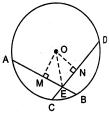
(N/A) Let there be a circle with center $O$. Let $AB$ and $CD$ be two equal chords that intersect at a point $E$ inside the circle.
To prove: $AE = DE$ and $CE = BE$.
Construction: Draw $OM \perp AB$ and $ON \perp CD$. Join $OE$.
Proof:
$1$. Since $AB = CD$ (given),the chords are equidistant from the center. Therefore,$OM = ON$.
$2$. In $\Delta OME$ and $\Delta ONE$:
- $OM = ON$ (Proved above)
- $OE = OE$ (Common side)
- $\angle OME = \angle ONE = 90^\circ$ (By construction)
By $RHS$ congruence criterion,$\Delta OME \cong \Delta ONE$.
$3$. By $CPCT$,$ME = NE$ (Equation $1$).
$4$. Since $OM \perp AB$,$M$ is the midpoint of $AB$,so $AM = MB = \frac{1}{2} AB$.
$5$. Since $ON \perp CD$,$N$ is the midpoint of $CD$,so $CN = ND = \frac{1}{2} CD$.
$6$. Since $AB = CD$,then $\frac{1}{2} AB = \frac{1}{2} CD$,which implies $AM = ND$ (Equation $2$).
$7$. Adding equations $1$ and $2$: $AM + ME = ND + NE$,which gives $AE = DE$.
$8$. Subtracting $AE = DE$ from $AB = CD$,we get $AB - AE = CD - DE$,which implies $BE = CE$.
Thus,the segments of one chord are equal to the corresponding segments of the other chord.
To prove: $AE = DE$ and $CE = BE$.
Construction: Draw $OM \perp AB$ and $ON \perp CD$. Join $OE$.
Proof:
$1$. Since $AB = CD$ (given),the chords are equidistant from the center. Therefore,$OM = ON$.
$2$. In $\Delta OME$ and $\Delta ONE$:
- $OM = ON$ (Proved above)
- $OE = OE$ (Common side)
- $\angle OME = \angle ONE = 90^\circ$ (By construction)
By $RHS$ congruence criterion,$\Delta OME \cong \Delta ONE$.
$3$. By $CPCT$,$ME = NE$ (Equation $1$).
$4$. Since $OM \perp AB$,$M$ is the midpoint of $AB$,so $AM = MB = \frac{1}{2} AB$.
$5$. Since $ON \perp CD$,$N$ is the midpoint of $CD$,so $CN = ND = \frac{1}{2} CD$.
$6$. Since $AB = CD$,then $\frac{1}{2} AB = \frac{1}{2} CD$,which implies $AM = ND$ (Equation $2$).
$7$. Adding equations $1$ and $2$: $AM + ME = ND + NE$,which gives $AE = DE$.
$8$. Subtracting $AE = DE$ from $AB = CD$,we get $AB - AE = CD - DE$,which implies $BE = CE$.
Thus,the segments of one chord are equal to the corresponding segments of the other chord.
0 likes
View Solution12
Medium
If two equal chords of a circle intersect within the circle,prove that the line joining the point of intersection to the centre makes equal angles with the chords.
Solution
(N/A) Let $AB$ and $CD$ be two equal chords of a circle with centre $O$,intersecting at point $E$ inside the circle.
We need to prove that $\angle OEA = \angle OED$.
Draw $OM \perp AB$ and $ON \perp CD$.
In $\Delta OME$ and $\Delta ONE$:
$1$. $OM = ON$ (Equal chords are equidistant from the centre).
$2$. $OE = OE$ (Common side).
$3$. $\angle OME = \angle ONE = 90^\circ$ (By construction).
Therefore,by $RHS$ congruence criterion,$\Delta OME \cong \Delta ONE$.
By $CPCT$,$\angle OEM = \angle OEN$.
Since $M$ lies on $AB$ and $N$ lies on $CD$,this implies $\angle OEA = \angle OED$.
We need to prove that $\angle OEA = \angle OED$.
Draw $OM \perp AB$ and $ON \perp CD$.
In $\Delta OME$ and $\Delta ONE$:
$1$. $OM = ON$ (Equal chords are equidistant from the centre).
$2$. $OE = OE$ (Common side).
$3$. $\angle OME = \angle ONE = 90^\circ$ (By construction).
Therefore,by $RHS$ congruence criterion,$\Delta OME \cong \Delta ONE$.
By $CPCT$,$\angle OEM = \angle OEN$.
Since $M$ lies on $AB$ and $N$ lies on $CD$,this implies $\angle OEA = \angle OED$.
0 likes
View Solution13
Medium
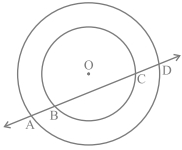
If a line intersects two concentric circles (circles with the same centre) with centre $O$ at $A, B, C$ and $D$,prove that $AB = CD$.
Solution
(N/A) We have two circles with the common centre $O$.
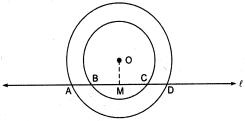
$A$ line $\ell$ intersects the outer circle at $A$ and $D$ and the inner circle at $B$ and $C$. To prove that $AB = CD$,let us draw $OM \perp \ell$.
For the outer circle,
$\because OM \perp \ell$,and the perpendicular from the centre to a chord bisects the chord,
$\therefore AM = MD$ --- $(1)$
For the inner circle,
$\because OM \perp \ell$,
$\therefore BM = MC$ --- $(2)$
Subtracting $(2)$ from $(1)$,we have:
$AM - BM = MD - MC$
$AB = CD$
Hence,it is proved.
$A$ line $\ell$ intersects the outer circle at $A$ and $D$ and the inner circle at $B$ and $C$. To prove that $AB = CD$,let us draw $OM \perp \ell$.
For the outer circle,
$\because OM \perp \ell$,and the perpendicular from the centre to a chord bisects the chord,
$\therefore AM = MD$ --- $(1)$
For the inner circle,
$\because OM \perp \ell$,
$\therefore BM = MC$ --- $(2)$
Subtracting $(2)$ from $(1)$,we have:
$AM - BM = MD - MC$
$AB = CD$
Hence,it is proved.
0 likes
View Solution14
DifficultMCQ
Three girls Reshma,Salma,and Mandip are playing a game by standing on a circle of radius $5 \, m$ drawn in a park. Reshma throws a ball to Salma,Salma to Mandip,and Mandip to Reshma. If the distance between Reshma and Salma and between Salma and Mandip is $6 \, m$ each,what is the distance between Reshma and Mandip (in $, m$)?
A
$10.6$
B
$9.6$
C
$11.6$
D
$13.6$
Solution
(B) Let the positions of Reshma,Salma,and Mandip be $R, S,$ and $M$ respectively on the circle with center $O$ and radius $5 \, m$.
Given $RS = SM = 6 \, m$.
Since equal chords subtend equal angles at the center,$\angle ROS = \angle SOM$.
Let $OP$ be the perpendicular from $O$ to $RM$,intersecting $RM$ at $P$ and $OS$ at $K$.
Since $RS = SM$,$OS$ is the perpendicular bisector of $RM$. Thus,$RM \perp OS$ and $RP = PM$.
Let $OK = x$. Then $KS = 5 - x$.
In $\Delta ORK$,$RK^2 = OR^2 - OK^2 = 5^2 - x^2 = 25 - x^2$.
In $\Delta RSK$,$RK^2 = RS^2 - KS^2 = 6^2 - (5 - x)^2 = 36 - (25 - 10x + x^2) = 11 + 10x - x^2$.
Equating the two expressions for $RK^2$: $25 - x^2 = 11 + 10x - x^2$.
$10x = 14 \Rightarrow x = 1.4 \, m$.
Now,$RK^2 = 25 - (1.4)^2 = 25 - 1.96 = 23.04$.
$RK = \sqrt{23.04} = 4.8 \, m$.
Since $RM = 2 \times RK$,$RM = 2 \times 4.8 = 9.6 \, m$.
Given $RS = SM = 6 \, m$.
Since equal chords subtend equal angles at the center,$\angle ROS = \angle SOM$.
Let $OP$ be the perpendicular from $O$ to $RM$,intersecting $RM$ at $P$ and $OS$ at $K$.
Since $RS = SM$,$OS$ is the perpendicular bisector of $RM$. Thus,$RM \perp OS$ and $RP = PM$.
Let $OK = x$. Then $KS = 5 - x$.
In $\Delta ORK$,$RK^2 = OR^2 - OK^2 = 5^2 - x^2 = 25 - x^2$.
In $\Delta RSK$,$RK^2 = RS^2 - KS^2 = 6^2 - (5 - x)^2 = 36 - (25 - 10x + x^2) = 11 + 10x - x^2$.
Equating the two expressions for $RK^2$: $25 - x^2 = 11 + 10x - x^2$.
$10x = 14 \Rightarrow x = 1.4 \, m$.
Now,$RK^2 = 25 - (1.4)^2 = 25 - 1.96 = 23.04$.
$RK = \sqrt{23.04} = 4.8 \, m$.
Since $RM = 2 \times RK$,$RM = 2 \times 4.8 = 9.6 \, m$.
0 likes
View Solution15
DifficultMCQ
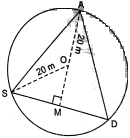
$A$ circular park of radius $20 \, m$ is situated in a colony. Three boys Ankur,Syed and David are sitting at equal distances on its boundary,each having a toy telephone in his hands to talk to each other. Find the length of the string of each phone.
A
$30 \sqrt{3} \, m$
B
$10 \sqrt{3} \, m$
C
$20 \sqrt{3} \, m$
D
$23 \sqrt{3} \, m$
Solution
(C) Let the positions of Ankur,Syed,and David be $A, S,$ and $D$ respectively on the circle with center $O$ and radius $20 \, m$.
Since they are sitting at equal distances,$\Delta ASD$ is an equilateral triangle.
Let the side length of the equilateral triangle be $a$.
In an equilateral triangle,the circumradius $R$ is given by $R = \frac{a}{\sqrt{3}}$.
Given $R = 20 \, m$,we have $20 = \frac{a}{\sqrt{3}}$.
Therefore,$a = 20 \sqrt{3} \, m$.
The length of the string of each phone is the side length of the equilateral triangle,which is $20 \sqrt{3} \, m$.
Since they are sitting at equal distances,$\Delta ASD$ is an equilateral triangle.
Let the side length of the equilateral triangle be $a$.
In an equilateral triangle,the circumradius $R$ is given by $R = \frac{a}{\sqrt{3}}$.
Given $R = 20 \, m$,we have $20 = \frac{a}{\sqrt{3}}$.
Therefore,$a = 20 \sqrt{3} \, m$.
The length of the string of each phone is the side length of the equilateral triangle,which is $20 \sqrt{3} \, m$.
0 likes
View Solution16
Medium
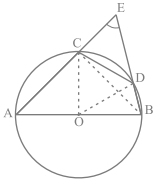
In the figure,$AB$ is a diameter of the circle,and $CD$ is a chord equal to the radius of the circle. $AC$ and $BD$ when extended intersect at a point $E$. Prove that $\angle AEB = 60^{\circ}$.
Solution
(N/A) Join $OC$,$OD$,and $BC$.
Since $CD$ is equal to the radius of the circle $(OC = OD = CD)$,triangle $ODC$ is an equilateral triangle.
Therefore,$\angle COD = 60^{\circ}$.
Now,the angle subtended by an arc at the center is double the angle subtended by it at any point on the remaining part of the circle.
Thus,$\angle CBD = \frac{1}{2} \angle COD = \frac{1}{2} \times 60^{\circ} = 30^{\circ}$.
Since $AB$ is the diameter,the angle in a semicircle is a right angle,so $\angle ACB = 90^{\circ}$.
Since $ACE$ is a straight line,$\angle BCE = 180^{\circ} - \angle ACB = 180^{\circ} - 90^{\circ} = 90^{\circ}$.
In $\triangle BCE$,the sum of angles is $180^{\circ}$.
Therefore,$\angle CEB + \angle BCE + \angle CBE = 180^{\circ}$.
$\angle CEB + 90^{\circ} + 30^{\circ} = 180^{\circ}$.
$\angle CEB = 180^{\circ} - 120^{\circ} = 60^{\circ}$.
Hence,$\angle AEB = 60^{\circ}$.
Since $CD$ is equal to the radius of the circle $(OC = OD = CD)$,triangle $ODC$ is an equilateral triangle.
Therefore,$\angle COD = 60^{\circ}$.
Now,the angle subtended by an arc at the center is double the angle subtended by it at any point on the remaining part of the circle.
Thus,$\angle CBD = \frac{1}{2} \angle COD = \frac{1}{2} \times 60^{\circ} = 30^{\circ}$.
Since $AB$ is the diameter,the angle in a semicircle is a right angle,so $\angle ACB = 90^{\circ}$.
Since $ACE$ is a straight line,$\angle BCE = 180^{\circ} - \angle ACB = 180^{\circ} - 90^{\circ} = 90^{\circ}$.
In $\triangle BCE$,the sum of angles is $180^{\circ}$.
Therefore,$\angle CEB + \angle BCE + \angle CBE = 180^{\circ}$.
$\angle CEB + 90^{\circ} + 30^{\circ} = 180^{\circ}$.
$\angle CEB = 180^{\circ} - 120^{\circ} = 60^{\circ}$.
Hence,$\angle AEB = 60^{\circ}$.
0 likes
View Solution17
MediumMCQ
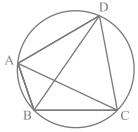
In the figure,$ABCD$ is a cyclic quadrilateral in which $AC$ and $BD$ are its diagonals. If $\angle DBC = 55^{\circ}$ and $\angle BAC = 45^{\circ}$,find $\angle BCD$. (in $^{\circ}$)
A
$80$
B
$60$
C
$40$
D
$30$
Solution
(A) We know that angles in the same segment of a circle are equal.
Therefore,$\angle CAD = \angle DBC = 55^{\circ}$.
Now,the total angle $\angle DAB = \angle CAD + \angle BAC$.
Substituting the values,$\angle DAB = 55^{\circ} + 45^{\circ} = 100^{\circ}$.
Since $ABCD$ is a cyclic quadrilateral,the sum of its opposite angles is $180^{\circ}$.
Thus,$\angle DAB + \angle BCD = 180^{\circ}$.
Substituting the value of $\angle DAB$,we get $100^{\circ} + \angle BCD = 180^{\circ}$.
Therefore,$\angle BCD = 180^{\circ} - 100^{\circ} = 80^{\circ}$.
Therefore,$\angle CAD = \angle DBC = 55^{\circ}$.
Now,the total angle $\angle DAB = \angle CAD + \angle BAC$.
Substituting the values,$\angle DAB = 55^{\circ} + 45^{\circ} = 100^{\circ}$.
Since $ABCD$ is a cyclic quadrilateral,the sum of its opposite angles is $180^{\circ}$.
Thus,$\angle DAB + \angle BCD = 180^{\circ}$.
Substituting the value of $\angle DAB$,we get $100^{\circ} + \angle BCD = 180^{\circ}$.
Therefore,$\angle BCD = 180^{\circ} - 100^{\circ} = 80^{\circ}$.
0 likes
View Solution18
Medium
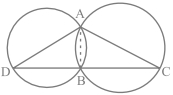
Two circles intersect at two points $A$ and $B$. $AD$ and $AC$ are diameters to the two circles (see Fig.). Prove that $B$ lies on the line segment $DC$.
Solution
(N/A) Join $AB.$
$\angle ABD = 90^\circ$ (Angle in a semicircle is a right angle).
$\angle ABC = 90^\circ$ (Angle in a semicircle is a right angle).
Adding these two equations,we get:
$\angle ABD + \angle ABC = 90^\circ + 90^\circ = 180^\circ.$
Since the sum of the angles is $180^\circ$,the points $D, B,$ and $C$ form a straight line. Therefore,$B$ lies on the line segment $DC.$
$\angle ABD = 90^\circ$ (Angle in a semicircle is a right angle).
$\angle ABC = 90^\circ$ (Angle in a semicircle is a right angle).
Adding these two equations,we get:
$\angle ABD + \angle ABC = 90^\circ + 90^\circ = 180^\circ.$
Since the sum of the angles is $180^\circ$,the points $D, B,$ and $C$ form a straight line. Therefore,$B$ lies on the line segment $DC.$
0 likes
View Solution19
Medium
Prove that the quadrilateral formed (if possible) by the internal angle bisectors of any quadrilateral is cyclic.
Solution
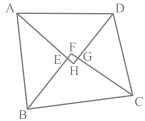
(N/A) In the figure,$ABCD$ is a quadrilateral in which the angle bisectors of internal angles $A, B, C$ and $D$ intersect to form a quadrilateral $EFGH$.
Now,in $\triangle AEB$,$\angle FEH = \angle AEB = 180^{\circ} - (\angle EAB + \angle EBA)$
$= 180^{\circ} - \frac{1}{2}(\angle A + \angle B)$
Similarly,in $\triangle CGD$,$\angle FGH = \angle CGD = 180^{\circ} - (\angle GCD + \angle GDC)$
$= 180^{\circ} - \frac{1}{2}(\angle C + \angle D)$
Adding these two equations:
$\angle FEH + \angle FGH = 180^{\circ} - \frac{1}{2}(\angle A + \angle B) + 180^{\circ} - \frac{1}{2}(\angle C + \angle D)$
$= 360^{\circ} - \frac{1}{2}(\angle A + \angle B + \angle C + \angle D)$
Since the sum of angles in a quadrilateral is $360^{\circ}$,we have:
$= 360^{\circ} - \frac{1}{2}(360^{\circ}) = 360^{\circ} - 180^{\circ} = 180^{\circ}$
Since the sum of opposite angles of quadrilateral $EFGH$ is $180^{\circ}$,it is a cyclic quadrilateral.
Now,in $\triangle AEB$,$\angle FEH = \angle AEB = 180^{\circ} - (\angle EAB + \angle EBA)$
$= 180^{\circ} - \frac{1}{2}(\angle A + \angle B)$
Similarly,in $\triangle CGD$,$\angle FGH = \angle CGD = 180^{\circ} - (\angle GCD + \angle GDC)$
$= 180^{\circ} - \frac{1}{2}(\angle C + \angle D)$
Adding these two equations:
$\angle FEH + \angle FGH = 180^{\circ} - \frac{1}{2}(\angle A + \angle B) + 180^{\circ} - \frac{1}{2}(\angle C + \angle D)$
$= 360^{\circ} - \frac{1}{2}(\angle A + \angle B + \angle C + \angle D)$
Since the sum of angles in a quadrilateral is $360^{\circ}$,we have:
$= 360^{\circ} - \frac{1}{2}(360^{\circ}) = 360^{\circ} - 180^{\circ} = 180^{\circ}$
Since the sum of opposite angles of quadrilateral $EFGH$ is $180^{\circ}$,it is a cyclic quadrilateral.
0 likes
View Solution20
MediumMCQ
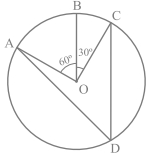
In the figure,$A, B$ and $C$ are three points on a circle with centre $O$ such that $\angle BOC = 30^{\circ}$ and $\angle AOB = 60^{\circ}$. If $D$ is a point on the circle other than the arc $ABC$,find $\angle ADC$. (in $^{\circ}$)
A
$30$
B
$55$
C
$50$
D
$45$
Solution
(D) Given,a circle with centre $O$ such that $\angle AOB = 60^{\circ}$ and $\angle BOC = 30^{\circ}$.
Since $\angle AOC = \angle AOB + \angle BOC$,we have $\angle AOC = 60^{\circ} + 30^{\circ} = 90^{\circ}$.
The arc $ABC$ subtends an angle $\angle AOC = 90^{\circ}$ at the centre of the circle.
According to the theorem,the angle subtended by an arc at the centre is double the angle subtended by it at any point on the remaining part of the circle.
Therefore,$\angle ADC = \frac{1}{2} \angle AOC$.
$\angle ADC = \frac{1}{2} (90^{\circ}) = 45^{\circ}$.
Since $\angle AOC = \angle AOB + \angle BOC$,we have $\angle AOC = 60^{\circ} + 30^{\circ} = 90^{\circ}$.
The arc $ABC$ subtends an angle $\angle AOC = 90^{\circ}$ at the centre of the circle.
According to the theorem,the angle subtended by an arc at the centre is double the angle subtended by it at any point on the remaining part of the circle.
Therefore,$\angle ADC = \frac{1}{2} \angle AOC$.
$\angle ADC = \frac{1}{2} (90^{\circ}) = 45^{\circ}$.
0 likes
View Solution21
Medium
$A$ chord of a circle is equal to the radius of the circle. Find the angle subtended by the chord at a point on the minor arc and also at a point on the major arc.
Solution
(A) Let the chord be $AB$ and the center of the circle be $O$. Since the chord $AB$ is equal to the radius of the circle,we have $OA = OB = AB$.
Therefore,$\Delta AOB$ is an equilateral triangle.
Since each angle of an equilateral triangle is $60^{\circ}$,we have $\angle AOB = 60^{\circ}$.
The reflex angle subtended by the chord at the center is $\text{reflex } \angle AOB = 360^{\circ} - 60^{\circ} = 300^{\circ}$.
The angle subtended by the chord at a point $C$ on the minor arc is half of the reflex angle subtended at the center: $\angle ACB = \frac{1}{2} \times 300^{\circ} = 150^{\circ}$.
The angle subtended by the chord at a point $D$ on the major arc is half of the angle subtended at the center: $\angle ADB = \frac{1}{2} \times 60^{\circ} = 30^{\circ}$.
Thus,the angle subtended by the chord on the minor arc is $150^{\circ}$ and on the major arc is $30^{\circ}$.
Therefore,$\Delta AOB$ is an equilateral triangle.
Since each angle of an equilateral triangle is $60^{\circ}$,we have $\angle AOB = 60^{\circ}$.
The reflex angle subtended by the chord at the center is $\text{reflex } \angle AOB = 360^{\circ} - 60^{\circ} = 300^{\circ}$.
The angle subtended by the chord at a point $C$ on the minor arc is half of the reflex angle subtended at the center: $\angle ACB = \frac{1}{2} \times 300^{\circ} = 150^{\circ}$.
The angle subtended by the chord at a point $D$ on the major arc is half of the angle subtended at the center: $\angle ADB = \frac{1}{2} \times 60^{\circ} = 30^{\circ}$.
Thus,the angle subtended by the chord on the minor arc is $150^{\circ}$ and on the major arc is $30^{\circ}$.
0 likes
View Solution22
DifficultMCQ
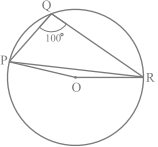
In the figure,$\angle PQR = 100^{\circ}$,where $P, Q$ and $R$ are points on a circle with centre $O$. Find $\angle OPR$. (in $^{\circ}$)
A
$20$
B
$10$
C
$30$
D
$40$
Solution
(B) The angle subtended by an arc of a circle at its centre is twice the angle subtended by the same arc at any point on the remaining part of the circle.
Therefore,reflex $\angle POR = 2 \times \angle PQR$.
Given $\angle PQR = 100^{\circ}$.
So,reflex $\angle POR = 2 \times 100^{\circ} = 200^{\circ}$.
Since $\angle POR + \text{reflex } \angle POR = 360^{\circ}$,we have $\angle POR + 200^{\circ} = 360^{\circ}$.
Thus,$\angle POR = 360^{\circ} - 200^{\circ} = 160^{\circ}$.
In $\Delta POR$,$OP = OR$ (radii of the same circle).
Therefore,$\angle OPR = \angle ORP$ (angles opposite to equal sides are equal).
In $\Delta POR$,the sum of angles is $180^{\circ}$,so $\angle OPR + \angle ORP + \angle POR = 180^{\circ}$.
Substituting $\angle ORP = \angle OPR$,we get $2 \angle OPR + 160^{\circ} = 180^{\circ}$.
$2 \angle OPR = 180^{\circ} - 160^{\circ} = 20^{\circ}$.
$\angle OPR = \frac{20^{\circ}}{2} = 10^{\circ}$.
Therefore,reflex $\angle POR = 2 \times \angle PQR$.
Given $\angle PQR = 100^{\circ}$.
So,reflex $\angle POR = 2 \times 100^{\circ} = 200^{\circ}$.
Since $\angle POR + \text{reflex } \angle POR = 360^{\circ}$,we have $\angle POR + 200^{\circ} = 360^{\circ}$.
Thus,$\angle POR = 360^{\circ} - 200^{\circ} = 160^{\circ}$.
In $\Delta POR$,$OP = OR$ (radii of the same circle).
Therefore,$\angle OPR = \angle ORP$ (angles opposite to equal sides are equal).
In $\Delta POR$,the sum of angles is $180^{\circ}$,so $\angle OPR + \angle ORP + \angle POR = 180^{\circ}$.
Substituting $\angle ORP = \angle OPR$,we get $2 \angle OPR + 160^{\circ} = 180^{\circ}$.
$2 \angle OPR = 180^{\circ} - 160^{\circ} = 20^{\circ}$.
$\angle OPR = \frac{20^{\circ}}{2} = 10^{\circ}$.
0 likes
View Solution23
MediumMCQ
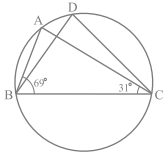
In the figure,$\angle ABC = 69^{\circ}$ and $\angle ACB = 31^{\circ}$. Find $\angle BDC$. (in $^{\circ}$)
A
$70$
B
$45$
C
$80$
D
$40$
Solution
(C) In $\Delta ABC$,we have:
$\angle ABC = 69^{\circ}$ and $\angle ACB = 31^{\circ}$.
We know that the sum of the angles in a triangle is $180^{\circ}$.
Therefore,$\angle ABC + \angle ACB + \angle BAC = 180^{\circ}$.
$69^{\circ} + 31^{\circ} + \angle BAC = 180^{\circ}$.
$100^{\circ} + \angle BAC = 180^{\circ}$.
$\angle BAC = 180^{\circ} - 100^{\circ} = 80^{\circ}$.
Since angles in the same segment of a circle are equal,we have $\angle BDC = \angle BAC$.
Therefore,$\angle BDC = 80^{\circ}$.
$\angle ABC = 69^{\circ}$ and $\angle ACB = 31^{\circ}$.
We know that the sum of the angles in a triangle is $180^{\circ}$.
Therefore,$\angle ABC + \angle ACB + \angle BAC = 180^{\circ}$.
$69^{\circ} + 31^{\circ} + \angle BAC = 180^{\circ}$.
$100^{\circ} + \angle BAC = 180^{\circ}$.
$\angle BAC = 180^{\circ} - 100^{\circ} = 80^{\circ}$.
Since angles in the same segment of a circle are equal,we have $\angle BDC = \angle BAC$.
Therefore,$\angle BDC = 80^{\circ}$.
0 likes
View Solution24
MediumMCQ
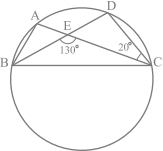
In the figure,$A, B, C$ and $D$ are four points on a circle. $AC$ and $BD$ intersect at a point $E$ such that $\angle BEC = 130^{\circ}$ and $\angle ECD = 20^{\circ}$. Find $\angle BAC$. (in $^{\circ}$)
A
$112$
B
$115$
C
$156$
D
$110$
Solution
(D) In $\Delta CDE$,the exterior angle $\angle BEC$ is equal to the sum of the interior opposite angles.
$\angle BEC = \angle EDC + \angle ECD$
Given $\angle BEC = 130^{\circ}$ and $\angle ECD = 20^{\circ}$.
$130^{\circ} = \angle EDC + 20^{\circ}$
$\angle EDC = 130^{\circ} - 20^{\circ} = 110^{\circ}$
Since $\angle EDC$ and $\angle BDC$ represent the same angle,$\angle BDC = 110^{\circ}$.
Angles in the same segment of a circle are equal.
Therefore,$\angle BAC = \angle BDC$.
$\angle BAC = 110^{\circ}$.
$\angle BEC = \angle EDC + \angle ECD$
Given $\angle BEC = 130^{\circ}$ and $\angle ECD = 20^{\circ}$.
$130^{\circ} = \angle EDC + 20^{\circ}$
$\angle EDC = 130^{\circ} - 20^{\circ} = 110^{\circ}$
Since $\angle EDC$ and $\angle BDC$ represent the same angle,$\angle BDC = 110^{\circ}$.
Angles in the same segment of a circle are equal.
Therefore,$\angle BAC = \angle BDC$.
$\angle BAC = 110^{\circ}$.
0 likes
View Solution25
MediumMCQ
$ABCD$ is a cyclic quadrilateral whose diagonals intersect at a point $E$. If $\angle DBC = 70^{\circ}$ and $\angle BAC = 30^{\circ}$,find $\angle BCD$. Further,if $AB = BC$,find $\angle ECD$.
A
$80^{\circ}; 50^{\circ}$
B
$20^{\circ}; 40^{\circ}$
C
$10^{\circ}; 60^{\circ}$
D
$90^{\circ}; 55^{\circ}$
Solution
(A) Since angles in the same segment of a circle are equal,we have $\angle BAC = \angle BDC$.
Given $\angle BAC = 30^{\circ}$,therefore $\angle BDC = 30^{\circ}$.
In $\Delta BCD$,the sum of angles is $180^{\circ}$:
$\angle BCD + \angle DBC + \angle BDC = 180^{\circ}$
$\angle BCD + 70^{\circ} + 30^{\circ} = 180^{\circ}$
$\angle BCD = 180^{\circ} - 100^{\circ} = 80^{\circ}$.
Now,in $\Delta ABC$,since $AB = BC$,the angles opposite to equal sides are equal,so $\angle BCA = \angle BAC = 30^{\circ}$.
Since $\angle BCD = \angle BCA + \angle ECD$,we have:
$80^{\circ} = 30^{\circ} + \angle ECD$
$\angle ECD = 80^{\circ} - 30^{\circ} = 50^{\circ}$.
Given $\angle BAC = 30^{\circ}$,therefore $\angle BDC = 30^{\circ}$.
In $\Delta BCD$,the sum of angles is $180^{\circ}$:
$\angle BCD + \angle DBC + \angle BDC = 180^{\circ}$
$\angle BCD + 70^{\circ} + 30^{\circ} = 180^{\circ}$
$\angle BCD = 180^{\circ} - 100^{\circ} = 80^{\circ}$.
Now,in $\Delta ABC$,since $AB = BC$,the angles opposite to equal sides are equal,so $\angle BCA = \angle BAC = 30^{\circ}$.
Since $\angle BCD = \angle BCA + \angle ECD$,we have:
$80^{\circ} = 30^{\circ} + \angle ECD$
$\angle ECD = 80^{\circ} - 30^{\circ} = 50^{\circ}$.
0 likes
View Solution26
Difficult
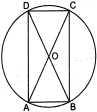
If the diagonals of a cyclic quadrilateral are diameters of the circle through the vertices of the quadrilateral,prove that it is a rectangle.
Solution
(N/A) Given: $ABCD$ is a cyclic quadrilateral where diagonals $AC$ and $BD$ are diameters of the circle.
Since $AC$ and $BD$ are diameters,they pass through the center $O$ and are equal in length $(AC = BD)$.
We know that an angle in a semicircle is a right angle.
Since $AC$ is a diameter,$\angle ABC = 90^{\circ}$ and $\angle ADC = 90^{\circ}$.
Since $BD$ is a diameter,$\angle BAD = 90^{\circ}$ and $\angle BCD = 90^{\circ}$.
Thus,all interior angles of the quadrilateral $ABCD$ are $90^{\circ}$.
$A$ quadrilateral with all angles equal to $90^{\circ}$ is a rectangle.
Therefore,$ABCD$ is a rectangle.
Since $AC$ and $BD$ are diameters,they pass through the center $O$ and are equal in length $(AC = BD)$.
We know that an angle in a semicircle is a right angle.
Since $AC$ is a diameter,$\angle ABC = 90^{\circ}$ and $\angle ADC = 90^{\circ}$.
Since $BD$ is a diameter,$\angle BAD = 90^{\circ}$ and $\angle BCD = 90^{\circ}$.
Thus,all interior angles of the quadrilateral $ABCD$ are $90^{\circ}$.
$A$ quadrilateral with all angles equal to $90^{\circ}$ is a rectangle.
Therefore,$ABCD$ is a rectangle.
0 likes
View Solution27
Medium
If the non-parallel sides of a trapezium are equal,prove that it is cyclic.
Solution
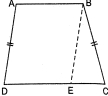
(N/A) We have a trapezium $ABCD$ such that $AB || CD$ and $AD = BC$.
Let us draw $BE || AD$ such that $ABED$ is a parallelogram.
Since the opposite angles of a parallelogram are equal,
$\angle BAD = \angle BED$ ..... $(1)$
and $AD = BE$ [Opposite sides of a parallelogram] ...... $(2)$
But $AD = BC$ [Given] ......... $(3)$
From $(2)$ and $(3)$,we have
$BE = BC$
$\Rightarrow \angle BEC = \angle BCE$ [Angles opposite to equal sides are equal]
Now,$\angle BED + \angle BEC = 180^{\circ}$ [Linear pair]
Since $\angle BED = \angle BAD$ and $\angle BEC = \angle BCE$,we have
$\angle BAD + \angle BCE = 180^{\circ}$
In quadrilateral $ABCD$,$\angle BAD + \angle BCD = \angle BAD + (\angle BCE + \angle ECD)$. Since $ABED$ is a parallelogram,$\angle ECD = \angle BAD$. Thus,the sum of opposite angles is $180^{\circ}$.
Therefore,$ABCD$ is a cyclic quadrilateral.
Let us draw $BE || AD$ such that $ABED$ is a parallelogram.
Since the opposite angles of a parallelogram are equal,
$\angle BAD = \angle BED$ ..... $(1)$
and $AD = BE$ [Opposite sides of a parallelogram] ...... $(2)$
But $AD = BC$ [Given] ......... $(3)$
From $(2)$ and $(3)$,we have
$BE = BC$
$\Rightarrow \angle BEC = \angle BCE$ [Angles opposite to equal sides are equal]
Now,$\angle BED + \angle BEC = 180^{\circ}$ [Linear pair]
Since $\angle BED = \angle BAD$ and $\angle BEC = \angle BCE$,we have
$\angle BAD + \angle BCE = 180^{\circ}$
In quadrilateral $ABCD$,$\angle BAD + \angle BCD = \angle BAD + (\angle BCE + \angle ECD)$. Since $ABED$ is a parallelogram,$\angle ECD = \angle BAD$. Thus,the sum of opposite angles is $180^{\circ}$.
Therefore,$ABCD$ is a cyclic quadrilateral.
0 likes
View Solution28
Medium
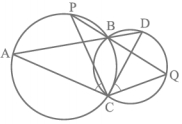
Two circles intersect at two points $B$ and $C$. Through $B$,two line segments $ABD$ and $PBQ$ are drawn to intersect the circles at $A, D$ and $P, Q$ respectively (see figure). Prove that $\angle ACP = \angle QCD$.
Solution
(N/A) Since angles in the same segment of a circle are equal:
$1$. In the circle on the left,$\angle ACP = \angle ABP$ (angles subtended by the same arc $AP$).
$2$. In the circle on the right,$\angle QCD = \angle QBD$ (angles subtended by the same arc $QD$).
$3$. Since $ABD$ and $PBQ$ are straight lines intersecting at $B$,$\angle ABP$ and $\angle QBD$ are vertically opposite angles.
$4$. Therefore,$\angle ABP = \angle QBD$.
$5$. From steps $1$,$2$,and $4$,we conclude that $\angle ACP = \angle QCD$.
$1$. In the circle on the left,$\angle ACP = \angle ABP$ (angles subtended by the same arc $AP$).
$2$. In the circle on the right,$\angle QCD = \angle QBD$ (angles subtended by the same arc $QD$).
$3$. Since $ABD$ and $PBQ$ are straight lines intersecting at $B$,$\angle ABP$ and $\angle QBD$ are vertically opposite angles.
$4$. Therefore,$\angle ABP = \angle QBD$.
$5$. From steps $1$,$2$,and $4$,we conclude that $\angle ACP = \angle QCD$.
0 likes
View Solution29
Medium
If circles are drawn taking two sides of a triangle as diameters,prove that the point of intersection of these circles lies on the third side.
Solution
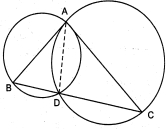
(N/A) Consider a $\Delta ABC$. Let two circles be drawn with $AB$ and $AC$ as their respective diameters. Let these circles intersect at point $A$ and another point $D$.
Join $A$ and $D$.
Since $AB$ is a diameter of the first circle,the angle subtended by it at the circumference is $90^{\circ}$.
Therefore,$\angle ADB = 90^{\circ}$ (Angle in a semicircle).
Similarly,since $AC$ is a diameter of the second circle,the angle subtended by it at the circumference is $90^{\circ}$.
Therefore,$\angle ADC = 90^{\circ}$ (Angle in a semicircle).
Adding these two angles,we get:
$\angle ADB + \angle ADC = 90^{\circ} + 90^{\circ} = 180^{\circ}$.
Since the sum of the angles is $180^{\circ}$,the points $B, D,$ and $C$ form a straight line.
Thus,the point of intersection $D$ lies on the third side $BC$.
Join $A$ and $D$.
Since $AB$ is a diameter of the first circle,the angle subtended by it at the circumference is $90^{\circ}$.
Therefore,$\angle ADB = 90^{\circ}$ (Angle in a semicircle).
Similarly,since $AC$ is a diameter of the second circle,the angle subtended by it at the circumference is $90^{\circ}$.
Therefore,$\angle ADC = 90^{\circ}$ (Angle in a semicircle).
Adding these two angles,we get:
$\angle ADB + \angle ADC = 90^{\circ} + 90^{\circ} = 180^{\circ}$.
Since the sum of the angles is $180^{\circ}$,the points $B, D,$ and $C$ form a straight line.
Thus,the point of intersection $D$ lies on the third side $BC$.
0 likes
View Solution30
Medium
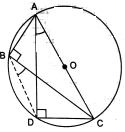
$ABC$ and $ADC$ are two right triangles with a common hypotenuse $AC$. Prove that $\angle CAD = \angle CBD$.
Solution
(N/A) We are given two right-angled triangles,$\Delta ABC$ and $\Delta ADC$,which share a common hypotenuse $AC$.
Since $\angle ABC = 90^{\circ}$ and $\angle ADC = 90^{\circ}$,both triangles are right-angled at $B$ and $D$ respectively.
Consider a circle with $AC$ as its diameter. Since $\angle ABC = 90^{\circ}$ and $\angle ADC = 90^{\circ}$,the points $B$ and $D$ must lie on this circle (because the angle in a semicircle is a right angle).
Thus,$A, B, C,$ and $D$ are concyclic points.
Now,consider the chord $CD$. The angles $\angle CAD$ and $\angle CBD$ are angles subtended by the same chord $CD$ in the same segment of the circle.
According to the theorem that angles subtended by the same arc (or chord) in the same segment of a circle are equal,we have:
$\angle CAD = \angle CBD$.
Hence proved.
Since $\angle ABC = 90^{\circ}$ and $\angle ADC = 90^{\circ}$,both triangles are right-angled at $B$ and $D$ respectively.
Consider a circle with $AC$ as its diameter. Since $\angle ABC = 90^{\circ}$ and $\angle ADC = 90^{\circ}$,the points $B$ and $D$ must lie on this circle (because the angle in a semicircle is a right angle).
Thus,$A, B, C,$ and $D$ are concyclic points.
Now,consider the chord $CD$. The angles $\angle CAD$ and $\angle CBD$ are angles subtended by the same chord $CD$ in the same segment of the circle.
According to the theorem that angles subtended by the same arc (or chord) in the same segment of a circle are equal,we have:
$\angle CAD = \angle CBD$.
Hence proved.
0 likes
View Solution31
Medium
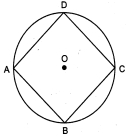
Prove that a cyclic parallelogram is a rectangle.
Solution
(N/A) Let $ABCD$ be a cyclic parallelogram.
Since $ABCD$ is a cyclic quadrilateral,the sum of its opposite angles is $180^{\circ}$.
Therefore,$\angle A + \angle C = 180^{\circ}$ .... $(1)$
In a parallelogram,opposite angles are equal,so $\angle A = \angle C$ .... $(2)$
Substituting $(2)$ in $(1)$,we get:
$\angle A + \angle A = 180^{\circ}$
$2\angle A = 180^{\circ}$
$\angle A = 90^{\circ}$
Since $\angle A = \angle C$,we have $\angle C = 90^{\circ}$.
Similarly,for the other pair of opposite angles,$\angle B + \angle D = 180^{\circ}$ and $\angle B = \angle D$,which implies $\angle B = \angle D = 90^{\circ}$.
Since all angles of the parallelogram $ABCD$ are $90^{\circ}$,$ABCD$ is a rectangle.
Since $ABCD$ is a cyclic quadrilateral,the sum of its opposite angles is $180^{\circ}$.
Therefore,$\angle A + \angle C = 180^{\circ}$ .... $(1)$
In a parallelogram,opposite angles are equal,so $\angle A = \angle C$ .... $(2)$
Substituting $(2)$ in $(1)$,we get:
$\angle A + \angle A = 180^{\circ}$
$2\angle A = 180^{\circ}$
$\angle A = 90^{\circ}$
Since $\angle A = \angle C$,we have $\angle C = 90^{\circ}$.
Similarly,for the other pair of opposite angles,$\angle B + \angle D = 180^{\circ}$ and $\angle B = \angle D$,which implies $\angle B = \angle D = 90^{\circ}$.
Since all angles of the parallelogram $ABCD$ are $90^{\circ}$,$ABCD$ is a rectangle.
0 likes
View Solution32
Medium
Prove that the line of centres of two intersecting circles subtends equal angles at the two points of intersection.
Solution
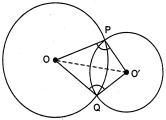
(N/A) Let there be two circles with centres $O$ and $O^{\prime}$ respectively,which intersect each other at points $P$ and $Q$. We need to prove that $\angle OPO^{\prime} = \angle OQO^{\prime}$.
Join $OP, O^{\prime}P, OQ, O^{\prime}Q$ and $OO^{\prime}$.
In $\Delta OPO^{\prime}$ and $\Delta OQO^{\prime}$:
$OP = OQ$ (Radii of the same circle with centre $O$)
$O^{\prime}P = O^{\prime}Q$ (Radii of the same circle with centre $O^{\prime}$)
$OO^{\prime} = OO^{\prime}$ (Common side)
Therefore,by the $SSS$ (Side-Side-Side) congruence criterion:
$\Delta OPO^{\prime} \cong \Delta OQO^{\prime}$
Since the triangles are congruent,their corresponding parts are equal $(CPCT)$.
Thus,$\angle OPO^{\prime} = \angle OQO^{\prime}$.
Join $OP, O^{\prime}P, OQ, O^{\prime}Q$ and $OO^{\prime}$.
In $\Delta OPO^{\prime}$ and $\Delta OQO^{\prime}$:
$OP = OQ$ (Radii of the same circle with centre $O$)
$O^{\prime}P = O^{\prime}Q$ (Radii of the same circle with centre $O^{\prime}$)
$OO^{\prime} = OO^{\prime}$ (Common side)
Therefore,by the $SSS$ (Side-Side-Side) congruence criterion:
$\Delta OPO^{\prime} \cong \Delta OQO^{\prime}$
Since the triangles are congruent,their corresponding parts are equal $(CPCT)$.
Thus,$\angle OPO^{\prime} = \angle OQO^{\prime}$.
0 likes
View Solution33
DifficultMCQ
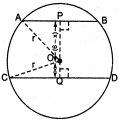
Two chords $AB$ and $CD$ of lengths $5\, cm$ and $11\, cm$ respectively of a circle are parallel to each other and are on opposite sides of its centre. If the distance between $AB$ and $CD$ is $6\, cm$,find the radius of the circle.
A
$\frac{1 \sqrt{6}}{2}\, cm$
B
$\frac{5 \sqrt{5}}{2}\, cm$
C
$\frac{8 \sqrt{5}}{2}\, cm$
D
$\frac{3 \sqrt{5}}{2}\, cm$
Solution
(B) Let the circle have centre $O$. Chords $AB$ and $CD$ are parallel,and the distance between them is $6\, cm$. Given $AB = 5\, cm$ and $CD = 11\, cm$.
Let $r$ be the radius of the circle.
Draw $OP \perp AB$ and $OQ \perp CD$. Since the chords are on opposite sides of the centre,$P, O, Q$ are collinear and $PQ = 6\, cm$.
Let $OQ = x\, cm$. Then $OP = (6 - x)\, cm$.
The perpendicular from the centre to a chord bisects the chord.
So,$AP = \frac{1}{2} AB = \frac{5}{2}\, cm$ and $CQ = \frac{1}{2} CD = \frac{11}{2}\, cm$.
In right $\Delta CQO$,$r^2 = CQ^2 + OQ^2 = (\frac{11}{2})^2 + x^2 = \frac{121}{4} + x^2$ --- $(1)$
In right $\Delta APO$,$r^2 = AP^2 + OP^2 = (\frac{5}{2})^2 + (6 - x)^2 = \frac{25}{4} + 36 - 12x + x^2$ --- $(2)$
Equating $(1)$ and $(2)$:
$\frac{121}{4} + x^2 = \frac{25}{4} + 36 - 12x + x^2$
$\frac{121}{4} - \frac{25}{4} - 36 = -12x$
$\frac{96}{4} - 36 = -12x \Rightarrow 24 - 36 = -12x \Rightarrow -12 = -12x \Rightarrow x = 1\, cm$.
Substituting $x = 1$ in $(1)$:
$r^2 = \frac{121}{4} + 1^2 = \frac{121 + 4}{4} = \frac{125}{4}$.
$r = \sqrt{\frac{125}{4}} = \frac{5\sqrt{5}}{2}\, cm$.
Let $r$ be the radius of the circle.
Draw $OP \perp AB$ and $OQ \perp CD$. Since the chords are on opposite sides of the centre,$P, O, Q$ are collinear and $PQ = 6\, cm$.
Let $OQ = x\, cm$. Then $OP = (6 - x)\, cm$.
The perpendicular from the centre to a chord bisects the chord.
So,$AP = \frac{1}{2} AB = \frac{5}{2}\, cm$ and $CQ = \frac{1}{2} CD = \frac{11}{2}\, cm$.
In right $\Delta CQO$,$r^2 = CQ^2 + OQ^2 = (\frac{11}{2})^2 + x^2 = \frac{121}{4} + x^2$ --- $(1)$
In right $\Delta APO$,$r^2 = AP^2 + OP^2 = (\frac{5}{2})^2 + (6 - x)^2 = \frac{25}{4} + 36 - 12x + x^2$ --- $(2)$
Equating $(1)$ and $(2)$:
$\frac{121}{4} + x^2 = \frac{25}{4} + 36 - 12x + x^2$
$\frac{121}{4} - \frac{25}{4} - 36 = -12x$
$\frac{96}{4} - 36 = -12x \Rightarrow 24 - 36 = -12x \Rightarrow -12 = -12x \Rightarrow x = 1\, cm$.
Substituting $x = 1$ in $(1)$:
$r^2 = \frac{121}{4} + 1^2 = \frac{121 + 4}{4} = \frac{125}{4}$.
$r = \sqrt{\frac{125}{4}} = \frac{5\sqrt{5}}{2}\, cm$.
0 likes
View Solution34
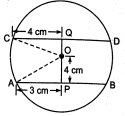
DifficultMCQ
The lengths of two parallel chords of a circle are $6\, cm$ and $8\, cm$. If the smaller chord is at a distance of $4\, cm$ from the centre,what is the distance of the other chord from the centre (in $, cm$)?
A
$8$
B
$4$
C
$3$
D
$6$
Solution
(C) Let the circle have centre $O$. Let the parallel chords be $AB = 6\, cm$ and $CD = 8\, cm$.
Draw $OP \perp AB$ and $OQ \perp CD$.
Since the perpendicular from the centre to a chord bisects the chord:
$AP = \frac{1}{2} AB = \frac{1}{2}(6\, cm) = 3\, cm$
$CQ = \frac{1}{2} CD = \frac{1}{2}(8\, cm) = 4\, cm$
Given that the smaller chord is at a distance of $4\, cm$ from the centre,$OP = 4\, cm$.
In right-angled $\Delta OPA$,by Pythagoras theorem:
$OA^2 = OP^2 + AP^2$
$r^2 = 4^2 + 3^2 = 16 + 9 = 25$
$r = 5\, cm$ (where $r$ is the radius of the circle).
Now,in right-angled $\Delta OQC$:
$OC^2 = OQ^2 + CQ^2$
$r^2 = OQ^2 + 4^2$
$5^2 = OQ^2 + 16$
$25 = OQ^2 + 16$
$OQ^2 = 25 - 16 = 9$
$OQ = 3\, cm$.
Thus,the distance of the other chord from the centre is $3\, cm$.
Draw $OP \perp AB$ and $OQ \perp CD$.
Since the perpendicular from the centre to a chord bisects the chord:
$AP = \frac{1}{2} AB = \frac{1}{2}(6\, cm) = 3\, cm$
$CQ = \frac{1}{2} CD = \frac{1}{2}(8\, cm) = 4\, cm$
Given that the smaller chord is at a distance of $4\, cm$ from the centre,$OP = 4\, cm$.
In right-angled $\Delta OPA$,by Pythagoras theorem:
$OA^2 = OP^2 + AP^2$
$r^2 = 4^2 + 3^2 = 16 + 9 = 25$
$r = 5\, cm$ (where $r$ is the radius of the circle).
Now,in right-angled $\Delta OQC$:
$OC^2 = OQ^2 + CQ^2$
$r^2 = OQ^2 + 4^2$
$5^2 = OQ^2 + 16$
$25 = OQ^2 + 16$
$OQ^2 = 25 - 16 = 9$
$OQ = 3\, cm$.
Thus,the distance of the other chord from the centre is $3\, cm$.
0 likes
View Solution35
Difficult
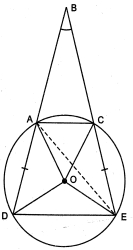
Let the vertex of an angle $\angle ABC$ be located outside a circle and let the sides of the angle intersect equal chords $AD$ and $CE$ with the circle. Prove that $\angle ABC$ is equal to half the difference of the angles subtended by the chords $DE$ and $AC$ at the centre.
Solution
(N/A) Let the vertex of $\angle ABC$ be $B$. The sides $BA$ and $BC$ intersect the circle at points $A, D$ and $C, E$ respectively such that chord $AD = CE$. Let $O$ be the centre of the circle. Join $OA, OC, OD, OE, AC$ and $DE$.
In $\Delta BAE$,the exterior angle $\angle DAE = \angle ABC + \angle AEC$ ... $(1)$
Since the angle subtended by an arc at the centre is double the angle subtended by it at any point on the remaining part of the circle:
$\angle DAE = \frac{1}{2} \angle DOE$ ... $(2)$
Similarly,$\angle AEC$ is the angle subtended by arc $AC$ at the circumference,so $\angle AEC = \frac{1}{2} \angle AOC$ ... $(3)$
Substituting $(2)$ and $(3)$ in $(1)$:
$\frac{1}{2} \angle DOE = \angle ABC + \frac{1}{2} \angle AOC$
$\angle ABC = \frac{1}{2} \angle DOE - \frac{1}{2} \angle AOC$
$\angle ABC = \frac{1}{2} [\angle DOE - \angle AOC]$
Thus,$\angle ABC$ is equal to half the difference of the angles subtended by the chords $DE$ and $AC$ at the centre.
In $\Delta BAE$,the exterior angle $\angle DAE = \angle ABC + \angle AEC$ ... $(1)$
Since the angle subtended by an arc at the centre is double the angle subtended by it at any point on the remaining part of the circle:
$\angle DAE = \frac{1}{2} \angle DOE$ ... $(2)$
Similarly,$\angle AEC$ is the angle subtended by arc $AC$ at the circumference,so $\angle AEC = \frac{1}{2} \angle AOC$ ... $(3)$
Substituting $(2)$ and $(3)$ in $(1)$:
$\frac{1}{2} \angle DOE = \angle ABC + \frac{1}{2} \angle AOC$
$\angle ABC = \frac{1}{2} \angle DOE - \frac{1}{2} \angle AOC$
$\angle ABC = \frac{1}{2} [\angle DOE - \angle AOC]$
Thus,$\angle ABC$ is equal to half the difference of the angles subtended by the chords $DE$ and $AC$ at the centre.
0 likes
View Solution36
Difficult
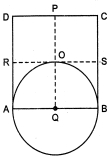
Prove that the circle drawn with any side of a rhombus as diameter, passes through the point of intersection of its diagonals.
Solution
(N/A) Let $ABCD$ be a rhombus whose diagonals $AC$ and $BD$ intersect at $O$. We know that the diagonals of a rhombus bisect each other at right angles, so $\angle AOB = 90^\circ$.
Consider a circle drawn with side $AB$ as the diameter. Let $Q$ be the midpoint of $AB$. Then $QA = QB = \text{radius}$.
In $\triangle AOB$, $\angle AOB = 90^\circ$. Since $Q$ is the midpoint of the hypotenuse $AB$ of the right-angled triangle $\triangle AOB$, the distance from the midpoint of the hypotenuse to the vertices is equal to half the length of the hypotenuse.
Therefore, $QO = QA = QB$.
Since the distance of point $O$ from the center $Q$ is equal to the radius ($QA$ or $QB$), the point $O$ must lie on the circle drawn with $AB$ as the diameter.
Thus, the circle drawn with any side of a rhombus as diameter passes through the point of intersection of its diagonals.
Consider a circle drawn with side $AB$ as the diameter. Let $Q$ be the midpoint of $AB$. Then $QA = QB = \text{radius}$.
In $\triangle AOB$, $\angle AOB = 90^\circ$. Since $Q$ is the midpoint of the hypotenuse $AB$ of the right-angled triangle $\triangle AOB$, the distance from the midpoint of the hypotenuse to the vertices is equal to half the length of the hypotenuse.
Therefore, $QO = QA = QB$.
Since the distance of point $O$ from the center $Q$ is equal to the radius ($QA$ or $QB$), the point $O$ must lie on the circle drawn with $AB$ as the diameter.
Thus, the circle drawn with any side of a rhombus as diameter passes through the point of intersection of its diagonals.
0 likes
View Solution37
Difficult
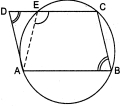
$ABCD$ is a parallelogram. The circle passing through $A, B$ and $C$ intersects $CD$ (produced if necessary) at $E$. Prove that $AE = AD$.
Solution
(N/A) Given: $ABCD$ is a parallelogram. $A$ circle passes through $A, B$ and $C$,intersecting $CD$ at $E$.
Step $1$: Since $ABCE$ is a cyclic quadrilateral,the sum of opposite angles is $180^{\circ}$.
Therefore,$\angle AEC + \angle B = 180^{\circ}$ --- $(1)$
Step $2$: In parallelogram $ABCD$,opposite angles are equal.
Therefore,$\angle D = \angle B$ --- $(2)$
Step $3$: From equations $(1)$ and $(2)$,we get:
$\angle AEC + \angle D = 180^{\circ}$ --- $(3)$
Step $4$: Since $D, E, C$ lie on a straight line,$\angle AEC$ and $\angle AED$ form a linear pair.
Therefore,$\angle AEC + \angle AED = 180^{\circ}$ --- $(4)$
Step $5$: Comparing equations $(3)$ and $(4)$:
$\angle D = \angle AED$
Step $6$: In $\Delta ADE$,since the base angles $\angle D$ and $\angle AED$ are equal,the sides opposite to these angles must be equal.
Therefore,$AE = AD$. Hence proved.
Step $1$: Since $ABCE$ is a cyclic quadrilateral,the sum of opposite angles is $180^{\circ}$.
Therefore,$\angle AEC + \angle B = 180^{\circ}$ --- $(1)$
Step $2$: In parallelogram $ABCD$,opposite angles are equal.
Therefore,$\angle D = \angle B$ --- $(2)$
Step $3$: From equations $(1)$ and $(2)$,we get:
$\angle AEC + \angle D = 180^{\circ}$ --- $(3)$
Step $4$: Since $D, E, C$ lie on a straight line,$\angle AEC$ and $\angle AED$ form a linear pair.
Therefore,$\angle AEC + \angle AED = 180^{\circ}$ --- $(4)$
Step $5$: Comparing equations $(3)$ and $(4)$:
$\angle D = \angle AED$
Step $6$: In $\Delta ADE$,since the base angles $\angle D$ and $\angle AED$ are equal,the sides opposite to these angles must be equal.
Therefore,$AE = AD$. Hence proved.
0 likes
View Solution38
Difficult
$AC$ and $BD$ are chords of a circle which bisect each other. Prove that $AC$ and $BD$ are diameters.
Solution
(N/A) Let the circle have its center at some point $P$. However,the problem states that the chords $AC$ and $BD$ bisect each other at point $O$.
In $\Delta AOB$ and $\Delta COD$:
$AO = OC$ (Given,as $O$ is the midpoint of $AC$)
$BO = OD$ (Given,as $O$ is the midpoint of $BD$)
$\angle AOB = \angle COD$ (Vertically opposite angles)
By $SAS$ congruence criterion,$\Delta AOB \cong \Delta COD$.
Therefore,$AB = CD$ (Corresponding parts of congruent triangles).
Since $AB = CD$,the arcs corresponding to these chords are equal: $\text{arc } AB = \text{arc } CD$.
Similarly,$\Delta AOD \cong \Delta COB$ by $SAS$ congruence,which implies $AD = CB$,so $\text{arc } AD = \text{arc } BC$.
Now,consider the quadrilateral $ABCD$. Since the diagonals $AC$ and $BD$ bisect each other,$ABCD$ is a parallelogram.
In a parallelogram inscribed in a circle,opposite angles are equal ($\angle A = \angle C$ and $\angle B = \angle D$). Since the sum of opposite angles in a cyclic quadrilateral is $180^{\circ}$,we have $\angle A + \angle C = 180^{\circ}$,which implies $2\angle A = 180^{\circ}$,so $\angle A = 90^{\circ}$.
Since $\angle A = 90^{\circ}$,the chord $BD$ subtends a right angle at the circumference,which means $BD$ must be a diameter. Similarly,$AC$ is a diameter.
In $\Delta AOB$ and $\Delta COD$:
$AO = OC$ (Given,as $O$ is the midpoint of $AC$)
$BO = OD$ (Given,as $O$ is the midpoint of $BD$)
$\angle AOB = \angle COD$ (Vertically opposite angles)
By $SAS$ congruence criterion,$\Delta AOB \cong \Delta COD$.
Therefore,$AB = CD$ (Corresponding parts of congruent triangles).
Since $AB = CD$,the arcs corresponding to these chords are equal: $\text{arc } AB = \text{arc } CD$.
Similarly,$\Delta AOD \cong \Delta COB$ by $SAS$ congruence,which implies $AD = CB$,so $\text{arc } AD = \text{arc } BC$.
Now,consider the quadrilateral $ABCD$. Since the diagonals $AC$ and $BD$ bisect each other,$ABCD$ is a parallelogram.
In a parallelogram inscribed in a circle,opposite angles are equal ($\angle A = \angle C$ and $\angle B = \angle D$). Since the sum of opposite angles in a cyclic quadrilateral is $180^{\circ}$,we have $\angle A + \angle C = 180^{\circ}$,which implies $2\angle A = 180^{\circ}$,so $\angle A = 90^{\circ}$.
Since $\angle A = 90^{\circ}$,the chord $BD$ subtends a right angle at the circumference,which means $BD$ must be a diameter. Similarly,$AC$ is a diameter.
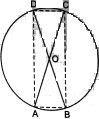
0 likes
View Solution39
Difficult
$AC$ and $BD$ are chords of a circle that bisect each other. Prove that $ABCD$ is a rectangle.
Solution
(A) Let the circle have its centre at $O'$. Let the chords $AC$ and $BD$ intersect at point $O$.
Since the chords bisect each other,$AO = OC$ and $BO = OD$.
In $\Delta AOB$ and $\Delta COD$:
$AO = OC$ (given),
$BO = OD$ (given),
$\angle AOB = \angle COD$ (vertically opposite angles).
Therefore,$\Delta AOB \cong \Delta COD$ by the $SAS$ congruence rule.
This implies $AB = CD$ and $\angle OAB = \angle OCD$. Since these are alternate interior angles,$AB \parallel CD$.
$A$ quadrilateral with one pair of opposite sides equal and parallel is a parallelogram. Thus,$ABCD$ is a parallelogram.
Since $ABCD$ is a cyclic quadrilateral (as its vertices lie on the circle),the sum of its opposite angles is $180^{\circ}$.
In a parallelogram,opposite angles are equal,so $\angle A = \angle C$ and $\angle B = \angle D$.
Since $\angle A + \angle C = 180^{\circ}$,we have $2\angle A = 180^{\circ}$,which means $\angle A = 90^{\circ}$.
$A$ parallelogram with one angle equal to $90^{\circ}$ is a rectangle. Therefore,$ABCD$ is a rectangle.
Since the chords bisect each other,$AO = OC$ and $BO = OD$.
In $\Delta AOB$ and $\Delta COD$:
$AO = OC$ (given),
$BO = OD$ (given),
$\angle AOB = \angle COD$ (vertically opposite angles).
Therefore,$\Delta AOB \cong \Delta COD$ by the $SAS$ congruence rule.
This implies $AB = CD$ and $\angle OAB = \angle OCD$. Since these are alternate interior angles,$AB \parallel CD$.
$A$ quadrilateral with one pair of opposite sides equal and parallel is a parallelogram. Thus,$ABCD$ is a parallelogram.
Since $ABCD$ is a cyclic quadrilateral (as its vertices lie on the circle),the sum of its opposite angles is $180^{\circ}$.
In a parallelogram,opposite angles are equal,so $\angle A = \angle C$ and $\angle B = \angle D$.
Since $\angle A + \angle C = 180^{\circ}$,we have $2\angle A = 180^{\circ}$,which means $\angle A = 90^{\circ}$.
$A$ parallelogram with one angle equal to $90^{\circ}$ is a rectangle. Therefore,$ABCD$ is a rectangle.
0 likes
View Solution40
Difficult
Bisectors of angles $A, B$ and $C$ of a triangle $ABC$ intersect its circumcircle at $D, E$ and $F$ respectively. Prove that the angles of the triangle $DEF$ are $90^{\circ} - \frac{1}{2}A, 90^{\circ} - \frac{1}{2}B$ and $90^{\circ} - \frac{1}{2}C$.
Solution
(N/A) Given a triangle $ABC$ inscribed in a circle,where the angle bisectors of $\angle A, \angle B$,and $\angle C$ intersect the circumcircle at $D, E$,and $F$ respectively.
Join $DE, EF$,and $FD$.
Since angles subtended by the same arc in the same segment are equal:
$\angle FDA = \angle FCA = \frac{1}{2} \angle C$ (as $CF$ is the bisector of $\angle C$)
$\angle EDA = \angle EBA = \frac{1}{2} \angle B$ (as $BE$ is the bisector of $\angle B$)
Adding these two equations:
$\angle FDE = \angle FDA + \angle EDA = \frac{1}{2} \angle C + \frac{1}{2} \angle B = \frac{1}{2}(\angle B + \angle C)$
Since $\angle A + \angle B + \angle C = 180^{\circ}$,we have $\angle B + \angle C = 180^{\circ} - \angle A$.
Therefore,$\angle FDE = \frac{1}{2}(180^{\circ} - \angle A) = 90^{\circ} - \frac{1}{2} \angle A$.
Similarly,$\angle FED = 90^{\circ} - \frac{1}{2} \angle B$ and $\angle EFD = 90^{\circ} - \frac{1}{2} \angle C$.
Thus,the angles of $\Delta DEF$ are $90^{\circ} - \frac{A}{2}, 90^{\circ} - \frac{B}{2}$,and $90^{\circ} - \frac{C}{2}$.
Join $DE, EF$,and $FD$.
Since angles subtended by the same arc in the same segment are equal:
$\angle FDA = \angle FCA = \frac{1}{2} \angle C$ (as $CF$ is the bisector of $\angle C$)
$\angle EDA = \angle EBA = \frac{1}{2} \angle B$ (as $BE$ is the bisector of $\angle B$)
Adding these two equations:
$\angle FDE = \angle FDA + \angle EDA = \frac{1}{2} \angle C + \frac{1}{2} \angle B = \frac{1}{2}(\angle B + \angle C)$
Since $\angle A + \angle B + \angle C = 180^{\circ}$,we have $\angle B + \angle C = 180^{\circ} - \angle A$.
Therefore,$\angle FDE = \frac{1}{2}(180^{\circ} - \angle A) = 90^{\circ} - \frac{1}{2} \angle A$.
Similarly,$\angle FED = 90^{\circ} - \frac{1}{2} \angle B$ and $\angle EFD = 90^{\circ} - \frac{1}{2} \angle C$.
Thus,the angles of $\Delta DEF$ are $90^{\circ} - \frac{A}{2}, 90^{\circ} - \frac{B}{2}$,and $90^{\circ} - \frac{C}{2}$.
0 likes
View Solution41
Medium
Two congruent circles intersect each other at points $A$ and $B$. Through $A$,any line segment $PAQ$ is drawn such that $P$ and $Q$ lie on the two circles. Prove that $BP = BQ$.
Solution
(N/A) Given: Two congruent circles intersect at $A$ and $B$. $A$ line segment $PAQ$ passes through $A$,where $P$ lies on the first circle and $Q$ lies on the second circle.
Construction: Join $AB$,$BP$,and $BQ$.
Proof:
$1$. Consider the two congruent circles. The chord $AB$ is common to both circles.
$2$. In congruent circles,equal chords subtend equal angles at the circumference.
$3$. Since $AB$ is a chord in both congruent circles,the angles subtended by $AB$ at the circumference in the respective circles must be equal.
$4$. Therefore,$\angle APB = \angle AQB$.
$5$. In $\Delta PBQ$,we have $\angle APB = \angle AQB$ (which is $\angle BPQ = \angle BQP$).
$6$. Since the angles opposite to sides $BQ$ and $BP$ are equal,the sides themselves must be equal.
$7$. Hence,$BP = BQ$.
Construction: Join $AB$,$BP$,and $BQ$.
Proof:
$1$. Consider the two congruent circles. The chord $AB$ is common to both circles.
$2$. In congruent circles,equal chords subtend equal angles at the circumference.
$3$. Since $AB$ is a chord in both congruent circles,the angles subtended by $AB$ at the circumference in the respective circles must be equal.
$4$. Therefore,$\angle APB = \angle AQB$.
$5$. In $\Delta PBQ$,we have $\angle APB = \angle AQB$ (which is $\angle BPQ = \angle BQP$).
$6$. Since the angles opposite to sides $BQ$ and $BP$ are equal,the sides themselves must be equal.
$7$. Hence,$BP = BQ$.
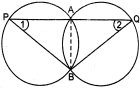
0 likes
View Solution42
Difficult
In any triangle $ABC$,if the angle bisector of $\angle A$ and the perpendicular bisector of $BC$ intersect,prove that they intersect on the circumcircle of the triangle $ABC$.
Solution
(N/A) Let $\Delta ABC$ be inscribed in a circle with center $O$.
Let the internal bisector of $\angle A$ intersect the circumcircle at point $E$. We need to show that $E$ lies on the perpendicular bisector of $BC$.
Since $AE$ is the bisector of $\angle BAC$,we have $\angle BAE = \angle CAE$.
Equal angles subtend equal arcs at the circumference,so $\text{arc } BE = \text{arc } EC$.
Consequently,the chords corresponding to these arcs are equal,i.e.,chord $BE = \text{chord } CE$.
Let $D$ be the midpoint of $BC$. In $\Delta BDE$ and $\Delta CDE$:
$BE = CE$ (Proved above)
$BD = CD$ ($D$ is the midpoint of $BC$)
$DE = DE$ (Common side)
By the $SSS$ congruence criterion,$\Delta BDE \cong \Delta CDE$.
Therefore,$\angle BDE = \angle CDE$ (Corresponding parts of congruent triangles).
Since $BC$ is a straight line,$\angle BDE + \angle CDE = 180^{\circ}$.
Thus,$\angle BDE = \angle CDE = 90^{\circ}$,which means $DE \perp BC$.
Since $DE$ passes through the midpoint $D$ of $BC$ and is perpendicular to $BC$,$DE$ is the perpendicular bisector of $BC$. Thus,the angle bisector of $\angle A$ and the perpendicular bisector of $BC$ intersect at point $E$ on the circumcircle.
Let the internal bisector of $\angle A$ intersect the circumcircle at point $E$. We need to show that $E$ lies on the perpendicular bisector of $BC$.
Since $AE$ is the bisector of $\angle BAC$,we have $\angle BAE = \angle CAE$.
Equal angles subtend equal arcs at the circumference,so $\text{arc } BE = \text{arc } EC$.
Consequently,the chords corresponding to these arcs are equal,i.e.,chord $BE = \text{chord } CE$.
Let $D$ be the midpoint of $BC$. In $\Delta BDE$ and $\Delta CDE$:
$BE = CE$ (Proved above)
$BD = CD$ ($D$ is the midpoint of $BC$)
$DE = DE$ (Common side)
By the $SSS$ congruence criterion,$\Delta BDE \cong \Delta CDE$.
Therefore,$\angle BDE = \angle CDE$ (Corresponding parts of congruent triangles).
Since $BC$ is a straight line,$\angle BDE + \angle CDE = 180^{\circ}$.
Thus,$\angle BDE = \angle CDE = 90^{\circ}$,which means $DE \perp BC$.
Since $DE$ passes through the midpoint $D$ of $BC$ and is perpendicular to $BC$,$DE$ is the perpendicular bisector of $BC$. Thus,the angle bisector of $\angle A$ and the perpendicular bisector of $BC$ intersect at point $E$ on the circumcircle.
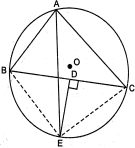
0 likes
View SolutionCircles — Textbook - Circles · Frequently Asked Questions
1Are these Circles questions useful for JEE and NEET?
Yes. All questions in this section are mapped to JEE Main and NEET exam patterns. Previous year questions from JEE Main, NEET, GUJCET and state-level exams are included with full solutions.
2Can I switch to Hindi or Gujarati for these questions?
Yes. Use the language tabs in the hero section or the sidebar to view the same questions and solutions in English, Hindi or Gujarati.
3How do I generate a question paper from this subtopic?
Use the Vedclass Exam Paper Generator — select the chapter and subtopic, set difficulty, and generate Sets A, B, C, D automatically. First 3 chapters of every subject are free.
Vedclass Products
For Students
Vedclass Test Series
Mock tests in real JEE/NEET style with performance analysis. 5-day free trial.
Start Free TrialFor Teachers
Exam Paper Generator
Generate Set A/B/C/D papers from this chapter in 2 minutes. 3 chapters free.
Try FreeFor Institutes
Online Exam Module
Live online exams with unlimited students, 360° analytics & white-label branding.
See DemoFor Teachers & Institutes
Generate a Circles Exam Paper in 2 Minutes
Select subtopic & difficulty — Sets A, B, C, D auto-generated with No Repeat logic.
First 3 chapters of every subject are free — no payment required.