
A English
Mix Examples - Circles Questions in English
Class 9 Mathematics · Circles · Mix Examples - Circles
152+
Questions
English
Language
100%
With Solutions
Showing 50 of 152 questions in English
1
MediumMCQ
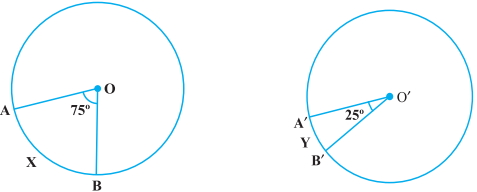
In the figure,two congruent circles have centers $O$ and $O'$. Arc $AXB$ subtends an angle of $75^{\circ}$ at the center $O$ and arc $A'YB'$ subtends an angle of $25^{\circ}$ at the center $O'$. Then the ratio of the lengths of arcs $AXB$ and $A'YB'$ is:
A
$3:1$
B
$1:2$
C
$2:1$
D
$1:3$
Solution
(A) The length of an arc of a circle is given by the formula $L = \frac{\theta}{360^{\circ}} \times 2\pi r$,where $\theta$ is the angle subtended by the arc at the center and $r$ is the radius of the circle.
Since the two circles are congruent,they have the same radius,let it be $r$.
Let $L_1$ be the length of arc $AXB$ and $L_2$ be the length of arc $A'YB'$.
Given that the angle subtended by arc $AXB$ at center $O$ is $\theta_1 = 75^{\circ}$.
So,$L_1 = \frac{75^{\circ}}{360^{\circ}} \times 2\pi r$.
Given that the angle subtended by arc $A'YB'$ at center $O'$ is $\theta_2 = 25^{\circ}$.
So,$L_2 = \frac{25^{\circ}}{360^{\circ}} \times 2\pi r$.
The ratio of the lengths of the arcs is $\frac{L_1}{L_2} = \frac{\frac{75^{\circ}}{360^{\circ}} \times 2\pi r}{\frac{25^{\circ}}{360^{\circ}} \times 2\pi r} = \frac{75^{\circ}}{25^{\circ}} = \frac{3}{1}$.
Therefore,the ratio is $3:1$.
Since the two circles are congruent,they have the same radius,let it be $r$.
Let $L_1$ be the length of arc $AXB$ and $L_2$ be the length of arc $A'YB'$.
Given that the angle subtended by arc $AXB$ at center $O$ is $\theta_1 = 75^{\circ}$.
So,$L_1 = \frac{75^{\circ}}{360^{\circ}} \times 2\pi r$.
Given that the angle subtended by arc $A'YB'$ at center $O'$ is $\theta_2 = 25^{\circ}$.
So,$L_2 = \frac{25^{\circ}}{360^{\circ}} \times 2\pi r$.
The ratio of the lengths of the arcs is $\frac{L_1}{L_2} = \frac{\frac{75^{\circ}}{360^{\circ}} \times 2\pi r}{\frac{25^{\circ}}{360^{\circ}} \times 2\pi r} = \frac{75^{\circ}}{25^{\circ}} = \frac{3}{1}$.
Therefore,the ratio is $3:1$.
0 likes
View Solution2
MediumMCQ
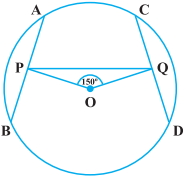
In the figure,$AB$ and $CD$ are two equal chords of a circle with center $O$. $OP$ and $OQ$ are perpendiculars on chords $AB$ and $CD$ respectively. If $\angle POQ = 150^{\circ}$,then $\angle APQ$ is equal to: (in $^{\circ}$)
A
$30$
B
$75$
C
$15$
D
$60$
Solution
(B) In $\triangle OPQ$,since $OP$ and $OQ$ are perpendiculars from the center to equal chords,$OP = OQ$.
Therefore,$\triangle OPQ$ is an isosceles triangle,which implies $\angle OQP = \angle OPQ = k$.
In $\triangle OPQ$,the sum of angles is $180^{\circ}$,so $\angle OQP + \angle OPQ + \angle POQ = 180^{\circ}$.
$k + k + 150^{\circ} = 180^{\circ}$.
$2k = 30^{\circ}$.
$k = 15^{\circ}$.
Thus,$\angle OPQ = 15^{\circ}$.
Since $OP \perp AB$,$\angle OPA = 90^{\circ}$.
From the figure,$\angle OPA = \angle OPQ + \angle APQ$.
$90^{\circ} = 15^{\circ} + \angle APQ$.
$\angle APQ = 90^{\circ} - 15^{\circ} = 75^{\circ}$.
Therefore,$\triangle OPQ$ is an isosceles triangle,which implies $\angle OQP = \angle OPQ = k$.
In $\triangle OPQ$,the sum of angles is $180^{\circ}$,so $\angle OQP + \angle OPQ + \angle POQ = 180^{\circ}$.
$k + k + 150^{\circ} = 180^{\circ}$.
$2k = 30^{\circ}$.
$k = 15^{\circ}$.
Thus,$\angle OPQ = 15^{\circ}$.
Since $OP \perp AB$,$\angle OPA = 90^{\circ}$.
From the figure,$\angle OPA = \angle OPQ + \angle APQ$.
$90^{\circ} = 15^{\circ} + \angle APQ$.
$\angle APQ = 90^{\circ} - 15^{\circ} = 75^{\circ}$.
0 likes
View Solution3
MediumMCQ
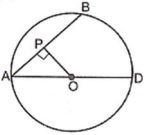
$AD$ is a diameter of a circle and $AB$ is a chord. If $AD = 34 \, cm$ and $AB = 30 \, cm$,the distance of $AB$ from the centre of the circle is (in $cm$):
A
$17$
B
$15$
C
$8$
D
$4$
Solution
(C) Let $O$ be the centre of the circle. Draw $OP \perp AB$.
Since the perpendicular from the centre to a chord bisects the chord,we have:
$AP = \frac{1}{2} \times AB = \frac{1}{2} \times 30 = 15 \, cm$.
The radius of the circle is $OA = \frac{AD}{2} = \frac{34}{2} = 17 \, cm$.
In the right-angled triangle $\Delta OPA$,by the Pythagorean theorem:
$OP^2 + AP^2 = OA^2$
$OP^2 + 15^2 = 17^2$
$OP^2 + 225 = 289$
$OP^2 = 289 - 225 = 64$
$OP = \sqrt{64} = 8 \, cm$.
Thus,the distance of the chord $AB$ from the centre is $8 \, cm$.
Since the perpendicular from the centre to a chord bisects the chord,we have:
$AP = \frac{1}{2} \times AB = \frac{1}{2} \times 30 = 15 \, cm$.
The radius of the circle is $OA = \frac{AD}{2} = \frac{34}{2} = 17 \, cm$.
In the right-angled triangle $\Delta OPA$,by the Pythagorean theorem:
$OP^2 + AP^2 = OA^2$
$OP^2 + 15^2 = 17^2$
$OP^2 + 225 = 289$
$OP^2 = 289 - 225 = 64$
$OP = \sqrt{64} = 8 \, cm$.
Thus,the distance of the chord $AB$ from the centre is $8 \, cm$.
0 likes
View Solution4
MediumMCQ
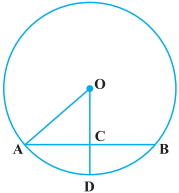
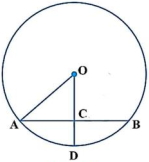
In the figure,if $OA = 5 \text{ cm}$,$AB = 8 \text{ cm}$,and $OD$ is perpendicular to $AB$,then $CD$ is equal to (in $\text{cm}$):
A
$4$
B
$3$
C
$5$
D
$2$
Solution
(D) Since the perpendicular from the centre of a circle to a chord bisects the chord,we have:
$AC = \frac{1}{2} \times AB = \frac{1}{2} \times 8 \text{ cm} = 4 \text{ cm}$.
In the right-angled triangle $\triangle OCA$,by the Pythagoras theorem:
$OC^2 + AC^2 = OA^2$
$OC^2 + 4^2 = 5^2$
$OC^2 + 16 = 25$
$OC^2 = 25 - 16 = 9$
$OC = \sqrt{9} = 3 \text{ cm}$.
Since $OD$ is the radius of the circle,$OD = OA = 5 \text{ cm}$.
Therefore,$CD = OD - OC = 5 \text{ cm} - 3 \text{ cm} = 2 \text{ cm}$.
$AC = \frac{1}{2} \times AB = \frac{1}{2} \times 8 \text{ cm} = 4 \text{ cm}$.
In the right-angled triangle $\triangle OCA$,by the Pythagoras theorem:
$OC^2 + AC^2 = OA^2$
$OC^2 + 4^2 = 5^2$
$OC^2 + 16 = 25$
$OC^2 = 25 - 16 = 9$
$OC = \sqrt{9} = 3 \text{ cm}$.
Since $OD$ is the radius of the circle,$OD = OA = 5 \text{ cm}$.
Therefore,$CD = OD - OC = 5 \text{ cm} - 3 \text{ cm} = 2 \text{ cm}$.
0 likes
View Solution5
MediumMCQ
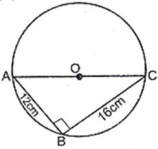
If $AB = 12 \, cm$,$BC = 16 \, cm$ and $AB$ is perpendicular to $BC$,then the radius of the circle passing through the points $A, B$ and $C$ is (in $cm$)
A
$10$
B
$6$
C
$12$
D
$8$
Solution
(A) $AB$ is perpendicular to $BC$,therefore $\Delta ABC$ is a right-angled triangle with $\angle B = 90^{\circ}$.
Since the triangle is right-angled,the hypotenuse $AC$ is the diameter of the circle passing through points $A, B$ and $C$.
Using the Pythagorean theorem in $\Delta ABC$:
$AC = \sqrt{AB^2 + BC^2}$
$AC = \sqrt{12^2 + 16^2}$
$AC = \sqrt{144 + 256}$
$AC = \sqrt{400} = 20 \, cm$
Since the diameter $AC = 20 \, cm$,the radius $r = \frac{AC}{2} = \frac{20}{2} = 10 \, cm$.
Since the triangle is right-angled,the hypotenuse $AC$ is the diameter of the circle passing through points $A, B$ and $C$.
Using the Pythagorean theorem in $\Delta ABC$:
$AC = \sqrt{AB^2 + BC^2}$
$AC = \sqrt{12^2 + 16^2}$
$AC = \sqrt{144 + 256}$
$AC = \sqrt{400} = 20 \, cm$
Since the diameter $AC = 20 \, cm$,the radius $r = \frac{AC}{2} = \frac{20}{2} = 10 \, cm$.
0 likes
View Solution6
EasyMCQ
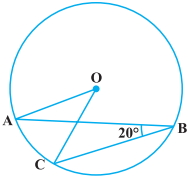
In the figure,if $\angle ABC = 20^{\circ},$ then $\angle AOC$ is equal to (in $^{\circ}$)
A
$20$
B
$40$
C
$60$
D
$10$
Solution
(B) According to the theorem,the angle subtended by an arc at the centre is double the angle subtended by it at any point on the remaining part of the circle.
Here,arc $AC$ subtends $\angle AOC$ at the centre $O$ and $\angle ABC$ at point $B$ on the remaining part of the circle.
Therefore,$\angle AOC = 2 \times \angle ABC$.
Given $\angle ABC = 20^{\circ}$.
Thus,$\angle AOC = 2 \times 20^{\circ} = 40^{\circ}$.
Here,arc $AC$ subtends $\angle AOC$ at the centre $O$ and $\angle ABC$ at point $B$ on the remaining part of the circle.
Therefore,$\angle AOC = 2 \times \angle ABC$.
Given $\angle ABC = 20^{\circ}$.
Thus,$\angle AOC = 2 \times 20^{\circ} = 40^{\circ}$.
0 likes
View Solution7
MediumMCQ
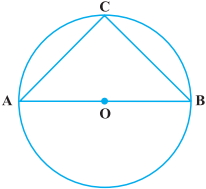
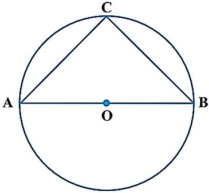
In the figure,if $AOB$ is a diameter of the circle and $AC = BC$,then $\angle CAB$ is equal to (in $^{\circ}$)
A
$30$
B
$60$
C
$45$
D
$90$
Solution
(C) Since $AOB$ is a diameter of the circle,the angle subtended by it at the circumference is $90^{\circ}$.
Therefore,$\angle ACB = 90^{\circ}$ (Angle in a semi-circle is $90^{\circ}$).
Given that $AC = BC$,the triangle $\triangle ABC$ is an isosceles triangle.
In an isosceles triangle,angles opposite to equal sides are equal,so $\angle CAB = \angle CBA$.
Let $\angle CAB = \angle CBA = x$.
In $\triangle ABC$,the sum of angles is $180^{\circ}$:
$\angle CAB + \angle CBA + \angle ACB = 180^{\circ}$
$x + x + 90^{\circ} = 180^{\circ}$
$2x = 90^{\circ}$
$x = 45^{\circ}$
Thus,$\angle CAB = 45^{\circ}$.
Therefore,$\angle ACB = 90^{\circ}$ (Angle in a semi-circle is $90^{\circ}$).
Given that $AC = BC$,the triangle $\triangle ABC$ is an isosceles triangle.
In an isosceles triangle,angles opposite to equal sides are equal,so $\angle CAB = \angle CBA$.
Let $\angle CAB = \angle CBA = x$.
In $\triangle ABC$,the sum of angles is $180^{\circ}$:
$\angle CAB + \angle CBA + \angle ACB = 180^{\circ}$
$x + x + 90^{\circ} = 180^{\circ}$
$2x = 90^{\circ}$
$x = 45^{\circ}$
Thus,$\angle CAB = 45^{\circ}$.
0 likes
View Solution8
MediumMCQ
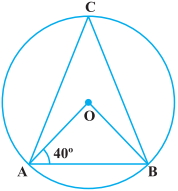
In the figure,if $\angle OAB = 40^{\circ},$ then $\angle ACB$ is equal to: (in $^{\circ}$)
A
$70$
B
$60$
C
$40$
D
$50$
Solution
(D) In $\Delta OAB$,
$OA = OB$ (Radii of the same circle).
Therefore,$\angle OAB = \angle OBA = 40^{\circ}$ (Angles opposite to equal sides are equal).
In $\Delta OAB$,the sum of angles is $180^{\circ}$.
So,$\angle AOB = 180^{\circ} - (40^{\circ} + 40^{\circ}) = 180^{\circ} - 80^{\circ} = 100^{\circ}$.
According to the theorem,the angle subtended by an arc at the center is double the angle subtended by it at any point on the remaining part of the circle.
Therefore,$\angle ACB = \frac{1}{2} \angle AOB = \frac{1}{2} \times 100^{\circ} = 50^{\circ}$.
$OA = OB$ (Radii of the same circle).
Therefore,$\angle OAB = \angle OBA = 40^{\circ}$ (Angles opposite to equal sides are equal).
In $\Delta OAB$,the sum of angles is $180^{\circ}$.
So,$\angle AOB = 180^{\circ} - (40^{\circ} + 40^{\circ}) = 180^{\circ} - 80^{\circ} = 100^{\circ}$.
According to the theorem,the angle subtended by an arc at the center is double the angle subtended by it at any point on the remaining part of the circle.
Therefore,$\angle ACB = \frac{1}{2} \angle AOB = \frac{1}{2} \times 100^{\circ} = 50^{\circ}$.
0 likes
View Solution9
MediumMCQ
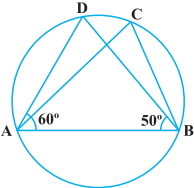
In the figure,if $\angle DAB = 60^{\circ}$ and $\angle ABD = 50^{\circ}$,then $\angle ACB$ is equal to: (in $^{\circ}$)
A
$70$
B
$60$
C
$50$
D
$80$
Solution
(A) In $\Delta ADB$,the sum of angles is $180^{\circ}$.
$\angle DAB + \angle ABD + \angle ADB = 180^{\circ}$
$60^{\circ} + 50^{\circ} + \angle ADB = 180^{\circ}$
$110^{\circ} + \angle ADB = 180^{\circ}$
$\angle ADB = 180^{\circ} - 110^{\circ} = 70^{\circ}$
Since angles in the same segment of a circle are equal,we have $\angle ACB = \angle ADB$.
Therefore,$\angle ACB = 70^{\circ}$.
$\angle DAB + \angle ABD + \angle ADB = 180^{\circ}$
$60^{\circ} + 50^{\circ} + \angle ADB = 180^{\circ}$
$110^{\circ} + \angle ADB = 180^{\circ}$
$\angle ADB = 180^{\circ} - 110^{\circ} = 70^{\circ}$
Since angles in the same segment of a circle are equal,we have $\angle ACB = \angle ADB$.
Therefore,$\angle ACB = 70^{\circ}$.
0 likes
View Solution10
MediumMCQ
$ABCD$ is a cyclic quadrilateral such that $AB$ is a diameter of the circle circumscribing it and $\angle ADC = 140^{\circ}$,then $\angle BAC$ is equal to (in $^{\circ}$)
A
$80$
B
$50$
C
$40$
D
$30$
Solution
(B) Given that $ABCD$ is a cyclic quadrilateral and $AB$ is the diameter of the circle.
Since $ABCD$ is a cyclic quadrilateral,the sum of opposite angles is $180^{\circ}$.
$\angle ADC + \angle ABC = 180^{\circ}$
Given $\angle ADC = 140^{\circ}$,we have:
$140^{\circ} + \angle ABC = 180^{\circ}$
$\angle ABC = 180^{\circ} - 140^{\circ} = 40^{\circ}$
Since $AB$ is the diameter,the angle subtended by the diameter at the circumference is $90^{\circ}$.
Therefore,$\angle ACB = 90^{\circ}$.
In $\Delta ABC$,the sum of angles is $180^{\circ}$:
$\angle BAC + \angle ABC + \angle ACB = 180^{\circ}$
$\angle BAC + 40^{\circ} + 90^{\circ} = 180^{\circ}$
$\angle BAC + 130^{\circ} = 180^{\circ}$
$\angle BAC = 180^{\circ} - 130^{\circ} = 50^{\circ}$
Since $ABCD$ is a cyclic quadrilateral,the sum of opposite angles is $180^{\circ}$.
$\angle ADC + \angle ABC = 180^{\circ}$
Given $\angle ADC = 140^{\circ}$,we have:
$140^{\circ} + \angle ABC = 180^{\circ}$
$\angle ABC = 180^{\circ} - 140^{\circ} = 40^{\circ}$
Since $AB$ is the diameter,the angle subtended by the diameter at the circumference is $90^{\circ}$.
Therefore,$\angle ACB = 90^{\circ}$.
In $\Delta ABC$,the sum of angles is $180^{\circ}$:
$\angle BAC + \angle ABC + \angle ACB = 180^{\circ}$
$\angle BAC + 40^{\circ} + 90^{\circ} = 180^{\circ}$
$\angle BAC + 130^{\circ} = 180^{\circ}$
$\angle BAC = 180^{\circ} - 130^{\circ} = 50^{\circ}$
0 likes
View Solution11
MediumMCQ
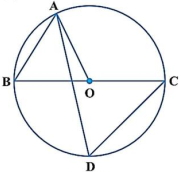
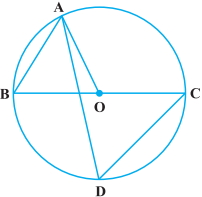
In the figure,$BC$ is a diameter of the circle and $\angle BAO = 60^{\circ}$. Then $\angle ADC$ is equal to: (in $^{\circ}$)
A
$30$
B
$45$
C
$60$
D
$120$
Solution
(C) In $\Delta OAB$,we have:
$OA = OB$ [Radii of the same circle]
Therefore,$\angle ABO = \angle BAO$ [Angles opposite to equal sides are equal].
Given $\angle BAO = 60^{\circ}$,so $\angle ABO = 60^{\circ}$.
In $\Delta OAB$,the sum of angles is $180^{\circ}$,so $\angle AOB = 180^{\circ} - (60^{\circ} + 60^{\circ}) = 60^{\circ}$.
Since $BC$ is a diameter,$\angle AOC = 180^{\circ} - \angle AOB = 180^{\circ} - 60^{\circ} = 120^{\circ}$.
The angle subtended by an arc at the center is double the angle subtended by it at any point on the remaining part of the circle.
Thus,$\angle ADC = \frac{1}{2} \angle AOC = \frac{1}{2} \times 120^{\circ} = 60^{\circ}$.
$OA = OB$ [Radii of the same circle]
Therefore,$\angle ABO = \angle BAO$ [Angles opposite to equal sides are equal].
Given $\angle BAO = 60^{\circ}$,so $\angle ABO = 60^{\circ}$.
In $\Delta OAB$,the sum of angles is $180^{\circ}$,so $\angle AOB = 180^{\circ} - (60^{\circ} + 60^{\circ}) = 60^{\circ}$.
Since $BC$ is a diameter,$\angle AOC = 180^{\circ} - \angle AOB = 180^{\circ} - 60^{\circ} = 120^{\circ}$.
The angle subtended by an arc at the center is double the angle subtended by it at any point on the remaining part of the circle.
Thus,$\angle ADC = \frac{1}{2} \angle AOC = \frac{1}{2} \times 120^{\circ} = 60^{\circ}$.
0 likes
View Solution12
DifficultMCQ
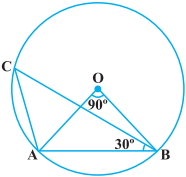
In the figure,$\angle AOB = 90^{\circ}$ and $\angle ABC = 30^{\circ},$ then $\angle CAO$ is equal to: (in $^{\circ}$)
A
$30$
B
$45$
C
$90$
D
$60$
Solution
(D) In $\Delta OAB,$ we have $OA = OB$ (radii of the same circle).
Therefore,$\angle OAB = \angle OBA.$
Since the sum of angles in a triangle is $180^{\circ},$
$2 \angle OAB = 180^{\circ} - \angle AOB = 180^{\circ} - 90^{\circ} = 90^{\circ}.$
Thus,$\angle OAB = 45^{\circ}.$
Also,the angle subtended by an arc at the center is double the angle subtended by it at any point on the remaining part of the circle.
So,$\angle ACB = \frac{1}{2} \angle AOB = \frac{1}{2} \times 90^{\circ} = 45^{\circ}.$
Now,in $\Delta CAB,$ the sum of angles is $180^{\circ}.$
$\angle CAB = 180^{\circ} - (\angle ABC + \angle ACB) = 180^{\circ} - (30^{\circ} + 45^{\circ}) = 180^{\circ} - 75^{\circ} = 105^{\circ}.$
Finally,$\angle CAO = \angle CAB - \angle OAB = 105^{\circ} - 45^{\circ} = 60^{\circ}.$
Therefore,$\angle OAB = \angle OBA.$
Since the sum of angles in a triangle is $180^{\circ},$
$2 \angle OAB = 180^{\circ} - \angle AOB = 180^{\circ} - 90^{\circ} = 90^{\circ}.$
Thus,$\angle OAB = 45^{\circ}.$
Also,the angle subtended by an arc at the center is double the angle subtended by it at any point on the remaining part of the circle.
So,$\angle ACB = \frac{1}{2} \angle AOB = \frac{1}{2} \times 90^{\circ} = 45^{\circ}.$
Now,in $\Delta CAB,$ the sum of angles is $180^{\circ}.$
$\angle CAB = 180^{\circ} - (\angle ABC + \angle ACB) = 180^{\circ} - (30^{\circ} + 45^{\circ}) = 180^{\circ} - 75^{\circ} = 105^{\circ}.$
Finally,$\angle CAO = \angle CAB - \angle OAB = 105^{\circ} - 45^{\circ} = 60^{\circ}.$
0 likes
View Solution13
EasyMCQ
Write True or False and justify your answer.
The angles subtended by a chord at any two points of a circle are equal.
The angles subtended by a chord at any two points of a circle are equal.
A
True
B
False
Solution
(B) The statement is $False$.
Justification: According to the theorem of circles,angles subtended by a chord at any two points in the same segment of a circle are equal.
However,if the two points lie in different segments (one in the major segment and one in the minor segment),the angles subtended by the chord at these points are supplementary,not equal. Therefore,the statement is incorrect as it does not specify that the points must lie in the same segment.
Justification: According to the theorem of circles,angles subtended by a chord at any two points in the same segment of a circle are equal.
However,if the two points lie in different segments (one in the major segment and one in the minor segment),the angles subtended by the chord at these points are supplementary,not equal. Therefore,the statement is incorrect as it does not specify that the points must lie in the same segment.
0 likes
View Solution14
EasyMCQ
Write True or False and justify your answer.
Two chords of a circle of lengths $10 \, cm$ and $8 \, cm$ are at the distances $8.0 \, cm$ and $3.5 \, cm$,respectively,from the centre.
Two chords of a circle of lengths $10 \, cm$ and $8 \, cm$ are at the distances $8.0 \, cm$ and $3.5 \, cm$,respectively,from the centre.
A
True
B
False
C
Cannot be determined
D
None of these
Solution
(B) The statement is False.
In a circle,the chord that is closer to the centre is always longer than the chord that is farther from the centre.
Let the lengths of the chords be $L_1 = 10 \, cm$ and $L_2 = 8 \, cm$.
Let their distances from the centre be $d_1 = 8.0 \, cm$ and $d_2 = 3.5 \, cm$.
Since $L_1 > L_2$,the distance $d_1$ must be less than $d_2$ $(d_1 < d_2)$.
However,here $d_1 = 8.0 \, cm$ and $d_2 = 3.5 \, cm$,which implies $d_1 > d_2$.
Therefore,the given information is geometrically impossible for a single circle.
In a circle,the chord that is closer to the centre is always longer than the chord that is farther from the centre.
Let the lengths of the chords be $L_1 = 10 \, cm$ and $L_2 = 8 \, cm$.
Let their distances from the centre be $d_1 = 8.0 \, cm$ and $d_2 = 3.5 \, cm$.
Since $L_1 > L_2$,the distance $d_1$ must be less than $d_2$ $(d_1 < d_2)$.
However,here $d_1 = 8.0 \, cm$ and $d_2 = 3.5 \, cm$,which implies $d_1 > d_2$.
Therefore,the given information is geometrically impossible for a single circle.
0 likes
View Solution15
Easy
Write True or False and justify your answer in each of the following: Two chords $AB$ and $CD$ of a circle are each at distances $4 \ cm$ from the centre. Then $AB = CD$.
Solution
(A) We know that chords equidistant from the centre of a circle are equal in length.
Given that two chords $AB$ and $CD$ of a circle are each at a distance of $4 \ cm$ from the centre,they are equidistant from the centre.
Therefore,according to the theorem,the chords must be equal.
Hence,$AB = CD$.
The given statement is True.
Given that two chords $AB$ and $CD$ of a circle are each at a distance of $4 \ cm$ from the centre,they are equidistant from the centre.
Therefore,according to the theorem,the chords must be equal.
Hence,$AB = CD$.
The given statement is True.
0 likes
View Solution16
Easy
Write True or False and justify your answer in each of the following:
Two chords $AB$ and $AC$ of a circle with centre $O$ are on the opposite sides of $OA$. Then $\angle OAB = \angle OAC$.
Two chords $AB$ and $AC$ of a circle with centre $O$ are on the opposite sides of $OA$. Then $\angle OAB = \angle OAC$.
Solution
(B) The statement is False.
In $\triangle OAB$ and $\triangle OAC$,we have $OA = OA$ (common side) and $OB = OC$ (radii of the same circle).
However,the angles $\angle OAB$ and $\angle OAC$ are equal if and only if the chords $AB$ and $AC$ are equal in length $(AB = AC)$.
If the chords are of unequal lengths,the angles subtended by them at the center or the angles they make with the radius $OA$ will not be equal.
Therefore,the statement is not universally true.
In $\triangle OAB$ and $\triangle OAC$,we have $OA = OA$ (common side) and $OB = OC$ (radii of the same circle).
However,the angles $\angle OAB$ and $\angle OAC$ are equal if and only if the chords $AB$ and $AC$ are equal in length $(AB = AC)$.
If the chords are of unequal lengths,the angles subtended by them at the center or the angles they make with the radius $OA$ will not be equal.
Therefore,the statement is not universally true.
0 likes
View Solution17
EasyMCQ
Write True or False and justify your answer in each of the following:
Two congruent circles with centres $O$ and $O^{\prime}$ intersect at two points $A$ and $B$. Then $\angle AOB = \angle AO^{\prime}B$.
Two congruent circles with centres $O$ and $O^{\prime}$ intersect at two points $A$ and $B$. Then $\angle AOB = \angle AO^{\prime}B$.
A
True
B
False
Solution
(A) The given statement is True.
In two congruent circles,the radii are equal. Let the radius of both circles be $r$.
In $\triangle AOB$ and $\triangle AO^{\prime}B$:
$OA = O^{\prime}A = r$ (radii of congruent circles)
$OB = O^{\prime}B = r$ (radii of congruent circles)
$AB = AB$ (common chord)
By the $SSS$ (Side-Side-Side) congruence criterion,$\triangle AOB \cong \triangle AO^{\prime}B$.
Since the triangles are congruent,their corresponding angles are equal by $CPCT$ (Corresponding Parts of Congruent Triangles).
Therefore,$\angle AOB = \angle AO^{\prime}B$.
In two congruent circles,the radii are equal. Let the radius of both circles be $r$.
In $\triangle AOB$ and $\triangle AO^{\prime}B$:
$OA = O^{\prime}A = r$ (radii of congruent circles)
$OB = O^{\prime}B = r$ (radii of congruent circles)
$AB = AB$ (common chord)
By the $SSS$ (Side-Side-Side) congruence criterion,$\triangle AOB \cong \triangle AO^{\prime}B$.
Since the triangles are congruent,their corresponding angles are equal by $CPCT$ (Corresponding Parts of Congruent Triangles).
Therefore,$\angle AOB = \angle AO^{\prime}B$.
0 likes
View Solution18
EasyMCQ
Write True or False and justify your answer in each of the following: Through three collinear points a circle can be drawn.
A
True
B
False
Solution
(B) The given statement is $False$. $A$ circle is uniquely determined by three non-collinear points. If three points are collinear,they lie on a single straight line. $A$ circle cannot pass through three points that lie on the same straight line because a circle has curvature,whereas a straight line does not. Therefore,it is impossible to draw a circle through three collinear points.
0 likes
View Solution19
Easy
Write True or False and justify your answer in each of the following:
$A$ circle of radius $3 \, cm$ can be drawn through two points $A$ and $B$ such that $AB = 6 \, cm$.
$A$ circle of radius $3 \, cm$ can be drawn through two points $A$ and $B$ such that $AB = 6 \, cm$.
Solution
(A) The radius of the circle is $r = 3 \, cm$.
The diameter of the circle is $d = 2 \times r = 2 \times 3 \, cm = 6 \, cm$.
Since the distance between the two points $A$ and $B$ is $AB = 6 \, cm$,which is equal to the diameter of the circle,a circle can indeed be drawn passing through these two points with $AB$ as its diameter.
Therefore,the given statement is True.
The diameter of the circle is $d = 2 \times r = 2 \times 3 \, cm = 6 \, cm$.
Since the distance between the two points $A$ and $B$ is $AB = 6 \, cm$,which is equal to the diameter of the circle,a circle can indeed be drawn passing through these two points with $AB$ as its diameter.
Therefore,the given statement is True.
0 likes
View Solution20
Medium
State whether the following statement is True or False and justify your answer: If $AOB$ is a diameter of a circle and $C$ is a point on the circle,then $AC^{2} + BC^{2} = AB^{2}$.
Solution
(A) $AOB$ is a diameter of a circle and $C$ is a point on the circle.
Since the angle in a semicircle is a right angle,$\angle ACB = 90^{\circ}$.
In the right-angled triangle $\Delta ABC$,by applying the Pythagoras theorem:
$AC^{2} + BC^{2} = AB^{2}$.
Therefore,the given statement is True.
Since the angle in a semicircle is a right angle,$\angle ACB = 90^{\circ}$.
In the right-angled triangle $\Delta ABC$,by applying the Pythagoras theorem:
$AC^{2} + BC^{2} = AB^{2}$.
Therefore,the given statement is True.
0 likes
View Solution21
Easy
State whether the following statement is True or False and justify your answer: $ABCD$ is a cyclic quadrilateral such that $\angle A = 90^{\circ}, \angle B = 70^{\circ}, \angle C = 95^{\circ}$ and $\angle D = 105^{\circ}$.
Solution
(B) We know that the sum of opposite angles of a cyclic quadrilateral is always $180^{\circ}$.
In the given quadrilateral $ABCD$,let us check the sum of opposite angles:
$\angle A + \angle C = 90^{\circ} + 95^{\circ} = 185^{\circ}$.
Since the sum of opposite angles is not $180^{\circ}$,the quadrilateral $ABCD$ cannot be a cyclic quadrilateral.
Therefore,the given statement is False.
In the given quadrilateral $ABCD$,let us check the sum of opposite angles:
$\angle A + \angle C = 90^{\circ} + 95^{\circ} = 185^{\circ}$.
Since the sum of opposite angles is not $180^{\circ}$,the quadrilateral $ABCD$ cannot be a cyclic quadrilateral.
Therefore,the given statement is False.
0 likes
View Solution22
Easy
Write True or False and justify your answer in each of the following:
If $A, B, C, D$ are four points such that $\angle BAC = 30^{\circ}$ and $\angle BDC = 60^{\circ}$, then $D$ is the centre of the circle through $A, B$ and $C$.
If $A, B, C, D$ are four points such that $\angle BAC = 30^{\circ}$ and $\angle BDC = 60^{\circ}$, then $D$ is the centre of the circle through $A, B$ and $C$.
Solution
(B) The given statement is False.
Justification:
According to the theorem in geometry, the angle subtended by an arc at the centre is double the angle subtended by it at any point on the remaining part of the circle.
If $D$ were the centre of the circle passing through $A, B,$ and $C$, then the angle subtended by the arc $BC$ at the centre $D$ $(\angle BDC)$ must be twice the angle subtended by the same arc at the circumference $(\angle BAC)$.
Given $\angle BAC = 30^{\circ}$, then $\angle BDC$ should be $2 \times 30^{\circ} = 60^{\circ}$.
However, the condition $\angle BDC = 60^{\circ}$ is necessary but not sufficient for $D$ to be the centre. There can be infinitely many points $D$ such that $\angle BDC = 60^{\circ}$ (for example, any point on the major arc $BC$ of a circle passing through $B, C$ and $D$).
Therefore, $D$ is not necessarily the centre of the circle passing through $A, B,$ and $C$.
Justification:
According to the theorem in geometry, the angle subtended by an arc at the centre is double the angle subtended by it at any point on the remaining part of the circle.
If $D$ were the centre of the circle passing through $A, B,$ and $C$, then the angle subtended by the arc $BC$ at the centre $D$ $(\angle BDC)$ must be twice the angle subtended by the same arc at the circumference $(\angle BAC)$.
Given $\angle BAC = 30^{\circ}$, then $\angle BDC$ should be $2 \times 30^{\circ} = 60^{\circ}$.
However, the condition $\angle BDC = 60^{\circ}$ is necessary but not sufficient for $D$ to be the centre. There can be infinitely many points $D$ such that $\angle BDC = 60^{\circ}$ (for example, any point on the major arc $BC$ of a circle passing through $B, C$ and $D$).
Therefore, $D$ is not necessarily the centre of the circle passing through $A, B,$ and $C$.
0 likes
View Solution23
Easy
Write True or False and justify your answer in each of the following:
If $A, B, C$ and $D$ are four points such that $\angle BAC = 45^{\circ}$ and $\angle BDC = 45^{\circ}$,then $A, B, C, D$ are concyclic.
If $A, B, C$ and $D$ are four points such that $\angle BAC = 45^{\circ}$ and $\angle BDC = 45^{\circ}$,then $A, B, C, D$ are concyclic.
Solution
(TRUE) The given statement is true.
According to the theorem,if a line segment joining two points subtends equal angles at two other points lying on the same side of the line containing the segment,then the four points lie on a circle (i.e.,they are concyclic).
Here,the line segment $BC$ subtends equal angles $\angle BAC = 45^{\circ}$ and $\angle BDC = 45^{\circ}$ at points $A$ and $D$ respectively.
Since these points lie on the same side of $BC$,the points $A, B, C$ and $D$ must be concyclic.
According to the theorem,if a line segment joining two points subtends equal angles at two other points lying on the same side of the line containing the segment,then the four points lie on a circle (i.e.,they are concyclic).
Here,the line segment $BC$ subtends equal angles $\angle BAC = 45^{\circ}$ and $\angle BDC = 45^{\circ}$ at points $A$ and $D$ respectively.
Since these points lie on the same side of $BC$,the points $A, B, C$ and $D$ must be concyclic.
0 likes
View Solution24
Medium
Write True or False and justify your answer in each of the following:
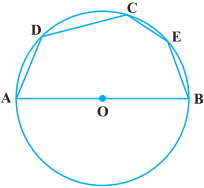
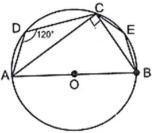
In the figure,if $AOB$ is a diameter and $\angle ADC = 120^{\circ}$,then $\angle CAB = 30^{\circ}$.
In the figure,if $AOB$ is a diameter and $\angle ADC = 120^{\circ}$,then $\angle CAB = 30^{\circ}$.
Solution
(TRUE) $AOB$ is a diameter of the circle with center $O$.
Consider the cyclic quadrilateral $ADCB$ (or $ADCEB$ as shown in the figure,but focusing on the cyclic quadrilateral $ADCB$ is sufficient).
Since $ADCB$ is a cyclic quadrilateral,the sum of opposite angles is $180^{\circ}$.
Therefore,$\angle ADC + \angle ABC = 180^{\circ}$.
Given $\angle ADC = 120^{\circ}$,we have $120^{\circ} + \angle ABC = 180^{\circ}$.
$\angle ABC = 180^{\circ} - 120^{\circ} = 60^{\circ}$.
In $\Delta ABC$,$\angle ACB = 90^{\circ}$ (Angle in a semicircle).
In $\Delta ABC$,the sum of angles is $180^{\circ}$.
$\angle CAB + \angle ABC + \angle ACB = 180^{\circ}$.
$\angle CAB + 60^{\circ} + 90^{\circ} = 180^{\circ}$.
$\angle CAB + 150^{\circ} = 180^{\circ}$.
$\angle CAB = 180^{\circ} - 150^{\circ} = 30^{\circ}$.
Hence,the given statement is True.
Consider the cyclic quadrilateral $ADCB$ (or $ADCEB$ as shown in the figure,but focusing on the cyclic quadrilateral $ADCB$ is sufficient).
Since $ADCB$ is a cyclic quadrilateral,the sum of opposite angles is $180^{\circ}$.
Therefore,$\angle ADC + \angle ABC = 180^{\circ}$.
Given $\angle ADC = 120^{\circ}$,we have $120^{\circ} + \angle ABC = 180^{\circ}$.
$\angle ABC = 180^{\circ} - 120^{\circ} = 60^{\circ}$.
In $\Delta ABC$,$\angle ACB = 90^{\circ}$ (Angle in a semicircle).
In $\Delta ABC$,the sum of angles is $180^{\circ}$.
$\angle CAB + \angle ABC + \angle ACB = 180^{\circ}$.
$\angle CAB + 60^{\circ} + 90^{\circ} = 180^{\circ}$.
$\angle CAB + 150^{\circ} = 180^{\circ}$.
$\angle CAB = 180^{\circ} - 150^{\circ} = 30^{\circ}$.
Hence,the given statement is True.
0 likes
View Solution25
Medium
In the figure,$AOC$ is a diameter of the circle and $\operatorname{arc} AXB = \frac{1}{2} \operatorname{arc} BYC$. Find $\angle BOC$.
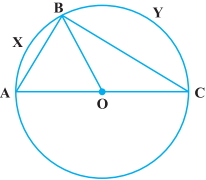
Solution
$(120^{\circ})$ We know that the angle subtended by an arc at the center is proportional to the length of the arc.
Given that $\operatorname{arc} AXB = \frac{1}{2} \operatorname{arc} BYC$,it follows that $\angle AOB = \frac{1}{2} \angle BOC$.
Since $AOC$ is a diameter,$\angle AOB + \angle BOC = 180^{\circ}$ (linear pair).
Substituting $\angle AOB = \frac{1}{2} \angle BOC$ into the equation,we get:
$\frac{1}{2} \angle BOC + \angle BOC = 180^{\circ}$
$\frac{3}{2} \angle BOC = 180^{\circ}$
$\angle BOC = 180^{\circ} \times \frac{2}{3} = 120^{\circ}$.
Given that $\operatorname{arc} AXB = \frac{1}{2} \operatorname{arc} BYC$,it follows that $\angle AOB = \frac{1}{2} \angle BOC$.
Since $AOC$ is a diameter,$\angle AOB + \angle BOC = 180^{\circ}$ (linear pair).
Substituting $\angle AOB = \frac{1}{2} \angle BOC$ into the equation,we get:
$\frac{1}{2} \angle BOC + \angle BOC = 180^{\circ}$
$\frac{3}{2} \angle BOC = 180^{\circ}$
$\angle BOC = 180^{\circ} \times \frac{2}{3} = 120^{\circ}$.
0 likes
View Solution26
Easy
In the given figure,if $\angle ABC = 45^{\circ}$,prove that $OA \perp OC$.
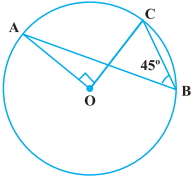
Solution
(N/A) We know that the angle subtended by an arc at the center is double the angle subtended by it at any point on the remaining part of the circle.
Therefore,$\angle AOC = 2 \times \angle ABC$.
Given that $\angle ABC = 45^{\circ}$.
Substituting the value,we get $\angle AOC = 2 \times 45^{\circ} = 90^{\circ}$.
Since $\angle AOC = 90^{\circ}$,the lines $OA$ and $OC$ are perpendicular to each other.
Hence,$OA \perp OC$ is proved.
Therefore,$\angle AOC = 2 \times \angle ABC$.
Given that $\angle ABC = 45^{\circ}$.
Substituting the value,we get $\angle AOC = 2 \times 45^{\circ} = 90^{\circ}$.
Since $\angle AOC = 90^{\circ}$,the lines $OA$ and $OC$ are perpendicular to each other.
Hence,$OA \perp OC$ is proved.
0 likes
View Solution27
EasyMCQ
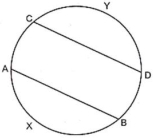
If arcs $AXB$ and $CYD$ of a circle are congruent,find the ratio of $AB$ and $CD.$
A
$1:1$
B
$1:2$
C
$2:1$
D
$1:3$
Solution
(A) We are given that arc $AXB \cong$ arc $CYD$.
According to the properties of circles,if two arcs of a circle are congruent,then their corresponding chords are equal.
Therefore,chord $AB =$ chord $CD$.
Thus,the ratio of the lengths of the chords is $AB:CD = 1:1$.
According to the properties of circles,if two arcs of a circle are congruent,then their corresponding chords are equal.
Therefore,chord $AB =$ chord $CD$.
Thus,the ratio of the lengths of the chords is $AB:CD = 1:1$.
0 likes
View Solution28
Medium
If the perpendicular bisector of a chord $AB$ of a circle $PXAQBY$ intersects the circle at $P$ and $Q$,prove that arc $PXA \cong$ arc $PYB$.
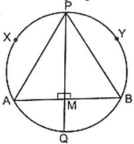
Solution
(N/A) Given: $PQ$ is the perpendicular bisector of chord $AB$ of a circle,intersecting the circle at $P$ and $Q$. Let $M$ be the point of intersection of $PQ$ and $AB$.
To prove: Arc $PXA \cong$ Arc $PYB$.
Proof:
In $\Delta APM$ and $\Delta BPM$:
$1$. $AM = BM$ (Since $PQ$ is the perpendicular bisector of $AB$)
$2$. $\angle AMP = \angle BMP = 90^{\circ}$ (Given)
$3$. $PM = PM$ (Common side)
Therefore,$\Delta APM \cong \Delta BPM$ by the $SAS$ congruence rule.
This implies $AP = BP$ by $CPCT$.
Since $AP$ and $BP$ are chords of the circle and $AP = BP$,their corresponding arcs are congruent.
Thus,arc $PXA \cong$ arc $PYB$.
To prove: Arc $PXA \cong$ Arc $PYB$.
Proof:
In $\Delta APM$ and $\Delta BPM$:
$1$. $AM = BM$ (Since $PQ$ is the perpendicular bisector of $AB$)
$2$. $\angle AMP = \angle BMP = 90^{\circ}$ (Given)
$3$. $PM = PM$ (Common side)
Therefore,$\Delta APM \cong \Delta BPM$ by the $SAS$ congruence rule.
This implies $AP = BP$ by $CPCT$.
Since $AP$ and $BP$ are chords of the circle and $AP = BP$,their corresponding arcs are congruent.
Thus,arc $PXA \cong$ arc $PYB$.
0 likes
View Solution29
Difficult
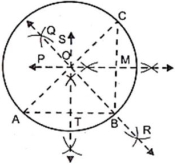
$A, B$ and $C$ are three points on a circle. Prove that the perpendicular bisectors of $AB, BC$ and $CA$ are concurrent.
Solution
(N/A) Given: Three non-collinear points $A, B$ and $C$ lie on a circle.
To prove: The perpendicular bisectors of $AB, BC$ and $CA$ are concurrent.
Construction: Join $AB, BC$ and $CA$. Draw the perpendicular bisectors $ST$ of $AB$,$PM$ of $BC$,and $QR$ of $CA$. Since points $A, B$ and $C$ are not collinear,the lines $ST, PM$ and $QR$ are not parallel and will intersect at some point $O$.
Proof:
$1$. Since point $O$ lies on $ST$,which is the perpendicular bisector of $AB$,we have $OA = OB$ (Any point on the perpendicular bisector of a line segment is equidistant from its endpoints) ... $(1)$
$2$. Similarly,since $O$ lies on $PM$,the perpendicular bisector of $BC$,we have $OB = OC$ ... $(2)$
$3$. Also,since $O$ lies on $QR$,the perpendicular bisector of $CA$,we have $OC = OA$ ... $(3)$
From $(1)$,$(2)$,and $(3)$,we get $OA = OB = OC = r$ (where $r$ is the radius).
This implies that $O$ is the center of the circle passing through $A, B$ and $C$. Since the perpendicular bisectors of the sides of a triangle intersect at a unique point (the circumcenter),the perpendicular bisectors of $AB, BC$ and $CA$ must be concurrent at point $O$.
To prove: The perpendicular bisectors of $AB, BC$ and $CA$ are concurrent.
Construction: Join $AB, BC$ and $CA$. Draw the perpendicular bisectors $ST$ of $AB$,$PM$ of $BC$,and $QR$ of $CA$. Since points $A, B$ and $C$ are not collinear,the lines $ST, PM$ and $QR$ are not parallel and will intersect at some point $O$.
Proof:
$1$. Since point $O$ lies on $ST$,which is the perpendicular bisector of $AB$,we have $OA = OB$ (Any point on the perpendicular bisector of a line segment is equidistant from its endpoints) ... $(1)$
$2$. Similarly,since $O$ lies on $PM$,the perpendicular bisector of $BC$,we have $OB = OC$ ... $(2)$
$3$. Also,since $O$ lies on $QR$,the perpendicular bisector of $CA$,we have $OC = OA$ ... $(3)$
From $(1)$,$(2)$,and $(3)$,we get $OA = OB = OC = r$ (where $r$ is the radius).
This implies that $O$ is the center of the circle passing through $A, B$ and $C$. Since the perpendicular bisectors of the sides of a triangle intersect at a unique point (the circumcenter),the perpendicular bisectors of $AB, BC$ and $CA$ must be concurrent at point $O$.
0 likes
View Solution30
Difficult
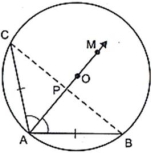
$AB$ and $AC$ are two equal chords of a circle. Prove that the bisector of the angle $BAC$ passes through the centre of the circle.
Solution
(N/A) To prove: The bisector $AM$ of $\angle BAC$ passes through the centre $O$.
Construction: Join $BC$. Let the bisector $AM$ intersect $BC$ at $P$.
Proof: In $\Delta BAP$ and $\Delta CAP$:
$AB = AC$ (Given,as chords are equal)
$\angle BAP = \angle CAP$ (Given,as $AM$ is the bisector)
$AP = AP$ (Common side)
Therefore,$\Delta BAP \cong \Delta CAP$ (By $SAS$ congruence rule).
Thus,$BP = CP$ and $\angle BPA = \angle CPA$ (by $CPCT$).
Since $\angle BPA + \angle CPA = 180^{\circ}$ (Linear pair),
$\angle BPA = \angle CPA = 90^{\circ}$.
This means $AP$ is the perpendicular bisector of the chord $BC$. We know that the perpendicular bisector of any chord of a circle always passes through the centre of the circle. Hence,the bisector of $\angle BAC$ passes through the centre $O$.
Construction: Join $BC$. Let the bisector $AM$ intersect $BC$ at $P$.
Proof: In $\Delta BAP$ and $\Delta CAP$:
$AB = AC$ (Given,as chords are equal)
$\angle BAP = \angle CAP$ (Given,as $AM$ is the bisector)
$AP = AP$ (Common side)
Therefore,$\Delta BAP \cong \Delta CAP$ (By $SAS$ congruence rule).
Thus,$BP = CP$ and $\angle BPA = \angle CPA$ (by $CPCT$).
Since $\angle BPA + \angle CPA = 180^{\circ}$ (Linear pair),
$\angle BPA = \angle CPA = 90^{\circ}$.
This means $AP$ is the perpendicular bisector of the chord $BC$. We know that the perpendicular bisector of any chord of a circle always passes through the centre of the circle. Hence,the bisector of $\angle BAC$ passes through the centre $O$.
0 likes
View Solution31
Difficult
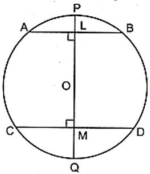
If a line segment joining the mid-points of two chords of a circle passes through the centre of the circle,prove that the two chords are parallel.
Solution
(N/A) Given: $AB$ and $CD$ are two chords of a circle with centre $O$. The mid-points of $AB$ and $CD$ are $L$ and $M$ respectively.
To prove: $AB \parallel CD$
Proof: Since $L$ is the mid-point of chord $AB$,therefore $OL \perp AB$,or $\angle ALO = 90^{\circ}$.
[Because the line joining the centre of a circle to the mid-point of a chord is perpendicular to the chord]
Similarly,$\angle CMO = 90^{\circ}$.
Therefore,$\angle ALO = \angle CMO = 90^{\circ}$.
Since these are corresponding angles formed by the transversal $LM$ intersecting lines $AB$ and $CD$,and they are equal,the lines must be parallel.
So,$AB \parallel CD$.
Hence,proved.
To prove: $AB \parallel CD$
Proof: Since $L$ is the mid-point of chord $AB$,therefore $OL \perp AB$,or $\angle ALO = 90^{\circ}$.
[Because the line joining the centre of a circle to the mid-point of a chord is perpendicular to the chord]
Similarly,$\angle CMO = 90^{\circ}$.
Therefore,$\angle ALO = \angle CMO = 90^{\circ}$.
Since these are corresponding angles formed by the transversal $LM$ intersecting lines $AB$ and $CD$,and they are equal,the lines must be parallel.
So,$AB \parallel CD$.
Hence,proved.
0 likes
View Solution32
Difficult
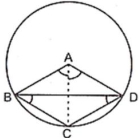
$ABCD$ is a quadrilateral such that $A$ is the centre of the circle passing through $B, C$ and $D$. Prove that $\angle CBD + \angle CDB = \frac{1}{2} \angle BAD$.
Solution
(N/A) $ABCD$ is a quadrilateral such that $A$ is the centre of the circle passing through $B, C$ and $D$. We have to prove that $\angle CBD + \angle CDB = \frac{1}{2} \angle BAD$.
Join $AC$.
Since the angle subtended by an arc at the centre is double the angle subtended by it at any point on the remaining part of the circle:
Therefore,$\angle CAD = 2 \angle CBD$ $....(1)$
And $\angle BAC = 2 \angle CDB$ $....(2)$
Adding $(1)$ and $(2)$,we get:
$\angle CAD + \angle BAC = 2(\angle CBD + \angle CDB)$
$\Rightarrow \angle BAD = 2(\angle CBD + \angle CDB)$
Hence,$\angle CBD + \angle CDB = \frac{1}{2} \angle BAD$.
Join $AC$.
Since the angle subtended by an arc at the centre is double the angle subtended by it at any point on the remaining part of the circle:
Therefore,$\angle CAD = 2 \angle CBD$ $....(1)$
And $\angle BAC = 2 \angle CDB$ $....(2)$
Adding $(1)$ and $(2)$,we get:
$\angle CAD + \angle BAC = 2(\angle CBD + \angle CDB)$
$\Rightarrow \angle BAD = 2(\angle CBD + \angle CDB)$
Hence,$\angle CBD + \angle CDB = \frac{1}{2} \angle BAD$.
0 likes
View Solution33
Difficult
$O$ is the circumcentre of the triangle $ABC$ and $D$ is the mid-point of the base $BC$. Prove that $\angle BOD = \angle A$.
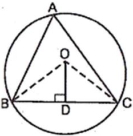
Solution
(N/A) Given: $O$ is the circumcentre of $\Delta ABC$ and $D$ is the mid-point of $BC$,so $OD \perp BC$.
To prove: $\angle BOD = \angle A$.
Construction: Join $OB$ and $OC$.
Proof: In $\Delta OBD$ and $\Delta OCD$,we have:
$OB = OC$ (Radii of the same circumcircle)
$OD = OD$ (Common side)
$BD = CD$ ($D$ is the mid-point of $BC$)
Therefore,$\Delta OBD \cong \Delta OCD$ by $SSS$ congruence rule.
This implies $\angle BOD = \angle COD$ (by $CPCT$).
Thus,$\angle BOC = \angle BOD + \angle COD = 2\angle BOD$.
We know that the angle subtended by an arc at the centre is double the angle subtended by it at any point on the remaining part of the circle.
Therefore,$\angle BOC = 2\angle BAC = 2\angle A$.
Equating the two expressions for $\angle BOC$:
$2\angle BOD = 2\angle A$
$\angle BOD = \angle A$.
Hence,proved.
To prove: $\angle BOD = \angle A$.
Construction: Join $OB$ and $OC$.
Proof: In $\Delta OBD$ and $\Delta OCD$,we have:
$OB = OC$ (Radii of the same circumcircle)
$OD = OD$ (Common side)
$BD = CD$ ($D$ is the mid-point of $BC$)
Therefore,$\Delta OBD \cong \Delta OCD$ by $SSS$ congruence rule.
This implies $\angle BOD = \angle COD$ (by $CPCT$).
Thus,$\angle BOC = \angle BOD + \angle COD = 2\angle BOD$.
We know that the angle subtended by an arc at the centre is double the angle subtended by it at any point on the remaining part of the circle.
Therefore,$\angle BOC = 2\angle BAC = 2\angle A$.
Equating the two expressions for $\angle BOC$:
$2\angle BOD = 2\angle A$
$\angle BOD = \angle A$.
Hence,proved.
0 likes
View Solution34
Medium
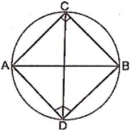
On a common hypotenuse $AB$,two right triangles $ACB$ and $ADB$ are situated on opposite sides. Prove that $\angle BAC = \angle BDC$.
Solution
(N/A) In right triangles $ACB$ and $ADB$,we have:
$\angle ACB = 90^{\circ}$ and $\angle ADB = 90^{\circ}$
Therefore,$\angle ACB + \angle ADB = 90^{\circ} + 90^{\circ} = 180^{\circ}$.
Since the sum of a pair of opposite angles of the quadrilateral $ADBC$ is $180^{\circ}$,it is a cyclic quadrilateral.
Now,consider the arc $BC$. The angles $\angle BAC$ and $\angle BDC$ are subtended by the same arc $BC$ in the same segment of the circle.
Since angles subtended by the same arc in the same segment of a circle are equal,we have $\angle BAC = \angle BDC$.
$\angle ACB = 90^{\circ}$ and $\angle ADB = 90^{\circ}$
Therefore,$\angle ACB + \angle ADB = 90^{\circ} + 90^{\circ} = 180^{\circ}$.
Since the sum of a pair of opposite angles of the quadrilateral $ADBC$ is $180^{\circ}$,it is a cyclic quadrilateral.
Now,consider the arc $BC$. The angles $\angle BAC$ and $\angle BDC$ are subtended by the same arc $BC$ in the same segment of the circle.
Since angles subtended by the same arc in the same segment of a circle are equal,we have $\angle BAC = \angle BDC$.
0 likes
View Solution35
Medium
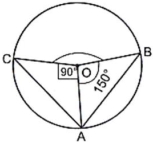
Two chords $AB$ and $AC$ of a circle subtend angles equal to $90^{\circ}$ and $150^{\circ}$,respectively,at the centre. Find $\angle BAC$,if $AB$ and $AC$ lie on the opposite sides of the centre.
Solution
$(120^{\circ})$ Given that chords $AB$ and $AC$ subtend angles $\angle AOB = 150^{\circ}$ and $\angle AOC = 90^{\circ}$ at the centre $O$.
Since $AB$ and $AC$ lie on opposite sides of the centre,the angle subtended by the chord $BC$ at the centre is $\angle BOC = \angle AOB + \angle AOC = 150^{\circ} + 90^{\circ} = 240^{\circ}$.
The angle subtended by the chord $BC$ at the remaining part of the circle is $\angle BAC$.
We know that the angle subtended by an arc at the centre is double the angle subtended by it at any point on the remaining part of the circle.
Therefore,the reflex angle $\angle BOC = 2 \angle BAC$.
$240^{\circ} = 2 \angle BAC$.
$\angle BAC = \frac{240^{\circ}}{2} = 120^{\circ}$.
Since $AB$ and $AC$ lie on opposite sides of the centre,the angle subtended by the chord $BC$ at the centre is $\angle BOC = \angle AOB + \angle AOC = 150^{\circ} + 90^{\circ} = 240^{\circ}$.
The angle subtended by the chord $BC$ at the remaining part of the circle is $\angle BAC$.
We know that the angle subtended by an arc at the centre is double the angle subtended by it at any point on the remaining part of the circle.
Therefore,the reflex angle $\angle BOC = 2 \angle BAC$.
$240^{\circ} = 2 \angle BAC$.
$\angle BAC = \frac{240^{\circ}}{2} = 120^{\circ}$.
0 likes
View Solution36
Medium
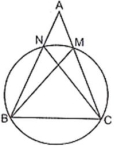
If $BM$ and $CN$ are the perpendiculars drawn on the sides $AC$ and $AB$ of the triangle $ABC$,prove that the points $B, C, M$ and $N$ are concyclic.
Solution
(N/A) Given that $BM \perp AC$ and $CN \perp AB$.
Therefore,$\angle BMC = 90^{\circ}$ and $\angle BNC = 90^{\circ}$.
Since $\angle BMC = \angle BNC = 90^{\circ}$,both angles are equal.
These two equal angles are subtended by the same line segment $BC$ at points $M$ and $N$ on the same side of $BC$.
According to the theorem,if a line segment joining two points subtends equal angles at two other points on the same side of the line containing the segment,then the four points are concyclic.
Thus,the points $B, C, M$ and $N$ are concyclic.
Therefore,$\angle BMC = 90^{\circ}$ and $\angle BNC = 90^{\circ}$.
Since $\angle BMC = \angle BNC = 90^{\circ}$,both angles are equal.
These two equal angles are subtended by the same line segment $BC$ at points $M$ and $N$ on the same side of $BC$.
According to the theorem,if a line segment joining two points subtends equal angles at two other points on the same side of the line containing the segment,then the four points are concyclic.
Thus,the points $B, C, M$ and $N$ are concyclic.
0 likes
View Solution37
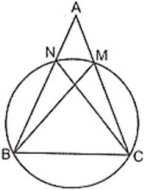
Difficult
If $BM$ and $CN$ are the perpendiculars drawn on the sides $AC$ and $AB$ of the triangle $ABC$,prove that the points $B, C, M$ and $N$ are concyclic.
Solution
(N/A) Given that $BM \perp AC$ and $CN \perp AB$.
Therefore,$\angle BMC = 90^{\circ}$ and $\angle BNC = 90^{\circ}$.
Since $\angle BMC = \angle BNC = 90^{\circ}$,the points $M$ and $N$ subtend equal angles at the line segment $BC$ on the same side.
According to the theorem,if a line segment joining two points subtends equal angles at two other points on the same side of the line,then the four points are concyclic.
Hence,the points $B, C, M$ and $N$ are concyclic.
Therefore,$\angle BMC = 90^{\circ}$ and $\angle BNC = 90^{\circ}$.
Since $\angle BMC = \angle BNC = 90^{\circ}$,the points $M$ and $N$ subtend equal angles at the line segment $BC$ on the same side.
According to the theorem,if a line segment joining two points subtends equal angles at two other points on the same side of the line,then the four points are concyclic.
Hence,the points $B, C, M$ and $N$ are concyclic.
0 likes
View Solution38
Medium
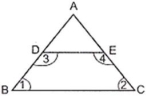
If a line is drawn parallel to the base of an isosceles triangle to intersect its equal sides,prove that the quadrilateral so formed is cyclic.
Solution
(N/A) Let $\Delta ABC$ be an isosceles triangle with $AB = AC$. $A$ line $DE$ is drawn parallel to $BC$ such that $D$ lies on $AB$ and $E$ lies on $AC$.
We need to prove that the quadrilateral $BCED$ is a cyclic quadrilateral.
In $\Delta ABC$,since $AB = AC$,the angles opposite to equal sides are equal,so $\angle ABC = \angle ACB$ (or $\angle 1 = \angle 2$ as per the figure).
Since $DE \parallel BC$,the interior angles on the same side of the transversal $AB$ are supplementary.
Therefore,$\angle BDE + \angle ABC = 180^{\circ}$ (or $\angle 3 + \angle 1 = 180^{\circ}$).
Substituting $\angle 1 = \angle 2$,we get $\angle 3 + \angle 2 = 180^{\circ}$.
This means the sum of the opposite angles of the quadrilateral $BCED$ is $180^{\circ}$.
Since the sum of a pair of opposite angles of the quadrilateral $BCED$ is $180^{\circ}$,the quadrilateral $BCED$ is cyclic.
We need to prove that the quadrilateral $BCED$ is a cyclic quadrilateral.
In $\Delta ABC$,since $AB = AC$,the angles opposite to equal sides are equal,so $\angle ABC = \angle ACB$ (or $\angle 1 = \angle 2$ as per the figure).
Since $DE \parallel BC$,the interior angles on the same side of the transversal $AB$ are supplementary.
Therefore,$\angle BDE + \angle ABC = 180^{\circ}$ (or $\angle 3 + \angle 1 = 180^{\circ}$).
Substituting $\angle 1 = \angle 2$,we get $\angle 3 + \angle 2 = 180^{\circ}$.
This means the sum of the opposite angles of the quadrilateral $BCED$ is $180^{\circ}$.
Since the sum of a pair of opposite angles of the quadrilateral $BCED$ is $180^{\circ}$,the quadrilateral $BCED$ is cyclic.
0 likes
View Solution39
Difficult
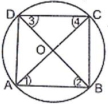
If a pair of opposite sides of a cyclic quadrilateral are equal,prove that its diagonals are also equal.
Solution
(N/A) $ABCD$ is a cyclic quadrilateral in which one pair of opposite sides $AB = DC$. We have to prove that diagonal $AC = $ diagonal $BD$.
In $\Delta AOB$ and $\Delta DOC$,we have:
$\angle 1 = \angle 3$ [Angles in the same segment of the circle are equal]
$AB = DC$ [Given]
$\angle 2 = \angle 4$ [Angles in the same segment of the circle are equal]
Therefore,$\Delta AOB \cong \Delta DOC$ [By $ASA$ congruence rule]
Therefore,$AO = OD$ [$CPCT$] $...(1)$
And $OC = BO$ [$CPCT$] $...(2)$
Now,adding $(1)$ and $(2)$,we get:
$AO + OC = BO + OD$
$\Rightarrow AC = BD$
Hence,proved.
In $\Delta AOB$ and $\Delta DOC$,we have:
$\angle 1 = \angle 3$ [Angles in the same segment of the circle are equal]
$AB = DC$ [Given]
$\angle 2 = \angle 4$ [Angles in the same segment of the circle are equal]
Therefore,$\Delta AOB \cong \Delta DOC$ [By $ASA$ congruence rule]
Therefore,$AO = OD$ [$CPCT$] $...(1)$
And $OC = BO$ [$CPCT$] $...(2)$
Now,adding $(1)$ and $(2)$,we get:
$AO + OC = BO + OD$
$\Rightarrow AC = BD$
Hence,proved.
0 likes
View Solution40
Difficult
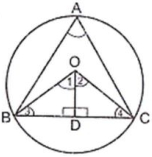
The circumcentre of the triangle $ABC$ is $O$. Prove that $\angle OBC + \angle BAC = 90^{\circ}$.
Solution
(N/A) $ABC$ is a triangle and $O$ is the circumcentre.
Draw $OD \perp BC$. Join $OB$ and $OC$.
In right $\Delta OBD$ and right $\Delta OCD$,we have:
hyp. $OB = \text{hyp. } OC$ [Radii of the same circle]
$OD = OD$ [Common side]
$\therefore \Delta OBD \cong \Delta OCD$ [By $RHS$ congruence rule]
$\therefore \angle 1 = \angle 2$ and $\angle 3 = \angle 4$ [$CPCT$]
Now,$\angle BOC = 2 \angle BAC$ [Angle at the centre is double the angle at the circumference]
Also,in $\Delta OBC$,$OB = OC$,so $\angle 3 = \angle 4$.
In $\Delta OBD$,$\angle 3 + \angle 1 + 90^{\circ} = 180^{\circ} \Rightarrow \angle 3 + \angle 1 = 90^{\circ}$.
Since $\angle BOC = 2 \angle 1 + 2 \angle 2$ and $\angle BOC = 2 \angle BAC$,we have $\angle 1 + \angle 2 = \angle BAC$.
Since $\angle 1 = \angle 2$,we have $2 \angle 1 = \angle BAC$,or $\angle 1 = \frac{1}{2} \angle BAC$.
Substituting this into $\angle 3 + \angle 1 = 90^{\circ}$,we get $\angle OBC + \angle BAC = 90^{\circ}$ (where $\angle OBC = \angle 3$).
Hence,proved.
Draw $OD \perp BC$. Join $OB$ and $OC$.
In right $\Delta OBD$ and right $\Delta OCD$,we have:
hyp. $OB = \text{hyp. } OC$ [Radii of the same circle]
$OD = OD$ [Common side]
$\therefore \Delta OBD \cong \Delta OCD$ [By $RHS$ congruence rule]
$\therefore \angle 1 = \angle 2$ and $\angle 3 = \angle 4$ [$CPCT$]
Now,$\angle BOC = 2 \angle BAC$ [Angle at the centre is double the angle at the circumference]
Also,in $\Delta OBC$,$OB = OC$,so $\angle 3 = \angle 4$.
In $\Delta OBD$,$\angle 3 + \angle 1 + 90^{\circ} = 180^{\circ} \Rightarrow \angle 3 + \angle 1 = 90^{\circ}$.
Since $\angle BOC = 2 \angle 1 + 2 \angle 2$ and $\angle BOC = 2 \angle BAC$,we have $\angle 1 + \angle 2 = \angle BAC$.
Since $\angle 1 = \angle 2$,we have $2 \angle 1 = \angle BAC$,or $\angle 1 = \frac{1}{2} \angle BAC$.
Substituting this into $\angle 3 + \angle 1 = 90^{\circ}$,we get $\angle OBC + \angle BAC = 90^{\circ}$ (where $\angle OBC = \angle 3$).
Hence,proved.
0 likes
View Solution41
Medium
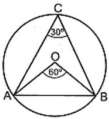
$A$ chord of a circle is equal to its radius. Find the angle subtended by this chord at a point in the major segment.
Solution
(N/A) Let the chord be $AB$ and the center of the circle be $O$. Since the chord is equal to the radius,we have $AB = OA = OB$.
Therefore,$\triangle OAB$ is an equilateral triangle.
Since each angle of an equilateral triangle is $60^{\circ}$,we have $\angle AOB = 60^{\circ}$.
According to the circle theorem,the angle subtended by an arc at the center is double the angle subtended by it at any point on the remaining part of the circle.
Thus,$\angle AOB = 2 \angle ACB$,where $C$ is a point on the major arc.
Therefore,$\angle ACB = \frac{1}{2} \angle AOB = \frac{1}{2} \times 60^{\circ} = 30^{\circ}$.
Therefore,$\triangle OAB$ is an equilateral triangle.
Since each angle of an equilateral triangle is $60^{\circ}$,we have $\angle AOB = 60^{\circ}$.
According to the circle theorem,the angle subtended by an arc at the center is double the angle subtended by it at any point on the remaining part of the circle.
Thus,$\angle AOB = 2 \angle ACB$,where $C$ is a point on the major arc.
Therefore,$\angle ACB = \frac{1}{2} \angle AOB = \frac{1}{2} \times 60^{\circ} = 30^{\circ}$.
0 likes
View Solution42
Medium
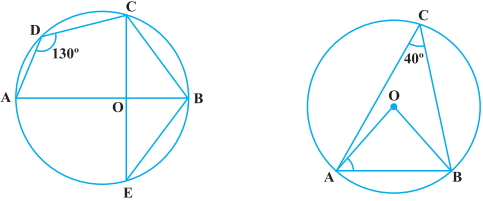
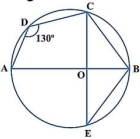
In the figure,$\angle ADC = 130^{\circ}$ and chord $BC = $ chord $BE$. Find $\angle CBE$.
Solution
$(100^{\circ})$ In the given figure,$ABCD$ is a cyclic quadrilateral. The sum of opposite angles of a cyclic quadrilateral is $180^{\circ}$.
Therefore,$\angle ADC + \angle ABC = 180^{\circ}$.
Given $\angle ADC = 130^{\circ}$,so $130^{\circ} + \angle ABC = 180^{\circ}$.
$\angle ABC = 180^{\circ} - 130^{\circ} = 50^{\circ}$.
Now,consider $\Delta OBC$ and $\Delta OBE$:
$BC = BE$ (Given)
$OC = OE$ (Radii of the same circle)
$OB = OB$ (Common side)
By $SSS$ congruence rule,$\Delta OBC \cong \Delta OBE$.
Therefore,$\angle OBC = \angle OBE$ (by $CPCT$).
Since $\angle ABC = 50^{\circ}$,and $\angle ABC$ is not directly $\angle OBC$ (as $O$ is the center,$AB$ is a diameter),we note that $\angle OBC$ is the angle subtended by chord $BC$ at the center. However,based on the geometry,$\angle OBC$ is part of the triangle. Since $\Delta OBC \cong \Delta OBE$,$\angle OBC = \angle OBE$.
Actually,$\angle ABC$ is the angle subtended by arc $AC$ at the circumference. The angle $\angle OBC$ is $50^{\circ}$.
Thus,$\angle CBE = \angle OBC + \angle OBE = 50^{\circ} + 50^{\circ} = 100^{\circ}$.
Therefore,$\angle ADC + \angle ABC = 180^{\circ}$.
Given $\angle ADC = 130^{\circ}$,so $130^{\circ} + \angle ABC = 180^{\circ}$.
$\angle ABC = 180^{\circ} - 130^{\circ} = 50^{\circ}$.
Now,consider $\Delta OBC$ and $\Delta OBE$:
$BC = BE$ (Given)
$OC = OE$ (Radii of the same circle)
$OB = OB$ (Common side)
By $SSS$ congruence rule,$\Delta OBC \cong \Delta OBE$.
Therefore,$\angle OBC = \angle OBE$ (by $CPCT$).
Since $\angle ABC = 50^{\circ}$,and $\angle ABC$ is not directly $\angle OBC$ (as $O$ is the center,$AB$ is a diameter),we note that $\angle OBC$ is the angle subtended by chord $BC$ at the center. However,based on the geometry,$\angle OBC$ is part of the triangle. Since $\Delta OBC \cong \Delta OBE$,$\angle OBC = \angle OBE$.
Actually,$\angle ABC$ is the angle subtended by arc $AC$ at the circumference. The angle $\angle OBC$ is $50^{\circ}$.
Thus,$\angle CBE = \angle OBC + \angle OBE = 50^{\circ} + 50^{\circ} = 100^{\circ}$.
0 likes
View Solution43
Medium
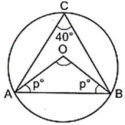
In the figure,$\angle ACB = 40^{\circ}$. Find $\angle OAB$.
Solution
$(50^{\circ})$ Since the angle subtended by an arc at the centre is double the angle subtended by it at any point on the remaining part of the circle,we have:
$\angle AOB = 2 \angle ACB = 2 \times 40^{\circ} = 80^{\circ}$
In $\Delta OAB$,since $OA = OB$ (radii of the same circle),the angles opposite to equal sides are equal. Therefore,$\angle OAB = \angle OBA = p^{\circ}$.
Using the angle sum property in $\Delta OAB$:
$p^{\circ} + p^{\circ} + \angle AOB = 180^{\circ}$
$2p^{\circ} + 80^{\circ} = 180^{\circ}$
$2p^{\circ} = 180^{\circ} - 80^{\circ}$
$2p^{\circ} = 100^{\circ}$
$p^{\circ} = 50^{\circ}$
Hence,$\angle OAB = 50^{\circ}$.
$\angle AOB = 2 \angle ACB = 2 \times 40^{\circ} = 80^{\circ}$
In $\Delta OAB$,since $OA = OB$ (radii of the same circle),the angles opposite to equal sides are equal. Therefore,$\angle OAB = \angle OBA = p^{\circ}$.
Using the angle sum property in $\Delta OAB$:
$p^{\circ} + p^{\circ} + \angle AOB = 180^{\circ}$
$2p^{\circ} + 80^{\circ} = 180^{\circ}$
$2p^{\circ} = 180^{\circ} - 80^{\circ}$
$2p^{\circ} = 100^{\circ}$
$p^{\circ} = 50^{\circ}$
Hence,$\angle OAB = 50^{\circ}$.
0 likes
View Solution44
Medium
$A$ quadrilateral $ABCD$ is inscribed in a circle such that $AB$ is a diameter and $\angle ADC = 130^{\circ}$. Find $\angle BAC$.
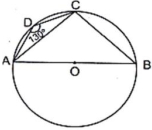
Solution
$(40^{\circ})$ Since the opposite angles of a cyclic quadrilateral are supplementary,we have:
$\angle ABC + \angle ADC = 180^{\circ}$
$\angle ABC + 130^{\circ} = 180^{\circ}$
$\angle ABC = 180^{\circ} - 130^{\circ} = 50^{\circ}$
Now,in $\Delta ABC$,$\angle ACB = 90^{\circ}$ (Angle in a semi-circle is $90^{\circ}$).
Using the angle sum property of a triangle in $\Delta ABC$:
$\angle BAC + \angle ABC + \angle ACB = 180^{\circ}$
$\angle BAC + 50^{\circ} + 90^{\circ} = 180^{\circ}$
$\angle BAC + 140^{\circ} = 180^{\circ}$
$\angle BAC = 180^{\circ} - 140^{\circ} = 40^{\circ}$
$\angle ABC + \angle ADC = 180^{\circ}$
$\angle ABC + 130^{\circ} = 180^{\circ}$
$\angle ABC = 180^{\circ} - 130^{\circ} = 50^{\circ}$
Now,in $\Delta ABC$,$\angle ACB = 90^{\circ}$ (Angle in a semi-circle is $90^{\circ}$).
Using the angle sum property of a triangle in $\Delta ABC$:
$\angle BAC + \angle ABC + \angle ACB = 180^{\circ}$
$\angle BAC + 50^{\circ} + 90^{\circ} = 180^{\circ}$
$\angle BAC + 140^{\circ} = 180^{\circ}$
$\angle BAC = 180^{\circ} - 140^{\circ} = 40^{\circ}$
0 likes
View Solution45
Difficult
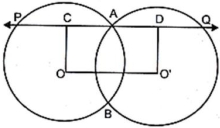
Two circles with centres $O$ and $O'$ intersect at two points $A$ and $B$. $A$ line $PQ$ is drawn parallel to $OO'$ through $A$ (or $B$) intersecting the circles at $P$ and $Q$. Prove that $PQ = 2 OO'$.
Solution
(N/A) Given: Two circles with centres $O$ and $O'$ intersect at $A$ and $B$. $A$ line $PQ$ is drawn parallel to $OO'$ passing through $A$,intersecting the circles at $P$ and $Q$.
To prove: $PQ = 2 OO'$.
Construction: Draw $OC \perp PA$ and $O'D \perp AQ$.
Proof:
$1$. Since the perpendicular from the centre of a circle to a chord bisects the chord,we have:
$PA = 2 CA$ (as $OC \perp PA$) $...(1)$
$AQ = 2 AD$ (as $O'D \perp AQ$) $...(2)$
$2$. Adding equations $(1)$ and $(2)$:
$PA + AQ = 2 CA + 2 AD$
$PQ = 2(CA + AD)$
$3$. Since $PQ \parallel OO'$,$OC \perp PQ$,and $O'D \perp PQ$,the quadrilateral $CDO'O$ is a rectangle.
Therefore,$CD = OO'$.
$4$. Substituting $CD = OO'$ in the equation $PQ = 2(CA + AD)$:
$PQ = 2 CD = 2 OO'$.
Hence,$PQ = 2 OO'$ is proved.
To prove: $PQ = 2 OO'$.
Construction: Draw $OC \perp PA$ and $O'D \perp AQ$.
Proof:
$1$. Since the perpendicular from the centre of a circle to a chord bisects the chord,we have:
$PA = 2 CA$ (as $OC \perp PA$) $...(1)$
$AQ = 2 AD$ (as $O'D \perp AQ$) $...(2)$
$2$. Adding equations $(1)$ and $(2)$:
$PA + AQ = 2 CA + 2 AD$
$PQ = 2(CA + AD)$
$3$. Since $PQ \parallel OO'$,$OC \perp PQ$,and $O'D \perp PQ$,the quadrilateral $CDO'O$ is a rectangle.
Therefore,$CD = OO'$.
$4$. Substituting $CD = OO'$ in the equation $PQ = 2(CA + AD)$:
$PQ = 2 CD = 2 OO'$.
Hence,$PQ = 2 OO'$ is proved.
0 likes
View Solution46
Difficult
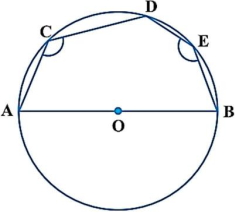
In the figure,$AOB$ is a diameter of the circle and $C, D, E$ are any three points on the semi-circle. Find the value of $\angle ACD + \angle BED$.
Solution
$(270^{\circ})$ Join $BC$.
Since the angle in a semicircle is $90^{\circ}$,we have
$\angle ACB = 90^{\circ}$.
As $ACDEB$ is a cyclic quadrilateral (all vertices lie on the circle),the sum of opposite angles is $180^{\circ}$.
Therefore,$\angle BCD + \angle BED = 180^{\circ}$.
Now,adding $\angle ACB$ to both sides,we get:
$(\angle BCD + \angle ACB) + \angle BED = 180^{\circ} + \angle ACB$
Since $\angle BCD + \angle ACB = \angle ACD$,we have:
$\angle ACD + \angle BED = 180^{\circ} + 90^{\circ} = 270^{\circ}$.
Since the angle in a semicircle is $90^{\circ}$,we have
$\angle ACB = 90^{\circ}$.
As $ACDEB$ is a cyclic quadrilateral (all vertices lie on the circle),the sum of opposite angles is $180^{\circ}$.
Therefore,$\angle BCD + \angle BED = 180^{\circ}$.
Now,adding $\angle ACB$ to both sides,we get:
$(\angle BCD + \angle ACB) + \angle BED = 180^{\circ} + \angle ACB$
Since $\angle BCD + \angle ACB = \angle ACD$,we have:
$\angle ACD + \angle BED = 180^{\circ} + 90^{\circ} = 270^{\circ}$.
0 likes
View Solution47
Difficult
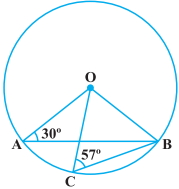
In the figure,$\angle OAB = 30^{\circ}$ and $\angle OCB = 57^{\circ}$. Find $\angle BOC$ and $\angle AOC$.
Solution
(N/A) In $\Delta OBC$,we have:
$OB = OC$ (Radii of the same circle)
Therefore,$\angle OCB = \angle OBC = 57^{\circ}$ (Since $\angle OCB = 57^{\circ}$ is given,and angles opposite to equal sides are equal).
Now,in $\Delta BOC$,the sum of angles is $180^{\circ}$:
$\angle OCB + \angle OBC + \angle BOC = 180^{\circ}$
$57^{\circ} + 57^{\circ} + \angle BOC = 180^{\circ}$
$114^{\circ} + \angle BOC = 180^{\circ}$
$\angle BOC = 180^{\circ} - 114^{\circ} = 66^{\circ}$.
In $\Delta OAB$,we have:
$OA = OB$ (Radii of the same circle)
Therefore,$\angle OBA = \angle OAB = 30^{\circ}$.
In $\Delta OAB$,the sum of angles is $180^{\circ}$:
$\angle OAB + \angle OBA + \angle AOB = 180^{\circ}$
$30^{\circ} + 30^{\circ} + \angle AOB = 180^{\circ}$
$\angle AOB = 180^{\circ} - 60^{\circ} = 120^{\circ}$.
Since $\angle AOB = \angle AOC + \angle BOC$,we have:
$120^{\circ} = \angle AOC + 66^{\circ}$
$\angle AOC = 120^{\circ} - 66^{\circ} = 54^{\circ}$.
Hence,$\angle BOC = 66^{\circ}$ and $\angle AOC = 54^{\circ}$.
$OB = OC$ (Radii of the same circle)
Therefore,$\angle OCB = \angle OBC = 57^{\circ}$ (Since $\angle OCB = 57^{\circ}$ is given,and angles opposite to equal sides are equal).
Now,in $\Delta BOC$,the sum of angles is $180^{\circ}$:
$\angle OCB + \angle OBC + \angle BOC = 180^{\circ}$
$57^{\circ} + 57^{\circ} + \angle BOC = 180^{\circ}$
$114^{\circ} + \angle BOC = 180^{\circ}$
$\angle BOC = 180^{\circ} - 114^{\circ} = 66^{\circ}$.
In $\Delta OAB$,we have:
$OA = OB$ (Radii of the same circle)
Therefore,$\angle OBA = \angle OAB = 30^{\circ}$.
In $\Delta OAB$,the sum of angles is $180^{\circ}$:
$\angle OAB + \angle OBA + \angle AOB = 180^{\circ}$
$30^{\circ} + 30^{\circ} + \angle AOB = 180^{\circ}$
$\angle AOB = 180^{\circ} - 60^{\circ} = 120^{\circ}$.
Since $\angle AOB = \angle AOC + \angle BOC$,we have:
$120^{\circ} = \angle AOC + 66^{\circ}$
$\angle AOC = 120^{\circ} - 66^{\circ} = 54^{\circ}$.
Hence,$\angle BOC = 66^{\circ}$ and $\angle AOC = 54^{\circ}$.
0 likes
View Solution48
Easy
Prove that two circles cannot intersect at more than two points.
Solution
(N/A) Assume that two circles intersect at three distinct points,$A$,$B$,and $C$.
Since $A$,$B$,and $C$ are three distinct points,they are non-collinear.
According to the geometric theorem,there is one and only one circle that passes through three non-collinear points.
Therefore,if two circles pass through the same three points $A$,$B$,and $C$,they must be the same circle.
This contradicts the assumption that there are two distinct circles.
Hence,it is impossible for two distinct circles to intersect at more than two points.
Since $A$,$B$,and $C$ are three distinct points,they are non-collinear.
According to the geometric theorem,there is one and only one circle that passes through three non-collinear points.
Therefore,if two circles pass through the same three points $A$,$B$,and $C$,they must be the same circle.
This contradicts the assumption that there are two distinct circles.
Hence,it is impossible for two distinct circles to intersect at more than two points.
0 likes
View Solution49
Easy
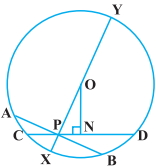
Prove that among all the chords of a circle passing through a given point inside the circle,the one that is perpendicular to the diameter passing through the point is the smallest.
Solution
(N/A) Let $P$ be the given point inside a circle with centre $O$. Draw the chord $AB$ which is perpendicular to the diameter $XY$ passing through $P$. Let $CD$ be any other chord passing through $P$. Draw $ON$ perpendicular to $CD$ from $O$.
In $\Delta ONP$,$\angle ONP = 90^{\circ}$. Since $OP$ is the hypotenuse,$OP > ON$.
We know that the chord nearer to the centre is larger than the chord which is farther from the centre.
Since $ON < OP$ (where $OP$ is the distance of chord $AB$ from the centre),the chord $CD$ is farther from the centre than the chord $AB$.
Therefore,$CD > AB$.
In other words,$AB$ is the smallest of all chords passing through $P$.
In $\Delta ONP$,$\angle ONP = 90^{\circ}$. Since $OP$ is the hypotenuse,$OP > ON$.
We know that the chord nearer to the centre is larger than the chord which is farther from the centre.
Since $ON < OP$ (where $OP$ is the distance of chord $AB$ from the centre),the chord $CD$ is farther from the centre than the chord $AB$.
Therefore,$CD > AB$.
In other words,$AB$ is the smallest of all chords passing through $P$.
0 likes
View Solution50
Difficult
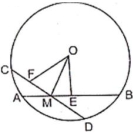
If two equal chords of a circle intersect,prove that the parts of one chord are separately equal to the parts of the other chord.
Solution
(N/A) $AB$ and $CD$ are two equal chords of a circle with centre $O,$ which intersect each other at $M.$ We have to prove that:
$(i)$ $MB = MC$ and
$(ii)$ $AM = MD$
Draw $OE \perp AB$ and $OF \perp CD$ from the centre $O.$
Since the perpendicular from the centre to a chord bisects the chord,we have:
$AE = \frac{1}{2} AB$ and $FD = \frac{1}{2} CD$
Since $AB = CD,$ it follows that $\frac{1}{2} AB = \frac{1}{2} CD,$ so $AE = FD$ $...(1)$
Since equal chords are equidistant from the centre,$OE = OF.$
Now,in $\Delta MOE$ and $\Delta MOF$:
$OE = OF$ [Proved above]
$OM = OM$ [Common side]
$\angle OEM = \angle OFM = 90^\circ$ [By construction]
Therefore,$\Delta MOE \cong \Delta MOF$ [By $RHS$ congruence rule]
Thus,$ME = MF$ $...(2)$
Subtracting $(2)$ from $(1),$ we get:
$AE - ME = FD - MF$
$\Rightarrow AM = MD$ [Proved part $(ii)$]
Again,$AB = CD$ and $AM = MD.$
Subtracting these,we get $AB - AM = CD - MD.$
Therefore,$MB = MC$ [Proved part $(i)$]
$(i)$ $MB = MC$ and
$(ii)$ $AM = MD$
Draw $OE \perp AB$ and $OF \perp CD$ from the centre $O.$
Since the perpendicular from the centre to a chord bisects the chord,we have:
$AE = \frac{1}{2} AB$ and $FD = \frac{1}{2} CD$
Since $AB = CD,$ it follows that $\frac{1}{2} AB = \frac{1}{2} CD,$ so $AE = FD$ $...(1)$
Since equal chords are equidistant from the centre,$OE = OF.$
Now,in $\Delta MOE$ and $\Delta MOF$:
$OE = OF$ [Proved above]
$OM = OM$ [Common side]
$\angle OEM = \angle OFM = 90^\circ$ [By construction]
Therefore,$\Delta MOE \cong \Delta MOF$ [By $RHS$ congruence rule]
Thus,$ME = MF$ $...(2)$
Subtracting $(2)$ from $(1),$ we get:
$AE - ME = FD - MF$
$\Rightarrow AM = MD$ [Proved part $(ii)$]
Again,$AB = CD$ and $AM = MD.$
Subtracting these,we get $AB - AM = CD - MD.$
Therefore,$MB = MC$ [Proved part $(i)$]
0 likes
View SolutionCircles — Mix Examples - Circles · Frequently Asked Questions
1Are these Circles questions useful for JEE and NEET?
Yes. All questions in this section are mapped to JEE Main and NEET exam patterns. Previous year questions from JEE Main, NEET, GUJCET and state-level exams are included with full solutions.
2Can I switch to Hindi or Gujarati for these questions?
Yes. Use the language tabs in the hero section or the sidebar to view the same questions and solutions in English, Hindi or Gujarati.
3How do I generate a question paper from this subtopic?
Use the Vedclass Exam Paper Generator — select the chapter and subtopic, set difficulty, and generate Sets A, B, C, D automatically. First 3 chapters of every subject are free.
Vedclass Products
For Students
Vedclass Test Series
Mock tests in real JEE/NEET style with performance analysis. 5-day free trial.
Start Free TrialFor Teachers
Exam Paper Generator
Generate Set A/B/C/D papers from this chapter in 2 minutes. 3 chapters free.
Try FreeFor Institutes
Online Exam Module
Live online exams with unlimited students, 360° analytics & white-label branding.
See DemoFor Teachers & Institutes
Generate a Circles Exam Paper in 2 Minutes
Select subtopic & difficulty — Sets A, B, C, D auto-generated with No Repeat logic.
First 3 chapters of every subject are free — no payment required.