
A English
Mix Examples-Wave Optics Questions in English
Class 12 Physics · Wave Optics · Mix Examples-Wave Optics
69+
Questions
English
Language
100%
With Solutions
Showing 14 of 69 questions in English
51
EasyMCQ
Laser is/are:
A
Highly coherent
B
Highly monochromatic
C
Highly directional
D
All of these
Solution
(D) laser (Light Amplification by Stimulated Emission of Radiation) exhibits the following properties:
$1$. Highly coherent: The light waves are in phase with each other in both space and time.
$2$. Highly monochromatic: It emits light of a single wavelength or color.
$3$. Highly directional: The beam spreads very little over long distances.
Therefore,all the given statements are correct.
$1$. Highly coherent: The light waves are in phase with each other in both space and time.
$2$. Highly monochromatic: It emits light of a single wavelength or color.
$3$. Highly directional: The beam spreads very little over long distances.
Therefore,all the given statements are correct.
0 likes
View Solution52
AdvancedMCQ
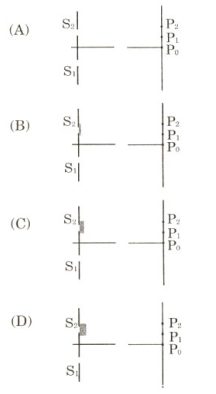
Column $I$ shows four situations of standard Young's double slit arrangement with the screen placed far away from the slits $S_1$ and $S_2$. In each of these cases $S_1 P_0 = S_2 P_0$,$S_1 P_1 - S_2 P_1 = \lambda / 4$ and $S_1 P_2 - S_2 P_2 = \lambda / 3$,where $\lambda$ is the wavelength of the light used. In the cases $B, C$ and $D$,a transparent sheet of refractive index $\mu$ and thickness $t$ is pasted on slit $S_2$. The thicknesses of the sheets are different in different cases. The phase difference between the light waves reaching a point $P$ on the screen from the two slits is denoted by $\delta(P)$ and the intensity by $I(P)$. Match each situation given in Column $I$ with the statement$(s)$ in Column $II$ valid for that situation.
| Column $I$ | Column $II$ |
| $(A)$ No sheet | $(p)$ $\delta(P_0) = 0$ |
| $(B)$ $(\mu-1)t = \lambda / 4$ | $(q)$ $\delta(P_1) = 0$ |
| $(C)$ $(\mu-1)t = \lambda / 2$ | $(r)$ $I(P_1) = 0$ |
| $(D)$ $(\mu-1)t = 3\lambda / 4$ | $(s)$ $I(P_0) > I(P_1)$ |
| $(t)$ $I(P_2) > I(P_1)$ |
A
$A-p, q; B-q; C-r; D-r, q, t$
B
$A-p, s; B-q; C-t; D-r, s, t$
C
$A-p, t; B-s; C-p; D-r, s, q$
D
$A-q, s; B-p; C-s; D-r, q, s$
Solution
(A) The path difference at any point $P$ is given by $\Delta x = (S_1 P - S_2 P) - (\mu-1)t$. The phase difference is $\delta = (2\pi / \lambda) \Delta x$.
For $(A)$: $(\mu-1)t = 0$. $\delta(P_0) = (2\pi / \lambda)(0 - 0) = 0$ $(p)$. $\delta(P_1) = (2\pi / \lambda)(\lambda / 4) = \pi / 2$ (q is false).
For $(B)$: $(\mu-1)t = \lambda / 4$. $\delta(P_1) = (2\pi / \lambda)(\lambda / 4 - \lambda / 4) = 0$ $(q)$. $I(P_1) = I_{max} \cos^2(0) = I_{max}$.
For $(C)$: $(\mu-1)t = \lambda / 2$. $\delta(P_1) = (2\pi / \lambda)(\lambda / 4 - \lambda / 2) = -\pi / 2$. $I(P_1) = I_{max} \cos^2(-\pi / 4) = I_{max} / 2$. $\delta(P_2) = (2\pi / \lambda)(\lambda / 3 - \lambda / 2) = -\pi / 3$. $I(P_2) = I_{max} \cos^2(-\pi / 6) = 3I_{max} / 4$. Thus $I(P_2) > I(P_1)$ $(t)$.
For $(D)$: $(\mu-1)t = 3\lambda / 4$. $\delta(P_1) = (2\pi / \lambda)(\lambda / 4 - 3\lambda / 4) = -\pi$. $I(P_1) = I_{max} \cos^2(-\pi / 2) = 0$ $(r)$.
For $(A)$: $(\mu-1)t = 0$. $\delta(P_0) = (2\pi / \lambda)(0 - 0) = 0$ $(p)$. $\delta(P_1) = (2\pi / \lambda)(\lambda / 4) = \pi / 2$ (q is false).
For $(B)$: $(\mu-1)t = \lambda / 4$. $\delta(P_1) = (2\pi / \lambda)(\lambda / 4 - \lambda / 4) = 0$ $(q)$. $I(P_1) = I_{max} \cos^2(0) = I_{max}$.
For $(C)$: $(\mu-1)t = \lambda / 2$. $\delta(P_1) = (2\pi / \lambda)(\lambda / 4 - \lambda / 2) = -\pi / 2$. $I(P_1) = I_{max} \cos^2(-\pi / 4) = I_{max} / 2$. $\delta(P_2) = (2\pi / \lambda)(\lambda / 3 - \lambda / 2) = -\pi / 3$. $I(P_2) = I_{max} \cos^2(-\pi / 6) = 3I_{max} / 4$. Thus $I(P_2) > I(P_1)$ $(t)$.
For $(D)$: $(\mu-1)t = 3\lambda / 4$. $\delta(P_1) = (2\pi / \lambda)(\lambda / 4 - 3\lambda / 4) = -\pi$. $I(P_1) = I_{max} \cos^2(-\pi / 2) = 0$ $(r)$.
0 likes
View Solution53
DifficultMCQ
In a Young's double slit experiment,two slits are located $1.5 \ mm$ apart. The distance of the screen from the slits is $2 \ m$ and the wavelength of the source is $400 \ nm$. If the $20$ maxima of the double slit pattern are contained within the central maximum of the single slit diffraction pattern,then the width of each slit is $x \times 10^{-3} \ cm$,where the $x$-value is . . . . . . .
A
$17$
B
$16$
C
$14$
D
$15$
Solution
(D) The width of the central maximum of a single slit diffraction pattern is given by $w = \frac{2 \lambda D}{a}$,where $a$ is the slit width.
The distance between adjacent maxima in a Young's double slit experiment is the fringe width $\beta = \frac{\lambda D}{d}$.
The total width occupied by $20$ maxima (which corresponds to $20$ fringe widths) is $20 \times \beta = \frac{20 \lambda D}{d}$.
Given that these $20$ maxima are contained within the central maximum of the diffraction pattern:
$\frac{20 \lambda D}{d} = \frac{2 \lambda D}{a}$
$\frac{10}{d} = \frac{1}{a}$
$a = \frac{d}{10}$
Given $d = 1.5 \ mm = 0.15 \ cm = 1.5 \times 10^{-1} \ cm$.
$a = \frac{1.5 \times 10^{-1}}{10} \ cm = 15 \times 10^{-3} \ cm$.
Comparing this with $x \times 10^{-3} \ cm$,we get $x = 15$.
The distance between adjacent maxima in a Young's double slit experiment is the fringe width $\beta = \frac{\lambda D}{d}$.
The total width occupied by $20$ maxima (which corresponds to $20$ fringe widths) is $20 \times \beta = \frac{20 \lambda D}{d}$.
Given that these $20$ maxima are contained within the central maximum of the diffraction pattern:
$\frac{20 \lambda D}{d} = \frac{2 \lambda D}{a}$
$\frac{10}{d} = \frac{1}{a}$
$a = \frac{d}{10}$
Given $d = 1.5 \ mm = 0.15 \ cm = 1.5 \times 10^{-1} \ cm$.
$a = \frac{1.5 \times 10^{-1}}{10} \ cm = 15 \times 10^{-3} \ cm$.
Comparing this with $x \times 10^{-3} \ cm$,we get $x = 15$.
0 likes
View Solution54
MediumMCQ
In Raman effect, Stokes' lines are spectral lines having
A
frequency greater than that of the original line
B
wavelength equal to that of the original line
C
wavelength less than that of the original line
D
wavelength greater than that of the original line
Solution
(D) In the Raman effect, when light is scattered by molecules, the scattered light contains frequencies different from the incident frequency.
Stokes' lines are the spectral lines observed in the scattered light that have a frequency lower than the incident (original) frequency.
Since frequency $(f)$ and wavelength $(\lambda)$ are inversely related by the equation $c = f\lambda$, a lower frequency corresponds to a longer (greater) wavelength.
Therefore, Stokes' lines have a wavelength greater than that of the original line.
Stokes' lines are the spectral lines observed in the scattered light that have a frequency lower than the incident (original) frequency.
Since frequency $(f)$ and wavelength $(\lambda)$ are inversely related by the equation $c = f\lambda$, a lower frequency corresponds to a longer (greater) wavelength.
Therefore, Stokes' lines have a wavelength greater than that of the original line.
0 likes
View Solution55
EasyMCQ
Which of the following phenomena support the wave theory of light?
$(1)$ Scattering
$(2)$ Interference
$(3)$ Diffraction
$(4)$ Velocity of light in a denser medium is less than the velocity of light in a rarer medium
$(1)$ Scattering
$(2)$ Interference
$(3)$ Diffraction
$(4)$ Velocity of light in a denser medium is less than the velocity of light in a rarer medium
A
$1, 2$ and $3$
B
$1, 2$ and $4$
C
$2, 3$ and $4$
D
$1, 3$ and $4$
Solution
(C) The wave theory of light,proposed by Huygens,successfully explains the phenomena of interference,diffraction,and the fact that the velocity of light in a denser medium is less than in a rarer medium.
However,the wave theory does not explain the scattering of light,which is better described by the particle nature of light or quantum theory.
Therefore,phenomena $(2)$,$(3)$,and $(4)$ support the wave theory of light.
However,the wave theory does not explain the scattering of light,which is better described by the particle nature of light or quantum theory.
Therefore,phenomena $(2)$,$(3)$,and $(4)$ support the wave theory of light.
0 likes
View Solution56
EasyMCQ
According to Newton's corpuscular theory,the speed of light is
A
same in all the media
B
lesser in rarer medium
C
lesser in denser medium
D
independent of the medium
Solution
(B) According to Newton's corpuscular theory,light consists of tiny particles called corpuscles. Newton proposed that these corpuscles travel faster in a denser medium because the attractive force exerted by the particles of the denser medium on the corpuscles increases their velocity. Therefore,according to this theory,the speed of light is lesser in a rarer medium and greater in a denser medium.
0 likes
View Solution57
EasyMCQ
$\lambda_{1}$ and $\lambda_{2}$ are used to illuminate the slits. $\beta_{1}$ and $\beta_{2}$ are the corresponding fringe widths. The wavelength $\lambda_{1}$ can produce photoelectric effect when incident on a metal. But the wavelength $\lambda_{2}$ cannot produce photoelectric effect. The correct relation between $\beta_{1}$ and $\beta_{2}$ is
A
$\beta_{1} < \beta_{2}$
B
$\beta_{1} = \beta_{2}$
C
$\beta_{1} > \beta_{2}$
D
$\beta_{1} \geq \beta_{2}$
Solution
(A) The fringe width $\beta$ in a Young's double-slit experiment is given by the formula $\beta = \frac{\lambda D}{d}$,where $\lambda$ is the wavelength,$D$ is the distance to the screen,and $d$ is the slit separation.
This implies that $\beta \propto \lambda$.
According to the photoelectric effect,the energy of a photon is $E = \frac{hc}{\lambda}$. For the photoelectric effect to occur,the energy of the incident photon must be greater than or equal to the work function of the metal $(\Phi)$,i.e.,$\frac{hc}{\lambda} \geq \Phi$.
This means that a smaller wavelength corresponds to higher energy.
Since $\lambda_{1}$ can produce the photoelectric effect and $\lambda_{2}$ cannot,it implies that $\lambda_{1}$ has higher energy than $\lambda_{2}$,which means $\lambda_{1} < \lambda_{2}$.
Since $\beta \propto \lambda$,it follows that $\beta_{1} < \beta_{2}$.
This implies that $\beta \propto \lambda$.
According to the photoelectric effect,the energy of a photon is $E = \frac{hc}{\lambda}$. For the photoelectric effect to occur,the energy of the incident photon must be greater than or equal to the work function of the metal $(\Phi)$,i.e.,$\frac{hc}{\lambda} \geq \Phi$.
This means that a smaller wavelength corresponds to higher energy.
Since $\lambda_{1}$ can produce the photoelectric effect and $\lambda_{2}$ cannot,it implies that $\lambda_{1}$ has higher energy than $\lambda_{2}$,which means $\lambda_{1} < \lambda_{2}$.
Since $\beta \propto \lambda$,it follows that $\beta_{1} < \beta_{2}$.
0 likes
View Solution58
EasyMCQ
Statement $(S)$: Using Huygen's eye-piece,measurements can be taken but are not correct.
Reason $(R)$: The cross wires,scale,and final image are not magnified proportionately because the image of the object is magnified by two lenses,whereas the cross-wire scale is magnified by one lens only.
Identify the correct option from the following:
Reason $(R)$: The cross wires,scale,and final image are not magnified proportionately because the image of the object is magnified by two lenses,whereas the cross-wire scale is magnified by one lens only.
Identify the correct option from the following:
A
Both $(S)$ and $(R)$ are true,and $(R)$ explains $(S)$.
B
Both $(S)$ and $(R)$ are true,but $(R)$ does not explain $(S)$.
C
Only $(S)$ is correct,but $(R)$ is wrong.
D
Both $(S)$ and $(R)$ are wrong.
Solution
(A) In a Huygen's eye-piece,the cross-wires are placed between the field lens and the eye lens.
Because of this,the image of the object is formed by both lenses (field lens and eye lens),resulting in magnification by both.
However,the cross-wires are placed such that they are only magnified by the eye lens.
Since the magnification is not uniform for the object and the cross-wires,the measurements taken using this eye-piece are not accurate.
Therefore,both Statement $(S)$ and Reason $(R)$ are true,and $(R)$ correctly explains $(S)$.
Because of this,the image of the object is formed by both lenses (field lens and eye lens),resulting in magnification by both.
However,the cross-wires are placed such that they are only magnified by the eye lens.
Since the magnification is not uniform for the object and the cross-wires,the measurements taken using this eye-piece are not accurate.
Therefore,both Statement $(S)$ and Reason $(R)$ are true,and $(R)$ correctly explains $(S)$.
0 likes
View Solution59
DifficultMCQ
Statement $(S)$: Using Huygen's eye-piece,measurements can be taken,but they are not correct.
Reason $(R)$: The cross wires,scale,and final image are not magnified proportionately because the image of the object is magnified by two lenses,whereas the cross-wire scale is magnified by one lens only.
Identify the correct one of the following:
Reason $(R)$: The cross wires,scale,and final image are not magnified proportionately because the image of the object is magnified by two lenses,whereas the cross-wire scale is magnified by one lens only.
Identify the correct one of the following:
A
Both $(S)$ and $(R)$ are true,$(R)$ explains $(S)$.
B
Both $(S)$ and $(R)$ are true,but $(R)$ cannot explain $(S)$.
C
Only $(S)$ is correct,but $(R)$ is wrong.
D
Both $(S)$ and $(R)$ are wrong.
Solution
(A) Huygen's eye-piece consists of two plano-convex lenses separated by a distance.
When used for measurements,the cross-wires are placed between the two lenses.
The final image of the object is formed by the combined effect of both lenses,resulting in a specific magnification.
However,the cross-wires are only magnified by the eye-lens.
Because the object and the cross-wires are magnified by different numbers of lenses,they are not magnified proportionately.
This leads to errors in measurement,making the statement $(S)$ correct and the reason $(R)$ the correct explanation for it.
When used for measurements,the cross-wires are placed between the two lenses.
The final image of the object is formed by the combined effect of both lenses,resulting in a specific magnification.
However,the cross-wires are only magnified by the eye-lens.
Because the object and the cross-wires are magnified by different numbers of lenses,they are not magnified proportionately.
This leads to errors in measurement,making the statement $(S)$ correct and the reason $(R)$ the correct explanation for it.
0 likes
View Solution60
DifficultMCQ
The difference in the number of wavelengths,when yellow light propagates through air and vacuum columns of the same thickness,is one. Find the thickness of the air column. Given: Refractive index of air $\mu_a = 1.0003$,Wavelength of yellow light in vacuum $\lambda_0 = 6000 \text{ Å}$.
A
$1.8 \text{ mm}$
B
$2 \text{ mm}$
C
$2 \text{ cm}$
D
$2.2 \text{ cm}$
Solution
(B) Let $L$ be the thickness of the air and vacuum columns.
The number of wavelengths in vacuum is $N_v = \frac{L}{\lambda_0}$.
The number of wavelengths in air is $N_a = \frac{L}{\lambda_a} = \frac{L}{\lambda_0 / \mu_a} = \frac{L \mu_a}{\lambda_0}$.
The difference in the number of wavelengths is given as $1$:
$N_a - N_v = 1$
$\frac{L \mu_a}{\lambda_0} - \frac{L}{\lambda_0} = 1$
$\frac{L}{\lambda_0} (\mu_a - 1) = 1$
$L = \frac{\lambda_0}{\mu_a - 1}$
Given $\lambda_0 = 6000 \text{ Å} = 6000 \times 10^{-10} \text{ m} = 6 \times 10^{-7} \text{ m}$ and $\mu_a = 1.0003$.
$L = \frac{6 \times 10^{-7}}{1.0003 - 1} = \frac{6 \times 10^{-7}}{0.0003} = \frac{6 \times 10^{-7}}{3 \times 10^{-4}} = 2 \times 10^{-3} \text{ m}$.
$L = 2 \text{ mm}$.
The number of wavelengths in vacuum is $N_v = \frac{L}{\lambda_0}$.
The number of wavelengths in air is $N_a = \frac{L}{\lambda_a} = \frac{L}{\lambda_0 / \mu_a} = \frac{L \mu_a}{\lambda_0}$.
The difference in the number of wavelengths is given as $1$:
$N_a - N_v = 1$
$\frac{L \mu_a}{\lambda_0} - \frac{L}{\lambda_0} = 1$
$\frac{L}{\lambda_0} (\mu_a - 1) = 1$
$L = \frac{\lambda_0}{\mu_a - 1}$
Given $\lambda_0 = 6000 \text{ Å} = 6000 \times 10^{-10} \text{ m} = 6 \times 10^{-7} \text{ m}$ and $\mu_a = 1.0003$.
$L = \frac{6 \times 10^{-7}}{1.0003 - 1} = \frac{6 \times 10^{-7}}{0.0003} = \frac{6 \times 10^{-7}}{3 \times 10^{-4}} = 2 \times 10^{-3} \text{ m}$.
$L = 2 \text{ mm}$.
0 likes
View Solution61
MediumMCQ
Fraunhofer lines are produced by the absorption of light in
A
the chromosphere of the sun
B
the photosphere of the sun
C
sodium
D
hydrogen
Solution
(A) Fraunhofer lines are a set of dark absorption lines observed in the solar spectrum.
These lines are produced when the continuous spectrum of light emitted by the hot,dense core of the sun (the photosphere) passes through the cooler,thinner gases of the solar atmosphere (the chromosphere).
The atoms in the chromosphere absorb specific wavelengths of light corresponding to their characteristic energy transitions,resulting in the dark lines observed in the spectrum.
These lines are produced when the continuous spectrum of light emitted by the hot,dense core of the sun (the photosphere) passes through the cooler,thinner gases of the solar atmosphere (the chromosphere).
The atoms in the chromosphere absorb specific wavelengths of light corresponding to their characteristic energy transitions,resulting in the dark lines observed in the spectrum.
0 likes
View Solution62
MediumMCQ
In Huygen's eyepiece,
A
the cross wires are outside the eyepiece
B
condition for achromatism is satisfied
C
condition for minimum spherical aberration is not satisfied
D
the image formed by the objective is a virtual image
Solution
(B) The Huygen eyepiece is designed such that the distance between the two plano-convex lenses is equal to half the sum of their focal lengths. This specific configuration satisfies the condition for achromatism (elimination of chromatic aberration) and also minimizes spherical aberration.
0 likes
View Solution63
MediumMCQ
Choose the incorrect statement.
A
The fringe width in a Young's double slit experiment reduces when the width between the two slits increases.
B
The central fringe observed in a single slit diffraction experiment is a bright fringe.
C
The resolving power of the microscope is reciprocal to the maximum separation of two points seen as distinct.
D
Polarisation phenomenon is observed only for transverse waves.
Solution
(C) In Young's double slit experiment,the fringe width is given by $\beta = \frac{\lambda D}{d} \Rightarrow \beta \propto \frac{1}{d}$. So,if the distance between the two slits $(d)$ increases,the fringe width reduces. This statement is correct.
$(b)$ In diffraction due to a single slit,the path difference between rays reaching the center of the screen is zero,so its intensity at the center is maximum,i.e.,a bright fringe is observed at the center. This statement is correct.
$(c)$ The resolving power of a microscope is defined as $\frac{1}{d_{\min }} = \frac{2 n \sin \theta}{1.22 \lambda}$. It is the reciprocal of the minimum separation $(d_{\min })$ of two points seen as distinct,not the maximum separation. Thus,this statement is incorrect.
$(d)$ Polarisation is possible only in those waves that have vibrations in different directions,which is the case for transverse waves. This statement is correct.
Therefore,the incorrect statement is $(c)$.
$(b)$ In diffraction due to a single slit,the path difference between rays reaching the center of the screen is zero,so its intensity at the center is maximum,i.e.,a bright fringe is observed at the center. This statement is correct.
$(c)$ The resolving power of a microscope is defined as $\frac{1}{d_{\min }} = \frac{2 n \sin \theta}{1.22 \lambda}$. It is the reciprocal of the minimum separation $(d_{\min })$ of two points seen as distinct,not the maximum separation. Thus,this statement is incorrect.
$(d)$ Polarisation is possible only in those waves that have vibrations in different directions,which is the case for transverse waves. This statement is correct.
Therefore,the incorrect statement is $(c)$.
0 likes
View Solution64
MediumMCQ
In interference and diffraction,the light energy is redistributed. If it reduces in one region,producing a dark fringe,it increases in another region,producing a bright fringe. Statement $A$: As there is no gain or loss of energy,these phenomena are consistent with the principle of conservation of energy. Statement $B$: Diffraction and interference are characteristics exhibited only by light waves. Choose the correct answer from the options given below:
A
$A$ is false,but $B$ is true
B
$A$ is true,but $B$ is false
C
$A$ is true and $B$ is also true
D
Both $A$ and $B$ are false
Solution
(B) Statement $A$ is correct because interference and diffraction involve the redistribution of energy in space,ensuring that the total energy remains constant,which is consistent with the law of conservation of energy.
Statement $B$ is false because interference and diffraction are wave phenomena that are not exclusive to light; they are exhibited by all types of waves,including sound waves,water waves,and matter waves.
Therefore,statement $A$ is true and statement $B$ is false. The correct option is $B$.
Statement $B$ is false because interference and diffraction are wave phenomena that are not exclusive to light; they are exhibited by all types of waves,including sound waves,water waves,and matter waves.
Therefore,statement $A$ is true and statement $B$ is false. The correct option is $B$.
0 likes
View SolutionWave Optics — Mix Examples-Wave Optics · Frequently Asked Questions
1Are these Wave Optics questions useful for JEE and NEET?
Yes. All questions in this section are mapped to JEE Main and NEET exam patterns. Previous year questions from JEE Main, NEET, GUJCET and state-level exams are included with full solutions.
2Can I switch to Hindi or Gujarati for these questions?
Yes. Use the language tabs in the hero section or the sidebar to view the same questions and solutions in English, Hindi or Gujarati.
3How do I generate a question paper from this subtopic?
Use the Vedclass Exam Paper Generator — select the chapter and subtopic, set difficulty, and generate Sets A, B, C, D automatically. First 3 chapters of every subject are free.
Vedclass Products
For Students
Vedclass Test Series
Mock tests in real JEE/NEET style with performance analysis. 5-day free trial.
Start Free TrialFor Teachers
Exam Paper Generator
Generate Set A/B/C/D papers from this chapter in 2 minutes. 3 chapters free.
Try FreeFor Institutes
Online Exam Module
Live online exams with unlimited students, 360° analytics & white-label branding.
See DemoFor Teachers & Institutes
Generate a Wave Optics Exam Paper in 2 Minutes
Select subtopic & difficulty — Sets A, B, C, D auto-generated with No Repeat logic.
First 3 chapters of every subject are free — no payment required.