
A English
Magnetic field due to magnetic dipole and Dipole in Magnetic Field and Poential Energy and Work Done Questions in English
Class 12 Physics · Magnetism and Matter · Magnetic field due to magnetic dipole and Dipole in Magnetic Field and Poential Energy and Work Done
173+
Questions
English
Language
100%
With Solutions
Showing 47 of 173 questions in English
101
DifficultMCQ
The magnetic potential due to a magnetic dipole at a point on its axis situated at a distance of $20 \ cm$ from its center is $1.5 \times 10^{-5} \ T \cdot m$. The magnetic moment of the dipole is . . . . . . $A \cdot m^2$. (Given: $\frac{\mu_0}{4 \pi} = 10^{-7} \ T \cdot m \cdot A^{-1}$)
A
$6$
B
$5$
C
$4$
D
$12$
Solution
(A) The formula for the magnetic potential $V$ due to a magnetic dipole at a point on its axis at a distance $r$ from the center is given by:
$V = \frac{\mu_0}{4 \pi} \frac{M}{r^2}$
Given values:
$V = 1.5 \times 10^{-5} \ T \cdot m$
$r = 20 \ cm = 0.2 \ m = 2 \times 10^{-1} \ m$
$\frac{\mu_0}{4 \pi} = 10^{-7} \ T \cdot m \cdot A^{-1}$
Substituting these values into the formula:
$1.5 \times 10^{-5} = 10^{-7} \times \frac{M}{(2 \times 10^{-1})^2}$
$1.5 \times 10^{-5} = 10^{-7} \times \frac{M}{4 \times 10^{-2}}$
$M = \frac{1.5 \times 10^{-5} \times 4 \times 10^{-2}}{10^{-7}}$
$M = \frac{6 \times 10^{-7}}{10^{-7}} = 6 \ A \cdot m^2$
Thus,the magnetic moment of the dipole is $6 \ A \cdot m^2$.
$V = \frac{\mu_0}{4 \pi} \frac{M}{r^2}$
Given values:
$V = 1.5 \times 10^{-5} \ T \cdot m$
$r = 20 \ cm = 0.2 \ m = 2 \times 10^{-1} \ m$
$\frac{\mu_0}{4 \pi} = 10^{-7} \ T \cdot m \cdot A^{-1}$
Substituting these values into the formula:
$1.5 \times 10^{-5} = 10^{-7} \times \frac{M}{(2 \times 10^{-1})^2}$
$1.5 \times 10^{-5} = 10^{-7} \times \frac{M}{4 \times 10^{-2}}$
$M = \frac{1.5 \times 10^{-5} \times 4 \times 10^{-2}}{10^{-7}}$
$M = \frac{6 \times 10^{-7}}{10^{-7}} = 6 \ A \cdot m^2$
Thus,the magnetic moment of the dipole is $6 \ A \cdot m^2$.
0 likes
View Solution102
DifficultMCQ
The magnetic moment of a bar magnet is $0.5 \text{ A m}^2$. It is suspended in a uniform magnetic field of $8 \times 10^{-2} \text{ T}$. The work done in rotating it from its most stable to most unstable position is:
A
$16 \times 10^{-2} \text{ J}$
B
$8 \times 10^{-2} \text{ J}$
C
$4 \times 10^{-2} \text{ J}$
D
Zero
Solution
(B) The potential energy of a magnetic dipole in a magnetic field is given by $U = -mB \cos \theta$.
At the most stable equilibrium position,the angle $\theta = 0^{\circ}$,so $U_i = -mB \cos 0^{\circ} = -mB$.
At the most unstable equilibrium position,the angle $\theta = 180^{\circ}$,so $U_f = -mB \cos 180^{\circ} = +mB$.
The work done $W$ is equal to the change in potential energy: $W = \Delta U = U_f - U_i$.
$W = mB - (-mB) = 2mB$.
Given $m = 0.5 \text{ A m}^2$ and $B = 8 \times 10^{-2} \text{ T}$.
$W = 2 \times 0.5 \times 8 \times 10^{-2} = 1 \times 8 \times 10^{-2} = 8 \times 10^{-2} \text{ J}$.
At the most stable equilibrium position,the angle $\theta = 0^{\circ}$,so $U_i = -mB \cos 0^{\circ} = -mB$.
At the most unstable equilibrium position,the angle $\theta = 180^{\circ}$,so $U_f = -mB \cos 180^{\circ} = +mB$.
The work done $W$ is equal to the change in potential energy: $W = \Delta U = U_f - U_i$.
$W = mB - (-mB) = 2mB$.
Given $m = 0.5 \text{ A m}^2$ and $B = 8 \times 10^{-2} \text{ T}$.
$W = 2 \times 0.5 \times 8 \times 10^{-2} = 1 \times 8 \times 10^{-2} = 8 \times 10^{-2} \text{ J}$.
0 likes
View Solution103
MediumMCQ
$A$ magnetic dipole experiences a torque of $80 \sqrt{3} \ N \ m$ when placed in a uniform magnetic field in such a way that the dipole moment makes an angle of $60^{\circ}$ with the magnetic field. The potential energy of the dipole is
A
$80 \ J$
B
$-40 \sqrt{3} \ J$
C
$-60 \ J$
D
$-80 \ J$
Solution
(D) The torque $\tau$ on a magnetic dipole is given by $\tau = MB \sin \theta$.
Given $\tau = 80 \sqrt{3} \ N \ m$ and $\theta = 60^{\circ}$.
$80 \sqrt{3} = MB \sin 60^{\circ} = MB \left( \frac{\sqrt{3}}{2} \right)$.
Multiplying both sides by $\frac{2}{\sqrt{3}}$,we get $MB = 160 \ J$.
The potential energy $U$ of the dipole is given by $U = -M \cdot B = -MB \cos \theta$.
Substituting the values,$U = -160 \cos 60^{\circ} = -160 \times \frac{1}{2} = -80 \ J$.
Given $\tau = 80 \sqrt{3} \ N \ m$ and $\theta = 60^{\circ}$.
$80 \sqrt{3} = MB \sin 60^{\circ} = MB \left( \frac{\sqrt{3}}{2} \right)$.
Multiplying both sides by $\frac{2}{\sqrt{3}}$,we get $MB = 160 \ J$.
The potential energy $U$ of the dipole is given by $U = -M \cdot B = -MB \cos \theta$.
Substituting the values,$U = -160 \cos 60^{\circ} = -160 \times \frac{1}{2} = -80 \ J$.
0 likes
View Solution104
MediumMCQ
$A$ magnet of magnetic moment $4 \, A-m^2$ is held in a uniform magnetic field $5 \times 10^{-4} \, T$ with the magnetic moment vector making an angle $30^{\circ}$ with the field. Calculate the work done in increasing the angle from $30^{\circ}$ to $45^{\circ}$.
A
$3.2 \times 10^{-4} \, J$
B
$1.6 \times 10^{-4} \, J$
C
$1.6 \times 10^{-3} \, J$
D
$3.2 \times 10^{-3} \, J$
Solution
(A) The work done $W$ in rotating a magnetic dipole in a uniform magnetic field from an angle $\theta_1$ to $\theta_2$ is given by the formula:
$W = MB(\cos \theta_1 - \cos \theta_2)$
Given:
Magnetic moment $M = 4 \, A-m^2$
Magnetic field $B = 5 \times 10^{-4} \, T$
Initial angle $\theta_1 = 30^{\circ}$
Final angle $\theta_2 = 45^{\circ}$
Substituting the values:
$W = (4) \times (5 \times 10^{-4}) \times (\cos 30^{\circ} - \cos 45^{\circ})$
$W = 20 \times 10^{-4} \times (\frac{\sqrt{3}}{2} - \frac{1}{\sqrt{2}})$
$W = 20 \times 10^{-4} \times (0.866 - 0.707)$
$W = 20 \times 10^{-4} \times (0.159)$
$W = 3.18 \times 10^{-4} \, J \approx 3.2 \times 10^{-4} \, J$
$W = MB(\cos \theta_1 - \cos \theta_2)$
Given:
Magnetic moment $M = 4 \, A-m^2$
Magnetic field $B = 5 \times 10^{-4} \, T$
Initial angle $\theta_1 = 30^{\circ}$
Final angle $\theta_2 = 45^{\circ}$
Substituting the values:
$W = (4) \times (5 \times 10^{-4}) \times (\cos 30^{\circ} - \cos 45^{\circ})$
$W = 20 \times 10^{-4} \times (\frac{\sqrt{3}}{2} - \frac{1}{\sqrt{2}})$
$W = 20 \times 10^{-4} \times (0.866 - 0.707)$
$W = 20 \times 10^{-4} \times (0.159)$
$W = 3.18 \times 10^{-4} \, J \approx 3.2 \times 10^{-4} \, J$
0 likes
View Solution105
EasyMCQ
The magnetic moment of a short magnet is $16 \ Am^2$. The magnetic induction at a point $20 \ cm$ away from its midpoint on $(i)$ axial point and $(ii)$ equatorial point respectively,will be:
A
$2 \times 10^{-4} \ T$ and $10^{-4} \ T$
B
$3 \times 10^{-4} \ T$ and $2 \times 10^{-4} \ T$
C
$4 \times 10^{-4} \ T$ and $2 \times 10^{-4} \ T$
D
none of these
Solution
(C) Given: Magnetic moment $M = 16 \ Am^2$,distance $r = 20 \ cm = 0.2 \ m$. The constant $\frac{\mu_0}{4\pi} = 10^{-7} \ T \cdot m/A$.
For an axial point: $B_{\text{axial}} = \frac{\mu_0}{4\pi} \frac{2M}{r^3} = 10^{-7} \times \frac{2 \times 16}{(0.2)^3} = 10^{-7} \times \frac{32}{0.008} = 10^{-7} \times 4000 = 4 \times 10^{-4} \ T$.
For an equatorial point: $B_{\text{equatorial}} = \frac{\mu_0}{4\pi} \frac{M}{r^3} = 10^{-7} \times \frac{16}{(0.2)^3} = 10^{-7} \times \frac{16}{0.008} = 10^{-7} \times 2000 = 2 \times 10^{-4} \ T$.
Thus,the values are $4 \times 10^{-4} \ T$ and $2 \times 10^{-4} \ T$.
For an axial point: $B_{\text{axial}} = \frac{\mu_0}{4\pi} \frac{2M}{r^3} = 10^{-7} \times \frac{2 \times 16}{(0.2)^3} = 10^{-7} \times \frac{32}{0.008} = 10^{-7} \times 4000 = 4 \times 10^{-4} \ T$.
For an equatorial point: $B_{\text{equatorial}} = \frac{\mu_0}{4\pi} \frac{M}{r^3} = 10^{-7} \times \frac{16}{(0.2)^3} = 10^{-7} \times \frac{16}{0.008} = 10^{-7} \times 2000 = 2 \times 10^{-4} \ T$.
Thus,the values are $4 \times 10^{-4} \ T$ and $2 \times 10^{-4} \ T$.
0 likes
View Solution106
MediumMCQ
The work done in turning a magnet of magnetic moment $M$ by an angle of $90^{\circ}$ from the magnetic meridian is $n$ times the corresponding work done to turn it through an angle of $60^{\circ}$. Find the value of $n$ (given $\cos 90^{\circ} = 0, \cos 60^{\circ} = 0.5$).
A
$0.5$
B
$2$
C
$0.25$
D
$1$
Solution
(B) The work done $W$ in rotating a magnetic dipole in a uniform magnetic field $B$ from an angle $\theta_1$ to $\theta_2$ is given by $W = MB(\cos \theta_1 - \cos \theta_2)$.
Assuming the initial position is the stable equilibrium position,$\theta_1 = 0^{\circ}$.
For the first case,$\theta_2 = 90^{\circ}$:
$W_1 = MB(\cos 0^{\circ} - \cos 90^{\circ}) = MB(1 - 0) = MB$.
For the second case,$\theta_2 = 60^{\circ}$:
$W_2 = MB(\cos 0^{\circ} - \cos 60^{\circ}) = MB(1 - 0.5) = 0.5MB$.
According to the problem,$W_1 = n \times W_2$.
Substituting the values: $MB = n \times (0.5MB)$.
$1 = n \times 0.5$.
$n = 1 / 0.5 = 2$.
Assuming the initial position is the stable equilibrium position,$\theta_1 = 0^{\circ}$.
For the first case,$\theta_2 = 90^{\circ}$:
$W_1 = MB(\cos 0^{\circ} - \cos 90^{\circ}) = MB(1 - 0) = MB$.
For the second case,$\theta_2 = 60^{\circ}$:
$W_2 = MB(\cos 0^{\circ} - \cos 60^{\circ}) = MB(1 - 0.5) = 0.5MB$.
According to the problem,$W_1 = n \times W_2$.
Substituting the values: $MB = n \times (0.5MB)$.
$1 = n \times 0.5$.
$n = 1 / 0.5 = 2$.
0 likes
View Solution107
EasyMCQ
$A$ magnetic needle of magnetic moment $6 \times 10^{-2} \text{ A m}^2$ and moment of inertia $9.6 \times 10^{-5} \text{ kg m}^2$ performs simple harmonic motion in a magnetic field of $0.01 \text{ T}$. The time taken to complete $10$ oscillations is (Take $\pi = 3.14$): (in $\text{ s}$)
A
$0.2512$
B
$2.512$
C
$25.12$
D
$251.2$
Solution
(C) The time period $T$ of a magnetic needle performing simple harmonic motion in a magnetic field is given by the formula:
$T = 2 \pi \sqrt{\frac{I}{MB}}$
Given:
Magnetic moment $M = 6 \times 10^{-2} \text{ A m}^2$
Moment of inertia $I = 9.6 \times 10^{-5} \text{ kg m}^2$
Magnetic field $B = 0.01 \text{ T}$
Substituting the values:
$T = 2 \times 3.14 \times \sqrt{\frac{9.6 \times 10^{-5}}{6 \times 10^{-2} \times 0.01}}$
$T = 6.28 \times \sqrt{\frac{9.6 \times 10^{-5}}{6 \times 10^{-4}}}$
$T = 6.28 \times \sqrt{0.16}$
$T = 6.28 \times 0.4 = 2.512 \text{ s}$
The time taken for $10$ oscillations is $10 \times T = 10 \times 2.512 = 25.12 \text{ s}$.
$T = 2 \pi \sqrt{\frac{I}{MB}}$
Given:
Magnetic moment $M = 6 \times 10^{-2} \text{ A m}^2$
Moment of inertia $I = 9.6 \times 10^{-5} \text{ kg m}^2$
Magnetic field $B = 0.01 \text{ T}$
Substituting the values:
$T = 2 \times 3.14 \times \sqrt{\frac{9.6 \times 10^{-5}}{6 \times 10^{-2} \times 0.01}}$
$T = 6.28 \times \sqrt{\frac{9.6 \times 10^{-5}}{6 \times 10^{-4}}}$
$T = 6.28 \times \sqrt{0.16}$
$T = 6.28 \times 0.4 = 2.512 \text{ s}$
The time taken for $10$ oscillations is $10 \times T = 10 \times 2.512 = 25.12 \text{ s}$.
0 likes
View Solution108
MediumMCQ
$A$ magnetic dipole of magnetic moment $M$ is freely suspended in a magnetic field of induction $B$. The minimum and maximum values of the potential energy of the dipole,respectively,are
A
$-MB, +MB$
B
$0, MB$
C
$0, 2 MB$
D
$MB, 0$
Solution
(A) The potential energy $U$ of a magnetic dipole in an external magnetic field is given by the formula $U = -\vec{M} \cdot \vec{B} = -MB \cos \theta$,where $\theta$ is the angle between the magnetic moment $\vec{M}$ and the magnetic field $\vec{B}$.
For the minimum potential energy,$\cos \theta$ must be maximum,which occurs at $\theta = 0^{\circ}$. Thus,$U_{\text{min}} = -MB \cos 0^{\circ} = -MB(1) = -MB$.
For the maximum potential energy,$\cos \theta$ must be minimum,which occurs at $\theta = 180^{\circ}$. Thus,$U_{\text{max}} = -MB \cos 180^{\circ} = -MB(-1) = +MB$.
Therefore,the minimum and maximum values are $-MB$ and $+MB$ respectively.
For the minimum potential energy,$\cos \theta$ must be maximum,which occurs at $\theta = 0^{\circ}$. Thus,$U_{\text{min}} = -MB \cos 0^{\circ} = -MB(1) = -MB$.
For the maximum potential energy,$\cos \theta$ must be minimum,which occurs at $\theta = 180^{\circ}$. Thus,$U_{\text{max}} = -MB \cos 180^{\circ} = -MB(-1) = +MB$.
Therefore,the minimum and maximum values are $-MB$ and $+MB$ respectively.
0 likes
View Solution109
MediumMCQ
$A$ magnetic dipole is placed in a uniform magnetic field of intensity $B$,oriented along the direction of the field. If the magnetic dipole moment is $M$,then the maximum work an external agent can perform in rotating the dipole will be
A
$\frac{1}{2} MB$
B
$4MB$
C
$2MB$
D
$MB$
Solution
(C) The potential energy of a magnetic dipole in a magnetic field is given by $U = -M B \cos \theta$.
Initially,the dipole is oriented along the field,so $\theta_1 = 0^\circ$. The initial potential energy is $U_i = -M B \cos(0^\circ) = -M B$.
To perform maximum work,the dipole must be rotated to the position of maximum potential energy,which is $\theta_2 = 180^\circ$. The final potential energy is $U_f = -M B \cos(180^\circ) = M B$.
The work done by an external agent is $W = U_f - U_i = M B - (-M B) = 2 M B$.
Initially,the dipole is oriented along the field,so $\theta_1 = 0^\circ$. The initial potential energy is $U_i = -M B \cos(0^\circ) = -M B$.
To perform maximum work,the dipole must be rotated to the position of maximum potential energy,which is $\theta_2 = 180^\circ$. The final potential energy is $U_f = -M B \cos(180^\circ) = M B$.
The work done by an external agent is $W = U_f - U_i = M B - (-M B) = 2 M B$.
0 likes
View Solution110
MediumMCQ
Two short bar magnets $A$ and $B$ (having magnetic moments $M_{1}$ and $M_{2}$ respectively) are kept one above the other with their magnetic axes perpendicular to each other. If their resultant magnetic field at a point on the axis of magnet $A$ is inclined at $45^{\circ}$ with the axis of magnet $A$,then the ratio of magnetic moments $\frac{M_{2}}{M_{1}}$ is $[\tan 45^{\circ} = 1]$.
A
$2: 1$
B
$2: 3$
C
$1: 2$
D
$3: 2$
Solution
(A) Let the point be at a distance $d$ from the center of the magnets along the axis of magnet $A$.
The magnetic field due to magnet $A$ (axial position) is $B_{1} = \frac{\mu_{0}}{4\pi} \frac{2M_{1}}{d^{3}}$.
The magnetic field due to magnet $B$ (equatorial position) at the same point is $B_{2} = \frac{\mu_{0}}{4\pi} \frac{M_{2}}{d^{3}}$.
Since the axes are perpendicular,the resultant field makes an angle $\theta$ with the axis of magnet $A$ such that $\tan \theta = \frac{B_{2}}{B_{1}}$.
Given $\theta = 45^{\circ}$,so $\tan 45^{\circ} = 1$.
Therefore,$1 = \frac{(\mu_{0} M_{2}) / (4\pi d^{3})}{(2\mu_{0} M_{1}) / (4\pi d^{3})} = \frac{M_{2}}{2M_{1}}$.
This gives $\frac{M_{2}}{M_{1}} = 2$,or $M_{2} : M_{1} = 2 : 1$.
The magnetic field due to magnet $A$ (axial position) is $B_{1} = \frac{\mu_{0}}{4\pi} \frac{2M_{1}}{d^{3}}$.
The magnetic field due to magnet $B$ (equatorial position) at the same point is $B_{2} = \frac{\mu_{0}}{4\pi} \frac{M_{2}}{d^{3}}$.
Since the axes are perpendicular,the resultant field makes an angle $\theta$ with the axis of magnet $A$ such that $\tan \theta = \frac{B_{2}}{B_{1}}$.
Given $\theta = 45^{\circ}$,so $\tan 45^{\circ} = 1$.
Therefore,$1 = \frac{(\mu_{0} M_{2}) / (4\pi d^{3})}{(2\mu_{0} M_{1}) / (4\pi d^{3})} = \frac{M_{2}}{2M_{1}}$.
This gives $\frac{M_{2}}{M_{1}} = 2$,or $M_{2} : M_{1} = 2 : 1$.
0 likes
View Solution111
EasyMCQ
Two identical bar magnets,each of magnetic moment $M$,are kept perpendicular to each other at a certain distance. The magnetic induction at a point that is at the same distance $d$ from the center of both magnets is: (where $\mu_{0}$ is the permeability of free space)
A
$\frac{\mu_{0}}{4 \pi}(\sqrt{2}) \frac{M}{d^{3}}$
B
$\frac{\mu_{0}}{4 \pi}(\sqrt{3}) \frac{M}{d^{3}}$
C
$\left(\frac{2 \mu_{0}}{\pi}\right) \frac{M}{d^{3}}$
D
$\frac{\mu_{0}}{4 \pi}(\sqrt{5}) \frac{M}{d^{3}}$
Solution
(D) For a bar magnet of magnetic moment $M$,the magnetic field at an axial point at distance $d$ is $B_{axial} = \frac{\mu_{0}}{4 \pi} \frac{2M}{d^{3}}$.
For the same magnet,the magnetic field at an equatorial point at distance $d$ is $B_{equatorial} = \frac{\mu_{0}}{4 \pi} \frac{M}{d^{3}}$.
Since the magnets are perpendicular,the point at distance $d$ from both centers acts as an axial point for one magnet and an equatorial point for the other.
The resultant magnetic field is $B_{net} = \sqrt{B_{axial}^{2} + B_{equatorial}^{2}}$.
Substituting the values: $B_{net} = \sqrt{\left(\frac{\mu_{0}}{4 \pi} \frac{2M}{d^{3}}\right)^{2} + \left(\frac{\mu_{0}}{4 \pi} \frac{M}{d^{3}}\right)^{2}}$.
$B_{net} = \frac{\mu_{0} M}{4 \pi d^{3}} \sqrt{2^{2} + 1^{2}} = \frac{\mu_{0}}{4 \pi} \frac{M}{d^{3}} \sqrt{5}$.
For the same magnet,the magnetic field at an equatorial point at distance $d$ is $B_{equatorial} = \frac{\mu_{0}}{4 \pi} \frac{M}{d^{3}}$.
Since the magnets are perpendicular,the point at distance $d$ from both centers acts as an axial point for one magnet and an equatorial point for the other.
The resultant magnetic field is $B_{net} = \sqrt{B_{axial}^{2} + B_{equatorial}^{2}}$.
Substituting the values: $B_{net} = \sqrt{\left(\frac{\mu_{0}}{4 \pi} \frac{2M}{d^{3}}\right)^{2} + \left(\frac{\mu_{0}}{4 \pi} \frac{M}{d^{3}}\right)^{2}}$.
$B_{net} = \frac{\mu_{0} M}{4 \pi d^{3}} \sqrt{2^{2} + 1^{2}} = \frac{\mu_{0}}{4 \pi} \frac{M}{d^{3}} \sqrt{5}$.
0 likes
View Solution112
MediumMCQ
$A$ torque of $1.732 \times 10^{-5} \text{ Nm}$ is required to hold a magnet at $90^{\circ}$ with the horizontal component of the Earth's magnetic field. The torque required to hold it at $60^{\circ}$ will be $\left[\sin 90^{\circ}=1, \sin 60^{\circ}=\frac{\sqrt{3}}{2}\right] [\sqrt{3} = 1.732]$
A
$1.5 \times 10^{-5} \text{ Nm}$
B
$1 \times 10^{-5} \text{ Nm}$
C
$1.732 \times 10^{-5} \text{ Nm}$
D
$0.5 \times 10^{-5} \text{ Nm}$
Solution
(A) The torque $\tau$ acting on a magnetic dipole in a magnetic field is given by $\tau = MB \sin \theta$.
Given,$\tau_1 = 1.732 \times 10^{-5} \text{ Nm}$ at $\theta_1 = 90^{\circ}$.
So,$\tau_1 = MB \sin 90^{\circ} = MB(1) = MB$.
Therefore,$MB = 1.732 \times 10^{-5} \text{ Nm}$.
Now,for $\theta_2 = 60^{\circ}$,the torque $\tau_2$ is:
$\tau_2 = MB \sin 60^{\circ} = (1.732 \times 10^{-5}) \times \frac{\sqrt{3}}{2}$.
Since $\sqrt{3} = 1.732$,we have:
$\tau_2 = 1.732 \times 10^{-5} \times \frac{1.732}{2} = 1.732 \times 10^{-5} \times 0.866 = 1.4999 \times 10^{-5} \approx 1.5 \times 10^{-5} \text{ Nm}$.
Given,$\tau_1 = 1.732 \times 10^{-5} \text{ Nm}$ at $\theta_1 = 90^{\circ}$.
So,$\tau_1 = MB \sin 90^{\circ} = MB(1) = MB$.
Therefore,$MB = 1.732 \times 10^{-5} \text{ Nm}$.
Now,for $\theta_2 = 60^{\circ}$,the torque $\tau_2$ is:
$\tau_2 = MB \sin 60^{\circ} = (1.732 \times 10^{-5}) \times \frac{\sqrt{3}}{2}$.
Since $\sqrt{3} = 1.732$,we have:
$\tau_2 = 1.732 \times 10^{-5} \times \frac{1.732}{2} = 1.732 \times 10^{-5} \times 0.866 = 1.4999 \times 10^{-5} \approx 1.5 \times 10^{-5} \text{ Nm}$.
0 likes
View Solution113
MediumMCQ
The magnetic field due to a short bar magnet at an axial point at a distance '$r$' from its centre is '$B$'. If this axis is moved towards the equator of the magnet along a circular path of radius '$r$',then the magnetic field '$B$' will
A
not change.
B
go on increasing.
C
increase from zero to infinity.
D
go on decreasing.
Solution
(D) The magnetic field of a short bar magnet at an axial point at distance '$r$' is given by $B_{axial} = \frac{\mu_0}{4\pi} \frac{2M}{r^3}$.
At the equatorial point at the same distance '$r$',the magnetic field is given by $B_{equatorial} = \frac{\mu_0}{4\pi} \frac{M}{r^3}$.
As the point moves from the axial position to the equatorial position along a circular path of radius '$r$',the angle $\theta$ with the magnetic moment vector changes from $0^\circ$ to $90^\circ$.
The general formula for the magnetic field at any point $(r, \theta)$ is $B = \frac{\mu_0}{4\pi} \frac{M}{r^3} \sqrt{1 + 3\cos^2\theta}$.
As $\theta$ increases from $0^\circ$ to $90^\circ$,$\cos^2\theta$ decreases from $1$ to $0$,and therefore the magnitude of the magnetic field '$B$' will go on decreasing.
At the equatorial point at the same distance '$r$',the magnetic field is given by $B_{equatorial} = \frac{\mu_0}{4\pi} \frac{M}{r^3}$.
As the point moves from the axial position to the equatorial position along a circular path of radius '$r$',the angle $\theta$ with the magnetic moment vector changes from $0^\circ$ to $90^\circ$.
The general formula for the magnetic field at any point $(r, \theta)$ is $B = \frac{\mu_0}{4\pi} \frac{M}{r^3} \sqrt{1 + 3\cos^2\theta}$.
As $\theta$ increases from $0^\circ$ to $90^\circ$,$\cos^2\theta$ decreases from $1$ to $0$,and therefore the magnitude of the magnetic field '$B$' will go on decreasing.
0 likes
View Solution114
MediumMCQ
$A$ bar magnet is held perpendicular to a uniform magnetic field. The couple acting on the magnet is to be halved by rotating it. Through what angle should it be rotated?
A
$\sin ^{-1}(0.8660)$
B
$\sin ^{-1}(0.7071)$
C
$\sin ^{-1}(1)$
D
$\sin ^{-1}(0.5)$
Solution
(D) The torque (couple) acting on a bar magnet in a uniform magnetic field is given by $T = MB \sin \theta$,where $M$ is the magnetic moment,$B$ is the magnetic field,and $\theta$ is the angle between the magnet and the field.
Initially,the magnet is perpendicular to the field,so $\theta = \frac{\pi}{2} = 90^{\circ}$.
The initial torque is $T = MB \sin(90^{\circ}) = MB$.
We want the new torque $T'$ to be half of the initial torque,so $T' = \frac{T}{2} = \frac{MB}{2}$.
Let the new angle be $\theta'$. Then $T' = MB \sin \theta' = \frac{MB}{2}$.
Dividing both sides by $MB$,we get $\sin \theta' = \frac{1}{2} = 0.5$.
Therefore,the angle $\theta'$ is $\sin^{-1}(0.5) = 30^{\circ}$.
Initially,the magnet is perpendicular to the field,so $\theta = \frac{\pi}{2} = 90^{\circ}$.
The initial torque is $T = MB \sin(90^{\circ}) = MB$.
We want the new torque $T'$ to be half of the initial torque,so $T' = \frac{T}{2} = \frac{MB}{2}$.
Let the new angle be $\theta'$. Then $T' = MB \sin \theta' = \frac{MB}{2}$.
Dividing both sides by $MB$,we get $\sin \theta' = \frac{1}{2} = 0.5$.
Therefore,the angle $\theta'$ is $\sin^{-1}(0.5) = 30^{\circ}$.
0 likes
View Solution115
DifficultMCQ
The ratio of magnetic fields due to a bar magnet at two axial points $P_1$ and $P_2$,which are separated from each other by $10 \ cm$,is $25: 2$. Point $P_1$ is situated at $10 \ cm$ from the center of the magnet. (Points $P_1$ and $P_2$ are on the same side of the magnet,and the distances of $P_1$ and $P_2$ from the center are much greater than the distance of the two ends of the magnet from the center). The magnetic length of the bar magnet is: (in $cm$)
A
$5$
B
$10$
C
$15$
D
$20$
Solution
(B) The magnetic field on the axis of a bar magnet is given by $B = \frac{\mu_0}{4\pi} \frac{2Md}{(d^2-l^2)^2}$,where $d$ is the distance from the center and $2l$ is the magnetic length.
Given $d_1 = 10 \ cm$ and $d_2 = 10 + 10 = 20 \ cm$.
The ratio is $\frac{B_1}{B_2} = \frac{d_1}{d_2} \left( \frac{d_2^2 - l^2}{d_1^2 - l^2} \right)^2 = \frac{25}{2}$.
Substituting the values: $\frac{10}{20} \left( \frac{20^2 - l^2}{10^2 - l^2} \right)^2 = \frac{25}{2}$.
$\frac{1}{2} \left( \frac{400 - l^2}{100 - l^2} \right)^2 = \frac{25}{2} \Rightarrow \left( \frac{400 - l^2}{100 - l^2} \right)^2 = 25$.
Taking the square root: $\frac{400 - l^2}{100 - l^2} = 5$.
$400 - l^2 = 500 - 5l^2 \Rightarrow 4l^2 = 100 \Rightarrow l^2 = 25$.
So,$l = 5 \ cm$.
The magnetic length is $2l = 2 \times 5 \ cm = 10 \ cm$.
Given $d_1 = 10 \ cm$ and $d_2 = 10 + 10 = 20 \ cm$.
The ratio is $\frac{B_1}{B_2} = \frac{d_1}{d_2} \left( \frac{d_2^2 - l^2}{d_1^2 - l^2} \right)^2 = \frac{25}{2}$.
Substituting the values: $\frac{10}{20} \left( \frac{20^2 - l^2}{10^2 - l^2} \right)^2 = \frac{25}{2}$.
$\frac{1}{2} \left( \frac{400 - l^2}{100 - l^2} \right)^2 = \frac{25}{2} \Rightarrow \left( \frac{400 - l^2}{100 - l^2} \right)^2 = 25$.
Taking the square root: $\frac{400 - l^2}{100 - l^2} = 5$.
$400 - l^2 = 500 - 5l^2 \Rightarrow 4l^2 = 100 \Rightarrow l^2 = 25$.
So,$l = 5 \ cm$.
The magnetic length is $2l = 2 \times 5 \ cm = 10 \ cm$.
0 likes
View Solution116
MediumMCQ
At a point on the equatorial line (right bisector) of a magnetic dipole,the magnetic:
A
potential varies as $\frac{1}{r^{2}}$
B
potential is zero at all points on the equatorial line
C
field varies as $r^{2}$
D
field is parallel to the axis of the dipole
Solution
(B) The magnetic potential $V$ due to a magnetic dipole of magnetic moment $M$ at a point $(r, \theta)$ is given by $V = \frac{\mu_{0}}{4 \pi} \frac{M \cos \theta}{r^{2}}$.
On the equatorial line (right bisector),the angle $\theta$ between the position vector and the dipole axis is $90^{\circ}$.
Since $\cos 90^{\circ} = 0$,the magnetic potential $V$ is zero at all points on the equatorial line.
Therefore,the correct option is $B$.
On the equatorial line (right bisector),the angle $\theta$ between the position vector and the dipole axis is $90^{\circ}$.
Since $\cos 90^{\circ} = 0$,the magnetic potential $V$ is zero at all points on the equatorial line.
Therefore,the correct option is $B$.
0 likes
View Solution117
EasyMCQ
$A$ short bar magnet placed with its axis at $30^{\circ}$ to a uniform external magnetic field of $0.5 \ T$ experiences a torque of magnitude equal to $4.5 \times 10^{-2} \ J$. The magnitude of the magnetic moment is . . . . . . .
A
$3.6 \times 10^2 \ J \ T^{-1}$
B
$36 \times 10^{-2} \ J \ T^{-1}$
C
$1.8 \times 10^2 \ J \ T^{-1}$
D
$18 \times 10^{-2} \ J \ T^{-1}$
Solution
(D) The torque $\tau$ acting on a magnetic dipole in a uniform magnetic field $B$ is given by the formula: $\tau = m B \sin \theta$.
Given:
Torque $\tau = 4.5 \times 10^{-2} \ J$
Magnetic field $B = 0.5 \ T$
Angle $\theta = 30^{\circ}$
Substituting the values into the formula:
$4.5 \times 10^{-2} = m \times 0.5 \times \sin 30^{\circ}$
Since $\sin 30^{\circ} = 0.5$:
$4.5 \times 10^{-2} = m \times 0.5 \times 0.5$
$4.5 \times 10^{-2} = m \times 0.25$
$m = \frac{4.5 \times 10^{-2}}{0.25}$
$m = 18 \times 10^{-2} \ J \ T^{-1}$.
Given:
Torque $\tau = 4.5 \times 10^{-2} \ J$
Magnetic field $B = 0.5 \ T$
Angle $\theta = 30^{\circ}$
Substituting the values into the formula:
$4.5 \times 10^{-2} = m \times 0.5 \times \sin 30^{\circ}$
Since $\sin 30^{\circ} = 0.5$:
$4.5 \times 10^{-2} = m \times 0.5 \times 0.5$
$4.5 \times 10^{-2} = m \times 0.25$
$m = \frac{4.5 \times 10^{-2}}{0.25}$
$m = 18 \times 10^{-2} \ J \ T^{-1}$.
0 likes
View Solution118
EasyMCQ
What is the magnitude of the equatorial magnetic field due to a bar magnet of length $5.0 \ cm$ at a distance $75 \ cm$ from its midpoint? The magnetic moment of the bar magnet is $0.75 \ A \ m^2$.
A
$1.78 \times 10^{-7} \ T$
B
$6.4 \times 10^{-7} \ T$
C
$3.2 \times 10^{-7} \ T$
D
$3.56 \times 10^{-7} \ T$
Solution
(A) The magnetic field $B$ on the equatorial line of a short bar magnet is given by the formula:
$B = \frac{\mu_0}{4\pi} \cdot \frac{m}{r^3}$
Given:
Magnetic moment $m = 0.75 \ A \ m^2$
Distance $r = 75 \ cm = 0.75 \ m$
Constant $\frac{\mu_0}{4\pi} = 10^{-7} \ T \ m/A$
Substituting the values:
$B = 10^{-7} \times \frac{0.75}{(0.75)^3}$
$B = 10^{-7} \times \frac{1}{(0.75)^2}$
$B = 10^{-7} \times \frac{1}{0.5625}$
$B \approx 1.78 \times 10^{-7} \ T$
$B = \frac{\mu_0}{4\pi} \cdot \frac{m}{r^3}$
Given:
Magnetic moment $m = 0.75 \ A \ m^2$
Distance $r = 75 \ cm = 0.75 \ m$
Constant $\frac{\mu_0}{4\pi} = 10^{-7} \ T \ m/A$
Substituting the values:
$B = 10^{-7} \times \frac{0.75}{(0.75)^3}$
$B = 10^{-7} \times \frac{1}{(0.75)^2}$
$B = 10^{-7} \times \frac{1}{0.5625}$
$B \approx 1.78 \times 10^{-7} \ T$
0 likes
View Solution119
EasyMCQ
$A$ short bar magnet experiences a torque of magnitude $0.64 \ J$ when it is placed in a uniform magnetic field of $0.32 \ T$. The magnetic moment of the magnet is . . . . . .
A
$6 \ Am^2$
B
$4 \ Am^2$
C
$2 \ Am^2$
D
None of the above.
Solution
(C) The torque $\tau$ experienced by a magnetic dipole in a uniform magnetic field $B$ is given by $\tau = mB \sin \theta$,where $m$ is the magnetic moment and $\theta$ is the angle between the magnetic moment vector and the magnetic field vector.
Assuming the maximum torque condition (where $\sin \theta = 1$),we have $\tau = mB$.
Given $\tau = 0.64 \ J$ and $B = 0.32 \ T$.
Substituting the values: $0.64 = m \times 0.32$.
Therefore,$m = \frac{0.64}{0.32} = 2 \ Am^2$.
Thus,the magnetic moment of the magnet is $2 \ Am^2$.
Assuming the maximum torque condition (where $\sin \theta = 1$),we have $\tau = mB$.
Given $\tau = 0.64 \ J$ and $B = 0.32 \ T$.
Substituting the values: $0.64 = m \times 0.32$.
Therefore,$m = \frac{0.64}{0.32} = 2 \ Am^2$.
Thus,the magnetic moment of the magnet is $2 \ Am^2$.
0 likes
View Solution120
EasyMCQ
In which direction would the magnetic field on the axis at a distance $Z$ from the centre of the bar magnet be?
A
In the direction of the magnetic dipole moment ( $\overrightarrow{M}$ ) of the magnet.
B
In the opposite direction of the magnetic dipole moment ( $\overrightarrow{M}$ ) of the magnet.
C
In the perpendicular direction of the magnetic moment ( $\overrightarrow{M}$ ) of the magnet.
D
Its direction depends on the magnitude of the magnetic moment ( $\overrightarrow{M}$ ) of the magnet.
Solution
(A) The correct answer is $A$.
For a bar magnet,the magnetic field $\overrightarrow{B}$ at a point on its axial line at a distance $Z$ from the center is given by the formula:
$\overrightarrow{B} = \frac{\mu_0}{4\pi} \frac{2\overrightarrow{M}}{Z^3}$
where $\overrightarrow{M}$ is the magnetic dipole moment of the magnet.
Since the expression for the magnetic field is directly proportional to the magnetic dipole moment vector $\overrightarrow{M}$,the direction of the magnetic field $\overrightarrow{B}$ is the same as the direction of the magnetic dipole moment $\overrightarrow{M}$.
For a bar magnet,the magnetic field $\overrightarrow{B}$ at a point on its axial line at a distance $Z$ from the center is given by the formula:
$\overrightarrow{B} = \frac{\mu_0}{4\pi} \frac{2\overrightarrow{M}}{Z^3}$
where $\overrightarrow{M}$ is the magnetic dipole moment of the magnet.
Since the expression for the magnetic field is directly proportional to the magnetic dipole moment vector $\overrightarrow{M}$,the direction of the magnetic field $\overrightarrow{B}$ is the same as the direction of the magnetic dipole moment $\overrightarrow{M}$.
0 likes
View Solution121
EasyMCQ
$A$ bar magnet of magnetic moment $\vec{M}$ is placed in a magnetic field of induction $\vec{B}$. The torque exerted on it is . . . . . . .
A
$-\vec{B} \cdot \vec{M}$
B
$\vec{M} \times \vec{B}$
C
$-\vec{M} \times \vec{B}$
D
$\vec{M} \cdot \vec{B}$
Solution
(B) When a magnetic dipole with magnetic moment $\vec{M}$ is placed in an external magnetic field $\vec{B}$,it experiences a torque $\vec{\tau}$.
The torque is defined as the cross product of the magnetic moment and the magnetic field.
Mathematically,the torque is given by $\vec{\tau} = \vec{M} \times \vec{B}$.
Therefore,the correct option is $B$.
The torque is defined as the cross product of the magnetic moment and the magnetic field.
Mathematically,the torque is given by $\vec{\tau} = \vec{M} \times \vec{B}$.
Therefore,the correct option is $B$.
0 likes
View Solution122
EasyMCQ
$A$ short bar magnet placed with its axis at $30^{\circ}$ with a uniform external magnetic field of $0.25 \ T$ experiences a torque of magnitude $4.5 \times 10^{-2} \ J$. The magnitude of the magnetic moment of the magnet will be . . . . . . $J \ T^{-1}$.
A
$0.18$
B
$0.54$
C
$0.36$
D
$0.72$
Solution
(C) The torque $\tau$ experienced by a magnetic dipole in an external magnetic field $B$ is given by the formula: $\tau = m B \sin \theta$,where $m$ is the magnetic moment and $\theta$ is the angle between the axis of the magnet and the magnetic field.
Given values are: $\tau = 4.5 \times 10^{-2} \ J$,$B = 0.25 \ T$,and $\theta = 30^{\circ}$.
Rearranging the formula to solve for $m$: $m = \frac{\tau}{B \sin \theta}$.
Substituting the values: $m = \frac{4.5 \times 10^{-2}}{0.25 \times \sin 30^{\circ}}$.
Since $\sin 30^{\circ} = 0.5$,we have: $m = \frac{4.5 \times 10^{-2}}{0.25 \times 0.5} = \frac{4.5 \times 10^{-2}}{0.125}$.
Calculating the result: $m = 36 \times 10^{-2} = 0.36 \ J \ T^{-1}$.
Given values are: $\tau = 4.5 \times 10^{-2} \ J$,$B = 0.25 \ T$,and $\theta = 30^{\circ}$.
Rearranging the formula to solve for $m$: $m = \frac{\tau}{B \sin \theta}$.
Substituting the values: $m = \frac{4.5 \times 10^{-2}}{0.25 \times \sin 30^{\circ}}$.
Since $\sin 30^{\circ} = 0.5$,we have: $m = \frac{4.5 \times 10^{-2}}{0.25 \times 0.5} = \frac{4.5 \times 10^{-2}}{0.125}$.
Calculating the result: $m = 36 \times 10^{-2} = 0.36 \ J \ T^{-1}$.
0 likes
View Solution123
EasyMCQ
The torque acting on a magnetic dipole placed in a uniform magnetic field is zero,when the angle between the dipole axis and the magnetic field is
A
Zero
B
$45^{\circ}$
C
$60^{\circ}$
D
$90^{\circ}$
Solution
(A) The torque $\tau$ acting on a magnetic dipole of magnetic moment $M$ in a uniform magnetic field $B$ is given by the formula $\tau = M B \sin \theta$,where $\theta$ is the angle between the dipole axis and the magnetic field.
For the torque to be zero,we must have $\tau = 0$.
Substituting the formula,we get $M B \sin \theta = 0$.
Since $M$ and $B$ are non-zero,we must have $\sin \theta = 0$.
This implies $\theta = 0^{\circ}$ or $\theta = 180^{\circ}$.
Among the given options,the correct angle is $0^{\circ}$.
For the torque to be zero,we must have $\tau = 0$.
Substituting the formula,we get $M B \sin \theta = 0$.
Since $M$ and $B$ are non-zero,we must have $\sin \theta = 0$.
This implies $\theta = 0^{\circ}$ or $\theta = 180^{\circ}$.
Among the given options,the correct angle is $0^{\circ}$.
0 likes
View Solution124
DifficultMCQ
If there is no torsion in the suspension thread, then the time period of a magnet executing $SHM$ is
A
$T=\frac{1}{2 \pi} \sqrt{\frac{M B}{I}}$
B
$T=\frac{1}{2 \pi} \sqrt{\frac{I}{M B}}$
C
$T=2 \pi \sqrt{\frac{I}{M B}}$
D
$T=2 \pi \sqrt{\frac{M B}{I}}$
Solution
(C) magnetic dipole of magnetic moment $M$ and moment of inertia $I$ placed in a uniform magnetic field $B$ experiences a restoring torque $\tau = -MB \sin \theta$.
For small oscillations, $\sin \theta \approx \theta$, so $\tau = -MB \theta$.
Comparing this with the equation for angular $SHM$, $\tau = -C \theta$, where $C = MB$.
The time period $T$ of an angular $SHM$ is given by $T = 2 \pi \sqrt{\frac{I}{C}}$.
Substituting $C = MB$, we get $T = 2 \pi \sqrt{\frac{I}{MB}}$.
For small oscillations, $\sin \theta \approx \theta$, so $\tau = -MB \theta$.
Comparing this with the equation for angular $SHM$, $\tau = -C \theta$, where $C = MB$.
The time period $T$ of an angular $SHM$ is given by $T = 2 \pi \sqrt{\frac{I}{C}}$.
Substituting $C = MB$, we get $T = 2 \pi \sqrt{\frac{I}{MB}}$.
0 likes
View Solution125
MediumMCQ
$A$ magnetic dipole of magnetic moment $ 6 \times 10^{-2} \text{ A m}^2 $ and moment of inertia $ 12 \times 10^{-6} \text{ kg m}^2 $ performs oscillations in a magnetic field of $ 2 \times 10^{-2} \text{ T} $. The time taken by the dipole to complete $ 20 $ oscillations is (assume $ \pi \simeq 3 $). (in $\text{ s}$)
A
$36$
B
$06$
C
$12$
D
$18$
Solution
(C) Given: Magnetic moment $ M = 6 \times 10^{-2} \text{ A m}^2 $, Moment of inertia $ I = 12 \times 10^{-6} \text{ kg m}^2 $, Magnetic field $ B = 2 \times 10^{-2} \text{ T} $.
The time period $ t $ of a magnetic dipole oscillating in a magnetic field is given by $ t = 2 \pi \sqrt{\frac{I}{MB}} $.
Substituting the values: $ t = 2 \pi \sqrt{\frac{12 \times 10^{-6}}{(6 \times 10^{-2}) \times (2 \times 10^{-2})}} $.
$ t = 2 \pi \sqrt{\frac{12 \times 10^{-6}}{12 \times 10^{-4}}} = 2 \pi \sqrt{10^{-2}} = 2 \pi \times 10^{-1} \text{ s} $.
Given $ \pi \simeq 3 $, so $ t = 2 \times 3 \times 0.1 = 0.6 \text{ s} $.
The time taken to complete $ 20 $ oscillations is $ T = 20 \times t = 20 \times 0.6 = 12 \text{ s} $.
The time period $ t $ of a magnetic dipole oscillating in a magnetic field is given by $ t = 2 \pi \sqrt{\frac{I}{MB}} $.
Substituting the values: $ t = 2 \pi \sqrt{\frac{12 \times 10^{-6}}{(6 \times 10^{-2}) \times (2 \times 10^{-2})}} $.
$ t = 2 \pi \sqrt{\frac{12 \times 10^{-6}}{12 \times 10^{-4}}} = 2 \pi \sqrt{10^{-2}} = 2 \pi \times 10^{-1} \text{ s} $.
Given $ \pi \simeq 3 $, so $ t = 2 \times 3 \times 0.1 = 0.6 \text{ s} $.
The time taken to complete $ 20 $ oscillations is $ T = 20 \times t = 20 \times 0.6 = 12 \text{ s} $.
0 likes
View Solution126
MediumMCQ
$A$ short bar magnet is placed in a uniform magnetic field of $2 \ T$ such that the axis of the magnet makes an angle of $45^{\circ}$ with the direction of the magnetic field. If the torque acting on the magnet is $0.36 \sqrt{2} \ Nm$,then the magnetic moment of the magnet is: (in $J \ T^{-1}$)
A
$0.54$
B
$0.18$
C
$0.72$
D
$0.36$
Solution
(D) The torque $\tau$ acting on a magnetic dipole in a uniform magnetic field $B$ is given by the formula: $\tau = M B \sin \theta$,where $M$ is the magnetic moment and $\theta$ is the angle between the magnetic moment vector and the magnetic field vector.
Given values are: $\tau = 0.36 \sqrt{2} \ Nm$,$B = 2 \ T$,and $\theta = 45^{\circ}$.
Substituting these values into the formula: $0.36 \sqrt{2} = M \times 2 \times \sin(45^{\circ})$.
Since $\sin(45^{\circ}) = \frac{1}{\sqrt{2}}$,we have: $0.36 \sqrt{2} = M \times 2 \times \frac{1}{\sqrt{2}}$.
Simplifying the equation: $0.36 \sqrt{2} = M \times \sqrt{2}$.
Dividing both sides by $\sqrt{2}$,we get: $M = 0.36 \ J \ T^{-1}$.
Given values are: $\tau = 0.36 \sqrt{2} \ Nm$,$B = 2 \ T$,and $\theta = 45^{\circ}$.
Substituting these values into the formula: $0.36 \sqrt{2} = M \times 2 \times \sin(45^{\circ})$.
Since $\sin(45^{\circ}) = \frac{1}{\sqrt{2}}$,we have: $0.36 \sqrt{2} = M \times 2 \times \frac{1}{\sqrt{2}}$.
Simplifying the equation: $0.36 \sqrt{2} = M \times \sqrt{2}$.
Dividing both sides by $\sqrt{2}$,we get: $M = 0.36 \ J \ T^{-1}$.
0 likes
View Solution127
MediumMCQ
$A$ short bar magnet of magnetic moment $10^4 \,J \,T^{-1}$ is free to rotate in a horizontal plane. The work done in rotating the magnet slowly from the direction parallel to a horizontal magnetic field of $4 \times 10^{-5} \,T$ to a direction $60^{\circ}$ to the direction of the field is (in $J$)
A
$0.2$
B
$2.6$
C
$0.4$
D
$6.2$
Solution
(A) The work done $W$ in rotating a magnetic dipole in a magnetic field is given by the formula: $W = MB(\cos \theta_1 - \cos \theta_2)$.
Here,the magnetic moment $M = 10^4 \,J \,T^{-1}$,the magnetic field $B = 4 \times 10^{-5} \,T$,the initial angle $\theta_1 = 0^{\circ}$,and the final angle $\theta_2 = 60^{\circ}$.
Substituting the values into the formula:
$W = (10^4) \times (4 \times 10^{-5}) \times (\cos 0^{\circ} - \cos 60^{\circ})$
$W = 0.4 \times (1 - 0.5)$
$W = 0.4 \times 0.5 = 0.2 \,J$.
Therefore,the work done is $0.2 \,J$.
Here,the magnetic moment $M = 10^4 \,J \,T^{-1}$,the magnetic field $B = 4 \times 10^{-5} \,T$,the initial angle $\theta_1 = 0^{\circ}$,and the final angle $\theta_2 = 60^{\circ}$.
Substituting the values into the formula:
$W = (10^4) \times (4 \times 10^{-5}) \times (\cos 0^{\circ} - \cos 60^{\circ})$
$W = 0.4 \times (1 - 0.5)$
$W = 0.4 \times 0.5 = 0.2 \,J$.
Therefore,the work done is $0.2 \,J$.
0 likes
View Solution128
MediumMCQ
$A$ short magnetic needle is placed in a magnetic field $B \hat{i}$. The needle is oriented in the direction $(\sqrt{3} \hat{i} + \hat{j})$. The needle experiences a torque of $0.06 \ N-m$. If the same magnetic needle is placed in a magnetic field $2B \hat{j}$ and is oriented in the direction $(\hat{i} + \sqrt{3} \hat{j})$,the torque experienced by it is: (in $N-m$)
A
$0.12$
B
$0.84$
C
$0.10$
D
$0.03$
Solution
(A) The torque $\vec{\tau}$ on a magnetic dipole $\vec{M}$ in a magnetic field $\vec{B}$ is given by $\vec{\tau} = \vec{M} \times \vec{B}$.
Let the magnitude of the magnetic moment be $M$. The unit vector in the direction of the needle is $\hat{u} = \frac{\sqrt{3}\hat{i} + \hat{j}}{2}$. Thus,$\vec{M} = \frac{M}{2}(\sqrt{3}\hat{i} + \hat{j})$.
Given $\vec{B}_1 = B\hat{i}$,the torque is $\vec{\tau}_1 = \frac{M}{2}(\sqrt{3}\hat{i} + \hat{j}) \times B\hat{i} = \frac{MB}{2}(\sqrt{3}(\hat{i} \times \hat{i}) + (\hat{j} \times \hat{i})) = \frac{MB}{2}(0 - \hat{k}) = -\frac{MB}{2}\hat{k}$.
Given $|\vec{\tau}_1| = 0.06 \ N-m$,we have $\frac{MB}{2} = 0.06$,so $MB = 0.12 \ N-m$.
In the second case,the needle is oriented in the direction $(\hat{i} + \sqrt{3}\hat{j})$,so $\vec{M}_2 = \frac{M}{2}(\hat{i} + \sqrt{3}\hat{j})$. The magnetic field is $\vec{B}_2 = 2B\hat{j}$.
The torque is $\vec{\tau}_2 = \vec{M}_2 \times \vec{B}_2 = \frac{M}{2}(\hat{i} + \sqrt{3}\hat{j}) \times 2B\hat{j} = MB(\hat{i} \times \hat{j} + \sqrt{3}(\hat{j} \times \hat{j})) = MB(\hat{k} + 0) = MB\hat{k}$.
Thus,$|\vec{\tau}_2| = MB = 0.12 \ N-m$.
Let the magnitude of the magnetic moment be $M$. The unit vector in the direction of the needle is $\hat{u} = \frac{\sqrt{3}\hat{i} + \hat{j}}{2}$. Thus,$\vec{M} = \frac{M}{2}(\sqrt{3}\hat{i} + \hat{j})$.
Given $\vec{B}_1 = B\hat{i}$,the torque is $\vec{\tau}_1 = \frac{M}{2}(\sqrt{3}\hat{i} + \hat{j}) \times B\hat{i} = \frac{MB}{2}(\sqrt{3}(\hat{i} \times \hat{i}) + (\hat{j} \times \hat{i})) = \frac{MB}{2}(0 - \hat{k}) = -\frac{MB}{2}\hat{k}$.
Given $|\vec{\tau}_1| = 0.06 \ N-m$,we have $\frac{MB}{2} = 0.06$,so $MB = 0.12 \ N-m$.
In the second case,the needle is oriented in the direction $(\hat{i} + \sqrt{3}\hat{j})$,so $\vec{M}_2 = \frac{M}{2}(\hat{i} + \sqrt{3}\hat{j})$. The magnetic field is $\vec{B}_2 = 2B\hat{j}$.
The torque is $\vec{\tau}_2 = \vec{M}_2 \times \vec{B}_2 = \frac{M}{2}(\hat{i} + \sqrt{3}\hat{j}) \times 2B\hat{j} = MB(\hat{i} \times \hat{j} + \sqrt{3}(\hat{j} \times \hat{j})) = MB(\hat{k} + 0) = MB\hat{k}$.
Thus,$|\vec{\tau}_2| = MB = 0.12 \ N-m$.
0 likes
View Solution129
DifficultMCQ
Torques $\tau_1$ and $\tau_2$ are required for a magnetic needle to remain perpendicular to the magnetic fields of $B_1$ and $B_2$ at two different places. The ratio of $B_1: B_2$ is equal to
A
$\tau_2: \tau_1$
B
$\tau_1: \tau_2$
C
$\frac{\tau_1+\tau_2}{\tau_1-\tau_2}$
D
$\frac{\tau_1-\tau_2}{\tau_1+\tau_2}$
Solution
(B) The torque $\tau$ acting on a magnetic needle of magnetic moment $M$ in a uniform magnetic field $B$ is given by the formula: $\tau = M B \sin \theta$.
Here,$\theta$ is the angle between the magnetic moment and the magnetic field.
It is given that the needle remains perpendicular to the magnetic field,so $\theta = 90^{\circ}$.
Since $\sin 90^{\circ} = 1$,the torque becomes $\tau = M B$.
For the two different places with magnetic fields $B_1$ and $B_2$,the torques are $\tau_1 = M B_1$ and $\tau_2 = M B_2$.
Taking the ratio of the two torques: $\frac{\tau_1}{\tau_2} = \frac{M B_1}{M B_2} = \frac{B_1}{B_2}$.
Therefore,the ratio $B_1 : B_2$ is equal to $\tau_1 : \tau_2$.
Here,$\theta$ is the angle between the magnetic moment and the magnetic field.
It is given that the needle remains perpendicular to the magnetic field,so $\theta = 90^{\circ}$.
Since $\sin 90^{\circ} = 1$,the torque becomes $\tau = M B$.
For the two different places with magnetic fields $B_1$ and $B_2$,the torques are $\tau_1 = M B_1$ and $\tau_2 = M B_2$.
Taking the ratio of the two torques: $\frac{\tau_1}{\tau_2} = \frac{M B_1}{M B_2} = \frac{B_1}{B_2}$.
Therefore,the ratio $B_1 : B_2$ is equal to $\tau_1 : \tau_2$.
0 likes
View Solution130
MediumMCQ
The work done in rotating a bar magnet,which is initially in the direction of a uniform magnetic field,through $45^{\circ}$ is $W$. The additional work to be done to rotate the magnet further through $15^{\circ}$ is
A
$W(\sqrt{3}-1)$
B
$W(\frac{\sqrt{3}-1}{\sqrt{2}-1})$
C
$W(\sqrt{2}-1)$
D
$W(\frac{\sqrt{2}-1}{\sqrt{3}-1})$
Solution
(B) The work done in rotating a magnetic dipole in a uniform magnetic field is given by $W = MB(\cos \theta_1 - \cos \theta_2)$.
Initially,the magnet is in the direction of the field,so $\theta_1 = 0^{\circ}$ and $\theta_2 = 45^{\circ}$.
$W = MB(\cos 0^{\circ} - \cos 45^{\circ}) = MB(1 - \frac{1}{\sqrt{2}}) = MB(\frac{\sqrt{2}-1}{\sqrt{2}})$.
Thus,$MB = \frac{W\sqrt{2}}{\sqrt{2}-1}$.
Now,the additional work $W'$ to rotate it further by $15^{\circ}$ means rotating from $\theta_1 = 45^{\circ}$ to $\theta_2 = 45^{\circ} + 15^{\circ} = 60^{\circ}$.
$W' = MB(\cos 45^{\circ} - \cos 60^{\circ}) = MB(\frac{1}{\sqrt{2}} - \frac{1}{2}) = MB(\frac{\sqrt{2}-1}{2\sqrt{2}})$.
Substituting the value of $MB$:
$W' = (\frac{W\sqrt{2}}{\sqrt{2}-1}) \times (\frac{\sqrt{2}-1}{2\sqrt{2}}) = \frac{W}{2}$.
Initially,the magnet is in the direction of the field,so $\theta_1 = 0^{\circ}$ and $\theta_2 = 45^{\circ}$.
$W = MB(\cos 0^{\circ} - \cos 45^{\circ}) = MB(1 - \frac{1}{\sqrt{2}}) = MB(\frac{\sqrt{2}-1}{\sqrt{2}})$.
Thus,$MB = \frac{W\sqrt{2}}{\sqrt{2}-1}$.
Now,the additional work $W'$ to rotate it further by $15^{\circ}$ means rotating from $\theta_1 = 45^{\circ}$ to $\theta_2 = 45^{\circ} + 15^{\circ} = 60^{\circ}$.
$W' = MB(\cos 45^{\circ} - \cos 60^{\circ}) = MB(\frac{1}{\sqrt{2}} - \frac{1}{2}) = MB(\frac{\sqrt{2}-1}{2\sqrt{2}})$.
Substituting the value of $MB$:
$W' = (\frac{W\sqrt{2}}{\sqrt{2}-1}) \times (\frac{\sqrt{2}-1}{2\sqrt{2}}) = \frac{W}{2}$.
0 likes
View Solution131
EasyMCQ
The magnitude of the axial field due to a short bar magnet at a distance of $50 \,cm$ from its mid-point is (The magnetic moment of the bar magnet is $0.4 \,Am^2$)
A
$3.2 \times 10^{-7} \,T$
B
$1.6 \times 10^{-7} \,T$
C
$6.4 \times 10^{-7} \,T$
D
$4.8 \times 10^{-7} \,T$
Solution
(C) Given: Magnetic moment,$m = 0.4 \,Am^2$
Distance,$r = 50 \,cm = 0.5 \,m$
The formula for the magnitude of the axial magnetic field of a short bar magnet is:
$B_{\text{axial}} = \frac{\mu_0}{4\pi} \left( \frac{2m}{r^3} \right)$
Substituting the values:
$B_{\text{axial}} = (10^{-7}) \times \frac{2 \times 0.4}{(0.5)^3}$
$B_{\text{axial}} = 10^{-7} \times \frac{0.8}{0.125}$
$B_{\text{axial}} = 10^{-7} \times 6.4 = 6.4 \times 10^{-7} \,T$
Distance,$r = 50 \,cm = 0.5 \,m$
The formula for the magnitude of the axial magnetic field of a short bar magnet is:
$B_{\text{axial}} = \frac{\mu_0}{4\pi} \left( \frac{2m}{r^3} \right)$
Substituting the values:
$B_{\text{axial}} = (10^{-7}) \times \frac{2 \times 0.4}{(0.5)^3}$
$B_{\text{axial}} = 10^{-7} \times \frac{0.8}{0.125}$
$B_{\text{axial}} = 10^{-7} \times 6.4 = 6.4 \times 10^{-7} \,T$
0 likes
View Solution132
DifficultMCQ
$A$ magnetic needle lying parallel to a magnetic field requires $W$ units of work to turn it through $60^{\circ}$. The torque required to maintain the needle in this position will be
A
$\sqrt{3} W$
B
$W$
C
$\frac{\sqrt{3}}{2} W$
D
$2 W$
Solution
(A) The work done $W$ to rotate a magnetic needle from an angle $\theta_1$ to $\theta_2$ in a magnetic field $B$ is given by $W = MB(\cos \theta_1 - \cos \theta_2)$.
Given $\theta_1 = 0^{\circ}$ and $\theta_2 = 60^{\circ}$,we have:
$W = MB(\cos 0^{\circ} - \cos 60^{\circ}) = MB(1 - 0.5) = 0.5 MB$.
Thus,$MB = 2W$.
The torque $\tau$ required to maintain the needle at an angle $\theta = 60^{\circ}$ is given by $\tau = MB \sin \theta$.
Substituting the values,$\tau = MB \sin 60^{\circ} = (2W) \times \frac{\sqrt{3}}{2} = \sqrt{3} W$.
Given $\theta_1 = 0^{\circ}$ and $\theta_2 = 60^{\circ}$,we have:
$W = MB(\cos 0^{\circ} - \cos 60^{\circ}) = MB(1 - 0.5) = 0.5 MB$.
Thus,$MB = 2W$.
The torque $\tau$ required to maintain the needle at an angle $\theta = 60^{\circ}$ is given by $\tau = MB \sin \theta$.
Substituting the values,$\tau = MB \sin 60^{\circ} = (2W) \times \frac{\sqrt{3}}{2} = \sqrt{3} W$.
0 likes
View Solution133
DifficultMCQ
$A$ bar magnet of length $10 \text{ cm}$ and having the pole strength equal to $10^{-3} \text{ A-m}$ is kept in a magnetic field having magnetic induction $B$ equal to $4 \pi \times 10^{-3} \text{ T}$. It makes an angle of $30^{\circ}$ with the direction of magnetic induction. The value of the torque acting on the magnet is
A
$2 \pi \times 10^{-7} \text{ Nm}$
B
$2 \pi \times 10^{-5} \text{ Nm}$
C
$0.5 \text{ Nm}$
D
$0.5 \times 10^2 \text{ Nm}$
Solution
(A) Given,length of bar magnet,$l = 10 \text{ cm} = 10^{-1} \text{ m}$.
Pole strength,$m = 10^{-3} \text{ A-m}$.
Magnetic induction,$B = 4 \pi \times 10^{-3} \text{ T}$.
Angle,$\theta = 30^{\circ}$.
First,calculate the magnetic dipole moment $M$:
$M = m \times l = 10^{-3} \text{ A-m} \times 10^{-1} \text{ m} = 10^{-4} \text{ A-m}^2$.
The torque $\tau$ acting on the magnet is given by the formula:
$\tau = M B \sin \theta$.
Substituting the values:
$\tau = (10^{-4}) \times (4 \pi \times 10^{-3}) \times \sin 30^{\circ}$.
Since $\sin 30^{\circ} = 0.5 = \frac{1}{2}$:
$\tau = 4 \pi \times 10^{-7} \times \frac{1}{2} = 2 \pi \times 10^{-7} \text{ N-m}$.
Pole strength,$m = 10^{-3} \text{ A-m}$.
Magnetic induction,$B = 4 \pi \times 10^{-3} \text{ T}$.
Angle,$\theta = 30^{\circ}$.
First,calculate the magnetic dipole moment $M$:
$M = m \times l = 10^{-3} \text{ A-m} \times 10^{-1} \text{ m} = 10^{-4} \text{ A-m}^2$.
The torque $\tau$ acting on the magnet is given by the formula:
$\tau = M B \sin \theta$.
Substituting the values:
$\tau = (10^{-4}) \times (4 \pi \times 10^{-3}) \times \sin 30^{\circ}$.
Since $\sin 30^{\circ} = 0.5 = \frac{1}{2}$:
$\tau = 4 \pi \times 10^{-7} \times \frac{1}{2} = 2 \pi \times 10^{-7} \text{ N-m}$.
0 likes
View Solution134
MediumMCQ
$A$ bar magnet placed in a uniform magnetic field making an angle $\theta$ with the field experiences a torque. If the angle made by the magnet with the field is doubled,the torque experienced by the magnet increases by $41.4 \%$. The initial angle made by the magnet with the magnetic field is (in $^{\circ}$)
A
$60$
B
$30$
C
$90$
D
$45$
Solution
(D) The torque $\tau$ experienced by a bar magnet in a uniform magnetic field $B$ is given by $\tau = MB \sin \theta$,where $M$ is the magnetic dipole moment and $\theta$ is the angle between the magnet and the field.
Let the initial angle be $\theta_1$. Then the initial torque is $\tau_1 = MB \sin \theta_1$ $(i)$.
If the angle is doubled,the new angle is $\theta_2 = 2\theta_1$. The new torque is $\tau_2 = MB \sin \theta_2 = MB \sin 2\theta_1$ (ii).
Given that the torque increases by $41.4 \%$,we have $\tau_2 = \tau_1 + 0.414 \tau_1 = 1.414 \tau_1$.
Since $\sqrt{2} \approx 1.414$,we can write $\tau_2 = \sqrt{2} \tau_1$.
Substituting the expressions for $\tau_1$ and $\tau_2$ from $(i)$ and (ii):
$MB \sin 2\theta_1 = \sqrt{2} MB \sin \theta_1$
Using the trigonometric identity $\sin 2\theta = 2 \sin \theta \cos \theta$:
$2 \sin \theta_1 \cos \theta_1 = \sqrt{2} \sin \theta_1$
Assuming $\sin \theta_1 \neq 0$,we divide both sides by $\sin \theta_1$:
$2 \cos \theta_1 = \sqrt{2}$
$\cos \theta_1 = \frac{\sqrt{2}}{2} = \frac{1}{\sqrt{2}}$
Therefore,$\theta_1 = 45^{\circ}$.
Thus,the correct option is $D$.
Let the initial angle be $\theta_1$. Then the initial torque is $\tau_1 = MB \sin \theta_1$ $(i)$.
If the angle is doubled,the new angle is $\theta_2 = 2\theta_1$. The new torque is $\tau_2 = MB \sin \theta_2 = MB \sin 2\theta_1$ (ii).
Given that the torque increases by $41.4 \%$,we have $\tau_2 = \tau_1 + 0.414 \tau_1 = 1.414 \tau_1$.
Since $\sqrt{2} \approx 1.414$,we can write $\tau_2 = \sqrt{2} \tau_1$.
Substituting the expressions for $\tau_1$ and $\tau_2$ from $(i)$ and (ii):
$MB \sin 2\theta_1 = \sqrt{2} MB \sin \theta_1$
Using the trigonometric identity $\sin 2\theta = 2 \sin \theta \cos \theta$:
$2 \sin \theta_1 \cos \theta_1 = \sqrt{2} \sin \theta_1$
Assuming $\sin \theta_1 \neq 0$,we divide both sides by $\sin \theta_1$:
$2 \cos \theta_1 = \sqrt{2}$
$\cos \theta_1 = \frac{\sqrt{2}}{2} = \frac{1}{\sqrt{2}}$
Therefore,$\theta_1 = 45^{\circ}$.
Thus,the correct option is $D$.

0 likes
View Solution135
MediumMCQ
$A$ magnetic dipole of moment $2.5 \text{ A m}^2$ is free to rotate about a vertical axis passing through its centre. It is released from the East-West direction. What is its kinetic energy at the moment it takes the North-South position (in $\mu\text{J}$)? (Given: $B_H = 3 \times 10^{-5} \text{ T}$)
A
$50$
B
$100$
C
$175$
D
$75$
Solution
(D) The potential energy of a magnetic dipole in a magnetic field is given by $U = -MB \cos \theta$.
Initially, the dipole is in the East-West direction $(\theta_1 = 90^{\circ})$, so $U_i = -MB \cos 90^{\circ} = 0$.
Finally, the dipole is in the North-South position $(\theta_2 = 0^{\circ})$, so $U_f = -MB \cos 0^{\circ} = -MB$.
By the law of conservation of energy, the loss in potential energy is equal to the gain in kinetic energy:
$KE = U_i - U_f = 0 - (-MB) = MB$.
Given $M = 2.5 \text{ A m}^2$ and $B_H = 3 \times 10^{-5} \text{ T}$.
$KE = 2.5 \times 3 \times 10^{-5} = 7.5 \times 10^{-5} \text{ J}$.
Converting to microjoules: $7.5 \times 10^{-5} \text{ J} = 75 \times 10^{-6} \text{ J} = 75 \mu\text{J}$.
Initially, the dipole is in the East-West direction $(\theta_1 = 90^{\circ})$, so $U_i = -MB \cos 90^{\circ} = 0$.
Finally, the dipole is in the North-South position $(\theta_2 = 0^{\circ})$, so $U_f = -MB \cos 0^{\circ} = -MB$.
By the law of conservation of energy, the loss in potential energy is equal to the gain in kinetic energy:
$KE = U_i - U_f = 0 - (-MB) = MB$.
Given $M = 2.5 \text{ A m}^2$ and $B_H = 3 \times 10^{-5} \text{ T}$.
$KE = 2.5 \times 3 \times 10^{-5} = 7.5 \times 10^{-5} \text{ J}$.
Converting to microjoules: $7.5 \times 10^{-5} \text{ J} = 75 \times 10^{-6} \text{ J} = 75 \mu\text{J}$.
0 likes
View Solution136
MediumMCQ
$A$ magnet suspended in a uniform magnetic field is heated so as to reduce its magnetic moment by $19 \%$. By doing this,the time period of the magnet approximately
A
Increases by $11 \%$
B
Decreases by $19 \%$
C
Increases by $19 \%$
D
Decreases by $4 \%$
Solution
(A) The time period $T$ of a magnet suspended in a uniform magnetic field $B$ is given by the formula $T = 2 \pi \sqrt{\frac{I}{MB}}$,where $I$ is the moment of inertia and $M$ is the magnetic moment.
Since $T \propto \frac{1}{\sqrt{M}}$,we have $\frac{T_2}{T_1} = \sqrt{\frac{M_1}{M_2}}$.
Given that the magnetic moment is reduced by $19 \%$,the new magnetic moment $M_2 = M_1 - 0.19 M_1 = 0.81 M_1$.
Substituting this into the ratio,we get $\frac{T_2}{T_1} = \sqrt{\frac{M_1}{0.81 M_1}} = \sqrt{\frac{1}{0.81}} = \frac{1}{0.9} \approx 1.111$.
Thus,$T_2 \approx 1.11 T_1$.
The percentage increase in the time period is $\frac{T_2 - T_1}{T_1} \times 100 = (1.11 - 1) \times 100 = 11 \%$.
Therefore,the time period increases by approximately $11 \%$.
Since $T \propto \frac{1}{\sqrt{M}}$,we have $\frac{T_2}{T_1} = \sqrt{\frac{M_1}{M_2}}$.
Given that the magnetic moment is reduced by $19 \%$,the new magnetic moment $M_2 = M_1 - 0.19 M_1 = 0.81 M_1$.
Substituting this into the ratio,we get $\frac{T_2}{T_1} = \sqrt{\frac{M_1}{0.81 M_1}} = \sqrt{\frac{1}{0.81}} = \frac{1}{0.9} \approx 1.111$.
Thus,$T_2 \approx 1.11 T_1$.
The percentage increase in the time period is $\frac{T_2 - T_1}{T_1} \times 100 = (1.11 - 1) \times 100 = 11 \%$.
Therefore,the time period increases by approximately $11 \%$.
0 likes
View Solution137
MediumMCQ
At a place where the magnitude of the earth's magnetic field is $4 \times 10^{-5} \ T$,a short bar magnet is placed with its axis perpendicular to the earth's magnetic field direction. If the resultant magnetic field at a point at a distance of $40 \ cm$ from the centre of the magnet on the normal bisector of the magnet is inclined at $45^{\circ}$ with the earth's field,then the magnetic moment of the magnet is (in $Am^2$)
A
$38.4$
B
$51.2$
C
$12.8$
D
$25.6$
Solution
(D) Given: Earth's magnetic field $B_e = 4 \times 10^{-5} \ T$,distance $r = 40 \ cm = 0.4 \ m$.
The magnetic field $B$ due to a short bar magnet at a point on its equatorial line (normal bisector) is given by $B = \frac{\mu_0}{4\pi} \cdot \frac{M}{r^3}$.
The resultant magnetic field makes an angle of $45^{\circ}$ with the earth's magnetic field. Since the magnet's axis is perpendicular to the earth's field,the field $B$ is perpendicular to $B_e$.
The angle $\theta$ of the resultant field with $B_e$ is given by $\tan \theta = \frac{B}{B_e}$.
Given $\theta = 45^{\circ}$,we have $\tan 45^{\circ} = 1$,so $B = B_e$.
Substituting the values: $4 \times 10^{-5} = 10^{-7} \times \frac{M}{(0.4)^3}$.
$M = \frac{4 \times 10^{-5} \times 0.064}{10^{-7}} = 4 \times 10^2 \times 0.064 = 400 \times 0.064 = 25.6 \ Am^2$.
The magnetic field $B$ due to a short bar magnet at a point on its equatorial line (normal bisector) is given by $B = \frac{\mu_0}{4\pi} \cdot \frac{M}{r^3}$.
The resultant magnetic field makes an angle of $45^{\circ}$ with the earth's magnetic field. Since the magnet's axis is perpendicular to the earth's field,the field $B$ is perpendicular to $B_e$.
The angle $\theta$ of the resultant field with $B_e$ is given by $\tan \theta = \frac{B}{B_e}$.
Given $\theta = 45^{\circ}$,we have $\tan 45^{\circ} = 1$,so $B = B_e$.
Substituting the values: $4 \times 10^{-5} = 10^{-7} \times \frac{M}{(0.4)^3}$.
$M = \frac{4 \times 10^{-5} \times 0.064}{10^{-7}} = 4 \times 10^2 \times 0.064 = 400 \times 0.064 = 25.6 \ Am^2$.
0 likes
View Solution138
MediumMCQ
$A$ magnet of magnetic moment $2 \,J \,T^{-1}$ is aligned in the direction of a magnetic field of $0.1 \,T$. What is the net work done to bring the magnet normal to the magnetic field (in $\,J$)?
A
$0.1$
B
$0.2$
C
$1.0$
D
$2.0$
Solution
(B) Given that, magnetic moment, $M = 2 \,J \,T^{-1}$.
Magnetic field, $B = 0.1 \,T$.
Since the magnetic moment is aligned in the direction of the magnetic field, the initial angle is $\theta_1 = 0^{\circ}$.
When the magnet is normal to the field, the final angle is $\theta_2 = 90^{\circ}$.
The work done $W$ in rotating a magnet in a magnetic field is given by the formula:
$W = MB(\cos \theta_1 - \cos \theta_2)$
Substituting the values:
$W = 2 \times 0.1 \times (\cos 0^{\circ} - \cos 90^{\circ})$
$W = 0.2 \times (1 - 0)$
$W = 0.2 \,J$.
Hence, the net work done is $0.2 \,J$.
Magnetic field, $B = 0.1 \,T$.
Since the magnetic moment is aligned in the direction of the magnetic field, the initial angle is $\theta_1 = 0^{\circ}$.
When the magnet is normal to the field, the final angle is $\theta_2 = 90^{\circ}$.
The work done $W$ in rotating a magnet in a magnetic field is given by the formula:
$W = MB(\cos \theta_1 - \cos \theta_2)$
Substituting the values:
$W = 2 \times 0.1 \times (\cos 0^{\circ} - \cos 90^{\circ})$
$W = 0.2 \times (1 - 0)$
$W = 0.2 \,J$.
Hence, the net work done is $0.2 \,J$.
0 likes
View Solution139
EasyMCQ
$A$ magnet of magnetic moment $M$ is rotated through $360^{\circ}$ in a magnetic field $H$,the work done will be
A
$MH$
B
$2MH$
C
$2\pi MH$
D
$0$
Solution
(D) The work done to rotate a magnetic dipole in a magnetic field from an initial angle $\theta_1$ to a final angle $\theta_2$ is given by the formula:
$W = MB(\cos \theta_1 - \cos \theta_2)$
In this problem,the magnet is rotated through $360^{\circ}$,which means the initial angle $\theta_1 = 0^{\circ}$ and the final angle $\theta_2 = 360^{\circ}$.
Substituting these values into the formula:
$W = MB(\cos 0^{\circ} - \cos 360^{\circ})$
Since $\cos 0^{\circ} = 1$ and $\cos 360^{\circ} = 1$:
$W = MB(1 - 1) = 0$
Therefore,the total work done is $0$.
$W = MB(\cos \theta_1 - \cos \theta_2)$
In this problem,the magnet is rotated through $360^{\circ}$,which means the initial angle $\theta_1 = 0^{\circ}$ and the final angle $\theta_2 = 360^{\circ}$.
Substituting these values into the formula:
$W = MB(\cos 0^{\circ} - \cos 360^{\circ})$
Since $\cos 0^{\circ} = 1$ and $\cos 360^{\circ} = 1$:
$W = MB(1 - 1) = 0$
Therefore,the total work done is $0$.
0 likes
View Solution140
MediumMCQ
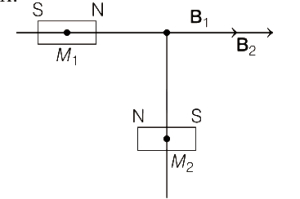
Two short bar magnets, each with a magnetic moment of $9 \text{ Am}^2$, are placed such that one is at $x = -3 \text{ cm}$ and the other is at $y = -3 \text{ cm}$. If their magnetic moments are directed along the positive and negative $X$-directions respectively, then the resultant magnetic field at the origin is: (in $\text{ T}$)
A
$100$
B
$10$
C
$0.1$
D
$0.001$
Solution
(C) The origin is on the axial line of the first magnet $(M_1)$ and on the equatorial line of the second magnet $(M_2)$.
Given: $M = 9 \text{ Am}^2$, $r = 3 \text{ cm} = 3 \times 10^{-2} \text{ m}$.
Magnetic field due to $M_1$ (axial point) at the origin:
$B_1 = \frac{\mu_0}{4 \pi} \times \frac{2M}{r^3} = 10^{-7} \times \frac{2 \times 9}{(3 \times 10^{-2})^3} = 10^{-7} \times \frac{18}{27 \times 10^{-6}} = \frac{2}{3} \times 10^{-1} \text{ T}$.
This field is directed along the positive $X$-axis.
Magnetic field due to $M_2$ (equatorial point) at the origin:
$B_2 = \frac{\mu_0}{4 \pi} \times \frac{M}{r^3} = 10^{-7} \times \frac{9}{(3 \times 10^{-2})^3} = 10^{-7} \times \frac{9}{27 \times 10^{-6}} = \frac{1}{3} \times 10^{-1} \text{ T}$.
Since the magnetic moment of $M_2$ is in the negative $X$-direction, the equatorial field at the origin points in the positive $X$-direction.
As both $B_1$ and $B_2$ point in the same direction, the resultant magnetic field is:
$B = B_1 + B_2 = \left(\frac{2}{3} + \frac{1}{3}\right) \times 10^{-1} \text{ T} = 1 \times 10^{-1} \text{ T} = 0.1 \text{ T}$.
Given: $M = 9 \text{ Am}^2$, $r = 3 \text{ cm} = 3 \times 10^{-2} \text{ m}$.
Magnetic field due to $M_1$ (axial point) at the origin:
$B_1 = \frac{\mu_0}{4 \pi} \times \frac{2M}{r^3} = 10^{-7} \times \frac{2 \times 9}{(3 \times 10^{-2})^3} = 10^{-7} \times \frac{18}{27 \times 10^{-6}} = \frac{2}{3} \times 10^{-1} \text{ T}$.
This field is directed along the positive $X$-axis.
Magnetic field due to $M_2$ (equatorial point) at the origin:
$B_2 = \frac{\mu_0}{4 \pi} \times \frac{M}{r^3} = 10^{-7} \times \frac{9}{(3 \times 10^{-2})^3} = 10^{-7} \times \frac{9}{27 \times 10^{-6}} = \frac{1}{3} \times 10^{-1} \text{ T}$.
Since the magnetic moment of $M_2$ is in the negative $X$-direction, the equatorial field at the origin points in the positive $X$-direction.
As both $B_1$ and $B_2$ point in the same direction, the resultant magnetic field is:
$B = B_1 + B_2 = \left(\frac{2}{3} + \frac{1}{3}\right) \times 10^{-1} \text{ T} = 1 \times 10^{-1} \text{ T} = 0.1 \text{ T}$.
0 likes
View Solution141
DifficultMCQ
$A$ short bar magnet of magnetic moment $0.21 \ A \cdot m^2$ is placed with its axis perpendicular to the direction of the horizontal component of the earth's magnetic field. The distance of the point on the axis of the magnet from the centre of the magnet where the resultant magnetic field is inclined at $45^{\circ}$ with the horizontal component of the earth's field direction is (horizontal component of the earth's magnetic field $= 4.2 \times 10^{-5} \ T$). (in $cm$)
A
$12$
B
$20$
C
$5$
D
$10$
Solution
(D) The magnetic field on the axial line of a short bar magnet is given by $B_{axial} = \frac{\mu_0}{4\pi} \cdot \frac{2M}{r^3}$.
Since the axis of the magnet is perpendicular to the horizontal component of the earth's magnetic field $(B_H)$,the resultant magnetic field makes an angle of $45^{\circ}$ with $B_H$ when the magnitude of the axial field equals the magnitude of the horizontal component of the earth's magnetic field.
Therefore,$B_{axial} = B_H$.
Substituting the values: $\frac{10^{-7} \times 2 \times 0.21}{r^3} = 4.2 \times 10^{-5}$.
$r^3 = \frac{2 \times 0.21 \times 10^{-7}}{4.2 \times 10^{-5}} = \frac{0.42 \times 10^{-7}}{4.2 \times 10^{-5}} = 0.1 \times 10^{-2} = 10^{-3} \ m^3$.
$r = 0.1 \ m = 10 \ cm$.
Since the axis of the magnet is perpendicular to the horizontal component of the earth's magnetic field $(B_H)$,the resultant magnetic field makes an angle of $45^{\circ}$ with $B_H$ when the magnitude of the axial field equals the magnitude of the horizontal component of the earth's magnetic field.
Therefore,$B_{axial} = B_H$.
Substituting the values: $\frac{10^{-7} \times 2 \times 0.21}{r^3} = 4.2 \times 10^{-5}$.
$r^3 = \frac{2 \times 0.21 \times 10^{-7}}{4.2 \times 10^{-5}} = \frac{0.42 \times 10^{-7}}{4.2 \times 10^{-5}} = 0.1 \times 10^{-2} = 10^{-3} \ m^3$.
$r = 0.1 \ m = 10 \ cm$.
0 likes
View Solution142
EasyMCQ
$A$ short bar magnet placed with its axis at $45^{\circ}$ with a uniform external magnetic field of $28.3 \times 10^{-3} \,T$ experiences a torque of magnitude equal to $3.6 \times 10^{-5} \,J$. The magnitude of the magnetic moment of the magnet is nearly:
A
$1.8 \times 10^{-3} \,J \,T^{-1}$
B
$1.2 \times 10^{-3} \,J \,T^{-1}$
C
$2.4 \times 10^{-3} \,J \,T^{-1}$
D
$1.6 \times 10^{-3} \,J \,T^{-1}$
Solution
(A) The torque $\tau$ experienced by a magnetic dipole in a uniform magnetic field $B$ is given by the formula: $\tau = MB \sin \theta$.
Given:
Torque $\tau = 3.6 \times 10^{-5} \,J$
Magnetic field $B = 28.3 \times 10^{-3} \,T$
Angle $\theta = 45^{\circ}$
Rearranging the formula to solve for the magnetic moment $M$:
$M = \frac{\tau}{B \sin \theta}$
Substituting the values:
$M = \frac{3.6 \times 10^{-5}}{28.3 \times 10^{-3} \times \sin 45^{\circ}}$
Since $\sin 45^{\circ} = \frac{1}{\sqrt{2}} \approx 0.707$:
$M = \frac{3.6 \times 10^{-5}}{28.3 \times 10^{-3} \times 0.707} \approx \frac{3.6 \times 10^{-5}}{20.008 \times 10^{-3}} \approx 0.1799 \times 10^{-2} \approx 1.8 \times 10^{-3} \,J \,T^{-1}$.
Given:
Torque $\tau = 3.6 \times 10^{-5} \,J$
Magnetic field $B = 28.3 \times 10^{-3} \,T$
Angle $\theta = 45^{\circ}$
Rearranging the formula to solve for the magnetic moment $M$:
$M = \frac{\tau}{B \sin \theta}$
Substituting the values:
$M = \frac{3.6 \times 10^{-5}}{28.3 \times 10^{-3} \times \sin 45^{\circ}}$
Since $\sin 45^{\circ} = \frac{1}{\sqrt{2}} \approx 0.707$:
$M = \frac{3.6 \times 10^{-5}}{28.3 \times 10^{-3} \times 0.707} \approx \frac{3.6 \times 10^{-5}}{20.008 \times 10^{-3}} \approx 0.1799 \times 10^{-2} \approx 1.8 \times 10^{-3} \,J \,T^{-1}$.
0 likes
View Solution143
EasyMCQ
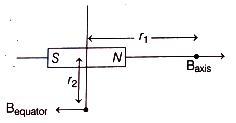
$A$ short bar magnet produces a magnetic field of $6.4 \times 10^{-5} \,T$ at a distance of $20 \,cm$ from the centre of the magnet on the normal bisector of the magnet. The magnetic field produced by this magnet at a distance of $40 \,cm$ from the centre of the magnet on the axis,is
A
$4.8 \times 10^{-5} \,T$
B
$3.2 \times 10^{-5} \,T$
C
$1.6 \times 10^{-5} \,T$
D
$6.4 \times 10^{-5} \,T$
Solution
(C) The magnetic field produced by a short bar magnet on its axis $(B_{\text{axis}})$ and on its equatorial line $(B_{\text{equator}})$ at a distance $r$ from the centre is given by:
$B_{\text{axis}} = \frac{\mu_0}{4\pi} \cdot \frac{2M}{r^3}$
$B_{\text{equator}} = \frac{\mu_0}{4\pi} \cdot \frac{M}{r^3}$
Thus,$B_{\text{axis}} = 2 \times B_{\text{equator}}$ for the same distance $r$.
Given:
$B_{\text{equator}} = 6.4 \times 10^{-5} \,T$ at $r_2 = 20 \,cm = 0.2 \,m$
We need to find $B_{\text{axis}}$ at $r_1 = 40 \,cm = 0.4 \,m$.
Using the general formula $B \propto \frac{1}{r^3}$:
$\frac{B_{\text{axis}}(r_1)}{B_{\text{equator}}(r_2)} = \frac{\frac{\mu_0}{4\pi} \cdot \frac{2M}{r_1^3}}{\frac{\mu_0}{4\pi} \cdot \frac{M}{r_2^3}} = 2 \times \left(\frac{r_2}{r_1}\right)^3$
$B_{\text{axis}} = 2 \times B_{\text{equator}} \times \left(\frac{20}{40}\right)^3$
$B_{\text{axis}} = 2 \times (6.4 \times 10^{-5}) \times \left(\frac{1}{2}\right)^3$
$B_{\text{axis}} = 2 \times (6.4 \times 10^{-5}) \times \frac{1}{8}$
$B_{\text{axis}} = \frac{6.4 \times 10^{-5}}{4} = 1.6 \times 10^{-5} \,T$
$B_{\text{axis}} = \frac{\mu_0}{4\pi} \cdot \frac{2M}{r^3}$
$B_{\text{equator}} = \frac{\mu_0}{4\pi} \cdot \frac{M}{r^3}$
Thus,$B_{\text{axis}} = 2 \times B_{\text{equator}}$ for the same distance $r$.
Given:
$B_{\text{equator}} = 6.4 \times 10^{-5} \,T$ at $r_2 = 20 \,cm = 0.2 \,m$
We need to find $B_{\text{axis}}$ at $r_1 = 40 \,cm = 0.4 \,m$.
Using the general formula $B \propto \frac{1}{r^3}$:
$\frac{B_{\text{axis}}(r_1)}{B_{\text{equator}}(r_2)} = \frac{\frac{\mu_0}{4\pi} \cdot \frac{2M}{r_1^3}}{\frac{\mu_0}{4\pi} \cdot \frac{M}{r_2^3}} = 2 \times \left(\frac{r_2}{r_1}\right)^3$
$B_{\text{axis}} = 2 \times B_{\text{equator}} \times \left(\frac{20}{40}\right)^3$
$B_{\text{axis}} = 2 \times (6.4 \times 10^{-5}) \times \left(\frac{1}{2}\right)^3$
$B_{\text{axis}} = 2 \times (6.4 \times 10^{-5}) \times \frac{1}{8}$
$B_{\text{axis}} = \frac{6.4 \times 10^{-5}}{4} = 1.6 \times 10^{-5} \,T$
0 likes
View Solution144
EasyMCQ
If the dipole moment of a short bar magnet is $1.25 \ A-m^2$,find the magnetic field on its axis at a distance of $0.5 \ m$ from the centre of the magnet.
A
$1.0 \times 10^{-4} \ T$
B
$4.0 \times 10^{-2} \ T$
C
$2.0 \times 10^{-6} \ T$
D
$6.64 \times 10^{-8} \ T$
Solution
(C) Given: Dipole moment $M = 1.25 \ A-m^2$ and distance $r = 0.5 \ m$.
The magnetic field $B$ on the axial position of a short bar magnet is given by the formula:
$B = \frac{\mu_0}{4 \pi} \times \frac{2 M}{r^3}$
Substituting the values:
$B = 10^{-7} \times \frac{2 \times 1.25}{(0.5)^3}$
$B = 10^{-7} \times \frac{2.5}{0.125}$
$B = 10^{-7} \times 20 = 2.0 \times 10^{-6} \ T$
Thus,the magnetic field is $2.0 \times 10^{-6} \ T$.
The magnetic field $B$ on the axial position of a short bar magnet is given by the formula:
$B = \frac{\mu_0}{4 \pi} \times \frac{2 M}{r^3}$
Substituting the values:
$B = 10^{-7} \times \frac{2 \times 1.25}{(0.5)^3}$
$B = 10^{-7} \times \frac{2.5}{0.125}$
$B = 10^{-7} \times 20 = 2.0 \times 10^{-6} \ T$
Thus,the magnetic field is $2.0 \times 10^{-6} \ T$.
0 likes
View Solution145
MediumMCQ
Two short bar magnets of magnetic moments $M$ and $\sqrt{3} M$ are joined like a cross (+). This cross is suspended from its centre with its plane horizontal in the earth's magnetic field. When the cross comes to equilibrium,the angle made by the weaker magnet with the earth's magnetic field $B_H$ is (in $^{\circ}$)
A
$30$
B
$45$
C
$75$
D
$60$
Solution
(D) Let the magnetic moment of the weaker magnet be $M_1 = M$ and the stronger magnet be $M_2 = \sqrt{3} M$.
Since they are joined in a cross (+) shape,the angle between them is $90^{\circ}$.
Let the weaker magnet make an angle $\theta$ with the earth's magnetic field $B_H$.
Then the stronger magnet makes an angle $(90^{\circ} - \theta)$ with $B_H$.
In equilibrium,the net torque acting on the system due to the earth's magnetic field must be zero.
$\tau_1 + \tau_2 = 0$
$M_1 B_H \sin(\theta) = M_2 B_H \sin(90^{\circ} - \theta)$
$M \sin(\theta) = \sqrt{3} M \cos(\theta)$
$\tan(\theta) = \sqrt{3}$
$\theta = 60^{\circ}$.
Since they are joined in a cross (+) shape,the angle between them is $90^{\circ}$.
Let the weaker magnet make an angle $\theta$ with the earth's magnetic field $B_H$.
Then the stronger magnet makes an angle $(90^{\circ} - \theta)$ with $B_H$.
In equilibrium,the net torque acting on the system due to the earth's magnetic field must be zero.
$\tau_1 + \tau_2 = 0$
$M_1 B_H \sin(\theta) = M_2 B_H \sin(90^{\circ} - \theta)$
$M \sin(\theta) = \sqrt{3} M \cos(\theta)$
$\tan(\theta) = \sqrt{3}$
$\theta = 60^{\circ}$.
0 likes
View Solution146
DifficultMCQ
Two short bar magnets have their magnetic moments $1.2 \text{ A m}^2$ and $1.0 \text{ A m}^2$. They are placed on a horizontal table parallel to each other at a distance of $20 \text{ cm}$ between their centres,such that their north poles point towards geographic south. They have a common magnetic equatorial line. The horizontal component of the Earth's magnetic field is $3.6 \times 10^{-5} \text{ T}$. The resultant horizontal magnetic induction at the midpoint of the line joining their centers is $\left(\frac{\mu_0}{4 \pi} = 10^{-7} \text{ N/A}^2\right)$.
A
$3.6 \times 10^{-5} \text{ T}$
B
$1.84 \times 10^{-4} \text{ T}$
C
$2.56 \times 10^{-4} \text{ T}$
D
$5.8 \times 10^{-5} \text{ T}$
Solution
(C) The magnetic field due to a short bar magnet at a point on its equatorial line is given by $B = \frac{\mu_0}{4 \pi} \frac{M}{r^3}$.
Here,the distance between the centers is $20 \text{ cm}$,so the distance of the midpoint from each magnet is $r = 10 \text{ cm} = 0.1 \text{ m}$.
Since the north poles point towards the geographic south,the magnetic fields produced by both magnets at the midpoint will be in the same direction as the Earth's horizontal magnetic field $(B_H)$.
Thus,the resultant magnetic field $B_{net} = B_1 + B_2 + B_H$.
$B_1 = \frac{10^{-7} \times 1.2}{(0.1)^3} = \frac{1.2 \times 10^{-7}}{10^{-3}} = 1.2 \times 10^{-4} \text{ T}$.
$B_2 = \frac{10^{-7} \times 1.0}{(0.1)^3} = \frac{1.0 \times 10^{-7}}{10^{-3}} = 1.0 \times 10^{-4} \text{ T}$.
$B_H = 3.6 \times 10^{-5} = 0.36 \times 10^{-4} \text{ T}$.
$B_{net} = (1.2 + 1.0 + 0.36) \times 10^{-4} \text{ T} = 2.56 \times 10^{-4} \text{ T}$.
Here,the distance between the centers is $20 \text{ cm}$,so the distance of the midpoint from each magnet is $r = 10 \text{ cm} = 0.1 \text{ m}$.
Since the north poles point towards the geographic south,the magnetic fields produced by both magnets at the midpoint will be in the same direction as the Earth's horizontal magnetic field $(B_H)$.
Thus,the resultant magnetic field $B_{net} = B_1 + B_2 + B_H$.
$B_1 = \frac{10^{-7} \times 1.2}{(0.1)^3} = \frac{1.2 \times 10^{-7}}{10^{-3}} = 1.2 \times 10^{-4} \text{ T}$.
$B_2 = \frac{10^{-7} \times 1.0}{(0.1)^3} = \frac{1.0 \times 10^{-7}}{10^{-3}} = 1.0 \times 10^{-4} \text{ T}$.
$B_H = 3.6 \times 10^{-5} = 0.36 \times 10^{-4} \text{ T}$.
$B_{net} = (1.2 + 1.0 + 0.36) \times 10^{-4} \text{ T} = 2.56 \times 10^{-4} \text{ T}$.
0 likes
View Solution147
DifficultMCQ
$A$ bar magnet of magnetic moment $M$ and moment of inertia $I$ is freely suspended such that the magnetic axial line is in the direction of the magnetic meridian. If the magnet is displaced by a very small angle $\theta$,the angular acceleration is (Magnetic induction of earth's horizontal field $= B_H$)
A
$\frac{M B_H \theta}{I}$
B
$\frac{I B_H \theta}{M}$
C
$\frac{M \theta}{I B_H}$
D
$\frac{I \theta}{M B_H}$
Solution
(A) When a magnet is displaced by a very small angle $\theta$,the restoring torque acting on the magnet is given by $\tau = -M B_H \sin \theta$.
The negative sign indicates the restoring nature of the torque.
Since $\tau = I \alpha$,where $I$ is the moment of inertia and $\alpha$ is the angular acceleration,we have $I \alpha = -M B_H \sin \theta$.
For small angular displacements,$\sin \theta \approx \theta$.
Therefore,$I \alpha = -M B_H \theta$.
The magnitude of the angular acceleration is $\alpha = \frac{M B_H \theta}{I}$.
The negative sign indicates the restoring nature of the torque.
Since $\tau = I \alpha$,where $I$ is the moment of inertia and $\alpha$ is the angular acceleration,we have $I \alpha = -M B_H \sin \theta$.
For small angular displacements,$\sin \theta \approx \theta$.
Therefore,$I \alpha = -M B_H \theta$.
The magnitude of the angular acceleration is $\alpha = \frac{M B_H \theta}{I}$.
0 likes
View SolutionMagnetism and Matter — Magnetic field due to magnetic dipole and Dipole in Magnetic Field and Poential Energy and Work Done · Frequently Asked Questions
1Are these Magnetism and Matter questions useful for JEE and NEET?
Yes. All questions in this section are mapped to JEE Main and NEET exam patterns. Previous year questions from JEE Main, NEET, GUJCET and state-level exams are included with full solutions.
2Can I switch to Hindi or Gujarati for these questions?
Yes. Use the language tabs in the hero section or the sidebar to view the same questions and solutions in English, Hindi or Gujarati.
3How do I generate a question paper from this subtopic?
Use the Vedclass Exam Paper Generator — select the chapter and subtopic, set difficulty, and generate Sets A, B, C, D automatically. First 3 chapters of every subject are free.
Vedclass Products
For Students
Vedclass Test Series
Mock tests in real JEE/NEET style with performance analysis. 5-day free trial.
Start Free TrialFor Teachers
Exam Paper Generator
Generate Set A/B/C/D papers from this chapter in 2 minutes. 3 chapters free.
Try FreeFor Institutes
Online Exam Module
Live online exams with unlimited students, 360° analytics & white-label branding.
See DemoFor Teachers & Institutes
Generate a Magnetism and Matter Exam Paper in 2 Minutes
Select subtopic & difficulty — Sets A, B, C, D auto-generated with No Repeat logic.
First 3 chapters of every subject are free — no payment required.