
A English
Mix Examples-Dual Nature of Radiation and matter Questions in English
Class 12 Physics · Dual Nature of Radiation and matter · Mix Examples-Dual Nature of Radiation and matter
75+
Questions
English
Language
100%
With Solutions
Showing 50 of 75 questions in English
1
EasyMCQ
For a body moving with relativistic speed,if the velocity is doubled,then
A
Its linear momentum is doubled
B
Its linear momentum will be less than double
C
Its linear momentum will be more than double
D
Its linear momentum remains unchanged
Solution
(C) The relativistic linear momentum $p$ is given by the formula: $p = \frac{m_0 v}{\sqrt{1 - v^2/c^2}}$,where $m_0$ is the rest mass,$v$ is the velocity,and $c$ is the speed of light.
When the velocity $v$ is doubled to $2v$,the new momentum $p'$ becomes $p' = \frac{m_0 (2v)}{\sqrt{1 - (2v)^2/c^2}} = \frac{2 m_0 v}{\sqrt{1 - 4v^2/c^2}}$.
Comparing $p'$ with the original momentum $p$,we see that the denominator $\sqrt{1 - 4v^2/c^2}$ is smaller than $\sqrt{1 - v^2/c^2}$.
Since the denominator decreases,the value of the momentum increases by a factor greater than $2$. Thus,the linear momentum will be more than double.
When the velocity $v$ is doubled to $2v$,the new momentum $p'$ becomes $p' = \frac{m_0 (2v)}{\sqrt{1 - (2v)^2/c^2}} = \frac{2 m_0 v}{\sqrt{1 - 4v^2/c^2}}$.
Comparing $p'$ with the original momentum $p$,we see that the denominator $\sqrt{1 - 4v^2/c^2}$ is smaller than $\sqrt{1 - v^2/c^2}$.
Since the denominator decreases,the value of the momentum increases by a factor greater than $2$. Thus,the linear momentum will be more than double.
0 likes
View Solution2
MediumMCQ
One day on a spacecraft corresponds to $2$ days on the earth. The speed of the spacecraft relative to the earth is
A
$1.5 \times 10^8 \ m/s$
B
$2.1 \times 10^8 \ m/s$
C
$2.6 \times 10^8 \ m/s$
D
$5.2 \times 10^8 \ m/s$
Solution
(C) According to the theory of special relativity, the time dilation formula is given by $T = \frac{T_0}{\sqrt{1 - \frac{v^2}{c^2}}}$, where $T$ is the time observed on Earth, $T_0$ is the proper time on the spacecraft, $v$ is the velocity of the spacecraft, and $c$ is the speed of light $(3 \times 10^8 \ m/s)$.
Given $T_0 = 1 \ day$ and $T = 2 \ days$, we have:
$2 = \frac{1}{\sqrt{1 - \frac{v^2}{c^2}}}$
Squaring both sides: $4 = \frac{1}{1 - \frac{v^2}{c^2}}$
$1 - \frac{v^2}{c^2} = \frac{1}{4} = 0.25$
$\frac{v^2}{c^2} = 1 - 0.25 = 0.75$
$v = c \sqrt{0.75} = 3 \times 10^8 \times 0.866 = 2.598 \times 10^8 \ m/s \approx 2.6 \times 10^8 \ m/s$.
Given $T_0 = 1 \ day$ and $T = 2 \ days$, we have:
$2 = \frac{1}{\sqrt{1 - \frac{v^2}{c^2}}}$
Squaring both sides: $4 = \frac{1}{1 - \frac{v^2}{c^2}}$
$1 - \frac{v^2}{c^2} = \frac{1}{4} = 0.25$
$\frac{v^2}{c^2} = 1 - 0.25 = 0.75$
$v = c \sqrt{0.75} = 3 \times 10^8 \times 0.866 = 2.598 \times 10^8 \ m/s \approx 2.6 \times 10^8 \ m/s$.
0 likes
View Solution3
EasyMCQ
The kinetic energy of emitted cathode rays is dependent on:
A
Only voltage
B
Only work function
C
Both $(a)$ and $(b)$
D
It does not depend upon any physical quantity
Solution
(C) The kinetic energy $(KE)$ of emitted electrons (cathode rays) is given by the photoelectric equation: $KE_{max} = h\nu - \Phi$, where $h\nu$ is the energy of the incident photon and $\Phi$ is the work function of the material.
In the context of cathode rays produced by an accelerating potential $V$, the kinetic energy acquired is $KE = eV$.
Thus, the kinetic energy depends on both the accelerating voltage (or incident energy) and the work function of the cathode material.
In the context of cathode rays produced by an accelerating potential $V$, the kinetic energy acquired is $KE = eV$.
Thus, the kinetic energy depends on both the accelerating voltage (or incident energy) and the work function of the cathode material.
0 likes
View Solution4
EasyMCQ
The dual nature of radiation is demonstrated by:
A
Diffraction and reflection
B
Refraction and diffraction
C
Photoelectric effect alone
D
Photoelectric effect and diffraction
Solution
(D) The dual nature of radiation implies that it exhibits both wave-like and particle-like properties.
$1$. The $Photoelectric \, effect$ demonstrates the particle nature of radiation,where light behaves as discrete packets of energy called photons.
$2$. $Diffraction$ is a phenomenon that demonstrates the wave nature of radiation,as it involves the bending of waves around obstacles.
Therefore,the combination of the $Photoelectric \, effect$ and $Diffraction$ confirms the dual nature of radiation.
$1$. The $Photoelectric \, effect$ demonstrates the particle nature of radiation,where light behaves as discrete packets of energy called photons.
$2$. $Diffraction$ is a phenomenon that demonstrates the wave nature of radiation,as it involves the bending of waves around obstacles.
Therefore,the combination of the $Photoelectric \, effect$ and $Diffraction$ confirms the dual nature of radiation.
0 likes
View Solution5
EasyMCQ
The particle nature and wave nature of electromagnetic waves and electrons can be demonstrated by which of the following?
A
Electron has small mass and is deflected by a metal sheet
B
$X$-rays are diffracted and reflected by a thick metal sheet
C
Light is refracted and diffracted
D
Photoelectricity and electron microscopy
Solution
(D) The particle nature of light is demonstrated by the photoelectric effect,where light behaves as a stream of photons. The wave nature of electrons is demonstrated by electron microscopy,where an electron beam behaves as a wave with a specific wavelength (de Broglie wavelength) to achieve high resolution. Thus,both natures are exhibited by these phenomena.
0 likes
View Solution6
EasyMCQ
Photo cells are used for the:
A
Reproduction of pictures from the cinema film
B
Reproduction of sound from the cinema film
C
Automatic switching of street light
D
$b$ and $c$ both
Solution
(D) Photo cells (or photoelectric cells) are devices that convert light energy into electrical energy.
They are widely used in the reproduction of sound from cinema film,where the light passing through the sound track on the film is converted into electrical signals.
They are also used for the automatic switching of street lights,where the intensity of ambient light controls the circuit.
Therefore,both options $b$ and $c$ are correct applications of photo cells.
They are widely used in the reproduction of sound from cinema film,where the light passing through the sound track on the film is converted into electrical signals.
They are also used for the automatic switching of street lights,where the intensity of ambient light controls the circuit.
Therefore,both options $b$ and $c$ are correct applications of photo cells.
0 likes
View Solution7
DifficultMCQ
In a photocell,bichromatic light of wavelengths $2475 \ \mathring{A}$ and $6000 \ \mathring{A}$ is incident on a cathode whose work function is $4.8 \ eV$. If a uniform magnetic field of $3 \times 10^{-5} \ T$ exists parallel to the plate,the radius of the path described by the photoelectron will be ............ $cm$ (mass of electron $= 9 \times 10^{-31} \ kg$).
A
$1$
B
$5$
C
$10$
D
$25$
Solution
(B) The energy of photons corresponding to wavelength $\lambda_1 = 2475 \ \mathring{A}$ is $E_1 = \frac{12375}{2475} = 5 \ eV$.
The energy of photons corresponding to wavelength $\lambda_2 = 6000 \ \mathring{A}$ is $E_2 = \frac{12375}{6000} = 2.06 \ eV$.
Since $E_2 < W_0$ $(4.8 \ eV)$ and $E_1 > W_0$,photoelectric emission is possible only with $\lambda_1$.
The maximum kinetic energy of the emitted photoelectrons is $K = E_1 - W_0 = 5 - 4.8 = 0.2 \ eV$.
Converting $K$ to Joules: $K = 0.2 \times 1.6 \times 10^{-19} \ J = 3.2 \times 10^{-20} \ J$.
The radius of the circular path in a magnetic field is given by $r = \frac{\sqrt{2mK}}{qB}$.
Substituting the values: $r = \frac{\sqrt{2 \times 9 \times 10^{-31} \times 3.2 \times 10^{-20}}}{1.6 \times 10^{-19} \times 3 \times 10^{-5}}$.
$r = \frac{\sqrt{57.6 \times 10^{-51}}}{4.8 \times 10^{-24}} = \frac{7.59 \times 10^{-25}}{4.8 \times 10^{-24}} \approx 0.05 \ m = 5 \ cm$.
The energy of photons corresponding to wavelength $\lambda_2 = 6000 \ \mathring{A}$ is $E_2 = \frac{12375}{6000} = 2.06 \ eV$.
Since $E_2 < W_0$ $(4.8 \ eV)$ and $E_1 > W_0$,photoelectric emission is possible only with $\lambda_1$.
The maximum kinetic energy of the emitted photoelectrons is $K = E_1 - W_0 = 5 - 4.8 = 0.2 \ eV$.
Converting $K$ to Joules: $K = 0.2 \times 1.6 \times 10^{-19} \ J = 3.2 \times 10^{-20} \ J$.
The radius of the circular path in a magnetic field is given by $r = \frac{\sqrt{2mK}}{qB}$.
Substituting the values: $r = \frac{\sqrt{2 \times 9 \times 10^{-31} \times 3.2 \times 10^{-20}}}{1.6 \times 10^{-19} \times 3 \times 10^{-5}}$.
$r = \frac{\sqrt{57.6 \times 10^{-51}}}{4.8 \times 10^{-24}} = \frac{7.59 \times 10^{-25}}{4.8 \times 10^{-24}} \approx 0.05 \ m = 5 \ cm$.
0 likes
View Solution8
DifficultMCQ
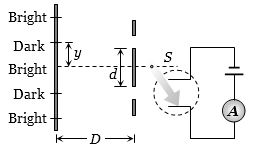
In the following arrangement $y = 1.0\ mm$,$d = 0.24\ mm$ and $D = 1.2\ m$. The work function of the material of the emitter is $2.2\ eV$. The stopping potential $V_0$ needed to stop the photocurrent will be .............. $V$.
A
$0.9$
B
$0.5$
C
$0.4$
D
$0.1$
Solution
(A) In Young's double-slit experiment,the fringe width $\beta$ is the distance between two consecutive bright or dark fringes,given by $\beta = \frac{\lambda D}{d}$.
From the figure,the distance between a central bright fringe and the first dark fringe is $y = 1.0\ mm$. Since the distance between a bright and the next dark fringe is $\frac{\beta}{2}$,we have $y = \frac{\beta}{2}$,which implies $\beta = 2y = 2.0\ mm = 2.0 \times 10^{-3}\ m$.
Using the fringe width formula: $\lambda = \frac{\beta d}{D} = \frac{2.0 \times 10^{-3} \times 0.24 \times 10^{-3}}{1.2} = 4 \times 10^{-7}\ m = 4000\ \mathring{A}$.
The energy of the incident photon is $E = \frac{12400}{\lambda(\mathring{A})} \approx \frac{12400}{4000} = 3.1\ eV$.
According to Einstein's photoelectric equation,$E = W_0 + eV_0$,where $W_0 = 2.2\ eV$ is the work function.
$eV_0 = E - W_0 = 3.1\ eV - 2.2\ eV = 0.9\ eV$.
Therefore,the stopping potential $V_0 = 0.9\ V$.
From the figure,the distance between a central bright fringe and the first dark fringe is $y = 1.0\ mm$. Since the distance between a bright and the next dark fringe is $\frac{\beta}{2}$,we have $y = \frac{\beta}{2}$,which implies $\beta = 2y = 2.0\ mm = 2.0 \times 10^{-3}\ m$.
Using the fringe width formula: $\lambda = \frac{\beta d}{D} = \frac{2.0 \times 10^{-3} \times 0.24 \times 10^{-3}}{1.2} = 4 \times 10^{-7}\ m = 4000\ \mathring{A}$.
The energy of the incident photon is $E = \frac{12400}{\lambda(\mathring{A})} \approx \frac{12400}{4000} = 3.1\ eV$.
According to Einstein's photoelectric equation,$E = W_0 + eV_0$,where $W_0 = 2.2\ eV$ is the work function.
$eV_0 = E - W_0 = 3.1\ eV - 2.2\ eV = 0.9\ eV$.
Therefore,the stopping potential $V_0 = 0.9\ V$.
0 likes
View Solution9
MediumMCQ
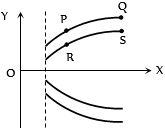
In the Thomson spectrograph experiment,four positive ions $P, Q, R,$ and $S$ are situated on the $Y-X$ curves as shown in the figure.
A
The specific charge of $R$ and $S$ are the same.
B
The masses of $P$ and $S$ are the same.
C
The specific charges of $Q$ and $R$ are the same.
D
The velocities of $R$ and $S$ are the same.
Solution
(A) In a Thomson spectrograph,the deflection of a charged particle in electric and magnetic fields is given by the equation of a parabola $y = kx^2$,where $k$ depends on the specific charge $(q/m)$ of the particle.
All positive ions having the same specific charge $(q/m)$ lie on the same parabolic path,regardless of their velocities.
Looking at the figure,points $R$ and $S$ lie on the same parabolic curve.
Therefore,the specific charge of $R$ and $S$ must be the same.
Thus,option $A$ is correct.
All positive ions having the same specific charge $(q/m)$ lie on the same parabolic path,regardless of their velocities.
Looking at the figure,points $R$ and $S$ lie on the same parabolic curve.
Therefore,the specific charge of $R$ and $S$ must be the same.
Thus,option $A$ is correct.
0 likes
View Solution10
EasyMCQ
The spectrum of light emitted by a glowing solid is
A
Continuous spectrum
B
Line spectrum
C
Band spectrum
D
Absorption spectrum
Solution
(A) Continuous spectra arise from dense gases or solid objects that radiate heat.
They emit radiation over a broad range of wavelengths,so the spectrum appears as smooth and continuous.
$A$ blackbody is a perfect example of an object emitting a continuous spectrum.
Any body that glows by radiating heat,such as incandescent light bulbs,electric cooking stove burners,or flames,emits radiation in a continuous spectrum.
They emit radiation over a broad range of wavelengths,so the spectrum appears as smooth and continuous.
$A$ blackbody is a perfect example of an object emitting a continuous spectrum.
Any body that glows by radiating heat,such as incandescent light bulbs,electric cooking stove burners,or flames,emits radiation in a continuous spectrum.
0 likes
View Solution11
EasyMCQ
The spectrum obtained from an electric lamp or a red-hot heater is:
A
Line spectrum
B
Band spectrum
C
Absorption spectrum
D
Continuous spectrum
Solution
(D) An electric lamp or a red-hot heater emits light due to thermal radiation (incandescence).
In such sources,the atoms are closely packed,and their energy levels overlap,resulting in the emission of all wavelengths within a specific range.
This produces a continuous spectrum,which contains all colors of the visible spectrum without any gaps.
Therefore,the correct option is $D$.
In such sources,the atoms are closely packed,and their energy levels overlap,resulting in the emission of all wavelengths within a specific range.
This produces a continuous spectrum,which contains all colors of the visible spectrum without any gaps.
Therefore,the correct option is $D$.
0 likes
View Solution12
EasyMCQ
The dual nature of light is exhibited by
A
Photoelectric effect
B
Refraction and interference
C
Diffraction and reflection
D
Diffraction and photoelectric effect
Solution
(D) The dual nature of light implies that light exhibits both wave-like and particle-like properties.
Diffraction is a phenomenon that demonstrates the wave nature of light.
The photoelectric effect is a phenomenon that demonstrates the particle nature of light (photons).
Therefore,the combination of diffraction and the photoelectric effect exhibits the dual nature of light.
Thus,the correct option is $D$.
Diffraction is a phenomenon that demonstrates the wave nature of light.
The photoelectric effect is a phenomenon that demonstrates the particle nature of light (photons).
Therefore,the combination of diffraction and the photoelectric effect exhibits the dual nature of light.
Thus,the correct option is $D$.
0 likes
View Solution13
MediumMCQ
If $m$ is the mass of an electron and $c$ is the speed of light,then the ratio of the wavelength of a photon of energy $E$ to the wavelength of an electron of the same energy is:
A
$c\sqrt{\frac{2m}{E}}$
B
$\sqrt{\frac{2m}{E}}$
C
$\sqrt{\frac{2m}{cE}}$
D
$\sqrt{\frac{m}{E}}$
Solution
(A) The energy of a photon is given by $E = h\nu = \frac{hc}{\lambda_{ph}}$,where $\lambda_{ph}$ is the wavelength of the photon.
Thus,$\lambda_{ph} = \frac{hc}{E}$.
The de Broglie wavelength of an electron with kinetic energy $E$ is given by $\lambda_e = \frac{h}{p} = \frac{h}{\sqrt{2mE}}$.
Now,the ratio of the wavelength of the photon to the wavelength of the electron is:
$\frac{\lambda_{ph}}{\lambda_e} = \left( \frac{hc}{E} \right) \times \left( \frac{\sqrt{2mE}}{h} \right)$
$= \frac{c}{E} \times \sqrt{2mE} = c \sqrt{\frac{2mE}{E^2}} = c \sqrt{\frac{2m}{E}}$.
Thus,$\lambda_{ph} = \frac{hc}{E}$.
The de Broglie wavelength of an electron with kinetic energy $E$ is given by $\lambda_e = \frac{h}{p} = \frac{h}{\sqrt{2mE}}$.
Now,the ratio of the wavelength of the photon to the wavelength of the electron is:
$\frac{\lambda_{ph}}{\lambda_e} = \left( \frac{hc}{E} \right) \times \left( \frac{\sqrt{2mE}}{h} \right)$
$= \frac{c}{E} \times \sqrt{2mE} = c \sqrt{\frac{2mE}{E^2}} = c \sqrt{\frac{2m}{E}}$.
0 likes
View Solution14
MediumMCQ
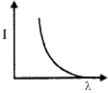
The anode voltage of a photocell is kept constant. The wavelength of the incident light on the cathode is changed gradually. Then,the photoelectric current $I$ of the photocell varies according to which of the following graphs?
A
B
C
D
Solution
(C) The photoelectric current $I$ is directly proportional to the number of photoelectrons emitted per second,which in turn is proportional to the number of incident photons per second.
If the power $P$ of the incident light is kept constant,then $P = n \cdot \frac{hc}{\lambda}$,where $n$ is the number of photons incident per second.
Thus,$n = \frac{P \lambda}{hc}$.
Since $I \propto n$,we have $I \propto \lambda$.
However,the photoelectric effect only occurs if the wavelength $\lambda$ is less than or equal to the threshold wavelength $\lambda_0$ (i.e.,$\lambda \le \lambda_0$).
As $\lambda$ increases from a small value towards $\lambda_0$,the number of photons $n$ required to maintain constant power $P$ increases,and thus the photoelectric current $I$ increases linearly with $\lambda$ until $\lambda = \lambda_0$,beyond which the current drops to zero. This behavior is represented by graph $C$.
If the power $P$ of the incident light is kept constant,then $P = n \cdot \frac{hc}{\lambda}$,where $n$ is the number of photons incident per second.
Thus,$n = \frac{P \lambda}{hc}$.
Since $I \propto n$,we have $I \propto \lambda$.
However,the photoelectric effect only occurs if the wavelength $\lambda$ is less than or equal to the threshold wavelength $\lambda_0$ (i.e.,$\lambda \le \lambda_0$).
As $\lambda$ increases from a small value towards $\lambda_0$,the number of photons $n$ required to maintain constant power $P$ increases,and thus the photoelectric current $I$ increases linearly with $\lambda$ until $\lambda = \lambda_0$,beyond which the current drops to zero. This behavior is represented by graph $C$.
0 likes
View Solution15
MediumMCQ
In a photoelectric effect experiment,three different metal plates $p, q,$ and $r$ have work functions $\phi_p = 2.0 \ eV, \phi_q = 2.5 \ eV,$ and $\phi_r = 3.0 \ eV$. The incident light beams have wavelengths $\lambda_p = 550 \ nm, \lambda_q = 450 \ nm,$ and $\lambda_r = 350 \ nm$. The intensity of light is the same for each plate. The correct $I-V$ graph for the experiment is: $[hc = 1240 \ eV \ nm]$
A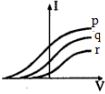
B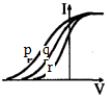
C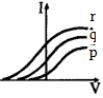
D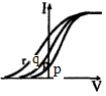
Solution
(D) The energy of incident photons is given by $E = \frac{hc}{\lambda}$.
For plate $p$: $E_p = \frac{1240}{550} \approx 2.25 \ eV$. Stopping potential $V_p = E_p - \phi_p = 2.25 - 2.0 = 0.25 \ eV$.
For plate $q$: $E_q = \frac{1240}{450} \approx 2.75 \ eV$. Stopping potential $V_q = E_q - \phi_q = 2.75 - 2.5 = 0.25 \ eV$.
For plate $r$: $E_r = \frac{1240}{350} \approx 3.54 \ eV$. Stopping potential $V_r = E_r - \phi_r = 3.54 - 3.0 = 0.54 \ eV$.
Since the intensities are equal,the saturation current $I_s$ is the same for all three plates.
Comparing the stopping potentials: $V_p = V_q = 0.25 \ eV$ and $V_r = 0.54 \ eV$.
Thus,plates $p$ and $q$ should have the same stopping potential (intercept on the negative $V$-axis),while plate $r$ should have a larger magnitude of stopping potential (further to the left).
Looking at the provided graphs,graph $D$ shows $p$ and $q$ starting at the same point on the negative $V$-axis,and $r$ starting further to the left,which matches our calculation.
For plate $p$: $E_p = \frac{1240}{550} \approx 2.25 \ eV$. Stopping potential $V_p = E_p - \phi_p = 2.25 - 2.0 = 0.25 \ eV$.
For plate $q$: $E_q = \frac{1240}{450} \approx 2.75 \ eV$. Stopping potential $V_q = E_q - \phi_q = 2.75 - 2.5 = 0.25 \ eV$.
For plate $r$: $E_r = \frac{1240}{350} \approx 3.54 \ eV$. Stopping potential $V_r = E_r - \phi_r = 3.54 - 3.0 = 0.54 \ eV$.
Since the intensities are equal,the saturation current $I_s$ is the same for all three plates.
Comparing the stopping potentials: $V_p = V_q = 0.25 \ eV$ and $V_r = 0.54 \ eV$.
Thus,plates $p$ and $q$ should have the same stopping potential (intercept on the negative $V$-axis),while plate $r$ should have a larger magnitude of stopping potential (further to the left).
Looking at the provided graphs,graph $D$ shows $p$ and $q$ starting at the same point on the negative $V$-axis,and $r$ starting further to the left,which matches our calculation.
0 likes
View Solution16
MediumMCQ
Consider the following statements: $(1)$ Both wave and particle nature are required for a complete understanding of light. $(2)$ Light cannot exhibit both wave and particle nature simultaneously in a single experiment.
A
$1$ is true,$2$ is false.
B
$1$ is false,$2$ is true.
C
Both $1$ and $2$ are false.
D
Both $1$ and $2$ are true.
Solution
(D) According to the principle of wave-particle duality,light exhibits both wave and particle properties.
Statement $(1)$ is true because phenomena like interference and diffraction are explained by the wave nature,while phenomena like the photoelectric effect and Compton scattering are explained by the particle nature.
Statement $(2)$ is also true because,in any single experimental setup,light behaves either as a wave or as a particle depending on the nature of the measurement being performed. It is impossible to observe both natures simultaneously in one experiment.
Statement $(1)$ is true because phenomena like interference and diffraction are explained by the wave nature,while phenomena like the photoelectric effect and Compton scattering are explained by the particle nature.
Statement $(2)$ is also true because,in any single experimental setup,light behaves either as a wave or as a particle depending on the nature of the measurement being performed. It is impossible to observe both natures simultaneously in one experiment.
0 likes
View Solution17
MediumMCQ
The anode voltage of a photocell is kept constant. The wavelength of the light incident on the cathode is changed gradually. Which of the following graphs represents the variation of the photoelectric current $(I)$ with the wavelength $(\lambda)$?
A
B
C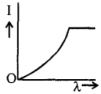
D
Solution
(B) In the photoelectric effect, the photoelectric current $(I)$ depends on the intensity of the incident light, provided the frequency of the incident light is greater than the threshold frequency $(\nu > \nu_0)$.
The threshold frequency $(\nu_0)$ corresponds to a threshold wavelength $(\lambda_0 = c / \nu_0)$.
If the wavelength of the incident light $(\lambda)$ is greater than the threshold wavelength $(\lambda_0)$, no photoelectric emission occurs, and the current $(I)$ is zero.
If the wavelength $(\lambda)$ is less than or equal to the threshold wavelength $(\lambda_0)$, photoelectric emission occurs. Assuming the intensity of the incident light remains constant as the wavelength is varied, the photoelectric current $(I)$ remains constant for all $\lambda \le \lambda_0$.
Therefore, the graph of photoelectric current $(I)$ versus wavelength $(\lambda)$ shows zero current for $\lambda > \lambda_0$ and a constant current for $\lambda \le \lambda_0$. This corresponds to the graph shown in option $(B)$.
The threshold frequency $(\nu_0)$ corresponds to a threshold wavelength $(\lambda_0 = c / \nu_0)$.
If the wavelength of the incident light $(\lambda)$ is greater than the threshold wavelength $(\lambda_0)$, no photoelectric emission occurs, and the current $(I)$ is zero.
If the wavelength $(\lambda)$ is less than or equal to the threshold wavelength $(\lambda_0)$, photoelectric emission occurs. Assuming the intensity of the incident light remains constant as the wavelength is varied, the photoelectric current $(I)$ remains constant for all $\lambda \le \lambda_0$.
Therefore, the graph of photoelectric current $(I)$ versus wavelength $(\lambda)$ shows zero current for $\lambda > \lambda_0$ and a constant current for $\lambda \le \lambda_0$. This corresponds to the graph shown in option $(B)$.
0 likes
View Solution18
MediumMCQ
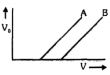
The graph shows the stopping potential as a function of the frequency of incident radiation for two different surfaces $A$ and $B$. The work function of surface $A$ is ......
A
greater than $B$
B
less than $B$
C
equal to $B$
D
cannot be compared from the given graph
Solution
(B) According to Einstein's photoelectric equation,$eV_0 = h\nu - \Phi$,where $V_0$ is the stopping potential,$\nu$ is the frequency,$h$ is Planck's constant,and $\Phi$ is the work function.
Rearranging gives $V_0 = (h/e)\nu - (\Phi/e)$.
The threshold frequency $\nu_0$ is the frequency at which the stopping potential $V_0$ is zero,so $\nu_0 = \Phi/h$,or $\Phi = h\nu_0$.
From the graph,the intercept on the frequency axis represents the threshold frequency $\nu_0$.
Since the intercept for surface $A$ is to the left of the intercept for surface $B$,we have $\nu_{0A} < \nu_{0B}$.
Therefore,the work function $\Phi_A = h\nu_{0A}$ is less than the work function $\Phi_B = h\nu_{0B}$.
Rearranging gives $V_0 = (h/e)\nu - (\Phi/e)$.
The threshold frequency $\nu_0$ is the frequency at which the stopping potential $V_0$ is zero,so $\nu_0 = \Phi/h$,or $\Phi = h\nu_0$.
From the graph,the intercept on the frequency axis represents the threshold frequency $\nu_0$.
Since the intercept for surface $A$ is to the left of the intercept for surface $B$,we have $\nu_{0A} < \nu_{0B}$.
Therefore,the work function $\Phi_A = h\nu_{0A}$ is less than the work function $\Phi_B = h\nu_{0B}$.
0 likes
View Solution19
MediumMCQ
In an experiment on the photoelectric effect,plates of three different metals $p, q,$ and $r$ are used,with work functions $\phi_p = 2.0\ eV$,$\phi_q = 2.5\ eV$,and $\phi_r = 3.0\ eV$,respectively. Three radiations of equal intensity with wavelengths $550\ nm, 450\ nm,$ and $350\ nm$ are incident on these plates. Which of the following $I \rightarrow V$ graphs is correct for the experimental results? $(hc = 1240\ eV\ nm)$
A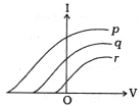
B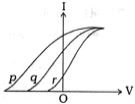
C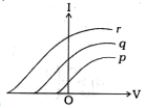
D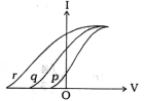
Solution
(A) The energy of the incident photons is given by $E = \frac{hc}{\lambda}$.
For $\lambda_1 = 550\ nm$,$E_1 = \frac{1240}{550} \approx 2.25\ eV$.
For $\lambda_2 = 450\ nm$,$E_2 = \frac{1240}{450} \approx 2.75\ eV$.
For $\lambda_3 = 350\ nm$,$E_3 = \frac{1240}{350} \approx 3.54\ eV$.
For metal $r$ $(\phi_r = 3.0\ eV)$,only $\lambda_3$ causes emission $(E_3 > \phi_r)$.
For metal $q$ $(\phi_q = 2.5\ eV)$,$\lambda_2$ and $\lambda_3$ cause emission $(E_2, E_3 > \phi_q)$.
For metal $p$ $(\phi_p = 2.0\ eV)$,all three $\lambda_1, \lambda_2, \lambda_3$ cause emission $(E_1, E_2, E_3 > \phi_p)$.
Since the intensity is the same,the saturation current $I$ depends on the number of photons incident and the number of wavelengths that can cause emission. Metal $p$ allows emission for all three wavelengths,resulting in the highest saturation current,while metal $r$ allows emission for only one,resulting in the lowest saturation current. Thus,the graph showing $I_p > I_q > I_r$ is correct.
For $\lambda_1 = 550\ nm$,$E_1 = \frac{1240}{550} \approx 2.25\ eV$.
For $\lambda_2 = 450\ nm$,$E_2 = \frac{1240}{450} \approx 2.75\ eV$.
For $\lambda_3 = 350\ nm$,$E_3 = \frac{1240}{350} \approx 3.54\ eV$.
For metal $r$ $(\phi_r = 3.0\ eV)$,only $\lambda_3$ causes emission $(E_3 > \phi_r)$.
For metal $q$ $(\phi_q = 2.5\ eV)$,$\lambda_2$ and $\lambda_3$ cause emission $(E_2, E_3 > \phi_q)$.
For metal $p$ $(\phi_p = 2.0\ eV)$,all three $\lambda_1, \lambda_2, \lambda_3$ cause emission $(E_1, E_2, E_3 > \phi_p)$.
Since the intensity is the same,the saturation current $I$ depends on the number of photons incident and the number of wavelengths that can cause emission. Metal $p$ allows emission for all three wavelengths,resulting in the highest saturation current,while metal $r$ allows emission for only one,resulting in the lowest saturation current. Thus,the graph showing $I_p > I_q > I_r$ is correct.
0 likes
View Solution20
MediumMCQ
Which of the following effects support the quantum nature of $EM$ radiation? $(1)$ Photoelectric effect $(2)$ Compton effect $(3)$ Doppler effect $(4)$ Field effect
A
$(1)$ and $(2)$
B
$(2)$ and $(3)$
C
$(3)$ and $(4)$
D
$(4)$ and $(1)$
Solution
(A) The quantum nature of $EM$ radiation is supported by phenomena that involve the interaction of light as discrete packets of energy,known as photons.
$(1)$ The Photoelectric effect demonstrates that light consists of photons with energy $E = h\nu$,which eject electrons from a metal surface.
$(2)$ The Compton effect involves the scattering of photons by electrons,confirming that photons behave like particles with momentum $p = h/\lambda$.
$(3)$ The Doppler effect is a wave phenomenon applicable to both classical waves and quantum particles.
$(4)$ The Field effect is related to semiconductor physics and does not specifically support the quantum nature of $EM$ radiation.
Therefore,both the Photoelectric effect and the Compton effect provide evidence for the quantum nature of $EM$ radiation.
$(1)$ The Photoelectric effect demonstrates that light consists of photons with energy $E = h\nu$,which eject electrons from a metal surface.
$(2)$ The Compton effect involves the scattering of photons by electrons,confirming that photons behave like particles with momentum $p = h/\lambda$.
$(3)$ The Doppler effect is a wave phenomenon applicable to both classical waves and quantum particles.
$(4)$ The Field effect is related to semiconductor physics and does not specifically support the quantum nature of $EM$ radiation.
Therefore,both the Photoelectric effect and the Compton effect provide evidence for the quantum nature of $EM$ radiation.
0 likes
View Solution21
MediumMCQ
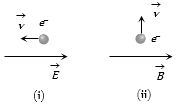
An electron is moving through a field. It is moving $(i)$ opposite to an electric field and $(ii)$ perpendicular to a magnetic field as shown. For each situation,determine the de-Broglie wavelength of the electron.
A
Increasing,increasing
B
Increasing,decreasing
C
Decreasing,same
D
Same,same
Solution
(C) The de-Broglie wavelength is given by $\lambda = \frac{h}{mv}$.
Case $(i)$: The electron is moving opposite to the electric field. Since the electron is negatively charged,it experiences a force in the direction of the electric field,which is opposite to its velocity. This force acts as a retarding force,causing the velocity $v$ of the electron to decrease. As $v$ decreases,the de-Broglie wavelength $\lambda = \frac{h}{mv}$ increases.
Case $(ii)$: The electron is moving perpendicular to a magnetic field. The magnetic force $\vec{F} = q(\vec{v} \times \vec{B})$ acts perpendicular to the velocity of the electron. $A$ magnetic force acting perpendicular to the velocity only changes the direction of motion,not the magnitude of the velocity $v$. Since the speed $v$ remains constant,the de-Broglie wavelength $\lambda = \frac{h}{mv}$ remains the same.
Therefore,the wavelength increases in case $(i)$ and remains the same in case $(ii)$.
Case $(i)$: The electron is moving opposite to the electric field. Since the electron is negatively charged,it experiences a force in the direction of the electric field,which is opposite to its velocity. This force acts as a retarding force,causing the velocity $v$ of the electron to decrease. As $v$ decreases,the de-Broglie wavelength $\lambda = \frac{h}{mv}$ increases.
Case $(ii)$: The electron is moving perpendicular to a magnetic field. The magnetic force $\vec{F} = q(\vec{v} \times \vec{B})$ acts perpendicular to the velocity of the electron. $A$ magnetic force acting perpendicular to the velocity only changes the direction of motion,not the magnitude of the velocity $v$. Since the speed $v$ remains constant,the de-Broglie wavelength $\lambda = \frac{h}{mv}$ remains the same.
Therefore,the wavelength increases in case $(i)$ and remains the same in case $(ii)$.
0 likes
View Solution22
DifficultMCQ
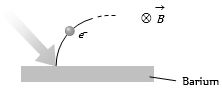
Light of wavelength $2475 \, Å$ is incident on barium. Photoelectrons emitted describe a circle of radius $100 \, cm$ in a magnetic field of flux density $\frac{1}{\sqrt{17}} \times 10^{-5} \, T$. The work function of the barium is .............. $eV$ (Given $\frac{e}{m} = 1.7 \times 10^{11} \, C/kg$)
A
$1.8$
B
$2.1$
C
$4.5$
D
$3.3$
Solution
(C) The radius $r$ of the circular path described by a charged particle in a magnetic field is given by $r = \frac{\sqrt{2mK}}{qB}$, where $K$ is the maximum kinetic energy of the photoelectron.
Squaring both sides and rearranging for $K$:
$K = \frac{q^2 B^2 r^2}{2m} = \left( \frac{e}{m} \right) \frac{e B^2 r^2}{2}$
Given $\frac{e}{m} = 1.7 \times 10^{11} \, C/kg$, $B = \frac{1}{\sqrt{17}} \times 10^{-5} \, T$, $r = 1 \, m$, and $e = 1.6 \times 10^{-19} \, C$:
$K = \frac{1}{2} \times (1.7 \times 10^{11}) \times (1.6 \times 10^{-19}) \times \left( \frac{1}{\sqrt{17}} \times 10^{-5} \right)^2 \times (1)^2$
$K = 0.5 \times 1.7 \times 1.6 \times 10^{-8} \times \frac{1}{17} \times 10^{-10} = 0.8 \times 10^{-19} \, J = 0.5 \, eV$
Using Einstein's photoelectric equation: $E = W_0 + K_{max}$
$E = \frac{hc}{\lambda} = \frac{12375 \, Å \cdot eV}{2475 \, Å} = 5 \, eV$
$W_0 = E - K_{max} = 5 \, eV - 0.5 \, eV = 4.5 \, eV$
Squaring both sides and rearranging for $K$:
$K = \frac{q^2 B^2 r^2}{2m} = \left( \frac{e}{m} \right) \frac{e B^2 r^2}{2}$
Given $\frac{e}{m} = 1.7 \times 10^{11} \, C/kg$, $B = \frac{1}{\sqrt{17}} \times 10^{-5} \, T$, $r = 1 \, m$, and $e = 1.6 \times 10^{-19} \, C$:
$K = \frac{1}{2} \times (1.7 \times 10^{11}) \times (1.6 \times 10^{-19}) \times \left( \frac{1}{\sqrt{17}} \times 10^{-5} \right)^2 \times (1)^2$
$K = 0.5 \times 1.7 \times 1.6 \times 10^{-8} \times \frac{1}{17} \times 10^{-10} = 0.8 \times 10^{-19} \, J = 0.5 \, eV$
Using Einstein's photoelectric equation: $E = W_0 + K_{max}$
$E = \frac{hc}{\lambda} = \frac{12375 \, Å \cdot eV}{2475 \, Å} = 5 \, eV$
$W_0 = E - K_{max} = 5 \, eV - 0.5 \, eV = 4.5 \, eV$
0 likes
View Solution23
MediumMCQ
The anode voltage of a photocell is kept fixed. The wavelength $\lambda$ of the light falling on the cathode is gradually changed. The plate current $I$ of the photocell varies as follows:
A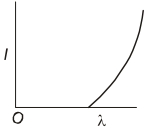
B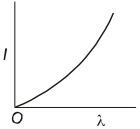
C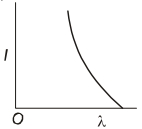
D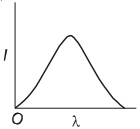
Solution
(C) The photoelectric current $I$ depends on the number of photoelectrons emitted per unit time,which is proportional to the intensity of the incident light,provided the frequency is above the threshold frequency. However,if the anode voltage is fixed and not high enough to collect all emitted electrons,the current depends on the kinetic energy of the photoelectrons. As the wavelength $\lambda$ decreases,the energy of the incident photons $(E = hc/\lambda)$ increases. This results in an increase in the maximum kinetic energy of the emitted photoelectrons. With higher kinetic energy,a greater number of photoelectrons are able to overcome the potential barrier and reach the anode,thereby increasing the plate current $I$. Therefore,as $\lambda$ decreases,$I$ increases. This relationship is represented by a curve where $I$ decreases as $\lambda$ increases,which corresponds to Graph $C$.
0 likes
View Solution24
MediumMCQ
The anode voltage of a photocell is kept fixed. The wavelength $\lambda$ of the light falling on the cathode is gradually changed. The plate current $I$ of the photocell varies as follows:
A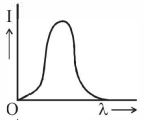
B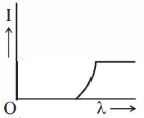
C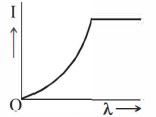
D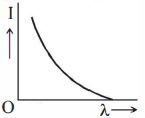
Solution
(D) According to the photoelectric effect,the energy of a photon is given by $E = \frac{hc}{\lambda}$.
As the wavelength $\lambda$ of the incident light increases,the energy of the incident photons decreases.
Photoelectric emission occurs only if the energy of the incident photon is greater than or equal to the work function $\phi$ of the metal surface.
This implies that there exists a maximum wavelength,known as the threshold wavelength $\lambda_0$,such that for all $\lambda > \lambda_0$,the energy of the photons is insufficient to eject electrons from the cathode.
Consequently,the photocurrent $I$ will be zero for all $\lambda > \lambda_0$.
As $\lambda$ increases from a small value towards $\lambda_0$,the number of emitted photoelectrons (and thus the current $I$) generally decreases or remains constant depending on the intensity,but it must drop to zero at $\lambda = \lambda_0$.
Among the given options,the graph that shows the current decreasing and eventually becoming zero at a specific wavelength is represented by option $(d)$.
As the wavelength $\lambda$ of the incident light increases,the energy of the incident photons decreases.
Photoelectric emission occurs only if the energy of the incident photon is greater than or equal to the work function $\phi$ of the metal surface.
This implies that there exists a maximum wavelength,known as the threshold wavelength $\lambda_0$,such that for all $\lambda > \lambda_0$,the energy of the photons is insufficient to eject electrons from the cathode.
Consequently,the photocurrent $I$ will be zero for all $\lambda > \lambda_0$.
As $\lambda$ increases from a small value towards $\lambda_0$,the number of emitted photoelectrons (and thus the current $I$) generally decreases or remains constant depending on the intensity,but it must drop to zero at $\lambda = \lambda_0$.
Among the given options,the graph that shows the current decreasing and eventually becoming zero at a specific wavelength is represented by option $(d)$.
0 likes
View Solution25
DifficultMCQ
The radiation corresponding to $3 \rightarrow 2$ transition of a hydrogen atom falls on a metal surface to produce photoelectrons. These electrons are made to enter a magnetic field of $3 \times 10^{-4} \ T$. If the radius of the largest circular path followed by these electrons is $10.0 \ mm$,the work function of the metal is close to......$ eV$.
A
$1.1$
B
$0.8$
C
$1.6$
D
$1.8$
Solution
(A) The energy of the photon emitted during the $3 \rightarrow 2$ transition in a hydrogen atom is given by:
$E = 13.6 \left( \frac{1}{2^2} - \frac{1}{3^2} \right) = 13.6 \left( \frac{1}{4} - \frac{1}{9} \right) = 13.6 \times \frac{5}{36} \approx 1.889 \ eV$.
The radius of the circular path of an electron in a magnetic field is $r = \frac{mv}{qB} = \frac{\sqrt{2mK}}{eB}$,where $K$ is the kinetic energy of the photoelectron.
$K = \frac{r^2 e^2 B^2}{2m}$.
Given $r = 10.0 \ mm = 10^{-2} \ m$,$B = 3 \times 10^{-4} \ T$,$e = 1.6 \times 10^{-19} \ C$,and $m = 9.1 \times 10^{-31} \ kg$:
$K = \frac{(10^{-2})^2 \times (1.6 \times 10^{-19}) \times (3 \times 10^{-4})^2}{2 \times 9.1 \times 10^{-31}} \approx 0.79 \ eV \approx 0.8 \ eV$.
Using Einstein's photoelectric equation: $E = \Phi + K$,where $\Phi$ is the work function.
$\Phi = E - K = 1.889 \ eV - 0.8 \ eV = 1.089 \ eV \approx 1.1 \ eV$.
$E = 13.6 \left( \frac{1}{2^2} - \frac{1}{3^2} \right) = 13.6 \left( \frac{1}{4} - \frac{1}{9} \right) = 13.6 \times \frac{5}{36} \approx 1.889 \ eV$.
The radius of the circular path of an electron in a magnetic field is $r = \frac{mv}{qB} = \frac{\sqrt{2mK}}{eB}$,where $K$ is the kinetic energy of the photoelectron.
$K = \frac{r^2 e^2 B^2}{2m}$.
Given $r = 10.0 \ mm = 10^{-2} \ m$,$B = 3 \times 10^{-4} \ T$,$e = 1.6 \times 10^{-19} \ C$,and $m = 9.1 \times 10^{-31} \ kg$:
$K = \frac{(10^{-2})^2 \times (1.6 \times 10^{-19}) \times (3 \times 10^{-4})^2}{2 \times 9.1 \times 10^{-31}} \approx 0.79 \ eV \approx 0.8 \ eV$.
Using Einstein's photoelectric equation: $E = \Phi + K$,where $\Phi$ is the work function.
$\Phi = E - K = 1.889 \ eV - 0.8 \ eV = 1.089 \ eV \approx 1.1 \ eV$.
0 likes
View Solution26
MediumMCQ
Match List-$I$ (Fundamental Experiment) with List-$II$ (its conclusion) and select the correct option from the choices given below the list.
| List-$I$ | List-$II$ |
| $a$. Franck-Hertz Experiment | $i$. Particle nature of light |
| $b$. Photo-electric Experiment | $ii$. Discrete energy levels of atom |
| $c$. Davisson-Germer Experiment | $iii$. Wave nature of electron |
| $iv$. Structure of atom |
A
$(a)-(ii), (b)-(iv), (c)-(iii)$
B
$(a)-(ii), (b)-(i), (c)-(iii)$
C
$(a)-(iv), (b)-(iii), (c)-(ii)$
D
$(a)-(i), (b)-(iv), (c)-(iii)$
Solution
(B) $1$. The Franck-Hertz experiment demonstrated that atoms can only absorb energy in discrete amounts,confirming the existence of discrete energy levels in atoms.
$2$. The Photo-electric effect experiment provided evidence for the particle nature of light,showing that light consists of quanta called photons.
$3$. The Davisson-Germer experiment confirmed the wave nature of electrons by demonstrating electron diffraction,which supports the de Broglie hypothesis.
Therefore,the correct matching is $(a)-(ii), (b)-(i), (c)-(iii)$.
$2$. The Photo-electric effect experiment provided evidence for the particle nature of light,showing that light consists of quanta called photons.
$3$. The Davisson-Germer experiment confirmed the wave nature of electrons by demonstrating electron diffraction,which supports the de Broglie hypothesis.
Therefore,the correct matching is $(a)-(ii), (b)-(i), (c)-(iii)$.
0 likes
View Solution27
MediumMCQ
Match the following columns:
| Column-$I$ | Column-$II$ |
|---|---|
| $A$. Hallwachs $\&$ Lenard | $P$. Transformers |
| $B$. Franck-Hertz | $Q$. Microwave |
| $C$. Klystron valve | $R$. Quantization of energy levels |
| $D$. Nicola Tesla | $S$. Photoelectric effect |
A
$A \to S, B \to Q, C \to P, D \to R$
B
$A \to R, B \to S, C \to P, D \to Q$
C
$A \to S, B \to R, C \to Q, D \to P$
D
$A \to Q, B \to P, C \to S, D \to R$
Solution
(C) . Hallwachs $\&$ Lenard observed the photoelectric effect.
$B$. The Franck-Hertz experiment provided experimental evidence for the quantization of energy levels in atoms.
$C$. The Klystron valve is a specialized vacuum tube used as an amplifier or oscillator for microwave frequencies.
$D$. Nicola Tesla is famous for his contributions to the design of modern alternating current $(AC)$ electricity supply systems,including transformers.
Therefore,the correct matching is $A \to S, B \to R, C \to Q, D \to P$.
$B$. The Franck-Hertz experiment provided experimental evidence for the quantization of energy levels in atoms.
$C$. The Klystron valve is a specialized vacuum tube used as an amplifier or oscillator for microwave frequencies.
$D$. Nicola Tesla is famous for his contributions to the design of modern alternating current $(AC)$ electricity supply systems,including transformers.
Therefore,the correct matching is $A \to S, B \to R, C \to Q, D \to P$.
0 likes
View Solution28
MediumMCQ
Find the number of photons emitted per second from a source of light which results in a photocurrent with drift velocity of $1.5 \ m/s$ in a conductor with cross-section area $0.25 \ m^2$ and volume density of electrons $10^{20} \ m^{-3}$. (Assume that $60\%$ of photons emitted result in electron emission).
A
$6.25 \times 10^{19}$
B
$6.25 \times 10^{20}$
C
$6 \times 10^{19}$
D
$6 \times 10^{20}$
Solution
(A) The current $I$ in a conductor is given by $I = n e A v_d$, where $n$ is the electron density, $e$ is the charge of an electron, $A$ is the cross-sectional area, and $v_d$ is the drift velocity.
Substituting the given values: $I = 10^{20} \times 1.6 \times 10^{-19} \times 0.25 \times 1.5$.
$I = 16 \times 0.25 \times 1.5 = 4 \times 1.5 = 6 \ A$.
The number of electrons emitted per second is $N_e = I / e = 6 / (1.6 \times 10^{-19}) = 3.75 \times 10^{19} \ \text{electrons/s}$.
Given that $60\%$ of emitted photons result in electron emission, let $N_p$ be the number of photons emitted per second: $0.60 \times N_p = N_e$.
$N_p = N_e / 0.60 = (3.75 \times 10^{19}) / 0.6 = 6.25 \times 10^{19} \ \text{photons/s}$.
Substituting the given values: $I = 10^{20} \times 1.6 \times 10^{-19} \times 0.25 \times 1.5$.
$I = 16 \times 0.25 \times 1.5 = 4 \times 1.5 = 6 \ A$.
The number of electrons emitted per second is $N_e = I / e = 6 / (1.6 \times 10^{-19}) = 3.75 \times 10^{19} \ \text{electrons/s}$.
Given that $60\%$ of emitted photons result in electron emission, let $N_p$ be the number of photons emitted per second: $0.60 \times N_p = N_e$.
$N_p = N_e / 0.60 = (3.75 \times 10^{19}) / 0.6 = 6.25 \times 10^{19} \ \text{photons/s}$.
0 likes
View Solution29
MediumMCQ
When a light source of power $P$ emitting monochromatic light of wavelength $\lambda$ is kept at a distance $r$ from a photosensitive surface of work function $\phi$ and surface area $A$,which of the following is the wrong option?
A
The maximum kinetic energy of emitted photoelectrons is $\frac{hc}{\lambda} - \phi$.
B
The stopping potential needed to stop the fastest photoelectron is $\frac{1}{e}\left[ \frac{hc}{\lambda} - \phi \right]$.
C
The number of photons striking the surface per unit time is $\frac{P \lambda A}{4 \pi hc r^2}$.
D
All of the above.
Solution
(D) According to Einstein's photoelectric equation,the maximum kinetic energy of emitted photoelectrons is given by $K.E_{max} = \frac{hc}{\lambda} - \phi$. Thus,option $A$ is correct.
The stopping potential $V_0$ is related to the maximum kinetic energy by $eV_0 = K.E_{max}$. Therefore,$V_0 = \frac{1}{e}\left[ \frac{hc}{\lambda} - \phi \right]$. Thus,option $B$ is correct.
The intensity of light at distance $r$ is $I = \frac{P}{4 \pi r^2}$. The energy of one photon is $E_{photon} = \frac{hc}{\lambda}$. The number of photons per unit area per unit time is $n = \frac{I}{E_{photon}} = \frac{P \lambda}{4 \pi r^2 hc}$. The number of photons striking the surface of area $A$ per unit time is $N = n \times A = \frac{P \lambda A}{4 \pi hc r^2}$. Thus,option $C$ is correct.
Since options $A$,$B$,and $C$ are all correct statements,the wrong option is $D$.
The stopping potential $V_0$ is related to the maximum kinetic energy by $eV_0 = K.E_{max}$. Therefore,$V_0 = \frac{1}{e}\left[ \frac{hc}{\lambda} - \phi \right]$. Thus,option $B$ is correct.
The intensity of light at distance $r$ is $I = \frac{P}{4 \pi r^2}$. The energy of one photon is $E_{photon} = \frac{hc}{\lambda}$. The number of photons per unit area per unit time is $n = \frac{I}{E_{photon}} = \frac{P \lambda}{4 \pi r^2 hc}$. The number of photons striking the surface of area $A$ per unit time is $N = n \times A = \frac{P \lambda A}{4 \pi hc r^2}$. Thus,option $C$ is correct.
Since options $A$,$B$,and $C$ are all correct statements,the wrong option is $D$.
0 likes
View Solution30
MediumMCQ
The correct curve between the stopping potential $(V_s)$ and intensity of incident light $(I)$ is
A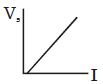
B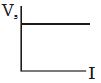
C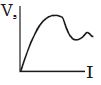
D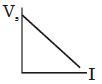
Solution
(B) The stopping potential $(V_s)$ is related to the frequency of incident light $(\nu)$ by Einstein's photoelectric equation:
$e V_s = h(\nu - \nu_0)$
where $e$ is the charge of an electron,$h$ is Planck's constant,and $\nu_0$ is the threshold frequency.
This equation shows that the stopping potential depends only on the frequency of the incident light and the work function of the material.
It does not depend on the intensity $(I)$ of the incident light.
Therefore,as the intensity of light increases,the stopping potential remains constant.
This corresponds to a straight line parallel to the $I$-axis (x-axis).
Thus,the correct curve is represented by option $B$.
$e V_s = h(\nu - \nu_0)$
where $e$ is the charge of an electron,$h$ is Planck's constant,and $\nu_0$ is the threshold frequency.
This equation shows that the stopping potential depends only on the frequency of the incident light and the work function of the material.
It does not depend on the intensity $(I)$ of the incident light.
Therefore,as the intensity of light increases,the stopping potential remains constant.
This corresponds to a straight line parallel to the $I$-axis (x-axis).
Thus,the correct curve is represented by option $B$.
0 likes
View Solution31
EasyMCQ
Two electrons are moving with the same speed $v$. One electron enters a region of a uniform electric field,while the other enters a region of a uniform magnetic field. If the de-Broglie wavelengths of the two electrons after some time are ${\lambda _1}$ and ${\lambda _2}$ respectively,then:
A
${\lambda _1} = {\lambda _2}$
B
${\lambda _1} > {\lambda _2}$
C
${\lambda _1} < {\lambda _2}$
D
Depends on the direction of the electric field
Solution
(D) The de-Broglie wavelength is given by $\lambda = \frac{h}{p} = \frac{h}{mv}$.
Since the mass $m$ is constant,the wavelength depends on the speed $v$ of the electron.
In a uniform magnetic field,the magnetic force $F = q(v \times B)$ acts perpendicular to the velocity. This force changes the direction of motion but does not change the magnitude of the velocity. Thus,the speed remains $v$ and the wavelength remains constant.
In a uniform electric field,the electric force $F = qE$ acts on the electron. This force can change the magnitude of the velocity (speed) depending on the direction of the field relative to the motion of the electron.
If the electric field accelerates the electron,the speed increases,and $\lambda$ decreases. If it decelerates the electron,the speed decreases,and $\lambda$ increases.
Therefore,the relationship between ${\lambda _1}$ and ${\lambda _2}$ depends on the direction of the electric field relative to the electron's velocity.
Since the mass $m$ is constant,the wavelength depends on the speed $v$ of the electron.
In a uniform magnetic field,the magnetic force $F = q(v \times B)$ acts perpendicular to the velocity. This force changes the direction of motion but does not change the magnitude of the velocity. Thus,the speed remains $v$ and the wavelength remains constant.
In a uniform electric field,the electric force $F = qE$ acts on the electron. This force can change the magnitude of the velocity (speed) depending on the direction of the field relative to the motion of the electron.
If the electric field accelerates the electron,the speed increases,and $\lambda$ decreases. If it decelerates the electron,the speed decreases,and $\lambda$ increases.
Therefore,the relationship between ${\lambda _1}$ and ${\lambda _2}$ depends on the direction of the electric field relative to the electron's velocity.
0 likes
View Solution32
MediumMCQ
When a monochromatic point source of light is placed at $0.1\, m$ from a photocell,the cut-off voltage and saturation current are $0.8\, V$ and $24\, mA$ respectively. If the same source is placed at $0.2\, m$ away from the photocell,then the cut-off voltage and saturation current will be:
A
$0.4\, V$ and $12\, mA$
B
$0.8\, V$ and $12\, mA$
C
$0.8\, V$ and $6\, mA$
D
$0.16\, V$ and $12\, mA$
Solution
(C) The intensity of light $I$ from a point source follows the inverse square law,$I \propto \frac{1}{r^2}$.
When the distance $r$ is doubled (from $0.1\, m$ to $0.2\, m$),the intensity becomes $\frac{1}{4}$ of the original value.
The saturation current is directly proportional to the intensity of incident light. Therefore,the new saturation current will be $\frac{24\, mA}{4} = 6\, mA$.
The cut-off voltage (stopping potential) depends only on the frequency of the incident light and the work function of the material,not on the intensity. Since the source remains the same,the frequency is unchanged,so the cut-off voltage remains $0.8\, V$.
When the distance $r$ is doubled (from $0.1\, m$ to $0.2\, m$),the intensity becomes $\frac{1}{4}$ of the original value.
The saturation current is directly proportional to the intensity of incident light. Therefore,the new saturation current will be $\frac{24\, mA}{4} = 6\, mA$.
The cut-off voltage (stopping potential) depends only on the frequency of the incident light and the work function of the material,not on the intensity. Since the source remains the same,the frequency is unchanged,so the cut-off voltage remains $0.8\, V$.
0 likes
View Solution33
DifficultMCQ
$A$ photon and an electron have equal energy $E$. The ratio $\lambda_{\text{photon}} / \lambda_{\text{electron}}$ is proportional to:
A
$\sqrt{E}$
B
$\frac{1}{\sqrt{E}}$
C
$\frac{1}{E}$
D
Does not depend upon $E$
Solution
(B) For a photon,the energy is given by $E = \frac{hc}{\lambda_{\text{photon}}}$,so $\lambda_{\text{photon}} = \frac{hc}{E}$.
For an electron,the de Broglie wavelength is given by $\lambda_{\text{electron}} = \frac{h}{p} = \frac{h}{\sqrt{2mE}}$.
Taking the ratio of the two wavelengths:
$\frac{\lambda_{\text{photon}}}{\lambda_{\text{electron}}} = \frac{hc/E}{h/\sqrt{2mE}} = \frac{hc}{E} \cdot \frac{\sqrt{2mE}}{h} = c \sqrt{2m} \cdot \frac{\sqrt{E}}{E} = c \sqrt{2m} \cdot \frac{1}{\sqrt{E}}$.
Therefore,$\frac{\lambda_{\text{photon}}}{\lambda_{\text{electron}}} \propto \frac{1}{\sqrt{E}}$.
For an electron,the de Broglie wavelength is given by $\lambda_{\text{electron}} = \frac{h}{p} = \frac{h}{\sqrt{2mE}}$.
Taking the ratio of the two wavelengths:
$\frac{\lambda_{\text{photon}}}{\lambda_{\text{electron}}} = \frac{hc/E}{h/\sqrt{2mE}} = \frac{hc}{E} \cdot \frac{\sqrt{2mE}}{h} = c \sqrt{2m} \cdot \frac{\sqrt{E}}{E} = c \sqrt{2m} \cdot \frac{1}{\sqrt{E}}$.
Therefore,$\frac{\lambda_{\text{photon}}}{\lambda_{\text{electron}}} \propto \frac{1}{\sqrt{E}}$.
0 likes
View Solution34
MediumMCQ
Which of the following support the quantum nature of the $EM$ radiations?
$(A)$ Photoelectric effect
$(B)$ Compton effect
$(C)$ Doppler effect
$(D)$ Field effect
$(A)$ Photoelectric effect
$(B)$ Compton effect
$(C)$ Doppler effect
$(D)$ Field effect
A
$A$ and $B$
B
$B$ and $C$
C
$C$ and $D$
D
$D$ and $A$
Solution
(A) The quantum nature of electromagnetic $(EM)$ radiation implies that radiation consists of discrete packets of energy called photons,where the energy of each photon is given by $E = h\nu$.
$1$. The Photoelectric effect involves the emission of electrons when light (photons) hits a material,which can only be explained by the particle (quantum) nature of light.
$2$. The Compton effect involves the scattering of $X$-rays by electrons,which demonstrates the particle-like momentum of photons,further supporting the quantum nature of $EM$ radiation.
$3$. The Doppler effect and Field effect are phenomena that can be explained by the wave nature of radiation and do not specifically require the quantum (particle) hypothesis.
Therefore,both the Photoelectric effect and the Compton effect support the quantum nature of $EM$ radiations.
$1$. The Photoelectric effect involves the emission of electrons when light (photons) hits a material,which can only be explained by the particle (quantum) nature of light.
$2$. The Compton effect involves the scattering of $X$-rays by electrons,which demonstrates the particle-like momentum of photons,further supporting the quantum nature of $EM$ radiation.
$3$. The Doppler effect and Field effect are phenomena that can be explained by the wave nature of radiation and do not specifically require the quantum (particle) hypothesis.
Therefore,both the Photoelectric effect and the Compton effect support the quantum nature of $EM$ radiations.
0 likes
View Solution35
MediumMCQ
Energy of an electron and a photon are equal. If the wavelength of the electron is $1\,\mathring{A}$,then the wavelength of the photon is approximately ............. $\mathring{A}$.
A
$82.67$
B
$1$
C
$124$
D
$1.67$
Solution
(A) The de Broglie wavelength of an electron is given by $\lambda_e = \frac{h}{p_e} = \frac{h}{\sqrt{2mE}}$.
Given $\lambda_e = 1\,\mathring{A}$,the kinetic energy $E$ of the electron is $E = \frac{h^2}{2m\lambda_e^2}$.
Using the relation $E = \frac{150}{\lambda_e^2} \text{ eV}$ (where $\lambda_e$ is in $\mathring{A}$),we get $E = 150 \text{ eV}$.
Since the energy of the photon is equal to the energy of the electron,$E_{ph} = 150 \text{ eV}$.
The wavelength of the photon is given by $\lambda_{ph} = \frac{hc}{E_{ph}}$.
Using $hc \approx 12400 \text{ eV}\cdot\mathring{A}$,we have $\lambda_{ph} = \frac{12400}{150} \mathring{A} \approx 82.67 \mathring{A}$.
Given $\lambda_e = 1\,\mathring{A}$,the kinetic energy $E$ of the electron is $E = \frac{h^2}{2m\lambda_e^2}$.
Using the relation $E = \frac{150}{\lambda_e^2} \text{ eV}$ (where $\lambda_e$ is in $\mathring{A}$),we get $E = 150 \text{ eV}$.
Since the energy of the photon is equal to the energy of the electron,$E_{ph} = 150 \text{ eV}$.
The wavelength of the photon is given by $\lambda_{ph} = \frac{hc}{E_{ph}}$.
Using $hc \approx 12400 \text{ eV}\cdot\mathring{A}$,we have $\lambda_{ph} = \frac{12400}{150} \mathring{A} \approx 82.67 \mathring{A}$.
0 likes
View Solution36
EasyMCQ
Assertion: If the speed of a charged particle increases,both the mass and the charge increase.
Reason: If $m_0$ is the rest mass and $m$ is the mass at velocity $v$,then $m = \frac{m_0}{\sqrt{1 - \frac{v^2}{c^2}}}$,where $c$ is the speed of light.
Reason: If $m_0$ is the rest mass and $m$ is the mass at velocity $v$,then $m = \frac{m_0}{\sqrt{1 - \frac{v^2}{c^2}}}$,where $c$ is the speed of light.
A
If both Assertion and Reason are correct and the Reason is a correct explanation of the Assertion.
B
If both Assertion and Reason are correct but Reason is not a correct explanation of the Assertion.
C
If the Assertion is correct but Reason is incorrect.
D
If the Assertion is incorrect but the Reason is correct.
Solution
(D) According to the theory of relativity,the mass of a particle increases with its speed $v$ as $m = \frac{m_0}{\sqrt{1 - \frac{v^2}{c^2}}}$.
However,the electric charge of a particle is an invariant quantity and does not change with its speed.
Therefore,the Assertion is incorrect because the charge remains constant,while the Reason is correct as it accurately describes the relativistic mass variation.
However,the electric charge of a particle is an invariant quantity and does not change with its speed.
Therefore,the Assertion is incorrect because the charge remains constant,while the Reason is correct as it accurately describes the relativistic mass variation.
0 likes
View Solution37
EasyMCQ
Assertion : Photoelectric effect demonstrates the wave nature of light.
Reason : The number of photoelectrons is proportional to the frequency of light.
Reason : The number of photoelectrons is proportional to the frequency of light.
A
If both Assertion and Reason are correct and the Reason is a correct explanation of the Assertion.
B
If both Assertion and Reason are correct but Reason is not a correct explanation of the Assertion.
C
If the Assertion is correct but Reason is incorrect.
D
If both the Assertion and Reason are incorrect.
Solution
(D) The photoelectric effect demonstrates the particle nature of light,not the wave nature. Therefore,the Assertion is incorrect.
The number of photoelectrons emitted per second is directly proportional to the intensity of the incident light,not its frequency. Therefore,the Reason is also incorrect.
Since both the Assertion and the Reason are incorrect,the correct option is $(D)$.
The number of photoelectrons emitted per second is directly proportional to the intensity of the incident light,not its frequency. Therefore,the Reason is also incorrect.
Since both the Assertion and the Reason are incorrect,the correct option is $(D)$.
0 likes
View Solution38
EasyMCQ
Assertion: The specific charge of positive rays is not constant.
Reason: The mass of ions varies with speed.
Reason: The mass of ions varies with speed.
A
If both Assertion and Reason are correct and the Reason is a correct explanation of the Assertion.
B
If both Assertion and Reason are correct but Reason is not a correct explanation of the Assertion.
C
If the Assertion is correct but Reason is incorrect.
D
If both the Assertion and Reason are incorrect.
Solution
(A) The specific charge $\frac{e}{m}$ of positive rays is defined as the ratio of charge to mass. According to the theory of relativity,the mass $m$ of a particle moving with a velocity $v$ is given by $m = \frac{m_0}{\sqrt{1 - \frac{v^2}{c^2}}}$,where $m_0$ is the rest mass and $c$ is the speed of light.
Since the mass $m$ depends on the speed $v$,the specific charge $\frac{e}{m}$ also changes with speed.
Therefore,the specific charge of positive rays is not constant because the mass of ions varies with speed.
Thus,both the Assertion and the Reason are correct,and the Reason is the correct explanation of the Assertion.
Since the mass $m$ depends on the speed $v$,the specific charge $\frac{e}{m}$ also changes with speed.
Therefore,the specific charge of positive rays is not constant because the mass of ions varies with speed.
Thus,both the Assertion and the Reason are correct,and the Reason is the correct explanation of the Assertion.
0 likes
View Solution39
MediumMCQ
What phenomena of light can be explained on the basis of particle theory and wave theory of light?
A
Reflection and Refraction
B
Interference and Diffraction
C
Photoelectric effect and Compton effect
D
All of the above
Solution
(D) The particle theory of light (Newton's Corpuscular theory) successfully explains phenomena like reflection and refraction of light.
Later,the wave theory of light (Huygens' principle) was developed to explain phenomena such as interference,diffraction,and polarization,which the particle theory could not explain.
Finally,the quantum nature of light (particle-like behavior) explains phenomena like the photoelectric effect and the Compton effect.
Therefore,all the listed phenomena are explained by either the particle or wave theories of light.
Later,the wave theory of light (Huygens' principle) was developed to explain phenomena such as interference,diffraction,and polarization,which the particle theory could not explain.
Finally,the quantum nature of light (particle-like behavior) explains phenomena like the photoelectric effect and the Compton effect.
Therefore,all the listed phenomena are explained by either the particle or wave theories of light.
0 likes
View Solution40
MediumMCQ
According to the particle theory of light (Newton's corpuscular theory),what is the velocity of light in a dense medium compared to that in a rare medium?
A
Greater in a dense medium
B
Smaller in a dense medium
C
Equal in both media
D
Zero in a dense medium
Solution
(A) According to Newton's corpuscular theory of light,light consists of tiny particles called corpuscles.
Newton assumed that the force of attraction exerted by the denser medium on the corpuscles increases their velocity as they enter the medium.
Therefore,according to this theory,the velocity of light in a dense medium is greater than the velocity of light in a rare medium.
(Note: This prediction was later proven incorrect by Foucault's experiment,which showed that the velocity of light is actually lower in a denser medium.)
Newton assumed that the force of attraction exerted by the denser medium on the corpuscles increases their velocity as they enter the medium.
Therefore,according to this theory,the velocity of light in a dense medium is greater than the velocity of light in a rare medium.
(Note: This prediction was later proven incorrect by Foucault's experiment,which showed that the velocity of light is actually lower in a denser medium.)
0 likes
View Solution41
Medium
Answer the following questions:
$(a)$ Quarks inside protons and neutrons are thought to carry fractional charges $[(+2/3)e, (-1/3)e]$. Why do they not show up in Millikan's oil-drop experiment?
$(b)$ What is so special about the combination $e/m$? Why do we not simply talk of $e$ and $m$ separately?
$(c)$ Why should gases be insulators at ordinary pressures and start conducting at very low pressures?
$(d)$ Every metal has a definite work function. Why do all photoelectrons not come out with the same energy if incident radiation is monochromatic? Why is there an energy distribution of photoelectrons?
$(e)$ The energy and momentum of an electron are related to the frequency and wavelength of the associated matter wave by the relations:
$E = h\nu, p = \frac{h}{\lambda}$
But while the value of $\lambda$ is physically significant,the value of $\nu$ (and therefore,the value of the phase speed $\nu\lambda$) has no physical significance. Why?
$(a)$ Quarks inside protons and neutrons are thought to carry fractional charges $[(+2/3)e, (-1/3)e]$. Why do they not show up in Millikan's oil-drop experiment?
$(b)$ What is so special about the combination $e/m$? Why do we not simply talk of $e$ and $m$ separately?
$(c)$ Why should gases be insulators at ordinary pressures and start conducting at very low pressures?
$(d)$ Every metal has a definite work function. Why do all photoelectrons not come out with the same energy if incident radiation is monochromatic? Why is there an energy distribution of photoelectrons?
$(e)$ The energy and momentum of an electron are related to the frequency and wavelength of the associated matter wave by the relations:
$E = h\nu, p = \frac{h}{\lambda}$
But while the value of $\lambda$ is physically significant,the value of $\nu$ (and therefore,the value of the phase speed $\nu\lambda$) has no physical significance. Why?
Solution
(N/A) Quarks carry fractional charges,but they are confined within protons and neutrons by strong nuclear forces. They cannot be isolated,so Millikan's experiment,which measures the charge of free particles,only detects integral multiples of $e$.
$(b)$ In electromagnetic fields,the motion of an electron is governed by equations involving $e$ and $m$ only as the ratio $e/m$ (specific charge). For example,$v = \sqrt{2V(e/m)}$ and $v = Br(e/m)$. Thus,the dynamics are determined by this ratio.
$(c)$ At ordinary pressures,gas molecules are dense,leading to frequent collisions and recombination of ions,preventing them from reaching electrodes. At low pressures,the mean free path increases,allowing ions to reach electrodes and conduct electricity.
$(d)$ The work function is the minimum energy to remove an electron from the surface. Electrons inside the metal occupy different energy levels. When a photon hits,an electron may lose energy through collisions before escaping,resulting in a distribution of kinetic energies.
$(e)$ The absolute energy of a particle is arbitrary up to an additive constant,making the frequency $\nu$ (linked to absolute energy) physically non-unique. However,the wavelength $\lambda$ is related to momentum,which is measurable. Consequently,the phase speed $\nu\lambda$ is not physically significant,whereas the group speed $v_g = d\nu/d(1/\lambda) = p/m$ represents the particle's velocity.
$(b)$ In electromagnetic fields,the motion of an electron is governed by equations involving $e$ and $m$ only as the ratio $e/m$ (specific charge). For example,$v = \sqrt{2V(e/m)}$ and $v = Br(e/m)$. Thus,the dynamics are determined by this ratio.
$(c)$ At ordinary pressures,gas molecules are dense,leading to frequent collisions and recombination of ions,preventing them from reaching electrodes. At low pressures,the mean free path increases,allowing ions to reach electrodes and conduct electricity.
$(d)$ The work function is the minimum energy to remove an electron from the surface. Electrons inside the metal occupy different energy levels. When a photon hits,an electron may lose energy through collisions before escaping,resulting in a distribution of kinetic energies.
$(e)$ The absolute energy of a particle is arbitrary up to an additive constant,making the frequency $\nu$ (linked to absolute energy) physically non-unique. However,the wavelength $\lambda$ is related to momentum,which is measurable. Consequently,the phase speed $\nu\lambda$ is not physically significant,whereas the group speed $v_g = d\nu/d(1/\lambda) = p/m$ represents the particle's velocity.
0 likes
View Solution42
Easy
Give a powerful way to determine an upper limit to the size of the electron.
Solution
(N/A) powerful way to determine an upper limit to the size of the electron is by using high-energy electron scattering experiments. By bombarding electrons with other high-energy particles or by studying the scattering of electrons off nuclei at extremely high energies,physicists can probe the structure of the electron. If the electron had a finite size,the scattering cross-section would deviate from the predictions of point-particle quantum electrodynamics $(QED)$ at very high momentum transfers. Currently,experimental results indicate that the electron behaves as a point particle down to a scale of approximately $10^{-18} \ m$.
0 likes
View Solution43
DifficultMCQ
Which microscope is used for nanotechnology?
A
Optical microscope
B
Scanning Tunneling Microscope $(STM)$
C
Electron microscope
D
Compound microscope
Solution
(B) The Scanning Tunneling Microscope $(STM)$ is a powerful instrument used for imaging surfaces at the atomic level.
It is specifically designed to study and manipulate matter at the nanoscale,making it a fundamental tool in the field of nanotechnology.
It is specifically designed to study and manipulate matter at the nanoscale,making it a fundamental tool in the field of nanotechnology.
0 likes
View Solution44
Medium
By a suitable example,show that the particle or wave nature of light depends on the type of experiment.
Solution
(N/A) The nature of light (particle or wave) is not an inherent property but depends on the experimental setup used to observe it.
$1$. Wave Nature: The gathering and focusing mechanism of light by the eye lens is best described using the wave picture of light,as it involves phenomena like refraction and interference.
$2$. Particle Nature: The absorption of light by the cone and rod cells on the retina requires the photon (particle) picture of light,where light interacts as discrete packets of energy to trigger biological signals.
$1$. Wave Nature: The gathering and focusing mechanism of light by the eye lens is best described using the wave picture of light,as it involves phenomena like refraction and interference.
$2$. Particle Nature: The absorption of light by the cone and rod cells on the retina requires the photon (particle) picture of light,where light interacts as discrete packets of energy to trigger biological signals.
0 likes
View Solution45
EasyMCQ
Name the device used for measuring the mass of atoms and molecules.
A
Mass spectrometer
B
Spectrograph
C
Calorimeter
D
Barometer
Solution
(A) The device used for measuring the mass of atoms and molecules is known as a $Mass \ spectrometer$. $A$ mass spectrometer works by ionizing chemical species and sorting the ions based on their mass-to-charge ratio $(m/z)$.
0 likes
View Solution46
DifficultMCQ
An electron of mass $m$ and a photon have the same energy $E$. The ratio of the wavelength of the electron to that of the photon is: ($c$ being the velocity of light)
A
$\frac{1}{c}\left(\frac{2 m}{E}\right)^{1 / 2}$
B
$\frac{1}{c}\left(\frac{E}{2 m}\right)^{1 / 2}$
C
$\left(\frac{ E }{2 m }\right)^{1 / 2}$
D
$c\, (2 mE )^{1 / 2}$
Solution
(B) The de Broglie wavelength of an electron with energy $E$ is given by $\lambda_e = \frac{h}{p} = \frac{h}{\sqrt{2mE}}$.
The wavelength of a photon with energy $E$ is given by $\lambda_p = \frac{hc}{E}$.
The ratio of the wavelength of the electron to that of the photon is $\frac{\lambda_e}{\lambda_p} = \frac{h}{\sqrt{2mE}} \times \frac{E}{hc}$.
Simplifying this,we get $\frac{\lambda_e}{\lambda_p} = \frac{1}{c} \frac{E}{\sqrt{2mE}} = \frac{1}{c} \sqrt{\frac{E}{2m}} = \frac{1}{c} \left(\frac{E}{2m}\right)^{1/2}$.
The wavelength of a photon with energy $E$ is given by $\lambda_p = \frac{hc}{E}$.
The ratio of the wavelength of the electron to that of the photon is $\frac{\lambda_e}{\lambda_p} = \frac{h}{\sqrt{2mE}} \times \frac{E}{hc}$.
Simplifying this,we get $\frac{\lambda_e}{\lambda_p} = \frac{1}{c} \frac{E}{\sqrt{2mE}} = \frac{1}{c} \sqrt{\frac{E}{2m}} = \frac{1}{c} \left(\frac{E}{2m}\right)^{1/2}$.
0 likes
View Solution47
DifficultMCQ
The radiation corresponding to the $3 \rightarrow 2$ transition of a hydrogen atom falls on a gold surface to generate photoelectrons. These electrons are passed through a magnetic field of $5 \times 10^{-4} \, T$. Assume that the radius of the largest circular path followed by these electrons is $7 \, mm$. The work function of the metal is $..... \, eV$. (Mass of electron $= 9.1 \times 10^{-31} \, kg$)
A
$0.82$
B
$0.16$
C
$1.88$
D
$1.36$
Solution
(A) The energy of a photon emitted during the $3 \rightarrow 2$ transition in a hydrogen atom is given by $E = 13.6 \left( \frac{1}{2^2} - \frac{1}{3^2} \right) = 13.6 \left( \frac{1}{4} - \frac{1}{9} \right) = 13.6 \times \frac{5}{36} \approx 1.89 \, eV$.
The kinetic energy $(K.E.)$ of the photoelectrons is related to the radius $r$ of their circular path in a magnetic field $B$ by $r = \frac{mv}{qB}$,where $p = mv = qBr$.
Thus,$K.E. = \frac{p^2}{2m} = \frac{(qBr)^2}{2m}$.
Given $q = 1.6 \times 10^{-19} \, C$,$B = 5 \times 10^{-4} \, T$,and $r = 7 \times 10^{-3} \, m$:
$p = (1.6 \times 10^{-19}) \times (7 \times 10^{-3}) \times (5 \times 10^{-4}) = 5.6 \times 10^{-25} \, kg \cdot m/s$.
$K.E. = \frac{(5.6 \times 10^{-25})^2}{2 \times 9.1 \times 10^{-31}} = \frac{31.36 \times 10^{-50}}{18.2 \times 10^{-31}} \approx 1.723 \times 10^{-19} \, J$.
Converting to $eV$: $K.E. = \frac{1.723 \times 10^{-19}}{1.6 \times 10^{-19}} \approx 1.077 \, eV$.
Using Einstein's photoelectric equation: $\Phi = E_{photon} - K.E._{max} = 1.89 \, eV - 1.077 \, eV = 0.813 \, eV \approx 0.82 \, eV$.
The kinetic energy $(K.E.)$ of the photoelectrons is related to the radius $r$ of their circular path in a magnetic field $B$ by $r = \frac{mv}{qB}$,where $p = mv = qBr$.
Thus,$K.E. = \frac{p^2}{2m} = \frac{(qBr)^2}{2m}$.
Given $q = 1.6 \times 10^{-19} \, C$,$B = 5 \times 10^{-4} \, T$,and $r = 7 \times 10^{-3} \, m$:
$p = (1.6 \times 10^{-19}) \times (7 \times 10^{-3}) \times (5 \times 10^{-4}) = 5.6 \times 10^{-25} \, kg \cdot m/s$.
$K.E. = \frac{(5.6 \times 10^{-25})^2}{2 \times 9.1 \times 10^{-31}} = \frac{31.36 \times 10^{-50}}{18.2 \times 10^{-31}} \approx 1.723 \times 10^{-19} \, J$.
Converting to $eV$: $K.E. = \frac{1.723 \times 10^{-19}}{1.6 \times 10^{-19}} \approx 1.077 \, eV$.
Using Einstein's photoelectric equation: $\Phi = E_{photon} - K.E._{max} = 1.89 \, eV - 1.077 \, eV = 0.813 \, eV \approx 0.82 \, eV$.
0 likes
View Solution48
MediumMCQ
An electron moving with speed $v$ and a photon moving with speed $c$ have the same de Broglie wavelength. The ratio of the kinetic energy of the electron to that of the photon is -
A
$\frac{3c}{v}$
B
$\frac{2c}{v}$
C
$\frac{v}{2c}$
D
$\frac{v}{3c}$
Solution
(C) Given that the de Broglie wavelengths are equal: $\lambda_e = \lambda_{ph}$.
Since $\lambda = \frac{h}{p}$,we have $p_e = p_{ph}$.
The momentum of the electron is $p_e = \sqrt{2mK_e}$ and the momentum of the photon is $p_{ph} = \frac{E_{ph}}{c}$.
Equating the momenta: $\sqrt{2mK_e} = \frac{E_{ph}}{c}$.
Squaring both sides: $2mK_e = \frac{E_{ph}^2}{c^2}$.
Rearranging for the ratio of kinetic energy of the electron $(K_e)$ to the energy of the photon $(E_{ph})$:
$\frac{K_e}{E_{ph}} = \frac{E_{ph}}{2mc^2}$.
Since $E_{ph} = p_{ph}c$ and $p_{ph} = p_e = mv$,we substitute $E_{ph} = (mv)c$.
$\frac{K_e}{E_{ph}} = \frac{mvc}{2mc^2} = \frac{v}{2c}$.
Since $\lambda = \frac{h}{p}$,we have $p_e = p_{ph}$.
The momentum of the electron is $p_e = \sqrt{2mK_e}$ and the momentum of the photon is $p_{ph} = \frac{E_{ph}}{c}$.
Equating the momenta: $\sqrt{2mK_e} = \frac{E_{ph}}{c}$.
Squaring both sides: $2mK_e = \frac{E_{ph}^2}{c^2}$.
Rearranging for the ratio of kinetic energy of the electron $(K_e)$ to the energy of the photon $(E_{ph})$:
$\frac{K_e}{E_{ph}} = \frac{E_{ph}}{2mc^2}$.
Since $E_{ph} = p_{ph}c$ and $p_{ph} = p_e = mv$,we substitute $E_{ph} = (mv)c$.
$\frac{K_e}{E_{ph}} = \frac{mvc}{2mc^2} = \frac{v}{2c}$.
0 likes
View Solution49
DifficultMCQ
$A$ light beam of wavelength $500 \, nm$ is incident on a metal having a work function of $1.25 \, eV$,placed in a magnetic field of intensity $B$. The electrons emitted perpendicular to the magnetic field $B$,with maximum kinetic energy,are bent into a circular arc of radius $30 \, cm$. The value of $B$ is $.... \times 10^{-7} \, T$.
Given $hc = 20 \times 10^{-26} \, J \cdot m$,mass of electron $m_e = 9 \times 10^{-31} \, kg$,and $e = 1.6 \times 10^{-19} \, C$.
Given $hc = 20 \times 10^{-26} \, J \cdot m$,mass of electron $m_e = 9 \times 10^{-31} \, kg$,and $e = 1.6 \times 10^{-19} \, C$.
A
$150$
B
$125$
C
$250$
D
$175$
Solution
(B) Using Einstein's photoelectric equation: $K_{\max} = \frac{hc}{\lambda} - \phi$.
Given $hc = 20 \times 10^{-26} \, J \cdot m$,$\lambda = 500 \times 10^{-9} \, m$,and $\phi = 1.25 \, eV = 1.25 \times 1.6 \times 10^{-19} \, J = 2 \times 10^{-19} \, J$.
$K_{\max} = \frac{20 \times 10^{-26}}{500 \times 10^{-9}} - 2 \times 10^{-19} = 4 \times 10^{-19} - 2 \times 10^{-19} = 2 \times 10^{-19} \, J$.
The radius of the circular path in a magnetic field is $r = \frac{\sqrt{2 m_e K_{\max}}}{eB}$.
Rearranging for $B$: $B = \frac{\sqrt{2 m_e K_{\max}}}{er}$.
Substituting values: $B = \frac{\sqrt{2 \times 9 \times 10^{-31} \times 2 \times 10^{-19}}}{1.6 \times 10^{-19} \times 0.3} = \frac{\sqrt{36 \times 10^{-50}}}{0.48 \times 10^{-19}} = \frac{6 \times 10^{-25}}{0.48 \times 10^{-19}} = 12.5 \times 10^{-6} \, T = 125 \times 10^{-7} \, T$.
Thus,the value of $B$ is $125 \times 10^{-7} \, T$.
Given $hc = 20 \times 10^{-26} \, J \cdot m$,$\lambda = 500 \times 10^{-9} \, m$,and $\phi = 1.25 \, eV = 1.25 \times 1.6 \times 10^{-19} \, J = 2 \times 10^{-19} \, J$.
$K_{\max} = \frac{20 \times 10^{-26}}{500 \times 10^{-9}} - 2 \times 10^{-19} = 4 \times 10^{-19} - 2 \times 10^{-19} = 2 \times 10^{-19} \, J$.
The radius of the circular path in a magnetic field is $r = \frac{\sqrt{2 m_e K_{\max}}}{eB}$.
Rearranging for $B$: $B = \frac{\sqrt{2 m_e K_{\max}}}{er}$.
Substituting values: $B = \frac{\sqrt{2 \times 9 \times 10^{-31} \times 2 \times 10^{-19}}}{1.6 \times 10^{-19} \times 0.3} = \frac{\sqrt{36 \times 10^{-50}}}{0.48 \times 10^{-19}} = \frac{6 \times 10^{-25}}{0.48 \times 10^{-19}} = 12.5 \times 10^{-6} \, T = 125 \times 10^{-7} \, T$.
Thus,the value of $B$ is $125 \times 10^{-7} \, T$.
0 likes
View Solution50
AdvancedMCQ
Two parallel discs are connected by a rigid rod of length $L=0.5 \,m$ centrally. Each disc has a slit oppositely placed as shown in the figure. $A$ beam of neutral atoms is incident on one of the discs axially at different velocities $v$,while the system is rotated at an angular speed of $600 \,rev/s$,so that atoms only with a specific velocity emerge at the other end. Calculate the two largest speeds (in $m/s$) of the atoms that will emerge at the other end.
A
$75, 25$
B
$100, 50$
C
$300, 100$
D
$600, 200$
Solution
(D) The angular speed of the system is $\omega = 600 \,rev/s = 600 \times 2\pi \,rad/s = 1200\pi \,rad/s$.
For an atom to pass through the second slit,the second disc must rotate by an odd multiple of $\pi$ radians (i.e.,$\pi, 3\pi, 5\pi, \dots$) in the time $t$ it takes for the atom to travel the distance $L = 0.5 \,m$.
The time taken is $t = L/v$.
The angle rotated by the disc is $\theta = \omega t = \omega (L/v)$.
For the slits to align,$\theta = (2n-1)\pi$ where $n = 1, 2, 3, \dots$.
So,$\omega (L/v) = (2n-1)\pi$.
$v = \frac{\omega L}{(2n-1)\pi} = \frac{1200\pi \times 0.5}{(2n-1)\pi} = \frac{600}{2n-1}$.
For $n=1$,$v_1 = 600/1 = 600 \,m/s$.
For $n=2$,$v_2 = 600/3 = 200 \,m/s$.
Thus,the two largest speeds are $600 \,m/s$ and $200 \,m/s$.
For an atom to pass through the second slit,the second disc must rotate by an odd multiple of $\pi$ radians (i.e.,$\pi, 3\pi, 5\pi, \dots$) in the time $t$ it takes for the atom to travel the distance $L = 0.5 \,m$.
The time taken is $t = L/v$.
The angle rotated by the disc is $\theta = \omega t = \omega (L/v)$.
For the slits to align,$\theta = (2n-1)\pi$ where $n = 1, 2, 3, \dots$.
So,$\omega (L/v) = (2n-1)\pi$.
$v = \frac{\omega L}{(2n-1)\pi} = \frac{1200\pi \times 0.5}{(2n-1)\pi} = \frac{600}{2n-1}$.
For $n=1$,$v_1 = 600/1 = 600 \,m/s$.
For $n=2$,$v_2 = 600/3 = 200 \,m/s$.
Thus,the two largest speeds are $600 \,m/s$ and $200 \,m/s$.
0 likes
View SolutionDual Nature of Radiation and matter — Mix Examples-Dual Nature of Radiation and matter · Frequently Asked Questions
1Are these Dual Nature of Radiation and matter questions useful for JEE and NEET?
Yes. All questions in this section are mapped to JEE Main and NEET exam patterns. Previous year questions from JEE Main, NEET, GUJCET and state-level exams are included with full solutions.
2Can I switch to Hindi or Gujarati for these questions?
Yes. Use the language tabs in the hero section or the sidebar to view the same questions and solutions in English, Hindi or Gujarati.
3How do I generate a question paper from this subtopic?
Use the Vedclass Exam Paper Generator — select the chapter and subtopic, set difficulty, and generate Sets A, B, C, D automatically. First 3 chapters of every subject are free.
Vedclass Products
For Students
Vedclass Test Series
Mock tests in real JEE/NEET style with performance analysis. 5-day free trial.
Start Free TrialFor Teachers
Exam Paper Generator
Generate Set A/B/C/D papers from this chapter in 2 minutes. 3 chapters free.
Try FreeFor Institutes
Online Exam Module
Live online exams with unlimited students, 360° analytics & white-label branding.
See DemoFor Teachers & Institutes
Generate a Dual Nature of Radiation and matter Exam Paper in 2 Minutes
Select subtopic & difficulty — Sets A, B, C, D auto-generated with No Repeat logic.
First 3 chapters of every subject are free — no payment required.