
A English
Spectral Series of Hydrogen Atom Questions in English
Class 12 Physics · Atoms · Spectral Series of Hydrogen Atom
242+
Questions
English
Language
100%
With Solutions
Showing 47 of 242 questions in English
51
MediumMCQ
Find the maximum wavelength of the Brackett series for a hydrogen atom in $\mathring A$.
A
$18695$
B
$28787$
C
$40400$
D
$47523$
Solution
(C) For the Brackett series,the transition occurs from $n_2$ to $n_1 = 4$.
For the maximum wavelength (minimum energy),the transition must be from the nearest energy level,i.e.,$n_2 = 5$.
Using the Rydberg formula: $\frac{1}{\lambda} = R \left( \frac{1}{n_1^2} - \frac{1}{n_2^2} \right)$.
Substituting the values: $\frac{1}{\lambda_{\max}} = R \left( \frac{1}{4^2} - \frac{1}{5^2} \right) = R \left( \frac{1}{16} - \frac{1}{25} \right) = R \left( \frac{25 - 16}{400} \right) = R \left( \frac{9}{400} \right)$.
Therefore,$\lambda_{\max} = \frac{400}{9R}$.
Given $R \approx 1.097 \times 10^7 \ m^{-1}$,$\lambda_{\max} = \frac{400}{9 \times 1.097 \times 10^7} \approx 4.05 \times 10^{-6} \ m = 40500 \ \mathring A$.
Rounding to the nearest provided option,the correct value is $40400 \ \mathring A$.
For the maximum wavelength (minimum energy),the transition must be from the nearest energy level,i.e.,$n_2 = 5$.
Using the Rydberg formula: $\frac{1}{\lambda} = R \left( \frac{1}{n_1^2} - \frac{1}{n_2^2} \right)$.
Substituting the values: $\frac{1}{\lambda_{\max}} = R \left( \frac{1}{4^2} - \frac{1}{5^2} \right) = R \left( \frac{1}{16} - \frac{1}{25} \right) = R \left( \frac{25 - 16}{400} \right) = R \left( \frac{9}{400} \right)$.
Therefore,$\lambda_{\max} = \frac{400}{9R}$.
Given $R \approx 1.097 \times 10^7 \ m^{-1}$,$\lambda_{\max} = \frac{400}{9 \times 1.097 \times 10^7} \approx 4.05 \times 10^{-6} \ m = 40500 \ \mathring A$.
Rounding to the nearest provided option,the correct value is $40400 \ \mathring A$.
0 likes
View Solution52
MediumMCQ
The shortest wavelength of the spectral line in the Brackett series is .......
A
$912 \, \mathring{A}$
B
$8201 \, \mathring{A}$
C
$1.46 \, \mu\text{m}$
D
$2.28 \, \mu\text{m}$
Solution
(C) For the shortest wavelength in the Brackett series,the electron transitions from $n_2 = \infty$ to $n_1 = 4$.
Using the Rydberg formula: $\frac{1}{\lambda} = R \left[ \frac{1}{n_1^2} - \frac{1}{n_2^2} \right]$.
Substituting $n_1 = 4$ and $n_2 = \infty$:
$\frac{1}{\lambda} = R \left[ \frac{1}{4^2} - \frac{1}{\infty^2} \right] = R \left[ \frac{1}{16} - 0 \right] = \frac{R}{16}$.
Therefore,$\lambda = \frac{16}{R}$.
Given Rydberg constant $R \approx 1.097 \times 10^7 \, \text{m}^{-1}$.
$\lambda = \frac{16}{1.097 \times 10^7} \approx 14.58 \times 10^{-7} \, \text{m} = 1.458 \times 10^{-6} \, \text{m} \approx 1.46 \, \mu\text{m}$.
Using the Rydberg formula: $\frac{1}{\lambda} = R \left[ \frac{1}{n_1^2} - \frac{1}{n_2^2} \right]$.
Substituting $n_1 = 4$ and $n_2 = \infty$:
$\frac{1}{\lambda} = R \left[ \frac{1}{4^2} - \frac{1}{\infty^2} \right] = R \left[ \frac{1}{16} - 0 \right] = \frac{R}{16}$.
Therefore,$\lambda = \frac{16}{R}$.
Given Rydberg constant $R \approx 1.097 \times 10^7 \, \text{m}^{-1}$.
$\lambda = \frac{16}{1.097 \times 10^7} \approx 14.58 \times 10^{-7} \, \text{m} = 1.458 \times 10^{-6} \, \text{m} \approx 1.46 \, \mu\text{m}$.
0 likes
View Solution53
DifficultMCQ
The ratio of the maximum wavelengths of the Lyman and Balmer series in the hydrogen spectrum is ........
A
$\frac{3}{23}$
B
$\frac{7}{29}$
C
$\frac{9}{31}$
D
$\frac{5}{27}$
Solution
(D) For the Lyman series,the maximum wavelength occurs for the transition from $n = 2$ to $n = 1$.
Using the Rydberg formula: $\frac{1}{\lambda} = R \left( \frac{1}{1^2} - \frac{1}{2^2} \right) = R \left( 1 - \frac{1}{4} \right) = \frac{3R}{4}$.
Thus,$(\lambda_L)_{\max} = \frac{4}{3R}$.
For the Balmer series,the maximum wavelength occurs for the transition from $n = 3$ to $n = 2$.
Using the Rydberg formula: $\frac{1}{\lambda} = R \left( \frac{1}{2^2} - \frac{1}{3^2} \right) = R \left( \frac{1}{4} - \frac{1}{9} \right) = R \left( \frac{9-4}{36} \right) = \frac{5R}{36}$.
Thus,$(\lambda_B)_{\max} = \frac{36}{5R}$.
The ratio is $\frac{(\lambda_L)_{\max}}{(\lambda_B)_{\max}} = \frac{4}{3R} \times \frac{5R}{36} = \frac{4 \times 5}{3 \times 36} = \frac{20}{108} = \frac{5}{27}$.
Using the Rydberg formula: $\frac{1}{\lambda} = R \left( \frac{1}{1^2} - \frac{1}{2^2} \right) = R \left( 1 - \frac{1}{4} \right) = \frac{3R}{4}$.
Thus,$(\lambda_L)_{\max} = \frac{4}{3R}$.
For the Balmer series,the maximum wavelength occurs for the transition from $n = 3$ to $n = 2$.
Using the Rydberg formula: $\frac{1}{\lambda} = R \left( \frac{1}{2^2} - \frac{1}{3^2} \right) = R \left( \frac{1}{4} - \frac{1}{9} \right) = R \left( \frac{9-4}{36} \right) = \frac{5R}{36}$.
Thus,$(\lambda_B)_{\max} = \frac{36}{5R}$.
The ratio is $\frac{(\lambda_L)_{\max}}{(\lambda_B)_{\max}} = \frac{4}{3R} \times \frac{5R}{36} = \frac{4 \times 5}{3 \times 36} = \frac{20}{108} = \frac{5}{27}$.
0 likes
View Solution54
DifficultMCQ
$A$ hydrogen atom absorbs radiation of wavelength $975 \, \mathring{A}$ and transitions from the ground state to an excited state. How many spectral lines are possible in the emission spectrum?
A
$2$
B
$4$
C
$6$
D
$8$
Solution
(C) The Rydberg formula for the wavelength of emitted or absorbed radiation is given by $\frac{1}{\lambda} = R \left[ \frac{1}{n_1^2} - \frac{1}{n_2^2} \right]$.
Given $\lambda = 975 \, \mathring{A} = 975 \times 10^{-10} \, m$ and $R \approx 1.097 \times 10^7 \, m^{-1}$.
For the ground state,$n_1 = 1$. Substituting the values:
$\frac{1}{975 \times 10^{-10}} = 1.097 \times 10^7 \left[ 1 - \frac{1}{n_2^2} \right]$.
$0.911 \times 10^7 = 1.097 \times 10^7 \left[ 1 - \frac{1}{n_2^2} \right]$.
$0.83 = 1 - \frac{1}{n_2^2} \implies \frac{1}{n_2^2} = 0.17 \implies n_2^2 \approx 5.88 \approx 16 \implies n_2 = 4$.
The number of spectral lines $N$ emitted when an electron transitions from state $n$ to the ground state is given by $N = \frac{n(n-1)}{2}$.
For $n = 4$,$N = \frac{4(4-1)}{2} = \frac{4 \times 3}{2} = 6$.
The possible transitions are $4 \to 3, 4 \to 2, 4 \to 1, 3 \to 2, 3 \to 1, 2 \to 1$.
Given $\lambda = 975 \, \mathring{A} = 975 \times 10^{-10} \, m$ and $R \approx 1.097 \times 10^7 \, m^{-1}$.
For the ground state,$n_1 = 1$. Substituting the values:
$\frac{1}{975 \times 10^{-10}} = 1.097 \times 10^7 \left[ 1 - \frac{1}{n_2^2} \right]$.
$0.911 \times 10^7 = 1.097 \times 10^7 \left[ 1 - \frac{1}{n_2^2} \right]$.
$0.83 = 1 - \frac{1}{n_2^2} \implies \frac{1}{n_2^2} = 0.17 \implies n_2^2 \approx 5.88 \approx 16 \implies n_2 = 4$.
The number of spectral lines $N$ emitted when an electron transitions from state $n$ to the ground state is given by $N = \frac{n(n-1)}{2}$.
For $n = 4$,$N = \frac{4(4-1)}{2} = \frac{4 \times 3}{2} = 6$.
The possible transitions are $4 \to 3, 4 \to 2, 4 \to 1, 3 \to 2, 3 \to 1, 2 \to 1$.
0 likes
View Solution55
DifficultMCQ
In a hydrogen atom,the wavelength of the light emitted during a transition from the $n = 3$ orbit to the $n = 2$ orbit is ${\lambda _0}$. What will be the wavelength of the light emitted during a transition from the $n = 4$ orbit to the $n = 2$ orbit?
A
$\frac{16}{25}{\lambda _0}$
B
$\frac{20}{27}{\lambda _0}$
C
$\frac{27}{20}{\lambda _0}$
D
$\frac{25}{16}{\lambda _0}$
Solution
(B) The Rydberg formula for the wavelength of emitted light is given by: $\frac{1}{\lambda} = R\left[ {\frac{1}{n_1^2} - \frac{1}{n_2^2}} \right]$.
For the transition from $n = 3$ to $n = 2$:
$\frac{1}{{\lambda _0}} = R\left[ {\frac{1}{2^2} - \frac{1}{3^2}} \right] = R\left[ {\frac{1}{4} - \frac{1}{9}} \right] = \frac{5}{36}R$ ---$(i)$
For the transition from $n = 4$ to $n = 2$:
$\frac{1}{{\lambda '}} = R\left[ {\frac{1}{2^2} - \frac{1}{4^2}} \right] = R\left[ {\frac{1}{4} - \frac{1}{16}} \right] = \frac{3}{16}R$ ---(ii)
Dividing equation $(i)$ by equation (ii):
$\frac{\lambda '}{{\lambda _0}} = \frac{5R}{36} \times \frac{16}{3R} = \frac{5 \times 16}{36 \times 3} = \frac{80}{108} = \frac{20}{27}$.
Therefore,$\lambda ' = \frac{20}{27}{\lambda _0}$.
For the transition from $n = 3$ to $n = 2$:
$\frac{1}{{\lambda _0}} = R\left[ {\frac{1}{2^2} - \frac{1}{3^2}} \right] = R\left[ {\frac{1}{4} - \frac{1}{9}} \right] = \frac{5}{36}R$ ---$(i)$
For the transition from $n = 4$ to $n = 2$:
$\frac{1}{{\lambda '}} = R\left[ {\frac{1}{2^2} - \frac{1}{4^2}} \right] = R\left[ {\frac{1}{4} - \frac{1}{16}} \right] = \frac{3}{16}R$ ---(ii)
Dividing equation $(i)$ by equation (ii):
$\frac{\lambda '}{{\lambda _0}} = \frac{5R}{36} \times \frac{16}{3R} = \frac{5 \times 16}{36 \times 3} = \frac{80}{108} = \frac{20}{27}$.
Therefore,$\lambda ' = \frac{20}{27}{\lambda _0}$.
0 likes
View Solution56
MediumMCQ
How many spectral lines are obtained when an electron in the ground state of hydrogen is excited to the principal quantum number $n = 3$?
A
$1$
B
$2$
C
$3$
D
$4$
Solution
(C) When an electron is excited from the ground state $(n_1 = 1)$ to an excited state $(n_2 = 3)$,it will return to the ground state by emitting photons.
The number of spectral lines emitted when an electron transitions from an excited state $n_2$ to a lower state $n_1$ is given by the formula:
$N = \frac{(n_2 - n_1)(n_2 - n_1 + 1)}{2}$
Here,$n_2 = 3$ and $n_1 = 1$.
Substituting the values:
$N = \frac{(3 - 1)(3 - 1 + 1)}{2}$
$N = \frac{2 \times 3}{2} = 3$
The possible transitions are:
$1$. $n = 3 \rightarrow n = 2$
$2$. $n = 3 \rightarrow n = 1$
$3$. $n = 2 \rightarrow n = 1$
Thus,the total number of spectral lines is $3$.
The number of spectral lines emitted when an electron transitions from an excited state $n_2$ to a lower state $n_1$ is given by the formula:
$N = \frac{(n_2 - n_1)(n_2 - n_1 + 1)}{2}$
Here,$n_2 = 3$ and $n_1 = 1$.
Substituting the values:
$N = \frac{(3 - 1)(3 - 1 + 1)}{2}$
$N = \frac{2 \times 3}{2} = 3$
The possible transitions are:
$1$. $n = 3 \rightarrow n = 2$
$2$. $n = 3 \rightarrow n = 1$
$3$. $n = 2 \rightarrow n = 1$
Thus,the total number of spectral lines is $3$.
0 likes
View Solution57
DifficultMCQ
The first wavelength of the Paschen series in hydrogen is $18,800 \, \mathring A$. What is the minimum wavelength of the Paschen series in $\mathring A$?
A
$1215$
B
$6560$
C
$8225$
D
$12850$
Solution
(C) The wavelength of spectral lines in the hydrogen spectrum is given by the Rydberg formula: $\frac{1}{\lambda} = R \left( \frac{1}{n_1^2} - \frac{1}{n_2^2} \right)$.
For the Paschen series,$n_1 = 3$ and $n_2 = 4, 5, 6, \dots$.
The first wavelength (maximum wavelength) corresponds to the transition from $n_2 = 4$ to $n_1 = 3$:
$\frac{1}{\lambda_{\max}} = R \left( \frac{1}{3^2} - \frac{1}{4^2} \right) = R \left( \frac{1}{9} - \frac{1}{16} \right) = R \left( \frac{16-9}{144} \right) = \frac{7R}{144}$.
So,$\lambda_{\max} = \frac{144}{7R} = 18,800 \, \mathring A$.
The minimum wavelength (series limit) corresponds to the transition from $n_2 = \infty$ to $n_1 = 3$:
$\frac{1}{\lambda_{\min}} = R \left( \frac{1}{3^2} - \frac{1}{\infty^2} \right) = \frac{R}{9}$.
So,$\lambda_{\min} = \frac{9}{R}$.
Taking the ratio: $\frac{\lambda_{\min}}{\lambda_{\max}} = \frac{9/R}{144/7R} = \frac{9}{R} \times \frac{7R}{144} = \frac{63}{144} = \frac{7}{16}$.
Therefore,$\lambda_{\min} = \frac{7}{16} \times \lambda_{\max} = \frac{7}{16} \times 18,800 = 8,225 \, \mathring A$.
For the Paschen series,$n_1 = 3$ and $n_2 = 4, 5, 6, \dots$.
The first wavelength (maximum wavelength) corresponds to the transition from $n_2 = 4$ to $n_1 = 3$:
$\frac{1}{\lambda_{\max}} = R \left( \frac{1}{3^2} - \frac{1}{4^2} \right) = R \left( \frac{1}{9} - \frac{1}{16} \right) = R \left( \frac{16-9}{144} \right) = \frac{7R}{144}$.
So,$\lambda_{\max} = \frac{144}{7R} = 18,800 \, \mathring A$.
The minimum wavelength (series limit) corresponds to the transition from $n_2 = \infty$ to $n_1 = 3$:
$\frac{1}{\lambda_{\min}} = R \left( \frac{1}{3^2} - \frac{1}{\infty^2} \right) = \frac{R}{9}$.
So,$\lambda_{\min} = \frac{9}{R}$.
Taking the ratio: $\frac{\lambda_{\min}}{\lambda_{\max}} = \frac{9/R}{144/7R} = \frac{9}{R} \times \frac{7R}{144} = \frac{63}{144} = \frac{7}{16}$.
Therefore,$\lambda_{\min} = \frac{7}{16} \times \lambda_{\max} = \frac{7}{16} \times 18,800 = 8,225 \, \mathring A$.
0 likes
View Solution58
DifficultMCQ
Find the ratio of the first wavelengths of the Lyman series and the Balmer series.
A
$5:27$
B
$27:5$
C
$1:3$
D
$4:9$
Solution
(A) The wavelength $\lambda$ for a transition in a hydrogen-like atom is given by the Rydberg formula: $\frac{1}{\lambda} = R \left( \frac{1}{n_1^2} - \frac{1}{n_2^2} \right)$.
For the first line of the Lyman series,$n_1 = 1$ and $n_2 = 2$:
$\frac{1}{\lambda_{L_1}} = R \left( \frac{1}{1^2} - \frac{1}{2^2} \right) = R \left( 1 - \frac{1}{4} \right) = \frac{3R}{4} \implies \lambda_{L_1} = \frac{4}{3R}$.
For the first line of the Balmer series,$n_1 = 2$ and $n_2 = 3$:
$\frac{1}{\lambda_{B_1}} = R \left( \frac{1}{2^2} - \frac{1}{3^2} \right) = R \left( \frac{1}{4} - \frac{1}{9} \right) = R \left( \frac{9-4}{36} \right) = \frac{5R}{36} \implies \lambda_{B_1} = \frac{36}{5R}$.
The ratio of the wavelengths is $\frac{\lambda_{L_1}}{\lambda_{B_1}} = \frac{4/3R}{36/5R} = \frac{4}{3} \times \frac{5}{36} = \frac{5}{27}$.
For the first line of the Lyman series,$n_1 = 1$ and $n_2 = 2$:
$\frac{1}{\lambda_{L_1}} = R \left( \frac{1}{1^2} - \frac{1}{2^2} \right) = R \left( 1 - \frac{1}{4} \right) = \frac{3R}{4} \implies \lambda_{L_1} = \frac{4}{3R}$.
For the first line of the Balmer series,$n_1 = 2$ and $n_2 = 3$:
$\frac{1}{\lambda_{B_1}} = R \left( \frac{1}{2^2} - \frac{1}{3^2} \right) = R \left( \frac{1}{4} - \frac{1}{9} \right) = R \left( \frac{9-4}{36} \right) = \frac{5R}{36} \implies \lambda_{B_1} = \frac{36}{5R}$.
The ratio of the wavelengths is $\frac{\lambda_{L_1}}{\lambda_{B_1}} = \frac{4/3R}{36/5R} = \frac{4}{3} \times \frac{5}{36} = \frac{5}{27}$.
0 likes
View Solution59
MediumMCQ
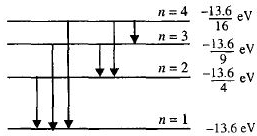
The ionization energy of the electron in the hydrogen atom in its ground state is $13.6 \text{ eV}$. The atoms are excited to higher energy levels to emit radiations of $6$ wavelengths. The maximum wavelength of the emitted radiation corresponds to the transition between:
A
$n=3 \to n=1$
B
$n=2 \to n=1$
C
$n=4 \to n=3$
D
$n=3 \to n=2$
Solution
(C) The number of spectral lines emitted when an electron transitions from an excited state $n$ to the ground state is given by the formula $N = \frac{n(n-1)}{2}$.
Given $N = 6$,we have $\frac{n(n-1)}{2} = 6$,which implies $n^2 - n - 12 = 0$. Solving this quadratic equation,we get $(n-4)(n+3) = 0$,so $n = 4$.
The energy of the emitted photon is given by $\Delta E = E_i - E_f = \frac{hc}{\lambda}$.
Since $\lambda = \frac{hc}{\Delta E}$,the wavelength $\lambda$ is maximum when the energy difference $\Delta E$ is minimum.
The possible transitions from $n=4$ are: $(4 \to 3), (4 \to 2), (4 \to 1), (3 \to 2), (3 \to 1), (2 \to 1)$.
Comparing the energy gaps,the transition $n=4 \to n=3$ has the smallest energy difference,and therefore corresponds to the maximum wavelength of the emitted radiation.
Given $N = 6$,we have $\frac{n(n-1)}{2} = 6$,which implies $n^2 - n - 12 = 0$. Solving this quadratic equation,we get $(n-4)(n+3) = 0$,so $n = 4$.
The energy of the emitted photon is given by $\Delta E = E_i - E_f = \frac{hc}{\lambda}$.
Since $\lambda = \frac{hc}{\Delta E}$,the wavelength $\lambda$ is maximum when the energy difference $\Delta E$ is minimum.
The possible transitions from $n=4$ are: $(4 \to 3), (4 \to 2), (4 \to 1), (3 \to 2), (3 \to 1), (2 \to 1)$.
Comparing the energy gaps,the transition $n=4 \to n=3$ has the smallest energy difference,and therefore corresponds to the maximum wavelength of the emitted radiation.
0 likes
View Solution60
MediumMCQ
The wavelength of the first line of the Lyman series for a hydrogen atom is equal to that of the second line of the Balmer series for a hydrogen-like ion. The atomic number $Z$ of the hydrogen-like ion is:
A
$1$
B
$2$
C
$3$
D
$4$
Solution
(B) The wavelength $\lambda$ of the first line of the Lyman series for a hydrogen atom $(Z=1)$ is given by the Rydberg formula:
$\frac{1}{\lambda} = R(1)^2 \left[ \frac{1}{1^2} - \frac{1}{2^2} \right] = R \left[ 1 - \frac{1}{4} \right] = \frac{3R}{4}$
The wavelength $\lambda'$ of the second line of the Balmer series for a hydrogen-like ion with atomic number $Z$ is given by:
$\frac{1}{\lambda'} = R Z^2 \left[ \frac{1}{2^2} - \frac{1}{4^2} \right] = R Z^2 \left[ \frac{1}{4} - \frac{1}{16} \right] = R Z^2 \left[ \frac{4-1}{16} \right] = \frac{3 R Z^2}{16}$
According to the problem,$\lambda = \lambda'$,which implies $\frac{1}{\lambda} = \frac{1}{\lambda'}$:
$\frac{3R}{4} = \frac{3 R Z^2}{16}$
Dividing both sides by $\frac{3R}{4}$:
$1 = \frac{Z^2}{4}$
$Z^2 = 4$
$Z = 2$
Thus,the atomic number of the hydrogen-like ion is $2$.
$\frac{1}{\lambda} = R(1)^2 \left[ \frac{1}{1^2} - \frac{1}{2^2} \right] = R \left[ 1 - \frac{1}{4} \right] = \frac{3R}{4}$
The wavelength $\lambda'$ of the second line of the Balmer series for a hydrogen-like ion with atomic number $Z$ is given by:
$\frac{1}{\lambda'} = R Z^2 \left[ \frac{1}{2^2} - \frac{1}{4^2} \right] = R Z^2 \left[ \frac{1}{4} - \frac{1}{16} \right] = R Z^2 \left[ \frac{4-1}{16} \right] = \frac{3 R Z^2}{16}$
According to the problem,$\lambda = \lambda'$,which implies $\frac{1}{\lambda} = \frac{1}{\lambda'}$:
$\frac{3R}{4} = \frac{3 R Z^2}{16}$
Dividing both sides by $\frac{3R}{4}$:
$1 = \frac{Z^2}{4}$
$Z^2 = 4$
$Z = 2$
Thus,the atomic number of the hydrogen-like ion is $2$.
0 likes
View Solution61
DifficultMCQ
The transition from the state $n = 3$ to $n = 1$ in a hydrogen-like atom results in ultraviolet radiation. Infrared radiation will be obtained in the transition from
A
$2 \to 1$
B
$3 \to 1$
C
$4 \to 2$
D
$4 \to 3$
Solution
(D) The energy of a photon emitted during a transition is given by $\Delta E = 13.6 Z^2 \left( \frac{1}{n_f^2} - \frac{1}{n_i^2} \right) \text{ eV}$.
Ultraviolet $(UV)$ radiation corresponds to higher energy transitions (Lyman series),while Infrared $(IR)$ radiation corresponds to lower energy transitions (Paschen,Brackett,or Pfund series).
For a transition to result in infrared radiation,the energy difference must be significantly smaller than that of the $n=3 \to n=1$ transition.
Let's evaluate the transitions:
$1. 2 \to 1$: This is part of the Lyman series,which is in the $UV$ region.
$2. 3 \to 1$: This is also part of the Lyman series,which is in the $UV$ region.
$3. 4 \to 2$: This is part of the Balmer series,which is in the visible region.
$4. 4 \to 3$: This is part of the Paschen series,which corresponds to the infrared $(IR)$ region.
Since the energy gap for $4 \to 3$ is the smallest among the given options,it corresponds to the longest wavelength,which falls in the infrared region.
Ultraviolet $(UV)$ radiation corresponds to higher energy transitions (Lyman series),while Infrared $(IR)$ radiation corresponds to lower energy transitions (Paschen,Brackett,or Pfund series).
For a transition to result in infrared radiation,the energy difference must be significantly smaller than that of the $n=3 \to n=1$ transition.
Let's evaluate the transitions:
$1. 2 \to 1$: This is part of the Lyman series,which is in the $UV$ region.
$2. 3 \to 1$: This is also part of the Lyman series,which is in the $UV$ region.
$3. 4 \to 2$: This is part of the Balmer series,which is in the visible region.
$4. 4 \to 3$: This is part of the Paschen series,which corresponds to the infrared $(IR)$ region.
Since the energy gap for $4 \to 3$ is the smallest among the given options,it corresponds to the longest wavelength,which falls in the infrared region.
0 likes
View Solution62
DifficultMCQ
The ratio of the longest wavelengths corresponding to the Lyman and Balmer series in the hydrogen spectrum is:
A
$5/27$
B
$7/29$
C
$9/31$
D
$3/23$
Solution
(A) The wavelength of spectral lines in the hydrogen spectrum is given by the Rydberg formula: $\frac{1}{\lambda} = R \left[ \frac{1}{n_1^2} - \frac{1}{n_2^2} \right]$.
For the Lyman series,$n_1 = 1$. The longest wavelength corresponds to the smallest energy transition,which is $n_2 = 2$.
$\frac{1}{\lambda_L} = R \left[ \frac{1}{1^2} - \frac{1}{2^2} \right] = R \left[ 1 - \frac{1}{4} \right] = \frac{3R}{4} \implies \lambda_L = \frac{4}{3R}$.
For the Balmer series,$n_1 = 2$. The longest wavelength corresponds to the smallest energy transition,which is $n_2 = 3$.
$\frac{1}{\lambda_B} = R \left[ \frac{1}{2^2} - \frac{1}{3^2} \right] = R \left[ \frac{1}{4} - \frac{1}{9} \right] = R \left[ \frac{9-4}{36} \right] = \frac{5R}{36} \implies \lambda_B = \frac{36}{5R}$.
The ratio of the longest wavelengths is:
$\frac{\lambda_L}{\lambda_B} = \frac{4/3R}{36/5R} = \frac{4}{3R} \times \frac{5R}{36} = \frac{4 \times 5}{3 \times 36} = \frac{20}{108} = \frac{5}{27}$.
For the Lyman series,$n_1 = 1$. The longest wavelength corresponds to the smallest energy transition,which is $n_2 = 2$.
$\frac{1}{\lambda_L} = R \left[ \frac{1}{1^2} - \frac{1}{2^2} \right] = R \left[ 1 - \frac{1}{4} \right] = \frac{3R}{4} \implies \lambda_L = \frac{4}{3R}$.
For the Balmer series,$n_1 = 2$. The longest wavelength corresponds to the smallest energy transition,which is $n_2 = 3$.
$\frac{1}{\lambda_B} = R \left[ \frac{1}{2^2} - \frac{1}{3^2} \right] = R \left[ \frac{1}{4} - \frac{1}{9} \right] = R \left[ \frac{9-4}{36} \right] = \frac{5R}{36} \implies \lambda_B = \frac{36}{5R}$.
The ratio of the longest wavelengths is:
$\frac{\lambda_L}{\lambda_B} = \frac{4/3R}{36/5R} = \frac{4}{3R} \times \frac{5R}{36} = \frac{4 \times 5}{3 \times 36} = \frac{20}{108} = \frac{5}{27}$.
0 likes
View Solution63
MediumMCQ
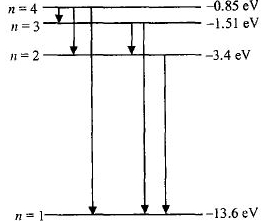
$A$ hydrogen atom in the ground state is excited by monochromatic radiation of $\lambda = 975 \; \mathring{A}$. The number of spectral lines in the resulting emission spectrum will be:
A
$2$
B
$3$
C
$6$
D
$10$
Solution
(C) The energy of the incident photon is given by $E = \frac{hc}{\lambda}$.
Using $hc \approx 12400 \; \text{eV} \cdot \mathring{A}$,we get $E = \frac{12400}{975} \approx 12.75 \; \text{eV}$.
The energy levels of a hydrogen atom are given by $E_n = -\frac{13.6}{n^2} \; \text{eV}$.
For the ground state $(n=1)$,$E_1 = -13.6 \; \text{eV}$.
After absorbing the photon,the new energy level is $E_n = E_1 + E = -13.6 + 12.75 = -0.85 \; \text{eV}$.
Since $E_n = -\frac{13.6}{n^2} = -0.85 \; \text{eV}$,we have $n^2 = \frac{13.6}{0.85} = 16$,so $n = 4$.
The electron is excited to the $n = 4$ state.
The number of spectral lines emitted when the electron transitions from $n$ to the ground state is given by $\frac{n(n-1)}{2}$.
For $n = 4$,the number of spectral lines is $\frac{4(4-1)}{2} = \frac{4 \times 3}{2} = 6$.
Using $hc \approx 12400 \; \text{eV} \cdot \mathring{A}$,we get $E = \frac{12400}{975} \approx 12.75 \; \text{eV}$.
The energy levels of a hydrogen atom are given by $E_n = -\frac{13.6}{n^2} \; \text{eV}$.
For the ground state $(n=1)$,$E_1 = -13.6 \; \text{eV}$.
After absorbing the photon,the new energy level is $E_n = E_1 + E = -13.6 + 12.75 = -0.85 \; \text{eV}$.
Since $E_n = -\frac{13.6}{n^2} = -0.85 \; \text{eV}$,we have $n^2 = \frac{13.6}{0.85} = 16$,so $n = 4$.
The electron is excited to the $n = 4$ state.
The number of spectral lines emitted when the electron transitions from $n$ to the ground state is given by $\frac{n(n-1)}{2}$.
For $n = 4$,the number of spectral lines is $\frac{4(4-1)}{2} = \frac{4 \times 3}{2} = 6$.
0 likes
View Solution64
DifficultMCQ
In the spectrum of hydrogen,the ratio of the longest wavelength in the Lyman series to the longest wavelength in the Balmer series is
A
$5/27$
B
$4/9$
C
$9/4$
D
$27/5$
Solution
(A) The wavelength of a spectral line in the Lyman series is given by $\frac{1}{\lambda_{L}} = R\left(\frac{1}{1^{2}} - \frac{1}{n^{2}}\right)$,where $n = 2, 3, 4, \dots$.
For the longest wavelength in the Lyman series,we take $n = 2$:
$\frac{1}{\lambda_{L}} = R\left(1 - \frac{1}{4}\right) = \frac{3R}{4} \implies \lambda_{L} = \frac{4}{3R}$.
The wavelength of a spectral line in the Balmer series is given by $\frac{1}{\lambda_{B}} = R\left(\frac{1}{2^{2}} - \frac{1}{n^{2}}\right)$,where $n = 3, 4, 5, \dots$.
For the longest wavelength in the Balmer series,we take $n = 3$:
$\frac{1}{\lambda_{B}} = R\left(\frac{1}{4} - \frac{1}{9}\right) = R\left(\frac{9-4}{36}\right) = \frac{5R}{36} \implies \lambda_{B} = \frac{36}{5R}$.
The ratio of the longest wavelength in the Lyman series to the longest wavelength in the Balmer series is:
$\frac{\lambda_{L}}{\lambda_{B}} = \frac{4/3R}{36/5R} = \frac{4}{3R} \times \frac{5R}{36} = \frac{5}{27}$.
For the longest wavelength in the Lyman series,we take $n = 2$:
$\frac{1}{\lambda_{L}} = R\left(1 - \frac{1}{4}\right) = \frac{3R}{4} \implies \lambda_{L} = \frac{4}{3R}$.
The wavelength of a spectral line in the Balmer series is given by $\frac{1}{\lambda_{B}} = R\left(\frac{1}{2^{2}} - \frac{1}{n^{2}}\right)$,where $n = 3, 4, 5, \dots$.
For the longest wavelength in the Balmer series,we take $n = 3$:
$\frac{1}{\lambda_{B}} = R\left(\frac{1}{4} - \frac{1}{9}\right) = R\left(\frac{9-4}{36}\right) = \frac{5R}{36} \implies \lambda_{B} = \frac{36}{5R}$.
The ratio of the longest wavelength in the Lyman series to the longest wavelength in the Balmer series is:
$\frac{\lambda_{L}}{\lambda_{B}} = \frac{4/3R}{36/5R} = \frac{4}{3R} \times \frac{5R}{36} = \frac{5}{27}$.
0 likes
View Solution65
MediumMCQ
Given the value of Rydberg constant is $10^7 \, m^{-1}$,the wave number of the last line of the Balmer series in the hydrogen spectrum will be:
A
$0.5 \times 10^7 \, m^{-1}$
B
$0.25 \times 10^7 \, m^{-1}$
C
$2.5 \times 10^7 \, m^{-1}$
D
$0.025 \times 10^4 \, m^{-1}$
Solution
(B) The wave number $\bar{\nu}$ for the hydrogen spectrum is given by the Rydberg formula: $\bar{\nu} = R \left( \frac{1}{n_1^2} - \frac{1}{n_2^2} \right)$.
For the Balmer series,the transition ends at $n_1 = 2$.
The last line of the Balmer series corresponds to the transition from $n_2 = \infty$ to $n_1 = 2$.
Given $R = 10^7 \, m^{-1}$,we substitute the values:
$\bar{\nu} = 10^7 \left( \frac{1}{2^2} - \frac{1}{\infty^2} \right) = 10^7 \left( \frac{1}{4} - 0 \right) = \frac{10^7}{4} = 0.25 \times 10^7 \, m^{-1}$.
For the Balmer series,the transition ends at $n_1 = 2$.
The last line of the Balmer series corresponds to the transition from $n_2 = \infty$ to $n_1 = 2$.
Given $R = 10^7 \, m^{-1}$,we substitute the values:
$\bar{\nu} = 10^7 \left( \frac{1}{2^2} - \frac{1}{\infty^2} \right) = 10^7 \left( \frac{1}{4} - 0 \right) = \frac{10^7}{4} = 0.25 \times 10^7 \, m^{-1}$.
0 likes
View Solution66
MediumMCQ
If an electron in a hydrogen atom jumps from the $3^{rd}$ orbit to the $2^{nd}$ orbit,it emits a photon of wavelength $\lambda$. When it jumps from the $4^{th}$ orbit to the $3^{rd}$ orbit,the corresponding wavelength of the photon will be
A
$\frac{20}{7}\lambda$
B
$\frac{20}{13}\lambda$
C
$\frac{16}{25}\lambda$
D
$\frac{9}{16}\lambda$
Solution
(A) The Rydberg formula for the wavelength of emitted radiation is given by $\frac{1}{\lambda} = R \left( \frac{1}{n_{f}^{2}} - \frac{1}{n_{i}^{2}} \right)$.
For the transition from $n_i = 3$ to $n_f = 2$:
$\frac{1}{\lambda} = R \left( \frac{1}{2^{2}} - \frac{1}{3^{2}} \right) = R \left( \frac{1}{4} - \frac{1}{9} \right) = R \left( \frac{9-4}{36} \right) = \frac{5R}{36}$.
For the transition from $n_i = 4$ to $n_f = 3$:
$\frac{1}{\lambda'} = R \left( \frac{1}{3^{2}} - \frac{1}{4^{2}} \right) = R \left( \frac{1}{9} - \frac{1}{16} \right) = R \left( \frac{16-9}{144} \right) = \frac{7R}{144}$.
Taking the ratio of the two equations:
$\frac{\lambda'}{\lambda} = \frac{5R/36}{7R/144} = \frac{5}{36} \times \frac{144}{7} = \frac{5 \times 4}{7} = \frac{20}{7}$.
Therefore,$\lambda' = \frac{20}{7}\lambda$.
For the transition from $n_i = 3$ to $n_f = 2$:
$\frac{1}{\lambda} = R \left( \frac{1}{2^{2}} - \frac{1}{3^{2}} \right) = R \left( \frac{1}{4} - \frac{1}{9} \right) = R \left( \frac{9-4}{36} \right) = \frac{5R}{36}$.
For the transition from $n_i = 4$ to $n_f = 3$:
$\frac{1}{\lambda'} = R \left( \frac{1}{3^{2}} - \frac{1}{4^{2}} \right) = R \left( \frac{1}{9} - \frac{1}{16} \right) = R \left( \frac{16-9}{144} \right) = \frac{7R}{144}$.
Taking the ratio of the two equations:
$\frac{\lambda'}{\lambda} = \frac{5R/36}{7R/144} = \frac{5}{36} \times \frac{144}{7} = \frac{5 \times 4}{7} = \frac{20}{7}$.
Therefore,$\lambda' = \frac{20}{7}\lambda$.
0 likes
View Solution67
MediumMCQ
If the longest wavelength in the ultraviolet region of the hydrogen spectrum is $\lambda_{0}$,then the shortest wavelength in its infrared region is:
A
$\frac{20}{3} \lambda_{0}$
B
$\frac{36}{5} \lambda_{0}$
C
$\frac{27}{4} \lambda_{0}$
D
$\frac{46}{7} \lambda_{0}$
Solution
(C) The longest wavelength in the ultraviolet region (Lyman series) occurs for the transition from $n_2 = 2$ to $n_1 = 1$.
Using the Rydberg formula: $\frac{1}{\lambda_{0}} = R \left( \frac{1}{1^2} - \frac{1}{2^2} \right) = R \left( 1 - \frac{1}{4} \right) = \frac{3}{4} R$.
Thus,$R = \frac{4}{3 \lambda_{0}}$.
The shortest wavelength in the infrared region (Paschen series) occurs for the transition from $n_2 = \infty$ to $n_1 = 3$.
Using the Rydberg formula: $\frac{1}{\lambda'} = R \left( \frac{1}{3^2} - \frac{1}{\infty^2} \right) = R \left( \frac{1}{9} \right) = \frac{R}{9}$.
Substituting $R = \frac{4}{3 \lambda_{0}}$ into the equation:
$\frac{1}{\lambda'} = \frac{1}{9} \times \frac{4}{3 \lambda_{0}} = \frac{4}{27 \lambda_{0}}$.
Therefore,$\lambda' = \frac{27}{4} \lambda_{0}$.
Using the Rydberg formula: $\frac{1}{\lambda_{0}} = R \left( \frac{1}{1^2} - \frac{1}{2^2} \right) = R \left( 1 - \frac{1}{4} \right) = \frac{3}{4} R$.
Thus,$R = \frac{4}{3 \lambda_{0}}$.
The shortest wavelength in the infrared region (Paschen series) occurs for the transition from $n_2 = \infty$ to $n_1 = 3$.
Using the Rydberg formula: $\frac{1}{\lambda'} = R \left( \frac{1}{3^2} - \frac{1}{\infty^2} \right) = R \left( \frac{1}{9} \right) = \frac{R}{9}$.
Substituting $R = \frac{4}{3 \lambda_{0}}$ into the equation:
$\frac{1}{\lambda'} = \frac{1}{9} \times \frac{4}{3 \lambda_{0}} = \frac{4}{27 \lambda_{0}}$.
Therefore,$\lambda' = \frac{27}{4} \lambda_{0}$.
0 likes
View Solution68
MediumMCQ
The ratio of wavelengths of the last line of the Balmer series and the last line of the Lyman series is
A
$1$
B
$4$
C
$0.5$
D
$2$
Solution
(B) The wavelength of the last line of the Balmer series is given by the Rydberg formula:
$\frac{1}{\lambda_{B}} = R \left( \frac{1}{2^{2}} - \frac{1}{\infty^{2}} \right) = \frac{R}{4}$
$\lambda_{B} = \frac{4}{R}$
The wavelength of the last line of the Lyman series is given by:
$\frac{1}{\lambda_{L}} = R \left( \frac{1}{1^{2}} - \frac{1}{\infty^{2}} \right) = R$
$\lambda_{L} = \frac{1}{R}$
Taking the ratio of the two wavelengths:
$\frac{\lambda_{B}}{\lambda_{L}} = \frac{4/R}{1/R} = 4$
Thus,the ratio is $4$.
$\frac{1}{\lambda_{B}} = R \left( \frac{1}{2^{2}} - \frac{1}{\infty^{2}} \right) = \frac{R}{4}$
$\lambda_{B} = \frac{4}{R}$
The wavelength of the last line of the Lyman series is given by:
$\frac{1}{\lambda_{L}} = R \left( \frac{1}{1^{2}} - \frac{1}{\infty^{2}} \right) = R$
$\lambda_{L} = \frac{1}{R}$
Taking the ratio of the two wavelengths:
$\frac{\lambda_{B}}{\lambda_{L}} = \frac{4/R}{1/R} = 4$
Thus,the ratio is $4$.
0 likes
View Solution69
DifficultMCQ
If the series limit of the Lyman series for a Hydrogen atom is equal to the series limit of the Balmer series for a hydrogen-like atom,then the atomic number of this hydrogen-like atom will be:
A
$1$
B
$2$
C
$3$
D
$4$
Solution
(B) The Rydberg formula for the wavelength of emitted radiation is given by $\frac{1}{\lambda} = R Z^2 \left[ \frac{1}{n_1^2} - \frac{1}{n_2^2} \right]$.
For the series limit of the Lyman series of a Hydrogen atom $(Z=1)$,we have $n_1 = 1$ and $n_2 = \infty$:
$\frac{1}{\lambda_L} = R(1)^2 \left[ \frac{1}{1^2} - \frac{1}{\infty} \right] = R$.
Thus,$\lambda_L = \frac{1}{R}$.
For the series limit of the Balmer series of a hydrogen-like atom (atomic number $Z$),we have $n_1 = 2$ and $n_2 = \infty$:
$\frac{1}{\lambda_B} = R Z^2 \left[ \frac{1}{2^2} - \frac{1}{\infty} \right] = \frac{R Z^2}{4}$.
Thus,$\lambda_B = \frac{4}{R Z^2}$.
Given that the series limits are equal,$\lambda_L = \lambda_B$:
$\frac{1}{R} = \frac{4}{R Z^2} \Rightarrow Z^2 = 4 \Rightarrow Z = 2$.
For the series limit of the Lyman series of a Hydrogen atom $(Z=1)$,we have $n_1 = 1$ and $n_2 = \infty$:
$\frac{1}{\lambda_L} = R(1)^2 \left[ \frac{1}{1^2} - \frac{1}{\infty} \right] = R$.
Thus,$\lambda_L = \frac{1}{R}$.
For the series limit of the Balmer series of a hydrogen-like atom (atomic number $Z$),we have $n_1 = 2$ and $n_2 = \infty$:
$\frac{1}{\lambda_B} = R Z^2 \left[ \frac{1}{2^2} - \frac{1}{\infty} \right] = \frac{R Z^2}{4}$.
Thus,$\lambda_B = \frac{4}{R Z^2}$.
Given that the series limits are equal,$\lambda_L = \lambda_B$:
$\frac{1}{R} = \frac{4}{R Z^2} \Rightarrow Z^2 = 4 \Rightarrow Z = 2$.
0 likes
View Solution70
AdvancedMCQ
The stopping potential for the photoelectrons emitted from a metal surface of work function $1.7 \ eV$ is $10.4 \ V$. Identify the energy levels corresponding to the transitions in a hydrogen atom which will result in the emission of a wavelength equal to that of the incident radiation for the above photoelectric effect.
A
$n = 3$ to $n = 1$
B
$n = 3$ to $n = 2$
C
$n = 2$ to $n = 1$
D
$n = 4$ to $n = 1$
Solution
$(A)$ According to Einstein's photoelectric equation, the maximum kinetic energy of the emitted photoelectrons is given by $K_{max} = e V_{0} = E - \phi_{0}$, where $E$ is the energy of the incident photon, $V_{0}$ is the stopping potential, and $\phi_{0}$ is the work function.
Given: $V_{0} = 10.4 \ V$ and $\phi_{0} = 1.7 \ eV$.
Thus, $E = e V_{0} + \phi_{0} = 10.4 \ eV + 1.7 \ eV = 12.1 \ eV$.
The energy of a photon emitted during a transition in a hydrogen atom from energy level $n_{i}$ to $n_{f}$ is given by $\Delta E = 13.6 \left( \frac{1}{n_{f}^{2}} - \frac{1}{n_{i}^{2}} \right) \ eV$.
For transition from $n = 3$ to $n = 1$:
$\Delta E = 13.6 \left( \frac{1}{1^{2}} - \frac{1}{3^{2}} \right) = 13.6 \left( 1 - \frac{1}{9} \right) = 13.6 \times \frac{8}{9} \approx 12.09 \ eV \approx 12.1 \ eV$.
Therefore, the transition from $n = 3$ to $n = 1$ corresponds to the energy of the incident photons.
Given: $V_{0} = 10.4 \ V$ and $\phi_{0} = 1.7 \ eV$.
Thus, $E = e V_{0} + \phi_{0} = 10.4 \ eV + 1.7 \ eV = 12.1 \ eV$.
The energy of a photon emitted during a transition in a hydrogen atom from energy level $n_{i}$ to $n_{f}$ is given by $\Delta E = 13.6 \left( \frac{1}{n_{f}^{2}} - \frac{1}{n_{i}^{2}} \right) \ eV$.
For transition from $n = 3$ to $n = 1$:
$\Delta E = 13.6 \left( \frac{1}{1^{2}} - \frac{1}{3^{2}} \right) = 13.6 \left( 1 - \frac{1}{9} \right) = 13.6 \times \frac{8}{9} \approx 12.09 \ eV \approx 12.1 \ eV$.
Therefore, the transition from $n = 3$ to $n = 1$ corresponds to the energy of the incident photons.
0 likes
View Solution71
AdvancedMCQ
The electron in a hydrogen atom in a sample is in the $n^{th}$ excited state. The number of different spectral lines obtained in its emission spectrum will be:
A
$1 + 2 + 3 + \dots + (n - 1)$
B
$1 + 2 + 3 + \dots + n$
C
$1 + 2 + 3 + \dots + (n + 1)$
D
$1 \times 2 \times 3 \times \dots \times (n - 1)$
Solution
(B) The $n^{th}$ excited state corresponds to the principal quantum number $N = n + 1$.
When an electron transitions from an excited state $N$ to lower energy levels,the total number of spectral lines emitted is given by the formula $\frac{N(N - 1)}{2}$.
Substituting $N = n + 1$ into the formula,we get:
Number of lines $= \frac{(n + 1)((n + 1) - 1)}{2} = \frac{(n + 1)n}{2}$.
This expression is equivalent to the sum of the first $n$ natural numbers: $1 + 2 + 3 + \dots + n$.
When an electron transitions from an excited state $N$ to lower energy levels,the total number of spectral lines emitted is given by the formula $\frac{N(N - 1)}{2}$.
Substituting $N = n + 1$ into the formula,we get:
Number of lines $= \frac{(n + 1)((n + 1) - 1)}{2} = \frac{(n + 1)n}{2}$.
This expression is equivalent to the sum of the first $n$ natural numbers: $1 + 2 + 3 + \dots + n$.
0 likes
View Solution72
MediumMCQ
If radiation of all wavelengths from ultraviolet to infrared is passed through hydrogen gas at room temperature,absorption lines will be observed in the:
A
Lyman series
B
Balmer series
C
both $(A)$ and $(B)$
D
neither $(A)$ nor $(B)$
Solution
(A) At room temperature,hydrogen atoms are in the ground state,where the electron is in the $n = 1$ energy level.
When radiation is passed through the gas,the atoms can only absorb photons that provide enough energy to excite the electron from $n = 1$ to higher energy levels $(n = 2, 3, 4, \dots)$.
Transitions starting from $n = 1$ to any higher energy level $(n > 1)$ correspond to the Lyman series in the absorption spectrum.
Since there are no electrons in the $n = 2$ level or higher at room temperature,no absorption lines corresponding to the Balmer series (which requires transitions starting from $n = 2$) will be observed.
Therefore,only the Lyman series is observed.
When radiation is passed through the gas,the atoms can only absorb photons that provide enough energy to excite the electron from $n = 1$ to higher energy levels $(n = 2, 3, 4, \dots)$.
Transitions starting from $n = 1$ to any higher energy level $(n > 1)$ correspond to the Lyman series in the absorption spectrum.
Since there are no electrons in the $n = 2$ level or higher at room temperature,no absorption lines corresponding to the Balmer series (which requires transitions starting from $n = 2$) will be observed.
Therefore,only the Lyman series is observed.
0 likes
View Solution73
EasyMCQ
The transition from the state $n = 4$ to $n = 3$ in a hydrogen-like atom results in ultraviolet radiation. Infrared radiation will be obtained in the transition from:
A
$2 \rightarrow 1$
B
$3 \rightarrow 2$
C
$4 \rightarrow 2$
D
$5 \rightarrow 4$
Solution
(D) The energy of a photon emitted during a transition between energy levels $n_i$ and $n_f$ is given by $\Delta E = 13.6 Z^2 (\frac{1}{n_f^2} - \frac{1}{n_i^2}) \text{ eV}$.
Ultraviolet radiation corresponds to higher energy transitions (Lyman series),while infrared radiation corresponds to lower energy transitions (Paschen,Brackett,or Pfund series).
Given that the transition $n=4 \rightarrow n=3$ results in ultraviolet radiation for this specific atom,it implies that the energy gap $\Delta E_{4 \rightarrow 3}$ is quite large.
To obtain infrared radiation,we need a transition with a significantly smaller energy gap than $\Delta E_{4 \rightarrow 3}$.
Comparing the options:
$(A)$ $2 \rightarrow 1$: This is a transition between lower energy levels,resulting in a larger energy gap than $4 \rightarrow 3$.
$(B)$ $3 \rightarrow 2$: This is also a transition between lower energy levels,resulting in a larger energy gap than $4 \rightarrow 3$.
$(C)$ $4 \rightarrow 2$: This involves a larger jump in quantum numbers,resulting in a larger energy gap.
$(D)$ $5 \rightarrow 4$: This transition occurs between higher energy levels where the energy difference between consecutive levels is much smaller. Thus,$5 \rightarrow 4$ will have the smallest energy gap and will result in infrared radiation.
Ultraviolet radiation corresponds to higher energy transitions (Lyman series),while infrared radiation corresponds to lower energy transitions (Paschen,Brackett,or Pfund series).
Given that the transition $n=4 \rightarrow n=3$ results in ultraviolet radiation for this specific atom,it implies that the energy gap $\Delta E_{4 \rightarrow 3}$ is quite large.
To obtain infrared radiation,we need a transition with a significantly smaller energy gap than $\Delta E_{4 \rightarrow 3}$.
Comparing the options:
$(A)$ $2 \rightarrow 1$: This is a transition between lower energy levels,resulting in a larger energy gap than $4 \rightarrow 3$.
$(B)$ $3 \rightarrow 2$: This is also a transition between lower energy levels,resulting in a larger energy gap than $4 \rightarrow 3$.
$(C)$ $4 \rightarrow 2$: This involves a larger jump in quantum numbers,resulting in a larger energy gap.
$(D)$ $5 \rightarrow 4$: This transition occurs between higher energy levels where the energy difference between consecutive levels is much smaller. Thus,$5 \rightarrow 4$ will have the smallest energy gap and will result in infrared radiation.
0 likes
View Solution74
MediumMCQ
$A$ hydrogen atom is excited from the ground state to a state with principal quantum number $n = 4$. The number of spectral lines emitted in the emission spectrum is:
A
$3$
B
$6$
C
$5$
D
$2$
Solution
(B) When an electron transitions from an excited state with principal quantum number $n$ to lower energy levels,the total number of possible spectral lines is given by the formula:
$N = \frac{n(n - 1)}{2}$
Given that the electron is excited to the state $n = 4$,we substitute this value into the formula:
$N = \frac{4(4 - 1)}{2}$
$N = \frac{4 \times 3}{2}$
$N = \frac{12}{2} = 6$
Therefore,the total number of spectral lines emitted is $6$.
$N = \frac{n(n - 1)}{2}$
Given that the electron is excited to the state $n = 4$,we substitute this value into the formula:
$N = \frac{4(4 - 1)}{2}$
$N = \frac{4 \times 3}{2}$
$N = \frac{12}{2} = 6$
Therefore,the total number of spectral lines emitted is $6$.
0 likes
View Solution75
MediumMCQ
If the series limit frequency of the Lyman series is $v_L$,then the series limit frequency of the Pfund series is
A
$16 v_L$
B
$\frac{v_L}{16}$
C
$\frac{v_L}{25}$
D
$25 v_L$
Solution
(C) The energy of a photon emitted during a transition is given by $h\nu = E_n - E_m$.
For the series limit,the electron transitions from $n = \infty$ to the ground state of the series.
For the Lyman series,the ground state is $n_1 = 1$. Thus,$h\nu_L = E_{\infty} - E_1 = 0 - E_1 = -E_1$.
For the Pfund series,the ground state is $n_5 = 5$. Thus,$h\nu_f = E_{\infty} - E_5 = 0 - E_5 = -E_5$.
Since $E_n = \frac{E_1}{n^2}$,we have $E_5 = \frac{E_1}{5^2} = \frac{E_1}{25}$.
Substituting this into the expression for $\nu_f$:
$h\nu_f = -\left(\frac{E_1}{25}\right) = \frac{-E_1}{25}$.
Since $h\nu_L = -E_1$,we get $h\nu_f = \frac{h\nu_L}{25}$.
Therefore,$\nu_f = \frac{\nu_L}{25}$.
For the series limit,the electron transitions from $n = \infty$ to the ground state of the series.
For the Lyman series,the ground state is $n_1 = 1$. Thus,$h\nu_L = E_{\infty} - E_1 = 0 - E_1 = -E_1$.
For the Pfund series,the ground state is $n_5 = 5$. Thus,$h\nu_f = E_{\infty} - E_5 = 0 - E_5 = -E_5$.
Since $E_n = \frac{E_1}{n^2}$,we have $E_5 = \frac{E_1}{5^2} = \frac{E_1}{25}$.
Substituting this into the expression for $\nu_f$:
$h\nu_f = -\left(\frac{E_1}{25}\right) = \frac{-E_1}{25}$.
Since $h\nu_L = -E_1$,we get $h\nu_f = \frac{h\nu_L}{25}$.
Therefore,$\nu_f = \frac{\nu_L}{25}$.
0 likes
View Solution76
MediumMCQ
The shortest wavelength of the Lyman series of a hydrogen atom is equal to the shortest wavelength of the Balmer series of a hydrogen-like atom of atomic number $Z$. The value of $Z$ is equal to:
A
$2$
B
$3$
C
$4$
D
$6$
Solution
(A) The wavelength $\lambda$ for a hydrogen-like atom is given by the Rydberg formula: $\frac{1}{\lambda} = R Z^2 \left( \frac{1}{n_1^2} - \frac{1}{n_2^2} \right)$.
For the shortest wavelength of the Lyman series of hydrogen $(Z=1)$,$n_1 = 1$ and $n_2 = \infty$. Thus,$\frac{1}{\lambda_L} = R (1)^2 \left( \frac{1}{1^2} - \frac{1}{\infty^2} \right) = R$.
For the shortest wavelength of the Balmer series of a hydrogen-like atom $(Z)$,$n_1 = 2$ and $n_2 = \infty$. Thus,$\frac{1}{\lambda_B} = R Z^2 \left( \frac{1}{2^2} - \frac{1}{\infty^2} \right) = R \frac{Z^2}{4}$.
Given that $\lambda_L = \lambda_B$,we have $\frac{1}{\lambda_L} = \frac{1}{\lambda_B}$.
Therefore,$R = R \frac{Z^2}{4}$,which implies $Z^2 = 4$.
Solving for $Z$,we get $Z = 2$.
For the shortest wavelength of the Lyman series of hydrogen $(Z=1)$,$n_1 = 1$ and $n_2 = \infty$. Thus,$\frac{1}{\lambda_L} = R (1)^2 \left( \frac{1}{1^2} - \frac{1}{\infty^2} \right) = R$.
For the shortest wavelength of the Balmer series of a hydrogen-like atom $(Z)$,$n_1 = 2$ and $n_2 = \infty$. Thus,$\frac{1}{\lambda_B} = R Z^2 \left( \frac{1}{2^2} - \frac{1}{\infty^2} \right) = R \frac{Z^2}{4}$.
Given that $\lambda_L = \lambda_B$,we have $\frac{1}{\lambda_L} = \frac{1}{\lambda_B}$.
Therefore,$R = R \frac{Z^2}{4}$,which implies $Z^2 = 4$.
Solving for $Z$,we get $Z = 2$.
0 likes
View Solution77
MediumMCQ
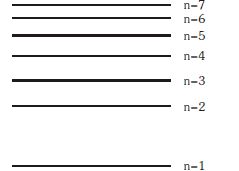
The maximum number of emission lines for atomic hydrogen that you would expect to see with the naked eye if the only electronic levels involved are those shown in the figure,is
A
$6$
B
$5$
C
$21$
D
$\infty$
Solution
(B) The spectral lines of the Balmer series lie in the visible range.
These lines are obtained due to the transition of an electron from any higher energy state $(n > 2)$ to the $n = 2$ state.
According to the provided figure,the energy levels involved are from $n = 1$ to $n = 7$.
Therefore,the possible transitions to the $n = 2$ state are from $n = 3, 4, 5, 6, \text{ and } 7$.
This gives a total of $5$ possible emission lines in the visible range $(3$ $\rightarrow 2, 4$ $\rightarrow 2, 5$ $\rightarrow 2, 6$ $\rightarrow 2, 7$ $\rightarrow 2)$.
These lines are obtained due to the transition of an electron from any higher energy state $(n > 2)$ to the $n = 2$ state.
According to the provided figure,the energy levels involved are from $n = 1$ to $n = 7$.
Therefore,the possible transitions to the $n = 2$ state are from $n = 3, 4, 5, 6, \text{ and } 7$.
This gives a total of $5$ possible emission lines in the visible range $(3$ $\rightarrow 2, 4$ $\rightarrow 2, 5$ $\rightarrow 2, 6$ $\rightarrow 2, 7$ $\rightarrow 2)$.
0 likes
View Solution78
MediumMCQ
When an electron makes a transition from $n=4$ to $n=2$,the emitted line spectrum will be:
A
first line of Lyman series
B
first line of Paschen series
C
second line of Balmer series
D
second line of Paschen series
Solution
(C) The spectral series of a hydrogen atom is determined by the final energy level $(n_f)$ of the electron transition.
$1$. Transitions to $n_f = 1$ result in the Lyman series.
$2$. Transitions to $n_f = 2$ result in the Balmer series.
$3$. Transitions to $n_f = 3$ result in the Paschen series.
In this case,the electron transitions from $n_i = 4$ to $n_f = 2$. Since the final state is $n_f = 2$,the emission belongs to the Balmer series.
The lines of the Balmer series are defined by transitions from $n_i = 3, 4, 5, ...$ to $n_f = 2$:
- The first line corresponds to $n_i = 3$ to $n_f = 2$.
- The second line corresponds to $n_i = 4$ to $n_f = 2$.
Therefore,the transition from $n=4$ to $n=2$ represents the second line of the Balmer series.
$1$. Transitions to $n_f = 1$ result in the Lyman series.
$2$. Transitions to $n_f = 2$ result in the Balmer series.
$3$. Transitions to $n_f = 3$ result in the Paschen series.
In this case,the electron transitions from $n_i = 4$ to $n_f = 2$. Since the final state is $n_f = 2$,the emission belongs to the Balmer series.
The lines of the Balmer series are defined by transitions from $n_i = 3, 4, 5, ...$ to $n_f = 2$:
- The first line corresponds to $n_i = 3$ to $n_f = 2$.
- The second line corresponds to $n_i = 4$ to $n_f = 2$.
Therefore,the transition from $n=4$ to $n=2$ represents the second line of the Balmer series.
0 likes
View Solution79
DifficultMCQ
In an $H$-like atom,when an electron transits from energy state $n=5$ to $n=2$,a photon of wavelength $434 \, nm$ is emitted. What will be the wavelength of the photon emitted when the transition occurs from energy state $n=4$ to $n=2$?
A
$486$
B
$450$
C
$500$
D
$550$
Solution
(A) The Rydberg formula for the wavelength of emitted radiation is given by $\frac{1}{\lambda} = RZ^2 \left( \frac{1}{n_f^2} - \frac{1}{n_i^2} \right)$.
Since $R$ and $Z$ are constant for a given atom,we have $\frac{1}{\lambda} \propto \left( \frac{1}{n_f^2} - \frac{1}{n_i^2} \right)$.
For the first transition ($n=5$ to $n=2$): $\frac{1}{434} = k \left( \frac{1}{2^2} - \frac{1}{5^2} \right) = k \left( \frac{1}{4} - \frac{1}{25} \right) = k \left( \frac{21}{100} \right)$.
For the second transition ($n=4$ to $n=2$): $\frac{1}{x} = k \left( \frac{1}{2^2} - \frac{1}{4^2} \right) = k \left( \frac{1}{4} - \frac{1}{16} \right) = k \left( \frac{3}{16} \right)$.
Dividing the two equations: $\frac{x}{434} = \frac{21/100}{3/16} = \frac{21}{100} \times \frac{16}{3} = \frac{7 \times 16}{100} = \frac{112}{100} = 1.12$.
Thus,$x = 434 \times 1.12 = 486.08 \, nm \approx 486 \, nm$.
Since $R$ and $Z$ are constant for a given atom,we have $\frac{1}{\lambda} \propto \left( \frac{1}{n_f^2} - \frac{1}{n_i^2} \right)$.
For the first transition ($n=5$ to $n=2$): $\frac{1}{434} = k \left( \frac{1}{2^2} - \frac{1}{5^2} \right) = k \left( \frac{1}{4} - \frac{1}{25} \right) = k \left( \frac{21}{100} \right)$.
For the second transition ($n=4$ to $n=2$): $\frac{1}{x} = k \left( \frac{1}{2^2} - \frac{1}{4^2} \right) = k \left( \frac{1}{4} - \frac{1}{16} \right) = k \left( \frac{3}{16} \right)$.
Dividing the two equations: $\frac{x}{434} = \frac{21/100}{3/16} = \frac{21}{100} \times \frac{16}{3} = \frac{7 \times 16}{100} = \frac{112}{100} = 1.12$.
Thus,$x = 434 \times 1.12 = 486.08 \, nm \approx 486 \, nm$.
0 likes
View Solution80
DifficultMCQ
$A$ doubly ionised $Li$ atom is excited from its ground state $(n = 1)$ to $n = 3$ state. The wavelengths of the spectral lines are given by $\lambda_{32}, \lambda_{31}$ and $\lambda_{21}$. The ratios $\lambda_{32}/\lambda_{31}$ and $\lambda_{21}/\lambda_{31}$ are,respectively:
A
$8.1, 0.67$
B
$8.1, 1.2$
C
$6.4, 1.2$
D
$6.4, 0.67$
Solution
(C) The wavelength $\lambda$ for a transition between energy levels $n_2$ and $n_1$ is given by the Rydberg formula: $\frac{1}{\lambda} = R Z^2 \left(\frac{1}{n_1^2} - \frac{1}{n_2^2}\right)$.
For $Li^{2+}$,the atomic number $Z = 3$,so $Z^2 = 9$.
$\frac{1}{\lambda_{32}} = R(9) \left(\frac{1}{2^2} - \frac{1}{3^2}\right) = 9R \left(\frac{1}{4} - \frac{1}{9}\right) = 9R \left(\frac{5}{36}\right) = \frac{5R}{4} \implies \lambda_{32} = \frac{4}{5R}$.
$\frac{1}{\lambda_{31}} = R(9) \left(\frac{1}{1^2} - \frac{1}{3^2}\right) = 9R \left(1 - \frac{1}{9}\right) = 9R \left(\frac{8}{9}\right) = 8R \implies \lambda_{31} = \frac{1}{8R}$.
$\frac{1}{\lambda_{21}} = R(9) \left(\frac{1}{1^2} - \frac{1}{2^2}\right) = 9R \left(1 - \frac{1}{4}\right) = 9R \left(\frac{3}{4}\right) = \frac{27R}{4} \implies \lambda_{21} = \frac{4}{27R}$.
Now,calculating the ratios:
$\frac{\lambda_{32}}{\lambda_{31}} = \frac{4/5R}{1/8R} = \frac{4}{5} \times 8 = \frac{32}{5} = 6.4$.
$\frac{\lambda_{21}}{\lambda_{31}} = \frac{4/27R}{1/8R} = \frac{4}{27} \times 8 = \frac{32}{27} \approx 1.185 \approx 1.2$.
Thus,the ratios are $6.4$ and $1.2$.
For $Li^{2+}$,the atomic number $Z = 3$,so $Z^2 = 9$.
$\frac{1}{\lambda_{32}} = R(9) \left(\frac{1}{2^2} - \frac{1}{3^2}\right) = 9R \left(\frac{1}{4} - \frac{1}{9}\right) = 9R \left(\frac{5}{36}\right) = \frac{5R}{4} \implies \lambda_{32} = \frac{4}{5R}$.
$\frac{1}{\lambda_{31}} = R(9) \left(\frac{1}{1^2} - \frac{1}{3^2}\right) = 9R \left(1 - \frac{1}{9}\right) = 9R \left(\frac{8}{9}\right) = 8R \implies \lambda_{31} = \frac{1}{8R}$.
$\frac{1}{\lambda_{21}} = R(9) \left(\frac{1}{1^2} - \frac{1}{2^2}\right) = 9R \left(1 - \frac{1}{4}\right) = 9R \left(\frac{3}{4}\right) = \frac{27R}{4} \implies \lambda_{21} = \frac{4}{27R}$.
Now,calculating the ratios:
$\frac{\lambda_{32}}{\lambda_{31}} = \frac{4/5R}{1/8R} = \frac{4}{5} \times 8 = \frac{32}{5} = 6.4$.
$\frac{\lambda_{21}}{\lambda_{31}} = \frac{4/27R}{1/8R} = \frac{4}{27} \times 8 = \frac{32}{27} \approx 1.185 \approx 1.2$.
Thus,the ratios are $6.4$ and $1.2$.
0 likes
View Solution81
DifficultMCQ
Taking the wavelength of the first Balmer line in the hydrogen spectrum ($n = 3$ to $n = 2$) as $660\,nm$,the wavelength of the $2^{nd}$ Balmer line ($n = 4$ to $n = 2$) will be....$nm$.
A
$889.2$
B
$642.7$
C
$488.9$
D
$388.9$
Solution
(C) The Rydberg formula for the hydrogen spectrum is given by $\frac{1}{\lambda} = R \left( \frac{1}{n_f^2} - \frac{1}{n_i^2} \right)$.
For the first Balmer line $(n_i = 3, n_f = 2)$: $\frac{1}{660} = R \left( \frac{1}{2^2} - \frac{1}{3^2} \right) = R \left( \frac{1}{4} - \frac{1}{9} \right) = \frac{5R}{36}$ .... $(1)$
For the second Balmer line $(n_i = 4, n_f = 2)$: $\frac{1}{\lambda} = R \left( \frac{1}{2^2} - \frac{1}{4^2} \right) = R \left( \frac{1}{4} - \frac{1}{16} \right) = \frac{3R}{16}$ .... $(2)$
Dividing equation $(1)$ by equation $(2)$:
$\frac{\lambda}{660} = \frac{5R/36}{3R/16} = \frac{5}{36} \times \frac{16}{3} = \frac{80}{108} = \frac{20}{27}$
$\lambda = 660 \times \frac{20}{27} = \frac{13200}{27} \approx 488.88\,nm \approx 488.9\,nm$.
For the first Balmer line $(n_i = 3, n_f = 2)$: $\frac{1}{660} = R \left( \frac{1}{2^2} - \frac{1}{3^2} \right) = R \left( \frac{1}{4} - \frac{1}{9} \right) = \frac{5R}{36}$ .... $(1)$
For the second Balmer line $(n_i = 4, n_f = 2)$: $\frac{1}{\lambda} = R \left( \frac{1}{2^2} - \frac{1}{4^2} \right) = R \left( \frac{1}{4} - \frac{1}{16} \right) = \frac{3R}{16}$ .... $(2)$
Dividing equation $(1)$ by equation $(2)$:
$\frac{\lambda}{660} = \frac{5R/36}{3R/16} = \frac{5}{36} \times \frac{16}{3} = \frac{80}{108} = \frac{20}{27}$
$\lambda = 660 \times \frac{20}{27} = \frac{13200}{27} \approx 488.88\,nm \approx 488.9\,nm$.
0 likes
View Solution82
DifficultMCQ
The wavelength of the first line of the Balmer series of a hydrogen atom is $\lambda \ \mathring{A}$. The wavelength of the same line for a doubly ionized lithium atom $(Z = 3)$ is:
A
$\lambda / 3$
B
$\lambda / 9$
C
$\lambda / 8$
D
$\lambda / 27$
Solution
(B) The Rydberg formula for the wavelength of a spectral line is given by $\frac{1}{\lambda} = R Z^2 \left( \frac{1}{n_1^2} - \frac{1}{n_2^2} \right)$.
For the Balmer series,the first line corresponds to the transition from $n_2 = 3$ to $n_1 = 2$.
Since the transition is the same for both atoms,the term $\left( \frac{1}{n_1^2} - \frac{1}{n_2^2} \right)$ is constant.
Therefore,$\frac{1}{\lambda} \propto Z^2$,which implies $\lambda \propto \frac{1}{Z^2}$.
For hydrogen $(Z_H = 1)$,$\lambda_H = \lambda$.
For doubly ionized lithium $(Z_{Li} = 3)$,$\lambda_{Li} = \lambda_H \times \left( \frac{Z_H}{Z_{Li}} \right)^2$.
$\lambda_{Li} = \lambda \times \left( \frac{1}{3} \right)^2 = \frac{\lambda}{9}$.
For the Balmer series,the first line corresponds to the transition from $n_2 = 3$ to $n_1 = 2$.
Since the transition is the same for both atoms,the term $\left( \frac{1}{n_1^2} - \frac{1}{n_2^2} \right)$ is constant.
Therefore,$\frac{1}{\lambda} \propto Z^2$,which implies $\lambda \propto \frac{1}{Z^2}$.
For hydrogen $(Z_H = 1)$,$\lambda_H = \lambda$.
For doubly ionized lithium $(Z_{Li} = 3)$,$\lambda_{Li} = \lambda_H \times \left( \frac{Z_H}{Z_{Li}} \right)^2$.
$\lambda_{Li} = \lambda \times \left( \frac{1}{3} \right)^2 = \frac{\lambda}{9}$.
0 likes
View Solution83
DifficultMCQ
In the spectrum of a hydrogen atom,the ratio of the longest wavelength in the Lyman series to the longest wavelength in the Balmer series is
A
$5/27$
B
$1/93$
C
$4/9$
D
$3/2$
Solution
(A) The wavelength $\lambda$ for a transition in a hydrogen atom is given by the Rydberg formula: $\frac{1}{\lambda} = R \left( \frac{1}{n_1^2} - \frac{1}{n_2^2} \right)$.
For the Lyman series,$n_1 = 1$. The longest wavelength corresponds to the transition from $n_2 = 2$ to $n_1 = 1$:
$\frac{1}{\lambda_{Lyman}} = R \left( \frac{1}{1^2} - \frac{1}{2^2} \right) = R \left( 1 - \frac{1}{4} \right) = \frac{3R}{4} \implies \lambda_{Lyman} = \frac{4}{3R}$.
For the Balmer series,$n_1 = 2$. The longest wavelength corresponds to the transition from $n_2 = 3$ to $n_1 = 2$:
$\frac{1}{\lambda_{Balmer}} = R \left( \frac{1}{2^2} - \frac{1}{3^2} \right) = R \left( \frac{1}{4} - \frac{1}{9} \right) = R \left( \frac{9-4}{36} \right) = \frac{5R}{36} \implies \lambda_{Balmer} = \frac{36}{5R}$.
The ratio of the longest wavelength in the Lyman series to the longest wavelength in the Balmer series is:
$\frac{\lambda_{Lyman}}{\lambda_{Balmer}} = \frac{4/3R}{36/5R} = \frac{4}{3} \times \frac{5}{36} = \frac{1}{3} \times \frac{5}{9} = \frac{5}{27}$.
For the Lyman series,$n_1 = 1$. The longest wavelength corresponds to the transition from $n_2 = 2$ to $n_1 = 1$:
$\frac{1}{\lambda_{Lyman}} = R \left( \frac{1}{1^2} - \frac{1}{2^2} \right) = R \left( 1 - \frac{1}{4} \right) = \frac{3R}{4} \implies \lambda_{Lyman} = \frac{4}{3R}$.
For the Balmer series,$n_1 = 2$. The longest wavelength corresponds to the transition from $n_2 = 3$ to $n_1 = 2$:
$\frac{1}{\lambda_{Balmer}} = R \left( \frac{1}{2^2} - \frac{1}{3^2} \right) = R \left( \frac{1}{4} - \frac{1}{9} \right) = R \left( \frac{9-4}{36} \right) = \frac{5R}{36} \implies \lambda_{Balmer} = \frac{36}{5R}$.
The ratio of the longest wavelength in the Lyman series to the longest wavelength in the Balmer series is:
$\frac{\lambda_{Lyman}}{\lambda_{Balmer}} = \frac{4/3R}{36/5R} = \frac{4}{3} \times \frac{5}{36} = \frac{1}{3} \times \frac{5}{9} = \frac{5}{27}$.
0 likes
View Solution84
DifficultMCQ
If ${\lambda _{\max }}$ is $6563\,\mathring{A}$ for the Balmer series of a particular atom,then the wavelength of the second line for the Balmer series will be:
A
$\lambda = \frac{16}{3R}$
B
$\lambda = \frac{36}{5R}$
C
$\lambda = \frac{4}{3R}$
D
None of the above
Solution
(A) For the Balmer series,the Rydberg formula is given by $\frac{1}{\lambda} = R \left( \frac{1}{2^2} - \frac{1}{n^2} \right)$,where $n = 3, 4, 5, \dots$
For the first line (maximum wavelength),$n = 3$: $\frac{1}{\lambda_{\max}} = R \left( \frac{1}{4} - \frac{1}{9} \right) = R \left( \frac{5}{36} \right)$.
For the second line,$n = 4$: $\frac{1}{\lambda} = R \left( \frac{1}{2^2} - \frac{1}{4^2} \right) = R \left( \frac{1}{4} - \frac{1}{16} \right) = R \left( \frac{4-1}{16} \right) = \frac{3R}{16}$.
Therefore,$\lambda = \frac{16}{3R}$.
For the first line (maximum wavelength),$n = 3$: $\frac{1}{\lambda_{\max}} = R \left( \frac{1}{4} - \frac{1}{9} \right) = R \left( \frac{5}{36} \right)$.
For the second line,$n = 4$: $\frac{1}{\lambda} = R \left( \frac{1}{2^2} - \frac{1}{4^2} \right) = R \left( \frac{1}{4} - \frac{1}{16} \right) = R \left( \frac{4-1}{16} \right) = \frac{3R}{16}$.
Therefore,$\lambda = \frac{16}{3R}$.
0 likes
View Solution85
DifficultMCQ
The shortest wavelength in the Lyman series is $91.2 \, nm$. The largest wavelength of the series is.....$nm$
A
$121.6$
B
$182.4$
C
$243.4$
D
$364.8$
Solution
(A) For the shortest wavelength of the Lyman series,the transition occurs from $n_2 = \infty$ to $n_1 = 1$.
Using the Rydberg formula: $\frac{1}{\lambda_{min}} = R \left( \frac{1}{1^2} - \frac{1}{\infty^2} \right) = R = \frac{1}{91.2 \, nm}$.
For the largest wavelength of the Lyman series,the transition occurs from $n_2 = 2$ to $n_1 = 1$.
Using the Rydberg formula: $\frac{1}{\lambda_{max}} = R \left( \frac{1}{1^2} - \frac{1}{2^2} \right) = R \left( 1 - \frac{1}{4} \right) = \frac{3}{4} R$.
Substituting $R = \frac{1}{91.2 \, nm}$ into the equation:
$\frac{1}{\lambda_{max}} = \frac{3}{4} \times \frac{1}{91.2 \, nm}$.
$\lambda_{max} = \frac{4}{3} \times 91.2 \, nm = 121.6 \, nm$.
Using the Rydberg formula: $\frac{1}{\lambda_{min}} = R \left( \frac{1}{1^2} - \frac{1}{\infty^2} \right) = R = \frac{1}{91.2 \, nm}$.
For the largest wavelength of the Lyman series,the transition occurs from $n_2 = 2$ to $n_1 = 1$.
Using the Rydberg formula: $\frac{1}{\lambda_{max}} = R \left( \frac{1}{1^2} - \frac{1}{2^2} \right) = R \left( 1 - \frac{1}{4} \right) = \frac{3}{4} R$.
Substituting $R = \frac{1}{91.2 \, nm}$ into the equation:
$\frac{1}{\lambda_{max}} = \frac{3}{4} \times \frac{1}{91.2 \, nm}$.
$\lambda_{max} = \frac{4}{3} \times 91.2 \, nm = 121.6 \, nm$.
0 likes
View Solution86
MediumMCQ
What is the wavelength of the least energetic photon emitted in the Lyman series of the hydrogen atom spectrum? (in $nm$)
A
$150$
B
$122$
C
$102$
D
$82$
Solution
(B) The Lyman series corresponds to transitions from higher energy levels to the ground state $(n_f = 1)$.
The energy of the emitted photon is given by $\Delta E = 13.6 \left( \frac{1}{n_f^2} - \frac{1}{n_i^2} \right) \text{ eV}$.
The least energetic photon corresponds to the smallest energy difference,which occurs for the transition from the first excited state $(n_i = 2)$ to the ground state $(n_f = 1)$.
Using the Rydberg formula: $\frac{1}{\lambda} = R \left( \frac{1}{1^2} - \frac{1}{2^2} \right) = R \left( 1 - \frac{1}{4} \right) = \frac{3R}{4}$.
Thus,$\lambda = \frac{4}{3R}$.
Given $R \approx 1.097 \times 10^7 \text{ m}^{-1}$,we have $\lambda = \frac{4}{3 \times 1.097 \times 10^7} \approx 1.216 \times 10^{-7} \text{ m} = 121.6 \text{ nm}$.
Rounding to the nearest integer,we get $122 \text{ nm}$.
The energy of the emitted photon is given by $\Delta E = 13.6 \left( \frac{1}{n_f^2} - \frac{1}{n_i^2} \right) \text{ eV}$.
The least energetic photon corresponds to the smallest energy difference,which occurs for the transition from the first excited state $(n_i = 2)$ to the ground state $(n_f = 1)$.
Using the Rydberg formula: $\frac{1}{\lambda} = R \left( \frac{1}{1^2} - \frac{1}{2^2} \right) = R \left( 1 - \frac{1}{4} \right) = \frac{3R}{4}$.
Thus,$\lambda = \frac{4}{3R}$.
Given $R \approx 1.097 \times 10^7 \text{ m}^{-1}$,we have $\lambda = \frac{4}{3 \times 1.097 \times 10^7} \approx 1.216 \times 10^{-7} \text{ m} = 121.6 \text{ nm}$.
Rounding to the nearest integer,we get $122 \text{ nm}$.
0 likes
View Solution87
MediumMCQ
The energy of an electron in the $n^{th}$ orbit of a hydrogen atom is expressed as $E_n = \frac{-13.6}{n^2} \, eV$. The shortest and longest wavelengths of the Lyman series will be:
A
$910 \, \mathring{A}, 1213 \, \mathring{A}$
B
$5463 \, \mathring{A}, 7858 \, \mathring{A}$
C
$1315 \, \mathring{A}, 1530 \, \mathring{A}$
D
None of these
Solution
(A) The Lyman series corresponds to transitions where the final state is $n_f = 1$. The wavelength $\lambda$ is given by the Rydberg formula: $\frac{1}{\lambda} = R \left( \frac{1}{n_f^2} - \frac{1}{n_i^2} \right)$,where $R \approx 1.097 \times 10^7 \, m^{-1}$.
For the longest wavelength (minimum energy transition),we take $n_i = 2$:
$\frac{1}{\lambda_{\max}} = R \left( \frac{1}{1^2} - \frac{1}{2^2} \right) = R \left( 1 - \frac{1}{4} \right) = \frac{3R}{4}$.
$\lambda_{\max} = \frac{4}{3R} \approx \frac{4}{3 \times 1.097 \times 10^7} \approx 1.215 \times 10^{-7} \, m = 1215 \, \mathring{A}$ (approximately $1213 \, \mathring{A}$ depending on the value of $R$ used).
For the shortest wavelength (maximum energy transition),we take $n_i = \infty$:
$\frac{1}{\lambda_{\min}} = R \left( \frac{1}{1^2} - \frac{1}{\infty^2} \right) = R$.
$\lambda_{\min} = \frac{1}{R} \approx \frac{1}{1.097 \times 10^7} \approx 9.11 \times 10^{-8} \, m = 911 \, \mathring{A}$ (approximately $910 \, \mathring{A}$).
Thus,the shortest wavelength is $910 \, \mathring{A}$ and the longest is $1213 \, \mathring{A}$.
For the longest wavelength (minimum energy transition),we take $n_i = 2$:
$\frac{1}{\lambda_{\max}} = R \left( \frac{1}{1^2} - \frac{1}{2^2} \right) = R \left( 1 - \frac{1}{4} \right) = \frac{3R}{4}$.
$\lambda_{\max} = \frac{4}{3R} \approx \frac{4}{3 \times 1.097 \times 10^7} \approx 1.215 \times 10^{-7} \, m = 1215 \, \mathring{A}$ (approximately $1213 \, \mathring{A}$ depending on the value of $R$ used).
For the shortest wavelength (maximum energy transition),we take $n_i = \infty$:
$\frac{1}{\lambda_{\min}} = R \left( \frac{1}{1^2} - \frac{1}{\infty^2} \right) = R$.
$\lambda_{\min} = \frac{1}{R} \approx \frac{1}{1.097 \times 10^7} \approx 9.11 \times 10^{-8} \, m = 911 \, \mathring{A}$ (approximately $910 \, \mathring{A}$).
Thus,the shortest wavelength is $910 \, \mathring{A}$ and the longest is $1213 \, \mathring{A}$.
0 likes
View Solution88
MediumMCQ
Assertion : Balmer series lies in the visible region of the electromagnetic spectrum.
Reason : $\frac{1}{\lambda} = R \left[ \frac{1}{2^2} - \frac{1}{n^2} \right]$,where $n = 3, 4, 5, \dots$
Reason : $\frac{1}{\lambda} = R \left[ \frac{1}{2^2} - \frac{1}{n^2} \right]$,where $n = 3, 4, 5, \dots$
A
If both Assertion and Reason are correct and the Reason is a correct explanation of the Assertion.
B
If both Assertion and Reason are correct but Reason is not a correct explanation of the Assertion.
C
If the Assertion is correct but Reason is incorrect.
D
If both the Assertion and Reason are incorrect.
Solution
(A) The wavelength for the Balmer series is given by the Rydberg formula: $\frac{1}{\lambda} = R \left[ \frac{1}{2^2} - \frac{1}{n^2} \right]$,where $n = 3, 4, 5, \dots$
For the maximum wavelength $(n=3)$:
$\frac{1}{\lambda_{\max}} = R \left[ \frac{1}{4} - \frac{1}{9} \right] = R \left[ \frac{5}{36} \right]$
$\lambda_{\max} = \frac{36}{5R} \approx 6563 \, \mathring{A}$
For the minimum wavelength $(n \to \infty)$:
$\frac{1}{\lambda_{\min}} = R \left[ \frac{1}{4} - 0 \right] = \frac{R}{4}$
$\lambda_{\min} = \frac{4}{R} \approx 3646 \, \mathring{A}$
The range $3646 \, \mathring{A}$ to $6563 \, \mathring{A}$ falls within the visible region of the electromagnetic spectrum. Thus,both the Assertion and the Reason are correct,and the Reason correctly explains the Assertion.
For the maximum wavelength $(n=3)$:
$\frac{1}{\lambda_{\max}} = R \left[ \frac{1}{4} - \frac{1}{9} \right] = R \left[ \frac{5}{36} \right]$
$\lambda_{\max} = \frac{36}{5R} \approx 6563 \, \mathring{A}$
For the minimum wavelength $(n \to \infty)$:
$\frac{1}{\lambda_{\min}} = R \left[ \frac{1}{4} - 0 \right] = \frac{R}{4}$
$\lambda_{\min} = \frac{4}{R} \approx 3646 \, \mathring{A}$
The range $3646 \, \mathring{A}$ to $6563 \, \mathring{A}$ falls within the visible region of the electromagnetic spectrum. Thus,both the Assertion and the Reason are correct,and the Reason correctly explains the Assertion.
0 likes
View Solution89
MediumMCQ
Assertion: In the Lyman series,the ratio of minimum and maximum wavelength is $\frac{3}{4}$.
Reason: The Lyman series constitutes spectral lines corresponding to transitions from higher energy levels to the ground state of the hydrogen atom.
Reason: The Lyman series constitutes spectral lines corresponding to transitions from higher energy levels to the ground state of the hydrogen atom.
A
If both Assertion and Reason are correct and the Reason is a correct explanation of the Assertion.
B
If both Assertion and Reason are correct but Reason is not a correct explanation of the Assertion.
C
If the Assertion is correct but Reason is incorrect.
D
If both the Assertion and Reason are incorrect.
Solution
(A) The Rydberg formula is given by $\frac{1}{\lambda} = R \left( \frac{1}{n_{1}^{2}} - \frac{1}{n_{2}^{2}} \right)$.
For the Lyman series,the ground state is $n_{1} = 1$.
For the minimum wavelength (shortest wavelength),$n_{2} = \infty$:
$\frac{1}{\lambda_{min}} = R \left( \frac{1}{1^{2}} - \frac{1}{\infty^{2}} \right) = R \implies \lambda_{min} = \frac{1}{R}$.
For the maximum wavelength (longest wavelength),$n_{2} = 2$:
$\frac{1}{\lambda_{max}} = R \left( \frac{1}{1^{2}} - \frac{1}{2^{2}} \right) = R \left( 1 - \frac{1}{4} \right) = \frac{3R}{4} \implies \lambda_{max} = \frac{4}{3R}$.
The ratio of minimum to maximum wavelength is $\frac{\lambda_{min}}{\lambda_{max}} = \frac{1/R}{4/3R} = \frac{3}{4}$.
Both the Assertion and Reason are correct,and the Reason correctly explains the origin of the Lyman series transitions.
For the Lyman series,the ground state is $n_{1} = 1$.
For the minimum wavelength (shortest wavelength),$n_{2} = \infty$:
$\frac{1}{\lambda_{min}} = R \left( \frac{1}{1^{2}} - \frac{1}{\infty^{2}} \right) = R \implies \lambda_{min} = \frac{1}{R}$.
For the maximum wavelength (longest wavelength),$n_{2} = 2$:
$\frac{1}{\lambda_{max}} = R \left( \frac{1}{1^{2}} - \frac{1}{2^{2}} \right) = R \left( 1 - \frac{1}{4} \right) = \frac{3R}{4} \implies \lambda_{max} = \frac{4}{3R}$.
The ratio of minimum to maximum wavelength is $\frac{\lambda_{min}}{\lambda_{max}} = \frac{1/R}{4/3R} = \frac{3}{4}$.
Both the Assertion and Reason are correct,and the Reason correctly explains the origin of the Lyman series transitions.
0 likes
View Solution90
MediumMCQ
Assertion : In Lyman series,the ratio of minimum and maximum wavelength is $\frac{3}{4}$.
Reason : Lyman series constitute spectral lines corresponding to transition from higher energy to ground state of hydrogen atom.
Reason : Lyman series constitute spectral lines corresponding to transition from higher energy to ground state of hydrogen atom.
A
If both Assertion and Reason are correct and the Reason is a correct explanation of the Assertion.
B
If both Assertion and Reason are correct but Reason is not a correct explanation of the Assertion.
C
If the Assertion is correct but Reason is incorrect.
D
If both the Assertion and Reason are incorrect.
Solution
(A) The Rydberg formula is given by $\frac{1}{\lambda} = R \left( \frac{1}{n_1^2} - \frac{1}{n_2^2} \right)$.
For the Lyman series,the ground state is $n_1 = 1$.
For the minimum wavelength (shortest wavelength),the transition occurs from $n_2 = \infty$ to $n_1 = 1$:
$\frac{1}{\lambda_{min}} = R \left( \frac{1}{1^2} - \frac{1}{\infty^2} \right) = R \implies \lambda_{min} = \frac{1}{R}$.
For the maximum wavelength (longest wavelength),the transition occurs from $n_2 = 2$ to $n_1 = 1$:
$\frac{1}{\lambda_{max}} = R \left( \frac{1}{1^2} - \frac{1}{2^2} \right) = R \left( 1 - \frac{1}{4} \right) = \frac{3R}{4} \implies \lambda_{max} = \frac{4}{3R}$.
The ratio of minimum to maximum wavelength is $\frac{\lambda_{min}}{\lambda_{max}} = \frac{1/R}{4/3R} = \frac{3}{4}$.
Both the Assertion and the Reason are correct,and the Reason correctly explains the origin of the Lyman series.
For the Lyman series,the ground state is $n_1 = 1$.
For the minimum wavelength (shortest wavelength),the transition occurs from $n_2 = \infty$ to $n_1 = 1$:
$\frac{1}{\lambda_{min}} = R \left( \frac{1}{1^2} - \frac{1}{\infty^2} \right) = R \implies \lambda_{min} = \frac{1}{R}$.
For the maximum wavelength (longest wavelength),the transition occurs from $n_2 = 2$ to $n_1 = 1$:
$\frac{1}{\lambda_{max}} = R \left( \frac{1}{1^2} - \frac{1}{2^2} \right) = R \left( 1 - \frac{1}{4} \right) = \frac{3R}{4} \implies \lambda_{max} = \frac{4}{3R}$.
The ratio of minimum to maximum wavelength is $\frac{\lambda_{min}}{\lambda_{max}} = \frac{1/R}{4/3R} = \frac{3}{4}$.
Both the Assertion and the Reason are correct,and the Reason correctly explains the origin of the Lyman series.
0 likes
View Solution91
MediumMCQ
The first member of the Balmer series of a hydrogen atom has a wavelength of $6561 \; \mathring{A}$. The wavelength of the second member of the Balmer series (in $nm$) is
A
$256$
B
$540$
C
$486$
D
$626$
Solution
(C) For the Balmer series,the Rydberg formula is given by $\frac{1}{\lambda} = R_{H} \left( \frac{1}{2^{2}} - \frac{1}{n^{2}} \right)$,where $n = 3, 4, 5, \dots$
The first member corresponds to $n = 3$: $\frac{1}{\lambda_{1}} = R_{H} \left( \frac{1}{4} - \frac{1}{9} \right) = R_{H} \left( \frac{5}{36} \right)$.
The second member corresponds to $n = 4$: $\frac{1}{\lambda_{2}} = R_{H} \left( \frac{1}{4} - \frac{1}{16} \right) = R_{H} \left( \frac{3}{16} \right)$.
Taking the ratio: $\frac{\lambda_{2}}{\lambda_{1}} = \frac{5/36}{3/16} = \frac{5}{36} \times \frac{16}{3} = \frac{80}{108} = \frac{20}{27}$.
Given $\lambda_{1} = 6561 \; \mathring{A}$,we have $\lambda_{2} = \frac{20}{27} \times 6561 = 4860 \; \mathring{A}$.
Converting to nanometers: $4860 \; \mathring{A} = 486 \; nm$.
The first member corresponds to $n = 3$: $\frac{1}{\lambda_{1}} = R_{H} \left( \frac{1}{4} - \frac{1}{9} \right) = R_{H} \left( \frac{5}{36} \right)$.
The second member corresponds to $n = 4$: $\frac{1}{\lambda_{2}} = R_{H} \left( \frac{1}{4} - \frac{1}{16} \right) = R_{H} \left( \frac{3}{16} \right)$.
Taking the ratio: $\frac{\lambda_{2}}{\lambda_{1}} = \frac{5/36}{3/16} = \frac{5}{36} \times \frac{16}{3} = \frac{80}{108} = \frac{20}{27}$.
Given $\lambda_{1} = 6561 \; \mathring{A}$,we have $\lambda_{2} = \frac{20}{27} \times 6561 = 4860 \; \mathring{A}$.
Converting to nanometers: $4860 \; \mathring{A} = 486 \; nm$.
0 likes
View Solution92
Medium
Using the Rydberg formula,calculate the wavelengths of the first four spectral lines in the Lyman series of the hydrogen spectrum.
Solution
The Rydberg formula is given by $\frac{1}{\lambda} = R_H \left( \frac{1}{n_f^2} - \frac{1}{n_i^2} \right)$,where $R_H \approx 1.097 \times 10^7 \, m^{-1}$.
For the Lyman series,the final energy level is $n_f = 1$. The first four spectral lines correspond to transitions from $n_i = 2, 3, 4, 5$ to $n_f = 1$.
Using $\lambda = \frac{1}{R_H \left( 1 - \frac{1}{n_i^2} \right)} = \frac{n_i^2}{R_H (n_i^2 - 1)}$:
$1$. For $n_i = 2$: $\lambda_{21} = \frac{4}{1.097 \times 10^7 (3)} \approx 1.216 \times 10^{-7} \, m = 1216 \, \mathring{A}$.
$2$. For $n_i = 3$: $\lambda_{31} = \frac{9}{1.097 \times 10^7 (8)} \approx 1.026 \times 10^{-7} \, m = 1026 \, \mathring{A}$.
$3$. For $n_i = 4$: $\lambda_{41} = \frac{16}{1.097 \times 10^7 (15)} \approx 0.972 \times 10^{-7} \, m = 972 \, \mathring{A}$.
$4$. For $n_i = 5$: $\lambda_{51} = \frac{25}{1.097 \times 10^7 (24)} \approx 0.950 \times 10^{-7} \, m = 950 \, \mathring{A}$.
For the Lyman series,the final energy level is $n_f = 1$. The first four spectral lines correspond to transitions from $n_i = 2, 3, 4, 5$ to $n_f = 1$.
Using $\lambda = \frac{1}{R_H \left( 1 - \frac{1}{n_i^2} \right)} = \frac{n_i^2}{R_H (n_i^2 - 1)}$:
$1$. For $n_i = 2$: $\lambda_{21} = \frac{4}{1.097 \times 10^7 (3)} \approx 1.216 \times 10^{-7} \, m = 1216 \, \mathring{A}$.
$2$. For $n_i = 3$: $\lambda_{31} = \frac{9}{1.097 \times 10^7 (8)} \approx 1.026 \times 10^{-7} \, m = 1026 \, \mathring{A}$.
$3$. For $n_i = 4$: $\lambda_{41} = \frac{16}{1.097 \times 10^7 (15)} \approx 0.972 \times 10^{-7} \, m = 972 \, \mathring{A}$.
$4$. For $n_i = 5$: $\lambda_{51} = \frac{25}{1.097 \times 10^7 (24)} \approx 0.950 \times 10^{-7} \, m = 950 \, \mathring{A}$.
0 likes
View Solution93
EasyMCQ
What is the shortest wavelength present in the Paschen series of spectral lines (in $;nm$)?
A
$818.9$
B
$915.4$
C
$761.2$
D
$892.6$
Solution
(A) The Rydberg formula for the wavelength $\lambda$ of spectral lines in the hydrogen atom is given by:
$\frac{1}{\lambda} = R \left( \frac{1}{n_1^2} - \frac{1}{n_2^2} \right)$
For the Paschen series,the transition occurs to the $n_1 = 3$ energy level.
The shortest wavelength corresponds to the transition from the highest energy level,i.e.,$n_2 = \infty$.
Using the Rydberg constant $R \approx 1.097 \times 10^7 \;m^{-1}$:
$\frac{1}{\lambda} = 1.097 \times 10^7 \left( \frac{1}{3^2} - \frac{1}{\infty^2} \right)$
$\frac{1}{\lambda} = 1.097 \times 10^7 \times \frac{1}{9}$
$\lambda = \frac{9}{1.097 \times 10^7} \approx 8.204 \times 10^{-7} \;m = 820.4 \;nm$.
Using the energy conversion factor $13.6 \;eV = 21.76 \times 10^{-19} \;J$ as provided in the context:
$\frac{hc}{\lambda} = 21.76 \times 10^{-19} \left( \frac{1}{3^2} - 0 \right)$
$\lambda = \frac{6.626 \times 10^{-34} \times 3 \times 10^8 \times 9}{21.76 \times 10^{-19}} \approx 8.22 \times 10^{-7} \;m = 822 \;nm$.
Given the options provided,$818.9 \;nm$ is the closest value.
$\frac{1}{\lambda} = R \left( \frac{1}{n_1^2} - \frac{1}{n_2^2} \right)$
For the Paschen series,the transition occurs to the $n_1 = 3$ energy level.
The shortest wavelength corresponds to the transition from the highest energy level,i.e.,$n_2 = \infty$.
Using the Rydberg constant $R \approx 1.097 \times 10^7 \;m^{-1}$:
$\frac{1}{\lambda} = 1.097 \times 10^7 \left( \frac{1}{3^2} - \frac{1}{\infty^2} \right)$
$\frac{1}{\lambda} = 1.097 \times 10^7 \times \frac{1}{9}$
$\lambda = \frac{9}{1.097 \times 10^7} \approx 8.204 \times 10^{-7} \;m = 820.4 \;nm$.
Using the energy conversion factor $13.6 \;eV = 21.76 \times 10^{-19} \;J$ as provided in the context:
$\frac{hc}{\lambda} = 21.76 \times 10^{-19} \left( \frac{1}{3^2} - 0 \right)$
$\lambda = \frac{6.626 \times 10^{-34} \times 3 \times 10^8 \times 9}{21.76 \times 10^{-19}} \approx 8.22 \times 10^{-7} \;m = 822 \;nm$.
Given the options provided,$818.9 \;nm$ is the closest value.
0 likes
View Solution94
Medium
$A$ $12.5\; eV$ electron beam is used to bombard gaseous hydrogen at room temperature. What series of wavelengths will be emitted?
Solution
(A) The energy of the electron beam is $12.5\; eV$. The ground state energy of hydrogen is $E_1 = -13.6\; eV$.
When bombarded,the hydrogen atom can absorb energy to reach an excited state $E_n = E_1 + 12.5\; eV = -13.6 + 12.5 = -1.1\; eV$.
Using the formula $E_n = -13.6 / n^2$,we find $n^2 = -13.6 / -1.1 \approx 12.36$,which implies $n \approx 3.5$. Thus,the electron can be excited up to the $n = 3$ level.
During de-excitation from $n = 3$,the possible transitions are $n = 3 \to 2$,$n = 2 \to 1$,and $n = 3 \to 1$.
$1$. For $n = 3 \to 1$ (Lyman series): $\frac{1}{\lambda} = R_y (\frac{1}{1^2} - \frac{1}{3^2}) = 1.097 \times 10^7 \times \frac{8}{9} \implies \lambda \approx 102.6\; nm$.
$2$. For $n = 2 \to 1$ (Lyman series): $\frac{1}{\lambda} = R_y (\frac{1}{1^2} - \frac{1}{2^2}) = 1.097 \times 10^7 \times \frac{3}{4} \implies \lambda \approx 121.6\; nm$.
$3$. For $n = 3 \to 2$ (Balmer series): $\frac{1}{\lambda} = R_y (\frac{1}{2^2} - \frac{1}{3^2}) = 1.097 \times 10^7 \times \frac{5}{36} \implies \lambda \approx 656.3\; nm$.
Thus,wavelengths from both the Lyman and Balmer series are emitted.
When bombarded,the hydrogen atom can absorb energy to reach an excited state $E_n = E_1 + 12.5\; eV = -13.6 + 12.5 = -1.1\; eV$.
Using the formula $E_n = -13.6 / n^2$,we find $n^2 = -13.6 / -1.1 \approx 12.36$,which implies $n \approx 3.5$. Thus,the electron can be excited up to the $n = 3$ level.
During de-excitation from $n = 3$,the possible transitions are $n = 3 \to 2$,$n = 2 \to 1$,and $n = 3 \to 1$.
$1$. For $n = 3 \to 1$ (Lyman series): $\frac{1}{\lambda} = R_y (\frac{1}{1^2} - \frac{1}{3^2}) = 1.097 \times 10^7 \times \frac{8}{9} \implies \lambda \approx 102.6\; nm$.
$2$. For $n = 2 \to 1$ (Lyman series): $\frac{1}{\lambda} = R_y (\frac{1}{1^2} - \frac{1}{2^2}) = 1.097 \times 10^7 \times \frac{3}{4} \implies \lambda \approx 121.6\; nm$.
$3$. For $n = 3 \to 2$ (Balmer series): $\frac{1}{\lambda} = R_y (\frac{1}{2^2} - \frac{1}{3^2}) = 1.097 \times 10^7 \times \frac{5}{36} \implies \lambda \approx 656.3\; nm$.
Thus,wavelengths from both the Lyman and Balmer series are emitted.
0 likes
View Solution95
Medium
Explain emission line spectra and absorption spectra.
Solution
(N/A) Each element emits radiation with different wavelengths depending on its temperature. Hence,each element has a characteristic spectrum of radiation which it emits.
When an atomic gas or vapour is excited at low pressure by passing an electric current through it,the emitted radiation has a spectrum which contains only certain specific wavelengths. $A$ spectrum of this kind is known as an emission line spectrum.
The emission line spectrum of atomic hydrogen is shown in the figure.
Emission line spectra of any gas are studied to identify that gas.
When white light passes through a gas,we find that certain wavelengths,which are characteristic of the atom,are absent in the transmitted light. Thus,there are some black lines appearing in the spectrum of the transmitted light. The spectrum produced by these dark lines is called the absorption spectrum of the material of the gas.
When an atomic gas or vapour is excited at low pressure by passing an electric current through it,the emitted radiation has a spectrum which contains only certain specific wavelengths. $A$ spectrum of this kind is known as an emission line spectrum.
The emission line spectrum of atomic hydrogen is shown in the figure.
Emission line spectra of any gas are studied to identify that gas.
When white light passes through a gas,we find that certain wavelengths,which are characteristic of the atom,are absent in the transmitted light. Thus,there are some black lines appearing in the spectrum of the transmitted light. The spectrum produced by these dark lines is called the absorption spectrum of the material of the gas.
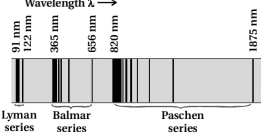
0 likes
View Solution96
Medium
What is the hydrogen spectral series? Explain with the help of a diagram.
Solution
(N/A) The hydrogen spectral series refers to the set of discrete wavelengths of electromagnetic radiation emitted by hydrogen atoms when electrons transition between different energy levels. When an electron jumps from a higher energy level $(n_i)$ to a lower energy level $(n_f)$,a photon is emitted with energy $E = E_{n_i} - E_{n_f} = h\nu = \frac{hc}{\lambda}$.
The wavelength $\lambda$ is given by the Rydberg formula: $\frac{1}{\lambda} = R \left( \frac{1}{n_f^2} - \frac{1}{n_i^2} \right)$,where $R$ is the Rydberg constant $(1.097 \times 10^7 \ m^{-1})$.
The main series are:
$1$. Lyman series: $n_f = 1$,$n_i = 2, 3, 4, \dots$ (Ultraviolet region).
$2$. Balmer series: $n_f = 2$,$n_i = 3, 4, 5, \dots$ (Visible region).
$3$. Paschen series: $n_f = 3$,$n_i = 4, 5, 6, \dots$ (Infrared region).
$4$. Brackett series: $n_f = 4$,$n_i = 5, 6, 7, \dots$ (Infrared region).
$5$. Pfund series: $n_f = 5$,$n_i = 6, 7, 8, \dots$ (Infrared region).
The wavelength $\lambda$ is given by the Rydberg formula: $\frac{1}{\lambda} = R \left( \frac{1}{n_f^2} - \frac{1}{n_i^2} \right)$,where $R$ is the Rydberg constant $(1.097 \times 10^7 \ m^{-1})$.
The main series are:
$1$. Lyman series: $n_f = 1$,$n_i = 2, 3, 4, \dots$ (Ultraviolet region).
$2$. Balmer series: $n_f = 2$,$n_i = 3, 4, 5, \dots$ (Visible region).
$3$. Paschen series: $n_f = 3$,$n_i = 4, 5, 6, \dots$ (Infrared region).
$4$. Brackett series: $n_f = 4$,$n_i = 5, 6, 7, \dots$ (Infrared region).
$5$. Pfund series: $n_f = 5$,$n_i = 6, 7, 8, \dots$ (Infrared region).
0 likes
View Solution97
Difficult
Name the different series obtained in the hydrogen spectrum and give the general formula for finding the wave number.
Solution
(N/A) The different series observed in the hydrogen spectrum are:
$1$. Lyman series: $\frac{1}{\lambda} = R \left( \frac{1}{1^2} - \frac{1}{n^2} \right)$,where $n = 2, 3, 4, \dots$
$2$. Balmer series: $\frac{1}{\lambda} = R \left( \frac{1}{2^2} - \frac{1}{n^2} \right)$,where $n = 3, 4, 5, \dots$
$3$. Paschen series: $\frac{1}{\lambda} = R \left( \frac{1}{3^2} - \frac{1}{n^2} \right)$,where $n = 4, 5, 6, \dots$
$4$. Brackett series: $\frac{1}{\lambda} = R \left( \frac{1}{4^2} - \frac{1}{n^2} \right)$,where $n = 5, 6, 7, \dots$
$5$. Pfund series: $\frac{1}{\lambda} = R \left( \frac{1}{5^2} - \frac{1}{n^2} \right)$,where $n = 6, 7, 8, \dots$
The general Rydberg formula for the wave number $\bar{\nu} = \frac{1}{\lambda}$ is:
$\bar{\nu} = R \left( \frac{1}{n_1^2} - \frac{1}{n_2^2} \right)$
where $R$ is the Rydberg constant $(1.097 \times 10^7 \ m^{-1})$,$n_1$ is the lower energy level,and $n_2$ is the higher energy level $(n_2 > n_1)$.
$1$. Lyman series: $\frac{1}{\lambda} = R \left( \frac{1}{1^2} - \frac{1}{n^2} \right)$,where $n = 2, 3, 4, \dots$
$2$. Balmer series: $\frac{1}{\lambda} = R \left( \frac{1}{2^2} - \frac{1}{n^2} \right)$,where $n = 3, 4, 5, \dots$
$3$. Paschen series: $\frac{1}{\lambda} = R \left( \frac{1}{3^2} - \frac{1}{n^2} \right)$,where $n = 4, 5, 6, \dots$
$4$. Brackett series: $\frac{1}{\lambda} = R \left( \frac{1}{4^2} - \frac{1}{n^2} \right)$,where $n = 5, 6, 7, \dots$
$5$. Pfund series: $\frac{1}{\lambda} = R \left( \frac{1}{5^2} - \frac{1}{n^2} \right)$,where $n = 6, 7, 8, \dots$
The general Rydberg formula for the wave number $\bar{\nu} = \frac{1}{\lambda}$ is:
$\bar{\nu} = R \left( \frac{1}{n_1^2} - \frac{1}{n_2^2} \right)$
where $R$ is the Rydberg constant $(1.097 \times 10^7 \ m^{-1})$,$n_1$ is the lower energy level,and $n_2$ is the higher energy level $(n_2 > n_1)$.
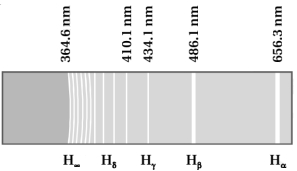
0 likes
View SolutionAtoms — Spectral Series of Hydrogen Atom · Frequently Asked Questions
1Are these Atoms questions useful for JEE and NEET?
Yes. All questions in this section are mapped to JEE Main and NEET exam patterns. Previous year questions from JEE Main, NEET, GUJCET and state-level exams are included with full solutions.
2Can I switch to Hindi or Gujarati for these questions?
Yes. Use the language tabs in the hero section or the sidebar to view the same questions and solutions in English, Hindi or Gujarati.
3How do I generate a question paper from this subtopic?
Use the Vedclass Exam Paper Generator — select the chapter and subtopic, set difficulty, and generate Sets A, B, C, D automatically. First 3 chapters of every subject are free.
Vedclass Products
For Students
Vedclass Test Series
Mock tests in real JEE/NEET style with performance analysis. 5-day free trial.
Start Free TrialFor Teachers
Exam Paper Generator
Generate Set A/B/C/D papers from this chapter in 2 minutes. 3 chapters free.
Try FreeFor Institutes
Online Exam Module
Live online exams with unlimited students, 360° analytics & white-label branding.
See DemoFor Teachers & Institutes
Generate a Atoms Exam Paper in 2 Minutes
Select subtopic & difficulty — Sets A, B, C, D auto-generated with No Repeat logic.
First 3 chapters of every subject are free — no payment required.