
A English
Half Power Frequency , Quality Factor ,Resonance in AC Circuit Questions in English
Class 12 Physics · Alternating Current · Half Power Frequency , Quality Factor ,Resonance in AC Circuit
261+
Questions
English
Language
100%
With Solutions
Showing 10 of 261 questions in English
251
MediumMCQ
In an $LCR$ circuit,the resonance frequency of the circuit increases to two times its initial value by changing the capacitance from $C$ to $C^{\prime}$ and the resistance from $100 \ \Omega$ to $400 \ \Omega$,while the inductance $L$ is kept constant. The ratio $C / C^{\prime}$ is:
A
$2$
B
$8$
C
$16$
D
$4$
Solution
(D) The resonance frequency $f$ of a series $LCR$ circuit is given by the formula: $f = \frac{1}{2 \pi \sqrt{LC}}$.
Initially,$f_1 = \frac{1}{2 \pi \sqrt{LC}}$.
Finally,the resonance frequency becomes $f_2 = 2f_1$ by changing $C$ to $C^{\prime}$.
Thus,$f_2 = \frac{1}{2 \pi \sqrt{LC^{\prime}}}$.
Substituting $f_2 = 2f_1$ into the equation:
$\frac{1}{2 \pi \sqrt{LC^{\prime}}} = 2 \times \frac{1}{2 \pi \sqrt{LC}}$.
Canceling common terms $2 \pi$ and $\sqrt{L}$ from both sides:
$\frac{1}{\sqrt{C^{\prime}}} = \frac{2}{\sqrt{C}}$.
Squaring both sides:
$\frac{1}{C^{\prime}} = \frac{4}{C}$.
Therefore,the ratio $\frac{C}{C^{\prime}} = 4$.
Note: The change in resistance $R$ does not affect the resonance frequency of an $LCR$ circuit.
Initially,$f_1 = \frac{1}{2 \pi \sqrt{LC}}$.
Finally,the resonance frequency becomes $f_2 = 2f_1$ by changing $C$ to $C^{\prime}$.
Thus,$f_2 = \frac{1}{2 \pi \sqrt{LC^{\prime}}}$.
Substituting $f_2 = 2f_1$ into the equation:
$\frac{1}{2 \pi \sqrt{LC^{\prime}}} = 2 \times \frac{1}{2 \pi \sqrt{LC}}$.
Canceling common terms $2 \pi$ and $\sqrt{L}$ from both sides:
$\frac{1}{\sqrt{C^{\prime}}} = \frac{2}{\sqrt{C}}$.
Squaring both sides:
$\frac{1}{C^{\prime}} = \frac{4}{C}$.
Therefore,the ratio $\frac{C}{C^{\prime}} = 4$.
Note: The change in resistance $R$ does not affect the resonance frequency of an $LCR$ circuit.
0 likes
View Solution252
EasyMCQ
$A$ series $LCR$ circuit is connected across a source of alternating emf of changing frequency and resonates at frequency $f_0$. Keeping capacitance constant,if the inductance $(L)$ is increased by $\sqrt{3}$ times and resistance is increased $(R)$ by $1.4$ times,the resonant frequency now is
A
$3^{1/4} f_0$
B
$\sqrt{3} f_0$
C
$(\sqrt{3}-1)^{1/4} f_0$
D
$\left(\frac{1}{3}\right)^{1/4} f_0$
Solution
(D) The resonant frequency of a series $LCR$ circuit is given by the formula: $f = \frac{1}{2\pi\sqrt{LC}}$.
From this formula,we can see that the resonant frequency $f$ is inversely proportional to the square root of the inductance $L$,provided the capacitance $C$ remains constant: $f \propto \frac{1}{\sqrt{L}}$.
Let the initial resonant frequency be $f_0$ with inductance $L$. Thus,$f_0 = \frac{1}{2\pi\sqrt{LC}}$.
When the inductance is increased by $\sqrt{3}$ times,the new inductance $L' = \sqrt{3}L$. The resistance $R$ does not affect the resonant frequency.
The new resonant frequency $f'$ is given by: $f' = \frac{1}{2\pi\sqrt{L'C}} = \frac{1}{2\pi\sqrt{(\sqrt{3}L)C}}$.
Dividing $f'$ by $f_0$: $\frac{f'}{f_0} = \frac{\frac{1}{2\pi\sqrt{\sqrt{3}LC}}}{\frac{1}{2\pi\sqrt{LC}}} = \frac{1}{\sqrt{\sqrt{3}}} = \left(\frac{1}{3^{1/2}}\right)^{1/2} = \left(\frac{1}{3}\right)^{1/4}$.
Therefore,the new resonant frequency is $f' = \left(\frac{1}{3}\right)^{1/4} f_0$.
From this formula,we can see that the resonant frequency $f$ is inversely proportional to the square root of the inductance $L$,provided the capacitance $C$ remains constant: $f \propto \frac{1}{\sqrt{L}}$.
Let the initial resonant frequency be $f_0$ with inductance $L$. Thus,$f_0 = \frac{1}{2\pi\sqrt{LC}}$.
When the inductance is increased by $\sqrt{3}$ times,the new inductance $L' = \sqrt{3}L$. The resistance $R$ does not affect the resonant frequency.
The new resonant frequency $f'$ is given by: $f' = \frac{1}{2\pi\sqrt{L'C}} = \frac{1}{2\pi\sqrt{(\sqrt{3}L)C}}$.
Dividing $f'$ by $f_0$: $\frac{f'}{f_0} = \frac{\frac{1}{2\pi\sqrt{\sqrt{3}LC}}}{\frac{1}{2\pi\sqrt{LC}}} = \frac{1}{\sqrt{\sqrt{3}}} = \left(\frac{1}{3^{1/2}}\right)^{1/2} = \left(\frac{1}{3}\right)^{1/4}$.
Therefore,the new resonant frequency is $f' = \left(\frac{1}{3}\right)^{1/4} f_0$.
0 likes
View Solution253
EasyMCQ
For an $R-L-C$ circuit,driven with voltage of amplitude $V_m$ and frequency $\omega_0 = \frac{1}{\sqrt{LC}}$,the current exhibits resonance. The quality factor $Q$ is
A
$\frac{\omega_0 R}{L}$
B
$\frac{R}{\omega_0 C}$
C
$\frac{CR}{\omega_0}$
D
$\frac{\omega_0 L}{R}$
Solution
(D) The quality factor $Q$ of an $R-L-C$ series circuit is defined as the ratio of the voltage drop across the inductor (or capacitor) to the voltage drop across the resistor at resonance.
$Q = \frac{V_L}{V_R} = \frac{I X_L}{I R} = \frac{\omega_0 L}{R}$.
At resonance,the resonant frequency is given by $\omega_0 = \frac{1}{\sqrt{LC}}$.
Substituting $\sqrt{LC} = \frac{1}{\omega_0}$,we can also write $Q = \frac{1}{R} \sqrt{\frac{L}{C}}$.
Comparing this with the given options,the expression for the quality factor is $\frac{\omega_0 L}{R}$.
$Q = \frac{V_L}{V_R} = \frac{I X_L}{I R} = \frac{\omega_0 L}{R}$.
At resonance,the resonant frequency is given by $\omega_0 = \frac{1}{\sqrt{LC}}$.
Substituting $\sqrt{LC} = \frac{1}{\omega_0}$,we can also write $Q = \frac{1}{R} \sqrt{\frac{L}{C}}$.
Comparing this with the given options,the expression for the quality factor is $\frac{\omega_0 L}{R}$.
0 likes
View Solution254
MediumMCQ
$A$ parallel plate capacitor in series with a resistance of $100 \Omega$,an inductor of $20 \text{ mH}$,and an $AC$ voltage source of variable frequency shows resonance at a frequency of $\frac{1250}{\pi} \text{ Hz}$. If this capacitor is charged by a $DC$ voltage source to a voltage of $25 \text{ V}$,what amount of charge will be stored in each plate of the capacitor?
A
$0.2 \mu\text{C}$
B
$2 \text{ mC}$
C
$0.2 \text{ mC}$
D
$0.2 \text{ C}$
Solution
(C) In a series $R-L-C$ circuit,the resonance frequency is given by $f_0 = \frac{1}{2\pi\sqrt{LC}}$.
Given: $R = 100 \Omega$,$L = 20 \text{ mH} = 20 \times 10^{-3} \text{ H}$,$f_0 = \frac{1250}{\pi} \text{ Hz}$.
Substituting the values into the resonance formula:
$\frac{1250}{\pi} = \frac{1}{2\pi\sqrt{20 \times 10^{-3} \times C}}$
$1250 = \frac{1}{2\sqrt{0.02 \times C}}$
$2500 = \frac{1}{\sqrt{0.02 \times C}}$
Squaring both sides:
$6.25 \times 10^6 = \frac{1}{0.02 \times C}$
$C = \frac{1}{0.02 \times 6.25 \times 10^6} = \frac{1}{0.125 \times 10^6} = 8 \times 10^{-6} \text{ F} = 8 \mu\text{F}$.
When charged by a $DC$ source of $V = 25 \text{ V}$,the charge $Q$ stored is:
$Q = C \times V = 8 \times 10^{-6} \text{ F} \times 25 \text{ V} = 200 \times 10^{-6} \text{ C} = 0.2 \times 10^{-3} \text{ C} = 0.2 \text{ mC}$.
Given: $R = 100 \Omega$,$L = 20 \text{ mH} = 20 \times 10^{-3} \text{ H}$,$f_0 = \frac{1250}{\pi} \text{ Hz}$.
Substituting the values into the resonance formula:
$\frac{1250}{\pi} = \frac{1}{2\pi\sqrt{20 \times 10^{-3} \times C}}$
$1250 = \frac{1}{2\sqrt{0.02 \times C}}$
$2500 = \frac{1}{\sqrt{0.02 \times C}}$
Squaring both sides:
$6.25 \times 10^6 = \frac{1}{0.02 \times C}$
$C = \frac{1}{0.02 \times 6.25 \times 10^6} = \frac{1}{0.125 \times 10^6} = 8 \times 10^{-6} \text{ F} = 8 \mu\text{F}$.
When charged by a $DC$ source of $V = 25 \text{ V}$,the charge $Q$ stored is:
$Q = C \times V = 8 \times 10^{-6} \text{ F} \times 25 \text{ V} = 200 \times 10^{-6} \text{ C} = 0.2 \times 10^{-3} \text{ C} = 0.2 \text{ mC}$.
0 likes
View Solution255
EasyMCQ
An alternating current is flowing through a series $L-C-R$ circuit. It is found that the current reaches a value of $1 \ mA$ at both $200 \ Hz$ and $800 \ Hz$ frequency. What is the resonance frequency of the circuit (in $Hz$)?
A
$600$
B
$300$
C
$500$
D
$400$
Solution
(D) In a series $L-C-R$ circuit,the current is the same at two different frequencies $f_1$ and $f_2$ if these frequencies are equidistant from the resonance frequency $f_0$ in a geometric sense.
The resonance frequency $f_0$ is given by the geometric mean of the two frequencies at which the current is equal:
$f_0 = \sqrt{f_1 \times f_2}$
Given:
$f_1 = 200 \ Hz$
$f_2 = 800 \ Hz$
Substituting the values:
$f_0 = \sqrt{200 \times 800}$
$f_0 = \sqrt{160000}$
$f_0 = 400 \ Hz$
Thus,the resonance frequency of the circuit is $400 \ Hz$.
The resonance frequency $f_0$ is given by the geometric mean of the two frequencies at which the current is equal:
$f_0 = \sqrt{f_1 \times f_2}$
Given:
$f_1 = 200 \ Hz$
$f_2 = 800 \ Hz$
Substituting the values:
$f_0 = \sqrt{200 \times 800}$
$f_0 = \sqrt{160000}$
$f_0 = 400 \ Hz$
Thus,the resonance frequency of the circuit is $400 \ Hz$.
0 likes
View Solution256
MediumMCQ
When the frequency of the $AC$ voltage applied to a series $LCR$ circuit is gradually increased from a low value,the impedance of the circuit
A
monotonically increases
B
first increases and then decreases
C
first decreases and then increases
D
monotonically decreases
Solution
(C) The impedance $Z$ of a series $LCR$ circuit is given by the formula: $Z = \sqrt{R^2 + (X_L - X_C)^2} = \sqrt{R^2 + (\omega L - \frac{1}{\omega C})^2}$.
At very low frequencies $(\omega \to 0)$,the capacitive reactance $X_C = \frac{1}{\omega C}$ is very large,making the impedance $Z$ very high.
As the frequency $\omega$ increases,the term $(\omega L - \frac{1}{\omega C})^2$ decreases until it reaches zero at the resonance frequency $\omega_0 = \frac{1}{\sqrt{LC}}$. At this point,$Z = R$,which is the minimum value.
As the frequency increases further beyond $\omega_0$,the inductive reactance $X_L = \omega L$ becomes dominant,and the term $(\omega L - \frac{1}{\omega C})^2$ increases again,causing the impedance $Z$ to increase.
Therefore,the impedance first decreases and then increases.
At very low frequencies $(\omega \to 0)$,the capacitive reactance $X_C = \frac{1}{\omega C}$ is very large,making the impedance $Z$ very high.
As the frequency $\omega$ increases,the term $(\omega L - \frac{1}{\omega C})^2$ decreases until it reaches zero at the resonance frequency $\omega_0 = \frac{1}{\sqrt{LC}}$. At this point,$Z = R$,which is the minimum value.
As the frequency increases further beyond $\omega_0$,the inductive reactance $X_L = \omega L$ becomes dominant,and the term $(\omega L - \frac{1}{\omega C})^2$ increases again,causing the impedance $Z$ to increase.
Therefore,the impedance first decreases and then increases.
0 likes
View Solution257
MediumMCQ
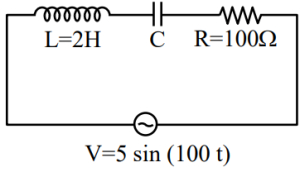
Using a variable-frequency a.c. voltage source,the maximum current measured in the given $LCR$ circuit is $50 \text{ mA}$ for $V = 5 \sin(100t)$. The values of $L$ and $R$ are shown in the figure. The capacitance of the capacitor $(C)$ used is . . . . . . $\mu\text{F}$.
A
$25$
B
$50$
C
$75$
D
$100$
Solution
(B) In an $LCR$ circuit,the current is maximum at resonance.
At resonance,the angular frequency $\omega$ is given by $\omega = \frac{1}{\sqrt{LC}}$.
From the given voltage equation $V = 5 \sin(100t)$,we have $\omega = 100 \text{ rad/s}$.
Given $L = 2 \text{ H}$,we can substitute these values into the resonance formula:
$100 = \frac{1}{\sqrt{2 \times C}}$
Squaring both sides:
$10000 = \frac{1}{2C}$
$C = \frac{1}{2 \times 10000} = \frac{1}{20000} \text{ F}$
$C = 0.5 \times 10^{-4} \text{ F} = 50 \times 10^{-6} \text{ F} = 50 \mu\text{F}$.
At resonance,the angular frequency $\omega$ is given by $\omega = \frac{1}{\sqrt{LC}}$.
From the given voltage equation $V = 5 \sin(100t)$,we have $\omega = 100 \text{ rad/s}$.
Given $L = 2 \text{ H}$,we can substitute these values into the resonance formula:
$100 = \frac{1}{\sqrt{2 \times C}}$
Squaring both sides:
$10000 = \frac{1}{2C}$
$C = \frac{1}{2 \times 10000} = \frac{1}{20000} \text{ F}$
$C = 0.5 \times 10^{-4} \text{ F} = 50 \times 10^{-6} \text{ F} = 50 \mu\text{F}$.
0 likes
View Solution258
MediumMCQ
In which of the following $AC$ circuit,we get the value of power factor $1$ at resonance condition?
A
$LCR$ series circuit
B
$CR$ series circuit
C
Only inductor $(L)$ circuit
D
$LR$ series circuit
Solution
(A) In an $LCR$ series circuit,resonance occurs when the inductive reactance $X_L$ equals the capacitive reactance $X_C$ $(X_L = X_C)$.
At this condition,the total impedance $Z$ is equal to the resistance $R$,meaning the circuit behaves purely resistively.
The power factor is given by $\cos \phi = \frac{R}{Z}$.
At resonance,$Z = R$,so $\cos \phi = \frac{R}{R} = 1$.
At this condition,the total impedance $Z$ is equal to the resistance $R$,meaning the circuit behaves purely resistively.
The power factor is given by $\cos \phi = \frac{R}{Z}$.
At resonance,$Z = R$,so $\cos \phi = \frac{R}{R} = 1$.
0 likes
View Solution259
DifficultMCQ
$A$ series $LCR$ circuit with $R = 20 \ \Omega$,$L = 1.6 \ \text{H}$ and $C = 40 \ \mu\text{F}$ is connected to a variable frequency a.c. source. The inductive reactance at resonant frequency is . . . . . . $\Omega$.
A
$10$
B
$20$
C
$80$
D
$200$
Solution
(D) At resonance,the inductive reactance $X_L$ is equal to the capacitive reactance $X_C$.
The resonant angular frequency is given by $\omega_0 = \frac{1}{\sqrt{LC}}$.
The inductive reactance at resonance is $X_L = \omega_0 L = \frac{1}{\sqrt{LC}} \times L = \sqrt{\frac{L}{C}}$.
Given: $L = 1.6 \ \text{H}$ and $C = 40 \ \mu\text{F} = 40 \times 10^{-6} \ \text{F}$.
Substituting these values into the formula:
$X_L = \sqrt{\frac{1.6}{40 \times 10^{-6}}} = \sqrt{\frac{1.6 \times 10^6}{40}} = \sqrt{0.04 \times 10^6} = \sqrt{40000} = 200 \ \Omega$.
Therefore,the inductive reactance at resonant frequency is $200 \ \Omega$.
The resonant angular frequency is given by $\omega_0 = \frac{1}{\sqrt{LC}}$.
The inductive reactance at resonance is $X_L = \omega_0 L = \frac{1}{\sqrt{LC}} \times L = \sqrt{\frac{L}{C}}$.
Given: $L = 1.6 \ \text{H}$ and $C = 40 \ \mu\text{F} = 40 \times 10^{-6} \ \text{F}$.
Substituting these values into the formula:
$X_L = \sqrt{\frac{1.6}{40 \times 10^{-6}}} = \sqrt{\frac{1.6 \times 10^6}{40}} = \sqrt{0.04 \times 10^6} = \sqrt{40000} = 200 \ \Omega$.
Therefore,the inductive reactance at resonant frequency is $200 \ \Omega$.
0 likes
View Solution260
DifficultMCQ
An $AC$ circuit contains a resistance of $1 \text{ k}Omega$,a capacitor of $0.1 \mu\text{F}$,and an inductor of $1 \text{ mH}$ connected in series. The resonance frequency of the circuit is approximately: (in $kHz$)
A
$15.9$
B
$20.7$
C
$10.1$
D
$13.5$
Solution
(A) The resonant frequency $f_r$ of an $LCR$ series circuit is given by the formula: $f_r = \frac{1}{2 \pi \sqrt{LC}}$.
Given values are $L = 1 \text{ mH} = 10^{-3} \text{ H}$ and $C = 0.1 \mu\text{F} = 0.1 \times 10^{-6} \text{ F} = 10^{-7} \text{ F}$.
Substituting these values into the formula:
$\sqrt{LC} = \sqrt{10^{-3} \times 10^{-7}} = \sqrt{10^{-10}} = 10^{-5}$.
Now,$f_r = \frac{1}{2 \pi \times 10^{-5}} = \frac{10^5}{2 \times 3.14159} \approx \frac{100000}{6.283} \approx 15915.5 \text{ Hz}$.
Converting to kHz,$f_r \approx 15.9 \text{ kHz}$.
Therefore,the correct option is $A$.
Given values are $L = 1 \text{ mH} = 10^{-3} \text{ H}$ and $C = 0.1 \mu\text{F} = 0.1 \times 10^{-6} \text{ F} = 10^{-7} \text{ F}$.
Substituting these values into the formula:
$\sqrt{LC} = \sqrt{10^{-3} \times 10^{-7}} = \sqrt{10^{-10}} = 10^{-5}$.
Now,$f_r = \frac{1}{2 \pi \times 10^{-5}} = \frac{10^5}{2 \times 3.14159} \approx \frac{100000}{6.283} \approx 15915.5 \text{ Hz}$.
Converting to kHz,$f_r \approx 15.9 \text{ kHz}$.
Therefore,the correct option is $A$.
0 likes
View SolutionAlternating Current — Half Power Frequency , Quality Factor ,Resonance in AC Circuit · Frequently Asked Questions
1Are these Alternating Current questions useful for JEE and NEET?
Yes. All questions in this section are mapped to JEE Main and NEET exam patterns. Previous year questions from JEE Main, NEET, GUJCET and state-level exams are included with full solutions.
2Can I switch to Hindi or Gujarati for these questions?
Yes. Use the language tabs in the hero section or the sidebar to view the same questions and solutions in English, Hindi or Gujarati.
3How do I generate a question paper from this subtopic?
Use the Vedclass Exam Paper Generator — select the chapter and subtopic, set difficulty, and generate Sets A, B, C, D automatically. First 3 chapters of every subject are free.
Vedclass Products
For Students
Vedclass Test Series
Mock tests in real JEE/NEET style with performance analysis. 5-day free trial.
Start Free TrialFor Teachers
Exam Paper Generator
Generate Set A/B/C/D papers from this chapter in 2 minutes. 3 chapters free.
Try FreeFor Institutes
Online Exam Module
Live online exams with unlimited students, 360° analytics & white-label branding.
See DemoFor Teachers & Institutes
Generate a Alternating Current Exam Paper in 2 Minutes
Select subtopic & difficulty — Sets A, B, C, D auto-generated with No Repeat logic.
First 3 chapters of every subject are free — no payment required.