
A English
Scalar or Dot product of two vectors and its applications Questions in English
Class 12 Mathematics · Vector Algebra · Scalar or Dot product of two vectors and its applications
923+
Questions
English
Language
100%
With Solutions
Showing 50 of 923 questions in English
201
MediumMCQ
$A$ particle is acted upon by constant forces $4\hat{i} + \hat{j} - 3\hat{k}$ and $3\hat{i} + \hat{j} - \hat{k}$. The displacement of the particle from the point $\hat{i} + 2\hat{j} + 3\hat{k}$ to the point $5\hat{i} + 4\hat{j} + \hat{k}$ is given. Find the total work done by the forces in units.
A
$50$
B
$20$
C
$30$
D
$40$
Solution
(D) The total force $\vec{F}$ is the sum of the individual forces:
$\vec{F} = (4\hat{i} + \hat{j} - 3\hat{k}) + (3\hat{i} + \hat{j} - \hat{k}) = 7\hat{i} + 2\hat{j} - 4\hat{k}$.
The displacement vector $\vec{d}$ is the difference between the final position vector and the initial position vector:
$\vec{d} = (5\hat{i} + 4\hat{j} + \hat{k}) - (\hat{i} + 2\hat{j} + 3\hat{k}) = 4\hat{i} + 2\hat{j} - 2\hat{k}$.
The work done $W$ is the dot product of the total force and the displacement:
$W = \vec{F} \cdot \vec{d} = (7\hat{i} + 2\hat{j} - 4\hat{k}) \cdot (4\hat{i} + 2\hat{j} - 2\hat{k})$.
$W = (7 \times 4) + (2 \times 2) + (-4 \times -2) = 28 + 4 + 8 = 40$ units.
$\vec{F} = (4\hat{i} + \hat{j} - 3\hat{k}) + (3\hat{i} + \hat{j} - \hat{k}) = 7\hat{i} + 2\hat{j} - 4\hat{k}$.
The displacement vector $\vec{d}$ is the difference between the final position vector and the initial position vector:
$\vec{d} = (5\hat{i} + 4\hat{j} + \hat{k}) - (\hat{i} + 2\hat{j} + 3\hat{k}) = 4\hat{i} + 2\hat{j} - 2\hat{k}$.
The work done $W$ is the dot product of the total force and the displacement:
$W = \vec{F} \cdot \vec{d} = (7\hat{i} + 2\hat{j} - 4\hat{k}) \cdot (4\hat{i} + 2\hat{j} - 2\hat{k})$.
$W = (7 \times 4) + (2 \times 2) + (-4 \times -2) = 28 + 4 + 8 = 40$ units.
0 likes
View Solution202
DifficultMCQ
If $\vec{l}, \vec{m}, \vec{n}$ are coplanar vectors,for what value of $\lambda$ are the points with position vectors $\vec{l} - 2\vec{m} + 3\vec{n}$,$2\vec{l} + \lambda\vec{m} - 4\vec{n}$,and $-7\vec{m} + 10\vec{n}$ collinear?
A
$3$
B
$2$
C
$0$
D
None of these
Solution
(A) Let the position vectors of the points be $\vec{A} = \vec{l} - 2\vec{m} + 3\vec{n}$,$\vec{B} = 2\vec{l} + \lambda\vec{m} - 4\vec{n}$,and $\vec{C} = -7\vec{m} + 10\vec{n}$.
For the points to be collinear,the vectors $\vec{AB}$ and $\vec{AC}$ must be parallel,meaning $\vec{AB} = k\vec{AC}$ for some scalar $k$.
$\vec{AB} = \vec{B} - \vec{A} = (2\vec{l} + \lambda\vec{m} - 4\vec{n}) - (\vec{l} - 2\vec{m} + 3\vec{n}) = \vec{l} + (\lambda + 2)\vec{m} - 7\vec{n}$.
$\vec{AC} = \vec{C} - \vec{A} = (-7\vec{m} + 10\vec{n}) - (\vec{l} - 2\vec{m} + 3\vec{n}) = -\vec{l} - 5\vec{m} + 7\vec{n}$.
Since $\vec{AB} = k\vec{AC}$,we have $\vec{l} + (\lambda + 2)\vec{m} - 7\vec{n} = k(-\vec{l} - 5\vec{m} + 7\vec{n})$.
Comparing the coefficients of $\vec{l}, \vec{m}, \vec{n}$:
For $\vec{l}$: $1 = -k \implies k = -1$.
For $\vec{n}$: $-7 = 7k \implies k = -1$.
For $\vec{m}$: $\lambda + 2 = -5k$.
Substituting $k = -1$ into the equation for $\vec{m}$:
$\lambda + 2 = -5(-1) = 5$.
$\lambda = 5 - 2 = 3$.
For the points to be collinear,the vectors $\vec{AB}$ and $\vec{AC}$ must be parallel,meaning $\vec{AB} = k\vec{AC}$ for some scalar $k$.
$\vec{AB} = \vec{B} - \vec{A} = (2\vec{l} + \lambda\vec{m} - 4\vec{n}) - (\vec{l} - 2\vec{m} + 3\vec{n}) = \vec{l} + (\lambda + 2)\vec{m} - 7\vec{n}$.
$\vec{AC} = \vec{C} - \vec{A} = (-7\vec{m} + 10\vec{n}) - (\vec{l} - 2\vec{m} + 3\vec{n}) = -\vec{l} - 5\vec{m} + 7\vec{n}$.
Since $\vec{AB} = k\vec{AC}$,we have $\vec{l} + (\lambda + 2)\vec{m} - 7\vec{n} = k(-\vec{l} - 5\vec{m} + 7\vec{n})$.
Comparing the coefficients of $\vec{l}, \vec{m}, \vec{n}$:
For $\vec{l}$: $1 = -k \implies k = -1$.
For $\vec{n}$: $-7 = 7k \implies k = -1$.
For $\vec{m}$: $\lambda + 2 = -5k$.
Substituting $k = -1$ into the equation for $\vec{m}$:
$\lambda + 2 = -5(-1) = 5$.
$\lambda = 5 - 2 = 3$.
0 likes
View Solution203
DifficultMCQ
If $\bar{a}$ and $\bar{b}$ are unit vectors such that $(\bar{a} + 2\bar{b})$ and $(5\bar{a} - 4\bar{b})$ are perpendicular to each other,then the angle between $\bar{a}$ and $\bar{b}$ is .....$^o$.
A
$45$
B
$60$
C
$\cos^{-1}\left(\frac{1}{3}\right)$
D
$\cos^{-1}\left(\frac{2}{7}\right)$
Solution
(B) Given that $(\bar{a} + 2\bar{b})$ and $(5\bar{a} - 4\bar{b})$ are perpendicular,their dot product is zero:
$(\bar{a} + 2\bar{b}) \cdot (5\bar{a} - 4\bar{b}) = 0$
Expanding the dot product:
$5|\bar{a}|^2 - 4(\bar{a} \cdot \bar{b}) + 10(\bar{a} \cdot \bar{b}) - 8|\bar{b}|^2 = 0$
Since $\bar{a}$ and $\bar{b}$ are unit vectors,$|\bar{a}| = 1$ and $|\bar{b}| = 1$:
$5(1)^2 + 6(\bar{a} \cdot \bar{b}) - 8(1)^2 = 0$
$5 + 6(\bar{a} \cdot \bar{b}) - 8 = 0$
$6(\bar{a} \cdot \bar{b}) = 3$
$\bar{a} \cdot \bar{b} = \frac{3}{6} = \frac{1}{2}$
Let $\theta$ be the angle between $\bar{a}$ and $\bar{b}$. Then $\cos \theta = \frac{\bar{a} \cdot \bar{b}}{|\bar{a}||\bar{b}|} = \frac{1/2}{1 \times 1} = \frac{1}{2}$.
Therefore,$\theta = \cos^{-1}\left(\frac{1}{2}\right) = 60^o$.
$(\bar{a} + 2\bar{b}) \cdot (5\bar{a} - 4\bar{b}) = 0$
Expanding the dot product:
$5|\bar{a}|^2 - 4(\bar{a} \cdot \bar{b}) + 10(\bar{a} \cdot \bar{b}) - 8|\bar{b}|^2 = 0$
Since $\bar{a}$ and $\bar{b}$ are unit vectors,$|\bar{a}| = 1$ and $|\bar{b}| = 1$:
$5(1)^2 + 6(\bar{a} \cdot \bar{b}) - 8(1)^2 = 0$
$5 + 6(\bar{a} \cdot \bar{b}) - 8 = 0$
$6(\bar{a} \cdot \bar{b}) = 3$
$\bar{a} \cdot \bar{b} = \frac{3}{6} = \frac{1}{2}$
Let $\theta$ be the angle between $\bar{a}$ and $\bar{b}$. Then $\cos \theta = \frac{\bar{a} \cdot \bar{b}}{|\bar{a}||\bar{b}|} = \frac{1/2}{1 \times 1} = \frac{1}{2}$.
Therefore,$\theta = \cos^{-1}\left(\frac{1}{2}\right) = 60^o$.
0 likes
View Solution204
MediumMCQ
The projection of the vector $\hat{i} + \hat{j} + \hat{k}$ on the line $\vec{r} = 3\hat{i} - \hat{j} + \lambda(\hat{i} + 2\hat{j} + 3\hat{k})$ is:
A
$\frac{1}{\sqrt{14}}$
B
$\frac{6}{\sqrt{14}}$
C
$\frac{16}{\sqrt{14}}$
D
None of these
Solution
(B) Let the given vector be $\vec{a} = \hat{i} + \hat{j} + \hat{k}$.
The line is given by $\vec{r} = (3\hat{i} - \hat{j}) + \lambda(\hat{i} + 2\hat{j} + 3\hat{k})$.
The direction vector of the line is $\vec{b} = \hat{i} + 2\hat{j} + 3\hat{k}$.
The projection of vector $\vec{a}$ on the line is the projection of $\vec{a}$ onto its direction vector $\vec{b}$,which is given by the formula $\frac{|\vec{a} \cdot \vec{b}|}{|\vec{b}|}$.
First,calculate the dot product $\vec{a} \cdot \vec{b} = (1)(1) + (1)(2) + (1)(3) = 1 + 2 + 3 = 6$.
Next,calculate the magnitude of $\vec{b}$: $|\vec{b}| = \sqrt{1^2 + 2^2 + 3^2} = \sqrt{1 + 4 + 9} = \sqrt{14}$.
Therefore,the projection is $\frac{6}{\sqrt{14}}$.
The line is given by $\vec{r} = (3\hat{i} - \hat{j}) + \lambda(\hat{i} + 2\hat{j} + 3\hat{k})$.
The direction vector of the line is $\vec{b} = \hat{i} + 2\hat{j} + 3\hat{k}$.
The projection of vector $\vec{a}$ on the line is the projection of $\vec{a}$ onto its direction vector $\vec{b}$,which is given by the formula $\frac{|\vec{a} \cdot \vec{b}|}{|\vec{b}|}$.
First,calculate the dot product $\vec{a} \cdot \vec{b} = (1)(1) + (1)(2) + (1)(3) = 1 + 2 + 3 = 6$.
Next,calculate the magnitude of $\vec{b}$: $|\vec{b}| = \sqrt{1^2 + 2^2 + 3^2} = \sqrt{1 + 4 + 9} = \sqrt{14}$.
Therefore,the projection is $\frac{6}{\sqrt{14}}$.
0 likes
View Solution205
MediumMCQ
Assertion $(A)$: The scalar product of force $\vec{F}$ and displacement $\vec{r}$ is equal to the work done.
Reason $(R)$: The work done is not a scalar quantity.
Reason $(R)$: The work done is not a scalar quantity.
A
$A$ and $R$ are both independently true and $R$ is the correct explanation for $A$.
B
$A$ and $R$ are both independently true and $R$ is not the correct explanation for $A$.
C
$A$ is true but $R$ is false.
D
$A$ is false but $R$ is true.
Solution
(C) The work done $W$ is defined as the dot product of the force vector $\vec{F}$ and the displacement vector $\vec{r}$.
Mathematically,$W = \vec{F} \cdot \vec{r}$.
The dot product of two vectors always results in a scalar quantity.
Therefore,work done is a scalar quantity.
Since Assertion $(A)$ is true and Reason $(R)$ states that work done is not a scalar (which is false),the correct option is $C$.
Mathematically,$W = \vec{F} \cdot \vec{r}$.
The dot product of two vectors always results in a scalar quantity.
Therefore,work done is a scalar quantity.
Since Assertion $(A)$ is true and Reason $(R)$ states that work done is not a scalar (which is false),the correct option is $C$.
0 likes
View Solution206
MediumMCQ
Two forces $\vec{F_1} = 2\hat{i} - 5\hat{j} + 6\hat{k}$ and $\vec{F_2} = -\hat{i} + 2\hat{j} - \hat{k}$ act on a particle. The particle is displaced from point $P(4\hat{i} - 3\hat{j} + 2\hat{k})$ to point $Q(6\hat{i} + \hat{j} + 3\hat{k})$. The work done by the forces is ............. units.
A
$15$
B
$-15$
C
$10$
D
$-5$
Solution
(D) The resultant force $\vec{F}$ is given by $\vec{F} = \vec{F_1} + \vec{F_2} = (2\hat{i} - 5\hat{j} + 6\hat{k}) + (-\hat{i} + 2\hat{j} - \hat{k}) = \hat{i} - 3\hat{j} + 5\hat{k}$.
The displacement vector $\vec{d}$ is given by $\vec{d} = \vec{PQ} = \vec{OQ} - \vec{OP} = (6\hat{i} + \hat{j} + 3\hat{k}) - (4\hat{i} - 3\hat{j} + 2\hat{k}) = 2\hat{i} + 4\hat{j} + \hat{k}$.
The work done $W$ is the dot product of the resultant force and the displacement vector: $W = \vec{F} \cdot \vec{d} = (\hat{i} - 3\hat{j} + 5\hat{k}) \cdot (2\hat{i} + 4\hat{j} + \hat{k})$.
Calculating the dot product: $W = (1)(2) + (-3)(4) + (5)(1) = 2 - 12 + 5 = -5$ units.
The displacement vector $\vec{d}$ is given by $\vec{d} = \vec{PQ} = \vec{OQ} - \vec{OP} = (6\hat{i} + \hat{j} + 3\hat{k}) - (4\hat{i} - 3\hat{j} + 2\hat{k}) = 2\hat{i} + 4\hat{j} + \hat{k}$.
The work done $W$ is the dot product of the resultant force and the displacement vector: $W = \vec{F} \cdot \vec{d} = (\hat{i} - 3\hat{j} + 5\hat{k}) \cdot (2\hat{i} + 4\hat{j} + \hat{k})$.
Calculating the dot product: $W = (1)(2) + (-3)(4) + (5)(1) = 2 - 12 + 5 = -5$ units.
0 likes
View Solution207
MediumMCQ
If $|a| = 3$ and $|b| = 4$,for what value of $\lambda$ is the vector $(a + \lambda b)$ perpendicular to $(a - \lambda b)$?
A
$9/16$
B
$3/4$
C
$3/2$
D
$4/3$
Solution
(B) Two vectors are perpendicular if their dot product is $0$.
Given that $(a + \lambda b)$ is perpendicular to $(a - \lambda b)$,we have:
$(a + \lambda b) \cdot (a - \lambda b) = 0$
Using the property of the dot product $(u + v) \cdot (u - v) = |u|^2 - |v|^2$,we get:
$|a|^2 - |\lambda b|^2 = 0$
$|a|^2 - \lambda^2 |b|^2 = 0$
Substitute the given values $|a| = 3$ and $|b| = 4$:
$3^2 - \lambda^2 (4^2) = 0$
$9 - 16\lambda^2 = 0$
$16\lambda^2 = 9$
$\lambda^2 = \frac{9}{16}$
$\lambda = \pm \frac{3}{4}$
Given that $(a + \lambda b)$ is perpendicular to $(a - \lambda b)$,we have:
$(a + \lambda b) \cdot (a - \lambda b) = 0$
Using the property of the dot product $(u + v) \cdot (u - v) = |u|^2 - |v|^2$,we get:
$|a|^2 - |\lambda b|^2 = 0$
$|a|^2 - \lambda^2 |b|^2 = 0$
Substitute the given values $|a| = 3$ and $|b| = 4$:
$3^2 - \lambda^2 (4^2) = 0$
$9 - 16\lambda^2 = 0$
$16\lambda^2 = 9$
$\lambda^2 = \frac{9}{16}$
$\lambda = \pm \frac{3}{4}$
0 likes
View Solution208
EasyMCQ
The work done by a force $\vec{F} = 2\hat{i} - \hat{j} - \hat{k}$ on an object moving with a displacement vector $\vec{d} = 3\hat{i} + 2\hat{j} - 5\hat{k}$ is ............ units.
A
$-9$
B
$15$
C
$9$
D
None of these
Solution
(C) The work done $W$ is defined as the scalar (dot) product of the force vector $\vec{F}$ and the displacement vector $\vec{d}$.
$W = \vec{F} \cdot \vec{d}$
$W = (2\hat{i} - \hat{j} - \hat{k}) \cdot (3\hat{i} + 2\hat{j} - 5\hat{k})$
Using the property of dot product $\hat{i} \cdot \hat{i} = \hat{j} \cdot \hat{j} = \hat{k} \cdot \hat{k} = 1$ and others as $0$:
$W = (2 \times 3) + (-1 \times 2) + (-1 \times -5)$
$W = 6 - 2 + 5$
$W = 9$ units.
$W = \vec{F} \cdot \vec{d}$
$W = (2\hat{i} - \hat{j} - \hat{k}) \cdot (3\hat{i} + 2\hat{j} - 5\hat{k})$
Using the property of dot product $\hat{i} \cdot \hat{i} = \hat{j} \cdot \hat{j} = \hat{k} \cdot \hat{k} = 1$ and others as $0$:
$W = (2 \times 3) + (-1 \times 2) + (-1 \times -5)$
$W = 6 - 2 + 5$
$W = 9$ units.
0 likes
View Solution209
MediumMCQ
If a particle is acted upon by forces of magnitude $6$ and $7$ units in the directions of $-\hat{i} - 2\hat{j} + 2\hat{k}$ and $2\hat{i} - 3\hat{j} - 6\hat{k}$ respectively,and it undergoes a displacement from point $P(2, -1, -3)$ to $Q(5, -1, 1)$,then the work done by the forces is .......... units.
A
$-8$
B
$-4$
C
$7$
D
$-7$
Solution
(NONE) The resultant force $\vec{F}$ is the sum of the two force vectors.
First,find the unit vectors in the given directions:
$\hat{u}_1 = \frac{-\hat{i} - 2\hat{j} + 2\hat{k}}{\sqrt{(-1)^2 + (-2)^2 + 2^2}} = \frac{-\hat{i} - 2\hat{j} + 2\hat{k}}{3}$
$\hat{u}_2 = \frac{2\hat{i} - 3\hat{j} - 6\hat{k}}{\sqrt{2^2 + (-3)^2 + (-6)^2}} = \frac{2\hat{i} - 3\hat{j} - 6\hat{k}}{7}$
Now,calculate the force vectors:
$\vec{F}_1 = 6 \hat{u}_1 = 2(-\hat{i} - 2\hat{j} + 2\hat{k}) = -2\hat{i} - 4\hat{j} + 4\hat{k}$
$\vec{F}_2 = 7 \hat{u}_2 = 1(2\hat{i} - 3\hat{j} - 6\hat{k}) = 2\hat{i} - 3\hat{j} - 6\hat{k}$
Resultant force $\vec{F} = \vec{F}_1 + \vec{F}_2 = (-2+2)\hat{i} + (-4-3)\hat{j} + (4-6)\hat{k} = 0\hat{i} - 7\hat{j} - 2\hat{k}$
Displacement vector $\vec{d} = \vec{PQ} = (5-2)\hat{i} + (-1 - (-1))\hat{j} + (1 - (-3))\hat{k} = 3\hat{i} + 0\hat{j} + 4\hat{k}$
Work done $W = \vec{F} \cdot \vec{d} = (0\hat{i} - 7\hat{j} - 2\hat{k}) \cdot (3\hat{i} + 0\hat{j} + 4\hat{k}) = (0)(3) + (-7)(0) + (-2)(4) = -8$ units.
First,find the unit vectors in the given directions:
$\hat{u}_1 = \frac{-\hat{i} - 2\hat{j} + 2\hat{k}}{\sqrt{(-1)^2 + (-2)^2 + 2^2}} = \frac{-\hat{i} - 2\hat{j} + 2\hat{k}}{3}$
$\hat{u}_2 = \frac{2\hat{i} - 3\hat{j} - 6\hat{k}}{\sqrt{2^2 + (-3)^2 + (-6)^2}} = \frac{2\hat{i} - 3\hat{j} - 6\hat{k}}{7}$
Now,calculate the force vectors:
$\vec{F}_1 = 6 \hat{u}_1 = 2(-\hat{i} - 2\hat{j} + 2\hat{k}) = -2\hat{i} - 4\hat{j} + 4\hat{k}$
$\vec{F}_2 = 7 \hat{u}_2 = 1(2\hat{i} - 3\hat{j} - 6\hat{k}) = 2\hat{i} - 3\hat{j} - 6\hat{k}$
Resultant force $\vec{F} = \vec{F}_1 + \vec{F}_2 = (-2+2)\hat{i} + (-4-3)\hat{j} + (4-6)\hat{k} = 0\hat{i} - 7\hat{j} - 2\hat{k}$
Displacement vector $\vec{d} = \vec{PQ} = (5-2)\hat{i} + (-1 - (-1))\hat{j} + (1 - (-3))\hat{k} = 3\hat{i} + 0\hat{j} + 4\hat{k}$
Work done $W = \vec{F} \cdot \vec{d} = (0\hat{i} - 7\hat{j} - 2\hat{k}) \cdot (3\hat{i} + 0\hat{j} + 4\hat{k}) = (0)(3) + (-7)(0) + (-2)(4) = -8$ units.
0 likes
View Solution210
DifficultMCQ
Let $|\vec{a}| = |\vec{b}| = 1$ and $|\vec{a} + \vec{b}| = \sqrt{3}$. If $\vec{c}$ is a vector satisfying the condition $\vec{c} - \vec{a} - 2\vec{b} = 3(\vec{a} \times \vec{b})$,then $\vec{c} \cdot \vec{b} = \dots$ (in $/2$)
A
$-1$
B
$1$
C
$3$
D
$5$
Solution
(D) Given that $|\vec{a} + \vec{b}| = \sqrt{3}$.
Squaring both sides,we get $|\vec{a} + \vec{b}|^2 = 3$.
$|\vec{a}|^2 + |\vec{b}|^2 + 2(\vec{a} \cdot \vec{b}) = 3$.
Since $|\vec{a}| = 1$ and $|\vec{b}| = 1$,we have $1 + 1 + 2(\vec{a} \cdot \vec{b}) = 3$.
$2(\vec{a} \cdot \vec{b}) = 1$,so $\vec{a} \cdot \vec{b} = 1/2$ $(1)$.
Now,consider the given equation $\vec{c} - \vec{a} - 2\vec{b} = 3(\vec{a} \times \vec{b})$.
Taking the dot product with $\vec{b}$ on both sides:
$(\vec{c} - \vec{a} - 2\vec{b}) \cdot \vec{b} = 3(\vec{a} \times \vec{b}) \cdot \vec{b}$.
$\vec{c} \cdot \vec{b} - \vec{a} \cdot \vec{b} - 2(\vec{b} \cdot \vec{b}) = 3[\vec{a} \vec{b} \vec{b}]$.
Since the scalar triple product $[\vec{a} \vec{b} \vec{b}] = 0$ (as two vectors are identical),we have:
$\vec{c} \cdot \vec{b} - 1/2 - 2(1) = 0$.
$\vec{c} \cdot \vec{b} = 1/2 + 2 = 5/2$.
Squaring both sides,we get $|\vec{a} + \vec{b}|^2 = 3$.
$|\vec{a}|^2 + |\vec{b}|^2 + 2(\vec{a} \cdot \vec{b}) = 3$.
Since $|\vec{a}| = 1$ and $|\vec{b}| = 1$,we have $1 + 1 + 2(\vec{a} \cdot \vec{b}) = 3$.
$2(\vec{a} \cdot \vec{b}) = 1$,so $\vec{a} \cdot \vec{b} = 1/2$ $(1)$.
Now,consider the given equation $\vec{c} - \vec{a} - 2\vec{b} = 3(\vec{a} \times \vec{b})$.
Taking the dot product with $\vec{b}$ on both sides:
$(\vec{c} - \vec{a} - 2\vec{b}) \cdot \vec{b} = 3(\vec{a} \times \vec{b}) \cdot \vec{b}$.
$\vec{c} \cdot \vec{b} - \vec{a} \cdot \vec{b} - 2(\vec{b} \cdot \vec{b}) = 3[\vec{a} \vec{b} \vec{b}]$.
Since the scalar triple product $[\vec{a} \vec{b} \vec{b}] = 0$ (as two vectors are identical),we have:
$\vec{c} \cdot \vec{b} - 1/2 - 2(1) = 0$.
$\vec{c} \cdot \vec{b} = 1/2 + 2 = 5/2$.
0 likes
View Solution211
DifficultMCQ
If $a = i + 2j - 3k$ and $b = 3i - j + 2k$,find the angle between the vectors $a + b$ and $a - b$ in degrees.
A
$0$
B
$30$
C
$60$
D
$90$
Solution
(D) Given vectors are $a = i + 2j - 3k$ and $b = 3i - j + 2k$.
First,calculate the sum and difference of the vectors:
$a + b = (1+3)i + (2-1)j + (-3+2)k = 4i + j - k$
$a - b = (1-3)i + (2-(-1))j + (-3-2)k = -2i + 3j - 5k$
Let $u = a + b$ and $v = a - b$. The angle $\theta$ between $u$ and $v$ is given by $\cos \theta = \frac{u \cdot v}{|u| |v|}$.
Calculate the dot product $u \cdot v = (4)(-2) + (1)(3) + (-1)(-5) = -8 + 3 + 5 = 0$.
Since the dot product is $0$,the vectors $u$ and $v$ are perpendicular.
Therefore,$\theta = 90^o$.
First,calculate the sum and difference of the vectors:
$a + b = (1+3)i + (2-1)j + (-3+2)k = 4i + j - k$
$a - b = (1-3)i + (2-(-1))j + (-3-2)k = -2i + 3j - 5k$
Let $u = a + b$ and $v = a - b$. The angle $\theta$ between $u$ and $v$ is given by $\cos \theta = \frac{u \cdot v}{|u| |v|}$.
Calculate the dot product $u \cdot v = (4)(-2) + (1)(3) + (-1)(-5) = -8 + 3 + 5 = 0$.
Since the dot product is $0$,the vectors $u$ and $v$ are perpendicular.
Therefore,$\theta = 90^o$.
0 likes
View Solution212
MediumMCQ
If the vectors $\vec{a} = \hat{i} - 2x\hat{j} - 3y\hat{k}$ and $\vec{b} = \hat{i} + 3x\hat{j} + 2y\hat{k}$ are perpendicular to each other,find the locus of the point $(x, y)$.
A
Circle
B
Ellipse
C
Parabola
D
Straight line
Solution
(A) Two vectors are perpendicular if and only if their dot product is zero.
Given $\vec{a} = \hat{i} - 2x\hat{j} - 3y\hat{k}$ and $\vec{b} = \hat{i} + 3x\hat{j} + 2y\hat{k}$.
$\vec{a} \cdot \vec{b} = 0$
$(1)(1) + (-2x)(3x) + (-3y)(2y) = 0$
$1 - 6x^2 - 6y^2 = 0$
$6x^2 + 6y^2 = 1$
$x^2 + y^2 = \frac{1}{6}$
This is the equation of a circle with center at the origin $(0, 0)$ and radius $\frac{1}{\sqrt{6}}$.
Therefore,the locus of the point $(x, y)$ is a circle.
Given $\vec{a} = \hat{i} - 2x\hat{j} - 3y\hat{k}$ and $\vec{b} = \hat{i} + 3x\hat{j} + 2y\hat{k}$.
$\vec{a} \cdot \vec{b} = 0$
$(1)(1) + (-2x)(3x) + (-3y)(2y) = 0$
$1 - 6x^2 - 6y^2 = 0$
$6x^2 + 6y^2 = 1$
$x^2 + y^2 = \frac{1}{6}$
This is the equation of a circle with center at the origin $(0, 0)$ and radius $\frac{1}{\sqrt{6}}$.
Therefore,the locus of the point $(x, y)$ is a circle.
0 likes
View Solution213
DifficultMCQ
If the angle between unit vectors $\vec{a}$ and $\vec{b}$ is $2\theta$,and $|\vec{a} - \vec{b}| < 1$ with $0 \le \theta \le \pi$,then in which interval does $\theta$ lie?
A
$[0, \pi/6) \cup (5\pi/6, \pi]$
B
$[0, \pi]$
C
$[\pi/6, \pi/2]$
D
$[\pi/2, 5\pi/6]$
Solution
(A) Given that $\vec{a}$ and $\vec{b}$ are unit vectors,so $|\vec{a}| = 1$ and $|\vec{b}| = 1$.
The angle between them is $2\theta$.
We know that $|\vec{a} - \vec{b}|^2 = |\vec{a}|^2 + |\vec{b}|^2 - 2(\vec{a} \cdot \vec{b})$.
$|\vec{a} - \vec{b}|^2 = 1^2 + 1^2 - 2|\vec{a}||\vec{b}| \cos(2\theta) = 2 - 2 \cos(2\theta)$.
Using the trigonometric identity $1 - \cos(2\theta) = 2 \sin^2(\theta)$,we get:
$|\vec{a} - \vec{b}|^2 = 2(1 - \cos(2\theta)) = 2(2 \sin^2(\theta)) = 4 \sin^2(\theta)$.
Taking the square root on both sides,$|\vec{a} - \vec{b}| = 2|\sin(\theta)|$.
Given the condition $|\vec{a} - \vec{b}| < 1$,we have $2|\sin(\theta)| < 1$,which implies $|\sin(\theta)| < 1/2$.
Since $0 \le \theta \le \pi$,$\sin(\theta)$ is non-negative,so $\sin(\theta) < 1/2$.
This inequality holds for $\theta \in [0, \pi/6) \cup (5\pi/6, \pi]$.
The angle between them is $2\theta$.
We know that $|\vec{a} - \vec{b}|^2 = |\vec{a}|^2 + |\vec{b}|^2 - 2(\vec{a} \cdot \vec{b})$.
$|\vec{a} - \vec{b}|^2 = 1^2 + 1^2 - 2|\vec{a}||\vec{b}| \cos(2\theta) = 2 - 2 \cos(2\theta)$.
Using the trigonometric identity $1 - \cos(2\theta) = 2 \sin^2(\theta)$,we get:
$|\vec{a} - \vec{b}|^2 = 2(1 - \cos(2\theta)) = 2(2 \sin^2(\theta)) = 4 \sin^2(\theta)$.
Taking the square root on both sides,$|\vec{a} - \vec{b}| = 2|\sin(\theta)|$.
Given the condition $|\vec{a} - \vec{b}| < 1$,we have $2|\sin(\theta)| < 1$,which implies $|\sin(\theta)| < 1/2$.
Since $0 \le \theta \le \pi$,$\sin(\theta)$ is non-negative,so $\sin(\theta) < 1/2$.
This inequality holds for $\theta \in [0, \pi/6) \cup (5\pi/6, \pi]$.
0 likes
View Solution214
DifficultMCQ
If $\vec{a}$ and $\vec{b}$ are unit vectors,then the maximum value of $|\vec{a} + \vec{b}| + |\vec{a} - \vec{b}|$ is:
A
$2$
B
$4$
C
$2\sqrt{2}$
D
$\sqrt{2}$
Solution
(C) Let $\theta$ be the angle between the unit vectors $\vec{a}$ and $\vec{b}$. Since they are unit vectors,$|\vec{a}| = 1$ and $|\vec{b}| = 1$.
We know that $|\vec{a} + \vec{b}|^2 = |\vec{a}|^2 + |\vec{b}|^2 + 2(\vec{a} \cdot \vec{b}) = 1 + 1 + 2\cos\theta = 2(1 + \cos\theta) = 4\cos^2(\frac{\theta}{2})$.
Thus,$|\vec{a} + \vec{b}| = 2\cos(\frac{\theta}{2})$ (assuming $\cos(\frac{\theta}{2}) \ge 0$ for $0 \le \theta \le \pi$).
Similarly,$|\vec{a} - \vec{b}|^2 = |\vec{a}|^2 + |\vec{b}|^2 - 2(\vec{a} \cdot \vec{b}) = 1 + 1 - 2\cos\theta = 2(1 - \cos\theta) = 4\sin^2(\frac{\theta}{2})$.
Thus,$|\vec{a} - \vec{b}| = 2\sin(\frac{\theta}{2})$.
Let $f(\theta) = |\vec{a} + \vec{b}| + |\vec{a} - \vec{b}| = 2(\cos(\frac{\theta}{2}) + \sin(\frac{\theta}{2}))$.
Using the identity $\cos x + \sin x = \sqrt{2}\sin(x + \frac{\pi}{4})$,we get $f(\theta) = 2\sqrt{2}\sin(\frac{\theta}{2} + \frac{\pi}{4})$.
The maximum value of $\sin(\frac{\theta}{2} + \frac{\pi}{4})$ is $1$ (when $\frac{\theta}{2} + \frac{\pi}{4} = \frac{\pi}{2}$,i.e.,$\theta = \frac{\pi}{2}$).
Therefore,the maximum value is $2\sqrt{2} \times 1 = 2\sqrt{2}$.
We know that $|\vec{a} + \vec{b}|^2 = |\vec{a}|^2 + |\vec{b}|^2 + 2(\vec{a} \cdot \vec{b}) = 1 + 1 + 2\cos\theta = 2(1 + \cos\theta) = 4\cos^2(\frac{\theta}{2})$.
Thus,$|\vec{a} + \vec{b}| = 2\cos(\frac{\theta}{2})$ (assuming $\cos(\frac{\theta}{2}) \ge 0$ for $0 \le \theta \le \pi$).
Similarly,$|\vec{a} - \vec{b}|^2 = |\vec{a}|^2 + |\vec{b}|^2 - 2(\vec{a} \cdot \vec{b}) = 1 + 1 - 2\cos\theta = 2(1 - \cos\theta) = 4\sin^2(\frac{\theta}{2})$.
Thus,$|\vec{a} - \vec{b}| = 2\sin(\frac{\theta}{2})$.
Let $f(\theta) = |\vec{a} + \vec{b}| + |\vec{a} - \vec{b}| = 2(\cos(\frac{\theta}{2}) + \sin(\frac{\theta}{2}))$.
Using the identity $\cos x + \sin x = \sqrt{2}\sin(x + \frac{\pi}{4})$,we get $f(\theta) = 2\sqrt{2}\sin(\frac{\theta}{2} + \frac{\pi}{4})$.
The maximum value of $\sin(\frac{\theta}{2} + \frac{\pi}{4})$ is $1$ (when $\frac{\theta}{2} + \frac{\pi}{4} = \frac{\pi}{2}$,i.e.,$\theta = \frac{\pi}{2}$).
Therefore,the maximum value is $2\sqrt{2} \times 1 = 2\sqrt{2}$.
0 likes
View Solution215
DifficultMCQ
If for vectors $\vec{a}, \vec{b},$ and $\vec{c}$,$\vec{a} + \vec{b} + \vec{c} = \vec{0}$ and $|\vec{a}| = 7, |\vec{b}| = 5, |\vec{c}| = 3$,then the angle between $\vec{b}$ and $\vec{c}$ is ............ $^o$.
A
$60$
B
$30$
C
$45$
D
$90$
Solution
(A) Given $\vec{a} + \vec{b} + \vec{c} = \vec{0}$.
We need the angle between $\vec{b}$ and $\vec{c}$,so we write $\vec{b} + \vec{c} = -\vec{a}$.
Squaring both sides,we get $|\vec{b} + \vec{c}|^2 = |-\vec{a}|^2$.
$|\vec{b}|^2 + |\vec{c}|^2 + 2(\vec{b} \cdot \vec{c}) = |\vec{a}|^2$.
Substituting the given magnitudes: $5^2 + 3^2 + 2(\vec{b} \cdot \vec{c}) = 7^2$.
$25 + 9 + 2(\vec{b} \cdot \vec{c}) = 49$.
$34 + 2(\vec{b} \cdot \vec{c}) = 49$.
$2(\vec{b} \cdot \vec{c}) = 15 \implies \vec{b} \cdot \vec{c} = \frac{15}{2}$.
Let $\theta$ be the angle between $\vec{b}$ and $\vec{c}$.
Then $\cos \theta = \frac{\vec{b} \cdot \vec{c}}{|\vec{b}| |\vec{c}|} = \frac{15/2}{5 \times 3} = \frac{15/2}{15} = \frac{1}{2}$.
Since $\cos \theta = \frac{1}{2}$,$\theta = 60^o$.
We need the angle between $\vec{b}$ and $\vec{c}$,so we write $\vec{b} + \vec{c} = -\vec{a}$.
Squaring both sides,we get $|\vec{b} + \vec{c}|^2 = |-\vec{a}|^2$.
$|\vec{b}|^2 + |\vec{c}|^2 + 2(\vec{b} \cdot \vec{c}) = |\vec{a}|^2$.
Substituting the given magnitudes: $5^2 + 3^2 + 2(\vec{b} \cdot \vec{c}) = 7^2$.
$25 + 9 + 2(\vec{b} \cdot \vec{c}) = 49$.
$34 + 2(\vec{b} \cdot \vec{c}) = 49$.
$2(\vec{b} \cdot \vec{c}) = 15 \implies \vec{b} \cdot \vec{c} = \frac{15}{2}$.
Let $\theta$ be the angle between $\vec{b}$ and $\vec{c}$.
Then $\cos \theta = \frac{\vec{b} \cdot \vec{c}}{|\vec{b}| |\vec{c}|} = \frac{15/2}{5 \times 3} = \frac{15/2}{15} = \frac{1}{2}$.
Since $\cos \theta = \frac{1}{2}$,$\theta = 60^o$.
0 likes
View Solution216
MediumMCQ
If $|\vec{a}| = 2\sqrt{2}$,$|\vec{b}| = 3$ and the angle between $\vec{a}$ and $\vec{b}$ is $\frac{\pi}{4}$,find the length of the longer diagonal of the parallelogram whose sides are $5\vec{a} + 2\vec{b}$ and $\vec{a} - 3\vec{b}$.
A
$15$
B
$\sqrt{113}$
C
$\sqrt{593}$
D
$\sqrt{369}$
Solution
(C) Let the sides of the parallelogram be $\vec{u} = 5\vec{a} + 2\vec{b}$ and $\vec{v} = \vec{a} - 3\vec{b}$.
The diagonals of the parallelogram are given by $\vec{d_1} = \vec{u} + \vec{v}$ and $\vec{d_2} = \vec{u} - \vec{v}$.
$\vec{d_1} = (5\vec{a} + 2\vec{b}) + (\vec{a} - 3\vec{b}) = 6\vec{a} - \vec{b}$.
$\vec{d_2} = (5\vec{a} + 2\vec{b}) - (\vec{a} - 3\vec{b}) = 4\vec{a} + 5\vec{b}$.
Given $|\vec{a}| = 2\sqrt{2}$,$|\vec{b}| = 3$,and $\vec{a} \cdot \vec{b} = |\vec{a}||\vec{b}| \cos(\frac{\pi}{4}) = (2\sqrt{2})(3)(\frac{1}{\sqrt{2}}) = 6$.
$|\vec{d_1}|^2 = |6\vec{a} - \vec{b}|^2 = 36|\vec{a}|^2 + |\vec{b}|^2 - 12(\vec{a} \cdot \vec{b}) = 36(8) + 9 - 12(6) = 288 + 9 - 72 = 225$.
$|\vec{d_1}| = \sqrt{225} = 15$.
$|\vec{d_2}|^2 = |4\vec{a} + 5\vec{b}|^2 = 16|\vec{a}|^2 + 25|\vec{b}|^2 + 40(\vec{a} \cdot \vec{b}) = 16(8) + 25(9) + 40(6) = 128 + 225 + 240 = 593$.
$|\vec{d_2}| = \sqrt{593}$.
Since $\sqrt{593} > 15$,the length of the longer diagonal is $\sqrt{593}$.
The diagonals of the parallelogram are given by $\vec{d_1} = \vec{u} + \vec{v}$ and $\vec{d_2} = \vec{u} - \vec{v}$.
$\vec{d_1} = (5\vec{a} + 2\vec{b}) + (\vec{a} - 3\vec{b}) = 6\vec{a} - \vec{b}$.
$\vec{d_2} = (5\vec{a} + 2\vec{b}) - (\vec{a} - 3\vec{b}) = 4\vec{a} + 5\vec{b}$.
Given $|\vec{a}| = 2\sqrt{2}$,$|\vec{b}| = 3$,and $\vec{a} \cdot \vec{b} = |\vec{a}||\vec{b}| \cos(\frac{\pi}{4}) = (2\sqrt{2})(3)(\frac{1}{\sqrt{2}}) = 6$.
$|\vec{d_1}|^2 = |6\vec{a} - \vec{b}|^2 = 36|\vec{a}|^2 + |\vec{b}|^2 - 12(\vec{a} \cdot \vec{b}) = 36(8) + 9 - 12(6) = 288 + 9 - 72 = 225$.
$|\vec{d_1}| = \sqrt{225} = 15$.
$|\vec{d_2}|^2 = |4\vec{a} + 5\vec{b}|^2 = 16|\vec{a}|^2 + 25|\vec{b}|^2 + 40(\vec{a} \cdot \vec{b}) = 16(8) + 25(9) + 40(6) = 128 + 225 + 240 = 593$.
$|\vec{d_2}| = \sqrt{593}$.
Since $\sqrt{593} > 15$,the length of the longer diagonal is $\sqrt{593}$.
0 likes
View Solution217
EasyMCQ
If $\vec{a} = 2\hat{i} + 2\hat{j} - \hat{k}$ and $\vec{b} = 6\hat{i} - 3\hat{j} + 2\hat{k}$,then find $\vec{a} \cdot \vec{b}$.
A
$2$
B
$5$
C
$4$
D
$6$
Solution
(C) The dot product of two vectors $\vec{a} = a_1\hat{i} + a_2\hat{j} + a_3\hat{k}$ and $\vec{b} = b_1\hat{i} + b_2\hat{j} + b_3\hat{k}$ is given by $\vec{a} \cdot \vec{b} = a_1b_1 + a_2b_2 + a_3b_3$.
Given $\vec{a} = 2\hat{i} + 2\hat{j} - 1\hat{k}$ and $\vec{b} = 6\hat{i} - 3\hat{j} + 2\hat{k}$.
Substituting the values,we get $\vec{a} \cdot \vec{b} = (2)(6) + (2)(-3) + (-1)(2)$.
$\vec{a} \cdot \vec{b} = 12 - 6 - 2$.
$\vec{a} \cdot \vec{b} = 4$.
Given $\vec{a} = 2\hat{i} + 2\hat{j} - 1\hat{k}$ and $\vec{b} = 6\hat{i} - 3\hat{j} + 2\hat{k}$.
Substituting the values,we get $\vec{a} \cdot \vec{b} = (2)(6) + (2)(-3) + (-1)(2)$.
$\vec{a} \cdot \vec{b} = 12 - 6 - 2$.
$\vec{a} \cdot \vec{b} = 4$.
0 likes
View Solution218
MediumMCQ
If $\vec{a}, \vec{b}, \vec{c}$ are three vectors such that $\vec{a} + \vec{b} + \vec{c} = \vec{0}$,$|\vec{a}| = 1$,$|\vec{b}| = 2$,and $|\vec{c}| = 3$,then find the value of $\vec{a} \cdot \vec{b} + \vec{b} \cdot \vec{c} + \vec{c} \cdot \vec{a}$.
A
$1$
B
$20$
C
$-7$
D
$7$
Solution
(C) Given that $\vec{a} + \vec{b} + \vec{c} = \vec{0}$.
Taking the dot product of the sum with itself: $(\vec{a} + \vec{b} + \vec{c}) \cdot (\vec{a} + \vec{b} + \vec{c}) = \vec{0} \cdot \vec{0}$.
This expands to $|\vec{a}|^2 + |\vec{b}|^2 + |\vec{c}|^2 + 2(\vec{a} \cdot \vec{b} + \vec{b} \cdot \vec{c} + \vec{c} \cdot \vec{a}) = 0$.
Substituting the given magnitudes $|\vec{a}| = 1, |\vec{b}| = 2, |\vec{c}| = 3$:
$1^2 + 2^2 + 3^2 + 2(\vec{a} \cdot \vec{b} + \vec{b} \cdot \vec{c} + \vec{c} \cdot \vec{a}) = 0$.
$1 + 4 + 9 + 2(\vec{a} \cdot \vec{b} + \vec{b} \cdot \vec{c} + \vec{c} \cdot \vec{a}) = 0$.
$14 + 2(\vec{a} \cdot \vec{b} + \vec{b} \cdot \vec{c} + \vec{c} \cdot \vec{a}) = 0$.
$2(\vec{a} \cdot \vec{b} + \vec{b} \cdot \vec{c} + \vec{c} \cdot \vec{a}) = -14$.
Therefore,$\vec{a} \cdot \vec{b} + \vec{b} \cdot \vec{c} + \vec{c} \cdot \vec{a} = -7$.
Taking the dot product of the sum with itself: $(\vec{a} + \vec{b} + \vec{c}) \cdot (\vec{a} + \vec{b} + \vec{c}) = \vec{0} \cdot \vec{0}$.
This expands to $|\vec{a}|^2 + |\vec{b}|^2 + |\vec{c}|^2 + 2(\vec{a} \cdot \vec{b} + \vec{b} \cdot \vec{c} + \vec{c} \cdot \vec{a}) = 0$.
Substituting the given magnitudes $|\vec{a}| = 1, |\vec{b}| = 2, |\vec{c}| = 3$:
$1^2 + 2^2 + 3^2 + 2(\vec{a} \cdot \vec{b} + \vec{b} \cdot \vec{c} + \vec{c} \cdot \vec{a}) = 0$.
$1 + 4 + 9 + 2(\vec{a} \cdot \vec{b} + \vec{b} \cdot \vec{c} + \vec{c} \cdot \vec{a}) = 0$.
$14 + 2(\vec{a} \cdot \vec{b} + \vec{b} \cdot \vec{c} + \vec{c} \cdot \vec{a}) = 0$.
$2(\vec{a} \cdot \vec{b} + \vec{b} \cdot \vec{c} + \vec{c} \cdot \vec{a}) = -14$.
Therefore,$\vec{a} \cdot \vec{b} + \vec{b} \cdot \vec{c} + \vec{c} \cdot \vec{a} = -7$.
0 likes
View Solution219
MediumMCQ
If the angle between the two vectors $\vec{u} = \hat{i} + \hat{k}$ and $\vec{v} = \hat{i} - \hat{j} + a\hat{k}$ is $\pi/3$,find the value of $a$.
A
$2$
B
$4$
C
$-2$
D
$0$
Solution
(D) Given vectors are $\vec{u} = \hat{i} + \hat{k}$ and $\vec{v} = \hat{i} - \hat{j} + a\hat{k}$.
The angle $\theta$ between two vectors is given by $\cos \theta = \frac{\vec{u} \cdot \vec{v}}{|\vec{u}| |\vec{v}|}$.
Here,$\theta = \pi/3$,so $\cos(\pi/3) = 1/2$.
The dot product $\vec{u} \cdot \vec{v} = (1)(1) + (0)(-1) + (1)(a) = 1 + a$.
The magnitudes are $|\vec{u}| = \sqrt{1^2 + 0^2 + 1^2} = \sqrt{2}$ and $|\vec{v}| = \sqrt{1^2 + (-1)^2 + a^2} = \sqrt{2 + a^2}$.
Substituting these into the formula: $\frac{1}{2} = \frac{1 + a}{\sqrt{2} \sqrt{2 + a^2}}$.
Squaring both sides: $\frac{1}{4} = \frac{(1 + a)^2}{2(2 + a^2)} \implies \frac{1}{2} = \frac{1 + 2a + a^2}{2 + a^2}$.
Cross-multiplying: $2 + a^2 = 2(1 + 2a + a^2) = 2 + 4a + 2a^2$.
Rearranging terms: $a^2 + 4a = 0 \implies a(a + 4) = 0$.
Thus,$a = 0$ or $a = -4$. Given the options,the correct value is $a = 0$.
The angle $\theta$ between two vectors is given by $\cos \theta = \frac{\vec{u} \cdot \vec{v}}{|\vec{u}| |\vec{v}|}$.
Here,$\theta = \pi/3$,so $\cos(\pi/3) = 1/2$.
The dot product $\vec{u} \cdot \vec{v} = (1)(1) + (0)(-1) + (1)(a) = 1 + a$.
The magnitudes are $|\vec{u}| = \sqrt{1^2 + 0^2 + 1^2} = \sqrt{2}$ and $|\vec{v}| = \sqrt{1^2 + (-1)^2 + a^2} = \sqrt{2 + a^2}$.
Substituting these into the formula: $\frac{1}{2} = \frac{1 + a}{\sqrt{2} \sqrt{2 + a^2}}$.
Squaring both sides: $\frac{1}{4} = \frac{(1 + a)^2}{2(2 + a^2)} \implies \frac{1}{2} = \frac{1 + 2a + a^2}{2 + a^2}$.
Cross-multiplying: $2 + a^2 = 2(1 + 2a + a^2) = 2 + 4a + 2a^2$.
Rearranging terms: $a^2 + 4a = 0 \implies a(a + 4) = 0$.
Thus,$a = 0$ or $a = -4$. Given the options,the correct value is $a = 0$.
0 likes
View Solution220
DifficultMCQ
In a parallelogram $ABCD$,the position vectors of vertices $A$ and $C$ are $3\hat{i} + 3\hat{j} + 5\hat{k}$ and $\hat{i} - 5\hat{j} - 5\hat{k}$ respectively. If $M$ is the midpoint of the diagonal $DB$,find the projection of $\overline{OM}$ on $\overline{OC}$,where $O$ is the origin.
A
$\frac{7}{\sqrt{50}}$
B
$7\sqrt{50}$
C
$\frac{7}{\sqrt{51}}$
D
$7\sqrt{51}$
Solution
(C) In a parallelogram $ABCD$,the diagonals $AC$ and $DB$ bisect each other at the same point $M$.
Therefore,$M$ is the midpoint of $AC$ as well.
The position vector of $M$ is given by $\vec{OM} = \frac{\vec{OA} + \vec{OC}}{2}$.
Given $\vec{OA} = 3\hat{i} + 3\hat{j} + 5\hat{k}$ and $\vec{OC} = \hat{i} - 5\hat{j} - 5\hat{k}$.
$\vec{OM} = \frac{(3+1)\hat{i} + (3-5)\hat{j} + (5-5)\hat{k}}{2} = \frac{4\hat{i} - 2\hat{j} + 0\hat{k}}{2} = 2\hat{i} - \hat{j}$.
The projection of $\vec{OM}$ on $\vec{OC}$ is given by $\frac{\vec{OM} \cdot \vec{OC}}{|\vec{OC}|}$.
$\vec{OM} \cdot \vec{OC} = (2)(1) + (-1)(-5) + (0)(-5) = 2 + 5 + 0 = 7$.
$|\vec{OC}| = \sqrt{1^2 + (-5)^2 + (-5)^2} = \sqrt{1 + 25 + 25} = \sqrt{51}$.
Thus,the projection is $\frac{7}{\sqrt{51}}$.
Therefore,$M$ is the midpoint of $AC$ as well.
The position vector of $M$ is given by $\vec{OM} = \frac{\vec{OA} + \vec{OC}}{2}$.
Given $\vec{OA} = 3\hat{i} + 3\hat{j} + 5\hat{k}$ and $\vec{OC} = \hat{i} - 5\hat{j} - 5\hat{k}$.
$\vec{OM} = \frac{(3+1)\hat{i} + (3-5)\hat{j} + (5-5)\hat{k}}{2} = \frac{4\hat{i} - 2\hat{j} + 0\hat{k}}{2} = 2\hat{i} - \hat{j}$.
The projection of $\vec{OM}$ on $\vec{OC}$ is given by $\frac{\vec{OM} \cdot \vec{OC}}{|\vec{OC}|}$.
$\vec{OM} \cdot \vec{OC} = (2)(1) + (-1)(-5) + (0)(-5) = 2 + 5 + 0 = 7$.
$|\vec{OC}| = \sqrt{1^2 + (-5)^2 + (-5)^2} = \sqrt{1 + 25 + 25} = \sqrt{51}$.
Thus,the projection is $\frac{7}{\sqrt{51}}$.
0 likes
View Solution221
MediumMCQ
If $a = 4i + 6j$ and $b = 3j + 4k$,what is the vector component of $a$ along the direction of $b$?
A
$\frac{18}{10\sqrt{3}}(3j + 4k)$
B
$\frac{18}{25}(3j + 4k)$
C
$\frac{18}{\sqrt{3}}(3j + 4k)$
D
$(3j + 4k)$
Solution
(B) The vector component of $a$ along the direction of $b$ is given by the formula: $\text{Component} = \frac{(a \cdot b)b}{|b|^2}$.
First,calculate the dot product $a \cdot b$:
$a \cdot b = (4i + 6j) \cdot (3j + 4k) = (4 \times 0) + (6 \times 3) + (0 \times 4) = 18$.
Next,calculate the magnitude squared of $b$:
$|b|^2 = 3^2 + 4^2 = 9 + 16 = 25$.
Substitute these values into the formula:
$\text{Component} = \frac{18}{25}(3j + 4k)$.
First,calculate the dot product $a \cdot b$:
$a \cdot b = (4i + 6j) \cdot (3j + 4k) = (4 \times 0) + (6 \times 3) + (0 \times 4) = 18$.
Next,calculate the magnitude squared of $b$:
$|b|^2 = 3^2 + 4^2 = 9 + 16 = 25$.
Substitute these values into the formula:
$\text{Component} = \frac{18}{25}(3j + 4k)$.
0 likes
View Solution222
MediumMCQ
If the position vectors of the vertices of $\Delta ABC$ are $2\hat{i} + 4\hat{j} - \hat{k}$,$4\hat{i} + 5\hat{j} + \hat{k}$,and $3\hat{i} + 6\hat{j} - 3\hat{k}$,then which of the following angles is a right angle?
A
$\angle A$
B
$\angle B$
C
$\angle C$
D
None of these
Solution
(A) Let the position vectors of the vertices be $\vec{A} = 2\hat{i} + 4\hat{j} - \hat{k}$,$\vec{B} = 4\hat{i} + 5\hat{j} + \hat{k}$,and $\vec{C} = 3\hat{i} + 6\hat{j} - 3\hat{k}$.
First,find the vectors representing the sides:
$\vec{AB} = \vec{B} - \vec{A} = (4-2)\hat{i} + (5-4)\hat{j} + (1-(-1))\hat{k} = 2\hat{i} + \hat{j} + 2\hat{k}$.
$\vec{BC} = \vec{C} - \vec{B} = (3-4)\hat{i} + (6-5)\hat{j} + (-3-1)\hat{k} = -\hat{i} + \hat{j} - 4\hat{k}$.
$\vec{AC} = \vec{C} - \vec{A} = (3-2)\hat{i} + (6-4)\hat{j} + (-3-(-1))\hat{k} = \hat{i} + 2\hat{j} - 2\hat{k}$.
Now,check the dot products to identify the right angle:
$\vec{AB} \cdot \vec{BC} = (2)(-1) + (1)(1) + (2)(-4) = -2 + 1 - 8 = -9 \neq 0$.
$\vec{BA} \cdot \vec{BC} = -\vec{AB} \cdot \vec{BC} = 9 \neq 0$.
$\vec{AB} \cdot \vec{AC} = (2)(1) + (1)(2) + (2)(-2) = 2 + 2 - 4 = 0$.
Since $\vec{AB} \cdot \vec{AC} = 0$,the vectors $\vec{AB}$ and $\vec{AC}$ are perpendicular.
Therefore,$\angle A = 90^{\circ}$.
First,find the vectors representing the sides:
$\vec{AB} = \vec{B} - \vec{A} = (4-2)\hat{i} + (5-4)\hat{j} + (1-(-1))\hat{k} = 2\hat{i} + \hat{j} + 2\hat{k}$.
$\vec{BC} = \vec{C} - \vec{B} = (3-4)\hat{i} + (6-5)\hat{j} + (-3-1)\hat{k} = -\hat{i} + \hat{j} - 4\hat{k}$.
$\vec{AC} = \vec{C} - \vec{A} = (3-2)\hat{i} + (6-4)\hat{j} + (-3-(-1))\hat{k} = \hat{i} + 2\hat{j} - 2\hat{k}$.
Now,check the dot products to identify the right angle:
$\vec{AB} \cdot \vec{BC} = (2)(-1) + (1)(1) + (2)(-4) = -2 + 1 - 8 = -9 \neq 0$.
$\vec{BA} \cdot \vec{BC} = -\vec{AB} \cdot \vec{BC} = 9 \neq 0$.
$\vec{AB} \cdot \vec{AC} = (2)(1) + (1)(2) + (2)(-2) = 2 + 2 - 4 = 0$.
Since $\vec{AB} \cdot \vec{AC} = 0$,the vectors $\vec{AB}$ and $\vec{AC}$ are perpendicular.
Therefore,$\angle A = 90^{\circ}$.
0 likes
View Solution223
MediumMCQ
Find the distance of the point $P(-\hat{i} + 2\hat{j} + 6\hat{k})$ from the line passing through the point $A(2\hat{i} + 3\hat{j} - 4\hat{k})$ and parallel to the vector $\vec{b} = 6\hat{i} + 3\hat{j} - 4\hat{k}$.
A
$8$
B
$7$
C
$10$
D
$9$
Solution
(B) The distance $d$ of a point $P$ with position vector $\vec{p}$ from a line passing through point $A$ with position vector $\vec{a}$ and parallel to vector $\vec{b}$ is given by the formula: $d = \frac{|(\vec{p} - \vec{a}) \times \vec{b}|}{|\vec{b}|}$.
Here,$\vec{a} = 2\hat{i} + 3\hat{j} - 4\hat{k}$,$\vec{p} = -\hat{i} + 2\hat{j} + 6\hat{k}$,and $\vec{b} = 6\hat{i} + 3\hat{j} - 4\hat{k}$.
First,calculate $\vec{p} - \vec{a} = (-1 - 2)\hat{i} + (2 - 3)\hat{j} + (6 - (-4))\hat{k} = -3\hat{i} - \hat{j} + 10\hat{k}$.
Next,calculate the cross product $(\vec{p} - \vec{a}) \times \vec{b}$:
$(\vec{p} - \vec{a}) \times \vec{b} = \begin{vmatrix} \hat{i} & \hat{j} & \hat{k} \\ -3 & -1 & 10 \\ 6 & 3 & -4 \end{vmatrix} = \hat{i}(4 - 30) - \hat{j}(12 - 60) + \hat{k}(-9 - (-6)) = -26\hat{i} + 48\hat{j} - 3\hat{k}$.
The magnitude $|(\vec{p} - \vec{a}) \times \vec{b}| = \sqrt{(-26)^2 + 48^2 + (-3)^2} = \sqrt{676 + 2304 + 9} = \sqrt{2989} = \sqrt{49 \times 61} = 7\sqrt{61}$ (Wait,let's recheck the calculation).
Re-calculating: $\vec{p}-\vec{a} = -3\hat{i}-\hat{j}+10\hat{k}$. Cross product: $\hat{i}(4-30) - \hat{j}(12-60) + \hat{k}(-9+6) = -26\hat{i} + 48\hat{j} - 3\hat{k}$. Magnitude is $\sqrt{676+2304+9} = \sqrt{2989}$.
Let's re-verify the vector $\vec{b} = 6\hat{i} + 3\hat{j} - 4\hat{k}$. Magnitude $|\vec{b}| = \sqrt{36+9+16} = \sqrt{61}$.
Distance $d = \frac{\sqrt{2989}}{\sqrt{61}} = \sqrt{\frac{2989}{61}} = \sqrt{49} = 7$.
Here,$\vec{a} = 2\hat{i} + 3\hat{j} - 4\hat{k}$,$\vec{p} = -\hat{i} + 2\hat{j} + 6\hat{k}$,and $\vec{b} = 6\hat{i} + 3\hat{j} - 4\hat{k}$.
First,calculate $\vec{p} - \vec{a} = (-1 - 2)\hat{i} + (2 - 3)\hat{j} + (6 - (-4))\hat{k} = -3\hat{i} - \hat{j} + 10\hat{k}$.
Next,calculate the cross product $(\vec{p} - \vec{a}) \times \vec{b}$:
$(\vec{p} - \vec{a}) \times \vec{b} = \begin{vmatrix} \hat{i} & \hat{j} & \hat{k} \\ -3 & -1 & 10 \\ 6 & 3 & -4 \end{vmatrix} = \hat{i}(4 - 30) - \hat{j}(12 - 60) + \hat{k}(-9 - (-6)) = -26\hat{i} + 48\hat{j} - 3\hat{k}$.
The magnitude $|(\vec{p} - \vec{a}) \times \vec{b}| = \sqrt{(-26)^2 + 48^2 + (-3)^2} = \sqrt{676 + 2304 + 9} = \sqrt{2989} = \sqrt{49 \times 61} = 7\sqrt{61}$ (Wait,let's recheck the calculation).
Re-calculating: $\vec{p}-\vec{a} = -3\hat{i}-\hat{j}+10\hat{k}$. Cross product: $\hat{i}(4-30) - \hat{j}(12-60) + \hat{k}(-9+6) = -26\hat{i} + 48\hat{j} - 3\hat{k}$. Magnitude is $\sqrt{676+2304+9} = \sqrt{2989}$.
Let's re-verify the vector $\vec{b} = 6\hat{i} + 3\hat{j} - 4\hat{k}$. Magnitude $|\vec{b}| = \sqrt{36+9+16} = \sqrt{61}$.
Distance $d = \frac{\sqrt{2989}}{\sqrt{61}} = \sqrt{\frac{2989}{61}} = \sqrt{49} = 7$.
0 likes
View Solution224
EasyMCQ
If $A = (k, 1, -1)$,$B = (2k, 0, 2)$,and $C = (2 + 2k, k, 1)$,and $AB \perp BC$,then the value of $k$ is:
A
$0$
B
$1$
C
$2$
D
$3$
Solution
(D) Given points are $A = (k, 1, -1)$,$B = (2k, 0, 2)$,and $C = (2 + 2k, k, 1)$.
The vector $\vec{AB} = B - A = (2k - k, 0 - 1, 2 - (-1)) = (k, -1, 3)$.
The vector $\vec{BC} = C - B = (2 + 2k - 2k, k - 0, 1 - 2) = (2, k, -1)$.
Since $AB \perp BC$,the dot product $\vec{AB} \cdot \vec{BC} = 0$.
$(k)(2) + (-1)(k) + (3)(-1) = 0$.
$2k - k - 3 = 0$.
$k - 3 = 0$.
Therefore,$k = 3$.
The vector $\vec{AB} = B - A = (2k - k, 0 - 1, 2 - (-1)) = (k, -1, 3)$.
The vector $\vec{BC} = C - B = (2 + 2k - 2k, k - 0, 1 - 2) = (2, k, -1)$.
Since $AB \perp BC$,the dot product $\vec{AB} \cdot \vec{BC} = 0$.
$(k)(2) + (-1)(k) + (3)(-1) = 0$.
$2k - k - 3 = 0$.
$k - 3 = 0$.
Therefore,$k = 3$.
0 likes
View Solution225
DifficultMCQ
If the coordinates of $A, B, C, D$ are $(2, 3, -1), (3, 5, -3), (1, 2, 3)$ and $(3, 5, 7)$ respectively,then what is the projection of $AB$ on $CD$?
A
$0$
B
$1$
C
$2$
D
$\sqrt{3}$
Solution
(A) The vector $\vec{AB} = (3-2, 5-3, -3-(-1)) = (1, 2, -2)$.
The vector $\vec{CD} = (3-1, 5-2, 7-3) = (2, 3, 4)$.
The projection of $\vec{AB}$ on $\vec{CD}$ is given by the formula $\frac{\vec{AB} \cdot \vec{CD}}{|\vec{CD}|}$.
Calculate the dot product: $\vec{AB} \cdot \vec{CD} = (1)(2) + (2)(3) + (-2)(4) = 2 + 6 - 8 = 0$.
Since the dot product is $0$,the projection of $AB$ on $CD$ is $0$.
The vector $\vec{CD} = (3-1, 5-2, 7-3) = (2, 3, 4)$.
The projection of $\vec{AB}$ on $\vec{CD}$ is given by the formula $\frac{\vec{AB} \cdot \vec{CD}}{|\vec{CD}|}$.
Calculate the dot product: $\vec{AB} \cdot \vec{CD} = (1)(2) + (2)(3) + (-2)(4) = 2 + 6 - 8 = 0$.
Since the dot product is $0$,the projection of $AB$ on $CD$ is $0$.
0 likes
View Solution226
MediumMCQ
The values of $a$,for which points $A, B, C$ with position vectors $2\hat{i}-\hat{j}+\hat{k}$,$\hat{i}-3\hat{j}-5\hat{k}$,and $a\hat{i}-3\hat{j}+\hat{k}$ respectively are the vertices of a right-angled triangle with $m\angle C = 90^\circ$ are:
A
$2$ and $1$
B
$-2$ and $-1$
C
$-2$ and $1$
D
$2$ and $-1$
Solution
(A) Given the position vectors of vertices $A, B, C$ are $\vec{A} = 2\hat{i}-\hat{j}+\hat{k}$,$\vec{B} = \hat{i}-3\hat{j}-5\hat{k}$,and $\vec{C} = a\hat{i}-3\hat{j}+\hat{k}$.
Since $m\angle C = 90^\circ$,the vectors $\overrightarrow{CA}$ and $\overrightarrow{CB}$ must be perpendicular,meaning their dot product is zero.
First,calculate $\overrightarrow{CA} = \vec{A} - \vec{C} = (2-a)\hat{i} + 2\hat{j} + 0\hat{k}$.
Next,calculate $\overrightarrow{CB} = \vec{B} - \vec{C} = (1-a)\hat{i} + 0\hat{j} - 6\hat{k}$.
Now,set the dot product $\overrightarrow{CA} \cdot \overrightarrow{CB} = 0$:
$((2-a)\hat{i} + 2\hat{j}) \cdot ((1-a)\hat{i} - 6\hat{k}) = 0$.
$(2-a)(1-a) + (2)(0) + (0)(-6) = 0$.
$(2-a)(1-a) = 0$.
This gives $a = 2$ or $a = 1$.
Since $m\angle C = 90^\circ$,the vectors $\overrightarrow{CA}$ and $\overrightarrow{CB}$ must be perpendicular,meaning their dot product is zero.
First,calculate $\overrightarrow{CA} = \vec{A} - \vec{C} = (2-a)\hat{i} + 2\hat{j} + 0\hat{k}$.
Next,calculate $\overrightarrow{CB} = \vec{B} - \vec{C} = (1-a)\hat{i} + 0\hat{j} - 6\hat{k}$.
Now,set the dot product $\overrightarrow{CA} \cdot \overrightarrow{CB} = 0$:
$((2-a)\hat{i} + 2\hat{j}) \cdot ((1-a)\hat{i} - 6\hat{k}) = 0$.
$(2-a)(1-a) + (2)(0) + (0)(-6) = 0$.
$(2-a)(1-a) = 0$.
This gives $a = 2$ or $a = 1$.
0 likes
View Solution227
MediumMCQ
The vector $\vec{a} = (\alpha, 2, \beta)$ lies in the plane of the vectors $\vec{b} = (1, 1, 0)$ and $\vec{c} = (0, 1, 1)$ and bisects the angle between $\vec{b}$ and $\vec{c}$. Then which one of the following gives the possible values of $\alpha$ and $\beta$?
A
$\alpha = 2, \beta = 2$
B
$\alpha = -1, \beta = 1$
C
$\alpha = 2, \beta = 1$
D
$\alpha = 1, \beta = 1$
Solution
(D) Since $\vec{a}, \vec{b},$ and $\vec{c}$ are coplanar,their scalar triple product is zero:
$[\vec{a} \vec{b} \vec{c}] = 0$
$\begin{vmatrix} \alpha & 2 & \beta \\ 1 & 1 & 0 \\ 0 & 1 & 1 \end{vmatrix} = 0$
$\alpha(1-0) - 2(1-0) + \beta(1-0) = 0 \Rightarrow \alpha - 2 + \beta = 0 \Rightarrow \alpha + \beta = 2 \dots (i)$
Since $\vec{a}$ bisects the angle between $\vec{b}$ and $\vec{c}$,$\vec{a}$ must be proportional to the sum of the unit vectors along $\vec{b}$ and $\vec{c}$:
$\hat{b} = \frac{\vec{b}}{|\vec{b}|} = \frac{(1, 1, 0)}{\sqrt{2}}, \hat{c} = \frac{\vec{c}}{|\vec{c}|} = \frac{(0, 1, 1)}{\sqrt{2}}$
$\vec{a} = k(\hat{b} + \hat{c}) = \frac{k}{\sqrt{2}}(1, 2, 1)$
Comparing this with $\vec{a} = (\alpha, 2, \beta)$,we get $\frac{k}{\sqrt{2}} = 1$,so $k = \sqrt{2}$.
Thus,$\alpha = 1$ and $\beta = 1$.
$[\vec{a} \vec{b} \vec{c}] = 0$
$\begin{vmatrix} \alpha & 2 & \beta \\ 1 & 1 & 0 \\ 0 & 1 & 1 \end{vmatrix} = 0$
$\alpha(1-0) - 2(1-0) + \beta(1-0) = 0 \Rightarrow \alpha - 2 + \beta = 0 \Rightarrow \alpha + \beta = 2 \dots (i)$
Since $\vec{a}$ bisects the angle between $\vec{b}$ and $\vec{c}$,$\vec{a}$ must be proportional to the sum of the unit vectors along $\vec{b}$ and $\vec{c}$:
$\hat{b} = \frac{\vec{b}}{|\vec{b}|} = \frac{(1, 1, 0)}{\sqrt{2}}, \hat{c} = \frac{\vec{c}}{|\vec{c}|} = \frac{(0, 1, 1)}{\sqrt{2}}$
$\vec{a} = k(\hat{b} + \hat{c}) = \frac{k}{\sqrt{2}}(1, 2, 1)$
Comparing this with $\vec{a} = (\alpha, 2, \beta)$,we get $\frac{k}{\sqrt{2}} = 1$,so $k = \sqrt{2}$.
Thus,$\alpha = 1$ and $\beta = 1$.
0 likes
View Solution228
MediumMCQ
If the vectors $\vec{a} = \hat{i} - \hat{j} + 2\hat{k}$,$\vec{b} = 2\hat{i} + 4\hat{j} + \hat{k}$,and $\vec{c} = \alpha\hat{i} + \hat{j} + \beta\hat{k}$ are mutually orthogonal,then $(\alpha, \beta) = $
A
$(2, -3)$
B
$(-2, 3)$
C
$(3, -2)$
D
$(-3, 2)$
Solution
(D) Given vectors are $\vec{a} = \hat{i} - \hat{j} + 2\hat{k}$,$\vec{b} = 2\hat{i} + 4\hat{j} + \hat{k}$,and $\vec{c} = \alpha\hat{i} + \hat{j} + \beta\hat{k}$.
Since the vectors are mutually orthogonal,their dot products are zero: $\vec{a} \cdot \vec{c} = 0$ and $\vec{b} \cdot \vec{c} = 0$.
For $\vec{a} \cdot \vec{c} = 0$: $(\hat{i} - \hat{j} + 2\hat{k}) \cdot (\alpha\hat{i} + \hat{j} + \beta\hat{k}) = \alpha - 1 + 2\beta = 0 \implies \alpha + 2\beta = 1$ (Equation $1$).
For $\vec{b} \cdot \vec{c} = 0$: $(2\hat{i} + 4\hat{j} + \hat{k}) \cdot (\alpha\hat{i} + \hat{j} + \beta\hat{k}) = 2\alpha + 4 + \beta = 0 \implies 2\alpha + \beta = -4$ (Equation $2$).
From Equation $2$,$\beta = -4 - 2\alpha$. Substituting this into Equation $1$:
$\alpha + 2(-4 - 2\alpha) = 1 \implies \alpha - 8 - 4\alpha = 1 \implies -3\alpha = 9 \implies \alpha = -3$.
Substituting $\alpha = -3$ into $\beta = -4 - 2\alpha$: $\beta = -4 - 2(-3) = -4 + 6 = 2$.
Thus,$(\alpha, \beta) = (-3, 2)$.
Since the vectors are mutually orthogonal,their dot products are zero: $\vec{a} \cdot \vec{c} = 0$ and $\vec{b} \cdot \vec{c} = 0$.
For $\vec{a} \cdot \vec{c} = 0$: $(\hat{i} - \hat{j} + 2\hat{k}) \cdot (\alpha\hat{i} + \hat{j} + \beta\hat{k}) = \alpha - 1 + 2\beta = 0 \implies \alpha + 2\beta = 1$ (Equation $1$).
For $\vec{b} \cdot \vec{c} = 0$: $(2\hat{i} + 4\hat{j} + \hat{k}) \cdot (\alpha\hat{i} + \hat{j} + \beta\hat{k}) = 2\alpha + 4 + \beta = 0 \implies 2\alpha + \beta = -4$ (Equation $2$).
From Equation $2$,$\beta = -4 - 2\alpha$. Substituting this into Equation $1$:
$\alpha + 2(-4 - 2\alpha) = 1 \implies \alpha - 8 - 4\alpha = 1 \implies -3\alpha = 9 \implies \alpha = -3$.
Substituting $\alpha = -3$ into $\beta = -4 - 2\alpha$: $\beta = -4 - 2(-3) = -4 + 6 = 2$.
Thus,$(\alpha, \beta) = (-3, 2)$.
0 likes
View Solution229
MediumMCQ
Let $\vec{a}$ and $\vec{b}$ be two unit vectors. If the vectors $\vec{c} = \vec{a} + 2\vec{b}$ and $\vec{d} = 5\vec{a} - 4\vec{b}$ are perpendicular to each other,then the angle between $\vec{a}$ and $\vec{b}$ is:
A
$\frac{\pi}{6}$
B
$\frac{\pi}{2}$
C
$\frac{\pi}{3}$
D
$\frac{\pi}{4}$
Solution
(C) Given that $\vec{a}$ and $\vec{b}$ are unit vectors,we have $|\vec{a}| = 1$ and $|\vec{b}| = 1$.
Since $\vec{c} = \vec{a} + 2\vec{b}$ and $\vec{d} = 5\vec{a} - 4\vec{b}$ are perpendicular,their dot product is zero: $\vec{c} \cdot \vec{d} = 0$.
$(\vec{a} + 2\vec{b}) \cdot (5\vec{a} - 4\vec{b}) = 0$.
Expanding the dot product: $5(\vec{a} \cdot \vec{a}) - 4(\vec{a} \cdot \vec{b}) + 10(\vec{b} \cdot \vec{a}) - 8(\vec{b} \cdot \vec{b}) = 0$.
Since $\vec{a} \cdot \vec{a} = |\vec{a}|^2 = 1$ and $\vec{b} \cdot \vec{b} = |\vec{b}|^2 = 1$,and $\vec{a} \cdot \vec{b} = \vec{b} \cdot \vec{a}$:
$5(1) + 6(\vec{a} \cdot \vec{b}) - 8(1) = 0$.
$6(\vec{a} \cdot \vec{b}) - 3 = 0$.
$6(\vec{a} \cdot \vec{b}) = 3$.
$\vec{a} \cdot \vec{b} = \frac{3}{6} = \frac{1}{2}$.
We know $\vec{a} \cdot \vec{b} = |\vec{a}||\vec{b}| \cos \theta$,where $\theta$ is the angle between $\vec{a}$ and $\vec{b}$.
$1 \cdot 1 \cdot \cos \theta = \frac{1}{2}$.
$\cos \theta = \frac{1}{2} \implies \theta = \frac{\pi}{3}$.
Since $\vec{c} = \vec{a} + 2\vec{b}$ and $\vec{d} = 5\vec{a} - 4\vec{b}$ are perpendicular,their dot product is zero: $\vec{c} \cdot \vec{d} = 0$.
$(\vec{a} + 2\vec{b}) \cdot (5\vec{a} - 4\vec{b}) = 0$.
Expanding the dot product: $5(\vec{a} \cdot \vec{a}) - 4(\vec{a} \cdot \vec{b}) + 10(\vec{b} \cdot \vec{a}) - 8(\vec{b} \cdot \vec{b}) = 0$.
Since $\vec{a} \cdot \vec{a} = |\vec{a}|^2 = 1$ and $\vec{b} \cdot \vec{b} = |\vec{b}|^2 = 1$,and $\vec{a} \cdot \vec{b} = \vec{b} \cdot \vec{a}$:
$5(1) + 6(\vec{a} \cdot \vec{b}) - 8(1) = 0$.
$6(\vec{a} \cdot \vec{b}) - 3 = 0$.
$6(\vec{a} \cdot \vec{b}) = 3$.
$\vec{a} \cdot \vec{b} = \frac{3}{6} = \frac{1}{2}$.
We know $\vec{a} \cdot \vec{b} = |\vec{a}||\vec{b}| \cos \theta$,where $\theta$ is the angle between $\vec{a}$ and $\vec{b}$.
$1 \cdot 1 \cdot \cos \theta = \frac{1}{2}$.
$\cos \theta = \frac{1}{2} \implies \theta = \frac{\pi}{3}$.
0 likes
View Solution230
DifficultMCQ
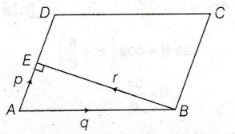
Let $ABCD$ be a parallelogram such that $\vec{AB} = \vec{q}$ and $\vec{AD} = \vec{p}$,and $\angle BAD$ is an acute angle. If $\vec{r}$ is the vector that coincides with the altitude directed from the vertex $B$ to the side $AD$,then $\vec{r}$ is given by:
A
$\vec{r} = 3\vec{q} - \frac{3(\vec{p} \cdot \vec{q})}{(\vec{p} \cdot \vec{p})}\vec{p}$
B
$\vec{r} = -\vec{q} + \frac{(\vec{p} \cdot \vec{q})}{(\vec{p} \cdot \vec{p})}\vec{p}$
C
$\vec{r} = \vec{q} - \frac{(\vec{p} \cdot \vec{q})}{(\vec{p} \cdot \vec{p})}\vec{p}$
D
$\vec{r} = -3\vec{q} - \frac{3(\vec{p} \cdot \vec{q})}{(\vec{p} \cdot \vec{p})}\vec{p}$
Solution
(B) Let $E$ be the foot of the perpendicular from vertex $B$ to the side $AD$. The vector $\vec{AE}$ is the projection of $\vec{AB}$ onto $\vec{AD}$.
Thus,$\vec{AE} = \text{proj}_{\vec{p}} \vec{q} = \left( \frac{\vec{q} \cdot \vec{p}}{\vec{p} \cdot \vec{p}} \right) \vec{p}$.
In $\triangle ABE$,by the triangle law of vector addition,we have $\vec{AB} + \vec{BE} = \vec{AE}$.
Given $\vec{AB} = \vec{q}$ and $\vec{BE} = \vec{r}$,we have $\vec{q} + \vec{r} = \vec{AE}$.
Therefore,$\vec{r} = \vec{AE} - \vec{q}$.
Substituting the expression for $\vec{AE}$,we get $\vec{r} = \left( \frac{\vec{q} \cdot \vec{p}}{\vec{p} \cdot \vec{p}} \right) \vec{p} - \vec{q}$.
Thus,$\vec{AE} = \text{proj}_{\vec{p}} \vec{q} = \left( \frac{\vec{q} \cdot \vec{p}}{\vec{p} \cdot \vec{p}} \right) \vec{p}$.
In $\triangle ABE$,by the triangle law of vector addition,we have $\vec{AB} + \vec{BE} = \vec{AE}$.
Given $\vec{AB} = \vec{q}$ and $\vec{BE} = \vec{r}$,we have $\vec{q} + \vec{r} = \vec{AE}$.
Therefore,$\vec{r} = \vec{AE} - \vec{q}$.
Substituting the expression for $\vec{AE}$,we get $\vec{r} = \left( \frac{\vec{q} \cdot \vec{p}}{\vec{p} \cdot \vec{p}} \right) \vec{p} - \vec{q}$.
0 likes
View Solution231
DifficultMCQ
Let $\vec{u}$ be a vector coplanar with the vectors $\vec{a} = 2\hat{i} + 3\hat{j} - \hat{k}$ and $\vec{b} = \hat{j} + \hat{k}$. If $\vec{u}$ is perpendicular to $\vec{a}$ and $\vec{u} \cdot \vec{b} = 24$,then $|\vec{u}|^2 = \dots$
A
$315$
B
$256$
C
$84$
D
$336$
Solution
(D) Since $\vec{u}$ is coplanar with $\vec{a}$ and $\vec{b}$,we can write $\vec{u} = x\vec{a} + y\vec{b}$.
Given $\vec{u} \perp \vec{a}$,so $\vec{u} \cdot \vec{a} = 0$.
$(x\vec{a} + y\vec{b}) \cdot \vec{a} = 0 \implies x|\vec{a}|^2 + y(\vec{a} \cdot \vec{b}) = 0$.
Calculate $|\vec{a}|^2 = 2^2 + 3^2 + (-1)^2 = 4 + 9 + 1 = 14$.
Calculate $\vec{a} \cdot \vec{b} = (2)(0) + (3)(1) + (-1)(1) = 3 - 1 = 2$.
So,$14x + 2y = 0 \implies y = -7x$.
Thus,$\vec{u} = x\vec{a} - 7x\vec{b} = x(\vec{a} - 7\vec{b})$.
$vec{a} - 7\vec{b} = (2\hat{i} + 3\hat{j} - \hat{k}) - 7(\hat{j} + \hat{k}) = 2\hat{i} - 4\hat{j} - 8\hat{k}$.
Given $\vec{u} \cdot \vec{b} = 24$,so $x(\vec{a} - 7\vec{b}) \cdot \vec{b} = 24$.
$(\vec{a} - 7\vec{b}) \cdot \vec{b} = \vec{a} \cdot \vec{b} - 7|\vec{b}|^2 = 2 - 7(1^2 + 1^2) = 2 - 14 = -12$.
So,$x(-12) = 24 \implies x = -2$.
Therefore,$\vec{u} = -2(2\hat{i} - 4\hat{j} - 8\hat{k}) = -4\hat{i} + 8\hat{j} + 16\hat{k}$.
$|\vec{u}|^2 = (-4)^2 + 8^2 + 16^2 = 16 + 64 + 256 = 336$.
Given $\vec{u} \perp \vec{a}$,so $\vec{u} \cdot \vec{a} = 0$.
$(x\vec{a} + y\vec{b}) \cdot \vec{a} = 0 \implies x|\vec{a}|^2 + y(\vec{a} \cdot \vec{b}) = 0$.
Calculate $|\vec{a}|^2 = 2^2 + 3^2 + (-1)^2 = 4 + 9 + 1 = 14$.
Calculate $\vec{a} \cdot \vec{b} = (2)(0) + (3)(1) + (-1)(1) = 3 - 1 = 2$.
So,$14x + 2y = 0 \implies y = -7x$.
Thus,$\vec{u} = x\vec{a} - 7x\vec{b} = x(\vec{a} - 7\vec{b})$.
$vec{a} - 7\vec{b} = (2\hat{i} + 3\hat{j} - \hat{k}) - 7(\hat{j} + \hat{k}) = 2\hat{i} - 4\hat{j} - 8\hat{k}$.
Given $\vec{u} \cdot \vec{b} = 24$,so $x(\vec{a} - 7\vec{b}) \cdot \vec{b} = 24$.
$(\vec{a} - 7\vec{b}) \cdot \vec{b} = \vec{a} \cdot \vec{b} - 7|\vec{b}|^2 = 2 - 7(1^2 + 1^2) = 2 - 14 = -12$.
So,$x(-12) = 24 \implies x = -2$.
Therefore,$\vec{u} = -2(2\hat{i} - 4\hat{j} - 8\hat{k}) = -4\hat{i} + 8\hat{j} + 16\hat{k}$.
$|\vec{u}|^2 = (-4)^2 + 8^2 + 16^2 = 16 + 64 + 256 = 336$.
0 likes
View Solution232
MediumMCQ
If the moduli of the vectors $a, b, c$ are $3, 4, 5$ respectively and $a$ and $b + c$,$b$ and $c + a$,$c$ and $a + b$ are mutually perpendicular,then the modulus of $a + b + c$ is
A
$\sqrt{12}$
B
$12$
C
$5\sqrt{2}$
D
$50$
Solution
(C) Given that $|a| = 3, |b| = 4, |c| = 5$.
Since $a$ and $(b + c)$ are perpendicular,$a \cdot (b + c) = 0 \implies a \cdot b + a \cdot c = 0$ .....$(i)$
Since $b$ and $(c + a)$ are perpendicular,$b \cdot (c + a) = 0 \implies b \cdot c + b \cdot a = 0$ .....$(ii)$
Since $c$ and $(a + b)$ are perpendicular,$c \cdot (a + b) = 0 \implies c \cdot a + c \cdot b = 0$ .....$(iii)$
Adding equations $(i), (ii),$ and $(iii)$,we get:
$2(a \cdot b + b \cdot c + c \cdot a) = 0 \implies a \cdot b + b \cdot c + c \cdot a = 0$.
Now,the modulus of $a + b + c$ is given by:
$|a + b + c|^2 = |a|^2 + |b|^2 + |c|^2 + 2(a \cdot b + b \cdot c + c \cdot a)$
$|a + b + c|^2 = 3^2 + 4^2 + 5^2 + 2(0)$
$|a + b + c|^2 = 9 + 16 + 25 = 50$
$|a + b + c| = \sqrt{50} = 5\sqrt{2}$.
Since $a$ and $(b + c)$ are perpendicular,$a \cdot (b + c) = 0 \implies a \cdot b + a \cdot c = 0$ .....$(i)$
Since $b$ and $(c + a)$ are perpendicular,$b \cdot (c + a) = 0 \implies b \cdot c + b \cdot a = 0$ .....$(ii)$
Since $c$ and $(a + b)$ are perpendicular,$c \cdot (a + b) = 0 \implies c \cdot a + c \cdot b = 0$ .....$(iii)$
Adding equations $(i), (ii),$ and $(iii)$,we get:
$2(a \cdot b + b \cdot c + c \cdot a) = 0 \implies a \cdot b + b \cdot c + c \cdot a = 0$.
Now,the modulus of $a + b + c$ is given by:
$|a + b + c|^2 = |a|^2 + |b|^2 + |c|^2 + 2(a \cdot b + b \cdot c + c \cdot a)$
$|a + b + c|^2 = 3^2 + 4^2 + 5^2 + 2(0)$
$|a + b + c|^2 = 9 + 16 + 25 = 50$
$|a + b + c| = \sqrt{50} = 5\sqrt{2}$.
0 likes
View Solution233
DifficultMCQ
What will be the length of the longer diagonal of the parallelogram constructed on vectors $5a + 2b$ and $a - 3b$,given that $|a| = 2\sqrt{2}$,$|b| = 3$,and the angle between $a$ and $b$ is $\frac{\pi}{4}$?
A
$15$
B
$\sqrt{113}$
C
$\sqrt{593}$
D
$\sqrt{369}$
Solution
(C) Let the two vectors forming the sides of the parallelogram be $u = 5a + 2b$ and $v = a - 3b$.
The diagonals of the parallelogram are given by $d_1 = u + v$ and $d_2 = u - v$.
$d_1 = (5a + 2b) + (a - 3b) = 6a - b$.
$d_2 = (5a + 2b) - (a - 3b) = 4a + 5b$.
We calculate the squared magnitudes:
$|d_1|^2 = |6a - b|^2 = 36|a|^2 + |b|^2 - 12(a \cdot b)$.
Given $|a| = 2\sqrt{2}$,$|b| = 3$,and $\theta = \frac{\pi}{4}$,$a \cdot b = |a||b|\cos(\frac{\pi}{4}) = (2\sqrt{2})(3)(\frac{1}{\sqrt{2}}) = 6$.
$|d_1|^2 = 36(8) + 9 - 12(6) = 288 + 9 - 72 = 225$,so $|d_1| = 15$.
$|d_2|^2 = |4a + 5b|^2 = 16|a|^2 + 25|b|^2 + 40(a \cdot b)$.
$|d_2|^2 = 16(8) + 25(9) + 40(6) = 128 + 225 + 240 = 593$.
$|d_2| = \sqrt{593}$.
Comparing the two,$\sqrt{593} > 15$,so the longer diagonal is $\sqrt{593}$.
The diagonals of the parallelogram are given by $d_1 = u + v$ and $d_2 = u - v$.
$d_1 = (5a + 2b) + (a - 3b) = 6a - b$.
$d_2 = (5a + 2b) - (a - 3b) = 4a + 5b$.
We calculate the squared magnitudes:
$|d_1|^2 = |6a - b|^2 = 36|a|^2 + |b|^2 - 12(a \cdot b)$.
Given $|a| = 2\sqrt{2}$,$|b| = 3$,and $\theta = \frac{\pi}{4}$,$a \cdot b = |a||b|\cos(\frac{\pi}{4}) = (2\sqrt{2})(3)(\frac{1}{\sqrt{2}}) = 6$.
$|d_1|^2 = 36(8) + 9 - 12(6) = 288 + 9 - 72 = 225$,so $|d_1| = 15$.
$|d_2|^2 = |4a + 5b|^2 = 16|a|^2 + 25|b|^2 + 40(a \cdot b)$.
$|d_2|^2 = 16(8) + 25(9) + 40(6) = 128 + 225 + 240 = 593$.
$|d_2| = \sqrt{593}$.
Comparing the two,$\sqrt{593} > 15$,so the longer diagonal is $\sqrt{593}$.
0 likes
View Solution234
DifficultMCQ
Vectors $a, b, c$ are inclined to each other at an angle of $60^\circ$. If $|a| = 2, |b| = 2$,and $|c| = 2$,then calculate the value of $(2a + 3b - 5c) \cdot (4a - 6b + 10c)$.
A
$167$
B
$-167$
C
$120$
D
$-120$
Solution
(D) Given that $|a| = |b| = |c| = 2$ and the angle between any two vectors is $60^\circ$.
Thus,$a \cdot b = b \cdot c = c \cdot a = |a||b| \cos 60^\circ = 2 \times 2 \times \frac{1}{2} = 2$.
Now,consider the dot product:
$(2a + 3b - 5c) \cdot (4a - 6b + 10c) = 8(a \cdot a) - 12(a \cdot b) + 20(a \cdot c) + 12(b \cdot a) - 18(b \cdot b) + 30(b \cdot c) - 20(c \cdot a) + 30(c \cdot b) - 50(c \cdot c)$.
Since $a \cdot b = b \cdot a$,$a \cdot c = c \cdot a$,and $b \cdot c = c \cdot b$,the expression simplifies to:
$8|a|^2 - 18|b|^2 - 50|c|^2 + (-12 + 12)(a \cdot b) + (20 - 20)(a \cdot c) + (30 + 30)(b \cdot c)$.
$= 8(2)^2 - 18(2)^2 - 50(2)^2 + 60(b \cdot c)$.
$= 8(4) - 18(4) - 50(4) + 60(2)$.
$= 32 - 72 - 200 + 120$.
$= -120$.
Thus,$a \cdot b = b \cdot c = c \cdot a = |a||b| \cos 60^\circ = 2 \times 2 \times \frac{1}{2} = 2$.
Now,consider the dot product:
$(2a + 3b - 5c) \cdot (4a - 6b + 10c) = 8(a \cdot a) - 12(a \cdot b) + 20(a \cdot c) + 12(b \cdot a) - 18(b \cdot b) + 30(b \cdot c) - 20(c \cdot a) + 30(c \cdot b) - 50(c \cdot c)$.
Since $a \cdot b = b \cdot a$,$a \cdot c = c \cdot a$,and $b \cdot c = c \cdot b$,the expression simplifies to:
$8|a|^2 - 18|b|^2 - 50|c|^2 + (-12 + 12)(a \cdot b) + (20 - 20)(a \cdot c) + (30 + 30)(b \cdot c)$.
$= 8(2)^2 - 18(2)^2 - 50(2)^2 + 60(b \cdot c)$.
$= 8(4) - 18(4) - 50(4) + 60(2)$.
$= 32 - 72 - 200 + 120$.
$= -120$.
0 likes
View Solution235
DifficultMCQ
The vectors $a, b$ and $c$ are of the same length and taken pairwise,they form equal angles. If $a = i + j$ and $b = j + k,$ then the co-ordinates of $c$ are
A
$(1, 0, 1)$
B
$(1, 2, 3)$
C
$(-1, 1, 2)$
D
None of these
Solution
(A) Let $c = (c_1, c_2, c_3).$ Since $|a| = |b| = |c|,$ we have $|c|^2 = |a|^2 = |b|^2 = 1^2 + 1^2 = 2.$ Thus,$c_1^2 + c_2^2 + c_3^2 = 2.$
Given that the vectors are taken pairwise at equal angles $\varphi,$ we have $\cos \varphi = \frac{a \cdot b}{|a||b|} = \frac{(i+j) \cdot (j+k)}{2} = \frac{1}{2}.$
Since the angle between $a$ and $c$ is $\varphi,$ we have $\frac{a \cdot c}{|a||c|} = \frac{1}{2} \implies \frac{c_1 + c_2}{2} = \frac{1}{2} \implies c_1 + c_2 = 1.$
Similarly,for $b$ and $c,$ $\frac{b \cdot c}{|b||c|} = \frac{1}{2} \implies \frac{c_2 + c_3}{2} = \frac{1}{2} \implies c_2 + c_3 = 1.$
From these,$c_1 = 1 - c_2$ and $c_3 = 1 - c_2.$
Substituting into $c_1^2 + c_2^2 + c_3^2 = 2,$ we get $(1 - c_2)^2 + c_2^2 + (1 - c_2)^2 = 2.$
$1 - 2c_2 + c_2^2 + c_2^2 + 1 - 2c_2 + c_2^2 = 2 \implies 3c_2^2 - 4c_2 = 0.$
This gives $c_2(3c_2 - 4) = 0,$ so $c_2 = 0$ or $c_2 = \frac{4}{3}.$
If $c_2 = 0,$ then $c_1 = 1$ and $c_3 = 1,$ giving $c = (1, 0, 1).$
If $c_2 = \frac{4}{3},$ then $c_1 = -\frac{1}{3}$ and $c_3 = -\frac{1}{3},$ giving $c = (-\frac{1}{3}, \frac{4}{3}, -\frac{1}{3}).$
Since $(1, 0, 1)$ is an option,the correct answer is $A$.
Given that the vectors are taken pairwise at equal angles $\varphi,$ we have $\cos \varphi = \frac{a \cdot b}{|a||b|} = \frac{(i+j) \cdot (j+k)}{2} = \frac{1}{2}.$
Since the angle between $a$ and $c$ is $\varphi,$ we have $\frac{a \cdot c}{|a||c|} = \frac{1}{2} \implies \frac{c_1 + c_2}{2} = \frac{1}{2} \implies c_1 + c_2 = 1.$
Similarly,for $b$ and $c,$ $\frac{b \cdot c}{|b||c|} = \frac{1}{2} \implies \frac{c_2 + c_3}{2} = \frac{1}{2} \implies c_2 + c_3 = 1.$
From these,$c_1 = 1 - c_2$ and $c_3 = 1 - c_2.$
Substituting into $c_1^2 + c_2^2 + c_3^2 = 2,$ we get $(1 - c_2)^2 + c_2^2 + (1 - c_2)^2 = 2.$
$1 - 2c_2 + c_2^2 + c_2^2 + 1 - 2c_2 + c_2^2 = 2 \implies 3c_2^2 - 4c_2 = 0.$
This gives $c_2(3c_2 - 4) = 0,$ so $c_2 = 0$ or $c_2 = \frac{4}{3}.$
If $c_2 = 0,$ then $c_1 = 1$ and $c_3 = 1,$ giving $c = (1, 0, 1).$
If $c_2 = \frac{4}{3},$ then $c_1 = -\frac{1}{3}$ and $c_3 = -\frac{1}{3},$ giving $c = (-\frac{1}{3}, \frac{4}{3}, -\frac{1}{3}).$
Since $(1, 0, 1)$ is an option,the correct answer is $A$.
0 likes
View Solution236
DifficultMCQ
Let $p$ and $q$ be the position vectors of $P$ and $Q$ respectively with respect to $O$ and $|p| = p, |q| = q.$ The points $R$ and $S$ divide $PQ$ internally and externally in the ratio $2 : 3$ respectively. If $\overrightarrow{OR}$ and $\overrightarrow{OS}$ are perpendicular,then:
A
$9p^2 = 4q^2$
B
$4p^2 = 9q^2$
C
$9p = 4q$
D
$4p = 9q$
Solution
(A) The position vectors of $R$ and $S$ are $\frac{3p + 2q}{5}$ and $3p - 2q$ respectively.
Therefore,$\overrightarrow{OR} = \frac{3p + 2q}{5}$ and $\overrightarrow{OS} = 3p - 2q.$
Since $\overrightarrow{OR} \perp \overrightarrow{OS},$ their dot product is zero,so $\overrightarrow{OR} \cdot \overrightarrow{OS} = 0.$
$\left( \frac{3p + 2q}{5} \right) \cdot (3p - 2q) = 0$
$9|p|^2 - 6(p \cdot q) + 6(q \cdot p) - 4|q|^2 = 0$
$9|p|^2 - 4|q|^2 = 0$
$9|p|^2 = 4|q|^2$
Given $|p| = p$ and $|q| = q,$ we get $9p^2 = 4q^2.$
Therefore,$\overrightarrow{OR} = \frac{3p + 2q}{5}$ and $\overrightarrow{OS} = 3p - 2q.$
Since $\overrightarrow{OR} \perp \overrightarrow{OS},$ their dot product is zero,so $\overrightarrow{OR} \cdot \overrightarrow{OS} = 0.$
$\left( \frac{3p + 2q}{5} \right) \cdot (3p - 2q) = 0$
$9|p|^2 - 6(p \cdot q) + 6(q \cdot p) - 4|q|^2 = 0$
$9|p|^2 - 4|q|^2 = 0$
$9|p|^2 = 4|q|^2$
Given $|p| = p$ and $|q| = q,$ we get $9p^2 = 4q^2.$
0 likes
View Solution237
MediumMCQ
$A$ unit vector in the $xy$-plane that makes an angle of $45^{\circ}$ with the vector $(i + j)$ and an angle of $60^{\circ}$ with the vector $(3i - 4j)$ is:
A
$i$
B
$\frac{1}{\sqrt{2}}(i - j)$
C
$\frac{1}{\sqrt{2}}(i + j)$
D
None of these
Solution
(D) Let the unit vector be $\vec{u} = x\,i + y\,j$. Since it is a unit vector,$x^2 + y^2 = 1$.
Given the angle with $\vec{a} = i + j$ is $45^{\circ}$,we have $\vec{u} \cdot \vec{a} = |\vec{u}| |\vec{a}| \cos(45^{\circ})$.
$(x\,i + y\,j) \cdot (i + j) = (1)(\sqrt{1^2 + 1^2}) \frac{1}{\sqrt{2}} \Rightarrow x + y = \sqrt{2} \cdot \frac{1}{\sqrt{2}} = 1$.
Given the angle with $\vec{b} = 3i - 4j$ is $60^{\circ}$,we have $\vec{u} \cdot \vec{b} = |\vec{u}| |\vec{b}| \cos(60^{\circ})$.
$(x\,i + y\,j) \cdot (3i - 4j) = (1)(\sqrt{3^2 + (-4)^2}) \frac{1}{2} \Rightarrow 3x - 4y = 5 \cdot \frac{1}{2} = 2.5$.
We have the system: $x + y = 1$ and $3x - 4y = 2.5$.
From the first equation,$y = 1 - x$. Substituting into the second: $3x - 4(1 - x) = 2.5 \Rightarrow 3x - 4 + 4x = 2.5 \Rightarrow 7x = 6.5 \Rightarrow x = \frac{6.5}{7} = \frac{13}{14}$.
Then $y = 1 - \frac{13}{14} = \frac{1}{14}$.
Check the unit vector condition: $x^2 + y^2 = (\frac{13}{14})^2 + (\frac{1}{14})^2 = \frac{169 + 1}{196} = \frac{170}{196} \neq 1$.
Since no option satisfies these conditions,the correct answer is $(d)$.
Given the angle with $\vec{a} = i + j$ is $45^{\circ}$,we have $\vec{u} \cdot \vec{a} = |\vec{u}| |\vec{a}| \cos(45^{\circ})$.
$(x\,i + y\,j) \cdot (i + j) = (1)(\sqrt{1^2 + 1^2}) \frac{1}{\sqrt{2}} \Rightarrow x + y = \sqrt{2} \cdot \frac{1}{\sqrt{2}} = 1$.
Given the angle with $\vec{b} = 3i - 4j$ is $60^{\circ}$,we have $\vec{u} \cdot \vec{b} = |\vec{u}| |\vec{b}| \cos(60^{\circ})$.
$(x\,i + y\,j) \cdot (3i - 4j) = (1)(\sqrt{3^2 + (-4)^2}) \frac{1}{2} \Rightarrow 3x - 4y = 5 \cdot \frac{1}{2} = 2.5$.
We have the system: $x + y = 1$ and $3x - 4y = 2.5$.
From the first equation,$y = 1 - x$. Substituting into the second: $3x - 4(1 - x) = 2.5 \Rightarrow 3x - 4 + 4x = 2.5 \Rightarrow 7x = 6.5 \Rightarrow x = \frac{6.5}{7} = \frac{13}{14}$.
Then $y = 1 - \frac{13}{14} = \frac{1}{14}$.
Check the unit vector condition: $x^2 + y^2 = (\frac{13}{14})^2 + (\frac{1}{14})^2 = \frac{169 + 1}{196} = \frac{170}{196} \neq 1$.
Since no option satisfies these conditions,the correct answer is $(d)$.
0 likes
View Solution238
DifficultMCQ
The value of $c$ such that for all real $x$, the vectors $\vec{a} = cxi - 6j + 3k$ and $\vec{b} = xi + 2j + 2cxk$ make an obtuse angle is:
A
$c < 0$
B
$0 < c < \frac{4}{3}$
C
$-\frac{4}{3} < c < 0$
D
$c > 0$
Solution
(C) Let the two vectors be $\vec{a} = cxi - 6j + 3k$ and $\vec{b} = xi + 2j + 2cxk$.
Since the vectors make an obtuse angle, their dot product must be negative, i.e., $\vec{a} \cdot \vec{b} < 0$.
Calculating the dot product: $\vec{a} \cdot \vec{b} = (cx)(x) + (-6)(2) + (3)(2cx) = cx^2 - 12 + 6cx$.
We require $cx^2 + 6cx - 12 < 0$ for all real $x$.
For a quadratic expression $Ax^2 + Bx + C < 0$ to hold for all $x$, we must have $A < 0$ and the discriminant $D = B^2 - 4AC < 0$.
Here, $A = c$, $B = 6c$, and $C = -12$.
Condition $1$: $c < 0$.
Condition $2$: $D = (6c)^2 - 4(c)(-12) < 0
\Rightarrow 36c^2 + 48c < 0
\Rightarrow 12c(3c + 4) < 0$.
Since $c < 0$, we divide by $12c$ (which reverses the inequality sign): $3c + 4 > 0
\Rightarrow 3c > -4
\Rightarrow c > -\frac{4}{3}$.
Combining $c < 0$ and $c > -\frac{4}{3}$, we get $-\frac{4}{3} < c < 0$.
Since the vectors make an obtuse angle, their dot product must be negative, i.e., $\vec{a} \cdot \vec{b} < 0$.
Calculating the dot product: $\vec{a} \cdot \vec{b} = (cx)(x) + (-6)(2) + (3)(2cx) = cx^2 - 12 + 6cx$.
We require $cx^2 + 6cx - 12 < 0$ for all real $x$.
For a quadratic expression $Ax^2 + Bx + C < 0$ to hold for all $x$, we must have $A < 0$ and the discriminant $D = B^2 - 4AC < 0$.
Here, $A = c$, $B = 6c$, and $C = -12$.
Condition $1$: $c < 0$.
Condition $2$: $D = (6c)^2 - 4(c)(-12) < 0
\Rightarrow 36c^2 + 48c < 0
\Rightarrow 12c(3c + 4) < 0$.
Since $c < 0$, we divide by $12c$ (which reverses the inequality sign): $3c + 4 > 0
\Rightarrow 3c > -4
\Rightarrow c > -\frac{4}{3}$.
Combining $c < 0$ and $c > -\frac{4}{3}$, we get $-\frac{4}{3} < c < 0$.
0 likes
View Solution239
MediumMCQ
The vector $b = 3j + 4k$ is to be written as the sum of a vector $b_1$ parallel to $a = i + j$ and a vector $b_2$ perpendicular to $a$. Then $b_1 = $
A
$\frac{3}{2}(i + j)$
B
$\frac{2}{3}(i + j)$
C
$\frac{1}{2}(i + j)$
D
$\frac{1}{3}(i + j)$
Solution
(A) Given $b = 3j + 4k$ and $a = i + j$.
Since $b_1$ is parallel to $a$,we can write $b_1 = \lambda a = \lambda(i + j) = \lambda i + \lambda j$.
We know that $b = b_1 + b_2$,where $b_2$ is perpendicular to $a$.
Thus,$b_2 = b - b_1 = (0 - \lambda)i + (3 - \lambda)j + 4k = -\lambda i + (3 - \lambda)j + 4k$.
Since $b_2 \perp a$,their dot product must be zero: $b_2 \cdot a = 0$.
$(-\lambda i + (3 - \lambda)j + 4k) \cdot (i + j) = 0$.
$-\lambda + (3 - \lambda) = 0$.
$3 - 2\lambda = 0 \Rightarrow \lambda = \frac{3}{2}$.
Therefore,$b_1 = \frac{3}{2}(i + j)$.
Since $b_1$ is parallel to $a$,we can write $b_1 = \lambda a = \lambda(i + j) = \lambda i + \lambda j$.
We know that $b = b_1 + b_2$,where $b_2$ is perpendicular to $a$.
Thus,$b_2 = b - b_1 = (0 - \lambda)i + (3 - \lambda)j + 4k = -\lambda i + (3 - \lambda)j + 4k$.
Since $b_2 \perp a$,their dot product must be zero: $b_2 \cdot a = 0$.
$(-\lambda i + (3 - \lambda)j + 4k) \cdot (i + j) = 0$.
$-\lambda + (3 - \lambda) = 0$.
$3 - 2\lambda = 0 \Rightarrow \lambda = \frac{3}{2}$.
Therefore,$b_1 = \frac{3}{2}(i + j)$.
0 likes
View Solution240
DifficultMCQ
Let $u, v, w$ be vectors such that $|u| = 1, |v| = 2, |w| = 3$. If the projection of $v$ along $u$ is equal to the projection of $w$ along $u$,and $v$ and $w$ are perpendicular to each other,then $|u - v + w|$ equals:
A
$14$
B
$\sqrt{7}$
C
$\sqrt{14}$
D
$2$
Solution
(C) Given $|u| = 1, |v| = 2, |w| = 3$. Since $v \perp w$,we have $v \cdot w = 0$.
Let the projection of $v$ along $u$ be equal to the projection of $w$ along $u$. This implies $\frac{v \cdot u}{|u|} = \frac{w \cdot u}{|u|}$.
Since $|u| = 1$,we have $v \cdot u = w \cdot u$,which means $(v - w) \cdot u = 0$.
We want to find $|u - v + w|$. Let $X = u - (v - w)$.
Then $|X|^2 = |u - (v - w)|^2 = |u|^2 + |v - w|^2 - 2u \cdot (v - w)$.
Since $u \cdot (v - w) = 0$,we have $|X|^2 = |u|^2 + |v - w|^2$.
$|v - w|^2 = |v|^2 + |w|^2 - 2(v \cdot w) = 2^2 + 3^2 - 2(0) = 4 + 9 = 13$.
Thus,$|u - v + w|^2 = 1^2 + 13 = 14$.
Therefore,$|u - v + w| = \sqrt{14}$.
Let the projection of $v$ along $u$ be equal to the projection of $w$ along $u$. This implies $\frac{v \cdot u}{|u|} = \frac{w \cdot u}{|u|}$.
Since $|u| = 1$,we have $v \cdot u = w \cdot u$,which means $(v - w) \cdot u = 0$.
We want to find $|u - v + w|$. Let $X = u - (v - w)$.
Then $|X|^2 = |u - (v - w)|^2 = |u|^2 + |v - w|^2 - 2u \cdot (v - w)$.
Since $u \cdot (v - w) = 0$,we have $|X|^2 = |u|^2 + |v - w|^2$.
$|v - w|^2 = |v|^2 + |w|^2 - 2(v \cdot w) = 2^2 + 3^2 - 2(0) = 4 + 9 = 13$.
Thus,$|u - v + w|^2 = 1^2 + 13 = 14$.
Therefore,$|u - v + w| = \sqrt{14}$.
0 likes
View Solution241
MediumMCQ
Forces of magnitudes $3$ and $2$ units acting in the directions $5\hat{i} + 3\hat{j} + 4\hat{k}$ and $3\hat{i} + 4\hat{j} - 5\hat{k}$ respectively act on a particle which is displaced from the points $(1, -1, -1)$ to $(3, 3, 1)$. The work done by the forces is equal to
A
$50\sqrt{2}$ units
B
$40\sqrt{2}$ units
C
$\frac{57}{5}\sqrt{2}$ units
D
$8\sqrt{2}$ units
Solution
(C) The unit vector in the direction of $\vec{a} = 5\hat{i} + 3\hat{j} + 4\hat{k}$ is $\hat{a} = \frac{5\hat{i} + 3\hat{j} + 4\hat{k}}{\sqrt{25 + 9 + 16}} = \frac{5\hat{i} + 3\hat{j} + 4\hat{k}}{5\sqrt{2}}$.
The unit vector in the direction of $\vec{b} = 3\hat{i} + 4\hat{j} - 5\hat{k}$ is $\hat{b} = \frac{3\hat{i} + 4\hat{j} - 5\hat{k}}{\sqrt{9 + 16 + 25}} = \frac{3\hat{i} + 4\hat{j} - 5\hat{k}}{5\sqrt{2}}$.
The forces are $\vec{F_1} = 3\hat{a} = \frac{3(5\hat{i} + 3\hat{j} + 4\hat{k})}{5\sqrt{2}}$ and $\vec{F_2} = 2\hat{b} = \frac{2(3\hat{i} + 4\hat{j} - 5\hat{k})}{5\sqrt{2}}$.
The net force $\vec{F} = \vec{F_1} + \vec{F_2} = \frac{1}{5\sqrt{2}} [(15\hat{i} + 9\hat{j} + 12\hat{k}) + (6\hat{i} + 8\hat{j} - 10\hat{k})] = \frac{21\hat{i} + 17\hat{j} + 2\hat{k}}{5\sqrt{2}}$.
The displacement vector $\vec{d} = (3 - 1)\hat{i} + (3 - (-1))\hat{j} + (1 - (-1))\hat{k} = 2\hat{i} + 4\hat{j} + 2\hat{k}$.
Work done $W = \vec{F} \cdot \vec{d} = \frac{1}{5\sqrt{2}} (21\hat{i} + 17\hat{j} + 2\hat{k}) \cdot (2\hat{i} + 4\hat{j} + 2\hat{k})$.
$W = \frac{1}{5\sqrt{2}} (21 \times 2 + 17 \times 4 + 2 \times 2) = \frac{42 + 68 + 4}{5\sqrt{2}} = \frac{114}{5\sqrt{2}}$.
Rationalizing the denominator: $W = \frac{114\sqrt{2}}{5 \times 2} = \frac{57\sqrt{2}}{5}$ units.
The unit vector in the direction of $\vec{b} = 3\hat{i} + 4\hat{j} - 5\hat{k}$ is $\hat{b} = \frac{3\hat{i} + 4\hat{j} - 5\hat{k}}{\sqrt{9 + 16 + 25}} = \frac{3\hat{i} + 4\hat{j} - 5\hat{k}}{5\sqrt{2}}$.
The forces are $\vec{F_1} = 3\hat{a} = \frac{3(5\hat{i} + 3\hat{j} + 4\hat{k})}{5\sqrt{2}}$ and $\vec{F_2} = 2\hat{b} = \frac{2(3\hat{i} + 4\hat{j} - 5\hat{k})}{5\sqrt{2}}$.
The net force $\vec{F} = \vec{F_1} + \vec{F_2} = \frac{1}{5\sqrt{2}} [(15\hat{i} + 9\hat{j} + 12\hat{k}) + (6\hat{i} + 8\hat{j} - 10\hat{k})] = \frac{21\hat{i} + 17\hat{j} + 2\hat{k}}{5\sqrt{2}}$.
The displacement vector $\vec{d} = (3 - 1)\hat{i} + (3 - (-1))\hat{j} + (1 - (-1))\hat{k} = 2\hat{i} + 4\hat{j} + 2\hat{k}$.
Work done $W = \vec{F} \cdot \vec{d} = \frac{1}{5\sqrt{2}} (21\hat{i} + 17\hat{j} + 2\hat{k}) \cdot (2\hat{i} + 4\hat{j} + 2\hat{k})$.
$W = \frac{1}{5\sqrt{2}} (21 \times 2 + 17 \times 4 + 2 \times 2) = \frac{42 + 68 + 4}{5\sqrt{2}} = \frac{114}{5\sqrt{2}}$.
Rationalizing the denominator: $W = \frac{114\sqrt{2}}{5 \times 2} = \frac{57\sqrt{2}}{5}$ units.
0 likes
View Solution242
MediumMCQ
If $|a \times b| = 4$ and $|a \cdot b| = 2$,then $|a|^2 |b|^2 = $
A
$2$
B
$6$
C
$8$
D
$20$
Solution
(D) Given $|a \times b| = 4$ and $|a \cdot b| = 2$.
We know that $|a \times b| = |a| |b| \sin \theta = 4$ and $|a \cdot b| = |a| |b| |\cos \theta| = 2$.
Squaring both equations,we get:
$|a|^2 |b|^2 \sin^2 \theta = 16$
$|a|^2 |b|^2 \cos^2 \theta = 4$
Adding these two equations:
$|a|^2 |b|^2 (\sin^2 \theta + \cos^2 \theta) = 16 + 4$
Since $\sin^2 \theta + \cos^2 \theta = 1$,we have:
$|a|^2 |b|^2 = 20$.
We know that $|a \times b| = |a| |b| \sin \theta = 4$ and $|a \cdot b| = |a| |b| |\cos \theta| = 2$.
Squaring both equations,we get:
$|a|^2 |b|^2 \sin^2 \theta = 16$
$|a|^2 |b|^2 \cos^2 \theta = 4$
Adding these two equations:
$|a|^2 |b|^2 (\sin^2 \theta + \cos^2 \theta) = 16 + 4$
Since $\sin^2 \theta + \cos^2 \theta = 1$,we have:
$|a|^2 |b|^2 = 20$.
0 likes
View Solution243
AdvancedMCQ
Given $ABC$ is an equilateral triangle of side length $1$ unit and $P$ be any arbitrary point on the circumcircle of triangle $ABC,$ then $|\vec{PA}|^2+|\vec{PB}|^2+|\vec{PC}|^2$ is equal to
A
$3$
B
$1$
C
$2$
D
$2\sqrt{3}$
Solution
(C) Let the origin be the circumcenter $O$ of the equilateral triangle $ABC.$ Let the position vectors of $A, B, C$ be $\vec{a}, \vec{b}, \vec{c}$ and $P$ be $\vec{r}.$
Since $O$ is the circumcenter,$|\vec{a}| = |\vec{b}| = |\vec{c}| = R,$ where $R$ is the circumradius.
For an equilateral triangle of side $s=1,$ the circumradius $R = \frac{s}{\sqrt{3}} = \frac{1}{\sqrt{3}}.$
Since $P$ is on the circumcircle,$|\vec{r}| = R = \frac{1}{\sqrt{3}}.$
We need to calculate $S = |\vec{r}-\vec{a}|^2 + |\vec{r}-\vec{b}|^2 + |\vec{r}-\vec{c}|^2.$
Expanding this,we get:
$S = (\vec{r}-\vec{a}) \cdot (\vec{r}-\vec{a}) + (\vec{r}-\vec{b}) \cdot (\vec{r}-\vec{b}) + (\vec{r}-\vec{c}) \cdot (\vec{r}-\vec{c})$
$S = 3|\vec{r}|^2 + (|\vec{a}|^2 + |\vec{b}|^2 + |\vec{c}|^2) - 2\vec{r} \cdot (\vec{a}+\vec{b}+\vec{c}).$
For an equilateral triangle centered at the origin,$\vec{a}+\vec{b}+\vec{c} = \vec{0}.$
Also,$|\vec{a}|^2 = |\vec{b}|^2 = |\vec{c}|^2 = R^2 = \frac{1}{3}$ and $|\vec{r}|^2 = R^2 = \frac{1}{3}.$
Substituting these values:
$S = 3(\frac{1}{3}) + (\frac{1}{3} + \frac{1}{3} + \frac{1}{3}) - 2\vec{r} \cdot \vec{0}$
$S = 1 + 1 - 0 = 2.$
Since $O$ is the circumcenter,$|\vec{a}| = |\vec{b}| = |\vec{c}| = R,$ where $R$ is the circumradius.
For an equilateral triangle of side $s=1,$ the circumradius $R = \frac{s}{\sqrt{3}} = \frac{1}{\sqrt{3}}.$
Since $P$ is on the circumcircle,$|\vec{r}| = R = \frac{1}{\sqrt{3}}.$
We need to calculate $S = |\vec{r}-\vec{a}|^2 + |\vec{r}-\vec{b}|^2 + |\vec{r}-\vec{c}|^2.$
Expanding this,we get:
$S = (\vec{r}-\vec{a}) \cdot (\vec{r}-\vec{a}) + (\vec{r}-\vec{b}) \cdot (\vec{r}-\vec{b}) + (\vec{r}-\vec{c}) \cdot (\vec{r}-\vec{c})$
$S = 3|\vec{r}|^2 + (|\vec{a}|^2 + |\vec{b}|^2 + |\vec{c}|^2) - 2\vec{r} \cdot (\vec{a}+\vec{b}+\vec{c}).$
For an equilateral triangle centered at the origin,$\vec{a}+\vec{b}+\vec{c} = \vec{0}.$
Also,$|\vec{a}|^2 = |\vec{b}|^2 = |\vec{c}|^2 = R^2 = \frac{1}{3}$ and $|\vec{r}|^2 = R^2 = \frac{1}{3}.$
Substituting these values:
$S = 3(\frac{1}{3}) + (\frac{1}{3} + \frac{1}{3} + \frac{1}{3}) - 2\vec{r} \cdot \vec{0}$
$S = 1 + 1 - 0 = 2.$
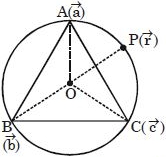
0 likes
View Solution244
AdvancedMCQ
In a parallelogram $OACB$,$\overrightarrow{OA} = \vec{a}$,$\overrightarrow{OB} = \vec{b}$,and the foot of the perpendicular drawn from point $B$ to $AC$ is $M$. If $\vec{a} \cdot \vec{b} = 1$ and $|\vec{a}| = |\vec{b}| = 2$,then $|\overrightarrow{BM}|$ is:
A
$\sqrt{15}$
B
$\frac{\sqrt{5}}{2}$
C
$5$
D
$\frac{\sqrt{15}}{2}$
Solution
(D) Given that $OACB$ is a parallelogram with $\overrightarrow{OA} = \vec{a}$ and $\overrightarrow{OB} = \vec{b}$.
Since $AC$ is parallel to $OB$,the vector $\overrightarrow{AC} = \overrightarrow{OB} = \vec{b}$.
The position vector of $M$ lies on $AC$. Since $M$ is on $AC$,we can write $\overrightarrow{OM} = \vec{a} + \lambda \vec{b}$ for some scalar $\lambda$.
Then $\overrightarrow{BM} = \overrightarrow{OM} - \overrightarrow{OB} = \vec{a} + \lambda \vec{b} - \vec{b} = \vec{a} + (\lambda - 1)\vec{b}$.
Since $BM \perp AC$,we have $\overrightarrow{BM} \cdot \overrightarrow{AC} = 0$.
$(\vec{a} + (\lambda - 1)\vec{b}) \cdot \vec{b} = 0$.
$\vec{a} \cdot \vec{b} + (\lambda - 1)|\vec{b}|^2 = 0$.
Given $\vec{a} \cdot \vec{b} = 1$ and $|\vec{b}| = 2$,so $|\vec{b}|^2 = 4$.
$1 + (\lambda - 1)(4) = 0 \implies 4(\lambda - 1) = -1 \implies \lambda - 1 = -\frac{1}{4} \implies \lambda = \frac{3}{4}$.
Now,$\overrightarrow{BM} = \vec{a} - \frac{1}{4}\vec{b}$.
$|\overrightarrow{BM}|^2 = |\vec{a} - \frac{1}{4}\vec{b}|^2 = |\vec{a}|^2 + \frac{1}{16}|\vec{b}|^2 - \frac{2}{4}(\vec{a} \cdot \vec{b})$.
$|\overrightarrow{BM}|^2 = 4 + \frac{4}{16} - \frac{1}{2} = 4 + \frac{1}{4} - \frac{1}{2} = \frac{16 + 1 - 2}{4} = \frac{15}{4}$.
Therefore,$|\overrightarrow{BM}| = \frac{\sqrt{15}}{2}$.
Since $AC$ is parallel to $OB$,the vector $\overrightarrow{AC} = \overrightarrow{OB} = \vec{b}$.
The position vector of $M$ lies on $AC$. Since $M$ is on $AC$,we can write $\overrightarrow{OM} = \vec{a} + \lambda \vec{b}$ for some scalar $\lambda$.
Then $\overrightarrow{BM} = \overrightarrow{OM} - \overrightarrow{OB} = \vec{a} + \lambda \vec{b} - \vec{b} = \vec{a} + (\lambda - 1)\vec{b}$.
Since $BM \perp AC$,we have $\overrightarrow{BM} \cdot \overrightarrow{AC} = 0$.
$(\vec{a} + (\lambda - 1)\vec{b}) \cdot \vec{b} = 0$.
$\vec{a} \cdot \vec{b} + (\lambda - 1)|\vec{b}|^2 = 0$.
Given $\vec{a} \cdot \vec{b} = 1$ and $|\vec{b}| = 2$,so $|\vec{b}|^2 = 4$.
$1 + (\lambda - 1)(4) = 0 \implies 4(\lambda - 1) = -1 \implies \lambda - 1 = -\frac{1}{4} \implies \lambda = \frac{3}{4}$.
Now,$\overrightarrow{BM} = \vec{a} - \frac{1}{4}\vec{b}$.
$|\overrightarrow{BM}|^2 = |\vec{a} - \frac{1}{4}\vec{b}|^2 = |\vec{a}|^2 + \frac{1}{16}|\vec{b}|^2 - \frac{2}{4}(\vec{a} \cdot \vec{b})$.
$|\overrightarrow{BM}|^2 = 4 + \frac{4}{16} - \frac{1}{2} = 4 + \frac{1}{4} - \frac{1}{2} = \frac{16 + 1 - 2}{4} = \frac{15}{4}$.
Therefore,$|\overrightarrow{BM}| = \frac{\sqrt{15}}{2}$.
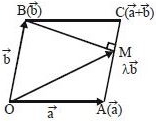
0 likes
View Solution245
AdvancedMCQ
Magnitudes of vectors $\vec a, \vec b, \vec c$ are $3, 4, 5$ respectively. If $\vec a$ and $\vec b + \vec c$,$\vec b$ and $\vec c + \vec a$,and $\vec c$ and $\vec a + \vec b$ are mutually perpendicular,then find the magnitude of $|\vec a + \vec b + \vec c|$.
A
$4 \sqrt{2}$
B
$3 \sqrt{2}$
C
$5 \sqrt{2}$
D
$3 \sqrt{3}$
Solution
(C) Given that $\vec a \cdot (\vec b + \vec c) = 0$,$\vec b \cdot (\vec c + \vec a) = 0$,and $\vec c \cdot (\vec a + \vec b) = 0$.
This implies:
$(i) \quad \vec a \cdot \vec b + \vec a \cdot \vec c = 0$
$(ii) \quad \vec b \cdot \vec c + \vec b \cdot \vec a = 0$
$(iii) \quad \vec c \cdot \vec a + \vec c \cdot \vec b = 0$
Adding these three equations,we get $2(\vec a \cdot \vec b + \vec b \cdot \vec c + \vec c \cdot \vec a) = 0$,which means $\vec a \cdot \vec b + \vec b \cdot \vec c + \vec c \cdot \vec a = 0$.
Now,$|\vec a + \vec b + \vec c|^2 = |\vec a|^2 + |\vec b|^2 + |\vec c|^2 + 2(\vec a \cdot \vec b + \vec b \cdot \vec c + \vec c \cdot \vec a)$.
Substituting the given magnitudes $|\vec a| = 3, |\vec b| = 4, |\vec c| = 5$:
$|\vec a + \vec b + \vec c|^2 = 3^2 + 4^2 + 5^2 + 2(0) = 9 + 16 + 25 = 50$.
Therefore,$|\vec a + \vec b + \vec c| = \sqrt{50} = 5 \sqrt{2}$.
This implies:
$(i) \quad \vec a \cdot \vec b + \vec a \cdot \vec c = 0$
$(ii) \quad \vec b \cdot \vec c + \vec b \cdot \vec a = 0$
$(iii) \quad \vec c \cdot \vec a + \vec c \cdot \vec b = 0$
Adding these three equations,we get $2(\vec a \cdot \vec b + \vec b \cdot \vec c + \vec c \cdot \vec a) = 0$,which means $\vec a \cdot \vec b + \vec b \cdot \vec c + \vec c \cdot \vec a = 0$.
Now,$|\vec a + \vec b + \vec c|^2 = |\vec a|^2 + |\vec b|^2 + |\vec c|^2 + 2(\vec a \cdot \vec b + \vec b \cdot \vec c + \vec c \cdot \vec a)$.
Substituting the given magnitudes $|\vec a| = 3, |\vec b| = 4, |\vec c| = 5$:
$|\vec a + \vec b + \vec c|^2 = 3^2 + 4^2 + 5^2 + 2(0) = 9 + 16 + 25 = 50$.
Therefore,$|\vec a + \vec b + \vec c| = \sqrt{50} = 5 \sqrt{2}$.
0 likes
View Solution246
AdvancedMCQ
If $\vec{a}, \vec{b}, \vec{c}$ are three non-zero,non-coplanar vectors and $\vec{b_1} = \vec{b} - \frac{\vec{b} \cdot \vec{a}}{|\vec{a}|^2}\vec{a}$,$\vec{b_2} = \vec{b} + \frac{\vec{b} \cdot \vec{a}}{|\vec{a}|^2}\vec{a}$,and $\vec{c_1} = \vec{c} - \frac{\vec{c} \cdot \vec{a}}{|\vec{a}|^2}\vec{a} + \frac{\vec{c} \cdot \vec{b}}{|\vec{b}|^2}\vec{b_1}$,$\vec{c_2} = \vec{c} - \frac{\vec{c} \cdot \vec{a}}{|\vec{a}|^2}\vec{a} - \frac{\vec{c} \cdot \vec{b_1}}{|\vec{b_1}|^2}\vec{b_1}$,$\vec{c_3} = \vec{c} - \frac{\vec{c} \cdot \vec{a}}{|\vec{c}|^2}\vec{a} + \frac{\vec{c} \cdot \vec{b_2}}{|\vec{c}|^2}\vec{b_1}$,$\vec{c_4} = \vec{c} - \frac{\vec{c} \cdot \vec{a}}{|\vec{c}|^2}\vec{a} - \frac{\vec{b} \cdot \vec{c}}{|\vec{b}|^2}\vec{b_1}$. Then,which of the following is a set of mutually orthogonal vectors?
A
$\{\vec{a}, \vec{b_1}, \vec{c_1}\}$
B
$\{\vec{a}, \vec{b_1}, \vec{c_2}\}$
C
$\{\vec{a}, \vec{b_2}, \vec{c_3}\}$
D
$\{\vec{a}, \vec{b_2}, \vec{c_4}\}$
Solution
(B) We check the orthogonality of the set $\{\vec{a}, \vec{b_1}, \vec{c_2}\}$.
First,$\vec{a} \cdot \vec{b_1} = \vec{a} \cdot \left( \vec{b} - \frac{\vec{b} \cdot \vec{a}}{|\vec{a}|^2}\vec{a} \right) = \vec{a} \cdot \vec{b} - \frac{\vec{b} \cdot \vec{a}}{|\vec{a}|^2} |\vec{a}|^2 = \vec{a} \cdot \vec{b} - \vec{b} \cdot \vec{a} = 0$.
Thus,$\vec{a}$ and $\vec{b_1}$ are orthogonal.
Next,$\vec{a} \cdot \vec{c_2} = \vec{a} \cdot \left( \vec{c} - \frac{\vec{c} \cdot \vec{a}}{|\vec{a}|^2}\vec{a} - \frac{\vec{c} \cdot \vec{b_1}}{|\vec{b_1}|^2}\vec{b_1} \right) = \vec{a} \cdot \vec{c} - \frac{\vec{c} \cdot \vec{a}}{|\vec{a}|^2} |\vec{a}|^2 - \frac{\vec{c} \cdot \vec{b_1}}{|\vec{b_1}|^2} (\vec{a} \cdot \vec{b_1}) = \vec{a} \cdot \vec{c} - \vec{c} \cdot \vec{a} - 0 = 0$.
Thus,$\vec{a}$ and $\vec{c_2}$ are orthogonal.
Finally,$\vec{b_1} \cdot \vec{c_2} = \vec{b_1} \cdot \left( \vec{c} - \frac{\vec{c} \cdot \vec{a}}{|\vec{a}|^2}\vec{a} - \frac{\vec{c} \cdot \vec{b_1}}{|\vec{b_1}|^2}\vec{b_1} \right) = \vec{b_1} \cdot \vec{c} - \frac{\vec{c} \cdot \vec{a}}{|\vec{a}|^2} (\vec{b_1} \cdot \vec{a}) - \frac{\vec{c} \cdot \vec{b_1}}{|\vec{b_1}|^2} |\vec{b_1}|^2 = \vec{b_1} \cdot \vec{c} - 0 - \vec{c} \cdot \vec{b_1} = 0$.
Thus,$\vec{b_1}$ and $\vec{c_2}$ are orthogonal.
Since all pairs are orthogonal,$\{\vec{a}, \vec{b_1}, \vec{c_2}\}$ is a set of mutually orthogonal vectors.
First,$\vec{a} \cdot \vec{b_1} = \vec{a} \cdot \left( \vec{b} - \frac{\vec{b} \cdot \vec{a}}{|\vec{a}|^2}\vec{a} \right) = \vec{a} \cdot \vec{b} - \frac{\vec{b} \cdot \vec{a}}{|\vec{a}|^2} |\vec{a}|^2 = \vec{a} \cdot \vec{b} - \vec{b} \cdot \vec{a} = 0$.
Thus,$\vec{a}$ and $\vec{b_1}$ are orthogonal.
Next,$\vec{a} \cdot \vec{c_2} = \vec{a} \cdot \left( \vec{c} - \frac{\vec{c} \cdot \vec{a}}{|\vec{a}|^2}\vec{a} - \frac{\vec{c} \cdot \vec{b_1}}{|\vec{b_1}|^2}\vec{b_1} \right) = \vec{a} \cdot \vec{c} - \frac{\vec{c} \cdot \vec{a}}{|\vec{a}|^2} |\vec{a}|^2 - \frac{\vec{c} \cdot \vec{b_1}}{|\vec{b_1}|^2} (\vec{a} \cdot \vec{b_1}) = \vec{a} \cdot \vec{c} - \vec{c} \cdot \vec{a} - 0 = 0$.
Thus,$\vec{a}$ and $\vec{c_2}$ are orthogonal.
Finally,$\vec{b_1} \cdot \vec{c_2} = \vec{b_1} \cdot \left( \vec{c} - \frac{\vec{c} \cdot \vec{a}}{|\vec{a}|^2}\vec{a} - \frac{\vec{c} \cdot \vec{b_1}}{|\vec{b_1}|^2}\vec{b_1} \right) = \vec{b_1} \cdot \vec{c} - \frac{\vec{c} \cdot \vec{a}}{|\vec{a}|^2} (\vec{b_1} \cdot \vec{a}) - \frac{\vec{c} \cdot \vec{b_1}}{|\vec{b_1}|^2} |\vec{b_1}|^2 = \vec{b_1} \cdot \vec{c} - 0 - \vec{c} \cdot \vec{b_1} = 0$.
Thus,$\vec{b_1}$ and $\vec{c_2}$ are orthogonal.
Since all pairs are orthogonal,$\{\vec{a}, \vec{b_1}, \vec{c_2}\}$ is a set of mutually orthogonal vectors.
0 likes
View Solution247
AdvancedMCQ
If $\vec{a}, \vec{b}, \vec{c}$ and $\vec{d}$ are unit vectors such that $(\vec{a} \times \vec{b}) \cdot (\vec{c} \times \vec{d}) = 1$ and $\vec{a} \cdot \vec{c} = \frac{1}{2}$,then :-
A
$\vec{a}, \vec{b}, \vec{c}$ are non-coplanar
B
$\vec{a}, \vec{b}, \vec{d}$ are non-coplanar
C
$\vec{b}, \vec{d}$ are non-parallel
D
$\vec{a}, \vec{d}$ are parallel and $\vec{b}, \vec{c}$ are parallel
Solution
(C) Given that $\vec{a}, \vec{b}, \vec{c}, \vec{d}$ are unit vectors.
We have $(\vec{a} \times \vec{b}) \cdot (\vec{c} \times \vec{d}) = 1$.
Using the identity $(\vec{a} \times \vec{b}) \cdot (\vec{c} \times \vec{d}) = (\vec{a} \cdot \vec{c})(\vec{b} \cdot \vec{d}) - (\vec{a} \cdot \vec{d})(\vec{b} \cdot \vec{c}) = 1$.
Since $\vec{a}, \vec{b}, \vec{c}, \vec{d}$ are unit vectors,the maximum value of $(\vec{a} \times \vec{b}) \cdot (\vec{c} \times \vec{d})$ is $1$,which occurs when $\vec{a} \times \vec{b} = \vec{c} \times \vec{d}$.
This implies that the vectors are coplanar in specific configurations.
Given $\vec{a} \cdot \vec{c} = \frac{1}{2}$,the angle between $\vec{a}$ and $\vec{c}$ is $60^{\circ}$.
If $\vec{b}$ and $\vec{d}$ were parallel,then $\vec{a} \times \vec{b}$ and $\vec{c} \times \vec{d}$ would not satisfy the dot product condition of $1$ unless specific constraints are met.
By analyzing the geometry,if $\vec{b}$ and $\vec{d}$ were parallel,the scalar triple products would vanish,contradicting the result.
Thus,$\vec{b}$ and $\vec{d}$ must be non-parallel.
Therefore,option $C$ is correct.
We have $(\vec{a} \times \vec{b}) \cdot (\vec{c} \times \vec{d}) = 1$.
Using the identity $(\vec{a} \times \vec{b}) \cdot (\vec{c} \times \vec{d}) = (\vec{a} \cdot \vec{c})(\vec{b} \cdot \vec{d}) - (\vec{a} \cdot \vec{d})(\vec{b} \cdot \vec{c}) = 1$.
Since $\vec{a}, \vec{b}, \vec{c}, \vec{d}$ are unit vectors,the maximum value of $(\vec{a} \times \vec{b}) \cdot (\vec{c} \times \vec{d})$ is $1$,which occurs when $\vec{a} \times \vec{b} = \vec{c} \times \vec{d}$.
This implies that the vectors are coplanar in specific configurations.
Given $\vec{a} \cdot \vec{c} = \frac{1}{2}$,the angle between $\vec{a}$ and $\vec{c}$ is $60^{\circ}$.
If $\vec{b}$ and $\vec{d}$ were parallel,then $\vec{a} \times \vec{b}$ and $\vec{c} \times \vec{d}$ would not satisfy the dot product condition of $1$ unless specific constraints are met.
By analyzing the geometry,if $\vec{b}$ and $\vec{d}$ were parallel,the scalar triple products would vanish,contradicting the result.
Thus,$\vec{b}$ and $\vec{d}$ must be non-parallel.
Therefore,option $C$ is correct.

0 likes
View Solution248
AdvancedMCQ
If $\vec{a} = 2\hat{i} + 3\hat{j} + \hat{k}$,$\vec{b} = \hat{i} - \hat{j} + \hat{k}$,$\vec{c} = \hat{i} + \hat{j} + \hat{k}$ and let $\vec{d}$ be such that $\vec{a} \times \vec{b} = \vec{d} \times \vec{b}$ and $\vec{d} \cdot \vec{c} = 8$,then the value of $\vec{d} \cdot \vec{b}$ is:
A
$6$
B
$-6$
C
$3$
D
$-3$
Solution
(A) Given $\vec{a} \times \vec{b} = \vec{d} \times \vec{b}$,we can write $(\vec{a} - \vec{d}) \times \vec{b} = 0$.
This implies that $\vec{a} - \vec{d}$ is parallel to $\vec{b}$,so $\vec{a} - \vec{d} = \lambda \vec{b}$ for some scalar $\lambda$.
Thus,$\vec{d} = \vec{a} - \lambda \vec{b}$.
Taking the dot product with $\vec{c}$ on both sides,we get $\vec{d} \cdot \vec{c} = \vec{a} \cdot \vec{c} - \lambda (\vec{b} \cdot \vec{c})$.
Given $\vec{d} \cdot \vec{c} = 8$,$\vec{a} \cdot \vec{c} = (2)(1) + (3)(1) + (1)(1) = 6$,and $\vec{b} \cdot \vec{c} = (1)(1) + (-1)(1) + (1)(1) = 1$.
Substituting these values: $8 = 6 - \lambda(1) \Rightarrow \lambda = -2$.
Therefore,$\vec{d} = \vec{a} + 2\vec{b} = (2\hat{i} + 3\hat{j} + \hat{k}) + 2(\hat{i} - \hat{j} + \hat{k}) = 4\hat{i} + \hat{j} + 3\hat{k}$.
Finally,$\vec{d} \cdot \vec{b} = (4\hat{i} + \hat{j} + 3\hat{k}) \cdot (\hat{i} - \hat{j} + \hat{k}) = (4)(1) + (1)(-1) + (3)(1) = 4 - 1 + 3 = 6$.
This implies that $\vec{a} - \vec{d}$ is parallel to $\vec{b}$,so $\vec{a} - \vec{d} = \lambda \vec{b}$ for some scalar $\lambda$.
Thus,$\vec{d} = \vec{a} - \lambda \vec{b}$.
Taking the dot product with $\vec{c}$ on both sides,we get $\vec{d} \cdot \vec{c} = \vec{a} \cdot \vec{c} - \lambda (\vec{b} \cdot \vec{c})$.
Given $\vec{d} \cdot \vec{c} = 8$,$\vec{a} \cdot \vec{c} = (2)(1) + (3)(1) + (1)(1) = 6$,and $\vec{b} \cdot \vec{c} = (1)(1) + (-1)(1) + (1)(1) = 1$.
Substituting these values: $8 = 6 - \lambda(1) \Rightarrow \lambda = -2$.
Therefore,$\vec{d} = \vec{a} + 2\vec{b} = (2\hat{i} + 3\hat{j} + \hat{k}) + 2(\hat{i} - \hat{j} + \hat{k}) = 4\hat{i} + \hat{j} + 3\hat{k}$.
Finally,$\vec{d} \cdot \vec{b} = (4\hat{i} + \hat{j} + 3\hat{k}) \cdot (\hat{i} - \hat{j} + \hat{k}) = (4)(1) + (1)(-1) + (3)(1) = 4 - 1 + 3 = 6$.
0 likes
View Solution249
AdvancedMCQ
Let $ABCD$ be a parallelogram where $\overrightarrow{AB} = \overrightarrow{a}$,$\overrightarrow{AD} = \overrightarrow{b}$,$|\overrightarrow{a}| = |\overrightarrow{b}| = 2$ and $|\overrightarrow{a} \times \overrightarrow{b}| + \overrightarrow{a} \cdot \overrightarrow{b} = \sqrt{2} |\overrightarrow{a}| |\overrightarrow{b}|$,where $\overrightarrow{a} \cdot \overrightarrow{b} > 0$. Then the area of this parallelogram is (in square units):
A
$2\sqrt{2}$
B
$2$
C
$\sqrt{2}$
D
$8\sqrt{2}$
Solution
(A) Given that $|\overrightarrow{a}| = |\overrightarrow{b}| = 2$ and the area of the parallelogram is $|\overrightarrow{a} \times \overrightarrow{b}| = |\overrightarrow{a}| |\overrightarrow{b}| \sin \theta = 4 \sin \theta$.
The dot product is $\overrightarrow{a} \cdot \overrightarrow{b} = |\overrightarrow{a}| |\overrightarrow{b}| \cos \theta = 4 \cos \theta$.
The given equation is $|\overrightarrow{a} \times \overrightarrow{b}| + \overrightarrow{a} \cdot \overrightarrow{b} = \sqrt{2} |\overrightarrow{a}| |\overrightarrow{b}|$.
Substituting the values,we get $4 \sin \theta + 4 \cos \theta = \sqrt{2} (2)(2) = 4\sqrt{2}$.
Dividing by $4$,we get $\sin \theta + \cos \theta = \sqrt{2}$.
Multiplying by $\frac{1}{\sqrt{2}}$,we get $\frac{1}{\sqrt{2}} \sin \theta + \frac{1}{\sqrt{2}} \cos \theta = 1$,which is $\sin(\theta + \frac{\pi}{4}) = 1$.
Thus,$\theta + \frac{\pi}{4} = \frac{\pi}{2}$,which implies $\theta = \frac{\pi}{4}$.
The area of the parallelogram is $|\overrightarrow{a} \times \overrightarrow{b}| = |\overrightarrow{a}| |\overrightarrow{b}| \sin \theta = (2)(2) \sin(\frac{\pi}{4}) = 4 \times \frac{1}{\sqrt{2}} = 2\sqrt{2}$ square units.
The dot product is $\overrightarrow{a} \cdot \overrightarrow{b} = |\overrightarrow{a}| |\overrightarrow{b}| \cos \theta = 4 \cos \theta$.
The given equation is $|\overrightarrow{a} \times \overrightarrow{b}| + \overrightarrow{a} \cdot \overrightarrow{b} = \sqrt{2} |\overrightarrow{a}| |\overrightarrow{b}|$.
Substituting the values,we get $4 \sin \theta + 4 \cos \theta = \sqrt{2} (2)(2) = 4\sqrt{2}$.
Dividing by $4$,we get $\sin \theta + \cos \theta = \sqrt{2}$.
Multiplying by $\frac{1}{\sqrt{2}}$,we get $\frac{1}{\sqrt{2}} \sin \theta + \frac{1}{\sqrt{2}} \cos \theta = 1$,which is $\sin(\theta + \frac{\pi}{4}) = 1$.
Thus,$\theta + \frac{\pi}{4} = \frac{\pi}{2}$,which implies $\theta = \frac{\pi}{4}$.
The area of the parallelogram is $|\overrightarrow{a} \times \overrightarrow{b}| = |\overrightarrow{a}| |\overrightarrow{b}| \sin \theta = (2)(2) \sin(\frac{\pi}{4}) = 4 \times \frac{1}{\sqrt{2}} = 2\sqrt{2}$ square units.
0 likes
View Solution250
AdvancedMCQ
If $\vec{a}$ and $\vec{b}$ are perpendicular unit vectors and vector $\vec{c}$ is such that $\vec{c} = \vec{a} + \vec{b}$,then $(\vec{a} \times \vec{b}) \cdot (\vec{b} \times \vec{c}) + (\vec{b} \times \vec{c}) \cdot (\vec{c} \times \vec{a}) + (\vec{c} \times \vec{a}) \cdot (\vec{a} \times \vec{b})$ is
A
$0$
B
$1$
C
$-1$
D
$\vec{b} \cdot \vec{c} + \vec{c} \cdot \vec{a}$
Solution
(C) Given that $\vec{a}$ and $\vec{b}$ are perpendicular unit vectors,we have $|\vec{a}| = 1$,$|\vec{b}| = 1$,and $\vec{a} \cdot \vec{b} = 0$.
Given $\vec{c} = \vec{a} + \vec{b}$.
We know the scalar triple product identity $(\vec{u} \times \vec{v}) \cdot (\vec{w} \times \vec{z}) = (\vec{u} \cdot \vec{w})(\vec{v} \cdot \vec{z}) - (\vec{u} \cdot \vec{z})(\vec{v} \cdot \vec{w})$.
Applying this to each term:
$1$. $(\vec{a} \times \vec{b}) \cdot (\vec{b} \times \vec{c}) = (\vec{a} \cdot \vec{b})(\vec{b} \cdot \vec{c}) - (\vec{a} \cdot \vec{c})(\vec{b} \cdot \vec{b}) = 0 \cdot (\vec{b} \cdot \vec{c}) - (\vec{a} \cdot (\vec{a} + \vec{b}))(1) = -(\vec{a} \cdot \vec{a} + \vec{a} \cdot \vec{b}) = -(1 + 0) = -1$.
$2$. $(\vec{b} \times \vec{c}) \cdot (\vec{c} \times \vec{a}) = (\vec{b} \cdot \vec{c})(\vec{c} \cdot \vec{a}) - (\vec{b} \cdot \vec{a})(\vec{c} \cdot \vec{c}) = (\vec{b} \cdot (\vec{a} + \vec{b}))(\vec{c} \cdot \vec{a}) - 0 = (\vec{b} \cdot \vec{a} + \vec{b} \cdot \vec{b})(\vec{c} \cdot \vec{a}) = (0 + 1)(\vec{c} \cdot \vec{a}) = \vec{c} \cdot \vec{a} = (\vec{a} + \vec{b}) \cdot \vec{a} = 1 + 0 = 1$.
$3$. $(\vec{c} \times \vec{a}) \cdot (\vec{a} \times \vec{b}) = (\vec{c} \cdot \vec{a})(\vec{a} \cdot \vec{b}) - (\vec{c} \cdot \vec{b})(\vec{a} \cdot \vec{a}) = (\vec{c} \cdot \vec{a})(0) - ((\vec{a} + \vec{b}) \cdot \vec{b})(1) = -(\vec{a} \cdot \vec{b} + \vec{b} \cdot \vec{b}) = -(0 + 1) = -1$.
Summing these values: $-1 + 1 - 1 = -1$.
Given $\vec{c} = \vec{a} + \vec{b}$.
We know the scalar triple product identity $(\vec{u} \times \vec{v}) \cdot (\vec{w} \times \vec{z}) = (\vec{u} \cdot \vec{w})(\vec{v} \cdot \vec{z}) - (\vec{u} \cdot \vec{z})(\vec{v} \cdot \vec{w})$.
Applying this to each term:
$1$. $(\vec{a} \times \vec{b}) \cdot (\vec{b} \times \vec{c}) = (\vec{a} \cdot \vec{b})(\vec{b} \cdot \vec{c}) - (\vec{a} \cdot \vec{c})(\vec{b} \cdot \vec{b}) = 0 \cdot (\vec{b} \cdot \vec{c}) - (\vec{a} \cdot (\vec{a} + \vec{b}))(1) = -(\vec{a} \cdot \vec{a} + \vec{a} \cdot \vec{b}) = -(1 + 0) = -1$.
$2$. $(\vec{b} \times \vec{c}) \cdot (\vec{c} \times \vec{a}) = (\vec{b} \cdot \vec{c})(\vec{c} \cdot \vec{a}) - (\vec{b} \cdot \vec{a})(\vec{c} \cdot \vec{c}) = (\vec{b} \cdot (\vec{a} + \vec{b}))(\vec{c} \cdot \vec{a}) - 0 = (\vec{b} \cdot \vec{a} + \vec{b} \cdot \vec{b})(\vec{c} \cdot \vec{a}) = (0 + 1)(\vec{c} \cdot \vec{a}) = \vec{c} \cdot \vec{a} = (\vec{a} + \vec{b}) \cdot \vec{a} = 1 + 0 = 1$.
$3$. $(\vec{c} \times \vec{a}) \cdot (\vec{a} \times \vec{b}) = (\vec{c} \cdot \vec{a})(\vec{a} \cdot \vec{b}) - (\vec{c} \cdot \vec{b})(\vec{a} \cdot \vec{a}) = (\vec{c} \cdot \vec{a})(0) - ((\vec{a} + \vec{b}) \cdot \vec{b})(1) = -(\vec{a} \cdot \vec{b} + \vec{b} \cdot \vec{b}) = -(0 + 1) = -1$.
Summing these values: $-1 + 1 - 1 = -1$.
0 likes
View SolutionVector Algebra — Scalar or Dot product of two vectors and its applications · Frequently Asked Questions
1Are these Vector Algebra questions useful for JEE and NEET?
Yes. All questions in this section are mapped to JEE Main and NEET exam patterns. Previous year questions from JEE Main, NEET, GUJCET and state-level exams are included with full solutions.
2Can I switch to Hindi or Gujarati for these questions?
Yes. Use the language tabs in the hero section or the sidebar to view the same questions and solutions in English, Hindi or Gujarati.
3How do I generate a question paper from this subtopic?
Use the Vedclass Exam Paper Generator — select the chapter and subtopic, set difficulty, and generate Sets A, B, C, D automatically. First 3 chapters of every subject are free.
Vedclass Products
For Students
Vedclass Test Series
Mock tests in real JEE/NEET style with performance analysis. 5-day free trial.
Start Free TrialFor Teachers
Exam Paper Generator
Generate Set A/B/C/D papers from this chapter in 2 minutes. 3 chapters free.
Try FreeFor Institutes
Online Exam Module
Live online exams with unlimited students, 360° analytics & white-label branding.
See DemoFor Teachers & Institutes
Generate a Vector Algebra Exam Paper in 2 Minutes
Select subtopic & difficulty — Sets A, B, C, D auto-generated with No Repeat logic.
First 3 chapters of every subject are free — no payment required.