
A English
Scalar or Dot product of two vectors and its applications Questions in English
Class 12 Mathematics · Vector Algebra · Scalar or Dot product of two vectors and its applications
923+
Questions
English
Language
100%
With Solutions
Showing 50 of 923 questions in English
301
MediumMCQ
Find $|\vec{x}|$,if for a unit vector $\vec{a}$,$(\vec{x}-\vec{a}) \cdot (\vec{x}+\vec{a}) = 12$.
A
$12$
B
$13$
C
$\sqrt{13}$
D
$14$
Solution
(C) Given that $(\vec{x}-\vec{a}) \cdot (\vec{x}+\vec{a}) = 12$.
Using the distributive property of the dot product:
$\vec{x} \cdot \vec{x} + \vec{x} \cdot \vec{a} - \vec{a} \cdot \vec{x} - \vec{a} \cdot \vec{a} = 12$.
Since the dot product is commutative,$\vec{x} \cdot \vec{a} = \vec{a} \cdot \vec{x}$,so they cancel out:
$|\vec{x}|^2 - |\vec{a}|^2 = 12$.
Given that $\vec{a}$ is a unit vector,$|\vec{a}| = 1$,so $|\vec{a}|^2 = 1$.
Substituting this into the equation:
$|\vec{x}|^2 - 1 = 12$.
$|\vec{x}|^2 = 13$.
Taking the square root on both sides,we get $|\vec{x}| = \sqrt{13}$.
Using the distributive property of the dot product:
$\vec{x} \cdot \vec{x} + \vec{x} \cdot \vec{a} - \vec{a} \cdot \vec{x} - \vec{a} \cdot \vec{a} = 12$.
Since the dot product is commutative,$\vec{x} \cdot \vec{a} = \vec{a} \cdot \vec{x}$,so they cancel out:
$|\vec{x}|^2 - |\vec{a}|^2 = 12$.
Given that $\vec{a}$ is a unit vector,$|\vec{a}| = 1$,so $|\vec{a}|^2 = 1$.
Substituting this into the equation:
$|\vec{x}|^2 - 1 = 12$.
$|\vec{x}|^2 = 13$.
Taking the square root on both sides,we get $|\vec{x}| = \sqrt{13}$.
0 likes
View Solution302
MediumMCQ
If $\vec{a}=2 \hat{i}+2 \hat{j}+3 \hat{k}, \vec{b}=-\hat{i}+2 \hat{j}+\hat{k}$ and $\vec{c}=3 \hat{i}+\hat{j}$ are such that $\vec{a}+\lambda \vec{b}$ is perpendicular to $\vec{c},$ then find the value of $\lambda$.
A
$8$
B
$4$
C
$2$
D
$6$
Solution
(A) Given vectors are $\vec{a}=2 \hat{i}+2 \hat{j}+3 \hat{k}, \vec{b}=-\hat{i}+2 \hat{j}+\hat{k}$ and $\vec{c}=3 \hat{i}+\hat{j}.$
First,calculate the vector $\vec{a}+\lambda \vec{b}$:
$\vec{a}+\lambda \vec{b} = (2 \hat{i}+2 \hat{j}+3 \hat{k}) + \lambda(-\hat{i}+2 \hat{j}+\hat{k})$
$= (2-\lambda) \hat{i} + (2+2\lambda) \hat{j} + (3+\lambda) \hat{k}.$
Since $(\vec{a}+\lambda \vec{b})$ is perpendicular to $\vec{c}$,their dot product must be zero:
$(\vec{a}+\lambda \vec{b}) \cdot \vec{c} = 0$
$[(2-\lambda) \hat{i} + (2+2\lambda) \hat{j} + (3+\lambda) \hat{k}] \cdot (3 \hat{i} + \hat{j} + 0 \hat{k}) = 0$
Calculating the dot product:
$3(2-\lambda) + 1(2+2\lambda) + 0(3+\lambda) = 0$
$6 - 3\lambda + 2 + 2\lambda = 0$
$8 - \lambda = 0$
$\lambda = 8.$
First,calculate the vector $\vec{a}+\lambda \vec{b}$:
$\vec{a}+\lambda \vec{b} = (2 \hat{i}+2 \hat{j}+3 \hat{k}) + \lambda(-\hat{i}+2 \hat{j}+\hat{k})$
$= (2-\lambda) \hat{i} + (2+2\lambda) \hat{j} + (3+\lambda) \hat{k}.$
Since $(\vec{a}+\lambda \vec{b})$ is perpendicular to $\vec{c}$,their dot product must be zero:
$(\vec{a}+\lambda \vec{b}) \cdot \vec{c} = 0$
$[(2-\lambda) \hat{i} + (2+2\lambda) \hat{j} + (3+\lambda) \hat{k}] \cdot (3 \hat{i} + \hat{j} + 0 \hat{k}) = 0$
Calculating the dot product:
$3(2-\lambda) + 1(2+2\lambda) + 0(3+\lambda) = 0$
$6 - 3\lambda + 2 + 2\lambda = 0$
$8 - \lambda = 0$
$\lambda = 8.$
0 likes
View Solution303
Easy
Show that $|\vec{a}| \vec{b}+|\vec{b}| \vec{a}$ is perpendicular to $|\vec{a}| \vec{b}-|\vec{b}| \vec{a},$ for any two nonzero vectors $\vec{a}$ and $\vec{b}.$
Solution
To show that two vectors are perpendicular,their dot product must be equal to $0$.
Let $\vec{u} = |\vec{a}| \vec{b}+|\vec{b}| \vec{a}$ and $\vec{v} = |\vec{a}| \vec{b}-|\vec{b}| \vec{a}$.
Calculate the dot product $\vec{u} \cdot \vec{v}$:
$\vec{u} \cdot \vec{v} = (|\vec{a}| \vec{b}+|\vec{b}| \vec{a}) \cdot (|\vec{a}| \vec{b}-|\vec{b}| \vec{a})$
Using the distributive property of the dot product:
$= |\vec{a}|^2 (\vec{b} \cdot \vec{b}) - |\vec{a}||\vec{b}| (\vec{b} \cdot \vec{a}) + |\vec{b}||\vec{a}| (\vec{a} \cdot \vec{b}) - |\vec{b}|^2 (\vec{a} \cdot \vec{a})$
Since $\vec{a} \cdot \vec{b} = \vec{b} \cdot \vec{a}$ and $\vec{x} \cdot \vec{x} = |\vec{x}|^2$:
$= |\vec{a}|^2 |\vec{b}|^2 - |\vec{a}||\vec{b}| (\vec{a} \cdot \vec{b}) + |\vec{a}||\vec{b}| (\vec{a} \cdot \vec{b}) - |\vec{b}|^2 |\vec{a}|^2$
$= |\vec{a}|^2 |\vec{b}|^2 - |\vec{a}|^2 |\vec{b}|^2$
$= 0$
Since the dot product is $0$,the vectors $|\vec{a}| \vec{b}+|\vec{b}| \vec{a}$ and $|\vec{a}| \vec{b}-|\vec{b}| \vec{a}$ are perpendicular to each other.
Let $\vec{u} = |\vec{a}| \vec{b}+|\vec{b}| \vec{a}$ and $\vec{v} = |\vec{a}| \vec{b}-|\vec{b}| \vec{a}$.
Calculate the dot product $\vec{u} \cdot \vec{v}$:
$\vec{u} \cdot \vec{v} = (|\vec{a}| \vec{b}+|\vec{b}| \vec{a}) \cdot (|\vec{a}| \vec{b}-|\vec{b}| \vec{a})$
Using the distributive property of the dot product:
$= |\vec{a}|^2 (\vec{b} \cdot \vec{b}) - |\vec{a}||\vec{b}| (\vec{b} \cdot \vec{a}) + |\vec{b}||\vec{a}| (\vec{a} \cdot \vec{b}) - |\vec{b}|^2 (\vec{a} \cdot \vec{a})$
Since $\vec{a} \cdot \vec{b} = \vec{b} \cdot \vec{a}$ and $\vec{x} \cdot \vec{x} = |\vec{x}|^2$:
$= |\vec{a}|^2 |\vec{b}|^2 - |\vec{a}||\vec{b}| (\vec{a} \cdot \vec{b}) + |\vec{a}||\vec{b}| (\vec{a} \cdot \vec{b}) - |\vec{b}|^2 |\vec{a}|^2$
$= |\vec{a}|^2 |\vec{b}|^2 - |\vec{a}|^2 |\vec{b}|^2$
$= 0$
Since the dot product is $0$,the vectors $|\vec{a}| \vec{b}+|\vec{b}| \vec{a}$ and $|\vec{a}| \vec{b}-|\vec{b}| \vec{a}$ are perpendicular to each other.
0 likes
View Solution304
MediumMCQ
If $\vec{a}, \vec{b}, \vec{c}$ are unit vectors such that $\vec{a}+\vec{b}+\vec{c}=\vec{0},$ find the value of $\vec{a} \cdot \vec{b}+\vec{b} \cdot \vec{c}+\vec{c} \cdot \vec{a}.$
A
$3/2$
B
$-3/2$
C
$0$
D
$1$
Solution
(B) Given that $\vec{a}, \vec{b}, \vec{c}$ are unit vectors,we have $|\vec{a}| = |\vec{b}| = |\vec{c}| = 1.$
We are given the equation $\vec{a}+\vec{b}+\vec{c}=\vec{0}.$
Squaring both sides,we get:
$|\vec{a}+\vec{b}+\vec{c}|^{2} = |\vec{0}|^{2}$
Expanding the dot product:
$(\vec{a}+\vec{b}+\vec{c}) \cdot (\vec{a}+\vec{b}+\vec{c}) = 0$
$|\vec{a}|^{2} + |\vec{b}|^{2} + |\vec{c}|^{2} + 2(\vec{a} \cdot \vec{b} + \vec{b} \cdot \vec{c} + \vec{c} \cdot \vec{a}) = 0$
Substituting the magnitudes $|\vec{a}| = |\vec{b}| = |\vec{c}| = 1$:
$1^{2} + 1^{2} + 1^{2} + 2(\vec{a} \cdot \vec{b} + \vec{b} \cdot \vec{c} + \vec{c} \cdot \vec{a}) = 0$
$3 + 2(\vec{a} \cdot \vec{b} + \vec{b} \cdot \vec{c} + \vec{c} \cdot \vec{a}) = 0$
Solving for the required expression:
$2(\vec{a} \cdot \vec{b} + \vec{b} \cdot \vec{c} + \vec{c} \cdot \vec{a}) = -3$
$\vec{a} \cdot \vec{b} + \vec{b} \cdot \vec{c} + \vec{c} \cdot \vec{a} = -\frac{3}{2}$
We are given the equation $\vec{a}+\vec{b}+\vec{c}=\vec{0}.$
Squaring both sides,we get:
$|\vec{a}+\vec{b}+\vec{c}|^{2} = |\vec{0}|^{2}$
Expanding the dot product:
$(\vec{a}+\vec{b}+\vec{c}) \cdot (\vec{a}+\vec{b}+\vec{c}) = 0$
$|\vec{a}|^{2} + |\vec{b}|^{2} + |\vec{c}|^{2} + 2(\vec{a} \cdot \vec{b} + \vec{b} \cdot \vec{c} + \vec{c} \cdot \vec{a}) = 0$
Substituting the magnitudes $|\vec{a}| = |\vec{b}| = |\vec{c}| = 1$:
$1^{2} + 1^{2} + 1^{2} + 2(\vec{a} \cdot \vec{b} + \vec{b} \cdot \vec{c} + \vec{c} \cdot \vec{a}) = 0$
$3 + 2(\vec{a} \cdot \vec{b} + \vec{b} \cdot \vec{c} + \vec{c} \cdot \vec{a}) = 0$
Solving for the required expression:
$2(\vec{a} \cdot \vec{b} + \vec{b} \cdot \vec{c} + \vec{c} \cdot \vec{a}) = -3$
$\vec{a} \cdot \vec{b} + \vec{b} \cdot \vec{c} + \vec{c} \cdot \vec{a} = -\frac{3}{2}$
0 likes
View Solution305
Medium
If either vector $\vec{a}=\vec{0}$ or $\vec{b}=\vec{0},$ then $\vec{a} \cdot \vec{b}=0 .$ But the converse need not be true. Justify your answer with an example.
Solution
(N/A) Consider $\vec{a}=2 \hat{i}+4 \hat{j}+3 \hat{k}$ and $\vec{b}=3 \hat{i}+3 \hat{j}-6 \hat{k}.$
Then,the dot product is:
$\vec{a} \cdot \vec{b}=(2)(3)+(4)(3)+(3)(-6)=6+12-18=0.$
We now observe the magnitudes:
$|\vec{a}|=\sqrt{2^{2}+4^{2}+3^{2}}=\sqrt{4+16+9}=\sqrt{29} \neq 0.$
$|\vec{b}|=\sqrt{3^{2}+3^{2}+(-6)^{2}}=\sqrt{9+9+36}=\sqrt{54} \neq 0.$
Since $\vec{a} \cdot \vec{b}=0$ but both $\vec{a} \neq \vec{0}$ and $\vec{b} \neq \vec{0},$ the converse of the statement is not necessarily true.
Then,the dot product is:
$\vec{a} \cdot \vec{b}=(2)(3)+(4)(3)+(3)(-6)=6+12-18=0.$
We now observe the magnitudes:
$|\vec{a}|=\sqrt{2^{2}+4^{2}+3^{2}}=\sqrt{4+16+9}=\sqrt{29} \neq 0.$
$|\vec{b}|=\sqrt{3^{2}+3^{2}+(-6)^{2}}=\sqrt{9+9+36}=\sqrt{54} \neq 0.$
Since $\vec{a} \cdot \vec{b}=0$ but both $\vec{a} \neq \vec{0}$ and $\vec{b} \neq \vec{0},$ the converse of the statement is not necessarily true.
0 likes
View Solution306
MediumMCQ
If the vertices $A, B, C$ of a triangle $ABC$ are $(1,2,3), (-1,0,0), (0,1,2)$ respectively,then find $\angle ABC$. $[\angle ABC \text{ is the angle between the vectors } \overrightarrow{BA} \text{ and } \overrightarrow{BC}]$.
A
$\cos^{-1}\left(\frac{10}{\sqrt{102}}\right)$
B
$\cos^{-1}\left(\frac{5}{\sqrt{102}}\right)$
C
$\cos^{-1}\left(\frac{1}{\sqrt{102}}\right)$
D
$\cos^{-1}\left(\frac{10}{\sqrt{17}}\right)$
Solution
(A) The vertices of $\triangle ABC$ are $A(1,2,3), B(-1,0,0),$ and $C(0,1,2)$.
$\angle ABC$ is the angle between the vectors $\overrightarrow{BA}$ and $\overrightarrow{BC}$.
$\overrightarrow{BA} = (1 - (-1))\hat{i} + (2 - 0)\hat{j} + (3 - 0)\hat{k} = 2\hat{i} + 2\hat{j} + 3\hat{k}$.
$\overrightarrow{BC} = (0 - (-1))\hat{i} + (1 - 0)\hat{j} + (2 - 0)\hat{k} = \hat{i} + \hat{j} + 2\hat{k}$.
$\overrightarrow{BA} \cdot \overrightarrow{BC} = (2)(1) + (2)(1) + (3)(2) = 2 + 2 + 6 = 10$.
$|\overrightarrow{BA}| = \sqrt{2^2 + 2^2 + 3^2} = \sqrt{4 + 4 + 9} = \sqrt{17}$.
$|\overrightarrow{BC}| = \sqrt{1^2 + 1^2 + 2^2} = \sqrt{1 + 1 + 4} = \sqrt{6}$.
Using the dot product formula: $\cos(\angle ABC) = \frac{\overrightarrow{BA} \cdot \overrightarrow{BC}}{|\overrightarrow{BA}| |\overrightarrow{BC}|} = \frac{10}{\sqrt{17} \times \sqrt{6}} = \frac{10}{\sqrt{102}}$.
Therefore,$\angle ABC = \cos^{-1}\left(\frac{10}{\sqrt{102}}\right)$.
$\angle ABC$ is the angle between the vectors $\overrightarrow{BA}$ and $\overrightarrow{BC}$.
$\overrightarrow{BA} = (1 - (-1))\hat{i} + (2 - 0)\hat{j} + (3 - 0)\hat{k} = 2\hat{i} + 2\hat{j} + 3\hat{k}$.
$\overrightarrow{BC} = (0 - (-1))\hat{i} + (1 - 0)\hat{j} + (2 - 0)\hat{k} = \hat{i} + \hat{j} + 2\hat{k}$.
$\overrightarrow{BA} \cdot \overrightarrow{BC} = (2)(1) + (2)(1) + (3)(2) = 2 + 2 + 6 = 10$.
$|\overrightarrow{BA}| = \sqrt{2^2 + 2^2 + 3^2} = \sqrt{4 + 4 + 9} = \sqrt{17}$.
$|\overrightarrow{BC}| = \sqrt{1^2 + 1^2 + 2^2} = \sqrt{1 + 1 + 4} = \sqrt{6}$.
Using the dot product formula: $\cos(\angle ABC) = \frac{\overrightarrow{BA} \cdot \overrightarrow{BC}}{|\overrightarrow{BA}| |\overrightarrow{BC}|} = \frac{10}{\sqrt{17} \times \sqrt{6}} = \frac{10}{\sqrt{102}}$.
Therefore,$\angle ABC = \cos^{-1}\left(\frac{10}{\sqrt{102}}\right)$.
0 likes
View Solution307
Medium
Show that the vectors $2 \hat{i}-\hat{j}+\hat{k}, \hat{i}-3 \hat{j}-5 \hat{k}$ and $3 \hat{i}-4 \hat{j}-4 \hat{k}$ form the vertices of a right-angled triangle.
Solution
Let the position vectors of points $A, B,$ and $C$ be $\overrightarrow{OA} = 2 \hat{i} - \hat{j} + \hat{k}$,$\overrightarrow{OB} = \hat{i} - 3 \hat{j} - 5 \hat{k}$,and $\overrightarrow{OC} = 3 \hat{i} - 4 \hat{j} - 4 \hat{k}$.
The vectors representing the sides of $\Delta ABC$ are:
$\overrightarrow{AB} = \overrightarrow{OB} - \overrightarrow{OA} = (1-2) \hat{i} + (-3+1) \hat{j} + (-5-1) \hat{k} = -\hat{i} - 2 \hat{j} - 6 \hat{k}$
$\overrightarrow{BC} = \overrightarrow{OC} - \overrightarrow{OB} = (3-1) \hat{i} + (-4+3) \hat{j} + (-4+5) \hat{k} = 2 \hat{i} - \hat{j} + \hat{k}$
$\overrightarrow{AC} = \overrightarrow{OC} - \overrightarrow{OA} = (3-2) \hat{i} + (-4+1) \hat{j} + (-4-1) \hat{k} = \hat{i} - 3 \hat{j} - 5 \hat{k}$
Now,calculate the squares of the magnitudes of the sides:
$|\overrightarrow{AB}|^2 = (-1)^2 + (-2)^2 + (-6)^2 = 1 + 4 + 36 = 41$
$|\overrightarrow{BC}|^2 = (2)^2 + (-1)^2 + (1)^2 = 4 + 1 + 1 = 6$
$|\overrightarrow{AC}|^2 = (1)^2 + (-3)^2 + (-5)^2 = 1 + 9 + 25 = 35$
Since $|\overrightarrow{BC}|^2 + |\overrightarrow{AC}|^2 = 6 + 35 = 41 = |\overrightarrow{AB}|^2$,the sides satisfy the Pythagorean theorem.
Therefore,$\Delta ABC$ is a right-angled triangle.
The vectors representing the sides of $\Delta ABC$ are:
$\overrightarrow{AB} = \overrightarrow{OB} - \overrightarrow{OA} = (1-2) \hat{i} + (-3+1) \hat{j} + (-5-1) \hat{k} = -\hat{i} - 2 \hat{j} - 6 \hat{k}$
$\overrightarrow{BC} = \overrightarrow{OC} - \overrightarrow{OB} = (3-1) \hat{i} + (-4+3) \hat{j} + (-4+5) \hat{k} = 2 \hat{i} - \hat{j} + \hat{k}$
$\overrightarrow{AC} = \overrightarrow{OC} - \overrightarrow{OA} = (3-2) \hat{i} + (-4+1) \hat{j} + (-4-1) \hat{k} = \hat{i} - 3 \hat{j} - 5 \hat{k}$
Now,calculate the squares of the magnitudes of the sides:
$|\overrightarrow{AB}|^2 = (-1)^2 + (-2)^2 + (-6)^2 = 1 + 4 + 36 = 41$
$|\overrightarrow{BC}|^2 = (2)^2 + (-1)^2 + (1)^2 = 4 + 1 + 1 = 6$
$|\overrightarrow{AC}|^2 = (1)^2 + (-3)^2 + (-5)^2 = 1 + 9 + 25 = 35$
Since $|\overrightarrow{BC}|^2 + |\overrightarrow{AC}|^2 = 6 + 35 = 41 = |\overrightarrow{AB}|^2$,the sides satisfy the Pythagorean theorem.
Therefore,$\Delta ABC$ is a right-angled triangle.
0 likes
View Solution308
EasyMCQ
Find the angle between the pair of lines given by $\vec{r}=3 \hat{i}+2 \hat{j}-4 \hat{k}+\lambda(\hat{i}+2 \hat{j}+2 \hat{k})$ and $\vec{r}=5 \hat{i}-2 \hat{j}+\mu(3 \hat{i}+2 \hat{j}+6 \hat{k})$.
A
$\theta=\cos ^{-1}\left(\frac{19}{21}\right)$
B
$\theta=\cos ^{-1}\left(\frac{17}{21}\right)$
C
$\theta=\cos ^{-1}\left(\frac{11}{21}\right)$
D
$\theta=\cos ^{-1}\left(\frac{13}{21}\right)$
Solution
(A) The given lines are in the form $\vec{r} = \vec{a}_1 + \lambda \vec{b}_1$ and $\vec{r} = \vec{a}_2 + \mu \vec{b}_2$.
Here,$\vec{b}_1 = \hat{i} + 2 \hat{j} + 2 \hat{k}$ and $\vec{b}_2 = 3 \hat{i} + 2 \hat{j} + 6 \hat{k}$.
The angle $\theta$ between the two lines is given by $\cos \theta = \left| \frac{\vec{b}_1 \cdot \vec{b}_2}{|\vec{b}_1| |\vec{b}_2|} \right|$.
First,calculate the dot product: $\vec{b}_1 \cdot \vec{b}_2 = (1)(3) + (2)(2) + (2)(6) = 3 + 4 + 12 = 19$.
Next,calculate the magnitudes: $|\vec{b}_1| = \sqrt{1^2 + 2^2 + 2^2} = \sqrt{1 + 4 + 4} = \sqrt{9} = 3$.
$|\vec{b}_2| = \sqrt{3^2 + 2^2 + 6^2} = \sqrt{9 + 4 + 36} = \sqrt{49} = 7$.
Substituting these values into the formula: $\cos \theta = \left| \frac{19}{3 \times 7} \right| = \frac{19}{21}$.
Therefore,$\theta = \cos^{-1}\left(\frac{19}{21}\right)$.
Here,$\vec{b}_1 = \hat{i} + 2 \hat{j} + 2 \hat{k}$ and $\vec{b}_2 = 3 \hat{i} + 2 \hat{j} + 6 \hat{k}$.
The angle $\theta$ between the two lines is given by $\cos \theta = \left| \frac{\vec{b}_1 \cdot \vec{b}_2}{|\vec{b}_1| |\vec{b}_2|} \right|$.
First,calculate the dot product: $\vec{b}_1 \cdot \vec{b}_2 = (1)(3) + (2)(2) + (2)(6) = 3 + 4 + 12 = 19$.
Next,calculate the magnitudes: $|\vec{b}_1| = \sqrt{1^2 + 2^2 + 2^2} = \sqrt{1 + 4 + 4} = \sqrt{9} = 3$.
$|\vec{b}_2| = \sqrt{3^2 + 2^2 + 6^2} = \sqrt{9 + 4 + 36} = \sqrt{49} = 7$.
Substituting these values into the formula: $\cos \theta = \left| \frac{19}{3 \times 7} \right| = \frac{19}{21}$.
Therefore,$\theta = \cos^{-1}\left(\frac{19}{21}\right)$.
0 likes
View Solution309
MediumMCQ
Find the distance between the lines $l_{1}$ and $l_{2}$ given by $\vec{r}=\hat{i}+2 \hat{j}-4 \hat{k}+\lambda(2 \hat{i}+3 \hat{j}+6 \hat{k})$ and $\vec{r}=3 \hat{i}+3 \hat{j}-5 \hat{k}+\mu(2 \hat{i}+3 \hat{j}+6 \hat{k})$.
A
$\frac{\sqrt{293}}{7}$
B
$\frac{\sqrt{293}}{8}$
C
$\frac{\sqrt{293}}{9}$
D
$\frac{\sqrt{293}}{6}$
Solution
(A) The two lines are parallel because their direction vectors are identical,$\vec{b} = 2\hat{i} + 3\hat{j} + 6\hat{k}$.
We have $\vec{a}_{1} = \hat{i} + 2\hat{j} - 4\hat{k}$ and $\vec{a}_{2} = 3\hat{i} + 3\hat{j} - 5\hat{k}$.
The distance $d$ between two parallel lines is given by $d = \frac{|\vec{b} \times (\vec{a}_{2} - \vec{a}_{1})|}{|\vec{b}|}$.
First,calculate $\vec{a}_{2} - \vec{a}_{1} = (3-1)\hat{i} + (3-2)\hat{j} + (-5 - (-4))\hat{k} = 2\hat{i} + \hat{j} - \hat{k}$.
Next,calculate the cross product $\vec{b} \times (\vec{a}_{2} - \vec{a}_{1}) = \begin{vmatrix} \hat{i} & \hat{j} & \hat{k} \\ 2 & 3 & 6 \\ 2 & 1 & -1 \end{vmatrix} = \hat{i}(-3-6) - \hat{j}(-2-12) + \hat{k}(2-6) = -9\hat{i} + 14\hat{j} - 4\hat{k}$.
The magnitude is $|\vec{b} \times (\vec{a}_{2} - \vec{a}_{1})| = \sqrt{(-9)^2 + 14^2 + (-4)^2} = \sqrt{81 + 196 + 16} = \sqrt{293}$.
The magnitude of $\vec{b}$ is $|\vec{b}| = \sqrt{2^2 + 3^2 + 6^2} = \sqrt{4 + 9 + 36} = \sqrt{49} = 7$.
Thus,the distance is $d = \frac{\sqrt{293}}{7}$.
We have $\vec{a}_{1} = \hat{i} + 2\hat{j} - 4\hat{k}$ and $\vec{a}_{2} = 3\hat{i} + 3\hat{j} - 5\hat{k}$.
The distance $d$ between two parallel lines is given by $d = \frac{|\vec{b} \times (\vec{a}_{2} - \vec{a}_{1})|}{|\vec{b}|}$.
First,calculate $\vec{a}_{2} - \vec{a}_{1} = (3-1)\hat{i} + (3-2)\hat{j} + (-5 - (-4))\hat{k} = 2\hat{i} + \hat{j} - \hat{k}$.
Next,calculate the cross product $\vec{b} \times (\vec{a}_{2} - \vec{a}_{1}) = \begin{vmatrix} \hat{i} & \hat{j} & \hat{k} \\ 2 & 3 & 6 \\ 2 & 1 & -1 \end{vmatrix} = \hat{i}(-3-6) - \hat{j}(-2-12) + \hat{k}(2-6) = -9\hat{i} + 14\hat{j} - 4\hat{k}$.
The magnitude is $|\vec{b} \times (\vec{a}_{2} - \vec{a}_{1})| = \sqrt{(-9)^2 + 14^2 + (-4)^2} = \sqrt{81 + 196 + 16} = \sqrt{293}$.
The magnitude of $\vec{b}$ is $|\vec{b}| = \sqrt{2^2 + 3^2 + 6^2} = \sqrt{4 + 9 + 36} = \sqrt{49} = 7$.
Thus,the distance is $d = \frac{\sqrt{293}}{7}$.
0 likes
View Solution310
MediumMCQ
Find the angle between the following pairs of lines:
$\vec{r}=2 \hat{i}-5 \hat{j}+\hat{k}+\lambda(3 \hat{i}+2 \hat{j}+6 \hat{k})$ and
$\vec{r}=7 \hat{i}-6 \hat{k}+\mu(\hat{i}+2 \hat{j}+2 \hat{k})$
$\vec{r}=2 \hat{i}-5 \hat{j}+\hat{k}+\lambda(3 \hat{i}+2 \hat{j}+6 \hat{k})$ and
$\vec{r}=7 \hat{i}-6 \hat{k}+\mu(\hat{i}+2 \hat{j}+2 \hat{k})$
A
$Q=\cos ^{-1}\left(\frac{19}{21}\right)$
B
$Q=\cos ^{-1}\left(\frac{19}{21}\right)$
C
$Q=\cos ^{-1}\left(\frac{19}{21}\right)$
D
$Q=\cos ^{-1}\left(\frac{19}{21}\right)$
Solution
(A) Let $Q$ be the angle between the given lines.
The angle between the given lines is given by the formula,$\cos Q = \left| \frac{\vec{b}_{1} \cdot \vec{b}_{2}}{|\vec{b}_{1}| |\vec{b}_{2}|} \right|$.
The given lines are parallel to the vectors $\vec{b}_{1} = 3 \hat{i} + 2 \hat{j} + 6 \hat{k}$ and $\vec{b}_{2} = \hat{i} + 2 \hat{j} + 2 \hat{k}$ respectively.
Calculate the magnitudes of the vectors:
$|\vec{b}_{1}| = \sqrt{3^{2} + 2^{2} + 6^{2}} = \sqrt{9 + 4 + 36} = \sqrt{49} = 7$.
$|\vec{b}_{2}| = \sqrt{1^{2} + 2^{2} + 2^{2}} = \sqrt{1 + 4 + 4} = \sqrt{9} = 3$.
Calculate the dot product of the vectors:
$\vec{b}_{1} \cdot \vec{b}_{2} = (3 \hat{i} + 2 \hat{j} + 6 \hat{k}) \cdot (\hat{i} + 2 \hat{j} + 2 \hat{k})$
$= (3 \times 1) + (2 \times 2) + (6 \times 2) = 3 + 4 + 12 = 19$.
Substitute the values into the formula:
$\cos Q = \frac{19}{7 \times 3} = \frac{19}{21}$.
Therefore,$Q = \cos ^{-1}\left(\frac{19}{21}\right)$.
The angle between the given lines is given by the formula,$\cos Q = \left| \frac{\vec{b}_{1} \cdot \vec{b}_{2}}{|\vec{b}_{1}| |\vec{b}_{2}|} \right|$.
The given lines are parallel to the vectors $\vec{b}_{1} = 3 \hat{i} + 2 \hat{j} + 6 \hat{k}$ and $\vec{b}_{2} = \hat{i} + 2 \hat{j} + 2 \hat{k}$ respectively.
Calculate the magnitudes of the vectors:
$|\vec{b}_{1}| = \sqrt{3^{2} + 2^{2} + 6^{2}} = \sqrt{9 + 4 + 36} = \sqrt{49} = 7$.
$|\vec{b}_{2}| = \sqrt{1^{2} + 2^{2} + 2^{2}} = \sqrt{1 + 4 + 4} = \sqrt{9} = 3$.
Calculate the dot product of the vectors:
$\vec{b}_{1} \cdot \vec{b}_{2} = (3 \hat{i} + 2 \hat{j} + 6 \hat{k}) \cdot (\hat{i} + 2 \hat{j} + 2 \hat{k})$
$= (3 \times 1) + (2 \times 2) + (6 \times 2) = 3 + 4 + 12 = 19$.
Substitute the values into the formula:
$\cos Q = \frac{19}{7 \times 3} = \frac{19}{21}$.
Therefore,$Q = \cos ^{-1}\left(\frac{19}{21}\right)$.
0 likes
View Solution311
MediumMCQ
Find the angle between the following pairs of lines:
$\vec{r}=3 \hat{i}+\hat{j}-2 \hat{k}+\lambda(\hat{i}-\hat{j}-2 \hat{k})$ and
$\vec{r}=2 \hat{i}-\hat{j}-56 \hat{k}+\mu(3 \hat{i}-5 \hat{j}-4 \hat{k})$
$\vec{r}=3 \hat{i}+\hat{j}-2 \hat{k}+\lambda(\hat{i}-\hat{j}-2 \hat{k})$ and
$\vec{r}=2 \hat{i}-\hat{j}-56 \hat{k}+\mu(3 \hat{i}-5 \hat{j}-4 \hat{k})$
A
$Q=\cos^{-1}\left(\frac{8}{5\sqrt{3}}\right)$
B
$Q=\cos^{-1}\left(\frac{4}{5\sqrt{3}}\right)$
C
$Q=\cos^{-1}\left(\frac{2}{5\sqrt{3}}\right)$
D
$Q=\cos^{-1}\left(\frac{1}{5\sqrt{3}}\right)$
Solution
(A) The given lines are parallel to the vectors $\vec{b}_{1}=\hat{i}-\hat{j}-2\hat{k}$ and $\vec{b}_{2}=3\hat{i}-5\hat{j}-4\hat{k}$ respectively.
First,calculate the magnitudes of the vectors:
$|\vec{b}_{1}|=\sqrt{(1)^{2}+(-1)^{2}+(-2)^{2}}=\sqrt{1+1+4}=\sqrt{6}$
$|\vec{b}_{2}|=\sqrt{(3)^{2}+(-5)^{2}+(-4)^{2}}=\sqrt{9+25+16}=\sqrt{50}=5\sqrt{2}$
Next,calculate the dot product $\vec{b}_{1} \cdot \vec{b}_{2}$:
$\vec{b}_{1} \cdot \vec{b}_{2} = (1)(3) + (-1)(-5) + (-2)(-4) = 3 + 5 + 8 = 16$
The angle $Q$ between the lines is given by:
$\cos Q = \frac{|\vec{b}_{1} \cdot \vec{b}_{2}|}{|\vec{b}_{1}| |\vec{b}_{2}|}$
Substituting the values:
$\cos Q = \frac{16}{\sqrt{6} \cdot 5\sqrt{2}} = \frac{16}{\sqrt{2} \cdot \sqrt{3} \cdot 5\sqrt{2}} = \frac{16}{5 \cdot 2 \cdot \sqrt{3}} = \frac{16}{10\sqrt{3}} = \frac{8}{5\sqrt{3}}$
Therefore,$Q = \cos^{-1}\left(\frac{8}{5\sqrt{3}}\right)$.
First,calculate the magnitudes of the vectors:
$|\vec{b}_{1}|=\sqrt{(1)^{2}+(-1)^{2}+(-2)^{2}}=\sqrt{1+1+4}=\sqrt{6}$
$|\vec{b}_{2}|=\sqrt{(3)^{2}+(-5)^{2}+(-4)^{2}}=\sqrt{9+25+16}=\sqrt{50}=5\sqrt{2}$
Next,calculate the dot product $\vec{b}_{1} \cdot \vec{b}_{2}$:
$\vec{b}_{1} \cdot \vec{b}_{2} = (1)(3) + (-1)(-5) + (-2)(-4) = 3 + 5 + 8 = 16$
The angle $Q$ between the lines is given by:
$\cos Q = \frac{|\vec{b}_{1} \cdot \vec{b}_{2}|}{|\vec{b}_{1}| |\vec{b}_{2}|}$
Substituting the values:
$\cos Q = \frac{16}{\sqrt{6} \cdot 5\sqrt{2}} = \frac{16}{\sqrt{2} \cdot \sqrt{3} \cdot 5\sqrt{2}} = \frac{16}{5 \cdot 2 \cdot \sqrt{3}} = \frac{16}{10\sqrt{3}} = \frac{8}{5\sqrt{3}}$
Therefore,$Q = \cos^{-1}\left(\frac{8}{5\sqrt{3}}\right)$.
0 likes
View Solution312
EasyMCQ
Find the angle between the lines whose direction ratios are $a, b, c$ and $b-c, c-a, a-b$. (in $^{\circ}$)
A
$0$
B
$45$
C
$60$
D
$90$
Solution
(D) Let the direction ratios of the two lines be $l_1 = (a, b, c)$ and $l_2 = (b-c, c-a, a-b)$.
The angle $\theta$ between two lines with direction ratios $(a_1, b_1, c_1)$ and $(a_2, b_2, c_2)$ is given by $\cos \theta = \frac{|a_1 a_2 + b_1 b_2 + c_1 c_2|}{\sqrt{a_1^2 + b_1^2 + c_1^2} \sqrt{a_2^2 + b_2^2 + c_2^2}}$.
Calculate the dot product of the direction ratios:
$a(b-c) + b(c-a) + c(a-b) = ab - ac + bc - ba + ca - cb = 0$.
Since the dot product is $0$,the numerator of the formula is $0$.
Therefore,$\cos \theta = 0$,which implies $\theta = 90^{\circ}$.
The angle $\theta$ between two lines with direction ratios $(a_1, b_1, c_1)$ and $(a_2, b_2, c_2)$ is given by $\cos \theta = \frac{|a_1 a_2 + b_1 b_2 + c_1 c_2|}{\sqrt{a_1^2 + b_1^2 + c_1^2} \sqrt{a_2^2 + b_2^2 + c_2^2}}$.
Calculate the dot product of the direction ratios:
$a(b-c) + b(c-a) + c(a-b) = ab - ac + bc - ba + ca - cb = 0$.
Since the dot product is $0$,the numerator of the formula is $0$.
Therefore,$\cos \theta = 0$,which implies $\theta = 90^{\circ}$.
0 likes
View Solution313
Difficult
If $l_{1}, m_{1}, n_{1}; l_{2}, m_{2}, n_{2}; l_{3}, m_{3}, n_{3}$ are the direction cosines of three mutually perpendicular lines,prove that the line whose direction cosines are proportional to $l_{1}+l_{2}+l_{3}, m_{1}+m_{2}+m_{3}, n_{1}+n_{2}+n_{3}$ makes equal angles with them.
Solution
(N/A) Let $\vec{a} = l_{1}\hat{i} + m_{1}\hat{j} + n_{1}\hat{k}$,$\vec{b} = l_{2}\hat{i} + m_{2}\hat{j} + n_{2}\hat{k}$,and $\vec{c} = l_{3}\hat{i} + m_{3}\hat{j} + n_{3}\hat{k}$ be the unit vectors along the three mutually perpendicular lines.
Let $\vec{d} = (l_{1}+l_{2}+l_{3})\hat{i} + (m_{1}+m_{2}+m_{3})\hat{j} + (n_{1}+n_{2}+n_{3})\hat{k} = \vec{a} + \vec{b} + \vec{c}$.
Let $\alpha, \beta, \gamma$ be the angles between $\vec{d}$ and $\vec{a}, \vec{b}, \vec{c}$ respectively.
Then $\cos \alpha = \frac{\vec{a} \cdot \vec{d}}{|\vec{a}| |\vec{d}|} = \frac{\vec{a} \cdot (\vec{a} + \vec{b} + \vec{c})}{|\vec{d}|} = \frac{\vec{a} \cdot \vec{a} + \vec{a} \cdot \vec{b} + \vec{a} \cdot \vec{c}}{|\vec{d}|}$.
Since the lines are mutually perpendicular,$\vec{a} \cdot \vec{b} = 0$,$\vec{a} \cdot \vec{c} = 0$,and $\vec{a} \cdot \vec{a} = 1$.
Thus,$\cos \alpha = \frac{1}{|\vec{d}|}$.
Similarly,$\cos \beta = \frac{\vec{b} \cdot (\vec{a} + \vec{b} + \vec{c})}{|\vec{d}|} = \frac{1}{|\vec{d}|}$ and $\cos \gamma = \frac{\vec{c} \cdot (\vec{a} + \vec{b} + \vec{c})}{|\vec{d}|} = \frac{1}{|\vec{d}|}$.
Since $\cos \alpha = \cos \beta = \cos \gamma$,it follows that $\alpha = \beta = \gamma$. Hence,the line makes equal angles with the three mutually perpendicular lines.
Let $\vec{d} = (l_{1}+l_{2}+l_{3})\hat{i} + (m_{1}+m_{2}+m_{3})\hat{j} + (n_{1}+n_{2}+n_{3})\hat{k} = \vec{a} + \vec{b} + \vec{c}$.
Let $\alpha, \beta, \gamma$ be the angles between $\vec{d}$ and $\vec{a}, \vec{b}, \vec{c}$ respectively.
Then $\cos \alpha = \frac{\vec{a} \cdot \vec{d}}{|\vec{a}| |\vec{d}|} = \frac{\vec{a} \cdot (\vec{a} + \vec{b} + \vec{c})}{|\vec{d}|} = \frac{\vec{a} \cdot \vec{a} + \vec{a} \cdot \vec{b} + \vec{a} \cdot \vec{c}}{|\vec{d}|}$.
Since the lines are mutually perpendicular,$\vec{a} \cdot \vec{b} = 0$,$\vec{a} \cdot \vec{c} = 0$,and $\vec{a} \cdot \vec{a} = 1$.
Thus,$\cos \alpha = \frac{1}{|\vec{d}|}$.
Similarly,$\cos \beta = \frac{\vec{b} \cdot (\vec{a} + \vec{b} + \vec{c})}{|\vec{d}|} = \frac{1}{|\vec{d}|}$ and $\cos \gamma = \frac{\vec{c} \cdot (\vec{a} + \vec{b} + \vec{c})}{|\vec{d}|} = \frac{1}{|\vec{d}|}$.
Since $\cos \alpha = \cos \beta = \cos \gamma$,it follows that $\alpha = \beta = \gamma$. Hence,the line makes equal angles with the three mutually perpendicular lines.
0 likes
View Solution314
MediumMCQ
Let the vectors $\vec{a}$ and $\vec{b}$ be such that $|\vec{a}|=3$ and $|\vec{b}|=\frac{\sqrt{2}}{3}$. Then $\vec{a} \times \vec{b}$ is a unit vector if the angle between $\vec{a}$ and $\vec{b}$ is
A
$\frac{\pi}{4}$
B
$\frac{\pi}{6}$
C
$\frac{\pi}{3}$
D
$\frac{\pi}{2}$
Solution
(A) It is given that $|\vec{a}|=3$ and $|\vec{b}|=\frac{\sqrt{2}}{3}$.
We know that the magnitude of the cross product is given by $|\vec{a} \times \vec{b}| = |\vec{a}| |\vec{b}| \sin \theta$,where $\theta$ is the angle between $\vec{a}$ and $\vec{b}$.
Since $\vec{a} \times \vec{b}$ is a unit vector,its magnitude must be $1$,i.e.,$|\vec{a} \times \vec{b}| = 1$.
Substituting the given values,we get:
$3 \times \frac{\sqrt{2}}{3} \times \sin \theta = 1$
$\sqrt{2} \sin \theta = 1$
$\sin \theta = \frac{1}{\sqrt{2}}$
Since $\sin \theta = \frac{1}{\sqrt{2}}$,the angle $\theta = \frac{\pi}{4}$.
Thus,$\vec{a} \times \vec{b}$ is a unit vector if the angle between $\vec{a}$ and $\vec{b}$ is $\frac{\pi}{4}$.
We know that the magnitude of the cross product is given by $|\vec{a} \times \vec{b}| = |\vec{a}| |\vec{b}| \sin \theta$,where $\theta$ is the angle between $\vec{a}$ and $\vec{b}$.
Since $\vec{a} \times \vec{b}$ is a unit vector,its magnitude must be $1$,i.e.,$|\vec{a} \times \vec{b}| = 1$.
Substituting the given values,we get:
$3 \times \frac{\sqrt{2}}{3} \times \sin \theta = 1$
$\sqrt{2} \sin \theta = 1$
$\sin \theta = \frac{1}{\sqrt{2}}$
Since $\sin \theta = \frac{1}{\sqrt{2}}$,the angle $\theta = \frac{\pi}{4}$.
Thus,$\vec{a} \times \vec{b}$ is a unit vector if the angle between $\vec{a}$ and $\vec{b}$ is $\frac{\pi}{4}$.
0 likes
View Solution315
Medium
If $\hat{i}+\hat{j}+\hat{k}, 2 \hat{i}+5 \hat{j}, 3 \hat{i}+2 \hat{j}-3 \hat{k}$ and $\hat{i}-6 \hat{j}-\hat{k}$ are the position vectors of points $A, B, C$ and $D$ respectively,then find the angle between $\overrightarrow{AB}$ and $\overrightarrow{CD}$. Deduce that $\overrightarrow{AB}$ and $\overrightarrow{CD}$ are collinear.
Solution
(D) Let $\theta$ be the angle between $\overrightarrow{AB}$ and $\overrightarrow{CD}$.
First,calculate the vectors:
$\overrightarrow{AB} = (2\hat{i} + 5\hat{j}) - (\hat{i} + \hat{j} + \hat{k}) = \hat{i} + 4\hat{j} - \hat{k}$
$\overrightarrow{CD} = (\hat{i} - 6\hat{j} - \hat{k}) - (3\hat{i} + 2\hat{j} - 3\hat{k}) = -2\hat{i} - 8\hat{j} + 2\hat{k}$
Calculate the magnitudes:
$|\overrightarrow{AB}| = \sqrt{1^2 + 4^2 + (-1)^2} = \sqrt{1 + 16 + 1} = \sqrt{18} = 3\sqrt{2}$
$|\overrightarrow{CD}| = \sqrt{(-2)^2 + (-8)^2 + 2^2} = \sqrt{4 + 64 + 4} = \sqrt{72} = 6\sqrt{2}$
Calculate the dot product:
$\overrightarrow{AB} \cdot \overrightarrow{CD} = (1)(-2) + (4)(-8) + (-1)(2) = -2 - 32 - 2 = -36$
Calculate the angle $\cos \theta$:
$\cos \theta = \frac{\overrightarrow{AB} \cdot \overrightarrow{CD}}{|\overrightarrow{AB}| |\overrightarrow{CD}|} = \frac{-36}{(3\sqrt{2})(6\sqrt{2})} = \frac{-36}{18 \times 2} = \frac{-36}{36} = -1$
Since $\cos \theta = -1$,we have $\theta = \pi$.
Since the angle between the vectors is $\pi$,the vectors are collinear (specifically,they are in opposite directions). Alternatively,$\overrightarrow{CD} = -2(\hat{i} + 4\hat{j} - \hat{k}) = -2\overrightarrow{AB}$,which confirms they are collinear.
First,calculate the vectors:
$\overrightarrow{AB} = (2\hat{i} + 5\hat{j}) - (\hat{i} + \hat{j} + \hat{k}) = \hat{i} + 4\hat{j} - \hat{k}$
$\overrightarrow{CD} = (\hat{i} - 6\hat{j} - \hat{k}) - (3\hat{i} + 2\hat{j} - 3\hat{k}) = -2\hat{i} - 8\hat{j} + 2\hat{k}$
Calculate the magnitudes:
$|\overrightarrow{AB}| = \sqrt{1^2 + 4^2 + (-1)^2} = \sqrt{1 + 16 + 1} = \sqrt{18} = 3\sqrt{2}$
$|\overrightarrow{CD}| = \sqrt{(-2)^2 + (-8)^2 + 2^2} = \sqrt{4 + 64 + 4} = \sqrt{72} = 6\sqrt{2}$
Calculate the dot product:
$\overrightarrow{AB} \cdot \overrightarrow{CD} = (1)(-2) + (4)(-8) + (-1)(2) = -2 - 32 - 2 = -36$
Calculate the angle $\cos \theta$:
$\cos \theta = \frac{\overrightarrow{AB} \cdot \overrightarrow{CD}}{|\overrightarrow{AB}| |\overrightarrow{CD}|} = \frac{-36}{(3\sqrt{2})(6\sqrt{2})} = \frac{-36}{18 \times 2} = \frac{-36}{36} = -1$
Since $\cos \theta = -1$,we have $\theta = \pi$.
Since the angle between the vectors is $\pi$,the vectors are collinear (specifically,they are in opposite directions). Alternatively,$\overrightarrow{CD} = -2(\hat{i} + 4\hat{j} - \hat{k}) = -2\overrightarrow{AB}$,which confirms they are collinear.
0 likes
View Solution316
MediumMCQ
Let $\vec{a}, \vec{b}$ and $\vec{c}$ be three vectors such that $|\vec{a}|=3, |\vec{b}|=4, |\vec{c}|=5$ and each one of them is perpendicular to the sum of the other two. Find $|\vec{a}+\vec{b}+\vec{c}|$.
A
$5\sqrt{2}$
B
$10\sqrt{2}$
C
$5\sqrt{3}$
D
$25\sqrt{2}$
Solution
(A) Given that $\vec{a} \cdot (\vec{b}+\vec{c}) = 0$,$\vec{b} \cdot (\vec{c}+\vec{a}) = 0$,and $\vec{c} \cdot (\vec{a}+\vec{b}) = 0$.
We know that $|\vec{a}+\vec{b}+\vec{c}|^2 = (\vec{a}+\vec{b}+\vec{c}) \cdot (\vec{a}+\vec{b}+\vec{c})$.
Expanding this,we get:
$|\vec{a}+\vec{b}+\vec{c}|^2 = \vec{a} \cdot \vec{a} + \vec{b} \cdot \vec{b} + \vec{c} \cdot \vec{c} + 2(\vec{a} \cdot \vec{b} + \vec{b} \cdot \vec{c} + \vec{c} \cdot \vec{a})$.
From the given conditions:
$\vec{a} \cdot \vec{b} + \vec{a} \cdot \vec{c} = 0$
$\vec{b} \cdot \vec{c} + \vec{b} \cdot \vec{a} = 0$
$\vec{c} \cdot \vec{a} + \vec{c} \cdot \vec{b} = 0$
Adding these three equations,we get $2(\vec{a} \cdot \vec{b} + \vec{b} \cdot \vec{c} + \vec{c} \cdot \vec{a}) = 0$.
Thus,$|\vec{a}+\vec{b}+\vec{c}|^2 = |\vec{a}|^2 + |\vec{b}|^2 + |\vec{c}|^2$.
Substituting the given magnitudes:
$|\vec{a}+\vec{b}+\vec{c}|^2 = 3^2 + 4^2 + 5^2 = 9 + 16 + 25 = 50$.
Therefore,$|\vec{a}+\vec{b}+\vec{c}| = \sqrt{50} = 5\sqrt{2}$.
We know that $|\vec{a}+\vec{b}+\vec{c}|^2 = (\vec{a}+\vec{b}+\vec{c}) \cdot (\vec{a}+\vec{b}+\vec{c})$.
Expanding this,we get:
$|\vec{a}+\vec{b}+\vec{c}|^2 = \vec{a} \cdot \vec{a} + \vec{b} \cdot \vec{b} + \vec{c} \cdot \vec{c} + 2(\vec{a} \cdot \vec{b} + \vec{b} \cdot \vec{c} + \vec{c} \cdot \vec{a})$.
From the given conditions:
$\vec{a} \cdot \vec{b} + \vec{a} \cdot \vec{c} = 0$
$\vec{b} \cdot \vec{c} + \vec{b} \cdot \vec{a} = 0$
$\vec{c} \cdot \vec{a} + \vec{c} \cdot \vec{b} = 0$
Adding these three equations,we get $2(\vec{a} \cdot \vec{b} + \vec{b} \cdot \vec{c} + \vec{c} \cdot \vec{a}) = 0$.
Thus,$|\vec{a}+\vec{b}+\vec{c}|^2 = |\vec{a}|^2 + |\vec{b}|^2 + |\vec{c}|^2$.
Substituting the given magnitudes:
$|\vec{a}+\vec{b}+\vec{c}|^2 = 3^2 + 4^2 + 5^2 = 9 + 16 + 25 = 50$.
Therefore,$|\vec{a}+\vec{b}+\vec{c}| = \sqrt{50} = 5\sqrt{2}$.
0 likes
View Solution317
MediumMCQ
Three vectors $\vec{a}, \vec{b}$ and $\vec{c}$ satisfy the condition $\vec{a}+\vec{b}+\vec{c}=\vec{0}.$ Evaluate the quantity $\mu=\vec{a} \cdot \vec{b}+\vec{b} \cdot \vec{c}+\vec{c} \cdot \vec{a},$ if $|\vec{a}|=1, |\vec{b}|=4$ and $|\vec{c}|=2.$
A
$-\frac{29}{2}$
B
$-\frac{21}{2}$
C
$-\frac{25}{2}$
D
$-\frac{27}{2}$
Solution
(B) Given $\vec{a}+\vec{b}+\vec{c}=\vec{0}.$
Squaring both sides,we get $(\vec{a}+\vec{b}+\vec{c}) \cdot (\vec{a}+\vec{b}+\vec{c}) = 0.$
Expanding the dot product,we have $|\vec{a}|^2 + |\vec{b}|^2 + |\vec{c}|^2 + 2(\vec{a} \cdot \vec{b} + \vec{b} \cdot \vec{c} + \vec{c} \cdot \vec{a}) = 0.$
Substitute the given magnitudes $|\vec{a}|=1, |\vec{b}|=4, |\vec{c}|=2:$
$1^2 + 4^2 + 2^2 + 2\mu = 0.$
$1 + 16 + 4 + 2\mu = 0.$
$21 + 2\mu = 0.$
$2\mu = -21.$
$\mu = -\frac{21}{2}.$
Squaring both sides,we get $(\vec{a}+\vec{b}+\vec{c}) \cdot (\vec{a}+\vec{b}+\vec{c}) = 0.$
Expanding the dot product,we have $|\vec{a}|^2 + |\vec{b}|^2 + |\vec{c}|^2 + 2(\vec{a} \cdot \vec{b} + \vec{b} \cdot \vec{c} + \vec{c} \cdot \vec{a}) = 0.$
Substitute the given magnitudes $|\vec{a}|=1, |\vec{b}|=4, |\vec{c}|=2:$
$1^2 + 4^2 + 2^2 + 2\mu = 0.$
$1 + 16 + 4 + 2\mu = 0.$
$21 + 2\mu = 0.$
$2\mu = -21.$
$\mu = -\frac{21}{2}.$
0 likes
View Solution318
Medium
If with reference to the right-handed system of mutually perpendicular unit vectors $\hat{i}, \hat{j}$ and $\hat{k}$,$\vec{\alpha} = 3\hat{i} - \hat{j}$ and $\vec{\beta} = 2\hat{i} + \hat{j} - 3\hat{k}$,then express $\vec{\beta}$ in the form $\vec{\beta} = \vec{\beta}_{1} + \vec{\beta}_{2}$,where $\vec{\beta}_{1}$ is parallel to $\vec{\alpha}$ and $\vec{\beta}_{2}$ is perpendicular to $\vec{\alpha}$.
Solution
Let $\vec{\beta}_{1} = \lambda \vec{\alpha}$,where $\lambda$ is a scalar. Then $\vec{\beta}_{1} = 3\lambda \hat{i} - \lambda \hat{j}$.
Now,$\vec{\beta}_{2} = \vec{\beta} - \vec{\beta}_{1} = (2 - 3\lambda) \hat{i} + (1 + \lambda) \hat{j} - 3\hat{k}$.
Since $\vec{\beta}_{2}$ is perpendicular to $\vec{\alpha}$,we have $\vec{\alpha} \cdot \vec{\beta}_{2} = 0$.
$3(2 - 3\lambda) - 1(1 + \lambda) = 0$
$6 - 9\lambda - 1 - \lambda = 0$
$5 - 10\lambda = 0 \implies \lambda = \frac{1}{2}$.
Thus,$\vec{\beta}_{1} = \frac{3}{2}\hat{i} - \frac{1}{2}\hat{j}$ and $\vec{\beta}_{2} = \frac{1}{2}\hat{i} + \frac{3}{2}\hat{j} - 3\hat{k}$.
Now,$\vec{\beta}_{2} = \vec{\beta} - \vec{\beta}_{1} = (2 - 3\lambda) \hat{i} + (1 + \lambda) \hat{j} - 3\hat{k}$.
Since $\vec{\beta}_{2}$ is perpendicular to $\vec{\alpha}$,we have $\vec{\alpha} \cdot \vec{\beta}_{2} = 0$.
$3(2 - 3\lambda) - 1(1 + \lambda) = 0$
$6 - 9\lambda - 1 - \lambda = 0$
$5 - 10\lambda = 0 \implies \lambda = \frac{1}{2}$.
Thus,$\vec{\beta}_{1} = \frac{3}{2}\hat{i} - \frac{1}{2}\hat{j}$ and $\vec{\beta}_{2} = \frac{1}{2}\hat{i} + \frac{3}{2}\hat{j} - 3\hat{k}$.
0 likes
View Solution319
DifficultMCQ
The scalar product of the vector $\hat{i}+\hat{j}+\hat{k}$ with a unit vector along the sum of vectors $2 \hat{i}+4 \hat{j}-5 \hat{k}$ and $\lambda \hat{i}+2 \hat{j}+3 \hat{k}$ is equal to $1$. Find the value of $\lambda$.
A
$1$
B
$2$
C
$3$
D
$4$
Solution
(A) Let $\vec{a} = \hat{i}+\hat{j}+\hat{k}$.
Let $\vec{b} = (2 \hat{i}+4 \hat{j}-5 \hat{k}) + (\lambda \hat{i}+2 \hat{j}+3 \hat{k}) = (2+\lambda) \hat{i}+6 \hat{j}-2 \hat{k}$.
The unit vector along $\vec{b}$ is $\hat{b} = \frac{\vec{b}}{|\vec{b}|} = \frac{(2+\lambda) \hat{i}+6 \hat{j}-2 \hat{k}}{\sqrt{(2+\lambda)^{2}+6^{2}+(-2)^{2}}} = \frac{(2+\lambda) \hat{i}+6 \hat{j}-2 \hat{k}}{\sqrt{\lambda^{2}+4 \lambda+44}}$.
The scalar product $\vec{a} \cdot \hat{b} = 1$.
$\Rightarrow \frac{(2+\lambda)(1) + (6)(1) + (-2)(1)}{\sqrt{\lambda^{2}+4 \lambda+44}} = 1$.
$\Rightarrow \frac{\lambda+6}{\sqrt{\lambda^{2}+4 \lambda+44}} = 1$.
$\Rightarrow \lambda+6 = \sqrt{\lambda^{2}+4 \lambda+44}$.
Squaring both sides: $(\lambda+6)^{2} = \lambda^{2}+4 \lambda+44$.
$\Rightarrow \lambda^{2}+12 \lambda+36 = \lambda^{2}+4 \lambda+44$.
$\Rightarrow 8 \lambda = 8$.
$\Rightarrow \lambda = 1$.
Let $\vec{b} = (2 \hat{i}+4 \hat{j}-5 \hat{k}) + (\lambda \hat{i}+2 \hat{j}+3 \hat{k}) = (2+\lambda) \hat{i}+6 \hat{j}-2 \hat{k}$.
The unit vector along $\vec{b}$ is $\hat{b} = \frac{\vec{b}}{|\vec{b}|} = \frac{(2+\lambda) \hat{i}+6 \hat{j}-2 \hat{k}}{\sqrt{(2+\lambda)^{2}+6^{2}+(-2)^{2}}} = \frac{(2+\lambda) \hat{i}+6 \hat{j}-2 \hat{k}}{\sqrt{\lambda^{2}+4 \lambda+44}}$.
The scalar product $\vec{a} \cdot \hat{b} = 1$.
$\Rightarrow \frac{(2+\lambda)(1) + (6)(1) + (-2)(1)}{\sqrt{\lambda^{2}+4 \lambda+44}} = 1$.
$\Rightarrow \frac{\lambda+6}{\sqrt{\lambda^{2}+4 \lambda+44}} = 1$.
$\Rightarrow \lambda+6 = \sqrt{\lambda^{2}+4 \lambda+44}$.
Squaring both sides: $(\lambda+6)^{2} = \lambda^{2}+4 \lambda+44$.
$\Rightarrow \lambda^{2}+12 \lambda+36 = \lambda^{2}+4 \lambda+44$.
$\Rightarrow 8 \lambda = 8$.
$\Rightarrow \lambda = 1$.
0 likes
View Solution320
Difficult
If $\vec{a}, \vec{b}$ and $\vec{c}$ are mutually perpendicular vectors of equal magnitudes,show that the vector $\vec{a} + \vec{b} + \vec{c}$ is equally inclined to $\vec{a}, \vec{b}$ and $\vec{c}$.
Solution
Since $\vec{a}, \vec{b}$ and $\vec{c}$ are mutually perpendicular vectors,we have $\vec{a} \cdot \vec{b} = \vec{b} \cdot \vec{c} = \vec{c} \cdot \vec{a} = 0$.
It is given that $|\vec{a}| = |\vec{b}| = |\vec{c}|$.
Let the vector $\vec{a} + \vec{b} + \vec{c}$ be inclined to $\vec{a}, \vec{b}$ and $\vec{c}$ at angles $\theta_{1}, \theta_{2}$ and $\theta_{3}$ respectively.
Then,we have:
$\cos \theta_{1} = \frac{(\vec{a} + \vec{b} + \vec{c}) \cdot \vec{a}}{|\vec{a} + \vec{b} + \vec{c}| |\vec{a}|} = \frac{\vec{a} \cdot \vec{a} + \vec{b} \cdot \vec{a} + \vec{c} \cdot \vec{a}}{|\vec{a} + \vec{b} + \vec{c}| |\vec{a}|} = \frac{|\vec{a}|^2}{|\vec{a} + \vec{b} + \vec{c}| |\vec{a}|} = \frac{|\vec{a}|}{|\vec{a} + \vec{b} + \vec{c}|}$.
Similarly,$\cos \theta_{2} = \frac{(\vec{a} + \vec{b} + \vec{c}) \cdot \vec{b}}{|\vec{a} + \vec{b} + \vec{c}| |\vec{b}|} = \frac{\vec{a} \cdot \vec{b} + \vec{b} \cdot \vec{b} + \vec{c} \cdot \vec{b}}{|\vec{a} + \vec{b} + \vec{c}| |\vec{b}|} = \frac{|\vec{b}|^2}{|\vec{a} + \vec{b} + \vec{c}| |\vec{b}|} = \frac{|\vec{b}|}{|\vec{a} + \vec{b} + \vec{c}|}$.
And $\cos \theta_{3} = \frac{(\vec{a} + \vec{b} + \vec{c}) \cdot \vec{c}}{|\vec{a} + \vec{b} + \vec{c}| |\vec{c}|} = \frac{\vec{a} \cdot \vec{c} + \vec{b} \cdot \vec{c} + \vec{c} \cdot \vec{c}}{|\vec{a} + \vec{b} + \vec{c}| |\vec{c}|} = \frac{|\vec{c}|^2}{|\vec{a} + \vec{b} + \vec{c}| |\vec{c}|} = \frac{|\vec{c}|}{|\vec{a} + \vec{b} + \vec{c}|}$.
Since $|\vec{a}| = |\vec{b}| = |\vec{c}|$,we have $\cos \theta_{1} = \cos \theta_{2} = \cos \theta_{3}$,which implies $\theta_{1} = \theta_{2} = \theta_{3}$.
Hence,the vector $\vec{a} + \vec{b} + \vec{c}$ is equally inclined to $\vec{a}, \vec{b}$ and $\vec{c}$.
It is given that $|\vec{a}| = |\vec{b}| = |\vec{c}|$.
Let the vector $\vec{a} + \vec{b} + \vec{c}$ be inclined to $\vec{a}, \vec{b}$ and $\vec{c}$ at angles $\theta_{1}, \theta_{2}$ and $\theta_{3}$ respectively.
Then,we have:
$\cos \theta_{1} = \frac{(\vec{a} + \vec{b} + \vec{c}) \cdot \vec{a}}{|\vec{a} + \vec{b} + \vec{c}| |\vec{a}|} = \frac{\vec{a} \cdot \vec{a} + \vec{b} \cdot \vec{a} + \vec{c} \cdot \vec{a}}{|\vec{a} + \vec{b} + \vec{c}| |\vec{a}|} = \frac{|\vec{a}|^2}{|\vec{a} + \vec{b} + \vec{c}| |\vec{a}|} = \frac{|\vec{a}|}{|\vec{a} + \vec{b} + \vec{c}|}$.
Similarly,$\cos \theta_{2} = \frac{(\vec{a} + \vec{b} + \vec{c}) \cdot \vec{b}}{|\vec{a} + \vec{b} + \vec{c}| |\vec{b}|} = \frac{\vec{a} \cdot \vec{b} + \vec{b} \cdot \vec{b} + \vec{c} \cdot \vec{b}}{|\vec{a} + \vec{b} + \vec{c}| |\vec{b}|} = \frac{|\vec{b}|^2}{|\vec{a} + \vec{b} + \vec{c}| |\vec{b}|} = \frac{|\vec{b}|}{|\vec{a} + \vec{b} + \vec{c}|}$.
And $\cos \theta_{3} = \frac{(\vec{a} + \vec{b} + \vec{c}) \cdot \vec{c}}{|\vec{a} + \vec{b} + \vec{c}| |\vec{c}|} = \frac{\vec{a} \cdot \vec{c} + \vec{b} \cdot \vec{c} + \vec{c} \cdot \vec{c}}{|\vec{a} + \vec{b} + \vec{c}| |\vec{c}|} = \frac{|\vec{c}|^2}{|\vec{a} + \vec{b} + \vec{c}| |\vec{c}|} = \frac{|\vec{c}|}{|\vec{a} + \vec{b} + \vec{c}|}$.
Since $|\vec{a}| = |\vec{b}| = |\vec{c}|$,we have $\cos \theta_{1} = \cos \theta_{2} = \cos \theta_{3}$,which implies $\theta_{1} = \theta_{2} = \theta_{3}$.
Hence,the vector $\vec{a} + \vec{b} + \vec{c}$ is equally inclined to $\vec{a}, \vec{b}$ and $\vec{c}$.
0 likes
View Solution321
Medium
Prove that $(\vec{a}+\vec{b}) \cdot(\vec{a}+\vec{b})=|\vec{a}|^{2}+|\vec{b}|^{2},$ if and only if $\vec{a}$ and $\vec{b}$ are perpendicular,given $\vec{a} \neq \vec{0}, \vec{b} \neq \vec{0}.$
Solution
(A) Given the equation: $(\vec{a}+\vec{b}) \cdot(\vec{a}+\vec{b})=|\vec{a}|^{2}+|\vec{b}|^{2}$
Using the distributive property of the dot product:
$\vec{a} \cdot \vec{a} + \vec{a} \cdot \vec{b} + \vec{b} \cdot \vec{a} + \vec{b} \cdot \vec{b} = |\vec{a}|^{2} + |\vec{b}|^{2}$
Since $\vec{a} \cdot \vec{a} = |\vec{a}|^{2}$,$\vec{b} \cdot \vec{b} = |\vec{b}|^{2}$,and the dot product is commutative $(\vec{a} \cdot \vec{b} = \vec{b} \cdot \vec{a})$:
$|\vec{a}|^{2} + 2(\vec{a} \cdot \vec{b}) + |\vec{b}|^{2} = |\vec{a}|^{2} + |\vec{b}|^{2}$
Subtracting $|\vec{a}|^{2} + |\vec{b}|^{2}$ from both sides:
$2(\vec{a} \cdot \vec{b}) = 0$
$\vec{a} \cdot \vec{b} = 0$
Since $\vec{a} \neq \vec{0}$ and $\vec{b} \neq \vec{0}$,the dot product of two non-zero vectors is zero if and only if they are perpendicular. Thus,$\vec{a} \perp \vec{b}$.
Using the distributive property of the dot product:
$\vec{a} \cdot \vec{a} + \vec{a} \cdot \vec{b} + \vec{b} \cdot \vec{a} + \vec{b} \cdot \vec{b} = |\vec{a}|^{2} + |\vec{b}|^{2}$
Since $\vec{a} \cdot \vec{a} = |\vec{a}|^{2}$,$\vec{b} \cdot \vec{b} = |\vec{b}|^{2}$,and the dot product is commutative $(\vec{a} \cdot \vec{b} = \vec{b} \cdot \vec{a})$:
$|\vec{a}|^{2} + 2(\vec{a} \cdot \vec{b}) + |\vec{b}|^{2} = |\vec{a}|^{2} + |\vec{b}|^{2}$
Subtracting $|\vec{a}|^{2} + |\vec{b}|^{2}$ from both sides:
$2(\vec{a} \cdot \vec{b}) = 0$
$\vec{a} \cdot \vec{b} = 0$
Since $\vec{a} \neq \vec{0}$ and $\vec{b} \neq \vec{0}$,the dot product of two non-zero vectors is zero if and only if they are perpendicular. Thus,$\vec{a} \perp \vec{b}$.
0 likes
View Solution322
EasyMCQ
If $\theta$ is the angle between two vectors $\vec{a}$ and $\vec{b},$ then $\vec{a} \cdot \vec{b} \geq 0$ only when
A
$0 < \theta < \pi$
B
$0 < \theta < \frac{\pi}{2}$
C
$0 \leq \theta \leq \frac{\pi}{2}$
D
$0 \leq \theta \leq \pi$
Solution
(C) Let $\theta$ be the angle between two vectors $\vec{a}$ and $\vec{b}$.
Assuming $\vec{a}$ and $\vec{b}$ are non-zero vectors,their magnitudes $|\vec{a}|$ and $|\vec{b}|$ are positive.
The dot product is defined as $\vec{a} \cdot \vec{b} = |\vec{a}| |\vec{b}| \cos \theta$.
Given $\vec{a} \cdot \vec{b} \geq 0$,we have $|\vec{a}| |\vec{b}| \cos \theta \geq 0$.
Since $|\vec{a}| > 0$ and $|\vec{b}| > 0$,it follows that $\cos \theta \geq 0$.
For the angle $\theta$ between two vectors,we know $0 \leq \theta \leq \pi$.
Within this range,$\cos \theta \geq 0$ holds when $0 \leq \theta \leq \frac{\pi}{2}$.
Thus,$\vec{a} \cdot \vec{b} \geq 0$ when $0 \leq \theta \leq \frac{\pi}{2}$.
The correct answer is $C$.
Assuming $\vec{a}$ and $\vec{b}$ are non-zero vectors,their magnitudes $|\vec{a}|$ and $|\vec{b}|$ are positive.
The dot product is defined as $\vec{a} \cdot \vec{b} = |\vec{a}| |\vec{b}| \cos \theta$.
Given $\vec{a} \cdot \vec{b} \geq 0$,we have $|\vec{a}| |\vec{b}| \cos \theta \geq 0$.
Since $|\vec{a}| > 0$ and $|\vec{b}| > 0$,it follows that $\cos \theta \geq 0$.
For the angle $\theta$ between two vectors,we know $0 \leq \theta \leq \pi$.
Within this range,$\cos \theta \geq 0$ holds when $0 \leq \theta \leq \frac{\pi}{2}$.
Thus,$\vec{a} \cdot \vec{b} \geq 0$ when $0 \leq \theta \leq \frac{\pi}{2}$.
The correct answer is $C$.
0 likes
View Solution323
MediumMCQ
Let $\vec{a}$ and $\vec{b}$ be two unit vectors and $\theta$ is the angle between them. Then $\vec{a}+\vec{b}$ is a unit vector if $\theta =$
A
$\frac{\pi}{2}$
B
$\frac{\pi}{3}$
C
$\frac{\pi}{4}$
D
$\frac{2\pi}{3}$
Solution
(D) Let $\vec{a}$ and $\vec{b}$ be two unit vectors and $\theta$ be the angle between them.
Then,$|\vec{a}| = |\vec{b}| = 1$.
Now,$\vec{a}+\vec{b}$ is a unit vector if $|\vec{a}+\vec{b}| = 1$.
Squaring both sides,we get $|\vec{a}+\vec{b}|^2 = 1^2$.
$(\vec{a}+\vec{b}) \cdot (\vec{a}+\vec{b}) = 1$.
$\vec{a} \cdot \vec{a} + 2(\vec{a} \cdot \vec{b}) + \vec{b} \cdot \vec{b} = 1$.
$|\vec{a}|^2 + 2|\vec{a}||\vec{b}| \cos \theta + |\vec{b}|^2 = 1$.
Since $|\vec{a}| = 1$ and $|\vec{b}| = 1$,we have $1^2 + 2(1)(1) \cos \theta + 1^2 = 1$.
$1 + 2 \cos \theta + 1 = 1$.
$2 \cos \theta = -1$.
$\cos \theta = -\frac{1}{2}$.
Since $\cos \theta = -\frac{1}{2}$,the angle $\theta = \frac{2\pi}{3}$.
Thus,the correct option is $D$.
Then,$|\vec{a}| = |\vec{b}| = 1$.
Now,$\vec{a}+\vec{b}$ is a unit vector if $|\vec{a}+\vec{b}| = 1$.
Squaring both sides,we get $|\vec{a}+\vec{b}|^2 = 1^2$.
$(\vec{a}+\vec{b}) \cdot (\vec{a}+\vec{b}) = 1$.
$\vec{a} \cdot \vec{a} + 2(\vec{a} \cdot \vec{b}) + \vec{b} \cdot \vec{b} = 1$.
$|\vec{a}|^2 + 2|\vec{a}||\vec{b}| \cos \theta + |\vec{b}|^2 = 1$.
Since $|\vec{a}| = 1$ and $|\vec{b}| = 1$,we have $1^2 + 2(1)(1) \cos \theta + 1^2 = 1$.
$1 + 2 \cos \theta + 1 = 1$.
$2 \cos \theta = -1$.
$\cos \theta = -\frac{1}{2}$.
Since $\cos \theta = -\frac{1}{2}$,the angle $\theta = \frac{2\pi}{3}$.
Thus,the correct option is $D$.
0 likes
View Solution324
MediumMCQ
The value of $\hat{i} \cdot(\hat{j} \times \hat{k})+\hat{j} \cdot(\hat{i} \times \hat{k})+\hat{k} \cdot(\hat{i} \times \hat{j})$ is
A
$1$
B
$0$
C
$-1$
D
$3$
Solution
(A) We know that for unit vectors $\hat{i}, \hat{j}, \hat{k}$ along the axes,the cross products are $\hat{j} \times \hat{k} = \hat{i}$,$\hat{i} \times \hat{k} = -\hat{j}$,and $\hat{i} \times \hat{j} = \hat{k}$.
Substituting these into the expression:
$\hat{i} \cdot(\hat{j} \times \hat{k})+\hat{j} \cdot(\hat{i} \times \hat{k})+\hat{k} \cdot(\hat{i} \times \hat{j})$
$= \hat{i} \cdot \hat{i} + \hat{j} \cdot (-\hat{j}) + \hat{k} \cdot \hat{k}$
$= 1 - \hat{j} \cdot \hat{j} + 1$
$= 1 - 1 + 1$
$= 1$
Thus,the correct answer is $A$.
Substituting these into the expression:
$\hat{i} \cdot(\hat{j} \times \hat{k})+\hat{j} \cdot(\hat{i} \times \hat{k})+\hat{k} \cdot(\hat{i} \times \hat{j})$
$= \hat{i} \cdot \hat{i} + \hat{j} \cdot (-\hat{j}) + \hat{k} \cdot \hat{k}$
$= 1 - \hat{j} \cdot \hat{j} + 1$
$= 1 - 1 + 1$
$= 1$
Thus,the correct answer is $A$.
0 likes
View Solution325
MediumMCQ
If $\theta$ is the angle between any two vectors $\vec{a}$ and $\vec{b},$ then $|\vec{a} \cdot \vec{b}| = |\vec{a} \times \vec{b}|$ when $\theta$ is equal to
A
$\frac{\pi}{4}$
B
$0$
C
$\frac{\pi}{2}$
D
$\pi$
Solution
(A) Let $\theta$ be the angle between two vectors $\vec{a}$ and $\vec{b}$.
Assuming $\vec{a}$ and $\vec{b}$ are non-zero vectors,we have $|\vec{a}| > 0$ and $|\vec{b}| > 0$.
The given condition is $|\vec{a} \cdot \vec{b}| = |\vec{a} \times \vec{b}|$.
Using the definitions of dot and cross products,we get $|\vec{a}||\vec{b}| |\cos \theta| = |\vec{a}||\vec{b}| |\sin \theta|$.
Since $|\vec{a}|$ and $|\vec{b}|$ are positive,we can divide both sides by $|\vec{a}||\vec{b}|$,yielding $|\cos \theta| = |\sin \theta|$.
This implies $|\tan \theta| = 1$.
For $\theta$ in the range $[0, \pi]$,$\tan \theta = 1$ gives $\theta = \frac{\pi}{4}$.
Thus,the condition holds when $\theta = \frac{\pi}{4}$.
The correct answer is $A$.
Assuming $\vec{a}$ and $\vec{b}$ are non-zero vectors,we have $|\vec{a}| > 0$ and $|\vec{b}| > 0$.
The given condition is $|\vec{a} \cdot \vec{b}| = |\vec{a} \times \vec{b}|$.
Using the definitions of dot and cross products,we get $|\vec{a}||\vec{b}| |\cos \theta| = |\vec{a}||\vec{b}| |\sin \theta|$.
Since $|\vec{a}|$ and $|\vec{b}|$ are positive,we can divide both sides by $|\vec{a}||\vec{b}|$,yielding $|\cos \theta| = |\sin \theta|$.
This implies $|\tan \theta| = 1$.
For $\theta$ in the range $[0, \pi]$,$\tan \theta = 1$ gives $\theta = \frac{\pi}{4}$.
Thus,the condition holds when $\theta = \frac{\pi}{4}$.
The correct answer is $A$.
0 likes
View Solution326
Medium
If $\vec{a} = 2\hat{i} - \hat{j} + \hat{k}$,$\vec{b} = \hat{i} + \hat{j} - 2\hat{k}$ and $\vec{c} = \hat{i} + 3\hat{j} - \hat{k}$,find $\lambda$ such that $\vec{a}$ is perpendicular to $\lambda\vec{b} + \vec{c}$.
Solution
(D) Given vectors are $\vec{a} = 2\hat{i} - \hat{j} + \hat{k}$,$\vec{b} = \hat{i} + \hat{j} - 2\hat{k}$,and $\vec{c} = \hat{i} + 3\hat{j} - \hat{k}$.
First,calculate the vector $\vec{v} = \lambda\vec{b} + \vec{c}$:
$\vec{v} = \lambda(\hat{i} + \hat{j} - 2\hat{k}) + (\hat{i} + 3\hat{j} - \hat{k})$
$= (\lambda + 1)\hat{i} + (\lambda + 3)\hat{j} - (2\lambda + 1)\hat{k}$.
Since $\vec{a}$ is perpendicular to $\vec{v}$,their dot product must be zero,i.e.,$\vec{a} \cdot \vec{v} = 0$.
$(2\hat{i} - \hat{j} + \hat{k}) \cdot ((\lambda + 1)\hat{i} + (\lambda + 3)\hat{j} - (2\lambda + 1)\hat{k}) = 0$
$2(\lambda + 1) - 1(\lambda + 3) + 1(-2\lambda - 1) = 0$
$2\lambda + 2 - \lambda - 3 - 2\lambda - 1 = 0$
$-\lambda - 2 = 0$
$\lambda = -2$.
First,calculate the vector $\vec{v} = \lambda\vec{b} + \vec{c}$:
$\vec{v} = \lambda(\hat{i} + \hat{j} - 2\hat{k}) + (\hat{i} + 3\hat{j} - \hat{k})$
$= (\lambda + 1)\hat{i} + (\lambda + 3)\hat{j} - (2\lambda + 1)\hat{k}$.
Since $\vec{a}$ is perpendicular to $\vec{v}$,their dot product must be zero,i.e.,$\vec{a} \cdot \vec{v} = 0$.
$(2\hat{i} - \hat{j} + \hat{k}) \cdot ((\lambda + 1)\hat{i} + (\lambda + 3)\hat{j} - (2\lambda + 1)\hat{k}) = 0$
$2(\lambda + 1) - 1(\lambda + 3) + 1(-2\lambda - 1) = 0$
$2\lambda + 2 - \lambda - 3 - 2\lambda - 1 = 0$
$-\lambda - 2 = 0$
$\lambda = -2$.
0 likes
View Solution327
Medium
Using vectors,prove that $\cos (A-B)=\cos A \cos B+\sin A \sin B$.
Solution
(N/A) Let $\widehat{OP}$ and $\widehat{OQ}$ be unit vectors making angles $A$ and $B$,respectively,with the positive direction of the $x$-axis. Then $\angle QOP = A-B$ (as shown in the figure).
We know that $\widehat{OP} = \cos A \hat{i} + \sin A \hat{j}$ and $\widehat{OQ} = \cos B \hat{i} + \sin B \hat{j}$.
By the definition of the dot product,$\widehat{OP} \cdot \widehat{OQ} = |\widehat{OP}| |\widehat{OQ}| \cos(A-B)$.
Since $\widehat{OP}$ and $\widehat{OQ}$ are unit vectors,$|\widehat{OP}| = 1$ and $|\widehat{OQ}| = 1$.
Therefore,$\widehat{OP} \cdot \widehat{OQ} = \cos(A-B) \quad \dots(1)$.
In terms of components,$\widehat{OP} \cdot \widehat{OQ} = (\cos A \hat{i} + \sin A \hat{j}) \cdot (\cos B \hat{i} + \sin B \hat{j})$.
Using the property $\hat{i} \cdot \hat{i} = 1, \hat{j} \cdot \hat{j} = 1, \hat{i} \cdot \hat{j} = 0$,we get:
$\widehat{OP} \cdot \widehat{OQ} = \cos A \cos B + \sin A \sin B \quad \dots(2)$.
From equations $(1)$ and $(2)$,we get:
$\cos(A-B) = \cos A \cos B + \sin A \sin B$.
We know that $\widehat{OP} = \cos A \hat{i} + \sin A \hat{j}$ and $\widehat{OQ} = \cos B \hat{i} + \sin B \hat{j}$.
By the definition of the dot product,$\widehat{OP} \cdot \widehat{OQ} = |\widehat{OP}| |\widehat{OQ}| \cos(A-B)$.
Since $\widehat{OP}$ and $\widehat{OQ}$ are unit vectors,$|\widehat{OP}| = 1$ and $|\widehat{OQ}| = 1$.
Therefore,$\widehat{OP} \cdot \widehat{OQ} = \cos(A-B) \quad \dots(1)$.
In terms of components,$\widehat{OP} \cdot \widehat{OQ} = (\cos A \hat{i} + \sin A \hat{j}) \cdot (\cos B \hat{i} + \sin B \hat{j})$.
Using the property $\hat{i} \cdot \hat{i} = 1, \hat{j} \cdot \hat{j} = 1, \hat{i} \cdot \hat{j} = 0$,we get:
$\widehat{OP} \cdot \widehat{OQ} = \cos A \cos B + \sin A \sin B \quad \dots(2)$.
From equations $(1)$ and $(2)$,we get:
$\cos(A-B) = \cos A \cos B + \sin A \sin B$.
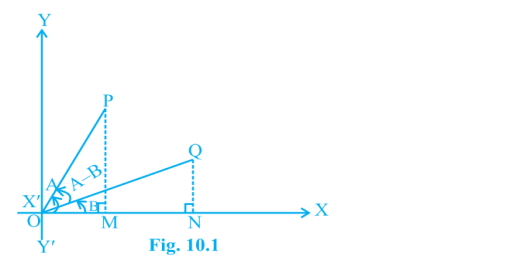
0 likes
View Solution328
DifficultMCQ
Find the angle between the vectors $2 \hat{i}-\hat{j}+\hat{k}$ and $3 \hat{i}+4 \hat{j}-\hat{k}$.
A
$\cos^{-1}\left(\frac{1}{2\sqrt{39}}\right)$
B
$\cos^{-1}\left(\frac{1}{\sqrt{39}}\right)$
C
$\cos^{-1}\left(\frac{2}{\sqrt{39}}\right)$
D
$\cos^{-1}\left(\frac{1}{2\sqrt{13}}\right)$
Solution
(A) Let $\vec{a} = 2\hat{i} - \hat{j} + \hat{k}$ and $\vec{b} = 3\hat{i} + 4\hat{j} - \hat{k}$.
The angle $\theta$ between two vectors $\vec{a}$ and $\vec{b}$ is given by the formula $\cos \theta = \frac{\vec{a} \cdot \vec{b}}{|\vec{a}| |\vec{b}|}$.
First,calculate the dot product: $\vec{a} \cdot \vec{b} = (2)(3) + (-1)(4) + (1)(-1) = 6 - 4 - 1 = 1$.
Next,calculate the magnitudes: $|\vec{a}| = \sqrt{2^2 + (-1)^2 + 1^2} = \sqrt{4 + 1 + 1} = \sqrt{6}$ and $|\vec{b}| = \sqrt{3^2 + 4^2 + (-1)^2} = \sqrt{9 + 16 + 1} = \sqrt{26}$.
Substitute these values into the formula: $\cos \theta = \frac{1}{\sqrt{6} \cdot \sqrt{26}} = \frac{1}{\sqrt{156}} = \frac{1}{\sqrt{4 \times 39}} = \frac{1}{2\sqrt{39}}$.
Therefore,$\theta = \cos^{-1}\left(\frac{1}{2\sqrt{39}}\right)$.
The angle $\theta$ between two vectors $\vec{a}$ and $\vec{b}$ is given by the formula $\cos \theta = \frac{\vec{a} \cdot \vec{b}}{|\vec{a}| |\vec{b}|}$.
First,calculate the dot product: $\vec{a} \cdot \vec{b} = (2)(3) + (-1)(4) + (1)(-1) = 6 - 4 - 1 = 1$.
Next,calculate the magnitudes: $|\vec{a}| = \sqrt{2^2 + (-1)^2 + 1^2} = \sqrt{4 + 1 + 1} = \sqrt{6}$ and $|\vec{b}| = \sqrt{3^2 + 4^2 + (-1)^2} = \sqrt{9 + 16 + 1} = \sqrt{26}$.
Substitute these values into the formula: $\cos \theta = \frac{1}{\sqrt{6} \cdot \sqrt{26}} = \frac{1}{\sqrt{156}} = \frac{1}{\sqrt{4 \times 39}} = \frac{1}{2\sqrt{39}}$.
Therefore,$\theta = \cos^{-1}\left(\frac{1}{2\sqrt{39}}\right)$.
0 likes
View Solution329
DifficultMCQ
Find the sine of the angle between the vectors $\vec{a}=3 \hat{i}+\hat{j}+2 \hat{k}$ and $\vec{b}=2 \hat{i}-2 \hat{j}+4 \hat{k}$.
A
$\frac{2}{\sqrt{7}}$
B
$\frac{1}{\sqrt{7}}$
C
$\frac{3}{\sqrt{7}}$
D
$\frac{4}{\sqrt{7}}$
Solution
(A) Given vectors are $\vec{a}=3 \hat{i}+\hat{j}+2 \hat{k}$ and $\vec{b}=2 \hat{i}-2 \hat{j}+4 \hat{k}$.
First,calculate the dot product $\vec{a} \cdot \vec{b} = (3)(2) + (1)(-2) + (2)(4) = 6 - 2 + 8 = 12$.
Next,calculate the magnitudes $|\vec{a}| = \sqrt{3^2 + 1^2 + 2^2} = \sqrt{9+1+4} = \sqrt{14}$ and $|\vec{b}| = \sqrt{2^2 + (-2)^2 + 4^2} = \sqrt{4+4+16} = \sqrt{24} = 2\sqrt{6}$.
Using the formula $\cos \theta = \frac{\vec{a} \cdot \vec{b}}{|\vec{a}| |\vec{b}|}$,we get $\cos \theta = \frac{12}{\sqrt{14} \cdot 2\sqrt{6}} = \frac{6}{\sqrt{84}} = \frac{6}{2\sqrt{21}} = \frac{3}{\sqrt{21}}$.
Now,use the identity $\sin \theta = \sqrt{1 - \cos^2 \theta}$.
$\sin \theta = \sqrt{1 - (\frac{3}{\sqrt{21}})^2} = \sqrt{1 - \frac{9}{21}} = \sqrt{\frac{12}{21}} = \sqrt{\frac{4}{7}} = \frac{2}{\sqrt{7}}$.
First,calculate the dot product $\vec{a} \cdot \vec{b} = (3)(2) + (1)(-2) + (2)(4) = 6 - 2 + 8 = 12$.
Next,calculate the magnitudes $|\vec{a}| = \sqrt{3^2 + 1^2 + 2^2} = \sqrt{9+1+4} = \sqrt{14}$ and $|\vec{b}| = \sqrt{2^2 + (-2)^2 + 4^2} = \sqrt{4+4+16} = \sqrt{24} = 2\sqrt{6}$.
Using the formula $\cos \theta = \frac{\vec{a} \cdot \vec{b}}{|\vec{a}| |\vec{b}|}$,we get $\cos \theta = \frac{12}{\sqrt{14} \cdot 2\sqrt{6}} = \frac{6}{\sqrt{84}} = \frac{6}{2\sqrt{21}} = \frac{3}{\sqrt{21}}$.
Now,use the identity $\sin \theta = \sqrt{1 - \cos^2 \theta}$.
$\sin \theta = \sqrt{1 - (\frac{3}{\sqrt{21}})^2} = \sqrt{1 - \frac{9}{21}} = \sqrt{\frac{12}{21}} = \sqrt{\frac{4}{7}} = \frac{2}{\sqrt{7}}$.
0 likes
View Solution330
Medium
If $A, B, C, D$ are the points with position vectors $\hat{i}-\hat{j}+\hat{k}, 2 \hat{i}-\hat{j}+3 \hat{k}, 2 \hat{i}-3 \hat{k}$ and $3 \hat{i}-2 \hat{j}+\hat{k}$ respectively,find the projection of $\overrightarrow{AB}$ on $\overrightarrow{CD}$.
Solution
(D) Given position vectors are $\overrightarrow{OA} = \hat{i}-\hat{j}+\hat{k}$,$\overrightarrow{OB} = 2\hat{i}-\hat{j}+3\hat{k}$,$\overrightarrow{OC} = 2\hat{i}-3\hat{k}$,and $\overrightarrow{OD} = 3\hat{i}-2\hat{j}+\hat{k}$.
$\overrightarrow{AB} = \overrightarrow{OB} - \overrightarrow{OA} = (2-1)\hat{i} + (-1 - (-1))\hat{j} + (3-1)\hat{k} = \hat{i} + 0\hat{j} + 2\hat{k}$.
$\overrightarrow{CD} = \overrightarrow{OD} - \overrightarrow{OC} = (3-2)\hat{i} + (-2-0)\hat{j} + (1 - (-3))\hat{k} = \hat{i} - 2\hat{j} + 4\hat{k}$.
The projection of $\overrightarrow{AB}$ on $\overrightarrow{CD}$ is given by $\frac{\overrightarrow{AB} \cdot \overrightarrow{CD}}{|\overrightarrow{CD}|}$.
$\overrightarrow{AB} \cdot \overrightarrow{CD} = (1)(1) + (0)(-2) + (2)(4) = 1 + 0 + 8 = 9$.
$|\overrightarrow{CD}| = \sqrt{1^2 + (-2)^2 + 4^2} = \sqrt{1 + 4 + 16} = \sqrt{21}$.
Therefore,the projection is $\frac{9}{\sqrt{21}} = \frac{9\sqrt{21}}{21} = \frac{3\sqrt{21}}{7}$ units.
$\overrightarrow{AB} = \overrightarrow{OB} - \overrightarrow{OA} = (2-1)\hat{i} + (-1 - (-1))\hat{j} + (3-1)\hat{k} = \hat{i} + 0\hat{j} + 2\hat{k}$.
$\overrightarrow{CD} = \overrightarrow{OD} - \overrightarrow{OC} = (3-2)\hat{i} + (-2-0)\hat{j} + (1 - (-3))\hat{k} = \hat{i} - 2\hat{j} + 4\hat{k}$.
The projection of $\overrightarrow{AB}$ on $\overrightarrow{CD}$ is given by $\frac{\overrightarrow{AB} \cdot \overrightarrow{CD}}{|\overrightarrow{CD}|}$.
$\overrightarrow{AB} \cdot \overrightarrow{CD} = (1)(1) + (0)(-2) + (2)(4) = 1 + 0 + 8 = 9$.
$|\overrightarrow{CD}| = \sqrt{1^2 + (-2)^2 + 4^2} = \sqrt{1 + 4 + 16} = \sqrt{21}$.
Therefore,the projection is $\frac{9}{\sqrt{21}} = \frac{9\sqrt{21}}{21} = \frac{3\sqrt{21}}{7}$ units.
0 likes
View Solution331
DifficultMCQ
Let $\overrightarrow{a} = 2\hat{i} - 3\hat{j} + 4\hat{k}$ and $\overrightarrow{b} = 7\hat{i} + \hat{j} - 6\hat{k}$. If $\overrightarrow{r} \times \overrightarrow{a} = \overrightarrow{r} \times \overrightarrow{b}$ and $\overrightarrow{r} \cdot (\hat{i} + 2\hat{j} + \hat{k}) = -3$,then $\overrightarrow{r} \cdot (2\hat{i} - 3\hat{j} + \hat{k})$ is equal to:
A
$12$
B
$8$
C
$13$
D
$10$
Solution
(A) Given $\overrightarrow{r} \times \overrightarrow{a} = \overrightarrow{r} \times \overrightarrow{b}$,we have $\overrightarrow{r} \times (\overrightarrow{a} - \overrightarrow{b}) = 0$.
This implies $\overrightarrow{r}$ is parallel to $(\overrightarrow{a} - \overrightarrow{b})$.
Calculate $\overrightarrow{a} - \overrightarrow{b} = (2-7)\hat{i} + (-3-1)\hat{j} + (4 - (-6))\hat{k} = -5\hat{i} - 4\hat{j} + 10\hat{k}$.
So,$\overrightarrow{r} = \lambda(-5\hat{i} - 4\hat{j} + 10\hat{k})$.
Given $\overrightarrow{r} \cdot (\hat{i} + 2\hat{j} + \hat{k}) = -3$,substitute $\overrightarrow{r}$:
$\lambda(-5\hat{i} - 4\hat{j} + 10\hat{k}) \cdot (\hat{i} + 2\hat{j} + \hat{k}) = -3$.
$\lambda(-5 - 8 + 10) = -3 \Rightarrow -3\lambda = -3 \Rightarrow \lambda = 1$.
Thus,$\overrightarrow{r} = -5\hat{i} - 4\hat{j} + 10\hat{k}$.
Finally,calculate $\overrightarrow{r} \cdot (2\hat{i} - 3\hat{j} + \hat{k}) = (-5)(2) + (-4)(-3) + (10)(1) = -10 + 12 + 10 = 12$.
This implies $\overrightarrow{r}$ is parallel to $(\overrightarrow{a} - \overrightarrow{b})$.
Calculate $\overrightarrow{a} - \overrightarrow{b} = (2-7)\hat{i} + (-3-1)\hat{j} + (4 - (-6))\hat{k} = -5\hat{i} - 4\hat{j} + 10\hat{k}$.
So,$\overrightarrow{r} = \lambda(-5\hat{i} - 4\hat{j} + 10\hat{k})$.
Given $\overrightarrow{r} \cdot (\hat{i} + 2\hat{j} + \hat{k}) = -3$,substitute $\overrightarrow{r}$:
$\lambda(-5\hat{i} - 4\hat{j} + 10\hat{k}) \cdot (\hat{i} + 2\hat{j} + \hat{k}) = -3$.
$\lambda(-5 - 8 + 10) = -3 \Rightarrow -3\lambda = -3 \Rightarrow \lambda = 1$.
Thus,$\overrightarrow{r} = -5\hat{i} - 4\hat{j} + 10\hat{k}$.
Finally,calculate $\overrightarrow{r} \cdot (2\hat{i} - 3\hat{j} + \hat{k}) = (-5)(2) + (-4)(-3) + (10)(1) = -10 + 12 + 10 = 12$.
0 likes
View Solution332
Difficult
Show that the area of the parallelogram whose diagonals are given by $\vec{a}$ and $\vec{b}$ is $\frac{|\vec{a} \times \vec{b}|}{2}$. Also,find the area of the parallelogram whose diagonals are $2 \hat{i}-\hat{j}+\hat{k}$ and $\hat{i}+3 \hat{j}-\hat{k}$.
Solution
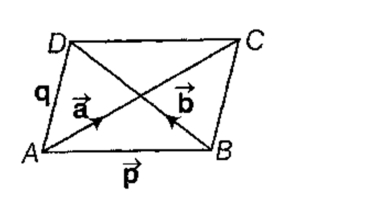
(N/A) Let $ABCD$ be a parallelogram such that $\overrightarrow{AB} = \vec{p}$ and $\overrightarrow{AD} = \vec{q}$. Then $\overrightarrow{BC} = \vec{q}$.
By the triangle law of vector addition,we have:
$\overrightarrow{AC} = \overrightarrow{AB} + \overrightarrow{BC} = \vec{p} + \vec{q} = \vec{a} \quad \dots(i)$
$\overrightarrow{BD} = \overrightarrow{AD} - \overrightarrow{AB} = \vec{q} - \vec{p} = \vec{b} \quad \dots(ii)$
Adding $(i)$ and $(ii)$,we get $\vec{a} + \vec{b} = 2\vec{q} \Rightarrow \vec{q} = \frac{1}{2}(\vec{a} + \vec{b})$.
Subtracting $(ii)$ from $(i)$,we get $\vec{a} - \vec{b} = 2\vec{p} \Rightarrow \vec{p} = \frac{1}{2}(\vec{a} - \vec{b})$.
The area of the parallelogram is given by $|\vec{p} \times \vec{q}|$.
$|\vec{p} \times \vec{q}| = |\frac{1}{2}(\vec{a} - \vec{b}) \times \frac{1}{2}(\vec{a} + \vec{b})| = \frac{1}{4} |\vec{a} \times \vec{a} + \vec{a} \times \vec{b} - \vec{b} \times \vec{a} - \vec{b} \times \vec{b}|$.
Since $\vec{a} \times \vec{a} = 0$ and $\vec{b} \times \vec{b} = 0$,and $\vec{b} \times \vec{a} = -(\vec{a} \times \vec{b})$,we have:
$|\vec{p} \times \vec{q}| = \frac{1}{4} |\vec{a} \times \vec{b} + \vec{a} \times \vec{b}| = \frac{1}{4} |2(\vec{a} \times \vec{b})| = \frac{1}{2} |\vec{a} \times \vec{b}|$.
Now,for diagonals $\vec{a} = 2\hat{i} - \hat{j} + \hat{k}$ and $\vec{b} = \hat{i} + 3\hat{j} - \hat{k}$:
$\vec{a} \times \vec{b} = \begin{vmatrix} \hat{i} & \hat{j} & \hat{k} \\ 2 & -1 & 1 \\ 1 & 3 & -1 \end{vmatrix} = \hat{i}(1 - 3) - \hat{j}(-2 - 1) + \hat{k}(6 + 1) = -2\hat{i} + 3\hat{j} + 7\hat{k}$.
Area $= \frac{1}{2} |\vec{a} \times \vec{b}| = \frac{1}{2} \sqrt{(-2)^2 + 3^2 + 7^2} = \frac{1}{2} \sqrt{4 + 9 + 49} = \frac{\sqrt{62}}{2} \text{ sq units}$.
By the triangle law of vector addition,we have:
$\overrightarrow{AC} = \overrightarrow{AB} + \overrightarrow{BC} = \vec{p} + \vec{q} = \vec{a} \quad \dots(i)$
$\overrightarrow{BD} = \overrightarrow{AD} - \overrightarrow{AB} = \vec{q} - \vec{p} = \vec{b} \quad \dots(ii)$
Adding $(i)$ and $(ii)$,we get $\vec{a} + \vec{b} = 2\vec{q} \Rightarrow \vec{q} = \frac{1}{2}(\vec{a} + \vec{b})$.
Subtracting $(ii)$ from $(i)$,we get $\vec{a} - \vec{b} = 2\vec{p} \Rightarrow \vec{p} = \frac{1}{2}(\vec{a} - \vec{b})$.
The area of the parallelogram is given by $|\vec{p} \times \vec{q}|$.
$|\vec{p} \times \vec{q}| = |\frac{1}{2}(\vec{a} - \vec{b}) \times \frac{1}{2}(\vec{a} + \vec{b})| = \frac{1}{4} |\vec{a} \times \vec{a} + \vec{a} \times \vec{b} - \vec{b} \times \vec{a} - \vec{b} \times \vec{b}|$.
Since $\vec{a} \times \vec{a} = 0$ and $\vec{b} \times \vec{b} = 0$,and $\vec{b} \times \vec{a} = -(\vec{a} \times \vec{b})$,we have:
$|\vec{p} \times \vec{q}| = \frac{1}{4} |\vec{a} \times \vec{b} + \vec{a} \times \vec{b}| = \frac{1}{4} |2(\vec{a} \times \vec{b})| = \frac{1}{2} |\vec{a} \times \vec{b}|$.
Now,for diagonals $\vec{a} = 2\hat{i} - \hat{j} + \hat{k}$ and $\vec{b} = \hat{i} + 3\hat{j} - \hat{k}$:
$\vec{a} \times \vec{b} = \begin{vmatrix} \hat{i} & \hat{j} & \hat{k} \\ 2 & -1 & 1 \\ 1 & 3 & -1 \end{vmatrix} = \hat{i}(1 - 3) - \hat{j}(-2 - 1) + \hat{k}(6 + 1) = -2\hat{i} + 3\hat{j} + 7\hat{k}$.
Area $= \frac{1}{2} |\vec{a} \times \vec{b}| = \frac{1}{2} \sqrt{(-2)^2 + 3^2 + 7^2} = \frac{1}{2} \sqrt{4 + 9 + 49} = \frac{\sqrt{62}}{2} \text{ sq units}$.
0 likes
View Solution333
DifficultMCQ
Let $\vec{a}, \vec{b}$ and $\vec{c}$ be three unit vectors such that $|\vec{a}-\vec{b}|^{2}+|\vec{a}-\vec{c}|^{2}=8$. Then $|\vec{a}+2\vec{b}|^{2}+|\vec{a}+2\vec{c}|^{2}$ is equal to
A
$1$
B
$2$
C
$4$
D
$6$
Solution
(B) Given that $\vec{a}, \vec{b}, \vec{c}$ are unit vectors,so $|\vec{a}| = |\vec{b}| = |\vec{c}| = 1$.
Expanding the given equation $|\vec{a}-\vec{b}|^{2}+|\vec{a}-\vec{c}|^{2}=8$:
$(|\vec{a}|^{2} + |\vec{b}|^{2} - 2\vec{a}\cdot\vec{b}) + (|\vec{a}|^{2} + |\vec{c}|^{2} - 2\vec{a}\cdot\vec{c}) = 8$
Since $|\vec{a}|^{2} = |\vec{b}|^{2} = |\vec{c}|^{2} = 1$,we have:
$(1 + 1 - 2\vec{a}\cdot\vec{b}) + (1 + 1 - 2\vec{a}\cdot\vec{c}) = 8$
$4 - 2(\vec{a}\cdot\vec{b} + \vec{a}\cdot\vec{c}) = 8$
$-2(\vec{a}\cdot\vec{b} + \vec{a}\cdot\vec{c}) = 4$
$\vec{a}\cdot\vec{b} + \vec{a}\cdot\vec{c} = -2$
Now,evaluate $|\vec{a}+2\vec{b}|^{2}+|\vec{a}+2\vec{c}|^{2}$:
$= (|\vec{a}|^{2} + 4|\vec{b}|^{2} + 4\vec{a}\cdot\vec{b}) + (|\vec{a}|^{2} + 4|\vec{c}|^{2} + 4\vec{a}\cdot\vec{c})$
$= (1 + 4 + 4\vec{a}\cdot\vec{b}) + (1 + 4 + 4\vec{a}\cdot\vec{c})$
$= 10 + 4(\vec{a}\cdot\vec{b} + \vec{a}\cdot\vec{c})$
Substitute the value $\vec{a}\cdot\vec{b} + \vec{a}\cdot\vec{c} = -2$:
$= 10 + 4(-2) = 10 - 8 = 2$.
Expanding the given equation $|\vec{a}-\vec{b}|^{2}+|\vec{a}-\vec{c}|^{2}=8$:
$(|\vec{a}|^{2} + |\vec{b}|^{2} - 2\vec{a}\cdot\vec{b}) + (|\vec{a}|^{2} + |\vec{c}|^{2} - 2\vec{a}\cdot\vec{c}) = 8$
Since $|\vec{a}|^{2} = |\vec{b}|^{2} = |\vec{c}|^{2} = 1$,we have:
$(1 + 1 - 2\vec{a}\cdot\vec{b}) + (1 + 1 - 2\vec{a}\cdot\vec{c}) = 8$
$4 - 2(\vec{a}\cdot\vec{b} + \vec{a}\cdot\vec{c}) = 8$
$-2(\vec{a}\cdot\vec{b} + \vec{a}\cdot\vec{c}) = 4$
$\vec{a}\cdot\vec{b} + \vec{a}\cdot\vec{c} = -2$
Now,evaluate $|\vec{a}+2\vec{b}|^{2}+|\vec{a}+2\vec{c}|^{2}$:
$= (|\vec{a}|^{2} + 4|\vec{b}|^{2} + 4\vec{a}\cdot\vec{b}) + (|\vec{a}|^{2} + 4|\vec{c}|^{2} + 4\vec{a}\cdot\vec{c})$
$= (1 + 4 + 4\vec{a}\cdot\vec{b}) + (1 + 4 + 4\vec{a}\cdot\vec{c})$
$= 10 + 4(\vec{a}\cdot\vec{b} + \vec{a}\cdot\vec{c})$
Substitute the value $\vec{a}\cdot\vec{b} + \vec{a}\cdot\vec{c} = -2$:
$= 10 + 4(-2) = 10 - 8 = 2$.
0 likes
View Solution334
DifficultMCQ
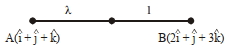
Let the position vectors of points $A$ and $B$ be $\hat{i}+\hat{j}+\hat{k}$ and $2\hat{i}+\hat{j}+3\hat{k},$ respectively. $A$ point $P$ divides the line segment $AB$ internally in the ratio $\lambda:1$ $(\lambda>0)$. If $O$ is the origin and $\overrightarrow{OB} \cdot \overrightarrow{OP}-3|\overrightarrow{OA} \times \overrightarrow{OP}|^{2}=6,$ then $\lambda$ is equal to
A
$0.6$
B
$0.7$
C
$0.8$
D
$0.5$
Solution
(C) Using the section formula,the position vector of point $P$ is given by:
$\overrightarrow{OP} = \frac{\lambda(2\hat{i}+\hat{j}+3\hat{k}) + 1(\hat{i}+\hat{j}+\hat{k})}{\lambda+1} = \frac{2\lambda+1}{\lambda+1}\hat{i} + \frac{\lambda+1}{\lambda+1}\hat{j} + \frac{3\lambda+1}{\lambda+1}\hat{k}$
Now,calculate $\overrightarrow{OB} \cdot \overrightarrow{OP}$:
$\overrightarrow{OB} \cdot \overrightarrow{OP} = (2\hat{i}+\hat{j}+3\hat{k}) \cdot \left( \frac{2\lambda+1}{\lambda+1}\hat{i} + \hat{j} + \frac{3\lambda+1}{\lambda+1}\hat{k} \right) = \frac{4\lambda+2 + \lambda+1 + 9\lambda+3}{\lambda+1} = \frac{14\lambda+6}{\lambda+1}$
Next,calculate $\overrightarrow{OA} \times \overrightarrow{OP}$:
$\overrightarrow{OA} \times \overrightarrow{OP} = \begin{vmatrix} \hat{i} & \hat{j} & \hat{k} \\ 1 & 1 & 1 \\ \frac{2\lambda+1}{\lambda+1} & 1 & \frac{3\lambda+1}{\lambda+1} \end{vmatrix} = \left( \frac{3\lambda+1}{\lambda+1} - 1 \right)\hat{i} - \left( \frac{3\lambda+1}{\lambda+1} - \frac{2\lambda+1}{\lambda+1} \right)\hat{j} + \left( 1 - \frac{2\lambda+1}{\lambda+1} \right)\hat{k}$
$= \frac{2\lambda}{\lambda+1}\hat{i} - \frac{\lambda}{\lambda+1}\hat{j} - \frac{\lambda}{\lambda+1}\hat{k}$
$|\overrightarrow{OA} \times \overrightarrow{OP}|^{2} = \frac{4\lambda^{2} + \lambda^{2} + \lambda^{2}}{(\lambda+1)^{2}} = \frac{6\lambda^{2}}{(\lambda+1)^{2}}$
Substituting these into the given equation:
$\frac{14\lambda+6}{\lambda+1} - 3 \left( \frac{6\lambda^{2}}{(\lambda+1)^{2}} \right) = 6$
Multiply by $(\lambda+1)^{2}$:
$(14\lambda+6)(\lambda+1) - 18\lambda^{2} = 6(\lambda+1)^{2}$
$14\lambda^{2} + 20\lambda + 6 - 18\lambda^{2} = 6(\lambda^{2} + 2\lambda + 1)$
$-4\lambda^{2} + 20\lambda + 6 = 6\lambda^{2} + 12\lambda + 6$
$10\lambda^{2} - 8\lambda = 0$
Since $\lambda > 0$,we have $10\lambda = 8 \Rightarrow \lambda = 0.8$.
$\overrightarrow{OP} = \frac{\lambda(2\hat{i}+\hat{j}+3\hat{k}) + 1(\hat{i}+\hat{j}+\hat{k})}{\lambda+1} = \frac{2\lambda+1}{\lambda+1}\hat{i} + \frac{\lambda+1}{\lambda+1}\hat{j} + \frac{3\lambda+1}{\lambda+1}\hat{k}$
Now,calculate $\overrightarrow{OB} \cdot \overrightarrow{OP}$:
$\overrightarrow{OB} \cdot \overrightarrow{OP} = (2\hat{i}+\hat{j}+3\hat{k}) \cdot \left( \frac{2\lambda+1}{\lambda+1}\hat{i} + \hat{j} + \frac{3\lambda+1}{\lambda+1}\hat{k} \right) = \frac{4\lambda+2 + \lambda+1 + 9\lambda+3}{\lambda+1} = \frac{14\lambda+6}{\lambda+1}$
Next,calculate $\overrightarrow{OA} \times \overrightarrow{OP}$:
$\overrightarrow{OA} \times \overrightarrow{OP} = \begin{vmatrix} \hat{i} & \hat{j} & \hat{k} \\ 1 & 1 & 1 \\ \frac{2\lambda+1}{\lambda+1} & 1 & \frac{3\lambda+1}{\lambda+1} \end{vmatrix} = \left( \frac{3\lambda+1}{\lambda+1} - 1 \right)\hat{i} - \left( \frac{3\lambda+1}{\lambda+1} - \frac{2\lambda+1}{\lambda+1} \right)\hat{j} + \left( 1 - \frac{2\lambda+1}{\lambda+1} \right)\hat{k}$
$= \frac{2\lambda}{\lambda+1}\hat{i} - \frac{\lambda}{\lambda+1}\hat{j} - \frac{\lambda}{\lambda+1}\hat{k}$
$|\overrightarrow{OA} \times \overrightarrow{OP}|^{2} = \frac{4\lambda^{2} + \lambda^{2} + \lambda^{2}}{(\lambda+1)^{2}} = \frac{6\lambda^{2}}{(\lambda+1)^{2}}$
Substituting these into the given equation:
$\frac{14\lambda+6}{\lambda+1} - 3 \left( \frac{6\lambda^{2}}{(\lambda+1)^{2}} \right) = 6$
Multiply by $(\lambda+1)^{2}$:
$(14\lambda+6)(\lambda+1) - 18\lambda^{2} = 6(\lambda+1)^{2}$
$14\lambda^{2} + 20\lambda + 6 - 18\lambda^{2} = 6(\lambda^{2} + 2\lambda + 1)$
$-4\lambda^{2} + 20\lambda + 6 = 6\lambda^{2} + 12\lambda + 6$
$10\lambda^{2} - 8\lambda = 0$
Since $\lambda > 0$,we have $10\lambda = 8 \Rightarrow \lambda = 0.8$.
0 likes
View Solution335
MediumMCQ
Let $a, b, c \in \mathbb{R}$ be such that $a^{2} + b^{2} + c^{2} = 1$. If $a \cos \theta = b \cos \left(\theta + \frac{2\pi}{3}\right) = c \cos \left(\theta + \frac{4\pi}{3}\right)$ where $\theta = \frac{\pi}{9}$,then the angle between the vectors $\vec{p} = a \hat{i} + b \hat{j} + c \hat{k}$ and $\vec{q} = b \hat{i} + c \hat{j} + a \hat{k}$ is:
A
$\frac{\pi}{2}$
B
$0$
C
$\frac{\pi}{9}$
D
$\frac{2\pi}{3}$
Solution
(D) Let $\vec{p} = a \hat{i} + b \hat{j} + c \hat{k}$ and $\vec{q} = b \hat{i} + c \hat{j} + a \hat{k}$.
Given $a^{2} + b^{2} + c^{2} = 1$,we have $|\vec{p}| = \sqrt{a^{2} + b^{2} + c^{2}} = 1$ and $|\vec{q}| = \sqrt{b^{2} + c^{2} + a^{2}} = 1$.
The dot product is $\vec{p} \cdot \vec{q} = ab + bc + ca$.
Let $a \cos \theta = b \cos \left(\theta + \frac{2\pi}{3}\right) = c \cos \left(\theta + \frac{4\pi}{3}\right) = k$.
Then $a = \frac{k}{\cos \theta}$,$b = \frac{k}{\cos(\theta + 2\pi/3)}$,$c = \frac{k}{\cos(\theta + 4\pi/3)}$.
Since $a+b+c = k(\sec \theta + \sec(\theta + 2\pi/3) + \sec(\theta + 4\pi/3)) = 0$ (using the identity for sum of secants),we have $(a+b+c)^{2} = a^{2} + b^{2} + c^{2} + 2(ab + bc + ca) = 0$.
Since $a^{2} + b^{2} + c^{2} = 1$,we get $1 + 2(ab + bc + ca) = 0$,so $ab + bc + ca = -1/2$.
Thus,$\cos \phi = \frac{\vec{p} \cdot \vec{q}}{|\vec{p}||\vec{q}|} = \frac{-1/2}{1 \times 1} = -1/2$.
Therefore,$\phi = \frac{2\pi}{3}$.
Given $a^{2} + b^{2} + c^{2} = 1$,we have $|\vec{p}| = \sqrt{a^{2} + b^{2} + c^{2}} = 1$ and $|\vec{q}| = \sqrt{b^{2} + c^{2} + a^{2}} = 1$.
The dot product is $\vec{p} \cdot \vec{q} = ab + bc + ca$.
Let $a \cos \theta = b \cos \left(\theta + \frac{2\pi}{3}\right) = c \cos \left(\theta + \frac{4\pi}{3}\right) = k$.
Then $a = \frac{k}{\cos \theta}$,$b = \frac{k}{\cos(\theta + 2\pi/3)}$,$c = \frac{k}{\cos(\theta + 4\pi/3)}$.
Since $a+b+c = k(\sec \theta + \sec(\theta + 2\pi/3) + \sec(\theta + 4\pi/3)) = 0$ (using the identity for sum of secants),we have $(a+b+c)^{2} = a^{2} + b^{2} + c^{2} + 2(ab + bc + ca) = 0$.
Since $a^{2} + b^{2} + c^{2} = 1$,we get $1 + 2(ab + bc + ca) = 0$,so $ab + bc + ca = -1/2$.
Thus,$\cos \phi = \frac{\vec{p} \cdot \vec{q}}{|\vec{p}||\vec{q}|} = \frac{-1/2}{1 \times 1} = -1/2$.
Therefore,$\phi = \frac{2\pi}{3}$.
0 likes
View Solution336
DifficultMCQ
Let the vectors $\overrightarrow{a}, \overrightarrow{b}, \overrightarrow{c}$ be such that $|\overrightarrow{a}|=2, |\overrightarrow{b}|=4$ and $|\overrightarrow{c}|=4$. If the projection of $\overrightarrow{b}$ on $\overrightarrow{a}$ is equal to the projection of $\overrightarrow{c}$ on $\overrightarrow{a}$ and $\overrightarrow{b}$ is perpendicular to $\overrightarrow{c}$,then the value of $|\overrightarrow{a}+\overrightarrow{b}-\overrightarrow{c}|$ is
A
$6$
B
$12$
C
$36$
D
$30$
Solution
(A) Given that the projection of $\overrightarrow{b}$ on $\overrightarrow{a}$ is equal to the projection of $\overrightarrow{c}$ on $\overrightarrow{a}$.
$\Rightarrow \frac{\overrightarrow{b} \cdot \overrightarrow{a}}{|\overrightarrow{a}|} = \frac{\overrightarrow{c} \cdot \overrightarrow{a}}{|\overrightarrow{a}|} \Rightarrow \overrightarrow{b} \cdot \overrightarrow{a} = \overrightarrow{c} \cdot \overrightarrow{a}$.
Also,$\overrightarrow{b}$ is perpendicular to $\overrightarrow{c}$,so $\overrightarrow{b} \cdot \overrightarrow{c} = 0$.
Let $k = |\overrightarrow{a} + \overrightarrow{b} - \overrightarrow{c}|$.
Squaring both sides,we get:
$k^2 = |\overrightarrow{a} + \overrightarrow{b} - \overrightarrow{c}|^2 = |\overrightarrow{a}|^2 + |\overrightarrow{b}|^2 + |\overrightarrow{c}|^2 + 2(\overrightarrow{a} \cdot \overrightarrow{b}) - 2(\overrightarrow{a} \cdot \overrightarrow{c}) - 2(\overrightarrow{b} \cdot \overrightarrow{c})$.
Since $\overrightarrow{a} \cdot \overrightarrow{b} = \overrightarrow{a} \cdot \overrightarrow{c}$ and $\overrightarrow{b} \cdot \overrightarrow{c} = 0$,the terms cancel out:
$k^2 = |\overrightarrow{a}|^2 + |\overrightarrow{b}|^2 + |\overrightarrow{c}|^2 + 2(\overrightarrow{a} \cdot \overrightarrow{b} - \overrightarrow{a} \cdot \overrightarrow{c}) - 2(0) = |\overrightarrow{a}|^2 + |\overrightarrow{b}|^2 + |\overrightarrow{c}|^2$.
Substituting the given magnitudes $|\overrightarrow{a}|=2, |\overrightarrow{b}|=4, |\overrightarrow{c}|=4$:
$k^2 = 2^2 + 4^2 + 4^2 = 4 + 16 + 16 = 36$.
Therefore,$k = \sqrt{36} = 6$.
$\Rightarrow \frac{\overrightarrow{b} \cdot \overrightarrow{a}}{|\overrightarrow{a}|} = \frac{\overrightarrow{c} \cdot \overrightarrow{a}}{|\overrightarrow{a}|} \Rightarrow \overrightarrow{b} \cdot \overrightarrow{a} = \overrightarrow{c} \cdot \overrightarrow{a}$.
Also,$\overrightarrow{b}$ is perpendicular to $\overrightarrow{c}$,so $\overrightarrow{b} \cdot \overrightarrow{c} = 0$.
Let $k = |\overrightarrow{a} + \overrightarrow{b} - \overrightarrow{c}|$.
Squaring both sides,we get:
$k^2 = |\overrightarrow{a} + \overrightarrow{b} - \overrightarrow{c}|^2 = |\overrightarrow{a}|^2 + |\overrightarrow{b}|^2 + |\overrightarrow{c}|^2 + 2(\overrightarrow{a} \cdot \overrightarrow{b}) - 2(\overrightarrow{a} \cdot \overrightarrow{c}) - 2(\overrightarrow{b} \cdot \overrightarrow{c})$.
Since $\overrightarrow{a} \cdot \overrightarrow{b} = \overrightarrow{a} \cdot \overrightarrow{c}$ and $\overrightarrow{b} \cdot \overrightarrow{c} = 0$,the terms cancel out:
$k^2 = |\overrightarrow{a}|^2 + |\overrightarrow{b}|^2 + |\overrightarrow{c}|^2 + 2(\overrightarrow{a} \cdot \overrightarrow{b} - \overrightarrow{a} \cdot \overrightarrow{c}) - 2(0) = |\overrightarrow{a}|^2 + |\overrightarrow{b}|^2 + |\overrightarrow{c}|^2$.
Substituting the given magnitudes $|\overrightarrow{a}|=2, |\overrightarrow{b}|=4, |\overrightarrow{c}|=4$:
$k^2 = 2^2 + 4^2 + 4^2 = 4 + 16 + 16 = 36$.
Therefore,$k = \sqrt{36} = 6$.
0 likes
View Solution337
MediumMCQ
If $\overrightarrow{x}$ and $\overrightarrow{y}$ are two non-zero vectors such that $|\overrightarrow{x}+\overrightarrow{y}|=|\overrightarrow{x}|$ and $2\overrightarrow{x}+\lambda\overrightarrow{y}$ is perpendicular to $\overrightarrow{y}$,then the value of $\lambda$ is
A
$1$
B
$3$
C
$4$
D
$2$
Solution
(A) Given $|\overrightarrow{x}+\overrightarrow{y}|=|\overrightarrow{x}|$. Squaring both sides,we get:
$|\overrightarrow{x}|^2+|\overrightarrow{y}|^2+2\overrightarrow{x}\cdot\overrightarrow{y}=|\overrightarrow{x}|^2$
$|\overrightarrow{y}|^2+2\overrightarrow{x}\cdot\overrightarrow{y}=0$ --- $(1)$
Given that $(2\overrightarrow{x}+\lambda\overrightarrow{y})$ is perpendicular to $\overrightarrow{y}$,their dot product is zero:
$(2\overrightarrow{x}+\lambda\overrightarrow{y})\cdot\overrightarrow{y}=0$
$2\overrightarrow{x}\cdot\overrightarrow{y}+\lambda|\overrightarrow{y}|^2=0$ --- $(2)$
From equation $(1)$,we have $2\overrightarrow{x}\cdot\overrightarrow{y}=-|\overrightarrow{y}|^2$. Substituting this into equation $(2)$:
$-|\overrightarrow{y}|^2+\lambda|\overrightarrow{y}|^2=0$
$(\lambda-1)|\overrightarrow{y}|^2=0$
Since $\overrightarrow{y}$ is a non-zero vector,$|\overrightarrow{y}|^2 \neq 0$. Therefore,$\lambda-1=0$,which gives $\lambda=1$.
$|\overrightarrow{x}|^2+|\overrightarrow{y}|^2+2\overrightarrow{x}\cdot\overrightarrow{y}=|\overrightarrow{x}|^2$
$|\overrightarrow{y}|^2+2\overrightarrow{x}\cdot\overrightarrow{y}=0$ --- $(1)$
Given that $(2\overrightarrow{x}+\lambda\overrightarrow{y})$ is perpendicular to $\overrightarrow{y}$,their dot product is zero:
$(2\overrightarrow{x}+\lambda\overrightarrow{y})\cdot\overrightarrow{y}=0$
$2\overrightarrow{x}\cdot\overrightarrow{y}+\lambda|\overrightarrow{y}|^2=0$ --- $(2)$
From equation $(1)$,we have $2\overrightarrow{x}\cdot\overrightarrow{y}=-|\overrightarrow{y}|^2$. Substituting this into equation $(2)$:
$-|\overrightarrow{y}|^2+\lambda|\overrightarrow{y}|^2=0$
$(\lambda-1)|\overrightarrow{y}|^2=0$
Since $\overrightarrow{y}$ is a non-zero vector,$|\overrightarrow{y}|^2 \neq 0$. Therefore,$\lambda-1=0$,which gives $\lambda=1$.
0 likes
View Solution338
MediumMCQ
If $\overrightarrow{a}$ and $\overrightarrow{b}$ are unit vectors,then the greatest value of $\sqrt{3}|\overrightarrow{a}+\overrightarrow{b}|+|\overrightarrow{a}-\overrightarrow{b}|$ is
A
$6$
B
$5$
C
$3$
D
$4$
Solution
(D) Let $\theta$ be the angle between the unit vectors $\overrightarrow{a}$ and $\overrightarrow{b}$.
We know that $|\overrightarrow{a}+\overrightarrow{b}| = \sqrt{|\overrightarrow{a}|^2 + |\overrightarrow{b}|^2 + 2\overrightarrow{a} \cdot \overrightarrow{b}} = \sqrt{1+1+2\cos \theta} = \sqrt{2+2\cos \theta} = 2|\cos(\theta/2)|$.
Similarly,$|\overrightarrow{a}-\overrightarrow{b}| = \sqrt{|\overrightarrow{a}|^2 + |\overrightarrow{b}|^2 - 2\overrightarrow{a} \cdot \overrightarrow{b}} = \sqrt{2-2\cos \theta} = 2|\sin(\theta/2)|$.
The expression becomes $f(\theta) = \sqrt{3}(2|\cos(\theta/2)|) + 2|\sin(\theta/2)|$.
Using the Cauchy-Schwarz inequality or the property $a\cos x + b\sin x \leq \sqrt{a^2+b^2}$,the maximum value is $\sqrt{(\sqrt{3} \times 2)^2 + 2^2} = \sqrt{12+4} = \sqrt{16} = 4$.
We know that $|\overrightarrow{a}+\overrightarrow{b}| = \sqrt{|\overrightarrow{a}|^2 + |\overrightarrow{b}|^2 + 2\overrightarrow{a} \cdot \overrightarrow{b}} = \sqrt{1+1+2\cos \theta} = \sqrt{2+2\cos \theta} = 2|\cos(\theta/2)|$.
Similarly,$|\overrightarrow{a}-\overrightarrow{b}| = \sqrt{|\overrightarrow{a}|^2 + |\overrightarrow{b}|^2 - 2\overrightarrow{a} \cdot \overrightarrow{b}} = \sqrt{2-2\cos \theta} = 2|\sin(\theta/2)|$.
The expression becomes $f(\theta) = \sqrt{3}(2|\cos(\theta/2)|) + 2|\sin(\theta/2)|$.
Using the Cauchy-Schwarz inequality or the property $a\cos x + b\sin x \leq \sqrt{a^2+b^2}$,the maximum value is $\sqrt{(\sqrt{3} \times 2)^2 + 2^2} = \sqrt{12+4} = \sqrt{16} = 4$.
0 likes
View Solution339
DifficultMCQ
Let $\overrightarrow{a} = \hat{i} + 2\hat{j} - 3\hat{k}$ and $\overrightarrow{b} = 2\hat{i} - 3\hat{j} + 5\hat{k}$. If $\overrightarrow{r} \times \overrightarrow{a} = \overrightarrow{b} \times \overrightarrow{r}$,$\overrightarrow{r} \cdot (\alpha\hat{i} + 2\hat{j} + \hat{k}) = 3$ and $\overrightarrow{r} \cdot (2\hat{i} + 5\hat{j} - \alpha\hat{k}) = -1$,where $\alpha \in R$,then the value of $\alpha + |\overrightarrow{r}|^{2}$ is equal to:
A
$9$
B
$15$
C
$13$
D
$11$
Solution
(B) Given $\overrightarrow{r} \times \overrightarrow{a} = \overrightarrow{b} \times \overrightarrow{r}$,we can write $\overrightarrow{r} \times \overrightarrow{a} + \overrightarrow{r} \times \overrightarrow{b} = 0$,which implies $\overrightarrow{r} \times (\overrightarrow{a} + \overrightarrow{b}) = 0$.
This means $\overrightarrow{r}$ is parallel to $(\overrightarrow{a} + \overrightarrow{b})$.
$\overrightarrow{a} + \overrightarrow{b} = (\hat{i} + 2\hat{j} - 3\hat{k}) + (2\hat{i} - 3\hat{j} + 5\hat{k}) = 3\hat{i} - \hat{j} + 2\hat{k}$.
So,$\overrightarrow{r} = \lambda(3\hat{i} - \hat{j} + 2\hat{k})$ for some scalar $\lambda$.
Substituting $\overrightarrow{r}$ into $\overrightarrow{r} \cdot (\alpha\hat{i} + 2\hat{j} + \hat{k}) = 3$:
$\lambda(3\alpha - 2 + 2) = 3 \Rightarrow 3\lambda\alpha = 3 \Rightarrow \lambda\alpha = 1$.
Substituting $\overrightarrow{r}$ into $\overrightarrow{r} \cdot (2\hat{i} + 5\hat{j} - \alpha\hat{k}) = -1$:
$\lambda(6 - 5 - 2\alpha) = -1 \Rightarrow \lambda(1 - 2\alpha) = -1 \Rightarrow \lambda - 2\lambda\alpha = -1$.
Since $\lambda\alpha = 1$,we have $\lambda - 2(1) = -1 \Rightarrow \lambda = 1$.
Then $\alpha = 1/\lambda = 1$.
Thus,$\overrightarrow{r} = 3\hat{i} - \hat{j} + 2\hat{k}$.
$|\overrightarrow{r}|^{2} = 3^{2} + (-1)^{2} + 2^{2} = 9 + 1 + 4 = 14$.
Finally,$\alpha + |\overrightarrow{r}|^{2} = 1 + 14 = 15$.
This means $\overrightarrow{r}$ is parallel to $(\overrightarrow{a} + \overrightarrow{b})$.
$\overrightarrow{a} + \overrightarrow{b} = (\hat{i} + 2\hat{j} - 3\hat{k}) + (2\hat{i} - 3\hat{j} + 5\hat{k}) = 3\hat{i} - \hat{j} + 2\hat{k}$.
So,$\overrightarrow{r} = \lambda(3\hat{i} - \hat{j} + 2\hat{k})$ for some scalar $\lambda$.
Substituting $\overrightarrow{r}$ into $\overrightarrow{r} \cdot (\alpha\hat{i} + 2\hat{j} + \hat{k}) = 3$:
$\lambda(3\alpha - 2 + 2) = 3 \Rightarrow 3\lambda\alpha = 3 \Rightarrow \lambda\alpha = 1$.
Substituting $\overrightarrow{r}$ into $\overrightarrow{r} \cdot (2\hat{i} + 5\hat{j} - \alpha\hat{k}) = -1$:
$\lambda(6 - 5 - 2\alpha) = -1 \Rightarrow \lambda(1 - 2\alpha) = -1 \Rightarrow \lambda - 2\lambda\alpha = -1$.
Since $\lambda\alpha = 1$,we have $\lambda - 2(1) = -1 \Rightarrow \lambda = 1$.
Then $\alpha = 1/\lambda = 1$.
Thus,$\overrightarrow{r} = 3\hat{i} - \hat{j} + 2\hat{k}$.
$|\overrightarrow{r}|^{2} = 3^{2} + (-1)^{2} + 2^{2} = 9 + 1 + 4 = 14$.
Finally,$\alpha + |\overrightarrow{r}|^{2} = 1 + 14 = 15$.
0 likes
View Solution340
MediumMCQ
Let $\overrightarrow{x}$ be a vector in the plane containing vectors $\overrightarrow{a} = 2\hat{i} - \hat{j} + \hat{k}$ and $\overrightarrow{b} = \hat{i} + 2\hat{j} - \hat{k}$. If the vector $\overrightarrow{x}$ is perpendicular to $(3\hat{i} + 2\hat{j} - \hat{k})$ and its projection on $\overrightarrow{a}$ is $\frac{17\sqrt{6}}{2}$,then the value of $|\overrightarrow{x}|^{2}$ is equal to ...... .
A
$452$
B
$396$
C
$486$
D
$512$
Solution
(C) Since $\overrightarrow{x}$ lies in the plane of $\overrightarrow{a}$ and $\overrightarrow{b}$,we can write $\overrightarrow{x} = \lambda\overrightarrow{a} + \mu\overrightarrow{b} = \lambda(2\hat{i} - \hat{j} + \hat{k}) + \mu(\hat{i} + 2\hat{j} - \hat{k}) = (2\lambda + \mu)\hat{i} + (2\mu - \lambda)\hat{j} + (\lambda - \mu)\hat{k}$.
Given $\overrightarrow{x} \perp (3\hat{i} + 2\hat{j} - \hat{k})$,so $\overrightarrow{x} \cdot (3\hat{i} + 2\hat{j} - \hat{k}) = 0$.
$3(2\lambda + \mu) + 2(2\mu - \lambda) - 1(\lambda - \mu) = 0 \implies 6\lambda + 3\mu + 4\mu - 2\lambda - \lambda + \mu = 0 \implies 3\lambda + 8\mu = 0 \implies \lambda = -\frac{8}{3}\mu$.
Projection of $\overrightarrow{x}$ on $\overrightarrow{a}$ is $\frac{\overrightarrow{x} \cdot \overrightarrow{a}}{|\overrightarrow{a}|} = \frac{17\sqrt{6}}{2}$.
$|\overrightarrow{a}| = \sqrt{2^2 + (-1)^2 + 1^2} = \sqrt{6}$.
$\overrightarrow{x} \cdot \overrightarrow{a} = (2\lambda + \mu)(2) + (2\mu - \lambda)(-1) + (\lambda - \mu)(1) = 4\lambda + 2\mu - 2\mu + \lambda + \lambda - \mu = 6\lambda - \mu$.
So,$\frac{6\lambda - \mu}{\sqrt{6}} = \frac{17\sqrt{6}}{2} \implies 6\lambda - \mu = 51$.
Substituting $\lambda = -\frac{8}{3}\mu$ into $6\lambda - \mu = 51$: $6(-\frac{8}{3}\mu) - \mu = 51 \implies -16\mu - \mu = 51 \implies -17\mu = 51 \implies \mu = -3$.
Then $\lambda = -\frac{8}{3}(-3) = 8$.
Thus,$\overrightarrow{x} = 8(2\hat{i} - \hat{j} + \hat{k}) - 3(\hat{i} + 2\hat{j} - \hat{k}) = (16-3)\hat{i} + (-8-6)\hat{j} + (8+3)\hat{k} = 13\hat{i} - 14\hat{j} + 11\hat{k}$.
$|\overrightarrow{x}|^{2} = 13^2 + (-14)^2 + 11^2 = 169 + 196 + 121 = 486$.
Given $\overrightarrow{x} \perp (3\hat{i} + 2\hat{j} - \hat{k})$,so $\overrightarrow{x} \cdot (3\hat{i} + 2\hat{j} - \hat{k}) = 0$.
$3(2\lambda + \mu) + 2(2\mu - \lambda) - 1(\lambda - \mu) = 0 \implies 6\lambda + 3\mu + 4\mu - 2\lambda - \lambda + \mu = 0 \implies 3\lambda + 8\mu = 0 \implies \lambda = -\frac{8}{3}\mu$.
Projection of $\overrightarrow{x}$ on $\overrightarrow{a}$ is $\frac{\overrightarrow{x} \cdot \overrightarrow{a}}{|\overrightarrow{a}|} = \frac{17\sqrt{6}}{2}$.
$|\overrightarrow{a}| = \sqrt{2^2 + (-1)^2 + 1^2} = \sqrt{6}$.
$\overrightarrow{x} \cdot \overrightarrow{a} = (2\lambda + \mu)(2) + (2\mu - \lambda)(-1) + (\lambda - \mu)(1) = 4\lambda + 2\mu - 2\mu + \lambda + \lambda - \mu = 6\lambda - \mu$.
So,$\frac{6\lambda - \mu}{\sqrt{6}} = \frac{17\sqrt{6}}{2} \implies 6\lambda - \mu = 51$.
Substituting $\lambda = -\frac{8}{3}\mu$ into $6\lambda - \mu = 51$: $6(-\frac{8}{3}\mu) - \mu = 51 \implies -16\mu - \mu = 51 \implies -17\mu = 51 \implies \mu = -3$.
Then $\lambda = -\frac{8}{3}(-3) = 8$.
Thus,$\overrightarrow{x} = 8(2\hat{i} - \hat{j} + \hat{k}) - 3(\hat{i} + 2\hat{j} - \hat{k}) = (16-3)\hat{i} + (-8-6)\hat{j} + (8+3)\hat{k} = 13\hat{i} - 14\hat{j} + 11\hat{k}$.
$|\overrightarrow{x}|^{2} = 13^2 + (-14)^2 + 11^2 = 169 + 196 + 121 = 486$.
0 likes
View Solution341
MediumMCQ
In a triangle $ABC,$ if $|\overline{BC}|=8, |\overline{CA}|=7, |\overline{AB}|=10,$ then the projection of the vector $\overline{AB}$ on $\overline{AC}$ is equal to ....... .
A
$\frac{25}{4}$
B
$\frac{85}{14}$
C
$\frac{127}{20}$
D
$\frac{115}{16}$
Solution
(B) Let $\vec{c} = \overline{AB},$ $\vec{b} = \overline{AC},$ and $\vec{a} = \overline{BC}.$ Given $|\vec{a}|=8, |\vec{b}|=7, |\vec{c}|=10.$
Using the Law of Cosines in $\triangle ABC$ at vertex $A$ where $\theta$ is the angle between $\overline{AB}$ and $\overline{AC}$:
$|\vec{a}|^2 = |\vec{b}|^2 + |\vec{c}|^2 - 2|\vec{b}||\vec{c}| \cos \theta$
$8^2 = 7^2 + 10^2 - 2(7)(10) \cos \theta$
$64 = 49 + 100 - 140 \cos \theta$
$140 \cos \theta = 149 - 64 = 85$
$\cos \theta = \frac{85}{140} = \frac{17}{28}.$
The projection of vector $\overline{AB}$ (which is $\vec{c}$) on $\overline{AC}$ (which is $\vec{b}$) is given by $|\vec{c}| \cos \theta.$
Projection $= 10 \times \frac{17}{28} = \frac{170}{28} = \frac{85}{14}.$
Using the Law of Cosines in $\triangle ABC$ at vertex $A$ where $\theta$ is the angle between $\overline{AB}$ and $\overline{AC}$:
$|\vec{a}|^2 = |\vec{b}|^2 + |\vec{c}|^2 - 2|\vec{b}||\vec{c}| \cos \theta$
$8^2 = 7^2 + 10^2 - 2(7)(10) \cos \theta$
$64 = 49 + 100 - 140 \cos \theta$
$140 \cos \theta = 149 - 64 = 85$
$\cos \theta = \frac{85}{140} = \frac{17}{28}.$
The projection of vector $\overline{AB}$ (which is $\vec{c}$) on $\overline{AC}$ (which is $\vec{b}$) is given by $|\vec{c}| \cos \theta.$
Projection $= 10 \times \frac{17}{28} = \frac{170}{28} = \frac{85}{14}.$
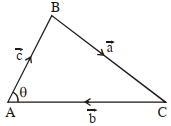
0 likes
View Solution342
DifficultMCQ
Let three vectors $\overrightarrow{a}, \overrightarrow{b}$ and $\overrightarrow{c}$ be such that $\overrightarrow{c}$ is coplanar with $\overrightarrow{a}$ and $\overrightarrow{b}$,$\overrightarrow{a} \cdot \overrightarrow{c} = 7$ and $\overrightarrow{b}$ is perpendicular to $\overrightarrow{c}$,where $\overrightarrow{a} = -\hat{i} + \hat{j} + \hat{k}$ and $\overrightarrow{b} = 2\hat{i} + \hat{k}$. Then the value of $2|\overrightarrow{a} + \overrightarrow{b} + \overrightarrow{c}|^{2}$ is .........
A
$75$
B
$50$
C
$80$
D
$100$
Solution
(A) Since $\overrightarrow{c}$ is coplanar with $\overrightarrow{a}$ and $\overrightarrow{b}$,we can write $\overrightarrow{c} = x\overrightarrow{a} + y\overrightarrow{b}$.
Given $\overrightarrow{b} \cdot \overrightarrow{c} = 0$,we have $\overrightarrow{b} \cdot (x\overrightarrow{a} + y\overrightarrow{b}) = 0$,which implies $x(\overrightarrow{a} \cdot \overrightarrow{b}) + y|\overrightarrow{b}|^{2} = 0$.
Calculating $\overrightarrow{a} \cdot \overrightarrow{b} = (-1)(2) + (1)(0) + (1)(1) = -1$ and $|\overrightarrow{b}|^{2} = 2^{2} + 0^{2} + 1^{2} = 5$.
So,$-x + 5y = 0 \Rightarrow x = 5y$.
Thus,$\overrightarrow{c} = y(5\overrightarrow{a} + \overrightarrow{b}) = y(5(-\hat{i} + \hat{j} + \hat{k}) + (2\hat{i} + \hat{k})) = y(-3\hat{i} + 5\hat{j} + 6\hat{k})$.
Given $\overrightarrow{a} \cdot \overrightarrow{c} = 7$,we have $y((-1)(-3) + (1)(5) + (1)(6)) = 7 \Rightarrow y(3 + 5 + 6) = 7 \Rightarrow 14y = 7 \Rightarrow y = \frac{1}{2}$.
So,$\overrightarrow{c} = -\frac{3}{2}\hat{i} + \frac{5}{2}\hat{j} + 3\hat{k}$.
Then $\overrightarrow{a} + \overrightarrow{b} + \overrightarrow{c} = (-\hat{i} + \hat{j} + \hat{k}) + (2\hat{i} + \hat{k}) + (-\frac{3}{2}\hat{i} + \frac{5}{2}\hat{j} + 3\hat{k}) = (2 - 1 - \frac{3}{2})\hat{i} + (1 + \frac{5}{2})\hat{j} + (1 + 1 + 3)\hat{k} = -\frac{1}{2}\hat{i} + \frac{7}{2}\hat{j} + 5\hat{k}$.
Finally,$2|\overrightarrow{a} + \overrightarrow{b} + \overrightarrow{c}|^{2} = 2((\frac{-1}{2})^{2} + (\frac{7}{2})^{2} + 5^{2}) = 2(\frac{1}{4} + \frac{49}{4} + 25) = 2(\frac{50}{4} + 25) = 2(12.5 + 25) = 2(37.5) = 75$.
Given $\overrightarrow{b} \cdot \overrightarrow{c} = 0$,we have $\overrightarrow{b} \cdot (x\overrightarrow{a} + y\overrightarrow{b}) = 0$,which implies $x(\overrightarrow{a} \cdot \overrightarrow{b}) + y|\overrightarrow{b}|^{2} = 0$.
Calculating $\overrightarrow{a} \cdot \overrightarrow{b} = (-1)(2) + (1)(0) + (1)(1) = -1$ and $|\overrightarrow{b}|^{2} = 2^{2} + 0^{2} + 1^{2} = 5$.
So,$-x + 5y = 0 \Rightarrow x = 5y$.
Thus,$\overrightarrow{c} = y(5\overrightarrow{a} + \overrightarrow{b}) = y(5(-\hat{i} + \hat{j} + \hat{k}) + (2\hat{i} + \hat{k})) = y(-3\hat{i} + 5\hat{j} + 6\hat{k})$.
Given $\overrightarrow{a} \cdot \overrightarrow{c} = 7$,we have $y((-1)(-3) + (1)(5) + (1)(6)) = 7 \Rightarrow y(3 + 5 + 6) = 7 \Rightarrow 14y = 7 \Rightarrow y = \frac{1}{2}$.
So,$\overrightarrow{c} = -\frac{3}{2}\hat{i} + \frac{5}{2}\hat{j} + 3\hat{k}$.
Then $\overrightarrow{a} + \overrightarrow{b} + \overrightarrow{c} = (-\hat{i} + \hat{j} + \hat{k}) + (2\hat{i} + \hat{k}) + (-\frac{3}{2}\hat{i} + \frac{5}{2}\hat{j} + 3\hat{k}) = (2 - 1 - \frac{3}{2})\hat{i} + (1 + \frac{5}{2})\hat{j} + (1 + 1 + 3)\hat{k} = -\frac{1}{2}\hat{i} + \frac{7}{2}\hat{j} + 5\hat{k}$.
Finally,$2|\overrightarrow{a} + \overrightarrow{b} + \overrightarrow{c}|^{2} = 2((\frac{-1}{2})^{2} + (\frac{7}{2})^{2} + 5^{2}) = 2(\frac{1}{4} + \frac{49}{4} + 25) = 2(\frac{50}{4} + 25) = 2(12.5 + 25) = 2(37.5) = 75$.
0 likes
View Solution343
MediumMCQ
Let $\overrightarrow{a} = \hat{i} + 2\hat{j} - \hat{k}$,$\overrightarrow{b} = \hat{i} - \hat{j}$ and $\overrightarrow{c} = \hat{i} - \hat{j} - \hat{k}$ be three given vectors. If $\overrightarrow{r}$ is a vector such that $\overrightarrow{r} \times \overrightarrow{a} = \overrightarrow{c} \times \overrightarrow{a}$ and $\overrightarrow{r} \cdot \overrightarrow{b} = 0$,then $\overrightarrow{r} \cdot \overrightarrow{a}$ is equal to ...........
A
$4$
B
$8$
C
$12$
D
$18$
Solution
(C) Given $\overrightarrow{r} \times \overrightarrow{a} = \overrightarrow{c} \times \overrightarrow{a}$,we can write $(\overrightarrow{r} - \overrightarrow{c}) \times \overrightarrow{a} = 0$.
This implies that $\overrightarrow{r} - \overrightarrow{c}$ is parallel to $\overrightarrow{a}$,so $\overrightarrow{r} = \overrightarrow{c} + \lambda \overrightarrow{a}$ for some scalar $\lambda$.
Given $\overrightarrow{r} \cdot \overrightarrow{b} = 0$,we substitute $\overrightarrow{r}$:
$(\overrightarrow{c} + \lambda \overrightarrow{a}) \cdot \overrightarrow{b} = 0 \Rightarrow \overrightarrow{c} \cdot \overrightarrow{b} + \lambda (\overrightarrow{a} \cdot \overrightarrow{b}) = 0$.
Calculating the dot products:
$\overrightarrow{c} \cdot \overrightarrow{b} = (1)(1) + (-1)(-1) + (-1)(0) = 1 + 1 = 2$.
$\overrightarrow{a} \cdot \overrightarrow{b} = (1)(1) + (2)(-1) + (-1)(0) = 1 - 2 = -1$.
Thus,$2 + \lambda(-1) = 0 \Rightarrow \lambda = 2$.
Now,$\overrightarrow{r} \cdot \overrightarrow{a} = (\overrightarrow{c} + 2\overrightarrow{a}) \cdot \overrightarrow{a} = \overrightarrow{c} \cdot \overrightarrow{a} + 2|\overrightarrow{a}|^2$.
$\overrightarrow{c} \cdot \overrightarrow{a} = (1)(1) + (-1)(2) + (-1)(-1) = 1 - 2 + 1 = 0$.
$|\overrightarrow{a}|^2 = 1^2 + 2^2 + (-1)^2 = 1 + 4 + 1 = 6$.
Therefore,$\overrightarrow{r} \cdot \overrightarrow{a} = 0 + 2(6) = 12$.
This implies that $\overrightarrow{r} - \overrightarrow{c}$ is parallel to $\overrightarrow{a}$,so $\overrightarrow{r} = \overrightarrow{c} + \lambda \overrightarrow{a}$ for some scalar $\lambda$.
Given $\overrightarrow{r} \cdot \overrightarrow{b} = 0$,we substitute $\overrightarrow{r}$:
$(\overrightarrow{c} + \lambda \overrightarrow{a}) \cdot \overrightarrow{b} = 0 \Rightarrow \overrightarrow{c} \cdot \overrightarrow{b} + \lambda (\overrightarrow{a} \cdot \overrightarrow{b}) = 0$.
Calculating the dot products:
$\overrightarrow{c} \cdot \overrightarrow{b} = (1)(1) + (-1)(-1) + (-1)(0) = 1 + 1 = 2$.
$\overrightarrow{a} \cdot \overrightarrow{b} = (1)(1) + (2)(-1) + (-1)(0) = 1 - 2 = -1$.
Thus,$2 + \lambda(-1) = 0 \Rightarrow \lambda = 2$.
Now,$\overrightarrow{r} \cdot \overrightarrow{a} = (\overrightarrow{c} + 2\overrightarrow{a}) \cdot \overrightarrow{a} = \overrightarrow{c} \cdot \overrightarrow{a} + 2|\overrightarrow{a}|^2$.
$\overrightarrow{c} \cdot \overrightarrow{a} = (1)(1) + (-1)(2) + (-1)(-1) = 1 - 2 + 1 = 0$.
$|\overrightarrow{a}|^2 = 1^2 + 2^2 + (-1)^2 = 1 + 4 + 1 = 6$.
Therefore,$\overrightarrow{r} \cdot \overrightarrow{a} = 0 + 2(6) = 12$.
0 likes
View Solution344
DifficultMCQ
$A$ hall has a square floor of dimension $10 \, m \times 10 \, m$ and vertical walls. If the angle $GPH$ between the diagonals $AG$ and $BH$ is $\cos^{-1} \frac{1}{5}$,then the height of the hall (in $meters$) is:
A
$5$
B
$2 \sqrt{10}$
C
$5 \sqrt{3}$
D
$5 \sqrt{2}$
Solution
(D) Let the vertices of the floor be $A(0,0,0)$,$B(10,0,0)$,$C(10,10,0)$,and $D(0,10,0)$. Let the height of the hall be $h$. Then the vertices of the ceiling are $E(0,0,h)$,$F(10,0,h)$,$G(10,10,h)$,and $H(0,10,h)$.
The vector $\overrightarrow{AG} = (10-0)\hat{i} + (10-0)\hat{j} + (h-0)\hat{k} = 10\hat{i} + 10\hat{j} + h\hat{k}$.
The vector $\overrightarrow{BH} = (0-10)\hat{i} + (10-0)\hat{j} + (h-0)\hat{k} = -10\hat{i} + 10\hat{j} + h\hat{k}$.
The angle $\theta$ between $\overrightarrow{AG}$ and $\overrightarrow{BH}$ is given by $\cos \theta = \frac{\overrightarrow{AG} \cdot \overrightarrow{BH}}{|\overrightarrow{AG}| |\overrightarrow{BH}|}$.
Given $\cos \theta = \frac{1}{5}$,we have:
$\frac{1}{5} = \frac{(10\hat{i} + 10\hat{j} + h\hat{k}) \cdot (-10\hat{i} + 10\hat{j} + h\hat{k})}{\sqrt{10^2 + 10^2 + h^2} \sqrt{(-10)^2 + 10^2 + h^2}}$
$\frac{1}{5} = \frac{-100 + 100 + h^2}{200 + h^2} = \frac{h^2}{200 + h^2}$.
$200 + h^2 = 5h^2 \Rightarrow 4h^2 = 200 \Rightarrow h^2 = 50 \Rightarrow h = \sqrt{50} = 5\sqrt{2}$ meters.
The vector $\overrightarrow{AG} = (10-0)\hat{i} + (10-0)\hat{j} + (h-0)\hat{k} = 10\hat{i} + 10\hat{j} + h\hat{k}$.
The vector $\overrightarrow{BH} = (0-10)\hat{i} + (10-0)\hat{j} + (h-0)\hat{k} = -10\hat{i} + 10\hat{j} + h\hat{k}$.
The angle $\theta$ between $\overrightarrow{AG}$ and $\overrightarrow{BH}$ is given by $\cos \theta = \frac{\overrightarrow{AG} \cdot \overrightarrow{BH}}{|\overrightarrow{AG}| |\overrightarrow{BH}|}$.
Given $\cos \theta = \frac{1}{5}$,we have:
$\frac{1}{5} = \frac{(10\hat{i} + 10\hat{j} + h\hat{k}) \cdot (-10\hat{i} + 10\hat{j} + h\hat{k})}{\sqrt{10^2 + 10^2 + h^2} \sqrt{(-10)^2 + 10^2 + h^2}}$
$\frac{1}{5} = \frac{-100 + 100 + h^2}{200 + h^2} = \frac{h^2}{200 + h^2}$.
$200 + h^2 = 5h^2 \Rightarrow 4h^2 = 200 \Rightarrow h^2 = 50 \Rightarrow h = \sqrt{50} = 5\sqrt{2}$ meters.
0 likes
View Solution345
MediumMCQ
If the projection of the vector $\hat{i}+2 \hat{j}+\hat{k}$ on the sum of the two vectors $2 \hat{i}+4 \hat{j}-5 \hat{k}$ and $-\lambda \hat{i}+2 \hat{j}+3 \hat{k}$ is $1,$ then $\lambda$ is equal to ..... .
A
$8$
B
$7$
C
$6$
D
$5$
Solution
(D) Let $\vec{a} = \hat{i} + 2\hat{j} + \hat{k}$.
Let $\vec{v_1} = 2\hat{i} + 4\hat{j} - 5\hat{k}$ and $\vec{v_2} = -\lambda\hat{i} + 2\hat{j} + 3\hat{k}$.
The sum of the vectors is $\vec{b} = \vec{v_1} + \vec{v_2} = (2 - \lambda)\hat{i} + 6\hat{j} - 2\hat{k}$.
The projection of $\vec{a}$ on $\vec{b}$ is given by $\frac{\vec{a} \cdot \vec{b}}{|\vec{b}|} = 1$.
First,calculate the dot product: $\vec{a} \cdot \vec{b} = (1)(2 - \lambda) + (2)(6) + (1)(-2) = 2 - \lambda + 12 - 2 = 12 - \lambda$.
Next,calculate the magnitude of $\vec{b}$: $|\vec{b}| = \sqrt{(2 - \lambda)^2 + 6^2 + (-2)^2} = \sqrt{4 - 4\lambda + \lambda^2 + 36 + 4} = \sqrt{\lambda^2 - 4\lambda + 44}$.
Setting the projection equal to $1$: $\frac{12 - \lambda}{\sqrt{\lambda^2 - 4\lambda + 44}} = 1$.
Squaring both sides: $(12 - \lambda)^2 = \lambda^2 - 4\lambda + 44$.
$144 - 24\lambda + \lambda^2 = \lambda^2 - 4\lambda + 44$.
$144 - 44 = 24\lambda - 4\lambda$.
$100 = 20\lambda$.
$\lambda = 5$.
Let $\vec{v_1} = 2\hat{i} + 4\hat{j} - 5\hat{k}$ and $\vec{v_2} = -\lambda\hat{i} + 2\hat{j} + 3\hat{k}$.
The sum of the vectors is $\vec{b} = \vec{v_1} + \vec{v_2} = (2 - \lambda)\hat{i} + 6\hat{j} - 2\hat{k}$.
The projection of $\vec{a}$ on $\vec{b}$ is given by $\frac{\vec{a} \cdot \vec{b}}{|\vec{b}|} = 1$.
First,calculate the dot product: $\vec{a} \cdot \vec{b} = (1)(2 - \lambda) + (2)(6) + (1)(-2) = 2 - \lambda + 12 - 2 = 12 - \lambda$.
Next,calculate the magnitude of $\vec{b}$: $|\vec{b}| = \sqrt{(2 - \lambda)^2 + 6^2 + (-2)^2} = \sqrt{4 - 4\lambda + \lambda^2 + 36 + 4} = \sqrt{\lambda^2 - 4\lambda + 44}$.
Setting the projection equal to $1$: $\frac{12 - \lambda}{\sqrt{\lambda^2 - 4\lambda + 44}} = 1$.
Squaring both sides: $(12 - \lambda)^2 = \lambda^2 - 4\lambda + 44$.
$144 - 24\lambda + \lambda^2 = \lambda^2 - 4\lambda + 44$.
$144 - 44 = 24\lambda - 4\lambda$.
$100 = 20\lambda$.
$\lambda = 5$.
0 likes
View Solution346
DifficultMCQ
Let $\vec{a}$ and $\vec{b}$ be two vectors such that $|2 \vec{a}+3 \vec{b}|=|3 \vec{a}+\vec{b}|$ and the angle between $\vec{a}$ and $\vec{b}$ is $60^{\circ}$. If $\frac{1}{8} \vec{a}$ is a unit vector,then $|\vec{b}|$ is equal to :
A
$4$
B
$6$
C
$5$
D
$8$
Solution
(C) Given $|2 \vec{a}+3 \vec{b}|=|3 \vec{a}+\vec{b}|$.
Squaring both sides,we get $|2 \vec{a}+3 \vec{b}|^{2}=|3 \vec{a}+\vec{b}|^{2}$.
$(2 \vec{a}+3 \vec{b}) \cdot (2 \vec{a}+3 \vec{b}) = (3 \vec{a}+\vec{b}) \cdot (3 \vec{a}+\vec{b})$.
$4|\vec{a}|^{2} + 12(\vec{a} \cdot \vec{b}) + 9|\vec{b}|^{2} = 9|\vec{a}|^{2} + 6(\vec{a} \cdot \vec{b}) + |\vec{b}|^{2}$.
Rearranging the terms,we get $8|\vec{b}|^{2} - 5|\vec{a}|^{2} + 6(\vec{a} \cdot \vec{b}) = 0$.
Since $\frac{1}{8} \vec{a}$ is a unit vector,$|\frac{1}{8} \vec{a}| = 1 \Rightarrow |\vec{a}| = 8$.
Also,$\vec{a} \cdot \vec{b} = |\vec{a}| |\vec{b}| \cos 60^{\circ} = 8 \cdot |\vec{b}| \cdot \frac{1}{2} = 4|\vec{b}|$.
Substituting these values into the equation: $8|\vec{b}|^{2} + 6(4|\vec{b}|) - 5(8)^{2} = 0$.
$8|\vec{b}|^{2} + 24|\vec{b}| - 320 = 0$.
Dividing by $8$,we get $|\vec{b}|^{2} + 3|\vec{b}| - 40 = 0$.
$(|\vec{b}| + 8)(|\vec{b}| - 5) = 0$.
Since the magnitude $|\vec{b}|$ must be positive,$|\vec{b}| = 5$.
Squaring both sides,we get $|2 \vec{a}+3 \vec{b}|^{2}=|3 \vec{a}+\vec{b}|^{2}$.
$(2 \vec{a}+3 \vec{b}) \cdot (2 \vec{a}+3 \vec{b}) = (3 \vec{a}+\vec{b}) \cdot (3 \vec{a}+\vec{b})$.
$4|\vec{a}|^{2} + 12(\vec{a} \cdot \vec{b}) + 9|\vec{b}|^{2} = 9|\vec{a}|^{2} + 6(\vec{a} \cdot \vec{b}) + |\vec{b}|^{2}$.
Rearranging the terms,we get $8|\vec{b}|^{2} - 5|\vec{a}|^{2} + 6(\vec{a} \cdot \vec{b}) = 0$.
Since $\frac{1}{8} \vec{a}$ is a unit vector,$|\frac{1}{8} \vec{a}| = 1 \Rightarrow |\vec{a}| = 8$.
Also,$\vec{a} \cdot \vec{b} = |\vec{a}| |\vec{b}| \cos 60^{\circ} = 8 \cdot |\vec{b}| \cdot \frac{1}{2} = 4|\vec{b}|$.
Substituting these values into the equation: $8|\vec{b}|^{2} + 6(4|\vec{b}|) - 5(8)^{2} = 0$.
$8|\vec{b}|^{2} + 24|\vec{b}| - 320 = 0$.
Dividing by $8$,we get $|\vec{b}|^{2} + 3|\vec{b}| - 40 = 0$.
$(|\vec{b}| + 8)(|\vec{b}| - 5) = 0$.
Since the magnitude $|\vec{b}|$ must be positive,$|\vec{b}| = 5$.
0 likes
View Solution347
DifficultMCQ
Let $\vec{a}, \vec{b}, \vec{c}$ be three mutually perpendicular vectors of the same magnitude and equally inclined at an angle $\theta$ with the vector $\vec{a}+\vec{b}+\vec{c}$. Then $36 \cos ^{2} 2 \theta$ is equal to $.....$
A
$1$
B
$2$
C
$3$
D
$4$
Solution
(D) Let the magnitude of the vectors be $|\vec{a}| = |\vec{b}| = |\vec{c}| = k$. Since they are mutually perpendicular,$\vec{a} \cdot \vec{b} = \vec{b} \cdot \vec{c} = \vec{c} \cdot \vec{a} = 0$.
Let $\vec{v} = \vec{a} + \vec{b} + \vec{c}$. Then $|\vec{v}|^2 = |\vec{a}|^2 + |\vec{b}|^2 + |\vec{c}|^2 + 2(\vec{a} \cdot \vec{b} + \vec{b} \cdot \vec{c} + \vec{c} \cdot \vec{a}) = 3k^2$.
Thus,$|\vec{v}| = \sqrt{3}k$.
The angle $\theta$ between $\vec{a}$ and $\vec{v}$ is given by $\cos \theta = \frac{\vec{a} \cdot \vec{v}}{|\vec{a}| |\vec{v}|} = \frac{\vec{a} \cdot (\vec{a} + \vec{b} + \vec{c})}{k \cdot \sqrt{3}k} = \frac{|\vec{a}|^2 + 0 + 0}{\sqrt{3}k^2} = \frac{k^2}{\sqrt{3}k^2} = \frac{1}{\sqrt{3}}$.
We need to find $36 \cos^2 2\theta$. Using the identity $\cos 2\theta = 2 \cos^2 \theta - 1$,we get $\cos 2\theta = 2(\frac{1}{\sqrt{3}})^2 - 1 = 2(\frac{1}{3}) - 1 = \frac{2}{3} - 1 = -\frac{1}{3}$.
Therefore,$36 \cos^2 2\theta = 36(-\frac{1}{3})^2 = 36(\frac{1}{9}) = 4$.
Let $\vec{v} = \vec{a} + \vec{b} + \vec{c}$. Then $|\vec{v}|^2 = |\vec{a}|^2 + |\vec{b}|^2 + |\vec{c}|^2 + 2(\vec{a} \cdot \vec{b} + \vec{b} \cdot \vec{c} + \vec{c} \cdot \vec{a}) = 3k^2$.
Thus,$|\vec{v}| = \sqrt{3}k$.
The angle $\theta$ between $\vec{a}$ and $\vec{v}$ is given by $\cos \theta = \frac{\vec{a} \cdot \vec{v}}{|\vec{a}| |\vec{v}|} = \frac{\vec{a} \cdot (\vec{a} + \vec{b} + \vec{c})}{k \cdot \sqrt{3}k} = \frac{|\vec{a}|^2 + 0 + 0}{\sqrt{3}k^2} = \frac{k^2}{\sqrt{3}k^2} = \frac{1}{\sqrt{3}}$.
We need to find $36 \cos^2 2\theta$. Using the identity $\cos 2\theta = 2 \cos^2 \theta - 1$,we get $\cos 2\theta = 2(\frac{1}{\sqrt{3}})^2 - 1 = 2(\frac{1}{3}) - 1 = \frac{2}{3} - 1 = -\frac{1}{3}$.
Therefore,$36 \cos^2 2\theta = 36(-\frac{1}{3})^2 = 36(\frac{1}{9}) = 4$.
0 likes
View Solution348
EasyMCQ
In a triangle $ABC$,if $|\overrightarrow{BC}|=3$,$|\overrightarrow{AC}|=5$,and $|\overrightarrow{BA}|=7$,then the projection of the vector $\overrightarrow{BA}$ on $\overrightarrow{BC}$ is equal to:
A
$\frac{11}{2}$
B
$\frac{13}{2}$
C
$\frac{19}{2}$
D
$\frac{15}{2}$
Solution
(A) Let $\vec{a} = \overrightarrow{BC}$,$\vec{b} = \overrightarrow{AC}$,and $\vec{c} = \overrightarrow{BA}$.
Given $|\vec{a}| = 3$,$|\vec{b}| = 5$,and $|\vec{c}| = 7$.
In $\triangle ABC$,by the Law of Cosines at vertex $B$:
$|\overrightarrow{AC}|^2 = |\overrightarrow{BA}|^2 + |\overrightarrow{BC}|^2 - 2 |\overrightarrow{BA}| |\overrightarrow{BC}| \cos(\angle ABC)$
$5^2 = 7^2 + 3^2 - 2(7)(3) \cos(\angle ABC)$
$25 = 49 + 9 - 42 \cos(\angle ABC)$
$25 = 58 - 42 \cos(\angle ABC)$
$42 \cos(\angle ABC) = 58 - 25 = 33$
$\cos(\angle ABC) = \frac{33}{42} = \frac{11}{14}$.
The projection of vector $\overrightarrow{BA}$ on $\overrightarrow{BC}$ is given by $|\overrightarrow{BA}| \cos(\angle ABC)$.
Projection $= 7 \times \frac{11}{14} = \frac{11}{2}$.
Given $|\vec{a}| = 3$,$|\vec{b}| = 5$,and $|\vec{c}| = 7$.
In $\triangle ABC$,by the Law of Cosines at vertex $B$:
$|\overrightarrow{AC}|^2 = |\overrightarrow{BA}|^2 + |\overrightarrow{BC}|^2 - 2 |\overrightarrow{BA}| |\overrightarrow{BC}| \cos(\angle ABC)$
$5^2 = 7^2 + 3^2 - 2(7)(3) \cos(\angle ABC)$
$25 = 49 + 9 - 42 \cos(\angle ABC)$
$25 = 58 - 42 \cos(\angle ABC)$
$42 \cos(\angle ABC) = 58 - 25 = 33$
$\cos(\angle ABC) = \frac{33}{42} = \frac{11}{14}$.
The projection of vector $\overrightarrow{BA}$ on $\overrightarrow{BC}$ is given by $|\overrightarrow{BA}| \cos(\angle ABC)$.
Projection $= 7 \times \frac{11}{14} = \frac{11}{2}$.
0 likes
View Solution349
DifficultMCQ
For $p > 0$,a vector $\vec{v}_{2} = 2 \hat{i} + (p + 1) \hat{j}$ is obtained by rotating the vector $\vec{v}_{1} = \sqrt{3} p \hat{i} + \hat{j}$ by an angle $\theta$ about the origin in the counter-clockwise direction. If $\tan \theta = \frac{(\alpha \sqrt{3} - 2)}{4 \sqrt{3} + 3}$,then the value of $\alpha$ is equal to $....$
A
$6$
B
$5$
C
$4$
D
$3$
Solution
(A) Given $\vec{v}_{1} = \sqrt{3} p \hat{i} + \hat{j}$ and $\vec{v}_{2} = 2 \hat{i} + (p + 1) \hat{j}$.
Since rotation preserves the magnitude of the vector,$|\vec{v}_{1}| = |\vec{v}_{2}|$.
$(\sqrt{3}p)^2 + 1^2 = 2^2 + (p + 1)^2$
$3p^2 + 1 = 4 + p^2 + 2p + 1$
$2p^2 - 2p - 4 = 0 \Rightarrow p^2 - p - 2 = 0$.
Solving for $p$,$(p - 2)(p + 1) = 0$. Since $p > 0$,we have $p = 2$.
Thus,$\vec{v}_{1} = 2\sqrt{3} \hat{i} + \hat{j}$ and $\vec{v}_{2} = 2 \hat{i} + 3 \hat{j}$.
$|\vec{v}_{1}| = \sqrt{(2\sqrt{3})^2 + 1^2} = \sqrt{12 + 1} = \sqrt{13}$.
$|\vec{v}_{2}| = \sqrt{2^2 + 3^2} = \sqrt{4 + 9} = \sqrt{13}$.
Using $\vec{v}_{1} \cdot \vec{v}_{2} = |\vec{v}_{1}| |\vec{v}_{2}| \cos \theta$,we get $(2\sqrt{3})(2) + (1)(3) = \sqrt{13} \cdot \sqrt{13} \cos \theta$.
$4\sqrt{3} + 3 = 13 \cos \theta \Rightarrow \cos \theta = \frac{4\sqrt{3} + 3}{13}$.
Since $\sin^2 \theta = 1 - \cos^2 \theta = 1 - \frac{(4\sqrt{3} + 3)^2}{169} = \frac{169 - (48 + 9 + 24\sqrt{3})}{169} = \frac{112 - 24\sqrt{3}}{169}$.
$\sin \theta = \frac{\sqrt{112 - 24\sqrt{3}}}{13} = \frac{\sqrt{4(28 - 6\sqrt{3})}}{13} = \frac{2\sqrt{(3\sqrt{3} - 1)^2}}{13} = \frac{2(3\sqrt{3} - 1)}{13} = \frac{6\sqrt{3} - 2}{13}$.
$\tan \theta = \frac{\sin \theta}{\cos \theta} = \frac{6\sqrt{3} - 2}{4\sqrt{3} + 3}$.
Comparing with $\frac{\alpha \sqrt{3} - 2}{4\sqrt{3} + 3}$,we get $\alpha = 6$.
Since rotation preserves the magnitude of the vector,$|\vec{v}_{1}| = |\vec{v}_{2}|$.
$(\sqrt{3}p)^2 + 1^2 = 2^2 + (p + 1)^2$
$3p^2 + 1 = 4 + p^2 + 2p + 1$
$2p^2 - 2p - 4 = 0 \Rightarrow p^2 - p - 2 = 0$.
Solving for $p$,$(p - 2)(p + 1) = 0$. Since $p > 0$,we have $p = 2$.
Thus,$\vec{v}_{1} = 2\sqrt{3} \hat{i} + \hat{j}$ and $\vec{v}_{2} = 2 \hat{i} + 3 \hat{j}$.
$|\vec{v}_{1}| = \sqrt{(2\sqrt{3})^2 + 1^2} = \sqrt{12 + 1} = \sqrt{13}$.
$|\vec{v}_{2}| = \sqrt{2^2 + 3^2} = \sqrt{4 + 9} = \sqrt{13}$.
Using $\vec{v}_{1} \cdot \vec{v}_{2} = |\vec{v}_{1}| |\vec{v}_{2}| \cos \theta$,we get $(2\sqrt{3})(2) + (1)(3) = \sqrt{13} \cdot \sqrt{13} \cos \theta$.
$4\sqrt{3} + 3 = 13 \cos \theta \Rightarrow \cos \theta = \frac{4\sqrt{3} + 3}{13}$.
Since $\sin^2 \theta = 1 - \cos^2 \theta = 1 - \frac{(4\sqrt{3} + 3)^2}{169} = \frac{169 - (48 + 9 + 24\sqrt{3})}{169} = \frac{112 - 24\sqrt{3}}{169}$.
$\sin \theta = \frac{\sqrt{112 - 24\sqrt{3}}}{13} = \frac{\sqrt{4(28 - 6\sqrt{3})}}{13} = \frac{2\sqrt{(3\sqrt{3} - 1)^2}}{13} = \frac{2(3\sqrt{3} - 1)}{13} = \frac{6\sqrt{3} - 2}{13}$.
$\tan \theta = \frac{\sin \theta}{\cos \theta} = \frac{6\sqrt{3} - 2}{4\sqrt{3} + 3}$.
Comparing with $\frac{\alpha \sqrt{3} - 2}{4\sqrt{3} + 3}$,we get $\alpha = 6$.
0 likes
View Solution350
EasyMCQ
If $|\vec{a}|=2, |\vec{b}|=5$ and $|\vec{a} \times \vec{b}|=8$,then $|\vec{a} \cdot \vec{b}|$ is equal to :
A
$5$
B
$4$
C
$6$
D
$3$
Solution
(C) Given: $|\vec{a}|=2$ and $|\vec{b}|=5$.
We know that $|\vec{a} \times \vec{b}| = |\vec{a}||\vec{b}| \sin \theta = 8$.
Substituting the values: $2 \times 5 \times \sin \theta = 8 \implies 10 \sin \theta = 8 \implies \sin \theta = \frac{8}{10} = \frac{4}{5}$.
Since $\sin^2 \theta + \cos^2 \theta = 1$,we have $\cos^2 \theta = 1 - \sin^2 \theta = 1 - (\frac{4}{5})^2 = 1 - \frac{16}{25} = \frac{9}{25}$.
Thus,$|\cos \theta| = \sqrt{\frac{9}{25}} = \frac{3}{5}$.
Now,$|\vec{a} \cdot \vec{b}| = |\vec{a}||\vec{b}| |\cos \theta|$.
$|\vec{a} \cdot \vec{b}| = 2 \times 5 \times \frac{3}{5} = 6$.
We know that $|\vec{a} \times \vec{b}| = |\vec{a}||\vec{b}| \sin \theta = 8$.
Substituting the values: $2 \times 5 \times \sin \theta = 8 \implies 10 \sin \theta = 8 \implies \sin \theta = \frac{8}{10} = \frac{4}{5}$.
Since $\sin^2 \theta + \cos^2 \theta = 1$,we have $\cos^2 \theta = 1 - \sin^2 \theta = 1 - (\frac{4}{5})^2 = 1 - \frac{16}{25} = \frac{9}{25}$.
Thus,$|\cos \theta| = \sqrt{\frac{9}{25}} = \frac{3}{5}$.
Now,$|\vec{a} \cdot \vec{b}| = |\vec{a}||\vec{b}| |\cos \theta|$.
$|\vec{a} \cdot \vec{b}| = 2 \times 5 \times \frac{3}{5} = 6$.
0 likes
View SolutionVector Algebra — Scalar or Dot product of two vectors and its applications · Frequently Asked Questions
1Are these Vector Algebra questions useful for JEE and NEET?
Yes. All questions in this section are mapped to JEE Main and NEET exam patterns. Previous year questions from JEE Main, NEET, GUJCET and state-level exams are included with full solutions.
2Can I switch to Hindi or Gujarati for these questions?
Yes. Use the language tabs in the hero section or the sidebar to view the same questions and solutions in English, Hindi or Gujarati.
3How do I generate a question paper from this subtopic?
Use the Vedclass Exam Paper Generator — select the chapter and subtopic, set difficulty, and generate Sets A, B, C, D automatically. First 3 chapters of every subject are free.
Vedclass Products
For Students
Vedclass Test Series
Mock tests in real JEE/NEET style with performance analysis. 5-day free trial.
Start Free TrialFor Teachers
Exam Paper Generator
Generate Set A/B/C/D papers from this chapter in 2 minutes. 3 chapters free.
Try FreeFor Institutes
Online Exam Module
Live online exams with unlimited students, 360° analytics & white-label branding.
See DemoFor Teachers & Institutes
Generate a Vector Algebra Exam Paper in 2 Minutes
Select subtopic & difficulty — Sets A, B, C, D auto-generated with No Repeat logic.
First 3 chapters of every subject are free — no payment required.